EP1884494A1 - Process for the monitoring of solids which release oxygen when decomposing and bulk container - Google Patents
Process for the monitoring of solids which release oxygen when decomposing and bulk container Download PDFInfo
- Publication number
- EP1884494A1 EP1884494A1 EP06117847A EP06117847A EP1884494A1 EP 1884494 A1 EP1884494 A1 EP 1884494A1 EP 06117847 A EP06117847 A EP 06117847A EP 06117847 A EP06117847 A EP 06117847A EP 1884494 A1 EP1884494 A1 EP 1884494A1
- Authority
- EP
- European Patent Office
- Prior art keywords
- gas
- purge
- bulk
- bulk container
- process according
- Prior art date
- Legal status (The legal status is an assumption and is not a legal conclusion. Google has not performed a legal analysis and makes no representation as to the accuracy of the status listed.)
- Ceased
Links
- QVGXLLKOCUKJST-UHFFFAOYSA-N atomic oxygen Chemical compound [O] QVGXLLKOCUKJST-UHFFFAOYSA-N 0.000 title claims abstract description 54
- 239000001301 oxygen Substances 0.000 title claims abstract description 54
- 229910052760 oxygen Inorganic materials 0.000 title claims abstract description 54
- 239000007787 solid Substances 0.000 title claims abstract description 41
- 238000000034 method Methods 0.000 title claims abstract description 34
- 238000012544 monitoring process Methods 0.000 title claims abstract description 11
- 238000003860 storage Methods 0.000 claims abstract description 12
- 238000010926 purge Methods 0.000 claims description 40
- VTIIJXUACCWYHX-UHFFFAOYSA-L disodium;carboxylatooxy carbonate Chemical compound [Na+].[Na+].[O-]C(=O)OOC([O-])=O VTIIJXUACCWYHX-UHFFFAOYSA-L 0.000 claims description 22
- 229940045872 sodium percarbonate Drugs 0.000 claims description 22
- 239000000203 mixture Substances 0.000 claims description 8
- 239000007789 gas Substances 0.000 claims description 7
- 239000002253 acid Substances 0.000 claims description 4
- 238000009472 formulation Methods 0.000 claims description 4
- 229910052757 nitrogen Inorganic materials 0.000 claims description 3
- XSVSPKKXQGNHMD-UHFFFAOYSA-N 5-bromo-3-methyl-1,2-thiazole Chemical compound CC=1C=C(Br)SN=1 XSVSPKKXQGNHMD-UHFFFAOYSA-N 0.000 claims description 2
- IBDSNZLUHYKHQP-UHFFFAOYSA-N sodium;3-oxidodioxaborirane;tetrahydrate Chemical compound O.O.O.O.[Na+].[O-]B1OO1 IBDSNZLUHYKHQP-UHFFFAOYSA-N 0.000 claims description 2
- 239000004343 Calcium peroxide Substances 0.000 claims 1
- SPAGIJMPHSUYSE-UHFFFAOYSA-N Magnesium peroxide Chemical compound [Mg+2].[O-][O-] SPAGIJMPHSUYSE-UHFFFAOYSA-N 0.000 claims 1
- LHJQIRIGXXHNLA-UHFFFAOYSA-N calcium peroxide Chemical compound [Ca+2].[O-][O-] LHJQIRIGXXHNLA-UHFFFAOYSA-N 0.000 claims 1
- 235000019402 calcium peroxide Nutrition 0.000 claims 1
- DLINORNFHVEIFE-UHFFFAOYSA-N hydrogen peroxide;zinc Chemical compound [Zn].OO DLINORNFHVEIFE-UHFFFAOYSA-N 0.000 claims 1
- 229960004995 magnesium peroxide Drugs 0.000 claims 1
- 229940105296 zinc peroxide Drugs 0.000 claims 1
- 239000000126 substance Substances 0.000 abstract description 2
- 238000000354 decomposition reaction Methods 0.000 description 14
- 238000012360 testing method Methods 0.000 description 12
- 239000000523 sample Substances 0.000 description 10
- 238000009529 body temperature measurement Methods 0.000 description 8
- 238000005259 measurement Methods 0.000 description 8
- QAOWNCQODCNURD-UHFFFAOYSA-L Sulfate Chemical compound [O-]S([O-])(=O)=O QAOWNCQODCNURD-UHFFFAOYSA-L 0.000 description 6
- 239000013590 bulk material Substances 0.000 description 6
- 235000010338 boric acid Nutrition 0.000 description 5
- 239000011248 coating agent Substances 0.000 description 5
- BVKZGUZCCUSVTD-UHFFFAOYSA-L Carbonate Chemical compound [O-]C([O-])=O BVKZGUZCCUSVTD-UHFFFAOYSA-L 0.000 description 4
- KGBXLFKZBHKPEV-UHFFFAOYSA-N boric acid Chemical compound OB(O)O KGBXLFKZBHKPEV-UHFFFAOYSA-N 0.000 description 4
- 239000004327 boric acid Substances 0.000 description 4
- 238000011109 contamination Methods 0.000 description 4
- BTBUEUYNUDRHOZ-UHFFFAOYSA-N Borate Chemical compound [O-]B([O-])[O-] BTBUEUYNUDRHOZ-UHFFFAOYSA-N 0.000 description 3
- 238000001514 detection method Methods 0.000 description 3
- 239000000463 material Substances 0.000 description 3
- IJGRMHOSHXDMSA-UHFFFAOYSA-N Atomic nitrogen Chemical compound N#N IJGRMHOSHXDMSA-UHFFFAOYSA-N 0.000 description 2
- BVKZGUZCCUSVTD-UHFFFAOYSA-M Bicarbonate Chemical compound OC([O-])=O BVKZGUZCCUSVTD-UHFFFAOYSA-M 0.000 description 2
- CSNNHWWHGAXBCP-UHFFFAOYSA-L Magnesium sulfate Chemical compound [Mg+2].[O-][S+2]([O-])([O-])[O-] CSNNHWWHGAXBCP-UHFFFAOYSA-L 0.000 description 2
- BPQQTUXANYXVAA-UHFFFAOYSA-N Orthosilicate Chemical compound [O-][Si]([O-])([O-])[O-] BPQQTUXANYXVAA-UHFFFAOYSA-N 0.000 description 2
- 229910019142 PO4 Inorganic materials 0.000 description 2
- CDBYLPFSWZWCQE-UHFFFAOYSA-L Sodium Carbonate Chemical compound [Na+].[Na+].[O-]C([O-])=O CDBYLPFSWZWCQE-UHFFFAOYSA-L 0.000 description 2
- 150000007513 acids Chemical class 0.000 description 2
- 239000011247 coating layer Substances 0.000 description 2
- 238000002474 experimental method Methods 0.000 description 2
- 238000010438 heat treatment Methods 0.000 description 2
- 238000004519 manufacturing process Methods 0.000 description 2
- 150000004972 metal peroxides Chemical class 0.000 description 2
- 239000002245 particle Substances 0.000 description 2
- 235000021317 phosphate Nutrition 0.000 description 2
- 229910001220 stainless steel Inorganic materials 0.000 description 2
- 239000010935 stainless steel Substances 0.000 description 2
- 241000273930 Brevoortia tyrannus Species 0.000 description 1
- OYPRJOBELJOOCE-UHFFFAOYSA-N Calcium Chemical compound [Ca] OYPRJOBELJOOCE-UHFFFAOYSA-N 0.000 description 1
- DGAQECJNVWCQMB-PUAWFVPOSA-M Ilexoside XXIX Chemical compound C[C@@H]1CC[C@@]2(CC[C@@]3(C(=CC[C@H]4[C@]3(CC[C@@H]5[C@@]4(CC[C@@H](C5(C)C)OS(=O)(=O)[O-])C)C)[C@@H]2[C@]1(C)O)C)C(=O)O[C@H]6[C@@H]([C@H]([C@@H]([C@H](O6)CO)O)O)O.[Na+] DGAQECJNVWCQMB-PUAWFVPOSA-M 0.000 description 1
- FYYHWMGAXLPEAU-UHFFFAOYSA-N Magnesium Chemical compound [Mg] FYYHWMGAXLPEAU-UHFFFAOYSA-N 0.000 description 1
- 239000004115 Sodium Silicate Substances 0.000 description 1
- PMZURENOXWZQFD-UHFFFAOYSA-L Sodium Sulfate Chemical compound [Na+].[Na+].[O-]S([O-])(=O)=O PMZURENOXWZQFD-UHFFFAOYSA-L 0.000 description 1
- 229910052784 alkaline earth metal Inorganic materials 0.000 description 1
- 150000004974 alkaline earth metal peroxides Chemical class 0.000 description 1
- 150000001342 alkaline earth metals Chemical class 0.000 description 1
- 239000007844 bleaching agent Substances 0.000 description 1
- 229910021538 borax Inorganic materials 0.000 description 1
- 125000005619 boric acid group Chemical class 0.000 description 1
- 150000001642 boronic acid derivatives Chemical class 0.000 description 1
- 229910052791 calcium Inorganic materials 0.000 description 1
- 239000011575 calcium Substances 0.000 description 1
- 239000003054 catalyst Substances 0.000 description 1
- 238000000576 coating method Methods 0.000 description 1
- 230000000052 comparative effect Effects 0.000 description 1
- 238000009833 condensation Methods 0.000 description 1
- 230000005494 condensation Effects 0.000 description 1
- ARUVKPQLZAKDPS-UHFFFAOYSA-L copper(II) sulfate Chemical compound [Cu+2].[O-][S+2]([O-])([O-])[O-] ARUVKPQLZAKDPS-UHFFFAOYSA-L 0.000 description 1
- 229910000366 copper(II) sulfate Inorganic materials 0.000 description 1
- 230000007423 decrease Effects 0.000 description 1
- 239000003599 detergent Substances 0.000 description 1
- 239000011491 glass wool Substances 0.000 description 1
- 239000011261 inert gas Substances 0.000 description 1
- 239000003999 initiator Substances 0.000 description 1
- 238000002347 injection Methods 0.000 description 1
- 239000007924 injection Substances 0.000 description 1
- 229910052500 inorganic mineral Inorganic materials 0.000 description 1
- 239000012212 insulator Substances 0.000 description 1
- 239000010410 layer Substances 0.000 description 1
- 150000002680 magnesium Chemical class 0.000 description 1
- 229910052749 magnesium Inorganic materials 0.000 description 1
- 239000011777 magnesium Substances 0.000 description 1
- 229910052943 magnesium sulfate Inorganic materials 0.000 description 1
- 235000019341 magnesium sulphate Nutrition 0.000 description 1
- 239000011707 mineral Substances 0.000 description 1
- 235000010755 mineral Nutrition 0.000 description 1
- 150000007522 mineralic acids Chemical class 0.000 description 1
- 230000000737 periodic effect Effects 0.000 description 1
- NBIIXXVUZAFLBC-UHFFFAOYSA-K phosphate Chemical compound [O-]P([O-])([O-])=O NBIIXXVUZAFLBC-UHFFFAOYSA-K 0.000 description 1
- 239000010452 phosphate Substances 0.000 description 1
- 150000003013 phosphoric acid derivatives Chemical class 0.000 description 1
- 239000004033 plastic Substances 0.000 description 1
- 150000004760 silicates Chemical class 0.000 description 1
- 229910052708 sodium Inorganic materials 0.000 description 1
- 239000011734 sodium Substances 0.000 description 1
- 229910000029 sodium carbonate Inorganic materials 0.000 description 1
- 235000017550 sodium carbonate Nutrition 0.000 description 1
- NTHWMYGWWRZVTN-UHFFFAOYSA-N sodium silicate Chemical compound [Na+].[Na+].[O-][Si]([O-])=O NTHWMYGWWRZVTN-UHFFFAOYSA-N 0.000 description 1
- 229910052911 sodium silicate Inorganic materials 0.000 description 1
- 235000019794 sodium silicate Nutrition 0.000 description 1
- 229910052938 sodium sulfate Inorganic materials 0.000 description 1
- 235000011152 sodium sulphate Nutrition 0.000 description 1
- 235000010339 sodium tetraborate Nutrition 0.000 description 1
- MWNQXXOSWHCCOZ-UHFFFAOYSA-L sodium;oxido carbonate Chemical compound [Na+].[O-]OC([O-])=O MWNQXXOSWHCCOZ-UHFFFAOYSA-L 0.000 description 1
- 239000000243 solution Substances 0.000 description 1
- 230000000087 stabilizing effect Effects 0.000 description 1
- 238000005979 thermal decomposition reaction Methods 0.000 description 1
- BSVBQGMMJUBVOD-UHFFFAOYSA-N trisodium borate Chemical compound [Na+].[Na+].[Na+].[O-]B([O-])[O-] BSVBQGMMJUBVOD-UHFFFAOYSA-N 0.000 description 1
- XLYOFNOQVPJJNP-UHFFFAOYSA-N water Substances O XLYOFNOQVPJJNP-UHFFFAOYSA-N 0.000 description 1
- 229910052725 zinc Inorganic materials 0.000 description 1
- 239000011701 zinc Substances 0.000 description 1
- -1 zinc peroxides Chemical class 0.000 description 1
Images
Classifications
-
- B—PERFORMING OPERATIONS; TRANSPORTING
- B65—CONVEYING; PACKING; STORING; HANDLING THIN OR FILAMENTARY MATERIAL
- B65D—CONTAINERS FOR STORAGE OR TRANSPORT OF ARTICLES OR MATERIALS, e.g. BAGS, BARRELS, BOTTLES, BOXES, CANS, CARTONS, CRATES, DRUMS, JARS, TANKS, HOPPERS, FORWARDING CONTAINERS; ACCESSORIES, CLOSURES, OR FITTINGS THEREFOR; PACKAGING ELEMENTS; PACKAGES
- B65D90/00—Component parts, details or accessories for large containers
- B65D90/48—Arrangements of indicating or measuring devices
-
- C—CHEMISTRY; METALLURGY
- C01—INORGANIC CHEMISTRY
- C01B—NON-METALLIC ELEMENTS; COMPOUNDS THEREOF; METALLOIDS OR COMPOUNDS THEREOF NOT COVERED BY SUBCLASS C01C
- C01B15/00—Peroxides; Peroxyhydrates; Peroxyacids or salts thereof; Superoxides; Ozonides
- C01B15/055—Peroxyhydrates; Peroxyacids or salts thereof
- C01B15/10—Peroxyhydrates; Peroxyacids or salts thereof containing carbon
Definitions
- the present invention is related to a process for the monitoring of solids which release oxygen when decomposing and which are stored in a bulk container which is closed to the ambient atmosphere.
- the present invention also relates to the use of this process for the safe storage of such solids and to a bulk container.
- sodium percarbonate decomposes very slowly if stabilized in an appropriate way.
- many efforts have been done by the manufacturers in order to continuously improve sodium percarbonate stability, for instance by coating it with one or more stabilizing coating layers.
- Studies have also been made in order to simulate the sodium percarbonate stability in bulk containers, and therefore to draw recommendations to guarantee a safe storage.
- US 6,595,008 discloses a process for the safe storage of sodium percarbonate in bulk containers, in particular in large silos, in which the temperature is measured at at least one position inside the sodium percarbonate stored in bulk and for which, with a temperature increase of from 0.5 to 10°C per day, in particular of from 1 to 5°C per day, dry air is passed periodically or continuously through the bulk material at least until the increase in temperature has fallen to a value of less than 1°C per day, in particular less than 0.5°C per day.
- a temperature increase of from 0.5 to 10°C per day, in particular of from 1 to 5°C per day dry air is passed periodically or continuously through the bulk material at least until the increase in temperature has fallen to a value of less than 1°C per day, in particular less than 0.5°C per day.
- Such fast decompositions can be initiated, for example, by a contamination of the bulk container content by rain ingress into the bulk container, by contamination of a silo-truck during transport, or by contamination of sodium percarbonate during the loading or unloading.
- the silo-truck can for example be contaminated with humidity or with traces of an iron-catalyst in the conveying pipe of the truck.
- the purpose of the present invention is to provide a new process for the monitoring of solids which release oxygen when decomposing, in particular sodium percarbonate, stored in a bulk container, such as a silo, which enables an early detection of slow as well as fast decompositions.
- the present invention therefore relates to a process for the monitoring of solids which release oxygen when decomposing and which are stored in a bulk container closed to the ambient atmosphere, by measuring oxygen level.
- One of the essential features of the present invention resides in the monitoring of the oxygen level instead of monitoring temperature increases, which allows a faster detection of decomposition of the solid stored.
- the part of the bulk container above the stored solid contains a gaseous atmosphere, which is called the headspace.
- the oxygen concentration of the atmosphere in the headspace of the bulk container is measured. Indeed, if decomposition of the stored solid occurs, oxygen will be released and the oxygen concentration in the headspace will increase. The evolution of the oxygen concentration can therefore be linked to the stability of the solid stored. If decomposition occurs in the bulk, an increase of the oxygen concentration is detected and one can empty the bulk container or perform other corrective actions.
- oxygen concentration measurements By monitoring of the oxygen level are intended oxygen concentration measurements, their interpretation and further corrective actions if a predetermined limit is reached or exceeded.
- the oxygen concentration measurements can be done periodically, for instance with a frequency of at least one measurement every 24 hours, in particular every 12 hours, for example every 6 hours.
- the first day after unloading of the truck the oxygen concentration measurements are preferably done at least every 6 hours, more preferably at least every 4 hours.
- the oxygen concentration measurements can also be done continuously. Continuous measurements are recommended.
- Oxygen concentration measurements are generally done using an oxygen detector equipped with sensors having a measuring range of from 0 to 40 Vol% of oxygen, for example of from 0 to 25 Vol% of oxygen.
- the accuracy of such detectors is usually about 0.1%, more generally about 0.5%.
- a gas-purge is passed through the solid stored in the bulk container and is released to the atmosphere through an opening made in a part of the closed bulk container, called the outlet of the bulk container, said opening positioned away from that where the gas-purge is introduced, thereby allowing the gas-purge to escape via a passage through the mass of the solid stored in bulk into the atmosphere and wherein the oxygen concentration of the gas-purge is measured at the outlet of the bulk container.
- the released oxygen is drawn along by the gas-purge to the oxygen detector where the oxygen concentration is measured.
- the evolution of the oxygen concentration can therefore be linked to the stability of the stored material. If decomposition of the solid occurs in the bulk, an increase of the oxygen concentration is detected and one can empty the bulk container or perform other corrective actions.
- the process of the invention is suitable for the monitoring of solids which release oxygen when decomposing.
- solids are notably persalts, metal peroxides and solid percarboxylic acids, mixtures thereof, and formulations containing them.
- Persalts are, for example, sodium percarbonate and sodium perborate monohydrate and tetrahydrate or mixtures thereof.
- Metal peroxides can be alkakine or alkaline earth metal peroxides, such as, calcium, magnesium and zinc peroxides or mixtures thereof.
- An example of solid percarboxylic acids is the N,N'-phthaloylaminoperoxycaproic acid. Formulations containing such solids are for example detergent or bleach booster formulations.
- the inventive process is especially suitable for uncoated sodium percarbonate particles as well as for sodium percarbonate particles coated with one or more coating layers.
- the coating agent can be organic or inorganic.
- Inorganic coating agents can be one or more materials selected from alkaline and/or alkaline earth metal (particularly sodium or magnesium) salts of mineral or other inorganic acids. Typical examples include sulfate, carbonate, bicarbonate, phosphate and/or polymeric phosphates, silicates, borates and the corresponding boric acids.
- coating agents include carbonate/silicate, and boric acid or borate with sulfate and the combination of a) sulfate, carbonate, carbonate/sulfate, bicarbonate, boric acid, borate, boric acid/sulfate, or borate/sulfate, with b) silicate.
- the inorganic coating agent contains sodium silicate, sodium borate, boric acid, sodium carbonate, sodium sulfate, magnesium sulfate or one of their mixtures.
- the solids which release oxygen when decomposing are generally stored at surrounding temperature, which will usually vary from 10 to 65°C.
- the solids are stored at a storage temperature of below 40°C, more preferably below 30°C.
- the solids which release oxygen when decomposing can be stored at surrounding temperature from 10 to 30°C.
- the oxygen concentration measurements are done continuously, for example with a purge of dry air having a velocity of 0,5 m/s across any openings to atmosphere.
- the bulk containers may be stationary or transportable, vertically or horizontally arranged, such as silos and bunkers for bulk material.
- the volume of the bulk containers is usually from 1 to 800 m3, in many cases from 10 to 250 m3.
- the storage containers are vertically standing silos having in most cases a bulk material capacity of from 10 to 250 m3.
- the silo has a maximal diameter of 4 meters, preferably of 3 meters.
- a gas-purge is passed through the bulk container in the process of the invention, it is generally introduced at one side by means of one or more feed devices and, after passage through the stored material, is led away at the opposite side.
- the gas-purge is introduced in the lower region of the bulk container and is led away at the top of the container.
- the bulk container is a vertically standing silo and the gas-purge to be passed through the bulk container is introduced in the lower region of the vertical bulk container and is led away at the top of the container.
- the gas-purge flow is in general at least 101/t.h, in particular at least 301/t.h, values of at least 501/t.h giving good results.
- the gas purge flow is usually at most 20001/t.h, in many cases at most 10001/t.h, values of at most 5001/t.h being common. Suitable ranges for the gas-purge flow are from 50 to 20001/t.h, preferably from 50 to 5001/t.h, for example 2501/t.h.
- the term “1” is an abbreviation for "liter” and means 1 liter of dry air at standard conditions of 1013 mbar and 20°C.
- the term “t” stands for tons of oxygen releasing substance and the term “h” stands for "hours”.
- the gas-purge can be passed continuously or periodically through the solid stored in bulk. Continuous gas-purge is recommended.
- the inlet temperature will be of at least 5°C, preferably at least 10°C, more preferably at least 15°C.
- the inlet temperature of gas-purge will in general be at most 40°C, in particular at most 30°C, more particularly at most 20°C. It is especially advantageous that the temperature of the gas introduced as the gas-purge is in the range from 5 to 30C°.
- the gas constituting the gas-purge can contain an inert gas, such as nitrogen.
- the gas preferably contains dry air. Dry air is intended to mean air whose dew point is below -20°C, preferably below -30°C. Dry air having a dew point temperature in the range from -30 to +10°C, for example from -20 to 0°C, may also be used, provided that the dew point temperature is below the surrounding temperature to avoid condensation.
- the level of the oxygen concentration is in most cases measured in or near the gas-purge outlet.
- the process of the invention can include measuring a temperature at a position inside the solid stored in bulk, passing a periodic or continuous flow of air through the container when a rate of increase of the temperature inside the solid is within a range of 0.5 to 10°C per day, and then discontinuing the flow of air through the container when the rate of increase decreases to less than -0.5°C per day.
- This temperature measurement is described in US 6,595,008 .
- This further embodiment leads to an advantageous method for the detection and control of slow and fast decompositions which can occur in solids stored in bulk and which release oxygen when decomposing.
- the process of the invention enables the monitoring of solids which release oxygen when decomposing and which are stored in bulk, detecting very quickly fast decompositions of such solids, even in local spots, which would not have been detected with simple temperature measurements. Indeed, as solids such as sodium percarbonate are good insulators, temperature measurements are not able to detect local fast decompositions.
- the present invention is therefore also related to the use of the process of the invention for the safe storage of solids which release oxygen when decomposing and which are stored in a bulk container closed to the ambient atmosphere.
- the present invention also relates to a bulk container closed to the ambient atmosphere equipped with an oxygen-detector.
- the use of such containers is especially suitable for the storage of solids which release oxygen when decomposing.
- a gas-purge is to be passed through the bulk material, such container is equipped with an inlet and an outlet for the gas-purge.
- the oxygen-detector can then be located in or near the gas-purge outlet.
Landscapes
- Chemical & Material Sciences (AREA)
- Organic Chemistry (AREA)
- Inorganic Chemistry (AREA)
- Engineering & Computer Science (AREA)
- Mechanical Engineering (AREA)
- Detergent Compositions (AREA)
Abstract
Process for the monitoring of solids which release oxygen when decomposing and which are stored in a bulk container closed to the ambient atmosphere, by measuring oxygen level. Use of this process and container according to this process for the safe storage of such substances.
Description
- The present invention is related to a process for the monitoring of solids which release oxygen when decomposing and which are stored in a bulk container which is closed to the ambient atmosphere. The present invention also relates to the use of this process for the safe storage of such solids and to a bulk container.
- It is known that solids which release oxygen when decomposing require particular attention to the issue of safety when stored in bulk containers. Indeed, their capacity to spontaneously decompose during storage in a bulk container can lead to heating of the product and uncontrolled thermal decomposition, also called self-heating.
- For example, sodium percarbonate decomposes very slowly if stabilized in an appropriate way. In the last years, many efforts have been done by the manufacturers in order to continuously improve sodium percarbonate stability, for instance by coating it with one or more stabilizing coating layers. Studies have also been made in order to simulate the sodium percarbonate stability in bulk containers, and therefore to draw recommendations to guarantee a safe storage.
- For instance,
US 6,595,008 discloses a process for the safe storage of sodium percarbonate in bulk containers, in particular in large silos, in which the temperature is measured at at least one position inside the sodium percarbonate stored in bulk and for which, with a temperature increase of from 0.5 to 10°C per day, in particular of from 1 to 5°C per day, dry air is passed periodically or continuously through the bulk material at least until the increase in temperature has fallen to a value of less than 1°C per day, in particular less than 0.5°C per day. When homogenous sodium percarbonate decomposes very slowly over months, temperature will slowly increase, over a certain period, depending on the intrinsic stability of the sodium percarbonate. In that case, when the increase in temperature is detected, there is enough time to empty the silo or to perform other corrective actions. - Unfortunately, it has been found that the above-mentioned process is not sufficient for local fast decompositions of sodium percarbonate which occur at a certain distance from the temperature probes.
- Such fast decompositions can be initiated, for example, by a contamination of the bulk container content by rain ingress into the bulk container, by contamination of a silo-truck during transport, or by contamination of sodium percarbonate during the loading or unloading. The silo-truck can for example be contaminated with humidity or with traces of an iron-catalyst in the conveying pipe of the truck.
- The purpose of the present invention is to provide a new process for the monitoring of solids which release oxygen when decomposing, in particular sodium percarbonate, stored in a bulk container, such as a silo, which enables an early detection of slow as well as fast decompositions.
- The present invention therefore relates to a process for the monitoring of solids which release oxygen when decomposing and which are stored in a bulk container closed to the ambient atmosphere, by measuring oxygen level.
- One of the essential features of the present invention resides in the monitoring of the oxygen level instead of monitoring temperature increases, which allows a faster detection of decomposition of the solid stored.
- The part of the bulk container above the stored solid contains a gaseous atmosphere, which is called the headspace. In a first embodiment of the process, the oxygen concentration of the atmosphere in the headspace of the bulk container is measured. Indeed, if decomposition of the stored solid occurs, oxygen will be released and the oxygen concentration in the headspace will increase. The evolution of the oxygen concentration can therefore be linked to the stability of the solid stored. If decomposition occurs in the bulk, an increase of the oxygen concentration is detected and one can empty the bulk container or perform other corrective actions.
- By monitoring of the oxygen level are intended oxygen concentration measurements, their interpretation and further corrective actions if a predetermined limit is reached or exceeded.
- According to the invention, the oxygen concentration measurements can be done periodically, for instance with a frequency of at least one measurement every 24 hours, in particular every 12 hours, for example every 6 hours. The first day after unloading of the truck, the oxygen concentration measurements are preferably done at least every 6 hours, more preferably at least every 4 hours. The oxygen concentration measurements can also be done continuously. Continuous measurements are recommended.
- Oxygen concentration measurements are generally done using an oxygen detector equipped with sensors having a measuring range of from 0 to 40 Vol% of oxygen, for example of from 0 to 25 Vol% of oxygen. The accuracy of such detectors is usually about 0.1%, more generally about 0.5%.
- In a second embodiment of the invention, a gas-purge is passed through the solid stored in the bulk container and is released to the atmosphere through an opening made in a part of the closed bulk container, called the outlet of the bulk container, said opening positioned away from that where the gas-purge is introduced, thereby allowing the gas-purge to escape via a passage through the mass of the solid stored in bulk into the atmosphere and wherein the oxygen concentration of the gas-purge is measured at the outlet of the bulk container. If decomposition of the solid stored in the bulk container occurs, the released oxygen is drawn along by the gas-purge to the oxygen detector where the oxygen concentration is measured. The evolution of the oxygen concentration can therefore be linked to the stability of the stored material. If decomposition of the solid occurs in the bulk, an increase of the oxygen concentration is detected and one can empty the bulk container or perform other corrective actions.
- The process of the invention is suitable for the monitoring of solids which release oxygen when decomposing. Such solids are notably persalts, metal peroxides and solid percarboxylic acids, mixtures thereof, and formulations containing them. Persalts are, for example, sodium percarbonate and sodium perborate monohydrate and tetrahydrate or mixtures thereof. Metal peroxides can be alkakine or alkaline earth metal peroxides, such as, calcium, magnesium and zinc peroxides or mixtures thereof. An example of solid percarboxylic acids is the N,N'-phthaloylaminoperoxycaproic acid. Formulations containing such solids are for example detergent or bleach booster formulations.
- The inventive process is especially suitable for uncoated sodium percarbonate particles as well as for sodium percarbonate particles coated with one or more coating layers. The coating agent can be organic or inorganic. Inorganic coating agents can be one or more materials selected from alkaline and/or alkaline earth metal (particularly sodium or magnesium) salts of mineral or other inorganic acids. Typical examples include sulfate, carbonate, bicarbonate, phosphate and/or polymeric phosphates, silicates, borates and the corresponding boric acids. Particular combinations of coating agents include carbonate/silicate, and boric acid or borate with sulfate and the combination of a) sulfate, carbonate, carbonate/sulfate, bicarbonate, boric acid, borate, boric acid/sulfate, or borate/sulfate, with b) silicate. Preferably, the inorganic coating agent contains sodium silicate, sodium borate, boric acid, sodium carbonate, sodium sulfate, magnesium sulfate or one of their mixtures.
- In the process of the invention, the solids which release oxygen when decomposing are generally stored at surrounding temperature, which will usually vary from 10 to 65°C. Preferably, the solids are stored at a storage temperature of below 40°C, more preferably below 30°C. For example, the solids which release oxygen when decomposing can be stored at surrounding temperature from 10 to 30°C. In case of extreme ambient temperatures, it is advisable that the oxygen concentration measurements are done continuously, for example with a purge of dry air having a velocity of 0,5 m/s across any openings to atmosphere.
- In the process of the invention, the bulk containers may be stationary or transportable, vertically or horizontally arranged, such as silos and bunkers for bulk material. The volume of the bulk containers is usually from 1 to 800 m3, in many cases from 10 to 250 m3. Preferably, the storage containers are vertically standing silos having in most cases a bulk material capacity of from 10 to 250 m3. Usually, the silo has a maximal diameter of 4 meters, preferably of 3 meters.
- In case a gas-purge is passed through the bulk container in the process of the invention, it is generally introduced at one side by means of one or more feed devices and, after passage through the stored material, is led away at the opposite side. Preferably, the gas-purge is introduced in the lower region of the bulk container and is led away at the top of the container. For example, the bulk container is a vertically standing silo and the gas-purge to be passed through the bulk container is introduced in the lower region of the vertical bulk container and is led away at the top of the container.
- In case a gas-purge is passed through the bulk container, the gas-purge flow is in general at least 101/t.h, in particular at least 301/t.h, values of at least 501/t.h giving good results. The gas purge flow is usually at most 20001/t.h, in many cases at most 10001/t.h, values of at most 5001/t.h being common. Suitable ranges for the gas-purge flow are from 50 to 20001/t.h, preferably from 50 to 5001/t.h, for example 2501/t.h. As used herein, the term "1" is an abbreviation for "liter" and means 1 liter of dry air at standard conditions of 1013 mbar and 20°C. The term "t" stands for tons of oxygen releasing substance and the term "h" stands for "hours". The gas-purge can be passed continuously or periodically through the solid stored in bulk. Continuous gas-purge is recommended.
- In case a gas-purge is passed through the bulk material, it will usually have an inlet temperature around or below the set storage temperature. Accordingly, the inlet temperature will be of at least 5°C, preferably at least 10°C, more preferably at least 15°C. The inlet temperature of gas-purge will in general be at most 40°C, in particular at most 30°C, more particularly at most 20°C. It is especially advantageous that the temperature of the gas introduced as the gas-purge is in the range from 5 to 30C°.
- The gas constituting the gas-purge can contain an inert gas, such as nitrogen. The gas preferably contains dry air. Dry air is intended to mean air whose dew point is below -20°C, preferably below -30°C. Dry air having a dew point temperature in the range from -30 to +10°C, for example from -20 to 0°C, may also be used, provided that the dew point temperature is below the surrounding temperature to avoid condensation.
- In case a gas-purge is passed through the bulk material, the level of the oxygen concentration is in most cases measured in or near the gas-purge outlet.
- Assuming a gas-purge of 20 m3/h through a silo filled with 100 tons of percarbonate, an increase of oxygen concentration by 1% would mean an oxygen production of 200 1/h. 2001 of oxygen are produced from about 2 kg sodium percarbonate. This rough calculation shows that, according to this invention, a 2 kg per hour decomposing sodium percarbonate can be detected.
- In a further embodiment, the process of the invention can include measuring a temperature at a position inside the solid stored in bulk, passing a periodic or continuous flow of air through the container when a rate of increase of the temperature inside the solid is within a range of 0.5 to 10°C per day, and then discontinuing the flow of air through the container when the rate of increase decreases to less than -0.5°C per day. This temperature measurement is described in
US 6,595,008 . This further embodiment leads to an advantageous method for the detection and control of slow and fast decompositions which can occur in solids stored in bulk and which release oxygen when decomposing. - The process of the invention enables the monitoring of solids which release oxygen when decomposing and which are stored in bulk, detecting very quickly fast decompositions of such solids, even in local spots, which would not have been detected with simple temperature measurements. Indeed, as solids such as sodium percarbonate are good insulators, temperature measurements are not able to detect local fast decompositions.
- The present invention is therefore also related to the use of the process of the invention for the safe storage of solids which release oxygen when decomposing and which are stored in a bulk container closed to the ambient atmosphere.
- The present invention also relates to a bulk container closed to the ambient atmosphere equipped with an oxygen-detector. The use of such containers is especially suitable for the storage of solids which release oxygen when decomposing. In case a gas-purge is to be passed through the bulk material, such container is equipped with an inlet and an outlet for the gas-purge. The oxygen-detector can then be located in or near the gas-purge outlet.
- The present invention is further illustrated below without limiting the scope thereto.
-
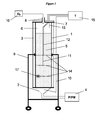
- Figure 1 describes the test silo used to conduct the experiment described in the example below. The test silo is composed of a cylindrical length of stainless steel pipe (1) and, below it, a conical air inlet region (2) for gas-purge flow. The volume of gas-purge flow through the bulk is controlled by a pressure and flow meter unit (4). The stainless steel vessel is insulated by a layer of glass wool with a thickness of 5 cm (3). The height of the silo is 120 cm. The inside diameter of the silo is 30 cm. The test silo is filled with sodium percarbonate (5), the height of the bulk being 75 cm. The part of the test silo above the stored solid contains a gaseous atmosphere and is called the headspace (6). The top of the test silo is flanged by a lid (7) fitted with an air outlet (8). The test silo is fixed in a mobile carrier (9) for transport reasons. Temperatures at different levels of the silo are monitored by means of four centered temperature probes of Type K (NiCrNi): a first one (10) in the air inlet region (2), a second one (11) reaching the first third of the bulk silo at a height of 40 cm, a third one (12) reaching the center of the bulk silo at a height of 60 cm, and a fourth one (13) in the headspace (6) of the test silo at a height of 105 cm. The temperature probes in the bulk are fixed in plastic cross stripes with drilled holes at defined positions (14). The temperature data are collected by data logger device (15). The oxygen concentration is monitored by means of an oxygen detector X-am 7000 from DRAEGER. The detector is fitted with XS R 02 LS sensor with a measuring range from 0 to 25 Vol% O2 (16) located in the headspace (6). The star mark (17) in the bulk represents any local contamination exemplarily.
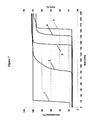
- Figure 2 shows the curves illustrating the oxygen concentration (Vol%) of the air-purge at the outlet of the silo and the local temperatures (°C) measured at four different points of the silo.
Curve 1 shows the oxygen concentration (Vol%) measured at the outlet of the test silo.Curve 2 shows temperature measurement done by the temperature probe (11), located at a height of 40 cm in the test silo.Curve 3 shows temperature measurement done by the temperature probe (12), located at a height of 60 cm in the test silo.Curve 4 shows temperature measurement done by the temperature probe (13) located in the headspace (6) of the test silo.Curve 5 shows temperature measurement done by the temperature probe (10), located in the air inlet region (2) of the test silo. - The decomposition was started at t=0.
Example (comparative and according to the invention): - The process according to the invention was tested in the experimental silo described in Figure 1, in which 54 kg of sodium percarbonate were loaded. During the experiment, a gas-purge of dry air (dew point = -70°C) was passed continuously through the bulk from the bottom to the top of the silo with a flow of 201/h. The temperature inlet of the gas was 12°C.
- A local decomposition of the sodium percarbonate was initiated by the injection, in the bottom of the column (height = 20 cm), through a small pipe, of 200 ml of a solution of 1000 ppm CuSO4 in hot water (around 95°C). The distance from this area to the closest temperature probe (11) was about 25 cm
- Some minutes after the addition of this initiator, the oxygen concentration measured in the headspace increased from 21% to above 25%, showing oxygen production related to the decomposing sodium percarbonate (Figure 2, curve 1).
- With regard to temperature measurements (Figure 2, curves 2 to 5), the first indication of decomposing sodium percarbonate was given about 90 minutes after the beginning of the decomposition, by the closest temperature probe (11) (height = 40 cm, 25 cm from the local spot, curve 2). The temperature raise was detected by the next temperature probe (12) (height = 60 cm, 42,7 cm from the local spot after more than 150 minutes (curve 3). The temperature rise in the headspace (13) after about 180 minutes (curve 4) and in the air inlet (10) after about 200 minutes (curve 5).
Claims (16)
- - Process for the monitoring of solids which release oxygen when decomposing and which are stored in a bulk container closed to the ambient atmosphere, by measuring oxygen level.
- - Process according to claim 1 in which the part of the bulk container above the stored solid contains a gaseous atmosphere, which is called the headspace, and wherein the oxygen concentration of the atmosphere in the headspace of the bulk container is measured.
- - Process according to claim 1, wherein a gas-purge is passed through the solid stored in bulk and is released to the atmosphere through an opening made in a part of the closed bulk container, called outlet of the bulk container, said opening positioned away from that where the gas-purge is introduced, thereby allowing the gas-purge to escape via a passage through the mass of the solid stored in bulk into the atmosphere and wherein the oxygen concentration of the gas-purge is measured at or near the outlet of the bulk container.
- - Process according to claim 3, wherein the gas constituting the gas-purge contains dry air.
- - Process according to claim 4, wherein the dry air has a dew point temperature in the range from -30 to +10°C, preferably from -20 to +0°C.
- - Process according to any one of claims 3 or 5, wherein the gas-purge is passed continuously or discontinuously through the solid stored in bulk.
- - Process according to any one of claims 1 to 6, wherein the solid which releases oxygen when decomposing is chosen from sodium percarbonate, sodium perborate monohydrate or tetrahydrate, calcium peroxide, magnesium peroxide, zinc peroxide, or N,N'-phthaloylaminoperoxycaproic acid and formulations containing them.
- - Process according to any one of claims 3 to 7, wherein the temperature of the gas introduced as the gas-purge is in the range from 5 to 30°C.
- - Process according to any one of claims 3 to 8, wherein the gas-purge flow is in the range from 50 to 20001/t.h, preferably from 50 to 500 l/t.h.
- - Process according to any one of claims 1 to 9, wherein the volume of the bulk container is from 1 to 800 m3, preferably from 10 to 250 m3.
- - Process according to any one of claims 1 to 10 wherein the bulk container is a vertically standing silo and the gas-purge to be passed through the bulk container is introduced in the lower region of the vertical bulk container and is led away at the top of the container.
- - Use of the process according to any one of claims 1 to 11 for the safe storage of solids which release oxygen when decomposing in a bulk container closed to the ambient atmosphere.
- - Use of the process according to claim 12, wherein the solids are stored at a storage temperature of below 40°C, preferably below 30°C.
- - Bulk container closed to the ambient atmosphere equipped with an oxygen-detector.
- - Container according to claim 14 equipped with an inlet and an outlet for a gas-purge.
- - Container according to claim 15, wherein the oxygen-detector is located in or near the gas-purge outlet.
Priority Applications (4)
| Application Number | Priority Date | Filing Date | Title |
|---|---|---|---|
| EP06117847A EP1884494A1 (en) | 2006-07-26 | 2006-07-26 | Process for the monitoring of solids which release oxygen when decomposing and bulk container |
| EP07787857A EP2059478A1 (en) | 2006-07-26 | 2007-07-24 | Process for the monitoring of solids which release oxygen when decomposing and bulk container |
| PCT/EP2007/057624 WO2008012311A1 (en) | 2006-07-26 | 2007-07-24 | Process for the monitoring of solids which release oxygen when decomposing and bulk container |
| EG2009010102A EG25144A (en) | 2006-07-26 | 2009-01-22 | Process for the monitoring of solids which releaseoxygen when decomposing and which are stored in a bulk container, use of this process for the safe storage of such solids and bulk container. |
Applications Claiming Priority (1)
| Application Number | Priority Date | Filing Date | Title |
|---|---|---|---|
| EP06117847A EP1884494A1 (en) | 2006-07-26 | 2006-07-26 | Process for the monitoring of solids which release oxygen when decomposing and bulk container |
Publications (1)
| Publication Number | Publication Date |
|---|---|
| EP1884494A1 true EP1884494A1 (en) | 2008-02-06 |
Family
ID=37561097
Family Applications (2)
| Application Number | Title | Priority Date | Filing Date |
|---|---|---|---|
| EP06117847A Ceased EP1884494A1 (en) | 2006-07-26 | 2006-07-26 | Process for the monitoring of solids which release oxygen when decomposing and bulk container |
| EP07787857A Withdrawn EP2059478A1 (en) | 2006-07-26 | 2007-07-24 | Process for the monitoring of solids which release oxygen when decomposing and bulk container |
Family Applications After (1)
| Application Number | Title | Priority Date | Filing Date |
|---|---|---|---|
| EP07787857A Withdrawn EP2059478A1 (en) | 2006-07-26 | 2007-07-24 | Process for the monitoring of solids which release oxygen when decomposing and bulk container |
Country Status (3)
| Country | Link |
|---|---|
| EP (2) | EP1884494A1 (en) |
| EG (1) | EG25144A (en) |
| WO (1) | WO2008012311A1 (en) |
Families Citing this family (1)
| Publication number | Priority date | Publication date | Assignee | Title |
|---|---|---|---|---|
| DK2504105T3 (en) | 2009-11-24 | 2021-03-15 | Opko Diagnostics Llc | FLUID MIXTURE AND RELEASE IN MICROFLUIT SYSTEMS |
Citations (6)
| Publication number | Priority date | Publication date | Assignee | Title |
|---|---|---|---|---|
| EP0396175A1 (en) * | 1989-05-03 | 1990-11-07 | INTEROX CHIMICA S.p.A. | Process for conserving sodium perborate monohydrate |
| JPH0385287A (en) * | 1989-08-25 | 1991-04-10 | Mitsubishi Kakoki Kaisha Ltd | Ca storage container |
| US6595008B2 (en) * | 2000-12-22 | 2003-07-22 | Degussa Ag | Process for the safe storage of sodium percarbonate in bulk containers |
| WO2004110180A1 (en) * | 2003-06-17 | 2004-12-23 | Ebro Electronic Gmbh & Co. Kg | Method for controlling ambient conditions during transportation and/or storage of food or museum pieces |
| WO2005032949A2 (en) * | 2003-09-23 | 2005-04-14 | Oci Chemical Corporation | Transportation subassembly for materials destabilized in presence of destabilizing contaiminants |
| US20060144811A1 (en) * | 2005-01-05 | 2006-07-06 | Lifetime Hoan Corporation | Oxygen absorbing appliance |
-
2006
- 2006-07-26 EP EP06117847A patent/EP1884494A1/en not_active Ceased
-
2007
- 2007-07-24 WO PCT/EP2007/057624 patent/WO2008012311A1/en not_active Ceased
- 2007-07-24 EP EP07787857A patent/EP2059478A1/en not_active Withdrawn
-
2009
- 2009-01-22 EG EG2009010102A patent/EG25144A/en active
Patent Citations (6)
| Publication number | Priority date | Publication date | Assignee | Title |
|---|---|---|---|---|
| EP0396175A1 (en) * | 1989-05-03 | 1990-11-07 | INTEROX CHIMICA S.p.A. | Process for conserving sodium perborate monohydrate |
| JPH0385287A (en) * | 1989-08-25 | 1991-04-10 | Mitsubishi Kakoki Kaisha Ltd | Ca storage container |
| US6595008B2 (en) * | 2000-12-22 | 2003-07-22 | Degussa Ag | Process for the safe storage of sodium percarbonate in bulk containers |
| WO2004110180A1 (en) * | 2003-06-17 | 2004-12-23 | Ebro Electronic Gmbh & Co. Kg | Method for controlling ambient conditions during transportation and/or storage of food or museum pieces |
| WO2005032949A2 (en) * | 2003-09-23 | 2005-04-14 | Oci Chemical Corporation | Transportation subassembly for materials destabilized in presence of destabilizing contaiminants |
| US20060144811A1 (en) * | 2005-01-05 | 2006-07-06 | Lifetime Hoan Corporation | Oxygen absorbing appliance |
Also Published As
| Publication number | Publication date |
|---|---|
| EP2059478A1 (en) | 2009-05-20 |
| EG25144A (en) | 2011-09-25 |
| WO2008012311A1 (en) | 2008-01-31 |
Similar Documents
| Publication | Publication Date | Title |
|---|---|---|
| Botcharnikov et al. | The effect of water activity on the oxidation and structural state of Fe in a ferro-basaltic melt | |
| Li et al. | Study on thermal decomposition characteristics of AIBN | |
| CA2893797C (en) | System for measuring level of dry bulk material in container | |
| US6964191B1 (en) | Apparatus and technique for measuring permeability and permeant sorption | |
| HUE025854T2 (en) | Storage of breathable fruit | |
| Malow et al. | Thermal decomposition of AIBN Part A: Decomposition in real scale packages and SADT determination | |
| EP2059478A1 (en) | Process for the monitoring of solids which release oxygen when decomposing and bulk container | |
| US11506582B2 (en) | Sensor system | |
| GB2164446A (en) | Indicating level of powdered material | |
| JP5045102B2 (en) | Method for producing sodium hydrogencarbonate crystal particles having low caking properties | |
| US20080020493A1 (en) | Apparatus for supplying chemical, semiconductor manufacturing apparatus having the same, and method for supplying chemical | |
| AU2002230300A1 (en) | Method and device for determining penetration of gaseous substances through a membrane | |
| US4327574A (en) | Non-destructive dissolved gas volume testing method | |
| EP0886128A1 (en) | Hydrometer for a liquid cryogen | |
| US5152961A (en) | Method of storing perborate monohydrate | |
| US6595008B2 (en) | Process for the safe storage of sodium percarbonate in bulk containers | |
| CN205925334U (en) | Level detection device of flue gas desulfurization regenerator column | |
| CN214622442U (en) | System for measuring trace moisture content in sample difficult to gasify | |
| JP4840139B2 (en) | Sodium bicarbonate crystal particles having low caking properties and method for producing the same | |
| KR100540186B1 (en) | Measuring method and device for pressure changed in plastic-bottle | |
| Barnes et al. | Application of the Warburg constant volume respirometer method for determination of oxygen consumption rates of mining waste | |
| US2766838A (en) | Monitoring gas-liquid systems | |
| US4073861A (en) | Method of using drying oils as oxygen scavenger | |
| RU2722135C1 (en) | Control system of multicomponent oxygen-containing gas medium in sealed container and method of system activation | |
| IE51722B1 (en) | Method for detecting solidification in a mixed phase container |
Legal Events
| Date | Code | Title | Description |
|---|---|---|---|
| PUAI | Public reference made under article 153(3) epc to a published international application that has entered the european phase |
Free format text: ORIGINAL CODE: 0009012 |
|
| AK | Designated contracting states |
Kind code of ref document: A1 Designated state(s): AT BE BG CH CY CZ DE DK EE ES FI FR GB GR HU IE IS IT LI LT LU LV MC NL PL PT RO SE SI SK TR |
|
| AX | Request for extension of the european patent |
Extension state: AL BA HR MK YU |
|
| STAA | Information on the status of an ep patent application or granted ep patent |
Free format text: STATUS: THE APPLICATION HAS BEEN REFUSED |
|
| 18R | Application refused |
Effective date: 20080411 |