EP1884334A1 - Woven recycled product - Google Patents
Woven recycled product Download PDFInfo
- Publication number
- EP1884334A1 EP1884334A1 EP20070014509 EP07014509A EP1884334A1 EP 1884334 A1 EP1884334 A1 EP 1884334A1 EP 20070014509 EP20070014509 EP 20070014509 EP 07014509 A EP07014509 A EP 07014509A EP 1884334 A1 EP1884334 A1 EP 1884334A1
- Authority
- EP
- European Patent Office
- Prior art keywords
- product
- sheet
- polylaminate
- strips
- scrap
- Prior art date
- Legal status (The legal status is an assumption and is not a legal conclusion. Google has not performed a legal analysis and makes no representation as to the accuracy of the status listed.)
- Withdrawn
Links
- 239000000463 material Substances 0.000 claims abstract description 30
- 238000004519 manufacturing process Methods 0.000 claims abstract description 17
- 238000000034 method Methods 0.000 claims abstract description 13
- -1 polypropylene Polymers 0.000 claims description 26
- 239000004698 Polyethylene Substances 0.000 claims description 13
- 239000004743 Polypropylene Substances 0.000 claims description 13
- 229920000573 polyethylene Polymers 0.000 claims description 13
- 229920001155 polypropylene Polymers 0.000 claims description 13
- 229910052782 aluminium Inorganic materials 0.000 claims description 10
- XAGFODPZIPBFFR-UHFFFAOYSA-N aluminium Chemical compound [Al] XAGFODPZIPBFFR-UHFFFAOYSA-N 0.000 claims description 10
- 239000007769 metal material Substances 0.000 claims description 10
- 238000005520 cutting process Methods 0.000 claims description 8
- 239000002861 polymer material Substances 0.000 claims description 8
- 238000009941 weaving Methods 0.000 claims description 8
- 239000000123 paper Substances 0.000 claims description 3
- 238000004026 adhesive bonding Methods 0.000 claims 1
- 239000000047 product Substances 0.000 description 27
- 230000000694 effects Effects 0.000 description 2
- 235000013305 food Nutrition 0.000 description 2
- 239000004417 polycarbonate Substances 0.000 description 2
- 229920000515 polycarbonate Polymers 0.000 description 2
- 238000011084 recovery Methods 0.000 description 2
- 238000004064 recycling Methods 0.000 description 2
- 239000004677 Nylon Substances 0.000 description 1
- 235000010627 Phaseolus vulgaris Nutrition 0.000 description 1
- 244000046052 Phaseolus vulgaris Species 0.000 description 1
- 238000009954 braiding Methods 0.000 description 1
- 239000006227 byproduct Substances 0.000 description 1
- 239000011111 cardboard Substances 0.000 description 1
- 239000002131 composite material Substances 0.000 description 1
- 230000008878 coupling Effects 0.000 description 1
- 238000010168 coupling process Methods 0.000 description 1
- 238000005859 coupling reaction Methods 0.000 description 1
- 238000005516 engineering process Methods 0.000 description 1
- 230000007613 environmental effect Effects 0.000 description 1
- 239000004744 fabric Substances 0.000 description 1
- 235000015203 fruit juice Nutrition 0.000 description 1
- 235000013336 milk Nutrition 0.000 description 1
- 239000008267 milk Substances 0.000 description 1
- 210000004080 milk Anatomy 0.000 description 1
- 238000000465 moulding Methods 0.000 description 1
- 229920001778 nylon Polymers 0.000 description 1
- 238000004806 packaging method and process Methods 0.000 description 1
- 230000002093 peripheral effect Effects 0.000 description 1
- 238000000197 pyrolysis Methods 0.000 description 1
- 239000004753 textile Substances 0.000 description 1
- 239000002699 waste material Substances 0.000 description 1
- 235000014101 wine Nutrition 0.000 description 1
Images

Classifications
-
- B—PERFORMING OPERATIONS; TRANSPORTING
- B29—WORKING OF PLASTICS; WORKING OF SUBSTANCES IN A PLASTIC STATE IN GENERAL
- B29B—PREPARATION OR PRETREATMENT OF THE MATERIAL TO BE SHAPED; MAKING GRANULES OR PREFORMS; RECOVERY OF PLASTICS OR OTHER CONSTITUENTS OF WASTE MATERIAL CONTAINING PLASTICS
- B29B17/00—Recovery of plastics or other constituents of waste material containing plastics
- B29B17/0026—Recovery of plastics or other constituents of waste material containing plastics by agglomeration or compacting
- B29B17/0036—Recovery of plastics or other constituents of waste material containing plastics by agglomeration or compacting of large particles, e.g. beads, granules, pellets, flakes, slices
-
- B—PERFORMING OPERATIONS; TRANSPORTING
- B29—WORKING OF PLASTICS; WORKING OF SUBSTANCES IN A PLASTIC STATE IN GENERAL
- B29B—PREPARATION OR PRETREATMENT OF THE MATERIAL TO BE SHAPED; MAKING GRANULES OR PREFORMS; RECOVERY OF PLASTICS OR OTHER CONSTITUENTS OF WASTE MATERIAL CONTAINING PLASTICS
- B29B17/00—Recovery of plastics or other constituents of waste material containing plastics
- B29B17/0026—Recovery of plastics or other constituents of waste material containing plastics by agglomeration or compacting
- B29B17/0042—Recovery of plastics or other constituents of waste material containing plastics by agglomeration or compacting for shaping parts, e.g. multilayered parts with at least one layer containing regenerated plastic
-
- B—PERFORMING OPERATIONS; TRANSPORTING
- B29—WORKING OF PLASTICS; WORKING OF SUBSTANCES IN A PLASTIC STATE IN GENERAL
- B29B—PREPARATION OR PRETREATMENT OF THE MATERIAL TO BE SHAPED; MAKING GRANULES OR PREFORMS; RECOVERY OF PLASTICS OR OTHER CONSTITUENTS OF WASTE MATERIAL CONTAINING PLASTICS
- B29B17/00—Recovery of plastics or other constituents of waste material containing plastics
- B29B17/04—Disintegrating plastics, e.g. by milling
- B29B17/0412—Disintegrating plastics, e.g. by milling to large particles, e.g. beads, granules, flakes, slices
-
- D—TEXTILES; PAPER
- D03—WEAVING
- D03D—WOVEN FABRICS; METHODS OF WEAVING; LOOMS
- D03D15/00—Woven fabrics characterised by the material, structure or properties of the fibres, filaments, yarns, threads or other warp or weft elements used
- D03D15/40—Woven fabrics characterised by the material, structure or properties of the fibres, filaments, yarns, threads or other warp or weft elements used characterised by the structure of the yarns or threads
- D03D15/44—Woven fabrics characterised by the material, structure or properties of the fibres, filaments, yarns, threads or other warp or weft elements used characterised by the structure of the yarns or threads with specific cross-section or surface shape
- D03D15/46—Flat yarns, e.g. tapes or films
-
- D—TEXTILES; PAPER
- D10—INDEXING SCHEME ASSOCIATED WITH SUBLASSES OF SECTION D, RELATING TO TEXTILES
- D10B—INDEXING SCHEME ASSOCIATED WITH SUBLASSES OF SECTION D, RELATING TO TEXTILES
- D10B2101/00—Inorganic fibres
- D10B2101/20—Metallic fibres
-
- Y—GENERAL TAGGING OF NEW TECHNOLOGICAL DEVELOPMENTS; GENERAL TAGGING OF CROSS-SECTIONAL TECHNOLOGIES SPANNING OVER SEVERAL SECTIONS OF THE IPC; TECHNICAL SUBJECTS COVERED BY FORMER USPC CROSS-REFERENCE ART COLLECTIONS [XRACs] AND DIGESTS
- Y02—TECHNOLOGIES OR APPLICATIONS FOR MITIGATION OR ADAPTATION AGAINST CLIMATE CHANGE
- Y02W—CLIMATE CHANGE MITIGATION TECHNOLOGIES RELATED TO WASTEWATER TREATMENT OR WASTE MANAGEMENT
- Y02W30/00—Technologies for solid waste management
- Y02W30/50—Reuse, recycling or recovery technologies
- Y02W30/62—Plastics recycling; Rubber recycling
Definitions
- the present invention relates to a product made from reused production scrap and a process for making such product, according to the preambles of claims 1 and 13 respectively.
- the present invention relates to a product made by reusing from the scrap arising from the production of polylaminate materials for packaging.
- polylaminate as used herein, is meant to indicate a composite or multilayer flexible film, i.e. a film composed of two or more sheets of different materials joined together.
- these sheets may be formed of materials such as polyethylene, polypropylene, cardboard, aluminum, nylon, etc.
- These polylaminate materials are usually employed for manufacturing containers or recipients for food, such as coffee grounds and/or beans, milk, fruit juices, wine, etc.
- the polylaminate material to be used for forming such recipients or containers it is typically unwound from a roll and is subjected to several processing operations, such as molding, coupling and cutting to the final shape.
- the scrap is produced in the form of strips of various lengths, as obtained from the cutting of the peripheral portions of the polylaminate material unwound from the roll, which usually occurs longitudinally with respect to the polylaminate unwinding direction.
- the object of the present invention is to reuse these polylaminate films that form the manufacturing scrap, which constitute an environmental, ecological and economical burden.
- a further object of the present invention is to increase the scrap recycling yield to reduce the overall costs of polycarbonate container manufacturing processes.
- a product may be obtained which exhibits certain characteristics of the scrap material, and can feature certain properties directly deriving from the specific polylaminate material that is used in the container manufacturing process.
- numeral 1 generally designates a product having a weft 2 and a warp 3.
- the weft 2 and/or the warp 3 are strips 4 of polylaminate material.
- the strips 4 of polylaminate material have predetermined length "L", width "l” and thickness "S".
- both the length "L” and the thickness “S” of the strip 4 are a function of the size and thickness of the roll (not shown in the figures) from which the polylaminate is unwound.
- the width "P' may be caused to change from one product to another depending on the desired surface effect, a reasonable value being greater than at least 1 mm.
- weft 2 and/or the warp 3 may have different lengths "L' depending on the desired type of weave.
- the polylaminate material generally has a structure comprising two (see Figure 3) or more (see Figure 4) different sheets in joined relationship, as is well known in the art.
- the structure of the polylaminate material may be composed of a first sheet 5 of metal material and a second sheet 6 of polymer material.
- such first sheet 5 of metal material is made of aluminum and such second sheet 6 of polymer material is made of polypropylene.
- Such second sheet 6 of polymer material may be made of polyethylene.
- FIG 4 shows another possible polylaminate structure for use in the product 1 of the present invention
- the first sheet 5 of metal material is both internally and externally covered with the second sheet 6 of polymer material.
- a structure may be provided in which the first sheet 5 of metal material, preferably aluminum, is internally covered with a polyethylene sheet and externally covered with a polypropylene sheet.
- the first sheet 5 of metal material preferably aluminum
- the first sheet 5 of metal material may be internally covered with a polypropylene sheet and externally covered with a polyethylene sheet.
- a polylaminate material that can be used to make the product 1 can embody other structures having at least two sheets 5, 6 joined together and formed of specific materials, such as:
- the present invention relates to the product 1, in which the weft 2 and/or the warp 3 are strips 4 of polylaminate material as described above.
- the above product 1 is formed using a production method that comprises the following processing steps:
- the polylaminate material that forms the scrap has to be subjected first to a cutting process for forming thin strips 4 and then to a weaving process.
- scrap of suitable size is braided to form the product 1, with the scrap itself forming the weft 2, the warp 3 or both.
- the polylaminate scrap may find novel application in common weaving techniques that are used to form lattices and fabrics.
- the scrap may be woven with anyone of the following patterns:
- the polycarbonate scrap when processed by the above cutting and weaving operations, may find application in any weaving operation in textile industry.
- the product 1 obtained by the inventive method is a product that has a unique surface appearance, which depends on the type of polylaminate scrap and on the type of weave being used.
- a product may be obtained whose surface recalls the print of the original polylaminate.
- the product 1 obtained through the inventive method as described above is a highly versatile product.
- Such product 1 may be used in the manufacture of items such as bags, envelopes, pouches, mats, fashion accessories and products, indoor and outdoor furniture and similar items.
Landscapes
- Engineering & Computer Science (AREA)
- Environmental & Geological Engineering (AREA)
- Mechanical Engineering (AREA)
- Textile Engineering (AREA)
- Woven Fabrics (AREA)
- Separation, Recovery Or Treatment Of Waste Materials Containing Plastics (AREA)
- Saccharide Compounds (AREA)
- Organic Low-Molecular-Weight Compounds And Preparation Thereof (AREA)
- Polysaccharides And Polysaccharide Derivatives (AREA)
Abstract
The present invention relates to a product (1) and a method for making such product (1), The product (1) has a weft (2) and a warp (3) and is characterized in that the weft (2) and/or the warp (3) are formed of strips (4) of polylarrtinate material said strips (4) of polylaminate material being obtained from production scrap.
Description
- The present invention relates to a product made from reused production scrap and a process for making such product, according to the preambles of
claims 1 and 13 respectively. - More particularly, the present invention relates to a product made by reusing from the scrap arising from the production of polylaminate materials for packaging.
- The term polylaminate, as used herein, is meant to indicate a composite or multilayer flexible film, i.e. a film composed of two or more sheets of different materials joined together.
- For example, these sheets may be formed of materials such as polyethylene, polypropylene, cardboard, aluminum, nylon, etc.
- These polylaminate materials are usually employed for manufacturing containers or recipients for food, such as coffee grounds and/or beans, milk, fruit juices, wine, etc.
- Particularly, for the polylaminate material to be used for forming such recipients or containers, it is typically unwound from a roll and is subjected to several processing operations, such as molding, coupling and cutting to the final shape.
- During such processing steps, some amount of scrap or waste is produced.
- This scrap arises during polylaminate cutting operations.
- The scrap is produced in the form of strips of various lengths, as obtained from the cutting of the peripheral portions of the polylaminate material unwound from the roll, which usually occurs longitudinally with respect to the polylaminate unwinding direction.
- As a byproduct of the container manufacturing process, the scrap is thus rejected and stored for the landfill, which involves obvious and imaginable drawbacks in terms of both environment protection and costs.
- It shall be noted that, due to the structure of polylaminate material, the scrap cannot be recycled, as the various materials that form the film cannot be separated unless a special technology or a pyrolysis process is used, which increases the overall costs for the recycling procedure.
- In view of the prior art as described above, the object of the present invention is to reuse these polylaminate films that form the manufacturing scrap, which constitute an environmental, ecological and economical burden.
- A further object of the present invention is to increase the scrap recycling yield to reduce the overall costs of polycarbonate container manufacturing processes.
- According to the present invention, these objects are fulfilled by a product as defined in
claim 1. - Still according to the present invention, these objects are also fulfilled by a method for making such product as defined in claim 13.
- Thanks to the present invention, a product may be obtained which exhibits certain characteristics of the scrap material, and can feature certain properties directly deriving from the specific polylaminate material that is used in the container manufacturing process.
- The features and advantages of the invention will appear from the following detailed description of one practical embodiment, which is illustrated without limitation in the annexed drawings, in which:
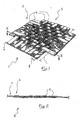
- Figure 1 shows a product having a weft and a warp according to the present invention;
- Figure 2 is a sectional view as taken along line II-II of the product of Figure 1;
- Figure 3 shows a possible polylaminate structure adapted to form the product of Figure 1;
- Figure 4 shows another possible polylaminate structure adapted to form the product of Figure 1.
- Referring to the annexed figures,
numeral 1 generally designates a product having aweft 2 and a warp 3. - Advantageously, the
weft 2 and/or the warp 3 are strips 4 of polylaminate material. - Particularly, the
strips 4 of polylaminate material have predetermined length "L", width "l" and thickness "S". - It shall be noted that both the length "L" and the thickness "S" of the
strip 4 are a function of the size and thickness of the roll (not shown in the figures) from which the polylaminate is unwound. - The width "P' may be caused to change from one product to another depending on the desired surface effect, a reasonable value being greater than at least 1 mm.
- It shall be further noted that the
weft 2 and/or the warp 3 may have different lengths "L' depending on the desired type of weave. - The polylaminate material generally has a structure comprising two (see Figure 3) or more (see Figure 4) different sheets in joined relationship, as is well known in the art.
- For instance, particularly referring to Figure 3, it can be noticed that the structure of the polylaminate material may be composed of a first sheet 5 of metal material and a second sheet 6 of polymer material.
- Advantageously, such first sheet 5 of metal material is made of aluminum and such second sheet 6 of polymer material is made of polypropylene.
- Otherwise, such second sheet 6 of polymer material may be made of polyethylene.
- Referring now to Figure 4, which shows another possible polylaminate structure for use in the
product 1 of the present invention, it can be noted that the first sheet 5 of metal material is both internally and externally covered with the second sheet 6 of polymer material. - Particularly, in the preferred embodiment, a structure may be provided in which the first sheet 5 of metal material, preferably aluminum, is internally covered with a polyethylene sheet and externally covered with a polypropylene sheet.
- Alternatively, the first sheet 5 of metal material, preferably aluminum, may be internally covered with a polypropylene sheet and externally covered with a polyethylene sheet.
- It shall be noted that a polylaminate material that can be used to make the
product 1 can embody other structures having at least two sheets 5, 6 joined together and formed of specific materials, such as: - Arnite/Omnialite + Aluminum + Polyethylene;
- Polypropylene + Aluminum + Polypropylene;
- Polypropylene + Polypropylene;
- Paper + Aluminum + Polyethylene;
- Polypropylene + Paper + Aluminum + Polyethylene;
- Arnite/Omnialite + Arnite/Omnialite + Polyethylene;
- Arnite/Omnialite + Polyethylene.
- Therefore, the present invention relates to the
product 1, in which theweft 2 and/or the warp 3 arestrips 4 of polylaminate material as described above. - These strips of polylaminate material are obtained from the processing scrap that arises from the production of food containers (not shown).
- Advantageously, the
above product 1 is formed using a production method that comprises the following processing steps: - Recovering the polylaminate scrap from the container production process;
- Cutting such scrap into
strips 4, saidstrips 4 having predetermined width "I", length "L" and thickness "S"; - Weaving said
strips 4 to obtain saidproduct 1. - In other words, the polylaminate material that forms the scrap has to be subjected first to a cutting process for forming
thin strips 4 and then to a weaving process. - It shall be noted that, by this weaving process, scrap of suitable size is braided to form the
product 1, with the scrap itself forming theweft 2, the warp 3 or both. - Thus, the polylaminate scrap may find novel application in common weaving techniques that are used to form lattices and fabrics.
- For example, the scrap may be woven with anyone of the following patterns:
- Plain weave, i.e. the simpler pattern, in which the weft and the warp are at right angles to each other;
- Twill, i.e. the most complex pattern, characterized by diagonal ribs;
- Satin weave, i.e. the weave in which the braiding points are aligned in the diagonal direction.
- In other words, the polycarbonate scrap, when processed by the above cutting and weaving operations, may find application in any weaving operation in textile industry.
- Therefore, the
product 1 obtained by the inventive method is a product that has a unique surface appearance, which depends on the type of polylaminate scrap and on the type of weave being used. - While the present invention is advantageously used for recovery of polylaminate production scrap, a graphically designed weave will allow control and selection of the surface effect to be imparted to the novel product.
- The recovery of scrap from the production of polylaminate material having a printed surface, will provide a product in which the original print is still recognizable.
- In other words, a product may be obtained whose surface recalls the print of the original polylaminate.
- It shall be further noticed that the
product 1 obtained through the inventive method as described above is a highly versatile product. -
Such product 1 may be used in the manufacture of items such as bags, envelopes, pouches, mats, fashion accessories and products, indoor and outdoor furniture and similar items. - Those skilled in the art will obviously appreciate that a number of changes and variants may be made to the arrangements as described hereinbefore to meet specific needs, without departure from the scope of the invention, as defined in the following claims.
Claims (15)
- A product (1) having a weft (2) and a warp (3), characterized in that said weft (2) and/or said warp (3) are formed of strips (4) of polylaminate material.
- A product as claimed in claim 1, characterized in that said strips (4) of polylaminate material have predetermined length (L), width (1) and thickness (S).
- A product as claimed in claim 1 or 2, characterized in that said polylaminate material comprises at least two sheets (5, 6) of different materials.
- A product as claimed in claim 3, characterized in that one sheet (5) of material of said at least two sheets (5, 6) is a sheet of metal material and the other sheet (6) of material of said at least two sheets (5, 6) is a sheet of polymer material.
- A product as claimed in claim 4, characterized in that said sheet of metal material (5) is both internally and externally covered with said sheet of polymer material (6).
- A product as claimed in claims 4 to 5, characterized in that the sheet of metal material (5) is made of aluminum.
- A product as claimed in claims 4 to 6, characterized in that said sheet of polymer material (6) is made of polypropylene.
- A product as claimed in claims 4 to 6, characterized in that said sheet of polymer material (6) is made of polyethylene.
- A product as claimed in claim 4, characterized in that the sheet of metal material (5) is internally covered with a sheet of polyethylene and is externally covered with a sheet of polypropylene.
- A product as claimed in claims 4 to 8, characterized in that the sheet of metal material (5) is internally covered with a sheet of polypropylene and is externally covered with a sheet of polyethylene.
- A product as claimed in claims 3 to 10, characterized in that said materials that form said at least two sheets (5, 6) are selected among arnite/omnialite, aluminum, polyethylene, polypropylene and paper.
- A product as claimed in claims 1 to 11, characterized in that said strips (4) of polylaminate material are obtained from production scrap.
- A method for making a product (1), said product (1) being as claimed in claims 1 to 12, said method comprising the steps of:- recovering the polylaminate production scrap;- cutting said production scrap into strips (4), said strips (4) having predetermined length (L), width (1) and thickness (S);- weaving said strips (4) to obtain said product (1).
- A method as claimed in claim 13 wherein, after said step of weaving said strips (4), a further cutting, gluing and/or bonding step is provided, depending on the type of application and use for which said product (1) is designed.
- An item obtained from a product as claimed in claims 1 to 12, said item having a weft (2) and/or a warp (3), said item being selected among bags, envelopes, pouches, mats, fashion accessories and products, indoor and outdoor furniture and similar items.
Applications Claiming Priority (1)
| Application Number | Priority Date | Filing Date | Title |
|---|---|---|---|
| IT001515A ITMI20061515A1 (en) | 2006-07-31 | 2006-07-31 | PRODUCT MADE FROM THE REUSE OF PRODUCTION SFRIDES |
Publications (1)
| Publication Number | Publication Date |
|---|---|
| EP1884334A1 true EP1884334A1 (en) | 2008-02-06 |
Family
ID=38743515
Family Applications (1)
| Application Number | Title | Priority Date | Filing Date |
|---|---|---|---|
| EP20070014509 Withdrawn EP1884334A1 (en) | 2006-07-31 | 2007-07-24 | Woven recycled product |
Country Status (2)
| Country | Link |
|---|---|
| EP (1) | EP1884334A1 (en) |
| IT (1) | ITMI20061515A1 (en) |
Cited By (1)
| Publication number | Priority date | Publication date | Assignee | Title |
|---|---|---|---|---|
| CN103806183A (en) * | 2014-01-29 | 2014-05-21 | 安徽工程大学 | Method for weaving fabric by using knitted leftover material |
Citations (7)
| Publication number | Priority date | Publication date | Assignee | Title |
|---|---|---|---|---|
| DE3630969A1 (en) * | 1986-09-11 | 1988-03-24 | Smoltczyk Hans Ulrich Prof Dr | Method of stabilising earth masses at risk of slipping |
| US5364206A (en) * | 1993-09-29 | 1994-11-15 | Marienfeld Mark L | Soil stabilization system |
| DE4333806C1 (en) * | 1993-10-04 | 1995-06-08 | Antje Stanke | Recycling coated recording tape or film |
| GB2333995A (en) * | 1998-02-06 | 1999-08-11 | Athlone Extrusions Dev Ltd | Applying protective plastics film to plastics panel sheet |
| WO2002026480A1 (en) * | 2000-09-26 | 2002-04-04 | Marathon Belting Limited | Press pad |
| JP2003201640A (en) * | 2001-12-27 | 2003-07-18 | Hagihara Industries Inc | Mesh sheet for construction work |
| GB2423092A (en) * | 2005-02-10 | 2006-08-16 | Thomas Peter Macguinness | Woven fabric with stiff weft and warp fibres |
-
2006
- 2006-07-31 IT IT001515A patent/ITMI20061515A1/en unknown
-
2007
- 2007-07-24 EP EP20070014509 patent/EP1884334A1/en not_active Withdrawn
Patent Citations (7)
| Publication number | Priority date | Publication date | Assignee | Title |
|---|---|---|---|---|
| DE3630969A1 (en) * | 1986-09-11 | 1988-03-24 | Smoltczyk Hans Ulrich Prof Dr | Method of stabilising earth masses at risk of slipping |
| US5364206A (en) * | 1993-09-29 | 1994-11-15 | Marienfeld Mark L | Soil stabilization system |
| DE4333806C1 (en) * | 1993-10-04 | 1995-06-08 | Antje Stanke | Recycling coated recording tape or film |
| GB2333995A (en) * | 1998-02-06 | 1999-08-11 | Athlone Extrusions Dev Ltd | Applying protective plastics film to plastics panel sheet |
| WO2002026480A1 (en) * | 2000-09-26 | 2002-04-04 | Marathon Belting Limited | Press pad |
| JP2003201640A (en) * | 2001-12-27 | 2003-07-18 | Hagihara Industries Inc | Mesh sheet for construction work |
| GB2423092A (en) * | 2005-02-10 | 2006-08-16 | Thomas Peter Macguinness | Woven fabric with stiff weft and warp fibres |
Cited By (1)
| Publication number | Priority date | Publication date | Assignee | Title |
|---|---|---|---|---|
| CN103806183A (en) * | 2014-01-29 | 2014-05-21 | 安徽工程大学 | Method for weaving fabric by using knitted leftover material |
Also Published As
| Publication number | Publication date |
|---|---|
| ITMI20061515A1 (en) | 2008-02-01 |
Similar Documents
| Publication | Publication Date | Title |
|---|---|---|
| US4064302A (en) | Composite flexible, semi-rigid materials and process for making same | |
| US7157126B2 (en) | Tear resistant bag for consumables | |
| US6890612B2 (en) | Article and method of making | |
| US20110019938A1 (en) | Paper shopper or bag and system for the production thereof | |
| GB2488509A (en) | Paper or card bubblewrap. | |
| EP3489163B1 (en) | Water-degradable bag | |
| ZA200304821B (en) | Article and method of making. | |
| CA2775579A1 (en) | Open mesh material and bags made therefrom | |
| US2437184A (en) | Labeled fabric bag and the like | |
| ITMI20010121A1 (en) | APPARATUS AND PROCEDURE FOR THE REALIZATION OF METAL-MULTILAYER PRODUCTS | |
| KR102243619B1 (en) | Recyclable air cap bag and apparatus for manufacturing the same | |
| EP3067290A1 (en) | Jute sack including airing way | |
| CA2135378A1 (en) | Textile bag, textile web for bags and process for producing a textile web | |
| EP3759270B1 (en) | Method of manufacturing of a woven textile | |
| ITMI20061515A1 (en) | PRODUCT MADE FROM THE REUSE OF PRODUCTION SFRIDES | |
| JP6433869B2 (en) | Polyolefin fiber reinforced resin laminated sheet and method for producing the same | |
| JP2748939B2 (en) | Composite container body | |
| EP4673310A1 (en) | Method for producing a packaging article and a packaging article | |
| EP1953279A2 (en) | Reinforcing frame for fittings | |
| KR100681374B1 (en) | Corrugated cardboard for packaging using cloth and its manufacturing method | |
| JP2025008080A (en) | Manufacturing method of laminated reinforcement material, laminated reinforcement material, and box, tube, plate, or edge protector using said laminated reinforcement material | |
| KR102022981B1 (en) | A Pad Packing using Poly Prophelene and thereof Manufacturing Method | |
| JP2016060201A (en) | Polyolefin-based fiber-reinforced resin laminate sheet and method for producing the same | |
| EP4232373B1 (en) | Sack for mailing or dunnage and method for producing the same | |
| WO1994002365A1 (en) | Container and method for manufacturing the same |
Legal Events
| Date | Code | Title | Description |
|---|---|---|---|
| PUAI | Public reference made under article 153(3) epc to a published international application that has entered the european phase |
Free format text: ORIGINAL CODE: 0009012 |
|
| AK | Designated contracting states |
Kind code of ref document: A1 Designated state(s): AT BE BG CH CY CZ DE DK EE ES FI FR GB GR HU IE IS IT LI LT LU LV MC MT NL PL PT RO SE SI SK TR |
|
| AX | Request for extension of the european patent |
Extension state: AL BA HR MK YU |
|
| AKX | Designation fees paid | ||
| REG | Reference to a national code |
Ref country code: DE Ref legal event code: 8566 |
|
| STAA | Information on the status of an ep patent application or granted ep patent |
Free format text: STATUS: THE APPLICATION IS DEEMED TO BE WITHDRAWN |
|
| 18D | Application deemed to be withdrawn |
Effective date: 20080807 |