EP1883639B1 - Preparation of famciclovir and other purine derivatives - Google Patents
Preparation of famciclovir and other purine derivatives Download PDFInfo
- Publication number
- EP1883639B1 EP1883639B1 EP06743955A EP06743955A EP1883639B1 EP 1883639 B1 EP1883639 B1 EP 1883639B1 EP 06743955 A EP06743955 A EP 06743955A EP 06743955 A EP06743955 A EP 06743955A EP 1883639 B1 EP1883639 B1 EP 1883639B1
- Authority
- EP
- European Patent Office
- Prior art keywords
- compound
- formula
- alkyl
- amino
- preparation
- Prior art date
- Legal status (The legal status is an assumption and is not a legal conclusion. Google has not performed a legal analysis and makes no representation as to the accuracy of the status listed.)
- Expired - Lifetime
Links
- 0 **[n]1c2nc(*)nc(*)c2nc1 Chemical compound **[n]1c2nc(*)nc(*)c2nc1 0.000 description 3
Classifications
-
- C—CHEMISTRY; METALLURGY
- C07—ORGANIC CHEMISTRY
- C07D—HETEROCYCLIC COMPOUNDS
- C07D473/00—Heterocyclic compounds containing purine ring systems
- C07D473/26—Heterocyclic compounds containing purine ring systems with an oxygen, sulphur, or nitrogen atom directly attached in position 2 or 6, but not in both
- C07D473/32—Nitrogen atom
-
- A—HUMAN NECESSITIES
- A61—MEDICAL OR VETERINARY SCIENCE; HYGIENE
- A61P—SPECIFIC THERAPEUTIC ACTIVITY OF CHEMICAL COMPOUNDS OR MEDICINAL PREPARATIONS
- A61P31/00—Antiinfectives, i.e. antibiotics, antiseptics, chemotherapeutics
- A61P31/12—Antivirals
-
- A—HUMAN NECESSITIES
- A61—MEDICAL OR VETERINARY SCIENCE; HYGIENE
- A61P—SPECIFIC THERAPEUTIC ACTIVITY OF CHEMICAL COMPOUNDS OR MEDICINAL PREPARATIONS
- A61P31/00—Antiinfectives, i.e. antibiotics, antiseptics, chemotherapeutics
- A61P31/12—Antivirals
- A61P31/20—Antivirals for DNA viruses
- A61P31/22—Antivirals for DNA viruses for herpes viruses
Definitions
- the present invention relates to the preparation of various 9-substituted purine derivatives, including famciclovir.
- Famciclovir (9-[4-acetoxy-3-(acetoxymethyl) but-1-yl]-2-aminopurin) is one of a number of compounds known to have useful antiviral activity and described, for example, in EP 141,927 . Famciclovir has antiviral activity relevant for treatment of a number of viral infections, including herpes simplex, varicella-zoster and hepatitis.
- the starting material 2-amino-6-chloro-purine (compound 1)
- compound 1 is commercially available at a reasonable price.
- a common problem associated with this process is lack of regioselectivity as the undesired 7-position isomer is generated simultaneously, reducing yield and requiring a separation step to remove this unwanted (inactive) isomer.
- An object of the present invention is to provide an alternative process for preparation of purine derivatives such as famciclovir.
- An object of specific embodiments of the invention is to provide a process for preparation of these purine derivatives with improved efficiency, for example with a reduced number of steps and/or improved yield of the desired end product.
- a method for preparation of a purine derivative of formula I comprising reacting a compound of formula VI with X-R 3 -X to form a compound of formula V wherein R 1 is selected from the group consisting of amino, hydroxyl and C 1-6 alkyl (optionally substituted), R 2 is halo, R 3 is C 1-6 alkyl (optionally substituted) and each X is independently a leaving group. All substituents are optionally protected.
- a desired purine derivative of formula I is obtained in a method comprising hydrogenating an intermediate diol of formula III in an alcoholic solvent, so as to yield a compound of formula II.
- the method of the invention employs both the steps detailed above, namely (a) reacting a compound of formula VI with X-R 3 -X to form a compound of formula V and (b) hydrogenating an intermediate compound of formula III so as to form a compound of formula II.
- a preferred embodiment of the invention provides a five step process for manufacture of a compound of formula I from a starting material of formula VI. Initial formation of compound V and an intermediate hydrogenation step are as described above. Other steps are as follows.
- a compound of formula V can be converted to a compound of formula IV by reaction of compound V with CH 2 (COOR 4 ) 2 typically under basic conditions, wherein each R 4 is independently a group such that subsequent hydrogenation yields a diol.
- R 4 can be C 1-6 alkyl (optionally substituted by halo, amino, hydroxyl 1 and/or C 1-6 alkyl), preferably C 1-3 alkyl. Generally, both R 4 groups are the same.
- the compound of formula IV can be then subjected to a reduction reaction using a reducing agent to yield a diol compound of formula III.
- the compound of formula II can be converted into the end product of formula I by reaction with (R 5 ) 2 O, wherein each R 5 is independently selected from C 1-6 alkyl carbonyl, preferably C 1-3 alkylcarbonyl. Generally, both R 5 groups are the same.
- R 1 is amino
- R 2 is chloro
- R 3 is ethyl
- R 5 is acetyl
- the process more generally may be employed to obtain other purine derivatives with different side chains located at the 9-position of the purine.
- the R 5 group, acetyl of famciclovir can be replaced by any alkylcarbonyl group, especially C 1-6 alkyl carbonyl, preferably C 1-3 alkyl carbonyl, optionally substituted by, for example, halo, hydroxyl and/or C 1-6 alkyl.
- the 2-substituted butyl of famciclovir can be replaced by another alkyl chain (see further discussion below) such as C 1-6 alkyl, preferably C 1-4 alkyl, optionally substituted by, for example, halo, amino, hydroxyl and/or C 1-6 alkyl.
- Halo or halogen refers throughout to fluoro, chloro, bromo and iodo, preferably bromo or chloro, more preferably chloro.
- the 2-amino substituent of famciclovir can also, and independently from the variations noted elsewhere, be replaced in other embodiments of the invention by an alternative substituent.
- One option is for there to be no substituent, i.e. a hydrogen.
- Another option is for the 2- position to be substituted by a group selected from amino, hydroxyl (both optionally protected) or C 1-6 alkyl, preferably C 1-3 alkyl, optionally substituted by, for example, amino, hydroxyl and/or C 1-6 alkyl.
- the starting material of a specific embodiment is 2-amino-6-chloro-purine, but can generally be a purine substituted at the 2- and 6- positions in accordance with the above.
- Substitution of the purine or purine derivative starting material at the 9-position by an alkyl group can be carried out using X-C 2-6 alkyl-X, where each X is independently a leaving group such as halogen, p-tosyl, mesyl, triflate, alkylcarbonate, preferably halogen.
- Solvents suitable for this step include polar solvents such as DMF, DMSO, acetonitrile and mixtures of such.
- the step is suitably carried out in the presence of base, which can be an inorganic base such as K 2 CO 3 or Na 2 CO 3 , KOH and/or NaOH or appropriate mixtures of these.
- Converting compound V to compound IV (step 2 in the example) is suitably carried out in the presence of a base, which can be K 2 CO 3 or KOH or even a lithium amide like LDA.
- a base which can be K 2 CO 3 or KOH or even a lithium amide like LDA.
- the solvent used can be similar to that for step 1. There is not much side reaction at all in this step and yields of about 96% can be obtained.
- Converting compound IV to compound III is a reduction of the ester functionality for which a number of known reducing agents are suitable.
- the diol on compound III may be hydrogenated to compound II (step 4 in the example) by any suitable catalyst, such as Pt, Pd, raney Ni. Because hydrogenation was carried out in alcoholic solvent in the prior art processes, cross acetylation of solvent occurred, which meant that an acetyl group on the 9-side chain group could be lost to give a 9-substituted purine alcohol. This side reaction is substantially avoided in the present process.
- any suitable catalyst such as Pt, Pd, raney Ni.
- Compound II can be converted to compound I (step 5 in the example) in an inert, organic solvent such as CH 2 Cl 2 , CH 3 Cl, EtOAc etc, and mixtures thereof.
- this step is carried out in the presence of the triethylamine though pyridine or any tertiary amines may also be used.
- the process described herein addresses the problems discussed in the background art.
- the starting materials and reactants used in the process are all ready available at a reasonable price.
- the invention forms the desired 9-position alkylated purine in a ratio of 15 ⁇ 20:1(9-position against 7-position isomer), an improvement over the known methods.
- the process comprises 5 steps and, as per the example, produced famciclovir with an overall yield of over 40%, again an improvement.
- Another feature in the process is the operational advantage achieved by hydrogenating a diol instead of a diester, avoiding the trans-acetylation side reactions. Referring to the example, this in turn reduced the potential impurity and increased the yield of the process.
- Famciclovir was prepared according to the following synthetic scheme:-
Landscapes
- Organic Chemistry (AREA)
- Chemical & Material Sciences (AREA)
- Health & Medical Sciences (AREA)
- Life Sciences & Earth Sciences (AREA)
- Virology (AREA)
- Pharmacology & Pharmacy (AREA)
- Communicable Diseases (AREA)
- General Chemical & Material Sciences (AREA)
- Medicinal Chemistry (AREA)
- Nuclear Medicine, Radiotherapy & Molecular Imaging (AREA)
- Oncology (AREA)
- Animal Behavior & Ethology (AREA)
- Chemical Kinetics & Catalysis (AREA)
- General Health & Medical Sciences (AREA)
- Public Health (AREA)
- Veterinary Medicine (AREA)
- Engineering & Computer Science (AREA)
- Biotechnology (AREA)
- Molecular Biology (AREA)
- Pharmaceuticals Containing Other Organic And Inorganic Compounds (AREA)
- Nitrogen Condensed Heterocyclic Rings (AREA)
Abstract
Description
- The present invention relates to the preparation of various 9-substituted purine derivatives, including famciclovir.
- Famciclovir (9-[4-acetoxy-3-(acetoxymethyl) but-1-yl]-2-aminopurin) is one of a number of compounds known to have useful antiviral activity and described, for example, in
EP 141,927 - A number of different routes for preparation of purine derivatives such as famciclovir are known, including those described in
EP 182,024 US 5,684,153 ,US 5,138,057 ,US 5,917,041 ,US 6,761,767 andWO 2004/110343 . - One method, set out below in Scheme 1, is known from
EP 182,024 US patents 5,684,153 ;5,138,057 and6,761,767 . Here the X on starting compound 6 is either halogen or any other leaving group such as tosyl or mesyl.
- The starting material, 2-amino-6-chloro-purine (compound 1), is commercially available at a reasonable price. However, a common problem associated with this process is lack of regioselectivity as the undesired 7-position isomer is generated simultaneously, reducing yield and requiring a separation step to remove this unwanted (inactive) isomer.
- A further method, set out as Scheme 2, is known from
US 5,971,041 .
- The method of Scheme 2 tries to address this problem in order to maximize the percentage of desired 9-substituted compound by carefully controlling the reaction conditions. However, starting compounds 8 and 9 are not commercially available and have to be prepared separately. Also, the overall yield for famciclovir is low, less than 30%.
- A more recent method, set out as Scheme 3, is described in
WO 2004/110343 .
- But this process only produces famciclovir at about 18% overall yield. Again, compound 11 used in this process is not commercially available and has to be prepared from nitrouracil.
- The methods described in scheme 2 and 3 provide a solution to the above mentioned regioselectivity problem by introducing the alkyl side-chain first onto the desired 9-position before the formation of fused imidazole ring. Nevertheless, a common drawback in these methods is their lengthy procedure and overall low yield.
- An object of the present invention is to provide an alternative process for preparation of purine derivatives such as famciclovir.
- An object of specific embodiments of the invention is to provide a process for preparation of these purine derivatives with improved efficiency, for example with a reduced number of steps and/or improved yield of the desired end product.
- According to the present invention, there is provided a method for preparation of a purine derivative of formula I


- It has been found that employment of this step results in formation of the 9-substituted compound of formula V with high regioselectivity, the 9-substituted isomer being obtainable in specific embodiments of the invention at a ratio of 15-20:1 compared with the formation of the contaminating 7-substituted isomer. Hence, there is significantly reduced contamination by the unwanted isomer, reduced need for separation of the products of this reaction step and improved yield overall of the desired end product.
- In the method of the invention, a desired purine derivative of formula I is obtained in a method comprising hydrogenating an intermediate diol of formula III


- In operation of a method of the invention employing this step, there is high yield of the desired intermediate II and absence of a trans-acetylation side-reaction seen in prior art methods in which the corresponding hydrogenation step is carried out on a diester intermediate.
- Thus, the method of the invention employs both the steps detailed above, namely (a) reacting a compound of formula VI with X-R3-X to form a compound of formula V and (b) hydrogenating an intermediate compound of formula III so as to form a compound of formula II.
- A preferred embodiment of the invention provides a five step process for manufacture of a compound of formula I from a starting material of formula VI. Initial formation of compound V and an intermediate hydrogenation step are as described above. Other steps are as follows.
- A compound of formula V can be converted to a compound of formula IV

- The compound of formula IV can be then subjected to a reduction reaction using a reducing agent to yield a diol compound of formula III.
- The compound of formula II can be converted into the end product of formula I by reaction with (R5)2O, wherein each R5 is independently selected from C1-6 alkyl carbonyl, preferably C1-3 alkylcarbonyl. Generally, both R5 groups are the same.
- For preparation of famciclovir, in accordance with a preferred embodiment of the invention, R1 is amino, R2 is chloro, R3 is ethyl and R5 is acetyl.
- While a process of a specific embodiment has advantageously been used for preparation of the particular compound famciclovir, the process more generally may be employed to obtain other purine derivatives with different side chains located at the 9-position of the purine. For instance, the R5 group, acetyl of famciclovir, can be replaced by any alkylcarbonyl group, especially C1-6 alkyl carbonyl, preferably C1-3 alkyl carbonyl, optionally substituted by, for example, halo, hydroxyl and/or C1-6 alkyl. Separately, the 2-substituted butyl of famciclovir (R3CH) can be replaced by another alkyl chain (see further discussion below) such as C1-6 alkyl, preferably C1-4 alkyl, optionally substituted by, for example, halo, amino, hydroxyl and/or C1-6 alkyl. Halo or halogen refers throughout to fluoro, chloro, bromo and iodo, preferably bromo or chloro, more preferably chloro.
- The 2-amino substituent of famciclovir (R1) can also, and independently from the variations noted elsewhere, be replaced in other embodiments of the invention by an alternative substituent. One option is for there to be no substituent, i.e. a hydrogen. Another option is for the 2- position to be substituted by a group selected from amino, hydroxyl (both optionally protected) or C1-6 alkyl, preferably C1-3 alkyl, optionally substituted by, for example, amino, hydroxyl and/or C1-6 alkyl.
- The starting material of a specific embodiment is 2-amino-6-chloro-purine, but can generally be a purine substituted at the 2- and 6- positions in accordance with the above.
- Substitution of the purine or purine derivative starting material at the 9-position by an alkyl group, as shown for example in step 1 in the example, can be carried out using X-C2-6 alkyl-X, where each X is independently a leaving group such as halogen, p-tosyl, mesyl, triflate, alkylcarbonate, preferably halogen. Solvents suitable for this step include polar solvents such as DMF, DMSO, acetonitrile and mixtures of such. The step is suitably carried out in the presence of base, which can be an inorganic base such as K2CO3 or Na2CO3, KOH and/or NaOH or appropriate mixtures of these.
- Converting compound V to compound IV (step 2 in the example) is suitably carried out in the presence of a base, which can be K2CO3 or KOH or even a lithium amide like LDA. The solvent used can be similar to that for step 1. There is not much side reaction at all in this step and yields of about 96% can be obtained.
- Converting compound IV to compound III (step 3 in the example) is a reduction of the ester functionality for which a number of known reducing agents are suitable.
- The diol on compound III may be hydrogenated to compound II (step 4 in the example) by any suitable catalyst, such as Pt, Pd, raney Ni. Because hydrogenation was carried out in alcoholic solvent in the prior art processes, cross acetylation of solvent occurred, which meant that an acetyl group on the 9-side chain group could be lost to give a 9-substituted purine alcohol. This side reaction is substantially avoided in the present process.
- Compound II can be converted to compound I (step 5 in the example) in an inert, organic solvent such as CH2Cl2, CH3Cl, EtOAc etc, and mixtures thereof. In the example this step is carried out in the presence of the triethylamine though pyridine or any tertiary amines may also be used.
- The process described herein addresses the problems discussed in the background art. The starting materials and reactants used in the process are all ready available at a reasonable price. In the specific embodiment, by using compounds VI and 1,2-dibromoethane, the invention forms the desired 9-position alkylated purine in a ratio of 15∼20:1(9-position against 7-position isomer), an improvement over the known methods. The process comprises 5 steps and, as per the example, produced famciclovir with an overall yield of over 40%, again an improvement. Another feature in the process is the operational advantage achieved by hydrogenating a diol instead of a diester, avoiding the trans-acetylation side reactions. Referring to the example, this in turn reduced the potential impurity and increased the yield of the process.
- The invention is now described in more detail with reference to a specific embodiment as set out in the following example.
- Famciclovir was prepared according to the following synthetic scheme:-

- The steps were as follows.
- Step 1: preparation of 2-amino-6-9-chloro-(2-bromoethyl) purine (2)
A mixture of 2-amino-6-chloropurine (33.9g, 0.2mol), potassium carbonate (69g, 0.5mol) and DMF (340ml) were placed in a 1L 3-neck flask, and heated at 60-65°C for 1hour. Then the 1,2-dibromoethane (112.8g, 0.6mol) was added and the resulting mixture was refluxed for 24 hours. The reaction mixture was then cooled and filtered. The filtrate solution was concentrated by distillation at reduced pressure. The residue was dissolved with methanol (170ml) and cooled down to 0∼5°C. The titled compound 2 was obtained in crystalline form (50.3g, yield 91 %).
1H NMR (d-DMSO): 3.89(t,2H,CH2 CH2 Br), 4.45(t,2H, CH2 CH2Br), 6.94(s,2H,NH2 ), 8.15(s,1H,aromatic) - Step 2: preparation of diethyl 2-[2-(2-amino-6-chloro-9H-purine-9-yl)-ethyl]-1,3-malonate (3)
To a dried 1L reaction flask were added sequentially the DMF (380g), anhydrous K2CO3 (55g, 0.04mol), intermediate compound 2 (98g, 0.06mol) and diethyl malonate (40g, 0.0145mol). The mixture was heated to 60°C and stirred at 60°C for 50 hours. Then the carbonate salt was removed by filtration. Solvent was then recovered by distillation at reduced pressure (keeping the temperature lower than 95°C at all times). The residue was cooled to room temperature and dissolved with methanol (400g). The title compound 3 was recovered after the methanol solution was kept at 0∼4°C for 4 hours (48g, yield 95%).
1H NMR (d-DMSO): 1.10(t,6H,CH2 CH3 ), 2.33(q,2H, NCH2 CH2 CHCO), 3.52(t,1H,), 3.59(m,4H,OCH2 CH3), 4.11(t,2H,NCH2 CH2CHCO), 6.87(s,2H, NH2 ), 8.06(s,1H,aromatic) - Step 3: preparation of 2-[2-(2-amino-6-chloro-9H-purine-9-yl)-ethyl]-1,3-propanediol (4)
To a 1L flask was added the dichloromethane (350ml) to dissolve the intermediate compound 3 (50g, 0.013mol), followed by NaBH4 (17.5g, 0.046mol) and methanol (95ml). The reaction mixture was stirred at 20∼25°C for 2 hours, then diluted with water (150ml) and settled at room temperature. The separated organic layer was removed. The aqueous layer (along with the precipitated solid) was cooled down with an ice/water bath, and hydrochloric acid (25-30%) was added slowly till the solution became neutral. The product was obtained by cooling in an ice/water bath. The precipitate was collected by filtration, and then washed with cold brine. The collected diol 4 was dried under vacuum (30g, yield 80%).
1H NMR (d-DMSO): 1.42(t,1H,NCH2CH2 CH), 1.75(q,2H, NCH2 CH2 CH) 3.35(d,4H,CH2 OH), 4.09(t,2H,NCH2 CH2CH), 4.45(s,2H,OH), 6.86(s,2H, NH2 ), 8.12(s,1H,aromatic) - Step 4: preparation of 2-[2-(2-amino-9H-purine-9-yl)-ethyl]-1,3-propanediol (5)
The diol 4 (25g, 9.2mmol) was dissolved with a mixed solvent of ethyl acetate (200ml) and ethanol (100ml) in a 1L steel autoclave. The palladium charcoal (5g) and triethylamine (12g) were added as well. The reaction mixture was kept at 55°C under hydrogen pressure (0.8Mpa) for 4 hours. The reaction was regarded as completed when no hydrogen intake was observed. The catalyst was removed by filtration after cooling down. The filtrate was concentrated by distillation under reduced pressure. The residue was dissolved by addition of DCM and water. The separated aqueous layer was extracted with more DCM (30ml x 3). The combined organic solution was dried and distilled to remove solvent. The residue was dissolved with ethyl acetate (80ml) and kept at room temperature for 4 hours. The product was collected by filtration and dried under vacuum (18g, yield 82%).
1H NMR (d-DMSO): 1.42(m,1H,NCH2CH2 CH), 1.75(q,2H, NCH2 CH2 CH) 3.42(d,4H,CH2 OH), 4.09(t,2H,NCH2 CH2CH), 4.44(s,2H,OH), 6.44(s,2H, NH2 ), 8.05(s,1H,aromatic), 8.54(s,1H, aromatic) - Step 5: preparation of famciclovir
To a dry 1L flask were added the intermediate diol 5 (50g, 21.5mmol), dichloromethane (500ml), triethylamine (31g, 30.6mmol) and catalytic dimethylaminopyridine (3.1g). The acetic anhydride (120g, 31mmol) was then added dropwise, keeping the solution at 25∼30°C. The reaction mixture was stirred at room temperature for 10 hours. Water was added to dilute the reaction mixture, and 5% Sodium hydroxyl solution (5%) was added till the solution turned neutral. The separated organic layer was washed with water (200ml x 2), saturated brine and dried by sodium sulphate. The dichloromethane was then removed under reduced pressure, and residue was dissolved with boiling methanol (180ml). The famciclovir crystallized out by keeping the methanol solution at 0∼4°C for 4 hours (60g, yield 90%).
1H NMR (CDCl3): 1.89(m,2H,NCH2 CH2 CH), 1.98(m,1H NCH2CH2 CH) 2.03(s,6H,COCH3 ), 4.11(d,4H,CH 2 OCO), 4.19(t,2H,NCH2 CH2CH), 5.18(s,2H, NH2 ), 7.73(s,1H,aromatic), 8.64(s,1H, aromatic)
Claims (12)
- A method for preparation of a purine derivative of formula I,


wherein
R1 is selected from the group consisting of amino (optionally protected), hydroxyl (optionally protected) and C1-6alkyl (optionally substituted by amino, hydroxyl and/or C1-6 alkyl, wherein all substituents are optionally protected),
R2 is halo,
R3 is C1-6 alkyl (optionally substituted by halo, amino, hydroxyl and/or C1-6 alkyl), each R5 is independently C1-6 alkyl carbonyl (optionally substituted by halo, hydroxyl and/or C1-6 alkyl), and
each X is independently a leaving group,
and (b) hydrogenating a diol of formula III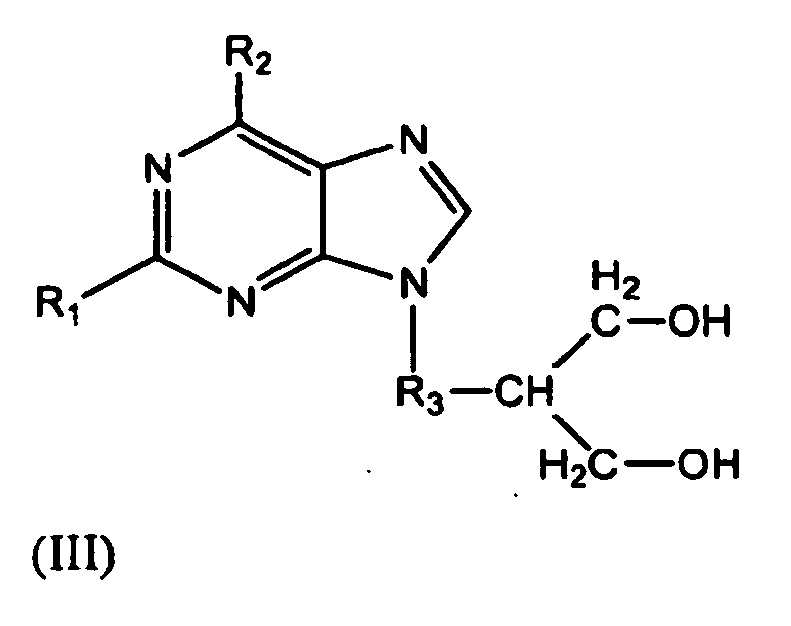

- A method according to claim 1, wherein step (a) is carried out in a polar solvent in the presence of base.
- A method according to claim 1 or 2, wherein step (b) is carried out using hydrogen in the presence of a hydrogenation catalyst.
- A method for preparation of a purine derivative of formula I, comprising hydrogenating a diol of formula III so as to yield a compound of formula of II, wherein R1, R2, R3 and R5 are as defined above.
- A method according to any previous claim, comprising converting a compound of formula V to a compound of formula IV

- A method according to claim 5, carried out in a polar solvent in the presence of base.
- A method according to any previous claim, comprising reducing a compound of formula IV to yield a compound of formula III.
- A method according to any previous claim, comprising reacting a compound of formula II with (R5)2O to form a compound of formula I.
- A method according to claim 8, carried out in an inert organic solvent.
- A method according to claim 9, carried out in the presence of an amine.
- A method according to claim 10, wherein the amine is a tertiary amine.
- A method according to any previous claim, for preparation of famciclovir, wherein R1 is amino, R2 is chloro, R3 is ethyl and R5 is acetyl.
Priority Applications (1)
| Application Number | Priority Date | Filing Date | Title |
|---|---|---|---|
| PL06743955T PL1883639T3 (en) | 2005-05-20 | 2006-05-19 | Preparation of famciclovir and other purine derivatives |
Applications Claiming Priority (1)
| Application Number | Priority Date | Filing Date | Title |
|---|---|---|---|
| GB0510345A GB2426247A (en) | 2005-05-20 | 2005-05-20 | Methods of preparing purine derivatives such as famciclovir |
Publications (2)
| Publication Number | Publication Date |
|---|---|
| EP1883639A1 EP1883639A1 (en) | 2008-02-06 |
| EP1883639B1 true EP1883639B1 (en) | 2010-09-01 |
Family
ID=34834391
Family Applications (1)
| Application Number | Title | Priority Date | Filing Date |
|---|---|---|---|
| EP06743955A Expired - Lifetime EP1883639B1 (en) | 2005-05-20 | 2006-05-19 | Preparation of famciclovir and other purine derivatives |
Country Status (17)
| Country | Link |
|---|---|
| US (1) | US7601835B2 (en) |
| EP (1) | EP1883639B1 (en) |
| JP (1) | JP5227166B2 (en) |
| CN (1) | CN101233134B (en) |
| AT (1) | ATE479688T1 (en) |
| AU (1) | AU2006248745B2 (en) |
| BR (1) | BRPI0609632A2 (en) |
| CA (1) | CA2608490C (en) |
| DE (1) | DE602006016593D1 (en) |
| DK (1) | DK1883639T3 (en) |
| ES (1) | ES2351925T3 (en) |
| GB (1) | GB2426247A (en) |
| NZ (1) | NZ563636A (en) |
| PL (1) | PL1883639T3 (en) |
| PT (1) | PT1883639E (en) |
| TW (1) | TW200716638A (en) |
| WO (1) | WO2006123175A1 (en) |
Families Citing this family (11)
| Publication number | Priority date | Publication date | Assignee | Title |
|---|---|---|---|---|
| CA2496684A1 (en) * | 2002-08-26 | 2004-03-04 | Teva Pharmaceutical Industries Ltd | Crystalline solid famciclovir forms i, ii, iii and preparation thereof |
| CA2522573A1 (en) * | 2003-04-30 | 2004-11-18 | Teva Pharmaceutical Industries Ltd. | Process for the preparation of famciclovir |
| EP1747223A1 (en) * | 2004-05-18 | 2007-01-31 | Teva Pharmaceutical Industries Ltd. | Drying process for preparing crystalline solid famciclovir |
| WO2008072074A1 (en) * | 2006-12-11 | 2008-06-19 | Aurobindo Pharma Limited | An improved process for the preparation of purine derivative |
| CN101555249B (en) * | 2008-04-08 | 2011-05-11 | 浙江海正药业股份有限公司 | Method for synthesizing famciclovir |
| CN102924455A (en) * | 2011-08-11 | 2013-02-13 | 重庆圣华曦药业股份有限公司 | Synthetic method of famciclovir intermediate |
| CN104496991A (en) * | 2014-11-04 | 2015-04-08 | 常州康丽制药有限公司 | Preparation method for high-quality 2-amino-6-chloro-9-(4-hydroxy-3-hydroxymethylbutyl)purine |
| CN104744472A (en) * | 2015-03-12 | 2015-07-01 | 常州康丽制药有限公司 | Preparation method of high-quality 2-amino-6-chloro-9-(4-hydroxyl-3-hydroxymethylbutyl) purine |
| CN109456329B (en) * | 2018-11-19 | 2021-03-09 | 迪嘉药业集团有限公司 | Preparation method of famciclovir |
| WO2021119351A1 (en) | 2019-12-11 | 2021-06-17 | Taro Pharmaceutical Industries Ltd. | Preparation of trifarotene and intermediates and polymorphs thereof |
| CN112979653A (en) * | 2019-12-12 | 2021-06-18 | 上药康丽(常州)药业有限公司 | Method for synthesizing famciclovir by using microchannel reactor |
Family Cites Families (16)
| Publication number | Priority date | Publication date | Assignee | Title |
|---|---|---|---|---|
| US5684153A (en) * | 1984-08-16 | 1997-11-04 | Beecham Group Plc | Process for the preparation of purine derivatives |
| EP0141927B1 (en) * | 1983-08-18 | 1991-10-30 | Beecham Group Plc | Antiviral guanine derivatives |
| DE3582399D1 (en) * | 1984-09-20 | 1991-05-08 | Beecham Group Plc | PURINE DERIVATIVES AND THEIR PHARMACEUTICAL USE. |
| SE8406538D0 (en) * | 1984-12-21 | 1984-12-21 | Astra Laekemedel Ab | NOVEL DERIVATIVES OF PURINE |
| GB8817607D0 (en) * | 1988-07-23 | 1988-09-01 | Beecham Group Plc | Novel process |
| GB8822236D0 (en) * | 1988-09-21 | 1988-10-26 | Beecham Group Plc | Chemical process |
| GB9402161D0 (en) | 1994-02-04 | 1994-03-30 | Wellcome Found | Chloropyrimidine intermediates |
| GB9407698D0 (en) * | 1994-04-19 | 1994-06-15 | Smithkline Beecham Plc | Pharmaceuticals |
| JPH11180983A (en) | 1997-12-24 | 1999-07-06 | Sumika Fine Chemicals Co Ltd | 9-substituted-2-amino-6-halogenopurine and its production |
| GB9807114D0 (en) * | 1998-04-02 | 1998-06-03 | Smithkline Beecham Plc | Novel process |
| GB9807116D0 (en) * | 1998-04-02 | 1998-06-03 | Smithkline Beecham Plc | Novel process |
| SI20022A (en) * | 1998-07-29 | 2000-02-29 | Kemijski inštitut | Alkyl substituted purine derivatives and their preparation |
| JP2003146988A (en) * | 2001-08-30 | 2003-05-21 | Ajinomoto Co Inc | Method for producing famciclovir, and method for producing and crystallization of intermediate thereof |
| DE60202245T2 (en) * | 2001-08-30 | 2005-09-01 | Ajinomoto Co., Inc. | Production method of famciclovir and preparation or crystallization method of a corresponding intermediate |
| KR100573860B1 (en) | 2003-06-13 | 2006-04-25 | 경동제약 주식회사 | Method for preparing 9- [4-acetoxy-3- (acetoxymethyl) but-1-yl] -2-aminopurine using 2-amino-9- (2-substituted ethyl) purine |
| US20050215787A1 (en) * | 2004-03-26 | 2005-09-29 | Joshi Ramesh A | An improved process for the preparation of purines |
-
2005
- 2005-05-20 GB GB0510345A patent/GB2426247A/en not_active Withdrawn
- 2005-11-10 US US11/270,777 patent/US7601835B2/en not_active Expired - Fee Related
-
2006
- 2006-05-19 CN CN200680017571XA patent/CN101233134B/en not_active Expired - Fee Related
- 2006-05-19 PT PT06743955T patent/PT1883639E/en unknown
- 2006-05-19 DE DE602006016593T patent/DE602006016593D1/en not_active Expired - Lifetime
- 2006-05-19 BR BRPI0609632-8A patent/BRPI0609632A2/en not_active IP Right Cessation
- 2006-05-19 EP EP06743955A patent/EP1883639B1/en not_active Expired - Lifetime
- 2006-05-19 ES ES06743955T patent/ES2351925T3/en not_active Expired - Lifetime
- 2006-05-19 CA CA2608490A patent/CA2608490C/en not_active Expired - Fee Related
- 2006-05-19 PL PL06743955T patent/PL1883639T3/en unknown
- 2006-05-19 WO PCT/GB2006/001877 patent/WO2006123175A1/en not_active Ceased
- 2006-05-19 NZ NZ563636A patent/NZ563636A/en not_active IP Right Cessation
- 2006-05-19 TW TW095117840A patent/TW200716638A/en unknown
- 2006-05-19 DK DK06743955.4T patent/DK1883639T3/en active
- 2006-05-19 JP JP2008511798A patent/JP5227166B2/en not_active Expired - Fee Related
- 2006-05-19 AU AU2006248745A patent/AU2006248745B2/en not_active Ceased
- 2006-05-19 AT AT06743955T patent/ATE479688T1/en active
Also Published As
| Publication number | Publication date |
|---|---|
| JP2008540628A (en) | 2008-11-20 |
| NZ563636A (en) | 2010-10-29 |
| PT1883639E (en) | 2010-12-07 |
| DE602006016593D1 (en) | 2010-10-14 |
| CA2608490C (en) | 2013-09-10 |
| US7601835B2 (en) | 2009-10-13 |
| GB0510345D0 (en) | 2005-06-29 |
| PL1883639T3 (en) | 2011-04-29 |
| EP1883639A1 (en) | 2008-02-06 |
| CN101233134B (en) | 2013-01-23 |
| BRPI0609632A2 (en) | 2011-10-18 |
| DK1883639T3 (en) | 2010-11-15 |
| ATE479688T1 (en) | 2010-09-15 |
| AU2006248745A1 (en) | 2006-11-23 |
| ES2351925T3 (en) | 2011-02-14 |
| GB2426247A (en) | 2006-11-22 |
| TW200716638A (en) | 2007-05-01 |
| US20060264629A1 (en) | 2006-11-23 |
| WO2006123175A1 (en) | 2006-11-23 |
| CN101233134A (en) | 2008-07-30 |
| AU2006248745B2 (en) | 2011-06-23 |
| JP5227166B2 (en) | 2013-07-03 |
| CA2608490A1 (en) | 2006-11-23 |
Similar Documents
| Publication | Publication Date | Title |
|---|---|---|
| AU2006248745B2 (en) | Preparation of famciclovir and other purine derivatives | |
| CA2188181C (en) | Preparation of purines | |
| US5831092A (en) | Process for producing purine derivatives | |
| EP1636231B1 (en) | Methods for preparing 9-[4-acetoxy-3-(acetoxymethyl)but-1-yl]-2-aminopurine using a compound of 2-amino-9-(2-substituted ethyl)purines | |
| WO2008155613A1 (en) | An improved process for preparing purine derivative | |
| EP1551839B1 (en) | Process for preparing 9-¬4-acetoxy-3-(acetoxymethyl)but-1-yl -2-aminopurine | |
| JP2019507156A (en) | Process for producing 4-alkoxy-3-hydroxypicolinic acid | |
| JPH0680670A (en) | Cyclopropane derivative and its production | |
| WO2008072074A1 (en) | An improved process for the preparation of purine derivative | |
| EP0298601A1 (en) | 6-Deoxy guanine derivatives and pyrimidine intermediates | |
| US6156892A (en) | Purine derivatives having cyclopropane ring | |
| JP7379381B2 (en) | Intermediates and processes for the manufacture of linagliptin and its salts | |
| US5821367A (en) | Regiospecific process for synthesis of acyclic nucleosides | |
| EP1857458A1 (en) | Process for the preparation of abacavir | |
| EP0806425B1 (en) | An improved regiospecific process for synthesis of acyclic nucleosides | |
| WO2003033498A2 (en) | A process for the treatment of ganciclovir intermediate n2-acetyl-9-(1, 3-diacetoxy-2-propoxymethyl) guanine | |
| WO2004043919A1 (en) | A process for the preparation of 3-and 4-aminophthalimide. | |
| EP3020712B1 (en) | Method for preparing cyclopropane derivatives | |
| WO2019186260A1 (en) | An improved process for the preparation of sitagliptin and pharmaceutically acceptable salts thereof | |
| JP2003119197A (en) | Method for producing 2-amino-6-cyclopropylamino-9h- purine | |
| JP2593292B2 (en) | Intermediate for synthesis of 6,7-dihydro-5,8-dimethyl-9-fluoro-1-oxo-1H, 5H-benzo [i, j] quinolidine-2-carboxylic acid and method for producing the same | |
| JPH11199584A (en) | Cyclopropane ring-containing purine derivative | |
| HK1231871A1 (en) | A process for the preparation of compound and synthetic intermediates thereof |
Legal Events
| Date | Code | Title | Description |
|---|---|---|---|
| PUAI | Public reference made under article 153(3) epc to a published international application that has entered the european phase |
Free format text: ORIGINAL CODE: 0009012 |
|
| 17P | Request for examination filed |
Effective date: 20071103 |
|
| AK | Designated contracting states |
Kind code of ref document: A1 Designated state(s): AT BE BG CH CY CZ DE DK EE ES FI FR GB GR HU IE IS IT LI LT LU LV MC NL PL PT RO SE SI SK TR |
|
| 17Q | First examination report despatched |
Effective date: 20080401 |
|
| DAX | Request for extension of the european patent (deleted) | ||
| GRAJ | Information related to disapproval of communication of intention to grant by the applicant or resumption of examination proceedings by the epo deleted |
Free format text: ORIGINAL CODE: EPIDOSDIGR1 |
|
| GRAP | Despatch of communication of intention to grant a patent |
Free format text: ORIGINAL CODE: EPIDOSNIGR1 |
|
| GRAP | Despatch of communication of intention to grant a patent |
Free format text: ORIGINAL CODE: EPIDOSNIGR1 |
|
| GRAS | Grant fee paid |
Free format text: ORIGINAL CODE: EPIDOSNIGR3 |
|
| GRAA | (expected) grant |
Free format text: ORIGINAL CODE: 0009210 |
|
| AK | Designated contracting states |
Kind code of ref document: B1 Designated state(s): AT BE BG CH CY CZ DE DK EE ES FI FR GB GR HU IE IS IT LI LT LU LV MC NL PL PT RO SE SI SK TR |
|
| REG | Reference to a national code |
Ref country code: GB Ref legal event code: FG4D |
|
| REG | Reference to a national code |
Ref country code: CH Ref legal event code: EP |
|
| REG | Reference to a national code |
Ref country code: IE Ref legal event code: FG4D |
|
| REF | Corresponds to: |
Ref document number: 602006016593 Country of ref document: DE Date of ref document: 20101014 Kind code of ref document: P |
|
| REG | Reference to a national code |
Ref country code: SE Ref legal event code: TRGR |
|
| REG | Reference to a national code |
Ref country code: DK Ref legal event code: T3 |
|
| REG | Reference to a national code |
Ref country code: PT Ref legal event code: SC4A Free format text: AVAILABILITY OF NATIONAL TRANSLATION Effective date: 20101126 |
|
| REG | Reference to a national code |
Ref country code: NL Ref legal event code: T3 |
|
| REG | Reference to a national code |
Ref country code: GR Ref legal event code: EP Ref document number: 20100402827 Country of ref document: GR |
|
| PG25 | Lapsed in a contracting state [announced via postgrant information from national office to epo] |
Ref country code: LT Free format text: LAPSE BECAUSE OF FAILURE TO SUBMIT A TRANSLATION OF THE DESCRIPTION OR TO PAY THE FEE WITHIN THE PRESCRIBED TIME-LIMIT Effective date: 20100901 |
|
| REG | Reference to a national code |
Ref country code: ES Ref legal event code: FG2A Effective date: 20110202 |
|
| REG | Reference to a national code |
Ref country code: CH Ref legal event code: NV Representative=s name: DR. JOACHIM LAUER PATENTANWALT |
|
| LTIE | Lt: invalidation of european patent or patent extension |
Effective date: 20100901 |
|
| PG25 | Lapsed in a contracting state [announced via postgrant information from national office to epo] |
Ref country code: SI Free format text: LAPSE BECAUSE OF FAILURE TO SUBMIT A TRANSLATION OF THE DESCRIPTION OR TO PAY THE FEE WITHIN THE PRESCRIBED TIME-LIMIT Effective date: 20100901 Ref country code: CY Free format text: LAPSE BECAUSE OF FAILURE TO SUBMIT A TRANSLATION OF THE DESCRIPTION OR TO PAY THE FEE WITHIN THE PRESCRIBED TIME-LIMIT Effective date: 20100901 |
|
| PG25 | Lapsed in a contracting state [announced via postgrant information from national office to epo] |
Ref country code: LV Free format text: LAPSE BECAUSE OF FAILURE TO SUBMIT A TRANSLATION OF THE DESCRIPTION OR TO PAY THE FEE WITHIN THE PRESCRIBED TIME-LIMIT Effective date: 20100901 |
|
| REG | Reference to a national code |
Ref country code: PL Ref legal event code: T3 |
|
| REG | Reference to a national code |
Ref country code: HU Ref legal event code: AG4A Ref document number: E010073 Country of ref document: HU |
|
| PG25 | Lapsed in a contracting state [announced via postgrant information from national office to epo] |
Ref country code: EE Free format text: LAPSE BECAUSE OF FAILURE TO SUBMIT A TRANSLATION OF THE DESCRIPTION OR TO PAY THE FEE WITHIN THE PRESCRIBED TIME-LIMIT Effective date: 20100901 Ref country code: IS Free format text: LAPSE BECAUSE OF FAILURE TO SUBMIT A TRANSLATION OF THE DESCRIPTION OR TO PAY THE FEE WITHIN THE PRESCRIBED TIME-LIMIT Effective date: 20110101 Ref country code: SK Free format text: LAPSE BECAUSE OF FAILURE TO SUBMIT A TRANSLATION OF THE DESCRIPTION OR TO PAY THE FEE WITHIN THE PRESCRIBED TIME-LIMIT Effective date: 20100901 Ref country code: RO Free format text: LAPSE BECAUSE OF FAILURE TO SUBMIT A TRANSLATION OF THE DESCRIPTION OR TO PAY THE FEE WITHIN THE PRESCRIBED TIME-LIMIT Effective date: 20100901 |
|
| PLBE | No opposition filed within time limit |
Free format text: ORIGINAL CODE: 0009261 |
|
| STAA | Information on the status of an ep patent application or granted ep patent |
Free format text: STATUS: NO OPPOSITION FILED WITHIN TIME LIMIT |
|
| 26N | No opposition filed |
Effective date: 20110606 |
|
| REG | Reference to a national code |
Ref country code: DE Ref legal event code: R097 Ref document number: 602006016593 Country of ref document: DE Effective date: 20110606 |
|
| PG25 | Lapsed in a contracting state [announced via postgrant information from national office to epo] |
Ref country code: MC Free format text: LAPSE BECAUSE OF NON-PAYMENT OF DUE FEES Effective date: 20110531 |
|
| REG | Reference to a national code |
Ref country code: CH Ref legal event code: PCAR Free format text: DR. JOACHIM LAUER C/O RENTSCH PARTNER AG;FRAUMUENSTERSTRASSE 9 POSTFACH 2441;8022 ZUERICH (CH) |
|
| PG25 | Lapsed in a contracting state [announced via postgrant information from national office to epo] |
Ref country code: BG Free format text: LAPSE BECAUSE OF FAILURE TO SUBMIT A TRANSLATION OF THE DESCRIPTION OR TO PAY THE FEE WITHIN THE PRESCRIBED TIME-LIMIT Effective date: 20101201 |
|
| REG | Reference to a national code |
Ref country code: FR Ref legal event code: PLFP Year of fee payment: 10 |
|
| REG | Reference to a national code |
Ref country code: FR Ref legal event code: PLFP Year of fee payment: 11 |
|
| PGFP | Annual fee paid to national office [announced via postgrant information from national office to epo] |
Ref country code: NL Payment date: 20160526 Year of fee payment: 11 |
|
| PGFP | Annual fee paid to national office [announced via postgrant information from national office to epo] |
Ref country code: LU Payment date: 20160610 Year of fee payment: 11 Ref country code: CZ Payment date: 20160510 Year of fee payment: 11 Ref country code: CH Payment date: 20160527 Year of fee payment: 11 Ref country code: GR Payment date: 20160527 Year of fee payment: 11 Ref country code: IE Payment date: 20160527 Year of fee payment: 11 Ref country code: DE Payment date: 20160527 Year of fee payment: 11 Ref country code: FI Payment date: 20160527 Year of fee payment: 11 Ref country code: GB Payment date: 20160527 Year of fee payment: 11 Ref country code: ES Payment date: 20160526 Year of fee payment: 11 |
|
| PGFP | Annual fee paid to national office [announced via postgrant information from national office to epo] |
Ref country code: PL Payment date: 20160504 Year of fee payment: 11 Ref country code: PT Payment date: 20160509 Year of fee payment: 11 Ref country code: FR Payment date: 20160530 Year of fee payment: 11 Ref country code: HU Payment date: 20160509 Year of fee payment: 11 Ref country code: SE Payment date: 20160527 Year of fee payment: 11 Ref country code: BE Payment date: 20160527 Year of fee payment: 11 Ref country code: IT Payment date: 20160520 Year of fee payment: 11 Ref country code: TR Payment date: 20160505 Year of fee payment: 11 Ref country code: AT Payment date: 20160504 Year of fee payment: 11 Ref country code: DK Payment date: 20160525 Year of fee payment: 11 |
|
| PG25 | Lapsed in a contracting state [announced via postgrant information from national office to epo] |
Ref country code: LU Free format text: LAPSE BECAUSE OF NON-PAYMENT OF DUE FEES Effective date: 20170531 |
|
| REG | Reference to a national code |
Ref country code: CH Ref legal event code: PCAR Free format text: NEW ADDRESS: BELLERIVESTRASSE 203 POSTFACH, 8034 ZUERICH (CH) |
|
| REG | Reference to a national code |
Ref country code: DE Ref legal event code: R119 Ref document number: 602006016593 Country of ref document: DE |
|
| REG | Reference to a national code |
Ref country code: CH Ref legal event code: PL |
|
| REG | Reference to a national code |
Ref country code: SE Ref legal event code: EUG Ref country code: DK Ref legal event code: EBP Effective date: 20170531 |
|
| REG | Reference to a national code |
Ref country code: NL Ref legal event code: MM Effective date: 20170601 |
|
| REG | Reference to a national code |
Ref country code: AT Ref legal event code: MM01 Ref document number: 479688 Country of ref document: AT Kind code of ref document: T Effective date: 20170519 |
|
| GBPC | Gb: european patent ceased through non-payment of renewal fee |
Effective date: 20170519 |
|
| PG25 | Lapsed in a contracting state [announced via postgrant information from national office to epo] |
Ref country code: FI Free format text: LAPSE BECAUSE OF NON-PAYMENT OF DUE FEES Effective date: 20170519 Ref country code: CZ Free format text: LAPSE BECAUSE OF NON-PAYMENT OF DUE FEES Effective date: 20170519 Ref country code: AT Free format text: LAPSE BECAUSE OF NON-PAYMENT OF DUE FEES Effective date: 20170519 Ref country code: HU Free format text: LAPSE BECAUSE OF NON-PAYMENT OF DUE FEES Effective date: 20170520 |
|
| REG | Reference to a national code |
Ref country code: IE Ref legal event code: MM4A |
|
| PG25 | Lapsed in a contracting state [announced via postgrant information from national office to epo] |
Ref country code: PT Free format text: LAPSE BECAUSE OF NON-PAYMENT OF DUE FEES Effective date: 20171120 Ref country code: SE Free format text: LAPSE BECAUSE OF NON-PAYMENT OF DUE FEES Effective date: 20170520 Ref country code: LI Free format text: LAPSE BECAUSE OF NON-PAYMENT OF DUE FEES Effective date: 20170531 Ref country code: GR Free format text: LAPSE BECAUSE OF NON-PAYMENT OF DUE FEES Effective date: 20171206 Ref country code: CH Free format text: LAPSE BECAUSE OF NON-PAYMENT OF DUE FEES Effective date: 20170531 |
|
| REG | Reference to a national code |
Ref country code: FR Ref legal event code: ST Effective date: 20180131 |
|
| PG25 | Lapsed in a contracting state [announced via postgrant information from national office to epo] |
Ref country code: NL Free format text: LAPSE BECAUSE OF NON-PAYMENT OF DUE FEES Effective date: 20170601 Ref country code: LU Free format text: LAPSE BECAUSE OF NON-PAYMENT OF DUE FEES Effective date: 20170519 |
|
| REG | Reference to a national code |
Ref country code: BE Ref legal event code: MM Effective date: 20170531 |
|
| PG25 | Lapsed in a contracting state [announced via postgrant information from national office to epo] |
Ref country code: IE Free format text: LAPSE BECAUSE OF NON-PAYMENT OF DUE FEES Effective date: 20170519 Ref country code: GB Free format text: LAPSE BECAUSE OF NON-PAYMENT OF DUE FEES Effective date: 20170519 Ref country code: DK Free format text: LAPSE BECAUSE OF NON-PAYMENT OF DUE FEES Effective date: 20170531 Ref country code: DE Free format text: LAPSE BECAUSE OF NON-PAYMENT OF DUE FEES Effective date: 20171201 |
|
| PG25 | Lapsed in a contracting state [announced via postgrant information from national office to epo] |
Ref country code: FR Free format text: LAPSE BECAUSE OF NON-PAYMENT OF DUE FEES Effective date: 20170531 Ref country code: IT Free format text: LAPSE BECAUSE OF NON-PAYMENT OF DUE FEES Effective date: 20170519 |
|
| REG | Reference to a national code |
Ref country code: ES Ref legal event code: FD2A Effective date: 20180704 |
|
| PG25 | Lapsed in a contracting state [announced via postgrant information from national office to epo] |
Ref country code: ES Free format text: LAPSE BECAUSE OF NON-PAYMENT OF DUE FEES Effective date: 20170520 |
|
| PG25 | Lapsed in a contracting state [announced via postgrant information from national office to epo] |
Ref country code: BE Free format text: LAPSE BECAUSE OF NON-PAYMENT OF DUE FEES Effective date: 20170531 |
|
| PG25 | Lapsed in a contracting state [announced via postgrant information from national office to epo] |
Ref country code: PL Free format text: LAPSE BECAUSE OF NON-PAYMENT OF DUE FEES Effective date: 20170519 |
|
| PG25 | Lapsed in a contracting state [announced via postgrant information from national office to epo] |
Ref country code: TR Free format text: LAPSE BECAUSE OF NON-PAYMENT OF DUE FEES Effective date: 20170519 |