EP1882740A1 - N-acetyl-(R,S)-B-amino acid acylase gene - Google Patents
N-acetyl-(R,S)-B-amino acid acylase gene Download PDFInfo
- Publication number
- EP1882740A1 EP1882740A1 EP07013995A EP07013995A EP1882740A1 EP 1882740 A1 EP1882740 A1 EP 1882740A1 EP 07013995 A EP07013995 A EP 07013995A EP 07013995 A EP07013995 A EP 07013995A EP 1882740 A1 EP1882740 A1 EP 1882740A1
- Authority
- EP
- European Patent Office
- Prior art keywords
- amino acid
- acetyl
- protein
- seq
- denoted
- Prior art date
- Legal status (The legal status is an assumption and is not a legal conclusion. Google has not performed a legal analysis and makes no representation as to the accuracy of the status listed.)
- Granted
Links
- 108700023418 Amidases Proteins 0.000 title claims abstract description 132
- 108090000623 proteins and genes Proteins 0.000 claims abstract description 169
- 102000005922 amidase Human genes 0.000 claims abstract description 130
- 239000002773 nucleotide Substances 0.000 claims abstract description 25
- 125000003729 nucleotide group Chemical group 0.000 claims abstract description 25
- 241000588724 Escherichia coli Species 0.000 claims abstract description 13
- 102000004169 proteins and genes Human genes 0.000 claims description 119
- 230000000694 effects Effects 0.000 claims description 90
- 150000001413 amino acids Chemical group 0.000 claims description 67
- 108020004414 DNA Proteins 0.000 claims description 50
- 238000000034 method Methods 0.000 claims description 46
- 150000001576 beta-amino acids Chemical class 0.000 claims description 30
- 230000001747 exhibiting effect Effects 0.000 claims description 23
- 238000004519 manufacturing process Methods 0.000 claims description 22
- 125000000539 amino acid group Chemical group 0.000 claims description 18
- 239000012634 fragment Substances 0.000 claims description 18
- 238000007792 addition Methods 0.000 claims description 15
- 238000012217 deletion Methods 0.000 claims description 15
- 230000037430 deletion Effects 0.000 claims description 15
- 238000006467 substitution reaction Methods 0.000 claims description 15
- OQEBBZSWEGYTPG-UHFFFAOYSA-N 3-aminobutanoic acid Chemical compound CC(N)CC(O)=O OQEBBZSWEGYTPG-UHFFFAOYSA-N 0.000 claims description 10
- 239000013598 vector Substances 0.000 claims description 9
- 244000005700 microbiome Species 0.000 claims description 8
- JYPHNHPXFNEZBR-UHFFFAOYSA-N 3-amino-3-(4-hydroxyphenyl)propanoic acid Chemical compound [O-]C(=O)CC([NH3+])C1=CC=C(O)C=C1 JYPHNHPXFNEZBR-UHFFFAOYSA-N 0.000 claims description 6
- GLUJNGJDHCTUJY-UHFFFAOYSA-N beta-leucine Chemical compound CC(C)C(N)CC(O)=O GLUJNGJDHCTUJY-UHFFFAOYSA-N 0.000 claims description 6
- 230000000295 complement effect Effects 0.000 claims description 6
- 230000001939 inductive effect Effects 0.000 claims description 6
- 108020004707 nucleic acids Proteins 0.000 claims description 6
- 102000039446 nucleic acids Human genes 0.000 claims description 6
- 150000007523 nucleic acids Chemical class 0.000 claims description 6
- OFVBLKINTLPEGH-VIFPVBQESA-N (3S)-3-Amino-4-phenylbutanoic acid Chemical compound OC(=O)C[C@@H](N)CC1=CC=CC=C1 OFVBLKINTLPEGH-VIFPVBQESA-N 0.000 claims description 5
- UJOYFRCOTPUKAK-MRVPVSSYSA-N (R)-3-ammonio-3-phenylpropanoate Chemical compound OC(=O)C[C@@H](N)C1=CC=CC=C1 UJOYFRCOTPUKAK-MRVPVSSYSA-N 0.000 claims description 5
- MLYMSIKVLAPCAK-LURJTMIESA-N (S)-3-Amino-5-methylhexanoic acid Chemical compound CC(C)C[C@H](N)CC(O)=O MLYMSIKVLAPCAK-LURJTMIESA-N 0.000 claims description 5
- XWHHYOYVRVGJJY-QMMMGPOBSA-N 4-fluoro-L-phenylalanine Chemical compound OC(=O)[C@@H](N)CC1=CC=C(F)C=C1 XWHHYOYVRVGJJY-QMMMGPOBSA-N 0.000 claims description 5
- DFZVZEMNPGABKO-ZETCQYMHSA-N (2s)-2-amino-3-pyridin-3-ylpropanoic acid Chemical compound OC(=O)[C@@H](N)CC1=CC=CN=C1 DFZVZEMNPGABKO-ZETCQYMHSA-N 0.000 claims 2
- 230000001580 bacterial effect Effects 0.000 abstract description 51
- 108090000790 Enzymes Proteins 0.000 abstract description 39
- 102000004190 Enzymes Human genes 0.000 abstract description 37
- 241001508395 Burkholderia sp. Species 0.000 abstract description 20
- 241000056137 Variovorax sp. Species 0.000 abstract description 10
- 235000018102 proteins Nutrition 0.000 description 79
- 239000000243 solution Substances 0.000 description 56
- HEMHJVSKTPXQMS-UHFFFAOYSA-M Sodium hydroxide Chemical compound [OH-].[Na+] HEMHJVSKTPXQMS-UHFFFAOYSA-M 0.000 description 54
- 238000006243 chemical reaction Methods 0.000 description 44
- QTBSBXVTEAMEQO-UHFFFAOYSA-N Acetic acid Chemical compound CC(O)=O QTBSBXVTEAMEQO-UHFFFAOYSA-N 0.000 description 36
- 229940088598 enzyme Drugs 0.000 description 36
- WFDIJRYMOXRFFG-UHFFFAOYSA-N Acetic anhydride Chemical compound CC(=O)OC(C)=O WFDIJRYMOXRFFG-UHFFFAOYSA-N 0.000 description 30
- 239000007864 aqueous solution Substances 0.000 description 29
- 238000001514 detection method Methods 0.000 description 25
- VEXZGXHMUGYJMC-UHFFFAOYSA-N Hydrochloric acid Chemical compound Cl VEXZGXHMUGYJMC-UHFFFAOYSA-N 0.000 description 22
- XLYOFNOQVPJJNP-UHFFFAOYSA-N water Substances O XLYOFNOQVPJJNP-UHFFFAOYSA-N 0.000 description 22
- 230000003287 optical effect Effects 0.000 description 19
- 239000013078 crystal Substances 0.000 description 18
- 238000000926 separation method Methods 0.000 description 18
- QKNYBSVHEMOAJP-UHFFFAOYSA-N 2-amino-2-(hydroxymethyl)propane-1,3-diol;hydron;chloride Chemical compound Cl.OCC(N)(CO)CO QKNYBSVHEMOAJP-UHFFFAOYSA-N 0.000 description 16
- FAPWRFPIFSIZLT-UHFFFAOYSA-M Sodium chloride Chemical compound [Na+].[Cl-] FAPWRFPIFSIZLT-UHFFFAOYSA-M 0.000 description 16
- 239000007853 buffer solution Substances 0.000 description 16
- BFNBIHQBYMNNAN-UHFFFAOYSA-N ammonium sulfate Chemical compound N.N.OS(O)(=O)=O BFNBIHQBYMNNAN-UHFFFAOYSA-N 0.000 description 15
- 229910052921 ammonium sulfate Inorganic materials 0.000 description 15
- 239000013612 plasmid Substances 0.000 description 15
- 238000000746 purification Methods 0.000 description 15
- 238000010828 elution Methods 0.000 description 14
- 239000000284 extract Substances 0.000 description 14
- 239000000047 product Substances 0.000 description 13
- OKKJLVBELUTLKV-UHFFFAOYSA-N Methanol Chemical compound OC OKKJLVBELUTLKV-UHFFFAOYSA-N 0.000 description 12
- AVKUERGKIZMTKX-NJBDSQKTSA-N ampicillin Chemical compound C1([C@@H](N)C(=O)N[C@H]2[C@H]3SC([C@@H](N3C2=O)C(O)=O)(C)C)=CC=CC=C1 AVKUERGKIZMTKX-NJBDSQKTSA-N 0.000 description 12
- 229960000723 ampicillin Drugs 0.000 description 12
- 238000003786 synthesis reaction Methods 0.000 description 12
- 235000001014 amino acid Nutrition 0.000 description 11
- 230000015572 biosynthetic process Effects 0.000 description 11
- 239000000758 substrate Substances 0.000 description 11
- 239000000725 suspension Substances 0.000 description 11
- 241000894006 Bacteria Species 0.000 description 10
- 210000004027 cell Anatomy 0.000 description 10
- 239000011541 reaction mixture Substances 0.000 description 10
- OKTJSMMVPCPJKN-UHFFFAOYSA-N Carbon Chemical compound [C] OKTJSMMVPCPJKN-UHFFFAOYSA-N 0.000 description 9
- 238000009396 hybridization Methods 0.000 description 9
- 239000002198 insoluble material Substances 0.000 description 9
- 125000001997 phenyl group Chemical group [H]C1=C([H])C([H])=C(*)C([H])=C1[H] 0.000 description 9
- 239000000523 sample Substances 0.000 description 9
- 239000007983 Tris buffer Substances 0.000 description 8
- 238000004128 high performance liquid chromatography Methods 0.000 description 8
- 230000006798 recombination Effects 0.000 description 8
- 238000005215 recombination Methods 0.000 description 8
- 239000011780 sodium chloride Substances 0.000 description 8
- LENZDBCJOHFCAS-UHFFFAOYSA-N tris Chemical compound OCC(N)(CO)CO LENZDBCJOHFCAS-UHFFFAOYSA-N 0.000 description 8
- 229910052799 carbon Inorganic materials 0.000 description 7
- 125000004432 carbon atom Chemical group C* 0.000 description 7
- 239000013611 chromosomal DNA Substances 0.000 description 7
- 239000012141 concentrate Substances 0.000 description 7
- 108090000765 processed proteins & peptides Proteins 0.000 description 7
- WEVYAHXRMPXWCK-UHFFFAOYSA-N Acetonitrile Chemical compound CC#N WEVYAHXRMPXWCK-UHFFFAOYSA-N 0.000 description 6
- 150000001875 compounds Chemical class 0.000 description 6
- 239000000203 mixture Substances 0.000 description 6
- 102000004196 processed proteins & peptides Human genes 0.000 description 6
- 238000002415 sodium dodecyl sulfate polyacrylamide gel electrophoresis Methods 0.000 description 6
- 239000006228 supernatant Substances 0.000 description 6
- 239000010414 supernatant solution Substances 0.000 description 6
- 239000012614 Q-Sepharose Substances 0.000 description 5
- 229920002684 Sepharose Polymers 0.000 description 5
- 239000012505 Superdex™ Substances 0.000 description 5
- 238000004458 analytical method Methods 0.000 description 5
- 238000010367 cloning Methods 0.000 description 5
- 230000002255 enzymatic effect Effects 0.000 description 5
- 238000002955 isolation Methods 0.000 description 5
- 229920001184 polypeptide Polymers 0.000 description 5
- 238000002360 preparation method Methods 0.000 description 5
- 238000012360 testing method Methods 0.000 description 5
- 238000005481 NMR spectroscopy Methods 0.000 description 4
- 108091028043 Nucleic acid sequence Proteins 0.000 description 4
- KDLHZDBZIXYQEI-UHFFFAOYSA-N Palladium Chemical compound [Pd] KDLHZDBZIXYQEI-UHFFFAOYSA-N 0.000 description 4
- 230000000274 adsorptive effect Effects 0.000 description 4
- 238000002330 electrospray ionisation mass spectrometry Methods 0.000 description 4
- 238000003780 insertion Methods 0.000 description 4
- 230000037431 insertion Effects 0.000 description 4
- 125000002496 methyl group Chemical group [H]C([H])([H])* 0.000 description 4
- 238000001556 precipitation Methods 0.000 description 4
- 238000012216 screening Methods 0.000 description 4
- 238000005160 1H NMR spectroscopy Methods 0.000 description 3
- YMWUJEATGCHHMB-UHFFFAOYSA-N Dichloromethane Chemical compound ClCCl YMWUJEATGCHHMB-UHFFFAOYSA-N 0.000 description 3
- IAZDPXIOMUYVGZ-UHFFFAOYSA-N Dimethylsulphoxide Chemical compound CS(C)=O IAZDPXIOMUYVGZ-UHFFFAOYSA-N 0.000 description 3
- 125000001429 N-terminal alpha-amino-acid group Chemical group 0.000 description 3
- 240000004808 Saccharomyces cerevisiae Species 0.000 description 3
- 235000014680 Saccharomyces cerevisiae Nutrition 0.000 description 3
- 235000011130 ammonium sulphate Nutrition 0.000 description 3
- 238000004587 chromatography analysis Methods 0.000 description 3
- 238000001816 cooling Methods 0.000 description 3
- 238000012258 culturing Methods 0.000 description 3
- 238000001962 electrophoresis Methods 0.000 description 3
- 239000013604 expression vector Substances 0.000 description 3
- 239000000706 filtrate Substances 0.000 description 3
- 239000000710 homodimer Substances 0.000 description 3
- 230000035772 mutation Effects 0.000 description 3
- 239000000126 substance Substances 0.000 description 3
- SYTBZMRGLBWNTM-SNVBAGLBSA-N (R)-flurbiprofen Chemical compound FC1=CC([C@H](C(O)=O)C)=CC=C1C1=CC=CC=C1 SYTBZMRGLBWNTM-SNVBAGLBSA-N 0.000 description 2
- 229920001817 Agar Polymers 0.000 description 2
- 229920000936 Agarose Polymers 0.000 description 2
- 102000016928 DNA-directed DNA polymerase Human genes 0.000 description 2
- 108010014303 DNA-directed DNA polymerase Proteins 0.000 description 2
- OKKJLVBELUTLKV-MZCSYVLQSA-N Deuterated methanol Chemical compound [2H]OC([2H])([2H])[2H] OKKJLVBELUTLKV-MZCSYVLQSA-N 0.000 description 2
- LFQSCWFLJHTTHZ-UHFFFAOYSA-N Ethanol Chemical compound CCO LFQSCWFLJHTTHZ-UHFFFAOYSA-N 0.000 description 2
- WQZGKKKJIJFFOK-GASJEMHNSA-N Glucose Natural products OC[C@H]1OC(O)[C@H](O)[C@@H](O)[C@@H]1O WQZGKKKJIJFFOK-GASJEMHNSA-N 0.000 description 2
- 102000005720 Glutathione transferase Human genes 0.000 description 2
- 108010070675 Glutathione transferase Proteins 0.000 description 2
- 239000007836 KH2PO4 Substances 0.000 description 2
- CSNNHWWHGAXBCP-UHFFFAOYSA-L Magnesium sulfate Chemical compound [Mg+2].[O-][S+2]([O-])([O-])[O-] CSNNHWWHGAXBCP-UHFFFAOYSA-L 0.000 description 2
- ZMXDDKWLCZADIW-UHFFFAOYSA-N N,N-Dimethylformamide Chemical compound CN(C)C=O ZMXDDKWLCZADIW-UHFFFAOYSA-N 0.000 description 2
- LRHPLDYGYMQRHN-UHFFFAOYSA-N N-Butanol Chemical compound CCCCO LRHPLDYGYMQRHN-UHFFFAOYSA-N 0.000 description 2
- PXHVJJICTQNCMI-UHFFFAOYSA-N Nickel Chemical compound [Ni] PXHVJJICTQNCMI-UHFFFAOYSA-N 0.000 description 2
- NBIIXXVUZAFLBC-UHFFFAOYSA-N Phosphoric acid Chemical compound OP(O)(O)=O NBIIXXVUZAFLBC-UHFFFAOYSA-N 0.000 description 2
- 102000007056 Recombinant Fusion Proteins Human genes 0.000 description 2
- 108010008281 Recombinant Fusion Proteins Proteins 0.000 description 2
- 125000002777 acetyl group Chemical group [H]C([H])([H])C(*)=O 0.000 description 2
- 230000000397 acetylating effect Effects 0.000 description 2
- 239000002253 acid Substances 0.000 description 2
- 239000008272 agar Substances 0.000 description 2
- 125000000217 alkyl group Chemical group 0.000 description 2
- -1 aromatic amino acids Chemical class 0.000 description 2
- 125000003118 aryl group Chemical group 0.000 description 2
- 239000000872 buffer Substances 0.000 description 2
- 125000003178 carboxy group Chemical group [H]OC(*)=O 0.000 description 2
- ARUVKPQLZAKDPS-UHFFFAOYSA-L copper(II) sulfate Chemical compound [Cu+2].[O-][S+2]([O-])([O-])[O-] ARUVKPQLZAKDPS-UHFFFAOYSA-L 0.000 description 2
- 229910000366 copper(II) sulfate Inorganic materials 0.000 description 2
- 239000000287 crude extract Substances 0.000 description 2
- 239000012228 culture supernatant Substances 0.000 description 2
- 238000000354 decomposition reaction Methods 0.000 description 2
- 238000000502 dialysis Methods 0.000 description 2
- 229940079919 digestives enzyme preparation Drugs 0.000 description 2
- 238000001914 filtration Methods 0.000 description 2
- RWSXRVCMGQZWBV-WDSKDSINSA-N glutathione Chemical compound OC(=O)[C@@H](N)CCC(=O)N[C@@H](CS)C(=O)NCC(O)=O RWSXRVCMGQZWBV-WDSKDSINSA-N 0.000 description 2
- 235000014304 histidine Nutrition 0.000 description 2
- 230000006801 homologous recombination Effects 0.000 description 2
- 238000002744 homologous recombination Methods 0.000 description 2
- 229910052739 hydrogen Inorganic materials 0.000 description 2
- 239000001257 hydrogen Substances 0.000 description 2
- BPHPUYQFMNQIOC-NXRLNHOXSA-N isopropyl beta-D-thiogalactopyranoside Chemical compound CC(C)S[C@@H]1O[C@H](CO)[C@H](O)[C@H](O)[C@H]1O BPHPUYQFMNQIOC-NXRLNHOXSA-N 0.000 description 2
- 239000007788 liquid Substances 0.000 description 2
- SQQMAOCOWKFBNP-UHFFFAOYSA-L manganese(II) sulfate Chemical compound [Mn+2].[O-]S([O-])(=O)=O SQQMAOCOWKFBNP-UHFFFAOYSA-L 0.000 description 2
- 229910000357 manganese(II) sulfate Inorganic materials 0.000 description 2
- 238000005259 measurement Methods 0.000 description 2
- 229910000402 monopotassium phosphate Inorganic materials 0.000 description 2
- 229910052763 palladium Inorganic materials 0.000 description 2
- GNSKLFRGEWLPPA-UHFFFAOYSA-M potassium dihydrogen phosphate Chemical compound [K+].OP(O)([O-])=O GNSKLFRGEWLPPA-UHFFFAOYSA-M 0.000 description 2
- 230000004952 protein activity Effects 0.000 description 2
- 108091008146 restriction endonucleases Proteins 0.000 description 2
- 238000012163 sequencing technique Methods 0.000 description 2
- 239000002904 solvent Substances 0.000 description 2
- JZRWCGZRTZMZEH-UHFFFAOYSA-N thiamine Chemical compound CC1=C(CCO)SC=[N+]1CC1=CN=C(C)N=C1N JZRWCGZRTZMZEH-UHFFFAOYSA-N 0.000 description 2
- PDRJLZDUOULRHE-ZETCQYMHSA-N (2s)-2-amino-3-pyridin-2-ylpropanoic acid Chemical compound OC(=O)[C@@H](N)CC1=CC=CC=N1 PDRJLZDUOULRHE-ZETCQYMHSA-N 0.000 description 1
- HTWAFOFDKZAKQP-SNVBAGLBSA-N (3r)-3-acetamido-3-phenylpropanoic acid Chemical compound CC(=O)N[C@H](CC(O)=O)C1=CC=CC=C1 HTWAFOFDKZAKQP-SNVBAGLBSA-N 0.000 description 1
- CPGFMWPQXUXQRX-MRVPVSSYSA-N (3r)-3-amino-3-(4-fluorophenyl)propanoic acid Chemical compound OC(=O)C[C@@H](N)C1=CC=C(F)C=C1 CPGFMWPQXUXQRX-MRVPVSSYSA-N 0.000 description 1
- SLNFFBWDHRKWCB-NUBCRITNSA-N (3r)-3-amino-4-methylpentanoic acid;hydrochloride Chemical compound Cl.CC(C)[C@H](N)CC(O)=O SLNFFBWDHRKWCB-NUBCRITNSA-N 0.000 description 1
- MLYMSIKVLAPCAK-ZCFIWIBFSA-N (3r)-3-azaniumyl-5-methylhexanoate Chemical compound CC(C)C[C@@H]([NH3+])CC([O-])=O MLYMSIKVLAPCAK-ZCFIWIBFSA-N 0.000 description 1
- MQTMGKGSJOPWJW-FVGYRXGTSA-N (3s)-3-amino-4-phenylbutanoic acid;hydron;chloride Chemical compound Cl.OC(=O)C[C@@H](N)CC1=CC=CC=C1 MQTMGKGSJOPWJW-FVGYRXGTSA-N 0.000 description 1
- JYPHNHPXFNEZBR-MRVPVSSYSA-N (R)-3-Amino-3-(4-hydroxy-phenyl)-propionic acid Chemical compound OC(=O)C[C@@H](N)C1=CC=C(O)C=C1 JYPHNHPXFNEZBR-MRVPVSSYSA-N 0.000 description 1
- 238000001644 13C nuclear magnetic resonance spectroscopy Methods 0.000 description 1
- SXGZJKUKBWWHRA-UHFFFAOYSA-N 2-(N-morpholiniumyl)ethanesulfonate Chemical compound [O-]S(=O)(=O)CC[NH+]1CCOCC1 SXGZJKUKBWWHRA-UHFFFAOYSA-N 0.000 description 1
- MLYMSIKVLAPCAK-UHFFFAOYSA-N 3-Amino-5-methylhexanoic acid Chemical compound CC(C)CC(N)CC(O)=O MLYMSIKVLAPCAK-UHFFFAOYSA-N 0.000 description 1
- CPGFMWPQXUXQRX-UHFFFAOYSA-N 3-amino-3-(4-fluorophenyl)propanoic acid Chemical compound OC(=O)CC(N)C1=CC=C(F)C=C1 CPGFMWPQXUXQRX-UHFFFAOYSA-N 0.000 description 1
- QOTCEJINJFHMLO-UHFFFAOYSA-N 3-amino-3-pyridin-3-ylpropanoic acid Chemical compound OC(=O)CC(N)C1=CC=CN=C1 QOTCEJINJFHMLO-UHFFFAOYSA-N 0.000 description 1
- UJOYFRCOTPUKAK-UHFFFAOYSA-N 3-ammonio-3-phenylpropanoate Chemical compound [O-]C(=O)CC([NH3+])C1=CC=CC=C1 UJOYFRCOTPUKAK-UHFFFAOYSA-N 0.000 description 1
- QFVHZQCOUORWEI-UHFFFAOYSA-N 4-[(4-anilino-5-sulfonaphthalen-1-yl)diazenyl]-5-hydroxynaphthalene-2,7-disulfonic acid Chemical compound C=12C(O)=CC(S(O)(=O)=O)=CC2=CC(S(O)(=O)=O)=CC=1N=NC(C1=CC=CC(=C11)S(O)(=O)=O)=CC=C1NC1=CC=CC=C1 QFVHZQCOUORWEI-UHFFFAOYSA-N 0.000 description 1
- 241000351920 Aspergillus nidulans Species 0.000 description 1
- 238000012935 Averaging Methods 0.000 description 1
- 244000063299 Bacillus subtilis Species 0.000 description 1
- 235000014469 Bacillus subtilis Nutrition 0.000 description 1
- UXVMQQNJUSDDNG-UHFFFAOYSA-L Calcium chloride Chemical compound [Cl-].[Cl-].[Ca+2] UXVMQQNJUSDDNG-UHFFFAOYSA-L 0.000 description 1
- 108090000317 Chymotrypsin Proteins 0.000 description 1
- 108020004705 Codon Proteins 0.000 description 1
- OFVBLKINTLPEGH-UHFFFAOYSA-N DL-beta-Homophenylalanine Chemical compound OC(=O)CC(N)CC1=CC=CC=C1 OFVBLKINTLPEGH-UHFFFAOYSA-N 0.000 description 1
- GSNUFIFRDBKVIE-UHFFFAOYSA-N DMF Natural products CC1=CC=C(C)O1 GSNUFIFRDBKVIE-UHFFFAOYSA-N 0.000 description 1
- 101000590165 Dictyostelium discoideum Nucleomorphin Proteins 0.000 description 1
- 108010074860 Factor Xa Proteins 0.000 description 1
- 102000004366 Glucosidases Human genes 0.000 description 1
- 108010056771 Glucosidases Proteins 0.000 description 1
- 108010024636 Glutathione Proteins 0.000 description 1
- UFHFLCQGNIYNRP-UHFFFAOYSA-N Hydrogen Chemical compound [H][H] UFHFLCQGNIYNRP-UHFFFAOYSA-N 0.000 description 1
- COLNVLDHVKWLRT-QMMMGPOBSA-N L-phenylalanine Chemical compound OC(=O)[C@@H](N)CC1=CC=CC=C1 COLNVLDHVKWLRT-QMMMGPOBSA-N 0.000 description 1
- 108010053229 Lysyl endopeptidase Proteins 0.000 description 1
- 239000002033 PVDF binder Substances 0.000 description 1
- 108091005804 Peptidases Proteins 0.000 description 1
- 102000035195 Peptidases Human genes 0.000 description 1
- 239000001888 Peptone Substances 0.000 description 1
- 108010080698 Peptones Proteins 0.000 description 1
- 239000004365 Protease Substances 0.000 description 1
- 102000001253 Protein Kinase Human genes 0.000 description 1
- 238000002105 Southern blotting Methods 0.000 description 1
- 108090000190 Thrombin Proteins 0.000 description 1
- 108090000631 Trypsin Proteins 0.000 description 1
- 102000004142 Trypsin Human genes 0.000 description 1
- 229930003451 Vitamin B1 Natural products 0.000 description 1
- DFPAKSUCGFBDDF-ZQBYOMGUSA-N [14c]-nicotinamide Chemical compound N[14C](=O)C1=CC=CN=C1 DFPAKSUCGFBDDF-ZQBYOMGUSA-N 0.000 description 1
- 238000010521 absorption reaction Methods 0.000 description 1
- 125000004183 alkoxy alkyl group Chemical group 0.000 description 1
- 150000001371 alpha-amino acids Chemical class 0.000 description 1
- 235000008206 alpha-amino acids Nutrition 0.000 description 1
- 229910000147 aluminium phosphate Inorganic materials 0.000 description 1
- 238000003277 amino acid sequence analysis Methods 0.000 description 1
- 125000003277 amino group Chemical group 0.000 description 1
- 230000003321 amplification Effects 0.000 description 1
- 238000013459 approach Methods 0.000 description 1
- 125000003710 aryl alkyl group Chemical group 0.000 description 1
- 238000003556 assay Methods 0.000 description 1
- 238000009835 boiling Methods 0.000 description 1
- 239000001110 calcium chloride Substances 0.000 description 1
- 229910001628 calcium chloride Inorganic materials 0.000 description 1
- 102000028861 calmodulin binding Human genes 0.000 description 1
- 108091000084 calmodulin binding Proteins 0.000 description 1
- 229940041514 candida albicans extract Drugs 0.000 description 1
- CREMABGTGYGIQB-UHFFFAOYSA-N carbon carbon Chemical compound C.C CREMABGTGYGIQB-UHFFFAOYSA-N 0.000 description 1
- 239000011203 carbon fibre reinforced carbon Substances 0.000 description 1
- 238000006555 catalytic reaction Methods 0.000 description 1
- 238000005119 centrifugation Methods 0.000 description 1
- 239000003153 chemical reaction reagent Substances 0.000 description 1
- 239000007810 chemical reaction solvent Substances 0.000 description 1
- 229960002376 chymotrypsin Drugs 0.000 description 1
- 239000011248 coating agent Substances 0.000 description 1
- 238000000576 coating method Methods 0.000 description 1
- 239000013065 commercial product Substances 0.000 description 1
- 238000010276 construction Methods 0.000 description 1
- 238000002425 crystallisation Methods 0.000 description 1
- 230000008025 crystallization Effects 0.000 description 1
- 238000005520 cutting process Methods 0.000 description 1
- 125000000753 cycloalkyl group Chemical group 0.000 description 1
- 230000006196 deacetylation Effects 0.000 description 1
- 238000003381 deacetylation reaction Methods 0.000 description 1
- 238000009795 derivation Methods 0.000 description 1
- 238000004821 distillation Methods 0.000 description 1
- 238000001035 drying Methods 0.000 description 1
- 238000004520 electroporation Methods 0.000 description 1
- 238000005516 engineering process Methods 0.000 description 1
- 229910052564 epsomite Inorganic materials 0.000 description 1
- 210000003527 eukaryotic cell Anatomy 0.000 description 1
- 238000011156 evaluation Methods 0.000 description 1
- 238000002474 experimental method Methods 0.000 description 1
- 238000005194 fractionation Methods 0.000 description 1
- 238000001641 gel filtration chromatography Methods 0.000 description 1
- 238000012215 gene cloning Methods 0.000 description 1
- 238000010359 gene isolation Methods 0.000 description 1
- 229960003180 glutathione Drugs 0.000 description 1
- 125000005842 heteroatom Chemical group 0.000 description 1
- HNDVDQJCIGZPNO-UHFFFAOYSA-N histidine Natural products OC(=O)C(N)CC1=CN=CN1 HNDVDQJCIGZPNO-UHFFFAOYSA-N 0.000 description 1
- 150000002411 histidines Chemical class 0.000 description 1
- 150000002431 hydrogen Chemical group 0.000 description 1
- 230000002209 hydrophobic effect Effects 0.000 description 1
- XLYOFNOQVPJJNP-UHFFFAOYSA-M hydroxide Chemical compound [OH-] XLYOFNOQVPJJNP-UHFFFAOYSA-M 0.000 description 1
- 238000001114 immunoprecipitation Methods 0.000 description 1
- 238000000338 in vitro Methods 0.000 description 1
- BAUYGSIQEAFULO-UHFFFAOYSA-L iron(2+) sulfate (anhydrous) Chemical compound [Fe+2].[O-]S([O-])(=O)=O BAUYGSIQEAFULO-UHFFFAOYSA-L 0.000 description 1
- 229910000359 iron(II) sulfate Inorganic materials 0.000 description 1
- 238000001155 isoelectric focusing Methods 0.000 description 1
- 238000002372 labelling Methods 0.000 description 1
- 229910052943 magnesium sulfate Inorganic materials 0.000 description 1
- 238000004949 mass spectrometry Methods 0.000 description 1
- 239000012533 medium component Substances 0.000 description 1
- 229910052603 melanterite Inorganic materials 0.000 description 1
- 239000012528 membrane Substances 0.000 description 1
- 230000000813 microbial effect Effects 0.000 description 1
- 238000002156 mixing Methods 0.000 description 1
- 238000012986 modification Methods 0.000 description 1
- 230000004048 modification Effects 0.000 description 1
- 239000013642 negative control Substances 0.000 description 1
- 229910052759 nickel Inorganic materials 0.000 description 1
- FEMOMIGRRWSMCU-UHFFFAOYSA-N ninhydrin Chemical compound C1=CC=C2C(=O)C(O)(O)C(=O)C2=C1 FEMOMIGRRWSMCU-UHFFFAOYSA-N 0.000 description 1
- 238000003199 nucleic acid amplification method Methods 0.000 description 1
- 239000002245 particle Substances 0.000 description 1
- 239000008188 pellet Substances 0.000 description 1
- 235000019319 peptone Nutrition 0.000 description 1
- 229920002981 polyvinylidene fluoride Polymers 0.000 description 1
- 239000002244 precipitate Substances 0.000 description 1
- 230000001376 precipitating effect Effects 0.000 description 1
- 238000012545 processing Methods 0.000 description 1
- 210000001236 prokaryotic cell Anatomy 0.000 description 1
- 108060006633 protein kinase Proteins 0.000 description 1
- 238000001742 protein purification Methods 0.000 description 1
- 238000011403 purification operation Methods 0.000 description 1
- 239000012264 purified product Substances 0.000 description 1
- 230000035484 reaction time Effects 0.000 description 1
- 238000011160 research Methods 0.000 description 1
- 230000000717 retained effect Effects 0.000 description 1
- 238000005185 salting out Methods 0.000 description 1
- 150000003839 salts Chemical class 0.000 description 1
- UQDJGEHQDNVPGU-UHFFFAOYSA-N serine phosphoethanolamine Chemical compound [NH3+]CCOP([O-])(=O)OCC([NH3+])C([O-])=O UQDJGEHQDNVPGU-UHFFFAOYSA-N 0.000 description 1
- 238000000638 solvent extraction Methods 0.000 description 1
- 238000010186 staining Methods 0.000 description 1
- 239000007858 starting material Substances 0.000 description 1
- 235000019157 thiamine Nutrition 0.000 description 1
- 239000011721 thiamine Substances 0.000 description 1
- 229960003495 thiamine Drugs 0.000 description 1
- DPJRMOMPQZCRJU-UHFFFAOYSA-M thiamine hydrochloride Chemical compound Cl.[Cl-].CC1=C(CCO)SC=[N+]1CC1=CN=C(C)N=C1N DPJRMOMPQZCRJU-UHFFFAOYSA-M 0.000 description 1
- 229960004072 thrombin Drugs 0.000 description 1
- 230000005030 transcription termination Effects 0.000 description 1
- 230000009466 transformation Effects 0.000 description 1
- 239000012588 trypsin Substances 0.000 description 1
- 238000000108 ultra-filtration Methods 0.000 description 1
- 238000000825 ultraviolet detection Methods 0.000 description 1
- 239000011691 vitamin B1 Substances 0.000 description 1
- 235000010374 vitamin B1 Nutrition 0.000 description 1
- 238000005406 washing Methods 0.000 description 1
- 239000012138 yeast extract Substances 0.000 description 1
Images

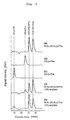
Classifications
-
- C—CHEMISTRY; METALLURGY
- C12—BIOCHEMISTRY; BEER; SPIRITS; WINE; VINEGAR; MICROBIOLOGY; ENZYMOLOGY; MUTATION OR GENETIC ENGINEERING
- C12N—MICROORGANISMS OR ENZYMES; COMPOSITIONS THEREOF; PROPAGATING, PRESERVING, OR MAINTAINING MICROORGANISMS; MUTATION OR GENETIC ENGINEERING; CULTURE MEDIA
- C12N9/00—Enzymes; Proenzymes; Compositions thereof; Processes for preparing, activating, inhibiting, separating or purifying enzymes
- C12N9/14—Hydrolases (3)
- C12N9/78—Hydrolases (3) acting on carbon to nitrogen bonds other than peptide bonds (3.5)
- C12N9/80—Hydrolases (3) acting on carbon to nitrogen bonds other than peptide bonds (3.5) acting on amide bonds in linear amides (3.5.1)
Definitions
- the present invention relates to a new N-acetyl-(R)- ⁇ -amino acid acylase, a new N-acetyl-(S)- ⁇ -amino acid acylase, genes encoding them, and the like.
- Enzymes having acylase activity on N-acetyl- ⁇ -amino acids are not conventionally known.
- the present inventors were the first to discover bacterial strains in the form of Variovorax sp. AJ 110348 (FERM BP-10367) and Burkholderia sp. AJ 110349 (FERM BP-10366) that optically selectively deacetylate N-acetyl- ⁇ -amino acids such as N-acetyl- ⁇ -phenylalanine in cultured bacterial masses.
- a method for optically selectively deacetylation employing such a bacterial mass or the supernatant of such a ruptured bacterial mass solution is described in Japanese Patent Application Publication No.
- Patent Reference 1 Japanese Patent Application Publication No. 2006-42722
- N-acetyl- ⁇ -amino acid acylase derived from Burkholderia sp. AJ110349 retains both (R) and (S) optically selective acylase, and it is difficult to produce ⁇ -amino acids of high optical selectivity using the wild strains.
- the present inventors first attempted to employ the usual method of shotgun cloning to obtain the N-acetyl- ⁇ -amino acid acylase that deacetylates N-acetyl- ⁇ -amino acids in an optically selective manner from the bacterial strains described in Patent Reference 1.
- a genomic DNA library was created for Burkholderia sp. AJ110349, this was coated on a medium having a sole carbon source in the form of N-acetyl-R/S- ⁇ -Phe, and culturing was conducted at 37°C for one week.
- the number of donor specimens was determined by separately coating the library on LB medium and calculating the number of bacterial cells that grew on the LB medium. Screening of about 10,000 bacterial strains yielded no strain that grew using N-acetyl-R/S- ⁇ -Phe as its sole carbon source.
- the isolated and purified enzyme has a specific activity that is several hundred times that of the target enzyme in cell-free extract. This purification proved to be extremely difficult.
- One of the reasons for this difficulty was that cells of Burkholderia sp. AJ110349, a bacterium that produces the enzyme, have the property of tending not to concentrate when centrifuged.
- a buffer solution is normally employed to thoroughly clean the cell mass once the cells have been concentrated so as to prevent the protein from mixing into the medium.
- This strain tends not to be recoverable in pellet form when concentrated by the commonly employed centrifugal separation methods, and it is difficult to separate proteins derived from medium components from proteins derived from the cell mass.
- the isolation and purification of protein from this strain requires isolation from a state in which many more undesired proteins are present than is normally the case, which is one reason behind the difficulty in purification.
- the present inventors conducted extensive research into a much greater number of conditions than is normally the case for protein purification. This resulted in the discovery that only by means of a purification step employing five types of chromatography, an unexpected number even for persons in the trade, was it possible to successfully isolate and purify the above enzyme. As a result, the nucleotide sequence of the gene encoding the above enzyme was determined. Further, since it was not necessary to separately obtain several enzymes for Variovorax sp. AJ110348, the procedure was improved and shotgun cloning was continued.
- the present inventors conducted an extremely time-consuming operation in which the activity of each clone was separately determined to successfully obtain the gene for the targeted enzyme. As set forth above, the present invention was devised as a result of strenuous effort.
- the present invention comprises the various following forms.
- N-acetyl-(R)- ⁇ -amino acid acylase and N-acetyl-(S)- ⁇ -amino acid acylase have been isolated and identified, their genes have been cloned, and their nucleotide sequences and the amino acid sequences of the proteins encoded by these genes have been elucidated.
- the genes of the present invention encode N-acetyl-(R)- ⁇ -amino acid acylase and N-acetyl-(S)- ⁇ -amino acid acylase. These enzymes have homodimer and homotrimer structures comprised of subunits (structural units) having molecular weights of about 84 kDa and 41 kDa, respectively. Accordingly, more specifically, the genes of the present invention encode the polypeptides that are the various subunits of these enzymes. Burkholderia sp. AJ110349 (FERM BP-10366) produces typical examples of these enzymes. Specific examples of the amino acid sequences thereof are given by SEQ. ID. NOS. 8 and 10.
- N-acetyl-(R,S)- ⁇ -amino acid acylase in the present invention is N-acetyl-(R,S)- ⁇ -phenylalanine (Phe) acylase. Whether N-acetyl-(R,S)- ⁇ -amino acid acylase has R-form specific activity or S-form specific activity is determined using N-acetyl-(R,S)- ⁇ -phenylalanine acylase as substrate.
- N-acetyl-(R,S)- ⁇ -amino acid acylase of the present invention just as in the recognition of the D-form and L-form of ⁇ -amino acids, recognizes the corresponding positions of hydrogen, carboxyl groups, amino groups, and side chains.
- precedence based on the cis -position and -C-COOH are sometimes interchanged based on the side chain that is bound at the ⁇ -position.
- the S-form is produced from N-acetyl-(R)- ⁇ -amino acid acylase in the case of N-acetyl- ⁇ -homoLeu and the R-form is produced from N-acetyl-(S)- ⁇ -amino acid acylase in the case of N-acetyl- ⁇ -homoPhe.
- a "protein having N-acetyl-(R)- ⁇ -amino acid acylase activity or N-acetyl-(S)- ⁇ -amino acid acylase activity” means a protein (or polypeptide) comprised of structural units (or functional structural units) in the form of various acylase enzymes having a homodimer or homotrimer structure.
- the genes of the present invention can be prepared by methods known to those skilled in the art.
- the genomic DNA of Burkholderia sp. AJ110349 (FERM BP-10366) or Variovorax sp. AJ110348 (FERM BP-10367) can be employed as DNA template, and primer that has been suitably prepared based on information relating to the amino acid sequence or the nucleotide sequence of the DNA of the present invention as disclosed in the present Specification can be employed to prepare the genes of the present invention by amplification by any form of PCR known to those skilled in the art.
- genes of the present invention can be prepared by methods of chemical synthesis known to those skilled in the art.
- under stringent conditions means conditions under which specific hybrids form but nonspecific hybrids do not.
- these are conditions under which two strands of DNA having a high degree of homology (for example, DNA strands having 50 percent or greater, desirably 70 percent or greater, preferably 80 percent or greater, more preferably 90 percent or greater, and still more preferably, 95 percent or greater homology) hybridize, but two strands of DNA of lower homology do not hybridize.
- homology between nucleotide sequences can be determined by algorithms known to those in the trade, such as the Blast algorithm.
- these are conditions under which hybridization occurs at salt concentrations corresponding to 60°C, 1 x SSC, 0.1 percent SDS, preferably 0.1 x SSC and 0.1 percent SDS, which are the normal Southern hybridization washing conditions.
- DNA strands that hybridize under such conditions include those having stop codons part way through and those that have lost their activity due to mutation of the activity center.
- prescribed N-acetyl-(R)- ⁇ -amino acid acylase or N-acetyl-(S)- ⁇ -amino acid acylase activity can be detected and eliminated by the method described further below.
- Hybridization can be conducted by the method described in Current Protocols in Molecular Biology (edited by Frederick M. Ausubel et al., 1987), methods known to those skilled in the trade, and methods based on such methods. It can also be conducted by methods described in commercial live [DVDs] and accompanying instruction manuals.
- the proteins encoded by the genes of the present invention are proteins having the amino acid sequences (SEQ. ID. NO. 8, 10, or 12) of the unit polypeptides constituting N-acetyl-(R)- ⁇ -amino acid acylase or N-acetyl-(S)- ⁇ -amino acid acylase with one or more amino acid residue substitutions, deletions, or additions.
- the term "one or more amino acid residue substitutions, deletions, or additions” as used herein means substitutions, deletions, or additions of 1 to 200 amino acids residues, preferably 1 to 100 amino acid residues, more preferably 1 to 50 amino acid residues, still more preferably 1 to 30 amino acid residues.
- Proteins having the above-described enzymatic activity can be readily prepared by suitable combinations of any of the methods known to those skilled in the art, such as the introduction of site-specific mutations, homologous recombination, primer extension, and PCR methods.
- proteins of the present invention are proteins, or fragments thereof, containing amino acid sequences having a high degree of sequence homology averaging about 70 percent overall, desirably about 80 percent or more, preferably about 90 percent or more, and more preferably, 95 percent or more, with the above amino acid sequences, that have prescribed N-acetyl-(R)- ⁇ -amino acid acylase or N-acetyl-(S)- ⁇ -amino acid acylase [activity].
- Homology between amino acid sequences can also be determined by algorithms known to those skilled in the trade, such as the Blast method employed in the embodiments. The above enzymatic activity can be measured by the method described in the embodiments of the present Specification.
- Such proteins can also be readily prepared by suitable combinations of any of the methods known to those skilled in the art, such as the introduction of site-specific mutations, homologous recombination, primer extension, and PCR methods.
- genes of the present invention obtained as set forth above can be incorporated into recombination vectors by any of the methods known to those skilled in the art to create the recombination expression vectors employed in the present invention.
- a DNA fragment containing the gene of the present invention can be excised, (2) inserted at a restrictase site or muticloning site in a suitable recombination vector, and ligated to the vector to prepare a recombination expression vector.
- the recombination vector is not specifically limited.
- recombination vectors in the form of plasmids derived from Aspergillus nidulans (such as pSa123, pTAex3, pNGU113, pRBG1, pGM32, pSE52, and pNAGL142), plasmids derived from Escherichia coli (such as pT7Blue T-Vector, pRSET, pBR322, pBR325, pUC18, and pUC118), plasmids derived from Bacillus subtilis (such as pUB 110, pTP5, and pC 194), and plasmids derived from yeast (such as pSH 19 and pSH 15) can be employed.
- Aspergillus nidulans such as pSa123, pTAex3, pNGU113, pRBG1, pGM32, pSE52, and pNAGL142
- Escherichia coli such as pT7
- the targeted proteins encoded by the external genes of the present invention can be expressed as fused genes with other proteins or peptides (such as glutathione-S-transferase, histidine tags, calmodulin-binding proteins, and protein A). Such fused proteins can be cleaved with suitable proteases and separated into independent proteins.
- any microbial cell known to those skilled in the art such as a prokaryotic cell such as Escherichia coli or a eukaryotic cell such as Saccharomyces cerevisiae (brewer's yeast), can be employed.
- the host cell can be transformed by a method known in the field of art, such as the calcium chloride method, use of a particle gun, or the electroporation method.
- a method known in the field of art such as the calcium chloride method, use of a particle gun, or the electroporation method.
- the following literature may be consulted: Proc. Natl. Acad. Sci. USA, Vol. 69, 2110 (1972 ); Gene, Vol. 17, 107 (1982 ); Molecular and General Genetics, Vol. 168, 111 (1979 ); Methods in Enzymology, Vol. 194, 182-187 (1991) ; Proc. Natl. Acad. Sci. USA, Vol. 75, 1929 (1978 ); Cell Engineering, Vol. 8, New Cell Engineering Experiment Protocols, 263-267 (1995) (pub. by Shujunsha ); and Virology, Vol. 52, 456 (1973 ).
- the transformant of the present invention thus obtained can be cultured by a method known to those skilled in the field of art.
- a method known to those skilled in the art can be suitably selected.
- methods known to those skilled in the art such as the use of various chromatographic columns, filters, ultrafiltration, salting out, solvent precipitation, solvent extraction, distillation, immunoprecipitation, SDS-polyacrylamide gel electrophoresis, isoelectric focusing electrophoresis, dialysis, and crystallization, can be suitably selected and combined to separate and purify the protein in essentially pure and uniform form.
- the recombinant protein that is expressed can be purified using a glutathione column or nickel column. Following purification of a fused protein, as needed, the regions outside the target protein can be cut away and eliminated with thrombin, factor Xa, or the like.
- a suitable protein modifying enzyme such as trypsin, chymotrypsin, lysyl endopeptidase, protein kinase, or glucosidase can be used to treat the protein, either before or after purification, to modify the protein or partially remove a peptide.
- the present invention provides a method for manufacturing ⁇ -amino acids by contacting a microbe that has been transformed with a gene encoding a protein having N-acetyl- ⁇ -amino acid acylase activity with an N-acetyl- ⁇ -amino acid, inducing the production of the ⁇ -amino acid, and recovering the ⁇ -amino acid.
- the present invention also provides a method for manufacturing ⁇ -amino acids, characterized by contacting a protein having N-acetyl- ⁇ -amino acid acylase activity obtained from this microbe with an N-acetyl- ⁇ -amino acid, inducing the production of the ⁇ -amino acid, and recovering the ⁇ -amino acid.
- R denotes a group selected from among alkyl groups having 1 to 6 carbon atoms, aryl groups having 6 to 14 carbon atoms, cycloalkyl groups having 3 to 10 carbon atoms, aralkyl groups having 7 to 19 carbon atoms, alkoxyalkyl groups having 2 to 11 carbon atoms, groups comprising a hetero atom on one of these carbon skeletons, and groups comprising a carbon-carbon unsaturated bond on one of these carbon skeletons, it being permissible for the group to be either linear or branched, and to be optionally further substituted.
- R denotes an alkyl group having 1 to 4 carbon atoms, or an aryl group having 6 or 7 carbon atoms, that is either linear or branched, and optionally further substituted. It is desirable to select the ⁇ -amino acid from among ⁇ -phenylalanine, ⁇ -leucine, ⁇ -homoleucine, ⁇ -homophenylalanine, ⁇ -tyrosine, ⁇ -4-fluorophenylalanine, ⁇ -aminobutyric acid, 3,4-(-0-CH2-0-)- ⁇ -phenylalanine, and ⁇ -Pyridylalanine.
- any of the types, methods, conditions, and the like for exerting the effects of various acylases known to those skilled in the art may be suitably selected based on various conditions such as the type and quantity of N-acetyl- ⁇ -amino acid, the type of acylase, and the scale of manufacturing.
- N-acetyl- ⁇ -amino acid can be added to a suspension of the bacterial mass of the present invention, or N-acetyl- ⁇ -amino acid can be added to the supernatant of a solution of ruptured bacterial mass, to cause the acylase to exert its effect.
- the reaction temperature is desirably 10 to 60°C, preferably 20 to 40°C.
- the pH of the reaction system is desirably 4 to 10, preferably 6 to 9.
- the reaction time is 10 minutes to 120 hours, desirably 1 to 60 hours, preferably 1 to 48 hours.
- the reaction solvent may be in the form of an aqueous solution, MeOH, DMF, DMSO, or the like, or a mixture thereof may be employed.
- N-acetyl- ⁇ -amino acids were synthesized: racemic forms were synthesized by acetylating racemic ⁇ -amino acids and optically active forms were synthesized by acetylating optically active ⁇ -amino acids.
- (R)- ⁇ -Phe hydrochloride 250 mg, 1.24 mmol was suspended in 5 mL of water, 20 percent NaOH aqueous solution was added with ice cooling, and the pH was adjusted to a range of 11 to 12. While maintaining the pH of the aqueous solution within the range of 11 to 12 by adjusting the pH with 20 percent NaOH aqueous solution, acetic anhydride (0.28 mL, 2.96 mmol) was added dropwise at room temperature. The reaction mixture was filtered to remove insoluble material, concentrated hydrochloric acid was added to the solution obtained, and the pH was adjusted to 2, causing crystals to precipitate out. The crystals were filtered out, washed with water, and dried overnight at 50°C under reduced pressure, yielding N-acetyl-(R)- ⁇ -Phe (236 mg, 1.13 mmmol, 91 percent).
- Methyl 3-acetamide-2-butenoate was prepared by the method described in J. Am. Chem. Soc. 2002, 124, 14552 .
- This compound was prepared by the method described in US20060035345 for use.
- ⁇ -3-Pyr-Ala 200 mg, 1.2 mmol was suspended in 5 mL of water and 20 percent NaOH aqueous solution was added to adjust the pH to a range of 11 to 12. While maintaining the pH of the aqueous solution within the range of 11 to 12 by adjusting the pH with 20 percent NaOH aqueous solution, acetic anhydride (257 mL, 2.46 mmol) was added dropwise at room temperature. The reaction mixture was filtered to remove insoluble material, concentrated hydrochloric acid was added to the solution, and the pH was adjusted to 2. Since nothing precipitated out, an evaporator was used to completely evaporate off the liquid. The dried product was analyzed by NMR and employed in the reaction.
- N-acetyl-(R,S)- ⁇ -Phe Activity producing (R)- ⁇ -Phe from N-acetyl-(R,S)- ⁇ -Phe will be referred to as N-acetyl-(R)- ⁇ -Phe acylase activity and activity producing (S)- ⁇ -Phe will be referred to as N-acetyl-(S)- ⁇ -Phe acylase activity hereinafter.
- the column employed was comprised of an Inertsil ODS3 (0.46 cm in diameter, 5 cm) made by GL Science and a Chiralpak WH (0.46 cm in diameter, 25 cm) made by Daisel Chemical Industries, arranged consecutively in that order.
- the mobile phase was 1 mM CuSO 4 , 10 percent MeOH.
- the temperature was 50°C and the flow rate was 1.0 mL/minute. Detection was conducted with a UV detector at 210 nm and optical selectivity was determined by comparison with standard (R) and (S) products.
- Burkholderia sp. AJ 110349 was employed. Preserved bacterial strain was refreshed by being statically cultured for 48 hours at 30°C on CM2G agar medium comprised of 5 g/L of D-glucose, 10 g/L of yeast extract, 10 g/L of peptone, 5 g/L of NaCl, and 20 g/L of agar (pH 7.0).
- the refreshed bacteria were inoculated onto 100 mL of enzyme producing medium comprised of 10 g/L D-glucose, 10 g/L (NH 4 ) 2 SO 4 , 10 g/L (R,S)- ⁇ -Phe, 2 g/L casamino acid, 1 g/L KH 2 PO 4 , 0.4 g/L MgSO 4 ⁇ 7H 2 O, 1 g/L NaCl, 19.5 g/L 2-(N-morpholino)ethanesulfonic acid (MES), 5 mg/L nicotinamide, 0.2 mg/L thiamin, 10 mg/L FeSO 4 ⁇ 7H 2 O, 10 mg/L MnSO 4 ⁇ 4 to 5H 2 O, and culturing was conducted with shaking in a 500 mL Sakaguchi flask for 66 hours at 120 rpm at 30°C.
- enzyme producing medium comprised of 10 g/L D-glucose, 10 g/L (NH 4
- the bacterial mass was collected by a 6,800 g, 10 minute centrifugation operation from about 2,000 mL of culture solution. Since precipitation of the bacterial mass was not adequately observed, about 1,600 mL of supernatant was removed, and the remainder was rendered uniform by pipeting.
- This concentrated culture solution without being washed by buffer or the like, was ultrasonically processed for 20 min at 200 W to rupture the bacteria. The ruptured solution obtained was centrifuged for 30 min at 200,000 g, and about 200 mL of the centrifuged supernatant obtained was employed as cell-free extract.
- ammonium sulfate fractions obtained as set forth above were dialyzed against a buffer solution comprised of 25 mM Tris-HCl (pH 7.6) and 0.6 M (NH 4 ) 2 SO 4 and then placed on phenyl sepharose 26/10 that had been equilibrated with the same buffer solution. Following nonadsorptive protein elution, the adsorptive protein was eluted by linearly varying the (NH 4 ) 2 SO 4 concentration in the buffer solution from 0.6 M to 0 M.
- N-acetyl-(R)- ⁇ -Phe acylase activity being detected in the vicinity of an (NH 4 ) 2 SO 4 concentration in the vicinity of 0.2 M
- N-acetyl-(S)- ⁇ -Phe acylase activity being detected in the vicinity of an (NH 4 ) 2 SO 4 concentration of about 0.1 M.
- the fractions exhibiting activity were divided into N-acetyl-(R)- ⁇ -Phe acylase activity elution fractions and N-acetyl-(S)- ⁇ -Phe acylase activity elution fractions and recovered.
- the phenyl-sepharose fraction obtained was concentrated, dialyzed against 25 mM Tris-HCl (pH 7.6), and then placed on Q-Sepharose 16/10 that had been equilibrated with the same buffer solution. Following nonadsorptive protein elution, the adsorptive protein was eluted by linearly varying the NaCl concentration in the buffer solution from 0 M to 0.5 M. This operation resulted in N-acetyl-(R)- ⁇ -Phe acylase activity being detected in the vicinity of an NaCl concentration in the vicinity of 0.22 M, and N-acetyl-(S)- ⁇ -Phe acylase activity being detected in the vicinity of an NaCl concentration of about 0.3 M. The fractions exhibiting activity were recovered.
- the Resource phenyl fractions obtained were concentrated, dialyzed against 25 mM Tris-HCl (pH 7.6), and placed on Mono Q 5/5 equilibrated with the same buffer solution. Following nonadsorptive protein elution, the adsorptive protein was eluted by linearly varying the NaCl concentration in the buffer solution from 0 M to 0.5 M. This operation resulted in N-acetyl-(R)- ⁇ -Phe acylase activity being detected in the vicinity of an NaCl concentration of about 0.2 M, and N-acetyl-(S)- ⁇ -Phe acylase activity being detected in the vicinity of an NaCl concentration of about 0.28 M. The fractions exhibiting activity were recovered, and adopted as N-acetyl-(R)- ⁇ -amino acid acylase and N-acetyl-(S)- ⁇ -amino acid acylase preparations.
- the molecular weights of the two enzymes in their unaltered forms were estimated at 206 kDa (N-acetyl-(R)- ⁇ -amino acid acylase) and 101 kDa (N-acetyl-(S)- ⁇ -amino acid acylase).
- both of the enzymes were thought to have homodimer or homotrimer structures.
- N-terminal amino acid sequences of the purified enzyme preparations were determined. This was done by subjecting the enzyme preparations to SDS-PAGE, transferring them to a PVDF membrane, staining them with coomassie blue, cutting out the positions where bands appeared, and placing these portions in a protein sequencer. As a result, N-acetyl-(R)- ⁇ -amino acid acylase was sequenced as the 20 residues indicated by SEQ. ID. NO. 1, and N-acetyl-(S)- ⁇ -amino acid acylase was sequenced as the 26 amino acid residues indicated by SEQ. ID. NO. 2.
- primers R7F and R8R SEQ. ID. NOS. 3 and 4
- primers S3F and S4R SEQ. ID. NOS. 5 and 6 were employed to conduct PCR using genomic DNA of Burkholderia sp. AJ 110349 as template.
- the 0.3 kg DNA fragment containing the gene region encoding the vicinity of the N-terminal of N-Acetyl-(R)- ⁇ -amino acid acylase, and the 0.4 kb DNA fragment containing the general region encoding the vicinity of the N-terminal of N-acetyl-(S)- ⁇ -amino acid acylase were amplified, DIG labeling was conducted, and these were denoted as R-probe and S-probe, respectively.
- Genomic DNA was extracted from Variovorax sp. AJ110348 and partially denatured with restrictase Sau3AI. Fragments of about 3 to 8 kg were recovered and ligated to pUC118. Escherichia coli JM109 was transformed with this reaction solution and a library was prepared. The transformants obtained were sorted by blue white selection, and a master plate was prepared for the 3,500 strains obtained as single colonies.
- N-acetyl-(R,S)- ⁇ -Phe liquid medium ammonium sulfate 10.0 g/L, KH 2 PO 4 1.0 g/L, MgSO 4 ⁇ 7H 2 O 0.4 g/L, FeSO4 ⁇ 7H 2 O 10 mg/L, MnSO4 ⁇ 5H 2 O 10 mg/L, vitamin B1 ⁇ HCl 0.2 mg/L, N-acetyl-(R,S)- ⁇ -Phe 1.0 g/L, and pH 8.0 IPTG 100 ⁇ M Amp 100 ⁇ g/mL) and cultured with shaking for 48 hours at 37°C.
- N-acetyl-(R,S)- ⁇ -Phe liquid medium ammonium sulfate 10.0 g/L, KH 2 PO 4 1.0 g/L, MgSO 4 ⁇ 7H 2 O 0.4 g/L, FeSO4 ⁇ 7H 2 O 10 mg/L, MnSO4 ⁇ 5H 2 O 10 mg
- a supernatant solution obtained by centrifugal separation (15,000 g, 10 minutes, 4°C) was employed as a cell-free extract and reacted for 10 minutes at 37°C with 50 mM Tris-HCl (pH 7.6) and 0.2 percent N-acetyl- ⁇ -Phe.
- N-acetyl- ⁇ -amino acid acylase activity was measured under the separation conditions of N-acetyl- ⁇ -Phe and ⁇ -Phe, a value of 2.3 U/mg was obtained.
- optical selectivity was determined by HPLC under ⁇ -Phe optical resolution conditions, (R)- ⁇ -Phe had been specifically produced, with (S)- ⁇ -Phe being below the detection threshold.
- PCR was conducted with primers R_7F (SEQ. ID. NO. 13) and R_R_HindIII (SEQ. ID. NO. 14).
- the 2.3 kb amplified fragment obtained was treated with BamHI and HindIII, inserted into the MamHI/HindIII site of ptrp4 (Reference Document: Journal of Molecular Catalysis B: Enzymatic 32 (2005) 205-211 ) to create ptrp4_3BR.
- Escherichia coli JM109 was transformed with this plasmid. The transformant was called JM109/ptrp4_3BR.
- a supernatant solution obtained by centrifugal separation (15,000 g, 10 minutes, 4°C) was employed as a cell-free extract and reacted for 30 minutes at 37°C with 50 mM Tris-HCl (pH 7.6) and 0.2 percent N-acetyl-(R,S)- ⁇ -Phe.
- the quantity of ⁇ -Phe produced was measured by HPLC.
- the N-acetyl- ⁇ -amino acid acylase activity was measured at 0.29 U/mg.
- Optical selectivity was determined by HPLC under ⁇ -Phe optical resolution conditions, revealing the specific production of (R)- ⁇ -Phe; (S)- ⁇ -Phe was below the detection threshold.
- JM109/pSFN_2BS DNA comprised of 1.1 kb of PCR product that had been treated with restrictionnuclease was inserted at the NdeI/HindIII sites of this pSFN to obtain pSFN_2BS.
- Escherichia coli JM109 was transformed with this plasmid.
- the transformant was called JM109/pSFN_2BS.
- the insert sequence of this plasmid starts from 6th Met. Inventers made the plasmid of starting from 1st Met. However, both plasmid don't have so much difference.
- JM109/pSFN_2BS was precultured for 16 hours at 37°C in LB medium containing 100 mg/L of ampicillin.
- JM109/pSFN_1VR was cultured for 16 hours at 37°C in LB medium containing 100 mg/L of ampicillin. 1 mL quantity of the cultured bacterial mass was transplanted to 50 mL of TB medium containing 100 mg/L of ampicillin and cultured for 16 hours at 30°C. The bacterial mass obtained was centrifugally separated to concentrate the bacteria. The bacterial mass was washed with 50 mM Tris buffer solution (pH 7.6) and the same buffer was used to prepare a bacterial mass suspension. Ultrasonic rupturing was employed to rupture the bacterial mass. A supernatant solution obtained by centrifugal separation (15,000 g, 10 minutes, 4°C) was employed as a cell-free extract.
- JM 109/ptrp4_3BR, JM109/pSFN_2BS, and JM109/pSFN_1 VR were precultured for 16 hours at 37°C in LB medium containing 100 mg/L of ampicillin.
- 1 mL quantity of the cultured bacterial mass was transplanted to 50 mL of TB medium containing 100 mg/L of ampicillin and cultured for 16 hours at 30°C.
- the bacterial mass obtained was centrifugally separated to concentrate the bacteria.
- the bacterial mass was washed with 50 mM Tris buffer solution (pH 7.6) and the same buffer solution was used to prepare a bacterial mass suspension. Ultrasonic rupturing was employed to rupture the bacterial mass.
- a supernatant solution obtained by centrifugal separation (15,000 g, 10 minutes, 4°C) was employed as a cell-free extract, and substrate specificity for the various N-acetyl-(R,S)- ⁇ -amino acids described in Embodiments 2-1 to 9 was examined. After adjusting the enzymes by the above methods, their activity was measured. Activity producing 1 ⁇ mol of ⁇ -Phe per minute from N-acetyl-(R,S)- ⁇ -Phe was denoted as 1 U. In the various examination of substrate specificity, 50 mU cell-free extracts were employed.
- a 50 mM Tris buffer solution (pH 7.6) that had been reacted with each of the substrates was employed as an "Enzyme-" test zone, and instead of the individual substrates, 50 mM Tris buffer solution (pH 7.6) that had been reacted with each of the cell-free extracts was employed as a "Substrate-" test zone.
- 50 mM Tris-HCl (pH 7.6) and 0.2 percent of various N-acetyl-(R,S)- ⁇ -amino acids were reacted at 37°C for 1 hour or 24 hours, and then processed for 10 minutes at 96°C to stop the reactions.
- the quantity of acetic acid produced by the decomposition of acetyl groups was determined by the protocol of an acetic acid kit (Roche). Table 3 shows the quantity of acetic acid produced after one hour, and Table 4 shows the quantity of acetic acid produced after 24 hours.
- N-acetyl-(R,S)- ⁇ -aminobutyric acid N-acetyl- ⁇ -Aba
- N-acetyl-(R,S)- ⁇ -Leu N-acetyl-(R,S)- ⁇ -homoLeu
- N-acetyl-(R,S)- ⁇ -Tyr N-acetyl-(R,S)-homoPhe
- N-acetyl-(R,S)- ⁇ -4-fluoroPhe N-acetyl-(R,S)- ⁇ -4-fluoroPhe as test zones.
- JM109/ptrp4_3BR, JM109/pSFN_2BS, and JM109/pSFN_1VR were precultured for 16 hours at 37°C in LB medium containing 100 mg/L of ampicillin.
- Single mL quantities of the cultured bacterial masses were transplanted to 50 mL of TB medium containing 100 mg/L of ampicillin and cultured for 16 hours at 30°C.
- the bacterial masses obtained were centrifugally separated to concentrate the bacteria.
- the bacterial masses were then washed with 50 mM Tris buffer solution (pH 7.6) and concentrated 10-fold with the same buffer solution to prepare bacterial suspensions.
- Transformation of a host such as Escherichia coli with the genes identified in the present invention permits the construction of high-expression systems for N-acetyl-(R)- ⁇ -amino acid acylase and N-acetyl-(S)- ⁇ -amino acid acylase. As a result, these enzymes can be used to conveniently and economically provide systems that select for R and S-forms of ⁇ -amino acids.
Landscapes
- Life Sciences & Earth Sciences (AREA)
- Chemical & Material Sciences (AREA)
- Health & Medical Sciences (AREA)
- Genetics & Genomics (AREA)
- Organic Chemistry (AREA)
- Zoology (AREA)
- Engineering & Computer Science (AREA)
- Bioinformatics & Cheminformatics (AREA)
- Wood Science & Technology (AREA)
- Microbiology (AREA)
- Biotechnology (AREA)
- Biomedical Technology (AREA)
- Molecular Biology (AREA)
- Biochemistry (AREA)
- General Engineering & Computer Science (AREA)
- General Health & Medical Sciences (AREA)
- Medicinal Chemistry (AREA)
- Micro-Organisms Or Cultivation Processes Thereof (AREA)
- Enzymes And Modification Thereof (AREA)
- Preparation Of Compounds By Using Micro-Organisms (AREA)
- Seasonings (AREA)
Abstract
Description
- The present invention relates to a new N-acetyl-(R)-β-amino acid acylase, a new N-acetyl-(S)-β-amino acid acylase, genes encoding them, and the like.
- Enzymes having acylase activity on N-acetyl-β-amino acids are not conventionally known. The present inventors were the first to discover bacterial strains in the form of Variovorax sp. AJ 110348 (FERM BP-10367) and Burkholderia sp. AJ 110349 (FERM BP-10366) that optically selectively deacetylate N-acetyl-β-amino acids such as N-acetyl-β-phenylalanine in cultured bacterial masses. A method for optically selectively deacetylation employing such a bacterial mass or the supernatant of such a ruptured bacterial mass solution is described in
Japanese Patent Application Publication No. 2006-42722
[Patent Reference 1]Japanese Patent Application Publication No. 2006-42722 - Conversion reactions employing these selected wild strains constitute one method of conversion. However, N-acetyl-β-amino acid acylase derived from Burkholderia sp. AJ110349 retains both (R) and (S) optically selective acylase, and it is difficult to produce β-amino acids of high optical selectivity using the wild strains. To achieve more efficient conversion, it is important to isolate and identify enzymes that catalyze the reaction, identify the genes encoding these enzymes, and construct a high-expression system using Escherichia coli as host.
- Numerous methods of isolating and identifying enzymes that support the activity of bacterial strains found to have enzymatic activity have been reported. Specifically, these include gene isolation by shotgun cloning; and isolating an enzyme, determining the amino acid sequence of a particular portion, and isolating the gene based on the sequence information.
- Accordingly, the present inventors first attempted to employ the usual method of shotgun cloning to obtain the N-acetyl-β-amino acid acylase that deacetylates N-acetyl-β-amino acids in an optically selective manner from the bacterial strains described in
Patent Reference 1. - A genomic DNA library was created for Burkholderia sp. AJ110349, this was coated on a medium having a sole carbon source in the form of N-acetyl-R/S-β-Phe, and culturing was conducted at 37°C for one week.
The number of donor specimens was determined by separately coating the library on LB medium and calculating the number of bacterial cells that grew on the LB medium. Screening of about 10,000 bacterial strains yielded no strain that grew using N-acetyl-R/S-β-Phe as its sole carbon source. - Similarly, about 51,000 strains of Variovorax sp. AJ110348 were screened to find those utilizing N-acetyl-R/S-β-Phe as sole carbon source. However, in the same manner as when screening strains of Burkholderia sp. AJ110349, no strain that grew using N-acetyl-R/S-β-Phe as its sole carbon source was obtained.
- As set forth above, although an extremely large number of clones were examined, screening employing the utilization of a sole carbon source as indicator did not yield the desired enzyme gene.
- Thus, the second approach of isolating and purifying the enzyme was attempted. Numerous methods of isolating and purifying enzymes have been reported. However, there are no general principles for an isolation and purification method that extends the promise of permitting the isolation and purification of every possible protein. Further, the difficulty of isolation and purification varies greatly based on the ratio in which the targeted protein is present in the total quantity of protein employed as the purification source. The method of purifying N-acetyl-β-amino acid acylase employed in the present invention is described in detail further below. When purifying N-acetyl-(R)-β-amino acid acylase and N-acetyl-(S)-β-amino acid acylase from Burkholderia sp. AJ110349, the isolated and purified enzyme has a specific activity that is several hundred times that of the target enzyme in cell-free extract. This purification proved to be extremely difficult. One of the reasons for this difficulty was that cells of Burkholderia sp. AJ110349, a bacterium that produces the enzyme, have the property of tending not to concentrate when centrifuged. When isolating and purifying a protein within a cell mass, a buffer solution is normally employed to thoroughly clean the cell mass once the cells have been concentrated so as to prevent the protein from mixing into the medium. This strain tends not to be recoverable in pellet form when concentrated by the commonly employed centrifugal separation methods, and it is difficult to separate proteins derived from medium components from proteins derived from the cell mass. Thus, the isolation and purification of protein from this strain requires isolation from a state in which many more undesired proteins are present than is normally the case, which is one reason behind the difficulty in purification.
- To solve this problem, the present inventors conducted extensive research into a much greater number of conditions than is normally the case for protein purification. This resulted in the discovery that only by means of a purification step employing five types of chromatography, an unexpected number even for persons in the trade, was it possible to successfully isolate and purify the above enzyme. As a result, the nucleotide sequence of the gene encoding the above enzyme was determined.
Further, since it was not necessary to separately obtain several enzymes for Variovorax sp. AJ110348, the procedure was improved and shotgun cloning was continued. Since the enzyme gene had not been obtained by simple screening in which strains having the target gene were selectively grown as set forth above, the present inventors, as will be described further below, conducted an extremely time-consuming operation in which the activity of each clone was separately determined to successfully obtain the gene for the targeted enzyme.
As set forth above, the present invention was devised as a result of strenuous effort. - That is, the present invention comprises the various following forms.
- [Form 1] A gene encoding any one of the following proteins:
- (a) the protein comprised of the amino acid sequence denoted by SEQ. ID. NO. 8;
- (b) a protein having N-acetyl-(R)-β-amino acid acylase activity comprised of the amino acid sequence denoted by SEQ. ID. NO. 8 with one or more amino acid residue substitutions, deletions, or additions; and
- (c) a protein having N-acetyl-(R)-β-amino acid acylase activity in the form of a protein comprising an amino acid sequence exhibiting 70 percent or greater sequence homology with the amino acid sequence of SEQ. ID. NO. 8.
- [Form 2] A gene comprising any one of the following DNAs:
- (a) DNA comprised of the nucleotide sequence denoted by SEQ. ID. NO. 7;
- (b) DNA encoding a protein having N-acetyl-(R)-β-amino acid acylase activity and hybridizing under stringent conditions with nucleic acid comprising a strand complementary to the nucleotide sequence denoted by SEQ. ID. NO. 7; and
- (c) DNA encoding a protein having N-acetyl-(R)-β-amino acid acylase activity in the form of DNA, or some fragment thereof, exhibiting 70 percent or greater sequence homology with the nucleotide sequence denoted by SEQ. ID. NO. 7.
- [Form 3] A gene encoding any of the following proteins:
- (a) the protein comprised of the amino acid sequence denoted by SEQ. ID. NO. 10;
- (b) a protein having N-acetyl-(S)-β-amino acid acylase activity that is comprised of the amino acid sequence denoted by SEQ. ID. NO. 10 with one or more amino acid residue substitutions, deletions, or additions; and
- (c) a protein having N-acetyl-(S)-β-amino acid acylase activity in the form of a protein comprising an amino acid sequence exhibiting 70 percent or greater sequence homology with the amino acid sequence of SEQ. ID. NO. 10.
- [Form 4] A gene comprising any one of the following DNAs:
- (a) DNA comprised of the nucleotide sequence denoted by SEQ. ID. NO. 9;
- (b) DNA encoding a protein having N-acetyl-(S)-β-amino acid acylase activity and hybridizing under stringent conditions with nucleic acid comprising a strand complementary to the nucleotide sequence denoted by SEQ. ID. NO. 9; and
- (c) DNA encoding a protein having N-acetyl-(S)-β-amino acid acylase activity in the form of DNA, or some fragment thereof, exhibiting 70 percent or greater sequence homology with the nucleotide sequence denoted by SEQ. ID. NO. 9.
- [Form 5] A gene encoding any one of the following proteins:
- (a) the protein comprised of the amino acid sequence denoted by SEQ. ID. NO. 12;
- (b) a protein having N-acetyl-(R)-β-amino acid acylase activity comprised of the amino acid sequence denoted by SEQ. ID. NO. 12 with one or more amino acid residue substitutions, deletions, or additions; and
- (c) a protein having N-acetyl-(R)-β-amino acid acylase activity in the form of a protein comprising an amino acid sequence exhibiting 70 percent or greater sequence homology with the amino acid sequence of SEQ. ID. NO. 12.
- [Form 6] A gene comprising any one of the following DNAs:
- (a) DNA comprised of the nucleotide sequence denoted by SEQ. ID. NO. 11;
- (b) DNA encoding a protein having N-acetyl-(R)-β-amino acid acylase activity and hybridizing under stringent conditions with nucleic acid comprising a strand complementary to the nucleotide sequence denoted by SEQ. ID. NO. 11; and
- (c) DNA encoding a protein having N-acetyl-(R)-β-amino acid acylase activity in the form of DNA, or some fragment thereof, exhibiting 70 percent or greater sequence homology with the nucleotide sequence denoted by SEQ. ID. NO. 11.
- [Form 7] The gene described by any one of
forms 1 to 6 wherein said β-amino acid is one or more members selected from the group consisting of β-phenylalanine, β-leucine, β-homoleucine, β-homophenylalanine, β-tyrosine, β-4-fluorophenylalanine, β-aminobutyric acid, 3,4-(-0-CH2-0-)-β-phenylalanine, and β-3-Pyridylalanie. - [Form 8] A protein denoted by any one of the following:
- (a) a protein comprising the amino acid sequence denoted by SEQ. ID. NO. 8;
- (b) a protein having N-acetyl-(R)-β-amino acid acylase activity comprising the amino acid sequence denoted by SEQ. ID. NO. 8 with one or more amino acid residue substitutions, deletions, or additions; and
- (c) a protein having N-acetyl-(R)-β-amino acid acylase activity in the form of a protein comprising an amino acid sequence exhibiting 70 percent or greater sequence homology with the amino acid sequence of SEQ. ID. NO. 8.
- [Form 9] A protein denoted by any one of the following:
- (a) the protein comprised of the amino acid sequence denoted by SEQ. ID. NO. 10;
- (b) a protein having N-acetyl-(S)-β-amino acid acylase activity that is comprised of the amino acid sequence denoted by SEQ. ID. NO. 10 with one or more amino acid residue substitutions, deletions, or additions; and
- (c) a protein having N-acetyl-(S)-β-amino acid acylase activity in the form of a protein comprising an amino acid sequence exhibiting 70 percent or greater sequence homology with the amino acid sequence of SEQ. ID. NO. 10.
- [Form 10] A protein denoted by any one of the following:
- (a) the protein comprised of the amino acid sequence denoted by SEQ. ID. NO. 12;
- (b) a protein having N-acetyl-(R)-β-amino acid acylase activity comprised of the amino acid sequence denoted by SEQ. ID. NO. 12 with one or more amino acid residue substitutions, deletions, or additions; and
- (c) a protein having N-acetyl-(R)-β-amino acid acylase activity in the form of a protein comprising an amino acid sequence exhibiting 70 percent or greater sequence homology with the amino acid sequence of SEQ. ID. NO. 12.
- [Form 11] The β-amino acid acylase described by any one of forms 8 to 10, wherein said β-amino acid is one or more members selected from the group consisting of β-phenylalanine, β-leucine, β-homoleucine, β-homophenylalanine, β-tyrosine, β-4-fluorophenylalanine, β-aminobutyric acid, 3,4-(-O-CH2-O-)-β-phenylalanine, and β-3-pyridyllalanine.
- [Form 12] A microorganism transformed by the gene described in any one of
forms 1 to 6. - [Form 13] Escherichia coli transformed by the gene described in any one of
forms 1 to 6. - [Form 14] A method for manufacturing β-amino acids, characterized by contacting the microorganism described in form 12 or 13 with N-acetyl-β-amino acid, inducing the production of one or more β-amino acids, and recovering the β-amino acids.
- [Form 15] A method for manufacturing β-amino acids, characterized by contacting a protein having N-acetyl-β-amino acid acylase activity obtained from the microorganism described in form 12 or 13 with N-acetyl-β-amino acid, inducing the production of one or more β-amino acids, and recovering the β-amino acids.
- Based on the present invention, N-acetyl-(R)-β-amino acid acylase and N-acetyl-(S)-β-amino acid acylase have been isolated and identified, their genes have been cloned, and their nucleotide sequences and the amino acid sequences of the proteins encoded by these genes have been elucidated.
- The genes of the present invention encode N-acetyl-(R)-β-amino acid acylase and N-acetyl-(S)-β-amino acid acylase. These enzymes have homodimer and homotrimer structures comprised of subunits (structural units) having molecular weights of about 84 kDa and 41 kDa, respectively. Accordingly, more specifically, the genes of the present invention encode the polypeptides that are the various subunits of these enzymes. Burkholderia sp. AJ110349 (FERM BP-10366) produces typical examples of these enzymes. Specific examples of the amino acid sequences thereof are given by SEQ. ID. NOS. 8 and 10. Further typical examples of these enzymes are produced by Variovorax sp. AJ110348 (FERM BP-10367). A specific example of the amino acid sequence thereof is given by SEQ. ID. NO. 12. A typical example of an N-acetyl-(R,S)-β-amino acid acylase in the present invention is N-acetyl-(R,S)-β-phenylalanine (Phe) acylase. Whether N-acetyl-(R,S)-β-amino acid acylase has R-form specific activity or S-form specific activity is determined using N-acetyl-(R,S)-β-phenylalanine acylase as substrate. The N-acetyl-(R,S)-β-amino acid acylase of the present invention, just as in the recognition of the D-form and L-form of α-amino acids, recognizes the corresponding positions of hydrogen, carboxyl groups, amino groups, and side chains. In the RS notation, precedence based on the cis-position and -C-COOH are sometimes interchanged based on the side chain that is bound at the β-position. For example, in the embodiments described further below, the S-form is produced from N-acetyl-(R)-β-amino acid acylase in the case of N-acetyl-β-homoLeu and the R-form is produced from N-acetyl-(S)-β-amino acid acylase in the case of N-acetyl-β-homoPhe.
- In the present Specification, a "protein having N-acetyl-(R)-β-amino acid acylase activity or N-acetyl-(S)-β-amino acid acylase activity" means a protein (or polypeptide) comprised of structural units (or functional structural units) in the form of various acylase enzymes having a homodimer or homotrimer structure.
- The genes of the present invention can be prepared by methods known to those skilled in the art.
For example, according to the method described in the embodiments of the present Specification, in addition to colony hybridization using various probes, the genomic DNA of Burkholderia sp. AJ110349 (FERM BP-10366) or Variovorax sp. AJ110348 (FERM BP-10367) can be employed as DNA template, and primer that has been suitably prepared based on information relating to the amino acid sequence or the nucleotide sequence of the DNA of the present invention as disclosed in the present Specification can be employed to prepare the genes of the present invention by amplification by any form of PCR known to those skilled in the art. - For example, following 2 minutes at 94°C, 30 cycles of 10 seconds at 94°C, 20 seconds at 55°C, and 2 minutes at 72°C can be conducted, followed by 5 minutes at 72°C. A common thermal cycler, such as a Perkins-Elmer Model 9600, can be employed. Heat-resistant DNA polymerase in the form of a common commercial product, such as ExTaq DNA Polymerase (made by Takara Shuzo) can be employed, and the composition of the reaction solution can be determined according to the instruction manual provided with the polymerase.
- The various genes of the present invention can be prepared by methods of chemical synthesis known to those skilled in the art.
- In the present Specification, the term "under stringent conditions" means conditions under which specific hybrids form but nonspecific hybrids do not. As an example, these are conditions under which two strands of DNA having a high degree of homology (for example, DNA strands having 50 percent or greater, desirably 70 percent or greater, preferably 80 percent or greater, more preferably 90 percent or greater, and still more preferably, 95 percent or greater homology) hybridize, but two strands of DNA of lower homology do not hybridize. Homology between nucleotide sequences can be determined by algorithms known to those in the trade, such as the Blast algorithm. As a more specific example, these are conditions under which hybridization occurs at salt concentrations corresponding to 60°C, 1 x SSC, 0.1 percent SDS, preferably 0.1 x SSC and 0.1 percent SDS, which are the normal Southern hybridization washing conditions. DNA strands that hybridize under such conditions include those having stop codons part way through and those that have lost their activity due to mutation of the activity center. However, in such DNA strands, prescribed N-acetyl-(R)-β-amino acid acylase or N-acetyl-(S)-β-amino acid acylase activity can be detected and eliminated by the method described further below.
- Hybridization can be conducted by the method described in Current Protocols in Molecular Biology (edited by Frederick M. Ausubel et al., 1987), methods known to those skilled in the trade, and methods based on such methods. It can also be conducted by methods described in commercial live [DVDs] and accompanying instruction manuals.
- The proteins encoded by the genes of the present invention are proteins having the amino acid sequences (SEQ. ID. NO. 8, 10, or 12) of the unit polypeptides constituting N-acetyl-(R)-β-amino acid acylase or N-acetyl-(S)-β-amino acid acylase with one or more amino acid residue substitutions, deletions, or additions.
The term "one or more amino acid residue substitutions, deletions, or additions" as used herein means substitutions, deletions, or additions of 1 to 200 amino acids residues, preferably 1 to 100 amino acid residues, more preferably 1 to 50 amino acid residues, still more preferably 1 to 30 amino acid residues.
Proteins having the above-described enzymatic activity can be readily prepared by suitable combinations of any of the methods known to those skilled in the art, such as the introduction of site-specific mutations, homologous recombination, primer extension, and PCR methods. - In this process, since they have substantially equivalent functions, the possibility of substituting amino acids within the same family (polar and β-nonpolar amino acids, hydrophobic and β-hydrophilic amino acids, positive and β-negative charge amino acids, aromatic amino acids, and the like) among the amino acids that constitute a particular polypeptide is also conceivable. To maintain essentially equivalent functioning, the amino acids within the functional domains contained in the various polypeptides of the present invention are desirably retained.
- Further examples of the proteins of the present invention are proteins, or fragments thereof, containing amino acid sequences having a high degree of sequence homology averaging about 70 percent overall, desirably about 80 percent or more, preferably about 90 percent or more, and more preferably, 95 percent or more, with the above amino acid sequences, that have prescribed N-acetyl-(R)-β-amino acid acylase or N-acetyl-(S)-β-amino acid acylase [activity]. Homology between amino acid sequences can also be determined by algorithms known to those skilled in the trade, such as the Blast method employed in the embodiments. The above enzymatic activity can be measured by the method described in the embodiments of the present Specification. Such proteins can also be readily prepared by suitable combinations of any of the methods known to those skilled in the art, such as the introduction of site-specific mutations, homologous recombination, primer extension, and PCR methods.
- The genes of the present invention obtained as set forth above can be incorporated into recombination vectors by any of the methods known to those skilled in the art to create the recombination expression vectors employed in the present invention.
For example, (1) a DNA fragment containing the gene of the present invention can be excised, (2) inserted at a restrictase site or muticloning site in a suitable recombination vector, and ligated to the vector to prepare a recombination expression vector. The recombination vector is not specifically limited. For example, recombination vectors in the form of plasmids derived from Aspergillus nidulans (such as pSa123, pTAex3, pNGU113, pRBG1, pGM32, pSE52, and pNAGL142), plasmids derived from Escherichia coli (such as pT7Blue T-Vector, pRSET, pBR322, pBR325, pUC18, and pUC118), plasmids derived from Bacillus subtilis (such as pUB 110, pTP5, and pC 194), and plasmids derived from yeast (such as pSH 19 and pSH 15) can be employed. - In addition to the above, so long as the activity of the transcription-regulating sequence of the present invention is not lost, various promoter transcription-regulating elements, Shine-Dalgarno sequences, selection markers, transcription termination signals, and the like known in this field of art can be added as desired to the above recombination vector. As needed, the targeted proteins encoded by the external genes of the present invention can be expressed as fused genes with other proteins or peptides (such as glutathione-S-transferase, histidine tags, calmodulin-binding proteins, and protein A). Such fused proteins can be cleaved with suitable proteases and separated into independent proteins.
- So long as the genes of the present invention are effectively expressed, neither the type or derivation of the host employed to prepare a microbe (transformant) having the recombination expression vector of the present invention are specifically limited. For example, any microbial cell known to those skilled in the art, such as a prokaryotic cell such as Escherichia coli or a eukaryotic cell such as Saccharomyces cerevisiae (brewer's yeast), can be employed.
- The host cell can be transformed by a method known in the field of art, such as the calcium chloride method, use of a particle gun, or the electroporation method. For example, the following literature may be consulted: Proc. Natl. Acad. Sci. USA, Vol. 69, 2110 (1972); Gene, Vol. 17, 107 (1982); Molecular and General Genetics, Vol. 168, 111 (1979); Methods in Enzymology, Vol. 194, 182-187 (1991); Proc. Natl. Acad. Sci. USA, Vol. 75, 1929 (1978); Cell Engineering, Vol. 8, New Cell Engineering Experiment Protocols, 263-267 (1995) (pub. by Shujunsha); and Virology, Vol. 52, 456 (1973).
- The transformant of the present invention thus obtained can be cultured by a method known to those skilled in the field of art.
- In the course of preparing a protein in the present invention, a method known to those skilled in the art can be suitably selected. For example, methods known to those skilled in the art, such as the use of various chromatographic columns, filters, ultrafiltration, salting out, solvent precipitation, solvent extraction, distillation, immunoprecipitation, SDS-polyacrylamide gel electrophoresis, isoelectric focusing electrophoresis, dialysis, and crystallization, can be suitably selected and combined to separate and purify the protein in essentially pure and uniform form.
- When expressing the protein as a fused protein with glutathione-S-transferase or as a recombinant protein to which multiple histidines are attached, the recombinant protein that is expressed can be purified using a glutathione column or nickel column. Following purification of a fused protein, as needed, the regions outside the target protein can be cut away and eliminated with thrombin, factor Xa, or the like. Alternatively, a suitable protein modifying enzyme such as trypsin, chymotrypsin, lysyl endopeptidase, protein kinase, or glucosidase can be used to treat the protein, either before or after purification, to modify the protein or partially remove a peptide.
The present invention provides a method for manufacturing β-amino acids by contacting a microbe that has been transformed with a gene encoding a protein having N-acetyl-β-amino acid acylase activity with an N-acetyl-β-amino acid, inducing the production of the β-amino acid, and recovering the β-amino acid. The present invention also provides a method for manufacturing β-amino acids, characterized by contacting a protein having N-acetyl-β-amino acid acylase activity obtained from this microbe with an N-acetyl-β-amino acid, inducing the production of the β-amino acid, and recovering the β-amino acid.
The β-amino acid of the present invention is denoted by the following structure:
In the manufacturing methods of the present invention, any of the types, methods, conditions, and the like for exerting the effects of various acylases known to those skilled in the art may be suitably selected based on various conditions such as the type and quantity of N-acetyl-β-amino acid, the type of acylase, and the scale of manufacturing.
For example, N-acetyl-β-amino acid can be added to a suspension of the bacterial mass of the present invention, or N-acetyl-β-amino acid can be added to the supernatant of a solution of ruptured bacterial mass, to cause the acylase to exert its effect.
The reaction temperature is desirably 10 to 60°C, preferably 20 to 40°C. The pH of the reaction system is desirably 4 to 10, preferably 6 to 9. The reaction time is 10 minutes to 120 hours, desirably 1 to 60 hours, preferably 1 to 48 hours. The reaction solvent may be in the form of an aqueous solution, MeOH, DMF, DMSO, or the like, or a mixture thereof may be employed. - The present invention is described in greater detail below through embodiments. However, the technical scope of the present invention is not limited thereto.
- (R,S)-β-Phe(DL-3-amino-3-phenylpropionic acid) was purchased from Sigma Aldrich Corp. (R)-β-Phe and (S)-β-Phe were purchased from Watanabe Chemicals. The other β-amino acids were purchased from the following manufacturers.
- (R,S)-β-Leu
(DL-β-Leucine, Fluka Co.) - (R)-β-Leu
(L-β-Leucine hydrochloride, Fluka Co.) - (R,S)-β-homoPhe
(DL-β-Homophenylalanine, Fluka Co.) - (S)-β-homoPhe
(L-β-Homophenylalanine hydrochloride, Fluka Co.) - (R,S)-β-homoLeu
(3-Amino-5-methyl-hexanoic acid, Astatech, Inc.) - (R)-β-homoLeu
((R)-3-amino-5-methyl-hexanoic acid, Astatech, Inc.) - (R,S)-β-Tyr
(3-Amino-3-(4-hydroxyphenyl)-propanoic acid, Bionet Building Blocks Co.) - (R)-β-Tyr
((R)-3-Amino-3-(4-hydroxyphenyl)-propanoic acid, Peptech Co.) - (R,S)-4-Fluoro-β-Phe
(3-Amino-3-(4-fluorophenyl)-propanoic acid, Bionet Building Blocks Co.) - (R)-4-Fluoro-β-Phe
((R)-3-Amino-3-(4-fluorophenyl)-propanoic acid, Peptech Co.) - (R,S)-β-3-Pyr-Ala
(3-Amino-3-(3-pyridyl)-propanoic acid, Bachem Co.) - Various N-acetyl-β-amino acids were synthesized: racemic forms were synthesized by acetylating racemic β-amino acids and optically active forms were synthesized by acetylating optically active β-amino acids.
- (R,S)-β-Phe (50 g, 303 mmol) was suspended in 200 mL of water, a 25 percent NaOH aqueous solution was added with ice cooling, and the pH was adjusted to a range of 11 to 12. While maintaining the pH of the aqueous solution within the range of 11 to 12 by adjusting the pH with 25 percent NaOH aqueous solution, acetic anhydride (62.8 mL, 664 mmol) was added dropwise at room temperature with a dropping funnel. The mixture was stirred overnight, at which time analysis of the reaction mixture revealed the residual presence of the starting material, so more acetic anhydride (6 mL, 63 mmol) was added. The reaction mixture was filtered to remove insoluble material, concentrated hydrochloric acid was added to the filtrate, and the pH was adjusted to 2, causing crystals to precipitate out. The crystals were filtered out, washed with water, and dried overnight at 60°C under reduced pressure, yielding N-acetyl-(R,S)-β-Phe (56.9 g, 274.3 mmmol, 91 percent).
- (S)-β-Phe (250 mg, 1.51 mmol) was suspended in 5 mL of water, 20 percent NaOH aqueous solution was added with ice cooling, and the pH was adjusted to a range of 11 to 12. While maintaining the pH of the aqueous solution within the range of 11 to 12 by adjusting the pH with 20 percent NaOH aqueous solution, acetic anhydride (0.33 mL, 3.49 mmol) was added dropwise at room temperature. The reaction mixture was filtered to remove insoluble material, concentrated hydrochloric acid was added to the solution obtained, and the pH was adjusted to 2, causing crystals to precipitate out. The crystals were filtered out, washed with water, and dried overnight at 50°C under reduced pressure, yielding N-acetyl-(S)-β-Phe (238 mg, 1.15 mmmol, 76 percent).
- (R)-β-Phe hydrochloride (250 mg, 1.24 mmol) was suspended in 5 mL of water, 20 percent NaOH aqueous solution was added with ice cooling, and the pH was adjusted to a range of 11 to 12. While maintaining the pH of the aqueous solution within the range of 11 to 12 by adjusting the pH with 20 percent NaOH aqueous solution, acetic anhydride (0.28 mL, 2.96 mmol) was added dropwise at room temperature. The reaction mixture was filtered to remove insoluble material, concentrated hydrochloric acid was added to the solution obtained, and the pH was adjusted to 2, causing crystals to precipitate out. The crystals were filtered out, washed with water, and dried overnight at 50°C under reduced pressure, yielding N-acetyl-(R)-β-Phe (236 mg, 1.13 mmmol, 91 percent).
- (R,S)-β-Leu (995 mg, 7.58 mmol) was suspended in 8 mL of water, 20 percent NaOH aqueous solution was added, and the pH was adjusted to a range of 11 to 12. While maintaining the pH of the aqueous solution within the range of 11 to 12 by adjusting the pH with 20 percent NaOH aqueous solution, acetic anhydride (1.3 mL 13.3 mmol) was added dropwise at room temperature. The reaction mixture was filtered to remove insoluble material, concentrated hydrochloric acid was added to the filtrate, and the pH was adjusted to 2, causing crystals to precipitate out. The crystals were filtered out, washed with water, and dried overnight at 50°C under reduced pressure, yielding N-acetyl-(R,S)-β-Leu (382 mg, 2.21 mmmol, 29.0 percent).

- (R,S)-β-HomoPhe (198 mg, 1.12 mmol) was suspended in 5 mL of water, 20 percent NaOH aqueous solution was added, and the pH was adjusted to a range of 11 to 12. While maintaining the pH of the aqueous solution within the range of 11 to 12 by adjusting the pH with 20 percent NaOH aqueous solution, acetic anhydride (0.24 mL, 2.46 mmol) was added dropwise at room temperature. The reaction mixture was filtered to remove insoluble material, concentrated hydrochloric acid was added to the solution, and the pH was adjusted to 2, causing crystals to precipitate out. The crystals were filtered out, washed with water, and dried overnight at 50°C under reduced pressure, yielding N-acetyl-(R,S)-β-homoPhe (64.5 mg, 0.36 mmmol, 32.1 percent).

- (R,S)-β-homoLeu (1.01 g, 6.9 mmol) was suspended in 16 mL of water, 20 percent NaOH aqueous solution was added, and the pH was adjusted to a range of 11 to 12. While maintaining the pH of the aqueous solution within the range of 11 to 12 by adjusting the pH with 20 percent NaOH aqueous solution, acetic anhydride (1.35 mL, 13.8 mmol) was added dropwise at room temperature. The reaction mixture was filtered to remove insoluble material, concentrated hydrochloric acid was added to the solution, and the pH was adjusted to 2, causing crystals to precipitate out. The crystals were filtered out, washed with water, and dried overnight at 50°C under reduced pressure, yielding N-acetyl-(R,S)-β-homoLeu (64.5 mg, 5.07 mmmol, 73.1 percent). This product was dissolved and solidified by drying under reduced pressure. NMR was used to confirm that the desired product had indeed been produced. The product was employed in the reaction without modification.

- (R,S)-β-Tyr (202 mg, 1.16 mmol) was suspended in 16 mL of water, 20 percent NaOH aqueous solution was added, and the pH was adjusted to a range of 11 to 12. While maintaining the pH of the aqueous solution within the range of 11 to 12 by adjusting the pH with 20 percent NaOH aqueous solution, acetic anhydride (0.33 mL, 3.39 mmol) was added dropwise at room temperature. The reaction mixture was filtered to remove insoluble material, concentrated hydrochloric acid was added to the solution, the pH was adjusted to 2, and the solution was concentrated in an evaporator, causing crystals to precipitate out. The crystals were filtered out, washed with water, and dried overnight at 50°C under reduced pressure, yielding N-acetyl-(R,S)-β-Tyr (55.5 mg, 0.25 mmmol), 21.4 percent).
1H NMR (400 MHz, D20); 2.05 (s, 3H), 2.60-2.70(m,2H),5.1(dd, 1H, J=7.5, 7.5 Hz), 6.88 (d, 2H, J=8.6 Hz), 7.26 (d, 2H, J=8.6 Hz)
ESI-MS [M-H]=222 - (R,S)-4-Fluoro-β-Phe (206 mg, 1.12 mmol) was suspended in 16 mL of water, 20 percent NaOH aqueous solution was added, and the pH was adjusted to a range of 11 to 12. While maintaining the pH of the aqueous solution within the range of 11 to 12 by adjusting the pH with 20 percent NaOH aqueous solution, acetic anhydride (0.22 mL, 2.26 mmol) was added dropwise at room temperature. The reaction mixture was filtered to remove insoluble material, concentrated hydrochloric acid was added to the solution, the pH was adjusted to 2, and the solution was concentrated in an evaporator, causing crystals to precipitate out. The crystals were filtered out, washed with water, and dried overnight at 50°C under reduced pressure, yielding N-acetyl-(R,S)-4-fluoro-β-Phe (143.9 mg, 0.64 mmmol, 57.1 percent).
ESI-MS [M-H] = 224 - After obtaining crystals, a chart was determined by NMR for the above compound, and mass spectroscopy was conducted to confirm that the targeted compound had indeed been produced.
- Methyl 3-acetamide-2-butenoate was prepared by the method described in J. Am. Chem. Soc. 2002, 124, 14552.
- To a methanol solution of methyl 3-acetamide-2-butenoate (1.35 g) was added 5 percent palladium/active carbon, and the mixture was stirred for 16 hours at 30°C under 1 atmosphere of hydrogen. When the reaction had ended, the 5 percent palladium/active carbon was removed by filtration, and the solution obtained was concentrated, yielding methyl 3-acetamide-2-butyrate (1.37 g).
- To a 3 mL ethanol solution of the methyl 3-acetamide-2-butenoate (570 mg) obtained was added an 8 M hydroxide aqueous solution (900 µL) and the mixture was stirred for one hour at 35°C. When the reaction had ended, the reaction solution was neutralized by adding 6 M hydrochloric acid (1.2 mL), and concentrated.
Dichloromethane (20 mL) was added. The precipitating crystals were removed by filtration and the filtrate was concentrated, yielding 265 mg of the title compound. Production of the target compound was confirmed by NMR.
1H NMR (400 MHz, MeOH-d4); 1.41 (q, 3H, J=2.6 Hz), 1.99 (s, 3H), 2.55 (t, 2H, J=5.1 Hz), 4.28 (m, 1H)
13C NMR (400 MHz, MeOH-d4); 175.6, 170.88, 42.62, 40.22, 23.60, 20.34
ESI-MS [M-H]=144 - This compound was prepared by the method described in
US20060035345 for use. - β-3-Pyr-Ala (200 mg, 1.2 mmol) was suspended in 5 mL of water and 20 percent NaOH aqueous solution was added to adjust the pH to a range of 11 to 12. While maintaining the pH of the aqueous solution within the range of 11 to 12 by adjusting the pH with 20 percent NaOH aqueous solution, acetic anhydride (257 mL, 2.46 mmol) was added dropwise at room temperature. The reaction mixture was filtered to remove insoluble material, concentrated hydrochloric acid was added to the solution, and the pH was adjusted to 2. Since nothing precipitated out, an evaporator was used to completely evaporate off the liquid. The dried product was analyzed by NMR and employed in the reaction.
1H NMR (400 MHz, D2O); 2.03 (s, 3H), 2.78-2.90 (m, 2H), 5.33 (dd, 1H, J=7.3, 7.3 Hz), 7.97 (dd, 1H, J=5.7, 8.2 Hz), 8.49 (d, 1H, J=8.2 Hz), 8.67 (d, 1H, J=5.7 Hz), 8.75 (s, 1H)
ESI-MS [M-H]=207 - 10 mM N acetyl-(R,S)-β-Phe, 50 mM Tris-HCl (pH 7.6), and a reaction solution containing a suitable enzyme sample were left standing from 15 minutes to 2 hours at 30°C, and then processed by boiling for 5 minutes to stop the reaction. The reaction solution was centrifuged. The supernatant was suitably diluted and then analyzed by HPLC. Acylase activity that produced 1 µmol of (R)-β-Phe or (S)-β-Phe per minute under these standard reaction conditions was defined as one unit. Activity producing (R)-β-Phe from N-acetyl-(R,S)-β-Phe will be referred to as N-acetyl-(R)-β-Phe acylase activity and activity producing (S)-β-Phe will be referred to as N-acetyl-(S)-β-Phe acylase activity hereinafter.
3-2. HPLC - (R)-β-Phe, (S)-β-Phe, N-acetyl-(R)-β-Phe, and N-acetyl-(S)-β-Phe were quantitatively analyzed. The column employed was comprised of an Inertsil ODS3 (0.46 cm in diameter, 5 cm) made by GL Science and a Chiralpak WH (0.46 cm in diameter, 25 cm) made by Daisel Chemical Industries, arranged consecutively in that order. The mobile phase was 0.25 mM CuSO4, 2 percent (v/v) acetonitrile. The flow rate was 1.5 mL/minute. The column temperature was 50°C. Detection was conducted with a UV detector at 210 nm. In this analysis, the above four compounds eluted out at different elution times. The elution sequence, in order of elution speed, was (S)-β-Phe, (R)-β-Phe, N-acetyl-(R)-β-Phe, and N-acetyl-(S)-β-Phe. The quantities were calculated from the peak area values relative to various standard products.
- An Inertsil Ph-3 (4.6 x 250 mm) column made by GL Science was employed. The mobile phase was 10 percent acetonitrile (adjusted to pH 3.0 with phosphoric acid). The temperature was 40°C. The flow rate was 1.0 mL/min. Detection was conducted under UV conditions of 210 nm and peak area values were calculated based on comparison with various standard racemic products.
- An Astec Chirobiotec T (0.46 cm in diameter, 25 cm) column was employed. A 90 percent MeOH mobile phase was employed. The temperature was 40°C and the flow rate was 0.4 mL/minute. Optical selectivity was determined based on comparison with various standard (R) and (S) standard products under UV detection conditions of 205 nm. 3-2-4. (R), (S)-β-Tyr, (R), (S)-β-4-fluoro-phe resolution conditions.
- The column employed was comprised of an Inertsil ODS3 (0.46 cm in diameter, 5 cm) made by GL Science and a Chiralpak WH (0.46 cm in diameter, 25 cm) made by Daisel Chemical Industries, arranged consecutively in that order. The mobile phase was 1 mM CuSO4, 10 percent MeOH. The temperature was 50°C and the flow rate was 1.0 mL/minute. Detection was conducted with a UV detector at 210 nm and optical selectivity was determined by comparison with standard (R) and (S) products.
- Burkholderia sp. AJ 110349 was employed. Preserved bacterial strain was refreshed by being statically cultured for 48 hours at 30°C on CM2G agar medium comprised of 5 g/L of D-glucose, 10 g/L of yeast extract, 10 g/L of peptone, 5 g/L of NaCl, and 20 g/L of agar (pH 7.0). The refreshed bacteria were inoculated onto 100 mL of enzyme producing medium comprised of 10 g/L D-glucose, 10 g/L (NH4)2SO4, 10 g/L (R,S)-β-Phe, 2 g/L casamino acid, 1 g/L KH2PO4, 0.4 g/L MgSO4·7H2O, 1 g/L NaCl, 19.5 g/L 2-(N-morpholino)ethanesulfonic acid (MES), 5 mg/L nicotinamide, 0.2 mg/L thiamin, 10 mg/L FeSO4·7H2O, 10 mg/L MnSO4·4 to 5H2O, and culturing was conducted with shaking in a 500 mL Sakaguchi flask for 66 hours at 120 rpm at 30°C.
- The bacterial mass was collected by a 6,800 g, 10 minute centrifugation operation from about 2,000 mL of culture solution. Since precipitation of the bacterial mass was not adequately observed, about 1,600 mL of supernatant was removed, and the remainder was rendered uniform by pipeting. This concentrated culture solution, without being washed by buffer or the like, was ultrasonically processed for 20 min at 200 W to rupture the bacteria. The ruptured solution obtained was centrifuged for 30 min at 200,000 g, and about 200 mL of the centrifuged supernatant obtained was employed as cell-free extract.
- (NH4)2SO4 was added to the cell-free extract to a final concentration of 40 percent saturation. The mixture was stirred on ice for one hour and centrifuged for 15 minutes at 9,200 g. The precipitate obtained was dissolved in a small quantity of 25 mM Tris-HCl (pH 7.6) and then dialyzed against 25 mM Tris-HCl (pH 7.6). Following dialysis, the solution was employed as a sample in chromatography, described further below.
- The ammonium sulfate fractions obtained as set forth above were dialyzed against a buffer solution comprised of 25 mM Tris-HCl (pH 7.6) and 0.6 M (NH4)2SO4 and then placed on phenyl sepharose 26/10 that had been equilibrated with the same buffer solution. Following nonadsorptive protein elution, the adsorptive protein was eluted by linearly varying the (NH4)2SO4 concentration in the buffer solution from 0.6 M to 0 M. This operation resulted in N-acetyl-(R)-β-Phe acylase activity being detected in the vicinity of an (NH4)2SO4 concentration in the vicinity of 0.2 M, and N-acetyl-(S)-β-Phe acylase activity being detected in the vicinity of an (NH4)2SO4 concentration of about 0.1 M. The fractions exhibiting activity were divided into N-acetyl-(R)-β-Phe acylase activity elution fractions and N-acetyl-(S)-β-Phe acylase activity elution fractions and recovered.
- The phenyl-sepharose fraction obtained was concentrated, dialyzed against 25 mM Tris-HCl (pH 7.6), and then placed on Q-Sepharose 16/10 that had been equilibrated with the same buffer solution. Following nonadsorptive protein elution, the adsorptive protein was eluted by linearly varying the NaCl concentration in the buffer solution from 0 M to 0.5 M. This operation resulted in N-acetyl-(R)-β-Phe acylase activity being detected in the vicinity of an NaCl concentration in the vicinity of 0.22 M, and N-acetyl-(S)-β-Phe acylase activity being detected in the vicinity of an NaCl concentration of about 0.3 M. The fractions exhibiting activity were recovered.
- The Q-Sepharose fraction obtained was concentrated and placed on a Superdex 200 16/20 equilibrated with 25 mM Tris-HCl (pH 7.6). This operation resulted in the detection of N-acetyl-(R)-β-Phe acylase activity at an elution position estimated to correspond to a molecular weight of 206 kDa, and the detection of N-acetyt-(S)-β-Phe acylase activity at an elution position estimated to correspond to a molecular weight of 101 kDa. The fractions exhibiting activity were recovered.
- The Superdex fractions obtained were concentrated, dialyzed against a buffer solution comprised of 25 mM Tris-HCl (pH 7.6) and 0.6 M (NH4)2SO4, and then placed on Resource phenyl equilibrated with the same buffer solution. Following nonadsorptive protein elution, the adsorptive protein was eluted by linearly varying the (NH4)2SO4 concentration in the buffer solution from 0.6 M to 0 M. This operation resulted in N-acetyl-(R)-β-Phe acylase activity being detected in the vicinity of an (NH4)2SO4 concentration in the vicinity of 0.35 M, and N-acetyl-(S)-β-Phe acylase activity being detected in the vicinity of an (NH4)2SO4 concentration of about 0.45 M. The fractions exhibiting activity were recovered.
- The Resource phenyl fractions obtained were concentrated, dialyzed against 25 mM Tris-HCl (pH 7.6), and placed on Mono Q 5/5 equilibrated with the same buffer solution. Following nonadsorptive protein elution, the adsorptive protein was eluted by linearly varying the NaCl concentration in the buffer solution from 0 M to 0.5 M. This operation resulted in N-acetyl-(R)-β-Phe acylase activity being detected in the vicinity of an NaCl concentration of about 0.2 M, and N-acetyl-(S)-β-Phe acylase activity being detected in the vicinity of an NaCl concentration of about 0.28 M. The fractions exhibiting activity were recovered, and adopted as N-acetyl-(R)-β-amino acid acylase and N-acetyl-(S)-β-amino acid acylase preparations.
- The results of the above enzyme purification have been organized into Table 1 (N-acetyl-(R)-β-amino acid acylase) and Table 2 (N-acetyl-(S)-β-amino acid acylase). These purification operations yielded N-acetyl-(R)-β-amino acid acylase with a specific activity that had been purified 262-fold, and N-acetyl-(S)-β-amino acid acylase with a specific activity that had been purified 809-fold.
-
Table 1 Step Protein Activity Yield Specific activity Purification (mg) (U) (%) (U/mg) (x fold) Crude extract 1438 68 100 0.047 1.0 (NH4)2SO4 precipitation 1074 66 97 0.061 1.3 Phenyl 36 '50 74 1.4 29 Sepharose Q-Sepharose 10 49 72 5.1 107 Superdex 200 4.3 31 46 7.2 152 Resource 0.81 7.6 11 9.4 198 Phenyl Mono-Q 0.29 3.6 5.3 12.4 262 -
Table 2 Step Protein Activity Yield Specific activity Purification (mg) (U) (%) (U/mg) (x fold) Crude extract 1438 23 100 0.016 1.0 (NH4)2SO4 precipitation 1074 19 83 0.016 1.0 Phenyl 47 11 48 0.23 14 Sepharose Q-Sepharose 6.5 6.2 27 0.95 59 Superdex 200 1.4 3.4 15 2.4 150 Resource 0.039 0.21 0.90 5.4 333 Phenyl Mono-Q 0.013 0.17 0.73 13.1 809 - The refined N-acetyl-(R)-β-amino acid acylase and N-acetyl-(S)-β-amino acid acylase obtained as set forth above were subjected to SDS-PAGE (Fig. 1). As a result, the N-acetyl-(R)-β-amino acid acylase was observed as a single band estimated to have a molecular weight of about 84 kDa (Fig. 1A), and the N-acetyl-(S)-β-amino acid acylase was observed as a single band estimated to have a molecular weight of about 41 kDa (Fig. 1B). In the above gel filtration chromatography, the molecular weights of the two enzymes in their unaltered forms were estimated at 206 kDa (N-acetyl-(R)-β-amino acid acylase) and 101 kDa (N-acetyl-(S)-β-amino acid acylase). When considered along with the molecular weights estimated by SDS-PAGE, both of the enzymes were thought to have homodimer or homotrimer structures.
- Optical selectivity was measured using the purified enzymes as enzyme sources. Reactions were conducted under the above enzyme conditions for a period of 30 minutes. The quantity of enzyme added was 4.6 µg/mL (N-acetyl-(R)-β-amino acid acylase) or 3.1 µg/mL (N-acetyl-(S)-β-amino acid acylase). As a result, only the production of (R)-β-Phe was observed when N-acetyl-(R)-β-amino acid acylase was employed as the enzyme source, with the production of (S)-β-Phe being below the detection threshold (Fig. 2D). Only the production of(S)-β-Phe was observed when N-acetyl-(S)-β-amino acid acylase was employed as the enzyme source, with the production of (R)-β-Phe being below the detection threshold (Fig. 2E). These results indicated that each of the enzymes had high optical selectively.
- The N-terminal amino acid sequences of the purified enzyme preparations were determined. This was done by subjecting the enzyme preparations to SDS-PAGE, transferring them to a PVDF membrane, staining them with coomassie blue, cutting out the positions where bands appeared, and placing these portions in a protein sequencer. As a result, N-acetyl-(R)-β-amino acid acylase was sequenced as the 20 residues indicated by SEQ. ID. NO. 1, and N-acetyl-(S)-β-amino acid acylase was sequenced as the 26 amino acid residues indicated by SEQ. ID. NO. 2.
- Based on the N-terminal amino acid sequence that was determined, a synthetic primer was designed. An LAPCR in vitro Cloning Kit made by Takara Corp. was employed to obtain the partial gene fragment encoding acylase. As a result, a DNA fragment of 794 bases comprising a 5'-PstI recognition sequence and a 3'-EcoRI recognition sequence at its two ends, and containing the gene region encoding the vicinity of the N terminal of N-acetyl-(R)-β-amino acid acylase; and a DNA fragment of 393 bases having a 5'-PstI recognition sequence and a 3'-SalI recognition sequence at its two ends, and containing the gene region encoding the vicinity of the N terminal of N-acetyl-(S)-β-amino acid acylase, were obtained, and the nucleotide sequences were determined.
- Based on the information obtained by determining the nucleotide sequences, primers R7F and R8R (SEQ. ID. NOS. 3 and 4) and primers S3F and S4R (SEQ. ID. NOS. 5 and 6) were employed to conduct PCR using genomic DNA of Burkholderia sp. AJ 110349 as template. The 0.3 kg DNA fragment containing the gene region encoding the vicinity of the N-terminal of N-Acetyl-(R)-β-amino acid acylase, and the 0.4 kb DNA fragment containing the general region encoding the vicinity of the N-terminal of N-acetyl-(S)-β-amino acid acylase were amplified, DIG labeling was conducted, and these were denoted as R-probe and S-probe, respectively.
- A 5 µg quantity of the chromosomal DNA of Burkholderia sp. AJ110349 was cleaved with BamHI and HindIII (100/50 U), after which R probe was used to conduct Southern analysis. The hybridization conditions were 42°C and 16 hours; DIG Easy Hyb (Roche Corp.) was employed as the hybridization solvent. As a result, a positive signal was determined for roughly 5 kb.
- A 5 µp quantity of the chromosomal DNA of Burkholderia sp. AJ 110349 was cleaved with BamHI and HindIII (100/50 U), after which agarose electrophoresis was conducted. A fragment of about 5 kb was purified and ligated to the pUC118 BamHI/HindIII sites. Escherichia coli JM109 was transformed with this reaction solution and a library was prepared. Using the above probe, colony hybridization was conducted. The positive colonies were collected and the plasmid was extracted. The plasmid obtained was designated as pBRACY_A3. When the nucleotide sequence of the insertion sequence was determined, an ORF (SEQ. ID. NO. 7) of 760 amino acids (SEQ. ID. NO. 8) was found to be present.
- A 5 µg quantity of the chromosomal DNA of Burkholderia sp. AJ110349 was cleaved with PstI and HindIII (50 U each), and Southern analysis was conducted with the S-probe. The hybridization conditions were 42°C and 16 hours. DIG Easy Hyb (Roche Corp.) was employed as the hybridization solution. As a result, a positive signal was determined for about 1.5 kb.
- Next, agarose electrophoresis was conducted following processing of a 5 µg quantity of the chromosomal DNA of Burkholderia sp. AJ110349 with PstI and HindIII (50 U each). A fragment in the vicinity of 1.5 kb was purified and ligated to the PstI/HindIII sites of pUC118. Escherichia coli JM109 was transformed with this reaction solution and a library was prepared. Using the above probe, colony hybridization was conducted. The positive colonies were collected and the plasmid was extracted. The plasmid obtained was designated as pBSACY_PH. When the nucleotide sequence of the insertion sequence was determined, an ORF (SEQ. ID. NO. 9) of 352 amino acids (SEQ. ID. NO. 10) was found to be present.
- Genomic DNA was extracted from Variovorax sp. AJ110348 and partially denatured with restrictase Sau3AI. Fragments of about 3 to 8 kg were recovered and ligated to pUC118. Escherichia coli JM109 was transformed with this reaction solution and a library was prepared.
The transformants obtained were sorted by blue white selection, and a master plate was prepared for the 3,500 strains obtained as single colonies. These bacterial strains were inoculated in groups of 10 strains each onto N-acetyl-(R,S)-β-Phe liquid medium (ammonium sulfate 10.0 g/L, KH2PO4 1.0 g/L, MgSO4 · 7H2O 0.4 g/L, FeSO4 · 7H2O 10 mg/L, MnSO4 · 5H2O 10 mg/L, vitamin B1 · HCl 0.2 mg/L, N-acetyl-(R,S)-β-Phe 1.0 g/L, and pH 8.0 IPTG 100 µM Amp 100 µg/mL) and cultured with shaking for 48 hours at 37°C.
The supernatants of the cultures obtained were separated with Siliagel 60F254 plates (Merck) and butanol : acetic acid : water 4 : 1 : 2, and the generation of β-Phe was confirmed by UV absorption at 254 nm and ninhydrin coloration.
As a result, since β-Phe was detected in the mixed culture supernatant, the same procedure was repeated for each strain. When the culture supernatants were determined by TLC, β-Phe was detected in a strain dubbed strain K83.
The plasmid DNA of strain K83 was extracted and the insertion sequence was determined, revealing the presence of an insertion sequence of about 3 kb. Nucleotide sequencing revealed the presence of an ORF (SEQ. ID. NO. 11) encoding 779 amino acids (SEQ. ID. NO. 12). - The K83 strain obtained was precultured for 16 hours at 37°C in LB medium containing 100 mg/L of ampicillin. A 1 mL quantity of the cultured bacterial mass was transplanted to 50 mL of TB medium containing 100 mg/L of ampicillin and 1 mM of IPTG and cultured for 16 hours at 30°C. The bacterial mass obtained was centrifugally separated to concentrate the bacteria. This bacterial mass was washed with 50 mM Tris buffer solution (pH 7.6) and the same buffer solution was employed to prepare a bacterial mass suspension. Ultrasonic rupturing was employed to rupture the bacterial mass. A supernatant solution obtained by centrifugal separation (15,000 g, 10 minutes, 4°C) was employed as a cell-free extract and reacted for 10 minutes at 37°C with 50 mM Tris-HCl (pH 7.6) and 0.2 percent N-acetyl-β-Phe. When the N-acetyl-β-amino acid acylase activity was measured under the separation conditions of N-acetyl-β-Phe and β-Phe, a value of 2.3 U/mg was obtained.
When optical selectivity was determined by HPLC under β-Phe optical resolution conditions, (R)-β-Phe had been specifically produced, with (S)-β-Phe being below the detection threshold. - Employing chromosomal DNA of Burkholderia sp. AJ 110349 as template, PCR was conducted with primers R_7F (SEQ. ID. NO. 13) and R_R_HindIII (SEQ. ID. NO. 14). The 2.3 kb amplified fragment obtained was treated with BamHI and HindIII, inserted into the MamHI/HindIII site of ptrp4 (Reference Document: Journal of Molecular Catalysis B: Enzymatic 32 (2005) 205-211) to create ptrp4_3BR. Escherichia coli JM109 was transformed with this plasmid. The transformant was called JM109/ptrp4_3BR.
JM109/ptrp4_3 was cultured for 16 hours at 37°C in LB medium containing 100 mg/L of ampicillin. 1 mL of the cultured bacterial mass was transplanted to 50 mL of M9 casamino acid medium containing 100 mg/L of ampicillin and cultured for 18 hours at 30°C. The bacterial mass obtained was centrifugally separated to concentrate the bacteria. The bacterial mass was washed with 50 mM Tris buffer solution (pH 7. 6) and the same buffer solution was employed to prepare a bacterial mass suspension. Ultrasonic rupturing was employed to rupture the bacterial mass. A supernatant solution obtained by centrifugal separation (15,000 g, 10 minutes, 4°C) was employed as a cell-free extract and reacted for 30 minutes at 37°C with 50 mM Tris-HCl (pH 7.6) and 0.2 percent N-acetyl-(R,S)-β-Phe. The quantity of β-Phe produced was measured by HPLC. The N-acetyl-β-amino acid acylase activity was measured at 0.29 U/mg. Optical selectivity was determined by HPLC under β-Phe optical resolution conditions, revealing the specific production of (R)-β-Phe; (S)-β-Phe was below the detection threshold. - Employing chromosomal DNA of Burkholderia sp. AJ 110349 as template, PCR was conducted with primers S_F_NdeI_2 (SEQ. ID. NO. 15) and S_R_HindIII (SEQ. ID. NO. 16). The 1.1 kb amplified fragment obtained was treated with NdeI/BamHI. Separately, pSFN_Sm_A et (Reference Document
WO2006075486 ) was cleaved with NdeI/HindIII, and about 3 kb of DNA was excised and purified. DNA comprised of 1.1 kb of PCR product that had been treated with restrictionnuclease was inserted at the NdeI/HindIII sites of this pSFN to obtain pSFN_2BS. Escherichia coli JM109 was transformed with this plasmid. The transformant was called JM109/pSFN_2BS.
The insert sequence of this plasmid starts from 6th Met. Inventers made the plasmid of starting from 1st Met. However, both plasmid don't have so much difference.
JM109/pSFN_2BS was precultured for 16 hours at 37°C in LB medium containing 100 mg/L of ampicillin. 1 mL quantity of the cultured bacterial mass was transplanted to 50 mL of TB medium containing 100 mg/L of ampicillin and cultured for 16 hours at 30°C. The bacterial mass obtained was centrifugally separated to concentrate the bacteria. The bacterial mass was washed with 50 mM Tris buffer solution (pH 7.6) and the same buffer solution was employed to prepare a bacterial mass suspension. Ultrasonic rupturing was employed to rupture the bacterial mass. A supernatant solution obtained by centrifugal separation (15,000 g, 10 minutes, 4°C) was employed as a cell-free extract. The N-acetyl-β-amino acid acylase activity, measured as above, was 0.33 U/mg. Optical selectivity determined by HPLC under β-Phe optical resolution conditions revealed the specific production of(S)-β-Phe; (R)-β-Phe was below the detection threshold. - Employing chromosomal DNA of Variovorax sp. AJ 110348 as template, PCR was conducted with primer VRACY_1F-NdeI (SEQ. ID. NO. 17) and VRACY_R_HindIII (SEQ. ID. NO. 18). The 2.4 kb amplified fraction obtained was treated with NdeI/HindIII. The DNA product was inserted at the NdeI/HindIII sites of the pSFN NdeI/HindIII purified product to obtain pSFN_1 VR. Escherichia coli JM109 was transformed with this plasmid. The transformant was called JM109/pSFN_1VR.
JM109/pSFN_1VR was cultured for 16 hours at 37°C in LB medium containing 100 mg/L of ampicillin. 1 mL quantity of the cultured bacterial mass was transplanted to 50 mL of TB medium containing 100 mg/L of ampicillin and cultured for 16 hours at 30°C. The bacterial mass obtained was centrifugally separated to concentrate the bacteria. The bacterial mass was washed with 50 mM Tris buffer solution (pH 7.6) and the same buffer was used to prepare a bacterial mass suspension. Ultrasonic rupturing was employed to rupture the bacterial mass. A supernatant solution obtained by centrifugal separation (15,000 g, 10 minutes, 4°C) was employed as a cell-free extract. The N-acetyl-β-amino acid acylase activity, measured as above, was 1.5 U/mg. Optical selectivity determined by HPLC under β-Phe optical resolution conditions revealed the specific production of (R)-β-Phe; (S)-β-Phe was below the detection threshold. - JM 109/ptrp4_3BR, JM109/pSFN_2BS, and JM109/pSFN_1 VR were precultured for 16 hours at 37°C in LB medium containing 100 mg/L of ampicillin. 1 mL quantity of the cultured bacterial mass was transplanted to 50 mL of TB medium containing 100 mg/L of ampicillin and cultured for 16 hours at 30°C. The bacterial mass obtained was centrifugally separated to concentrate the bacteria. The bacterial mass was washed with 50 mM Tris buffer solution (pH 7.6) and the same buffer solution was used to prepare a bacterial mass suspension. Ultrasonic rupturing was employed to rupture the bacterial mass. A supernatant solution obtained by centrifugal separation (15,000 g, 10 minutes, 4°C) was employed as a cell-free extract, and substrate specificity for the various N-acetyl-(R,S)-β-amino acids described in Embodiments 2-1 to 9 was examined.
After adjusting the enzymes by the above methods, their activity was measured. Activity producing 1 µmol of β-Phe per minute from N-acetyl-(R,S)-β-Phe was denoted as 1 U. In the various examination of substrate specificity, 50 mU cell-free extracts were employed. As a negative control, instead of the cell-free medium prepared as set forth above, a 50 mM Tris buffer solution (pH 7.6) that had been reacted with each of the substrates was employed as an "Enzyme-" test zone, and instead of the individual substrates, 50 mM Tris buffer solution (pH 7.6) that had been reacted with each of the cell-free extracts was employed as a "Substrate-" test zone.
50 mM Tris-HCl (pH 7.6) and 0.2 percent of various N-acetyl-(R,S)-β-amino acids were reacted at 37°C for 1 hour or 24 hours, and then processed for 10 minutes at 96°C to stop the reactions. The quantity of acetic acid produced by the decomposition of acetyl groups was determined by the protocol of an acetic acid kit (Roche).
Table 3 shows the quantity of acetic acid produced after one hour, and Table 4 shows the quantity of acetic acid produced after 24 hours. As a result, acetic acid was detected from test zones employed N-acetyl-(R,S)-β-aminobutyric acid (N-acetyl-β-Aba), N-acetyl-(R,S)-β-Leu, N-acetyl-(R,S)-β-homoLeu, N-acetyl-(R,S)-β-Tyr, N-acetyl-(R,S)-homoPhe, and N-acetyl-(R,S)-β-4-fluoroPhe as test zones.Table 3 Concentration of acetic acid detected (mM) JM109/ ptrp4_3BR JM109/ pSFN_2BS JM109/ pSFN_1VR enzyme- N-Ac-β-Phe 5.0 5.3 5.2 0.1 N-Ac-β-Aba 0.1 0.1 0.0 0.0 N-Ac-β-Leu 0.2 1.6 0.0 0.0 N-Ac-β-homoLeu 3.0 1.2 0.0 0.0 N-Ac-β-homoPhe 1.6 0.5 0.1 0.0 N-Ac-β-Tyr 4.5 5.2 5.1 0.0 N-Ac-β-4-F-Phe 4.6 5.2 4.6 0.0 Substrate- 0.0 0.0 0.0 0.0 Table 4 Concentration of acetic acid detected (mM) JM109/ ptrp4_3BR JM109/ pSFN_2BS JM109/ pSFN_1VR enzyme- N-Ac-β-Aba 0.6 0.3 0.1 0.0 N-Ac-β-Leu 5.6 6.2 1.0 0.0 N-Ac-β-homoLeu 7.5 5.4 0.6 0.0 N-Ac-β-homoPhe 3.7 4.0 2.6 0.0 N-Ac-β-Tyr 4.9 5.2 4.6 0.0 N-Ac-β-4-F-Phe 5.4 5.1 4.7 0.0 Substrate- 0.0 0.0 0.0 0.0 - After reacting for 24 hours, the samples were analyzed with various chiral resolution columns to determine optical selectivity.
- Under the resolution conditions of 3-2-3, standard samples were eluted in the order N-acetyl-(R),(S)-β-Leu; (S)-β-Leu, and (R)-β-Leu.
In the N-acetyl-β-Leu reaction solution employing JM109/ptrp4_3BR, (R)-β-Leu was detected and (S)-β-Leu was below the detection threshold;> 99 % ee.
In the N-acetyl-β-Leu reaction solution employing JM109/pSFN_2BS, (S)-β-Leu was detected and (R)-β-Leu was below the detection threshold; > 99 % ee.
In the N-acetyl-β-Leu reaction solution employing JM109/pSFN_1 VR, (R)-β-Leu was detected and (S)-β-Leu was below the detection threshold; > 99 % ee. - Under the resolution conditions of 3-2-3., standard samples were eluted in the order N-acetyl-(R,S)-β-homoLeu; (R)-β-homoLeu, and (S)-β-homoLeu.
In the N-acetyl-β-homoLeu reaction solution employing JM109/ptrp4_3BR, (S)-β-homoLeu was detected and a small quantity of (R)-β-Leu was detected; 69 % ee.
In the N-acetyl-β-homoLeu reaction solution employing JM109/pSFN_2BS, (R)-β-homoLeu was detected and (S)-β-Leu was below the detection threshold;> 99 % ee.
In the N-acetyl-β-homoLeu reaction solution employing JM109/pSFN_1VR, (S)-β-homoLeu was detected and (R)-β-homoLeu was below the detection threshold; > 99 % ee. 12-2-3. Separation of (R) and (S)-β-homoPhe
Under the resolution conditions of 3-2-3., standard samples were eluted in the order N-acetyl-(R,S)-homoPhe; (R)-β-homoPhe, and (S)-β-homoPhe.
In the N-acetyl-β-homoPhe reaction solution employing JM109/ptrp4_3BR, (S)-β-homoPhe was detected and a trace amount of (R)-β-homoPhe was detected; 98 % ee.
In the N-acetyl-β-homoPhe reaction solution employing JM109/pSFN_2BS, (R)-β-homoPhe was detected and (S)-β-[homoPhe] was below the detection threshold; > 99 % ee.
In the N-acetyl-β-homoPhe reaction solution employing JM109/pSFN_1VR, (S)-β-homoPhe was detected and (R)-β-homoPhe was below the detection threshold; > 99 % ee.. - Under the resolution conditions of 3-2-4, standard samples were eluted in the order (S)-β-Tyr; (R)-β-Tyr, N-acetyl-(R)/(S)-β-Tyr. (The standard product of N-acetyl-β-Tyr was racemic, so the order of elution during separation was undetermined.)
In the N-acetyl-β-Tyr reaction solution employing JM109/ptrp4_3BR, (R)-β-Tyr was detected and a small amount of (S)-β-Tyr was detected; 61 % ee.
In the N-acetyl-β-Tyr reaction solution employing JM109/pSFN_2BS, (S)-β-Tyr was detected and (R)-β-Tyr was below the detection threshold; > 99 % ee.
In the N-acetyl-β-Tyr reaction solution employing JM109/pSFN_1VR, (R)-β-Tyr was detected and (S)-β-Tyr was below the detection threshold; > 99 % ee. - Under the resolution conditions of 3-2-4., standard samples were eluted in the order (S)-4-fluoro-β-Phe, (R)-4-fluoro-β-Phe, and N-acetyl-(R)/(S)-4-fluoro-β-Phe. (The standard product of N-acetyl-4-fluoro-β-Phe was racemic, so the order of elution during separation was undetermined.)
In the N-acetyl-4-fluoro-β-Phe reaction solution employing JM109/ptrp4_3BR, (R)-4-fluoro-β-Phe was detected and a small amount of (S)-4-fluoro-β-Phe was detected; 94 % ee.
In the N-acetyl-4-fluoro-β-Phe reaction solution employing JM109/pSFN_2BS, (S)-4-fluoro-β-Phe was detected and (R)-4-fluoro-β-Phe was below the detection threshold > 99 % ee.
In the N-acetyl-4-fluoro-β-Phe reaction solution employing JM109/pSFN_1VR, (R)-4-fluoro-β-Phe was detected and (S)-4-fluoro-β-Phe was below the detection threshold; > 99 % ee.. - JM109/ptrp4_3BR, JM109/pSFN_2BS, and JM109/pSFN_1VR were prepared by the methods set forth above, and their substrate specificity for N-acetyl-3,4-(O-CH2-O-)-β-phenylalanine was examined.
A 300 µL quantity of culture solution was washed with 50 mM Tris-HCl (pH 7.6), suspended in 300 µL of 50 mM Tris-HCl (pH 7.6), and subjected to ultrasonic rupturing to rupture the bacteria. A supernatant solution obtained by centrifugal separation (15,000 g, 10 minutes, 4°C) was employed as cell-free extract in the reaction.
50 mM Tris-HCl (pH 7.6) and 0.2 percent N-acetyl-(R)/(S)-3,4-(-O-CH2-O-)-β-phenylalanine were reacted for 10 minutes at 37°C. When 3,4-(-O-CH2-O-)-β-phenylalanine was quantized under the separation conditions of N-acetyl-β-Phe and β-Phe, the activity per mL of cell-free extract was 0.2 U for JM109/ptrp4_3BR, 3.9 U for JM109/pSFN_2BS, and 27.8 U for JM109/pSFN_1VR.
When the standard product was separated under (R), (S)-β-Phe optical resolution conditions, (S)-3,4-(-O-CH2-O-)-β-phenylalanine, (R)-3,4-(-O-CH2-O-)-β-phenylalanine, and N-acetyl-(R)/(S)-3,4-(-O-CH2-O-)-β-phenylalanine eluted out sequentially (the elution order of N-acetyl-(R)/(S)-3,4-(-O-CH2-O-)-β-phenylalanine was undetermined).
When the reaction solution was analyzed under these conditions, (R)-3,4-(-O-CH2-O-)-β-phenylalanine was detected in the reaction solution of JM109/ptrp4_3BR, (S)-3,4-(-O-CH2-O-)-β-phenylalanine was detected in the reaction solution of JM109/pSFN_2BS, and (R)-3,4-(-O-CH2-O-)-β-phenylalanine was detected in the reaction solution of JM 109/pSFN_1 VR. - Various enzymes were prepared from the same bacterial mass and by the same methods as in 12-1, and 50 mU cell-free extracts were employed in the reaction. 50 mM Tris-HCl (pH 7.6) and 1 percent N-acetyl-(R,S)-β-3-Pyr-Ala were reacted for 1 hour at 37°C, after which the reaction was stopped by treatment at 70°C for 10 minutes. The quantity of acetic acid generated by the decomposition of acetyl groups was determined by the protocol of an acetic acid kit (Roche).
As a result, acetic acid was detected in concentrations of 3.5 mM, 8.4 mM, and 0.8 mM in the reaction solutions in which JM109/ptrp4_3BR, JM109/pSFN_2BS, and JM109/pSFN_1VR were employed, respectively, and no acetic acid was detected in the "Substrate-" or "Enzyme-" test zones. - JM109/ptrp4_3BR, JM109/pSFN_2BS, and JM109/pSFN_1VR were precultured for 16 hours at 37°C in LB medium containing 100 mg/L of ampicillin. Single mL quantities of the cultured bacterial masses were transplanted to 50 mL of TB medium containing 100 mg/L of ampicillin and cultured for 16 hours at 30°C. The bacterial masses obtained were centrifugally separated to concentrate the bacteria. The bacterial masses were then washed with 50 mM Tris buffer solution (pH 7.6) and concentrated 10-fold with the same buffer solution to prepare bacterial suspensions.
These bacterial suspensions were reacted with 100 mM Tris-HCl (pH 7.6) and 5 percent N-acetyl-(R,S)-β-Phe for 24 hours at 37°C at a total quantity of 2.5 mL. Subsequently, the reaction solutions were analyzed by the analysis method of 3-2-1.
When 500 µL of the 10-fold concentrated bacterial suspension of JM109/ptrp4_3BR was added and reacted, the (R)-β-Phe yield was 21.6 percent, > 99 % ee., and (S)-β-Phe was below the detection threshold.
When 250 µL of the 10-fold concentrated bacterial suspension of JM109/pSFN_2BS was added and reacted, the (S)-β-Phe yield was 49.5 percent, > 99 % ee, and (R)-β-Phe was below the detection threshold.
When 125 µL of the 10-fold concentrated bacterial suspension of JM109/pSFN_1VR was added and reacted, the (R)-β-Phe yield was 45.5 percent, > 99 % ee, and (S)-β-Phe was below the detection threshold. - Transformation of a host such as Escherichia coli with the genes identified in the present invention permits the construction of high-expression systems for N-acetyl-(R)-β-amino acid acylase and N-acetyl-(S)-β-amino acid acylase. As a result, these enzymes can be used to conveniently and economically provide systems that select for R and S-forms of β-amino acids.
-
- [Fig. 1] The results of observation by SDS-PAGE of (A) purified N-acetyl-(R)-β-amino acid acylase and (B) N-acetyl-(S)-β-amino acid acylase.
- [Fig. 2] The results of HPLC analysis of results obtained employing N-acetyl-(R,S)-β-Phe as substrate and making changes with purified N-acetyl-(R)-β-amino acid acylase or N-acetyl-(S)-β-amino acid acylase as enzyme source. (A) shows the results when no enzyme was added with only N-acetyl-(R,S)-β-Phe present; (B) shows the results when (R)-β-Phe was added; (C) shows the results when (S)-β-Phe was added; (D) shows the results when N-acetyl-(R,S)-β-Phe and N-acetyl-(R)-β-amino acid acylase were added; and (E) shows the results when N-acetyl-(R,S)-β-Phe and N-acetyl-(S)-β-amino acid acylase were added.


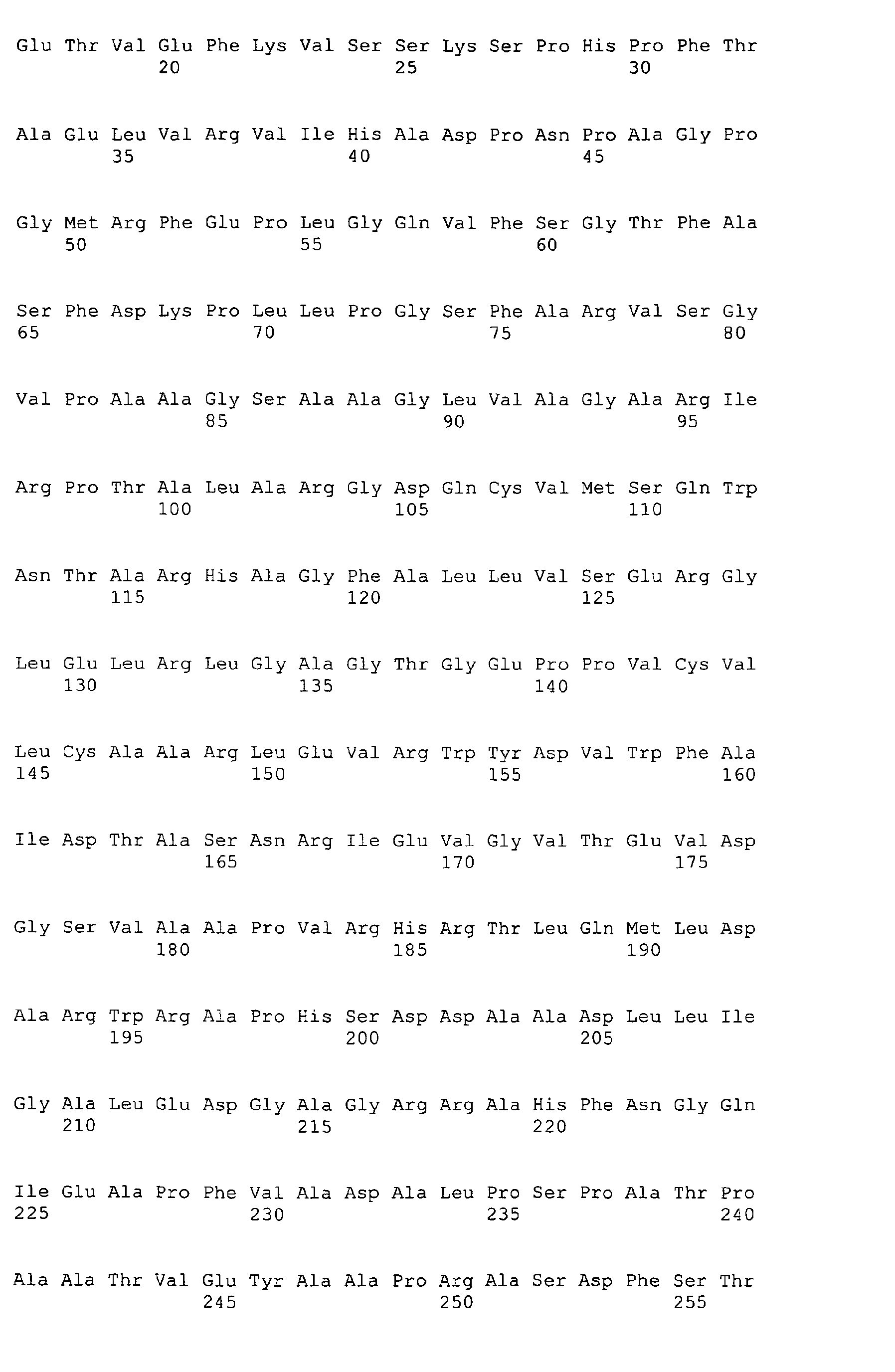


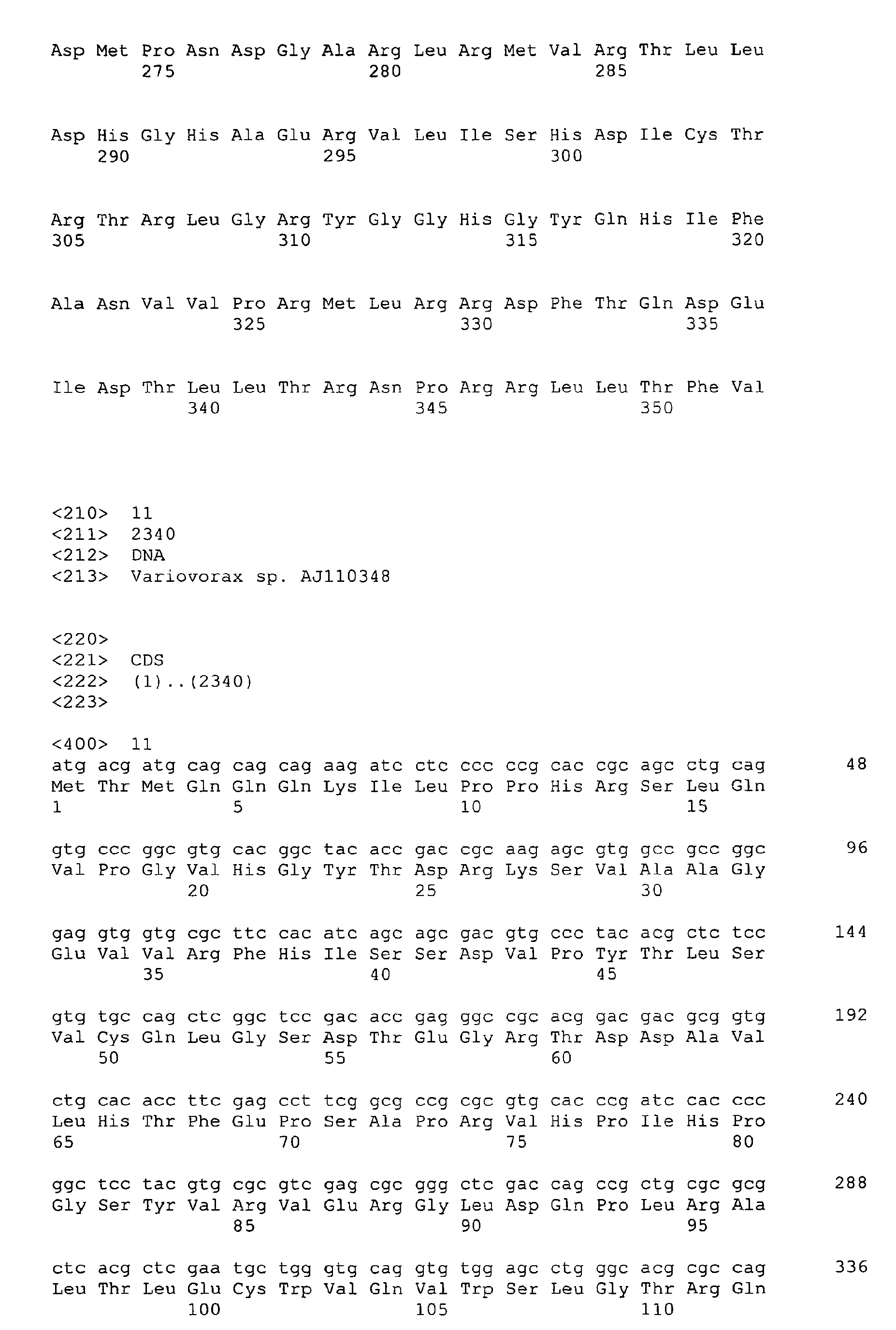


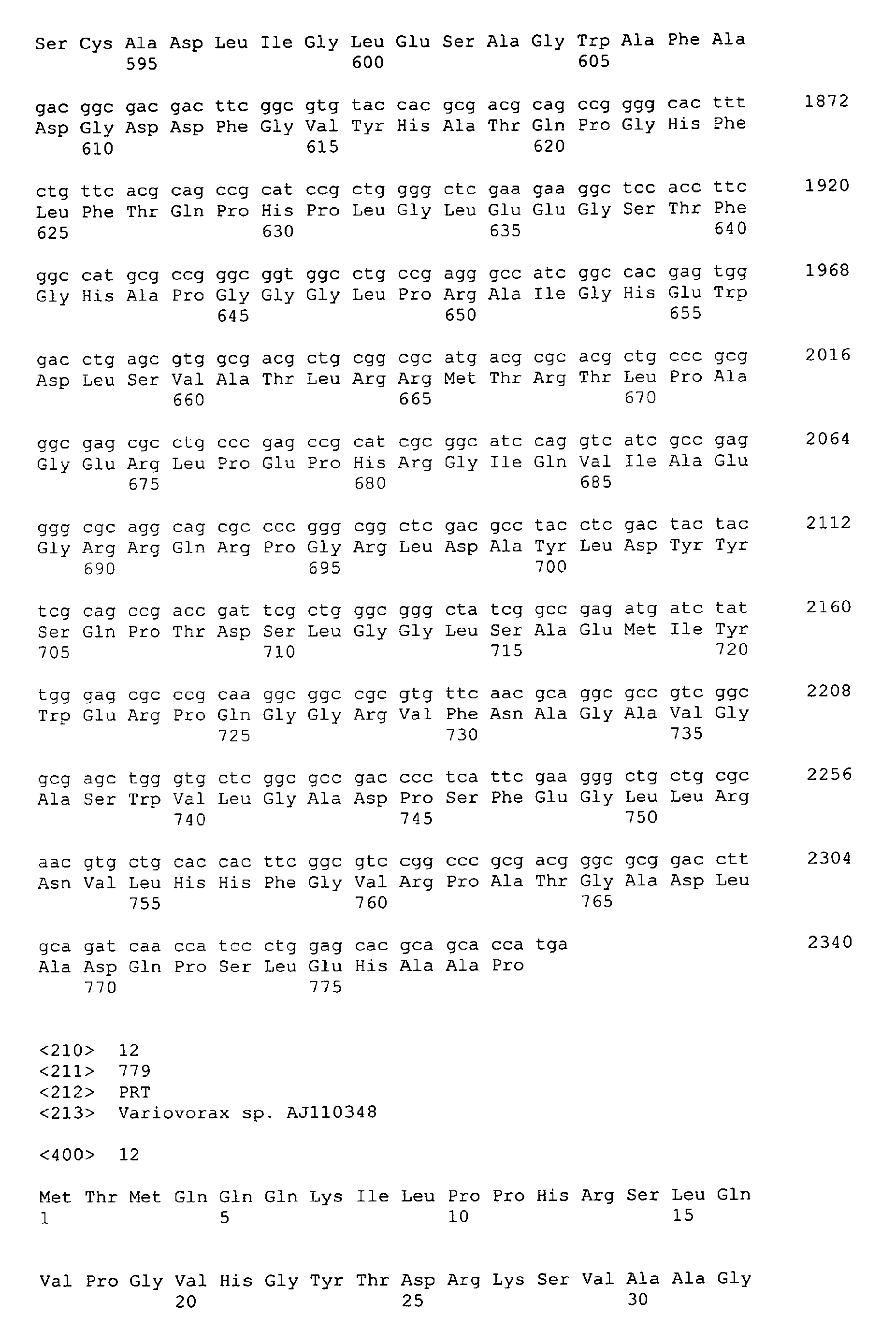
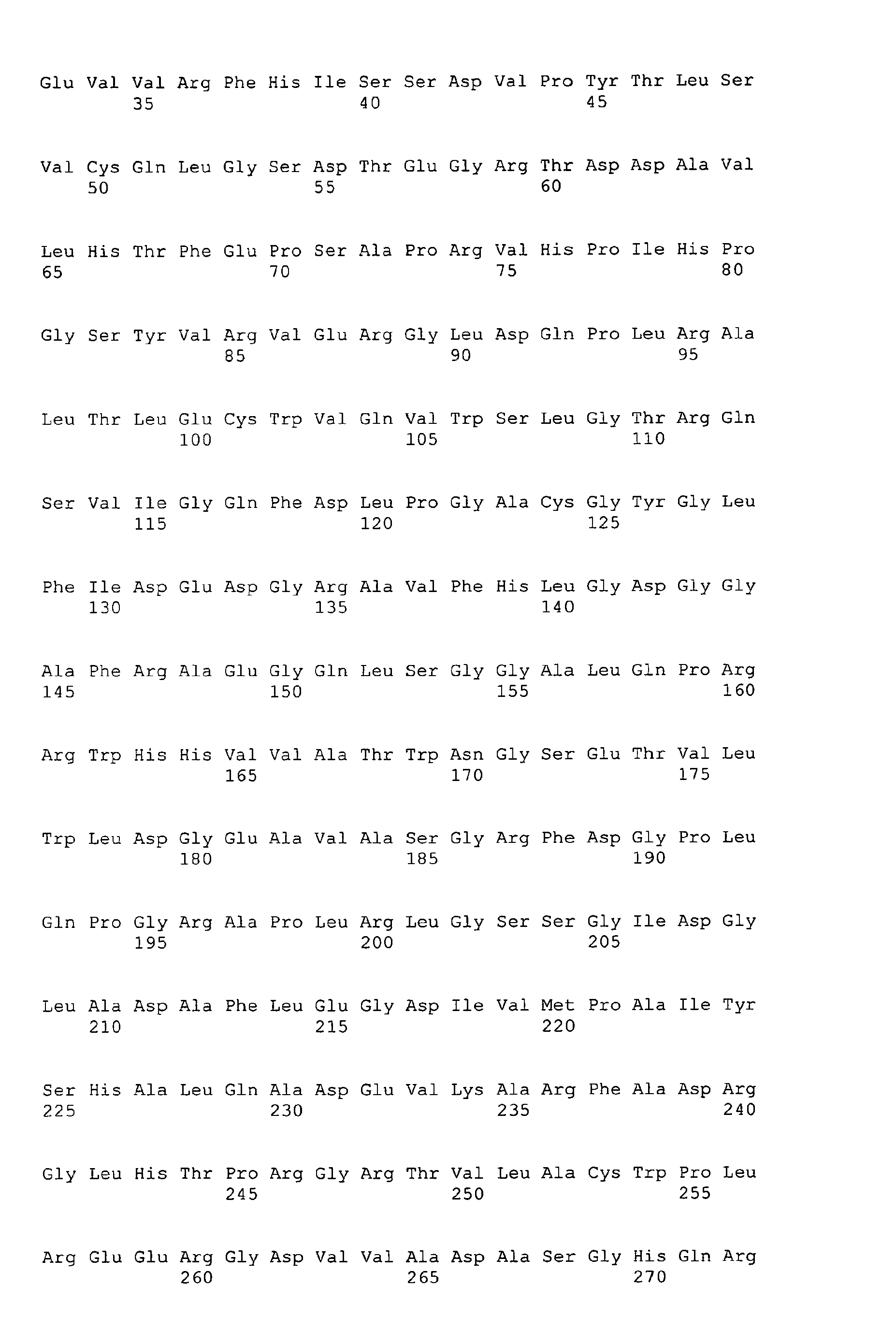


Claims (16)
- A gene encoding any one of the following proteins:(a) the protein having the amino acid sequence denoted by SEQ. ID. NO. 8;(b) a protein having N-acetyl-(R)-β-amino acid acylase activity having the amino acid sequence denoted by SEQ. ID. NO. 8 with 1 to 100 amino acid residue substitutions, deletions, or additions; and(c) a protein having N-acetyl-(R)-β-amino acid acylase activity in the form of a protein comprising an amino acid sequence exhibiting 70 percent or greater sequence homology with the amino acid sequence of SEQ. ID. NO. 8.
- A gene comprising any one of the following DNAs:(a) DNA having the nucleotide sequence denoted by SEQ. ID. NO. 7;(b) DNA encoding a protein having N-acetyl-(R)-β-amino acid acylase activity and hybridizing under stringent conditions with a nucleic acid comprising a strand complementary to the nucleotide sequence denoted by SEQ. ID. NO. 7, wherein the stringent condition is 60 °C, 1 x SSC, and 0.1 % SDS; and(c) DNA encoding a protein having N-acetyl-(R)-β-amino acid acylase activity in the form of a DNA, or a fragment thereof, exhibiting 70 percent or greater sequence homology with the nucleotide sequence denoted by SEQ. ID. NO. 7.
- A gene encoding any one of the following proteins:(a) the protein having the amino acid sequence denoted by SEQ. ID. NO. 10;(b) a protein having N-acetyl-(S)-β-amino acid acylase activity that is having the amino acid sequence denoted by SEQ. ID. NO. 10 with 1 to 100 amino acid residue substitutions, deletions, or additions; and(c) a protein having N-acetyl-(S)-β-amino acid acylase activity in the form of a protein comprising an amino acid sequence exhibiting 70 percent or greater sequence homology with the amino acid sequence of SEQ. ID. NO. 10.
- A gene comprising any one of the following DNAs:(a) DNA having the nucleotide sequence denoted by SEQ. ID. NO. 9;(b) DNA encoding a protein having N-acetyl-(S)-β-amino acid acylase activity and hybridizing under stringent conditions with a nucleic acid comprising a strand complementary to the nucleotide sequence denoted by SEQ. ID. NO. 9, wherein the stringent condition is 60°C, 1 x SSC, and 0.1 % SDS; and(c) DNA encoding a protein having N-acetyl-(S)-β-amino acid acylase activity in the form of a DNA, or a fragment thereof, exhibiting 70 percent or greater sequence homology with the nucleotide sequence denoted by SEQ. ID. NO. 9.
- A gene encoding any one of the following proteins:(a) the protein having the amino acid sequence denoted by SEQ. ID. NO. 12;(b) a protein having N-acetyl-(R)-β-amino acid acylase activity having the amino acid sequence denoted by SEQ. ID. NO. 12 with 1 to 100 amino acid residue substitutions, deletions, or additions; and(c) a protein having N-acetyl-(R)-β-amino acid acylase activity in the form of a protein comprising an amino acid sequence exhibiting 70 percent or greater sequence homology with the amino acid sequence of SEQ. ID. NO. 12.
- A gene comprising any one of the following DNAs:(a) DNA having the nucleotide sequence denoted by SEQ. ID. NO. 11;(b) DNA encoding a protein having N-acetyl-(R)-β-amino acid acylase activity and hybridizing under stringent conditions with nucleic acid comprising a strand complementary to the nucleotide sequence denoted by SEQ. ID. NO. 11, wherein the stringent condition is 60°C, 1 x SSC, and 0.1 % SDS; and(c) DNA encoding a protein having N-acetyl-(R)-β-amino acid acylase activity in the form of a DNA, or a fragment thereof, exhibiting 70 percent or greater sequence homology with the nucleotide sequence denoted by SEQ. ID. NO. 11.
- The gene described by any one of claims 1 to 6 wherein said β-amino acid is one or more members selected from the group consisting of β-phenylalanine, β-leucine, β-homoleucine, β-homophenylalanine, β-tyrosine, β-4-fluorophenylalanine, β-aminobutyric acid, 3,4-(-0-CH2-0-)-β-phenylalanine, and β-3-Pyridylalanine.
- A protein denoted by any one of the following:(a) a protein comprising the amino acid sequence denoted by SEQ. ID. NO. 8;(b) a protein having N-acetyl-(R)-β-amino acid acylase activity comprising the amino acid sequence denoted by SEQ. ID. NO. 8 with 1 to 100 amino acid residue substitutions, deletions, or additions; and(c) a protein having N-acetyl-(R)-β-amino acid acylase activity in the form of a protein comprising an amino acid sequence exhibiting 70 percent or greater sequence homology with the amino acid sequence of SEQ. ID. NO. 8.
- A protein denoted by any one of the following:(a) the protein having the amino acid sequence denoted by SEQ. ID. NO. 10;(b) a protein having N-acetyl-(S)-β-amino acid acylase activity that is having the amino acid sequence denoted by SEQ. ID. NO. 10 with 1 to 100 amino acid residue substitutions, deletions, or additions; and(c) a protein having N-acetyl-(S)-β-amino acid acylase activity in the form of a protein comprising an amino acid sequence exhibiting 70 percent or greater sequence homology with the amino acid sequence of SEQ. ID. NO. 10.
- A protein denoted by any one of the following:(a) the protein having the amino acid sequence denoted by SEQ. ID. NO. 12;(b) a protein having N-acetyl-(R)-β-amino acid acylase activity having the amino acid sequence denoted by SEQ. ID. NO. 12 with 1 to 100 amino acid residue substitutions, deletions, or additions; and(c) a protein having N-acetyl-(R)-β-amino acid acylase activity in the form of a protein comprising an amino acid sequence exhibiting 70 percent or greater sequence homology with the amino acid sequence of SEQ. ID. NO. 12.
- The protein according to any one of claims 8 to 10, wherein said β-amino acid is one or more members selected from the group consisting of β-phenylalanine, β-leucine, β-homoleucine, β-homophenylalanine, β-tyrosine, β-4-fluorophenylalanine, β-aminobutyric acid, 3,4-(-0-CH2-0-)-β-phenylalanine, and β-3-pyridylalanine.
- A vector containing the gene of any one of claims 1 to 6.
- A microorganism transformed with the gene of any one of claims 1 to 6 or with the vector of claim 12.
- The microorganism of claim 13 which is Escherichia coli.
- A method for manufacturing β-amino acids, characterized by contacting the microorganism of claim 13 or 14 with an N-acetyl-β-amino acid, inducing the production of the β-amino acid, and recovering the β-amino acid.
- A method for manufacturing β-amino acids, characterized by contacting a protein of any one of claims 8 to 11 or a protein having N-acetyl-β-amino acid acylase activity obtained from the microorganism of claim 12 or 13 with an N-acetyl-β-amino acid, inducing the production of the β-amino acid, and recovering the β-amino acid.
Applications Claiming Priority (1)
| Application Number | Priority Date | Filing Date | Title |
|---|---|---|---|
| JP2006202836 | 2006-07-26 |
Publications (3)
| Publication Number | Publication Date |
|---|---|
| EP1882740A1 true EP1882740A1 (en) | 2008-01-30 |
| EP1882740A8 EP1882740A8 (en) | 2008-03-05 |
| EP1882740B1 EP1882740B1 (en) | 2010-04-14 |
Family
ID=38800762
Family Applications (1)
| Application Number | Title | Priority Date | Filing Date |
|---|---|---|---|
| EP07013995A Not-in-force EP1882740B1 (en) | 2006-07-26 | 2007-07-17 | N-acetyl-(R,S)-B-amino acid acylase gene |
Country Status (5)
| Country | Link |
|---|---|
| US (1) | US7858348B2 (en) |
| EP (1) | EP1882740B1 (en) |
| JP (1) | JP5516664B2 (en) |
| AT (1) | ATE464385T1 (en) |
| DE (1) | DE602007005880D1 (en) |
Cited By (1)
| Publication number | Priority date | Publication date | Assignee | Title |
|---|---|---|---|---|
| WO2011036233A1 (en) * | 2009-09-25 | 2011-03-31 | Basf Se | Amidase and use thereof for producing 3-amino carboxylic acid esters |
Families Citing this family (5)
| Publication number | Priority date | Publication date | Assignee | Title |
|---|---|---|---|---|
| DK0841395T3 (en) | 1995-06-07 | 2012-01-09 | Ajinomoto Kk | Process for Preparing L-Lysine |
| JP4806963B2 (en) * | 2005-05-20 | 2011-11-02 | 味の素株式会社 | Process for producing β-hydroxyamino acid and enzyme used therefor |
| RU2007147436A (en) * | 2007-12-21 | 2009-06-27 | Закрытое акционерное общество "Научно-исследовательский институт Аджиномото-Генетика" (ЗАО АГРИ) (RU) | BACTERIA-PRODUCER (2S, 3R, 4S) -4-HYDROXY-L-ISOLEUCIN AND METHOD FOR PRODUCTION (2S, 3R, 4S) -4-HYDROXY-L-ISOLEUCIN |
| EP2239335B1 (en) * | 2008-01-18 | 2013-02-27 | Ajinomoto Co., Inc. | Process for production of serine derivative, and protein for use in the process |
| DE112009001080T5 (en) * | 2008-05-12 | 2011-03-03 | Ajinomoto Co., Inc. | A process for producing β-alanyl amino acid or a derivative thereof |
Citations (2)
| Publication number | Priority date | Publication date | Assignee | Title |
|---|---|---|---|---|
| JPS60169451A (en) * | 1984-02-13 | 1985-09-02 | Mitsui Toatsu Chem Inc | Separation and purification of l-phenylalanine |
| EP1624052A1 (en) * | 2004-08-06 | 2006-02-08 | Ajinomoto Co., Inc. | Process for the production of beta-amino acids with the use of acylase |
Family Cites Families (4)
| Publication number | Priority date | Publication date | Assignee | Title |
|---|---|---|---|---|
| DE3603986A1 (en) * | 1986-02-08 | 1987-08-13 | Degussa | METHOD FOR PROCESSING THE SOLUTION REMAINING FROM THE ENZYMATIC RACEMAT CLEAVING OF AN N-ACETYL-DL-AMINOCARBONIC ACID IN THE PRESENCE OF A L-AMINO ACID ACYLASE |
| DE10050123A1 (en) * | 2000-10-11 | 2002-04-25 | Degussa | Process for the production of amino acids |
| FR2829152B1 (en) * | 2001-09-04 | 2004-09-10 | Aventis Pharma Sa | ENZYMATIC PROCESS FOR THE ENANTIOMERIC RESOLUTION OF AMINO ACIDS |
| WO2003080854A2 (en) * | 2002-03-23 | 2003-10-02 | Degussa Ag | Process for preparing optically active beta-aminocarboxylic acids from racemic n-acylated beta-aminocarboxylic acids |
-
2007
- 2007-07-17 EP EP07013995A patent/EP1882740B1/en not_active Not-in-force
- 2007-07-17 DE DE602007005880T patent/DE602007005880D1/en active Active
- 2007-07-17 AT AT07013995T patent/ATE464385T1/en active
- 2007-07-24 US US11/782,260 patent/US7858348B2/en not_active Expired - Fee Related
-
2012
- 2012-07-17 JP JP2012158252A patent/JP5516664B2/en not_active Expired - Fee Related
Patent Citations (2)
| Publication number | Priority date | Publication date | Assignee | Title |
|---|---|---|---|---|
| JPS60169451A (en) * | 1984-02-13 | 1985-09-02 | Mitsui Toatsu Chem Inc | Separation and purification of l-phenylalanine |
| EP1624052A1 (en) * | 2004-08-06 | 2006-02-08 | Ajinomoto Co., Inc. | Process for the production of beta-amino acids with the use of acylase |
Cited By (2)
| Publication number | Priority date | Publication date | Assignee | Title |
|---|---|---|---|---|
| WO2011036233A1 (en) * | 2009-09-25 | 2011-03-31 | Basf Se | Amidase and use thereof for producing 3-amino carboxylic acid esters |
| US8932837B2 (en) | 2009-09-25 | 2015-01-13 | Basf Se | Amidase and use thereof for producing 3-aminocarboxylic acid esters |
Also Published As
| Publication number | Publication date |
|---|---|
| ATE464385T1 (en) | 2010-04-15 |
| EP1882740A8 (en) | 2008-03-05 |
| DE602007005880D1 (en) | 2010-05-27 |
| JP2012196231A (en) | 2012-10-18 |
| US20080241895A1 (en) | 2008-10-02 |
| JP5516664B2 (en) | 2014-06-11 |
| US7858348B2 (en) | 2010-12-28 |
| EP1882740B1 (en) | 2010-04-14 |
Similar Documents
| Publication | Publication Date | Title |
|---|---|---|
| CA2360376C (en) | Novel carbonyl reductase, gene thereof and method of using the same | |
| EP1882740B1 (en) | N-acetyl-(R,S)-B-amino acid acylase gene | |
| EP0433117A1 (en) | Novel polypeptides, the DNA sequences allowing their expression, method of preparation, and utilization | |
| JP5903298B2 (en) | Modified D-succinylase with improved D-form selectivity for N-succinyl-DL-amino acids | |
| JP4529338B2 (en) | DNA encoding hydantoinase, DNA encoding N-carbamyl-L-amino acid hydrolase, recombinant DNA, transformed cell, protein production method and optically active amino acid production method | |
| US6869788B2 (en) | DNA encoding novel D-aminoacylase and process for producing D-amino acid by using the same | |
| EP1174499B1 (en) | Novel amidase gene | |
| JP5119783B2 (en) | N-acetyl- (R, S) -β-amino acid acylase gene | |
| JP4489598B2 (en) | D-aminoacylase | |
| KR20020056894A (en) | Novel carbonyl reductase, gene thereof and method of using the same | |
| JP2006055131A (en) | Novel D-aminoacylase and gene thereof | |
| JP4650421B2 (en) | L-form amino acid amide asymmetric hydrolase and DNA encoding the same | |
| JPWO2000008170A1 (en) | Genes involved in the production of homoglutamic acid and uses thereof | |
| JP4485734B2 (en) | 5-substituted hydantoin racemase, DNA encoding the same, recombinant DNA, transformed cell, and method for producing optically active amino acid | |
| JPH09510623A (en) | Method for obtaining microorganism containing peptide amidase, microorganism obtained thereby, peptide amidase contained therein and use thereof | |
| JP2025523627A (en) | Ketoreductase enzymes for the synthesis of 1,3-diol substituted indenes | |
| JP4652915B2 (en) | DNA involved in hydrolysis of norbornane derivatives | |
| JP2025523626A (en) | Engineered enzymes for the preparation of hydroxylated indanone intermediates useful for the synthesis of verzutiphan | |
| CN119307477A (en) | Hydantoinase and its application in hydrolysis or preparation of chiral monomer compounds | |
| WO2023102374A1 (en) | Process of synthesizing (r)-3-aminobutan-1-ol | |
| JP2002320491A (en) | Dna encoding new d-aminoacylase and method for producing d-amino acid using the same | |
| JPWO2011001889A1 (en) | Method for racemizing optically active α-amino acids | |
| WO2009006492A2 (en) | Stereoselective resolution of racemic amines | |
| JPWO2003085108A1 (en) | Recombinant DNA having hydantoinase gene and carbamylase gene, and method for producing amino acid | |
| WO2007097429A1 (en) | Novel acylamidase gene and use thereof |
Legal Events
| Date | Code | Title | Description |
|---|---|---|---|
| PUAI | Public reference made under article 153(3) epc to a published international application that has entered the european phase |
Free format text: ORIGINAL CODE: 0009012 |
|
| AK | Designated contracting states |
Kind code of ref document: A1 Designated state(s): AT BE BG CH CY CZ DE DK EE ES FI FR GB GR HU IE IS IT LI LT LU LV MC MT NL PL PT RO SE SI SK TR |
|
| AX | Request for extension of the european patent |
Extension state: AL BA HR MK YU |
|
| RAP1 | Party data changed (applicant data changed or rights of an application transferred) |
Owner name: AJINOMOTO CO., INC. |
|
| 17P | Request for examination filed |
Effective date: 20080222 |
|
| 17Q | First examination report despatched |
Effective date: 20080328 |
|
| AKX | Designation fees paid |
Designated state(s): AT BE BG CH CY CZ DE DK EE ES FI FR GB GR HU IE IS IT LI LT LU LV MC MT NL PL PT RO SE SI SK TR |
|
| GRAP | Despatch of communication of intention to grant a patent |
Free format text: ORIGINAL CODE: EPIDOSNIGR1 |
|
| GRAS | Grant fee paid |
Free format text: ORIGINAL CODE: EPIDOSNIGR3 |
|
| GRAA | (expected) grant |
Free format text: ORIGINAL CODE: 0009210 |
|
| AK | Designated contracting states |
Kind code of ref document: B1 Designated state(s): AT BE BG CH CY CZ DE DK EE ES FI FR GB GR HU IE IS IT LI LT LU LV MC MT NL PL PT RO SE SI SK TR |
|
| REG | Reference to a national code |
Ref country code: GB Ref legal event code: FG4D |
|
| REG | Reference to a national code |
Ref country code: CH Ref legal event code: NV Representative=s name: BOHEST AG Ref country code: CH Ref legal event code: EP |
|
| REG | Reference to a national code |
Ref country code: IE Ref legal event code: FG4D |
|
| REF | Corresponds to: |
Ref document number: 602007005880 Country of ref document: DE Date of ref document: 20100527 Kind code of ref document: P |
|
| REG | Reference to a national code |
Ref country code: NL Ref legal event code: T3 |
|
| LTIE | Lt: invalidation of european patent or patent extension |
Effective date: 20100414 |
|
| PG25 | Lapsed in a contracting state [announced via postgrant information from national office to epo] |
Ref country code: SE Free format text: LAPSE BECAUSE OF FAILURE TO SUBMIT A TRANSLATION OF THE DESCRIPTION OR TO PAY THE FEE WITHIN THE PRESCRIBED TIME-LIMIT Effective date: 20100414 Ref country code: LT Free format text: LAPSE BECAUSE OF FAILURE TO SUBMIT A TRANSLATION OF THE DESCRIPTION OR TO PAY THE FEE WITHIN THE PRESCRIBED TIME-LIMIT Effective date: 20100414 Ref country code: ES Free format text: LAPSE BECAUSE OF FAILURE TO SUBMIT A TRANSLATION OF THE DESCRIPTION OR TO PAY THE FEE WITHIN THE PRESCRIBED TIME-LIMIT Effective date: 20100725 |
|
| PG25 | Lapsed in a contracting state [announced via postgrant information from national office to epo] |
Ref country code: SI Free format text: LAPSE BECAUSE OF FAILURE TO SUBMIT A TRANSLATION OF THE DESCRIPTION OR TO PAY THE FEE WITHIN THE PRESCRIBED TIME-LIMIT Effective date: 20100414 Ref country code: IS Free format text: LAPSE BECAUSE OF FAILURE TO SUBMIT A TRANSLATION OF THE DESCRIPTION OR TO PAY THE FEE WITHIN THE PRESCRIBED TIME-LIMIT Effective date: 20100814 Ref country code: FI Free format text: LAPSE BECAUSE OF FAILURE TO SUBMIT A TRANSLATION OF THE DESCRIPTION OR TO PAY THE FEE WITHIN THE PRESCRIBED TIME-LIMIT Effective date: 20100414 Ref country code: LV Free format text: LAPSE BECAUSE OF FAILURE TO SUBMIT A TRANSLATION OF THE DESCRIPTION OR TO PAY THE FEE WITHIN THE PRESCRIBED TIME-LIMIT Effective date: 20100414 |
|
| PG25 | Lapsed in a contracting state [announced via postgrant information from national office to epo] |
Ref country code: PL Free format text: LAPSE BECAUSE OF FAILURE TO SUBMIT A TRANSLATION OF THE DESCRIPTION OR TO PAY THE FEE WITHIN THE PRESCRIBED TIME-LIMIT Effective date: 20100414 Ref country code: CY Free format text: LAPSE BECAUSE OF FAILURE TO SUBMIT A TRANSLATION OF THE DESCRIPTION OR TO PAY THE FEE WITHIN THE PRESCRIBED TIME-LIMIT Effective date: 20100519 |
|
| PG25 | Lapsed in a contracting state [announced via postgrant information from national office to epo] |
Ref country code: DK Free format text: LAPSE BECAUSE OF FAILURE TO SUBMIT A TRANSLATION OF THE DESCRIPTION OR TO PAY THE FEE WITHIN THE PRESCRIBED TIME-LIMIT Effective date: 20100414 Ref country code: PT Free format text: LAPSE BECAUSE OF FAILURE TO SUBMIT A TRANSLATION OF THE DESCRIPTION OR TO PAY THE FEE WITHIN THE PRESCRIBED TIME-LIMIT Effective date: 20100816 Ref country code: EE Free format text: LAPSE BECAUSE OF FAILURE TO SUBMIT A TRANSLATION OF THE DESCRIPTION OR TO PAY THE FEE WITHIN THE PRESCRIBED TIME-LIMIT Effective date: 20100414 Ref country code: GR Free format text: LAPSE BECAUSE OF FAILURE TO SUBMIT A TRANSLATION OF THE DESCRIPTION OR TO PAY THE FEE WITHIN THE PRESCRIBED TIME-LIMIT Effective date: 20100715 |
|
| PLBE | No opposition filed within time limit |
Free format text: ORIGINAL CODE: 0009261 |
|
| STAA | Information on the status of an ep patent application or granted ep patent |
Free format text: STATUS: NO OPPOSITION FILED WITHIN TIME LIMIT |
|
| PG25 | Lapsed in a contracting state [announced via postgrant information from national office to epo] |
Ref country code: MC Free format text: LAPSE BECAUSE OF NON-PAYMENT OF DUE FEES Effective date: 20100731 Ref country code: CZ Free format text: LAPSE BECAUSE OF FAILURE TO SUBMIT A TRANSLATION OF THE DESCRIPTION OR TO PAY THE FEE WITHIN THE PRESCRIBED TIME-LIMIT Effective date: 20100414 Ref country code: RO Free format text: LAPSE BECAUSE OF FAILURE TO SUBMIT A TRANSLATION OF THE DESCRIPTION OR TO PAY THE FEE WITHIN THE PRESCRIBED TIME-LIMIT Effective date: 20100414 Ref country code: SK Free format text: LAPSE BECAUSE OF FAILURE TO SUBMIT A TRANSLATION OF THE DESCRIPTION OR TO PAY THE FEE WITHIN THE PRESCRIBED TIME-LIMIT Effective date: 20100414 |
|
| 26N | No opposition filed |
Effective date: 20110117 |
|
| PG25 | Lapsed in a contracting state [announced via postgrant information from national office to epo] |
Ref country code: IT Free format text: LAPSE BECAUSE OF FAILURE TO SUBMIT A TRANSLATION OF THE DESCRIPTION OR TO PAY THE FEE WITHIN THE PRESCRIBED TIME-LIMIT Effective date: 20100414 |
|
| PG25 | Lapsed in a contracting state [announced via postgrant information from national office to epo] |
Ref country code: MT Free format text: LAPSE BECAUSE OF FAILURE TO SUBMIT A TRANSLATION OF THE DESCRIPTION OR TO PAY THE FEE WITHIN THE PRESCRIBED TIME-LIMIT Effective date: 20100414 |
|
| PG25 | Lapsed in a contracting state [announced via postgrant information from national office to epo] |
Ref country code: HU Free format text: LAPSE BECAUSE OF FAILURE TO SUBMIT A TRANSLATION OF THE DESCRIPTION OR TO PAY THE FEE WITHIN THE PRESCRIBED TIME-LIMIT Effective date: 20101015 Ref country code: LU Free format text: LAPSE BECAUSE OF NON-PAYMENT OF DUE FEES Effective date: 20100717 Ref country code: BG Free format text: LAPSE BECAUSE OF FAILURE TO SUBMIT A TRANSLATION OF THE DESCRIPTION OR TO PAY THE FEE WITHIN THE PRESCRIBED TIME-LIMIT Effective date: 20100414 |
|
| PG25 | Lapsed in a contracting state [announced via postgrant information from national office to epo] |
Ref country code: TR Free format text: LAPSE BECAUSE OF FAILURE TO SUBMIT A TRANSLATION OF THE DESCRIPTION OR TO PAY THE FEE WITHIN THE PRESCRIBED TIME-LIMIT Effective date: 20100414 |
|
| PG25 | Lapsed in a contracting state [announced via postgrant information from national office to epo] |
Ref country code: BG Free format text: LAPSE BECAUSE OF FAILURE TO SUBMIT A TRANSLATION OF THE DESCRIPTION OR TO PAY THE FEE WITHIN THE PRESCRIBED TIME-LIMIT Effective date: 20100714 |
|
| REG | Reference to a national code |
Ref country code: CH Ref legal event code: PCAR Free format text: NEW ADDRESS: HOLBEINSTRASSE 36-38, 4051 BASEL (CH) |
|
| REG | Reference to a national code |
Ref country code: FR Ref legal event code: PLFP Year of fee payment: 10 |
|
| PGFP | Annual fee paid to national office [announced via postgrant information from national office to epo] |
Ref country code: BE Payment date: 20160613 Year of fee payment: 10 Ref country code: NL Payment date: 20160610 Year of fee payment: 10 Ref country code: FR Payment date: 20160613 Year of fee payment: 10 |
|
| PGFP | Annual fee paid to national office [announced via postgrant information from national office to epo] |
Ref country code: CH Payment date: 20160712 Year of fee payment: 10 Ref country code: IE Payment date: 20160711 Year of fee payment: 10 Ref country code: DE Payment date: 20160712 Year of fee payment: 10 Ref country code: GB Payment date: 20160713 Year of fee payment: 10 |
|
| PGFP | Annual fee paid to national office [announced via postgrant information from national office to epo] |
Ref country code: AT Payment date: 20160630 Year of fee payment: 10 |
|
| REG | Reference to a national code |
Ref country code: DE Ref legal event code: R119 Ref document number: 602007005880 Country of ref document: DE |
|
| REG | Reference to a national code |
Ref country code: CH Ref legal event code: PL |
|
| REG | Reference to a national code |
Ref country code: NL Ref legal event code: MM Effective date: 20170801 |
|
| REG | Reference to a national code |
Ref country code: AT Ref legal event code: MM01 Ref document number: 464385 Country of ref document: AT Kind code of ref document: T Effective date: 20170717 |
|
| GBPC | Gb: european patent ceased through non-payment of renewal fee |
Effective date: 20170717 |
|
| REG | Reference to a national code |
Ref country code: IE Ref legal event code: MM4A |
|
| REG | Reference to a national code |
Ref country code: FR Ref legal event code: ST Effective date: 20180330 |
|
| PG25 | Lapsed in a contracting state [announced via postgrant information from national office to epo] |
Ref country code: CH Free format text: LAPSE BECAUSE OF NON-PAYMENT OF DUE FEES Effective date: 20170731 Ref country code: GB Free format text: LAPSE BECAUSE OF NON-PAYMENT OF DUE FEES Effective date: 20170717 Ref country code: LI Free format text: LAPSE BECAUSE OF NON-PAYMENT OF DUE FEES Effective date: 20170731 Ref country code: NL Free format text: LAPSE BECAUSE OF NON-PAYMENT OF DUE FEES Effective date: 20170801 Ref country code: DE Free format text: LAPSE BECAUSE OF NON-PAYMENT OF DUE FEES Effective date: 20180201 Ref country code: IE Free format text: LAPSE BECAUSE OF NON-PAYMENT OF DUE FEES Effective date: 20170717 |
|
| PG25 | Lapsed in a contracting state [announced via postgrant information from national office to epo] |
Ref country code: FR Free format text: LAPSE BECAUSE OF NON-PAYMENT OF DUE FEES Effective date: 20170731 Ref country code: AT Free format text: LAPSE BECAUSE OF NON-PAYMENT OF DUE FEES Effective date: 20170717 |
|
| REG | Reference to a national code |
Ref country code: BE Ref legal event code: MM Effective date: 20170731 |
|
| PG25 | Lapsed in a contracting state [announced via postgrant information from national office to epo] |
Ref country code: BE Free format text: LAPSE BECAUSE OF NON-PAYMENT OF DUE FEES Effective date: 20170731 |