EP1882687A1 - Heterocyclic compounds useful as vanilloid receptor antagonists and pharmaceutical compositions containing the same - Google Patents
Heterocyclic compounds useful as vanilloid receptor antagonists and pharmaceutical compositions containing the same Download PDFInfo
- Publication number
- EP1882687A1 EP1882687A1 EP06015724A EP06015724A EP1882687A1 EP 1882687 A1 EP1882687 A1 EP 1882687A1 EP 06015724 A EP06015724 A EP 06015724A EP 06015724 A EP06015724 A EP 06015724A EP 1882687 A1 EP1882687 A1 EP 1882687A1
- Authority
- EP
- European Patent Office
- Prior art keywords
- alkyl
- fluoro
- alkoxy
- hydrogen
- trifluoromethyl
- Prior art date
- Legal status (The legal status is an assumption and is not a legal conclusion. Google has not performed a legal analysis and makes no representation as to the accuracy of the status listed.)
- Withdrawn
Links
- 239000008194 pharmaceutical composition Substances 0.000 title claims abstract description 21
- 150000002391 heterocyclic compounds Chemical class 0.000 title 1
- 239000000085 vanilloid receptor antagonist Substances 0.000 title 1
- 150000001875 compounds Chemical class 0.000 claims abstract description 153
- 150000003839 salts Chemical class 0.000 claims abstract description 78
- 208000002193 Pain Diseases 0.000 claims abstract description 38
- 230000036407 pain Effects 0.000 claims abstract description 36
- 208000037265 diseases, disorders, signs and symptoms Diseases 0.000 claims abstract description 33
- 208000026935 allergic disease Diseases 0.000 claims abstract description 29
- 208000021302 gastroesophageal reflux disease Diseases 0.000 claims abstract description 22
- 208000022559 Inflammatory bowel disease Diseases 0.000 claims abstract description 20
- 208000002551 irritable bowel syndrome Diseases 0.000 claims abstract description 20
- 230000007823 neuropathy Effects 0.000 claims abstract description 20
- 201000001119 neuropathy Diseases 0.000 claims abstract description 20
- 206010020751 Hypersensitivity Diseases 0.000 claims abstract description 19
- 230000009610 hypersensitivity Effects 0.000 claims abstract description 19
- 210000003932 urinary bladder Anatomy 0.000 claims abstract description 18
- 208000035475 disorder Diseases 0.000 claims abstract description 15
- 201000004624 Dermatitis Diseases 0.000 claims abstract description 12
- 208000006673 asthma Diseases 0.000 claims abstract description 12
- 208000006545 Chronic Obstructive Pulmonary Disease Diseases 0.000 claims abstract description 11
- 208000003251 Pruritus Diseases 0.000 claims abstract description 11
- 102000011040 TRPV Cation Channels Human genes 0.000 claims abstract description 11
- 108010062740 TRPV Cation Channels Proteins 0.000 claims abstract description 11
- 206010046543 Urinary incontinence Diseases 0.000 claims abstract description 11
- 208000000718 duodenal ulcer Diseases 0.000 claims abstract description 11
- 208000033808 peripheral neuropathy Diseases 0.000 claims abstract description 11
- 210000002784 stomach Anatomy 0.000 claims abstract description 11
- 201000004384 Alopecia Diseases 0.000 claims abstract description 10
- 206010011224 Cough Diseases 0.000 claims abstract description 10
- 208000011231 Crohn disease Diseases 0.000 claims abstract description 10
- 206010020559 Hyperacusis Diseases 0.000 claims abstract description 10
- 208000028389 Nerve injury Diseases 0.000 claims abstract description 10
- 206010033645 Pancreatitis Diseases 0.000 claims abstract description 10
- 206010037083 Prurigo Diseases 0.000 claims abstract description 10
- 201000004681 Psoriasis Diseases 0.000 claims abstract description 10
- 208000009205 Tinnitus Diseases 0.000 claims abstract description 10
- 230000000172 allergic effect Effects 0.000 claims abstract description 10
- 231100000360 alopecia Toxicity 0.000 claims abstract description 10
- 201000003146 cystitis Diseases 0.000 claims abstract description 10
- 230000002550 fecal effect Effects 0.000 claims abstract description 10
- 230000003779 hair growth Effects 0.000 claims abstract description 10
- 208000019622 heart disease Diseases 0.000 claims abstract description 10
- 208000027866 inflammatory disease Diseases 0.000 claims abstract description 10
- 230000007794 irritation Effects 0.000 claims abstract description 10
- 210000004400 mucous membrane Anatomy 0.000 claims abstract description 10
- 208000031225 myocardial ischemia Diseases 0.000 claims abstract description 10
- 230000008764 nerve damage Effects 0.000 claims abstract description 10
- 230000004770 neurodegeneration Effects 0.000 claims abstract description 10
- 206010039083 rhinitis Diseases 0.000 claims abstract description 10
- 231100000886 tinnitus Toxicity 0.000 claims abstract description 10
- 230000001720 vestibular Effects 0.000 claims abstract description 10
- 208000012886 Vertigo Diseases 0.000 claims abstract description 9
- 230000001667 episodic effect Effects 0.000 claims abstract description 9
- 231100000889 vertigo Toxicity 0.000 claims abstract description 9
- 229910052739 hydrogen Inorganic materials 0.000 claims description 179
- 239000001257 hydrogen Substances 0.000 claims description 179
- -1 nitro, carboxy Chemical group 0.000 claims description 122
- 125000003545 alkoxy group Chemical group 0.000 claims description 118
- 150000002431 hydrogen Chemical class 0.000 claims description 116
- 125000000217 alkyl group Chemical group 0.000 claims description 115
- 125000006527 (C1-C5) alkyl group Chemical group 0.000 claims description 73
- 125000002023 trifluoromethyl group Chemical group FC(F)(F)* 0.000 claims description 70
- 125000005843 halogen group Chemical group 0.000 claims description 69
- 229910052736 halogen Inorganic materials 0.000 claims description 68
- 150000002367 halogens Chemical class 0.000 claims description 67
- 125000001153 fluoro group Chemical group F* 0.000 claims description 61
- 125000002496 methyl group Chemical group [H]C([H])([H])* 0.000 claims description 56
- 125000002757 morpholinyl group Chemical group 0.000 claims description 46
- 125000006729 (C2-C5) alkenyl group Chemical group 0.000 claims description 44
- 125000000391 vinyl group Chemical group [H]C([*])=C([H])[H] 0.000 claims description 39
- 125000001495 ethyl group Chemical group [H]C([H])([H])C([H])([H])* 0.000 claims description 38
- 125000001997 phenyl group Chemical group [H]C1=C([H])C([H])=C(*)C([H])=C1[H] 0.000 claims description 38
- 125000004435 hydrogen atom Chemical group [H]* 0.000 claims description 33
- 125000002887 hydroxy group Chemical group [H]O* 0.000 claims description 33
- UFHFLCQGNIYNRP-UHFFFAOYSA-N Hydrogen Chemical compound [H][H] UFHFLCQGNIYNRP-UHFFFAOYSA-N 0.000 claims description 32
- 125000005936 piperidyl group Chemical group 0.000 claims description 32
- 125000003282 alkyl amino group Chemical group 0.000 claims description 31
- HSFWRNGVRCDJHI-UHFFFAOYSA-N alpha-acetylene Natural products C#C HSFWRNGVRCDJHI-UHFFFAOYSA-N 0.000 claims description 31
- 125000002534 ethynyl group Chemical group [H]C#C* 0.000 claims description 31
- 239000000203 mixture Substances 0.000 claims description 30
- 125000004453 alkoxycarbonyl group Chemical group 0.000 claims description 29
- 125000004414 alkyl thio group Chemical group 0.000 claims description 29
- 238000000034 method Methods 0.000 claims description 28
- 125000000719 pyrrolidinyl group Chemical group 0.000 claims description 27
- 125000003302 alkenyloxy group Chemical group 0.000 claims description 26
- 125000000449 nitro group Chemical group [O-][N+](*)=O 0.000 claims description 26
- BMTZEAOGFDXDAD-UHFFFAOYSA-M 4-(4,6-dimethoxy-1,3,5-triazin-2-yl)-4-methylmorpholin-4-ium;chloride Chemical compound [Cl-].COC1=NC(OC)=NC([N+]2(C)CCOCC2)=N1 BMTZEAOGFDXDAD-UHFFFAOYSA-M 0.000 claims description 25
- 125000006730 (C2-C5) alkynyl group Chemical group 0.000 claims description 24
- 125000004093 cyano group Chemical group *C#N 0.000 claims description 21
- 125000002924 primary amino group Chemical group [H]N([H])* 0.000 claims description 20
- 125000000999 tert-butyl group Chemical group [H]C([H])([H])C(*)(C([H])([H])[H])C([H])([H])[H] 0.000 claims description 20
- 125000001309 chloro group Chemical group Cl* 0.000 claims description 19
- 125000001424 substituent group Chemical group 0.000 claims description 19
- 125000005913 (C3-C6) cycloalkyl group Chemical group 0.000 claims description 16
- 125000006273 (C1-C3) alkyl group Chemical group 0.000 claims description 15
- 125000003342 alkenyl group Chemical group 0.000 claims description 15
- 125000004448 alkyl carbonyl group Chemical group 0.000 claims description 15
- 125000003178 carboxy group Chemical group [H]OC(*)=O 0.000 claims description 14
- 125000001246 bromo group Chemical group Br* 0.000 claims description 12
- 238000011282 treatment Methods 0.000 claims description 12
- 125000004390 alkyl sulfonyl group Chemical group 0.000 claims description 11
- 208000004296 neuralgia Diseases 0.000 claims description 11
- 230000008569 process Effects 0.000 claims description 11
- 230000002757 inflammatory effect Effects 0.000 claims description 10
- 125000001449 isopropyl group Chemical group [H]C([H])([H])C([H])(*)C([H])([H])[H] 0.000 claims description 10
- 208000021722 neuropathic pain Diseases 0.000 claims description 10
- 206010019233 Headaches Diseases 0.000 claims description 9
- VEXZGXHMUGYJMC-UHFFFAOYSA-N Hydrochloric acid Chemical compound Cl VEXZGXHMUGYJMC-UHFFFAOYSA-N 0.000 claims description 9
- 208000019695 Migraine disease Diseases 0.000 claims description 9
- 208000004550 Postoperative Pain Diseases 0.000 claims description 9
- 231100000869 headache Toxicity 0.000 claims description 9
- 238000004519 manufacturing process Methods 0.000 claims description 9
- 206010027599 migraine Diseases 0.000 claims description 9
- 206010002556 Ankylosing Spondylitis Diseases 0.000 claims description 8
- 208000008035 Back Pain Diseases 0.000 claims description 8
- 208000001640 Fibromyalgia Diseases 0.000 claims description 8
- 206010028391 Musculoskeletal Pain Diseases 0.000 claims description 8
- 208000030858 Myofascial Pain Syndromes Diseases 0.000 claims description 8
- 206010012601 diabetes mellitus Diseases 0.000 claims description 8
- 125000001160 methoxycarbonyl group Chemical group [H]C([H])([H])OC(*)=O 0.000 claims description 8
- 201000008482 osteoarthritis Diseases 0.000 claims description 8
- 206010039073 rheumatoid arthritis Diseases 0.000 claims description 8
- 230000001594 aberrant effect Effects 0.000 claims description 7
- 239000003937 drug carrier Substances 0.000 claims description 7
- WXDMHYCQTCNHOM-UHFFFAOYSA-N n-[[3-ethynyl-5-fluoro-4-(methanesulfonamido)phenyl]methyl]-3-[2-piperidin-1-yl-6-(trifluoromethyl)pyridin-3-yl]prop-2-enamide Chemical compound C1=C(C#C)C(NS(=O)(=O)C)=C(F)C=C1CNC(=O)C=CC1=CC=C(C(F)(F)F)N=C1N1CCCCC1 WXDMHYCQTCNHOM-UHFFFAOYSA-N 0.000 claims description 7
- GAMTTYVCXGXREK-UHFFFAOYSA-N n-[[3-fluoro-4-(methanesulfonamido)-5-methylphenyl]methyl]-3-[2-morpholin-4-yl-6-(trifluoromethyl)pyridin-3-yl]prop-2-enamide Chemical compound FC1=C(NS(C)(=O)=O)C(C)=CC(CNC(=O)C=CC=2C(=NC(=CC=2)C(F)(F)F)N2CCOCC2)=C1 GAMTTYVCXGXREK-UHFFFAOYSA-N 0.000 claims description 7
- LGTDRAZKIFDWLE-UHFFFAOYSA-N 3-(6-tert-butylpyridin-3-yl)-n-[[3-ethenyl-5-fluoro-4-(methanesulfonamido)phenyl]methyl]prop-2-enamide Chemical compound C1=NC(C(C)(C)C)=CC=C1C=CC(=O)NCC1=CC(F)=C(NS(C)(=O)=O)C(C=C)=C1 LGTDRAZKIFDWLE-UHFFFAOYSA-N 0.000 claims description 6
- CIXFEOZIDVVKJE-UHFFFAOYSA-N 3-(6-tert-butylpyridin-3-yl)-n-[[3-ethynyl-5-fluoro-4-(methanesulfonamido)phenyl]methyl]prop-2-enamide Chemical compound C1=NC(C(C)(C)C)=CC=C1C=CC(=O)NCC1=CC(F)=C(NS(C)(=O)=O)C(C#C)=C1 CIXFEOZIDVVKJE-UHFFFAOYSA-N 0.000 claims description 6
- 239000003814 drug Substances 0.000 claims description 6
- HURLSNOUEBCOQZ-UHFFFAOYSA-N n-[[3-ethenyl-4-(methanesulfonamido)phenyl]methyl]-3-[2-morpholin-4-yl-6-(trifluoromethyl)pyridin-3-yl]prop-2-enamide Chemical compound C1=C(C=C)C(NS(=O)(=O)C)=CC=C1CNC(=O)C=CC1=CC=C(C(F)(F)F)N=C1N1CCOCC1 HURLSNOUEBCOQZ-UHFFFAOYSA-N 0.000 claims description 6
- VMQLWMTZDMPKAG-UHFFFAOYSA-N n-[[3-ethynyl-5-fluoro-4-(methanesulfonamido)phenyl]methyl]-3-[2-morpholin-4-yl-6-(trifluoromethyl)pyridin-3-yl]prop-2-enamide Chemical compound C1=C(C#C)C(NS(=O)(=O)C)=C(F)C=C1CNC(=O)C=CC1=CC=C(C(F)(F)F)N=C1N1CCOCC1 VMQLWMTZDMPKAG-UHFFFAOYSA-N 0.000 claims description 6
- 230000002265 prevention Effects 0.000 claims description 6
- CUMBBEHFKIAWJX-UHFFFAOYSA-N 3-(2-bromo-6-tert-butylpyridin-3-yl)-n-[[3-ethynyl-5-fluoro-4-(methanesulfonamido)phenyl]methyl]prop-2-enamide Chemical compound BrC1=NC(C(C)(C)C)=CC=C1C=CC(=O)NCC1=CC(F)=C(NS(C)(=O)=O)C(C#C)=C1 CUMBBEHFKIAWJX-UHFFFAOYSA-N 0.000 claims description 5
- OCVCAJAQLFEAKR-UHFFFAOYSA-N 3-(2-bromo-6-tert-butylpyridin-3-yl)-n-[[3-fluoro-4-(methanesulfonamido)phenyl]methyl]prop-2-enamide Chemical compound BrC1=NC(C(C)(C)C)=CC=C1C=CC(=O)NCC1=CC=C(NS(C)(=O)=O)C(F)=C1 OCVCAJAQLFEAKR-UHFFFAOYSA-N 0.000 claims description 5
- KKABNIIYNWFYQB-UHFFFAOYSA-N 3-(6-tert-butyl-2-methoxypyridin-3-yl)-n-[[3-ethynyl-5-fluoro-4-(methanesulfonamido)phenyl]methyl]prop-2-enamide Chemical compound COC1=NC(C(C)(C)C)=CC=C1C=CC(=O)NCC1=CC(F)=C(NS(C)(=O)=O)C(C#C)=C1 KKABNIIYNWFYQB-UHFFFAOYSA-N 0.000 claims description 5
- WIQISBIQXNHZJM-UHFFFAOYSA-N 3-(6-tert-butyl-2-methoxypyridin-3-yl)-n-[[3-fluoro-4-(methanesulfonamido)phenyl]methyl]prop-2-enamide Chemical compound COC1=NC(C(C)(C)C)=CC=C1C=CC(=O)NCC1=CC=C(NS(C)(=O)=O)C(F)=C1 WIQISBIQXNHZJM-UHFFFAOYSA-N 0.000 claims description 5
- TXBYTKFJBVCEJT-UHFFFAOYSA-N 3-(6-tert-butylpyridin-3-yl)-n-[[3-ethenyl-4-(methanesulfonamido)phenyl]methyl]prop-2-enamide Chemical compound C1=NC(C(C)(C)C)=CC=C1C=CC(=O)NCC1=CC=C(NS(C)(=O)=O)C(C=C)=C1 TXBYTKFJBVCEJT-UHFFFAOYSA-N 0.000 claims description 5
- ZZZCZAWEFDKKQY-UHFFFAOYSA-N 3-(6-tert-butylpyridin-3-yl)-n-[[3-fluoro-4-(methanesulfonamido)phenyl]methyl]prop-2-enamide Chemical compound C1=NC(C(C)(C)C)=CC=C1C=CC(=O)NCC1=CC=C(NS(C)(=O)=O)C(F)=C1 ZZZCZAWEFDKKQY-UHFFFAOYSA-N 0.000 claims description 5
- RLZGUSJCAZBYHB-UHFFFAOYSA-N 3-[6-tert-butyl-4-(trifluoromethyl)pyridin-3-yl]-n-[[3-ethynyl-5-fluoro-4-(methanesulfonamido)phenyl]methyl]prop-2-enamide Chemical compound C1=NC(C(C)(C)C)=CC(C(F)(F)F)=C1C=CC(=O)NCC1=CC(F)=C(NS(C)(=O)=O)C(C#C)=C1 RLZGUSJCAZBYHB-UHFFFAOYSA-N 0.000 claims description 5
- VTXWJZWBMACROA-UHFFFAOYSA-N 3-[6-tert-butyl-4-(trifluoromethyl)pyridin-3-yl]-n-[[3-fluoro-4-(methanesulfonamido)phenyl]methyl]prop-2-enamide Chemical compound C1=NC(C(C)(C)C)=CC(C(F)(F)F)=C1C=CC(=O)NCC1=CC=C(NS(C)(=O)=O)C(F)=C1 VTXWJZWBMACROA-UHFFFAOYSA-N 0.000 claims description 5
- KDLHZDBZIXYQEI-UHFFFAOYSA-N Palladium Chemical compound [Pd] KDLHZDBZIXYQEI-UHFFFAOYSA-N 0.000 claims description 5
- 125000004029 hydroxymethyl group Chemical group [H]OC([H])([H])* 0.000 claims description 5
- 125000000956 methoxy group Chemical group [H]C([H])([H])O* 0.000 claims description 5
- LMDZBCPBFSXMTL-UHFFFAOYSA-N 1-Ethyl-3-(3-dimethylaminopropyl)carbodiimide Substances CCN=C=NCCCN(C)C LMDZBCPBFSXMTL-UHFFFAOYSA-N 0.000 claims description 4
- FYQHKEWSNRJXES-UHFFFAOYSA-N 3-(6-tert-butylpyridin-3-yl)-n-[[3-chloro-4-(methanesulfonamido)phenyl]methyl]prop-2-enamide Chemical compound C1=NC(C(C)(C)C)=CC=C1C=CC(=O)NCC1=CC=C(NS(C)(=O)=O)C(Cl)=C1 FYQHKEWSNRJXES-UHFFFAOYSA-N 0.000 claims description 4
- FPQQSJJWHUJYPU-UHFFFAOYSA-N 3-(dimethylamino)propyliminomethylidene-ethylazanium;chloride Chemical compound Cl.CCN=C=NCCCN(C)C FPQQSJJWHUJYPU-UHFFFAOYSA-N 0.000 claims description 4
- 230000004913 activation Effects 0.000 claims description 4
- 238000006243 chemical reaction Methods 0.000 claims description 4
- 239000007822 coupling agent Substances 0.000 claims description 4
- 125000005059 halophenyl group Chemical group 0.000 claims description 4
- HYWGVGFFGVKMDD-UHFFFAOYSA-N n-[[3,5-difluoro-4-(methanesulfonamido)phenyl]methyl]-3-[2-morpholin-4-yl-6-(trifluoromethyl)pyridin-3-yl]prop-2-enamide Chemical compound C1=C(F)C(NS(=O)(=O)C)=C(F)C=C1CNC(=O)C=CC1=CC=C(C(F)(F)F)N=C1N1CCOCC1 HYWGVGFFGVKMDD-UHFFFAOYSA-N 0.000 claims description 4
- SGNOVMOBFHHANX-UHFFFAOYSA-N n-[[3-chloro-4-(methanesulfonamido)phenyl]methyl]-3-[2-morpholin-4-yl-6-(trifluoromethyl)pyridin-3-yl]prop-2-enamide Chemical compound C1=C(Cl)C(NS(=O)(=O)C)=CC=C1CNC(=O)C=CC1=CC=C(C(F)(F)F)N=C1N1CCOCC1 SGNOVMOBFHHANX-UHFFFAOYSA-N 0.000 claims description 4
- XNVXDCAKTMLEEO-UHFFFAOYSA-N n-[[3-fluoro-4-(methanesulfonamido)phenyl]methyl]-3-[2-morpholin-4-yl-6-(trifluoromethyl)pyridin-3-yl]prop-2-enamide Chemical compound C1=C(F)C(NS(=O)(=O)C)=CC=C1CNC(=O)C=CC1=CC=C(C(F)(F)F)N=C1N1CCOCC1 XNVXDCAKTMLEEO-UHFFFAOYSA-N 0.000 claims description 4
- CUUZZEDHXYJLNL-UHFFFAOYSA-N n-[[3-fluoro-4-(methanesulfonamido)phenyl]methyl]-3-[2-piperidin-1-yl-6-(trifluoromethyl)pyridin-3-yl]prop-2-enamide Chemical compound C1=C(F)C(NS(=O)(=O)C)=CC=C1CNC(=O)C=CC1=CC=C(C(F)(F)F)N=C1N1CCCCC1 CUUZZEDHXYJLNL-UHFFFAOYSA-N 0.000 claims description 4
- 238000002360 preparation method Methods 0.000 claims description 4
- 230000000638 stimulation Effects 0.000 claims description 4
- 241000124008 Mammalia Species 0.000 claims description 3
- 125000006431 methyl cyclopropyl group Chemical group 0.000 claims description 3
- 230000001575 pathological effect Effects 0.000 claims description 3
- 239000004480 active ingredient Substances 0.000 claims description 2
- 230000002401 inhibitory effect Effects 0.000 claims description 2
- 239000003446 ligand Substances 0.000 claims description 2
- 125000004360 trifluorophenyl group Chemical group 0.000 claims description 2
- 102000003566 TRPV1 Human genes 0.000 abstract description 23
- 101150016206 Trpv1 gene Proteins 0.000 abstract description 22
- 201000010099 disease Diseases 0.000 abstract description 18
- 239000005557 antagonist Substances 0.000 abstract description 6
- 102100029613 Transient receptor potential cation channel subfamily V member 1 Human genes 0.000 abstract description 2
- 108050004388 Transient receptor potential cation channel subfamily V member 1 Proteins 0.000 abstract description 2
- XEKOWRVHYACXOJ-UHFFFAOYSA-N Ethyl acetate Chemical compound CCOC(C)=O XEKOWRVHYACXOJ-UHFFFAOYSA-N 0.000 description 83
- HEDRZPFGACZZDS-MICDWDOJSA-N Trichloro(2H)methane Chemical compound [2H]C(Cl)(Cl)Cl HEDRZPFGACZZDS-MICDWDOJSA-N 0.000 description 73
- 238000005160 1H NMR spectroscopy Methods 0.000 description 49
- 235000019439 ethyl acetate Nutrition 0.000 description 41
- IAZDPXIOMUYVGZ-WFGJKAKNSA-N Dimethyl sulfoxide Chemical compound [2H]C([2H])([2H])S(=O)C([2H])([2H])[2H] IAZDPXIOMUYVGZ-WFGJKAKNSA-N 0.000 description 34
- 238000004440 column chromatography Methods 0.000 description 28
- 125000000008 (C1-C10) alkyl group Chemical group 0.000 description 26
- 238000000746 purification Methods 0.000 description 26
- 125000000027 (C1-C10) alkoxy group Chemical group 0.000 description 25
- ZMANZCXQSJIPKH-UHFFFAOYSA-N Triethylamine Chemical compound CCN(CC)CC ZMANZCXQSJIPKH-UHFFFAOYSA-N 0.000 description 23
- XLYOFNOQVPJJNP-UHFFFAOYSA-N water Substances O XLYOFNOQVPJJNP-UHFFFAOYSA-N 0.000 description 22
- 125000001188 haloalkyl group Chemical group 0.000 description 21
- YMWUJEATGCHHMB-UHFFFAOYSA-N Dichloromethane Chemical compound ClCCl YMWUJEATGCHHMB-UHFFFAOYSA-N 0.000 description 19
- 239000000243 solution Substances 0.000 description 18
- 125000000304 alkynyl group Chemical group 0.000 description 17
- 239000011541 reaction mixture Substances 0.000 description 16
- 125000006374 C2-C10 alkenyl group Chemical group 0.000 description 15
- LFQSCWFLJHTTHZ-UHFFFAOYSA-N Ethanol Chemical compound CCO LFQSCWFLJHTTHZ-UHFFFAOYSA-N 0.000 description 15
- 239000012267 brine Substances 0.000 description 15
- OKKJLVBELUTLKV-UHFFFAOYSA-N methanol Natural products OC OKKJLVBELUTLKV-UHFFFAOYSA-N 0.000 description 15
- HPALAKNZSZLMCH-UHFFFAOYSA-M sodium;chloride;hydrate Chemical compound O.[Na+].[Cl-] HPALAKNZSZLMCH-UHFFFAOYSA-M 0.000 description 15
- UIIMBOGNXHQVGW-UHFFFAOYSA-M Sodium bicarbonate Chemical compound [Na+].OC([O-])=O UIIMBOGNXHQVGW-UHFFFAOYSA-M 0.000 description 14
- 150000002148 esters Chemical class 0.000 description 14
- YKPUWZUDDOIDPM-SOFGYWHQSA-N capsaicin Chemical compound COC1=CC(CNC(=O)CCCC\C=C\C(C)C)=CC=C1O YKPUWZUDDOIDPM-SOFGYWHQSA-N 0.000 description 13
- 150000003840 hydrochlorides Chemical class 0.000 description 13
- 239000007832 Na2SO4 Substances 0.000 description 12
- PMZURENOXWZQFD-UHFFFAOYSA-L Sodium Sulfate Chemical compound [Na+].[Na+].[O-]S([O-])(=O)=O PMZURENOXWZQFD-UHFFFAOYSA-L 0.000 description 12
- CVCVZXAEBWRRHY-UHFFFAOYSA-N n-[4-(aminomethyl)-2-fluorophenyl]methanesulfonamide;hydrochloride Chemical compound Cl.CS(=O)(=O)NC1=CC=C(CN)C=C1F CVCVZXAEBWRRHY-UHFFFAOYSA-N 0.000 description 12
- 229910052938 sodium sulfate Inorganic materials 0.000 description 12
- 238000012360 testing method Methods 0.000 description 12
- 125000000753 cycloalkyl group Chemical group 0.000 description 11
- 125000005865 C2-C10alkynyl group Chemical group 0.000 description 10
- CSNNHWWHGAXBCP-UHFFFAOYSA-L Magnesium sulfate Chemical compound [Mg+2].[O-][S+2]([O-])([O-])[O-] CSNNHWWHGAXBCP-UHFFFAOYSA-L 0.000 description 10
- YABMKHYZQODDRS-UHFFFAOYSA-N 2-pyridin-2-ylprop-2-enamide Chemical compound NC(=O)C(=C)C1=CC=CC=N1 YABMKHYZQODDRS-UHFFFAOYSA-N 0.000 description 9
- KWYUFKZDYYNOTN-UHFFFAOYSA-M Potassium hydroxide Chemical compound [OH-].[K+] KWYUFKZDYYNOTN-UHFFFAOYSA-M 0.000 description 9
- YXFVVABEGXRONW-UHFFFAOYSA-N Toluene Chemical compound CC1=CC=CC=C1 YXFVVABEGXRONW-UHFFFAOYSA-N 0.000 description 9
- 230000015572 biosynthetic process Effects 0.000 description 8
- 210000002569 neuron Anatomy 0.000 description 8
- 229910000030 sodium bicarbonate Inorganic materials 0.000 description 8
- 238000003786 synthesis reaction Methods 0.000 description 8
- PSVWSZRSVYEQHH-FNORWQNLSA-N (e)-3-(6-tert-butylpyridin-3-yl)prop-2-enoic acid Chemical compound CC(C)(C)C1=CC=C(\C=C\C(O)=O)C=N1 PSVWSZRSVYEQHH-FNORWQNLSA-N 0.000 description 7
- CSDSSGBPEUDDEE-UHFFFAOYSA-N 2-formylpyridine Chemical class O=CC1=CC=CC=N1 CSDSSGBPEUDDEE-UHFFFAOYSA-N 0.000 description 7
- INZDOLUMZGABIH-UHFFFAOYSA-N 3-[2-morpholin-4-yl-6-(trifluoromethyl)pyridin-3-yl]prop-2-enoic acid Chemical compound OC(=O)C=CC1=CC=C(C(F)(F)F)N=C1N1CCOCC1 INZDOLUMZGABIH-UHFFFAOYSA-N 0.000 description 7
- 239000002609 medium Substances 0.000 description 7
- LJGZUNSGNOERLG-UHFFFAOYSA-N n-[4-(aminomethyl)-2-ethynyl-6-fluorophenyl]methanesulfonamide;hydrochloride Chemical compound Cl.CS(=O)(=O)NC1=C(F)C=C(CN)C=C1C#C LJGZUNSGNOERLG-UHFFFAOYSA-N 0.000 description 7
- 210000005036 nerve Anatomy 0.000 description 7
- 210000003491 skin Anatomy 0.000 description 7
- 125000004169 (C1-C6) alkyl group Chemical group 0.000 description 6
- QWPBWIRUYTZEFI-UHFFFAOYSA-N 2-pyridin-2-ylprop-2-enoic acid Chemical compound OC(=O)C(=C)C1=CC=CC=N1 QWPBWIRUYTZEFI-UHFFFAOYSA-N 0.000 description 6
- DNIAPMSPPWPWGF-UHFFFAOYSA-N Propylene glycol Chemical compound CC(O)CO DNIAPMSPPWPWGF-UHFFFAOYSA-N 0.000 description 6
- 125000005083 alkoxyalkoxy group Chemical group 0.000 description 6
- 125000005081 alkoxyalkoxyalkyl group Chemical group 0.000 description 6
- 235000017663 capsaicin Nutrition 0.000 description 6
- 229960002504 capsaicin Drugs 0.000 description 6
- 210000004027 cell Anatomy 0.000 description 6
- 125000004663 dialkyl amino group Chemical group 0.000 description 6
- 210000001508 eye Anatomy 0.000 description 6
- 125000002768 hydroxyalkyl group Chemical group 0.000 description 6
- 230000002194 synthesizing effect Effects 0.000 description 6
- 125000006552 (C3-C8) cycloalkyl group Chemical group 0.000 description 5
- GRFNBEZIAWKNCO-UHFFFAOYSA-N 3-pyridinol Chemical compound OC1=CC=CN=C1 GRFNBEZIAWKNCO-UHFFFAOYSA-N 0.000 description 5
- 0 CCC(C)CC1=C(C)C(C)(C)C(C(C)C)C(C(C)C**C)=C1C Chemical compound CCC(C)CC1=C(C)C(C)(C)C(C(C)C)C(C(C)C**C)=C1C 0.000 description 5
- RTZKZFJDLAIYFH-UHFFFAOYSA-N Diethyl ether Chemical compound CCOCC RTZKZFJDLAIYFH-UHFFFAOYSA-N 0.000 description 5
- 241001465754 Metazoa Species 0.000 description 5
- PVNIIMVLHYAWGP-UHFFFAOYSA-N Niacin Chemical class OC(=O)C1=CC=CN=C1 PVNIIMVLHYAWGP-UHFFFAOYSA-N 0.000 description 5
- FAPWRFPIFSIZLT-UHFFFAOYSA-M Sodium chloride Chemical compound [Na+].[Cl-] FAPWRFPIFSIZLT-UHFFFAOYSA-M 0.000 description 5
- 125000004438 haloalkoxy group Chemical group 0.000 description 5
- 239000007924 injection Substances 0.000 description 5
- 238000002347 injection Methods 0.000 description 5
- 229910052943 magnesium sulfate Inorganic materials 0.000 description 5
- YURUVQCOYDKFPM-UHFFFAOYSA-N methyl 3-(6-bromopyridin-3-yl)prop-2-enoate Chemical compound COC(=O)C=CC1=CC=C(Br)N=C1 YURUVQCOYDKFPM-UHFFFAOYSA-N 0.000 description 5
- DCGZZKDVNPMJHZ-UHFFFAOYSA-N n-pyridin-2-ylpropanamide Chemical compound CCC(=O)NC1=CC=CC=N1 DCGZZKDVNPMJHZ-UHFFFAOYSA-N 0.000 description 5
- 230000001473 noxious effect Effects 0.000 description 5
- 150000003254 radicals Chemical class 0.000 description 5
- 239000011780 sodium chloride Substances 0.000 description 5
- 210000003594 spinal ganglia Anatomy 0.000 description 5
- NOCOZQLIBKEIAJ-DUXPYHPUSA-N (e)-3-(6-chloropyridin-3-yl)prop-2-enoic acid Chemical compound OC(=O)\C=C\C1=CC=C(Cl)N=C1 NOCOZQLIBKEIAJ-DUXPYHPUSA-N 0.000 description 4
- QDDOMKHRESAXAC-UHFFFAOYSA-N 2-(4-tert-butylpyridin-2-yl)prop-2-enoic acid Chemical compound CC(C)(C)C1=CC=NC(C(=C)C(O)=O)=C1 QDDOMKHRESAXAC-UHFFFAOYSA-N 0.000 description 4
- RWFJXMZDJYAHAL-UHFFFAOYSA-N 2-(6-chloropyridin-3-yl)oxyacetic acid Chemical compound OC(=O)COC1=CC=C(Cl)N=C1 RWFJXMZDJYAHAL-UHFFFAOYSA-N 0.000 description 4
- RLQZIECDMISZHS-UHFFFAOYSA-N 2-phenylcyclohexa-2,5-diene-1,4-dione Chemical compound O=C1C=CC(=O)C(C=2C=CC=CC=2)=C1 RLQZIECDMISZHS-UHFFFAOYSA-N 0.000 description 4
- PDHQJNXUPUDDKW-UHFFFAOYSA-N 3-[2-piperidin-1-yl-6-(trifluoromethyl)pyridin-3-yl]prop-2-enoic acid Chemical compound OC(=O)C=CC1=CC=C(C(F)(F)F)N=C1N1CCCCC1 PDHQJNXUPUDDKW-UHFFFAOYSA-N 0.000 description 4
- PJAAESPGJOSQGZ-DZGBDDFRSA-N Isovelleral Chemical compound O=CC1=C[C@@H]2CC(C)(C)C[C@@H]2[C@@]2(C)C[C@]21C=O PJAAESPGJOSQGZ-DZGBDDFRSA-N 0.000 description 4
- NQRYJNQNLNOLGT-UHFFFAOYSA-N Piperidine Chemical compound C1CCNCC1 NQRYJNQNLNOLGT-UHFFFAOYSA-N 0.000 description 4
- 241000700159 Rattus Species 0.000 description 4
- 229940126422 TRPV1 antagonist Drugs 0.000 description 4
- 230000000202 analgesic effect Effects 0.000 description 4
- 150000003939 benzylamines Chemical class 0.000 description 4
- 230000037396 body weight Effects 0.000 description 4
- 125000004432 carbon atom Chemical group C* 0.000 description 4
- 238000011161 development Methods 0.000 description 4
- 230000006870 function Effects 0.000 description 4
- 125000001183 hydrocarbyl group Chemical group 0.000 description 4
- 230000005764 inhibitory process Effects 0.000 description 4
- YIVOKIIISQSQHJ-UHFFFAOYSA-N n-[4-(aminomethyl)-2-ethynyl-6-fluorophenyl]methanesulfonamide Chemical compound CS(=O)(=O)NC1=C(F)C=C(CN)C=C1C#C YIVOKIIISQSQHJ-UHFFFAOYSA-N 0.000 description 4
- WGDCOSRLGPHOHM-UHFFFAOYSA-N n-benzyl-2-pyridin-2-ylprop-2-enamide Chemical compound C=1C=CC=NC=1C(=C)C(=O)NCC1=CC=CC=C1 WGDCOSRLGPHOHM-UHFFFAOYSA-N 0.000 description 4
- 208000024891 symptom Diseases 0.000 description 4
- MZIMKUQFGDVIID-DUXPYHPUSA-N (e)-3-(6-bromopyridin-3-yl)prop-2-enoic acid Chemical compound OC(=O)\C=C\C1=CC=C(Br)N=C1 MZIMKUQFGDVIID-DUXPYHPUSA-N 0.000 description 3
- KOETWBOODFUFFF-UHFFFAOYSA-N 2-[2-(hydroxymethyl)-6-methylpyridin-3-yl]oxyacetic acid Chemical compound CC1=CC=C(OCC(O)=O)C(CO)=N1 KOETWBOODFUFFF-UHFFFAOYSA-N 0.000 description 3
- YVNWKSJDCNIRCA-UHFFFAOYSA-N 2-[6-(trifluoromethyl)pyridin-3-yl]oxyacetic acid Chemical compound OC(=O)COC1=CC=C(C(F)(F)F)N=C1 YVNWKSJDCNIRCA-UHFFFAOYSA-N 0.000 description 3
- QTBSBXVTEAMEQO-UHFFFAOYSA-N Acetic acid Chemical compound CC(O)=O QTBSBXVTEAMEQO-UHFFFAOYSA-N 0.000 description 3
- UHDGCWIWMRVCDJ-CCXZUQQUSA-N Cytarabine Chemical compound O=C1N=C(N)C=CN1[C@H]1[C@@H](O)[C@H](O)[C@@H](CO)O1 UHDGCWIWMRVCDJ-CCXZUQQUSA-N 0.000 description 3
- OFOBLEOULBTSOW-UHFFFAOYSA-N Malonic acid Chemical compound OC(=O)CC(O)=O OFOBLEOULBTSOW-UHFFFAOYSA-N 0.000 description 3
- 241000699670 Mus sp. Species 0.000 description 3
- RWRDLPDLKQPQOW-UHFFFAOYSA-N Pyrrolidine Chemical compound C1CCNC1 RWRDLPDLKQPQOW-UHFFFAOYSA-N 0.000 description 3
- DRCMAZOSEIMCHM-UHFFFAOYSA-N capsazepine Chemical compound C1C=2C=C(O)C(O)=CC=2CCCN1C(=S)NCCC1=CC=C(Cl)C=C1 DRCMAZOSEIMCHM-UHFFFAOYSA-N 0.000 description 3
- KRKNYBCHXYNGOX-UHFFFAOYSA-N citric acid Chemical compound OC(=O)CC(O)(C(O)=O)CC(O)=O KRKNYBCHXYNGOX-UHFFFAOYSA-N 0.000 description 3
- 230000006378 damage Effects 0.000 description 3
- 230000000694 effects Effects 0.000 description 3
- GFXRJGBNJWVYOX-UHFFFAOYSA-N ethyl 2-(6-chloropyridin-3-yl)oxyacetate Chemical compound CCOC(=O)COC1=CC=C(Cl)N=C1 GFXRJGBNJWVYOX-UHFFFAOYSA-N 0.000 description 3
- 230000004941 influx Effects 0.000 description 3
- WMFOQBRAJBCJND-UHFFFAOYSA-M lithium hydroxide Inorganic materials [Li+].[OH-] WMFOQBRAJBCJND-UHFFFAOYSA-M 0.000 description 3
- CMWAMJBCWMMGCH-HWKANZROSA-N methyl (e)-3-(6-chloropyridin-3-yl)prop-2-enoate Chemical compound COC(=O)\C=C\C1=CC=C(Cl)N=C1 CMWAMJBCWMMGCH-HWKANZROSA-N 0.000 description 3
- NTNUDYROPUKXNA-UHFFFAOYSA-N methyl 2-(triphenyl-$l^{5}-phosphanylidene)acetate Chemical compound C=1C=CC=CC=1P(C=1C=CC=CC=1)(=CC(=O)OC)C1=CC=CC=C1 NTNUDYROPUKXNA-UHFFFAOYSA-N 0.000 description 3
- NJJHDEAXOFVGBE-UHFFFAOYSA-N n-[4-(aminomethyl)-2-fluorophenyl]methanesulfonamide Chemical compound CS(=O)(=O)NC1=CC=C(CN)C=C1F NJJHDEAXOFVGBE-UHFFFAOYSA-N 0.000 description 3
- RQFBUGCDHZQDTK-UHFFFAOYSA-N n-[[3-fluoro-4-(methanesulfonamido)phenyl]methyl]-2-[2-(hydroxymethyl)-6-methylpyridin-3-yl]oxyacetamide Chemical compound OCC1=NC(C)=CC=C1OCC(=O)NCC1=CC=C(NS(C)(=O)=O)C(F)=C1 RQFBUGCDHZQDTK-UHFFFAOYSA-N 0.000 description 3
- LCDIPFWZYIOZAY-UHFFFAOYSA-N n-[[3-fluoro-4-(methanesulfonamido)phenyl]methyl]-2-[6-(trifluoromethyl)pyridin-3-yl]oxyacetamide Chemical compound C1=C(F)C(NS(=O)(=O)C)=CC=C1CNC(=O)COC1=CC=C(C(F)(F)F)N=C1 LCDIPFWZYIOZAY-UHFFFAOYSA-N 0.000 description 3
- 230000009467 reduction Effects 0.000 description 3
- 230000004044 response Effects 0.000 description 3
- 230000001953 sensory effect Effects 0.000 description 3
- 210000001044 sensory neuron Anatomy 0.000 description 3
- 239000007787 solid Substances 0.000 description 3
- 239000000725 suspension Substances 0.000 description 3
- JZWWUTULHJHEED-UHFFFAOYSA-N 2-(6-chloropyridin-3-yl)oxy-n-[[3-ethynyl-5-fluoro-4-(methanesulfonamido)phenyl]methyl]acetamide Chemical compound C1=C(C#C)C(NS(=O)(=O)C)=C(F)C=C1CNC(=O)COC1=CC=C(Cl)N=C1 JZWWUTULHJHEED-UHFFFAOYSA-N 0.000 description 2
- KYIRRZVLVMPUHD-UHFFFAOYSA-N 2-(6-tert-butylpyridin-3-yl)oxyacetic acid Chemical compound CC(C)(C)C1=CC=C(OCC(O)=O)C=N1 KYIRRZVLVMPUHD-UHFFFAOYSA-N 0.000 description 2
- BSRMGMVORJOUOM-UHFFFAOYSA-N 3-(2-bromo-6-tert-butylpyridin-3-yl)prop-2-enoic acid Chemical compound CC(C)(C)C1=CC=C(C=CC(O)=O)C(Br)=N1 BSRMGMVORJOUOM-UHFFFAOYSA-N 0.000 description 2
- UEPCMROBMLQAHO-UHFFFAOYSA-N 3-(6-bromopyridin-3-yl)-n-[[3-ethynyl-5-fluoro-4-(methanesulfonamido)phenyl]methyl]prop-2-enamide Chemical compound C1=C(C#C)C(NS(=O)(=O)C)=C(F)C=C1CNC(=O)C=CC1=CC=C(Br)N=C1 UEPCMROBMLQAHO-UHFFFAOYSA-N 0.000 description 2
- HPWIJEDLQXESGL-UHFFFAOYSA-N 3-(6-chloropyridin-3-yl)-n-[[3-ethynyl-5-fluoro-4-(methanesulfonamido)phenyl]methyl]prop-2-enamide Chemical compound C1=C(C#C)C(NS(=O)(=O)C)=C(F)C=C1CNC(=O)C=CC1=CC=C(Cl)N=C1 HPWIJEDLQXESGL-UHFFFAOYSA-N 0.000 description 2
- UKJQTTYEKFSWRJ-UHFFFAOYSA-N 3-(6-chloropyridin-3-yl)-n-[[3-fluoro-4-(methanesulfonamido)phenyl]methyl]prop-2-enamide Chemical compound C1=C(F)C(NS(=O)(=O)C)=CC=C1CNC(=O)C=CC1=CC=C(Cl)N=C1 UKJQTTYEKFSWRJ-UHFFFAOYSA-N 0.000 description 2
- IVAYEFRUTMUHEG-UHFFFAOYSA-N 3-(6-tert-butyl-2-methoxypyridin-3-yl)prop-2-enoic acid Chemical compound COC1=NC(C(C)(C)C)=CC=C1C=CC(O)=O IVAYEFRUTMUHEG-UHFFFAOYSA-N 0.000 description 2
- CDIJASLJOPXSKX-UHFFFAOYSA-N 3-[6-tert-butyl-4-(trifluoromethyl)pyridin-3-yl]prop-2-enoic acid Chemical compound CC(C)(C)C1=CC(C(F)(F)F)=C(C=CC(O)=O)C=N1 CDIJASLJOPXSKX-UHFFFAOYSA-N 0.000 description 2
- XMIIGOLPHOKFCH-UHFFFAOYSA-N 3-phenylpropionic acid Chemical compound OC(=O)CCC1=CC=CC=C1 XMIIGOLPHOKFCH-UHFFFAOYSA-N 0.000 description 2
- MVQVNTPHUGQQHK-UHFFFAOYSA-N 3-pyridinemethanol Chemical compound OCC1=CC=CN=C1 MVQVNTPHUGQQHK-UHFFFAOYSA-N 0.000 description 2
- 108090000932 Calcitonin Gene-Related Peptide Proteins 0.000 description 2
- 102000004414 Calcitonin Gene-Related Peptide Human genes 0.000 description 2
- HEDRZPFGACZZDS-UHFFFAOYSA-N Chloroform Chemical compound ClC(Cl)Cl HEDRZPFGACZZDS-UHFFFAOYSA-N 0.000 description 2
- RGHNJXZEOKUKBD-SQOUGZDYSA-N D-gluconic acid Chemical group OC[C@@H](O)[C@@H](O)[C@H](O)[C@@H](O)C(O)=O RGHNJXZEOKUKBD-SQOUGZDYSA-N 0.000 description 2
- VZCYOOQTPOCHFL-OWOJBTEDSA-N Fumaric acid Chemical compound OC(=O)\C=C\C(O)=O VZCYOOQTPOCHFL-OWOJBTEDSA-N 0.000 description 2
- 208000018522 Gastrointestinal disease Diseases 0.000 description 2
- AEMRFAOFKBGASW-UHFFFAOYSA-N Glycolic acid Chemical compound OCC(O)=O AEMRFAOFKBGASW-UHFFFAOYSA-N 0.000 description 2
- 241000282412 Homo Species 0.000 description 2
- 208000004454 Hyperalgesia Diseases 0.000 description 2
- 208000035154 Hyperesthesia Diseases 0.000 description 2
- 206010061218 Inflammation Diseases 0.000 description 2
- AFVFQIVMOAPDHO-UHFFFAOYSA-N Methanesulfonic acid Chemical compound CS(O)(=O)=O AFVFQIVMOAPDHO-UHFFFAOYSA-N 0.000 description 2
- 241000699666 Mus <mouse, genus> Species 0.000 description 2
- 108010025020 Nerve Growth Factor Proteins 0.000 description 2
- 102000015336 Nerve Growth Factor Human genes 0.000 description 2
- 108090000189 Neuropeptides Proteins 0.000 description 2
- NBIIXXVUZAFLBC-UHFFFAOYSA-N Phosphoric acid Chemical compound OP(O)(O)=O NBIIXXVUZAFLBC-UHFFFAOYSA-N 0.000 description 2
- LCTONWCANYUPML-UHFFFAOYSA-N Pyruvic acid Chemical compound CC(=O)C(O)=O LCTONWCANYUPML-UHFFFAOYSA-N 0.000 description 2
- QAOWNCQODCNURD-UHFFFAOYSA-N Sulfuric acid Chemical compound OS(O)(=O)=O QAOWNCQODCNURD-UHFFFAOYSA-N 0.000 description 2
- 102000003563 TRPV Human genes 0.000 description 2
- 108060008564 TRPV Proteins 0.000 description 2
- 239000002253 acid Substances 0.000 description 2
- 230000009471 action Effects 0.000 description 2
- 239000002671 adjuvant Substances 0.000 description 2
- 230000003042 antagnostic effect Effects 0.000 description 2
- 230000005540 biological transmission Effects 0.000 description 2
- FJDQFPXHSGXQBY-UHFFFAOYSA-L caesium carbonate Chemical compound [Cs+].[Cs+].[O-]C([O-])=O FJDQFPXHSGXQBY-UHFFFAOYSA-L 0.000 description 2
- 239000006143 cell culture medium Substances 0.000 description 2
- 210000003169 central nervous system Anatomy 0.000 description 2
- 235000014113 dietary fatty acids Nutrition 0.000 description 2
- 239000003085 diluting agent Substances 0.000 description 2
- XBDQKXXYIPTUBI-UHFFFAOYSA-N dimethylselenoniopropionate Natural products CCC(O)=O XBDQKXXYIPTUBI-UHFFFAOYSA-N 0.000 description 2
- 238000002474 experimental method Methods 0.000 description 2
- 229930195729 fatty acid Natural products 0.000 description 2
- 239000000194 fatty acid Substances 0.000 description 2
- 125000000623 heterocyclic group Chemical group 0.000 description 2
- 230000004054 inflammatory process Effects 0.000 description 2
- SUMDYPCJJOFFON-UHFFFAOYSA-N isethionic acid Chemical compound OCCS(O)(=O)=O SUMDYPCJJOFFON-UHFFFAOYSA-N 0.000 description 2
- 125000000959 isobutyl group Chemical group [H]C([H])([H])C([H])(C([H])([H])[H])C([H])([H])* 0.000 description 2
- 238000011813 knockout mouse model Methods 0.000 description 2
- JVTAAEKCZFNVCJ-UHFFFAOYSA-N lactic acid Chemical compound CC(O)C(O)=O JVTAAEKCZFNVCJ-UHFFFAOYSA-N 0.000 description 2
- GUUFJVDVOXKJKU-UHFFFAOYSA-N methyl 3-(6-morpholin-4-ylpyridin-3-yl)prop-2-enoate Chemical compound N1=CC(C=CC(=O)OC)=CC=C1N1CCOCC1 GUUFJVDVOXKJKU-UHFFFAOYSA-N 0.000 description 2
- YGRIOCIITQTLGT-UHFFFAOYSA-N methyl 3-(6-piperidin-1-ylpyridin-3-yl)prop-2-enoate Chemical compound N1=CC(C=CC(=O)OC)=CC=C1N1CCCCC1 YGRIOCIITQTLGT-UHFFFAOYSA-N 0.000 description 2
- TXXHDPDFNKHHGW-UHFFFAOYSA-N muconic acid Chemical group OC(=O)C=CC=CC(O)=O TXXHDPDFNKHHGW-UHFFFAOYSA-N 0.000 description 2
- VLKZOEOYAKHREP-UHFFFAOYSA-N n-Hexane Chemical compound CCCCCC VLKZOEOYAKHREP-UHFFFAOYSA-N 0.000 description 2
- FLWMRDHVIVHLRF-UHFFFAOYSA-N n-[4-(aminomethyl)-2-chlorophenyl]methanesulfonamide Chemical compound CS(=O)(=O)NC1=CC=C(CN)C=C1Cl FLWMRDHVIVHLRF-UHFFFAOYSA-N 0.000 description 2
- HUBXSZRJPFVGFN-UHFFFAOYSA-N n-[4-(aminomethyl)-2-ethenylphenyl]methanesulfonamide Chemical compound CS(=O)(=O)NC1=CC=C(CN)C=C1C=C HUBXSZRJPFVGFN-UHFFFAOYSA-N 0.000 description 2
- RVFNGCVVCMSEAN-UHFFFAOYSA-N n-[[3-ethynyl-5-fluoro-4-(methanesulfonamido)phenyl]methyl]-3-(6-morpholin-4-ylpyridin-3-yl)prop-2-enamide Chemical compound C1=C(C#C)C(NS(=O)(=O)C)=C(F)C=C1CNC(=O)C=CC1=CC=C(N2CCOCC2)N=C1 RVFNGCVVCMSEAN-UHFFFAOYSA-N 0.000 description 2
- KVQUFVYEWOLUKM-UHFFFAOYSA-N n-[[3-fluoro-4-(methanesulfonamido)-5-(trifluoromethyl)phenyl]methyl]-3-[2-morpholin-4-yl-6-(trifluoromethyl)pyridin-3-yl]prop-2-enamide Chemical compound C1=C(C(F)(F)F)C(NS(=O)(=O)C)=C(F)C=C1CNC(=O)C=CC1=CC=C(C(F)(F)F)N=C1N1CCOCC1 KVQUFVYEWOLUKM-UHFFFAOYSA-N 0.000 description 2
- SWLQCIXQKYNNEL-UHFFFAOYSA-N n-[[3-fluoro-4-(methanesulfonamido)-5-methylphenyl]methyl]-3-[2-morpholin-4-yl-6-(trifluoromethyl)pyridin-3-yl]propanamide Chemical compound FC1=C(NS(C)(=O)=O)C(C)=CC(CNC(=O)CCC=2C(=NC(=CC=2)C(F)(F)F)N2CCOCC2)=C1 SWLQCIXQKYNNEL-UHFFFAOYSA-N 0.000 description 2
- GKDCMHPRTIDYGP-UHFFFAOYSA-N n-[[3-fluoro-4-(methanesulfonamido)phenyl]methyl]-3-(6-piperidin-1-ylpyridin-3-yl)prop-2-enamide Chemical compound C1=C(F)C(NS(=O)(=O)C)=CC=C1CNC(=O)C=CC1=CC=C(N2CCCCC2)N=C1 GKDCMHPRTIDYGP-UHFFFAOYSA-N 0.000 description 2
- FUZZWVXGSFPDMH-UHFFFAOYSA-N n-hexanoic acid Natural products CCCCCC(O)=O FUZZWVXGSFPDMH-UHFFFAOYSA-N 0.000 description 2
- 229940053128 nerve growth factor Drugs 0.000 description 2
- 230000001272 neurogenic effect Effects 0.000 description 2
- 239000012044 organic layer Substances 0.000 description 2
- 239000000546 pharmaceutical excipient Substances 0.000 description 2
- 230000000144 pharmacologic effect Effects 0.000 description 2
- 125000004193 piperazinyl group Chemical group 0.000 description 2
- IUGYQRQAERSCNH-UHFFFAOYSA-N pivalic acid Chemical compound CC(C)(C)C(O)=O IUGYQRQAERSCNH-UHFFFAOYSA-N 0.000 description 2
- 235000010482 polyoxyethylene sorbitan monooleate Nutrition 0.000 description 2
- 229920000053 polysorbate 80 Polymers 0.000 description 2
- 238000007347 radical substitution reaction Methods 0.000 description 2
- YGSDEFSMJLZEOE-UHFFFAOYSA-N salicylic acid Chemical group OC(=O)C1=CC=CC=C1O YGSDEFSMJLZEOE-UHFFFAOYSA-N 0.000 description 2
- 210000002966 serum Anatomy 0.000 description 2
- SQGYOTSLMSWVJD-UHFFFAOYSA-N silver(1+) nitrate Chemical compound [Ag+].[O-]N(=O)=O SQGYOTSLMSWVJD-UHFFFAOYSA-N 0.000 description 2
- 230000006641 stabilisation Effects 0.000 description 2
- 238000011105 stabilization Methods 0.000 description 2
- 239000000126 substance Substances 0.000 description 2
- 210000001519 tissue Anatomy 0.000 description 2
- VZCYOOQTPOCHFL-UHFFFAOYSA-N trans-butenedioic acid Natural products OC(=O)C=CC(O)=O VZCYOOQTPOCHFL-UHFFFAOYSA-N 0.000 description 2
- 235000015112 vegetable and seed oil Nutrition 0.000 description 2
- 239000008158 vegetable oil Substances 0.000 description 2
- 239000003981 vehicle Substances 0.000 description 2
- 229920002554 vinyl polymer Polymers 0.000 description 2
- GLGNXYJARSMNGJ-VKTIVEEGSA-N (1s,2s,3r,4r)-3-[[5-chloro-2-[(1-ethyl-6-methoxy-2-oxo-4,5-dihydro-3h-1-benzazepin-7-yl)amino]pyrimidin-4-yl]amino]bicyclo[2.2.1]hept-5-ene-2-carboxamide Chemical compound CCN1C(=O)CCCC2=C(OC)C(NC=3N=C(C(=CN=3)Cl)N[C@H]3[C@H]([C@@]4([H])C[C@@]3(C=C4)[H])C(N)=O)=CC=C21 GLGNXYJARSMNGJ-VKTIVEEGSA-N 0.000 description 1
- SZUVGFMDDVSKSI-WIFOCOSTSA-N (1s,2s,3s,5r)-1-(carboxymethyl)-3,5-bis[(4-phenoxyphenyl)methyl-propylcarbamoyl]cyclopentane-1,2-dicarboxylic acid Chemical compound O=C([C@@H]1[C@@H]([C@](CC(O)=O)([C@H](C(=O)N(CCC)CC=2C=CC(OC=3C=CC=CC=3)=CC=2)C1)C(O)=O)C(O)=O)N(CCC)CC(C=C1)=CC=C1OC1=CC=CC=C1 SZUVGFMDDVSKSI-WIFOCOSTSA-N 0.000 description 1
- QBYIENPQHBMVBV-HFEGYEGKSA-N (2R)-2-hydroxy-2-phenylacetic acid Chemical compound O[C@@H](C(O)=O)c1ccccc1.O[C@@H](C(O)=O)c1ccccc1 QBYIENPQHBMVBV-HFEGYEGKSA-N 0.000 description 1
- GHYOCDFICYLMRF-UTIIJYGPSA-N (2S,3R)-N-[(2S)-3-(cyclopenten-1-yl)-1-[(2R)-2-methyloxiran-2-yl]-1-oxopropan-2-yl]-3-hydroxy-3-(4-methoxyphenyl)-2-[[(2S)-2-[(2-morpholin-4-ylacetyl)amino]propanoyl]amino]propanamide Chemical compound C1(=CCCC1)C[C@@H](C(=O)[C@@]1(OC1)C)NC([C@H]([C@@H](C1=CC=C(C=C1)OC)O)NC([C@H](C)NC(CN1CCOCC1)=O)=O)=O GHYOCDFICYLMRF-UTIIJYGPSA-N 0.000 description 1
- MIOPJNTWMNEORI-GMSGAONNSA-N (S)-camphorsulfonic acid Chemical compound C1C[C@@]2(CS(O)(=O)=O)C(=O)C[C@@H]1C2(C)C MIOPJNTWMNEORI-GMSGAONNSA-N 0.000 description 1
- BJEPYKJPYRNKOW-REOHCLBHSA-N (S)-malic acid Chemical compound OC(=O)[C@@H](O)CC(O)=O BJEPYKJPYRNKOW-REOHCLBHSA-N 0.000 description 1
- WBYWAXJHAXSJNI-VOTSOKGWSA-M .beta-Phenylacrylic acid Natural products [O-]C(=O)\C=C\C1=CC=CC=C1 WBYWAXJHAXSJNI-VOTSOKGWSA-M 0.000 description 1
- RYHBNJHYFVUHQT-UHFFFAOYSA-N 1,4-Dioxane Chemical compound C1COCCO1 RYHBNJHYFVUHQT-UHFFFAOYSA-N 0.000 description 1
- ONBQEOIKXPHGMB-VBSBHUPXSA-N 1-[2-[(2s,3r,4s,5r)-3,4-dihydroxy-5-(hydroxymethyl)oxolan-2-yl]oxy-4,6-dihydroxyphenyl]-3-(4-hydroxyphenyl)propan-1-one Chemical compound O[C@@H]1[C@H](O)[C@@H](CO)O[C@H]1OC1=CC(O)=CC(O)=C1C(=O)CCC1=CC=C(O)C=C1 ONBQEOIKXPHGMB-VBSBHUPXSA-N 0.000 description 1
- VZHHXWHQYIOBDS-UHFFFAOYSA-N 2-(2-bromo-6-tert-butylpyridin-3-yl)oxy-n-[[3-fluoro-4-(methanesulfonamido)phenyl]methyl]acetamide Chemical compound BrC1=NC(C(C)(C)C)=CC=C1OCC(=O)NCC1=CC=C(NS(C)(=O)=O)C(F)=C1 VZHHXWHQYIOBDS-UHFFFAOYSA-N 0.000 description 1
- DBYLAUYTKBEKSN-UHFFFAOYSA-N 2-(2-bromo-6-tert-butylpyridin-3-yl)oxyacetic acid Chemical compound CC(C)(C)C1=CC=C(OCC(O)=O)C(Br)=N1 DBYLAUYTKBEKSN-UHFFFAOYSA-N 0.000 description 1
- NSTWFEQMLIUYRB-UHFFFAOYSA-N 2-(6-chloro-2-piperidin-1-ylpyridin-3-yl)oxy-n-[[3-fluoro-4-(methanesulfonamido)phenyl]methyl]acetamide Chemical compound C1=C(F)C(NS(=O)(=O)C)=CC=C1CNC(=O)COC1=CC=C(Cl)N=C1N1CCCCC1 NSTWFEQMLIUYRB-UHFFFAOYSA-N 0.000 description 1
- BNDMFRBOJWIQJV-UHFFFAOYSA-N 2-(6-tert-butyl-2-chloropyridin-3-yl)oxy-n-[[3-fluoro-4-(methanesulfonamido)phenyl]methyl]acetamide Chemical compound ClC1=NC(C(C)(C)C)=CC=C1OCC(=O)NCC1=CC=C(NS(C)(=O)=O)C(F)=C1 BNDMFRBOJWIQJV-UHFFFAOYSA-N 0.000 description 1
- ITGRCLATSJYGTC-UHFFFAOYSA-N 2-(6-tert-butyl-2-chloropyridin-3-yl)oxyacetic acid Chemical compound CC(C)(C)C1=CC=C(OCC(O)=O)C(Cl)=N1 ITGRCLATSJYGTC-UHFFFAOYSA-N 0.000 description 1
- SQZSJXLEKWHOGJ-UHFFFAOYSA-N 2-(6-tert-butyl-5-chloropyridin-3-yl)oxy-n-[[3-fluoro-4-(methanesulfonamido)phenyl]methyl]acetamide Chemical compound C1=C(Cl)C(C(C)(C)C)=NC=C1OCC(=O)NCC1=CC=C(NS(C)(=O)=O)C(F)=C1 SQZSJXLEKWHOGJ-UHFFFAOYSA-N 0.000 description 1
- XSTGHSBFIISEHL-UHFFFAOYSA-N 2-(6-tert-butyl-5-chloropyridin-3-yl)oxyacetic acid Chemical compound CC(C)(C)C1=NC=C(OCC(O)=O)C=C1Cl XSTGHSBFIISEHL-UHFFFAOYSA-N 0.000 description 1
- KGWQCCIBMOTTKW-UHFFFAOYSA-N 2-(6-tert-butylpyridin-3-yl)oxy-n-[[3-ethynyl-5-fluoro-4-(methanesulfonamido)phenyl]methyl]acetamide Chemical compound C1=NC(C(C)(C)C)=CC=C1OCC(=O)NCC1=CC(F)=C(NS(C)(=O)=O)C(C#C)=C1 KGWQCCIBMOTTKW-UHFFFAOYSA-N 0.000 description 1
- DISQQDNHKXWEHF-UHFFFAOYSA-N 2-(6-tert-butylpyridin-3-yl)oxy-n-[[3-fluoro-4-(methanesulfonamido)phenyl]methyl]acetamide Chemical compound C1=NC(C(C)(C)C)=CC=C1OCC(=O)NCC1=CC=C(NS(C)(=O)=O)C(F)=C1 DISQQDNHKXWEHF-UHFFFAOYSA-N 0.000 description 1
- JKMHFZQWWAIEOD-UHFFFAOYSA-N 2-[4-(2-hydroxyethyl)piperazin-1-yl]ethanesulfonic acid Chemical compound OCC[NH+]1CCN(CCS([O-])(=O)=O)CC1 JKMHFZQWWAIEOD-UHFFFAOYSA-N 0.000 description 1
- RGHQKFQZGLKBCF-UHFFFAOYSA-N 2-bromoethyl acetate Chemical compound CC(=O)OCCBr RGHQKFQZGLKBCF-UHFFFAOYSA-N 0.000 description 1
- DXRBTBMFFGEVCX-UHFFFAOYSA-N 2-chloro-6-(trifluoromethyl)pyridine-3-carboxylic acid Chemical compound OC(=O)C1=CC=C(C(F)(F)F)N=C1Cl DXRBTBMFFGEVCX-UHFFFAOYSA-N 0.000 description 1
- UPHOPMSGKZNELG-UHFFFAOYSA-N 2-hydroxynaphthalene-1-carboxylic acid Chemical group C1=CC=C2C(C(=O)O)=C(O)C=CC2=C1 UPHOPMSGKZNELG-UHFFFAOYSA-N 0.000 description 1
- MBEPWLCDXKKANL-UHFFFAOYSA-N 2-pyridin-3-yloxyacetic acid Chemical compound OC(=O)COC1=CC=CN=C1 MBEPWLCDXKKANL-UHFFFAOYSA-N 0.000 description 1
- XLZYKTYMLBOINK-UHFFFAOYSA-N 3-(4-hydroxybenzoyl)benzoic acid Chemical compound OC(=O)C1=CC=CC(C(=O)C=2C=CC(O)=CC=2)=C1 XLZYKTYMLBOINK-UHFFFAOYSA-N 0.000 description 1
- ORHYNVUCCJOETD-UHFFFAOYSA-N 3-(6-bromopyridin-3-yl)-n-[[3-fluoro-4-(methanesulfonamido)phenyl]methyl]prop-2-enamide Chemical compound C1=C(F)C(NS(=O)(=O)C)=CC=C1CNC(=O)C=CC1=CC=C(Br)N=C1 ORHYNVUCCJOETD-UHFFFAOYSA-N 0.000 description 1
- VWOPTGKMNMAWCP-UHFFFAOYSA-N 3-(6-chloro-2-piperidin-1-ylpyridin-3-yl)prop-2-enoic acid Chemical compound OC(=O)C=CC1=CC=C(Cl)N=C1N1CCCCC1 VWOPTGKMNMAWCP-UHFFFAOYSA-N 0.000 description 1
- BUONKDJXGIAJFU-UHFFFAOYSA-N 3-(6-morpholin-4-ylpyridin-3-yl)prop-2-enoic acid Chemical compound N1=CC(C=CC(=O)O)=CC=C1N1CCOCC1 BUONKDJXGIAJFU-UHFFFAOYSA-N 0.000 description 1
- BFOWLHXQLJGOTB-UHFFFAOYSA-N 3-(6-piperidin-1-ylpyridin-3-yl)prop-2-enoic acid Chemical compound N1=CC(C=CC(=O)O)=CC=C1N1CCCCC1 BFOWLHXQLJGOTB-UHFFFAOYSA-N 0.000 description 1
- BMYNFMYTOJXKLE-UHFFFAOYSA-N 3-azaniumyl-2-hydroxypropanoate Chemical compound NCC(O)C(O)=O BMYNFMYTOJXKLE-UHFFFAOYSA-N 0.000 description 1
- ZRPLANDPDWYOMZ-UHFFFAOYSA-N 3-cyclopentylpropionic acid Chemical compound OC(=O)CCC1CCCC1 ZRPLANDPDWYOMZ-UHFFFAOYSA-N 0.000 description 1
- RJWBTWIBUIGANW-UHFFFAOYSA-N 4-chlorobenzenesulfonic acid Chemical compound OS(=O)(=O)C1=CC=C(Cl)C=C1 RJWBTWIBUIGANW-UHFFFAOYSA-N 0.000 description 1
- HIQIXEFWDLTDED-UHFFFAOYSA-N 4-hydroxy-1-piperidin-4-ylpyrrolidin-2-one Chemical compound O=C1CC(O)CN1C1CCNCC1 HIQIXEFWDLTDED-UHFFFAOYSA-N 0.000 description 1
- VFOBDHYPESAMAF-UHFFFAOYSA-N 6-(trifluoromethyl)pyridin-3-ol Chemical compound OC1=CC=C(C(F)(F)F)N=C1 VFOBDHYPESAMAF-UHFFFAOYSA-N 0.000 description 1
- PVUKGNBRJFTFNJ-UHFFFAOYSA-N 6-bromopyridine-3-carbaldehyde Chemical compound BrC1=CC=C(C=O)C=N1 PVUKGNBRJFTFNJ-UHFFFAOYSA-N 0.000 description 1
- KVCOOWROABTXDJ-UHFFFAOYSA-N 6-chloropyridin-3-ol Chemical compound OC1=CC=C(Cl)N=C1 KVCOOWROABTXDJ-UHFFFAOYSA-N 0.000 description 1
- AFWWKZCPPRPDQK-UHFFFAOYSA-N 6-chloropyridine-3-carbaldehyde Chemical compound ClC1=CC=C(C=O)C=N1 AFWWKZCPPRPDQK-UHFFFAOYSA-N 0.000 description 1
- QOZRGMFRRCQYGU-UHFFFAOYSA-N 6-tert-butylpyridine-3-carbaldehyde Chemical compound CC(C)(C)C1=CC=C(C=O)C=N1 QOZRGMFRRCQYGU-UHFFFAOYSA-N 0.000 description 1
- WEVYAHXRMPXWCK-UHFFFAOYSA-N Acetonitrile Chemical compound CC#N WEVYAHXRMPXWCK-UHFFFAOYSA-N 0.000 description 1
- 239000005711 Benzoic acid Substances 0.000 description 1
- WPYMKLBDIGXBTP-UHFFFAOYSA-N Benzoic acid Natural products OC(=O)C1=CC=CC=C1 WPYMKLBDIGXBTP-UHFFFAOYSA-N 0.000 description 1
- 206010066091 Bronchial Hyperreactivity Diseases 0.000 description 1
- JSHUTBMQSGXHAU-VQHVLOKHSA-N CC(C)(C)c1ccc(/C=C/C(NCc(cc2C#C)cc(F)c2NCCN)=O)c(Br)n1 Chemical compound CC(C)(C)c1ccc(/C=C/C(NCc(cc2C#C)cc(F)c2NCCN)=O)c(Br)n1 JSHUTBMQSGXHAU-VQHVLOKHSA-N 0.000 description 1
- WWZKQHOCKIZLMA-UHFFFAOYSA-N Caprylic acid Natural products CCCCCCCC(O)=O WWZKQHOCKIZLMA-UHFFFAOYSA-N 0.000 description 1
- 235000002568 Capsicum frutescens Nutrition 0.000 description 1
- 240000008574 Capsicum frutescens Species 0.000 description 1
- 108091005462 Cation channels Proteins 0.000 description 1
- 108091006146 Channels Proteins 0.000 description 1
- 208000000094 Chronic Pain Diseases 0.000 description 1
- WBYWAXJHAXSJNI-SREVYHEPSA-N Cinnamic acid Chemical compound OC(=O)\C=C/C1=CC=CC=C1 WBYWAXJHAXSJNI-SREVYHEPSA-N 0.000 description 1
- 102000029816 Collagenase Human genes 0.000 description 1
- 108060005980 Collagenase Proteins 0.000 description 1
- AHLPHDHHMVZTML-SCSAIBSYSA-N D-Ornithine Chemical compound NCCC[C@@H](N)C(O)=O AHLPHDHHMVZTML-SCSAIBSYSA-N 0.000 description 1
- RGHNJXZEOKUKBD-UHFFFAOYSA-N D-gluconic acid Chemical group OCC(O)C(O)C(O)C(O)C(O)=O RGHNJXZEOKUKBD-UHFFFAOYSA-N 0.000 description 1
- FEWJPZIEWOKRBE-JCYAYHJZSA-N Dextrotartaric acid Chemical compound OC(=O)[C@H](O)[C@@H](O)C(O)=O FEWJPZIEWOKRBE-JCYAYHJZSA-N 0.000 description 1
- 208000032131 Diabetic Neuropathies Diseases 0.000 description 1
- IKYCZSUNGFRBJS-UHFFFAOYSA-N Euphorbia factor RL9 = U(1) = Resiniferatoxin Natural products COC1=CC(O)=CC(CC(=O)OCC=2CC3(O)C(=O)C(C)=CC3C34C(C)CC5(OC(O4)(CC=4C=CC=CC=4)OC5C3C=2)C(C)=C)=C1 IKYCZSUNGFRBJS-UHFFFAOYSA-N 0.000 description 1
- CEAZRRDELHUEMR-URQXQFDESA-N Gentamicin Chemical compound O1[C@H](C(C)NC)CC[C@@H](N)[C@H]1O[C@H]1[C@H](O)[C@@H](O[C@@H]2[C@@H]([C@@H](NC)[C@@](C)(O)CO2)O)[C@H](N)C[C@@H]1N CEAZRRDELHUEMR-URQXQFDESA-N 0.000 description 1
- 229930182566 Gentamicin Natural products 0.000 description 1
- 208000032612 Glial tumor Diseases 0.000 description 1
- 206010018338 Glioma Diseases 0.000 description 1
- WQZGKKKJIJFFOK-GASJEMHNSA-N Glucose Natural products OC[C@H]1OC(O)[C@H](O)[C@@H](O)[C@@H]1O WQZGKKKJIJFFOK-GASJEMHNSA-N 0.000 description 1
- WHUUTDBJXJRKMK-UHFFFAOYSA-N Glutamic acid Chemical group OC(=O)C(N)CCC(O)=O WHUUTDBJXJRKMK-UHFFFAOYSA-N 0.000 description 1
- 239000007995 HEPES buffer Substances 0.000 description 1
- 239000012981 Hank's balanced salt solution Substances 0.000 description 1
- 206010020112 Hirsutism Diseases 0.000 description 1
- 206010065390 Inflammatory pain Diseases 0.000 description 1
- WHUUTDBJXJRKMK-VKHMYHEASA-N L-glutamic acid Chemical group OC(=O)[C@@H](N)CCC(O)=O WHUUTDBJXJRKMK-VKHMYHEASA-N 0.000 description 1
- 102000003820 Lipoxygenases Human genes 0.000 description 1
- 108090000128 Lipoxygenases Proteins 0.000 description 1
- TXXHDPDFNKHHGW-CCAGOZQPSA-N Muconic acid Chemical group OC(=O)\C=C/C=C\C(O)=O TXXHDPDFNKHHGW-CCAGOZQPSA-N 0.000 description 1
- 208000007920 Neurogenic Inflammation Diseases 0.000 description 1
- GRYLNZFGIOXLOG-UHFFFAOYSA-N Nitric acid Chemical compound O[N+]([O-])=O GRYLNZFGIOXLOG-UHFFFAOYSA-N 0.000 description 1
- JCXJVPUVTGWSNB-UHFFFAOYSA-N Nitrogen dioxide Chemical compound O=[N]=O JCXJVPUVTGWSNB-UHFFFAOYSA-N 0.000 description 1
- 208000000450 Pelvic Pain Diseases 0.000 description 1
- 208000010886 Peripheral nerve injury Diseases 0.000 description 1
- 239000002202 Polyethylene glycol Substances 0.000 description 1
- 206010036376 Postherpetic Neuralgia Diseases 0.000 description 1
- 206010037211 Psychomotor hyperactivity Diseases 0.000 description 1
- IWYDHOAUDWTVEP-UHFFFAOYSA-N R-2-phenyl-2-hydroxyacetic acid Natural products OC(=O)C(O)C1=CC=CC=C1 IWYDHOAUDWTVEP-UHFFFAOYSA-N 0.000 description 1
- 208000025747 Rheumatic disease Diseases 0.000 description 1
- VYPSYNLAJGMNEJ-UHFFFAOYSA-N Silicium dioxide Chemical compound O=[Si]=O VYPSYNLAJGMNEJ-UHFFFAOYSA-N 0.000 description 1
- 206010040880 Skin irritation Diseases 0.000 description 1
- UIIMBOGNXHQVGW-DEQYMQKBSA-M Sodium bicarbonate-14C Chemical compound [Na+].O[14C]([O-])=O UIIMBOGNXHQVGW-DEQYMQKBSA-M 0.000 description 1
- 235000021355 Stearic acid Nutrition 0.000 description 1
- KDYFGRWQOYBRFD-UHFFFAOYSA-N Succinic acid Natural products OC(=O)CCC(O)=O KDYFGRWQOYBRFD-UHFFFAOYSA-N 0.000 description 1
- 238000006859 Swern oxidation reaction Methods 0.000 description 1
- FEWJPZIEWOKRBE-UHFFFAOYSA-N Tartaric acid Natural products [H+].[H+].[O-]C(=O)C(O)C(O)C([O-])=O FEWJPZIEWOKRBE-UHFFFAOYSA-N 0.000 description 1
- 102000004142 Trypsin Human genes 0.000 description 1
- 108090000631 Trypsin Proteins 0.000 description 1
- 238000007239 Wittig reaction Methods 0.000 description 1
- 230000003187 abdominal effect Effects 0.000 description 1
- 230000002378 acidificating effect Effects 0.000 description 1
- 230000001154 acute effect Effects 0.000 description 1
- 208000005298 acute pain Diseases 0.000 description 1
- 239000000654 additive Substances 0.000 description 1
- 239000000556 agonist Substances 0.000 description 1
- 125000001931 aliphatic group Chemical group 0.000 description 1
- BJEPYKJPYRNKOW-UHFFFAOYSA-N alpha-hydroxysuccinic acid Natural products OC(=O)C(O)CC(O)=O BJEPYKJPYRNKOW-UHFFFAOYSA-N 0.000 description 1
- 229910000147 aluminium phosphate Inorganic materials 0.000 description 1
- WGQKYBSKWIADBV-UHFFFAOYSA-N aminomethyl benzene Natural products NCC1=CC=CC=C1 WGQKYBSKWIADBV-UHFFFAOYSA-N 0.000 description 1
- LGEQQWMQCRIYKG-DOFZRALJSA-N anandamide Chemical compound CCCCC\C=C/C\C=C/C\C=C/C\C=C/CCCC(=O)NCCO LGEQQWMQCRIYKG-DOFZRALJSA-N 0.000 description 1
- 239000008346 aqueous phase Substances 0.000 description 1
- LGEQQWMQCRIYKG-UHFFFAOYSA-N arachidonic acid ethanolamide Natural products CCCCCC=CCC=CCC=CCC=CCCCC(=O)NCCO LGEQQWMQCRIYKG-UHFFFAOYSA-N 0.000 description 1
- 230000002917 arthritic effect Effects 0.000 description 1
- 239000012298 atmosphere Substances 0.000 description 1
- 230000003542 behavioural effect Effects 0.000 description 1
- SRSXLGNVWSONIS-UHFFFAOYSA-N benzenesulfonic acid Chemical compound OS(=O)(=O)C1=CC=CC=C1 SRSXLGNVWSONIS-UHFFFAOYSA-N 0.000 description 1
- 229940092714 benzenesulfonic acid Drugs 0.000 description 1
- 235000010233 benzoic acid Nutrition 0.000 description 1
- WXBLLCUINBKULX-UHFFFAOYSA-N benzoic acid Chemical compound OC(=O)C1=CC=CC=C1.OC(=O)C1=CC=CC=C1 WXBLLCUINBKULX-UHFFFAOYSA-N 0.000 description 1
- GONOPSZTUGRENK-UHFFFAOYSA-N benzyl(trichloro)silane Chemical compound Cl[Si](Cl)(Cl)CC1=CC=CC=C1 GONOPSZTUGRENK-UHFFFAOYSA-N 0.000 description 1
- 210000004556 brain Anatomy 0.000 description 1
- KDYFGRWQOYBRFD-NUQCWPJISA-N butanedioic acid Chemical compound O[14C](=O)CC[14C](O)=O KDYFGRWQOYBRFD-NUQCWPJISA-N 0.000 description 1
- 229910000024 caesium carbonate Inorganic materials 0.000 description 1
- 230000009460 calcium influx Effects 0.000 description 1
- 230000003185 calcium uptake Effects 0.000 description 1
- 239000000969 carrier Substances 0.000 description 1
- UOCJDOLVGGIYIQ-PBFPGSCMSA-N cefatrizine Chemical group S([C@@H]1[C@@H](C(N1C=1C(O)=O)=O)NC(=O)[C@H](N)C=2C=CC(O)=CC=2)CC=1CSC=1C=NNN=1 UOCJDOLVGGIYIQ-PBFPGSCMSA-N 0.000 description 1
- 230000030833 cell death Effects 0.000 description 1
- 239000006285 cell suspension Substances 0.000 description 1
- 238000005119 centrifugation Methods 0.000 description 1
- 239000002561 chemical irritant Substances 0.000 description 1
- 239000007810 chemical reaction solvent Substances 0.000 description 1
- 239000003795 chemical substances by application Substances 0.000 description 1
- 235000013985 cinnamic acid Nutrition 0.000 description 1
- 229930016911 cinnamic acid Natural products 0.000 description 1
- 235000015165 citric acid Nutrition 0.000 description 1
- 229960002424 collagenase Drugs 0.000 description 1
- 229940125797 compound 12 Drugs 0.000 description 1
- 229940126543 compound 14 Drugs 0.000 description 1
- 229940125758 compound 15 Drugs 0.000 description 1
- 229940126142 compound 16 Drugs 0.000 description 1
- 230000001143 conditioned effect Effects 0.000 description 1
- 230000008602 contraction Effects 0.000 description 1
- 239000006071 cream Substances 0.000 description 1
- 125000001995 cyclobutyl group Chemical group [H]C1([H])C([H])([H])C([H])(*)C1([H])[H] 0.000 description 1
- 125000000113 cyclohexyl group Chemical group [H]C1([H])C([H])([H])C([H])([H])C([H])(*)C([H])([H])C1([H])[H] 0.000 description 1
- 125000001511 cyclopentyl group Chemical group [H]C1([H])C([H])([H])C([H])([H])C([H])(*)C1([H])[H] 0.000 description 1
- 125000001559 cyclopropyl group Chemical group [H]C1([H])C([H])([H])C1([H])* 0.000 description 1
- 125000004186 cyclopropylmethyl group Chemical group [H]C([H])(*)C1([H])C([H])([H])C1([H])[H] 0.000 description 1
- 230000034994 death Effects 0.000 description 1
- 230000007423 decrease Effects 0.000 description 1
- 230000007123 defense Effects 0.000 description 1
- 239000008121 dextrose Substances 0.000 description 1
- 208000037765 diseases and disorders Diseases 0.000 description 1
- MOTZDAYCYVMXPC-UHFFFAOYSA-N dodecyl hydrogen sulfate Chemical group CCCCCCCCCCCCOS(O)(=O)=O MOTZDAYCYVMXPC-UHFFFAOYSA-N 0.000 description 1
- 239000002552 dosage form Substances 0.000 description 1
- 229940079593 drug Drugs 0.000 description 1
- 238000007876 drug discovery Methods 0.000 description 1
- 239000003995 emulsifying agent Substances 0.000 description 1
- 230000001804 emulsifying effect Effects 0.000 description 1
- 239000006274 endogenous ligand Substances 0.000 description 1
- 210000005175 epidermal keratinocyte Anatomy 0.000 description 1
- 210000000981 epithelium Anatomy 0.000 description 1
- AFAXGSQYZLGZPG-UHFFFAOYSA-N ethanedisulfonic acid Chemical compound OS(=O)(=O)CCS(O)(=O)=O AFAXGSQYZLGZPG-UHFFFAOYSA-N 0.000 description 1
- CCIVGXIOQKPBKL-UHFFFAOYSA-M ethanesulfonate Chemical compound CCS([O-])(=O)=O CCIVGXIOQKPBKL-UHFFFAOYSA-M 0.000 description 1
- 229940093499 ethyl acetate Drugs 0.000 description 1
- PQJJJMRNHATNKG-UHFFFAOYSA-N ethyl bromoacetate Chemical compound CCOC(=O)CBr PQJJJMRNHATNKG-UHFFFAOYSA-N 0.000 description 1
- 125000005744 ethylethenyl group Chemical group [H]\C(*)=C(/[H])C([H])([H])C([H])([H])[H] 0.000 description 1
- 125000006125 ethylsulfonyl group Chemical group 0.000 description 1
- 238000011049 filling Methods 0.000 description 1
- 238000009472 formulation Methods 0.000 description 1
- 239000001530 fumaric acid Substances 0.000 description 1
- 235000011087 fumaric acid Nutrition 0.000 description 1
- 210000000609 ganglia Anatomy 0.000 description 1
- 210000001035 gastrointestinal tract Anatomy 0.000 description 1
- 239000000174 gluconic acid Chemical group 0.000 description 1
- 235000012208 gluconic acid Nutrition 0.000 description 1
- 239000004220 glutamic acid Chemical group 0.000 description 1
- 235000013922 glutamic acid Nutrition 0.000 description 1
- 230000006872 improvement Effects 0.000 description 1
- 238000000338 in vitro Methods 0.000 description 1
- 230000001939 inductive effect Effects 0.000 description 1
- 239000004615 ingredient Substances 0.000 description 1
- 210000000936 intestine Anatomy 0.000 description 1
- 238000000185 intracerebroventricular administration Methods 0.000 description 1
- 238000007918 intramuscular administration Methods 0.000 description 1
- 239000007928 intraperitoneal injection Substances 0.000 description 1
- 238000001990 intravenous administration Methods 0.000 description 1
- 125000002346 iodo group Chemical group I* 0.000 description 1
- 125000000555 isopropenyl group Chemical group [H]\C([H])=C(\*)C([H])([H])[H] 0.000 description 1
- YWXYYJSYQOXTPL-SLPGGIOYSA-N isosorbide mononitrate Chemical compound [O-][N+](=O)O[C@@H]1CO[C@@H]2[C@@H](O)CO[C@@H]21 YWXYYJSYQOXTPL-SLPGGIOYSA-N 0.000 description 1
- 239000007951 isotonicity adjuster Substances 0.000 description 1
- 210000003734 kidney Anatomy 0.000 description 1
- 239000004310 lactic acid Substances 0.000 description 1
- 235000014655 lactic acid Nutrition 0.000 description 1
- 150000002632 lipids Chemical class 0.000 description 1
- 210000004072 lung Anatomy 0.000 description 1
- VZCYOOQTPOCHFL-UPHRSURJSA-N maleic acid Chemical compound OC(=O)\C=C/C(O)=O VZCYOOQTPOCHFL-UPHRSURJSA-N 0.000 description 1
- 239000011976 maleic acid Substances 0.000 description 1
- 239000001630 malic acid Substances 0.000 description 1
- 235000011090 malic acid Nutrition 0.000 description 1
- 229960002510 mandelic acid Drugs 0.000 description 1
- 230000007246 mechanism Effects 0.000 description 1
- 210000004379 membrane Anatomy 0.000 description 1
- 239000012528 membrane Substances 0.000 description 1
- 239000002207 metabolite Substances 0.000 description 1
- 229940098779 methanesulfonic acid Drugs 0.000 description 1
- CWWARWOPSKGELM-SARDKLJWSA-N methyl (2s)-2-[[(2s)-2-[[2-[[(2s)-2-[[(2s)-2-[[(2s)-5-amino-2-[[(2s)-5-amino-2-[[(2s)-1-[(2s)-6-amino-2-[[(2s)-1-[(2s)-2-amino-5-(diaminomethylideneamino)pentanoyl]pyrrolidine-2-carbonyl]amino]hexanoyl]pyrrolidine-2-carbonyl]amino]-5-oxopentanoyl]amino]-5 Chemical compound C([C@@H](C(=O)NCC(=O)N[C@@H](CC(C)C)C(=O)N[C@@H](CCSC)C(=O)OC)NC(=O)[C@H](CC=1C=CC=CC=1)NC(=O)[C@H](CCC(N)=O)NC(=O)[C@H](CCC(N)=O)NC(=O)[C@H]1N(CCC1)C(=O)[C@H](CCCCN)NC(=O)[C@H]1N(CCC1)C(=O)[C@@H](N)CCCN=C(N)N)C1=CC=CC=C1 CWWARWOPSKGELM-SARDKLJWSA-N 0.000 description 1
- WBYWAXJHAXSJNI-UHFFFAOYSA-N methyl p-hydroxycinnamate Natural products OC(=O)C=CC1=CC=CC=C1 WBYWAXJHAXSJNI-UHFFFAOYSA-N 0.000 description 1
- 125000004170 methylsulfonyl group Chemical group [H]C([H])([H])S(*)(=O)=O 0.000 description 1
- 150000007522 mineralic acids Chemical class 0.000 description 1
- 238000010369 molecular cloning Methods 0.000 description 1
- 210000004877 mucosa Anatomy 0.000 description 1
- RSKWIWKRZZCTOU-UHFFFAOYSA-N n-[4-(aminomethyl)-2,6-difluorophenyl]methanesulfonamide Chemical compound CS(=O)(=O)NC1=C(F)C=C(CN)C=C1F RSKWIWKRZZCTOU-UHFFFAOYSA-N 0.000 description 1
- SQNDEMLCUXFFAK-UHFFFAOYSA-N n-[4-(aminomethyl)-2-ethenyl-6-fluorophenyl]methanesulfonamide Chemical compound CS(=O)(=O)NC1=C(F)C=C(CN)C=C1C=C SQNDEMLCUXFFAK-UHFFFAOYSA-N 0.000 description 1
- DAVOCEHIWXMAOZ-UHFFFAOYSA-N n-[4-(aminomethyl)-2-fluoro-6-(trifluoromethyl)phenyl]methanesulfonamide Chemical compound CS(=O)(=O)NC1=C(F)C=C(CN)C=C1C(F)(F)F DAVOCEHIWXMAOZ-UHFFFAOYSA-N 0.000 description 1
- MUGJWOJGFOVILF-UHFFFAOYSA-N n-[4-(aminomethyl)-2-fluoro-6-methylphenyl]methanesulfonamide Chemical compound CC1=CC(CN)=CC(F)=C1NS(C)(=O)=O MUGJWOJGFOVILF-UHFFFAOYSA-N 0.000 description 1
- VTOIHWOIPMCKLC-UHFFFAOYSA-N n-[[3-fluoro-4-(methanesulfonamido)phenyl]methyl]-3-(6-pyrrolidin-1-ylpyridin-3-yl)prop-2-enamide Chemical compound C1=C(F)C(NS(=O)(=O)C)=CC=C1CNC(=O)C=CC1=CC=C(N2CCCC2)N=C1 VTOIHWOIPMCKLC-UHFFFAOYSA-N 0.000 description 1
- 125000004108 n-butyl group Chemical group [H]C([H])([H])C([H])([H])C([H])([H])C([H])([H])* 0.000 description 1
- 125000004123 n-propyl group Chemical group [H]C([H])([H])C([H])([H])C([H])([H])* 0.000 description 1
- ZXFPEFNJBLFFPM-UHFFFAOYSA-N n-pyridin-2-yloxyethanamine Chemical compound CCNOC1=CC=CC=N1 ZXFPEFNJBLFFPM-UHFFFAOYSA-N 0.000 description 1
- KVBGVZZKJNLNJU-UHFFFAOYSA-N naphthalene-2-sulfonic acid Chemical compound C1=CC=CC2=CC(S(=O)(=O)O)=CC=C21 KVBGVZZKJNLNJU-UHFFFAOYSA-N 0.000 description 1
- 210000004126 nerve fiber Anatomy 0.000 description 1
- 229960003512 nicotinic acid Drugs 0.000 description 1
- 235000001968 nicotinic acid Nutrition 0.000 description 1
- 239000011664 nicotinic acid Substances 0.000 description 1
- 229910017604 nitric acid Inorganic materials 0.000 description 1
- 125000004433 nitrogen atom Chemical group N* 0.000 description 1
- QIQXTHQIDYTFRH-UHFFFAOYSA-N octadecanoic acid Chemical group CCCCCCCCCCCCCCCCCC(O)=O QIQXTHQIDYTFRH-UHFFFAOYSA-N 0.000 description 1
- OQCDKBAXFALNLD-UHFFFAOYSA-N octadecanoic acid Chemical group CCCCCCCC(C)CCCCCCCCC(O)=O OQCDKBAXFALNLD-UHFFFAOYSA-N 0.000 description 1
- 239000003921 oil Substances 0.000 description 1
- 235000019198 oils Nutrition 0.000 description 1
- 239000002674 ointment Substances 0.000 description 1
- 210000000056 organ Anatomy 0.000 description 1
- 150000007524 organic acids Chemical class 0.000 description 1
- 235000005985 organic acids Nutrition 0.000 description 1
- 239000012074 organic phase Substances 0.000 description 1
- 230000003349 osteoarthritic effect Effects 0.000 description 1
- 210000000496 pancreas Anatomy 0.000 description 1
- FJKROLUGYXJWQN-UHFFFAOYSA-N papa-hydroxy-benzoic acid Chemical group OC(=O)C1=CC=C(O)C=C1 FJKROLUGYXJWQN-UHFFFAOYSA-N 0.000 description 1
- 239000013618 particulate matter Substances 0.000 description 1
- 230000008506 pathogenesis Effects 0.000 description 1
- 125000006340 pentafluoro ethyl group Chemical group FC(F)(F)C(F)(F)* 0.000 description 1
- 239000002504 physiological saline solution Substances 0.000 description 1
- 229920001223 polyethylene glycol Polymers 0.000 description 1
- WSHYKIAQCMIPTB-UHFFFAOYSA-M potassium;2-oxo-3-(3-oxo-1-phenylbutyl)chromen-4-olate Chemical compound [K+].[O-]C=1C2=CC=CC=C2OC(=O)C=1C(CC(=O)C)C1=CC=CC=C1 WSHYKIAQCMIPTB-UHFFFAOYSA-M 0.000 description 1
- 230000003389 potentiating effect Effects 0.000 description 1
- 239000003755 preservative agent Substances 0.000 description 1
- 238000011321 prophylaxis Methods 0.000 description 1
- 235000019260 propionic acid Nutrition 0.000 description 1
- SHNUBALDGXWUJI-UHFFFAOYSA-N pyridin-2-ylmethanol Chemical compound OCC1=CC=CC=N1 SHNUBALDGXWUJI-UHFFFAOYSA-N 0.000 description 1
- 125000006513 pyridinyl methyl group Chemical group 0.000 description 1
- 229940107700 pyruvic acid Drugs 0.000 description 1
- IUVKMZGDUIUOCP-BTNSXGMBSA-N quinbolone Chemical compound O([C@H]1CC[C@H]2[C@H]3[C@@H]([C@]4(C=CC(=O)C=C4CC3)C)CC[C@@]21C)C1=CCCC1 IUVKMZGDUIUOCP-BTNSXGMBSA-N 0.000 description 1
- 102000005962 receptors Human genes 0.000 description 1
- 108020003175 receptors Proteins 0.000 description 1
- 230000011514 reflex Effects 0.000 description 1
- 238000010992 reflux Methods 0.000 description 1
- 230000001105 regulatory effect Effects 0.000 description 1
- DSDNAKHZNJAGHN-UHFFFAOYSA-N resinferatoxin Natural products C1=C(O)C(OC)=CC(CC(=O)OCC=2CC3(O)C(=O)C(C)=CC3C34C(C)CC5(OC(O4)(CC=4C=CC=CC=4)OC5C3C=2)C(C)=C)=C1 DSDNAKHZNJAGHN-UHFFFAOYSA-N 0.000 description 1
- DSDNAKHZNJAGHN-MXTYGGKSSA-N resiniferatoxin Chemical compound C1=C(O)C(OC)=CC(CC(=O)OCC=2C[C@]3(O)C(=O)C(C)=C[C@H]3[C@@]34[C@H](C)C[C@@]5(O[C@@](O4)(CC=4C=CC=CC=4)O[C@@H]5[C@@H]3C=2)C(C)=C)=C1 DSDNAKHZNJAGHN-MXTYGGKSSA-N 0.000 description 1
- 229940073454 resiniferatoxin Drugs 0.000 description 1
- 208000023504 respiratory system disease Diseases 0.000 description 1
- 238000012552 review Methods 0.000 description 1
- 230000000552 rheumatic effect Effects 0.000 description 1
- 229960004889 salicylic acid Drugs 0.000 description 1
- 238000000926 separation method Methods 0.000 description 1
- 229910001961 silver nitrate Inorganic materials 0.000 description 1
- 239000002356 single layer Substances 0.000 description 1
- 210000004927 skin cell Anatomy 0.000 description 1
- 230000036556 skin irritation Effects 0.000 description 1
- 231100000475 skin irritation Toxicity 0.000 description 1
- XZPVPNZTYPUODG-UHFFFAOYSA-M sodium;chloride;dihydrate Chemical compound O.O.[Na+].[Cl-] XZPVPNZTYPUODG-UHFFFAOYSA-M 0.000 description 1
- 239000002904 solvent Substances 0.000 description 1
- 210000000278 spinal cord Anatomy 0.000 description 1
- 239000003381 stabilizer Substances 0.000 description 1
- 239000008117 stearic acid Chemical group 0.000 description 1
- 238000007920 subcutaneous administration Methods 0.000 description 1
- 239000000375 suspending agent Substances 0.000 description 1
- 239000011975 tartaric acid Substances 0.000 description 1
- 235000002906 tartaric acid Nutrition 0.000 description 1
- 230000001225 therapeutic effect Effects 0.000 description 1
- JOXIMZWYDAKGHI-UHFFFAOYSA-N toluene-4-sulfonic acid Chemical compound CC1=CC=C(S(O)(=O)=O)C=C1 JOXIMZWYDAKGHI-UHFFFAOYSA-N 0.000 description 1
- 238000011200 topical administration Methods 0.000 description 1
- 239000012588 trypsin Substances 0.000 description 1
- 210000003741 urothelium Anatomy 0.000 description 1
- 238000005406 washing Methods 0.000 description 1
- 239000003799 water insoluble solvent Substances 0.000 description 1
- 239000003021 water soluble solvent Substances 0.000 description 1
Classifications
-
- C—CHEMISTRY; METALLURGY
- C07—ORGANIC CHEMISTRY
- C07D—HETEROCYCLIC COMPOUNDS
- C07D213/00—Heterocyclic compounds containing six-membered rings, not condensed with other rings, with one nitrogen atom as the only ring hetero atom and three or more double bonds between ring members or between ring members and non-ring members
- C07D213/02—Heterocyclic compounds containing six-membered rings, not condensed with other rings, with one nitrogen atom as the only ring hetero atom and three or more double bonds between ring members or between ring members and non-ring members having three double bonds between ring members or between ring members and non-ring members
- C07D213/04—Heterocyclic compounds containing six-membered rings, not condensed with other rings, with one nitrogen atom as the only ring hetero atom and three or more double bonds between ring members or between ring members and non-ring members having three double bonds between ring members or between ring members and non-ring members having no bond between the ring nitrogen atom and a non-ring member or having only hydrogen or carbon atoms directly attached to the ring nitrogen atom
- C07D213/60—Heterocyclic compounds containing six-membered rings, not condensed with other rings, with one nitrogen atom as the only ring hetero atom and three or more double bonds between ring members or between ring members and non-ring members having three double bonds between ring members or between ring members and non-ring members having no bond between the ring nitrogen atom and a non-ring member or having only hydrogen or carbon atoms directly attached to the ring nitrogen atom with hetero atoms or with carbon atoms having three bonds to hetero atoms with at the most one bond to halogen, e.g. ester or nitrile radicals, directly attached to ring carbon atoms
- C07D213/62—Oxygen or sulfur atoms
- C07D213/63—One oxygen atom
- C07D213/64—One oxygen atom attached in position 2 or 6
-
- A—HUMAN NECESSITIES
- A61—MEDICAL OR VETERINARY SCIENCE; HYGIENE
- A61P—SPECIFIC THERAPEUTIC ACTIVITY OF CHEMICAL COMPOUNDS OR MEDICINAL PREPARATIONS
- A61P25/00—Drugs for disorders of the nervous system
-
- A—HUMAN NECESSITIES
- A61—MEDICAL OR VETERINARY SCIENCE; HYGIENE
- A61P—SPECIFIC THERAPEUTIC ACTIVITY OF CHEMICAL COMPOUNDS OR MEDICINAL PREPARATIONS
- A61P29/00—Non-central analgesic, antipyretic or antiinflammatory agents, e.g. antirheumatic agents; Non-steroidal antiinflammatory drugs [NSAID]
-
- C—CHEMISTRY; METALLURGY
- C07—ORGANIC CHEMISTRY
- C07D—HETEROCYCLIC COMPOUNDS
- C07D213/00—Heterocyclic compounds containing six-membered rings, not condensed with other rings, with one nitrogen atom as the only ring hetero atom and three or more double bonds between ring members or between ring members and non-ring members
- C07D213/02—Heterocyclic compounds containing six-membered rings, not condensed with other rings, with one nitrogen atom as the only ring hetero atom and three or more double bonds between ring members or between ring members and non-ring members having three double bonds between ring members or between ring members and non-ring members
- C07D213/04—Heterocyclic compounds containing six-membered rings, not condensed with other rings, with one nitrogen atom as the only ring hetero atom and three or more double bonds between ring members or between ring members and non-ring members having three double bonds between ring members or between ring members and non-ring members having no bond between the ring nitrogen atom and a non-ring member or having only hydrogen or carbon atoms directly attached to the ring nitrogen atom
- C07D213/24—Heterocyclic compounds containing six-membered rings, not condensed with other rings, with one nitrogen atom as the only ring hetero atom and three or more double bonds between ring members or between ring members and non-ring members having three double bonds between ring members or between ring members and non-ring members having no bond between the ring nitrogen atom and a non-ring member or having only hydrogen or carbon atoms directly attached to the ring nitrogen atom with substituted hydrocarbon radicals attached to ring carbon atoms
- C07D213/54—Radicals substituted by carbon atoms having three bonds to hetero atoms with at the most one bond to halogen, e.g. ester or nitrile radicals
- C07D213/56—Amides
-
- C—CHEMISTRY; METALLURGY
- C07—ORGANIC CHEMISTRY
- C07D—HETEROCYCLIC COMPOUNDS
- C07D213/00—Heterocyclic compounds containing six-membered rings, not condensed with other rings, with one nitrogen atom as the only ring hetero atom and three or more double bonds between ring members or between ring members and non-ring members
- C07D213/02—Heterocyclic compounds containing six-membered rings, not condensed with other rings, with one nitrogen atom as the only ring hetero atom and three or more double bonds between ring members or between ring members and non-ring members having three double bonds between ring members or between ring members and non-ring members
- C07D213/04—Heterocyclic compounds containing six-membered rings, not condensed with other rings, with one nitrogen atom as the only ring hetero atom and three or more double bonds between ring members or between ring members and non-ring members having three double bonds between ring members or between ring members and non-ring members having no bond between the ring nitrogen atom and a non-ring member or having only hydrogen or carbon atoms directly attached to the ring nitrogen atom
- C07D213/60—Heterocyclic compounds containing six-membered rings, not condensed with other rings, with one nitrogen atom as the only ring hetero atom and three or more double bonds between ring members or between ring members and non-ring members having three double bonds between ring members or between ring members and non-ring members having no bond between the ring nitrogen atom and a non-ring member or having only hydrogen or carbon atoms directly attached to the ring nitrogen atom with hetero atoms or with carbon atoms having three bonds to hetero atoms with at the most one bond to halogen, e.g. ester or nitrile radicals, directly attached to ring carbon atoms
- C07D213/61—Halogen atoms or nitro radicals
-
- C—CHEMISTRY; METALLURGY
- C07—ORGANIC CHEMISTRY
- C07D—HETEROCYCLIC COMPOUNDS
- C07D213/00—Heterocyclic compounds containing six-membered rings, not condensed with other rings, with one nitrogen atom as the only ring hetero atom and three or more double bonds between ring members or between ring members and non-ring members
- C07D213/02—Heterocyclic compounds containing six-membered rings, not condensed with other rings, with one nitrogen atom as the only ring hetero atom and three or more double bonds between ring members or between ring members and non-ring members having three double bonds between ring members or between ring members and non-ring members
- C07D213/04—Heterocyclic compounds containing six-membered rings, not condensed with other rings, with one nitrogen atom as the only ring hetero atom and three or more double bonds between ring members or between ring members and non-ring members having three double bonds between ring members or between ring members and non-ring members having no bond between the ring nitrogen atom and a non-ring member or having only hydrogen or carbon atoms directly attached to the ring nitrogen atom
- C07D213/60—Heterocyclic compounds containing six-membered rings, not condensed with other rings, with one nitrogen atom as the only ring hetero atom and three or more double bonds between ring members or between ring members and non-ring members having three double bonds between ring members or between ring members and non-ring members having no bond between the ring nitrogen atom and a non-ring member or having only hydrogen or carbon atoms directly attached to the ring nitrogen atom with hetero atoms or with carbon atoms having three bonds to hetero atoms with at the most one bond to halogen, e.g. ester or nitrile radicals, directly attached to ring carbon atoms
- C07D213/62—Oxygen or sulfur atoms
- C07D213/63—One oxygen atom
- C07D213/65—One oxygen atom attached in position 3 or 5
Definitions
- the present invention relates to novel compounds, isomer thereof or pharmaceutically acceptable salts thereof as TRPV1 antagonist; and a pharmaceutical composition containing the same
- the vanilloid receptor-1 (VR1, or transient receptor potential vanilloid-1, TRPV1) is the receptor for capsaicin (8-methyl-N-vanillyl-6-nonenamide), a pungent ingredient in hot peppers.
- VR1 transient receptor potential vanilloid-1
- TRPV1 transient receptor potential vanilloid-1
- TRPV 1 is activated or sensitized by stimuli such as capsaicin, resiniferatoxin, heat, acid, anandamide, lipid metabolites or the like ; thus it plays a crucial role as a molecular integrator of noxious stimuli in mammals ( Tominaga et al., 1998, Neuron, 21 pp531-543 ; Hwang et al., 2000, PNAS, 97, pp6155-6160 ).
- stimuli such as capsaicin, resiniferatoxin, heat, acid, anandamide, lipid metabolites or the like ; thus it plays a crucial role as a molecular integrator of noxious stimuli in mammals ( Tominaga et al., 1998, Neuron, 21 pp531-543 ; Hwang et al., 2000, PNAS, 97, pp6155-6160 ).
- the TRPV1 is highly expressed in primary afferent sensory neurons, and also reportedly expressed in various organs and tissues such as bladder, kidney, lung, intestine, or skin and in the central nervous system (CNS) including the brain and nonneuronal tissues ( Mezey et al., 2000, PNAS, 97, pp3655-3660 ; Stander et al., 2004, Exp. Dermatol. 13, pp129-139 ; Cortright et al., 2001, BBRC, 281, pp1183-1189 ).
- CNS central nervous system
- TRPV1 Activation of the TRPV1 by endogenous/exogenous stimuli leads to not only transmission of noxious stimuli, but also liberation of neuropeptides such as substance P, CGRP (Calcitonin Gene-Related Peptide) in the neurons, thereby causing neurogenic inflammation.
- neuropeptides such as substance P, CGRP (Calcitonin Gene-Related Peptide)
- TRPV1 knock-out mice showed normal responses in a wide range of behavioural tests including noxious mechanical and acute thermal stimuli, but exhibited little thermal hypersensitivity in inflammation states. ( Caterina et- al., 2000, Science, 288, pp306-313 ; Davis et al., 2000, Nature, 405, pp183-187 ; Karai et al., 2004, J. Clin. Invest., 113, pp1344-1352 ).
- TRPV1 knock-out mice exhibited reduced responses to thermal or noxious stimuli, which is thus raising the possibility that TRPV1 antagonists may be utilized for the prevention or treatment of various pain conditions.
- TRPV1 antagonists may be utilized for the prevention or treatment of various pain conditions.
- the well-known TRPV1 antagonist, capsazepine also decreases hyperalgesia caused by physical stimuli in several models of inflammatory and neuropathic pain ( Walker et al., 2003, JPET, 304, pp56-62 ; Garcia-Martinez et al., 2002, PNAS, 99, 2374-2379 ).
- TRPV1 agonist In addition, treatment of the primary culture of afferent sensory neurons with the TRPV1 agonist, capsaicin etc., results in damage to nerve functions and furthermore death of nerve cells.
- the TRPV1 antagonist exerts defense actions against such damage to nerve functions and nerve cell death ( Holzer P, 1991, Pharmacological Reviews, 43, pp143-201 ; Mezey et al., 2000, PNAS, 97, 3655-3660 ).
- the TRPV1 is expressed on sensory neurons distributed in all regions of the gastrointestinal tract and is highly expressed in inflammatory disorders such as irritable bowel syndrome and inflammatory bowel disease ( Chan et al., 2003, Lancet, 361, pp385-391 ; Yiangou et al., 2001, Lancet, 357, pp1338-1339 ).
- activation of the TRPV1 stimulates sensory nerves, which in turn causes release of neuropeptides which are known to play a critical role in pathogenesis of gastrointestinal disorders such as gastro-esophageal reflux disease (GERD) and stomach duodenal ulcer ( Holzer P, 2004, Eur. J. Pharmacol. 500, pp231-241 ; Geppetti et al., 2004, Br. J. Pharmacol., 141, pp1313-1320 ).
- the TRPV1-expressing afferent nerves are abundantly distributed in airway mucosa, and bronchial hypersensitivity is very similar mechanism to hyperalgesia.
- Protons and lipoxygenase products known as endogenous ligands for the TRPV1 are well known as crucial factors responsible for development of asthma and chronic obstructive pulmonary diseases ( Hwang et al., 2002, Curr. Opin. Pharmacol. pp235-242 ; Spina et al., 2002, Curr. Opin. Pharmacol. pp264-272 ).
- TRPV1 immunoreactivity of the TRPV1 was reported in urinary bladder epithelium (urothelium) in rats, and it was found that bladder overactivity induced by capsaicin was due to the stimulation of TRPV1 present in nerve fibers or various transmitters which are released by TRPV1 ( Birder et al., 2001, PNAS, 98, pp13396-13401 ). Further, TRPV1 -/- mice are anatomically normal but have higher frequency of low-amplitude, non-voiding bladder contractions and reduced reflex voiding during bladder filling as compared to wild type mice, which is thus indicating that the TRPV1 affects functions of the bladder ( Birder et al., 2002, Nat. Neuroscience, 5, pp856-860 ).
- the TFPV1 is distributed in human epidermal keratinocytes as well as in primary afferent sensory nerves ( Denda et al., 2001, Biochem. Biophys. Res. Commun., 285, pp1250-1252 ; Inoue et al., 2002, Biochem. Biophys. Res. Commun., 291, pp124-129 ), and it is then involved in transmission of various noxious stimuli and pains such as skin irritation and pruritus, thereby having close correlation with etiology of dermatological diseases and disorders, such as skin inflammation, due to neurogenic/non-neurogenic factors.
- the TRPV1 antagonist, capsazepine inhibits inflammatory mediators in human skin cells ( Southall et al., 2003, J. Pharmacol. Exp. Ther., 304, pp217-222 ).
- Compounds of the present invention are useful for prophylaxis and treatment of diseases associated with the activity of TRPV1 ( Nagy et al., 2004, Eur. J. Pharmacol. 500, 351-369 ) including but not limited to, pain such as acute pain, chronic pain, neuropathic pain, post-operative pain, rheumatic arthritic pain, osteoarthritic pain, postherpetic neuralgia, neuralgia, headache, dental pain, pelvic pain and migraine ( Petersen et al., 2000, Pain 88, pp125-133 ; Walker et al., 2003, J. Pharmacol. Exp. Ther., 304, pp56-62 ; Morgan et al.,2005, J. Orofac.
- pain such as acute pain, chronic pain, neuropathic pain, post-operative pain, rheumatic arthritic pain, osteoarthritic pain, postherpetic neuralgia, neuralgia, headache, dental pain, pelvic pain and migraine
- fecal urgency irritable bowel syndrome ( Chan et al., 2003, Lancet, 361, pp385-391 ); inflammatory bowel disease ( Yiangou et al., 2001, Lancet 357, pp1338-1339 ); gastrointestinal disorders such as gastro-esophageal reflux disease (GERD), stomach duodenal ulcer and Crohn's disease ( Holzer P, 2004, Eur. J. Pharm., 500, pp231-241 ; Geppetti et al., 2004, Br. J. Pharmacol., 141, pp1313-1320 ); respiratory diseases such as asthma, chronic obstructive pulmonary disease, cough ( Hwang et al., 2002, Curr. Opin.
- Ther., 304, pp217-222 irritation of skin, eye or mucous membrane ( Tominaga et al., 1998, Neuron 21 pp531-543 ); hyperacusis; tinnitus; vestibular hypersensitiveness ( Balaban et al., 2003, Hear Res. 175, pp 165-70 ); cardiac diseases such as myocardial ischemia ( Scotland et al., 2004, Circ. Res. 95, pp1027-1034 ; Pan et al., 2004, Circulation 110, pp1826-1831 ) ; hair growth-related disorders such as hirsutism, effluvium, alopecia ( Bodó et al., 2005, Am. J.
- the present inventors have consequently synthesized novel compounds having VRI antagonistic activity by the replacement of one phenyl ring with a heterocyclic ring. Furthermore, the present inventors have also surprisingly identified that the replacement of one phenyl ring as mentioned above provided the improvement of their physicochemical characteristics, especially the solubility.
- the present invention provides a novel compound of the following formula (I), an isomer thereof, or a pharmaceutically acceptable salt thereof; and a pharmaceutical composition containing the same; wherein,
- the present invention also provides a novel compound of the following formula (I), an isomer thereof, or a pharmaceutically acceptable salt thereof; and a pharmaceutical composition containing the same; wherein,
- Another aspect of the present invention is a compound according to the above formula (1), an isomer, or a pharmaceutically acceptable salt thereof; wherein,
- the present invention also provides a novel compound of the following formula (II), an isomer, or a pharmaceutically acceptable salt thereof; wherein,
- the present invention also provides a novel compound of the following formula (II), an isomer, or a pharmaceutically acceptable salt thereof; wherein,
- One preferred aspect of the present invention is a compound of the formula (III), an isomer, or a pharmaceutically acceptable salt thereof; wherein,
- One aspect of the present invention is a compound of the formula (I), (II), or (III), an isomer, or a pharmaceutically acceptable salt thereof as defined further above, wherein R 7 is a C3-C6 cycloalkyl group which may be unsubstituted or substituted with one or more methyl groups, or a C1-C5 alkyl group that is optionally halogenated with one or more radicals selected from chloro, bromo, or, preferably, fluoro. Examples are methylcyclopropyl, CF 3 , isopropyl, t-butyl and isobutyl.
- Another aspect of the present invention is a compound of the formula (I), (II), or (III), an isomer, or a pharmaceutically acceptable salt thereof as defined further above, wherein R 6 is selected from hydrogen, fluoro, bromo, chloro, methyl, ethyl, hydroxymethyl, trifluoromethyl, morpholinyl, methoxy, and piperidyl.
- Another aspect of the present invention is a compound of the formula (I), (II), or (III), an isomer, or a pharmaceutically acceptable salt thereof as defined further above, wherein R 3 is selected from hydrogen, fluoro, bromo, chloro, methyl, ethyl, trifluoromethyl, ethenyl, ethynyl, and cyano.
- Another aspect of the present invention is a compound of the formula (I), (II), or (III), an isomer, or a pharmaceutically acceptable salt thereof as defined further above, wherein R 10 is methyl.
- Another aspect of the present invention is a compound of the formula (I), (II), or (III), an isomer, or a pharmaceutically acceptable salt thereof as defined further above, wherein R 11 and R 12 , if present, are both hydrogen.
- Another aspect of the present invention is a compound of the formula (I), (II), or (III), an isomer, or a pharmaceutically acceptable salt thereof as defined further above, wherein R 4 is hydrogen, fluoro, chloro, bromo, methyl, ethyl, cyano, or trifluoromethyl.
- Another aspect of the present invention is a compound of the formula (I), (II), or (III), an isomer, or a pharmaceutically acceptable salt thereof as defined further above, wherein R 1 and R 2 are both hydrogen.
- Another aspect of the present invention is a compound of the formula (I), (II), or (III), an isomer, or a pharmaceutically acceptable salt thereof as defined further above, wherein R 1 , R 2 , and R 11 and R 12 , if present, are all hydrogen.
- Another aspect of the present invention is a compound of the formula (I), (II), or (III), an isomer, or a pharmaceutically acceptable salt thereof as defined further above, wherein R 1 , R 2 , and R 11 and R 12 , if present, are all hydrogen, R 10 is methyl, and R 3 is selected from hydrogen, fluoro, bromo, chloro, methyl, ethyl, trifluoromethyl, ethenyl, ethynyl, and cyano.
- Another aspect of the present invention is a compound of the formula (I), (II), or (III), an isomer, or a pharmaceutically acceptable salt thereof as defined further above, wherein R 11 and R 12 , if present, are both hydrogen, R 10 is methyl or ethyl, R 3 is selected from hydrogen, fluoro, bromo, chloro, methyl, ethyl, trifluoromethyl, ethenyl, ethynyl, and cyano, and R 4 is selected from hydrogen, fluoro, chloro, bromo, methyl, cyano, or trifluoromethyl.
- Another aspect of the present invention is a compound of the formula (I), (II), or (III), an isomer, or a pharmaceutically acceptable salt thereof as defined further above, wherein R 11 and R 12 , if present, are both hydrogen, R 10 is methyl or ethyl, R 3 is selected from hydrogen, fluoro, bromo, chloro, methyl, ethyl, trifluoromethyl, ethenyl, ethynyl, and cyano, and R 7 is cyclopropylmethyl or a C1-C5 alkyl that is optionally halogenated with one or more radicals selected from chloro, bromo, or, preferably, fluoro.
- Another aspect of the present invention is a compound of the formula (I), (II), or (III), an isomer, or a pharmaceutically acceptable salt thereof as defined further above, wherein R 1 and R 12 , if present, are both hydrogen, R 10 is methyl or ethyl, R 2 , R 5 and R 8 are hydrogen, R 3 is selected from hydrogen, fluoro, bromo, chloro, methyl, ethyl, trifluoromethyl, ethenyl, ethynyl, and cyano, and R 7 is a C1-C5 alkyl that is optionally halogenated with one or more radicals selected from chloro, bromo, or, preferably, fluoro.
- One preferred aspect of the present invention is a compound of the formula (I), (II), or (III), an isomer, or a pharmaceutically acceptable salt thereof; wherein,
- Another preferred embodiment of the invention is a compound of the formula (I), (II), or (III), an isomer, or a pharmaceutically acceptable salt thereof; wherein,
- Another preferred embodiment of the invention is a compound of the formula (I), (II), or (III), an isomer, or a pharmaceutically acceptable salt thereof; wherein,
- Another preferred embodiment of the invention is a compound of the formula (I), (II), or (III), an isomer, or a pharmaceutically acceptable salt thereof; wherein,
- Preferred examples of compounds according to the invention are selected from the group consisting of;
- the present invention also provides a novel compound of the following formula (IV), an isomer, or a pharmaceutically acceptable salt thereof; wherein,
- the present invention also provides a novel compound of the following formula (IV), an isomer, or a pharmaceutically acceptable salt thereof; wherein,
- One preferred aspect of the present invention is a compound of above formula (IV), an isomer, or a pharmaceutically acceptable salt thereof; wherein,
- Another preferred aspect of the present invention is a compound of above formula (IV), an isomer, or a pharmaceutically acceptable salt thereof; wherein,
- the present invention also provides a novel compound of the following formula (V), an isomer, or a pharmaceutically acceptable salt thereof; wherein,
- the present invention also provides a novel compound of the following formula (V), an isomer, or a pharmaceutically acceptable salt thereof; wherein,
- One preferred aspect of the present invention is a compound of above formula (V), an isomer, or a pharmaceutically acceptable salt thereof; wherein,
- Another preferred aspect of the present invention is a compound of above formula (V), an isomer, or a pharmaceutically acceptable salt thereof; wherein,
- the Scheme 1 shows a proposed process for synthesizing acrylamide compound with various substituents.
- Substituted benzylamine (1) is reacted with pyridinylacrylic acid (2) to yield benzyl pyridinylacrylamide (3) using DMTMM ⁇ 4-(4,6-dimethoxy-1,3,5-triazin-2-yl)-4-methylmorpholinium chloride ⁇ ( Tetrahedron Lett., 1999, 40, 5327 ).
- the Scheme 2 shows a proposed process for synthesizing pyridinyl acrylic acid (9) with various substituents.
- Substituted pyridinecarboxaldehyde (7) is prepared by known methods.
- Substituted nicotinic acid (4) and nicotinic ester (5) are converted to corresponding pyridinecarboxaldehyde (7) via pyridinyl methyl alcohol (6).
- Pyridinyl methanol is converted to pyridinylcarboxaldehyde (7) via swern oxidation.
- Pyridinecarboxaldehye (7) is converted to methyl pyridinyl acrylic ester (8) by the Wittig reaction.
- Methyl pyridinyl acrylic ester (8) is hydrolyzed with potassium hydroxide to yield pyridinyl acrylic acid (9).
- the Scheme 3 shows a proposed process for synthesizing pyridinyl acrylic amide ( 16 ) with t-butyl group.
- Substituted pyridinecarboxaldehyde with t-butyl group ( 12 ) is prepared by reduction and radical substitution method ( J. Heterocyclic Chem., 1989, 25, 45-48 ).
- Substituted nicotinic ester ( 10 ) is converted to corresponding pyridine-3-methanol ( 11 ).
- Pyridinyl-3-methanol is reacted with pivalic acid and silver nitrate to give pyridinylcarboxaldehyde ( 12 ) via Tada's radical substitution.
- Compound 14 is synthesized from compound 12 with similar method of scheme 2.
- 4-t-Butylpyridinyl acrylic acid ( 14 ) is reacted with compound 15 to yield compound 16.
- the Scheme 4 shows a proposed process for synthesizing pyridinyl acrylamide (22) with trifluoromethyl group.
- 2-chloro-6-trifluoromethyl-nicotinic ester (17) was reacted with cyclic secondary amine to give compound (18).
- Compound (18) was converted to obtain compound (21) under similar reaction of scheme 2.
- Compound (21) was reacted with compound (15) to give compound (22).
- the Scheme 5 shows a proposed process for synthesizing pyridinyl propionamide ( 23 ) with trifluoromethyl group.
- Compound ( 22 ) is transformed to give compound ( 23 ) under hydrogen atmosphere.
- the Scheme 6 shows a proposed process for synthesizing pyridinoxy ethylamide ( 27 ).
- 3-hydroxy-pyridine ( 24 ) is reacted with ethyl bromoacetate to give compound ( 25 ).
- the compound ( 25 ) is hydrolyzed with potassium hydroxide to give 3-pyridinyloxyacetic acid ( 26 ).
- Compound ( 26 ) is reacted with compound ( 15 ) to yield compound ( 27 ).
- the present invention also provides a compound of formula (I), (V), (III), (IV) or (V), an isomer thereof, or a pharmaceutically acceptable salt thereof for preventing or treating a disease associated with the pathological stimulation and/or aberrant expression of vanilloid receptor, wherein said composition comprises the compound of formula (I), (II), (III), (IV) or (V), an isomer thereof or a pharmaceutically acceptable salt thereof; and pharmaceutically acceptable carrier.
- the present invention provides a compound of formula (I), (V), (III), (IV) or (V), an isomer thereof, or a pharmaceutically acceptable salt thereof for treating a condition selected from the group consisting of pain, inflammatory disease of the joints, neuropathies, HIV-related neuropathy, nerve injury, neurodegeneration, stroke, urinary bladder hypersensitivity including urinary incontinence, cystitis, stomach duodenal ulcer, irritable bowel syndrome (IBS) and inflammatory bowel disease (IBD), fecal urgency, gastro-esophageal reflux disease (GERD), Crohn's disease, asthma, chronic obstructive pulmonary disease, cough, neurotic/allergic/inflammatory skin disease, psoriasis, pruritus, prurigo, irritation of skin, eye or mucous membrane, hyperacusis, tinnitus, vestibular hypersensitivity, episodic vertigo, cardiac diseases such as myocardial ischemia, hair growth-related disorders such as effluvium,
- the present invention relates to a compound of formula (I), (V), (III), (IV) or (V), an isomer thereof, or a pharmaceutically acceptable salt thereof, wherein the pain is or is associated with a condition selected from the group consisting of osteoarthritis, rheumatoid arthritis, ankylosing spondylitis, diabetic neuropathic pain, post-operative pain, dental pain, non-inflammatory musculoskeletal pain (including fibromyalgia, myofascial pain syndrome and back pain), migraine and other types of headaches.
- a condition selected from the group consisting of osteoarthritis, rheumatoid arthritis, ankylosing spondylitis, diabetic neuropathic pain, post-operative pain, dental pain, non-inflammatory musculoskeletal pain (including fibromyalgia, myofascial pain syndrome and back pain), migraine and other types of headaches.
- the present invention also provides a pharmaceutical composition
- a pharmaceutical composition comprising a compound of formula (I), (V), (III), (IV) or (V), an isomer thereof, or a pharmaceutically acceptable salt thereof as an active ingredient together with a pharmaceutically acceptable carrier.
- the present invention also provides a pharmaceutical composition for preventing or treating a disease associated with the pathological stimulation and/or aberrant expression of vanilloid receptor, wherein said composition comprises the compound of formula (I), (II), (III), (IV) or (V), an isomer thereof or a pharmaceutically acceptable salt thereof; and pharmaceutically acceptable carrier.
- the present invention provides a pharmaceutical composition
- a pharmaceutical composition comprising a compound of formula (I), (V), (III), (IV) or (V), an isomer thereof, or a pharmaceutically acceptable salt thereof, for treating a condition selected from the group consisting of pain, inflammatory disease of the joints, neuropathies, HIV-related neuropathy, nerve injury, neurodegeneration, stroke, urinary bladder hypersensitivity including urinary incontinence, cystitis, stomach duodenal ulcer, irritable bowel syndrome (IBS) and inflammatory bowel disease (IBD), fecal urgency, gastro-esophageal reflux disease (GERD), Crohn's disease, asthma, chronic obstructive pulmonary disease, cough, neurotic/allergic/inflammatory skin disease, psoriasis, pruritus, prurigo, irritation of skin, eye or mucous membrane, hyperacusis, tinnitus, vestibular hypersensitivity, episodic vertigo, cardiac diseases such as myocardial ischemia, hair growth-related
- the present invention relates to the pharmaceutical composition
- the pharmaceutical composition comprising a compound of formula (I), (V), (III), (IV) or (V), an isomer thereof, or a pharmaceutically acceptable salt thereof for treating pain as described above, wherein the pain is or is associated with a condition selected from the group consisting of osteoarthritis, rheumatoid arthritis, ankylosing spondylitis, diabetic neuropathic pain, post-operative pain, dental pain, non-inflammatory musculoskeletal pain (including fibromyalgia, myofascial pain syndrome and back pain), migraine and other types of headaches.
- a condition selected from the group consisting of osteoarthritis, rheumatoid arthritis, ankylosing spondylitis, diabetic neuropathic pain, post-operative pain, dental pain, non-inflammatory musculoskeletal pain (including fibromyalgia, myofascial pain syndrome and back pain), migraine and other types of headaches.
- the present invention also provides a pharmaceutical composition
- a pharmaceutical composition comprising a compound of formula (I), (V), (III), (IV) or (V), an isomer thereof, or a pharmaceutically acceptable salt thereof, which is characterized in that it is adapted for oral administration.
- the present invention relates to a method for inhibiting vanilloid ligand from binding to vanilloid receptor in a patient, comprising contacting cells expressing vanilloid receptor in the patient with the compound of formula (I), (II), (III), (IV) or (V), an isomer thereof, or a pharmaceutically acceptable salt thereof.
- the present invention also provides a method for preventing or treating a condition selected from the group consisting of pain, inflammatory disease of the joints, neuropathies, HIV-related neuropathy, nerve injury, neurodegeneration, stroke, urinary bladder hypersensitivity including urinary incontinence, cystitis, stomach duodenal ulcer, irritable bowel syndrome (IBS) and inflammatory bowel disease (IBD), fecal urgency, gastro-esophageal reflux disease (GERD), Crohn's disease, asthma, chronic obstructive pulmonary disease, cough, neurotic/allergic/inflammatory skin disease, psoriasis, pruritus, prurigo, irritation of skin, eye or mucous membrane, hyperacusis, tinnitus, vestibular hypersensitivity, episodic vertigo, cardiac diseases such as myocardial ischemia, hair growth-related disorders such as effluvium, alopecia, rhinitis and pancreatitis, which comprises administering to a mammal including
- the present invention relates to the method of treating pain by administering a compound of formula (I), (V), (III), (IV) or (V), an isomer thereof, or a pharmaceutically acceptable salt thereof as described above, wherein the pain is or is associated with a condition selected from the group consisting of osteoarthritis, rheumatoid arthritis, ankylosing spondylitis, diabetic neuropathic pain, post-operative pain, dental pain, non-inflammatory musculoskeletal pain (including fibromyalgia, myofascial pain syndrome and back pain), migraine, and other types of headaches.
- a condition selected from the group consisting of osteoarthritis, rheumatoid arthritis, ankylosing spondylitis, diabetic neuropathic pain, post-operative pain, dental pain, non-inflammatory musculoskeletal pain (including fibromyalgia, myofascial pain syndrome and back pain), migraine, and other types of headaches.
- the present invention relates to the use of a compound of formula (I), (II), (III), (IV) or (V), an isomer thereof, or a pharmaceutically acceptable salt thereof for the preparation of a medicament for the prevention or treatment of a condition that is associated with the aberrant expression and/or aberrant activation of a vanilloid receptor.
- the present invention relates to the use of a compound of formula (I), (II), (III), (IV) or (V), an isomer thereof, or a pharmaceutically acceptable salt thereof, in preparation of a medicament for the prevention or treatment of a condition that is selected from the group consisting of pain, inflammatory disease of the joints, neuropathies, HIV-related neuropathy, nerve injury, neurodegeneration, stroke, urinary bladder hypersensitivity including urinary incontinence, cystitis, stomach duodenal ulcer, irritable bowel syndrome (IBS) and inflammatory bowel disease (IBD), fecal urgency, gastro-esophageal reflux disease (GERD), Crohn's disease, asthma, chronic obstructive pulmonary disease, cough, neurotic/allergic/inflammatory skin disease, psoriasis, pruritus, prurigo, irritation of skin, eye or mucous membrane, hyperacusis, tinnitus, vestibular hypersensitivity, episodic vertigo, cardiac diseases such as myocardi
- the present invention relates to the use of the compound of formula (I), (II), (III), (IV) or (V) for preparing a medicament for preventing or treating pain as described above, wherein the condition is pain or which is or which is associated with a condition selected from the group consisting of osteoarthritis, rheumatoid arthritis, ankylosing spondylitis, diabetic neuropathic pain, post-operative pain, dental pain, non-inflammatory musculoskeletal pain (including fibromyalgia, myofascial pain syndrome and back pain), migraine, and other types of headaches.
- a condition selected from the group consisting of osteoarthritis, rheumatoid arthritis, ankylosing spondylitis, diabetic neuropathic pain, post-operative pain, dental pain, non-inflammatory musculoskeletal pain (including fibromyalgia, myofascial pain syndrome and back pain), migraine, and other types of headaches.
- the present invention also provides a process for preparing a compound represented by the formula (III) which comprises reacting a compound represented by the formula (IIIa); with a compound represented by the formula (IIIb); wherein,
- One preferred aspect of the present invention is the process for preparing a compound of formula (III), wherein, the reaction is conducted in the presence of a coupling agent.
- Another preferred aspect of the present invention is the process for preparing a compound of formula (III), wherein the coupling agent is selected from the group consisting of DCC (N,N-dicyclohexylcarbodidimide), EDCI ⁇ 1-(3-dimethylaminopropyl)-3-ethylcarbodidimide hydrochloride (EDCI) ⁇ , and DMTMM ⁇ 4-(4,6-dimethoxy-1,3,5-triazin-2-yl)-4-methylmorpholinium chloride ⁇ .
- the coupling agent is selected from the group consisting of DCC (N,N-dicyclohexylcarbodidimide), EDCI ⁇ 1-(3-dimethylaminopropyl)-3-ethylcarbodidimide hydrochloride (EDCI) ⁇
- DMTMM ⁇ 4-(4,6-dimethoxy-1,3,5-triazin-2-yl)-4-methylmorpholinium chloride ⁇ .
- the present invention also provides a process for preparing a compound of formula (IIIc), which comprises an reducing step of the compound of the formula (III).
- One preferred aspect of the present invention is the process for preparing a compound of formula (IIIc), wherein the reducing step is conducted in the presence of hydrogen gas and palladium on carbon.
- Another preferred aspect of the present invention is the process for preparing a compound of formula (III) or (IIIc), wherein R 1 , R 11 , and R 12 are hydrogen.
- R 1 , R 2 , R 8 , R 11 , and R 12 are hydrogen;
- R 3 is hydrogen, fluoro, chloro, bromo, cyano, methyl, ethyl, ethenyl, ethynyl, or trifluoromethyl;
- R 4 and R 5 are independently hydrogen, fluoro, chloro, cyano, methyl, ethyl, or trifluoromethyl;
- R 6 is hydrogen, fluoro, chloro, bromo, methyl, methoxy, diethylamino, pyrrolidinyl, piperidyl, or morpholinyl;
- R 7 is isopropyl, t-butyl, or trifluoromethyl;
- R 9 is hydrogen or trifluoromethyl; and
- R 10 is methyl.
- a compound of formula (I), (II), (III), (IV) or (V), an isomer thereof or a pharmaceutically acceptable salt thereof according to the present invention can be prepared as a pharmaceutical composition containing pharmaceutically acceptable carriers, adjuvants, diluents and the like.
- the compounds of the present invention can be dissolved in oils, propylene glycol or other solvents which are commonly used to produce an injection.
- Suitable examples of the carriers include, but not limited to, physiological saline, polyethylene glycol, ethanol, vegetable oils, isopropyl myristate, etc.
- the compounds of the present invention can be formulated in the form of ointment or cream.
- the compound according to the present invention may also be used in the forms of pharmaceutically acceptable salts thereof, and may be used either alone or in combination or in admixture with other pharmaceutically active compounds.
- the compounds of the present invention may be formulated into injections by dissolving, suspending or emulsifying in water-soluble solvent such as saline and 5% dextrose, or in water-insoluble solvents such as vegetable oils, synthetic fatty acid glyceride, higher fatty acid esters and propylene glycol.
- the formulations of the invention may include any of conventional additives such as dissolving agents, isotonic agents, suspending agents, emulsifiers, stabilizers and preservatives.
- the preferable dose level of the compounds according to the present invention depends upon a variety of factors including the condition and body weight of the patient, severity of the particular disease, dosage form, and route and period of administration, but may appropriately be chosen by those skilled in the art.
- the compounds of the present invention are preferably administered in an amount ranging from 0.001 to 100 mg/kg of body weight per day, and more preferably from 0.01 to 30 mg/kg of body weight per day. Doses may be administered once a day, or several times a day with each divided portions.
- the compounds of the present invention are used in a pharmaceutical composition in an amount of 0.0001 ⁇ 10% by weight, and preferably 0.001 ⁇ 1% by weight, based on the total amount of the composition.
- the pharmaceutical composition of the present invention can be administered to a mammalian subject such as rat, mouse, domestic animals, human being and the like via various routes.
- the methods of administration which may easily be expected include oral and rectal administration; intravenous, intramuscular, subcutaneous, intrauterine, duramatral and intracerebroventricular injections.
- “Pharmaceutically acceptable” means being approved by a regulatory agency of the Federal or a state government or being listed in the U. S. Pharmacopoeia or other generally recognized pharmacopoeia for use in animals, and more particularly in humans.
- “Pharmaceutically acceptable salt” refers to a salt of a compound of the invention that is pharmaceutically acceptable and that possesses the desired pharmacological activity of the parent compound.
- Such salts include: (1) acid addition salts, formed with inorganic acids such as hydrochloric acid, hydrobromic acid, sulfuric acid, nitric acid, phosphoric acid, and the like; or formed with organic acids such as acetic acid, propionic acid, hexanoic acid, cyclopentanepropionic acid, glycolic acid, pyruvic acid, lactic acid, malonic acid, succinic acid, malic acid, maleic acid, fumaric acid, tartaric acid, citric acid, benzoic acid,3- (4-hydroxybenzoyl) benzoic acid, cinnamic acid, mandelic acid, methanesulfonic acid, ethanesulfonic acid, 1,2-ethanedisulfonic acid, 2-hydroxyethanesulfonic acid, benzene
- “Pharmaceutically acceptable carrier” refers to a diluent, adjuvant, excipient or carrier with which a compound of the invention is administered.
- Preventing refers to a reduction in risk of acquiring a disease or disorder (i. e., causing at least one of the clinical symptoms of the disease not to develop in a subject that may be exposed to or predisposed to the disease but does not yet experience or display symptoms of the disease).
- Subject includes humans.
- the terms “human,” “patient” and “subject” are used interchangeably herein.
- “Therapeutically effective amount” means the amount of a compound that, when administered to a subject for treating a disease, is sufficient to effect such treatment for the disease.
- The"therapeutically effective amount” can vary depending on the compound, the disease and its severity, and the age, weight, etc., of the subject to be treated.
- Treating” or “treatment” of any disease or disorder refers, in one embodiment, to ameliorating the disease or disorder (i. e., arresting or reducing the development of the disease or at least one of the clinical symptoms thereof). In another embodiment “treating” or “treatment” refers to ameliorating at least one physical parameter, which may not be discernible by the subject. In yet another embodiment, “treating” or “treatment” refers to modulating the disease or disorder, either physically, (e. g., stabilization of a discernible symptom), physiologically, (e. g., stabilization of a physical parameter), or both. In yet another embodiment, “treating” or “treatment” refers to delaying the onset of the disease or disorder.
- Step 2 Synthesis of 3-(6-tert-Butyl-pyridin-3-yl)-N-(3-fluoro-4-methanesulfonylaminobenzyl)-acrylamide
- N-(4-Aminomethyl-3-fluoro-phenyl)-methanesulfonamide HCl salt 32 mg, 0.12 mmol
- NMP 0.05 ml
- DMTMM 51 mg, 0.18 mmol
- 3-(6'-Chloro-3,4,5,6-tetrahydro-2H-[1,2']bipyridinyl-3'-yl)-acrylic acid 20 mg, 0.092 mmol
- Step 1 3-(6-Chloro-pyridin-3-yl)-acrylic acid methyl ester
- Step 3 3-(6-Chloro-pyridin-3-yl)-N-(3-ethynyl-5-fluoro-4-methanesulfonylamino-benzyl)-acrylamide
- N-(4-Aminomethyl-2-ethynyl-6-fluoro-phenyl)-methanesulfonamide HCl salt (78.3 mg, 0.272 mmol) was suspended in THF and treated with triethylamine (30 mg, 0.299 mmol) and then the resulting mixture was stirred for 10mins.
- 3-(6-Chloro-pyridin-3-yl)-acrylic acid 50 mg, 0.272 mmol
- DMTMM 82 mg, 0.299 mmol
- Step 1 3-(6-Bromo-pyridin-3-yl)-acrylic acid methyl ester
- Step 3 3-(6-Bromo-pyridin-3-yl)-N-(3-ethynyl-5-fluoro-4-methanesulfonylamino-benzyl)-acrylamide
- N-(4-Aminomethyl-2-ethynyl-6-fluoro-phenyl)-methanesulfonamide HCl salt (63 mg, 0.219 mmol) was suspended in THF and treated with triethylamine (25 mg, 0.241 mmol) and then the resulting mixture was stirred for 10mins.
- 3-(6-Bromo-pyridin-3-yl)-acrylic acid 50 mg, 0.219 mmol
- DMTMM 66 mg, 0.241 mmol
- 3-fluoro-4-methanesulfonylaminobenzylamine hydrochloride (51 mg, 0.201 mmol) was suspended in THF and treated with triethylamine (23 mg, 0.22 mmol) and then the resulting mixture was stirred for 10mins.
- 3-(6-Chloro-pyridin-3-yl)-acrylic acid (37 mg, 0.201 mmol) was added to the reaction mixture followed by DMTMM (61 mg, 0.22 mmol) after 10 mins.
- the resulting mixture was stirred overnight at ambient temperature and then diluted with EtOAc.
- the resulting solution was washed successively with water, sat'd NaHCO 3 (x2), brine, and then dried over anhyd.
- Step 2 N-(3-Fluoro-4-methanesulfonylamino-benzyl)-3-(3,4,5,6-tetrahydro-2H-[1,2']bipyridinyl-5'-yl)-acrylamide
- 3-fluoro-4-methanesulfonylaminobenzylamine hydrochloride (25.2 mg, 0.099 mmol) was suspended in THF and treated with triethylamine (11 mg, 0.108 mmol) and then the resulting mixture was stirred for 10mins.
- 3-(3,4,5,6-Tetrahydro-2H-[1,2']bipyridinyl-5'-yl)-acrylic acid 23 mg, 0.099 mmol
- DMTMM (30 mg, 0.108 mmol) after 10 mins. The resulting mixture was stirred overnight at ambient temperature and then diluted with EtOAc.
- 3-fluoro-4-methanesulfonylaminobenzylamine hydrochloride (183 mg, 0.719 mmol) was suspended in THF and treated with triethylamine (80 mg, 0.791 mmol) and then the resulting mixture was stirred for 10mins.
- (6-Chloro-pyridin-3-yloxy)-acetic acid (164 mg, 0.719 mmol) was added to the reaction mixture followed by DMTMM (218 mg, 0.791 mmol) after 10 mins.
- the resulting mixture was stirred overnight at ambient temperature and then diluted with EtOAc.
- the resulting solution was washed successively with water, sat'd NaHCO 3 (x2), brine, and then dried over anhyd.
- Step 1 3-(6-Morpholin-4-yl-pyridin-3-yl)-acrylic acid methyl ester
- Step 2 N-(3-Ethynyl-5-fluoro-4-methanesulfonylamino-benzyl)-3-(6-morpholin-4-yl-pyridin-3-yl)-acrylamide
- N-(4-Aminomethyl-2-ethynyl-6-fluoro-phenyl)-methanesulfonamide HCl salt (20 mg, 0.072 mmol) was suspended in THF and treated with triethylamine (11 mg, 0.108 mmol) and then the resulting mixture was stirred for 10mins.
- 3-(6-Morpholin-4-yl-pyridin-3-yl)-acrylic acid 17. mg, 0.072 mmol
- DMTMM 22 mg, 0.08 mmol
- Step 1 Synthesis of 3-(6'-Trifluoromethyl-3,4,5,6-tetrahydro-2H-[1,2']bipyridinyl-3'-yl)-acrylic acid
- Step 2 Synthesis of N-(3-Ethynyl-5-fluoro-4-methanesulfonylamino-benzyl)-3-(6'-trifluoromethyl-3,4,5,6-tetrahydro-2H-[1,2']bipyridinyl-3'-yl)-acrylamide
- Step 2 Synthesis of N-(3-Fluoro-4-methanesulfonylamino-benzyl)-2-(2-hydroxymethyl-6-methyl-pyridin-3-yloxy)-acetamide
- Step 2 Synthesis of N-(3-Fluoro-4-methanesulfonylamino-benzyl)-2-(6-trifluoromethyl-pyridin-3-yloxy)-acetamide
- N-(4-Aminomethyl-2-fluoro-phenyl)-methanesulfonamide HCl salt (270mg, 1.00mmol) was reacted with (6-Trifluoromethyl-pyridin-3-yloxy)-acetic acid (221mg) to give N-(3-Fluoro-4-methanesulfonylamino-benzyl)-2-(6-trifluoromethyl-pyridin-3-yloxy)-acetamide (54mg, 88%) after recrystalization from Hex/EtOAc.
- Step 1 (6-Chloro-pyridin-3-yloxy)-acetic acid ethyl ester
- Step 3 2-(6-Chloro-pyridin-3-yloxy)-N-(3-ethynyl-5-fluoro-4-methanesulfonylamino-benzyl)-acetamide
- N-(4-Aminomethyl-2-ethynyl-6-fluoro-phenyl)-methanesulfonamide (74.3 mg, 0.266 mmol) was suspended in THF and treated with triethylamine (27 mg, 0.266 mmol) and then the resulting mixture was stirred for 10mins.
- (6-Chloro-pyridin-3-yloxy)-acetic acid 50 mg, 0.266 mmol
- DMTMM 2.5 mg, 0.266 mmol
- Neonatal (2-3 day old or younger than 2-3 day old) SD rats were put in ice for 5 minutes to anesthetize and disinfected with 70% ethanol.
- DRG of all part of spinal cord were dissected ( Wood et al., 1988, J. Neurosci. 8, pp3208-3220 ) and collected in DME/F12 medium to which 1.2g/l sodium bicarbonate, 50mg/l gentamycin were added. The DRG were incubated sequentially at 37°C for 30 mins in 200 U/ml collagenase and 2.5mg/ml trypsin, separately.
- the ganglia were washed twice with DME/F12 medium supplemented with 10% horse serum, triturated through a fire-polished Pasteur pipette, filtered through Nitex 80 membrane to obtain single cell suspension and the suspension was washed once more. This was subjected to centrifugation, then resuspended in cell culture medium at certain level of cell density.
- DME/F12 medium supplemented with 10% horse serum was diluted with identical medium conditioned by C6 glioma cells 2 days on a confluent monolayer (1:1), and NGF (Nerve Growth Factor) was added to adjust 200ng/ml as final concentration.
- cytosine arabinoside Ara-C, 100 ⁇ M
- medium was changed to one without Ara-C.
- the resuspended cells were plated at a density of 1500-2000 neurons/well onto Terasaki plates previously coated with 10 ⁇ g/ml poly-D-ornithine.
- DRG nerve cells from the primary culture of 2 days were equilibrated by washing 4 times with HEPES (10mM, pH 7.4)-buffered Ca 2+ , Mg 2+ -free HBSS (H-HBSS).
- HEPES HEPES
- the solution in each well was removed from the individual well.
- Medium containing the test compound plus capsaicin (final concentration 0.5 ⁇ M) and 45 Ca (final concentration 10 ⁇ Ci/ml) in H-HBSS was added to each well and incubated at room temperature for 10 mins. Terasaki plates were washed five times with H-HBSS and dried at room temperature. To each well, 0.3% SDS (10 ⁇ l) was added to elute 45 Ca.
- Analgesic activity test Mouse writhing test by inducing with phenyl-p-quinone
- mice Male ICR mice (mean body weight 25g) were maintained in a controlled lighting environment (12 h on/ 12 h off) for experiment. Animals received an intraperitoneal injection of 0.3ml of the chemical irritant phenyl-p-quinone (dissolved in saline containing 5% ethanol to be a dose of 4.5mg/kg) and 6 mins later, the number of abdominal constrictions was counted in the subsequent 6 mins period. Animals (10 animals/group) received 0.2ml of test compounds solution in vehicle of ethanol/Tween 80/saline (10/10/80) intraperitoneally 30 mins before the injection of phenyl-p-quinone.
- test compounds solution in vehicle of ethanol/Tween 80/saline (5/5/90) were administered 54 mins prior to the 0.2ml of 0.02% phenyl-p-quinone injection.
- a reduction in the number of writhes responding to the test drug compound relative to the number responding in saline control group was considered to be indicative of an analgesic effect.
- Most examples of the present invention having good in vitro activities were tested at various doses (0.1 to 3 mg/kg) and resulted in good analgesic effect from 30 to 64% inhibition.
- the compound according to the present invention is useful to prevent or to treat pain, inflammatory disease of the joints, neuropathies, HIV-related neuropathy, nerve injury, neurodegeneration, stroke, urinary bladder hypersensitivity including urinary incontinence, cystitis, stomach duodenal ulcer, irritable bowel syndrome (IBS) and inflammatory bowel disease (IBD), fecal urgency, gastro-esophageal reflux disease (GERD), Crohn's disease, asthma, chronic obstructive pulmonary disease, cough, neurotic/allergic/inflammatory skin disease, psoriasis, pruritus, prurigo, irritation of skin, eye or mucous membrane, hyperacusis, tinnitus, vestibular hypersensitivity, episodic vertigo, cardiac diseases such as myocardial ischemia, hair growth-related disorders such as effluvium, alopecia, rhinitis, and pancreatitis.
- cardiac diseases such as myocardial ischemia, hair growth-related disorders such as effl
- the compound according to the present invention is useful to preventing and treating of pain, which is or which is associated with a condition selected from the group consisting of osteoarthritis, rheumatoid arthritis, ankylosing spondylitis, diabetic neuropathic pain, post-operative pain, dental pain, non-inflammatory musculoskeletal pain (including fibromyalgia, myofascial pain syndrome and back pain), migraine, and other types of headaches.
- pain which is or which is associated with a condition selected from the group consisting of osteoarthritis, rheumatoid arthritis, ankylosing spondylitis, diabetic neuropathic pain, post-operative pain, dental pain, non-inflammatory musculoskeletal pain (including fibromyalgia, myofascial pain syndrome and back pain), migraine, and other types of headaches.
Landscapes
- Chemical & Material Sciences (AREA)
- Organic Chemistry (AREA)
- Health & Medical Sciences (AREA)
- Life Sciences & Earth Sciences (AREA)
- General Health & Medical Sciences (AREA)
- Chemical Kinetics & Catalysis (AREA)
- General Chemical & Material Sciences (AREA)
- Medicinal Chemistry (AREA)
- Nuclear Medicine, Radiotherapy & Molecular Imaging (AREA)
- Pharmacology & Pharmacy (AREA)
- Veterinary Medicine (AREA)
- Animal Behavior & Ethology (AREA)
- Public Health (AREA)
- Rheumatology (AREA)
- Pain & Pain Management (AREA)
- Engineering & Computer Science (AREA)
- Bioinformatics & Cheminformatics (AREA)
- Biomedical Technology (AREA)
- Neurology (AREA)
- Neurosurgery (AREA)
- Pharmaceuticals Containing Other Organic And Inorganic Compounds (AREA)
Abstract
This present invention relates to novel compounds, of the formula (I),

isomer thereof or pharmaceutically acceptable salts thereof as vanilloid receptor (Vanilloid Receptor 1;VR1;TRPV1) antagonist; and a pharmaceutical composition containing the same.
The present invention provides a pharmaceutical composition for preventing or treating a disease such as pain, inflammatory disease of the joints, neuropathies, HIV-related neuropathy, nerve injury, neurodegeneration, stroke, urinary bladder hypersensitivity including urinary incontinence, cystitis, stomach duodenal ulcer, irritable bowel syndrome (IBS) and inflammatory bowel disease (IBD), fecal urgency, gastro-esophageal reflux disease (GERD), Crohn's disease, asthma, chronic obstructive pulmonary disease, cough, neurotic/allergic/inflammatory skin disease, psoriasis, pruritus, prurigo, irritation of skin, eye or mucous membrane, hyperacusis, tinnitus, vestibular hypersensitivity, episodic vertigo, cardiac diseases such as myocardial ischemia, hair growth-related disorders such as effluvium, alopecia, rhinitis and pancreatitis.
The present invention provides a pharmaceutical composition for preventing or treating a disease such as pain, inflammatory disease of the joints, neuropathies, HIV-related neuropathy, nerve injury, neurodegeneration, stroke, urinary bladder hypersensitivity including urinary incontinence, cystitis, stomach duodenal ulcer, irritable bowel syndrome (IBS) and inflammatory bowel disease (IBD), fecal urgency, gastro-esophageal reflux disease (GERD), Crohn's disease, asthma, chronic obstructive pulmonary disease, cough, neurotic/allergic/inflammatory skin disease, psoriasis, pruritus, prurigo, irritation of skin, eye or mucous membrane, hyperacusis, tinnitus, vestibular hypersensitivity, episodic vertigo, cardiac diseases such as myocardial ischemia, hair growth-related disorders such as effluvium, alopecia, rhinitis and pancreatitis.
Description
- The present invention relates to novel compounds, isomer thereof or pharmaceutically acceptable salts thereof as TRPV1 antagonist; and a pharmaceutical composition containing the same
- The vanilloid receptor-1 (VR1, or transient receptor potential vanilloid-1, TRPV1) is the receptor for capsaicin (8-methyl-N-vanillyl-6-nonenamide), a pungent ingredient in hot peppers. The molecular cloning of TRPV1 was reported in 1997 (Caterina et al., 1997, Nature, 389, pp816-824), which belongs to the TRP channel family of non-selective cation channel. TRPV 1 is activated or sensitized by stimuli such as capsaicin, resiniferatoxin, heat, acid, anandamide, lipid metabolites or the like ; thus it plays a crucial role as a molecular integrator of noxious stimuli in mammals (Tominaga et al., 1998, Neuron, 21 pp531-543; Hwang et al., 2000, PNAS, 97, pp6155-6160). The TRPV1 is highly expressed in primary afferent sensory neurons, and also reportedly expressed in various organs and tissues such as bladder, kidney, lung, intestine, or skin and in the central nervous system (CNS) including the brain and nonneuronal tissues (Mezey et al., 2000, PNAS, 97, pp3655-3660; Stander et al., 2004, Exp. Dermatol. 13, pp129-139; Cortright et al., 2001, BBRC, 281, pp1183-1189). Activation of the TRPV1 by endogenous/exogenous stimuli leads to not only transmission of noxious stimuli, but also liberation of neuropeptides such as substance P, CGRP (Calcitonin Gene-Related Peptide) in the neurons, thereby causing neurogenic inflammation.
- TRPV1 knock-out mice showed normal responses in a wide range of behavioural tests including noxious mechanical and acute thermal stimuli, but exhibited little thermal hypersensitivity in inflammation states. (Caterina et- al., 2000, Science, 288, pp306-313; Davis et al., 2000, Nature, 405, pp183-187; Karai et al., 2004, J. Clin. Invest., 113, pp1344-1352).
- As mentioned above, the TRPV1 knock-out mice exhibited reduced responses to thermal or noxious stimuli, which is thus raising the possibility that TRPV1 antagonists may be utilized for the prevention or treatment of various pain conditions. This possibility is supported by the report that the well-known TRPV1 antagonist, capsazepine, also decreases hyperalgesia caused by physical stimuli in several models of inflammatory and neuropathic pain (Walker et al., 2003, JPET, 304, pp56-62; Garcia-Martinez et al., 2002, PNAS, 99, 2374-2379). In addition, treatment of the primary culture of afferent sensory neurons with the TRPV1 agonist, capsaicin etc., results in damage to nerve functions and furthermore death of nerve cells. The TRPV1 antagonist exerts defense actions against such damage to nerve functions and nerve cell death (Holzer P, 1991, Pharmacological Reviews, 43, pp143-201; Mezey et al., 2000, PNAS, 97, 3655-3660). The TRPV1 is expressed on sensory neurons distributed in all regions of the gastrointestinal tract and is highly expressed in inflammatory disorders such as irritable bowel syndrome and inflammatory bowel disease (Chan et al., 2003, Lancet, 361, pp385-391 ; Yiangou et al., 2001, Lancet, 357, pp1338-1339). In addition, activation of the TRPV1 stimulates sensory nerves, which in turn causes release of neuropeptides which are known to play a critical role in pathogenesis of gastrointestinal disorders such as gastro-esophageal reflux disease (GERD) and stomach duodenal ulcer (Holzer P, 2004, Eur. J. Pharmacol. 500, pp231-241; Geppetti et al., 2004, Br. J. Pharmacol., 141, pp1313-1320).
- The TRPV1-expressing afferent nerves are abundantly distributed in airway mucosa, and bronchial hypersensitivity is very similar mechanism to hyperalgesia. Protons and lipoxygenase products, known as endogenous ligands for the TRPV1, are well known as crucial factors responsible for development of asthma and chronic obstructive pulmonary diseases (Hwang et al., 2002, Curr. Opin. Pharmacol. pp235-242; Spina et al., 2002, Curr. Opin. Pharmacol. pp264-272). Further, it has been reported that air-polluting substances which are a kind of asthma-causing substances, i.e., particulate matter specifically acts on the TRPV1 and such action is inhibited by capsazepine (Veronesi et al., 2001, NeuroToxicology, 22, pp795-810). Urinary bladder hypersensitiveness and urinary incontinence are caused by various central/peripheral nerve disorders or injury, and capsaicin-responsive sensory nerves play an important role in bladder function control and inflammation. In addition, immunoreactivity of the TRPV1 was reported in urinary bladder epithelium (urothelium) in rats, and it was found that bladder overactivity induced by capsaicin was due to the stimulation of TRPV1 present in nerve fibers or various transmitters which are released by TRPV1 (Birder et al., 2001, PNAS, 98, pp13396-13401). Further, TRPV1 -/- mice are anatomically normal but have higher frequency of low-amplitude, non-voiding bladder contractions and reduced reflex voiding during bladder filling as compared to wild type mice, which is thus indicating that the TRPV1 affects functions of the bladder (Birder et al., 2002, Nat. Neuroscience, 5, pp856-860). The TFPV1 is distributed in human epidermal keratinocytes as well as in primary afferent sensory nerves (Denda et al., 2001, Biochem. Biophys. Res. Commun., 285, pp1250-1252; Inoue et al., 2002, Biochem. Biophys. Res. Commun., 291, pp124-129), and it is then involved in transmission of various noxious stimuli and pains such as skin irritation and pruritus, thereby having close correlation with etiology of dermatological diseases and disorders, such as skin inflammation, due to neurogenic/non-neurogenic factors. This is supported by the report that the TRPV1 antagonist, capsazepine inhibits inflammatory mediators in human skin cells (Southall et al., 2003, J. Pharmacol. Exp. Ther., 304, pp217-222).
- Based on the above-mentioned information, development of various TRPV1 antagonists is under way, and some patents and patent applications relating to TRPV 1 antagonists under development were published. (Rami et al., 2004, Drug Discovery Today: Therapeutic Strategies, 1, pp97-104 ; Correll et al., 2006, Expert. Opin. Ther. Patents, 16, pp783-795 ; Kyle et al., 2006, Expert. Opin. Ther. Patents, 16, pp977-996)
- Compounds of the present invention, are useful for prophylaxis and treatment of diseases associated with the activity of TRPV1 (Nagy et al., 2004, Eur. J. Pharmacol. 500, 351-369) including but not limited to, pain such as acute pain, chronic pain, neuropathic pain, post-operative pain, rheumatic arthritic pain, osteoarthritic pain, postherpetic neuralgia, neuralgia, headache, dental pain, pelvic pain and migraine (Petersen et al., 2000, Pain 88, pp125-133; Walker et al., 2003, J. Pharmacol. Exp. Ther., 304, pp56-62; Morgan et al.,2005, J. Orofac. Pain, 19, pp248-60 ; Dinis et al., 2005, Eur. Urol., 48, pp162-7; Akerman et al., 2004, Br. J. Pharmcol., 142, pp1354-1360) ; nerve-related diseases such as neuropathies, HIV-related neuropathy, nerve injury, neurodegeneration, and stroke (Park et al., 1999, Arch. Pharm. Res. 22, pp432-434; Kim et al., 2005, J. Neurosci. 25(3), pp662-671); diabetic neuropathy (Kamei et al., 2001, Eur. J. Pharmacol. 422, pp83-86); fecal urgency; irritable bowel syndrome (Chan et al., 2003, Lancet, 361, pp385-391); inflammatory bowel disease (Yiangou et al., 2001, Lancet 357, pp1338-1339); gastrointestinal disorders such as gastro-esophageal reflux disease (GERD), stomach duodenal ulcer and Crohn's disease (Holzer P, 2004, Eur. J. Pharm., 500, pp231-241; Geppetti et al., 2004, Br. J. Pharmacol., 141, pp1313-1320); respiratory diseases such as asthma, chronic obstructive pulmonary disease, cough (Hwang et al., 2002, Curr. Opin. Pharmacol. pp235-242; Spina et al., 2002, Curr. Opin. Pharmacol. pp264-272; Geppetti et al., 2006, Eur. J. Pharmacol., 533, pp207-214 ); urinary incontinence (Birder et al., 2002, Nat. Neuroscience 5, pp856-860); urinary bladder hypersensitiveness (Birder et al., 2001, PNAS, 98, pp13396-13401); neurotic/allergic/inflammatory skin diseases such as psoriasis, pruritus, prurigo and dermatitis (Southall et al., 2003, J. Pharmacol. Exp. Ther., 304, pp217-222); irritation of skin, eye or mucous membrane (Tominaga et al., 1998, Neuron 21 pp531-543); hyperacusis; tinnitus; vestibular hypersensitiveness (Balaban et al., 2003, Hear Res. 175, pp 165-70); cardiac diseases such as myocardial ischemia (Scotland et al., 2004, Circ. Res. 95, pp1027-1034; Pan et al., 2004, Circulation 110, pp1826-1831) ; hair growth-related disorders such as hirsutism, effluvium, alopecia (Bodó et al., 2005, Am. J. Patho. 166, pp985-998, Bíró et al., 2006, J. Invest. Dermatol. pp1-4) ; rhinitis (Seki et al. 2006, Rhinology, 44, pp128-34) ; pancreatitis (Hutter et al., 2005, Pancreas 30, pp260-5) ; cystitis (Dinis et al., 2004, J. Neurosci., 24, pp11253-63; Sculptoreanu et al., 2005, Neurosci. Lett. 381, pp42-6).
- As a result of extensive and intensive studies based on the theoretical background discussed above, the present inventors have consequently synthesized novel compounds having VRI antagonistic activity by the replacement of one phenyl ring with a heterocyclic ring. Furthermore, the present inventors have also surprisingly identified that the replacement of one phenyl ring as mentioned above provided the improvement of their physicochemical characteristics, especially the solubility.
- Therefore, it is an object of the present invention to provide novel compounds useful as a potent antagonist for a TRPV1, isomer thereof and pharmaceutically acceptable salts thereof; and a pharmaceutical composition comprising the same.
- The present invention provides a novel compound of the following formula (I), an isomer thereof, or a pharmaceutically acceptable salt thereof; and a pharmaceutical composition containing the same;

- X is CR11=CR12, CHR11CHR12,

- Y and Z are independently CH, CR6, or N, such that at least one of Y and Z is N;
- R1 is hydrogen or alkyl, preferably C1-C10 alkyl;
- R2, R3, R4, and R5 are independently hydrogen, halogen, nitro, cyano, alkyl (preferably C1-C10 alkyl), alkoxy (preferably C1-C10 alkoxy), haloalkyl (preferably halo (C1-C10) alkyl), alkenyl (preferably C2-C10 alkenyl), alkynyl (preferably C2-C10 alkynyl), carboxy, alkoxycarbonyl (preferably C1-C10 alkoxycarbonyl), or alkylthio (preferably C1-C10 alkylthio);
- R6, R7, R8, and R9 are independently hydrogen, hydroxy, halogen, nitro, carboxy, alkyl (preferably C1-C10 alkyl), alkoxy (preferably C1-C10 alkoxy), hydroxyalkyl (preferably hydroxy (C1-C10) alkyl), alkenyl (preferably C2-C10 alkenyl), alkynyl (preferably C2-C 10 alkynyl), haloalkyl (preferably halo (C1-C10) alkyl), haloalkoxy (preferably halo (C1-C10) alkoxy), alkylthio (preferably C1-C10 alkylthio), alkylsufonyl (preferably C1-C10 alkylsulfonyl), alkylcarbonyl (preferably C1-C10 alkylcarbonyl), alkoxycarbonyl (preferably C1-C10 alkoxycarbonyl), alkenyloxy (preferably C2-C10 alkenyloxy), alkoxyalkoxy (preferably C1-C10 alkoxy (C1-C10) alkoxy), alkoxyalkoxyalkyl (preferably C1-C10 alkoxy (C1-C10) alkoxy (C1-C10) alkyl), alkylpiperazinyl (preferably C1-C10 alkylpiperazinyl), piperidyl, alkoxyalkylamino (preferably C1-C10 alkoxy (C1-C10) alkylamino), alkylamino (preferably C1-C10 alkylamino), dialkylamino (preferably di(C1-C10 alkyl)amino), cycloalkyl (preferably C3-C8 cycloalkyl) which may be unsubstituted or substituted with one or more alkyl groups preferably C1-C6 alkyl groups, pyrrolidinyl, phenyl, or morpholinyl, wherein the phenyl may be unsubstituted or substituted with one or more substituents selected from halogen, alkyl (preferably C1-C10 alkyl), and haloalkyl (preferably halo (C1-C10) alkyl); and
- R10 is alkyl (preferably C1-C10 alkyl), haloalkyl (preferably halo (C1-C10) alkyl), or alkynyl (preferably C2-C 10 alkenyl).
- The present invention also provides a novel compound of the following formula (I), an isomer thereof, or a pharmaceutically acceptable salt thereof; and a pharmaceutical composition containing the same;
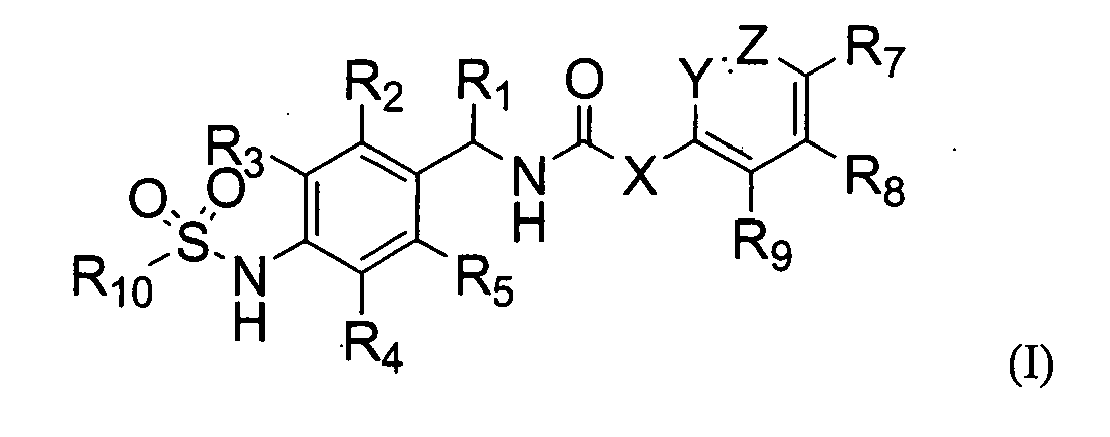
- X is CR11=CR12 , CHR11CHR12 ,

- Y and Z are independently CH, CR6, or N, such that at least one of Y and Z is N;
- R1 is hydrogen or C1-C5 alkyl;
- R2, R3, R4, and R5 are independently hydrogen, halogen, nitro, cyano, C1-C5 alkyl, C1-C5 alkoxy, halo (C1-C5) alkyl, C2-C5 alkenyl, C2-C5 alkynyl, carboxy, C1-C5 alkoxycarbonyl, or C1-C5 alkylthio;
- R6, R7, R8, and R9 are independently hydrogen, hydroxy, halogen, nitro, carboxy, C1-C5 alkyl, C1-C5 alkoxy, hydroxy (C1-C5) alkyl, C2-C5 alkenyl, C2-C5 alkynyl, halo (C1-C5) alkyl, halo (C1-C5) alkoxy, C1-C5 alkylthio, C1-C5 alkylsulfonyl, C1-C5 alkylcarbonyl, C1-C5 alkoxycarbonyl, C2-C5 alkenyloxy, C1-C5 alkoxy (C1-C5) alkoxy, C1-C5 alkoxy (C1-C5) alkoxy (C1-C5) alkyl, C1-C3 alkylpiperazinyl, piperidyl, C1-C5 alkoxy (C1-C5) alkylamino, C1-C7 alkylamino, di(C1-C5 alkyl)amino, C3-C6 cycloalkyl which may be unsubstituted or substituted with one or more C1-C3 alkyl groups, pyrrolidinyl, phenyl, or morpholinyl, wherein the phenyl may be unsubstituted or substituted with one or more substituents selected from halogen, C1-C5 alkyl, and halo (C1-C5) alkyl; and
- R10 is C1-C5 alkyl, halo (C1-C5) alkyl, or C2-C5 alkenyl.
- Another aspect of the present invention is a compound according to the above formula (1), an isomer, or a pharmaceutically acceptable salt thereof;
wherein, - X is CR11=CR12, CHR11CHR12,

- R1 is hydrogen or C1-C3 alkyl;
- R2, R3, R4, and R5 are independently hydrogen, halogen, nitro, cyano, methyl, ethyl, ethenyl, ethynyl, trifluoromethyl, methoxy, ethoxy, or methoxycarbonyl;
- R6, R7, R8, and R9 are independently hydrogen, hydroxy, halogen, nitro, carboxy, C1-C5 alkyl, C1-C5 alkoxy, hydroxy (C1-C5) alkyl, C2-C5 alkenyl, C2-C5 alkynyl, halo (C1-C5) alkyl, halo (C1-C5) alkoxy, C1-C5 alkylthio, C1-C5 alkylsulfonyl, C1-C5 alkylcarbonyl, C1-C5 alkoxycarbonyl, C2-C5 alkenyloxy, C1-C5 alkoxy (C1-C5) alkoxy, C1-C5 alkoxy (C1-C5) alkoxy (C1-C5) alkyl, C1-C3 alkylpiperazinyl, piperidyl, C1-C5 alkoxy (C1-C5) alkylamino, C1-C7 alkylamino, di(C1-C3 alkyl)amino, C3-C6 cycloalkyl which may be unsubstituted or substituted with one or more methyl groups, pyrrolidinyl, phenyl, or morpholinyl, wherein the phenyl may be unsubstituted or substituted with one or more substituents selected from halogen, C1-C5 alkyl, and halo (C1-C5) alkyl; and
- R10 is C1-C3 alkyl or C2-C3 alkenyl.
- The present invention also provides a novel compound of the following formula (II), an isomer, or a pharmaceutically acceptable salt thereof;

- R1 is hydrogen or alkyl, preferably C1-C10 alkyl;
- R2, R3, R4, and R5 are independently hydrogen, halogen, nitro, cyano, alkyl (preferably C1-C10 alkyl), alkoxy (preferably C1-C10 alkoxy), haloalkyl (preferably halo (C1-C10) alkyl), alkenyl (preferably C2-C10 alkenyl), alkynyl (preferably C2-C10 alkynyl), carboxy, alkoxycarbonyl (preferably C1-C10 alkoxycarbonyl), or alkylthio (preferably C1-C10 alkylthio);
- R6, R7, R8, and R9 are independently hydrogen, hydroxy, halogen, nitro, carboxy, alkyl (preferably C1-C10 alkyl), alkoxy (preferably C1-C10 alkoxy), hydroxyalkyl (preferably hydroxy (C1-C10) alkyl), alkenyl (preferably C2-C 10 alkenyl), alkynyl (preferably C2-C10 alkynyl), haloalkyl (preferably halo (C1-C10) alkyl), haloalkoxy (preferably halo (C1-C10) alkoxy), alkylthio (preferably C1-C10 alkylthio), alkylsufonyl (preferably C1-C10 alkylsulfonyl), alkylcarbonyl (preferably C1-C10 alkylcarbonyl), alkoxycarbonyl (preferably C1-C10 alkoxycarbonyl), alkenyloxy (preferably C2-C10 alkenyloxy), alkoxyalkoxy (preferably C1-C10 alkoxy (C1-C10) alkoxy), alkoxyalkoxyalkyl (preferably C1-C10 alkoxy (C1-C10) alkoxy (C1-C10) alkyl), alkylpiperazinyl (preferably C1-C10 alkylpiperazinyl), piperidyl, alkoxyalkylamino (preferably C1-C10 alkoxy (C1-C10) alkylamino), alkylamino (preferably C1-C10 alkylamino), dialkylamino (preferably di(C1-C10 alkyl)amino), cycloalkyl (preferably C3-C8 cycloalkyl) which may be unsubstituted or substituted with one or more C1-C6 alkyl groups, pyrrolidinyl, phenyl, or morpholinyl, wherein the phenyl may be unsubstituted or substituted with one or more substituents selected from halogen, alkyl (preferably C1-C10 alkyl), and haloalkyl (preferably halo (C1-C10) alkyl); and
- R10 is alkyl (preferably C1-C10 alkyl), haloalkyl (preferably halo (C1-C10) alkyl), or alkynyl (preferably C2-C10 alkenyl).
- The present invention also provides a novel compound of the following formula (II), an isomer, or a pharmaceutically acceptable salt thereof;

- R1 is hydrogen or C1-C5 alkyl;
- R2, R3, R4, and R5 are independently hydrogen, halogen, nitro, cyano, C1-C5 alkyl, C1-C5 alkoxy, halo (C1-C5) alkyl, C2-C5 alkenyl, C2-C5 alkynyl, carboxy, C1-C5 alkoxycarbonyl, or C1-C5 alkylthio;
- R6, R7, R8, and R9 are independently hydrogen, hydroxy, halogen, nitro, carboxy, C1-C5 alkyl, C1-C5 alkoxy, C2-C5 alkenyl, C2-C5 alkynyl, halo (C1-C5) alkyl, halo (C1-C5) alkoxy, hydroxy (C1-C5) alkyl, C1-C5 alkylthio, C1-C5 alkylsulfonyl, C1-C5 alkylcarbonyl, C1-C5 alkoxycarbonyl, C2-C5 alkenyloxy, C1-C5 alkoxy (C1-C5) alkoxy, C1-C5 alkoxy (C1-C5) alkoxy (C1-C5) alkyl, C1-C3 alkylpiperazinyl, piperidyl, C1-C5 alkoxy (C1-C5) alkylamino, C1-C7 alkylamino, di(C1-C5 alkyl)amino, C3-C6 cycloalkyl which may be unsubstituted or substituted with one or more C1-C3 alkyl groups, pyrrolidinyl, phenyl, or morpholinyl, wherein the phenyl may be unsubstituted or substituted with one or more substituents selected from halogen, C1-C5 alkyl, and halo (C1-C5) alkyl;
- R10 is C1-C5 alkyl, halo (C1-C5) alkyl, or C2-C5 alkenyl; and
- R11 and R12 are independently hydrogen, C1-C5 alkyl, or halogen.
- Also disclosed is a compound of the formula (III), an isomer, or a pharmaceutically acceptable salt thereof;

- R1 is hydrogen or alkyl, preferably C1-C10 alkyl;
- R2, R3, R4, and R5 are independently hydrogen, halogen, nitro, cyano, alkyl (preferably C1-C10 alkyl), alkoxy (preferably C1-C10 alkoxy), haloalkyl (preferably halo (C1-C10) alkyl), alkenyl (preferably C2-C10 alkenyl), alkynyl (preferably C2-C10 alkynyl), carboxy, alkoxycarbonyl (preferably C1-C10 alkoxycarbonyl), or alkylthio (preferably C1-C10 alkylthio);
- R6, R7, R8, and R9 are independently hydrogen, hydroxy, halogen, nitro, carboxy, alkyl (preferably C1-C10 alkyl), alkoxy (preferably C1-C10 alkoxy), hydroxyalkyl (preferably hydroxy (C1-C10) alkyl), alkenyl (preferably C2-C10 alkenyl), alkynyl (preferably C2-C10 alkynyl), haloalkyl (preferably halo (C1-C10) alkyl), haloalkoxy (preferably halo (C1-C10) alkoxy), alkylthio (preferably C1-C10 alkylthio), alkylsufonyl (preferably C1-C10 alkylsulfonyl), alkylcarbonyl (preferably C1-C10 alkylcarbonyl), alkoxycarbonyl (preferably C1-C10 alkoxycarbonyl), alkenyloxy (preferably C2-C10 alkenyloxy), alkoxyalkoxy (preferably C1-C10 alkoxy (C1-C10) alkoxy), alkoxyalkoxyalkyl (preferably C1-C10 alkoxy (C1-C10) alkoxy (C1-C10) alkyl), alkylpiperazinyl (preferably C1-C10 alkylpiperazinyl), piperidyl, alkoxyalkylamino (preferably C1-C10 alkoxy (C1-C10) alkylamino), alkylamino (preferably C1-C10 alkylamino), dialkylamino (preferably di(C1-C10 alkyl)amino), cycloalkyl (preferably C3-C8 cycloalkyl) which may be unsubstituted or substituted with one or more C1-C6 alkyl groups, pyrrolidinyl, phenyl, or morpholinyl, wherein the phenyl may be unsubstituted or substituted with one or more substituents selected from halogen, alkyl (preferably C1-C10 alkyl), and haloalkyl (preferably halo (C1-C10) alkyl); and
- R10 is alkyl (preferably C1-C10 alkyl), haloalkyl (preferably halo (C1-C10) alkyl), or alkynyl (preferably C2-C 10 alkenyl).
- One preferred aspect of the present invention is a compound of the formula (III), an isomer, or a pharmaceutically acceptable salt thereof;

- R1 is hydrogen or C1-C5 alkyl;
- R2, R3, R4, and R5 are independently hydrogen, halogen, nitro, cyano, C1-C5 alkyl, C1-C5 alkoxy, halo (C1-C5) alkyl, C2-C5 alkenyl, C2-C5 alkynyl, carboxy, C1-C5 alkoxycarbonyl, or C1-C5 alkylthio;
- R6, R7, R8, and R9 are independently hydrogen, hydroxy, halogen, nitro, carboxy, C1-C5 alkyl, C1-C5 alkoxy, C2-C5 alkenyl, C2-C5 alkynyl, halo (C1-C5) alkyl, halo (C1-C5) alkoxy, hydroxy (C1-C5) alkyl, C1-C5 alkylthio, C1-C5 alkylsulfonyl, C1-C5 alkylcarbonyl, C1-C5 alkoxycarbonyl, C2-C5 alkenyloxy, C1-C5 alkoxy (C1-C5) alkoxy, C1-C5 alkoxy (C1-C5) alkoxy (C1-C5) alkyl, C1-C3 alkylpiperazinyl, piperidyl, C1-C5 alkoxy (C1-C5) alkylamino, C1-C7 alkylamino, di(C1-C5 alkyl)amino, C3-C6 cycloalkyl which may be unsubstituted or substituted with one or more C1-C3 alkyl groups, pyrrolidinyl, phenyl, or morpholinyl, wherein the phenyl may be unsubstituted or substituted with one or more substituents selected from halogen, C1-C5 alkyl, and halo (C1-C5) alkyl;
- R10 is C1-C5 alkyl, halo (C1-C5) alkyl, or C2-C5 alkenyl; and
- R11 and R12 are independently hydrogen, C1-C5 alkyl, or halogen.
- One aspect of the present invention is a compound of the formula (I), (II), or (III), an isomer, or a pharmaceutically acceptable salt thereof as defined further above, wherein R7 is a C3-C6 cycloalkyl group which may be unsubstituted or substituted with one or more methyl groups, or a C1-C5 alkyl group that is optionally halogenated with one or more radicals selected from chloro, bromo, or, preferably, fluoro. Examples are methylcyclopropyl, CF3, isopropyl, t-butyl and isobutyl.
- Another aspect of the present invention is a compound of the formula (I), (II), or (III), an isomer, or a pharmaceutically acceptable salt thereof as defined further above, wherein R6 is selected from hydrogen, fluoro, bromo, chloro, methyl, ethyl, hydroxymethyl, trifluoromethyl, morpholinyl, methoxy, and piperidyl.
- Another aspect of the present invention is a compound of the formula (I), (II), or (III), an isomer, or a pharmaceutically acceptable salt thereof as defined further above, wherein R3 is selected from hydrogen, fluoro, bromo, chloro, methyl, ethyl, trifluoromethyl, ethenyl, ethynyl, and cyano..
- Another aspect of the present invention is a compound of the formula (I), (II), or (III), an isomer, or a pharmaceutically acceptable salt thereof as defined further above, wherein R10 is methyl.
- Another aspect of the present invention is a compound of the formula (I), (II), or (III), an isomer, or a pharmaceutically acceptable salt thereof as defined further above, wherein R11 and R12, if present, are both hydrogen.
- Another aspect of the present invention is a compound of the formula (I), (II), or (III), an isomer, or a pharmaceutically acceptable salt thereof as defined further above, wherein R4 is hydrogen, fluoro, chloro, bromo, methyl, ethyl, cyano, or trifluoromethyl.
- Another aspect of the present invention is a compound of the formula (I), (II), or (III), an isomer, or a pharmaceutically acceptable salt thereof as defined further above, wherein R1 and R2 are both hydrogen.
- Another aspect of the present invention is a compound of the formula (I), (II), or (III), an isomer, or a pharmaceutically acceptable salt thereof as defined further above, wherein R1, R2, and R11 and R12, if present, are all hydrogen.
- Another aspect of the present invention is a compound of the formula (I), (II), or (III), an isomer, or a pharmaceutically acceptable salt thereof as defined further above, wherein R1, R2, and R11 and R12, if present, are all hydrogen, R10 is methyl, and R3 is selected from hydrogen, fluoro, bromo, chloro, methyl, ethyl, trifluoromethyl, ethenyl, ethynyl, and cyano.
- Another aspect of the present invention is a compound of the formula (I), (II), or (III), an isomer, or a pharmaceutically acceptable salt thereof as defined further above, wherein R11 and R12, if present, are both hydrogen, R10 is methyl or ethyl, R3 is selected from hydrogen, fluoro, bromo, chloro, methyl, ethyl, trifluoromethyl, ethenyl, ethynyl, and cyano, and R4 is selected from hydrogen, fluoro, chloro, bromo, methyl, cyano, or trifluoromethyl.
- Another aspect of the present invention is a compound of the formula (I), (II), or (III), an isomer, or a pharmaceutically acceptable salt thereof as defined further above, wherein R11 and R12, if present, are both hydrogen, R10 is methyl or ethyl, R3 is selected from hydrogen, fluoro, bromo, chloro, methyl, ethyl, trifluoromethyl, ethenyl, ethynyl, and cyano, and R7 is cyclopropylmethyl or a C1-C5 alkyl that is optionally halogenated with one or more radicals selected from chloro, bromo, or, preferably, fluoro.
- Another aspect of the present invention is a compound of the formula (I), (II), or (III), an isomer, or a pharmaceutically acceptable salt thereof as defined further above, wherein R1 and R12, if present, are both hydrogen, R10 is methyl or ethyl, R2, R5 and R8 are hydrogen, R3 is selected from hydrogen, fluoro, bromo, chloro, methyl, ethyl, trifluoromethyl, ethenyl, ethynyl, and cyano, and R7 is a C1-C5 alkyl that is optionally halogenated with one or more radicals selected from chloro, bromo, or, preferably, fluoro.
- One preferred aspect of the present invention is a compound of the formula (I), (II), or (III), an isomer, or a pharmaceutically acceptable salt thereof;
wherein, - R1 is hydrogen, methyl, or ethyl;
- R2, R3, R4, and R5 are independently hydrogen, fluoro, chloro, bromo, nitro, cyano, methyl, ethyl, ethenyl, ethynyl, trifluoromethyl, methoxy, ethoxy, or methoxycarbonyl;
- R6, if present, is hydrogen, hydroxy, fluoro, bromo, chloro, hydroxymethyl, C1-C5 alkyl, C1-C5 alkoxy, C2-C5 alkenyl, C2-C5 alkynyl, halo (C1-C5) alkyl, halo (C1-C5) alkoxy, C2-C5 alkenyloxy, C1-C5 alkoxy (C1-C5) alkoxy, C1-C5 alkoxy (C1-C5) alkoxy (C1-C5) alkyl, di(C1-C3 alkyl)amino, C1-C3 alkylpiperazinyl, piperidyl, pyrrolidinyl, halophenyl, phenyl, or morpholinyl;
- R7 is C1-C5 alkyl, halo (C1-C4) alkyl, halogen, piperidyl, morpholinyl, pyrrolidinyl, C3-C6 cycloalkyl which may be unsubstituted or substituted with one or more methyl groups, C2-C5 alkenyl;
- R8 and R9 are independently hydrogen, halogen, or trifluoromethyl;
- R10 is C1-C5 alkyl, halo (C1-C5) alkyl, or C2-C5 alkenyl; and
- R11 and R12, if present, are independently hydrogen, or methyl.
- Another preferred embodiment of the invention is a compound of the formula (I), (II), or (III), an isomer, or a pharmaceutically acceptable salt thereof;
wherein, - R),and R2 are hydrogen;
- R3 is hydrogen, fluoro, chloro, bromo, cyano, methyl, ethyl ethenyl, ethynyl, or trifluoromethyl;
- R4 and R5 are independently hydrogen, fluoro, chloro, cyano, methyl, ethyl, or trifluoromethyl;
- R6, if present, is hydrogen, hydroxy, fluoro, bromo, chloro, methyl, hydroxymethyl, methoxy, trifluoromethyl, di(C1-C3 alkyl)amino, alkylpiperazinyl, piperidyl, pyrrolidinyl, halophenyl, phenyl, or morpholinyl;
- R7 is methyl, isopropyl, t-butyl, trifloromethyl, chloro, bromo, cyclopropyl which may be unsubstituted or substituted with one or two methyl groups, piperidyl, pyrrolidinyl, or morpholinyl;
- R8 is hydrogen;
- R9 is hydrogen or trifluoromethyl;
- R10 is C1-C5 alkyl, halo (C1-C5) alkyl, or C2-C5 alkenyl; and
- R11, and R12, if present, are independently hydrogen or methyl.
- Another preferred embodiment of the invention is a compound of the formula (I), (II), or (III), an isomer, or a pharmaceutically acceptable salt thereof;
wherein, - R1, R2, and R5 are hydrogen;
- R3 is hydrogen, fluoro, chloro, cyano, methyl, ethenyl, ethynyl, or trifluoromethyl;
- R4 is hydrogen, fluoro, chloro, cyano, methyl, ethyl, or trifluoromethyl;
- R6, if present, is hydrogen, hydroxy, fluoro, bromo, chloro, methyl, hydroxymethyl, methoxy, trifluoromethyl, diethylamino, piperidyl, pyrrolidinyl, trifluorophenyl, phenyl, or morpholinyl;
- R7 is methyl, isopropyl, t-butyl, trifluoromethyl, chloro, bromo, cyclopropyl, methylcyclopropyl, piperidyl, pyrrolidinyl, or morpholinyl;
- R8 is hydrogen;
- R11, and R12, if present, are hydrogen;
- R9 is hydrogen or trifluoromethyl; and
- R10 is methyl.
- Another preferred embodiment of the invention is a compound of the formula (I), (II), or (III), an isomer, or a pharmaceutically acceptable salt thereof;
wherein, - R1 is hydrogen or methyl;
- R2 is hydrogen;
- R3 is hydrogen, fluoro, chloro, bromo, cyano, methyl, ethyl, ethenyl, ethynyl, or trifluoromethyl;
- R4 and R5 are independently hydrogen, fluoro, chloro, cyano, methyl, ethyl, or trifluoromethyl;
- R6, if present, is hydrogen, fluoro, chloro, bromo, methyl, methoxy, piperidyl, or morpholinyl;
- R7 is isopropyl, t-butyl, or trifluoromethyl;
- R8 is hydrogen;
- R11, and R12, if present, are hydrogen;
- R9 is hydrogen or trifluoromethyl; and
- R10 is methyl.
- Preferred examples of compounds according to the invention are selected from the group consisting of;
- 3-(6-tert-Butyl-pyridin-3-yl)-N-(3-chloro-4-methanesulfonylamino-benzyl)-acrylamide,
- 3-(6-tert-Butyl-pyridin-3-yl)-N-(3-fluoro-4-methanesulfonylamino-benzyl)-acrylamide,
- 3-(6-tert-Butyl-pyridin-3-yl)-N-(3-ethynyl-5-fluoro-4-methanesulfonylamino-benzyl)-acrylamide,
- 3-(6-tert-Butyl-pyridin-3-yl)-N-(4-methanesulfonylamino-3-vinyl-benzyl)-acrylamide,
- N-(3-Fluoro-4-methanesulfonylamino-benzyl)-3-(2-morpholin-4-yl-6-trifluoromethylpyridin-3-yl)-acrylamide,
- N-(4-Methanesulfonylamino-3-vinyl-benzyl)-3-(2-morpholin-4-yl-6-trifluoromethylpyridin-3-yl)-acrylamide,
- N-(3-Chloro-4-methanesulfonylamino-benzyl)-3-(2-morpholin-4-yl-6-trifluoromethylpyridin-3-yl)-acrylamide,
- N-(3-Fluoro-4-methanesulfonylamino-5-methyl-benzyl)-3-(2-morpholin-4-yl-6-trifluoromethyl-pyridin-3-yl)-acrylamide,
- 3-(6-tert-Butyl-2-methoxy-pyridin-3-yl)-N-(3-fluoro-4-methanesulfonylamino-benzyl)-acrylamide,
- 3-(6-tert-Butyl-pyridin-3-yl)-N-(3-fluoro-4-methanesulfonylamino-5-vinyl-benzyl)-acrylamide,
- 3-(6-tert-Butyl-2-methoxy-pyridin-3-yl)-N-(3-ethynyl-5-fluoro-4-methanesulfonylamino-benzyl)-acrylamide,
- N-(3-Ethynyl-5-fluoro-4-methanesulfonylamino-benzyl)-3-(2-morpholin-4-yl-6-trifluoromethyl-pyridin-3-yl)-acrylamide,
- 3-(6-tert-Butyl-4-trifluoromethyl-pyridin-3-yl)-N-(3-fluoro-4-methanesulfonylamino-benzyl)-acrylamide,
- 3-(6-tert-Butyl-4-trifluoromethyl-pyridin-3-yl)-N-(3-ethynyl-5-fluoro-4-methanesulfonylamino-benzyl)-acrylamide,
- N-(3,5-Difluoro-4-methanesulfonylamino-benzyl)-3-(2-morpholin-4-yl-6-trifluoromethyl-pyridin-3-yl)-acrylamide,
- N-(3-Ethynyl-5-fluoro-4-methanesulfonylamino-benzyl)-3-(6'-trifluoromethyl-3,4,5,6-tetrahydro-2H-[1,2']bipyridinyl-3'-yl)-acrylamide,
- 3-(2-Bromo-6-tert-butyl-pyridin-3-yl)-N-(3-fluoro-4-methanesulfonylamino-benzyl)-acrylamide,
- 3-(2-Bromo-6-tert-butyl-pyridin-3-yl)-N-(3-ethynyl-5-fluoro-4-methanesulfonylamino-benzyl)-acrylamide, and
- N-(3-Fluoro-4-methanesulfonylamino-benzyl)-3-(6'-trifluoromethyl-3,4,5,6-tetrahydro-2H-[1,2']bipyridinyl-3'-yl)-acrylamide.
- Particularly preferred compounds according to the present invention are
- 3-(6-tert-Butyl-pyridin-3-yl)-N-(3-ethynyl-5-fluoro-4-methanesulfonylamino-benzyl)-acrylamide,
- 3-(6-tert-Butyl-pyridin-3-yl)-N-(4-methanesulfonylamino-3-vinyl-benzyl)-acrylamide,
- N-(4-Methanesulfonylamino-3-vinyl-benzyl)-3-(2-morpholin-4-yl-6-trifluoromethyl-pyridin-3-yl)-acrylamide,
- N-(3-Fluoro-4-methanesulfonylamino-5-methyl-benzyl)-3-(2-morpholin-4-yl-6-trifluoromethyl-pyridin-3-yl)-acrylamide,
- 3-(6-tert-Butyl-2-methoxy-pyridin-3-yl)-N-(3-fluoro-4-methanesulfonylamino-benzyl)-acrylamide,
- 3-(6-tert-Butyl-pyridin-3-yl)-N-(3-fluoro-4-methanesulfonylamino-5-vinyl-benzyl)-acrylamide,
- 3-(6-tert-Butyl-2-methoxy-pyridin-3-yl)-N-(3-ethynyl-5-fluoro-4-methanesulfonylamino-benzyl)-acrylamide,
- N-(3-Ethynyl-5-fluoro-4-methanesulfonylamino-benzyl)-3-(2-morpholin-4-yl-6-trifluoromethyl-pyridin-3-yl)-acrylamide,
- 3-(6-tert-Butyl-4-trifluoromethyl-pyridin-3-yl)-N-(3-fluoro-4-methanesulfonylamino-benzyl)-acrylamide,
- 3-(6-tert-Butyl-4-trifluoromethyl-pyridin-3-yl)-N-(3-ethynyl-5-fluoro-4-methanesulfonylamino-benzyl)-acrylamide,
- N-(3-Ethynyl-5-fluoro-4-methanesulfonylamino-benzyl)-3-(6'-trifluoromethyl-3,4,5,6-tetrahydro-2H-[1,2']bipyridinyl-3'-yl)-acrylamide,
- 3-(2-Bromo-6-tert-butyl-pyridin-3-yl)-N-(3-fluoro-4-methanesulfonylamino-benzyl)-acrylamide, and
- 3-(2-Bromo-6-tert-butyl-pyridin-3-yl)-N-(3-ethynyl-5-fluoro-4-methanesulfonylamino-benzyl)-acrylamide.
- The present invention also provides a novel compound of the following formula (IV), an isomer, or a pharmaceutically acceptable salt thereof;
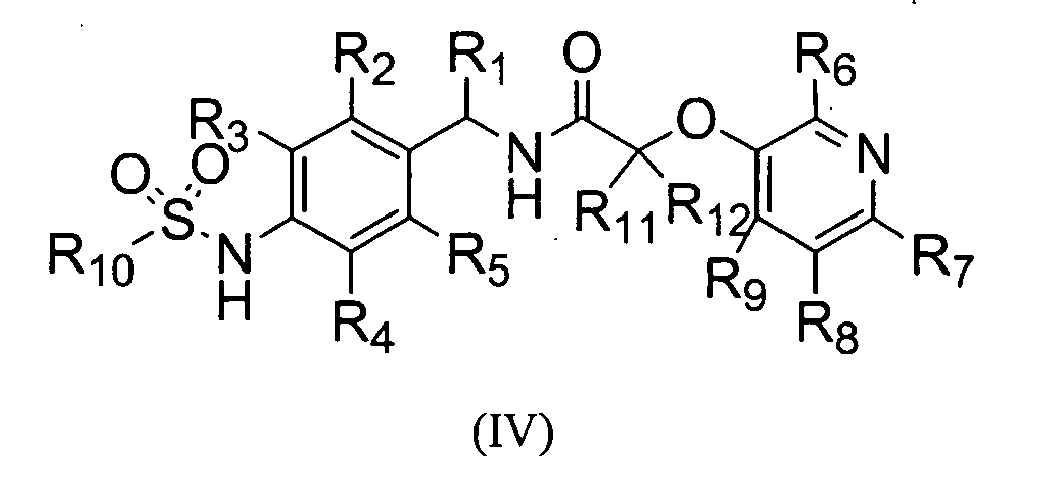
- R1 is hydrogen or alkyl, preferably C1-C10 alkyl;
- R2, R3, R4, and R5 are independently hydrogen, halogen, nitro, cyano, alkyl preferably C1-C10 alkyl, alkoxy preferably C1-C10 alkoxy, haloalkyl preferably halo (C1-C10) alkyl, alkenyl preferably C2-C10 alkenyl, alkynyl preferably C2-C10 alkynyl, carboxy, alkoxycarbonyl preferably C1-C10 alkoxycarbonyl, or alkylthio, preferably C1-C10 alkylthio;
- R6, R7, R8, and R9 are independently hydrogen, hydroxy, halogen, nitro, carboxy, alkyl preferably C1-C10 alkyl, alkoxy preferably C1-C10 alkoxy, hydroxyalkyl preferably hydroxy (C1-C10) alkyl, alkenyl preferably C2-C10 alkenyl, alkynyl preferably C2-C10 alkynyl, haloalkyl preferably halo (C1-C10) alkyl, haloalkoxy preferably halo (C1-C10) alkoxy, alkylthio preferably C1-C10 alkylthio, alkylsufonyl preferably C1-C10 alkylsulfonyl, alkylcarbonyl preferably C1-C10 alkylcarbonyl, alkoxycarbonyl preferably C1-C10 alkoxycarbonyl, alkenyloxy preferably C2-C10 alkenyloxy, alkoxyalkoxy preferably C1-C10 alkoxy (C1-C10) alkoxy, alkoxyalkoxyalkyl preferably C1-C10 alkoxy (C1-C10) alkoxy (C1-C10) alkyl, alkylpiperazinyl preferably C1-C10 alkylpiperazinyl, piperidyl, alkoxyalkylamino preferably C1-C10 alkoxy (C1-C10) alkylamino, alkylamino preferably C1-C10 alkylamino, dialkylamino preferably di(C1-C10 alkyl)amino, cycloalkyl preferably C3-C8 cycloalkyl which may be unsubstituted or substituted with one or more C1-C6 alkyl groups, pyrrolidinyl, phenyl, or morpholinyl, wherein the phenyl may be unsubstituted or substituted with one or more substituents selected from halogen, alkyl preferably C1-C10 alkyl, and haloalkyl preferably halo (C1-C10) alkyl; and
- R10 is alkyl preferably C1-C10 alkyl, haloalkyl preferably halo (C1-C10) alkyl, or alkynyl preferably C2-C10 alkenyl.
- The present invention also provides a novel compound of the following formula (IV), an isomer, or a pharmaceutically acceptable salt thereof;

- R1 is hydrogen, methyl, or ethyl;
- R2, R3, R4, and R5 are independently hydrogen, fluoro, chloro, bromo, nitro, cyano, methyl, ethyl, ethenyl, ethynyl, trifluoromethyl, methoxy, ethoxy, hydroxy, or methoxycarbonyl;
- R6 is hydrogen, fluoro, bromo, chloro, hydroxymethyl, C1-C5 alkyl, C1-C5 alkoxy, C2-C5 alkenyl, C2-C5 alkynyl, halo (C1-C5) alkyl, halo (C1-C5) alkoxy, C2-C5 alkenyloxy, C1-C5 alkoxy (C1-C5) alkoxy, piperidyl, or morpholinyl;
- R7 is C1-C5 alkyl, halo (C1-C4) alkyl, halogen, morpholinyl, C3-C6 cycloalkyl, C2-C5 alkenyl, or nitro;
- R8 and R9 are hydrogen;
- R10 is C1-C5 alkyl, halo (C1-C5) alkyl, or C2-C5 alkenyl; and
- R11 and R12 are independently hydrogen, halogen, or methyl.
- One preferred aspect of the present invention is a compound of above formula (IV), an isomer, or a pharmaceutically acceptable salt thereof;
wherein, - R1, R2, R5, R8, and R9 are hydrogen;
- R3 and R4 are independently hydrogen, fluoro, chloro, cyano, methyl, ethenyl, ethynyl, or trifluoromethyl;
- R6 is hydrogen, fluoro, bromo, chloro, hydroxymethyl, methoxy, morpholinyl, or trifluoromethyl;
- R7 is t-butyl, trifloromethyl, methyl, chloro, bromo, nitro, or morpholinyl; and
- R10 is methyl or ethenyl.
- Another preferred aspect of the present invention is a compound of above formula (IV), an isomer, or a pharmaceutically acceptable salt thereof;
wherein, - R1, R2, R5, R8, and R9 are hydrogen;
- R3 and R4 are independently hydrogen, fluoro, chloro, cyano, methyl, ethenyl, ethynyl, or trifluoromethyl;
- R6 is hydrogen, fluoro, bromo, chloro, hydroxymethyl, methoxy, morpholinyl, or trifluoromethyl;
- R7 is t-butyl, trifloromethyl, methyl, chloro, bromo, nitro, or morpholinyl; and
- R10 is methyl.
- The present invention also provides a novel compound of the following formula (V), an isomer, or a pharmaceutically acceptable salt thereof;

- R1 is hydrogen or alkyl, preferably C1-C10 alkyl;
- R2, R3, R4, and R5 are independently hydrogen, halogen, nitro, cyano, alkyl preferably C1-C10 alkyl, alkoxy preferably C1-C10 alkoxy, haloalkyl preferably halo (C1-C10) alkyl, alkenyl preferably C2-C10 alkenyl, alkynyl preferably C2-C10 alkynyl, carboxy, alkoxycarbonyl preferably C1-C10 alkoxycarbonyl, or alkylthio, preferably C1-C10 alkylthio;
- R6, R7, R8, and R9 are independently hydrogen, hydroxy, halogen, nitro, carboxy, alkyl preferably C1-C10 alkyl, alkoxy preferably C1-C10 alkoxy, hydroxyalkyl preferably hydroxy (C1-C10) alkyl, alkenyl preferably C2-C 10 alkenyl, alkynyl preferably C2-C 10 alkynyl, haloalkyl preferably halo (C1-C10) alkyl, haloalkoxy preferably halo (C1-C10) alkoxy, alkylthio preferably C1-C10 alkylthio, alkylsufonyl preferably C1-C10 alkylsulfonyl, alkylcarbonyl preferably C1-C10 alkylcarbonyl, alkoxycarbonyl preferably C1-C10 alkoxycarbonyl, alkenyloxy preferably C2-C10 alkenyloxy, alkoxyalkoxy preferably C1-C10 alkoxy (C1-C10) alkoxy, alkoxyalkoxyalkyl preferably C1-C10 alkoxy (C1-C10) alkoxy (C1-C10) alkyl, alkylpiperazinyl preferably C1-C10 alkylpiperazinyl, piperidyl, alkoxyalkylamino preferably C1-C10 alkoxy (C1-C10) alkylamino, alkylamino preferably C1-C10 alkylamino, dialkylamino preferably di(C1-C10 alkyl)amino, cycloalkyl preferably C3-C8 cycloalkyl which may be unsubstituted or substituted with one or more C1-C6 alkyl groups, pyrrolidinyl, phenyl, or morpholinyl, wherein the phenyl may be unsubstituted or substituted with one or more substituents selected from halogen, alkyl preferably C1-C10 alkyl; and haloalkyl preferably halo (C1-C10) alkyl; and
- R10 is alkyl preferably C1-C10 alkyl, haloalkyl preferably halo (C1-C10) alkyl, or alkynyl preferably C2-C10 alkenyl.
- The present invention also provides a novel compound of the following formula (V), an isomer, or a pharmaceutically acceptable salt thereof;

- R1 is hydrogen, methyl, or ethyl;
- R2, R3, R4, and R5 are independently hydrogen, fluoro, chloro, bromo, nitro, cyano, methyl, ethyl, ethenyl, ethynyl, trifluoromethyl, methoxy, ethoxy, or methoxycarbonyl;
- R6, R7, R8 and R9 are independently hydrogen, fluoro, bromo, chloro, hydroxymethyl, C1-C5 alkyl, C1-C5 alkoxy, C2-C5 alkenyl, C2-C5 alkynyl, halo (C1-C5) alkyl, halo (C1-C5) alkoxy, C2-C5 alkenyloxy, C1-C5 alkoxy (C1-C5) alkoxy, piperidyl, nitro, or morpholinyl;
- R10 is C1-C5 alkyl, halo (C1-C5) alkyl, or C2-C5 alkenyl; and
- R11 and R12 are independently hydrogen, halogen, or methyl.
- One preferred aspect of the present invention is a compound of above formula (V), an isomer, or a pharmaceutically acceptable salt thereof;
wherein, - R1, R2, R5, R6, R8, and R9 are hydrogen;
- R3 and R4 are independently hydrogen, fluoro, chloro, cyano, methyl, ethenyl, ethynyl, or trifluoromethyl;
- R7 is t-butyl, trifloromethyl, methyl, chloro, bromo, nitro, or morpholinyl; and
- R10 is methyl or ethenyl.
- Another preferred aspect of the present invention is a compound of above formula (V), an isomer, or a pharmaceutically acceptable salt thereof;
wherein, - R1, R2, R5, R6, R8, and R9 are hydrogen;
- R3 and R4 are independently hydrogen, fluoro, chloro, cyano, methyl, ethenyl, ethynyl, or trifluoromethyl;
- R7 is t-butyl, trifluoromethyl, methyl, chloro, bromo, nitro, or morpholinyl; and
- R10 is methyl.
- The compounds of the formula (I), (II), (III), (IV), and (V) of the present invention can chemically be synthesized by the following reaction schemes. However, these are given only for illustration of the invention and not intended to limit to them.

- The Scheme 1 shows a proposed process for synthesizing acrylamide compound with various substituents. Substituted benzylamine (1) is reacted with pyridinylacrylic acid (2) to yield benzyl pyridinylacrylamide (3) using DMTMM {4-(4,6-dimethoxy-1,3,5-triazin-2-yl)-4-methylmorpholinium chloride} (Tetrahedron Lett., 1999, 40, 5327).

- The Scheme 2 shows a proposed process for synthesizing pyridinyl acrylic acid (9) with various substituents. Substituted pyridinecarboxaldehyde (7) is prepared by known methods. Substituted nicotinic acid (4) and nicotinic ester (5) are converted to corresponding pyridinecarboxaldehyde (7) via pyridinyl methyl alcohol (6). Pyridinyl methanol is converted to pyridinylcarboxaldehyde (7) via swern oxidation. Pyridinecarboxaldehye (7) is converted to methyl pyridinyl acrylic ester (8) by the Wittig reaction. Methyl pyridinyl acrylic ester (8) is hydrolyzed with potassium hydroxide to yield pyridinyl acrylic acid (9).

- The Scheme 3 shows a proposed process for synthesizing pyridinyl acrylic amide (16) with t-butyl group. Substituted pyridinecarboxaldehyde with t-butyl group (12) is prepared by reduction and radical substitution method (J. Heterocyclic Chem., 1989, 25, 45-48). Substituted nicotinic ester (10) is converted to corresponding pyridine-3-methanol (11). Pyridinyl-3-methanol is reacted with pivalic acid and silver nitrate to give pyridinylcarboxaldehyde (12) via Tada's radical substitution. Compound 14 is synthesized from compound 12 with similar method of scheme 2. 4-t-Butylpyridinyl acrylic acid (14) is reacted with compound 15 to yield compound 16.

- The Scheme 4 shows a proposed process for synthesizing pyridinyl acrylamide (22) with trifluoromethyl group. 2-chloro-6-trifluoromethyl-nicotinic ester (17) was reacted with cyclic secondary amine to give compound (18). Compound (18) was converted to obtain compound (21) under similar reaction of scheme 2. Compound (21) was reacted with compound (15) to give compound (22).


- The present invention also provides a compound of formula (I), (V), (III), (IV) or (V), an isomer thereof, or a pharmaceutically acceptable salt thereof for preventing or treating a disease associated with the pathological stimulation and/or aberrant expression of vanilloid receptor, wherein said composition comprises the compound of formula (I), (II), (III), (IV) or (V), an isomer thereof or a pharmaceutically acceptable salt thereof; and pharmaceutically acceptable carrier.
- In one preferred aspect, the present invention provides a compound of formula (I), (V), (III), (IV) or (V), an isomer thereof, or a pharmaceutically acceptable salt thereof for treating a condition selected from the group consisting of pain, inflammatory disease of the joints, neuropathies, HIV-related neuropathy, nerve injury, neurodegeneration, stroke, urinary bladder hypersensitivity including urinary incontinence, cystitis, stomach duodenal ulcer, irritable bowel syndrome (IBS) and inflammatory bowel disease (IBD), fecal urgency, gastro-esophageal reflux disease (GERD), Crohn's disease, asthma, chronic obstructive pulmonary disease, cough, neurotic/allergic/inflammatory skin disease, psoriasis, pruritus, prurigo, irritation of skin, eye or mucous membrane, hyperacusis, tinnitus, vestibular hypersensitivity, episodic vertigo, cardiac diseases such as myocardial ischemia, hair growth-related disorders such as effluvium, alopecia, rhinitis and pancreatitis.
- In a particularly preferred aspect, the present invention relates to a compound of formula (I), (V), (III), (IV) or (V), an isomer thereof, or a pharmaceutically acceptable salt thereof, wherein the pain is or is associated with a condition selected from the group consisting of osteoarthritis, rheumatoid arthritis, ankylosing spondylitis, diabetic neuropathic pain, post-operative pain, dental pain, non-inflammatory musculoskeletal pain (including fibromyalgia, myofascial pain syndrome and back pain), migraine and other types of headaches.
- The present invention also provides a pharmaceutical composition comprising a compound of formula (I), (V), (III), (IV) or (V), an isomer thereof, or a pharmaceutically acceptable salt thereof as an active ingredient together with a pharmaceutically acceptable carrier.
- The present invention also provides a pharmaceutical composition for preventing or treating a disease associated with the pathological stimulation and/or aberrant expression of vanilloid receptor, wherein said composition comprises the compound of formula (I), (II), (III), (IV) or (V), an isomer thereof or a pharmaceutically acceptable salt thereof; and pharmaceutically acceptable carrier.
- In one preferred aspect, the present invention provides a pharmaceutical composition comprising a compound of formula (I), (V), (III), (IV) or (V), an isomer thereof, or a pharmaceutically acceptable salt thereof, for treating a condition selected from the group consisting of pain, inflammatory disease of the joints, neuropathies, HIV-related neuropathy, nerve injury, neurodegeneration, stroke, urinary bladder hypersensitivity including urinary incontinence, cystitis, stomach duodenal ulcer, irritable bowel syndrome (IBS) and inflammatory bowel disease (IBD), fecal urgency, gastro-esophageal reflux disease (GERD), Crohn's disease, asthma, chronic obstructive pulmonary disease, cough, neurotic/allergic/inflammatory skin disease, psoriasis, pruritus, prurigo, irritation of skin, eye or mucous membrane, hyperacusis, tinnitus, vestibular hypersensitivity, episodic vertigo, cardiac diseases such as myocardial ischemia, hair growth-related disorders such as effluvium, alopecia, rhinitis and pancreatitis.
- In a particularly preferred aspect, the present invention relates to the pharmaceutical composition comprising a compound of formula (I), (V), (III), (IV) or (V), an isomer thereof, or a pharmaceutically acceptable salt thereof for treating pain as described above, wherein the pain is or is associated with a condition selected from the group consisting of osteoarthritis, rheumatoid arthritis, ankylosing spondylitis, diabetic neuropathic pain, post-operative pain, dental pain, non-inflammatory musculoskeletal pain (including fibromyalgia, myofascial pain syndrome and back pain), migraine and other types of headaches.
- The present invention also provides a pharmaceutical composition comprising a compound of formula (I), (V), (III), (IV) or (V), an isomer thereof, or a pharmaceutically acceptable salt thereof, which is characterized in that it is adapted for oral administration.
- In another aspect, the present invention relates to a method for inhibiting vanilloid ligand from binding to vanilloid receptor in a patient, comprising contacting cells expressing vanilloid receptor in the patient with the compound of formula (I), (II), (III), (IV) or (V), an isomer thereof, or a pharmaceutically acceptable salt thereof.
- In another aspect, the present invention also provides a method for preventing or treating a condition selected from the group consisting of pain, inflammatory disease of the joints, neuropathies, HIV-related neuropathy, nerve injury, neurodegeneration, stroke, urinary bladder hypersensitivity including urinary incontinence, cystitis, stomach duodenal ulcer, irritable bowel syndrome (IBS) and inflammatory bowel disease (IBD), fecal urgency, gastro-esophageal reflux disease (GERD), Crohn's disease, asthma, chronic obstructive pulmonary disease, cough, neurotic/allergic/inflammatory skin disease, psoriasis, pruritus, prurigo, irritation of skin, eye or mucous membrane, hyperacusis, tinnitus, vestibular hypersensitivity, episodic vertigo, cardiac diseases such as myocardial ischemia, hair growth-related disorders such as effluvium, alopecia, rhinitis and pancreatitis, which comprises administering to a mammal including a person in need thereof a therapeutically effective amount of the compound of formula (I), (II), (III), (IV), or (V), an isomer thereof, or a pharmaceutically acceptable salt thereof.
- In a particularly preferred aspect, the present invention relates to the method of treating pain by administering a compound of formula (I), (V), (III), (IV) or (V), an isomer thereof, or a pharmaceutically acceptable salt thereof as described above, wherein the pain is or is associated with a condition selected from the group consisting of osteoarthritis, rheumatoid arthritis, ankylosing spondylitis, diabetic neuropathic pain, post-operative pain, dental pain, non-inflammatory musculoskeletal pain (including fibromyalgia, myofascial pain syndrome and back pain), migraine, and other types of headaches.
- In another aspect, the present invention relates to the use of a compound of formula (I), (II), (III), (IV) or (V), an isomer thereof, or a pharmaceutically acceptable salt thereof for the preparation of a medicament for the prevention or treatment of a condition that is associated with the aberrant expression and/or aberrant activation of a vanilloid receptor.
- In another aspect, the present invention relates to the use of a compound of formula (I), (II), (III), (IV) or (V), an isomer thereof, or a pharmaceutically acceptable salt thereof, in preparation of a medicament for the prevention or treatment of a condition that is selected from the group consisting of pain, inflammatory disease of the joints, neuropathies, HIV-related neuropathy, nerve injury, neurodegeneration, stroke, urinary bladder hypersensitivity including urinary incontinence, cystitis, stomach duodenal ulcer, irritable bowel syndrome (IBS) and inflammatory bowel disease (IBD), fecal urgency, gastro-esophageal reflux disease (GERD), Crohn's disease, asthma, chronic obstructive pulmonary disease, cough, neurotic/allergic/inflammatory skin disease, psoriasis, pruritus, prurigo, irritation of skin, eye or mucous membrane, hyperacusis, tinnitus, vestibular hypersensitivity, episodic vertigo, cardiac diseases such as myocardial ischemia, hair growth-related disorders such as effluvium, alopecia, rhinitis and pancreatitis.
- In a particularly preferred aspect, the present invention relates to the use of the compound of formula (I), (II), (III), (IV) or (V) for preparing a medicament for preventing or treating pain as described above, wherein the condition is pain or which is or which is associated with a condition selected from the group consisting of osteoarthritis, rheumatoid arthritis, ankylosing spondylitis, diabetic neuropathic pain, post-operative pain, dental pain, non-inflammatory musculoskeletal pain (including fibromyalgia, myofascial pain syndrome and back pain), migraine, and other types of headaches.
- The present invention also provides a process for preparing a compound represented by the formula (III)


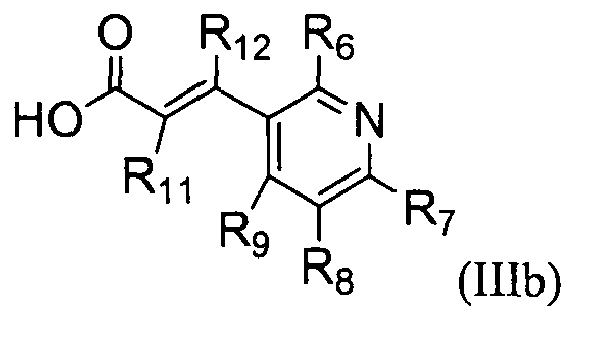
- R1 is hydrogen or C1-C5 alkyl;
- R2, R3, R4, and R5 are independently hydrogen, halogen, nitro, cyano, C1-C5 alkyl, C1-C5 alkoxy, halo (C1-C5) alkyl, C2-C5 alkenyl, C2-C5 alkynyl, carboxy, C1-C5 alkoxycarbonyl, or C1-C5 alkylthio;
- R6, R7, R8, and R9 are independently hydrogen, hydroxy, halogen, nitro, carboxy, C1-C5 alkyl, C1-C5 alkoxy, C2-C5 alkenyl, C2-C5 alkynyl, halo (C1-C5) alkyl, halo (C1-C5) alkoxy, hydroxy (C1-C5) alkyl, C1-C5 alkylthio, C1-C5 alkylsulfonyl, C1-C5 alkylcarbonyl, C1-C5 alkoxycarbonyl, C2-C5 alkenyloxy, C1-C5 alkoxy (C1-C5) alkoxy, C1-C5 alkoxy (C1-C5) alkoxy (C1-C5) alkyl, C1-C3 alkylpiperazinyl, piperidyl, C1-C5 alkoxy (C1-C5) alkylamino, C1-C7 alkylamino, di(C1-C5 alkyl)amino, C3-C6 cycloalkyl which may be unsubstituted or substituted with one or more C1-C3 alkyl groups, pyrrolidinyl, phenyl, or morpholinyl, wherein the phenyl may be unsubstituted or substituted with one or more substituents selected from halogen, C1-C5 alkyl, and halo (C1-C5) alkyl;
- Rio is C1-C5 alkyl, halo (C1-C5) alkyl, or C2-C5 alkenyl; and
- R11 and R12 are independently hydrogen, C1-C5 alkyl, or halogen.
- One preferred aspect of the present invention is the process for preparing a compound of formula (III), wherein, the reaction is conducted in the presence of a coupling agent.
- Another preferred aspect of the present invention is the process for preparing a compound of formula (III), wherein the coupling agent is selected from the group consisting of DCC (N,N-dicyclohexylcarbodidimide), EDCI {1-(3-dimethylaminopropyl)-3-ethylcarbodidimide hydrochloride (EDCI)}, and DMTMM {4-(4,6-dimethoxy-1,3,5-triazin-2-yl)-4-methylmorpholinium chloride}.
- The present invention also provides a process for preparing a compound of formula (IIIc),

- One preferred aspect of the present invention is the process for preparing a compound of formula (IIIc), wherein the reducing step is conducted in the presence of hydrogen gas and palladium on carbon.
- Another preferred aspect of the present invention is the process for preparing a compound of formula (III) or (IIIc), wherein R1, R11, and R12 are hydrogen.
- Another preferred aspect of the present invention is the process for preparing a compound of formula (III) or (IIIc), wherein, R1, R2, R8, R11, and R12 are hydrogen; R3 is hydrogen, fluoro, chloro, bromo, cyano, methyl, ethyl, ethenyl, ethynyl, or trifluoromethyl; R4 and R5 are independently hydrogen, fluoro, chloro, cyano, methyl, ethyl, or trifluoromethyl; R6 is hydrogen, fluoro, chloro, bromo, methyl, methoxy, diethylamino, pyrrolidinyl, piperidyl, or morpholinyl; R7 is isopropyl, t-butyl, or trifluoromethyl; R9 is hydrogen or trifluoromethyl; and R10 is methyl.
- Hereinafter, the formulating methods and kinds of excipients will be described, but the present invention is not limited to them.
- A compound of formula (I), (II), (III), (IV) or (V), an isomer thereof or a pharmaceutically acceptable salt thereof according to the present invention can be prepared as a pharmaceutical composition containing pharmaceutically acceptable carriers, adjuvants, diluents and the like. For instance, the compounds of the present invention can be dissolved in oils, propylene glycol or other solvents which are commonly used to produce an injection. Suitable examples of the carriers include, but not limited to, physiological saline, polyethylene glycol, ethanol, vegetable oils, isopropyl myristate, etc. For topical administration, the compounds of the present invention can be formulated in the form of ointment or cream.
- The compound according to the present invention may also be used in the forms of pharmaceutically acceptable salts thereof, and may be used either alone or in combination or in admixture with other pharmaceutically active compounds.
- The compounds of the present invention may be formulated into injections by dissolving, suspending or emulsifying in water-soluble solvent such as saline and 5% dextrose, or in water-insoluble solvents such as vegetable oils, synthetic fatty acid glyceride, higher fatty acid esters and propylene glycol. The formulations of the invention may include any of conventional additives such as dissolving agents, isotonic agents, suspending agents, emulsifiers, stabilizers and preservatives.
- The preferable dose level of the compounds according to the present invention depends upon a variety of factors including the condition and body weight of the patient, severity of the particular disease, dosage form, and route and period of administration, but may appropriately be chosen by those skilled in the art. The compounds of the present invention are preferably administered in an amount ranging from 0.001 to 100 mg/kg of body weight per day, and more preferably from 0.01 to 30 mg/kg of body weight per day. Doses may be administered once a day, or several times a day with each divided portions. The compounds of the present invention are used in a pharmaceutical composition in an amount of 0.0001~10% by weight, and preferably 0.001~1% by weight, based on the total amount of the composition.
- The pharmaceutical composition of the present invention can be administered to a mammalian subject such as rat, mouse, domestic animals, human being and the like via various routes. The methods of administration which may easily be expected include oral and rectal administration; intravenous, intramuscular, subcutaneous, intrauterine, duramatral and intracerebroventricular injections.
- When describing the compounds, pharmaceutical compositions containing such compounds, methods of using such compounds and compositions, and use of such compounds and compositions, all terms used in the present application shall have the meaning usually employed by a relevant person skilled in the art, e.g. by a medicinal chemists, pharmacist or physician. By the way of example some definitions of specific groups are given below:
- "Alkyl" includes monovalent saturated aliphatic hydrocarbyl groups. The hydrocarbon chain may be either straight-chained or branched. This term is exemplified by groups such as methyl, ethyl, n-propyl, isopropyl, n-butyl, iso-butyl, tert-butyl, t-amyl, and the like.
- "Alkoxy" includes the group -OR wherein R is alkyl. Particular alkoxy groups include, by way of example, methoxy, ethoxy, n-propoxy, isopropoxy, n-butoxy, tert-butoxy, sec-butoxy, n-pentoxy, 1,2-dimethylbutoxy, and the like.
- "Alkoxyalkoxy" refers to the group -OROR', wherein R and R' are the same or different "alkyl" groups as defined further above.
- "Alkoxyalkoxyalkyl" refers to the group -ROR'OR", wherein R, R' and R" are the same or different "alkyl" groups as defined further above.
- "Alkoxyalkylamino" refers to the group

- "Alkoxycarbonyl" refer to the radical -C(=O)-O-R, wherein R is an alkyl group as defined herein.
- "Alkenyl" includes monovalent olefinically unsaturated hydrocarbyl groups being straight-chained or branched and having at least 1 double bond. Particular alkenyl groups include ethenyl (-CH=CH2), n-propenyl (-CH2CH=CH2), isopropenyl (C (CH3) =CH2), and the like. A preferred "alkenyl" group is ethenyl (vinyl).
- "Alkynyl" includes acetylenically unsaturated hydrocarbyl groups being straight-chained or branched and having at least 1 triple bond .A preferred alkynyl group is ethynyl (acetylenyl).
- "Alkylamino" includes the group -NHR', wherein R' is alkyl group as defined herein.
- "Dialkylamino" includes the group -NR'R", wherein R' and R" are alkyl group as defined herein.
- "Alkylsulfonyl" includes a radical-S(O)2R, wherein R is an alkyl group as defined herein. Representative examples include, but are not limited to, methanesulfonyl, ethylsulfonyl, propylsulfonyl, butylsulfonyl and the like.
- "Alkylthio" includes a radical-S-R wherein R is an alkyl group as defined herein that may be optionally substituted as defined herein. Representative examples include, but are not limited to, methylthio, ethylthio, propylthio, butylthio, and the like.
- "Amino" refers to the radical-NH2.
- "Carboxy" refers to the radical -C(=O)OH.
- "Cycloalkyl" refers to cyclic saturated aliphatic hydrocarbyl groups. The numbers of C-atoms referenced in connection with a given cycloalkyl group corresponds to the number of ring forming carbon atoms, e.g. "C3-C6 cycloalkyl" refers to a cycloalkyl with between three and six ring-forming C atoms. Examples of "cycloalkyl" are cyclopropyl, cyclobutyl, cyclopentyl, cyclohexyl etc. If indicated, a "cycloalkyl" group may be unsubstituted or substituted with one or more alkyl groups, e.g. with C1-C6 alkyl groups, preferably with C1-C3 alkyl groups, particularly preferably with methyl groups. If a "cycloalkyl" carries more than one alkyl substituent these substituents may be attached to the same or to different ring-forming carbon atoms.
- "Cyano" refers to the radical -C≡N.
- "Ethenyl" refers to -CH=CH2 which is also designated "vinyl" in the present application.
- "Ethynyl" refers to -C≡CH.
- "Halo" or "halogen" refers to fluoro, chloro, bromo and iodo. Preferred halo groups are either fluoro or chloro.
- "Haloalkyl" includes an "alkyl" group as defined further above which is substituted with one or more halogens which may be the same, e.g. in trifluoromethyl or pentafluoroethyl, or which may be different.
- "Hydroxy" refers to the radical-OH.
- "Hydroxyalkyl" includes an "alkyl" group as defined further above which is substituted with one or more hydroxy groups.
- "Nitro" refers to the radical-NO2.
- "Alkylpiperazinyl" refers to a piperazine ring that carries an "alkyl" as substituent, wherein the piperazinyl ring is preferably bound both to the "alkyl" as well as to the second attachment position via its nitrogen atoms.
- "Pharmaceutically acceptable" means being approved by a regulatory agency of the Federal or a state government or being listed in the U. S. Pharmacopoeia or other generally recognized pharmacopoeia for use in animals, and more particularly in humans.
- "Pharmaceutically acceptable salt" refers to a salt of a compound of the invention that is pharmaceutically acceptable and that possesses the desired pharmacological activity of the parent compound. Such salts include: (1) acid addition salts, formed with inorganic acids such as hydrochloric acid, hydrobromic acid, sulfuric acid, nitric acid, phosphoric acid, and the like; or formed with organic acids such as acetic acid, propionic acid, hexanoic acid, cyclopentanepropionic acid, glycolic acid, pyruvic acid, lactic acid, malonic acid, succinic acid, malic acid, maleic acid, fumaric acid, tartaric acid, citric acid, benzoic acid,3- (4-hydroxybenzoyl) benzoic acid, cinnamic acid, mandelic acid, methanesulfonic acid, ethanesulfonic acid, 1,2-ethanedisulfonic acid, 2-hydroxyethanesulfonic acid, benzenesulfonic acid, 4-chlorobenzenesulfonic acid, 2naphthalenesulfonic acid, 4-toluenesulfonic acid,camphorsulfonic acid, 4methylbicyclo [2.2.2]-oct-2-ene-1-carboxylic acid, glucoheptonic acid,3-phenylpropionic acid, trimethylacetic acid, tertiary butylacetic acid, lauryl sulfuric acid, gluconic acid, glutamic acid, hydroxynaphthoic acid, salicylic acid, stearic acid, muconic acid, and the like; or (2) salts formed when an acidic proton present in the parent compound is replaced.
- "Pharmaceutically acceptable carrier" refers to a diluent, adjuvant, excipient or carrier with which a compound of the invention is administered.
- "Preventing" or "prevention" refers to a reduction in risk of acquiring a disease or disorder (i. e., causing at least one of the clinical symptoms of the disease not to develop in a subject that may be exposed to or predisposed to the disease but does not yet experience or display symptoms of the disease).
- "Subject" includes humans. The terms "human," "patient" and "subject" are used interchangeably herein.
- "Therapeutically effective amount" means the amount of a compound that, when administered to a subject for treating a disease, is sufficient to effect such treatment for the disease. The"therapeutically effective amount" can vary depending on the compound, the disease and its severity, and the age, weight, etc., of the subject to be treated.
- "Treating" or "treatment" of any disease or disorder refers, in one embodiment, to ameliorating the disease or disorder (i. e., arresting or reducing the development of the disease or at least one of the clinical symptoms thereof). In another embodiment "treating" or "treatment" refers to ameliorating at least one physical parameter, which may not be discernible by the subject. In yet another embodiment, "treating" or "treatment" refers to modulating the disease or disorder, either physically, (e. g., stabilization of a discernible symptom), physiologically, (e. g., stabilization of a physical parameter), or both. In yet another embodiment, "treating" or "treatment" refers to delaying the onset of the disease or disorder.
- The present invention is more specifically explained by following examples and experimental examples. However, it should be understood that the extent of the present invention is not limited to the following examples and experimental examples
-

- To a solution of 6-tert-Butyl-pyridine-3-carboxaldehyde (1.34g, 8.75mmol) prepared by known procedure in toluene was added methyl (triphenylphosphoranylidene)acetate (2.93g), and the resulting was heated at 90°C for 3 hrs. The reaction mixture was diluted with EtOAc, and washed with water and brine. The organic layer was dried over anhydrous MgSO4 and concentrated under reduced pressure. The resulting residue was purified by column chromatography (Hex/EtOAc = 4/1) to give ester product (1.56g, 81%). The resulting ester was dissolved in 1,4-dioxane, treated with water and KOH, stirred and heated at reflux for 18hrs. The reaction mixture was cooled to room temperature, diluted with water, and then washed with ether. The aqueous phase was acidified with 1N HCl, and then extracted with CHCl3, and the combined organic phase was washed with brine, dried over anhydrous MgSO4 and concentrated under reduced pressure to give 3-(6-tert-Butyl-pyridin-3-yl)-acrylic acid (1.00g, 68%).
1H NMR(300MHz, CDCl3): δ 8.78(d, 1H, J=2.1Hz), 7.84(dd, 1H, J=2.1 and 8.4Hz), 7.78(d, 1H, J=16.2Hz), 7.42(d, 1H, J=8.4Hz), 6.53(d, 1H, J=16.2Hz), 1.40(s, 9H) - N-(4-Aminomethyl-2-fluoro-phenyl)-methanesulfonamide, HCl salt (50mg, 0.20mmol) was reacted with 3-(6-tert-Butyl-pyridin-3-yl)-acrylic acid (40mg) to give 3-(6-tert-Butyl-pyridin-3-yl)-N-(3-fluoro-4-methanesulfonylamino-benzyl)-acrylamide (75mg, 92%) after purification by column chromatography (Hex/EtOAc = 1/2).
1H NMR(300MHz, CDCl3): δ 8.70(d, 1H, J=2.1Hz), 7.77(dd, 1H, J=2.1 and 8.1Hz), 7.64(d, 1H, J=15.6Hz), 7.48(m, 1H), 7.38(d, 1H, J=8.4Hz), 7.13(m, 2H), 6.77(s, 1H), 6.51(d, 1H, J=15.6Hz), 6.43(t, 1H), 4.54 (d, 2H, J=6.0Hz), 3.02(s, 3H), 1.38(s, 9H) ESI [M+H]+: 406.2. -

- N-(4-Aminomethyl-2-chloro-phenyl)-methanesulfonamide, HCl salt (100mg, 0.35mmol) was reacted with 3-(6-tert-Butyl-pyridin-3-yl)-acrylic acid (70mg) to give 3-(6-tert-Butyl-pyridin-3-yl)-N-(3-chloro-4-methanesulfonylamino-benzyl)-acrylamide (110mg, 74%) after purification by column chromatography (Hex/EtOAc = 1/2).
1H NMR(300MHz, CDCl3): δ 8.66(d, 1H, J=2.1Hz), 7.74(dd, 1H, J=2.1 and 8.1Hz), 7.64(d, 1H, J=15.6Hz), 7.57(d, 1H, J =8.7Hz), 7.41(d, 1H, J=2.1Hz), 7.36(d, 1H, J =8.1Hz), 7.24(dd, 1H, J=2.1 and 8.7Hz), 6.82(s, 1H), 6.48(d, 1H, J=15.6Hz), 6.42(t, 1H), 4.53 (d, 2H, J=6.0Hz), 3.00(s, 3H), 1.37(s, 9H)
ESI [M+H]+: 422.2. -

- N-(4-Aminomethyl-2-ethynyl-6-fluoro-phenyl)-methanesulfonamide, HCl salt (70mg, 0.25mmol) was reacted with 3-(6-tert-Butyl-pyridin-3-yl)-acrylic acid (52mg) to give 3-(6-tert-Butyl-pyridin-3-yl)-N-(3-ethynyl-5-fluoro-4-methanesulfonylamino-benzyl)-acrylamide (63mg, 64%) after purification by column chromatography (Hex/EtOAc = 1/2).
1H NMR(300MHz CDC13): δ 8.71(d, 1H, J =2.4Hz), 7.76(dd, 1H, J =2.4 and 8.4Hz), 7.63(d, 1H, J =16.0Hz), 7.39(d, 1H, J =8.4Hz), 7.28(s, 1H), 7.16(dd, 1H, J =2.1 and 11.0Hz), 6.64(s, 1H), 6.52(d, 1H, J =16.0Hz), 6.47(t, 1H), 4.51 (d, 2H, J =6.0Hz), 3.45(s, 1H), 3.24(s, 3H), 1.38(s, 9H)
ESI [M+H]+: 430.1. -

- N-(4-Aminomethyl-2-vinyl-phenyl)-methanesulfonamide, HCl salt (70mg, 0.28mmol) was reacted with 3-(6-tert-Butyl-pyridin-3-yl)-acrylic acid (52mg) to give 3-(6-tert-Butyl-pyridin-3-yl)-N-(4-methanesulfonylamino-3-vinyl-benzyl)-acrylamide (62mg, 54%) after purification by column chromatography (Hex/EtOAc = 1/2).
1H NMR(300MHz, CDCl3): δ 8.66(d, 1H, J =1.8Hz), 7.74(dd, 1H, J =2.1 and 8.4Hz), 7.63(d, 1H, J =16.0Hz), 7.44(d, 1H, J =2.1Hz), 7.36(m, 2H), 7.23(m, 2H), 6.90(dd, 1H, J =11.0 and 17.0Hz), 6.70(s, 1H), 6.48(d, 1H, J =16.0Hz), 6.40(t, 1H), 5.70(d, 1H, J =17.0Hz), 5.43(d, 1H, J =11.0Hz), 4.54(d, 2H, J =5.7Hz), 2.98(s, 3H), 1.37(s, 9H)
ESI [M+H]+: 414.2. -
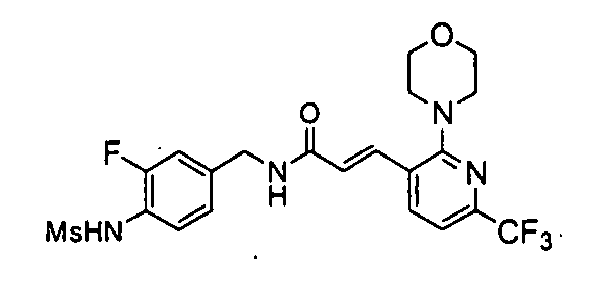
- N-(4-Aminomethyl-2-fluoro-phenyl)-methanesulfonamide, HCl salt(100mg, 0.40mmol) was reacted with 3-(2-Morpholin-4-yl-6-trifluoromethyl-pyridin-3-yl)-acrylic acid (121mg) prepared by known procedure to give N-(3-Fluoro-4-methanesulfonylamino-benzyl)-3-(2-morpholin-4-yl-6-trifluoromethyl-pyridin-3-yl)-acrylamide (118mg, 66%) after purification by column chromatography (CH2Cl2/MeOH = 20/1).
1H NMR(300MHz, CDCl3 + DMSO-d6): δ 9.13(s, 1H), 8.32(t, 1H), 7.96(d, 1H, J =7.8Hz), 7.79(d, 1H, J =1 5.9Hz), 7.56(t, 1H, J =8.4Hz), 7.38(d, 1H, J=7.8Hz), 7.26(m, 2H), 6.80(d, 1H, J =15.9Hz), 4.63(d, 2H, J =5.7Hz), 3.98(m, 4H), 3.46(m, 4H), 3.13(s, 3H)
ESI [M+H]+: 503.1. -

- N-(4-Aminomethyl-2-vinyl-phenyl)-methanesulfonamide, HCl salt (70mg, 0.27mmol) was reacted with 3-(2-Morpholin-4-yl-6-trifluoromethyl-pyridin-3-yl)-acrylic acid (81mg) to give N-(4-Methanesulfonylamino-3-vinyl-benzyl)-3-(2-morpholin-4-yl-6-trifluoromethyl-pyridin-3-yl)-acrylamide (55mg, 45%) after purification by column chromatography (CH2Ch/MeOH = 20/1).
1H NMR(300MHz, CDCl3 + DMSO-d6): δ 8.92(s, 1H), 8.18(s, 1H), 7.97(d, 1H, J =7.8Hz), 7.83(d, 1H, J =16.0Hz), 7.73(s, 1H), 7.44(m, 3H), 7.33(dd, 1H, J =11.0 and 17.0Hz), 6.83(d, 1H, J =16.0Hz), 5.93(d, 1H, J =17.0Hz), 6.55(d, 1H, J =11.0Hz), 4.69(d, 2H, J =5.1Hz), 4.01 (m, 4H), 3.50(m, 4H), 3.09(s, 3H)
ESI [M+H]+: 511.1. -
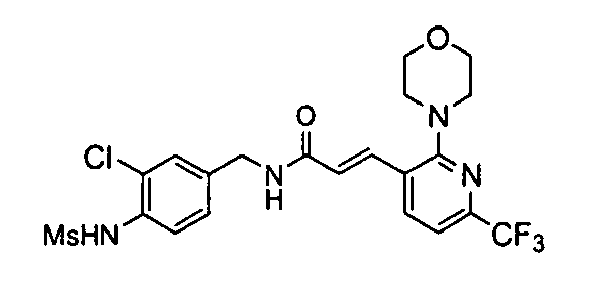
- N-(4-Aminomethyl-2-chloro-phenyl)-methanesulfonamide, HCl salt (62mg, 0.22mmol) was reacted with 3-(2-Morpholin-4-yl-6-trifluoromethyl-pyridin-3-yl)-acrylic acid (67mg) to give N-(3-Chloro-4-methanesulfonylamino-benzyl)-3-(2-morpholin-4-yl-6-trifluoromethyl-pyridin-3-yl)-acrylamide (93mg, 91%) after purification by column chromatography (CH2Cl2/MeOH = 20/1).
1H NMR(300MHz, CDCl3 + DMSO-d6): δ 8.37(s, 1H), 8.27(t, 1H), 7.99(d, 1H, J =7.8Hz), 7.86(d, 1H, J =15.9Hz), 7.72(d, 1H, J =8.4Hz), 7.62(m, 1H), 7.44(m, 2H), 6.84(d, 1H, J=15.9Hz), 4.68(d, 2H, J=5.7Hz), 4.04(m, 4H), 3.52(m, 4H), 3.19(s, 3H)
ESI [M+H]+: 519.1. -

- N-(4-Aminomethyl-2-fluoro-6-methyl-phenyl)-methanesulfonamide, HCl salt (100mg, 0.35mmol) was reacted with 3-(2-Morpholin-4-yl-6-trifluoromethyl-pyridin-3-yl)-acrylic acid (116mg) to give N-(3-Fluoro-4-methanesulfonylamino-5-methyl-benzyl)-3-(2-morpholin-4-yl-6-trifluoromethyl-pyridin-3-yl)-acrylamide (120mg, 74%) after purification by column chromatography (Hex/EtOAc = 1/2).
1H NMR(300MHz, CDCl3): δ 7.76(d, 1H, J =7.8Hz), 7.71(d, 1H, J =15.6Hz), 7.24(m, 3H), 6.42(d, 1H, J =15.6Hz), 6.32(s, 1H), 6.06(t, 1H), 4.59(d, 2H, J =6.3Hz), 3.85(m, 4H), 3.34(m, 4H), 3.05(s, 3H), 2.25(d, 3H, J =2.1Hz)
ESI [M+H]+: 517.1. -

- 3-fluoro-4-methanesulfonylaminobenzylamine hydrochloride(17.8mg, 0.052mmol) was reacted with 3-(6-tert-Butyl-2-methoxy-pyridin-3-yl)-acrylic acid (12mg) DMTMM(1.1eq, 16mg) and NMP(1.2eq, 90µl) in THF to give title compound (14mg, 61.8%) after purification by column chromatography (Hex/EtOAc = 3/2).
1H NMR(300MHz, CDCl3): δ 7.70(d, 1H, J =15.6Hz) 7.61(d, 1H, J =9.3Hz) 7.51(m, 1H) 7.13(m, 2H) 6.90(d, 1H, J =7.8Hz) 6.84(d, 1H, J =15.6Hz) 6.61(bs, 1H) 6.10 (bs, 1H) 4.54(d, 2H, J=6Hz) 4.01(s, 3H) 3.02(s, 3H) 1.33(s, 9H)
ESI [M+H]+: 436.1. -

- N-(4-Aminomethyl-2-fluoro-6-vinyl-phenyl)-methanesulfonamide, HCl salt (84mg, 0.30mmol) was reacted with 3-(6-tert-Butyl-pyridin-3-yl)-acrylic acid (62mg) to give 3-(6-tert-Butyl-pyridin-3-yl)-N-(3-fluoro-4-methanesulfonylamino-5-vinyl-benzyl)-acrylamide (34mg, 26%) after purification by column chromatography (Hex/EtOAc = 1/2).
1H NMR(300MHz, CDCl3+ DMSO-d6): δ 8.68(d, 1H, J =2.4Hz), 8.09(s, 1H), 7.78(dd, 1H, J =2.1 and 8.4Hz), 7.61(s, 1H), 7.56(d, 1H, J =15.9Hz), 7.35(d, 1H, J =8.4Hz), 7.33(s, 1H), 7.12(dd, 1H, J=14.8 and 18.0Hz), 7.01(dd, 1H, J=1.8 and 10.2Hz), 6.60(d, 1H, J =15.9Hz), 5.73(d,1H, J =18.0Hz), 5.33(d, 1H, J =11.4Hz), 4.46(d, 2H, J =6.0Hz), 2.97(d, 3H, J=0.9Hz), 1.34(s, 9H)
ESI [M+H]+: 432.2. -

- N-(4-Aminomethyl-2-ethynyl-6-fluoro-phenyl)-methanesulfonamide, HCl salt(82.4mg, 0.30mmol) was reacted with 3-(6-tert-Butyl-2-methoxy-pyridin-3-yl)-acrylic acid (66mg), DMTMM(1.1eq, 90mg) and NMP(1.2eq, 40µl) in THF to give the title compound (51.2mg, 37.6%) after purification by column chromatography (Hex/EtOAc = 1/1).
1H NMR(300MHz, CDCl3): δ 7.70(d, 1H, J=15.9Hz) 7.62(d, 1H, J=8.4Hz) 7.30(s, 1H) 7.17(m, 1H) 6.91(d, 1H, J=7.8Hz) 6.69(d, 1H, J =15.6Hz) 6.41(s, 1H) 6.02 (bs, 1H) 4.53(d, 2H, J =6Hz) 4.02(s, 3H) 3.47(s, 1H) 3.26(s, 3H) 1.34(s, 9H)
ESI [M+H]+: 460.1. -

- N-(4-Aminomethyl-2-ethynyl-6-fluoro-phenyl)-methanesulfonamide, HCl salt (100mg, 0.22mmol) was reacted with 3-(2-Morpholin-4-yl-6-trifluoromethyl-pyridin-3-yl)-acrylic acid (108mg) to give N-(3-Ethynyl-5-fluoro-4-methanesulfonylamino-benzyl)-3-(2-morpholin-4-yl-6-trifluoromethyl-pyridin-3-yl)-acrylamide (190mg, 100%) after purification by column chromatography (Hex/EtOAc = 1/2).
1H NMR(300MHz, CDCl3 + DMSO-d6): δ 9.31(s, 1H), 8.73(t, 1H), 7.92(d, 1H, J =7.8Hz), 7.49(d, 1H, J =15.6Hz), 7.31(d, 1H, J =7.8Hz), 7.25(s, 1H), 7.18(d, 1H, J =10.8Hz), 6.71(d, 1H, J =15.6Hz), 4.38(d, 2H, J =5.7Hz), 4.14(s, 1H), 3.76(m, 4H), 3.22(m, 4H), 3.04(s, 3H)
ESI [M+H]+: 527.2. -

- N-(4-Aminomethyl-3-fluoro-phenyl)-methanesulfonamide HCl salt (32 mg, 0.12 mmol) and NMP (0.05 ml) were added in 20 ml of THF. The mixture was stirred for 10 mins. DMTMM (51 mg, 0.18 mmol) and 3-(6'-Chloro-3,4,5,6-tetrahydro-2H-[1,2']bipyridinyl-3'-yl)-acrylic acid (20 mg, 0.092 mmol) were added into the mixture. The reaction mixture was stirred overnight. The reaction solvent was removed in vacuo. The residue was extracted with ethylacetate (30 ml x 3) and H2O (30 ml). A combined organic layer was washed with sat. NaHCO3 (30ml), and with brine (30 ml), dried with MgSO4, and concentrated in vacuo. The residue was purified with column chromatography to yield a white solid (11 mg).
1H NMR (CDCl3, 300 MHz) δ 7.87 (d, J = 15.9 Hz, 1H), 7.62 (d, J = 9.0 Hz, 1H), 7.51 (t, j = 7.8 Hz, 1H), 7.12 (m, 2H), 6.39 (br, 1H), 6.51 (d, J = 9.0 Hz, 1H), 6.20 (d, J = 15.6 Hz), 6.00 (br, 1H), 5.53 (d, J = 6.3 Hz, 2H), 3.60 (m, 4H), 3.01 (s, 3H), 1.65 (m, 6H)
ESI [M+H]+: 467.1. -

- To 6-Chloro-pyridine-3-carboxaldehyde (300 mg, 2.12 mmol) in toluene was added Methyl(Triphenylphosphoranylidene)acetate (708 mg, 2.12 mmol) and the solution was refluxed for 6 hrs. The reaction mixture was diluted with EtOAc and then washed three times with H2O, brine, dried. Na2SO4, filtered and concentrated under reduced pressure. The obtained residue was column-chromatographed to yield 3-(6-Chloro-pyridin-3-yl)-acrylic acid methyl ester (380 mg, 90 %).
1H NMR (300 MHz, CDCl3): δ 8.51 (d, 1H, J = 2.7 Hz), 7.80 (dd, 1H, J= 8.1, 2.4 Hz), 7.65 (d, 1H, J = 15.9 Hz), 7.36 (d, 1H, J = 8.4 Hz), 6.48 (d, 1H, J = 15.9 Hz), 3.83 (s, 3H). - 3-(6-Chloro-pyridin-3-yl)-acrylic acid methyl ester (107 mg, 0.541 mmol) in THF was added to a solution of 0.5 N-LiOH (2 eq) and the mixture was stirred for 3 hrs at room temperature. The resulting residue was dissolved in H2O and then washed three times with Et2O, neutralized with 1N HCl to pH 5~7. The resulting solid filtered and washed with H2O and then dried in vacuo to give 3-(6-Chloro-pyridin-3-yl)-acrylic acid (80 mg, 80 %).
1H NMR (300 MHz, DMSO-d6): δ 8.64 (s, 1H), 8.16 (d, 1H, J = 8.1 Hz), 7.54 (d, 1H, J=16.8 Hz), 7.50 (d, 1H, J = 9.9 Hz), 6.63 (d, 1H, J = 15.9 Hz). - N-(4-Aminomethyl-2-ethynyl-6-fluoro-phenyl)-methanesulfonamide HCl salt (78.3 mg, 0.272 mmol) was suspended in THF and treated with triethylamine (30 mg, 0.299 mmol) and then the resulting mixture was stirred for 10mins. 3-(6-Chloro-pyridin-3-yl)-acrylic acid (50 mg, 0.272 mmol) was added to the reaction mixture followed by DMTMM (82 mg, 0.299 mmol) after 10 mins. The resulting mixture was stirred overnight at ambient temperature and then diluted with EtOAc. The resulting solution was washed successively with water, sat'd NaHCO3 (x2), brine, and then dried over anhyd. Na2SO4, filtered and concentrated under reduced pressure. The crude residue was recrystallized (CH2Cl2) to yield the title compound (26 mg, 23 %).
1H NMR (300 MHz, DMSO-d6): δ 9.54 (s, 1H), 8.74 (t, 1H, J= 6.0 Hz), 8.61 (d, 1H, J = 2.4 Hz), 8.07 (dd, 1H, J = 8.4, 2.4 Hz), 7.56 (d, 1H, J = 8.4 Hz), 7.51 (d, 1H, J = 15.9 Hz), 7.34 (t, 1H, J = 8.1 Hz), 7.19 (d, 1H, J = 12.0 Hz), 7.12 (d, 1H, J = 8.4 Hz), 6.79 (d, 1H, J = 15.9 Hz), 4.39 (d, 2H, J = 5.7 Hz), 3.00 (s, 3H).
ESI [M+H]+; 408.0. -

- To 6-Bromo-pyridine-3-carboxaldehyde (300 mg, 1.61 mmol) in toluene was added Methyl(Triphenylphosphoranylidene)acetate (647 mg, 1.94 mmol) and the solution was refluxed for 6 hrs. The reaction mixture was diluted with EtOAc and then washed three times with H2O, brine, dried. Na2SO4, filtered and concentrated under reduced pressure. The obtained residue was column-chromatographed to yield 3-(6-Bromo-pyridin-3-yl)-acrylic acid methyl ester (380 mg, 97 %).
1H NMR (300 MHz, CDCl3): δ 8.47 (d, 1H, J=2.4 Hz), 7.68 (dd, 1H, J=8.4, 2.4 Hz), 7.60 (d, 1H, J=15.9 Hz), 7.51 (d, 1H, J=8.4 Hz), 6.49 (d, 1H, J=15.9 Hz), 3.81 (s, 3H). - To 3-(6-Bromo-pyridin-3-yl)-acrylic acid methyl ester (120 mg, 0.495 mmol) in THF was added a solution of 0.5 N-LiOH (2 eq) and the mixture was stirred for 3 hrs at room temperature. The resulting residue was dissolved in H2O, then washed three times with Et2O, and neutralized with 1N HCl to pH 5~7. The resulting solid filtered and washed with H2O and then dried in vacuo to give 3-(6-Bromo-pyridin-3-yl)-acrylic acid (100 mg, 88 %).
1H NMR (300 MHz, DMSO-d6): δ 8.67 (d, 1H, J=2.1 Hz), 8.11 (dd, 1H, J=8.4, 2.1 Hz), 7.69 (d, 1H, J=8.4 Hz), 7.59 (d, 1H, J=15.9 Hz), 6.71 (d, 1H, J=15.9 Hz). - N-(4-Aminomethyl-2-ethynyl-6-fluoro-phenyl)-methanesulfonamide HCl salt (63 mg, 0.219 mmol) was suspended in THF and treated with triethylamine (25 mg, 0.241 mmol) and then the resulting mixture was stirred for 10mins. 3-(6-Bromo-pyridin-3-yl)-acrylic acid (50 mg, 0.219 mmol) was added to the reaction mixture followed by DMTMM (66 mg, 0.241 mmol) after 10 mins. The resulting mixture was stirred overnight at ambient temperature and then diluted with EtOAc. The resulting solution was washed successively with water, sat'd NaHCO3 (x2), and brine, and then dried over anhyd. Na2SO4, filtered and concentrated under reduced pressure. The crude residue was recrystallized (EtOAc/n-Hexane) to yield the title compound (71 mg, 72 %).
1H NMR (300 MHz, DMSO-d6): δ 9.42 (s, 1H), 8.77 (t, 1H, J = 6.0 Hz), 8.60 (d, 1H, J = 2.4 Hz), 7.96 (dd, 1H, J = 8.1, 1.8 Hz), 7.70 (d, 1H, J = 8.1 Hz), 7.48 (d, 1H, J = 15.9 Hz), 7.28 (s, 1H), 7.27 (d, 1H, J = 8.7 Hz), 6.81 (d, 1H, J = 15.9 Hz), 4.50 (s, 1H), 4.39 (d, 2H, J = 5.7 Hz), 3.06 (s, 3H).
ESI [M+H]+; 452.0. -

- 3-fluoro-4-methanesulfonylaminobenzylamine hydrochloride (51 mg, 0.201 mmol) was suspended in THF and treated with triethylamine (23 mg, 0.22 mmol) and then the resulting mixture was stirred for 10mins. 3-(6-Chloro-pyridin-3-yl)-acrylic acid (37 mg, 0.201 mmol) was added to the reaction mixture followed by DMTMM (61 mg, 0.22 mmol) after 10 mins. The resulting mixture was stirred overnight at ambient temperature and then diluted with EtOAc. The resulting solution was washed successively with water, sat'd NaHCO3 (x2), brine, and then dried over anhyd. Na2SO4, filtered and concentrated under reduced pressure. The crude residue was column-chromatographed to yield the title compound (74 mg, 96 %).
1H NMR (300 MHz, DMSO-d6): δ 9.54 (s, 1 H), 8.74 (t, 1H, J = 6.0 Hz), 8.62 (d, 1H, J = 2.4 Hz), 8.07 (dd, 1H, J = 6.0, 2.4 Hz), 7.57 (d, 1H, J = 8.4 Hz), 7.51 (d, 1H, J = 15.9 Hz), 7.34 (t, 1H, J = 8.1 Hz), 7.19 (d, 1H, J = 12.0 Hz), 7.12 (d, 1H, J = 8.4 Hz), 6.79 (d, 1H, J= 15.9 Hz), 4.39 (d, 2H, J= 5.7 Hz), 3.00 (s, 3H).
ESI [M+H]+; 384.0. -

- 3-fluoro-4-methanesulfonylaminobenzylamine hydrochloride (41.2mg, 0.162mmol) was reacted with 3-(6-tert-Butyl-4-trifluoromethyl-pyridin-3-yl)-acrylic acid (1.0eq, 44.2mg) DMTMM(1.0eq, 44.8mg) and NMP(1.2eq, 22µl) in THF to give the title compound (48mg, 62.6%) after purification by column chromatography (Hex/EtOAc = 1/1).
1H NMR(300MHz, CDCl3): δ 8.84(s, 1H) 7.93(d, 1H, J =15.3Hz) 7.57(s, 1H) 7.52(t, 1H) 7.14(m, 1H) 6.60(bs, 1H) 6.45(d, 1H, J =15.6Hz) 6.24(bs, 1H) 6.50(bs, 1H) 4.54(d, 2H, J=6.0Hz) 3.03(s, 3H) 1.39(s, 9H)
ESI [M+H]+: 474.2. -

- N-(4-Aminomethyl-2-ethynyl-6-fluoro-phenyl)-methanesulfonamide HCl salt (11.2mg, 0.04mmol) was reacted with 3-(6-tert-Butyl-4-trifluoromethyl-pyridin-3-yl)-acrylic acid (1.0eq, 11.0mg) DMTMM(1.0eq, 11.1mg) and NMP(1.2eq, 6µl) in THF to give the title compound (6mg, 30.2%) after purification by column chromatography (Hex/EtOAc = 3/2).
1H NMR(300MHz, CDCl3): δ 8.85(s, 1H) 7.95(d, 1H, J=13.5Hz) 7.58(s, 1H) 7.32(bs, 1H) 7.20(d, 1H, J=12.6Hz) 6.05(bs, 1H) 4.54(d, 1H, J=6.0Hz) 3.49(s, 1H) 3.27(s, 3H) 1.40(s, 9H)
ESI [M+H]+: 498.2 -

- 3-(6-Bromo-pyridin-3-yl)-acrylic acid methyl ester (180 mg, 0.74 mmol) was added to piperidine (1 ml) and the mixture was stirred for 1.5 hrs at room temperature. The reaction mixture was diluted with EtOAc and then washed three times with H2O, brine, dried. Na2SO4, filtered and concentrated under reduced pressure. The obtained residue was column-chromatographed to yield 3-(3,4,5,6-Tetrahydro-2H-[1,2']bipyridinyl-5'-yl)-acrylic acid methyl ester (60 mg, 33 %).
1H NMR (300 MHz, CDCl3): δ 8.25 (d, 1H, J = 2.1 Hz), 7.63 (dd, 1H, J = 6.0, 2.4 Hz), 7.58 (d, 1H, J=15.9 Hz), 6.62 (d, 1H, J=9.3 Hz), 6.21 (d, 1H, J = 15.9 Hz), 3.78 (s, 3H), 3.64 - 3.61 (m, 4H), 1.66 - 1.60 (m, 6H). - 3-fluoro-4-methanesulfonylaminobenzylamine hydrochloride (25.2 mg, 0.099 mmol) was suspended in THF and treated with triethylamine (11 mg, 0.108 mmol) and then the resulting mixture was stirred for 10mins. 3-(3,4,5,6-Tetrahydro-2H-[1,2']bipyridinyl-5'-yl)-acrylic acid (23 mg, 0.099 mmol) was added to the reaction mixture followed by DMTMM (30 mg, 0.108 mmol) after 10 mins. The resulting mixture was stirred overnight at ambient temperature and then diluted with EtOAc. The resulting solution was washed successively with water, sat'd NaHCO3 (x2), brine, and then dried over anhyd. Na2SO4, filtered and concentrated under reduced pressure. The crude residue was recrystallized (CH2Cl2) to yield the title compound (15 mg, 35 %).
1H NMR (300 MHz, CDCl3): δ 8.25 (d, 1H, J = 2.7 Hz), 7.59 (dd, 1H, J = 6.0, 2.7 Hz), 7.52 (d, 1H, J = 15.9 Hz), 7.15 (t, 1H, J = 6.0 Hz), 6.62 (d, 1H, J = 9.0 Hz), 6.21 (d, 1H, J = 15.3 Hz), 6.01 (s, 1H, br), 4.53 (d, 2H, J = 6.0 Hz), 3.62 - 3.59 (m, 4H), 3.01 (s, 3H), 1.65 - 1.64 (m, 6H).
ESI [M+H]+: 433.2. -

- 3-fluoro-4-methanesulfonylaminobenzylamine hydrochloride (183 mg, 0.719 mmol) was suspended in THF and treated with triethylamine (80 mg, 0.791 mmol) and then the resulting mixture was stirred for 10mins. (6-Chloro-pyridin-3-yloxy)-acetic acid (164 mg, 0.719 mmol) was added to the reaction mixture followed by DMTMM (218 mg, 0.791 mmol) after 10 mins. The resulting mixture was stirred overnight at ambient temperature and then diluted with EtOAc. The resulting solution was washed successively with water, sat'd NaHCO3 (x2), brine, and then dried over anhyd. Na2SO4, filtered and concentrated under reduced pressure. The crude residue was recrystallized (CH2Cl2) to yield the title compound (225 mg, 65 %).
1H NMR (300 MHz, DMSO-d6): δ 9.54 (s, 1H), 8.75 (t, 1H, J = 6.0 Hz), 8.59 (d, 1H, J = 2.1 Hz), 7.95 (dd, 1H, J = 8.4, 2.4 Hz), 7.71 (d, 1H, J = 8.4 Hz), 7.49 (d, 1H, J = 15.9 Hz), 7.34 (t, 1H, J = 8.1 Hz), 7.19 (d, 1H, J = 12.0 Hz), 7.12 (d, 1H, J = 8.4 Hz), 6.79 (d, 1H, J= 15.9 Hz), 4.39 (d, 2H, J=5.7 Hz), 3.00 (s, 3H).
ESI [M+H]+: 428.0. -

- N-(4-Aminomethyl-2,6-difluoro-phenyl)-methanesulfonamide, HC1 salt (50mg, 0.22mmol) was reacted with 3-(2-Morpholin-4-yl-6-trifluoromethyl-pyridin-3-yl)-acrylic acid (55mg) to give N-(3,5-Difluoro-4-methanesulfonylamino-benzyl)-3-(2-morpholin-4-yl-6-trifluoromethyl-pyridin-3-yl)-acrylamide (37mg, 39%) after purification by column chromatography (Hex/EtOAc = 1/2).
1H NMR(300MHz, CDCl3): δ 7.78(d, 1H, J =8.1Hz), 7.75(d, 1H, J =15.3Hz), 7.25(d, 1H, J =8.1Hz), 6.98(d, 2H, J =8.4Hz), 6.46(d, 1H, J =15.3Hz), 6.15(s, 1H), 6.10(t, 1H), 4.38(d, 2H, J=6.6Hz), 3.85(m, 4H), 3.35(m, 4H), 3.21(s, 3H)
ESI [M+H]+: 521.1. -

- N-(4-Aminomethyl-2-fluoro-6-trifluoromethyl-phenyl)-methanesulfonamide, HCl salt (80mg, 0.25mmol) was reacted with 3-(2-Morpholin-4-yl-6-trifluoromethyl-pyridin-3-yl)-acrylic acid (76mg) to give N-(3-Fluoro-4-methanesulfonylamino-5-trifluoromethylbenzyl)-3-(2-morpholin-4-yl-6-trifluoromethyl-pyridin-3-yl)-acrylamide (56mg, 39%) after purification by column chromatography (Hex/EtOAc = 1/2).
1H NMR(300MHz, CDCl3): δ 8.71(s, 1H), 8.21(t, 1H), 7.65(d, 1H, J =7.8Hz), 7.49(d, 1H, J =15.6Hz), 7.29(s, 1H), 7.22(d, 1H, J =9.9Hz), 7.07(d, 1H, J =7.8Hz), 6.48(d, 1H, J=15.6Hz), 4.36(d, 2H, J=6.0Hz), 3.67(m, 4H), 3.18(m, 4H), 3.02(s, 3H)
ESI [M+H]+: 571. -

- 3-(6-Bromo-pyridin-3-yl)-acrylic acid methyl ester (100 mg, 0.413 mmol) was added to piperidine (1 ml) and the mixture was stirred for 1.5 hrs at room temperature. The reaction mixture was diluted with EtOAc and then washed three times with H2O brine, dried. Na2SO4, filtered and concentrated under reduced pressure. The obtained residue was column-chromatographed to yield 3-(6-Morpholin-4-yl-pyridin-3-yl)-acrylic acid methyl ester (40 mg, 21 %).
1H NMR (300 MHz, CDCl3): δ 8.27 (d, 1H, J = 2.4 Hz), 7.68 (dd, 1H, J = 6.0, 2.4 Hz), 7.59 (d, 1H, J = 15.9 Hz), 6.62 (d, 1H, J = 9.3 Hz), 6.25 (d, 1H, J= 15.3 Hz), 3.82 - 3.78 (m, 7H), 3.61 - 3.57 (m, 4H). - N-(4-Aminomethyl-2-ethynyl-6-fluoro-phenyl)-methanesulfonamide HCl salt (20 mg, 0.072 mmol) was suspended in THF and treated with triethylamine (11 mg, 0.108 mmol) and then the resulting mixture was stirred for 10mins. 3-(6-Morpholin-4-yl-pyridin-3-yl)-acrylic acid (17 mg, 0.072 mmol) was added to the reaction mixture followed by DMTMM (22 mg, 0.08 mmol) after 10 mins. The resulting mixture was stirred overnight at ambient temperature and then diluted with EtOAc. The resulting solution was washed successively with water, sat'd NaHC03 (x2), brine, and then dried over anh. Na2SO4, filtered and concentrated under reduced pressure. The, crude residue was recrystallized (CH2Cl2) to yield the title compound (8 mg, 24 %).
1H NMR (300 MHz, DMSO-d6): δ 9.39 (s, 1H), 8.52 (t, 1H, J= 5.4 Hz), 8.24 (s, 1H), 7.74 (d, 1H, J = 8.7 Hz), 7.34 (d, 1H, J = 15.9 Hz), 7.22-7.19 (m, 2H), 6.84 (d, 1H, J = 9.3 Hz), 6.45 (d, 1H, J = 15.9 Hz), 4.46 (s, 1H), 4.31 (d, 2H, J = 5.7 Hz), 3.63 -3.62 (m, 4H), 3.48 - 3.47(m, 4H), 3.01 (s, 3 H).
ESI [M+H]+: 459. -

- 3-(6'-Trifluoromethyl-3,4,5,6-tetrahydro-2H-[1,2']bipyridinyl-3'-yl)-acrylic acid (720mg) was prepared by similar procedure as described in the previous from 2-chloro-6-trifluoromethylnicotinic acid in an overall yield of 54%.
1H NMR(300MHz, CDCl3): δ 7.81(m, 2H), 7.18(d, 1H, J =7.5Hz), 6.45(d, 1H, J =16.2Hz), 3.31(m, 4H), 1.72(m, 6H) - N-(4-Aminomethyl-2-ethynyl-6-fluoro-phenyl)-methanesulfonamide HCl salt (139mg, 0.50mmol) was reacted with 3-(6'-Trifluoromethyl-3,4,5,6-tetrahydro-2H-[1,2']bipyridinyl-3'-yl)-acrylic acid (150mg) to give N-(3-Ethynyl-5-fluoro-4-methanesulfonylamino-benzyl)-3-(6'-trifluoromethyl-3,4,5,6-tetrahydro-2H-[1,2']bipyridinyl-3'-yl)-acrylamide (132mg, 50%) after purification by column chromatography (Hex/EtOAc = 1/1).
1H NMR(300MHz, CDCl3): δ 7.72(m, 2H), 7.30(s, 1H), 7.16(m, 2H), 6.44(s, 1H), 6.43(d, 1H, J =15.6Hz), 6.10(s, 1H), 4.53(d, 2H, J =6.0Hz), 3.48(s, 1H), 3.30(m, 4H), 3.26(s, 3H), 1.65(m, 6H)
ESI [M+H]+: 525. -

- 3-(6-Chloro-pyridin-3-yl)-N-(3-fluoro-4-methanesulfonylamino-benzyl)-acrylamide (15 mg, 0.413 mmol) was added to pyrrolidine (0.5 ml) and the mixture was stirred for 12 hrs at 90 °C. The resulting residue was dissolved in EtOAc, then washed three times with H2O, and neutralized with 1N HCl to pH 5~7. The resulting solution was washed with brine, and then dried over anhyd. Na2SO4, filtered and concentrated under reduced pressure. The crude residue was recrystallized (CH2Cl2) to yield the title compound (4 mg, 24 %).
1H NMR (300 MHz, DMSO-d6): δ, 8.41 (t, 1H, J = 6.0 Hz), 8.15 (s, 1H), 7.65 (d, 1H, J = 8.7 Hz), 7.29 (d, 1H, J = 16.8 Hz), 7.26 (d, 1H, J = 16.5 Hz), 7.10 (d, 1H, J = 11.7 Hz), 7.02 (d, 1H, J = 7.5 Hz), 6.43 (d, 1H, J = 9.3 Hz), 6.36 (d, 1H, J = 15.6 Hz), 4.29 (d, 2H, J = 5.7 Hz), 3.85 -3.75 (m, 4H), 2.92 (s, 3H), 3.48 - 3.47(m, 4H).
ESI [M+H]+: 419. -

- N-(4-Aminomethyl-2-fluoro-phenyl)-methanesulfonamide, HCl salt (127mg, 0.50mmol) was reacted with 3-(6'-Trifluoromethyl-3,4,5,6-tetrahydro-2H-[1,2']bipyridinyl-3'-yl)-acrylic acid (150mg) to give N-(3-Fluoro-4-methanesulfonylamino-benzyl)-3-(6'-trifluoromethyl-3,4,5,6-tetrahydro-2H-[1,2']bipyridinyl-3'-yl)-acrylamide (175mg, 70%) after purification by column chromatography (Hex/EtOAc = 1/1).
1H NMR(300MHz, CDCl3): δ 7.70(m, 2H), 7.50(t, 1H, J =8.1Hz), 7.12(m, 3H), 6.65(s, 1H), 6.45(d, 1H, J =15.6Hz), 6.14(t, 1H), 4.54(d, 2H, J =6.0Hz), 3.29(m, 4H), 3.02(s, 3H), 1.70(m, 6H)
ESI [M+H]+: 501. -

- A suspension of N-(3-fluoro-4-methanesulfonylamino-5-methyl-benzyl)-3-(2-morpholin-4-yl-6-trifluoromethyl-pyridin-3-yl)-acrylamide (32mg, 0.069mmol) and 10% Pd/C (3mg) in MeOH was reacted under hydrogen of 40 psi pressure. The reaction mixture was filtered through celite and then concentrated under reduced pressure to give N-(3-fluoro-4-methanesulfonylamino-5-methyl-benzyl)-3-(2-morpholin-4-yl-6-trifluoromethyl-pyridin-3-yl)-propionamide (22mg, 69%).
1H NMR(300MHz, CDCl3): δ 7.61(d, 1H, J =6.9Hz), 7.27(d, 1H, J =8.4Hz), 7.10(m, 2H), 6.51 (s, 1H), 6.21(s, 1H), 4.42(d, 2H, J =5.1Hz), 3.86(m, 4H), 3.20(m, 4H), 3.07(m, 2H), 3.03(s, 3H), 2.63(m, 2H), 2.22(d, 3H, J=2.4Hz)
ESI [M+H]+: 519. -
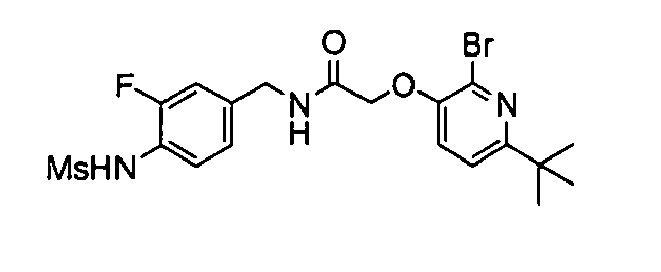
- 3-fluoro-4-methanesulfonylaminobenzylamine hydrochloride(72mg, 0.25mmol) was reacted with (2-Bromo-6-tert-butyl-pyridin-3-yloxy)-acetic acid (64mg), DMTMM(1.2eq, 83mg) and NEt3(2.5eq, 90µl) in THF to give the title compound (71mg, 58.2%) after purification by column chromatography (Hex/EtOAc = 1/1).
1H NMR(300MHz, CDCl3): δ 7.56(m, 1H) 7.24(m, 2H) 7.11(m, 3H) 6.48(bs, 1H) 4.58 (s, 2H) 4.55(d, 2H, J=6Hz) 3.03(s, 3H) 1.33(s, 9H)
ESI [M+H]+: 488. -

- (3-fluoro-4-methanesulfonylaminobenzylamine hydrochloride(158mg, 0.62mmol) was reacted with (6-tert-Butyl-pyridin-3-yloxy)-acetic acid (130mg) DMTMM(1.2eq, 206mg) and NEt3(2.5eq, 220µl) in THF to give title compound (165mg, 65%) after purification by column chromatography (Hex/EtOAc = 1/3).
1H NMR(300MHz, CDCl3): δ 8.33(d, 1H, J=0.6Hz) 7.38(m, 1H) 7.21(bs, 1H) 6.96(m, 2H) 6.88(m, 2H) 4.71 (s, 2H) 4.52(d, 2H, J=6Hz) 2.99(s, 3H) 1.47(s, 9H)
ESI [M+H]+: 409. -

- 3-fluoro-4-methanesulfonylaminobenzylamine hydrochloride (21mg, 0.08mmo1) was reacted with (6-tert-Butyl-2-chloro-pyridin-3-yloxy)-acetic acid (1.0eq, 20mg) DMTMM(1.2eq, 27mg) and NMP(1.5eq, 14µl) in THF to give the title compound(10mg, 28.2%) after purification by column chromatography (Hex/EtOAc = 1/1).
1H NMR(300MHz, CDCl3): δ 7.55(m, 1H) 7.23(s, 1H) 7.16(s, 1H) 7.13(m, 2H) 7.10 (bs, 1H) 6.50(bs, 1H) 4.59(s, 2H) 4.54(d, 2H, J=6.3Hz) 3.03(s, 3H) 1.33(s, 9H)
ESI [M+H]+: 444. -

- (2-Hydroxymethyl-6-methyl-pyridin-3-yloxy)-acetic acid (200mg) was prepared by similar procedure as described above from 2,6-lutidine- 2,3-diol in an overall yield of 51%.
1H NMR(300MHz, DMSO-d6): δ 7.24(d, 1H, J =8.1Hz), 7.10(d, 1H, J =8.1Hz), 4.73(s, 2H), 4.54(s, 2H), 2.40(s, 3H) - N-(4-Aminomethyl-2-fluoro-phenyl)-methanesulfonamide HCl salt (270mg, 1.00mmol) was reacted with (2-Hydroxymethyl-6-methyl-pyridin-3-yloxy)-acetic acid (200mg) to give N-(3-Fluoro-4-methanesulfonylamino-benzyl)-2-(2-hydroxymethyl-6-methyl-pyridin-3-yloxy)-acetamide (350mg, 88%) after purification by column chromatography (Hex/EtOAc = 10/1).
1H NMR(300MHz DMSO-d6): δ 8.69(t, 1H), 7.29(m, 2H), 7.09(m, 3H), 5.10(t, 1H), 4.66(s, 2H), 4.60(d, 2H, J =5.4Hz), 4.31(d, 2H, J=6.3Hz), 2.99(s, 3H), 2.40(s, 3H)
ESI [M+H]+: 398. -

- (6-Trifluoromethyl-pyridin-3-yloxy)-acetic acid (410mg) was prepared by similar procedure as described above from 2-trifluoromethyl-5-hydroxypyridine in an overall yield of 93%.
1H NMR(300MHz, DMSO-d6): δ 8.29(d, 1H, J=2.7Hz), 7.75(d, 1H, J=8.7Hz), 7.34(dd, 1H, J=2.7 and 8.7Hz), 4.33(s, 2H) - N-(4-Aminomethyl-2-fluoro-phenyl)-methanesulfonamide HCl salt (270mg, 1.00mmol) was reacted with (6-Trifluoromethyl-pyridin-3-yloxy)-acetic acid (221mg) to give N-(3-Fluoro-4-methanesulfonylamino-benzyl)-2-(6-trifluoromethyl-pyridin-3-yloxy)-acetamide (54mg, 88%) after recrystalization from Hex/EtOAc.
1H NMR(300MHz DMSO-d6): δ 9.52(s, 1H), 8.80(t, 1H), 8.49(d, 1H, J =2.7Hz), 7.87(d, 1H, J =9.0Hz), 7.60(dd, 1H, J =2.7 and 9.0Hz), 7.32(m, 1H), 7.11(m, 2H), 4.80(s, 2H), 4.33(d, 2H, J=6.3Hz), 2.99(s, 3H)
ESI [M+H]+: 422. -

- 3-fluoro-4-methanesulfonylaminobenzylamine hydrochloride (192mg, 0.751minol) was reacted with (6-tert-Butyl-5-chloro-pyridin-3-yloxy)-acetic acid (183mg) DMTMM(1.1eq, 229mg) and NMP(1.2eq, 100µl) in THF to give the title compound (102mg, 30.6%) after purification by column chromatography (Hex/EtOAc = 1/1).
1H NMR(300MHz, CDCl3): δ 8.18(d, 1H, J =1.8Hz) 7.56(t, 1H) 7.10(m, 2H) 7.07(m, 1H) 6.71(bs, H) 6.50 (bs, 1H) 4.60(s, 2H) 4.54(d, 2H, J=6Hz) 3.03(s, 3H) 1.38(s, 9H)
ESI [M+H]+: 444. -

- N-(4-Aminomethyl-2-ethynyl-6-fluoro-phenyl)-methanesulfonamide HCl salt (120mg, 0.43mmol) was reacted with (6-tert-Butyl-pyridin-3-yloxy)-acetic acid (90mg) DMTMM(1.1eq, 131mg) and NMP(1.2eq, 60µl) in THF to give the title compound (62mg, 33.3%) after purification by column chromatography (Hex/EtOAc = 2/3).
1H NMR(300MHz, CDCl3): δ 8.36(d, 1H, J =1.8Hz) 7.22(bs, 1H) 7.18(m, 1H) 7.06(m, 1H) 6.89(ts, 1H) 6.64 (s, 1H) 4.68(s, 2H) 4.51(d, 2H, J =6Hz) 3.46(s, 1H) 3.23(s, 3H) 1.47(s, 9H)
ESI [M+H]+: 434. -

- To a suspension of 6-Chloro-pyridin-3-ol (1000 mg, 7.72 mmol) and Bromoethyl acetate (1933 mg, 11.57 mmol) in CH3CN was added Cs2CO3 (3772 mg, 11.57 mmol). The mixture was stirred for overnight at room temperature. The reaction mixture was diluted with EtOAc, then washed three times with H2O and brine, and then dried. MgSO4, filtered and concentrated under reduced pressure. The obtained residue was column-chromatographed to yield the (6-Chloro-pyridin-3-yloxy)-acetic acid ethyl ester (1.5 g, 90%).
1H-NMR (300MHz, CDCl3): δ 8.07 (dd, 1H, J = 2.7, 0.9 Hz), 7.27 - 7.23 (m, 2H), 4.65 (s, 2H), 4.28 (q, 2H, J = 7.2 Hz), 1.30 (t, 3H, J = 7.2 Hz). - (6-Chloro-pyridin-3-yloxy)-acetic acid ethyl ester (800 mg, 3.71 mmol) in THF was added to a solution of 0.5 N-LiOH (2 eq) and the mixture was stirred for 1.5 hrs at room temperature. The resulting residue was dissolved in H2O then washed three times with Et2O and neutralized with 1N HCl to pH 5-7. The solution was extracted three times with methylene chloride and then dried over anhyd. Na2SO4 and concentrated in vacuo to give (6-Chloro-pyridin-3-yloxy)-acetic acid (300 mg, 36 %).
1H-NMR (300MHz, CDCl3): δ 8.05 (d, 1H, J= 3.3 Hz), 7.43 - 7.35 (m, 2H), 4.74 (s, 2H). - N-(4-Aminomethyl-2-ethynyl-6-fluoro-phenyl)-methanesulfonamide (74.3 mg, 0.266 mmol) was suspended in THF and treated with triethylamine (27 mg, 0.266 mmol) and then the resulting mixture was stirred for 10mins. (6-Chloro-pyridin-3-yloxy)-acetic acid (50 mg, 0.266 mmol) was added to the reaction mixture followed by DMTMM (62.5 mg, 0.266 mmol) after 10 mins. The resulting mixture was stirred overnight at ambient temperature and then diluted with EtOAc. The resulting solution was washed successively with water, sat'd NaHCO3 (x3), and brine, and then dried over anh. MgSO4, filtered and concentrated under reduced pressure. The crude residue was recrystallized (CH2Cl2) to yield the title compound (25 mg, 25 %).
1H NMR (300 MHz, CDCl3): δ 8.13 (dd, 1H, J= 3.0, 0.9 Hz), 7.34 - 7.24 (m, 3H), 7.14 (dd, 1H, J= 10.5, 2.1 Hz), 6.90 (s, 1H, br), 6.44 (s, 1H), 4.58 (s, 2H), 4.53 (s, 1H), 4.50 (d, 2H, J= 6.3 Hz), 3.26 (s, 3H).
ESI [M+H]+: 412. -

- 3-fluoro-4-methanesulfonylaminobenzylamine hydrochloride (116mg, 0.454mmol) was reacted with 3-(2-Bromo-6-tert-butyl-pyridin-3-yl)-acrylic acid (1.0eq, 129mg) DMTMM(1.0eq, 126mg) and NMP(1.2eq, 60µl) in THF to give the title compound (72mg, 32.8%) after purification by column chromatography (Hex/EtOAc = 1/1).
1H NMR(300MHz, CDCl3): δ 7.89(d, 1H, J =12.9Hz), 7.72(d, 1H, J =7.8Hz) 7.56(m, 1H) 7.29(d, 1H, J =8.4Hz) 7.15(m, 2H) 6.46(bs, 1H) 6.36(d, 1H, J =15.3Hz) 6.01(bs, 1H) 4.56(d, 2H, J=6.3Hz) 3.03(s, 3H) 1.35(s, 9H) -

- N-(4-Aminomethyl-2-ethynyl-6-fluoro-phenyl)-methanesulfonamide HCl salt (41.2mg, 0.148mmol) was reacted with 3-(2-Bromo-6-tert-butyl-pyridin-3-yl)-acrylic acid (1.0eq, 42mg) DMTMM(1.0eq, 41mg) and NMP(1.2eq, 20µl) in THF to give the title compound (42mg, 55.8%) after purification by column chromatography (Hex/EtOAc = 3/2).
1H NMR(300MHz, CDCl3): δ 7.90(d, 1H, J =15.9Hz), 7.73(d, 1H, J =7.5Hz) 7.31(m, 1H) 7.28(s, 1H), 7.17(dd, 1H, J =2.1Hz and 1.5Hz) 6.41(s, 1H), 6.37(d, 1H, J=15.7Hz) 6.09(bs, 1H), 4.53(d, 2H, J =6.0Hz), 3.48(s, 1H), 3.27(s, 3H) 1.35(s, 9H) - Neonatal (2-3 day old or younger than 2-3 day old) SD rats were put in ice for 5 minutes to anesthetize and disinfected with 70% ethanol. DRG of all part of spinal cord were dissected (Wood et al., 1988, J. Neurosci. 8, pp3208-3220) and collected in DME/F12 medium to which 1.2g/l sodium bicarbonate, 50mg/l gentamycin were added. The DRG were incubated sequentially at 37°C for 30 mins in 200 U/ml collagenase and 2.5mg/ml trypsin, separately. The ganglia were washed twice with DME/F12 medium supplemented with 10% horse serum, triturated through a fire-polished Pasteur pipette, filtered through Nitex 80 membrane to obtain single cell suspension and the suspension was washed once more. This was subjected to centrifugation, then resuspended in cell culture medium at certain level of cell density. As the cell culture medium, DME/F12 medium supplemented with 10% horse serum was diluted with identical medium conditioned by C6 glioma cells 2 days on a confluent monolayer (1:1), and NGF (Nerve Growth Factor) was added to adjust 200ng/ml as final concentration. After the cells were grown 2 days in medium where cytosine arabinoside (Ara-C, 100 µM) was added to kill dividing nonneuronal cells, medium was changed to one without Ara-C. The resuspended cells were plated at a density of 1500-2000 neurons/well onto Terasaki plates previously coated with 10 µg/ml poly-D-ornithine.
- DRG nerve cells from the primary culture of 2 days were equilibrated by washing 4 times with HEPES (10mM, pH 7.4)-buffered Ca2+, Mg2+-free HBSS (H-HBSS). The solution in each well was removed from the individual well. Medium containing the test compound plus capsaicin (final concentration 0.5 µM) and 45Ca (final concentration 10 µCi/ml) in H-HBSS was added to each well and incubated at room temperature for 10 mins. Terasaki plates were washed five times with H-HBSS and dried at room temperature. To each well, 0.3% SDS (10 µl) was added to elute 45Ca. After the addition of scintillation cocktail of into each well, the amount of 45Ca influx into neuron was measured by counting radioactivity. Antagonistic activities of test compounds against vanilloid receptor were calculated as percent of the inhibition of maximal response of capsaicin at a concentration of 0.5 µM and the results are given as IC50.
[Table 1] Results of Calcium Influx Test Examples Antagonist Calcium Uptake Test (IC50, µM) 1 1.3 2 1.3 3 0.52 4 0.22 5 1.5 6 0.30 7 1.0 8 0.42 9 0.40 10 0.28 11 0.29 12 0.26 13 3.5 14 >10 15 5.9 16 >10 17 0.57 18 0.13 19 >10 20 >10 21 1.1 22 3.3 23 >10 24 0.34 25 >10 26 1.1 27 2.9 28 1.6 29 >10 30 3.8 31 >10 32 >10 33 1.0 34 >10 35 >10 36 0.18 37 0.059 - Male ICR mice (mean body weight 25g) were maintained in a controlled lighting environment (12 h on/ 12 h off) for experiment. Animals received an intraperitoneal injection of 0.3ml of the chemical irritant phenyl-p-quinone (dissolved in saline containing 5% ethanol to be a dose of 4.5mg/kg) and 6 mins later, the number of abdominal constrictions was counted in the subsequent 6 mins period. Animals (10 animals/group) received 0.2ml of test compounds solution in vehicle of ethanol/Tween 80/saline (10/10/80) intraperitoneally 30 mins before the injection of phenyl-p-quinone. In the case of oral administration, 0.2ml of test compounds solution in vehicle of ethanol/Tween 80/saline (5/5/90) were administered 54 mins prior to the 0.2ml of 0.02% phenyl-p-quinone injection. A reduction in the number of writhes responding to the test drug compound relative to the number responding in saline control group was considered to be indicative of an analgesic effect. Analgesic effect was calculated by % inhibition equation (% inhibition=(C-T)/C x 100), wherein C and T represent the number of writhes in control and compound-treated group, respectively. Most examples of the present invention having good in vitro activities, were tested at various doses (0.1 to 3 mg/kg) and resulted in good analgesic effect from 30 to 64% inhibition.
- As explained above, the compound according to the present invention is useful to prevent or to treat pain, inflammatory disease of the joints, neuropathies, HIV-related neuropathy, nerve injury, neurodegeneration, stroke, urinary bladder hypersensitivity including urinary incontinence, cystitis, stomach duodenal ulcer, irritable bowel syndrome (IBS) and inflammatory bowel disease (IBD), fecal urgency, gastro-esophageal reflux disease (GERD), Crohn's disease, asthma, chronic obstructive pulmonary disease, cough, neurotic/allergic/inflammatory skin disease, psoriasis, pruritus, prurigo, irritation of skin, eye or mucous membrane, hyperacusis, tinnitus, vestibular hypersensitivity, episodic vertigo, cardiac diseases such as myocardial ischemia, hair growth-related disorders such as effluvium, alopecia, rhinitis, and pancreatitis.
More specifically, the compound according to the present invention is useful to preventing and treating of pain, which is or which is associated with a condition selected from the group consisting of osteoarthritis, rheumatoid arthritis, ankylosing spondylitis, diabetic neuropathic pain, post-operative pain, dental pain, non-inflammatory musculoskeletal pain (including fibromyalgia, myofascial pain syndrome and back pain), migraine, and other types of headaches.
Claims (34)
- A compound of the formula (I), an isomer thereof, or a pharmaceutically acceptable salt thereof:
 X is CR11=CR12, CHR11CHR12,
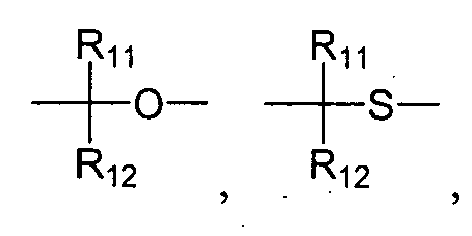 Y and Z are independently CH, CR6, or N, such that at least one of Y and Z is N;R1 is hydrogen or C1-C5 alkyl;R2, R3, R4, and R5 are independently hydrogen, halogen, nitro, cyano, C1-C5 alkyl, C1-C5 alkoxy, halo (C1-C5) alkyl, C2-C5 alkenyl, C2-C5 alkynyl, carboxy, C1-C5 alkoxycarbonyl, or C1-C5 alkylthio;R6, R7, R8, and R9 are independently hydrogen, hydroxy, halogen, nitro, carboxy, C1-C5 alkyl, C1-C5 alkoxy, hydroxy (C1-C5) alkyl, C2-C5 alkenyl, C2-C5 alkynyl, halo (C1-C5) alkyl, halo (C1-C5) alkoxy, C1-C5 alkylthio, C1-C5 alkylsulfonyl, C1-C5 alkylcarbonyl, C1-C5 alkoxycarbonyl, C2-C5 alkenyloxy, C1-C5 alkoxy (C1-C5) alkoxy, C1-C5 alkoxy (C1-C5) alkoxy (C1-C5) alkyl, C1-C3 alkylpiperazinyl, piperidyl, C1-C5 alkoxy (C1-C5) alkylamino, C1-C7 alkylamino, di(C1-C5 alkyl)amino, C3-C6 cycloalkyl which may be unsubstituted or substituted with one or more C1-C3 alkyl groups, pyrrolidinyl, phenyl, or morpholinyl, wherein the phenyl may be unsubstituted or substituted with one or more substituents selected from halogen, C1-C5 alkyl, and halo (C1-C5) alkyl; andR10 is C1-C5 alkyl, halo (C1-C5) alkyl, or C2-C5 alkenyl.
 - The compound according to claim 1, an isomer, or a pharmaceutically acceptable salt thereof;
wherein,X is CR11=CR12, CHR11CHR12, R1 is hydrogen or C1-C3 alkyl;R2, R3, R4, and R5 are independently hydrogen, halogen, nitro, cyano, methyl, ethyl, ethenyl, ethynyl, trifluoromethyl, methoxy, ethoxy, or methoxycarbonyl;R6, R7, R8, and R9 are independently hydrogen, hydroxy, halogen, nitro, carboxy, C1-C5 alkyl, C1-C5 alkoxy, hydroxy (C1-C5) alkyl, C2-C5 alkenyl, C2-C5 alkynyl, halo (C1-C5) alkyl, halo (C1-C5) alkoxy, C1-C5 alkylthio, C1-C5 alkylsulfonyl, C1-C5 alkylcarbonyl, C1-C5 alkoxycarbonyl, C2-C5 alkenyloxy, C1-C5 alkoxy (C1-C5) alkoxy, C1-C5 alkoxy (C1-C5) alkoxy (C1-C5) alkyl, C1-C3 alkylpiperazinyl, piperidyl, C1-C5 alkoxy (C1-C5) alkylamino, C1-C7 alkylamino, di(C1-C3 alkyl)amino, C3-C6 cycloalkyl which may be unsubstituted or substituted with one or more methyl groups, pyrrolidinyl, phenyl, or morpholinyl, wherein the phenyl may be unsubstituted or substituted with one or more substituents selected from halogen, C1-C5 alkyl, and halo (C1-C5) alkyl; andR10 is C1-C3 alkyl or C2-C3 alkenyl.
 - A compound of the formula (II), an isomer, or a pharmaceutically acceptable salt thereof;

R1 is hydrogen or C1-C5 alkyl;
R2, R3, R4, and R5 are independently hydrogen, halogen, nitro, cyano, C1-C5 alkyl, C1-C5 alkoxy, halo (C1-C5) alkyl, C2-C5 alkenyl, C2-C5 alkynyl, carboxy, C1-C5 alkoxycarbonyl, or C1-C5 alkylthio;
R6, R7, R8, and R9 are independently hydrogen, hydroxy, halogen, nitro, carboxy, C1-C5 alkyl, C1-C5 alkoxy, C2-C5 alkenyl, C2-C5 alkynyl, halo (C1-C5) alkyl, halo (C1-C5) alkoxy, hydroxy (C1-C5) alkyl, C1-C5 alkylthio, C1-C5 alkylsulfonyl, C1-C5 alkylcarbonyl, C1-C5 alkoxycarbonyl, C2-C5 alkenyloxy, C1-C5 alkoxy (C1-C5) alkoxy, C1-C5 alkoxy (C1-C5) alkoxy (C1-C5) alkyl, C1-C3 alkylpiperazinyl, piperidyl, C1-C5 alkoxy (C1-C5) alkylamino, C1-C7 alkylamino, di(C1-C5 alkyl)amino, C3-C6 cycloalkyl which may be unsubstituted or substituted with one or more C1-C3 alkyl groups, pyrrolidinyl, phenyl, or morpholinyl, wherein the phenyl may be unsubstituted or substituted with one or more substituents selected from halogen, C1-C5 alkyl, and halo (C1-C5) alkyl;
R10 is C1-C5 alkyl, halo (C1-C5) alkyl, or C2-C5 alkenyl; and
R11 and R12 are independently hydrogen, C1-C5 alkyl, or halogen. - A compound of the formula (III), an isomer, or a pharmaceutically acceptable salt thereof;
 R1 is hydrogen or C1-C5 alkyl;R2, R3, R4, and R5 are independently hydrogen, halogen, nitro, cyano, C1-C5 alkyl, C1-C5 alkoxy, halo (C1-C5) alkyl, C2-C5 alkenyl, C2-C5 alkynyl, carboxy, C1-C5 alkoxycarbonyl, or C1-C5 alkylthio;R6, R7, R8, and R9 are independently hydrogen, hydroxy, halogen, nitro, carboxy, C1-C5 alkyl, C1-C5 alkoxy, C2-C5 alkenyl, C2-C5 alkynyl, halo (C1-C5) alkyl, halo (C1-C5) alkoxy, hydroxy (C1-C5) alkyl, C1-C5 alkylthio, C1-C5 alkylsulfonyl, C1-C5 alkylcarbonyl, C1-C5 alkoxycarbonyl, C2-C5 alkenyloxy, C1-C5 alkoxy (C1-C5) alkoxy, C1-C5 alkoxy (C1-C5) alkoxy (C1-C5) alkyl, C1-C3 alkylpiperazinyl, piperidyl, C1-C5 alkoxy (C1-C5) alkylamino, C1-C7 alkylamino, di(C1-C5 alkyl)amino, C3-C6 cycloalkyl which may be unsubstituted or substituted with one or more C1-C3 alkyl groups, pyrrolidinyl, phenyl, or morpholinyl, wherein the phenyl may be unsubstituted or substituted with one or more substituents selected from halogen, C1-C5 alkyl, and halo (C1-C5) alkyl;R10 is C1-C5 alkyl, halo (C1-C5) alkyl, or C2-C5 alkenyl; andR11 and R12 are independently hydrogen, C1-C5 alkyl, or halogen.
 - The compound according to anyone of claims 1 to 4, an isomer, or a pharmaceutically acceptable salt thereof;
wherein,R1 is hydrogen, methyl, or ethyl;R2, R3, R4, and R5 are independently hydrogen, fluoro, chloro, bromo, nitro, cyano, methyl, ethyl, ethenyl, ethynyl, trifluoromethyl, methoxy, ethoxy, or methoxycarbonyl; R6, if present, is hydrogen, hydroxy, fluoro, bromo, chloro, hydroxymethyl, C1-C5 alkyl, C1-C5 alkoxy, C2-C5 alkenyl, C2-C5 alkynyl, halo (C1-C5) alkyl, halo (C1-C5) alkoxy, C2-C5 alkenyloxy, C1-C5 alkoxy (C1-C5) alkoxy, C1-C5 alkoxy (C1-C5) alkoxy (C1-C5) alkyl, di(C1-C3 alkyl)amino, C1-C3 alkylpiperazinyl, piperidyl, pyrrolidinyl, halophenyl, phenyl, or morpholinyl;R7 is C1-C5 alkyl, halo (C1-C4) alkyl, halogen, piperidyl, morpholinyl, pyrrolidinyl, C3-C6 cycloalkyl which may be unsubstituted or substituted with one or more methyl groups, C2-C5 alkenyl;R8 and R9 are independently hydrogen, halogen, or trifluoromethyl;R10 is C1-C5 alkyl, halo (C1-C5) alkyl, or C2-C5 alkenyl; andR11 and R12, if present, are independently hydrogen, or methyl. - The compound according to anyone of claims 1 to. 5, an isomer, or a pharmaceutically acceptable salt thereof;
wherein,R1, and R2 are hydrogen;R3 is hydrogen, fluoro, chloro, bromo, cyano, methyl, ethyl, ethenyl, ethynyl, or trifluoromethyl;R4 and R5 are independently hydrogen, fluoro, chloro, cyano, methyl, ethyl, or trifluoromethyl;R6, if present, is hydrogen, hydroxy, fluoro, bromo, chloro, methyl, hydroxymethyl, methoxy, trifluoromethyl, di(C1-C3 alkyl)amino, alkylpiperazinyl, piperidyl, pyrrolidinyl, halophenyl, phenyl, or morpholinyl;R7 is methyl, isopropyl, t-butyl, trifloromethyl, chloro, bromo, cyclopropyl which may be unsubstituted or substituted with one or two methyl groups, piperidyl, pyrrolidinyl, or morpholinyl;R8 is hydrogen;R9 is hydrogen or trifluoromethyl;R10 is C1-C5 alkyl, halo (C1-C5) alkyl, or C2-C5 alkenyl; andR11 and R12, if present, are independently hydrogen or methyl. - The compound according to anyone of claims 1 to 6, an isomer, or a pharmaceutically acceptable salt thereof;
wherein,R1, R2, and R5 are hydrogen;R3 is hydrogen, fluoro, chloro, cyano, methyl, ethenyl, ethynyl, or trifluoromethyl;R4 is hydrogen, fluoro, chloro, cyano, methyl, ethyl, or trifluoromethyl;R6, if present, is hydrogen, hydroxy, fluoro, bromo, chloro, methyl, hydroxymethyl, methoxy, trifluoromethyl, diethylamino, piperidyl, pyrrolidinyl, trifluorophenyl, phenyl, or morpholinyl;R7 is methyl, isopropyl, t-butyl, trifluoromethyl, chloro, bromo, cyclopropyl, methylcyclopropyl, piperidyl, pyrrolidinyl, or morpholinyl;R8 is hydrogen;R11 and R12, if present, are hydrogen;R9 is hydrogen or trifluoromethyl; andR10 is methyl. - The compound according to anyone of claims 1 to 5, an isomer, or a pharmaceutically acceptable salt thereof;
wherein,R1 is hydrogen or methyl;R2 is hydrogen;R3 is hydrogen, fluoro, chloro, bromo, cyano, methyl, ethyl, ethenyl, ethynyl, or trifluoromethyl;R4 and R5 are independently hydrogen, fluoro, chloro, cyano, methyl, ethyl, or trifluoromethyl;R6, if present, is hydrogen, fluoro, chloro, bromo, methyl, methoxy, piperidyl, or morpholinyl;R7 is isopropyl, t-butyl, or trifluoromethyl;R8 is hydrogen;R11 and R12, if present, are hydrogen;R9 is hydrogen or trifluoromethyl; andR10 is methyl. - The compound according to anyone of claims 1 to 8, an isomer, or a pharmaceutically acceptable salt thereof, wherein the compound is selected from the group consisting of3-(6-tert-Butyl-pyridin-3-yl)-N-(3-chloro-4-methanesulfonylamino-benzyl)-acrylamide,3-(6-tert-Butyl-pyridin-3-yl)-N-(3-fluoro-4-methanesulfonylamino-benzyl)-acrylamide,3-(6-tert-Butyl-pyridin-3-yl)-N-(3-ethynyl-5-fluoro-4-methanesulfonylamino-benzyl)-acrylamide,3-(6-tert-Butyl-pyridin-3-yl)-N-(4-methanesulfonylamino-3-vinyl-benzyl)-acrylamide,N-(3-Fluoro-4-methanesulfonylamino-benzyl)-3-(2-morpholin-4-yl-6-trifluoromethylpyridin-3-yl)-acrylamide,N-(4-Methanesulfonylamino-3-vinyl-benzyl)-3-(2-morpholin-4-yl-6-trifluoromethyl-pyridin-3-yl)-acrylamide,N-(3-Chloro-4-methanesulfonylamino-benzyl)-3-(2-morpholin-4-yl-6-trifluoromethyl-pyridin-3-yl)-acrylamide,N-(3-Fluoro-4-methanesulfonylamino-5-methyl-benzyl)-3-(2-morpholin-4-yl-6-trifluoromethyl-pyridin-3-yl)-acrylamide,3-(6-tert-Butyl-2-methoxy-pyridin-3-yl)-N-(3-fluoro-4-methanesulfonylamino-benzyl)-acrylamide,3-(6-tert-Butyl-pyridin-3-yl)-N-(3-fluoro-4-methanesulfonylamino-5-vinyl-benzyl)-acrylamide,3-(6-tert-Butyl-2-methoxy-pyridin-3-yl)-N-(3-ethynyl-5-fluoro-4-methanesulfonylamino-benzyl)-acrylamide,N-(3-Ethynyl-5-fluoro-4-methanesulfonylamino-benzyl)-3-(2-morpholin-4-yl-6-trifluoromethyl-pyridin-3-yl)-acrylamide,3-(6-tert-Butyl-4-trifluoromethyl-pyridin-3-yl)-N-(3-fluoro-4-methanesulfonylamino-benzyl)-acrylamide,3-(6-tert-Butyl-4-trifluoromethyl-pyridin-3-yl)-N-(3-ethynyl-5-fluoro-4-methanesulfonylamino-benzyl)-acrylamide,N-(3,5-Difluoro-4-methanesulfonylamino-benzyl)-3-(2-morpholin-4-yl-6-trifluoromethyl-pyridin-3-yl)-acrylamide,N-(3-Ethynyl-5-fluoro-4-methanesulfonylamino-benzyl)-3-(6'-trifluoromethyl-3,4,5,6-tetrahydro-2H-[1,2']bipyridinyl-3'-yl)-acrylamide,3-(2-Bromo-6-tert-butyl-pyridin-3-yl)-N-(3-fluoro-4-methanesulfonylamino-benzyl)-acrylamide,3-(2-Bromo-6-tert-butyl-pyridin-3-yl)-N-(3-ethynyl-5-fluoro-4-methanesulfonylamino-benzyl)-acrylamide, andN-(3-Fluoro-4-methanesulfonylamino-benzyl)-3-(6'-trifluoromethyl-3,4,5,6-tetrahydro-2H-[1,2']bipyridinyl-3'-yl)-acrylamide.
- The compound according to anyone of claims 1 to 8, an isomer, or a pharmaceutically acceptable salt thereof, wherein the compound is selected from the group consisting of;3-(6-tert-Butyl-pyridin-3-yl)-N-(3-ethynyl-5-fluoro-4-methanesulfonylamino-benzyl)-acrylamide,3-(6-tert-Butyl-pyridin-3-yl)-N-(4-methanesulfonylamino-3--benzyl)-acrylamide,N-(4-Methanesulfonylamino-3-vinyl-benzyl)-3-(2-morpholin-4-yl-6-trifluoromethyl-pyridin-3-yl)-acrylamide,N-(3-Fluoro-4-methanesulfonylamino-5-methyl-benzyl)-3-(2-morpholin-4-yl-6-trifluoromethyl-pyridin-3-yl)-acrylamide,3-(6-tert-Butyl-2-methoxy-pyridin-3-yl)-N-(3-fluoro-4-methanesulfonylamino-benzyl)-acrylamide,3-(6-tert-Butyl-pyridin-3-yl)-N-(3-fluoro-4-methanesulfonylamino-5-vinyl-benzyl)-acrylamide,3-(6-tert-Butyl-2-methoxy-pyridin-3-yl)-N-(3-ethynyl-5-fluoro-4-methanesulfonylamino-benzyl)-acrylamide,N-(3-Ethynyl-5-fluoro-4-methanesulfonylamino-benzyl)-3-(2-morpholin-4-yl-6-trifluoromethyl-pyridin-3-yl)-acrylamide,3-(6-tert-Butyl-4-trifluoromethyl-pyridin-3-yl)-N-(3-fluoro-4-methanesulfonylamino-benzyl)-acrylamide,3-(6-tert-Butyl-4-trifluoromethyl-pyridin-3-yl)-N-(3-ethynyl-5-fluoro-4-methanesulfonylamino-benzyl)-acrylamide,N-(3-Ethynyl-5-fluoro-4-methanesulfonylamino-benzyl)-3-(6'-trifluoromethyl-3,4,5,6-tetrahydro-2H-[1,2']bipyridinyl-3'-yl)-acrylamide,3-(2-Bromo-6- tert-butyl-pyridin-3-yl)-N-(3-fluoro-4-methanesulfonylamino-benzyl)-acrylamide, and3-(2-Bromo-6-tert-butyl-pyridin-3-yl)-N-(3-ethynyl-5-fluoro-4-methanesulfonylamino-benzyl)-acrylamide.
- A compound of the formula (IV), an isomer, or a pharmaceutically acceptable salt thereof;
 R1 is hydrogen, methyl, or ethyl;R2, R3, R4, and R5 are independently hydrogen, fluoro, chloro, bromo, nitro, cyano, methyl, ethyl, ethenyl, ethynyl, trifluoromethyl, methoxy, ethoxy, hydroxy, or methoxycarbonyl;R6 is hydrogen, fluoro, bromo, chloro, hydroxymethyl, C1-C5 alkyl, C1-C5 alkoxy, C2-C5 alkenyl, C2-C5 alkynyl, halo (C1-C5) alkyl, halo (C1-C5) alkoxy, C2-C5 alkenyloxy, C1-C5 alkoxy (C1-C5) alkoxy, piperidyl, or morpholinyl;R7 is C1-C5 alkyl, halo (C1-C4) alkyl, halogen, morpholinyl, C3-C6 cycloalkyl, C2-C5 alkenyl, or nitro;R8 and R9 are hydrogen;R10 is C1-C5 alkyl, halo (C1-C5) alkyl, or C2-C5 alkenyl; andR11 and R12 are independently hydrogen, halogen, or methyl.
 - The compound according to claim 11, an isomer, or a pharmaceutically acceptable salt thereof;
wherein,R1, R2, R5, R8, and R9 are hydrogen;R3 and R4 are independently hydrogen, fluoro, chloro, cyano, methyl, ethenyl, ethynyl, or trifluoromethyl;R6 is hydrogen, fluoro, bromo, chloro, hydroxymethyl, methoxy, morpholinyl, or trifluoromethyl;R7 is t-butyl, trifloromethyl, methyl, chloro, bromo, nitro, or morpholinyl; andR10 is methyl or ethenyl. - The compound according to claims 11 or 12, an isomer, or a pharmaceutically acceptable salt thereof;
wherein,R1, R2, R5, R8, and R9 are hydrogen;R3 and R4 are independently hydrogen, fluoro, chloro, cyano, methyl, ethenyl, ethynyl, or trifluoromethyl;R6 is hydrogen, fluoro, bromo, chloro, hydroxymethyl, methoxy, morpholinyl, or trifluoromethyl;R7 is t-butyl, trifloromethyl, methyl, chloro, bromo, nitro, or morpholinyl; andR10 is methyl. - A compound of the formula (V), an isomer, or a pharmaceutically acceptable salt thereof;
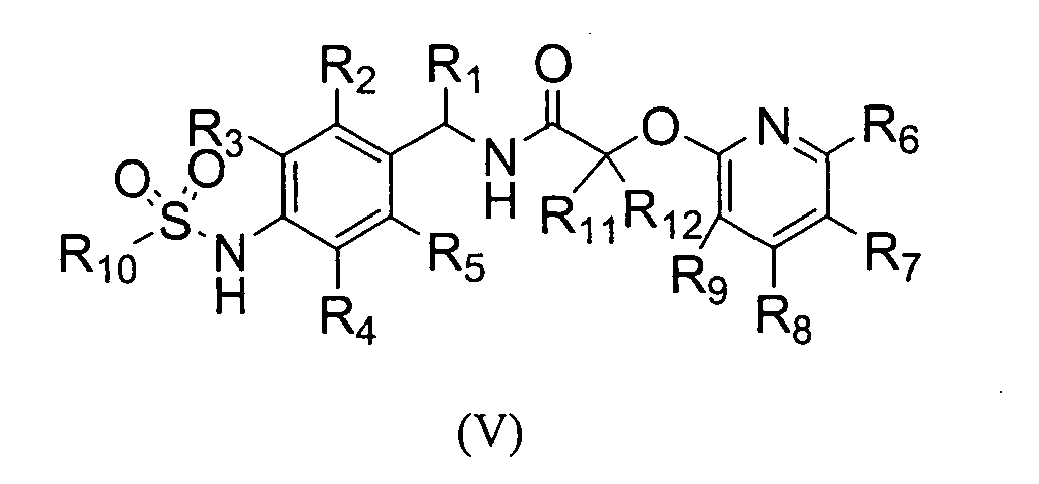 R1 is hydrogen, methyl, or ethyl;R2, R3, R4, and R5 are independently hydrogen, fluoro, chloro, bromo, nitro, cyano, methyl, ethyl, ethenyl, ethynyl, trifluoromethyl, methoxy, ethoxy, or methoxycarbonyl;R6, R7, R8 and R9 are independently hydrogen, fluoro, bromo, chloro, hydroxymethyl, C1-C5 alkyl, C1-C5 alkoxy, C2-C5 alkenyl, C2-C5 alkynyl, halo (C1-C5) alkyl, halo (C1-C5) alkoxy, C2-C5 alkenyloxy, C1-C5 alkoxy (C1-C5) alkoxy, piperidyl, nitro, or morpholinyl;R10 is C1-C5 alkyl, halo (C1-C5) alkyl, or C2-C5 alkenyl; andR11 and R12 are independently hydrogen, halogen, or methyl.
 - The compound according to claim 14, an isomer, or a pharmaceutically acceptable salt thereof;
wherein,R1, R2, R5, R6, R8, and R9 are hydrogen;R3 and R4 are independently hydrogen, fluoro, chloro, cyano, methyl, ethenyl, ethynyl, or trifluoromethyl;R7 is t-butyl, trifloromethyl, methyl, chloro, bromo, nitro, or morpholinyl; andR10 is methyl or ethenyl. - The compound according to claims 14 or 15, an isomer, or a pharmaceutically acceptable salt thereof;
wherein,R1, R2, R5, R6, R8, and R9 are hydrogen;R3 and R4 are independently hydrogen, fluoro, chloro, cyano, methyl, ethenyl, ethynyl, or trifluoromethyl;R7 is t-butyl, trifluoromethyl, methyl, chloro, bromo, nitro, or morpholinyl; andR10 is methyl. - A pharmaceutical composition comprising the compound according to any one of claims 1 to 16, an isomer thereof, or a pharmaceutically acceptable salt thereof, as an active ingredient and a pharmaceutically acceptable carrier.
- A pharmaceutical composition for preventing or treating a condition associated with the pathological stimulation and/or aberrant expression of vanilloid receptors, wherein said composition comprises the compound according to any one of claims 1 to 16, an isomer thereof, or a pharmaceutically acceptable salt thereof; and a pharmaceutically acceptable carrier.
- The pharmaceutical composition according to claims 17 or 18, for treating a condition selected from the group consisting of pain, inflammatory disease of the joints, neuropathies, HIV-related neuropathy, nerve injury, neurodegeneration, stroke, urinary bladder hypersensitivity including urinary incontinence, cystitis, stomach duodenal ulcer, irritable bowel syndrome (IBS) and inflammatory bowel disease (IBD), fecal urgency, gastro-esophageal reflux disease (GERD), Crohn's disease, asthma, chronic obstructive pulmonary disease, cough, neurotic/allergic/inflammatory skin disease, psoriasis, pruritus, prurigo, irritation of skin, eye or mucous membrane, hyperacusis, tinnitus, vestibular hypersensitivity, episodic vertigo, cardiac diseases such as myocardial ischemia, hair growth-related disorders such as effluvium, alopecia, rhinitis, and pancreatitis.
- The pharmaceutical composition according to claim 19 wherein the pain is or is associated with a condition selected from the group consisting of osteoarthritis, rheumatoid arthritis, ankylosing spondylitis, diabetic neuropathic pain, post-operative pain, dental pain, non-inflammatory musculoskeletal pain (including fibromyalgia, myofascial pain syndrome and back pain), migraine and other types of headaches.
- The pharmaceutical composition according to anyone of claims 17 to 20 characterized in that it is adapted for oral administration.
- A method for inhibiting vanilloid ligand from binding to vanilloid receptor in a patient, comprising contacting cells expressing vanilloid receptor in the patient with the compound according to any one of claims 1 to 16, an isomer thereof, or a pharmaceutically acceptable salt thereof.
- A method for preventing or treating a condition selected from the group consisting of pain, inflammatory disease of the joints, neuropathies, HIV-related neuropathy, nerve injury, neurodegeneration, stroke, urinary bladder hypersensitivity including urinary incontinence, cystitis, stomach duodenal ulcer, irritable bowel syndrome (IBS) and inflammatory bowel disease (IBD), fecal urgency, gastro-esophageal reflux disease (GERD), Crohn's disease, asthma, chronic obstructive pulmonary disease, cough, neurotic/allergic/inflammatory skin disease, psoriasis, pruritus, prurigo, irritation of skin, eye or mucous membrane, hyperacusis, tinnitus, vestibular hypersensitivity, episodic vertigo, cardiac diseases such as myocardial ischemia, hair growth-related disorders such as effluvium, alopecia, rhinitis, and pancreatitis, which comprises administering to a mammal including a person in need thereof a therapeutically effective amount of the compound according to any one of claims 1 to 16, an isomer thereof, or a pharmaceutically acceptable salt thereof.
- The method according to claim 23, wherein the pain is or is associated with a condition selected from the group consisting of osteoarthritis, rheumatoid arthritis, ankylosing spondylitis, diabetic neuropathic pain, post-operative pain, dental pain, non-inflammatory musculoskeletal pain (including fibromyalgia, myofascial pain syndrome and back pain), migraine, and other types of headaches.
- Use of the compound according to any one of claims 1 to 16, an isomer thereof, or a pharmaceutically acceptable salt thereof, in preparation of a medicament for prevention or treatment of a condition that is associated with the aberrant expression and/or aberrant activation of a vanilloid receptor.
- Use of the compound according to any one of claims 1 to 16, an isomer thereof, or a pharmaceutically acceptable salt thereof, in preparation of a medicament for prevention or treatment of a condition that is selected from the group consisting of pain, inflammatory disease of the joints, neuropathies, HIV-related neuropathy, nerve injury, neurodegeneration, stroke, urinary bladder hypersensitivity including urinary incontinence, cystitis, stomach duodenal ulcer, irritable bowel syndrome (IBS) and inflammatory bowel disease (IBD), fecal urgency, gastro-esophageal reflux disease (GERD), Crohn's disease, asthma, chronic obstructive pulmonary disease, cough, neurotic/allergic/inflammatory skin disease, psoriasis, pruritus, prurigo, irritation of skin, eye or mucous membrane, hyperacusis, tinnitus, vestibular hypersensitivity, episodic vertigo, cardiac diseases such as myocardial ischemia, hair growth-related disorders such as effluvium, alopecia, rhinitis and pancreatitis.
- Use of the compound according to claim 26, wherein the condition is pain, which is or which is associated with a condition selected from the group consisting of osteoarthritis, rheumatoid arthritis, ankylosing spondylitis, diabetic neuropathic pain, post-operative pain, dental pain, non-inflammatory musculoskeletal pain (including fibromyalgia, myofascial pain syndrome and back pain), migraine, and other types of headaches.
- A process for preparing a compound represented by the formula (III)


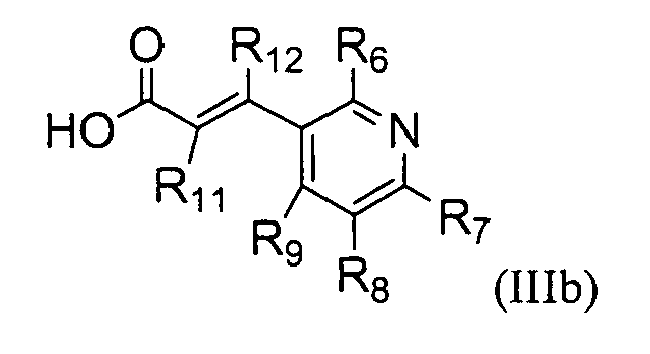 R1 is hydrogen or C1-C5 alkyl;R2, R3, R4, and R5 are independently hydrogen, halogen, nitro, cyano, C1-C5 alkyl, C1-C5 alkoxy, halo (C1-C5) alkyl, C2-C5 alkenyl, C2-C5 alkynyl, carboxy, C1-C5 alkoxycarbonyl, or C1-C5 alkylthio;R6, R7, R8, and R9 are independently hydrogen, hydroxy, halogen, nitro, carboxy, C1-C5 alkyl, C1-C5 alkoxy, C2-C5 alkenyl, C2-C5 alkynyl, halo (C1-C5) alkyl, halo (C1-C5) alkoxy, hydroxy (C1-C5) alkyl, C1-C5 alkylthio, C1-C5 alkylsulfonyl, C1-C5 alkylcarbonyl, C1-C5 alkoxycarbonyl, C2-C5 alkenyloxy, C1-C5 alkoxy (C1-C5) alkoxy, C1-C5 alkoxy (C1-C5) alkoxy (C1-C5) alkyl, C1-C3 alkylpiperazinyl, piperidyl, C1-C5 alkoxy (C1-C5) alkylamino, C1-C7 alkylamino, di(C1-C5 alkyl)amino, C3-C6 cycloalkyl which may be unsubstituted or substituted with one or more C1-C3 alkyl groups, pyrrolidinyl, phenyl, or morpholinyl, wherein the phenyl may be unsubstituted or substituted with one or more substituents selected from halogen, C1-C5 alkyl, and halo (C1-C5) alkyl;R10 is C1-C5 alkyl, halo (C1-C5) alkyl, or C2-C5 alkenyl; andR11 and R12 are independently hydrogen, C1-C5 alkyl, or halogen.
 - The process according to claim 28, wherein the reaction is conducted in the presence of a coupling agent.
- The process according to claim 29, wherein the coupling agent is selected from the group consisting of DCC (N,N-dicyclcohexylcarbodidimide), EDCI { 1-(3-dimethylaminopropyl)-3-ethylcarbodidimide hydrochloride (EDCI)}, and DMTMM {4-(4,6-dimethoxy-1,3,5-triazin-2-yl)-4-methylmorpholinium chloride}.
- A process for preparing a compound represented by the formula (IIIc);

- The process according to claim 31, wherein the reducing step is conducted in the presence of hydrogen gas and palladium on carbon.
- The process according to claims 28 to 32, wherein R1, R11, and R12 are hydrogen.
- The process according to claims 28 to 31, wherein, R1, R2, R8, R11, and R12 are hydrogen; R3 is hydrogen, fluoro, chloro, bromo, cyano, methyl, ethyl, ethenyl, ethynyl, or trifluoromethyl; R4 and R5 are independently hydrogen, fluoro, chloro, cyano, methyl, ethyl, or trifluoromethyl; R6 is hydrogen, fluoro, chloro, bromo, methyl, methoxy, diethylamino, pyrrolidinyl, piperidyl, or morpholinyl; R7 is isopropyl, t-butyl, or trifluoromethyl; R9 is hydrogen or trifluoromethyl; and R10 is methyl.
Priority Applications (17)
| Application Number | Priority Date | Filing Date | Title |
|---|---|---|---|
| EP06015724A EP1882687A1 (en) | 2006-07-27 | 2006-07-27 | Heterocyclic compounds useful as vanilloid receptor antagonists and pharmaceutical compositions containing the same |
| ARP070103317A AR063211A1 (en) | 2006-07-27 | 2007-07-26 | DERIVATIVES OF 3- (PIRIDIN-3-IL) ACRILAMIDE AND 3- (PIRIDIN-3-IL) PROPIONAMIDE, A METHOD FOR THEIR PREPARATION, A PHARMACEUTICAL COMPOSITION THAT UNDERSTANDS AND THEIR USE IN THE MANUFACTURE OF MEDICINES FOR THE TREATMENT OF ASSOCIATED DISEASES WITH THE VANILOID RECEIVER. |
| PT07793254T PT2054411E (en) | 2006-07-27 | 2007-07-26 | Novel compounds, isomer thereof, or pharmaceutically acceptable salts thereof as vanilloid receptor antagonist; and pharmaceutical compositions containing the same |
| RU2009106867/04A RU2448108C2 (en) | 2006-07-27 | 2007-07-26 | Novel compounds, isomers thereof or pharmacutically acceptable salts thereof as vanilloid receptor antagonists and pharmaceutical composition containing said compounds |
| KR1020097004333A KR101410318B1 (en) | 2006-07-27 | 2007-07-26 | Novel compound as a vanilloid receptor antagonist, an isomer thereof, or a pharmaceutically acceptable salt thereof, and a pharmaceutical composition containing the same |
| EP07793254.9A EP2054411B1 (en) | 2006-07-27 | 2007-07-26 | Novel compounds, isomer thereof, or pharmaceutically acceptable salts thereof as vanilloid receptor antagonist; and pharmaceutical compositions containing the same |
| PL07793254T PL2054411T3 (en) | 2006-07-27 | 2007-07-26 | Novel compounds, isomer thereof, or pharmaceutically acceptable salts thereof as vanilloid receptor antagonist; and pharmaceutical compositions containing the same |
| DK07793254.9T DK2054411T3 (en) | 2006-07-27 | 2007-07-26 | HIS UNKNOWN RELATIONS, ISOMS THEREOF, OR PHARMACEUTICAL ACCEPTABLE SALTS THEREOF, AS VANILLOID RECEPTOR ANTAGONIST AND PHARMACEUTICAL COMPOSITIONS CONTAINING THE SAME |
| MX2009000925A MX2009000925A (en) | 2006-07-27 | 2007-07-26 | Novel compounds, isomer thereof, or pharmaceutically acceptable salts thereof as vanilloid receptor antagonist; and pharmaceutical compositions containing the same. |
| PCT/KR2007/003592 WO2008013414A1 (en) | 2006-07-27 | 2007-07-26 | Novel compounds, isomer thereof, or pharmaceutically acceptable salts thereof as vanilloid receptor antagonist; and pharmaceutical compositions containing the same |
| JP2009521700A JP5254228B2 (en) | 2006-07-27 | 2007-07-26 | Novel compounds, isomers or pharmaceutically acceptable salts thereof as vanilloid receptor antagonists; and pharmaceutical compositions containing the same |
| AU2007277519A AU2007277519B2 (en) | 2006-07-27 | 2007-07-26 | Novel compounds, isomer thereof, or pharmaceutically acceptable salts thereof as vanilloid receptor antagonist; and pharmaceutical compositions containing the same |
| CN2007800354112A CN101522674B (en) | 2006-07-27 | 2007-07-26 | Novel compounds, pharmaceutically acceptable salts as vanilloid receptor antagonist and pharmaceutical composition comprising the compounds |
| CA2658925A CA2658925C (en) | 2006-07-27 | 2007-07-26 | Novel sulfonylamino acrylamide derivatives, isomer thereof,or pharmaceutically acceptable salts thereof as vanilloid receptor antagonist; and pharmaceutical compositions containing the same |
| ES07793254.9T ES2523191T3 (en) | 2006-07-27 | 2007-07-26 | New compounds, isomers thereof, or pharmaceutically acceptable salts thereof, as vanilloid receptor antagonists; and pharmaceutical compositions containing them |
| TW96127258A TW200817332A (en) | 2006-07-27 | 2007-07-26 | Novel compounds, isomer thereof, or pharmaceutically acceptable salts thereof as vanilloid receptor antagonist; and pharmaceutical compositions containing the same |
| US11/829,531 US7858621B2 (en) | 2006-07-27 | 2007-07-27 | Compounds, isomer thereof, or pharmaceutically acceptable salts thereof as vanilloid receptor antagonist; and pharmaceutical compositions containing the same |
Applications Claiming Priority (1)
| Application Number | Priority Date | Filing Date | Title |
|---|---|---|---|
| EP06015724A EP1882687A1 (en) | 2006-07-27 | 2006-07-27 | Heterocyclic compounds useful as vanilloid receptor antagonists and pharmaceutical compositions containing the same |
Publications (1)
| Publication Number | Publication Date |
|---|---|
| EP1882687A1 true EP1882687A1 (en) | 2008-01-30 |
Family
ID=37497882
Family Applications (1)
| Application Number | Title | Priority Date | Filing Date |
|---|---|---|---|
| EP06015724A Withdrawn EP1882687A1 (en) | 2006-07-27 | 2006-07-27 | Heterocyclic compounds useful as vanilloid receptor antagonists and pharmaceutical compositions containing the same |
Country Status (2)
| Country | Link |
|---|---|
| EP (1) | EP1882687A1 (en) |
| CN (1) | CN101522674B (en) |
Families Citing this family (7)
| Publication number | Priority date | Publication date | Assignee | Title |
|---|---|---|---|---|
| RS54591B1 (en) * | 2010-01-27 | 2016-08-31 | Takeda Pharmaceutical Company Limited | UNITS FOR SUPPRESSION OF PERIPHERAL DISORDER DISORDERS INDUCED BY ANTI-CARCINOGENIC MEANS |
| EP3162793B1 (en) * | 2015-02-17 | 2019-04-10 | Amorepacific Corporation | Chiral resolution method of n-[4-(1-aminoethyl)-phenyl]-sulfonamide derivatives |
| KR102359436B1 (en) * | 2015-06-05 | 2022-02-09 | (주)아모레퍼시픽 | Methods for manufacturing methyl 2-propyl-6-(trifluoromethyl) nicotinate |
| KR102287585B1 (en) * | 2015-06-30 | 2021-08-10 | (주)아모레퍼시픽 | Methods for manufacturing n-(4-acetyl-2,6-difluorophenyl)methanesulfonamide |
| KR102565407B1 (en) * | 2016-01-04 | 2023-08-10 | (주)아모레퍼시픽 | Method for chiral resolution of n-[4-(1-aminoethyl)-phenyl]-sulfonamide derivatives by using polar aprotic solvent |
| KR102599958B1 (en) * | 2016-09-28 | 2023-11-09 | (주)아모레퍼시픽 | Method for manufacturing (R)-N-[4-(1-AMINOETHYL)-2,6-difluoro-PHENYL]- METHANESULFONAMIDE |
| CN109608368B (en) * | 2018-10-24 | 2021-03-09 | 常州市阳光药业有限公司 | Synthesis and resolution method of N- [4- (1-aminoethyl) -2, 6-difluorophenyl ] methanesulfonamide |
Citations (2)
| Publication number | Priority date | Publication date | Assignee | Title |
|---|---|---|---|---|
| WO2002016318A1 (en) * | 2000-08-21 | 2002-02-28 | Pacific Corporation | Novel thiourea derivatives and the pharmaceutical compositions containing the same |
| WO2005040100A1 (en) * | 2003-10-15 | 2005-05-06 | Bayer Healthcare Ag | Tetrahydro-naphthalene and urea derivatives |
Family Cites Families (1)
| Publication number | Priority date | Publication date | Assignee | Title |
|---|---|---|---|---|
| MY138086A (en) * | 2001-09-13 | 2009-04-30 | Smithkline Beecham Plc | Novel urea derivative as vanilloid receptor-1 antagonist |
-
2006
- 2006-07-27 EP EP06015724A patent/EP1882687A1/en not_active Withdrawn
-
2007
- 2007-07-26 CN CN2007800354112A patent/CN101522674B/en not_active Expired - Fee Related
Patent Citations (2)
| Publication number | Priority date | Publication date | Assignee | Title |
|---|---|---|---|---|
| WO2002016318A1 (en) * | 2000-08-21 | 2002-02-28 | Pacific Corporation | Novel thiourea derivatives and the pharmaceutical compositions containing the same |
| WO2005040100A1 (en) * | 2003-10-15 | 2005-05-06 | Bayer Healthcare Ag | Tetrahydro-naphthalene and urea derivatives |
Non-Patent Citations (1)
| Title |
|---|
| JEEWOO LEE ET AL: "Analysis of structure-activity relationships with the N-(3-acyloxy-2- benzylpropyl)-N'-[4-(methylsulfonylamino)benzyl]thiourea template for vanilloid receptor 1 antagonism", BIOORGANIC & MEDICINAL CHEMISTRY, ELSEVIER SCIENCE LTD, GB, vol. 12, 2004, pages 3411 - 3420, XP002385180, ISSN: 0968-0896 * |
Also Published As
| Publication number | Publication date |
|---|---|
| CN101522674B (en) | 2013-08-21 |
| CN101522674A (en) | 2009-09-02 |
Similar Documents
| Publication | Publication Date | Title |
|---|---|---|
| US7858621B2 (en) | Compounds, isomer thereof, or pharmaceutically acceptable salts thereof as vanilloid receptor antagonist; and pharmaceutical compositions containing the same | |
| US7067553B2 (en) | Thiourea compounds and the pharmaceutical compositions containing the same | |
| US7960584B2 (en) | Compounds, isomer thereof, or pharmaceutically acceptable salts thereof as vanilloid receptor antagonist; and pharmaceutical compositions containing the same | |
| EP2238105B1 (en) | Novel compounds as vanilloid receptor antagonists | |
| EP1882687A1 (en) | Heterocyclic compounds useful as vanilloid receptor antagonists and pharmaceutical compositions containing the same | |
| WO2007120012A1 (en) | Novel compounds, isomer thereof, or pharmaceutically acceptable salts thereof as vanilloid receptor antagonist; and pharmaceutical compositions containing the same | |
| WO2006098554A1 (en) | Novel compounds, isomer thereof or pharmaceutically acceptable salts thereof as vanilloid receptor antagonist; and a pharmaceutical composition containing the same | |
| RU2448108C2 (en) | Novel compounds, isomers thereof or pharmacutically acceptable salts thereof as vanilloid receptor antagonists and pharmaceutical composition containing said compounds | |
| DK2054411T3 (en) | HIS UNKNOWN RELATIONS, ISOMS THEREOF, OR PHARMACEUTICAL ACCEPTABLE SALTS THEREOF, AS VANILLOID RECEPTOR ANTAGONIST AND PHARMACEUTICAL COMPOSITIONS CONTAINING THE SAME | |
| WO2007142426A1 (en) | Novel compounds, isomer thereof or pharmaceutically acceptable salts thereof as vanilloid receptor antagonist; and a pharmaceutical composition containing the same | |
| KR101374749B1 (en) | Novel compounds or pharmaceutically acceptable salts thereof as potent vanilloid receptor antagonist; and pharmaceutical compositions containing the same | |
| EP1857440A1 (en) | Novel compounds, isomer thereof, or pharmaceutically acceptable salts thereof as vanilloid receptor antagonist; and pharmaceutical compositions containing the same | |
| KR20100053470A (en) | Novel compounds, isomer thereof, or pharmaceutically acceptable salts thereof as vanulloid receptor antagonist and pharmaceutical compositions containing the same |
Legal Events
| Date | Code | Title | Description |
|---|---|---|---|
| PUAI | Public reference made under article 153(3) epc to a published international application that has entered the european phase |
Free format text: ORIGINAL CODE: 0009012 |
|
| AK | Designated contracting states |
Kind code of ref document: A1 Designated state(s): AT BE BG CH CY CZ DE DK EE ES FI FR GB GR HU IE IS IT LI LT LU LV MC NL PL PT RO SE SI SK TR |
|
| AX | Request for extension of the european patent |
Extension state: AL BA HR MK YU |
|
| AKX | Designation fees paid | ||
| STAA | Information on the status of an ep patent application or granted ep patent |
Free format text: STATUS: THE APPLICATION IS DEEMED TO BE WITHDRAWN |
|
| 18D | Application deemed to be withdrawn |
Effective date: 20080801 |
|
| REG | Reference to a national code |
Ref country code: DE Ref legal event code: 8566 |