EP1882599A2 - Device for the structural closure and fastening of folders - Google Patents
Device for the structural closure and fastening of folders Download PDFInfo
- Publication number
- EP1882599A2 EP1882599A2 EP07014391A EP07014391A EP1882599A2 EP 1882599 A2 EP1882599 A2 EP 1882599A2 EP 07014391 A EP07014391 A EP 07014391A EP 07014391 A EP07014391 A EP 07014391A EP 1882599 A2 EP1882599 A2 EP 1882599A2
- Authority
- EP
- European Patent Office
- Prior art keywords
- folders
- fastening
- fixation
- structural closure
- covers
- Prior art date
- Legal status (The legal status is an assumption and is not a legal conclusion. Google has not performed a legal analysis and makes no representation as to the accuracy of the status listed.)
- Granted
Links
Images



Classifications
-
- B—PERFORMING OPERATIONS; TRANSPORTING
- B42—BOOKBINDING; ALBUMS; FILES; SPECIAL PRINTED MATTER
- B42F—SHEETS TEMPORARILY ATTACHED TOGETHER; FILING APPLIANCES; FILE CARDS; INDEXING
- B42F13/00—Filing appliances with means for engaging perforations or slots
- B42F13/0006—Covers for loose-leaf binders
- B42F13/0026—Covers for loose-leaf binders with locks or closures
-
- Y—GENERAL TAGGING OF NEW TECHNOLOGICAL DEVELOPMENTS; GENERAL TAGGING OF CROSS-SECTIONAL TECHNOLOGIES SPANNING OVER SEVERAL SECTIONS OF THE IPC; TECHNICAL SUBJECTS COVERED BY FORMER USPC CROSS-REFERENCE ART COLLECTIONS [XRACs] AND DIGESTS
- Y10—TECHNICAL SUBJECTS COVERED BY FORMER USPC
- Y10T—TECHNICAL SUBJECTS COVERED BY FORMER US CLASSIFICATION
- Y10T24/00—Buckles, buttons, clasps, etc.
- Y10T24/34—Combined diverse multipart fasteners
- Y10T24/3427—Clasp
Definitions
- the present invention refers to the field of temporary assembly of paper sheets or any other laminar elements for their filing.
- it consists of a device for the structural closure and fastening of new or used ring binders, which allows to close the filing folders adequately while it keeps their structural integrity preventing the warping of new folders or the modification of the structure of used folders, allowing them to remain in a stable position when they are filed vertically or horizontally.
- Said type of folder has a central rectangular back or part from which the longest longitudinal rims, two covers are projected and a fastening mechanism which may be placed on the back or on any of the covers by means of which the sheets can be inserted, secured or removed quickly and easily.
- folder Probably the most usual type of folder is the one that has a fastening mechanism with two or three rings placed on the back or on any of the covers, in this latter case, called back cover.
- the rings coincide with the perforated holes on the sheets, which once inserted into them are fastened to the folder.
- the cause of the instability of the folder when it is filed vertically is due to the fact that the position of the force resulting from all the forces applied, constituted by the own weight of the components and the stored sheets, is placed -depending on where the sheet fastening mechanism is placed- in such a place that it produces a momentum of vertical section (overturn) that cannot be counteracted by the folder structure, in which the manner of transmitting the forces to the supporting surface of the folder plays a key role.
- the shape of the supporting surface of the folder is determined by the edges of both covers and the back of the folder which stand on the shelf and a fourth imaginary line which relates the free ends of the covers.
- the shape of the surface is variable depending on the relative position of one cover respect to the other, which, in case the free ends of the cover touch each other, has the shape of an isosceles triangle with its height being 4 or 5 times longer than the width of the base.
- the height of the folders can be 4, 5 or 6 times longer than the widest part of the supporting triangular surface, that is the width of the back, and that most of the force resulting from all the forces applied is physically related by means of the fastening mechanism, only to the back or to one of the covers with a leverage arm which increases with the amount of sheets stored, then, a momentum of overturn is produced generally placed half way of the folder height, making it overturn easily.
- the warping of the structure becomes permanent and irreversible.
- the folder After a certain time of use, and even taking out all the filed sheets, the folder remains deformed in such a manner that the vertical projection of the center of gravity may be easily placed outside the supporting base even when the free ends of the covers do not touch each other or are parallel.
- the patent US2804872 discloses a partial solution to the problem we posed, although it is incomplete when the folder reaches its maximum capacity of storage as the momentum of vertical section (overturn) cannot be counteracted effectively by the reaction force coming from the linking of the sheet fastening mechanism and the free cover. This reaction force is insufficient due to the location of the linking point between the above-mentioned parts. This problem aggravates when the free cover of the folder suffered structural deformations. In this case, even when the fastening mechanism is inserted into the free cover slots, the folder can lose its stability easily.
- the design presented in the present patent is not a response to solve the stability problem, but to save space by manufacturing a folder having a narrower back.
- the design disclosed substantially improves the stability of the folders.
- the device should keep the covers substantially parallel and will allow the folders to be stacked horizontally in a stable manner in case they are piled up in that way.
- An objective of the present device is to relate the covers of a folder so that the structural deformation of the folder is prevented, thus preventing it from losing the stability when it is filed vertically. Being a device with a very solid structure and with a link between its parts and between the device and the folder covers where the movement freedom is minimized, it is achieved that the device provides a rigidity between the covers that allows the momentum of vertical section applied on the back cover to be transmitted efficiently and efficaciously to the front cover.
- the device applies a downward force to the free cover, which avoids the deformations of the set cover-back-cover. Therefore, the device adopts a structural compensating behavior and equivalent to the back situated at the part opposite the covers.
- One of the advantages of the present device is that it can be applied to new folders or in good use as well as to deformed folders. In the first case, it avoids the occurrence of deformations and in the second case; the correction of the structural deformation is achieved placing it in the most suitable position by means of trial and error. Once it is placed, it can be removed and placed in another position if the structural compensation is not satisfactory for different amounts of stored sheets.
- Another advantage of the present device is that, due to its coupling and cramping means, it allows to open and close the covers without the need of removing or disassembling it, something that facilitates the use and prevents the deterioration of the folder edges.
- a further advantage is that it allows a very good fastening of the cover, without movements or clearance that may hinder its structural fastening function.
- a further advantage is that the placement and removal are simple. Once it is placed, it is difficult that it comes off accidentally.
- the insert fasteners comprise some thin mechanically strong laminar metal clips that fasten the outer part of the covers. Therefore, they outstand from the covers very insignificantly. If we add the fact that the device has such a size that once it is placed on the folder, makes the separation between the covers be shorter than the back width, both attributes help the device not to interfere with other adjacent folders and prevent that, upon taking the folder out of its place, it draws the neighbor folders and some of them fall down.
- Another advantage is that the device is, at the same time, structurally strong and light.
- Another advantage is that the device, being structurally strong and being strongly fixed to the covers, allows stacking several folders horizontally and in case of an accidental fall of one of them, the covers do not open and the filed sheets cannot come out of the folder.
- Another advantage is that the coupling means have been arranged in such a manner that they prevent undesirable clearances or movements.
- a further advantage is that the coupling means have been arranged in such a manner that the opening of the covers is performed easily by means of the pressure exerted upon moving the thumb and the index finger as pliers over the two flexible parts that unbind the device without the need of using both hands.
- Another advantage is that the front of the device has an area designed to apply a logotype.
- a further advantage is that the device can be detached from the folder and be placed on another folder.
- the device for structural closure and fastening of folders comprising a back or central part on which inner part there are fastening means of the elements to be filed and from which longitudinal edges project the mobile covers limited by external faces, inner faces and external edges, is characterized by the presence in combination of:
- the present invention refers to a device for the structural closure and fastening of folders that comprises a reciprocal set of coupling means (2a)(2b) which, provided with insert fasteners (6)(13) and fixation means (9)(9a)(9b) that are mounted on the edges (23a) of the covers (23), allows the closure of a filing folder (20) keeping a structural fastening that prevents deformations or allows to correct them in case they occurred.
- the present device (1) is applicable to folders (20) for filing elements such as paper or plastic sheets, laminar elements in general, envelopes, envelopes or cases to keep discs [CD ⁇ s, DVD ⁇ s, diskettes], etc.
- These filing folders (20) usually comprise a back (21) or central part in which an inner face has a set of fastening means or hooks (22) intended to insert the holes of the elements to be filed.
- the mobile covers (23) From the longitudinal edges (21a) of the back, (21) the mobile covers (23) project -towards both sides- and their mobility allows the opening and closure of the folder (20).
- Each cover (23) is limited by an outer face (23c), an inner face (23b) and external edges (23a).
- the present device (1) comprises a set of reciprocal coupling means (2a)(2b) integrated by a first (2a) and second (2b) coupling means which, in the present embodiment, are of the box and pin type.
- These coupling means (2a)(2b) comprise a set of bodies (4)(5) which, as an elastic broach, are pluggable by means of the forced wedging until the assembly of an elastically releasable cramp (10a)(11a).
- the first coupling means (2a) comprises a first body (4) which, on the one hand, forms a fixation base (6) to the folder (20), whereas, on the other hand, has cramping elastic arms (10) which free ends form two cramping heads (10a). These elements constitute the pin part of the coupling.
- the second coupling means comprises a second body (5) which, on the one hand, forma a fixation base (6) to the folder (20), whereas, on the opposite part, forms a forced wedging cavity (11) which constitutes the box part of the coupling.
- the forced wedging cavity (11) presents a progressive widening from the entrance or stop (3), so that said progressive widening constitutes a cooperating means with the functionality of the coupling means (2a)(2b) [when it couples, it gradually compresses the elastic cramping arms (10) and when it decouples, it cooperates with said decoupling].
- both fixation bases (6) have a contact wall (7) that contacts the inner face (23b) of the cover (23).
- This contact wall (7) can be provided with non-slip means such as, for instance, some protruding embossments that can be sharpened so that their action against the cover (23) prevents undesirable movements.
- fixation bases (6) also have anchorage openings where some fastening clips (13) are anchored.
- the latter (13) can be comprised by elastic laminar means [for example, they can be structured in resistant and elastically flexible metals].
- the contact wall (7) and the fastening clip (13) complement each other to form an insert fastener which fastening cavity (14) or wedge is prepared to receive the external edge (23a) of the cover (23), on which they act as a fastening little claw.
- the fastening clip (13) is folded so that a fastening sector or body (13a) and an anchorage sector or body is distinguished (13b).
- the anchorage body (13b) of the fastening clip (13) has a set of alternative positional anchorage means (8a)(8b), which, as positional variation means, are situated in the anchorage opening (8) of the fixation base (6).
- the anchorage body (13b) also has an anchorage hole (13c) to allow the action of the fixation means (9)(9a)(9b) constituted [for example] by fixation screws (9b) which, placed into fixation ducts (9a) that cross the fixation bases (6), are capable of projecting and exerting pressure on the part of the cover (23) able to be inserted in the fastening wedge or cavity (14).
- fixation screws (9b) Upon crossing the hole of the fastening clip (13), the fixation screws (9b) also form part of the anchorage of said clip (13) in the fixation base (6).
- the edges (23a) of the covers (23) are inserted in the fastening cavity (14) of the insert fasteners formed by the fixation bases (6) and the fastening clips (13).
- the contact walls (7) remain attached to the inner faces (23b) of the covers (23), whereas the fastening bodies (13a) of the clips (13) stay attached to the outer faces (23c) of said covers (23) of the folder (20).
- fixation screws (9b) are placed in the fixation ducts (9a) so that, projecting themselves through the anchorage opening (8) of the fixation base (6) and through the anchorage holes (13c) of the fastening clips (13), exert pressure on the part of the cover (23) inserted in the fastening cavity (14).
- the first coupling means (2a) can be inserted in the second (2b), with which, as a mode of elastic broach of forced wedging, said first means (2a) enters until reaching the coupling stop (3).
- the elastic cramping arms (10) are bent by forced insertion and slip within the wedging cavity (11) until the heads (10a) encase into the cramping edges (11a) and said cramp is assembled.
- the device (1) may have different sizes that facilitate its application to different types of folders (20). For example, that the separation between both insert fasteners (6)(13) is shorter than the width of the back (21) of the application folder (20). In this manner, the folder (20) can be kept adequately closed without the covers (23) being arranged in a parallel manner.
Landscapes
- Sheet Holders (AREA)
- Treatment Of Fiber Materials (AREA)
- Warehouses Or Storage Devices (AREA)
Abstract
Description
- The present invention refers to the field of temporary assembly of paper sheets or any other laminar elements for their filing.
- More particularly, it consists of a device for the structural closure and fastening of new or used ring binders, which allows to close the filing folders adequately while it keeps their structural integrity preventing the warping of new folders or the modification of the structure of used folders, allowing them to remain in a stable position when they are filed vertically or horizontally.
- The ring binders for temporary assembly of paper sheets or any other laminar elements are known in the prior art. Said type of folder has a central rectangular back or part from which the longest longitudinal rims, two covers are projected and a fastening mechanism which may be placed on the back or on any of the covers by means of which the sheets can be inserted, secured or removed quickly and easily.
- Probably the most usual type of folder is the one that has a fastening mechanism with two or three rings placed on the back or on any of the covers, in this latter case, called back cover. The rings coincide with the perforated holes on the sheets, which once inserted into them are fastened to the folder.
- For more than 70 years, these folders have been manufactured with systems that could not solve structural deficiencies, which make the folders present difficulties to remain tidied and stable when they are placed in vertical position and can overturn towards one side.
- In several patents, another problem to be solved is presented, that is the instability of the folders when they are piled up horizontally, because they slide one over the other, even when they are stacked alternately with their backs in opposite positions. The horizontal stacking of the folders is a filing manner used to save space when the folders cannot be kept stable in vertical position, but this is not the manner to do it already considered for their use. The causes of these main problems, although not the only ones, are different in each case.
- One of the reasons for the difficulty in keeping the folders tidy when they are in a vertical position, or that they cannot be stacked horizontally without them sliding one over the other, is related with the triangular shape adopted by the supporting base of the folder on a shelf, when the free ends of the covers tend to join. When several folders are placed vertically one beside the other, they adopt this shape, although temporarily, and the whole set of folders has an untidy aspect and eventually, if one of them loses balance and overturns, the rest of them can also overturn easily due to the "domino effect".
- A simple manner of reducing the chances of lateral overturning is to make the covers of the folders remain substantially parallel. This problem is stated in several patents and they present different types of solutions. In all cases, the inventors make the conclusion that the triangular shape of the supporting base of the folders is mainly due to the fact that they do not contain enough amount of filed sheets for the covers to be substantially parallel. Consequently, according to some inventors, the way of solving the problem is to achieve parallelism of the covers regardless the amount of sheets filed.
- Further to these considerations, the most relevant patents are the following:
GB2341140 CA2245452 ;US6944918 ;US5947521 ;US5380111 ;US5267804 ;US5002416 ;US4531764 ; andNL1013926 - The cause of the instability of the folder when it is filed vertically is due to the fact that the position of the force resulting from all the forces applied, constituted by the own weight of the components and the stored sheets, is placed -depending on where the sheet fastening mechanism is placed- in such a place that it produces a momentum of vertical section (overturn) that cannot be counteracted by the folder structure, in which the manner of transmitting the forces to the supporting surface of the folder plays a key role.
- The shape of the supporting surface of the folder is determined by the edges of both covers and the back of the folder which stand on the shelf and a fourth imaginary line which relates the free ends of the covers. The shape of the surface is variable depending on the relative position of one cover respect to the other, which, in case the free ends of the cover touch each other, has the shape of an isosceles triangle with its height being 4 or 5 times longer than the width of the base.
- Considering the height of the folders can be 4, 5 or 6 times longer than the widest part of the supporting triangular surface, that is the width of the back, and that most of the force resulting from all the forces applied is physically related by means of the fastening mechanism, only to the back or to one of the covers with a leverage arm which increases with the amount of sheets stored, then, a momentum of overturn is produced generally placed half way of the folder height, making it overturn easily. This is due to the fact that the reaction forces exerted -from downwards to upwards- by the supporting surface are mainly applied to the parts of the folder that do not contain the fastening element -free cover and/or back-, which make these parts move vertically upwards relative to the part of the folder which contains the sheet fastening element -usually the back cover.
- These relative movements between the back and the covers are due to the fact that, altogether, they form a structure where numerous points on it have several degrees of freedom of movement. In addition, the above mentioned movements between the parts make the structure of the folder be warped so that the position of the resulting force moves towards one side until reaching a point where the center of gravity falls outside the supporting base of the folder and the latter overturns towards that side. That is to say, a little movement of the cover upwards causes the structure of the folder to warp, something that translates into a significant movement of the original position of the resulting forces up the cover favored by the height of the folder and the increase of stored sheets.
- As the forces act permanently and increase in relation with the larger amount of stored sheets, the warping of the structure becomes permanent and irreversible. After a certain time of use, and even taking out all the filed sheets, the folder remains deformed in such a manner that the vertical projection of the center of gravity may be easily placed outside the supporting base even when the free ends of the covers do not touch each other or are parallel.
- The aforementioned shows that it is not necessary and not even enough to look for keeping the covers in an almost parallel position to avoid the instability problem, which is the most important of all the problems that may come up. To achieve parallelism of the folder covers, specially when some of them are filed one next to the other -and only when they do not have their structures deformed- only causes an increase of the efficiency of the support or stand action when the folders are placed between two lateral devices that prevent them from overturning to one side, in the same manner as with books on a bookshelf. Even though a standing surface of an almost rectangular shape favors stability, the shapes of said surfaces do not solve the instability problem, but the structural deformations of the folder -related to the shape of the standing surface- are the ones that have to be controlled to avoid the problem.
- Therefore, the conclusion is:
- 1. The problem related with "keeping the folders tidy", when they are vertically filed, is not necessarily related to the problem of "keeping them stable". Consequently, not necessarily a solution to achieve parallelism is a sufficient solution to keep the folder stable.
- 2. The difficulty for horizontal stacking of the folders should not be posed as a problem to be solved as said action would not be necessary to perform if a folder had the attribute of remaining stable when it is filed vertically, which is the way of using it already considered.
- In the patents
US Des.366496 US5695295 ;US 5634666 ;US5590909 ;US5348971 ;US4997207 ;US4744689 ;US4569613 ;US4524991 ;GB2306395 GB2079224 - In the patents
US5897141 ;US4750884 ;GB2341140 GB2286560 CA2468476 , the problem of instability is posed taking into account some considerations of our analysis. The patentsUS4750884 andGB234140 US5897141 ,GB2286560 CA2468476 partially solve the problem of instability; the problem conceptualization led them to disclose solutions, which originate products that are costly, large and complicated to handle. - The patent
US2804872 discloses a partial solution to the problem we posed, although it is incomplete when the folder reaches its maximum capacity of storage as the momentum of vertical section (overturn) cannot be counteracted effectively by the reaction force coming from the linking of the sheet fastening mechanism and the free cover. This reaction force is insufficient due to the location of the linking point between the above-mentioned parts. This problem aggravates when the free cover of the folder suffered structural deformations. In this case, even when the fastening mechanism is inserted into the free cover slots, the folder can lose its stability easily. In fact, the design presented in the present patent is not a response to solve the stability problem, but to save space by manufacturing a folder having a narrower back. In addition, the design disclosed substantially improves the stability of the folders. - From the above, it can be stated that, in view of the manner of defining the problem in the above mentioned patents, the solutions disclosed are inadequate or insufficient to solve the problem we have pointed out. Therefore, they should be considered as the closest background but not relevant regarding our analysis and the solution disclosed herein.
- Then, there is a need of a new device useful to solve the problem posed, preventing or reducing the structural deformations that may occur in new folders or controlling the degree of deformation of the used folders taking it to an adequate level to prevent them from losing the vertical stability. Once this problem is adequately solved, it is not necessary to make the covers remain in a substantially parallel position to be tidied and it is not necessary to make the folders stack horizontally either, as this requirement will not be necessary if they can remain stable in a vertical position.
- The current needs require such a device to behave as if it were an integral part of it and without degrees of freedom at the linking point; it should also be easy to place and remove; it should not come off in case of sudden handling and within certain limits; it should provide an easy and simple opening and closure mode which does not interfere with the access of the stored sheets; and it should not interfere with other folders placed next to it. As additional attributes, the device should keep the covers substantially parallel and will allow the folders to be stacked horizontally in a stable manner in case they are piled up in that way.
- An objective of the present device is to relate the covers of a folder so that the structural deformation of the folder is prevented, thus preventing it from losing the stability when it is filed vertically. Being a device with a very solid structure and with a link between its parts and between the device and the folder covers where the movement freedom is minimized, it is achieved that the device provides a rigidity between the covers that allows the momentum of vertical section applied on the back cover to be transmitted efficiently and efficaciously to the front cover.
- In consequence, the device applies a downward force to the free cover, which avoids the deformations of the set cover-back-cover. Therefore, the device adopts a structural compensating behavior and equivalent to the back situated at the part opposite the covers.
- One of the advantages of the present device is that it can be applied to new folders or in good use as well as to deformed folders. In the first case, it avoids the occurrence of deformations and in the second case; the correction of the structural deformation is achieved placing it in the most suitable position by means of trial and error. Once it is placed, it can be removed and placed in another position if the structural compensation is not satisfactory for different amounts of stored sheets.
- Another advantage of the present device is that, due to its coupling and cramping means, it allows to open and close the covers without the need of removing or disassembling it, something that facilitates the use and prevents the deterioration of the folder edges.
- A further advantage is that it allows a very good fastening of the cover, without movements or clearance that may hinder its structural fastening function.
- A further advantage is that the placement and removal are simple. Once it is placed, it is difficult that it comes off accidentally.
- Another advantage of the present device is that the insert fasteners comprise some thin mechanically strong laminar metal clips that fasten the outer part of the covers. Therefore, they outstand from the covers very insignificantly. If we add the fact that the device has such a size that once it is placed on the folder, makes the separation between the covers be shorter than the back width, both attributes help the device not to interfere with other adjacent folders and prevent that, upon taking the folder out of its place, it draws the neighbor folders and some of them fall down.
- Yet a further advantage is that the presence of positional anchors on the fixation base allows varying the position of the clips and, therefore, adapts the insert fasteners to folders having different thickness. In this manner, the link between the device and the folder covers is optimized.
- Another advantage is that the device is, at the same time, structurally strong and light.
- Another advantage is that the device, being structurally strong and being strongly fixed to the covers, allows stacking several folders horizontally and in case of an accidental fall of one of them, the covers do not open and the filed sheets cannot come out of the folder.
- Another advantage is that the coupling means have been arranged in such a manner that they prevent undesirable clearances or movements.
- A further advantage is that the coupling means have been arranged in such a manner that the opening of the covers is performed easily by means of the pressure exerted upon moving the thumb and the index finger as pliers over the two flexible parts that unbind the device without the need of using both hands.
- Another advantage is that the front of the device has an area designed to apply a logotype.
- A further advantage is that the device can be detached from the folder and be placed on another folder.
- Yet a further advantage is that the design allows a low cost manufacturing.
- The device, according to the invention, for structural closure and fastening of folders comprising a back or central part on which inner part there are fastening means of the elements to be filed and from which longitudinal edges project the mobile covers limited by external faces, inner faces and external edges, is characterized by the presence in combination of:
- A set of reciprocal coupling means;
- Basis of fixation to the inner faces of the respective covers, components of the application folder, in said reciprocal coupling means;
- Insert fasteners prepared to serve as wedge for the edges of said covers, in each fixation base;
- Fixation means which, applicable to the inner faces of the covers, act in said fixation bases as a complement of said insert fasteners.
- For the sake of better clearness and understanding of the invention, it is illustrated with several drawings in which it has been represented in one of its preferred embodiments, in an illustrative but not limiting manner:
- Figure 1 is a perspective view of a decoupled device.
- Figure 2 is a perspective view of the fastening clip.
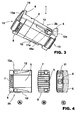
- Figure 3 is a perspective view of the coupled device.
- Figure 4 comprises drawings A, B and C, being:
- Drawing A, a side view, elevated, of the second coupling means;
- Drawing B, a back view, elevated, of the second coupling means;
- Drawing C, a front view, elevated, of the second coupling means.
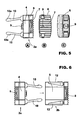
- Figure 5 comprises drawings A, B and C, being:
- Drawing A, a lateral view, elevated, of the first coupling means;
- Drawing B, a back view, elevated, of the first coupling means; and
- Drawing C, a front view, elevated, of the first coupling means.
- Figure 6 is a side view, elevated, of both coupling means in decoupled position.
- Figure 7 is a longitudinal section of both coupling means in decoupled position.
- Figure 8 is another longitudinal section as in figure 7 where the position of placement of the fixation screws is indicated.
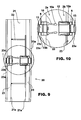
- Figure 9 is a side view, elevated, of a folder with the device placed and in decoupled position.
- Figure 10 is a side view, elevated, of a detail from figure 9.
- Figure 11 is a side view, elevated, of a folder with the device placed and coupled, keeping the folder structurally stabilized.
- Figure 12 is a side view, elevated, of a detail from figure 11.
- In the different figures, the same referral numbers indicate equal or corresponding parts, and the sets of several elements have been marked with letters.
-
- (1)
- Device for closure and structural fastening.
- (2a)
- First coupling means.
- (2b)
- Second coupling means.
- (3)
- Coupling stop.
- (4)
- First coupling body.
- (5)
- Second coupling body.
- (6)
- Fixation base [insert fastener].
- (7)
- Contact wall [insert fastener].
- (8)
- Anchorage opening [formed at the fixation base (6) for the fastening clip (13) of insertion].
- (8a)
- First positional anchorage.
- (8b)
- Second positional anchorage.
- (9)
- Fixation opening.
- (9a)
- Fixation duct.
- (9b)
- Fixation screw.
- (10)
- Elastic cramping arms.
- (10a)
- Cramping head.
- (11)
- Forced wedging cavity.
- (11 a)
- Cramping edge.
- (12)
- Cramping release arms.
- (12a)
- Cramping release terminal.
- (13)
- Fastening clip [insert fastener].
- (13a)
- Fastening body.
- (13b)
- Anchorage body.
- (13c)
- Anchorage hole.
- (14)
- Insert fastening cavity [formed between the fastening body (13a) and the contact wall (7)].
- (20)
- Filing folder.
- (21)
- Back or central part.
- (21 a)
- Longitudinal edges of the back (21).
- (22)
- Fastening hooks.
- (23)
- Covers.
- (23a)
- External edges of the covers (23).
- (23b)
- Inner faces or sides of the covers (23).
- (23c)
- Outer faces or sides of the covers (23).
- In general terms, the present invention refers to a device for the structural closure and fastening of folders that comprises a reciprocal set of coupling means (2a)(2b) which, provided with insert fasteners (6)(13) and fixation means (9)(9a)(9b) that are mounted on the edges (23a) of the covers (23), allows the closure of a filing folder (20) keeping a structural fastening that prevents deformations or allows to correct them in case they occurred.
- More particularly, the present device (1) is applicable to folders (20) for filing elements such as paper or plastic sheets, laminar elements in general, envelopes, envelopes or cases to keep discs [CD¦s, DVD¦s, diskettes], etc. These filing folders (20), usually comprise a back (21) or central part in which an inner face has a set of fastening means or hooks (22) intended to insert the holes of the elements to be filed. From the longitudinal edges (21a) of the back, (21) the mobile covers (23) project -towards both sides- and their mobility allows the opening and closure of the folder (20). Each cover (23) is limited by an outer face (23c), an inner face (23b) and external edges (23a).
- The present device (1) comprises a set of reciprocal coupling means (2a)(2b) integrated by a first (2a) and second (2b) coupling means which, in the present embodiment, are of the box and pin type. These coupling means (2a)(2b) comprise a set of bodies (4)(5) which, as an elastic broach, are pluggable by means of the forced wedging until the assembly of an elastically releasable cramp (10a)(11a).
- The first coupling means (2a) comprises a first body (4) which, on the one hand, forms a fixation base (6) to the folder (20), whereas, on the other hand, has cramping elastic arms (10) which free ends form two cramping heads (10a). These elements constitute the pin part of the coupling.
- The second coupling means comprises a second body (5) which, on the one hand, forma a fixation base (6) to the folder (20), whereas, on the opposite part, forms a forced wedging cavity (11) which constitutes the box part of the coupling.
- At the bottom of the above-mentioned forced wedging cavity (11), there are some cramping edges (11a) intended to the cramping heads (10a) of the first coupling means (2a). Quite behind, there are some cramping releasing terminals (12a) which project from the elastically conveying cramping releasing arms (12).
- The forced wedging cavity (11) presents a progressive widening from the entrance or stop (3), so that said progressive widening constitutes a cooperating means with the functionality of the coupling means (2a)(2b) [when it couples, it gradually compresses the elastic cramping arms (10) and when it decouples, it cooperates with said decoupling].
- On the other hand, both fixation bases (6) have a contact wall (7) that contacts the inner face (23b) of the cover (23). This contact wall (7) can be provided with non-slip means such as, for instance, some protruding embossments that can be sharpened so that their action against the cover (23) prevents undesirable movements.
- The fixation bases (6) also have anchorage openings where some fastening clips (13) are anchored. The latter (13) can be comprised by elastic laminar means [for example, they can be structured in resistant and elastically flexible metals].
- In this manner, the contact wall (7) and the fastening clip (13) complement each other to form an insert fastener which fastening cavity (14) or wedge is prepared to receive the external edge (23a) of the cover (23), on which they act as a fastening little claw.
- The fastening clip (13) is folded so that a fastening sector or body (13a) and an anchorage sector or body is distinguished (13b).
- It has been provided that the anchorage body (13b) of the fastening clip (13) has a set of alternative positional anchorage means (8a)(8b), which, as positional variation means, are situated in the anchorage opening (8) of the fixation base (6).
- The anchorage body (13b) also has an anchorage hole (13c) to allow the action of the fixation means (9)(9a)(9b) constituted [for example] by fixation screws (9b) which, placed into fixation ducts (9a) that cross the fixation bases (6), are capable of projecting and exerting pressure on the part of the cover (23) able to be inserted in the fastening wedge or cavity (14). Upon crossing the hole of the fastening clip (13), the fixation screws (9b) also form part of the anchorage of said clip (13) in the fixation base (6).
- To place the present device (1), the edges (23a) of the covers (23) are inserted in the fastening cavity (14) of the insert fasteners formed by the fixation bases (6) and the fastening clips (13). In these conditions, the contact walls (7) remain attached to the inner faces (23b) of the covers (23), whereas the fastening bodies (13a) of the clips (13) stay attached to the outer faces (23c) of said covers (23) of the folder (20).
- The fixation screws (9b) are placed in the fixation ducts (9a) so that, projecting themselves through the anchorage opening (8) of the fixation base (6) and through the anchorage holes (13c) of the fastening clips (13), exert pressure on the part of the cover (23) inserted in the fastening cavity (14).
- With the device (1) so arranged, the first coupling means (2a) can be inserted in the second (2b), with which, as a mode of elastic broach of forced wedging, said first means (2a) enters until reaching the coupling stop (3). This is possible because the elastic cramping arms (10) are bent by forced insertion and slip within the wedging cavity (11) until the heads (10a) encase into the cramping edges (11a) and said cramp is assembled.
- In these conditions, the fastening and fixation exerted by the means described, keep the folder (20) structurally unaltered, preventing its bending, folding or disassembling.
- To disassemble the cramp, it is enough to press the releasing arms (12) which releasing terminals (12a) move the cramping heads (10a) from their position against the cramping edges (11 a). When the cramp is released, the coupling means (2a)(2b) can be decoupled and the folder (20) can be opened.
- It has been provided that the device (1) may have different sizes that facilitate its application to different types of folders (20). For example, that the separation between both insert fasteners (6)(13) is shorter than the width of the back (21) of the application folder (20). In this manner, the folder (20) can be kept adequately closed without the covers (23) being arranged in a parallel manner.
Claims (17)
- Device for the structural closure and fastening of folders, which is applicable to filing folders, comprising a back or central part on which inner part there are fastening means of the elements to be filed and from which longitudinal edges project the mobile covers limited by external faces, inner faces and external edges, characterized by the presence in combination of:- A set of reciprocal coupling means;- Basis of fixation to the inner faces of the respective covers, components of the application folder, in said reciprocal coupling means;- Insert fasteners prepared to serve as wedge for the edges of said covers, in each fixation base;- Fixation means which, applicable to the inner faces of the covers, act in said fixation bases as a complement of said insert fasteners.
- Device for the structural closure and fastening of folders, according with claim 1, which comprises a set of reciprocal coupling means of the box and pin type.
- Device for the structural closure and fastening of folders, according with claim 1, in which the coupling means comprise, at least, a set of pieces that, as an elastic broach, are connected by means of forced wedging until the assembly of an elastically releasable cramp.
- Device for the structural closure and fastening of folders, according with claim 1, in which the elastically releasable cramp is double.
- Device for the structural closure and fastening of folders, according with claim 3, in which the elastically releasable cramp comprises cramping releasing means capable of moving its assembly position to each cramping means.
- Device for the structural closure and fastening of folders, according with claim 1, in which the fixation bases comprise respective contact walls with the cover provided with non-slip means.
- Device for the structural closure and fastening of folders, according with claim 6, in which the non-slip means comprise protruding embossments.
- Device for the structural closure and fastening of folders, according with claim 6, in which the non-slip means comprise sharpened protruding embossments.
- Device for the structural closure and fastening of folders, according with claim 1, in which each fixation base, the insert fastener is comprised by the contact wall and at least a clip, being said contact wall and said clip arranged in such a manner that they complement each other in the assembly of a wedge prepared to receive the edge of a folder cover.
- Device for the structural closure and fastening of folders, according with claim 1, in which the clip is an elastic laminar means which has anchorage means in the fixation base.
- Device for the structural closure and fastening of folders, according with claim 9, in which the clip is an elastic laminar means which has a set of alternative anchorage means that enable its positional variation in the fixation base.
- Device for the structural closure and fastening of folders, according with claim 9, in which the clip is an elastic laminar means that, faced with the fixation base, comprises a fastening little claw applicable to the application folder cover.
- Device for the structural closure and fastening of folders, according with claim 9, in which the clip is an elastic laminar means constituted by a steel strip.
- Device for the structural closure and fastening of folders, according with claim 1, in which the fixation means comprise screws that, passing through the fixation base, are capable of projecting and exerting pressure on the part of the cover which inserts into the wedge.
- Device for the structural closure and fastening of folders, according with claim 14, in which the fixation means comprise screws that, in addition to passing through the fixation base with a capacity to project and exert pressure over the part of the cover that inserts into the wedge, also pass through the clip so that they form the anchorage of said clip in said fixation base.
- Device for the structural closure and fastening of folders, according with claim 1, in which the active coupling means determine that the separation between both insert fasteners is shorter than the width of the back of the application folder.
- Device for the structural closure and fastening of folders, according with claim 2, in which the box coupling means comprises an insert cavity with a progressive widening from the entrance of said cavity, so that said progressive widening constitutes a cooperating means with the functionality of the coupling means.
Applications Claiming Priority (1)
| Application Number | Priority Date | Filing Date | Title |
|---|---|---|---|
| ARP060103179A AR057080A1 (en) | 2006-07-24 | 2006-07-24 | DEVICE FOR CLOSURE AND STRUCTURAL HOLDING OF FOLDERS |
Publications (3)
| Publication Number | Publication Date |
|---|---|
| EP1882599A2 true EP1882599A2 (en) | 2008-01-30 |
| EP1882599A3 EP1882599A3 (en) | 2010-04-07 |
| EP1882599B1 EP1882599B1 (en) | 2011-10-26 |
Family
ID=38686838
Family Applications (1)
| Application Number | Title | Priority Date | Filing Date |
|---|---|---|---|
| EP07014391A Not-in-force EP1882599B1 (en) | 2006-07-24 | 2007-07-23 | Device for the structural closure and fastening of folders |
Country Status (6)
| Country | Link |
|---|---|
| US (1) | US20080017538A1 (en) |
| EP (1) | EP1882599B1 (en) |
| AR (1) | AR057080A1 (en) |
| AT (1) | ATE530354T1 (en) |
| BR (1) | BRPI0702449A (en) |
| ES (1) | ES2376393T3 (en) |
Families Citing this family (4)
| Publication number | Priority date | Publication date | Assignee | Title |
|---|---|---|---|---|
| TWI505063B (en) * | 2009-12-11 | 2015-10-21 | Kye Systems Corp | The structure of the computer peripheral device |
| US20130129404A1 (en) * | 2011-11-21 | 2013-05-23 | Chun Yuan Chang | Two-way moving structure of a file folder |
| CN106579797B (en) * | 2017-01-23 | 2023-03-14 | 安徽工程大学 | Bookshelf capable of being folded and unfolded |
| US10386939B2 (en) * | 2017-09-07 | 2019-08-20 | Dexin Electronic Ltd. | Mouse |
Family Cites Families (22)
| Publication number | Priority date | Publication date | Assignee | Title |
|---|---|---|---|---|
| US2804872A (en) * | 1953-04-10 | 1957-09-03 | Kraut Erich | Looseleaf book |
| NL8301125A (en) * | 1983-03-30 | 1984-10-16 | R L Imprimerie Oberthur Sa | Note book closing catch - has curved hook with spring action running on slideway fitted to back cover |
| US4569613A (en) * | 1983-06-27 | 1986-02-11 | Thomas Ralph D | Snap on device for hardcover ring binder |
| US4524991A (en) * | 1983-06-27 | 1985-06-25 | Thomas Ralph D | Snap on device for hardcover ring binder |
| US4531764A (en) * | 1983-10-17 | 1985-07-30 | Chang Kwei K | Loose leaf binder spacer |
| US4744689A (en) * | 1985-08-02 | 1988-05-17 | Adam Sternberg | Binder with closure |
| US4750884A (en) * | 1985-08-09 | 1988-06-14 | American Trading And Production Corporation | Binder backing for notebooks |
| US5348971A (en) * | 1988-12-16 | 1994-09-20 | Roussel Uclaf | Indanes useful as analgesics |
| US4997207A (en) * | 1989-06-22 | 1991-03-05 | Feldman Richard L | Notebook cover restraining system and method of use |
| US5002416A (en) * | 1990-05-07 | 1991-03-26 | Serzen Russell D | Cover spacer for binders |
| US5267804A (en) * | 1991-09-30 | 1993-12-07 | Baumgarten Hans J | Apparatus and method for making a binder self-supporting |
| ZA946000B (en) * | 1993-08-11 | 1996-02-12 | Designodev Ltd | A file stiffener |
| TW301145U (en) * | 1993-10-16 | 1997-03-21 | Yoshida Kogyo Kk | Buckle |
| US5380111A (en) * | 1993-12-20 | 1995-01-10 | Westrom; S. John | Releasable spacer assembly for binders |
| US5695295A (en) * | 1994-05-10 | 1997-12-09 | Fikre Ayele | Restraining device for binder cover members |
| US5590909A (en) * | 1994-11-23 | 1997-01-07 | Fikre Ayele | File cover restraining device |
| USD366496S (en) * | 1994-12-29 | 1996-01-23 | Yiu Felix H | Ring binder stabilizer |
| US5634666A (en) * | 1995-03-09 | 1997-06-03 | Lee; Dong H. | Binder with cover spacer |
| US5947521A (en) * | 1997-09-03 | 1999-09-07 | Stucki; Ronald | Binder spacer |
| AU2000236662A1 (en) * | 1999-04-09 | 2000-11-14 | Press Products (Proprietary) Limited | A file cover assembly |
| JP2001096949A (en) * | 1999-09-28 | 2001-04-10 | Midori:Kk | Regulating fitment for opening/closing operation of front /back cover parts of filing utensil and the like |
| US6944918B1 (en) * | 2003-08-05 | 2005-09-20 | Accu-Mold Corp. | Ring binder clip |
-
2006
- 2006-07-24 AR ARP060103179A patent/AR057080A1/en active IP Right Grant
-
2007
- 2007-07-23 ES ES07014391T patent/ES2376393T3/en active Active
- 2007-07-23 US US11/880,522 patent/US20080017538A1/en not_active Abandoned
- 2007-07-23 EP EP07014391A patent/EP1882599B1/en not_active Not-in-force
- 2007-07-23 AT AT07014391T patent/ATE530354T1/en not_active IP Right Cessation
- 2007-07-23 BR BRPI0702449-5A patent/BRPI0702449A/en not_active IP Right Cessation
Also Published As
| Publication number | Publication date |
|---|---|
| EP1882599B1 (en) | 2011-10-26 |
| ATE530354T1 (en) | 2011-11-15 |
| US20080017538A1 (en) | 2008-01-24 |
| EP1882599A3 (en) | 2010-04-07 |
| BRPI0702449A (en) | 2008-03-11 |
| ES2376393T3 (en) | 2012-03-13 |
| AR057080A1 (en) | 2007-11-14 |
Similar Documents
| Publication | Publication Date | Title |
|---|---|---|
| EP1882599B1 (en) | Device for the structural closure and fastening of folders | |
| JP2679694B2 (en) | holder | |
| US8157230B2 (en) | Shelf support | |
| US5634666A (en) | Binder with cover spacer | |
| US20090067915A1 (en) | Ring binder | |
| JP6426792B2 (en) | Handle insertion type binding clip | |
| US20050103659A1 (en) | Means of attaching rigid pages to a book-like cover | |
| US5813734A (en) | Filing guide | |
| US20080298883A1 (en) | Ring Binder Kit and Fastening System | |
| US20070048073A1 (en) | Ring binder having a clip | |
| US20070048079A1 (en) | Ring binder having a clip | |
| US7654765B2 (en) | Ring binder having a clip | |
| GB2297063A (en) | File | |
| CN107554129A (en) | Document holding member and file | |
| JP2687913B2 (en) | Sticky note storage container | |
| JPH05504099A (en) | document punch | |
| KR100652813B1 (en) | Book and | |
| JP5165514B2 (en) | Document holder | |
| JP3071585U (en) | Sticky note storage box | |
| JPH045345Y2 (en) | ||
| JP3004579U (en) | Disk storage mount | |
| JP3020310U (en) | File | |
| JP2007062377A (en) | Fastening system for ring binder mechanism | |
| EP2103448A1 (en) | Hanging file bar and method for using same | |
| US20080292387A1 (en) | Paper fastener prong cover |
Legal Events
| Date | Code | Title | Description |
|---|---|---|---|
| PUAI | Public reference made under article 153(3) epc to a published international application that has entered the european phase |
Free format text: ORIGINAL CODE: 0009012 |
|
| AK | Designated contracting states |
Kind code of ref document: A2 Designated state(s): AT BE BG CH CY CZ DE DK EE ES FI FR GB GR HU IE IS IT LI LT LU LV MC MT NL PL PT RO SE SI SK TR |
|
| AX | Request for extension of the european patent |
Extension state: AL BA HR MK YU |
|
| PUAL | Search report despatched |
Free format text: ORIGINAL CODE: 0009013 |
|
| AK | Designated contracting states |
Kind code of ref document: A3 Designated state(s): AT BE BG CH CY CZ DE DK EE ES FI FR GB GR HU IE IS IT LI LT LU LV MC MT NL PL PT RO SE SI SK TR |
|
| AX | Request for extension of the european patent |
Extension state: AL BA HR MK RS |
|
| 17P | Request for examination filed |
Effective date: 20101006 |
|
| 17Q | First examination report despatched |
Effective date: 20101112 |
|
| AKX | Designation fees paid |
Designated state(s): AT BE BG CH CY LI |
|
| RBV | Designated contracting states (corrected) |
Designated state(s): AT BE BG CH CY CZ DE DK EE ES FI FR GB GR HU IE IS IT LI LT LU LV MC MT NL PL PT RO SE SI SK TR |
|
| REG | Reference to a national code |
Ref country code: DE Ref legal event code: 8566 |
|
| GRAP | Despatch of communication of intention to grant a patent |
Free format text: ORIGINAL CODE: EPIDOSNIGR1 |
|
| RIC1 | Information provided on ipc code assigned before grant |
Ipc: B42F 13/00 20060101AFI20110404BHEP |
|
| GRAS | Grant fee paid |
Free format text: ORIGINAL CODE: EPIDOSNIGR3 |
|
| GRAA | (expected) grant |
Free format text: ORIGINAL CODE: 0009210 |
|
| AK | Designated contracting states |
Kind code of ref document: B1 Designated state(s): AT BE BG CH CY CZ DE DK EE ES FI FR GB GR HU IE IS IT LI LT LU LV MC MT NL PL PT RO SE SI SK TR |
|
| REG | Reference to a national code |
Ref country code: GB Ref legal event code: FG4D |
|
| REG | Reference to a national code |
Ref country code: CH Ref legal event code: EP |
|
| REG | Reference to a national code |
Ref country code: IE Ref legal event code: FG4D |
|
| REG | Reference to a national code |
Ref country code: DE Ref legal event code: R096 Ref document number: 602007018139 Country of ref document: DE Effective date: 20111222 |
|
| REG | Reference to a national code |
Ref country code: NL Ref legal event code: VDEP Effective date: 20111026 |
|
| REG | Reference to a national code |
Ref country code: ES Ref legal event code: FG2A Ref document number: 2376393 Country of ref document: ES Kind code of ref document: T3 Effective date: 20120313 |
|
| LTIE | Lt: invalidation of european patent or patent extension |
Effective date: 20111026 |
|
| REG | Reference to a national code |
Ref country code: AT Ref legal event code: MK05 Ref document number: 530354 Country of ref document: AT Kind code of ref document: T Effective date: 20111026 |
|
| PG25 | Lapsed in a contracting state [announced via postgrant information from national office to epo] |
Ref country code: IS Free format text: LAPSE BECAUSE OF FAILURE TO SUBMIT A TRANSLATION OF THE DESCRIPTION OR TO PAY THE FEE WITHIN THE PRESCRIBED TIME-LIMIT Effective date: 20120226 Ref country code: BE Free format text: LAPSE BECAUSE OF FAILURE TO SUBMIT A TRANSLATION OF THE DESCRIPTION OR TO PAY THE FEE WITHIN THE PRESCRIBED TIME-LIMIT Effective date: 20111026 Ref country code: LT Free format text: LAPSE BECAUSE OF FAILURE TO SUBMIT A TRANSLATION OF THE DESCRIPTION OR TO PAY THE FEE WITHIN THE PRESCRIBED TIME-LIMIT Effective date: 20111026 |
|
| PG25 | Lapsed in a contracting state [announced via postgrant information from national office to epo] |
Ref country code: NL Free format text: LAPSE BECAUSE OF FAILURE TO SUBMIT A TRANSLATION OF THE DESCRIPTION OR TO PAY THE FEE WITHIN THE PRESCRIBED TIME-LIMIT Effective date: 20111026 Ref country code: SI Free format text: LAPSE BECAUSE OF FAILURE TO SUBMIT A TRANSLATION OF THE DESCRIPTION OR TO PAY THE FEE WITHIN THE PRESCRIBED TIME-LIMIT Effective date: 20111026 Ref country code: SE Free format text: LAPSE BECAUSE OF FAILURE TO SUBMIT A TRANSLATION OF THE DESCRIPTION OR TO PAY THE FEE WITHIN THE PRESCRIBED TIME-LIMIT Effective date: 20111026 Ref country code: LV Free format text: LAPSE BECAUSE OF FAILURE TO SUBMIT A TRANSLATION OF THE DESCRIPTION OR TO PAY THE FEE WITHIN THE PRESCRIBED TIME-LIMIT Effective date: 20111026 Ref country code: PT Free format text: LAPSE BECAUSE OF FAILURE TO SUBMIT A TRANSLATION OF THE DESCRIPTION OR TO PAY THE FEE WITHIN THE PRESCRIBED TIME-LIMIT Effective date: 20120227 Ref country code: GR Free format text: LAPSE BECAUSE OF FAILURE TO SUBMIT A TRANSLATION OF THE DESCRIPTION OR TO PAY THE FEE WITHIN THE PRESCRIBED TIME-LIMIT Effective date: 20120127 Ref country code: PL Free format text: LAPSE BECAUSE OF FAILURE TO SUBMIT A TRANSLATION OF THE DESCRIPTION OR TO PAY THE FEE WITHIN THE PRESCRIBED TIME-LIMIT Effective date: 20111026 |
|
| PG25 | Lapsed in a contracting state [announced via postgrant information from national office to epo] |
Ref country code: CY Free format text: LAPSE BECAUSE OF FAILURE TO SUBMIT A TRANSLATION OF THE DESCRIPTION OR TO PAY THE FEE WITHIN THE PRESCRIBED TIME-LIMIT Effective date: 20111026 |
|
| PG25 | Lapsed in a contracting state [announced via postgrant information from national office to epo] |
Ref country code: DK Free format text: LAPSE BECAUSE OF FAILURE TO SUBMIT A TRANSLATION OF THE DESCRIPTION OR TO PAY THE FEE WITHIN THE PRESCRIBED TIME-LIMIT Effective date: 20111026 Ref country code: BG Free format text: LAPSE BECAUSE OF FAILURE TO SUBMIT A TRANSLATION OF THE DESCRIPTION OR TO PAY THE FEE WITHIN THE PRESCRIBED TIME-LIMIT Effective date: 20120126 Ref country code: SK Free format text: LAPSE BECAUSE OF FAILURE TO SUBMIT A TRANSLATION OF THE DESCRIPTION OR TO PAY THE FEE WITHIN THE PRESCRIBED TIME-LIMIT Effective date: 20111026 Ref country code: EE Free format text: LAPSE BECAUSE OF FAILURE TO SUBMIT A TRANSLATION OF THE DESCRIPTION OR TO PAY THE FEE WITHIN THE PRESCRIBED TIME-LIMIT Effective date: 20111026 Ref country code: CZ Free format text: LAPSE BECAUSE OF FAILURE TO SUBMIT A TRANSLATION OF THE DESCRIPTION OR TO PAY THE FEE WITHIN THE PRESCRIBED TIME-LIMIT Effective date: 20111026 |
|
| PG25 | Lapsed in a contracting state [announced via postgrant information from national office to epo] |
Ref country code: RO Free format text: LAPSE BECAUSE OF FAILURE TO SUBMIT A TRANSLATION OF THE DESCRIPTION OR TO PAY THE FEE WITHIN THE PRESCRIBED TIME-LIMIT Effective date: 20111026 |
|
| PLBE | No opposition filed within time limit |
Free format text: ORIGINAL CODE: 0009261 |
|
| STAA | Information on the status of an ep patent application or granted ep patent |
Free format text: STATUS: NO OPPOSITION FILED WITHIN TIME LIMIT |
|
| 26N | No opposition filed |
Effective date: 20120727 |
|
| REG | Reference to a national code |
Ref country code: DE Ref legal event code: R097 Ref document number: 602007018139 Country of ref document: DE Effective date: 20120727 |
|
| PG25 | Lapsed in a contracting state [announced via postgrant information from national office to epo] |
Ref country code: AT Free format text: LAPSE BECAUSE OF FAILURE TO SUBMIT A TRANSLATION OF THE DESCRIPTION OR TO PAY THE FEE WITHIN THE PRESCRIBED TIME-LIMIT Effective date: 20111026 |
|
| PG25 | Lapsed in a contracting state [announced via postgrant information from national office to epo] |
Ref country code: MC Free format text: LAPSE BECAUSE OF NON-PAYMENT OF DUE FEES Effective date: 20120731 |
|
| REG | Reference to a national code |
Ref country code: CH Ref legal event code: PL |
|
| GBPC | Gb: european patent ceased through non-payment of renewal fee |
Effective date: 20120723 |
|
| REG | Reference to a national code |
Ref country code: FR Ref legal event code: ST Effective date: 20130329 |
|
| PG25 | Lapsed in a contracting state [announced via postgrant information from national office to epo] |
Ref country code: CH Free format text: LAPSE BECAUSE OF NON-PAYMENT OF DUE FEES Effective date: 20120731 Ref country code: FR Free format text: LAPSE BECAUSE OF NON-PAYMENT OF DUE FEES Effective date: 20120731 Ref country code: DE Free format text: LAPSE BECAUSE OF NON-PAYMENT OF DUE FEES Effective date: 20130201 Ref country code: GB Free format text: LAPSE BECAUSE OF NON-PAYMENT OF DUE FEES Effective date: 20120723 Ref country code: LI Free format text: LAPSE BECAUSE OF NON-PAYMENT OF DUE FEES Effective date: 20120731 |
|
| REG | Reference to a national code |
Ref country code: IE Ref legal event code: MM4A |
|
| REG | Reference to a national code |
Ref country code: DE Ref legal event code: R119 Ref document number: 602007018139 Country of ref document: DE Effective date: 20130201 |
|
| PG25 | Lapsed in a contracting state [announced via postgrant information from national office to epo] |
Ref country code: FI Free format text: LAPSE BECAUSE OF FAILURE TO SUBMIT A TRANSLATION OF THE DESCRIPTION OR TO PAY THE FEE WITHIN THE PRESCRIBED TIME-LIMIT Effective date: 20111026 |
|
| PG25 | Lapsed in a contracting state [announced via postgrant information from national office to epo] |
Ref country code: IE Free format text: LAPSE BECAUSE OF NON-PAYMENT OF DUE FEES Effective date: 20120723 Ref country code: MT Free format text: LAPSE BECAUSE OF FAILURE TO SUBMIT A TRANSLATION OF THE DESCRIPTION OR TO PAY THE FEE WITHIN THE PRESCRIBED TIME-LIMIT Effective date: 20111026 |
|
| PG25 | Lapsed in a contracting state [announced via postgrant information from national office to epo] |
Ref country code: TR Free format text: LAPSE BECAUSE OF FAILURE TO SUBMIT A TRANSLATION OF THE DESCRIPTION OR TO PAY THE FEE WITHIN THE PRESCRIBED TIME-LIMIT Effective date: 20111026 |
|
| PG25 | Lapsed in a contracting state [announced via postgrant information from national office to epo] |
Ref country code: LU Free format text: LAPSE BECAUSE OF NON-PAYMENT OF DUE FEES Effective date: 20120723 |
|
| PG25 | Lapsed in a contracting state [announced via postgrant information from national office to epo] |
Ref country code: HU Free format text: LAPSE BECAUSE OF FAILURE TO SUBMIT A TRANSLATION OF THE DESCRIPTION OR TO PAY THE FEE WITHIN THE PRESCRIBED TIME-LIMIT Effective date: 20070723 |
|
| PGFP | Annual fee paid to national office [announced via postgrant information from national office to epo] |
Ref country code: ES Payment date: 20150730 Year of fee payment: 9 |
|
| PGFP | Annual fee paid to national office [announced via postgrant information from national office to epo] |
Ref country code: IT Payment date: 20150722 Year of fee payment: 9 |
|
| PG25 | Lapsed in a contracting state [announced via postgrant information from national office to epo] |
Ref country code: IT Free format text: LAPSE BECAUSE OF NON-PAYMENT OF DUE FEES Effective date: 20160723 |
|
| PG25 | Lapsed in a contracting state [announced via postgrant information from national office to epo] |
Ref country code: ES Free format text: LAPSE BECAUSE OF NON-PAYMENT OF DUE FEES Effective date: 20160724 |
|
| REG | Reference to a national code |
Ref country code: ES Ref legal event code: FD2A Effective date: 20181130 |