EP1882528A1 - Functional surface finish and method of its application to a material surface - Google Patents
Functional surface finish and method of its application to a material surface Download PDFInfo
- Publication number
- EP1882528A1 EP1882528A1 EP20060076464 EP06076464A EP1882528A1 EP 1882528 A1 EP1882528 A1 EP 1882528A1 EP 20060076464 EP20060076464 EP 20060076464 EP 06076464 A EP06076464 A EP 06076464A EP 1882528 A1 EP1882528 A1 EP 1882528A1
- Authority
- EP
- European Patent Office
- Prior art keywords
- finish
- functional
- moiety
- groups
- anchoring
- Prior art date
- Legal status (The legal status is an assumption and is not a legal conclusion. Google has not performed a legal analysis and makes no representation as to the accuracy of the status listed.)
- Withdrawn
Links
- 239000000463 material Substances 0.000 title claims abstract description 69
- 238000000034 method Methods 0.000 title claims abstract description 35
- 238000004873 anchoring Methods 0.000 claims abstract description 49
- 230000002441 reversible effect Effects 0.000 claims abstract description 29
- 239000000203 mixture Substances 0.000 claims abstract description 26
- 239000003795 chemical substances by application Substances 0.000 claims description 36
- 238000006243 chemical reaction Methods 0.000 claims description 18
- 125000000217 alkyl group Chemical group 0.000 claims description 8
- -1 cyclic anhydride Chemical class 0.000 claims description 8
- YLQBMQCUIZJEEH-UHFFFAOYSA-N Furan Chemical compound C=1C=COC=1 YLQBMQCUIZJEEH-UHFFFAOYSA-N 0.000 claims description 6
- YTPLMLYBLZKORZ-UHFFFAOYSA-N Thiophene Chemical compound C=1C=CSC=1 YTPLMLYBLZKORZ-UHFFFAOYSA-N 0.000 claims description 6
- MWPLVEDNUUSJAV-UHFFFAOYSA-N anthracene Chemical compound C1=CC=CC2=CC3=CC=CC=C3C=C21 MWPLVEDNUUSJAV-UHFFFAOYSA-N 0.000 claims description 6
- 125000002887 hydroxy group Chemical group [H]O* 0.000 claims description 6
- 230000000979 retarding effect Effects 0.000 claims description 6
- VZCYOOQTPOCHFL-UHFFFAOYSA-N trans-butenedioic acid Natural products OC(=O)C=CC(O)=O VZCYOOQTPOCHFL-UHFFFAOYSA-N 0.000 claims description 6
- 238000006117 Diels-Alder cycloaddition reaction Methods 0.000 claims description 5
- 230000015572 biosynthetic process Effects 0.000 claims description 5
- 239000005871 repellent Substances 0.000 claims description 5
- 239000002689 soil Substances 0.000 claims description 5
- 238000004078 waterproofing Methods 0.000 claims description 5
- ZAMOUSCENKQFHK-UHFFFAOYSA-N Chlorine atom Chemical compound [Cl] ZAMOUSCENKQFHK-UHFFFAOYSA-N 0.000 claims description 4
- 239000004593 Epoxy Substances 0.000 claims description 4
- JOYRKODLDBILNP-UHFFFAOYSA-N Ethyl urethane Chemical compound CCOC(N)=O JOYRKODLDBILNP-UHFFFAOYSA-N 0.000 claims description 4
- 230000000845 anti-microbial effect Effects 0.000 claims description 4
- 125000003178 carboxy group Chemical group [H]OC(*)=O 0.000 claims description 4
- 229910052801 chlorine Inorganic materials 0.000 claims description 4
- 239000000460 chlorine Substances 0.000 claims description 4
- 150000001875 compounds Chemical class 0.000 claims description 4
- 125000002897 diene group Chemical group 0.000 claims description 4
- 230000002209 hydrophobic effect Effects 0.000 claims description 4
- 229920000642 polymer Polymers 0.000 claims description 4
- WKBOTKDWSSQWDR-UHFFFAOYSA-N Bromine atom Chemical compound [Br] WKBOTKDWSSQWDR-UHFFFAOYSA-N 0.000 claims description 3
- 238000005698 Diels-Alder reaction Methods 0.000 claims description 3
- PEEHTFAAVSWFBL-UHFFFAOYSA-N Maleimide Chemical compound O=C1NC(=O)C=C1 PEEHTFAAVSWFBL-UHFFFAOYSA-N 0.000 claims description 3
- 239000002202 Polyethylene glycol Substances 0.000 claims description 3
- 239000004743 Polypropylene Substances 0.000 claims description 3
- 150000001252 acrylic acid derivatives Chemical class 0.000 claims description 3
- 150000001336 alkenes Chemical class 0.000 claims description 3
- 125000002355 alkine group Chemical group 0.000 claims description 3
- GDTBXPJZTBHREO-UHFFFAOYSA-N bromine Substances BrBr GDTBXPJZTBHREO-UHFFFAOYSA-N 0.000 claims description 3
- 229910052794 bromium Inorganic materials 0.000 claims description 3
- 229920001577 copolymer Polymers 0.000 claims description 3
- VZCYOOQTPOCHFL-OWOJBTEDSA-L fumarate(2-) Chemical compound [O-]C(=O)\C=C\C([O-])=O VZCYOOQTPOCHFL-OWOJBTEDSA-L 0.000 claims description 3
- 125000001475 halogen functional group Chemical group 0.000 claims description 3
- 229920001477 hydrophilic polymer Polymers 0.000 claims description 3
- VZCYOOQTPOCHFL-UPHRSURJSA-N maleic acid Chemical compound OC(=O)\C=C/C(O)=O VZCYOOQTPOCHFL-UPHRSURJSA-N 0.000 claims description 3
- FPYJFEHAWHCUMM-UHFFFAOYSA-N maleic anhydride Chemical compound O=C1OC(=O)C=C1 FPYJFEHAWHCUMM-UHFFFAOYSA-N 0.000 claims description 3
- 150000002734 metacrylic acid derivatives Chemical class 0.000 claims description 3
- 229920001223 polyethylene glycol Polymers 0.000 claims description 3
- 229920001155 polypropylene Polymers 0.000 claims description 3
- 125000000168 pyrrolyl group Chemical group 0.000 claims description 3
- 229930192474 thiophene Natural products 0.000 claims description 3
- AVXURJPOCDRRFD-UHFFFAOYSA-N Hydroxylamine Chemical compound ON AVXURJPOCDRRFD-UHFFFAOYSA-N 0.000 claims description 2
- QYTDEUPAUMOIOP-UHFFFAOYSA-N TEMPO Chemical group CC1(C)CCCC(C)(C)N1[O] QYTDEUPAUMOIOP-UHFFFAOYSA-N 0.000 claims description 2
- 150000001299 aldehydes Chemical group 0.000 claims description 2
- 150000001408 amides Chemical class 0.000 claims description 2
- 238000006471 dimerization reaction Methods 0.000 claims description 2
- 125000001145 hydrido group Chemical group *[H] 0.000 claims description 2
- 150000003949 imides Chemical class 0.000 claims description 2
- 125000005439 maleimidyl group Chemical group C1(C=CC(N1*)=O)=O 0.000 claims description 2
- 230000001404 mediated effect Effects 0.000 claims description 2
- GDOPTJXRTPNYNR-UHFFFAOYSA-N methyl-cyclopentane Natural products CC1CCCC1 GDOPTJXRTPNYNR-UHFFFAOYSA-N 0.000 claims description 2
- 125000000018 nitroso group Chemical group N(=O)* 0.000 claims description 2
- 125000000962 organic group Chemical group 0.000 claims description 2
- 230000009467 reduction Effects 0.000 claims description 2
- 229920001296 polysiloxane Polymers 0.000 claims 2
- RTAQQCXQSZGOHL-UHFFFAOYSA-N Titanium Chemical compound [Ti] RTAQQCXQSZGOHL-UHFFFAOYSA-N 0.000 claims 1
- 150000001412 amines Chemical class 0.000 claims 1
- 125000000524 functional group Chemical group 0.000 description 13
- 239000004753 textile Substances 0.000 description 13
- 230000008569 process Effects 0.000 description 11
- 239000002904 solvent Substances 0.000 description 9
- XLYOFNOQVPJJNP-UHFFFAOYSA-N water Substances O XLYOFNOQVPJJNP-UHFFFAOYSA-N 0.000 description 9
- 239000000126 substance Substances 0.000 description 8
- 239000002023 wood Substances 0.000 description 6
- 238000011282 treatment Methods 0.000 description 4
- 125000003277 amino group Chemical group 0.000 description 3
- 239000000919 ceramic Substances 0.000 description 3
- 230000000295 complement effect Effects 0.000 description 3
- 239000003063 flame retardant Substances 0.000 description 3
- 239000011521 glass Substances 0.000 description 3
- 239000002184 metal Substances 0.000 description 3
- 229910052751 metal Inorganic materials 0.000 description 3
- 230000004048 modification Effects 0.000 description 3
- 238000012986 modification Methods 0.000 description 3
- 239000000758 substrate Substances 0.000 description 3
- YTVQIZRDLKWECQ-UHFFFAOYSA-N 2-benzoylcyclohexan-1-one Chemical compound C=1C=CC=CC=1C(=O)C1CCCCC1=O YTVQIZRDLKWECQ-UHFFFAOYSA-N 0.000 description 2
- VEORPZCZECFIRK-UHFFFAOYSA-N 3,3',5,5'-tetrabromobisphenol A Chemical compound C=1C(Br)=C(O)C(Br)=CC=1C(C)(C)C1=CC(Br)=C(O)C(Br)=C1 VEORPZCZECFIRK-UHFFFAOYSA-N 0.000 description 2
- IJGRMHOSHXDMSA-UHFFFAOYSA-N Atomic nitrogen Chemical compound N#N IJGRMHOSHXDMSA-UHFFFAOYSA-N 0.000 description 2
- 238000005299 abrasion Methods 0.000 description 2
- 239000004599 antimicrobial Substances 0.000 description 2
- 239000012620 biological material Substances 0.000 description 2
- 125000004432 carbon atom Chemical group C* 0.000 description 2
- 239000011248 coating agent Substances 0.000 description 2
- 238000000576 coating method Methods 0.000 description 2
- 239000000835 fiber Substances 0.000 description 2
- 238000007730 finishing process Methods 0.000 description 2
- 239000010985 leather Substances 0.000 description 2
- 239000000123 paper Substances 0.000 description 2
- 239000004033 plastic Substances 0.000 description 2
- 229920003023 plastic Polymers 0.000 description 2
- 239000002481 rotproofing Substances 0.000 description 2
- 239000000243 solution Substances 0.000 description 2
- YFSUTJLHUFNCNZ-UHFFFAOYSA-M 1,1,2,2,3,3,4,4,5,5,6,6,7,7,8,8,8-heptadecafluorooctane-1-sulfonate Chemical compound [O-]S(=O)(=O)C(F)(F)C(F)(F)C(F)(F)C(F)(F)C(F)(F)C(F)(F)C(F)(F)C(F)(F)F YFSUTJLHUFNCNZ-UHFFFAOYSA-M 0.000 description 1
- RNFJDJUURJAICM-UHFFFAOYSA-N 2,2,4,4,6,6-hexaphenoxy-1,3,5-triaza-2$l^{5},4$l^{5},6$l^{5}-triphosphacyclohexa-1,3,5-triene Chemical compound N=1P(OC=2C=CC=CC=2)(OC=2C=CC=CC=2)=NP(OC=2C=CC=CC=2)(OC=2C=CC=CC=2)=NP=1(OC=1C=CC=CC=1)OC1=CC=CC=C1 RNFJDJUURJAICM-UHFFFAOYSA-N 0.000 description 1
- OKTJSMMVPCPJKN-UHFFFAOYSA-N Carbon Chemical compound [C] OKTJSMMVPCPJKN-UHFFFAOYSA-N 0.000 description 1
- 229920000742 Cotton Polymers 0.000 description 1
- 241000238631 Hexapoda Species 0.000 description 1
- 241001492414 Marina Species 0.000 description 1
- 239000004952 Polyamide Substances 0.000 description 1
- 239000004372 Polyvinyl alcohol Substances 0.000 description 1
- 229920001328 Polyvinylidene chloride Polymers 0.000 description 1
- 230000002745 absorbent Effects 0.000 description 1
- 239000002250 absorbent Substances 0.000 description 1
- 239000000956 alloy Substances 0.000 description 1
- 229910045601 alloy Inorganic materials 0.000 description 1
- 230000004888 barrier function Effects 0.000 description 1
- 230000008901 benefit Effects 0.000 description 1
- 235000010290 biphenyl Nutrition 0.000 description 1
- 150000004074 biphenyls Chemical class 0.000 description 1
- 238000007664 blowing Methods 0.000 description 1
- 230000001680 brushing effect Effects 0.000 description 1
- 229910052799 carbon Inorganic materials 0.000 description 1
- 125000003636 chemical group Chemical group 0.000 description 1
- 239000002894 chemical waste Substances 0.000 description 1
- 239000004927 clay Substances 0.000 description 1
- 239000004567 concrete Substances 0.000 description 1
- 238000010276 construction Methods 0.000 description 1
- 230000002079 cooperative effect Effects 0.000 description 1
- USIUVYZYUHIAEV-UHFFFAOYSA-N diphenyl ether Chemical class C=1C=CC=CC=1OC1=CC=CC=C1 USIUVYZYUHIAEV-UHFFFAOYSA-N 0.000 description 1
- 238000007598 dipping method Methods 0.000 description 1
- KPUWHANPEXNPJT-UHFFFAOYSA-N disiloxane Chemical compound [SiH3]O[SiH3] KPUWHANPEXNPJT-UHFFFAOYSA-N 0.000 description 1
- 239000006185 dispersion Substances 0.000 description 1
- 238000001035 drying Methods 0.000 description 1
- 230000000694 effects Effects 0.000 description 1
- 229920001971 elastomer Polymers 0.000 description 1
- 239000000839 emulsion Substances 0.000 description 1
- 230000002708 enhancing effect Effects 0.000 description 1
- 239000004744 fabric Substances 0.000 description 1
- NBVXSUQYWXRMNV-UHFFFAOYSA-N fluoromethane Chemical compound FC NBVXSUQYWXRMNV-UHFFFAOYSA-N 0.000 description 1
- ZZUFCTLCJUWOSV-UHFFFAOYSA-N furosemide Chemical compound C1=C(Cl)C(S(=O)(=O)N)=CC(C(O)=O)=C1NCC1=CC=CO1 ZZUFCTLCJUWOSV-UHFFFAOYSA-N 0.000 description 1
- 210000004209 hair Anatomy 0.000 description 1
- 239000000383 hazardous chemical Substances 0.000 description 1
- BHEPBYXIRTUNPN-UHFFFAOYSA-N hydridophosphorus(.) (triplet) Chemical compound [PH] BHEPBYXIRTUNPN-UHFFFAOYSA-N 0.000 description 1
- 238000007654 immersion Methods 0.000 description 1
- 238000009434 installation Methods 0.000 description 1
- 230000003993 interaction Effects 0.000 description 1
- 238000012423 maintenance Methods 0.000 description 1
- 150000002739 metals Chemical class 0.000 description 1
- 229910052757 nitrogen Inorganic materials 0.000 description 1
- JRZJOMJEPLMPRA-UHFFFAOYSA-N olefin Natural products CCCCCCCC=C JRZJOMJEPLMPRA-UHFFFAOYSA-N 0.000 description 1
- 150000002903 organophosphorus compounds Chemical class 0.000 description 1
- 230000000149 penetrating effect Effects 0.000 description 1
- 230000000737 periodic effect Effects 0.000 description 1
- 238000005498 polishing Methods 0.000 description 1
- 229920002647 polyamide Polymers 0.000 description 1
- 229920006149 polyester-amide block copolymer Polymers 0.000 description 1
- 229920002451 polyvinyl alcohol Polymers 0.000 description 1
- 229940068984 polyvinyl alcohol Drugs 0.000 description 1
- 235000019422 polyvinyl alcohol Nutrition 0.000 description 1
- 229920000915 polyvinyl chloride Polymers 0.000 description 1
- 239000004800 polyvinyl chloride Substances 0.000 description 1
- 239000005033 polyvinylidene chloride Substances 0.000 description 1
- 238000007639 printing Methods 0.000 description 1
- 230000002940 repellent Effects 0.000 description 1
- 238000005096 rolling process Methods 0.000 description 1
- 239000005060 rubber Substances 0.000 description 1
- 229920006395 saturated elastomer Polymers 0.000 description 1
- 150000004760 silicates Chemical class 0.000 description 1
- 238000005507 spraying Methods 0.000 description 1
- 239000004575 stone Substances 0.000 description 1
- 238000010345 tape casting Methods 0.000 description 1
- 125000004417 unsaturated alkyl group Chemical group 0.000 description 1
- 238000005406 washing Methods 0.000 description 1
- 210000002268 wool Anatomy 0.000 description 1
- 230000037303 wrinkles Effects 0.000 description 1
- 238000004383 yellowing Methods 0.000 description 1
Images
Classifications
-
- C—CHEMISTRY; METALLURGY
- C09—DYES; PAINTS; POLISHES; NATURAL RESINS; ADHESIVES; COMPOSITIONS NOT OTHERWISE PROVIDED FOR; APPLICATIONS OF MATERIALS NOT OTHERWISE PROVIDED FOR
- C09D—COATING COMPOSITIONS, e.g. PAINTS, VARNISHES OR LACQUERS; FILLING PASTES; CHEMICAL PAINT OR INK REMOVERS; INKS; CORRECTING FLUIDS; WOODSTAINS; PASTES OR SOLIDS FOR COLOURING OR PRINTING; USE OF MATERIALS THEREFOR
- C09D5/00—Coating compositions, e.g. paints, varnishes or lacquers, characterised by their physical nature or the effects produced; Filling pastes
- C09D5/16—Antifouling paints; Underwater paints
- C09D5/1656—Antifouling paints; Underwater paints characterised by the film-forming substance
- C09D5/1662—Synthetic film-forming substance
-
- B—PERFORMING OPERATIONS; TRANSPORTING
- B05—SPRAYING OR ATOMISING IN GENERAL; APPLYING FLUENT MATERIALS TO SURFACES, IN GENERAL
- B05D—PROCESSES FOR APPLYING FLUENT MATERIALS TO SURFACES, IN GENERAL
- B05D5/00—Processes for applying liquids or other fluent materials to surfaces to obtain special surface effects, finishes or structures
-
- B—PERFORMING OPERATIONS; TRANSPORTING
- B05—SPRAYING OR ATOMISING IN GENERAL; APPLYING FLUENT MATERIALS TO SURFACES, IN GENERAL
- B05D—PROCESSES FOR APPLYING FLUENT MATERIALS TO SURFACES, IN GENERAL
- B05D7/00—Processes, other than flocking, specially adapted for applying liquids or other fluent materials to particular surfaces or for applying particular liquids or other fluent materials
- B05D7/50—Multilayers
- B05D7/52—Two layers
-
- B—PERFORMING OPERATIONS; TRANSPORTING
- B05—SPRAYING OR ATOMISING IN GENERAL; APPLYING FLUENT MATERIALS TO SURFACES, IN GENERAL
- B05D—PROCESSES FOR APPLYING FLUENT MATERIALS TO SURFACES, IN GENERAL
- B05D1/00—Processes for applying liquids or other fluent materials
- B05D1/36—Successively applying liquids or other fluent materials, e.g. without intermediate treatment
-
- B—PERFORMING OPERATIONS; TRANSPORTING
- B05—SPRAYING OR ATOMISING IN GENERAL; APPLYING FLUENT MATERIALS TO SURFACES, IN GENERAL
- B05D—PROCESSES FOR APPLYING FLUENT MATERIALS TO SURFACES, IN GENERAL
- B05D3/00—Pretreatment of surfaces to which liquids or other fluent materials are to be applied; After-treatment of applied coatings, e.g. intermediate treating of an applied coating preparatory to subsequent applications of liquids or other fluent materials
- B05D3/02—Pretreatment of surfaces to which liquids or other fluent materials are to be applied; After-treatment of applied coatings, e.g. intermediate treating of an applied coating preparatory to subsequent applications of liquids or other fluent materials by baking
-
- Y—GENERAL TAGGING OF NEW TECHNOLOGICAL DEVELOPMENTS; GENERAL TAGGING OF CROSS-SECTIONAL TECHNOLOGIES SPANNING OVER SEVERAL SECTIONS OF THE IPC; TECHNICAL SUBJECTS COVERED BY FORMER USPC CROSS-REFERENCE ART COLLECTIONS [XRACs] AND DIGESTS
- Y10—TECHNICAL SUBJECTS COVERED BY FORMER USPC
- Y10T—TECHNICAL SUBJECTS COVERED BY FORMER US CLASSIFICATION
- Y10T442/00—Fabric [woven, knitted, or nonwoven textile or cloth, etc.]
- Y10T442/20—Coated or impregnated woven, knit, or nonwoven fabric which is not [a] associated with another preformed layer or fiber layer or, [b] with respect to woven and knit, characterized, respectively, by a particular or differential weave or knit, wherein the coating or impregnation is neither a foamed material nor a free metal or alloy layer
- Y10T442/2221—Coating or impregnation is specified as water proof
- Y10T442/223—Organosilicon containing
Definitions
- the present invention relates to chemical surface modifications.
- the present invention relates to a functional surface finish, to compositions for finishing a surface, to methods of finishing a material surface, to material surface comprising a surface finish and to a method of re-functionalizing a material surface.
- Surface modification aims to tailor the surface characteristics of a material for a specific application without detrimentally affecting the bulk properties.
- a range of biological, physical, and chemical methods are used to effect surface modifications on a wide range of materials, including biomedical devices and biomaterials, wood, textiles, leather, metals, glass, ceramics, paper and plastics.
- Such finishes may for instance include wettability, water-repellent and waterproofing finishes; coloration, lacquering, and abrasion protection finishes; chemical softening, easy-care, antistatic and soil-release finishes; flame-retarding finishes; and anti-microbial, rotproofing and hygiene finishes.
- textiles are often provided with fire or flame retarding finishes.
- the finish itself is the chemical substance provided bonded to the surface by mechanical or chemical interaction.
- finishing process requires a specific application process and is tailored to the material processed.
- the finishing process requires a careful balance between the compatibility of different finishing products with the material and treatments and the application processes used to provide that material with desirable properties.
- parameters such parameters as fiber nature (100% natural, synthetic or blends thereof) and inherent absorbent properties as well as weave and construction of a textile fabric, largely determine the possibility of subjecting the material to a wet finish process.
- Protecting lumber against weather conditions and enhancing its lifespan involves the provision of barrier functions (water repellency), flame retardancy, anti-rot functionality and insect resistance. These treatments are essential and are mostly applied discontinuously (i.e. once only, for instance prior to retail sale). Also, they involve hazardous chemicals. On the one hand there is needed a process by which functional chemicals can be applied continuously (i.e. involving periodic re-application) and in a water-based process. On the other hand there is needed a process for easy removal of the biohazardous chemicals, so that the remaining material may be disposed of much cheaper, in stead of as chemical waste, or be re-used for a different purpose.
- a reversible finishing can be provided to mostly any material surface by treating that surface with a finishing agent comprising a surface-anchoring group and a functional group, wherein said two groups are linked by a thermally reversible binding system.
- the present invention relates to a surface finish, comprising a finishing agent having a functional part and a surface-anchoring part, wherein said functional part and said surface-anchoring part are coupled via a thermally reversible covalent bond.
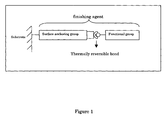
- the surface-anchoring part anchors the agent to the surface, while the surface is provided with functionality as a result of the tethered functional part (See fig. 1).
- the finish may comprise from 0.1-100% of the finishing agent.
- the amount of finishing agent in the finish depends, as a skilled person will understand, on the application method, type of finishing agent, requirements imposed on the finish, etc.
- the functional part comprises a functional moiety and a first covalent binding moiety
- the surface-anchoring part comprises a surface-anchoring moiety and a second covalent binding moiety, wherein the first and second covalent binding moieties together form the thermally reversible covalent bond at a temperature T1 while they form no covalent bond at a temperature T2, wherein T1 is lower than T2, and wherein more covalent bonds are formed between the moieties at T1 than at T2.
- the covalent bond can be formed in an equilibrium reaction, so that, also, a part of the bonds has been formed at T1 and a part of the bonds has been broken at T2. It is essential, however, that (many) more bonds are formed at T1 than at T2.
- the temperature T1 and temperature T2 are suitably 0-250 °C and preferably 5-150 °C, with T1 being lower than T2.
- at T1 at least 5% of the reversible covalent binding moieties have formed a covalent bond.
- at T1 at least 50% of the covalent binding moieties have formed a covalent bond. It will be clear that, preferably, the total amount of the first covalent binding moieties and the total amount of the second covalent binding moieties are essentially in the proportion of 1:1.
- T1 is for instance between 5-60°C.
- T1 may be 15, 25, 35 or 45°C.
- Temperature T2 is preferably above 75°C, for instance 80, 90, 100, 110, 120, 130, or 140 °C or higher.
- the covalent binding moieties of both parts of the finishing agent that together form the covalent bond may be identical covalent binding moieties or they may differ from each other. In most instances they will constitute complementary reactive groups that upon engaging in the thermally reversible reaction, form the thermally reversible covalent bond.
- the reversible covalent bond between the covalent binding moieties can be brought about by means of different types of thermally reversible reactions.
- the first and second covalent binding moieties are selected from diene groups and dienophile groups.
- the thermally reversible covalent bond may be brought about by means of a thermally reversible reaction referred to as a Diels-Alder reaction.
- Diels-Alder reactions that may be used in aspects of the present invention are for instance Diels-Alder cycloaddition reactions, nitroso dimerization reactions, cyclic anhydride reactions in which ester bonds are formed, reactions in which urethane formation takes place, and reactions in which azlactone-phenol adduct formation takes place, Schiff's base reactions from which an imide is formed and wherein no reduction takes place (thereby providing for a reversible bond), and the 'nitroxide mediated reaction' (e.g.
- the thermally reversible covalent bond is brought about by means of a Diels-Alder cycloaddition reaction.
- the first covalent binding moieties are preferably selected from acrylates, methacrylates, furane, anthracene, thiophene and pyrrole groups and combinations thereof, preferably furan groups
- the second covalent binding moieties are preferably selected from maleimide, maleic anhydride, fumarate, maleate and alkyne groups and combinations thereof, preferably maleimide groups.
- the first covalent binding moiety may also be selected from maleimide, maleic anhydride, fumarate, maleate and alkyne groups.
- the covalent binding moieties are selected from acrylates, methacrylates, furane, anthracene, thiophene and pyrrole groups in order to be able to form a covalent bond with the first covalent binding moiety.
- the surface-anchoring moiety as part of the surface-anchoring part of the finishing agent of the present invention may be any molecule capable of providing adhesion or fixation to the material surface to which the finish is to be applied.
- the skilled person will understand that the surface-anchoring moiety will therefore strongly depend on the surface chemistry of the material to which the finish is to be applied. For instance, in the case of textile applications skilled persons can think of hydroxyl, carboxyl or amine groups. For wood applications hydroxyl groups are present to react with the surface-anchoring group. In the case of glass, metal and ceramics also hydroxyl groups are present.
- the anchoring moiety is an epoxy moiety, a hydroxyl moiety, a carboxyl moiety, an amine moiety, a hydrazide moiety, an amide moiety or an aldehyde moiety.
- the anchoring moiety is preferably selected from an epoxy, hydroxyl, carboxyl or amine moiety.
- the functional moiety as part of the functional part of the finishing agent may be any molecule that provides the finish with dye-properties, crease resistant / easy care properties, waterproofing, hydrophobic, water-repellent, soil and stain releasing, flame retarding, hydrophilic, antistatic, oil absorbing, and/or antimicrobial functionality.
- the skilled person is well aware of the various chemical groups that can be used to provide these functionalities.
- the functional group may suitably be an alkyl group.
- Alkyl groups may provide waterproofing or water-repellency to the finish.
- the alkyl group may be a branched or straight chain, saturated or unsaturated alkyl group.
- Preferably the alkyl is a straight chain having from 2 to 50 carbon atoms, most preferably C 4 -C 20 .
- the functional group may for instance be a halo(hydro)carbon, such as a fluorocarbon or a fluorohydrocarbon in order to provide hydrophobic character and soil and stain release properties to the finish.
- a halo(hydro)carbon such as a fluorocarbon or a fluorohydrocarbon in order to provide hydrophobic character and soil and stain release properties to the finish.
- the functional group may for instance be an oligo- or (poly)siloxane in order to provide hydrophobic, anti-stick or soft-touch character.
- the functional group may for instance be a phosphorous or nitrogen or bromine or chlorine-containing compound in order to provide flame retardancy to the finish.
- Flame retardancy can be accomplished by the provision of a functional group comprising a complex organophosphorous compound such as Tetrakis (hydroxymethyl) phosphonium chloride (THPC), brominated flame retardants (BFRs), such as polybromobiphenyl (PBB), polybrominated diphenylethers (PBDEs), polybrominated biphenyls (PBBs), and tetrabromobisphenol A (TBBPA), or fluorinated flame retardants (FFRs), in general perfluoroorganic compounds (e.g., perfluorooctane sulfonate - PFOS), or flame retarding polymers or copolymers such as polyvinylchloride, polyvinylidenechloride, or polymer combinations with antimonum trioxide.
- a functional group comprising a complex organophosphorous
- the functional group may for instance be a hydrophilic polymer such as polyethylene glycol or poly vinyl alcohol, in order to provide hydrophilic and antistatic properties.
- the functional group may for instance be an olefin, such as a polypropylene in order to provide oil-absorbing properties.
- the finishing agent may be provided with multiple functionalities for instance by using bi or trifurcating elements between the reversible covalent binding moiety and the functional moieties.
- combinations of functionalities may be provided by combining various functional groups into one molecule.
- one may apply different molecules to the surface, each providing a different functionality.
- functional groups may be used that provide a combined functionality in a single molecule such as polychlorinated-n-alkanes (PCAs) (e.g. Short-chain chlorinated paraffins (SCCPs) with up to 30 carbon atoms and a chlorine content of 30 to 70% by mass, which are known to improve water repellent and flame retardant properties.
- PCAs polychlorinated-n-alkanes
- SCCPs Short-chain chlorinated paraffins
- the functional moiety is selected from the group consisting of alkyl groups, halo(hydro)carbon groups, (organo)phosphorous compounds, bromine and chlorine-containing compounds, flame retarding polymers and copolymers, hydrophilic polymers and olefins. More preferably, the functional moiety is selected from the group consisting of alkyl groups, preferably C 4 -C 20 alkyl groups, fluorocarbons, polyethylene glycol, and polypropylene.
- the present invention provides a composition for finishing a surface, comprising a finishing agent as described above, wherein said functional part and a surface-anchoring part are coupled.
- the present invention provides a composition for finishing a surface, comprising only the surface-anchoring part of a finishing agent as described above.
- the present invention provides such a composition comprising only the functional part of a finishing agent as described above.
- the surface-anchoring part of a finishing agent may be provided as a basic functionality on the material surface by the factory, while the customer may use only the functional part of a finishing agent in order to re-apply the finish after it has weared off, such as indicated in a method of re-functionalizing a material surface described herein below.
- the two separate compositions may be provided in a kit of parts for finishing a surface, comprising a finishing agent as described above, wherein said functional part and a surface-anchoring part are provided as separate compositions.
- the present invention provides a method of finishing a material surface comprising contacting a material surface with a composition according to the present invention.
- the contact should be of such nature and of sufficient duration to allow for the anchoring moiety in the anchoring part of the agent to react with the complementary reactive group on the surface.
- a suitable contact time may for instance encompass a period of for instance about 1 minute to about 1 day after which the solvent may then be allowed to evaporate or may be rinsed of with for instance water. This provides the finish to the surface and provides the surface with the required functionality.
- the material surface to which a finish according to the present invention is applied may be wood, textile (including its basic materials hair, cotton, silk, wool, polyester or polyamide), leather, metal, alloy, glass, ceramic, stone, concrete, paper, rubber, silicates (clay), plastic (synthetic polymeric material) or any other material that requires a finish according to the present invention.
- the finish may not only be provided upon the visible surface, but may penetrate into the substrate material, depending on the material surface characteristics. For instance, it may be more freely absorbed by wood or textile, penetrating deeper into the wood or textile fibre, thereby presenting a thicker covering and thus providing enhanced functionality in some cases.
- the finish may be applied by bringing the finish agent (for instance in the form wherein the anchoring group is covalently bonded to the functional group) into contact with the material surface.
- the anchoring group will fix the finishing agent to the material's surface, while the functional group will provide the surface with the desired functionality, thus providing the material surface with the finish.
- the finish may be applied to a material's surface by first bringing the surface-anchoring part with an unreacted covalent binding moiety into contact with the material's surface and allowing the surface-anchoring moiety to attach to the material's surface.
- the material surface having fixed thereto the surface-anchoring part of the finishing agent is brought into contact with the functional part having the second unreacted covalent binding moiety at a temperature at which said first and second covalent binding moieties form a covalent bond (i.e. at a temperature T1).
- the present invention provides a method of finishing a material surface as described above, wherein the material surface is first coated with the surface-anchoring part and subsequently with the functional part of the finishing agent of the present invention.
- compositions of the present invention may be applied to a suitable material surface by any method available, including but not limited to spraying, dipping, brushing, rolling, knife coating, polishing, padding, impregnating, immersion coating and printing.
- the compositions may be applied directly, or, alternatively, the composition may be dissolved or dispersed in a solvent and then applied to the material surface.
- the application may occur by a wet process (including a solvent) or may occur by a dry process.
- the finish according to the invention may be applied to the material surface in the form of a solution, dispersion or emulsion. Alternatively, the finish may be applied in powdered form.
- compositions used for reversible functional finishing a material surface are 0.1 - 1000 g/m 2 , more preferably 0.1 - 100 g/m 2 of material surface based on the weight of the finishing agent.
- the thermally reversible reaction is a Diels-Alder cycloaddition reaction.
- the present invention also relates to a material surface obtainable by a method according to the present invention finishing a material surface as described above.
- the present invention also relates to a material surface comprising a surface finish according to the present invention, comprising a finishing agent having a functional part and a surface-anchoring part, wherein said functional part and said surface-anchoring part are coupled via a thermally reversible covalent bond.
- Such finishes may for instance include wettability, water-repellent and waterproofing finishes; coloration, lacquering, and abrasion protection finishes; chemical softening, easy-care, antistatic and soil-release finishes; flame-retarding finishes; and anti-microbial, rotproofing and hygiene finishes.
- the present invention also relates to a method of re-functionalizing a material surface comprising a surface finish according to the present invention as described above, said method comprising the steps of:
- the step of removing the separated functional part from the surface is meant to provide a de-functionalized material surface comprising the surface-anchoring parts having only the second covalent binding moieties.
- This removal may be performed together with the step of raising the temperature, for instance by blowing hot air over the surface, as a result of which the functional parts will "debond” or "dis-connect”.
- hot water or steam or any other solvent may be used to remove the functional part from the material surface when the temperature is above T2.
- the step of re-functionalizing the de-functionalized material surface comprises contacting the de-functionalized material surface with a composition comprising functional parts having covalent binding moieties capable of forming a thermally reversible covalent bond with the second covalent binding moieties at a temperature T1 but not at a temperature T2, wherein T1 is lower than T2, and wherein more covalent bonds are formed between the moieties at T1 than at T2, wherein the contacting is performed under conditions which allow for the formation of a thermally reversible covalent bond between said first covalent binding moiety and said second covalent binding moiety.
- This may suitably be performed by providing the functional part in a sovent, contacting the solution to the de-functionalized surface, and allowing the first covalent binding moiety to react with the second covalent binding moiety of the anchoring part which is still on the de-functionalized surface, for instance by allowing contact for a period of 1 minute to about 1 day at a temperature T1. Thereafter, the unreacted functional part and solvent may be removed, e.g. by rinsing with water, which again provides the finish to the surface and restores the desired functionality.
- Finishes according to the present invention may be used on surfaces including biomedical devices and biomaterials. It may be used on textiles to make them wrinkle resistant, shrink free, rot free, antistatic, odor-resistant, moth-resist, soil- and stain-resist, and anti-yellowing.
- the present invention also provides graffiti-resistant treatments for outdoor surfaces or makes it easy to remove graffiti there from.
- a hot-air, hot-water or steam treatment may be used to remove the functional part of the finish, upon which a composition with a new functional part can be simply applied to the surface to re-functionalize it.
- the method of the present invention may be performed as follows:
- a finishing agent according to the invention may be prepared by mixing a suitable amount of a suitable functional part having a functional moiety and a first covalent binding moiety, and a suitable amount of a suitable anchoring part having an anchoring moiety and a second covalent binding moiety in a suitable solvent to provide a composition of the finishing agent, wherein the functionality of the functional part will provide a surface with the desired functionality.
- the surface of a material may be contacted with the composition of the finishing agent prepared as described above at a suitable temperature T1.
- the anchoring moiety is then allowed to react with the complementary reactive group on the surface for a suitable period of time and the unreacted agent and solvent may then be is rinsed of with water. This provides the finish to the surface and provides the surface with the desired functionalty.
- the surface may be exposed to a suitable temperature T2. As a result, the bond between the anchoring part and the functional part is broken. The functional part may then be removed from the surface by a suitable removing process.
- the material surface may be contacted with a composition comprising the functional part of the finishing agent consisting of a suitable amoount of a suitable functional part having a functional moiety and a first covalent binding moiety as described above, in a similar suitable solvent.
- the first covalent binding moiety is then allowed to react with the second covalent binding moiety of the anchoring part which is still on the surface, for a suitable period of time at a suitable temperature T1, and the unreacted functional part and solvent may then be rinsed of with water. This again provides the finish to the surface and restores the functionalty to the surface.
Landscapes
- Life Sciences & Earth Sciences (AREA)
- Chemical & Material Sciences (AREA)
- Engineering & Computer Science (AREA)
- Wood Science & Technology (AREA)
- Materials Engineering (AREA)
- Organic Chemistry (AREA)
- Treatments For Attaching Organic Compounds To Fibrous Goods (AREA)
- Paints Or Removers (AREA)
- Treatment And Processing Of Natural Fur Or Leather (AREA)
- Application Of Or Painting With Fluid Materials (AREA)
Abstract
The present invention relates to a functional surface finish comprising a finishing agent having a functional part and a surface-anchoring part, wherein said functional part and said surface-anchoring part are coupled via a thermally reversible covalent bond. The present invention further relates to compositions for finishing a surface, to methods of finishing a material surface, to material surface comprising a surface finish and to a method of re-functionalizing a material surface.
Description
- The present invention relates to chemical surface modifications. In particular the present invention relates to a functional surface finish, to compositions for finishing a surface, to methods of finishing a material surface, to material surface comprising a surface finish and to a method of re-functionalizing a material surface.
- Surface modification aims to tailor the surface characteristics of a material for a specific application without detrimentally affecting the bulk properties. At present a range of biological, physical, and chemical methods are used to effect surface modifications on a wide range of materials, including biomedical devices and biomaterials, wood, textiles, leather, metals, glass, ceramics, paper and plastics.
- Such finishes may for instance include wettability, water-repellent and waterproofing finishes; coloration, lacquering, and abrasion protection finishes; chemical softening, easy-care, antistatic and soil-release finishes; flame-retarding finishes; and anti-microbial, rotproofing and hygiene finishes. For instance textiles are often provided with fire or flame retarding finishes. The finish itself is the chemical substance provided bonded to the surface by mechanical or chemical interaction.
- The application of these finishes requires a specific application process and is tailored to the material processed. In fact, the finishing process requires a careful balance between the compatibility of different finishing products with the material and treatments and the application processes used to provide that material with desirable properties. For instance in the field of textile finishes, such parameters as fiber nature (100% natural, synthetic or blends thereof) and inherent absorbent properties as well as weave and construction of a textile fabric, largely determine the possibility of subjecting the material to a wet finish process.
- One general problem with product finishes, and one that is most notable in textiles, is that the desired material properties diminish by care and maintenance of the material since washing results in partial removal of the finish and will gradually reduce the functionality. Yet, the processes for applying these product finishes are so specialized that they do not allow for a re-application of the finish by for instance a decentralized laundry or private person. It would however be desirable to be able to restore the functional surface properties, such as water-repellency or flame retardancy, of a material by an easy process. Thus in for instance textile processing, there is needed a process which involves no sophisticated equipment or intricate procedures.
- A reverse situation, where an easy removal of the finish is required, may also be desirable, such as for instance in some finishes for wood. Protecting lumber against weather conditions and enhancing its lifespan involves the provision of barrier functions (water repellency), flame retardancy, anti-rot functionality and insect resistance. These treatments are essential and are mostly applied discontinuously (i.e. once only, for instance prior to retail sale). Also, they involve hazardous chemicals. On the one hand there is needed a process by which functional chemicals can be applied continuously (i.e. involving periodic re-application) and in a water-based process. On the other hand there is needed a process for easy removal of the biohazardous chemicals, so that the remaining material may be disposed of much cheaper, in stead of as chemical waste, or be re-used for a different purpose.
- Thus, there is a need for a surface finishing process for providing materials such as textiles with a permanent, yet easily re-applicable finish that provides the material, and particularly its surface with desirable properties. Also there is needed a functional finish which can be removed without great difficulty, while allowing the material to maintain all other properties.
- The present inventors have found that a reversible finishing can be provided to mostly any material surface by treating that surface with a finishing agent comprising a surface-anchoring group and a functional group, wherein said two groups are linked by a thermally reversible binding system.
- In a first aspect, the present invention relates to a surface finish, comprising a finishing agent having a functional part and a surface-anchoring part, wherein said functional part and said surface-anchoring part are coupled via a thermally reversible covalent bond. The surface-anchoring part anchors the agent to the surface, while the surface is provided with functionality as a result of the tethered functional part (See fig. 1). The finish may comprise from 0.1-100% of the finishing agent. The amount of finishing agent in the finish depends, as a skilled person will understand, on the application method, type of finishing agent, requirements imposed on the finish, etc.
- In a preferred embodiment of a surface finish according to the invention, the functional part comprises a functional moiety and a first covalent binding moiety, and the surface-anchoring part comprises a surface-anchoring moiety and a second covalent binding moiety, wherein the first and second covalent binding moieties together form the thermally reversible covalent bond at a temperature T1 while they form no covalent bond at a temperature T2, wherein T1 is lower than T2, and wherein more covalent bonds are formed between the moieties at T1 than at T2.
- The covalent bond can be formed in an equilibrium reaction, so that, also, a part of the bonds has been formed at T1 and a part of the bonds has been broken at T2. It is essential, however, that (many) more bonds are formed at T1 than at T2. The temperature T1 and temperature T2 are suitably 0-250 °C and preferably 5-150 °C, with T1 being lower than T2. Preferably, at T1, at least 5% of the reversible covalent binding moieties have formed a covalent bond. Still more preferably, at T1, at least 50% of the covalent binding moieties have formed a covalent bond. It will be clear that, preferably, the total amount of the first covalent binding moieties and the total amount of the second covalent binding moieties are essentially in the proportion of 1:1.
- A highly preferred range of values for temperature T1 is for instance between 5-60°C. For instance, T1 may be 15, 25, 35 or 45°C. Temperature T2 is preferably above 75°C, for instance 80, 90, 100, 110, 120, 130, or 140 °C or higher.
- The covalent binding moieties of both parts of the finishing agent that together form the covalent bond may be identical covalent binding moieties or they may differ from each other. In most instances they will constitute complementary reactive groups that upon engaging in the thermally reversible reaction, form the thermally reversible covalent bond.
- The reversible covalent bond between the covalent binding moieties can be brought about by means of different types of thermally reversible reactions.
- In preferred embodiment, the first and second covalent binding moieties are selected from diene groups and dienophile groups.
- In an even more preferred embodiment, the thermally reversible covalent bond may be brought about by means of a thermally reversible reaction referred to as a Diels-Alder reaction. Examples of suitable Diels-Alder reactions that may be used in aspects of the present invention are for instance Diels-Alder cycloaddition reactions, nitroso dimerization reactions, cyclic anhydride reactions in which ester bonds are formed, reactions in which urethane formation takes place, and reactions in which azlactone-phenol adduct formation takes place, Schiff's base reactions from which an imide is formed and wherein no reduction takes place (thereby providing for a reversible bond), and the 'nitroxide mediated reaction' (e.g. TEMPO [2,2,6,6-tetramethylpiperidinyloxy]. A condition is that the reaction chosen from this group is thermally reversible. For a further description of these reactions, reference is made to J. Macromol. Sci. Rev. Macromol. Chem. C33 (3), 1993, pp. 239-257.
- In a highly preferred embodiment, the thermally reversible covalent bond is brought about by means of a Diels-Alder cycloaddition reaction.
- The first covalent binding moieties are preferably selected from acrylates, methacrylates, furane, anthracene, thiophene and pyrrole groups and combinations thereof, preferably furan groups
- The second covalent binding moieties are preferably selected from maleimide, maleic anhydride, fumarate, maleate and alkyne groups and combinations thereof, preferably maleimide groups.
- It should be understood that the first covalent binding moiety may also be selected from maleimide, maleic anhydride, fumarate, maleate and alkyne groups. However in that event, the covalent binding moieties are selected from acrylates, methacrylates, furane, anthracene, thiophene and pyrrole groups in order to be able to form a covalent bond with the first covalent binding moiety.
- The surface-anchoring moiety as part of the surface-anchoring part of the finishing agent of the present invention may be any molecule capable of providing adhesion or fixation to the material surface to which the finish is to be applied. The skilled person will understand that the surface-anchoring moiety will therefore strongly depend on the surface chemistry of the material to which the finish is to be applied. For instance, in the case of textile applications skilled persons can think of hydroxyl, carboxyl or amine groups. For wood applications hydroxyl groups are present to react with the surface-anchoring group. In the case of glass, metal and ceramics also hydroxyl groups are present. If there aren't any suitable reactive groups available on the substrate surface for the reaction with the surface-anchoring group one can think of coating the substrate surface with epoxy, urethane, alkoxysilane, alkoxytitane or one of the above mentioned above for textile applications. In some preferred embodiments the anchoring moiety is an epoxy moiety, a hydroxyl moiety, a carboxyl moiety, an amine moiety, a hydrazide moiety, an amide moiety or an aldehyde moiety. The anchoring moiety is preferably selected from an epoxy, hydroxyl, carboxyl or amine moiety.
- The functional moiety as part of the functional part of the finishing agent may be any molecule that provides the finish with dye-properties, crease resistant / easy care properties, waterproofing, hydrophobic, water-repellent, soil and stain releasing, flame retarding, hydrophilic, antistatic, oil absorbing, and/or antimicrobial functionality. The skilled person is well aware of the various chemical groups that can be used to provide these functionalities.
- The functional group may suitably be an alkyl group. Alkyl groups may provide waterproofing or water-repellency to the finish. The alkyl group may be a branched or straight chain, saturated or unsaturated alkyl group. Preferably the alkyl is a straight chain having from 2 to 50 carbon atoms, most preferably C4-C20.
- Alternatively, the functional group may for instance be a halo(hydro)carbon, such as a fluorocarbon or a fluorohydrocarbon in order to provide hydrophobic character and soil and stain release properties to the finish.
- In another embodiment, the functional group may for instance be an oligo- or (poly)siloxane in order to provide hydrophobic, anti-stick or soft-touch character.
- In another embodiment, the functional group may for instance be a phosphorous or nitrogen or bromine or chlorine-containing compound in order to provide flame retardancy to the finish. Flame retardancy can be accomplished by the provision of a functional group comprising a complex organophosphorous compound such as Tetrakis (hydroxymethyl) phosphonium chloride (THPC), brominated flame retardants (BFRs), such as polybromobiphenyl (PBB), polybrominated diphenylethers (PBDEs), polybrominated biphenyls (PBBs), and tetrabromobisphenol A (TBBPA), or fluorinated flame retardants (FFRs), in general perfluoroorganic compounds (e.g., perfluorooctane sulfonate - PFOS), or flame retarding polymers or copolymers such as polyvinylchloride, polyvinylidenechloride, or polymer combinations with antimonum trioxide.
- In yet another embodiment, the functional group may for instance be a hydrophilic polymer such as polyethylene glycol or poly vinyl alcohol, in order to provide hydrophilic and antistatic properties.
- In still another embodiment, the functional group may for instance be an olefin, such as a polypropylene in order to provide oil-absorbing properties.
- In stead of providing the finishing agent with a single functionality, the skilled person will appreciate that the finishing agent may be provided with multiple functionalities for instance by using bi or trifurcating elements between the reversible covalent binding moiety and the functional moieties. Thus, combinations of functionalities may be provided by combining various functional groups into one molecule. Alternatively, one may apply different molecules to the surface, each providing a different functionality. Also, functional groups may be used that provide a combined functionality in a single molecule such as polychlorinated-n-alkanes (PCAs) (e.g. Short-chain chlorinated paraffins (SCCPs) with up to 30 carbon atoms and a chlorine content of 30 to 70% by mass, which are known to improve water repellent and flame retardant properties.
- In preferred embodiments the functional moiety is selected from the group consisting of alkyl groups, halo(hydro)carbon groups, (organo)phosphorous compounds, bromine and chlorine-containing compounds, flame retarding polymers and copolymers, hydrophilic polymers and olefins. More preferably, the functional moiety is selected from the group consisting of alkyl groups, preferably C4-C20 alkyl groups, fluorocarbons, polyethylene glycol, and polypropylene.
- In still another aspect, the present invention provides a composition for finishing a surface, comprising a finishing agent as described above, wherein said functional part and a surface-anchoring part are coupled. Alternatively, the present invention provides a composition for finishing a surface, comprising only the surface-anchoring part of a finishing agent as described above. Also, the present invention provides such a composition comprising only the functional part of a finishing agent as described above. An advantage of these separate compositions is that for instance the surface-anchoring part of a finishing agent may be provided as a basic functionality on the material surface by the factory, while the customer may use only the functional part of a finishing agent in order to re-apply the finish after it has weared off, such as indicated in a method of re-functionalizing a material surface described herein below. Conveniently, the two separate compositions may be provided in a kit of parts for finishing a surface, comprising a finishing agent as described above, wherein said functional part and a surface-anchoring part are provided as separate compositions.
- In yet another aspect, the present invention provides a method of finishing a material surface comprising contacting a material surface with a composition according to the present invention. The contact should be of such nature and of sufficient duration to allow for the anchoring moiety in the anchoring part of the agent to react with the complementary reactive group on the surface. A suitable contact time may for instance encompass a period of for instance about 1 minute to about 1 day after which the solvent may then be allowed to evaporate or may be rinsed of with for instance water. This provides the finish to the surface and provides the surface with the required functionality.
- The material surface to which a finish according to the present invention is applied may be wood, textile (including its basic materials hair, cotton, silk, wool, polyester or polyamide), leather, metal, alloy, glass, ceramic, stone, concrete, paper, rubber, silicates (clay), plastic (synthetic polymeric material) or any other material that requires a finish according to the present invention. It should be understood that the finish may not only be provided upon the visible surface, but may penetrate into the substrate material, depending on the material surface characteristics. For instance, it may be more freely absorbed by wood or textile, penetrating deeper into the wood or textile fibre, thereby presenting a thicker covering and thus providing enhanced functionality in some cases.
- The finish may be applied by bringing the finish agent (for instance in the form wherein the anchoring group is covalently bonded to the functional group) into contact with the material surface. The anchoring group will fix the finishing agent to the material's surface, while the functional group will provide the surface with the desired functionality, thus providing the material surface with the finish.
- Alternatively, the finish may be applied to a material's surface by first bringing the surface-anchoring part with an unreacted covalent binding moiety into contact with the material's surface and allowing the surface-anchoring moiety to attach to the material's surface. Next, the material surface having fixed thereto the surface-anchoring part of the finishing agent is brought into contact with the functional part having the second unreacted covalent binding moiety at a temperature at which said first and second covalent binding moieties form a covalent bond (i.e. at a temperature T1). Thus, in one embodiment, the present invention provides a method of finishing a material surface as described above, wherein the material surface is first coated with the surface-anchoring part and subsequently with the functional part of the finishing agent of the present invention.
- The compositions of the present invention may be applied to a suitable material surface by any method available, including but not limited to spraying, dipping, brushing, rolling, knife coating, polishing, padding, impregnating, immersion coating and printing. The compositions may be applied directly, or, alternatively, the composition may be dissolved or dispersed in a solvent and then applied to the material surface. The application may occur by a wet process (including a solvent) or may occur by a dry process. The finish according to the invention may be applied to the material surface in the form of a solution, dispersion or emulsion. Alternatively, the finish may be applied in powdered form.
- Suitable amounts of compositions used for reversible functional finishing a material surface are 0.1 - 1000 g/m2, more preferably 0.1 - 100 g/m2 of material surface based on the weight of the finishing agent.
- Preferably, in a method of finishing a material surface according to the present invention, the thermally reversible reaction is a Diels-Alder cycloaddition reaction.
- The present invention also relates to a material surface obtainable by a method according to the present invention finishing a material surface as described above.
- The present invention also relates to a material surface comprising a surface finish according to the present invention, comprising a finishing agent having a functional part and a surface-anchoring part, wherein said functional part and said surface-anchoring part are coupled via a thermally reversible covalent bond. Such finishes may for instance include wettability, water-repellent and waterproofing finishes; coloration, lacquering, and abrasion protection finishes; chemical softening, easy-care, antistatic and soil-release finishes; flame-retarding finishes; and anti-microbial, rotproofing and hygiene finishes.
- The present invention also relates to a method of re-functionalizing a material surface comprising a surface finish according to the present invention as described above, said method comprising the steps of:
- a) raising the temperature of said surface finish to a temperature T2 as described above;
- b) removing said functional part from said surface, and
- c) contacting the material surface obtained in step b) with a composition comprising only the functional part of a finishing agent as described above before, during or after lowering the temperature of said material surface obtained in step b) to a temperature T1 as described above.
- The raising of the temperature of said surface finish to a temperature T2, whereby said thermally reversible covalent bond is not formed, is performed in order to separate the functional part from the surface-anchoring part. By bringing the temperature of the finish above the temperature at which the covalent binding moieties in the finishing agent form a covalent bond, the finish will loose its functional group together with the second covalent binding moiety, while the first covalent binding moiety is still held at the surface of the material by the anchoring group. Thus, at such an elevated temperature, it is possible to wholly or partly remove from the object the functionality-providing part of the finish.
- The step of removing the separated functional part from the surface is meant to provide a de-functionalized material surface comprising the surface-anchoring parts having only the second covalent binding moieties. This removal may be performed together with the step of raising the temperature, for instance by blowing hot air over the surface, as a result of which the functional parts will "debond" or "dis-connect". Alternatively hot water or steam or any other solvent may be used to remove the functional part from the material surface when the temperature is above T2.
- The step of re-functionalizing the de-functionalized material surface comprises contacting the de-functionalized material surface with a composition comprising functional parts having covalent binding moieties capable of forming a thermally reversible covalent bond with the second covalent binding moieties at a temperature T1 but not at a temperature T2, wherein T1 is lower than T2, and wherein more covalent bonds are formed between the moieties at T1 than at T2, wherein the contacting is performed under conditions which allow for the formation of a thermally reversible covalent bond between said first covalent binding moiety and said second covalent binding moiety. This may suitably be performed by providing the functional part in a sovent, contacting the solution to the de-functionalized surface, and allowing the first covalent binding moiety to react with the second covalent binding moiety of the anchoring part which is still on the de-functionalized surface, for instance by allowing contact for a period of 1 minute to about 1 day at a temperature T1. Thereafter, the unreacted functional part and solvent may be removed, e.g. by rinsing with water, which again provides the finish to the surface and restores the desired functionality.
- Finishes according to the present invention may be used on surfaces including biomedical devices and biomaterials. It may be used on textiles to make them wrinkle resistant, shrink free, rot free, antistatic, odor-resistant, moth-resist, soil- and stain-resist, and anti-yellowing.
- The present invention also provides graffiti-resistant treatments for outdoor surfaces or makes it easy to remove graffiti there from. For instance, a hot-air, hot-water or steam treatment may be used to remove the functional part of the finish, upon which a composition with a new functional part can be simply applied to the surface to re-functionalize it.
- The place where the methods of the present invention may be carried out are for instance central laundries and commercial laundry equipment facilities in apartments, residence halls, condominiums, cooperatives, hotels, motels, military installations, campgrounds, RV parks, senior citizen residences, truck stops and marinas. The present invention will now be exemplified in the following examples.
- As an Example, the method of the present invention may be performed as follows:
- Re-applying a functional finish to a surface.
- A finishing agent according to the invention may be prepared by mixing a suitable amount of a suitable functional part having a functional moiety and a first covalent binding moiety, and a suitable amount of a suitable anchoring part having an anchoring moiety and a second covalent binding moiety in a suitable solvent to provide a composition of the finishing agent, wherein the functionality of the functional part will provide a surface with the desired functionality.
- The surface of a material may be contacted with the composition of the finishing agent prepared as described above at a suitable temperature T1. The anchoring moiety is then allowed to react with the complementary reactive group on the surface for a suitable period of time and the unreacted agent and solvent may then be is rinsed of with water. This provides the finish to the surface and provides the surface with the desired functionalty.
- To remove the finish, the surface may be exposed to a suitable temperature T2. As a result, the bond between the anchoring part and the functional part is broken. The functional part may then be removed from the surface by a suitable removing process.
- Subsequently, the material surface may be contacted with a composition comprising the functional part of the finishing agent consisting of a suitable amoount of a suitable functional part having a functional moiety and a first covalent binding moiety as described above, in a similar suitable solvent. Next, the first covalent binding moiety is then allowed to react with the second covalent binding moiety of the anchoring part which is still on the surface, for a suitable period of time at a suitable temperature T1, and the unreacted functional part and solvent may then be rinsed of with water. This again provides the finish to the surface and restores the functionalty to the surface.
Claims (22)
- A surface finish, comprising a finishing agent having a functional part and a surface-anchoring part, wherein said functional part and said surface-anchoring part are coupled via a thermally reversible covalent bond.
- A finish according to claim 1, wherein said functional part comprises a functional moiety and a first covalent binding moiety, and wherein said surface-anchoring part comprises a surface-anchoring moiety and a second covalent binding moiety, and wherein said first and second covalent binding moieties together form said thermally reversible covalent bond at a temperature T1 while they form no covalent bond at a temperature T2, wherein T1 is lower than T2, and wherein more covalent bonds are formed between the moieties at T1 than at T2.
- A finish according to claim 1 or 2, wherein said first and second covalent binding moieties are selected from diene groups and dienophile groups, preferably such that one of the covalent binding moieties has a diene group and the other has a dienophile group.
- A finish according to any one of the preceding claims, wherein said thermally reversible covalent bond is brought about by means of a thermally reversible Diels-Alder reaction, preferably selected from the group consisting of Diels-Alder cycloaddition reactions, nitroso dimerization reactions, cyclic anhydride reactions in which ester bonds are formed, reactions in which urethane formation takes place, and reactions in which azlactone-phenol adduct formation takes place, Schiff's base reactions from which an imide is formed and wherein no reduction takes place (thereby providing for a reversible bond), and the 'nitroxide mediated reaction' (e.g. TEMPO [2,2,6,6-tetramethylpiperidinyloxy]).
- A finish according to claim 4, wherein said thermally reversible covalent bond is brought about by means of a Diels-Alder cycloaddition reaction.
- A finish according to claim 5, wherein said first covalent binding moieties are selected from acrylates, methacrylates, furane, anthracene, thiophene and pyrrole groups and combinations thereof, preferably furan groups, and wherein said second covalent binding moieties are selected from maleimide, maleic anhydride, fumarate, maleate and alkyne groups and combinations thereof, preferably maleimide groups.
- A finish according to any one of claims 2-6, wherein said anchoring moiety is an epoxy, hydroxyl, carboxyl, amine, urethane, hydrazide, amide, alkoxysilane, alkoxytitane (titanate) or aldehyde moiety.
- A finish according to any one of claims 2-7, wherein said functional moiety represents a molecule that provides said finish with dye-properties, crease resistant/easy care, anti-graffiti, waterproofing, hydrophobic, water-repellent, soil and stain releasing, flame retarding, hydrophilic, antistatic, oil absorbing, hygienic and/or antimicrobial functionality.
- A finish according to any one of claims 2-8, wherein said functional moiety is selected from the group consisting of alkyl groups, oligo- and polysiloxane, halo(hydro)carbon groups, (organo)phosphorous compounds, bromine and chlorine-containing compounds, flame retarding polymers and copolymers, hydrophilic polymers and olefins.
- A finish according to any one of claims 2-9, wherein said functional moiety is selected from the group consisting of alkyl groups, oligo- and polysiloxanes, fluorocarbons, polyethylene glycol, and polypropylene.
- A composition for finishing a surface, comprising a finishing agent as defined in any one of claims 1-10, wherein said functional part and a surface-anchoring part are coupled.
- A composition for finishing a surface, comprising the surface-anchoring part of a finishing agent as defined in any one of claims 1-10.
- A composition for finishing a surface, comprising the functional part of a finishing agent as defined in any one of claims 1-10.
- A kit of parts for finishing a surface, comprising a finishing agent as defined in any one of claims 1-10, wherein said functional part and a surface-anchoring part are provided as separate compositions.
- A method of finishing a material surface comprising contacting a material surface with a composition according to any one of claims 11-14.
- A method according to claim 15, wherein said material surface is first coated with said surface-anchoring part and subsequently with said functional part.
- A method according to claim 15 or 16, wherein said first and second covalent binding moieties that couple said functional part and said surface-anchoring part are selected from diene groups and dienophile groups.
- A material surface obtainable by a method according to any one of claims 15-17.
- A material surface comprising a surface finish as defined in any one of claims 1-10.
- A method of re-functionalizing a material surface as defined in claim 17, said method comprising the steps of:a) raising the temperature of said surface finish to a temperature T2 as defined in claim 2;b) removing said functional part from said surface, andc) contacting the material surface obtained in step b) with a composition according to claim 13 before, during or after lowering the temperature of said material surface obtained in step b) to a temperature T1 as defined in claim 2.
- Use of a surface-anchoring part as defined in any one of claims 2-7 as part of a surface finish according to any one of claims 1-10.
- Use of a functional part as defined in any one of claims 2-6 and 8-10 as part of a surface finish according to any one of claims 1-10.
Priority Applications (4)
| Application Number | Priority Date | Filing Date | Title |
|---|---|---|---|
| EP20060076464 EP1882528A1 (en) | 2006-07-24 | 2006-07-24 | Functional surface finish and method of its application to a material surface |
| US12/374,471 US9051480B2 (en) | 2006-07-24 | 2007-07-23 | Functional surface finish and method of its application to a material surface |
| PCT/NL2007/050365 WO2008013449A1 (en) | 2006-07-24 | 2007-07-23 | Functional surface finish and method of its application to a material surface |
| EP07793866.0A EP2051822B1 (en) | 2006-07-24 | 2007-07-23 | Functional surface finish and method of its application to a material surface |
Applications Claiming Priority (1)
| Application Number | Priority Date | Filing Date | Title |
|---|---|---|---|
| EP20060076464 EP1882528A1 (en) | 2006-07-24 | 2006-07-24 | Functional surface finish and method of its application to a material surface |
Publications (1)
| Publication Number | Publication Date |
|---|---|
| EP1882528A1 true EP1882528A1 (en) | 2008-01-30 |
Family
ID=37670758
Family Applications (2)
| Application Number | Title | Priority Date | Filing Date |
|---|---|---|---|
| EP20060076464 Withdrawn EP1882528A1 (en) | 2006-07-24 | 2006-07-24 | Functional surface finish and method of its application to a material surface |
| EP07793866.0A Active EP2051822B1 (en) | 2006-07-24 | 2007-07-23 | Functional surface finish and method of its application to a material surface |
Family Applications After (1)
| Application Number | Title | Priority Date | Filing Date |
|---|---|---|---|
| EP07793866.0A Active EP2051822B1 (en) | 2006-07-24 | 2007-07-23 | Functional surface finish and method of its application to a material surface |
Country Status (3)
| Country | Link |
|---|---|
| US (1) | US9051480B2 (en) |
| EP (2) | EP1882528A1 (en) |
| WO (1) | WO2008013449A1 (en) |
Cited By (4)
| Publication number | Priority date | Publication date | Assignee | Title |
|---|---|---|---|---|
| US8022238B2 (en) | 2009-03-20 | 2011-09-20 | E. I. Du Pont De Nemours And Company | Phosphate surfactants |
| CN107938339A (en) * | 2017-12-15 | 2018-04-20 | 常熟市乐德维织造有限公司 | The postfinishing process of anti-static fabric |
| CN108424637A (en) * | 2018-03-21 | 2018-08-21 | 苏州凌科特新材料有限公司 | The preparation method of biomaterial with optical activation |
| CN113930135A (en) * | 2020-07-14 | 2022-01-14 | 北京化工大学 | Self-repairing solvent-free epoxy fireproof coating and preparation method thereof |
Families Citing this family (3)
| Publication number | Priority date | Publication date | Assignee | Title |
|---|---|---|---|---|
| CN105949422B (en) * | 2016-05-10 | 2018-12-25 | 四川大学 | Polysiloxanes-urethane elastomers of the key containing Diels-Alder and preparation method thereof |
| CN107987693B (en) * | 2017-12-15 | 2019-12-17 | 中山市钧纬新材料科技有限公司 | Durable antibacterial water-based alkyd paint |
| CN110862748B (en) * | 2019-11-29 | 2021-06-29 | 广州建筑产业研究院有限公司 | Fire-resistant and heat-insulating paint and preparation method and application thereof |
Citations (2)
| Publication number | Priority date | Publication date | Assignee | Title |
|---|---|---|---|---|
| US5641856A (en) * | 1994-11-15 | 1997-06-24 | Shell Oil Company | Cross-linked resin |
| WO2004076567A1 (en) * | 2003-02-25 | 2004-09-10 | Nederlandse Organisatie Voor Toegepast-Natuurwe Tenschappelijk Onderzoek Tno | Low solvent coating process for applying the coating to an object coated object obtainable with the process and process for leveling a coating applied to an object |
Family Cites Families (3)
| Publication number | Priority date | Publication date | Assignee | Title |
|---|---|---|---|---|
| EP0357110A1 (en) * | 1988-08-05 | 1990-03-07 | Akzo N.V. | Two component coating curable at ambient temperature via a Diels-Alder reaction |
| US6403753B1 (en) * | 2000-01-18 | 2002-06-11 | Sandia Corporation | Method of making thermally removable polyurethanes |
| US20030218130A1 (en) | 2002-05-02 | 2003-11-27 | Ciphergen Biosystems, Inc. | Biochips with surfaces coated with polysaccharide-based hydrogels |
-
2006
- 2006-07-24 EP EP20060076464 patent/EP1882528A1/en not_active Withdrawn
-
2007
- 2007-07-23 US US12/374,471 patent/US9051480B2/en active Active
- 2007-07-23 EP EP07793866.0A patent/EP2051822B1/en active Active
- 2007-07-23 WO PCT/NL2007/050365 patent/WO2008013449A1/en not_active Ceased
Patent Citations (2)
| Publication number | Priority date | Publication date | Assignee | Title |
|---|---|---|---|---|
| US5641856A (en) * | 1994-11-15 | 1997-06-24 | Shell Oil Company | Cross-linked resin |
| WO2004076567A1 (en) * | 2003-02-25 | 2004-09-10 | Nederlandse Organisatie Voor Toegepast-Natuurwe Tenschappelijk Onderzoek Tno | Low solvent coating process for applying the coating to an object coated object obtainable with the process and process for leveling a coating applied to an object |
Cited By (4)
| Publication number | Priority date | Publication date | Assignee | Title |
|---|---|---|---|---|
| US8022238B2 (en) | 2009-03-20 | 2011-09-20 | E. I. Du Pont De Nemours And Company | Phosphate surfactants |
| CN107938339A (en) * | 2017-12-15 | 2018-04-20 | 常熟市乐德维织造有限公司 | The postfinishing process of anti-static fabric |
| CN108424637A (en) * | 2018-03-21 | 2018-08-21 | 苏州凌科特新材料有限公司 | The preparation method of biomaterial with optical activation |
| CN113930135A (en) * | 2020-07-14 | 2022-01-14 | 北京化工大学 | Self-repairing solvent-free epoxy fireproof coating and preparation method thereof |
Also Published As
| Publication number | Publication date |
|---|---|
| WO2008013449A1 (en) | 2008-01-31 |
| EP2051822B1 (en) | 2019-11-13 |
| US9051480B2 (en) | 2015-06-09 |
| EP2051822A1 (en) | 2009-04-29 |
| US20090318045A1 (en) | 2009-12-24 |
Similar Documents
| Publication | Publication Date | Title |
|---|---|---|
| EP2051822B1 (en) | Functional surface finish and method of its application to a material surface | |
| US4501682A (en) | Cleaning and protective composition and method | |
| EP0207282B1 (en) | Oil and water repellent coating compositions | |
| JP3982012B2 (en) | Novel compositions and treatment agents | |
| CA2964415A1 (en) | Anti-smudge and anti-graffiti compositions | |
| AU2012243394A1 (en) | Amphiphobic block copolymers and applications thereof | |
| JPH08325220A (en) | Carbodiimide compound and water repellent composition | |
| KR20190004758A (en) | Crosslinkable materials based on organosilicon compounds | |
| US6491981B1 (en) | Use of functionalized silicone composition for producing a hydrophobic and/or oil-repellent coating and/or impregnation with low surface energy | |
| TW202302670A (en) | Dispersion | |
| US7645333B2 (en) | Aqueous composition and method for imparting resistance to stain absorption | |
| JP5473332B2 (en) | Antifouling polyaddition silicone varnish, application of said varnish to a support, and support thus treated | |
| Simončič et al. | Tailoring of multifunctional cellulose fibres with “lotus effect” and flame retardant properties | |
| JP2979049B2 (en) | Adhesion promoter | |
| JP6161495B2 (en) | Coating agent for leather | |
| TWI911304B (en) | Water-repellent components and fiber treatment agents | |
| WO2013158863A2 (en) | Nonfluorinated polyurethanes and methods of making and using thereof | |
| WO2025234430A1 (en) | Surface treatment agent composition, water-repellent and oil-repellent textile product, and method for producing same | |
| JP2008540693A (en) | Fluorocarbon grafted polysiloxane | |
| TWI862472B (en) | Staple fiber, fabric, method of forming a carrier, and method of releasing a surface modifying molecule | |
| BR112016005991B1 (en) | Polysiloxane with quaternary heterocyclic groups, its method of preparation, preparation comprising the same, and use | |
| US9969903B2 (en) | Method of applying an organosilane solution to rigid substrates and grout | |
| CN118871494A (en) | Fluorine-free coating composition | |
| JP2019502033A (en) | Articles comprising laminated metallized textile layers, in particular solar protection articles, and methods for grafting metal layers to obtain said articles | |
| DE10319058A1 (en) | Siliconized interlinings, processes for their production and their use |
Legal Events
| Date | Code | Title | Description |
|---|---|---|---|
| PUAI | Public reference made under article 153(3) epc to a published international application that has entered the european phase |
Free format text: ORIGINAL CODE: 0009012 |
|
| AK | Designated contracting states |
Kind code of ref document: A1 Designated state(s): AT BE BG CH CY CZ DE DK EE ES FI FR GB GR HU IE IS IT LI LT LU LV MC NL PL PT RO SE SI SK TR |
|
| AX | Request for extension of the european patent |
Extension state: AL BA HR MK YU |
|
| AKX | Designation fees paid | ||
| REG | Reference to a national code |
Ref country code: DE Ref legal event code: 8566 |
|
| STAA | Information on the status of an ep patent application or granted ep patent |
Free format text: STATUS: THE APPLICATION IS DEEMED TO BE WITHDRAWN |
|
| 18D | Application deemed to be withdrawn |
Effective date: 20080731 |