EP1881976B1 - Substituted amide derivatives as protein kinase inhibitors - Google Patents
Substituted amide derivatives as protein kinase inhibitors Download PDFInfo
- Publication number
- EP1881976B1 EP1881976B1 EP06751834A EP06751834A EP1881976B1 EP 1881976 B1 EP1881976 B1 EP 1881976B1 EP 06751834 A EP06751834 A EP 06751834A EP 06751834 A EP06751834 A EP 06751834A EP 1881976 B1 EP1881976 B1 EP 1881976B1
- Authority
- EP
- European Patent Office
- Prior art keywords
- phenyl
- methyl
- oxo
- dihydro
- carboxamide
- Prior art date
- Legal status (The legal status is an assumption and is not a legal conclusion. Google has not performed a legal analysis and makes no representation as to the accuracy of the status listed.)
- Expired - Lifetime
Links
- 0 O=C1N(*I)C=CC=C1 Chemical compound O=C1N(*I)C=CC=C1 0.000 description 7
- MIHCWLIBCJAHNQ-UHFFFAOYSA-N CC(C)(CN(C(C)=C(C(Nc(cc1)cc(F)c1Oc1cc(NC(N2CCCC2)=O)ncn1)=O)C1=O)N1c1ccccc1)O Chemical compound CC(C)(CN(C(C)=C(C(Nc(cc1)cc(F)c1Oc1cc(NC(N2CCCC2)=O)ncn1)=O)C1=O)N1c1ccccc1)O MIHCWLIBCJAHNQ-UHFFFAOYSA-N 0.000 description 2
- BDLNWDAUNGSVBN-UHFFFAOYSA-N [O-][N+](c(cc1)cc(F)c1Oc1ncnc(NC(N2CCCC2)=O)c1)=O Chemical compound [O-][N+](c(cc1)cc(F)c1Oc1ncnc(NC(N2CCCC2)=O)c1)=O BDLNWDAUNGSVBN-UHFFFAOYSA-N 0.000 description 2
- BXZAMGUUHPQNCB-UHFFFAOYSA-N [O-][N+](c(cc1F)ccc1Oc1ncnc(Cl)c1)=O Chemical compound [O-][N+](c(cc1F)ccc1Oc1ncnc(Cl)c1)=O BXZAMGUUHPQNCB-UHFFFAOYSA-N 0.000 description 2
- OMNBQBFAKSOGAT-OCEACIFDSA-N CC(C)(/C(/NC)=C(/C(Nc1ccccc1)=O)\C(Nc(cc1F)ccc1Oc1cc(NC(N2CCCC2)=O)ncc1)=O)N Chemical compound CC(C)(/C(/NC)=C(/C(Nc1ccccc1)=O)\C(Nc(cc1F)ccc1Oc1cc(NC(N2CCCC2)=O)ncc1)=O)N OMNBQBFAKSOGAT-OCEACIFDSA-N 0.000 description 1
- KTHBTMQUMOBCSP-UHFFFAOYSA-N CC(C)(CN(C(C)=C(C(Nc(cc1)cc(F)c1Oc1c2[s]c(-c3nc(C)n[o]3)cc2ncc1)=O)C1=O)N1c1ccccc1)O Chemical compound CC(C)(CN(C(C)=C(C(Nc(cc1)cc(F)c1Oc1c2[s]c(-c3nc(C)n[o]3)cc2ncc1)=O)C1=O)N1c1ccccc1)O KTHBTMQUMOBCSP-UHFFFAOYSA-N 0.000 description 1
- CIQCAEOYTAZOFC-UHFFFAOYSA-N CC(C)(CN(C(C)=C(C(Nc(cc1)cc(F)c1Oc1c2[s]c(C(N3CCC3)=O)cc2ncc1)=O)C1=O)N1c1ccccc1)O Chemical compound CC(C)(CN(C(C)=C(C(Nc(cc1)cc(F)c1Oc1c2[s]c(C(N3CCC3)=O)cc2ncc1)=O)C1=O)N1c1ccccc1)O CIQCAEOYTAZOFC-UHFFFAOYSA-N 0.000 description 1
- JZOLSIWVEDHXFB-UHFFFAOYSA-N CC(C)(CN(C(C)=C(C(Nc(cc1)cc(F)c1Oc1ncnc2c1cc[nH]2)=O)C1=O)N1c1ccccc1)O Chemical compound CC(C)(CN(C(C)=C(C(Nc(cc1)cc(F)c1Oc1ncnc2c1cc[nH]2)=O)C1=O)N1c1ccccc1)O JZOLSIWVEDHXFB-UHFFFAOYSA-N 0.000 description 1
- GLBZSOQDAOLMGC-UHFFFAOYSA-N CC(C)(CN(C(C)=C(C(Nc(cc1)ncc1Oc1c(ccc(OC)c2)c2ncc1)=O)C1=O)N1c1ccccc1)O Chemical compound CC(C)(CN(C(C)=C(C(Nc(cc1)ncc1Oc1c(ccc(OC)c2)c2ncc1)=O)C1=O)N1c1ccccc1)O GLBZSOQDAOLMGC-UHFFFAOYSA-N 0.000 description 1
- KZZMAHRKOBIIRQ-UHFFFAOYSA-O CC(C)(C[NH2+]C(C)=C(C(Nc1ccccc1)=O)C(O)=O)O Chemical compound CC(C)(C[NH2+]C(C)=C(C(Nc1ccccc1)=O)C(O)=O)O KZZMAHRKOBIIRQ-UHFFFAOYSA-O 0.000 description 1
- OSCBXCDDUKCMTK-UHFFFAOYSA-N CC(C=C1C(Nc(cc2)ncc2Oc2c(cc(c(OC)c3)OC)c3ncc2)=O)=NN(Cc2ccccc2)C1=O Chemical compound CC(C=C1C(Nc(cc2)ncc2Oc2c(cc(c(OC)c3)OC)c3ncc2)=O)=NN(Cc2ccccc2)C1=O OSCBXCDDUKCMTK-UHFFFAOYSA-N 0.000 description 1
- SXMPGEUQDPFYEA-UHFFFAOYSA-N CC(N(C)N1Cc2ccccc2)=C(C(Nc(cc2)cc(F)c2Oc2c(cc(c(OC)c3)OC)c3ncc2)=O)C1=O Chemical compound CC(N(C)N1Cc2ccccc2)=C(C(Nc(cc2)cc(F)c2Oc2c(cc(c(OC)c3)OC)c3ncc2)=O)C1=O SXMPGEUQDPFYEA-UHFFFAOYSA-N 0.000 description 1
- OTVVVPAVJMOGCU-UHFFFAOYSA-N CC(N(C)N1c2ccccc2)=C(C(Nc(cc2)cc(F)c2Oc2cc(NC(N3CCCCC3)=O)ncc2)=O)C1=O Chemical compound CC(N(C)N1c2ccccc2)=C(C(Nc(cc2)cc(F)c2Oc2cc(NC(N3CCCCC3)=O)ncc2)=O)C1=O OTVVVPAVJMOGCU-UHFFFAOYSA-N 0.000 description 1
- XSSFHNSBYMMVCU-UHFFFAOYSA-N CC(N(CC(CN(C)C)O)N1c2ccccc2)=C(C(Nc(cc2)cc(F)c2Oc2c(ccc(OC)c3)c3ncc2)=O)C1=O Chemical compound CC(N(CC(CN(C)C)O)N1c2ccccc2)=C(C(Nc(cc2)cc(F)c2Oc2c(ccc(OC)c3)c3ncc2)=O)C1=O XSSFHNSBYMMVCU-UHFFFAOYSA-N 0.000 description 1
- WYIOGRCUILYATA-UHFFFAOYSA-N CC(N(CC1OCCC1)N1c2ccccc2)=C(C(Nc(cc2)cc(F)c2Oc2c(ccc(OC)c3)c3ncc2)=O)C1=O Chemical compound CC(N(CC1OCCC1)N1c2ccccc2)=C(C(Nc(cc2)cc(F)c2Oc2c(ccc(OC)c3)c3ncc2)=O)C1=O WYIOGRCUILYATA-UHFFFAOYSA-N 0.000 description 1
- QBCBFYALBNALKY-KBKYJPHKSA-N CC(N(CC=C)N1c2ccccc2)=C(C(Nc(cc2)cc(F)c2O/C(/c(cc(c(OC)c2)OC)c2N[O-])=C/C=C)=O)C1=O Chemical compound CC(N(CC=C)N1c2ccccc2)=C(C(Nc(cc2)cc(F)c2O/C(/c(cc(c(OC)c2)OC)c2N[O-])=C/C=C)=O)C1=O QBCBFYALBNALKY-KBKYJPHKSA-N 0.000 description 1
- VCMSULGORSGFSP-UHFFFAOYSA-N CC(N(CCO)N1c2ccccc2)=C(C(Nc(cc2)cc(F)c2Oc2c(ccc(OC)c3)c3ncc2)=O)C1=O Chemical compound CC(N(CCO)N1c2ccccc2)=C(C(Nc(cc2)cc(F)c2Oc2c(ccc(OC)c3)c3ncc2)=O)C1=O VCMSULGORSGFSP-UHFFFAOYSA-N 0.000 description 1
- JGIANKPNCUQJIC-UHFFFAOYSA-N CC(N(CCOC)N1c2ccccc2)=C(C(Nc(cc2)cc(F)c2Oc2c(ccc(OC)c3)c3ncc2)=O)C1=O Chemical compound CC(N(CCOC)N1c2ccccc2)=C(C(Nc(cc2)cc(F)c2Oc2c(ccc(OC)c3)c3ncc2)=O)C1=O JGIANKPNCUQJIC-UHFFFAOYSA-N 0.000 description 1
- DZWWAPPPTLQDFL-UHFFFAOYSA-O CC([NH2+]C)=C(C(Nc1ccccc1)=O)C(Nc(cc1)ncc1Oc1ccnc(NC(NC)=O)n1)=O Chemical compound CC([NH2+]C)=C(C(Nc1ccccc1)=O)C(Nc(cc1)ncc1Oc1ccnc(NC(NC)=O)n1)=O DZWWAPPPTLQDFL-UHFFFAOYSA-O 0.000 description 1
- WOHPGSOQYIBQII-UHFFFAOYSA-N CCC(CN(C(C)=C(C(Nc(cc1F)ccc1Oc1cc(C)nc2c1ccc(OC)c2)=O)C1=O)N1c1ccccc1)=O Chemical compound CCC(CN(C(C)=C(C(Nc(cc1F)ccc1Oc1cc(C)nc2c1ccc(OC)c2)=O)C1=O)N1c1ccccc1)=O WOHPGSOQYIBQII-UHFFFAOYSA-N 0.000 description 1
- YRCSFWQLJFRPEI-UHFFFAOYSA-N CN(C(CN1CCCC1)=C(C(Nc(cc1F)ccc1Oc1ccnc2c1ccc(OC)c2)=O)C1=O)N1c1ccccc1 Chemical compound CN(C(CN1CCCC1)=C(C(Nc(cc1F)ccc1Oc1ccnc2c1ccc(OC)c2)=O)C1=O)N1c1ccccc1 YRCSFWQLJFRPEI-UHFFFAOYSA-N 0.000 description 1
- JZUWCVLWVOWRLG-UHFFFAOYSA-N COC(C(C1=O)OCCN1c1ccccc1)=O Chemical compound COC(C(C1=O)OCCN1c1ccccc1)=O JZUWCVLWVOWRLG-UHFFFAOYSA-N 0.000 description 1
- ZTWMMBAANLTIFG-UHFFFAOYSA-N COc(c(OC)cc1ncc2)cc1c2Oc(c(F)c1)ccc1NC(C(C=C1N(CCC2)C2=O)=CN(C2CCCC2)C1=O)=O Chemical compound COc(c(OC)cc1ncc2)cc1c2Oc(c(F)c1)ccc1NC(C(C=C1N(CCC2)C2=O)=CN(C2CCCC2)C1=O)=O ZTWMMBAANLTIFG-UHFFFAOYSA-N 0.000 description 1
- WEEMSRUOVNMUPV-UHFFFAOYSA-N COc(c(OC)cc1ncc2)cc1c2Oc(cc1)cnc1NC(C(C(N(C=C1)c2ccccc2)=O)=C1Nc1ccccc1)=O Chemical compound COc(c(OC)cc1ncc2)cc1c2Oc(cc1)cnc1NC(C(C(N(C=C1)c2ccccc2)=O)=C1Nc1ccccc1)=O WEEMSRUOVNMUPV-UHFFFAOYSA-N 0.000 description 1
- HPFRJPDLSIHOSC-UHFFFAOYSA-N COc(c(OC)cc1ncc2)cc1c2Oc(cc1)cnc1NC(C1=CC(c2ccc[s]2)=CN(Cc2ccccc2)C1=O)=O Chemical compound COc(c(OC)cc1ncc2)cc1c2Oc(cc1)cnc1NC(C1=CC(c2ccc[s]2)=CN(Cc2ccccc2)C1=O)=O HPFRJPDLSIHOSC-UHFFFAOYSA-N 0.000 description 1
- GGMLJZRRHXTGSJ-UHFFFAOYSA-N COc(c(OC)cc1ncc2)cc1c2Oc(cc1)cnc1NC(C1=CC(c2cccnc2)=CN(Cc2ccccc2)C1=O)=O Chemical compound COc(c(OC)cc1ncc2)cc1c2Oc(cc1)cnc1NC(C1=CC(c2cccnc2)=CN(Cc2ccccc2)C1=O)=O GGMLJZRRHXTGSJ-UHFFFAOYSA-N 0.000 description 1
- AMZWENBKRDXBHQ-UHFFFAOYSA-N COc(c(OC)cc1ncc2)cc1c2Oc(ccc(NC(C(CO)N(Cc1ccccc11)C1=O)=O)c1)c1F Chemical compound COc(c(OC)cc1ncc2)cc1c2Oc(ccc(NC(C(CO)N(Cc1ccccc11)C1=O)=O)c1)c1F AMZWENBKRDXBHQ-UHFFFAOYSA-N 0.000 description 1
- YOHXVPIILOONKY-UHFFFAOYSA-N COc(c(OC)cc1ncc2)cc1c2Oc(ccc(NC(CN(Cc1ccccc11)C1=O)=O)c1)c1F Chemical compound COc(c(OC)cc1ncc2)cc1c2Oc(ccc(NC(CN(Cc1ccccc11)C1=O)=O)c1)c1F YOHXVPIILOONKY-UHFFFAOYSA-N 0.000 description 1
- GNPMSGXAUSJKSF-SFHVURJKSA-N C[C@@H](CN(C(C)=C(C(Nc(cc1)cc(F)c1Oc1c(ccc(OC)c2)c2ncc1)=O)C1=O)N1c1ccccc1)N Chemical compound C[C@@H](CN(C(C)=C(C(Nc(cc1)cc(F)c1Oc1c(ccc(OC)c2)c2ncc1)=O)C1=O)N1c1ccccc1)N GNPMSGXAUSJKSF-SFHVURJKSA-N 0.000 description 1
- XJPZKYIHCLDXST-UHFFFAOYSA-N Clc1ncnc(Cl)c1 Chemical compound Clc1ncnc(Cl)c1 XJPZKYIHCLDXST-UHFFFAOYSA-N 0.000 description 1
- PUMLFBDCLXGGPC-UHFFFAOYSA-N Nc(cc1)cc(F)c1Oc1ncnc(NC(N2CCCC2)=O)c1 Chemical compound Nc(cc1)cc(F)c1Oc1ncnc(NC(N2CCCC2)=O)c1 PUMLFBDCLXGGPC-UHFFFAOYSA-N 0.000 description 1
- JZCSOXSMQRBCJF-UHFFFAOYSA-N O=C(C1=CC(c2cnccn2)=CN(c2ccccc2)C1=O)Nc(cc1)cc(F)c1Oc1ccnc(NC(N2CCCC2)=O)c1 Chemical compound O=C(C1=CC(c2cnccn2)=CN(c2ccccc2)C1=O)Nc(cc1)cc(F)c1Oc1ccnc(NC(N2CCCC2)=O)c1 JZCSOXSMQRBCJF-UHFFFAOYSA-N 0.000 description 1
- UJVGYSZKUZJGBZ-UHFFFAOYSA-N O=C(C1=CC=NN(c2ccccc2)C1=O)Nc(cc1F)ccc1Oc1cc(NC(N2CCOCC2)=S)ncc1 Chemical compound O=C(C1=CC=NN(c2ccccc2)C1=O)Nc(cc1F)ccc1Oc1cc(NC(N2CCOCC2)=S)ncc1 UJVGYSZKUZJGBZ-UHFFFAOYSA-N 0.000 description 1
- OXMKNUCRSLQWMI-UHFFFAOYSA-N O=C1N=CCCC1 Chemical compound O=C1N=CCCC1 OXMKNUCRSLQWMI-UHFFFAOYSA-N 0.000 description 1
- CXYORXVCHSOIQX-UHFFFAOYSA-N OC1=CCCC=N1 Chemical compound OC1=CCCC=N1 CXYORXVCHSOIQX-UHFFFAOYSA-N 0.000 description 1
- ORPHLVJBJOCHBR-UHFFFAOYSA-N [O-][N+](c(cc1)cc(F)c1O)=O Chemical compound [O-][N+](c(cc1)cc(F)c1O)=O ORPHLVJBJOCHBR-UHFFFAOYSA-N 0.000 description 1
- GQSIAHIQHKRKFX-UHFFFAOYSA-N [O-][N+](c(cc1)ccc1OC(N(CCC1)C1=O)=O)=O Chemical compound [O-][N+](c(cc1)ccc1OC(N(CCC1)C1=O)=O)=O GQSIAHIQHKRKFX-UHFFFAOYSA-N 0.000 description 1
Classifications
-
- C—CHEMISTRY; METALLURGY
- C07—ORGANIC CHEMISTRY
- C07D—HETEROCYCLIC COMPOUNDS
- C07D413/00—Heterocyclic compounds containing two or more hetero rings, at least one ring having nitrogen and oxygen atoms as the only ring hetero atoms
- C07D413/02—Heterocyclic compounds containing two or more hetero rings, at least one ring having nitrogen and oxygen atoms as the only ring hetero atoms containing two hetero rings
- C07D413/12—Heterocyclic compounds containing two or more hetero rings, at least one ring having nitrogen and oxygen atoms as the only ring hetero atoms containing two hetero rings linked by a chain containing hetero atoms as chain links
-
- A—HUMAN NECESSITIES
- A61—MEDICAL OR VETERINARY SCIENCE; HYGIENE
- A61P—SPECIFIC THERAPEUTIC ACTIVITY OF CHEMICAL COMPOUNDS OR MEDICINAL PREPARATIONS
- A61P1/00—Drugs for disorders of the alimentary tract or the digestive system
- A61P1/04—Drugs for disorders of the alimentary tract or the digestive system for ulcers, gastritis or reflux esophagitis, e.g. antacids, inhibitors of acid secretion, mucosal protectants
-
- A—HUMAN NECESSITIES
- A61—MEDICAL OR VETERINARY SCIENCE; HYGIENE
- A61P—SPECIFIC THERAPEUTIC ACTIVITY OF CHEMICAL COMPOUNDS OR MEDICINAL PREPARATIONS
- A61P1/00—Drugs for disorders of the alimentary tract or the digestive system
- A61P1/16—Drugs for disorders of the alimentary tract or the digestive system for liver or gallbladder disorders, e.g. hepatoprotective agents, cholagogues, litholytics
-
- A—HUMAN NECESSITIES
- A61—MEDICAL OR VETERINARY SCIENCE; HYGIENE
- A61P—SPECIFIC THERAPEUTIC ACTIVITY OF CHEMICAL COMPOUNDS OR MEDICINAL PREPARATIONS
- A61P11/00—Drugs for disorders of the respiratory system
-
- A—HUMAN NECESSITIES
- A61—MEDICAL OR VETERINARY SCIENCE; HYGIENE
- A61P—SPECIFIC THERAPEUTIC ACTIVITY OF CHEMICAL COMPOUNDS OR MEDICINAL PREPARATIONS
- A61P11/00—Drugs for disorders of the respiratory system
- A61P11/06—Antiasthmatics
-
- A—HUMAN NECESSITIES
- A61—MEDICAL OR VETERINARY SCIENCE; HYGIENE
- A61P—SPECIFIC THERAPEUTIC ACTIVITY OF CHEMICAL COMPOUNDS OR MEDICINAL PREPARATIONS
- A61P15/00—Drugs for genital or sexual disorders; Contraceptives
-
- A—HUMAN NECESSITIES
- A61—MEDICAL OR VETERINARY SCIENCE; HYGIENE
- A61P—SPECIFIC THERAPEUTIC ACTIVITY OF CHEMICAL COMPOUNDS OR MEDICINAL PREPARATIONS
- A61P15/00—Drugs for genital or sexual disorders; Contraceptives
- A61P15/08—Drugs for genital or sexual disorders; Contraceptives for gonadal disorders or for enhancing fertility, e.g. inducers of ovulation or of spermatogenesis
-
- A—HUMAN NECESSITIES
- A61—MEDICAL OR VETERINARY SCIENCE; HYGIENE
- A61P—SPECIFIC THERAPEUTIC ACTIVITY OF CHEMICAL COMPOUNDS OR MEDICINAL PREPARATIONS
- A61P17/00—Drugs for dermatological disorders
-
- A—HUMAN NECESSITIES
- A61—MEDICAL OR VETERINARY SCIENCE; HYGIENE
- A61P—SPECIFIC THERAPEUTIC ACTIVITY OF CHEMICAL COMPOUNDS OR MEDICINAL PREPARATIONS
- A61P17/00—Drugs for dermatological disorders
- A61P17/02—Drugs for dermatological disorders for treating wounds, ulcers, burns, scars, keloids, or the like
-
- A—HUMAN NECESSITIES
- A61—MEDICAL OR VETERINARY SCIENCE; HYGIENE
- A61P—SPECIFIC THERAPEUTIC ACTIVITY OF CHEMICAL COMPOUNDS OR MEDICINAL PREPARATIONS
- A61P17/00—Drugs for dermatological disorders
- A61P17/06—Antipsoriatics
-
- A—HUMAN NECESSITIES
- A61—MEDICAL OR VETERINARY SCIENCE; HYGIENE
- A61P—SPECIFIC THERAPEUTIC ACTIVITY OF CHEMICAL COMPOUNDS OR MEDICINAL PREPARATIONS
- A61P19/00—Drugs for skeletal disorders
- A61P19/02—Drugs for skeletal disorders for joint disorders, e.g. arthritis, arthrosis
-
- A—HUMAN NECESSITIES
- A61—MEDICAL OR VETERINARY SCIENCE; HYGIENE
- A61P—SPECIFIC THERAPEUTIC ACTIVITY OF CHEMICAL COMPOUNDS OR MEDICINAL PREPARATIONS
- A61P21/00—Drugs for disorders of the muscular or neuromuscular system
-
- A—HUMAN NECESSITIES
- A61—MEDICAL OR VETERINARY SCIENCE; HYGIENE
- A61P—SPECIFIC THERAPEUTIC ACTIVITY OF CHEMICAL COMPOUNDS OR MEDICINAL PREPARATIONS
- A61P25/00—Drugs for disorders of the nervous system
-
- A—HUMAN NECESSITIES
- A61—MEDICAL OR VETERINARY SCIENCE; HYGIENE
- A61P—SPECIFIC THERAPEUTIC ACTIVITY OF CHEMICAL COMPOUNDS OR MEDICINAL PREPARATIONS
- A61P27/00—Drugs for disorders of the senses
- A61P27/02—Ophthalmic agents
-
- A—HUMAN NECESSITIES
- A61—MEDICAL OR VETERINARY SCIENCE; HYGIENE
- A61P—SPECIFIC THERAPEUTIC ACTIVITY OF CHEMICAL COMPOUNDS OR MEDICINAL PREPARATIONS
- A61P27/00—Drugs for disorders of the senses
- A61P27/02—Ophthalmic agents
- A61P27/06—Antiglaucoma agents or miotics
-
- A—HUMAN NECESSITIES
- A61—MEDICAL OR VETERINARY SCIENCE; HYGIENE
- A61P—SPECIFIC THERAPEUTIC ACTIVITY OF CHEMICAL COMPOUNDS OR MEDICINAL PREPARATIONS
- A61P27/00—Drugs for disorders of the senses
- A61P27/02—Ophthalmic agents
- A61P27/10—Ophthalmic agents for accommodation disorders, e.g. myopia
-
- A—HUMAN NECESSITIES
- A61—MEDICAL OR VETERINARY SCIENCE; HYGIENE
- A61P—SPECIFIC THERAPEUTIC ACTIVITY OF CHEMICAL COMPOUNDS OR MEDICINAL PREPARATIONS
- A61P29/00—Non-central analgesic, antipyretic or antiinflammatory agents, e.g. antirheumatic agents; Non-steroidal antiinflammatory drugs [NSAID]
-
- A—HUMAN NECESSITIES
- A61—MEDICAL OR VETERINARY SCIENCE; HYGIENE
- A61P—SPECIFIC THERAPEUTIC ACTIVITY OF CHEMICAL COMPOUNDS OR MEDICINAL PREPARATIONS
- A61P3/00—Drugs for disorders of the metabolism
- A61P3/04—Anorexiants; Antiobesity agents
-
- A—HUMAN NECESSITIES
- A61—MEDICAL OR VETERINARY SCIENCE; HYGIENE
- A61P—SPECIFIC THERAPEUTIC ACTIVITY OF CHEMICAL COMPOUNDS OR MEDICINAL PREPARATIONS
- A61P31/00—Antiinfectives, i.e. antibiotics, antiseptics, chemotherapeutics
- A61P31/04—Antibacterial agents
-
- A—HUMAN NECESSITIES
- A61—MEDICAL OR VETERINARY SCIENCE; HYGIENE
- A61P—SPECIFIC THERAPEUTIC ACTIVITY OF CHEMICAL COMPOUNDS OR MEDICINAL PREPARATIONS
- A61P31/00—Antiinfectives, i.e. antibiotics, antiseptics, chemotherapeutics
- A61P31/12—Antivirals
-
- A—HUMAN NECESSITIES
- A61—MEDICAL OR VETERINARY SCIENCE; HYGIENE
- A61P—SPECIFIC THERAPEUTIC ACTIVITY OF CHEMICAL COMPOUNDS OR MEDICINAL PREPARATIONS
- A61P31/00—Antiinfectives, i.e. antibiotics, antiseptics, chemotherapeutics
- A61P31/12—Antivirals
- A61P31/14—Antivirals for RNA viruses
- A61P31/18—Antivirals for RNA viruses for HIV
-
- A—HUMAN NECESSITIES
- A61—MEDICAL OR VETERINARY SCIENCE; HYGIENE
- A61P—SPECIFIC THERAPEUTIC ACTIVITY OF CHEMICAL COMPOUNDS OR MEDICINAL PREPARATIONS
- A61P31/00—Antiinfectives, i.e. antibiotics, antiseptics, chemotherapeutics
- A61P31/12—Antivirals
- A61P31/20—Antivirals for DNA viruses
- A61P31/22—Antivirals for DNA viruses for herpes viruses
-
- A—HUMAN NECESSITIES
- A61—MEDICAL OR VETERINARY SCIENCE; HYGIENE
- A61P—SPECIFIC THERAPEUTIC ACTIVITY OF CHEMICAL COMPOUNDS OR MEDICINAL PREPARATIONS
- A61P33/00—Antiparasitic agents
- A61P33/02—Antiprotozoals, e.g. for leishmaniasis, trichomoniasis, toxoplasmosis
-
- A—HUMAN NECESSITIES
- A61—MEDICAL OR VETERINARY SCIENCE; HYGIENE
- A61P—SPECIFIC THERAPEUTIC ACTIVITY OF CHEMICAL COMPOUNDS OR MEDICINAL PREPARATIONS
- A61P35/00—Antineoplastic agents
-
- A—HUMAN NECESSITIES
- A61—MEDICAL OR VETERINARY SCIENCE; HYGIENE
- A61P—SPECIFIC THERAPEUTIC ACTIVITY OF CHEMICAL COMPOUNDS OR MEDICINAL PREPARATIONS
- A61P35/00—Antineoplastic agents
- A61P35/02—Antineoplastic agents specific for leukemia
-
- A—HUMAN NECESSITIES
- A61—MEDICAL OR VETERINARY SCIENCE; HYGIENE
- A61P—SPECIFIC THERAPEUTIC ACTIVITY OF CHEMICAL COMPOUNDS OR MEDICINAL PREPARATIONS
- A61P35/00—Antineoplastic agents
- A61P35/04—Antineoplastic agents specific for metastasis
-
- A—HUMAN NECESSITIES
- A61—MEDICAL OR VETERINARY SCIENCE; HYGIENE
- A61P—SPECIFIC THERAPEUTIC ACTIVITY OF CHEMICAL COMPOUNDS OR MEDICINAL PREPARATIONS
- A61P37/00—Drugs for immunological or allergic disorders
- A61P37/02—Immunomodulators
-
- A—HUMAN NECESSITIES
- A61—MEDICAL OR VETERINARY SCIENCE; HYGIENE
- A61P—SPECIFIC THERAPEUTIC ACTIVITY OF CHEMICAL COMPOUNDS OR MEDICINAL PREPARATIONS
- A61P37/00—Drugs for immunological or allergic disorders
- A61P37/02—Immunomodulators
- A61P37/04—Immunostimulants
-
- A—HUMAN NECESSITIES
- A61—MEDICAL OR VETERINARY SCIENCE; HYGIENE
- A61P—SPECIFIC THERAPEUTIC ACTIVITY OF CHEMICAL COMPOUNDS OR MEDICINAL PREPARATIONS
- A61P37/00—Drugs for immunological or allergic disorders
- A61P37/02—Immunomodulators
- A61P37/06—Immunosuppressants, e.g. drugs for graft rejection
-
- A—HUMAN NECESSITIES
- A61—MEDICAL OR VETERINARY SCIENCE; HYGIENE
- A61P—SPECIFIC THERAPEUTIC ACTIVITY OF CHEMICAL COMPOUNDS OR MEDICINAL PREPARATIONS
- A61P43/00—Drugs for specific purposes, not provided for in groups A61P1/00-A61P41/00
-
- A—HUMAN NECESSITIES
- A61—MEDICAL OR VETERINARY SCIENCE; HYGIENE
- A61P—SPECIFIC THERAPEUTIC ACTIVITY OF CHEMICAL COMPOUNDS OR MEDICINAL PREPARATIONS
- A61P5/00—Drugs for disorders of the endocrine system
-
- A—HUMAN NECESSITIES
- A61—MEDICAL OR VETERINARY SCIENCE; HYGIENE
- A61P—SPECIFIC THERAPEUTIC ACTIVITY OF CHEMICAL COMPOUNDS OR MEDICINAL PREPARATIONS
- A61P7/00—Drugs for disorders of the blood or the extracellular fluid
- A61P7/06—Antianaemics
-
- A—HUMAN NECESSITIES
- A61—MEDICAL OR VETERINARY SCIENCE; HYGIENE
- A61P—SPECIFIC THERAPEUTIC ACTIVITY OF CHEMICAL COMPOUNDS OR MEDICINAL PREPARATIONS
- A61P9/00—Drugs for disorders of the cardiovascular system
-
- A—HUMAN NECESSITIES
- A61—MEDICAL OR VETERINARY SCIENCE; HYGIENE
- A61P—SPECIFIC THERAPEUTIC ACTIVITY OF CHEMICAL COMPOUNDS OR MEDICINAL PREPARATIONS
- A61P9/00—Drugs for disorders of the cardiovascular system
- A61P9/08—Vasodilators for multiple indications
-
- A—HUMAN NECESSITIES
- A61—MEDICAL OR VETERINARY SCIENCE; HYGIENE
- A61P—SPECIFIC THERAPEUTIC ACTIVITY OF CHEMICAL COMPOUNDS OR MEDICINAL PREPARATIONS
- A61P9/00—Drugs for disorders of the cardiovascular system
- A61P9/10—Drugs for disorders of the cardiovascular system for treating ischaemic or atherosclerotic diseases, e.g. antianginal drugs, coronary vasodilators, drugs for myocardial infarction, retinopathy, cerebrovascula insufficiency, renal arteriosclerosis
-
- C—CHEMISTRY; METALLURGY
- C07—ORGANIC CHEMISTRY
- C07D—HETEROCYCLIC COMPOUNDS
- C07D401/00—Heterocyclic compounds containing two or more hetero rings, having nitrogen atoms as the only ring hetero atoms, at least one ring being a six-membered ring with only one nitrogen atom
- C07D401/02—Heterocyclic compounds containing two or more hetero rings, having nitrogen atoms as the only ring hetero atoms, at least one ring being a six-membered ring with only one nitrogen atom containing two hetero rings
- C07D401/12—Heterocyclic compounds containing two or more hetero rings, having nitrogen atoms as the only ring hetero atoms, at least one ring being a six-membered ring with only one nitrogen atom containing two hetero rings linked by a chain containing hetero atoms as chain links
-
- C—CHEMISTRY; METALLURGY
- C07—ORGANIC CHEMISTRY
- C07D—HETEROCYCLIC COMPOUNDS
- C07D401/00—Heterocyclic compounds containing two or more hetero rings, having nitrogen atoms as the only ring hetero atoms, at least one ring being a six-membered ring with only one nitrogen atom
- C07D401/14—Heterocyclic compounds containing two or more hetero rings, having nitrogen atoms as the only ring hetero atoms, at least one ring being a six-membered ring with only one nitrogen atom containing three or more hetero rings
-
- C—CHEMISTRY; METALLURGY
- C07—ORGANIC CHEMISTRY
- C07D—HETEROCYCLIC COMPOUNDS
- C07D403/00—Heterocyclic compounds containing two or more hetero rings, having nitrogen atoms as the only ring hetero atoms, not provided for by group C07D401/00
- C07D403/02—Heterocyclic compounds containing two or more hetero rings, having nitrogen atoms as the only ring hetero atoms, not provided for by group C07D401/00 containing two hetero rings
- C07D403/12—Heterocyclic compounds containing two or more hetero rings, having nitrogen atoms as the only ring hetero atoms, not provided for by group C07D401/00 containing two hetero rings linked by a chain containing hetero atoms as chain links
-
- C—CHEMISTRY; METALLURGY
- C07—ORGANIC CHEMISTRY
- C07D—HETEROCYCLIC COMPOUNDS
- C07D405/00—Heterocyclic compounds containing both one or more hetero rings having oxygen atoms as the only ring hetero atoms, and one or more rings having nitrogen as the only ring hetero atom
- C07D405/14—Heterocyclic compounds containing both one or more hetero rings having oxygen atoms as the only ring hetero atoms, and one or more rings having nitrogen as the only ring hetero atom containing three or more hetero rings
-
- C—CHEMISTRY; METALLURGY
- C07—ORGANIC CHEMISTRY
- C07D—HETEROCYCLIC COMPOUNDS
- C07D409/00—Heterocyclic compounds containing two or more hetero rings, at least one ring having sulfur atoms as the only ring hetero atoms
- C07D409/14—Heterocyclic compounds containing two or more hetero rings, at least one ring having sulfur atoms as the only ring hetero atoms containing three or more hetero rings
-
- C—CHEMISTRY; METALLURGY
- C07—ORGANIC CHEMISTRY
- C07D—HETEROCYCLIC COMPOUNDS
- C07D413/00—Heterocyclic compounds containing two or more hetero rings, at least one ring having nitrogen and oxygen atoms as the only ring hetero atoms
- C07D413/14—Heterocyclic compounds containing two or more hetero rings, at least one ring having nitrogen and oxygen atoms as the only ring hetero atoms containing three or more hetero rings
-
- C—CHEMISTRY; METALLURGY
- C07—ORGANIC CHEMISTRY
- C07D—HETEROCYCLIC COMPOUNDS
- C07D417/00—Heterocyclic compounds containing two or more hetero rings, at least one ring having nitrogen and sulfur atoms as the only ring hetero atoms, not provided for by group C07D415/00
- C07D417/14—Heterocyclic compounds containing two or more hetero rings, at least one ring having nitrogen and sulfur atoms as the only ring hetero atoms, not provided for by group C07D415/00 containing three or more hetero rings
-
- C—CHEMISTRY; METALLURGY
- C07—ORGANIC CHEMISTRY
- C07D—HETEROCYCLIC COMPOUNDS
- C07D487/00—Heterocyclic compounds containing nitrogen atoms as the only ring hetero atoms in the condensed system, not provided for by groups C07D451/00 - C07D477/00
- C07D487/02—Heterocyclic compounds containing nitrogen atoms as the only ring hetero atoms in the condensed system, not provided for by groups C07D451/00 - C07D477/00 in which the condensed system contains two hetero rings
- C07D487/04—Ortho-condensed systems
-
- C—CHEMISTRY; METALLURGY
- C07—ORGANIC CHEMISTRY
- C07D—HETEROCYCLIC COMPOUNDS
- C07D495/00—Heterocyclic compounds containing in the condensed system at least one hetero ring having sulfur atoms as the only ring hetero atoms
- C07D495/02—Heterocyclic compounds containing in the condensed system at least one hetero ring having sulfur atoms as the only ring hetero atoms in which the condensed system contains two hetero rings
- C07D495/04—Ortho-condensed systems
Definitions
- This invention is in the field of pharmaceutical agents and specifically relates to compounds, compositions that can be used in methods for treating cancer.
- Protein kinases represent a large family of proteins, which play a central role in the regulation of a wide variety of cellular processes, maintaining control over cellular function.
- a partial list of such kinases includes abl, Akt, bcr-abl, Blk, Brk, Btk, c-kit, c-Met, c-src, c-fms, CDK, CDK2, CDK3, CDK4, CDK5, CDK6, CDK7, CDK8, CDK9, CDK10, cRaf1, CSF1R, CSK, EGFR, ErbB2, ErbB3, ErbB4, Erk, Fak, fes, FGFR1, FGFR2, FGFR3, FGFR4, FGFR5, Fgr, flt-1, Fps, Frk, Fyn, Hck, IGF-1R, INS-R, Jak, KDR, Lck, Lyn, MEK, p38, PDGFR, PIK,
- Certain diseases are known to be associated with deregulated angiogenesis, for example ocular neovascularisation, such as retinopathies (including diabetic retinopathy), age-related macular degeneration, psoriasis, hemangioblastoma, hemangioma, arteriosclerosis, inflammatory disease, such as a rheumatoid or rheumatic inflammatory disease, especially arthritis (including rheumatoid arthritis), or other chronic inflammatory disorders, such as chronic asthma, arterial or post-transplantational atherosclerosis, endometriosis, and neoplastic diseases, for example so-called solid tumors and liquid tumors (such as leukemias).
- retinopathies including diabetic retinopathy
- age-related macular degeneration psoriasis
- hemangioblastoma hemangioma
- arteriosclerosis arteriosclerosis
- inflammatory disease such as a rheumatoid or
- VEGF Vascular Endothelial Growth Factor
- VPF Vascular Permeability Factor
- VEGF is a dimeric, disulfide-linked 46-kDa glycoprotein related to "Platelet-Derived Growth Factor” (PDGF); it is produced by normal cell lines and tumor cell lines; is an endothelial cell-specific mitogen; shows angiogenic activity in in vivo test systems (e.g. rabbit cornea); is chemotactic for endothelial cells and monocytes; and induces plasminogen activators in endothelial cells, which are involved in the proteolytic degradation of extracellular matrix during the formation of capillaries.
- PDGF Platinum-Derived Growth Factor
- VEGF vascular endothelial growth factor
- VEGF receptors are transmembranous receptor tyrosine kinases. They are characterized by an extracellular domain with seven immunoglobulin-like domains and an intracellular tyrosine kinase domain.
- Various types of VEGF receptor are known, e.g. VEGFR-1 (also known as flt-1), VEGFR-2 (also known as KDR), and VEGFR-3.
- VEGF vascular endothelium
- VEGF expression could explain the occurrence of cerebral edema in patients with glioma.
- Direct evidence of the role of VEGF as a tumor angiogenesis factor in vivo is shown in studies in which VEGF expression or VEGF activity was inhibited. This was achieved with anti-VEGF antibodies, with dominant-negative VEGFR-2 mutants, which inhibited signal transduction, and with antisense-VEGF RNA techniques. All approaches led to a reduction in the growth of glioma cell lines or other tumor cell lines in vivo as a result of inhibited tumor angiogenesis.
- Angiogenesis is regarded as an absolute prerequisite for tumors, which grow beyond a diameter of about 1-2 mm; up to this limit, oxygen and nutrients may be supplied to the tumor cells by diffusion. Every tumor, regardless of its origin and its cause, is thus dependent on angiogenesis for its growth after it has reached a certain size.
- VEGF's are unique in that they are the only angiogenic growth factors known to contribute to vascular hyperpermeability and the formation of edema. Indeed, vascular hyperpermeability and edema that is associated with the expression or administration of many other growth factors appears to be mediated via VEGF production.
- VEGF-mediated hyperpermeability can significantly contribute to disorders with these etiologic features. As such, regulators of angiogenesis have become an important therapeutic target.
- c-Met The hepatocyte growth factor receptor
- c-Met is a unique receptor tyrosine kinase shown to be overexpressed in a variety of malignancies.
- c-Met typically comprises, in its native form, a 190-kDa heterodimeric (a disulfide-linked 50-kDa ⁇ -chain and a 145-kDa ⁇ -chain) membrane-spanning tyrosine kinase protein ( Proc. Natl. Acad. Sci. USA, 84:6379-6383 (1987 )).
- c-Met is mainly expressed in epithelial cells and stimulation of c-Met leads to scattering, angiogenesis, proliferation and metastasis. (See Cytokine and Growth Factor Reviews, 13:41-59 (2002 )).
- HGF hepatocyte growth factor
- SF scatter factor
- HGF-SF Hepatocyte Growth Factor- Scatter Factor
- c-Met Receptor Goldberg and Rosen, eds., Birkhauser Verlag-Basel, 67-79 (1993 ).
- the biological effect of HGF/SF may depend in part on the target cell.
- HGF induces a spectrum of biological activities in epithelial cells, including mitogenesis, stimulation of cell motility and promotion of matrix invasion ( Biochem. Biophys. Res. Comm., 122:1450-1459 (1984 ); Proc. Natl. Acad. Sci. U.S.A., 88:415-419 (1991 )).
- HGF can also act as a "scatter factor", an activity that promotes the dissociation of epithelial and vascular endothelial cells ( Nature, 327:239-242 (1987 ); J. Cell Biol., 111:2097-2108 (1990 ); EMBO J., 10:2867-2878 (1991 ); Proc. Natl. Acad. Sci. USA, 90:649-653 (1993 )).
- HGF Hepatocyte Growth Factor-Scatter Factor
- C-Met Receptor Goldberg and Rosen, eds., Birkhauser Verlag-Basel, 131-165 (1993 )
- HGF and c-Met are expressed at abnormally high levels in a large variety of solid tumors.
- High levels of HGF and/or c-Met have been observed in liver, breast, pancreas, lung, kidney, bladder, ovary, brain, prostate, gallbladder and myeloma tumors in addition to many others.
- the role of HGF/c-Met in metastasis has been investigated in mice using cell lines transformed with HGF/c-Met ( J. Mol. Med., 74:505-513 (1996 )).
- Overexpression of the c-Met oncogene has also been suggested to play a role in the pathogenesis and progression of thyroid tumors derived from follicular epithelium ( Oncogene, 7:2549-2553 (1992 )).
- HGF is a morphogen ( Development, 110:1271-1284 (1990 ); Cell, 66:697-711 (1991 )) and a potent angiogenic factor ( J. Cell Biol., 119:629-641 (1992 )).
- Angiogenesis can be stimulated by HGF, as well as vascular endothelial growth factor (VEGF) and basic fibroblast growth factor (bFGF).
- HGF vascular endothelial growth factor
- bFGF basic fibroblast growth factor
- Angiogenesis the process of sprouting new blood vessels from existing vasculature and arteriogenesis, the remodeling of small vessels into larger conduit vessels are both physiologically important aspects of vascular growth in adult tissues. These processes of vascular growth are required for beneficial processes such as tissue repair, wound healing, recovery from tissue ischemia and menstrual cycling. They are also required for the development of pathological conditions such as the growth of neoplasias, diabetic retinopathy, rheumatoid arthritis, psoriasis, certain forms of macular degeneration, and certain inflammatory pathologies. The inhibition of vascular growth in these contexts has also shown beneficial effects in preclinical animal models.
- angiogenesis For example, inhibition of angiogenesis by blocking vascular endothelial growth factor or its receptor has resulted in inhibition of tumor growth and in retinopathy. Also, the development of pathological pannus tissue in rheumatoid arthritis involves angiogenesis and might be blocked by inhibitors of angiogenesis.
- the ability to stimulate vascular growth has potential utility for treatment of ischemia-induced pathologies such as myocardial infarction, coronary artery disease, peripheral vascular disease, and stroke.
- ischemia-induced pathologies such as myocardial infarction, coronary artery disease, peripheral vascular disease, and stroke.
- the sprouting of new vessels and/or the expansion of small vessels in ischemic tissues prevents ischemic tissue death and induces tissue repair.
- Certain diseases are known to be associated with deregulated angiogenesis, for example ocular neovascularization, such as retinopathies (including diabetic retinopathy), age-related macular degeneration, psoriasis, hemangioblastoma, hemangioma, arteriosclerosis, inflammatory disease, such as a rheumatoid or rheumatic inflammatory disease, especially arthritis (including rheumatoid arthritis), or other chronic inflammatory disorders, such as chronic asthma, arterial or post-transplantational atherosclerosis, endometriosis, and neoplastic diseases, for example so-called solid tumors and liquid tumors (such as leukemias). Treatment of malaria and related viral diseases may also be mediated by HGF and cMet.
- HGF HGF-like growth factor
- c-Met Elevated levels of HGF and c-Met have also been observed in non-oncological settings, such as hypertension, myocardial infarction and rheumatoid arthritis. It has been observed that levels of HGF increase in the plasma of patients with hepatic failure (Gohda et al., supra) and in the plasma ( Hepatol., 13:734-750 (1991 )) or serum ( J. Biochem., 109:8-13 (1991 )) of animals with experimentally induced liver damage. HGF has also been shown to be a mitogen for certain cell types, including melanocytes, renal tubular cells, keratinocytes, certain endothelial cells and cells of epithelial origin ( Biochem. Biophys. Res.
- Metastatic SCC cells overexpress c-Met and have enhanced tumoregenesis and metastasis in vivo [ G. Gong et al., Oncogene, 23:6199-6208 (2004 )].
- C-Met is required for tumor cell survival [ N. Shinomiya et al., Cancer Research, 64:7962-7970 (2004 )].
- C. Birchmeier et al. Nature Reviews/Molecular Biology 4:915-925 (2003 ).
- HGF and/or c-Met in potentiating or promoting such diseases or pathological conditions, it would be useful to have a means of substantially reducing or inhibiting one or more of the biological effects of HGF and its receptor.
- a compound that reduces the effect of HGF would be a useful compound.
- Compounds of the current invention have not been previously described as inhibitors of angiogenesis such as for the treatment of cancer.
- Kirin Japanese patent application JP11158149, published 28 November 1997 describes substituted phenyl compounds.
- Kirin publication WO 00/43366 describes substituted phenyl compounds.
- Kirin publication WO 03/000660 describes substituted phenyl compounds.
- Substituted quinolines are described in US Patent No. 6,143,764 .
- WO 02/32872 describes substituted quinolines.
- Patent Application WO 00/47212 describes substituted quinazoline derivatives.
- Patent Application WO 98/37079 describes substituted N-heterocyclic compounds.
- Kubo et al, Biorg. Med. Chem., 11:5117-33 (2003 ) describes phenoxyquinoline derivatives.
- Patent Application WO 04/46133 published 3 June 2004 , describes amino-heterocycles for treating pain.
- Patent Application WO 03/004472 published 16 January 2003 , describes pyrazine-2-carboxamides.
- JP63145272 published 17 June 1988 , describes 4,5-dihydro-6-(4-substituted phenyl)-3(2H)-pyridazinones.
- Kamel, et al., Egyptian J. of Pharm. Sci., 38:61-69 (1997 ) describes 4-substituted phenoxyquinolines.
- Patent Application WO 04/18430 published 4 March 2004 , describes quinoline derivatives.
- Patent Application WO 02/32872 published 25 April 2002 , describes urea derivatives.
- Patent Application WO 04/37784 published 6 May 2004 , describes substituted pyrrolidones.
- Patent Application WO 00/50405 published 31 August 2000 , describes quinoline-6-carboxamides.
- Patent Application WO 04/083235 published 30 September 2004 , describes azaheterocyclyl aromatic compounds.
- EP1411046 discloses quinoline and quinazoline derivatives, which are structurally distinct from the compounds of the present invention with respect to R 1 of the present invention and which are reported to have anti-tumor activity.
- WO2005/005389 discloses malonamide derivatives which are reported to act as Raf kinase inhibitors.
- EP1415987 describes structurally nitrogenous aromatic ring compounds which are reported to act as angiogenesis inhibitors.
- a class of compounds useful in treating cancer and angiogenesis is defined by Formula I R-X-W-Y-R 1 I enantiomers, diastereomers, salts solvates, and N-oxides thereof wherein
- R 8 is independently selected from H, cyano, aminocarbonyl, C 1-3 -alkylarmnocarbonyl, C 1-6 -alkyl, C 1-6 -alkoxy, C 1-3 -alkylamino-C 1-3 -akoxy, 5-6 membered heterocyclyl-C 1-3 -alkoxy, C 4-6 -cycloalkyl-C 1-3 -alkoxy, 5-6 membered heterocyclyl-C 1-3 -(hydroxyalkoxy), C 3-6 -cycloalkyl-C 1-3 -(hydroxyalkoxy), C 1-2 -alkoxy-C 1-3 -alkoxy, phenyloxy-C 1-3 alkoxy, 5-6 membered heterocyclyloxy-C 1-3 -alkoxy, cycloalkyloxy-C 1-3 -alkoxy, 5-6 membered heterocyclyloxy, and C 3-6 -cycloalkyloxy in conjunction with any
- R 8 is independently selected from H, methyl, cyano, aminocarbonyl, methylaminocarbonyl, methoxy, dimethylaminopropoxy, 3-(morpholin-4-yl)ethoxy, 3-(pyrrolidin-1-yl)propoxy, 2-hydroxy-3-(morpholin-4-yl)propoxy, 3-(1,2,4-triazol-1-yl)propoxy, 3-(4-methylpiperazin-1-yl)propoxy, 3-(piperidin-4-yl)propoxy, dimethylaminoethoxy and diethylaminoethoxy; in conjunction with any of the above or below embodiments.
- R is selected from 6,7-dimethoxy-4-quinolinyl, 6-methoxy-7-(dimethylaminopropoxy)-4-quinolinyl, 6-methoxy-7-(3-(morpholin-4-yl)propoxy)-4-quinolinyl, 6-methoxy-7-(3-(pyrrolidin-1-yl)propoxy)-4-quinolinyl, 6-methoxy-7-(2-hydroxy-3-(morpholin-4-yl)propoxy)-4-quinolinyl, 6-methoxy-7-(3-(1,2,4-triazol-1-yl)propoxy)-4-quinolinyl, 6-methoxy-7-(3-(4-methylpiperazin-1-yl)propoxy)-4-quinolinyl, 6-methoxy-7-(3-(piperidin-4-yl)propoxy)-4-quinolinyl, 6,7-dimethoxy-4-quinazolinyl and 6-methoxy
- the invention also relates to compounds wherein W is selected from substituted or unsubstituted phenyl, substituted or unsubstituted pyridyl, substituted or unsubstituted pyrimidinyl, substituted or unsubstituted pyridazinyl and substituted or unsubstituted pyrazinyl; in conjunction with any of the above or below embodiments.
- the invention also relates to compounds wherein W is substituted or unsubstituted phenyl; in conjunction with any of the above or below embodiments.
- the invention also relates to compounds wherein W is substituted or unsubstituted pyridyl; in conjunction with any of the above or below embodiments.
- the invention also relates to compounds wherein X is O; in conjunction with any of the above or below embodiments.
- the invention also relates to compounds wherein p is 1; in conjunction with any of the above or below embodiments.
- R 1 is selected from
- R 1 is selected from
- R 1 is selected from
- R 1 is selected from wherein
- the disclosure also relates to compounds of Formula II wherein
- R 9 and R 10 are independently selected from H, cyano, aminocarbonyl, C 1-3 -alkylaminocarbonyl, C 1-3 -alkylamino-C 1-3 -alkoxy, 5-6 membered heterocyclyl-C 1-3 -alkoxy, C 4-6 -cycloalkyl-C 1-3 -alkoxy, 5-6 membered heterocyclyl-C 1-3 -(hydroxyalkoxy), C 3-6 -cycloalkyl-C 1-3 -(hydroxyalkoxy), C 1-2 -alkoxy-C 1-3 -alkoxy, phenyloxy-C 1-3 alkoxy, 5-6 membered heterocyclyloxy-C 1-3 -alkoxy, cycloalkyloxy-C 1-3 -alkoxy, 5-6 membered heterocyclyloxy, and C 3-6 -cycloalkyloxy; in conjunction with any of the above or below embodiments.
- R 9 is independently selected from H, methyl, cyano, aminocarbonyl, methylaminocarbonyl, methoxy, dimethylaminopropoxy, 3-(morpholin-4-yl)ethoxy, 3-(pyrrolidin-1-yl)propoxy, 2-hydroxy-3-(morpholin-4-yl)propoxy, 3-(1,2,4-triazol-1-yl)propoxy, 3-(4-methylpiperazin-1-yl)propoxy, 3-(piperidin-4-yl)propoxy, dimethylaminoethoxy and diethylaminoethoxy; in conjunction with any of the above or below embodiments.
- the disclosure also relates to compounds wherein R 10 is methoxy; in conjunction with any of the above or below embodiments.
- the disclosure also relates to compounds wherein Z a is CH; wherein Z b is CH; wherein Z c is CF; and wherein Z d is CH; in conjunction with any of the above or below embodiments.
- the disclosure also relates to compounds wherein Z a is N; Z a is CH; Z c is CH; Z d is CH; and R 12 is H; in conjunction with any of the above or below embodiments.
- the disclosure also relates to compounds wherein Z a is CH; Z b is N; Z c is CH; Z d is CH; and R 12 is H; in conjunction with any of the above or below embodiments.
- the disclosure also relates to compounds wherein Z a is CH; Z b is N; Z c is CH; Z d is N; and R 12 is H; in conjunction with any of the above or below embodiments.
- R d is R b is independently selected at each occurrence from H, optionally substituted arylalkyl, optionally substituted 5-6-membered heterocyclyl-C 1-3 alkyl, optionally substituted C 1-6 -alkyl, optionally substituted 5-6 membered heterocyclyl, optionally substituted C 6-10 ary, optionally substituted C 6-10 heteroaryl, optionally substituted C 3-6 cycloalkyl, and R a R 5a N-C 1-3 alkyl;
- R c is one or more substituents selected from H, methyl, isopropyl, tert-butyl, bromo, fluoro, hydroxyl, R 5a R a N-, R 5a R a N-C 1-3 alkyl, methoxymethyl, methoxyethyl, methylthiomethyl, piperidin-1-ylmethyl, pyrrolidin-1-ylmethyl, optionally substituted phenyl, optionally substituted phenyl,
- the invention also relates to compounds wherein R d is wherein
- R c is one or more substituents selected from H, methyl, isopropyl, tert-butyl, bromo, fluoro, hydroxyl, R 5a R a N-, R 5a R a N-C 1-3 alkyl, methoxymethyl, methoxyethyl, methylthiomethyl, piperidin-1-ylmethyl, pyrrolidin-1-ylmethyl, optionally substituted phenyl, optionally substituted pyridyl, optionally substituted thienyl, and optionally substituted benzyl; wherein R a is selected from H, methyl, ethyl, isopropyl, butyl, sec-butyl, isobutyl, phenyl, and phenylmethyl; and wherein R 5a is selected from H, methyl, ethyl, isopropyl, butyl, sec-butyl, isobutyl, phenylmethyl; and wherein R 5a is
- R d is R c is one or more substituents selected from H, methyl, isopropyl, tert-butyl, bromo, fluoro, hydroxyl, R 5a R a N-, R 5a R a -C 1-3 alkyl, methoxymethyl, methoxyethyl, methylthiomethyl, piperidin-1-ylmethyl, pyrrolidin-1-ylmethyl, optionally substituted phenyl, optionally substituted pyridyl, optionally substituted thienyl, and optionally substituted benzyl; wherein R a is selected from H, methyl, ethyl, isopropyl, butyl, sec-butyl, isobutyl, phenyl, and phenylmethyl; and wherein R 5a is selected from H, methyl, ethyl, isopropyl, butyl, sec-butyl, isobutyl, phenyl, and pheny
- R c is one or more substituents selected from H, methyl, isopropyl, tert-butyl, bromo, fluoro, hydroxyl, R 5a R a N-, R 5a R a N-C 1-3 alkyl, methoxymethyl, methoxyethyl, methylthiomethyl, piperidin-1-ylmethyl, pyrrolidin-1-ylmethyl, optionally substituted phenyl, optionally substituted pyridyl, optionally substituted thienyl, and optionally substituted benzyl; wherein R a is selected from H, methyl, ethyl, isopropyl, butyl, sec-butyl, isobutyl, phenyl, and phenylmethyl; and wherein R 5a is selected from H, methyl, ethyl, isopropyl, butyl, sec-butyl, isobutyl, phenylmethyl; and wherein R 5a is
- R d is R b is independently selected at each occurrence from H, optionally substituted arylalkyl, optionally substituted 5-6-membered heterocyclyl-C 1-3 alkyl, optionally substituted C 1-6 -alkyl, optionally substituted 5-6 membered heterocyclyl, optionally substituted C 6-10 ary, optionally substituted C 6-10 heteroaryl, optionally substituted C 3-6 cycloalkyl, and R a R 5a N-C 1-3 alkyl;
- R c is one or more substituents selected from H, methyl, isopropyl, tert-butyl, bromo, fluoro, hydroxyl, R 5a R a N-, R 5a R a N-C 1-3 alkyl, methoxymethyl, methoxyethyl, methylthiomethyl, piperidin-1-ylmethyl, pyrrolidin-1-ylmethyl, optionally substituted phenyl, optionally substituted phenyl,
- R d is R b is independently selected at each occurrence from H, optionally substituted arylalkyl, optionally substituted 5-6-membered heterocycly-C 1-3 alkyl, optionally substituted C 1-6 -alkyl, optionally substituted 5-6 membered heterocyclyl, optionally substituted C 6-10 ary, optionally substituted C 6-10 heteroaryl, optionally substituted C 3-6 cycloalkyl, and R a -R 5a N-C 1-3 alkyl;
- R c is one or more substituents selected from H, methyl, isopropyl, tert-butyl, bromo, fluoro, hydroxyl, R 5a R a N-, R 5a R a N-C 1-3 alkyl, methoxymethyl, methoxyethyl, methylthiomethyl, piperidin-1-ylmethyl, pyrrolidin-1-ylmethyl, optionally substituted phenyl, optionally
- R d is R b is independently selected at each occurrence from H, optionally substituted arylalkyl, optionally substituted 5-6-membered heterocyclyl-C 1-3 alkyl, optionally substituted C 1-6 -alkyl, optionally substituted 5-6 membered heterocyclyl, optionally substituted C 6-10 ary, optionally substituted C 6-10 heteroaryl, optionally substituted C 3-6 cycloalkyl, and R a R 5a N-C 1-3 C 1-3 alkyl;
- R c is one or more substituents selected from H, methyl, isopropyl, tert-butyl, bromo, fluoro, hydroxyl, R 5a R a N-, R 5a R a N-C 1-3 alkyl, methoxymethyl, methoxyethyl, methylthiomethyl, piperidin-1-ylmethyl, pyrrolidin-1-ylmethyl, optionally substituted phenyl,
- R d is R b is independently selected at each occurrence from H, optionally substituted arylalkyl, optionally substituted 5-6-membered heterocyclyl-C 1-3 alkyl, optionally substituted C 1-6 -alkyl, optionally substituted 5-6 membered heterocyclyl, optionally substituted C 6-10 ary, optionally substituted C 6-10 heteroaryl, optionally substituted C 3-6 cycloalkyl, and R a R 5a N-C 1-3 alkyl;
- R c is one or more substituents selected from H, methyl, isopropyl, tert-butyl, bromo, fluoro, hydroxyl, R 5a R a N-, R 5a R a N-C 1-3 alkyl, methoxymethyl, methoxyethyl, methylthiomethyl, piperidin-1-ylmethyl, pyrrolidin-1-ylmethyl, optionally substituted phenyl, optionally substituted phenyl,
- R d is R b is independently selected at each occurrence from H, optionally substituted arylalkyl, optionally substituted 5-6-membered heterocyclyl-C 1-3 alkyl, optionally substituted C 1-6 -alkyl, optionally substituted 5-6 membered heterocyclyl, optionally substituted C 6-10 ary, optionally substituted C 6-10 heteroraryl, optionally substituted C 3-6 cycloalkyl, and R a R 5a N-C 1-3 alkyl;
- R c is one or more substituents selected from H, methyl, isopropyl, tert-butyl, bromo, fluoro, hydroxyl, R 5a R a N-, R 5a R a -C 1-3 alkyl, methoxymethyl, methoxyethyl, methylthiomethyl, piperidin-1-ylmethyl, pyrrolidin-1-ylmethyl, optionally substituted phenyl, optionally
- the invention also relates to compounds wherein n is 0 or 1; in conjunction with any of the above or below embodiments; T is O; in conjunction with any of the above or below embodiments; and R 3 and R 4 are both H; in conjunction with any of the above or below embodiments.
- the disclosure also relates to compounds wherein R is in conjunction with any of the above or below embodiments.
- the disclosure also relates to compounds Ris R 8a is C 1-3 alkyl or H; in conjunction with any of the above or below embodiments.
- the invention also relates to compounds wherein R is R 8a is C 1-3 alkyl or H ; in conjunction with any of the above or below embodiments.
- the invention also relates to compounds and pharmaceutically acceptable salts and solvates thereof selected from N-(4-(6,7-dimethoxyquinolin-4-yloxy)-3-fluorophenyl)-1-methyl-3-oxo-2-phenyl-5-(pyridin-4-yl)-2,3-dihydro-1H-pyrazole-4-carboxamide; N-(5-(7-methoxyquinolin-4-yloxy)pyridin-2-yl)-1-methyl-3-oxo-2-phenyl-5-(pyrrolidin-1-ylmethyl)-2,3-dihydro-1H-pyrazole-4-carboxamide; N-(4-(6,7-dimethoxyquinolin-4-yloxy)-3-fluorophenyl)-5-((ethyl(methyl)amino)methyl)-1-methyl-3-oxo-2-phenyl-2,3-dihydro-1H-pyrazole-4-carboxamide:; N-(
- Compounds of the present invention would be useful for, but not limited to, the prevention or treatment of angiogenesis related diseases.
- the compounds of the invention have kinase inhibitory activity, such as VEGFR/KDR and/or c-Met inhibitory activity.
- the compounds of the invention are useful in therapy as antineoplasia agents or to minimize deleterious effects of VEGF and/or HGF.
- neoplasia including cancer and metastasis, including, but not limited to: carcinoma such as cancer of the bladder, breast, colon, kidney, liver, lung (including small cell lung cancer), esophagus, gall-bladder, ovary, pancreas, stomach, cervix, thyroid, prostate, and skin (including squamous cell carcinoma); hematopoietic tumors of lymphoid lineage (including leukemia, acute lymphocitic leukemia, acute lymphoblastic leukemia, B-cell lymphoma, T-cell-lymphoma, Hodgkin's lymphoma, non-Hodgkin's lymphoma, hairy cell lymphoma and Burkett's lymphoma); hematopoietic tumors of myeloid lineage (including acute and chronic myelogenous leukemias, myelodysplastic syndrome and promyelocytic leukemia); tumors of me
- tumors of the central and peripheral nervous system including astrocytoma, neuroblastoma, glioma and schwannomas); and other tumors (including melanoma, seminoma, teratocarcinoma, osteosarcoma, xenoderoma pigmentosum, keratoctanthoma, thyroid follicular cancer and Kaposi's sarcoma).
- the compounds are useful for the treatment of neoplasia selected from lung cancer, colon cancer and breast cancer.
- the compounds also would be useful for treatment of ophthalmological conditions such as corneal graft rejection, ocular neovascularization, retinal neovascularization including neovascularization following injury or infection, diabetic retinopathy, retrolental fibroplasia and neovascular glaucoma; retinal ischemia; vitreous hemorrhage; ulcerative diseases such as gastric ulcer; pathological, but non-malignant, conditions such as hemangiomas, including infantile hemaginomas, angiofibroma of the nasopharynx and avascular necrosis of bone; and disorders of the female reproductive system such as endometriosis.
- the compounds are also useful for the treatment of edema, and conditions of vascular hyperpermeability.
- the compounds of the invention are useful in therapy of proliferative diseases. These compounds can be used for the treatment of an inflammatory rheumatoid or rheumatic disease, especially of manifestations at the locomotor apparatus, such as various inflammatory rheumatoid diseases, especially chronic polyarthritis including rheumatoid arthritis, juvenile arthritis or psoriasis arthropathy; paraneoplastic syndrome or tumor-induced inflammatory diseases, turbid effusions, collagenosis, such as systemic Lupus erythematosus, poly-myositis, dermato-myositis, systemic sclerodermia or mixed collagenosis; postinfectious arthritis (where no living pathogenic organism can be found at or in the affected part of the body), seronegative spondylarthritis, such as spondylitis ankylosans; vasculitis, sarcoidosis, or arthrosis; or further any combinations thereof.
- synovial inflammation for example, synovitis, including any of the particular forms of synovitis, in particular bursal synovitis and purulent synovitis, as far as it is not crystal-induced.
- synovial inflammation may for example, be consequential to or associated with disease, e.g. arthritis, e.g. osteoarthritis, rheumatoid arthritis or arthritis deformans.
- the present invention is further applicable to the systemic treatment of inflammation, e.g. inflammatory diseases or conditions, of the joints or locomotor apparatus in the region of the tendon insertions and tendon sheaths.
- Such inflammation may be, for example, consequential to or associated with disease or further (in a broader sense of the invention) with surgical intervention, including, in particular conditions such as insertion endopathy, myofasciale syndrome and tendomyosis.
- the present invention is further especially applicable to the treatment of inflammation, e.g. inflammatory disease or condition, of connective tissues including dermatomyositis and myositis.
- These compounds can be used as active agents against such disease states as arthritis, atherosclerosis, psoriasis, hemangiomas, myocardial angiogenesis, coronary and cerebral collaterals, ischemic limb angiogenesis, wound healing, peptic ulcer Helicobacter related diseases, fractures, cat scratch fever, rubeosis, neovascular glaucoma and retinopathies such as those associated with diabetic retinopathy or macular degeneration.
- some of these compounds can be used as active agents against solid tumors, malignant ascites, hematopoietic cancers and hyperproliferative disorders such as thyroid hyperplasia (especially Grave's disease), and cysts (such as hypervascularity of ovarian stroma, characteristic of polycystic ovarian syndrome (Stein-Leventhal syndrome)) since such diseases require a proliferation of blood vessel cells for growth and/or metastasis.
- thyroid hyperplasia especially Grave's disease
- cysts such as hypervascularity of ovarian stroma, characteristic of polycystic ovarian syndrome (Stein-Leventhal syndrome)
- some of these compounds can be used as active agents against burns, chronic lung disease, stroke, polyps, anaphylaxis, chronic and allergic inflammation, ovarian hyperstimulation syndrome, brain tumor-associated cerebral edema, high-altitude, trauma or hypoxia induced cerebral or pulmonary edema, ocular and macular edema, ascites, and other diseases where vascular hyperpermeability, effusions, exudates, protein extravasation, or edema is a manifestation of the disease.
- the compounds will also be useful in treating disorders in which protein extravasation leads to the deposition of fibrin and extracellular matrix, promoting stromal proliferation (e.g. fibrosis, cirrhosis and carpal tunnel syndrome).
- the compounds of the present invention are also useful in the treatment of ulcers including bacterial, fungal, Mooren ulcers and ulcerative colitis.
- the compounds of the present invention are also useful in the treatment of conditions wherein undesired angiogenesis, edema, or stromal deposition occurs in viral infections such as Herpes simplex, Herpes Zoster, AIDS, Kaposi's sarcoma, protozoan infections and toxoplasmosis, following trauma, radiation, stroke, endometriosis, ovarian hyperstimulation syndrome, systemic lupus, sarcoidosis, synovitis, Crohn's disease, sickle cell anemia, Lyme disease, pemphigoid, Paget's disease, hyperviscosity syndrome, Osler-Weber-Rendu disease, chronic inflammation, chronic occlusive pulmonary disease, asthma, and inflammatory rheumatoid or rheumatic disease.
- the compounds are also useful in the reduction of subcutaneous fat and for the treatment of obesity.
- the compounds of the present invention are also useful in the treatment of ocular conditions such as ocular and macular edema, ocular neovascular disease, scleritis, radial keratotomy, uveitis, vitritis, myopia, optic pits, chronic retinal detachment, post-laser complications, glaucoma, conjunctivitis, Stargardt's disease and Eales disease in addition to retinopathy and macular degeneration.
- ocular conditions such as ocular and macular edema, ocular neovascular disease, scleritis, radial keratotomy, uveitis, vitritis, myopia, optic pits, chronic retinal detachment, post-laser complications, glaucoma, conjunctivitis, Stargardt's disease and Eales disease in addition to retinopathy and macular degeneration.
- the compounds of the present invention are also useful in the treatment of cardiovascular conditions such as atherosclerosis, restenosis, arteriosclerosis, vascular occlusion and carotid obstructive disease.
- the compounds of the present invention are also useful in the treatment of cancer related indications such as solid tumors, sarcomas (especially Ewing's sarcoma and osteosarcoma), retinoblastoma, rhabdomyosarcomas, neuroblastoma, hematopoietic malignancies, including leukemia and lymphoma, tumor-induced pleural or pericardial effusions, and malignant ascites.
- cancer related indications such as solid tumors, sarcomas (especially Ewing's sarcoma and osteosarcoma), retinoblastoma, rhabdomyosarcomas, neuroblastoma, hematopoietic malignancies, including leukemia and lymphoma, tumor-induced pleural or pericardial effusions, and malignant ascites.
- the compounds of the present invention are also useful in the treatment of diabetic conditions such as diabetic retinopathy and microangiopathy.
- the compounds of the present invention are also useful in the reduction of blood flow in a tumor in a subject.
- the compounds of the present invention are also useful in the reduction of metastasis of a tumor in a subject.
- the compounds of this invention may also act as inhibitors of other protein kinases, e.g. tie-2, lck, src, fgf, c-Met, ron, ckit and ret, and thus be effective in the treatment of diseases associated with other protein kinases.
- other protein kinases e.g. tie-2, lck, src, fgf, c-Met, ron, ckit and ret.
- these compounds are also useful for veterinary treatment of companion animals, exotic animals and farm animals, including mammals, rodents, and the like. More preferred animals include horses, dogs, and cats.
- the compounds of the present invention include the pharmaceutically acceptable derivatives thereof.
- Angiogenesis is defined as any alteration of an existing vascular bed or the formation of new vasculature, which benefits tissue perfasion. This includes the formation of new vessels by sprouting of endothelial cells from existing blood vessels or the remodeling of existing vessels to alter size, maturity, direction or flow properties to improve blood perfusion of tissue.
- HGF refers to hepatocyte growth factor/scatter factor. This includes purified hepatocyte growth factor/scatter factor, fragments of hepatocyte growth factor/scatter factor, chemically synthesized fragments of hepatocyte growth factor/scatter factor, derivatives or mutated versions of hepatocyte growth factor/scatter factor, and fusion proteins comprising hepatocyte growth factor/scatter factor and another protein. "HGF” as used herein also includes hepatocyte growth factor/scatter factor isolated from species other than humans.
- c-Met refers to the receptor for HGF. This includes purified receptor, fragments of receptor, chemically synthesized fragments of receptor, derivatives or mutated versions of receptor, and fusion proteins comprising the receptor and another protein. “c-Met” as used herein also includes the HGF receptor isolated from a species other than humans.
- HGF refers to hepatocyte growth factor/scatter factor. This includes purified hepatocyte growth factor/scatter factor, fragments of hepatocyte growth factor/scatter factor, chemically synthesized fragments of hepatocyte growth factor/scatter factor, derivatives or mutated versions of hepatocyte growth factor/scatter factor, and fusion proteins comprising hepatocyte growth factor/scatter factor and another protein. "HGF” as used herein also includes hepatocyte growth factor/scatter factor isolated from species other than humans.
- c-Met refers to the receptor for HGF. This includes purified receptor, fragments of receptor, chemically synthesized fragments of receptor, derivatives or mutated versions of receptor, and fusion proteins comprising the receptor and another protein. “c-Met” as used herein also includes the HGF receptor isolated from a species other than humans.
- hepatocyte growth factor and "HGF” refer to a growth factor typically having a structure with six domains (finger, Kringle 1, Kringle 2, Kringle 3, Kringle 4 and serine protease domains). Fragments of HGF constitute HGF with fewer domains and variants of HGF may have some of the domains of HGF repeated; both are included if they still retain their respective ability to bind a HGF receptor.
- the terms "hepatocyte growth factor” and “HGF” include hepatocyte growth factor from humans (“huHGF”) and any non-human mammalian species, and in particular rat HGF.
- Human HGF is encoded by the cDNA sequence published by Miyazawa et al. (1989), supra, or Nakamura et al. (1989), supra.
- the sequences reported by Miyazawa et al. and Nakamura et al. differ in 14 amino acids. The reason for the differences is not entirely clear; polymorphism or cloning artifacts are among the possibilities. Both sequences are specifically encompassed by the foregoing terms.
- hepatocyte growth factor and "HGF” specifically include the delta 5 huHGF as disclosed by Seki et al., supra.
- HGF receptor and "c-Met” when used herein refer to a cellular receptor for HGF, which typically includes an extracellular domain, a transmembrane domain and an intracellular domain, as well as variants and fragments thereof which retain the ability to bind HGF.
- HGF receptor and "c-Met” include the polypeptide molecule that comprises the full-length, native amino acid sequence encoded by the gene variously known as p190.sup.MET. The present definition specifically encompasses soluble forms of HGF receptor, and HGF receptor from natural sources, synthetically produced in vitro or obtained by genetic manipulation including methods of recombinant DNA technology.
- the HGF receptor variants or fragments preferably share at least about 65% sequence homology, and more preferably at least about 75% sequence homology with any domain of the human c-Met amino acid sequence published in Rodrigues et al., Mol. Cell. Biol., 11:2962-2970 (1991 ); Park et al., Proc. Natl. Acad. Sci., 84:6379-6383 (1987 ); or Ponzetto et al., Oncogene, 6:553-559 (1991 ).
- agonist and “agonistic” when used herein refer to or describe a molecule which is capable of, directly or indirectly, substantially inducing, promoting or enhancing HGF biological activity or HGF receptor activation.
- cancer refers to or describe the physiological condition in mammals that is typically characterized by unregulated cell growth.
- examples of cancer include but are not limited to, carcinoma, lymphoma, sarcoma, blastoma and leukemia. More particular examples of such cancers include squamous cell carcinoma, lung cancer, pancreatic cancer, cervical cancer, bladder cancer, hepatoma, breast cancer, colon carcinoma, and head and neck cancer. While the term “cancer” as used herein is not limited to any one specific form of the disease, it is believed that the methods of the invention will be particularly effective for cancers which are found to be accompanied by increased levels of HGF or expression of c-Met in the mammal.
- treating refers to curative therapy, prophylactic therapy, and preventative therapy.
- mammal refers to any mammal classified as a mammal, including humans, cows, horses, dogs and cats. In a preferred embodiment of the invention, the mammal is a human.
- nucleic acid ligands Given that elevated levels of c-Met and HGF are observed in hypertension, arteriosclerosis, myocardial infarction, and rheumatoid arthritis, nucleic acid ligands will serve as useful therapeutic agents for these diseases.
- treatment includes therapeutic treatment as well as prophylactic treatment (either preventing the onset of disorders altogether or delaying the onset of a pre-clinically evident stage of disorders in individuals).
- a “pharmaceutically-acceptable derivative” denotes any salt, ester of a compound of this invention, or any other compound which upon administration to a patient is capable of providing (directly or indirectly) a compound of this invention, or a metabolite or residue thereof, characterized by the ability to inhibit angiogenesis.
- neoplastic therapeutic agents prolong the survivability of the patient, inhibit the rapidly proliferating cell growth associated with the neoplasm, or effect a regression of the neoplasm.
- H denotes a single hydrogen atom. This radical may be attached, for example, to an oxygen atom to form a hydroxyl radical.
- alkyl is used, either alone or within other terms such as “haloalkyl” and “alkylamino", it embraces linear or branched radicals having one to about twelve carbon atoms. More preferred alkyl radicals are “lower alkyl” radicals having one to about six carbon atoms. Examples of such radicals include methyl, ethyl, n-propyl, isopropyl, n-butyl, isobutyl, sec-butyl, tert-butyl, pentyl, isoamyl, hexyl and the like. Even more preferred are lower alkyl radicals having one or two carbon atoms.
- alkylenyl embraces bridging divalent alkyl radicals such as methylenyl and ethylenyl.
- the term "lower alkyl substituted with R 2" does not include an acetal moiety.
- alkenyl embraces linear or branched radicals having at least one carbon-carbon double bond of two to about twelve carbon atoms. More preferred alkenyl radicals are “lower alkenyl” radicals having two to about six carbon atoms. Most preferred lower alkenyl radicals are radicals having two to about four carbon atoms. Examples of alkenyl radicals include ethenyl, propenyl, allyl, propenyl, butenyl and 4-methylbutenyl.
- alkenyl and “lower alkenyl” embrace radicals having "cis” and “trans” orientations, or alternatively, "E” and "Z” orientations.
- alkynyl denotes linear or branched radicals having at least one carbon-carbon triple bond and having two to about twelve carbon atoms. More preferred alkynyl radicals are "lower alkynyl” radicals having two to about six carbon atoms. Most preferred are lower alkynyl radicals having two to about four carbon atoms. Examples of such radicals include propargyl, butynyl, and the like.
- halo means halogens such as fluorine, chlorine, bromine or iodine atoms.
- haloalkyl embraces radicals wherein any one or more of the alkyl carbon atoms is substituted with halo as defined above. Specifically embraced are monohaloalkyl, dihaloalkyl and polyhaloalkyl radicals including perhaloalkyl.
- a monohaloalkyl radical for one example, may have either an iodo, bromo, chloro or fluoro atom within the radical.
- Dihalo and polyhaloalkyl radicals may have two or more of the same halo atoms or a combination of different halo radicals.
- “Lower haloalkyl” embraces radicals having 1-6 carbon atoms.
- haloalkyl radicals having one to three carbon atoms.
- haloalkyl radicals include fluoromethyl, difluoromethyl, trifluoromethyl, chloromethyl, dichloromethyl, trichloromethyl, pentafluoroethyl, heptafluoropropyl, difluorochloromethyl, dichlorofluoromethyl, difluoroethyl, difluoropropyl, dichloroethyl and dichloropropyl.
- Perfluoroalkyl means alkyl radicals having all hydrogen atoms replaced with fluoro atoms. Examples include trifluoromethyl and pentafluoroethyl.
- hydroxyalkyl embraces linear or branched alkyl radicals having one to about ten carbon atoms any one of which may be substituted with one or more hydroxyl radicals. More preferred hydroxyalkyl radicals are "lower hydroxyalkyl” radicals having one to six carbon atoms and one or more hydroxyl radicals. Examples of such radicals include hydroxymethyl, hydroxyethyl, hydroxypropyl, hydroxybutyl and hydroxyhexyl. Even more preferred are lower hydroxyalkyl radicals having one to three carbon atoms.
- alkoxy embraces linear or branched oxy-containing radicals each having alkyl portions of one to about ten carbon atoms. More preferred alkoxy radicals are "lower alkoxy" radicals having one to six carbon atoms. Examples of such radicals include methoxy, ethoxy, propoxy, butoxy and tert-butoxy. Even more preferred are lower alkoxy radicals having one to three carbon atoms. Alkoxy radicals may be further substituted with one or more halo atoms, such as fluoro, chloro or bromo, to provide "haloalkoxy" radicals. Even more preferred are lower haloalkoxy radicals having one to three carbon atoms. Examples of such radicals include fluoromethoxy, chloromethoxy, trifluoromethoxy, trifluoroethoxy, fluoroethoxy and fluoropropoxy.
- aryl alone or in combination, means a carbocyclic aromatic system containing one or two rings wherein such rings may be attached together in a fused manner.
- aryl embraces aromatic radicals such as phenyl, naphthyl, indenyl, tetrahydronaphthyl, and indanyl. More preferred aryl is phenyl.
- Said "aryl” group may have 1 to 3 substituents such as lower alkyl, hydroxyl, halo, haloalkyl, nitro, cyano, alkoxy and lower alkylamino. Phenyl substituted with -O-CH 2 -O- forms the aryl benzodioxolyl substituent.
- heterocyclyl embraces saturated, partially saturated and unsaturated heteroatom-containing ring radicals, where the heteroatoms may be selected from nitrogen, sulfur and oxygen. It does not include rings containing -O-O-,-O-S- or -S-S- portions.
- Said "heterocyclyl” group may have 1 to 3 substituents such as hydroxyl, Boc, halo, haloalkyl, cyano, lower alkyl, lower aralkyl, oxo, lower alkoxy, amino and lower alkylamino.
- saturated heterocyclic radicals include saturated 3 to 6-membered heteromonocyclic groups containing 1 to 4 nitrogen atoms [e.g. pyrrolidinyl, imidazolidinyl, piperidinyl, pyrrolinyl, piperazinyl]; saturated 3 to 6-membered heteromonocyclic group containing 1 to 2 oxygen atoms and I to 3 nitrogen atoms [e.g. morpholinyl]; saturated 3 to 6-membered heteromonocyclic group containing 1 to 2 sulfur atoms and 1 to 3 nitrogen atoms [e.g., thiazolidinyl].
- partially saturated heterocyclyl radicals include dihydrothienyl, dihydropyranyl, dihydrofuryl and dihydrothiazolyl.
- unsaturated heterocyclic radicals also termed "heteroaryl” radicals
- unsaturated heterocyclic radicals include unsaturated 5 to 6 membered heteromonocyclyl group containing 1 to 4 nitrogen atoms, for example, pyrrolyl, imidazolyl, pyrazolyl, 2-pyridyl, 3-pyridyl, 4-pyridyl, pyrimidyl, pyrazinyl, pyridazinyl, triazolyl [e.g., 4H-1,2,4-triazolyl, 1H-1,2,3-triazolyl, 2H-1,2,3-triazolyl]; unsaturated 5- to 6-membered heteromonocyclic group containing an oxygen atom, for example, pyranyl, 2-furyl, 3-furyl, etc.; unsaturated 5 to 6-membered heteromonocyclic group containing a sulfur atom, for example, 2-thienyl, 3-thienyl, etc.; uns
- heterocyclyl also embraces radicals where heterocyclic radicals are fused/condensed with aryl radicals: unsaturated condensed heterocyclic group containing 1 to 5 nitrogen atoms, for example, indolyl, isoindolyl, indolizinyl, benzimidazolyl, quinolyl, isoquinolyl, indazolyl, benzotriazolyl, tetrazolopyridazinyl [e.g., tetrazolo [1,5-b]pyridazinyl]; unsaturated condensed heterocyclic group containing 1 to 2 oxygen atoms and 1 to 3 nitrogen atoms [e.g.
- Preferred heterocyclic radicals include five to ten membered fused or unfused radicals.
- heteroaryl radicals include quinolyl, isoquinolyl, imidazolyl, pyridyl, thienyl, thiazolyl, oxazolyl, furyl, and pyrazinyl.
- Other preferred heteroaryl radicals are 5- or 6-membered heteroaryl, containing one or two heteroatoms selected from sulfur, nitrogen and oxygen, selected from thienyl, furyl, pyrrolyl, indazolyl, pyrazolyl, oxazolyl, triazolyl, imidazolyl, pyrazolyl, isoxazolyl, isothiazolyl, pyridyl, piperidinyl and pyrazinyl.
- non-nitrogen containing heteroaryl include pyranyl, 2-furyl, 3-furyl, 2-thienyl, 3-thienyl, benzofuryl, benzothienyl, and the like.
- Particular examples of partially saturated and saturated heterocyclyl include pyrrolidinyl, imidazolidinyl, piperidinyl, pyrrolinyl, pyrazolidinyl, piperazinyl, morpholinyl, tetrahydropyranyl, thiazolidinyl, dihydrothienyl, 2,3-dihydro-benzo[1,4]dioxanyl, indolinyl, isoindolinyl, dihydrobenzothienyl, dihydrobenzofuryl, isochromanyl, chromanyl, 1,2-dihydroquinolyl, 1,2,3,4-tetrahydro-isoquinolyl, 1,2,3,4-tetrahydro-quinolyl, 2,3,4,4a,9,9a-hexahydro-1H-3-aza-fluorenyl, 5,6,7-trihydro-1,2,4-triazolo[3,4-a]isoquinolyl, 3,4-
- sulfonyl whether used alone or linked to other terms such as alkylsulfonyl, denotes respectively divalent radicals -SO 2 -.
- sulfamyl denotes a sulfonyl radical substituted with an amine radical, forming a sulfonamide (-SO 2 NH 2 ).
- alkylaminosulfonyl includes "N-alkylaminosulfonyl” where sulfamyl radicals are independently substituted with one or two alkyl radical(s). More preferred alkylaminosulfonyl radicals are “lower alkylaminosulfonyl” radicals having one to six carbon atoms. Even more preferred are lower alkylaminosulfonyl radicals having one to three carbon atoms. Examples of such lower alkylaminosulfonyl radicals include N-methylaminosulfonyl, and N-ethylaminosulfonyl.
- N-alkylaminocarbonyl and N,N-dialkylaminocarbonyl denote aminocarbonyl radicals independently substituted with one or two alkyl radicals, respectively. More preferred are “lower alkylaminocarbonyl” having lower alkyl radicals as described above attached to an aminocarbonyl radical.
- N-arylaminocarbonyl and "N-alkyl-N-arylaminocarbonyl” denote aminocarbonyl radicals substituted, respectively, with one aryl radical, or one alkyl and one aryl radical.
- heterocyclylalkylenyl and “heterocyclylalkyl” embrace heterocyclic-substituted alkyl radicals. More preferred heterocyclylalkyl radicals are "5- or 6-membered heteroarylalkyl” radicals having alkyl portions of one to six carbon atoms and a 5- or 6-membered heteroaryl radical. Even more preferred are lower heteroarylalkylenyl radicals having alkyl portions of one to three carbon atoms. Examples include such radicals as pyridylmethyl and thienylmethyl.
- aralkyl embraces aryl-substituted alkyl radicals.
- Preferable aralkyl radicals are "lower aralkyl” radicals having aryl radicals attached to alkyl radicals having one to six carbon atoms. Even more preferred are “phenylalkylenyl” attached to alkyl portions having one to three carbon atoms. Examples of such radicals include benzyl, diphenylmethyl and phenylethyl.
- the aryl in said aralkyl may be additionally substituted with halo, alkyl, alkoxy, halkoalkyl and haloalkoxy.
- alkylthio embraces radicals containing a linear or branched alkyl radical, of one to ten carbon atoms, attached to a divalent sulfur atom. Even more preferred are lower alkylthio radicals having one to three carbon atoms.
- An example of “alkylthio” is methylthio, (CH 3 S-).
- haloalkylthio embraces radicals containing a haloalkyl radical, of one to ten carbon atoms, attached to a divalent sulfur atom. Even more preferred are lower haloalkylthio radicals having one to three carbon atoms. An example of “haloalkylthio” is trifluoromethylthio.
- alkylamino embraces “N-alkylamino” and "N,N-dialkylamino” where amino groups are independently substituted with one alkyl radical and with two alkyl radicals, respectively. More preferred alkylamino radicals are “lower alkylamino” radicals having one or two alkyl radicals of one to six carbon atoms, attached to a nitrogen atom. Even more preferred are lower alkylamino radicals having one to three carbon atoms. Suitable alkylamino radicals may be mono or dialkylamino such as N-methylamino, N-ethylamino, N,N-dimethylamino, N,N-diethylamino and the like.
- arylamino denotes amino groups, which have been substituted with one or two aryl radicals, such as N-phenylamino.
- the arylamino radicals may be further substituted on the aryl ring portion of the radical.
- heteroarylamino denotes amino groups, which have been substituted with one or two heteroaryl radicals, such as N-thienylamino.
- heteroarylamino radicals may be further substituted on the heteroaryl ring portion of the radical.
- aralkylamino denotes amino groups, which have been substituted with one or two aralkyl radicals. More preferred are phenyl-C 1 -C 3 -alkylamino radicals, such as N-benzylamino. The aralkylamino radicals may be further substituted on the aryl ring portion.
- N-alkyl-N-arylamino and “N-aralkyl-N-alkylamino” denote amino groups, which have been independently substituted with one aralkyl and one alkyl radical, or one aryl and one alkyl radical, respectively, to an amino group.
- aminoalkyl embraces linear or branched alkyl radicals having one to about ten carbon atoms any one of which may be substituted with one or more amino radicals. More preferred aminoalkyl radicals are "lower aminoalkyl” radicals having one to six carbon atoms and one or more amino radicals. Examples of such radicals include aminomethyl, aminoethyl, aminopropyl, aminobutyl and aminohexyl. Even more preferred are lower aminoalkyl radicals having one to three carbon atoms.
- alkylaminoalkyl embraces alkyl radicals substituted with alkylamino radicals. More preferred alkylaminoalkyl radicals are "lower alkylaminoalkyl” radicals having alkyl radicals of one to six carbon atoms. Even more preferred are lower alkylaminoalkyl radicals having alkyl radicals of one to three carbon atoms. Suitable alkylaminoalkyl radicals may be mono or dialkyl substituted, such as N-methylaminomethyl, N,N-dimethyl-aminoethyl, N,N-diethylaminomethyl and the like.
- alkylaminoalkoxy embraces alkoxy radicals substituted with alkylamino radicals. More preferred alkylaminoalkoxy radicals are "lower alkylaminoalkoxy” radicals having alkoxy radicals of one to six carbon atoms. Even more preferred are lower alkylaminoalkoxy radicals having alkyl radicals of one to three carbon atoms. Suitable alkylaminoalkoxy radicals may be mono or dialkyl substituted, such as N-methylaminoethoxy, N,N-dimethylaminoethoxy, N,N-diethylaminoethoxy and the like.
- alkylaminoalkoxyalkoxy embraces alkoxy radicals substituted with alkylaminoalkoxy radicals. More preferred alkylaminoalkoxyalkoxy radicals are "lower alkylaminoalkoxyalkoxy" radicals having alkoxy radicals of one to six carbon atoms. Even more preferred are lower alkylaminoalkoxyalkoxy radicals having alkyl radicals of one to three carbon atoms.
- Suitable alkylaminoalkoxyalkoxy radicals may be mono or dialkyl substituted, such as N-methylaminomethoxyethoxy, N-methylaminoethoxyethoxy, N,N-dimethylaminoethoxyethoxy, N,N-diethylaminomethoxymethoxy and the like.
- carboxyalkyl embraces linear or branched alkyl radicals having one to about ten carbon atoms any one of which may be substituted with one or more carboxy radicals. More preferred carboxyalkyl radicals are "lower carboxyalkyl” radicals having one to six carbon atoms and one carboxy radical. Examples of such radicals include carboxymethyl, carboxypropyl, and the like. Even more preferred are lower carboxyalkyl radicals having one to three CH 2 groups.
- halosulfonyl embraces sulfonyl radicals substituted with a halogen radical. Examples of such halosulfonyl radicals include chlorosulfonyl and fluorosulfonyl.
- arylthio embraces aryl radicals of six to ten carbon atoms, attached to a divalent sulfur atom.
- An example of “arylthio” is phenylthio.
- aralkylthio embraces aralkyl radicals as described above, attached to a divalent sulfur atom. More preferred are phenyl-C 1 -C 3 -alkylthio radicals. An example of “aralkylthio” is benzylthio.
- aryloxy embraces optionally substituted aryl radicals, as defined above, attached to an oxygen atom. Examples of such radicals include phenoxy.
- aralkoxy embraces oxy-containing aralkyl radicals attached through an oxygen atom to other radicals. More preferred aralkoxy radicals are "lower aralkoxy” radicals having optionally substituted phenyl radicals attached to lower alkoxy radical as described above.
- heteroaryloxy embraces optionally substituted heteroaryl radicals, as defined above, attached to an oxygen atom.
- heteroarylalkoxy embraces oxy-containing heteroarylalkyl radicals attached through an oxygen atom to other radicals. More preferred heteroarylalkoxy radicals are "lower heteroarylalkoxy” radicals having optionally substituted heteroaryl radicals attached to lower alkoxy radical as described above.
- cycloalkyl includes saturated carbocyclic groups.
- Preferred cycloalkyl groups include C 3 -C 6 rings. More preferred compounds include, cyclopentyl, cyclopropyl, and cyclohexyl.
- cycloalkylalkyl embraces cycloalkyl-substituted alkyl radicals.
- Preferable cycloalkylalkyl radicals are "lower cycloalkylalkyl” radicals having cycloalkyl radicals attached to alkyl radicals having one to six carbon atoms. Even more preferred are “5-6-membered cycloalkylalkyl” attached to alkyl portions having one to three carbon atoms. Examples of such radicals include cyclohexylmethyl.
- the cycloalkyl in said radicals may be additionally substituted with halo, alkyl, alkoxy and hydroxy.
- cycloalkenyl includes carbocyclic groups having one or more carbon-carbon double bonds including “cycloalkyldienyl” compounds.
- Preferred cycloalkenyl groups include C 3 -C 6 rings. More preferred compounds include, for example, cyclopentenyl, cyclopentadienyl, cyclohexenyl and cycloheptadienyl.
- Forms I-II includes any sub formulas.
- the compounds of the invention are endowed with kinase inhibitory activity, such as KDR and/or c-Met inhibitory activity.
- the present invention also comprises the use of a compound of the invention, or pharmaceutically acceptable salt thereof, in the manufacture of a medicament for the treatment either acutely or chronically of an angiogenesis mediated disease state, including those described previously.
- the compounds of the present invention are useful in the manufacture of an anti-cancer medicament.
- the compounds of the present invention are also useful in the manufacture of a medicament to attenuate or prevent disorders through inhibition of KDR and/or c-Met.
- the present invention comprises a pharmaceutical composition
- a pharmaceutical composition comprising a therapeutically effective amount of a compound of Formulas I-II in association with a least one pharmaceutically acceptable carrier, adjuvant or diluent.
- the present invention also comprises a method of treating angiogenesis related disorders in a subject having or susceptible to such disorder, the method comprising treating the subject with a therapeutically effective amount of a compound of Formula I-II.
- the compounds of the invention can be administered as the sole active pharmaceutical agent, they can also be used in combination with one or more compounds of the invention or other agents.
- the therapeutic agents can be formulated as separate compositions that are administered at the same time or sequentially at different times, or the therapeutic agents can be given as a single composition.
- co-therapy in defining use of a compound of the present invention and another pharmaceutical agent, is intended to embrace administration of each agent in a sequential manner in a regimen that will provide beneficial effects of the drug combination, and is intended as well to embrace co-administration of these agents in a substantially simultaneous manner, such as in a single capsule having a fixed ratio of these active agents or in multiple, separate capsules for each agent.
- the administration of compounds of the present invention may be in conjunction with additional therapies known to those skilled in the art in the prevention or treatment of neoplasia, such as with radiation therapy or with cytostatic or cytotoxic agents.
- Such combination products employ the compounds of this invention within the accepted dosage ranges.
- Compounds of Formula I may also be administered sequentially with known anticancer or cytotoxic agents when a combination formulation is inappropriate.
- the invention is not limited in the sequence of administration; compounds of the invention may be administered either prior to, simultaneous with or after administration of the known anticancer or cytotoxic agent.
- the typical chemotherapy regime consists of either DNA alkylating agents, DNA intercalating agents, CDK inhibitors, or microtubule poisons.
- the chemotherapy doses used are just below the maximal tolerated dose and therefore dose limiting toxicities typically include, nausea, vomiting, diarrhea, hair loss, neutropenia and the like.
- antineoplastic agents available in commercial use, in clinical evaluation and in pre-clinical development, which would be selected for treatment of neoplasia by combination drug chemotherapy.
- Such antineoplastic agents fall into several major categories, namely, antibiotic-type agents, alkylating agents, antimetabolite agents, hormonal agents, immunological agents, interferon-type agents and a category of miscellaneous agents.
- a first family of antineoplastic agents which may be used in combination with compounds of the present invention, consists of antimetabolite-type/thymidilate synthase inhibitor antineoplastic agents.
- Suitable antimetabolite antineoplastic agents may be selected from but not limited to the group consisting of 5-FU-fibrinogen, acanthifolic acid, aminothiadiazole, brequinar sodium, carmofur, Ciba-Geigy CGP-30694, cyclopentyl cytosine, cytarabine phosphate stearate, cytarabine conjugates, Lilly DATHF, Merrel Dow DDFC, dezaguanine, dideoxycytidine, dideoxyguanosine, didox, Yoshitomi DMDC, doxifluridine, Wellcome EHNA, Merck & Co.
- EX-015 benzrabine, floxuridine, fludarabine phosphate, 5-fluorouracil, N-(2'-furanidyl)-5-fluorouracil, Daiichi Seiyaku FO-152, isopropyl pyrrolizine, Lilly LY-188011, Lilly LY-264618, methobenzaprim, methotrexate, Wellcome MZPES, norspermidine, NCI NSC-127716, NCI NSC-264880, NCI NSC-39661, NCI NSC-612567, Warner-Lambert PALA, pentostatin, piritrexim, plicamycin, Asahi Chemical PL-AC, Takeda TAC-788, thioguanine, tiazofurin, Erbamont TIF, trimetrexate, tyrosine kinase inhibitors, Taiho UFT and uricytin.
- a second family of antineoplastic agents which may be used in combination with compounds of the present invention, consists of alkylating-type antineoplastic agents.
- Suitable alkylating-type antineoplastic agents may be selected from but not limited to the group consisting of Shionogi 254-S, aldo-phosphamide analogues, altretamine, anaxirone, Boehringer Mannheim BBR-2207, bestrabucil, budotitane, Wakunaga CA-102, carboplatin, carmustine, Chinoin-139, Chinoin-153, chlorambucil, cisplatin, cyclophosphamide, American Cyanamid CL-286558, Sanofi CY-233, cyplatate, Degussa D-19-384, Sumimoto DACHP(Myr)2, diphenylspiromustine, diplatinum cytostatic, Erba distamycin derivatives, Chugai DWA-2114R, ITI
- a third family of antineoplastic agents which may be used in combination with compounds of the present invention consists of antibiotic-type antineoplastic agents.
- Suitable antibiotic-type antineoplastic agents may be selected from but not limited to the group consisting of Taiho 4181-A, aclarubicin, actinomycin D, actinoplanone, Erbamont ADR-456, aeroplysinin derivative, Ajinomoto AN-201-II, Ajinomoto AN-3, Nippon Soda anisomycins, anthracycline, azino-mycin-A, bisucaberin, Bristol-Myers BL-6859, Bristol-Myers BMY-25067, Bristol-Myers BMY-25551, Bristol-Myers BMY-26605, Bristol-Myers BMY-27557, Bristol-Myers BMY-28438, bleomycin sulfate, bryostatin-1, Taiho C-1427, calichemycin, chromoxi
- a fourth family of antineoplastic agents which may be used in combination with compounds of the present invention consists of a miscellaneous family of antineoplastic agents, including tubulin interacting agents, topoisomerase II inhibitors, topoisomerase I inhibitors and hormonal agents, selected from but not limited to the group consisting of ⁇ -carotene, ⁇ -difluoromethyl-arginine, acitretin, Biotec AD-5, Kyorin AHC-52, alstonine, amonafide, amphethinile, amsacrine, Angiostat, ankinomycin, anti-neoplaston A10, antineoplaston A2, antineoplaston A3, antineoplaston A5, antineoplaston AS2-1, Henkel APD, aphidicolin glycinate, asparaginase, Avarol, baccharin, batracylin, benfluron, benzotript, Ipsen-Beaufour BIM-23015, bisant
- the present compounds may also be used in co-therapies with other antineoplastic agents, such as acemannan, aclarubicin, aldesleukin, alemtuzumab, alitretinoin, altretamine, amifostine, aminolevulinic acid, amrubicin, amsacrine, anagrelide, anastrozole, ANCER, ancestim, ARGLABIN, arsenic trioxide, BAM 002 (Novelos), bexarotene, bicalutamide, broxuridine, capecitabine, celmoleukin, cetrorelix, cladribine, clotrimazole, cytarabine ocfosfate, DA 3030 (Dong-A), daclizumab, denileukin diftitox, deslorelin, dexrazoxane, dilazep, docetaxel, docosanol, dox
- the present compounds may also be used in co-therapies with VEGFR inhibitors including N-(4-chlorophenyl)-4-(4-pyridinylmethyl)-1-phthalazinamine; 4-[4-[[[[4-chloro-3-(trifluoromethyl)phenyl]amino]carbonyl]amino]phenoxy]-N-methyl-2-pyridinecarboxamide; N-[2-(diethylamino)ethyl]-5-[(5-fluoro-1,2-dihydro-2-oxo-3H-indol-3-ylidene)methyl]-2,4-dimethyl-1H-pyrrole-3-carboxamide; 3-[(4-bromo-2,6-difluorophenyl)methoxy]-5-[[[[4-(1-pyrrolidinyl)butyl]amino]carbonyl]amino]-4-isothiazolecarboxamide; N-(4-bromo
- the combination comprises a composition of the present invention in combination with at least one anti-angiogenic agent.
- Agents are inclusive of, but not limited to, in vitro synthetically prepared chemical compositions, antibodies, antigen binding regions, radionuclides, and combinations and conjugates thereof.
- An agent can be an agonist, antagonist, allosteric modulator, toxin or, more generally, may act to inhibit or stimulate its target (e.g., receptor or enzyme activation or inhibition), and thereby promote cell death or arrest cell growth.
- anti-tumor agents include HERCEPTINTM (trastuzumab), which may be used to treat breast cancer and other forms of cancer, and RITUXANTM (rituximab), ZEVALINTM (ibritumomab tiuxetan), and LYMPHOCIDETM (epratuzumab), which may be used to treat non-Hodgkin's lymphoma and other forms of cancer, GLEEVACTM which may be used to treat chronic myeloid leukemia and gastrointestinal stromal tumors, and BEXXARTM (iodine 131 tositumomab) which may be used for treatment of non-Hodgkins's lymphoma.
- anti-angiogenic agents include ERBITUXTM (IMC-C225), KDR (kinase domain receptor) inhibitory agents (e.g., antibodies and antigen binding regions that specifically bind to the kinase domain receptor), anti-VEGF agents (e.g., antibodies or antigen binding regions that specifically bind VEGF, or soluble VEGF receptors or a ligand binding region thereof) such as AVASTINTM or VEGF-TRAPTM, and anti-VEGF receptor agents (e.g., antibodies or antigen binding regions that specifically bind thereto), EGFR inhibitory agents (e.g., antibodies or antigen binding regions that specifically bind thereto) such as ABX-EGF (panitumumab), IRESSATM (gefitinib), TARCEVATM (erlotinib), anti-Ang1 and anti-Ang2 agents (e.g., antibodies or antigen binding regions specifically binding thereto or to their receptors, e.g., Tie2/Tek), and anti-
- compositions of the present invention can also include one or more agents (e.g., antibodies, antigen binding regions, or soluble receptors) that specifically bind and inhibit the activity of growth factors, such as antagonists of hepatocyte growth factor (HGF, also known as Scatter Factor), and antibodies or antigen binding regions that specifically bind its receptor "c-met".
- agents e.g., antibodies, antigen binding regions, or soluble receptors
- HGF hepatocyte growth factor
- c-met antibodies or antigen binding regions that specifically bind its receptor "c-met”.
- anti-angiogenic agents include Campath, IL-8, B-FGF, Tek antagonists ( Ceretti et al., US Publication No. 2003/0162712 ; US Patent No. 6,413,932 ), anti-TWEAK agents (e.g., specifically binding antibodies or antigen binding regions, or soluble TWEAK receptor antagonists; see, Wiley, US Patent No. 6,727,225 ), ADAM distintegrin domain to antagonize the binding of integrin to its ligands ( Fanslow et al., US Publication No. 2002/0042368 ), specifically binding anti-eph receptor and/or anti-ephrin antibodies or antigen binding regions ( US Patent Nos.
- anti-PDGF-BB antagonists e.g., specifically binding antibodies or antigen binding regions
- antibodies or antigen binding regions specifically binding to PDGF-BB ligands
- PDGFR kinase inhibitory agents e.g., antibodies or antigen binding regions that specifically bind thereto
- Additional anti-angiogenic/anti-tumor agents include: SD-7784 (Pfizer, USA); cilengitide.(Merck KGaA, Germany, EPO 770622); pegaptanib octasodium, (Gilead Sciences, USA); Alphastatin, (BioActa, UK); M-PGA, (Celgene, USA, US 5712291 ); ilomastat, (Arriva, USA, US 5892112 ); emaxanib, (Pfizer, USA, US 5792783 ); vatalanib, (Novartis, Switzerland); 2-methoxyestradiol, (EntreMed, USA); TLC ELL-12, (Elan, Ireland); anecortave acetate, (Alcon, USA); alpha-D148 Mab, (Amgen, USA); CEP-7055,(Cephalon, USA); anti-Vn Mab, (Crucell, Netherlands) DAC:antiangiogenic, (Con
- the present compounds may also be used in co-therapies with other antineoplastic agents, such as VEGF antagonists, other kinase inhibitors including p38 inhibitors, KDR inhibitors, EGF inhibitors and CDK inhibitors, TNF inhibitors, metallomatrix proteases inhibitors (MMP), COX-2 inhibitors including celecoxib, NSAID's, or ⁇ v ⁇ 3 inhibitors.
- VEGF antagonists such as VEGF antagonists, other kinase inhibitors including p38 inhibitors, KDR inhibitors, EGF inhibitors and CDK inhibitors, TNF inhibitors, metallomatrix proteases inhibitors (MMP), COX-2 inhibitors including celecoxib, NSAID's, or ⁇ v ⁇ 3 inhibitors.
- the present invention comprises processes for the preparation of a compound of Formula I-II.
- pharmaceutically acceptable salts are also included in the family of compounds of Formula I-II.
- pharmaceutically-acceptable salts embraces salts commonly used to form alkali metal salts and to form addition salts of free acids or free bases. The nature of the salt is not critical, provided that it is pharmaceutically acceptable.
- Suitable pharmaceutically acceptable acid addition salts of compounds of Formula I-II may be prepared from an inorganic acid or from an organic acid. Examples of such inorganic acids are hydrochloric, hydrobromic, hydroiodic, nitric, carbonic, sulfuric and phosphoric acid.
- organic acids may be selected from aliphatic, cycloaliphatic, aromatic, arylaliphatic, heterocyclic, carboxylic and sulfonic classes of organic acids, example of which are formic, acetic, adipic, butyric, propionic, succinic, glycolic, gluconic, lactic, malic, tartaric, citric, ascorbic, glucuronic, maleic, fumaric, pyruvic, aspartic, glutamic, benzoic, anthranilic, mesylic, 4-hydroxybenzoic, phenylacetic, mandelic, embonic (pamoic), methanesulfonic, ethanesulfonic, ethanedisulfonic, benzenesulfonic, pantothenic, 2-hydroxyethanesulfonic, toluenesulfonic, sulfanilic, cyclohexylaminosulfonic, camphoric, camphorsulfonic,
- Suitable pharmaceutically-acceptable base addition salts of compounds of Formula I-II include metallic salts, such as salts made from aluminum, calcium, lithium, magnesium, potassium, sodium and zinc, or salts made from organic bases including primary, secondary and tertiary amines, substituted amines including cyclic amines, such as caffeine, arginine, diethylamine, N-ethyl piperidine, aistidine, glucamine, isopropylamine, lysine, morpholine, N-ethyl morpholine, piperazine, piperidine, triethylamine, trimethylamine.
- metallic salts such as salts made from aluminum, calcium, lithium, magnesium, potassium, sodium and zinc
- organic bases including primary, secondary and tertiary amines, substituted amines including cyclic amines, such as caffeine, arginine, diethylamine, N-ethyl piperidine, aistidine, glucamine, isopropy
- All of these salts may be prepared by conventional means from the corresponding compound of the invention by reacting, for example, the appropriate acid or base with the compound of Formula I-II.
- a compound of Formula I-II may also form internal salts.
- the halo substituted ring R-halo 1 is condensed with an alcohol 2 (where X is O) is heated, preferably in the presence of a catalyst such as DMAP, solvent such as dioxane, and base, such as pyridine to form the ether 3.
- a catalyst such as DMAP
- solvent such as dioxane
- base such as pyridine
- the reaction is heated above RT, more preferably above 75 °C, even more preferably at about 110 °C.
- the nitro compound 3 is reduced to the amine 4 such as by treatment with Fe, HCl and an alcohol such as MeOH, in an appropriate solvent such as THF.
- the amine 4 is coupled with a carboxylic acid derivative R 1 -OH, such as a carboxylic acid or anhydride, in the presence of a coupling agent such as HATU, or with PyBOP and base such as DIEA, to yield the desired compounds 5.
- a carboxylic acid derivative R 1 -OH such as a carboxylic acid or anhydride
- a coupling agent such as HATU
- PyBOP and base such as DIEA
- compounds of the invention where X is O and R 1 is 2-oxopyrrolyl can be prepared by the method described in Scheme 2.
- the halo substituted quinoline derivative 6, is condensed with alcohol 7 is heated, preferably in the presence of a catalyst such as DMAP, solvent such as dioxane, and base, such as pyridine to form ether 8.
- a catalyst such as DMAP
- solvent such as dioxane
- base such as pyridine
- the reaction is heated above RT, more preferably above 75 °C, even more preferably at about 110 °C.
- the nitro compound 8 is reduced to the amine 9 such as by treatment with Fe, HCl and an alcohol such as MeOH, in an appropriate solvent such as THF.
- the amine 9 is coupled with a carboxylic acid, in the presence of a coupling agent such as HATU to yield the desired compounds 10.
- compounds of the invention where R 1 is 2-oxoimidazolyl can be prepared by the method described in Scheme 3.
- the amine 9 can be activated such as with a chloroformate to form the caarbamate 11.
- the substituted imidazolidin-2-one is treated with base, such as NaH, in an appropriate solvent such as DMF and added to the carbamate 11 to provide the desired compounds 12.
- R 1 is 2-oxopyrrolyl
- the N-protected 2-oxopyrrolidine 13 is alkylated such as by treatment with base, e.g. LDA, in a suitable solvent such as THF, followed by addition of a compound with an appropriate leaving group, such as a halo substituent.
- the reaction temperature is preferably below RT, preferably at about 0 °C.
- the free amine 15 is treated with a chlorformate in the presence of base, such as TEA, to form the active ester 16. Treatment with the ester 16 with an amine yields the desired amides 17.
- Substituted pyridazines 21 of the invention can be prepared by the method described in Scheme 5. Hydrazines 18 are reacted with oxaldehyde then with 2,2-dimethyl-1,3-dioxane-4,6-dione followed by acid, such as acetic acid ,and piperidines, to form the diaza butadiene-4-ylidene 19. Cyclization, such as by treatment with base, e.g. sodium methoxide, yields the pyridazine carboxylic acid 20. The reaction is heated at a temperature above RT, preferably at about reflux. Formation of the desired amides 21 from the pyridazine 20 is by the coupling procedure described above, or with PyBOP and base such as DIEA.
- Substituted pyrimidines 25 of the invention can be prepared by the method described in Scheme 6. Alkylation of the oxo-1,6-dihydropyrimidine ester 22, such as by reaction with the appropriate halide in the presence of base, e.g. K 2 CO 3 , and a solvent such as DMF, provided the substituted pyrimidines 23. De-esterification of 23, such as by treatment with base, e.g. NaOH, provides the carboxylic acid 24, which can be coupled via the methods described above to provide the amides 25.
- base e.g. K 2 CO 3
- a solvent such as DMF
- Substituted oxazolidine acetamides 28 of the invention can be prepared by the method described in Scheme 7.
- Treatment of the amine 9 with an activated acetyl compound, e.g. chloroacetyl chloride, such as in the presence of base, e.g. NaHCO 3 provides the chloroacetamide 26.
- the reaction is held at a temperature below RT, preferably at about 0 °C.
- Imidazolidine acetic acids 31 of the invention can be prepared by the method described in Scheme 8. Alkylation of the imidazolidine 29, such as by treatment with base, e.g. NaH, followed by addition of the appropriate haloacetic acid ester provides the desired substituted imidazolidine 30. De-esterification of 30 such as by treatment with base, e.g. NaOH, provides the desired acetic acid 31, which can be coupled with an amine to provide the acetamides of the invention.
- base e.g. NaH
- pyrrolyl acetic acids 37 of the invention can be prepared by the method described in Scheme 9.
- Substituted hydroxyl-pyrroles 34 formed such as by Grignard reactions with pyrrolidine-2,5-dione and substituted magnesium bromides, are reduced, such with NaBH 3 CN and acid, e.g. HCl, to provide the pyrrolidones 35.
- Alkylation of the pyrrolidone such as with treatment with base, e.g. NaH, followed by addition of 2-haloacetates, provides the desired pyrrolidinyl acetates 36.
- De-esterification of 36 such as by treatment with acid, e.g. HCl, provides the desired pyrrolidinyl acetic acid 37 which can be treated with an amine as described above to provide the acetamides of the invention.
- compounds of the invention where W is pyridyl can be prepared by the method described in Scheme 10.
- the halo substituted quinoline derivative 38 is condensed with alcohol 39 , preferably in the presence of a catalyst such as DMAP, solvent such as dioxane, and base, such as pyridine to form ether 40 .
- a catalyst such as DMAP
- solvent such as dioxane
- base such as pyridine
- the reaction is heated above RT, more preferably above about 75 °C, even more preferably at about 105 °C.
- the halo compound 40 is converted to the amine 41 such as by treatment with LiHMDS, 2-(dicyclohexylphosphino)biphenyl and a palladium catalyst, such as Pd 2 (dba) 3 .
- the reaction is heated above RT, more preferably at about 65 °C.
- the amine 41 is coupled with a carboxylic acid, in the presence of a coupling agent such as
- the starting compounds defined in Schemes 1-10 may also be present with functional groups in protected form if necessary and/or in the form of salts, provided a salt-forming group is present and the reaction in salt form is possible. If so desired, one compound of Formula I can be converted into another compound of Formula I or a N-oxide thereof; a compound of Formula I can be converted into a salt; a salt of a compound of Formula I can be converted into the free compound or another salt; and/or a mixture of isomeric compounds of Formula I can be separated into the individual isomers.
- N-Oxides can be obtained in a known matter by reacting a compound of Formula I with hydrogen peroxide, oxone, or a peracid, e.g. mCPBA, in an inert solvent, e.g. CH 2 Cl 2 , or a mixture of H 2 O and an alcohol such as MeOH or EtOH, at a temperature between about -10-35 °C, such as about 0 °C - RT.
- an inert solvent e.g. CH 2 Cl 2
- an alcohol such as MeOH or EtOH
- one or more other functional groups for example carboxy, hydroxy, amino, or mercapto, are or need to be protected in a compound of Formula I or in the preparation of compounds of Formula I, because they should not take part in the reaction, these are such groups as are usually used in the synthesis of peptide compounds, and also of cephalosporins and penicillins, as well as nucleic acid derivatives and sugars.
- the protecting groups may already be present in precursors and should protect the functional groups concerned against unwanted secondary reactions, such as acylations, etherifications, esterifications, oxidations, solvolysis, and similar reactions. It is a characteristic of protecting groups that they lend themselves readily, i.e. without undesired secondary reactions, to removal, typically by solvolysis, reduction, photolysis or also by enzyme activity, for example under conditions analogous to physiological conditions, and that they are not present in the end-products.
- the specialist knows, or can easily establish, which protecting groups are suitable with the reactions mentioned above and hereinafter.
- functional groups of the starting compounds which should not take part in the reaction may be present in unprotected form or may be protected for example by one or more of the protecting groups mentioned above under "protecting groups".
- the protecting groups are then wholly or partly removed according to one of the methods described there.
- Salts of a compound of Formula I with a salt-forming group may be prepared in a manner known per se. Acid addition salts of compounds of Formula I may thus be obtained by treatment with an acid or with a suitable anion exchange reagent.
- a salt with two acid molecules for example, a dihalogenide of a compound of Formula I
- Salts can usually be converted to free compounds, e.g. by treating with suitable basic agents, for example with alkali metal carbonates, alkali metal hydrogen carbonates, or alkali metal hydroxides, typically potassium carbonate or sodium hydroxide.
- suitable basic agents for example with alkali metal carbonates, alkali metal hydrogen carbonates, or alkali metal hydroxides, typically potassium carbonate or sodium hydroxide.
- All process steps described here can be carried out under known reaction conditions, preferably under those specifically mentioned, in the absence of or usually in the presence of solvents or diluents, preferably such as are inert to the reagents used and able to dissolve these, in the absence or presence of catalysts, condensing agents or neutralizing agents, for example ion exchangers, typically cation exchangers, for example in the H + form, depending on the type of reaction and/or reactants at reduced, normal, or elevated temperature, for example in the range from about -100 °C to about 190 °C, preferably from about -80 °C to about 150 °C, for example at about -80 °C to about 60 °C, at RT, at about -20 °C to about 40 °C or at the boiling point of the solvent used, under atmospheric pressure or in a closed vessel, where appropriate under pressure, and/or in an inert atmosphere, for example under argon or nitrogen.
- solvents or diluents
- Salts may be present in all starting compounds and transients, if these contain salt-forming groups. Salts may also be present during the reaction of such compounds, provided the reaction is not thereby disturbed.
- the solvents from which those can be selected which are suitable for the reaction in question include for example H 2 O esters, typically lower alkyl-lower alkanoates, e.g., EtOAc, ethers, typically aliphatic ethers, e.g., Et 2 O, or cyclic ethers, e.g., THF, liquid aromatic hydrocarbons, typically benzene or toluene, alcohols, typically MeOH, EtOH or 1-propanol, IPOH, nitriles, typically CH 3 CN, halogenated hydrocarbons, typically CH 2 Cl 2 , acid amides, typically DMF, bases, typically heterocyclic nitrogen bases, e.g.
- carboxylic acids typically lower alkanecarboxylic acids, e.g., AcOH
- carboxylic acid anhydrides typically lower alkane acid anhydrides, e.g., acetic anhydride
- cyclic linear, or branched hydrocarbons, typically cyclohexane, hexane, or isopentane, or mixtures of these solvents, e.g., aqueous solutions, unless otherwise stated in the description of the process.
- solvent mixtures may also be used in processing, for example in chromatography.
- the invention relates also to those forms of the process in which one starts from a compound obtainable at any stage as a transient and carries out the missing steps, or breaks off the process at any stage, or formes a starting material under the reaction conditions, or uses said starting material in the form of a reactive derivative or salt, or produces a compound obtainable by means of the process according to the invention and processes the said compound in situ .
- the compounds of Formula I are also obtainable in the form of hydrates, or their crystals can include for example the solvent used for crystallization (present as solvates).
- New starting materials and/or intermediates, as well as processes for the preparation thereof, are likewise the subject of this invention.
- such starting materials are used and reaction conditions so selected as to enable the preferred compounds to be obtained.
- optical isomers can be obtained by resolution of the racemic mixtures according to conventional processes, e.g., by formation of diastereoisomeric salts, by treatment with an optically active acid or base.
- appropriate acids are tartaric, diacetyltartaric, dibenzoyltartaric, ditoluoyltartaric, and camphorsulfonic acid and then separation of the mixture of diastereoisomers by crystallization followed by liberation of the optically active bases from these salts.
- a different process for separation of optical isomers involves the use of a chiral chromatography column optimally chosen to maximize the separation of the enantiomers.
- Still another available method involves synthesis of covalent diastereoisomeric molecules by reacting compounds of the invention with an optically pure acid in an activated form or an optically pure isocyanate.
- the synthesized diastereoisomers can be separated by conventional means such as chromatography, distillation, crystallization or sublimation, and then hydrolyzed to deliver the enantiomerically pure compound.
- the optically active compounds of the invention can likewise be obtained by using optically active starting materials. These isomers may be in the form of a free acid, a free base, an ester or a salt.
- the compounds of this invention may contain one or more asymmetric centers and thus occur as racemates and racemic mixtures, scalemic mixtures, single enantiomers, individual diastereomers and diastereomeric mixtures. All such isomeric forms of these compounds are expressly included in the present invention.
- the compounds of this invention may also be represented in multiple tautomeric forms, for example, as illustrated below:
- the invention expressly includes all tautomeric forms of the compounds described herein.
- the compounds may also occur in cis- or trans- or E- or Z- double bond isomeric forms. All such isomeric forms of such compounds are expressly included in the present invention. All crystal forms of the compounds described herein are expressly included in the present invention.
- Substituents on ring moieties may be attached to specific atoms, whereby they are intended to be fixed to that atom, or they may be drawn unattached to a specific atom, whereby they are intended to be attached at any available atom that is not already substituted by an atom other than H (hydrogen).
- the compounds of this invention may contain heterocyclic ring systems attached to another ring system.
- Such heterocyclic ring systems may be attached through a carbon atom or a heteroatom in the ring system.
- a compound of any of the formulas delineated herein may be synthesized according to any of the processes delineated herein.
- the steps may be performed in an alternate order and may be preceded, or followed, by additional protection/deprotection steps as necessary.
- the processes may further comprise use of appropriate reaction conditions, including inert solvents, additional reagents, such as bases (e.g., LDA, DIEA, pyridine, K 2 CO 3 , and the like), catalysts, and salt forms of the above.
- bases e.g., LDA, DIEA, pyridine, K 2 CO 3 , and the like
- Purification methods include, for example, crystallization, chromatography (liquid and gas phase, and the like), extraction, distillation, trituration, reverse phase HPLC and the like. Reactions conditions such as temperature, duration, pressure, and atmosphere (inert gas, ambient) are known in the art and may be adjusted as appropriate for the reaction.
- the compounds of this invention may be modified by appending appropriate functionalities to enhance selective biological properties.
- modifications are known in the art and include those which increase biological penetration into a given biological compartment (e.g., blood, lymphatic system, central nervous system), increase oral availability, increase solubility to allow administration by injection, alter metabolism and alter rate of excretion.
- Step 1 1-methyl-2-phenyl-5-(pyridin-4-yl)-1,2-dihydropyrazol-3-one.
- thyl isonicotinoylacetate (3.01 g, 16 mmol)
- 1-methyl-2-phenylhydrazine (2.03 g, 17 mmol) were suspended in water (50 ml) and glacial acetic acid (1.35 ml, 23 mmol) was added.
- the flask was fitted with a reflux condensor and placed in a preheated oil bath (115 C) and stirred.
- Step 3 1-methyl-3-oxo-2-phenyl-5-(pyridin-4-yl)-2,3-dihydro-1H-pyrazole-4-carboxylic acid .
- the crude 1-methyl-3-oxo-2-phenyl-5-(pyridin-4-yl)-2,3-dihydro-1H-pyrazole-4-carbaldehyde was dissolved in t-BuOH (- 70 ml) and 2-methyl-2-butene (25 ml, 236 mmol) was added, followed by sodium chlorite (2.43 g, 27 mmol) in water (30 ml) with ⁇ 5 ml water rinse.
- potassium phosphate monobasic (10.35 g, 76 mmol) was added as a suspension in water (- 70 ml), and the reaction was stirred at room temperature. After 9 hours, the reaction was poured into water (400 ml) and the aqueous phase was then extracted with EtOAc, DCM, and 10:1 DCM / MeOH exhaustively until most of the product had been extracted. The organic extracts were combined, dried over sodium sulfate, filtered, and concentrated to give desired 1-methyl-3-oxo-2-phenyl-5-(pyridin-4-yl)-2,3-dihydro-1H-pyrazole-4-carboxylic acid (1.98 g, 6.7 mmol, 52% yield over two steps).
- Step 1 Methyl 1,5-dimethyl-3-oxo-2-phenyl-2,3-dihydro-1H-pyrazole-4-carboxylate.
- 2,3-dimethyl-5-oxo-1-phenyl-2,5-dihydro-1H-pyrazole-4-carboxylic acid (7.55 g, 33 mmol) was dissolved in dichlormethane (145 ml) and oxalyl chloride (4.1 ml, 46 mmol) was added via syringe over about 10 minutes, resulting in vigorous bubbling. After stirring at room temperature for about 30 minutes, the reaction was cautiously quenched with MeOH (100 ml). The methanol was added slowly at first as vigorous gas evolution was observed.
- Step 2 Methyl 5-(bromomethyl)-1-methyl-3-oxo-2-phenyl-2,3-dihydro-1H-pyrazole-4-carboxylate .
- Methyl 1,5-dimethyl-3-oxo-2-phenyl-2,3-dihydro-1H-pyrazole-4-carboxylate (7.82 g, 31.8 mmol) was dissolved in CHCl 3 (150 ml) and n-bromosuccimide (6.91 g, 38.8 mmol) was added.
- Step 3 Methyl 1-methyl-3-oxo-2-phenyl-5-(pyrrolidin-1-ylmethyl)-2,3-dihydro-1H-pyrazole-4-carboxylate .
- Methyl 5-(bromomethyl)-l-methyl-3-oxo-2-phenyl-2,3-dihydro-1H-pyrazole-4-carboxylate (1.266 g, 3.9 mmol) was dissolved in dichlormethane (30 ml) and pyrrolidine (0.40 ml, 4.8 mmol) was added via syringe. The reaction was stirred under nitrogen at room temperature.
- Step 4 1-methyl-3-oxo-2-phenyl-5-(pyrrolidin-1-ylmethyl)-2,3-dihydro-1H-pyrazole-4-carboxylic acid .
- Methyl 1-methyl-3-oxo-2-phenyl-5-(pyrrolidin-1-ylmethyl)-2,3-dihydro-1H-pyrazole-4-carboxylate 1.182 g, 3.7 mmol
- MeOH 17.3 mmol
- sodium hydroxide 4.2 ml,, 1.0 M, 4.2 mmol
- solid sodium hydroxide 282 mg, 7.05 mmol
- Step 5 N-(5-(7-methoxyquinolin-4-yloxy)pyridin-2-yl)-1-methyl-3-oxo-2-phenyl-5-(pyrrolidin-1-ylmethyl)-2,3-dihydro-1H-pyrazole-4-carboxamide .
- Step 1 Ethyl 1-methyl-3-oxo-2-phenyl-2,3-dihydro-1H-pyrazole-4-carboxylate .
- dichloromethane (10 mL) was added methyl trifluoromethanesulfonate (1200 mg, 7.3 mmol).
- the resulting carboxylic acid was mixed with 5-(7-methoxyquinolin-4-yloxy)pyridin-2-amine (282 mg, 1054 ⁇ mol), Et 3 N (500 ⁇ l, 3587 ⁇ mol), and HATU (401 mg, 1054 ⁇ mol) in DMF (4 mL) - dichloromethane (5 mL) and was stirred at 60°C for 2 h. Upon cooling to room temperature, the mixture was diluted with EtOAc containing 10% MeOH (30 mL) and washed with H 2 O. The organic layer was dried over Na 2 SO 4 , concentrated, and eluded on silica (1-10% 2N NH 3 -MeOH in CHCl 3 ).
- Step 1 Benzyl 5-methyl-3-oxo-2-phenyl-2,3-dihydro-1H-pyrazole-4-carboxylate .
- Step 2 Benzyl 1-(2-hydroxy-2-methylpropyl)-S-methyl-3-oxo-2-phenyl-2,3-dihydro-1H-pyrazole-4-carboxylate .
- benzyl 5-hydroxy-3-methyl-1-phenyl-1H-pyrazole-4-carboxylate 3380 mg, 11 mmol
- trimethylaluminum 16 mL, 33 mmol, 2M in toluene.
- Internal temperature reached 27 °C.
- 1,2-epoxy-2-methylpropane 1000 mg, 16 mmol
- the reaction mixture was stirred for 3 h at 25°C, and then diluted with THF (500mL)).
- the resultant was chilled to 10°C, and sodium sulfate decahydrate (2g) was added. After 1hr, another 2g of sodium sulfate decahydrate added. After 2h, the gel was filtered through a bed of celite and washed with EtOAc (3x100mL). The filtrate was then washed with aq. 1M HCl (50mL) and brine. The organic layer was dried over MgSO4. and concentrated. The residue was purified on 120g silica chromatography (30>90% EtOAc/hex). To give the title compound (1.11g, 27% yield) as an amorphous solid.
- Step 3 1-(2-hydroxy-2-methylpropyl)-5-methyl-3-oxo-2-phenyl-2,3-dihydro-1H-pyrazole-4-carboxylic acid .
- benzyl 1-(2-hydroxy-2-methylpropyl)-5-methyl-3-oxo-2-phenyl-2,3-dihydro-1H-pyrazole-4-carboxylate 300 mg, 789 ⁇ mol
- MeOH (10mL) was purged with argon for 10min.
- Step 4 N-(4-(6,7-dimethoxyquinolin-4-yloxy)-3-fluorophenyl)-1-(2-hydroxy-2-methylpropyl)-5-methyl-3-oxo-2-phenyl-2,3-dihydro-1H-pyrazole-4-carboxamide .
- N-(3-fluoro-4-(7-Methoxyquinolin-4-yloxy)phenyl)-1,2-dimethyl-3-oxo-5-phenyl-2,3-dihydro-1H-pyrazole-4-carboxamide A mixture of HATU (458 mg, 1206 ⁇ mol), 1,2-dimethyl-3-oxo-5-phenyl-2,3-dihydro-1H-pyrazole-4-carboxylic acid (140 mg, 603 ⁇ mol), 3-fluoro-4-(7-methoxyquinolin-4-yloxy)benzenamine (258 mg, 908 ⁇ mol), and Triethylamine (254 ⁇ L, 1809 ⁇ mol) in DMF (2 mL) was stirred at 60°C overnight.
- Step 1 1-(2-aminoethyl)-N-(3-fluoro-4-((7-(methyloxy)-4-quinolinyl)oxy) phenyl)-5-methyl-3-oxo-2-phenyl-2,3-dihydro-1H-pyrazole-4-carboxamide
- Step 1 1-(2-(1,3-dioxo-1,3-dihydro-2H-isoindol-2-yl)ethyl)-N-(3-fluoro-4-((7-(methyloxy)-4-quinolinyl)oxy)phenyl)-5-methyl-3-oxo-2-phenyl-2,3-dihydro-1H-pyrazole-4-carboxamide .
- Step 2 1-(2-aminoethyl)-N-(3-fluoro-4-((7-(methyloxy)-4-quinolinyl)oxy)phenyl)-5-methyl-3-oxo-2-phenyl-2,3-dihydro-1H-pyrazole-4-carboxamide .
- Step 1 Thiophen-3-amine .
- a 200-mL flask equipped with a reflux condenser and a magnetic stirbar was charged with methyl 3-aminothiophene-2-carboxylate (20.00 g, 127.2 mmol) and suspended in 2 N NaOH (140 mL, 2 equiv), then was heated to reflux for 4 h.
- the flask was removed from the oil bath and immersed in an ice/water bath and neutralized to pH 5 by the addition of conc. HCl (about 20 mL).
- the mixture was extracted with EtOAc (2x100 mL), and the combined organic extracts were washed with sat'd brine (100 mL) then dried over Na 2 SO 4 .
- the organic layer was dried, filtered and concentrated to a brown oil.
- the oil was dried under vacuum and dissolved in 1-propanol (60 mL, 5 vol), and treated with oxalic acid (11.1 g, 1.0 equiv).
- the resulting slurry was stirred at 40 deg C (oil bath) for 45 min, then the precipitate was isolated by vacuum filtration and washed with cold 1-propanol.
- the light brown solid (6.9 g, 30% y) was dried under vacuum.
- the product was isolated as the likely oxalate salt (30% yield). The product was used as is in the next step.
- Step 2 2,2-dimethyl-5-((thiophen-3-ylamino)methylene)-1,3-dioxane-4,6-dione.
- a 200-mL, rb flask equipped with a magnetic stirbar and a reflux condenser was charged with 3-aminothiophene oxalate (6.9 g, 36 mmol) and triethoxymethane (61 ml, 365 mmol) under N 2 .
- 2,2-dimethyl-1,3-dioxane-4,6-dione 5.3 g, 36 mmol was added in one portion to the light brown slurry, and the mixture was heated to 85 deg C in an oil bath overnight.
- the mixture was cooled in an ice bath, then diluted with MTBE (800 mL), resulting in the exothermic precipitation of copious amounts of a dense, mustard-brown solid.
- the solid was isolated by vacuum filtration and washed with MTBE until the filtrate was colorless to yield the solid and a cloudy, bright orange filtrate.
- the solid product was then carefully partitioned between DCM (1 L) and sat'd aq. NaHCO 3 (1 L). The phases were mixed and the light brown aqueous layer was back extracted with DCM (500 mL). The combined organic layers were washed with sat'd brine, then dried over anhydrous Na 2 SO 4 .
- Oxalyl chloride (0.248 ml, 2.85 mmol) was added dropwise, and the reaction mixture was stirred at room temperature for 3 hours then concentrated in vacuo to yield 7-chlorothieno[3,2-b]pyridine-2-carbonyl chloride as a brown solid. This material was suspended in chloroform (5 mL).
- N'-hydroxyacetamidine (0.186 g, 2.50 mmol), triethylamine (0.347 ml, 2.50 mmol), and chloroform (15 mL) were stirred together in a 50 mL flask to form a slurry, which was slowly added to the 7-chlorothieno[3,2-b]pyridine-2-carbonyl chloride suspension, then stirred for 1.5 hours at room temperature.
- the reaction mixture was diluted with chloroform (50 mL) and washed with water (50 mL), sat. aq. NaHCO 3 (50 mL) and brine (50 mL).
- the organic layer was dried with MgSO 4 , filtered, and concentrated in vacuo.
- Step 7 7-chloro-2-(3-methyl-1,2,4-oxadiazol-5-yl)thieno[3,2-b]pyridine.
- a 50 mL round bottom flask with a reflux condenser was charged with (1Z)-N'-(((7-chlorothieno[3,2-b]pyridin-2-yl)carbonyl)oxy)ethanimidamide (0.282 g, 1.04 mmol) and toluene (10 ml) and heated to 110 °C and stirred for 18 hours.
- Step 8 3-fluoro-4-(2-(3-methyl-1,2,4-oxadiazol-5-yl)thieno[3,2-b]pyridin-7-yloxy)benzenamine.
- a 15 mL sealed tube was charged with 7-chloro-2-(3-methyl-1,2,4-oxadiazol-5-yl)thieno[3,2-b]pyridine (0.113 g, 0.449 mmol), 4-amino-2-fluorophenol (0.071 g, 0.56 mmol), cesium carbonate (0.512 g, 1.57 mmol), and DMF (2.00 ml) and sealed.
- reaction mixture was stirred at 90 °C for 18 hours, allowed to cool to room temperature, then diluted with chloroform (50 mL) and washed with water (50 mL), sat. aq. NaHCO 3 (50 mL), and brine (50 mL). The organic layer was dried with MgSO 4 , filtered, and concentrated in vacuo to yield a black solid.
- Oxalyl chloride (0.298 ml, 3.42 mmol) was added dropwise, and the mixture was stirred at room temperature for 3 hours and concentrated to yield a tan solid. This was redissolved in methylene chloride (15 ml). Azetidine hydrochloride (0.426 g, 4.55 mmol) was added in one portion and Hunig's Base (1.59 ml, 9.11 mmol) was added dropwise. This mixture was stirred at room temperature overnight, then diluted with methylene chloride (15 mL) and washed with water (25 mL), sat. NaHCO 3 (25 mL), and brine (25 mL).
- Step 1 4-chloro-6-(2-fluoro-4-nitrophenoxy)pyrimidine. 6,6-dichloropyrimidine (1.000 g, 7 mmol) was dissolved in N,N-dimethylformamide (5 ml, 7 mmol), then 2-fluoro-4-nitrophenol (1 g, 7 mmol) was added into the mixture.
- Step 2 N-(6-(2-fluoro-4-nitrophenoxy)pyrimidin-4-yl)pyrrolidine-1-carboxamide.
- 4- chloro-6-(2-fluoro-4-nitrophenoxy)pyrimidine (0.300 g, 1 mmol) was mixed with ammonium hydroxide (3 ml, 77 mmol) in a microwave vial. The resulting mixture was capped, and then placed into a CEM microwave for 10 minutes at 90°C, while 40 Watts of energy was supplied via Powermax.
- 6-(2-fluoro-4-nitrophenoxy)pyrimidin-4-amine (0.550 g, 2.2 mmol) was dissolved in tetrahydrofuran (10 ml). Then triethylamine (0.61 ml, 4.4 mmol) was added to the mixture with stirring. Then phenyl chloroformate (0.55 ml, 4.4 mmol) was added slowly to the mixture. The mixture was stirred at ambient temperature for 1.5 hours. Then pyrrolidine (1.8 ml, 22 mmol) was added to the mixture, and the mixture was stirred an additional 30 minutes. The mixture was diluted with sat. ammonium chloride and dichloromethane and stirred an additional 10 minutes.
- N-(6-(2-fluoro-4-nitrophenoxy)pyrimidin-4-yl)pyrrolidine-1-carboxamide (0.320 g, 0.921 mmol) was dissolved in a mixture of 3:1 ethanol/water (8 ml). Then iron (0.276 g, 4.95 mmol) and ammonium chloride (0.0281 g, 0.525 mmol) was added to the mixture with stirring. The mixture was placed in a pre-heated oil bath (80 °C) for 1 hour. The oil bath was removed to allow the mixture to cool to ambient temperature. The mixture was filtered through a filter diskette. The flask was rinsed with methanol (3 x 10 ml) and filtered through diskette.
- HATU (0.301 g, 0.792 mmol) was added into the mixture in one portion.
- the resulting mixture was allowed to stir under inert atmosphere for 3 hours.
- the reaction was monitored by LC/MS, which confirmed completion.
- the mixture was diluted with dichloromethane and water and with 4:1 dichloromethane /methanol (3 x 20 ml). Combined organic layer was dried over sodium sulfate, filtered, and concentrated in-vacuo.
- the crude was purified by chromatography (Amino-Propyl silica gel column, in a gradient of 1-5% MeOH/ dichloromethane to give an oil.
- Step 1 4-(2-fluoro-4-nitrophenoxy)pyridin-2-amine.
- 4-chloropyridin-2-amine (0.500 g, 3.9 mmol) was added to a microwave vial, along with 1-methyl-2-pyrrolidinone (1 ml, 10 mmol). The mixture was stirred into a homogeneous mixture, then 2-fluoro-4-nitrophenol (1.2 g, 7.8 mmol) was added to the mixture.
- Step 1 7-methoxy-4-(phenylthio)quinoline.
- 4-chloro-7-methoxyquinoline (1.00 g, 5.16 mmol)
- thiophenol 0.528 ml, 5.16 mmol
- cesium carbonate 2.52 g, 7.75 mmol
- Step 5 N-(4-((S)-hydroxy(7-(methyloxy)-4-quinolinyl)methyl)phenyl)-5-methyl-3-oxo-2-phenyl-1-propyl-2,3-dihydro-1H-pyrazole-4-carboxamide.
- Step 6 5-methyl-N-(4-((7-(methyloxy)-4-quinolinyl)methyl)phenyl)-3-oxo-2-phenyl-1-propyl-2,3-dihydro-1H-pyrazole-4-carboxamide.
- Step 1 methyl 5-bromo-2-oxo-1-phenyl-1,2-dihydropyridine-3-carboxylate: A round bottom flask was charged with methyl 5-bromo-2-oxo-1,2-dihydropyridine-3-carboxylate (0.500 g, 2.2 mmol), phenylboronic acid (0.66 g, 5.4 mmol), and copper(II) acetate (0.78 g, 4.3 mmol).
- Step 2 5-bromo-2-oxo-1-phenyl-1,2-dihydropyridine-3-carboxylic acid.
- Methyl 5-bromo-2-oxo-1-phenyl-1,2-dihydropyridine-3-carboxylate 0.554 g, 1.80 mmol was dissolved in dioxane (10.5 mL) then diluted with water (3.5 mL). 2N aqueous sodium hydroxide solution (0.944 ml, 1.89 mmol) was slowly added to the mixture.
- the reaction mixture was diluted with ethyl acetate and water and then extracted with ethyl acetate. A precipitate formed between the layers.
- the aqueous layer was filtered and the precipitate collected.
- the filtered aqueous layer was extracted with ethyl acetate (1x).
- the combined ethyl acetate layers were washed with brine and then dried over sodium sulfate.
- the precipitate was dissolved in dichloromethane and also dried over sodium sulfate. All of the organic layers were combined and concentrated under vacuum.
- Step 4 N-(4-(6,7-dimethoxyquinolin-4-yloxy)-3-fluorophenyl)-2-oxo-1,5-diphenyl-1,2-dihydropyridine-3-carboxamide.
- 5-Bromo-N-(4-(6,7-dimethoxyquinolin-4-yloxy)-3-fluorophenyl)-2-oxo-1-phenyl-1,2-dihydro-pyridine-3-carboxamide (0.075 g, 0.13 mmol) was suspended in DMF (1.5 mL) and then was added a solution of potassium carbonate (0.053 g, 0.38 mmol) in water (0.5 mL), phenylboronic acid (0.015 g, 0.13 mmol) and PdCl 2 (dppf) 2 (0.0093 g, 0.013 mmol).
- the reaction mixture was heated at 80°C for 6 hours.
- the reaction mixture was diluted with ethyl acetate and water then extracted with ethyl acetate.
- the organic layer was washed with brine then dried over sodium sulfate and concentrated under vacuum.
- the remaining residue was purified by silica gel chromatography (1% methanol/dichloromethane to 2% methanol /dichloromethane) to give N-(4-(6,7-dimethoxyquinolin-4-yloxy)-3-fluorophenyl)-2-oxo-1,5-diphenyl-1,2-dihydropyridine-3-carboxamide as a light yellow solid (0.069 g, 0.12 mmol, 92% yield).
- Step 7 N-(5-(6,7-dimethoxyquinolin-4-yloxy)pyridin-2-yl)-4-(2-methoxyethylamino)-2-oxo-1-phenyl-1,2-dihydropyridine-3-carboxamide.
- 2-methoxyethylamine 137 ⁇ l, 1573 ⁇ mol was added to a suspension of N-(5-(6,7-dimethoxyquinolin-4-yloxy)pyridin-2-yl)-4-iodo-2-oxo-1-phenyl-1,2-dihydropyridine-3-carboxamide (122 mg, 197 ⁇ mol) in iso-propanol (1 mL).
- Step 1 Ethyl 7-methyl-4-oxo-4H-pyrido[1,2-a]pyrimidine-3-carboxylate.
- a mixture of diethyl 2-(ethoxymethylene)malonate (0.60 g, 3 mmol), 5-methylpyridin-2-amine (0.20 g, 2 mmol), DBU (0.1 ml, 0.9 mmol) in acetonitrile (2 g, 49 mmol) was heated under Microwave (CEM) at 150 °C (150 W) for 20 min. The resultant was diluted with dichloromthane and water, and the organic layer was dried over sodium sulfate.
- CEM Microwave
- Step 1 4-Phenylmorpholin-3-one.
- 2-anilinoethanol (9.17 ml, 73.2 mmol)
- 9 mL dry EtOH 9 mL dry EtOH
- an overhead stirrer 9 mL
- 27 mL water 27 mL
- An addition funnel was charged with 10 N sodium hydroxide solution (45.4 ml, 454 mmol).
- the solution was heated to 41 °C, and treated with chloracetyl chloride (17.5 ml, 220 mmol) via a syringe pump over 1 h.
- the sodium hydroxide solution was simultaneously added to the stirring solution so that the pH was maintained between 12 and 12.5.
- the solution was cooled to 0 °C and stirred for 1 h.
Landscapes
- Health & Medical Sciences (AREA)
- Chemical & Material Sciences (AREA)
- Organic Chemistry (AREA)
- Life Sciences & Earth Sciences (AREA)
- Veterinary Medicine (AREA)
- General Health & Medical Sciences (AREA)
- Public Health (AREA)
- General Chemical & Material Sciences (AREA)
- Medicinal Chemistry (AREA)
- Nuclear Medicine, Radiotherapy & Molecular Imaging (AREA)
- Pharmacology & Pharmacy (AREA)
- Chemical Kinetics & Catalysis (AREA)
- Animal Behavior & Ethology (AREA)
- Engineering & Computer Science (AREA)
- Bioinformatics & Cheminformatics (AREA)
- Immunology (AREA)
- Virology (AREA)
- Oncology (AREA)
- Communicable Diseases (AREA)
- Ophthalmology & Optometry (AREA)
- Reproductive Health (AREA)
- Diabetes (AREA)
- Dermatology (AREA)
- Heart & Thoracic Surgery (AREA)
- Endocrinology (AREA)
- Hematology (AREA)
- Cardiology (AREA)
- Pulmonology (AREA)
- Physical Education & Sports Medicine (AREA)
- Rheumatology (AREA)
- Orthopedic Medicine & Surgery (AREA)
- Molecular Biology (AREA)
- Tropical Medicine & Parasitology (AREA)
- Neurology (AREA)
- Vascular Medicine (AREA)
- Transplantation (AREA)
- Biomedical Technology (AREA)
- Pain & Pain Management (AREA)
- Neurosurgery (AREA)
- AIDS & HIV (AREA)
Description
- This invention is in the field of pharmaceutical agents and specifically relates to compounds, compositions that can be used in methods for treating cancer.
- Protein kinases represent a large family of proteins, which play a central role in the regulation of a wide variety of cellular processes, maintaining control over cellular function. A partial list of such kinases includes abl, Akt, bcr-abl, Blk, Brk, Btk, c-kit, c-Met, c-src, c-fms, CDK, CDK2, CDK3, CDK4, CDK5, CDK6, CDK7, CDK8, CDK9, CDK10, cRaf1, CSF1R, CSK, EGFR, ErbB2, ErbB3, ErbB4, Erk, Fak, fes, FGFR1, FGFR2, FGFR3, FGFR4, FGFR5, Fgr, flt-1, Fps, Frk, Fyn, Hck, IGF-1R, INS-R, Jak, KDR, Lck, Lyn, MEK, p38, PDGFR, PIK, PKC, PYK2, ros, tie, tie2, TRK, Yes, and Zap70. Inhibition of such kinases has become an important therapeutic target.
- Certain diseases are known to be associated with deregulated angiogenesis, for example ocular neovascularisation, such as retinopathies (including diabetic retinopathy), age-related macular degeneration, psoriasis, hemangioblastoma, hemangioma, arteriosclerosis, inflammatory disease, such as a rheumatoid or rheumatic inflammatory disease, especially arthritis (including rheumatoid arthritis), or other chronic inflammatory disorders, such as chronic asthma, arterial or post-transplantational atherosclerosis, endometriosis, and neoplastic diseases, for example so-called solid tumors and liquid tumors (such as leukemias).
- At the center of the network regulating the growth and differentiation of the vascular system and its components, both during embryonic development and normal growth, and in a wide number of pathological anomalies and diseases, lies the angiogenic factor known as Vascular Endothelial Growth Factor"(VEGF; originally termed 'Vascular Permeability Factor", VPF), along with its cellular receptors (see G. Breier et al., Trends in Cell Biology, 6:454-456 (1996)).
- VEGF is a dimeric, disulfide-linked 46-kDa glycoprotein related to "Platelet-Derived Growth Factor" (PDGF); it is produced by normal cell lines and tumor cell lines; is an endothelial cell-specific mitogen; shows angiogenic activity in in vivo test systems (e.g. rabbit cornea); is chemotactic for endothelial cells and monocytes; and induces plasminogen activators in endothelial cells, which are involved in the proteolytic degradation of extracellular matrix during the formation of capillaries. A number of isoforms of VEGF are known, which show comparable biological activity, but differ in the type of cells that secrete them and in their heparin-binding capacity addition, there are other members of the VEGF family, such as "Placenta Growth Factor"(PIGF) and VEGF-C.
- VEGF receptors (VEGFR) are transmembranous receptor tyrosine kinases. They are characterized by an extracellular domain with seven immunoglobulin-like domains and an intracellular tyrosine kinase domain. Various types of VEGF receptor are known, e.g. VEGFR-1 (also known as flt-1), VEGFR-2 (also known as KDR), and VEGFR-3.
- A large number of human tumors, especially gliomas and carcinomas, express high levels of VEGF and its receptors. This has led to the hypothesis that the VEGF released by tumor cells stimulates the growth of blood capillaries and the proliferation of tumor endothelium in a paracrine manner and through the improved blood supply, accelerates tumor growth. Increased VEGF expression could explain the occurrence of cerebral edema in patients with glioma. Direct evidence of the role of VEGF as a tumor angiogenesis factor in vivo is shown in studies in which VEGF expression or VEGF activity was inhibited. This was achieved with anti-VEGF antibodies, with dominant-negative VEGFR-2 mutants, which inhibited signal transduction, and with antisense-VEGF RNA techniques. All approaches led to a reduction in the growth of glioma cell lines or other tumor cell lines in vivo as a result of inhibited tumor angiogenesis.
- Angiogenesis is regarded as an absolute prerequisite for tumors, which grow beyond a diameter of about 1-2 mm; up to this limit, oxygen and nutrients may be supplied to the tumor cells by diffusion. Every tumor, regardless of its origin and its cause, is thus dependent on angiogenesis for its growth after it has reached a certain size.
- Three principal mechanisms play an important part in the activity of angiogenesis inhibitors against tumors: 1) Inhibition of the growth of vessels, especially capillaries, into avascular resting tumors, with the result that there is no net tumor growth owing to the balance that is achieved between cell death and proliferation; 2) Prevention of the migration of tumor cells owing to the absence of blood flow to and from tumors; and 3) Inhibition of endothelial cell proliferation, thus avoiding the paracrine growth-stimulating effect exerted on the surrounding tissue by the endothelial cells which normally line the vessels. See R. Connell and J. Beebe, Exp. Opin. Ther. Patents, 11:77-114 (2001).
- VEGF's are unique in that they are the only angiogenic growth factors known to contribute to vascular hyperpermeability and the formation of edema. Indeed, vascular hyperpermeability and edema that is associated with the expression or administration of many other growth factors appears to be mediated via VEGF production.
- Inflammatory cytokines stimulate VEGF production. Hypoxia results in a marked upregulation of VEGF in numerous tissues, hence situations involving infarct, occlusion, ischemia, anemia, or circulatory impairment typically invoke VEGF/VPF-mediated responses. Vascular hyperpermeability, associated edema, altered transendothelial exchange and macromolecular extravasation, which is often accompanied by diapedesis, can result in excessive matrix deposition, aberrant stromal proliferation, fibrosis, etc. Hence, VEGF-mediated hyperpermeability can significantly contribute to disorders with these etiologic features. As such, regulators of angiogenesis have become an important therapeutic target.
- The hepatocyte growth factor receptor ("c-Met") is a unique receptor tyrosine kinase shown to be overexpressed in a variety of malignancies. c-Met typically comprises, in its native form, a 190-kDa heterodimeric (a disulfide-linked 50-kDa α-chain and a 145-kDa β-chain) membrane-spanning tyrosine kinase protein (Proc. Natl. Acad. Sci. USA, 84:6379-6383 (1987)). c-Met is mainly expressed in epithelial cells and stimulation of c-Met leads to scattering, angiogenesis, proliferation and metastasis. (See Cytokine and Growth Factor Reviews, 13:41-59 (2002)).
- The ligand for c-Met is hepatocyte growth factor (also known as scatter factor, HGF and SF). HGF is a heterodimeric protein secreted by cells of mesodermal origin (Nature, 327:239-242 (1987); J. Cell Biol., 111:2097-2108 (1990)).
- Various biological activities have been described for HGF through interaction with c-met (Hepatocyte Growth Factor- Scatter Factor (HGF-SF) and the c-Met Receptor, Goldberg and Rosen, eds., Birkhauser Verlag-Basel, 67-79 (1993). The biological effect of HGF/SF may depend in part on the target cell. HGF induces a spectrum of biological activities in epithelial cells, including mitogenesis, stimulation of cell motility and promotion of matrix invasion (Biochem. Biophys. Res. Comm., 122:1450-1459 (1984); Proc. Natl. Acad. Sci. U.S.A., 88:415-419 (1991)). It stimulates the motility and invasiveness of carcinoma cells, the former having been implicated in the migration of cells required for metastasis. HGF can also act as a "scatter factor", an activity that promotes the dissociation of epithelial and vascular endothelial cells (Nature, 327:239-242 (1987); J. Cell Biol., 111:2097-2108 (1990); EMBO J., 10:2867-2878 (1991); Proc. Natl. Acad. Sci. USA, 90:649-653 (1993)). Therefore, HGF is thought to be important in tumor invasion (Hepatocyte Growth Factor-Scatter Factor (HGF-SF) and the C-Met Receptor, Goldberg and Rosen, eds., Birkhauser Verlag-Basel, 131-165 (1993)).
- HGF and c-Met are expressed at abnormally high levels in a large variety of solid tumors. High levels of HGF and/or c-Met have been observed in liver, breast, pancreas, lung, kidney, bladder, ovary, brain, prostate, gallbladder and myeloma tumors in addition to many others. The role of HGF/c-Met in metastasis has been investigated in mice using cell lines transformed with HGF/c-Met (J. Mol. Med., 74:505-513 (1996)). Overexpression of the c-Met oncogene has also been suggested to play a role in the pathogenesis and progression of thyroid tumors derived from follicular epithelium (Oncogene, 7:2549-2553 (1992)). HGF is a morphogen (Development, 110:1271-1284 (1990); Cell, 66:697-711 (1991)) and a potent angiogenic factor (J. Cell Biol., 119:629-641 (1992)).
- Recent work on the relationship between inhibition of angiogenesis and the suppression or reversion of tumor progression shows great promise in the treatment of cancer (Nature, 390:404-407 (1997)), especially the use of multiple angiogenesis inhibitors compared to the effect of a single inhibitor. Angiogenesis can be stimulated by HGF, as well as vascular endothelial growth factor (VEGF) and basic fibroblast growth factor (bFGF).
- Angiogenesis, the process of sprouting new blood vessels from existing vasculature and arteriogenesis, the remodeling of small vessels into larger conduit vessels are both physiologically important aspects of vascular growth in adult tissues. These processes of vascular growth are required for beneficial processes such as tissue repair, wound healing, recovery from tissue ischemia and menstrual cycling. They are also required for the development of pathological conditions such as the growth of neoplasias, diabetic retinopathy, rheumatoid arthritis, psoriasis, certain forms of macular degeneration, and certain inflammatory pathologies. The inhibition of vascular growth in these contexts has also shown beneficial effects in preclinical animal models. For example, inhibition of angiogenesis by blocking vascular endothelial growth factor or its receptor has resulted in inhibition of tumor growth and in retinopathy. Also, the development of pathological pannus tissue in rheumatoid arthritis involves angiogenesis and might be blocked by inhibitors of angiogenesis.
- The ability to stimulate vascular growth has potential utility for treatment of ischemia-induced pathologies such as myocardial infarction, coronary artery disease, peripheral vascular disease, and stroke. The sprouting of new vessels and/or the expansion of small vessels in ischemic tissues prevents ischemic tissue death and induces tissue repair. Certain diseases are known to be associated with deregulated angiogenesis, for example ocular neovascularization, such as retinopathies (including diabetic retinopathy), age-related macular degeneration, psoriasis, hemangioblastoma, hemangioma, arteriosclerosis, inflammatory disease, such as a rheumatoid or rheumatic inflammatory disease, especially arthritis (including rheumatoid arthritis), or other chronic inflammatory disorders, such as chronic asthma, arterial or post-transplantational atherosclerosis, endometriosis, and neoplastic diseases, for example so-called solid tumors and liquid tumors (such as leukemias). Treatment of malaria and related viral diseases may also be mediated by HGF and cMet.
- Elevated levels of HGF and c-Met have also been observed in non-oncological settings, such as hypertension, myocardial infarction and rheumatoid arthritis. It has been observed that levels of HGF increase in the plasma of patients with hepatic failure (Gohda et al., supra) and in the plasma (Hepatol., 13:734-750 (1991)) or serum (J. Biochem., 109:8-13 (1991)) of animals with experimentally induced liver damage. HGF has also been shown to be a mitogen for certain cell types, including melanocytes, renal tubular cells, keratinocytes, certain endothelial cells and cells of epithelial origin (Biochem. Biophys. Res. Commun., 176:45-51 (1991); Biochem. Biophys. Res. Commun., 174:831-838 (1991); Biochem., 30:9768-9780 (1991); Proc. Natl. Acad. Sci. USA, 88:415-419 (1991)). Both HGF and the c-Met proto-oncogene have been postulated to play a role in microglial reactions to CNS injuries (Oncogene, 8:219-222 (1993)).
- Metastatic SCC cells overexpress c-Met and have enhanced tumoregenesis and metastasis in vivo [G. Gong et al., Oncogene, 23:6199-6208 (2004)]. C-Met is required for tumor cell survival [N. Shinomiya et al., Cancer Research, 64:7962-7970 (2004)]. For a general review see C. Birchmeier et al., Nature Reviews/Molecular Biology 4:915-925 (2003).
- In view of the role of HGF and/or c-Met in potentiating or promoting such diseases or pathological conditions, it would be useful to have a means of substantially reducing or inhibiting one or more of the biological effects of HGF and its receptor. Thus a compound that reduces the effect of HGF would be a useful compound. Compounds of the current invention have not been previously described as inhibitors of angiogenesis such as for the treatment of cancer.
- Kirin Japanese patent application
JP11158149, published 28 November 1997 publication WO 00/43366 WO 03/000660 US Patent No. 6,143,764 .WO 02/32872 WO 00/47212 WO 98/37079 Patent Application WO 04/46133, published 3 June 2004 WO 03/004472, published 16 January 2003 JP63145272, published 17 June 1988 WO 04/18430, published 4 March 2004 WO 02/32872, published 25 April 2002 WO 04/37784, published 6 May 2004 WO 00/50405 published 31 August 2000 WO 04/083235, published 30 September 2004 - Compounds of the current invention have not been described as inhibitors of c-Met such as for the treatment of cancer.
-
EP1411046 discloses quinoline and quinazoline derivatives, which are structurally distinct from the compounds of the present invention with respect to R1 of the present invention and which are reported to have anti-tumor activity. -
WO2005/005389 discloses malonamide derivatives which are reported to act as Raf kinase inhibitors. -
EP1415987 describes structurally nitrogenous aromatic ring compounds which are reported to act as angiogenesis inhibitors. - A class of compounds useful in treating cancer and angiogenesis is defined by Formula I
R-X-W-Y-R1 I
enantiomers, diastereomers, salts solvates, and N-oxides thereof wherein - R is

- Z is selected from N or CR7;
- Z1 is selected from N or CR7;
- W' is selected from from substituted or unsubstituted phenyl, substituted or unsubstituted pyridyl. substituted or unsubstituted pyrimidinyl, substituted or unsubstituted pyridazinyl and substituted or unsubstituted pyrazinyl;
- X is O;
- Y is selected from -NRaC(=O)-(CR3R4)p-, -NRaC(=S)-(CR3R4)p-;
- Ra is selected from H, alkyl, heterocyclyl, aryl, alkenyl and alkynyl;
- R1 is selected from

- wherein Rb is independently selected at each occurrence from H, arylalkyl, membered heterocyclyl-C1-3 alkyl, C1-6-alkyl, C6-10 aryl, C6-10 heteroaryl, C3-6 cycloalkyl, benzyl, C1-3 alkylaryl, C1-3 alkylheteroaryl, methyl, ethyl, isopropyl, butyl, sec-butyl, isobutyl, methoxymethyl, (C1-6)alkyl, 2-hydroxy 2-methylbutyl, 2-hydroxy-2-methylpropyl, 2-hydroxypropyl, 1-(1-hydroxycyclopropyl)methyl, ethylaminomethyl, piperidin-1-ylmethyl, pyrrolidin-1-ylmethyl, pyridyl, thienyl, phenyl, 1-naphthyl, nitrile, C(=O)OR5a, C(=O)NR5aRa, and C(=O)R5a;
- wherein Rc is one or more substituents selected from H, methyl, isopropyl, tert-butyl, bromo, fluoro, and hydroxyl;
- R3 and R4 are each independently selected from H, alkyl, aryl, heterocyclyl, arylalkyl, cycloalkyl, cycloalkylalkyl, alternatively R3 and R4, together with the carbon atom they are attached to, form an 3-6 membered ring;
- R5 is independently selected at each occurrence from H, alkyl, haloalkyl, heterocyclylalkyl, cycloalkylalkyl, aryl, heterocyclyl;
- R5a is independently selected at each occurrence from H, alkyl, haloalkyl, arylalkyl aminoalkyl, heterocyclylalkyl, cycloalkylalkyl, aryl, heterocyclyl, alkenyl, alkynyl and cycloalkyl;
- R7 is selected from H, halo, cyano, and alkyl;
- R8* is one or more substituents independently selected at each occurrence from H, -OC(=O)NRaR5, -NR8C(=O)OR5, -NRaC(=O)-R5;
- p is 0, 1, 2, or 3; and
- wherein each alkyl, aryl, heteroaryl, cycloalkyl, alkenyl, alkynyl, heterocyclyl, and alkoxy moiety of any R, R1, R2, R3, R4, R5, R7, R8, R8*, and Ra is optionally independently substituted with one or more groups independently selected at each occurrence from halo, oxo, -NRaR5, -OR5a, -CO2R5, -C(=O)R5, (C1-C6)alkylamino, -NH-N=NH, (C1-C6)alkyl, (C1-C6)alkynyl, (C3-C6)cycloalkyl, (C1-C6)haloalkyl, di(C1-C6)alkylamino, (C1-C6)alkylamino-(C1-C6)alkyl, (C1-C6)hydroxyalkylamino, (C1-C6)alkylamino-(C1-C6)alkylamino, phenyl, heterocyclic, heteroaryl, -(CR3R4)palkyl-S(=O)-alkyl, and -(CR3R4)palkyl-S(O)2alkyl, wherein each alkenyl hereinabove is a linear or branched radical of two to twelve carbon atoms having at least one carbon-carbon double bond and wherein each alkynyl hereinabove is a linear or branched radical of two to twelve carbon atoms having at least one carbon-carbon triple bond.
- Also disclosed are compounds wherein
- R is selected from
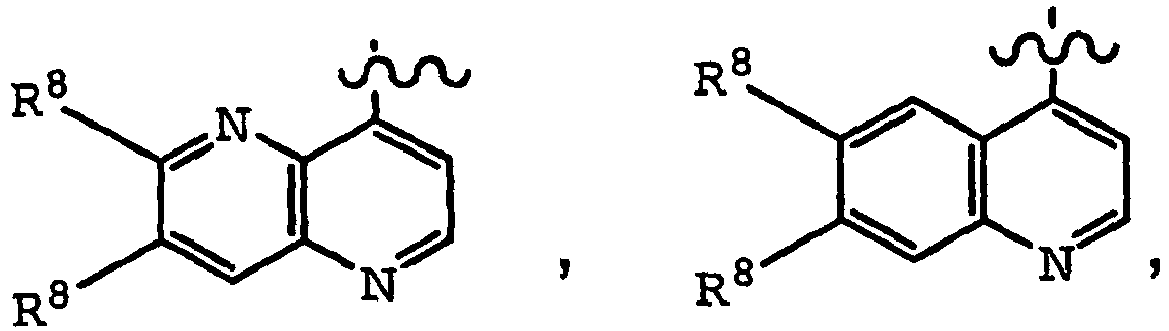

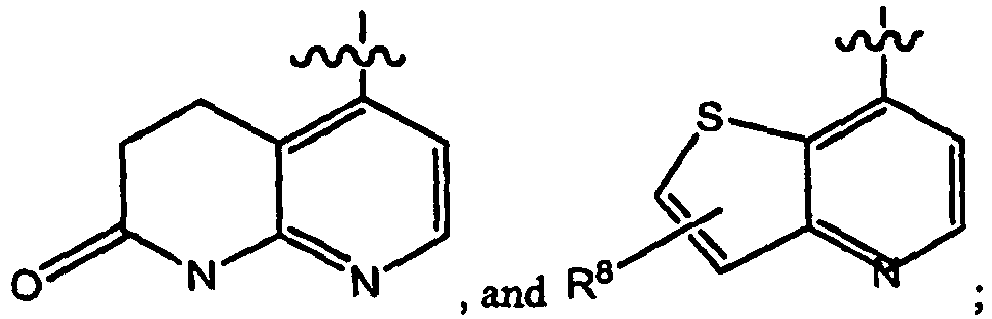
- R8 is independently selected from H, cyano, hydroxy, -C(=O)NRaR5a, 5-6 membered heterocyclyl, -NRaC(=O)-R5a, R5aRaN-O2S-, R5aO2SRaN-, R5aRaN-, C1-6-alkyl, amino-C1-6-alkyl, C1-6-alkylamino-C1-6-alkyl, alkoxy-C1-6-alkyl, phenyl-C1-6-alkyl, heterocyclyl-C1-6-alkyl, C1-6-alkoxy, halo-C1-6-alkoxy, C1-6-alkylamino-C1-6-alkoxy, aryl-C1-6-alkoxy, 5-6-membered heterocyclyl-C1-6-alkoxy, C3-6-cycloalkyl-C1-6-alkoxy, 5-6-membered heterocyclyl(hydroxyl-C1-6-alkoxy), C3-6-cycloalkyl(hydroxyl-C1-6-alkoxy), phenyl(hydroxyl-C1-6-alkoxy), C1-6-alkoxy-C1-6-alkoxy, phenyloxy-C1-6-alkoxy, 5-6 membered heterocyclyloxy-C1-6-alkoxy, C3-6-cycloalkyloxy-C1-6-alkoxy, phenyloxy, 5-6-membered heterocyclyloxy, and C3-6-cycloalkyloxy;
- Ra is selected from H, C1-6-alkyl, 5-6 membered heterocyclyl, phenyl, phenyl-C1-6-alkyl, 5-6 membered heterocyclyl-C1-6-alkyl, C3-6-cycloalkyl, C3-6-cycloalkyl-C1-6-alkyl, C2-6-alkenyl and C2-6-alkynyl; and
- R5a is selected from H, C1-6-alkyl, C1-6-haloalkyl, phenyl-C1-6-alkyl, 5-6 membered heterocyclyl-C1-6-alkyl, C3-6-cycloalkyl-C1-6-alkyl, phenyl, 5-6-membered heterocyclyl, C2-6-alkenyl, C2-6-alkYnYl and C3-6-cydoalkyl;
- The disclosure also relates to compounds wherein
R8 is independently selected from H, cyano, aminocarbonyl, C1-3-alkylarmnocarbonyl, C1-6-alkyl, C1-6-alkoxy, C1-3-alkylamino-C1-3-akoxy, 5-6 membered heterocyclyl-C1-3-alkoxy, C4-6-cycloalkyl-C1-3-alkoxy, 5-6 membered heterocyclyl-C1-3-(hydroxyalkoxy), C3-6-cycloalkyl-C1-3-(hydroxyalkoxy), C1-2-alkoxy-C1-3-alkoxy, phenyloxy-C1-3alkoxy, 5-6 membered heterocyclyloxy-C1-3-alkoxy, cycloalkyloxy-C1-3-alkoxy, 5-6 membered heterocyclyloxy, and C3-6-cycloalkyloxy in conjunction with any of the above or below embodiments. - The disclosure also relates to compounds wherein
R8 is independently selected from H, methyl, cyano, aminocarbonyl, methylaminocarbonyl, methoxy, dimethylaminopropoxy, 3-(morpholin-4-yl)ethoxy, 3-(pyrrolidin-1-yl)propoxy, 2-hydroxy-3-(morpholin-4-yl)propoxy, 3-(1,2,4-triazol-1-yl)propoxy, 3-(4-methylpiperazin-1-yl)propoxy, 3-(piperidin-4-yl)propoxy, dimethylaminoethoxy and diethylaminoethoxy; in conjunction with any of the above or below embodiments. - The invention also relates to compounds wherein
R is selected from 6,7-dimethoxy-4-quinolinyl, 6-methoxy-7-(dimethylaminopropoxy)-4-quinolinyl, 6-methoxy-7-(3-(morpholin-4-yl)propoxy)-4-quinolinyl, 6-methoxy-7-(3-(pyrrolidin-1-yl)propoxy)-4-quinolinyl, 6-methoxy-7-(2-hydroxy-3-(morpholin-4-yl)propoxy)-4-quinolinyl, 6-methoxy-7-(3-(1,2,4-triazol-1-yl)propoxy)-4-quinolinyl, 6-methoxy-7-(3-(4-methylpiperazin-1-yl)propoxy)-4-quinolinyl, 6-methoxy-7-(3-(piperidin-4-yl)propoxy)-4-quinolinyl, 6,7-dimethoxy-4-quinazolinyl and 6-methoxy-7-(dimethylaminopropoxy)-4-quinazolinyl; in conjunction with any of the above or below embodiments. - The invention also relates to compounds wherein
W is selected from substituted or unsubstituted phenyl, substituted or unsubstituted pyridyl, substituted or unsubstituted pyrimidinyl, substituted or unsubstituted pyridazinyl and substituted or unsubstituted pyrazinyl; in conjunction with any of the above or below embodiments. - The invention also relates to compounds wherein
W is substituted or unsubstituted phenyl; in conjunction with any of the above or below embodiments. - The invention also relates to compounds wherein
W is substituted or unsubstituted pyridyl; in conjunction with any of the above or below embodiments. - The invention also relates to compounds wherein
X is O; in conjunction with any of the above or below embodiments. - The invention also relates to compounds wherein
Y is selected from -NHC(=O)-, NHC(=O)-(CH2)p-, -NH-(CH2)p-, and NH-(CH2)pC(=O)-; and wherein
p is 0 or 1; in conjunction with any of the above or below embodiments. - The invention also relates to compounds wherein
Y is -NHC(=O)-; in conjunction with any of the above or below embodiments. - The invention also relates to compounds wherein
p is 1; in conjunction with any of the above or below embodiments. - The disclosure also relates to compounds wherein
R1 is selected from


- Rb is independently selected at each occurrence from H, optionally substituted arylalkyl, optionally substituted 5-6-membered heterocyclyl-C1-3 alkyl, optionally substituted C1-6-alkyl, optionally substituted 5-6 membered heterocyclyl, optionally substituted C6-10 ary, optionally substituted C6-10 heteroaryl, optionally substituted C3-6 cycloalkyl, and RaR5aN-C1-3alkyl;
- Rc is one or more substituents selected from H, methyl, isopropyl, tert-butyl, bromo, fluoro, hydroxyl, R5aRaN-, R5aRaN-C1-3 alkyl, methoxymethyl, methoxyethyl, methylthiomethyl, piperidin-1-ylmethyl, pyrrolidin-1-ylmethyl, optionally substituted phenyl, optionally substituted pyridyl, optionally substituted thienyl, and optionally substituted benzyl; wherein Ra is selected from H, methyl, ethyl, isopropyl, butyl, sec-butyl, isobutyl, phenyl, and phenylmethyl; and wherein R5a is selected from H, methyl, ethyl, isopropyl, butyl, sec-butyl, isobutyl, phenylmethyl, optionally substituted 5-6 membered heterocyclyl-C1-2-alkyl, optionally substituted phenyl, and optionally substituted 5-6-membered heterocyclyl; C6-10 aryl, nitrile, -C(=O)OR5a, -C(=O)NR5aRa, -C(=O)R5a and optionally substituted heteroraryl
- Ra is selected from H, C1-6-alkyl, optionally substituted 5-6 membered heterocyclyl, optionally substituted phenyl, optionally substituted phenyl-C1-6-alkyl, optionally substituted 5-6 membered heterocyclyl-C1-6-alkyl, C3-6-cycloalkyl, C3-6-cycloalkyl-C1-6-alkyl, C2-6-alkenyl and C2-6-alkynyl; and
- R5a is selected from H, C1-6-alkyl, C1-6-haloalkyl, phenyl-C1-6-alkyl, 5-6 membered heterocyclyl-C1-6-alkyl, C3-6-cycloalkyl-C1-6-alkyl, RaC(=O)-, optionally substituted phenyl, optionally substituted 5-6-membered heterocyclyl, C2-6-alkenyl, C2-6-alkynyl and C3-6-cycloalkyl; or wherein
- two adjacent Rc substituents, two adjacent Rb substituents or Rc together with an adjacent Rb together form an optionally substituted fused ring; or wherein
- two Rc substituents, together form an optionally substituted spiro ring; in conjunction with any of the above or below embodiments.
- The disclosure also relates to compounds wherein
Rb is selected from H, optionally substituted benzyl, C1-3 alkylaryl, C1-3 alkylheteroaryl, methyl, ethyl, isopropyl, butyl, sec-butyl, isobutyl, methoxymethyl" -(C1-6)alkyl,2-hydroxy 2-methylbutyl, 2-hydroxy-2-methylpropyl, 2-hydroxypropyl, 1-(1-hydroxycyclopropyl)methyl,, ethylaminomethyl, piperidin-1-ylmethyl, pyrrolidin-1-ylmethyl, pyridyl, thienyl, optionally substituted phenyl,1-naphthy, nitrile, -C(=O)OR5a, -C(=O)NR5aRa, and -C(=O)R5a ;
Rc is one or more substituents selected from H, methyl, isopropyl, tert-butyl, bromo, fluoro, hydroxyl, R5aRaN-, R5aRaN-C1-3 alkyl, methoxymethyl, methoxyethyl, methylthiomethyl, piperidin-1-ylmethyl, pyrrolidin-1-ylmethyl, optionally substituted phenyl, optionally substituted pyridyl, optionally substituted thienyl, and optionally substituted benzyl; wherein Ra is selected from H, methyl, ethyl, isopropyl, butyl, sec-butyl, isobutyl, phenyl, and phenylmethyl; and wherein R5a is selected from H, methyl, ethyl, isopropyl, butyl, sec-butyl, isobutyl, phenylmethyl, optionally substituted 5-6 membered heterocyclyl-C1-2-alkyl, optionally substituted phenyl, and optionally substituted 5-6-membered heterocyclyl; C6-10 aryl, nitrile, -C(=O)OR5a, -C(=O)NR5aRa, -C(=O)R5a and optionally substituted heteroraryl
wherein
Ra is selected from H, methyl, ethyl, isopropyl, butyl, sec-butyl, isobutyl, phenyl, and phenylmethyl; and wherein R5a is selected from H, methyl, ethyl, isopropyl, butyl, sec-butyl, isobutyl, phenylmethyl, optionally substituted 5-6 membered heterocyclyl-C1-2-alkyl, optionally substituted phenyl, and optionally substituted 5-6-membered heterocyclyl; C6-10 aryl, nitrile, -C(=O)OR5a, -C(=O)NR5aRa, -C(=O)R5a and optionally substituted heteroraryl
Ra is selected from H, methyl, ethyl, isopropyl, butyl, sec-butyl, isobutyl, phenyl, and phenylmethyl; and wherein
R5a is selected from H, methyl, ethyl, isopropyl, butyl, sec-butyl, isobutyl, phenylmethyl, optionally substituted 5-6 membered heterocyclyl-C1-2-alkyl, optionally substituted phenyl, and optionally substituted 5-6-membered heterocyclyl; or wherein
two Rc substituents, two Rb substituents or R° together with Rb together form an optionally substituted fused phenyl ring; or wherein two Rc substituents, together form an optionally substituted 3-6 membered spiro ring; in conjunction with any of the above or below embodiments. - The disclosure also relates to compounds wherein
R1 is selected from

- Rb is independently selected at each occurrence from H, optionally substituted arylalkyl, optionally substituted 5-6-membered heterocyclyl-C1-3 alkyl, optionally substituted C1-6-alkyl, optionally substituted 5-6 membered heterocyclyl, optionally substituted C6-10 ary, optionally substituted C6-10 heteroaryl, optionally substituted C3-6 cycloalkyl, and RaR5aN-C1-3alkyl;
- Rc is one or more substituents selected from H, methyl, isopropyl, tert-butyl, bromo, fluoro, hydroxyl, R5aRaN-, R5aRaN-C1-3 alkyl, methoxymethyl, methoxyethyl, methylthiomethyl, piperidin-1-ylmethyl, pyrrolidin-1-ylmethyl, optionally substituted phenyl, optionally substituted pyridyl, optionally substituted thienyl, and optionally substituted benzyl; wherein Ra is selected from H, methyl, ethyl, isopropyl, butyl, sec-butyl, isobutyl, phenyl, and phenylmethyl; and wherein R5a is selected from H, methyl, ethyl, isopropyl, butyl, sec-butyl, isobutyl, phenylmethyl, optionally substituted 5-6 membered heterocydyl-C1-2-alkyl, optionally substituted phenyl, and optionally substituted 5-6-membered heterocyclyl; C6-10 aryl, nitrile, -C(=O)OR5a, -C(=O)NR5aRa, -C(=O)R5a and optionally substituted heteroraryl
- Ra is selected from H, C1-6-alkyl, optionally substituted 5-6 membered heterocyclyl, optionally substituted phenyl, optionally substituted phenyl-C1-6-alkyl, optionally substituted 5-6 membered heterocyclyl-C1-6-alkyl, C3-6-cycloalkyl, C3-6-cycloalkyl-C1-6-alkyl, C2-6-alkenyl and C2-6-alkynyl; and
- R5a is selected from H, C1-6-alkyl, C1-6-haloalkyl, phenyl-C1-6-alkyl, 5-6 membered heterocyclyl-C1-6-alkyl, C3-6-cycloalkyl-C1-6-alkyl, RaC(=O)-, optionally substituted phenyl, optionally substituted 5-6-membered heterocyclyl, C2-6-alkenyl, C2-6-alkynyl and C3-6-cycloalkyl; or wherein
- two adjacent Rc substituents, two adjacent Rb substituents or Rc together with an adjacent Rb together form an optionally substituted fused ring; or wherein two Rc substituents, together form an optionally substituted spiro ring; in conjunction with any of the above or below embodiments.
- The disclosure also relates to compounds wherein
Rb is selected from H, optionally substituted benzyl, C1-3 alkylaryl, C1-3 alkylheteroaryl, methyl, ethyl, isopropyl, butyl, sec-butyl, isobutyl, methoxymethyl" -(C1-6)alkyl,2-hydroxy 2-methylbutyl, 2-hydroxy-2-methylpropyl, 2-hydroxypropyl, 1-(1-hydroxycyclopropyl)methyl,, ethylaminomethyl, piperidin-1-ylmethyl, pyrrolidin-1-ylmethyl, pyridyl, thienyl, optionally substituted phenyl, 1-naphthy, nitrile, -C(=O)OR5a, -C(=O)NR5aRa, and -C(=O)R5a ;
Rc is one or more substituents selected from H, methyl, isopropyl, tert-butyl, bromo, fluoro, hydroxyl, R5aRaN-, R5aRaN-C1-3 alkyl, methoxymethyl, methoxyethyl, methylthiomethyl, piperidin-1-ylmethyl, pyrrolidin-1-ylmethyl, optionally substituted phenyl, optionally substituted pyridyl, optionally substituted thienyl, and optionally substituted benzyl; wherein Ra is selected from H, methyl, ethyl, isopropyl, butyl, sec-butyl, isobutyl, phenyl, and phenylmethyl; and wherein R5a is selected from H, methyl, ethyl, isopropyl, butyl, sec-butyl, isobutyl, phenylmethyl, optionally substituted 5-6 membered heterocyclyl-C1-2-alkyl, optionally substituted phenyl, and optionally substituted 5-6-membered heterocyclyl; C6-10 aryl, nitrile, -C(=O)OR5a, -C(=O)NR5aRa, -C(=O)R5a and optionally substituted heteroraryl
Ra is selected from H, methyl, ethyl, isopropyl, butyl, sec-butyl, isobutyl, phenyl, and phenylmethyl; and wherein
R5a is selected from H, methyl, ethyl, isopropyl, butyl, sec-butyl, isobutyl, phenylmethyl, optionally substituted 5-6 membered heterocyclyl-C1-2-alkyl, optionally substituted phenyl, and optionally substituted 5-6-membered heterocyclyl; or wherein two Rc substituents, two Rb substituents or Rc together with Rb together form an optionally substituted fused phenyl ring; or wherein
two Rc substituents, together form an optionally substituted 3-6 membered spiro ring; in conjunction with any of the above or below embodiments. - The disclosure also relates to compounds wherein
R1 is selected from


- Rb is independently selected at each occurrence from H, optionally substituted arylalkyl, optionally substituted 5-6-membered heterocyclyl-C1-3 alkyl, optionally substituted C1-6-alkyl, optionally substituted 5-6 membered heterocyclyl, optionally substituted C6-10 ary, optionally substituted C6-10 heteroaryl, optionally substituted C3-6 cycloalkyl, and RaR5aN-C1-3alkyl;
- Rc is one or more substituents selected from H, methyl, isopropyl, tert-butyl, bromo, fluoro, hydroxyl, R5aRaN-, R5aRaN-C1-3 alkyl, methoxymethyl, methoxyethyl, methylthiomethyl, piperidin-1-ylmethyl, pyrrolidin-1-ylmethyl, optionally substituted phenyl, optionally substituted pyridyl, optionally substituted thienyl, and optionally substituted benzyl; wherein Ra is selected from H, methyl, ethyl, isopropyl, butyl, sec-butyl, isobutyl, phenyl, and phenylmethyl; and wherein R5a is selected from H, methyl, ethyl, isopropyl, butyl, sec-butyl, isobutyl, phenylmethyl, optionally substituted 5-6 membered heterocyclyl-C1-2-alkyl, optionally substituted phenyl, and optionally substituted 5-6-membered heterocyclyl; C6-10 aryl, nitrile, -C(=O)OR5a, -C(=O)NR5aRa, -C(=O)R5a and optionally substituted heteroraryl
- Ra is selected from H, C1-6-alkyl, optionally substituted 5-6 membered heterocyclyl, optionally substituted phenyl, optionally substituted phenyl-C1-6-alkyl, optionally substituted 5-6 membered heterocyclyl-C1-6-alkyl, C3-6-cycloalkyl, C3-6-cycloalkyl-C1-6-alkyl, C2-6-alkenyl and C2-6-alkynyl; and
- R5a is selected from H, C1-6-alkyl, C1-6-haloalkyl, phenyl-C1-6-alkyl, 5-6 membered heterocyclyl-C1-6-alkyl, C3-6-cycloalkyl-C1-6-alkyl, RaC(=O)-, optionally substituted phenyl, optionally substituted 5-6-membered heterocyclyl, C2-6-alkenyl, C2-6-alkynyl and C3-6-cycloalkyl; or wherein
- two adjacent Rc substituents, two adjacent Rb substituents or Rc together with an adjacent Rb together form an optionally substituted fused ring; or wherein
- two Rc substituents, together form an optionally substituted spiro ring; in conjunction with any of the above or below embodiments.
- The disclosure also relates to compounds wherein
Rb is selected from H, optionally substituted benzyl, C1-3 alkylaryl, C1-3 alkylheteroaryl, methyl, ethyl, isopropyl, butyl, sec-butyl, isobutyl, methoxymethyl,, -(C1-6)alkyl,2-hydroxy 2-methylbutyl, 2-hydroxy-2-methylpropyl, 2-hydroxypropyl, 1-(1-hydroxycyclopropyl)methyl,, ethylaminomethyl, piperidin-1-ylmethyl, pyrrolidin-1-ylmethyl, pyridyl, thienyl, optionally substituted phenyl,1-naphthy, nitrile, -C(=O)OR5a, -C(=O)NR5aRa, and -C(=O)R5a;
Rc is one or more substituents selected from H, methyl, isopropyl, tert-butyl, bromo, fluoro, hydroxyl, R5aRaN-, R5aRaN-C1-3 alkyl, methoxymethyl, methoxyethyl, methylthiomethyl, piperidin-1-ylmethyl, pyrrolidin-1-ylmethyl, optionally substituted phenyl, optionally substituted pyridyl, optionally substituted thienyl, and optionally substituted benzyl; wherein Ra is selected from H, methyl, ethyl, isopropyl, butyl, sec-butyl, isobutyl, phenyl, and phenylmethyl; and wherein R5a is selected from H, methyl, ethyl, isopropyl, butyl, sec-butyl, isobutyl, phenylmethyl, optionally substituted 5-6 membered heteracyclyl-C1-2-alkyl, optionally substituted phenyl, and optionally substituted 5-6-membered heterocyclyl; C6-10 aryl, nitrile, -C(=O)OR5a, -C(=O)NR5aRa, -C(=O)R5a and optionally substituted heteroraryl
R5a is selected from H, methyl, ethyl, isopropyl, butyl, sec-butyl, isobutyl, phenylmethyl, optionally substituted 5-6 membered heterocyclyl-C1-2-alkyl, optionally substituted phenyl, and optionally substituted 5-6-membered heterocyclyl; or wherein
two Rc substituents, two Rb substituents or Rc together with Rb together form an optionally substituted fused phenyl ring; or wherein
two Rc substituents, together form an optionally substituted 3-6 membered spiro ring; in conjunction with any of the above or below embodiments. - The disclosure also relates to compounds wherein
R1 is selected from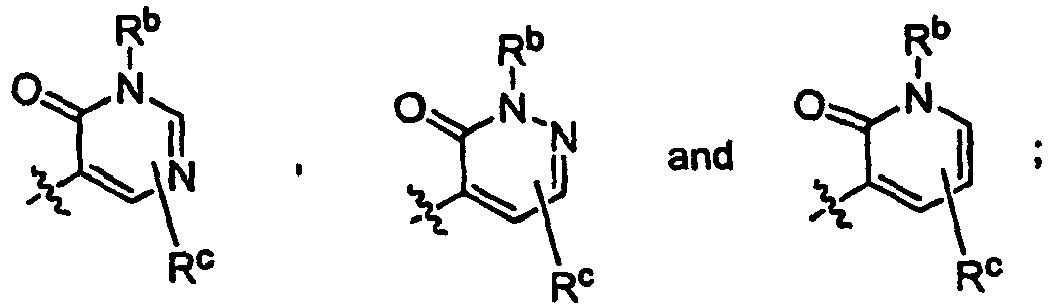
- Rb is independently selected at each occurrence from H, optionally substituted arylalkyl, optionally substituted 5-6-membered heterocyclyl-C1-3 alkyl, optionally substituted C1-6-alkyl, optionally substituted 5-6 membered heterocyclyl, optionally substituted C6-10 ary, optionally substituted C6-10 heteroaryl, optionally substituted C3-6 cycloalkyl, and RaR5aN-C1-3alkyl;
- Rc is one or more substituents selected from H, methyl, isopropyl, tert-butyl, bromo, fluoro, hydroxyl, R5aRaN-, R5aRaN-C1-3 alkyl, methoxymethyl, methoxyethyl, methylthiomethyl, piperidin-1-ylmethyl, pyrrolidin-1-ylmethyl, optionally substituted phenyl, optionally substituted pyridyl, optionally substituted thienyl, and optionally substituted benzyl; wherein Ra is selected from H, methyl, ethyl, isopropyl, butyl, sec-butyl, isobutyl, phenyl, and phenylmethyl; and wherein R5a is selected from H, methyl, ethyl, isopropyl, butyl, sec-butyl, isobutyl, phenylmethyl, optionally substituted 5-6 membered heterocyclyl-C1-2-alkyl, optionally substituted phenyl, and optionally substituted 5-6-membered heterocyclyl; C6-10 aryl, nitrile, -C(=O)OR5a, -C(=O)NR5aRa, -C(=O)R5a and optionally substituted heteroraryl
- Ra is selected from H, C1-6-alkyl, optionally substituted 5-6 membered heterocyclyl, optionally substituted phenyl, optionally substituted phenyl-C1-6-alkyl, optionally substituted 5-6 membered heterocyclyl-C1-6-alkyl, C3-6-cycloalkyl, C3-6-cycloalkyl-C1-6-alkyl, C2-6-alkenyl and C2-6-alkynyl; and
- R5a is selected from H, C1-6-alkyl, C1-6-haloalkyl, phenyl-C1-6-alkyl, 5-6 membered heterocyclyl-C1-6-alkyl, C3-6-cycloalkyl-C1-6-alkyl, RaC(=O)-, optionally substituted phenyl, optionally substituted 5-6-membered heterocyclyl, C2-6-alkenyl, C2-6-alkynyl and C3-6-cyclolkyl; or wherein
- two adjacent Rc substituents, two adjacent Rb substituents or Rc together with an adjacent Rb together form an optionally substituted fused ring; or wherein two Rc substituents, together form an optionally substituted spiro ring; in conjunction with any of the above or below embodiments.
- The disclosure also relates to compounds wherein
Rb is selected from H, optionally substituted benzyl, C1-3 alkylaryl, C1-3 alkylheteroaryl, methyl, ethyl, isopropyl, butyl, sec-butyl, isobutyl, methoxymethyl,, -(C1-6)alkyl,2-hydroxy 2-methylbutyl, 2-hydroxy-2-methylpropyl, 2-hydroxypropyl, 1-(1-hydroxycyclopropyl)methyl" ethylaminomethyl, piperidin-1-ylmethyl, pyrrolidin-1-ylmethyl, pyridyl, thienyl, optionally substituted phenyl,1-naphthy, nitrile, -C(=O)OR5a, -C(=O)NR5aRa, and -C(=O)R5a ;
Rc is one or more substituents selected from H, methyl, isopropyl, tert-butyl, bromo, fluoro, hydroxyl, R5aRaN-, R5aRaN-C1-3 alkyl, methoxymethyl, methoxyethyl, methylthiomethyl, piperidin-1-ylmethyl, pyrrolidin-1-ylmethyl, optionally substituted phenyl, optionally substituted pyridyl, optionally substituted thienyl, and optionally substituted benzyl; wherein Ra is selected from H, methyl, ethyl, isopropyl, butyl, sec-butyl, isobutyl, phenyl, and phenyhnethyl; and wherein R5a is selected from H, methyl, ethyl, isopropyl, butyl, sec-butyl, isobutyl, phenylmethyl, optionally substituted 5-6 membered heterocyclyl-C1-2-alkyl, optionally substituted phenyl, and optionally substituted 5-6-membered heterocyclyl; C6-10 aryl, nitrile, -C(=O)OR5a, -C(=O)NR5aRa, -C(=O)R5a and optionally substituted heteroraryl
R5a is selected from H, methyl, ethyl, isopropyl, butyl, sec-butyl, isobutyl, phenylmethyl, optionally substituted 5-6 membered heterocyclyl-C1-2-alkyl, optionally substituted phenyl, and optionally substituted 5-6-membered heterocyclyl; or wherein two Rc substituents, two Rb substituents or Rc together with Rb together form an optionally substituted fused phenyl ring; or wherein two Rc substituents, together form an optionally substituted 3-6 membered spiro ring; in conjunction with any of the above or below embodiments. - The disclosure also relates to compounds of Formula II

- T is O or S;
- R3 and R4 is each independently selected from H, C1-2-alkyl, phenyl, 5-6-membered heterocyclyl, phenyl-C1-2-alkyl, 5-6-membered heterocyclyl- C1-2-alkyl, C3-6-cycloalkyl, and C3-6-cycloalkyl-C1-2-alkyl; alternatively R3 and R4, together with the atom they are attached to, form an optionally substituted 4-6 membered ring;
- R9 and R10 is independently selected from H, cyano, hydroxy, -C(=O)NRaR5a, 5-6 membered heterocyclyl, -NRaC(=O)-R5a, R5aRaN-O2S-, R5aO2SRaN-, R5aRaN-, C1-6-alkyl, amino-C1-6-alkyl, C1-6-alkylamino-C1-6-alkyl, alkoxy-C1-6-alkyl, hydroxy, aryl-C1-6-alkyl, heterocyclyl-C1-6-alkyl, C1-6-alkoxy, halo-C1-6-alkoxy, C1-6-alkylamino-C1-6-alkoxy, aryl-C1-6-alkoxy, 5-6-membered heterocyclyl, -C1-6alkoxy, C3-6-cycloalkyl-C1-6-alkoxy, 5-6-membered heterocyclyl(hydroxyl-C1-6-alkoxy), C3-6-cycloalkyl(hydroxyl-C1-6-alkoxy), phenyl(hydroxyl-C1-6-alkoxy), C1-6-alkoxy-C1-6-alkoxy, phenyloxy-C1-6-alkoxy, 5-6 membered heterocyclyloxy-C1-6-alkoxy, C3-6-cycloalkyloxy-C1-6-alkoxy, phenyloxy, 5-6-membered heterocyclyloxy, and C3-6-cycloalkyloxy; each of Za, Zb, Zc and Zd is independently selected from N or CH; provided no more than 2 of Za, Zb, Zc and Zd are N;
- n is 0, 1, 2 or 3 ;
- D1 is selected from N or CR11;
- D2 is selected from NR13, O, or CHR11; provided either D1 is N or D2 is NR13; ring Rd including

- R11 is selected from H, halo, C1-4-alkyl, C1-4-haloalkyl, C1-4-hydroxyalkyl, -NH2, -OR12, alkoxycarbonyl, -CO2H, -CONR3R5a, (C1-C3)alkylamino, di(C1-C6)alkylamino, (C1-C3)hydroxyalkylamino, (C1-C3)alkylamino-(C1-C3)alkylamino, C1-3-alkoxy-C1-3-alkyl, C1-3-alkylamino-C1-3-alkyl, C1-3-alkylthio-C1-3-alkyl, optionally substituted phenyl-C1-3-alkyl, 5-6 membered heterocyclyl-C1-3-alkyl, C3-6-cycloalkyl-C1-3-alkyl, optionally substituted phenyl, optionally substituted 5-6 membered heterocyclyl, and C3-6-cycloalkyl;
- Ra is selected from H, alkyl, heterocyclyl, aryl, arylalkyl, heterocyclylalkyl, cycloalkyl, cycloalkylalkyl, alkenyl and alkynyl;
- R5a is selected from H, alkyl, haloalkyl, arylalkyl, heterocyclylalkyl, cycloalkylalkyl, aryl, heterocyclyl, alkenyl, alkynyl and cycloalkyl;
- R12 is selected from H, halo, C1-2-alkyl and methoxy;
- R13 is selected from H, alkyl, haloalkyl, optionally substituted phenylalkyl, optionally substituted 5-10 membered heterocyclylalkyl, cycloalkylalkyl, optionally substituted phenyl or naphthyl, optionally substituted 5-10 membered heterocyclyl and cycloalkyl.
- The invention also relates to compounds wherein
R9 and R10 are independently selected from H, cyano, aminocarbonyl, C1-3-alkylaminocarbonyl, C1-3-alkylamino-C1-3-alkoxy, 5-6 membered heterocyclyl-C1-3-alkoxy, C4-6-cycloalkyl-C1-3-alkoxy, 5-6 membered heterocyclyl-C1-3-(hydroxyalkoxy), C3-6-cycloalkyl-C1-3-(hydroxyalkoxy), C1-2-alkoxy-C1-3-alkoxy, phenyloxy-C1-3alkoxy, 5-6 membered heterocyclyloxy-C1-3-alkoxy, cycloalkyloxy-C1-3-alkoxy, 5-6 membered heterocyclyloxy, and C3-6-cycloalkyloxy; in conjunction with any of the above or below embodiments. - The disclosure also relates to compounds wherein
R9 is independently selected from H, methyl, cyano, aminocarbonyl, methylaminocarbonyl, methoxy, dimethylaminopropoxy, 3-(morpholin-4-yl)ethoxy, 3-(pyrrolidin-1-yl)propoxy, 2-hydroxy-3-(morpholin-4-yl)propoxy, 3-(1,2,4-triazol-1-yl)propoxy, 3-(4-methylpiperazin-1-yl)propoxy, 3-(piperidin-4-yl)propoxy, dimethylaminoethoxy and diethylaminoethoxy; in conjunction with any of the above or below embodiments. - The disclosure also relates to compounds wherein
R10 is methoxy; in conjunction with any of the above or below embodiments. - The disclosure also relates to compounds wherein
Za is CH; wherein Zb is CH; wherein Zc is CF; and wherein Zd is CH; in conjunction with any of the above or below embodiments. - The disclosure also relates to compounds wherein
Za is N;
Za is CH;
Zc is CH;
Zd is CH; and
R12 is H; in conjunction with any of the above or below embodiments. - The disclosure also relates to compounds wherein
Za is CH;
Zb is N;
Zc is CH;
Zd is CH; and
R12 is H; in conjunction with any of the above or below embodiments. - The disclosure also relates to compounds wherein
Za is CH;
Zb is N;
Zc is CH;
Zd is N; and
R12 is H; in conjunction with any of the above or below embodiments. - The disclosure also relates to compounds wherein
Rd is
Rc is one or more substituents selected from H, methyl, isopropyl, tert-butyl, bromo, fluoro, hydroxyl, R5aRaN-, R5aRaN-C1-3 alkyl, methoxymethyl, methoxyethyl, methylthiomethyl, piperidin-1-ylmethyl, pyrrolidin-1-ylmethyl, optionally substituted phenyl, optionally substituted pyridyl, optionally substituted thienyl, and optionally substituted benzyl; wherein Ra is selected from H, methyl, ethyl, isopropyl, butyl, see-butyl, isobutyl, phenyl, and phenylmethyl; and wherein R5a is selected from H, methyl, ethyl, isopropyl, butyl, sec-butyl, isobutyl, phenylmethyl, optionally substituted 5-6 membered heterocyclyl-C1-2-alkyl, optionally substituted phenyl, and optionally substituted 5-6-membered heterocyclyl; C6-10 aryl, nitrile, -C(=O)OR5a, -C(=O)NR5aR8, -C(=O)R5a and optionally substituted heteroraryl
Ra is selected from H, C1-6-alkyl, optionally substituted 5-6 membered heterocyclyl, optionally substituted phenyl, optionally substituted phenyl-C1-6-alkyl, optionally substituted 5-6 membered heterocyclyl-C1-6-alkyl, C3-6-cycloalkyl, C3-6-cycloalkyl-C1-6-alkyl, C2-6-alkenyl and C2-6-alkynyl; and
R5a is selected from H, C1-6-alkyl, C1-6-haloalkyl, phenyl-C1-6-alkyl, 5-6 membered heterocyclyl-C1-6-alkyl, C3-6-cycloalkyl-C1-6-alkyl, optionally substituted phenyl, optionally substituted 5-6-membered heterocyclyl, C2-6-alkenyl, C2-6-alkynyl and C3-6-cycloalkyl; or wherein
two adjacent Rc substituents, two adjacent Rb substituents or Rc together with an adjacent Rb together form an optionally substituted fused phenyl ring; or wherein
two Rc substituents, together form an optionally substituted spiro ring; in conjunction with any of the above or below embodiments. - The disclosure also relates to compounds wherein
Rb is selected from H, optionally substituted benzyl, C1-3 alkylaryl, C1-3 alkylheteroaryl, methyl, ethyl, isopropyl, butyl, sec-butyl, isobutyl, methoxymethyl" -(C1-6)alkyl,2-hydroxy 2-methylbutyl, 2-hydroxy-2-methylpropyl, 2-hydroxypropyl, 1-(1-hydroxycyclopropyl)methyl" ethylaminomethyl, piperidin-1-ylmethyl, pyrrolidine-1-ylmethyl, pyridyl, thienyl, optionally substituted phenyl,1-naphthy, nitrile, -C(=O)OR5a, -C(=O)NR5aRa, and -C(=O)R5a;
Rc is one or more substituents selected from H, methyl, isopropyl, tert-butyl, bromo, fluoro, hydroxyl, R5aRaN-, R5aRaN-C1-3 alkyl, methoxymethyl, methoxyethyl, methylthiomethyl, piperidin-1-ylimethyl, pyrrolidin-1-ylmethyl, optionally substituted phenyl, optionally substituted pyridyl, optionally substituted thienyl, and optionally substituted benzyl; wherein Ra is selected from H, methyl, ethyl, isopropyl, butyl, sec-butyl, isobutyl, phenyl, and phenylmethyl; and wherein R5a is selected from H, methyl, ethyl, isopropyl, butyl, sec-butyl, isobutyl, phenylmethyl, optionally substituted 5-6 membered heterocyclyl-C1-2-alkyl, optionally substituted phenyl, and optionally substituted 5-6-membered heterocyclyl; C6-10 aryl, nitrile, -C(=O)OR5a, -C(=O)NR5aRa, -C(=O)R5a and optionally substituted heteroraryl
R5a is selected from H, methyl, ethyl, isopropyl, butyl, sec-butyl, isobutyl, phenylmethyl, optionally substituted 5-6 membered heterocyclyl-C1-2-alkyl, optionally substituted phenyl, and optionally substituted 5-6-membered heterocyclyl; or
two Rc substituents, two Rb substituents or Rc together with Rb together form an optionally substituted fused phenyl ring; or
two Rc substituents, together form an optionally substituted 3-6 membered spiro ring; in conjunction with any of the above or below embodiments. - The invention also relates to compounds wherein
Rd is
- Rc is one or more substituents selected from H, methyl, isopropyl, tert-butyl, bromo, fluoro, hydroxyl, R5aRaN-, R5aRaN-C1-3 alkyl, methoxymethyl, methoxyethyl, methylthiomethyl, piperidin-1-ylmethyl, pyrrolidin-1-ylmethyl, optionally substituted phenyl, optionally substituted pyridyl, optionally substituted thienyl, and optionally substituted benzyl; wherein Ra is selected from H, methyl, ethyl, isopropyl, butyl, sec-butyl, isobutyl, phenyl, and phenylmethyl; and wherein R5a is selected from H, methyl, ethyl, isopropyl, butyl, sec-butyl, isobutyl, phenylmethyl, optionally substituted 5-6 membered heterocyclyl-C1-2-alkyl, optionally substituted phenyl, and optionally substituted 5-6-membered heterocyclyl; C6-10 aryl, nitrile, -C(=O)OR5a, -C(=O)NR5aRa, -C(=O)R5a and optionally substituted heteroraryl
- Ra is selected from H, C1-4-alkyl, optionally substituted 5-6 membered heterocyclyl, optionally substituted phenyl, optionally substituted phenyl-C1-6-alkyl, optionally substituted 5-6 membered heterocyclyl-C1-6-alkyl, C3-6-cycloalkyl, C3-6-cycloalkyl-C1-6-alkyl, C2-6-alkenyl and C2-6-alkynyl; and
- R5a is selected from H, C1-6-alkyl, C1-6-haloalkyl, phenyl-C1-6-alkyl, 5-6 membered heterocyclyl-C1-6-alkyl, C3-6-cycloalkyl-C1-6-alkyl, RaC(=O)-, optionally substituted phenyl, optionally substituted 5-6-membered heterocyclyl, C2-6-alkenyl, C2-6-alkynyl and C3-6-cycloalkyl;or wherein
- two adjacent Rc substituents, two adjacent Rb substituents or Rc together with an adjacent Rb together form an optionally substituted fused phenyl ring; or wherein
- two Rc substituents, together form an optionally substituted spiro ring;
- in conjunction with any of the above or below embodiments.
- The disclosure also relates to compounds wherein
Rc is one or more substituents selected from H, methyl, isopropyl, tert-butyl, bromo, fluoro, hydroxyl, R5aRaN-, R5aRaN-C1-3 alkyl, methoxymethyl, methoxyethyl, methylthiomethyl, piperidin-1-ylmethyl, pyrrolidin-1-ylmethyl, optionally substituted phenyl, optionally substituted pyridyl, optionally substituted thienyl, and optionally substituted benzyl; wherein Ra is selected from H, methyl, ethyl, isopropyl, butyl, sec-butyl, isobutyl, phenyl, and phenylmethyl; and wherein R5a is selected from H, methyl, ethyl, isopropyl, butyl, sec-butyl, isobutyl, phenylmethyl, optionally substituted 5-6 membered heterocyclyl-C1-2-alkyl, optionally substituted phenyl, and optionally substituted 5-6-membered heterocyclyl; C6-10 aryl, nitrile, -C(=O)OR5a, -C(=O)NR5aRa, -C(=O)R5a and optionally substituted heteroraryl
Ra is selected from H, methyl, ethyl, isopropyl, butyl, sec-butyl, isobutyl, phenyl, and phenylmethyl; and wherein R5a is selected from H, methyl, ethyl, isopropyl, butyl, sec-butyl, isobutyl, phenylmethyl, optionally substituted 5-6 membered heterocyclyl-C1-2-alkyl, optionally substituted phenyl, and optionally substituted 5-6-membered heterocyclyl; C6-10 aryl, nitrile, -C(=O)OR5a, -C(=O)NR5aRa, -C(=O)R5a and optionally substituted heteroraryl
Ra is selected from H, methyl, ethyl, isopropyl, butyl, sec-butyl, isobutyl, phenyl, and phenylmethyl; and wherein R5a is selected from H, methyl, ethyl, isopropyl, butyl, sec-butyl, isobutyl, phenylmethyl, optionally substituted 5-6 membered heterocyclyl-C1-2-alkyl, optionally substituted phenyl, and optionally substituted 5-6-membered heterocyclyl; or
two Rc substituents, two Rb substituents or Rc together with Rb together form an optionally substituted fused phenyl ring; or wherein two Rc substituents, together form an optionally substituted 3-6 membered spiro ring;
in conjunction with any of the above or below embodiments. - The disclosure also relates to compounds wherein
Rd is
Ra is selected from H, C1-6-alkyl, optionally substituted 5-6 membered heterocyclyl, optionally substituted phenyl, optionally substituted phenyl-C1-6-alkyl, optionally substituted 5-6 membered heterocyclyl-C1-6-alkyl, C3-6-cycloalkyl, C3-6-cycloalkyl-C1-6-alkyl, C2-6-alkenyl and C2-6-alkynyl; and
R5a is selected from H, C1-6-alkyl, C1-6-haloalkyl, phenyl-C1-6-alkyl, 5-6 membered heterocyclyl-C1-6-alkyl, C3-6-cycloalkyl-C1-6-alkyl, RaC(=O)-, optionally substituted phenyl, optionally substituted 5-6-membered heterocyclyl, C2-6-alkenyl, C2-6-alkynyl and C3-6-cycloalkyl; or wherein
two adjacent Rc substituents, two adjacent Rb substituents or Rc together with an adjacent Rb together form an optionally substituted fused phenyl ring; or wherein
two Rc substituents, together form an optionally substituted spiro ring,
in conjunction with any of the above or below embodiments. - The disclosure also relates to compounds wherein
Rc is one or more substituents selected from H, methyl, isopropyl, tert-butyl, bromo, fluoro, hydroxyl, R5aRaN-, R5aRaN-C1-3 alkyl, methoxymethyl, methoxyethyl, methylthiomethyl, piperidin-1-ylmethyl, pyrrolidin-1-ylmethyl, optionally substituted phenyl, optionally substituted pyridyl, optionally substituted thienyl, and optionally substituted benzyl; wherein Ra is selected from H, methyl, ethyl, isopropyl, butyl, sec-butyl, isobutyl, phenyl, and phenylmethyl; and wherein R5a is selected from H, methyl, ethyl, isopropyl, butyl, sec-butyl, isobutyl, phenylmethyl, optionally substituted 5-6 membered heterocyclyl-C1-2-alkyl, optionally substituted phenyl, and optionally substituted 5-6-membered heterocyclyl; C6-10 aryl, nitrile, -C(=O)OR5a, -C(=O)NR5Ra, -C(=O)R5a and optionally substituted heteroraryl
Ra is selected from H, methyl, ethyl, isopropyl, butyl, sec-butyl, isobutyl, phenyl, and phenylmethyl; and wherein R5a is selected from H, methyl, ethyl, isopropyl, butyl, sec-butyl, isobutyl, phenylmethyl, optionally substituted 5-6 membered heterocyclyl-C1-2-alkyl, optionally substituted phenyl, and optionally substituted 5-6-membered heterocyclyl; or
two Rc substituents, two Rb substituents or Rc together with Rb together form an optionally substituted fused phenyl ring; or
two Rc substituents, together form an optionally substituted 3-6 membered spiro ring;
in conjunction with any of the above or below embodiments. - The disclosure also relates to compounds wherein
Rd is
Rc is one or more substituents selected from H, methyl, isopropyl, tert-butyl, bromo, fluoro, hydroxyl, R5aRaN-, R5aRaN-C1-3 alkyl, methoxymethyl, methoxyethyl, methylthiomethyl, piperidin-1-ylmethyl, pyrrolidin-1-ylmethyl, optionally substituted phenyl, optionally substituted pyridyl, optionally substituted thienyl, and optionally substituted benzyl; wherein Ra is selected from H, methyl, ethyl, isopropyl, butyl, sec-butyl, isobutyl, phenyl, and phenylmethyl; and wherein R5a is selected from H, methyl, ethyl, isopropyl, butyl, sec-butyl, isobutyl, phenylmethyl, optionally substituted 5-6 membered heterocyclyl-C1-2-alkyl, optionally substituted phenyl, and optionally substituted 5-6-membered heterocyclyl; C6-10 aryl, nitrile, -C(=O)OR5a, -C(=O)NR5aRa, -C(=O)R5a and optionally substituted heteroraryl
Ra is selected from H, C1-6-alkyl, optionally substituted 5-6 membered heterocyclyl, optionally substituted phenyl, optionally substituted phenyl-C1-6-alkyl, optionally substituted 5-6 membered heterocyclyl-C1-6-alkyl, C3-4-cycloalkyl, C3-6cycloalkyl-C1-6-alkyl, C2-6-alkenyl and C2-6-alkynyl; and
R5a is selected from H, C1-6-alkyl, C1-6-haloalkyl, phenyl-C1-6-alkyl, 5-6 membered heterocyclyl-C1-6-alkyl, C3-6-cycloalkyl-C1-6-alkyl, RaC(=O)-, optionally substituted phenyl, optionally substituted 5-6-membered heterocyclyl, C2-6-alkenyl, C2-6-alkynyl and C3-6-cycloalkyl; or wherein
two adjacent Rc substituents, two adjacent Rb substituents or Rc together with an adjacent Rb together form an optionally substituted fused phenyl ring; or wherein
two Rc substituents, together form an optionally substituted spiro ring;
in conjunction with any of the above or below embodiments. - The disclosure also relates to compounds wherein
Rb is selected from H, optionally substituted benzyl, C1-3 alkylaryl, C1-3 alkylheteroaryl, methyl, ethyl, isopropyl, butyl, sec-butyl, isobutyl, methoxymethyl" -(C1-6)alkyl,2-hydroxy 2-methylbutyl, 2-hydroxy-2-methylpropyl, 2-hydroxypropyl, 1-(1-hydroxycyclopropyl)methyl" ethylaminomethyl, piperidin-1-ylmethyl, pyrrolidin-1-yhnethyl, pyridyl, thienyl, optionally substituted phenyl,1-naphthy, nitrile, -C(=O)OR5a, -C(=O)NR5aRa, and -C(=O)R5a ;
Rc is one or more substituents selected from H, methyl, isopropyl, tert-butyl, bromo, fluoro, hydroxyl, R5aRaN-, R5aRa-C1-3 alkyl, methoxymethyl, methoxyethyl, methylthiomethyl, piperidin-1-ylmethyl, pyrrolidin-1-ylmethyl, optionally substituted phenyl, optionally substituted pyridyl, optionally substituted thienyl, optionally substituted benzyl, and ;
Ra is selected from H, methyl, ethyl, isopropyl, butyl, sec-butyl, isobutyl, phenyl, and phenylmethyl; and
R5a is selected from H, methyl, ethyl, isopropyl, butyl, sec-butyl, isobutyl, phenylmethyl, optionally substituted 5-6 membered heterocyclyl-C1-2-alkyl, optionally substituted phenyl, and optionally substituted 5-6-membered heterocyclyl; or wherein two Rc substituents, two Rb substituents or Rc together with Rb together form an optionally substituted fused phenyl ring; or wherein
two Rc substituents, together form an optionally substituted 3-6 membered spiro ring; in conjunction with any of the above or below embodiments. - The disclosure also relates to compounds wherein
Rd is
Rc is one or more substituents selected from H, methyl, isopropyl, tert-butyl, bromo, fluoro, hydroxyl, R5aRaN-, R5aRaN-C1-3 alkyl, methoxymethyl, methoxyethyl, methylthiomethyl, piperidin-1-ylmethyl, pyrrolidin-1-ylmethyl, optionally substituted phenyl, optionally substituted pyridyl, optionally substituted thienyl, and optionally substituted benzyl; wherein Ra is selected from H, methyl, ethyl, isopropyl, butyl, sec-butyl, isobutyl, phenyl, and phenylmethyl; and wherein R5a is selected from H, methyl, ethyl, isopropyl, butyl, sec-butyl, isobutyl, phenylmethyl, optionally substituted 5-6 membered heterocyclyl-C1-2-alkyl, optionally substituted phenyl, and optionally substituted 5-6-membered heterocyclyl; C6-10 aryl, nitrile, -C(=O)OR5a, -C(=O)NR5aRa, -C(=O)R5a and optionally substituted heteroraryl
Ra is selected from H, C1-6-alkyl, optionally substituted 5-6 membered heterocyclyl, optionally substituted phenyl, optionally substituted phenyl-C1-6-alkyl, optionally substituted 5-6 membered heterocyclyl-C1-6-alkyl, C3-6-cycloalkyl, C3-6-cycloalkyl-C1-6alkyl, C2-6-alkenyl and C2-6-alkynyl; and
R5a is selected from H, C1-6-alkyl, C1-6-haloalkyl, phenyl-C1-6-alkyl, 5-6 membered heterocyclyl-C1-6-alkyl, C3-6-cycloalkyl-C1-6-alkyl, RaC(=O)-, optionally substituted phenyl, optionally substituted 5-6-membered heterocyclyl, C2-6-alkenyl, C2-6-alkynyl and C3-6-cycloalkyl;or wherein
two adjacent Rc substituents, two adjacent Rb substituents or Rc together with an adjacent Rb together form an optionally substituted fused phenyl ring; or wherein
two Rc substituents, together form an optionally substituted spiro ring;
in conjunction with any of the above or below embodiments. - The disclosure also relates to compounds wherein
Rb is selected from H, optionally substituted benzyl, C1-3 alkylaryl, C1-3 alkylheteroaryl, methyl, ethyl, isopropyl, butyl, sec-butyl, isobutyl, methoxymethyl" -(C1-6)alkyl,2-hydroxy 2-methylbutyl, 2-hydroxy-2-methylpropyl, 2-hydroxypropyl, 1-(1-hydroxycyclopropyl)methyl,, ethylaminomethyl, piperidin-1-ylmethyl, pyrrolidin-1-ylmethyl, pyridyl, thienyl, optionally substituted phenyl,1-naphthy, nitrile, -C(=O)OR5a, -C(=O)NR5aRa, and -C(=O)R5a ;
Rc is one or more substituents selected from H, methyl, isopropyl, tert-butyl, bromo, fluoro, hydroxyl, R5aRaN-, R5aRaN-C1-3 alkyl, methoxymethyl, methoxyethyl, methylthiomethyl, piperidin-1-ylmethyl, pyrrolidin-1-ylmethyl, optionally substituted phenyl, optionally substituted pyridyl, optionally substituted thienyl, and optionally substituted benzyl; wherein Ra is selected from H, methyl, ethyl, isopropyl, butyl, sec-butyl, isobutyl, phenyl, and phenylmethyl; and wherein R5a is selected from H, methyl, ethyl, isopropyl, butyl, sec-butyl, isobutyl, phenylmethyl, optionally substituted 5-6 membered heterocyclyl-C1-2-alkyl, optionally substituted phenyl, and optionally substituted 5-6-membered heterocyclyl; C6-10 aryl, nitrile, -C(=O)OR5a, -C(=O)NR5aRa, -C(=O)R5a and optionally substituted heteroraryl
Ra is selected from H, methyl, ethyl, isopropyl, butyl, sec-butyl, isobutyl, phenyl, and phenylmethyl; and wherein R5a is selected from H, methyl, ethyl, isopropyl, butyl, sec-butyl, isobutyl, phenylmethyl, optionally substituted 5-6 membered heterocyclyl-C1.2-alkyl, optionally substituted phenyl, and optionally substituted 5-6-membered heterocyclyl; or wherein
two Rc substituents, two Rb substituents or Rc together with Rb together form an optionally substituted fused phenyl ring; or wherein
two Rc substituents, together form an optionally substituted 3-6 membered spiro ring; in conjunction with any of the above or below embodiments. - The disclosure also relates to compounds wherein
Rd is
Rc is one or more substituents selected from H, methyl, isopropyl, tert-butyl, bromo, fluoro, hydroxyl, R5aRaN-, R5aRaN-C1-3 alkyl, methoxymethyl, methoxyethyl, methylthiomethyl, piperidin-1-ylmethyl, pyrrolidin-1-ylmethyl, optionally substituted phenyl, optionally substituted pyridyl, optionally substituted thienyl, and optionally substituted benzyl; wherein Ra is selected from H, methyl, ethyl, isopropyl, butyl, sec-butyl, isobutyl, phenyl, and phenylmethyl; and wherein R5a is selected from H, methyl, ethyl, isopropyl, butyl, sec-butyl, isobutyl, phenylmethyl, optionally substituted 5-6 membered heterocyclyl-C1-2-alkyl, optionally substituted phenyl, and optionally substituted 5-6-membered heterocyclyl; C6-10 aryl, nitrile, -C(=O)OR5a, -C(=O)NR5aRa, -C(=O)R5a and optionally substituted heteroraryl
Ra is selected from H, C1-6-alkyl, optionally substituted 5-6 membered heterocyclyl, optionally substituted phenyl, optionally substituted phenyl-C1-6-alkyl, optionally substituted 5-6 membered heterocyclyl-C1-6-alkyl, C3-6-cycloalkyl, C3-6-cycloalkyl-C1-6-alkyl, C2-6-alkenyl and C2-6-alkynyl; and
R5a is selected from H, C1-6-alkyl, C1-6-haloalkyl, phenyl-C1-6-alkyl, 5-6 membered heterocyclyl-C1-6-alkyl, C3-6-cycloalkyl-C1-6-alkyl, RaC(=O)-, optionally substituted phenyl, optionally substituted 5-6-membered heterocyclyl, C2-6-alkenyl, C2-6-alkynyl and C3-6-cycloalkyl; or wherein
two adjacent Rc substituents, two adjacent Rb substituents or Rc together with an adjacent Rb together form an optionally substituted fused phenyl ring; or wherein
two Rc substituents, together form an optionally substituted spiro ring; in conjunction with any of the above or below embodiments. - The disclosure also relates to compounds wherein
Rb is selected from H, optionally substituted benzyl, C1-3 alkylaryl, C1-3 alkylheteroaryl, methyl, ethyl, isopropyl, butyl, see-butyl, isobutyl, methoxymethyl" -(C1-6)alkyl,2-hydroxy 2-methylbutyl, 2-hydroxy-2-methylpropyl, 2-hydroxypropyl, 1-(1-hydroxycyclopropyl)methyl" ethylaminomethyl, piperidin-1-ylmethyl, pyrrolidine-1-ylmethyl, pyridyl, thienyl, optionally substituted phenyl,1-naphthy, nitrile, -C(=O)OR5a, -C(=O)NR5aRa, and -C(=O)R5a;
Rc is one or more substituents selected from H, methyl, isopropyl, tert-butyl, bromo, fluoro, hydroxyl, R5aRaN-, R5aRaN-C1-3 alkyl, methoxymethyl, methoxyethyl, methylthiomethyl, piperidin-1-ylmethyl, pyrrolidin-1-ylmethyl, optionally substituted phenyl, optionally substituted pyridyl, optionally substituted thienyl, and optionally substituted benzyl; wherein Ra is selected from H, methyl, ethyl, isopropyl, butyl, sec-butyl, isobutyl, phenyl, and phenylmethyl; and wherein R5a is selected from H, methyl, ethyl, isopropyl, butyl, sec-butyl, isobutyl, phenylmethyl, optionally substituted 5-6 membered heterocyclyl-C1-2-alkyl, optionally substituted phenyl, and optionally substituted 5-6-membered heterocyclyl; or wherein
two Rc substituents, two Rb substituents or Rc together with Rb together form an optionally substituted fused phenyl ring; or wherein
two Rc substituents, together form an optionally substituted 3-6 membered spiro ring;
in conjunction with any of the above or below embodiments. - The disclosure also relates to compounds wherein
Rd is
Rc is one or more substituents selected from H, methyl, isopropyl, tert-butyl, bromo, fluoro, hydroxyl, R5aRaN-, R5aRaN-C1-3 alkyl, methoxymethyl, methoxyethyl, methylthiomethyl, piperidin-1-ylmethyl, pyrrolidin-1-ylmethyl, optionally substituted phenyl, optionally substituted pyridyl, optionally substituted thienyl, and optionally substituted benzyl; wherein Ra is selected from H, methyl, ethyl, isopropyl, butyl, sec-butyl, isobutyl, phenyl, and phenylmethyl; and wherein R5a is selected from H, methyl, ethyl, isopropyl, butyl, sec-butyl, isobutyl, phenylmethyl, optionally substituted 5-6 membered heterocyclyl-C1-2-alkyl, optionally substituted phenyl, and optionally substituted 5-6-membered heterocyclyl; C6-10 aryl, nitrile, -C(=O)OR5a, -C(=O)NR5aRa, -C(=O)R5a and optionally substituted heteroraryl
Ra is selected from H, C1-6-alkyl, optionally substituted 5-6 membered heterocyclyl, optionally substituted phenyl, optionally substituted phenyl-C1-6-alkyl, optionally substituted 5-6 membered heterocyclyl-C1-6-alkyl, C3-6-cycloalkyl, C3-6-cycloalkyl-C1-6-alkyl, C2-6-alkenyl and C2-6-alkynyl; and
R5a is selected from H, C1-6-alkyl, C1-6-haloalkyl, phenyl-C1-6-alkyl, 5-6 membered heterocyclyl-C1-6-alkyl, C3-6-cycloalkyl-C1-6-alkyl, RaC(=O)-, optionally substituted phenyl, optionally substituted 5-6-membered heterocyclyl, C2-6-alkenyl, C2-6-alkynyl and C3-6-cycloalkyl;or wherein
two adjacent Rc substituents, two adjacent Rb substituents or Rc together with an adjacent Rb together form an optionally substituted fused phenyl ring; or wherein
two Rc substituents, together form an optionally substituted spiro ring;
in conjunction with any of the above or below embodiments. - The disclosure also relates to compounds wherein
Rb is selected from H, optionally substituted benzyl, C1-3 alkylaryl, C1-3 alkylheteroaryl, methyl, ethyl, isopropyl, butyl, sec-butyl, isobutyl, methoxymethyl" -(C1-6)alkyl,2-hydroxy 2-methylbutyl, 2-hydroxy-2-methylpropyl, 2-hydroxypropyl, 1-(1-hydroxycyclopropyl)methyl" ethylaminomethyl, piperidin-1-ylmethyl, pyrrolidine-1-ylmethyl, pyridyl, thienyl, optionally substituted phenyl,1-naphthy, nitrile, -C(=O)OR5a, -C(=O)NR5aRa, and -C(=O)R5a;
Rc is one or more substituents selected from H, methyl, isopropyl, tert-butyl, bromo, fluoro, hydroxyl, R5aRaN-, R5aRaN-C1-3 alkyl, methoxymethyl, methoxyethyl, methylthiomethyl, piperidin-1-ylmethyl, pyrrolidin-1-ylmethyl, optionally substituted phenyl, optionally substituted pyridyl, optionally substituted thienyl, and optionally substituted benzyl; wherein Ra is selected from H, methyl, ethyl, isopropyl, butyl, sec-butyl, isobutyl, phenyl, and phenylmethyl; and wherein R5a is selected from H, methyl, ethyl, isopropyl, butyl, sec-butyl, isobutyl, phenylmethyl, optionally substituted 5-6 membered heterocyclyl-C1-2-alkyl, optionally substituted phenyl, and optionally substituted 5-6-membered heterocyclyl; C6-10 aryl, nitrile, -C(=O)R5a, -C(=O)NR5aRa, -C(=O)R5a and optionally substituted heteroraryl
Ra is selected from H, methyl, ethyl, isopropyl, butyl, sec-butyl, isobutyl, phenyl, and phenylmethyl; and wherein R5a is selected from H, methyl, ethyl, isopropyl, butyl, sec-butyl, isobutyl, phenylmethyl, optionally substituted 5-6 membered heterocyclyl-C1-2-alkyl, optionally substituted phenyl, and optionally substituted 5-6-membered heterocyclyl; or wherein
two Rc substituents, two Rb substituents or Rc together with Rb together form an optionally substituted fused phenyl ring; or wherein two Rc substituents, together form an optionally substituted 3-6 membered spiro ring; in conjunction with any of the above or below embodiments. - The disclosure also relates to compounds wherein
Rd is
Rc is one or more substituents selected from H, methyl, isopropyl, tert-butyl, bromo, fluoro, hydroxyl, R5aRaN-, R5aRa-C1-3 alkyl, methoxymethyl, methoxyethyl, methylthiomethyl, piperidin-1-ylmethyl, pyrrolidin-1-ylmethyl, optionally substituted phenyl, optionally substituted pyridyl, optionally substituted thienyl, and optionally substituted benzyl; wherein Ra is selected from H, methyl, ethyl, isopropyl, butyl, sec-butyl, isobutyl, phenyl, and phenylmethyl; and wherein R5a is selected from H, methyl, ethyl, isopropyl, butyl, sec-butyl, isobutyl, phenylmethyl, optionally substituted 5-6 membered heterocyclyl-C1-2-alkyl, optionally substituted phenyl, and optionally substituted 5-6-membered heterocyclyl; C6-10 aryl, nitrile, -C(=O)OR5a, -C(=O)NR5Ra, -C(=O)R5a and optionally substituted heteroraryl
Ra is selected from H, C1-6-alkyl, optionally substituted 5-6 membered heterocyclyl, optionally substituted phenyl, optionally substituted phenyl-C1-6-alkyl, optionally substituted 5-6 membered heterocyclyl-C1-6-alkyl, C3-6-cycloalkyl, C3-6-cycloalkyl-C1-6-alkyl, C2-6-alkenyl and C2-6-alkynyl; and
R5a is selected from H, C1-6-alkyl, C1-6-haloalkyl, phenyl-C1-6-alkyl, 5-6 membered heterocyclyl-C1-6-alkyl, C3-6-cycloalkyl-C1-6-alkyl, RaC(=)-, optionally substituted phenyl, optionally substituted 5-6-membered heterocyclyl, C2-6-alkenyl, C2-6-alkynyl and C3-6-cycloalkyl;or wherein
two adjacent Rc substituents, two adjacent Rb substituents or Rc together with an adjacent Rb together form an optionally substituted fused phenyl ring; or wherein
two Rc substituents, together form an optionally substituted spiro ring;
in conjunction with any of the above or below embodiments. - The disclosure also relates to compounds wherein
Rb is selected from H, optionally substituted benzyl, C1-3 alkylaryl, C1-3 alkylheteroaryl, methyl, ethyl, isopropyl, butyl, sec-butyl, isobutyl, methoxymethyl,, -(C1-6)alkyl,2-hydroxy 2-methylbutyl, 2-hydroxy-2-methylpropyl, 2-hydroxypropyl, 1-(1-hydroxycyclopropyl)methyl" ethylaminomethyl, piperidin-1-ylmethyl, pyrrolidin-1-ylmethyl, pyridyl, thienyl, optionally substituted phenyl,1-naphthy, nitrile, -C(=O)OR5a, -C(=O)NR5aRa, and -C(=O)R5a;
Rc is one or more substituents selected from H, methyl, isopropyl, tert-butyl, bromo, fluoro, hydroxyl, R5aRaN-, R5aRaN-C1-3 alkyl, methoxymethyl, methoxyethyl, methylthiomethyl, piperidin-1-ylmethyl, pyrrolidin-1-ylmethyl, optionally substituted phenyl, optionally substituted pyridyl, optionally substituted thienyl, and optionally substituted benzyl; wherein Ra is selected from H, methyl, ethyl, isopropyl, butyl, sec-butyl, isobutyl, phenyl, and phenylmethyl; and wherein R5a is selected from H, methyl, ethyl, isopropyl, butyl, sec-butyl, isobutyl, phenylmethyl, optionally substituted 5-6 membered heterocyclyl-C1-2-alkyl, optionally substituted phenyl, and optionally substituted 5-6-membered heterocyclyl; C6-10 aryl, nitrile, -C(=O)OR5a, -C(=O)NR5aRa, -C(=O)R5a and optionally substituted heteroraryl
Ra is selected from H, methyl, ethyl, isopropyl, butyl, sec-butyl, isobutyl, phenyl, and phenylmethyl; and wherein R5a is selected from H, methyl, ethyl, isopropyl, butyl, sec-butyl, isobutyl, phenylmethyl, optionally substituted 5-6 membered heterocyclyl-C1-2-alkyl, optionally substituted phenyl, and optionally substituted 5-6-membered heterocyclyl; or wherein
two Rc substituents, two Rb substituents or Rc together with Rb together form an optionally substituted fused phenyl ring; or wherein
two Rc substituents, together form an optionally substituted 3-6 membered spiro ring; in conjunction with any of the above or below embodiments. - The invention also relates to compounds wherein
n is 0 or 1; in conjunction with any of the above or below embodiments;
T is O; in conjunction with any of the above or below embodiments; and
R3 and R4 are both H; in conjunction with any of the above or below embodiments. - The disclosure also relates to compounds wherein
R is
- The disclosure also relates to compounds
Ris


- The invention also relates to compounds wherein
R is
- The invention also relates to compounds and pharmaceutically acceptable salts and solvates thereof selected from
N-(4-(6,7-dimethoxyquinolin-4-yloxy)-3-fluorophenyl)-1-methyl-3-oxo-2-phenyl-5-(pyridin-4-yl)-2,3-dihydro-1H-pyrazole-4-carboxamide;
N-(5-(7-methoxyquinolin-4-yloxy)pyridin-2-yl)-1-methyl-3-oxo-2-phenyl-5-(pyrrolidin-1-ylmethyl)-2,3-dihydro-1H-pyrazole-4-carboxamide;
N-(4-(6,7-dimethoxyquinolin-4-yloxy)-3-fluorophenyl)-5-((ethyl(methyl)amino)methyl)-1-methyl-3-oxo-2-phenyl-2,3-dihydro-1H-pyrazole-4-carboxamide:;
N-(4-(6,7-dimethoxyquinolin-4-yloxy)-3-fluorophenyl)-5-((dimethylamino)methyl)-1-methyl-3-oxo-2-phenyl-2,3-dihydro-1H-pyrazole-4-carboxamide;
5-(aminomethyl)-N-(3-fluoro-4-(7-methoxyquinolin-4-yloxy)phenyl)-1-methyl-3-oxo-2-phenyl-2,3-dihydro-1H-pyrazole-4-carboxamide;
tert-butyl (4-((3-fluoro-4-(7-methoxyquinolin-4-yloxy)phenyl)carbamoyl)-1-methyl-3-oxo-2-phenyl-2,3-dihydro-1H-pyrazol-5-yl)methylcarbamate;
N-(5-(7-methoxyquinolin-4-yloxy)pyridin-2-yl)-1-methyl-3-oxo-2-phenyl-5-(pyrrolidin-1-ylmethyl)-2,3-dihydro-1H-pyrazole-4-carboxamide;
N-(3-fluoro-4-(7-methoxyquinolin-4-yloxy)phenyl)-1-methyl-3-oxo-2-phenyl-5-(pyrrolidin-1-ylmethyl)-2,3-dihydro-1H-pyrazole-4-carboxamide;
N-(3-fluoro-4-(7-methoxyquinolin-4-yloxy)phenyl)-5-methyl-3-oxo-2-phenyl-1-((tetrahydrofuran-2-yl)methyl)-2,3-dihydro-1H-pyrazole-4-carboxamide;
5-((ethyl(methyl)amino)methyl)-N-(3-fluoro-4-(7-methoxyquinolin-4-yloxy)phenyl)-1-methyl-3-oxo-2-phenyl-2,3-dihydro-1H-pyrazole-4-carboxamide;
2-benzyl-N-(5-(7-methoxyquinolin-4-yloxy)pyridin-2-yl)-1-methyl-3-oxo-5-(pyridin-4-yl)-2,3-dihydro-1H-pyrazole-4-carboxamide;
2-benzyl-N-(3-fluoro-4-(7-methoxyquinolin-4-yloxy)phenyl)-1-methyl-3-oxo-5-(pyridin-4-yl)-2,3-dihydro-1H-pyrazole-4-carboxamide;
(S)-N-(5-(7-methoxyquinolin-4-yloxy)pyridin-2-yl)-1-methyl-3-oxo-2-(1-phenylethyl)-5-(pyridin-4-yl)-2,3-dihydro-1H-pyrazole-4-carboxamide;
(S)-N-(3-fluoro-4-(7-methoxyquinolin-4-yloxy)phenyl)-1-methyl-3-oxo-2-(1-phenylethyl)-5-(pyridin-4-yl)-2,3-dihydro-1H-pyrazole-4-carboxamide;
N-(5-(7-methoxyquinolin-4-yloxy)pyridin-2-yl)-1-methyl-3-oxo-2-phenyl-5-(pyridin-4-yl)-2,3-dihydro-1H-pyrazole-4-carboxamide;
N-(3-fluoro-4-(7-methoxyquinolin-4-yloxy)phenyl)-1-methyl-3-oxo-2-phenyl-5-(pyridin-4-yl)-2,3-dihydro-1H-pyrazole-4-carboxamide;
N-(5-(6,7-dimethoxyquinolin-4-yloxy)pyridin-2-yl)-1-methyl-3-oxo-2-phenyl-5-(pyridin-4-yl)-2,3-dihydro-1H-pyrazole-4-carboxamide;
N-(3-fluoro-4-(7-methoxyquinolin-4-yloxy)phenyl)-1-methyl-3-oxo-2-phenyl-5-(pyridin-2-yl)-2,3-dihydro-1H-pyrazole-4-carboxamide;
N-(5-(7-methoxyquinolin-4-yloxy)pyridin-2-yl)-1-methyl-3-oxo-2-phenyl-5-(pyridin-2-yl)-2,3-dihydro-1H-pyrazole-4-carboxamide;
N-(3-fluoro-4-(7-methoxyquinolin-4-yloxy)phenyl)-1-methyl-3-oxo-2-phenyl-5-(tetrahydro-2H-pyran-4-yl)-2,3-dihydro-1H-pyrazole-4-carboxamide;
N-(5-(7-methoxyquinolin-4-yloxy)pyridin-2-yl)-1-methyl-3-oxo-2-phenyl-5-(tetrahydro-2H-pyran-4-yl)-2,3-dihydro-1H-pyrazole-4-carboxamide;
1-Methyl-N-(5-((7-(methyloxy)-4-quinolinyl)oxy)-2-pyridinyl)-5-(2-methyl-1,3-thiazol-4-yl)-3-oxo-2-phenyl-2,3-dihydro-1H-pyrazole-4-carboxamide;
N-(5-((6,7-bis(methyloxy)-4-quinolinyl)oxy)-2-pyridinyl)-1-methyl-5-(5-methyl-3-isoxazolyl)-3-oxo-2-phenyl-2,3-dihydro-1H-pyrazole-4-carboxamide;
1-methyl-5-(5-methyl-3-isoxazolyl)-N-(5-((7-(methyloxy)-4-quinolinyl)oxy)-2-pyridinyl)-3-oxo-2-phenyl-2,3-dihydro-1H-pyrazole-4-carboxamide;
N-(3-fluoro-4-((7-(methyloxy)-4-quinolinyl)oxy)phenyl)-1-methyl-5-(5-methyl-3-isoxazolyl)-3-oxo-2-phenyl-2,3-dihydro-1H-pyrazole-4-carboxamide;
1-methyl-N-(5-((7-(methyloxy)-4-quinolinyl)oxy)-2-pyridinyl)-3-oxo-2-phenyl-5-(2-pyrazinyl)-2,3-dihydro-1H-pyrazole-4-carboxamide;
N-(3-fluoro-4-((7-(methyloxy)-4-quinolinyl)oxy)phenyl)-1-methyl-3-oxo-2-phenyl-5-(2-pyrazinyl)-2,3-dihydro-1H-pyrazole-4-carboxamide;
N-(5-((6,7-bis(methyloxy)-4-quinolinyl)oxy)-2-pyridinyl)-1-methyl-3-oxo-2-phenyl-5-(2-pyrazinyl)-2,3-dihydro-1H-pyrazole-4-carboxamide;
N-(5-((6,7-bis(methyloxy)-4-quinolinyl)oxy)-2-pyridinyl)-1-methyl-5-(2-methyl-1,3-thiazol-4-yl)-3-oxo-2-phenyl-2,3-dihydro-1H-pyrazole-4-carboxamide;
N-(3-fluoro-4-((7-(methyloxy)-4-quinolinyl)oxy)phenyl)-1-methyl-5-(2-methyl-1,3-thiazol-4-yl)-3-oxo-2-phenyl-2,3-dihydro-1H-pyrazole-4-carboxamide;
N-(4-(6,7-dimethoxyquinolin-4-yloxy)-3-fluorophenyl)-N,1,5-trimethyl-3-oxo-2-phenyl-2,3-dihydro-1H-pyrazole-4-carboxamide;
2-(3-chlorophenyl)-N-(4-(6,7-dimethoxyquinolin-4-yloxy)-3-fluorophenyl)-1,5-dimethyl-3-oxo-2,3-dihydro-1H-pyrazole-4-carboxamide;
2-(3-chlorophenyl)-N-(5-(6,7-dimethoxyquinolin-4-yloxy)pyridin-2-yl)-1,5-dimethyl-3-oxo-2,3-dihydro-1H-pyrazole-4-carboxamide;
N-(4-(6,7-dimethoxyquinolin-4-yloxy)-3-fluorophenyl)-1,5-dimethyl-3-oxo-2-p-tolyl-2,3-dihydro-1H-pyrazole-4-carboxamide;
N-(4-(6,7-dimethoxyquinolin-4-yloxy)-3-fluorophenyl)-2-(4-fluorophenyl)-1,5-dimethyl-3-oxo-2,3-dihydro-1H-pyrazole-4-carboxamide;
N-(5-(6,7-dimethoxyquinolin-4-yloxy)pyridine-2-yl)-1,5-dimethyl-3-oxo-2-p-tolyl-2,3-dihydro-1H-pyrazole-4-carboxamide;
N-(5-(6,7-dimethoxyquinolin-4-yloxy)pyridin-2-yl)-2-(4-fluorophenyl)-1,5-dimethyl-3-oxo-2,3-dihydro-1H-pyrazole-4-carboxamide;
2-(3-chlorophenyl)-N-(5-(7-methoxyquinolin-4-yloxy)pyridin-2-yl)-1,5-dimethyl-3-oxo-2,3-dihydro-1H-pyrazole-4-carboxamide;
N-(5-(7-methoxyquinolin-4-yloxy)pyridin-2-yl)-1,5-dimethyl-3-oxo-2-p-tolyl-2,3-dihydro-1H-pyrazole-4-carboxamide;
2-(2-chlorophenyl)-N-(5-(6,7-dimethoxyquinolin-4-yloxy)pyridin-2-yl)-1,5-dimethyl-3-oxo-2,3-dihydro-1H-pyrazole-4-carboxamide;
2-(2-chlorophenyl)-N-(4-(6,7-dimethoxyquinolin-4-yloxy)-3-fluorophenyl)-1,5-dimethyl-3-oxo-2,3-dihydro-1H-pyrazole-4-carboxamide;
2-(2-chlorophenyl)-N-(3-fluoro-4-(7-methoxyquinolin-4-yloxy)phenyl)-1,5-dimethyl-3-oxo-2,3-dihydro-1H-pyrazole-4-carboxamide;
N-(3-fluoro-4-(7-methoxyquinolin-4-yloxy)phenyl)-2-(4-fluorophenyl)-1,5-dimethyl-3-oxo-2,3-dihydro-1H-pyrazole-4-carboxamide;
2-(3-chlorophenyl)-N-(3-fluoro-4-(7-methoxyquinolin-4-yloxy)phenyl)-1,5-dimethyl-3-oxo-2,3-dihydro-1H-pyrazole-4-carboxamide;
N-(6-(6,7-dimethoxyquinolin-4-yloxy)pyridin-3-yl)-1,5-dimethyl-3-oxo-2-phenyl-2,3-dihydro-1H-pyrazole-4-carboxamide;
N-(2-chloro-4-(6,7-dimethoxyquinolin-4-yloxy)phenyl)-1,5-dimethyl-3-oxo-2-phenyl-2,3-dihydro-1H-pyrazole-4-carboxamide;
2-benzyl-N-(4-(6,7-dimethoxyquinolin-4-yloxy)-3-fluorophenyl)-1,5-dimethyl-3-oxo-2,3-dihydro-1H-pyrazole-4-carboxamide;
2-benzyl-N-(5-(6,7-dimethoxyquinolin-4-yloxy)pyridin-2-yl)-1,5-dimethyl-3-oxo-2,3-dihydro-1H-pyrazole-4-carboxamide;
N-(5-(7-methoxyquinolin-4-yloxy)pyridin-2-yl)-1-methyl-3-oxo-2-phenyl-2,3-dihydro-1H-pyrazole-4-carboxamide;
N-(4-(6,7-dimethoxyquinolin-4-yloxy)-3-fluorophenyl)-1-(2-hydroxy-2-methylpropyl)-5-methyl-3-oxo-2-phenyl-2,3-dihydro-1H-pyrazole-4-carboxamide;
N-(3-fluoro-4-(7-methoxyquinolin-4-yloxy)phenyl)-5-methyl-3-oxo-1-(2-oxobutyl)-2-phenyl-2,3-dihydro-1H-pyrazole-4-carboxamide;
N-(3-fluoro-4-(7-methoxyquinolin-4-yloxy)phenyl)-5-methyl-1-(3-methyl-2-oxobutyl)-3-oxo-2-phenyl-2,3-dihydro-1H-pyrazole-4-carboxamide;
(R)-N-(3-fluoro-4-(7-methoxyquinolin-4-yloxy)phenyl)-1-(2-hydroxybutyl)-5-methyl-3-oxo-2-phenyl-2,3-dihydro-1H-pyrazole-4-carboxamide;
N-(3-fluoro-4-(7-methoxyquinolin-4-yloxy)phenyl)-1-((2R,3R)-3-hydroxybutan-2-yl)-5-methyl-3-oxo-2-phenyl-2,3-dihydro-1H-pyrazole-4-carboxamide;
1-((2R,3R)-3-hydroxybutan-2-yl)-N-(5-(7-methoxyquinolin-4-yloxy)pyridin-2-yl)-5-methyl-3-oxo-2-phenyl-2,3-dihydro-1H-pyrazole-4-carboxamide;
(S)-1-(2-hydroxy-3-methylbutyl)-N-(5-(7-methoxyquinolin-4-yloxy)pyridin-2-yl)-5-methyl- 3-oxo-2-phenyl-2,3-dihydro-1H-pyrazole-4-carboxamide;
(R)-1-(2-hydroxy-3-methylbutyl)-N-(5-(7-methoxyquinolin-4-yloxy)pyridin-2-yl)-5-methyl-3-oxo-2-phenyl-2,3-dihydro-1H-pyrazole-4-carboxamide;
(S)-N-(3-fluoro-4-(7-methoxyquinolin-4-yloxy)phenyl)-1-(2-hydroxy-3-methylbutyl)-5-methyl-3-oxo-2-phenyl-2,3-dihydro-1H-pyrazole-4-carboxamide;
(R)-N-(3-fluoro-4-(7-methoxyquinolin-4-yloxy)phenyl)-1-(2-hydroxy-3-methylbutyl)-5-methyl-3-oxo-2-phenyl-2,3-dihydro-1H-pyrazole-4-carboxamide;
N-(3-fluoro-4-(7-methoxyquinolin-4-yloxy)phenyl)-5-methyl-1-((3-methyl-2-oxooxazolidin-5-yl)methyl)-3-oxo-2-phenyl-2,3-dihydro-1H-pyrazole-4-carboxamide;
N-(3-fluoro-4-(7-methoxyquinolin-4-yloxy)phenyl)-1-(2-hydroxy-3-(methylamino)propyl)-5-methyl-3-oxo-2-phenyl-2,3-dihydro-1H-pyrazole-4-carboxamide;
1-(3-chloro-2-hydroxypropyl)-N-(3-fluoro-4-(7-methoxyquinolin-4-yloxy)phenyl)-5-methyl-3-oxo-2-phenyl-2,3-dihydro-1H-pyrazole-4-carboxamide;
N-(3-fluoro-4-(7-methoxyquinolin-4-yloxy)phenyl)-1-(2-hydroxy-2-methylbutyl)-5-methyl-3-oxo-2-phenyl-2,3-dihydro-1H-pyrazole-4-carboxamide;
1-(2-hydroxy-3-methylbutyl)-N-(5-(7-methoxyquinolin-4-yloxy)pyridin-2-yl)-5-methyl-3-oxo-2-phenyl-2,3-dihydro-1H-pyrazole-4-carboxamide;
N-(3-fluoro-4-(7-methoxyquinolin-4-yloxy)phenyl)-1-(2-hydroxy-3-methylbutyl)-5-methyl-3-oxo-2-phenyl-2,3-dihydro-lH-pyrazole-4-carboxamide;
N-(3-fluoro-4-(7-methoxyquinolin-4-yloxy)phenyl)-1-(2-hydroxy-3-morpholinopropyl)-5-methyl-3-oxo-2-phenyl-2,3-dihydro-1H-pyrazole-4-carboxamide;
N-(3-fluoro-4-(7-methoxyquinolin-4-yloxy)phenyl)-5-methyl-1-(oxazolidin-5-ylmethyl)-3-oxo-2-phenyl-2,3-dihydro-1H-pyrazole-4-carboxamide;
(S)-N-(3-fluoro-4-(7-methoxyquinolin-4-yloxy)phenyl)-1-(2-hydroxybutyl)-5-methyl-3-oxo-2-phenyl-2,3-dihydro-1H-pyrazole-4-carboxamide;
1-(3-amino-2-hydroxypropyl)-N-(3-fluoro-4-(7-methoxyquinolin-4-yloxy)phenyl)-5-methyl-3-oxo-2-phenyl-2,3-dihydro-1H-pyrazole-4-carboxamide;
1-(2-hydroxy-2-methylpropyl)-N-(5-(7-methoxyquinolin-4-yloxy)pyridin-2-yl)-5-methyl-3-oxo-2-phenyl-2,3-dihydro-1H-pyrazole-4-carboxamide;
N-(3-fluoro-4-(7-methoxyquinolin-4-yloxy)phenyl)-1-(2-hydroxy-2-methylpropyl)-5-methyl-3-oxo-2-phenyl-2,3-dihydro-1H-pyrazole-4-carboxamide;
(R)-1-(2-hydroxypropyl)-N-(5-(7-methoxyquinolin-4-yloxy)pyridin-2-yl)-5-methyl-3-oxo-2-phenyl-2,3-dihydro-1H-pyrazole-4-carboxamide;
1-(3-(dimethylamino)-2-hydroxypropyl)-N-(3-fluoro-4-(7-methoxyquinolin-4-yloxy)phenyl)-5-methyl-3-oxo-2-phenyl-2,3-dihydro-1H-pyrazole-4-carboxamide;
(R)-N-(3-fluoro-4-(7-methoxyquinolin-4-yloxy)phenyl)-1-(2-hydroxypropyl)-5-methyl-3-oxo-2-phenyl-2,3-dihydro-1H-pyrazole-4-carboxamide;
(R)-N-(4-(6,7-dimethoxyquinolin-4-yloxy)-3-fluorophenyl)-1-(2-hydroxypropyl)-5-methyl-3-oxo-2-phenyl-2,3-dihydro-1H-pyrazole-4-carboxamide;
1-(2-hydroxypropyl)-N-(5-(7-methoxyquinolin-4-yloxy)pyridin-2-yl)-5-methyl-3-oxo-2-phenyl-2,3-dihydro-1H-pyrazole-4-carboxamide;
N-(5-(6,7-dimethoxyquinolin-4-yloxy)pyridin-2-yl)-1-(2-hydroxy-2-methylpropyl)-5-methyl-3-oxo-2-phenyl-2,3-dihydro-1H-pyrazole-4-carboxamide;
(R)-2-(3-chlorophenyl)-N-(3-fluoro-4-(7-methoxyquinolin-4-yloxy)phenyl)-1-(2-hydroxypropyl)-5-methyl-3-oxo-2,3-dihydro-1H-pyrazole-4-carboxamide;
(R)-2-(3-chlorophenyl)-1-(2-hydroxypropyl)-N-(5-(7-methoxyquinolin-4-yloxy)pyridin-2-yl)-5-methyl-3-oxo-2,3-dihydro-1H-pyrazole-4-carboxamide;
(R)-N-(3-fluoro-4-(7-methoxyquinolin-4-yloxy)phenyl)-2-(4-fluorophenyl)-1-(2-hydroxypropyl)-5-methyl-3-oxo-2,3-dihydro-1H-pyrazole-4-carboxamide
1-(2-hydroxy-2-methylpropyl)-N-(5-(1-oxo-7-methoxyquinolin-4-yloxy)pyridin-2-yl)-5-methyl-3-oxo-2-phenyl-2,3-dihydro-1H-pyrazole-4-carboxamide;
N-(3-Fluoro-4-(7-hydroxyquinolin-4-yloxy)phenyl)-1-(2-hydroxy-2-methylpropyl)-5-methyl-3-oxo-2-phenyl-2,3-dihydro-1H-pyrazole-4-carboxamide;
1-(2-hydroxy-2-methylpropyl)-N-(5-(7-hydroxyquinolin-4-yloxy)pyridin-2-yl)-5-methyl-3-oxo-2-phenyl-2,3-dihydro-1H-pyrazole-4-carboxamide;
N-(4-(6-Ethyl-7-methoxyquinolin-4-yloxy)-3-fluorophenyl)-1,5-dimethyl-3-oxo-2-phenyl-2,3-dihydro-1H-pyrazole-4-carboxamide;
N-(3-Fluoro-4-(7-methoxyquinolin-4-yloxy)phenyl)-1,5-dimethyl-3-oxo-2-phenyl-2,3-dihydro-1H-pyrazole-4-carboxamide;
N-(3-fluoro-4-(7-Methoxyquinolin-4-yloxy)phenyl)-1,2-dimethyl-3-oxo-5-phenyl-2,3-dihydro-1H-pyrazole-4-carboxamide;
N-(5-(7-Methoxyquinolin-4-yloxy)pyridin-2-yl)-1,2-dimethyl-3-oxo-5-phenyl-2,3-dihydro-1H-pyrazole-4-carboxamide;
N-(4-(6,7-Dimethoxyquinolin-4-yloxy)-3-fluorophenyl)-1,2-dimethyl-3-oxo-5-phenyl-2,3-dihydro-1H-pyrazole-4-carboxamide;
N-(5-(7-Methoxyquinolin-4-yloxy)pyridin-2-yl)-1,5-dimethyl-3-oxo-2-phenyl-2,3-dihydro-1H-pyrazole-4-carboxamide;
(R)-1-(2-Hydroxypropyl)-N-(5-(7-methoxyquinolin-4-yloxy)pyridin-2-yl)-2-methyl-3-oxo-5-phenyl-2,3-dihydro-1H-pyrazole-4-carboxamide;
(R)-N-(3-Fluoro-4-(7-methoxyquinolin-4-yloxy)phenyl)-1-(2-hydroxypropyl)-2-methyl-3-oxo-5-phenyl-2,3-dihydro-1H-pyrazole-4-carboxamide
(S)-N-(3-fluoro-4-(6-methoxyquinolin-4-yloxy)phenyl)-1-(2-hydroxypropyl)-5-methyl-3-oxo-2-phenyl-2,3-dihydro-1H-pyrazole-4-carboxamide;
1-(2-aminoethyl)-N-(3-fluoro-4-((7-(methyloxy)-4-quinolinyl)oxy)phenyl)-5-methyl-3-oxo-2-phenyl-2,3-dihydro-1H-pyrazole-4-carboxamide
1-(2-(1,3-dioxo-1,3-dihydro-2H-isoindol-2-yl)ethyl)-N-(3-fluoro-4-((7-(methyloxy)-4-quinolinyl)oxy)phenyl)-5-methyl-3-oxo-2-phenyl-2,3-dihydro-1H-pyrazole-4-carboxamide;
1-(2-aminoethyl)-N-(3-fluoro-4-((7-(methyloxy)-4-quinolinyl)oxy)phenyl)-5-methyl-3-oxo-2-phenyl-2,3-dihydro-1H-pyrazole-4-carboxamide;
5-methyl-N-(5-((7-(methyloxy)-4-quinolinyl)oxy)-2-pyridinyl)-3-oxo-2-phenyl-1-(phenylmethyl)-2,3-dihydro-1H-pyrazole-4-carboxamide
1-benzyl-N-(3-fluoro-4-(7-methoxyquinolin-4-yloxy)phenyl)-5-methyl-3-oxo-2-phenyl-2,3-dihydro-1H-pyrazole-4-carboxamide;
5-methyl-1-(2-(methyloxy)ethyl)-N-(5-((7-(methyloxy)-4-quinolinyl)oxy)-2-pyridinyl)-3-oxo-2-phenyl-2,3-dihydro-1H-pyrazole-4-carboxamide;
N-(3-fluoro-4-((7-(methyloxy)-4-quinolinyl)oxy)phenyl)-5-methyl-1-(2-(methyloxy)ethyl)-3-oxo-2-phenyl-2,3-dihydro-1H-pyrazole-4-carboxamide;
1-(2-hydroxyethyl)-5-methyl-N-(5-((7-(methyloxy)-4-quinolinyl)oxy)-2-pyridinyl)-3-oxo-2-phenyl-2,3-dihydro-1H-pyrazole-4-carboxamide;
1-((2R)-2-fluoropropyl)-5-methyl-N-(5-((7-(methyloxy)-4-quinolinyl)oxy)-2-pyridinyl)-3-oxo-2-phenyl-2,3-dihydro-1H-pyrazole-4-carboxamide;
(S)-1-(2-(dimethylamino)propyl)-N-(3-fluoro-4-(7-methoxyquinolin-4-yloxy)phenyl)-5-methyl-3-oxo-2-phenyl-2,3-dihydro-1H-pyrazole-4-carboxamide;
N-(3-fluoro-4-((7-(methyloxy)-4-quinolinyl)oxy)phenyl)-5-methyl-3-oxo-2-phenyl-1-(2-(1-pyrrolidinyl)ethyl)-2,3-dihydro-1H-pyrazole-4-carboxamide;
1-((2S)-2-fluoropropyl)-5-methyl-N-(5-((7-(methyloxy)-4-quinolinyl)oxy)-2-pyridinyl)-3-oxo-2-phenyl-2,3-dihydro-1H-pyrazole-4-carboxamide;
N-(3-fluoro-4-((7-(methyloxy)-4-quinolinyl)oxy)phenyl)-1-((2S)-2-fluoropropyl)-5-methyl-3-oxo-2-phenyl-2,3-dihydro-1H-pyrazole-4-carboxamide;
1-((2S)-2-(acetylamino)propyl)-N-(3-fluoro-4-((7-(methyloxy)-4-quinolinyl)oxy)phenyl)-5-methyl-3-oxo-2-phenyl-2,3-dihydro-1H-pyrazole-4-carboxamide;
1-((2S)-2-aminopropyl)-N-(3-fluoro-4-((7-(methyloxy)-4-quinolinyl)oxy)phenyl)-5-methyl-3-oxo-2-phenyl-2,3-dihydro-1H-pyrazole-4-carboxamide;
1-((2S)-2-azidopropyl)-N-(3-fluoro-4-((7-(methyloxy)-4-quinolinyl)oxy)phenyl)-5-methyl-3-oxo-2-phenyl-2,3-dihydro-1H-pyrazole-4-carboxamide;
N-(3-fluoro-4-((7-(methyloxy)-4-quinolinyl)oxy)phenyl)-1-(2-hydroxyethyl)-5-methyl-3-oxo-2-phenyl-2,3-dihydro-1H-pyrazole-4-carboxamide;
N-(3-fluoro-4-((7-(methyloxy)-4-quinolinyl)oxy)phenyl)-5-methyl-3-oxo-2-phenyl-1-propyl-2,3-dihydro-1H-pyrazole-4-carboxamide;
N-(4-((6,7-bis(methyloxy)-4-quinolinyl)oxy)-3-fluorophenyl)-1-((2R)-2-hydroxypropyl)-5-methyl-3-oxo-2-phenyl-2,3-dihydro-1H-pyrazole-4-carboxamide;
N-(4-((6,7-bis(methyloxy)-4-quinolinyl)oxy)-3-fluorophenyl)-1-((2S)-2-hydroxypropyl)-5-methyl-3-oxo-2-phenyl-2,3-dihydro-1H-pyrazole-4-carboxamide;
5-methyl-N-(5-((7-(methyloxy)-4-quinolinyl)oxy)-2-pyridinyl)-1-(2-methylpropyl)-3-oxo-2-phenyl-2,3-dihydro-1H-pyrazole-4-carboxamide;
5-methyl-N-(5-((7-(methyloxy)-4-quinolinyl)oxy)-2-pyridinyl)-3-oxo-2-phenyl-1-propyl-2,3-dihydro-1H-pyrazole-4-carboxamide;
N-(3-fluoro-4-((7-(methyloxy)-4-quinolinyl)oxy)phenyl)-5-methyl-3-oxo-1-(2-oxopropyl)-2-phenyl-2,3-dihydro-1H-pyrazole-4-carboxamide;
1-(2,3-dihydroxy-2-methylpropyl)-N-(3-fluoro-4-((7-(methyloxy)-4-quinolinyl)oxy)phenyl)-5-methyl-3-oxo-2-phenyl-2,3-dihydro-1H-pyrazole-4-carboxamide; N-(3-fluoro-4-((7-(methyloxy)-4-quinolinyl)oxy)phenyl)-1-(2-hydroxypropyl)-5-methyl-3-oxo-2-phenyl-2,3-dihydro-1H-pyrazole-4-carboxamide;
N-(4-((6,7-bis(methyloxy)-4-quinazolinyl)oxy)-3-fluorophenyl)-1-(2-hydroxy-2-methylpropyl)-5-methyl-3-oxo-2-phenyl-2,3-dihydro-1H-pyrazole-4-carboxamide;
N-(3-fluoro-4-((7-(methyloxy)-4-quinolinyl)oxy)phenyl)-5-methyl-1-(2-methyl-2-propen-1-yl)-3-oxo-2-phenyl-2,3-dihydro-1H-pyrazole-4-carboxamide;
N-(4-((6,7-bis(methyloxy)-4-quinolinyl)oxy)-3-fluorophenyl)-1-((2S)-2-hydroxypropyl)-5-methyl-3-oxo-2-phenyl-2,3-dihydro-1H-pyrazole-4-carboxamide;
N-(4-((6,7-bis(methyloxy)-4-quinolinyl)oxy)-3-fluorophenyl)-5-methyl-3-oxo-1-(2-oxopropyl)-2-phenyl-2,3-dihydro-1H-pyrazole-4-carboxamide;
N-(4-((6,7-bis(methyloxy)-4-quinolinyl)oxy)-3-fluorophenyl)-1-(2,3-dihydroxy-2-methylpropyl)-5-methyl-3-oxo-2-phenyl-2,3-dihydro-1H-pyrazole-4-carboxamide;
N-(4-((6,7-bis(methyloxy)-4-quinolinyl)oxy)-3-fluorophenyl)-5-methyl-1-(2-methyl-2-propen-1-yl)-3-oxo-2-phenyl-2,3-dihydro-1H-pyrazole-4-carboxamide;
N-(5-((6,7-bis(methyloxy)-4-quinolinyl)oxy)-2-pyridinyl)-5-methyl-3-oxo-2-phenyl-1-propyl-2,3-dihydro-1H-pyrazole-4-carboxamide;
N-(4-((6,7-bis(methyloxy)-4-quinolinyl)oxy)-3-fluorophenyl)-5-methyl-3-oxo-2-phenyl-2,3-dihydro-1H-pyrazole-4-carboxamide;
N-(5-((6,7-bis(methyloxy)-4-quinolinyl)oxy)-2-pyridinyl)-5-methyl-3-oxo-2-phenyl-1-(2-propen-1-yl)-2,3-dihydro-1H-pyrazole-4-carboxamide;
N-(4-((6,7-bis(methyloxy)-1-oxido-4-quinolinyl)oxy)-3-fluorophenyl)-5-methyl-3-oxo-2-phenyl-1-(2-propen-1-yl)-2,3-dihydro-1H-pyrazole-4-carboxamide;
N-(4-((6,7-bis(methyloxy)-4-quinolinyl)oxy)-3-fluorophenyl)-5-methyl-3-oxo-2-phenyl-1-(phenylmethyl)-2,3-dihydro-1H-pyrazole-4-carboxamide;
4-(6,7-Dimethoxyquinolin-4-yloxy)-3-fluoro-N-(5-oxo-1-phenyl-2,5-dihydro-1H-pyrazol-3-yl)benzamide;
4-(6,7-Dimethoxyquinolin-4-yloxy)-N-((1,2-dimethyl-5-oxo-3-phenyl-2,5-dihydro-1H-pyrazol-4-yl)methyl)-3-fluorobenzamide;
4-(6,7-Dimethoxyquinolin-4-yloxy)-N-(2,3-dimethyl-5-oxo-1-phenyl-2,5-dihydro-1H-pyrazol-4-yl)-3-fluorobenzamide
4-(6,7-Dimethoxyquinolin-4-yloxy)-N-((2,3-dimethyl-5-oxo-1-phenyl-2,5-dihydro-1H-pyrazol-4-yl)methyl)-3-fluorobenzamide;
1-Benzyl-N-(5-(7-methoxyquinolin-4-yloxy)pyridin-2-yl)-2-oxo-1,2-dihydropyrazolo[1,5-a]pyridine-3-carboxamide;
4-((5-(6,7-Dimethoxyquinolin-4-yloxy)pyridin-2-ylamino)methyl)-1,5-dimethyl-2-phenyl-1,2-dihydropyrazol-3-one;
N-(3-fluoro-4-(2-(3-methyl-1,2,4-oxadiazol-5-yl)thieno[3,2-b]pyridin-7-yloxy)phenyl)-1-(2-hydroxy-2-methylpropyl)-5-methyl-3-oxo-2-phenyl-2,3-dihydro-1H-pyrazole-4-carboxamide;
N-(3-fluoro-4-((2-(1-methyl-1H-imidazol-5-yl)thieno[3,2-b]pyridin-7-yl)oxy)phenyl)-1-(2-hydroxy-2-methylpropyl)-5-methyl-3-oxo-2-phenyl-2,3-dihydro-1H-pyrazole-4-carboxamide;
N-(3-fluoro-4-((2-(1-methyl-1H-imidazol-5-yl)thieno[3,2-b]pyridin-7-yl)oxy)phenyl)-1-((2R)-2-hydroxypropyl)-5-methyl-3-oxo-2-phenyl-2,3-dihydro-1H-pyrazole-4-carboxamide;
N-(3-fluoro-4-(7H-pyrrolo[2,3-d]pyrimidin-4-yloxy)phenyl)-1-(2-hydroxy-2-methylpropyl)-5-methyl-3-oxo-2-phenyl-2,3-dihydro-1H-pyrazole-4-carboxamide;
N-(3-fluoro-4-(1H-pyrrolo[2,3-b]pyridin-4-yloxy)phenyl)-1-(2-hydroxy-2-methylpropyl)-5-methyl-3-oxo-2-phenyl-2,3-dihydro-1H-pyrazole-4-carboxamide;
Methyl(6-((4-(((1-(2-hydroxy-2-methylpropyl)-5-methyl-3-oxo-2-phenyl-2,3-dihydro-1H-pyrazol-4-yl)carbonyl)amino)phenyl)oxy)-1H-benzimidazol-2-yl)carbamate;
N-(4-(2-(azetidine-1-carbonyl)thieno[3,2-b]pyridin-7-yloxy)-3-fluorophenyl)-5-methyl-3-oxo-2-phenyl-1-propyl-2,3-dihydro-1H-pyrazole-4-carboxamide;
7-(2-fluoro-4-(1-(2-hydroxy-2-methylpropyl)-5-methyl-3-oxo-2-phenyl-2,3-dihydro-1H-pyrazole-4-carboxamido)phenoxy)-N-methylthieno[3,2-b]pyridine-2-carboxamide;
N-(3-fluoro-4-(2-(1-methylpiperazine-4-carbonyl)thieno[3,2-b]pyridin-7-yloxy)phenyl)-1-(2-hydroxy-2-methylpropyl)-5-methyl-3-oxo-2-phenyl-2,3-dihydro-1H-pyrazole-4-carboxamide;
N-(2-(dimethylamino)ethyl)-7-(2-fluoro-4-(1-(2-hydroxy-2-methylpropyl)-5-methyl-3-oxo-2-phenyl-2,3-dihydro-1H-pyrazole-4-carboxamido)phenoxy)thieno[3,2-b]pyridine-2-carboxamide;
N-(4-(2-(3-(dimethylamino)pyrrolidine-1-carbonyl)thieno[3,2-b]pyridin-7-yloxy)-3-fluorophenyl)-1-(2-hydroxy-2-methylpropyl)-5-methyl-3-oxo-2-phenyl-2,3-dihydro-1H-pyrazole-4-carboxamide;
7-(2-fluoro-4-(1-(2-hydroxy-2-methylpropyl)-5-methyl-3-oxo-2-phenyl-2,3-dihydro-1H-pyrazole-4-carboxamido)phenoxy)-N,N-dimethylthieno[3,2-b]pyridine-2-carboxamide;
7-(2-fluoro-4-(1-(2-hydroxy-2-methylpropyl)-5-methyl-3-oxo-2-phenyl-2,3-dihydro-1H-pyrazole-4-carboxamido)phenoxy)thieno[3,2-b]pyridine-2-carboxamide;
N-(2-(dimethylamino)ethyl)-7-(2-fluoro-4-(1-(2-hydroxy-2-methylpropyl)-5-methyl-3-oxo-2-phenyl-2,3-dihydro-1H-pyrazole-4-carboxamido)phenoxy)-N-methylthieno[3,2-b]pyridine-2-carboxamide;
7-(2-fluoro-4-(1-(2-hydroxy-2-methylpropyl)-5-methyl-3-oxo-2-phenyl-2,3-dihydro-1H-pyrazole-4-carboxamido)phenoxy)-N-(2-methoxyethyl)thieno[3,2-b]pyridine-2-carboxamide;
N-(4-(2-(azetidine-1-carbonyl)thieno[3,2-b]pyridin-7-yloxy)-3-fluorophenyl)-1-(2-hydroxy-2-methylpropyl)-5-methyl-3-oxo-2-phenyl-2,3-dihydro-1H-pyrazole-4-carboxamide;
N-cyclopropyl-7-(2-fluoro-4-(1-(2-hydroxy-2-methylpropyl)-5-methyl-3-oxo-2-phenyl-2,3-dihydro-1H-pyrazole-4-carboxamido)phenoxy)thieno[3,2-b]pyridine-2-carboxamide 7-(2-fluoro-4-(5-methyl-3-oxo-2-phenyl-1-propyl-2,3-dihydro-1H-pyrazole-4-carboxamido)phenoxy)thieno[3,2-b]pyridine-2-carboxamide;
N-(3-fluoro-4-(6-(pyrrolidine-1-carboxamido)pyrimidin-4-yloxy)phenyl)-1-(2-hydroxy-2-methylpropyl)-5-methyl-3-oxo-2-phenyl-2,3-dihydro-1H-pyrazole-4-carboxamide;
N-(3-fluoro-4-(6-(pyrrolidine-1-carboxamido)pyrimidin-4-yloxy)phenyl)-5-methyl-3-oxo-2-phenyl-1-propyl-2,3-dihydro-1H-pyrazole-4-carboxamide;
N-(6-(4-(1,5-dimethyl-3-oxo-2-phenyl-2,3-dihydro-1H-pyrazole-4-carboxamido)-2-fluorophenoxy)pyrimidin-4-yl)morpholine-4-carboxamide;
N-(6-(2-fluoro-4-(5-methyl-3-oxo-2-phenyl-1-propyl-2,3-dihydro-1H-pyrazole-4-carboxamido)phenoxy)pyrimidin-4-yl)morpholine-4-carboxamide;
N-(6-(2-fluoro-4-(5-methyl-3-oxo-2-phenyl-1-propyl-2,3-dihydro-1H-pyrazole-4-carboxamido)phenoxy)pyrimidin-4-yl)piperidine-1-carboxamide;
N-(6-(2-fluoro-4-(5-methyl-3-oxo-2-phenyl-1-propyl-2,3-dihydro-1H-pyrazole-4-carboxamido)phenoxy)pyrimidin-4-yl)-4-methylpiperazine-1-carboxamide;
(R)-N-(4-(6-(3-(dimethylamino)pyrrolidine-1-carboxamido)pyrimidin-4-yloxy)-3-fluorophenyl)-5-methyl-3-oxo-2-phenyl-1-propyl-2,3-dihydro-1H-pyrazole-4-carboxamide;
(R)-N-(4-(6-aminopyrimidin-4-yloxy)-3-fluorophenyl)-1-(2-hydroxypropyl)-5-methyl-3-oxo-2-phenyl-2,3-dihydro-1H-pyrazole-4-carboxamide;
N-(3-fluoro-4-(2-(pyrrolidine-1-carboxamido)pyridin-4-yloxy)phenyl)-1,5-dimethyl-3-oxo-2-phenyl-2,3-dihydro-1H-pyrazole-4-carboxamide;
N-(4-(4-(1,5-dimethyl-3-oxo-2-phenyl-2,3-dihydro-1H-pyrazole-4-carboxamido)-2-fluorophenoxy)pyridin-2-yl)piperidine-1-carboxamide;
(R)-N-(4-(2-(3-(dimethylamino)pyrrolidine-1-carboxamido)pyridin-4-yloxy)-3-fluorophenyl)-1,5-dimethyl-3-oxo-2-phenyl-2,3-dihydro-1H-pyrazole-4-carboxamide;
N-(3-fluoro-4-(2-(pyrrolidine-1-carboxamido)pyridin-4-yloxy)phenyl)-1-(2-hydroxy-2-methylpropyl)-5-methyl-3-oxo-2-phenyl-2,3-dihydro-1H-pyrazole-4-carboxamide;
N-(3-fluoro-4-(2-(pyrrolidine-1-carboxamido)pyridin-4-yloxy)phenyl)-5-methyl-3-oxo-2-phenyl-1-propyl-2,3-dihydro-1H-pyrazole-4-carboxamide;
N-(4-(4-(1,5-dimethyl-3-oxo-2-phenyl-2,3-dihydro-1H-pyrazole-4-carboxamido)-2-fluorophenoxy)pyridin-2-yl)morpholine-4-carboxamide;
N-(4-(2-fluoro-4-(1-(2-hydroxy-2-methylpropyl)-5-methyl-3-oxo-2-phenyl-2,3-dihydro-1H-pyrazole-4-carboxamido)phenoxy)pyridin-2-yl)piperidine-1-carboxamide;
5-methyl-N-(4-((7-(methyloxy)-4-quinolinyl)methyl)phenyl)-3-oxo-2-phenyl-1-propyl-2,3-dihydro-1H-pyrazole-4-carboxamide;
N-(4-(hydroxy(7-methoxyquinolin-4-yl)methyl)phenyl)-5-methyl-3-oxo-2-phenyl-1-propyl-2,3-dihydro-1H-pyrazole-4-carboxamide;
1,5-dimethyl-N-(5-((7-(methyloxy)-4-quinolinyl)oxy)-2-pyrimidinyl)-3-oxo-2-phenyl-2,3-dihydro-1H-pyrazole-4-carboxamide;
5-methyl-N-(4-((7-(methyloxy)-4-quinolinyl)sulfinyl)phenyl)-3-oxo-2-phenyl-1-propyl-2,3-dihydro-1H-pyrazole-4-carboxamide
1-(2-hydroxy-2-methylpropyl)-5-methyl-N-(4-((7-(methyloxy)-4-quinolinyl)thio)phenyl)-3-oxo-2-phenyl-2,3-dihydro-1H-pyrazole-4-carboxamide
5-methyl-N-(4-((7-(methyloxy)-4-quinolinyl)thio)phenyl)-3-oxo-2-phenyl-1-propyl-2,3-dihydro-1H-pyrazole-4-carboxamide
5-methyl-N-(3-((7-(methyloxy)-4-quinolinyl)oxy)propyl)-3-oxo-2-phenyl-1-propyl-2,3-dihydro-1H-pyrazole-4-carboxamide;
5-methyl-N-(trans-4-((7-(methyloxy)-4-quinolinyl)oxy)cyclohexyl)-3-oxo-2-phenyl-1-propyl-2,3-dihydro-1H-pyrazole-4-carboxamide;
5-methyl-N-(cis-4-((7-(methyloxy)-4-quinolinyl)oxy)cyclohexyl)-3-oxo-2-phenyl-1-propyl-2,3-dihydro-1H-pyrazole-4-carboxamide;
1-(2-hydroxy-2-methylpropyl)-5-methyl-N-(trans-4-((7-(methyloxy)-4-quinolinyl)oxy)cyclohexyl)-3-oxo-2-phenyl-2,3-dihydro-1H-pyrazole-4-carboxamide 5-methyl-N-(4-((7-(methyloxy)-4-quinolinyl)amino)phenyl)-3-oxo-2-phenyl-1-propyl-2,3-dihydro-1H-pyrazole-4-carboxamide;
5-methyl-N-(5-((7-(methyloxy)-4-quinolinyl)oxy)-2-pyrimidinyl)-3-oxo-2-phenyl-1-propyl-2,3-dihydro-lH-pyrazole-4-carboxamide;
N-(3-fluoro-4-((7-(methyloxy)-4-quinolinyl)amino)phenyl)-1-(2-hydroxy-2-methylpropyl)-5-methyl-3-oxo-2-phenyl-2,3-dihydro-1H-pyrazole-4-carboxamide;
1-(2-hydroxy-2-methylpropyl)-5-methyl-4-((7-((7-(methyloxy)-4-quinolinyl)oxy)-2,3-dihydro-4H-1,4-benzoxazin-4-yl)carbonyl)-2-phenyl-1,2-dihydro-3H-pyrazol-3-one;
1-(2-hydroxy-2-methylpropyl)-5-methyl-N-(4-((7-(methyloxy)-4-quinolinyl)amino)phenyl)-3-oxo-2-phenyl-2,3-dihydro-1H-pyrazole-4-carboxamide;
N-(4-(6,7-dimethoxyquinolin-4-yloxy)-3-fluorophenyl)-3-hydroxy-2-(1-oxoisoindolin-2-yl)propanamide;
N-(4-(6,7-dimethoxyquinolin-4-yloxy)-3-fluorophenyl)-2-(1-oxoisoindolin-2-yl)acetamide; N-(4-(6,7-dimethoxyquinolin-4-yloxy)-3-fluorophenyl)-2-oxo-1,5-diphenyl-1,2-dihydropyridine-3-carboxamide;
N-(5-((6,7-bis(methyloxy)-4-quinolinyl)oxy)-2-pyridinyl)-6-oxo-1-(phenylmethyl)-1,1',2',3',6,6'-hexahydro-3,4'-bipyridine-5-carboxamide;
N-(5-((6,7-bis(methyloxy)-4-quinolinyl)oxy)-2-pyridinyl)-6-oxo-1-(phenylmethyl)-1,6-dihydro-3,3'-bipyridine-5-carboxamide;
N-(5-((6,7-bis(methyloxy)-4-quinolinyl)oxy)-2-pyridinyl)-6'-oxo-1'-(phenylmethyl)-1',6'-dihydro-2,3'-bipyridine-5'-carboxamide
N-(5-((6,7-bis(methyloxy)-4-quinolinyl)oxy)-2-pyridinyl)-2-oxo-1-(phenylmethyl)-5-(2-thienyl)-1,2-dihydro-3-pyridinecarboxamide;
N-(5-((6,7-bis(methyloxy)-4-quinolinyl)oxy)-2-pyridinyl)-2-oxo-1-(phenylmethyl)-5-(2-pyrazinyl)-1,2-dihydro-3-pyridinecarboxamide;
N-(5-((6,7-bis(methyloxy)-4-quinolinyl)oxy)-2-pyridinyl)-5-methyl-2-oxo-1-(phenylmethyl)-1,2-dihydro-3-pyridinecarboxamide;
N-(4-((6,7-bis(methyloxy)-4-quinolinyl)oxy)-3-fluorophenyl)-5-bromo-1-(3-methylphenyl)-2-oxo-1,2-dihydro-3-pyridinecarboxamide;
N-(4-((6,7-bis(methyloxy)-4-quinolinyl)oxy)-3-fluorophenyl)-5-(1-methyl-1H-pyrazol-4-yl)-2-oxo-1-phenyl-1,2-dihydro-3-pyridinecarboxamide;
N-(3-fluoro-4-((6-(methyloxy)-7-((3-(4-morpholinyl)propyl)oxy)-4-quinolinyl)oxy)phenyl)-2-oxo-5-phenyl-1-(phenylmethyl)-1,2-dihydro-3-pyridinecarboxamide;
1,1-dimethylethyl 5-(((5-((6,7-bis(methyloxy)-4-quinolinyl)oxy)-2-pyridinyl)amino)carbonyl)-6-oxo-1-(phenylmethyl)-1,3',6,6'-tetrahydro-3,4'-bipyridine-1'(2'H)-carboxylate;
N-(4-((6,7-bis(methyloxy)-4-quinolinyl)oxy)-3-fluorophenyl)-2-oxo-1-(phenylmethyl)-5-(2-pyrimidinyl)-1,2-dihydro-3-pyridinecarboxamide;
N-(4-((6,7-bis(methyloxy)-4-quinolinyl)oxy)-3-fluorophenyl)-2-oxo-1-phenyl-5-(1H-pyrazol-4-yl)-1,2-dihydro-3-pyridinecarboxamide;
1-benzyl-5-bromo-N-(2-chloro-4-(6,7-dimethoxyquinolin-4-yloxy)phenyl)-2-oxo-1,2-dihydropyridine-3-carboxamide;
N-(5-(7-methoxyquinolin-4-yloxy)pyridin-2-yl)-2-oxo-1-phenyl-5-(pyridin-3-yl)-1,2-dihydropyridine-3-carboxamide;
N-(5-(7-methoxyquinolin-4-yloxy)pyridin-2-yl)-2-oxo-1-phenyl-5-(pyrazin-2-yl)-1,2-dihydropyridine-3-carboxamide;
N-(5-(6,7-dimethoxyquinolin-4-yloxy)pyridin-2-yl)-2-oxo-1-phenyl-5-(pyridin-3-yl)-1,2-dihydropyridine-3-carboxamide;
N-(5-(6,7-dimethoxyquinolin-4-yloxy)pyridin-2-yl)-2-oxo-1-phenyl-5-(pyrazin-2-yl)-1,2-dihydropyridine-3-carboxamide;
N-(5-(6,7-dimethoxyquinolin-4-yloxy)pyridin-2-yl)-2-oxo-1-phenyl-5-(thiophen-2-yl)-1,2-dihydropyridine-3-carboxamide;
5-benzyl-N-(5-(6,7-dimethoxyquinolin-4-yloxy)pyridin-2-yl)-2-oxo-1-phenyl-1,2-dihydropyridine-3-carboxamide;
tert-butyl 4-(5-((5-(6,7-dimethoxyquinolin-4-yloxy)pyridin-2-yl)carbamoyl)-6-oxo-1-phenyl-1,6-dihydropyridin-3-yl)-5,6-dihydropyridine-1(2H)-carboxylate;
5-bromo-N-(2-chloro-4-(6,7-dimethoxyquinolin-4-yloxy)phenyl)-2-oxo-1-phenyl-1,2-dihydropyridine-3-carboxamide;
N-(5-(6,7-dimethoxyquinolin-4-yloxy)pyridin-2-yl)-4-(2-methoxyethylamino)-2-oxo-1-phenyl-1,2-dihydropyridine-3-carboxamide;
N-(5-(6,7-dimethoxyquinolin-4-yloxy)pyridin-2-yl)-2-oxo-1-phenyl-4-(tetrahydro-2H-pyran-4-ylamino)-1,2-dihydropyridine-3-carboxamide;
N-(5-(6,7-dimethoxyquinolin-4-yloxy)pyridin-2-yl)-2-oxo-1-phenyl-4-(phenylamino)-1,2-dihydropyridine-3-carboxamide;
N-(5-(6,7-dimethoxyquinolin-4-yloxy)pyridin-2-yl)-4-(4-methylpiperazin-1-yl)-2-oxo-1-phenyl-1,2-dihydropyridine-3-carboxamide;
N-(5-(6,7-dimethoxyquinolin-4-yloxy)pyridin-2-yl)-4-(methylamino)-2-oxo-1-phenyl-1,2-dihydropyridine-3-carboxamide;
N-(5-(6,7-dimethoxyquinolin-4-yloxy)pyridin-2-yl)-4-(dimethylamino)-2-oxo-1-phenyl-1,2-dihydropyridine-3-carboxamide;
4-(2-methoxyethylamino)-N-(5-(7-methoxyquinolin-4-yloxy)pyridin-2-yl)-2-oxo-1-phenyl-1,2-dihydropyridine-3-carboxamide;
N-(3-fluoro-4-(7-methoxyquinolin-4-yloxy)phenyl)-4-(2-methoxyethylamino)-2-oxo-1-phenyl-1,2-dihydropyridine-3-carboxamide
N-(4-((6,7-bis(methyloxy)-4-quinolinyl)oxy)-3-fluorophenyl)-1-cyclopentyl-6-oxo-5-(2-oxo-1-pyrrolidinyl)-1,6-dihydro-3-pyridinecarboxamide;
1-benzyl-N-(5-(6,7-dimethoxyquinolin-4-yloxy)pyridin-2-yl)-4-(2-methoxyethylamino)-2-oxo-1,2-dihydropyridine-3-carboxamide;
1-benzyl-N-(5-(6,7-dimethoxyquinolin-4-yloxy)pyridin-2-yl)-4-(dimethylamino)-2-oxo-1,2-dihydropyridine-3-carboxamide;
1-benzyl-N-(5-(6,7-dimethoxyquinolin-4-yloxy)pyridin-2-yl)-4-(methylamino)-2-oxo-1,2-dihydropyridine-3-carboxamide;
1-benzyl-N-(5-(6,7-dimethoxyquinolin-4-yloxy)pyridin-2-yl)-2-oxo-4-(phenylamino)-1,2-dihydropyridine-3-carboxamide;
1-benzyl-N-(5-(6,7-dimethoxyquinolin-4-yloxy)pyridin-2-yl)-2-oxo-4-(pyridin-4-ylamino)-1,2-dihydropyridine-3-carboxamide;
1-benzyl-N-(5-(6,7-dimethoxyquinolin-4-yloxy)pyridin-2-yl)-4-(4-methylpiperazin-1-yl)-2-oxo-1,2-dihydropyridine-3-carboxamide;
1-benzyl-N-(5-(6,7-dimethoxyquinolin-4-yloxy)pyridin-2-yl)-2-oxo-4-(tetrahydro-2H-pyran-4-ylamino)-1,2-dihydropyridine-3-carboxamide;
1-benzyl-N-(5-(6,7-dimethoxyquinolin-4-yloxy)pyridin-2-yl)-2-oxo-4-(4-(trifluoromethyl)phenylamino)-1,2-dihydropyridine-3-carboxamide;
1-cyclopentyl-N-(4-(6,7-dimethoxyquinolin-4-yloxy)-3-fluorophenyl)-6-oxo-5-(2-oxopyrrolidin-1-yl)-1,6-dihydropyridine-3-carboxamide;
N-(3-fluoro-4-(2-(pyrrolidine-1-carboxamido)pyridin-4-yloxy)phenyl)-3-oxo-2-phenyl-2,3-dihydropyridazine-4-carboxamide;
6-((diethylamino)methyl)-N-(4-(6,7-dimethoxyquinolin-4-yloxy)-3-fluorophenyl)-3-oxo-2-phenyl-2,3-dihydropyridazine-4-carboxamide;
6-((dimethylamino)methyl)-N-(3-fluoro-4-(7-methoxyquinolin-4-yloxy)phenyl)-3-oxo-2-phenyl-2,3-dihydropyridazine-4-carboxamide;
N-(3-fluoro-4-(7-methoxyquinolin-4-yloxy)phenyl)-6-methyl-3-oxo-2-phenyl-2,3-dihydropyridazine-4-carboxamide;
N-(5-(6,7-dimethoxyquinolin-4-yloxy)pyridin-2-yl)-6-methyl-3-oxo-2-phenyl-2,3-dihydropyridazine-4-carboxamide;
2-benzyl-N-(5-(6,7-dimethoxyquinolin-4-yloxy)pyridin-2-yl)-6-methyl-3-oxo-2,3-dihydropyridazine-4-carboxamide;
N-(3-fluoro-4-(7-methoxyquinolin-4-yloxy)phenyl)-3-oxo-2-phenyl-2,3-dihydropyridazine-4-carboxamide;
N-(2-chloro-4-(6,7-dimethoxyquinolin-4-yloxy)phenyl)-6-methyl-3-oxo-2-phenyl-2,3-dihydropyridazine-4-carboxamide;
(R)-N-(4-(6,7-dimethoxyquinolin-4-yloxy)-3-fluorophenyl)-6-((3-(dimethylamino)pyrrolidin-1-yl)methyl)-3-oxo-2-phenyl-2,3-dihydropyridazine-4-carboxamide;
3-benzyl-N-(4-(6,7-dimethoxyquinolin-4-yloxy)-3-fluorophenyl)-2-oxoimidazolidine-1-carboxamide;
N-(4-(6,7-dimethoxyquinolin-4-yloxy)-3-fluorophenyl)-5-((dimethylamino)methyl)-2-oxo-3-phenyl-tetrahydropyrimidine-1(2H)-carboxamide;
N-(3-Fluoro-4-(7-methoxyquinolin-4-yloxy)phenyl)-3-oxo-4-phenylmorpholine-2-carboxamide;
N-(5-(7-methoxyquinolin-4-yloxy)pyridin-2-yl)-1-methyl-3-oxo-2-phenyl-2,3-dihydro-1H-pyrazole-4-carboxamide; and
N-(3-Fluoro-4-(7-methoxyquinolin-4-yloxy)phenyl)-3-oxo-4-phenylmorpholine-2-carboxamide. The invention is further described by the appended claims. - Compounds of the present invention would be useful for, but not limited to, the prevention or treatment of angiogenesis related diseases. The compounds of the invention have kinase inhibitory activity, such as VEGFR/KDR and/or c-Met inhibitory activity. The compounds of the invention are useful in therapy as antineoplasia agents or to minimize deleterious effects of VEGF and/or HGF.
- Compounds of the invention would be useful for the treatment of neoplasia including cancer and metastasis, including, but not limited to: carcinoma such as cancer of the bladder, breast, colon, kidney, liver, lung (including small cell lung cancer), esophagus, gall-bladder, ovary, pancreas, stomach, cervix, thyroid, prostate, and skin (including squamous cell carcinoma); hematopoietic tumors of lymphoid lineage (including leukemia, acute lymphocitic leukemia, acute lymphoblastic leukemia, B-cell lymphoma, T-cell-lymphoma, Hodgkin's lymphoma, non-Hodgkin's lymphoma, hairy cell lymphoma and Burkett's lymphoma); hematopoietic tumors of myeloid lineage (including acute and chronic myelogenous leukemias, myelodysplastic syndrome and promyelocytic leukemia); tumors of mesenchymal origin (including fibrosarcoma and rhabdomyosarcoma, and other sarcomas, e.g. soft tissue and bone); tumors of the central and peripheral nervous system (including astrocytoma, neuroblastoma, glioma and schwannomas); and other tumors (including melanoma, seminoma, teratocarcinoma, osteosarcoma, xenoderoma pigmentosum, keratoctanthoma, thyroid follicular cancer and Kaposi's sarcoma).
- Preferably, the compounds are useful for the treatment of neoplasia selected from lung cancer, colon cancer and breast cancer.
- The compounds also would be useful for treatment of ophthalmological conditions such as corneal graft rejection, ocular neovascularization, retinal neovascularization including neovascularization following injury or infection, diabetic retinopathy, retrolental fibroplasia and neovascular glaucoma; retinal ischemia; vitreous hemorrhage; ulcerative diseases such as gastric ulcer; pathological, but non-malignant, conditions such as hemangiomas, including infantile hemaginomas, angiofibroma of the nasopharynx and avascular necrosis of bone; and disorders of the female reproductive system such as endometriosis. The compounds are also useful for the treatment of edema, and conditions of vascular hyperpermeability.
- The compounds of the invention are useful in therapy of proliferative diseases. These compounds can be used for the treatment of an inflammatory rheumatoid or rheumatic disease, especially of manifestations at the locomotor apparatus, such as various inflammatory rheumatoid diseases, especially chronic polyarthritis including rheumatoid arthritis, juvenile arthritis or psoriasis arthropathy; paraneoplastic syndrome or tumor-induced inflammatory diseases, turbid effusions, collagenosis, such as systemic Lupus erythematosus, poly-myositis, dermato-myositis, systemic sclerodermia or mixed collagenosis; postinfectious arthritis (where no living pathogenic organism can be found at or in the affected part of the body), seronegative spondylarthritis, such as spondylitis ankylosans; vasculitis, sarcoidosis, or arthrosis; or further any combinations thereof. An example of an inflammation related disorder is (a) synovial inflammation, for example, synovitis, including any of the particular forms of synovitis, in particular bursal synovitis and purulent synovitis, as far as it is not crystal-induced. Such synovial inflammation may for example, be consequential to or associated with disease, e.g. arthritis, e.g. osteoarthritis, rheumatoid arthritis or arthritis deformans. The present invention is further applicable to the systemic treatment of inflammation, e.g. inflammatory diseases or conditions, of the joints or locomotor apparatus in the region of the tendon insertions and tendon sheaths. Such inflammation may be, for example, consequential to or associated with disease or further (in a broader sense of the invention) with surgical intervention, including, in particular conditions such as insertion endopathy, myofasciale syndrome and tendomyosis. The present invention is further especially applicable to the treatment of inflammation, e.g. inflammatory disease or condition, of connective tissues including dermatomyositis and myositis.
- These compounds can be used as active agents against such disease states as arthritis, atherosclerosis, psoriasis, hemangiomas, myocardial angiogenesis, coronary and cerebral collaterals, ischemic limb angiogenesis, wound healing, peptic ulcer Helicobacter related diseases, fractures, cat scratch fever, rubeosis, neovascular glaucoma and retinopathies such as those associated with diabetic retinopathy or macular degeneration. In addition, some of these compounds can be used as active agents against solid tumors, malignant ascites, hematopoietic cancers and hyperproliferative disorders such as thyroid hyperplasia (especially Grave's disease), and cysts (such as hypervascularity of ovarian stroma, characteristic of polycystic ovarian syndrome (Stein-Leventhal syndrome)) since such diseases require a proliferation of blood vessel cells for growth and/or metastasis.
- Further, some of these compounds can be used as active agents against burns, chronic lung disease, stroke, polyps, anaphylaxis, chronic and allergic inflammation, ovarian hyperstimulation syndrome, brain tumor-associated cerebral edema, high-altitude, trauma or hypoxia induced cerebral or pulmonary edema, ocular and macular edema, ascites, and other diseases where vascular hyperpermeability, effusions, exudates, protein extravasation, or edema is a manifestation of the disease. The compounds will also be useful in treating disorders in which protein extravasation leads to the deposition of fibrin and extracellular matrix, promoting stromal proliferation (e.g. fibrosis, cirrhosis and carpal tunnel syndrome).
- The compounds of the present invention are also useful in the treatment of ulcers including bacterial, fungal, Mooren ulcers and ulcerative colitis.
- The compounds of the present invention are also useful in the treatment of conditions wherein undesired angiogenesis, edema, or stromal deposition occurs in viral infections such as Herpes simplex, Herpes Zoster, AIDS, Kaposi's sarcoma, protozoan infections and toxoplasmosis, following trauma, radiation, stroke, endometriosis, ovarian hyperstimulation syndrome, systemic lupus, sarcoidosis, synovitis, Crohn's disease, sickle cell anemia, Lyme disease, pemphigoid, Paget's disease, hyperviscosity syndrome, Osler-Weber-Rendu disease, chronic inflammation, chronic occlusive pulmonary disease, asthma, and inflammatory rheumatoid or rheumatic disease. The compounds are also useful in the reduction of subcutaneous fat and for the treatment of obesity.
- The compounds of the present invention are also useful in the treatment of ocular conditions such as ocular and macular edema, ocular neovascular disease, scleritis, radial keratotomy, uveitis, vitritis, myopia, optic pits, chronic retinal detachment, post-laser complications, glaucoma, conjunctivitis, Stargardt's disease and Eales disease in addition to retinopathy and macular degeneration.
- The compounds of the present invention are also useful in the treatment of cardiovascular conditions such as atherosclerosis, restenosis, arteriosclerosis, vascular occlusion and carotid obstructive disease.
- The compounds of the present invention are also useful in the treatment of cancer related indications such as solid tumors, sarcomas (especially Ewing's sarcoma and osteosarcoma), retinoblastoma, rhabdomyosarcomas, neuroblastoma, hematopoietic malignancies, including leukemia and lymphoma, tumor-induced pleural or pericardial effusions, and malignant ascites.
- The compounds of the present invention are also useful in the treatment of diabetic conditions such as diabetic retinopathy and microangiopathy.
- The compounds of the present invention are also useful in the reduction of blood flow in a tumor in a subject.
- The compounds of the present invention are also useful in the reduction of metastasis of a tumor in a subject.
- The compounds of this invention may also act as inhibitors of other protein kinases, e.g. tie-2, lck, src, fgf, c-Met, ron, ckit and ret, and thus be effective in the treatment of diseases associated with other protein kinases.
- Besides being useful for human treatment, these compounds are also useful for veterinary treatment of companion animals, exotic animals and farm animals, including mammals, rodents, and the like. More preferred animals include horses, dogs, and cats.
- As used herein, the compounds of the present invention include the pharmaceutically acceptable derivatives thereof.
- Where the plural form is used for compounds, salts, and the like, this is taken to mean also a single compound, salt and the like.
- "Angiogenesis" is defined as any alteration of an existing vascular bed or the formation of new vasculature, which benefits tissue perfasion. This includes the formation of new vessels by sprouting of endothelial cells from existing blood vessels or the remodeling of existing vessels to alter size, maturity, direction or flow properties to improve blood perfusion of tissue.
- As used herein, "HGF" refers to hepatocyte growth factor/scatter factor. This includes purified hepatocyte growth factor/scatter factor, fragments of hepatocyte growth factor/scatter factor, chemically synthesized fragments of hepatocyte growth factor/scatter factor, derivatives or mutated versions of hepatocyte growth factor/scatter factor, and fusion proteins comprising hepatocyte growth factor/scatter factor and another protein. "HGF" as used herein also includes hepatocyte growth factor/scatter factor isolated from species other than humans.
- As used herein "c-Met" refers to the receptor for HGF. This includes purified receptor, fragments of receptor, chemically synthesized fragments of receptor, derivatives or mutated versions of receptor, and fusion proteins comprising the receptor and another protein. "c-Met" as used herein also includes the HGF receptor isolated from a species other than humans.
- As used herein, "HGF" refers to hepatocyte growth factor/scatter factor. This includes purified hepatocyte growth factor/scatter factor, fragments of hepatocyte growth factor/scatter factor, chemically synthesized fragments of hepatocyte growth factor/scatter factor, derivatives or mutated versions of hepatocyte growth factor/scatter factor, and fusion proteins comprising hepatocyte growth factor/scatter factor and another protein. "HGF" as used herein also includes hepatocyte growth factor/scatter factor isolated from species other than humans.
- As used herein "c-Met" refers to the receptor for HGF. This includes purified receptor, fragments of receptor, chemically synthesized fragments of receptor, derivatives or mutated versions of receptor, and fusion proteins comprising the receptor and another protein. "c-Met" as used herein also includes the HGF receptor isolated from a species other than humans.
- As used herein, the terms "hepatocyte growth factor" and "HGF" refer to a growth factor typically having a structure with six domains (finger, Kringle 1, Kringle 2, Kringle 3, Kringle 4 and serine protease domains). Fragments of HGF constitute HGF with fewer domains and variants of HGF may have some of the domains of HGF repeated; both are included if they still retain their respective ability to bind a HGF receptor. The terms "hepatocyte growth factor" and "HGF" include hepatocyte growth factor from humans ("huHGF") and any non-human mammalian species, and in particular rat HGF. The terms as used herein include mature, pre, pre-pro, and pro forms, purified from a natural source, chemically synthesized or recombinantly produced. Human HGF is encoded by the cDNA sequence published by Miyazawa et al. (1989), supra, or Nakamura et al. (1989), supra. The sequences reported by Miyazawa et al. and Nakamura et al. differ in 14 amino acids. The reason for the differences is not entirely clear; polymorphism or cloning artifacts are among the possibilities. Both sequences are specifically encompassed by the foregoing terms. It will be understood that natural allelic variations exist and can occur among individuals, as demonstrated by one or more amino acid differences in the amino acid sequence of each individual. The terms "hepatocyte growth factor" and "HGF" specifically include the delta 5 huHGF as disclosed by Seki et al., supra.
- The terms "HGF receptor" and "c-Met" when used herein refer to a cellular receptor for HGF, which typically includes an extracellular domain, a transmembrane domain and an intracellular domain, as well as variants and fragments thereof which retain the ability to bind HGF. The terms "HGF receptor" and "c-Met" include the polypeptide molecule that comprises the full-length, native amino acid sequence encoded by the gene variously known as p190.sup.MET. The present definition specifically encompasses soluble forms of HGF receptor, and HGF receptor from natural sources, synthetically produced in vitro or obtained by genetic manipulation including methods of recombinant DNA technology. The HGF receptor variants or fragments preferably share at least about 65% sequence homology, and more preferably at least about 75% sequence homology with any domain of the human c-Met amino acid sequence published in Rodrigues et al., Mol. Cell. Biol., 11:2962-2970 (1991); Park et al., Proc. Natl. Acad. Sci., 84:6379-6383 (1987); or Ponzetto et al., Oncogene, 6:553-559 (1991).
- The terms "agonist" and "agonistic" when used herein refer to or describe a molecule which is capable of, directly or indirectly, substantially inducing, promoting or enhancing HGF biological activity or HGF receptor activation.
- The terms "cancer" and "cancerous" when used herein refer to or describe the physiological condition in mammals that is typically characterized by unregulated cell growth. Examples of cancer include but are not limited to, carcinoma, lymphoma, sarcoma, blastoma and leukemia. More particular examples of such cancers include squamous cell carcinoma, lung cancer, pancreatic cancer, cervical cancer, bladder cancer, hepatoma, breast cancer, colon carcinoma, and head and neck cancer. While the term "cancer" as used herein is not limited to any one specific form of the disease, it is believed that the methods of the invention will be particularly effective for cancers which are found to be accompanied by increased levels of HGF or expression of c-Met in the mammal.
- The terms "treating," "treatment," and "therapy" as used herein refer to curative therapy, prophylactic therapy, and preventative therapy.
- The term "mammal" as used herein refers to any mammal classified as a mammal, including humans, cows, horses, dogs and cats. In a preferred embodiment of the invention, the mammal is a human.
- Given that elevated levels of c-Met and HGF are observed in hypertension, arteriosclerosis, myocardial infarction, and rheumatoid arthritis, nucleic acid ligands will serve as useful therapeutic agents for these diseases.
- The term "treatment" includes therapeutic treatment as well as prophylactic treatment (either preventing the onset of disorders altogether or delaying the onset of a pre-clinically evident stage of disorders in individuals).
- A "pharmaceutically-acceptable derivative" denotes any salt, ester of a compound of this invention, or any other compound which upon administration to a patient is capable of providing (directly or indirectly) a compound of this invention, or a metabolite or residue thereof, characterized by the ability to inhibit angiogenesis.
- The phrase "therapeutically-effective" is intended to qualify the amount of each agent, which will achieve the goal of improvement in disorder severity and the frequency of incidence over treatment of each agent by itself, while avoiding adverse side effects typically associated with alternative therapies. For example, effective neoplastic therapeutic agents prolong the survivability of the patient, inhibit the rapidly proliferating cell growth associated with the neoplasm, or effect a regression of the neoplasm.
- The term "H" denotes a single hydrogen atom. This radical may be attached, for example, to an oxygen atom to form a hydroxyl radical.
- Where the term "alkyl" is used, either alone or within other terms such as "haloalkyl" and "alkylamino", it embraces linear or branched radicals having one to about twelve carbon atoms. More preferred alkyl radicals are "lower alkyl" radicals having one to about six carbon atoms. Examples of such radicals include methyl, ethyl, n-propyl, isopropyl, n-butyl, isobutyl, sec-butyl, tert-butyl, pentyl, isoamyl, hexyl and the like. Even more preferred are lower alkyl radicals having one or two carbon atoms. The term "alkylenyl" embraces bridging divalent alkyl radicals such as methylenyl and ethylenyl. The term "lower alkyl substituted with R2" does not include an acetal moiety.
- The term "alkenyl" embraces linear or branched radicals having at least one carbon-carbon double bond of two to about twelve carbon atoms. More preferred alkenyl radicals are "lower alkenyl" radicals having two to about six carbon atoms. Most preferred lower alkenyl radicals are radicals having two to about four carbon atoms. Examples of alkenyl radicals include ethenyl, propenyl, allyl, propenyl, butenyl and 4-methylbutenyl. The terms "alkenyl" and "lower alkenyl", embrace radicals having "cis" and "trans" orientations, or alternatively, "E" and "Z" orientations.
- The term "alkynyl" denotes linear or branched radicals having at least one carbon-carbon triple bond and having two to about twelve carbon atoms. More preferred alkynyl radicals are "lower alkynyl" radicals having two to about six carbon atoms. Most preferred are lower alkynyl radicals having two to about four carbon atoms. Examples of such radicals include propargyl, butynyl, and the like.
- The term "halo" means halogens such as fluorine, chlorine, bromine or iodine atoms.
- The term "haloalkyl" embraces radicals wherein any one or more of the alkyl carbon atoms is substituted with halo as defined above. Specifically embraced are monohaloalkyl, dihaloalkyl and polyhaloalkyl radicals including perhaloalkyl. A monohaloalkyl radical, for one example, may have either an iodo, bromo, chloro or fluoro atom within the radical. Dihalo and polyhaloalkyl radicals may have two or more of the same halo atoms or a combination of different halo radicals. "Lower haloalkyl" embraces radicals having 1-6 carbon atoms. Even more preferred are lower haloalkyl radicals having one to three carbon atoms. Examples of haloalkyl radicals include fluoromethyl, difluoromethyl, trifluoromethyl, chloromethyl, dichloromethyl, trichloromethyl, pentafluoroethyl, heptafluoropropyl, difluorochloromethyl, dichlorofluoromethyl, difluoroethyl, difluoropropyl, dichloroethyl and dichloropropyl. "Perfluoroalkyl" means alkyl radicals having all hydrogen atoms replaced with fluoro atoms. Examples include trifluoromethyl and pentafluoroethyl.
- The term "hydroxyalkyl" embraces linear or branched alkyl radicals having one to about ten carbon atoms any one of which may be substituted with one or more hydroxyl radicals. More preferred hydroxyalkyl radicals are "lower hydroxyalkyl" radicals having one to six carbon atoms and one or more hydroxyl radicals. Examples of such radicals include hydroxymethyl, hydroxyethyl, hydroxypropyl, hydroxybutyl and hydroxyhexyl. Even more preferred are lower hydroxyalkyl radicals having one to three carbon atoms.
- The term "alkoxy" embraces linear or branched oxy-containing radicals each having alkyl portions of one to about ten carbon atoms. More preferred alkoxy radicals are "lower alkoxy" radicals having one to six carbon atoms. Examples of such radicals include methoxy, ethoxy, propoxy, butoxy and tert-butoxy. Even more preferred are lower alkoxy radicals having one to three carbon atoms. Alkoxy radicals may be further substituted with one or more halo atoms, such as fluoro, chloro or bromo, to provide "haloalkoxy" radicals. Even more preferred are lower haloalkoxy radicals having one to three carbon atoms. Examples of such radicals include fluoromethoxy, chloromethoxy, trifluoromethoxy, trifluoroethoxy, fluoroethoxy and fluoropropoxy.
- The term "aryl", alone or in combination, means a carbocyclic aromatic system containing one or two rings wherein such rings may be attached together in a fused manner. The term "aryl" embraces aromatic radicals such as phenyl, naphthyl, indenyl, tetrahydronaphthyl, and indanyl. More preferred aryl is phenyl. Said "aryl" group may have 1 to 3 substituents such as lower alkyl, hydroxyl, halo, haloalkyl, nitro, cyano, alkoxy and lower alkylamino. Phenyl substituted with -O-CH2-O- forms the aryl benzodioxolyl substituent.
- The term " heterocyclyl" embraces saturated, partially saturated and unsaturated heteroatom-containing ring radicals, where the heteroatoms may be selected from nitrogen, sulfur and oxygen. It does not include rings containing -O-O-,-O-S- or -S-S- portions. Said "heterocyclyl" group may have 1 to 3 substituents such as hydroxyl, Boc, halo, haloalkyl, cyano, lower alkyl, lower aralkyl, oxo, lower alkoxy, amino and lower alkylamino.
- Examples of saturated heterocyclic radicals include saturated 3 to 6-membered heteromonocyclic groups containing 1 to 4 nitrogen atoms [e.g. pyrrolidinyl, imidazolidinyl, piperidinyl, pyrrolinyl, piperazinyl]; saturated 3 to 6-membered heteromonocyclic group containing 1 to 2 oxygen atoms and I to 3 nitrogen atoms [e.g. morpholinyl]; saturated 3 to 6-membered heteromonocyclic group containing 1 to 2 sulfur atoms and 1 to 3 nitrogen atoms [e.g., thiazolidinyl]. Examples of partially saturated heterocyclyl radicals include dihydrothienyl, dihydropyranyl, dihydrofuryl and dihydrothiazolyl.
- Examples of unsaturated heterocyclic radicals, also termed "heteroaryl" radicals, include unsaturated 5 to 6 membered heteromonocyclyl group containing 1 to 4 nitrogen atoms, for example, pyrrolyl, imidazolyl, pyrazolyl, 2-pyridyl, 3-pyridyl, 4-pyridyl, pyrimidyl, pyrazinyl, pyridazinyl, triazolyl [e.g., 4H-1,2,4-triazolyl, 1H-1,2,3-triazolyl, 2H-1,2,3-triazolyl]; unsaturated 5- to 6-membered heteromonocyclic group containing an oxygen atom, for example, pyranyl, 2-furyl, 3-furyl, etc.; unsaturated 5 to 6-membered heteromonocyclic group containing a sulfur atom, for example, 2-thienyl, 3-thienyl, etc.; unsaturated 5- to 6-membered heteromonocyclic group containing 1 to 2 oxygen atoms and 1 to 3 nitrogen atoms, for example, oxazolyl, isoxazolyl, oxadiazolyl [e.g., 1,2,4-oxadiazolyl, 1,3,4-oxadiazolyl, 1,2,5-oxadiazolyl]; unsaturated 5 to 6-membered heteromonocyclic group containing 1 to 2 sulfur atoms and 1 to 3 nitrogen atoms, for example, thiazolyl, thiadiazolyl [e.g., 1,2,4-thiadiazolyl, 1,3,4-thiadiazolyl, 1,2,5-thiadiazolyl].
- The term heterocyclyl also embraces radicals where heterocyclic radicals are fused/condensed with aryl radicals: unsaturated condensed heterocyclic group containing 1 to 5 nitrogen atoms, for example, indolyl, isoindolyl, indolizinyl, benzimidazolyl, quinolyl, isoquinolyl, indazolyl, benzotriazolyl, tetrazolopyridazinyl [e.g., tetrazolo [1,5-b]pyridazinyl]; unsaturated condensed heterocyclic group containing 1 to 2 oxygen atoms and 1 to 3 nitrogen atoms [e.g. benzoxazolyl, benzoxadiazolyl]; unsaturated condensed heterocyclic group containing 1 to 2 sulfur atoms and 1 to 3 nitrogen atoms [e.g., benzothiazolyl, benzothiadiazolyl]; and saturated, partially unsaturated and unsaturated condensed heterocyclic group containing 1 to 2 oxygen or sulfur atoms [e.g. benzofuryl, benzothienyl, 2,3-dihydrobenzo[1,4]dioxinyl and dihydrobenzofuryl]. Preferred heterocyclic radicals include five to ten membered fused or unfused radicals. More preferred examples of heteroaryl radicals include quinolyl, isoquinolyl, imidazolyl, pyridyl, thienyl, thiazolyl, oxazolyl, furyl, and pyrazinyl. Other preferred heteroaryl radicals are 5- or 6-membered heteroaryl, containing one or two heteroatoms selected from sulfur, nitrogen and oxygen, selected from thienyl, furyl, pyrrolyl, indazolyl, pyrazolyl, oxazolyl, triazolyl, imidazolyl, pyrazolyl, isoxazolyl, isothiazolyl, pyridyl, piperidinyl and pyrazinyl.
- Particular examples of non-nitrogen containing heteroaryl include pyranyl, 2-furyl, 3-furyl, 2-thienyl, 3-thienyl, benzofuryl, benzothienyl, and the like.
- Particular examples of partially saturated and saturated heterocyclyl include pyrrolidinyl, imidazolidinyl, piperidinyl, pyrrolinyl, pyrazolidinyl, piperazinyl, morpholinyl, tetrahydropyranyl, thiazolidinyl, dihydrothienyl, 2,3-dihydro-benzo[1,4]dioxanyl, indolinyl, isoindolinyl, dihydrobenzothienyl, dihydrobenzofuryl, isochromanyl, chromanyl, 1,2-dihydroquinolyl, 1,2,3,4-tetrahydro-isoquinolyl, 1,2,3,4-tetrahydro-quinolyl, 2,3,4,4a,9,9a-hexahydro-1H-3-aza-fluorenyl, 5,6,7-trihydro-1,2,4-triazolo[3,4-a]isoquinolyl, 3,4-dihydro-2H-benzo[1,4]oxazinyl, benzo[1,4]dioxanyl, 2,3-dihydro-1H-1λ-benzo[d]isothiazol-6-yl, dihydropyranyl, dihydrofuryl and dihydrothiazolyl, and the like.
- The term "sulfonyl", whether used alone or linked to other terms such as alkylsulfonyl, denotes respectively divalent radicals -SO2-.
- The terms "sulfamyl," "aminosulfonyl" and "sulfonamidyl," denotes a sulfonyl radical substituted with an amine radical, forming a sulfonamide (-SO2NH2).
- The term "alkylaminosulfonyl" includes "N-alkylaminosulfonyl" where sulfamyl radicals are independently substituted with one or two alkyl radical(s). More preferred alkylaminosulfonyl radicals are "lower alkylaminosulfonyl" radicals having one to six carbon atoms. Even more preferred are lower alkylaminosulfonyl radicals having one to three carbon atoms. Examples of such lower alkylaminosulfonyl radicals include N-methylaminosulfonyl, and N-ethylaminosulfonyl.
- The terms "carboxy" or "carboxyl", whether used alone or with other terms, such as "carboxyalkyl", denotes -CO2H.
- The term "carbonyl", whether used alone or with other terms, such as "aminocarbonyl", denotes -(C=O)-.
- The term "aminocarbonyl" denotes an amide group of the formula -C(=O)NH2.
- The terms "N-alkylaminocarbonyl" and "N,N-dialkylaminocarbonyl" denote aminocarbonyl radicals independently substituted with one or two alkyl radicals, respectively. More preferred are "lower alkylaminocarbonyl" having lower alkyl radicals as described above attached to an aminocarbonyl radical.
- The terms "N-arylaminocarbonyl" and "N-alkyl-N-arylaminocarbonyl" denote aminocarbonyl radicals substituted, respectively, with one aryl radical, or one alkyl and one aryl radical.
- The terms "heterocyclylalkylenyl" and "heterocyclylalkyl" embrace heterocyclic-substituted alkyl radicals. More preferred heterocyclylalkyl radicals are "5- or 6-membered heteroarylalkyl" radicals having alkyl portions of one to six carbon atoms and a 5- or 6-membered heteroaryl radical. Even more preferred are lower heteroarylalkylenyl radicals having alkyl portions of one to three carbon atoms. Examples include such radicals as pyridylmethyl and thienylmethyl.
- The term "aralkyl" embraces aryl-substituted alkyl radicals. Preferable aralkyl radicals are "lower aralkyl" radicals having aryl radicals attached to alkyl radicals having one to six carbon atoms. Even more preferred are "phenylalkylenyl" attached to alkyl portions having one to three carbon atoms. Examples of such radicals include benzyl, diphenylmethyl and phenylethyl. The aryl in said aralkyl may be additionally substituted with halo, alkyl, alkoxy, halkoalkyl and haloalkoxy.
- The term "alkylthio" embraces radicals containing a linear or branched alkyl radical, of one to ten carbon atoms, attached to a divalent sulfur atom. Even more preferred are lower alkylthio radicals having one to three carbon atoms. An example of "alkylthio" is methylthio, (CH3S-).
- The term "haloalkylthio" embraces radicals containing a haloalkyl radical, of one to ten carbon atoms, attached to a divalent sulfur atom. Even more preferred are lower haloalkylthio radicals having one to three carbon atoms. An example of "haloalkylthio" is trifluoromethylthio.
- The term "alkylamino" embraces "N-alkylamino" and "N,N-dialkylamino" where amino groups are independently substituted with one alkyl radical and with two alkyl radicals, respectively. More preferred alkylamino radicals are "lower alkylamino" radicals having one or two alkyl radicals of one to six carbon atoms, attached to a nitrogen atom. Even more preferred are lower alkylamino radicals having one to three carbon atoms. Suitable alkylamino radicals may be mono or dialkylamino such as N-methylamino, N-ethylamino, N,N-dimethylamino, N,N-diethylamino and the like.
- The term "arylamino" denotes amino groups, which have been substituted with one or two aryl radicals, such as N-phenylamino. The arylamino radicals may be further substituted on the aryl ring portion of the radical.
- The term "heteroarylamino" denotes amino groups, which have been substituted with one or two heteroaryl radicals, such as N-thienylamino. The "heteroarylamino" radicals may be further substituted on the heteroaryl ring portion of the radical.
- The term "aralkylamino" denotes amino groups, which have been substituted with one or two aralkyl radicals. More preferred are phenyl-C1-C3-alkylamino radicals, such as N-benzylamino. The aralkylamino radicals may be further substituted on the aryl ring portion.
- The terms "N-alkyl-N-arylamino" and "N-aralkyl-N-alkylamino" denote amino groups, which have been independently substituted with one aralkyl and one alkyl radical, or one aryl and one alkyl radical, respectively, to an amino group.
- The term "aminoalkyl" embraces linear or branched alkyl radicals having one to about ten carbon atoms any one of which may be substituted with one or more amino radicals. More preferred aminoalkyl radicals are "lower aminoalkyl" radicals having one to six carbon atoms and one or more amino radicals. Examples of such radicals include aminomethyl, aminoethyl, aminopropyl, aminobutyl and aminohexyl. Even more preferred are lower aminoalkyl radicals having one to three carbon atoms.
- The term "alkylaminoalkyl" embraces alkyl radicals substituted with alkylamino radicals. More preferred alkylaminoalkyl radicals are "lower alkylaminoalkyl" radicals having alkyl radicals of one to six carbon atoms. Even more preferred are lower alkylaminoalkyl radicals having alkyl radicals of one to three carbon atoms. Suitable alkylaminoalkyl radicals may be mono or dialkyl substituted, such as N-methylaminomethyl, N,N-dimethyl-aminoethyl, N,N-diethylaminomethyl and the like.
- The term "alkylaminoalkoxy" embraces alkoxy radicals substituted with alkylamino radicals. More preferred alkylaminoalkoxy radicals are "lower alkylaminoalkoxy" radicals having alkoxy radicals of one to six carbon atoms. Even more preferred are lower alkylaminoalkoxy radicals having alkyl radicals of one to three carbon atoms. Suitable alkylaminoalkoxy radicals may be mono or dialkyl substituted, such as N-methylaminoethoxy, N,N-dimethylaminoethoxy, N,N-diethylaminoethoxy and the like.
- The term "alkylaminoalkoxyalkoxy" embraces alkoxy radicals substituted with alkylaminoalkoxy radicals. More preferred alkylaminoalkoxyalkoxy radicals are "lower alkylaminoalkoxyalkoxy" radicals having alkoxy radicals of one to six carbon atoms. Even more preferred are lower alkylaminoalkoxyalkoxy radicals having alkyl radicals of one to three carbon atoms. Suitable alkylaminoalkoxyalkoxy radicals may be mono or dialkyl substituted, such as N-methylaminomethoxyethoxy, N-methylaminoethoxyethoxy, N,N-dimethylaminoethoxyethoxy, N,N-diethylaminomethoxymethoxy and the like.
- The term "carboxyalkyl" embraces linear or branched alkyl radicals having one to about ten carbon atoms any one of which may be substituted with one or more carboxy radicals. More preferred carboxyalkyl radicals are "lower carboxyalkyl" radicals having one to six carbon atoms and one carboxy radical. Examples of such radicals include carboxymethyl, carboxypropyl, and the like. Even more preferred are lower carboxyalkyl radicals having one to three CH2 groups.
- The term "halosulfonyl" embraces sulfonyl radicals substituted with a halogen radical. Examples of such halosulfonyl radicals include chlorosulfonyl and fluorosulfonyl.
- The term "arylthio" embraces aryl radicals of six to ten carbon atoms, attached to a divalent sulfur atom. An example of "arylthio" is phenylthio.
- The term "aralkylthio" embraces aralkyl radicals as described above, attached to a divalent sulfur atom. More preferred are phenyl-C1-C3-alkylthio radicals. An example of "aralkylthio" is benzylthio.
- The term "aryloxy" embraces optionally substituted aryl radicals, as defined above, attached to an oxygen atom. Examples of such radicals include phenoxy.
- The term "aralkoxy" embraces oxy-containing aralkyl radicals attached through an oxygen atom to other radicals. More preferred aralkoxy radicals are "lower aralkoxy" radicals having optionally substituted phenyl radicals attached to lower alkoxy radical as described above.
- The term "heteroaryloxy" embraces optionally substituted heteroaryl radicals, as defined above, attached to an oxygen atom.
- The term "heteroarylalkoxy" embraces oxy-containing heteroarylalkyl radicals attached through an oxygen atom to other radicals. More preferred heteroarylalkoxy radicals are "lower heteroarylalkoxy" radicals having optionally substituted heteroaryl radicals attached to lower alkoxy radical as described above.
- The term "cycloalkyl" includes saturated carbocyclic groups. Preferred cycloalkyl groups include C3-C6 rings. More preferred compounds include, cyclopentyl, cyclopropyl, and cyclohexyl.
- The term "cycloalkylalkyl" embraces cycloalkyl-substituted alkyl radicals. Preferable cycloalkylalkyl radicals are "lower cycloalkylalkyl" radicals having cycloalkyl radicals attached to alkyl radicals having one to six carbon atoms. Even more preferred are "5-6-membered cycloalkylalkyl" attached to alkyl portions having one to three carbon atoms. Examples of such radicals include cyclohexylmethyl. The cycloalkyl in said radicals may be additionally substituted with halo, alkyl, alkoxy and hydroxy.
- The term "cycloalkenyl" includes carbocyclic groups having one or more carbon-carbon double bonds including "cycloalkyldienyl" compounds. Preferred cycloalkenyl groups include C3-C6 rings. More preferred compounds include, for example, cyclopentenyl, cyclopentadienyl, cyclohexenyl and cycloheptadienyl.
- The term "comprising" is meant to be open ended, including the indicated component but not excluding other elements.
- The term "Formulas I-II" includes any sub formulas.
- The compounds of the invention are endowed with kinase inhibitory activity, such as KDR and/or c-Met inhibitory activity.
- The present invention also comprises the use of a compound of the invention, or pharmaceutically acceptable salt thereof, in the manufacture of a medicament for the treatment either acutely or chronically of an angiogenesis mediated disease state, including those described previously. The compounds of the present invention are useful in the manufacture of an anti-cancer medicament. The compounds of the present invention are also useful in the manufacture of a medicament to attenuate or prevent disorders through inhibition of KDR and/or c-Met.
- The present invention comprises a pharmaceutical composition comprising a therapeutically effective amount of a compound of Formulas I-II in association with a least one pharmaceutically acceptable carrier, adjuvant or diluent.
- The present invention also comprises a method of treating angiogenesis related disorders in a subject having or susceptible to such disorder, the method comprising treating the subject with a therapeutically effective amount of a compound of Formula I-II.
- While the compounds of the invention can be administered as the sole active pharmaceutical agent, they can also be used in combination with one or more compounds of the invention or other agents. When administered as a combination, the therapeutic agents can be formulated as separate compositions that are administered at the same time or sequentially at different times, or the therapeutic agents can be given as a single composition.
- The phrase "co-therapy" (or "combination-therapy"), in defining use of a compound of the present invention and another pharmaceutical agent, is intended to embrace administration of each agent in a sequential manner in a regimen that will provide beneficial effects of the drug combination, and is intended as well to embrace co-administration of these agents in a substantially simultaneous manner, such as in a single capsule having a fixed ratio of these active agents or in multiple, separate capsules for each agent.
- Specifically, the administration of compounds of the present invention may be in conjunction with additional therapies known to those skilled in the art in the prevention or treatment of neoplasia, such as with radiation therapy or with cytostatic or cytotoxic agents.
- If formulated as a fixed dose, such combination products employ the compounds of this invention within the accepted dosage ranges. Compounds of Formula I may also be administered sequentially with known anticancer or cytotoxic agents when a combination formulation is inappropriate. The invention is not limited in the sequence of administration; compounds of the invention may be administered either prior to, simultaneous with or after administration of the known anticancer or cytotoxic agent.
- Currently, standard treatment of primary tumors consists of surgical excision followed by either radiation or IV administered chemotherapy. The typical chemotherapy regime consists of either DNA alkylating agents, DNA intercalating agents, CDK inhibitors, or microtubule poisons. The chemotherapy doses used are just below the maximal tolerated dose and therefore dose limiting toxicities typically include, nausea, vomiting, diarrhea, hair loss, neutropenia and the like.
- There are large numbers of antineoplastic agents available in commercial use, in clinical evaluation and in pre-clinical development, which would be selected for treatment of neoplasia by combination drug chemotherapy. Such antineoplastic agents fall into several major categories, namely, antibiotic-type agents, alkylating agents, antimetabolite agents, hormonal agents, immunological agents, interferon-type agents and a category of miscellaneous agents.
- A first family of antineoplastic agents, which may be used in combination with compounds of the present invention, consists of antimetabolite-type/thymidilate synthase inhibitor antineoplastic agents. Suitable antimetabolite antineoplastic agents may be selected from but not limited to the group consisting of 5-FU-fibrinogen, acanthifolic acid, aminothiadiazole, brequinar sodium, carmofur, Ciba-Geigy CGP-30694, cyclopentyl cytosine, cytarabine phosphate stearate, cytarabine conjugates, Lilly DATHF, Merrel Dow DDFC, dezaguanine, dideoxycytidine, dideoxyguanosine, didox, Yoshitomi DMDC, doxifluridine, Wellcome EHNA, Merck & Co. EX-015, fazarabine, floxuridine, fludarabine phosphate, 5-fluorouracil, N-(2'-furanidyl)-5-fluorouracil, Daiichi Seiyaku FO-152, isopropyl pyrrolizine, Lilly LY-188011, Lilly LY-264618, methobenzaprim, methotrexate, Wellcome MZPES, norspermidine, NCI NSC-127716, NCI NSC-264880, NCI NSC-39661, NCI NSC-612567, Warner-Lambert PALA, pentostatin, piritrexim, plicamycin, Asahi Chemical PL-AC, Takeda TAC-788, thioguanine, tiazofurin, Erbamont TIF, trimetrexate, tyrosine kinase inhibitors, Taiho UFT and uricytin.
- A second family of antineoplastic agents, which may be used in combination with compounds of the present invention, consists of alkylating-type antineoplastic agents. Suitable alkylating-type antineoplastic agents may be selected from but not limited to the group consisting of Shionogi 254-S, aldo-phosphamide analogues, altretamine, anaxirone, Boehringer Mannheim BBR-2207, bestrabucil, budotitane, Wakunaga CA-102, carboplatin, carmustine, Chinoin-139, Chinoin-153, chlorambucil, cisplatin, cyclophosphamide, American Cyanamid CL-286558, Sanofi CY-233, cyplatate, Degussa D-19-384, Sumimoto DACHP(Myr)2, diphenylspiromustine, diplatinum cytostatic, Erba distamycin derivatives, Chugai DWA-2114R, ITI E09, elmustine, Erbamont FCE-24517, estramustine phosphate sodium, fotemustine, Unimed G-6-M, Chinoin GYKI-17230, hepsul-fam, ifosfamide, iproplatin, lomustine, mafosfamide, mitolactol, Nippon Kayaku NK-121, NCI NSC-264395, NCI NSC-342215, oxaliplatin, Upjohn PCNU, prednimustine, Proter PTT-119, ranimustine, semustine, SmithKline SK&F-101772, Yakult Honsha SN-22, spiromus-tine, Tanabe Seiyaku TA-077, tauromustine, temozolomide, teroxirone, tetraplatin and trimelamol.
- A third family of antineoplastic agents which may be used in combination with compounds of the present invention consists of antibiotic-type antineoplastic agents. Suitable antibiotic-type antineoplastic agents may be selected from but not limited to the group consisting of Taiho 4181-A, aclarubicin, actinomycin D, actinoplanone, Erbamont ADR-456, aeroplysinin derivative, Ajinomoto AN-201-II, Ajinomoto AN-3, Nippon Soda anisomycins, anthracycline, azino-mycin-A, bisucaberin, Bristol-Myers BL-6859, Bristol-Myers BMY-25067, Bristol-Myers BMY-25551, Bristol-Myers BMY-26605, Bristol-Myers BMY-27557, Bristol-Myers BMY-28438, bleomycin sulfate, bryostatin-1, Taiho C-1427, calichemycin, chromoximycin, dactinomycin, daunorubicin, Kyowa Hakko DC-102, Kyowa Hakko DC-79, Kyowa Hakko DC-88A, Kyowa Hakko DC89-A1, Kyowa Hakko DC92-B, ditrisarubicin B, Shionogi DOB-41, doxorubicin, doxorubicin-fibrinogen, elsamicin-A, epirubicin, erbstatin, esorubicin, esperamicin-A1, esperamicin-Alb, Erbamont FCE-21954, Fujisawa FK-973, fostriecin, Fujisawa FR-900482, glidobactin, gregatin-A, grincamycin, herbimycin, idarubicin, illudins, kazusamycin, kesarirhodins, Kyowa Hakko KM-5539, Kirin Brewery KRN-8602, Kyowa Hakko KT-5432, Kyowa Hakko KT-5594, Kyowa Hakko KT-6149, American Cyanamid LL-D49194, Meiji Seika ME 2303, menogaril, mitomycin, mitoxantrone, SmithKline M-TAG, neoenactin, Nippon Kayaku NK-313, Nippon Kayaku NKT-01, SRI International NSC-357704, oxalysine, oxaunomycin, peplomycin, pilatin, pirarubicin, porothramycin, pyrindanycin A, Tobishi RA-I, rapamycin, rhizoxin, rodorubicin, sibanomicin, siwenmycin, Sumitomo SM-5887, Snow Brand SN-706, Snow Brand SN-07, sorangicin-A, sparsomycin, SS Pharmaceutical SS-21020, SS Pharmaceutical SS-7313B, SS Pharmaceutical SS-9816B, steffimycin B, Taiho 4181-2, talisomycin, Takeda TAN-868A, terpentecin, thrazine, tricrozarin A, Upjohn U-73975, Kyowa Hakko UCN-10028A, Fujisawa WF-3405, Yoshitomi Y-25024 and zorubicin.
- A fourth family of antineoplastic agents which may be used in combination with compounds of the present invention consists of a miscellaneous family of antineoplastic agents, including tubulin interacting agents, topoisomerase II inhibitors, topoisomerase I inhibitors and hormonal agents, selected from but not limited to the group consisting of α-carotene, α-difluoromethyl-arginine, acitretin, Biotec AD-5, Kyorin AHC-52, alstonine, amonafide, amphethinile, amsacrine, Angiostat, ankinomycin, anti-neoplaston A10, antineoplaston A2, antineoplaston A3, antineoplaston A5, antineoplaston AS2-1, Henkel APD, aphidicolin glycinate, asparaginase, Avarol, baccharin, batracylin, benfluron, benzotript, Ipsen-Beaufour BIM-23015, bisantrene, Bristol-Myers BMY-40481, Vestar boron-10, bromofosfamide, Wellcome BW-502, Wellcome BW-773, caracemide, carmethizole hydrochloride, Ajinomoto CDAF, chlorsulfaquinoxalone, Chemes CHX-2053, Chemex CHX-100, Warner-Lambert CI-921, Warner-Lambert CI-937, Warner-Lambert CI-941, Warner-Lambert CI-958, clanfenur, claviridenone, ICN compound 1259, ICN compound 4711, Contracan, Yakult Honsha CPT-11, crisnatol, curaderm, cytochalasin B, cytarabine, cytocytin, Merz D-609, DABIS maleate, dacarbazine, datelliptinium, didemnin-B, dihaematoporphyrin ether, dihydrolenperone, dinaline, distamycin, Toyo Pharmar DM-341, Toyo Pharmar DM-75, Daiichi Seiyaku DN-9693, docetaxel elliprabin, elliptinium acetate, Tsumura EPMTC, the epothilones, ergotamine, etoposide, etretinate, fenretinide, Fujisawa FR-57704, gallium nitrate, genkwadaphnin, Chugai GLA-43, Glaxo GR-63178, grifolan NMF-5N, hexadecylphosphocholine, Green Cross HO-221, homoharringtonine, hydroxyurea, BTG ICRF-187, ilmofosine, isoglutamine, isotretinoin, Otsuka JI-36, Ramot K-477, Otsuak K-76COONa, Kureha Chemical K-AM, MECT Corp KI-8110, American Cyanamid L-623, leukoregulin, lonidamine, Lundbeck LU-23-112, Lilly LY-186641, NCI (US) MAP, marycin, Merrel Dow MDL-27048, Medco MEDR-340, merbarone, merocyanlne derivatives, methylanilinoacridine, Molecular Genetics MGI-136, minactivin, mitonafide, mitoquidone mopidamol, motretinide, Zenyaku Kogyo MST-16, N-(retinoyl)amino acids, Nisshin Flour Milling N-021, N-acylated-dehydroalanines, nafazatrom, Taisho NCU-190, nocodazole derivative, Normosang, NCI NSC-145813, NCI NSC-361456, NCI NSC-604782, NCI NSC-95580, ocreotide, Ono ONO-112, oquizanocine, Akzo Org-10172, paclitaxel, pancratistatin, pazelliptine, Warner-Lambert PD-111707, Warner-Lambert PD-115934, Warner-Lambert PD-131141, Pierre Fabre PE-1001, ICRT peptide D, piroxantrone, polyhaematoporphyrin, polypreic acid, Efamol porphyrin, probimane, procarbazine, proglumide, Invitron protease nexin I, Tobishi RA-700, razoxane, Sapporo Breweries RBS, restrictin-P, retelliptine, retinoic acid, Rhone-Poulenc RP-49532, Rhone-Poulenc RP-56976, SmithKline SK&F-104864, Sumitomo SM-108, Kuraray SMANCS, SeaPharm SP-10094, spatol, spirocyclopropane derivatives, spirogermanium, Unimed, SS Pharmaceutical SS-554, strypoldinone, Stypoldione, Suntory SUN 0237, Suntory SUN 2071, superoxide dismutase, Toyama T-506, Toyama T-680, taxol, Teijin TEI-0303, teniposide, thaliblastine, Eastman Kodak TJB-29, tocotrienol, topotecan, Topostin, Teijin TT-82, Kyowa Hakko UCN-01, Kyowa Hakko UCN-1028, ukrain, Eastman Kodak USB-006, vinblastine sulfate, vincristine, vindesine, vinestramide, vinorelbine, vintriptol, vinzolidine, withanolides and Yamanouchi YM-534.
- Alternatively, the present compounds may also be used in co-therapies with other antineoplastic agents, such as acemannan, aclarubicin, aldesleukin, alemtuzumab, alitretinoin, altretamine, amifostine, aminolevulinic acid, amrubicin, amsacrine, anagrelide, anastrozole, ANCER, ancestim, ARGLABIN, arsenic trioxide, BAM 002 (Novelos), bexarotene, bicalutamide, broxuridine, capecitabine, celmoleukin, cetrorelix, cladribine, clotrimazole, cytarabine ocfosfate, DA 3030 (Dong-A), daclizumab, denileukin diftitox, deslorelin, dexrazoxane, dilazep, docetaxel, docosanol, doxercalciferol, doxifluridine, doxorubicin, bromocriptine, carmustine, cytarabine, fluorouracil, HIT diclofenac, interferon alfa, daunorubicin, doxorubicin, tretinoin, edelfosine, edrecolomab, eflornithine, emitefur, epirubicin, epoetin beta, etoposide phosphate, exemestane, exisulind, fadrozole, filgrastim, finasteride, fludarabine phosphate, formestane, fotemustine, gallium nitrate, gemcitabine, gemtuzumab zogamicin, gimeracil/oteracil/tegafur combination, glycopine, goserelin, heptaplatin, human chorionic gonadotropin, human fetal alpha fetoprotein, ibandronic acid, idarubicin, (imiquimod, interferon alfa, interferon alfa, natural, interferon alfa-2, interferon alfa-2a, interferon alfa-2b, interferon alfa-N1, interferon alfa-n3, interferon alfacon-1, interferon alpha, natural, interferon beta, interferon beta-1a, interferon beta-1b, interferon gamma, natural interferon gamma-1a, interferon gamma-1b, interleukin-1 beta, iobenguane, irinotecan, irsogladine, lanreotide, LC 9018 (Yakult), leflunomide, lenograstim, lentinan sulfate, letrozole, leukocyte alpha interferon, leuprorelin, levamisole + fluorouracil, liarozole, lobaplatin, lonidamine, lovastatin, masoprocol, melarsoprol, metoclopramide, mifepristone, miltefosine, mirimostim, mismatched double stranded RNA, mitoguazone, mitolactol, mitoxantrone, molgramostim, nafarelin, naloxone + pentazocine, nartograstim, nedaplatin, nilutamide, noscapine, novel erythropoiesis stimulating protein, NSC 631570 octreotide, oprelvekin, osaterone, oxaliplatin, paclitaxel, pamidronic acid, pegaspargase, peginterferon alfa-2b, pentosan polysulfate sodium, pentostatin, picibanil, pirarubicin, rabbit antithymocyte polyclonal antibody, polyethylene glycol interferon alfa-2a, porfimer sodium, raloxifene, raltitrexed, rasburicase, rhenium Re 186 etidronate, RII retinamide, rituximab, romurtide, samarium (153 Sm) lexidronam, sargramostim, sizofiran, sobuzoxane, sonermin, strontium-89 chloride, suramin, tasonermin, tazarotene, tegafur, temoporfin, temozolomide, teniposide, tetrachlorodecaoxide, thalidomide, thymalfasin, thyrotropin alfa, topotecan, toremifene, tositumomab-iodine 131, trastuzumab, treosulfan, tretinoin, trilostane, trimetrexate, triptorelin, tumor necrosis factor alpha, natural, ubenimex, bladder cancer vaccine, Maruyama vaccine, melanoma lysate vaccine, valrubicin, verteporfin, vinorelbine, VIRULIZIN, zinostatin stimalamer, or zoledronic acid; abarelix; AE 941 (Aetema), ambamustine, antisense oligonucleotide, bcl-2 (Genta), APC 8015 (Dendreon), cetuximab, decitabine, dexaminoglutethimide, diaziquone, EL 532 (Elan), EM 800 (Endorecherche), eniluracil, etanidazole, fenretinide, filgrastim SD01 (Amgen), fulvestrant, galocitabine, gastrin 17 immunogen, HLA-B7 gene therapy (Vical), granulocyte macrophage colony stimulating factor, histamine dihydrochloride, ibritumomab tiuxetan, ilomastat, IM 862 (Cytran), interleukin-2, iproxifene, LDI 200 (Milkhaus), leridistim, lintuzumab, CA 125 MAb (Biomira), cancer MAb (Japan Pharmaceutical Development), HER-2 and Fc MAb (Medarex), idiotypic 105AD7 MAb (CRC Technology), idiotypic CEA MAb (Trilex), LYM-1-iodine 131 MAb (Techniclone), polymorphic epithelial mucin-yttrium 90 MAb (Antisoma), marimastat, menogaril, mitumomab, motexafin gadolinium, MX 6 (Galderma), nelarabine, nolatrexed, P 30 protein, pegvisomant, pemetrexed, porfiromycin, prinomastat, RL 0903 (Shire), rubitecan, satraplatin, sodium phenylacetate, sparfosic acid, SRL 172 (SR Pharma), SU 5416 (SUGEN), TA 077 (Tanabe), tetrathiomolybdate, thaliblastine, thrombopoietin, tin ethyl etiopurpurin, tirapazamine, cancer vaccine (Biomira), melanoma vaccine (New York University), melanoma vaccine (Sloan Kettering Institute), melanoma oncolysate vaccine (New York Medical College), viral melanoma cell lysates vaccine (Royal Newcastle Hospital), or valspodar.
- Alternatively, the present compounds may also be used in co-therapies with VEGFR inhibitors including
N-(4-chlorophenyl)-4-(4-pyridinylmethyl)-1-phthalazinamine;
4-[4-[[[[4-chloro-3-(trifluoromethyl)phenyl]amino]carbonyl]amino]phenoxy]-N-methyl-2-pyridinecarboxamide;
N-[2-(diethylamino)ethyl]-5-[(5-fluoro-1,2-dihydro-2-oxo-3H-indol-3-ylidene)methyl]-2,4-dimethyl-1H-pyrrole-3-carboxamide;
3-[(4-bromo-2,6-difluorophenyl)methoxy]-5-[[[[4-(1-pyrrolidinyl)butyl]amino]carbonyl]amino]-4-isothiazolecarboxamide;
N-(4-bromo-2-fluorophenyl)-6-methoxy-7-[(1-methyl-4-piperidinyl)methoxy]-4-quinazolinamine;
3-[5,6,7,13-tetrahydro-9-[(1-methylethoxy)methyl]-5-oxo-12H-indeno[2,-a]pyrrolo[3,4-c]carbazol-12-yl]propyl ester N,N-dimethyl-glycine;
N-[5-[[[5-(1,1-dimethylethyl)-2-oxazolyl]methyl]thio]-2-thiazolyl]-4-piperidinecarboxamide;
N-[3-chloro-4-[(3-fluorophenyl)methoxy]phenyl]-6-[5-[[[2-(methylsulfonyl)ethyl]amino]methyl]-2-furanyl]-4-quinazolinamine
4-[(4-Methyl-1-piperazinyl)methyl]-N-[[4-methyl-3-[[4-(3-pyridinyl)-2-pyrimidinyl]amino]-phenyl]benzamide
N-(3-chloro-4-fluorophenyl)-7-methoxy-6-[3-(4-morpholinyl)propoxy]-4-quinazolinamine
N-(3-ethynylphenyl)-6,7-bis(2-methoxyethoxy)-4-quinazolinamine
N-(3-((((2R)-1-methyl-2-pyrrolidinyl)methyl)oxy)-5-(trifluoromethyl)phenyl)-2-((3-(1,3-oxazol-5-yl)phenyl)amino)-3-pyridinecarboxamide;
2-(((4-fluorophenyl)methyl)amino)-N-(3-((((2R)-1-methyl-2-pyrrolidinyl)methyl)oxy)-5-(trifluoromethyl)phenyl)-3-pyridinecarboxamide;
N-[3-(Azetidin-3-ylmethoxy)-5-trifluoromethyl-phenyl]-2-(4-fluoro-benzylamino)-nicotinamide.
6-fluoro-N-(4-(1-methylethyl)phenyl)-2-((4-pyridinylmethyl)amino)-3-pyridinecarboxamide; 2-((4-pyridinylmethyl)amino)-N-(3-(((2S)-2-pyrrolidinylmethyl)oxy)-5-(trifluoromethyl)phenyl)-3-pyridinecarboxamide;
N-(3-(1,1-dimethylethyl)-1H-pyrazol-5-yl)-2-((4-pyridinylmethyl)amino)-3-pyridinecarboxamide;
N-(3,3-dimethyl-2,3-dihydro-1-benzofuran-6-yl)-2-((4-pyridinylmethyl)amino)-3-pyridinecarboxamide;
N-(3-((((2S)-1-methyl-2-pyrrolidinyl)methyl)oxy)-5-(trifluoromethyl)phenyl)-2-((4-pyridinylmethyl)amino)-3-pyridinecarboxamide;
2-((4-pyridinylmethyl)amino)-N-(3-((2-(1-pyrrolidinyl)ethyl)oxy)-4-(trifluoromethyl)phenyl)-3-pyridinecarboxamide;
N-(3,3-dimethyl-2,3-dihydro-1H-indol-6-yl)-2-((4-pyridinylmethyl)amino)-3-pyridinecarboxamide;
N-(4-(pentafluoroethyl)-3-(((2S)-2-pyrrolidinylmethyl)oxy)phenyl)-2-((4-pyridinylmethyl)amino)-3-pyridinecarboxamide;
N-(3-((3-azetidinylmethyl)oxy)-5-(trifluoromethyl)phenyl)-2-((4-pyridinylmethyl)amino)-3-pyridinecarboxamide;
N-(3-(4-piperidinyloxy)-5-(trifluoromethyl)phenyl)-2-((2-(3-pyridinyl)ethyl)amino)-3-pyridinecarboxamide;
N-(4,4-dimethyl-1,2,3,4-tetrahydro-isoquinolin-7-yl)-2-(1H-indazol-6-ylamino)-nicotinamide;
2-(1H-indazol-6-ylamino)-N-[3-(1-methylpyrrolidin-2-ylmethoxy)-5-trifluoromethyl-phenyl]-nicotinamide;
N-[1-(2-dimethylamino-acetyl)-3,3-dimethyl-2,3-dihydro-1H-indol-6-yl]-2-(1H-indazol-6-ylamino)-nicotinamide;
2-(1H-indazol-6-ylamino)-N-[3-(pyrrolidin-2-ylmethoxy)-5-trifluoromethyl-phenyl]-nicotinamide;
N-(1-acetyl-3,3-dimethyl-2,3-dihydro-1H-indol-6-yl)-2-(1H-indazol-6-ylamino)-nicotinamide;
N-(4,4-dimethyl-1-oxo-1,2,3,4-tetrahydro-isoquinolin-7-yl)-2-(1H-indazol-6-ylamino)-nicotinamide;
N-[4-(tert-butyl)-3-(3-piperidylpropyl)phenyl][2-(1H-indazol-6-ylamino)(3-pyridyl)]carboxamide;
N-[5-(tert-butyl)isoxazol-3-yl][2-(1H-indazol-6-ylamino)(3-pyridyl)]carboxamide; and
N-[4-(tert-butyl)phenyl][2-(1H-indazol-6-ylamino)(3-pyridyl)]carboxamide. - Other compounds described in the following patents and patent applications can be used in combination therapy:
US 6,258,812 ,US 2003/0105091 ,WO 01/37820 US 6,235,764 ,WO 01/32651 US 6,630,500 ,US 6,515,004 ,US 6,713,485 ,US 5,521,184 ,US 5,770,599 ,US 5,747,498 ,WO 02/68406 WO 02/66470 WO 02/55501 WO 04/05279 WO 04/07481 WO 04/07458 WO 04/09784 WO 02/59110 WO 99/45009 WO 00/59509 WO 99/61422 US 5,990,141 ,WO 00/12089 WO 00/02871 - In some embodiments, the combination comprises a composition of the present invention in combination with at least one anti-angiogenic agent. Agents are inclusive of, but not limited to, in vitro synthetically prepared chemical compositions, antibodies, antigen binding regions, radionuclides, and combinations and conjugates thereof. An agent can be an agonist, antagonist, allosteric modulator, toxin or, more generally, may act to inhibit or stimulate its target (e.g., receptor or enzyme activation or inhibition), and thereby promote cell death or arrest cell growth.
- Exemplary anti-tumor agents include HERCEPTIN™ (trastuzumab), which may be used to treat breast cancer and other forms of cancer, and RITUXAN™ (rituximab), ZEVALIN™ (ibritumomab tiuxetan), and LYMPHOCIDE™ (epratuzumab), which may be used to treat non-Hodgkin's lymphoma and other forms of cancer, GLEEVAC™ which may be used to treat chronic myeloid leukemia and gastrointestinal stromal tumors, and BEXXAR™ (iodine 131 tositumomab) which may be used for treatment of non-Hodgkins's lymphoma.
- Exemplary anti-angiogenic agents include ERBITUX™ (IMC-C225), KDR (kinase domain receptor) inhibitory agents (e.g., antibodies and antigen binding regions that specifically bind to the kinase domain receptor), anti-VEGF agents (e.g., antibodies or antigen binding regions that specifically bind VEGF, or soluble VEGF receptors or a ligand binding region thereof) such as AVASTIN™ or VEGF-TRAP™, and anti-VEGF receptor agents (e.g., antibodies or antigen binding regions that specifically bind thereto), EGFR inhibitory agents (e.g., antibodies or antigen binding regions that specifically bind thereto) such as ABX-EGF (panitumumab), IRESSA™ (gefitinib), TARCEVA™ (erlotinib), anti-Ang1 and anti-Ang2 agents (e.g., antibodies or antigen binding regions specifically binding thereto or to their receptors, e.g., Tie2/Tek), and anti-Tie2 kinase inhibitory agents (e.g., antibodies or antigen binding regions that specifically bind thereto). The pharmaceutical compositions of the present invention can also include one or more agents (e.g., antibodies, antigen binding regions, or soluble receptors) that specifically bind and inhibit the activity of growth factors, such as antagonists of hepatocyte growth factor (HGF, also known as Scatter Factor), and antibodies or antigen binding regions that specifically bind its receptor "c-met".
- Other anti-angiogenic agents include Campath, IL-8, B-FGF, Tek antagonists (
Ceretti et al., US Publication No. 2003/0162712 ;US Patent No. 6,413,932 ), anti-TWEAK agents (e.g., specifically binding antibodies or antigen binding regions, or soluble TWEAK receptor antagonists; see,Wiley, US Patent No. 6,727,225 ), ADAM distintegrin domain to antagonize the binding of integrin to its ligands (Fanslow et al., US Publication No. 2002/0042368 ), specifically binding anti-eph receptor and/or anti-ephrin antibodies or antigen binding regions (US Patent Nos. 5,981,245 ;5,728,813 ;5,969,110 ;6,596,852 ;6,232,447 ;6,057,124 and patent family members thereof), and anti-PDGF-BB antagonists (e.g., specifically binding antibodies or antigen binding regions) as well as antibodies or antigen binding regions specifically binding to PDGF-BB ligands, and PDGFR kinase inhibitory agents (e.g., antibodies or antigen binding regions that specifically bind thereto). - Additional anti-angiogenic/anti-tumor agents include: SD-7784 (Pfizer, USA); cilengitide.(Merck KGaA, Germany, EPO 770622); pegaptanib octasodium, (Gilead Sciences, USA); Alphastatin, (BioActa, UK); M-PGA, (Celgene, USA,
US 5712291 ); ilomastat, (Arriva, USA,US 5892112 ); emaxanib, (Pfizer, USA,US 5792783 ); vatalanib, (Novartis, Switzerland); 2-methoxyestradiol, (EntreMed, USA); TLC ELL-12, (Elan, Ireland); anecortave acetate, (Alcon, USA); alpha-D148 Mab, (Amgen, USA); CEP-7055,(Cephalon, USA); anti-Vn Mab, (Crucell, Netherlands) DAC:antiangiogenic, (ConjuChem, Canada); Angiocidin, (InKine Pharmaceutical, USA); KM-2550, (Kyowa Hakko, Japan); SU-0879, (Pfizer, USA); CGP-79787, (Novartis, Switzerland,EP 970070 JP 02233610 - Alternatively, the present compounds may also be used in co-therapies with other antineoplastic agents, such as VEGF antagonists, other kinase inhibitors including p38 inhibitors, KDR inhibitors, EGF inhibitors and CDK inhibitors, TNF inhibitors, metallomatrix proteases inhibitors (MMP), COX-2 inhibitors including celecoxib, NSAID's, or αvβ3 inhibitors.
- The present invention comprises processes for the preparation of a compound of Formula I-II.
Also included in the family of compounds of Formula I-II are the pharmaceutically acceptable salts thereof. The term "pharmaceutically-acceptable salts" embraces salts commonly used to form alkali metal salts and to form addition salts of free acids or free bases. The nature of the salt is not critical, provided that it is pharmaceutically acceptable. Suitable pharmaceutically acceptable acid addition salts of compounds of Formula I-II may be prepared from an inorganic acid or from an organic acid. Examples of such inorganic acids are hydrochloric, hydrobromic, hydroiodic, nitric, carbonic, sulfuric and phosphoric acid. Appropriate organic acids may be selected from aliphatic, cycloaliphatic, aromatic, arylaliphatic, heterocyclic, carboxylic and sulfonic classes of organic acids, example of which are formic, acetic, adipic, butyric, propionic, succinic, glycolic, gluconic, lactic, malic, tartaric, citric, ascorbic, glucuronic, maleic, fumaric, pyruvic, aspartic, glutamic, benzoic, anthranilic, mesylic, 4-hydroxybenzoic, phenylacetic, mandelic, embonic (pamoic), methanesulfonic, ethanesulfonic, ethanedisulfonic, benzenesulfonic, pantothenic, 2-hydroxyethanesulfonic, toluenesulfonic, sulfanilic, cyclohexylaminosulfonic, camphoric, camphorsulfonic, digluconic, cyclopentanepropionic, dodecylsulfonic, glucoheptanoic, glycerophosphonic, heptanoic, hexanoic, 2-hydroxy-ethanesulfonic, nicotinic, 2-naphthalenesulfonic, oxalic, palmoic, pectinic, persulfuric, 2-phenylpropionic, picric, pivalic propionic, succinic, tartaric, thiocyanic, mesylic, undecanoic, stearic, algenic, β-hydroxybutyric, salicylic, galactaric and galacturonic acid. Suitable pharmaceutically-acceptable base addition salts of compounds of Formula I-II include metallic salts, such as salts made from aluminum, calcium, lithium, magnesium, potassium, sodium and zinc, or salts made from organic bases including primary, secondary and tertiary amines, substituted amines including cyclic amines, such as caffeine, arginine, diethylamine, N-ethyl piperidine, aistidine, glucamine, isopropylamine, lysine, morpholine, N-ethyl morpholine, piperazine, piperidine, triethylamine, trimethylamine. All of these salts may be prepared by conventional means from the corresponding compound of the invention by reacting, for example, the appropriate acid or base with the compound of Formula I-II. When a basic group and an acid group are present in the same molecule, a compound of Formula I-II may also form internal salts. - The compounds of the invention can be synthesized according to the following procedures of Schemes 1-10, wherein the substituents are as defined for Formulas I-II, above, except where further noted.
- The following abbreviations are used throughout the specification:
- HOAc -
- acetic acid
- MeCN, CH3CN -
- acetonitrile
- NH3 -
- ammonia
- NH4Cl -
- ammonium chloride
- Ar -
- argon
- HBTA -
- O-benzotriazol-1-yl-N,N,N',N'-tetramethyluronium hexafluorophosphate
- HATU -
- O-(7-azabenzotriazol-1-yl)-N,N,N',N'-tetramethyluronium hexafluorophosphate
- PyBop -
- benzotriazol-1-yl-oxy-tripyrrolidino-phosphonium hexafluorophosphate
- Pd2(dba)3 -
- bis(dibenzylideneacetone) palladium
- BINAP -
- 2,2'-bis(diphenylphosphino)-1,1'-binaphthyl
- TEAC -
- bis(tetra-ethylammonium)carbonate
- BBr3 -
- boron tribromide
- BSA -
- bovine serum albumin
- Br2 -
- bromine
- BOC -
- butyloxycarbonyl
- Cs2CO3 -
- cesium carbonate
- CHCl3 -
- chloroform
- CDCl3 -
- chloroform deuterated
- Cu -
- copper
- CuI -
- copper(I) iodide
- Et2O -
- diethyl ether
- DBU -
- 1,8-diazabicyclo[5.4.0]undec-7-ene
- DIBAL -
- diisobutylaluminum hydride
- DIAD -
- diisopropyl azodicarboxylate
- DIEA -
- diisopropylethylamine
- DMF -
- dimethylformamide
- DMAP -
- 4-dimethylaminopyridine
- DMSO -
- dimethylsulfoxide
- EDC, EDCI -
- 1-(3-dimethylaminopropyl)-3-ethylcarbodiimide hydrochloride
- dppa -
- diphenylphosphoryl azide
- EtOAc -
- ethyl acetate
- FBS -
- fetal bovine serum
- g -
- gram
- h -
- hour
- HBr -
- hydrobromic acid
- HCl -
- hydrochloric acid
- HOBt -
- 1-hydroxybenzotriazole hydrate
- H2 -
- hydrogen
- H2O2 -
- hydrogen peroxide
- Fe -
- iron
- LiHMDS -
- lithium bis(trimethylsilyl)-amide
- LDA -
- Lithium diisopropylamide
- MCPBA -
- meta-chloroperbenzoic acid
- MgSO4 -
- magnesium sulfate
- MeOH, CH3OH -
- methanol
- MeI -
- methyl iodide
- CH2Cl2, DCM -
- methylene chloride
- NMP -
- N-methylpyrrolidinone
- ML, ml -
- milliliter
- N2 -
- nitrogen
- Pd/C -
- palladium on carbon
- Pd(OAc)2 -
- palladium acetate
- Pd(OH)2 -
- palladium hydroxide
- Pd(PPh3)4 -
- palladium tetrakis triphenylphosphine
- Pd(dppf)Cl2 -
- 1,1-bis(diphenylphosphino)ferrocene palladium chloride
- PBS -
- phosphate buffered saline
- POCl3 -
- phosphorous oxychloride
- K2CO3 -
- potassium carbonate
- KOH -
- potassium hydroxide
- RT -
- room temperature
- NaHCO3 -
- sodium bicarbonate
- NaBH4 -
- sodium borohydride
- NaBH3CN -
- sodium cyanoborohydride
- NaOtBu -
- sodium tert-butoxide
- NaOH -
- sodium hydroxide
- NaClO2 -
- sodium chlorite
- NaCl -
- sodium chloride
- NaHPO4 -
- sodium biphospate
- NaH -
- sodium hydride
- NaI -
- sodium iodide
- Na2SO4 -
- sodium sulfate
- TBTU -
- O-benzotriazol-1-yl-N,N,N',N'-tetramethyluronium tetrafluoroborate
- THF -
- tetrahydrofuran
- Et3N, TEA -
- triethylamine
- TFA -
- trifluoroacetic acid
- P(t-bu)3 -
- tri(tert-butyl)phosphine
- H2O -
- water
- Substituted compounds 5, where Y is -NH-C(=O)-, can be prepared by the process outlined in Scheme 1. The halo substituted ring R-halo 1, is condensed with an alcohol 2 (where X is O) is heated, preferably in the presence of a catalyst such as DMAP, solvent such as dioxane, and base, such as pyridine to form the ether 3. Preferably the reaction is heated above RT, more preferably above 75 °C, even more preferably at about 110 °C. The nitro compound 3 is reduced to the amine 4 such as by treatment with Fe, HCl and an alcohol such as MeOH, in an appropriate solvent such as THF. The amine 4 is coupled with a carboxylic acid derivative R1-OH, such as a carboxylic acid or anhydride, in the presence of a coupling agent such as HATU, or with PyBOP and base such as DIEA, to yield the desired compounds 5.

- Alternatively, compounds of the invention where X is O and R1 is 2-oxopyrrolyl can be prepared by the method described in Scheme 2. The halo substituted quinoline derivative 6, is condensed with alcohol 7 is heated, preferably in the presence of a catalyst such as DMAP, solvent such as dioxane, and base, such as pyridine to form ether 8. Preferably the reaction is heated above RT, more preferably above 75 °C, even more preferably at about 110 °C. The nitro compound 8 is reduced to the amine 9 such as by treatment with Fe, HCl and an alcohol such as MeOH, in an appropriate solvent such as THF. The amine 9 is coupled with a carboxylic acid, in the presence of a coupling agent such as HATU to yield the desired compounds 10.

- Alternatively, compounds of the invention where R1 is 2-oxoimidazolyl can be prepared by the method described in Scheme 3. The amine 9 can be activated such as with a chloroformate to form the caarbamate 11. The substituted imidazolidin-2-one is treated with base, such as NaH, in an appropriate solvent such as DMF and added to the carbamate 11 to provide the desired compounds 12.

- Compounds of the invention where R1 is 2-oxopyrrolyl can be prepared by the method described in Scheme 4. The N-protected 2-oxopyrrolidine 13 is alkylated such as by treatment with base, e.g. LDA, in a suitable solvent such as THF, followed by addition of a compound with an appropriate leaving group, such as a halo substituent. The reaction temperature is preferably below RT, preferably at about 0 °C. Following deprotection, such as by treatment with TFA, where the amine is protected with a BOC group, the free amine 15 is treated with a chlorformate in the presence of base, such as TEA, to form the active ester 16. Treatment with the ester 16 with an amine yields the desired amides 17.

- Substituted pyridazines 21 of the invention can be prepared by the method described in Scheme 5. Hydrazines 18 are reacted with oxaldehyde then with 2,2-dimethyl-1,3-dioxane-4,6-dione followed by acid, such as acetic acid ,and piperidines, to form the diaza butadiene-4-ylidene 19. Cyclization, such as by treatment with base, e.g. sodium methoxide, yields the pyridazine carboxylic acid 20. The reaction is heated at a temperature above RT, preferably at about reflux. Formation of the desired amides 21 from the pyridazine 20 is by the coupling procedure described above, or with PyBOP and base such as DIEA.

- Substituted pyrimidines 25 of the invention can be prepared by the method described in Scheme 6. Alkylation of the oxo-1,6-dihydropyrimidine ester 22, such as by reaction with the appropriate halide in the presence of base, e.g. K2CO3, and a solvent such as DMF, provided the substituted pyrimidines 23. De-esterification of 23, such as by treatment with base, e.g. NaOH, provides the carboxylic acid 24, which can be coupled via the methods described above to provide the amides 25.

- Substituted oxazolidine acetamides 28 of the invention can be prepared by the method described in Scheme 7. Treatment of the amine 9 with an activated acetyl compound, e.g. chloroacetyl chloride, such as in the presence of base, e.g. NaHCO3, provides the chloroacetamide 26. The reaction is held at a temperature below RT, preferably at about 0 °C. Treatment of the acetamide 26 with an amino-alcohol, at a temperature above RT, preferably above 50 °C, more preferably at about 80 °C, provides the substituted acetamide 27. Cyclization of the acetamide 27, such as by treatment with 1-(2,5-dioxopyrrolidine-1-carbonyl)pyrrolidine-2,5-dione and DBU, yields the desired oxazoldine acetamides 28.

- Imidazolidine acetic acids 31 of the invention can be prepared by the method described in Scheme 8. Alkylation of the imidazolidine 29, such as by treatment with base, e.g. NaH, followed by addition of the appropriate haloacetic acid ester provides the desired substituted imidazolidine 30. De-esterification of 30 such as by treatment with base, e.g. NaOH, provides the desired acetic acid 31, which can be coupled with an amine to provide the acetamides of the invention.

- Similarly, pyrrolyl acetic acids 37 of the invention can be prepared by the method described in Scheme 9. Substituted hydroxyl-pyrroles 34, formed such as by Grignard reactions with pyrrolidine-2,5-dione and substituted magnesium bromides, are reduced, such with NaBH3CN and acid, e.g. HCl, to provide the pyrrolidones 35. Alkylation of the pyrrolidone, such as with treatment with base, e.g. NaH, followed by addition of 2-haloacetates, provides the desired pyrrolidinyl acetates 36. De-esterification of 36, such as by treatment with acid, e.g. HCl, provides the desired pyrrolidinyl acetic acid 37 which can be treated with an amine as described above to provide the acetamides of the invention.

- Alternatively, compounds of the invention where W is pyridyl can be prepared by the method described in Scheme 10. The halo substituted quinoline derivative 38, is condensed with alcohol 39, preferably in the presence of a catalyst such as DMAP, solvent such as dioxane, and base, such as pyridine to form ether 40. Preferably the reaction is heated above RT, more preferably above about 75 °C, even more preferably at about 105 °C. The halo compound 40 is converted to the amine 41 such as by treatment with LiHMDS, 2-(dicyclohexylphosphino)biphenyl and a palladium catalyst, such as Pd2(dba)3. Preferably the reaction is heated above RT, more preferably at about 65 °C. The amine 41 is coupled with a carboxylic acid, in the presence of a coupling agent such as HBTU to yield the desired compounds 42.
- The starting compounds defined in Schemes 1-10 may also be present with functional groups in protected form if necessary and/or in the form of salts, provided a salt-forming group is present and the reaction in salt form is possible. If so desired, one compound of Formula I can be converted into another compound of Formula I or a N-oxide thereof; a compound of Formula I can be converted into a salt; a salt of a compound of Formula I can be converted into the free compound or another salt; and/or a mixture of isomeric compounds of Formula I can be separated into the individual isomers.
- N-Oxides can be obtained in a known matter by reacting a compound of Formula I with hydrogen peroxide, oxone, or a peracid, e.g. mCPBA, in an inert solvent, e.g. CH2Cl2, or a mixture of H2O and an alcohol such as MeOH or EtOH, at a temperature between about -10-35 °C, such as about 0 °C - RT.
- If one or more other functional groups, for example carboxy, hydroxy, amino, or mercapto, are or need to be protected in a compound of Formula I or in the preparation of compounds of Formula I, because they should not take part in the reaction, these are such groups as are usually used in the synthesis of peptide compounds, and also of cephalosporins and penicillins, as well as nucleic acid derivatives and sugars.
- The protecting groups may already be present in precursors and should protect the functional groups concerned against unwanted secondary reactions, such as acylations, etherifications, esterifications, oxidations, solvolysis, and similar reactions. It is a characteristic of protecting groups that they lend themselves readily, i.e. without undesired secondary reactions, to removal, typically by solvolysis, reduction, photolysis or also by enzyme activity, for example under conditions analogous to physiological conditions, and that they are not present in the end-products. The specialist knows, or can easily establish, which protecting groups are suitable with the reactions mentioned above and hereinafter.
- The protection of such functional groups by such protecting groups, the protecting groups themselves, and their removal reactions are described for example in standard reference works, such as J.F.W. McOmie, "Protective Groups in Organic Chemistry", Plenum Press, London and New York (1973), in T.W. Greene, "Protective Groups in Organic Synthesis", Wiley, New York (1981), in "The Peptides", Volume 3, E. Gross and J. Meienhofer editors, Academic Press, London and New York (1981), in "Methoden der Organischen Chemie" (Methods of Organic Chemistry), Houben Weyl, 4th edition, Volume 15/1, Georg Thieme Verlag, Stuttgart (1974), in H.-D. Jakubke and H. Jescheit, "Aminosäuren, Peptide, Proteine" (Amino acids, Peptides, Proteins), Verlag Chemie, Weinheim, Deerfield Beach, and Basel (1982), and in Jochen Lehmann, "Chemie der Kohlenhydrate: Monosaccharide und Derivate" (Chemistry of Carbohydrates: Monosaccharides and Derivatives), Georg Thieme Verlag, Stuttgart (1974).
- In the additional process steps, carried out as desired, functional groups of the starting compounds which should not take part in the reaction may be present in unprotected form or may be protected for example by one or more of the protecting groups mentioned above under "protecting groups". The protecting groups are then wholly or partly removed according to one of the methods described there.
- Salts of a compound of Formula I with a salt-forming group may be prepared in a manner known per se. Acid addition salts of compounds of Formula I may thus be obtained by treatment with an acid or with a suitable anion exchange reagent. A salt with two acid molecules (for example, a dihalogenide of a compound of Formula I) may also be converted into a salt with one acid molecule per compound (for example, a monohalogenide); this may be done by heating to a melt, or for example by heating as a solid under a high vacuum at elevated temperature, for example from 130 to 170 °C, one molecule of the acid being expelled per molecule of a compound of Formula I.
- Salts can usually be converted to free compounds, e.g. by treating with suitable basic agents, for example with alkali metal carbonates, alkali metal hydrogen carbonates, or alkali metal hydroxides, typically potassium carbonate or sodium hydroxide.
- All process steps described here can be carried out under known reaction conditions, preferably under those specifically mentioned, in the absence of or usually in the presence of solvents or diluents, preferably such as are inert to the reagents used and able to dissolve these, in the absence or presence of catalysts, condensing agents or neutralizing agents, for example ion exchangers, typically cation exchangers, for example in the H+ form, depending on the type of reaction and/or reactants at reduced, normal, or elevated temperature, for example in the range from about -100 °C to about 190 °C, preferably from about -80 °C to about 150 °C, for example at about -80 °C to about 60 °C, at RT, at about -20 °C to about 40 °C or at the boiling point of the solvent used, under atmospheric pressure or in a closed vessel, where appropriate under pressure, and/or in an inert atmosphere, for example under argon or nitrogen.
- Salts may be present in all starting compounds and transients, if these contain salt-forming groups. Salts may also be present during the reaction of such compounds, provided the reaction is not thereby disturbed.
- In certain cases, typically in hydrogenation processes, it is possible to achieve stereoselective reactions, allowing for example easier recovery of individual isomers.
- The solvents from which those can be selected which are suitable for the reaction in question include for example H2O esters, typically lower alkyl-lower alkanoates, e.g., EtOAc, ethers, typically aliphatic ethers, e.g., Et2O, or cyclic ethers, e.g., THF, liquid aromatic hydrocarbons, typically benzene or toluene, alcohols, typically MeOH, EtOH or 1-propanol, IPOH, nitriles, typically CH3CN, halogenated hydrocarbons, typically CH2Cl2, acid amides, typically DMF, bases, typically heterocyclic nitrogen bases, e.g. pyridine, carboxylic acids, typically lower alkanecarboxylic acids, e.g., AcOH, carboxylic acid anhydrides, typically lower alkane acid anhydrides, e.g., acetic anhydride, cyclic, linear, or branched hydrocarbons, typically cyclohexane, hexane, or isopentane, or mixtures of these solvents, e.g., aqueous solutions, unless otherwise stated in the description of the process. Such solvent mixtures may also be used in processing, for example in chromatography.
- The invention relates also to those forms of the process in which one starts from a compound obtainable at any stage as a transient and carries out the missing steps, or breaks off the process at any stage, or formes a starting material under the reaction conditions, or uses said starting material in the form of a reactive derivative or salt, or produces a compound obtainable by means of the process according to the invention and processes the said compound in situ. In the preferred embodiment, one starts from those starting materials, which lead to the compounds described above as preferred.
- The compounds of Formula I, including their salts, are also obtainable in the form of hydrates, or their crystals can include for example the solvent used for crystallization (present as solvates).
- New starting materials and/or intermediates, as well as processes for the preparation thereof, are likewise the subject of this invention. In the preferred embodiment, such starting materials are used and reaction conditions so selected as to enable the preferred compounds to be obtained.
- Starting materials of the invention, are known, are commercially available, or can be synthesized in analogy to or according to methods that are known in the art.
- In the preparation of starting materials, existing functional groups, which do not participate in the reaction, should, if necessary, be protected. Preferred protecting groups, their introduction and their removal are described above or in the examples.
- All remaining starting materials are known, capable of being prepared according to known processes, or commercially obtainable; in particular, they can be prepared using processes as described in the examples.
- Compounds of the present invention can possess, in general, one or more asymmetric carbon atoms and are thus capable of existing in the form of optical isomers as well as in the form of racemic or non-racemic mixtures thereof. The optical isomers can be obtained by resolution of the racemic mixtures according to conventional processes, e.g., by formation of diastereoisomeric salts, by treatment with an optically active acid or base. Examples of appropriate acids are tartaric, diacetyltartaric, dibenzoyltartaric, ditoluoyltartaric, and camphorsulfonic acid and then separation of the mixture of diastereoisomers by crystallization followed by liberation of the optically active bases from these salts. A different process for separation of optical isomers involves the use of a chiral chromatography column optimally chosen to maximize the separation of the enantiomers. Still another available method involves synthesis of covalent diastereoisomeric molecules by reacting compounds of the invention with an optically pure acid in an activated form or an optically pure isocyanate. The synthesized diastereoisomers can be separated by conventional means such as chromatography, distillation, crystallization or sublimation, and then hydrolyzed to deliver the enantiomerically pure compound. The optically active compounds of the invention can likewise be obtained by using optically active starting materials. These isomers may be in the form of a free acid, a free base, an ester or a salt.
- The compounds of this invention may contain one or more asymmetric centers and thus occur as racemates and racemic mixtures, scalemic mixtures, single enantiomers, individual diastereomers and diastereomeric mixtures. All such isomeric forms of these compounds are expressly included in the present invention.
- The compounds of this invention may also be represented in multiple tautomeric forms, for example, as illustrated below:

- The invention expressly includes all tautomeric forms of the compounds described herein.
- The compounds may also occur in cis- or trans- or E- or Z- double bond isomeric forms. All such isomeric forms of such compounds are expressly included in the present invention. All crystal forms of the compounds described herein are expressly included in the present invention.
- Substituents on ring moieties (e.g., phenyl, thienyl, etc.) may be attached to specific atoms, whereby they are intended to be fixed to that atom, or they may be drawn unattached to a specific atom, whereby they are intended to be attached at any available atom that is not already substituted by an atom other than H (hydrogen).
- The compounds of this invention may contain heterocyclic ring systems attached to another ring system. Such heterocyclic ring systems may be attached through a carbon atom or a heteroatom in the ring system.
- Alternatively, a compound of any of the formulas delineated herein may be synthesized according to any of the processes delineated herein. In the processes delineated herein, the steps may be performed in an alternate order and may be preceded, or followed, by additional protection/deprotection steps as necessary. The processes may further comprise use of appropriate reaction conditions, including inert solvents, additional reagents, such as bases (e.g., LDA, DIEA, pyridine, K2CO3, and the like), catalysts, and salt forms of the above. The intermediates may be isolated or carried on in situ, with or without purification. Purification methods are known in the art and include, for example, crystallization, chromatography (liquid and gas phase, and the like), extraction, distillation, trituration, reverse phase HPLC and the like. Reactions conditions such as temperature, duration, pressure, and atmosphere (inert gas, ambient) are known in the art and may be adjusted as appropriate for the reaction.
- As can be appreciated by the skilled artisan, the above synthetic schemes are not intended to comprise a comprehensive list of all means by which the compounds described and claimed in this application may be synthesized. Further methods will be evident to those of ordinary skill in the art. Additionally, the various synthetic steps described above may be performed in an alternate sequence or order to give the desired compounds. Synthetic chemistry transformations and protecting group methodologies (protection and deprotection) useful in synthesizing the inhibitor compounds described herein are known in the art and include, for example, those such as described in R. Larock, "Comprehensive Organic Transformations", VCH Publishers (1989); T.W. Greene and P.G.M. Wuts, "Protective Groups in Organic Synthesis", 3rd edition, John Wiley and Sons (1999); L. Fieser and M. Fieser, "Fieser and Fieser's Reagents for Organic Synthesis", John Wiley and Sons (1994); A. Katritzky and A. Pozharski, "Handbook of Heterocyclic Chemistry", 2nd edition (2001); M. Bodanszky, A. Bodanszky, "The Practice of Peptide Synthesis", Springer-Verlag, Berlin Heidelberg (1984); J. Seyden-Penne, "Reductions by the Alumino- and Borohydrides in Organic Synthesis", 2nd edition, Wiley-VCH, (1997); and L. Paquette, editor, "Encyclopedia of Reagents for Organic Synthesis", John Wiley and Sons (1995).
- The compounds of this invention may be modified by appending appropriate functionalities to enhance selective biological properties. Such modifications are known in the art and include those which increase biological penetration into a given biological compartment (e.g., blood, lymphatic system, central nervous system), increase oral availability, increase solubility to allow administration by injection, alter metabolism and alter rate of excretion.
- These detailed descriptions fall within the scope, and serve to exemplify, the above-described General Synthetic Procedures, which form part of the invention. These detailed descriptions are presented for illustrative purposes only and are not intended as a restriction on the scope of the invention.
- Unless otherwise noted, all materials were obtained from commercial suppliers and used without further purification. Anhydrous solvents such as DMF, THF, CH2Cl2 and toluene were obtained from the Aldrich Chemical Company, EMD among others.
-


-

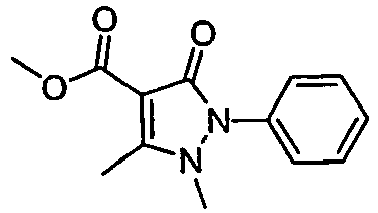
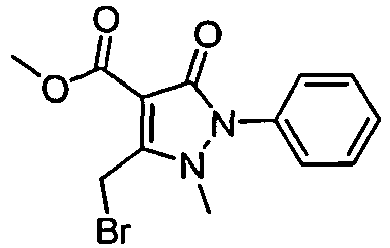


-

-

-

-

-

-
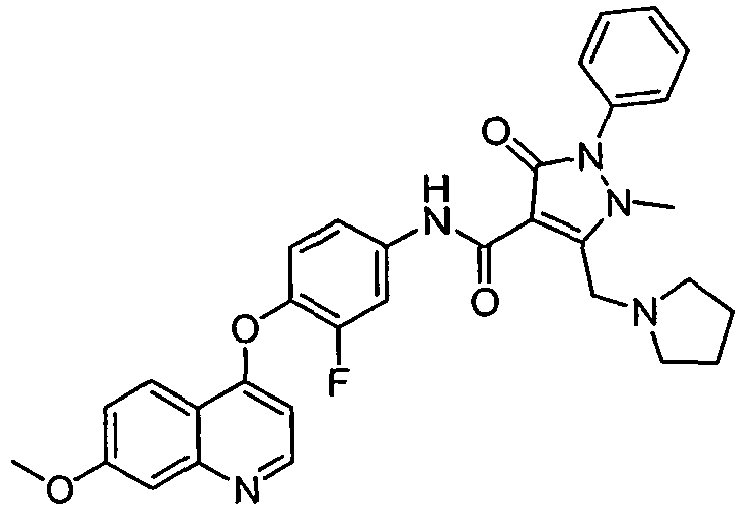
-

-

-

-

-

-

-

-

-

-

-

-

-
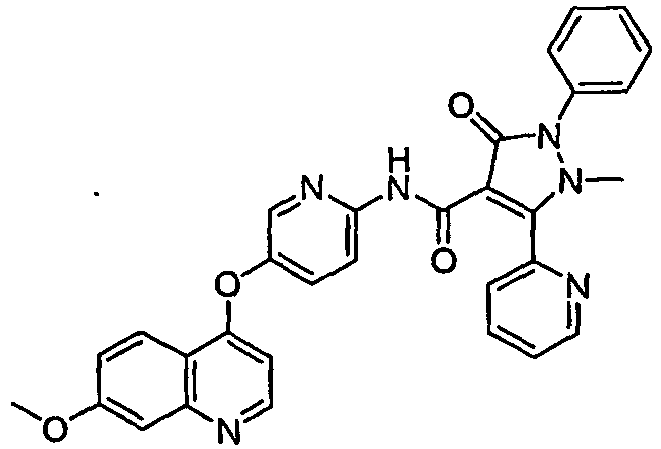
-

-

-

-

-

-
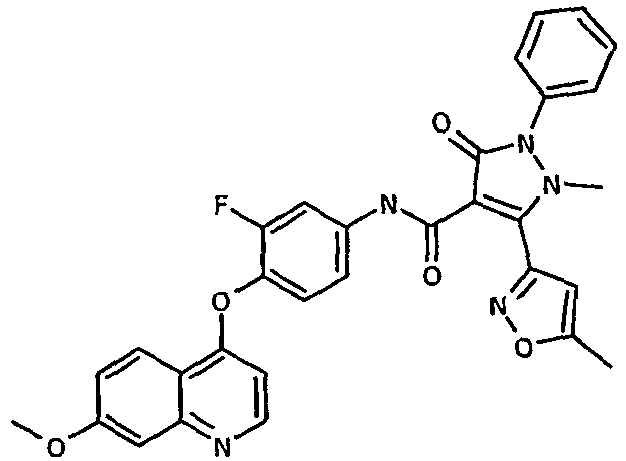
-

-

-

-
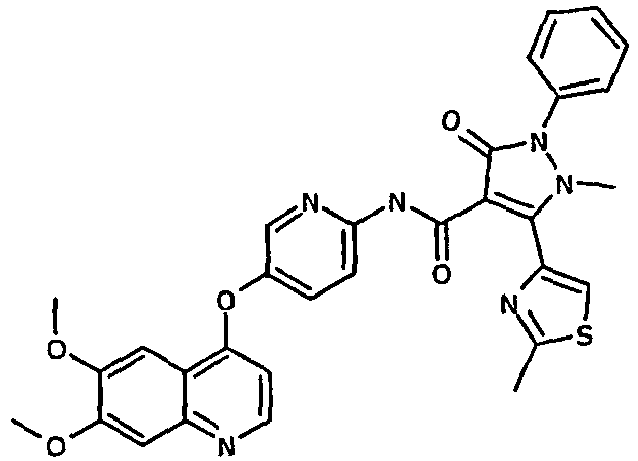
-

-
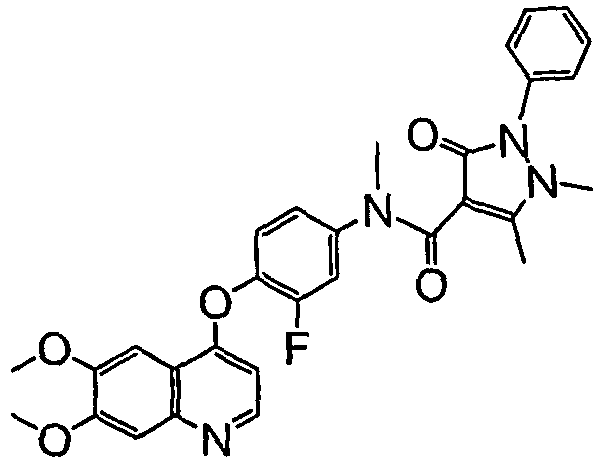
-

-

-

-

-

-
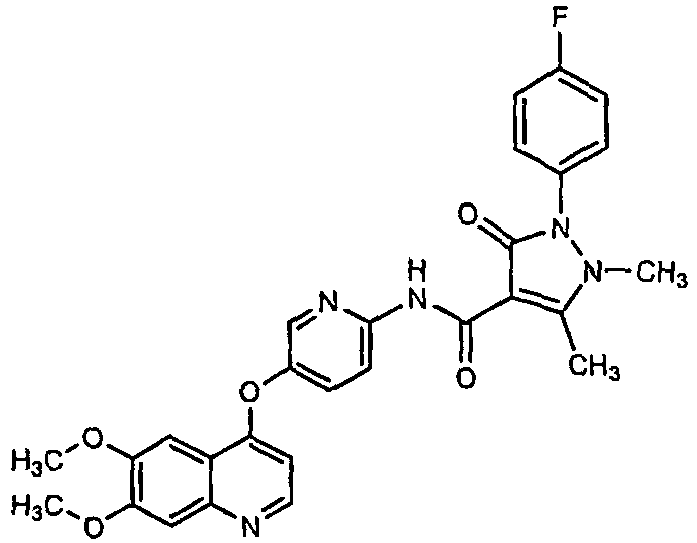
-

-

-

-

-

-

-

-

-

-
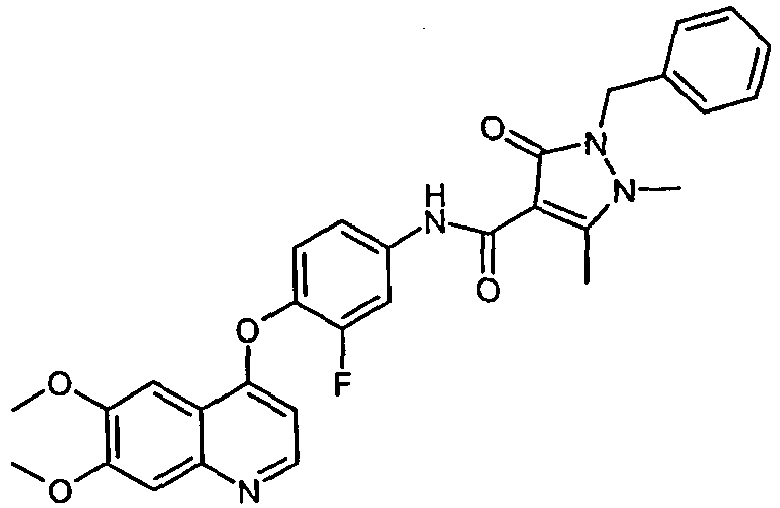
-

-


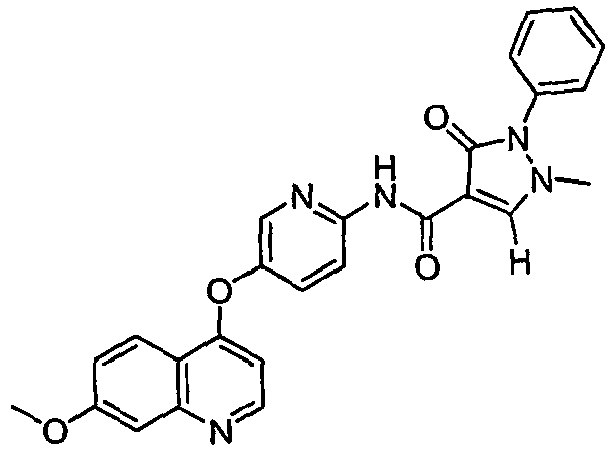
-


-

-

-

-

-
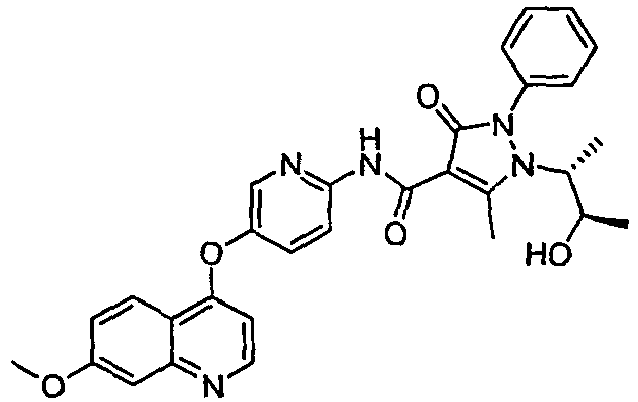
-

-

-

-

-

-

-

-

-
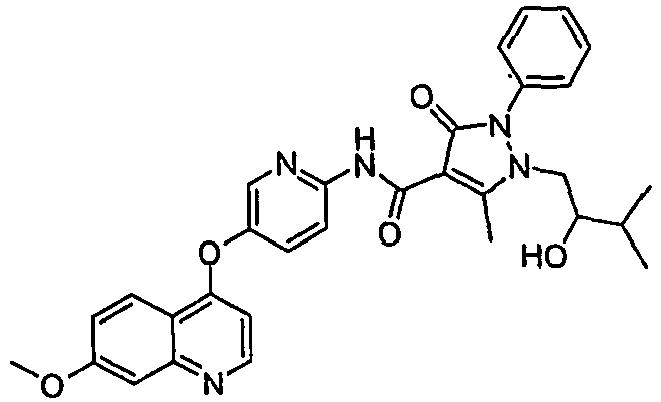
-
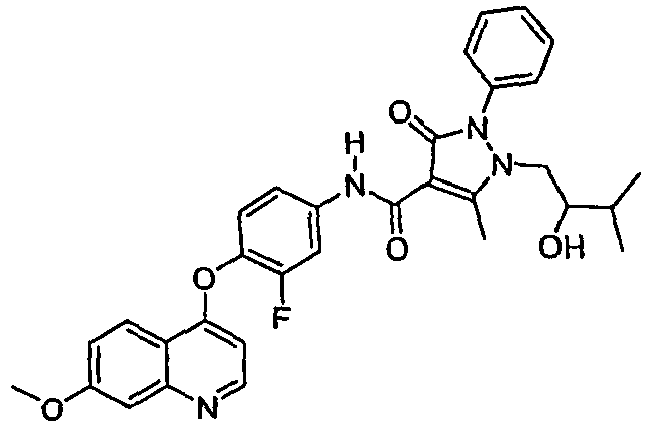
-

-

-

-

-

-

-

-

-
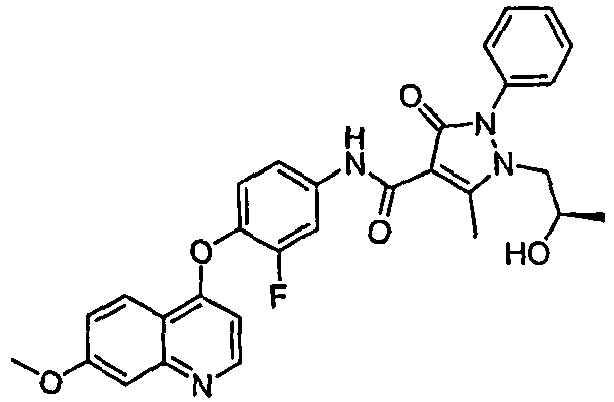
-

-

-

-

-

-

-

-

-

-

-

-

-

-

-

-

-

-

-


MS (ESI pos. ion) m/z: 528 (MH+). Calc'd exact mass for C29H26FN5O4: 527. 1H NMR (300 MHz, MeOH) 8.54 (1 H, d, J=5.5 Hz), 8.30 (1 H, d, J=9.2 Hz), 7.93 - 7.97 (1 H, m), 7.54 - 7.66 (3 H, m), 7.44 - 7.51 (2 H, m), 7.27 - 7.38 (4 H, m), 6.50 (1 H, dd, J=5.5, 0.9 Hz), 3.92 - 4.02 (5 H, m), 2.83 (3 H, s), 2.68 (2 H, t, J=6.7 Hz). -

-

-

-

-

-

-

-

-

-

-

-

-

-

-

-

- N-(4-((6,7-bis(methyloxy)-4-quinolinyl)oxy)-3-fluorophenyl)-1-((2R)-2-hydroxypropyl)-5-methyl-3-oxo-2-phenyl-2,3-dihydro-1H-pyrazole-4-carboxamide: MS (ESI pos. ion) m/z: 573 (MH+). Calc'd exact mass for C31H29FN4O6: 572.
-

-

-

-

-

-

-

-

-

-

-

-

-
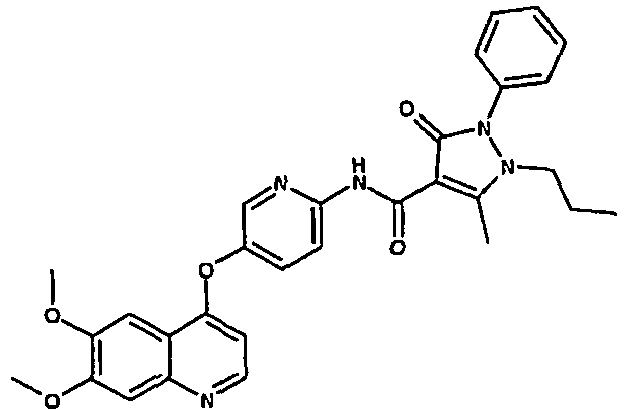
-

-

-

-

-

1HNMR (DMSO-d6, 400 MHz): 8.54 (1H, d, J 5.2), 7.88 (1H, dd, J 11.6, 1.6), 7.71 (1H, d, J 8.4), 7.59-7.54 (3H, m), 7.48 - 7.37 (4H, m), 7.13 (1H, t, J 7.3), 6.56 (1H, d, J5.1), 3.96 (6H, s). -
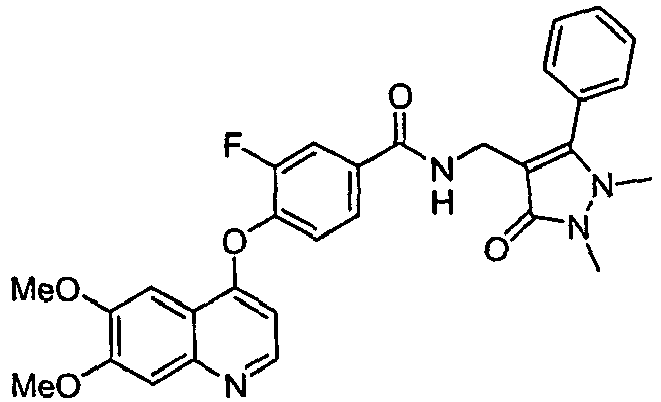
1HNMR (CDCl3, 400 MHz): 8.51 (2H, m), 7.81 (1H, dd, J 1.8, 10.8), 7.71 (1H, d, J 8.3), 7.57-7.48 (5H, m), 7.44 (1H, s), 7.28 (1H, t, J 8.0), 6.42 (1H, d, J5.3), 4.46 (d, 2H, d, J 4.9), 4.06 (6H, s), 3.48 (3H, s), 3.14 (3H, s). -

1HNMR (CDCl3, 400 MHz): 9.20 (1H, b), 8.56 (1H, d, J5.3), 7.86 (1H, J), 7.76 (1H, d, J) 7.57 (1H, s), 7.50-7.44 (3H, m), 7.40 (2H, d, J 7.4), 7.34 (1H, t, J7.2), 7.28 (1H, m), 6.56 (1H, d, J 4.9), 4.07 (3H, s), 4.06 (3H, s), 3.12 (3H, s), 2.30 (3H, s). -

-

1HNMR (CDCl3, 400 MHz): 10.96 (1H, s), 8.62 (1H, d, J 5.3), 8.48 (1H, d, J 9.0), 8.29-8.25 (2H, m), 7.73 (1H, d, J6.8), 7.55-7.53 (1H, dd, J2.7, 9.0), 7.48-7.43 (2H, m), 7.40-7.34 (3H, m), 7.29-7.23 (3H, m), 6.74 (1H, t, J7.1), 6.46 (1H, d J5.3), 5.48 (2 H, s), 3.98 (3H, s). -

Calc'd for C28H27N5O4: 497; MS (ESI pos. ion) m/z: 498. 1HNMR (400 MHz, CDCl3): 8.48 (1H, d, J 5.1), 8.06 (1H, s), 7.57 (1H, s), 7.47 (2H, t, J 7.2), 7.42 (3H, m), 7.33-7.22 (2H, m), 6.56 (1H, d, J 9.0), 6.43 (1H, d, J 5.3), 5.56 (1H, s, NH), 4.36 (2H, d, J 5.5, NCH2), 4.06 (6H, d), 3.08 (3H, s), 2.36 (3H, s). -

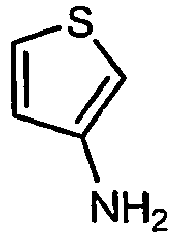
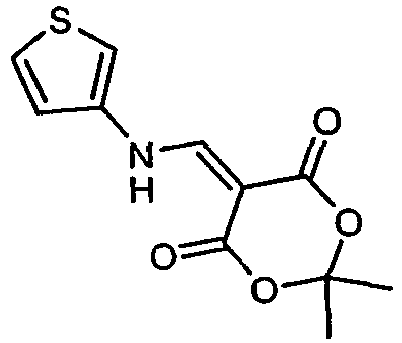

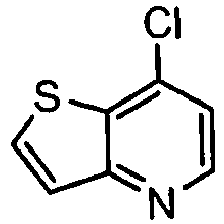


-

-

-

-

-
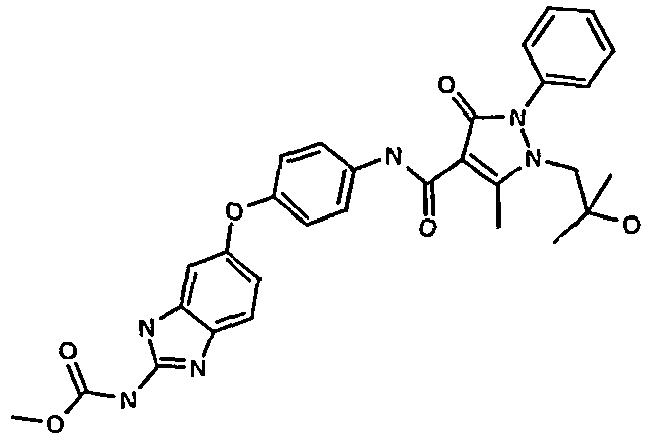
-


A 50 mL round bottom flask was charged with lithium 7-chlorothieno[3,2-b]pyridine-2-carboxylate (0.500 g, 2.28 mmol), methylene chloride (15 ml), and 12 drops of DMF. Oxalyl chloride (0.298 ml, 3.42 mmol) was added dropwise, and the mixture was stirred at room temperature for 3 hours and concentrated to yield a tan solid. This was redissolved in methylene chloride (15 ml). Azetidine hydrochloride (0.426 g, 4.55 mmol) was added in one portion and Hunig's Base (1.59 ml, 9.11 mmol) was added dropwise. This mixture was stirred at room temperature overnight, then diluted with methylene chloride (15 mL) and washed with water (25 mL), sat. NaHCO3 (25 mL), and brine (25 mL). The organic layer was dried with MgSO4, filtered, and concentrated in vacuo to yield azetidin-1-yl(7-chlorothieno[3,2-b]pyridin-2-yl)methanone (0.58 g, 100% yield) as a tan solid.
-

-

-

-

-
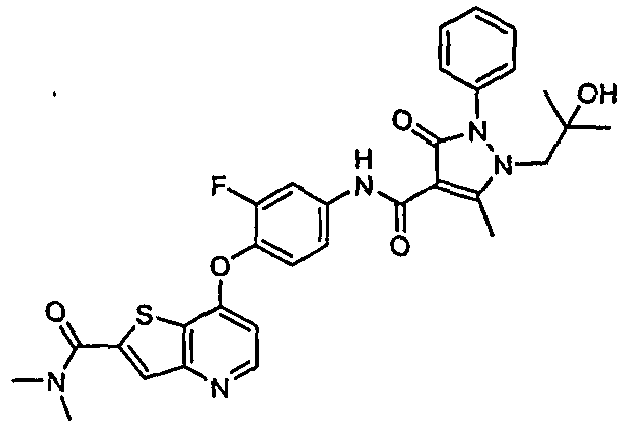
-

-

-

-

-

-

-
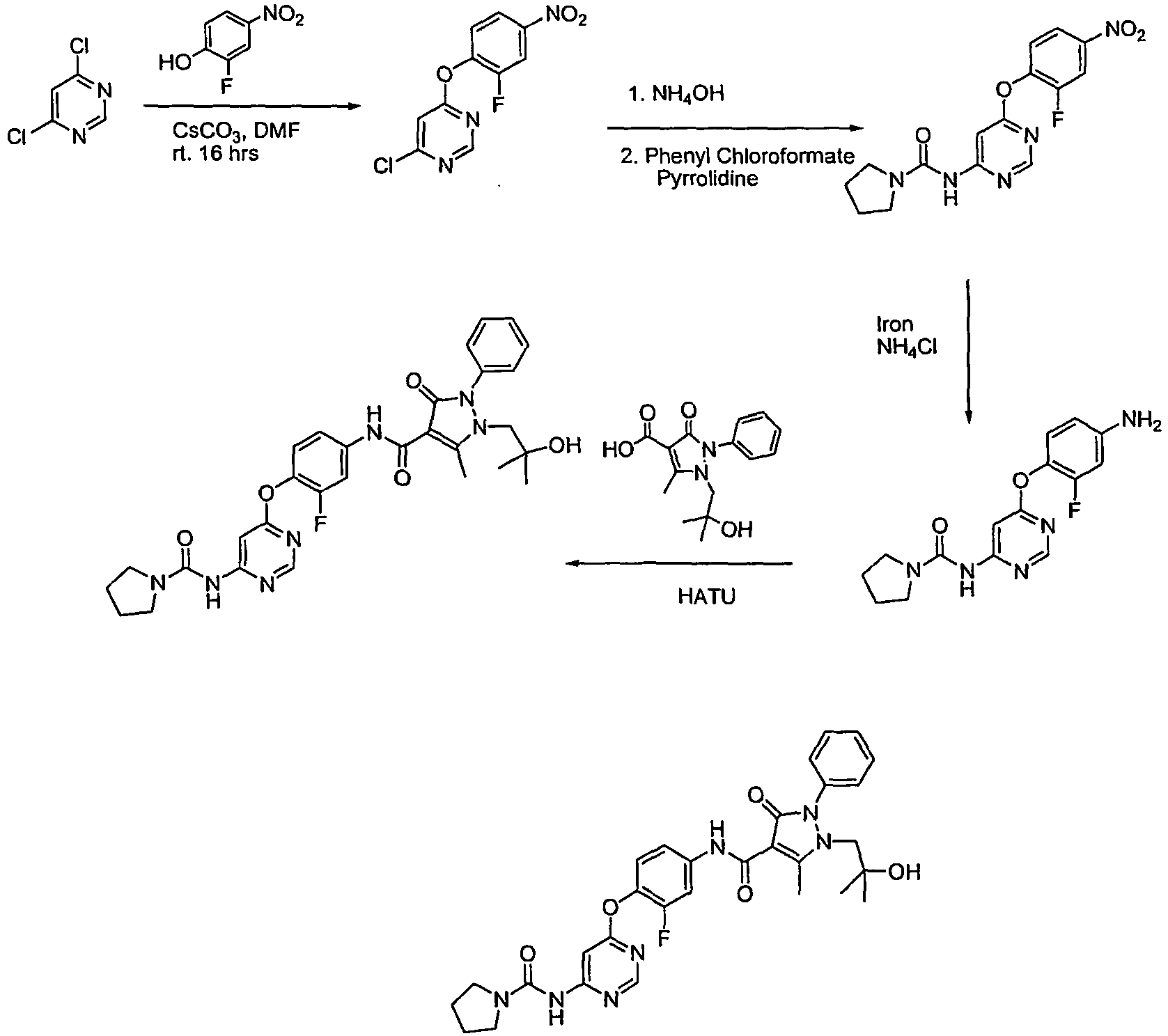


- 6-(2-fluoro-4-nitrophenoxy)pyrimidin-4-amine (0.550 g, 2.2 mmol) was dissolved in tetrahydrofuran (10 ml). Then triethylamine (0.61 ml, 4.4 mmol) was added to the mixture with stirring. Then phenyl chloroformate (0.55 ml, 4.4 mmol) was added slowly to the mixture. The mixture was stirred at ambient temperature for 1.5 hours. Then pyrrolidine (1.8 ml, 22 mmol) was added to the mixture, and the mixture was stirred an additional 30 minutes. The mixture was diluted with sat. ammonium chloride and dichloromethane and stirred an additional 10 minutes. The organic layer was collected by extracting with dichloromethane (3 x 10 ml). Combined organic layer was dried over sodium sulfate, filtered, and concentrated in-vacuo. The crude was purified by chromatography (Amino-Propyl silica gel column) in a gradient of 1-5% MeOH/ dichloromethane to give an oil. The oil was recrystallized from dichloromethane/hexanes to give the desired product N-(6-(2-fluoro-4-nitrophenoxy)pyrimidin-4-yl)pyrrolidine-1-carboxamide (0.330 g, 0.95 mmol, 43% yield) as a yellow solid. MS (ESI pos. ion) m/z: 348 (MH+). Calc'd exact mass for C15H14FN5O4: 347. 1NMR (300 MHz, CDCl3): 1.94 (s, 4H), 3.37-3.49 (m, 4H), 5.23 (s, 1H), 7.09-7.21 (m, 1H), 7.29-7.38 (m, 1H), 7.99-8.09 (m, 2H), 8.25 (d, J=0.73 Hz, 1H).


-

-

-

-

-

-
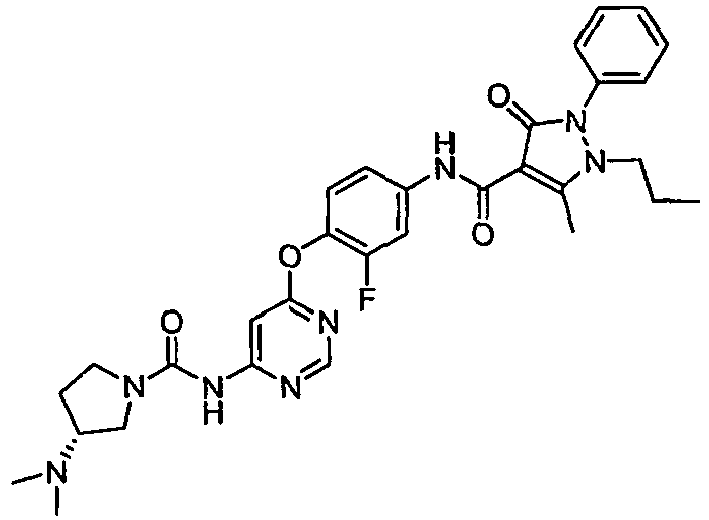
-

-


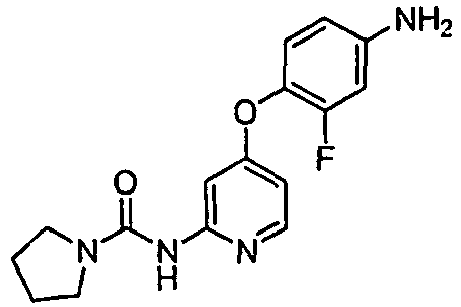
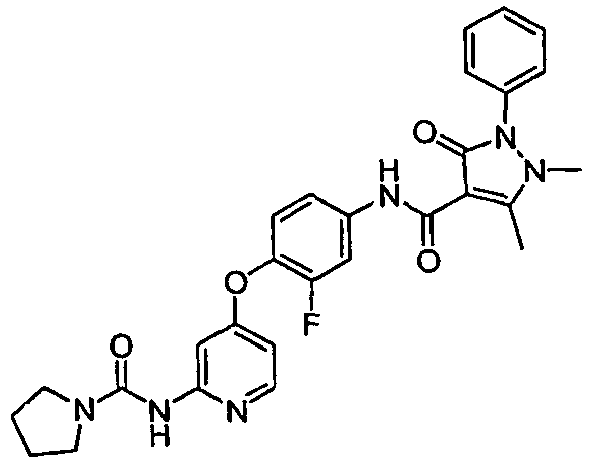
-

-

-

-

-

-

- N-(4-(2-fluoro-4-(1-(2-hydroxy-2-methylpropyl)-5-methyl-3-oxo-2-phenyl-2,3-dihydro-1H-pyrazole-4-carboxamido)phenoxy)pyridin-2-yl)piperidine-1-carboxamide: MS (ESI pos. ion) m/z: 603 (MH+). Calc'd exact mass for C32H35FN6O5: 602. 1HNMR (300 MHz, CDCl3): 1.12 (s, 6H), 1.61 (s, 6H), 2.28 (s, 1H), 2.86 (s, 3H), 3.44 (d, J=4.97 Hz, 4H), 3.86 (s, 2H), 5.30 (s, 1H), 6.46 (dd, J=5.77, 2.12 Hz, 1H), 7.08 (t, J=8.70 Hz, 1H), 7.21 (d, J=1.02 Hz, 1H), 7.27 (t, J=8.18 Hz, 1H), 7.40-7.57 (m, 3H), 7.65 (d, J=1.90 Hz, 1H), 7.87 (dd, J=12.64, 2.27 Hz, 1H), 8.00 (d, J=5.85 Hz, 1H), 10.82 (s, 1H).
-


-

-

-

-

-

-

-

-

-

-

-

-

-

-

-

-

-


-

-

-

-

-

-

-

-

-

-

-

-

-

-

-

- N-(5-(7-methoxyquinolin-4-yloxy)pyridin-2-yl)-2-oxo-1-phenyl-5-(pyrazin-2-yl)-1,2-dihydropyridine-3-carboxamide: MS (ESI pos. ion) m/z: 543 (MH+). Calc'd exact mass for C31H22N6O4 542 1H NMR (400 MHz, CDCl3) 12.36 (s, 1 H), 9.37 (d, J=2.78 Hz, 1 H), 9.08 (s, 1 H), 8.69 - 8.60 (m, 2 H), 8.59 - 8.50 (m, 2 H), 8.52 (d, J=8.97 Hz, 1 H), 8.28 -8.23 (m, 2 H), 7.66 - 7.42 (3 m, 7 H), 7.24 (d, J=2.27 Hz, 1 H), 6.46 (d, J=5.31 Hz, I H), 3.99 (s, 3 H).
-

-

-

-

-

-

-


- To a solution of 4-iodo-2-oxo-1-phenyl-1,2-dihydropyridine-3-carbonyl chloride (139 mg, 387 µmol) in dichloromethane (4 mL) at room temperature was added diisopropylethylamine (202 µl, 1160 µmol) followed by 5-(6,7-dimethoxyquinolin-4-yloxy)pyridin-2-amine (115 mg, 387 µmol). The reaction mixture was stirred at room temperature for 2h. An aliquot was taken and analyzed by LCMS: reaction was done. The reaction mixture was diluted with methanol and directly adsorbed on silica. Purification by MPLC (CH2Cl2/MeOH: 100/0 to 96/4) afforded N-(5-(6,7-dimethoxyquinolin-4-yloxy)pyridin-2-yl)-4-iodo-2-oxo-1-phenyl-1,2-dihydropyridine-3-carboxamide (162 mg, 261 µmol, 68% yield for two steps). MS (ESI pos. ion) m/z: 621 (MH+). Calc'd exact mass for C28H20IN4O5: 620.

-
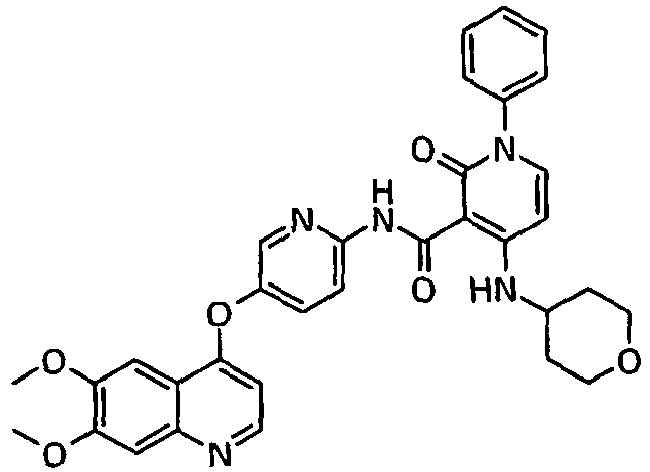
-
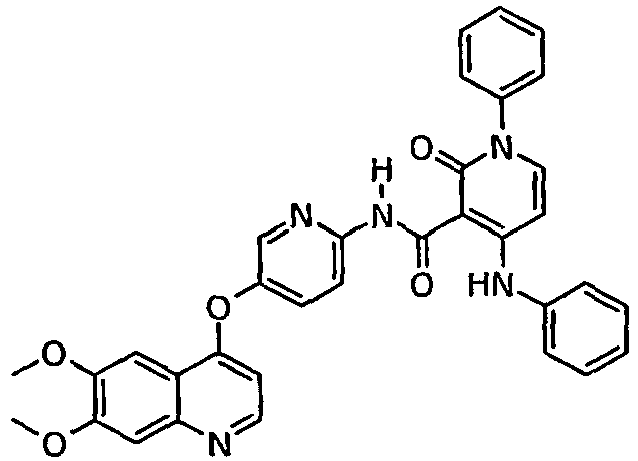
-

-
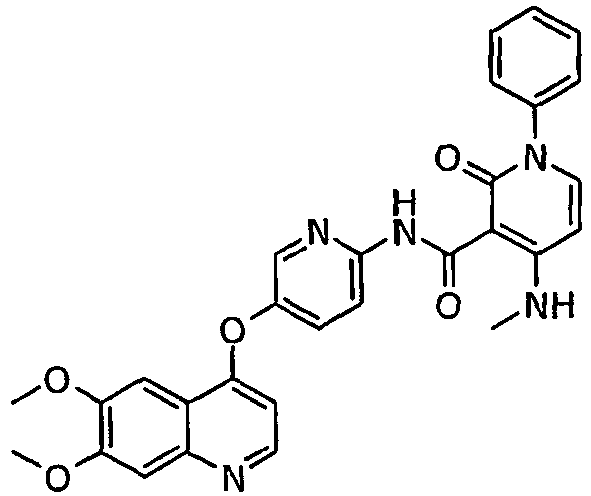
-

-

-

-

-

-

-
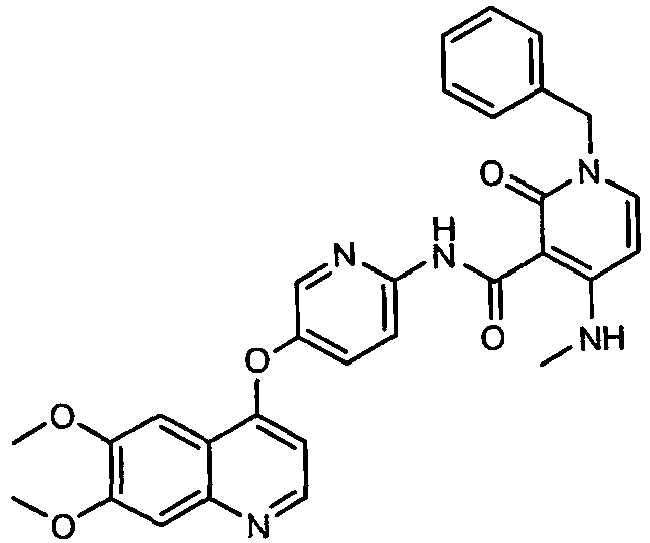
-

-

-

-

-

-

-

-

-

-

-

-

-

-
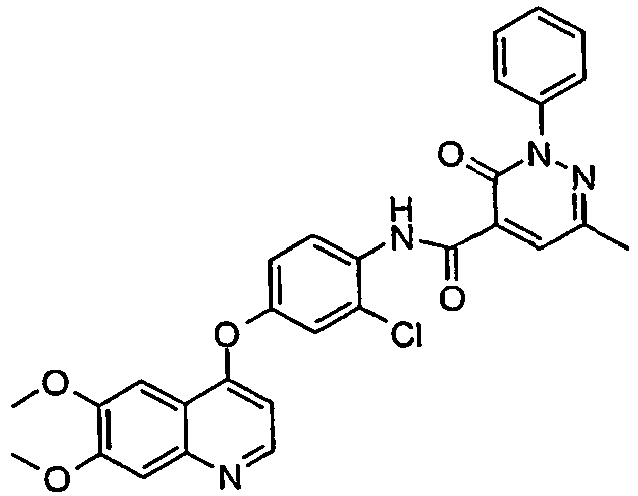
-
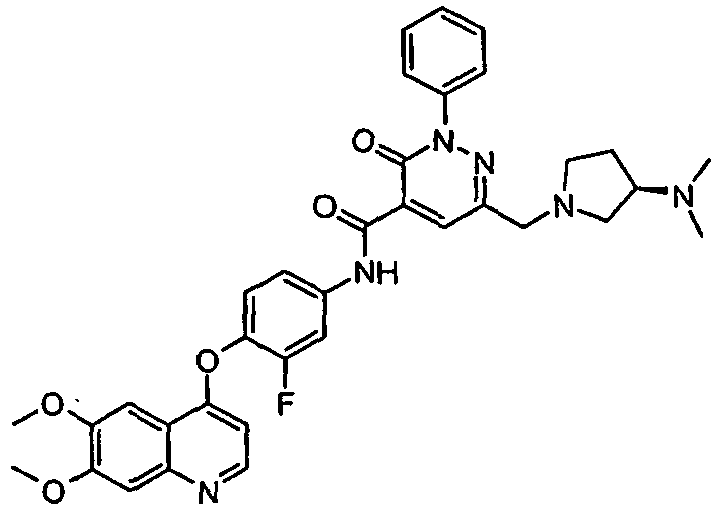
-

-

-


-


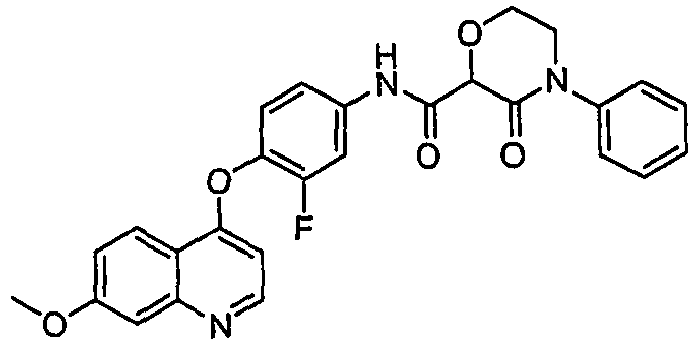
-


Calc'd for C26H21N5O4: 467.16; MS (ESI pos. ion) m/z: 468 (MH+). 1H NMR (400 MHz, DMSO-d6) 3.49 (s, 3 H) 3.95 (s, 3 H) 6.55 (d, J 5.1, 1H) 7.30 (dd, J 2.0, 9.0, 1H) 7.42 (s, 1 H) 7.59 (s, 17 H) 7.50- 7.60 (m, 5 H), 7.84 (dd, J 2.8, 9.2, 1H), 8.22 (d, J 9.2, 1H), 8.34 - 8.38 (m, 2 H) 8.62 (d, J 5.3, 1H) 8.69 (s, 1 H) 10.86 (s, 1 H). -


- The following additional compounds can also be made using the methodology generally set forth above:
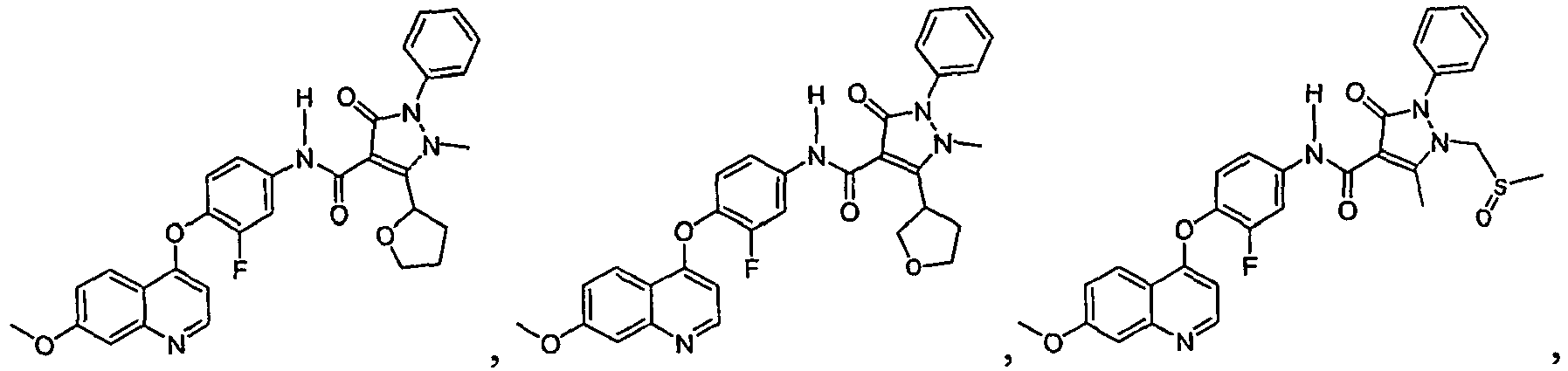


- Although the pharmacological properties of the compounds of Formulas I-II vary with structural change, in general, activity possessed by compounds of Formulas I-II may be demonstrated in vivo. The pharmacological properties of the compounds of this invention may be confirmed by a number of pharmacological in vitro assays. The exemplified pharmacological assays, which follow have been carried out with the compounds according to the invention and their salts. Compounds of the present invention showed inhibition of c-Met kinase at doses less than 2 µM.
- The efficacy of the compounds of the invention as inhibitors of HGF related activity is demonstrated as follows.
- A PCR product covering residues 1058-1365 of c-Met (c-Met kinase domain) is generated from Human Liver QuickClone™ cDNA (Invitrogen) using forward primer 5'-ATTGACGGATCCATGCTAAATCCAGAGCTGGTCCAGGCA-3' (SEQ ID NO. 1) and reverse primer 5'-ACAACAGAATTCAATACGGAGCGACACATTTTACGTT-3' (SEQ ID NO. 2). The PCR product is cloned into a modified pFastBac1 expression vector (harboring the gene for S. japonicum glutathione S-transferase immediately upstream of the multiple cloning site) using standard molecular biological techniques. The GST-c-Met kinase domain fusion (GST-Met) gene is transposed into full-length baculovirus DNA using the BacToBac™ system (Invitrogen). High5 cells are infected with the recombinant baculovirus for 72 h at 27°C. The infected cells are harvested by centrifugation and the pellet is stored at -80°C. The pellet is resuspended in buffer A (50 mM HEPES, pH 8.0,0.25 M NaCl, 10 mM 2-mercaptoethanol, 10% (w/v) glycerol, 0.5 % (v/v) protease inhibitor cocktail (Sigma P8340), stirred at 4°C to homogeneity, and the cells are disrupted by microfluidization (Microfluidics) at 10,000 psi. The resulting lysate is centrifuged at 50,000 x g for 90 min at 4 °C, and the supernatant is adsorbed onto 10 mL of glutathione sepharose™ 4B (Amersham) by batch method. The slurry is rocked gently overnight at 4°C. The glutathione resin is harvested by centrifugation and washed three times with 40 mL buffer A by batch method. The resin is washed three times with buffer B (buffer A adjusted to 0.1 M NaCl, less protease inhibitors). The protein is eluted with buffer B containing 25 mM reduced glutathione. Eluted fractions are analyzed by SDS-PAGE and concentrated to <10 mL (~10 mg/mL total protein). The concentrated protein is separated by Superdex™ 200 (Amersham) size exclusion chromatography in buffer C (25 mM Tris, pH 7.5, 0.1 M NaCl, 10 mM 2-mercaptoethanol, 10% glycerol). The fractions are analyzed by SDS-PAGE and the appropriate fractions are pooled and concentrated to ~1 mg/mL. The protein is aliquotted and stored at -80°C.
- Baculovirus cells are broken in 5x (volume/weight) of Lysis Buffer (50 mM HEPES, pH 8.0, 0.25 M NaCl, 5 mM mercaptoethanol, 10% glycerol plus Complete Protease Inhibitors (Roche (#10019600), 1 tablet per 50 mL buffer). The lysed cell suspension is centrifuged at 100,000 x g (29,300 rpm) in a Beckman ultracentrifuge Ti45 rotor for 1 h. The supernatant is incubated with 10 ml of Glutathione Sepharose 4B from Amersham Biosciences (#27-4574-01). Incubation is carried out overnight in a cold room (approximately 8°C). The resin and supernatant is poured into an appropriately sized disposable column and the flow through supernatant was collected. The resin is washed with 10 column volumes (100 mL) of Lysis Buffer. The GST-cMET is eluted with 45 mL of 10 mM Glutathione (Sigma #G-4251) in Lysis Buffer. The elution is collected as 15 mL fractions. Aliquots of the elution fractions are run on SDS PAGE (12% Tris Glycine gel, Invitrogen, #EC6005BOX). The gel is stained with 0.25% Coomassie Blue stain. Fractions with GST-cMET are concentrated with a Vivaspin 20 mL Concentrator (#VS2002; 10,00 MW cutoff) to a final volume less than 2.0 ml. The concentrated GST-cMET solution is applied to a Superdex 75 16/60 column (Amersham Biosciences #17-1068-01) equilibrated with 25 mM Tris, pH 7.5, 100 mM NaCl, 10 mM mercaptoethanol, 10% glycerol. The GST-cMET is eluted with an isocratic run of the above buffer, with the eluent collected in 1.0 mL fractions. Fractions with significant OD280 readings are run on another 12% Tris Glycine gel. The peak tubes with GST-cMET are pooled and the OD280 is read with the column buffer listed above as the blank buffer.
- Phosphorylation of the purified GST-cMET is performed by incubating the protein for 3 h at RT with the following:
Final concentration a) 100 mM ATP (Sigma #A7699) 25 mM b) 1.0 M MgCl2 (Sigma #M-0250) 100 mM c) 200 mM Sodium Orthovanadate (Sigma #S-6508) 15 mM d) 1.0 M Tris-HCl, pH 7.00 (in house) 50 mM e) H20 f) GST-cMET 0.2 - 0.5 mg/mL - After incubation, the solution is concentrated in a Vivaspin 20 ml Concentrator to a volume less than 2.00 ml. The solution is applied to the same Superdex 75 16/60 column used above after re-equilibration. The GST-cMET is eluted as described above. The elution fractions corresponding to the first eluted peak on the chromatogram are run on a 12% Tris Glycine gel, as above, to identify the fractions with GST-cMET. Fractions are pooled and the OD280 is read with the column buffer used as the blank.
- A Kinase reaction Buffer is prepared as follows:
Per 1 L 60 mM HEPES PH 7.4 1 M stock 16.7 X 60 mL 50 mM NaCl 5 M stock 100 X 10 mL 20 mM MgCl2 1 M stock 50 X 20 mL 5 mM MnCl2 1 M stock 200 X 5 mL 2 mM DTT 1 M stock 500 X 0.05 % BSA 5 % stock 100 X 0.1 mM Na3OV4 0.1 M stock 1000 X - 50 mM Tris-HCl (pH 7.5), 100 mM NaCl, 0.1 % BSA, 0.05 % Tween 20,5mM EDTA
- 0.1 nM final Eu-PT66
- 11 nM final SA-APC
- Prepare 8 nM GST-cMet (P) working solution (7.32 µM to 8 nM, 915 X, 10 µL to 9.15 mL). In a 96 well clear plate [Costar # 3365] add 100 µL in eleven columns, in one column add 100 µL kinase reaction buffer alone.
- Use Biomek FX to transfer 10 µL 8 nM GST-cMet (P) enzyme, 48.4 µL kinase reaction buffer, 1.6 µL compound (in DMSO) (Start concentration at 10 mM, 1 mM and 0.1 mM, sequential dilution 1:3 to reach 10 test points) in a 96 well costar clear plate [Costar # 3365], mix several times. Then incubate the plate at RT for 30 min.
- Prepare 4 µM Gastrin and 16 µM ATP working solution
Per 10 mL Gastrin 4 µM stock (500 µM to 4 µM, 125 X) 80 µL ATP 16 µM stock (1000 µM to 16 µM, 62.5 X) 160 µL - Use Biomek FX to add 20 µl ATP and Gastrin working solution to the assay plate to start reaction, incubate the plate at RT for 1 h.
- 4. Transfer 5 µL reaction product at the end of 1 h into 80 µL HTRF buffer in black plate [Costar # 3356], read on Discover after 30 min incubation.
-
KM ATP* - 6 µM [ATP] - 4 µM KM Gastrin/p(EY) - 3.8 µM [gastrin] - 1 µM [enzyme] - 1 nM KM ATP, KM gastrin for various enzymes were determined by HTRF/33P labeling and HTRF methods. - Examples 1-28, 30, 33-34, 36-37, and 39-48 exhibited activity with IC50 values less than 0.5 µM.
- Human PC3 and mouse CT26 cells are available obtained from ATCC. The cells were cultured in a growth medium containing RPMI 1640, penicillin/streptomycin/glutamine (1X) and 5% FBS. 2 x 10⁴ cells in medium were plated per well in a 96 well plate and incubated at 37 °C overnight. The cells were serum-starved by replacing the growth media with basic medium (DMEM low glucose + 0.1 BSA, 120 µL per well) at 37 °C for 16 h. Compounds (either 1 mM and 0.2 mM) in 100% DMSO were serially diluted (1:3) 3333 fold on a 96 well plate, diluting 1:3 with DMSO from column 1 to 11 (columns 6 and 12 receive no compound). Compound samples (2.4 µL per well) were diluted with basic medium (240 µL) in a 96 well plate. The cells were washed once with basic medium (GIBCO, DMEM 11885-076) then compound solution was added (100 µL). The cells were incubated at 37 °C for 1 h. A (2 mg/mL) solution of CHO-HGF (7.5 µL) was diluted with 30 mL basic medium to provide a final concentration of 500 ng/mL. This HGF-containing media (120 µL) was transferred to a 96 well plate. Compounds (1.2 µL) was added to the HGF-containing media and mixed well. The mixture of media/HGF/compound (100 µL) was added to the cells (final HGF concentration - 250 ng/mL) then incubated at 37 °C for 10 min. A cell lysate buffer (20 mL) was prepared containing 1% Triton X-100, 50 mM Tris pH 8.0, 100 mM NaCl, Protease inhibitor (Sigma, #P-8340) 200 µL, Roche Protease inhibitor (Complete, # 1-697-498) 2 tablets, Phosphatase Inhibitor II (Sigma, #P-5726) 200 µL, and a sodium vanadate solution (containing 900 µL PBS, 100 µL 300 mM NaVO3, 6 µL H2O2 (30% stock) and stirred at RT for 15 min) (90 µL). The cells were washed once with ice cold 1X PBS (GIBCO, #14190-136), then lysis buffer (60 µL) was added and the cells were incubated on ice for 20 min.
- The IGEN assay was performed as follows: Dynabeads M-280 streptavidin beads were pre-incubated with biotinylated anti-human HGFR (240 µL anti-human-HGFR (R&D system, BAF527 or BAF328) @ 100 µg/mL + 360 µL Beads (IGEN #10029 + 5.4 µL buffer - PBS/1% BSA/0.1% Tween20) by rotating for 30 min at RT. Antibody beads (25 µL) were transferred to a 96 well plate. Cell lysate solution (25 µL) was transferred added and the plate was shaken at RT for 1 h. Anti-phosphotyrosine 4G10 (Upstate 05-321) (19.7 µL antibody + 6 mL 1X PBS) (12.5 µL) was added to each well, then incubated for 1 h at RT. Anti-mouse IgG ORI-Tag (ORIGEN #110087) (24 µL Antibody + 6 mL buffer) (12.5 µL) was added to each well, then incubated at RT for 30 min. 1X PBS (175 µL) was added to each well and the electrochemiluminescence was read by an IGEN M8. Raw data was analyzed using a 4-parameter fit equation in XLFit. IC50 values are then determined using Grafit software. Examples 2, 4, 6-8, 11, 13, 15-21, 23-26, 36-37, 39, 41, and 43-44 exhibited activity in PC3 cells with IC50 values less than 1.0 µM. Examples 2, 4, 6-8, 11-13, 15-21, 23-26, 36-37, 41, and 43-44 exhibited activity in CT26 cells with IC50 values less than 1.0 µM.
- Human Umbilical Vein Endothelial cells are purchased from Clonetics, Inc., as cryopreserved cells harvested from a pool of donors. These cells, at passage 1, are thawed and expanded in EBM-2 complete medium, until passage 2 or 3. The cells are trypsinized, washed in DMEM + 10% FBS + antibiotics, and spun at 1000 rpm for 10 min. Prior to centrifugation of the cells, a small amount is collected for a cell count. After centrifugation, the medium is discarded, and the cells are resuspended in the appropriate volume of DMEM + 10% FBS + antibiotics to achieve a concentration of 3 x 10⁵ cells/mL. Another cell count is performed to confirm the cell concentration. The cells are diluted to 3 x 10⁴ cells/mL in DMEM + 10% FBS + antibiotics, and 100 µL of cells are added to a 96-well plate. The cells are incubated at 37 °C for 22 h.
- Prior to the completion of the incubation period, compound dilutions are prepared. Five-point, five-fold serial dilutions are prepared in DMSO, at concentrations 400-fold greater than the final concentrations desired. 2.5 µL of each compound dilution are diluted further in a total of 1 mL DMEM + 10% FBS + antibiotics (400x dilution). Medium containing 0.25% DMSO is also prepared for the 0 µM compound sample. At the 22 h timepoint, the medium is removed from the cells, and 100 µL of each compound dilution is added. The cells are incubated at 37 °C for 2-3 h.
- During the compound pre-incubation period, the growth factors are diluted to the appropriate concentrations. Solutions of DMEM + 10% FBS + antibiotics, containing either VEGF or bFGF at the following concentrations: 50, 10, 2, 0.4, 0.08, and 0 ng/mL are prepared. For the compound-treated cells, solutions of VEGF at 550 ng/mL or bFGF at 220 ng/mL for 50 ng/mL or 20 ng/mL final concentrations, respectively, are prepared since 10 µL of each will be added to the cells (110 µL final volume). At the appropriate time after adding the compounds, the growth factors are added. VEGF is added to one set of plates, while bFGF is added to another set of plates. For the growth factor control curves, the media on wells B4-G6 of plates 1 and 2 are replaced with media containing VEGF or bFGF at the varying concentrations (50-0 ng/mL). The cells are incubated at 37 °C for an additional 72 h.
- At the completion of the 72 h incubation period, the medium is removed, and the cells are washed twice with PBS. After the second wash with PBS, the plates are tapped gently to remove excess PBS, and the cells are placed at -70 °C for at least 30 min. The cells are thawed and analyzed using the CyQuant fluorescent dye (Molecular Probes C-7026), following the manufacturer's recommendations. The plates are read on a Victor/Wallac 1420 workstation at 485 nm/530 nm (excitation/emission). Raw data are collected and analyzed using a 4-parameter fit equation in XLFit. IC50 values are then determined.
- In Life Aspects: Female Sprague Dawley rats weighing approximately 250 g were randomized into one of five treatment groups. Pretreatment with the vehicle or compound was administered orally, 24 h prior to surgery and continued once a day for seven additional days. On the day of surgery, the rats were temporarily anesthetized in an Isofluorane gas chamber (delivering 2.5 L/min oxygen + 5% Isofluorane). An othoscope was then placed inside the mouth of the animal to visualize the vocal cords. A tip-blunted wire was advanced in between the vocal cords and used as a guide for the placement of an endotracheal Teflon tube (Small Parts Inc. TFE-standard Wall R-SWTT-18). A volume-controlled ventilator (Harvard Apparatus, Inc. Model 683) was connected to the endotracheal tube to deliver a mixture of oxygen and 3% Isofluorane. Upon achieving deep anesthesia, the whiskers were cut short and the eye areas and eyes gently washed with Betadine soap and rinsed with sterile saline. The corneas were irrigated with one to two drops of Proparacaine HCl ophthalmic topical anesthetic solution (0.5%) (Bausch and Lomb Pharmaceuticals, Tampa FL). The rat was then positioned under the dissecting microscope and the corneal surface brought into focus. A vertical incision was made on the midline of the cornea using a diamond blade knife. A pocket was created by using fine scissors to separate the connective tissue layers of the stroma, tunneling towards the limbus of the eye. The distance between the apex of the pocket and the limbus was approximately 1.5 mm. After the pocket had been made, the soaked nitrocellulose disk filter (Gelman Sciences, Ann Arbor MI.) was inserted under the lip of the pocket. This surgical procedure was performed on both eyes. rHu-bFGF soaked disks were placed into the right eye, and the rHu-VEGF soaked disks were placed into the left eye. Vehicle soaked disks were placed in both eyes. The disk was pushed into position at the desired distance from the limbal vessels. Ophthalmic antibiotic ointment was applied to the eye to prevent drying and infection. After seven days, the rats were euthanized by CO2 asphyxiation, and the eyes enucleated. The retinal hemisphere of the eye was windowed to facilitate fixation, and the eye placed into formalin overnight.
- Post Mortem Aspects: After 24 h in fixative, the corneal region of interest was dissected out from the eye, using fine forceps and a razorblade. The retinal hemisphere was trimmed off and the lens extracted and discarded. The corneal dome was bisected and the superfluous cornea trimmed off. The iris, conjunctiva and associated limbal glands were then carefully teased away. Final cuts were made to generate a square 3 x 3 mm containing the disk, the limbus, and the entire zone of neovascularization.
- Gross Image Recording: The corneal specimens were digitally photographed using a Sony CatsEye DKC5000 camera (A.G. Heinz, Irvine CA) mounted on a Nikon SMZ-U stereo microscope (A.G. Heinz). The corneas were submerged in distilled water and photographed via trans-illumination at approximately 5.0 diameters magnification.
- Image analysis: Numerical endpoints were generated using digital micrographs collected from the whole mount corneas after trimming and were used for image analysis on the Metamorph image analysis system (Universal Imaging Corporation, West Chester PA). Three measurements were taken: Disk placement distance from the limbus, number of vessels intersecting a 2.0 mm perpendicular line at the midpoint of the disk placement distance, and percent blood vessel area of the diffusion determined by thresholding.
-
- 0.1% BSA in PBS vehicle: 0.025 g of BSA was added to 25.0 mL of sterile 1X phosphate buffered saline, gently shaken until fully dissolved, and filtered at 0.2 µM. Individual 1.0 mL samples were aliquoted into 25 single-use vials, and stored at -20 °C. until use. For the rHu-bFGF disks, a vial of this 0.1% BSA solution was allowed to thaw at room temperature. Once thawed, 10 µL of a 100 mM stock solution of DTT was added to the 1 ml BSA vial to yield a final concentration of 1 mM DTT in 0.1% BSA.
- rHu-VEGF Dilutions: Prior to the disk implant surgery, 23.8 µL of the 0.1% BSA vehicle above was added to a 10 µg rHu-VEGF lyophilized vial yielding a final concentration of 10 µM.
- rHu-bFGF: Stock concentration of 180 ng/µL: R&D rHu- bFGF: Added 139 µL of the appropriate vehicle above to the 25 µg vial lyophilized vial. 13.3 µL of the [180 ng/µL] stock vial and added 26.6 µL of vehicle to yield a final concentration of 3.75 µM concentration. Nitro-cellulose disk preparation: The tip of a 20-gauge needle was cut off square and beveled with emery paper to create a punch. This tip was then used to cut out ≅ 0.5 mm diameter disks from a nitrocellulose filter paper sheet (Gelman Sciences). Prepared disks were then placed into Eppendorf microfuge tubes containing solutions of either 0.1 % BSA in PBS vehicle, 10 µM rHu-VEGF (R&D Systems, Minneapolis, MN), or 3.75 µM rHu-bFGF (R&D Systems, Minneapolis, MN) and allowed to soak for 45-60 min before use. Each nitrocellulose filter disk absorbs approximately 0.1 µL of solution.
- In the rat micropocket assay, compounds of the present invention will inhibit angiogenesis at a dose of less than 50 mg/kg/day.
- A431 cells (ATCC) are expanded in culture, harvested and injected subcutaneously into 5-8 week old female nude mice (CD1 nu/nu, Charles River Labs) (n = 5-15). Subsequent administration of compound by oral gavage (10 - 200 mpk/dose) begins anywhere from day 0 to day 29 post tumor cell challenge and generally continues either once or twice a day for the duration of the experiment. Progression of tumor growth is followed by three dimensional caliper measurements and recorded as a function of time. Initial statistical analysis is done by repeated measures analysis of variance (RMANOVA), followed by Scheffe post hoc testing for multiple comparisons. Vehicle alone (Ora-Plus, pH 2.0) is the negative control. Compounds of the present invention will be active at doses less than 150 mpk.
- Human glioma tumor cells (U87MG cells, ATCC) are expanded in culture, harvested and injected subcutaneously into 5-8 week old female nude mice (CD1 nu/nu, Charles River Labs) (n=10). Subsequent administration of compound by oral gavage or by IP (10-100 mpk/dose) begins anywhere from day 0 to day 29 post tumor cell challenge and generally continues either once or twice a day for the duration of the experiment. Progression of tumor growth is followed by three dimensional caliper measurements and recorded as a function of time. Initial statistical analysis is done by repeated measures analysis of variance (RMANOVA), followed by Scheffe post hoc testing for multiple comparisons. Vehicle alone (captisol, or the like) is the negative control. Compounds of the present invention will be active at 150 mpk.
- Human gastric adenocarcinoma tumor cells (MKN45 cells, ATCC) are expanded in culture, harvested and injected subcutaneously into 5-8 week old female nude mice (CD1 nu/nu, Charles River Labs) (n=10). Subsequent administration of compound by oral gavage or by IP (10-100 mpk/dose) begins anywhere from day 0 to day 29 post tumor cell challenge and generally continues either once or twice a day for the duration of the experiment. Progression of tumor growth is followed by three dimensional caliper measurements and recorded as a function of time. Initial statistical analysis is done by repeated measures analysis of variance (RMANOVA), followed by Scheffe post hoc testing for multiple comparisons. Vehicle alone (captisol, or the like) is the negative control. Compounds of the present invention will be active at 150 mpk.
- Also embraced within this invention is a class of pharmaceutical compositions comprising the active compounds of Formula I-II in association with one or more non-toxic, pharmaceutically-acceptable carriers and/or diluents and/or adjuvants (collectively referred to herein as "carrier" materials) and, if desired, other active ingredients. The active compounds of the present invention may be administered by any suitable route, preferably in the form of a pharmaceutical composition adapted to such a route, and in a dose effective for the treatment intended. The compounds and compositions of the present invention may, for example, be administered orally, mucosally, topically, rectally, pulmonarily such as by inhalation spray, or parentally including intravascularly, intravenously, intraperitoneally, subcutaneously, intramuscularly intrasternally and infusion techniques, in dosage unit formulations containing conventional pharmaceutically acceptable carriers, adjuvants, and vehicles.
- The pharmaceutically active compounds of this invention can be processed in accordance with conventional methods of pharmacy to produce medicinal agents for administration to patients, including humans and other mammals.
- For oral administration, the pharmaceutical composition may be in the form of, for example, a tablet, capsule, suspension or liquid. The pharmaceutical composition is preferably made in the form of a dosage unit containing a particular amount of the active ingredient. Examples of such dosage units are tablets or capsules. For example, these may contain an amount of active ingredient from about 1 to 2000 mg, preferably from about 1 to 500 mg. A suitable daily dose for a human or other mammal may vary widely depending on the condition of the patient and other factors, but, once again, can be determined using routine methods.
- The amount of compounds which are administered and the dosage regimen for treating a disease condition with the compounds and/or compositions of this invention depends on a variety of factors, including the age, weight, sex and medical condition of the subject, the type of disease, the severity of the disease, the route and frequency of administration, and the particular compound employed. Thus, the dosage regimen may vary widely, but can be determined routinely using standard methods. A daily dose of about 0.01 to 500 mg/kg, preferably between about 0.01 and about 50 mg/kg, and more preferably about 0.01 and about 30 mg/kg body weight may be appropriate. The daily dose can be administered in one to four doses per day.
- For therapeutic purposes, the active compounds of this invention are ordinarily combined with one or more adjuvants appropriate to the indicated route of administration. If administered per os, the compounds may be admixed with lactose, sucrose, starch powder, cellulose esters of alkanoic acids, cellulose alkyl esters, talc, stearic acid, magnesium stearate, magnesium oxide, sodium and calcium salts of phosphoric and sulfuric acids, gelatin, acacia gum, sodium alginate, polyvinylpyrrolidone, and/or polyvinyl alcohol, and then tableted or encapsulated for convenient administration. Such capsules or tablets may contain a controlled-release formulation as may be provided in a dispersion of active compound in hydroxypropylmethyl cellulose.
- In the case of psoriasis and other skin conditions, it may be preferable to apply a topical preparation of compounds of this invention to the affected area two to four times a day.
- Formulations suitable for topical administration include liquid or semi-liquid preparations suitable for penetration through the skin (e.g., liniments, lotions, ointments, creams, or pastes) and drops suitable for administration to the eye, ear, or nose. A suitable topical dose of active ingredient of a compound of the invention is 0.1 mg to 150 mg administered one to four, preferably one or two times daily. For topical administration, the active ingredient may comprise from 0.001 % to 10% w/w, e.g., from 1% to 2% by weight of the formulation, although it may comprise as much as 10% w/w, but preferably not more than 5% w/w, and more preferably from 0.1 % to 1% of the formulation.
- When formulated in an ointment, the active ingredients may be employed with either paraffinic or a water-miscible ointment base. Alternatively, the active ingredients may be formulated in a cream with an oil-in-water cream base. If desired, the aqueous phase of the cream base may include, for example at least 30% w/w of a polyhydric alcohol such as propylene glycol, butane-1,3-diol, mannitol, sorbitol, glycerol, polyethylene glycol and mixtures thereof. The topical formulation may desirably include a compound, which enhances absorption or penetration of the active ingredient through the skin or other affected areas. Examples of such dermal penetration enhancers include DMSO and related analogs.
- The compounds of this invention can also be administered by a transdermal device. Preferably transdermal administration will be accomplished using a patch either of the reservoir and porous membrane type or of a solid matrix variety. In either case, the active agent is delivered continuously from the reservoir or microcapsules through a membrane into the active agent permeable adhesive, which is in contact with the skin or mucosa of the recipient. If the active agent is absorbed through the skin, a controlled and predetermined flow of the active agent is administered to the recipient. In the case of microcapsules, the encapsulating agent may also function as the membrane.
- The oily phase of the emulsions of this invention may be constituted from known ingredients in a known manner. While the phase may comprise merely an emulsifier, it may comprise a mixture of at least one emulsifier with a fat or an oil or with both a fat and an oil. Preferably, a hydrophilic emulsifier is included together with a lipophilic emulsifier, which acts as a stabilizer. It is also preferred to include both an oil and a fat. Together, the emulsifier(s) with or without stabilizer(s) make-up the so-called emulsifying wax, and the wax together with the oil and fat make up the so-called emulsifying ointment base, which forms the oily dispersed phase of the cream formulations. Emulsifiers and emulsion stabilizers suitable for use in the formulation of the present invention include Tween 60, Span 80, cetostearyl alcohol, myristyl alcohol, glyceryl monostearate, sodium lauryl sulfate, glyceryl distearate alone or with a wax, or other materials well known in the art.
- The choice of suitable oils or fats for the formulation is based on achieving the desired cosmetic properties, since the solubility of the active compound in most oils likely to be used in pharmaceutical emulsion formulations is very low. Thus, the cream should preferably be a non-greasy, non-staining and washable product with suitable consistency to avoid leakage from tubes or other containers. Straight or branched chain, mono- or dibasic alkyl esters such as di-isoadipate, isocetyl stearate, propylene glycol diester of coconut fatty acids, isopropyl myristate, decyl oleate, isopropyl palmitate, butyl stearate, 2-ethylhexyl palmitate or a blend of branched chain esters may be used. These may be used alone or in combination depending on the properties required. Alternatively, high melting point lipids such as white soft paraffin and/or liquid paraffin or other mineral oils can be used.
- Formulations suitable for topical administration to the eye also include eye drops wherein the active ingredients are dissolved or suspended in suitable carrier, especially an aqueous solvent for the active ingredients. The active ingredients are preferably present in such formulations in a concentration of 0.5 to 20%, advantageously 0.5 to 10% and particularly about 1.5% w/w.
- Formulations for parenteral administration may be in the form of aqueous or nonaqueous isotonic sterile injection solutions or suspensions. These solutions and suspensions may be prepared from sterile powders or granules using one or more of the carriers or diluents mentioned for use in the formulations for oral administration or by using other suitable dispersing or wetting agents and suspending agents. The compounds may be dissolved in water, polyethylene glycol, propylene glycol, ethanol, corn oil, cottonseed oil, peanut oil, sesame oil, benzyl alcohol, sodium chloride, tragacanth gum, and/or various buffers. Other adjuvants and modes of administration are well and widely known in the pharmaceutical art. The active ingredient may also be administered by injection as a composition with suitable carriers including saline, dextrose, or water, or with cyclodextrin (ie. Captisol), cosolvent solubilization (ie. propylene glycol) or micellar solubilization (ie. Tween 80).
- The sterile injectable preparation may also be a sterile injectable solution or suspension in a non-toxic parenterally acceptable diluent or solvent, for example as a solution in 1,3-butanediol. Among the acceptable vehicles and solvents that may be employed are water, Ringer's solution, and isotonic sodium chloride solution. In addition, sterile, fixed oils are conventionally employed as a solvent or suspending medium. For this purpose any bland fixed oil may be employed, including synthetic mono- or diglycerides. In addition, fatty acids such as oleic acid find use in the preparation of injectables.
- For pulmonary administration, the pharmaceutical composition may be administered in the form of an aerosol or with an inhaler including dry powder aerosol.
- Suppositories for rectal administration of the drug can be prepared by mixing the drug with a suitable non-irritating excipient such as cocoa butter and polyethylene glycols that are solid at ordinary temperatures but liquid at the rectal temperature and will therefore melt in the rectum and release the drug.
- The pharmaceutical compositions may be subjected to conventional pharmaceutical operations such as sterilization and/or may contain conventional adjuvants, such as preservatives, stabilizers, wetting agents, emulsifiers, buffers etc. Tablets and pills can additionally be prepared with enteric coatings. Such compositions may also comprise adjuvants, such as wetting, sweetening, flavoring, and perfuming agents.
- No unacceptable toxological effects are expected when compounds of the present invention are administered in accordance with the present invention.

Claims (18)
- A compound of formula I
R-X-W-Y-R1 I
enantiomers, diastereomers, pharmacologically acceptable salts, and N-oxides thereof, whereinR is Z is selected from N or CR7;Z1 is selected from N or CR7;W is selected from substituted or unsubstituted phenyl, substituted or unsubstituted pyridyl, substituted or unsubstituted pyrimidinyl, substituted or unsubstituted pyridazinyl and substituted or unsubstituted pyrazinyl;X is O;Y is selected from -NRaC(=O)-(CR3R4)p-, and -NRaC(=S)-(CR3R4)p- ;Ra is selected from H, alkyl, heterocyclyl, aryl, alkenyl and alkynyl;R1 is selected from:
 wherein Rb is independently selected at each occurrence from H, arylalkyl, 5-6-membered heterocyclyl-C1-3 alkyl, C1-6-alkyl, C6-10 aryl, C6-10 heteroaryl, C3-6 cycloalkyl, benzyl, C1-3 alkylaryl, C1-3alkylheteroaryl, methyl, ethyl, isopropyl, butyl, sec-butyl, isobutyl, methoxymethyl, -(C1-6)alkyl, 2-hydroxy 2-methylbutyl, 2-hydroxy-2-methylpropyl, 2-hydroxypropyl, 1-(1-hydroxycyclopropyl)methyl, ethylaminomethyl, piperidin-1-ylmethyl, pyrrolidin-1-ylmethyl, pyridyl, thienyl, phenyl, 1-naphthyl, nitrile, -C(=O)OR5a, -C(=O)NR5aRa, and -C(=O)R5a;wherein Rc is one or more substituents selected from H, methyl, isopropyl, tert-butyl, bromo, fluoro, and hydroxyl;R3 and R4 are each independently selected from H, alkyl, aryl, heterocyclyl, arylalkyl, cycloalkyl, and cycloalkylalkyl; alternatively R3 and R4, together with the atom they are attached to, form a 3-6 membered ring;R5 is independently selected at each occurrence from H, alkyl, haloalkyl, heterocyclylalkyl, cycloalkylalkyl, aryl, and heterocyclyl;R5a is independently selected at each occurrence from H, alkyl, haloalkyl, arylalkyl aminoalkyl, heterocyclylalkyl, cycloalkylalkyl, aryl, heterocyclyl, alkenyl, alkynyl and cycloalkyl;R7 is selected from H, halo, cyano and alkyl;R8* is one or more substituents independently selected at each occurrence from OC(=O)NRaR5, - NRaC(=O)OR5 and -NRaC(=O)-R5;p is 0, 1, 2, or 3; andwherein each alkyl, aryl, heteroaryl, cycloalkyl, alkenyl, alkynyl, heterocyclyl, and alkoxy moiety of any R, R1, R3, R4, R5, R7, R8*, and Ra is optionally independently substituted with one or more groups independently selected at each occurrence from halo, oxo, -NRaR5, -OR5a, -CO2R5, -C(=O)R5, (C1-C6)alkylamino, -NH-N=NH, (C1-C6)alkyl, (C1-C6)alkynyl, (C3-C6)cycloalkyl, (C1-C6)haloalkyl, di(C1-C6)alkylamino, (C1-C6)alkylamino-(C1-C6)alkyl, (C1-C6)hydroxyalkylamino, (C1-C6)alkylamino-(C1-C6)alkylamino, phenyl, heterocyclic, heteroaryl, -(CR3R4)palkyl-S(=O)-alkyl, and -(CR3R4)palkyl-S(O)2-alkyl, wherein each alkenyl hereinabove is a linear or branched radical of two to twelve carbon atoms having at least one carbon-carbon double bond and wherein each alkynyl hereinabove is a linear or branched radical of two to twelve carbon atoms having at least one carbon-carbon triple bond.
 - Compound of Claim 1, wherein W is substituted or unsubstituted phenyl; and pharmaceutically acceptable salts thereof.
- Compound of Claim 1, wherein W is substituted or unsubstituted pyridyl; and pharmaceutically acceptable salts thereof.
- Compound of Claim 1 wherein Y is selected from -NHC(=O)-, and -NHC(=O)-(CH2)p-; and wherein p is 0 or 1; and pharmaceutically acceptable salts thereof.
- Compound of Claim 1, wherein Y is -NHC(=O)-; and pharmaceutically acceptable salts thereof.
- Compound of Claim 1, wherein p is 0; and pharmaceutically acceptable salts thereof.
- A compound and pharmaceutically acceptable salts and solvates thereof selected from
N-(3-fluoro-4-(2-(3-methyl-1,2,4-oxadiazol-5-yl)thieno[3,2-b]pyridin-7-yloxy)phenyl)-1-(2-hydroxy-2-methylpropyl)-5-methyl-3-oxo-2-phenyl-2,3-dihydro-1H-pyrazole-4-carboxamide;
N-(3-fluoro-4-((2-(1-methyl-1H-imidazol-5-yl)thieno[3,2-b]pyridin-7-yl)oxy)phenyl)-1-(2-hydroxy-2-methylpropyl)-5-methyl-3-oxo-2-phenyl-2,3-dihydro-1H-pyrazole-4-carboxamide;
N-(3-fluoro-4-((2-(1-methyl-1H-imidazol-5-yl)thieno[3, 2-b]pyrid in-7-yl)oxy)phenyl)-1-((2R)-2-hydroxypropyl)-5-methyl-3-oxo-2-phenyl-2,3-dihydro-1H-pyrazole-4-carboxam ide;
N-(3-fluoro-4-(7H-pyrrolo[2,3-d]pyrimidin-4-yloxy)phenyl)-1-(2-hydroxy-2-methylpropyl)-5-methyl-3-oxo-2-phenyl-2,3-dihydro-1H-pyrazole-4-carboxamide;
N-(3-fluoro-4-(1H-pyrrolo[2,3-b]pyridin-4-yloxy)phenyl)-1-(2-hydroxy-2-methylpropyl)-5-methyl-3-oxo-2-phenyl-2,3-dihydro-1H-pyrazole-4-carboxamide;
Methyl(6-((4-(((1-(2-hydroxy-2-methylpropyl)-5-methyl-3-oxo-2-phenyl-2,3-dihydro-1H-pyrazol-4-yl)carbonyl)amino)phenyl)oxy)-1H-benzimidazol-2-yl)carbamate;
N-(4-(2-(azetidine-1-carbonyl)thieno[3,2-b]pyridin-7-yloxy)-3-fluorophenyl)-5-methyl-3-oxo-2-phenyl-1-propyl-2,3-dihydro-1H-pyrazole-4-carboxamide;
7-(2-fluoro-4-(1-(2-hydroxy-2-methylpropyl)-5-methyl-3-oxo-2-phenyl-2,3-dihydro-1H-pyrazole-4-carboxamido)phenoxy)-N-methylthieno[3,2-b]pyridine-2-carboxamide;
N-(3-fluoro-4-(2-(1-methylpiperazine-4-carbonyl)thieno[3,2-b]pyridin-7-yloxy)phenyl)-1-(2-hydroxy-2-methylpropyl)-5-methyl-3-oxo-2-phenyl-2,3-dihydro-1H-pyrazole-4-carboxamide;
N-(2-(dimethylamino)ethyl)-7-(2-fluoro-4-(1-(2-hydroxy-2-methylpropyl)-5-methyl-3-oxo-2-phenyl-2,3-dihydro-1H-pyrazole-4-carboxamido)phenoxy)thieno[3,2-b]pyridine-2-carboxamide;
N-(4-(2-(3-(dimethylamino)pyrrolidine-1-carbonyl)thieno[3,2-b]pyridin-7-yloxy)-3-fluorophenyl)-1-(2-hydroxy-2-methylpropyl)-5-methyl-3-oxo-2-phenyl-2,3-dihydro-1H-pyrazole-4-carboxamide;
7-(2-fluoro-4-(1-(2-hydroxy-2-methylpropyl)-5-methyl-3-oxo-2-phenyl-2,3-dihydro-1H-pyrazole-4-carboxamido)phenoxy)-N,N-dimethylthieno[3,2-b]pyridine-2-carboxamide;
7-(2-fluoro-4-(1-(2-hydroxy-2-methylpropyl)-5-methyl-3-oxo-2-phenyl-2,3-dihydro-1H-pyrazole-4-carboxamido)phenoxy)thieno[3,2-b]pyridine-2-carboxamide;
N-(2-(dimethylamino)ethyl)-7-(2-fluoro-4-(1-(2-hydroxy-2-methylpropyl)-5-methyl-3-oxo-2-phenyl-2,3-dihydro-1 H-pyrazole-4-carboxamido)phenoxy)-N-methylthieno[3,2-b]pyridine-2-carboxamide;
7-(2-fluoro-4-(1-(2-hydroxy-2-methylpropyl)-5-methyl-3-oxo-2-phenyl-2,3-dihydro-1H-pyrazole-4-carboxamido)phenoxy)-N-(2-methoxyethyl)thieno[3,2-b]pyridine-2-carboxamide;
N-(4-(2-(azetidine-1-carbonyl)thieno[3,2-b]pyridin-7-yloxy)-3-fluorophenyl)-1-(2-hydroxy-2-methylpropyl)-5-methyl-3-oxo-2-phenyl-2,3-dihydro-1H-pyrazole-4-carboxamide;
N-cyclopropyl-7-(2-fluoro-4-(1-(2-hydroxy-2-methylpropyl)-5-methyl-3-oxo-2-phenyl-2,3-dihydro-1H-pyrazole-4-carboxamido)phenoxy)thieno[3,2-b]pyridine-2-carboxamide
7-(2-fluoro-4-(5-methyl-3-oxo-2-phenyl-1-propyl-2,3-dihydro-1H-pyrazole-4-carboxamido)phenoxy)thieno[3,2-b]pyridine-2-carboxamide;
N-(3-fluoro-4-(6-(pyrrolidine-1-carboxamido)pyrimidin-4-yloxy)phenyl)-1-(2-hydroxy-2-methylpropyl)-5-methyl-3-oxo-2-phenyl-2,3-dihydro-1H-pyrazole-4-carboxamide;
N-(3-fluoro-4-(6-(pyrrolidine-1-carboxamido)pyrimidin-4-yloxy)phenyl)-5-methyl-3-oxo-2-phenyl-1-propyl-2,3-dihydro-1H-pyrazole-4-carboxamide;
N-(6-(4-(1,5-dimethyl-3-oxo-2-phenyl-2,3-dihydro-1H-pyrazole-4-carboxamido)-2-fluorophenoxy)pyrimidin-4-yl)morpholine-4-carboxamide;
N-(6-(2-fluoro-4-(5-methyl-3-oxo-2-phenyl-1-propyl-2,3-dihydro-1H-pyrazole-4-carboxamido)phenoxy)pyrimidin-4-yl)morpholine-4-carboxamide;
N-(6-(2-fluoro-4-(5-methyl-3-oxo-2-phenyl-1-propyl-2,3-dihydro-1H-pyrazole-4-carboxamido)phenoxy)pyrimidin-4-yl)piperidine-1-carboxamide;
N-(6-(2-fluoro-4-(5-methyl-3-oxo-2-phenyl-1-propyl-2,3-dihydro-1H-pyrazole-4-carboxamido)phenoxy)pyrimidin-4-yl)-4-methylpiperazine-1-carboxamide;
(R)-N-(4-(6-(3-(dimethylamino)pyrrolidine-1-carboxamido)pyrimidin-4-yloxy)-3-fluorophenyl)-5-methyl-3-oxo-2-phenyl-1-propyl-2,3-dihydro-1 H-pyrazole-4-carboxamide;
(R)-N-(4-(6-aminopyrimidin-4-yloxy)-3-fluorophenyl)-1-(2-hydroxypropyl)-5-methyl-3-oxo-2-phenyl-2,3-dihydro-1H-pyrazole-4-carboxamide;
N-(3-fluoro-4-(2-(pyrrolidine-1-carboxamido)pyridin-4-yloxy)phenyl)-1,5-dimethyl-3-oxo-2-phenyl-2,3-dihydro-1H-pyrazole-4-carboxamide;
N-(4-(4-(1,5-dimethyl-3-oxo-2-phenyl-2,3-dihydro-1H-pyrazole-4-carboxamido)-2-fluorophenoxy)pyridin-2-yl)piperidine-1-carboxamide;
(R)-N-(4-(2-(3-(dimethylamino)pyrrolidine-1-carboxamido)pyridin-4-yloxy)-3-fluorophenyl)-1,5-dimethyl-3-oxo-2-phenyl-2,3-dihydro-1H-pyrazole-4-carboxamide;
N-(3-fluoro-4-(2-(pyrrolidine-1-carboxamido)pyridin-4-yloxy)phenyl)-1-(2-hydroxy-2-methylpropyl)-5-methyl-3-oxo-2-phenyl-2,3-dihydro-1H-pyrazole-4-carboxamide;
N-(3-fluoro-4-(2-(pyrrolidine-1-carboxamido)pyridin-4-yloxy)phenyl)-5-methyl-3-oxo-2-phenyl-1-propyl-2, 3-dihydro-1H-pyrazole-4-carboxamide;
N-(4-(4-(1,5-dimethyl-3-oxo-2-phenyl-2,3-dihydro-1H-pyrazole-4-carboxamido)-2-fluorophenoxy)pyridin-2-yl)morpholine-4-carboxamide;
N-(4-(2-fluoro-4-(1-(2-hydroxy-2-methylpropyl)-5-methyl-3-oxo-2-phenyl-2,3-dihydro-1H-pyrazole-4-carboxamido)phenoxy)pyridin-2-yl)piperidine-1-carboxamide;
N-(3-fluoro-4-(2-(pyrrolidine-1-carboxamido)pyridin-4-yloxy)phenyl)-3-oxo-2-phenyl-2,3-dihydropyridazine-4-carboxamide;

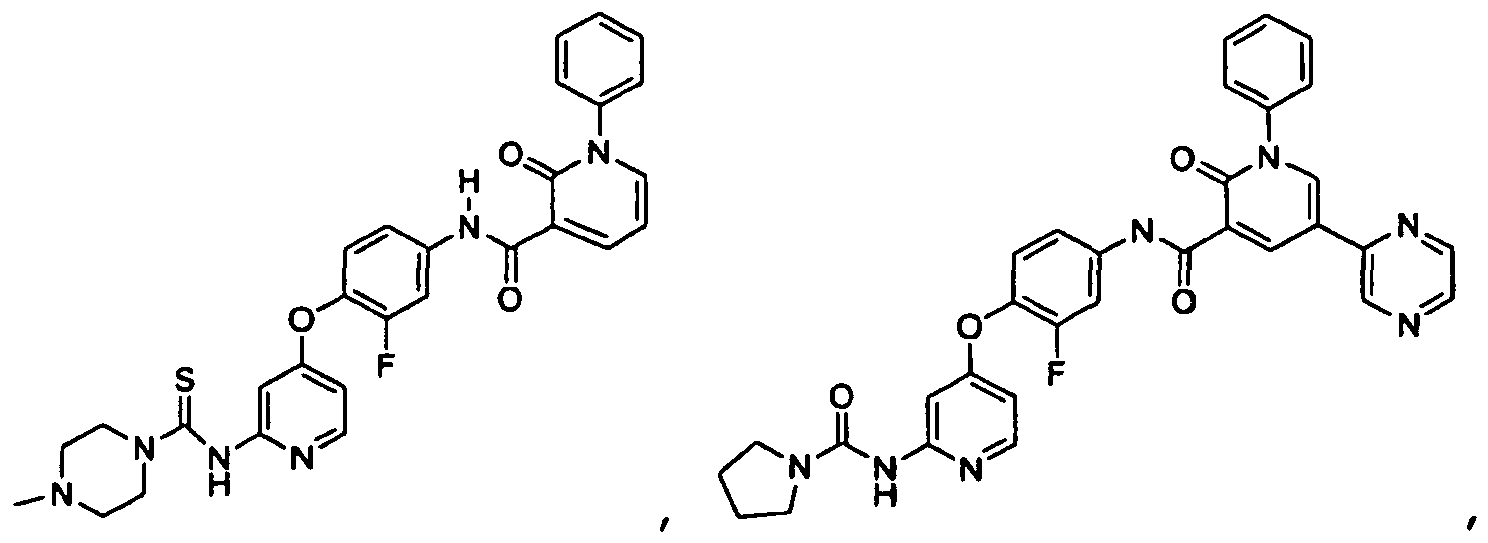


- A pharmaceutical composition comprising a pharmaceutically-acceptable carrier and a compound as in any of Claims 1-7.
- A compound as defined in any one of claims 1-7 for use in a method of treating cancer in a subject.
- The compound for use according to Claim 9 comprising a combination with a compound selected from antibiotic-type agents, alkylating agents, antimetabolite agents, hormonal agents, immunological agents, interferon-type agents and miscellaneous agents.
- A compound as defined in any one of claims 1-7 for use in reducing tumor size in a subject.
- A compound as defined in any one of claims 1-7 for use in treating HGF mediated disorders in a subject.
- A compound as defined in any one of claims 1-7 for use in reducing metastasis in a tumor in a subject.
- Use of a compound as defined in any one of claims 1-7 for the preparation of a medicament for treating cancer in a subject.
- The use according to Claim 14, the medicament further comprising a compound selected from antibiotic-type agents, alkylating agents, antimetabolite agents, hormonal agents, immunological agents, interferon-type agents and miscellaneous agents.
- Use of a compound as defined in any one of claims 1-7 for the preparation of a medicament for reducing tumor size in a subject.
- Use of a compound as defined in any one of claims 1-7 for the preparation of a medicament for treating HGF mediated disorders in a subject.
- Use of a compound as defined in any one of claims 1-7 for the preparation of a medicament for reducing metastasis in a tumor in a subject.
Priority Applications (3)
| Application Number | Priority Date | Filing Date | Title |
|---|---|---|---|
| SI200631479T SI1881976T1 (en) | 2005-04-27 | 2006-04-27 | Substituted amide derivatives as protein kinase inhibitors |
| PL06751834T PL1881976T3 (en) | 2005-04-27 | 2006-04-27 | Substituted amide derivatives as protein kinase inhibitors |
| CY20121101137T CY1113324T1 (en) | 2005-04-27 | 2012-11-26 | Substituted Amide Derivatives as Protein Kinase Suspensions |
Applications Claiming Priority (2)
| Application Number | Priority Date | Filing Date | Title |
|---|---|---|---|
| US67580505P | 2005-04-27 | 2005-04-27 | |
| PCT/US2006/016344 WO2006116713A1 (en) | 2005-04-27 | 2006-04-27 | Substituted amide derivatives as protein kinase inhibitors |
Related Child Applications (1)
| Application Number | Title | Priority Date | Filing Date |
|---|---|---|---|
| EP12001216 Division-Into | 2012-02-23 |
Publications (2)
| Publication Number | Publication Date |
|---|---|
| EP1881976A1 EP1881976A1 (en) | 2008-01-30 |
| EP1881976B1 true EP1881976B1 (en) | 2012-10-17 |
Family
ID=36617399
Family Applications (1)
| Application Number | Title | Priority Date | Filing Date |
|---|---|---|---|
| EP06751834A Expired - Lifetime EP1881976B1 (en) | 2005-04-27 | 2006-04-27 | Substituted amide derivatives as protein kinase inhibitors |
Country Status (33)
| Country | Link |
|---|---|
| US (3) | US7858623B2 (en) |
| EP (1) | EP1881976B1 (en) |
| JP (1) | JP5463033B2 (en) |
| KR (1) | KR20080004617A (en) |
| CN (1) | CN101248059A (en) |
| AR (1) | AR054262A1 (en) |
| AU (1) | AU2006239216B2 (en) |
| BR (1) | BRPI0608097A2 (en) |
| CA (1) | CA2605680C (en) |
| CR (1) | CR9475A (en) |
| CY (1) | CY1113324T1 (en) |
| DK (1) | DK1881976T3 (en) |
| EA (1) | EA013231B1 (en) |
| ES (1) | ES2396219T3 (en) |
| GT (1) | GT200600181A (en) |
| HN (1) | HN2006016313A (en) |
| HR (1) | HRP20121069T1 (en) |
| IL (1) | IL186526A (en) |
| JO (1) | JO2787B1 (en) |
| MX (1) | MX2007013216A (en) |
| MY (1) | MY177111A (en) |
| NO (1) | NO20076093L (en) |
| NZ (1) | NZ562595A (en) |
| PE (1) | PE20061436A1 (en) |
| PL (1) | PL1881976T3 (en) |
| PT (1) | PT1881976E (en) |
| RS (1) | RS52596B (en) |
| SI (1) | SI1881976T1 (en) |
| TW (1) | TWI378094B (en) |
| UA (1) | UA93375C2 (en) |
| UY (1) | UY29503A1 (en) |
| WO (1) | WO2006116713A1 (en) |
| ZA (1) | ZA200708775B (en) |
Cited By (1)
| Publication number | Priority date | Publication date | Assignee | Title |
|---|---|---|---|---|
| US10934274B2 (en) | 2015-04-14 | 2021-03-02 | Qurient Co., Ltd. | Quinoline derivatives as TAM RTK inhibitors |
Families Citing this family (166)
| Publication number | Priority date | Publication date | Assignee | Title |
|---|---|---|---|---|
| SE0302486D0 (en) | 2003-09-18 | 2003-09-18 | Astrazeneca Ab | Novel compounds |
| WO2005070891A2 (en) * | 2004-01-23 | 2005-08-04 | Amgen Inc | Compounds and methods of use |
| EP1781664B1 (en) | 2004-07-30 | 2013-09-04 | MethylGene Inc. | Inhibitors of vegf receptor and hgf receptor signaling |
| AP2007004244A0 (en) | 2005-05-10 | 2007-12-31 | Intermune Inc | Method of modulating stress-activated protein kinase system |
| WO2008041053A2 (en) * | 2005-05-20 | 2008-04-10 | Methylgene, Inc. | Inhibitors of vegf receptor and hgf receptor signaling |
| MX2007014617A (en) | 2005-05-20 | 2008-02-11 | Methylgene Inc | Inhibitors of vegf receptor and hgf receptor signaling. |
| WO2007035428A1 (en) | 2005-09-15 | 2007-03-29 | Bristol-Myers Squibb Company | Met kinase inhibitors |
| US7700567B2 (en) | 2005-09-29 | 2010-04-20 | Supergen, Inc. | Oligonucleotide analogues incorporating 5-aza-cytosine therein |
| CN101321759A (en) * | 2005-10-06 | 2008-12-10 | 先灵公司 | Pyrazolopyrimidine compounds as protein kinase inhibitors |
| US8003662B2 (en) | 2006-01-30 | 2011-08-23 | Array Biopharma, Inc. | Heterobicyclic thiophene compounds and methods of use |
| US7723330B2 (en) | 2006-03-07 | 2010-05-25 | Array Biopharma Inc. | Heterobicyclic pyrazole compounds and methods of use |
| ES2828739T3 (en) | 2006-04-07 | 2021-05-27 | Aerpio Pharmaceuticals Inc | Antibodies that bind to human protein tyrosine phosphatase beta (HPTP-beta) and their uses |
| TW200808763A (en) | 2006-05-08 | 2008-02-16 | Astrazeneca Ab | Novel compounds I |
| TW200808771A (en) | 2006-05-08 | 2008-02-16 | Astrazeneca Ab | Novel compounds II |
| EP2023926B1 (en) * | 2006-05-19 | 2011-10-12 | Bayer Pharma Aktiengesellschaft | Pyridonecarboxamide derivatives useful in treating hyper-proliferative and angiogenesis disorders |
| WO2008035209A2 (en) * | 2006-05-30 | 2008-03-27 | Methylgene Inc. | Inhibitors of protein tyrosine kinase activity |
| US20110053931A1 (en) * | 2006-06-08 | 2011-03-03 | John Gaudino | Quinoline compounds and methods of use |
| US7622593B2 (en) | 2006-06-27 | 2009-11-24 | The Procter & Gamble Company | Human protein tyrosine phosphatase inhibitors and methods of use |
| ES2431466T3 (en) | 2006-06-30 | 2013-11-26 | Sunesis Pharmaceuticals, Inc. | Pyridinonyl pdk1 inhibitors |
| KR101390076B1 (en) | 2006-11-08 | 2014-04-29 | 브리스톨-마이어스 스큅 컴퍼니 | Pyridinone compounds |
| WO2008079294A1 (en) * | 2006-12-20 | 2008-07-03 | Amgen Inc. | Substituted heterocycles and methods of use |
| MX2009006543A (en) | 2006-12-20 | 2009-06-26 | Amgen Inc | Heterocyclic compounds and their use in treating inflammation, angiogenesis and cancer. |
| AU2007338792B2 (en) | 2006-12-20 | 2012-05-31 | Amgen Inc. | Substituted heterocycles and methods of use |
| US7737149B2 (en) | 2006-12-21 | 2010-06-15 | Astrazeneca Ab | N-[5-[2-(3,5-dimethoxyphenyl)ethyl]-2H-pyrazol-3-yl]-4-(3,5-dimethylpiperazin-1-yl)benzamide and salts thereof |
| CA2676173A1 (en) * | 2007-02-16 | 2008-08-28 | Amgen Inc. | Nitrogen-containing heterocyclyl ketones and their use as c-met inhibitors |
| WO2009026720A1 (en) | 2007-08-29 | 2009-03-05 | Methylgene Inc. | Processes and intermediates for preparing fused heterocyclic kinase inhibitors |
| EP2183254B1 (en) * | 2007-08-29 | 2017-06-21 | MethylGene Inc. | Inhibitors of protein tyrosine kinase activity |
| WO2009054544A1 (en) * | 2007-10-26 | 2009-04-30 | Eisai R & D Management Co., Ltd. | Ampa receptor antagonists for parkinson's disease and movement disorders |
| AU2008319366B2 (en) * | 2007-10-29 | 2012-03-01 | Amgen Inc. | Benzomorpholine derivatives and methods of use |
| WO2009061271A1 (en) | 2007-11-06 | 2009-05-14 | Astrazeneca Ab | Some 2-pyrazinone derivatives and their use as inhibitors of neutrophile elastase |
| ES2531396T3 (en) | 2008-01-23 | 2015-03-13 | Bristol Myers Squibb Co | Process to prepare pyridinone compounds |
| EA017736B1 (en) | 2008-01-23 | 2013-02-28 | Бристол-Маерс Сквибб Компани | 4-pyridinone compounds and their use for cancer |
| MX2010009729A (en) * | 2008-03-05 | 2010-12-21 | Methylgene Inc | Inhibitors of protein tyrosine kinase activity. |
| WO2009140549A1 (en) * | 2008-05-14 | 2009-11-19 | Amgen Inc. | Combinations vegf(r) inhibitors and hepatocyte growth factor (c-met) inhibitors for the treatment of cancer |
| EP2296653B1 (en) | 2008-06-03 | 2016-01-27 | Intermune, Inc. | Compounds and methods for treating inflammatory and fibrotic disorders |
| TWI365185B (en) | 2008-07-24 | 2012-06-01 | Lilly Co Eli | Amidophenoxyindazoles useful as inhibitors of c-met |
| RS53382B (en) | 2008-08-20 | 2014-10-31 | Zoetis Llc | PIROL [2,3-D] PIRIMIDINE COMPOUNDS |
| US9040715B2 (en) | 2008-09-23 | 2015-05-26 | Georgetown University | 1,2-benzisothiazolinone and isoindolinone derivatives |
| AU2009300328A1 (en) * | 2008-10-01 | 2010-04-08 | Ludwig Institute For Cancer Research | Methods for the treatment of cancer |
| KR100961410B1 (en) * | 2008-10-14 | 2010-06-09 | (주)네오팜 | As protein kinase inhibitors, heterocyclic compounds |
| AU2009303602B2 (en) * | 2008-10-14 | 2012-06-14 | Sunshine Lake Pharma Co., Ltd. | Compounds and methods of use |
| AU2009322656A1 (en) * | 2008-12-05 | 2010-06-10 | Merck Sharp & Dohme Corp. | Inhibitors of phosphoinositide dependent kinase 1 (PDK1) |
| US8691866B2 (en) * | 2008-12-10 | 2014-04-08 | The General Hospital Corporation | HIF inhibitors and use thereof |
| WO2010071885A1 (en) | 2008-12-19 | 2010-06-24 | Cephalon, Inc. | Pyrrolotriazines as alk and jak2 inhibitors |
| TW201036957A (en) | 2009-02-20 | 2010-10-16 | Astrazeneca Ab | Novel salt 628 |
| EP2408300B1 (en) * | 2009-03-21 | 2016-05-11 | Sunshine Lake Pharma Co., Ltd. | Amino ester derivatives, salts thereof and methods of use |
| SG10201401836RA (en) * | 2009-04-27 | 2014-10-30 | Elan Pharm Inc | Pyridinone antagonists of alpha-4 integrins |
| BRPI1006897A2 (en) | 2009-07-06 | 2015-09-08 | Akebia Therapeutics Inc | compounds, compositions and methods for preventing cancer cell metastasis. |
| US9340555B2 (en) | 2009-09-03 | 2016-05-17 | Allergan, Inc. | Compounds as tyrosine kinase modulators |
| MX2012002591A (en) | 2009-09-03 | 2012-04-02 | Allergan Inc | Compounds as tyrosine kinase modulators. |
| US8293925B2 (en) * | 2009-09-21 | 2012-10-23 | Chemocentryx, Inc. | Pyrrolidinone carboxamide derivatives |
| AU2010302420B2 (en) | 2009-10-02 | 2013-07-04 | Astrazeneca Ab | 2-pyridone compounds used as inhibitors of neutrophil elastase |
| WO2011051958A1 (en) | 2009-10-30 | 2011-05-05 | E.I. Du Pont De Nemours And Company | Fungicidal pyrazolones |
| EP2521723A1 (en) | 2010-01-04 | 2012-11-14 | Enantia, S.L. | Process for the preparation of rivaroxaban and intermediates thereof |
| CN102212062B (en) * | 2010-04-02 | 2015-04-29 | 广东东阳光药业有限公司 | Derivative of amino ester, salt thereof and using method |
| MX2012012031A (en) * | 2010-04-16 | 2012-12-17 | Methylgene Inc | Inhibitors of protein tyrosine kinase activity and use thereof to treat ophthalmic disorders. |
| EP2563773A1 (en) | 2010-04-29 | 2013-03-06 | Deciphera Pharmaceuticals, LLC | Pyridone amides and analogs exhibiting anti-cancer and anti-proliferative activites |
| JP5960688B2 (en) | 2010-05-17 | 2016-08-02 | インコゼン セラピューティクス プライベート リミテッド | Novel 3,5-disubstituted-3H- [1,2,3] triazolo [4,5-B] pyridine compounds as protein kinase modulators |
| WO2011161217A2 (en) | 2010-06-23 | 2011-12-29 | Palacký University in Olomouc | Targeting of vegfr2 |
| CA2841142C (en) | 2010-06-23 | 2020-12-15 | Ryan D. Morin | Biomarkers for non-hodgkin lymphomas and uses thereof |
| EP2594566A4 (en) * | 2010-07-16 | 2014-10-01 | Kyowa Hakko Kirin Co Ltd | Nitrogenated aromatic heterocyclic ring derivative |
| EP2423208A1 (en) * | 2010-08-28 | 2012-02-29 | Lead Discovery Center GmbH | Pharmaceutically active compounds as Axl inhibitors |
| US9175331B2 (en) | 2010-09-10 | 2015-11-03 | Epizyme, Inc. | Inhibitors of human EZH2, and methods of use thereof |
| BR112013005806B1 (en) | 2010-09-10 | 2022-05-10 | Epizyme, Inc | METHODS TO DETECT WHETHER AN INDIVIDUAL IS A CANDIDATE FOR TREATMENT WITH OR RESPONSIVE TO AN EZH2 INHIBITOR AND THERAPEUTIC USES OF SUCH EZH2 INHIBITOR |
| WO2012044577A1 (en) | 2010-09-27 | 2012-04-05 | Exelixis, Inc. | Dual inhibitors of met and vegf for the treatment of castration resistant prostate cancer and osteoblastic bone metastases |
| MX352844B (en) * | 2011-02-28 | 2017-12-11 | Calitor Sciences Llc | Substituted quinoline compounds and methods of use. |
| JP6026441B2 (en) | 2011-03-04 | 2016-11-16 | グラクソスミスクライン、インテレクチュアル、プロパティー、ディベロップメント、リミテッドGlaxosmithkline Intellectual Property Development Limited | Aminoquinolines as kinase inhibitors |
| JO3363B1 (en) | 2011-04-13 | 2019-03-13 | Epizyme Inc | Heterocyclic benzene compounds with aryl or aryl |
| TW201733984A (en) | 2011-04-13 | 2017-10-01 | 雅酶股份有限公司 | Substituted benzene compounds |
| US9283225B2 (en) | 2011-08-10 | 2016-03-15 | Merck Patent Gmbh | Pyrido-pyrimidine derivatives |
| WO2013025897A1 (en) | 2011-08-16 | 2013-02-21 | Georgetown University | Methods of treating bacterial infections with 1,2-benzisothiazolinone and isoindolinone derivatives |
| TWI547494B (en) | 2011-08-18 | 2016-09-01 | 葛蘭素史克智慧財產發展有限公司 | Aminoquinazolines as kinase inhibitors |
| HUE042327T2 (en) * | 2011-08-30 | 2019-06-28 | Astex Pharmaceuticals Inc | Decitabine derivative products |
| MX363351B (en) | 2011-10-13 | 2019-03-20 | Aerpio Therapeutics Inc | Methods for treating vascular leak syndrome and cancer. |
| EP3501536B1 (en) | 2011-10-13 | 2025-12-24 | EyePoint Pharmaceuticals, Inc. | Treatment of ocular disease |
| HK1202450A1 (en) * | 2011-11-22 | 2015-10-02 | Deciphera Pharmaceuticals, Llc. | Pyridinamide and the like which exhibit anticancer and antiproliferative activities |
| CN102643268B (en) * | 2011-12-30 | 2014-05-21 | 沈阳药科大学 | Quinolines and cinnolines and their applications |
| CN103319468B (en) * | 2012-03-21 | 2016-07-13 | 广东东阳光药业有限公司 | The spiral shell dicyclic compound replaced and using method and purposes |
| CN104321322A (en) | 2012-03-30 | 2015-01-28 | 理森制药股份公司 | Novel 3,5-disubstituted-3H-imidazo[4,5-B]pyridines and 3,5-disubstituted-3H-[1,2,3]triazolo[ 4,5-B]pyridine compounds |
| ES2617379T3 (en) | 2012-04-13 | 2017-06-16 | Epizyme, Inc. | Salt form of a human EZH2 histone methyltransferase inhibitor |
| CN103420986A (en) * | 2012-05-18 | 2013-12-04 | 广东东阳光药业有限公司 | Substituted quinoline compounds and methods and uses thereof |
| EP2864291B1 (en) * | 2012-06-26 | 2016-10-05 | Bayer Pharma Aktiengesellschaft | N-[4-(quinolin-4-yloxy)cyclohexyl(methyl)](hetero)arylcarboxamides as androgen receptor antagonists, production and use thereof as medicinal products |
| TWI520962B (en) * | 2012-06-29 | 2016-02-11 | 貝達藥業股份有限公司 | As the c-Met tyrosine kinase inhibitors novel fused pyridine derivatives |
| CN103539780A (en) * | 2012-07-16 | 2014-01-29 | 广东东阳光药业有限公司 | Substituted pyrazolone compounds and methods and uses thereof |
| US8975282B2 (en) | 2012-07-28 | 2015-03-10 | Sunshine Lake Pharma Co., Ltd. | Substituted pyrazolone compounds and methods of use |
| EP2879677B1 (en) * | 2012-07-28 | 2017-06-14 | Calitor Sciences, LLC | Substituted pyrazolone compounds and methods of use |
| TWI565702B (en) * | 2012-08-03 | 2017-01-11 | 習寧 | Substituted pyrazolone compounds and methods of use thereof |
| KR101350006B1 (en) * | 2012-09-06 | 2014-02-13 | 씨제이제일제당 (주) | Protein kinase inhibitors comprising pyridone derivatives |
| AR092530A1 (en) | 2012-09-13 | 2015-04-22 | Glaxosmithkline Llc | AMINO-QUINOLINE COMPOSITE, PHARMACEUTICAL COMPOSITION THAT INCLUDES IT AND USE OF THIS COMPOUND FOR THE PREPARATION OF A MEDICINAL PRODUCT |
| AR092529A1 (en) | 2012-09-13 | 2015-04-22 | Glaxosmithkline Llc | AMINOQUINAZOLINE COMPOUND, PHARMACEUTICAL COMPOSITION THAT INCLUDES IT AND USE OF THIS COMPOSITE FOR THE PREPARATION OF A MEDICINAL PRODUCT |
| AR092742A1 (en) | 2012-10-02 | 2015-04-29 | Intermune Inc | ANTIFIBROTIC PYRIDINONES |
| BR112015008480A2 (en) | 2012-10-15 | 2017-07-04 | Epizyme Inc | substituted benzene compounds |
| US20140179712A1 (en) | 2012-12-21 | 2014-06-26 | Astrazeneca Ab | Pharmaceutical formulation of n-[5-[2-(3,5-dimethoxyphenyl)ethyl]-2h-pyrazol-3-yl]-4-[(3r,5s)-3,5-dimethylpiperazin-1-yl]benzamide |
| US9353122B2 (en) | 2013-02-15 | 2016-05-31 | Kala Pharmaceuticals, Inc. | Therapeutic compounds and uses thereof |
| US9688688B2 (en) | 2013-02-20 | 2017-06-27 | Kala Pharmaceuticals, Inc. | Crystalline forms of 4-((4-((4-fluoro-2-methyl-1H-indol-5-yl)oxy)-6-methoxyquinazolin-7-yl)oxy)-1-(2-oxa-7-azaspiro[3.5]nonan-7-yl)butan-1-one and uses thereof |
| US9353123B2 (en) | 2013-02-20 | 2016-05-31 | Kala Pharmaceuticals, Inc. | Therapeutic compounds and uses thereof |
| CN105143208B (en) | 2013-02-21 | 2017-09-26 | 葛兰素史密斯克莱知识产权发展有限公司 | Quinazolines as Kinase Inhibitors |
| JP6572201B2 (en) | 2013-03-15 | 2019-09-04 | エアーピオ セラピューティクス インコーポレイテッド | Compositions, formulations and methods for treating ocular diseases |
| US20150050277A1 (en) | 2013-03-15 | 2015-02-19 | Aerpio Therapeutics Inc. | Compositions and methods for treating ocular diseases |
| NO3003315T3 (en) * | 2013-06-06 | 2018-06-16 | ||
| TWI649308B (en) | 2013-07-24 | 2019-02-01 | 小野藥品工業股份有限公司 | Quinoline derivative |
| PE20161273A1 (en) | 2013-10-16 | 2016-12-18 | Epizyme Inc | SALINE FORM OF HYDROCHLORIDE FOR EZH2 INHIBITION |
| KR20160099084A (en) | 2013-11-01 | 2016-08-19 | 칼라 파마슈티컬스, 인크. | Crystalline forms of therapeutic compounds and uses thereof |
| US9890173B2 (en) | 2013-11-01 | 2018-02-13 | Kala Pharmaceuticals, Inc. | Crystalline forms of therapeutic compounds and uses thereof |
| WO2015138882A1 (en) | 2014-03-14 | 2015-09-17 | Aerpio Therapeutics, Inc. | Hptp-beta inhibitors |
| RU2692485C2 (en) | 2014-04-02 | 2019-06-25 | Интермьюн, Инк. | Antifibrous pyridinones |
| CN104974162B (en) * | 2014-04-09 | 2018-09-14 | 广东东阳光药业有限公司 | Bicyclic pyrazolone compounds and its application method and purposes |
| WO2015164161A1 (en) * | 2014-04-22 | 2015-10-29 | Calitor Sciences, Llc | Bicylcic pyrazolone compounds and methods of use |
| WO2016104617A1 (en) * | 2014-12-25 | 2016-06-30 | 小野薬品工業株式会社 | Quinoline derivative |
| CN106279147A (en) | 2015-05-21 | 2017-01-04 | 中国科学院上海药物研究所 | A kind of pyrido nitrogen heterocyclic and its production and use |
| WO2017004538A1 (en) | 2015-07-02 | 2017-01-05 | Otsuka Pharmaceutical Co., Ltd. | Lyophilized pharmaceutical compositions |
| ES2769124T3 (en) * | 2015-07-20 | 2020-06-24 | Betta Pharmaceuticals Co Ltd | Crystalline form of maleate of condensed pyridine derivatives and uses thereof |
| CN106632253B (en) * | 2015-11-02 | 2019-03-22 | 广东东阳光药业有限公司 | Crystal form of a substituted quinoline compound and its pharmaceutical composition and use |
| CN106632254B (en) * | 2015-11-02 | 2019-03-01 | 广东东阳光药业有限公司 | Crystal form of a substituted quinoline compound and its pharmaceutical composition and use |
| US9920033B2 (en) * | 2015-11-14 | 2018-03-20 | Calitor Sciences, Llc | Crystalline form of a substituted quinoline compound and pharmaceutical compositions thereof |
| WO2017083789A1 (en) * | 2015-11-14 | 2017-05-18 | Sunshine Lake Pharma Co., Ltd. | Crystalline form of a substituted quinoline compound and pharmaceutical compositions thereof |
| US9815850B2 (en) | 2016-02-05 | 2017-11-14 | Denali Therapeutics Inc. | Compounds, compositions and methods |
| CN107286140A (en) * | 2016-04-12 | 2017-10-24 | 上海医药工业研究院 | Substituted aromatic amines base heteroaromatic class compound and its application as antineoplastic |
| WO2017198196A1 (en) * | 2016-05-18 | 2017-11-23 | 王子厚 | Quinoline derivative having anti-tumor activity |
| US10253036B2 (en) | 2016-09-08 | 2019-04-09 | Kala Pharmaceuticals, Inc. | Crystalline forms of therapeutic compounds and uses thereof |
| EP3509421A4 (en) | 2016-09-08 | 2020-05-20 | Kala Pharmaceuticals, Inc. | CRYSTALLINE FORMS OF THERAPEUTIC COMPOUNDS AND USES THEREOF |
| WO2018048750A1 (en) | 2016-09-08 | 2018-03-15 | Kala Pharmaceuticals, Inc. | Crystalline forms of therapeutic compounds and uses thereof |
| EP3529245A4 (en) | 2016-10-24 | 2020-12-23 | Yumanity Therapeutics, Inc. | COMPOUNDS AND USES THEREOF |
| LT3552017T (en) | 2016-12-09 | 2022-05-10 | Denali Therapeutics Inc. | COMPOUNDS TO BE USED AS RIPK1 INHIBITORS |
| MA47212A (en) | 2017-01-06 | 2019-11-13 | Yumanity Therapeutics Inc | TREATMENT METHODS FOR NEUROLOGICAL DISORDERS |
| KR102571911B1 (en) | 2017-01-26 | 2023-08-28 | 오노 야꾸힝 고교 가부시키가이샤 | Ethanesulfonates of quinoline derivatives |
| AU2018259078B2 (en) | 2017-04-27 | 2021-10-07 | Astrazeneca Ab | C5-anilinoquinazoline compounds and their use in treating cancer |
| EP3655406A1 (en) | 2017-07-18 | 2020-05-27 | Bayer Pharma Aktiengesellschaft | Substituted pyrrolopyridine-derivatives |
| BR112020002280A2 (en) | 2017-08-03 | 2020-07-28 | Otsuka Pharmaceutical Co., Ltd. | pharmacological compound and purification methods |
| WO2019048988A1 (en) | 2017-09-08 | 2019-03-14 | Pi Industries Ltd. | NOVEL FUNGICIDE HETEROCYCLIC COMPOUNDS |
| BR112020004356A2 (en) | 2017-09-08 | 2020-12-01 | Pi Industries Ltd. | new fungicidal heterocyclic compounds |
| US11826363B2 (en) | 2017-10-13 | 2023-11-28 | Ono Pharmaceutical Co., Ltd. | Therapeutic agent for solid cancers, which comprises Axl inhibitor as active ingredient |
| WO2019084157A1 (en) | 2017-10-24 | 2019-05-02 | Yumanity Therapeutics, Inc. | Compounds and uses thereof |
| CN110041316B (en) * | 2018-01-17 | 2022-04-19 | 药捷安康(南京)科技股份有限公司 | TAM family kinase/and CSF1R kinase inhibitors and their uses |
| EP3762392B1 (en) | 2018-03-08 | 2024-05-15 | Wellmarker Bio Co., Ltd. | Thienopyridine derivatives and pharmaceutical composition comprising same |
| ES3043183T3 (en) | 2018-03-23 | 2025-11-25 | Janssen Pharmaceutica Nv | Compounds and uses thereof |
| CN110372666B (en) * | 2018-04-13 | 2022-11-08 | 华东理工大学 | Quinazoline compound as EGFR (epidermal growth factor receptor) triple mutation inhibitor and application thereof |
| CN110511218A (en) * | 2018-05-21 | 2019-11-29 | 中国科学院上海药物研究所 | A kind of and ring pyrazolone Carbox amide and preparation method thereof, pharmaceutical composition and purposes |
| CN111295380B (en) * | 2018-06-01 | 2020-11-20 | 杭州阿诺生物医药科技有限公司 | A highly active CSF1R inhibitor compound |
| CN108727386A (en) * | 2018-07-16 | 2018-11-02 | 广州医科大学 | A kind of pyrazolopyrimidine compound and its preparation method and application |
| PT3842425T (en) * | 2018-08-24 | 2024-07-02 | Transthera Sciences Nanjing Inc | Novel quinoline derivative inhibitor |
| US20220047603A1 (en) | 2018-12-11 | 2022-02-17 | Bayer Aktiengesellschaft | Substituted pyrrolopyridine-derivatives |
| CN111303024B (en) * | 2018-12-12 | 2023-03-28 | 安徽中科拓苒药物科学研究有限公司 | Quinoline-structured pan-KIT kinase inhibitor and application thereof |
| MA54829A (en) | 2019-01-24 | 2021-12-01 | Yumanity Therapeutics Inc | COMPOUNDS AND THEIR USES |
| NL2022471B1 (en) | 2019-01-29 | 2020-08-18 | Vationpharma B V | Solid state forms of oclacitinib |
| JP7636326B2 (en) * | 2019-07-29 | 2025-02-26 | 武田薬品工業株式会社 | Heterocyclic compounds |
| AU2020325115B2 (en) * | 2019-08-02 | 2026-03-12 | Amgen Inc. | Pyridine derivatives as KIF18A inhibitors |
| PL4010330T3 (en) * | 2019-08-08 | 2026-03-16 | Hirundo Biosciences | QUINOLINE DERIVATIVES AS PROTEIN KINASE INHIBITORS |
| JP2022554042A (en) | 2019-09-06 | 2022-12-28 | ウェルマーカー・バイオ・カンパニー・リミテッド | Biomarker-type therapeutic composition |
| CN112625026B (en) * | 2019-09-24 | 2022-09-09 | 药捷安康(南京)科技股份有限公司 | Quinoline derivatives of TAM family kinase inhibitors |
| JP2022551422A (en) | 2019-09-26 | 2022-12-09 | エグゼリクシス, インコーポレイテッド | Pyridone compounds and methods of use in modulating protein kinases |
| EA202192047A1 (en) | 2019-11-13 | 2021-12-08 | Юманити Терапьютикс, Инк. | COMPOUNDS AND THEIR APPLICATIONS |
| CN113121429B (en) * | 2020-01-15 | 2024-04-26 | 鲁南制药集团股份有限公司 | C-Met kinase inhibitor and preparation method and application thereof |
| CA3171473A1 (en) * | 2020-02-24 | 2021-09-02 | Exelixis, Inc. | Compounds and methods of use |
| CN111440174B (en) * | 2020-04-02 | 2021-07-09 | 广州医科大学 | A kind of pyridine amide compound and its preparation method and application |
| WO2021249913A1 (en) | 2020-06-09 | 2021-12-16 | Bayer Aktiengesellschaft | 2'-(quinolin-3-yl)-5',6'-dihydrospiro[azetidine-3,4'-pyrrolo[1,2-b]pyrazole]-1-carboxylate derivatives and related compounds as map4k1 (hpk1) inhibitors for the treatment of cancer |
| WO2022167627A1 (en) | 2021-02-05 | 2022-08-11 | Bayer Aktiengesellschaft | Map4k1 inhibitors |
| TW202309022A (en) | 2021-04-13 | 2023-03-01 | 美商努法倫特公司 | Amino-substituted heterocycles for treating cancers with egfr mutations |
| MX2023014754A (en) | 2021-06-18 | 2024-02-12 | Aligos Therapeutics Inc | METHODS AND COMPOSITIONS DIRECTED AT PD-L1. |
| TW202315628A (en) * | 2021-06-24 | 2023-04-16 | 南韓商Lg化學股份有限公司 | Novel pyridine derivative compound as ron inhibitor |
| CN113999205B (en) * | 2021-12-13 | 2023-09-15 | 辽宁大学 | Pyridine compounds containing triazolone amide and imidazole amide structures and their applications |
| CN119212987A (en) | 2021-12-16 | 2024-12-27 | 安力高医药股份有限公司 | Methods and compositions for targeting PD-L1 |
| EP4463229A1 (en) | 2022-01-12 | 2024-11-20 | Denali Therapeutics Inc. | Crystalline forms of (s)-5-benzyl-n-(5-methyl-4-oxo-2, 3,4,5- tetrahydropyrido [3,2-b] [l,4]oxazepin-3-yl)-4h-l,2,4-triazole-3-carboxamide |
| CN117362275A (en) * | 2022-06-29 | 2024-01-09 | 广州百霆医药科技有限公司 | Tyrosine protein kinase inhibitor and application thereof |
| CN116283920B (en) * | 2023-03-31 | 2024-04-16 | 贵州医科大学 | 2,4-Disubstituted pyridine compounds and their applications |
| CN117126142B (en) * | 2023-08-30 | 2026-02-10 | 遵义医科大学珠海校区 | Heterocyclic EGFR mutation inhibitors and their applications |
Family Cites Families (65)
| Publication number | Priority date | Publication date | Assignee | Title |
|---|---|---|---|---|
| US3755332A (en) * | 1971-07-01 | 1973-08-28 | Ciba Geigy Corp | Substituted 4 indazolaminoquinolines |
| DE2948434A1 (en) * | 1979-12-01 | 1981-06-11 | Hoechst Ag, 6000 Frankfurt | 1-PIPERIDINSULFONYL UREA AND METHOD FOR THE PRODUCTION THEREOF |
| JPS63145272A (en) | 1986-12-09 | 1988-06-17 | Morishita Seiyaku Kk | 4,5-dihydro-6-(4-substituted phenyl)-3(2h)-pyridazinone derivative |
| US4916135A (en) * | 1989-05-08 | 1990-04-10 | Hoechst Roussel Pharmaceuticals Inc. | N-heteroaryl-4-quinolinamines |
| GB9323290D0 (en) * | 1992-12-10 | 1994-01-05 | Zeneca Ltd | Quinazoline derivatives |
| JPH08193070A (en) * | 1995-01-11 | 1996-07-30 | Mitsubishi Chem Corp | 2-Imidazolidinone derivative, herbicide containing the same as active ingredient, and intermediate for producing the same |
| WO1996023774A1 (en) | 1995-01-31 | 1996-08-08 | Zenyaku Kogyo Kabushiki Kaisha | Thioquinoline derivatives |
| GB9505651D0 (en) | 1995-03-21 | 1995-05-10 | Agrevo Uk Ltd | AgrEvo UK Limited |
| GB9505702D0 (en) | 1995-03-21 | 1995-05-10 | Agrevo Uk Ltd | Fungicidal compounds |
| GB9514265D0 (en) | 1995-07-13 | 1995-09-13 | Wellcome Found | Hetrocyclic compounds |
| DE69622183D1 (en) | 1995-11-07 | 2002-08-08 | Kirin Brewery | CHINOLINE DERIVATIVES AND CHINAZOLE DERIVATIVES, WHICH INHIBIT THE AUTOPHOSPHORYLATION OF THE GROWTH FACTOR RECEPTOR DERIVING FROM BLOOD PLATPLES AND THEIR PHARMACEUTICAL COMPOSITIONS CONTAINING THEM |
| HUP9801177A3 (en) * | 1995-11-14 | 1998-11-30 | Pharmacia & Upjohn Spa | Tetrahydronaphthyl, indanyl and indolyl substituted pyrido[2,3-d]pyrimidine and purine derivatives, process for their preparation and pharmaceutical compositions containing them |
| GB9624482D0 (en) | 1995-12-18 | 1997-01-15 | Zeneca Phaema S A | Chemical compounds |
| GB9603095D0 (en) * | 1996-02-14 | 1996-04-10 | Zeneca Ltd | Quinazoline derivatives |
| DE19614718A1 (en) * | 1996-04-15 | 1997-10-16 | Hoechst Schering Agrevo Gmbh | Substituted pyridines / pyrimidines, processes for their preparation and their use as pesticides |
| CN1100777C (en) | 1997-02-19 | 2003-02-05 | 伯莱克斯实验室公司 | N-heterocyclic derivatives as NOS inhibitor |
| JP4194678B2 (en) | 1997-11-28 | 2008-12-10 | キリンファーマ株式会社 | Quinoline derivative and pharmaceutical composition containing the same |
| GB9800575D0 (en) | 1998-01-12 | 1998-03-11 | Glaxo Group Ltd | Heterocyclic compounds |
| US6573289B1 (en) * | 1998-04-23 | 2003-06-03 | Takeda Chemical Industries, Ltd. | Naphthalene derivatives, their production and use |
| HUP0102793A3 (en) | 1998-05-28 | 2002-07-29 | Parker Hughes Inst St Paul | Quinazolines for treating brain tumor and medicaments containing them |
| AU5682799A (en) | 1998-08-21 | 2000-03-14 | Parker Hughes Institute | Quinazoline derivatives |
| IL144461A0 (en) * | 1999-01-22 | 2002-05-23 | Kirin Brewery | Quinoline and quinazoline derivatives and pharmaceutical compositions containing them |
| EE05345B1 (en) | 1999-02-10 | 2010-10-15 | Astrazeneca Ab | Quinazoline derivatives as inhibitors of angiogenesis |
| GB9904103D0 (en) | 1999-02-24 | 1999-04-14 | Zeneca Ltd | Quinoline derivatives |
| US6258820B1 (en) | 1999-03-19 | 2001-07-10 | Parker Hughes Institute | Synthesis and anti-tumor activity of 6,7-dialkoxy-4-phenylamino-quinazolines |
| MXPA01010231A (en) | 1999-04-12 | 2003-07-21 | Aventis Pharma Ltd | Substituted bicyclic heteroaryl compounds as integrin antagonists. |
| HK1046688A1 (en) | 1999-09-21 | 2003-01-24 | Astrazeneca Ab | Quinazoline compounds and pharmaceutical compositions containing them |
| ATE260272T1 (en) | 2000-03-17 | 2004-03-15 | Bristol Myers Squibb Pharma Co | BETA-AMINO ACID DERIVATIVES FOR USE AS MATRIX METALLOPROTEASES AND TNA-ALPHA INHIBITORS |
| IL151552A0 (en) | 2000-03-17 | 2003-04-10 | Bristol Myers Squibb Pharma Co | Cyclic beta-amino acid derivatives as inhibitors of matrix metalloproteases and tnf-alpha |
| WO2002000005A1 (en) | 2000-06-21 | 2002-01-03 | Alexion Pharmaceuticals, Inc. | Libraries displaying human antibody fragments with hybrid complementarity determining regions |
| AU2001290912A1 (en) | 2000-09-15 | 2002-03-26 | Vertex Pharmaceuticals Incorporated | Pyrazole compounds useful as protein kinase inhibitors |
| WO2002030924A1 (en) | 2000-10-13 | 2002-04-18 | Astrazeneca Ab | Quinazoline derivatives with anti-tumour activity |
| KR100600550B1 (en) | 2000-10-20 | 2006-07-13 | 에자이 가부시키가이샤 | Nitrogen-containing aromatic ring derivative |
| ATE497603T1 (en) * | 2001-03-02 | 2011-02-15 | Gpc Biotech Ag | THREE-HYBRID ASSAY SYSTEM |
| HN2002000067A (en) | 2001-03-23 | 2003-10-24 | Bayer Healthcare Llc | INHIBITORS OF THE RHO - QUINASA. |
| JP4583751B2 (en) | 2001-06-06 | 2010-11-17 | アベンティス・フアーマ・リミテッド | Substituted tetrahydroisoquinolines for use in the treatment of inflammatory diseases |
| CA2454538A1 (en) * | 2001-06-22 | 2003-01-03 | Kirin Beer Kabushiki Kaisha | Quinoline derivatives and quinazoline derivatives capable of inhibiting autophosphorylation of hepatocyte growth factor receptors, and pharmaceutical composition comprising the same |
| WO2002000004A2 (en) | 2001-07-05 | 2002-01-03 | Telefonaktiebolaget Lm Ericsson (Publ) | Detrimental latch-up avoidans in digital circuits |
| SE0102439D0 (en) | 2001-07-05 | 2001-07-05 | Astrazeneca Ab | New compounds |
| GB0126433D0 (en) | 2001-11-03 | 2002-01-02 | Astrazeneca Ab | Compounds |
| RU2004116911A (en) | 2001-11-03 | 2005-11-10 | Астразенека Аб (Se) | Quinazoline derivatives as anti-tumor agents |
| EP2292615A1 (en) | 2002-02-01 | 2011-03-09 | AstraZeneca AB | Quinazoline compounds |
| US6818772B2 (en) * | 2002-02-22 | 2004-11-16 | Abbott Laboratories | Antagonists of melanin concentrating hormone effects on the melanin concentrating hormone receptor |
| US7645878B2 (en) | 2002-03-22 | 2010-01-12 | Bayer Healthcare Llc | Process for preparing quinazoline Rho-kinase inhibitors and intermediates thereof |
| MXPA04009541A (en) | 2002-03-29 | 2005-01-25 | Chiron Corp | Substituted benzazoles and use thereof as raf kinase inhibitors. |
| AU2003257666A1 (en) | 2002-08-23 | 2004-03-11 | Kirin Beer Kabushiki Kaisha | COMPOUND HAVING TGFss INHIBITORY ACTIVITY AND MEDICINAL COMPOSITION CONTAINING THE SAME |
| AU2003255482A1 (en) | 2002-10-02 | 2004-04-23 | Merck Patent Gmbh | Use of 4 amino-quinazolines as anti cancer agents |
| AU2003285952A1 (en) | 2002-10-21 | 2004-05-13 | Irm Llc | Pyrrolidones with anti-hiv activity |
| AR041992A1 (en) | 2002-11-06 | 2005-06-08 | Smithkline Beecham Corp | PIRIDINIL BENZOHETEROCICLIC COMPOSITE, PHARMACEUTICAL COMPOSITION THAT INCLUDES IT AND ITS USE TO PREPARE IT |
| TW200500341A (en) * | 2002-11-12 | 2005-01-01 | Astrazeneca Ab | Novel compounds |
| GB0226724D0 (en) | 2002-11-15 | 2002-12-24 | Merck Sharp & Dohme | Therapeutic agents |
| JP2006519258A (en) | 2003-02-28 | 2006-08-24 | エンサイシブ・ファーマシューティカルズ・インコーポレイテッド | Pyridine, pyrimidine, quinoline, quinazoline and naphthalene urotensin-II receptor antagonists |
| CA2517291C (en) | 2003-03-19 | 2012-05-08 | Exelixis, Inc. | Ortho-substituted aryl and heteroaryl tie-2 modulators and methods of use |
| US7531553B2 (en) | 2003-03-21 | 2009-05-12 | Amgen Inc. | Heterocyclic compounds and methods of use |
| GB0310401D0 (en) | 2003-05-07 | 2003-06-11 | Astrazeneca Ab | Therapeutic agent |
| WO2005005389A2 (en) | 2003-07-07 | 2005-01-20 | Merck Patent Gmbh | Malonamide derivatives |
| EP1660503A1 (en) | 2003-08-29 | 2006-05-31 | Pfizer Inc. | Naphthalene carboxamides and their derivatives useful as new anti-angiogenic agents |
| EP2210607B1 (en) | 2003-09-26 | 2011-08-17 | Exelixis Inc. | N-[3-fluoro-4-({6-(methyloxy)-7-[(3-morpholin-4-ylpropyl)oxy]quinolin-4-yl}oxy)phenyl]-N'-(4-fluorophenyl)cyclopropane-1,1-dicarboxamide for the treatment of cancer |
| WO2005037285A1 (en) | 2003-10-16 | 2005-04-28 | Chiron Corporation | 2,6-disubstituted quinazolines, quinoxalines, quinolines and isoquinolines as inhibitors of raf kinase for treatment of cancer |
| US7626030B2 (en) * | 2004-01-23 | 2009-12-01 | Amgen Inc. | Compounds and methods of use |
| WO2005070891A2 (en) | 2004-01-23 | 2005-08-04 | Amgen Inc | Compounds and methods of use |
| TW200538120A (en) | 2004-02-20 | 2005-12-01 | Kirin Brewery | Compound having TGF-beta inhibitory activity and pharmaceutical composition containing same |
| US7459562B2 (en) | 2004-04-23 | 2008-12-02 | Bristol-Myers Squibb Company | Monocyclic heterocycles as kinase inhibitors |
| US7523317B2 (en) | 2004-04-29 | 2009-04-21 | International Business Machines Corporation | Computer grid access management system |
| US20050288290A1 (en) * | 2004-06-28 | 2005-12-29 | Borzilleri Robert M | Fused heterocyclic kinase inhibitors |
-
2006
- 2006-04-25 JO JO2006118A patent/JO2787B1/en active
- 2006-04-26 US US11/412,302 patent/US7858623B2/en active Active
- 2006-04-26 TW TW095114947A patent/TWI378094B/en not_active IP Right Cessation
- 2006-04-26 MY MYPI20061913A patent/MY177111A/en unknown
- 2006-04-26 AR AR20060101671A patent/AR054262A1/en not_active Application Discontinuation
- 2006-04-27 KR KR1020077027041A patent/KR20080004617A/en not_active Abandoned
- 2006-04-27 PE PE2006000442A patent/PE20061436A1/en not_active Application Discontinuation
- 2006-04-27 DK DK06751834.0T patent/DK1881976T3/en active
- 2006-04-27 HR HRP20121069TT patent/HRP20121069T1/en unknown
- 2006-04-27 PT PT06751834T patent/PT1881976E/en unknown
- 2006-04-27 HN HN2006016313A patent/HN2006016313A/en unknown
- 2006-04-27 WO PCT/US2006/016344 patent/WO2006116713A1/en not_active Ceased
- 2006-04-27 ES ES06751834T patent/ES2396219T3/en not_active Expired - Lifetime
- 2006-04-27 EA EA200702339A patent/EA013231B1/en not_active IP Right Cessation
- 2006-04-27 AU AU2006239216A patent/AU2006239216B2/en not_active Ceased
- 2006-04-27 UY UY29503A patent/UY29503A1/en not_active Application Discontinuation
- 2006-04-27 CA CA2605680A patent/CA2605680C/en not_active Expired - Fee Related
- 2006-04-27 SI SI200631479T patent/SI1881976T1/en unknown
- 2006-04-27 RS RS20120566A patent/RS52596B/en unknown
- 2006-04-27 EP EP06751834A patent/EP1881976B1/en not_active Expired - Lifetime
- 2006-04-27 MX MX2007013216A patent/MX2007013216A/en active IP Right Grant
- 2006-04-27 BR BRPI0608097-9A patent/BRPI0608097A2/en not_active IP Right Cessation
- 2006-04-27 UA UAA200713130A patent/UA93375C2/en unknown
- 2006-04-27 JP JP2008509191A patent/JP5463033B2/en not_active Expired - Fee Related
- 2006-04-27 PL PL06751834T patent/PL1881976T3/en unknown
- 2006-04-27 GT GT200600181A patent/GT200600181A/en unknown
- 2006-04-27 CN CNA2006800231692A patent/CN101248059A/en active Pending
- 2006-04-27 NZ NZ562595A patent/NZ562595A/en not_active IP Right Cessation
-
2007
- 2007-10-09 IL IL186526A patent/IL186526A/en not_active IP Right Cessation
- 2007-10-15 ZA ZA200708775A patent/ZA200708775B/en unknown
- 2007-10-26 CR CR9475A patent/CR9475A/en unknown
- 2007-11-26 NO NO20076093A patent/NO20076093L/en not_active Application Discontinuation
-
2010
- 2010-11-12 US US12/945,575 patent/US8088794B2/en not_active Expired - Lifetime
-
2011
- 2011-11-30 US US13/308,310 patent/US8685983B2/en not_active Expired - Lifetime
-
2012
- 2012-11-26 CY CY20121101137T patent/CY1113324T1/en unknown
Cited By (1)
| Publication number | Priority date | Publication date | Assignee | Title |
|---|---|---|---|---|
| US10934274B2 (en) | 2015-04-14 | 2021-03-02 | Qurient Co., Ltd. | Quinoline derivatives as TAM RTK inhibitors |
Also Published As
Similar Documents
| Publication | Publication Date | Title |
|---|---|---|
| US8088794B2 (en) | Substituted amide derivatives and methods of use | |
| US7687522B2 (en) | Substituted pyridines and pyrimidines and their use in treatment of cancer | |
| US7652009B2 (en) | Substituted heterocycles and methods of use | |
| EP2118069B1 (en) | Bis-aryl amide derivatives useful for the treatment of cancer | |
| EP3170824B1 (en) | A 6-([1,2,4]triazolo[4,3-a]pyridin-3-ylmethyl)-1,6-naphthyridin-5(6h)-one derivative as c-met inhibitor | |
| EP2125780B1 (en) | Substituted heterocycles and methods of use | |
| US8017601B2 (en) | Bis-aryl kinase inhibitors and method | |
| AU2009248839B2 (en) | Heterocycles as protein kinase inhibitors | |
| HK1116161B (en) | Substituted amide derivatives as protein kinase inhibitors |
Legal Events
| Date | Code | Title | Description |
|---|---|---|---|
| PUAI | Public reference made under article 153(3) epc to a published international application that has entered the european phase |
Free format text: ORIGINAL CODE: 0009012 |
|
| 17P | Request for examination filed |
Effective date: 20071026 |
|
| AK | Designated contracting states |
Kind code of ref document: A1 Designated state(s): AT BE BG CH CY CZ DE DK EE ES FI FR GB GR HU IE IS IT LI LT LU LV MC NL PL PT RO SE SI SK TR |
|
| AX | Request for extension of the european patent |
Extension state: AL BA HR MK YU |
|
| RIN1 | Information on inventor provided before grant (corrected) |
Inventor name: NORMAL, MARK H. Inventor name: DOMINGUEZ, CELIA Inventor name: D'AMICO, DERIN Inventor name: D'ANGELO, NOEL Inventor name: LEE, MATTHEW Inventor name: BAUER, DAVID Inventor name: CHOQUETTE, DEBORAH Inventor name: BOOKER, SHON Inventor name: YANG, KEVIN Inventor name: GRACEFFA, RUSSEL Inventor name: LIU, LONGBIN Inventor name: BOEZIO, ALESSANDRO Inventor name: LA, DANIEL Inventor name: HIRAI, SATOKO Inventor name: HARMANGE, JEAN-CRISTOPHE Inventor name: GERMAIN, JULIE Inventor name: KIM, TAE-SEONG Inventor name: POTHASHMAN, MICHELE Inventor name: BELLON, STEVEN Inventor name: FELLOWS, INGRID M. Inventor name: ROVETO, PHILIP Inventor name: SIEGMUND, AARON C. Inventor name: XI, NING |
|
| REG | Reference to a national code |
Ref country code: HK Ref legal event code: DE Ref document number: 1116161 Country of ref document: HK |
|
| 17Q | First examination report despatched |
Effective date: 20090723 |
|
| R17C | First examination report despatched (corrected) |
Effective date: 20100218 |
|
| GRAC | Information related to communication of intention to grant a patent modified |
Free format text: ORIGINAL CODE: EPIDOSCIGR1 |
|
| GRAP | Despatch of communication of intention to grant a patent |
Free format text: ORIGINAL CODE: EPIDOSNIGR1 |
|
| RIN1 | Information on inventor provided before grant (corrected) |
Inventor name: KIM, TAE-SEONG Inventor name: HARMANGE, JEAN-CRISTOPHE Inventor name: POTHASHMAN, MICHELE Inventor name: SIEGMUND, AARON C. Inventor name: HIRAI, SATOKO Inventor name: GERMAIN, JULIE Inventor name: LIU, LONGBIN Inventor name: LA, DANIEL Inventor name: BELLON, STEVEN Inventor name: YANG, KEVIN Inventor name: NORMAL, MARK H. Inventor name: ROVETO, PHILIP Inventor name: BOOKER, SHON Inventor name: LEE, MATTHEW Inventor name: CHOQUETTE, DEBORAH Inventor name: BOEZIO, ALESSANDRO Inventor name: DOMINGUEZ, CELIA Inventor name: XI, NING Inventor name: FELLOWS, INGRID M. Inventor name: GRACEFFA, RUSSEL Inventor name: BAUER, DAVID Inventor name: D'AMICO, DERIN Inventor name: D'ANGELO, NOEL |
|
| GRAS | Grant fee paid |
Free format text: ORIGINAL CODE: EPIDOSNIGR3 |
|
| GRAA | (expected) grant |
Free format text: ORIGINAL CODE: 0009210 |
|
| AK | Designated contracting states |
Kind code of ref document: B1 Designated state(s): AT BE BG CH CY CZ DE DK EE ES FI FR GB GR HU IE IS IT LI LT LU LV MC NL PL PT RO SE SI SK TR |
|
| AX | Request for extension of the european patent |
Extension state: AL BA HR MK YU |
|
| REG | Reference to a national code |
Ref country code: GB Ref legal event code: FG4D |
|
| REG | Reference to a national code |
Ref country code: CH Ref legal event code: EP Ref country code: CH Ref legal event code: NV Representative=s name: KIRKER & CIE S.A. |
|
| REG | Reference to a national code |
Ref country code: IE Ref legal event code: FG4D |
|
| REG | Reference to a national code |
Ref country code: AT Ref legal event code: REF Ref document number: 579861 Country of ref document: AT Kind code of ref document: T Effective date: 20121115 |
|
| REG | Reference to a national code |
Ref country code: PT Ref legal event code: SC4A Free format text: AVAILABILITY OF NATIONAL TRANSLATION Effective date: 20121106 |
|
| REG | Reference to a national code |
Ref country code: DE Ref legal event code: R096 Ref document number: 602006032520 Country of ref document: DE Effective date: 20121213 |
|
| REG | Reference to a national code |
Ref country code: HR Ref legal event code: TUEP Ref document number: P20121069 Country of ref document: HR |
|
| REG | Reference to a national code |
Ref country code: RO Ref legal event code: EPE |
|
| REG | Reference to a national code |
Ref country code: SE Ref legal event code: TRGR |
|
| REG | Reference to a national code |
Ref country code: NL Ref legal event code: T3 |
|
| REG | Reference to a national code |
Ref country code: HR Ref legal event code: T1PR Ref document number: P20121069 Country of ref document: HR |
|
| REG | Reference to a national code |
Ref country code: DK Ref legal event code: T3 |
|
| REG | Reference to a national code |
Ref country code: ES Ref legal event code: FG2A Ref document number: 2396219 Country of ref document: ES Kind code of ref document: T3 Effective date: 20130220 |
|
| REG | Reference to a national code |
Ref country code: GR Ref legal event code: EP Ref document number: 20120402759 Country of ref document: GR Effective date: 20130122 |
|
| REG | Reference to a national code |
Ref country code: PL Ref legal event code: T3 |
|
| REG | Reference to a national code |
Ref country code: SK Ref legal event code: T3 Ref document number: E 13374 Country of ref document: SK |
|
| REG | Reference to a national code |
Ref country code: EE Ref legal event code: FG4A Ref document number: E007626 Country of ref document: EE Effective date: 20130102 |
|
| PLBE | No opposition filed within time limit |
Free format text: ORIGINAL CODE: 0009261 |
|
| STAA | Information on the status of an ep patent application or granted ep patent |
Free format text: STATUS: NO OPPOSITION FILED WITHIN TIME LIMIT |
|
| 26N | No opposition filed |
Effective date: 20130718 |
|
| REG | Reference to a national code |
Ref country code: HK Ref legal event code: GR Ref document number: 1116161 Country of ref document: HK |
|
| REG | Reference to a national code |
Ref country code: DE Ref legal event code: R097 Ref document number: 602006032520 Country of ref document: DE Effective date: 20130718 |
|
| REG | Reference to a national code |
Ref country code: HU Ref legal event code: AG4A Ref document number: E017355 Country of ref document: HU |
|
| PGFP | Annual fee paid to national office [announced via postgrant information from national office to epo] |
Ref country code: RO Payment date: 20140313 Year of fee payment: 9 Ref country code: MC Payment date: 20140312 Year of fee payment: 9 Ref country code: LT Payment date: 20140320 Year of fee payment: 9 Ref country code: EE Payment date: 20140317 Year of fee payment: 9 Ref country code: IS Payment date: 20140306 Year of fee payment: 9 |
|
| PGFP | Annual fee paid to national office [announced via postgrant information from national office to epo] |
Ref country code: GR Payment date: 20140313 Year of fee payment: 9 Ref country code: PL Payment date: 20140310 Year of fee payment: 9 Ref country code: TR Payment date: 20140326 Year of fee payment: 9 Ref country code: ES Payment date: 20140311 Year of fee payment: 9 |
|
| PGFP | Annual fee paid to national office [announced via postgrant information from national office to epo] |
Ref country code: LU Payment date: 20140502 Year of fee payment: 9 |
|
| PGFP | Annual fee paid to national office [announced via postgrant information from national office to epo] |
Ref country code: IE Payment date: 20140410 Year of fee payment: 9 Ref country code: GB Payment date: 20140423 Year of fee payment: 9 |
|
| PGFP | Annual fee paid to national office [announced via postgrant information from national office to epo] |
Ref country code: FI Payment date: 20140410 Year of fee payment: 9 Ref country code: NL Payment date: 20140410 Year of fee payment: 9 Ref country code: CY Payment date: 20140306 Year of fee payment: 9 Ref country code: CH Payment date: 20140414 Year of fee payment: 9 Ref country code: DE Payment date: 20140430 Year of fee payment: 9 Ref country code: CZ Payment date: 20140408 Year of fee payment: 9 Ref country code: SK Payment date: 20140404 Year of fee payment: 9 Ref country code: AT Payment date: 20140326 Year of fee payment: 9 Ref country code: PT Payment date: 20140424 Year of fee payment: 9 Ref country code: IT Payment date: 20140418 Year of fee payment: 9 Ref country code: SE Payment date: 20140411 Year of fee payment: 9 Ref country code: FR Payment date: 20140409 Year of fee payment: 9 |
|
| PGFP | Annual fee paid to national office [announced via postgrant information from national office to epo] |
Ref country code: LV Payment date: 20140325 Year of fee payment: 9 Ref country code: HU Payment date: 20140414 Year of fee payment: 9 Ref country code: BE Payment date: 20140414 Year of fee payment: 9 Ref country code: DK Payment date: 20140410 Year of fee payment: 9 |
|
| REG | Reference to a national code |
Ref country code: HR Ref legal event code: ODRP Ref document number: P20121069 Country of ref document: HR Payment date: 20150310 Year of fee payment: 10 |
|
| PGFP | Annual fee paid to national office [announced via postgrant information from national office to epo] |
Ref country code: BG Payment date: 20150318 Year of fee payment: 10 |
|
| PGFP | Annual fee paid to national office [announced via postgrant information from national office to epo] |
Ref country code: SI Payment date: 20150323 Year of fee payment: 10 |
|
| REG | Reference to a national code |
Ref country code: DE Ref legal event code: R119 Ref document number: 602006032520 Country of ref document: DE |
|
| REG | Reference to a national code |
Ref country code: PT Ref legal event code: MM4A Free format text: LAPSE DUE TO NON-PAYMENT OF FEES Effective date: 20151027 |
|
| REG | Reference to a national code |
Ref country code: DK Ref legal event code: EBP Effective date: 20150430 |
|
| PG25 | Lapsed in a contracting state [announced via postgrant information from national office to epo] |
Ref country code: LU Free format text: LAPSE BECAUSE OF NON-PAYMENT OF DUE FEES Effective date: 20150427 Ref country code: MC Free format text: LAPSE BECAUSE OF NON-PAYMENT OF DUE FEES Effective date: 20150430 |
|
| REG | Reference to a national code |
Ref country code: CH Ref legal event code: PL |
|
| REG | Reference to a national code |
Ref country code: SE Ref legal event code: EUG Ref country code: AT Ref legal event code: MM01 Ref document number: 579861 Country of ref document: AT Kind code of ref document: T Effective date: 20150427 Ref country code: EE Ref legal event code: MM4A Ref document number: E007626 Country of ref document: EE Effective date: 20150430 |
|
| GBPC | Gb: european patent ceased through non-payment of renewal fee |
Effective date: 20150427 |
|
| REG | Reference to a national code |
Ref country code: LT Ref legal event code: MM4D Effective date: 20150427 |
|
| REG | Reference to a national code |
Ref country code: NL Ref legal event code: MM Effective date: 20150501 |
|
| REG | Reference to a national code |
Ref country code: SK Ref legal event code: MM4A Ref document number: E 13374 Country of ref document: SK Effective date: 20150427 |
|
| REG | Reference to a national code |
Ref country code: IE Ref legal event code: MM4A |
|
| PG25 | Lapsed in a contracting state [announced via postgrant information from national office to epo] |
Ref country code: IT Free format text: LAPSE BECAUSE OF NON-PAYMENT OF DUE FEES Effective date: 20150427 Ref country code: GR Free format text: LAPSE BECAUSE OF NON-PAYMENT OF DUE FEES Effective date: 20151106 Ref country code: LV Free format text: LAPSE BECAUSE OF NON-PAYMENT OF DUE FEES Effective date: 20150427 Ref country code: DE Free format text: LAPSE BECAUSE OF NON-PAYMENT OF DUE FEES Effective date: 20151103 Ref country code: GB Free format text: LAPSE BECAUSE OF NON-PAYMENT OF DUE FEES Effective date: 20150427 Ref country code: FI Free format text: LAPSE BECAUSE OF NON-PAYMENT OF DUE FEES Effective date: 20150427 Ref country code: LT Free format text: LAPSE BECAUSE OF NON-PAYMENT OF DUE FEES Effective date: 20150427 Ref country code: LI Free format text: LAPSE BECAUSE OF NON-PAYMENT OF DUE FEES Effective date: 20150430 Ref country code: EE Free format text: LAPSE BECAUSE OF NON-PAYMENT OF DUE FEES Effective date: 20150430 Ref country code: CH Free format text: LAPSE BECAUSE OF NON-PAYMENT OF DUE FEES Effective date: 20150430 |
|
| REG | Reference to a national code |
Ref country code: FR Ref legal event code: ST Effective date: 20151231 |
|
| REG | Reference to a national code |
Ref country code: GR Ref legal event code: ML Ref document number: 20120402759 Country of ref document: GR Effective date: 20151106 |
|
| PG25 | Lapsed in a contracting state [announced via postgrant information from national office to epo] |
Ref country code: AT Free format text: LAPSE BECAUSE OF NON-PAYMENT OF DUE FEES Effective date: 20150427 Ref country code: HU Free format text: LAPSE BECAUSE OF NON-PAYMENT OF DUE FEES Effective date: 20150428 Ref country code: SE Free format text: LAPSE BECAUSE OF NON-PAYMENT OF DUE FEES Effective date: 20150428 Ref country code: CZ Free format text: LAPSE BECAUSE OF NON-PAYMENT OF DUE FEES Effective date: 20150427 Ref country code: FR Free format text: LAPSE BECAUSE OF NON-PAYMENT OF DUE FEES Effective date: 20150430 Ref country code: CY Free format text: LAPSE BECAUSE OF NON-PAYMENT OF DUE FEES Effective date: 20150427 Ref country code: PT Free format text: LAPSE BECAUSE OF NON-PAYMENT OF DUE FEES Effective date: 20151027 Ref country code: SK Free format text: LAPSE BECAUSE OF NON-PAYMENT OF DUE FEES Effective date: 20150427 Ref country code: RO Free format text: LAPSE BECAUSE OF NON-PAYMENT OF DUE FEES Effective date: 20150427 Ref country code: IS Free format text: LAPSE BECAUSE OF FAILURE TO SUBMIT A TRANSLATION OF THE DESCRIPTION OR TO PAY THE FEE WITHIN THE PRESCRIBED TIME-LIMIT Effective date: 20151031 |
|
| PG25 | Lapsed in a contracting state [announced via postgrant information from national office to epo] |
Ref country code: NL Free format text: LAPSE BECAUSE OF NON-PAYMENT OF DUE FEES Effective date: 20150501 |
|
| PG25 | Lapsed in a contracting state [announced via postgrant information from national office to epo] |
Ref country code: IE Free format text: LAPSE BECAUSE OF NON-PAYMENT OF DUE FEES Effective date: 20150427 Ref country code: DK Free format text: LAPSE BECAUSE OF NON-PAYMENT OF DUE FEES Effective date: 20150430 |
|
| REG | Reference to a national code |
Ref country code: ES Ref legal event code: FD2A Effective date: 20160527 |
|
| PG25 | Lapsed in a contracting state [announced via postgrant information from national office to epo] |
Ref country code: ES Free format text: LAPSE BECAUSE OF NON-PAYMENT OF DUE FEES Effective date: 20150428 |
|
| PG25 | Lapsed in a contracting state [announced via postgrant information from national office to epo] |
Ref country code: PL Free format text: LAPSE BECAUSE OF NON-PAYMENT OF DUE FEES Effective date: 20150427 |
|
| REG | Reference to a national code |
Ref country code: HR Ref legal event code: PBON Ref document number: P20121069 Country of ref document: HR Effective date: 20160427 |
|
| REG | Reference to a national code |
Ref country code: SI Ref legal event code: KO00 Effective date: 20161227 |
|
| PG25 | Lapsed in a contracting state [announced via postgrant information from national office to epo] |
Ref country code: BG Free format text: LAPSE BECAUSE OF NON-PAYMENT OF DUE FEES Effective date: 20161031 Ref country code: SI Free format text: LAPSE BECAUSE OF NON-PAYMENT OF DUE FEES Effective date: 20160428 |
|
| PG25 | Lapsed in a contracting state [announced via postgrant information from national office to epo] |
Ref country code: BE Free format text: LAPSE BECAUSE OF NON-PAYMENT OF DUE FEES Effective date: 20150430 |
|
| PG25 | Lapsed in a contracting state [announced via postgrant information from national office to epo] |
Ref country code: TR Free format text: LAPSE BECAUSE OF NON-PAYMENT OF DUE FEES Effective date: 20150427 |