EP1881717A1 - Allocating channels in multi-user or multi-service real-time transmissions of wireless packet data - Google Patents
Allocating channels in multi-user or multi-service real-time transmissions of wireless packet data Download PDFInfo
- Publication number
- EP1881717A1 EP1881717A1 EP06253849A EP06253849A EP1881717A1 EP 1881717 A1 EP1881717 A1 EP 1881717A1 EP 06253849 A EP06253849 A EP 06253849A EP 06253849 A EP06253849 A EP 06253849A EP 1881717 A1 EP1881717 A1 EP 1881717A1
- Authority
- EP
- European Patent Office
- Prior art keywords
- users
- channel
- user
- channels
- allocation
- Prior art date
- Legal status (The legal status is an assumption and is not a legal conclusion. Google has not performed a legal analysis and makes no representation as to the accuracy of the status listed.)
- Granted
Links
- 230000005540 biological transmission Effects 0.000 title claims abstract description 44
- 238000000034 method Methods 0.000 claims abstract description 31
- 238000013507 mapping Methods 0.000 claims abstract description 5
- 238000004891 communication Methods 0.000 description 18
- 230000007774 longterm Effects 0.000 description 15
- 230000015654 memory Effects 0.000 description 8
- 238000013468 resource allocation Methods 0.000 description 7
- 230000003044 adaptive effect Effects 0.000 description 5
- 238000013459 approach Methods 0.000 description 5
- 230000001413 cellular effect Effects 0.000 description 5
- 230000008569 process Effects 0.000 description 5
- 230000008901 benefit Effects 0.000 description 4
- 238000010295 mobile communication Methods 0.000 description 4
- 238000004364 calculation method Methods 0.000 description 3
- 239000000969 carrier Substances 0.000 description 3
- 230000003287 optical effect Effects 0.000 description 3
- 238000005457 optimization Methods 0.000 description 3
- 238000011161 development Methods 0.000 description 2
- 238000005516 engineering process Methods 0.000 description 2
- 238000012986 modification Methods 0.000 description 2
- 230000004048 modification Effects 0.000 description 2
- 238000000926 separation method Methods 0.000 description 2
- 230000009471 action Effects 0.000 description 1
- 230000002411 adverse Effects 0.000 description 1
- 230000008859 change Effects 0.000 description 1
- 238000010276 construction Methods 0.000 description 1
- 230000008878 coupling Effects 0.000 description 1
- 238000010168 coupling process Methods 0.000 description 1
- 238000005859 coupling reaction Methods 0.000 description 1
- 238000013461 design Methods 0.000 description 1
- 230000000694 effects Effects 0.000 description 1
- 230000003993 interaction Effects 0.000 description 1
- 239000000203 mixture Substances 0.000 description 1
- 239000013307 optical fiber Substances 0.000 description 1
- 238000012545 processing Methods 0.000 description 1
- 230000009467 reduction Effects 0.000 description 1
- 230000004044 response Effects 0.000 description 1
- 239000004065 semiconductor Substances 0.000 description 1
- 238000001228 spectrum Methods 0.000 description 1
- 230000007480 spreading Effects 0.000 description 1
- 230000003068 static effect Effects 0.000 description 1
- 239000000126 substance Substances 0.000 description 1
- 238000012546 transfer Methods 0.000 description 1
Images


Classifications
-
- H—ELECTRICITY
- H04—ELECTRIC COMMUNICATION TECHNIQUE
- H04W—WIRELESS COMMUNICATION NETWORKS
- H04W28/00—Network traffic management; Network resource management
- H04W28/16—Central resource management; Negotiation of resources or communication parameters, e.g. negotiating bandwidth or QoS [Quality of Service]
- H04W28/18—Negotiating wireless communication parameters
- H04W28/22—Negotiating communication rate
-
- H—ELECTRICITY
- H04—ELECTRIC COMMUNICATION TECHNIQUE
- H04W—WIRELESS COMMUNICATION NETWORKS
- H04W72/00—Local resource management
- H04W72/04—Wireless resource allocation
- H04W72/044—Wireless resource allocation based on the type of the allocated resource
- H04W72/0453—Resources in frequency domain, e.g. a carrier in FDMA
Definitions
- This invention relates generally to telecommunications, and more particularly, to wireless communications.
- a channel allocation technique is used to allocate channels to users for real-time traffic transmission.
- channel allocation may affect system performance.
- Channel allocation in a wireless network typically determines allocation of a channel to provide each user access to the common access medium with minimal interference to other users.
- a scheduler may provide access to the wireless network with a desired Quality of Service (QoS) for communications.
- QoS Quality of Service
- a base station controller (BSC) or a radio network controller (RNC) may schedule reverse link (RL) or uplink (UL) communications from the mobile stations to the base stations.
- a base station may schedule forward link (FL) or downlink (DL) communications- For a data packet transmission on a downlink or forward link from a base station, a mobile station indicates a data transmission rate. In response, the base station may allocate a radio resource, such as a frequency channel and corresponding bit, power levels for the user transmission from the mobile station.
- a radio resource such as a frequency channel and corresponding bit, power levels for the user transmission from the mobile station.
- Wireless communication systems have evolved to the 3 rd generation digital multimedia systems (CDMA2000 IX and Universal Mobile Telecommunications System (UMTS)) to the high-speed data system (CDMA2000 Evolution-Data Optimized (EV-DO) and UMTS High-Speed Downlink Packet Access (HSDPA).
- CDMA2000 IX and Universal Mobile Telecommunications System UMTS
- EV-DO High-Speed Downlink Packet Access
- HSDPA High-Speed Downlink Packet Access
- the 3 rd generation wireless system can support multimedia service with a desired Quality of Service (QoS)
- QoS Quality of Service
- a packet switching type high-speed data system uses efficient radio resource allocation and scheduling with radio channel awareness in the transmission. Resource allocation typically includes determining powers and/or bandwidth to optimize performance within the cell served by the base station.
- the wireless packet-oriented data traffic on many wireless networks may comprise a mixture of real-time traffic such as voice, multimedia teleconferencing and games, and data-traffic such as web browsing, messaging and file transfer.
- Such traffic characteristics in wireless communication systems may constrain system resources available for transmission when simultaneously providing diverse quality of services (QoSs).
- the system resource may include a frequency band, a spreading code, a time slot or even a resource in space domain as well as the power with which a signal is transmitted.
- allocation of these resources to the users may be difficult while still being able to meets the QoS constraints given for the specific services, as desired by the different users.
- real-time traffic voice, multimedia streaming etc.
- a packet-data channel where a fixed-data rate is an essential QoS constraint
- an optimum resource allocation may be desired.
- Such resource allocation may involve allocating frequency bands (channels) to multiple real-time traffic users rather than allocating time, code or space domain units.
- Orthogonal Frequency Division Multiplexing (OFDM) channels may be used for high data rate transmission in a downlink.
- OFDM Orthogonal Frequency Division Multiplexing
- Utilizing OFDM involves assigning bits, power and different orthogonal frequency channels to multiple users all likely to have access to the total UMTS-OFDM frequency band.
- one optimal solution for the joint bit, power and channel allocation aims at fixed-rate transmission with a minimized total transmit power. It results in time-sharing of the channels amongst different users based on a sharing factor, but this joint solution is far too complex for any reasonable implementation.
- Another approach divides the joint optimization into two optimization problems.
- One problem deals exclusively with the channel allocation while bit and power allocation is still solved jointly.
- bit and power allocation For the latter optimization of bit and power allocation, a single-user greedy algorithm may be applied in a base station for HSDPA transmission.
- Other approaches for the channel allocation that may provide an optimum channel allocation avoid time-sharing. Although separation of the channel allocation with the bit and power allocation is less involving, this approach still results in high complexity and is therefore not suitable for many implementations.
- several sub-optimum channel allocations allocate channels to users in a stepwise manner where for each step a set of users is created. Users belonging to this set commonly referred to as In-Set compete for the channel allocation in the corresponding step.
- One method usually referred to as an always include method provides an In-Set for all steps that composes all users likely to have access to the channels.
- another method always excludes the user from the In-Set in the next step for whom a channel is assigned to in the current step.
- Such set assignments may provide a desired overall system performance, but it is difficult to determine which users should belong to the In-Set and which users should be excluded to belong in the Out-Set.
- the present invention is directed to overcoming, or at least reducing, the effects of, one or more of the problems set forth above.
- a method for allocating channels in at least one of a multi-user and a multi-service environment for transmitting real-time traffic data in a wireless packet data network
- the method comprises determining a desired transmission rate for a first mobile station to allocate a unique frequency channel from a plurality of frequency channels to an individual user of a plurality of users.
- the method further comprises mapping a data stream associated with the individual user to the unique frequency channel based on the desired transmission rate for the first mobile station.
- a transmitter for allocating channels in at least one of a multi-user and a multi-service environment for transmitting real-time traffic data in a wireless communication system.
- the transmitter comprises a plurality of encoders to independently encode data streams of each individual mobile station user of a plurality of mobile station users, a first resource allocator coupled to the plurality of encoders to allocate bit and power to the plurality of mobile station users, and a second resource allocator coupled to the plurality of encoders to allocate a unique frequency channel of a plurality of frequency channel to each mobile station user of the plurality of mobile station users based on at least one of channel state information and a desired transmission rate.
- an article comprising a computer readable storage medium storing instructions such that, when executed the instructions cause a wireless communication system to allocate channels in at least one of a multi-user and a multi-service environment for transmitting real-time traffic data in a wireless packet data network by determining a desired transmission rate for a first mobile station to allocate a unique frequency channel from a plurality of frequency channels to an individual user of a plurality of users, and map a data stream associated with the individual user to the unique frequency channel based on the desired transmission rate for the first mobile station.
- first and second resource allocators may provide adaptive channel, bit and power allocation based on information about individual fixed-rate requirements of the users and the number of assigned channels to one or more active users.
- UMTS Universal Mobile Telephone System
- LTE Long Term Evolution
- the method comprises determining a desired transmission rate for a first mobile station to allocate a unique frequency channel from a plurality of frequency channels to an individual user of a plurality of users.
- the method further comprises mapping a data stream associated with the individual user to the unique frequency channel based on the desired transmission rate for the first mobile station.
- the transmitter may comprise a plurality of encoders to independently encode data streams of each individual mobile station user of a plurality of mobile station users.
- the transmitter may further comprise a first resource allocator coupled to the plurality of encoders to allocate bit and power to the plurality of mobile station users, and a second resource allocator coupled to the plurality of encoders to allocate a unique frequency channel of a plurality of frequency channel to each mobile station user of the plurality of mobile station users based on at least one of channel state information and a desired transmission rate.
- a first resource allocator coupled to the plurality of encoders to allocate bit and power to the plurality of mobile station users
- a second resource allocator coupled to the plurality of encoders to allocate a unique frequency channel of a plurality of frequency channel to each mobile station user of the plurality of mobile station users based on at least one of channel state information and a desired transmission rate.
- Such set assignment may not only provide a desired overall system performance but indicate a rule or policy to decide which users should belong to the In-Set and which users should be excluded or belong in an Out-Set that excludes active users competing for the channel allocation in a next iteration step of channel allocation.
- a channel allocation policy for OFDM systems that utilizes real-time traffic rate requirements may pre-calculate the maximum number of channels and define the In-Set which includes active users competing for the channel allocation in a next iteration step of channel allocation.
- a groupwise definition of the In-Set may be deployed and/or a relative groupwise definition of the In-Set may be used based upon the relation of the desired rates to the already assigned channels.
- a user that desires a high data rate may not end up with relatively less number of channels as compared to another user with a lower data rate demand.
- power resources may not be wasted to compensate for the lower number of channels assigned to the user indicating the high data rate demand.
- FIG. 1 schematically depicts a multi-channel wireless communications system, such as a Universal Mobile Telephone System (UMTS) Long Term Evolution (LTE) 100 which includes first and second mobile stations (MSs) 105(1, 2) and a base station (BS) 110 including a transmitter (TX) 115 for allocating a plurality of channels 140 (1-m) according to one illustrative embodiment of the present invention.
- the transmitter 115 may allocate the channels 120 (1-m) to a plurality of users in at least one of a multi-user and a multi-service environment for real-time traffic data transmissions in a relatively high-speed wireless packet data network.
- the transmitter 115 may comprise a plurality of encoders (ENs) 125 (1-K), first resource allocator (FRA) 130(1) and second resource allocator (SRA) 130(2) to provide an adaptive channel, bit and power allocation based on information about individual fixed-rate requirements (REQ) 135(1,2) of the users and the number of assigned channels 140(1,2) to one or more active users.
- ENs encoders
- FAA first resource allocator
- SRA resource allocator
- the base station 110 may service one or more of cells in which the first and second mobile stations 105(1,2) (also known as Access Terminals(ATs).
- User Equipment (UE), and the like) may access the wireless packet data network and other interconnected telecommunications systems, such as a publicly switched telephone system (PSTN) and a Data network.
- PSTN publicly switched telephone system
- the base station 110 may communicate with a network control server 145 that connects the cells to the UMTS Long Term Evolution system 100.
- the UMTS Long Term Evolution system 100 and the network control server 145 may operate according to Universal Mobile Telecommunication Services (UMTS) protocols and may implement Orthogonal Frequency Division Multiple Access (OFDMA).
- UMTS Universal Mobile Telecommunication Services
- OFDMA Orthogonal Frequency Division Multiple Access
- the present invention is not limited to communication systems that operate according to UMTS-LTE or an OFDMA based communication system.
- the UMTS Long Term Evolution system 100 may operate according to one or more other protocols including, but not limited to, the Global System for Mobile communication (GSM), Code Division Multiple Access (CDMA, CDMA 2000), and the like.
- GSM Global System for Mobile communication
- CDMA Code Division Multiple Access
- CDMA 2000 Code Division Multiple Access 2000
- the multi-channel wireless communications system of Figure 1 is the UMTS Long Term Evolution system 100, although it should be understood that the present invention may be applicable to other systems that support data and/or voice communication.
- the UMTS Long Term Evolution system 100 has some similarities to a conventional UMTS system, but differs substantially with respect to the operation of the instant invention with regard to the base station 110. That is, in the UMTS Long Term Evolution system 100, the transmitter 115 may use information of an individual fixed-rate requirement of a user, the first rate requirement (REQ) 135(1) at which the user of the first mobile station 105(1) desires to transmit their real-time traffic data and the channels 140(1) that have been already assigned to that user.
- REQ first rate requirement
- the transmitter 115 may allocate a plurality of channels (CHs) 140(1-m) between the first and second mobile stations 105(1,2) within a frequency spectrum over which to communicate with the base station 110.
- CHs channels
- the base station 110 within range of the first mobile station 105(1) may communicate therewith over a downlink 150a.
- the base stations 110 may provide wireless connectivity to corresponding geographical areas or cells.
- the first mobile station 105(I) may transmit the real-time traffic data at a high data rate in an uplink 150 from the first mobile station 105(1) to the base station 110.
- the transmitter 115 may comprise a plurality of encoders 125(1-K), first and second resource allocators 130(1,2).
- the plurality of encoders 125 (1-K) may independently encode data streams of each individual mobile station 105 user of a plurality of mobile station 105 users.
- the first resource allocator 130(1) may be coupled to the plurality of encoders 125 (1-K) to allocate bit and power to the plurality of mobile station 105 users.
- the second resource allocator may be coupled to the plurality of encoders 125 (1-K) to allocate a unique frequency channel of a plurality of frequency channels to each mobile station 105 user of the plurality of mobile station 105 users based on at least one of channel state information 160 and a desired transmission rate. i.e. , the rate requirement 135.
- the base station 110 may provide wireless connectivity according to UMTS protocols and may implement OFDMA, but the base stations 110 are not limited to these protocols.
- the base station 110 provides wireless connectivity to the first and second mobile stations 105(1,2) using OFDM channels.
- the base station 110 may provide wireless connectivity using other channels at any location within or proximate to the cells.
- the base station 110 may provide the wireless connectivity to the first and second mobile stations 105(1,2) according to any desirable protocol, including a Code Division Multiple Access (CDMA, cdma2000) protocol, an Evolved Data Optimized (EVDO, IXEVDO) protocol, a Universal Mobile Telecommunication System (UMTS) protocol, a Global System for Mobile communications (GSM) protocol, and like.
- CDMA Code Division Multiple Access
- cdma2000 Code Division Multiple Access
- EVDO Evolved Data Optimized
- UMTS Universal Mobile Telecommunication System
- GSM Global System for Mobile communications
- the first rate requirement (REQ) 135(1) of an active user at the first mobile station 705(1,2) may very from 9.6 kbps to 153.6 kbps.
- real-time traffic data transmissions 155(1,2) include one or more channels within a selected frequency band, e.g., sub-carriers may be defined according to an OFDMA scheme.
- sub-carriers may also be referred to using terms such as frequency channels, sub-channels, tones, and the like.
- Examples of the first and second mobile stations 105(1,2) may include a host of wireless communication devices including, but not limited to, cellular telephones, personal digital assistants (PDAs), and global positioning systems (GPS) that operate in the high-speed wireless packet data network, such as a digital cellular CDMA network
- Examples of the first and second mobile stations 105(1,2) may include smart phones, text messaging devices, and the like.
- the high-speed wireless packet data network may deploy any desirable protocol to enable wireless communications between the first and second base stations 105(1,2) and the first and second mobile stations 105(1,2) according to any desirable protocol.
- a protocol include a (CDMA, cdma2000) protocol, an Evolved Data Optimized (EVDO, 1XEVDO) protocol, a UMTS protocol, a GSM protocol, and like.
- Such a protocol examples include a 1xEV-DO protocol, a UMTS protocol, a GSM protocol, and like.
- the 3G cellular systems based on any one of these protocols, or the like, provide enhanced voice capacity and support high data rate packet based services. As one example, these features arc provided in cdma2000 1xEV high rate packet data air interface referred to as IS-856. More specifically, the 3G cellular system cdma2000 1xEV provides high-speed wireless Internet access to users with asymmetric data traffic relative to a cellular network based on IS-95 standard.
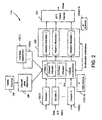
- FIG 2 schematically depicts an OFDM transmitter 115a in which a channel allocator 130a(1) may provide adaptive channel allocation and a bit-power allocator 130a(2) may allocate bit and power using the first and second rate requirements 135(1.2) for the Long Term Evolution (LTE) UMTS system 100 shown in Figure 1 in accordance with one illustrative embodiment of the present invention.
- the OFDM transmitter 115a may comprise a plurality of modulators 200 (1 -N) coupled to the channel allocator 130a(1) and the bit-power allocator 130a(2) for individually modulating a plurality of OFDM frequency channels 140a (1-N).
- the OFDM transmitter 115a may further comprise an inverse Fast Fourier Transformer (IFFT) 205 to insert a guard interval in transmission of a high data rate traffic for each mobile station 105 user of the plurality of mobile station 105 users.
- IFFT inverse Fast Fourier Transformer
- the OFDM transmitter 115a may map the data streams 210(1-K) to the N>K OFDM channels 140a(1-N) sometimes also referred to as OFDM carriers. For this mapping (allocation), the OFDM transmitter 115a may use the first and second rate requirements 135(1,2) indicated by the QoS of different real-time services.
- An allocator 215 may allocate the K data streams 210(1-K) onto the N OFDM frequency channels 140a(1-N) based on the rate requirements 135(1,2) and the channel state information 160.
- the allocator 215 includes both the channel allocator 130a(1) and the bit-power allocator 130a(2).
- the plurality of modulators 200 (1-N) may process (including adaptive OFDM modulation) the different K data streams 210(1-K).
- the IFFT 205 may insert a guard interval in the real-time traffic data for each mobile station 105 before forwarding the packet data to a radio for transmission.
- the OFDM transmitter 115a may pre-calculate a given maximum number of channels that may be assigned to a user and create the In-Set that defines which users compete for the channel allocation in the current iteration step for set-assignment
- the allocator 215 may pre-calculate the maximum number of channels allocated per user. As an example, for each user this pre-calculation may be included in its rate requirement in addition to the rate requirement of all the users.
- K denotes the number of users and N is the total number of channels 140 available for OFDM transmission.
- any combination of the rate requirements 135(1,2) may be used in other embodiments of the present invention.
- a set assignment process includes the rate requirement 135 of individual users in defining the set of users that compete for the channel allocation in the current iteration step. This set is referred to as an In-Set, while all the users that are excluded from the channel allocation may be grouped in an Out-Set.
- the individual rate requirements R k of the users and the overall rate R tot of the Long Term Evolution (LTE) UMTS system 100 may be fixed during the channel allocation process but the total instantaneous (at i- th iteration step) number of channels allocated N tot ( i ) as well as the instantaneous number of channels per user N (k; i ) allocated to different users change per iteration step.
- the relation shown below may be used.
- the allocator 215 may indicate that user k should be allocated more resources. Hence, the user k may be included in the In-Set in the next iteration step i . Otherwise, being having sufficient resources at the current state of the process, the user k is included in the Out-set.
- the allocator 215 may check the relation (3) for all users at each iteration step i . However, users with same rate requirements being in the In-Set may compete for the available channels. Thus, in one embodiment, the allocator 215 may define the In-Set by grouping users having the same rate requirement 135. Then, the allocator 215 may check the relation (3) for each group rather than checking the relation (3) per user. By applying the relative relation (3) between the channel ratio and the rate ratio on groups may result in a significant reduction of complexity. However, such groupwise checking to build the In-Set for channel allocation may be performed in many different ways. For example, in one illustrative embodiment, the allocator 215 may follow the steps listed below:
- the allocator 215 may provide a Relative Group Channel Assignment in one embodiment of the instant invention.
- Figure 3 depicts a stylized representation for implementing a method that may allocate the OFDM frequency channels 140a(1-N) to the plurality of mobile station 105 users for transmitting real-time traffic data based on the information about individual fixed-rate requirements 135 of the users and the number of assigned channels 140a to one or more active users in the UMTS Long Term Evolution system 100 shown in Figure 1 consistent with an exemplary embodiment of the present invention.
- the allocator 215 may determine a desired transmission rate, e.g. , 135 for the first mobile station 105(1) to allocate a first OFDM frequency channel 140a(1) from the plurality of frequency channels 140a(1-N) to an individual user of the plurality of mobile station users. For example, the allocator 215 may receive the desired transmission rate in a quality of service parameter of a real-time service. By using the desired transmission rate for at least two users of the plurality of mobile station users, the allocator 215 may allot the given maximum number of channels to each user of the at least two users.
- the allocator 215 may define a set of users that compete for allocation of a unique frequency channel 140a of the plurality of frequency channels 140a(1-N) in a next iteration of channel assignment. By using the desired transmission rate of an individual user of the plurality of mobile station users, the allocator 215 may determine whether to include that individual user in the set of users competing for the channel allocations in the next iteration of the channel assignment. To this end, the allocator 215 may compare a channel ratio of that individual user at a current iteration step to a rate ratio of the same individual user.
- the allocator 215 may group that individual user with the set of users that compete for allocation of the unique frequency channel in the next iteration of channel assignment. Otherwise, the individual user may be grouped with another set of users that are excluded from competing for channel allocation in the next iteration of channel assignment.
- the allocator 215 may map a data stream 210(1) associated with the individual user to the unique frequency channel based on the desired transmission rate 135(1) for the first mobile station 105(1).
- the allocator 215 may allocate a second OFDM frequency channel 140a(2) different than the first OFDM frequency channel 140a(1) to the second mobile station 105(2) for transmitting real-time traffic data in a wireless packet data network.
- the allocator 215 may allocate the second OFDM frequency channel 140a(2) based on the assigned channel to an active user, i.e., the first OFDM frequency channel 140a(1) and its desired rate requirement, i.e., the first rate requirement 135(2).
- the allocator 215 may allocate the second OFDM frequency channel 140a(2) based on the channel state information 160 of the uplink channel 150 between the first mobile station 105(1) associated with an individual user of the plurality of mobile station users and the base station 110.
- the wireless packet data network may wirelessly communicate mobile data at a speed and coverage desired by individual users or enterprises.
- a high-speed wireless packet data network may comprise one or more data networks, such as Internet Protocol (IP) network comprising the Internet and a public telephone system (PSTN).
- IP Internet Protocol
- PSTN public telephone system
- the 3rd generation (3G) mobile communication system namely Universal Mobile Telecommunication System (UMTS) supports multimedia services according to 3rd Generation Partnership Project (3GPP) specifications.
- the UMTS adapts the Wideband Code Division Multiple Access (WCDMA) technology and includes Core Networks (CN) that are packet switched networks, e.g., IP-based networks. Because of the merging of Internet and mobile applications, the UMTS users can access both telecommunications and Internet resources.
- WCDMA Wideband Code Division Multiple Access
- CN Core Networks
- a UMTS network may deploy a UMTS bearer service layered architecture specified by Third Generation Project Partnership (3GPP) standard.
- 3GPP Third Generation Project Partnership
- these quantities take the form of optical, electrical, or magnetic signals capable of being stored, transferred, combined, compared, and otherwise manipulated, It has proven convenient at times, principally for reasons of common usage, to refer to these signals as bits, values, elements, symbols, characters, terms, numbers, or the like.
- the software implemented aspects of the invention are typically encoded on some form of program storage medium or implemented over some type of transmission medium
- the program storage medium may be magnetic (e.g., a floppy disk or a hard drive) or optical (e.g., a compact disk read only memory, or "CD ROM"), and may be read only or random access.
- the transmission medium may be twisted wire pairs, coaxial cable, optical fiber, or some other suitable transmission medium known to the art. The invention is not limited by these aspects of any given implementation.
- the invention has been illustrated herein as being useful in a telecommunications network environment, it also has application in other connected environments.
- two or more of the devices described above may be coupled together via device-to-device connections, such as by hard cabling, radio frequency signals (e.g., 802.11 (a), 802.11 (b), 802.11(g), 802.16, Bluetooth, or the like), infrared coupling, telephone lines and modems, or the like.
- the present invention may have application in any environment where two or more users arc interconnected and capable of communicating with one another.
- control units may include a microprocessor, a microcontroller, a digital signal processor, a processor card (including one or more microprocessors or controllers), or other control or computing devices as well as executable instructions contained within one or more storage devices.
- the storage devices may include one or more machine-readable storage media for storing data and instructions.
- the storage media may include different forms of memory including semiconductor memory devices such as dynamic or static random access memories (DRAMs or SRAMs), erasable and programmable read-only memories (EPROMs), electrically erasable and programmable read-only memories (EEPROMs) and flash memories; magnetic disks such as fixed, floppy, removable disks; other magnetic media including tape; and optical media such as compact disks (CDs) or digital video disks (DVDs).
- DRAMs or SRAMs dynamic or static random access memories
- EPROMs erasable and programmable read-only memories
- EEPROMs electrically erasable and programmable read-only memories
- flash memories such as fixed, floppy, removable disks
- magnetic media such as fixed, floppy, removable disks
- optical media such as compact disks (CDs) or digital video disks (DVDs).
- Instructions that make up the various software layers, routines, or modules in the various systems may be stored in respective storage devices- The instructions, when executed by
Landscapes
- Engineering & Computer Science (AREA)
- Quality & Reliability (AREA)
- Computer Networks & Wireless Communication (AREA)
- Signal Processing (AREA)
- Mobile Radio Communication Systems (AREA)
Abstract
Description
- This invention relates generally to telecommunications, and more particularly, to wireless communications.
- In multi-user or multi-service network environments, since many users desire access to unique services, a channel allocation technique is used to allocate channels to users for real-time traffic transmission. In many wireless communication systems, however, channel allocation may affect system performance. Channel allocation in a wireless network typically determines allocation of a channel to provide each user access to the common access medium with minimal interference to other users. For multiple users, a scheduler may provide access to the wireless network with a desired Quality of Service (QoS) for communications. For example, in a packet data network, a base station controller (BSC) or a radio network controller (RNC) may schedule reverse link (RL) or uplink (UL) communications from the mobile stations to the base stations. Alternatively, a base station may schedule forward link (FL) or downlink (DL) communications- For a data packet transmission on a downlink or forward link from a base station, a mobile station indicates a data transmission rate. In response, the base station may allocate a radio resource, such as a frequency channel and corresponding bit, power levels for the user transmission from the mobile station.
- Wireless communication systems have evolved to the 3rd generation digital multimedia systems (CDMA2000 IX and Universal Mobile Telecommunications System (UMTS)) to the high-speed data system (CDMA2000 Evolution-Data Optimized (EV-DO) and UMTS High-Speed Downlink Packet Access (HSDPA). While the 3rd generation wireless system can support multimedia service with a desired Quality of Service (QoS), the efficiency of the 3rd generation wireless system for robust data transmission is not that high since the system is a circuit-switching type system. On the other hand, a packet switching type high-speed data system uses efficient radio resource allocation and scheduling with radio channel awareness in the transmission. Resource allocation typically includes determining powers and/or bandwidth to optimize performance within the cell served by the base station.
- While high-speed packet switching systems, including UMTS-HSDPA serve mobile communication market, the long-term evolution (LTE) af UMTS may deliver broadband wireless access to a variety of different service classes. However, resource allocation in providing broadband access with UMTS-LTE may adversely affect overall system performance when serving multiple users each having a desired QoS. Nevertheless, the growth in Internet coupled with a rapid adoption of wireless technology has led to an increasing demand for wireless packet-oriented data transmission. The wireless packet-oriented data traffic on many wireless networks may comprise a mixture of real-time traffic such as voice, multimedia teleconferencing and games, and data-traffic such as web browsing, messaging and file transfer. Such traffic characteristics in wireless communication systems may constrain system resources available for transmission when simultaneously providing diverse quality of services (QoSs).
- Accordingly, in many multi-user and/or multi-service environments, the system resource may include a frequency band, a spreading code, a time slot or even a resource in space domain as well as the power with which a signal is transmitted. Thus, allocation of these resources to the users may be difficult while still being able to meets the QoS constraints given for the specific services, as desired by the different users. For example, in real-time traffic (voice, multimedia streaming etc.) transmitted via a packet-data channel where a fixed-data rate is an essential QoS constraint, an optimum resource allocation may be desired. Such resource allocation may involve allocating frequency bands (channels) to multiple real-time traffic users rather than allocating time, code or space domain units.
- As an example, Orthogonal Frequency Division Multiplexing (OFDM) channels may be used for high data rate transmission in a downlink. Utilizing OFDM involves assigning bits, power and different orthogonal frequency channels to multiple users all likely to have access to the total UMTS-OFDM frequency band. In a multi-user environment, one optimal solution for the joint bit, power and channel allocation aims at fixed-rate transmission with a minimized total transmit power. It results in time-sharing of the channels amongst different users based on a sharing factor, but this joint solution is far too complex for any reasonable implementation.
- Another approach divides the joint optimization into two optimization problems. One problem deals exclusively with the channel allocation while bit and power allocation is still solved jointly. For the latter optimization of bit and power allocation, a single-user greedy algorithm may be applied in a base station for HSDPA transmission. Other approaches for the channel allocation that may provide an optimum channel allocation avoid time-sharing. Although separation of the channel allocation with the bit and power allocation is less involving, this approach still results in high complexity and is therefore not suitable for many implementations.
- Alternatively, several sub-optimum channel allocations allocate channels to users in a stepwise manner where for each step a set of users is created. Users belonging to this set commonly referred to as In-Set compete for the channel allocation in the corresponding step. One method usually referred to as an always include method provides an In-Set for all steps that composes all users likely to have access to the channels. In contrast, another method always excludes the user from the In-Set in the next step for whom a channel is assigned to in the current step. Such set assignments may provide a desired overall system performance, but it is difficult to determine which users should belong to the In-Set and which users should be excluded to belong in the Out-Set.
- With regard to the channel allocation and the bit, power allocation, if real-time traffic is transmitted via a packet-data scheme (e.g., HSDPA, UMTS-LTF), some shortcomings of the approaches set forth above arc as follows:
- (1) Joint optimum resource allocation is too complex to be implemented.
- (2) Separation of channel allocation from bit and power allocation may simplify the resource allocation, but optimum channel allocation is still too involved for a practical implementation.
- (3) For the sub-optimum channel allocation approaches, such as Always In-/Exelude, a variation in individual fixed-rate requirements regarding transmissions of their real-time traffic data and the status of channel assignments may have further shortcomings:
- a. Significantly higher emitted power: As an example, a user that requires a high data rate may get fewer numbers of channels compared to another user with lower data rate demand. In order to compensate for the lower number of channels, substantially more power may be required, resulting in wasted power resources.
- b. System capacity loss: Wasting power resources with a given maximum available power of the base station may degrade the system capacity since some real-time traffic users cannot be served anymore.
- The following presents a simplified summary of the invention in order to provide a basic understanding of some aspects of the invention. This summary is not an exhaustive overview of the invention. It is not intended to identify key or critical elements of the invention or to delineate the scope of the invention. Its sole purpose is to present some concepts in a simplified form as a prelude to the more detailed description that is discussed later.
- The present invention is directed to overcoming, or at least reducing, the effects of, one or more of the problems set forth above.
- In one embodiment of the present invention, a method is provided for allocating channels in at least one of a multi-user and a multi-service environment for transmitting real-time traffic data in a wireless packet data network The method comprises determining a desired transmission rate for a first mobile station to allocate a unique frequency channel from a plurality of frequency channels to an individual user of a plurality of users. The method further comprises mapping a data stream associated with the individual user to the unique frequency channel based on the desired transmission rate for the first mobile station.
- In another embodiment, a transmitter is provided for allocating channels in at least one of a multi-user and a multi-service environment for transmitting real-time traffic data in a wireless communication system. The transmitter comprises a plurality of encoders to independently encode data streams of each individual mobile station user of a plurality of mobile station users, a first resource allocator coupled to the plurality of encoders to allocate bit and power to the plurality of mobile station users, and a second resource allocator coupled to the plurality of encoders to allocate a unique frequency channel of a plurality of frequency channel to each mobile station user of the plurality of mobile station users based on at least one of channel state information and a desired transmission rate.
- In yet another embodiment, an article comprising a computer readable storage medium storing instructions is provided such that, when executed the instructions cause a wireless communication system to allocate channels in at least one of a multi-user and a multi-service environment for transmitting real-time traffic data in a wireless packet data network by determining a desired transmission rate for a first mobile station to allocate a unique frequency channel from a plurality of frequency channels to an individual user of a plurality of users, and map a data stream associated with the individual user to the unique frequency channel based on the desired transmission rate for the first mobile station.
- The invention may be understood by reference to the following description taken in conjunction with the accompanying drawings, in which like reference numerals identity like elements, and in which:
- Figure 1 schematically depicts a wireless communication system, such as a Long Term Evolution (LTE) UMTS system which includes first and second mobile stations and a base station including a transmitter for allocating channels in at least one of a multi-user and a multi-service environment for transmitting real-time traffic data in a wireless packet data network according to one illustrative embodiment of the present invention;
- Figure 2 schematically depicts an OFDM transmitter in which first and second resource allocators may provide adaptive channel, bit and power allocation using rate requirements for the Long Term Evolution (LTE) UMTS system shown in Figure 1 in accordance with one illustrative embodiment of the present invention; and
- Figure 3 depicts a stylized representation for implementing a method that may allocate channels to a plurality of users for transmitting real-time traffic data based on information about individual fixed-rate requirements of the users and the number of assigned channels to one or more active users in the wireless communications system shown in Figure 1 consistent with an exemplary embodiment of the present invention.
- While the invention is susceptible to various modifications and alternative forms, specific embodiments thereof have been shown by way of example in the drawings and are herein described in detail. It should be understood, however, that the description herein of specific embodiments is not intended to limit the invention to the particular forms disclosed, but on the contrary, the intention is to cover all modifications, equivalents, and alternatives falling within the spirit and scope of the invention as defined by the appended claims.
- Illustrative embodiments of the invention arc described below. In the interest of clarity, not all features of an actual implementation are described in this specification. It will of course be appreciated that in the development of any such actual embodiment, numerous implementation-specific decisions may be made to achieve the developers' specific goals, such as compliance with system-related and business-related constraints, which will vary from one implementation to another. Moreover, it should be appreciated that such a development effort might be complex and time-consuming, but may nevertheless be a routine undertaking for those of ordinary skill in the art having the benefit of this disclosure.
- Generally, a method and an apparatus are provided for allocating channels to a plurality of users for transmitting real-time traffic data in at least one of a multi-user and a multi-servicc environment for transmitting real-time traffic data in a wireless packet data network. By using a transmitter at a base station or a base station router in a wireless communications system, such as a Universal Mobile Telephone System (UMTS) Long Term Evolution (LTE), first and second resource allocators may provide adaptive channel, bit and power allocation based on information about individual fixed-rate requirements of the users and the number of assigned channels to one or more active users. The method comprises determining a desired transmission rate for a first mobile station to allocate a unique frequency channel from a plurality of frequency channels to an individual user of a plurality of users. The method further comprises mapping a data stream associated with the individual user to the unique frequency channel based on the desired transmission rate for the first mobile station. The transmitter may comprise a plurality of encoders to independently encode data streams of each individual mobile station user of a plurality of mobile station users. The transmitter may further comprise a first resource allocator coupled to the plurality of encoders to allocate bit and power to the plurality of mobile station users, and a second resource allocator coupled to the plurality of encoders to allocate a unique frequency channel of a plurality of frequency channel to each mobile station user of the plurality of mobile station users based on at least one of channel state information and a desired transmission rate. By using information of an individual fixed-rate requirement of a user, the rate at which the users desire to transmit their real-time traffic data and the channels already assigned to the user may be used for deciding whether that user belongs to an In-Set that includes active users competing for the channel allocation in a next iteration step of channel allocation. Such set assignment may not only provide a desired overall system performance but indicate a rule or policy to decide which users should belong to the In-Set and which users should be excluded or belong in an Out-Set that excludes active users competing for the channel allocation in a next iteration step of channel allocation. For example, a channel allocation policy for OFDM systems that utilizes real-time traffic rate requirements may pre-calculate the maximum number of channels and define the In-Set which includes active users competing for the channel allocation in a next iteration step of channel allocation. A groupwise definition of the In-Set may be deployed and/or a relative groupwise definition of the In-Set may be used based upon the relation of the desired rates to the already assigned channels. In this way, a user that desires a high data rate may not end up with relatively less number of channels as compared to another user with a lower data rate demand. Thus, power resources may not be wasted to compensate for the lower number of channels assigned to the user indicating the high data rate demand.
- Figure 1 schematically depicts a multi-channel wireless communications system, such as a Universal Mobile Telephone System (UMTS) Long Term Evolution (LTE) 100 which includes first and second mobile stations (MSs) 105(1, 2) and a base station (BS) 110 including a transmitter (TX) 115 for allocating a plurality of channels 140 (1-m) according to one illustrative embodiment of the present invention. The
transmitter 115 may allocate the channels 120 (1-m) to a plurality of users in at least one of a multi-user and a multi-service environment for real-time traffic data transmissions in a relatively high-speed wireless packet data network. Thetransmitter 115 may comprise a plurality of encoders (ENs) 125 (1-K), first resource allocator (FRA) 130(1) and second resource allocator (SRA) 130(2) to provide an adaptive channel, bit and power allocation based on information about individual fixed-rate requirements (REQ) 135(1,2) of the users and the number of assigned channels 140(1,2) to one or more active users. - The
base station 110 may service one or more of cells in which the first and second mobile stations 105(1,2) (also known as Access Terminals(ATs). User Equipment (UE), and the like) may access the wireless packet data network and other interconnected telecommunications systems, such as a publicly switched telephone system (PSTN) and a Data network. To provide wireless connectivity to the first and second mobile stations 105(1, 2), thebase station 110, in turn, may communicate with anetwork control server 145 that connects the cells to the UMTS LongTerm Evolution system 100. The UMTS LongTerm Evolution system 100 and thenetwork control server 145 may operate according to Universal Mobile Telecommunication Services (UMTS) protocols and may implement Orthogonal Frequency Division Multiple Access (OFDMA). However, persons of ordinary skill in the art having benefit of the present disclosure should appreciate that the present invention is not limited to communication systems that operate according to UMTS-LTE or an OFDMA based communication system. In alternative embodiments, the UMTS LongTerm Evolution system 100 may operate according to one or more other protocols including, but not limited to, the Global System for Mobile communication (GSM), Code Division Multiple Access (CDMA, CDMA 2000), and the like. - For illustrative purposes, the multi-channel wireless communications system of Figure 1 is the UMTS Long
Term Evolution system 100, although it should be understood that the present invention may be applicable to other systems that support data and/or voice communication. The UMTS LongTerm Evolution system 100 has some similarities to a conventional UMTS system, but differs substantially with respect to the operation of the instant invention with regard to thebase station 110. That is, in the UMTS LongTerm Evolution system 100, thetransmitter 115 may use information of an individual fixed-rate requirement of a user, the first rate requirement (REQ) 135(1) at which the user of the first mobile station 105(1) desires to transmit their real-time traffic data and the channels 140(1) that have been already assigned to that user. - The
transmitter 115 may allocate a plurality of channels (CHs) 140(1-m) between the first and second mobile stations 105(1,2) within a frequency spectrum over which to communicate with thebase station 110. For example, thebase station 110 within range of the first mobile station 105(1) may communicate therewith over adownlink 150a. In this way, thebase stations 110 may provide wireless connectivity to corresponding geographical areas or cells. By using the frequency channel 140(1), the first mobile station 105(I) may transmit the real-time traffic data at a high data rate in anuplink 150 from the first mobile station 105(1) to thebase station 110. - For allocating the
channels 140 separately from bit and power allocation independently to each active user, thetransmitter 115 may comprise a plurality of encoders 125(1-K), first and second resource allocators 130(1,2). The plurality of encoders 125 (1-K) may independently encode data streams of each individualmobile station 105 user of a plurality ofmobile station 105 users. The first resource allocator 130(1) may be coupled to the plurality of encoders 125 (1-K) to allocate bit and power to the plurality ofmobile station 105 users. The second resource allocator may be coupled to the plurality of encoders 125 (1-K) to allocate a unique frequency channel of a plurality of frequency channels to eachmobile station 105 user of the plurality ofmobile station 105 users based on at least one ofchannel state information 160 and a desired transmission rate. i.e., therate requirement 135. - As discussed above, the
base station 110 may provide wireless connectivity according to UMTS protocols and may implement OFDMA, but thebase stations 110 are not limited to these protocols. In the illustrated embodiment, thebase station 110 provides wireless connectivity to the first and second mobile stations 105(1,2) using OFDM channels. However, persons ordinary skill in the art having benefit of the present disclosure should appreciate that thebase station 110 may provide wireless connectivity using other channels at any location within or proximate to the cells. - In operation, the
base station 110 may provide the wireless connectivity to the first and second mobile stations 105(1,2) according to any desirable protocol, including a Code Division Multiple Access (CDMA, cdma2000) protocol, an Evolved Data Optimized (EVDO, IXEVDO) protocol, a Universal Mobile Telecommunication System (UMTS) protocol, a Global System for Mobile communications (GSM) protocol, and like. For example, the first rate requirement (REQ) 135(1) of an active user at the first mobile station 705(1,2) may very from 9.6 kbps to 153.6 kbps. - In the illustrated embodiment, real-time traffic data transmissions 155(1,2) include one or more channels within a selected frequency band, e.g., sub-carriers may be defined according to an OFDMA scheme. Persons of ordinary skill in the art should appreciate that sub-carriers may also be referred to using terms such as frequency channels, sub-channels, tones, and the like.
- Examples of the first and second mobile stations 105(1,2) may include a host of wireless communication devices including, but not limited to, cellular telephones, personal digital assistants (PDAs), and global positioning systems (GPS) that operate in the high-speed wireless packet data network, such as a digital cellular CDMA network Other examples of the first and second mobile stations 105(1,2) may include smart phones, text messaging devices, and the like.
- In the UMTS Long
Term Evolution system 100, the high-speed wireless packet data network may deploy any desirable protocol to enable wireless communications between the first and second base stations 105(1,2) and the first and second mobile stations 105(1,2) according to any desirable protocol. Examples of such a protocol include a (CDMA, cdma2000) protocol, an Evolved Data Optimized (EVDO, 1XEVDO) protocol, a UMTS protocol, a GSM protocol, and like. - Other examples of such a protocol include a 1xEV-DO protocol, a UMTS protocol, a GSM protocol, and like. The 3G cellular systems based on any one of these protocols, or the like, provide enhanced voice capacity and support high data rate packet based services. As one example, these features arc provided in cdma2000 1xEV high rate packet data air interface referred to as IS-856. More specifically, the 3G cellular system cdma2000 1xEV provides high-speed wireless Internet access to users with asymmetric data traffic relative to a cellular network based on IS-95 standard.
- Figure 2 schematically depicts an
OFDM transmitter 115a in which achannel allocator 130a(1) may provide adaptive channel allocation and a bit-power allocator 130a(2) may allocate bit and power using the first and second rate requirements 135(1.2) for the Long Term Evolution (LTE)UMTS system 100 shown in Figure 1 in accordance with one illustrative embodiment of the present invention. TheOFDM transmitter 115a may comprise a plurality of modulators 200 (1 -N) coupled to thechannel allocator 130a(1) and the bit-power allocator 130a(2) for individually modulating a plurality ofOFDM frequency channels 140a (1-N). TheOFDM transmitter 115a may further comprise an inverse Fast Fourier Transformer (IFFT) 205 to insert a guard interval in transmission of a high data rate traffic for eachmobile station 105 user of the plurality ofmobile station 105 users. - To transmit real-time traffic data of K users, the
OFDM transmitter 115a, as shown in Figure 2 shows, after encoding different data streams 210(1-K), theOFDM transmitter 115a may map the data streams 210(1-K) to the N>K OFDM channels 140a(1-N) sometimes also referred to as OFDM carriers. For this mapping (allocation), theOFDM transmitter 115a may use the first and second rate requirements 135(1,2) indicated by the QoS of different real-time services. Anallocator 215 may allocate the K data streams 210(1-K) onto the NOFDM frequency channels 140a(1-N) based on the rate requirements 135(1,2) and thechannel state information 160. Theallocator 215 includes both thechannel allocator 130a(1) and the bit-power allocator 130a(2). After the allocation, the plurality of modulators 200 (1-N) may process (including adaptive OFDM modulation) the different K data streams 210(1-K). Thereafter, theIFFT 205 may insert a guard interval in the real-time traffic data for eachmobile station 105 before forwarding the packet data to a radio for transmission. - Consistent with one embodiment, to use the first and second rate requirements 135(1,2) in the
allocator 215 for channel allocation, theOFDM transmitter 115a may pre-calculate a given maximum number of channels that may be assigned to a user and create the In-Set that defines which users compete for the channel allocation in the current iteration step for set-assignment - Accordingly, the
allocator 215 may pre-calculate the maximum number of channels allocated per user. As an example, for each user this pre-calculation may be included in its rate requirement in addition to the rate requirement of all the users. This pre-calculation of maximum number of channels Nk that can be allotted to the k-th user with rate requirement of Rk may be performed, in an exemplary embodiment, as shown below in the following:
with
channels 140 available for OFDM transmission. However, any combination of the rate requirements 135(1,2) may be used in other embodiments of the present invention. - For assigning users to a set of users, in one embodiment, a set assignment process includes the
rate requirement 135 of individual users in defining the set of users that compete for the channel allocation in the current iteration step. This set is referred to as an In-Set, while all the users that are excluded from the channel allocation may be grouped in an Out-Set. As used for the pre-calculation, the individual rate requirements Rk of the users and the overall rate Rtot of the Long Term Evolution (LTE)UMTS system 100 may be fixed during the channel allocation process but the total instantaneous (at i-th iteration step) number of channels allocated Ntot (i) as well as the instantaneous number of channels per user N (k; i) allocated to different users change per iteration step. As an example, to define the In-Set the relation shown below may be used.
- Thus, by checking if the channel ratio of a user k at itertation step i to be either less than or equal to its rate ratio, resources may be allocated. If the channel ratio is determined to be less than its rate ratio, the
allocator 215 may indicate that user k should be allocated more resources. Hence, the user k may be included in the In-Set in the next iteration step i. Otherwise, being having sufficient resources at the current state of the process, the user k is included in the Out-set. - For example, in one scenario, if a
channel 140a is assigned to a user l in iteration step l. theallocator 215 may increment the instantaneous number ofchannels 140a(1) allocated to l-th user as well as the total instantaneous number of sub-channels using the equation as follows:
- The
allocator 215 may check the relation (3) for all users at each iteration step i. However, users with same rate requirements being in the In-Set may compete for the available channels. Thus, in one embodiment, theallocator 215 may define the In-Set by grouping users having thesame rate requirement 135. Then, theallocator 215 may check the relation (3) for each group rather than checking the relation (3) per user. By applying the relative relation (3) between the channel ratio and the rate ratio on groups may result in a significant reduction of complexity. However, such groupwise checking to build the In-Set for channel allocation may be performed in many different ways. For example, in one illustrative embodiment, theallocator 215 may follow the steps listed below: - 1. Assume user k gets a channel at iteration step i.
- 2. Using the relation (4), update the number of channels al located to user k as well as the total number of channels assigned.
- 3. If user k satisfies the relative relation (3) in the next iteration step, the user k is allowed to be a part of the In-set only if all other users of its group are in the Out-set. If even one user of the selected user's group is determined to be in the In-set, then this user may be added in the Out-set. But, when the selected user has all its group users in the Out-set, the whole group may be added back in the In-set.
- 4. All other groups which have all its users in the Out-set may also be checked for the relative relation (3).
- In this way, by checking the relative relation (3) groupwise, the
allocator 215 may provide a Relative Group Channel Assignment in one embodiment of the instant invention. - Figure 3 depicts a stylized representation for implementing a method that may allocate the
OFDM frequency channels 140a(1-N) to the plurality ofmobile station 105 users for transmitting real-time traffic data based on the information about individual fixed-rate requirements 135 of the users and the number of assignedchannels 140a to one or more active users in the UMTS LongTerm Evolution system 100 shown in Figure 1 consistent with an exemplary embodiment of the present invention. - At
block 300, theallocator 215 may determine a desired transmission rate, e.g., 135 for the first mobile station 105(1) to allocate a firstOFDM frequency channel 140a(1) from the plurality offrequency channels 140a(1-N) to an individual user of the plurality of mobile station users. For example, theallocator 215 may receive the desired transmission rate in a quality of service parameter of a real-time service. By using the desired transmission rate for at least two users of the plurality of mobile station users, theallocator 215 may allot the given maximum number of channels to each user of the at least two users. - The
allocator 215 may define a set of users that compete for allocation of aunique frequency channel 140a of the plurality offrequency channels 140a(1-N) in a next iteration of channel assignment. By using the desired transmission rate of an individual user of the plurality of mobile station users, theallocator 215 may determine whether to include that individual user in the set of users competing for the channel allocations in the next iteration of the channel assignment. To this end, theallocator 215 may compare a channel ratio of that individual user at a current iteration step to a rate ratio of the same individual user. If the channel ratio is determined to be less than or equal to the rate ratio, theallocator 215 may group that individual user with the set of users that compete for allocation of the unique frequency channel in the next iteration of channel assignment. Otherwise, the individual user may be grouped with another set of users that are excluded from competing for channel allocation in the next iteration of channel assignment. - At
block 305, theallocator 215 may map a data stream 210(1) associated with the individual user to the unique frequency channel based on the desired transmission rate 135(1) for the first mobile station 105(1). Atblock 310, theallocator 215 may allocate a secondOFDM frequency channel 140a(2) different than the firstOFDM frequency channel 140a(1) to the second mobile station 105(2) for transmitting real-time traffic data in a wireless packet data network. Theallocator 215 may allocate the secondOFDM frequency channel 140a(2) based on the assigned channel to an active user, i.e., the firstOFDM frequency channel 140a(1) and its desired rate requirement, i.e., the first rate requirement 135(2). Theallocator 215 may allocate the secondOFDM frequency channel 140a(2) based on thechannel state information 160 of theuplink channel 150 between the first mobile station 105(1) associated with an individual user of the plurality of mobile station users and thebase station 110. - In one embodiment, the wireless packet data network may wirelessly communicate mobile data at a speed and coverage desired by individual users or enterprises. According to one embodiment, a high-speed wireless packet data network may comprise one or more data networks, such as Internet Protocol (IP) network comprising the Internet and a public telephone system (PSTN). The 3rd generation (3G) mobile communication system, namely Universal Mobile Telecommunication System (UMTS) supports multimedia services according to 3rd Generation Partnership Project (3GPP) specifications. The UMTS adapts the Wideband Code Division Multiple Access (WCDMA) technology and includes Core Networks (CN) that are packet switched networks, e.g., IP-based networks. Because of the merging of Internet and mobile applications, the UMTS users can access both telecommunications and Internet resources. To provide an end-to-end service to users, a UMTS network may deploy a UMTS bearer service layered architecture specified by Third Generation Project Partnership (3GPP) standard. The provision of the end-to-end service is conveyed over several networks and realized by the interaction of the protocol layers.
- Portions of the present invention and corresponding detailed description are presented in terms of software, or algorithms and symbolic representations of operations on data bits within a computer memory. These descriptions and representations arc the ones by which those of ordinary skill in the art effectively convey the substance of their work to others of ordinary skill in the art. An algorithm, as the term is used here, and as it is used generally, is conceived to be a self-consistent sequence of steps leading to a desired result. The steps arc those requiring physical manipulations of physical quantities. Usually, though not necessarily, these quantities take the form of optical, electrical, or magnetic signals capable of being stored, transferred, combined, compared, and otherwise manipulated, It has proven convenient at times, principally for reasons of common usage, to refer to these signals as bits, values, elements, symbols, characters, terms, numbers, or the like.
- It should be borne in mind, however, that all of these and similar terms are to be associated with the appropriate physical quantities and are merely convenient labels applied to these quantities. Unless specifically stated otherwise, or as is apparent from the discussion, terms such as "processing" or "computing" or "calculating" or "determining" or "displaying" or the like, refer to the action and processes of a computer system, or similar electronic computing device, that manipulates and transforms data represented as physical, electronic quantities within the computer system's registers and memories into other data similarly represented as physical quantities within the computer system memories or registers or other such information storage, transmission or display devices.
- Note also that the software implemented aspects of the invention are typically encoded on some form of program storage medium or implemented over some type of transmission medium The program storage medium may be magnetic (e.g., a floppy disk or a hard drive) or optical (e.g., a compact disk read only memory, or "CD ROM"), and may be read only or random access. Similarly, the transmission medium may be twisted wire pairs, coaxial cable, optical fiber, or some other suitable transmission medium known to the art. The invention is not limited by these aspects of any given implementation.
- The present invention set forth above is described with reference to the attached figures. Various structures, systems and devices are schematically depicted in the drawings for purposes of explanation only and so as to not obscure the present invention with details that are well known to those skilled in the art. Nevertheless, the attached drawings are included to describe and explain illustrative examples of the present invention. The words and phrases used herein should be understood and interpreted to have a meaning consistent with the understanding of those words and phrases by those skilled in the relevant art. No special definition of a term or phrase, i.e., a definition that is different from the ordinary and customary meaning as understood by those skilled in the art, is intended to be implied by consistent usage of the term or phrase herein. To the extent that a term or phrase is intended to have a special meaning, i.e., a meaning other than that understood by skilled artisans, such a special definition will be expressly set forth in the specification in a definitional manner that directly and unequivocally provides the special definition for the term or phrase.
- While the invention has been illustrated herein as being useful in a telecommunications network environment, it also has application in other connected environments. For example, two or more of the devices described above may be coupled together via device-to-device connections, such as by hard cabling, radio frequency signals (e.g., 802.11 (a), 802.11 (b), 802.11(g), 802.16, Bluetooth, or the like), infrared coupling, telephone lines and modems, or the like. The present invention may have application in any environment where two or more users arc interconnected and capable of communicating with one another.
- Those skilled in the art will appreciate that the various system layers, routines, or modules illustrated in the various embodiments herein may be executable control units. The control units may include a microprocessor, a microcontroller, a digital signal processor, a processor card (including one or more microprocessors or controllers), or other control or computing devices as well as executable instructions contained within one or more storage devices. The storage devices may include one or more machine-readable storage media for storing data and instructions. The storage media may include different forms of memory including semiconductor memory devices such as dynamic or static random access memories (DRAMs or SRAMs), erasable and programmable read-only memories (EPROMs), electrically erasable and programmable read-only memories (EEPROMs) and flash memories; magnetic disks such as fixed, floppy, removable disks; other magnetic media including tape; and optical media such as compact disks (CDs) or digital video disks (DVDs). Instructions that make up the various software layers, routines, or modules in the various systems may be stored in respective storage devices- The instructions, when executed by a respective control unit, causes the corresponding system to perform programmed acts.
- The particular embodiments disclosed above are illustrative only, as the invention may be modified and practiced in different but equivalent manners apparent to those skilled in the art having the benefit of the teachings herein. Furthermore, no limitations arc intended to the details of construction or design herein shown, other than as described in the claims below. It is therefore evident that the particular embodiments disclosed above may be altered or modified and all such variations arc considered within the scope and spirit of the invention. Accordingly, the protection sought herein is as set forth in the claims below.
Claims (10)
- A method of allocating channels in at least one of a multi-user and a multi-service environment for transmitting real-time traffic data in a wireless packet data network, the method comprising:determining a desired transmission rate for a first mobile station to allocate a unique frequency channel from a plurality of frequency channels to an individual user of a plurality of users; andmapping a data stream associated with said individual user to said unique frequency channel based on the desired transmission rate for said first mobile station
- A method, as set forth in claim 1, further comprising:receiving the desired transmission rate in a quality of service parameter of a real-time service; andallocating said unique frequency channel based on channel state information and an uplink channel between said first mobile station associated with said individual user of said plurality of users and a base station.
- A method, as set forth in claim 2, wherein allocating said unique frequency channel further comprises:allocating a unique Orthogonal Frequency Division Multiplexing (OFDM) channel to said first mobile station than to a second mobile station of another user of said plurality of users for transmitting said real-time traffic data at a high data rate in a downlink from said base station to said first mobile station.
- A method, as set forth in claim 1, further comprising:precalculating a given maximum number of channels to be assigned to said individual user of said plurality of users; andusing the desired transmission rate for at least two users of said plurality of users to allot said given maximum number of channels to each user of said at least two users.
- A method, as set forth in claim 1, further comprising:defining a set of users that compete for allocation of said unique frequency channel of said plurality of frequency channels in a next iteration of channel assignment;using the desired transmission rate of said individual user of said plurality of users to determine whether to include said individual user in said set of users competing for the channel allocations in the next iteration of the channel assignment;comparing a channel ratio of said individual user at a current iteration step to a rate ratio of said individual user; andif said channel ratio is less than or equal to said rate ratio, grouping said individual user with said set of users that compete for allocation of said unique frequency channel in the next iteration of channel assignment.
- A method, as set forth in claim 5, further comprising:if said channel ratio is more than said rate ratio, grouping said individual user with another set of users that are excluded from competing for channel allocation in the next iteration of channel assignment.
- A method, as set forth in claim 1, further comprising:grouping at least two users of said plurality of users together in a group to include users having the same desired transmission rates.comparing a channel ratio of said group at a current iteration step to a rate ratio of said group;if said channel ratio is less than or equal to said rate ratio, including said group in a set of users that compete for allocations of said plurality of Frequency channels in a next iteration of channel assignment; andif a first user of a first user group in said plurality of users is allocated a first frequency channel of said plurality of frequency channels, updating a number of channels allocated to said first user and a total number of channels assigned to said plurality of users.
- A method, as set forth in claim 7, further comprising:determining whether said first user is to be included in said set of users that compete for allocation of said plurality of frequency channels in the next iteration of channel assignment;if so, determining whether all other users of said first user group belong to another set of users that are not to compete for allocation of said plurality of frequency channels in the next iteration of channel assignment ; andif so, including said first user in said set of users that compete for allocation of said plurality of frequency channels in the next iteration of channel assignment.
- A method, as set forth in claim 7, further comprising:determining whether said first user group is to be included in said set of users that compete for allocation of said plurality of frequency channels in the next iteration of channel assignment;if so, determining whether all other users of said first user group belong to another set of users that are not to compete for allocation of said plurality of frequency channels in the next iteration of channel assignment ; andif so, including said first user group in said set of users that compete for allocation of said plurality of frequency channels in the next iteration of channel assignment.
- A method, as set forth in claim 7, further comprising:determining whether said each user group of all other groups which have all corresponding users in another set of users that are not to compete for allocation of said plurality of frequency channels in the next iteration of channel assignment is to be included in a set of groups that compete for allocation of said plurality of frequency channels in the next iteration of channel assignment; andif so, including said each user group in said set of groups that compete for allocation of said plurality of frequency channels in the next iteration of channel assignment.
Priority Applications (1)
| Application Number | Priority Date | Filing Date | Title |
|---|---|---|---|
| EP20060253849 EP1881717B1 (en) | 2006-07-20 | 2006-07-25 | Allocating channels in multi-user or multi-service real-time transmissions of wireless packet data |
Applications Claiming Priority (3)
| Application Number | Priority Date | Filing Date | Title |
|---|---|---|---|
| US11/458,707 US7653024B2 (en) | 2006-07-20 | 2006-07-20 | Allocating channels in multi-user or multi-service real-time transmissions of wireless packet data |
| EP06253848 | 2006-07-20 | ||
| EP20060253849 EP1881717B1 (en) | 2006-07-20 | 2006-07-25 | Allocating channels in multi-user or multi-service real-time transmissions of wireless packet data |
Publications (2)
| Publication Number | Publication Date |
|---|---|
| EP1881717A1 true EP1881717A1 (en) | 2008-01-23 |
| EP1881717B1 EP1881717B1 (en) | 2010-09-08 |
Family
ID=37216032
Family Applications (1)
| Application Number | Title | Priority Date | Filing Date |
|---|---|---|---|
| EP20060253849 Ceased EP1881717B1 (en) | 2006-07-20 | 2006-07-25 | Allocating channels in multi-user or multi-service real-time transmissions of wireless packet data |
Country Status (1)
| Country | Link |
|---|---|
| EP (1) | EP1881717B1 (en) |
Citations (2)
| Publication number | Priority date | Publication date | Assignee | Title |
|---|---|---|---|---|
| US20060013168A1 (en) * | 2004-06-04 | 2006-01-19 | Avneesh Agrawal | Coding and modulation for broadcast and multicast services in a wireless communication system |
| US20060056451A1 (en) * | 2004-08-27 | 2006-03-16 | Takashi Yano | Method for allocating subchannel in wireless network |
-
2006
- 2006-07-25 EP EP20060253849 patent/EP1881717B1/en not_active Ceased
Patent Citations (2)
| Publication number | Priority date | Publication date | Assignee | Title |
|---|---|---|---|---|
| US20060013168A1 (en) * | 2004-06-04 | 2006-01-19 | Avneesh Agrawal | Coding and modulation for broadcast and multicast services in a wireless communication system |
| US20060056451A1 (en) * | 2004-08-27 | 2006-03-16 | Takashi Yano | Method for allocating subchannel in wireless network |
Non-Patent Citations (1)
| Title |
|---|
| CHEONG YUI WONG ET AL: "Multiuser OFDM with Adaptive Subcarrier, Bit, and Power Allocation", IEEE JOURNAL ON SELECTED AREAS IN COMMUNICATIONS, IEEE SERVICE CENTER, PISCATAWAY, US, vol. 17, no. 10, October 1999 (1999-10-01), XP011055027, ISSN: 0733-8716 * |
Also Published As
| Publication number | Publication date |
|---|---|
| EP1881717B1 (en) | 2010-09-08 |
Similar Documents
| Publication | Publication Date | Title |
|---|---|---|
| US7653024B2 (en) | Allocating channels in multi-user or multi-service real-time transmissions of wireless packet data | |
| EP2858450B1 (en) | Methods and apparatus for efficient providing of scheduling information | |
| KR100891427B1 (en) | Indicating special transmissions in wireless communication systems | |
| EP1249092B1 (en) | Adaptive frame structures for hybrid cdma / tdma system | |
| CN104365048B (en) | Device, method and the computer-readable medium of payload segmentation for wireless packet data transmission | |
| JP4885980B2 (en) | Method and apparatus for flexible reporting of control information | |
| RU2391795C2 (en) | Device and procedure for detection and distribution of resources on basis of service quality in systems of development and long-term development of high-speed batch access | |
| CN102916724B (en) | User device, transmission method and communication system | |
| US8249607B2 (en) | Scheduling in wireless communication systems | |
| CN101682913B (en) | Method of allocating uplink radio resources | |
| CN109150458B (en) | Control information transmission method and device | |
| EP2391045B1 (en) | Radio base station and radio resource allocation method | |
| JP2005531939A (en) | Selection of the optimal transmission format for transmission in the allocated time period | |
| CN101731018A (en) | Base station device and communication control method | |
| CN101529960A (en) | Wireless communication system | |
| EP2254290B1 (en) | A Method For Performing Scheduling Algorithm with a Minimum Resource Parameter and Method of Calculating Same | |
| EP2127435B1 (en) | Allocating channels for real-time traffic transmission in a wireless packet data multi-user environment | |
| EP1881717B1 (en) | Allocating channels in multi-user or multi-service real-time transmissions of wireless packet data | |
| EP1738534B1 (en) | A method and scheduler for performing a scheduling algorithm with minimum resource parameter | |
| CN102752868B (en) | Distribution method of wireless resources, wireless terminal and wireless base station. | |
| KR20060133070A (en) | Scheduling algorithm and scheduler with minimum resource parameters | |
| Kim | Quality of service and channel-aware packet bundling for capacity improvement in cellular networks | |
| KR20110068123A (en) | Method and apparatus for providing uplink service in mobile communication system | |
| WO2008066120A1 (en) | Communication system, base station, terminal, and communication method |
Legal Events
| Date | Code | Title | Description |
|---|---|---|---|
| PUAI | Public reference made under article 153(3) epc to a published international application that has entered the european phase |
Free format text: ORIGINAL CODE: 0009012 |
|
| 17P | Request for examination filed |
Effective date: 20060805 |
|
| AK | Designated contracting states |
Kind code of ref document: A1 Designated state(s): AT BE BG CH CY CZ DE DK EE ES FI FR GB GR HU IE IS IT LI LT LU LV MC NL PL PT RO SE SI SK TR |
|
| AX | Request for extension of the european patent |
Extension state: AL BA HR MK YU |
|
| AKX | Designation fees paid |
Designated state(s): DE FR GB |
|
| RAP1 | Party data changed (applicant data changed or rights of an application transferred) |
Owner name: LUCENT TECHNOLOGIES INC. Owner name: LUCENT TECHNOLOGIES NETWORK SYSTEMS GMBH |
|
| RAP3 | Party data changed (applicant data changed or rights of an application transferred) |
Owner name: LUCENT TECHNOLOGIES NETWORK SYSTEMS GMBH Owner name: LUCENT TECHNOLOGIES INC. |
|
| RIC1 | Information provided on ipc code assigned before grant |
Ipc: H04W 72/04 20090101AFI20091210BHEP |
|
| GRAP | Despatch of communication of intention to grant a patent |
Free format text: ORIGINAL CODE: EPIDOSNIGR1 |
|
| GRAS | Grant fee paid |
Free format text: ORIGINAL CODE: EPIDOSNIGR3 |
|
| GRAA | (expected) grant |
Free format text: ORIGINAL CODE: 0009210 |
|
| AK | Designated contracting states |
Kind code of ref document: B1 Designated state(s): DE FR GB |
|
| REG | Reference to a national code |
Ref country code: GB Ref legal event code: FG4D |
|
| REF | Corresponds to: |
Ref document number: 602006016780 Country of ref document: DE Date of ref document: 20101021 Kind code of ref document: P |
|
| REG | Reference to a national code |
Ref country code: DE Ref legal event code: R081 Ref document number: 602006016780 Country of ref document: DE Owner name: ALCATEL LUCENT, FR Free format text: FORMER OWNER: LUCENT TECHNOLOGIES NETWORK SYSTEMS GMBH, 90411 NUERNBERG, DE Effective date: 20110318 |
|
| PLBE | No opposition filed within time limit |
Free format text: ORIGINAL CODE: 0009261 |
|
| STAA | Information on the status of an ep patent application or granted ep patent |
Free format text: STATUS: NO OPPOSITION FILED WITHIN TIME LIMIT |
|
| 26N | No opposition filed |
Effective date: 20110609 |
|
| REG | Reference to a national code |
Ref country code: DE Ref legal event code: R097 Ref document number: 602006016780 Country of ref document: DE Effective date: 20110609 |
|
| REG | Reference to a national code |
Ref country code: GB Ref legal event code: 732E Free format text: REGISTERED BETWEEN 20111027 AND 20111102 |
|
| REG | Reference to a national code |
Ref country code: FR Ref legal event code: CD Owner name: ALCATEL-LUCENT USA, INC, US Effective date: 20130708 |
|
| REG | Reference to a national code |
Ref country code: FR Ref legal event code: CD Owner name: ALCATEL-LUCENT USA INC. Effective date: 20131122 |
|
| REG | Reference to a national code |
Ref country code: FR Ref legal event code: GC Effective date: 20131126 |
|
| REG | Reference to a national code |
Ref country code: GB Ref legal event code: 732E Free format text: REGISTERED BETWEEN 20140313 AND 20140319 |
|
| REG | Reference to a national code |
Ref country code: FR Ref legal event code: GC Effective date: 20140410 |
|
| REG | Reference to a national code |
Ref country code: FR Ref legal event code: RG Effective date: 20141015 |
|
| REG | Reference to a national code |
Ref country code: FR Ref legal event code: PLFP Year of fee payment: 10 |
|
| REG | Reference to a national code |
Ref country code: FR Ref legal event code: PLFP Year of fee payment: 11 |
|
| REG | Reference to a national code |
Ref country code: FR Ref legal event code: PLFP Year of fee payment: 12 |
|
| REG | Reference to a national code |
Ref country code: FR Ref legal event code: PLFP Year of fee payment: 13 |
|
| PGFP | Annual fee paid to national office [announced via postgrant information from national office to epo] |
Ref country code: FR Payment date: 20190619 Year of fee payment: 14 |
|
| PGFP | Annual fee paid to national office [announced via postgrant information from national office to epo] |
Ref country code: DE Payment date: 20190710 Year of fee payment: 14 |
|
| PGFP | Annual fee paid to national office [announced via postgrant information from national office to epo] |
Ref country code: GB Payment date: 20190724 Year of fee payment: 14 |
|
| REG | Reference to a national code |
Ref country code: DE Ref legal event code: R119 Ref document number: 602006016780 Country of ref document: DE |
|
| GBPC | Gb: european patent ceased through non-payment of renewal fee |
Effective date: 20200725 |
|
| PG25 | Lapsed in a contracting state [announced via postgrant information from national office to epo] |
Ref country code: FR Free format text: LAPSE BECAUSE OF NON-PAYMENT OF DUE FEES Effective date: 20200731 Ref country code: GB Free format text: LAPSE BECAUSE OF NON-PAYMENT OF DUE FEES Effective date: 20200725 |
|
| PG25 | Lapsed in a contracting state [announced via postgrant information from national office to epo] |
Ref country code: DE Free format text: LAPSE BECAUSE OF NON-PAYMENT OF DUE FEES Effective date: 20210202 |