EP1880870A1 - Tire with silica-rich rubber tread for winter performance - Google Patents
Tire with silica-rich rubber tread for winter performance Download PDFInfo
- Publication number
- EP1880870A1 EP1880870A1 EP07110331A EP07110331A EP1880870A1 EP 1880870 A1 EP1880870 A1 EP 1880870A1 EP 07110331 A EP07110331 A EP 07110331A EP 07110331 A EP07110331 A EP 07110331A EP 1880870 A1 EP1880870 A1 EP 1880870A1
- Authority
- EP
- European Patent Office
- Prior art keywords
- rubber
- tire
- range
- phr
- sbr
- Prior art date
- Legal status (The legal status is an assumption and is not a legal conclusion. Google has not performed a legal analysis and makes no representation as to the accuracy of the status listed.)
- Withdrawn
Links
- 229920001971 elastomer Polymers 0.000 title claims abstract description 117
- 239000005060 rubber Substances 0.000 title claims abstract description 97
- VYPSYNLAJGMNEJ-UHFFFAOYSA-N Silicium dioxide Chemical compound O=[Si]=O VYPSYNLAJGMNEJ-UHFFFAOYSA-N 0.000 title claims abstract description 79
- 239000000377 silicon dioxide Substances 0.000 title claims abstract description 36
- 239000000203 mixture Substances 0.000 claims abstract description 46
- 239000005062 Polybutadiene Substances 0.000 claims abstract description 45
- 229920003193 cis-1,4-polybutadiene polymer Polymers 0.000 claims abstract description 13
- 239000006235 reinforcing carbon black Substances 0.000 claims abstract description 11
- 238000010528 free radical solution polymerization reaction Methods 0.000 claims abstract description 10
- 125000000391 vinyl group Chemical group [H]C([*])=C([H])[H] 0.000 claims abstract description 10
- 229920002554 vinyl polymer Polymers 0.000 claims abstract description 10
- 239000012763 reinforcing filler Substances 0.000 claims abstract description 6
- RRHGJUQNOFWUDK-UHFFFAOYSA-N Isoprene Chemical compound CC(=C)C=C RRHGJUQNOFWUDK-UHFFFAOYSA-N 0.000 claims description 28
- KAKZBPTYRLMSJV-UHFFFAOYSA-N Butadiene Chemical compound C=CC=C KAKZBPTYRLMSJV-UHFFFAOYSA-N 0.000 claims description 20
- 239000000806 elastomer Substances 0.000 claims description 20
- PPBRXRYQALVLMV-UHFFFAOYSA-N Styrene Chemical compound C=CC1=CC=CC=C1 PPBRXRYQALVLMV-UHFFFAOYSA-N 0.000 claims description 18
- 229920003048 styrene butadiene rubber Polymers 0.000 claims description 15
- 229920001577 copolymer Polymers 0.000 claims description 10
- -1 3-triethoxysilylpropyl Chemical group 0.000 claims description 7
- 239000007822 coupling agent Substances 0.000 claims description 6
- 239000005077 polysulfide Substances 0.000 claims description 6
- 229920001021 polysulfide Polymers 0.000 claims description 6
- 150000008117 polysulfides Polymers 0.000 claims description 6
- NLHHRLWOUZZQLW-UHFFFAOYSA-N Acrylonitrile Chemical compound C=CC#N NLHHRLWOUZZQLW-UHFFFAOYSA-N 0.000 claims description 5
- 150000001993 dienes Chemical class 0.000 claims description 5
- 125000004434 sulfur atom Chemical group 0.000 claims description 4
- 229920001897 terpolymer Polymers 0.000 claims description 4
- 125000002887 hydroxy group Chemical group [H]O* 0.000 claims description 3
- 229920000642 polymer Polymers 0.000 claims description 3
- ZCYVEMRRCGMTRW-UHFFFAOYSA-N 7553-56-2 Chemical compound [I] ZCYVEMRRCGMTRW-UHFFFAOYSA-N 0.000 claims description 2
- 239000005065 High vinyl polybutadiene Substances 0.000 claims description 2
- RTACIUYXLGWTAE-UHFFFAOYSA-N buta-1,3-diene;2-methylbuta-1,3-diene;styrene Chemical compound C=CC=C.CC(=C)C=C.C=CC1=CC=CC=C1 RTACIUYXLGWTAE-UHFFFAOYSA-N 0.000 claims description 2
- 229920003211 cis-1,4-polyisoprene Polymers 0.000 claims description 2
- 230000002452 interceptive effect Effects 0.000 claims description 2
- 229910052740 iodine Inorganic materials 0.000 claims description 2
- 239000011630 iodine Substances 0.000 claims description 2
- 229920002857 polybutadiene Polymers 0.000 abstract description 21
- IJGRMHOSHXDMSA-UHFFFAOYSA-N Atomic nitrogen Chemical compound N#N IJGRMHOSHXDMSA-UHFFFAOYSA-N 0.000 abstract description 10
- XZKRXPZXQLARHH-UHFFFAOYSA-N buta-1,3-dienylbenzene Chemical compound C=CC=CC1=CC=CC=C1 XZKRXPZXQLARHH-UHFFFAOYSA-N 0.000 abstract description 5
- 229910052757 nitrogen Inorganic materials 0.000 abstract description 5
- 230000009477 glass transition Effects 0.000 abstract description 3
- 238000002156 mixing Methods 0.000 description 13
- 239000003921 oil Substances 0.000 description 12
- 230000000052 comparative effect Effects 0.000 description 11
- MTAZNLWOLGHBHU-UHFFFAOYSA-N butadiene-styrene rubber Chemical compound C=CC=C.C=CC1=CC=CC=C1 MTAZNLWOLGHBHU-UHFFFAOYSA-N 0.000 description 9
- DOIRQSBPFJWKBE-UHFFFAOYSA-N dibutyl phthalate Chemical compound CCCCOC(=O)C1=CC=CC=C1C(=O)OCCCC DOIRQSBPFJWKBE-UHFFFAOYSA-N 0.000 description 8
- NINIDFKCEFEMDL-UHFFFAOYSA-N Sulfur Chemical compound [S] NINIDFKCEFEMDL-UHFFFAOYSA-N 0.000 description 7
- 239000011593 sulfur Substances 0.000 description 7
- 229910052717 sulfur Inorganic materials 0.000 description 7
- 238000005299 abrasion Methods 0.000 description 6
- 238000000034 method Methods 0.000 description 6
- BWGNESOTFCXPMA-UHFFFAOYSA-N Dihydrogen disulfide Chemical compound SS BWGNESOTFCXPMA-UHFFFAOYSA-N 0.000 description 5
- 125000003118 aryl group Chemical group 0.000 description 5
- 239000003795 chemical substances by application Substances 0.000 description 5
- 238000010057 rubber processing Methods 0.000 description 5
- BLRPTPMANUNPDV-UHFFFAOYSA-N Silane Chemical compound [SiH4] BLRPTPMANUNPDV-UHFFFAOYSA-N 0.000 description 4
- XLOMVQKBTHCTTD-UHFFFAOYSA-N Zinc monoxide Chemical compound [Zn]=O XLOMVQKBTHCTTD-UHFFFAOYSA-N 0.000 description 4
- 239000006229 carbon black Substances 0.000 description 4
- 235000019241 carbon black Nutrition 0.000 description 4
- 239000004615 ingredient Substances 0.000 description 4
- 229920003049 isoprene rubber Polymers 0.000 description 4
- 229910000077 silane Inorganic materials 0.000 description 4
- 235000021355 Stearic acid Nutrition 0.000 description 3
- 239000003963 antioxidant agent Substances 0.000 description 3
- 235000014113 dietary fatty acids Nutrition 0.000 description 3
- 239000000284 extract Substances 0.000 description 3
- 239000000194 fatty acid Substances 0.000 description 3
- 229930195729 fatty acid Natural products 0.000 description 3
- 150000004665 fatty acids Chemical class 0.000 description 3
- 239000000463 material Substances 0.000 description 3
- 230000000704 physical effect Effects 0.000 description 3
- 239000011347 resin Substances 0.000 description 3
- 229920005989 resin Polymers 0.000 description 3
- 239000000126 substance Substances 0.000 description 3
- 238000012360 testing method Methods 0.000 description 3
- 239000001993 wax Substances 0.000 description 3
- OKTJSMMVPCPJKN-UHFFFAOYSA-N Carbon Chemical compound [C] OKTJSMMVPCPJKN-UHFFFAOYSA-N 0.000 description 2
- 239000006057 Non-nutritive feed additive Substances 0.000 description 2
- BPQQTUXANYXVAA-UHFFFAOYSA-N Orthosilicate Chemical compound [O-][Si]([O-])([O-])[O-] BPQQTUXANYXVAA-UHFFFAOYSA-N 0.000 description 2
- 239000002174 Styrene-butadiene Substances 0.000 description 2
- 239000000654 additive Substances 0.000 description 2
- 229910000323 aluminium silicate Inorganic materials 0.000 description 2
- 230000009286 beneficial effect Effects 0.000 description 2
- 239000002131 composite material Substances 0.000 description 2
- 150000001875 compounds Chemical class 0.000 description 2
- 230000008878 coupling Effects 0.000 description 2
- 238000010168 coupling process Methods 0.000 description 2
- 238000005859 coupling reaction Methods 0.000 description 2
- 239000012990 dithiocarbamate Substances 0.000 description 2
- ZRALSGWEFCBTJO-UHFFFAOYSA-N guanidine group Chemical group NC(=N)N ZRALSGWEFCBTJO-UHFFFAOYSA-N 0.000 description 2
- QIQXTHQIDYTFRH-UHFFFAOYSA-N octadecanoic acid Chemical compound CCCCCCCCCCCCCCCCCC(O)=O QIQXTHQIDYTFRH-UHFFFAOYSA-N 0.000 description 2
- OQCDKBAXFALNLD-UHFFFAOYSA-N octadecanoic acid Natural products CCCCCCCC(C)CCCCCCCCC(O)=O OQCDKBAXFALNLD-UHFFFAOYSA-N 0.000 description 2
- 238000012545 processing Methods 0.000 description 2
- 230000002787 reinforcement Effects 0.000 description 2
- 238000010058 rubber compounding Methods 0.000 description 2
- 125000005372 silanol group Chemical group 0.000 description 2
- 239000008117 stearic acid Substances 0.000 description 2
- 238000004073 vulcanization Methods 0.000 description 2
- 239000011787 zinc oxide Substances 0.000 description 2
- OWRCNXZUPFZXOS-UHFFFAOYSA-N 1,3-diphenylguanidine Chemical compound C=1C=CC=CC=1NC(=N)NC1=CC=CC=C1 OWRCNXZUPFZXOS-UHFFFAOYSA-N 0.000 description 1
- LLMLGZUZTFMXSA-UHFFFAOYSA-N 2,3,4,5,6-pentachlorobenzenethiol Chemical compound SC1=C(Cl)C(Cl)=C(Cl)C(Cl)=C1Cl LLMLGZUZTFMXSA-UHFFFAOYSA-N 0.000 description 1
- OVSKIKFHRZPJSS-UHFFFAOYSA-N 2,4-D Chemical compound OC(=O)COC1=CC=C(Cl)C=C1Cl OVSKIKFHRZPJSS-UHFFFAOYSA-N 0.000 description 1
- 238000004438 BET method Methods 0.000 description 1
- 239000004215 Carbon black (E152) Substances 0.000 description 1
- UTGQNNCQYDRXCH-UHFFFAOYSA-N N,N'-diphenyl-1,4-phenylenediamine Chemical compound C=1C=C(NC=2C=CC=CC=2)C=CC=1NC1=CC=CC=C1 UTGQNNCQYDRXCH-UHFFFAOYSA-N 0.000 description 1
- CHJJGSNFBQVOTG-UHFFFAOYSA-N N-methyl-guanidine Natural products CNC(N)=N CHJJGSNFBQVOTG-UHFFFAOYSA-N 0.000 description 1
- 235000021314 Palmitic acid Nutrition 0.000 description 1
- 239000006087 Silane Coupling Agent Substances 0.000 description 1
- 239000004115 Sodium Silicate Substances 0.000 description 1
- 239000012190 activator Substances 0.000 description 1
- 238000007792 addition Methods 0.000 description 1
- 230000000996 additive effect Effects 0.000 description 1
- 150000004645 aluminates Chemical class 0.000 description 1
- 150000001412 amines Chemical class 0.000 description 1
- DKVNPHBNOWQYFE-UHFFFAOYSA-N carbamodithioic acid Chemical compound NC(S)=S DKVNPHBNOWQYFE-UHFFFAOYSA-N 0.000 description 1
- 229910052799 carbon Inorganic materials 0.000 description 1
- 239000000470 constituent Substances 0.000 description 1
- SWSQBOPZIKWTGO-UHFFFAOYSA-N dimethylaminoamidine Natural products CN(C)C(N)=N SWSQBOPZIKWTGO-UHFFFAOYSA-N 0.000 description 1
- 125000002228 disulfide group Chemical group 0.000 description 1
- 150000002019 disulfides Chemical class 0.000 description 1
- 150000004659 dithiocarbamates Chemical class 0.000 description 1
- 238000007720 emulsion polymerization reaction Methods 0.000 description 1
- 238000005516 engineering process Methods 0.000 description 1
- 230000001747 exhibiting effect Effects 0.000 description 1
- 238000002474 experimental method Methods 0.000 description 1
- 239000000945 filler Substances 0.000 description 1
- 238000009472 formulation Methods 0.000 description 1
- 150000002357 guanidines Chemical class 0.000 description 1
- 229930195733 hydrocarbon Natural products 0.000 description 1
- 150000002430 hydrocarbons Chemical class 0.000 description 1
- RLAWWYSOJDYHDC-BZSNNMDCSA-N lisinopril Chemical compound C([C@H](N[C@@H](CCCCN)C(=O)N1[C@@H](CCC1)C(O)=O)C(O)=O)CC1=CC=CC=C1 RLAWWYSOJDYHDC-BZSNNMDCSA-N 0.000 description 1
- 238000005259 measurement Methods 0.000 description 1
- 239000004200 microcrystalline wax Substances 0.000 description 1
- JRZJOMJEPLMPRA-UHFFFAOYSA-N olefin Natural products CCCCCCCC=C JRZJOMJEPLMPRA-UHFFFAOYSA-N 0.000 description 1
- 235000021313 oleic acid Nutrition 0.000 description 1
- 150000002889 oleic acids Chemical class 0.000 description 1
- 239000003960 organic solvent Substances 0.000 description 1
- 230000020477 pH reduction Effects 0.000 description 1
- 150000002943 palmitic acids Chemical class 0.000 description 1
- 239000002245 particle Substances 0.000 description 1
- 239000000049 pigment Substances 0.000 description 1
- 229920003023 plastic Polymers 0.000 description 1
- 239000004033 plastic Substances 0.000 description 1
- 239000004014 plasticizer Substances 0.000 description 1
- 238000006116 polymerization reaction Methods 0.000 description 1
- 238000002360 preparation method Methods 0.000 description 1
- 238000010074 rubber mixing Methods 0.000 description 1
- 238000013040 rubber vulcanization Methods 0.000 description 1
- GPNLWUFFWOYKLP-UHFFFAOYSA-N s-(1,3-benzothiazol-2-yl)thiohydroxylamine Chemical compound C1=CC=C2SC(SN)=NC2=C1 GPNLWUFFWOYKLP-UHFFFAOYSA-N 0.000 description 1
- 238000007493 shaping process Methods 0.000 description 1
- NTHWMYGWWRZVTN-UHFFFAOYSA-N sodium silicate Chemical compound [Na+].[Na+].[O-][Si]([O-])=O NTHWMYGWWRZVTN-UHFFFAOYSA-N 0.000 description 1
- 229910052911 sodium silicate Inorganic materials 0.000 description 1
- 239000000758 substrate Substances 0.000 description 1
- QAZLUNIWYYOJPC-UHFFFAOYSA-M sulfenamide Chemical group [Cl-].COC1=C(C)C=[N+]2C3=NC4=CC=C(OC)C=C4N3SCC2=C1C QAZLUNIWYYOJPC-UHFFFAOYSA-M 0.000 description 1
- 229910002029 synthetic silica gel Inorganic materials 0.000 description 1
- 238000009864 tensile test Methods 0.000 description 1
- 238000010998 test method Methods 0.000 description 1
- 150000003557 thiazoles Chemical class 0.000 description 1
- 150000003585 thioureas Chemical class 0.000 description 1
- 229960002447 thiram Drugs 0.000 description 1
- 239000012991 xanthate Substances 0.000 description 1
Images

Classifications
-
- C—CHEMISTRY; METALLURGY
- C08—ORGANIC MACROMOLECULAR COMPOUNDS; THEIR PREPARATION OR CHEMICAL WORKING-UP; COMPOSITIONS BASED THEREON
- C08L—COMPOSITIONS OF MACROMOLECULAR COMPOUNDS
- C08L9/00—Compositions of homopolymers or copolymers of conjugated diene hydrocarbons
-
- B—PERFORMING OPERATIONS; TRANSPORTING
- B60—VEHICLES IN GENERAL
- B60C—VEHICLE TYRES; TYRE INFLATION; TYRE CHANGING; CONNECTING VALVES TO INFLATABLE ELASTIC BODIES IN GENERAL; DEVICES OR ARRANGEMENTS RELATED TO TYRES
- B60C1/00—Tyres characterised by the chemical composition or the physical arrangement or mixture of the composition
- B60C1/0016—Compositions of the tread
-
- C—CHEMISTRY; METALLURGY
- C08—ORGANIC MACROMOLECULAR COMPOUNDS; THEIR PREPARATION OR CHEMICAL WORKING-UP; COMPOSITIONS BASED THEREON
- C08L—COMPOSITIONS OF MACROMOLECULAR COMPOUNDS
- C08L9/00—Compositions of homopolymers or copolymers of conjugated diene hydrocarbons
- C08L9/06—Copolymers with styrene
-
- C—CHEMISTRY; METALLURGY
- C08—ORGANIC MACROMOLECULAR COMPOUNDS; THEIR PREPARATION OR CHEMICAL WORKING-UP; COMPOSITIONS BASED THEREON
- C08K—Use of inorganic or non-macromolecular organic substances as compounding ingredients
- C08K3/00—Use of inorganic substances as compounding ingredients
- C08K3/34—Silicon-containing compounds
- C08K3/36—Silica
-
- C—CHEMISTRY; METALLURGY
- C08—ORGANIC MACROMOLECULAR COMPOUNDS; THEIR PREPARATION OR CHEMICAL WORKING-UP; COMPOSITIONS BASED THEREON
- C08L—COMPOSITIONS OF MACROMOLECULAR COMPOUNDS
- C08L21/00—Compositions of unspecified rubbers
Definitions
- This invention relates to a tire having a tread intended for winter performance comprising cis 1,4-polybutadiene rubber (BR) and specialized solution polymerization prepared high vinyl styrene/butadiene rubber (HVS-SBR).
- BR 1,4-polybutadiene rubber
- HVS-SBR specialized solution polymerization prepared high vinyl styrene/butadiene rubber
- Such tire tread further comprises a compatible rubber blend of at least 40 phr of the BR in combination the HVS-SBR together with reinforcing filler composed of precipitated silica with a low BET nitrogen surface area and, optionally, rubber reinforcing carbon black.
- a disulfide silane based silica coupler is used to aid in coupling the precipitated silica to the elastomers.
- Compatibility of the combination of the BR with a relatively low glass transition temperature (Tg) of -100°C or lower and the HVS-SBR with a relatively high Tg of at least -30°C or higher, and therefore spaced apart Tg's of at least 70°C is promoted by the high vinyl content of the HVS-SBR in a range of from about 40 to about 50 percent based upon its polybutadiene portion.
- Tg glass transition temperature
- Vehicular tires particularly pneumatic tires, are sometimes provided with a circumferential tread of a rubber composition which contains a combination of styrene/butadiene rubber and cis 1,4-polybutadiene rubber.
- a significant aspect of this invention is the preparation of a tire tread of a rubber composition comprising a combination of ingredients in a manner not believed to be heretofore taught, suggested or utilized for a tire tread.
- the highly reactive mixing procedure involving a chemical reactive combination of precipitated silica with its attendant hydroxyl groups (e.g. silanol groups) and disulfide silane based coupling agent during the mixing process may be a factor.
- the tread rubber prefferably comprises a combination of relatively compatible elastomers to promote a relatively low stiffness in a sense of relatively low Shore A hardness in a range of from 55 to 61 and a relatively high tangent delta (tan delta), (-20°C, 1.5 percent strain and 7.8 Hertz) in a range of from 0.65 to 0.80 to promote wet traction for the tire tread.
- relatively compatible elastomers to promote a relatively low stiffness in a sense of relatively low Shore A hardness in a range of from 55 to 61 and a relatively high tangent delta (tan delta), (-20°C, 1.5 percent strain and 7.8 Hertz) in a range of from 0.65 to 0.80 to promote wet traction for the tire tread.
- a relatively high content of at least 40 phr of a high cis 1,4-polybutadiene (BR) having a Tg in a range of from -100°C to -110°C is used in the rubber blend.
- such relatively high content of such low Tg BR is conventionally relatively incompatible with a styrene butadiene rubber having a significantly higher Tg of at least -20°C.
- a specialized styrene/butadiene rubber (the HVS-SBR) with a relatively high Tg is used having a relatively high vinyl content to promote a significantly high degree of compatibility between the BR and HVS-SBR blend.
- HVS-SBR styrene/butadiene rubber
- Such significant degree of compatibility between the BR and HVS-SBR enables the use of the aforesaid relatively high content of the BR in the tread rubber blend.
- such tire tread comprises a compatible blend of a high cis 1,4-polybutadiene rubber (BR) having a low Tg of at least as low as -100°C together with a specialized high vinyl solution polymerization prepared styrene/butadiene elastomer (HVS-SBR) having a relatively conventional bound styrene content of about 26 percent and a relatively high Tg of -30°C or higher. Therefore, the BR and HVS-SBR have spaced apart Tg's of at least 70°C.
- BR high cis 1,4-polybutadiene rubber
- HVS-SBR specialized high vinyl solution polymerization prepared styrene/butadiene elastomer
- a combination of cis 1,4-polybutadiene rubber and styrene/butadiene rubber with such spaced apart Tg's would be expected to be relatively incompatible in a sense of the rubber blend exhibiting separate Tg's of each of the BR and the styrene/butadiene rubber except that the styrene/butadiene rubber (the HVS-SBR) has a relatively high vinyl content to promote a significant degree of compatibility between the BR and HVS-SBR.
- the glass transition temperatures (Tg's) for the individual BR and HVS-SBR elastomers is an onset Tg according to ASTM 3418 normally determined by a differential scanning (DSC) calorimeter with a temperature rise of 10°C per minute.
- a further significant aspect of the tire tread of this invention is the use of a precipitated silica (synthetic precipitated amorphous silica aggregates) having a relatively low BET nitrogen surface area in combination with the aforesaid BR and HV-SBR elastomers.
- a precipitated silica synthetic precipitated amorphous silica aggregates
- Such precipitated silica for this invention has a BET nitrogen surface area in a range of from 100 to 135 m 2 /g instead of a more conventional precipitated silica BET surface area in a range of from 140 to 160 m 2 /g for most precipitated silica-containing rubber tire treads.
- Such precipitated silica aggregates for the tread rubber composition with their relatively low BET surface areas are of a relatively larger particle size which is considered herein to be more useful in this tire tread composition in a sense of an observed balance of physical properties to promote a beneficial balance of wet traction and winter snow performance for the rubber composition for a tire tread.
- a tire tread can be provided with a circumferential tread of a silica-rich rubber composition which contains a combination of compatible elastomers comprised of a specialized solution polymerization prepared styrene/butadiene copolymer rubber (HVS-SBR) and a cis 1,4-polybutadiene rubber (BR) together with high level (high loading) of a precipitated silica reinforcing filler having a relatively low BET nitrogen surface area.
- HVS-SBR specialized solution polymerization prepared styrene/butadiene copolymer rubber
- BR cis 1,4-polybutadiene rubber
- the use of the precipitated silica reinforcement combined with a disulfide silane based coupling as an aforesaid highly reactive mixture (mixing procedure) thereof together with the said compatible blend of said HVS-SBR/BR aids in achieving suitable wet traction (wet friction between the tread rubber composition and a typical road substrate surface) while maintaining a suitable winter snow performance for the tire tread rubber composition.
- rubber and “elastomer” if used herein, may be used interchangeably, unless otherwise prescribed.
- rubber composition “compounded rubber” and “rubber compound”, if used herein, are used interchangeably to refer to “rubber which has been blended or mixed with various ingredients and materials”.
- a tire having a circumferential tread of a rubber composition which comprises, based on parts by weight per 100 parts by weight of rubber (phr):
- the rubber reinforcing carbon black if used, to be a high structure rubber reinforcing carbon black.
- high structure rubber carbon blacks are rubber reinforcing carbon blacks having a DBP (dibutyl phthalate), (ASTM D2414), value in a range of from 100 to 140 cc/100g in combination with an Iodine value (ASTM D1510) in a range of from 115 to 185 g/kg.
- Representative examples of such high structure rubber reinforcing carbon blacks are, for example, N110, N115, N120, N121, NN134, N220 and N234 according to their ASTM designations. Representative of various rubber reinforcing carbon blacks can easily be found in The Vanderbilt Rubber Handbook , 1978 edition, Page 417.
- one aspect of this invention is the tire having a tread of a silica-rich, compatible blend of the said specialized styrene/butadiene rubber (HVS-SBR) and BR rubbers, wherein the ratio of the HVS-SBR to BR is a maximum of 0.5/1 and the minimum ratio is 0.05/1 to achieve suitable wet traction and snow traction properties for a tire tread of such rubber composition.
- HVS-SBR specialized styrene/butadiene rubber
- HVS-SBR rubber may be obtained, for example, as SLR4630 TM from Dow Chemical.
- Such BR rubber may be obtained, for example, as Budene1207 TM from The Goodyear Tire & Rubber Company.
- the precipitated silica for use as reinforcement for this invention is intended herein to include precipitated aluminosilicates.
- Such precipitated silica may be prepared, for example, by controlled acidification of a soluble silicate, e.g., sodium silicate or a combination of silicate and aluminate in the case of aluminosilicates and such silica preparation is, in general, well known to those skilled in the precipitated silica preparation art.
- the precipitated silica is a form of aggregates of primary silica particles and have a BET surface area within a range of 80 to 300 m 2 /g and a DBP (dibutyl phthalate) value within a range of 100 to 350 cc/100g.
- precipitated silicas may be considered for use in the tread of this invention such as, for example only and without limitation, silica from Rhodia as Zeosil 1115MP TM and from Degussa as Ultrasil VN2 TM .
- the rubber composition of the tread rubber would be compounded by methods generally known in the rubber compounding art, such as mixing the various sulfur-vulcanizable constituent rubbers with various commonly used additive materials such as, for example, curing aids, such as sulfur, activators, retarders and accelerators, processing additives, such as oils, resins including tackifying resins, silica, and plasticizers, fillers, pigments, fatty acid, zinc oxide, waxes, antioxidants and antiozonants and peptizing agents.
- curing aids such as sulfur, activators, retarders and accelerators
- processing additives such as oils, resins including tackifying resins, silica, and plasticizers
- fillers pigments, fatty acid, zinc oxide, waxes, antioxidants and antiozonants and peptizing agents.
- the tire as a manufactured article, may be prepared by shaping and sulfur curing the assembly of its components at an elevated temperature (e.g. 140°C to about 160°C) and elevated pressure in a suitable mold.
- elevated temperature e.g. 140°C to about 160°C
- a tire having a tread component, namely an outer, circumferential tread intended to be ground-contacting, comprising a rubber composition prepared according to this invention.
- conjugated diene-based elastomers which include, for example, cis 1,4-polyisoprene rubber (natural or synthetic), high vinyl polybutadiene having a vinyl 1,2 content in a range of 30 to 90 percent, styrene/butadiene copolymers (SBR), other than said HVS-SBR, including emulsion polymerization prepared SBR and organic solvent polymerization prepared SBR, styrene/isoprene/butadiene terpolymers, isoprene/butadiene copolymers, isoprene/styrene copolymers, acrylonitrile/butadiene copolymers and acrylonitrile/butadiene/styrene terpolymers.
- SBR styrene/butadiene copolymers
- acrylonitrile/diene polymers are referred to as diene-based elastomers even though the diene might
- Typical amounts of tackifier resins comprise 0.5 to 10 phr.
- processing aids comprise 1 to 50 phr.
- Such processing aids can include, for example, aromatic, naphthenic, and/or paraffinic processing oils.
- Typical amounts of antioxidants comprise 1 to 5 phr. Representative antioxidants may be, for example, diphenyl-p-phenylenediamine.
- Typical amounts of antiozonants comprise 1 to 5 phr.
- Typical amounts of fatty acids, if used which can include stearic acid comprise 0.5 to 3 phr.
- Typical amounts of zinc oxide comprise 1 to 5 phr.
- Typical amounts of waxes comprise 1 to 5 phr.
- Typical amounts of peptizers comprise 0.1 to 1 phr. Typical peptizers may be, for example, pentachlorothiophenol and dibenzamidodiphenyl disulfide.
- the vulcanization is conducted in the presence of a sulfur-vulcanizing agent.
- suitable sulfur-vulcanizing agents include elemental sulfur (free sulfur) or sulfur donating vulcanizing agents, for example, an amine disulfide, polymeric polysulfide or sulfur olefin adducts.
- sulfur-vulcanizing agents are used in an amount ranging from 0.5 to 4 phr.
- Accelerators are used to control the time and/or temperature required for vulcanization and to improve the properties of the vulcanizate.
- a single accelerator system may be used, i.e., primary accelerator.
- a primary accelerator(s) is used in total amounts ranging from, for example, 1 to 3.5.
- Suitable types of accelerators that may be used in the present invention are amines, disulfides, guanidines, thioureas, thiazoles, thiurams, sulfenamides, dithiocarbamates and xanthates.
- the primary accelerator is a sulfenamide.
- the secondary accelerator is preferably a guanidine, dithiocarbamate or thiuram compound.
- the mixing of the rubber composition can be accomplished by methods known to those having skill in the rubber mixing art.
- the ingredients may be mixed in at least two stages, namely, at least one non-productive stage followed by a productive mix stage.
- the final curatives are typically mixed in the final stage which is conventionally called the "productive" mix stage in which the mixing typically occurs at a temperature, or ultimate temperature, lower than the mix temperature(s) than the preceding non-productive mix stage(s).
- a rubber composition for use as a tire tread composed of a silica-rich rubber composition comprised of a compatible combination of a solution polymerization prepared high vinyl styrene/butadiene rubber (HVS-SBR) and a cis 1,4-polybutadiene rubber (BR).
- HVS-SBR high vinyl styrene/butadiene rubber
- BR cis 1,4-polybutadiene rubber
- Rubber composition Samples A through C were prepared, with Sample A being a Comparative Sample and Samples B and C being Experimental Samples.
- the rubber composition samples were prepared by mixing the elastomers(s) together with reinforcing fillers and other rubber compounding ingredients in a first non-productive mixing stage (NP) an internal rubber mixer for 5 minutes to a temperature of 160°C. The mixture (optionally) is then further sequentially mixed in a second non-productive mixing stage (NP) in an internal rubber mixer for 4 minutes to a temperature of 160°C. The resulting mixture is then mixed in a productive mixing stage (P) in an internal rubber mixer with curatives for 2 minutes to a temperature of 110°C. The rubber composition is cooled to below 40°C between each of the non-productive mixing steps and between the second non-productive mixing step and the productive mixing step.
- NP non-productive mixing stage
- P productive mixing stage
- Table 1 illustrates the basic formulations for Comparative Sample A and Experimental Samples B and C and Table 2 reports various physical properties of the prepared Comparative Sample A and Experimental Samples B and C.
- Table 1 Samples A B C Non-Productive Mix Step (160°C) Solution prepared 50/50 isoprene/butadiene rubber (S-IBR) 1 40 0 0 Solution prepared 30/70 isoprene/butadiene rubber (S-IBR) 2 30 0 0 Solution prepared styrene/butadiene rubber (HV S-SBR) 3 0 55 50 Cis 1,4-polybutadiene rubber 4 30 0 0 Cis 1,4-polybutadiene rubber 5 0 45 50 High PCA rubber processing oil 6 44 0 0 Low PCA rubber processing oil 7 0 19.375 21.25 Wax 8 1.5 1.5 1.5 Fatty acid 9 3 3 3 Silica 10 100 105 105 Silica coupler 11 12.1 13.125 13.125 Productive Mix Step (110°C) Sulfur 1.6 1.4
- the HVS-SBR elastomer was used as being rubber processing oil extended in the sense of containing 27.3% by weight of TDAE (or, "Treated Distillate Aromatic Extract”) rubber processing oil and 55 parts weight HVS-SBR elastomer, reported in Table 1 in terms of parts by weight of the high vinyl styrene/butadiene rubber (HVS-SBR).
- HVS-SBR high vinyl styrene/butadiene rubber
- 4 Cis 1,4-polybutadiene rubber obtained as Budene 1254 from The Goodyear Tire & Rubber Company as an oil extended elastomer containing 25 parts by weight aromatic rubber processing oil per 100 parts by weight of the elastomer, with the elastomer being reported in Table 2 based on its dry weight (without the oil being taken into consideration).
- the elastomer has an onset Tg (ASTM D 3418) of 106°C. 5 Cis 1,4-polybutadiene rubber obtained as Budene 1207 from The Goodyear Tire & Rubber Company having an onset Tg (ASTM D3418) of -110°C 6 DAE type oil (wherein the term “DAE” means Distillate Aromatic Extract) obtained as Enerflex 65 from the H&R Company 7 TDAE type oil (wherein the term “TDAE” means Treated Distillate Aromatic Extract) obtained as Vivatec 500 from the H & R Company 8 Microcrystalline wax 9 Comprised of stearic, palmitic and oleic acids, primarily stearic acid 10 Precipitated silica obtained as Hi-Sil 315 TM G-D from PPG Industries 11 Silica coupler composite obtained as X266S TM from the Degussa Company as a composite of carbon black and bis(3-triethoxysilylpropyl) polysulfide
- Table 2 illustrates cure behavior and various physical properties of the rubber compositions of Samples A through C. Where cured rubber samples are examined, such as for the stress-strain, rebound, hardness, tear strength and abrasion measurements, the rubber samples were cured for 14 minutes at a temperature of 160°C.
- a tires are individually prepared with a circumferential tread of the rubber composition of experimental Sample B and experimental Sample C and identified herein as Tire B and Tire C, respectively.
Landscapes
- Chemical & Material Sciences (AREA)
- Health & Medical Sciences (AREA)
- Chemical Kinetics & Catalysis (AREA)
- Medicinal Chemistry (AREA)
- Polymers & Plastics (AREA)
- Organic Chemistry (AREA)
- Engineering & Computer Science (AREA)
- Mechanical Engineering (AREA)
- Compositions Of Macromolecular Compounds (AREA)
- Tires In General (AREA)
Abstract
This invention relates to a tire having a tread intended for winter performance comprising cis 1,4-polybutadiene rubber (BR) and specialized solution polymerization prepared high vinyl styrene/butadiene rubber (HVS-SBR). Such tire tread further comprises a compatible rubber blend of at least 40 phr of the BR in combination the HVS-SBR together with reinforcing filler composed of precipitated silica with a low BET nitrogen surface area and, optionally, rubber reinforcing carbon black. Compatibility of the combination of the BR with a relatively low glass transition temperature (Tg) of -100°C or lower and the HVS-SBR with a relatively high Tg of at least 30°C or higher, and therefore spaced apart Tg's of at least 70°C is promoted by the high vinyl content of the HVS-SBR in a range of from 40 to 50 percent based upon its polybutadiene portion.
Description
- This invention relates to a tire having a tread intended for winter performance comprising cis 1,4-polybutadiene rubber (BR) and specialized solution polymerization prepared high vinyl styrene/butadiene rubber (HVS-SBR). Such tire tread further comprises a compatible rubber blend of at least 40 phr of the BR in combination the HVS-SBR together with reinforcing filler composed of precipitated silica with a low BET nitrogen surface area and, optionally, rubber reinforcing carbon black. Preferably, a disulfide silane based silica coupler is used to aid in coupling the precipitated silica to the elastomers. Compatibility of the combination of the BR with a relatively low glass transition temperature (Tg) of -100°C or lower and the HVS-SBR with a relatively high Tg of at least -30°C or higher, and therefore spaced apart Tg's of at least 70°C is promoted by the high vinyl content of the HVS-SBR in a range of from about 40 to about 50 percent based upon its polybutadiene portion.
- Vehicular tires, particularly pneumatic tires, are sometimes provided with a circumferential tread of a rubber composition which contains a combination of styrene/butadiene rubber and cis 1,4-polybutadiene rubber.
- For this invention, it is desired to provide such a tire with a tread with suitable wet traction which also has an acceptable performance on snow covered roads. It is difficult to achieve an appropriate balance between wet traction and acceptable performance on snow covered roads for a vehicular tire tread.
- A significant aspect of this invention is the preparation of a tire tread of a rubber composition comprising a combination of ingredients in a manner not believed to be heretofore taught, suggested or utilized for a tire tread. The highly reactive mixing procedure involving a chemical reactive combination of precipitated silica with its attendant hydroxyl groups (e.g. silanol groups) and disulfide silane based coupling agent during the mixing process may be a factor.
- In particular, it is desired for the tread rubber to comprise a combination of relatively compatible elastomers to promote a relatively low stiffness in a sense of relatively low Shore A hardness in a range of from 55 to 61 and a relatively high tangent delta (tan delta), (-20°C, 1.5 percent strain and 7.8 Hertz) in a range of from 0.65 to 0.80 to promote wet traction for the tire tread.
- In order to accomplish such objectives, a relatively high content of at least 40 phr of a high cis 1,4-polybutadiene (BR) having a Tg in a range of from -100°C to -110°C is used in the rubber blend.
- However, such relatively high content of such low Tg BR is conventionally relatively incompatible with a styrene butadiene rubber having a significantly higher Tg of at least -20°C.
- Accordingly, for the purpose of this invention, a specialized styrene/butadiene rubber (the HVS-SBR) with a relatively high Tg is used having a relatively high vinyl content to promote a significantly high degree of compatibility between the BR and HVS-SBR blend. Such significant degree of compatibility between the BR and HVS-SBR enables the use of the aforesaid relatively high content of the BR in the tread rubber blend.
- In this manner, such tire tread comprises a compatible blend of a high cis 1,4-polybutadiene rubber (BR) having a low Tg of at least as low as -100°C together with a specialized high vinyl solution polymerization prepared styrene/butadiene elastomer (HVS-SBR) having a relatively conventional bound styrene content of about 26 percent and a relatively high Tg of -30°C or higher. Therefore, the BR and HVS-SBR have spaced apart Tg's of at least 70°C. As indicated above, it is important to appreciate that a combination of cis 1,4-polybutadiene rubber and styrene/butadiene rubber with such spaced apart Tg's would be expected to be relatively incompatible in a sense of the rubber blend exhibiting separate Tg's of each of the BR and the styrene/butadiene rubber except that the styrene/butadiene rubber (the HVS-SBR) has a relatively high vinyl content to promote a significant degree of compatibility between the BR and HVS-SBR.
- The glass transition temperatures (Tg's) for the individual BR and HVS-SBR elastomers is an onset Tg according to ASTM 3418 normally determined by a differential scanning (DSC) calorimeter with a temperature rise of 10°C per minute.
- A further significant aspect of the tire tread of this invention is the use of a precipitated silica (synthetic precipitated amorphous silica aggregates) having a relatively low BET nitrogen surface area in combination with the aforesaid BR and HV-SBR elastomers. Such precipitated silica for this invention has a BET nitrogen surface area in a range of from 100 to 135 m2/g instead of a more conventional precipitated silica BET surface area in a range of from 140 to 160 m2/g for most precipitated silica-containing rubber tire treads. Thus, such precipitated silica aggregates for the tread rubber composition, with their relatively low BET surface areas are of a relatively larger particle size which is considered herein to be more useful in this tire tread composition in a sense of an observed balance of physical properties to promote a beneficial balance of wet traction and winter snow performance for the rubber composition for a tire tread.
- It has therefore now been discovered that a tire tread can be provided with a circumferential tread of a silica-rich rubber composition which contains a combination of compatible elastomers comprised of a specialized solution polymerization prepared styrene/butadiene copolymer rubber (HVS-SBR) and a cis 1,4-polybutadiene rubber (BR) together with high level (high loading) of a precipitated silica reinforcing filler having a relatively low BET nitrogen surface area.
- The use of the precipitated silica reinforcement combined with a disulfide silane based coupling as an aforesaid highly reactive mixture (mixing procedure) thereof together with the said compatible blend of said HVS-SBR/BR aids in achieving suitable wet traction (wet friction between the tread rubber composition and a typical road substrate surface) while maintaining a suitable winter snow performance for the tire tread rubber composition.
- In the description of this invention, the terms "rubber" and "elastomer" if used herein, may be used interchangeably, unless otherwise prescribed. The terms "rubber composition", "compounded rubber" and "rubber compound", if used herein, are used interchangeably to refer to "rubber which has been blended or mixed with various ingredients and materials".
- The term "phr" where used herein, and according to conventional practice, refers to "parts of a respective material per 100 parts by weight of rubber, or elastomer".
- In accordance with this invention, a tire is provided having a circumferential tread of a rubber composition which comprises, based on parts by weight per 100 parts by weight of rubber (phr):
- (A) 100 phr of elastomers comprising
- (1) 48 to 60 phr of a specialized solution polymerization prepared styrene/butadiene copolymer rubber (HVS-SBR) having an onset Tg (ASTM D3418) in a range of from-28°C to-23°C, a bound styrene content in a range of 23 to 31 percent and a vinyl 1,2-content of from 40 to 50 percent,
- (2) 60 to 40 phr, alternately 52 to 44 phr of cis 1,4-polybutadiene rubber (BR) having an onset Tg (ASTM D3418) in a range of from-107°C to-115°C and a cis 1,4-isometric content in a range of from 93 to 100 percent,
wherein the weight ratio of said HVS-SBR to said BR preferably is a maximum of 0.5/1 and a minimum of 0.05/1, and, optionally, - (3) from zero to 20, alternately from 10 to 15, phr of an additional rubber selected from polymers and copolymers of at least one of isoprene and 1,3-butadiene and copolymers of styrene and at least one of isoprene and 1,3-butadiene (other than said HVS-SBR and BR);
- (B) 85 to 120, alternately 95 to 110, phr of particulate reinforcing filler comprising:
- (1) 85 to 110, alternately 90 to 105, phr of synthetic amorphous silica (precipitated silica) having a BET surface area in a range of from 100 to 135 m2/g, and
- (2) from zero to 20, alternately 5 to 15, phr of rubber reinforcing carbon black; and
- (C) at least one silica coupling agent having a moiety reactive with hydroxyl (e,g, silanol groups) on the surface of the said precipitated silica and on the surface of said silica domains on the surface of said silica-containing carbon black, and an additional moiety interactive with the said rubbers. Said coupling agent is preferably a disulfide silane based coupling agent as, for example, a bis(3-triethoxysilylpropyl) polysulfide containing an average of from 2 to 2.6 connecting sulfur atoms in its polysulfide bridge (referred to herein as a disulfide silane coupling agent even though it most likely contains an average of more than two connecting sulfur atoms in its polysulfidic bridge).
- In one aspect, and which may be considered an additional aspect of the invention is for the rubber reinforcing carbon black, if used, to be a high structure rubber reinforcing carbon black. Exemplary of such high structure rubber carbon blacks are rubber reinforcing carbon blacks having a DBP (dibutyl phthalate), (ASTM D2414), value in a range of from 100 to 140 cc/100g in combination with an Iodine value (ASTM D1510) in a range of from 115 to 185 g/kg. Representative examples of such high structure rubber reinforcing carbon blacks are, for example, N110, N115, N120, N121, NN134, N220 and N234 according to their ASTM designations. Representative of various rubber reinforcing carbon blacks can easily be found in The Vanderbilt Rubber Handbook, 1978 edition, Page 417.
- As hereinbefore discussed, one aspect of this invention is the tire having a tread of a silica-rich, compatible blend of the said specialized styrene/butadiene rubber (HVS-SBR) and BR rubbers, wherein the ratio of the HVS-SBR to BR is a maximum of 0.5/1 and the minimum ratio is 0.05/1 to achieve suitable wet traction and snow traction properties for a tire tread of such rubber composition.
- Such HVS-SBR rubber may be obtained, for example, as SLR4630™ from Dow Chemical.
- Such BR rubber may be obtained, for example, as Budene1207™ from The Goodyear Tire & Rubber Company.
- The precipitated silica for use as reinforcement for this invention is intended herein to include precipitated aluminosilicates. Such precipitated silica may be prepared, for example, by controlled acidification of a soluble silicate, e.g., sodium silicate or a combination of silicate and aluminate in the case of aluminosilicates and such silica preparation is, in general, well known to those skilled in the precipitated silica preparation art.
- In general, the precipitated silica is a form of aggregates of primary silica particles and have a BET surface area within a range of 80 to 300 m2/g and a DBP (dibutyl phthalate) value within a range of 100 to 350 cc/100g.
- A BET method of measuring surface area is described in the Journal of the American Chemical Society, ).
- Various commercially-available precipitated silicas may be considered for use in the tread of this invention such as, for example only and without limitation, silica from Rhodia as Zeosil 1115MP™ and from Degussa as Ultrasil VN2™.
- It is readily understood by those having skill in the art that the rubber composition of the tread rubber would be compounded by methods generally known in the rubber compounding art, such as mixing the various sulfur-vulcanizable constituent rubbers with various commonly used additive materials such as, for example, curing aids, such as sulfur, activators, retarders and accelerators, processing additives, such as oils, resins including tackifying resins, silica, and plasticizers, fillers, pigments, fatty acid, zinc oxide, waxes, antioxidants and antiozonants and peptizing agents.
- Typical additions of carbon black, silica and silica coupler for this invention are hereinbefore set forth.
- In practice, the tire, as a manufactured article, may be prepared by shaping and sulfur curing the assembly of its components at an elevated temperature (e.g. 140°C to about 160°C) and elevated pressure in a suitable mold.
- Thus, in a more specific aspect of this invention, a tire is provided having a tread component, namely an outer, circumferential tread intended to be ground-contacting, comprising a rubber composition prepared according to this invention.
- Representative of said additional rubbers for use in this invention are conjugated diene-based elastomers which include, for example, cis 1,4-polyisoprene rubber (natural or synthetic), high vinyl polybutadiene having a vinyl 1,2 content in a range of 30 to 90 percent, styrene/butadiene copolymers (SBR), other than said HVS-SBR, including emulsion polymerization prepared SBR and organic solvent polymerization prepared SBR, styrene/isoprene/butadiene terpolymers, isoprene/butadiene copolymers, isoprene/styrene copolymers, acrylonitrile/butadiene copolymers and acrylonitrile/butadiene/styrene terpolymers. For convenience, said acrylonitrile/diene polymers are referred to as diene-based elastomers even though the diene might not be a major component of the elastomer.
- Typical amounts of tackifier resins, if used, comprise 0.5 to 10 phr. Typical amounts of processing aids comprise 1 to 50 phr. Such processing aids can include, for example, aromatic, naphthenic, and/or paraffinic processing oils. Typical amounts of antioxidants comprise 1 to 5 phr. Representative antioxidants may be, for example, diphenyl-p-phenylenediamine. Typical amounts of antiozonants comprise 1 to 5 phr. Typical amounts of fatty acids, if used which can include stearic acid, comprise 0.5 to 3 phr. Typical amounts of zinc oxide comprise 1 to 5 phr. Typical amounts of waxes comprise 1 to 5 phr. Typical amounts of peptizers comprise 0.1 to 1 phr. Typical peptizers may be, for example, pentachlorothiophenol and dibenzamidodiphenyl disulfide.
- The vulcanization is conducted in the presence of a sulfur-vulcanizing agent. Examples of suitable sulfur-vulcanizing agents include elemental sulfur (free sulfur) or sulfur donating vulcanizing agents, for example, an amine disulfide, polymeric polysulfide or sulfur olefin adducts. As known to those skilled in the art, sulfur-vulcanizing agents are used in an amount ranging from 0.5 to 4 phr.
- Accelerators are used to control the time and/or temperature required for vulcanization and to improve the properties of the vulcanizate. In one embodiment, a single accelerator system may be used, i.e., primary accelerator. Conventionally and preferably, a primary accelerator(s) is used in total amounts ranging from, for example, 1 to 3.5. Suitable types of accelerators that may be used in the present invention are amines, disulfides, guanidines, thioureas, thiazoles, thiurams, sulfenamides, dithiocarbamates and xanthates. Preferably, the primary accelerator is a sulfenamide. If a second accelerator is used, the secondary accelerator is preferably a guanidine, dithiocarbamate or thiuram compound.
- The mixing of the rubber composition can be accomplished by methods known to those having skill in the rubber mixing art. For example, the ingredients may be mixed in at least two stages, namely, at least one non-productive stage followed by a productive mix stage. The final curatives are typically mixed in the final stage which is conventionally called the "productive" mix stage in which the mixing typically occurs at a temperature, or ultimate temperature, lower than the mix temperature(s) than the preceding non-productive mix stage(s).
- Experiments were undertaken to evaluate the feasibility preparing a rubber composition for use as a tire tread composed of a silica-rich rubber composition comprised of a compatible combination of a solution polymerization prepared high vinyl styrene/butadiene rubber (HVS-SBR) and a cis 1,4-polybutadiene rubber (BR).
- Rubber composition Samples A through C were prepared, with Sample A being a Comparative Sample and Samples B and C being Experimental Samples.
- The rubber composition samples were prepared by mixing the elastomers(s) together with reinforcing fillers and other rubber compounding ingredients in a first non-productive mixing stage (NP) an internal rubber mixer for 5 minutes to a temperature of 160°C. The mixture (optionally) is then further sequentially mixed in a second non-productive mixing stage (NP) in an internal rubber mixer for 4 minutes to a temperature of 160°C. The resulting mixture is then mixed in a productive mixing stage (P) in an internal rubber mixer with curatives for 2 minutes to a temperature of 110°C. The rubber composition is cooled to below 40°C between each of the non-productive mixing steps and between the second non-productive mixing step and the productive mixing step.
- Table 1 illustrates the basic formulations for Comparative Sample A and Experimental Samples B and C and Table 2 reports various physical properties of the prepared Comparative Sample A and Experimental Samples B and C.
Table 1 Samples A B C Non-Productive Mix Step (160°C) Solution prepared 50/50 isoprene/butadiene rubber (S-IBR)1 40 0 0 Solution prepared 30/70 isoprene/butadiene rubber (S-IBR)2 30 0 0 Solution prepared styrene/butadiene rubber (HV S-SBR)3 0 55 50 Cis 1,4-polybutadiene rubber4 30 0 0 Cis 1,4- polybutadiene rubber 50 45 50 High PCA rubber processing oil6 44 0 0 Low PCA rubber processing oil 70 19.375 21.25 Wax8 1.5 1.5 1.5 Fatty acid9 3 3 3 Silica 10100 105 105 Silica coupler11 12.1 13.125 13.125 Productive Mix Step (110°C) Sulfur 1.6 1.4 1.4 Accelerators12 3.6 3.9 3.9 1Solution polymerization (pzn) prepared isoprene/butadiene rubber obtained from The Goodyear Tire & Rubber Company having a Tg of -42°C, isoprene content of 50 percent and butadiene content of 50 percent
2Solution polymerization (pzn) prepared isoprene/butadiene rubber obtained from The Goodyear Tire & Rubber Company having a Tg of -83°C, isoprene content of 30 percent and butadiene content of 70 percent
3Solution polymerization prepared styrene/butadiene rubber obtained as SE SLR4630™ from the Dow BSL company, as a high vinyl styrene/butadiene copolymer, reportedly having a Tg of -26°C, a bound styrene content of 25 percent and a vinyl 1,2-content (based on total rubber hydrocarbon, or "rhc") of 47 percent. The HVS-SBR elastomer was used as being rubber processing oil extended in the sense of containing 27.3% by weight of TDAE (or, "Treated Distillate Aromatic Extract") rubber processing oil and 55 parts weight HVS-SBR elastomer, reported in Table 1 in terms of parts by weight of the high vinyl styrene/butadiene rubber (HVS-SBR).
4Cis 1,4-polybutadiene rubber obtained as Budene 1254 from The Goodyear Tire & Rubber Company as an oil extended elastomer containing 25 parts by weight aromatic rubber processing oil per 100 parts by weight of the elastomer, with the elastomer being reported in Table 2 based on its dry weight (without the oil being taken into consideration). The elastomer has an onset Tg (ASTM D 3418) of 106°C.
5Cis 1,4-polybutadiene rubber obtained as Budene 1207 from The Goodyear Tire & Rubber Company having an onset Tg (ASTM D3418) of -110°C
6DAE type oil (wherein the term "DAE" means Distillate Aromatic Extract) obtained as Enerflex 65 from the H&R Company
7TDAE type oil (wherein the term "TDAE" means Treated Distillate Aromatic Extract) obtained as Vivatec 500 from the H & R Company
8Microcrystalline wax
9Comprised of stearic, palmitic and oleic acids, primarily stearic acid
10Precipitated silica obtained as Hi-Sil 315™ G-D from PPG Industries
11Silica coupler composite obtained as X266S™ from the Degussa Company as a composite of carbon black and bis(3-triethoxysilylpropyl) polysulfide containing an average in a range of from 2.2 to 2.6 connecting sulfur atoms in its polysulfidic bridge in a weight ratio of 50/50 thereof.
12Sulfur rubber vulcanization accelerators of the benzothiazole sulfenamide and diphenylguanidine types - The following Table 2 illustrates cure behavior and various physical properties of the rubber compositions of Samples A through C. Where cured rubber samples are examined, such as for the stress-strain, rebound, hardness, tear strength and abrasion measurements, the rubber samples were cured for 14 minutes at a temperature of 160°C.
Table 2 Comparative Rubber Compound (Cpd) Samples A B C Soln pzn lBR 50/50 40 0 0 Soln pzn IBR 30/70 30 0 0 HVS-SBR (dry, recited here without the oil) 0 55 50 Cis 1,4-polybutadiene rubber (dry) 30 45 50 Stress-strain (ATS) 1 Tensile strength (MPa) 14.3 16.7 16.8 Elongation at break (%) 501 519 547 300% modulus, ring (MPa) 7.4 8.2 7.7 Rebound, Zwick, 14 min, 160° C -10°C 18 12 14 0°C 28.4 18.4 20.6 23°C 47.4 38.2 39.4 100°C 64.4 59.6 59.8 Hardness (Shore A), 23°C2 56.9 59.4 58.1 RPA, 100°C, 0.33/3.33 Hertz, storage modulus G', 1% strain (MPa)3 1.684 2.162 2.200 DIN Abrasion, Rel Vol. Loss, cc4 65 75 68 Metravib Instrument, 1.5% strain, 7.8 Hertz Storage modulus G' @ -30°C (MPa) 8.3 19.1 15.7 Tan delta @ -20°C 0.539 0.772 0.703 1Data obtained according to Automated Testing System instrument by the Instron Corporation which incorporates a number of tests in one system. Such instrument may determine, for example, ultimate tensile, ultimate elongation and ring modulus. Data reported in the Table is generated by running the ring tensile test station which is an Instron 4201 load frame.
2Shore A hardness, ASTM D-1415
3Data obtained according to Rubber Process Analyzer as RPA 2000™ instrument by Alpha Technologies, formerly the Flexsys Company and formerly the Monsanto Company. References to an RPA-2000 instrument may be found in the following publications: H.A. Palowski, et al, Rubber World, June 1992 and January 1997, as well as Rubber & Plastics News, April 26 and May 10, 1993
4Data obtained according to DIN 53516 abrasion resistance test procedure using a Zwick drum abrasion unit, Model 6102 with 2.5 Newtons force. DIN standards are German test standards. The DIN abrasion results are reported as relative values to a control rubber composition used by the laboratory. - From Table 2 it can be seen that both Samples B and C have lower Rebound values at 0°C and -10°C and higher tan delta values at -20°C as compared to comparative Sample A. This is considered herein to be predictive of beneficial wet traction properties for a tire having a tread of Sample B and of Sample C rubber compositions as compared to comparative Sample A.
- However, a significantly reduced abrasion loss of 68 cc is seen for Sample C as compared to a value of 75 for Sample B; a higher Tg of about -44 as compared to a value of about 41 for Sample B and a significantly lower storage modulus (G') at 30°C value of about 16 MPa as compared to such G' storage modulus value of about 19 MPa for Sample B. This is considered herein to be predictive of beneficially better winter resistance to treadwear for a tire tread of Sample C as well as predictive of beneficially better winter performance for a tire tread of Sample C, as compared to a tire tread of Sample B.
-
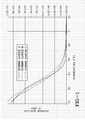
- FIGURE 1 is presented to graphically illustrate Storage Modulus (G') values as a function of temperature for Samples A through C.
- FIGURE 2 is presented to graphically illustrate tan delta values as a function of temperature for Samples A through C.
- For FIG 1, a graphical presentation of Storage Modulus G' versus Temperature, it is readily seen that the modulus increase at low temperature is higher (steeper curve) for Experimental Sample B but is lower (less steep curve) for Comparative Sample A.
- This is considered herein to be significant in the sense of tire performance under winter conditions (e.g. snow and ice) being slightly worse for Experimental Sample B but better for Experimental Sample C.
- For FIG 2, a graphical presentation of tan delta versus Temperature, it is readily seen that the tan delta peak (maximum temperature) is similar for Comparative Sample A and Experimental Sample C but slightly higher for Experimental Sample B.
- This is considered herein to be significant for tire performance in the sense that it is indicative of similar winter performance for Comparative Sample A and Experimental Sample C, but slightly inferior winter performance for Experimental Sample B, for a tire having a tread of the respective rubber compositions.
- Further, it can be seen that the tan delta at lower temperatures, namely from-95°C to-70°C, is relatively high for Experimental Samples B and C versus Comparative Sample A which is indicative of a relatively good resistance to tread wear potential for Experimental Samples B and C.
- Further, it can be seen that the tan delta values at the higher temperatures, namely from-30°C to 0°C, is relatively high for Experimental Samples B and C versus Comparative Sample A which is indicative of good wet performance (e.g. traction) for a tire having a tread of the respective rubber compositions.
- Therefore, it is considered herein that an improved balance of wet traction and winter performance is provided for a tire having a tread of the Experimental Sample C rubber composition.
- A tires are individually prepared with a circumferential tread of the rubber composition of experimental Sample B and experimental Sample C and identified herein as Tire B and Tire C, respectively.
- The tires were individually tested for wet traction and winter handling, the results of which are reported herein in Table 3, with the properties for Tire B being normalized to a value of 100 and the properties for Tire C reported on a comparison basis to normalized values for the Control Tire B.
Table 3 Property Tire B Tire C Wet traction 100 100 Snow handling 100 106 - From Table 3 it can be seen that while experimental Tire C exhibited wet traction similar to experimental Tire B, experimental Tire C exhibited significantly better snow handling than Tire B.
Claims (5)
- A tire having a circumferential tread of a rubber composition comprising, based on parts by weight per 100 parts by weight of rubber (phr):(A) 100 phr of elastomers comprising(1) from 48 to 60 phr of a specialized solution polymerization prepared styrene/butadiene copolymer rubber (HVS-SBR) having an onset Tg (ASTM D3418) in a range of from -28°C to -23°C, a bound styrene content in a range of 23 to 31 percent and a vinyl 1,2-content of from 40 to 50 percent,(2) from 60 to 40 phr of cis 1,4-polybutadiene rubber (BR) having an onset Tg (ASTMD 3418) in a range of from -100°C to -110°C and a cis 1,4-isometric content in a range of from 93 to 100 percent, and, optionally,(3) from zero to 20 phr of an additional rubber selected from polymers and copolymers of at least one of isoprene and 1,3-butadieneand copolymers of styrene and at least one of isoprene and 1,3-butadiene.(B) from 85 to 120 phr of particulate reinforcing filler comprising:(1) from 85 to 110 phr of synthetic amorphous precipitated silica having a BET surface area in a range of from 100 to 135 m2/g, and(2) from zero to 20 phr of rubber reinforcing carbon black; and(C) at least one silica coupling agent having a moiety reactive with hydroxyl groups on the surface of the said precipitated silica and an additional moiety interactive with the said rubbers.
- The tire of claim 1 wherein said coupling agent is a
bis(3-triethoxysilylpropyl) polysulfide containing an average of from 2 to 2.6 connecting sulfur atoms in its polysulfide bridge. - The tire of claim 1 or 2 wherein said rubber reinforcing carbon black is a high structure rubber reinforcing carbon black DBP value in a range of from 100 to 140 cc/100g in combination with an Iodine value in a range of from 115 to 185 g/kg.
- The tire of at least one of the previous claims, wherein said precipitated silica is in a form of aggregates of primary silica particles and has a BET surface area within a range of 80 to 300 m2/g and a DBP value within a range of 100 to 350 cc/100g.
- The tire of one of the previous claims, wherein said additional rubbers are conjugated diene-based elastomers selected from at least one of cis 1,4-polyisoprene rubber, high vinyl polybutadiene having a vinyl 1,2 content in a range of 30 to 90 percent, styrene/butadiene copolymers (SBR) other than said HVS-SBR, styrene/isoprene/butadiene terpolymers, isoprene/butadiene copolymers, isoprene/styrene copolymers, acrylonitrile/butadiene copolymers and acrylonitrile/butadiene/styrene terpolymers.
Applications Claiming Priority (1)
| Application Number | Priority Date | Filing Date | Title |
|---|---|---|---|
| US11/455,917 US20070293619A1 (en) | 2006-06-19 | 2006-06-19 | Tire with silica-rich rubber tread for winter performance |
Publications (1)
| Publication Number | Publication Date |
|---|---|
| EP1880870A1 true EP1880870A1 (en) | 2008-01-23 |
Family
ID=38718265
Family Applications (1)
| Application Number | Title | Priority Date | Filing Date |
|---|---|---|---|
| EP07110331A Withdrawn EP1880870A1 (en) | 2006-06-19 | 2007-06-15 | Tire with silica-rich rubber tread for winter performance |
Country Status (3)
| Country | Link |
|---|---|
| US (1) | US20070293619A1 (en) |
| EP (1) | EP1880870A1 (en) |
| JP (1) | JP2008001900A (en) |
Cited By (2)
| Publication number | Priority date | Publication date | Assignee | Title |
|---|---|---|---|---|
| CN106084360A (en) * | 2016-07-15 | 2016-11-09 | 山东永泰集团有限公司 | A kind of farm cart tire tread glue and preparation method thereof |
| CN109438621A (en) * | 2018-11-09 | 2019-03-08 | 新辉(中国)新材料有限公司 | Functional butylbenzene copolymer latex and its preparation method and application |
Families Citing this family (21)
| Publication number | Priority date | Publication date | Assignee | Title |
|---|---|---|---|---|
| FR2933417B1 (en) * | 2008-07-04 | 2011-12-30 | Michelin Soc Tech | TIRE TREAD TIRE |
| IT1394126B1 (en) * | 2008-10-22 | 2012-05-25 | Bridgestone Corp | TREAD COMPOUND FOR WINTER TIRES |
| US7671132B1 (en) | 2008-12-17 | 2010-03-02 | The Goodyear Tire & Rubber Company | Pneumatic tire with tread |
| JP5403258B2 (en) * | 2008-12-22 | 2014-01-29 | 日立金属株式会社 | Radiation-resistant composition and electric wire / cable |
| CN102395473B (en) * | 2009-04-29 | 2014-12-17 | 米其林集团总公司 | Treads for heavy vehicle tires |
| FR2968006B1 (en) | 2010-11-26 | 2012-12-21 | Michelin Soc Tech | TIRE TREAD TIRE |
| FR2970256B1 (en) * | 2010-11-30 | 2013-01-11 | Michelin Soc Tech | PNEUMATIC COMPRISING A ROLLING BAND UNDERCOAT BASED ON NITRILE RUBBER. |
| DE102010061469A1 (en) | 2010-12-22 | 2012-06-28 | Continental Reifen Deutschland Gmbh | Rubber compound with improved rolling resistance behavior |
| JP5339008B2 (en) * | 2011-08-26 | 2013-11-13 | 横浜ゴム株式会社 | Rubber composition for tire tread |
| US20170218170A1 (en) * | 2014-08-05 | 2017-08-03 | Sumitomo Rubber Industries, Ltd. | Rubber composition and tire |
| JP6393562B2 (en) * | 2014-09-02 | 2018-09-19 | 株式会社ブリヂストン | Rubber composition production method, rubber composition and tire |
| TWI673324B (en) * | 2014-09-12 | 2019-10-01 | 日商宇部興產股份有限公司 | Rubber composition |
| CN106795334B (en) * | 2014-10-17 | 2019-06-18 | 日本瑞翁株式会社 | Rubber composition for tires |
| WO2016069012A1 (en) * | 2014-10-31 | 2016-05-06 | Compagnie Generale Des Etablissements Michelin | Rubber component for a tire with improved abrasion resistance |
| ES2895416T3 (en) | 2016-08-17 | 2022-02-21 | Continental Reifen Deutschland Gmbh | Rubber blend, sulfur crosslinkable rubber blend and vehicle tire |
| US12227651B2 (en) | 2016-08-17 | 2025-02-18 | Continental Reifen Deutschland Gmbh | Rubber blend, sulfur-crosslinkable rubber mixture, and vehicle tire |
| EP3500598B1 (en) | 2016-08-17 | 2021-09-15 | Continental Reifen Deutschland GmbH | Rubber blend, sulfur-crosslinkable rubber mixture and vehicle tire |
| JP6939231B2 (en) * | 2017-08-10 | 2021-09-22 | 住友ゴム工業株式会社 | Pneumatic tires |
| JP2019112500A (en) * | 2017-12-21 | 2019-07-11 | Toyo Tire株式会社 | Rubber composition for tire, and pneumatic tire using the same |
| US12522691B2 (en) * | 2019-11-19 | 2026-01-13 | Exxonmobil Chemical Patents Inc. | Post-synthesis backbone modification of polypentenamer rubber and related tire compositions |
| US12698380B2 (en) | 2022-03-28 | 2026-08-04 | The Goodyear Tire & Rubber Company | Rubber composition for a winter tire and a winter tire |
Citations (8)
| Publication number | Priority date | Publication date | Assignee | Title |
|---|---|---|---|---|
| EP0831122A1 (en) * | 1996-09-23 | 1998-03-25 | The Goodyear Tire & Rubber Company | Tyre with tread of elastomer composition |
| EP1398347A1 (en) * | 2002-09-16 | 2004-03-17 | The Goodyear Tire & Rubber Company | Tire with tread of cis 1,4-polybutadiene-rich rubber composition which contains a functional styrene/butadiene elastomer, silica and coupling agent |
| US20040054062A1 (en) * | 2002-09-17 | 2004-03-18 | Zanzig David John | Tire with component of rubber composition comprised of a combination of functionalized emulsion SBR and coupled solution SBR |
| EP1518895A1 (en) * | 2003-09-18 | 2005-03-30 | The Goodyear Tire & Rubber Company | Tire with component comprised of a blend of polybutadiene rubber and composite of styrene/butadiene elastomer which contains exfoliated clay platelets |
| EP1637353A1 (en) * | 2004-09-17 | 2006-03-22 | The Goodyear Tire & Rubber Company | Pneumatic tire having a tread containing immiscible rubber blend and silica |
| EP1676882A1 (en) * | 2004-12-30 | 2006-07-05 | The Goodyear Tire & Rubber Company | Tread cap composition and method of making same |
| EP1676881A1 (en) * | 2004-12-30 | 2006-07-05 | The Goodyear Tire & Rubber Company | Method of mixing of a tread composition |
| EP1767571A1 (en) * | 2005-09-21 | 2007-03-28 | The Goodyear Tire & Rubber Company | Tire with tread containing tin coupled amine functionalized polybutadiene and nanostructured inversion carbon black |
Family Cites Families (3)
| Publication number | Priority date | Publication date | Assignee | Title |
|---|---|---|---|---|
| US6429245B1 (en) * | 1997-09-16 | 2002-08-06 | The Goodyear Tire & Rubber Company | Tire tread with elastomers of spatially defined Tg's |
| US20050171267A1 (en) * | 2004-01-29 | 2005-08-04 | Zanzig David J. | Tire with component of rubber composition comprised of functionalized styrene/butadiene elastomer, silica and styrene/alpha methylstyrene resin |
| US7262254B2 (en) * | 2004-09-23 | 2007-08-28 | The Goodyear Tire & Rubber Company | Tire with low volatile alcohol emission rubber tread with compositional limitations |
-
2006
- 2006-06-19 US US11/455,917 patent/US20070293619A1/en not_active Abandoned
-
2007
- 2007-06-15 EP EP07110331A patent/EP1880870A1/en not_active Withdrawn
- 2007-06-19 JP JP2007161686A patent/JP2008001900A/en active Pending
Patent Citations (8)
| Publication number | Priority date | Publication date | Assignee | Title |
|---|---|---|---|---|
| EP0831122A1 (en) * | 1996-09-23 | 1998-03-25 | The Goodyear Tire & Rubber Company | Tyre with tread of elastomer composition |
| EP1398347A1 (en) * | 2002-09-16 | 2004-03-17 | The Goodyear Tire & Rubber Company | Tire with tread of cis 1,4-polybutadiene-rich rubber composition which contains a functional styrene/butadiene elastomer, silica and coupling agent |
| US20040054062A1 (en) * | 2002-09-17 | 2004-03-18 | Zanzig David John | Tire with component of rubber composition comprised of a combination of functionalized emulsion SBR and coupled solution SBR |
| EP1518895A1 (en) * | 2003-09-18 | 2005-03-30 | The Goodyear Tire & Rubber Company | Tire with component comprised of a blend of polybutadiene rubber and composite of styrene/butadiene elastomer which contains exfoliated clay platelets |
| EP1637353A1 (en) * | 2004-09-17 | 2006-03-22 | The Goodyear Tire & Rubber Company | Pneumatic tire having a tread containing immiscible rubber blend and silica |
| EP1676882A1 (en) * | 2004-12-30 | 2006-07-05 | The Goodyear Tire & Rubber Company | Tread cap composition and method of making same |
| EP1676881A1 (en) * | 2004-12-30 | 2006-07-05 | The Goodyear Tire & Rubber Company | Method of mixing of a tread composition |
| EP1767571A1 (en) * | 2005-09-21 | 2007-03-28 | The Goodyear Tire & Rubber Company | Tire with tread containing tin coupled amine functionalized polybutadiene and nanostructured inversion carbon black |
Cited By (2)
| Publication number | Priority date | Publication date | Assignee | Title |
|---|---|---|---|---|
| CN106084360A (en) * | 2016-07-15 | 2016-11-09 | 山东永泰集团有限公司 | A kind of farm cart tire tread glue and preparation method thereof |
| CN109438621A (en) * | 2018-11-09 | 2019-03-08 | 新辉(中国)新材料有限公司 | Functional butylbenzene copolymer latex and its preparation method and application |
Also Published As
| Publication number | Publication date |
|---|---|
| US20070293619A1 (en) | 2007-12-20 |
| JP2008001900A (en) | 2008-01-10 |
Similar Documents
| Publication | Publication Date | Title |
|---|---|---|
| EP3205514B1 (en) | Rubber composition and tire with tread for low temperature performance and wet traction | |
| EP3351405B1 (en) | Rubber composition and tire with tread for low temperature performance and wet traction | |
| EP2289712B1 (en) | Tire with rubber tread containing combination of resin blend and functionalized elastomer | |
| CA2281735C (en) | Tire with silica reinforced tread and/or sidewall components | |
| CA2948708C (en) | Tire with tread for low temperature performance and wet traction | |
| US20070293619A1 (en) | Tire with silica-rich rubber tread for winter performance | |
| US6581659B1 (en) | Tire with silica-reinforced tread comprised of trans 1,4-polybutadiene, solution, SBR polyisoprene and defined amount of carbon black and amorphous silica | |
| US5798405A (en) | Tire with tread of rubber composition containing two different carbon blacks | |
| EP1897703A1 (en) | Tire with tread having a transition layer containing depolymerized rubber, pre-cured rubber or coal dust | |
| EP3109065A1 (en) | Tire with tread for low temperature performance and wet traction | |
| US7001946B2 (en) | Tire with tread of natural rubber-rich rubber composition | |
| JP3655698B2 (en) | Tire with silica reinforced tread | |
| EP2452831B1 (en) | Tire with tread containing carboxylated styrene/butadiene rubber | |
| US20190225778A1 (en) | Tire with tread containing vegetable oil extended high tg styrene/butadiene elastomer and traction resin | |
| US5756589A (en) | Silica reinforced rubber composition and use in tires | |
| EP2033813A1 (en) | Tire with tread having enhanced wet traction | |
| US7640957B2 (en) | Tire with rubber tread highly loaded with a combination of filler reinforcement and oil | |
| US9890270B2 (en) | Phased rubber composition and tire with tread | |
| EP1726617A1 (en) | Tire with tread comprised of natural rubber and specialized emulsion prepared styrene/butadiene elastomer | |
| EP2607421A2 (en) | Tire with rubber component containing combination of carbon black, silica and functionalized mineral |
Legal Events
| Date | Code | Title | Description |
|---|---|---|---|
| PUAI | Public reference made under article 153(3) epc to a published international application that has entered the european phase |
Free format text: ORIGINAL CODE: 0009012 |
|
| AK | Designated contracting states |
Kind code of ref document: A1 Designated state(s): AT BE BG CH CY CZ DE DK EE ES FI FR GB GR HU IE IS IT LI LT LU LV MC MT NL PL PT RO SE SI SK TR |
|
| AX | Request for extension of the european patent |
Extension state: AL BA HR MK YU |
|
| AKX | Designation fees paid | ||
| REG | Reference to a national code |
Ref country code: DE Ref legal event code: 8566 |
|
| STAA | Information on the status of an ep patent application or granted ep patent |
Free format text: STATUS: THE APPLICATION IS DEEMED TO BE WITHDRAWN |
|
| 18D | Application deemed to be withdrawn |
Effective date: 20080724 |