EP1879895B1 - Enzyme inhibitors - Google Patents
Enzyme inhibitors Download PDFInfo
- Publication number
- EP1879895B1 EP1879895B1 EP06726982A EP06726982A EP1879895B1 EP 1879895 B1 EP1879895 B1 EP 1879895B1 EP 06726982 A EP06726982 A EP 06726982A EP 06726982 A EP06726982 A EP 06726982A EP 1879895 B1 EP1879895 B1 EP 1879895B1
- Authority
- EP
- European Patent Office
- Prior art keywords
- compound
- optionally substituted
- radical
- alkyl
- stage
- Prior art date
- Legal status (The legal status is an assumption and is not a legal conclusion. Google has not performed a legal analysis and makes no representation as to the accuracy of the status listed.)
- Expired - Lifetime
Links
- 0 CCC(*)N*I** Chemical compound CCC(*)N*I** 0.000 description 6
- YYSNUKULNLXXSQ-SNVBAGLBSA-N CC(C)(C)SC[C@H](C(OC1CCCC1)=O)N Chemical compound CC(C)(C)SC[C@H](C(OC1CCCC1)=O)N YYSNUKULNLXXSQ-SNVBAGLBSA-N 0.000 description 1
- AAPUBXSPCDBQMV-UHFFFAOYSA-N CC(C)COC(C)ONC(CCCCCCC(O)=O)=O Chemical compound CC(C)COC(C)ONC(CCCCCCC(O)=O)=O AAPUBXSPCDBQMV-UHFFFAOYSA-N 0.000 description 1
- HJUSODLDRVSYKV-QFIPXVFZSA-N CC(C)C[C@@H](C(OC1CCCC1)=O)NC(c(cc1)ccc1NC(CCCCCCC(NO)=O)=O)=O Chemical compound CC(C)C[C@@H](C(OC1CCCC1)=O)NC(c(cc1)ccc1NC(CCCCCCC(NO)=O)=O)=O HJUSODLDRVSYKV-QFIPXVFZSA-N 0.000 description 1
- UMRSUPKZDIMJDX-UHFFFAOYSA-N NC(C1(OC2CCCC2)OC1)=C1CCCCC1 Chemical compound NC(C1(OC2CCCC2)OC1)=C1CCCCC1 UMRSUPKZDIMJDX-UHFFFAOYSA-N 0.000 description 1
- BKOTWGYGBLTPKM-UHFFFAOYSA-N OC(C(c1ccccc1)NCc(cc1)ccc1NC(CCCCCCC(NO)=O)=O)=O Chemical compound OC(C(c1ccccc1)NCc(cc1)ccc1NC(CCCCCCC(NO)=O)=O)=O BKOTWGYGBLTPKM-UHFFFAOYSA-N 0.000 description 1
- FYSVIVMUZOHXTO-UGNFMNBCSA-N OC([C@H](C1C=CC=CC1)NCc1ccccc1NC(CCCCCCC(NO)=O)=O)=O Chemical compound OC([C@H](C1C=CC=CC1)NCc1ccccc1NC(CCCCCCC(NO)=O)=O)=O FYSVIVMUZOHXTO-UGNFMNBCSA-N 0.000 description 1
- MRRYPFHGMZSSGI-FQEVSTJZSA-N OC([C@H](c1ccccc1)NCc1cccc(C(NCCCCCC(NO)=O)=O)c1)=O Chemical compound OC([C@H](c1ccccc1)NCc1cccc(C(NCCCCCC(NO)=O)=O)c1)=O MRRYPFHGMZSSGI-FQEVSTJZSA-N 0.000 description 1
- GLNWREBYRLDPQP-UHFFFAOYSA-N ONC(CCCCCCC(Nc1ccc(CNC(C(OC2CCCC2)=O)c2ccccc2)cc1)=O)=O Chemical compound ONC(CCCCCCC(Nc1ccc(CNC(C(OC2CCCC2)=O)c2ccccc2)cc1)=O)=O GLNWREBYRLDPQP-UHFFFAOYSA-N 0.000 description 1
- SOIKKDVGTMPIST-UHFFFAOYSA-N ONC(CCCCCCC(Nc1ccccc1C[N-]C(C(OC1CCCC1)=O)c1ccccc1)=O)=O Chemical compound ONC(CCCCCCC(Nc1ccccc1C[N-]C(C(OC1CCCC1)=O)c1ccccc1)=O)=O SOIKKDVGTMPIST-UHFFFAOYSA-N 0.000 description 1
- RNFNREWODKRFEX-UHFFFAOYSA-N [O-][N+](c1cccc(COC(Cl)=O)c1)=O Chemical compound [O-][N+](c1cccc(COC(Cl)=O)c1)=O RNFNREWODKRFEX-UHFFFAOYSA-N 0.000 description 1
Classifications
-
- C—CHEMISTRY; METALLURGY
- C07—ORGANIC CHEMISTRY
- C07C—ACYCLIC OR CARBOCYCLIC COMPOUNDS
- C07C237/00—Carboxylic acid amides, the carbon skeleton of the acid part being further substituted by amino groups
- C07C237/28—Carboxylic acid amides, the carbon skeleton of the acid part being further substituted by amino groups having the carbon atom of at least one of the carboxamide groups bound to a carbon atom of a non-condensed six-membered aromatic ring of the carbon skeleton
- C07C237/40—Carboxylic acid amides, the carbon skeleton of the acid part being further substituted by amino groups having the carbon atom of at least one of the carboxamide groups bound to a carbon atom of a non-condensed six-membered aromatic ring of the carbon skeleton having the nitrogen atom of the carboxamide group bound to a carbon atom of a six-membered aromatic ring
-
- A—HUMAN NECESSITIES
- A61—MEDICAL OR VETERINARY SCIENCE; HYGIENE
- A61P—SPECIFIC THERAPEUTIC ACTIVITY OF CHEMICAL COMPOUNDS OR MEDICINAL PREPARATIONS
- A61P3/00—Drugs for disorders of the metabolism
-
- A—HUMAN NECESSITIES
- A61—MEDICAL OR VETERINARY SCIENCE; HYGIENE
- A61P—SPECIFIC THERAPEUTIC ACTIVITY OF CHEMICAL COMPOUNDS OR MEDICINAL PREPARATIONS
- A61P19/00—Drugs for skeletal disorders
- A61P19/02—Drugs for skeletal disorders for joint disorders, e.g. arthritis, arthrosis
-
- A—HUMAN NECESSITIES
- A61—MEDICAL OR VETERINARY SCIENCE; HYGIENE
- A61P—SPECIFIC THERAPEUTIC ACTIVITY OF CHEMICAL COMPOUNDS OR MEDICINAL PREPARATIONS
- A61P25/00—Drugs for disorders of the nervous system
-
- A—HUMAN NECESSITIES
- A61—MEDICAL OR VETERINARY SCIENCE; HYGIENE
- A61P—SPECIFIC THERAPEUTIC ACTIVITY OF CHEMICAL COMPOUNDS OR MEDICINAL PREPARATIONS
- A61P25/00—Drugs for disorders of the nervous system
- A61P25/28—Drugs for disorders of the nervous system for treating neurodegenerative disorders of the central nervous system, e.g. nootropic agents, cognition enhancers, drugs for treating Alzheimer's disease or other forms of dementia
-
- A—HUMAN NECESSITIES
- A61—MEDICAL OR VETERINARY SCIENCE; HYGIENE
- A61P—SPECIFIC THERAPEUTIC ACTIVITY OF CHEMICAL COMPOUNDS OR MEDICINAL PREPARATIONS
- A61P29/00—Non-central analgesic, antipyretic or antiinflammatory agents, e.g. antirheumatic agents; Non-steroidal antiinflammatory drugs [NSAID]
-
- A—HUMAN NECESSITIES
- A61—MEDICAL OR VETERINARY SCIENCE; HYGIENE
- A61P—SPECIFIC THERAPEUTIC ACTIVITY OF CHEMICAL COMPOUNDS OR MEDICINAL PREPARATIONS
- A61P3/00—Drugs for disorders of the metabolism
- A61P3/08—Drugs for disorders of the metabolism for glucose homeostasis
- A61P3/10—Drugs for disorders of the metabolism for glucose homeostasis for hyperglycaemia, e.g. antidiabetics
-
- A—HUMAN NECESSITIES
- A61—MEDICAL OR VETERINARY SCIENCE; HYGIENE
- A61P—SPECIFIC THERAPEUTIC ACTIVITY OF CHEMICAL COMPOUNDS OR MEDICINAL PREPARATIONS
- A61P35/00—Antineoplastic agents
-
- A—HUMAN NECESSITIES
- A61—MEDICAL OR VETERINARY SCIENCE; HYGIENE
- A61P—SPECIFIC THERAPEUTIC ACTIVITY OF CHEMICAL COMPOUNDS OR MEDICINAL PREPARATIONS
- A61P37/00—Drugs for immunological or allergic disorders
- A61P37/02—Immunomodulators
- A61P37/06—Immunosuppressants, e.g. drugs for graft rejection
-
- A—HUMAN NECESSITIES
- A61—MEDICAL OR VETERINARY SCIENCE; HYGIENE
- A61P—SPECIFIC THERAPEUTIC ACTIVITY OF CHEMICAL COMPOUNDS OR MEDICINAL PREPARATIONS
- A61P43/00—Drugs for specific purposes, not provided for in groups A61P1/00-A61P41/00
-
- A—HUMAN NECESSITIES
- A61—MEDICAL OR VETERINARY SCIENCE; HYGIENE
- A61P—SPECIFIC THERAPEUTIC ACTIVITY OF CHEMICAL COMPOUNDS OR MEDICINAL PREPARATIONS
- A61P7/00—Drugs for disorders of the blood or the extracellular fluid
-
- C—CHEMISTRY; METALLURGY
- C07—ORGANIC CHEMISTRY
- C07C—ACYCLIC OR CARBOCYCLIC COMPOUNDS
- C07C229/00—Compounds containing amino and carboxyl groups bound to the same carbon skeleton
-
- C—CHEMISTRY; METALLURGY
- C07—ORGANIC CHEMISTRY
- C07C—ACYCLIC OR CARBOCYCLIC COMPOUNDS
- C07C259/00—Compounds containing carboxyl groups, an oxygen atom of a carboxyl group being replaced by a nitrogen atom, this nitrogen atom being further bound to an oxygen atom and not being part of nitro or nitroso groups
- C07C259/04—Compounds containing carboxyl groups, an oxygen atom of a carboxyl group being replaced by a nitrogen atom, this nitrogen atom being further bound to an oxygen atom and not being part of nitro or nitroso groups without replacement of the other oxygen atom of the carboxyl group, e.g. hydroxamic acids
-
- C—CHEMISTRY; METALLURGY
- C07—ORGANIC CHEMISTRY
- C07C—ACYCLIC OR CARBOCYCLIC COMPOUNDS
- C07C259/00—Compounds containing carboxyl groups, an oxygen atom of a carboxyl group being replaced by a nitrogen atom, this nitrogen atom being further bound to an oxygen atom and not being part of nitro or nitroso groups
- C07C259/04—Compounds containing carboxyl groups, an oxygen atom of a carboxyl group being replaced by a nitrogen atom, this nitrogen atom being further bound to an oxygen atom and not being part of nitro or nitroso groups without replacement of the other oxygen atom of the carboxyl group, e.g. hydroxamic acids
- C07C259/06—Compounds containing carboxyl groups, an oxygen atom of a carboxyl group being replaced by a nitrogen atom, this nitrogen atom being further bound to an oxygen atom and not being part of nitro or nitroso groups without replacement of the other oxygen atom of the carboxyl group, e.g. hydroxamic acids having carbon atoms of hydroxamic groups bound to hydrogen atoms or to acyclic carbon atoms
-
- C—CHEMISTRY; METALLURGY
- C07—ORGANIC CHEMISTRY
- C07C—ACYCLIC OR CARBOCYCLIC COMPOUNDS
- C07C275/00—Derivatives of urea, i.e. compounds containing any of the groups, the nitrogen atoms not being part of nitro or nitroso groups
- C07C275/04—Derivatives of urea, i.e. compounds containing any of the groups, the nitrogen atoms not being part of nitro or nitroso groups having nitrogen atoms of urea groups bound to acyclic carbon atoms
- C07C275/20—Derivatives of urea, i.e. compounds containing any of the groups, the nitrogen atoms not being part of nitro or nitroso groups having nitrogen atoms of urea groups bound to acyclic carbon atoms of an unsaturated carbon skeleton
- C07C275/24—Derivatives of urea, i.e. compounds containing any of the groups, the nitrogen atoms not being part of nitro or nitroso groups having nitrogen atoms of urea groups bound to acyclic carbon atoms of an unsaturated carbon skeleton containing six-membered aromatic rings
-
- C—CHEMISTRY; METALLURGY
- C07—ORGANIC CHEMISTRY
- C07C—ACYCLIC OR CARBOCYCLIC COMPOUNDS
- C07C311/00—Amides of sulfonic acids, i.e. compounds having singly-bound oxygen atoms of sulfo groups replaced by nitrogen atoms, not being part of nitro or nitroso groups
- C07C311/30—Sulfonamides, the carbon skeleton of the acid part being further substituted by singly-bound nitrogen atoms, not being part of nitro or nitroso groups
- C07C311/45—Sulfonamides, the carbon skeleton of the acid part being further substituted by singly-bound nitrogen atoms, not being part of nitro or nitroso groups at least one of the singly-bound nitrogen atoms being part of any of the groups, X being a hetero atom, Y being any atom, e.g. N-acylaminosulfonamides
- C07C311/46—Y being a hydrogen or a carbon atom
-
- C—CHEMISTRY; METALLURGY
- C07—ORGANIC CHEMISTRY
- C07C—ACYCLIC OR CARBOCYCLIC COMPOUNDS
- C07C317/00—Sulfones; Sulfoxides
- C07C317/44—Sulfones; Sulfoxides having sulfone or sulfoxide groups and carboxyl groups bound to the same carbon skeleton
- C07C317/48—Sulfones; Sulfoxides having sulfone or sulfoxide groups and carboxyl groups bound to the same carbon skeleton the carbon skeleton being further substituted by singly-bound nitrogen atoms, not being part of nitro or nitroso groups
- C07C317/50—Sulfones; Sulfoxides having sulfone or sulfoxide groups and carboxyl groups bound to the same carbon skeleton the carbon skeleton being further substituted by singly-bound nitrogen atoms, not being part of nitro or nitroso groups at least one of the nitrogen atoms being part of any of the groups, X being a hetero atom, Y being any atom
-
- C—CHEMISTRY; METALLURGY
- C07—ORGANIC CHEMISTRY
- C07D—HETEROCYCLIC COMPOUNDS
- C07D207/00—Heterocyclic compounds containing five-membered rings not condensed with other rings, with one nitrogen atom as the only ring hetero atom
- C07D207/02—Heterocyclic compounds containing five-membered rings not condensed with other rings, with one nitrogen atom as the only ring hetero atom with only hydrogen or carbon atoms directly attached to the ring nitrogen atom
- C07D207/30—Heterocyclic compounds containing five-membered rings not condensed with other rings, with one nitrogen atom as the only ring hetero atom with only hydrogen or carbon atoms directly attached to the ring nitrogen atom having two double bonds between ring members or between ring members and non-ring members
- C07D207/34—Heterocyclic compounds containing five-membered rings not condensed with other rings, with one nitrogen atom as the only ring hetero atom with only hydrogen or carbon atoms directly attached to the ring nitrogen atom having two double bonds between ring members or between ring members and non-ring members with hetero atoms or with carbon atoms having three bonds to hetero atoms with at the most one bond to halogen, e.g. ester or nitrile radicals, directly attached to ring carbon atoms
- C07D207/36—Oxygen or sulfur atoms
- C07D207/40—2,5-Pyrrolidine-diones
- C07D207/416—2,5-Pyrrolidine-diones with hetero atoms or with carbon atoms having three bonds to hetero atoms with at the most one bond to halogen, e.g. ester or nitrile radicals, directly attached to other ring carbon atoms
-
- C—CHEMISTRY; METALLURGY
- C07—ORGANIC CHEMISTRY
- C07D—HETEROCYCLIC COMPOUNDS
- C07D209/00—Heterocyclic compounds containing five-membered rings, condensed with other rings, with one nitrogen atom as the only ring hetero atom
- C07D209/02—Heterocyclic compounds containing five-membered rings, condensed with other rings, with one nitrogen atom as the only ring hetero atom condensed with one carbocyclic ring
- C07D209/04—Indoles; Hydrogenated indoles
- C07D209/30—Indoles; Hydrogenated indoles with hetero atoms or with carbon atoms having three bonds to hetero atoms with at the most one bond to halogen, directly attached to carbon atoms of the hetero ring
- C07D209/42—Carbon atoms having three bonds to hetero atoms with at the most one bond to halogen, e.g. ester or nitrile radicals
-
- C—CHEMISTRY; METALLURGY
- C07—ORGANIC CHEMISTRY
- C07D—HETEROCYCLIC COMPOUNDS
- C07D213/00—Heterocyclic compounds containing six-membered rings, not condensed with other rings, with one nitrogen atom as the only ring hetero atom and three or more double bonds between ring members or between ring members and non-ring members
- C07D213/02—Heterocyclic compounds containing six-membered rings, not condensed with other rings, with one nitrogen atom as the only ring hetero atom and three or more double bonds between ring members or between ring members and non-ring members having three double bonds between ring members or between ring members and non-ring members
- C07D213/04—Heterocyclic compounds containing six-membered rings, not condensed with other rings, with one nitrogen atom as the only ring hetero atom and three or more double bonds between ring members or between ring members and non-ring members having three double bonds between ring members or between ring members and non-ring members having no bond between the ring nitrogen atom and a non-ring member or having only hydrogen or carbon atoms directly attached to the ring nitrogen atom
- C07D213/24—Heterocyclic compounds containing six-membered rings, not condensed with other rings, with one nitrogen atom as the only ring hetero atom and three or more double bonds between ring members or between ring members and non-ring members having three double bonds between ring members or between ring members and non-ring members having no bond between the ring nitrogen atom and a non-ring member or having only hydrogen or carbon atoms directly attached to the ring nitrogen atom with substituted hydrocarbon radicals attached to ring carbon atoms
- C07D213/36—Radicals substituted by singly-bound nitrogen atoms
- C07D213/40—Acylated substituent nitrogen atom
-
- C—CHEMISTRY; METALLURGY
- C07—ORGANIC CHEMISTRY
- C07D—HETEROCYCLIC COMPOUNDS
- C07D217/00—Heterocyclic compounds containing isoquinoline or hydrogenated isoquinoline ring systems
- C07D217/02—Heterocyclic compounds containing isoquinoline or hydrogenated isoquinoline ring systems with only hydrogen atoms or radicals containing only carbon and hydrogen atoms, directly attached to carbon atoms of the nitrogen-containing ring; Alkylene-bis-isoquinolines
-
- C—CHEMISTRY; METALLURGY
- C07—ORGANIC CHEMISTRY
- C07D—HETEROCYCLIC COMPOUNDS
- C07D217/00—Heterocyclic compounds containing isoquinoline or hydrogenated isoquinoline ring systems
- C07D217/22—Heterocyclic compounds containing isoquinoline or hydrogenated isoquinoline ring systems with hetero atoms or with carbon atoms having three bonds to hetero atoms with at the most one bond to halogen, e.g. ester or nitrile radicals, directly attached to carbon atoms of the nitrogen-containing ring
-
- C—CHEMISTRY; METALLURGY
- C07—ORGANIC CHEMISTRY
- C07D—HETEROCYCLIC COMPOUNDS
- C07D217/00—Heterocyclic compounds containing isoquinoline or hydrogenated isoquinoline ring systems
- C07D217/22—Heterocyclic compounds containing isoquinoline or hydrogenated isoquinoline ring systems with hetero atoms or with carbon atoms having three bonds to hetero atoms with at the most one bond to halogen, e.g. ester or nitrile radicals, directly attached to carbon atoms of the nitrogen-containing ring
- C07D217/26—Carbon atoms having three bonds to hetero atoms with at the most one bond to halogen
-
- C—CHEMISTRY; METALLURGY
- C07—ORGANIC CHEMISTRY
- C07D—HETEROCYCLIC COMPOUNDS
- C07D295/00—Heterocyclic compounds containing polymethylene-imine rings with at least five ring members, 3-azabicyclo [3.2.2] nonane, piperazine, morpholine or thiomorpholine rings, having only hydrogen atoms directly attached to the ring carbon atoms
- C07D295/16—Heterocyclic compounds containing polymethylene-imine rings with at least five ring members, 3-azabicyclo [3.2.2] nonane, piperazine, morpholine or thiomorpholine rings, having only hydrogen atoms directly attached to the ring carbon atoms acylated on ring nitrogen atoms
- C07D295/18—Heterocyclic compounds containing polymethylene-imine rings with at least five ring members, 3-azabicyclo [3.2.2] nonane, piperazine, morpholine or thiomorpholine rings, having only hydrogen atoms directly attached to the ring carbon atoms acylated on ring nitrogen atoms by radicals derived from carboxylic acids, or sulfur or nitrogen analogues thereof
- C07D295/182—Radicals derived from carboxylic acids
- C07D295/185—Radicals derived from carboxylic acids from aliphatic carboxylic acids
-
- C—CHEMISTRY; METALLURGY
- C07—ORGANIC CHEMISTRY
- C07D—HETEROCYCLIC COMPOUNDS
- C07D295/00—Heterocyclic compounds containing polymethylene-imine rings with at least five ring members, 3-azabicyclo [3.2.2] nonane, piperazine, morpholine or thiomorpholine rings, having only hydrogen atoms directly attached to the ring carbon atoms
- C07D295/16—Heterocyclic compounds containing polymethylene-imine rings with at least five ring members, 3-azabicyclo [3.2.2] nonane, piperazine, morpholine or thiomorpholine rings, having only hydrogen atoms directly attached to the ring carbon atoms acylated on ring nitrogen atoms
- C07D295/18—Heterocyclic compounds containing polymethylene-imine rings with at least five ring members, 3-azabicyclo [3.2.2] nonane, piperazine, morpholine or thiomorpholine rings, having only hydrogen atoms directly attached to the ring carbon atoms acylated on ring nitrogen atoms by radicals derived from carboxylic acids, or sulfur or nitrogen analogues thereof
- C07D295/182—Radicals derived from carboxylic acids
- C07D295/192—Radicals derived from carboxylic acids from aromatic carboxylic acids
-
- C—CHEMISTRY; METALLURGY
- C07—ORGANIC CHEMISTRY
- C07D—HETEROCYCLIC COMPOUNDS
- C07D333/00—Heterocyclic compounds containing five-membered rings having one sulfur atom as the only ring hetero atom
- C07D333/50—Heterocyclic compounds containing five-membered rings having one sulfur atom as the only ring hetero atom condensed with carbocyclic rings or ring systems
- C07D333/52—Benzo[b]thiophenes; Hydrogenated benzo[b]thiophenes
- C07D333/62—Benzo[b]thiophenes; Hydrogenated benzo[b]thiophenes with hetero atoms or with carbon atoms having three bonds to hetero atoms with at the most one bond to halogen, e.g. ester or nitrile radicals, directly attached to carbon atoms of the hetero ring
- C07D333/68—Carbon atoms having three bonds to hetero atoms with at the most one bond to halogen
- C07D333/70—Carbon atoms having three bonds to hetero atoms with at the most one bond to halogen attached in position 2
-
- C—CHEMISTRY; METALLURGY
- C07—ORGANIC CHEMISTRY
- C07D—HETEROCYCLIC COMPOUNDS
- C07D471/00—Heterocyclic compounds containing nitrogen atoms as the only ring hetero atoms in the condensed system, at least one ring being a six-membered ring with one nitrogen atom, not provided for by groups C07D451/00 - C07D463/00
- C07D471/02—Heterocyclic compounds containing nitrogen atoms as the only ring hetero atoms in the condensed system, at least one ring being a six-membered ring with one nitrogen atom, not provided for by groups C07D451/00 - C07D463/00 in which the condensed system contains two hetero rings
- C07D471/04—Ortho-condensed systems
-
- C—CHEMISTRY; METALLURGY
- C07—ORGANIC CHEMISTRY
- C07C—ACYCLIC OR CARBOCYCLIC COMPOUNDS
- C07C2601/00—Systems containing only non-condensed rings
- C07C2601/06—Systems containing only non-condensed rings with a five-membered ring
- C07C2601/08—Systems containing only non-condensed rings with a five-membered ring the ring being saturated
-
- C—CHEMISTRY; METALLURGY
- C07—ORGANIC CHEMISTRY
- C07C—ACYCLIC OR CARBOCYCLIC COMPOUNDS
- C07C2601/00—Systems containing only non-condensed rings
- C07C2601/12—Systems containing only non-condensed rings with a six-membered ring
- C07C2601/14—The ring being saturated
Definitions
- This invention relates to compounds which inhibit members of the histone deacetylase family of enzymes and to their use in the treatment of cell proliferative diseases, including cancers, polyglutamine diseases, for example Huntingdon disease, neurodegenerative diseases for example Alzheimer disease, autoimmune disease for example rheumatoid arthritis and organ transplant rejection, diabetes, haematological disorders, inflammatory disease, cardiovascular disease, atherosclerosis, and the inflammatory sequelae of infection.
- cancers including cancers, polyglutamine diseases, for example Huntingdon disease, neurodegenerative diseases for example Alzheimer disease, autoimmune disease for example rheumatoid arthritis and organ transplant rejection, diabetes, haematological disorders, inflammatory disease, cardiovascular disease, atherosclerosis, and the inflammatory sequelae of infection.
- polyglutamine diseases for example Huntingdon disease
- neurodegenerative diseases for example Alzheimer disease
- autoimmune disease for example rheumatoid arthritis and organ transplant rejection
- diabetes haematological disorders
- inflammatory disease cardiovascular disease
- DNA is packaged with histones, to form chromatin.
- chromatin Approximately 150 base pairs of DNA are wrapped twice around an octamer of histones (two each of histones 2A, 2B, 3 and 4) to form a nucleosome, the basic unit of chromatin.
- the ordered structure of chromatin needs to be modified in order to allow transcription of the associated genes. Transcriptional regulation is key to differentiation, proliferation and apoptosis, and is, therefore, tightly controlled. Control of the changes in chromatin structure (and hence of transcription) is mediated by covalent modifications to histones, most notably of the N-terminal tails.
- Covalent modifications for example methylation, acetylation, phosphorylation and ubiquitination
- Covalent modifications for example methylation, acetylation, phosphorylation and ubiquitination
- Covalent modifications of the side chains of amino acids are enzymatically mediated
- a review of the covalent modifications of histones and their role in transcriptional regulation can be found in Berger SL 2001 Oncogene 20, 3007-3013 ; See Grunstein, M 1997 Nature 389, 349-352 ; Wolffe AP 1996 Science 272, 371-372 ; and Wade PA et al 1997 Trends Biochem Sci 22, 128-132 for reviews of histone acetylation and transcription).
- HATs histone acetyltransferases
- HDACs histone deacetylases
- HDAC inhibitors have been described in the literature and shown to induce transcriptional reactivation of certain genes resulting in the inhibition of cancer cell proliferation, induction of apoptosis and inhibition of tumour growth in animals (For review see Kelly, WK et al 2002 Expert Opin Investig Drugs 11, 1695-1713 ). Such findings suggest that HDAC inhibitors have therapeutic potential in the treatment of proliferative diseases such as cancer ( Kramer, OH et al 2001 Trends Endocrinol 12, 294-300 , Vigushin DM and Coombes RC 2002 Anticancer Drugs 13, 1-13).
- HDAC activity or histone acetylation is implicated in the following diseases and disorders; polyglutamine disease, for example Huntingdon disease (Hughes RE 2002 Curr Biol 12, R141-R143; McCampbell A et al 2001 Proc Soc Natl Acad Sci 98, 15179-15184 ; Hockly E et al 2003 Proc Soc Natl Acad Sci 100, 2041-2046 ), other neurodegenerative diseases, for example Alzheimer disease ( Hempen B and Brion JP 1996 , J Neuropathol Exp Neurol 55, 964-972 ), autoimmune disease and organ transplant rejection ( Skov S et al 2003 Blood 101, 14 30-1438 ; Mishra N et al 2003 J Clin Invest 111, 539-552 ), diabetes ( Mosley AL and Ozcan S 2003 J Biol Chem 278, 19660 - 19666 ) and diabetic complications, infection (including protozoal infection ( Darkin-Rattray, SJ et al
- HDAC inhibitor compounds Many types have been suggested, and several such compounds are currently being evaluated clinically, for the treatment of cancers.
- the following patent publications disclose such compounds: US 5,369,108 and WO WO 03/076395 WO 04/110989 01/18171 WO 03/076400 WO 04/092115 US 4,254,220 WO 03/076401 WO 04/0224991 WO 01/70675 WO 03/076421 WO 05/014588 WO 01/38322 WO 03/076430 WO 05/018578 WO 02/30879 WO 03/076422 WO 05/019174 WO 02/26703 WO 03/082288 WO 05/004861 WO 02/069947 WO 03/087057 WO 05/007091 WO 02/26696 WO 03/092686 WO 05/030704 WO 03/082288 WO 03/066579 WO 05/013958 WO 02/225
- HDAC inhibitors known in the art have a structural template, which may be represented as in formula (A): wherein ring A is a carbocyclic or heterocyclic ring system with optional substituents R, and [Linker] is a linker radical of various types.
- the hydroxamate group functions as a metal binding group, interacting with the metal ion at the active site of the HDAC enzyme, which lies at the base of a pocket in the folded enzyme structure.
- the ring or ring system A lies within or at the entrance to the pocket containing the metal ion, with the - ⁇ Linker]- radical extending deeper into that pocket linking A to the metal binding hydroxamic acid group.
- the ring or ring system A is sometimes informally referred to as the "head group" of the inhibitor.
- prodrugs to enhance the delivery to target organs and tissues, or to overcome poor pharmacokinetic properties of the parent drug, is a well known medicinal chemistry approach.
- This invention is based on the finding that the introduction of an alpha amino acid ester grouping into the HDAC inhibitor molecular template (A) above facilitates penetration of the agent through the cell membrane, and thereby allows intracellular carboxylesterase activity to hydrolyse the ester to release the parent acid. Being charged, the acid is not readily transported out of the cell, where it therefore accumulates to increase the intracellular concentration of active HDAC inhibitor. This leads to increases in potency and duration of action.
- the invention therefore makes available a class of compounds whose structures are characterised by having an alpha amino acid ester moiety which is a substrate for intracellular carboxylesterase (also referred to herein as an "esterase motif") covalently linked to an HDAC inhibitor molecular template, and to the corresponding de-esterified parent acids, such compounds having pharmaceutical utility in the treatment of diseases such as cancers which benefit from intracellular inhibition of HDAC.
- carboxylesterase also referred to herein as an "esterase motif”
- a compound of formula (I) or a salt, N-oxide, hydrate or solvate thereof wherein cyclohexylmethyl, cyclohexyl, pyridin-3-ylmethyl, sec-butyl, tert-butyl, 1-benzylthio-1-methylethyl, 1-methylthio-1-methylethyl, and 1-mercapto-1-methylethyl, phenyl, benzyl, phenylethyl, tert-butoxymethyl or iso-butyl.
- the invention provides the use of a compound of formula (I) as defined above, or an N-oxide, salt, hydrate or solvate thereof in the preparation of a composition for the treatment of cell-proliferation disease, for example cancer cell proliferation, polyglutamine diseases for example Huntingdon disease, neurogdeenerative diseases for example Alzheimer disease, autoimmune disease for example rheumatoid arthritis, and organ transplant rejection, diabetes, haematological disorders, infection (including but not limited to protozoal and fungal), inflammatory disease, and cardiovascular disease, including atherosclerosis.
- cell-proliferation disease for example cancer cell proliferation
- polyglutamine diseases for example Huntingdon disease
- neurogdeenerative diseases for example Alzheimer disease
- autoimmune disease for example rheumatoid arthritis
- organ transplant rejection diabetes
- haematological disorders infection (including but not limited to protozoal and fungal)
- infection including but not limited to protozoal and fungal
- cardiovascular disease including atherosclerosis.
- (C a -C b )alkyl wherein a and b are integers refers to a straight or branched chain alkyl radical having from a to b carbon atoms.
- a 1 and b is 6, for example, the term includes methyl, ethyl, n-propyl, isopropyl, n-butyl, isobutyl, sec-butyl, t-butyl, n-pentyl and n-hexyl.
- divalent (C a -C b )alkylene radical wherein a and b are integers refers to a saturated hydrocarbon chain having from a to b carbon atoms and two unsatisfied valences.
- (C a -C b )alkenyl wherein a and b are integers refers to a straight or branched chain alkenyl moiety having from a to b carbon atoms having at least one double bond of either E or Z stereochemistry where applicable.
- the term includes, for example, vinyl, allyl, 1- and 2-butenyl and 2-methyl-2-propenyl.
- divalent (C a -C b )alkenylene radical means a hydrocarbon chain having from a to b carbon atoms, at least one double bond, and two unsatisfied valences.
- C a -C b alkynyl wherein a and b are integers refers to straight chain or branched chain hydrocarbon groups having from two to six carbon atoms and having in addition one triple bond. This term would include for example, ethynyl, 1-propynyl, 1- and 2-butynyl, 2-methyl-2-propynyl, 2-pentynyl, 3-pentynyl, 4-pentynyl, 2-hexynyl, 3-hexynyl, 4-hexynyl and 5-hexynyl.
- divalent (C a -C b )alkynylene radical wherein a and b are integers refers to a divalent hydrocarbon chain having from 2 to 6 carbon atoms, and at least one triple bond.
- Carbocyclic refers to a mono-, bi- or tricyclic radical having up to 16 ring atoms, all of which are carbon, and includes aryl and cycloalkyl.
- cycloalkyl refers to a monocyclic saturated carbocyclic radical having from 3-8 carbon atoms and includes, for example, cyclopropyl, cyclobutyl, cyclopentyl, cyclohexyl, cycloheptyl and cyclooctyl.
- aryl refers to a mono-, bi- or tri-cyclic carbocyclic aromatic radical, and includes radicals having two monocyclic carbocyclic aromatic rings which are directly linked by a covalent bond.
- Illustrative of such radicals are phenyl, biphenyl and napthyl.
- heteroaryl refers to a mono-, bi- or tri-cyclic aromatic radical containing one or more heteroatoms selected from S, N and O, and includes radicals having two such monocyclic rings, or one such monocyclic ring and one monocyclic aryl ring, which are directly linked by a covalent bond.
- Illustrative of such radicals are thienyl, benzthienyl, furyl, benzfuryl, pyrrolyl, imidazolyl, benzimidazolyl, thiazolyl, benzthiazolyl, isothiazolyl, benzisothiazolyl, pyrazolyl, oxazolyl, benzoxazolyl, isoxazolyl, benzisoxazolyl, isothiazolyl, triazolyl, benztriazolyl, thiadiazolyl, oxadiazolyl, pyridinyl, pyridazinyl, pyrimidinyl, pyrazinyl, triazinyl, indolyl and indazolyl.
- heterocyclyl or “heterocyclic” includes “heteroaryl” as defined above, and in its non-aromatic meaning relates to a mono-, bi- or tri-cyclic non-aromatic radical containing one or more heteroatoms selected from S, N and O, and to groups consisting of a monocyclic non-aromatic radical containing one or more such heteroatoms which is covalently linked to another such radical or to a monocyclic carbocyclic radical.
- radicals are pyrrolyl, furanyl, thienyl, piperidinyl, imidazolyl, oxazolyl, isoxazolyl, thiazolyl, thiadiazolyl, pyrazolyl, pyridinyl, pyrrolidinyl, pyrimidinyl, morpholinyl, piperazinyl, indolyl, morpholinyl, benzfuranyl, pyranyl, isoxazolyl, benzimidazolyl, methylenedioxyphenyl, ethylenedioxyphenyl, maleimido and succinimido groups.
- substituted as applied to any moiety herein means substituted with up to four compatible substituents, each of which independently may be, for example, (C 1 -C 6 )alkyl, (C 1 -C 6 )alkoxy, hydroxy, hydroxy(C 1 -C 6 )alkyl, mercapto, mercapto(C 1 -C 6 )alkyl, (C 1 -C 6 )alkylthio, phenyl, halo (including fluoro, bromo and chloro), trifluoromethyl, trifluoromethoxy, nitro, nitrile (-CN), oxo, -COOH, -COOR A , -COR A , -SO 2 R A , -CONH 2 , -SO 2 NH 2 , -CONHR A , -SO 2 NHR A , -CONR A R B , -SO 2
- salt includes base addition, acid addition and quaternary salts.
- Compounds of the invention which are acidic can form salts, including pharmaceutically acceptable salts, with bases such as alkali metal hydroxides, e.g. sodium and potassium hydroxides; alkaline earth metal hydroxides e.g. calcium, barium and magnesium hydroxides; with organic bases e.g. N-methyl-D-glucamine, choline tris(hydroxymethyl)amino-methane, L-arginine, L-lysine, N-ethyl piperidine, dibenzylamine and the like.
- bases such as alkali metal hydroxides, e.g. sodium and potassium hydroxides; alkaline earth metal hydroxides e.g. calcium, barium and magnesium hydroxides; with organic bases e.g. N-methyl-D-glucamine, choline tris(hydroxymethyl)amino-methane, L-arginine, L-lysine, N-ethyl pipe
- hydrohalic acids such as hydrochloric or hydrobromic acids, sulphuric acid, nitric acid or phosphoric acid and the like
- organic acids e.g. with acetic, tartaric, succinic, fumaric, maleic, malic, salicylic, citric, methanesulphonic, p-toluenesulphonic, benzoic, benzenesunfonic, glutamic, lactic, and mandelic acids and the like.
- esters of the invention are primarily prodrugs of the corresponding carboxylic acids to which they are converted by intracellular carboxylesterases. However, for so long as they remain unhydrolised, the esters may have HDAC inhibitory activity in their own right.
- the compounds of the invention include not only the ester, but also the corresponding carboxylic acid hydrolysis products.
- the hydroxamate group functions as a metal binding group, interacting with the metal ion at the active site of the HDAC enzyme, which lies at the base of a pocket in the folded enzyme structure.
- the ring or ring system A The ring or ring system A
- ring or ring system A when bound to the HDAC enzyme's active site, ring or ring system A lies within or at the entrance to the pocket containing the metal ion, with the - ⁇ Linker]- radical extending deeper into that pocket linking A to the metal binding hydroxamic acid group.
- the ring or ring system A is sometimes informally referred to as the "head group" of the inhibitor. Ring system A is the following; optionally substituted
- Linker]- represents a divalent linker radical linking a ring atom in A with the hydroxamic acid group CONHOH, the length of the linker radical, from the terminal atom linked to the ring atom of A to the terminal atom linked to the hydroxamic acid group, being equivalent to that of an unbranched saturated hydrocarbon chain of from 3-10 carbon atoms.
- An unbranched saturated hydrocarbon chain of 3 carbon atoms has a length of about 2.5 angstroms, and one of 10 carbon atoms has a length of about 11.3 angstroms.
- any given -[Linker]- radical can be determined from data on atom radii and bond lengths in the literature, or can be determined using chemical structure modelling software such as DS ViewerPro (Accelrys, Inc).
- the defined length of the -[Linker]-radical reflects the fact that the head group A may lie at the entrance to, or within, the metal ion-containing pocket at the active site of the enzyme, and is therefore loosely related to the depth of that pocket.
- the length of the linker will be equivalent to that of an unbranched saturated hydrocarbon chain of from 4 to 9 carbon atoms, for example 5, 6 or 7 carbon atoms.
- the ester group R 1 must be one which in the compound of the invention is hydrolysable by one or more of the intracellular carboxylesterase enzymes hCE-1, hCE-2 and hCE-3 to a carboxylic acid group.
- Intracellular carboxylesterase enzymes capable of hydrolysing the ester group of a compound of the invention to the corresponding acid include the three known human enzyme isotypes hCE-1, hCE-2 and hCE-3. Although these are considered to be the main enzymes, other enzymes such as biphenylhydrolase (BPH) may also have a role in hydrolysing the ester.
- BPH biphenylhydrolase
- the carboxylesterase hydrolyses the free amino acid ester to the parent acid it will, subject to the N-carbonyl dependence of hCE-2 and hCE-3 discussed below, also hydrolyse the ester motif when covalently conjugated to the HDAC inhibitor.
- the broken cell assay described herein provide a straightforward, quick and simple first screen for esters which have the required hydrolysis profile. Ester motifs selected in that way may then be re-assayed in the same carboxylesterase assay when conjugated to the modulator via the chosen conjugation chemistry, to confirm that it is still a carboxylesterase substrate in that background.
- R 9 may be, for example, methyl, ethyl, n- or iso-propyl, n- or sec-butyl, cyclohexyl, allyl, phenyl, benzyl, 2-, 3- or 4-pyridylmethyl, N-methylpiperidin-4-yl, tetrahydrofuran-3-yl or methoxyethyl.
- R 9 is cyclopentyl.
- Macrophages are known to play a key role in inflammatory disorders through the release of cytokines in particular TNF ⁇ and IL-1 (van Roon et al Arthritis and Rheumatism, 2003, 1229-1238). In rheumatoid arthritis they are major contributors to the maintenance of joint inflammation and joint destruction. Macrophages are also involved in tumour growth and development (Naldini and Carraro Curr Drug Targets Inflamm Allergy ,2005, 3-8). Hence agents that selectively target macrophage cell proliferation could be of value in the treatment of cancer and autoimmune disease. Targeting specific cell types would be expected to lead to reduced side-effects.
- the inventors have discovered a method of targeting HDAC inhibitors to macrophages which is based on the observation that the way in which the esterase motif is linked to the HDAC inhibitor determines whether it is hydrolysed, and hence whether or not it accumulates in different cell types. Specifically it has been found that macrophages contain the human carboxylesterase hCE-1 whereas other cell types do not.
- R 2 is benzyl, phenyl, cyclohexylmethyl, cyclohexyl, pyridin-3-ylmethyl, tert-butoxymethyl, iso-butyl, sec-butyl, tert-butyl, 1-benzylthio-1-methylethyl, 1-methylthio-1-methylethyl, 1-mercapto-1-methylethyl, and phenylethyl.
- Presently preferred R 2 groups include phenyl, benzyl, and iso-butyl.
- esters with a slow rate of carboxylesterase cleavage are preferred, since they are less susceptible to pre-systemic metabolism. Their ability to reach their target tissue intact is therefore increased, and the ester can be converted inside the cells of the target tissue into the acid product.
- ester is either directly applied to the target tissue or directed there by, for example, inhalation, it will often be desirable that the ester has a rapid rate of esterase cleavage, to minimise systemic exposure and consequent unwanted side effects.
- This radical arises from the particular chemistry strategy chosen to link the amino acid ester motif R 1 CH(R 2 )NH- to the head group A of the inhibitor.
- the chemistry strategy for that coupling may vary widely, and thus many combinations of the variables Y, L 1 , X 1 and z are possible.
- the head group A is located at the top of, or within, the metal-ion-containing pocket of the enzyme, so by linking the amino acid ester motif to the head group it generally extends in a direction away from that pocket, and thus minimises or avoids interference with the binding mode of the inhibitor template A-[Linker]-CONHOH.
- linkage chemistry may in some cases pick up additional binding interactions with the enzyme at the top of, or adjacent to, the metal ion-containing pocket, thereby enhancing binding.
- Examples of particular subsets of compounds of the invention include those of formula (ID) and (IF); wherein z, R 1 , R 2 , R 3 , L 1 and X 1 and Y are as defined in relation to formula (I), and as discussed above, including the preferences therefor.
- Examples of specific compounds of the invention include the following:
- compounds of the invention may be prepared from the corresponding carboxylic acids (II) by reaction of an activated derivative thereof, such as the acid chloride, with hydroxylamine or a protected version of hydroxylamine.
- an activated derivative thereof such as the acid chloride
- an N- or O-protected or N,O-diprotected precursor of the desired compound (I) may be deprotected.
- O-protection is provided by a resin support, from which the desired hydroxamic acid (I) may be cleaved, for example by acid hydrolysis.
- Carboxyl protected derivatives of compounds (II), or O-linked resin-supported derivatives of compounds (II) of the invention may be synthesised in stages by literature methods, selected according to the particular structure of the desired compound.
- the patent publications listed above provide information on the synthesis of HDAC inhibitors which are structurally similar to those of the present invention.
- an amine (III) may be reacted with an activated derivative, for example the acid chloride, of a sulfonic acid HOSO 2 -L 2 -Z 2 wherein Z 2 is a protected carboxyl group, such as cleavable ester, or an O-linked resin-supported hydroxamic acid group.
- an activated derivative for example the acid chloride, of a sulfonic acid HOSO 2 -L 2 -Z 2 wherein Z 2 is a protected carboxyl group, such as cleavable ester, or an O-linked resin-supported hydroxamic acid group.
- N-heterocycle (IV) may be reacted with the corresponding carboxylic or sulfonic acid (ie HOOC-L 2 -Z 2 or HOSO 2 -L 2 -Z 2 wherein Z 2 is as defined above), either as an activated derivative thereof such as the chloride, or in the presence of a carbodiimide coupling agent.
- the symbol represents a solid phase resin support.
- the compounds with which the invention is concerned are HDAC inhibitors, and may therefore be of use in the treatment of cell proliferative disease, such as cancer, in humans and other mammals.
- the specific dose level for any particular patient will depend upon a variety of factors including the activity of the specific compound employed, the age, body weight, general health, sex, diet, time of administration, route of administration, rate of excretion, drug combination and the severity of the particular disease undergoing treatment. Optimum dose levels and frequency of dosing will be determined by clinical trial.
- the compounds with which the invention is concerned may be prepared for administration by any route consistent with their pharmacokinetic properties.
- the orally administrable compositions may be in the form of tablets, capsules, powders, granules, lozenges, liquid or gel preparations, such as oral, topical, or sterile parenteral solutions or suspensions.
- Tablets and capsules for oral administration may be in unit dose presentation form, and may contain conventional excipients such as binding agents, for example syrup, acacia, gelatin, sorbitol, tragacanth, or polyvinylpyrrolidone; fillers for example lactose, sugar, maize-starch, calcium phosphate, sorbitol or glycine; tabletting lubricant, for example magnesium stearate, talc, polyethylene glycol or silica; disintegrants for example potato starch, or acceptable wetting agents such as sodium lauryl sulphate.
- the tablets may be coated according to methods well known in normal pharmaceutical practice.
- Oral liquid preparations may be in the form of, for example, aqueous or oily suspensions, solutions, emulsions, syrups or elixirs, or may be presented as a dry product for reconstitution with water or other suitable vehicle before use.
- Such liquid preparations may contain conventional additives such as suspending agents, for example sorbitol, syrup, methyl cellulose, glucose syrup, gelatin hydrogenated edible fats; emulsifying agents, for example lecithin, sorbitan monooleate, or acacia; non-aqueous vehicles (which may include edible oils), for example almond oil, fractionated coconut oil, oily esters such as glycerine, propylene glycol, or ethyl alcohol; preservatives, for example methyl or propyl p-hydroxybenzoate or sorbic acid, and if desired conventional flavouring or colouring agents.
- suspending agents for example sorbitol, syrup, methyl cellulose, glucose syrup, gelatin hydrogenated edible fats
- emulsifying agents for example lecithin, sorbitan monooleate, or acacia
- non-aqueous vehicles which may include edible oils
- almond oil fractionated coconut oil
- oily esters such as glycerine, propylene
- the drug may be made up into a cream, lotion or ointment.
- Cream or ointment formulations which may be used for the drug are conventional formulations well known in the art, for example as described in standard textbooks of pharmaceutics such as the British Pharmacopoeia.
- the drug may be formulated for aerosol delivery for example, by pressure-driven jet atomizers or ultrasonic atomizers, or preferably by propellant-driven metered aerosols or propellant-free administration of micronized powders, for example, inhalation capsules or other "dry powder" delivery systems.
- Excipients such as, for example, propellants (e.g. Frigen in the case of metered aerosols), surface-active substances, emulsifiers, stabilizers, preservatives, flavorings, and fillers (e.g. lactose in the case of powder inhalers) may be present in such inhaled formulations.
- the drug may be made up into a solution or suspension in a suitable sterile aqueous or non aqueous vehicle.
- Additives for instance buffers such as sodium metabisulphite or disodium edeate; preservatives including bactericidal and fungicidal agents such as phenyl mercuric acetate or nitrate, benzalkonium chloride or chlorhexidine, and thickening agents such as hypromellose may also be included.
- the active ingredient may also be administered parenterally in a sterile medium.
- the drug can either be suspended or dissolved in the vehicle.
- adjuvants such as a local anaesthetic, preservative and buffering agents can be dissolved in the vehicle.
- UV spectra were recorded at 215 nm using a Gilson G1315A Diode Array Detector, G1214A single wavelength UV detector, Waters 2487 dual wavelength UV detector, Waters 2488 dual wavelength UV detector, or Waters 2996 diode array UV detector. Mass spectra were obtained over the range m/z 150 to 850 at a sampling rate of 2 scans per second or 1 scan per 1.2 seconds using Micromass LCT with Z-spray interface or Micromass LCT with Z-spray or MUX interface. Data were integrated and reported using OpenLynx and OpenLynx Browser software
- Resin was washed in the following sequence: DMF, MeOH, DMF, MeOH, DCM, MeOH, DCM, MeOH x 2, TBME x 2.
- stage 1 resin To a round bottomed flask charged with stage 1 resin (4 g, loading 1.14 mmol/g, 4.56 mmol) was added THF (16 ml) and MeOH (16 ml). To the reaction was added a solution of NaOH (0.91 g, 22.8 mmol, 5 eq) in water (16 ml). The reaction mixture was shaken for 48 hours. The resin was filtered and washed with water x 2, MeOH x 2, followed by the standard wash procedure. The resin was dried under vacuum. LCMS purity was determined by ELS detection, 100% m/z 190 [M + +H] + .
- esters were prepared according to one of the following methods.
- Stage 4 Coupling of stage 3 aniline
- Stage 4 resin (1.5g, loading 0.94mmol) was gently shaken in 2% TFA/DCM (10ml) for 20mins. The resin was filtered. The filtrate was collected and evaporated under reduced pressure at room temperature. The resin was re-treated with 2% TFA/DCM (10ml) and after 20mins filtered. The combined filtrates were evaporated to dryness under reduced pressure at r.t to give a residue. This residue was allowed to stand in 20% TFA/DCM for 40mins.
- Stage 4 resin (2.5g, loading, 0.94mmol, 2.35mmol) was suspended in MeOH (8.7ml) and THF (8.7ml). An aq. solution of 2.7 N NaOH (8.8ml, 10eq, 23.5mmol) was added. The mixture was shaken for 36h. LCMS of the test cleave confirmed the completion of reaction, m/z 528 [M + +H] + . The resin was filtered and washed with water x 2, MeOH x 2, followed by the standard wash procedure. The resin was dried under vacuum.
- Stage 6 resin (21) was cleaved and boc deprotected using the procedure outlined for Stage 5.
- the crude product (0.40g) was purified by preparative HPLC giving compound (21) as the TFA salt.
- stage 1 acid (4.32g, 12.8mmol) in cyclopentanol (60ml) at 0°C was added slowly thionyl chloride (9.3ml, 128mmol).
- the reaction mixture was stirred and heated under reflux at 70°C for 2 hours.
- the excess thionyl chloride was removed by evaporation in vacuo, the reaction mixture was extracted into EtOAc and washed with saturated NaHCO 3 solution and dried over Na 2 SO 4 , filtered and evaporated to dryness. Flash column chromatography purification with DCM gave the required product (3.6g, 70% yield). LCMS purity of 100%, (molecular ion not observed).
- Stage 4 resin (1.12g, loading 1.14mmol/g) was gently shaken in 2% TFA/DCM (10ml) for 20mins. The resin was filtered. The filtrate was collected and evaporated under reduced pressure at room temperature. The resin was re-treated with 2% TFA/DCM (10ml) and after 20mins filtered. The combined filtrates were evaporated to dryness under reduced pressure at room temperature to give a residue. The residue was purified by preparative HPLC to yield compound (22).
- Stage 4 resin (1.2g, loading 1.14mmol/g) was suspended in THF (8ml) and methanol (8ml) and 2.7M sodium hydroxide (5.1 ml, 13.68mmol) was added. The mixture was shaken for 48h. LCMS of the test cleave confirmed the completion of reaction, m/z 478 [M + +H] + . The resin was filtered and washed with water x 2, MeOH x 2, followed by the standard wash procedure. The resin was dried under vacuum.
- Stage 6 resin (1.2g, loading 1.14mmol/g) was gently shaken in 2% TFA/DCM (10ml) for 20mins. The resin was filtered. The filtrate was collected and evaporated under reduced pressure at room temperature. The resin was re-treated with 2% TFA/DCM (10ml) and after 20mins filtered. The combined filtrates were evaporated to dryness under reduced pressure at room temperature to give a residue. The residue was purified by preparative HPLC to yield compound (23) .
- Stage 1 amine (13.4g, 40.9mmol) was dissolved in THF (250ml) before addition of potassium carbonate (8.46g, 61.4mmol) and water (150ml).
- Di- t butyl-dicarbonate (35.6. 163mmol) was added and the reaction mixture heated to 50°C for 18 h.
- DCM was added the resultant mixture washed consecutively with 0.1 M HCl (150ml), sat. aq. NaHCO 3 and water (150 ml).
- the DCM layer was dried (Na 2 SO 4 ), filtered and concentrated to dryness. After purification by flash column chromatography (5% EtOAc/ hexane) the product was isolated (9.4g, 54% yield). LCMS purity 95%, m/z 428 [M + +H] + .
- Stage 4 resin (1.3g, loading 0.83mmol) was gently shaken in 2% TFA/DCM (10ml) for 20mins. The resin was filtered. The filtrate was evaporated under reduced pressure at room temperature. The resin was re-treated with 2% TFA/DCM (10ml) and was filtered after 20mins. The combined filtrates were evaporated to dryness under reduced pressure at room temperature to give an oily residue. The residue was allowed to stand in 20% TFA/DCM for 40mins. After evaporation to dryness, also under reduced pressure at room temperature, the crude product was purified by preparative HPLC to yield compound (26).
- Stage 4 resin (1.4g, loading 0.83mmol) was suspended in THF (8.6ml) and methanol (8.6 ml) and 1.4M sodium hydroxide solution (8.6ml, 5.98mmol) was added. The mixture was shaken for 24 hours before test cleavage revealed 83% conversion to required acid, m/z 541 [M + +H] The resin was filtered and washed with water x 2, MeOH x 2, followed by the standard wash procedure. The resin was dried under vacuum.
- Stage 6 resin (1.44g, loading 0.83mmol) was gently shaken in 2% TFA/DCM (10ml) for 20mins. The resin was filtered. The filtrate was evaporated under reduced pressure at room temperature. The resin was re-treated with 2% TFA/DCM (10ml) and was filtered after 20mins. The combined filtrates were evaporated to dryness under reduced pressure at room temperature to give an oily residue. The residue was allowed to stand in 20% TFA/DCM for 40mins. After evaporation to dryness, under reduced pressure at room temperature, the crude product was purified by preparative HPLC to yield compound (27) . LCMS purity 100%, m/z 442 [M + +H] + , 1 H NMR (400 MHz, MeOD).
- stage 2 carbamate (4.44g, 9.78mmol) and 10% Pd/C (0.7g) in EtOAc (130ml) was hydrogenated at room temperature for 18 h under balloon pressure.
- the Pd/C catalyst was filtered off through a pad of celite. The filtrate was concentrated under reduced pressure to yield a white solid (4.25g).
- Stage 4 Coupling of stage 3 aniline
- Stage 4 resin (1.34g, loading 0.83mmol) was gently shaken in 2% TFA/DCM (10ml) for 20mins. The resin was filtered. The filtrate was collected and evaporated under reduced pressure at room temperature. The resin was re-treated with 2% TFA/DCM (10ml) and after 20mins filtered. The combined filtrates were evaporated to dryness under reduced pressure at room temperature to give a residue. This residue was allowed to stand in 20% TFA/DCM for 40mins.
- Stage 4 resin (2.0g, loading, 0.83mmol, 2.35mmol) was suspended in MeOH (6.1) and THF (6.1ml). 2.7 N NaOH (aq, 6.1ml) was added. The mixture was shaken for 5 days. LCMS of the test cleave confirmed the completion of reaction, m/z 528 [M + +H] + .
- the resin was filtered and washed with water x 2, MeOH x 2, followed by the standard wash procedure. The resin was dried under vacuum.
- Stage 6 resin (2.0g, loading 0.83mmol) was cleaved and boc deprotected using the procedure outlined for stage 5.
- the crude product was purified by preparative HPLC yielding compound (41) as the TFA salt.
- LCMS purity 98%, m/z 428 [M + +H] + , 1 H NMR (400MHz, MeOD), ⁇ : 1.25-1.35 (4 H, m, 2 x CH 2 ), 1.50-1.65 (4 H, m, 2 x CH 2 ), 2.00 (2 H, m, CH 2 ), 2.30 (2 H, m, CH 2 ), 3.80 (1 H, d, C H 2 NH), 4.10 (1 H, d, C H 2 NH), 5.00 (1 H, m, OCOC H Ph), 7.10 (1 H, m, Ar), 7.30 (1 H, m, Ar), 7.40-7.50 (7 H, m, Ar).
- Meythl-3-aminobenzoate was obtained from commercial sources
- Resin bound stage 1 ester (6.95g, loading 0.83mmol/g) was suspended in THF (25ml) and methanol (25ml). Sodium hydroxide, 1.4M aqueous solution (25ml) was added. The mixture was shaken for 48 hours and further sodium hydroxide (25ml) added after 24 hours.
- LCMS of the test cleaved material indicated 65% conversion to the acid m/z 349 [M + +H] + .
- the resin was filtered and washed with water x 2, MeOH x 2, followed by the standard wash procedure. The resin was dried under vacuum.
- Resin bound stage 2 carboxylic acid (2.2g, loading 0.83mmol/g) was swollen in anhydrous DCM (25ml). PyBOP (2.85g, 5.48mmol), L-phenylglycine cyclopentyl ester tosyl salt (2.14g, 5.48mmol) and DIPEA (3.17ml, 18.3mmol) were added. The mixture was shaken for 24 hours at room temperature. LCMS following test cleavage revealed 52% conversion, m/z 550 [M + +H] + . The resin was filtered and washed using standard wash procedure. The resin was dried under vacuum
- Stage 3 resin (2.2g, loading 0.83mmol) was gently shaken in 2% TFA/DCM (10ml) for 20mins. The resin was filtered. The filtrate was collected and evaporated under reduced pressure at room temperature. The resin was re-treated with 2% TFA/DCM (10ml) and after 20mins filtered. The combined filtrates were evaporated to dryness under reduced pressure at room temperature to give a residue. The residue was purified by preparative HPLC to yield compound (44) as the TFA salt.
- Stage 3 resin (1.3g, 1.13mmol) was suspended in THF (4.6ml) and methanol (4.6 ml). Sodium hydroxide added as a 1.4M aqueous solution (4.6ml). The mixture was shaken for 24 hours. LCMS of the test cleaved material confirmed conversion to required acid. The resin was filtered and washed with water x 2, MeOH x 2, followed by the standard wash procedure. The resin was dried under vacuum.
- Stage 5 resin (1.3g, loading 0.83mmol) was gently shaken in 2% TFA/DCM (10ml) for 20mins. The resin was filtered. The filtrate was collected and evaporated under reduced pressure at room temperature. The resin was re-treated with 2% TFA/DCM (10ml) and after 20mins filtered. The combined filtrates were evaporated to dryness under reduced pressure at room temperature to give a residue. The residue was purified by preparative HPLC to yield compound (45) .
- Stage 1 Fmoc protected amine resin (2.0g, loading 0.94mmol/g) was dissolved in a solution of 20% piperidine in DMF (25ml, excess) and shaken at room temperature for 30 minutes. A test cleavage indicated complete conversion by LCMS, 100% (ELS detection). The resin was filtered, washed using the standard wash procedure and dried under vacuum.
- stage 2 amine (2.0 g, loading 0.94mmol/g) in anhydrous DCM (10ml) and DMF (10ml) was added DIC (0.71 ml, 5.64mmol) and 3- (chloromethyl) benzoic acid (0.96g, 5.64mmol). The mixture was shaken for 1 hour before test cleavage revealed 49% conversion by LCMS, m/z 219 [M + +H] + . The resin was filtered and washed using the standard wash procedure. The resin was dried under vacuum.
- stage 3 chloride 0.5g, 0.47mmol
- L-phenylglycine cyclopentyl ester tosyl salt (0.57g, 1.41 mmol
- DIPEA 0.24ml, 1.41 mmol
- a catalytic amount of sodium iodide was added to resin bound stage 3 chloride (0.5g, 0.47mmol) in anhydrous DMF (5ml)
- L-phenylglycine cyclopentyl ester tosyl salt a catalytic amount of sodium iodide.
- the reaction mixture was heated at 60°C for 1 hour.
- LCMS following test cleavage revealed 45% conversion, m/z 482 [M + +H] + .
- the resin was filtered and washed using the standard wash procedure. The resin was dried under vacuum.
- Stage 4 resin (1.0g, loading 0.94mmol/g) was gently shaken in 2% TFA/DCM (10ml) for 20mins. The resin was filtered. The filtrate was collected and evaporated under reduced pressure at room temperature. The resin was re-treated with 2% TFA/DCM (10ml) and after 20mins filtered. The combined filtrates were evaporated to dryness under reduced pressure at room temperature to give a residue. The residue was purified by preparative HPLC to yield compound (69) .
- Stage 4 resin (1.35g, loading 0.94mmol/g) was suspended in THF (4.7ml) and methanol (4.7ml). 1.4M sodium hydroxide was added (9.4ml, 12.66mmol). The mixture was shaken for 48h. LCMS of the test cleave showed 49% conversion to the acid, m/z 414 [M + +H] + .
- the resin was filtered and washed with water x 2, MeOH x 2, followed by the standard wash procedure. The resin was dried under vacuum
- Stage 6 resin (1.35g, loading 0.94mmol/g) was gently shaken in 2% TFA/DCM (10ml) for 20mins. The resin was filtered. The filtrate was collected and evaporated under reduced pressure at room temperature. The resin was re-treated with 2% TFA/DCM (10ml) and after 20mins filtered. The combined filtrates were evaporated to dryness under reduced pressure at room temperature to give a residue. The residue was purified by preparative HPLC to yield compound (70).
- Building block O was prepared as described for Building block G with 3-bromo-1-propanol used in place of 2-bromoethanol.
- stage 1 resin 0.4g, 0.38mmol
- DMF dimethyl methoxyethyl-N-(2-aminoethyl)
- DIPEA dimethyl methyl-N-(2-aminoethyl)-N-(2-aminoethyl)-N-(2-aminoethyl)-N-(2-aminoethyl)-N-(2-aminoethyl)
- Nal 50mg
- the reaction was allowed to stand at 65°C for 8 h.
- the resin was thoroughly washed using the standard wash procedure.
- Stage 2 resin was cleaved with 2% TFA/ DCM (10ml x 3). The filtrate was concentrated to dryness and the residue purified by preparative HPLC to afford compound (71) as the TFA salt. Yield 21mg (11% overall), LCMS purity 99%, m/z 510 [M + +H] + , 1 H NMR (400 MHz, MeOD), ⁇ : 1.35-1.95 (16 H, m 8 x CH 2 ), 2.10 (2 H, t, CH 2 ), 2.38 (2 H, t, CH 2 ), 2.91-3.29 (4 H, m), 5.18 (1 H, s, OCOC H Ph), 5.32 (1 H, m, C H OCO), 6.98 (1 H, m, Ar), 7.30 (2 H, m, Ar), 7.47-7.56 (5 H, m, Ar), 7.62 (1 H, s, Ar).
- Stage 2 resin (1.2g, 1.12mmol) was suspended in THF/ MeOH (12m/12ml). 2.7M NaOH solution added and mixture was shaken for 18 h at room temperature Upon completion of reaction the resin was thoroughly washed (Standard wash procedure).
- Stage 4 resin (0.8g, 0.76mmol) was cleaved with 2% TFA/ DCM (10ml x 3). Filtrate was concentrated to dryness and residue purified by preparative HPLC to give compound (72) as a TFA salt, yield 40mg (10% overall).
- Octanedioic acid (4-hydroxymethyl-phenyl)-amide (1-isobutoxyethoxy)-amide (100 mg, 0.025 mmol, 1.0 eq) was dissolved in DCM (5 mL). To the reaction mixture, was added MnO 2 (286 mg, 0.33 mmol, 13.0 eq) and was stirred at room temperature for 1.5 h. The reaction mixture was filtered over Celite and washed through with DCM, followed by evaporation of solvent to give a yellow oil (78.6 mg, 79% yield) LCMS purity 53%, m/z 415 [M + +Na] + . The product was used in the subsequent steps without further purification.
- Octanedioic acid (4-formyl-phenyl)-amide (1-isobutoxy-ethoxy)-amide (276 mg, 0.70 mmol, 1.0 eq) and D-phenylglycine cyclopentyl ester (170 mg, 0.77 mmol, 1.1 eq) were stirred in DCE (15 mL) for 10 min. Acetic acid (65 ⁇ L) was added and stirred for 2 min. Sodium triacetoxyborohydride (448 mg, 0.21 mmol, 3.0 eq) was introduced and the reaction mixture stirred under a nitrogen atmosphere, at room temperature for 1 h. Sodium hydrogen carbonate was added to quench the reaction. DCM was then added and the organic phase isolated.
- Step 7 (R)-[4-(7-Hydroxycarbamoyl-heptanoylamino)-benzylamino]-phenyl-acetic acid cyclopentyl ester (83)
- Step 6b (S)-Cyclohexyl- ⁇ 4-[7-(1-isobutoxy-ethoxycarbamoyl)-heptanoylamino]-benzylamino ⁇ -acetic acid cyclopentyl ester
- Octanedioic acid (4-formyl-phenyl)-amide (1-isobutoxy-ethoxy)-amide (220 mg, 0.056 mmol, 1.0 eq) and L -cyclohexyl-glycine cyclopentyl ester (138.9 mg, 0.062 mmol, 1.1 eq) were stirred in methanol (8 mL) overnight at room temperature.
- Sodium borohydride (31.8 mg, 0.084 mmol, 1.5 eq) was introduced and the reaction mixture stirred for 15 min.
- the reaction mixture was transferred to an ice bath and 2 drops of sodium hydroxide (2M) were added. Diethyl ether was added and the organic phase isolated.
- Step 7b (S)-Cyclohexyl-[4-(7-hydroxycarbamoyl-heptanoylamino)-benzylamino]-acetic acid cyclopentyl ester (86)
- Suberic acid derivatised hydroxylamine 2-chlorotrityl resin (8g, 7.52mmol, loading, 0.94 mmol/g) was swollen in DCM/DMF (80ml/80ml). PyBOP (11.8g, 22.6mmol) and diisopropylethylamine (13.1ml, 75.2mmol) were added to the flask followed by 4-(3-amino-phenoxy)-butyric acid methyl ester (4.73g, 22.6mmol). The reaction was shaken at room temperature for 72 h before standard wash and drying.
- Stage 3 resin (9.5 g), was suspended in THF/MeOH (34 ml/34ml). NaOH (1.4 M, aq, 34 ml) was added and the reaction shaken for 16 h at room temperature. The resin was washed using the standard wash procedure before air drying.
- Stage 4 resin (2.1g), was suspended in DCM/DMF (20ml/20ml). PyBOP (3.1g, 5.92mmol), N-phenlglycine cyclopentyl ester (2.4g, 5.92mmol) and diisopropylethylamine (3.4ml, 19.7mmol) were added sequentially and the reaction shaken at room temperature for 72 hours. The resin was submitted to standard wash and dried.
- Stage 6 cyclopentyl ester resin (500mg) was suspended in THF (15ml). To the suspension was added NaOH (1.4M aq., 1.6 ml) and the reaction shaken for 16 hr at room temperature. The filtrate was removed and the resin washed and dried before cleavage. Cleavage was effected by shaking with 2%TFA/DCM (5ml) for 10 minutes before filtering the resin and evaporating the solvent under reduced pressure at room temperature. The process was repeated (x3) and the combined crude product purified by preparative HPLC to yield compound (93) (62mg).
- Suberic acid derivatised hydroxylamine 2-chlorotrityl resin (2.0g, 1.88mmol, loading, 0.94 mmol/g) was swollen in DMF (20ml). PyBOP (2.93g, 5.64mmol) and diisopropyl ethylamine (3.25m, 18.8mmol) were added. Stage 3 anilino carbamate (1.8g, 4.7mmol) dissolved in DCM (20ml) was added and the reaction shaken for 4 d before filtrate removal and standard wash of the resin which was dried under air.
- the ability of compounds to inhibit histone deacetylase activities was measured using the commercially available HDAC fluorescent activity assay from Biomol.
- the Fluor de LysTM substrate a lysine with an epsilon-amino acetylation
- the source of histone deacetylase activity HeLa nuclear extract
- Deacetylation of the substrate sensitises the substrate to Fluor de LysTM developer, which generates a fluorophore.
- incubation of the substrate with a source of HDAC activity results in an increase in signal that is diminished in the presence of an HDAC inhibitor.
- S' is the signal in the presence of substrate, enzyme and inhibitor
- S° is the signal in the presence of substrate, enzyme and the vehicle in which the inhibitor is dissolved
- B is the background signal measured in the absence of enzyme.
- IC50 values were determined by non-linear regression analysis, after fitting the results of eight data points to the equation for sigmoidal dose response with variable slope (% activity against log concentration of compound), using Graphpad Prism software.
- Histone deacetylase activity from crude nuclear extract derived from HeLa cells was used for screening.
- the preparation purchased from 4C (Seneffe, Belgium), was prepared from HeLa cells harvested whilst in exponential growth phase.
- the nuclear extract is prepared according to Dignam JD1983 Nucl. Acid. Res. 11, 1475-1489 , snap frozen in liquid nitrogen and stored at -80°C.
- the final buffer composition was 20 mM Hepes, 100 mM KCI, 0.2 mM EDTA, 0.5 mM DTT, 0.2 mM PMSF and 20 % (v/v) glycerol.
- IC50 results were allocated to one of 3 ranges as follows:
- the corresponding cancer cell lines (Hela, U937 and HUT) growing in log phase were harvested and seeded at 1000 cells/well (200ul final volume) into 96-well tissue culture plates. Following 24h of cell growth cells were treated with compounds (final concentration of 20uM). Plates were then re-incubated for a further 72h before a sulphorhodamine B (SRB) cell viability assay was conducted according to Skehan 1990 J Natl Canc Inst 82, 1107-1112 .
- SRB sulphorhodamine B
- IC50 values were determined by non-linear regression analysis, after fitting the results of eight data points to the equation for sigmoidal dose response with variable slope (% activity against log concentration of compound), using Graphpad Prism software. IC50 results were allocated to one of 3 ranges as follows:
- the resulting supernatant was used as a source of esterase activity and could be stored at -80°C until required.
Landscapes
- Organic Chemistry (AREA)
- Chemical & Material Sciences (AREA)
- Health & Medical Sciences (AREA)
- Medicinal Chemistry (AREA)
- General Chemical & Material Sciences (AREA)
- Bioinformatics & Cheminformatics (AREA)
- Chemical Kinetics & Catalysis (AREA)
- Life Sciences & Earth Sciences (AREA)
- Pharmacology & Pharmacy (AREA)
- Nuclear Medicine, Radiotherapy & Molecular Imaging (AREA)
- Engineering & Computer Science (AREA)
- Veterinary Medicine (AREA)
- Public Health (AREA)
- Animal Behavior & Ethology (AREA)
- General Health & Medical Sciences (AREA)
- Diabetes (AREA)
- Immunology (AREA)
- Neurology (AREA)
- Hematology (AREA)
- Neurosurgery (AREA)
- Biomedical Technology (AREA)
- Rheumatology (AREA)
- Obesity (AREA)
- Endocrinology (AREA)
- Hospice & Palliative Care (AREA)
- Psychiatry (AREA)
- Pain & Pain Management (AREA)
- Transplantation (AREA)
- Orthopedic Medicine & Surgery (AREA)
- Physical Education & Sports Medicine (AREA)
- Emergency Medicine (AREA)
- Pharmaceuticals Containing Other Organic And Inorganic Compounds (AREA)
- Acyclic And Carbocyclic Compounds In Medicinal Compositions (AREA)
- Medicines That Contain Protein Lipid Enzymes And Other Medicines (AREA)
- Medicines Containing Material From Animals Or Micro-Organisms (AREA)
- Indole Compounds (AREA)
- Organic Low-Molecular-Weight Compounds And Preparation Thereof (AREA)
- Plural Heterocyclic Compounds (AREA)
- Pyrrole Compounds (AREA)
- Other In-Based Heterocyclic Compounds (AREA)
Abstract
Description
- This invention relates to compounds which inhibit members of the histone deacetylase family of enzymes and to their use in the treatment of cell proliferative diseases, including cancers, polyglutamine diseases, for example Huntingdon disease, neurodegenerative diseases for example Alzheimer disease, autoimmune disease for example rheumatoid arthritis and organ transplant rejection, diabetes, haematological disorders, inflammatory disease, cardiovascular disease, atherosclerosis, and the inflammatory sequelae of infection.
- In eukaryotic cells DNA is packaged with histones, to form chromatin. Approximately 150 base pairs of DNA are wrapped twice around an octamer of histones (two each of histones 2A, 2B, 3 and 4) to form a nucleosome, the basic unit of chromatin. The ordered structure of chromatin needs to be modified in order to allow transcription of the associated genes. Transcriptional regulation is key to differentiation, proliferation and apoptosis, and is, therefore, tightly controlled. Control of the changes in chromatin structure (and hence of transcription) is mediated by covalent modifications to histones, most notably of the N-terminal tails. Covalent modifications (for example methylation, acetylation, phosphorylation and ubiquitination) of the side chains of amino acids are enzymatically mediated (A review of the covalent modifications of histones and their role in transcriptional regulation can be found in Berger SL 2001 Oncogene 20, 3007-3013; See Grunstein, M 1997 Nature 389, 349-352; Wolffe AP 1996 Science 272, 371-372; and Wade PA et al 1997 Trends Biochem Sci 22, 128-132 for reviews of histone acetylation and transcription).
- Acetylation of histones is associated with areas of chromatin that are transcriptionally active, whereas nucleosomes with low acetylation levels are, typically, transcriptionally silent. The acetylation status of histones is controlled by two enzyme classes of opposing activities; histone acetyltransferases (HATs) and histone deacetylases (HDACs). In transformed cells it is believed that inappropriate expression of HDACs results in silencing of tumour suppressor genes (For a review of the potential roles of HDACs in tumorigenesis see Gray SG and Teh BT 2001 Curr Mol Med 1, 401-429). Inhibitors of HDAC enzymes have been described in the literature and shown to induce transcriptional reactivation of certain genes resulting in the inhibition of cancer cell proliferation, induction of apoptosis and inhibition of tumour growth in animals (For review see Kelly, WK et al 2002 Expert Opin Investig Drugs 11, 1695-1713). Such findings suggest that HDAC inhibitors have therapeutic potential in the treatment of proliferative diseases such as cancer (Kramer, OH et al 2001 Trends Endocrinol 12, 294-300, Vigushin DM and Coombes RC 2002 Anticancer Drugs 13, 1-13).
- In addition, others have proposed that aberrant HDAC activity or histone acetylation is implicated in the following diseases and disorders; polyglutamine disease, for example Huntingdon disease (Hughes RE 2002 Curr Biol 12, R141-R143; McCampbell A et al 2001 Proc Soc Natl Acad Sci 98, 15179-15184; Hockly E et al 2003 Proc Soc Natl Acad Sci 100, 2041-2046), other neurodegenerative diseases, for example Alzheimer disease (
Hempen B and Brion JP 1996 - Many types of HDAC inhibitor compounds have been suggested, and several such compounds are currently being evaluated clinically, for the treatment of cancers. For example, the following patent publications disclose such compounds:
US 5,369,108 and WOWO 03/076395 WO 04/110989 01/18171 WO 03/076400 WO 04/092115 US 4,254,220 WO 03/076401 WO 04/0224991 WO 01/70675 WO 03/076421 WO 05/014588 WO 01/38322 WO 03/076430 WO 05/018578 WO 02/30879 WO 03/076422 WO 05/019174 WO 02/26703 WO 03/082288 WO 05/004861 WO 02/069947 WO 03/087057 WO 05/007091 WO 02/26696 WO 03/092686 WO 05/030704 WO 03/082288 WO 03/066579 WO 05/013958 WO 02/22577 WO 03/011851 WO 05/028447 WO 03/075929 WO 04/013130 WO 05/026907 - Many of the HDAC inhibitors known in the art have a structural template, which may be represented as in formula (A):

- The use of prodrugs to enhance the delivery to target organs and tissues, or to overcome poor pharmacokinetic properties of the parent drug, is a well known medicinal chemistry approach. Administration of ester prodrugs, for example, which are hydrolysed by serum carboxylesterases in vivo to the active parent acids, can result in higher serum levels of the parent acid than administration of the acid itself.
- This invention is based on the finding that the introduction of an alpha amino acid ester grouping into the HDAC inhibitor molecular template (A) above facilitates penetration of the agent through the cell membrane, and thereby allows intracellular carboxylesterase activity to hydrolyse the ester to release the parent acid. Being charged, the acid is not readily transported out of the cell, where it therefore accumulates to increase the intracellular concentration of active HDAC inhibitor. This leads to increases in potency and duration of action. The invention therefore makes available a class of compounds whose structures are characterised by having an alpha amino acid ester moiety which is a substrate for intracellular carboxylesterase (also referred to herein as an "esterase motif") covalently linked to an HDAC inhibitor molecular template, and to the corresponding de-esterified parent acids, such compounds having pharmaceutical utility in the treatment of diseases such as cancers which benefit from intracellular inhibition of HDAC.
- According to the present invention there is provided a compound of formula (I) or a salt, N-oxide, hydrate or solvate thereof:

- Although the above definition potentially includes molecules of high molecular weight, it is preferable, in line with general principles of medicinal chemistry practice, that the compounds with which this invention is concerned should have molecular weights of no more than 600.
- In another broad aspect the invention provides the use of a compound of formula (I) as defined above, or an N-oxide, salt, hydrate or solvate thereof in the preparation of a composition for the treatment of cell-proliferation disease, for example cancer cell proliferation, polyglutamine diseases for example Huntingdon disease, neurogdeenerative diseases for example Alzheimer disease, autoimmune disease for example rheumatoid arthritis, and organ transplant rejection, diabetes, haematological disorders, infection (including but not limited to protozoal and fungal), inflammatory disease, and cardiovascular disease, including atherosclerosis.
- The term "ester" or "esterified carboxyl group" means a group R9O(C=O)- in which R9 is the group characterising the ester, notionally derived from the alcohol R9OH.
- As used herein, the term "(Ca-Cb)alkyl" wherein a and b are integers refers to a straight or branched chain alkyl radical having from a to b carbon atoms. Thus when a is 1 and b is 6, for example, the term includes methyl, ethyl, n-propyl, isopropyl, n-butyl, isobutyl, sec-butyl, t-butyl, n-pentyl and n-hexyl.
- As used herein the term "divalent (Ca-Cb)alkylene radical" wherein a and b are integers refers to a saturated hydrocarbon chain having from a to b carbon atoms and two unsatisfied valences.
- As used herein the term "(Ca-Cb)alkenyl" wherein a and b are integers refers to a straight or branched chain alkenyl moiety having from a to b carbon atoms having at least one double bond of either E or Z stereochemistry where applicable. The term includes, for example, vinyl, allyl, 1- and 2-butenyl and 2-methyl-2-propenyl.
- As used herein the term "divalent (Ca-Cb)alkenylene radical" means a hydrocarbon chain having from a to b carbon atoms, at least one double bond, and two unsatisfied valences.
- As used herein the term "Ca-Cb alkynyl" wherein a and b are integers refers to straight chain or branched chain hydrocarbon groups having from two to six carbon atoms and having in addition one triple bond. This term would include for example, ethynyl, 1-propynyl, 1- and 2-butynyl, 2-methyl-2-propynyl, 2-pentynyl, 3-pentynyl, 4-pentynyl, 2-hexynyl, 3-hexynyl, 4-hexynyl and 5-hexynyl.
- As used herein the term "divalent (Ca-Cb)alkynylene radical" wherein a and b are integers refers to a divalent hydrocarbon chain having from 2 to 6 carbon atoms, and at least one triple bond.
- As used herein the term "carbocyclic" refers to a mono-, bi- or tricyclic radical having up to 16 ring atoms, all of which are carbon, and includes aryl and cycloalkyl.
- As used herein the term "cycloalkyl" refers to a monocyclic saturated carbocyclic radical having from 3-8 carbon atoms and includes, for example, cyclopropyl, cyclobutyl, cyclopentyl, cyclohexyl, cycloheptyl and cyclooctyl.
- As used herein the unqualified term "aryl" refers to a mono-, bi- or tri-cyclic carbocyclic aromatic radical, and includes radicals having two monocyclic carbocyclic aromatic rings which are directly linked by a covalent bond. Illustrative of such radicals are phenyl, biphenyl and napthyl.
- As used herein the unqualified term "heteroaryl" refers to a mono-, bi- or tri-cyclic aromatic radical containing one or more heteroatoms selected from S, N and O, and includes radicals having two such monocyclic rings, or one such monocyclic ring and one monocyclic aryl ring, which are directly linked by a covalent bond. Illustrative of such radicals are thienyl, benzthienyl, furyl, benzfuryl, pyrrolyl, imidazolyl, benzimidazolyl, thiazolyl, benzthiazolyl, isothiazolyl, benzisothiazolyl, pyrazolyl, oxazolyl, benzoxazolyl, isoxazolyl, benzisoxazolyl, isothiazolyl, triazolyl, benztriazolyl, thiadiazolyl, oxadiazolyl, pyridinyl, pyridazinyl, pyrimidinyl, pyrazinyl, triazinyl, indolyl and indazolyl.
- As used herein the unqualified term "heterocyclyl" or "heterocyclic" includes "heteroaryl" as defined above, and in its non-aromatic meaning relates to a mono-, bi- or tri-cyclic non-aromatic radical containing one or more heteroatoms selected from S, N and O, and to groups consisting of a monocyclic non-aromatic radical containing one or more such heteroatoms which is covalently linked to another such radical or to a monocyclic carbocyclic radical. Illustrative of such radicals are pyrrolyl, furanyl, thienyl, piperidinyl, imidazolyl, oxazolyl, isoxazolyl, thiazolyl, thiadiazolyl, pyrazolyl, pyridinyl, pyrrolidinyl, pyrimidinyl, morpholinyl, piperazinyl, indolyl, morpholinyl, benzfuranyl, pyranyl, isoxazolyl, benzimidazolyl, methylenedioxyphenyl, ethylenedioxyphenyl, maleimido and succinimido groups.
- Unless otherwise specified in the context in which it occurs, the term "substituted" as applied to any moiety herein means substituted with up to four compatible substituents, each of which independently may be, for example, (C1-C6)alkyl, (C1-C6)alkoxy, hydroxy, hydroxy(C1-C6)alkyl, mercapto, mercapto(C1-C6)alkyl, (C1-C6)alkylthio, phenyl, halo (including fluoro, bromo and chloro), trifluoromethyl, trifluoromethoxy, nitro, nitrile (-CN), oxo, -COOH, -COORA, -CORA, -SO2RA, -CONH2, -SO2NH2, -CONHRA, -SO2NHRA, -CONRARB, -SO2NRARB, -NH2, -NHRA, -NRARB, -OCONH2, -OCONHRA, -OCONRARB, -NHCORA, -NHCOORA, -NRBCOORA, -NHSO2ORA, -NRBSO2OH, -NRBSO2ORA,-NHCONH2, -NRACONH2, -NHCONHRB,-NRACONHRB, -NHCONRARB, or -NRACONRARB wherein RA and RB are independently a (C1-C6)alkyl, (C3-C6) cycloalkyl , phenyl or monocyclic heteroaryl having 5 or 6 ring atoms. An "optional substituent" may be one of the foregoing substituent groups.
- As used herein the term "salt" includes base addition, acid addition and quaternary salts. Compounds of the invention which are acidic can form salts, including pharmaceutically acceptable salts, with bases such as alkali metal hydroxides, e.g. sodium and potassium hydroxides; alkaline earth metal hydroxides e.g. calcium, barium and magnesium hydroxides; with organic bases e.g. N-methyl-D-glucamine, choline tris(hydroxymethyl)amino-methane, L-arginine, L-lysine, N-ethyl piperidine, dibenzylamine and the like. Those compounds (I) which are basic can form salts, including pharmaceutically acceptable salts with inorganic acids, e.g. with hydrohalic acids such as hydrochloric or hydrobromic acids, sulphuric acid, nitric acid or phosphoric acid and the like, and with organic acids e.g. with acetic, tartaric, succinic, fumaric, maleic, malic, salicylic, citric, methanesulphonic, p-toluenesulphonic, benzoic, benzenesunfonic, glutamic, lactic, and mandelic acids and the like.
- Compounds of the invention which contain one or more actual or potential chiral centres, because of the presence of asymmetric carbon atoms, can exist as a number of diastereoisomers with R or S stereochemistry at each chiral centre. The invention includes all such diastereoisomers and mixtures thereof.
- As stated above, the esters of the invention are primarily prodrugs of the corresponding carboxylic acids to which they are converted by intracellular carboxylesterases. However, for so long as they remain unhydrolised, the esters may have HDAC inhibitory activity in their own right. The compounds of the invention include not only the ester, but also the corresponding carboxylic acid hydrolysis products.
- In the compounds of the invention, the hydroxamate group functions as a metal binding group, interacting with the metal ion at the active site of the HDAC enzyme, which lies at the base of a pocket in the folded enzyme structure.
- In the compounds of the invention, when bound to the HDAC enzyme's active site, ring or ring system A lies within or at the entrance to the pocket containing the metal ion, with the -{Linker]- radical extending deeper into that pocket linking A to the metal binding hydroxamic acid group. In the art, the ring or ring system A is sometimes informally referred to as the "head group" of the inhibitor. Ring system A is the following; optionally substituted

- -[Linker]- represents a divalent linker radical linking a ring atom in A with the hydroxamic acid group CONHOH, the length of the linker radical, from the terminal atom linked to the ring atom of A to the terminal atom linked to the hydroxamic acid group, being equivalent to that of an unbranched saturated hydrocarbon chain of from 3-10 carbon atoms. An unbranched saturated hydrocarbon chain of 3 carbon atoms has a length of about 2.5 angstroms, and one of 10 carbon atoms has a length of about 11.3 angstroms. The length of any given -[Linker]- radical can be determined from data on atom radii and bond lengths in the literature, or can be determined using chemical structure modelling software such as DS ViewerPro (Accelrys, Inc). The defined length of the -[Linker]-radical reflects the fact that the head group A may lie at the entrance to, or within, the metal ion-containing pocket at the active site of the enzyme, and is therefore loosely related to the depth of that pocket. In many cases, the length of the linker will be equivalent to that of an unbranched saturated hydrocarbon chain of from 4 to 9 carbon atoms, for example 5, 6 or 7 carbon atoms.
- -[Linker]- represents a divalent radical of formula -(CH2)x-Z-L2- wherein x is 0 or 1;
- Z is a bond, -NR3-, -NR3C(=O)-, -C(=O)NR3-,-NR4C(=O)-NR3-, -C(=S)-NR3, -C(=N)-NR3 -NR3S(=O)2-, or -S(=O)2NR3- wherein R3 is hydrogen or C1-C6 alkyl; -C(=O); or -S(=O)2-; and
- L2 represents an optionally substituted, straight or branched, C4-C7 alkylene, C4-C6 alkenylene or C4-C6 alkynylene radicals which may optionally contain or terminate in an ether (-O-), thioether (-S-) or amino (-NRA-) link wherein RA is hydrogen or optionally substituted C1-C3 alkyl.
- In one sub-class of this type of linker, in any compatible combination, x is 0; Z is -NH-, -C(=O)-, -NHC(=O)- or -C(=O)NH- and L2 is -(CH2)5-,-(CH2)6-, or -(CH2)7-.
- The ester group R1 must be one which in the compound of the invention is hydrolysable by one or more of the intracellular carboxylesterase enzymes hCE-1, hCE-2 and hCE-3 to a carboxylic acid group. Intracellular carboxylesterase enzymes capable of hydrolysing the ester group of a compound of the invention to the corresponding acid include the three known human enzyme isotypes hCE-1, hCE-2 and hCE-3. Although these are considered to be the main enzymes, other enzymes such as biphenylhydrolase (BPH) may also have a role in hydrolysing the ester. In general, if the carboxylesterase hydrolyses the free amino acid ester to the parent acid it will, subject to the N-carbonyl dependence of hCE-2 and hCE-3 discussed below, also hydrolyse the ester motif when covalently conjugated to the HDAC inhibitor. Hence, the broken cell assay described herein provide a straightforward, quick and simple first screen for esters which have the required hydrolysis profile. Ester motifs selected in that way may then be re-assayed in the same carboxylesterase assay when conjugated to the modulator via the chosen conjugation chemistry, to confirm that it is still a carboxylesterase substrate in that background.
- Subject to the requirement that they be hydroysable by intracellular carboxylesterase enzymes, examples of particular ester groups R1 include those of formula -(C=O)OR9 wherein R9 is (i) R7R8CH- wherein R7 is optionally substituted (C1-C3)alkyl-(Z1)a-(C1-C3)alkyl- or (C2-C3)alkenyl-(Z1)a-(C1-C3)alkyl- wherein a is 0 or 1 and Z1 is -O-, -S-, or -NH-, and R8 is hydrogen or (C1-C3)alkyl- or R7 and R8 taken together with the carbon to which they are attached form an optionally substituted C3-C7 cycloalkyl ring or an optionally substituted heterocyclic ring of 5- or 6-ring atoms; or (ii) optionally substituted phenyl or monocyclic heterocyclic having 5 or 6 ring atoms. Within these classes, R9 may be, for example, methyl, ethyl, n- or iso-propyl, n- or sec-butyl, cyclohexyl, allyl, phenyl, benzyl, 2-, 3- or 4-pyridylmethyl, N-methylpiperidin-4-yl, tetrahydrofuran-3-yl or methoxyethyl. Currently preferred is where R9 is cyclopentyl.
- Macrophages are known to play a key role in inflammatory disorders through the release of cytokines in particular TNFα and IL-1 (van Roon et al Arthritis and Rheumatism, 2003, 1229-1238). In rheumatoid arthritis they are major contributors to the maintenance of joint inflammation and joint destruction. Macrophages are also involved in tumour growth and development (Naldini and Carraro Curr Drug Targets Inflamm Allergy ,2005, 3-8). Hence agents that selectively target macrophage cell proliferation could be of value in the treatment of cancer and autoimmune disease. Targeting specific cell types would be expected to lead to reduced side-effects. The inventors have discovered a method of targeting HDAC inhibitors to macrophages which is based on the observation that the way in which the esterase motif is linked to the HDAC inhibitor determines whether it is hydrolysed, and hence whether or not it accumulates in different cell types. Specifically it has been found that macrophages contain the human carboxylesterase hCE-1 whereas other cell types do not. In the general formula (I) when the nitrogen of the esterase motif R1R2 CHNH- is not directly linked to a carbonyl (-C(=O)-), ie when Y is not a -C(=O), -C(=O)O- or -C(=O)NR3- radical, the ester will only be hydrolysed by hCE-1 and hence the HDAC inhibitors will only accumulate in macrophages. Herein, unless "monocyte" or "monocytes" is specified, the term macrophage or macrophages will be used to denote macrophages (including tumour associated macrophages) and/or monocytes.
- The amino acid side chain R 2
- R2 is benzyl, phenyl, cyclohexylmethyl, cyclohexyl, pyridin-3-ylmethyl, tert-butoxymethyl, iso-butyl, sec-butyl, tert-butyl, 1-benzylthio-1-methylethyl, 1-methylthio-1-methylethyl, 1-mercapto-1-methylethyl, and phenylethyl. Presently preferred R2 groups include phenyl, benzyl, and iso-butyl.
- For compounds of the invention which are to be administered systemically, esters with a slow rate of carboxylesterase cleavage are preferred, since they are less susceptible to pre-systemic metabolism. Their ability to reach their target tissue intact is therefore increased, and the ester can be converted inside the cells of the target tissue into the acid product. However, for local administration, where the ester is either directly applied to the target tissue or directed there by, for example, inhalation, it will often be desirable that the ester has a rapid rate of esterase cleavage, to minimise systemic exposure and consequent unwanted side effects. In the compounds of this invention, if the carbon adjacent to the alpha carbon of the alpha amino acid ester ester is monosubstituted, ie R2 is CH2Rz (Rz being the mono-substituent) then the esters tend to be cleaved more rapidly than if that carbon is di- or tri-substituted, as in the case where R2 is, for example, phenyl or cyclohexyl.
- This radical (or bond) arises from the particular chemistry strategy chosen to link the amino acid ester motif R1CH(R2)NH- to the head group A of the inhibitor. Clearly the chemistry strategy for that coupling may vary widely, and thus many combinations of the variables Y, L1, X1 and z are possible. However, as mentioned above, when the inhibitor is bound to the HDAC enzyme at its active site, the head group A is located at the top of, or within, the metal-ion-containing pocket of the enzyme, so by linking the amino acid ester motif to the head group it generally extends in a direction away from that pocket, and thus minimises or avoids interference with the binding mode of the inhibitor template A-[Linker]-CONHOH. Hence the precise combination of variable making up the linking chemistry between the amino acid ester motif and the head group A will often be irrelevant to the primary binding mode of the compound as a whole. On the other hand, that linkage chemistry may in some cases pick up additional binding interactions with the enzyme at the top of, or adjacent to, the metal ion-containing pocket, thereby enhancing binding.
- It should also be noted that the benefits of the amino acid ester motif described above (facile entry into the cell, carboxylesterase hydrolysis within the cell, and accumulation within the cell of active carboxylic acid hydrolysis product) are best achieved when the linkage between the amino acid ester motif and the head group is not a substrate for peptidase activity within the cell, which might result in cleavage of the amino acid from the molecule. Of course, stability to intracellular peptidases is easily tested by incubating the compound with disrupted cell contents, and analysing for any such cleavage.
- With the foregoing general observations in mind, taking the variables making up the radical -Y-L1-X1-[CH2]z- in turn:
- z may be 0 or 1, so that a methylene radical linked to the head group A is optional;
- specific preferred examples of Y when macrophage selectivity is not required include-(C=O)-, -(C=O)NH-, and -(C=O)O-; Where macrophage selectivity is required any of the other options for Y, including the case where Y is a bond, are appropriate.
- In the radical L1, examples of Alk1 and Alk2 radicals, when present, include -CH2-, -CH2CH2- -CH2CH2CH2-, -CH2CH2CH2CH2-, -CH=CH-, -CH=CHCH2-, -CH2CH=CH-, CH2CH=CHCH2-C≡C-, -C≡CCH2-, CH2C≡C-, and CH2C≡CCH2. Additional examples of Alk1 and Alk2 include -CH2W-, -CH2CH2W- -CH2CH2WCH2-, -CH2CH2WCH(CH3)-, -CH2WCH2CH2-, -CH2WCH2CH2WCH2-, and -WCH2CH2- where W is -O-, -S-, -NH-, -N(CH3)-, or -CH2CH2N(CH2CH2OH)CH2-. Further examples of Alk1 and Alk2 include divalent cyclopropyl, cyclopentyl and cyclohexyl radicals.
- In L1, when n is 0, the radical is a hydrocarbon chain (optionally substituted and perhaps having an ether, thioether or amino linkage). Presently it is preferred that there be no optional substituents in L1. When both m and p are 0, L1 is a divalent mono- or bicyclic carbocyclic or heterocyclic radical with 5 - 13 ring atoms (optionally substituted). When n is 1 and at least one of m and p is 1, L1 is a divalent radical including a hydrocarbon chain or chains and a mono- or bicyclic carbocyclic or heterocyclic radical with 5 - 13 ring atoms (optionally substituted). When present, Q may be, for example, a divalent phenyl, naphthyl, cyclopropyl, cyclopentyl, or cyclohexyl radical, or a mono-, or bi-cyclic heterocyclicl radical having 5 to13 ring members, such as piperidinyl, piperazinyl, indolyl, pyridyl, thienyl, or pyrrolyl radical, but 1,4-phenylene is presently preferred.
- Specifically, in some embodiments of the invention, L1, m and p may be 0 with n being 1. In other embodiments, n and p may be 0 with m being 1. In further embodiments, m, n and p may be all 0. In still further embodiments m may be 0, n may be 1 with Q being a monocyclic heterocyclic radical, and p may be 0 or 1. Alk1 and Alk2, when present, may be selected from -CH2-, -CH2CH2-, and -CH2CH2CH2- and Q may be 1,4-phenylene.
- Specific examples of the radical -Y-L1-X1-[CH2]z- include -C(=O)- and -C(=O)NH- as well as -(CH2)v-, -(CH2)vO-, -C(=O)-(CH2)v-, -C(=O)-(CH2)vO-, -C(=O)-NH-(CH2)w-, - C(=O)-NH-(CH2)wO-

- Examples of particular subsets of compounds of the invention include those of formula (ID) and (IF);


- Examples of specific compounds of the invention include the following:
- (S)-[4-(7-Hydroxycarbamoyl-heptanoylamino)-benzylamino]-phenyl-acetic acid cyclopentyl ester,
- (S)-2-[3-(7-Hydroxycarbamoyl-heptanoylamino)-benzylamino]-4-phenyl-butyric acid cyclopentyl ester
- (S)-[3-(7-Hydroxycarbamoyl-heptanoylamino)-benzylamino]-phenyl-acetic acid cyclopentyl ester,
- (S)-2-[3-(7-Hydroxycarbamoyl-heptanoylamino)-benzylamino]-4-methyl-pentanoic acid cyclopentyl ester
- (S)-{2-[3-(7-Hydroxycarbamoyl-heptanoylamino)-phenyl]-ethylamino}-phenyl-acetic acid cyclopentyl ester
- (S)-2-{3-[3-(7-Hydroxycarbamoyl-heptanoylamino)-phenoxy]-propylamino}-3-phenyl-propionic acid cyclopentyl ester
- Compounds of the invention may be prepared, for example, by the methods described below and in the Examples herein.
- For example, compounds of the invention may be prepared from the corresponding carboxylic acids (II)

- Alternatively, an N- or O-protected or N,O-diprotected precursor of the desired compound (I) may be deprotected. In a useful version of this method O-protection is provided by a resin support, from which the desired hydroxamic acid (I) may be cleaved, for example by acid hydrolysis.
- Carboxyl protected derivatives of compounds (II), or O-linked resin-supported derivatives of compounds (II) of the invention may be synthesised in stages by literature methods, selected according to the particular structure of the desired compound. In that connection, the patent publications listed above provide information on the synthesis of HDAC inhibitors which are structurally similar to those of the present invention.
- In one approach, suitable for compounds (I) wherein Z is a sulfonamido radical - NHSO2-, an amine (III)

- In another approach, suitable for compounds (I) wherein Z is an amide radical - NHC(=O)-, an amine (III) may be reacted with a carboxylic acid HOC(=O)-L-Z2, Z2 being as defined in the preceding paragraph, in the presence of a carbodiimide coupling agent..
- The case of compounds (I) where the ring or ring system A is linked to the -Linker-CONHOH moiety via a ring nitrogen, and Z is -(C=O)- or -SO2-, the appropriate N-heterocycle (IV)

- By way of further illustration of the use of literature methods for the synthesis of compounds within the scope of formula (I) above, the following reaction schemes 1-6 are presented. In these schemes the group R represents the radical
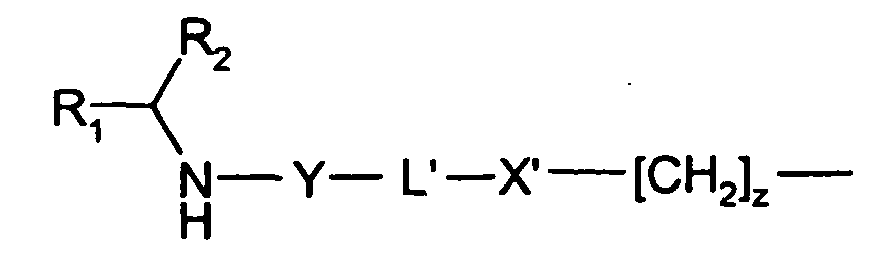
- Also in the schemes, the symbolrepresents a solid phase resin support.


- As mentioned above, the compounds with which the invention is concerned are HDAC inhibitors, and may therefore be of use in the treatment of cell proliferative disease, such as cancer, in humans and other mammals.
- It will be understood that the specific dose level for any particular patient will depend upon a variety of factors including the activity of the specific compound employed, the age, body weight, general health, sex, diet, time of administration, route of administration, rate of excretion, drug combination and the severity of the particular disease undergoing treatment. Optimum dose levels and frequency of dosing will be determined by clinical trial.
- The compounds with which the invention is concerned may be prepared for administration by any route consistent with their pharmacokinetic properties. The orally administrable compositions may be in the form of tablets, capsules, powders, granules, lozenges, liquid or gel preparations, such as oral, topical, or sterile parenteral solutions or suspensions. Tablets and capsules for oral administration may be in unit dose presentation form, and may contain conventional excipients such as binding agents, for example syrup, acacia, gelatin, sorbitol, tragacanth, or polyvinylpyrrolidone; fillers for example lactose, sugar, maize-starch, calcium phosphate, sorbitol or glycine; tabletting lubricant, for example magnesium stearate, talc, polyethylene glycol or silica; disintegrants for example potato starch, or acceptable wetting agents such as sodium lauryl sulphate. The tablets may be coated according to methods well known in normal pharmaceutical practice. Oral liquid preparations may be in the form of, for example, aqueous or oily suspensions, solutions, emulsions, syrups or elixirs, or may be presented as a dry product for reconstitution with water or other suitable vehicle before use. Such liquid preparations may contain conventional additives such as suspending agents, for example sorbitol, syrup, methyl cellulose, glucose syrup, gelatin hydrogenated edible fats; emulsifying agents, for example lecithin, sorbitan monooleate, or acacia; non-aqueous vehicles (which may include edible oils), for example almond oil, fractionated coconut oil, oily esters such as glycerine, propylene glycol, or ethyl alcohol; preservatives, for example methyl or propyl p-hydroxybenzoate or sorbic acid, and if desired conventional flavouring or colouring agents.
- For topical application to the skin, the drug may be made up into a cream, lotion or ointment. Cream or ointment formulations which may be used for the drug are conventional formulations well known in the art, for example as described in standard textbooks of pharmaceutics such as the British Pharmacopoeia.
- For topical application by inhalation, the drug may be formulated for aerosol delivery for example, by pressure-driven jet atomizers or ultrasonic atomizers, or preferably by propellant-driven metered aerosols or propellant-free administration of micronized powders, for example, inhalation capsules or other "dry powder" delivery systems. Excipients, such as, for example, propellants (e.g. Frigen in the case of metered aerosols), surface-active substances, emulsifiers, stabilizers, preservatives, flavorings, and fillers (e.g. lactose in the case of powder inhalers) may be present in such inhaled formulations. For the purposes of inhalation, a large number of apparata are available with which aerosols of optimum particle size can be generated and administered, using an inhalation technique which is appropriate for the patient. In addition to the use of adaptors (spacers, expanders) and pear-shaped containers (e.g. Nebulator®, Volumatic®), and automatic devices emitting a puffer spray (Autohaler®), for metered aerosols, in particular in the case of powder inhalers, a number of technical solutions are available (e.g. Diskhaler®, Rotadisk®, Turbohaler® or the inhalers for example as described in
European Patent Application EP 0 505 321 ). - For topical application to the eye, the drug may be made up into a solution or suspension in a suitable sterile aqueous or non aqueous vehicle. Additives, for instance buffers such as sodium metabisulphite or disodium edeate; preservatives including bactericidal and fungicidal agents such as phenyl mercuric acetate or nitrate, benzalkonium chloride or chlorhexidine, and thickening agents such as hypromellose may also be included.
- The active ingredient may also be administered parenterally in a sterile medium. Depending on the vehicle and concentration used, the drug can either be suspended or dissolved in the vehicle. Advantageously, adjuvants such as a local anaesthetic, preservative and buffering agents can be dissolved in the vehicle.
- The following syntheses illustrate the preparation of specific ester compounds of the invention and their corresponding carboxylic acids, and the HDAC inhibitory properties thereof: In the syntheses:
- Commercially available reagents and solvents (HPLC grade) were used without further purification.
Microwave irradiation was carried out using a CEM Discover focused microwave reactor.
Solvents were removed using a GeneVac Series I without heating or a Genevac Series II with VacRamp at 30° C or a Buchi rotary evaporator.
Purification of compounds by flash chromatography column was performed using silica gel, particle size 40-63 µm (230-400 mesh) obtained from Silicycle. Purification of compounds by preparative HPLC was performed on Gilson systems using reverse phase ThermoHypersil-Keystone Hyperprep HS C18 columns (12 µm, 100 X 21.2 mm), gradient 20-100% B (A= water/ 0.1% TFA, B= acetonitrile/ 0.1% TFA) over 9.5 min, flow = 30 ml/min, injection solvent 2:1 DMSO:acetonitrile (1.6 ml), UV detection at 215 nm. - 1H NMR spectra were recorded on a Bruker 400 MHz AV spectrometer in deuterated solvents. Chemical shifts (δ) are in parts per million. Thin-layer chromatography (TLC) analysis was performed with Kieselgel 60 F254 (Merck) plates and visualized using UV light.
Analytical HPLCMS was performed on Agilent HP1100, Waters 600 or Waters 1525 LC systems using reverse phase Hypersil BDS C18 columns (5 µm, 2.1 X 50 mm), gradient 0-95% B (A= water/ 0.1 % TFA, B= acetonitrile/ 0.1 % TFA) over 2.10 min, flow = 1.0 ml/min. UV spectra were recorded at 215 nm using a Gilson G1315A Diode Array Detector, G1214A single wavelength UV detector, Waters 2487 dual wavelength UV detector, Waters 2488 dual wavelength UV detector, or Waters 2996 diode array UV detector. Mass spectra were obtained over the range m/z 150 to 850 at a sampling rate of 2 scans per second or 1 scan per 1.2 seconds using Micromass LCT with Z-spray interface or Micromass LCT with Z-spray or MUX interface. Data were integrated and reported using OpenLynx and OpenLynx Browser software - The following abbreviations have been used:
- MeOH = methanol
- EtOH = ethanol
- EtOAc = ethyl acetate
- Boc = tert-butoxycarbonyl
- Cbz = carbobenzyloxy
- DCM = dichloromethane
- DCE= dichloroethane
- DMF = dimethylformamide
- DMSO = dimethyl sulfoxide
- TFA = trifluoroacetic acid
- THF = tetrahydrofuran
- Na2CO3 = sodium carbonate
- HCl = hydrochloric acid
- DIPEA = diisopropylethylamine
- NaH = sodium hydride
- NaOH = sodium hydroxide
- NaHCO3= sodium hydrogen carbonate
- Pd/C = palladium on carbon
- TBME = tert-butyl methyl ether
- DMAP = 4-Dimethylaminopyridine
- N2 = nitrogen
- PyBop = benzotriazole-1-yl-oxy-tris-pyrrolidino-phosphonium hexafluorophosphate
- Na2SO4 = sodium sulphate
- Et3N = triethylamine
- NH3 = ammonia
- TMSCl = trimethylchlorosilane
- NH4Cl = ammonium chloride
- LiAlH4 = lithium aluminium hydride
- pyBrOP = Bromo-tris-pyrrolidino phosphoniumhexafluorophosphate
- MgSO4 = magnesium sulfate
- MnO2 = Manganese dioxide
- nBuLi = n-butyllithium
- CO2 = carbon dioxide
- EDCI = N-(3-Dimethylaminopropyl)-N'-ethylcarbodiimide hydrochloride
- Et2O = diethyl ether
- LiOH = lithium hydroxide
- HOBt = 1-hydroxybenzotriazole
- DIAD = Diisopropyl azodicarboxylate
- HATU = O-(7-Azabenzotriazol-1-yl-N,N,N',N'-tetramethyluronium hexafluorophosphate
- ELS = Evaporative Light Scattering
- TLC = thin layer chromatography
- ml = millilitre
- g = gram(s)
- mg = milligram(s)
- mol = moles
- mmol = millimole(s)
- eq = mole equivalent
- LCMS = high performance liquid chromatography/mass spectrometry
- NMR = nuclear magnetic resonance
- r.t. = room temperature
- Resin was washed in the following sequence: DMF, MeOH, DMF, MeOH, DCM, MeOH, DCM, MeOH x 2, TBME x 2.
- A small amount of functionalised hydroxylamine 2-chlorotrityl resin (ca 0.3ml of reaction mixture, ca 10mg resin) was treated with 2% TFA/DCM (0.5ml) for 10min at room temperature. The resin was filtered and the filtrate was concentrated by blowing with a stream of N2 gas. LCMS of the residue was obtained.
(Note: For functionalized hydroxylamine Wang resin test cleavage was carried out using 50% TFA/ DCM). -

-

- To a round bottomed flask charged with 2-chlorotrityl-O-NH2 resin (6 g, loading 1.14 mmol/g, 6.84 mmol) and DCM (60 ml) was added diisopropylethylamine (5.30, 41.0 mmol, 6 eq). Methyl 8-chloro-8-oxooctanoate (4.2 g, 20.5 mmol, 3 eq) was slowly added to the reaction mixture with orbital shaking and the reaction mixture shaken for 48 hours. The resin was filtered and washed using the standard washing procedure. The resin was dried under vacuum. LCMS purity was determined by ELS detection, 100%, m/z 204 [M++H]+.
-

- To a round bottomed flask charged with stage 1 resin (4 g, loading 1.14 mmol/g, 4.56 mmol) was added THF (16 ml) and MeOH (16 ml). To the reaction was added a solution of NaOH (0.91 g, 22.8 mmol, 5 eq) in water (16 ml). The reaction mixture was shaken for 48 hours. The resin was filtered and washed with water x 2, MeOH x 2, followed by the standard wash procedure. The resin was dried under vacuum. LCMS purity was determined by ELS detection, 100% m/z 190 [M++H]+.
-

-

- (S)-2-Benzyloxycarbonylamino-3-tert-butoxy-propionic acid (4g, 0.014mol) was dissolved in DMF (40ml). Cyclopentanol (2.54ml, 0.027mol) and dimethylaminopyridine (0.165g, 0.014mol) were added. The solution was cooled to 0°C using an ice bath and to it was added N-(3-dimethylaminopropyl)-N'-ethylcarbodiimide hydrochloride (2.73g, 0.014mol, 1.05eq.). The mixture was stirred at 0°C for 10 minutes and then allowed to warm to r.t. and stirred for a further 18 hours. To the reaction mixture was added water (20-30ml) followed by EtOAc (40 ml). The layers were separated and the aqueous layer re-extracted with EtOAc (15 ml). The combined organic layers were washed with water (4 x 20 ml), dried (MgSO4) and the solvent removed in vacuo to give a residue. Purification by column chromatography (1:1 EtOAc/heptane) gave the product as a colourless oil (3.82g, 78% yield). 1H NMR (300 MHz, CDCl3), δ: 1.15 (9H, s, CH3 x 3), 1.50-1.90 (8H, m, CH2 x 4), 3.57 (1H, dd, J = 7.4, 1.2Hz, CH), 3.85 (1H, dd, J = 7.4, 1.2Hz, CH), 4.45 (1H, m, CH), 5.15 (2H, s, CH2), 5.25 (1H, m, CH), 5.65 (1H, d, CH, J = 7.6Hz), 7.30-7.50 (5H, m, ArH x 5).
-
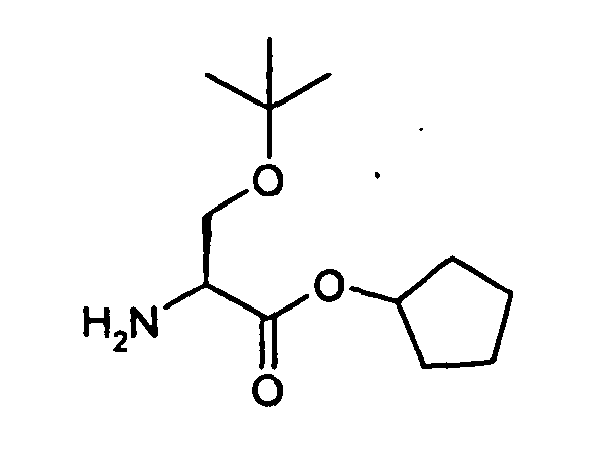
- (S)-2-Benzyloxycarbonylamino-3-tert-butoxy-propionic acid cyclopentyl ester (3.82g, 0.011 mol) was dissolved in EtOH (50ml). 20% wt. Palladium hydroxide (wet) was added cautiously to the solution. The system was evacuated and put under a hydrogen atmosphere for 4 hours. The system was evacuated and the palladium residues filtered off through Celite. The Celite was thoroughly washed with EtOH (3 x 5ml). The solvent of the filtrate was removed in vacuo to give the product as a colourless oil (2.41g, 100% yield). 1H NMR (300 MHz, CDCl3), δ: 1.15 (9H, s, CH3 x 3), 1.50-1.90 (10H, m, CH2 x 4, NH2), 3.50-3.70 (3H, m, CH2, CH), 5.22 (1H, s, CH).
-

-
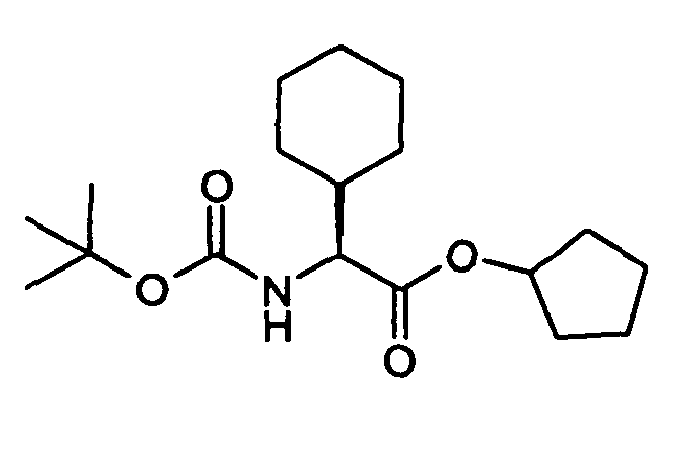
- This was prepared in the same manner as (S)-2-benzyloxycarbonylamino-3-tert-butoxy-propionic acid cyclopentyl ester (Method A, Stage 1) but from (S)-tert-butoxycarbonylamino-cyclohexyl acetic acid. 1H NMR (300 MHz, CDCl3), δ: 1.00-1.40 (10H, m, CH x 10), 1.45 (9H, s, C(CH3)3), 1.60-2.00 (8H, m, 4 x CH2), 4.15 (1H, m, CH), 5.05 (1H, d, NH, J = 7.6Hz), 5.25 (1H, m, CH).
-

- (S)-tert-butoxycarbonylamino-cyclohexyl-acetic acid cyclopentyl ester (1.17g, 3.60mmol) was dissolved in a TFA / DCM mixture (1:1, 10ml) at 0°C. The solution was stirred for 90 minutes, the solvent removed in vacuo. The residue was azetroped with a DCM / heptane mixture (2x) to give a gum. The gum was redissolved in DCM (10ml) and washed with saturated aqueous NaHCO3 solution (3 x 10ml), dried (MgSO4) and filtered. The solvent of the filtrate was removed in vacuo to give the product as an oil (0.780g, 78% yield). 1H NMR (300 MHz, CDCl3), δ: 1.00-1.40 (10h, m, CH x 10), 1.50-2.00 (8H, m, CH x 8), 3.25 (1H, d, CH, J = 7.2Hz), 5.20 (1H, m, CH).
-

-

- To a suspension of (S)-leucine (15g, 0.11mol) in cyclohexane (400ml) was added cyclopentanol (103.78ml, 1.14mmol) and p-toluene sulfonic acid (23.93g, 0.13mol). The suspension was heated at reflux to effect solvation. After refluxing the solution for 16 hours it was cooled to give a white suspension. Heptane (500ml) was added to the mixture and the suspension was filtered to give the product as a white solid (35g, 85% yield). 1H NMR (300 MHz, MeOD), δ: 1.01 (6H, t, CH3x2, J = 5.8Hz), 1.54-2.03 (11H, m, 11 x CH), 2.39 (3H, s, CH3), 3.96 (1H, t, CH, J = 6.5Hz), 5.26-5.36 (1H, m, CH), 7.25 (2H, d, ArH x 2, J = 7.9Hz), 7.72 (2H, d, ArH x 2, J = 8.3Hz).
-

- A solution of (S)-2-amino-4-methyl-pentanoic acid cyclopentyl ester toluene-4-sulfonic acid (2.57g, 0.013mol) in DCM (5ml) was washed with saturated aqueous NaHCO3 solution (2 x 3ml). The combined aqueous layers were back extracted with DCM (3 x 4ml). The combined organic layers were dried (MgSO4), and the solvent removed in vacuo to give a colourless oil (1.10g, 80% yield). 1H NMR (300 MHz, CDCl3), δ: 0.90 (6H, t, CH3 x 2, J = 6.4Hz), 1.23-1.94 (11H, m, 5 x CH2, CH), 3.38 (1H, dd, CH, J = 8.4, 5.9Hz), 5.11-5.22 (1H, m, CH).
-

-

- This was prepared in the same manner as (S)-2-Benzyloxycarbonytamino-3-tert-butoxy-propionic acid cyclopentyl ester (Method A, Stage 1) but from (S)-3-tert-Butylsulfanyl-2-(9H-fluoren-9-ylmethoxycarbonylamino)-propionic acid. 1H NMR (300 MHz, CDCl3), δ: 1.30 (9H, s, (CH3)3), 1.55-1.95 (8H, m, CH2 x 4), 3.05 (2H, d, CH2, J = 4.8Hz), 4.20-4.30 (1H, m, CH), 4.40 (2H, d, CH2, J = 7.5Hz), 4.65 (1H, m, CH), 5.25 (1H, m, CH), 5.70 (1H, d, NH, J = 7.8Hz), 7.30-7.50 (4H, m, ArH x 4), 7.65 (2H, d, J = 7.5Hz, ArH x 2), 7.80 (2H, d, J = 7.5Hz, ArH x 2).
-

- (S)-3-tert-Butylsulfanyl-2-(9H-fluoren-9-ylmethoxycarbonylamino)-propionic acid cyclopentyl ester (1.63g, 3.50mmol) was dissolved in a CH3CN (25ml) at 0°C. Piperidine (21 ml) was added to the solution. After stirring for 30 minutes, the solvent was removed in vacuo to give a residue. Purification by column chromatography (EtOAc eluent) gave the product as a colourless oil (628mg, 73% yield). 1H NMR (300 MHz, CDCl3), δ: 1.30 (9H, s, (CH3)3), 1.55-1.95 (8H, m, CH2 x 4), 2.75 (1H, dd, CH, J = 7.2, 12.3Hz), 2.95 (1H, dd, CH, J = 4.8, 12.3Hz), 5.25 (1H, m, CH).
-
- (S)-2-Benzyloxycarbonylamino-succinic acid 4-tert-butyl ester
- (S)-2-Benzyloxycarbonylamino-succinamic acid
- (S)-2-Benzyloxycarbonylamino-4-carbamoyl-butyric acid
- (S)-2-Benzyloxycarbonylamino-3-(4-tert-butoxy-phenyl)-propionic acid
- (S)-2-Benzyloxycarbonylamino-3-hydroxy-butyric acid
- (S)-2-Benzyloxycarbonylamino-3,3-dimethyl-butyric acid
- (S)-2-Benzyloxycarbonylamino-3-(1H-indol-2-yl)-propionic acid
- (S)-2-Benzyloxycarbonylamino-6-tert-butoxycarbonylamino-hexanoic acid
-
- tert-Butoxycarbonylamino-acetic acid
- (S)-2-tert-Butoxycarbonylamino-3-methyl-pentanoic acid
- (S)-Pyrrolidine-1,2-dicarboxylic acid 1-tert-butyl ester
- (S)-2-tert-Butoxycarbonylamino-3-methyl-butyric acid
- (S)-2-tert-Butoxycarbonylamino-4-methylsulfanyl-butyric acid
-
- (S)-Amino-phenyl-acetic acid
- (S)-2-Amino-3-phenyl-propionic acid
- (S)-2-Amino-propionic acid
- (S)-2-Amino-4-methyl-pentanoic acid
-

-

- A mixture of 4-nitrobenzyl bromide (15g, 69.4mmol), L-phenylglycine cyclopentylester tosyl salt (27.1g, 60.4mmol) and potassium carbonate (19.6g, 138.8mmol) in DMF (250ml) was stirred at room temperature for 18h. The reaction mixture was diluted with EtOAc (300ml) and washed with water (3 x 200ml). The EtOAc layer was isolated, dried (Na2SO4), filtered and concentrated to dryness yielding an orange colour oil. A crude weight of 21 g was isolated. LCMS purity 81%, m/z 355 [M++H]+, This product was used without further purification.
-
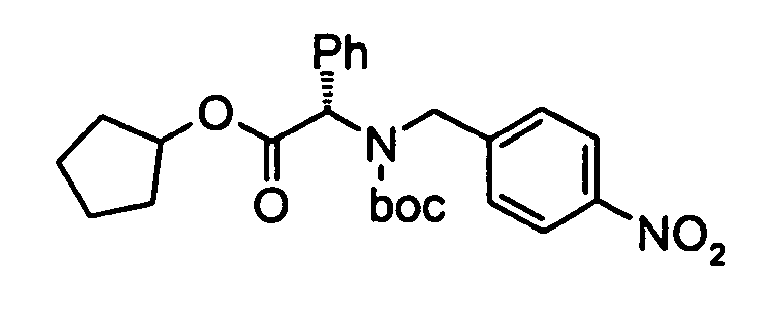
- To a solution of Stage 1 product (15g, 42.37mmol) in THF (150ml) was added K2CO3 (6.9g, 50.8mmol), followed by di-t-butyldicarbonate (22.2g, 101.7mmol). Water (150ml) was added and the reaction stirred at room temperature for 36h. The reaction mixture was evaporated to dryness. The residue was redissolved in EtOAc (300ml), washed consecutively with 0.1 M HCl (150ml), sat. aq. NaHCO3 and water (150 ml). The EtOAc layer was dried (Na2SO4), filtered and concentrated to dryness yielding a yellow oil. After purification by column chromatography (10% EtOAc/ hexane) the product was obtained as clear yellow oil (12g, 62% yield). LCMS purity 95%, m/z 455 [M++H]+, 496 [M++H+41]+.
-
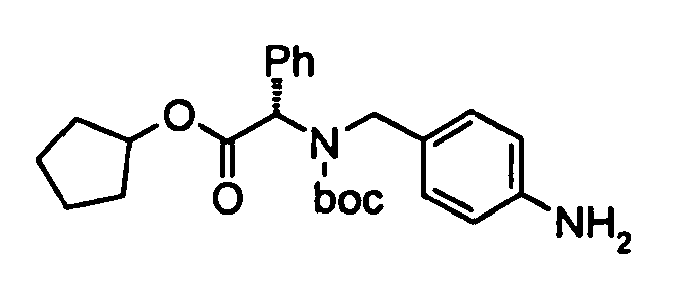
- A mixture of Stage 2 product (12g, 26.4mmol) and 10% Pd/C (2.0g) in EtOAc (350ml) was hydrogenated at room temperature for 18h. The Pd/C catalyst was filtered off through a pad of celite. The filtrate was concentrated under reduced pressure to yield a white solid (10.1g, 90% yield). LCMS purity 100%, m/z 425 [M++H]+, 466 [M++H+41]+.
-

- Hydroxylamine 2-chlorotrityl resin derivatized with suberic acid (1.0g, loading 0.94mmol) was swollen in anhydrous DCM (100ml). 1-Chloro-N,N-2-trimethylpropenylamine (Ghosez reagent)1 (0.373ml, 2.82mmol, 3eq) was added at 0 °C under the atmosphere of N2. The mixture was allowed to warm to room temperature and gently shaken for 1-2h. Stage 3 aniline (1.2g, 2.82mmol, 3eq) was added portionwise over 20min. Et3N (0.53ml, 3.76mmol, 4eq) was added. The mixture was shaken for 1 h. LCMS after a test cleave shows 70% conversion, m/z 596 [M++H]+. The resin was filtered and washed using the standard wash procedure. The resin was dried under vacuum.
-

- Stage 4 resin (1.5g, loading 0.94mmol) was gently shaken in 2% TFA/DCM (10ml) for 20mins. The resin was filtered. The filtrate was collected and evaporated under reduced pressure at room temperature. The resin was re-treated with 2% TFA/DCM (10ml) and after 20mins filtered. The combined filtrates were evaporated to dryness under reduced pressure at r.t to give a residue. This residue was allowed to stand in 20% TFA/DCM for 40mins. After evaporation to dryness, also under reduced pressure at r.t, the residue was purified by preparative HPLC to yield compound (20) as the TFA salt, LCMS purity 95%, m/z 496 [M++H]+, 1H NMR (400 MHz, DMSO), δ: 1.30-1.50 (6 H, m, 3 x CH2), 1.50-1.70 (8H, m, 4 x CH2), 1.80 (2 H, m, CH2), 2.10 (2 H, t, CH2), 2.45 (2 H, t, CH2), 4.1 (2 H, dd, CH 2 NH), 5.25 (1 H, m, CHOCO), 5.35 (1 H, m, OCOCHPh), 7.45 (2 H, d, Ar), 7.60 (5 H, m, Ar), 7.80 (2 H, d, Ar), 10.00-10.10 (2 H, br s), 10.50 (1 H, s).
-

- Stage 4 resin (2.5g, loading, 0.94mmol, 2.35mmol) was suspended in MeOH (8.7ml) and THF (8.7ml). An aq. solution of 2.7 N NaOH (8.8ml, 10eq, 23.5mmol) was added. The mixture was shaken for 36h. LCMS of the test cleave confirmed the completion of reaction, m/z 528 [M++H]+. The resin was filtered and washed with water x 2, MeOH x 2, followed by the standard wash procedure. The resin was dried under vacuum.
-

- Stage 6 resin (2.5g, loading 0.94mmol, 2.35mmol) was cleaved and boc deprotected using the procedure outlined for Stage 5. The crude product (0.40g) was purified by preparative HPLC giving compound (21) as the TFA salt. LCMS purity 100%, m/z 428 [M++H], 1H NMR (400 MHz, CD3OD), δ: 1.30 (4 H, 2 x CH2), 1.55 (4 H, 2 x CH2), 2.00 (2 H, t, CH2), 2.30 (2 H, t, CH2), 3.90 (1 H, s, NHCH2), 4.05 (2 H, dd, NHCH2), 4.95 (1 H, s, CHPh), 7.35 (2 H, d, Ar), 7.40 (5 H, m, Ar), 7.55 (2 H, d, Ar).
-

-

- To a solution of L-phenylglycine (0.227g, 1.5mmol) in water (5 ml) and dioxane (5ml) was added triethylamine (0.42ml, 3.0mmol) followed by slow addition of 4-nitrobenzene sulphonyl chloride (0.5g, 2.3mmol) in dioxane (5ml) at 0°C. After stirring for 45 minutes the reaction mixture was evaporated to dryness, re-dissolved in EtOAc and washed with saturated NaHCO3 solution (2x20ml) and water (10ml). The EtOAc layer was dried over Na2SO4, filtered and evaporated to dryness. LCMS purity 75%, (molecular ion not observed) yield 0.58g, (76%). This material was used without any purification.
-

- To a solution of stage 1 acid (4.32g, 12.8mmol) in cyclopentanol (60ml) at 0°C was added slowly thionyl chloride (9.3ml, 128mmol). The reaction mixture was stirred and heated under reflux at 70°C for 2 hours. The excess thionyl chloride was removed by evaporation in vacuo, the reaction mixture was extracted into EtOAc and washed with saturated NaHCO3 solution and dried over Na2SO4, filtered and evaporated to dryness. Flash column chromatography purification with DCM gave the required product (3.6g, 70% yield). LCMS purity of 100%, (molecular ion not observed).
-

- A mixture of (S)-(4-Nitro-benzenesulfonylamino)-phenyl-acetic acid cyclopentyl ester (5.29g, 13.1mmol) and 10% Pd/C (5.0g) in EtOAc (350ml) was hydrogenated under balloon pressure at room temperature for 24h. The Pd/C catalyst was filtered off through a pad of celite. The filtrate was concentrated under reduced pressure to yield the required product (4.54g, 92% yield). LCMS purity 100%, m/z 375 [M++H]+.
-

- Hydroxylamine 2-chlorotrityl resin derivatized with suberic acid (0.39g, loading 1.14mmol/g) was swollen in anhydrous DCM (25ml) and at 0°C under N2 atmosphere 1-chloro-N,N, 2-trimethylpropenylamine (0.175ml, 1.33mmol) added dropwise. The reaction mixture was shaken for 1.5 hours. A solution of stage 3 aniline (0.5g, 1.33mmol) in DCM (25ml) was added followed by triethylamine (0.25ml, 1.76mmol). The reaction mixture was shaken for a further 10 minutes. LCMS after a test cleave showed 61% conversion, m/z 546 [M++H]+. The resin was filtered and washed using the standard wash procedure. The resin was dried under vacuum and used in the next step.
-

- Stage 4 resin (1.12g, loading 1.14mmol/g) was gently shaken in 2% TFA/DCM (10ml) for 20mins. The resin was filtered. The filtrate was collected and evaporated under reduced pressure at room temperature. The resin was re-treated with 2% TFA/DCM (10ml) and after 20mins filtered. The combined filtrates were evaporated to dryness under reduced pressure at room temperature to give a residue. The residue was purified by preparative HPLC to yield compound (22). LCMS purity 93%, m/z 546 [M++H]+, +H NMR (400 MHz, DMSO), δ:1.20-1.68 (16 H, m, 8 x CH2), 1.93 (2 H, t, CH2), 2.33 (2H, t, CH2), 4.80 (1 H, m, CHOCO), 4.81 (1 H, d, OCOCHPh), 7.27 (5 H, m, Ar), 7.65 (2 H, d, Ar), 7.71 (2 H, d, Ar), 8.67 (1 H, br s), 8.75 (1 H, d), 10.24 (1 H, s), 10.34 (1 H, s).
-

- Stage 4 resin (1.2g, loading 1.14mmol/g) was suspended in THF (8ml) and methanol (8ml) and 2.7M sodium hydroxide (5.1 ml, 13.68mmol) was added. The mixture was shaken for 48h. LCMS of the test cleave confirmed the completion of reaction, m/z 478 [M++H]+. The resin was filtered and washed with water x 2, MeOH x 2, followed by the standard wash procedure. The resin was dried under vacuum.
-

- Stage 6 resin (1.2g, loading 1.14mmol/g) was gently shaken in 2% TFA/DCM (10ml) for 20mins. The resin was filtered. The filtrate was collected and evaporated under reduced pressure at room temperature. The resin was re-treated with 2% TFA/DCM (10ml) and after 20mins filtered. The combined filtrates were evaporated to dryness under reduced pressure at room temperature to give a residue. The residue was purified by preparative HPLC to yield compound (23). LCMS purity 91%, m/z 478 [M++H]+, 1H NMR (400 MHz, MeOD), δ:1.44 (4 H, m, 2 x CH2),1.62-1.74 (4 H, m, 2 x CH2), 2.12 (2 H, t, CH2), 2.34 (1 H, m, OCOCHPh), 2.41 (2 H, t, CH2), 7.25 (5 H, m, Ar), 7.69 (2 H, d, Ar), 7.72 (2 H, d, Ar).
-

-

-

- 3-Nitrobenzyl bromide (10.0g, 46mmol) was dissolved in DMF (180ml) and potassium carbonate (12.7g, 92mmol) added, followed by L-phenylalanine ethyl ester hydrochloride (10.6g, 46mmol). The reaction was stirred for 17 h at room temperature before evaporating to dryness. The residue was re-dissolved in EtOAc (150ml) and washed with water (3X80ml), dried (Na2SO4) filtered and concentrated to dryness. After purification by flash column chromatography (30% EtOAc/ hexane) the product was obtained (3.7g, 24% yield). LCMS purity 86%, m/z 329 [M++H]+.
-

- Stage 1 amine (13.4g, 40.9mmol) was dissolved in THF (250ml) before addition of potassium carbonate (8.46g, 61.4mmol) and water (150ml). Di-tbutyl-dicarbonate (35.6. 163mmol) was added and the reaction mixture heated to 50°C for 18 h. DCM was added the resultant mixture washed consecutively with 0.1 M HCl (150ml), sat. aq. NaHCO3 and water (150 ml). The DCM layer was dried (Na2SO4), filtered and concentrated to dryness. After purification by flash column chromatography (5% EtOAc/ hexane) the product was isolated (9.4g, 54% yield). LCMS purity 95%, m/z 428 [M++H]+.
-

- Stage 2 carbamate (4.92g, 11.5mmol) was dissolved in EtOAc (150ml) before addition of Pd/C (10% wet) catalyst (0.8g) and hydrogenated under balloon pressure at room temperature for 18 h. The reaction mixture was filtered through a pad of celite and evaporated to dryness to give a red solid (4.0g, 89% yield). LCMS purity 100%, m/z 399 [M++H]+.
-

- Hydroxylamine 2-chlorotrityl resin derivatized with suberic acid (1.0 g, loading 0.83mmol/g) was swollen in DMF (15ml) and PyBOP (1.36g, 2.61mmol) added, followed by DIPEA (1.5ml, 8.7mmol). Stage 3 aniline (1.04g, 2.61mmol) was dissolved in DCM (15ml) and added to the reaction mixture. The reaction was shaken for 24 h at room temperature. LCMS after a test cleave indicated 86% conversion, m/z 570 [M++H]+. The resin was filtered and washed using the standard wash procedure. The resin was dried under vacuum.
-

- Stage 4 resin (1.3g, loading 0.83mmol) was gently shaken in 2% TFA/DCM (10ml) for 20mins. The resin was filtered. The filtrate was evaporated under reduced pressure at room temperature. The resin was re-treated with 2% TFA/DCM (10ml) and was filtered after 20mins. The combined filtrates were evaporated to dryness under reduced pressure at room temperature to give an oily residue. The residue was allowed to stand in 20% TFA/DCM for 40mins. After evaporation to dryness, also under reduced pressure at room temperature, the crude product was purified by preparative HPLC to yield compound (26). LCMS purity 100%, m/z 470 [M++H]+, 1H NMR (400 MHz, MeOD), δ: 1.08 (3 H, t, CH3), 1.35-1.45 (4 H, m, 2 x CH2), 1.60-1.80 (4 H, m, 2 x CH2), 2.10 (2 H, t, CH2), 2.40 (2 H, t, CH2), 3.13 (1 H, dd, PhCHH), 3.40 (1 H, dd, PhCHH), 4.11 (2 H, q, CH 2CH3), 4.14-4.22 (3 H, m), 7.20-7.48 (8 H, m, Ar), 7.92 (1 H, s, Ar).
-

- Stage 4 resin (1.4g, loading 0.83mmol) was suspended in THF (8.6ml) and methanol (8.6 ml) and 1.4M sodium hydroxide solution (8.6ml, 5.98mmol) was added. The mixture was shaken for 24 hours before test cleavage revealed 83% conversion to required acid, m/z 541 [M++H] The resin was filtered and washed with water x 2, MeOH x 2, followed by the standard wash procedure. The resin was dried under vacuum.
-

- Stage 6 resin (1.44g, loading 0.83mmol) was gently shaken in 2% TFA/DCM (10ml) for 20mins. The resin was filtered. The filtrate was evaporated under reduced pressure at room temperature. The resin was re-treated with 2% TFA/DCM (10ml) and was filtered after 20mins. The combined filtrates were evaporated to dryness under reduced pressure at room temperature to give an oily residue. The residue was allowed to stand in 20% TFA/DCM for 40mins. After evaporation to dryness, under reduced pressure at room temperature, the crude product was purified by preparative HPLC to yield compound (27). LCMS purity 100%, m/z 442 [M++H]+, 1H NMR (400 MHz, MeOD). δ: 1.35-1.48 (4 H, m, 2 x CH2), 1.60-1.78 (4 H, m, 2 x CH2), 2.10 (2 H, t, CH2), 2.40 (2 H, t, CH2), 3.20 (1 H, dd, PhCHH), 3.28 (1 H, dd, PhCHH), 3.90 (1 H, t, OCOCH), 4.14 (2 H, m), 7.15 (1 H, d, Ar), 7.26 (6 H, m, Ar), 7.51 (1 H, d, Ar), 7.73 (1 H s, Ar).
- The following compounds were prepared according to the procedure described for compound (26) and compound (27)
- LCMS purity 100%, m/z 510 [M++H]+, 1H NMR (400 MHz, MeOD), δ:1.00-1.61 (16 H, m, 8 x CH2), 1.90 (2 H, t, CH2), 2.20 (2 H, d, CH2), 2.90 (1 H, dd, PhCHH), 3.20 (1 H, dd, PhCHH), 4.00-4.11 (3 H, m), 4.91 (1 H, m), 7.00-7.25 (8 H, m, Ar), 7.75 (1 H, s, Ar).
- LCMS purity 100%, m/z 484 [M++H]+, 1H NMR (400MHz, MeOD), δ: 1.23-1.29 (7 H, m, CH3, 2 x CH2), 1.53 (2 H, t, CH2), 1.62 (2 H, t, CH2), 1.99 (2 H, t, CH2), 2.11-2.16 (2 H, m, CH2), 2.28 (2 H, t, CH2), 2.53-2.61 (1 H, m, CH), 2.65-2.76 (1 H, m, CH), 3.80-3.90, (1 H, m, CHCO2Et), 4.05 (2H, s, CH2), 4.21 (2 H, q, CH2), 7.05-7.15 (4 H, m, Ar), 7.15-7.22 (2 H, m, Ar), 7.25-7.39 (2 H, m, Ar), 7.75 (1 H, s, Ar).
- LCMS purity 100%, m/z 456 [M++H]+, 1H NMR (400MHz, MeOD), δ: 1.27-1.32 (4 H, m, 2 x CH2), 1.53 (2 H, t, CH2), 1.62 (2 H, t, CH2), 1.99 (2 H, t, CH2), 2.11-2.16 (2 H, m, CH2), 2.29 (2 H, t, CH2), 2.57-2.64 (1 H, m, CH), 2.69-2.77 (1 H, m, CH), 3.84-3.87 (1 H, m, CHCO2H), 4.12 (2 H, q, CH2), 7.09-7.11 (4 H, m, Ar), 7.16-7.20 (2 H, m, Ar), 7.27-7.35 (2 H, m, Ar), 7.78 (1 H, s, Ar).
- LCMS purity 100%, m/z 524 [M++H]+, 1H NMR (400 MHz, MeOD), δ:1.20-1.35 (4 H, m), 1.45-1.62 (10 H, m), 1.85 (2 H, m), 2.00 (2 H, t, CH2), 2.10 (2 H, m), 2.28 (2 H, t, CH2), 2.55 (1 H, m), 2.68 (1 H, m), 3.88 (1 H, t, OCOCHNH), 4.11 (2 H, s, CH 2Ph), 5.24 (1 H, m) 7.02-7.12 (4 H, m, Ar), 7.18 (2 H, m, Ar), 7.30 (2 H, m, Ar), 7.80 (1 H, s, Ar).
- LCMS purity 90%, m/z 466 [M++H]+, 1H NMR (400 MHz, MeOD), δ:1.25 (9 H, s, C(CH 3)3), 1.35 (3 H, t, CH2CH 3), 1.35-1.45 (4 H, m, 2 x CH2), 1.62-1.76 (4 H, m, 2 x CH2), 2.12 (2 H, t, CH2), 2.40 (2 H, t, CH2), 3.89 (1 H, m), 3.98 (1 H, m), 4.20-4.40 (5 H, m), 7.25 (1 H, d, Ar), 7.39-7.50 (2 H, m, Ar), 7.90 (1 H, s, Ar).
- LCMS purity 86%, m/z 438 [M++H]+, 1H NMR (400 MHz, MeOD), δ: 1.20 (9 H, s, C(CH 3)3), 1.38 (4 H, m, 2 x CH2), 1.57-1.75 (4 H, m ,2 x CH2), 2.10 (2 H, t, CH2), 2.39 (2 H, t, CH2), 3.78-3.85 (3 H, m), 4.26 (2 H, s, CH2Ph), 7.21 (1 H, d, Ar), 7.39 (1 H, t, Ar), 7.50 (1 H, d, Ar), 7.80 (1 H, s, Ar).
- LCMS purity 94%, m/z 506 [M++H]+, 1H NMR (400 MHz, MeOD), δ:1.25 (9 H, s, C(CH3)3), 1.33-1.50 (4 H, m, 2 x CH2), 1.60-2.00 (12 H, m), 2.13 (2 H, t, CH2), 2.42 (2 H, t, CH2), 3.83-4.00 (2 H, m), 4.18 (1 H, m), 4.28 (2 H, s, CH2Ph), 5.35 (1 H, m), 7.25 (1 H, m, Ar), 7.45 (2 H, m, Ar), 7.90 (1 H, s, Ar).
- LCMS purity 97%, m/z 484 [M++H]+, 1H NMR (400 MHz, MeOD), δ: 1.30 (13 H, m, 2 x CH2, C(CH 3)3),1.45-1.65 (4 H, m, CH2 x 2), 1.93-2.05 (2 H, m, CH2), 2.20-2.40 (2 H, m, CH2), 3.99 (2 H, q, CH2), 4.65-4.95 (1 H, m, CH, masked signal) 7.05 (1 H, d, Ar), 7.25-7.33 (2 H, m, Ar), 7.35-7.50 (5 H, m, Ar), 7.75 (1 H, s, Ar).
- LCMS purity 100%, m/z 496 [M++H]+, 1H NMR (400MHz, MeOD), δ:1.30-1.70 (16 H, m, 8 x CH2), 2.00 (2 H, t, CH2). 2.30 (2 H, t, CH2), 4.05 (2 H, dd, CH 2 NH), 5.00 (1 H, m, OCOCHPh), 5.15 (1 H, m, CHOCO), 7.05 (1 H, m, Ar), 7.30 (2 H, m, Ar), 7.40 (5 H, m, Ar), 7.75 (1H, m, Ar).
- LCMS purity 100%, m/z 428 [M++H]+, 1H NMR (400MHz, MeOD), δ: 1.20-1.35 (4 H, m, 2 x CH2), 1.50-1.65 (4 H, m, 2 x CH2), 2.00 (2 H, m, CH2), 2.30 (2 H, m, CH2), 4.00 (2 H, dd, CH 2NH), 4.90 (1 H, m, OCOCHPh), 7.05 (1 H, m, Ar), 7.25-7.50 (7 H, m, Ar), 7.70 (1 H, m, Ar).
- LCMS purity 91%, m/z 408 [M++H]+, 1H NMR (400 MHz, MeOD), δ: 0.78 (3 H, d, J = 6.6 Hz, CH3), 0.84 Hz (3 H, d, J = 6.6 Hz, CH3), 1.26-1.40 (6 H, m, alkyl), 1.49- 1.70 (5 H, m, CH + 2 x CH2), 1.95 (2 H, t, J = 7.32, CH2), 2.25 (2 H, t, J = 7.36, CH2), 3.00 (1 H, t, J = 6.88 Hz, NHCHCO), 3.42 (1 H, d, J = 12.7 Hz, CH), 3.68 (1 H, d, J = 12.5 Hz, CH), 7.00 (1 H, d, J = 7.6 Hz, Ar), 7.15 (1 H, t, J = 7.8 Hz, Ar), 7.30 (1 H, s. Ar), 7.47 (1 H, br d, Ar)
- LCMS purity 100%, m/z 476 [M++H]+, 1H NMR (400 MHz, MeOD), δ: 0.85 - 0.95 (6 H, 2 x d, 2 x CH3), 1.30 (4 H, m, 2 x CH2), 1.50 - 1.70 (13 H, m, alkyl), 1.75 (2 H, m, CH2), 2.00 (2 H, t, CH2), 2.30 (2 H, t, CH2), 3.90 (1 H, NHCHCO), 4.10 (2 H, q, CH2), 5.25, (1 H, m, CH), 7.10 (1 H, d, Ar), 7.30 (2 H, m), 7.80 (1 H, s, Ar)
-

-

- A mixture of 2-nitrobenzyl bromide (15g, 69.4mmol), L-phenylglycine cyclopentyl ester tosyl salt (27.2g, 69.4mmol) and potassium carbonate (19.2g, 138.8mmol) in DMF (300ml) was stirred at room temperature for 18 h. The reaction mixture was diluted with EtOAc (300ml) and washed with water (3 x 200ml). The EtOAc layer was isolated, dried (Na2SO4), filtered and concentrated to dryness yielding an orange coloured oil. A crude weight of 24g was isolated. LCMS purity 81%, m/z 355 [M++H]+. This product was used without further purification
-

- To a solution of (S)-(2-Nitro-benzylamino)-phenyl-acetic acid cyclopentyl ester (24.4g, 69.1 mmol) in THF (150ml) was added K2CO3 (7.6g, 69.1 mmol), followed by di-tert-butyl dicarbonate (30.1g, 138.1 mmol). Water (150ml) was added and the reaction stirred at room temperature for 8 days with further di-tert-butyl dicarbonate (45.1g, 206.6mmol). The reaction mixture was evaporated to dryness. The residue was re-dissolved in EtOAc (300ml), washed with 0.1 M HCl (150ml), sat. aq.NaHCO3 and water (150 ml). The EtOAc layer was dried (Na2SO4), filtered and concentrated to dryness yielding a yellow oil. After purification by column chromatography (20% EtOAc/ hexane) the product was obtained as clear yellow oil (15g, 48% yield).
-

- A mixture of stage 2 carbamate (4.44g, 9.78mmol) and 10% Pd/C (0.7g) in EtOAc (130ml) was hydrogenated at room temperature for 18 h under balloon pressure. The Pd/C catalyst was filtered off through a pad of celite. The filtrate was concentrated under reduced pressure to yield a white solid (4.25g). LCMS purity 100%, m/z 425 [M++H]+,
-

- Hydroxylamine 2-chlorotrityl resin derivatized with suberic acid (1.6g, loading 0.83mmol) was swollen in anhydrous DCM (100ml). 1-Chloro-N,N-2-trimethylpropenylamine (Ghosez reagent)1 (0.56ml, 3.3mmol, 3eq) was added at 0 °C under the atmosphere of N2. The mixture was allowed to warm to room temperature and gently shaken for 1-2 h. Stage 3 aniline (1.4g, 3.3mmol, 3eq) was added portionwise over 20min. Et3N (0.76ml, 4.4mmol, 4eq) was added. The mixture was shaken for 1 h. LCMS after a test cleave shows 97% conversion, m/z 596 [M++H]+. The resin was filtered and washed using the standard wash procedure. The resin was dried under vacuum.
- 1. Ghosez et al, J. C. S. Chem. Comm., 1979, 1180.
-

- Stage 4 resin (1.34g, loading 0.83mmol) was gently shaken in 2% TFA/DCM (10ml) for 20mins. The resin was filtered. The filtrate was collected and evaporated under reduced pressure at room temperature. The resin was re-treated with 2% TFA/DCM (10ml) and after 20mins filtered. The combined filtrates were evaporated to dryness under reduced pressure at room temperature to give a residue. This residue was allowed to stand in 20% TFA/DCM for 40mins. After evaporation to dryness, also under reduced pressure at room temperature, the residue was purified by preparative HPLC to yield compound 40 as the TFA salt, LCMS purity 100%, m/z 496 [M++H]+, 1H NMR (400MHz, MeOD), δ: 1.40-2.00 (16 H, m, 8 x CH2), 2.15 (2 H, m, CH2), 2.45 (2 H, m, CH2), 3.95 (1 H, d, CH 2 NH), 4.20 (1 H, d, CH 2 NH), 5.20 (1 H, m, OCOCHPh), 5.35 (1 H, m, CHOCO), 7.25 (1 H, m, Ar), 7.40 (1 H, m, Ar), 7.50-7.60 (7 H, m, Ar).
-

- Stage 4 resin (2.0g, loading, 0.83mmol, 2.35mmol) was suspended in MeOH (6.1) and THF (6.1ml). 2.7 N NaOH (aq, 6.1ml) was added. The mixture was shaken for 5 days. LCMS of the test cleave confirmed the completion of reaction, m/z 528 [M++H]+. The resin was filtered and washed with water x 2, MeOH x 2, followed by the standard wash procedure. The resin was dried under vacuum.
-

- Stage 6 resin (2.0g, loading 0.83mmol) was cleaved and boc deprotected using the procedure outlined for stage 5. The crude product was purified by preparative HPLC yielding compound (41) as the TFA salt. LCMS purity 98%, m/z 428 [M++H]+, 1H NMR (400MHz, MeOD), δ: 1.25-1.35 (4 H, m, 2 x CH2), 1.50-1.65 (4 H, m, 2 x CH2), 2.00 (2 H, m, CH2), 2.30 (2 H, m, CH2), 3.80 (1 H, d, CH 2 NH), 4.10 (1 H, d, CH 2 NH), 5.00 (1 H, m, OCOCHPh), 7.10 (1 H, m, Ar), 7.30 (1 H, m, Ar), 7.40-7.50 (7 H, m, Ar). CH2CH), 4.80 (2 H, m, CH 2 NH, masked signal), 6.00 (1 H, m, OCOCHPh), 6.90 (1 H, m, Ar), 7.00 (1 H, m, Ar), 7.20 (1 H, m, Ar), 7.30-7.50 (6 H, m, Ar).
-


-

- (S)-1,2,3,4-Tetrahydroisoquinoline-3-carboxylic acid (10g, 56mmol), TMSCI (39ml, 310mmol) and methanol (500ml) were refluxed together (at 70°C) for 2 hours. The reaction mixture was evaporated to dryness and LCMS analysis indicated 100% conversion to (S)-1,2,3,4-tetrahydro-isoquinoline-3-carboxylic acid methyl ester, m/z 192 [M++H]+.
-

- Meythl-3-aminobenzoate was obtained from commercial sources
-

-

- Hydroxylamine 2-chlorotrityl resin derivatized with suberic acid (6.6g, loading, 0.83mmol) was swollen in anhydrous DCM (65ml). PyBOP (8.6g, 16.43mmol), amine building block A (3.7g, 16.43mmol) and DIPEA (9.5ml, 58.4mmol) were added. The reaction was shaken for 24 hours at room temperature. LCMS of test cleaved material indicated reaction completion. The resin was filtered and washed using the standard wash procedure. The resin was dried under vacuum.
-

- Resin bound stage 1 ester (6.95g, loading 0.83mmol/g) was suspended in THF (25ml) and methanol (25ml). Sodium hydroxide, 1.4M aqueous solution (25ml) was added. The mixture was shaken for 48 hours and further sodium hydroxide (25ml) added after 24 hours. LCMS of the test cleaved material indicated 65% conversion to the acid m/z 349 [M++H]+. The resin was filtered and washed with water x 2, MeOH x 2, followed by the standard wash procedure. The resin was dried under vacuum.
-

- Resin bound stage 2 carboxylic acid (2.2g, loading 0.83mmol/g) was swollen in anhydrous DCM (25ml). PyBOP (2.85g, 5.48mmol), L-phenylglycine cyclopentyl ester tosyl salt (2.14g, 5.48mmol) and DIPEA (3.17ml, 18.3mmol) were added. The mixture was shaken for 24 hours at room temperature. LCMS following test cleavage revealed 52% conversion, m/z 550 [M++H]+. The resin was filtered and washed using standard wash procedure. The resin was dried under vacuum
-

- Stage 3 resin (2.2g, loading 0.83mmol) was gently shaken in 2% TFA/DCM (10ml) for 20mins. The resin was filtered. The filtrate was collected and evaporated under reduced pressure at room temperature. The resin was re-treated with 2% TFA/DCM (10ml) and after 20mins filtered. The combined filtrates were evaporated to dryness under reduced pressure at room temperature to give a residue. The residue was purified by preparative HPLC to yield compound (44) as the TFA salt. LCMS purity 95%, m/z 550 [M++H]+, 1H NMR (400 MHz, MeOD), δ:1.12-1.75 (16 H, m, 8 x CH2), 1.92-2.02 (2 H, m, CH2), 2.09-2.30 (1 H, m), 2.48 (1 H, m), 3.10 (2 H, m, CH2), 4.58-4.66 (2 H, m, CH2), 4.82 (1 H, m), 5.04 (1 H, m), 5.20 (1 H, s, OCOCHPh), 6.95-7.20 (9 H, m, Ar).
-

- Stage 3 resin (1.3g, 1.13mmol) was suspended in THF (4.6ml) and methanol (4.6 ml). Sodium hydroxide added as a 1.4M aqueous solution (4.6ml). The mixture was shaken for 24 hours. LCMS of the test cleaved material confirmed conversion to required acid. The resin was filtered and washed with water x 2, MeOH x 2, followed by the standard wash procedure. The resin was dried under vacuum.
-

- Stage 5 resin (1.3g, loading 0.83mmol) was gently shaken in 2% TFA/DCM (10ml) for 20mins. The resin was filtered. The filtrate was collected and evaporated under reduced pressure at room temperature. The resin was re-treated with 2% TFA/DCM (10ml) and after 20mins filtered. The combined filtrates were evaporated to dryness under reduced pressure at room temperature to give a residue. The residue was purified by preparative HPLC to yield compound (45). LCMS purity 96%, m/z 482 [M++H]+, 1H NMR (400 MHz, MeOD), δ: 1.12-1.38 (4 H, m, 2 x CH2), 1.45-1.61 (4 H, m, CH2), 1.98 (2 H, m, CH2), 2.10-2.58 (2 H, m, CH2), 3.04-3.20 (2 H, m, CH2), 4.48-4.65 (2 H, m), 4.85 (1 H, m), 5.20 ( 1 H, m), 6.92-7.25 (9 H, m, Ar).
- The following compounds were prepared according to the procedure described for compounds (44) and compound (45)
- LCMS purity 100%, m/z 510 [M++H]+, 1H NMR (400 MHz, MeOD), δ: 1.28 (4 H, m, 2 x CH2), 1.40-1.80 (12 H, m, 6 x CH2), 1.98 (2 H, t, CH2), 2.27 (2 H, t, CH2), 5.12 (1 H, m), 5.50 (1 H, s, OCOCHPh), 7.21-7.32 (4 H, m, Ar), 7.36 (2 H, m, Ar), 7.45 (1 H, d, Ar), 7.61 (1 H, d, Ar), 7.90 (1 H, s, Ar).
- LCMS purity 100%, m/z 442[M++H]+, 1H NMR (400 MHz, MeOD), δ: 1.21-1.34 (4 H, m, 2 x CH2), 1.48-1.63 (4 H, m, 2 x CH2), 1.98 (2 H, t, CH2), 2.26 (2 H, t, CH2), 5.55 (1 H, s, OCOCHPh), 7.20-7.32 (4 H, m, Ar), 7.40 (2 H, d, Ar), 7.48 (1 H, d, Ar), 7.64 (1 H, d, Ar), 7.89 (1 H, s, Ar).
- LCMS purity 93%, m/z 490 [M++H]+, 1H NMR (400 MHz, MeOD), δ: 0.84 (3 H, d, CH(CH 3)), 0.88 (3 H, d, CH(CH3)), 1.20-1.40 (4 H, m, 2 x CH2), 1.40-1.85 (15 H, m, 6 x CH2, CH(CH3)2, CH 2CH(CH3)2), 2.00 (2 H, t, CH2), 2.25 (2 H, t, CH2), 4.45 (1 H, m, OCOCHCH2), 5.10 (1 H, m, CHOCO), 7.25 (1 H, m Ar), 7.40 (1 H, d, Ar), 7.60 (1 H, d, Ar), 7.90 (1 H, s, Ar).
- LCMS purity 97%, m/z 422 [M++H]+, 1H NMR (400 MHz, MeOD), δ: 1.03 (3 H, d, CH(CH3)), 1.06 (3 H, d, CH(CH3)), 1.40-1.55 (4 H, m, 2 x CH2). 1.65-1.95 (7 H, m, 2 x CH2, CH(CH3)2, CH 2CH(CH3)2), 2.15 (2 H, t, CH2), 2.45 (2 H, t, CH2), 4.70 (1 H, m, OCOCHCH2), 7.45 (1 H, m, Ar), 7.60 (1 H, d, Ar), 7.80 (1 H, d, Ar), 8.05 (1 H, s, Ar).
-

-

- To a mixture of hydroxylamine 2-chlorotrityl resin (2.5g, loading 0.94mmol/g) in anhydrous DCM (10ml) was added a solution of 1,3-diisopropylcarbodiimide (1.1ml, 7.05mmol) and 6-(Fmoc-amino) caproic acid (2.5g, 7.05mmol) in anhydrous DCM (10ml). DMF (5ml) was added and the reaction shaken at room temperature for 1 h. Test cleavage revealed 96% conversion to required product. The resin was filtered and washed using the standard wash procedure. The resin was dried under vacuum.
-

- Stage 1 Fmoc protected amine resin (2.0g, loading 0.94mmol/g) was dissolved in a solution of 20% piperidine in DMF (25ml, excess) and shaken at room temperature for 30 minutes. A test cleavage indicated complete conversion by LCMS, 100% (ELS detection). The resin was filtered, washed using the standard wash procedure and dried under vacuum.
-

- To resin bound stage 2 amine (2.0 g, loading 0.94mmol/g) in anhydrous DCM (10ml) and DMF (10ml) was added DIC (0.71 ml, 5.64mmol) and 3- (chloromethyl) benzoic acid (0.96g, 5.64mmol). The mixture was shaken for 1 hour before test cleavage revealed 49% conversion by LCMS, m/z 219 [M++H]+. The resin was filtered and washed using the standard wash procedure. The resin was dried under vacuum.
-

- To resin bound stage 3 chloride (0.5g, 0.47mmol) in anhydrous DMF (5ml) was added L-phenylglycine cyclopentyl ester tosyl salt (0.57g, 1.41 mmol), DIPEA (0.24ml, 1.41 mmol) and a catalytic amount of sodium iodide. The reaction mixture was heated at 60°C for 1 hour. LCMS following test cleavage revealed 45% conversion, m/z 482 [M++H]+. The resin was filtered and washed using the standard wash procedure. The resin was dried under vacuum.
-

- Stage 4 resin (1.0g, loading 0.94mmol/g) was gently shaken in 2% TFA/DCM (10ml) for 20mins. The resin was filtered. The filtrate was collected and evaporated under reduced pressure at room temperature. The resin was re-treated with 2% TFA/DCM (10ml) and after 20mins filtered. The combined filtrates were evaporated to dryness under reduced pressure at room temperature to give a residue. The residue was purified by preparative HPLC to yield compound (69). LCMS purity 89%, m/z 482 [M++H]+, 1H NMR (400 MHz, MeOD), δ:1.24-1.82 (14 H, m, 7 x CH2), 2.03 (2 H, t, CH2), 3.30 (2 H, t, CH2), 4.08 (1 H, d, CHHPh), 2.20 (1 H, d, CHHPh), 5.09 (1 H, s, OCOCHPh), 5.18 (1 H, m, CHOCO), 7.39-7.54 (7 H, m, Ar), 7.77 (2 H, m, Ar).
-

- Stage 4 resin (1.35g, loading 0.94mmol/g) was suspended in THF (4.7ml) and methanol (4.7ml). 1.4M sodium hydroxide was added (9.4ml, 12.66mmol). The mixture was shaken for 48h. LCMS of the test cleave showed 49% conversion to the acid, m/z 414 [M++H]+. The resin was filtered and washed with water x 2, MeOH x 2, followed by the standard wash procedure. The resin was dried under vacuum
-

- Stage 6 resin (1.35g, loading 0.94mmol/g) was gently shaken in 2% TFA/DCM (10ml) for 20mins. The resin was filtered. The filtrate was collected and evaporated under reduced pressure at room temperature. The resin was re-treated with 2% TFA/DCM (10ml) and after 20mins filtered. The combined filtrates were evaporated to dryness under reduced pressure at room temperature to give a residue. The residue was purified by preparative HPLC to yield compound (70). LCMS purity 100%, m/z 414 [M++H]+, 1H NMR (400 MHz, MeOD), δ: 1.30 (2 H, m, CH2), 1.57 (4 H, m, 2 x CH2), 2.20 (2 H, t, CH2), 3.30 (2 H, t, CH2), 4.05 (1 H, d, CHHPh), 4.18 (1 H, d, CHHPh), 4.90 (1 H, s, OCOCHPh), 7.35-7.52 (7 H, m, Ar), 7.78 (2 H, m, Ar).
-

-

- A mixture of nitro phenethyl alcohol (8.0g, 0.047mol) and 10% Pd/C (0.6g) in ethanol (100ml) was stirred under a hydrogen atmosphere (balloon pressure) for 18 h. The reaction mixture was filtered through a pad of celite and the Pd/C catalyst removed. The filtrate was concentrated under reduced pressure to yield a light brown solid 6.1g (95% yield). LCMS purity 98%, m/z 138 [M+H]+.
- A solution of 2-(3-Amino-phenyl)-ethanol (2.0g) in 48% aq HBr (20ml) was heated at 90°C for 18 h. The mixture was cooled to room temperature, and the precipitate formed was collected by filtration. The solid was dried in vacuo yielding Building block M, 1.8g (61% yield). LCMS purity 90%, m/z 200/202 [M+H]+.
-

- To a solution of 3-nitrophenol (10g, 71.9mmol) in DMF (40ml) was added NaOH pellets (3.16g, 79.1 mmol) and 2-bromoethanol (5.6ml, 79.1 mmol). The reaction mixture was heated at 60 °C for 18 h. LCMS indicated 65% conversion to the required product. The reaction mixture was diluted with water (10ml) and was slowly neutralised with 2M HCl. The reaction mixture was extracted with EtOAc (50ml) and washed with water (50ml). The EtOAc layer dried (Na2SO4), filtered and evaporated to dryness. Flash column chromatography purification eluting with 30% EtOAc/ heptane gave the required product (8.2g, 62% yield). LCMS purity 100%, m/z 184 [M+H]+.
- Reduction was carried out using the procedure outlined for Building block M.
- Bromination was carried out using the procedure described for Building block M.
-

- Building block O was prepared as described for Building block G with 3-bromo-1-propanol used in place of 2-bromoethanol.
-

-

- To a suspension of hydroxylamine 2-chlorotrityl resin derivatized with suberic acid (1.0g, 0.94mmol, loading 0.94mmol) in DCM/DMF (10ml/10ml) was added DIPEA (1.75ml) followed by building block M, 0.8g, 2.82mmol. PyBrOP (0.53g, 3.76mmol) was added and the suspension shaken for 18 h. The resin was washed using the standard wash procedure and was thoroughly dried.
-

- To a suspension of stage 1 resin (0.4g, 0.38mmol) in DMF (4ml) in a vial, was added L-phenylglycine cyclopentyl ester tosyl salt (0.44g, 1.12mmol) and DIPEA (0.67ml, 3.76mmol) followed by Nal (50mg). The reaction was allowed to stand at 65°C for 8 h. The resin was thoroughly washed using the standard wash procedure.
-

- Stage 2 resin was cleaved with 2% TFA/ DCM (10ml x 3). The filtrate was concentrated to dryness and the residue purified by preparative HPLC to afford compound (71) as the TFA salt. Yield 21mg (11% overall), LCMS purity 99%, m/z 510 [M++H]+, 1H NMR (400 MHz, MeOD), δ: 1.35-1.95 (16 H, m 8 x CH2), 2.10 (2 H, t, CH2), 2.38 (2 H, t, CH2), 2.91-3.29 (4 H, m), 5.18 (1 H, s, OCOCHPh), 5.32 (1 H, m, CHOCO), 6.98 (1 H, m, Ar), 7.30 (2 H, m, Ar), 7.47-7.56 (5 H, m, Ar), 7.62 (1 H, s, Ar).
-

- Stage 2 resin (1.2g, 1.12mmol) was suspended in THF/ MeOH (12m/12ml). 2.7M NaOH solution added and mixture was shaken for 18 h at room temperature Upon completion of reaction the resin was thoroughly washed (Standard wash procedure).
-
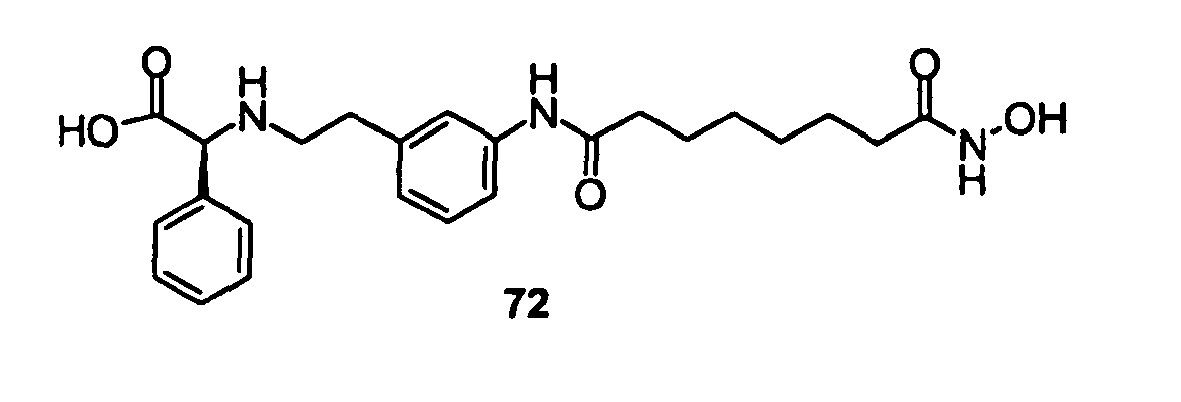
- Stage 4 resin (0.8g, 0.76mmol) was cleaved with 2% TFA/ DCM (10ml x 3). Filtrate was concentrated to dryness and residue purified by preparative HPLC to give compound (72) as a TFA salt, yield 40mg (10% overall). LCMS purity of 100%, m/z 442 [M++H]+, 1H NMR (400 MHz MeOD), δ: 1.20-1.35 (4 H, m, 2 x CH2), 1.45-1.70 (4 H, m, 2 x CH2), 1.95 (2 H, t, CH2), 2.25 (2 H, t, CH2), 2.80-3.20 (4 H, m CH 2 NH, CH 2 Ph), 5.00 (1 H, s, CHCOOH), 6.85 (1 H, m, Ar), 7.15 (2 H, m, Ar), 7.40 (5 H, s, Ar), 7.50 (1 H, s, Ar).
- The following compounds were prepared according to the procedure described for compounds (71) and compound (72)
- LCMS purity 94%, m/z 540 [M++H]+, 1H NMR (400 MHz, MeOD), δ: 1.26-1.82 (16 H, m, 8 x CH2), 2.11 (2 H, t, CH2), 2.39 (2 H, t, CH2), 3.15 (1 H, dd, CHHPh), 3.44 (1 H, dd, CHHPh), 3.56 (2 H, m, CH2), 4.30 (2 H, t, CH2), 4.40 (1 H, m), 5.13 (1 H, m, CHOCO), 6.76 (1 H, d, Ar), 7.00 (1 H, d, Ar), 7.24-7.41 (6 H, m, Ar), 7.57 (1 H, s, Ar).
- LCMS purity 100%, m/z 472 [M*+H]+. 1H NMR (400 MHz, MeOD), δ: 1.35-1.46 (4 H, m, 2 x CH2), 1.61-1.77 (4 H, m, 2 x CH2), 2.11 (2 H, t, CH2), 2.40 (2 H, t, CH2). 3.28-3.40 (2 H, m, CH2, masked signal), 3.53 (2 H, t, CH2), 4.29 (2 H, t, CH2), 4.38 (1 H, t, OCOCHCH2), 6.75 (1 H, d, Ar), 7.00 (1 H, d, Ar), 7.25 (1 H, t, Ar), 7.30-7.41 (5 H, m, Ar), 7.53 (1 H, s, Ar).
- LCMS purity 100%, m/z 554 [M++H]+, 1H NMR (400 MHz, MeOD), δ: 1.29-1.87 (16 H, m, 8 x CH2), 2.10 (2 H, t, CH2), 2.21 (2 H, m, CH2), 2.37 (2 H, t, CH2), 3.12 (1 H, dd, CHHPh), 3.25-3.43 (3 H, m, CHHPh, CH2), 4.11 (2 H, t, CH2), 4.33 (1 H, m, OCOCHCH2), 5.18 (1 H, m, CHOCO), 6.78 (1 H, d, Ar), 7.00 (1 H, d, Ar), 7.22 (1 H, t, Ar), 7.24-7.39 (5 H, m, Ar), 7.44 (1 H, s, Ar).
- LCMS purity 100%, m/z 486 [M++H]+, 1H NMR (400 MHz, MeOD), δ: 1.34-1.47 (4 H, m, 2 x CH2), 1.60-1.75 (4 H, m, 2 x CH2), 2.10 (2 H, t, CH2), 2.19 (2 H, m, CH2), 2.38 (2 H, t, CH2), 3.25-3.40 (4 H, m, 2 x CH2, masked signal), 4.09 (2 H, t, CH2), 4.35 (1 H, OCOCHCH2), 6.75 (1 H, d, Ar), 6.98 (1 H, d, Ar), 7.20 (1 H, t, Ar), 7.28-7.39 (5 H, m, Ar), 7.41 (1 H, s, Ar).
- LCMS purity of 100%, m/z 540 [M++H]+, 1H NMR (400 MHz, MeOD), δ: 1.20-1.50 (8 H, m, 4 x CH2), 1.50-1.80 (8 H, m, 4 x CH2), 1.80-1.90 (2 H, m, NHCH2CH2), 2.00 (2 H, t, CH2), 2.25 (2 H, t, CH2), 2.55-2.70 (2 H, m, NHCH 2), 3.90 (2 H, t, CH2CH 2 O), 4.25 (1H, s, OCOCHPh), 5.05 (1 H, m, CHOCO), 6.55 (1 H, m, Ar), 6.95 (1 H, m, Ar), 7.00-7.10 (1 H, m, Ar), 6.15-6.35 (6 H, m, Ar)
- LCMS purity of 100%, m/z 472 [M++H]+, 1H NMR (400 MHz, DMSO), δ:1.20-1.40 (4 H, m, 2 x CH2), 1.45-1.65 (4 H, m, 2 x CH2), 1.90 (2 H, m, NHCH2CH 2 ), 2.00-2.20 (2 H, m, CH2), 2.20-2.35 (2 H, m, CH2), 2.80-3.10 (2 H, m, NHCH 2 masked signal), 3.90-4.00 (2 H, m, CH2CH 2 O), 4.60-4.85 (1 H, br s, OCOCHPh), 6.55 (1 H, d, Ar), 7.05 (1 H, d, Ar), 7.15 (1 H, m, Ar), 7.30-7.60 (6 H, m, Ar), 8.50-8.85 (1 H, br s), 9.85 (1 H, s), 10.35 (1 H, s).
-

-

-

- 3-Nitrobenzyl bromide (10g, 46.3mmol) was dissolved in ethanol (200ml) and stirred at room temperature A solution of conc.NH3 (aq) (200ml) in ethanol (300ml) was added dropwise to the reaction over 30 minutes. The reaction was stirred for 18 h at room temperature before evaporating to dryness. Water (350ml) was added to the residue and the solution was washed with EtOAc (2x 200ml). The aqueous layer was basified with 1 M NaOH and extracted with EtOAc (2x 200ml). The organic extracts of the basic layer were combined, dried (Na2SO4) and evaporated to dryness. The product was obtained as an orange oil (4.6g, 65% yield). LCMS purity 100%, m/z 153 [M++H]+.
-

- 3-Nitro-benzylamine (2.3g, 15.1mmol) was dissolved in anhydrous dioxane (50ml) under N2 atmosphere. Diphosgene (2.2ml, 18.2mmol) was added, a precipitate formed which dissolved upon heating to 75°C. The reaction was stirred at 75°C for 3 h, cooled and evaporated to dryness giving 3.4g of crude material which was used in the next step without further purification.
-

- L-phenylglycine cyclopentyl ester tosyl salt (7.47g, 19.1 mmol) was dissolved in DMF (70ml). Triethylamine (5.8ml, 42.0mmol) was added and the mixture was cooled to 0°C. A solution of 1-Isocyanatomethyl-3-nitro-benzene (3.4g, 19.1mmol in 30ml of DMF) was added slowly to the reaction mixture under a N2 atmosphere. Stirring was continued for 18 h allowing the reaction to warm to room temperature The mixture was diluted with water (200ml) and extracted with EtOAc (2x 200ml). The organic extracts were washed with water (3x 100m) and brine (1 00ml), dried (Na2SO4) and evaporated to dryness. The crude urea was purified by column chromatography (1% MeOH/DCM) to yield a pale yellow oil (4.6g, 65% yield). LCMS purity 85%, m/z 398 [M++H]+.
-

- (S)-[3-(3-Nitro-benzyl)-ureido]-phenyl-acetic acid cyclopentyl ester (3.6g, 9.0mmol) was dissolved in ethanol (50ml) Pd/C (10% wet) catalyst (100mg) was added and the mixture was stirred under H2 atmosphere (balloon pressure) for 18h. The reaction mixture was filtered through a celite plug and evaporated to dryness to give a purple oil (2.34g, 71% yield). LCMS purity 90%, m/z 368 [M++H]+.
-

- Hydroxylamine 2-chlorotrityl resin derivatized with suberic acid (1.5g, loading 0.94mmol/g) was swollen in DMF (15ml) and PyBOP (2.2g, 4.23mmol) added, followed by DIPEA (2.4ml, 14.1mmol). Stage 4 aniline (1.3g, 3.53mmol) was dissolved in DCM (15ml) and added to the reaction mixture. The reaction was shaken for 42 h at room temp before standard resin wash and drying.
-

- Stage 5 resin bound cyclopentyl ester (1.75g) was shaken with 2%TFA/ DCM (15ml) for 10min before filtering the resin and evaporating the solvent under reduced pressure at room temperature This process was repeated (x3) and the combined crude product was purified by preparative HPLC to yield compound (79). LCMS purity 100%, m/z 539 [M++H]+,1H NMR (400 MHz, MeOD), δ: 1.34-1.90 (16 H, m, 8 x CH2), 2.11 (2 H, t, CH2), 2.38 (2 H, t, CH2), 4.30 (2 H, s, CH2), 5.18 (1 H, m, CHOCO), 5.30 (1 H, s, OCOCHPh), 7.05 (1 H, d, Ar), 7.26 (1 H, t, Ar), 7.34-7.40 (5 H, m, Ar), 7.47 (2 H, m, Ar).
-

- Compound (79) (75mg) was dissolved in THF (1ml) and 2M NaOH (aq,1ml) added. The reaction was stirred at room temperature for 2 h. THF was removed under a stream of N2 and the aqueous layer (∼1ml) was purified by preparative HPLC to yield compound (80). LCMS purity 99%, m/z 471 [M++H]+, 1H NMR (400 MHz, MeOD), δ: 1.20-1.35 (4 H, m, 2 x CH2), 1.45-1.65 (4 H, m, 2 x CH2), 2.00 (2 H, t, CH2), 2.25 (2 H, t, CH2), 4.20 (2 H, s CH 2NH), 5.25 (1 H, s CHPh), 6.90 (1 H, d, Ar), 7.10 (1 H, t, Ar), 7.15-7.40 (7 H, m, Ar).
- The following compounds were prepared according to the procedure described for compounds (79) and compound (80)
- LCMS purity 95%, m/z 553 [M++H]+, 1H NMR (400 MHz, MeOD), δ:1.20-1.40 (4 H, m, 2 x CH2), 1.40-1.80 (12 H, m, 6 x CH2), 2.00 (2 H, t, CH2), 2.25 (2 H, t, CH2), 2.90 (2 H, m, CHCH 2Ph), 4.15 (2 H, s CH 2NH), 4.40 (1 H, m, OCOCHCH2), 5.00 (1 H, m, CHOCO), 6.85 (1 H, d, Ar), 7.00-7.25 (6 H, m, Ar), 7.35 (2 H, br s, Ar).
- LCMS purity 94%, m/z 485 [M++H]+, 1H NMR (400 MHz, MeOD), δ: 1.30-1.50 (4 H, m, 2 x CH2), 1.60-1.80 (4 H, m, 2 x CH2), 2.10 (2 H, t, CH2), 2.35 (2 H, t, CH2). 2.95-3.25 (2 H, m, CHCH 2Ph), 4.25 (2 H, s, CH 2 NH), 4.60 (1 H , m OCOCHCH2), 7.00 (1 H, d, Ar), 7.15-7.35 (6 H, m, Ar), 7.45 (2 H, m, Ar)
-

-

- Monomethyl suberate (25.0 g, 13.3 mmol, 1.0 eq) was dissolved in THF (300 mL) and DCM (300 mL). EDC.HCl (25.46 g, 13.3 mmol, 1.0 eq) was added to the stirred solution, followed by HOBt (17.95 g, 13.3 mmol, 1.0 eq) and triethylamine (48.5 mL, 34.5 mmol, 2.6 eq). O-(1-Isobutoxy-ethyl)-hydroxylamine (21.9 mL, 15.9 mmol, 1.2 eq) was added to the viscous solution and the reaction allowed to stir overnight at room temperature. The reaction mixture was concentrated under vacuum, DCM (350 mL) was added and washed with water (250 mL) and brine (200 mL). The organic layer was isolated, dried (MgSO4), filtered and concentrated in vacuo. The product was obtained as a white solid (36.6 g, 91% yield) LCMS purity 88%, m/z 302 (M++H)+. This was used in the next step without further purification.
-
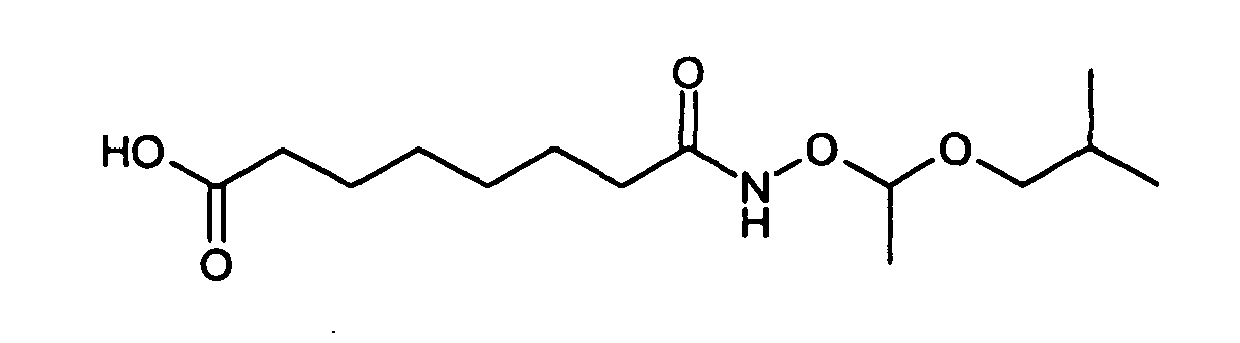
- 7-(1-Isobutoxy-ethoxycarbamoyl)-heptanoic acid methyl ester (36.6 g, 12.1 mmol, 1.0 eq) was stirred in THF (200 mL) and water (200 mL) in the presence of lithium hydroxide (8.68 g, 36.2 mmol, 3.0 eq) for 3 h at 50°C. THF was evaporated under vacuum and to the mixture water (100 mL) and ethyl acetate (200 mL) were added. The mixture was acidified cautiously to pH 3 by addition of 1 N HCl. The organic phase was isolated and the aqueous layer re-extracted with ethyl acetate (150 mL). The organic phases were combined, dried (MgSO4), filtered and concentrated in vacuo. The product was obtained as a white solid (29.0 g, 83% yield), m/z 288 [M++H]+ and used in stage 4 without further purification.
-

- To a stirred solution of 4-amino benzyl alcohol (16.0 g, 13.0 mmol, 1.0 eq) in THF (400 mL), was added triethylamine (18.9 mL, 13.6 mmol, 1.05 eq) followed by trimethylchlorosilane (17.2 mL, 13.6 mmol, 1.05 eq). The reaction mixture was stirred under a nitrogen atmosphere overnight at room temperature. THF was evaporated under vacuum and the mixture partitioned with ethyl acetate (300 mL) and water (300 mL). The organic phase was isolated and the aqueous layer re-extracted with ethyl acetate (2 x 100 mL). The combined organic phases were washed with brine (2 x 150 mL), dried (MgSO4), filtered and concentrated in vacuo. The product was obtained as a yellow oil (24.0 g, 95% yield) and used in stage 4 without further purification.
-

- 7-(1-Isobutoxy-ethoxycarbamoyl)-heptanoic acid (5.0 g, 1.72 mmol, 1.0 eq) and 4-trimethylsilanyloxymethyl-phenylamine (3.38 g, 1.72 mmol, 1.0 eq) were stirred together in DMF (140 mL). To the mixture was added PyBroP (10.5 g, 2.25 mmol, 1.3 eq) and DiPEA (3.9 mL, 2.25 mmol, 1.3 eq). The reaction was stirred under a nitrogen atmosphere overnight at room temperature. Ethyl acetate (200 mL) and water (200 mL) were added. The aqueous phase was isolated and re-extracted with ethyl acetate (2 x 100 mL). The combined organic phases were washed with water (2 x 50 mL) and brine (50 mL), then dried (MgSO4), filtered and concentrated in vacuo. The crude product was dissolved in the minimum of ethyl acetate and purified by passing through a pad of silica. The product was washed through the silica using ethyl acetate and collected in 100 mL conical flasks until elution ceased by LCMS analysis. Purification gave a yellow oil (3.59 g, 53% yield). LCMS purity 61%, m/z 417 [M++Na]+
-

- Octanedioic acid (4-hydroxymethyl-phenyl)-amide (1-isobutoxyethoxy)-amide (100 mg, 0.025 mmol, 1.0 eq) was dissolved in DCM (5 mL). To the reaction mixture, was added MnO2 (286 mg, 0.33 mmol, 13.0 eq) and was stirred at room temperature for 1.5 h. The reaction mixture was filtered over Celite and washed through with DCM, followed by evaporation of solvent to give a yellow oil (78.6 mg, 79% yield) LCMS purity 53%, m/z 415 [M++Na]+. The product was used in the subsequent steps without further purification.
-

- Octanedioic acid (4-formyl-phenyl)-amide (1-isobutoxy-ethoxy)-amide (276 mg, 0.70 mmol, 1.0 eq) and D-phenylglycine cyclopentyl ester (170 mg, 0.77 mmol, 1.1 eq) were stirred in DCE (15 mL) for 10 min. Acetic acid (65 µL) was added and stirred for 2 min. Sodium triacetoxyborohydride (448 mg, 0.21 mmol, 3.0 eq) was introduced and the reaction mixture stirred under a nitrogen atmosphere, at room temperature for 1 h. Sodium hydrogen carbonate was added to quench the reaction. DCM was then added and the organic phase isolated. The aqueous layer was re-extracted with DCM, organic layers combined, dried (MgSO4), filtered and concentrated in vacuo to give crude product (100 mg, 24%) LCMS purity 94.0%, m/z 496 [m++H]+ which was taken on without further purification.
-

- (R)-{4-[7-(1-Isobutoxy-ethoxycarbamoyl)-heptanoylamino]-benzylamino}-phenyl-acetic acid cyclopentyl ester (50 mg, 0.08 mmol, 1 eq) was dissolved in DCM (0.5 mL) and stirred with 4M HCl in dioxane (0.2 mL) for 30 min. The resulting salt was concentrated, dissolved in methanol and purified by preparative HPLC to yield compound (83). LCMS purity 94%, m/z 496 [M++H]+, 1H NMR (300 MHz, MeOD), δ: 1.41-1.95 (16H, m, 8 x CH2), 2.15-2.17 (2H, m, CH2), 2.40 (2H, t, J = 7.2 Hz, CH2), 4.16 (2H, q, J = 13.5 Hz, CH2), 5.12 (1H, s, CH), 5.27-5.30 (1H, m, CH), 7.40 (2H, d, J = 8.7 Hz, Ar-H), 7.50-7.56 (5H, m, Ar-H), 7.67 (2H, d, J = 8.7 Hz, Ar-H).
-
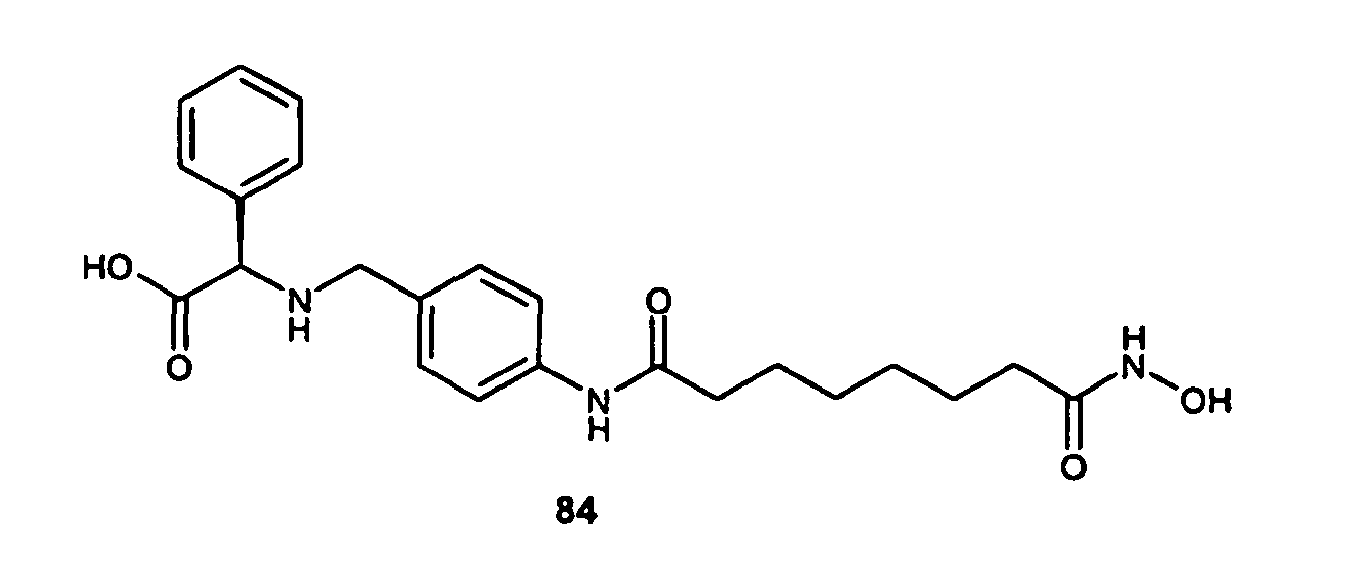
- To a solution of CHR-003644 (50 mg, 0.008 mmol, 1.0 eq) in THF (2 mL) and water (2 mL), was added LiOH (8.0 mg, 0.033 mmol, 4.0 eq). The reaction was stirred under a nitrogen atmosphere at 40°C overnight. THF was evaporated under vacuum and the remaining aqueous reaction solvent washed with ethyl acetate. The solution was acidified to pH 3 and the product concentrated in vacuo. The resulting salts were dissolved in methanol and the product purified by preparative HPLC to yield compound (84). LCMS purity 97%, m/z 428 [M++H]+,1H NMR (300 MHz, MeOD), δ: 1.39-1.41 (4H, m, 2 x CH2), 1.62-1.74 (4H, m, 2 x CH2), 2.13-2.15 (2H, m, CH2), 2.40 (2H, t, J = 7.5 Hz, CH2), 4.14 (2H, q, J = 12.9 Hz, CH2), 5.06 (1H, s, CH), 7.39 (2H, d, J = 8.4 Hz, Ar-H), 7.54 (5H, s, Ar-H), 7.67 (2H, d, J = 8.7 Hz, Ar-H)
- LCMS purity 97%, m/z 476 [M++H]+, 1H NMR (300 MHz, MeOD), δ:0.98-1.03 (6H, m, 2 x CH3), 1.41-1.42 (4H, m, 2 x CH2), 1.71-1.96 (14H, m, 7 x CH2), 2.10-2.15 (2H, m, CH2), 2.40 (2H, t, J = 7.2 Hz, CH2), 3.96-4.01 (1H, m, CH), 4.15-4.26 (2H, m, CH2), 4.81 (1H, s, CH), 5.31-5.34 (1H, m, CH), 7.44 (2H, d, J = 8.7 Hz, Ar-H), 7.70 (2H, d, J = 8.7 Hz, Ar-H)
- LCMS purity 95%, m/z 434 [M++H]+, 1H NMR (300 MHz, MeOD), δ:1.23-1.96 (18H, m, 9 x CH2), 2.10-2.15 (2H, m, CH2), 2.39 (2H, m, CH2), 3.71 (1H, m, CH), 4.12 (2H, q, J = 7.2 Hz, CH2), 4.80 (1H, s, CH), 7.43 (2H, d, J = 8.4 Hz, Ar-H), 7.68 (2H, d, J = 8.7 Hz, Ar-H)
- LCMS purity 83%, m/z 520 [M++H]+, 1H NMR (300 MHz, MeOD), δ:1.19 (9H, s, 3 x CH3), 1.29 (3H, d, J = 7.8 Hz, CH3), 1.37-1.41 (4H, m, CH2), 1.64-1.89 (12H, m, CH2), 2.09-2.15 (2H, m, CH2), 2.40 (2H, t, J = 7.2 Hz, CH2), 3.36-3.37 (1H, m, CH), 3.70-3.71 (1H, m, CH), 4.24-4.27 (2H, m, CH2), 5.17-5.19 (1H, m, CH), 7.42 (2H, d, J = 6.9 Hz, Ar-H), 7.68 (2H, d, J = 8.4 Hz, Ar-H)
- LCMS purity 95%, m/z 506 [M++H]+, 1H NMR (300 MHz, MeOD), δ:1.23 (9H, s, C(CH3)3), 1.36-2.09 (16H, m, 8 x CH2), 1.66 (2H, t, J=7.7Hz, CH2), 1.75 (2H, t, J=7.4Hz, CH2), 2.11 (2H, t, J=7.4Hz, CH2), 2.40 (2H, t, J=7.3Hz, CH2), 3.92 (2H, m, CH2), 4.16 (1H, m, CH), 4.26 (2H, s, CH2), 5.32 (1H, m, CH), 7.45 (2H, d, J=8.5Hz, ArH), 7.67 (2H, dd, J=3.2, 8.3Hz, ArH).
- LCMS purity 95%, m/z 438 [M++H]+, 1H NMR (300 MHz, MeOD), δ: 1.25 (9H, s, C(CH3)3), 1.39-1.42 (4H, m, 2 x CH2), 1.62-1.69 (4H, m, 2 x CH2), 2.08-2.17 (2H, m, CH2), 2.40 (2H, t, J = 7.5 Hz, CH2), 3.85-3.96 (2H, m, CH2), 4.01-4.04 (1H, m, CH), 4.26 (2H, s, CH2), 7.46 (2H, d, J = 8.4 Hz, Ar-H), 7.68 (2H, d, J = 8.4 Hz, Ar-H)
- LCMS purity 95%, m/z 510 [M++H]+, 1H NMR (300 MHz, MeOD), δ:1.17- 2.43 (22H, m, 11 x CH2), 4.19- 4.30 (2H, m, CH2), 5.08 (1H, s, CH), 5.20- 5.26 (1H, m, CH), 7.24 - 7.71 (9H, m, Ar-H)
-

- Octanedioic acid (4-formyl-phenyl)-amide (1-isobutoxy-ethoxy)-amide (220 mg, 0.056 mmol, 1.0 eq) and L-cyclohexyl-glycine cyclopentyl ester (138.9 mg, 0.062 mmol, 1.1 eq) were stirred in methanol (8 mL) overnight at room temperature. Sodium borohydride (31.8 mg, 0.084 mmol, 1.5 eq) was introduced and the reaction mixture stirred for 15 min. The reaction mixture was transferred to an ice bath and 2 drops of sodium hydroxide (2M) were added. Diethyl ether was added and the organic phase isolated. The aqueous layer was re-extracted with diethyl ether, organic layers combined and washed with brine. The organic phase was then dried (MgSO4) filtered and concentrated in vacuo to give crude material which was taken to the next step without further purification.
-

- Material from step 6b (50 mg, 0.083 mmol, 1 eq) was dissolved in DCM/methanol (2 mL : 2 mL) and stirred with TFA (1.0 mL) for 2 h. The resulting salt was concentrated, dissolved in methanol and purified by preparative HPLC to yield compound (86). LCMS purity 100%, m/z 502 [M++H]+, 1H NMR (300 MHz, MeOD), δ: 1.28-1.98 (26H, m, 13 x CH2), 2.10-2.15 (2H, m, CH2), 2.40 (2H, t, J = 7.8 Hz, CH2), 3.81 (1H, d, J = 3.9 Hz, CH), 4.21 (2H, m, CH2), 5.01 (1H, s, CH), 5.23-5.25 (1H, m, CH), 7.43 (2H, d, J = 8.4 Hz, Ar-H), 7.68 (2H, d, J = 8.7 Hz, Ar-H)
-

-

- To a solution of 3-nitrophenol (8.35g, 60mmol), in DMF (50ml) was added K2CO3 (16.56g, 120mmol) and methyl 1,4- bromobutyrate (11.95g, 66mmol). The reaction was stirred at room temperature for 16 h. The reaction was diluted with ethyl acetate and water. The organic phase was separated and washed with water (2 x 200ml). The organic phase was dried with Na2SO4 and concentrated in vacuo. The required ether was isolated following chromatography (ethyl acetate : heptane, 1 : 9) as a pale yellow solid (12.2g, 85% yield). LCMS purity 100%, m/z 240 [M++H]+.
-

- Stage 1 nitro ester (250mg, 1 mmol) was dissolved in ethanol (3ml). Pd/carbon (40mg) was added and the reaction stirred under a hydrogen atmosphere (balloon pressure) for 16 h. The reaction mixture was filtered through celite. The celite pad was washed with ethanol and the combined organic fractions concentrated in vacuo to give the required product as an orange oil (210mg, 100% yield). LCMS purity 89%, m/z 210 [M++H]+.The aniline was used in the next stage without further purification.
-

- Suberic acid derivatised hydroxylamine 2-chlorotrityl resin (8g, 7.52mmol, loading, 0.94 mmol/g) was swollen in DCM/DMF (80ml/80ml). PyBOP (11.8g, 22.6mmol) and diisopropylethylamine (13.1ml, 75.2mmol) were added to the flask followed by 4-(3-amino-phenoxy)-butyric acid methyl ester (4.73g, 22.6mmol). The reaction was shaken at room temperature for 72 h before standard wash and drying.
-

- Stage 3 resin (9.5 g), was suspended in THF/MeOH (34 ml/34ml). NaOH (1.4 M, aq, 34 ml) was added and the reaction shaken for 16 h at room temperature. The resin was washed using the standard wash procedure before air drying.
-

- Stage 4 resin (2.1g), was suspended in DCM/DMF (20ml/20ml). PyBOP (3.1g, 5.92mmol), N-phenlglycine cyclopentyl ester (2.4g, 5.92mmol) and diisopropylethylamine (3.4ml, 19.7mmol) were added sequentially and the reaction shaken at room temperature for 72 hours. The resin was submitted to standard wash and dried.
-

- Stage 5 resin bound cyclopentyl ester (1.1g) was shaken with 2%TFA/DCM (10ml) for 10 minutes before filtering the resin and evaporating the solvent under reduced pressure at room temperature. The process was repeated (x3) and the combined crude product purified by preparative HPLC to yield compound (92) (114mg). LCMS purity 99%, m/z 568 [M++H]+, 1H NMR (400 MHz, MeOD), δ:1.40 (4 H, m, 2 x CH2), 1.45 - 1.90 (13 H, m, alkyl), 2.10 (4 H, m, 2 x CH2), 2.40 (2 H, t, CH2), 2.50 (2 H, m, CH2), 4.00 (2 H, m, CH2), 5.15 (1 H, m,), 5.40 (1 H, s, NHCHCO), 6.65 (1 H, m, Ar) 7.15 (1 H, m, Ar), 7.20 (1 H, t, Ar), 7.30 (1 H, s, Ar), 7.40 (5 H, s, Ar).
-

- Stage 6 cyclopentyl ester resin (500mg) was suspended in THF (15ml). To the suspension was added NaOH (1.4M aq., 1.6 ml) and the reaction shaken for 16 hr at room temperature. The filtrate was removed and the resin washed and dried before cleavage. Cleavage was effected by shaking with 2%TFA/DCM (5ml) for 10 minutes before filtering the resin and evaporating the solvent under reduced pressure at room temperature. The process was repeated (x3) and the combined crude product purified by preparative HPLC to yield compound (93) (62mg). LCMS purity 99%, m/z 500 [M++H]+, 1H NMR (400 MHz, MeOD), δ:1.40 (4 H, m, 2 x CH2), 1.60 - 1.80 (4 H, m, alkyl), 2.10 (4 H, m, 2 x CH2), 2.40 (2 H, t, CH2), 2.50 (2 H, t, CH2), 4.00 (2 H, m, CH2), 5.45 (1 H, s, NHCHCO), 6.65 (1 H, d, Ar) 7.10 (1 H, m, Ar), 7.20 (1 H, t, Ar), 7.25 (1 H, s, Ar), 7.30-7.45 (5 H, m, Ar).
-

-

- To a solution of 3-nitro benzyl alcohol (10g, 65mmol), in dioxane (anhydrous, 100ml) was added trichloromethyl chloroformate (9.47ml, 78mmol). The reaction was heated at 75°C under nitrogen for 16 h. The solvent was evaporated and the residue resuspended in dioxane and evaporated. The procedure was repeated (x 3). The crude chloroformate was used in the next stage without further purification.
-
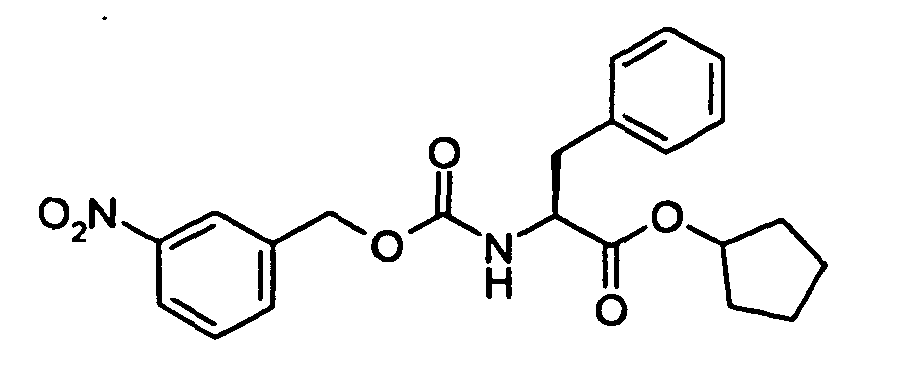
-

- Stage 2 nitro carbamate (6.4g, 15.5mmol) was dissolved in ethanol (64ml). Tin chloride dihydrate (17.5g, 77mmol) was added and the reaction stirred for 16 h at room temperature. The solvent was evaporated and the residue dissolved in EtOAc (60ml). A saturated solution of sodium potassium tartrate (60ml) was added followed by a solution of saturated sodium hydrogen carbonate (120ml). The biphasic solution was stirred for 15 min. The organic layer was separated and the aqueous phase extracted with EtOAc (60ml x1). The organic layers were combined, dried and the solvent evaporated to give the crude product which was purified by chromatography (EtOAc : heptane 1 : 3 → 1 : 1). The required product was isolated (3.5g, 59% yield). LCMS purity 100%, m/z 383 [M++H]+.
-

- Suberic acid derivatised hydroxylamine 2-chlorotrityl resin (2.0g, 1.88mmol, loading, 0.94 mmol/g) was swollen in DMF (20ml). PyBOP (2.93g, 5.64mmol) and diisopropyl ethylamine (3.25m, 18.8mmol) were added. Stage 3 anilino carbamate (1.8g, 4.7mmol) dissolved in DCM (20ml) was added and the reaction shaken for 4 d before filtrate removal and standard wash of the resin which was dried under air.
-

- Stage 4 resin bound cyclopentyl ester (2g) was shaken with 2%TFA/DCM (15ml) for 10 minutes before filtering the resin and evaporating the solvent under reduced pressure at room temperature. The process was repeated (x3) and the combined crude product purified by preparative HPLC to yield compound (94). LCMS purity 95%, m/z 554 [M++H]+, 1H NMR (400 MHz, MeOD), δ:1.30 (4 H, m, 2 x CH2), 1.40 - 1.90 (13 H, m, alkyl), 2.00 (2 H, t, CH2), 2.30 (2 H, t, CH2), 2.90 (2 H, ddd, CH2), 3.80 (1 H, m), 4.25 (1 H, dd, NHCHCO), 4.90 (2 H, s, CH2), 5.05 (1 H, m), 5.35 (1 H, m), 6.95 (1 H, d, Ar) 7.05-7.25 (6 H, m, Ar), 7.35 -7.75 (2 H, m, Ar).
-

- Compound (94) (100mg, 0.18mmol) was dissolved in THF (1ml) and 2M NaOH (1ml) added. The reaction vial was shaken for 4 h before THF removal via a stream of nitrogen. The aqueous residue was purified by preparative HPLC to yield compound (95) (62mg). LCMS purity 95%, m/z 486 [M++H]+, 1H NMR (400 MHz, MeOD), δ:1.35 (4 H, m, 2 x CH2), 1.55 -1.75 (4 H, m, alkyl), 2.10 (2 H, t, CH2), 2.35 (2 H, t, CH2), 2.95 (2 H, dd, CH), 3.20 (1 H, dd, CH), 4.45 (1 H, dd, NHCHCO), 5.00 (2 H, s, CH2), 7.05 (1 H, d, Ar), 7.20-7.35 (6 H, m, Ar), 7.55 (2 H, m, Ar).
-

-

- L-leucine cyclopentyl ester. TsOH salt (7.98g, 21.51 mmol) was dissolved in THF (40ml) and triethylamine (6ml, 21.5mmol) added. 4-Nitrobenzoyl chloride (4g, 21.5mmol) was added portionwise with cooling, ice bath. The reaction was stirred at room temperature for 16 h before evaporation to dryness. The residue was dissolved in DCM (100ml) and washed with saturated sodium hydrogen carbonate (3x100ml), 1 M HCl (3x100ml) and brine, dried (Na2SO4), and the solvent removed in vacuo. to give the required product 5.25g (70% yield) which was used in the next step without further purification, LCMS purity 100%, m/z 349 [M++H]+
-

- Stage 1 nitro amide (5.25g, 15.1mmol) was dissolved in ethanol (100ml). Pd/carbon (200mg) was added and the reaction stirred for 16 h at room temperature under hydrogen (balloon pressure). The reaction mixture was filtered through celite and evaporated to give the required amine amide 3.9g (81% yield) which was used in the next step without further purification, LCMS purity 100%, m/z 319 [M++H]+
-

- Suberic acid derivatised Wang hydroxylamine resin (1.6g, loading, 1.8mmol/g) was swollen in DCM (anhydrous, 20ml). 1-Chloro-N,N-2-trimethylpropenylamine (1.15ml), 8.64mmol) was added dropwise before shaking at room temperature for 1 h. (S)-2-(4-Amino-benzoylamino)-4-methyl-pentanoic acid cyclopentyl ester (2.75g, 8.64mmol) was added followed by triethylamine (2.4ml, 17.63mmol) and the reaction shaken at room temperature for 16 h. The resin was washed (standard) and air dried.
-

- Stage 3 resin bound cyclopentyl ester was shaken with 2%TFA/DCM (10ml) for 10 minutes before filtering the resin and evaporating the solvent under reduced pressure at room temperature. The process was repeated (x3) and the combined crude product purified by preparative HPLC to yield compound (98) (36mg). LCMS purity 91%, m/z 490 [M++H]+, 1H NMR (400 MHz, MeOD), δ:0.80 - 0.95 (6 H, 2 x CH3), 1.25 (4 H, m, alkyl), 1.40 - 1.85 (15 H, m, alkyl), 2.00 (2 H, t, CH2), 2.30 (2 H, t, CH2), 4.45 (1 H, m, CH), 5.05 (1 H, m, CH), 7.60 (2 H, d, Ar), 7.75 (2 H, d, Ar).
-

- Compound (98) (21mg, 0.043mmol) was dissolved in THF (1ml) and 2M NaOH (1ml) added. The reaction vial was shaken for 16 h before THF removal by blowing a stream of N2 gas at the surface of the solution. The aqueous residue was purified by preparative HPLC to yield compound (99) (5.2mg). LCMS purity 92%, m/z 422 [M++H]+, 1H NMR (400 MHz, MeOD), δ:0.95 - 1.05 (6 H, m, 2 x CH3), 1.30 - 1.50 (4 H, m, alkyl), 1.55 - 1.85 (7 H, m, alkyl), 2.10 (2 H, t, CH2), 2.40 (2 H, t, CH2), 4.65 (1 H, m, CH), 7.65 (2 H, d, Ar), 7.80 (2 H, d, Ar).
- The ability of compounds to inhibit histone deacetylase activities was measured using the commercially available HDAC fluorescent activity assay from Biomol. In brief, the Fluor de Lys™ substrate, a lysine with an epsilon-amino acetylation, is incubated with the source of histone deacetylase activity (HeLa nuclear extract) in the presence or absence of inhibitor. Deacetylation of the substrate sensitises the substrate to Fluor de Lys™developer, which generates a fluorophore. Thus, incubation of the substrate with a source of HDAC activity results in an increase in signal that is diminished in the presence of an HDAC inhibitor.
- Data are expressed as a percentage of the control, measured in the absence of inhibitor, with background signal being subtracted from all samples, as follows:-

- where S' is the signal in the presence of substrate, enzyme and inhibitor, S° is the signal in the presence of substrate, enzyme and the vehicle in which the inhibitor is dissolved, and B is the background signal measured in the absence of enzyme.
- IC50 values were determined by non-linear regression analysis, after fitting the results of eight data points to the equation for sigmoidal dose response with variable slope (% activity against log concentration of compound), using Graphpad Prism software.
- Histone deacetylase activity from crude nuclear extract derived from HeLa cells was used for screening. The preparation, purchased from 4C (Seneffe, Belgium), was prepared from HeLa cells harvested whilst in exponential growth phase. The nuclear extract is prepared according to Dignam JD1983 Nucl. Acid. Res. 11, 1475-1489, snap frozen in liquid nitrogen and stored at -80°C. The final buffer composition was 20 mM Hepes, 100 mM KCI, 0.2 mM EDTA, 0.5 mM DTT, 0.2 mM PMSF and 20 % (v/v) glycerol.
IC50 results were allocated to one of 3 ranges as follows: - Range A: IC50<100nM,
- Range B: IC50 from 101nM to 1000nM;
- Range C: IC50 >1001nM.
- NT = Not tested
- Results of testing the compounds of the examples in this assay are given in the second column of Table 2 below.
- The corresponding cancer cell lines (Hela, U937 and HUT) growing in log phase were harvested and seeded at 1000 cells/well (200ul final volume) into 96-well tissue culture plates. Following 24h of cell growth cells were treated with compounds (final concentration of 20uM). Plates were then re-incubated for a further 72h before a sulphorhodamine B (SRB) cell viability assay was conducted according to Skehan 1990 J Natl Canc Inst 82, 1107-1112.
- Data were expressed as a percentage inhibition of the control, measured in the absence of inhibitor, as follows:-

where Si is the signal in the presence of inhibitor and S° is the signal in the presence of DMSO. - IC50 values were determined by non-linear regression analysis, after fitting the results of eight data points to the equation for sigmoidal dose response with variable slope (% activity against log concentration of compound), using Graphpad Prism software. IC50 results were allocated to one of 3 ranges as follows:
- Range A: IC50<330nM,
- Range B: IC50 from 330nM to 3300nM;
- Range C: IC50 >3301 nM.
- NT= Not tested
- Results of testing the compounds of the examples in this assay are given in the third-fifth columns of Table 2 below.
Table 2 Example No. HDAC Activity Hela U937 HUT 20 B B A B 21 B C C C 22 B B B B 23 B C C C 26 A B B B 27 B C NT NT 28 B B B B 29 B B B B 30 B C NT NT 31 B B A B 32 A B NT B 33 B C NT NT 34 B B A B 35 B B B B 36 A B A B 37 B C C C 38 B NT NT NT 39 B NT A B 40 C C C C 41 C C C C 60 B B B B 61 B C NT NT 62 B C C B 63 B NT NT NT 69 B B NT B 70 B C NT NT 71 A B A B 72 A NT NT NT 73 A B A B 74 B NT NT NT 75 A B A A 76 A NT NT NT 77 A B A A 78 A NT NT NT 79 A NT C C 80 B NT NT NT 81 A C C B 82 B NT NT NT 83 B B B B 84 B NT NT NT 85 B C A B 86 B C A B 87 A NT NT NT 88 B B A B 89 B C A B 90 B NT NT NT 91 B C B B 92 A B B B 93 A NT NT NT 94 B NT B B 95 B NT NT NT 98 B B B B 99 C NT NT NT - U937 or Hct116 tumour cells (~ 109 were washed in 4 volumes of Dulbeccos PBS (~ 1litre) and pelleted at 160g for 10mins at 4□C. This was repeated twice and the final cell pellet was then resuspended in 35ml of cold homogenising buffer (Trizma 10mM , NaCl 130mM, CaCl2 0.5mM PH 7.0) at 25°C. Homogenates were prepared by nitrogen cavitation (700psi for 50min at 4°C ). The homogenate was kept on ice and supplemented with a cocktail of inhibitors designed to give final concentrations of
- Leupeptin 1µM
- Aprotinin 0.1µM
- E64 8µM
- Pepstatin 1.5µM
- Bestatin 162µM
- Chymostatin 33µM
- After clarification of the cell homogenate by centrifugation at 360 rpm for 10min, the resulting supernatant was used as a source of esterase activity and could be stored at -80°C until required.
- Hydrolysis of ester to the corresponding carboxylic acid can be measured using this cell extract. To this effect cell extract (~30ug / total assay volume of 0.5ml) was incubated at 37°C in a Tris- HCl 25mM,125mM NaCl, buffer, PH 7.5 at 25°C. At zero time the relevant ester (substrate), at a final concentration of 2.5µM was then added and samples incubated at 37°C for the appropriate time (Usually zero or 80 minutes). Reactions were stopped by the addition of 3x volumes of Acetonitrile. For zero time samples the acetonitrile was added prior to the ester compound. After centrifugation at 12000g for 5minutes, samples were analysed for the parent ester and its corresponding carboxylic acid at room temperature by LCMS (Sciex API 3000, HP1100 binary pump, CTC PAL). Chromatographic conditions used were based on an AceCN (75*2.1 mm) column and a mobile phase of 5-95% acetonitrile in water /0.1% formic acid.
Claims (28)
- A compound of formula (I) or a salt, N-oxide, hydrate or solvate thereof:
 R1 is an ester group which is hydrolysable by one or more of the intracellular carboxylesterase enzymes hCE-1, hCE-2 and hCE-3 to a carboxylic acid group;R2 is cyclohexylmethyl, cyclohexyl, pyridin-3-ylmethyl, sec-butyl, tert-butyl, 1-benzylthio-1-methylethyl, 1-methylthio-1-methylethyl, and 1-mercapto-1-methylethyl, phenyl, benzyl, phenylethyl, tert-butoxymethyl or iso-butyl.Y is a bond, -C(=O)-, -S(=O)2-, -C(=O)O-, -C(=O)NR3-, -C(=S)-NR3, -C(=NH)NR3 or -S(=O)2NR3- wherein R3 is hydrogen or optionally substituted C1-C6 alkyl;L1 is a divalent radical of formula -(Alk1)m(Q)n(Alk2)p- whereinm, n and p are independently 0 or 1,Q is (i) an optionally substituted divalent mono- or bicyclic carbocyclic or heterocyclic radical having 5-13 ring members, or (ii), in the case where both m and p are 0, a divalent radical of formula -X2-Q1- or -Q1-X2- wherein X2 is - O-, S- or NRA- wherein RA is hydrogen or optionally substituted C1-C3 alkyl, and Q1 is an optionally substituted divalent mono- or bicyclic carbocyclic or heterocyclic radical having 5-13 ring members,Alk1 and Alk1 independently represent optionally substituted divalent C3-C7 cycloalkyl radicals, or optionally substituted straight or branched, C1-C6 alkylene, C2-C6 alkenylene ,or C2-C6 alkynylene radicals which may optionally contain or terminate in an ether (-O-), thioether (-S-) or amino (-NRA-) link wherein RA is hydrogen or optionally substituted C1-C3 alkyl;X1 represents a bond; -C(=O); or -S(=O)2-; -NR4C(=O)-, -C(=O)NR4-,-NR4C(=O)NR5-, -NR4S(=O)2-, or -S(=O)2NR4- wherein R4 and R5 are independently hydrogen or optionally substituted C1-C6 alkyl;z is 0 or 1;A is the following ring system, optionally substituted:
 -[Linker]- represents a divalent radical of formula -(CH2)xZ-L2- whereinand wherein the term "optionally substituted" means optionally substituted with up to four compatible substituents, each of which is independently selected from (C1-C6)alkyl, (C1-C6)alkoxy, hydroxy, hydroxy(C1-C6)alkyl, mercapto, mercapto(C1-C6)alkyl, (C1-C6)alkylthio, phenyl, halo (including fluoro, bromo and chloro), trifluoromethyl, trifluoromethoxy, nitro, nitrile (-CN), oxo, -COOH, -COORA, -CORA, -SO2RA, -CONH2, -SO2NH2, -CONHRA, -SO2NHRA, -CONRARB, -SO2NRARB, -NH2, -NHRA, -NRARB, -OCONH2, -OCONHRA, -OCONRARB, -NHCORA, -NHCOORA, -NRBCOORA, -NHSO2ORA, -NRBSO2OH, -NRBSO2ORA,-NHCONH2, -NR4CONH2, -NHCONHRB,-NRACONHRB, -NHCONRARB, or-NRACONRARB wherein RAand RB are independently a (C1-C6)alkyl, (C3-C6) cycloalkyl , phenyl or monocyclic heteroaryl having 5 or 6 ring atoms.x is 0 or 1;Z is a bond, -NR3C(=O)-, -C(=O)NR3-,-NR4C(=O)NR3-, -C(=S)-NR3, -C(=NH)-NR3 -NR3S(=O)2-, or -S(=O)2NR3- wherein R3 is hydrogen or C1-C6 alkyl; -C(=O); or -S(=O)2-; andL2 represents an optionally substituted, straight or branched, C4-C7 alkylene, C4-C6 alkenylene or C4-C6 alkynylene radical which may optionally contain or terminate in an ether (-0-), thioether (-S-) or amino (-NRA-) link wherein RA is hydrogen or optionally substituted C1-C3 alkyl;
 - A compound as claimed in claim 1 wherein x is 0.
- A compound as claimed in claim 1 or claim 2 wherein Z is -C(=O)-, -NHC(=O)- or -C(=O)NH-.
- A compound as claimed in claim 2 or claim 3 wherein L2 is -(CH2)5-, -(CH2)6-, or -(CH2)7-.
- A compound as claimed in any of the preceding claims wherein z is 0.
- A compound as claimed in any of the preceding claims wherein Y is -S(=O)2-, -C(=S)-NR3, -C(=NH)-NR3 or -S(=O)2NR3- wherein R3 is hydrogen or C1-C6 alkyl.
- A compound as claimed in any of claims 1 to 6 wherein Y is a bond.
- A compound as claimed in any of the preceding claims wherein, in the radical L1, Alk1 and Alk2, when present, are selected from -CH2-, -CH2CH2-, -CH2CH2CH2-, and divalent cyclopropyl, cyclopentyl and cyclohexyl radicals.
- A compound as claimed in any of the preceding claims wherein, in the radical L1, Q is a divalent phenyl radical or a mono-, or bi-cyclic heteroaryl radical having 5 to13 ring members.
- A compound as claimed in claim 8 wherein Q is 1,4-phenylene.
- A compound as claimed in any of the preceding claims wherein, in the radical L1 m and p are 0.
- A compound as claimed in any of claims 1 to 10 wherein, in the radical L1, n and p are 0 and m is 1.
- A compound as claimed in any of claims 1 to 10 wherein, in the radical L1, m, n and p are all 0.
- A compound as claimed in any of the preceding claims wherein the radical -Y-L1-X1-[CH2]z- is selected from -C(=O)-, -C(=O)NH-, -(CH2)v-. -(CH2)vO-. -C(=O)-(CH2)v-, -C(=O)-(CH2)vO-, -C(=O)-NH-(CH2)w-, -C(=O)-NH-(CH2)wO-

- A compound as claimed in any of claims 1 to 13 wherein the radical -Y-L1-X1-[CH2]z-, is -CH2-, -CH2O-, -C(=O)-CH2-, -C(=O)-CH2O-, -C(=O)-NH-CH2-, or -C(=O)-NH-CH2O-.
- A compound as claimed in any of the preceding claims wherein R1 is an ester group of formula -(C=O)OR9 wherein R9 is(i) R7R8CH- wherein R7 is optionally substituted (C1-C3)alkyl-(Z1)a-(C1-C3)alkyl- or (C2-C3)alkenyl-(Z1)a-(C1-C3)alkyl- wherein a is 0 or 1 and Z' is -O-, -S-, or -NH-, and R8 is hydrogen or (C1-C3)alkyl- or R7 and R8 taken together with the carbon to which they are attached form an optionally substituted C3-C7 cycloalkyl ring or an optionally substituted heterocyclic ring of 5- or 6-ring atoms; or(ii) optionally substituted phenyl or monocyclic heterocyclic having 5 or 6 ring atoms,
- A compound as claimed in claim 16 wherein R9 is methyl, ethyl, n- or iso-propyl, n- or sec-butyl, cyclohexyl, allyl, phenyl, benzyl, 2-, 3- or 4-pyridylmethyl, N-methylpiperidin-4-yl, tetrahydrofuran-3-yl or methoxyethyl.
- A compound as claimed in claim 17 wherein R9 is cyclopentyl.
- A compound as claimed in claim 1 wherein formula (I) defines (S)-3-tert-butoxy-2-[3-(7-hydroxycarbamoyl-heptanoylamino)-benzylamino]-propionic acid cyclopentyl ester;
- A compound as claimed in claim 1 wherein formula (I) defines (S)-[3-(7-hydroxycarbamoyl-heptanoylamino)-benzylamino]-phenyl-acetic acid cyclopentyl ester;
- A compound as claimed in claim 1 wherein formula (I) defines (S)-[4-(7-hydroxycarbamoyl-heptanoylamino)-benzylamino]-phenyl-acetic acid cyclopentyl ester;
- A compound as claimed in claim 1 wherein formula (I) defines (S)-2-[3-(7-hydroxycarbamoyl-heptanoylamino)-benzylamino]-4-methyl-pentanoic acid cyclopentyl ester.
- A pharmaceutical composition comprising a compound as claimed in any of the preceding claims, together with a pharmaceutically acceptable carrier.
- The use of a compound of formula (I) as claimed in any of claims 1 to 22 in the preparation of a composition for treatment of call-proliferation disease, polyglutamine disease, neurodegenerative disease, autoimmune disease, inflammatory disease, organ transplant rejection, diabetes, haematological disorders or infection.
- The use as claimed in claim 24 wherein Y is a bond, -S(=O)2 or -S(=O)2NR3- wherein R3 is hydrogen or optionally substituted C1-C6 alkyl.
- The use as claimed in claim 24 for the treatment of cancer cell proliferation, Huntingdon disease, or Alzheimer disease.
- The use as claimed in claim 24 for the treatment of rheumatoid arthritis.
- A pharmaceutical composition as claimed in claim 23 which is adapted for topical administration and wherein, in the compound as claimed in any of claims 1 to 22, R2 is linked to the carbon atom to which it is attached through a methylene radical -CH2-.
Priority Applications (2)
| Application Number | Priority Date | Filing Date | Title |
|---|---|---|---|
| EP20100176446 EP2301939A1 (en) | 2005-05-05 | 2006-05-04 | Enzyme inhibitors |
| PL06726982T PL1879895T3 (en) | 2005-05-05 | 2006-05-04 | Enzyme inhibitors |
Applications Claiming Priority (2)
| Application Number | Priority Date | Filing Date | Title |
|---|---|---|---|
| GB0509223A GB0509223D0 (en) | 2005-05-05 | 2005-05-05 | Enzyme inhibitors |
| PCT/GB2006/001605 WO2006117549A1 (en) | 2005-05-05 | 2006-05-04 | Enzyme inhibitors |
Related Child Applications (1)
| Application Number | Title | Priority Date | Filing Date |
|---|---|---|---|
| EP10176446.2 Division-Into | 2010-09-13 |
Publications (2)
| Publication Number | Publication Date |
|---|---|
| EP1879895A1 EP1879895A1 (en) | 2008-01-23 |
| EP1879895B1 true EP1879895B1 (en) | 2011-06-08 |
Family
ID=34685155
Family Applications (2)
| Application Number | Title | Priority Date | Filing Date |
|---|---|---|---|
| EP06726982A Expired - Lifetime EP1879895B1 (en) | 2005-05-05 | 2006-05-04 | Enzyme inhibitors |
| EP20100176446 Withdrawn EP2301939A1 (en) | 2005-05-05 | 2006-05-04 | Enzyme inhibitors |
Family Applications After (1)
| Application Number | Title | Priority Date | Filing Date |
|---|---|---|---|
| EP20100176446 Withdrawn EP2301939A1 (en) | 2005-05-05 | 2006-05-04 | Enzyme inhibitors |
Country Status (19)
| Country | Link |
|---|---|
| US (3) | US7939666B2 (en) |
| EP (2) | EP1879895B1 (en) |
| JP (1) | JP5405820B2 (en) |
| KR (1) | KR101307815B1 (en) |
| CN (1) | CN101133060B (en) |
| AT (1) | ATE512150T1 (en) |
| AU (1) | AU2006243065B2 (en) |
| BR (1) | BRPI0607410A2 (en) |
| CA (1) | CA2599411C (en) |
| DK (1) | DK1879895T3 (en) |
| ES (1) | ES2367369T3 (en) |
| GB (1) | GB0509223D0 (en) |
| IL (1) | IL185580A (en) |
| MX (1) | MX2007010456A (en) |
| NZ (1) | NZ560289A (en) |
| PL (1) | PL1879895T3 (en) |
| PT (1) | PT1879895E (en) |
| WO (1) | WO2006117549A1 (en) |
| ZA (1) | ZA200707091B (en) |
Families Citing this family (30)
| Publication number | Priority date | Publication date | Assignee | Title |
|---|---|---|---|---|
| WO2003078448A1 (en) | 2002-03-13 | 2003-09-25 | Signum Biosciences, Inc. | Modulation of protein methylation and phosphoprotein phosphate |
| US7923041B2 (en) | 2005-02-03 | 2011-04-12 | Signum Biosciences, Inc. | Compositions and methods for enhancing cognitive function |
| WO2006084033A1 (en) | 2005-02-03 | 2006-08-10 | Signum Biosciences, Inc. | Compositions and methods for enhancing cognitive function |
| GB0509223D0 (en) * | 2005-05-05 | 2005-06-15 | Chroma Therapeutics Ltd | Enzyme inhibitors |
| MX2007013257A (en) * | 2005-05-05 | 2008-01-21 | Chroma Therapeutics Ltd | Alpha aminoacid ester-drug conjugates hydrolysable by carboxylesterase. |
| GB0509225D0 (en) * | 2005-05-05 | 2005-06-15 | Chroma Therapeutics Ltd | Inhibitors of enzymatic activity |
| US8119655B2 (en) | 2005-10-07 | 2012-02-21 | Takeda Pharmaceutical Company Limited | Kinase inhibitors |
| GB0619753D0 (en) | 2006-10-06 | 2006-11-15 | Chroma Therapeutics Ltd | Enzyme inhibitors |
| JP2010505962A (en) | 2006-10-09 | 2010-02-25 | 武田薬品工業株式会社 | Kinase inhibitor |
| CA2668070A1 (en) | 2006-10-30 | 2008-05-08 | Chroma Therapeutics Ltd. | Hydroxamates as inhibitors of histone deacetylase |
| GB0803747D0 (en) | 2008-02-29 | 2008-04-09 | Martin | Enzyme and receptor modulation |
| GB0903480D0 (en) | 2009-02-27 | 2009-04-08 | Chroma Therapeutics Ltd | Enzyme Inhibitors |
| JP5838157B2 (en) * | 2009-07-22 | 2015-12-24 | ザ・ボード・オブ・トラスティーズ・オブ・ザ・ユニバーシティ・オブ・イリノイThe Board Of Trustees Of The University Of Illinois | HDAC inhibitor and therapeutic method using the same |
| JP5947724B2 (en) * | 2009-12-21 | 2016-07-06 | アンスティチュ ナショナル ドゥ ラ サンテ エ ドゥ ラ ルシェルシュ メディカル | New inhibitors of cyclophilin and their use |
| GB201009853D0 (en) | 2010-06-11 | 2010-07-21 | Chroma Therapeutics Ltd | HSP90 inhibitors |
| ES2402252B1 (en) * | 2011-09-26 | 2014-03-10 | Universidad De Granada | COMPOSED WITH ANTILEISHMANIA ACTIVITY |
| WO2013062344A1 (en) * | 2011-10-28 | 2013-05-02 | Chong Kun Dang Pharmaceutical Corp. | Hydroxamate derivatives for hdac inhibitor, and the pharmaceutical composition comprising thereof |
| GB201211310D0 (en) | 2012-06-26 | 2012-08-08 | Chroma Therapeutics Ltd | CSF-1R kinase inhibitors |
| SI3222616T1 (en) | 2012-10-17 | 2019-10-30 | Macrophage Pharma Ltd | N-(2-(4-(6-amino-5-(2,4-difluorobenzoyl)-2-oxopyridin-1(2h)-yl)-3,5-difluorophenyl)ethyl)-l-alanine and the terbutyl ester thereof |
| CN103172540B (en) * | 2013-03-18 | 2015-07-01 | 潍坊博创国际生物医药研究院 | Phenylglycine histone deacetylase inhibitor as well as preparation method and applications thereof |
| WO2016126726A1 (en) | 2015-02-02 | 2016-08-11 | Forma Therapeutics, Inc. | Bicyclic [4,6,0] hydroxamic acids as hdac6 inhibitors |
| TW201629026A (en) | 2015-02-02 | 2016-08-16 | 佛瑪治療公司 | 3-alkylbicyclo[4,5,0]hydroxamic acid as HDAC inhibitor |
| CN109476631B (en) * | 2016-03-22 | 2021-04-06 | 国家健康与医学研究院 | Novel derivatives and their use as selective inhibitors of caspase-2 |
| WO2017216297A1 (en) | 2016-06-16 | 2017-12-21 | Glaxosmithkline Intellectual Property Development Limited | Dosage regimen |
| US10555935B2 (en) | 2016-06-17 | 2020-02-11 | Forma Therapeutics, Inc. | 2-spiro-5- and 6-hydroxamic acid indanes as HDAC inhibitors |
| GB201713975D0 (en) | 2017-08-31 | 2017-10-18 | Macrophage Pharma Ltd | Medical use |
| TWI650139B (en) * | 2017-10-11 | 2019-02-11 | 行政院原子能委員會核能硏究所 | Hydroxamic acid-containing contrast agent containing radioactive isotope fluorine, preparation method thereof and use thereof |
| WO2020013116A1 (en) * | 2018-07-10 | 2020-01-16 | 京都薬品工業株式会社 | Ptp-1b inhibitor and use thereof |
| CN111393404B (en) * | 2019-01-02 | 2023-02-17 | 中国科学院上海药物研究所 | Benzothiophene compounds, and pharmaceutical composition and application thereof |
| CN113121527B (en) * | 2019-12-31 | 2024-09-06 | 上海辉启生物医药科技有限公司 | Tricyclic compounds and uses thereof |
Family Cites Families (43)
| Publication number | Priority date | Publication date | Assignee | Title |
|---|---|---|---|---|
| IT1099355B (en) | 1978-10-12 | 1985-09-18 | Sclavo Inst Sieroterapeut | COMPOSITION SUITABLE FOR THE DETERMINATION OF GLUCOSE IN KINETICS |
| JPS6188884A (en) * | 1984-10-04 | 1986-05-07 | Sankyo Co Ltd | Encephalinase b-inhibiting substance and its preparation |
| AU650953B2 (en) | 1991-03-21 | 1994-07-07 | Novartis Ag | Inhaler |
| US5369108A (en) | 1991-10-04 | 1994-11-29 | Sloan-Kettering Institute For Cancer Research | Potent inducers of terminal differentiation and methods of use thereof |
| IT1264860B1 (en) * | 1993-06-21 | 1996-10-17 | Guidotti & C Spa Labor | DERIVATIVES OF CIS- AND TRANS-2(((2-(HYDROXYAMINO)-2-OXOETHYL)- ALKYLAMINO)CARBONYL)CYCLOHEXINECARBOXYLIC ACIDS |
| US6204293B1 (en) * | 1995-11-06 | 2001-03-20 | University Of Pittsburgh | Inhibitors of protein isoprenyl transferases |
| AU4249700A (en) * | 1999-04-19 | 2000-11-02 | Sumitomo Pharmaceuticals Company, Limited | Hydroxamic acid derivative |
| BR0014254A (en) | 1999-09-08 | 2002-08-27 | Sloan Kettering Inst Cancer | New class of cytodifferentiation agents and histone deacetylase inhibitors, and methods of using them |
| KR20100035666A (en) | 1999-11-23 | 2010-04-05 | 메틸진 인크. | Inhibitors of histone deacetylase |
| GB0003476D0 (en) | 2000-02-16 | 2000-04-05 | British Biotech Pharm | Acetal Hydroxylamine compounds |
| JP2003528074A (en) | 2000-03-24 | 2003-09-24 | メチルジーン インコーポレイテッド | Histone deacetylase inhibitor |
| PE20020354A1 (en) * | 2000-09-01 | 2002-06-12 | Novartis Ag | HYDROXAMATE COMPOUNDS AS HISTONE-DESACETILASE (HDA) INHIBITORS |
| GB0023983D0 (en) | 2000-09-29 | 2000-11-15 | Prolifix Ltd | Therapeutic compounds |
| EP2292593A3 (en) | 2000-09-29 | 2011-05-25 | TopoTarget UK Limited | Carbamic acid compounds comprising a sulfonamide linkage as HDAC inhibitors |
| CA2423868C (en) | 2000-09-29 | 2011-06-07 | Prolifix Limited | Carbamic acid compounds comprising an amide linkage as hdac inhibitors |
| AR035513A1 (en) | 2000-12-23 | 2004-06-02 | Hoffmann La Roche | DERIVATIVES OF TETRAHYDROPIRIDINE, PROCESS TO PREPARE THEM, PHARMACEUTICAL COMPOSITIONS CONTAINING THEM, AND USE OF SUCH COMPOUNDS IN THE PREPARATION OF MEDICINES |
| DE10295684T9 (en) | 2001-01-12 | 2004-10-14 | Methylgene, Inc., Saint-Laurent | Method of specifically inhibiting histone deacetylase-4 |
| US6784173B2 (en) | 2001-06-15 | 2004-08-31 | Hoffmann-La Roche Inc. | Aromatic dicarboxylic acid derivatives |
| JP2005517007A (en) | 2002-02-07 | 2005-06-09 | アクシス・ファーマスーティカルズ | Novel bicyclic hydroxamates as histone deacetylase inhibitors |
| CA2476583C (en) | 2002-03-13 | 2011-07-05 | Kristof Van Emelen | Aminocarbonyl-derivatives as novel inhibitors of histone deacetylase |
| JP4648628B2 (en) | 2002-03-13 | 2011-03-09 | ジヤンセン・フアーマシユーチカ・ナームローゼ・フエンノートシヤツプ | Carbonylamino derivatives as novel inhibitors of histone deacetylase |
| ES2306859T3 (en) | 2002-03-13 | 2008-11-16 | Janssen Pharmaceutica Nv | DERIVATIVES OF SULFONIL AS NEW INHIBITORS OF HISTONE DEACETILASE. |
| WO2003076401A1 (en) | 2002-03-13 | 2003-09-18 | Janssen Pharmaceutica N.V. | Sulfonylamino-derivatives as novel inhibitors of histone deacetylase |
| NZ536116A (en) | 2002-04-03 | 2007-01-26 | Topotarget Uk Ltd | Carbamic acid compounds comprising a piperazine linkage as HDAC inhibitors |
| TWI319387B (en) | 2002-04-05 | 2010-01-11 | Astrazeneca Ab | Benzamide derivatives |
| GB0209715D0 (en) | 2002-04-27 | 2002-06-05 | Astrazeneca Ab | Chemical compounds |
| KR20050034732A (en) | 2002-08-02 | 2005-04-14 | 아젠터 디스커버리 리미티드 | Substituted thienyl-hydroxamic acids as histone deacetylase inhibitors |
| US7221775B2 (en) | 2002-11-12 | 2007-05-22 | Intellivid Corporation | Method and apparatus for computerized image background analysis |
| PT1611088E (en) | 2003-04-07 | 2009-09-24 | Pharmacyclics Inc | HYDROXAMATS AS THERAPEUTIC AGENTS |
| WO2004110989A1 (en) | 2003-05-14 | 2004-12-23 | Bayer Pharmaceuticals Corporation | N-hydroxy-7-(arylamino)heptanamide derivatives useful for treating hyper-proliferative disorders |
| EP1633751A1 (en) * | 2003-06-16 | 2006-03-15 | Chroma Therapeutics Limited | Carboline and betacarboline derivatives for use as hdac enzyme inhibitors |
| EP1644323B1 (en) | 2003-07-07 | 2015-03-18 | Georgetown University | Histone deacetylase inhibitors and methods of use thereof |
| WO2005004861A1 (en) | 2003-07-15 | 2005-01-20 | Korea Research Institute Of Bioscience And Biotechnology | A use of novel 2-oxo-heterocyclic compounds and the pharmaceutical compositions comprising the same |
| WO2005014588A1 (en) | 2003-08-01 | 2005-02-17 | Argenta Discovery Limited | Substituted thienyl-hydroxamic acids having histone deacetylase activity |
| US20060270730A1 (en) | 2003-08-07 | 2006-11-30 | Andreas Katopodis | Histone deacetylase inhibitors as immunosuppressants |
| MXPA05011286A (en) | 2003-08-20 | 2006-01-24 | Axys Pharm Inc | Acetylene derivatives as inhibitors of histone deacetylase. |
| HRP20060080A2 (en) | 2003-08-26 | 2006-07-31 | Sloan-Kettering Institute For Cancer Research | Method of treating cancer with hdac inhibitors |
| KR101127201B1 (en) | 2003-09-22 | 2012-04-12 | 에스*바이오 피티이 리미티드 | Benzimidazole derivatives: preparation and pharmaceutical applications |
| AU2004276337B2 (en) | 2003-09-24 | 2009-11-12 | Methylgene Inc. | Inhibitors of histone deacetylase |
| AU2004280264A1 (en) | 2003-10-09 | 2005-04-21 | Merck Hdac Research, Llc | Thiophene and benzothiophene hydroxamic acid derivatives |
| JP2007509082A (en) * | 2003-10-22 | 2007-04-12 | アルピダ エー/エス | Benzimidazole derivatives and their use as peptide deformylase inhibitors |
| MX2007013257A (en) | 2005-05-05 | 2008-01-21 | Chroma Therapeutics Ltd | Alpha aminoacid ester-drug conjugates hydrolysable by carboxylesterase. |
| GB0509223D0 (en) * | 2005-05-05 | 2005-06-15 | Chroma Therapeutics Ltd | Enzyme inhibitors |
-
2005
- 2005-05-05 GB GB0509223A patent/GB0509223D0/en not_active Ceased
-
2006
- 2006-05-04 NZ NZ560289A patent/NZ560289A/en not_active IP Right Cessation
- 2006-05-04 EP EP06726982A patent/EP1879895B1/en not_active Expired - Lifetime
- 2006-05-04 BR BRPI0607410-3A patent/BRPI0607410A2/en not_active Application Discontinuation
- 2006-05-04 EP EP20100176446 patent/EP2301939A1/en not_active Withdrawn
- 2006-05-04 KR KR1020077019886A patent/KR101307815B1/en not_active Expired - Fee Related
- 2006-05-04 PT PT06726982T patent/PT1879895E/en unknown
- 2006-05-04 CN CN2006800069161A patent/CN101133060B/en not_active Expired - Fee Related
- 2006-05-04 PL PL06726982T patent/PL1879895T3/en unknown
- 2006-05-04 DK DK06726982.9T patent/DK1879895T3/en active
- 2006-05-04 AU AU2006243065A patent/AU2006243065B2/en not_active Ceased
- 2006-05-04 ES ES06726982T patent/ES2367369T3/en not_active Expired - Lifetime
- 2006-05-04 CA CA2599411A patent/CA2599411C/en not_active Expired - Fee Related
- 2006-05-04 US US11/918,139 patent/US7939666B2/en active Active
- 2006-05-04 WO PCT/GB2006/001605 patent/WO2006117549A1/en not_active Ceased
- 2006-05-04 JP JP2008509500A patent/JP5405820B2/en not_active Expired - Fee Related
- 2006-05-04 MX MX2007010456A patent/MX2007010456A/en active IP Right Grant
- 2006-05-04 AT AT06726982T patent/ATE512150T1/en active
-
2007
- 2007-08-22 ZA ZA200707091A patent/ZA200707091B/en unknown
- 2007-08-29 IL IL185580A patent/IL185580A/en active IP Right Grant
-
2010
- 2010-12-01 US US12/957,829 patent/US8686032B2/en not_active Expired - Fee Related
-
2014
- 2014-02-13 US US14/179,880 patent/US9133104B2/en not_active Expired - Fee Related
Also Published As
| Publication number | Publication date |
|---|---|
| KR20080015388A (en) | 2008-02-19 |
| NZ560289A (en) | 2010-11-26 |
| JP2008540389A (en) | 2008-11-20 |
| CN101133060B (en) | 2013-06-05 |
| IL185580A (en) | 2012-08-30 |
| PL1879895T3 (en) | 2011-11-30 |
| CA2599411C (en) | 2013-12-03 |
| EP1879895A1 (en) | 2008-01-23 |
| PT1879895E (en) | 2011-09-06 |
| US7939666B2 (en) | 2011-05-10 |
| WO2006117549A1 (en) | 2006-11-09 |
| DK1879895T3 (en) | 2011-09-19 |
| US9133104B2 (en) | 2015-09-15 |
| CN101133060A (en) | 2008-02-27 |
| ATE512150T1 (en) | 2011-06-15 |
| JP5405820B2 (en) | 2014-02-05 |
| MX2007010456A (en) | 2007-10-11 |
| CA2599411A1 (en) | 2006-11-09 |
| IL185580A0 (en) | 2008-01-06 |
| BRPI0607410A2 (en) | 2009-09-01 |
| US20130116318A1 (en) | 2013-05-09 |
| AU2006243065A1 (en) | 2006-11-09 |
| US20140163042A1 (en) | 2014-06-12 |
| ZA200707091B (en) | 2008-10-29 |
| AU2006243065B2 (en) | 2012-05-03 |
| EP2301939A1 (en) | 2011-03-30 |
| GB0509223D0 (en) | 2005-06-15 |
| KR101307815B1 (en) | 2013-09-12 |
| ES2367369T3 (en) | 2011-11-02 |
| US8686032B2 (en) | 2014-04-01 |
| US20090291978A1 (en) | 2009-11-26 |
Similar Documents
| Publication | Publication Date | Title |
|---|---|---|
| US9133104B2 (en) | Enzyme inhibitors | |
| EP1877366B1 (en) | Hydroxamic acid dervicatives as inhibitors of hdac enzymatic activity | |
| CN101528677B (en) | Hdac inhibitors | |
| EP2013175B1 (en) | p38 MAP KINASE INHIBITORS | |
| EP2077999B1 (en) | Hydroxamates as inhibitors of histone deacetylase | |
| WO2010097586A1 (en) | Enzyme inhibitors | |
| US20110039920A1 (en) | Inhibitors of ikk-beta serine-theronine protein kinase |
Legal Events
| Date | Code | Title | Description |
|---|---|---|---|
| PUAI | Public reference made under article 153(3) epc to a published international application that has entered the european phase |
Free format text: ORIGINAL CODE: 0009012 |
|
| 17P | Request for examination filed |
Effective date: 20070807 |
|
| AK | Designated contracting states |
Kind code of ref document: A1 Designated state(s): AT BE BG CH CY CZ DE DK EE ES FI FR GB GR HU IE IS IT LI LT LU LV MC NL PL PT RO SE SI SK TR |
|
| 17Q | First examination report despatched |
Effective date: 20080228 |
|
| DAX | Request for extension of the european patent (deleted) | ||
| GRAP | Despatch of communication of intention to grant a patent |
Free format text: ORIGINAL CODE: EPIDOSNIGR1 |
|
| GRAS | Grant fee paid |
Free format text: ORIGINAL CODE: EPIDOSNIGR3 |
|
| GRAA | (expected) grant |
Free format text: ORIGINAL CODE: 0009210 |
|
| AK | Designated contracting states |
Kind code of ref document: B1 Designated state(s): AT BE BG CH CY CZ DE DK EE ES FI FR GB GR HU IE IS IT LI LT LU LV MC NL PL PT RO SE SI SK TR |
|
| REG | Reference to a national code |
Ref country code: GB Ref legal event code: FG4D |
|
| REG | Reference to a national code |
Ref country code: CH Ref legal event code: EP |
|
| REG | Reference to a national code |
Ref country code: IE Ref legal event code: FG4D |
|
| REG | Reference to a national code |
Ref country code: DE Ref legal event code: R096 Ref document number: 602006022388 Country of ref document: DE Effective date: 20110721 |
|
| REG | Reference to a national code |
Ref country code: NL Ref legal event code: T3 |
|
| REG | Reference to a national code |
Ref country code: PT Ref legal event code: SC4A Free format text: AVAILABILITY OF NATIONAL TRANSLATION Effective date: 20110830 |
|
| REG | Reference to a national code |
Ref country code: DK Ref legal event code: T3 |
|
| REG | Reference to a national code |
Ref country code: SE Ref legal event code: TRGR |
|
| REG | Reference to a national code |
Ref country code: GR Ref legal event code: EP Ref document number: 20110402006 Country of ref document: GR Effective date: 20110916 |
|
| PG25 | Lapsed in a contracting state [announced via postgrant information from national office to epo] |
Ref country code: LT Free format text: LAPSE BECAUSE OF FAILURE TO SUBMIT A TRANSLATION OF THE DESCRIPTION OR TO PAY THE FEE WITHIN THE PRESCRIBED TIME-LIMIT Effective date: 20110608 |
|
| REG | Reference to a national code |
Ref country code: ES Ref legal event code: FG2A Ref document number: 2367369 Country of ref document: ES Kind code of ref document: T3 Effective date: 20111102 |
|
| PG25 | Lapsed in a contracting state [announced via postgrant information from national office to epo] |
Ref country code: LV Free format text: LAPSE BECAUSE OF FAILURE TO SUBMIT A TRANSLATION OF THE DESCRIPTION OR TO PAY THE FEE WITHIN THE PRESCRIBED TIME-LIMIT Effective date: 20110608 Ref country code: CY Free format text: LAPSE BECAUSE OF FAILURE TO SUBMIT A TRANSLATION OF THE DESCRIPTION OR TO PAY THE FEE WITHIN THE PRESCRIBED TIME-LIMIT Effective date: 20110608 Ref country code: SI Free format text: LAPSE BECAUSE OF FAILURE TO SUBMIT A TRANSLATION OF THE DESCRIPTION OR TO PAY THE FEE WITHIN THE PRESCRIBED TIME-LIMIT Effective date: 20110608 |
|
| REG | Reference to a national code |
Ref country code: PL Ref legal event code: T3 |
|
| REG | Reference to a national code |
Ref country code: HU Ref legal event code: AG4A Ref document number: E012015 Country of ref document: HU |
|
| PG25 | Lapsed in a contracting state [announced via postgrant information from national office to epo] |
Ref country code: EE Free format text: LAPSE BECAUSE OF FAILURE TO SUBMIT A TRANSLATION OF THE DESCRIPTION OR TO PAY THE FEE WITHIN THE PRESCRIBED TIME-LIMIT Effective date: 20110608 |
|
| PG25 | Lapsed in a contracting state [announced via postgrant information from national office to epo] |
Ref country code: RO Free format text: LAPSE BECAUSE OF FAILURE TO SUBMIT A TRANSLATION OF THE DESCRIPTION OR TO PAY THE FEE WITHIN THE PRESCRIBED TIME-LIMIT Effective date: 20110608 Ref country code: SK Free format text: LAPSE BECAUSE OF FAILURE TO SUBMIT A TRANSLATION OF THE DESCRIPTION OR TO PAY THE FEE WITHIN THE PRESCRIBED TIME-LIMIT Effective date: 20110608 |
|
| PLBE | No opposition filed within time limit |
Free format text: ORIGINAL CODE: 0009261 |
|
| STAA | Information on the status of an ep patent application or granted ep patent |
Free format text: STATUS: NO OPPOSITION FILED WITHIN TIME LIMIT |
|
| 26N | No opposition filed |
Effective date: 20120309 |
|
| REG | Reference to a national code |
Ref country code: CH Ref legal event code: NV Representative=s name: MEYER & KOLLEGEN |
|
| REG | Reference to a national code |
Ref country code: DE Ref legal event code: R097 Ref document number: 602006022388 Country of ref document: DE Effective date: 20120309 |
|
| PG25 | Lapsed in a contracting state [announced via postgrant information from national office to epo] |
Ref country code: BG Free format text: LAPSE BECAUSE OF FAILURE TO SUBMIT A TRANSLATION OF THE DESCRIPTION OR TO PAY THE FEE WITHIN THE PRESCRIBED TIME-LIMIT Effective date: 20110908 |
|
| REG | Reference to a national code |
Ref country code: FR Ref legal event code: PLFP Year of fee payment: 11 |
|
| REG | Reference to a national code |
Ref country code: FR Ref legal event code: PLFP Year of fee payment: 12 |
|
| REG | Reference to a national code |
Ref country code: FR Ref legal event code: PLFP Year of fee payment: 13 |
|
| PGFP | Annual fee paid to national office [announced via postgrant information from national office to epo] |
Ref country code: IE Payment date: 20190509 Year of fee payment: 14 Ref country code: ES Payment date: 20190603 Year of fee payment: 14 Ref country code: MC Payment date: 20190426 Year of fee payment: 14 |
|
| PGFP | Annual fee paid to national office [announced via postgrant information from national office to epo] |
Ref country code: CH Payment date: 20190516 Year of fee payment: 14 |
|
| REG | Reference to a national code |
Ref country code: GB Ref legal event code: 732E Free format text: REGISTERED BETWEEN 20191128 AND 20191204 |
|
| PGFP | Annual fee paid to national office [announced via postgrant information from national office to epo] |
Ref country code: PL Payment date: 20200309 Year of fee payment: 15 |
|
| PGFP | Annual fee paid to national office [announced via postgrant information from national office to epo] |
Ref country code: FR Payment date: 20200312 Year of fee payment: 15 |
|
| PGFP | Annual fee paid to national office [announced via postgrant information from national office to epo] |
Ref country code: DE Payment date: 20200422 Year of fee payment: 15 Ref country code: PT Payment date: 20200415 Year of fee payment: 15 Ref country code: CZ Payment date: 20200422 Year of fee payment: 15 Ref country code: LU Payment date: 20200424 Year of fee payment: 15 Ref country code: GR Payment date: 20200409 Year of fee payment: 15 Ref country code: NL Payment date: 20200417 Year of fee payment: 15 Ref country code: TR Payment date: 20200504 Year of fee payment: 15 |
|
| PGFP | Annual fee paid to national office [announced via postgrant information from national office to epo] |
Ref country code: IS Payment date: 20200407 Year of fee payment: 15 Ref country code: HU Payment date: 20200405 Year of fee payment: 15 Ref country code: BE Payment date: 20200416 Year of fee payment: 15 Ref country code: GB Payment date: 20200422 Year of fee payment: 15 Ref country code: IT Payment date: 20200414 Year of fee payment: 15 |
|
| REG | Reference to a national code |
Ref country code: FI Ref legal event code: MAE |
|
| REG | Reference to a national code |
Ref country code: DK Ref legal event code: EBP Effective date: 20200531 |
|
| REG | Reference to a national code |
Ref country code: AT Ref legal event code: MM01 Ref document number: 512150 Country of ref document: AT Kind code of ref document: T Effective date: 20200504 |
|
| PG25 | Lapsed in a contracting state [announced via postgrant information from national office to epo] |
Ref country code: MC Free format text: LAPSE BECAUSE OF NON-PAYMENT OF DUE FEES Effective date: 20200602 Ref country code: FI Free format text: LAPSE BECAUSE OF NON-PAYMENT OF DUE FEES Effective date: 20200504 Ref country code: CH Free format text: LAPSE BECAUSE OF NON-PAYMENT OF DUE FEES Effective date: 20200531 Ref country code: AT Free format text: LAPSE BECAUSE OF NON-PAYMENT OF DUE FEES Effective date: 20200504 Ref country code: SE Free format text: LAPSE BECAUSE OF NON-PAYMENT OF DUE FEES Effective date: 20200505 Ref country code: LI Free format text: LAPSE BECAUSE OF NON-PAYMENT OF DUE FEES Effective date: 20200531 |
|
| PG25 | Lapsed in a contracting state [announced via postgrant information from national office to epo] |
Ref country code: IE Free format text: LAPSE BECAUSE OF NON-PAYMENT OF DUE FEES Effective date: 20200504 Ref country code: DK Free format text: LAPSE BECAUSE OF NON-PAYMENT OF DUE FEES Effective date: 20200531 |
|
| REG | Reference to a national code |
Ref country code: ES Ref legal event code: FD2A Effective date: 20210927 |
|
| PG25 | Lapsed in a contracting state [announced via postgrant information from national office to epo] |
Ref country code: ES Free format text: LAPSE BECAUSE OF NON-PAYMENT OF DUE FEES Effective date: 20200505 |
|
| REG | Reference to a national code |
Ref country code: DE Ref legal event code: R119 Ref document number: 602006022388 Country of ref document: DE |
|
| REG | Reference to a national code |
Ref country code: NL Ref legal event code: MM Effective date: 20210601 |
|
| GBPC | Gb: european patent ceased through non-payment of renewal fee |
Effective date: 20210504 |
|
| PG25 | Lapsed in a contracting state [announced via postgrant information from national office to epo] |
Ref country code: PT Free format text: LAPSE BECAUSE OF NON-PAYMENT OF DUE FEES Effective date: 20211104 Ref country code: LU Free format text: LAPSE BECAUSE OF NON-PAYMENT OF DUE FEES Effective date: 20210504 Ref country code: HU Free format text: LAPSE BECAUSE OF NON-PAYMENT OF DUE FEES Effective date: 20210505 Ref country code: CZ Free format text: LAPSE BECAUSE OF NON-PAYMENT OF DUE FEES Effective date: 20210504 |
|
| REG | Reference to a national code |
Ref country code: BE Ref legal event code: MM Effective date: 20210531 |
|
| PG25 | Lapsed in a contracting state [announced via postgrant information from national office to epo] |
Ref country code: GR Free format text: LAPSE BECAUSE OF NON-PAYMENT OF DUE FEES Effective date: 20211207 |
|
| PG25 | Lapsed in a contracting state [announced via postgrant information from national office to epo] |
Ref country code: GB Free format text: LAPSE BECAUSE OF NON-PAYMENT OF DUE FEES Effective date: 20210504 Ref country code: DE Free format text: LAPSE BECAUSE OF NON-PAYMENT OF DUE FEES Effective date: 20211201 |
|
| PG25 | Lapsed in a contracting state [announced via postgrant information from national office to epo] |
Ref country code: NL Free format text: LAPSE BECAUSE OF NON-PAYMENT OF DUE FEES Effective date: 20210601 Ref country code: FR Free format text: LAPSE BECAUSE OF NON-PAYMENT OF DUE FEES Effective date: 20210531 |
|
| PG25 | Lapsed in a contracting state [announced via postgrant information from national office to epo] |
Ref country code: BE Free format text: LAPSE BECAUSE OF NON-PAYMENT OF DUE FEES Effective date: 20210531 |
|
| PG25 | Lapsed in a contracting state [announced via postgrant information from national office to epo] |
Ref country code: PL Free format text: LAPSE BECAUSE OF NON-PAYMENT OF DUE FEES Effective date: 20210504 |
|
| PG25 | Lapsed in a contracting state [announced via postgrant information from national office to epo] |
Ref country code: IT Free format text: LAPSE BECAUSE OF NON-PAYMENT OF DUE FEES Effective date: 20200504 |
|
| PG25 | Lapsed in a contracting state [announced via postgrant information from national office to epo] |
Ref country code: TR Free format text: LAPSE BECAUSE OF NON-PAYMENT OF DUE FEES Effective date: 20210504 |
|
| PG25 | Lapsed in a contracting state [announced via postgrant information from national office to epo] |
Ref country code: IT Free format text: LAPSE BECAUSE OF NON-PAYMENT OF DUE FEES Effective date: 20210504 |
|
| PG25 | Lapsed in a contracting state [announced via postgrant information from national office to epo] |
Ref country code: IS Free format text: LAPSE BECAUSE OF NON-PAYMENT OF DUE FEES Effective date: 20211206 |