EP1879873B1 - Neurotherapeutic azole compounds - Google Patents
Neurotherapeutic azole compounds Download PDFInfo
- Publication number
- EP1879873B1 EP1879873B1 EP06768472.0A EP06768472A EP1879873B1 EP 1879873 B1 EP1879873 B1 EP 1879873B1 EP 06768472 A EP06768472 A EP 06768472A EP 1879873 B1 EP1879873 B1 EP 1879873B1
- Authority
- EP
- European Patent Office
- Prior art keywords
- phenyl
- ethyl ester
- tetrazol
- carbamic acid
- carbon atoms
- Prior art date
- Legal status (The legal status is an assumption and is not a legal conclusion. Google has not performed a legal analysis and makes no representation as to the accuracy of the status listed.)
- Expired - Lifetime
Links
- 0 CC1C=C*(CC(C)=C)C=C1 Chemical compound CC1C=C*(CC(C)=C)C=C1 0.000 description 18
- QQVAAJAXHNCLRS-UHFFFAOYSA-N CC1NC(CCC(c(cc2)ccc2O)OC(C(C)=C)=O)=[IH](=C)=C1 Chemical compound CC1NC(CCC(c(cc2)ccc2O)OC(C(C)=C)=O)=[IH](=C)=C1 QQVAAJAXHNCLRS-UHFFFAOYSA-N 0.000 description 1
- SEEIMAKWTZCCMI-UHFFFAOYSA-N CC1OC1C(CC1)CC1=C Chemical compound CC1OC1C(CC1)CC1=C SEEIMAKWTZCCMI-UHFFFAOYSA-N 0.000 description 1
Classifications
-
- C—CHEMISTRY; METALLURGY
- C07—ORGANIC CHEMISTRY
- C07D—HETEROCYCLIC COMPOUNDS
- C07D257/00—Heterocyclic compounds containing rings having four nitrogen atoms as the only ring hetero atoms
- C07D257/02—Heterocyclic compounds containing rings having four nitrogen atoms as the only ring hetero atoms not condensed with other rings
- C07D257/04—Five-membered rings
-
- A—HUMAN NECESSITIES
- A61—MEDICAL OR VETERINARY SCIENCE; HYGIENE
- A61K—PREPARATIONS FOR MEDICAL, DENTAL OR TOILETRY PURPOSES
- A61K31/00—Medicinal preparations containing organic active ingredients
- A61K31/33—Heterocyclic compounds
- A61K31/395—Heterocyclic compounds having nitrogen as a ring hetero atom, e.g. guanethidine or rifamycins
- A61K31/41—Heterocyclic compounds having nitrogen as a ring hetero atom, e.g. guanethidine or rifamycins having five-membered rings with two or more ring hetero atoms, at least one of which being nitrogen, e.g. tetrazole
- A61K31/4192—1,2,3-Triazoles
-
- A—HUMAN NECESSITIES
- A61—MEDICAL OR VETERINARY SCIENCE; HYGIENE
- A61P—SPECIFIC THERAPEUTIC ACTIVITY OF CHEMICAL COMPOUNDS OR MEDICINAL PREPARATIONS
- A61P21/00—Drugs for disorders of the muscular or neuromuscular system
-
- A—HUMAN NECESSITIES
- A61—MEDICAL OR VETERINARY SCIENCE; HYGIENE
- A61P—SPECIFIC THERAPEUTIC ACTIVITY OF CHEMICAL COMPOUNDS OR MEDICINAL PREPARATIONS
- A61P25/00—Drugs for disorders of the nervous system
-
- A—HUMAN NECESSITIES
- A61—MEDICAL OR VETERINARY SCIENCE; HYGIENE
- A61P—SPECIFIC THERAPEUTIC ACTIVITY OF CHEMICAL COMPOUNDS OR MEDICINAL PREPARATIONS
- A61P25/00—Drugs for disorders of the nervous system
- A61P25/06—Antimigraine agents
-
- A—HUMAN NECESSITIES
- A61—MEDICAL OR VETERINARY SCIENCE; HYGIENE
- A61P—SPECIFIC THERAPEUTIC ACTIVITY OF CHEMICAL COMPOUNDS OR MEDICINAL PREPARATIONS
- A61P25/00—Drugs for disorders of the nervous system
- A61P25/08—Antiepileptics; Anticonvulsants
-
- A—HUMAN NECESSITIES
- A61—MEDICAL OR VETERINARY SCIENCE; HYGIENE
- A61P—SPECIFIC THERAPEUTIC ACTIVITY OF CHEMICAL COMPOUNDS OR MEDICINAL PREPARATIONS
- A61P25/00—Drugs for disorders of the nervous system
- A61P25/20—Hypnotics; Sedatives
-
- A—HUMAN NECESSITIES
- A61—MEDICAL OR VETERINARY SCIENCE; HYGIENE
- A61P—SPECIFIC THERAPEUTIC ACTIVITY OF CHEMICAL COMPOUNDS OR MEDICINAL PREPARATIONS
- A61P25/00—Drugs for disorders of the nervous system
- A61P25/24—Antidepressants
-
- A—HUMAN NECESSITIES
- A61—MEDICAL OR VETERINARY SCIENCE; HYGIENE
- A61P—SPECIFIC THERAPEUTIC ACTIVITY OF CHEMICAL COMPOUNDS OR MEDICINAL PREPARATIONS
- A61P25/00—Drugs for disorders of the nervous system
- A61P25/28—Drugs for disorders of the nervous system for treating neurodegenerative disorders of the central nervous system, e.g. nootropic agents, cognition enhancers, drugs for treating Alzheimer's disease or other forms of dementia
-
- A—HUMAN NECESSITIES
- A61—MEDICAL OR VETERINARY SCIENCE; HYGIENE
- A61P—SPECIFIC THERAPEUTIC ACTIVITY OF CHEMICAL COMPOUNDS OR MEDICINAL PREPARATIONS
- A61P25/00—Drugs for disorders of the nervous system
- A61P25/30—Drugs for disorders of the nervous system for treating abuse or dependence
-
- A—HUMAN NECESSITIES
- A61—MEDICAL OR VETERINARY SCIENCE; HYGIENE
- A61P—SPECIFIC THERAPEUTIC ACTIVITY OF CHEMICAL COMPOUNDS OR MEDICINAL PREPARATIONS
- A61P25/00—Drugs for disorders of the nervous system
- A61P25/30—Drugs for disorders of the nervous system for treating abuse or dependence
- A61P25/34—Tobacco-abuse
-
- A—HUMAN NECESSITIES
- A61—MEDICAL OR VETERINARY SCIENCE; HYGIENE
- A61P—SPECIFIC THERAPEUTIC ACTIVITY OF CHEMICAL COMPOUNDS OR MEDICINAL PREPARATIONS
- A61P29/00—Non-central analgesic, antipyretic or antiinflammatory agents, e.g. antirheumatic agents; Non-steroidal antiinflammatory drugs [NSAID]
-
- A—HUMAN NECESSITIES
- A61—MEDICAL OR VETERINARY SCIENCE; HYGIENE
- A61P—SPECIFIC THERAPEUTIC ACTIVITY OF CHEMICAL COMPOUNDS OR MEDICINAL PREPARATIONS
- A61P3/00—Drugs for disorders of the metabolism
- A61P3/04—Anorexiants; Antiobesity agents
-
- A—HUMAN NECESSITIES
- A61—MEDICAL OR VETERINARY SCIENCE; HYGIENE
- A61P—SPECIFIC THERAPEUTIC ACTIVITY OF CHEMICAL COMPOUNDS OR MEDICINAL PREPARATIONS
- A61P9/00—Drugs for disorders of the cardiovascular system
- A61P9/10—Drugs for disorders of the cardiovascular system for treating ischaemic or atherosclerotic diseases, e.g. antianginal drugs, coronary vasodilators, drugs for myocardial infarction, retinopathy, cerebrovascula insufficiency, renal arteriosclerosis
-
- C—CHEMISTRY; METALLURGY
- C07—ORGANIC CHEMISTRY
- C07D—HETEROCYCLIC COMPOUNDS
- C07D249/00—Heterocyclic compounds containing five-membered rings having three nitrogen atoms as the only ring hetero atoms
- C07D249/02—Heterocyclic compounds containing five-membered rings having three nitrogen atoms as the only ring hetero atoms not condensed with other rings
- C07D249/04—1,2,3-Triazoles; Hydrogenated 1,2,3-triazoles
-
- C—CHEMISTRY; METALLURGY
- C07—ORGANIC CHEMISTRY
- C07D—HETEROCYCLIC COMPOUNDS
- C07D401/00—Heterocyclic compounds containing two or more hetero rings, having nitrogen atoms as the only ring hetero atoms, at least one ring being a six-membered ring with only one nitrogen atom
- C07D401/02—Heterocyclic compounds containing two or more hetero rings, having nitrogen atoms as the only ring hetero atoms, at least one ring being a six-membered ring with only one nitrogen atom containing two hetero rings
- C07D401/12—Heterocyclic compounds containing two or more hetero rings, having nitrogen atoms as the only ring hetero atoms, at least one ring being a six-membered ring with only one nitrogen atom containing two hetero rings linked by a chain containing hetero atoms as chain links
-
- C—CHEMISTRY; METALLURGY
- C07—ORGANIC CHEMISTRY
- C07D—HETEROCYCLIC COMPOUNDS
- C07D401/00—Heterocyclic compounds containing two or more hetero rings, having nitrogen atoms as the only ring hetero atoms, at least one ring being a six-membered ring with only one nitrogen atom
- C07D401/14—Heterocyclic compounds containing two or more hetero rings, having nitrogen atoms as the only ring hetero atoms, at least one ring being a six-membered ring with only one nitrogen atom containing three or more hetero rings
-
- C—CHEMISTRY; METALLURGY
- C07—ORGANIC CHEMISTRY
- C07D—HETEROCYCLIC COMPOUNDS
- C07D403/00—Heterocyclic compounds containing two or more hetero rings, having nitrogen atoms as the only ring hetero atoms, not provided for by group C07D401/00
- C07D403/02—Heterocyclic compounds containing two or more hetero rings, having nitrogen atoms as the only ring hetero atoms, not provided for by group C07D401/00 containing two hetero rings
- C07D403/12—Heterocyclic compounds containing two or more hetero rings, having nitrogen atoms as the only ring hetero atoms, not provided for by group C07D401/00 containing two hetero rings linked by a chain containing hetero atoms as chain links
-
- C—CHEMISTRY; METALLURGY
- C07—ORGANIC CHEMISTRY
- C07D—HETEROCYCLIC COMPOUNDS
- C07D405/00—Heterocyclic compounds containing both one or more hetero rings having oxygen atoms as the only ring hetero atoms, and one or more rings having nitrogen as the only ring hetero atom
- C07D405/02—Heterocyclic compounds containing both one or more hetero rings having oxygen atoms as the only ring hetero atoms, and one or more rings having nitrogen as the only ring hetero atom containing two hetero rings
- C07D405/06—Heterocyclic compounds containing both one or more hetero rings having oxygen atoms as the only ring hetero atoms, and one or more rings having nitrogen as the only ring hetero atom containing two hetero rings linked by a carbon chain containing only aliphatic carbon atoms
Definitions
- the present invention is directed to neurotherapeutic azole compounds containing a carbamoyl group which are useful as anticonvulsant agents.
- arylalkyl azole compounds are effectively used as anticonvulsant, antimicrobial and hypoglycemic agents.
- One of the structurally distinct classes of antiepileptic drugs is the (arylalkyl) imidazoles.
- denzimol and nafimidone possess a profile of activity similar to that of phenytoin or carbamazepine but distinct from those of barbiturates or valproic acid. Moreover, both agents display acceptable therapeutic ratios and protective indices. Although formal accounts of carefully controlled clinical trials have not been reported, preliminary communications indicate these drugs are effective in epileptic patients. Structure-activity relationship studies show that anticonvulsant properties of this group are associated with the presence of a small oxygen functional group (such as carbonyl, ethylene dioxy, methoxy, acyloxy, and hydroxy substituents) in the alkylene bridge in addition to imidazole ring and lipophilic aryl portion facilitating penetration of the blood-brain barrier.
- a small oxygen functional group such as carbonyl, ethylene dioxy, methoxy, acyloxy, and hydroxy substituents
- US-A-3,415,840 discloses the preparation of new carbamate and carbamate esters of pyrazole-1-ethanol.
- A is O, -OCH 2 CH 2 O-, -OCH 2 CH 2 CH 2 O-, -OCH(CH 3 )CH 2 CH 2 O-, -OCH 2 C(CH 3 ) 2 CH 2 O-, (OCH 3 ) 2 , -SCH 2 CH 2 S-, -SCH 2 CH 2 CH 2 S-, (SCH 3 ) 2 , (SC 2 H 5 ) 2 , (S- n -C 3 H 7 ) 2 , (S- i -C 3 H 7 ) 2 , (S-i-C 4 H 9 ) 2 , (SC 6 H 5 ) 2 , (SCH 2 C 6 H 5 ) 2 , or (H) 2 ;
- Alkyl chain is substituted at 1 or 2-position of the naphthalene ring
- R is H, 6-Cl, 6-Br, 6-CH 3 , 6-C 2 H 5 , 6,7-(CH3) 2 , 6-OCH 3 , 1-CH 3 , 7-CH 3 , 7-C 3 H 5 , 4-CH(CH 3 ) 2 , or 6,7-(OCH 3 ) 2 ;
- n is an integer from 0 to 2;
- X is OH, OCH 3 , OC 3 H 5 , O- n -C 4 H 9 , OC 6 H 5 , p -OC 6 H 4 Cl, o-OC H CH , OCOC 2 H 5 , OCOC 6 H 5 , SCH 3 , SOCH 3 , or SO 2 CH 3 ;
- Alkyl chain is substituted at 1 or 2-position of the naphthalene ring
- R is H, 6-Cl, 6-Br, 6-CH 3 , 6-C 2 H 5 , 6,7-(CH 3 ) 2 , 6-OCH 3 , 1-CH 3 , 7-CH 3 , 7-C 3 H 5 , 4-CH(CH 3 ) 2 , or 6,7-(OCH 3 ) 2 ;
- n is an integer from 1 to 2.
- R is 3,4-(HO) 2 , 4-HO, 4-NO 2 , 4-NH 2 , 4-CH 3 CONH, 4-CH 3 SO 2 NH, 4-C 6 H 5 O, 4-(t-C 4 H 9 ), 4-(s-C 4 H 9 ), 4-(c-C 6 H 11 ), 2-C 6 H 5 , 3-C 6 H 5 , or 4-C 6 H 5 CH 2 CH 2 ; and
- X is CH 2 , CHCH 3 , CH 3 CCH 3 , CH 2 CH 2 , or CH(CH 3 )CH 2 ;
- R is 3,4-(HO) 2 , 4-HO, 4-NO 2 , 4-NH 2 , 4-CH 3 CONH, 4-CH 3 SO 2 NH, 4-C 6 H 5 O, 4-(t-C 4 H 9 ), 4-(s-C 4 H 9 ), 4-( c -C 6 H 11 ), 2-C 6 H 5 , 3-C 6 H 5 , or 4-C 6 H 5 CH 2 CH 2 ; and
- X is CH 2 , CHCH 3 , CH 3 CCH 3 , CH 2 CH 2 , or CH(CH 3 )CH 2.
- Ar is benzo[b]thien-2-yl, benzo[b]thien-3-yl, benzofuran-2-yl, phenanthren-2-yl, 9,10-dihydrophenanthren-2-yl, 9,10-dihydrophenanthren-3-yl, naphthalen-2-yl, or naphthalene-3-yl; and
- X is O or (H, OH);
- X is O, (H, OH), (H, OCOPh), (CH 3 , OH), -SCH 2 CH 2 S-, -OCH 2 CH 2 O-,-OCH 2 CH 2 CH 2 O-, -OCH(CH 3 )CH 2 O-, -OCH 2 C(CH 3 ) 2 CH 2 O-, or (H, H);
- Alkyl chain is substituted at 1,2 or 4-position of the fluorenyl ring ;
- R 1 is H, 9-CH 3 , 7-CH 3 , 7-C 2 H 5 or 7-OCH 3 , 7-(CH 3 ) 2 CH, or 7-Br;
- R 2 is H or 9-CH 3 ;
- R 3 is H, ⁇ -CH 3 , or ⁇ -C 2 H 5 ;
- R 4 is H, 2-CH 3 , 2-C 2 H 5 , 4-CH 3 , or 4-C 6 H 5 ;
- n is an integer from 1 to 3.
- R is selected from the group consisting of hydrogen, methyl, ethyl, propyl, allyl, cyclohexyl, benzyl, 4-chlorobenzyl, and 2,4-dichlorobenzyl.
- U.S. Pat. No. 3,415,840 discloses pyrazole-1-ethanol derivatives of the following general structural formula (VIII) possessing useful pharmacological effects as hypoglycemic agents and anticonvulsant agents:
- R stands for a member of the group consisting of hydrogen and methyl
- R1 stands for a member of the group consisting of phenyl and phenoxymethyl
- R2 represents a member of the group consisting of hydrogen and phenyl; and the non-toxic acid addition salts thereof.
- azole compounds containing carbamoyl group for the treatment of CNS disorders such as anxiety, depression, convulsion, epilepsy, migraine, bipolar disorder, drug abuse, smoking, ADHD, obesity, sleep disorder, neuropathic pain, cognitive impairment, stroke, neurodegeneration and muscle spasm.
- This invention is directed to azole compounds containing carbamoyl group having formula (IX) and their pharmaceutically acceptable salts:
- G is a ring selected from the group consisting of piperonyl, indanyl, naphtyl, phenyl and phenoxy methyl which ring may be substituted with one or more identical or different substituents selected from the group consisting of hydrogen, alkyl of 1 to 8 carbon atoms, halogen, alkoxy containing 1 to 8 carbon atoms, thioalkoxy containing 1 to 8 carbon atoms, hydroxy, perfluoroalkyl, phenoxy, pheny-lalkyloxy of 1 to 8 carbon atoms or phenoxyalkyl of 1 to 8 carbon atoms, wherein the phenyl moiety of phenoxy, phenoxyalkyl and phenylalkyloxy is unsubstituted or substituted with amino, mono- or di-substituted amino with lower alkyl of 1 to 8 carbon atoms, amido, sulfonamido, nitro, carboxyl, or perfluoroalky
- n is an integer from 0 to 6;
- Y is selected from the group consisting of hydrogen, halogen, and alkyl of 1 to 8 carbon atoms;
- n is an integer from 0 to 6;
- A is azole group represented by the following structural formula (X-1) or (X-2):
- A1 is selected from the group consisting of nitrogen atom and CH;
- Q is selected from the group consisting of hydrogen, perfluoroalkyl, halogen, amino, mono- or di-substituted alkyl amino with alkyl of 1 to 8 carbon atoms, amido, linear or branched alkyl of 1 to 8 carbon atoms, cycloalkyl of 3 to 8 carbon atoms, arylalkyl, morpholino, piperidino, pyrrolidino, thioalkoxy of 1 to 8 carbon atoms, benzylthio, thienyl, aminoalkyl, hydroxyalkyl, styryl, carboxylic, pyridyl, unsubstituted phenyl and phenyl substituted with one or more identical or different substituents selected from the group consisting of hydrogen, lower alkyl of 1 to 8 carbon atoms, arylalkyl, halogen, alkoxy containing 1 to 8 carbon atoms, phenoxy, amino, mono- or di-substit
- a 2 is selected from the group consisting of nitrogen atom and carbon atom;
- E and U may and are independently selected from the group consisting of hydrogen, hydroxy and O-carbamoyl or taken together form oxo;
- W is selected from a ring consisting of piperonyl, indanyl, naphtyl, tetrazolyl, triazolyl, pyridyl and phenyl which ring may be substituted with one or more identical or different substituents selected from the group consisting of hydrogen, alkyl of 1 to 8 carbon atoms, halogen, alkoxy containing 1 to 8 carbon atoms, thioalkoxy containing 1 to 8 carbon atoms, phenoxy, phenylalkyloxy of 1 to 8 carbon atoms, phenoxyalkyl of 1 to 8 carbon atoms, where the phenyl moiety of phenoxy, phenylalkyloxy and phenoxyalkyl is unsubstituted or substituted with amino, mono- or di-substituted amino with alkyl of 1 to 8 carbon atoms, amido, sulfonamido, nitro, carboxyl, hydroxy, or perfluoroalkyl
- j is an integer from 0 to 4.
- t is an integer from 0 to 4, preferably from 0 to 2.
- the compound containing carbamoyl group has the following structural formula (XVII):
- X 1 is selected from the group consisting of alkyl of 1 to 8 carbon atoms, halogen, alkoxy containing 1 to 8 carbon atoms, thioalkoxy containing 1 to 8 carbon atoms, hydroxy, phenoxy, phenylalkyloxy of 1 to 8 carbon atoms, or phenoxyalkyl of 1 to 8 carbon atoms wherein the phenyl moiety of phenoxy, phenylalkyloxy and phenoxyalkyl is unsubstituted or substituted with amino, mono- or di-substituted amino with alkyl of 1 to 8 carbon atoms, amido, sulfonamido, nitro, carboxyl, or perfluoroalkyl of 1 to 8 carbon atoms;
- X 2 and X 3 may be the same with or different from each other and are independently selected from the group consisting of hydrogen, alkyl of 1 to 8 carbon atoms, halogen, alkoxy containing 1 to 8 carbon atoms, thioalkoxy containing 1 to 8 carbon atoms, hydroxy, phenoxy, phenylalkyloxy of 1 to 8 carbon atoms, phenoxyalkyl of 1 to 8 carbon atoms wherein the phenyl moiety of phenoxy, phenylalkyloxy and phenoxyalkyl is unsubstituted or substituted with amino, mono- or di-substituted amino with alkyl of 1 to 8 carbon atoms, amido, sulfonamido, nitro, carboxyl, or per-fluoroalkyl of 1 to 8 carbon atoms;
- n is an integer from 0 to 6;
- Y is selected from the group consisting of hydrogen and lower alkyl of 1 to 8 carbon atoms
- n is an integer from 0 to 6;
- A is azole group represented by the following structural formula (X-1) or (X-2):
- a 1 is selected from the group consisting of nitrogen atom and CH;
- R 1 and R 2 are as above.
- azole compound containing carbamoyl group has the following formula (XVIII):
- X 4 and X 6 6 are independently selected from the group consisting of alkyl of 1 to 8 carbon atoms, halogen, alkoxy containing 1 to 8 carbon atoms, thioalkoxy containing 1 to 8 carbon atoms, hydroxy, phenoxy, phenylalkyloxy of 1 to 8 carbon atoms, phenoxyalkyl of 1 to 8 carbon atoms wherein the phenyl moiety of phenoxy, phenylalkyloxy and phenoxyalkyl is unsubstituted or substituted with amino, mono- or di-substituted amino with alkyl of 1 to 8 carbon atoms, amido, sulfonamido, nitro, carboxyl, or perfluoroalkyl of 1 to 8 carbon atoms;
- X 5 and X 7 may be the same with or different from each other and are independently selected from the group consisting of hydrogen, alkyl of 1 to 8 carbon atoms, halogen, alkoxy containing 1 to 8 carbon atoms, thioalkoxy containing 1 to 8 carbon atoms, hydroxy, phenoxy, phenylalkyloxy of 1 to 8 carbon atoms, phenoxyalkyl of 1 to 8 carbon atoms wherein the phenyl moiety of phenoxy, phenylalkyloxy and phenoxyalkyl is unsubstituted or substituted with, amino, mono- or di-substituted amino with alkyl of 1 to 8 carbon atoms, amido, sulfonamido, nitro, carboxyl, or per-fluoroalkyl of 1 to 8 carbon atoms;
- n is an integer from 0 to 6;
- 1 is an integer from 1 to 6;
- A is azole group represented by the following structural formula (X-1) or (X-2):
- a 1 is selected from the group consisting of nitrogen atom and CH;
- the azole compound containing carbamoyl group has the following structural formula (XIX):
- X 8 and X 9 are independently selected from the group consisting of hydrogen, alkyl of 1 to 8 carbon atoms, halogen, alkoxy containing 1 to 8 carbon atoms, thioalkoxy containing 1 to 8 carbon atoms, hydroxy, phenoxy, phenylalkyloxy of 1 to 8 carbon atoms or phenoxyalkyl of 1 to 8 carbon atoms wherein the phenyl moiety of phenoxy, phenylalkyloxy and phenoxyalkyl is unsubstituted or substituted with, amino, mono- or di-substituted amino with alkyl of 1 to 8 carbon atoms, amido, sulfonamido, nitro, carboxyl, or perfluoroalkyl of 1 to 8 carbon atoms;
- n is an integer from 0 to 6;
- Y is selected from the group consisting of hydrogen and lower alkyl of 1 to 8 carbon atoms
- n is an integer from 0 to 6;
- R 1 and R 2 are as above.
- the azole compound containing carbamoyl group has the following structural formula (XX):
- Ph is phenyl, piperonyl, indanyl or naphtyl which may be substituted with one or more identical or different substituents selected from the group consisting of hydrogen, alkyl of 1 to 8 carbon atoms, halogen, alkoxy containing 1 to 8 carbon atoms, thioalkoxy containing 1 to 8 carbon atoms, phenoxy, phenylalkyloxy of 1 to 8 carbon atoms, phenoxyalkyl of 1 to 8 carbon atoms, wherein the phenyl moiety of phenoxy, phenylalkyloxy and phenoxyalkyl is unsubstituted or substituted with amino, mono- or di-substituted amino with alkyl of 1 to 8 carbon atoms, amido, sulfonamido, nitro, carboxyl, hydroxy, or perfluoroalkyl of 1 to 8 carbon atoms;
- 1 is an integer from 1 to 6;
- stereochemistry of the product represented by the general formula (IX) depends on that of the starting material represented by the general structural formula (XIII) and intermediates represented by the general structural formula (XII); a starting material represented by the general structural formula (XIII) with an ( R )-configuration yields only a alcohol compound represented by the general structural formula (XII) with ( R )-configuration and a starting material represented by the general structural formula (XIII) with an ( S )-configuration yields only a intermediate represented by the general structural formula (XII) with ( S )-configuration.
- Reacting Alkyl halide represented by the following general structural formula (XV);
- n is an integer from 0 to 6;
- X is halogen such as Cl, Br and I;
- the reaction was warmed to 40 - 189°C for 0.1 - 240 hours and then cooled to 25°C.
- Organic solvent such as ethyl acetate, diethyl ether, benzene, toluene, xylene, methylene chloride, chloroform, heptane, cyclohexane and hexane was added to this mixture and organic layer was washed with brine.
- the crude product was dissolved in methyl alcohol (1- 10000 equiv) and then sodium borohydride (1 - 100 equiv) was added to this solution slowly. After 0.1 ⁇ 24 hours stirring at room temperature, the reaction mixture was concentrated in vacuo.
- Organic solvent such as ethyl acetate, diethyl ether, benzene, toluene, xylene, methylene chloride, chloroform, heptane, cyclohexane and hexane was added to this mixture and organic layer was washed with brine. The resulting organic layer was dried and concentrated in vacuo. This residue was consisting of 1N-azole and 2N-azole. They were separated by column chromatography, eluting with an increasing ratio of ethyl acetate in hexane.
- G, Y, A, R 1 , R 2 , m and n are as above.
- the azole compounds containing carbamoyl group represented by the general structural formula (IX) were prepared by reacting alcohol compounds represented by the general structural formula (XII) with 1,1'-carbonyldiimidazole and then with amine base represented by the general structural formula (XVI);
- R 1 and R 2 are as above.
- reaction conditions described in Reaction Scheme I are as follows.
- concentration of the alcohol compounds of the general structural formula (XII) is about 0.005 to 0.1 moles with 1,1'-carbonyldiimidazole ranging from about 1.0 to 3.5 equivalents.
- This reaction is preferably carried out at a temperature of -10 to 66°C.
- the resulting intermediate is treated with 1 to 1,000 equivalents of amine base represented by the general structural formula (XVI) at a temperature of -10 to 30°C to give the compound represented by the general structural formula (IX).
- an ethereal solvent such as diethyl ether and tetrahydrofuran, a halogenated hydrocarbon solvent such as dichloromethane and chloroform, or the mixture thereof may be used.
- G, Y, A, R 1 , R 2 , m and n are as above.
- reaction conditions described in Reaction Scheme 2 are as follows.
- concentration of alcohol compounds represented by the general structural formula (XII) is about 0.005 to 0.1 moles with sodium cyanate ranging from about 0.5 to 4.0 equivalents and acid ranging from about 0.5 to 4.0 equivalents.
- This reaction is preferably carried out at a temperature of -10 to 66°C to give the compound represented by the general structural formula (IX).
- an ethereal solvent such as diethyl ether and tetrahydrofuran, a halogenated hydrocarbon solvent such as dichloromethane and chloroform, or the mixture thereof may be used.
- a 3 , A 4 and A 5 are independently selected from the group consisting of CH or N, with at least one of A 3 , A 4 and A being CH; and at least one of the other of A 3 , A 4 and A 5 being N;
- R 6 and R 7 are selected from the group consisting of hydrogen, halogen, per-fluoroalkyl, alkyl of from 1 to 8 carbon atoms, thioalkoxy, and alkoxy;
- R 3 and R 4 are alkyl, hydrogen, , or taken together
- y is an integer of from 0 to 4, preferably from 0 to 2 or pharmaceutically acceptable salts thereof;
- R 3 , R 4 , R 6 , R 7 , Y, y, A 3 , A 4 and A 5 are as above;and
- p is an integer of from 0 to 1;
- k and v are an integer from 0 to 1;
- Z is a phenyl, phenoxy, alkyl or phenylalkyloxy substitued where the phenyl moiety of said substitutent is unsubstituted or substituted with from one to three substituents selected from the group consisting of halogen, alkyl, perfluoroalkyl or alkoxy;
- Y is a hydrogen, halogen or alkyl
- y is an integer of from 0 to 1;
- R 6 and R 7 are selected from the group consisting of hydrogen, halogen, per-fluoroalkyl, thioalkoxy, alkoxy and alkyl.
- Another group of preferred compounds are the following:
- R 8 and R 9 are hydrogen, halogen, lower alkoxy, lower alkyl, hydroxy, trifluromethyl, amino, mono or dilower alkyl amino, nitro or R 8 and R 9 when substituted on adjacent carbon atoms and when R 10 is hydrogen can be taken together to form a cyclolower alkyl, phenyl or heterocyclolower alkyl ring;
- R 10 is lower alkoxy, phenyloxy, phenylalkoxy, hydrogen, cycloloweralkyl, halogen, hydroxy, lower alkyl, nitro, trifluoromethyl, mono or lower dikalkyl amino or amino;
- R 11 is hydrogen, lower alkyl, phenyl or phenyl lower alkyl wherein the phenyl group can be unsubstituted or mono or disubstituted with a lower alkyl, hydroxy, lower alkoxy, or halo;
- R 12 is hydrogen or lower alkyl or R 12 taken together
- a 1 is as above;
- R 8 , R 9 ,R 10 , R 13 and R 14 are as above;
- 0, z and p are integers from 0-1;
- R 16 is phenyl, phenyl carbonyl, a five or six membered hetero aromatic ring containing from 1 to 4 nitro heteroatoms, wherein said phenyl and heteroaromatic rings can be unsubstituted or mono or di-substituted with hydroxy, hydroxy lower alkyl, lower alkoxy, halogen, phenyl or trifloromethyl.
- a 1 is as above; R 11 , R 12 and R 13 are as above; and R' 15 and R' 16 when taken together with their attached carbon atoms form a cycloalkyl or phenyl ring which can be unsubstituted or substituted with halo, lower alkyl, lower alkoxy, hydroxy, halogen or trifluoromethyl.
- the compounds of IX-A, IX-B, IX-C, IX-D, IX-E and IX-F constitute preferred embodiments of the compound of formula IX.
- Particularly preferred embodiments of the compounds of formula IX-A, IX-B, IX-C, IX-D, IX-E and IX-F are those compounds where the nitrogen containing ring is a tetrazole or triazole ring.
- the triazoles are those compounds where one of A 1 , A 3 , A 4 and A is nitrogen and the others are CH.
- the tetrazoles of the compounds of formula IX-A, IX-B, IX-C, IX-D, IX-E and IX-F are those compounds where two of A , A 3 , A 4 and A are nitrogen and the other is CH.
- R 6 and R 7 are selected from the group consisting of hydrogen, halogen, perfluoroalkyl, alkyl and alkoxy.
- R 1 and R 2 in the compound of formula IX are substituted phenyl or substituted phenylalkyl
- the phenyl moiety can be substituted in one or more positions, preferably from one to three positions with amino, mono- or di-substituted alkyl amino, amido, alkyl, alkoxy and nitro.
- the compounds of formula IX, IX-A, IX-B, IX-C, IX-D, IX-E and IX-F include all forms of these compounds including these stereo, geometric and optical isomeric forms.
- the compounds of formula IX, IX-A, IX-B, IX-C, IX-D, IX-E and IX-F can exist as a racemate, as well as any mixture of these stereo, geometric or optical isomeric forms.
- the compounds of IX, IX-A, IX-B, IX-C, IX-D, IX-E and IX-F exist in pure isomeric form substantially free of these other isomeric forms.
- substantially free it is meant, that the specific isomer exists in its pure isomeric form such as a pure enantiomer with at least 95% by weight with at most 5% by weight of the other isomeric forms such as its other enantiomer.
- alkyl alone or in combination, means a monovalent straight or branched-chain saturated hydrocarbon alkyl group containing from one to eight carbon atoms, preferably lower alkyl containing from one to six carbon atoms, such as methyl, ethyl, n-propyl, isopropyl, n-butyl, sec-butyl, isobutyl, tert-butyl, n-pentyl, n-hexyl and the like.
- alkoxy means a straight or branched-chain alkoxy group formed from alkyl containing from one to eight carbon atoms, preferably from one to six carbon atoms, such as methoxy, ethoxy, n-propoxy, isopropoxy, n-butoxy, tert-butoxy and the like.
- aryl means a monovalent mono- or bicyclic unsubstituted aromatic hydrocarbon ring such as phenyl or naphthyl, with phenyl being preferred.
- perfluoro-lower alkyl means any lower alkyl group wherein all the hydrogens of the lower alkyl group are substituted or replaced by fluorine.
- the prefered perfluoro-lower alkyl groups are trifluoromethyl, pentafluroethyl, heptafluoropropyl, etc with trifluromethyl being especially preferred.
- cycloalkyl means a cyclolower alkyl substituent which designates a monovalent unsubstituted 3- to 6-membered saturated carbocylic hydrocarbon ring.
- preferred cycloalkyl substituents are cyclopropyl, cyclobutyl, cyclohexyl, etc.
- heterocycloalkyl refers to a 4 to 6 membered monocyclic saturated ring containing 3 to 4 carbon atoms and one to three hetero nitrogen or oxygen atoms.
- heteromatic ring refers to a monovalent 4 to 6 membered monocyclic heteroaromatic ring containing from 4 to 5 carbon atoms and from 1 to 4 hetero nitrogen.
- pharmaceutically acceptable salts refers to conventional acid-addition salts or base-addition salts that retain the biological effectiveness and properties of the compounds of formulae IX, IX-A, IX-B, IX-C, IX-D, IX-E and IX-F are formed from suitable non-toxic organic or inorganic acids, or organic or inorganic bases.
- Sample acid-addition salts include those derived from inorganic acids such as hydrochloric acid, hydrobromic acid, hydroiodic acid, sulfuric acid, sulfamic acid, phosphoric acid and nitric acid, and those derived from organic acids such as p-toluenesulfonic acid, salicylic acid, methanesulfonic acid, oxalic acid, succinic acid, citric acid, malic acid, lactic acid, fumaric acid, and the like.
- Sample base-addition salts include those derived from ammonium, potassium, sodium and, quaternary ammonium hydroxides, such as for example, tetramethylammonium hydroxide.
- the chemical modification of a pharmaceutical compound (i.e., drug) into a salt is a technique well known to pharmaceutical chemists to obtain improved physical and chemical stability, hygroscopicity, flowability and solubility of compounds. See, e.g., H. Ansel et al., Pharmaceutical Dosage Forms and Drug Delivery Systems (6th Ed. 1995) at pp. 196 and 1456-1457 .
- racemic or enantiomerically enriched azole compounds containing carbamoyl group represented by the general structural formula (IX) are selected from the group consisting of
- the compounds of the invention represented by the general structural formula (IX) for the treatment of diseases of the central nervous system, particularly the treatment of anxiety, depression, convulsion, epilepsy, migraine, bipolar disorder, drug abuse, smoking, ADHD, obesity, sleep disorder, neuropathic pain, cognitive impairment, stroke and muscle spasm, it is preferred to administer the compounds orally.
- the compounds of formula (IX) are preferably combined with a pharmaceutical carrier.
- the ratio of the carrier to a compound of formula (IX) is not critical to achieve the desired effects on the central nervous system of the host requiring such treatment, and can vary considerably, depending on whether the composition is to be filled into capsules or formed into tablets.
- Suitable carriers for example, comprise mixtures of lactose, dibasic calcium phosphate and corn starch.
- Other pharmaceutically acceptable ingredients can be further added, including lubricants such as magnesium stearate.
- the compounds of formula (IX) can be formulated, using conventional inert pharmaceutical adjuvant materials, into dosage forms that are suitable for oral or parenteral administration. Such dosage forms include tablets, suspensions, solutions, and the like. Furthermore, the compounds of the invention can be administered in the form of hard or soft capsules. Examples of suitable inert adjuvant materials that can be used in formulating the compounds of formula (IX) into oral and parenteral dosage forms will be immediately apparent to persons skilled in the art. These adjuvant materials include, for example, water, gelatin, lactose, starch, magnesium stearate, talc, vegetable oils, gums, polyalkylene glycols, and the like. Moreover, preservatives, stabilizers, wetting agents, emulsifying agents, salts for altering osmotic pressure, buffers, and the like, can be incorporated, if desired, into such formulations.
- LDB Light-Dark Box
- the animals were treated with compound 30 min prior to testing.
- the light-dark box consisted of a plexiglas apparatus measuring 45cmx7cmx7cm (L ⁇ W ⁇ H), and was partitioned into two compartments, one fully opaque (dark compartment made of black plexiglas : 18cm of total length of apparatus), while the second was lit from the compartment ceiling by a 100W bulb.
- a small opening (7x7cm) in the partition wall allowed free passage between the light and dark compartments.
- the compounds with a higher % duration value in the light box are more potent as anxiolytics.
- the "Maximal ElectroShock (MES)" test is a well-established pharmacological screening method for anticonvulsants against tonic-clonic seizures.
- the procedure employed in the MES test for anticonvulsants is as follows. The compounds to be tested were dissolved in 30% PEG400 and administered ip and po into animals. After the designated number of hours, maximal electroshock (50 mA, 60 Hz, 0.2 sec) was applied into animals via corneal electrodes using IITC Life Science model 11A Shocker. Anticonvulsant activity is demonstrated by the protection against MES-induced hindlimb tonic extension. Median efficacy dose (ED50) levels were determined using three different dose levels with at least 8 mice in each group. Compounds with smaller ED50 value and higher protection rate are more potent as anticonvulsants.
- ED50 Median efficacy dose
- PTZ Pentylenetetrazol
- the procedure employed in the PTZ test is as follows.
- the compounds to be tested were dissolved in 30% PEG400 and administered ip and po into animals. After the designated number of hours, each animal was injected subcutaneously with 100 mg/kg of PTZ (CD97 dose) and observed for up to 30 minutes for the presence or absence of clonic spasms over 5 seconds.
- Median efficacy dose (ED50) levels were determined using three different dose levels with 8 mice in each group. The compounds with a smaller ED50 value and higher protection rate are more potent as anticonvulsant and anxiolytics.
- the "Forced swimming test (FST)" for antidepressant activity was also carried out.
- the procedure employed in the FST for antidepressant is as follows.
- the compounds to be tested were dissolved in 30% PEG400 and administered ip and po into animals. 30 min later, the immobility time during post 4 minutes of 6 minutes experiment time was measured.
- the compounds with a higher reduction % value of immobility are more potent as antidepressants
- This binding assay was performed using [35S] TBPS as radioligand in washed crude membrane homogenate from rat brains.
- Membrane preparations were carried out according to procedure described below.
- Sprague-Dawley (SD) rat weighting 230g were killed by decapitation and their whole brains were rapidly removed and its cerebellums were excluded.
- the dissected brains were homogenized for 30 sec in 10 volumes (W/V) of ice-cold 0.32 M Sucrose and 50mM Tris-citrate buffer pH 7.4 using glass homogenate.
- the homogenate was centrifuged at 2,000xg for 5 min at 4°C. And the supernatant re-centrifuged at 50,000xg for 20 min at 4°C.
- the supernatant was discarded and the resulting pellets were resuspended in 10 volumes (W/V) of ice-cold 50mM Tris-citrate buffer pH 7.4. And then the suspended pellet was centrifuged at 50,000xg for 20 min at 4°C. The resulting pellets were suspended again in 32 volumes (W/V) of ice-cold 50mM Tris-citrate buffer pH 7.4 with 0.05% Triton X-100 and then incubated in 37°C for 60 min using a water bath. The incubated suspension was centrifuged at 50,000xg for 20 min at 4°C.
- Resuspending and centrifugation step of the remained pellets were repeated twice at the same manner and final pellets were resuspended in 10 volumes(W/V) of ice-cold 50mM Tris-citrate buffer pH 7.4 to enable distribution of 2 ml aliquot in microcentrifuge tube, which were used immediately or kept at -80°C for no more than 1 month before use.
- TBPS site binding assay 50 ⁇ of the tested compound were added to 100 ⁇ membrane protein suspended in 0.15ml of 50mM Tris-citrate buffer with 200mM NaCl pH 7.4 in presence of 2 nM of [35S] TBPS. The incubation of mixtures were carried out for 1.5 hours at 25°C and then rapidly filtered over Whatman GF/C glass fiber filters, followed by twice 4.5ml rinses with ice-cold incubation buffer. The filters were placed in counting vials and 4 ml scintillation solution. The vials were counted in a Beckman scintillation counter. Non-specific binding was determined in parallel incubations with 100 ⁇ M picrotoxin.
- IC50 values for TBPS site binding assay was calculated using Graphpad PRISM v.3.00.
- the compounds with a smaller IC50 value or higher inhibition % are more potent as GABA allosteric modulator.
- DAT Dopamine Transport
- D8 cells were cultured in 48-well plate using RMPI1640 containing 10% FCS. D8 cells, grown to 60,000 cells per well, each wells were rinsed once with phosphate buffered saline (PBS) and pre-incubated in 100 ⁇ Hank's balanced salt solution (HBSS) for 10 min at room temperature. The buffer was then changed to 50 ⁇ HBSS containing the tested compounds and 350 ⁇ HBSS containing reaction components ([3H] dopamine, ascorbic acid and pargyline). Final concentrations of [3H] dopamine, ascorbic acid and pargyline are 151 nM, 100 ⁇ M and 100 ⁇ M, respectively.
- PBS phosphate buffered saline
- HBSS Hank's balanced salt solution
- the cells were incubated for 20 min at room temperature and the reaction was terminated by aspiration of the buffer and washed three times with 1ml cold PBS. The cells were then solubilized in 2N NaOH and an aliquot was measured by liquid scintillation counting to quantify the uptake of [3H] dopamine.
- the compounds with higher inhibition % are more potent as dopamine uptake inhibitor.
- racemic or enantiomerically enriched azole compounds containing carbamoyl group represented by the general structural formula (IX) and pharmaceutically useful salts thereof of the present invention were observed to have anxiolytic and anticonvulsant activity in the LDB test, MES test, PTZ test and TBPS assay.
- the compounds showing GABA-related activities can be applied to the treatment of sleep disorder or muscle spasms.
- the racemic or enantiomerically enriched azole compounds containing carbamoyl group represented by the general structural formula (IX) and pharmaceutically useful salts thereof of the present invention were also observed to have antidepressant activity and affinity to dopamine uptake inhibition.
- the compounds acting as dopamine reuptake inhibitors can be developed for the treatment of ADHD, obesity or abuse syndromes of drugs or smoking.
- the compounds with the anticonvulsant and/or antiepileptic activities may also be used for the treatment of bipolar disorders, migraine prophylaxis, and neuropathic pain as their additional indications.
- racemic or enantiomerically enriched azole compounds containing carbamoyl group represented by the general structural formula (IX) and pharmaceutically useful salts thereof of the present invention can be used in the treatment of disorders of the central nervous system, especially as anxiety, depression, convulsion, epilepsy, migraine, bipolar disorder, drug abuse, smoking, ADHD, obesity, sleep disorder, neuropathic pain, cognitive impairment, stroke, neurodegeneration and muscle spasm.
- the amount of a compound of general structural formula (IX) and pharmaceutically useful salts thereof, which is present in any of the above-described dosage forms, is variable.
- the dosage is typically from about 0.02mg to about 250 mg/kg/day (0.001 ⁇ 12.5g/day in a typical human weighing 50kg) in single or divided doses, regardless of the route of administration.
- a more preferred dosage range is from about 0.15mg/kg/day to about 250mg/kg/day.
- doses outside this range may be prescribed by the attending physician.
- Example 1 The procedure given in Example 1 was followed using 2-bromo-4'-methoxyacetophenone as a reactant, instead of 2-bromo-2'-chloroacetophenone, to give carbamic acid 1-(4-methoxy-phenyl)-2-[1,2,3] triazol-2-yl-ethyl ester.
- Example 1 The procedure given in Example 1 was followed using 2-bromo acetophenone as a reactant, instead of 2-bromo-2'-chloroacetophenone, to give carbamic acid 1-phenyl-2-[1,2,3]triazol-2-yl-ethyl ester.
- Example 1 The procedure given in Example 1 was followed using 2-bromo-3'-chloroacetophenone as a reactant, instead of 2-bromo-2'-chloroacetophenone, to give carbamic acid 1-(3-chloro-phenyl)-2-[1,2,3] triazol-2-yl-ethyl ester
- Example 1 The procedure given in Example 1 was followed using 2-bromo-4'-nitroacetophenone as a reactant, instead of 2-bromo-2'-chloroacetophenone, to give carbamic acid 1-(4-nitro-phenyl)-2-[1,2,3] triazol-2-yl-ethyl ester.
- Example 1 The procedure given in Example 1 was followed using 2-bromo-4'-fluoroacetophenone as a reactant, instead of 2-bromo-2'-chloroacetophenone, to give carbamic acid 1-(4-fluoro-phenyl)-2-[1,2,3] triazol-2-yl-ethyl ester.
- Example 1 The procedure given in Example 1 was followed using 2-bromo-3'-methylacetophenone as a reactant, instead of 2-bromo-2'-chloroacetophenone, to give carbamic acid 1-m-tolyl-2-[1,2,3] triazol-2-yl-ethyl ester.
- Example 1 The procedure given in Example 1 was followed using 2-bromo-3',4'-dichloroacetophenone as a reactant, instead of 2-bromo-2'-chloroacetophenone, to give carbamic acid 1-(3,4-dichloro-phenyl)-2-[1,2,3]triazol-2-yl-ethyl ester.
- Example 1 The procedure given in Example 1 was followed using 2-bromo-3'-(trifluoromethyl)acetophenone as a reactant, instead of 2-bromo-2'-chloroacetophenone, to give carbamic acid 2-[1,2,3] triazol-2-yl-1-(3-trifluoromethyl-phenyl)-ethyl ester.
- Example 1 The procedure given in Example 1 was followed using 2-bromo-2',4'-dichloroacetophenone as a reactant, instead of 2-bromo-2'-chloroacetophenone, to give carbamic acid 1-(2,4-dichloro-phenyl)-2-[1,2,3]triazol-2-yl-ethyl ester.
- Example 1 The procedure given in Example 1 was followed using 2-bromo-4'-(trifluoromethyl)acetophenone as a reactant, instead of 2-bromo-2'-chloroacetophenone, to give carbamic acid 2-[1,2,3] triazol-2-yl-1-(3-trifluoromethyl-phenyl)-ethyl ester.
- Example 1 The procedure given in Example 1 was followed using 2-bromo-2'-(trifluoromethyl)acetophenone as a reactant, instead of 2-bromo-2'-chloroacetophenone, to give carbamic acid 2-[1,2,3] triazol-2-yl-1-(2-trifluoromethyl-phenyl)-ethyl ester.
- Example 1 The procedure given in Example 1 was followed using methanesulfonic acid 3-(2-chloro-phenyl)-3-hydroxy-propyl ester as a reactant, instead of 2-bromo-2'-chloroacetophenone, to give carbamic acid 1-(2-chloro-phenyl)-3-[1,2,3] triazol-2-yl-propyl ester without carbonyl reduction.
- Example 1 The procedure given in Example 1 was followed using 2-Bromo-1-(3-chloro-phenyl)-propan-1-one as a reactant, instead of 2-bromo-2'-chloroacetophenone, to give carbamic acid 1-(3-chloro-phenyl)-2-[1,2,3] triazol-2-yl-propyl ester.
- Example 14 The procedure given in Example 14 was followed using excess methylamine as a reactant, instead of excess ammonium hydroxide, to give methyl-carbamic acid 1-(3-chloro-phenyl)-2-[1,2,3]triazol-2-yl-propyl ester.
- Example 1 The procedure given in Example 1 was followed using 2-bromo-2',5'-dichloroacetophenone as a reactant, instead of 2-bromo-2'-chloroacetophenone, to give carbamic acid 1-(2,5-dichloro-phenyl)-2-[1,2,3]triazol-2-yl-ethyl ester.
- Example 1 The procedure given in Example 1 was followed using 2-bromo-2',6'-dichloroacetophenone as a reactant, instead of 2-bromo-2'-chloroacetophenone, to give carbamic acid 1-(2,6-dichloro-phenyl)-2-[1,2,3]triazol-2-yl-ethyl ester.
- Example 1 The procedure given in Example 1 was followed using 2-bromo-4'-chloro-3'-(trifluoromethyl)acetophenone as a reactant, instead of 2-bromo-2'-chloroacetophenone, to give carbamic acid 1-(4-chloro-3-trifluoromethyl-phenyl)-2-[1,2,3]triazol-2-yl-ethyl ester.
- Example 1 The procedure given in Example 1 was followed using 2-bromo-2'-4'-dimethylacetophenone as a reactant, instead of 2-bromo-2'-chloroacetophenone, to give carbamic acid 1-(2,4-dimethyl-phenyl)-2-[1,2,3]triazol-2-yl-ethyl ester.
- Example 1 The procedure given in Example 1 was followed using excess 4-(3,4-dichloro-benzyl)-piperidine as a reactant, instead of excess ammonium hydroxide, to give 4-(3,4-dichloro-benzyl)-piperidine-1-carboxylic acid 1-(2-chloro-phenyl)-2-[1,2,3]triazol-2-yl-ethyl ester.
- 1N-azole The preparation procedure of 1N-azole is same as that of 2N-azole in example 1 except the ratio of mobile phase of column chromatography.
- 1N-Azole is more polar than 2N-azole in chromatographic condition and separated by eluting with an increasing ratio of ethyl acetate in hexane after elution of 2N-azole to give carbamic acid 1-(2-chloro-phenyl)-2-[1,2,3]triazol-1-yl-ethyl ester.
- Example 21 The procedure given in Example 21 was followed using 2-bromo-2',6'-dichloroacetophenone as a reactant, instead of 2-bromo-2'-chloroacetophenone, to give carbamic acid 1-(2,6-dichloro-phenyl)-2-[1,2,3]triazol-1-yl-ethyl ester.
- Example 21 The procedure given in Example 21 was followed using 2-bromo-4'-chloro-3'-(trifluoromethyl)acetophenone as a reactant, instead of 2-bromo-2'-chloroacetophenone, to give carbamic acid 1-(4-chloro-3-trifluoromethyl-phenyl)-2-[1,2,3]triazol-1-yl-ethyl ester.
- Example 24 The procedure given in Example 24 was followed using 2-bromo-4'-methoxyacetophenone as a reactant, instead of 2-bromo-2'-chloroacetophenone, to give carbamic acid 1-(4-methoxy-phenyl)-2-tetrazol-2-yl-ethyl ester.
- Example 24 The procedure given in Example 24 was followed using 2-bromo acetophenone as a reactant, instead of 2-bromo-2'-chloroacetophenone, to give carbamic acid 1-phenyl-2-tetrazol-2-yl-ethyl ester.
- Example 24 The procedure given in Example 24 was followed using 2-bromo-4'-chloroacetophenone as a reactant, instead of 2-bromo-2'-chloroacetophenone, to give carbamic acid 1-(4-chloro-phenyl)-2-tetrazol-2-yl-ethyl ester.
- Example 24 The procedure given in Example 24 was followed using 2-bromo-4'-methylacetophenone as a reactant, instead of 2-bromo-2'-chloroacetophenone, to give carbamic acid 2-tetrazol-2-yl-1-p-tolyl-ethyl ester.
- Example 24 The procedure given in Example 24 was followed using 2-bromo-4'-nitroacetophenone as a reactant, instead of 2-bromo-2'-chloroacetophenone, to give carbamic acid 1-(4-nitro-phenyl)-2-tetrazol-2-yl-ethyl ester.
- Example 24 The procedure given in Example 24 was followed using 2-bromo-4'-fluoroacetophenone as a reactant, instead of 2-bromo-2'-chloroacetophenone, to give carbamic acid 1-(4-fluoro-phenyl)-2-tetrazol-2-yl-ethyl ester.
- Example 24 The procedure given in Example 24 was followed using 2-bromo-3'-chloroacetophenone as a reactant, instead of 2-bromo-2'-chloroacetophenone, to give carbamic acid 1-(3-chloro-phenyl)-2-tetrazol-2-yl-ethyl ester.
- Example 24 The procedure given in Example 24 was followed using 2-bromo-3'-methylacetophenone as a reactant, instead of 2-bromo-2'-chloroacetophenone, to give carbamic acid 2-tetrazol-2-yl-1-m-tolyl-ethyl ester.
- Example 24 The procedure given in Example 24 was followed using 2-bromo 2'-methylacetophenone as a reactant, instead of 2-bromo-2'-chloroacetophenone, to give carbamic acid 2-tetrazol-2-yl-1-o-tolyl-ethyl ester.
- Example 24 The procedure given in Example 24 was followed using 2-bromo-3',4'-dichloroacetophenone as a reactant, instead of 2-bromo-2'-chloroacetophenone, to give carbamic acid 1-(3,4-dichloro-phenyl)-2-tetrazol-2-yl-ethyl ester.
- Example 24 The procedure given in Example 24 was followed using 2-bromo-3'-trifluoromethylacetophenone as a reactant, instead of 2-bromo-2'-chloroacetophenone, to give carbamic acid 2-tetr azol-2-yl-1-(3-trifluoromethyl-phenyl)-ethyl ester.
- Example 24 The procedure given in Example 24 was followed using 2-bromo 2',4'-dichloroacetophenone as a reactant, instead of 2-bromo-2'-chloroacetophenone, to give carbamic acid 1-(2,4-dichloro-phenyl)-2-tetrazol-2-yl-ethyl ester.
- Example 24 The procedure given in Example 24 was followed using 2-bromo-4'-trifluoromethylacetophenone as a reactant, instead of 2-bromo-2'-chloroacetophenone, to give carbamic acid 2-tetrazol-2-yl-1-(4-trifluoromethyl-phenyl)-ethyl ester.
- Example 24 The procedure given in Example 24 was followed using 3-chloropropiophenone as a reactant, instead of 2-bromo-2'-chloroacetophenone, to give carbamic acid 1-phenyl-3-tetrazol-2-yl-propyl ester.
- Example 24 The procedure given in Example 24 was followed using 2-bromo-4'-hydroxyacetophenone as a reactant, instead of 2-bromo-2'-chloroacetophenone, to give carbamic acid 1-(4-hydroxy-phenyl)-2-tetrazol-2-yl-ethyl ester.
- Example 24 The procedure given in Example 24 was followed using methanesulfonic acid 3-(2-chloro-phenyl)-3-hydroxy-propyl ester as a reactant, instead of 2-bromo-2'-chloroacetophenone, to give carbamic acid 1-(2-chloro-phenyl)-3-tetrazol-2-yl-propyl ester without carbonyl reduction.
- Example 24 The procedure given in Example 24 was followed using 2-bromo-1-(3-chloro-phenyl)-propan-1-one as a reactant, instead of 2-bromo-2'-chloroacetophenone, to give carbamic acid 1-(3-chloro-phenyl)-2-tetrazol-2-yl-propyl ester.
- Example 24 The procedure given in Example 24 was followed using excess methylamine as a reactant, instead of excess ammonium hydroxide, to give methyl-carbamic acid 1-(3-chloro-phenyl)-2-tetrazol-2-yl-propyl ester.
- Example 24 The procedure given in Example 24 was followed using 2-bromo-1-(4-chloro-phenyl)-propan-1-one as a reactant, instead of 2-bromo-2'-chloroacetophenone, to give carbamic acid 1-(4-chloro-phenyl)-2-tetrazol-2-yl-propyl ester.
- Example 43 The procedure given in Example 43 was followed using excess methylamine as a reactant, instead of excess ammonium hydroxide, to give methyl-carbamic acid 1-(4-chloro-phenyl)-2-tetrazol-2-yl-propyl ester.
- Example 24 The procedure given in Example 24 was followed using 2-Bromo-1-(3,4-dichloro-phenyl)-propan-1-one as a reactant, instead of 2-bromo-2'-chloroacetophenone, to give carbamic acid 1-(3,4-dichloro-phenyl)-2-tetrazol-2-yl-propyl ester.
- Example 45 The procedure given in Example 45 was followed using excess methylamine as a reactant, instead of excess ammonium hydroxide, to give methyl-carbamic acid 1-(3,4-dichloro-phenyl)-2-tetrazol-2-yl-propyl ester.
- Example 24 The procedure given in Example 24 was followed using 2-bromo-3',4'-dimethoxyacetophenone as a reactant, instead of 2-bromo-2'-chloroacetophenone, to give carbamic acid 1-(3,4-dimethoxy-phenyl)-2-tetrazol-2-yl-ethyl ester.
- Example 24 The procedure given in Example 24 was followed using 2-bromo-2',5'-dichloroacetophenone as a reactant, instead of 2-bromo-2'-chloroacetophenone, to give carbamic acid 1-(2,5-dichloro-phenyl)-2-tetrazol-2-yl-ethyl ester.
- Example 24 The procedure given in Example 24 was followed using 2-bromo-4'-phenoxyacetophenone as a reactant, instead of 2-bromo-2'-chloroacetophenone, to give carbamic acid 1-(4-phenoxy-phenyl)-2-tetrazol-2-yl-ethyl ester.
- Example 24 The procedure given in Example 24 was followed using 2-bromo-2',6'-dichloroacetophenone as a reactant, instead of 2-bromo-2'-chloroacetophenone, to give carbamic acid 1-(2,6-dichloro-phenyl)-2-tetrazol-2-yl-ethyl ester.
- Example 24 The procedure given in Example 24 was followed using 2-bromo-2'-acetonaphtone as a reactant, instead of 2-bromo-2'-chloroacetophenone, to give carbamic acid 1-naphthalen-2-yl-2-tetrazol-2-yl-ethyl ester.
- Example 24 The procedure given in Example 24 was followed using 2-bromo-2',3',4'-trimethoxyacetophenone as a reactant, instead of 2-bromo-2'-chloroacetophenone, to give carbamic acid 2-tetrazol-2-yl-1-(2,3,4-trimethoxy-phenyl)-ethyl ester.
- Example 24 The procedure given in Example 24 was followed using 2-bromo-3',4',5'-trimethoxyacetophenone as a reactant, instead of 2-bromo-2'-chloroacetophenone, to give carbamic acid 2-tetrazol-2-yl-1-(3,4,5-trimethoxy-phenyl)-ethyl ester.
- Example 24 The procedure given in Example 24 was followed using as a reactant, instead of 2-bromo-2'-chloroacetophenone, to give carbamic acid 1-benzo[1,3] dioxol-5-yl-2-tetrazol-2-yl-ethyl ester.
- Example 24 The procedure given in Example 24 was followed using 2-bromo-4'-(dimethylamino) acetophenone as a reactant, instead of 2-bromo-2'-chloroacetophenone, to give carbamic acid 1-(4-dimethylamino-phenyl)-2-tetrazol-2-yl-ethyl ester.
- Example 24 The procedure given in Example 24 was followed using 2-bromo-2',4',6'-trimethylacetophenone as a reactant, instead of 2-bromo-2'-chloroacetophenone, to give carbamic acid 2-tetrazol-2-yl-1-(2,4,6-trimethyl-phenyl)-ethyl ester.
- Example 24 The procedure given in Example 24 was followed using 2-bromo-4'-tert-butylacetophenone as a reactant, instead of 2-bromo-2'-chloroacetophenone, to give carbamic acid 1-(4-tert-butyl-phenyl)-2-tetrazol-2-yl-ethyl ester.
- Example 24 The procedure given in Example 24 was followed using 2-bromo-1-indan-5-yl-ethanone as a reactant, instead of 2-bromo-2'-chloroacetophenone, to give carbamic acid 1-indan-5-yl-2-tetrazol-2-yl-ethyl ester.
- Example 24 The procedure given in Example 24 was followed using 2-bromo-3',4'-difluoroacetophenone as a reactant, instead of 2-bromo-2'-chloroacetophenone, to give carbamic acid 1-(3,4-difluoro-p henyl)-2-tetrazol-2-yl-ethyl ester.
- Example 24 The procedure given in Example 24 was followed using 2-bromo-2'-fluoroacetophenone as a reactant, instead of 2-bromo-2'-chloroacetophenone, to give carbamic acid 1-(2-fluoro-phenyl)-2-tetrazol-2-yl-ethyl ester.
- Example 24 The procedure given in Example 24 was followed using excess 4-benzyl piperidine as a reactant, instead of excess ammonium hydroxide, to give 4-benzyl-piperidine-1-carboxylic acid 1-(2-chloro-phenyl)-2-tetrazol-2-yl-ethyl ester.
- Example 24 The procedure given in Example 24 was followed using excess 4-phenyl piperazine as a reactant, instead of excess ammonium hydroxide, to give 4-phenyl-piperazine-1-carboxylic acid 1-(2-chloro-phenyl)-2-tetrazol-2-yl-ethyl ester.
- Example 24 The procedure given in Example 24 was followed using excess 4-(4-fluoro-benzoyl)-piperidine as a reactant, instead of excess ammonium hydroxide, to give 4-(4-fluoro-benzoyl)-piperidine-1-carboxylic acid 1-(2-chloro-phenyl)-2-tetrazol-2-yl-ethyl ester.
- Example 24 The procedure given in Example 24 was followed using excess 4-benzyl-piperazine as a reactant, instead of excess ammonium hydroxide, to give 4-Benzyl-piperazine-1-carboxylic acid 1-(2-chloro-phenyl)-2-tetrazol-2-yl-ethyl ester. This compound was dissolved in methylene chloride and added HCl gas to give 1-benzyl-4-[1-(2-chloro-phenyl)-2-tetrazol-2-yl-ethoxycarbonyl]-piperazin-1-ium.
- Example 26 The procedure given in Example 26 was followed using excess 4-benzyl piperidine as a reactant, instead of excess ammonium hydroxide, to give 4-benzyl-piperidine-1-carboxylic acid 1-phenyl-2-tetrazol-2-yl-ethyl ester.
- Example 24 The procedure given in Example 24 was followed using 2-bromo-2',4'-difluoroacetophenone as a reactant, instead of 2-bromo-2'-chloroacetophenone, to give carbamic acid 1-(2,4-difluoro-phenyl)-2-tetrazol-2-yl-ethyl ester.
- Example 24 The procedure given in Example 24 was followed using excess 2-(3,4-dihydroxy-phenyl)-ethyl amine as a reactant, instead of excess ammonium hydroxide, to give [2-(3,4-dihydroxy-phenyl)-ethyl]-carbamic acid 1-(2-chloro-phenyl)-2-tetrazol-2-yl-ethyl ester.
- Example 24 The procedure given in Example 24 was followed using excess 4-(4-methoxy-benzyl)-piperidine as a reactant, instead of excess ammonium hydroxide, to give 4-(4-methoxy-benzyl)-piperidine-1-carboxylic acid 1-(2-chloro-phenyl)-2-tetrazol-2-yl-ethyl ester.
- Example 24 The procedure given in Example 24 was followed using excess 4-(3,4-dichloro-benzyl)-piperidine as a reactant, instead of excess ammonium hydroxide, to give 4-(3,4-dichloro-benzyl)-piperidine-1-carboxylic acid 1-(2-chloro-phenyl)-2-tetrazol-2-yl-ethyl ester.
- Example 24 The procedure given in Example 24 was followed using excess 4-pyridin-4-yl methyl-piperidine as a reactant, instead of excess ammonium hydroxide, to 4-pyridin-4-ylmethyl-piperidine-1-carboxylic acid 1-(2-chloro-phenyl)-2-tetrazol-2-yl-ethyl ester.
- Example 24 The procedure given in Example 24 was followed using excess 4-(4-fluoro-benzyl)-piperidine as a reactant, instead of excess ammonium hydroxide, to give 4-(4-fluoro-benzyl)-piperidine-1-carboxylic acid 1-(2-chloro-phenyl)-2-tetrazol-2-yl-ethyl ester.
- Example 24 The procedure given in Example 24 was followed using excess 3-(4-fluoro-benzyl)-piperidine as a reactant, instead of excess ammonium hydroxide, to give 3-(4-fluoro-benzyl)-piperidine-1-carboxylic acid 1-(2-chloro-phenyl)-2-tetrazol-2-yl-ethyl ester.
- Example 24 The procedure given in Example 24 was followed using excess 4-(4-chloro-benzyl)-piperidine as a reactant, instead of excess ammonium hydroxide, to give 4-(4-chloro-benzyl)-piperidine-1-carboxylic acid 1-(2-chloro-phenyl)-2-tetrazol-2-yl-ethyl ester.
- Example 24 The procedure given in Example 24 was followed using excess 3-(4-chloro-phenyl)-pyrrolidine as a reactant, instead of excess ammonium hydroxide, to give 3-(4-chloro-phenyl)-pyrrolidine-1-carboxylic acid 1-(2-chloro-phenyl)-2-tetrazol-2-yl-ethyl ester.
- Example 24 The procedure given in Example 24 was followed using excess 3-phenethyl-pyrrolidine as a reactant, instead of excess ammonium hydroxide, to give 3-phenethyl-pyrrolidine-1-carboxylic acid 1-(2-chloro-phenyl)-2-tetrazol-2-yl-ethyl ester.
- Example 24 The procedure given in Example 24 was followed using excess 4-[1,2,3] triazol-2-ylmethyl-piperidine as a reactant, instead of excess ammonium hydroxide, to give 4-[1,2,3]triazol-2-ylmethyl-piperidine-1-carboxylic acid 1-(2-chloro-phenyl)-2-tetrazol-2-yl-ethyl ester.
- Example 24 The procedure given in Example 24 was followed using excess 3-tetrazol-2-ylmethyl-piperidine as a reactant, instead of excess ammonium hydroxide, to give 3-tetrazol-2-ylmethyl-piperidine-1-carboxylic acid 1-(2-chloro-phenyl)-2-tetrazol-2-yl-ethyl ester.
- Example 24 The procedure given in Example 24 was followed using excess 3-[1,2,3] triazol-2-ylmethyl-piperidine as a reactant, instead of excess ammonium hydroxide, to give 3-[1,2,3]triazol-2-ylmethyl-piperidine-1-carboxylic acid 1-(2-chloro-phenyl)-2-tetrazol-2-yl-ethyl ester.
- Example 24 The procedure given in Example 24 was followed using excess 4-benzoyl-piperidine as a reactant, instead of excess ammonium hydroxide, to give 4-benzoyl-piperidine-1-carboxylic acid 1-(2-chloro-phenyl)-2-tetrazol-2-yl-ethyl ester.
- Example 24 The procedure given in Example 24 was followed using excess 4-(4 - chloro-benzoyl)-piperidine as a reactant, instead of excess ammonium hydroxide, to give 4-(4-chloro-benzoyl)-piperidine-1-carboxylic acid 1-(2-chloro-phenyl)-2-tetrazol-2-yl-ethyl ester.
- Example 24 The procedure given in Example 24 was followed using excess 4-(4-methoxy-benzoyl)-piperidine as a reactant, instead of excess ammonium hydroxide, to give 4-(4-methoxy-benzoyl)-piperidine-1-carboxylic acid 1-(2-chloro-phenyl)-2-tetrazol-2-yl-ethyl ester.
- Example 24 The procedure given in Example 24 was followed using excess. 4-[1,2,3] triazol-1-ylmethyl-piperidine as a reactant, instead of excess ammonium hydroxide, to give 4-[1,2,3]triazol-1-ylmethyl-piperidine-1-carboxylic acid 1-(2-chloro-phenyl)-2-tetrazol-2-yl-ethyl ester.
- Example 24 The procedure given in Example 24 was followed using excess 4-tetrazol-2-ylmethyl-piperidine as a reactant, instead of excess ammonium hydroxide, to give 4-tetrazol-2-ylmethyl-piperidine-1-carboxylic acid 1-(2-chloro-phenyl)-2-tetrazol-2-yl-ethyl ester.
- Example 24 The procedure given in Example 24 was followed using excess 4-[1,2,3] triazol-2-yl-piperidine as a reactant, instead of excess ammonium hydroxide, to give 4-[1,2,3] triazol-2-yl-piperidine-1-carboxylic acid 1-(2-chloro-phenyl)-2-tetrazol-2-yl-ethyl ester.
- Example 48 The procedure given in Example 48 was followed using excess 4-(3,4-dichloro-benzyl)-piperidine as a reactant, instead of excess ammonium hydroxide, to give 4-(3,4-dichloro-benzyl)-piperidine-1-carboxylic acid 1-(2,5-dichloro-phenyl)-2-tetrazol-2-yl-ethyl ester.
- Example 24 The procedure given in Example 24 was followed using excess 4-(5-phenyl-tetrazol-2-yl)-piperidine as a reactant, instead of excess ammonium hydroxide, to give 4-(5-phenyl-tetrazol-2-yl)-piperidine-1-carboxylic acid 1-(2-chloro-phenyl)-2-tetrazol-2-yl-ethyl ester.
- Example 24 The procedure given in Example 24 was followed using excess 4-[1,2,3] triazol-1-yl-piperidine as a reactant, instead of excess ammonium hydroxide, to give 4-[1,2,3] triazol-1-yl-piperidine-1-carboxylic acid 1-(2-chloro-phenyl)-2-tetrazol-2-yl-ethyl ester.
- Example 36 The procedure given in Example 36 was followed using excess 4-(3,4-dichloro-benzyl)-piperidine as a reactant, instead of excess ammonium hydroxide, to give 4-(3,4-dichloro-benzyl)-piperidine-1-carboxylic acid 1-(2,4-dichloro-phenyl)-2-tetrazol-2-yl-ethyl ester.
- Example 34 The procedure given in Example 34 was followed using excess 4-(3,4-dichloro-benzyl)-piperidine as a reactant, instead of excess ammonium hydroxide, to give 4-(3,4-dichloro-benzyl)-piperidine-1-carboxylic acid 1-(3,4-dichloro-phenyl)-2-tetrazol-2-yl-ethyl ester.
- Example 24 The procedure given in Example 24 was followed using excess 3-(4-chloro-benzyl)-pyrrolidine as a reactant, instead of excess ammonium hydroxide, to give 3-(4-chloro-benzyl)-pyrrolidine-1-carboxylic acid 1-(2-chloro-phenyl)-2-tetrazol-2-yl-ethyl ester.
- Example 24 The procedure given in Example 24 was followed using excess 4-(3,5-bis-trifluoromethyl-benzyl)-piperidine as a reactant, instead of excess ammonium hydroxide, to give 4-(3,5-bis-trifluoromethyl-benzyl)-piperidine-1-carboxylic acid 1-(2-chloro-phenyl)-2-tetrazol-2-yl-ethyl ester.
- Example 24 The procedure given in Example 24 was followed using excess 4-(5-methyl-tetrazol-2-ylmethyl)-piperidine as a reactant, instead of excess ammonium hydroxide, to give 4-(5-methyl-tetrazol-2-ylmethyl)-piperidine-1-carboxylic acid 1-(2-chloro-phenyl)-2-tetrazol-2-yl-ethyl ester.
- Example 48 The procedure given in Example 48 was followed using excess 3-phenethyl-pyrrolidine as a reactant, instead of excess ammonium hydroxide, to give 3-phenethyl-pyrrolidine-1-carboxylic acid 1-(2,5-dichloro-phenyl)-2-tetrazol-2-yl-ethyl ester.
- Example 36 The procedure given in Example 36 was followed using excess 3-phenethyl-pyrrolidine as a reactant, instead of excess ammonium hydroxide, to give 3-phenethyl-pyrrolidine-1-carboxylic acid 1-(2,4-dichloro-phenyl)-2-tetrazol-2-yl-ethyl ester.
- Example 34 The procedure given in Example 34 was followed using excess 3-phenethyl-pyrrolidine as a reactant, instead of excess ammonium hydroxide, to give 3-phenethyl-pyrrolidine-1-carboxylic acid 1-(3,4-dichloro-phenyl)-2-tetrazol-2-yl-ethyl ester.
- Example 24 The procedure given in Example 24 was followed using excess 3-[2-(4-methoxy-phenyl)-ethyl]-pyrrolidine as a reactant, instead of excess ammonium hydroxide, to give 3-[2-(4-methoxy-phenyl)-ethyl]-pyrrolidine-1-carboxylic acid 1-(2-chloro-phenyl)-2-tetrazol-2-yl-ethyl ester.
- Example 26 The procedure given in Example 26 was followed using excess 4-(3,4-dichloro-benzyl)-piperidine as a reactant, instead of excess ammonium hydroxide, to give 4-(3,4-dichloro-benzyl)-piperidine-1-carboxylic acid 1-phenyl-2-tetrazol-2-yl-ethyl ester.
- Example 24 The procedure given in Example 24 was followed using 2-bromo-4'-benzyloxyacetophenone as a reactant, instead of 2-bromo-2'-chloroacetophenone, to give carbamic acid 1-(4-benzyloxy-phenyl)-2-tetrazol-2-yl-ethyl ester.
- 1N-azole is more polar than 2N-azole in chromatographic condition and separated by eluting with an increasing ratio of ethyl acetate in hexane after elution of 2N-azole to give carbamic acid 1-(2-chloro-phenyl)-2-tetrazol-1-yl-ethyl ester
- Example 99 The procedure given in Example 99 was followed using 3-chloropropiophenone as a reactant, instead of 2-bromo-2'-chloroacetophenone, to give carbamic acid 1-phenyl-3-tetrazol-1-yl-propyl ester.
- Example 99 The procedure given in Example 99 was followed using 2-bromo-1-(3-chloro-phenyl)-propan-1-one as a reactant, instead of 2-bromo-2'-chloroacetophenone, to give carbamic acid 1-(3-chloro-phenyl)-2-tetrazol-1-yl-propyl ester.
- Example 99 The procedure given in Example 99 was followed using 2-bromo-1-(4-chloro-phenyl)-propan-1-one as a reactant, instead of 2-bromo-2'-chloroacetophenone, to give carbamic acid 1-(4-chloro-phenyl)-2-tetrazol-1-yl-propyl ester.
- Example 102 The procedure given in Example 102 was followed using excess methylamine as a reactant, instead of excess ammonium hydroxide, to give methyl-carbamic acid 1-(4-chloro-phenyl)-2-tetrazol-1-yl-propyl ester.
- Example 99 The procedure given in Example 99 was followed using 2-bromo-1-(3,4-dichloro-phenyl)-propan-1-one as a reactant, instead of 2-bromo-2'-chloroacetophenone, to give carbamic acid 1-(3,4-dichloro-phenyl)-2-tetrazol-1-yl-propyl ester.
- Example 99 The procedure given in Example 99 was followed using 2-bromo-2',5'-dichloroacetophenone as a reactant, instead of 2-bromo-2'-chloroacetophenone, to give carbamic acid 1-(2,5-dichloro-phenyl)-2-tetrazol-1-yl-ethyl ester.
- Example 99 The procedure given in Example 99 was followed using 2-bromo-4'-phenoxyacetophenone as a reactant, instead of 2-bromo-2'-chloroacetophenone, to give carbamic acid 1-(4-phenoxy-phenyl)-2-tetrazol-1-yl-ethyl ester.
- Example 99 The procedure given in Example 99 was followed using 2-bromo-2',4'-dichloroacetophenone as a reactant, instead of 2-bromo-2'-chloroacetophenone, to give carbamic acid 1-(2,4-dichloro-phenyl)-2-tetrazol-1-yl-ethyl ester.
- Example 99 The procedure given in Example 99 was followed using 2-bromo-2'-acetonaphtone as a reactant, instead of 2-bromo-2'-chloroacetophenone, to give carbamic acid 1-naphthalen-2-yl-2-tetrazol-1-yl-ethyl ester.
- Example 99 The procedure given in Example 99 was followed using 2-bromo-2',3',4'-trimethoxyacetophenone as a reactant, instead of 2-bromo-2'-chloroacetophenone, to give carbamic acid 2-tetrazol-1-yl-1-(2,3,4-trimethoxy-phenyl)-ethyl ester.
- Example 99 The procedure given in Example 99 was followed using 1-benzo[1,3] dioxol-5-yl-2-bromo-ethanone as a reactant, instead of 2-bromo-2'-chloroacetophenone, to give carbamic acid 1-benzo[1,3]dioxol-5-yl-2-tetrazol-1-yl-ethyl ester
- Example 99 The procedure given in Example 99 was followed using 2-bromo-2', 4', 6'-trimethylacetophenone as a reactant, instead of 2-bromo-2'-chloroacetophenone, to give carbamic acid 2-tetrazol-1-yl-1-(2,4,6-trimethyl-phenyl)-ethyl ester.
- Example 99 The procedure given in Example 99 was followed using 2-bromo-4'-tert-butylacetophenone as a reactant, instead of 2-bromo-2'-chloroacetophenone, to give carbamic acid 1-(4-tert-butyl-phenyl)-2-tetrazol-1-yl-ethyl ester.
- Example 99 The procedure given in Example 99 was followed using 2-bromo-1-indan-5-yl-ethanone as a reactant, instead of 2-bromo-2'-chloroacetophenone, to give carbamic acid 1-indan-5-yl-2-tetrazol-1-yl-ethyl ester
- Example 99 The procedure given in Example 99 was followed using 2-bromo acetophenone as a reactant, instead of 2-bromo-2'-chloroacetophenone, to give carbamic acid 1-phenyl-2-tetrazol-1-yl-ethyl ester.
- Example 99 The procedure given in Example 99 was followed using 2-bromo-3', 4'-difluoroacetophenone as a reactant, instead of 2-bromo-2'-chloroacetophenone, to give carbamic acid 1-(3,4-difluoro-phenyl)-2-tetrazol-1-yl-ethyl ester.
- Example 99 The procedure given in Example 99 was followed using 2-bromo-2'-fluoroacetophenone as a reactant, instead of 2-bromo-2'-chloroacetophenone, to give carbamic acid 1-(2-fluoro-phenyl)-2-tetrazol-1-yl-ethyl ester.
- Example 99 The procedure given in Example 99 was followed using excess 4-phenyl-piperazine as a reactant, instead of excess ammonium hydroxide, to give 4-phenyl-piperazine-1-carboxylic acid 1-(2-chloro-phenyl)-2-tetrazol-1-yl-ethyl ester.
- Example 114 The procedure given in Example 114 was followed using excess 4-benzyl-piperidine as a reactant, instead of excess ammonium hydroxide, to give 4-benzyl-piperidine-1-carboxylic acid 1-phenyl-2-tetrazol-1-yl-ethyl ester.
- Example 99 The procedure given in Example 99 was followed using 2-bromo-2', 4'-difluoroacet ophenone as a reactant, instead of 2-bromo-2'-chloroacetophenone, to give carbamic acid 1-(2,4-difluoro-phenyl)-2-tetrazol-1-yl-ethyl ester.
- Example 99 The procedure given in Example 99 was followed using excess 2-(3,4-dihydroxy-phenyl)-ethyl amine as a reactant, instead of excess ammonium hydroxide, to give [2-(3,4-dihydroxy-phenyl)-ethyl]-carbamic acid 1-(2-chloro-phenyl)-tetrazol-1-yl-ethyl ester.
- Example 99 The procedure given in Example 99 was followed using 2-bromo-4'-benzyloxyacetophenone as a reactant, instead of 2-bromo-2'-chloroacetophenone, to give carbamic acid 1-(4-benzyloxy-phenyl)-2-tetrazol-1-yl-ethyl ester.
- Example 99 The procedure given in Example 99 was followed using excess 4-(3,4-dichloro-benzyl)-piperidine as a reactant, instead of excess ammonium hydroxide, to give 4-(3,4-dichloro-benzyl)-piperidine-1-carboxylic acid 1-(2-chloro-phenyl)-2-tetrazol-1-yl-ethyl ester.
- Example 123 The procedure given in Example 123 was followed using 5-phenyl-1 H -tetrazole as a reactant, instead of 5-methyl-1 H -tetrazole, to give carbamic acid 1-(2-chloro-phenyl)-2-(5-phenyl-tetrazol-2-yl)-ethyl ester.
- Methyl-carbamic acid 1-(2-chloro-phenyl)-2-(5-phenyl-tetrazol-2-yl)-ethyl ester
- Example 124 The procedure given in Example 124 was followed using excess methylamine as a reactant, instead of excess ammonium hydroxide, to give Methyl-carbamic acid 1-(2-chloro-phenyl)-2-(5-phenyl-tetrazol-2-yl)-ethyl ester.
- Example 123 The procedure given in Example 123 was followed using 5-(2,3-dichlorophenyl)-1 H- tetrazole as a reactant, instead of 5-methyl-1 H -tetrazole, to give carbamic acid 1-(2-chloro-phenyl)-2-[5-(2,3-dichloro-phenyl)-tetrazol-2-yl]-ethyl ester.
- Methyl-carbamic acid 1-(2-chloro-phenyl)-2-[5-(2,3-dichloro-phenyl)-tetrazol-2-yl]-ethyl ester
- Example 126 The procedure given in Example 126 was followed using excess methylamine as a reactant, instead of excess ammonium hydroxide, to give methyl-carbamic acid 1-(2-chloro-phenyl)-2-[5-(2,3-dichloro-phenyl)-tetrazol-2-yl]-ethyl ester.
- Example 123 The procedure given in Example 123 was followed using 5-pyridin-2-yl-1 H- tetrazole as a reactant, instead of 5-methyl-1 H- tetrazole, to give carbamic acid 1-(2-chloro-phenyl)-2-(5-pyridin-2-yl-tetrazol-2-yl)-ethyl ester.
- Example 128 The procedure given in Example 128 was followed using excess ethylamine as a reactant, instead of excess ammonium hydroxide, to give ethyl-carbamic acid 1-(2-chloro-phenyl)-2-(5-pyridin-2-yl-tetrazol-2-yl)-ethyl ester.
- Example 123 The procedure given in Example 123 was followed using 5-amino-1 H- tetrazole as a reactant, instead of 5-methyl-1 H- tetrazole, to give carbamic acid 2-(5-amino-tetrazol-2-yl)-1-(2-chloro-phenyl)-ethyl ester.
- reaction mixture was stirred at room temperature for 0.5h, followed by the addition of excess ammonium hydroxide (50ml). After 4h stirring at room temperature, the organic layer was isolated and washed with brine. The resulting organic layer was dried and concentrated in vacuo.
- 1N-azole is more polar than 2N-azole in chromatographic condition and separated by eluting with an increasing ratio of ethyl acetate in hexane after elution of 2N-azole to give carbamic acid 1-(2-chloro-phenyl)-2-(5-methyl-tetrazol-1-yl)-ethyl ester
- Example 131 The procedure given in Example 131 was followed using 5-(2,3-dichlorophenyl)-1 H- tetrazole as a reactant, instead of 5-methyl-1 H -tetrazole, to give carbamic acid 1-(2-chloro-phenyl)-2-[5-(2,3-dichloro-phenyl)-tetrazol-1-yl]-ethyl ester.
- Methyl-carbamic acid 1-(2-chloro-phenyl)-2-[5-(2,3-dichloro-phenyl)-tetrazol-1-yl]-ethyl ester
- Example 132 The procedure given in Example 132 was followed using excess methylamine as a reactant, instead of excess ammonium hydroxide, to give methyl-carbamic acid 1-(2-chloro-phenyl)-2-[5-(2,3-dichloro-phenyl)-tetrazol-1-yl]-ethyl ester.
- optical purity was more than 98%ee.
- Example 134 The procedure given in Example 134 was followed using (S)-2-chlorostyrene oxide as a reactant, instead of (R)-2-chlorostyrene oxide, to give Carbamic acid (S)-1-(2-chloro-phenyl)-2-tetrazol-2-yl-ethyl ester.
- Example 134 The procedure given in Example 134 was followed using (S)-4-chlorostyrene oxide as a reactant, instead of (R)-2-chlorostyrene oxide, to give Carbamic acid (S)-1-(4-chloro-phenyl)-2-tetrazol-2-yl-ethyl ester.
- Example 134 The procedure given in Example 134 was followed using (R)-4-chlorostyrene oxide as a reactant, instead of (R)-2-chlorostyrene oxide, to give Carbamic acid (R)-1-(4-chloro-phenyl)-2-tetrazol-2-yl-ethyl ester.
- Example 134 The procedure given in Example 134 was followed using excess methylamine as a reactant, instead of excess ammonium hydroxide, to give methyl-carbamic acid (R)-1-(2-chloro-phenyl)-2-tetrazol-2-yl-ethyl ester.
- Example 134 The procedure given in Example 134 was followed using excess ethylamine as a reactant, instead of excess ammonium hydroxide, to give ethyl-carbamic acid (R)-1-(2-chloro-phenyl)-2-tetrazol-2-yl-ethyl ester.
- Example 134 The procedure given in Example 134 was followed using excess phenylamine as a reactant, instead of excess ammonium hydroxide, to give phenyl-carbamic acid (R)-1-(2-chloro-phenyl)-2-tetrazol-2-yl-ethyl ester.
- Example 134 The procedure given in Example 134 was followed using excess cyclopropylamine as a reactant, instead of excess ammonium hydroxide, to give cyclopropyl-carbamic acid (R)-1-(2-chloro-phenyl)-2-tetrazol-2-yl-ethyl ester.
- Example 134 The procedure given in Example 134 was followed using (R)-2-trifluorostyrene oxide as a reactant, instead of (R)-2-chlorostyrene oxide, to give carbamic acid (R)-2-tetrazol-2-yl-1-(2-trifluoromethyl-phenyl)-ethyl ester.
- Example 134 The procedure given in Example 134 was followed using (S)-2-trifluorostyrene oxide as a reactant, instead of (R)-2-chlorostyrene oxide, to give carbamic acid (S)-2-tetrazol-2-yl-1-(2-trifluoromethyl-phenyl)-ethyl ester.
- Example 134 The procedure given in Example 134 was followed using (R)-3,4-dichlorostyrene oxide as a reactant, instead of (R)-2-chlorostyrene oxide, to give carbamic acid (R)-1-(3,4-dichloro-phenyl)-2-tetrazol-2-yl-ethyl ester.
- Example 134 The procedure given in Example 134 was followed using (S)-3,4-dichlorostyrene oxide as a reactant, instead of (R)-2-chlorostyrene oxide, to give carbamic acid (S)-1-(3,4-dichloro-phenyl)-2-tetrazol-2-yl-ethyl ester.
- Example 134 The procedure given in Example 134 was followed using (R)-2,4-dichlorostyrene oxide as a reactant, instead of (R)-2-chlorostyrene oxide, to give carbamic acid (R)-1-(2,4-dichloro-phenyl)-2-tetrazol-2-yl-ethyl ester.
- Example 134 The procedure given in Example 134 was followed using (S)-2,4-dichlorostyrene oxide as a reactant, instead of (R)-2-chlorostyrene oxide, to give carbamic acid (S)-1-(2,4-dichloro-phenyl)-2-tetrazol-2-yl-ethyl ester.
- Example 134 The procedure given in Example 134 was followed using 2-benzyl-oxirane as a reactant, instead of (R)-2-chlorostyrene oxide, to give carbamic acid 2-phenyl-1-tetrazol-2-ylmethyl-ethyl ester.
- Example 134 The procedure given in Example 134 was followed using 2-(2,4-dichloro-phenoxymethyl)-oxirane as a reactant, instead of (R)-2-chlorostyrene oxide, to give carbamic acid 2-(2,4-dichloro-phenoxy)-1-tetrazol-2-ylmethyl-ethyl ester.
- Example 134 The procedure given in Example 134 was followed using 2-(3,4-dichloro-phenoxymethyl)-oxirane as a reactant, instead of (R)-2-chlorostyrene oxide, to give carbamic acid 2-(3,4-dichloro-phenoxy)-1-tetrazol-2-ylmethyl-ethyl ester.
- Example 134 The procedure given in Example 134 was followed using 2-(4-chloro-phenoxymethyl)-oxirane as a reactant, instead of (R)-2-chlorostyrene oxide, to give carbamic acid 2-(4-chloro-phenoxy)-1-tetrazol-2-ylmethyl-ethyl ester.
- Example 134 The procedure given in Example 134 was followed using 2-(2-chloro-phenoxymethyl)-oxirane as a reactant, instead of (R)-2-chlorostyrene oxide, to give carbamic acid 2-(2-chloro-phenoxy)-1-tetrazol-2-ylmethyl-ethyl ester.
- Example 152 The procedure given in Example 152 was followed using 4-benzyl-piperidine as a reactant, instead of excess ammonium hydroxide, to give 4-benzyl-piperidine-1-carboxylic acid 2-(2-chloro-phenoxy)-1-tetrazol-2-ylmethyl-ethyl ester.
- Example 134 The procedure given in Example 134 was followed using excess 4-benzyl-piperidine as a reactant, instead of excess ammonium hydroxide, to give 4-benzyl-piperidine-1-carboxylic acid (R)-1-(2-chloro-phenyl)-2-tetrazol-2-yl-ethyl ester.
- Example 135 The procedure given in Example 135 was followed using excess 4-benzyl-piperidine as a reactant, instead of excess ammonium hydroxide, to give 4-benzyl-piperidine-1-carboxylic acid (S)-1-(2-chloro-phenyl)-2-tetrazol-2-yl-ethyl ester.
- Example 151 The procedure given in Example 151 was followed using excess 4-benzyl-piperidine as a reactant, instead of excess ammonium hydroxide, to give 4-benzyl-piperidine-1-carboxylic acid 2-(4-chloro-phenoxy)-1-tetrazol-2-ylmethyl-ethyl ester.
- Example 134 The procedure given in Example 134 was followed using 2-(2,5-dichloro-phenoxymethyl)-oxirane as a reactant, instead of (R)-2-chlorostyrene oxide, to give carbamic acid 2-(2,5-dichloro-phenoxy)-1-tetrazol-2-ylmethyl-ethyl ester.
- Example 157 The procedure given in Example 157 was followed using excess 3-phenethyl-pyrrolidine as a reactant, instead of excess ammonium hydroxide, to give 3-phenethyl-pyrrolidine-1-carboxylic acid 2-(2,5-dichloro-phenoxy)-1-tetrazol-2-ylmethyl-ethyl ester.
- Example 152 The procedure given in Example 152 was followed using excess 4-(3,4-dichloro-benzyl)-piperidine as a reactant, instead of excess ammonium hydroxide, to give 4-(3,4-dichloro-benzyl)-piperidine-1-carboxylic acid 2-(2-chloro-phenoxy)-1-tetrazol-2-ylmethyl-ethyl ester.
- Example 149 The procedure given in Example 149 was followed using excess 4-(3,4-dichloro-benzyl)-piperidine as a reactant, instead of excess ammonium hydroxide, to give 4-(3,4-dichloro-benzyl)-piperidine-1-carboxylic acid 2-(2,4-dichloro-phenoxy)-1-tetrazol-2-ylmethyl-ethyl ester.
- Example 150 The procedure given in Example 150 was followed using excess 4-(3,4-dichloro-benzyl)-piperidine as a reactant, instead of excess ammonium hydroxide, to give 4-(3,4-dichloro-benzyl)-piperidine-1-carboxylic acid 2-(3,4-dichloro-phenoxy)-1-tetrazol-2-ylmethyl-ethyl ester.
- 1N-azole is same as that of 2N-azole in example except the ratio of mobile phase of column chromatography.
- 1N-Azole is more polar than 2N-azole in chromatographic condition and separated by eluting with an increasing ratio of ethyl acetate in hexane after elution of 2N-azole to give carbamic acid (R)-1-(2-chloro-phenyl)-2-tetrazol-1-yl-ethyl ester.
- Example 162 The procedure given in Example 162 was followed using (S)-2-chlorostyrene oxide as a reactant, instead of (R)-2-chlorostyrene oxide, to give carbamic acid (S)-1-(2-chloro-phenyl)-2-tetrazol-1-yl-ethyl ester.
- Example 162 The procedure given in Example 162 was followed using (S)-3,4-dichlorostyrene oxide as a reactant, instead of (R)-2-chlorostyrene oxide, to give carbamic acid (S)-1-(3,4-dichloro-phenyl)-2-tetrazol-1-yl-ethyl ester.
- Example 162 The procedure given in Example 162 was followed using 2-benzyl-oxirane as a reactant, instead of (R)-2-chlorostyrene oxide, to give carbamic acid 2-phenyl-1-tetrazol-1-ylmethyl-ethyl ester.
- Example 162 The procedure given in Example 162 was followed using (S)-2,6-dichlorostyrene oxide as a reactant, instead of (R)-2-chlorostyrene oxide, to give carbamic acid (S)-1-(2,6-dichloro-phenyl)-2-tetrazol-1-yl-ethyl ester.
- Example 162 The procedure given in Example 162 was followed using 2-(4-chloro-phenoxymethyl)-oxirane as a reactant, instead of (R)-2-chlorostyrene oxide, to give carbamic acid 2-(4-chloro-phenoxy)-1-tetrazol-1-ylmethyl-ethyl ester.
- Example 162 The procedure given in Example 162 was followed using 2-(2-chloro-phenoxymethyl)-oxirane as a reactant, instead of (R)-2-chlorostyrene oxide, to give carbamic acid 2-(2-chloro-phenoxy)-1-tetrazol-1-ylmethyl-ethyl ester.
- Example 168 The procedure given in Example 168 was followed using excess 4-benzyl-piperidine as a reactant, instead of excess ammonium hydroxide, to give 4-benzyl-piperidine-1-carboxylic acid 2-(2-chloro-phenoxy)-1-tetrazol-1-ylmethyl-ethyl ester.
- Example 167 The procedure given in Example 167 was followed using excess 4-benzyl-piperidine as a reactant, instead of excess ammonium hydroxide, to give 4-benzyl-piperidine-1-carboxylic acid 2-(4-chloro-phenoxy)-1-tetrazol-1-ylmethyl-ethyl ester.
- Example 171 The procedure given in Example 171 was followed using (S)-2-chlorostyrene oxide as a reactant, instead of (R)-2-chlorostyrene oxide, to give carbamic acid (S)-1-(2-chloro-phenyl)-2-[1,2,3]triazol-2-yl-ethyl ester.
- Example 171 The procedure given in Example 171 was followed using (S)-4-chlorostyrene oxide as a reactant, instead of (R)-2-chlorostyrene oxide, to give carbamic acid (S)-1-(4-chloro-phenyl)-2-[1,2,3]triazol-2-yl-ethyl ester.
- Example 171 The procedure given in Example 171 was followed using (R)-4-chlorostyrene oxide as a reactant, instead of (R)-2-chlorostyrene oxide, to give carbamic acid (R)-1-(4-chloro-phenyl)-2-[1,2,3]triazol-2-yl-ethyl ester.
- Example 171 The procedure given in Example 171 was followed using (S)-3,4-dichlorostyrene oxide as a reactant, instead of (R)-2-chlorostyrene oxide, to give carbamic acid (S)-1-(3,4-dichloro-phenyl)-2-[1,2,3]triazol-2-yl-ethyl ester.
- Example 171 The procedure given in Example 171 was followed using (R)-3,4-dichlorostyrene oxide as a reactant, instead of (R)-2-chlorostyrene oxide, to give carbamic acid (R)-1-(3,4-dichloro-phenyl)-2-[1,2,3]triazol-2-yl-ethyl ester.
- Example 171 The procedure given in Example 171 was followed using (S)-2,4-dichlorostyrene oxide as a reactant, instead of (R)-2-chlorostyrene oxide, to give carbamic acid (S)-1-(2,4-dichloro-phenyl)-2-[1,2,3]triazol-2-yl-ethyl ester.
- Example 171 The procedure given in Example 171 was followed using (R)-2,4-dichlorostyrene oxide as a reactant, instead of (R)-2-chlorostyrene oxide, to give carbamic acid (R)-1-(2,4-dichloro-phenyl)-2-[1,2,3]triazol-2-yl-ethyl ester.
- Example 172 The procedure given in Example 172 was followed using excess 4-benzyl-piperidine as a reactant, instead of excess ammonium hydroxide, to give 4-benzyl-piperidine-1-carboxylic acid (S)-1-(2-chloro-phenyl)-2-[1,2,3] triazol-2-yl-ethyl ester.
- Example 171 The procedure given in Example 171 was followed using excess 4-benzyl-piperidine as a reactant, instead of excess ammonium hydroxide, to give 4-benzyl-piperidine-1-carboxylic acid (R)-1-(2-chloro-phenyl)-2-[1,2,3] triazol-2-yl-ethyl ester.
- Example 171 The procedure given in Example 171 was followed using 2-(4-chloro-phenoxymethyl)-oxirane as a reactant, instead of (R)-2-chlorostyrene oxide, to give carbamic acid 2-(4-chloro-phenoxy)-1-[1,2,3]triazol-2-ylmethyl-ethyl ester.
- Example 171 The procedure given in Example 171 was followed using 2-(2-chloro-phenoxymethyl)-oxirane as a reactant, instead of (R)-2-chlorostyrene oxide, to give carbamic acid 2-(2-chloro-phenoxy)-1-[1,2,3]triazol-2-ylmethyl-ethyl ester.
- Example 182 The procedure given in Example 182 was followed using excess 3-phenethyl-pyrrolidine as a reactant, instead of excess ammonium hydroxide, to give 3-phenethyl-pyrrolidine-1-carboxylic acid 2-(2-chloro-phenoxy)-1-[1,2,3]triazol-2-ylmethyl-ethyl ester.
- Example 171 The procedure given in Example 171 was followed using 2-(2,4-dichloro-phenoxymethyl)-oxirane as a reactant, instead of (R)-2-chlorostyrene oxide, to give carbamic acid 2-(2,4-dichloro-phenoxy)-1-[1,2,3] triazol-2-ylmethyl-ethyl ester.
- Example 184 The procedure given in Example 184 was followed using excess 3-phenethyl-pyrrolidine as a reactant, instead of excess ammonium hydroxide, to give 3-phenethyl-pyrrolidine-1-carboxylic acid 2-(2,4-dichloro-phenoxy)-1-[1,2,3] triazol-2-ylmethyl-ethyl ester.
- Example 171 The procedure given in Example 171 was followed using 2-(3,4-dichloro-phenoxymethyl)-oxirane as a reactant, instead of (R)-2-chlorostyrene oxide, to give carbamic acid 2-(3,4-dichloro-phenoxy)-1-[1,2,3] triazol-2-ylmethyl-ethyl ester.
- Example 186 The procedure given in Example 186 was followed using excess 3-phenethyl-pyrrolidine as a reactant, instead of excess ammonium hydroxide, to give 3-phenethyl-pyrrolidine-1-carboxylic acid 2-(3,4-dichloro-phenoxy)-1-[1,2,3]triazol-2-ylmethyl-ethyl ester.
- 1N-azole is more polar than 2N-azole in chromatographic condition and separated by eluting with an increasing ratio of ethyl acetate in hexane after elution of 2N-azole to give carbamic acid (R)-1-(2-chloro-phenyl)-2-[1,2,3]triazol-1-yl-ethyl ester.
- Example 188 The procedure given in Example 188 was followed using (S)-2-chlorostyrene oxide as a reactant, instead of (R)-2-chlorostyrene oxide, to give carbamic acid (S)-1-(2-chloro-phenyl)-2-[1,2,3]triazol-1-yl-ethyl ester.
- Example 188 The procedure given in Example 188 was followed using (R)-3,4-dichlorostyrene oxide as a reactant, instead of (R)-2-chlorostyrene oxide, to give carbamic acid (R)-1-(3,4-dichloro-phenyl)-2-[1,2,3]triazol-1-yl-ethyl ester.
- Example 188 The procedure given in Example 188 was followed using (R)-2,4-dichlorostyrene oxide as a reactant, instead of (R)-2-chlorostyrene oxide, to give carbamic acid (R)-1-(2,4-dichloro-phenyl)-2-[1,2,3]triazol-1-yl-ethyl ester.
- Example 188 The procedure given in Example 188 was followed using 2-(4-chloro-phenoxymethyl)-oxirane as a reactant, instead of (R)-2-chlorostyrene oxide, to give carbamic acid 2-(4-chloro-phenoxy)-1-[1,2,3]triazol-1-ylmethyl-ethyl ester.
- Example 193 The procedure given in Example 193 was followed using (S)-2-chlorostyrene oxide as a reactant, instead of (R)-2-chlorostyrene oxide, to give carbamic acid (S)-1-(2-chloro-phenyl)-2-(5-phenyl-tetrazol-2-yl)-ethyl ester.
- Example 193 The procedure given in Example 193 was followed using excess methylamine as a reactant, instead of excess ammonium hydroxide, to give methyl-carbamic acid (R)-1-(2-chloro-phenyl)-2-(5-phenyl-tetrazol-2-yl)-ethyl ester.
Landscapes
- Chemical & Material Sciences (AREA)
- Organic Chemistry (AREA)
- Health & Medical Sciences (AREA)
- Engineering & Computer Science (AREA)
- Bioinformatics & Cheminformatics (AREA)
- Veterinary Medicine (AREA)
- Public Health (AREA)
- General Health & Medical Sciences (AREA)
- Animal Behavior & Ethology (AREA)
- Life Sciences & Earth Sciences (AREA)
- Medicinal Chemistry (AREA)
- Pharmacology & Pharmacy (AREA)
- General Chemical & Material Sciences (AREA)
- Nuclear Medicine, Radiotherapy & Molecular Imaging (AREA)
- Chemical Kinetics & Catalysis (AREA)
- Neurology (AREA)
- Neurosurgery (AREA)
- Biomedical Technology (AREA)
- Pain & Pain Management (AREA)
- Psychiatry (AREA)
- Addiction (AREA)
- Diabetes (AREA)
- Hematology (AREA)
- Vascular Medicine (AREA)
- Cardiology (AREA)
- Heart & Thoracic Surgery (AREA)
- Child & Adolescent Psychology (AREA)
- Urology & Nephrology (AREA)
- Rheumatology (AREA)
- Obesity (AREA)
- Hospice & Palliative Care (AREA)
- Anesthesiology (AREA)
- Orthopedic Medicine & Surgery (AREA)
- Physical Education & Sports Medicine (AREA)
- Epidemiology (AREA)
- Pharmaceuticals Containing Other Organic And Inorganic Compounds (AREA)
- Plural Heterocyclic Compounds (AREA)
Description
- The present invention is directed to neurotherapeutic azole compounds containing a carbamoyl group which are useful as anticonvulsant agents.
- Many reports have disclosed that arylalkyl azole compounds are effectively used as anticonvulsant, antimicrobial and hypoglycemic agents. One of the structurally distinct classes of antiepileptic drugs is the (arylalkyl) imidazoles.
- J. Med. Chem., 24, 67 (1981) and J. Med. Chem., 24, 727 (1981) disclose Nafimidone (2-(1H-imidazole-1-yl)-1-(2-naphthalenyl) ethanone) and denzimol greek letter alpha (α-(4-(2-phenylethyl)phenyl)-1H-imidazole-1-ethanol) are two independently discovered representatives of this group and protect mice and rats against maximal electroshock-or pentylenetetrazole-induced tonic seizures but do not antagonize clonic seizures induced by pentylenetetrazole, strychnine, bicuculline, or picrotoxin. These indicated that denzimol and nafimidone possess a profile of activity similar to that of phenytoin or carbamazepine but distinct from those of barbiturates or valproic acid. Moreover, both agents display acceptable therapeutic ratios and protective indices. Although formal accounts of carefully controlled clinical trials have not been reported, preliminary communications indicate these drugs are effective in epileptic patients. Structure-activity relationship studies show that anticonvulsant properties of this group are associated with the presence of a small oxygen functional group (such as carbonyl, ethylene dioxy, methoxy, acyloxy, and hydroxy substituents) in the alkylene bridge in addition to imidazole ring and lipophilic aryl portion facilitating penetration of the blood-brain barrier.
-
US-A-3,415,840 discloses the preparation of new carbamate and carbamate esters of pyrazole-1-ethanol. - J. Med. Chem., 24, 67 (1981) discloses anticonvulsive 1-(naphthylalkyl)-1H-imidazole derivatives represented by the following general structural formula (I) and (II):
-

- wherein, A is O, -OCH2CH2O-, -OCH2CH2CH2O-, -OCH(CH3)CH2CH2O-, -OCH2 C(CH3)2CH2O-, (OCH3)2, -SCH2CH2S-, -SCH2CH2CH2S-, (SCH3)2, (SC2H5)2, (S-n-C3H 7)2, (S-i-C3H7)2, (S-i-C4H9)2, (SC6H5)2, (SCH2C6H5)2, or (H)2;
- Alkyl chain is substituted at 1 or 2-position of the naphthalene ring;
- R is H, 6-Cl, 6-Br, 6-CH3, 6-C2H5, 6,7-(CH3)2, 6-OCH3, 1-CH3, 7-CH3, 7-C3H5, 4-CH(CH3)2, or 6,7-(OCH3)2; and
- n is an integer from 0 to 2;
-

- wherein, X is OH, OCH3, OC3H5, O-n-C4H9, OC6H5, p-OC6H4Cl, o-OC H CH , OCOC2H5, OCOC6H5, SCH3, SOCH3, or SO2CH3;
- Alkyl chain is substituted at 1 or 2-position of the naphthalene ring;
- R is H, 6-Cl, 6-Br, 6-CH3, 6-C2H5, 6,7-(CH3)2, 6-OCH3, 1-CH3, 7-CH3, 7-C3H5, 4-CH(CH3)2, or 6,7-(OCH3)2; and
- n is an integer from 1 to 2.
- J. Med. Chem., 24, 727 (1981) discloses anticonvulsant activity of N-(benzoylalkyl) imidazoles and N-(ω-phenyl-ω-hydroxyalkyl)imidazoles represented by the following general structural formula (III) and (IV):
-

- wherein, R is 3,4-(HO)2, 4-HO, 4-NO2, 4-NH2, 4-CH3 CONH, 4-CH3SO2NH, 4-C6 H5O, 4-(t-C4H9), 4-(s-C4H9), 4-(c-C6H11), 2-C6H5, 3-C6H5, or 4-C6H5CH2CH2; and
- X is CH2, CHCH3, CH3CCH3, CH2CH2, or CH(CH3)CH2;
-

- wherein, R is 3,4-(HO)2, 4-HO, 4-NO2, 4-NH2, 4-CH3CONH, 4-CH3SO2NH, 4-C6H5 O, 4-(t-C4H9), 4-(s-C4H9), 4-(c-C6H11), 2-C6H5, 3-C6H5, or 4-C6H5CH2CH2; and
- X is CH2, CHCH3, CH3CCH3, CH2CH2, or CH(CH3)CH2.
- J. Med. Chem., 29, 1577 (1986) discloses structure-activity relationships of anticonvulsive (arylalkyl)imidazoles represented by the following general structural formula (V) and (VI):
-

- wherein, Ar is benzo[b]thien-2-yl, benzo[b]thien-3-yl, benzofuran-2-yl, phenanthren-2-yl, 9,10-dihydrophenanthren-2-yl, 9,10-dihydrophenanthren-3-yl, naphthalen-2-yl, or naphthalene-3-yl; and
- X is O or (H, OH);
-

- wherein, X is O, (H, OH), (H, OCOPh), (CH3, OH), -SCH2CH2S-, -OCH 2CH2O-,-OCH2CH2CH2O-, -OCH(CH3)CH2O-, -OCH2C(CH3)2CH2O-, or (H, H);
- Alkyl chain is substituted at 1,2 or 4-position of the fluorenyl ring ;
- R1 is H, 9-CH3, 7-CH3, 7-C2H5 or 7-OCH3, 7-(CH3)2CH, or 7-Br;
- R2 is H or 9-CH3;
- R3 is H, α-CH3, or α-C2H5;
- R4 is H, 2-CH3, 2-C2H5, 4-CH3, or 4-C6H5; and
- n is an integer from 1 to 3.
- This series of imidazole anticonvulsants was highly selective; while many compounds displayed potent anti-electroshock activity, little or no activity was observed against pentylenetetrazole-induced clonic seizures or in the horizontal screen test for ataxia. All active compounds that we tested in this series, as well as denzimol and nafimidone, potentiated hexobarbital-induced sleeping time in mice, probably by imidazole-mediated inhibition of cytochrome P-450.
- Eur. J. Med. Chem., 28, 749 (1993) discloses anticonvulsant activity of 1-(4-methylphenyl)-2-(1H-imidazol-1-yl)ethanol.
- Eur. J. Med. Chem., 36, 421 (2001) discloses some 1-(2-naphtyl)-2-(imidazole-1-yl)ethanone oxime and oxime ether derivatives of the following general structural formula (VII) and pharmaceutical acceptable salts thereof possessing both anticonvulsant and antimicrobial activities:
-

- wherein, R is selected from the group consisting of hydrogen, methyl, ethyl, propyl, allyl, cyclohexyl, benzyl, 4-chlorobenzyl, and 2,4-dichlorobenzyl.
-
U.S. Pat. No. 3,415,840 discloses pyrazole-1-ethanol derivatives of the following general structural formula (VIII) possessing useful pharmacological effects as hypoglycemic agents and anticonvulsant agents: -

- wherein, R stands for a member of the group consisting of hydrogen and methyl, R1 stands for a member of the group consisting of phenyl and phenoxymethyl while R2 represents a member of the group consisting of hydrogen and phenyl; and the non-toxic acid addition salts thereof.
- Active research and development efforts have been and continues to be directed to the application of azole compounds containing carbamoyl group for the treatment of CNS disorders such as anxiety, depression, convulsion, epilepsy, migraine, bipolar disorder, drug abuse, smoking, ADHD, obesity, sleep disorder, neuropathic pain, cognitive impairment, stroke, neurodegeneration and muscle spasm.
- This invention is directed to azole compounds containing carbamoyl group having formula (IX) and their pharmaceutically acceptable salts:
-

- wherein, G is a ring selected from the group consisting of piperonyl, indanyl, naphtyl, phenyl and phenoxy methyl which ring may be substituted with one or more identical or different substituents selected from the group consisting of hydrogen, alkyl of 1 to 8 carbon atoms, halogen, alkoxy containing 1 to 8 carbon atoms, thioalkoxy containing 1 to 8 carbon atoms, hydroxy, perfluoroalkyl, phenoxy, pheny-lalkyloxy of 1 to 8 carbon atoms or phenoxyalkyl of 1 to 8 carbon atoms, wherein the phenyl moiety of phenoxy, phenoxyalkyl and phenylalkyloxy is unsubstituted or substituted with amino, mono- or di-substituted amino with lower alkyl of 1 to 8 carbon atoms, amido, sulfonamido, nitro, carboxyl, or perfluoroalkyl of 1 to 8 carbon atoms;
- m is an integer from 0 to 6;
- Y is selected from the group consisting of hydrogen, halogen, and alkyl of 1 to 8 carbon atoms;
- n is an integer from 0 to 6;
- A is azole group represented by the following structural formula (X-1) or (X-2):
-

- wherein, A1 is selected from the group consisting of nitrogen atom and CH;
- Q is selected from the group consisting of hydrogen, perfluoroalkyl, halogen, amino, mono- or di-substituted alkyl amino with alkyl of 1 to 8 carbon atoms, amido, linear or branched alkyl of 1 to 8 carbon atoms, cycloalkyl of 3 to 8 carbon atoms, arylalkyl, morpholino, piperidino, pyrrolidino, thioalkoxy of 1 to 8 carbon atoms, benzylthio, thienyl, aminoalkyl, hydroxyalkyl, styryl, carboxylic, pyridyl, unsubstituted phenyl and phenyl substituted with one or more identical or different substituents selected from the group consisting of hydrogen, lower alkyl of 1 to 8 carbon atoms, arylalkyl, halogen, alkoxy containing 1 to 8 carbon atoms, phenoxy, amino, mono- or di-substituted amino with alkyl of 1 to 8 carbon atoms, nitro, hydroxy, thioalkoxy, furanyl, sulfonamido, and perfluoroalkyl;
- R1 and R2 are independently selected from the group consisting of hydrogen, C(=O)NH2, alkyl of 1 to 8 carbon atoms, non-substituted or substituted phenyl, and non-substituted or substituted phenylalkyl of 1 to 8 carbon atoms, or taken together with attached nitrogen form a imidazole, piperazine or phenyl piperazine ring or cyclic amine ring represented by the following structural formula (XI):
-

- wherein, A2 is selected from the group consisting of nitrogen atom and carbon atom;
- E and U may and are independently selected from the group consisting of hydrogen, hydroxy and O-carbamoyl or taken together form oxo;
- W is selected from a ring consisting of piperonyl, indanyl, naphtyl, tetrazolyl, triazolyl, pyridyl and phenyl which ring may be substituted with one or more identical or different substituents selected from the group consisting of hydrogen, alkyl of 1 to 8 carbon atoms, halogen, alkoxy containing 1 to 8 carbon atoms, thioalkoxy containing 1 to 8 carbon atoms, phenoxy, phenylalkyloxy of 1 to 8 carbon atoms, phenoxyalkyl of 1 to 8 carbon atoms, where the phenyl moiety of phenoxy, phenylalkyloxy and phenoxyalkyl is unsubstituted or substituted with amino, mono- or di-substituted amino with alkyl of 1 to 8 carbon atoms, amido, sulfonamido, nitro, carboxyl, hydroxy, or perfluoroalkyl of 1 to 8 carbon atoms;
- j is an integer from 0 to 4; and
- t is an integer from 0 to 4, preferably from 0 to 2.
- In one embodiment, the compound containing carbamoyl group has the following structural formula (XVII):
-

- wherein, X1 is selected from the group consisting of alkyl of 1 to 8 carbon atoms, halogen, alkoxy containing 1 to 8 carbon atoms, thioalkoxy containing 1 to 8 carbon atoms, hydroxy, phenoxy, phenylalkyloxy of 1 to 8 carbon atoms, or phenoxyalkyl of 1 to 8 carbon atoms wherein the phenyl moiety of phenoxy, phenylalkyloxy and phenoxyalkyl is unsubstituted or substituted with amino, mono- or di-substituted amino with alkyl of 1 to 8 carbon atoms, amido, sulfonamido, nitro, carboxyl, or perfluoroalkyl of 1 to 8 carbon atoms;
- X2 and X3 may be the same with or different from each other and are independently selected from the group consisting of hydrogen, alkyl of 1 to 8 carbon atoms, halogen, alkoxy containing 1 to 8 carbon atoms, thioalkoxy containing 1 to 8 carbon atoms, hydroxy, phenoxy, phenylalkyloxy of 1 to 8 carbon atoms, phenoxyalkyl of 1 to 8 carbon atoms wherein the phenyl moiety of phenoxy, phenylalkyloxy and phenoxyalkyl is unsubstituted or substituted with amino, mono- or di-substituted amino with alkyl of 1 to 8 carbon atoms, amido, sulfonamido, nitro, carboxyl, or per-fluoroalkyl of 1 to 8 carbon atoms;
- m is an integer from 0 to 6;
- Y is selected from the group consisting of hydrogen and lower alkyl of 1 to 8 carbon atoms;
- n is an integer from 0 to 6;
- A is azole group represented by the following structural formula (X-1) or (X-2):
-

- wherein, A1 is selected from the group consisting of nitrogen atom and CH;
- Q is as above; and
- R1 and R2 are as above.
- In another embodiment, azole compound containing carbamoyl group has the following formula (XVIII):
-

- wherein, X4 and X6 6 are independently selected from the group consisting of alkyl of 1 to 8 carbon atoms, halogen, alkoxy containing 1 to 8 carbon atoms, thioalkoxy containing 1 to 8 carbon atoms, hydroxy, phenoxy, phenylalkyloxy of 1 to 8 carbon atoms, phenoxyalkyl of 1 to 8 carbon atoms wherein the phenyl moiety of phenoxy, phenylalkyloxy and phenoxyalkyl is unsubstituted or substituted with amino, mono- or di-substituted amino with alkyl of 1 to 8 carbon atoms, amido, sulfonamido, nitro, carboxyl, or perfluoroalkyl of 1 to 8 carbon atoms;
- X5 and X7 may be the same with or different from each other and are independently selected from the group consisting of hydrogen, alkyl of 1 to 8 carbon atoms, halogen, alkoxy containing 1 to 8 carbon atoms, thioalkoxy containing 1 to 8 carbon atoms, hydroxy, phenoxy, phenylalkyloxy of 1 to 8 carbon atoms, phenoxyalkyl of 1 to 8 carbon atoms wherein the phenyl moiety of phenoxy, phenylalkyloxy and phenoxyalkyl is unsubstituted or substituted with, amino, mono- or di-substituted amino with alkyl of 1 to 8 carbon atoms, amido, sulfonamido, nitro, carboxyl, or per-fluoroalkyl of 1 to 8 carbon atoms;
- m is an integer from 0 to 6;
- 1 is an integer from 1 to 6;
- A is azole group represented by the following structural formula (X-1) or (X-2):
-

- wherein, A1 is selected from the group consisting of nitrogen atom and CH; and
- Q, R1 and R2 are as above.
- In another embodiment, the azole compound containing carbamoyl group has the following structural formula (XIX):
-

- wherein, X8 and X9 are independently selected from the group consisting of hydrogen, alkyl of 1 to 8 carbon atoms, halogen, alkoxy containing 1 to 8 carbon atoms, thioalkoxy containing 1 to 8 carbon atoms, hydroxy, phenoxy, phenylalkyloxy of 1 to 8 carbon atoms or phenoxyalkyl of 1 to 8 carbon atoms wherein the phenyl moiety of phenoxy, phenylalkyloxy and phenoxyalkyl is unsubstituted or substituted with, amino, mono- or di-substituted amino with alkyl of 1 to 8 carbon atoms, amido, sulfonamido, nitro, carboxyl, or perfluoroalkyl of 1 to 8 carbon atoms;
- m is an integer from 0 to 6;
- Y is selected from the group consisting of hydrogen and lower alkyl of 1 to 8 carbon atoms;
- n is an integer from 0 to 6; and
- A, R1 and R2 are as above.
- In another embodiment, the azole compound containing carbamoyl group has the following structural formula (XX):
-

- wherein, Ph is phenyl, piperonyl, indanyl or naphtyl which may be substituted with one or more identical or different substituents selected from the group consisting of hydrogen, alkyl of 1 to 8 carbon atoms, halogen, alkoxy containing 1 to 8 carbon atoms, thioalkoxy containing 1 to 8 carbon atoms, phenoxy, phenylalkyloxy of 1 to 8 carbon atoms, phenoxyalkyl of 1 to 8 carbon atoms, wherein the phenyl moiety of phenoxy, phenylalkyloxy and phenoxyalkyl is unsubstituted or substituted with amino, mono- or di-substituted amino with alkyl of 1 to 8 carbon atoms, amido, sulfonamido, nitro, carboxyl, hydroxy, or perfluoroalkyl of 1 to 8 carbon atoms;
- 1 is an integer from 1 to 6; and

- wherein, G, m, Y, n and A are as above.
- The two methods for preparing the alcohol compounds represented by the general structural formula (XII) will be described below in detail.
- Method I
- Reacting an epoxide of by the following general structural formula (XIII);
-

- wherein, G, m and Y are as above with azole of the formula (XIV);
-

- wherein, A1 and Q are as above to synthesize the racemic or enantiomerically enriched alcohol compounds represented by the general structural formula (XII):
-

- wherein, G, Y, A, m and n are as above.
- It should be noted that the stereochemistry of the product represented by the general formula (IX) depends on that of the starting material represented by the general structural formula (XIII) and intermediates represented by the general structural formula (XII); a starting material represented by the general structural formula (XIII) with an (R)-configuration yields only a alcohol compound represented by the general structural formula (XII) with (R)-configuration and a starting material represented by the general structural formula (XIII) with an (S)-configuration yields only a intermediate represented by the general structural formula (XII) with (S)-configuration. In the preparation of azole compounds containing carbamoyl group represented by the general structural formula (IX) (Reaction Scheme 1 and 2), alcohol intermediates represented by the general structural formula (XII) with an (R)-configuration yields only a product represented by the general structural formula (IX) with (R )-configuration and alcohol intermediates represented by the general structural formula (XII) with an (S)-configuration yields only a product represented by the general structural formula (IX) with (S)-configuration.
- Details of the reaction conditions described in Method I are as follows. To a solution of azole derivative of the general structural formula (XIV) (0.5 - 10 equiv) and base such as sodium hydride, sodium methoxide, sodium ethoxide, sodium carbonate, potassium carbonate, calcium carbonate, lithium carbonate (0 - 100 equiv), pyridine, diethyl amine, diisopropylethyl amine, and triethylamine in organic solvent such as methyl alcohol, ethyl alcohol, isopropyl alcohol, DMSO, acetonitrile, DMF, NMP, acetone, methylene chloride, chloroform, MIBK, DME, ethyl acetate, THF, 1,4-dioxane, benzene, toluene, xylene, hexane, heptane and cyclohexane (0 ∼ 10000eq), racemic or enantiomerically enriched epoxide derivative of the general structural formula (XIII) was slowly added. The reaction was warmed to 40 - 189°C for 0.1 ∼ 240 hours and then cooled to 25°C. Organic solvent such as ethyl acetate, diethyl ether, benzene, toluene, xylene, methylene chloride, chloroform, heptane, cyclohexane and hexane was added to this mixture and organic layer was washed with brine. The resulting organic layer was dried and concentrated in vacuo. This residue was consisting of two regio-isomers, one is azol-1yl compound (hereinafter referred to as "1N-azole" and another is azol-2-yl compound (hereinafter referred to as "2N-azole". They were separated by column chromatography, eluting with an increasing ratio of ethyl acetate in hexane.
- Method II
- Reacting Alkyl halide represented by the following general structural formula (XV);
-
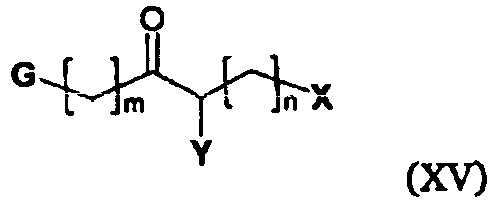
- wherein, G, Y and m are as above;
- n is an integer from 0 to 6; and
- X is halogen such as Cl, Br and I;
- with azole represented by the general structural formula (XIV) and then treat with sodium borohydride to synthesize alcohol compounds represented by the general structural formula (XII).
- Details of the reaction conditions described in Method II are as follows. To a solution of azole derivative of the general structural formula (XIV) (0.5 ∼ 10 equiv) and base such as sodium hydride, sodium methoxide sodium ethoxide, sodium carbonate, potassium carbonate, calcium carbonate, lithium carbonate (0 ∼ 100 equiv), pyridine, diethyl amine, diisopropylethyl amine, and triethylamine in organic solvent such as methyl alcohol, ethyl alcohol, isopropyl alcohol, DMSO, acetonitrile, DMF, NMP, acetone, methylene chloride, chloroform, MIBK, DME, ethyl acetate, THF, 1,4-dioxane, benzene, toluene, xylene, hexane, heptane and cyclohexane (0 - 10000 equiv), alkyl halide derivative of the general structural formula (XV) was slowly added. The reaction was warmed to 40 - 189°C for 0.1 - 240 hours and then cooled to 25°C. Organic solvent such as ethyl acetate, diethyl ether, benzene, toluene, xylene, methylene chloride, chloroform, heptane, cyclohexane and hexane was added to this mixture and organic layer was washed with brine. The crude product was dissolved in methyl alcohol (1- 10000 equiv) and then sodium borohydride (1 - 100 equiv) was added to this solution slowly. After 0.1 ∼ 24 hours stirring at room temperature, the reaction mixture was concentrated in vacuo. Organic solvent such as ethyl acetate, diethyl ether, benzene, toluene, xylene, methylene chloride, chloroform, heptane, cyclohexane and hexane was added to this mixture and organic layer was washed with brine. The resulting organic layer was dried and concentrated in vacuo. This residue was consisting of 1N-azole and 2N-azole. They were separated by column chromatography, eluting with an increasing ratio of ethyl acetate in hexane.
- There are several pathways to introduce carbamoyl group to alcohol compounds such as 1,1'-carbonyldiimidazole-amine, sodium cyanate-acid, carbamoyl chloride, chlorosulfamoyl isocyanate-water, disuccimidyl carbonate-amine, phosgene-amine, triphosgene-amine, chloroformate-amine, trichloroacetylchloride-amine, trichloroactylisocyanate, trimethylsilylisocyanate, 1-chlorocarbonylbenzotriazole-amine and so on. Some of pathways to prepare azole compounds containing carbamoyl group represented by the general structural formula (IX) are summarized as set forth in Reaction Scheme 1 and Reaction Scheme 2 below.
-

- wherein, G, Y, A, R1, R2, m and n are as above.
- The azole compounds containing carbamoyl group represented by the general structural formula (IX) were prepared by reacting alcohol compounds represented by the general structural formula (XII) with 1,1'-carbonyldiimidazole and then with amine base represented by the general structural formula (XVI);
- R 1 R 2 NH (XVI)
- wherein,
- R1 and R2 are as above.
- Details of the reaction conditions described in Reaction Scheme I are as follows. For the conversion of the racemic or enantiomerically enriched alcohol compounds of the general structural formula (XII) to the racemic or enantiomerically enriched azole compounds containing carbamoyl group of the general structural formula (IX), the concentration of the alcohol compounds of the general structural formula (XII) is about 0.005 to 0.1 moles with 1,1'-carbonyldiimidazole ranging from about 1.0 to 3.5 equivalents. This reaction is preferably carried out at a temperature of -10 to 66°C. Without purification, the resulting intermediate is treated with 1 to 1,000 equivalents of amine base represented by the general structural formula (XVI) at a temperature of -10 to 30°C to give the compound represented by the general structural formula (IX). For this carbamoylation, an ethereal solvent such as diethyl ether and tetrahydrofuran, a halogenated hydrocarbon solvent such as dichloromethane and chloroform, or the mixture thereof may be used.
-

- wherein, G, Y, A, R1, R2, m and n are as above.
- Details of the reaction conditions described in Reaction Scheme 2 are as follows. For the conversion of the racemic or enantiomerically enriched alcohol compounds represented by the general structural formula (XII) to the racemic or enantiomerically enriched azole compounds containing carbamoyl group represented by the general structural formula (IX), the concentration of alcohol compounds represented by the general structural formula (XII) is about 0.005 to 0.1 moles with sodium cyanate ranging from about 0.5 to 4.0 equivalents and acid ranging from about 0.5 to 4.0 equivalents. This reaction is preferably carried out at a temperature of -10 to 66°C to give the compound represented by the general structural formula (IX). For this carbamoylation, an ethereal solvent such as diethyl ether and tetrahydrofuran, a halogenated hydrocarbon solvent such as dichloromethane and chloroform, or the mixture thereof may be used.
- Among the preferred embodiments of the compounds of formula (IX) are included compounds of the formula:
-

- wherein, Y is as above;
- A3, A4 and A5 are independently selected from the group consisting of CH or N, with at least one of A3, A4 and A being CH; and at least one of the other of A3, A4 and A5 being N;
- R6 and R7 are selected from the group consisting of hydrogen, halogen, per-fluoroalkyl, alkyl of from 1 to 8 carbon atoms, thioalkoxy, and alkoxy;

- R3 and R4 are alkyl, hydrogen,
, or taken together - with the attached nitrogen atom form an imidazole, or phenyl piperazine ring; and
- y is an integer of from 0 to 4, preferably from 0 to 2 or pharmaceutically acceptable salts thereof;
- a compound of the formula:
-

- wherein R3, R4, R6, R7, Y, y, A3, A4 and A5 are as above;and
- p is an integer of from 0 to 1;
- or pharmaceutically acceptable salts thereof; and
- a compound of the formula:
-

- wherein R8 and R9 taken together with the attached nitrogen atom form a substituent of the formula:
-

- wherein E, U, A2, A3, A4 and A5 are as above;
- k and v are an integer from 0 to 1;
- Z is a phenyl, phenoxy, alkyl or phenylalkyloxy substitued where the phenyl moiety of said substitutent is unsubstituted or substituted with from one to three substituents selected from the group consisting of halogen, alkyl, perfluoroalkyl or alkoxy;
- Y is a hydrogen, halogen or alkyl;
- y is an integer of from 0 to 1;
- R6 and R7 are selected from the group consisting of hydrogen, halogen, per-fluoroalkyl, thioalkoxy, alkoxy and alkyl.
- Another group of preferred compounds are the following:
-

- wherein A1 is as above; R8 and R9 are hydrogen, halogen, lower alkoxy, lower alkyl, hydroxy, trifluromethyl, amino, mono or dilower alkyl amino, nitro or R8 and R9 when substituted on adjacent carbon atoms and when R10 is hydrogen can be taken together to form a cyclolower alkyl, phenyl or heterocyclolower alkyl ring; R10 is lower alkoxy, phenyloxy, phenylalkoxy, hydrogen, cycloloweralkyl, halogen, hydroxy, lower alkyl, nitro, trifluoromethyl, mono or lower dikalkyl amino or amino; R11 is hydrogen, lower alkyl, phenyl or phenyl lower alkyl wherein the phenyl group can be unsubstituted or mono or disubstituted with a lower alkyl, hydroxy, lower alkoxy, or halo; R12 is hydrogen or lower alkyl or R12 taken together with R11 and their attached nitrogen atom form a 4 to 6 membered heteroarmatic ring containing at most 3 additional hetero nitrogen atoms ; R14 is hydrogen, amino carbonyl or lower alkyl: R13 is hydrogen, lower alkyl, amino, mono or dilower alkylamino hetero aromatic, amino carbonyl or phenyl where the phenyl group can be unsubstituted or mono or disubstituted with a lower alkyl, hydroxy, lower alkoxy, or halo,; and 0 and p are integers from 0-1.
-


- a 4 to 6 membered a heterocycloalkyl ring containing at most 1 additional hetero nitrogen atom; A1 is as above; R8, R9 ,R10, R13 and R14 are as above; 0, z and p are integers from 0-1; R16 is phenyl, phenyl carbonyl, a five or six membered hetero aromatic ring containing from 1 to 4 nitro heteroatoms, wherein said phenyl and heteroaromatic rings can be unsubstituted or mono or di-substituted with hydroxy, hydroxy lower alkyl, lower alkoxy, halogen, phenyl or trifloromethyl.
-

- wherein A1 is as above; R11, R12 and R13 are as above; and R'15 and R'16 when taken together with their attached carbon atoms form a cycloalkyl or phenyl ring which can be unsubstituted or substituted with halo, lower alkyl, lower alkoxy, hydroxy, halogen or trifluoromethyl.
- The compounds of IX-A, IX-B, IX-C, IX-D, IX-E and IX-F constitute preferred embodiments of the compound of formula IX. Particularly preferred embodiments of the compounds of formula IX-A, IX-B, IX-C, IX-D, IX-E and IX-F are those compounds where the nitrogen containing ring is a tetrazole or triazole ring. The triazoles are those compounds where one of A1, A3, A4 and A is nitrogen and the others are CH. The tetrazoles of the compounds of formula IX-A, IX-B, IX-C, IX-D, IX-E and IX-F are those compounds where two of A , A3, A4 and A are nitrogen and the other is CH. Generally, among the triazoles and tetrazoles of the compounds of formula IX-A, IX-B and IX-C are those compounds where R 6 and R7 are selected from the group consisting of hydrogen, halogen, perfluoroalkyl, alkyl and alkoxy. Where R1 and R2 in the compound of formula IX, are substituted phenyl or substituted phenylalkyl, the phenyl moiety can be substituted in one or more positions, preferably from one to three positions with amino, mono- or di-substituted alkyl amino, amido, alkyl, alkoxy and nitro.
- The compounds of formula IX, IX-A, IX-B, IX-C, IX-D, IX-E and IX-F include all forms of these compounds including these stereo, geometric and optical isomeric forms. The compounds of formula IX, IX-A, IX-B, IX-C, IX-D, IX-E and IX-F can exist as a racemate, as well as any mixture of these stereo, geometric or optical isomeric forms. In accordance with a preferred embodiment of this invention, the compounds of IX, IX-A, IX-B, IX-C, IX-D, IX-E and IX-F exist in pure isomeric form substantially free of these other isomeric forms. By substantially free, it is meant, that the specific isomer exists in its pure isomeric form such as a pure enantiomer with at least 95% by weight with at most 5% by weight of the other isomeric forms such as its other enantiomer.
- As used in the specification, the term "alkyl", alone or in combination, means a monovalent straight or branched-chain saturated hydrocarbon alkyl group containing from one to eight carbon atoms, preferably lower alkyl containing from one to six carbon atoms, such as methyl, ethyl, n-propyl, isopropyl, n-butyl, sec-butyl, isobutyl, tert-butyl, n-pentyl, n-hexyl and the like.
- The term "alkoxy" means a straight or branched-chain alkoxy group formed from alkyl containing from one to eight carbon atoms, preferably from one to six carbon atoms, such as methoxy, ethoxy, n-propoxy, isopropoxy, n-butoxy, tert-butoxy and the like.
- The term "aryl" means a monovalent mono- or bicyclic unsubstituted aromatic hydrocarbon ring such as phenyl or naphthyl, with phenyl being preferred.
- The term "perfluoro-lower alkyl" means any lower alkyl group wherein all the hydrogens of the lower alkyl group are substituted or replaced by fluorine. Among the prefered perfluoro-lower alkyl groups are trifluoromethyl, pentafluroethyl, heptafluoropropyl, etc with trifluromethyl being especially preferred.
- The term "cycloalkyl" means a cyclolower alkyl substituent which designates a monovalent unsubstituted 3- to 6-membered saturated carbocylic hydrocarbon ring. Among the preferred cycloalkyl substituents are cyclopropyl, cyclobutyl, cyclohexyl, etc.
- The term "heterocycloalkyl" refers to a 4 to 6 membered monocyclic saturated ring containing 3 to 4 carbon atoms and one to three hetero nitrogen or oxygen atoms.
- The term "heteroaromatic ring" refers to a monovalent 4 to 6 membered monocyclic heteroaromatic ring containing from 4 to 5 carbon atoms and from 1 to 4 hetero nitrogen.
- The term "pharmaceutically acceptable salts" refers to conventional acid-addition salts or base-addition salts that retain the biological effectiveness and properties of the compounds of formulae IX, IX-A, IX-B, IX-C, IX-D, IX-E and IX-F are formed from suitable non-toxic organic or inorganic acids, or organic or inorganic bases. Sample acid-addition salts include those derived from inorganic acids such as hydrochloric acid, hydrobromic acid, hydroiodic acid, sulfuric acid, sulfamic acid, phosphoric acid and nitric acid, and those derived from organic acids such as p-toluenesulfonic acid, salicylic acid, methanesulfonic acid, oxalic acid, succinic acid, citric acid, malic acid, lactic acid, fumaric acid, and the like. Sample base-addition salts include those derived from ammonium, potassium, sodium and, quaternary ammonium hydroxides, such as for example, tetramethylammonium hydroxide. The chemical modification of a pharmaceutical compound (i.e., drug) into a salt is a technique well known to pharmaceutical chemists to obtain improved physical and chemical stability, hygroscopicity, flowability and solubility of compounds. See, e.g., H. Ansel et al., Pharmaceutical Dosage Forms and Drug Delivery Systems (6th Ed. 1995) at pp. 196 and 1456-1457.
- Representative examples of the racemic or enantiomerically enriched azole compounds containing carbamoyl group represented by the general structural formula (IX) are selected from the group consisting of
-
Table 1 # Compound name 1 Carbamic acid 1-(2-chloro-phenyl)-2-[1,2,3]triazol-2-yl-ethyl ester 2 Carbamic acid 1-(2-chloro-phenyl)-2-tetrazol-2-yl-ethyl ester 3 Carbamic acid 1-(4-methoxy-phenyl)-2-tetrazol-2-yl-ethyl ester 4 Carbamic acid 1-phenyl-2-tetrazol-2-yl-ethyl ester 5 Carbamic acid 1-(4-chloro-phenyl)-2-tetrazol-2-yl-ethyl ester 6 Carbamic acid 1-(4-methoxy-phenyl)-2-[1,2,3]triazol-2-yl-ethyl ester 7 Carbamic acid 1-phenyl-2-[1,2,3]triazol-2-yl-ethyl ester 8 Carbamic acid 1-p-tolyl-2-[1,2,3]triazol-2-yl-ethyl ester 9 Carbamic acid 1-(3-chloro-phenyl)-2-[1,2,3]triazol-2-yl-ethyl ester 1 0 Carbamic acid 1-(4-chloro-phenyl)-2-[1,2,3]triazol-2-yl-ethyl ester 1 1 Carbamic acid 2-tetrazol-2-yl-1-p-tolyl-ethyl ester 1 2 Carbamic acid 1-o-tolyl-2-[1,2,3]triazol-2-yl-ethyl ester 1 3 Carbamic acid 1-(4-nitro-phenyl)-2-[1,2,3]triazol-2-yl-ethyl ester 1 4 Carbamic acid 1-(4-nitro-phenyl)-2-tetrazol-2-yl-ethyl ester 1 5 Carbamic acid 1-(4-fluoro-phenyl)-2-tetrazol-2-yl-ethyl ester 1 6 Carbamic acid 1-(4-fluoro-phenyl)-2-[1,2,3]triazol-2-yl-ethyl ester 1 7 Carbamic acid 1-(3-chloro-phenyl)-2-tetrazol-2-yl-ethyl ester 1 8 Carbamic acid 1-m-tolyl-2-[1,2,3]triazol-2-yl-ethyl ester 1 9 Carbamic acid 2-tetrazol-2-yl-1-m-tolyl-ethyl ester 2 0 Carbamic acid (R)-1-(2-chloro-phenyl)-2-tetrazol-2-yl-ethyl ester 2 1 Carbamic acid (S)-1-(2-chloro-phenyl)-2-tetrazol-2-yl-ethyl ester 2 2 Carbamic acid (R)-1-(2-chloro-phenyl)-2-tetrazol-1-yl-ethyl ester 2 3 Carbamic acid (S)-1-(2-chloro-phenyl)-2-tetrazol-1-yl-ethyl ester 2 4 Carbamic acid 2-tetrazol-2-yl-1-o-tolyl-ethyl ester 2 5 Carbamic acid 1-(3,4-dichloro-phenyl)-2-[1,2,3]triazol-2-yl-ethyl ester 2 6 Carbamic acid 1-(3,4-dichloro-phenyl)-2-tetrazol-2-yl-ethyl ester 2 7 Carbamic acid 2-tetrazol-2-yl-1-(3-trifluoromethyl-phenyl)-ethyl ester 2 8 Carbamic acid 2-[1,2,3]triazol-2-yl-1-(3-trifluoromethyl-phenyl)-ethyl ester 2 9 Carbamic acid 1-(2,4-dichloro-phenyl)-2-[1,2,3]triazol-2-yl-ethyl ester 3 0 Carbamic acid 1-(2,4-dichloro-phenyl)-2-tetrazol-2-yl-ethyl ester 3 1 Carbamic acid 2-tetrazol-2-yl-1-(4-trifluoromethyl-phenyl)-ethyl ester 3 2 Carbamic acid 2-[1,2,3]triazol-2-yl-1-(4-trifluoromethyl-phenyl)-ethyl ester 3 3 Carbamic acid (R)-1-(2-chloro-phenyl)-2-[1,2,3]triazol-2-yl-ethyl ester 3 4 Carbamic acid (S)-1-(2-chloro-phenyl)-2-[1,2,3]triazol-2-yl-ethyl ester 3 5 Carbamic acid 1-(2-chloro-phenyl)-2-tetrazol-1-yl-ethyl ester 3 6 Carbamic acid (R)-1-(2-chloro-phenyl)-2-[1,2,3]triazol-1-yl-ethyl ester 3 7 Carbamic acid (S)-1-(2-chloro-phenyl)-2-[1,2,3]triazol-1-yl-ethyl ester 3 8 Carbamic acid 1-(2-chloro-phenyl)-2-[1,2,3]triazol-1-yl-ethyl ester 3 Carbamic acid 2-[1,2,3]triazol-2-yl-1-(2-trifluoromethyl-phenyl)-ethyl ester 9 4 0 Carbamic acid 2-chloro-1-phenyl-2-tetrazol-1-yl-ethyl ester 4 1 Carbamic acid (S)-1-(4-chloro-phenyl)-2-tetrazol-2-yl-ethyl ester 4 2 Carbamic acid (R)-1-(4-chloro-phenyl)-2-tetrazol-2-yl-ethyl ester 4 3 Carbamic acid 1-(2-chloro-phenyl)-2-(5-methyl-tetrazol-2-yl)-ethyl ester 4 4 Carbamic acid 1-(2-chloro-phenyl)-2-(5-methyl-tetrazol-1-yl)-ethyl ester 4 5 Methyl-carbamic acid (R)-1-(2-chloro-phenyl)-2-tetrazol-2-yl-ethyl ester 4 6 Ethyl-carbamic acid (R)-1-(2-chloro-phenyl)-2-tetrazol-2-yl-ethyl ester 4 7 Phenyl-carbamic acid (R)-1-(2-chloro-phenyl)-2-tetrazol-2-yl-ethyl ester 4 8 Carbamic acid (R)-2-tetrazol-2-yl-1-(2-trifluoromethyl-phenyl)-ethyl ester 4 9 Carbamic acid (S)-2-tetrazol-2-yl-1-(2-trifluoromethyl-phenyl)-ethyl ester 5 0 Carbamic acid 1-(2-chloro-phenyl)-2-(5-phenyl-tetrazol-2-yl)-ethyl ester 5 1 Methyl-carbamic acid 1-(2-chloro-phenyl)-2-(5-phenyl-tetrazol-2-yl)-ethyl ester 5 2 Cyclopropyl-carbamic acid (R)-1-(2-chloro-phenyl)-2-tetrazol-2-yl-ethyl ester 5 3 Carbamic acid (R)-1-(2-chloro-phenyl)-2-(5-phenyl-tetrazol-2-yl)-ethyl ester 5 4 Methyl-carbamic acid (R)-1-(2-chloro-phenyl)-2-(5-phenyl-tetrazol-2-yl)-ethyl ester 5 5 Carbamic acid 1-phenyl-3-tetrazol-2-yl-propyl ester 5 6 Carbamic acid 1-(2-chloro-phenyl)-2-[5-(2,3-dichloro-phenyl)-tetrazol-2-yl]-ethyl ester 5 7 Methyl-carbamic acid 1-(2-chloro-phenyl)-2-[5-(2,3-dichloro-phenyl)-tetrazol-2-yl] -ethyl ester 5 8 Carbamic acid 1-(4-hydroxy-phenyl)-2-tetrazol-2-yl-ethyl ester 5 9 Carbamic acid (S)-1-(2-chloro-phenyl)-2-(5-phenyl-tetrazol-2-yl)-ethyl ester 6 0 Methyl-carbamic acid (S)-1-(2-chloro-phenyl)-2-(5-phenyl-tetrazol-2-yl)-ethyl ester 6 1 Carbamic acid (S)-1-(2-chloro-phenyl)-2-(5-phenyl-tetrazol-1-yl)-ethyl ester 6 2 Methyl-carbamic acid (S)-1-(2-chloro-phenyl)-2-(5-phenyl-tetrazol-1-yl)-ethyl ester 6 3 Carbamic acid 1-phenyl-3-tetrazol-1-yl-propyl ester 6 4 Carbamic acid 1-phenyl-3-tetrazol-1-yl-propyl ester 6 5 Carbamic acid 1-(2-chloro-phenyl)-2-[5-(2,3-dichloro-phenyl)-tetrazol-1-yl]-ethyl ester 6 6 Methyl-carbamic acid 1-(2-chloro-phenyl)-2-[5-(2,3-dichloro-phenyl)-tetrazol-1-yl] -ethyl ester 6 7 Carbamic acid 1-(3-chloro-phenyl)-2-tetrazol-2-yl-propyl ester 6 8 Methyl-carbamic acid 1-(3-chloro-phenyl)-2-tetrazol-2-yl-propyl ester 6 9 Carbamic acid 1-(3-chloro-phenyl)-2-tetrazol-1-yl-propyl ester 7 0 Carbamic acid 1-(2-chloro-phenyl)-3-[1,2,3]triazol-2-yl-propyl ester 7 1 Carbamic acid 1-(2-chloro-phenyl)-2-(5-pyridin-2-yl-tetrazol-2-yl)-ethyl ester 7 2 Carbamic acid 2-(5-amino-tetrazol-2-yl)-1-(2-chloro-phenyl)-ethyl ester 7 3 Carbamic acid 1-(3-chloro-phenyl)-2-[1,2,3]triazol-2-yl-propyl ester 7 Methyl-carbamic acid 1-(3-chloro-phenyl)-2-[1,2,3]triazol-2-yl-propyl ester 4 7 5 Ethyl-carbamic acid 1-(2-chloro-phenyl)-2-(5-pyridin-2-yl-tetrazol-2-yl)-ethyl ester 7 6 Carbamic acid 1-(4-chloro-phenyl)-2-tetrazol-2-yl-propyl ester 7 7 Methyl-carbamic acid 1-(4-chloro-phenyl)-2-tetrazol-2-yl-propyl ester 7 8 Carbamic acid 1-(4-chloro-phenyl)-2-tetrazol-1-yl-propyl ester 7 9 Methyl-carbamic acid 1-(4-chloro-phenyl)-2-tetrazol-1-yl-propyl ester 8 0 Carbamic acid 1-(3,4-dichloro-phenyl)-2-tetrazol-2-yl-propyl ester 8 1 Methyl-carbamic acid 1-(3,4-dichloro-phenyl)-2-tetrazol-2-yl-propyl ester 8 2 Carbamic acid 1-(3,4-dichloro-phenyl)-2-tetrazol-1-yl-propyl ester 8 3 Methyl-carbamic acid 1-(3,4-dichloro-phenyl)-2-tetrazol-1-yl-propyl ester 8 4 Carbamic acid 1-(3,4-dimethoxy-phenyl)-2-tetrazol-2-yl-ethyl ester 8 5 Carbamic acid (S)-1-(4-chloro-phenyl)-2-[1,2,3]triazol-2-yl-ethyl ester 8 6 Carbamic acid (R)-1-(4-chloro-phenyl)-2-[1,2,3]triazol-2-yl-ethyl ester 8 7 Carbamic acid (S)-1-(3,4-dichloro-phenyl)-2-[1,2,3]triazol-2-yl-ethyl ester 8 8 Carbamic acid (R)-1-(3,4-dichloro-phenyl)-2-tetrazol-2-yl-ethyl ester 8 9 Carbamic acid 1-(2,5-dichloro-phenyl)-2-tetrazol-2-yl-ethyl ester 9 0 Carbamic acid 1-(2,5-dichloro-phenyl)-2-tetrazol-1-yl-ethyl ester 9 1 Carbamic acid (R)-1-(3,4-dichloro-phenyl)-2-[1,2,3]triazol-2-yl-ethyl ester 9 2 Carbamic acid (R)-1-(3,4-dichloro-phenyl)-2-[1,2,3]triazol-1-yl-ethyl ester 9 3 Carbamic acid 1-(4-phenoxy-phenyl)-2-tetrazol-2-yl-ethyl ester 9 4 Carbamic acid 1-(4-phenoxy-phenyl)-2-tetrazol-1-yl-ethyl ester 9 5 Carbamic acid 1-(2,5-dichloro-phenyl)-2-[1,2,3]triazol-2-yl-ethyl ester 9 6 Carbamic acid (S)-1-(3,4-dichloro-phenyl)-2-tetrazol-2-yl-ethyl ester 9 7 Carbamic acid (S)-1-(3,4-dichloro-phenyl)-2-tetrazol-1-yl-ethyl ester 9 8 Carbamic acid 1-(2,6-dichloro-phenyl)-2-tetrazol-2-yl-ethyl ester 9 9 Carbamic acid 1-(2,6-dichloro-phenyl)-2-[1,2,3]triazol-2-yl-ethyl ester 1 0 0 Carbamic acid 1-(2,6-dichloro-phenyl)-2-[1,2,3]triazol-1-yl-ethyl ester 1 0 1 Carbamic acid 1-(2,4-dichloro-phenyl)-2-tetrazol-1-yl-ethyl ester 1 0 2 Carbamic acid 1-naphthalen-2-yl-2-tetrazol-2-yl-ethyl ester 1 0 3 Carbamic acid (R)-1-(2,4-dichloro-phenyl)-2-tetrazol-2-yl-ethyl ester 1 0 4 Carbamic acid 1-naphthalen-2-yl-2-tetrazol-1-yl-ethyl ester 1 0 5 Carbamic acid 2-tetrazol-2-yl-1-(2,3,4-trimethoxy-phenyl)-ethyl ester 1 0 6 Carbamic acid 2-tetrazol-1-yl-1-(2,3,4-trimethoxy-phenyl)-ethyl ester 1 0 7 Carbamic acid 2-tetrazol-2-yl-1-(3,4,5-trimethoxy-phenyl)-ethyl ester 1 0 8 Carbamic acid 1-benzo[1,3]dioxol-5-yl-2-tetrazol-2-yl-ethyl ester 1 0 9 Carbamic acid 1-benzo[1,3]dioxol-5-yl-2-tetrazol-1-yl-ethyl ester 1 1 0 Carbamic acid 1-(4-dimethylamino-phenyl)-2-tetrazol-2-yl-ethyl ester 1 1 1 Carbamic acid 2-tetrazol-2-yl-1-(2,4,6-trimethyl-phenyl)-ethyl ester 1 1 2 Carbamic acid 2-tetrazol-1-yl-1-(2,4,6-trimethyl-phenyl)-ethyl ester 1 1 3 Carbamic acid (S)-1-(2,4-dichloro-phenyl)-2-tetrazol-2-yl-ethyl ester 1 1 4 Carbamic acid (S)-1-(2,4-dichloro-phenyl)-2-[1,2,3]triazol-2-yl-ethyl ester 1 1 5 Carbamic acid (R)-1-(2,4-dichloro-phenyl)-2-[1,2,3]triazol-2-yl-ethyl ester 1 1 6 Carbamic acid 2-phenyl-1-tetrazol-2-ylmethyl-ethyl ester 1 1 7 Carbamic acid 2-phenyl-1-tetrazol-1-ylmethyl-ethyl ester 1 1 8 Carbamic acid 1-(4-tert-butyl-phenyl)-2-tetrazol-2-yl-ethyl ester 1 1 9 Carbamic acid 1-(4-tert-butyl-phenyl)-2-tetrazol-1-yl-ethyl ester 1 2 0 Carbamic acid 1-(4-chloro-3-trifluoromethyl-phenyl)-2-[1,2,3]triazol-2-yl-ethyl ester 1 2 1 Carbamic acid 1-(4-chloro-3-trifluoromethyl-phenyl)-2-[1,2,3]triazol-1-yl-ethyl ester 1 2 2 Carbamic acid (S)-1-(2,6-dichloro-phenyl)-2-tetrazol-1-yl-ethyl ester 1 2 3 Carbamic acid (R)-1-(2,6-dichloro-phenyl)-2-tetrazol-1-yl-ethyl ester 1 2 4 Carbamic acid 1-indan-5-yl-2-tetrazol-1-yl-ethyl ester 1 2 5 Carbamic acid 1-indan-5-yl-2-tetrazol-2-yl-ethyl ester 1 2 6 Carbamic acid (R)-1-(2,6-dichloro-phenyl)-2-tetrazol-2-yl-ethyl ester 1 2 7 Carbamic acid (S)-1-(2,6-dichloro-phenyl)-2-tetrazol-2-yl-ethyl ester 1 2 8 Carbamic acid 2-(2,4-dichloro-phenoxy)-1-tetrazol-2-ylmethyl-ethyl ester 1 2 9 O-1-(2-Chloro-phenyl)-2-tetrazol-2-yl ethyl allophanate 1 3 0 Carbamic acid (R)-1-(2,4-dichloro-phenyl)-2-[1,2,3]triazol-1-yl-ethyl ester 1 3 1 Carbamic acid 1-phenyl-2-tetrazol-1-yl-ethyl ester 1 3 2 Carbamic acid 1-(3,4-difluoro-phenyl)-2-tetrazol-2-yl-ethyl ester 1 3 3 Carbamic acid 1-(3,4-difluoro-phenyl)-2-tetrazol-1-yl-ethyl ester 1 3 4 Carbamic acid 1-(3,4-difluoro-phenyl)-2-[1,2,3]triazol-2-yl-ethyl ester 1 3 5 Carbamic acid 1-(3,4-difluoro-phenyl)-2-[1,2,3]triazol-1-yl-ethyl ester 1 3 6 Carbamic acid 1-(2-fluoro-phenyl)-2-tetrazol-2-yl-ethyl ester 1 3 7 Carbamic acid 1-(2-fluoro-phenyl)-2-tetrazol-1-yl-ethyl ester 1 3 8 4-Benzyl-piperidine-1-carboxylic acid 1-(2-chloro-phenyl)-2-tetrazol-2-yl-ethyl ester 1 4 3 4-Phenyl-piperazine-1-carboxylic acid 1-(2-chloro-phenyl)-2-tetrazol-2-yl-ethyl ester 1 4 4 4-Phenyl-piperazine-1-carboxylic acid 1-(2-chloro-phenyl)-2-tetrazol-1-yl-ethyl ester 1 4 5 4-(4-Fluoro-benzoyl)-piperidine-1-carboxylic acid 1-(2-chloro-phenyl)-2-tetrazol-2-yl-ethyl ester 1 4 6 4-Benzyl-piperidine-1-carboxylic acid 1-(2-chloro-phenyl)-2-tetrazol-1-yl-ethyl ester 1 4 7 1-Benzyl-4-[1-(2-chloro-phenyl)-2-tetrazol-2-yl-ethoxycarbonyl]-piperazin-1-ium 1 4 8 Carbamic acid 2-(3,4-dichloro-phenoxy)-1-tetrazol-2-ylmethyl-ethyl ester 1 4 9 Imidazole-1-carboxylic acid 2-(3,4-dichloro-phenoxy)-1-tetrazol-1-ylmethyl-ethyl ester 1 5 0 Carbamic acid 2-(4-chloro-phenoxy)-1-tetrazol-1-ylmethyl-ethyl ester 1 5 1 Imidazole-1-carboxylic acid 2-(4-chloro-phenoxy)-1-tetrazol-1-ylmethyl-ethyl ester 1 5 2 Carbamic acid 2-(4-chloro-phenoxy)-1-tetrazol-2-ylmethyl-ethyl ester 1 5 3 4-Benzyl-piperidine-1-carboxylic acid 1-phenyl-2-tetrazol-1-yl-ethyl ester 1 5 4 4-Benzyl-piperidine-1-carboxylic acid 1-phenyl-2-tetrazol-2-yl-ethyl ester 1 5 5 Carbamic acid 2-(2-chloro-phenoxy)-1-tetrazol-2-ylmethyl-ethyl ester 1 5 6 4-Benzyl-piperidine-1-carboxylic acid 2-(2-chloro-phenoxy)-1-tetrazol-2-ylmethyl-ethyl ester 1 5 7 Carbamic acid 2-(2-chloro-phenoxy)-1-tetrazol-1-ylmethyl-ethyl ester 1 5 8 4-Benzyl-piperidine-1-carboxylic acid 2-(2-chloro-phenoxy)-1-tetrazol-1-ylmethyl-ethyl ester 1 6 1 Carbamic acid 1-(2,4-difluoro-phenyl)-2-tetrazol-2-yl-ethyl ester 1 6 2 Carbamic acid 1-(2,4-difluoro-phenyl)-2-tetrazol-1-yl-ethyl ester 1 6 3 4-Benzyl-piperidine-1-carboxylic acid (S)-1-(2-chloro-phenyl)-2-[1,2,3] triazol-2-yl-ethyl ester 1 6 4 4-Benzyl-piperidine-1-carboxylic acid (R)-1-(2-chloro-phenyl)-2-tetrazol-2-yl-ethyl ester 1 6 5 Carbamic acid 1-(2,4-dimethyl-phenyl)-2-[1,2,3]triazol-2-yl-ethyl ester 1 6 6 4-Benzyl-piperidine-1-carboxylic acid (S)-1-(2-chloro-phenyl)-2-tetrazol-2-yl-ethyl ester 1 6 7 [2-(3,4-Dihydroxy-phenyl)-ethyl]-carbamic acid 1-(2-chloro-phenyl)-2-tetrazol-2-yl-ethyl ester 1 6 8 [2-(3,4-Dihydroxy-phenyl)-ethyl]-carbamic acid 1-(2-chloro-phenyl)-2-tetrazol-1-yl-ethyl ester 1 6 9 4-Benzyl-piperidine-1-carboxylic acid (R)-1-(2-chloro-phenyl)-2-[1,2,3] triazol-2-yl-ethyl ester 1 7 0 Carbamic acid 2-(4-chloro-phenoxy)-1-[1,2,3]triazol-2-ylmethyl-ethyl ester 1 7 1 Carbamic acid 2-(4-chloro-phenoxy)-1-[1,2,3]triazol-1-ylmethyl-ethyl ester 1 7 2 4-Benzyl-piperidine-1-carboxylic acid 2-(4-chloro-phenoxy)-1-tetrazol-2-ylmethyl-ethyl ester 1 7 3 4-Benzyl-piperidine-1-carboxylic acid 2-(4-chloro-phenoxy)-1-tetrazol-1-ylmethyl-ethyl ester 1 7 4 4-(4-Methoxy-benzyl)-piperidine-1-carboxylic acid 1-(2-chloro-phenyl)-2-tetrazol-2-yl-ethyl ester 1 7 5 4-(3,4-Dichloro-benzyl)-piperidine-1-carboxylic acid 1-(2-chloro-phenyl)-2-tetrazol-2-yl-ethyl ester 1 7 6 4-Pyridin-4-ylmethyl-piperidine-1-carboxylic acid 1-(2-chloro-phenyl)-2-tetrazol-2-yl-ethyl ester 1 7 7 4-(4-Fluoro-benzyl)-piperidine-1-carboxylic acid 1-(2-chloro-phenyl)-2-tetrazol-2-yl-ethyl ester 1 7 8 3-(4-Fluoro-benzyl)-piperidine-1-carboxylic acid 1-(2-chloro-phenyl)-2-tetrazol-2-yl-ethyl ester 1 7 9 4-(4-Chloro-benzyl)-piperidine-1-carboxylic acid 1-(2-chloro-phenyl)-2-tetrazol-2-yl-ethyl ester 1 8 0 3-(4-Chloro-phenyl)-pyrrolidine-1-carboxylic acid 1-(2-chloro-phenyl)-2-tetrazol-2-yl-ethyl ester 1 8 1 3-Phenethyl-pyrrolidine-1-carboxylic acid 1-(2-chloro-phenyl)-2-tetrazol-2-yl-ethyl ester 1 8 2 4-[1,2,3]Triazol-2-ylmethyl-piperidine-1-carboxylic acid 1-(2-chloro-phenyl)-2-tetrazol-2-yl-ethyl ester 1 8 3 3-Tetrazol-2-ylmethyl-piperidine-1-carboxylic acid 1-(2-chloro-phenyl)-2-tetrazol-2-yl-ethyl ester 1 8 4 3-[1,2,3]Triazol-2-ylmethyl-piperidine-1-carboxylic acid 1-(2-chloro-phenyl)-2-tetrazol-2-yl-ethyl ester 1 8 5 4-Benzoyl-piperidine-1-carboxylic acid 1-(2-chloro-phenyl)-2-tetrazol-2-yl-ethyl ester 1 8 6 4-(4-Chloro-benzoyl)-piperidine-1-carboxylic acid 1-(2-chloro-phenyl)-2-tetrazol-2-yl-ethyl ester 1 8 7 4-(4-Methoxy-benzoyl)-piperidine-1-carboxylic acid 1-(2-chloro-phenyl)-2-tetrazol-2-yl-ethyl ester 1 8 8 4-[1,2,3]Triazol-1-ylmethyl-piperidine-1-carboxylic acid 1-(2-chloro-phenyl)-2-tetrazol-2-yl-ethyl ester 1 8 9 4-Tetrazol-2-ylmethyl-piperidine-1-carboxylic acid 1-(2-chloro-phenyl)-2-tetrazol-2-yl-ethyl ester 1 9 0 4-[1,2,3]Triazol-2-yl-piperidine-1-carboxylic acid 1-(2-chloro-phenyl)-2-tetrazol-2-yl-ethyl ester 1 9 1 4-(3,4-Dichloro-benzyl)-piperidine-1-carboxylic acid 1-(2,5-dichloro-phenyl)-2-tetrazol-2-yl-ethyl ester 1 9 2 4-(5-Phenyl-tetrazol-2-yl)-piperidine-1-carboxylic acid 1-(2-chloro-phenyl)-2-tetrazol-2-yl-ethyl ester 1 9 3 4-[1,2,3]Triazol-1-yl-piperidine-1-carboxylic acid 1-(2-chloro-phenyl)-2-tetrazol-2-yl-ethyl ester 1 9 4 4-(3,4-Dichloro-benzyl)-piperidine-1-carboxylic acid 1-(2,4-dichloro-phenyl)-2-tetrazol-2-yl-ethyl ester 1 9 5 4-(3,4-Dichloro-benzyl)-piperidine-1-carboxylic acid 1-(3,4-dichloro-phenyl)-2-tetrazol-2-yl-ethyl ester 1 9 6 3-(4-Chloro-benzyl)-pyrrolidine-1-carboxylic acid 1-(2-chloro-phenyl)-2-tetrazol-2-yl-ethyl ester 1 9 7 4-(3,5-Bis-trifluoromethyl-benzyl)-piperidine-1-carboxylic acid 1-(2-chloro-phenyl)-2-tetrazol-2-yl-ethyl ester 1 9 8 3-(5-Methyl-tetrazol-2-ylmethyl)-piperidine-1-carboxylic acid 1-(2-chloro-phenyl)-2-tetrazol-2-yl-ethyl ester 1 9 9 4-(5-Methyl-tetrazol-2-ylmethyl)-piperidine-1-carboxylic acid 1-(2-chloro-phenyl)-2-tetrazol-2-yl-ethyl ester 2 0 0 4-(3,4-Dichloro-benzyl)-piperidine-1-carboxylic acid 1-(2-chloro-phenyl)-2-[1,2,3] triazol-2-yl-ethyl ester 2 0 1 4-(3,4-Dichloro-benzyl)-piperidine-1-carboxylic acid 1-(2-chloro-phenyl)-2-tetrazol-1-yl-ethyl ester 2 0 2 3-Phenethyl-pyrrolidine-1-carboxylic acid 1-(2,5-dichloro-phenyl)-2-tetrazol-2-yl-ethyl ester 2 0 3 3-Phenethyl-pyrrolidine-1-carboxylic acid 1-(2,4-dichloro-phenyl)-2-tetrazol-2-yl-ethyl ester 2 0 4 3-Phenethyl-pyrrolidine-1-carboxylic acid 1-(3,4-dichloro-phenyl)-2-tetrazol-2-yl-ethyl ester 2 0 5 3-Phenethyl-pyrrolidine-1-carboxylic acid 2-(2-chloro-phenoxy)-1-[1,2,3] triazol-2-ylmethyl-ethyl ester 2 0 6 3-Phenethyl-pyrrolidine-1-carboxylic acid 2-(2,4-dichloro-phenoxy)-1-[1,2,3] triazol-2-ylmethyl-ethyl ester 2 0 7 3-Phenethyl-pyrrolidine-1-carboxylic acid 2-(3,4-dichloro-phenoxy)-1-[1,2,3] triazol-2-ylmethyl-ethyl ester 2 0 8 3-Phenethyl-pyrrolidine-1-carboxylic acid 2-(2,5-dichloro-phenoxy)-1-tetrazol-2-ylmethyl-ethyl ester 2 0 9 Carbamic acid 2-(2-chloro-phenoxy)-1-[1,2,3]triazol-2-ylmethyl-ethyl ester 2 1 0 Carbamic acid 2-(3,4-dichloro-phenoxy)-1-[1,2,3]triazol-2-ylmethyl-ethyl ester 2 1 1 Carbamic acid 2-(2,4-dichloro-phenoxy)-1-[1,2,3]triazol-2-ylmethyl-ethyl ester 2 1 2 Carbamic acid 2-(2,5-dichloro-phenoxy)-1-tetrazol-2-ylmethyl-ethyl ester 2 1 3 4-(4-Fluoro-benzoyl)-piperidine-1-carboxylic acid 01-(3,4-dichloro-phenyl)-2-tetrazol-2-yl-ethyl ester 2 1 4 4-(4-Fluoro-benzoyl)-piperidine-1-carboxylic acid 1-(2,4-dichloro-phenyl)-2-tetrazol-2-yl-ethyl ester 2 1 5 4-(4-Fluoro-benzoyl)-piperidine-1-carboxylic acid 1-(2,5-dichloro-phenyl)-2-tetrazol-2-yl-ethyl ester 2 1 6 4-(3,4-Dichloro-benzyl)-piperidine-1-carboxylic acid 2-(2-chloro-phenoxy)-1-tetrazol-2-ylmethyl-ethyl ester 2 1 7 4-(3,4-Dichloro-benzyl)-piperidine-1-carboxylic acid 2-(2,4-dichloro-phenoxy)-tetrazol-2-ylmethyl-ethyl ester 2 1 8 4-(3,4-Dichloro-benzyl)-piperidine-1-carboxylic acid 2-(3,4-dichloro-phenoxy)-1-tetrazol-2-ylmethyl-ethyl ester 2 1 9 3-[2-(4-Methoxy-phenyl)-ethyl]-pyrrolidine-1-carboxylic acid 1-(2-chloro-phenyl)-2-tetrazol-2-yl-ethyl ester 2 2 0 4-(3,4-Dichloro-benzyl)-piperidine-1-carboxylic acid 1-phenyl-2-tetrazol-2-yl-ethyl ester 2 2 1 Carbamic acid 1-(4-benzyloxy-phenyl)-2-tetrazol-2-yl-ethyl ester 2 2 2 Carbamic acid 1-(4-benzyloxy-phenyl)-2-tetrazol-1-yl-ethyl ester 2 2 3 methyl-carbamic acid -1-(2-chloro-phenyl)-2-tetrazol-2-yl-ethyl ester 2 2 4 methyl-carbamic acid (S) -1-(2-chloro-phenyl)-2-tetrazol-2-yl-ethyl ester 2 2 5 4-benzyl-piperidine-1-carboxylic acid-1-(2-chloro-phenyl)-2-[1,2,3] triazol-2-yl-ethyl ester 2 2 6 4-benzyl-piperidine-1-carboxylic acid (S)-1-(2-chloro-phenyl)-2-[1,2,3] triazol-2-yl-ethyl ester - In utilizing the compounds of the invention represented by the general structural formula (IX) for the treatment of diseases of the central nervous system, particularly the treatment of anxiety, depression, convulsion, epilepsy, migraine, bipolar disorder, drug abuse, smoking, ADHD, obesity, sleep disorder, neuropathic pain, cognitive impairment, stroke and muscle spasm, it is preferred to administer the compounds orally. For oral administration, the compounds of formula (IX) are preferably combined with a pharmaceutical carrier. The ratio of the carrier to a compound of formula (IX) is not critical to achieve the desired effects on the central nervous system of the host requiring such treatment, and can vary considerably, depending on whether the composition is to be filled into capsules or formed into tablets. In tableting, it is usually desirable to employ at least as much pharmaceutical carrier as the pharma-ceutically active ingredients. Various pharmaceutical carriers or mixtures thereof can be used. Suitable carriers, for example, comprise mixtures of lactose, dibasic calcium phosphate and corn starch. Other pharmaceutically acceptable ingredients can be further added, including lubricants such as magnesium stearate.
- The compounds of formula (IX) can be formulated, using conventional inert pharmaceutical adjuvant materials, into dosage forms that are suitable for oral or parenteral administration. Such dosage forms include tablets, suspensions, solutions, and the like. Furthermore, the compounds of the invention can be administered in the form of hard or soft capsules. Examples of suitable inert adjuvant materials that can be used in formulating the compounds of formula (IX) into oral and parenteral dosage forms will be immediately apparent to persons skilled in the art. These adjuvant materials include, for example, water, gelatin, lactose, starch, magnesium stearate, talc, vegetable oils, gums, polyalkylene glycols, and the like. Moreover, preservatives, stabilizers, wetting agents, emulsifying agents, salts for altering osmotic pressure, buffers, and the like, can be incorporated, if desired, into such formulations.
- The therapeutic use of the racemic or enantiomerically enriched compounds of general structural formula(IX) and their pharmaceutically useful salts have been established by the following tests.
- Light-Dark Box Test Methods
- Light-Dark Box (LDB) test, one of the unconditioned conflict tests, was used to investigate anxiolytic activity for several drugs such as Diazepam, Buspirone, etc (Allikmets et al, 1996; Belzung and Griebel, 2001; Cutler and Aitken, 1991; Leyre et al, 2004). In the present study, anxiolytic effect of azole compounds containing carbamoyl group represented by general structural formula (IX) was investigated on the LDB test in mice.
- The animals were treated with compound 30 min prior to testing. The light-dark box consisted of a plexiglas apparatus measuring 45cmx7cmx7cm (L×W×H), and was partitioned into two compartments, one fully opaque (dark compartment made of black plexiglas : 18cm of total length of apparatus), while the second was lit from the compartment ceiling by a 100W bulb. A small opening (7x7cm) in the partition wall allowed free passage between the light and dark compartments.
- Animals were placed at the lit compartment first, and the latency for escape into dark was checked and tested in the LDB for 5 min after the first entering into dark box. The animal, which the latency was over 2 min, was excluded from the test. Total time spent in the light compartment was counted. Movement of animal was checked through the TV-CCD camera by an experienced observer blind to the conditions of the experiment. A mouse whose four paws were in the new box was considered as having changed box.
- The compounds with a higher % duration value in the light box are more potent as anxiolytics.
- Maximal Electro Shock-induced Tonic Seizure Test Methods
- The "Maximal ElectroShock (MES)" test is a well-established pharmacological screening method for anticonvulsants against tonic-clonic seizures. The procedure employed in the MES test for anticonvulsants is as follows. The compounds to be tested were dissolved in 30% PEG400 and administered ip and po into animals. After the designated number of hours, maximal electroshock (50 mA, 60 Hz, 0.2 sec) was applied into animals via corneal electrodes using IITC Life Science model 11A Shocker. Anticonvulsant activity is demonstrated by the protection against MES-induced hindlimb tonic extension. Median efficacy dose (ED50) levels were determined using three different dose levels with at least 8 mice in each group. Compounds with smaller ED50 value and higher protection rate are more potent as anticonvulsants.
- Pentylenetetrazol-induced Clonic Seizure Test Methods
- The "Pentylenetetrazol (PTZ)" test for anticonvulsant and antianxiety activity was also carried out. Compounds that antagonize the effects of subcutaneous PTZ-induced clonic seizures are known to elevate the seizure threshold, hence are generally useful in preventing absence seizures.
- The procedure employed in the PTZ test is as follows. The compounds to be tested were dissolved in 30% PEG400 and administered ip and po into animals. After the designated number of hours, each animal was injected subcutaneously with 100 mg/kg of PTZ (CD97 dose) and observed for up to 30 minutes for the presence or absence of clonic spasms over 5 seconds. Median efficacy dose (ED50) levels were determined using three different dose levels with 8 mice in each group. The compounds with a smaller ED50 value and higher protection rate are more potent as anticonvulsant and anxiolytics.
- Forced Swimming Test Methods
- The "Forced swimming test (FST)" for antidepressant activity was also carried out. The procedure employed in the FST for antidepressant is as follows. The compounds to be tested were dissolved in 30% PEG400 and administered ip and po into animals. 30 min later, the immobility time during post 4 minutes of 6 minutes experiment time was measured. The compounds with a higher reduction % value of immobility are more potent as antidepressants
- GABA-A receptor (TBPS site) Binding Assay Methods
- Compounds of the inventions were tested for specific binding to TBPS (t-butyl bi-cyclophosphorothionate) site, an allosteric modulator site of GABA-A receptor as modified from G. Maksay and M. Simonyi, Eur. J. Pharmacol. 1985, 117(2), 275. and Gee, K.W. et al., J. Pharm. Exp. Ther. 1988, 246, 803.
- This binding assay was performed using [35S] TBPS as radioligand in washed crude membrane homogenate from rat brains. Membrane preparations were carried out according to procedure described below. Sprague-Dawley (SD) rat weighting 230g were killed by decapitation and their whole brains were rapidly removed and its cerebellums were excluded. The dissected brains were homogenized for 30 sec in 10 volumes (W/V) of ice-cold 0.32 M Sucrose and 50mM Tris-citrate buffer pH 7.4 using glass homogenate. The homogenate was centrifuged at 2,000xg for 5 min at 4°C. And the supernatant re-centrifuged at 50,000xg for 20 min at 4°C. The supernatant was discarded and the resulting pellets were resuspended in 10 volumes (W/V) of ice-cold 50mM Tris-citrate buffer pH 7.4. And then the suspended pellet was centrifuged at 50,000xg for 20 min at 4°C. The resulting pellets were suspended again in 32 volumes (W/V) of ice-cold 50mM Tris-citrate buffer pH 7.4 with 0.05% Triton X-100 and then incubated in 37°C for 60 min using a water bath. The incubated suspension was centrifuged at 50,000xg for 20 min at 4°C. Resuspending and centrifugation step of the remained pellets were repeated twice at the same manner and final pellets were resuspended in 10 volumes(W/V) of ice-cold 50mM Tris-citrate buffer pH 7.4 to enable distribution of 2 ml aliquot in microcentrifuge tube, which were used immediately or kept at -80°C for no more than 1 month before use.
- For TBPS site binding assay, 50 □ of the tested compound were added to 100□ membrane protein suspended in 0.15ml of 50mM Tris-citrate buffer with 200mM NaCl pH 7.4 in presence of 2 nM of [35S] TBPS. The incubation of mixtures were carried out for 1.5 hours at 25°C and then rapidly filtered over Whatman GF/C glass fiber filters, followed by twice 4.5ml rinses with ice-cold incubation buffer. The filters were placed in counting vials and 4 ml scintillation solution. The vials were counted in a Beckman scintillation counter. Non-specific binding was determined in parallel incubations with 100µM picrotoxin.
- IC50 values for TBPS site binding assay was calculated using Graphpad PRISM v.3.00. The compounds with a smaller IC50 value or higher inhibition % are more potent as GABA allosteric modulator.
- Dopamine Transport Assay Methods (Measurement of Dopamine uptake)
- The "Dopamine Transport (DAT)" assay for dopamine uptake inhibition was also carried out. In order to test dopamine uptake inhibition, compounds of the inventions were assayed as modified from Zhaoping Liu et. al., Neuropharmacology, 2001, 41, 464.
- Cultured CHO cells were infected with recombinant plasmid, DAT-pCDNA3, which encodes rat dopamine transporter. Several subclones were selected and assayed for [3H] dopamine uptake. The clone with the highest uptake, designated D8, was chosen for Dopamine transport assay of compounds.
- For the Dopamine transport assay, D8 cells were cultured in 48-well plate using RMPI1640 containing 10% FCS. D8 cells, grown to 60,000 cells per well, each wells were rinsed once with phosphate buffered saline (PBS) and pre-incubated in 100 □ Hank's balanced salt solution (HBSS) for 10 min at room temperature. The buffer was then changed to 50 □ HBSS containing the tested compounds and 350 □ HBSS containing reaction components ([3H] dopamine, ascorbic acid and pargyline). Final concentrations of [3H] dopamine, ascorbic acid and pargyline are 151 nM, 100 µM and 100 µM, respectively. The cells were incubated for 20 min at room temperature and the reaction was terminated by aspiration of the buffer and washed three times with 1ml cold PBS. The cells were then solubilized in 2N NaOH and an aliquot was measured by liquid scintillation counting to quantify the uptake of [3H] dopamine. The compounds with higher inhibition % are more potent as dopamine uptake inhibitor.
- Test results obtained with the compounds of general structural formula (IX) and pharmaceutically useful salts of the invention are set forth in Table 2.
-
Table 2 Compound # Mice LDB % Duration in the light box Mice MES ED50 or Protection % (mpk/ peak time) Mice PTZ ED50 or Protection % (mpk/ peak time) Mice FST Reduction of immobility % TBPS Inhibition % (At 100µM) DAT Inhibition % (At 10µM) 1 N.T 10.7/0.5hr 24.5/0.5hr N.S 18.3% 47.3% 2 180% 8.6/ 0.5hr 5-9/0.5hr N.S 11.2% N.T 4 N.T 66.7% (30/ 0.5hr) N.T 40-3% -2.3% 41.5% 5 N.T 18.4/0.5hr N.T 71.7% 14.5% N.T 7 N.T 26.2/0.5hr N.T N.T 3.5% -21.1% 10 N.T 21.3/0.5hr N.T 45.1% 35.9% N.T 20 285% 4.24/0.5hr 3.76/0.5hr -24.3% 25.1% 7.1% 21 N.T 14.2/0.5hr 28.8/0.5hr N.T 12.6% 20.9% 25 N.T 100% (50/0.5,1, 4hr) N.T 94.1% 74.8% 70.7% 26 N.T 100% (50/ 0.5, 1, 2, 4hr) N.T 97-5% 66.3% 88.2% 29 288.5% 14.4/1hr 16.8/1hr N.S IC50 = 8.1µM -27.5% 30 143.6% 14.9/1hr 12.2/1hr N.S 74.9% 15.1% 33 N.S 9.72/0.5hr 8.1/0.5hr 26.2% 48.2% N.T 39 N.T 12.5/0.5hr N.T N.T N.T N.T 42 N.T 18.2/0.5hr N.T 44.1% N.T N.T 45 N.S 4.88/0.5hr 5.81/0.5hr N.T N.T -58.1% 80 N.T 33.3% (30/ 2,4hr) N.T 50.6% 64.8% N.T 86 N.T 21.4/ 0.5hr N.T N.S 18.9% N.T 87 N.S 14.8/0.5hr N.T 92.5% 50.1% 93.8% 88 N.T 19.1/0.5hr N.T 88.4% 52.8% N.T 89 167.4% 6.15/1hr 14.5/1hr N.S 27.6% N.T 91 N.T 16.0/0.5hr N.T 94.0% N.T N.T 96 N.T 10.4/0.5hr N.T 95.8% N.T 98.4% 98 N.T 6.03/0.5hr 11.6/0.5hr 31.5% 29.9% N.T 99 N.T 11.6/0.5hr 100% (30/0.5, 2hr) N.S 23.6% N.T 103 277.8% 19.2/1hr 5.14/1hr N.S IC50 = 13-4µM N.T 113 -172% 13.0/1hr 20.7/1hr N.S N.T 114 172.5% 33.9/1hr 16.9/1hr N.S IC50 = 107-4µM N.T 115 245% (10 mpk, ip) 12.7/0.25hr B-43/1hr N.S IC50 = 4.3µM N.T 116 N.T 100% (30/0.5, 1hr) 33.3% (30/0.5, 1, 2hr) 30.0% N.T N.T 126 241.5% 2.7/0.5hr 5.06/0.5hr 72.0% 0.3% N.T 129 N.T 13.7/0.5hr 100% (30/1hr) N.S 5.6% N.T 130 N.S 24.0/0.5hr 8.0/0.5hr 8.8% 42.8% N.T 138 N.T 100% (30/2hr) 66.7% (30/4hr) 35.9% 49.6% N.T 148 N.T 100% (30/0.5 hr) 66.7% (30/0.5, 4hr) N.S 76.1% N.T 175 N.T 20.2/ 0.5hr 66.7% (30/4hr) N.S N.T N.T 181 N.T 12.1/ 0.5hr 33.3% (30/1, 2, 4hr) 30.6% N.T N.T 191 N.T 66.7% (30/0,5, 1, 2, 4hr) > 30 50.6% N.T N.T 194 N.T 11.9/0.5hr 33.3% (30/ 2hr) 53.4% N.T N.T 195 N.T 15.3/0.5hr 33.3% (30/0.5, 1hr) 31.9% N.T N.T 196 N.T 15.3/0.5hr 33.3% (30/2,4hr) N.S N.T N.T 197 N.T 6.3/ 0.5hr 100% (30/0.5, 4hr) N.S N.T N.T 200 N.T 100% (30/0.5, 4hr) N.T 25.9% N.T N.T 201 N.T 100% (30/1, 2, 4hr) N.T 54.0% N.T N.T 202 N.T 11.4/0.5hr 33.3% (30/1, 4hr) 81.2% N.T N.T 203 N.T 100% (30/0.5, 1, 2. 4hr) N.T 44.0% N.T N.T 204 N.T 100% (30/0.5, 1, 2hr) N.T 51.2% N.T N.T 206 N.T 100% (30/0.5, 1, 2, 4hr) 66.7% (30/2,4hr) 51.4% N.T N.T 207 N.T 100% (30/0.5,1, 4hr) N.T 43.4% N.T N.T 208 N.T 100% (30/0.5,1, 4hr) 33.3% (30/ 4hr) 48.2% N.T N.T Protection % was evaluated using with 3 mice.
mpk: mg/kg
N.S: Not significant (p > 0.05)
N.T: Not tested - As described hereinbefore, the racemic or enantiomerically enriched azole compounds containing carbamoyl group represented by the general structural formula (IX) and pharmaceutically useful salts thereof of the present invention were observed to have anxiolytic and anticonvulsant activity in the LDB test, MES test, PTZ test and TBPS assay. The compounds showing GABA-related activities can be applied to the treatment of sleep disorder or muscle spasms. Furthermore, the racemic or enantiomerically enriched azole compounds containing carbamoyl group represented by the general structural formula (IX) and pharmaceutically useful salts thereof of the present invention were also observed to have antidepressant activity and affinity to dopamine uptake inhibition. Also the compounds acting as dopamine reuptake inhibitors can be developed for the treatment of ADHD, obesity or abuse syndromes of drugs or smoking. The compounds with the anticonvulsant and/or antiepileptic activities may also be used for the treatment of bipolar disorders, migraine prophylaxis, and neuropathic pain as their additional indications. Accordingly the racemic or enantiomerically enriched azole compounds containing carbamoyl group represented by the general structural formula (IX) and pharmaceutically useful salts thereof of the present invention can be used in the treatment of disorders of the central nervous system, especially as anxiety, depression, convulsion, epilepsy, migraine, bipolar disorder, drug abuse, smoking, ADHD, obesity, sleep disorder, neuropathic pain, cognitive impairment, stroke, neurodegeneration and muscle spasm.
- The amount of a compound of general structural formula (IX) and pharmaceutically useful salts thereof, which is present in any of the above-described dosage forms, is variable. In the systemic treatment of CNS diseases with an active amount of compounds of the general structural formula (IX) and pharmaceutically useful salts thereof, the dosage is typically from about 0.02mg to about 250 mg/kg/day (0.001∼12.5g/day in a typical human weighing 50kg) in single or divided doses, regardless of the route of administration. A more preferred dosage range is from about 0.15mg/kg/day to about 250mg/kg/day. Of course, depending upon the exact compound and the exact nature of the individual illness, doses outside this range may be prescribed by the attending physician.
- The examples, which follow further, illustrate the invention. All parts are by weight and all temperatures are in degrees centigrade, unless otherwise mentioned. Moreover, unless otherwise stated, NMR spectra were obtained at 200MHz.
- A better understanding of the present invention may be obtained in light of following examples that are set forth to illustrate, but are not to be construed to limit, the present invention.
- Preparation of azole compounds containing carbamoyl group of the general structural formula (IX).
- Example 1
- Carbamic acid 1-(2-chloro-phenyl)-2-[1,2,3]triazol-2-yl-ethyl ester
- To a solution of 2-bromo-2'-chloroacetophenone (2mmol) and sodium carbonate (4mmol) in toluene (100ml), 1H-1,2,3-triazole (4mmol) was added. The reaction was refluxed for 4h and then cooled to 25°C. This solution was then concentrated on a rotary evaporator and diluted with ethyl acetate. This mixture was washed with brine. The resulting organic layer was dried and concentrated in vacuo. The crude product was dissolved in methanol (50ml) and was added with sodium borohydride (8mmol) slowly at 0°C to give alcohol compound represented by the general formula (XII) where in, G is 2-chlorophenyl, m is 0, Y is hydrogen, n is 0 and A is 2N-1,2,3-triazole. After 1h stirring at room temperature, this solution was concentrated on a rotary evaporator and diluted with ethyl acetate. This mixture was washed with brine. The resulting organic layer was dried and concentrated in vacuo. This alcohol compound was dissolved in methylene chloride (50ml) and was added 1,1'-carbonyl diimidazole (8mmol). The reaction mixture was stirred at room temperature for 4h, followed by the addition of excess ammonium hydroxide (50ml). After 4h stirring at room temperature, the organic layer was isolated and washed with brine. The resulting organic layer was dried and concentrated in vacuo. The residue was purified by column chromatography (ethyl acetate : hexane = 1 : 2) and give carbamic acid 1-(2-chloro-phenyl)-2-[1,2,3] triazol-2-yl-ethyl ester.
- 1H-NMR (CDCl3) δ7.62 (s, 1H), 7.21-7.38 (m, 4H), 6.55 (m, 1H), 5.09 (br, 2H), 4.8 (m, 2H)
- Example 2
- Carbamic acid 1-(4-methoxy-phenyl)-2-[1,2,3]triazol-2-yl-ethyl ester
- The procedure given in Example 1 was followed using 2-bromo-4'-methoxyacetophenone as a reactant, instead of 2-bromo-2'-chloroacetophenone, to give carbamic acid 1-(4-methoxy-phenyl)-2-[1,2,3] triazol-2-yl-ethyl ester.
- 1H-NMR (Acetone-d6) δ7.65 (s, 2H), 7.35 (d, 2H), 6.92 (d, 2H), 6.15 (m, 1H), 5.75-6.1 (br, 2H), 4.7 (m, 2H), 3.81 (s, 3H)
- Example 3
- Carbamic acid 1-phenyl-2-[1,2,3]triazol-2-yl-ethyl ester
- The procedure given in Example 1 was followed using 2-bromo acetophenone as a reactant, instead of 2-bromo-2'-chloroacetophenone, to give carbamic acid 1-phenyl-2-[1,2,3]triazol-2-yl-ethyl ester.
- 1H-NMR (CDCl3) δ7.62(s, 1H), 7.37(br, 5H), 6.21(m, 1H), 4.98(br, 2H), 4.8(m, 2H)
- Example 4
- Carbamic acid 1-(3-chloro-phenyl)-2-[1,2,3]triazol-2-yl-ethyl ester
- The procedure given in Example 1 was followed using 2-bromo-3'-chloroacetophenone as a reactant, instead of 2-bromo-2'-chloroacetophenone, to give carbamic acid 1-(3-chloro-phenyl)-2-[1,2,3] triazol-2-yl-ethyl ester
- 1H-NMR (Acetone-d6) δ7.67(s, 2H), 7.6-7.2(m, 4H), 6.25(m, 1H), 6.15(br, 2H), 4.81(m, 2H)
- Example 5
- Carbamic acid 1-(4-nitro-phenyl)-2-[1,2,3]triazol-2-yl-ethyl ester
- The procedure given in Example 1 was followed using 2-bromo-4'-nitroacetophenone as a reactant, instead of 2-bromo-2'-chloroacetophenone, to give carbamic acid 1-(4-nitro-phenyl)-2-[1,2,3] triazol-2-yl-ethyl ester.
- 1H-NMR (DMSO-d6) 88.15(s, 2H), 7.5 (m, 4H), 6.19 (m, 3H), 4.6- 4.95 (m, 2H)
- Example 6
- Carbamic acid 1-(4-fluoro-phenyl)-2-[1,2,3]triazol-2-yl-ethyl ester
- The procedure given in Example 1 was followed using 2-bromo-4'-fluoroacetophenone as a reactant, instead of 2-bromo-2'-chloroacetophenone, to give carbamic acid 1-(4-fluoro-phenyl)-2-[1,2,3] triazol-2-yl-ethyl ester.
- 1H-NMR (Acetone-d6) δ7.66(s, 2H), 7.2-7.5(m, 4H), 6.3(m, 1H), 5.8-6.6(br, 2H), 4.7(m, 2H)
- Example 7
- Carbamic acid 1-m-tolyl-2-[1,2,3]triazol-2-yl-ethyl ester
- The procedure given in Example 1 was followed using 2-bromo-3'-methylacetophenone as a reactant, instead of 2-bromo-2'-chloroacetophenone, to give carbamic acid 1-m-tolyl-2-[1,2,3] triazol-2-yl-ethyl ester.
- 1H-NMR (Acetone-d6) δ7.67(s, 2H), 7.1-7.35(m, 4H), 6.2(m, 1H), 5.7-6.3(br, 2H), 4.7(m, 2H)
- Example 8
- Carbamic acid 1-(3,4-dichloro-phenyl)-2-[1,2,3]triazol-2-yl-ethyl ester
- The procedure given in Example 1 was followed using 2-bromo-3',4'-dichloroacetophenone as a reactant, instead of 2-bromo-2'-chloroacetophenone, to give carbamic acid 1-(3,4-dichloro-phenyl)-2-[1,2,3]triazol-2-yl-ethyl ester.
- 1H-NMR (Acetone-d6) δ7.67(s, 2H), 7.57(m, 2H), 7.36(m, 1H), 6.19(m, 1H), 5.9-6.3(br, 2H), 4.8-4.9(m, 2H)
- Example 9
- Carbamic acid 2-[1,2,3]triazol-2-yl-l-(3-trifluoromethyl-phenyl)-ethyl ester
- The procedure given in Example 1 was followed using 2-bromo-3'-(trifluoromethyl)acetophenone as a reactant, instead of 2-bromo-2'-chloroacetophenone, to give carbamic acid 2-[1,2,3] triazol-2-yl-1-(3-trifluoromethyl-phenyl)-ethyl ester.
- 1H-NMR (Acetone-d6) δ7.67 (m, 6H), 6.30(m, 1H), 5.9-6.4(br, 2H), 4.87(m, 2H)
- Example 10
- Carbamic acid 1-(2,4-dichloro-phenyl)-2-[1,2,3]triazol-2-yl-ethyl ester
- The procedure given in Example 1 was followed using 2-bromo-2',4'-dichloroacetophenone as a reactant, instead of 2-bromo-2'-chloroacetophenone, to give carbamic acid 1-(2,4-dichloro-phenyl)-2-[1,2,3]triazol-2-yl-ethyl ester.
- 1H-NMR (Acetone-d6) δ7.68(s, 2H), 7.5(m, 3H), 6.50(m, 1H), 5.9-6.4(br, 2H), 4.8(m, 2H)
- Example 11
- Carbamic acid 2-[1,2,3]triazol-2-yl-1-(4-trifluoromethyl-phenyl)-ethyl ester
- The procedure given in Example 1 was followed using 2-bromo-4'-(trifluoromethyl)acetophenone as a reactant, instead of 2-bromo-2'-chloroacetophenone, to give carbamic acid 2-[1,2,3] triazol-2-yl-1-(3-trifluoromethyl-phenyl)-ethyl ester.
- 1H-NMR (Acetone-d6) δ7.72 (m, 6H), 6.29(m, 1H), 5.8-6.8(br, 2H), 4.8(m, 2H)
- Example 12
- Carbamic acid 2-[1,2,3]triazol-2-yl-1-(2-trifluoromethyl-phenyl)-ethyl ester
- The procedure given in Example 1 was followed using 2-bromo-2'-(trifluoromethyl)acetophenone as a reactant, instead of 2-bromo-2'-chloroacetophenone, to give carbamic acid 2-[1,2,3] triazol-2-yl-1-(2-trifluoromethyl-phenyl)-ethyl ester.
- 1H-NMR (Acetone-d6) δ7.7 (m, 6H), 6.64(m, 1H), 5.7-6.4(br, 2H), 4.75(m, 2H)
- Example 13
- Carbamic acid 1-(2-chloro-phenyl)-3-[1,2,3]triazol-2-yl-propyl ester
- The procedure given in Example 1 was followed using methanesulfonic acid 3-(2-chloro-phenyl)-3-hydroxy-propyl ester as a reactant, instead of 2-bromo-2'-chloroacetophenone, to give carbamic acid 1-(2-chloro-phenyl)-3-[1,2,3] triazol-2-yl-propyl ester without carbonyl reduction.
- 1H-NMR (Acetone-d6) δ7.87 (d, 2H), 8-7(m, 4H), 6.27(br, 2H), 6.00(m, 1H), 4.64(m, 2H), 2.4(m, 2H)
- Example 14
- Carbamic acid 1-(3-chloro-phenyl)-2-[1,2,3]triazol-2-yl-propyl ester
- The procedure given in Example 1 was followed using 2-Bromo-1-(3-chloro-phenyl)-propan-1-one as a reactant, instead of 2-bromo-2'-chloroacetophenone, to give carbamic acid 1-(3-chloro-phenyl)-2-[1,2,3] triazol-2-yl-propyl ester.
- 1H-NMR (Acetone-d6) δ8.09(s, 1H), 7.68(s, 1H), 7.3(m, 4H), 5.9-6.6(br, 2H), 6.07(m, 1H), 5.2 (m, 1H), 1.57(d, 3H)
- Example 15
- Methyl-carbamic acid 1-(3-chloro-phenyl)-2-[1,2,3]triazol-2-yl-propyl ester
- The procedure given in Example 14 was followed using excess methylamine as a reactant, instead of excess ammonium hydroxide, to give methyl-carbamic acid 1-(3-chloro-phenyl)-2-[1,2,3]triazol-2-yl-propyl ester.
- 1H-NMR (Acetone-d6) δ8.06(s, 1H), 7.65(s, 1H), 7.3(m, 4H), 6.5(br, 1H), 6.05(m, 1H), 5.2 (m, 1H), 2.66(m, 3H), 1.54(d, 3H)
- Example 16
- Carbamic acid 1-(2,5-dichloro-phenyl)-2-[1,2,3]triazol-2-yl-ethyl ester
- The procedure given in Example 1 was followed using 2-bromo-2',5'-dichloroacetophenone as a reactant, instead of 2-bromo-2'-chloroacetophenone, to give carbamic acid 1-(2,5-dichloro-phenyl)-2-[1,2,3]triazol-2-yl-ethyl ester.
- 1H-NMR (Acetone-d6) δ7.69(s, 2H), 7.46(m, 3H), 6.35(m, 1H), 5.9-6.58(br, 2H), 4.84(m, 2H)
- Example 17
- Carbamic acid 1-(2,6-dichloro-phenyl)-2-[1,2,3]triazol-2-yl-ethyl ester
- The procedure given in Example 1 was followed using 2-bromo-2',6'-dichloroacetophenone as a reactant, instead of 2-bromo-2'-chloroacetophenone, to give carbamic acid 1-(2,6-dichloro-phenyl)-2-[1,2,3]triazol-2-yl-ethyl ester.
- 1H-NMR (Acetone-d6) δ7.68(s, 2H), 7.37-7.6(m, 3H), 6.9 (m, 1H), 5.8-6.25(br, 2H), 4.96(m, 2H)
- Example 18
- Carbamic acid 1-(4-chloro-3-trifluoromethyl-phenyl)-2-[1,2,3] triazol-2-yl-ethyl ester
- The procedure given in Example 1 was followed using 2-bromo-4'-chloro-3'-(trifluoromethyl)acetophenone as a reactant, instead of 2-bromo-2'-chloroacetophenone, to give carbamic acid 1-(4-chloro-3-trifluoromethyl-phenyl)-2-[1,2,3]triazol-2-yl-ethyl ester.
- 1H-NMR (Acetone-d6) δ7.9-7.6 (m, 5H), 6.26(m, 1H), 6.2(br, 2H), 4.88(m, 2H)
- Example 19
- Carbamic acid 1-(2,4-dimethyl-phenyl)-2-[1,2,3]triazol-2-yl-ethyl ester
- The procedure given in Example 1 was followed using 2-bromo-2'-4'-dimethylacetophenone as a reactant, instead of 2-bromo-2'-chloroacetophenone, to give carbamic acid 1-(2,4-dimethyl-phenyl)-2-[1,2,3]triazol-2-yl-ethyl ester.
- 1H-NMR (Acetone-d6) δ7.93(s, 1H), 7.63(s, 1H), 7.46 (d, 1H), 7.1(m, 2H), 5.35(br, 2H), 5.0(m, 1H), 4.55(m, 2H), 2.33(s, 3H), 2.30(s, 3H)
- Example 20
- 4-(3,4-Dichloro-benzyl)-piperidine-1-carboxylic acid
- The procedure given in Example 1 was followed using excess 4-(3,4-dichloro-benzyl)-piperidine as a reactant, instead of excess ammonium hydroxide, to give 4-(3,4-dichloro-benzyl)-piperidine-1-carboxylic acid 1-(2-chloro-phenyl)-2-[1,2,3]triazol-2-yl-ethyl ester.
- 1H-NMR (Acetone-d6) δ7.9(s, 2H), 7.48(m, 3H), 7.36(s, 1H), 7.22(d, 2H), 7.02(s, 1H), 4.07(d, 2H), 3.15(t, 2H), 2.68(d, 2H), 1.76(m, 4H), 1.33(m, 4H)
- Example 21
- Carbamic acid 1-(2-chloro-phenyl)-2-[1,2,3]triazol-1-yl-ethyl ester
- To a solution of 2-bromo-2'-chloroacetophenone (2mmol) and sodium carbonate (4mmol) in toluene (100ml), 1H-1,2,3-triazole (4mmol) was added. The reaction was refluxed for 4h and then cooled to 25°C. This solution was then concentrated on a rotary evaporator and diluted with ethyl acetate. This mixture was washed with brine. The resulting organic layer was dried and concentrated in vacuo. The crude product was dissolved in methanol (50ml) and was added with sodium borohydride (8mmol) slowly at 0°C to give alcohol compound represented by the general formula (XII) where in, G is 2-chlorophenyl, m is 0, Y is hydrogen, n is 0 and A is 1N-1,2,3-triazole.. After 1h stirring at room temperature, this solution was concentrated on a rotary evaporator and diluted with ethyl acetate. This mixture was washed with brine. The resulting organic layer was dried and concentrated in vacuo. This alcohol compound was dissolved in methylene chloride (50ml) and was added 1,1'-carbonyl diimidazole (8mmol). The reaction mixture was stirred at room temperature for 4h, followed by the addition of excess ammonium hydroxide (50ml). After 4h stirring at room temperature, the organic layer was isolated and washed with brine. The resulting organic layer was dried and concentrated in vacuo.
- The preparation procedure of 1N-azole is same as that of 2N-azole in example 1 except the ratio of mobile phase of column chromatography. 1N-Azole is more polar than 2N-azole in chromatographic condition and separated by eluting with an increasing ratio of ethyl acetate in hexane after elution of 2N-azole to give carbamic acid 1-(2-chloro-phenyl)-2-[1,2,3]triazol-1-yl-ethyl ester.
- 1H-NMR (CDCl3) δ7.57(s, 1H), 7.53(s, 1H), 7.05-7.35(m, 4H), 6.20(m, 1H), 5.64(br, 2H), 4.66(m, 2H)
- Example 22
- Carbamic acid 1-(2,6-dichloro-phenyl)-2-[1,2,3]triazol-1-yl-ethyl ester
- The procedure given in Example 21 was followed using 2-bromo-2',6'-dichloroacetophenone as a reactant, instead of 2-bromo-2'-chloroacetophenone, to give carbamic acid 1-(2,6-dichloro-phenyl)-2-[1,2,3]triazol-1-yl-ethyl ester.
- 1H-NMR (Acetone-d6) δ8.05(s, 1H), 7.69(s, 1H), 7.40-7.89(m, 3H), 6.97(m, 1H), 5.82-6.64(br, 2H), 5.58-5.52 (m, 2H)
- Example 23
- Carbamic acid 1-(4-chloro-3-trifluoromethyl-phenyl)-2-[1,2,3] triazol-1-yl-ethyl ester
- The procedure given in Example 21 was followed using 2-bromo-4'-chloro-3'-(trifluoromethyl)acetophenone as a reactant, instead of 2-bromo-2'-chloroacetophenone, to give carbamic acid 1-(4-chloro-3-trifluoromethyl-phenyl)-2-[1,2,3]triazol-1-yl-ethyl ester.
- 1H-NMR (Acetone-d6) δ7.99 (d, 1H), 7.81(s, 1H), 7.68-7.65(m, 3H), 6.20(m, 3H), 4.93(dd, 2H)
- Example 24
- Carbamic acid 1-(2-chloro-phenyl)-2-tetrazol-2-yl-ethyl ester
- To a solution of 2-bromo-2'-chloroacetophenone (2mmol) and sodium carbonate (4mmol) in toluene (100ml), 1H-tetrazole (4mmol) was added. The reaction was refluxed for 4h and then cooled to 25°C. This solution was then concentrated on a rotary evaporator and diluted with ethyl acetate. This mixture was washed with brine. The resulting organic layer was dried and concentrated in vacuo. The crude product was dissolved in methanol (50ml) and was added with sodium borohydride (8mmol) slowly at 0°C to give alcohol compound represented by the general formula (XII) where in, G is 2-chlorophenyl, m is 0, Y is hydrogen, n is 0 and A is 2N-tetrazole. After 1h stirring at room temperature, this solution was concentrated on a rotary evaporator and diluted with ethyl acetate. This mixture was washed with brine. The resulting organic layer was dried and concentrated in vacuo. This alcohol compound was dissolved in methylene chloride (50ml) and was added 1,1'-carbonyl diimidazole (8mmol). The reaction mixture was stirred at room temperature for 4h, followed by the addition of excess ammonium hydroxide (50ml). After 4h stirring at room temperature, the organic layer was isolated and washed with brine. The resulting organic layer was dried and concentrated in vacuo. The residue was purified by column chromatography (ethyl acetate : hexane = 1 : 2) and give acid 1-(2-chloro-phenyl)-2-tetrazol-2-yl-ethyl ester.
- 1H-NMR (Acetone-d6) δ8.71 (s, 1H), 7.32-7.51 (m, 4H), 6.56 (m, 1H), 6.18 (br, 2H), 5.09 (m, 2H)
- Example 25
- Carbamic acid 1-(4-methoxy-phenyl)-2-tetrazol-2-yl-ethyl ester
- The procedure given in Example 24 was followed using 2-bromo-4'-methoxyacetophenone as a reactant, instead of 2-bromo-2'-chloroacetophenone, to give carbamic acid 1-(4-methoxy-phenyl)-2-tetrazol-2-yl-ethyl ester.
- 1H-NMR (Acetone-d6) δ8.45 (s, 1H), 7.30 (d, 2H), 6.90 (d, 2H), 6.18 (m, 1H), 4.18-5.19 (m, 4H), 3.83 (s, 3H)
- Example 26
- Carbamic acid 1-phenyl-2-tetrazol-2-yl-ethyl ester
- The procedure given in Example 24 was followed using 2-bromo acetophenone as a reactant, instead of 2-bromo-2'-chloroacetophenone, to give carbamic acid 1-phenyl-2-tetrazol-2-yl-ethyl ester.
- 1H-NMR (Acetone-d6) δ8.55 (s, 1H), 7.41 (s, 5H), 6.15 (m, 1H), 4.9-5.1 (m, 2H), 4.7-4.95 (br, 2H)
- Example 27
- Carbamic acid 1-(4-chloro-phenyl)-2-tetrazol-2-yl-ethyl ester
- The procedure given in Example 24 was followed using 2-bromo-4'-chloroacetophenone as a reactant, instead of 2-bromo-2'-chloroacetophenone, to give carbamic acid 1-(4-chloro-phenyl)-2-tetrazol-2-yl-ethyl ester.
- 1H-NMR (Acetone-d6) δ8.73 (s, 1H), 7.47 (m, 4H), 6.3 (m, 1H), 5.8-6.3 (br, 2H), 5.13 (m, 2H)
- Example 28
- Carbamic acid 2-tetrazol-2-yl-1-p-tolyl-ethyl ester
- The procedure given in Example 24 was followed using 2-bromo-4'-methylacetophenone as a reactant, instead of 2-bromo-2'-chloroacetophenone, to give carbamic acid 2-tetrazol-2-yl-1-p-tolyl-ethyl ester.
- 1H-NMR (Acetone-d6) δ8.54(s, 1H), 7.15-7.4(m, 4H), 6.19(m, 1H), 4.95(m, 2H), 4.6-5.2(br, 2H), 2.38(s, 3H)
- Example 29
- Carbamic acid 1-(4-nitro-phenyl)-2-tetrazol-2-yl-ethyl ester
- The procedure given in Example 24 was followed using 2-bromo-4'-nitroacetophenone as a reactant, instead of 2-bromo-2'-chloroacetophenone, to give carbamic acid 1-(4-nitro-phenyl)-2-tetrazol-2-yl-ethyl ester.
- 1H-NMR (Acetone-d6) δ8.77(s, 1H), 8.3(m, 2H), 7.75(m, 2H), 6.4(m, 1H), 6.0-6.6(br, 2H), 5.23(m, 2H)
- Example 30
- Carbamic acid 1-(4-fluoro-phenyl)-2-tetrazol-2-yl-ethyl ester
- The procedure given in Example 24 was followed using 2-bromo-4'-fluoroacetophenone as a reactant, instead of 2-bromo-2'-chloroacetophenone, to give carbamic acid 1-(4-fluoro-phenyl)-2-tetrazol-2-yl-ethyl ester.
- 1H-NMR (Acetone-d6) δ8.72(s, 1H), 7.51(m, 2H), 7.22(m, 2H), 6.35(m, 1H), 5.8-6.4(br, 2H), 5.13(m, 2H)
- Example 31
- Carbamic acid 1-(3-chloro-phenyl)-2-tetrazol-2-yl-ethyl ester
- The procedure given in Example 24 was followed using 2-bromo-3'-chloroacetophenone as a reactant, instead of 2-bromo-2'-chloroacetophenone, to give carbamic acid 1-(3-chloro-phenyl)-2-tetrazol-2-yl-ethyl ester.
- 1H-NMR (Acetone-d6) δ8.47(s, 1H), 7.12-7.38(m, 4H), 6.15(m, 1H), 5.2-5.4(br, 2H), 4.9(m, 2H)
- Example 32
- Carbamic acid 2-tetrazol-2-yl-1-m-tolyl-ethyl ester
- The procedure given in Example 24 was followed using 2-bromo-3'-methylacetophenone as a reactant, instead of 2-bromo-2'-chloroacetophenone, to give carbamic acid 2-tetrazol-2-yl-1-m-tolyl-ethyl ester.
- 1H-NMR (Acetone-d6) δ8.50(s, 1H), 7.16-7.29(m, 4H), 6.18(m, 1H), 4.8-5.2(br, 2H), 4.90(m, 2H)
- Example 33
- Carbamic acid 2-tetrazol-2-yl-1-o-tolyl-ethyl ester
- The procedure given in Example 24 was followed using 2-bromo 2'-methylacetophenone as a reactant, instead of 2-bromo-2'-chloroacetophenone, to give carbamic acid 2-tetrazol-2-yl-1-o-tolyl-ethyl ester.
- 1H-NMR (CDCl3) δ8.55(s, 1H), 7.25-7.43(m, 4H), 7.05(br, 2H), 6.66(m, 1H), 5.25(m, 2H)
- Example 34
- Carbamic acid 1-(3,4-dichloro-phenyl)-2-tetrazol-2-yl-ethyl ester
- The procedure given in Example 24 was followed using 2-bromo-3',4'-dichloroacetophenone as a reactant, instead of 2-bromo-2'-chloroacetophenone, to give carbamic acid 1-(3,4-dichloro-phenyl)-2-tetrazol-2-yl-ethyl ester.
- 1H-NMR (Acetone-d6) δ8.78(s, 1H), 7.38-7.68(m, 3H), 6.25(m, 1H), 5.89-6.62(br, 2H), 5.18(m, 2H)
- Example 35
- Carbamic acid 2-tetrazol-2-yl-1-(3-trifluoromethyl-phenyl)-ethyl ester
- The procedure given in Example 24 was followed using 2-bromo-3'-trifluoromethylacetophenone as a reactant, instead of 2-bromo-2'-chloroacetophenone, to give carbamic acid 2-tetr azol-2-yl-1-(3-trifluoromethyl-phenyl)-ethyl ester.
- 1H-NMR (Acetone-d6) δ8.78(s, 1H), 7.58-7.80(m, 4H), 6.38(m, 1H), 5.78-6.52(br, 2H), 5.20(m, 2H)
- Example 36
- Carbamic acid 1-(2,4-dichloro-phenyl)-2-tetrazol-2-yl-ethyl ester
- The procedure given in Example 24 was followed using 2-bromo 2',4'-dichloroacetophenone as a reactant, instead of 2-bromo-2'-chloroacetophenone, to give carbamic acid 1-(2,4-dichloro-phenyl)-2-tetrazol-2-yl-ethyl ester.
- 1H-NMR (Acetone-d6) δ8.74(s, 1H), 7.5(m, 3H), 6.53(m, 1H), 5.9-6.5(br, 2H), 5.12(m, 2H)
- Example 37
- Carbamic acid 2-tetrazol-2-yl-1-(4-trifluoromethyl-phenyl)-ethyl ester
- The procedure given in Example 24 was followed using 2-bromo-4'-trifluoromethylacetophenone as a reactant, instead of 2-bromo-2'-chloroacetophenone, to give carbamic acid 2-tetrazol-2-yl-1-(4-trifluoromethyl-phenyl)-ethyl ester.
- 1H-NMR (Acetone-d6) δ8.69(s, 1H), 7.20-7.49(m, 4H), 6.36(m, 1H), 5.90-6.5(br, 2H), 4.95(m, 2H)
- Example 38
- Carbamic acid 1-phenyl-3-tetrazol-2-yl-propyl ester
- The procedure given in Example 24 was followed using 3-chloropropiophenone as a reactant, instead of 2-bromo-2'-chloroacetophenone, to give carbamic acid 1-phenyl-3-tetrazol-2-yl-propyl ester.
- 1H-NMR (Acetone-d6) δ8.73(s, 1H), 7.44-7.31(m, 5H), 6.66(br, 2H), 5.75(q, 1H), 4.80(m, 2H), 2.55(m, 2H)
- Example 39
- Carbamic acid 1-(4-hydroxy-phenyl)-2-tetrazol-2-yl-ethyl ester
- The procedure given in Example 24 was followed using 2-bromo-4'-hydroxyacetophenone as a reactant, instead of 2-bromo-2'-chloroacetophenone, to give carbamic acid 1-(4-hydroxy-phenyl)-2-tetrazol-2-yl-ethyl ester.
- 1H-NMR (Acetone-d6) δ9.04(s, 1H), 7.28(m, 2H), 6.87(m, 2h), 5.92(m, 1H), 5.65-6.25(br, 2H), 4.74(m, 2H), 3.05(br, 1H)
- Example 40
- Carbamic acid 1-(2-chloro-phenyl)-3-tetrazol-2-yl-propyl ester
- The procedure given in Example 24 was followed using methanesulfonic acid 3-(2-chloro-phenyl)-3-hydroxy-propyl ester as a reactant, instead of 2-bromo-2'-chloroacetophenone, to give carbamic acid 1-(2-chloro-phenyl)-3-tetrazol-2-yl-propyl ester without carbonyl reduction.
- 1H-NMR (Acetone-d6) δ8.74(s, 1H), 7.56-7.30(m, 4H), 6.20(br, 2H), 6.00(m, 1H), 4.93(m, 2H), 2.55(m, 2H)
- Example 41
- Carbamic acid 1-(3-chloro-phenyl)-2-tetrazol-2-yl-propyl ester
- The procedure given in Example 24 was followed using 2-bromo-1-(3-chloro-phenyl)-propan-1-one as a reactant, instead of 2-bromo-2'-chloroacetophenone, to give carbamic acid 1-(3-chloro-phenyl)-2-tetrazol-2-yl-propyl ester.
- 1H-NMR (Acetone-d6) δ8.74(s, 1H), 7.4(m, 4H), 6.08(m, 1H), 5.6-6.2(br, 2H), 5.5 (m, 1H), 1.52(d, 3H)
- Example 42
- Methyl-carbamic acid 1-(3-chloro-phenyl)-2-tetrazol-2-yl-propyl ester
- The procedure given in Example 24 was followed using excess methylamine as a reactant, instead of excess ammonium hydroxide, to give methyl-carbamic acid 1-(3-chloro-phenyl)-2-tetrazol-2-yl-propyl ester.
- 1H-NMR (Acetone-d6) δ8.73(s, 1H), 7.45(m, 4H), 6.2(m, 1H), 5.8-6.1(br, 1H), 5.5 (m, 1H), 2.58(d, 3H), 1.52(d, 3H)
- Example 43
- Carbamic acid 1-(4-chloro-phenyl)-2-tetrazol-2-yl-propyl ester
- The procedure given in Example 24 was followed using 2-bromo-1-(4-chloro-phenyl)-propan-1-one as a reactant, instead of 2-bromo-2'-chloroacetophenone, to give carbamic acid 1-(4-chloro-phenyl)-2-tetrazol-2-yl-propyl ester.
- 1H-NMR (Acetone-d6) δ8.75(s, 1H), 7.45(m, 4H), 6.10(d, 1H), 6.08(br, 2H), 5.52(m, 1H), 1.51(d, 3H)
- Example 44
- Methyl-carbamic acid 1-(4-chloro-phenyl)-2-tetrazol-2-yl-propyl ester
- The procedure given in Example 43 was followed using excess methylamine as a reactant, instead of excess ammonium hydroxide, to give methyl-carbamic acid 1-(4-chloro-phenyl)-2-tetrazol-2-yl-propyl ester.
- 1H-NMR (Acetone-d6) δ8.76(s, 1H), 7.8-7(m, 4H), 6.35(br, 1H), 6.12(d, 1H), 5.51(m, 1H), 2.58(d, 3H), 1.50(d, 3H)
- Example 45
- Carbamic acid 1-(3,4-dichloro-phenyl)-2-tetrazol-2-yl-propyl ester
- The procedure given in Example 24 was followed using 2-Bromo-1-(3,4-dichloro-phenyl)-propan-1-one as a reactant, instead of 2-bromo-2'-chloroacetophenone, to give carbamic acid 1-(3,4-dichloro-phenyl)-2-tetrazol-2-yl-propyl ester.
- 1H-NMR (Acetone-d6) δ8.75(s, 1H), 7.8-7.2(m, 3H), 6.12(d, 1H), 6.1(br, 2H), 5.57(m, 1H), 1.57(d, 3H)
- Example 46
- Methyl-carbamic acid 1-(3,4-dichloro-phenyl)-2-tetrazol-2-yl-propyl ester
- The procedure given in Example 45 was followed using excess methylamine as a reactant, instead of excess ammonium hydroxide, to give methyl-carbamic acid 1-(3,4-dichloro-phenyl)-2-tetrazol-2-yl-propyl ester.
- 1H-NMR (Acetone-d6) δ8.74(s, 1H), 7.8-7.2(m, 3H), 6.35(br, 1H), 6.12(d, 1H), 5.55(m, 1H), 2.60(d, 3H), 1.55(d, 3H)
- Example 47
- Carbamic acid 1-(3,4-dimethoxy-phenyl)-2-tetrazol-2-yl-ethyl ester
- The procedure given in Example 24 was followed using 2-bromo-3',4'-dimethoxyacetophenone as a reactant, instead of 2-bromo-2'-chloroacetophenone, to give carbamic acid 1-(3,4-dimethoxy-phenyl)-2-tetrazol-2-yl-ethyl ester.
- 1H-NMR (Acetone-d6) δ8.04(s, 1H), 7.35-8.15(m, 3H), 6.7(m, 1H), 6.2(br, 2H), 4.92(m, 2H), 1.35(m, 6H)
- Example 48
- Carbamic acid 1-(2,5-dichloro-phenyl)-2-tetrazol-2-yl-ethyl ester
- The procedure given in Example 24 was followed using 2-bromo-2',5'-dichloroacetophenone as a reactant, instead of 2-bromo-2'-chloroacetophenone, to give carbamic acid 1-(2,5-dichloro-phenyl)-2-tetrazol-2-yl-ethyl ester.
- 1H-NMR (Acetone-d6) δ8.74(s, 1H), 7.25-7.63(m, 3H), 6.53(m, 1H), 5.8-6.57(br, 2H), 5.15(m, 2H)
- Example 49
- Carbamic acid 1-(4-phenoxy-phenyl)-2-tetrazol-2-yl-ethyl ester
- The procedure given in Example 24 was followed using 2-bromo-4'-phenoxyacetophenone as a reactant, instead of 2-bromo-2'-chloroacetophenone, to give carbamic acid 1-(4-phenoxy-phenyl)-2-tetrazol-2-yl-ethyl ester.
- 1H-NMR (Acetone-d6) δ8.73(s, 1H), 7.49(m, 4H), 6.95-7.25(m, 5H), 6.26(m, 1H), 5.8-6.39(br, 2H), 5.12(m, 2H)
- Example 50
- Carbamic acid 1-(2,6-dichloro-phenyl)-2-tetrazol-2-yl-ethyl ester
- The procedure given in Example 24 was followed using 2-bromo-2',6'-dichloroacetophenone as a reactant, instead of 2-bromo-2'-chloroacetophenone, to give carbamic acid 1-(2,6-dichloro-phenyl)-2-tetrazol-2-yl-ethyl ester.
- 1H-NMR (Acetone-d6) δ7.99(s, 2H), 7.2-7.7(m, 3H), 6.95(m, 1H), 5.8-6.4(br, 2H), 4.86(m, 2H)
- Example 51
- Carbamic acid 1-naphthalen-2-yl-2-tetrazol-2-yl-ethyl ester
- The procedure given in Example 24 was followed using 2-bromo-2'-acetonaphtone as a reactant, instead of 2-bromo-2'-chloroacetophenone, to give carbamic acid 1-naphthalen-2-yl-2-tetrazol-2-yl-ethyl ester.
- 1H-NMR (Acetone-d6) δ8.75(s, 1H), 7.91-7.98(m, 4H), 7.52-7.65(m, 3H), 6.47(q, 1H), 6.19(br, 2H), 5.21(m, 2H).
- Example 52
- Carbamic acid 2-tetrazol-2-yl-1-(2,3,4-trimethoxy-phenyl)-ethyl ester
- The procedure given in Example 24 was followed using 2-bromo-2',3',4'-trimethoxyacetophenone as a reactant, instead of 2-bromo-2'-chloroacetophenone, to give carbamic acid 2-tetrazol-2-yl-1-(2,3,4-trimethoxy-phenyl)-ethyl ester.
- 1H-NMR (Acetone-d6) δ8.70(s, 1H), 7.03(d, 1H), 6.83(d, 1H), 6.41(m, 1H), 6.00(br, 2H), 5.07(m, 2H), 3.99(s, 3H), 3.87(s, 3H), 3.84(s, 3H)
- Example 53
- Carbamic acid 2-tetrazol-2-yl-1-(3,4,5-trimethoxy-phenyl)-ethyl ester
- The procedure given in Example 24 was followed using 2-bromo-3',4',5'-trimethoxyacetophenone as a reactant, instead of 2-bromo-2'-chloroacetophenone, to give carbamic acid 2-tetrazol-2-yl-1-(3,4,5-trimethoxy-phenyl)-ethyl ester.
- 1H-NMR (Acetone-d6) δ8.73(s, 1H), 6.79(s, 2H), 6.21(m, 1H), 6.07(br, 2H), 5.03(m, 2H), 3.85(s, 6H), 3.74(s, 3H)
- Example 54
- Carbamic acid 1-benzo[1,3]dioxol-5-yl-2-tetrazol-2-yl-ethyl ester
- The procedure given in Example 24 was followed using as a reactant, instead of 2-bromo-2'-chloroacetophenone, to give carbamic acid 1-benzo[1,3] dioxol-5-yl-2-tetrazol-2-yl-ethyl ester.
- 1H-NMR (Acetone-d6) δ8.72(s, 1H), 6.99-6.86(m, 3H), 6.18(m, 1H), 6.12(br, 2H), 6.04(s, 2H), 5.09(m, 2H)
- Example 55
- Carbamic acid 1-(4-dimethylamino-phenyl)-2-tetrazol-2-yl-ethyl ester
- The procedure given in Example 24 was followed using 2-bromo-4'-(dimethylamino) acetophenone as a reactant, instead of 2-bromo-2'-chloroacetophenone, to give carbamic acid 1-(4-dimethylamino-phenyl)-2-tetrazol-2-yl-ethyl ester.
- 1H-NMR (Acetone-d6) δ8.86(s, 1H), 6.78-7.34(m, 4H), 6.12(m, 1H), 5.7-6.25(br, 2H), 5.02(m, 2H), 1.35 (s, 6H)
- Example 56
- Carbamic acid 2-tetrazol-2-yl-1-(2,4,6-trimethyl-phenyl)-ethyl ester
- The procedure given in Example 24 was followed using 2-bromo-2',4',6'-trimethylacetophenone as a reactant, instead of 2-bromo-2'-chloroacetophenone, to give carbamic acid 2-tetrazol-2-yl-1-(2,4,6-trimethyl-phenyl)-ethyl ester.
- 1H-NMR (Acetone-d6) δ8.79(s, 1H), 7.56(s, 2H), 6.25(m, 1H), 5.66-6.39(br, 2H), 5.04(m, 2H), 1.36(s, 9H)
- Example 57
- Carbamic acid 1-(4-tert-butyl-phenyl)-2-tetrazol-2-yl-ethyl ester
- The procedure given in Example 24 was followed using 2-bromo-4'-tert-butylacetophenone as a reactant, instead of 2-bromo-2'-chloroacetophenone, to give carbamic acid 1-(4-tert-butyl-phenyl)-2-tetrazol-2-yl-ethyl ester.
- 1H-NMR (Acetone-d6) δ9.07(s, 1H), 7.44(m, 4H), 6.25(m, 1H), 5.75-6.2(br, 2H), 4.96(m, 2H), 1.33(s, 9H)
- Example 58
- Carbamic acid 1-indan-5-yl-2-tetrazol-2-yl-ethyl ester
- The procedure given in Example 24 was followed using 2-bromo-1-indan-5-yl-ethanone as a reactant, instead of 2-bromo-2'-chloroacetophenone, to give carbamic acid 1-indan-5-yl-2-tetrazol-2-yl-ethyl ester.
- 1H-NMR (Acetone-d6) δ8.72(s, 1H), 7.31-7.22(m, 3H), 6.21(t, 1H), 6.01(br, 2H), 5.06(m, 2H), 2.17-1.75(m, 6H)
- Example 59
- Carbamic acid 1-(3,4-difluoro-phenyl)-2-tetrazol-2-yl-ethyl ester
- The procedure given in Example 24 was followed using 2-bromo-3',4'-difluoroacetophenone as a reactant, instead of 2-bromo-2'-chloroacetophenone, to give carbamic acid 1-(3,4-difluoro-p henyl)-2-tetrazol-2-yl-ethyl ester.
- 1H-NMR (Acetone-d6) δ8.78(s, 1H), 7.46(m, 3H), 5.50-6.34(br, 3H), 5.13(m, 2H)
- Example 60
- Carbamic acid 1-(2-fluoro-phenyl)-2-tetrazol-2-yl-ethyl ester
- The procedure given in Example 24 was followed using 2-bromo-2'-fluoroacetophenone as a reactant, instead of 2-bromo-2'-chloroacetophenone, to give carbamic acid 1-(2-fluoro-phenyl)-2-tetrazol-2-yl-ethyl ester.
- 1H-NMR (Acetone-d6) δ8.74(s, 1H), 7.44(m, 4H), 5.60-5.81(m, 1H), 5.13(br, 2H), 4.97(m, 2H)
- Example 61
- 4-Benzyl-piperidine-1-carboxylic acid 1-(2-chloro-phenyl)-2-tetrazol-2-yl-ethyl ester
- The procedure given in Example 24 was followed using excess 4-benzyl piperidine as a reactant, instead of excess ammonium hydroxide, to give 4-benzyl-piperidine-1-carboxylic acid 1-(2-chloro-phenyl)-2-tetrazol-2-yl-ethyl ester.
- 1H-NMR (CDCl3) δ7.86(s, 1H), 7.08-7.34(m, 9H), 4.1(m, 2H), 2.97(m, 2H), 2.6(m, 2H), 1.77(m, 4H), 1.267(m, 4H)
- Example 62
- 4-Phenyl-piperazine-1-carboxylic acid 1-(2-chloro-phenyl)-2-tetrazol-2-yl-ethyl ester
- The procedure given in Example 24 was followed using excess 4-phenyl piperazine as a reactant, instead of excess ammonium hydroxide, to give 4-phenyl-piperazine-1-carboxylic acid 1-(2-chloro-phenyl)-2-tetrazol-2-yl-ethyl ester.
- 1H-NMR (Acetone-d6) δ8.77(s, 1H), 7.54-6.82(m, 9H), 6.63(t, 1H), 5.19(d, 2H), 3.73-2.89(d, 8H)
- Example 63
- 4-(4-Fluoro-benzoyl)-piperidine-1-carboxylic acid 1-(2-chloro-phenyl)-2-tetrazol-2-yl-ethyl ester
- The procedure given in Example 24 was followed using excess 4-(4-fluoro-benzoyl)-piperidine as a reactant, instead of excess ammonium hydroxide, to give 4-(4-fluoro-benzoyl)-piperidine-1-carboxylic acid 1-(2-chloro-phenyl)-2-tetrazol-2-yl-ethyl ester.
- 1H-NMR (Acetone-d6) δ8.75(s, 1H), 8.18-7.30(m, 8H), 6.61(t, 1H), 5.19(d, 2H), 4.29(m, 1H), 4.03(m, 2H), 3.68(m, 1H) 2.01-1.18(m, 5H)
- Example 64
- 1-Benzyl-4-[1-(2-chloro-phenyl)-2-tetrazol-2-yl-ethoxycarbonyl]-piperazin-1-ium
- The procedure given in Example 24 was followed using excess 4-benzyl-piperazine as a reactant, instead of excess ammonium hydroxide, to give 4-Benzyl-piperazine-1-carboxylic acid 1-(2-chloro-phenyl)-2-tetrazol-2-yl-ethyl ester. This compound was dissolved in methylene chloride and added HCl gas to give 1-benzyl-4-[1-(2-chloro-phenyl)-2-tetrazol-2-yl-ethoxycarbonyl]-piperazin-1-ium.
- 1H-NMR (CDCl3) δ8.50(s, 1H), 7.6-7.2(m, 9H), 6.58(m,1H), 5.087(d, 2H), 2.47(m, 4H), 1.73(m, 6H)
- Example 65
- 4-Benzyl-piperidine-1-carboxylic acid 1-phenyl-2-tetrazol-2-yl-ethyl ester
- The procedure given in Example 26 was followed using excess 4-benzyl piperidine as a reactant, instead of excess ammonium hydroxide, to give 4-benzyl-piperidine-1-carboxylic acid 1-phenyl-2-tetrazol-2-yl-ethyl ester.
- 1H-NMR (Acetone-d6) δ8.74(s, 1H), 7.47-7.20(m, 12H), 6.26(m, 1H), 5.14(m, 2H), 4.07(m, 1H), 2.55(m, 2H), 1.70(m, 3H), 1.10(m, 3H)
- Example 66
- Carbamic acid 1-(2,4-difluoro-phenyl)-2-tetrazol-2-yl-ethyl ester
- The procedure given in Example 24 was followed using 2-bromo-2',4'-difluoroacetophenone as a reactant, instead of 2-bromo-2'-chloroacetophenone, to give carbamic acid 1-(2,4-difluoro-phenyl)-2-tetrazol-2-yl-ethyl ester.
- 1H-NMR (Acetone-d6) δ9.13(s, 1H), 7.5(s, 1H), 7.05(m, 2H), 5.6-6.2(br, 2H), 5.45(m, 1H), 4.82(m, 2H)
- Example 67
- [2-(3,4-Dihydroxy-phenyl)-ethyl]-carbamic add 1-(2-chloro-phenyl)-2-tetrazol-2-yl-ethyl ester
- The procedure given in Example 24 was followed using excess 2-(3,4-dihydroxy-phenyl)-ethyl amine as a reactant, instead of excess ammonium hydroxide, to give [2-(3,4-dihydroxy-phenyl)-ethyl]-carbamic acid 1-(2-chloro-phenyl)-2-tetrazol-2-yl-ethyl ester.
- 1H-NMR (Acetone-d6) δ8.76(s, 1H), 7.50-6.60(m, 7H), 6.50(t, 1H), 5.09(d, 2H), 3.23(m, 2H), 2.60(t, 2H)
- Example 68
- 4-(4-Methoxy-benzyl)-piperidine-1-carboxylic add 1-(2-chloro-phenyl)-2-tetrazol-2-yl-ethyl ester
- The procedure given in Example 24 was followed using excess 4-(4-methoxy-benzyl)-piperidine as a reactant, instead of excess ammonium hydroxide, to give 4-(4-methoxy-benzyl)-piperidine-1-carboxylic acid 1-(2-chloro-phenyl)-2-tetrazol-2-yl-ethyl ester.
- 1H-NMR (Acetone-d6) δ7.96(s, 1H), 7.41(m, 1H), 7.17(m, 3H), 7.08(m, 1H), 6.92(m, 3H), 4.08(d, 2H), 3.82(s, 3H), 3.08(t, 2H), 2.57(d, 2H), 1.75(m, 4H), 1.37(m, 4H)
- Example 69
- 4-(3,4-Dichloro-benzyl)-piperidine-1-carboxylic add 1-(2-chloro-phenyl)-2-tetrazol-2-yl-ethyl ester
- The procedure given in Example 24 was followed using excess 4-(3,4-dichloro-benzyl)-piperidine as a reactant, instead of excess ammonium hydroxide, to give 4-(3,4-dichloro-benzyl)-piperidine-1-carboxylic acid 1-(2-chloro-phenyl)-2-tetrazol-2-yl-ethyl ester.
- 1H-NMR (Acetone-d6) δ7.91(s, 1H), 7.51(m, 3H), 7.36(s, 1H), 7.25(m, 2H), 7.02(s, 1H), 4.05(d, 2H), 3.09(t, 2H), 2.65(d, 2H), 1.75(m, 4H), 1.35(m, 4H)
- Example 70
- 4-Pyridin-4-ylmethyl-piperidine-1-carboxylic acid 1-(2-chloro-phenyl)-2-tetrazol-2-yl-ethyl ester
- The procedure given in Example 24 was followed using excess 4-pyridin-4-yl methyl-piperidine as a reactant, instead of excess ammonium hydroxide, to 4-pyridin-4-ylmethyl-piperidine-1-carboxylic acid 1-(2-chloro-phenyl)-2-tetrazol-2-yl-ethyl ester.
- 1H-NMR (Acetone-d6) δ8.50 (d, 2H), 7.91(s, 1H), 7.26(m, 6H), 4.05(d, 2H), 3.09(t, 2H), 2.66(d, 2H), 1.75(m, 4H), 1.36(m, 4H)
- Example 71
- 4-(4-Fluoro-benzyl)-piperidine-1-carboxylic acid 1-(2-chloro - phenyl)-2-tetrazol-2-yl-ethyl ester
- The procedure given in Example 24 was followed using excess 4-(4-fluoro-benzyl)-piperidine as a reactant, instead of excess ammonium hydroxide, to give 4-(4-fluoro-benzyl)-piperidine-1-carboxylic acid 1-(2-chloro-phenyl)-2-tetrazol-2-yl-ethyl ester.
- 1H-NMR (Acetone-d6) δ7.91(s, 1H), 7.37(s, 1H), 7.28(m, 6H), 7.02(s, 1H), 4.06(d, 2H), 3.06(t, 2H), 2.62(d, 2H), 1.75(m, 4H), 1.35(m, 4H)
- Example 72
- 3-(4-Fluoro-benzyl)-piperidine-1-carboxylic acid 1-(2-chloro-phenyl)-2-tetrazol-2-yl-ethyl ester
- The procedure given in Example 24 was followed using excess 3-(4-fluoro-benzyl)-piperidine as a reactant, instead of excess ammonium hydroxide, to give 3-(4-fluoro-benzyl)-piperidine-1-carboxylic acid 1-(2-chloro-phenyl)-2-tetrazol-2-yl-ethyl ester.
- 1H-NMR (Acetone-d6) δ7.88(s, 1H), 6.99-7.32 (m, 8H), 3.95(d, 2H), 3.06(t, 1H), 2.95(t, 1H), 2.61(d, 2H), 1.75(m, 2H), 1.31(m, 6H)
- Example 73
- 4-(4-Chloro-benzyl)-piperidine-1-carboxylic acid 1-(2-chloro-phenyl)-2-tetrazol-2-yl-ethyl ester
- The procedure given in Example 24 was followed using excess 4-(4-chloro-benzyl)-piperidine as a reactant, instead of excess ammonium hydroxide, to give 4-(4-chloro-benzyl)-piperidine-1-carboxylic acid 1-(2-chloro-phenyl)-2-tetrazol-2-yl-ethyl ester.
- 1H-NMR (Acetone-d6) δ7.92(s, 1H), 7.31 (m, 6H), 7.04(s, 2H), 4.05(d, 2H), 3.06(t, 2H), 2.61(d, 2H), 1.75(m, 4H), 1.33(m, 4H)
- Example 74
- 3-(4-Chloro-phenyl)-pyrrolidine-1-carboxylic acid 1-(2-chloro-phenyl)-2-tetrazol-2-yl-ethyl ester
- The procedure given in Example 24 was followed using excess 3-(4-chloro-phenyl)-pyrrolidine as a reactant, instead of excess ammonium hydroxide, to give 3-(4-chloro-phenyl)-pyrrolidine-1-carboxylic acid 1-(2-chloro-phenyl)-2-tetrazol-2-yl-ethyl ester.
- 1H-NMR (Acetone-d6) δ8.09(s, 1H), 7.56(s, 1H), 7.42(m, 6H), 7.01(s, 1H), 4.05(t, 1H), 3.84(d, 2H), 3.68(m, 6H), 2.4(m, 1H)
- Example 75
- 3-Phenethyl-pyrrolidine-1-carboxylic acid 1-(2-chloro-phenyl)-2-tetrazol-2-yl-ethyl ester
- The procedure given in Example 24 was followed using excess 3-phenethyl-pyrrolidine as a reactant, instead of excess ammonium hydroxide, to give 3-phenethyl-pyrrolidine-1-carboxylic acid 1-(2-chloro-phenyl)-2-tetrazol-2-yl-ethyl ester.
- 1H-NMR (Acetone-d6) δ8.06(s, 1H), 7.51(s, 1H), 7.24(m, 7H), 7.01(s, 1H), 3.86(t, 1H), 3.68(d, 2H), 2.71(t, 2H), 2.25(m, 3H), 1.82(m, 6H)
- Example 76
- 4-[1,2,3]Triazol-2-ylmethyl-piperidine-1-carboxylic acid 1-(2-chloro-phenyl)-2-tetrazol-2-yl-ethyl ester
- The procedure given in Example 24 was followed using excess 4-[1,2,3] triazol-2-ylmethyl-piperidine as a reactant, instead of excess ammonium hydroxide, to give 4-[1,2,3]triazol-2-ylmethyl-piperidine-1-carboxylic acid 1-(2-chloro-phenyl)-2-tetrazol-2-yl-ethyl ester.
- 1H-NMR (Acetone-d6) δ7.92(s, 1H), 7.71(s, 2H), 7.37(s, 2H), 7.03(s, 2H), 4.42(d, 2H), 4.05(d, 2H), 3.15(t, 2H), 1.75(m, 4H), 1.33(m, 4H)
- Example 77
- 3-Tetrazol-2-ylmethyl-piperidine-1-carboxylic add 1-(2-chloro-phenyl)-2-tetrazol-2-yl-ethyl ester
- The procedure given in Example 24 was followed using excess 3-tetrazol-2-ylmethyl-piperidine as a reactant, instead of excess ammonium hydroxide, to give 3-tetrazol-2-ylmethyl-piperidine-1-carboxylic acid 1-(2-chloro-phenyl)-2-tetrazol-2-yl-ethyl ester.
- 1H-NMR (Acetone-d6) δ8.78(s, 1H), 7.91(s, 1H), 7.35(s, 2H), 7.01(s, 2H), 4.79(d, 2H), 3.97(d, 2H), 3.15(m, 2H), 1.82(m, 2H), 1.4(m, 6H)
- Example 78
- 3-[1,2,3]Triazol-2-ylmethyl-piperidine-1-carboxylic add 1-(2-chloro-phenyl)-2-tetrazol-2-yl-ethyl ester
- The procedure given in Example 24 was followed using excess 3-[1,2,3] triazol-2-ylmethyl-piperidine as a reactant, instead of excess ammonium hydroxide, to give 3-[1,2,3]triazol-2-ylmethyl-piperidine-1-carboxylic acid 1-(2-chloro-phenyl)-2-tetrazol-2-yl-ethyl ester.
- 1H-NMR (Acetone-d6) δ7.89(s, 1H), 7.70(s, 2H), 7.30(s, 2H), 7.0(s, 2H), 4.45(d, 2H), 3.9(d, 2H), 3.15(m, 2H), 1.85(m, 2H), 1.3(m, 6H)
- Example 79
- 4-Benzoyl-piperidine-1-carboxylic acid 1-(2-chloro-phenyl)-2-tetrazol-2-yl-ethyl ester
- The procedure given in Example 24 was followed using excess 4-benzoyl-piperidine as a reactant, instead of excess ammonium hydroxide, to give 4-benzoyl-piperidine-1-carboxylic acid 1-(2-chloro-phenyl)-2-tetrazol-2-yl-ethyl ester.
- 1H-NMR (Acetone-d6) δ8.1 (m, 2H), 7.95(s, 1H), 7.63(m, 3H), 7.42(s, 2H), 7.0(s, 2H), 4.11(d, 2H), 3.85(m, 1H), 3.38(t, 2H), 2.09(m, 2H), 2.06(m, 2H), 1.83(m, 4H)
- Example 80
- 4-(4-Chloro-benzoyl)-piperidine-1-carboxylic add 1-(2-chloro-phenyl)-2-tetrazol-2-yl-ethyl ester
- The procedure given in Example 24 was followed using excess 4-(4 - chloro-benzoyl)-piperidine as a reactant, instead of excess ammonium hydroxide, to give 4-(4-chloro-benzoyl)-piperidine-1-carboxylic acid 1-(2-chloro-phenyl)-2-tetrazol-2-yl-ethyl ester.
- 1H-NMR (Acetone-d6) δ8.11 (m, 2H), 7.95(s, 1H), 7.59(m, 2H), 7.41(s, 2H), 7.03(s, 2H), 4.11(d, 2H), 3.85(m, 1H), 3.38(t, 2H), 2.09(m, 2H), 2.07(m, 2H), 1.83(m, 4H)
- Example 81
- 4-(4-Methoxy-benzoyl)-piperidine-1-carboxylic acid 1-(2-chloro-phenyl)-2-tetrazol-2-yl-ethyl ester
- The procedure given in Example 24 was followed using excess 4-(4-methoxy-benzoyl)-piperidine as a reactant, instead of excess ammonium hydroxide, to give 4-(4-methoxy-benzoyl)-piperidine-1-carboxylic acid 1-(2-chloro-phenyl)-2-tetrazol-2-yl-ethyl ester.
- 1H-NMR (Acetone-d6) δ8.06(m, 2H), 7.95(s, 1H), 7.41(m, 2H), 7.05(d, 4H), 4.15(d, 2H), 3.92(s, 3H), 3.87(m, 1H), 3.35(t, 2H), 203(m, 2H), 1.98(m, 2H), 1.81(m, 4H)
- Example 82
- 4-[1,2,3]Triazol-1-ylmethyl-piperidine-1-carboxylic acid 1-(2-chloro-phenyl)-2-tetrazol-2-yl-ethyl ester
- The procedure given in Example 24 was followed using excess. 4-[1,2,3] triazol-1-ylmethyl-piperidine as a reactant, instead of excess ammonium hydroxide, to give 4-[1,2,3]triazol-1-ylmethyl-piperidine-1-carboxylic acid 1-(2-chloro-phenyl)-2-tetrazol-2-yl-ethyl ester.
- 1H-NMR (Acetone-d6) δ8.0(s, 2H), 7.96(s, 1H), 7.71(s, 2H), 7.39(s, 1H), 7.05(s, 1H), 4.05(d, 2H), 3.89(m, 1H), 3.15(t, 2H), 2.23(m, 2H), 1.99(m, 2H), 1.86(m, 4H)
- Example 83
- 4-Tetrazol-2-ylmethyl-piperidine-1-carboxylic acid 1-(2-chloro-phenyl)-2-tetrazol-2-yl-ethyl ester
- The procedure given in Example 24 was followed using excess 4-tetrazol-2-ylmethyl-piperidine as a reactant, instead of excess ammonium hydroxide, to give 4-tetrazol-2-ylmethyl-piperidine-1-carboxylic acid 1-(2-chloro-phenyl)-2-tetrazol-2-yl-ethyl ester.
- 1H-NMR (Acetone-d6) δ7.97(s, 1H), 7.7(s, 1H), 7.42(s, 2H), 7.09(s, 2H), 4.96(d, 2H), 4.15(d, 2H), 3.18(t, 2H), 2.17(m, 2H), 2.14(m, 2H), 1.97(m, 4H)
- Example 84
- 4-[1,2,3]Triazol-2-yl-piperidine-1-carboxylic acid
- The procedure given in Example 24 was followed using excess 4-[1,2,3] triazol-2-yl-piperidine as a reactant, instead of excess ammonium hydroxide, to give 4-[1,2,3] triazol-2-yl-piperidine-1-carboxylic acid 1-(2-chloro-phenyl)-2-tetrazol-2-yl-ethyl ester.
- 1H-NMR (Acetone-d6) δ7.99(s, 1H), 7.73(s, 2H), 7.45(s, 2H), 7.05(s, 2H), 4.15(d, 2H), 3.17(t, 2H), 2.14(m, 4H), 2.04(m, 4H)
- Example 85
- 4-(3,4-Dichloro-benzyl)-piperidine-1-carboxylic acid 1-(2,5-dichloro-phenyl)-2-tetrazol-2-yl-ethyl ester
- The procedure given in Example 48 was followed using excess 4-(3,4-dichloro-benzyl)-piperidine as a reactant, instead of excess ammonium hydroxide, to give 4-(3,4-dichloro-benzyl)-piperidine-1-carboxylic acid 1-(2,5-dichloro-phenyl)-2-tetrazol-2-yl-ethyl ester.
- 1H-NMR (Acetone-d6) δ7.9(s, 1H), 7.47(d, 2H), 7.37(s, 1H), 7.23(d, 2H), 7.02(s, 1H), 4.05(d, 2H), 3.05(t, 2H), 2.65(d, 2H), 1.75(m, 4H), 1.35(m, 4H)
- Example 86
- 4-(5-Phenyl-tetrazol-2-yl)-piperidine-1-carboxylic add 1-(2-chloro-phenyl)-2-tetrazol-2-yl-ethyl ester
- The procedure given in Example 24 was followed using excess 4-(5-phenyl-tetrazol-2-yl)-piperidine as a reactant, instead of excess ammonium hydroxide, to give 4-(5-phenyl-tetrazol-2-yl)-piperidine-1-carboxylic acid 1-(2-chloro-phenyl)-2-tetrazol-2-yl-ethyl ester.
- 1H-NMR (Acetone-d6) δ8.18 (m, 2H), 8.1(s, 1H), 7.57(m, 6H), 7.07(s, 1H), 5.3(m, 1H), 4.25(d, 2H), 3.56(t, 1H), 2.45(m, 6H), 1.31(m, 2H)
- Example 87
- 4-[1,2,3]Triazol-1-yl-piperidine-1-carboxylic acid 1-(2-chloro-phenyl)-2-tetrazol-2-yl-ethyl ester
- The procedure given in Example 24 was followed using excess 4-[1,2,3] triazol-1-yl-piperidine as a reactant, instead of excess ammonium hydroxide, to give 4-[1,2,3] triazol-1-yl-piperidine-1-carboxylic acid 1-(2-chloro-phenyl)-2-tetrazol-2-yl-ethyl ester.
- 1H-NMR (Acetone-d6) δ8.09(s, 1H), 7.98(s, 1H), 7.71(s, 1H), 7.45(s, 2H), 7.05(s, 2H), 4.98(m, 1H), 4.25(d, 2H), 3.4(t, 1H), 2.25(m, 6H), 1.31(m, 2H)
- Example 88
- 4-(3,4-Dichloro-benzyl)-piperidine-1-carboxylic add 1-(2,4-dichloro-phenyl)-2-tetrazol-2-yl-ethyl ester
- The procedure given in Example 36 was followed using excess 4-(3,4-dichloro-benzyl)-piperidine as a reactant, instead of excess ammonium hydroxide, to give 4-(3,4-dichloro-benzyl)-piperidine-1-carboxylic acid 1-(2,4-dichloro-phenyl)-2-tetrazol-2-yl-ethyl ester.
- 1H-NMR (Acetone-d6) δ7.9(s, 1H), 7.49(d, 2H), 7.35(s, 1H), 7.25d, 2H), 7.01(s, 1H), 4.06(d, 2H), 3.10(t, 2H), 2.65(d, 2H), 1.75(m, 4H), 1.35(m, 4H)
- Example 89
- 4-(3,4-Dichloro-benzyl)-piperidine-1-carboxylic acid 1-(3,4-dichloro-phenyl)-2-tetrazol-2-yl-ethyl ester
- The procedure given in Example 34 was followed using excess 4-(3,4-dichloro-benzyl)-piperidine as a reactant, instead of excess ammonium hydroxide, to give 4-(3,4-dichloro-benzyl)-piperidine-1-carboxylic acid 1-(3,4-dichloro-phenyl)-2-tetrazol-2-yl-ethyl ester.
- 1H-NMR (Acetone-d6) δ7.9(s, 1H), 7.49(d, 2H), 7.36(s, 1H), 7.26(d, 2H), 7.02(s, 1H), 4.10(d, 2H), 3.1(t, 2H), 2.65(d, 2H), 1.77(m, 4H), 1.35(m, 4H)
- Example 90
- 3-(4-Chloro-benzyl)-pyrrolidine-1-carboxylic acid 1-(2-chloro-phenyl)-2-tetrazol-2-yl-ethyl ester
- The procedure given in Example 24 was followed using excess 3-(4-chloro-benzyl)-pyrrolidine as a reactant, instead of excess ammonium hydroxide, to give 3-(4-chloro-benzyl)-pyrrolidine-1-carboxylic acid 1-(2-chloro-phenyl)-2-tetrazol-2-yl-ethyl ester.
- 1H-NMR (Acetone-d6) δ8.0(s, 1H), 7.50(s, 1H), 7.34(m, 6H), 6.99(s, 1H), 3.42(t, 1H), 2.84(d, 2H), 2.61(m, 3H), 2.09(m, 6H)
- Example 91
- 4-(3,5-Bis-trifluoromethyl-benzyl)-piperidine-1-carboxylic acid 1-(2-chloro-phenyl)-2-tetrazol-2-yl-ethyl ester
- The procedure given in Example 24 was followed using excess 4-(3,5-bis-trifluoromethyl-benzyl)-piperidine as a reactant, instead of excess ammonium hydroxide, to give 4-(3,5-bis-trifluoromethyl-benzyl)-piperidine-1-carboxylic acid 1-(2-chloro-phenyl)-2-tetrazol-2-yl-ethyl ester.
- 1H-NMR (Acetone-d6) δ7.95(s, 1H), 7.90(m, 4H), 7.37(s, 2H), 7.02(s, 1H), 4.1(d, 2H), 3.1(t, 2H), 2.91(d, 2H), 1.77(m, 4H), 1.48(m, 4H)
- Example 92
- 4-(5-Methyl-tetrazol-2-ylmethyl)-piperidine-1-carboxylic acid 1-(2-chloro-phenyl)-2-tetrazol-2-yl-ethyl ester
- The procedure given in Example 24 was followed using excess 4-(5-methyl-tetrazol-2-ylmethyl)-piperidine as a reactant, instead of excess ammonium hydroxide, to give 4-(5-methyl-tetrazol-2-ylmethyl)-piperidine-1-carboxylic acid 1-(2-chloro-phenyl)-2-tetrazol-2-yl-ethyl ester.
- 1H-NMR (Acetone-d6) δ7.9(s, 1H), 7.37(s, 2H), 7.01(s, 2H), 4.6(d, 2H), 4.08(d, 2H), 3.14(t, 2H), 2.48(s, 3H), 1.73(m, 4H), 1.52(m, 4H)
- Example 93
- 3-Phenethyl-pyrrolidine-1-carboxylic acid 1-(2,5-dichloro-phenyl)-2-tetrazol-2-yl-ethyl ester
- The procedure given in Example 48 was followed using excess 3-phenethyl-pyrrolidine as a reactant, instead of excess ammonium hydroxide, to give 3-phenethyl-pyrrolidine-1-carboxylic acid 1-(2,5-dichloro-phenyl)-2-tetrazol-2-yl-ethyl ester.
- 1H-NMR (Acetone-d6) δ8.05(s, 1H), 7.52(s, 1H), 7.28(m, 6H), 7.00(s, 1H), 3.8(t, 1H), 3.34(d, 2H), 2.72(t, 2H), 2.15(m, 3H), 1.70(m, 6H)
- Example 94
- 3-Phenethyl-pyrrolidine-1-carboxylic acid 1-(2,4-dichloro-phenyl)-2-tetrazol-2-yl-ethyl ester
- The procedure given in Example 36 was followed using excess 3-phenethyl-pyrrolidine as a reactant, instead of excess ammonium hydroxide, to give 3-phenethyl-pyrrolidine-1-carboxylic acid 1-(2,4-dichloro-phenyl)-2-tetrazol-2-yl-ethyl ester.
- 1H-NMR (Acetone-d6) δ8.05(s, 1H), 7.51(s, 1H), 7.28(m, 6H), 7.01(s, 1H), 3.75(t, 1H), 3.34(d, 2H), 2.74(t, 2H), 2.20(m, 3H), 1.75(m, 6H)
- Example 95
- 3-Phenethyl-pyrrolidine-1-carboxylic add 1-(3,4-dichloro-phenyl)-2-tetrazol-2-yl-ethyl ester
- The procedure given in Example 34 was followed using excess 3-phenethyl-pyrrolidine as a reactant, instead of excess ammonium hydroxide, to give 3-phenethyl-pyrrolidine-1-carboxylic acid 1-(3,4-dichloro-phenyl)-2-tetrazol-2-yl-ethyl ester.
- 1H-NMR (Acetone-d6) δ8.05(s, 1H), 7.51(s, 1H), 7.27(m, 6H), 7.00(s, 1H), 3.76(t, 1H), 3.35(d, 2H), 2.72(t, 2H), 2.20(m, 3H), 1.75(m, 6H)
- Example 96
- 3-[2-(4-Methoxy-phenyl)-ethyl]-pyrrolidine-1-carboxylic acid 1-(2-chloro-phenyl)-2-tetrazol-2-yl-ethyl ester
- The procedure given in Example 24 was followed using excess 3-[2-(4-methoxy-phenyl)-ethyl]-pyrrolidine as a reactant, instead of excess ammonium hydroxide, to give 3-[2-(4-methoxy-phenyl)-ethyl]-pyrrolidine-1-carboxylic acid 1-(2-chloro-phenyl)-2-tetrazol-2-yl-ethyl ester.
- 1H-NMR (Acetone-d6) δ8.05(s, 1H), 7.51(s, 2H), 7.17(m, 2H), 7.00(s, 2H), 6.86(m, 2H), 3.78(s, 3H), 3.67(d, 2H), 3.32(t, 1H), 2.65(t, 2H), 2.36(m, 3H), 1.71(m, 6H)
- Example 97
- 4-(3,4-Dichloro-benzyl)-piperidine-1-carboxylic acid 1-phenyl-2-tetrazol-2-yl-ethyl ester
- The procedure given in Example 26 was followed using excess 4-(3,4-dichloro-benzyl)-piperidine as a reactant, instead of excess ammonium hydroxide, to give 4-(3,4-dichloro-benzyl)-piperidine-1-carboxylic acid 1-phenyl-2-tetrazol-2-yl-ethyl ester.
- 1H-NMR (Acetone-d6) δ7.9(s, 1H), 7.48(m, 4H), 7.36(s, 1H), 7.24(m, 2H), 7.01(s, 1H), 4.07(d, 2H), 3.15(t, 2H), 2.66(d, 2H), 2.08(m, 2H), 1.77(m, 2H), 1.38(m, 4H)
- Example 98
- Carbamic acid 1-(4-benzyloxy-phenyl)-2-tetrazol-2-yl-ethyl ester
- The procedure given in Example 24 was followed using 2-bromo-4'-benzyloxyacetophenone as a reactant, instead of 2-bromo-2'-chloroacetophenone, to give carbamic acid 1-(4-benzyloxy-phenyl)-2-tetrazol-2-yl-ethyl ester.
- 1H-NMR (Acetone-d6) δ8.7(s, 1H), 7.46(m, 7H), 7.05(m, 2H), 6.23(m, 1H), 5.85-6.4(br, 2H), 5.16(s, 2H), 5.08(m, 2H)
- Example 99
- Carbamic acid 1-(2-chloro-phenyl)-2-tetrazol-1-yl-ethyl ester
- To a solution of 2-bromo-2'-chloroacetophenone (2mmol) and sodium carbonate (4mmol) in toluene (100ml), 1H-tetrazole (4mmol) was added. The reaction was refluxed for 4h and then cooled to 25°C. This solution was then concentrated on a rotary evaporator and diluted with ethyl acetate. This mixture was washed with brine. The resulting organic layer was dried and concentrated in vacuo. The crude product was dissolved in methanol (50ml) and was added with sodium borohydride (8mmol) slowly at 0°C to give alcohol compound represented by the general formula (XII) where in, G is 2-chlorophenyl, m is 0, Y is hydrogen, n is 0 and A is 1N tetrazole. After 1h stirring at room temperature, this solution was concentrated on a rotary evaporator and diluted with ethyl acetate. This mixture was washed with brine. The resulting organic layer was dried and concentrated in vacuo. This alcohol compound was dissolved in methylene chloride (50ml) and was added 1,1'-carbonyl diimidazole (8mmol). The reaction mixture was stirred at room temperature for 4h, followed by the addition of excess ammonium hydroxide (50ml). After 4h stirring at room temperature, the organic layer was isolated and washed with brine. The resulting organic layer was dried and concentrated in vacuo.
- The preparation procedure of 1N-azole is same as that of 2N-azole in example except the ratio of mobile phase of column chromatography. 1N-azole is more polar than 2N-azole in chromatographic condition and separated by eluting with an increasing ratio of ethyl acetate in hexane after elution of 2N-azole to give carbamic acid 1-(2-chloro-phenyl)-2-tetrazol-1-yl-ethyl ester
- 1H-NMR (Acetone-d6) δ9.13(s, 1H), 7.3-7.54(m, 4H), 6.41(m, 1H), 5.9-6.8(br, 2H), 5.01 (m, 2H)
- Example 100
- Carbamic acid 1-phenyl-3-tetrazol-1-yl-propyl ester
- The procedure given in Example 99 was followed using 3-chloropropiophenone as a reactant, instead of 2-bromo-2'-chloroacetophenone, to give carbamic acid 1-phenyl-3-tetrazol-1-yl-propyl ester.
- 1H-NMR (Acetone-d6) δ9.13(s, 1H), 7.38-7.32(m, 5H), 6.08(br, 2H), 5.71(m, 1H), 4.63(m, 2H), 2.53(m, 2H)
- Example 101
- Carbamic acid 1-(3-chloro-phenyl)-2-tetrazol-1-yl-propyl ester
- The procedure given in Example 99 was followed using 2-bromo-1-(3-chloro-phenyl)-propan-1-one as a reactant, instead of 2-bromo-2'-chloroacetophenone, to give carbamic acid 1-(3-chloro-phenyl)-2-tetrazol-1-yl-propyl ester.
- 1H-NMR (Acetone-d6) δ9.1(s, 1H), 7.1-7.4(m, 4H), 5.95-6.5(br, 2H), 6.0(m, 1H), 5.3 (m, 1H), 1.65(d, 3H)
- Example 102
- Carbamic acid 1-(4-chloro-phenyl)-2-tetrazol-1-yl-propyl ester
- The procedure given in Example 99 was followed using 2-bromo-1-(4-chloro-phenyl)-propan-1-one as a reactant, instead of 2-bromo-2'-chloroacetophenone, to give carbamic acid 1-(4-chloro-phenyl)-2-tetrazol-1-yl-propyl ester.
- 1H-NMR (Acetone-d6) δ9.20 (d, 1H), 7.6-7(m, 4H), 6.4(br, 2H), 6.05(m, 1H), 5.35(m, 1H), 1.66(m, 3H)
- Example 103
- Methyl-carbamic acid 1-(4-chloro-phenyl)-2-tetrazol-1-yl-propyl ester
- The procedure given in Example 102 was followed using excess methylamine as a reactant, instead of excess ammonium hydroxide, to give methyl-carbamic acid 1-(4-chloro-phenyl)-2-tetrazol-1-yl-propyl ester.
- 1H-NMR (Acetone-d6) δ9.17 (d, 1H), 7.6-7(m, 4H), 6.72(br, 1H), 6.07(m, 1H), 5.34(m, 1H), 2.67(m, 3H), 1.65(m, 3H)
- Example 104
- Carbamic acid 1-(3,4-dichloro-phenyl)-2-tetrazol-1-yl-propyl ester
- The procedure given in Example 99 was followed using 2-bromo-1-(3,4-dichloro-phenyl)-propan-1-one as a reactant, instead of 2-bromo-2'-chloroacetophenone, to give carbamic acid 1-(3,4-dichloro-phenyl)-2-tetrazol-1-yl-propyl ester.
- 1H-NMR (Acetone-d6) δ9.12 (d, 1H), 7.7-7.1(m, 3H), 6.354(br, 2H), 6.03(m, 1H), 5.38(m, 1H), 1.7(m, 3H)
- Example 105
- Carbamic acid 1-(2,5-dichloro-phenyl)-2-tetrazol-1-yl-ethyl ester
- The procedure given in Example 99 was followed using 2-bromo-2',5'-dichloroacetophenone as a reactant, instead of 2-bromo-2'-chloroacetophenone, to give carbamic acid 1-(2,5-dichloro-phenyl)-2-tetrazol-1-yl-ethyl ester.
- 1H-NMR (Acetone-d6) δ9.17(s, 1H), 7.25-7.63(m, 3H), 6.37(m, 1H), 5.8-6.7(br, 2H), 5.03(m, 2H)
- Example 106
- Carbamic acid 1-(4-phenoxy-phenyl)-2-tetrazol-1-yl-ethyl ester
- The procedure given in Example 99 was followed using 2-bromo-4'-phenoxyacetophenone as a reactant, instead of 2-bromo-2'-chloroacetophenone, to give carbamic acid 1-(4-phenoxy-phenyl)-2-tetrazol-1-yl-ethyl ester.
- 1H-NMR (Acetone-d6) δ9.09(s, 1H), 7.42(m, 4H), 6.90-7.22(m, 5H), 6.14(m, 1H), 5.92-6.45(br, 2H), 4.97(m, 2H)
- Example 107
- Carbamic acid 1-(2,4-dichloro-phenyl)-2-tetrazol-1-yl-ethyl ester
- The procedure given in Example 99 was followed using 2-bromo-2',4'-dichloroacetophenone as a reactant, instead of 2-bromo-2'-chloroacetophenone, to give carbamic acid 1-(2,4-dichloro-phenyl)-2-tetrazol-1-yl-ethyl ester.
- 1H-NMR (CDCl3) δ9.16(s, 1H), 7.60(d, 1H), 7.39(dd, 1H), 7.26(m, 1H), 6.36(m, 3H), 5.02(m, 2H)
- Example 108
- Carbamic acid 1-naphthalen-2-yl-2-tetrazol-1-yl-ethyl ester
- The procedure given in Example 99 was followed using 2-bromo-2'-acetonaphtone as a reactant, instead of 2-bromo-2'-chloroacetophenone, to give carbamic acid 1-naphthalen-2-yl-2-tetrazol-1-yl-ethyl ester.
- 1H-NMR (Acetone-d6) δ9.10(s, 1H), 7.88-7.98(m, 4H), 7.53-7.58(m, 3H), 6.31(t, 1H), 6.28(br, 2H), 5.09(d, 2H)
- Example 109
- Carbamic acid 2-tetrazol-1-yl-1-(2,3,4-trimethoxy-phenyl)-ethyl ester
- The procedure given in Example 99 was followed using 2-bromo-2',3',4'-trimethoxyacetophenone as a reactant, instead of 2-bromo-2'-chloroacetophenone, to give carbamic acid 2-tetrazol-1-yl-1-(2,3,4-trimethoxy-phenyl)-ethyl ester.
- 1H-NMR (Acetone-d6) δ9.04(s, 1H), 6.87(d, 1H), 6.75(d, 1H), 6.25(t, 1H), 6.20(br, 2H), 4.90(d, 2H), 4.00(s, 3H), 3.85(s, 3H), 3.84(s, 3H)
- Example 110
- Carbamic acid 1-benzo[1,3]dioxol-5-yl-2-tetrazol-1-yl-ethyl ester
- The procedure given in Example 99 was followed using 1-benzo[1,3] dioxol-5-yl-2-bromo-ethanone as a reactant, instead of 2-bromo-2'-chloroacetophenone, to give carbamic acid 1-benzo[1,3]dioxol-5-yl-2-tetrazol-1-yl-ethyl ester
- 1H-NMR (Acetone-d6) δ9.06(s, 1H), 6.85-6.91(m, 3H), 6.17(br, 2H), 6.03(s, 2H), 6.02(m, 1H), 4.94(m, 2H)
- Example 111
- Carbamic acid 2-tetrazol-1-yl-1-(2,4,6-trimethyl-phenyl)-ethyl ester
- The procedure given in Example 99 was followed using 2-bromo-2', 4', 6'-trimethylacetophenone as a reactant, instead of 2-bromo-2'-chloroacetophenone, to give carbamic acid 2-tetrazol-1-yl-1-(2,4,6-trimethyl-phenyl)-ethyl ester.
- 1H-NMR (Acetone-d6) δ9.14(s, 1H), 7.59(s, 2H), 6.18(ml 1H), 5.65-6.40(br, 2H), 5.10(m, 2H), 1.35(s, 9H)
- Example 112
- Carbamic acid 1-(4-tert-butyl-phenyl)-2-tetrazol-1-yl-ethyl ester
- The procedure given in Example 99 was followed using 2-bromo-4'-tert-butylacetophenone as a reactant, instead of 2-bromo-2'-chloroacetophenone, to give carbamic acid 1-(4-tert-butyl-phenyl)-2-tetrazol-1-yl-ethyl ester.
- 1H-NMR (Acetone-d6) δ8.74(s, 1H), 7.46(m, 4H), 6.11(m, 1H), 5.80-6.2(br, 2H), 5.10(m, 2H), 1.34(s, 9H)
- Example 113
- Carbamic acid 1-indan-5-yl-2-tetrazol-1-yl-ethyl ester
- The procedure given in Example 99 was followed using 2-bromo-1-indan-5-yl-ethanone as a reactant, instead of 2-bromo-2'-chloroacetophenone, to give carbamic acid 1-indan-5-yl-2-tetrazol-1-yl-ethyl ester
- 1H-NMR (Acetone-d6) δ9.05(s, 1H), 7.25-7.16(m, 3H), 6.08(m, 3H), 4.95(m, 2H), 2.1-2.03(m, 6H)
- Example 114
- Carbamic acid 1-phenyl-2-tetrazol-1-yl-ethyl ester
- The procedure given in Example 99 was followed using 2-bromo acetophenone as a reactant, instead of 2-bromo-2'-chloroacetophenone, to give carbamic acid 1-phenyl-2-tetrazol-1-yl-ethyl ester.
- 1H-NMR (Acetone-d6) δ9.04(s, 1H), 7.44(m, 3H), 6.07(m, 1H), 5.57-6.45(br, 2H), 5.03(m, 2H)
- Example 115
- Carbamic acid 1-(3,4-difluoro-phenyl)-2-tetrazol-1-yl-ethyl ester
- The procedure given in Example 99 was followed using 2-bromo-3', 4'-difluoroacetophenone as a reactant, instead of 2-bromo-2'-chloroacetophenone, to give carbamic acid 1-(3,4-difluoro-phenyl)-2-tetrazol-1-yl-ethyl ester.
- 1H-NMR (Acetone-d6) δ9.04(s, 1H), 7.44(m, 3H), 5.57-6.45(br, 3H), 5.03(m, 2H)
- Example 116
- Carbamic acid 1-(2-fluoro-phenyl)-2-tetrazol-1-yl-ethyl ester
- The procedure given in Example 99 was followed using 2-bromo-2'-fluoroacetophenone as a reactant, instead of 2-bromo-2'-chloroacetophenone, to give carbamic acid 1-(2-fluoro-phenyl)-2-tetrazol-1-yl-ethyl ester.
- 1H-NMR (Acetone-d6) δ9.14(s, 1H), 7.29(m, 4H), 5.6-6.17(br, 2H), 5.32(m, 1H), 4.84(m, 2H)
- Example 117
- 4-Phenyl-piperazine-1-carboxylic add 1-(2-chloro-phenyl)-2-tetrazol-1-yl-ethyl ester
- The procedure given in Example 99 was followed using excess 4-phenyl-piperazine as a reactant, instead of excess ammonium hydroxide, to give 4-phenyl-piperazine-1-carboxylic acid 1-(2-chloro-phenyl)-2-tetrazol-1-yl-ethyl ester.
- 1H-NMR (Acetone-d6) δ9.24(s, 1H), 7.85-7.38(m, 9H), 6.54(t, 1H), 5.10(d, 2H), 4.28-3.55(d, 8H)
- Example 118
- 4-Benzyl-piperidine-1-carboxylic acid 1-phenyl-2-tetrazol-1-yl-ethyl ester
- The procedure given in Example 114 was followed using excess 4-benzyl-piperidine as a reactant, instead of excess ammonium hydroxide, to give 4-benzyl-piperidine-1-carboxylic acid 1-phenyl-2-tetrazol-1-yl-ethyl ester.
- 1H-NMR (Acetone-d6) δ9.06(s, 1H), 7.45-7.20(m, 12H), 6.19(t, 1H), 5.01(d, 2H), 4.05(m, 1H), 2.55(m, 2H), 1.75(m, 3H), 1.10(m, 3H)
- Example 119
- Carbamic acid 1-(2,4-difluoro-phenyl)-2-tetrazol-1-yl-ethyl ester
- The procedure given in Example 99 was followed using 2-bromo-2', 4'-difluoroacet ophenone as a reactant, instead of 2-bromo-2'-chloroacetophenone, to give carbamic acid 1-(2,4-difluoro-phenyl)-2-tetrazol-1-yl-ethyl ester.
- 1H-NMR (Acetone-d6) δ9.12(s, 1H), 7.55(m, 1H), 7.05(m, 2H), 5.85(br, 2H), 5.41(m, 1H), 4.8(m, 2H)
- Example 120
- [2-(3,4-Dihydroxy-phenyl)-ethyl]-carbamic acid 1-(2-chloro-phenyl)-2-tetrazol-1-yl-ethyl ester
- The procedure given in Example 99 was followed using excess 2-(3,4-dihydroxy-phenyl)-ethyl amine as a reactant, instead of excess ammonium hydroxide, to give [2-(3,4-dihydroxy-phenyl)-ethyl]-carbamic acid 1-(2-chloro-phenyl)-tetrazol-1-yl-ethyl ester.
- 1H-NMR (Acetone-d6) δ9.14(s, 1H), 7.50-6.56(m, 7H), 5.53(t, 1H), 5.07(d, 2H), 3.25(m, 2H), 2.57(m 2H)
- Example 121
- Carbamic acid 1-(4-benzyloxy-phenyl)-2-tetrazol-1-yl-ethyl ester
- The procedure given in Example 99 was followed using 2-bromo-4'-benzyloxyacetophenone as a reactant, instead of 2-bromo-2'-chloroacetophenone, to give carbamic acid 1-(4-benzyloxy-phenyl)-2-tetrazol-1-yl-ethyl ester.
- 1H-NMR (Acetone-d6) δ9.05(s, 1H), 7.42(m, 7H), 7.04(m, 2H), 6.09(m, 1H), 5.9-6.3(br, 2H), 5.15(s, 2H), 5.04(m, 2H)
- Example 122
- 4-(3,4-Dichloro-benzyl)-piperidine-1-carboxylic acid 1-(2-chloro-phenyl)-2-tetrazol-1-yl-ethyl ester
- The procedure given in Example 99 was followed using excess 4-(3,4-dichloro-benzyl)-piperidine as a reactant, instead of excess ammonium hydroxide, to give 4-(3,4-dichloro-benzyl)-piperidine-1-carboxylic acid 1-(2-chloro-phenyl)-2-tetrazol-1-yl-ethyl ester.
- 1H-NMR (CDCl3) δ7.92(s, 1H), 7.48(m, 3H), 7.37(s, 1H), 7.25(d, 2H), 7.03(s, 1H), 4.07(d, 2H), 3.08(t, 2H), 2.67(d, 2H), 1.75(m, 4H), 1.34(m, 4H)
- Example 123
- Carbamic acid 1-(2-chloro-phenyl)-2-(5-methyl-tetrazol-2-yl)-ethyl ester
- To a solution of 2-bromo-2'-chloroacetophenone (2mmol) and sodium carbonate (4mmol) in toluene (100ml), 5-methyl-1H-tetrazole (4mmol) was added. The reaction was refluxed for 7h and then cooled to 25°C. This solution was then concentrated on a rotary evaporator and diluted with ethyl acetate. This mixture was washed with brine. The resulting organic layer was dried and concentrated in vacuo. The crude product was dissolved in methanol (50ml) and was added with sodium borohydride (2.4mmol) slowly at 0°C to give alcohol compound represented by the general formula (XII) where in, G is 2-chlorophenyl, m is 0, Y is hydrogen, n is 0 and A is 2N-5-methyl tetrazole. After 2h stirring at room temperature, this solution was concentrated on a rotary evaporator and diluted with ethyl acetate. This mixture was washed with brine. The resulting organic layer was dried and concentrated in vacuo. This alcohol compound was dissolved in methylene chloride (50ml) and was added 1,1'-carbonyl diimidazole (8mmol). The reaction mixture was stirred at room temperature for 0.5h, followed by the addition of excess ammonium hydroxide (50ml). After 4h stirring at room temperature, the organic layer was isolated and washed with brine. The resulting organic layer was dried and concentrated in vacuo. The residue was purified by column chromatography (ethyl acetate : hexane = 1 : 2) and give carbamic acid 1-(2-chloro-phenyl)-2-(5-methyl-tetrazol-2-yl)-ethyl ester.
- 1H-NMR (Acetone-d6) δ7.37-7.61(m, 4H), 6.58(m, 1H), 6.15(br, 2H), 4.97(m, 2H), 2.47(s, 3H)
- Example 124
- Carbamic acid 1-(2-chloro-phenyl)-2-(5-phenyl-tetrazol-2-yl)-ethyl ester
- The procedure given in Example 123 was followed using 5-phenyl-1H-tetrazole as a reactant, instead of 5-methyl-1H-tetrazole, to give carbamic acid 1-(2-chloro-phenyl)-2-(5-phenyl-tetrazol-2-yl)-ethyl ester.
- 1H-NMR (Acetone-d6) δ8.0-8.4 (m, 2H), 7.2-7.8(m, 7H), 6.67(t, 1H), 6.2(br, 2H), 5.14(d, 2H)
- Example 125
- Methyl-carbamic acid 1-(2-chloro-phenyl)-2-(5-phenyl-tetrazol-2-yl)-ethyl ester
- The procedure given in Example 124 was followed using excess methylamine as a reactant, instead of excess ammonium hydroxide, to give Methyl-carbamic acid 1-(2-chloro-phenyl)-2-(5-phenyl-tetrazol-2-yl)-ethyl ester.
- 1H-NMR (Acetone-d6) δ8.1-8.25 (m, 2H), 7.3-7.7(m, 7H), 6.7(t, 1H), 6.55(br, 1H), 5.12(d, 2H), 2.65(d, 3H)
- Example 126
- Carbamic acid 1-(2-chloro-phenyl)-2-[5-(2,3-dichloro-phenyl)-tetrazol-2-yl]-ethyl ester
- The procedure given in Example 123 was followed using 5-(2,3-dichlorophenyl)-1 H-tetrazole as a reactant, instead of 5-methyl-1H-tetrazole, to give carbamic acid 1-(2-chloro-phenyl)-2-[5-(2,3-dichloro-phenyl)-tetrazol-2-yl]-ethyl ester.
- 1H-NMR (Acetone-d6) δ7.38-7.85 (m, 7H), 6.63(t, 1H), 6.24(br, 2H), 5.21(d, 2H)
- Example 127
- Methyl-carbamic acid 1-(2-chloro-phenyl)-2-[5-(2,3-dichloro-phenyl)-tetrazol-2-yl]-ethyl ester
- The procedure given in Example 126 was followed using excess methylamine as a reactant, instead of excess ammonium hydroxide, to give methyl-carbamic acid 1-(2-chloro-phenyl)-2-[5-(2,3-dichloro-phenyl)-tetrazol-2-yl]-ethyl ester.
- 1H-NMR (Acetone-d6) δ7.35-7.85 (m, 7H), 6.68(t, 1H), 6.57(d, 1H), 5.20(d, 2H), 2.68(d, 3H)
- Example 128
- Carbamic acid 1-(2-chloro-phenyl)-2-(5-pyridin-2-yl-tetrazol-2-yl)-ethyl ester
- The procedure given in Example 123 was followed using 5-pyridin-2-yl-1H-tetrazole as a reactant, instead of 5-methyl-1H-tetrazole, to give carbamic acid 1-(2-chloro-phenyl)-2-(5-pyridin-2-yl-tetrazol-2-yl)-ethyl ester.
- 1H-NMR (Acetone-d6) δ9.28(s, 1H), 8.75(m, 1H), 8.43(d, 1H), 7.62-7.40(m 5H), 6.64(m, 1H), 6.25(br, 2H), 5.18(d, 2H)
- Example 129
- Ethyl-carbamic acid 1-(2-chloro-phenyl)-2-(5-pyridin-2-yl-tetrazol-2-yl)-ethyl ester
- The procedure given in Example 128 was followed using excess ethylamine as a reactant, instead of excess ammonium hydroxide, to give ethyl-carbamic acid 1-(2-chloro-phenyl)-2-(5-pyridin-2-yl-tetrazol-2-yl)-ethyl ester.
- 1H-NMR (Acetone-d6) δ9.28(s, 1H), 8.75(dd, 1H), 8.41(m, 1H), 7.62-7.40(m, 5H), 6.66(t, 1H), 6.58(br, 1H), 5.17(d, 2H), 2.07(m, 3H)
- Example 130
- Carbamic acid 2-(5-amino-tetrazol-2-yl)-1-(2-chloro-phenyl)-ethyl ester
- The procedure given in Example 123 was followed using 5-amino-1H-tetrazole as a reactant, instead of 5-methyl-1H-tetrazole, to give carbamic acid 2-(5-amino-tetrazol-2-yl)-1-(2-chloro-phenyl)-ethyl ester.
- 1H-NMR (Acetone-d6) δ7.20-7.76 (m, 4H), 6.5(m, 1H), 6.12(br, 2H), 5.46(br, 2H), 4.75(m, 2H)
- Example 131
- Carbamic acid 1-(2-chloro-phenyl)-2-(5-methyl-tetrazol-1-yl)-ethyl ester
- To a solution of 2-bromo-2'-chloroacetophenone (2mmol) and sodium carbonate (4mmol) in toluene (100ml), 5-methyl-1H-tetrazole (4mmol) was added. The reaction was refluxed for 7h and then cooled to 25°C. This solution was then concentrated on a rotary evaporator and diluted with ethyl acetate. This mixture was washed with brine. The resulting organic layer was dried and concentrated in vacuo. The crude product was dissolved in methanol (50ml) and was added with sodium borohydride (2.4mmol) slowly at 0°C to give alcohol compound represented by the general formula (XII) where in, G is 2-chlorophenyl, m is 0, Y is hydrogen, n is 0 and A is 1N-5-methyl tetrazole. After 2h stirring at room temperature, this solution was concentrated on a rotary evaporator and diluted with ethyl acetate. This mixture was washed with brine. The resulting organic layer was dried and concentrated in vacuo. This alcohol compound was dissolved in methylene chloride (50ml) and was added 1,1'-carbonyl diimidazole (8mmol). The reaction mixture was stirred at room temperature for 0.5h, followed by the addition of excess ammonium hydroxide (50ml). After 4h stirring at room temperature, the organic layer was isolated and washed with brine. The resulting organic layer was dried and concentrated in vacuo.
- The preparation procedure of 1N-azole is same as that of 2N-azole in example except the ratio of mobile phase of column chromatography. 1N-azole is more polar than 2N-azole in chromatographic condition and separated by eluting with an increasing ratio of ethyl acetate in hexane after elution of 2N-azole to give carbamic acid 1-(2-chloro-phenyl)-2-(5-methyl-tetrazol-1-yl)-ethyl ester
- 1H-NMR (Acetone-d6) δ7.35-7.59 (m, 4H), 6.44(m, 1H), 5.99-6.4(br, 2H), 4.82(m, 2H), 2.537(s, 3H)
- Example 132
- Carbamic acid 1-(2-chloro-phenyl)-2-[5-(2,3-dichloro-phenyl)-tetrazol-1-yl]-ethyl ester
- The procedure given in Example 131 was followed using 5-(2,3-dichlorophenyl)-1 H-tetrazole as a reactant, instead of 5-methyl-1H-tetrazole, to give carbamic acid 1-(2-chloro-phenyl)-2-[5-(2,3-dichloro-phenyl)-tetrazol-1-yl]-ethyl ester.
- 1H-NMR (Acetone-d6) δ7.37-7.95 (m, 7H), 6.26(t, 1H), 6.20(br, 2H), 4.79(d, 2H)
- Example 133
- Methyl-carbamic acid 1-(2-chloro-phenyl)-2-[5-(2,3-dichloro-phenyl)-tetrazol-1-yl]-ethyl ester
- The procedure given in Example 132 was followed using excess methylamine as a reactant, instead of excess ammonium hydroxide, to give methyl-carbamic acid 1-(2-chloro-phenyl)-2-[5-(2,3-dichloro-phenyl)-tetrazol-1-yl]-ethyl ester.
- 1H-NMR (Acetone-d6) δ7.36-7.94 (m, 7H), 6.47(br, 1H), 6.29(t, 1H), 4.79(d, 2H), 2.65(d, 3H)
- Example 134
- Carbamic acid (R)-(+)-1-(2-chloro-phenyl)-2-tetrazol-2-yl-ethyl ester
- To a solution of 1H-tetrazole (2.4mmol) and lithium carbonate (4.8mmol) in DMF (100ml), (R)-2-chlorostyrene oxide (2mmol) was slowly added to give enantiomerically (R)-configured alcohol compound represented by the general formula (XII) where in, G is 2-chlorophenyl, m is 0, Y is hydrogen, n is 0 and A is 2N-tetrazole. The reaction was stirred for 4h at 120°C and then cooled to 25°C. This solution was then concentrated on a rotary evaporator and diluted with ethyl acetate. This mixture was washed with brine. The resulting organic layer was dried and concentrated in vacuo. This alcohol compound was dissolved in methylene chloride (50ml) and was added 1,1'-carbonyl diimidazole (8mmol). The reaction mixture was stirred at room temperature for 3h, followed by the addition of excess ammonium hydroxide (50ml). After 5h stirring at room temperature, the organic layer was isolated and washed with brine. The resulting organic layer was dried and concentrated in vacuo. The residue was purified by column chromatography (ethyl acetate : hexane = 1 : 2) and recrystallized from dichloromethane and ethyl ether (1 : 1) to give carbamic acid (R)-1-(2-chloro-phenyl)-2-tetrazol-2-yl-ethyl ester.
- Optical purity was more than 98%ee. The optical purity was measured by HPLC (Chiracel OD-H column, Mobile phase = acetonitrile + water with 0.1 % trifluoroacetic acid).
- [α] D =+16.0°
- 1H-NMR (Acetone-d6) δ8.74(s, 1H), 7.38-7.54(m, 4H), 6.59(m, 1H), 6.16(br, 2H), 5.09(m, 2H)
- Example 135
- Carbamic acid (S)-(-)-1-(2-chloro-phenyl)-2-tetrazol-2-yl-ethyl ester
- The procedure given in Example 134 was followed using (S)-2-chlorostyrene oxide as a reactant, instead of (R)-2-chlorostyrene oxide, to give Carbamic acid (S)-1-(2-chloro-phenyl)-2-tetrazol-2-yl-ethyl ester.
- 1H-NMR (Acetone-d6) δ8.74(s, 1H), 7.39-7.52(m, 4H), 6.57(m, 1H), 6.18(br, 2H), 5.11 (m, 2H)
- Example 136
- Carbamic acid (S)-1-(4-chloro-phenyl)-2-tetrazol-2-yl-ethyl ester
- The procedure given in Example 134 was followed using (S)-4-chlorostyrene oxide as a reactant, instead of (R)-2-chlorostyrene oxide, to give Carbamic acid (S)-1-(4-chloro-phenyl)-2-tetrazol-2-yl-ethyl ester.
- 1H-NMR (CDCl3) δ8.54(s, 1H), 7.29-7.41(m, 4H), 6.21(m, 1H), 6.04(br, 2H), 4.87(m, 2H)
- Example 137
- Carbamic acid (R)-1-(4-chloro-phenyl)-2-tetrazol-2-yl-ethyl ester
- The procedure given in Example 134 was followed using (R)-4-chlorostyrene oxide as a reactant, instead of (R)-2-chlorostyrene oxide, to give Carbamic acid (R)-1-(4-chloro-phenyl)-2-tetrazol-2-yl-ethyl ester.
- 1H-NMR (CDCl3) δ8.54(s, 1H), 7.29-7.41(m, 4H), 6.21(m, 1H), 6.04(br, 2H), 4.87(m, 2H)
- Example 138
- Methyl-carbamic acid (R)-1-(2-chloro-phenyl)-2-tetrazol-2-yl-ethyl ester
- The procedure given in Example 134 was followed using excess methylamine as a reactant, instead of excess ammonium hydroxide, to give methyl-carbamic acid (R)-1-(2-chloro-phenyl)-2-tetrazol-2-yl-ethyl ester.
- 1H-NMR (Acetone-d6) δ8.75(s, 1H), 7.2-7.8(m, 4H), 6.65(dd, 1H), 6.5(br, 1H), 5.1(m, 2H), 2.65(d, 3H)
- Example 139
- Ethyl-carbamic acid (R)-1-(2-chloro-phenyl)-2-tetrazol-2-yl-ethyl ester
- The procedure given in Example 134 was followed using excess ethylamine as a reactant, instead of excess ammonium hydroxide, to give ethyl-carbamic acid (R)-1-(2-chloro-phenyl)-2-tetrazol-2-yl-ethyl ester.
- 1H-NMR (CDCl3) δ8.57(s, 1H), 8.15-8.47(m, 4H), 5.12(m, 1H), 3.40(m, 2H), 3.0-3.2(br, 1H), 1.22(t, 3H), 1.09(t, 2H)
- Example 140
- Phenyl-carbamic acid (R)-1-(2-chloro-phenyl)-2-tetrazol-2-yl-ethyl ester
- The procedure given in Example 134 was followed using excess phenylamine as a reactant, instead of excess ammonium hydroxide, to give phenyl-carbamic acid (R)-1-(2-chloro-phenyl)-2-tetrazol-2-yl-ethyl ester.
- 1H-NMR (CDCl3) δ7.17-8.53 (m, 10H), 6.55(m, 1H), 6.42-6.86(br, 1H), 5.12(m, 2H)
- Example 141
- Cyclopropyl-carbamic acid (R)-1-(2-chloro-phenyl)-2-tetrazol-2-yl-ethyl ester
- The procedure given in Example 134 was followed using excess cyclopropylamine as a reactant, instead of excess ammonium hydroxide, to give cyclopropyl-carbamic acid (R)-1-(2-chloro-phenyl)-2-tetrazol-2-yl-ethyl ester.
- 1H-NMR (Acetone-d6) δ8.75(s, 1H), 7.45-8.24(m, 4H), 6.51(m, 1H), 6.20-6.65(br, 1h), 4.85(m, 2H), 1.6-1.84(m, 5H)
- Example 142
- Carbamic acid (R)-2-tetrazol-2-yl-1-(2-trifluoromethyl-phenyl)-ethyl ester
- The procedure given in Example 134 was followed using (R)-2-trifluorostyrene oxide as a reactant, instead of (R)-2-chlorostyrene oxide, to give carbamic acid (R)-2-tetrazol-2-yl-1-(2-trifluoromethyl-phenyl)-ethyl ester.
- 1H-NMR (Acetone-d6) δ8.72(s, 1H), 7.10-7.83(m, 4H), 6.67(m, 1H), 6.05-6.87(br, 2h), 4.86(m, 2H)
- Example 143
- Carbamic acid (S)-2-tetrazol-2-yl-1-(2-trifluoromethyl-phenyl)-ethyl ester
- The procedure given in Example 134 was followed using (S)-2-trifluorostyrene oxide as a reactant, instead of (R)-2-chlorostyrene oxide, to give carbamic acid (S)-2-tetrazol-2-yl-1-(2-trifluoromethyl-phenyl)-ethyl ester.
- 1H-NMR (Acetone-d6) δ8.74(s, 1H), 7.10-7.85(m, 4H), 6.58(m, 1H), 6.15-6.80(br, 2h), 4.87(m, 2H)
- Example 144
- Carbamic acid (R)-1-(3,4-dichloro-phenyl)-2-tetrazol-2-yl-ethyl ester
- The procedure given in Example 134 was followed using (R)-3,4-dichlorostyrene oxide as a reactant, instead of (R)-2-chlorostyrene oxide, to give carbamic acid (R)-1-(3,4-dichloro-phenyl)-2-tetrazol-2-yl-ethyl ester.
- 1H-NMR (Acetone-d6) δ8.73(s, 1H), 7.8-7.2(m, 3H), 6.25(m, 1H), 6.2(br, 2H), 5.18(m, 2H)
- Example 145
- Carbamic acid (S)-1-(3,4-dichloro-phenyl)-2-tetrazol-2-yl-ethyl ester
- The procedure given in Example 134 was followed using (S)-3,4-dichlorostyrene oxide as a reactant, instead of (R)-2-chlorostyrene oxide, to give carbamic acid (S)-1-(3,4-dichloro-phenyl)-2-tetrazol-2-yl-ethyl ester.
- 1H-NMR (Acetone-d6) δ8.73(s, 2H), 7.8-7.2(m, 3H), 6.26(m, 1H), 6.23(br, 2H), 5.17(m, 2H)
- Example 146
- Carbamic acid (R)-1-(2,4-dichloro-phenyl)-2-tetrazol-2-yl-ethyl ester
- The procedure given in Example 134 was followed using (R)-2,4-dichlorostyrene oxide as a reactant, instead of (R)-2-chlorostyrene oxide, to give carbamic acid (R)-1-(2,4-dichloro-phenyl)-2-tetrazol-2-yl-ethyl ester.
- 1H-NMR (Acetone-d6) δ8.74(s, 1H), 7.47-7.63(m, 3H), 6.53(m, 1H), 6.24(br, 2H), 5.13(m, 2H)
- Example 147
- Carbamic acid (S)-1-(2,4-dichloro-phenyl)-2-tetrazol-2-yl-ethyl ester
- The procedure given in Example 134 was followed using (S)-2,4-dichlorostyrene oxide as a reactant, instead of (R)-2-chlorostyrene oxide, to give carbamic acid (S)-1-(2,4-dichloro-phenyl)-2-tetrazol-2-yl-ethyl ester.
- 1H-NMR (Acetone-d6) δ8.74(s, 1H), 7.58-7.42(m, 3H), 6.53(t, 1H), 6.27(br, 2H), 5.13(m, 2H)
- Example 148
- Carbamic acid 2-phenyl-1-tetrazol-2-ylmethyl-ethyl ester
- The procedure given in Example 134 was followed using 2-benzyl-oxirane as a reactant, instead of (R)-2-chlorostyrene oxide, to give carbamic acid 2-phenyl-1-tetrazol-2-ylmethyl-ethyl ester.
- 1H-NMR (CDCl3) δ8.52(s, 1H), 7.34-7.27(m, 5H), 5.42(m, 1H), 4.81(m, 2H), 4.74(m, 2H), 2.98(m, 2H)
- Example 149
- Carbamic acid 2-(2,4-dichloro-phenoxy)-1-tetrazol-2-ylmethyl-ethyl ester
- The procedure given in Example 134 was followed using 2-(2,4-dichloro-phenoxymethyl)-oxirane as a reactant, instead of (R)-2-chlorostyrene oxide, to give carbamic acid 2-(2,4-dichloro-phenoxy)-1-tetrazol-2-ylmethyl-ethyl ester.
- 1H-NMR (Acetone-d6) δ8.76(s, 1H), 7.38(m, 3H), 5.03(m, 2H), 4.89(m, 1H), 4.71-5.01(br, 2H), 4.31(m, 2H)
- Example 150
- Carbamic acid 2-(3,4-dichloro-phenoxy)-1-tetrazol-2-ylmethyl-ethyl ester
- The procedure given in Example 134 was followed using 2-(3,4-dichloro-phenoxymethyl)-oxirane as a reactant, instead of (R)-2-chlorostyrene oxide, to give carbamic acid 2-(3,4-dichloro-phenoxy)-1-tetrazol-2-ylmethyl-ethyl ester.
- 1H-NMR (Acetone-d6) δ8.75(s, 1H), 7.53-7.02(m, 3H), 6.07(br, 2H), 5.56(t, 1H), 5.15(d, 2H), 4.35(m, 2H)
- Example 151
- Carbamic acid 2-(4-chloro-phenoxy)-1-tetrazol-2-ylmethyl-ethyl ester
- The procedure given in Example 134 was followed using 2-(4-chloro-phenoxymethyl)-oxirane as a reactant, instead of (R)-2-chlorostyrene oxide, to give carbamic acid 2-(4-chloro-phenoxy)-1-tetrazol-2-ylmethyl-ethyl ester.
- 1H-NMR (Acetone-d6) δ8.76(s, 1H), 7.50(m, 1H), 7.27(m, 1H), 7.04(m, 1H), 6.07(br, 2H), 5.56(t, 1H), 5.15(d, 2H), 4.35(m, 2H)
- Example 152
- Carbamic acid 2-(2-chloro-phenoxy)-1-tetrazol-2-ylmethyl-ethyl ester
- The procedure given in Example 134 was followed using 2-(2-chloro-phenoxymethyl)-oxirane as a reactant, instead of (R)-2-chlorostyrene oxide, to give carbamic acid 2-(2-chloro-phenoxy)-1-tetrazol-2-ylmethyl-ethyl ester.
- 1H-NMR (Acetone-d6) δ8.76(s, 1H), 7.47-6.98(m, 4H), 6.07(br, 2H), 5.60(t, 1H), 5.20(d, 2H), 4.39(m, 2H)
- Example 153
- 4-Benzyl-piperidine-1-carboxylic acid 2-(2-chloro-phenoxy)-1-tetrazol-2-ylmethyl-ethyl ester
- The procedure given in Example 152 was followed using 4-benzyl-piperidine as a reactant, instead of excess ammonium hydroxide, to give 4-benzyl-piperidine-1-carboxylic acid 2-(2-chloro-phenoxy)-1-tetrazol-2-ylmethyl-ethyl ester.
- 1H-NMR (Acetone-d6) δ8.77(s, 1H), 7.48-6.99(m, 11H), 5.30(t, 1H), 5.25(d, 2H), 4.44(d, 2H), 3.95(m, 1H), 2.54(m, 3H), 1.66(m, 3H), 1.04(m, 2H)
- Example 154
- 4-Benzyl-piperidine-1-carboxylic acid (R)-1-(2-chloro-phenyl)-2-tetrazol-2-yl-ethyl ester
- The procedure given in Example 134 was followed using excess 4-benzyl-piperidine as a reactant, instead of excess ammonium hydroxide, to give 4-benzyl-piperidine-1-carboxylic acid (R)-1-(2-chloro-phenyl)-2-tetrazol-2-yl-ethyl ester.
- 1H-NMR (Acetone-d6) δ7.91(s, 1H), 7.28(m, 7h), 7.03(s, 2H), 4.0 (d, 2H), 3.12(t, 2H), 2.6( d, 2H), 1.74 (m, 4H), 1.33(m, 4H)
- Example 155
- 4-Benzyl-piperidine-1-carboxylic acid (S)-1-(2-chloro-phenyl)-2-tetrazol-2-yl-ethyl ester
- The procedure given in Example 135 was followed using excess 4-benzyl-piperidine as a reactant, instead of excess ammonium hydroxide, to give 4-benzyl-piperidine-1-carboxylic acid (S)-1-(2-chloro-phenyl)-2-tetrazol-2-yl-ethyl ester.
- 1H-NMR (Acetone-d6) δ7.90(s, 1H), 6.95-7.5(m, 7h), 7.02(s, 2H), 4.05 (d, 2H), 3.08(t, 2H), 2.63( d, 2H), 1.75 (m, 4H), 1.35(m, 4H)
- Example 156
- 4-Benzyl-piperidine-1-carboxylic acid 2-(4-chloro-phenoxy)-1-tetrazol-2-ylmethyl-ethyl ester
- The procedure given in Example 151 was followed using excess 4-benzyl-piperidine as a reactant, instead of excess ammonium hydroxide, to give 4-benzyl-piperidine-1-carboxylic acid 2-(4-chloro-phenoxy)-1-tetrazol-2-ylmethyl-ethyl ester.
- 1H-NMR (Acetone-d6) δ7.92(s, 1H), 7.37(s, 1H), 7.28(m, 7H), 7.03(s, 1H), 4.05(d, 2H), 3.08(t, 2H), 2.59(d, 2H), 2.06(m, 2H), 1.75(m, 4H), 1.35(m, 4H)
- Example 157
- Carbamic acid 2-(2,5-dichloro-phenoxy)-1-tetrazol-2-ylmethyl-ethyl ester
- The procedure given in Example 134 was followed using 2-(2,5-dichloro-phenoxymethyl)-oxirane as a reactant, instead of (R)-2-chlorostyrene oxide, to give carbamic acid 2-(2,5-dichloro-phenoxy)-1-tetrazol-2-ylmethyl-ethyl ester.
- 1H-NMR (Acetone-d6) δ8.76(s, 1H), 7.49(d, 1H), 7.29(s, 1H), 7.05(d, 1H), 6.08(br, 2H), 5.62(m, 1H), 5.21(d, 2H), 4.46(m, 2H)
- Example 158
- 3-Phenethyl-pyrrolidine-1-carboxylic acid 2-(2,5-dichloro-phenoxy)-1-tetrazol-2-ylmethyl-ethyl ester
- The procedure given in Example 157 was followed using excess 3-phenethyl-pyrrolidine as a reactant, instead of excess ammonium hydroxide, to give 3-phenethyl-pyrrolidine-1-carboxylic acid 2-(2,5-dichloro-phenoxy)-1-tetrazol-2-ylmethyl-ethyl ester.
- 1H-NMR (Acetone-d6) δ8.06(s, 1H), 7.52(s, 1H), 7.29(m, 6H), 7.02(s, 1H), 3.82(m, 1H), 3.37(d, 2H), 2.99(d, 2H), 2.71(t, 2H), 2.2(m, 3H), 1.77(m, 6H)
- Example 159
- 4-(3,4-Dichloro-benzyl)-piperidine-1-carboxylic add 2-(2-chloro-phenoxy)-1-tetrazol-2-ylmethyl-ethyl ester
- The procedure given in Example 152 was followed using excess 4-(3,4-dichloro-benzyl)-piperidine as a reactant, instead of excess ammonium hydroxide, to give 4-(3,4-dichloro-benzyl)-piperidine-1-carboxylic acid 2-(2-chloro-phenoxy)-1-tetrazol-2-ylmethyl-ethyl ester.
- 1H-NMR (Acetone-d6) δ7.9(s, 1H), 7.47(m, 3H), 7.36(s, 1H), 7.22(m, 2H), 7.02(s, 1H), 4.05(d, 2H), 3.1(t, 2H), 2.65(d, 2H), 2.05 (m, 2H), 1.76(m, 4H), 1.3(m, 4H)
- Example 160
- 4-(3,4-Dichloro-benzyl)-piperidine-1-carboxylic add 2-(2,4-dichloro-phenoxy)-1-tetrazol-2-ylmethyl-ethyl ester
- The procedure given in Example 149 was followed using excess 4-(3,4-dichloro-benzyl)-piperidine as a reactant, instead of excess ammonium hydroxide, to give 4-(3,4-dichloro-benzyl)-piperidine-1-carboxylic acid 2-(2,4-dichloro-phenoxy)-1-tetrazol-2-ylmethyl-ethyl ester.
- 1H-NMR (Acetone-d6) δ7.91(s, 1H), 7.50(m, 2H), 7.36(s, 1H), 7.23(m, 2H), 7.02(s, 1H), 4.05(d, 2H), 3.08(t, 2H), 2.66(d, 2H), 2.08(m, 2H), 1.76(m, 4H), 1.37(m, 4H)
- Example 161
- 4-(3,4-Dichloro-benzyl)-piperidine-1-carboxylic add 2-(3,4-dichloro-phenoxy)-1-tetrazol-2-ylmethyl-ethyl ester
- The procedure given in Example 150 was followed using excess 4-(3,4-dichloro-benzyl)-piperidine as a reactant, instead of excess ammonium hydroxide, to give 4-(3,4-dichloro-benzyl)-piperidine-1-carboxylic acid 2-(3,4-dichloro-phenoxy)-1-tetrazol-2-ylmethyl-ethyl ester.
- 1H-NMR (Acetone-d6) δ7.91(s, 1H), 7.47(m, 2H), 7.35(s, 1H), 7.23(m, 2H), 7.02(s, 1H), 4.08(d, 2H), 3.10(t, 2H), 2.65(d, 2H), 1.99(m, 2H), 1.75(m, 4H), 1.3(m, 4H)
- Example 162
- Carbamic acid (R)-1-(2-chloro-phenyl)-2-tetrazol-1-yl-ethyl ester
- To a solution of 1H-tetrazole (2.4mmol) and lithium carbonate (4.8mmol) in DMF (100ml), (R)-2-chlorostyrene oxide (2mmol) was slowly added to give enantiomerically (R)-configured alcohol compound represented by the general formula (XII) where in, G is 2-chlorophenyl, m is 0, Y is hydrogen, n is 0 and A is 1N-tetrazole. The reaction was stirred for 4h at 120°C and then cooled to 25°C. This solution was then concentrated on a rotary evaporator and diluted with ethyl acetate. This mixture was washed with brine. The resulting organic layer was dried and concentrated in vacuo. This alcohol compound was dissolved in methylene chloride (50ml) and was added 1,1'-carbonyl diimidazole (8mmol). The reaction mixture was stirred at room temperature for 3h, followed by the addition of excess ammonium hydroxide (50ml). After 5h stirring at room temperature, the organic layer was isolated and washed with brine. The resulting organic layer was dried and concentrated in vacuo.
- The preparation procedure of 1N-azole is same as that of 2N-azole in example except the ratio of mobile phase of column chromatography. 1N-Azole is more polar than 2N-azole in chromatographic condition and separated by eluting with an increasing ratio of ethyl acetate in hexane after elution of 2N-azole to give carbamic acid (R)-1-(2-chloro-phenyl)-2-tetrazol-1-yl-ethyl ester.
- 1H-NMR (Acetone-d6) δ9.14(s, 1H), 7.31-7.59(m, 4H), 6.42(m, 1H), 6.0-6.75(br, 2H), 5.03(m, 2H)
- Example 163
- Carbamic acid (S)-1-(2-chloro-phenyl)-2-tetrazol-1-yl-ethyl ester
- The procedure given in Example 162 was followed using (S)-2-chlorostyrene oxide as a reactant, instead of (R)-2-chlorostyrene oxide, to give carbamic acid (S)-1-(2-chloro-phenyl)-2-tetrazol-1-yl-ethyl ester.
- 1H-NMR (CDCl3) δ8.75(s, 1H), 7.10-7.4(m, 4H), 6.35(m, 1H), 5.67(br, 2H), 4.83(m, 2H)
- Example 164
- Carbamic acid (S)-1-(3,4-dichloro-phenyl)-2-tetrazol-1-yl-ethyl ester
- The procedure given in Example 162 was followed using (S)-3,4-dichlorostyrene oxide as a reactant, instead of (R)-2-chlorostyrene oxide, to give carbamic acid (S)-1-(3,4-dichloro-phenyl)-2-tetrazol-1-yl-ethyl ester.
- 1H-NMR (Acetone-d6) δ9.16(s, 1H), 7.59(m, 2H), 7.35(dd, 1H), 6.39(br, 2H), 6.17(t, 1H),5.05(d, 2H)
- Example 165
- Carbamic acid 2-phenyl-1-tetrazol-1-ylmethyl-ethyl ester
- The procedure given in Example 162 was followed using 2-benzyl-oxirane as a reactant, instead of (R)-2-chlorostyrene oxide, to give carbamic acid 2-phenyl-1-tetrazol-1-ylmethyl-ethyl ester.
- 1H-NMR (CDCl3) δ8.62(s, 1H), 7.39-7.27(m, 5H), 5.29(m, 1H), 4.78(br, 2H), 4.60(m, 2H), 2.90(m, 2H)
- Example 166
- Carbamic acid (S)-1-(2,6-dichloro-phenyl)-2-tetrazol-1-yl-ethyl ester
- The procedure given in Example 162 was followed using (S)-2,6-dichlorostyrene oxide as a reactant, instead of (R)-2-chlorostyrene oxide, to give carbamic acid (S)-1-(2,6-dichloro-phenyl)-2-tetrazol-1-yl-ethyl ester.
- 1H-NMR (CDCl3) δ8.8(s, 1H), 7.4-7.2(m, 3H), 6.72(m, 1H), 5.29-4.87(m, 2H), 5.08(br, 2H)
- Example 167
- Carbamic acid 2-(4-chloro-phenoxy)-1-tetrazol-1-ylmethyl-ethyl ester
- The procedure given in Example 162 was followed using 2-(4-chloro-phenoxymethyl)-oxirane as a reactant, instead of (R)-2-chlorostyrene oxide, to give carbamic acid 2-(4-chloro-phenoxy)-1-tetrazol-1-ylmethyl-ethyl ester.
- 1H-NMR (Acetone-d6) δ9.17(s, 1H), 7.32(m, 2H), 7.04(m, 2H), 6.18(br, 2H), 5.44(t, 1H), 5.00(d, 2H), 4.22(d, 2H)
- Example 168
- Carbamic acid 2-(2-chloro-phenoxy)-1-tetrazol-1-yhmethyl-ethyl ester
- The procedure given in Example 162 was followed using 2-(2-chloro-phenoxymethyl)-oxirane as a reactant, instead of (R)-2-chlorostyrene oxide, to give carbamic acid 2-(2-chloro-phenoxy)-1-tetrazol-1-ylmethyl-ethyl ester.
- 1H-NMR (Acetone-d6) δ9.20(s, 1H), 7.47-6.98(m, 4H), 6.19(br, 2H), 5.50(t, 1H), 5.05(d, 2H), 4.30(m, 2H)
- Example 169
- 4-Benzyl-piperidine-1-carboxylic acid 2-(2-chloro-phenoxy)-1-tetrazol-1-ylmethyl-ethyl ester
- The procedure given in Example 168 was followed using excess 4-benzyl-piperidine as a reactant, instead of excess ammonium hydroxide, to give 4-benzyl-piperidine-1-carboxylic acid 2-(2-chloro-phenoxy)-1-tetrazol-1-ylmethyl-ethyl ester.
- 1H-NMR (Acetone-d6) δ9.26(s, 1H), 7.36-7.01(m, 11H), 5.52(t, 1H), 5.05(d, 2H), 4.41(m, 2H), 3.14-1.22(m, 9.H)
- Example 170
- 4-Benzyl-piperidine-1-carboxylic acid 2-(4-chloro-phenoxy)-1-tetrazol-1-ylmethyl-ethyl ester
- The procedure given in Example 167 was followed using excess 4-benzyl-piperidine as a reactant, instead of excess ammonium hydroxide, to give 4-benzyl-piperidine-1-carboxylic acid 2-(4-chloro-phenoxy)-1-tetrazol-1-ylmethyl-ethyl ester.
- 1H-NMR (Acetone-d6) δ8.02(s, 1H), 7.45 (s, 1H), 7.29(m, 7H), 7.01(s, 1H), 4.05(d, 2H), 3.07(t, 2H), 2.63(d, 2H), 2.07(m, 2H), 1.75(m, 4H), 1.34(m, 4H)
- Example 171
- Carbamic acid (R)-1-(2-chloro-phenyl)-2-[1,2,3]triazol-2-yl-ethyl ester
- To a solution of 1H-1,2,3-triazole (2.4mmol) and lithium carbonate (4.8mmol) in DMF (100ml), (R)-2-chlorostyrene oxide (2mmol) was slowly added to give enantiomerically (R)-configured alcohol compound represented by the general formula (XII) where in, G is 2-chlorophenyl, m is 0, Y is hydrogen, n is 0 and A is 2N-1,2,3-triazole. The reaction was stirred for 4h at 120°C and then cooled to 25°C. This solution was then concentrated on a rotary evaporator and diluted with ethyl acetate. This mixture was washed with brine. The resulting organic layer was dried and concentrated in vacuo. This alcohol compound was dissolved in methylene chloride (50ml) and was added 1,1'-carbonyl diimidazole (8mmol). The reaction mixture was stirred at room temperature for 3h, followed by the addition of excess ammonium hydroxide (50ml). After 5h stirring at room temperature, the organic layer was isolated and washed with brine. The resulting organic layer was dried and concentrated in vacuo. The residue was purified by column chromatography (ethyl acetate : hexane = 1 : 2) and recrystallized from dichloromethane and ethyl ether (1 : 1) to give carbamic acid (R)-1-(2-chloro-phenyl)-2-[1,2,3]triazol-2-yl-ethyl ester.
- 1H-NMR (Acetone-d6) δ7.69(s, 2H), 7.6-7.2(m, 4H), 6.59(dd, 1H), 6.11(br, 2H), 4.78(d, 2H)
- Example 172
- Carbamic acid (S)-1-(2-chloro-phenyl)-2-[1,2,3]triazol-2-yl-ethyl ester
- The procedure given in Example 171 was followed using (S)-2-chlorostyrene oxide as a reactant, instead of (R)-2-chlorostyrene oxide, to give carbamic acid (S)-1-(2-chloro-phenyl)-2-[1,2,3]triazol-2-yl-ethyl ester.
- 1H-NMR (Acetone-d6) δ7.71(s, 2H), 7.7-7.1(m, 4H), 6.60(dd, 1H), 6.14(br, 2H), 4.79(d, 2H)
- Example 173
- Carbamic acid (S)-1-(4-chloro-phenyl)-2-[1,2,3]triazol-2-yl-ethyl ester
- The procedure given in Example 171 was followed using (S)-4-chlorostyrene oxide as a reactant, instead of (R)-2-chlorostyrene oxide, to give carbamic acid (S)-1-(4-chloro-phenyl)-2-[1,2,3]triazol-2-yl-ethyl ester.
- 1H-NMR (Acetone-d6) δ7.68(s, 2H), 7.41(m, 4H), 6.23(m, 1H), 6.15(br, 2H), 4.82(m, 2H)
- Example 174
- Carbamic acid (R)-1-(4-chloro-phenyl)-2-[1,2,3]triazol-2-yl-ethyl ester
- The procedure given in Example 171 was followed using (R)-4-chlorostyrene oxide as a reactant, instead of (R)-2-chlorostyrene oxide, to give carbamic acid (R)-1-(4-chloro-phenyl)-2-[1,2,3]triazol-2-yl-ethyl ester.
- 1H-NMR (Acetone-d6) δ7.67(s, 2H), 7.41(m, 4H), 6.22(m, 1H), 6.09(br, 2H), 4.80(m, 2H)
- Example 175
- Carbamic acid (S)-1-(3,4-dichloro-phenyl)-2-[1,2,3]triazol-2-yl-ethyl ester
- The procedure given in Example 171 was followed using (S)-3,4-dichlorostyrene oxide as a reactant, instead of (R)-2-chlorostyrene oxide, to give carbamic acid (S)-1-(3,4-dichloro-phenyl)-2-[1,2,3]triazol-2-yl-ethyl ester.
- 1H-NMR (Acetone-d6) δ7.67(s, 2H), 7.7-7.2(m, 3H), 6.19(m, 1H), 6.16(br, 2H), 4.84(m, 2H)
- Example 176
- Carbamic acid (R)-1-(3,4-dichloro-phenyl)-2-[1,2,3]triazol-2-yl-ethyl ester
- The procedure given in Example 171 was followed using (R)-3,4-dichlorostyrene oxide as a reactant, instead of (R)-2-chlorostyrene oxide, to give carbamic acid (R)-1-(3,4-dichloro-phenyl)-2-[1,2,3]triazol-2-yl-ethyl ester.
- 1H-NMR (Acetone-d6) δ8-7(m, 5H), 6.18(m, 1H), 6.16(br, 2H), 4.84(m, 2H)
- Example 177
- Carbamic acid (S)-1-(2,4-dichloro-phenyl)-2-[1,2,3]triazol-2-yl-ethyl ester
- The procedure given in Example 171 was followed using (S)-2,4-dichlorostyrene oxide as a reactant, instead of (R)-2-chlorostyrene oxide, to give carbamic acid (S)-1-(2,4-dichloro-phenyl)-2-[1,2,3]triazol-2-yl-ethyl ester.
- 1H-NMR (Acetone-d6) δ7.68(s, 2H), 7.60-7.44(m, 3H), 6.51(t, 1H), 6.18(s, 2H), 4.79(d, 2H)
- Example 178
- Carbamic acid (R)-1-(2,4-dichloro-phenyl)-2-[1,2,3]triazol-2-yl-ethyl ester
- The procedure given in Example 171 was followed using (R)-2,4-dichlorostyrene oxide as a reactant, instead of (R)-2-chlorostyrene oxide, to give carbamic acid (R)-1-(2,4-dichloro-phenyl)-2-[1,2,3]triazol-2-yl-ethyl ester.
- 1H-NMR (Acetone-d6) δ7.68(s, 2H), 7.55-7.4(m, 3H), 6.51(dd, 1H), 6.12(br, 2H), 4.81(d, 2H)
- Example 179
- 4-Benzyl-piperidine-1-carboxylic acid (S)-1-(2-chloro-phenyl)-2-[1,2,3]triazol-2-yl-ethyl ester
- The procedure given in Example 172 was followed using excess 4-benzyl-piperidine as a reactant, instead of excess ammonium hydroxide, to give 4-benzyl-piperidine-1-carboxylic acid (S)-1-(2-chloro-phenyl)-2-[1,2,3] triazol-2-yl-ethyl ester.
- 1H-NMR (Acetone-d6) δ7.91(s, 2H), 7.3(m, 7h), 7.03 (s, 2H), 4.05 (d, 2H), 3.08( t, 2H), 2.63( d, 2H), 1.74 (m, 4H), 1.35(m, 4H)
- Example 180
- 4-Benzyl-piperidine-1-carboxylic acid (R)-1-(2-chloro-phenyl)-2-[1,2,3]triazol-2-yl-ethyl ester
- The procedure given in Example 171 was followed using excess 4-benzyl-piperidine as a reactant, instead of excess ammonium hydroxide, to give 4-benzyl-piperidine-1-carboxylic acid (R)-1-(2-chloro-phenyl)-2-[1,2,3] triazol-2-yl-ethyl ester.
- 1H-NMR (Acetone-d6) δ7.98(s, 2H), 7.2-7.55(m, 7h), 7.08 (s, 2H), 4.05 (d, 2H), 3.02( t, 2H), 2.59( d, 2H), 1.70 (m, 4H), 1.29(m, 4H)
- Example 181
- Carbamic acid 2-(4-chloro-phenoxy)-1-[1,2,3]triazol-2-ylmethyl-ethyl ester
- The procedure given in Example 171 was followed using 2-(4-chloro-phenoxymethyl)-oxirane as a reactant, instead of (R)-2-chlorostyrene oxide, to give carbamic acid 2-(4-chloro-phenoxy)-1-[1,2,3]triazol-2-ylmethyl-ethyl ester.
- 1H-NMR (Acetone-d6) δ7.70(s, 2H), 7.3(d, 2h), 7.0 (d, 2H), 5.7-6.3(br, 2H), 5.5(t, 1H), 4.83(d, 2H), 4.22(m, 2H)
- Example 182
- Carbamic acid 2-(2-chloro-phenoxy)-1-[1,2,3]triazol-2-ylmethyl-ethyl ester
- The procedure given in Example 171 was followed using 2-(2-chloro-phenoxymethyl)-oxirane as a reactant, instead of (R)-2-chlorostyrene oxide, to give carbamic acid 2-(2-chloro-phenoxy)-1-[1,2,3]triazol-2-ylmethyl-ethyl ester.
- 1H-NMR (Acetone-d6) δ7.71(s, 2H), 7.25(m, 4H), 6.0(br, 2H), 5.56(m, 1H), 4.9(d, 2H), 4.3(m, 2H)
- Example 183
- 3-Phenethyl-pyrrolidine-1-carboxylic acid 2-(2-chloro-phenoxy)-1-[1,2,3]
- The procedure given in Example 182 was followed using excess 3-phenethyl-pyrrolidine as a reactant, instead of excess ammonium hydroxide, to give 3-phenethyl-pyrrolidine-1-carboxylic acid 2-(2-chloro-phenoxy)-1-[1,2,3]triazol-2-ylmethyl-ethyl ester.
- 1H-NMR (Acetone-d6) δ8.06(s, 2H), 7.51(s, 1H), 7.25(m, 7H), 7.01(s, 1H), 3.75(m, 1H), 3.34(d, 2H), 3.01(d, 2H), 2.7(t, 2H), 2.15(m, 3H), 1.82(m, 6H)
- Example 184
- Carbamic acid 2-(2,4-dichloro-phenoxy)-1-[1,2,3]triazol-2-ylmethyl-ethyl ester
- The procedure given in Example 171 was followed using 2-(2,4-dichloro-phenoxymethyl)-oxirane as a reactant, instead of (R)-2-chlorostyrene oxide, to give carbamic acid 2-(2,4-dichloro-phenoxy)-1-[1,2,3] triazol-2-ylmethyl-ethyl ester.
- 1H-NMR (Acetone-d6) δ7.71(s, 2H), 7.5(s, 1H), 7.36(d, 1H), 7.19(d, 1H), 6.01(br, 2H), 5.55(m, 1H), 4.88(d, 2H), 4.32(m, 2H)
- Example 185
- 3-Phenethyl-pyrrolidine-1-carboxylic acid 2-(2,4-dichloro-phenoxy)-1-[1,2,3] triazol-2-ylmethyl-ethyl ester
- The procedure given in Example 184 was followed using excess 3-phenethyl-pyrrolidine as a reactant, instead of excess ammonium hydroxide, to give 3-phenethyl-pyrrolidine-1-carboxylic acid 2-(2,4-dichloro-phenoxy)-1-[1,2,3] triazol-2-ylmethyl-ethyl ester.
- 1H-NMR (Acetone-d6) δ8.05(s, 2H), 7.51(s, 1H), 7.28(m, 6H), 7.01(s, 1H), 3.77(m, 1H), 3.35(d, 2H), 3.03(d, 2H), 2.73(t, 2H), 2.15(m, 3H), 1.79(m, 6H)
- Example 186
- Carbamic acid 2-(3,4-dichloro-phenoxy)-1-[1,2,3]triazol-2-ylmethyl-ethyl ester
- The procedure given in Example 171 was followed using 2-(3,4-dichloro-phenoxymethyl)-oxirane as a reactant, instead of (R)-2-chlorostyrene oxide, to give carbamic acid 2-(3,4-dichloro-phenoxy)-1-[1,2,3] triazol-2-ylmethyl-ethyl ester.
- 1H-NMR (Acetone-d6) δ7.71(s, 2H), 7.50(s, 1H), 7.34(d, 1H), 7.19(d, 1H), 6.03(br, 2H), 5.56(m, 1H), 4.89(m, 2H), 4.35(m, 2H)
- Example 187
- 3-Phenethyl-pyrrolidine-1-carboxylic acid 2-(3,4-dichloro-phenoxy)-1-[1,2,3] triazol-2-ylmethyl-ethyl ester
- The procedure given in Example 186 was followed using excess 3-phenethyl-pyrrolidine as a reactant, instead of excess ammonium hydroxide, to give 3-phenethyl-pyrrolidine-1-carboxylic acid 2-(3,4-dichloro-phenoxy)-1-[1,2,3]triazol-2-ylmethyl-ethyl ester.
- 1H-NMR (Acetone-d6) δ8.06(s, 2H), 7.52(s, 1H), 7.28(m, 6H), 7.01(s, 1H), 3.80(m, 1H), 3.35(d, 2H), 3.02(d, 2H), 2.7(t, 2H), 2.16(m, 3H), 1.78(m, 6H)
- Example 188
- Carbamic acid (R)-1-(2-chloro-phenyl)-2-[1,2,3]triazol-1-yl-ethyl ester
- To a solution of 1H-1,2,3-triazole (2.4mmol) and lithium carbonate (4.8mmol) in DMF (100ml), (R)-2-chlorostyrene oxide (2mmol) was slowly added to give enantiomerically (R)-configured alcohol compound represented by the general formula (XII) where in, G is 2-chlorophenyl, m is 0, Y is hydrogen, n is 0 and A is 1N-1,2,3-triazole. The reaction was stirred for 4h at 120°C and then cooled to 25°C. This solution was then concentrated on a rotary evaporator and diluted with ethyl acetate. This mixture was washed with brine. The resulting organic layer was dried and concentrated in vacuo. This alcohol compound was dissolved in methylene chloride (50ml) and was added 1,1'-carbonyl diimidazole (8mmol). The reaction mixture was stirred at room temperature for 3h, followed by the addition of excess ammonium hydroxide (50ml). After 5h stirring at room temperature, the organic layer was isolated and washed with brine. The resulting organic layer was dried and concentrated in vacuo.
- The preparation procedure of 1N-azole is same as that of 2N-azole in example except the ratio of mobile phase of column chromatography. 1N-azole is more polar than 2N-azole in chromatographic condition and separated by eluting with an increasing ratio of ethyl acetate in hexane after elution of 2N-azole to give carbamic acid (R)-1-(2-chloro-phenyl)-2-[1,2,3]triazol-1-yl-ethyl ester.
- 1H-NMR (CDCl3) δ7.61(s, 1H), 7.61(s, 1H), 7.20-7.38(m, 4H), 6.35(m, 1H), 5.38(br, 2H), 4.75(m, 2H)
- Example 189
- Carbamic acid (S)-1-(2-chloro-phenyl)-2-[1,2,3]triazol-1-yl-ethyl ester
- The procedure given in Example 188 was followed using (S)-2-chlorostyrene oxide as a reactant, instead of (R)-2-chlorostyrene oxide, to give carbamic acid (S)-1-(2-chloro-phenyl)-2-[1,2,3]triazol-1-yl-ethyl ester.
- 1H-NMR (CDCl3) δ7.53(s, 1H), 7.48(s, 1H), 6.92-7.37(m, 4H), 6.17(m, 1H), 5.72(br, 2H), 4.65(m, 2H)
- Example 190
- Carbamic acid (R)-1-(3,4-dichloro-phenyl)-2-[1,2,3]triazol-1-yl-ethyl ester
- The procedure given in Example 188 was followed using (R)-3,4-dichlorostyrene oxide as a reactant, instead of (R)-2-chlorostyrene oxide, to give carbamic acid (R)-1-(3,4-dichloro-phenyl)-2-[1,2,3]triazol-1-yl-ethyl ester.
- 1H-NMR (Acetone-d6) δ7.98(s, 1H), 7.67(s, 1H), 7.8-7.1(m, 3H), 6.34(br, 2H), 6.12(m, 1H), 4.90(d, 2H)
- Example 191
- Carbamic acid (R)-1-(2,4-dichloro-phenyl)-2-[1,2,3]triazol-1-yl-ethyl ester
- The procedure given in Example 188 was followed using (R)-2,4-dichlorostyrene oxide as a reactant, instead of (R)-2-chlorostyrene oxide, to give carbamic acid (R)-1-(2,4-dichloro-phenyl)-2-[1,2,3]triazol-1-yl-ethyl ester.
- 1H-NMR (Acetone-d6) δ8.78(s, 1H), 7.46(m, 3H), 5.98(m, 1H), 5.50-6.34(br, 2H), 5.13(m, 2H)
- Example 192
- Carbamic acid 2-(4-chloro-phenoxy)-1-[1,2,3]triazol-1-ylmethyl-ethyl ester
- The procedure given in Example 188 was followed using 2-(4-chloro-phenoxymethyl)-oxirane as a reactant, instead of (R)-2-chlorostyrene oxide, to give carbamic acid 2-(4-chloro-phenoxy)-1-[1,2,3]triazol-1-ylmethyl-ethyl ester.
- 1H-NMR (Acetone-d6) δ8.0(s, 1H), 7.70(s, 1H), 7.34(d, 2h), 7.0 (d, 2H), 5.9-6.4(br, 2H), 5.41(t, 1H), 4.86(d, 2H), 4.16(m, 2H)
- Example 193
- Carbamic acid (R)-1-(2-chloro-phenyl)-2-(5-phenyl-tetrazol-2-yl)-ethyl ester
- To a solution of 5-phenyl-1H-tetrazole (2.4mmol) and lithium carbonate (4.8mmol) in DMF (100ml), (R)-2-chlorostyrene oxide (2mmol) was slowly added to give enantiomerically (R)-configured alcohol compound represented by the general formula (XII) where in, G is 2-chlorophenyl, m is 0, Y is hydrogen, n is 0 and A is 2N-5-phenyl-tetrazole. The reaction was stirred for 4h at 120°C and then cooled to 25°C. This solution was then concentrated on a rotary evaporator and diluted with ethyl acetate. This mixture was washed with brine. The resulting organic layer was dried and concentrated in vacuo. This alcohol compound was dissolved in methylene chloride (50ml) and was added 1,1'-carbonyl diimidazole (8mmol). The reaction mixture was stirred at room temperature for 3h, followed by the addition of excess ammonium hydroxide (50ml). After 5h stirring at room temperature, the organic layer was isolated and washed with brine. The resulting organic layer was dried and concentrated in vacuo. The residue was purified by column chromatography (ethyl acetate: hexane = 1 : 2) and recrystallized from dichloromethane and ethyl ether (1 : 1) to give carbamic acid (R)-1-(2-chloro-phenyl)-2-(5-phenyl-tetrazol-2-yl)-ethyl ester.
- 1H-NMR (Acetone-d6) δ8.1-8.3(m, 2H), 7.2-7.8(m, 7H), 6.67(t, 1H), 6.25(br, 2H), 5.14(d, 2H)
- Example 194
- Carbamic acid (S)-1-(2-chloro-phenyl)-2-(5-phenyl-tetrazol-2-yl)-ethyl ester
- The procedure given in Example 193 was followed using (S)-2-chlorostyrene oxide as a reactant, instead of (R)-2-chlorostyrene oxide, to give carbamic acid (S)-1-(2-chloro-phenyl)-2-(5-phenyl-tetrazol-2-yl)-ethyl ester.
- 1H-NMR (Acetone-d6) δ8.11 (dd, 2H), 7.57-7.40(m, 7H), 6.65(t, 1H), 6.24(br, 2H), 5.13(d, 2H)
- Example 195
- Methyl-carbamic acid (R)-1-(2-chloro-phenyl)-2-(5-phenyl-tetrazol-2-yl)-ethyl ester
- The procedure given in Example 193 was followed using excess methylamine as a reactant, instead of excess ammonium hydroxide, to give methyl-carbamic acid (R)-1-(2-chloro-phenyl)-2-(5-phenyl-tetrazol-2-yl)-ethyl ester.
- 1H-NMR (Acetone-d6) δ8.05-8.25(m, 2H), 7.3-7.7(m, 7H), 6.7(t, 1H), 6.55(br, 1H), 5.13(d, 2H), 2.64(d, 3H)
- Example 196
- Methyl-carbamic acid (S)-1-(2-chloro-phenyl)-2-(5-phenyl-tetrazol-2-yl)-ethyl ester
- The procedure given in Example 194 was followed using excess methylamine as a reactant, instead of excess ammonium hydroxide, to give methyl-carbamic acid (S)-1-(2-chloro-phenyl)-2-(5-phenyl-tetrazol-2-yl)-ethyl ester.
- 1H-NMR (Acetone-d6) δ8.14 (m, 2H), 7.59-7.39(m, 7H), 6.67(t, 1H), 6.54(br, 1H), 5.14(m, 2H), 2.64(d, 3H)
- Example 197
- Carbamic acid (S)-1-(2-chloro-phenyl)-2-(5-phenyl-tetrazol-1-yl)-ethyl ester
- To a solution of 5-phenyl-1H-tetrazole (2.4mmol) and lithium carbonate (4.8mmol) in DMF (100ml), (S)-2-chlorostyrene oxide (2mmol) was slowly added to give enantiomerically (S)-configured alcohol compound represented by the general formula (XII) where in, G is 2-chlorophenyl, m is 0, Y is hydrogen, n is 0 and A is 1N-5-phenyl-tetrazole. The reaction was stirred for 4h at 120°C and then cooled to 25°C. This solution was then concentrated on a rotary evaporator and diluted with ethyl acetate. This mixture was washed with brine. The resulting organic layer was dried and concentrated in vacuo. This alcohol compound was dissolved in methylene chloride (50ml) and was added 1,1'-carbonyl diimidazole (8mmol). The reaction mixture was stirred at room temperature for 3h, followed by the addition of excess ammonium hydroxide (50ml). After 5h stirring at room temperature, the organic layer was isolated and washed with brine. The resulting organic layer was dried and concentrated in vacuo.
- The preparation procedure of 1N-azole is same as that of 2N-azole in example except the ratio of mobile phase of column chromatography. 1N-azole is more polar than 2N-azole in chromatographic condition and separated by eluting with an increasing ratio of ethyl acetate in hexane after elution of 2N-azole to give carbamic acid (S)-1-(2-chloro-phenyl)-2-(5-phenyl-tetrazol-1-yl)-ethyl ester.
- 1H-NMR (Acetone-d6) δ7.75-7.60 (m, 4H), 7.36(s, 3H), 7.44(m, 1H), 6.18(br, 2H), 4.96(t, 2H)
- Example 198
- Methyl-carbamic acid (S)-1-(2-chloro-phenyl)-2-(5-phenyl-tetrazol-1-yl)-ethyl ester
- The procedure given in Example 197 was followed using excess methylamine as a reactant, instead of excess ammonium hydroxide, to give methyl-carbamic acid (S)-1-(2-chloro-phenyl)-2-(5-phenyl-tetrazol-1-yl)-ethyl ester.
- 1H-NMR (Acetone-d6)δ7.75-7.60(m, 4H), 7.34(m, 3H), 6.45(m, 1H), 6.38(br 1H), 4.97(m, 2H), 2.63(d, 3H)
- Example 199
- O-1-(2-Chloro-phenyl)-2-tetrazol-2-yl ethyl allophanate
- To a solution of 1H-tetrazole (2.4mmol) and lithium carbonate (4.8mmol) in DMF (100ml), 2-chlorostyrene oxide (2mmol) was slowly added to give alcohol compound represented by the general formula (XII) where in, G is 2-chlorophenyl, m is 0, Y is hydrogen, n is 0 and A is 2N-tetrazole. The reaction was stirred for 4h at 120°C and then cooled to 25°C. This solution was then concentrated on a rotary evaporator and diluted with ethyl acetate. This mixture was washed with brine. The resulting organic layer was dried and concentrated in vacuo. This alcohol compound was dissolved in methylene chloride (50ml) and was slowly added methanesulfonic acid (20mmol) and sodium cyanate (20mmol) at 0°C. After 5hr stirring at room temperature, brine was added to terminate the reaction. The resulting organic layer was dried and concentrated in vacuo. The residue was purified by column chromatography (ethyl acetate : hexane = 1 : 1) to give O-1-(2-Chloro-phenyl)-2-tetrazol-2-yl ethyl allophanate.
- 1H-NMR (DMSO-d6) δ8.75(s, 1H), 8.11(s, 1H), 748(m, 3H), 6.67(m, 1H), 5.59-6.55(br, 2H), 5.46(m, 2H).
-
Structure IUPAC 
Carbamic acid 1-(2-chloro-phenyl)-2-[1,2,3]triazol-2-yl-ethyl ester 
Carbamic acid 1-(2-chloro-phenyl)-2-tetrazol-2-yl-ethyl ester 
Carbamic acid 1-(4-methoxy-phenyl)-2-tetrazol-2-yl-ethyl ester 
Carbamic acid 1-phenyl-2-tetrazol-2-yl-ethyl ester 
Carbamic acid 1-(4-chloro-phenyl)-2-tetrazol-2-yl-ethyl ester 
Carbamic acid 1-(4-methoxy-phenyl)-2-[1,2,3]triazol-2-yl-ethyl ester 
Carbamic acid 1-phenyl-2-[1,2,3]triazol-2-yl-ethyl ester 
Carbamic acid 1-p-tolyl-2-[1,2,3]triazol-2-yl-ethyl ester 
Carbamic acid 1-(3-chloro-phenyl)-2-[1,2,3]triazol-2-yl-ethyl ester 
Carbamic acid 1-(4-chloro-phenyl)-2-[1,2,3]triazol-2-yl-ethyl ester 
Carbamic acid 2-tetrazol-2-yl-1-p-tolyl-ethyl ester 
Carbamic acid 1-o-tolyl-2-[1,2,3]triazol-2-yl-ethyl ester 
Carbamic acid 1-(4-nitro-phenyl)-2-[1,2,3]triazol-2-yl-ethyl ester 
Carbamic acid 1-(4-nitro-phenyl)-2-tetrazol-2-yl-ethyl ester 
Carbamic acid 1-(4-fluoro-phenyl)-2-tetrazol-2-yl-ethyl ester 
Carbamic acid 1-(4-fluoro-phenyl)-2-[1,2,3]triazol-2-yl-ethyl ester 
Carbamic acid 1-(3-chloro-phenyl)-2-tetrazol-2-yl-ethyl ester 
Carbamic acid 1-m-tolyl-2-[1,2,3]triazol-2-yl-ethyl ester 
Carbamic acid 2-tetrazol-2-yl-1-m-tolyl-ethyl ester 
Carbamic acid (R)-1-(2-chloro-phenyl)-2-tetrazol-2-yl-ethyl ester 
Carbamic acid (S)-1-(2-chloro-phenyl)-2-tetrazol-2-yl-ethyl ester 
Carbamic acid (R)-1-(2-chloro-phenyl)-2-tetrazol-1-yl-ethyl ester 
Carbamic acid (S)-1-(2-chloro-phenyl)-2-tetrazol-1-yl-ethyl ester 
Carbamic acid 2-tetrazol-2-yl-1-o-tolyl-ethyl ester 
Carbamic acid 1-(3,4-dichloro-phenyl)-2-[1,2,3]triazol-2-yl-ethyl ester 
Carbamic acid 1-(3,4-dichloro-phenyl)-2-tetrazol-2-yl-ethyl ester 
Carbamic acid 2-tetrazol-2-yl-1-(3-trifluoromethyl-phenyl)-ethyl ester 
Carbamic acid 2-[1,2,3]triazol-2-yl-1-(3-trifluoromethyl-phenyl)-ethyl ester 
Carbamic acid 1-(2,4-dichloro-phenyl)-2-[1,2,3]triazol-2-yl-ethyl ester 
Carbamic acid 1-(2,4-dichloro-phenyl)-2-tetrazol-2-yl-ethyl ester 
Carbamic acid 2-tetrazol-2-yl-1-(4-trifluoromethyl-phenyl)-ethyl ester 
Carbamic acid 2-[1,2,3]triazol-2-yl-1-(4-trifluoromethyl-phenyl)-ethyl ester 
Carbamic acid (R)-1-(2-chloro-phenyl)-2-[1,2,3]triazol-2-yl-ethyl ester 
Carbamic acid (S)-1-(2-chloro-phenyl)-2-[1,2,3]triazol-2-yl-ethyl ester 
Carbamic acid 1-(2-chloro-phenyl)-2-tetrazol-1-yl-ethyl ester 
Carbamic acid (R)-1-(2-chloro-phenyl)-2-[1,2,3]triazol-1-yl-ethyl ester 
Carbamic acid (S)-1-(2-chloro-phenyl)-2-[1,2,3]triazol-1-yl-ethyl ester 
Carbamic acid 1-(2-chloro-phenyl)-2-[1,2,3]triazol-1-yl-ethyl ester 
Carbamic acid 2-[1,2,3]triazol-2-yl-1-(2-trifluoromethyl-phenyl)-ethyl ester 
Carbamic acid 2-chloro-1-phenyl-2-tetrazol-1-yl-ethyl ester 
Carbamic acid (S)-1-(4-chloro-phenyl)-2-tetrazol-2-yl-ethyl ester 
Carbamic acid (R)-1-(4-chloro-phenyl)-2-tetrazol-2-yl-ethyl ester 
Carbamic acid 1-(2-chloro-phenyl)-2-(5-methyl-tetrazol-2-yl)-ethyl ester 
Carbamic acid 1-(2-chloro-phenyl)-2-(5-methyl-tetrazol-1-yl)-ethyl ester 
Methyl-carbamic acid (R)-1-(2-chloro-phenyl)-2-tetrazol-2-yl-ethyl ester 
Ethyl-carbamic acid (R)-1-(2-chloro-phenyl)-2-tetrazol-2-yl-ethyl ester 
Phenyl-carbamic acid (R)-1-(2-chloro-phenyl)-2-tetrazol-2-yl-ethyl ester 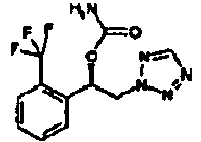
Carbamic acid (R)-2-tetrazol-2-yl-1-(2-trifluoromethyl-phenyl)-ethyl ester 
Carbamic acid (S)-2-tetrazol-2-yl-1-(2-trifluoromethyl-phenyl)-ethyl ester 
Carbamic acid 1-(2-chloro-phenyl)-2-(5-phenyl-tetrazol-2-yl)-ethyl ester 
Methyl-carbamic acid 1-(2-chloro-phenyl)-2-(5-phenyl-tetrazol-2-yl)-ethyl ester 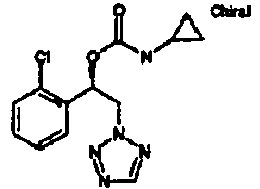
Cyclopropyl-carbamic acid (R)-1-(2-chloro-phenyl)-2-tetrazol-2-yl-ethyl ester 
Carbamic acid (R)-1-(2-chloro-phenyl)-2-(5-phenyl-tetrazol-2-yl)-ethyl ester 
Methyl-carbamic acid (R)-1-(2-chloro-phenyl)-2-(5-phenyl-tetrazol-2-yl)-ethyl ester 
Carbamic acid 1-phenyl-3-tetrazol-2-yl-propyl ester 
Carbamic acid 1-(2-chloro-phenyl)-2-[5-(2,3-dichloro-phenyl)-tetrazol-2-yl]-ethyl ester 
Methyl-carbamic acid 1-(2-chloro-phenyl)-2-[5-(2,3-dichloro-phenyl)-tetrazol-2-yl]-ethyl ester 
Carbamic acid 1-(4-hydroxy-phenyl)-2-tetrazol-2-yl-ethyl ester 
Carbamic acid (S)-1-(2-chloro-phenyl)-2-(5-phenyl-tetrazol-2-yl)-ethyl ester 
Methyl-carbamic acid (S)-1-(2-chlorophenyl)-2-(5-phenyl-tetrazol-2-yl)-ethyl ester 
Carbamic acid (S)-1-(2-chloro-phenyl)-2-(5-phenyl-tetrazol-1-yl)-ethyl ester 
Methyl-carbamic acid (S)-1-(2-chloro-phenyl)-2-(5-phenyl-tetrazol-1-yl)-ethyl ester 
Carbamic acid 1-phenyl-3-tetrazol-1-yl-propyl ester 
Carbamic acid 1-phenyl-3-tetrazol-1-yl-propyl ester 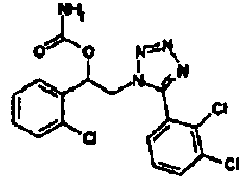
Carbamic acid 1-(2-chloro-phenyl)-2-[5-(2,3-dichloro-phenyl)-tetrazol-1-yl]-ethyl ester 
Methyl-carbamic acid 1-(2-chloro-phenyl)-2-[5-(2,3-dichloro-phenyl)-tetrazol-1-yl]-ethyl ester 
Carbamic acid 1-(3-chloro-phenyl)-2-tetrazol-2-yl-propyl ester 
Methyl-carbamic acid 1-(3-chloro-phenyl)-2-tetrazol-2-yl-propyl ester 
Carbamic acid 1-(3-chloro-phenyl)-2-tetrazol-1-yl-propyl ester 
Carbamic acid 1-(2-chloro-phenyl)-3-[1,2,3]triazol-2-yl-propyl ester 
Carbamic acid 1-(2-chloro-phenyl)-2-(5-pyridin-2-yl-tetrazol-2-yl)-ethyl ester 
Carbamic acid 2-(5-amino-tetrazol-2-yl)-1-(2-chloro-phenyl)-ethyl ester 
Carbamic acid 1-(3-chloro-phenyl)-2-[1,2,3]triazol-2-yl-propyl ester 
Methyl-carbamic acid 1-(3-chloro-phenyl)-2-[1,2,3]triazol-2-yl-propyl ester 
Ethyl-carbamic acid 1-(2-chloro-phenyl)-2-(5-pyridin-2-yl-tetrazol-2-yl)-ethyl ester 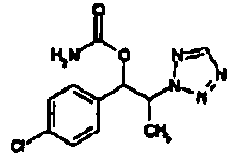
Carbamic acid 1-(4-chloro-phenyl)-2-tetrazol-2-yl-propyl ester 
Methyl-carbamic acid 1-(4-chloro-phenyl)-2-tetrazol-2-yl-propyl ester 
Carbamic acid 1-(4-chloro-phenyl)-2-tetrazol-1-yl-propyl ester 
Methyl-carbamic acid 1-(4-chloro-phenyl)-2-tetrazol-1-yl-propyl ester 
Carbamic acid 1-(3,4-dichloro-phenyl)-2-tetrazol-2-yl-propyl ester 
Methyl-carbamic acid 1-(3,4-dichloro-phenyl)-2-tetrazol-2-yl-propyl ester 
Carbamic acid 1-(3,4-dichloro-phenyl)-2-tetrazol-1-yl-propyl ester 
Methyl-carbamic acid 1-(3,4-dichloro-phenyl)-2-tetrazol-i-yl-propyl ester 
Carbamic acid 1-(3,4-dimethoxy-phenyl)-2-tetrazol-2-yl-ethyl ester 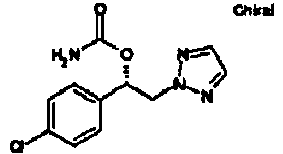
Carbamic acid (S)-1-(4-chloro-phenyl)-2-[1,2,3]triazol-2-yl-ethyl ester 
Carbamic acid (R)-1-(4-chloro-phenyl)-2-[1,2,3]triazol-2-yl-ethyl ester 
Carbamic acid (S)-1-(3,4-dichloro-phenyl)-2-[1,2,3]triazol-2-yl-ethyl ester 
Carbamic acid (R)-1-(3,4-dichloro-phenyl)-2-tetrazol-2-yl-ethyl ester 
Carbamic acid 1-(2,5-dichloro-phenyl)-2-tetrazol-2-yl-ethyl ester 
Carbamic acid 1-(2,5-dichloro-phenyl)-2-tetrazol-1-yl-ethyl ester 
Carbamic acid (R)-1-(3,4-dichloro-phenyl)-2-[1,2,3]triazol-2-yl-ethyl ester 
Carbamic acid (R)-1-(3,4-dichloro-phenyl)-2-[1,2,3]triazol-1-yl-ethyl ester 
Carbamic acid 1-(4-phenoxy-phenyl)-2-tetrazol-2-yl-ethyl ester 
Carbamic acid 1-(4-phenoxy-phenyl)-2-tetrazol-1-yl-ethyl ester 
Carbamic acid 1-(2,5-dichloro-phenyl)-2-[1,2,3]triazol-2-yl-ethyl ester 
Carbamic acid (S)-1-(3,4-dichloro-phenyl)-2-tetrazol-2-yl-ethyl ester 
Carbamic acid (S)-1-(3,4-dichloro-phenyl)-2-tetrazol-1-yl-ethyl ester 
Carbamic acid 1-(2,6-dichloro-phenyl)-2-tetrazol-2-yl-ethyl ester 
Carbamic acid 1-(2,6-dichloro-phenyl)-2-[1,2,3]triazol-2-yl-ethyl ester 
Carbamic acid 1-(2,6-dichloro-phenyl)-2-[1,2,3]triazol-1-yl-ethyl ester 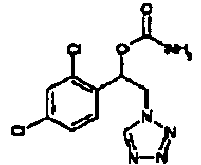
Carbamic acid 1-(2,4-dichloro-phenyl)-2-tetrazol-1-yl-ethyl ester 
Carbamic acid 1-naphthalen-2-yl-2-tetrazol-2-yl-ethyl ester 
Carbamic acid (R)-1-(2,4-dichloro-phenyl)-2-tetrazol-2-yl-ethyl ester 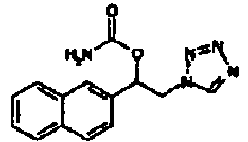
Carbamic acid 1-naphthalen-2-yl-2-tetrazol-1-yl-ethyl ester 
Carbamic acid 2-tetrazol-2-yl-1-(2,3,4-trimethoxy-phenyl)-ethyl ester 
Carbamic acid 2-tetrazol-1-yl-1-(2,3,4-trimethoxy-phenyl)-ethyl ester 
Carbamic acid 2-tetrazol-2-yl-1-(3,4,5-trimethoxy-phenyl)-ethyl ester 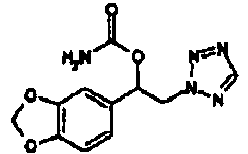
Carbamic acid 1-benzo[1,3]dioxol-5-yl-2-tetrazol-2-yl-ethyl ester 
Carbamic acid 1-benzo[1,3]dioxol-5-yl-2-tetrazol-1-yl-ethyl ester 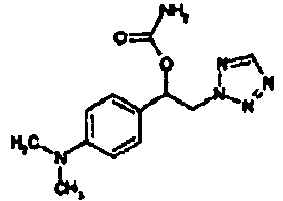
Carbamic acid 1-(4-dimethylamino-phenyl)-2-tetrazol-2-yl-ethyl ester 
Carbamic acid 2-tetrazol-2-yl-1-(2,4,6-trimethyl-phenyl)-ethyl ester 
Carbamic acid 2-tetrazol-1-yl-1-(2,4,6-trimethyl-phenyl)-ethyl ester 
Carbamic acid (S)-1-(2,4-dichloro-phenyl)-2-tetrazol-2-yl-ethyl ester 
Carbamic acid (S)-1-(2,4-dichloro-phenyl)-2-[1,2,3]triazol-2-yl-ethyl ester 
Carbamic acid (R)-1-(2,4-dichloro-phenyl)-2-[1,2,3]triazol-2-yl-ethyl ester 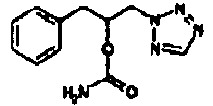
Carbamic acid 2-phenyl-1-tetrazol-2-ylmethyl-ethyl ester 
Carbamic acid 2-phenyl-1-tetrazol-1-ylmethyl-ethyl ester 
Carbamic acid 1-(4-tert-butyl-phenyl)-2-tetrazol-2-yl-ethyl ester 
Carbamic acid 1-(4-tert-butyl-phenyl)-2-tetrazol-1-yl-ethyl ester 
Carbamic acid 1-(4-chloro-3-trifluoromethyl-phenyl)-2-[1,2,3]triazol-2-yl-ethyl ester 
Carbamic acid 1-(4-chloro-3-trifluoromethyl-phenyl)-2-[1,2,3]triazol-1-yl-ethyl ester 
Carbamic acid (S)-1-(2,6-dichloro-phenyl)-2-tetrazol-1-yl-ethyl ester 
Carbamic acid (R)-1-(2,6-dichloro-phenyl)-2-tetrazol-1-yl-ethyl ester 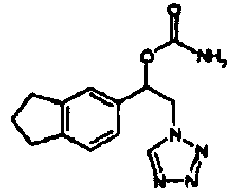
Carbamic acid 1-indan-5-yl-2-tetrazol-1-yl-ethyl ester 
Carbamic acid 1-indan-5-yl-2-tetrazol-2-yl-ethyl ester 
Carbamic acid (R)-1-(2,6-dichloro-phenyl)-2-tetrazol-2-yl-ethyl ester 
Carbamic acid (S)-1-(2,6-dichloro-phenyl)-2-tetrazol-2-yl-ethyl ester 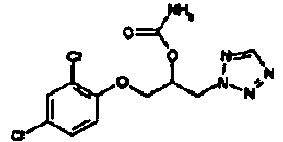
Carbamic acid 2-(2,4-dichloro-phenoxy)-1-tetrazol-2-ylmethyl-ethyl ester 
O-1-(2-Chloro-phenyl)-2-tetrazol-2-yl ethyl allophanate 
Carbamic acid (R)-1-(2,4-dichloro-phenyl)-2-[1,2,3]triazol-1-yl-ethyl ester 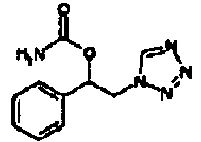
Carbamic acid 1-phenyl-2-tetrazol-1-yl-ethyl ester 
Carbamic acid 1-(3,4-difluoro-phenyl)-2-tetrazol-2-yl-ethyl ester 
Carbamic acid 1-(3,4-difluoro-phenyl)-2-tetrazol-1-yl-ethyl ester 
Carbamic acid 1-(3,4-difluoro-phenyl)-2-[1,2,3]triazol-2-yl-ethyl ester 
Carbamic acid 1-(3,4-difluoro-phenyl)-2-[1,2,3]triazol-1-yl-ethyl ester 
Carbamic acid 1-(2-fluoro-phenyl)-2-tetrazol-2-yl-ethyl ester 
Carbamic acid 1-(2-fluoro-phenyl)-2-tetrazol-1-yl-ethyl ester 
4-Benzyl-piperidine-1-carboxylic acid 1-(2-chloro-phenyl)-2-tetrazol-2-yl-ethyl ester 
Carbamic acid 7-nitro-2-tetrazol-2-yl-1,2,3,4-tetrahydro-naphthalen-1-yl ester 
Carbamic acid 5,7-dimethyl-2-tetrazol-2-yl-1,2,3,4-tetrahydro-naphthalen-1-yl ester 
Carbamic acid 7-nitro-2-tetrazol-1-yl-1,2,3,4-tetrahydro-naphthalen-1-yl ester 
Carbamic acid 5,7-dimethyl-2-tetrazol-1-yl-1,2,3,4-tetrahydro-naphthalen-1-yl ester 
4-Phenyl-piperazine-1-carboxylic acid 1-(2-chloro-phenyl)-2-tetrazol-2-yl-ethyl ester 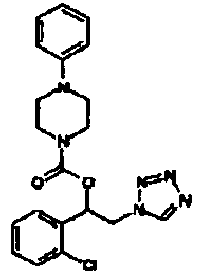
4-Phenyl-piperazine-1-carboxylic acid 1-(2-chloro-phenyl)-2-tetrazol-1-yl-ethyl ester 
4-(4-Fluoro-benzoyl)-piperidine-1-carboxylic acid 1-(2-chloro-phenyl)-2-tetrazol-2-yl-ethyl ester 
4-Benzyl-piperidine-1-carboxylic acid 1-(2-chloro-phenyl)-2-tetrazol-1-yl-ethyl ester 
1-Benzyl-4-[1-(2-chloro-phenyl)-2-tetrazol-2-yl-ethoxycarbonyl]-piperazin-1-ium 
Carbamic acid 2-(3,4-dichloro-phenoxy)-1-tetrazol-2-ylmethyl-ethyl ester 
Imidazole-1-carboxylic acid 2-(3,4-dichloro-phenoxy)-1-tetrazol-1-ylmethyl-ethyl ester 
Carbamic acid 2-(4-chloro-phenoxy)-1-tetrazol-1-ylmethyl-ethyl ester 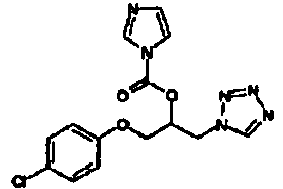
Imidazole-1-carboxylic acid 2-(4-chloro-phenoxy)-1-tetrazol-1-ylmethyl-ethyl ester 
Carbamic acid 2-(4-chloro-phenoxy)-1-tetrazol-2-ylmethyl-ethyl ester 
4-Benzyl-piperidine-1-carboxylic acid 1-phenyl-2-tetrazol-i-yl-ethyl ester 
4-Benzyl-piperidine-1-carboxylic acid 1-phenyl-2-tetrazol-2-yl-ethyl ester 
Carbamic acid 2-(2-chloro-phenoxy)-1-tetrazol-2-ylmethyl-ethyl ester 
4-Benzyl-piperidine-1-carboxylic acid 2-(2-chloro-phenoxy)-1-tetrazol-2-ylmethyl-ethyl ester 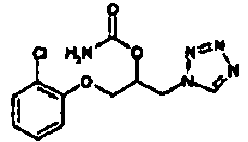
Carbamic acid 2-(2-chloro-phenoxy)-1-tetrazol-1-ylmethyl-ethyl ester 
4-Benzyl-piperidine-1-carboxylic acid 2-(2-chloro-phenoxy)-1-tetrazol-1-ylmethyl-ethyl ester 
Carbamic acid 2-tetrazol-2-yl-1,2,3,4-tetrahydro-naphthalen-1-yl ester 
Carbamic acid 2-tetrazol-1-yl-1,2,3,4-tetrahydro-naphthalen-1-yl ester 
Carbamic acid 1-(2,4-difluoro-phenyl)-2-tetrazol-2-yl-ethyl ester 
Carbamic acid 1-(2,4-difluoro-phenyl)-2-tetrazol-1-yl-ethyl ester 
4-Benzyl-piperidine-1-carboxylic acid (S)-1-(2-chloro-phenyl)-2-[1,2,3]triazol-2-yl-ethyl ester 
4-Benzyl-piperidine-1-carboxylic acid (R)-1-(2-chloro-phenyl)-2-tetrazol-2-yl-ethyl ester 
Carbamic acid 1-(2,4-dimethyl-phenyl)-2-[1,2,3]triazol-2-yl-ethyl ester 
4-Benzyl-piperidine-1-carboxylic acid (S)-1-(2-chloro-phenyl)-2-tetrazol-2-yl-ethyl ester 
[2-(3,4-Dihydroxy-phenyl)-ethyl]-carbamic acid 1-(2-chloro-phenyl)-2-tetrazol-2-yl-ethyl ester 
[2-(3,4-Dihydroxy-phenyl)-ethyl]-carbamic acid 1-(2-chloro-phenyl)-2-tetrazol-1-yl-ethyl ester 
4-Benzyl-piperidine-1-carboxylic acid (R)-1-(2-chloro-phenyl)-2-[1,2,3]triazol-2-yl-ethyl ester 
Carbamic acid 2-(4-chloro-phenoxy)-1-[1,2,3]triazol-2-ylmethyl-ethyl ester 
Carbamic acid 2-(4-chloro-phenoxy)-1-[1,2,3]triazol-1-ylmethyl-ethyl ester 
4-Benzyl-piperidine-1-carboxylic acid 2-(4-chloro-phenoxy)-1-tetrazol-2-ylmethyl-ethyl ester 
4-Benzyl-piperidine-1-carboxylic acid 2-(4-chloro-phenoxy)-1-tetrazol-1-ylmethyl-ethyl ester 
4-(4-Methoxy-benzyl)-piperidine-1-carboxylic acid 1-(2-chloro-phenyl)-2-tetrazol-2-yl-ethyl ester 
4-(3,4-Dichloro-benzyl)-piperidine-1-carboxylic acid 1-(2-chloro-phenyl)-2-tetrazol-2-yl-ethyl ester 
4-Pyridin-4-ylmethyl-piperidine-1-carboxylic acid 1-(2-chloro-phenyl)-2-tetrazol-2-yl-ethyl ester 
4-(4-Fluoro-benzyl)-piperidine-1-carboxylic acid 1-(2-chloro-phenyl)-2-tetrazol-2-yl-ethyl ester 
3-(4-Fluoro-benzyl)-piperidine-1-carboxylic acid 1-(2-chloro-phenyl)-2-tetrazol-2-yl-ethyl ester 
4-(4-Chloro-benzyl)-piperidine-1-carboxylic acid 1-(2-chloro-phenyl)-2-tetrazol-2-yl-ethyl ester 
3-(4-Chloro-phenyl)-pyrrolidine-1-carboxylic acid 1-(2-chloro-phenyl)-2-tetrazol-2-yl-ethyl ester 
3-Phenethyl-pyrrolidine-1-carboxylic acid 1-(2-chloro-phenyl)-2-tetrazol-2-yl-ethyl ester 
4-[1,2,3]Triazol-2-ylmethyl-piperidine-1-carboxylic acid 1-(2-chloro-phenyl)-2-tetrazol-2-yl-ethyl ester 
3-Tetrazol-2-ylmethyl-piperidine-1-carboxylic acid 1-(2-chloro-phenyl)-2-tetrazol-2-yl-ethyl ester 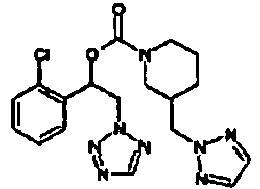
3-[1,2,3]Triazol-2-ylmethyl-piperidine-1-carboxylic acid 1-(2-chloro-phenyl)-2-tetrazol-2-yl-ethyl ester 
4-Benzoyl-piperidine-1-carboxylic acid 1-(2-chloro-phenyl)-2-tetrazol-2-yl-ethyl ester 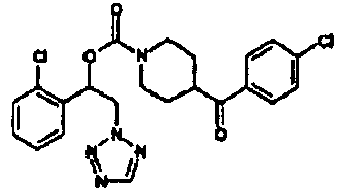
4-(4-Chloro-benzoyl)-piperidine-1-carboxylic acid 1-(2-chloro-phenyl)-2-tetrazol-2-yl-ethyl ester 
4-(4-Methoxy-benzoyl)-piperidine-1-carboxylic acid 1-(2-chloro-phenyl)-2-tetrazol-2-yl-ethyl ester 
4-[1,2,3]Triazol-1-ylmethyl-piperidine-1-carboxylic acid 1-(2-chloro-phenyl)-2-tetrazol-2-yl-ethyl ester 
4-Tetrazol-2-ylmethyl-piperidine-1-carboxylic acid 1-(2-chloro-phenyl)-2-tetrazol-2-yl-ethyl ester 
4-[1,2,3]Triazol-2-yl-piperidine-1-carboxylic acid 1-(2-chloro-phenyl)-2-tetrazol-2-yl-ethyl ester 
4-(3,4-Dichloro-benzyl)-piperidine-1-carboxylic acid 1-(2,5-dichloro-phenyl)-2-tetrazol-2-yl-ethyl ester 
4-(5-Phenyl-tetrazol-2-yl)-piperidine-1-carboxylic acid 1-(2-chloro-phenyl)-2-tetrazol-2-yl-ethyl ester 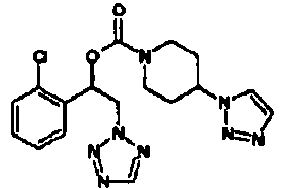
4-[1,2,3]Triazol-1-yl-piperidine-1-carboxylic acid 1-(2-chloro-phenyl)-2-tetrazol-2-yl-ethyl ester 
4-(3,4-Dichloro-benzyl)-piperidine-1-carboxylic acid 1-(2,4-dichloro-phenyl)-2-tetrazol-2-yl-ethyl ester 
4-(3,4-Dichloro-benzyl)-piperidine-1-carboxylic acid 1-(3,4-dichloro-phenyl)-2-tetrazol-2-yl-ethyl ester 
3-(4-Chloro-benzyl)-pyrrolidine-1-carboxylic acid 1-(2-chloro-phenyl)-2-tetrazol-2-yl-ethyl ester 
4-(3,5-Bis-trifluoromethyl-benzyl)-piperidine-1-carboxylic acid 1-(2-chloro-phenyl)-2-tetrazol-2-yl-ethyl ester 
3-(5-Methyl-tetrazol-2-ylmethyl)-piperidine-1-carboxylic acid 1-(2-chloro-phenyl)-2-tetrazol-2-yl-ethyl ester 
4-(5-Methyl-tetrazol-2-ylmethyl)-piperidine-i-carboxylic acid 1-(2-chloro-phenyl)-2-tetrazol-2-yl-ethyl ester 
4-(3,4-Dichloro-benzyl)-piperidine-1-carboxylic acid 1-(2-chloro-phenyl)-2-[1,2,3]triazol-2-yl-ethyl ester 
4-(3,4-Dichloro-benzyl)-piperidine-1-carboxylic acid 1-(2-chloro-phenyl)-2-tetrazol-1-yl-ethyl ester 
3-Phenethyl-pyrrolidine-1-carboxylic acid 1-(2,5-dichloro-phenyl)-2-tetrazol-2-yl-ethyl ester 
3-Phenethyl-pyrrolidine-1-carboxylic acid 1-(2,4-dichloro-phenyl)-2-tetrazol-2-yl-ethyl ester 
3-Phenethyl-pyrrolidine-1-carboxylic acid 1-(3,4-dichloro-phenyl)-2-tetrazol-2-yl-ethyl ester 
3-Phenethyl-pyrrolidine-1-carboxylic acid 2-(2-chloro-phenoxy)-1-[1,2,3]triazol-2-ylmethyl-ethyl ester 
3-Phenethyl-pyrrolidine-1-carboxylic acid 2-(2,4-dichloro-phenoxy)-1-[1,2,3]triazol-2-ylmethyl-ethyl ester 
3-Phenethyl-pyrrolidine-1-carboxylic acid 2-(3,4-dichloro-phenoxy)-1-[1,2,3]triazol-2-ylmethyl-ethyl ester 
3-Phenethyl-pyrrolidine-1-carboxylic acid 2-(2,5-dichloro-phenoxy)-1-tetrazol-2-ylmethyl-ethyl ester 
Carbamic acid 2-(2-chloro-phenoxy)-1-[1,2,3]triazol-2-ylmethyl-ethyl ester 
Carbamic acid 2-(3,4-dichloro-phenoxy)-1-[1,2,3]triazol-2-ylmethyl-ethyl ester 
Carbamic acid 2-(2,4-dichloro-phenoxy)-1-[1,2,3]triazol-2-ylmethyl-ethyl ester 
Carbamic acid 2-(2,5-dichloro-phenoxy)-1-tetrazol-2-ylmethyl-ethyl ester 
4-(4-Fluoro-benzoyl)-piperidine-1-carboxylic acid 1-(3,4-dichloro-phenyl)-2-tetrazol-2-yl-ethyl ester 
4-(4-Fluoro-benzoyl)-piperidine-1-carboxylic acid 1-(2,4-dichloro-phenyl)-2-tetrazol-2-yl-ethyl ester 
4-(4-Fluoro-benzoyl)-piperidine-1-carboxylic acid 1-(2,5-dichloro-phenyl)-2-tetrazol-2-yl-ethyl ester 
4-(3,4-Dichloro-benzyl)-piperidine-1-carboxylic acid 2-(2-chloro-phenoxy)-1-tetrazol-2-ylmethyl-ethyl ester 
4-(3,4-Dichloro-benzyl)-piperidine-1-carboxylic acid 2-(2,4-dichloro-phenoxy)-1-tetrazol-2-ylmethyl-ethyl ester 
4-(3,4-Dichloro-benzyl)-piperidine-1-carboxylic acid 2-(3,4-dichloro-phenoxy)-1-tetrazol-2-ylmethyl-ethyl ester 
3-[2-(4-Methoxy-phenyl)-ethyl]-pyrrolidine-1-carboxylic acid 1-(2-chloro-phenyl)-2-tetrazol-2-yl-ethyl ester 
4-(3,4-Dichloro-benzyl)-piperidine-1-carboxylic acid 1-phenyl-2-tetrazol-2-yl-ethyl ester 
Carbamic acid 1-(4-benzyloxy-phenyl)-2-tetrazol-2-yl-ethyl ester 
Carbamic acid 1-(4-benzyloxy-phenyl)-2-tetrazol-1-yl-ethyl ester 
methyl-carbamic acid -1-(2-chloro-phenyl)-2-tetrazol-2-yl-ethyl ester 
methyl-carbamic acid (S)-1-(2-chloro-phenyl)-2-tetrazol-2-yl-ethyl ester 
4-benzyl-piperidine-1-carboxylic acid-1-(2-chloro-phenyl)-2-[1,2,3]triazol-2-yl-ethyl ester 
4-benzyl-piperidine-1-carboxylic acid (S)-1-(2-chloro-phenyl)-2-[1,2,3]triazol-2-yl-ethyl ester
Claims (72)
- An azole of the formula:

m is an integer from 0 to 6;
Y is selected from the group consisting of hydrogen, halogen, and alkyl of 1 to 8 carbon atoms;
n is an integer from 0 to 6;
A is azole group represented by the following structural formula (X-1) or (X-2):
Q is selected from the group consisting of hydrogen, perfluoroalkyl, halogen, amino, mono- or di-substituted alkyl amino with alkyl of 1 to 8 carbon atoms, amido, linear or branched alkyl of 1 to 8 carbon atoms, cycloalkyl of 3 to 8 carbon atoms, arylalkyl, morpholino, piperidino, pyrrolidino, thioalkoxy of 1 to 8 carbon atoms, benzylthio, thienyl, aminoalkyl, hydroxyalkyl, styryl, carboxylic, pyridyl, unsubstituted phenyl and phenyl substituted with one or more identical or different substituents selected from the group consisting of hydrogen,
alkyl of 1 to 8 carbon atoms, arylalkyl, halogen, alkoxy containing 1 to 8 carbon atoms, phenoxy, amino, mono- or di- substituted amino with alkyl of 1 to 8 carbon atoms, nitro, hydroxy, thioalkoxy, furanyl, sulfonamido, or per-fluoroalkyl;
R1 and R2 are independently selected from the group consisting of hydrogen, C(=O)NH2, alkyl of 1 to 8 carbon atoms, non-substituted or substituted phenyl, and non-substituted or substituted phenylalkyl of 1 to 8 carbon atoms, or taken together with attached nitrogen form a imidazole, piperazine or phenyl piperazine ring or cyclic amine ring represented by the following structural formula (XI):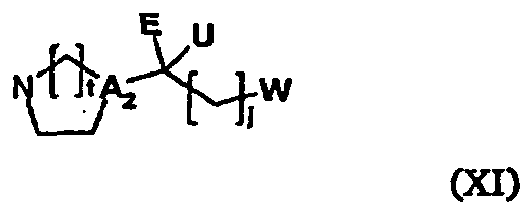
E and U are independently selected from the group consisting of hydrogen, hydroxy and O-carbamoyl or taken together form oxo;
W is selected from a ring consisting of piperonyl, indanyl, naphtyl, tetrazolyl, triazolyl, pyridyl and phenyl which ring may be substituted with one or more identical or different substituents selected from the group consisting of hydrogen, alkyl of 1 to 8 carbon atoms, halogen, alkoxy containing 1 to 8 carbon atoms, thioalkoxy containing 1 to 8 carbon atoms, phenoxy, phenylalkyloxy of 1 to 8 carbon atoms, phenyloxyalkyl of 1 to 8 carbon atoms, where the phenyl moiety of phenoxy, phenylalkyloxy and phenoxyalkyl is unsubstituted or substituted with amino, mono- or di-substituted amino with alkyl of 1 to 8 carbon atoms, amido, sulfonamido, nitro, carboxyl, hydroxy, or perfluoroalkyl of 1 to 8 carbon atoms;
j is an integer from 0 to 4; and
t is an integer from 0 to 4. - The azole of claim 1, wherein said compound has the formula:

X2 and X3 may be the same with or different from each other and are independently selected from the group consisting of hydrogen, alkyl of 1 to 8 carbon atoms, halogen, alkoxy containing 1 to 8 carbon atoms, thioalkoxy containing 1 to 8 carbon atoms, hydroxy, phenoxy, phenylalkyloxy of 1 to 8 carbon atoms, phenoxyalkyl of 1 to 8 carbon atoms wherein the phenyl moiety of phenoxy, phenylalkyloxy and phenoxyalkyl is unsubstituted or substituted with amino, mono- or di-substituted amino with alkyl of 1 to 8 carbon atoms, amido, sulfonamido, nitro, carboxyl, or perfluoroalkyl of 1 to 8 carbon atoms; m is an integer from 0 to 6;
Y is selected from the group consisting of hydrogen and alkyl of 1 to 8 carbon atoms;
n is an integer from 0 to 6;
A is azole group represented by the following structural formula (X-1) or (X-2):
R1 and R2 are as above; or
pharmaceutically acceptable salts thereof. - The azole of claim 1, wherein said compound has the formula:

X5 and X7 may be the same with or different from each other and are independently selected from the group consisting of hydrogen, alkyl of 1 to 8 carbon atoms, halogen, alkoxy containing 1 to 8 carbon atoms, thioalkoxy containing 1 to 8 carbon atoms, hydroxy, phenoxy, phenylalkyloxy of 1 to 8
carbon atoms, phenoxyalkyl of 1 to 8 carbon atoms wherein the phenyl moiety of phenoxy, phenylalkyloxy and phenoxyalkyl is unsubstituted or substituted with amino, mono- or di-substituted alkyl amino with alkyl of 1 to 8 carbon atoms, amido, sulfonamido, nitro, carboxyl, or perfluoroalkyl of 1 to 8 carbon atoms; m is an integer from 0 to 6;
1 is an integer from 1 to 6;
A is azole group represented by the following structural formula (X-1) or (X-2):
- The azole of claim 1, wherein said compound has the formula:

m is an integer from 0 to 6;
Y is selected from the group consisting of hydrogen and alkyl of 1 to 8 carbon atoms;
n is an integer from 0 to 6; and
A, R and R are as above. 1 - The azole of claim 1, wherein said compound has the formula:

containing 1 to 8 carbon atoms, thioalkoxy containing 1 to 8 carbon atoms, phenoxy, phenylalkyloxy of 1 to 8 carbon atoms, phenoxyalkyl of 1 to 8 carbon atoms, wherein the phenyl moiety of phenoxy, phenylalkyloxy and phenoxyalkyl is unsubstituted or substituted with amino, mono- or di-substituted amino with alkyl of 1 to 8 carbon atoms, amido, sulfonamido, nitro, carboxyl, hydroxy, or perfluoroalkyl of 1 to 8 carbon atoms;
1 is an integer from 1 to 6; and
A, R1 and R2 are as above. - The azole of claim 1, wherein said compound has the formula:

1 is an integer from 1 to 4;
and pharmaceutically useful salts thereof. - The azole of claim 1, wherein said compound has the formula:

A3, A4 and A5 are independently selected from the group consisting of CH or N, with at least one of A3, A4 and A5 being CH and at least one of the other of A3, A4 and A5 being N;
R6 and R7 being selected from the group consisting of hydrogen, halogen, perfluoroalkyl, alkyl of from 1 to 8 carbon atoms, thioalkoxy containing 1 to 8 carbon atoms;
R3 and R4 are alkyl or hydrogen,
y is an integer of from 0 to 4. - The azole of claim 7, wherein one of A3, A4 and A5 are CH and the others are N.
- The azole of claim 8, wherein R6 and R7 are independently hydrogen, halogen or perfluoroalkyl.
- The azole of claim 9, wherein said compound is carbamic acid 1-(2-chloro-phenyl)-2-tetrazol-2-yl-ethyl ester.
- The azole of claim 10, wherein said compound is carbamic acid (R)-(+)-1-(2-chloro-phenyl)-2-tetrazol-2-yl-ethyl ester free of its (S)-enantiomer and said (R)-enantiomer is present to the extent of at least 95%.
- The azole of claim 10, wherein said compound is carbamic acid (S)-(-)-1-(2-chloro-phenyl)-2-tetrazol-2-yl-ethyl ester free of its (R)-enantiomer and said (S)-enantiomer is present to the extent of at least 95%.
- The azole of claim 9, wherein said compound is methyl-carbamic acid - 1-(2-chloro-phenyl)-2-tetrazol-2-yl-ethyl ester.
- The azole of claim 13, wherein said compound is methyl-carbamic acid (R)-1-(2-chloro-phenyl)-2-tetrazol-2-yl-ethyl ester free of its (S)-enantiomer and said (R)-enantiomer is present to the extent of at least 95%.
- The azole of claim 13, wherein said compound is methyl-carbamic acid (S)-1-(2-chloro-phenyl)-2-tetrazol-2-yl-ethyl ester free of its (R)-enantiomer and said (S)-enantiomer is present to the extent of at least 95%.
- The azole of claim 9, wherein said compound is carbamic acid-1-(2,4-dichloro-phenyl)-2-tetrazol-2-yl-ethyl ester.
- The azole of claim 16, wherein said compound is carbamic acid (R)-1-(2,4-dichloro-phenyl)-2-tetrazol-2-yl-ethyl ester free of its (S)-enantiomer and said (R)-enantiomer is present to the extent of at least 95%.
- The azole of claim 16, wherein said compound is carbamic acid (S)-1-(2,4-dichloro-phenyl)-2-tetrazol-2-yl-ethyl ester free of its (R)-enantiomer and said (S)-enantiomer is present to the extent of of at least 95%.
- The azole of claim 9, wherein said compound is carbamic acid 1-(3,4-dichloro-phenyl)-2-tetrazol-2-yl-ethyl ester.
- The azole of claim 19, wherein said compound is carbamic acid (R)-1-(3,4-dichloro-phenyl)-2-tetrazol-2-yl-ethyl ester free of its (S)-enantiomer and said (R)-enantiomer is present to the extent of at least 95%.
- The azole of claim 19, wherein said compound is carbamic acid (S)-1-(3,4-dichloro-phenyl)-2-tetrazol-2-yl-ethyl ester free of its (R)-enantiomer and said (S)-enantiomer is present to the extent of at least 95%.
- The azole of claim 9, wherein said compound is carbamic acid-1-(2,6-dichloro-phenyl)-2-tetrazol-2-yl-ethyl ester.
- The azole of claim 9, wherein said compound is carbamic acid 1-(3,4-dichloro-phenyl)-2-tetrazol-2-yl-propyl ester.
- The azole of claim 7, wherein one of A3, A4 and A5 is N and the others are CH.
- The azole of claim 24, wherein R6 and R7 are independently hydrogen, halogen or perfluoroalkyl.
- The azole of claim 25, wherein said compound is carbamic acid - 1-(2-chloro-phenyl)-2-[1,2,3]triazol-2-yl-ethyl ester.
- The azole in accordance with claim 26 wherein said compound is carbamic acid (R)-1-(2-chloro-phenyl)-2-[1,2,3]triazol-2-yl-ethyl ester free of its (S)-enantiomer and said (R)-enantiomer is present to the extent of at least 95%.
- The azole in accordance with claim 26 wherein said compound is carbamic acid (S)-1-(2-chloro-phenyl)-2-[1,2,3]triazol-2-yl-ethyl ester free of its (R)-enantiomer and said (S)-enantiomer is present to the extent of at least 95%.
- The azole of claim 25, wherein said compound is carbamic acid-1-(2,4-dichloro-phenyl)-2-[1,2,3]triazol-1-yl-ethyl ester.
- The azole in accordance with claim 29 wherein said compound is carbamic acid (R)-1-(2,4-dichloro-phenyl)-2-[1,2,3]triazol-2-yl-ethyl ester free of its (S)-enantiomer and said (R)-enantiomer is present to the extent of at least 95%.
- The azole in accordance with claim 29 wherein said compound is carbamic acid (S)-1-(2,4-dichloro-phenyl)-2-[1,2,3]triazol-2-yl-ethyl ester free of its (R)-enantiomer and said (S)-enantiomer is present to the extent of at least 95%.
- The azole of claim 25, wherein said compound is carbamic acid 1-(3,4-dichloro-phenyl)-2-[1,2,3]triazol-2-yl-ethyl ester.
- The azole in accordance with claim 32 wherein said compound is carbamic acid (R)-1-(3,4-dichloro-phenyl)-2-[1,2,3]triazol-2-yl-ethyl ester free of its (S)-enantiomer and said (R)-enantiomer is present to the extent of at least 95%.
- The azole in accordance with claim 32 wherein said compound is carbamic acid (S)-1-(3,4-dichloro-phenyl)-2-[1,2,3]triazol-2-yl-ethyl ester free of its (R)-enantiomer and said (S)-enantiomer is present to the extent of at least 95%.
- The azole of claim 1 wherein said compound has the formula:

A3, A4 and A5 are independently selected from the group consisting of CH or N, with at least one of A3, A4 and A5 being CH and at least one of the other of A3, A4 and A5 being N;
R6 and R7 being selected from the group consisting of hydrogen, halogen, per-fluoroalkyl, alkyl of from 1 to 8 carbon atoms, thioalkoxy;
R3 and R4 are alkyl or hydrogen,
with the attached nitrogen atom form an imidazole, or phenyl piperazine ring; y is an integer of from 0 to 4; and
p is an integer from 0 to 1. - The azole of claim 35, wherein R6 and R 7 are independently hydrogen, halogen or perfluoroalkyl.
- The azole of claim 36, wherein said compound is carbamic acid 2-(3,4-dichloro-phenoxy)-1-tetrazol-2-ylmethyl-ethyl ester.
- The azole of claim 36, wherein said compound is carbamic acid 2-(2-chloro-phenoxy)-1-tetrazol-2-ylmethyl-ethyl ester.
- The azole of claim 35, wherein one of A3, A4 and A5 is N and the others are CH.
- The azole of claim 39, wherein R6 and R7 are independently hydrogen, halogen or perfluoroalkyl.
- The azole of claim 40, wherein said compound is carbamic acid 2-(2,4-dichloro-phenoxy)-1-[1,2,3]triazol-2-ylmethyl-ethyl ester.
- The azole of claim 1, wherein said compound is:
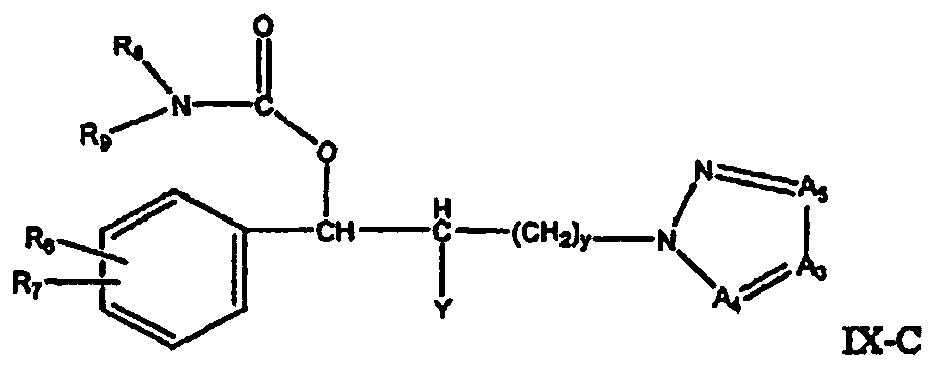

k and v are an integer from 0 to 1;
Z is a phenyl, phenoxy, alkyl or phenylalkyloxy substituted where the phenyl moiety of said substitutent is unsubstituted or substituted with from one to three substituents selected from the group consisting of halogen, alkyl, perfluoroalkyl or C1-8alkoxy;
A3, A4 and A5 are independently selected from the group consisting of CH or N, with at least one of A3, A4 and A5 being CH and at least one of the other of A3, A4 and A5 being N;
Y is a hydrogen, halogen or alkyl;
y is an integer of from 0 to 1;
R6 and R7 are selected from the group consisting of hydrogen, halogen, perfluoroalkyl, C1-8thioalkoxy, C1-8 alkoxy and C1-8 alkyl; or pharmaceutically acceptable salts thereof. - The azole of claim 42, wherein one of A3, A4 and A5 are CH and the others are N.
- The azole of claim 43, wherein R 6 and R7 are independently hydrogen, halogen or perfluoroalkyl.
- The azole of claim 44, wherein said compound is 4-(3,4-dichloro-benzyl)-piperidine-1-carboxylic acid 1-(2,4-dichloro-phenyl)-2-tetrazol-2-yl-ethyl ester.
- The azole of claim 44, wherein said compound is 4-(3,4-dichloro-benzyl)-piperidine-1-carboxylic acid 1-(3,4-dichloro-phenyl)-2-tetrazol-2-yl-ethyl ester.
- The azole of claim 44, wherein said compound is 4-(3,5-bis-trifluoromethyl-benzyl)-piperidine-1-carboxylic acid 1-(2-chloro-phenyl)-2-tetrazol-2-yl-ethyl ester.
- The azole of claim 44, wherein said compound is 3-phenethyl-pyrrolidine-1-carboxylic acid 1-(2,5-dichloro-phenyl)-2-tetrazol-2-yl-ethyl ester.
- The azole of claim 42, wherein one of A3, A4 and A5 is N and the others are CH.
- The azole of claim 49, wherein R6 and R7 are independently hydrogen, halogen or perfluoroalkyl.
- The azole of claim 50, wherein said compound is 4-benzyl-piperidine-1-carboxylic acid-1-(2-chloro-phenyl)-2-[1,2,3] triazol-2-yl-ethyl ester.
- The azole in accordance with claim 51 wherein said compound is 4-benzyl-piperidine-1-carboxylic acid (R)-1-(2-chloro-phenyl)-2-[1,2,3] triazol-2-yl-ethyl ester free of its (S)-enantiomer and said (R)-enantiomer is present to the extent of at least 95%.
- The azole in accordance with claim 51 wherein said compound is is 4-benzyl-piperidine-1-carboxylic acid (S)-1-(2-chloro-phenyl)-2-[1,2,3] triazol-2-yl-ethyl ester free of its (R)-enantiomer and said (S)-enantiomer is present to the extent of at least 95%.
- The compound of claim 1 having the formula:

- The compound of claim 54 wherein p is 0 and o is 1.
- The compound of claim 54 wherein o is 0 and p is 1.
- The compound of claim 1 wherein said compound has the formula:


- The compound of claim 57 wherein o is 0 and p equals 1.
- The compound of claim 57 wherein p is 0 and o is 0.
- An azole compound of the formula:

- A pharmaceutical composition for treating disorders of the central nervous system, which comprises as an active ingredient an effective amount for treating disorders of the central nervous system of a compound of general structural formula (IX) as defined in claim 1 and a pharmaceutically acceptable carrier.
- A pharmaceutical composition for treating disorders of the central nervous system, which comprises as an active ingredient an effective amount for treating disorders of the central nervous system of a compound of general structural formula (XVII) as defined in claim 2and a pharmaceutically acceptable carrier.
- A pharmaceutical composition for treating disorders of the central nervous system, which comprises as an active ingredient an effective amount for treating disorders of the central nervous system of a compound of general structural formula (XVIII) as defined in claim 3 and a pharmaceutically acceptable carrier.
- A pharmaceutical composition for treating disorders of the central nervous system, which comprises as an active ingredient an effective amount for treating disorders of the central nervous system of a compound of general structural formula (XIX) as defined in claim 4 and a pharmaceutically acceptable carrier.
- A pharmaceutical composition for treating disorders of the central nervous system, which comprises as an active ingredient an effective amount for treating disorders of the central nervous system of a compound of general structural formula (XX) as defined in claim 5 and a pharmaceutically acceptable carrier.
- A pharmaceutical composition for treating disorders of the central nervous system, which comprises as an active ingredient an effective amount for treating disorders of the central nervous system of a compound of general structural formula (XXI) as defined in claim 6 and a pharmaceutically acceptable carrier.
- The pharmaceutical composition of Claim 61, wherein the disorders of the central nervous system are anxiety, depression, convulsion, epilepsy, migraine, bipolar disorder, drug abuse, smoking, ADHD, obesity, sleep disorder, stroke, neuropathic pain, cognitive impairment, neurodegeneration and muscle spasm.
- The pharmaceutical composition of Claim 62, wherein the disorders of the central nervous system are anxiety, depression, convulsion, epilepsy, migraine, bipolar disorder, drug abuse, smoking, ADHD, obesity, sleep disorder, stroke, neuropathic pain, cognitive impairment, neurodegeneration and muscle spasm.
- The pharmaceutical composition of Claim 63, wherein the disorders of the central nervous system are anxiety, depression, convulsion, epilepsy, migraine, bipolar disorder, drug abuse, smoking, ADHD, obesity, sleep disorder, stroke, neuropathic pain, cognitive impairment, neurodegeneration and muscle spasm.
- The pharmaceutical composition of Claim 64, wherein the disorders of the central nervous system are anxiety, depression, convulsion, epilepsy, migraine, bipolar disorder, drug abuse, smoking, ADHD, obesity, sleep disorder, stroke, neuropathic pain, cognitive impairment, neurodegeneration and muscle spasm.
- The pharmaceutical composition of Claim 65, wherein the disorders of the central nervous system are anxiety, depression, convulsion, epilepsy, migraine, bipolar disorder, drug abuse, smoking, ADHD, obesity, sleep disorder, stroke, neuropathic pain, cognitive impairment, neurodegeneration and muscle spasm.
- The pharmaceutical composition of Claim 66, wherein the disorders of the central nervous system are anxiety, depression, convulsion, epilepsy, migraine, bipolar disorder, drug abuse, smoking, ADHD, obesity, sleep disorder, stroke, neuropathic pain, cognitive impairment, neurodegeneration and muscle spasm.
Priority Applications (1)
| Application Number | Priority Date | Filing Date | Title |
|---|---|---|---|
| PL06768472T PL1879873T3 (en) | 2005-04-22 | 2006-04-21 | Neurotherapeutic azole compounds |
Applications Claiming Priority (2)
| Application Number | Priority Date | Filing Date | Title |
|---|---|---|---|
| US67453005P | 2005-04-22 | 2005-04-22 | |
| PCT/KR2006/001523 WO2006112685A1 (en) | 2005-04-22 | 2006-04-21 | Neurotherapeutic azole compounds |
Publications (3)
| Publication Number | Publication Date |
|---|---|
| EP1879873A1 EP1879873A1 (en) | 2008-01-23 |
| EP1879873A4 EP1879873A4 (en) | 2011-06-15 |
| EP1879873B1 true EP1879873B1 (en) | 2013-10-09 |
Family
ID=37115369
Family Applications (1)
| Application Number | Title | Priority Date | Filing Date |
|---|---|---|---|
| EP06768472.0A Expired - Lifetime EP1879873B1 (en) | 2005-04-22 | 2006-04-21 | Neurotherapeutic azole compounds |
Country Status (23)
| Country | Link |
|---|---|
| US (1) | US7598279B2 (en) |
| EP (1) | EP1879873B1 (en) |
| JP (1) | JP5035238B2 (en) |
| KR (1) | KR101286499B1 (en) |
| CN (1) | CN101228138B (en) |
| AR (1) | AR053065A1 (en) |
| AU (1) | AU2006237798B2 (en) |
| BE (1) | BE2021C524I2 (en) |
| BR (1) | BRPI0607529B8 (en) |
| CA (1) | CA2606258C (en) |
| DK (1) | DK1879873T3 (en) |
| ES (1) | ES2441765T3 (en) |
| FI (1) | FIC20210018I1 (en) |
| FR (1) | FR21C1027I2 (en) |
| MX (1) | MX2007013197A (en) |
| MY (1) | MY148589A (en) |
| NL (1) | NL301106I2 (en) |
| PL (1) | PL1879873T3 (en) |
| PT (1) | PT1879873E (en) |
| RU (1) | RU2418792C2 (en) |
| TW (1) | TWI398249B (en) |
| WO (1) | WO2006112685A1 (en) |
| ZA (1) | ZA200709994B (en) |
Families Citing this family (44)
| Publication number | Priority date | Publication date | Assignee | Title |
|---|---|---|---|---|
| US7598279B2 (en) | 2005-04-22 | 2009-10-06 | Sk Holdings Co., Ltd. | Neurotherapeutic azole compounds |
| AU2008251259B2 (en) * | 2007-05-14 | 2013-02-14 | Sk Biopharmaceuticals Co., Ltd. | Novel carbamoyloxy arylalkanoyl arylpiperazine compound, pharmaceutical compositions comprising the compound and method for treating pain, anxiety and depression by administering the compound |
| US8188301B2 (en) | 2007-06-05 | 2012-05-29 | Nsab, Filial Af Neurosearch Sweden Ab, Sverige | Disubstituted phenylpyrrolidines as modulators of cortical catecholaminergic neurotransmission |
| WO2009148290A2 (en) * | 2008-06-05 | 2009-12-10 | Sk Holdings Co., Ltd. | 3-substituted propanamine compounds |
| BRPI0924997B1 (en) * | 2009-06-22 | 2024-01-16 | Sk Biopharmaceuticals Co., Ltd | METHOD FOR PREPARING A 1-ARYL-2-TETRAZOYL ETHYL CARBAMIC ACID ESTER COMPOUND |
| US8404461B2 (en) * | 2009-10-15 | 2013-03-26 | SK Biopharmaceutical Co. Ltd. | Method for preparation of carbamic acid (R)-1-aryl-2-tetrazolyl-ethyl ester |
| KR101783632B1 (en) | 2009-11-06 | 2017-10-10 | 에스케이바이오팜 주식회사 | Methods for treating Attention-Deficit/Hyperactivity Disorder |
| WO2011055944A2 (en) | 2009-11-06 | 2011-05-12 | Sk Holdings Co., Ltd. | Methods for treating fibromyalgia syndrome |
| US8623913B2 (en) | 2010-06-30 | 2014-01-07 | Sk Biopharmaceuticals Co., Ltd. | Methods for treating restless legs syndrome |
| US9610274B2 (en) | 2010-06-30 | 2017-04-04 | Sk Biopharmaceuticals Co., Ltd. | Methods for treating bipolar disorder |
| PL2800738T3 (en) * | 2012-01-06 | 2020-10-19 | Novartis Ag | Heterocyclic compounds and methods for their use |
| US9630896B2 (en) | 2013-11-22 | 2017-04-25 | Tansna Therapeutics, Inc. | 2,5-dialkyl-4-H/halo/ether-phenol compounds |
| TWI655179B (en) * | 2014-02-28 | 2019-04-01 | 南韓商愛思開生物製藥股份有限公司 | Aminocarbonyl carbamate compound |
| ITUA20161941A1 (en) * | 2016-03-23 | 2017-09-23 | Univ Degli Studi Di Siena | USE OF DERIVATIVES OF ACID 2-ADMINOTIOFEN-3-CARBOXYLIC FOR THE TREATMENT OF FOOD ADDICTIONS |
| KR102421013B1 (en) * | 2016-05-19 | 2022-07-14 | 에스케이바이오팜 주식회사 | Use of carbamate compound for prevention or treatment of trigeminal neuralgia |
| KR102421006B1 (en) * | 2016-05-19 | 2022-07-14 | 에스케이바이오팜 주식회사 | Use of carbamate compound for prophylactic treatment of headache |
| KR102489052B1 (en) * | 2016-05-19 | 2023-01-16 | 에스케이바이오팜 주식회사 | Use of carbamate compound for prevention or treatment of fibromyalgia or associated functional symptoms of fibromyalgia |
| JP7208139B2 (en) * | 2016-12-14 | 2023-01-18 | エスケー バイオファーマスティカルズ カンパニー リミテッド | Use of Carbamate Compounds for Prevention, Alleviation or Treatment of Bipolar Disorder |
| CN110475544B (en) * | 2016-12-14 | 2024-03-01 | 爱思开生物制药株式会社 | Orally disintegrating tablets containing carbamate compounds |
| US12070447B2 (en) * | 2016-12-14 | 2024-08-27 | Sk Biopharmaceuticals Co., Ltd. | Parenteral liquid preparation comprising carbamate compound |
| KR102900173B1 (en) * | 2016-12-14 | 2025-12-12 | 에스케이바이오팜 주식회사 | Use of carbamate compound for prevention, alleviation or treatment of psychiatric disorder selected from schizophrenia, obsessive-compulsive disorder and tourette syndrome |
| EP3556365B1 (en) * | 2016-12-14 | 2025-07-02 | SK Biopharmaceuticals Co., Ltd. | Use of carbamate compound for prevention, alleviation, or treatment of demyelinating disease |
| KR102901908B1 (en) * | 2016-12-14 | 2025-12-17 | 에스케이바이오팜 주식회사 | Use of carbamate compound for the prevetion, alleviation, and treatment of motor neuron disease |
| ES2975254T3 (en) * | 2016-12-14 | 2024-07-04 | Sk Biopharmaceuticals Co Ltd | Use of carbamate compounds for the prevention, relief or treatment of pruritus |
| US11033531B2 (en) * | 2016-12-14 | 2021-06-15 | Sk Biopharmaceuticals Co., Ltd. | Use of carbamate compound for preventing, alleviating, or treating tremors or tremor syndrome |
| US11389429B2 (en) | 2017-11-14 | 2022-07-19 | Sk Biopharmaceuticals Co., Ltd. | Use of carbamate compound for preventing, alleviating or treating myotonia |
| FI3711758T3 (en) * | 2017-11-14 | 2024-05-13 | Sk Biopharmaceuticals Co Ltd | Use of carbamate compound for preventing, alleviating or treating absence seizure or epilepsy showing absence seizure |
| EP3711760B1 (en) | 2017-11-14 | 2024-02-14 | SK Biopharmaceuticals Co., Ltd. | Use of carbamate compound for preventing or treating diseases associated with increase in late sodium current |
| WO2019098634A1 (en) | 2017-11-14 | 2019-05-23 | 에스케이바이오팜 주식회사 | Blend containing carbamate compound for prevention, mitigation, or treatment of schizophrenia |
| KR102900177B1 (en) * | 2017-11-14 | 2025-12-16 | 에스케이바이오팜 주식회사 | Use of carbamate compounds for preventing, alleviating or treating pain arising from visceral pain or visceral diseases |
| JP7258902B2 (en) * | 2017-11-14 | 2023-04-17 | エスケー バイオファーマスティカルズ カンパニー リミテッド | Use of Carbamate Compounds for Alleviating or Treating Developmental Disorders Including Fragile X Syndrome, Angelman Syndrome or Rett Syndrome |
| EP3854392A4 (en) * | 2018-09-21 | 2022-08-17 | SK Biopharmaceuticals Co., Ltd. | USE OF A CARBAMATE COMPOUND FOR THE PREVENTION, ATTENUATION OR TREATMENT OF CONCOMITANT EPILEPTIC SEIZURES |
| TWI826531B (en) * | 2018-09-21 | 2023-12-21 | 南韓商愛思開生物製藥股份有限公司 | Compound having oxadiazole and pharmaceutical composition containing the same |
| MX2021003203A (en) * | 2018-09-21 | 2021-05-27 | Sk Biopharmaceuticals Co Ltd | Carbamate compound and use of formulation comprising same in preventing, alleviating, or treating acute stress disorder or post-traumatic stress disorder. |
| JP7369185B2 (en) * | 2018-10-19 | 2023-10-25 | エスケー バイオファーマスティカルズ カンパニー リミテッド | Use of carbamate compounds for the prevention, mitigation or treatment of diabetic peripheral neuropathy or chemotherapy-induced peripheral neuropathy |
| US10611737B1 (en) | 2019-10-24 | 2020-04-07 | Sk Biopharmaceuticals Co., Ltd. | Method for preparing aryl 2-tetrazol-2-yl ketone with improved selectivity |
| KR20220104746A (en) * | 2019-11-22 | 2022-07-26 | 에스케이바이오팜 주식회사 | Oral pharmaceutical composition containing carbamate compound and method for preparing same |
| EP4193987A4 (en) * | 2020-08-06 | 2024-08-21 | SK Biopharmaceuticals Co., Ltd. | SOLID ORAL COMPOSITION CONTAINING A CARBAMATE COMPOUND AND MANUFACTURING PROCESS THEREOF |
| CN114317620B (en) * | 2020-09-29 | 2024-02-02 | 上海医药工业研究院 | A biological preparation method of (R)-2-(2-chlorophenyl)ethylene oxide |
| AR125970A1 (en) | 2021-05-28 | 2023-08-30 | Sk Biopharmaceuticals Co Ltd | AQUEOUS SUSPENSION FORMULATIONS FOR ORAL ADMINISTRATION COMPRISING A CARBAMATE COMPOUND |
| CN115974799B (en) * | 2021-10-14 | 2024-08-13 | 成都百裕制药股份有限公司 | Carbamate substituted alcohol derivative and application thereof in medicine |
| ES2931000B2 (en) * | 2022-07-14 | 2023-07-07 | Univ Madrid Complutense | Process for the preparation of cenobamate |
| CN115716810B (en) * | 2022-11-15 | 2026-02-13 | 江苏艾立康医药科技有限公司 | A crystalline form of cinoramide and its preparation method |
| CN118239901A (en) * | 2023-03-15 | 2024-06-25 | 江苏恩华药业股份有限公司 | A crystal of (R)-1-(2-chlorophenyl)-2-tetrazolyl-2-ylethyl carbamate |
Family Cites Families (6)
| Publication number | Priority date | Publication date | Assignee | Title |
|---|---|---|---|---|
| US3415840A (en) * | 1965-10-22 | 1968-12-10 | American Home Prod | Pyrazole-1-ethanol derivatives |
| DK181988A (en) * | 1988-03-30 | 1989-10-01 | Dumex Ltd As | THIOCARBAMIC ACID RESIDUES FOR USE AS A THERAPEUTIC AND PREPARATION FOR THE TREATMENT OF ALCOHOL ABUSE |
| DK0600950T3 (en) * | 1991-08-22 | 1997-04-21 | Warner Lambert Co | Tetrazolamides as Inhibitors of ACAT |
| CN100338055C (en) * | 2001-06-25 | 2007-09-19 | Sk株式会社 | Carbamates of 2-heterocyclic-1, 2-ethanediols |
| US6770659B2 (en) * | 2002-08-26 | 2004-08-03 | Sk Corporation | Benzoyl piperidine compounds |
| US7598279B2 (en) | 2005-04-22 | 2009-10-06 | Sk Holdings Co., Ltd. | Neurotherapeutic azole compounds |
-
2006
- 2006-04-20 US US11/407,526 patent/US7598279B2/en active Active
- 2006-04-21 CN CN2006800134724A patent/CN101228138B/en not_active Expired - Lifetime
- 2006-04-21 RU RU2007143073/04A patent/RU2418792C2/en active
- 2006-04-21 ES ES06768472.0T patent/ES2441765T3/en not_active Expired - Lifetime
- 2006-04-21 MX MX2007013197A patent/MX2007013197A/en active IP Right Grant
- 2006-04-21 PL PL06768472T patent/PL1879873T3/en unknown
- 2006-04-21 WO PCT/KR2006/001523 patent/WO2006112685A1/en not_active Ceased
- 2006-04-21 TW TW095114655A patent/TWI398249B/en active
- 2006-04-21 AU AU2006237798A patent/AU2006237798B2/en not_active Expired
- 2006-04-21 AR ARP060101598A patent/AR053065A1/en active IP Right Grant
- 2006-04-21 DK DK06768472.0T patent/DK1879873T3/en active
- 2006-04-21 KR KR1020077026985A patent/KR101286499B1/en not_active Expired - Lifetime
- 2006-04-21 EP EP06768472.0A patent/EP1879873B1/en not_active Expired - Lifetime
- 2006-04-21 BR BRPI0607529A patent/BRPI0607529B8/en active IP Right Grant
- 2006-04-21 PT PT67684720T patent/PT1879873E/en unknown
- 2006-04-21 JP JP2008507557A patent/JP5035238B2/en not_active Expired - Lifetime
- 2006-04-21 CA CA2606258A patent/CA2606258C/en not_active Expired - Lifetime
- 2006-04-24 MY MYPI20061865A patent/MY148589A/en unknown
-
2007
- 2007-11-20 ZA ZA200709994A patent/ZA200709994B/en unknown
-
2021
- 2021-05-31 NL NL301106C patent/NL301106I2/en unknown
- 2021-06-14 FI FIC20210018C patent/FIC20210018I1/en unknown
- 2021-06-28 BE BE2021C524C patent/BE2021C524I2/nl unknown
- 2021-07-06 FR FR21C1027C patent/FR21C1027I2/en active Active
Also Published As
Similar Documents
| Publication | Publication Date | Title |
|---|---|---|
| AU2006237798B2 (en) | Neurotherapeutic azole compounds | |
| TWI904134B (en) | Small molecule sting antagonists | |
| JP5767631B2 (en) | Substituted aromatic carboxamide and urea derivatives as vanilloid receptor ligands | |
| JP6117430B2 (en) | Novel compounds as selective histone deacetylase inhibitors and pharmaceutical compositions containing the same | |
| US20090118303A1 (en) | Serotonin 5-ht3 receptor agonist | |
| RU2131417C1 (en) | Derivatives of azole, methods of their synthesis and antifungal agent | |
| CA2659952A1 (en) | 8-hydroxyquinoline compounds and methods thereof | |
| KR101176721B1 (en) | Benzimidazole derivatives and their use as fxr agonists | |
| EP0775118B1 (en) | Benzimidazole derivatives having dopaminergic activity | |
| JP2007510741A (en) | Substituted triazoles as sodium channel blockers | |
| US8222254B2 (en) | 1, 2, 4-triazole derivatives as serotonergic modulators | |
| EP2721014B1 (en) | Hybrid molecules containing pharmacophores of fluconazole as antifungal agents and their preparation | |
| NL8005491A (en) | HETEROCYCLIC COMPOUNDS WITH THERAPEUTIC EFFECT. | |
| US7626038B2 (en) | Method for manufacturing enantiomeric imidazole compounds | |
| US9751835B2 (en) | Processes and intermediates for preparing indole pharmaceuticals | |
| EP2346861B1 (en) | Thiophene containing analogues of fluconazole as antifungal agents and process thereof | |
| MXPA01005034A (en) | Pyrrolidine derivatives-ccr-3 receptor antagonists | |
| MX2008007030A (en) | Chromane substituted benzimidazoles and their use as acid pump inhibitors |
Legal Events
| Date | Code | Title | Description |
|---|---|---|---|
| PUAI | Public reference made under article 153(3) epc to a published international application that has entered the european phase |
Free format text: ORIGINAL CODE: 0009012 |
|
| 17P | Request for examination filed |
Effective date: 20070928 |
|
| AK | Designated contracting states |
Kind code of ref document: A1 Designated state(s): AT BE BG CH CY CZ DE DK EE ES FI FR GB GR HU IE IS IT LI LT LU LV MC NL PL PT RO SE SI SK TR |
|
| RIN1 | Information on inventor provided before grant (corrected) |
Inventor name: CHOI, YONG-MOON Inventor name: LEE, EUN-HO Inventor name: IM, DAE-JOONG Inventor name: KU, BON-CHUL Inventor name: YI, HAN-JU Inventor name: KANG, YOUNG-SUN Inventor name: SHIN, YU-JIN Inventor name: LEE, HYUN-SEOK Inventor name: KIM, CHOON-GIL |
|
| DAX | Request for extension of the european patent (deleted) | ||
| A4 | Supplementary search report drawn up and despatched |
Effective date: 20110513 |
|
| RIC1 | Information provided on ipc code assigned before grant |
Ipc: C07D 257/04 20060101AFI20061113BHEP Ipc: A61K 31/4192 20060101ALI20110509BHEP Ipc: A61K 31/41 20060101ALI20110509BHEP |
|
| RAP1 | Party data changed (applicant data changed or rights of an application transferred) |
Owner name: SK BIOPHARMACEUTICALS CO., LTD. |
|
| 17Q | First examination report despatched |
Effective date: 20120525 |
|
| REG | Reference to a national code |
Ref country code: DE Ref legal event code: R079 Ref document number: 602006038786 Country of ref document: DE Free format text: PREVIOUS MAIN CLASS: C07D0257040000 Ipc: C07D0249040000 |
|
| GRAJ | Information related to disapproval of communication of intention to grant by the applicant or resumption of examination proceedings by the epo deleted |
Free format text: ORIGINAL CODE: EPIDOSDIGR1 |
|
| GRAP | Despatch of communication of intention to grant a patent |
Free format text: ORIGINAL CODE: EPIDOSNIGR1 |
|
| RIC1 | Information provided on ipc code assigned before grant |
Ipc: C07D 401/14 20060101ALI20130408BHEP Ipc: C07D 405/06 20060101ALI20130408BHEP Ipc: C07D 403/12 20060101ALI20130408BHEP Ipc: C07D 249/04 20060101AFI20130408BHEP Ipc: C07D 257/04 20060101ALI20130408BHEP Ipc: C07D 401/12 20060101ALI20130408BHEP |
|
| INTG | Intention to grant announced |
Effective date: 20130503 |
|
| GRAS | Grant fee paid |
Free format text: ORIGINAL CODE: EPIDOSNIGR3 |
|
| GRAA | (expected) grant |
Free format text: ORIGINAL CODE: 0009210 |
|
| AK | Designated contracting states |
Kind code of ref document: B1 Designated state(s): AT BE BG CH CY CZ DE DK EE ES FI FR GB GR HU IE IS IT LI LT LU LV MC NL PL PT RO SE SI SK TR |
|
| REG | Reference to a national code |
Ref country code: GB Ref legal event code: FG4D |
|
| REG | Reference to a national code |
Ref country code: AT Ref legal event code: REF Ref document number: 635500 Country of ref document: AT Kind code of ref document: T Effective date: 20131015 Ref country code: CH Ref legal event code: EP |
|
| REG | Reference to a national code |
Ref country code: IE Ref legal event code: FG4D |
|
| REG | Reference to a national code |
Ref country code: DE Ref legal event code: R096 Ref document number: 602006038786 Country of ref document: DE Effective date: 20131205 |
|
| REG | Reference to a national code |
Ref country code: DK Ref legal event code: T3 Effective date: 20131204 |
|
| REG | Reference to a national code |
Ref country code: SE Ref legal event code: TRGR |
|
| REG | Reference to a national code |
Ref country code: PT Ref legal event code: SC4A Free format text: AVAILABILITY OF NATIONAL TRANSLATION Effective date: 20131219 |
|
| REG | Reference to a national code |
Ref country code: NL Ref legal event code: T3 Ref country code: CH Ref legal event code: NV Representative=s name: MOINAS AND SAVOYE SARL, CH |
|
| REG | Reference to a national code |
Ref country code: ES Ref legal event code: FG2A Ref document number: 2441765 Country of ref document: ES Kind code of ref document: T3 Effective date: 20140206 |
|
| PG25 | Lapsed in a contracting state [announced via postgrant information from national office to epo] |
Ref country code: SI Free format text: LAPSE BECAUSE OF FAILURE TO SUBMIT A TRANSLATION OF THE DESCRIPTION OR TO PAY THE FEE WITHIN THE PRESCRIBED TIME-LIMIT Effective date: 20131009 |
|
| REG | Reference to a national code |
Ref country code: LT Ref legal event code: MG4D |
|
| REG | Reference to a national code |
Ref country code: GR Ref legal event code: EP Ref document number: 20140400020 Country of ref document: GR Effective date: 20140224 |
|
| PG25 | Lapsed in a contracting state [announced via postgrant information from national office to epo] |
Ref country code: LT Free format text: LAPSE BECAUSE OF FAILURE TO SUBMIT A TRANSLATION OF THE DESCRIPTION OR TO PAY THE FEE WITHIN THE PRESCRIBED TIME-LIMIT Effective date: 20131009 Ref country code: IS Free format text: LAPSE BECAUSE OF FAILURE TO SUBMIT A TRANSLATION OF THE DESCRIPTION OR TO PAY THE FEE WITHIN THE PRESCRIBED TIME-LIMIT Effective date: 20140209 |
|
| PG25 | Lapsed in a contracting state [announced via postgrant information from national office to epo] |
Ref country code: LV Free format text: LAPSE BECAUSE OF FAILURE TO SUBMIT A TRANSLATION OF THE DESCRIPTION OR TO PAY THE FEE WITHIN THE PRESCRIBED TIME-LIMIT Effective date: 20131009 Ref country code: CY Free format text: LAPSE BECAUSE OF FAILURE TO SUBMIT A TRANSLATION OF THE DESCRIPTION OR TO PAY THE FEE WITHIN THE PRESCRIBED TIME-LIMIT Effective date: 20131009 |
|
| REG | Reference to a national code |
Ref country code: DE Ref legal event code: R097 Ref document number: 602006038786 Country of ref document: DE |
|
| PG25 | Lapsed in a contracting state [announced via postgrant information from national office to epo] |
Ref country code: EE Free format text: LAPSE BECAUSE OF FAILURE TO SUBMIT A TRANSLATION OF THE DESCRIPTION OR TO PAY THE FEE WITHIN THE PRESCRIBED TIME-LIMIT Effective date: 20131009 |
|
| PLBE | No opposition filed within time limit |
Free format text: ORIGINAL CODE: 0009261 |
|
| STAA | Information on the status of an ep patent application or granted ep patent |
Free format text: STATUS: NO OPPOSITION FILED WITHIN TIME LIMIT |
|
| PG25 | Lapsed in a contracting state [announced via postgrant information from national office to epo] |
Ref country code: RO Free format text: LAPSE BECAUSE OF FAILURE TO SUBMIT A TRANSLATION OF THE DESCRIPTION OR TO PAY THE FEE WITHIN THE PRESCRIBED TIME-LIMIT Effective date: 20131009 Ref country code: SK Free format text: LAPSE BECAUSE OF FAILURE TO SUBMIT A TRANSLATION OF THE DESCRIPTION OR TO PAY THE FEE WITHIN THE PRESCRIBED TIME-LIMIT Effective date: 20131009 |
|
| 26N | No opposition filed |
Effective date: 20140710 |
|
| REG | Reference to a national code |
Ref country code: DE Ref legal event code: R097 Ref document number: 602006038786 Country of ref document: DE Effective date: 20140710 |
|
| PG25 | Lapsed in a contracting state [announced via postgrant information from national office to epo] |
Ref country code: LU Free format text: LAPSE BECAUSE OF FAILURE TO SUBMIT A TRANSLATION OF THE DESCRIPTION OR TO PAY THE FEE WITHIN THE PRESCRIBED TIME-LIMIT Effective date: 20140421 Ref country code: MC Free format text: LAPSE BECAUSE OF FAILURE TO SUBMIT A TRANSLATION OF THE DESCRIPTION OR TO PAY THE FEE WITHIN THE PRESCRIBED TIME-LIMIT Effective date: 20131009 |
|
| REG | Reference to a national code |
Ref country code: IE Ref legal event code: MM4A |
|
| PG25 | Lapsed in a contracting state [announced via postgrant information from national office to epo] |
Ref country code: IE Free format text: LAPSE BECAUSE OF NON-PAYMENT OF DUE FEES Effective date: 20140421 |
|
| REG | Reference to a national code |
Ref country code: FR Ref legal event code: PLFP Year of fee payment: 11 |
|
| PG25 | Lapsed in a contracting state [announced via postgrant information from national office to epo] |
Ref country code: BG Free format text: LAPSE BECAUSE OF FAILURE TO SUBMIT A TRANSLATION OF THE DESCRIPTION OR TO PAY THE FEE WITHIN THE PRESCRIBED TIME-LIMIT Effective date: 20131009 |
|
| PG25 | Lapsed in a contracting state [announced via postgrant information from national office to epo] |
Ref country code: HU Free format text: LAPSE BECAUSE OF FAILURE TO SUBMIT A TRANSLATION OF THE DESCRIPTION OR TO PAY THE FEE WITHIN THE PRESCRIBED TIME-LIMIT; INVALID AB INITIO Effective date: 20060421 |
|
| REG | Reference to a national code |
Ref country code: FR Ref legal event code: PLFP Year of fee payment: 12 |
|
| REG | Reference to a national code |
Ref country code: FR Ref legal event code: PLFP Year of fee payment: 13 |
|
| REG | Reference to a national code |
Ref country code: CH Ref legal event code: PFA Owner name: SK BIOPHARMACEUTICALS CO., LTD., KR Free format text: FORMER OWNER: SK BIOPHARMACEUTICALS CO., LTD., KR |
|
| REG | Reference to a national code |
Ref country code: NL Ref legal event code: SPCF Free format text: PRODUCT NAME: CENOBAMAAT OF EEN FARMACEUTISCH AANVAARDBAAR ZOUT DAARVAN; REGISTRATION NO/DATE: EU/1/21/1530 20210330 Spc suppl protection certif: 301106 Filing date: 20210531 Expiry date: 20260420 Extension date: 20310420 |
|
| REG | Reference to a national code |
Ref country code: IT Ref legal event code: SPCF Ref document number: 502014902222125 Country of ref document: IT Free format text: PRODUCT NAME: CENOBAMATO(ONTOZRY); AUTHORISATION NUMBER(S) AND DATE(S): EU/1/21/1530, 20210330 Spc suppl protection certif: 132021000000101 |
|
| REG | Reference to a national code |
Ref country code: FI Ref legal event code: SPCF Spc suppl protection certif: C20210018 |
|
| REG | Reference to a national code |
Ref country code: DE Ref legal event code: R065 Ref document number: 602006038786 Country of ref document: DE Free format text: PRODUCT NAME: CENOBAMAT; REGISTRATION NO/DATE: EU/1/21/1530 20210326 Spc suppl protection certif: 122021000027 Filing date: 20210528 Expiry date: 20260422 Extension date: 20310421 Ref country code: DE Ref legal event code: R065 Ref document number: 602006038786 Country of ref document: DE Free format text: PRODUCT NAME: CENOBAMAT; REGISTRATION NO/DATE: EU/1/21/1530 20210326 Spc suppl protection certif: 122021000027 Filing date: 20210528 Expiry date: 20260422 |
|
| REG | Reference to a national code |
Ref country code: SE Ref legal event code: SPCF Free format text: PRODUCT NAME: CENOBAMATE OR A PHARMACEUTICAL ACCEPTABLE SALT THEREOF; REG. NO/DATE: EU/1/21/1530 20210330 Spc suppl protection certif: 2190019-6 |
|
| REG | Reference to a national code |
Ref country code: IT Ref legal event code: SPCG Ref document number: 502014902222125 Country of ref document: IT Free format text: PRODUCT NAME: CENOBAMATO(ONTOZRY); AUTHORISATION NUMBER(S) AND DATE(S): EU/1/21/1530, 20210330 Spc suppl protection certif: 132021000000101 Extension date: 20310421 |
|
| REG | Reference to a national code |
Ref country code: FR Ref legal event code: CP Free format text: PRODUCT NAME: CENOBAMATE OU L'UN DE SES SELS PHARMACEUTIQUEMENT ACCEPTABLES; REGISTRATION NO/DATE: EU/1/21/1530 20210330 Spc suppl protection certif: 21C1027 Filing date: 20210706 Ref country code: FR Ref legal event code: CP Free format text: PRODUCT NAME: CENOBAMATE OU L'UN DE SES SELS PHARMACEUTIQUEMENT ACCEPTABLES; REGISTRATION NO/DATE: EU/1/21/1530 20210330 Spc suppl protection certif: 21C1027 Filing date: 20210706 Extension date: 20310420 |
|
| REG | Reference to a national code |
Ref country code: ES Ref legal event code: SPCF Free format text: PRODUCT NAME: CENOBAMATO; NATIONAL AUTHORISATION NUMBER: EU/1/21/1530; DATE OF AUTHORISATION: 20210326; NUMBER OF FIRST AUTHORISATION IN EUROPEAN ECONOMIC AREA (EEA): EU/1/21/1530; DATE OF FIRST AUTHORISATION IN EEA: 20210326 Spc suppl protection certif: C202130027 Effective date: 20210601 |
|
| REG | Reference to a national code |
Ref country code: DK Ref legal event code: CTFF Free format text: PRODUCT NAME: CENOBAMAT ELLER ET FARMACEUTISK ACCEPTABELT SALT DERAF; REG. NO/DATE: EU/1/21/1530 20210330 Spc suppl protection certif: CA 2021 00015 Filing date: 20210528 Expiry date: 20260421 Extension date: 20310421 |
|
| REG | Reference to a national code |
Ref country code: NL Ref legal event code: SPCG Free format text: PRODUCT NAME: CENOBAMAAT OF EEN FARMACEUTISCH AANVAARDBAAR ZOUT DAARVAN; REGISTRATION NO/DATE: EU/1/21/1530 20210330 Spc suppl protection certif: 301106 Filing date: 20210531 Expiry date: 20260420 Extension date: 20310420 Effective date: 20210803 |
|
| REG | Reference to a national code |
Ref country code: BE Ref legal event code: SPCF Free format text: PRODUCT NAME: CENOBAMAAT; AUTHORISATION NUMBER AND DATE: EU/1/21/1530 20210330 Spc suppl protection certif: 2021C/524 Filing date: 20210628 Expiry date: 20260421 Extension date: 20310421 |
|
| REG | Reference to a national code |
Ref country code: AT Ref legal event code: SPCF Ref document number: 635500 Country of ref document: AT Kind code of ref document: T Free format text: PRODUCT NAME: CENOBAMAT ODER EIN PHARMAZEUTISCH ANNEHMBARES SALZ DAVON; REGISTRATION NO/DATE: EU/1/21/1530 (MITTEILUNG) 20210330 Spc suppl protection certif: 19/2021 Filing date: 20210616 Effective date: 20210815 |
|
| REG | Reference to a national code |
Ref country code: GB Ref legal event code: CTFF Free format text: PRODUCT NAME: CENOBAMATE; REGISTERED: UK EU/1/21/1530(FOR NI) 20210330; UK FURTHER MA ON IPSUM 20210330 Spc suppl protection certif: SPC/GB21/044 Filing date: 20210806 |
|
| REG | Reference to a national code |
Ref country code: AT Ref legal event code: SPCG Ref document number: 635500 Country of ref document: AT Kind code of ref document: T Free format text: PRODUCT NAME: CENOBAMAT ODER EIN PHARMAZEUTISCH ANNEHMBARES SALZ DAVON; REGISTRATION NO/DATE: EU/1/21/1530 (MITTEILUNG) 20210330 Spc suppl protection certif: 19/2021 Filing date: 20210616 Expiry date: 20260421 Extension date: 20310421 Effective date: 20211115 |
|
| REG | Reference to a national code |
Ref country code: ES Ref legal event code: SPCG Free format text: PRODUCT NAME: CENOBAMATO; NATIONAL AUTHORISATION NUMBER: EU/1/21/1530; DATE OF AUTHORISATION: 20210326; NUMBER OF FIRST AUTHORISATION IN EUROPEAN ECONOMIC AREA (EEA): EU/1/21/1530; DATE OF FIRST AUTHORISATION IN EEA: 20210326 Spc suppl protection certif: C202130027 Extension date: 20310421 Effective date: 20220309 |
|
| REG | Reference to a national code |
Ref country code: SE Ref legal event code: SPCG Free format text: PRODUCT NAME: CENOBAMATE OR A PHARMACEUTICAL ACCEPTABLE SALT THEREOF; REG. NO/DATE: EU/1/21/1530 20210330 Spc suppl protection certif: 2190019-6 Expiry date: 20260422 Extension date: 20310421 |
|
| REG | Reference to a national code |
Ref country code: FR Ref legal event code: CT Free format text: PRODUCT NAME: CENOBAMATE OU L'UN DE SES SELS PHARMACEUTIQUEMENT ACCEPTABLES; REGISTRATION NO/DATE: EU/1/21/1530 20210330 Spc suppl protection certif: 21C1027 Filing date: 20210706 Extension date: 20310420 |
|
| REG | Reference to a national code |
Ref country code: DE Ref legal event code: R067 Ref document number: 602006038786 Country of ref document: DE Free format text: PRODUCT NAME: CENOBAMAT; REGISTRATION NO/DATE: EU/1/21/1530 20210326 Spc suppl protection certif: 122021000027 Filing date: 20210528 Expiry date: 20260422 Extension date: 20310421 |
|
| REG | Reference to a national code |
Ref country code: CH Ref legal event code: SPCF Free format text: PRODUCT NAME: CENOBAMAT; REGISTRATION NO/DATE: SWISSMEDIC-ZULASSUNG 68051 19.05.2022 Filing date: 20220708 |
|
| REG | Reference to a national code |
Ref country code: DE Ref legal event code: R069 Ref document number: 602006038786 Country of ref document: DE Free format text: PRODUCT NAME: CENOBAMAT; REGISTRATION NO/DATE: EU/1/21/1530 20210326 Spc suppl protection certif: 122021000027 Filing date: 20210528 Expiry date: 20260422 Extension date: 20310421 |
|
| REG | Reference to a national code |
Ref country code: CH Ref legal event code: SPCG Free format text: PRODUCT NAME: CENOBAMAT; REGISTRATION NO/DATE: SWISSMEDIC-ZULASSUNG 68051 19.05.2022 Spc suppl protection certif: C01879873/01 Filing date: 20220708 Extension date: 20310420 |
|
| REG | Reference to a national code |
Ref country code: DK Ref legal event code: CTFG Free format text: PRODUCT NAME: CENOBAMAT ELLER ET FARMACEUTISK ACCEPTABELT SALT DERAF; REG. NO/DATE: EU/1/21/1530 20210330 Spc suppl protection certif: CR 2021 00015 Filing date: 20210528 Expiry date: 20260421 Extension date: 20310421 |
|
| P01 | Opt-out of the competence of the unified patent court (upc) registered |
Effective date: 20230510 |
|
| REG | Reference to a national code |
Ref country code: FI Ref legal event code: SPCG Ref document number: C20210018 Country of ref document: FI Spc suppl protection certif: 769 Filing date: 20210614 Expiry date: 20260421 |
|
| REG | Reference to a national code |
Ref country code: CH Ref legal event code: SPCN Spc suppl protection certif: C01879873/01 Representative=s name: E. BLUM AND CO. AG, CH |
|
| REG | Reference to a national code |
Ref country code: GB Ref legal event code: CTFG Free format text: PRODUCT NAME: CENOBAMATE; REGISTERED: UK EU/1/21/1530(FOR NI) 20210330; UK FURTHER MA ON IPSUM 20210330 Spc suppl protection certif: SPC/GB21/044 Filing date: 20210806 Extension date: 20310420 Effective date: 20240624 |
|
| PGFP | Annual fee paid to national office [announced via postgrant information from national office to epo] |
Ref country code: SE Payment date: 20250310 Year of fee payment: 20 |
|
| PGFP | Annual fee paid to national office [announced via postgrant information from national office to epo] |
Ref country code: NL Payment date: 20250314 Year of fee payment: 20 |
|
| PGFP | Annual fee paid to national office [announced via postgrant information from national office to epo] |
Ref country code: GR Payment date: 20250318 Year of fee payment: 20 Ref country code: BE Payment date: 20250318 Year of fee payment: 20 |
|
| PGFP | Annual fee paid to national office [announced via postgrant information from national office to epo] |
Ref country code: PL Payment date: 20250314 Year of fee payment: 20 Ref country code: FR Payment date: 20250310 Year of fee payment: 20 |
|
| PGFP | Annual fee paid to national office [announced via postgrant information from national office to epo] |
Ref country code: IT Payment date: 20250320 Year of fee payment: 20 Ref country code: GB Payment date: 20250306 Year of fee payment: 20 |
|
| PGFP | Annual fee paid to national office [announced via postgrant information from national office to epo] |
Ref country code: FI Payment date: 20250421 Year of fee payment: 20 |
|
| PGFP | Annual fee paid to national office [announced via postgrant information from national office to epo] |
Ref country code: DE Payment date: 20250305 Year of fee payment: 20 |
|
| PGFP | Annual fee paid to national office [announced via postgrant information from national office to epo] |
Ref country code: ES Payment date: 20250506 Year of fee payment: 20 Ref country code: DK Payment date: 20250411 Year of fee payment: 20 |
|
| PGFP | Annual fee paid to national office [announced via postgrant information from national office to epo] |
Ref country code: PT Payment date: 20250415 Year of fee payment: 20 |
|
| PGFP | Annual fee paid to national office [announced via postgrant information from national office to epo] |
Ref country code: CH Payment date: 20250501 Year of fee payment: 20 |
|
| PGFP | Annual fee paid to national office [announced via postgrant information from national office to epo] |
Ref country code: AT Payment date: 20250325 Year of fee payment: 20 |
|
| PGFP | Annual fee paid to national office [announced via postgrant information from national office to epo] |
Ref country code: TR Payment date: 20250409 Year of fee payment: 20 |
|
| PGFP | Annual fee paid to national office [announced via postgrant information from national office to epo] |
Ref country code: CZ Payment date: 20250331 Year of fee payment: 20 |
|
| REG | Reference to a national code |
Ref country code: BE Ref legal event code: SPCG Free format text: PRODUCT NAME: CENOBAMAAT; AUTHORISATION NUMBER AND DATE: EU/1/21/1530 20210330 Spc suppl protection certif: 2021C/524 Filing date: 20210628 Expiry date: 20260421 Extension date: 20310421 Effective date: 20251210 |
|
| REG | Reference to a national code |
Ref country code: FR Ref legal event code: SPAY Free format text: PRODUCT NAME: CENOBAMATE OU L'UN DE SES SELS PHARMACEUTIQUEMENT ACCEPTABLES; REGISTRATION NO/DATE: EU/1/21/1530 20210330 Spc suppl protection certif: 21C1027 Filing date: 20210706 Year of fee payment: 1 Extension date: 20310420 |
|
| REG | Reference to a national code |
Ref country code: CH Ref legal event code: H14 Free format text: ST27 STATUS EVENT CODE: U-0-0-H10-H14 (AS PROVIDED BY THE NATIONAL OFFICE) Effective date: 20260421 Ref country code: DE Ref legal event code: R071 Ref document number: 602006038786 Country of ref document: DE |
|
| REG | Reference to a national code |
Ref country code: NL Ref legal event code: MK Effective date: 20260420 |
|
| REG | Reference to a national code |
Ref country code: DK Ref legal event code: EUP Expiry date: 20260421 |
|
| REG | Reference to a national code |
Ref country code: ES Ref legal event code: FD2A Effective date: 20260504 |