EP1879177A1 - A method for distributing high and low-bandwidth voice channels using a minimum number of timeslots - Google Patents
A method for distributing high and low-bandwidth voice channels using a minimum number of timeslots Download PDFInfo
- Publication number
- EP1879177A1 EP1879177A1 EP07252808A EP07252808A EP1879177A1 EP 1879177 A1 EP1879177 A1 EP 1879177A1 EP 07252808 A EP07252808 A EP 07252808A EP 07252808 A EP07252808 A EP 07252808A EP 1879177 A1 EP1879177 A1 EP 1879177A1
- Authority
- EP
- European Patent Office
- Prior art keywords
- low
- signal
- band signal
- bandwidth
- band
- Prior art date
- Legal status (The legal status is an assumption and is not a legal conclusion. Google has not performed a legal analysis and makes no representation as to the accuracy of the status listed.)
- Withdrawn
Links
Images

Classifications
-
- G—PHYSICS
- G10—MUSICAL INSTRUMENTS; ACOUSTICS
- G10L—SPEECH ANALYSIS TECHNIQUES OR SPEECH SYNTHESIS; SPEECH RECOGNITION; SPEECH OR VOICE PROCESSING TECHNIQUES; SPEECH OR AUDIO CODING OR DECODING
- G10L19/00—Speech or audio signals analysis-synthesis techniques for redundancy reduction, e.g. in vocoders; Coding or decoding of speech or audio signals, using source filter models or psychoacoustic analysis
- G10L19/02—Speech or audio signals analysis-synthesis techniques for redundancy reduction, e.g. in vocoders; Coding or decoding of speech or audio signals, using source filter models or psychoacoustic analysis using spectral analysis, e.g. transform vocoders or subband vocoders
- G10L19/0204—Speech or audio signals analysis-synthesis techniques for redundancy reduction, e.g. in vocoders; Coding or decoding of speech or audio signals, using source filter models or psychoacoustic analysis using spectral analysis, e.g. transform vocoders or subband vocoders using subband decomposition
- G10L19/0208—Subband vocoders
-
- G—PHYSICS
- G10—MUSICAL INSTRUMENTS; ACOUSTICS
- G10L—SPEECH ANALYSIS TECHNIQUES OR SPEECH SYNTHESIS; SPEECH RECOGNITION; SPEECH OR VOICE PROCESSING TECHNIQUES; SPEECH OR AUDIO CODING OR DECODING
- G10L19/00—Speech or audio signals analysis-synthesis techniques for redundancy reduction, e.g. in vocoders; Coding or decoding of speech or audio signals, using source filter models or psychoacoustic analysis
- G10L19/04—Speech or audio signals analysis-synthesis techniques for redundancy reduction, e.g. in vocoders; Coding or decoding of speech or audio signals, using source filter models or psychoacoustic analysis using predictive techniques
- G10L19/16—Vocoder architecture
- G10L19/18—Vocoders using multiple modes
- G10L19/20—Vocoders using multiple modes using sound class specific coding, hybrid encoders or object based coding
Definitions
- G.711 is the international standard for encoding telephone audio on 64 kbps channel.
- G.711 is a pulse code modulation (PCM) scheme operating at an 8 kHz sample rate, with 8 bits per sample.
- PCM pulse code modulation
- G.711 is an ITU-T standard for audio companding, and is primarily used in telephony. According to the Nyquist theorem, which states that a signal must be sampled at twice its highest frequency component, G.711 can encode frequencies between 0 and 4 kHz.
- G.711 is a standard to represent 8 bit compressed pulse code modulation (PCM) samples for signals of voice frequencies, sampled at the rate of 8000 samples/second and 8 bits per sample. A G.711 encoder will thus create a 64 kbit/s bitstream.
- G.722 is an ITU-T standard wideband speech codec operating at 32-64 kbit/s. G.722 offers lower bit-rate compressions than G.711. The unencoded signal is 14 bits at 16 KHz, producing an effective bandwidth of 50 Hz to 7000 Hz (per the G.722 standard).
- G.711 There are two different companding variants of G.711: ⁇ -law (a.k.a. "Mu-Law") and A-law.
- ⁇ -law a.k.a. "Mu-Law”
- A-law A-law algorithm
- the ⁇ -law algorithm is used in North America & Japan and A-law algorithm is used in Europe and the rest of the world. Both are logarithmic, but the A-law was specifically designed to be simpler for a computer to process.
- the standard also defines a sequence of repeating code values which defines the power level of 0 dB.
- a Quadrature Mirror Filter In digital signal processing, a Quadrature Mirror Filter (QMF) is used to split an input signal into bands (e.g., a high band and a low band) which are then usually sub-sampled by a factor of two.
- the QMF includes a high-pass filter and a low-pass filter wherein the sum of the magnitudes response of the filters is equal to one at every frequency.
- G.722 and G.711 are not inherently compatible, it is not possible for a G.711-optimized conferencing summation to include G.722 channels, unless they are first converted to G.711 (adding cost and reducing overall system capacity).
- ADPCM ADPCM
- Embodiments of the invention significantly overcome such deficiencies and provide mechanisms and techniques that reduces to a minimum the number of timeslots required to transport G.722 wideband voice traffic while providing compatibility with G.711 voice processing elements.
- the method includes receiving an input signal and separating the input signal into a first low-bandwidth signal and a first high-bandwidth signal.
- the method further includes compressing the first low-bandwidth signal to provide a low-bandwidth channel and carrying encoded voice signals on the low-bandwidth channel.
- the method also includes compressing the first high-bandwidth signal to provide a high-bandwidth channel and carrying encoded voice signals on the high-bandwidth channel.
- PBX Private Branch Exchange
- the PBX includes a modified Quadrature Mirror Filter (QMF) having a decomposition portion and a reconstruction portion, the decomposition portion receiving an input signal and separating the input signal into a first high-band signal and a first low-band signal.
- QMF Quadrature Mirror Filter
- the modified QMF also includes a first compander having a first compander compression portion and a first compander expander portion, the first compander compression portion receiving the first low-band signal and compressing the first low-band signal to produce a low-bandwidth channel, the first compander expander portion receiving the low-bandwidth channel and producing a second low-band signal.
- the PBX includes a converter having a converter compression portion and a converter expander portion, the converter compression portion receiving the first high-band signal and compressing the first high-band signal to produce a high-bandwidth channel, the converter expander portion receiving the high-bandwidth channel and producing a second high-band signal and wherein the reconstruction portion of the QMF receives the second low-band signal and the second high-band signal and produces an output signal from the second low-band signal and the second high-band signal.
- Older generation PBX and other voice processing systems are often optimized to support G.711 bandwidth (approximately 3.5 KHz) voice channels.
- G.711 bandwidth approximately 3.5 KHz
- Recent market trends have shown that higher bandwidth voice channels are required for a particular customer segment (some conferencing services, some contact/call centers).
- G.722 A popular high-bandwidth codec exists (G.722) that provides upwards of 7 KHz bandwidth.
- the challenge to date for legacy PBX vendors has been the upgrade of existing PBX systems to support G.722 bandwidth channels.
- the most common approach is to consume 4 64kbps timeslots per every G.722 talk path, as compared to one 64kbps timeslot required per G.711 talk path. It can be seen that the addition of G.722 channels can quickly exhaust the limited number of timeslots available within a PBX (for example, a PBX may only have approximately 480 timeslots available for voice channels).
- multi-party conferencing is based on the transport of G.711 voice streams.
- the PBX defines a talk path timeslot for each G.711 source. All G.711 "listeners" have the ability to sum together a number of talk paths, thus creating the basis for conferencing.
- G.722 channels cannot be summed with G.711 channels so easily - the G.722 channels must first be converted to G.711. Adding G.722 voice to a PBX causes the loss of conferencing efficiency unless other steps are taken.
- Described is a mechanism to transport G.722 and G.711 voice channels in such a manner that the number of timeslots consumed inside the PBX is reduced. Further, the native conferencing capability of the PBX is preserved, or at least it is minimally impacted.
- the frequency components of a signal are separated into multiple bands.
- the number of bands is two, and they are designated "High” and “Low”.
- the G.722 7 KHz stream is run through a QMF, with the Low band being compatible with a G.711 voice channel. This allows one voice stream (G.722) to support both High and Low-bandwidth devices.
- companding and/or down converting is employed in both the High and Low frequency bands.
- Companding is a method commonly used in telephony applications to increase dynamic range while keeping the number of bits used for quantization constant.
- ⁇ -law is a companding standard commonly used in the United States. [ ⁇ -law takes 14-bit data values and compresses them to eight-bit values. A-law is the standard used in Europe. A-law takes 13-bit data values and compresses them to eight-bit values.
- Prior art devices implements the transport of G.722 using four 64kbps timeslots.
- a centralized conversion function bridges between G.722 and G.711 traffic.
- the present invention provides a mechanism by which G.722 and G.711 interoperability is supplied yet no system-wide dedicated conversion function is utilized. The inherent efficiencies of G.711 transport are thus preserved.
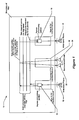
- the PBX 10 includes a first G.722 interface board which is capable of interfacing with a first wide-band phone 12 (G.722).
- the first G.722 interface board includes an ingress processing portion 14 also referred to herein as a decomposition portion of a Quadrature Mirror filter (QMF).
- QMF Quadrature Mirror filter
- Within the PBX 10 is a plurality of 8-bit wide transport channels.
- One of the channels is in communication with the first G.722 interface board and comprises a high band channel carrying high band frequencies required by G.722 phones.
- Another channel of the plurality of channels comprises a low band channel that carries G.711 encoded voice signals.
- a G.711 interface board 20 is shown in communication with the low band channel.
- Conventional narrow-band phones 22 and 24 are capable of communication with the G.711 interface board.
- a second G.722 board having an egress processing portion 16, also referred to herein as a reconstruction portion of a QMF.
- the second G.722 interface board is in communication with a second G.722 phone 18.
- both G.711 and G.722 devices can be used with the same PBX, and results in minimum usage of timeslots. While Figure 1 shows only one half of the duplex voice flow, it should be appreciated that the opposite flow is the logical inverse of this flow.
- the modified QMF 100 includes an ingress processing portion 110 and an egress processing portion 111 and further includes a compander including a compressor and an expander, as well as a converter disposed between the ingress processing portion 110 of the QMF and the egress processing portion 111 of the QMF.
- a compander including a compressor and an expander, as well as a converter disposed between the ingress processing portion 110 of the QMF and the egress processing portion 111 of the QMF.
- An input signal is received by ingress processing portion 110 of the modified QMF 100 at amplifier 112.
- This input signal comprises a 0-8KHz, 14 bit signal.
- Amplifier 112 receives the input signal and produces an amplified signal which is supplied by amplifier 112 to a first low-pass filter 116.
- the first low-pass filter 116 receives the amplifier output signal and produces a first low-pass signal.
- This signal is a 0-4KHz 14 bit signal, and is supplied to a first down-sampler 118.
- the first down-sampler 118 receives the low-pass signal and provides a first low-band signal.
- the amplified signal from amplifier 112 is also provided to delay 114.
- Delay 114 provides a one sample delay, as required by the filter. The delay 114 produces a delayed signal.
- the delayed signal is provided to a first high-pass filter 130 coupled to the output of delay 114.
- the first high-pass filter 130 receives the delayed signal and produces a high-pass signal.
- the high-pass signal is provided to a second down-sampler 132 coupled to the high-pass filter.
- the second down-sampler 132 receives the high-pass signal and produces a first high-band signal.
- the above described amplifier 112, first low-pass filter 116, first down-sampler 118, delay 114, first high-pass filter 130 and second down-sampler 132 comprise the ingress processing portion or decomposition portion of the modified QMF 100.
- the first low-bandwidth signal from first down-sampler 118 is provided to a first compander having a first compander compression portion 120 and a first compander expander portion 122.
- the first compander compression portion 120 receives the first low-band signal and compresses the first low-band signal to produce a low-bandwidth channel.
- the low-bandwidth channel comprises an 8 bit G.711 stream for carrying encoded voice that can be used by other devices communicating with the PBX.
- the compander also includes an expander portion 122 that receives the low-bandwidth channel and produces a second low-band signal.
- a converter having a compression portion 134 and an expander portion 136 is interfaced between the decomposition portion and reconstruction portion of modified QMF 100.
- the converter compression portion 134 receives the first high-band signal from second down converter 132 and compresses the first high-band signal to produce a high-bandwidth channel.
- the high-bandwidth channel comprises an 8 bit high-band decomposed portion of a G.722 stream for carrying encoded voice that can be used by other devices communicating with the PBX.
- the converter also includes an expander portion 136 which receives the high-bandwidth channel and produces a second high-band signal.
- the second low-band signal and the second high-band signal are received by the reconstruction portion 111 of the modified QMF 100.
- the reconstruction portion of the QMF includes a first up-sampler 124 which receives the second low-bandwidth signal and provides an up-sampled low-band signal.
- a second low-pass filter 126 is coupled to the first up-sampler 124. The second low-pass filter 126 receives the up-sampled low-band signal and provides a filtered low-band signal.
- a second up-sampler 138 receives the second high-bandwidth signal and provides an up-sampled high-band signal.
- a second high-pass filter 140 is coupled to the second up-sampler. 138.
- the second high-pass filter 140 receives the up-sampled high-band signal and produces a filtered high-band signal.
- a combiner 128 is coupled to the second low-pass filter 126 and the second high-pass filter 140 and receives the filtered low-band signal and the filtered high-band signal and produces an output signal from the filtered low-band signal and the filtered high-band signal.
- PBX which includes a modified QMF
- low-bandwidth and high-bandwidth voice channels are distributed within a PBX using a minimum amount of timeslots and maintaining compatibility with low-bandwidth voice processing elements.
- FIG. 3A and 3B A flow chart of the presently disclosed method of distribution of high-bandwidth and low-bandwidth voice channels using a minimum number of timeslots depicted in Figures 3A and 3B.
- the rectangular elements are herein denoted "processing blocks" and represent computer software instructions or groups of instructions. Alternatively, the processing blocks represent steps performed by functionally equivalent circuits such as a digital signal processor circuit or an application specific integrated circuit (ASIC).
- ASIC application specific integrated circuit
- the flow diagrams do not depict the syntax of any particular programming language. Rather, the flow diagrams illustrate the functional information one of ordinary skill in the art requires to fabricate circuits or to generate computer software to perform the processing required in accordance with the present invention. It should be noted that many routine program elements, such as initialization of loops and variables and the use of temporary variables are not shown.
- processing block 202 discloses receiving an input signal.
- the input signal comprises a 0-8KHz, 14 bit voice stream signal.
- Processing block 206 states separating the input signal into a first high-band signal and a first low-band signal.
- the first low-bandwidth signal comprises a 0-4KHz, 14 bit voice stream signal, as depicted in processing block 208, while the first high-band signal comprises a 4-8KHz, 14 bit voice stream signal as recited in processing block 210.
- processing block 212 recites compressing the first low-band signal to provide a low-bandwidth channel.
- the low-bandwidth channel comprises a G.711 voice stream signal.
- Processing block 216 discloses carrying encoded voice signals on the low-bandwidth channel.
- the low-bandwidth channel is distributed through the PBX and can be used by all G.711 devices.
- Processing block 218 states compressing the first high-band signal to provide a high-bandwidth channel.
- the high-bandwidth channel comprises a high-band decomposed portion of a G.722 voice stream signal.
- Processing block 222 discloses carrying encoded voice signals on the high-bandwidth channel.
- the high-bandwidth channel is distributed through the PBX and can be used by all G.722 devices.
- Processing block 224 discloses expanding the low-bandwidth channel to provide a second low-band signal.
- the compressing the low-bandwidth signal to provide a low-bandwidth channel and the expanding the low-bandwidth channel to provide a second low-band signal is done by way of a compander, as shown in processing block 226.
- the compressing the first high-bandwidth signal and the expanding the first high-bandwidth signal is done in accordance with one of the group consisting of ⁇ -law and A-law.
- Processing block 230 states expanding the high-bandwidth channel to provide a second high-bandwidth signal.
- Processing block 232 recites the compressing the high-bandwidth signal to provide a high-bandwidth channel and the expanding the high-bandwidth channel to provide a second high-bandwidth signal is done by way of a converter.
- Processing block 234 discloses combining the second low-band signal and the second high-band signal to provide a 0 to 8KHz output signal.
- Processing block 236 states wherein the separating the input signal into a first high-band signal and a first low-band signal is done by way of a decomposition portion of a Quadrature Mirror Filter (QMF) and wherein the combining the second low-band signal and the second high-band signal to provide an output signal is done by way of a reconstruction portion of the QMF.
- Processing block 238 states the receiving, separating, compressing, carrying and combining is performed within a private branch exchange (PBX).
- PBX private branch exchange
- the above described method reduces to a minimum the number of timeslots required to transport G.722 wideband voice traffic while providing compatibility with G.711 voice processing elements within a PBX.
- a computer usable medium can include a readable memory device, such as a hard drive device, a CD-ROM, a DVD-ROM, or a computer diskette, having computer readable program code segments stored thereon.
- the computer readable medium can also include a communications link, either optical, wired, or wireless, having program code segments carried thereon as digital or analog signals.
Landscapes
- Engineering & Computer Science (AREA)
- Physics & Mathematics (AREA)
- Computational Linguistics (AREA)
- Signal Processing (AREA)
- Health & Medical Sciences (AREA)
- Audiology, Speech & Language Pathology (AREA)
- Human Computer Interaction (AREA)
- Acoustics & Sound (AREA)
- Multimedia (AREA)
- Spectroscopy & Molecular Physics (AREA)
- Information Transfer Between Computers (AREA)
- Compression, Expansion, Code Conversion, And Decoders (AREA)
Abstract
Description
- G.711 is the international standard for encoding telephone audio on 64 kbps channel. G.711 is a pulse code modulation (PCM) scheme operating at an 8 kHz sample rate, with 8 bits per sample. G.711 is an ITU-T standard for audio companding, and is primarily used in telephony. According to the Nyquist theorem, which states that a signal must be sampled at twice its highest frequency component, G.711 can encode frequencies between 0 and 4 kHz. G.711 is a standard to represent 8 bit compressed pulse code modulation (PCM) samples for signals of voice frequencies, sampled at the rate of 8000 samples/second and 8 bits per sample. A G.711 encoder will thus create a 64 kbit/s bitstream.
- G.722 is an ITU-T standard wideband speech codec operating at 32-64 kbit/s. G.722 offers lower bit-rate compressions than G.711. The unencoded signal is 14 bits at 16 KHz, producing an effective bandwidth of 50 Hz to 7000 Hz (per the G.722 standard).
- There are two different companding variants of G.711: µ-law (a.k.a. "Mu-Law") and A-law. The µ-law algorithm is used in North America & Japan and A-law algorithm is used in Europe and the rest of the world. Both are logarithmic, but the A-law was specifically designed to be simpler for a computer to process. The standard also defines a sequence of repeating code values which defines the power level of 0 dB.
- In digital signal processing, a Quadrature Mirror Filter (QMF) is used to split an input signal into bands (e.g., a high band and a low band) which are then usually sub-sampled by a factor of two. The QMF includes a high-pass filter and a low-pass filter wherein the sum of the magnitudes response of the filters is equal to one at every frequency.
- Conventional mechanisms such as those explained above suffer from a variety of deficiencies. One such deficiency is that conventional products allocate enough timeslots to support both G.711 and G.722 talkers. Somewhere in the system -- often a single board, but can be distributed -- the conversion is performed. Since G.711 ("low bandwidth") and G.722 ("high bandwidth") channels are run to and from the common conversion device, a maximum number of timeslots is consumed. Not only does this consume precious resources (timeslots), it reduces the effectiveness of a certain style conferencing mechanism (one in which every voice source has its own talk path and all conferencing summation is performed at the egress point). Since G.722 and G.711 are not inherently compatible, it is not possible for a G.711-optimized conferencing summation to include G.722 channels, unless they are first converted to G.711 (adding cost and reducing overall system capacity).
- Techniques exist (for example, ADPCM) to reduce the number of time slots consumed by G.722 voice channels, but it does nothing to allow the interoperation of High and Low-bandwidth streams.
- Embodiments of the invention significantly overcome such deficiencies and provide mechanisms and techniques that reduces to a minimum the number of timeslots required to transport G.722 wideband voice traffic while providing compatibility with G.711 voice processing elements.
- In a particular embodiment of a method for distributing high-bandwidth and low-bandwidth voice channels, the method includes receiving an input signal and separating the input signal into a first low-bandwidth signal and a first high-bandwidth signal. The method further includes compressing the first low-bandwidth signal to provide a low-bandwidth channel and carrying encoded voice signals on the low-bandwidth channel. The method also includes compressing the first high-bandwidth signal to provide a high-bandwidth channel and carrying encoded voice signals on the high-bandwidth channel.
- Other embodiments comprise a Private Branch Exchange (PBX), wherein the PBX includes a modified Quadrature Mirror Filter (QMF) having a decomposition portion and a reconstruction portion, the decomposition portion receiving an input signal and separating the input signal into a first high-band signal and a first low-band signal. The modified QMF also includes a first compander having a first compander compression portion and a first compander expander portion, the first compander compression portion receiving the first low-band signal and compressing the first low-band signal to produce a low-bandwidth channel, the first compander expander portion receiving the low-bandwidth channel and producing a second low-band signal. Additionally, the PBX includes a converter having a converter compression portion and a converter expander portion, the converter compression portion receiving the first high-band signal and compressing the first high-band signal to produce a high-bandwidth channel, the converter expander portion receiving the high-bandwidth channel and producing a second high-band signal and wherein the reconstruction portion of the QMF receives the second low-band signal and the second high-band signal and produces an output signal from the second low-band signal and the second high-band signal.
- It is to be understood that the embodiments of the invention can be embodied strictly as software and hardware, or as hardware and/or circuitry alone, such as within a data communications device. The features of the invention, as explained herein, may be employed in data communications devices and/or software systems for such devices such as those manufactured by Avaya Inc. of Lincroft New Jersey.
- The foregoing will be apparent from the following more particular description of preferred embodiments of the invention, as illustrated in the accompanying drawings in which like reference characters refer to the same parts throughout the different views. The drawings are not necessarily to scale, emphasis instead being placed upon illustrating the principles of the invention.
- Figure 1 comprises a block diagram of a PBX wherein distribution of high-bandwidth and low-bandwidth voice channels using a minimum number of timeslots is preformed in accordance with embodiments of the invention;
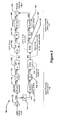
- Figure 2 comprises a block diagram of a portion of a PBX distribution of high-bandwidth and low-bandwidth voice channels using a minimum number of timeslots in accordance with embodiments of the invention; and
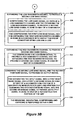
- Figure 3 comprises a flow diagram of a particular embodiment of a method for distribution of high-bandwidth and low-bandwidth voice channels using a minimum number of timeslots in accordance with embodiments of the invention.
- Older generation PBX and other voice processing systems are often optimized to support G.711 bandwidth (approximately 3.5 KHz) voice channels. Recent market trends have shown that higher bandwidth voice channels are required for a particular customer segment (some conferencing services, some contact/call centers). A popular high-bandwidth codec exists (G.722) that provides upwards of 7 KHz bandwidth. The challenge to date for legacy PBX vendors has been the upgrade of existing PBX systems to support G.722 bandwidth channels. The most common approach is to consume 4 64kbps timeslots per every G.722 talk path, as compared to one 64kbps timeslot required per G.711 talk path. It can be seen that the addition of G.722 channels can quickly exhaust the limited number of timeslots available within a PBX (for example, a PBX may only have approximately 480 timeslots available for voice channels).
- Beyond the issue of timeslot consumption required for the higher bandwidth voice traffic is the inability of non-G.722-capable interface boards to process G.722 traffic. Therefore, if a G.722 phone call is made to a G.711-only user, a conversion must be performed somewhere in the PBX. Because of this, even more timeslots are consumed by the need to move the G.722 and G.711 channels into a conversion device, and then to move the converted voice channels back to the appropriate interface boards.
- In certain PBXs, multi-party conferencing is based on the transport of G.711 voice streams. The PBX defines a talk path timeslot for each G.711 source. All G.711 "listeners" have the ability to sum together a number of talk paths, thus creating the basis for conferencing. In this system, G.722 channels cannot be summed with G.711 channels so easily - the G.722 channels must first be converted to G.711. Adding G.722 voice to a PBX causes the loss of conferencing efficiency unless other steps are taken.
- Described is a mechanism to transport G.722 and G.711 voice channels in such a manner that the number of timeslots consumed inside the PBX is reduced. Further, the native conferencing capability of the PBX is preserved, or at least it is minimally impacted.
- By implementing a structure known as a Quadrature Mirror Filter (QMF), the frequency components of a signal are separated into multiple bands. For this invention, the number of bands is two, and they are designated "High" and "Low". The G.722 7 KHz stream is run through a QMF, with the Low band being compatible with a G.711 voice channel. This allows one voice stream (G.722) to support both High and Low-bandwidth devices. In order to further reduce the number of time slots consumed by the voice channel, companding and/or down converting is employed in both the High and Low frequency bands.
- Companding (compression and expansion) is a method commonly used in telephony applications to increase dynamic range while keeping the number of bits used for quantization constant. µ-law is a companding standard commonly used in the United States. [µ-law takes 14-bit data values and compresses them to eight-bit values. A-law is the standard used in Europe. A-law takes 13-bit data values and compresses them to eight-bit values.
- The presently described distribution of high-bandwidth and low-bandwidth voice channels using a minimum number of timeslots maintains compatibility with G.711 voice processing equipment, which preserves a Customer's investment. Newer, G.722-capable boards bear the implementation complexity. Such newer designs benefit from recent improvements in Digital Signal Processing (DSP) and Field Programmable Gate Arrays (FPGAs) silicon.
- Prior art devices implements the transport of G.722 using four 64kbps timeslots. In order to provide interoperability with G.711 devices, a centralized conversion function bridges between G.722 and G.711 traffic. The present invention provides a mechanism by which G.722 and G.711 interoperability is supplied yet no system-wide dedicated conversion function is utilized. The inherent efficiencies of G.711 transport are thus preserved.
- Referring now to Figure 1 a high-level block diagram of a PBX capable of performing distribution of high-bandwidth and low-bandwidth voice channels using a minimum number of timeslots is presented. The
PBX 10 includes a first G.722 interface board which is capable of interfacing with a first wide-band phone 12 (G.722). The first G.722 interface board includes aningress processing portion 14 also referred to herein as a decomposition portion of a Quadrature Mirror filter (QMF). Within thePBX 10 is a plurality of 8-bit wide transport channels. One of the channels is in communication with the first G.722 interface board and comprises a high band channel carrying high band frequencies required by G.722 phones. Another channel of the plurality of channels comprises a low band channel that carries G.711 encoded voice signals. A G.711interface board 20 is shown in communication with the low band channel. Conventional narrow-band phones egress processing portion 16, also referred to herein as a reconstruction portion of a QMF. The second G.722 interface board is in communication with a second G.722phone 18. By way of the present distribution of high-bandwidth and low-bandwidth voice channels using a minimum number of timeslots, both G.711 and G.722 devices can be used with the same PBX, and results in minimum usage of timeslots. While Figure 1 shows only one half of the duplex voice flow, it should be appreciated that the opposite flow is the logical inverse of this flow. - Referring now to Figure 2, a block diagram of the modified
QMF 100 is shown. The modifiedQMF 100 includes aningress processing portion 110 and anegress processing portion 111 and further includes a compander including a compressor and an expander, as well as a converter disposed between theingress processing portion 110 of the QMF and theegress processing portion 111 of the QMF. - An input signal is received by
ingress processing portion 110 of the modifiedQMF 100 atamplifier 112. This input signal comprises a 0-8KHz, 14 bit signal.Amplifier 112 receives the input signal and produces an amplified signal which is supplied byamplifier 112 to a first low-pass filter 116. The first low-pass filter 116 receives the amplifier output signal and produces a first low-pass signal. This signal is a 0-4KHz 14 bit signal, and is supplied to a first down-sampler 118. The first down-sampler 118 receives the low-pass signal and provides a first low-band signal. - The amplified signal from
amplifier 112 is also provided to delay 114.Delay 114 provides a one sample delay, as required by the filter. Thedelay 114 produces a delayed signal. The delayed signal is provided to a first high-pass filter 130 coupled to the output ofdelay 114. The first high-pass filter 130 receives the delayed signal and produces a high-pass signal. The high-pass signal is provided to a second down-sampler 132 coupled to the high-pass filter. The second down-sampler 132 receives the high-pass signal and produces a first high-band signal. - The above described
amplifier 112, first low-pass filter 116, first down-sampler 118,delay 114, first high-pass filter 130 and second down-sampler 132 comprise the ingress processing portion or decomposition portion of the modifiedQMF 100. - The first low-bandwidth signal from first down-
sampler 118 is provided to a first compander having a firstcompander compression portion 120 and a firstcompander expander portion 122. The firstcompander compression portion 120 receives the first low-band signal and compresses the first low-band signal to produce a low-bandwidth channel. The low-bandwidth channel comprises an 8 bit G.711 stream for carrying encoded voice that can be used by other devices communicating with the PBX. The compander also includes anexpander portion 122 that receives the low-bandwidth channel and produces a second low-band signal. - A converter having a
compression portion 134 and anexpander portion 136 is interfaced between the decomposition portion and reconstruction portion of modifiedQMF 100. Theconverter compression portion 134 receives the first high-band signal fromsecond down converter 132 and compresses the first high-band signal to produce a high-bandwidth channel. The high-bandwidth channel comprises an 8 bit high-band decomposed portion of a G.722 stream for carrying encoded voice that can be used by other devices communicating with the PBX. The converter also includes anexpander portion 136 which receives the high-bandwidth channel and produces a second high-band signal. - The second low-band signal and the second high-band signal are received by the
reconstruction portion 111 of the modifiedQMF 100. The reconstruction portion of the QMF includes a first up-sampler 124 which receives the second low-bandwidth signal and provides an up-sampled low-band signal. A second low-pass filter 126 is coupled to the first up-sampler 124. The second low-pass filter 126 receives the up-sampled low-band signal and provides a filtered low-band signal. - A second up-
sampler 138 receives the second high-bandwidth signal and provides an up-sampled high-band signal. A second high-pass filter 140 is coupled to the second up-sampler. 138. The second high-pass filter 140 receives the up-sampled high-band signal and produces a filtered high-band signal. Acombiner 128 is coupled to the second low-pass filter 126 and the second high-pass filter 140 and receives the filtered low-band signal and the filtered high-band signal and produces an output signal from the filtered low-band signal and the filtered high-band signal. - By way of the above described PBX, which includes a modified QMF, low-bandwidth and high-bandwidth voice channels are distributed within a PBX using a minimum amount of timeslots and maintaining compatibility with low-bandwidth voice processing elements.
- A flow chart of the presently disclosed method of distribution of high-bandwidth and low-bandwidth voice channels using a minimum number of timeslots depicted in Figures 3A and 3B. The rectangular elements are herein denoted "processing blocks" and represent computer software instructions or groups of instructions. Alternatively, the processing blocks represent steps performed by functionally equivalent circuits such as a digital signal processor circuit or an application specific integrated circuit (ASIC). The flow diagrams do not depict the syntax of any particular programming language. Rather, the flow diagrams illustrate the functional information one of ordinary skill in the art requires to fabricate circuits or to generate computer software to perform the processing required in accordance with the present invention. It should be noted that many routine program elements, such as initialization of loops and variables and the use of temporary variables are not shown. It will be appreciated by those of ordinary skill in the art that unless otherwise indicated herein, the particular sequence of steps described is illustrative only and can be varied without departing from the spirit of the invention. Thus, unless otherwise stated the steps described below are unordered meaning that, when possible, the steps can be performed in any convenient or desirable order.
- Referring now to Figures 3A and 3B, a particular embodiment of a
method 200 of distributing high-bandwidth and low-bandwidth voice channels using a minimal amount of time slots is shown. The method begins withprocessing block 202 which discloses receiving an input signal. As further recited inprocessing block 204, the input signal comprises a 0-8KHz, 14 bit voice stream signal. -
Processing block 206 states separating the input signal into a first high-band signal and a first low-band signal. The first low-bandwidth signal comprises a 0-4KHz, 14 bit voice stream signal, as depicted inprocessing block 208, while the first high-band signal comprises a 4-8KHz, 14 bit voice stream signal as recited inprocessing block 210. - Processing continues with
processing block 212 which recites compressing the first low-band signal to provide a low-bandwidth channel. As stated inprocessing block 214, the low-bandwidth channel comprises a G.711 voice stream signal. -
Processing block 216 discloses carrying encoded voice signals on the low-bandwidth channel. The low-bandwidth channel is distributed through the PBX and can be used by all G.711 devices. -
Processing block 218 states compressing the first high-band signal to provide a high-bandwidth channel. As stated inprocessing block 220, the high-bandwidth channel comprises a high-band decomposed portion of a G.722 voice stream signal. -
Processing block 222 discloses carrying encoded voice signals on the high-bandwidth channel. The high-bandwidth channel is distributed through the PBX and can be used by all G.722 devices. -
Processing block 224 discloses expanding the low-bandwidth channel to provide a second low-band signal. The compressing the low-bandwidth signal to provide a low-bandwidth channel and the expanding the low-bandwidth channel to provide a second low-band signal is done by way of a compander, as shown inprocessing block 226. As further recited inprocessing block 228, the compressing the first high-bandwidth signal and the expanding the first high-bandwidth signal is done in accordance with one of the group consisting of µ-law and A-law. -
Processing block 230 states expanding the high-bandwidth channel to provide a second high-bandwidth signal.Processing block 232 recites the compressing the high-bandwidth signal to provide a high-bandwidth channel and the expanding the high-bandwidth channel to provide a second high-bandwidth signal is done by way of a converter. -
Processing block 234 discloses combining the second low-band signal and the second high-band signal to provide a 0 to 8KHz output signal.Processing block 236 states wherein the separating the input signal into a first high-band signal and a first low-band signal is done by way of a decomposition portion of a Quadrature Mirror Filter (QMF) and wherein the combining the second low-band signal and the second high-band signal to provide an output signal is done by way of a reconstruction portion of the QMF.Processing block 238 states the receiving, separating, compressing, carrying and combining is performed within a private branch exchange (PBX). - The above described method reduces to a minimum the number of timeslots required to transport G.722 wideband voice traffic while providing compatibility with G.711 voice processing elements within a PBX.
- Having described preferred embodiments of the invention it will now become apparent to those of ordinary skill in the art that other embodiments incorporating these concepts may be used. Additionally, the software included as part of the invention may be embodied in a computer program product that includes a computer useable medium. For example, such a computer usable medium can include a readable memory device, such as a hard drive device, a CD-ROM, a DVD-ROM, or a computer diskette, having computer readable program code segments stored thereon. The computer readable medium can also include a communications link, either optical, wired, or wireless, having program code segments carried thereon as digital or analog signals. Accordingly, it is submitted that that the invention should not be limited to the described embodiments but rather should be limited only by the spirit and scope of the appended claims.
Claims (20)
- A method of distributing high-bandwidth and low-bandwidth voice channels comprising:receiving an input signal;separating the input signal into a first high-band signal and a first low-band signal;compressing the first low-band signal to provide a low-bandwidth channel; andcarrying encoded voice signals on the low-bandwidth channel.
- The method of claim 1 further comprising:compressing the first high-band signal to provide a high-bandwidth channel; andcarrying encoded voice signals on the high-bandwidth channel.
- The method of claim 2 further comprising expanding the low-bandwidth channel to provide a second low-band signal.
- The method of claim 3 further comprising expanding the high-bandwidth channel to provide a second high-band signal.
- The method of claim 4 further comprising combining the second low-band signal and the second high-band signal to provide an output signal.
- The method of claim 1 wherein the input signal comprises a 0-8KHz, 14 bit voice stream signal.
- The method of claim 1 wherein the first low-band signal comprises a 0-4KHz, 14 bit voice stream signal.
- The method of claim 1 wherein the first high-band signal comprises a 4-8KHz, 14 bit voice stream signal.
- The method of claim 1 wherein the low-bandwidth channel comprises a G.711 voice stream signal.
- The method of claim 2 wherein the high-bandwidth channel comprises a high-band decomposed portion of a G.722 voice stream signal.
- The method of claim 5 wherein the receiving, separating, compressing, carrying and combining is performed within a private branch exchange (PBX).
- The method of claim 5 wherein the separating the input signal into a first high-band signal and a first low-band signal is done by way of a decomposition portion of a Quadrature Mirror Filter (QMF) and wherein the combining the second low-band signal and the second high-band signal to provide an output signal is done by way of a reconstruction portion of the QMF.
- The method of claim 3 wherein the compressing the low-band signal to provide a low-bandwidth channel and the expanding the low-bandwidth channel to provide a second low-band signal is done by way of a compander.
- The method of claim 13 wherein the compressing the high-band signal to provide a high-bandwidth channel and the expanding the high-bandwidth channel to provide a second high-band signal is done by way of a converter.
- The method of claim 4 wherein the compressing the first low-band signal and the expanding the first low-bandwidth signal is done in accordance with one of the group consisting of µ-law and A-law.
- A private branch exchange (PBX) comprising:a Quadrature Mirror Filter (QMF) having a decomposition portion and a reconstruction portion, the decomposition portion receiving an input signal and separating the input signal into a first high-band signal and a first low-band signal;a first compander having a first compander compression portion and a first compander expander portion, the first compander compression portion receiving the first low-band signal and compressing the first low-band signal to produce a low-bandwidth channel, the first compander expander portion receiving the low-bandwidth channel and producing a second low-band signal;a converter having a converter compression portion and a converter expander portion, the converter compression portion receiving the first high-band signal and compressing the first high-band signal to produce a high-bandwidth channel, the converter expander portion receiving the high bandwidth channel and producing a second high-band signal; andwherein the reconstruction portion of the QMF receives the second low-band signal and the second high-band signal and produces outputs an output signal from the second low-band signal and the second high-band signal.
- The PBX of claim 16 wherein the decomposition portion of the QMF comprises:an amplifier receiving the input signal and providing an amplifier output signal;a first low-pass filter coupled to the output of the amplifier, the first low-pass filter receiving the amplifier output signal and producing a low-pass signal;a first down-sampler coupled to the low-pass filter, the first down-sampler receiving the low-pass signal and providing the first low-bandwidth signal;a delay coupled to the amplifier and receiving the amplifier output signal, the delay producing a delayed signal;a first high-pass filter coupled to the output of the delay, the first high-pass filter receiving the delayed signal and producing a high-pass signal; anda second down-sampler coupled to the high-pass filter, the second down-sampler receiving the high low-pass signal and providing the first high-bandwidth signal.
- The PBX of claim 16 wherein the reconstruction portion of the QMF comprises:a first up-sampler receiving the second low-band signal and providing an up-sampled low-band signal;a second low-pass filter coupled to the first up-sampler, the second low-pass filter receiving the up-sampled low-band signal and producing a filtered low-band signal;a second up-sampler receiving the second high-band signal and providing an up-sampled high-band signal;a second high-pass filter coupled to the second up-sampler, the second high-pass filter receiving the up-sampled high-band signal and producing a filtered high-band signal; anda combiner coupled to the second low-pass filter and the second high-pass filter and receiving the filtered low-band signal and the filtered high-band signal and producing an output signal from the filtered low-band signal and the filtered high-band signal.
- The PBX of claim 17 wherein the first compander is selected from the group consisting of µ law, and A-law.
- The PBX of claim 17 wherein the low-bandwidth channel comprises a G.711 voice stream and wherein the high-bandwidth channel comprises a high-band decomposed portion of a G. 722 voice stream.
Applications Claiming Priority (1)
| Application Number | Priority Date | Filing Date | Title |
|---|---|---|---|
| US11/486,225 US8041770B1 (en) | 2006-07-13 | 2006-07-13 | Method of providing instant messaging functionality within an email session |
Publications (1)
| Publication Number | Publication Date |
|---|---|
| EP1879177A1 true EP1879177A1 (en) | 2008-01-16 |
Family
ID=38582003
Family Applications (1)
| Application Number | Title | Priority Date | Filing Date |
|---|---|---|---|
| EP07252808A Withdrawn EP1879177A1 (en) | 2006-07-13 | 2007-07-13 | A method for distributing high and low-bandwidth voice channels using a minimum number of timeslots |
Country Status (2)
| Country | Link |
|---|---|
| US (1) | US8041770B1 (en) |
| EP (1) | EP1879177A1 (en) |
Families Citing this family (11)
| Publication number | Priority date | Publication date | Assignee | Title |
|---|---|---|---|---|
| US7921176B2 (en) * | 2007-01-03 | 2011-04-05 | Madnani Rajkumar R | Mechanism for generating a composite email |
| JP5369777B2 (en) * | 2009-03-11 | 2013-12-18 | 富士通株式会社 | Information processing device |
| US9043407B1 (en) * | 2009-06-12 | 2015-05-26 | Avaya Inc. | Interactive user interface to communication-enabled business process platforms method and apparatus |
| EP2823445A1 (en) * | 2012-03-08 | 2015-01-14 | Citrix Systems, Inc. | Cross platform messaging |
| US20160087929A1 (en) | 2014-09-24 | 2016-03-24 | Zoho Corporation Private Limited | Methods and apparatus for document creation via email |
| US11838254B2 (en) * | 2014-09-24 | 2023-12-05 | Zoho Corporation Private Limited | System and method for transforming communication stream messages to email messages |
| US11057325B2 (en) * | 2014-09-24 | 2021-07-06 | Zoho Corporation Private Limited | Methods and apparatus for enhanced communication in email applications |
| US11323401B2 (en) | 2014-09-24 | 2022-05-03 | Zoho Corporation Private Limited | Email interface for application creation and management |
| CN106302081B (en) * | 2015-05-14 | 2020-04-17 | 阿里巴巴集团控股有限公司 | Instant messaging method and client |
| US10685169B2 (en) | 2017-05-08 | 2020-06-16 | Zoho Corporation Private Limited | Messaging application with presentation window |
| US10897432B2 (en) * | 2017-12-04 | 2021-01-19 | Microsoft Technology Licensing, Llc | Chat-enabled messaging |
Citations (4)
| Publication number | Priority date | Publication date | Assignee | Title |
|---|---|---|---|---|
| EP0351479A1 (en) * | 1988-07-18 | 1990-01-24 | International Business Machines Corporation | Low bit rate voice coding method and device |
| US20030115044A1 (en) * | 2001-12-19 | 2003-06-19 | Ho-Sang Sung | Method and apparatus for transmitting wideband speech signals |
| EP1408679A2 (en) * | 2002-09-27 | 2004-04-14 | Broadcom Corporation | Multiple data rate communication system |
| EP1494211A1 (en) * | 2003-07-03 | 2005-01-05 | Samsung Electronics Co., Ltd. | Speech compression and decompression apparatuses and methods providing scalable bandwidth structure |
Family Cites Families (34)
| Publication number | Priority date | Publication date | Assignee | Title |
|---|---|---|---|---|
| US6763376B1 (en) * | 1997-09-26 | 2004-07-13 | Mci Communications Corporation | Integrated customer interface system for communications network management |
| US6167434A (en) * | 1998-07-15 | 2000-12-26 | Pang; Stephen Y. | Computer code for removing junk e-mail messages |
| US6917610B1 (en) * | 1999-12-30 | 2005-07-12 | At&T Corp. | Activity log for improved call efficiency |
| EP1311924A2 (en) * | 2000-06-22 | 2003-05-21 | Yaron Mayer | System and method for searching, finding and contacting dates on the internet in instant messaging networks and/or in other methods that enable immediate finding and creating immediate contact |
| US7222156B2 (en) * | 2001-01-25 | 2007-05-22 | Microsoft Corporation | Integrating collaborative messaging into an electronic mail program |
| US20030110227A1 (en) * | 2001-12-06 | 2003-06-12 | O'hagan Timothy Patrick | Real time streaming media communication system |
| US6961878B2 (en) * | 2002-02-28 | 2005-11-01 | Bellsouth Intellectual Property Corporation | Software application error severity notification to users |
| US20040078446A1 (en) * | 2002-09-17 | 2004-04-22 | Daniell W. Todd | Options associated with instant messaging (IM) chat transcripts of IM chat sessions |
| US20040064514A1 (en) * | 2002-09-17 | 2004-04-01 | Daniell W. Todd | Providing instant messaging (IM) internet presence information and chat capability from displayed email messages |
| US7185059B2 (en) * | 2002-09-17 | 2007-02-27 | Bellsouth Intellectual Property Corp | Multi-system instant messaging (IM) |
| US20040054719A1 (en) * | 2002-09-17 | 2004-03-18 | Daigle Brian K. | Providing uniform settings for multiple resources in a client-server environment |
| US7933957B2 (en) * | 2002-09-17 | 2011-04-26 | At&T Intellectual Property Ii, L.P. | Tracking email and instant messaging (IM) thread history |
| US7657598B2 (en) * | 2002-09-17 | 2010-02-02 | At&T Intellectual Property I, L.P. | Address book for integrating email and instant messaging (IM) |
| US7818375B2 (en) * | 2002-10-17 | 2010-10-19 | At&T Intellectual Property I, L.P. | Providing advanced instant messaging (IM) notification |
| US20040054736A1 (en) * | 2002-09-17 | 2004-03-18 | Daniell W. Todd | Object architecture for integration of email and instant messaging (IM) |
| US7921160B2 (en) * | 2002-09-17 | 2011-04-05 | At&T Intellectual Property I, L.P. | Initiating instant messaging (IM) chat sessions from email messages |
| US20040125924A1 (en) * | 2002-12-31 | 2004-07-01 | Mcmullin William P. | Provision of call destination information to a caller |
| US20050033811A1 (en) * | 2003-08-07 | 2005-02-10 | International Business Machines Corporation | Collaborative email |
| US8108469B2 (en) * | 2003-10-14 | 2012-01-31 | At&T Intellectual Property I, L.P. | User interface for a communication suite |
| US20050080862A1 (en) * | 2003-10-14 | 2005-04-14 | Kent Larry G. | Communication suite engine |
| US7996470B2 (en) * | 2003-10-14 | 2011-08-09 | At&T Intellectual Property I, L.P. | Processing rules for digital messages |
| US7356572B2 (en) * | 2003-11-10 | 2008-04-08 | Yahoo! Inc. | Method, apparatus and system for providing a server agent for a mobile device |
| US20050141511A1 (en) * | 2003-12-08 | 2005-06-30 | Thawatt Gopal | Method of reducing call setup time for IP services in a mobile communication network |
| US20050160146A1 (en) * | 2003-12-29 | 2005-07-21 | Arnoff Mary S. | Modular integration of communication modalities |
| US7274777B2 (en) * | 2003-12-29 | 2007-09-25 | At&T Bls Intellectual Property, Inc. | Substantially synchronous deposit of messages into multiple communication modalities |
| US7184525B2 (en) * | 2003-12-29 | 2007-02-27 | Bellsouth Intellectual Property Corporation | Accessing messages stored in one communication system by another communication system |
| US7730129B2 (en) * | 2004-10-20 | 2010-06-01 | Inbit, Inc. | Collaborative communication platforms |
| US7689655B2 (en) * | 2004-12-06 | 2010-03-30 | Aol Inc. | Managing and collaborating with digital content using a dynamic user interface |
| US20060218491A1 (en) * | 2005-03-25 | 2006-09-28 | International Business Machines Corporation | System, method and program product for community review of documents |
| US9514441B2 (en) * | 2005-06-17 | 2016-12-06 | Blackberry Limited | Method and apparatus for switching between concurrent messaging sessions |
| US20070005701A1 (en) * | 2005-06-30 | 2007-01-04 | International Business Machines Corporation | Synchronizing email content with IM content |
| US9053461B2 (en) * | 2005-10-07 | 2015-06-09 | Yahoo! Inc. | Instant messaging interoperability between disparate service providers |
| WO2007112369A2 (en) * | 2006-03-24 | 2007-10-04 | Meebo, Inc. | A method and system for event polling |
| CN101079849B (en) * | 2007-06-29 | 2010-07-14 | 腾讯科技(深圳)有限公司 | Method and system for sending offline messages in instant communication system |
-
2006
- 2006-07-13 US US11/486,225 patent/US8041770B1/en active Active
-
2007
- 2007-07-13 EP EP07252808A patent/EP1879177A1/en not_active Withdrawn
Patent Citations (4)
| Publication number | Priority date | Publication date | Assignee | Title |
|---|---|---|---|---|
| EP0351479A1 (en) * | 1988-07-18 | 1990-01-24 | International Business Machines Corporation | Low bit rate voice coding method and device |
| US20030115044A1 (en) * | 2001-12-19 | 2003-06-19 | Ho-Sang Sung | Method and apparatus for transmitting wideband speech signals |
| EP1408679A2 (en) * | 2002-09-27 | 2004-04-14 | Broadcom Corporation | Multiple data rate communication system |
| EP1494211A1 (en) * | 2003-07-03 | 2005-01-05 | Samsung Electronics Co., Ltd. | Speech compression and decompression apparatuses and methods providing scalable bandwidth structure |
Also Published As
| Publication number | Publication date |
|---|---|
| US8041770B1 (en) | 2011-10-18 |
Similar Documents
| Publication | Publication Date | Title |
|---|---|---|
| Mermelstein | G. 722: a new CCITT coding standard for digital transmission of wideband audio signals | |
| US5570363A (en) | Transform based scalable audio compression algorithms and low cost audio multi-point conferencing systems | |
| US5383184A (en) | Multi-speaker conferencing over narrowband channels | |
| US7046695B2 (en) | System and method of disharmonic frequency multiplexing | |
| US5778024A (en) | Dual-mode communications processor | |
| US7218900B2 (en) | Radio transmitter and receiver | |
| US5457685A (en) | Multi-speaker conferencing over narrowband channels | |
| US6556965B1 (en) | Wired and cordless telephone systems with extended frequency range | |
| US20110282676A1 (en) | Method and System for Dual Mode Subband Acoustic Echo Canceller with Integrated Noise Suppression | |
| MXPA04007668A (en) | Tandem-free intersystem voice communication. | |
| Maitre | 7 kHz audio coding within 64 kbit/s | |
| EP0874509B1 (en) | A computer and a method of operating a computer | |
| GB2323246A (en) | Internet telephony signal conversion | |
| US5272698A (en) | Multi-speaker conferencing over narrowband channels | |
| US6489908B2 (en) | Wireless local loop terminal and system having high speed, high resolution, digital-to-analog converter with off-line sigma-delta conversion and storage | |
| JP4426278B2 (en) | Multi-mode communication system, multi-mode communication apparatus and operation method thereof | |
| US7970062B1 (en) | Method for distributing high and low-bandwidth voice channels using a minimum number of timeslots | |
| US4686512A (en) | Integrated digital circuit for processing speech signal | |
| KR20030050636A (en) | Transmission method of wideband speech signals and apparatus | |
| JPS6096041A (en) | Subband encoding method and device | |
| WO1998059469A3 (en) | Method and apparatus for allowing ordinary telephones to connect to a data network | |
| JPS60176356A (en) | Pcm code decoder | |
| CN1214565C (en) | Method and apparatus for combining corded and cordless telephones for telephone conferencing and intercom | |
| WO1996004744A1 (en) | System and method for conducting conference calls in a communication system utilizing voice compression | |
| US20040263369A1 (en) | Oversampling in analog/digital and digital/analog converters |
Legal Events
| Date | Code | Title | Description |
|---|---|---|---|
| PUAI | Public reference made under article 153(3) epc to a published international application that has entered the european phase |
Free format text: ORIGINAL CODE: 0009012 |
|
| AK | Designated contracting states |
Kind code of ref document: A1 Designated state(s): AT BE BG CH CY CZ DE DK EE ES FI FR GB GR HU IE IS IT LI LT LU LV MC MT NL PL PT RO SE SI SK TR |
|
| AX | Request for extension of the european patent |
Extension state: AL BA HR MK YU |
|
| 17P | Request for examination filed |
Effective date: 20080711 |
|
| 17Q | First examination report despatched |
Effective date: 20080822 |
|
| AKX | Designation fees paid |
Designated state(s): DE FR GB |
|
| RAP1 | Party data changed (applicant data changed or rights of an application transferred) |
Owner name: AVAYA INC. |
|
| STAA | Information on the status of an ep patent application or granted ep patent |
Free format text: STATUS: THE APPLICATION IS DEEMED TO BE WITHDRAWN |
|
| 18D | Application deemed to be withdrawn |
Effective date: 20150203 |