EP1878724A1 - A regioselective palladium catalyzed synthesis of benzimidazoles and azabenzimidazoles - Google Patents
A regioselective palladium catalyzed synthesis of benzimidazoles and azabenzimidazoles Download PDFInfo
- Publication number
- EP1878724A1 EP1878724A1 EP06014789A EP06014789A EP1878724A1 EP 1878724 A1 EP1878724 A1 EP 1878724A1 EP 06014789 A EP06014789 A EP 06014789A EP 06014789 A EP06014789 A EP 06014789A EP 1878724 A1 EP1878724 A1 EP 1878724A1
- Authority
- EP
- European Patent Office
- Prior art keywords
- unsubstituted
- phenyl
- another
- mono
- alkyl
- Prior art date
- Legal status (The legal status is an assumption and is not a legal conclusion. Google has not performed a legal analysis and makes no representation as to the accuracy of the status listed.)
- Withdrawn
Links
- KDLHZDBZIXYQEI-UHFFFAOYSA-N Palladium Chemical compound [Pd] KDLHZDBZIXYQEI-UHFFFAOYSA-N 0.000 title claims abstract description 42
- 229910052763 palladium Inorganic materials 0.000 title claims abstract description 19
- 238000003786 synthesis reaction Methods 0.000 title abstract description 15
- 230000015572 biosynthetic process Effects 0.000 title abstract description 13
- 150000001556 benzimidazoles Chemical class 0.000 title 1
- 150000001875 compounds Chemical class 0.000 claims abstract description 119
- 238000000034 method Methods 0.000 claims abstract description 108
- -1 N-substituted benzimidazoles Chemical class 0.000 claims abstract description 88
- 230000008569 process Effects 0.000 claims abstract description 45
- 239000003814 drug Substances 0.000 claims abstract description 5
- 238000004519 manufacturing process Methods 0.000 claims abstract description 4
- 239000000032 diagnostic agent Substances 0.000 claims abstract description 3
- 229940039227 diagnostic agent Drugs 0.000 claims abstract description 3
- 239000004009 herbicide Substances 0.000 claims abstract description 3
- 239000002917 insecticide Substances 0.000 claims abstract description 3
- 239000004973 liquid crystal related substance Substances 0.000 claims abstract description 3
- 230000001069 nematicidal effect Effects 0.000 claims abstract description 3
- 230000000590 parasiticidal effect Effects 0.000 claims abstract description 3
- 239000002297 parasiticide Substances 0.000 claims abstract description 3
- 229920000642 polymer Polymers 0.000 claims abstract description 3
- 230000000855 fungicidal effect Effects 0.000 claims abstract 2
- IAZDPXIOMUYVGZ-UHFFFAOYSA-N Dimethylsulphoxide Chemical compound CS(C)=O IAZDPXIOMUYVGZ-UHFFFAOYSA-N 0.000 claims description 123
- 125000001997 phenyl group Chemical group [H]C1=C([H])C([H])=C(*)C([H])=C1[H] 0.000 claims description 38
- QTBSBXVTEAMEQO-UHFFFAOYSA-N Acetic acid Chemical compound CC(O)=O QTBSBXVTEAMEQO-UHFFFAOYSA-N 0.000 claims description 35
- 125000004178 (C1-C4) alkyl group Chemical group 0.000 claims description 30
- 238000006243 chemical reaction Methods 0.000 claims description 30
- 229910052757 nitrogen Inorganic materials 0.000 claims description 27
- IJGRMHOSHXDMSA-UHFFFAOYSA-N Atomic nitrogen Chemical compound N#N IJGRMHOSHXDMSA-UHFFFAOYSA-N 0.000 claims description 26
- YXFVVABEGXRONW-UHFFFAOYSA-N Toluene Chemical compound CC1=CC=CC=C1 YXFVVABEGXRONW-UHFFFAOYSA-N 0.000 claims description 26
- 125000001072 heteroaryl group Chemical group 0.000 claims description 25
- JUJWROOIHBZHMG-UHFFFAOYSA-N Pyridine Chemical compound C1=CC=NC=C1 JUJWROOIHBZHMG-UHFFFAOYSA-N 0.000 claims description 23
- 125000004435 hydrogen atom Chemical group [H]* 0.000 claims description 23
- 125000002023 trifluoromethyl group Chemical group FC(F)(F)* 0.000 claims description 23
- UHOVQNZJYSORNB-UHFFFAOYSA-N Benzene Chemical compound C1=CC=CC=C1 UHOVQNZJYSORNB-UHFFFAOYSA-N 0.000 claims description 22
- 125000000217 alkyl group Chemical group 0.000 claims description 20
- 125000004122 cyclic group Chemical group 0.000 claims description 20
- 150000003839 salts Chemical class 0.000 claims description 20
- 125000003118 aryl group Chemical group 0.000 claims description 19
- ZMXDDKWLCZADIW-UHFFFAOYSA-N N,N-Dimethylformamide Chemical compound CN(C)C=O ZMXDDKWLCZADIW-UHFFFAOYSA-N 0.000 claims description 18
- 125000002993 cycloalkylene group Chemical group 0.000 claims description 18
- 125000004433 nitrogen atom Chemical group N* 0.000 claims description 17
- 239000000460 chlorine Substances 0.000 claims description 15
- 239000002585 base Substances 0.000 claims description 14
- 125000005842 heteroatom Chemical group 0.000 claims description 14
- NINIDFKCEFEMDL-UHFFFAOYSA-N Sulfur Chemical compound [S] NINIDFKCEFEMDL-UHFFFAOYSA-N 0.000 claims description 13
- QVGXLLKOCUKJST-UHFFFAOYSA-N atomic oxygen Chemical compound [O] QVGXLLKOCUKJST-UHFFFAOYSA-N 0.000 claims description 13
- 239000003446 ligand Substances 0.000 claims description 13
- 229910052760 oxygen Inorganic materials 0.000 claims description 13
- 239000001301 oxygen Substances 0.000 claims description 13
- 125000004209 (C1-C8) alkyl group Chemical group 0.000 claims description 12
- WEVYAHXRMPXWCK-UHFFFAOYSA-N Acetonitrile Chemical compound CC#N WEVYAHXRMPXWCK-UHFFFAOYSA-N 0.000 claims description 12
- YMWUJEATGCHHMB-UHFFFAOYSA-N Dichloromethane Chemical compound ClCCl YMWUJEATGCHHMB-UHFFFAOYSA-N 0.000 claims description 12
- XEKOWRVHYACXOJ-UHFFFAOYSA-N Ethyl acetate Chemical compound CCOC(C)=O XEKOWRVHYACXOJ-UHFFFAOYSA-N 0.000 claims description 12
- OKKJLVBELUTLKV-UHFFFAOYSA-N Methanol Chemical compound OC OKKJLVBELUTLKV-UHFFFAOYSA-N 0.000 claims description 12
- 239000003054 catalyst Substances 0.000 claims description 12
- LFQSCWFLJHTTHZ-UHFFFAOYSA-N Ethanol Chemical compound CCO LFQSCWFLJHTTHZ-UHFFFAOYSA-N 0.000 claims description 11
- WYURNTSHIVDZCO-UHFFFAOYSA-N Tetrahydrofuran Chemical compound C1CCOC1 WYURNTSHIVDZCO-UHFFFAOYSA-N 0.000 claims description 11
- MUALRAIOVNYAIW-UHFFFAOYSA-N binap Chemical compound C1=CC=CC=C1P(C=1C(=C2C=CC=CC2=CC=1)C=1C2=CC=CC=C2C=CC=1P(C=1C=CC=CC=1)C=1C=CC=CC=1)C1=CC=CC=C1 MUALRAIOVNYAIW-UHFFFAOYSA-N 0.000 claims description 11
- UMJSCPRVCHMLSP-UHFFFAOYSA-N pyridine Natural products COC1=CC=CN=C1 UMJSCPRVCHMLSP-UHFFFAOYSA-N 0.000 claims description 11
- 239000005864 Sulphur Substances 0.000 claims description 10
- 239000003153 chemical reaction reagent Substances 0.000 claims description 10
- 229910052801 chlorine Inorganic materials 0.000 claims description 10
- XEEYBQQBJWHFJM-UHFFFAOYSA-N iron Substances [Fe] XEEYBQQBJWHFJM-UHFFFAOYSA-N 0.000 claims description 10
- 239000000203 mixture Substances 0.000 claims description 10
- CXNIUSPIQKWYAI-UHFFFAOYSA-N xantphos Chemical compound C=12OC3=C(P(C=4C=CC=CC=4)C=4C=CC=CC=4)C=CC=C3C(C)(C)C2=CC=CC=1P(C=1C=CC=CC=1)C1=CC=CC=C1 CXNIUSPIQKWYAI-UHFFFAOYSA-N 0.000 claims description 10
- 239000000010 aprotic solvent Substances 0.000 claims description 9
- 229910052799 carbon Inorganic materials 0.000 claims description 9
- 229910052736 halogen Inorganic materials 0.000 claims description 9
- 125000000449 nitro group Chemical group [O-][N+](*)=O 0.000 claims description 9
- 239000002904 solvent Substances 0.000 claims description 9
- LMBFAGIMSUYTBN-MPZNNTNKSA-N teixobactin Chemical compound C([C@H](C(=O)N[C@@H]([C@@H](C)CC)C(=O)N[C@@H](CO)C(=O)N[C@H](CCC(N)=O)C(=O)N[C@H]([C@@H](C)CC)C(=O)N[C@@H]([C@@H](C)CC)C(=O)N[C@@H](CO)C(=O)N[C@H]1C(N[C@@H](C)C(=O)N[C@@H](C[C@@H]2NC(=N)NC2)C(=O)N[C@H](C(=O)O[C@H]1C)[C@@H](C)CC)=O)NC)C1=CC=CC=C1 LMBFAGIMSUYTBN-MPZNNTNKSA-N 0.000 claims description 9
- 125000004169 (C1-C6) alkyl group Chemical group 0.000 claims description 8
- VEXZGXHMUGYJMC-UHFFFAOYSA-N Hydrochloric acid Chemical compound Cl VEXZGXHMUGYJMC-UHFFFAOYSA-N 0.000 claims description 8
- URLKBWYHVLBVBO-UHFFFAOYSA-N Para-Xylene Chemical group CC1=CC=C(C)C=C1 URLKBWYHVLBVBO-UHFFFAOYSA-N 0.000 claims description 8
- 125000002947 alkylene group Chemical group 0.000 claims description 8
- FJDQFPXHSGXQBY-UHFFFAOYSA-L caesium carbonate Chemical compound [Cs+].[Cs+].[O-]C([O-])=O FJDQFPXHSGXQBY-UHFFFAOYSA-L 0.000 claims description 8
- 229910052794 bromium Inorganic materials 0.000 claims description 7
- 150000002367 halogens Chemical class 0.000 claims description 7
- PBDBXAQKXCXZCJ-UHFFFAOYSA-L palladium(2+);2,2,2-trifluoroacetate Chemical compound [Pd+2].[O-]C(=O)C(F)(F)F.[O-]C(=O)C(F)(F)F PBDBXAQKXCXZCJ-UHFFFAOYSA-L 0.000 claims description 7
- CYPYTURSJDMMMP-WVCUSYJESA-N (1e,4e)-1,5-diphenylpenta-1,4-dien-3-one;palladium Chemical compound [Pd].[Pd].C=1C=CC=CC=1\C=C\C(=O)\C=C\C1=CC=CC=C1.C=1C=CC=CC=1\C=C\C(=O)\C=C\C1=CC=CC=C1.C=1C=CC=CC=1\C=C\C(=O)\C=C\C1=CC=CC=C1 CYPYTURSJDMMMP-WVCUSYJESA-N 0.000 claims description 6
- 125000000218 acetic acid group Chemical group C(C)(=O)* 0.000 claims description 6
- 125000004429 atom Chemical group 0.000 claims description 6
- AUHZEENZYGFFBQ-UHFFFAOYSA-N mesitylene Substances CC1=CC(C)=CC(C)=C1 AUHZEENZYGFFBQ-UHFFFAOYSA-N 0.000 claims description 6
- 125000001827 mesitylenyl group Chemical group [H]C1=C(C(*)=C(C([H])=C1C([H])([H])[H])C([H])([H])[H])C([H])([H])[H] 0.000 claims description 6
- YJVFFLUZDVXJQI-UHFFFAOYSA-L palladium(ii) acetate Chemical compound [Pd+2].CC([O-])=O.CC([O-])=O YJVFFLUZDVXJQI-UHFFFAOYSA-L 0.000 claims description 6
- XJOAPGWPDDJMDJ-UHFFFAOYSA-N 2-methyl-1-pyridin-2-ylbenzimidazole Chemical compound CC1=NC2=CC=CC=C2N1C1=CC=CC=N1 XJOAPGWPDDJMDJ-UHFFFAOYSA-N 0.000 claims description 5
- OKTJSMMVPCPJKN-UHFFFAOYSA-N Carbon Chemical compound [C] OKTJSMMVPCPJKN-UHFFFAOYSA-N 0.000 claims description 5
- 229910004373 HOAc Inorganic materials 0.000 claims description 5
- 229910000024 caesium carbonate Inorganic materials 0.000 claims description 5
- 229910052731 fluorine Inorganic materials 0.000 claims description 5
- 229910052740 iodine Inorganic materials 0.000 claims description 5
- LXNAVEXFUKBNMK-UHFFFAOYSA-N palladium(II) acetate Substances [Pd].CC(O)=O.CC(O)=O LXNAVEXFUKBNMK-UHFFFAOYSA-N 0.000 claims description 5
- 229910052717 sulfur Inorganic materials 0.000 claims description 5
- LVEYOSJUKRVCCF-UHFFFAOYSA-N 1,3-bis(diphenylphosphino)propane Chemical compound C=1C=CC=CC=1P(C=1C=CC=CC=1)CCCP(C=1C=CC=CC=1)C1=CC=CC=C1 LVEYOSJUKRVCCF-UHFFFAOYSA-N 0.000 claims description 4
- CTQNGGLPUBDAKN-UHFFFAOYSA-N O-Xylene Chemical compound CC1=CC=CC=C1C CTQNGGLPUBDAKN-UHFFFAOYSA-N 0.000 claims description 4
- 229940093499 ethyl acetate Drugs 0.000 claims description 4
- 235000019439 ethyl acetate Nutrition 0.000 claims description 4
- 125000001495 ethyl group Chemical group [H]C([H])([H])C([H])([H])* 0.000 claims description 4
- BAUYGSIQEAFULO-UHFFFAOYSA-L iron(2+) sulfate (anhydrous) Chemical compound [Fe+2].[O-]S([O-])(=O)=O BAUYGSIQEAFULO-UHFFFAOYSA-L 0.000 claims description 4
- 229910000359 iron(II) sulfate Inorganic materials 0.000 claims description 4
- BWHMMNNQKKPAPP-UHFFFAOYSA-L potassium carbonate Chemical compound [K+].[K+].[O-]C([O-])=O BWHMMNNQKKPAPP-UHFFFAOYSA-L 0.000 claims description 4
- 239000012279 sodium borohydride Substances 0.000 claims description 4
- 229910000033 sodium borohydride Inorganic materials 0.000 claims description 4
- ITMCEJHCFYSIIV-UHFFFAOYSA-M triflate Chemical compound [O-]S(=O)(=O)C(F)(F)F ITMCEJHCFYSIIV-UHFFFAOYSA-M 0.000 claims description 4
- LWIHDJKSTIGBAC-UHFFFAOYSA-K tripotassium phosphate Chemical compound [K+].[K+].[K+].[O-]P([O-])([O-])=O LWIHDJKSTIGBAC-UHFFFAOYSA-K 0.000 claims description 4
- BWHDROKFUHTORW-UHFFFAOYSA-N tritert-butylphosphane Chemical compound CC(C)(C)P(C(C)(C)C)C(C)(C)C BWHDROKFUHTORW-UHFFFAOYSA-N 0.000 claims description 4
- 239000008096 xylene Substances 0.000 claims description 4
- PJQIBTFOXWGAEN-UHFFFAOYSA-N 1,2-dimethylbenzimidazole Chemical compound C1=CC=C2N(C)C(C)=NC2=C1 PJQIBTFOXWGAEN-UHFFFAOYSA-N 0.000 claims description 3
- FQQYXWZAPZERDK-UHFFFAOYSA-N 1-phenyl-2-pyridin-3-ylbenzimidazole Chemical compound C1=CC=CC=C1N1C2=CC=CC=C2N=C1C1=CC=CN=C1 FQQYXWZAPZERDK-UHFFFAOYSA-N 0.000 claims description 3
- WAWZSWSFBPNGNQ-UHFFFAOYSA-N 2,6-dimethyl-3-phenylimidazo[4,5-b]pyridine Chemical compound CC1=NC2=CC(C)=CN=C2N1C1=CC=CC=C1 WAWZSWSFBPNGNQ-UHFFFAOYSA-N 0.000 claims description 3
- 229910019142 PO4 Inorganic materials 0.000 claims description 3
- VDHAUMFISVWIRX-UHFFFAOYSA-L [1-(2-diphenylphosphanylnaphthalen-1-yl)naphthalen-2-yl]-diphenylphosphane;palladium(2+);dichloride Chemical compound Cl[Pd]Cl.C1=CC=CC=C1P(C=1C(=C2C=CC=CC2=CC=1)C=1C2=CC=CC=C2C=CC=1P(C=1C=CC=CC=1)C=1C=CC=CC=1)C1=CC=CC=C1 VDHAUMFISVWIRX-UHFFFAOYSA-L 0.000 claims description 3
- 150000004649 carbonic acid derivatives Chemical class 0.000 claims description 3
- SBZXBUIDTXKZTM-UHFFFAOYSA-N diglyme Chemical compound COCCOCCOC SBZXBUIDTXKZTM-UHFFFAOYSA-N 0.000 claims description 3
- FOOXEFYZHXHBLL-UHFFFAOYSA-N methyl 2-ethoxy-4-(2-methylbenzimidazol-1-yl)benzoate Chemical compound C1=C(C(=O)OC)C(OCC)=CC(N2C3=CC=CC=C3N=C2C)=C1 FOOXEFYZHXHBLL-UHFFFAOYSA-N 0.000 claims description 3
- PIBWKRNGBLPSSY-UHFFFAOYSA-L palladium(II) chloride Chemical compound Cl[Pd]Cl PIBWKRNGBLPSSY-UHFFFAOYSA-L 0.000 claims description 3
- 235000021317 phosphate Nutrition 0.000 claims description 3
- 150000003013 phosphoric acid derivatives Chemical class 0.000 claims description 3
- QFMZQPDHXULLKC-UHFFFAOYSA-N 1,2-bis(diphenylphosphino)ethane Chemical compound C=1C=CC=CC=1P(C=1C=CC=CC=1)CCP(C=1C=CC=CC=1)C1=CC=CC=C1 QFMZQPDHXULLKC-UHFFFAOYSA-N 0.000 claims description 2
- ZLGVZKQXZYQJSM-UHFFFAOYSA-N 1,2-diphenylbenzimidazole Chemical compound C1=CC=CC=C1C1=NC2=CC=CC=C2N1C1=CC=CC=C1 ZLGVZKQXZYQJSM-UHFFFAOYSA-N 0.000 claims description 2
- DKPIXBPTQHVZGY-UHFFFAOYSA-N 1-(1-phenylpropyl)benzimidazole Chemical compound C1=NC2=CC=CC=C2N1C(CC)C1=CC=CC=C1 DKPIXBPTQHVZGY-UHFFFAOYSA-N 0.000 claims description 2
- HGFYCBUBDMMFHC-UHFFFAOYSA-N 1-(4-methoxyphenyl)-2-methylbenzimidazole Chemical compound C1=CC(OC)=CC=C1N1C2=CC=CC=C2N=C1C HGFYCBUBDMMFHC-UHFFFAOYSA-N 0.000 claims description 2
- QCQAYQQTKRUYPA-UHFFFAOYSA-N 1-(4-methoxyphenyl)-2-methylimidazo[4,5-c]pyridine Chemical compound C1=CC(OC)=CC=C1N1C2=CC=NC=C2N=C1C QCQAYQQTKRUYPA-UHFFFAOYSA-N 0.000 claims description 2
- UTRLUZCQALCILT-UHFFFAOYSA-N 1-phenyl-2-tridecylbenzimidazole Chemical compound CCCCCCCCCCCCCC1=NC2=CC=CC=C2N1C1=CC=CC=C1 UTRLUZCQALCILT-UHFFFAOYSA-N 0.000 claims description 2
- LIWFEUBDCIKHDD-UHFFFAOYSA-N 1-phenyl-2-tridecylimidazo[4,5-c]pyridine Chemical compound CCCCCCCCCCCCCC1=NC2=CN=CC=C2N1C1=CC=CC=C1 LIWFEUBDCIKHDD-UHFFFAOYSA-N 0.000 claims description 2
- LTNDNQPIKQHBLD-UHFFFAOYSA-N 2,4-dimethyl-1-phenylbenzimidazole Chemical compound CC1=NC2=C(C)C=CC=C2N1C1=CC=CC=C1 LTNDNQPIKQHBLD-UHFFFAOYSA-N 0.000 claims description 2
- LHLZXPQZIYUOEL-UHFFFAOYSA-N 2,5-dimethyl-3-phenylimidazo[4,5-b]pyridine Chemical compound CC1=NC2=CC=C(C)N=C2N1C1=CC=CC=C1 LHLZXPQZIYUOEL-UHFFFAOYSA-N 0.000 claims description 2
- ACYVIHJTLCSUGN-UHFFFAOYSA-N 2,6-dimethyl-3-(2-phenylethyl)imidazo[4,5-b]pyridine Chemical compound CC1=NC2=CC(C)=CN=C2N1CCC1=CC=CC=C1 ACYVIHJTLCSUGN-UHFFFAOYSA-N 0.000 claims description 2
- BDRFIFZITJTSER-UHFFFAOYSA-N 2,7-dimethyl-1-phenylbenzimidazole Chemical compound CC1=NC2=CC=CC(C)=C2N1C1=CC=CC=C1 BDRFIFZITJTSER-UHFFFAOYSA-N 0.000 claims description 2
- UGEYUOZZKUSBMK-UHFFFAOYSA-N 2,7-dimethyl-3-phenylimidazo[4,5-b]pyridine Chemical compound CC1=NC2=C(C)C=CN=C2N1C1=CC=CC=C1 UGEYUOZZKUSBMK-UHFFFAOYSA-N 0.000 claims description 2
- LQIVWWKMYOPATG-UHFFFAOYSA-N 2-(5-chloropentyl)-1-phenylbenzimidazole Chemical compound ClCCCCCC1=NC2=CC=CC=C2N1C1=CC=CC=C1 LQIVWWKMYOPATG-UHFFFAOYSA-N 0.000 claims description 2
- USMBVLLBXYSTLH-UHFFFAOYSA-N 2-(5-chloropentyl)-5-methoxy-3-phenylimidazo[4,5-b]pyridine Chemical compound C12=NC(OC)=CC=C2N=C(CCCCCCl)N1C1=CC=CC=C1 USMBVLLBXYSTLH-UHFFFAOYSA-N 0.000 claims description 2
- FAFGMAGIYHHRKN-UHFFFAOYSA-N 2-diphenylphosphanylethyl(diphenyl)phosphane;palladium Chemical compound [Pd].C=1C=CC=CC=1P(C=1C=CC=CC=1)CCP(C=1C=CC=CC=1)C1=CC=CC=C1.C=1C=CC=CC=1P(C=1C=CC=CC=1)CCP(C=1C=CC=CC=1)C1=CC=CC=C1 FAFGMAGIYHHRKN-UHFFFAOYSA-N 0.000 claims description 2
- LDJXFZUGZASGIW-UHFFFAOYSA-L 2-diphenylphosphanylethyl(diphenyl)phosphane;palladium(2+);dichloride Chemical compound Cl[Pd]Cl.C=1C=CC=CC=1P(C=1C=CC=CC=1)CCP(C=1C=CC=CC=1)C1=CC=CC=C1 LDJXFZUGZASGIW-UHFFFAOYSA-L 0.000 claims description 2
- MGKPDVRJFZOSFV-UHFFFAOYSA-N 2-methyl-1-phenylbenzimidazole Chemical compound CC1=NC2=CC=CC=C2N1C1=CC=CC=C1 MGKPDVRJFZOSFV-UHFFFAOYSA-N 0.000 claims description 2
- VXGMLCPAMOGFFJ-UHFFFAOYSA-N 2-methyl-1-phenylbenzimidazole-5-carbaldehyde Chemical compound CC1=NC2=CC(C=O)=CC=C2N1C1=CC=CC=C1 VXGMLCPAMOGFFJ-UHFFFAOYSA-N 0.000 claims description 2
- KMNQFPMSZAJXGL-UHFFFAOYSA-N 2-methyl-1-phenylbenzimidazole-5-carbonitrile Chemical compound CC1=NC2=CC(C#N)=CC=C2N1C1=CC=CC=C1 KMNQFPMSZAJXGL-UHFFFAOYSA-N 0.000 claims description 2
- WLGWGXZKUJVZKH-UHFFFAOYSA-N 2-methyl-1-phenylimidazo[4,5-b]pyridine Chemical compound CC1=NC2=NC=CC=C2N1C1=CC=CC=C1 WLGWGXZKUJVZKH-UHFFFAOYSA-N 0.000 claims description 2
- IJWOFYWYGCWMDN-UHFFFAOYSA-N 2-methyl-1-phenylimidazo[4,5-c]pyridine Chemical compound CC1=NC2=CN=CC=C2N1C1=CC=CC=C1 IJWOFYWYGCWMDN-UHFFFAOYSA-N 0.000 claims description 2
- IROZFJHOPQLGQS-UHFFFAOYSA-N 2-methyl-3-phenylimidazo[4,5-b]pyridine Chemical compound CC1=NC2=CC=CN=C2N1C1=CC=CC=C1 IROZFJHOPQLGQS-UHFFFAOYSA-N 0.000 claims description 2
- ZXRGQOWZKLFSQY-UHFFFAOYSA-N 4-(2-methylbenzimidazol-1-yl)benzonitrile Chemical compound CC1=NC2=CC=CC=C2N1C1=CC=C(C#N)C=C1 ZXRGQOWZKLFSQY-UHFFFAOYSA-N 0.000 claims description 2
- BDYHHBOQBZEHLL-UHFFFAOYSA-N 5-chloro-2-methyl-1-phenylbenzimidazole Chemical compound CC1=NC2=CC(Cl)=CC=C2N1C1=CC=CC=C1 BDYHHBOQBZEHLL-UHFFFAOYSA-N 0.000 claims description 2
- FBNNOTJDULWWCJ-UHFFFAOYSA-N 5-methoxy-2-methyl-1-phenylbenzimidazole Chemical compound CC1=NC2=CC(OC)=CC=C2N1C1=CC=CC=C1 FBNNOTJDULWWCJ-UHFFFAOYSA-N 0.000 claims description 2
- USESKFDRCGECFR-UHFFFAOYSA-N 5-methoxy-2-methyl-3-phenylimidazo[4,5-b]pyridine Chemical compound C12=NC(OC)=CC=C2N=C(C)N1C1=CC=CC=C1 USESKFDRCGECFR-UHFFFAOYSA-N 0.000 claims description 2
- RVXNLLLWRCBFIO-UHFFFAOYSA-N 5-methoxy-2-methyl-3-pyridin-2-ylimidazo[4,5-b]pyridine Chemical compound C12=NC(OC)=CC=C2N=C(C)N1C1=CC=CC=N1 RVXNLLLWRCBFIO-UHFFFAOYSA-N 0.000 claims description 2
- SPYFTGQKRJEHCY-UHFFFAOYSA-N 5-methoxy-3-phenyl-2-pyridin-3-ylimidazo[4,5-b]pyridine Chemical compound C=1C=CC=CC=1N1C2=NC(OC)=CC=C2N=C1C1=CC=CN=C1 SPYFTGQKRJEHCY-UHFFFAOYSA-N 0.000 claims description 2
- OMWQKUVQGVPVDX-UHFFFAOYSA-N 7-chloro-2-methyl-1-phenylbenzimidazole Chemical compound CC1=NC2=CC=CC(Cl)=C2N1C1=CC=CC=C1 OMWQKUVQGVPVDX-UHFFFAOYSA-N 0.000 claims description 2
- 229910003953 H3PO2 Inorganic materials 0.000 claims description 2
- FXHOOIRPVKKKFG-UHFFFAOYSA-N N,N-Dimethylacetamide Chemical compound CN(C)C(C)=O FXHOOIRPVKKKFG-UHFFFAOYSA-N 0.000 claims description 2
- 229910004878 Na2S2O4 Inorganic materials 0.000 claims description 2
- 229910021586 Nickel(II) chloride Inorganic materials 0.000 claims description 2
- 229910019020 PtO2 Inorganic materials 0.000 claims description 2
- NPXOKRUENSOPAO-UHFFFAOYSA-N Raney nickel Chemical compound [Al].[Ni] NPXOKRUENSOPAO-UHFFFAOYSA-N 0.000 claims description 2
- 229910021626 Tin(II) chloride Inorganic materials 0.000 claims description 2
- ZTBFODSKEBBIJJ-UHFFFAOYSA-N [1,3-bis(2,4,6-trimethylphenyl)imidazol-2-ylidene]palladium;naphthalene-1,4-dione Chemical compound C1=CC=C2C(=O)C=CC(=O)C2=C1.C1=CC=C2C(=O)C=CC(=O)C2=C1.CC1=CC(C)=CC(C)=C1N1C(=[Pd])N(C=2C(=CC(C)=CC=2C)C)C=C1.CC1=CC(C)=CC(C)=C1N1C(=[Pd])N(C=2C(=CC(C)=CC=2C)C)C=C1 ZTBFODSKEBBIJJ-UHFFFAOYSA-N 0.000 claims description 2
- RYXZOQOZERSHHQ-UHFFFAOYSA-N [2-(2-diphenylphosphanylphenoxy)phenyl]-diphenylphosphane Chemical compound C=1C=CC=C(P(C=2C=CC=CC=2)C=2C=CC=CC=2)C=1OC1=CC=CC=C1P(C=1C=CC=CC=1)C1=CC=CC=C1 RYXZOQOZERSHHQ-UHFFFAOYSA-N 0.000 claims description 2
- IDKFJAWYYLNKGO-UHFFFAOYSA-N [5-bis[3,5-bis(trifluoromethyl)phenyl]phosphanyl-9,9-dimethylxanthen-4-yl]-bis[3,5-bis(trifluoromethyl)phenyl]phosphane Chemical compound C=12OC3=C(P(C=4C=C(C=C(C=4)C(F)(F)F)C(F)(F)F)C=4C=C(C=C(C=4)C(F)(F)F)C(F)(F)F)C=CC=C3C(C)(C)C2=CC=CC=1P(C=1C=C(C=C(C=1)C(F)(F)F)C(F)(F)F)C1=CC(C(F)(F)F)=CC(C(F)(F)F)=C1 IDKFJAWYYLNKGO-UHFFFAOYSA-N 0.000 claims description 2
- AGTIJKLADGVFEL-UHFFFAOYSA-N acetic acid;ditert-butyl-(2-phenylphenyl)phosphane;palladium Chemical compound [Pd].CC(O)=O.CC(C)(C)P(C(C)(C)C)C1=CC=CC=C1C1=CC=CC=[C-]1 AGTIJKLADGVFEL-UHFFFAOYSA-N 0.000 claims description 2
- YKIOKAURTKXMSB-UHFFFAOYSA-N adams's catalyst Chemical compound O=[Pt]=O YKIOKAURTKXMSB-UHFFFAOYSA-N 0.000 claims description 2
- 150000004703 alkoxides Chemical class 0.000 claims description 2
- 239000004305 biphenyl Substances 0.000 claims description 2
- 239000001273 butane Substances 0.000 claims description 2
- LNAMMBFJMYMQTO-FNEBRGMMSA-N chloroform;(1e,4e)-1,5-diphenylpenta-1,4-dien-3-one;palladium Chemical compound [Pd].[Pd].ClC(Cl)Cl.C=1C=CC=CC=1\C=C\C(=O)\C=C\C1=CC=CC=C1.C=1C=CC=CC=1\C=C\C(=O)\C=C\C1=CC=CC=C1.C=1C=CC=CC=1\C=C\C(=O)\C=C\C1=CC=CC=C1 LNAMMBFJMYMQTO-FNEBRGMMSA-N 0.000 claims description 2
- HGTBZFMPHBAUCQ-KHZPMNTOSA-N cyclopentane;dicyclohexyl-[(1r)-1-(2-diphenylphosphanylcyclopentyl)ethyl]phosphane;iron Chemical compound [Fe].[CH]1[CH][CH][CH][CH]1.[C]1([C@@H](C)P(C2CCCCC2)C2CCCCC2)[CH][CH][CH][C]1P(C=1C=CC=CC=1)C1=CC=CC=C1 HGTBZFMPHBAUCQ-KHZPMNTOSA-N 0.000 claims description 2
- VDQVEACBQKUUSU-UHFFFAOYSA-M disodium;sulfanide Chemical compound [Na+].[Na+].[SH-] VDQVEACBQKUUSU-UHFFFAOYSA-M 0.000 claims description 2
- LMAJREOZDVKQCZ-UHFFFAOYSA-N ditert-butyl-[2-(2-ditert-butylphosphanylphenyl)phenyl]phosphane Chemical group CC(C)(C)P(C(C)(C)C)C1=CC=CC=C1C1=CC=CC=C1P(C(C)(C)C)C(C)(C)C LMAJREOZDVKQCZ-UHFFFAOYSA-N 0.000 claims description 2
- KTWOOEGAPBSYNW-UHFFFAOYSA-N ferrocene Chemical compound [Fe+2].C=1C=C[CH-]C=1.C=1C=C[CH-]C=1 KTWOOEGAPBSYNW-UHFFFAOYSA-N 0.000 claims description 2
- 150000002222 fluorine compounds Chemical class 0.000 claims description 2
- 229910000041 hydrogen chloride Inorganic materials 0.000 claims description 2
- 150000004679 hydroxides Chemical class 0.000 claims description 2
- 229910052751 metal Inorganic materials 0.000 claims description 2
- 239000002184 metal Substances 0.000 claims description 2
- XXSBXZCNWWHDDQ-UHFFFAOYSA-N methyl 2-(cyclopentylmethyl)-1-(2-methylbutyl)benzimidazole-5-carboxylate Chemical compound N=1C2=CC(C(=O)OC)=CC=C2N(CC(C)CC)C=1CC1CCCC1 XXSBXZCNWWHDDQ-UHFFFAOYSA-N 0.000 claims description 2
- GAFKFFKAKKTTSB-UHFFFAOYSA-N methyl 4-(2,6-dimethylimidazo[4,5-b]pyridin-3-yl)-2-ethoxybenzoate Chemical compound C1=C(C(=O)OC)C(OCC)=CC(N2C3=NC=C(C)C=C3N=C2C)=C1 GAFKFFKAKKTTSB-UHFFFAOYSA-N 0.000 claims description 2
- LVWJGMSPRYYSTB-UHFFFAOYSA-N methyl 5-(1-phenylbenzimidazol-2-yl)pentanoate Chemical compound COC(=O)CCCCC1=NC2=CC=CC=C2N1C1=CC=CC=C1 LVWJGMSPRYYSTB-UHFFFAOYSA-N 0.000 claims description 2
- WUMPGJPZLSPSKI-UHFFFAOYSA-N methyl 5-(5-methyl-3-phenylimidazo[4,5-b]pyridin-2-yl)pentanoate Chemical compound COC(=O)CCCCC1=NC2=CC=C(C)N=C2N1C1=CC=CC=C1 WUMPGJPZLSPSKI-UHFFFAOYSA-N 0.000 claims description 2
- OXCXDCNEIIUGQO-UHFFFAOYSA-N methyl 6-(2-methylbenzimidazol-1-yl)hexanoate Chemical compound C1=CC=C2N(CCCCCC(=O)OC)C(C)=NC2=C1 OXCXDCNEIIUGQO-UHFFFAOYSA-N 0.000 claims description 2
- IJDNQMDRQITEOD-UHFFFAOYSA-N n-butane Chemical compound CCCC IJDNQMDRQITEOD-UHFFFAOYSA-N 0.000 claims description 2
- OFBQJSOFQDEBGM-UHFFFAOYSA-N n-pentane Natural products CCCCC OFBQJSOFQDEBGM-UHFFFAOYSA-N 0.000 claims description 2
- QMMRZOWCJAIUJA-UHFFFAOYSA-L nickel dichloride Chemical compound Cl[Ni]Cl QMMRZOWCJAIUJA-UHFFFAOYSA-L 0.000 claims description 2
- MUJIDPITZJWBSW-UHFFFAOYSA-N palladium(2+) Chemical compound [Pd+2] MUJIDPITZJWBSW-UHFFFAOYSA-N 0.000 claims description 2
- ZOUWOGOTHLRRLS-UHFFFAOYSA-N palladium;phosphane Chemical class P.[Pd] ZOUWOGOTHLRRLS-UHFFFAOYSA-N 0.000 claims description 2
- VLTRZXGMWDSKGL-UHFFFAOYSA-M perchlorate Inorganic materials [O-]Cl(=O)(=O)=O VLTRZXGMWDSKGL-UHFFFAOYSA-M 0.000 claims description 2
- VLTRZXGMWDSKGL-UHFFFAOYSA-N perchloric acid Chemical compound OCl(=O)(=O)=O VLTRZXGMWDSKGL-UHFFFAOYSA-N 0.000 claims description 2
- ACVYVLVWPXVTIT-UHFFFAOYSA-N phosphinic acid Chemical compound O[PH2]=O ACVYVLVWPXVTIT-UHFFFAOYSA-N 0.000 claims description 2
- 229910000027 potassium carbonate Inorganic materials 0.000 claims description 2
- 229910000160 potassium phosphate Inorganic materials 0.000 claims description 2
- 235000011009 potassium phosphates Nutrition 0.000 claims description 2
- BDERNNFJNOPAEC-UHFFFAOYSA-N propan-1-ol Chemical compound CCCO BDERNNFJNOPAEC-UHFFFAOYSA-N 0.000 claims description 2
- JVBXVOWTABLYPX-UHFFFAOYSA-L sodium dithionite Chemical compound [Na+].[Na+].[O-]S(=O)S([O-])=O JVBXVOWTABLYPX-UHFFFAOYSA-L 0.000 claims description 2
- 229910052979 sodium sulfide Inorganic materials 0.000 claims description 2
- PYBYHVFAEJCIMO-UHFFFAOYSA-N tert-butyl 5-(2-heptylbenzimidazol-1-yl)pentanoate Chemical compound C1=CC=C2N(CCCCC(=O)OC(C)(C)C)C(CCCCCCC)=NC2=C1 PYBYHVFAEJCIMO-UHFFFAOYSA-N 0.000 claims description 2
- AXZWODMDQAVCJE-UHFFFAOYSA-L tin(II) chloride (anhydrous) Chemical compound [Cl-].[Cl-].[Sn+2] AXZWODMDQAVCJE-UHFFFAOYSA-L 0.000 claims description 2
- ZUOUZKKEUPVFJK-UHFFFAOYSA-N diphenyl Chemical compound C1=CC=CC=C1C1=CC=CC=C1 ZUOUZKKEUPVFJK-UHFFFAOYSA-N 0.000 claims 2
- 125000005843 halogen group Chemical group 0.000 claims 2
- 235000010290 biphenyl Nutrition 0.000 claims 1
- 238000006722 reduction reaction Methods 0.000 claims 1
- 125000003944 tolyl group Chemical group 0.000 claims 1
- 238000005160 1H NMR spectroscopy Methods 0.000 description 39
- FZERHIULMFGESH-UHFFFAOYSA-N N-phenylacetamide Chemical compound CC(=O)NC1=CC=CC=C1 FZERHIULMFGESH-UHFFFAOYSA-N 0.000 description 34
- 238000001644 13C nuclear magnetic resonance spectroscopy Methods 0.000 description 28
- 238000010265 fast atom bombardment Methods 0.000 description 26
- 239000003921 oil Substances 0.000 description 19
- 239000007787 solid Substances 0.000 description 18
- JXMZUNPWVXQADG-UHFFFAOYSA-N 1-iodo-2-nitrobenzene Chemical compound [O-][N+](=O)C1=CC=CC=C1I JXMZUNPWVXQADG-UHFFFAOYSA-N 0.000 description 16
- 125000001424 substituent group Chemical group 0.000 description 15
- YNAVUWVOSKDBBP-UHFFFAOYSA-N Morpholine Chemical compound C1COCCN1 YNAVUWVOSKDBBP-UHFFFAOYSA-N 0.000 description 13
- RWRDLPDLKQPQOW-UHFFFAOYSA-N Pyrrolidine Chemical compound C1CCNC1 RWRDLPDLKQPQOW-UHFFFAOYSA-N 0.000 description 12
- XYFCBTPGUUZFHI-UHFFFAOYSA-N Phosphine Chemical compound P XYFCBTPGUUZFHI-UHFFFAOYSA-N 0.000 description 10
- NQRYJNQNLNOLGT-UHFFFAOYSA-N Piperidine Chemical compound C1CCNCC1 NQRYJNQNLNOLGT-UHFFFAOYSA-N 0.000 description 10
- 125000003785 benzimidazolyl group Chemical class N1=C(NC2=C1C=CC=C2)* 0.000 description 10
- 125000004093 cyano group Chemical group *C#N 0.000 description 10
- 125000002950 monocyclic group Chemical group 0.000 description 10
- GLUUGHFHXGJENI-UHFFFAOYSA-N Piperazine Chemical compound C1CNCCN1 GLUUGHFHXGJENI-UHFFFAOYSA-N 0.000 description 8
- 229960000583 acetic acid Drugs 0.000 description 8
- 125000000623 heterocyclic group Chemical group 0.000 description 8
- 0 C**(C)=*(*)*c([n]1*O*)c(**)nc1I* Chemical compound C**(C)=*(*)*c([n]1*O*)c(**)nc1I* 0.000 description 7
- YLQBMQCUIZJEEH-UHFFFAOYSA-N Furan Chemical compound C=1C=COC=1 YLQBMQCUIZJEEH-UHFFFAOYSA-N 0.000 description 7
- 239000002253 acid Substances 0.000 description 7
- 125000004432 carbon atom Chemical group C* 0.000 description 7
- 125000000524 functional group Chemical group 0.000 description 7
- 239000000543 intermediate Substances 0.000 description 7
- 238000002360 preparation method Methods 0.000 description 7
- GAMYYCRTACQSBR-UHFFFAOYSA-N 4-azabenzimidazole Chemical compound C1=CC=C2NC=NC2=N1 GAMYYCRTACQSBR-UHFFFAOYSA-N 0.000 description 6
- KAESVJOAVNADME-UHFFFAOYSA-N Pyrrole Chemical compound C=1C=CNC=1 KAESVJOAVNADME-UHFFFAOYSA-N 0.000 description 6
- 235000011054 acetic acid Nutrition 0.000 description 6
- 238000004128 high performance liquid chromatography Methods 0.000 description 6
- RAXXELZNTBOGNW-UHFFFAOYSA-N imidazole Natural products C1=CNC=N1 RAXXELZNTBOGNW-UHFFFAOYSA-N 0.000 description 6
- 125000003367 polycyclic group Chemical group 0.000 description 6
- 125000006239 protecting group Chemical group 0.000 description 6
- 230000002829 reductive effect Effects 0.000 description 6
- DTQVDTLACAAQTR-UHFFFAOYSA-N trifluoroacetic acid Substances OC(=O)C(F)(F)F DTQVDTLACAAQTR-UHFFFAOYSA-N 0.000 description 6
- LRANPJDWHYRCER-UHFFFAOYSA-N 1,2-diazepine Chemical compound N1C=CC=CC=N1 LRANPJDWHYRCER-UHFFFAOYSA-N 0.000 description 5
- HYZJCKYKOHLVJF-UHFFFAOYSA-N 1H-benzimidazole Chemical compound C1=CC=C2NC=NC2=C1 HYZJCKYKOHLVJF-UHFFFAOYSA-N 0.000 description 5
- POXWDTQUDZUOGP-UHFFFAOYSA-N 1h-1,4-diazepine Chemical compound N1C=CC=NC=C1 POXWDTQUDZUOGP-UHFFFAOYSA-N 0.000 description 5
- MSRJJSCOWHWGGX-UHFFFAOYSA-N 2h-1,3-diazepine Chemical compound C1N=CC=CC=N1 MSRJJSCOWHWGGX-UHFFFAOYSA-N 0.000 description 5
- WEQPBCSPRXFQQS-UHFFFAOYSA-N 4,5-dihydro-1,2-oxazole Chemical compound C1CC=NO1 WEQPBCSPRXFQQS-UHFFFAOYSA-N 0.000 description 5
- HBAQYPYDRFILMT-UHFFFAOYSA-N 8-[3-(1-cyclopropylpyrazol-4-yl)-1H-pyrazolo[4,3-d]pyrimidin-5-yl]-3-methyl-3,8-diazabicyclo[3.2.1]octan-2-one Chemical class C1(CC1)N1N=CC(=C1)C1=NNC2=C1N=C(N=C2)N1C2C(N(CC1CC2)C)=O HBAQYPYDRFILMT-UHFFFAOYSA-N 0.000 description 5
- FZWLAAWBMGSTSO-UHFFFAOYSA-N Thiazole Chemical compound C1=CSC=N1 FZWLAAWBMGSTSO-UHFFFAOYSA-N 0.000 description 5
- 229910000073 phosphorus hydride Inorganic materials 0.000 description 5
- IWELDVXSEVIIGI-UHFFFAOYSA-N piperazin-2-one Chemical compound O=C1CNCCN1 IWELDVXSEVIIGI-UHFFFAOYSA-N 0.000 description 5
- PBMFSQRYOILNGV-UHFFFAOYSA-N pyridazine Chemical compound C1=CC=NN=C1 PBMFSQRYOILNGV-UHFFFAOYSA-N 0.000 description 5
- BRNULMACUQOKMR-UHFFFAOYSA-N thiomorpholine Chemical compound C1CSCCN1 BRNULMACUQOKMR-UHFFFAOYSA-N 0.000 description 5
- JYEUMXHLPRZUAT-UHFFFAOYSA-N 1,2,3-triazine Chemical compound C1=CN=NN=C1 JYEUMXHLPRZUAT-UHFFFAOYSA-N 0.000 description 4
- DVRGUTNVDGIKTP-UHFFFAOYSA-N 2-chloro-6-methoxy-3-nitropyridine Chemical compound COC1=CC=C([N+]([O-])=O)C(Cl)=N1 DVRGUTNVDGIKTP-UHFFFAOYSA-N 0.000 description 4
- 125000000954 2-hydroxyethyl group Chemical group [H]C([*])([H])C([H])([H])O[H] 0.000 description 4
- MGADZUXDNSDTHW-UHFFFAOYSA-N 2H-pyran Chemical compound C1OC=CC=C1 MGADZUXDNSDTHW-UHFFFAOYSA-N 0.000 description 4
- XKTYXVDYIKIYJP-UHFFFAOYSA-N 3h-dioxole Chemical compound C1OOC=C1 XKTYXVDYIKIYJP-UHFFFAOYSA-N 0.000 description 4
- KYQCOXFCLRTKLS-UHFFFAOYSA-N Pyrazine Chemical compound C1=CN=CC=N1 KYQCOXFCLRTKLS-UHFFFAOYSA-N 0.000 description 4
- CZPWVGJYEJSRLH-UHFFFAOYSA-N Pyrimidine Chemical compound C1=CN=CN=C1 CZPWVGJYEJSRLH-UHFFFAOYSA-N 0.000 description 4
- VYPSYNLAJGMNEJ-UHFFFAOYSA-N Silicium dioxide Chemical compound O=[Si]=O VYPSYNLAJGMNEJ-UHFFFAOYSA-N 0.000 description 4
- 125000003917 carbamoyl group Chemical group [H]N([H])C(*)=O 0.000 description 4
- 150000001721 carbon Chemical group 0.000 description 4
- 238000004587 chromatography analysis Methods 0.000 description 4
- PPSZHCXTGRHULJ-UHFFFAOYSA-N dioxazine Chemical compound O1ON=CC=C1 PPSZHCXTGRHULJ-UHFFFAOYSA-N 0.000 description 4
- 125000002883 imidazolyl group Chemical group 0.000 description 4
- 125000004170 methylsulfonyl group Chemical group [H]C([H])([H])S(*)(=O)=O 0.000 description 4
- 125000004043 oxo group Chemical group O=* 0.000 description 4
- 125000004076 pyridyl group Chemical group 0.000 description 4
- 239000007858 starting material Substances 0.000 description 4
- 125000001544 thienyl group Chemical group 0.000 description 4
- FYADHXFMURLYQI-UHFFFAOYSA-N 1,2,4-triazine Chemical compound C1=CN=NC=N1 FYADHXFMURLYQI-UHFFFAOYSA-N 0.000 description 3
- CIISBYKBBMFLEZ-UHFFFAOYSA-N 1,2-oxazolidine Chemical compound C1CNOC1 CIISBYKBBMFLEZ-UHFFFAOYSA-N 0.000 description 3
- JIHQDMXYYFUGFV-UHFFFAOYSA-N 1,3,5-triazine Chemical compound C1=NC=NC=N1 JIHQDMXYYFUGFV-UHFFFAOYSA-N 0.000 description 3
- WNXJIVFYUVYPPR-UHFFFAOYSA-N 1,3-dioxolane Chemical compound C1COCO1 WNXJIVFYUVYPPR-UHFFFAOYSA-N 0.000 description 3
- OGYGFUAIIOPWQD-UHFFFAOYSA-N 1,3-thiazolidine Chemical compound C1CSCN1 OGYGFUAIIOPWQD-UHFFFAOYSA-N 0.000 description 3
- FQUYSHZXSKYCSY-UHFFFAOYSA-N 1,4-diazepane Chemical compound C1CNCCNC1 FQUYSHZXSKYCSY-UHFFFAOYSA-N 0.000 description 3
- ZNGWEEUXTBNKFR-UHFFFAOYSA-N 1,4-oxazepane Chemical compound C1CNCCOC1 ZNGWEEUXTBNKFR-UHFFFAOYSA-N 0.000 description 3
- QWENRTYMTSOGBR-UHFFFAOYSA-N 1H-1,2,3-Triazole Chemical compound C=1C=NNN=1 QWENRTYMTSOGBR-UHFFFAOYSA-N 0.000 description 3
- LUAJUWOJEFFNFE-UHFFFAOYSA-N 2-chloro-5-methyl-3-nitropyridine Chemical compound CC1=CN=C(Cl)C([N+]([O-])=O)=C1 LUAJUWOJEFFNFE-UHFFFAOYSA-N 0.000 description 3
- VSWICNJIUPRZIK-UHFFFAOYSA-N 2-piperideine Chemical compound C1CNC=CC1 VSWICNJIUPRZIK-UHFFFAOYSA-N 0.000 description 3
- RSEBUVRVKCANEP-UHFFFAOYSA-N 2-pyrroline Chemical compound C1CC=CN1 RSEBUVRVKCANEP-UHFFFAOYSA-N 0.000 description 3
- KGWNRZLPXLBMPS-UHFFFAOYSA-N 2h-1,3-oxazine Chemical compound C1OC=CC=N1 KGWNRZLPXLBMPS-UHFFFAOYSA-N 0.000 description 3
- YHWMFDLNZGIJSD-UHFFFAOYSA-N 2h-1,4-oxazine Chemical compound C1OC=CN=C1 YHWMFDLNZGIJSD-UHFFFAOYSA-N 0.000 description 3
- BCHZICNRHXRCHY-UHFFFAOYSA-N 2h-oxazine Chemical compound N1OC=CC=C1 BCHZICNRHXRCHY-UHFFFAOYSA-N 0.000 description 3
- JOTRPRKONYTVBV-UHFFFAOYSA-N 4-chloro-3-nitropyridine Chemical compound [O-][N+](=O)C1=CN=CC=C1Cl JOTRPRKONYTVBV-UHFFFAOYSA-N 0.000 description 3
- NSPMIYGKQJPBQR-UHFFFAOYSA-N 4H-1,2,4-triazole Chemical compound C=1N=CNN=1 NSPMIYGKQJPBQR-UHFFFAOYSA-N 0.000 description 3
- XKRFYHLGVUSROY-UHFFFAOYSA-N Argon Chemical compound [Ar] XKRFYHLGVUSROY-UHFFFAOYSA-N 0.000 description 3
- WKBOTKDWSSQWDR-UHFFFAOYSA-N Bromine atom Chemical compound [Br] WKBOTKDWSSQWDR-UHFFFAOYSA-N 0.000 description 3
- ZAMOUSCENKQFHK-UHFFFAOYSA-N Chlorine atom Chemical compound [Cl] ZAMOUSCENKQFHK-UHFFFAOYSA-N 0.000 description 3
- WRYCSMQKUKOKBP-UHFFFAOYSA-N Imidazolidine Chemical compound C1CNCN1 WRYCSMQKUKOKBP-UHFFFAOYSA-N 0.000 description 3
- OFOBLEOULBTSOW-UHFFFAOYSA-N Malonic acid Chemical compound OC(=O)CC(O)=O OFOBLEOULBTSOW-UHFFFAOYSA-N 0.000 description 3
- MODKMHXGCGKTLE-UHFFFAOYSA-N N-acetylphenylethylamine Chemical compound CC(=O)NCCC1=CC=CC=C1 MODKMHXGCGKTLE-UHFFFAOYSA-N 0.000 description 3
- MUBZPKHOEPUJKR-UHFFFAOYSA-N Oxalic acid Chemical compound OC(=O)C(O)=O MUBZPKHOEPUJKR-UHFFFAOYSA-N 0.000 description 3
- ZCQWOFVYLHDMMC-UHFFFAOYSA-N Oxazole Chemical compound C1=COC=N1 ZCQWOFVYLHDMMC-UHFFFAOYSA-N 0.000 description 3
- WTKZEGDFNFYCGP-UHFFFAOYSA-N Pyrazole Chemical compound C=1C=NNC=1 WTKZEGDFNFYCGP-UHFFFAOYSA-N 0.000 description 3
- DPOPAJRDYZGTIR-UHFFFAOYSA-N Tetrazine Chemical compound C1=CN=NN=N1 DPOPAJRDYZGTIR-UHFFFAOYSA-N 0.000 description 3
- ZMANZCXQSJIPKH-UHFFFAOYSA-N Triethylamine Chemical compound CCN(CC)CC ZMANZCXQSJIPKH-UHFFFAOYSA-N 0.000 description 3
- 239000004480 active ingredient Substances 0.000 description 3
- 125000003277 amino group Chemical group 0.000 description 3
- XYOVOXDWRFGKEX-UHFFFAOYSA-N azepine Chemical compound N1C=CC=CC=C1 XYOVOXDWRFGKEX-UHFFFAOYSA-N 0.000 description 3
- 150000001555 benzenes Chemical class 0.000 description 3
- 125000000051 benzyloxy group Chemical group [H]C1=C([H])C([H])=C(C([H])=C1[H])C([H])([H])O* 0.000 description 3
- GDTBXPJZTBHREO-UHFFFAOYSA-N bromine Substances BrBr GDTBXPJZTBHREO-UHFFFAOYSA-N 0.000 description 3
- 150000001735 carboxylic acids Chemical class 0.000 description 3
- 239000003795 chemical substances by application Substances 0.000 description 3
- KRKNYBCHXYNGOX-UHFFFAOYSA-N citric acid Chemical compound OC(=O)CC(O)(C(O)=O)CC(O)=O KRKNYBCHXYNGOX-UHFFFAOYSA-N 0.000 description 3
- 238000010168 coupling process Methods 0.000 description 3
- MTNDZQHUAFNZQY-UHFFFAOYSA-N imidazoline Chemical compound C1CN=CN1 MTNDZQHUAFNZQY-UHFFFAOYSA-N 0.000 description 3
- ZLTPDFXIESTBQG-UHFFFAOYSA-N isothiazole Chemical compound C=1C=NSC=1 ZLTPDFXIESTBQG-UHFFFAOYSA-N 0.000 description 3
- CTAPFRYPJLPFDF-UHFFFAOYSA-N isoxazole Chemical compound C=1C=NOC=1 CTAPFRYPJLPFDF-UHFFFAOYSA-N 0.000 description 3
- 238000004949 mass spectrometry Methods 0.000 description 3
- XVAIDCNLVLTVFM-UHFFFAOYSA-N methacetin Chemical compound COC1=CC=C(NC(C)=O)C=C1 XVAIDCNLVLTVFM-UHFFFAOYSA-N 0.000 description 3
- 125000002496 methyl group Chemical group [H]C([H])([H])* 0.000 description 3
- QROKOTBWFZITJZ-UHFFFAOYSA-N n-pyridin-2-ylacetamide Chemical compound CC(=O)NC1=CC=CC=N1 QROKOTBWFZITJZ-UHFFFAOYSA-N 0.000 description 3
- OXUZCBDDXOMZAM-UHFFFAOYSA-N oxathiepane Chemical compound C1CCOSCC1 OXUZCBDDXOMZAM-UHFFFAOYSA-N 0.000 description 3
- 239000012071 phase Substances 0.000 description 3
- 239000002243 precursor Substances 0.000 description 3
- 125000000714 pyrimidinyl group Chemical group 0.000 description 3
- HNJBEVLQSNELDL-UHFFFAOYSA-N pyrrolidin-2-one Chemical compound O=C1CCCN1 HNJBEVLQSNELDL-UHFFFAOYSA-N 0.000 description 3
- ZVJHJDDKYZXRJI-UHFFFAOYSA-N pyrroline Natural products C1CC=NC1 ZVJHJDDKYZXRJI-UHFFFAOYSA-N 0.000 description 3
- 125000000168 pyrrolyl group Chemical group 0.000 description 3
- 230000009467 reduction Effects 0.000 description 3
- 239000007790 solid phase Substances 0.000 description 3
- 239000011593 sulfur Chemical group 0.000 description 3
- 125000000999 tert-butyl group Chemical group [H]C([H])([H])C(*)(C([H])([H])[H])C([H])([H])[H] 0.000 description 3
- VLLMWSRANPNYQX-UHFFFAOYSA-N thiadiazole Chemical compound C1=CSN=N1.C1=CSN=N1 VLLMWSRANPNYQX-UHFFFAOYSA-N 0.000 description 3
- CBDKQYKMCICBOF-UHFFFAOYSA-N thiazoline Chemical compound C1CN=CS1 CBDKQYKMCICBOF-UHFFFAOYSA-N 0.000 description 3
- 238000010626 work up procedure Methods 0.000 description 3
- KZPYGQFFRCFCPP-UHFFFAOYSA-N 1,1'-bis(diphenylphosphino)ferrocene Chemical compound [Fe+2].C1=CC=C[C-]1P(C=1C=CC=CC=1)C1=CC=CC=C1.C1=CC=C[C-]1P(C=1C=CC=CC=1)C1=CC=CC=C1 KZPYGQFFRCFCPP-UHFFFAOYSA-N 0.000 description 2
- UWYZHKAOTLEWKK-UHFFFAOYSA-N 1,2,3,4-tetrahydroisoquinoline Chemical compound C1=CC=C2CNCCC2=C1 UWYZHKAOTLEWKK-UHFFFAOYSA-N 0.000 description 2
- LBUJPTNKIBCYBY-UHFFFAOYSA-N 1,2,3,4-tetrahydroquinoline Chemical compound C1=CC=C2CCCNC2=C1 LBUJPTNKIBCYBY-UHFFFAOYSA-N 0.000 description 2
- CZSRXHJVZUBEGW-UHFFFAOYSA-N 1,2-thiazolidine Chemical compound C1CNSC1 CZSRXHJVZUBEGW-UHFFFAOYSA-N 0.000 description 2
- RFOHSZFQYMEWMH-UHFFFAOYSA-N 1,3-diazocan-2-one Chemical compound O=C1NCCCCCN1 RFOHSZFQYMEWMH-UHFFFAOYSA-N 0.000 description 2
- ABADUMLIAZCWJD-UHFFFAOYSA-N 1,3-dioxole Chemical compound C1OC=CO1 ABADUMLIAZCWJD-UHFFFAOYSA-N 0.000 description 2
- CXPUAWQOXQINEX-UHFFFAOYSA-N 1,4-diazocane Chemical compound C1CCNCCNC1 CXPUAWQOXQINEX-UHFFFAOYSA-N 0.000 description 2
- RZKKOBGFCAHLCZ-UHFFFAOYSA-N 1,4-dichloro-2-nitrobenzene Chemical compound [O-][N+](=O)C1=CC(Cl)=CC=C1Cl RZKKOBGFCAHLCZ-UHFFFAOYSA-N 0.000 description 2
- GYZMNNQUSLUCLP-UHFFFAOYSA-N 1,4-dioxocane Chemical compound C1CCOCCOC1 GYZMNNQUSLUCLP-UHFFFAOYSA-N 0.000 description 2
- ORPVVAKYSXQCJI-UHFFFAOYSA-N 1-bromo-2-nitrobenzene Chemical compound [O-][N+](=O)C1=CC=CC=C1Br ORPVVAKYSXQCJI-UHFFFAOYSA-N 0.000 description 2
- 125000004066 1-hydroxyethyl group Chemical group [H]OC([H])([*])C([H])([H])[H] 0.000 description 2
- ZHKJHQBOAJQXQR-UHFFFAOYSA-N 1H-azirine Chemical compound N1C=C1 ZHKJHQBOAJQXQR-UHFFFAOYSA-N 0.000 description 2
- HZAXFHJVJLSVMW-UHFFFAOYSA-N 2-Aminoethan-1-ol Chemical compound NCCO HZAXFHJVJLSVMW-UHFFFAOYSA-N 0.000 description 2
- UIEVSGOVFXWCIK-UHFFFAOYSA-N 2-chloro-6-methyl-3-nitropyridine Chemical compound CC1=CC=C([N+]([O-])=O)C(Cl)=N1 UIEVSGOVFXWCIK-UHFFFAOYSA-N 0.000 description 2
- 125000002941 2-furyl group Chemical group O1C([*])=C([H])C([H])=C1[H] 0.000 description 2
- 125000003903 2-propenyl group Chemical group [H]C([*])([H])C([H])=C([H])[H] 0.000 description 2
- 125000001494 2-propynyl group Chemical group [H]C#CC([H])([H])* 0.000 description 2
- 125000004105 2-pyridyl group Chemical group N1=C([*])C([H])=C([H])C([H])=C1[H] 0.000 description 2
- 125000000389 2-pyrrolyl group Chemical group [H]N1C([*])=C([H])C([H])=C1[H] 0.000 description 2
- 125000000175 2-thienyl group Chemical group S1C([*])=C([H])C([H])=C1[H] 0.000 description 2
- NTYABNDBNKVWOO-UHFFFAOYSA-N 2h-1,3-thiazine Chemical compound C1SC=CC=N1 NTYABNDBNKVWOO-UHFFFAOYSA-N 0.000 description 2
- ZAISDHPZTZIFQF-UHFFFAOYSA-N 2h-1,4-thiazine Chemical compound C1SC=CN=C1 ZAISDHPZTZIFQF-UHFFFAOYSA-N 0.000 description 2
- AGIJRRREJXSQJR-UHFFFAOYSA-N 2h-thiazine Chemical compound N1SC=CC=C1 AGIJRRREJXSQJR-UHFFFAOYSA-N 0.000 description 2
- 125000003682 3-furyl group Chemical group O1C([H])=C([*])C([H])=C1[H] 0.000 description 2
- 125000003349 3-pyridyl group Chemical group N1=C([H])C([*])=C([H])C([H])=C1[H] 0.000 description 2
- 125000001397 3-pyrrolyl group Chemical group [H]N1C([H])=C([*])C([H])=C1[H] 0.000 description 2
- 125000001541 3-thienyl group Chemical group S1C([H])=C([*])C([H])=C1[H] 0.000 description 2
- BWCDLEQTELFBAW-UHFFFAOYSA-N 3h-dioxazole Chemical compound N1OOC=C1 BWCDLEQTELFBAW-UHFFFAOYSA-N 0.000 description 2
- GUUULVAMQJLDSY-UHFFFAOYSA-N 4,5-dihydro-1,2-thiazole Chemical compound C1CC=NS1 GUUULVAMQJLDSY-UHFFFAOYSA-N 0.000 description 2
- 125000000339 4-pyridyl group Chemical group N1=C([H])C([H])=C([*])C([H])=C1[H] 0.000 description 2
- DLFVBJFMPXGRIB-UHFFFAOYSA-N Acetamide Chemical compound CC(N)=O DLFVBJFMPXGRIB-UHFFFAOYSA-N 0.000 description 2
- QGZKDVFQNNGYKY-UHFFFAOYSA-N Ammonia Chemical compound N QGZKDVFQNNGYKY-UHFFFAOYSA-N 0.000 description 2
- ROSDSFDQCJNGOL-UHFFFAOYSA-N Dimethylamine Chemical compound CNC ROSDSFDQCJNGOL-UHFFFAOYSA-N 0.000 description 2
- GOVWOKSKFSBNGD-UHFFFAOYSA-N Ethopabate Chemical compound CCOC1=CC(NC(C)=O)=CC=C1C(=O)OC GOVWOKSKFSBNGD-UHFFFAOYSA-N 0.000 description 2
- QUSNBJAOOMFDIB-UHFFFAOYSA-N Ethylamine Chemical compound CCN QUSNBJAOOMFDIB-UHFFFAOYSA-N 0.000 description 2
- PXGOKWXKJXAPGV-UHFFFAOYSA-N Fluorine Chemical compound FF PXGOKWXKJXAPGV-UHFFFAOYSA-N 0.000 description 2
- VZCYOOQTPOCHFL-OWOJBTEDSA-N Fumaric acid Chemical compound OC(=O)\C=C\C(O)=O VZCYOOQTPOCHFL-OWOJBTEDSA-N 0.000 description 2
- KFZMGEQAYNKOFK-UHFFFAOYSA-N Isopropanol Chemical compound CC(C)O KFZMGEQAYNKOFK-UHFFFAOYSA-N 0.000 description 2
- AFVFQIVMOAPDHO-UHFFFAOYSA-N Methanesulfonic acid Chemical compound CS(O)(=O)=O AFVFQIVMOAPDHO-UHFFFAOYSA-N 0.000 description 2
- BAVYZALUXZFZLV-UHFFFAOYSA-N Methylamine Chemical compound NC BAVYZALUXZFZLV-UHFFFAOYSA-N 0.000 description 2
- 150000001204 N-oxides Chemical class 0.000 description 2
- PCNDJXKNXGMECE-UHFFFAOYSA-N Phenazine Natural products C1=CC=CC2=NC3=CC=CC=C3N=C21 PCNDJXKNXGMECE-UHFFFAOYSA-N 0.000 description 2
- NBIIXXVUZAFLBC-UHFFFAOYSA-N Phosphoric acid Chemical compound OP(O)(O)=O NBIIXXVUZAFLBC-UHFFFAOYSA-N 0.000 description 2
- QAOWNCQODCNURD-UHFFFAOYSA-N Sulfuric acid Chemical compound OS(O)(=O)=O QAOWNCQODCNURD-UHFFFAOYSA-N 0.000 description 2
- DHXVGJBLRPWPCS-UHFFFAOYSA-N Tetrahydropyran Chemical compound C1CCOCC1 DHXVGJBLRPWPCS-UHFFFAOYSA-N 0.000 description 2
- JZFICWYCTCCINF-UHFFFAOYSA-N Thiadiazin Chemical compound S=C1SC(C)NC(C)N1CCN1C(=S)SC(C)NC1C JZFICWYCTCCINF-UHFFFAOYSA-N 0.000 description 2
- 125000000738 acetamido group Chemical group [H]C([H])([H])C(=O)N([H])[*] 0.000 description 2
- 230000002378 acidificating effect Effects 0.000 description 2
- 125000002252 acyl group Chemical group 0.000 description 2
- 150000001408 amides Chemical class 0.000 description 2
- 150000001412 amines Chemical class 0.000 description 2
- 229910052786 argon Inorganic materials 0.000 description 2
- 125000000499 benzofuranyl group Chemical group O1C(=CC2=C1C=CC=C2)* 0.000 description 2
- WPYMKLBDIGXBTP-UHFFFAOYSA-N benzoic acid Chemical compound OC(=O)C1=CC=CC=C1 WPYMKLBDIGXBTP-UHFFFAOYSA-N 0.000 description 2
- 125000001164 benzothiazolyl group Chemical group S1C(=NC2=C1C=CC=C2)* 0.000 description 2
- 125000004196 benzothienyl group Chemical group S1C(=CC2=C1C=CC=C2)* 0.000 description 2
- 125000004541 benzoxazolyl group Chemical group O1C(=NC2=C1C=CC=C2)* 0.000 description 2
- 125000001797 benzyl group Chemical group [H]C1=C([H])C([H])=C(C([H])=C1[H])C([H])([H])* 0.000 description 2
- 125000006297 carbonyl amino group Chemical group [H]N([*:2])C([*:1])=O 0.000 description 2
- 125000003178 carboxy group Chemical group [H]OC(*)=O 0.000 description 2
- 230000003197 catalytic effect Effects 0.000 description 2
- 125000003016 chromanyl group Chemical group O1C(CCC2=CC=CC=C12)* 0.000 description 2
- 125000000259 cinnolinyl group Chemical group N1=NC(=CC2=CC=CC=C12)* 0.000 description 2
- 230000008878 coupling Effects 0.000 description 2
- 238000005859 coupling reaction Methods 0.000 description 2
- 238000002425 crystallisation Methods 0.000 description 2
- 125000000113 cyclohexyl group Chemical group [H]C1([H])C([H])([H])C([H])([H])C([H])(*)C([H])([H])C1([H])[H] 0.000 description 2
- 238000011161 development Methods 0.000 description 2
- WZVHPXGAWGWKTL-UHFFFAOYSA-N diazocan-3-one Chemical compound O=C1CCCCCNN1 WZVHPXGAWGWKTL-UHFFFAOYSA-N 0.000 description 2
- 229940079593 drug Drugs 0.000 description 2
- 238000007876 drug discovery Methods 0.000 description 2
- 125000004185 ester group Chemical group 0.000 description 2
- 125000001033 ether group Chemical group 0.000 description 2
- 238000001914 filtration Methods 0.000 description 2
- 239000011737 fluorine Substances 0.000 description 2
- 125000002485 formyl group Chemical group [H]C(*)=O 0.000 description 2
- 125000002541 furyl group Chemical group 0.000 description 2
- 239000012362 glacial acetic acid Substances 0.000 description 2
- 125000002795 guanidino group Chemical group C(N)(=N)N* 0.000 description 2
- ORTFAQDWJHRMNX-UHFFFAOYSA-N hydroxidooxidocarbon(.) Chemical group O[C]=O ORTFAQDWJHRMNX-UHFFFAOYSA-N 0.000 description 2
- 125000002887 hydroxy group Chemical group [H]O* 0.000 description 2
- 125000004029 hydroxymethyl group Chemical group [H]OC([H])([H])* 0.000 description 2
- 125000001041 indolyl group Chemical group 0.000 description 2
- 125000003384 isochromanyl group Chemical group C1(OCCC2=CC=CC=C12)* 0.000 description 2
- 125000000904 isoindolyl group Chemical group C=1(NC=C2C=CC=CC12)* 0.000 description 2
- 125000002183 isoquinolinyl group Chemical group C1(=NC=CC2=CC=CC=C12)* 0.000 description 2
- 125000001786 isothiazolyl group Chemical group 0.000 description 2
- 125000000842 isoxazolyl group Chemical group 0.000 description 2
- JVTAAEKCZFNVCJ-UHFFFAOYSA-N lactic acid Chemical compound CC(O)C(O)=O JVTAAEKCZFNVCJ-UHFFFAOYSA-N 0.000 description 2
- BDAGIHXWWSANSR-UHFFFAOYSA-N methanoic acid Natural products OC=O BDAGIHXWWSANSR-UHFFFAOYSA-N 0.000 description 2
- LIAMKASWBBQJGD-UHFFFAOYSA-N methyl 6-anilino-6-oxohexanoate Chemical compound COC(=O)CCCCC(=O)NC1=CC=CC=C1 LIAMKASWBBQJGD-UHFFFAOYSA-N 0.000 description 2
- 150000007522 mineralic acids Chemical class 0.000 description 2
- VSEAAEQOQBMPQF-UHFFFAOYSA-N morpholin-3-one Chemical compound O=C1COCCN1 VSEAAEQOQBMPQF-UHFFFAOYSA-N 0.000 description 2
- LYSJUAWWUBVYCB-UHFFFAOYSA-N n-phenyltetradecanamide Chemical compound CCCCCCCCCCCCCC(=O)NC1=CC=CC=C1 LYSJUAWWUBVYCB-UHFFFAOYSA-N 0.000 description 2
- 238000005580 one pot reaction Methods 0.000 description 2
- OOFGXDQWDNJDIS-UHFFFAOYSA-N oxathiolane Chemical compound C1COSC1 OOFGXDQWDNJDIS-UHFFFAOYSA-N 0.000 description 2
- SJGALSBBFTYSBA-UHFFFAOYSA-N oxaziridine Chemical compound C1NO1 SJGALSBBFTYSBA-UHFFFAOYSA-N 0.000 description 2
- 125000000160 oxazolidinyl group Chemical group 0.000 description 2
- 125000002971 oxazolyl group Chemical group 0.000 description 2
- 125000004592 phthalazinyl group Chemical group C1(=NN=CC2=CC=CC=C12)* 0.000 description 2
- 125000004193 piperazinyl group Chemical group 0.000 description 2
- 125000000587 piperidin-1-yl group Chemical group [H]C1([H])N(*)C([H])([H])C([H])([H])C([H])([H])C1([H])[H] 0.000 description 2
- 125000003386 piperidinyl group Chemical group 0.000 description 2
- 239000000047 product Substances 0.000 description 2
- 239000003586 protic polar solvent Substances 0.000 description 2
- 125000001042 pteridinyl group Chemical group N1=C(N=CC2=NC=CN=C12)* 0.000 description 2
- 238000000746 purification Methods 0.000 description 2
- 125000003373 pyrazinyl group Chemical group 0.000 description 2
- USPWKWBDZOARPV-UHFFFAOYSA-N pyrazolidine Chemical compound C1CNNC1 USPWKWBDZOARPV-UHFFFAOYSA-N 0.000 description 2
- DNXIASIHZYFFRO-UHFFFAOYSA-N pyrazoline Chemical compound C1CN=NC1 DNXIASIHZYFFRO-UHFFFAOYSA-N 0.000 description 2
- 125000003226 pyrazolyl group Chemical group 0.000 description 2
- 125000002098 pyridazinyl group Chemical group 0.000 description 2
- 125000000719 pyrrolidinyl group Chemical group 0.000 description 2
- 125000002294 quinazolinyl group Chemical group N1=C(N=CC2=CC=CC=C12)* 0.000 description 2
- 125000002943 quinolinyl group Chemical group N1=C(C=CC2=CC=CC=C12)* 0.000 description 2
- 125000001567 quinoxalinyl group Chemical group N1=C(C=NC2=CC=CC=C12)* 0.000 description 2
- 239000011541 reaction mixture Substances 0.000 description 2
- 230000035484 reaction time Effects 0.000 description 2
- 238000010992 reflux Methods 0.000 description 2
- 229920006395 saturated elastomer Polymers 0.000 description 2
- 125000002914 sec-butyl group Chemical group [H]C([H])([H])C([H])([H])C([H])(*)C([H])([H])[H] 0.000 description 2
- 238000010898 silica gel chromatography Methods 0.000 description 2
- 241000894007 species Species 0.000 description 2
- 239000000126 substance Substances 0.000 description 2
- 150000003457 sulfones Chemical class 0.000 description 2
- 125000000472 sulfonyl group Chemical group *S(*)(=O)=O 0.000 description 2
- 150000003462 sulfoxides Chemical class 0.000 description 2
- 125000004434 sulfur atom Chemical group 0.000 description 2
- 125000001973 tert-pentyl group Chemical group [H]C([H])([H])C([H])([H])C(*)(C([H])([H])[H])C([H])([H])[H] 0.000 description 2
- 125000005958 tetrahydrothienyl group Chemical group 0.000 description 2
- 150000003536 tetrazoles Chemical class 0.000 description 2
- 125000004571 thiomorpholin-4-yl group Chemical group N1(CCSCC1)* 0.000 description 2
- 125000004568 thiomorpholinyl group Chemical group 0.000 description 2
- IBBLKSWSCDAPIF-UHFFFAOYSA-N thiopyran Chemical compound S1C=CC=C=C1 IBBLKSWSCDAPIF-UHFFFAOYSA-N 0.000 description 2
- JOXIMZWYDAKGHI-UHFFFAOYSA-N toluene-4-sulfonic acid Chemical compound CC1=CC=C(S(O)(=O)=O)C=C1 JOXIMZWYDAKGHI-UHFFFAOYSA-N 0.000 description 2
- VZCYOOQTPOCHFL-UHFFFAOYSA-N trans-butenedioic acid Natural products OC(=O)C=CC(O)=O VZCYOOQTPOCHFL-UHFFFAOYSA-N 0.000 description 2
- GETQZCLCWQTVFV-UHFFFAOYSA-N trimethylamine Chemical compound CN(C)C GETQZCLCWQTVFV-UHFFFAOYSA-N 0.000 description 2
- XLYOFNOQVPJJNP-UHFFFAOYSA-N water Substances O XLYOFNOQVPJJNP-UHFFFAOYSA-N 0.000 description 2
- AIFRHYZBTHREPW-UHFFFAOYSA-N β-carboline Chemical compound N1=CC=C2C3=CC=CC=C3NC2=C1 AIFRHYZBTHREPW-UHFFFAOYSA-N 0.000 description 2
- BJEPYKJPYRNKOW-REOHCLBHSA-N (S)-malic acid Chemical compound OC(=O)[C@@H](O)CC(O)=O BJEPYKJPYRNKOW-REOHCLBHSA-N 0.000 description 1
- 125000004502 1,2,3-oxadiazolyl group Chemical group 0.000 description 1
- 125000004511 1,2,3-thiadiazolyl group Chemical group 0.000 description 1
- 125000004504 1,2,4-oxadiazolyl group Chemical group 0.000 description 1
- 125000004514 1,2,4-thiadiazolyl group Chemical group 0.000 description 1
- 125000004506 1,2,5-oxadiazolyl group Chemical group 0.000 description 1
- 125000004517 1,2,5-thiadiazolyl group Chemical group 0.000 description 1
- CMVQZRLQEOAYSW-UHFFFAOYSA-N 1,2-dichloro-3-nitrobenzene Chemical compound [O-][N+](=O)C1=CC=CC(Cl)=C1Cl CMVQZRLQEOAYSW-UHFFFAOYSA-N 0.000 description 1
- 125000001781 1,3,4-oxadiazolyl group Chemical group 0.000 description 1
- 125000004520 1,3,4-thiadiazolyl group Chemical group 0.000 description 1
- 125000005871 1,3-benzodioxolyl group Chemical group 0.000 description 1
- TXLLFXVNIJXUQJ-UHFFFAOYSA-N 1,3-oxazocan-2-one Chemical compound O=C1NCCCCCO1 TXLLFXVNIJXUQJ-UHFFFAOYSA-N 0.000 description 1
- YNGDWRXWKFWCJY-UHFFFAOYSA-N 1,4-Dihydropyridine Chemical compound C1C=CNC=C1 YNGDWRXWKFWCJY-UHFFFAOYSA-N 0.000 description 1
- RYHBNJHYFVUHQT-UHFFFAOYSA-N 1,4-Dioxane Chemical compound C1COCCO1 RYHBNJHYFVUHQT-UHFFFAOYSA-N 0.000 description 1
- NZBVQPIZDGSDNN-UHFFFAOYSA-N 1,4-oxazocane Chemical compound C1CCOCCNC1 NZBVQPIZDGSDNN-UHFFFAOYSA-N 0.000 description 1
- WMKGGPCROCCUDY-UHFFFAOYSA-N 1,5-diphenylpenta-1,4-dien-3-one Chemical compound C=1C=CC=CC=1C=CC(=O)C=CC1=CC=CC=C1 WMKGGPCROCCUDY-UHFFFAOYSA-N 0.000 description 1
- BFCFYVKQTRLZHA-UHFFFAOYSA-N 1-chloro-2-nitrobenzene Chemical compound [O-][N+](=O)C1=CC=CC=C1Cl BFCFYVKQTRLZHA-UHFFFAOYSA-N 0.000 description 1
- JLDKNVUJLUGIBQ-UHFFFAOYSA-N 1-chloro-3-methyl-2-nitrobenzene Chemical compound CC1=CC=CC(Cl)=C1[N+]([O-])=O JLDKNVUJLUGIBQ-UHFFFAOYSA-N 0.000 description 1
- HISHUMDTGXICEZ-UHFFFAOYSA-N 1-chloro-4-methoxy-2-nitrobenzene Chemical compound COC1=CC=C(Cl)C([N+]([O-])=O)=C1 HISHUMDTGXICEZ-UHFFFAOYSA-N 0.000 description 1
- 125000001637 1-naphthyl group Chemical group [H]C1=C([H])C([H])=C2C(*)=C([H])C([H])=C([H])C2=C1[H] 0.000 description 1
- 125000006017 1-propenyl group Chemical group 0.000 description 1
- 125000000530 1-propynyl group Chemical group [H]C([H])([H])C#C* 0.000 description 1
- 125000004214 1-pyrrolidinyl group Chemical group [H]C1([H])N(*)C([H])([H])C([H])([H])C1([H])[H] 0.000 description 1
- 125000001462 1-pyrrolyl group Chemical group [*]N1C([H])=C([H])C([H])=C1[H] 0.000 description 1
- RHXSYTACTOMVLJ-UHFFFAOYSA-N 1H-benzimidazole-2-carboxylic acid Chemical compound C1=CC=C2NC(C(=O)O)=NC2=C1 RHXSYTACTOMVLJ-UHFFFAOYSA-N 0.000 description 1
- VKJBICQSBBONRC-UHFFFAOYSA-N 2,3,4,5-tetrahydro-1h-azocin-8-one Chemical compound O=C1NCCCCC=C1 VKJBICQSBBONRC-UHFFFAOYSA-N 0.000 description 1
- JECYNCQXXKQDJN-UHFFFAOYSA-N 2-(2-methylhexan-2-yloxymethyl)oxirane Chemical compound CCCCC(C)(C)OCC1CO1 JECYNCQXXKQDJN-UHFFFAOYSA-N 0.000 description 1
- IMSODMZESSGVBE-UHFFFAOYSA-N 2-Oxazoline Chemical compound C1CN=CO1 IMSODMZESSGVBE-UHFFFAOYSA-N 0.000 description 1
- GCAAVRIWNMTOKB-UHFFFAOYSA-N 2-bromo-1-methyl-3-nitrobenzene Chemical compound CC1=CC=CC([N+]([O-])=O)=C1Br GCAAVRIWNMTOKB-UHFFFAOYSA-N 0.000 description 1
- 125000004974 2-butenyl group Chemical group C(C=CC)* 0.000 description 1
- 125000000069 2-butynyl group Chemical group [H]C([H])([H])C#CC([H])([H])* 0.000 description 1
- XTSGZXRUCAWXKY-UHFFFAOYSA-N 2-chloro-1-methyl-3-nitrobenzene Chemical compound CC1=CC=CC([N+]([O-])=O)=C1Cl XTSGZXRUCAWXKY-UHFFFAOYSA-N 0.000 description 1
- UUOLETYDNTVQDY-UHFFFAOYSA-N 2-chloro-3-nitropyridine Chemical compound [O-][N+](=O)C1=CC=CN=C1Cl UUOLETYDNTVQDY-UHFFFAOYSA-N 0.000 description 1
- JHARVUVBTAAPLA-UHFFFAOYSA-N 2-chloro-4-methyl-3-nitropyridine Chemical compound CC1=CC=NC(Cl)=C1[N+]([O-])=O JHARVUVBTAAPLA-UHFFFAOYSA-N 0.000 description 1
- LDZYRENCLPUXAX-UHFFFAOYSA-N 2-methyl-1h-benzimidazole Chemical compound C1=CC=C2NC(C)=NC2=C1 LDZYRENCLPUXAX-UHFFFAOYSA-N 0.000 description 1
- 125000006029 2-methyl-2-butenyl group Chemical group 0.000 description 1
- 125000005916 2-methylpentyl group Chemical group 0.000 description 1
- 125000001622 2-naphthyl group Chemical group [H]C1=C([H])C([H])=C2C([H])=C(*)C([H])=C([H])C2=C1[H] 0.000 description 1
- 125000004485 2-pyrrolidinyl group Chemical group [H]N1C([H])([H])C([H])([H])C([H])([H])C1([H])* 0.000 description 1
- BMYNFMYTOJXKLE-UHFFFAOYSA-N 3-azaniumyl-2-hydroxypropanoate Chemical compound NCC(O)C(O)=O BMYNFMYTOJXKLE-UHFFFAOYSA-N 0.000 description 1
- 125000004975 3-butenyl group Chemical group C(CC=C)* 0.000 description 1
- PSGASDJUCYTRAD-UHFFFAOYSA-N 3-chloro-2-nitropyridine Chemical compound [O-][N+](=O)C1=NC=CC=C1Cl PSGASDJUCYTRAD-UHFFFAOYSA-N 0.000 description 1
- 125000005917 3-methylpentyl group Chemical group 0.000 description 1
- 125000004575 3-pyrrolidinyl group Chemical group [H]N1C([H])([H])C([H])([H])C([H])(*)C1([H])[H] 0.000 description 1
- OSWFIVFLDKOXQC-UHFFFAOYSA-N 4-(3-methoxyphenyl)aniline Chemical compound COC1=CC=CC(C=2C=CC(N)=CC=2)=C1 OSWFIVFLDKOXQC-UHFFFAOYSA-N 0.000 description 1
- WIKGPXXGEIEWDE-UHFFFAOYSA-N 4-(dimethoxymethyl)-1-iodo-2-nitrobenzene Chemical compound COC(OC)C1=CC=C(I)C([N+]([O-])=O)=C1 WIKGPXXGEIEWDE-UHFFFAOYSA-N 0.000 description 1
- 125000002471 4H-quinolizinyl group Chemical group C=1(C=CCN2C=CC=CC12)* 0.000 description 1
- 125000006043 5-hexenyl group Chemical group 0.000 description 1
- XMQUHXXKMILTHG-UHFFFAOYSA-N 6-chloro-n-phenylhexanamide Chemical compound ClCCCCCC(=O)NC1=CC=CC=C1 XMQUHXXKMILTHG-UHFFFAOYSA-N 0.000 description 1
- YCMROAIHIVGNSR-UHFFFAOYSA-N 7-chloro-n-phenylheptanamide Chemical compound ClCCCCCCC(=O)NC1=CC=CC=C1 YCMROAIHIVGNSR-UHFFFAOYSA-N 0.000 description 1
- NOWKCMXCCJGMRR-UHFFFAOYSA-N Aziridine Chemical compound C1CN1 NOWKCMXCCJGMRR-UHFFFAOYSA-N 0.000 description 1
- 239000005711 Benzoic acid Substances 0.000 description 1
- FEWJPZIEWOKRBE-JCYAYHJZSA-N Dextrotartaric acid Chemical compound OC(=O)[C@H](O)[C@@H](O)C(O)=O FEWJPZIEWOKRBE-JCYAYHJZSA-N 0.000 description 1
- YXHKONLOYHBTNS-UHFFFAOYSA-N Diazomethane Chemical compound C=[N+]=[N-] YXHKONLOYHBTNS-UHFFFAOYSA-N 0.000 description 1
- RWSOTUBLDIXVET-UHFFFAOYSA-N Dihydrogen sulfide Chemical compound S RWSOTUBLDIXVET-UHFFFAOYSA-N 0.000 description 1
- VGGSQFUCUMXWEO-UHFFFAOYSA-N Ethene Chemical compound C=C VGGSQFUCUMXWEO-UHFFFAOYSA-N 0.000 description 1
- 239000005977 Ethylene Substances 0.000 description 1
- 238000004566 IR spectroscopy Methods 0.000 description 1
- SIKJAQJRHWYJAI-UHFFFAOYSA-N Indole Chemical compound C1=CC=C2NC=CC2=C1 SIKJAQJRHWYJAI-UHFFFAOYSA-N 0.000 description 1
- 229910021577 Iron(II) chloride Inorganic materials 0.000 description 1
- OHLUUHNLEMFGTQ-UHFFFAOYSA-N N-methylacetamide Chemical compound CNC(C)=O OHLUUHNLEMFGTQ-UHFFFAOYSA-N 0.000 description 1
- 238000005481 NMR spectroscopy Methods 0.000 description 1
- GRYLNZFGIOXLOG-UHFFFAOYSA-N Nitric acid Chemical compound O[N+]([O-])=O GRYLNZFGIOXLOG-UHFFFAOYSA-N 0.000 description 1
- WYNCHZVNFNFDNH-UHFFFAOYSA-N Oxazolidine Chemical compound C1COCN1 WYNCHZVNFNFDNH-UHFFFAOYSA-N 0.000 description 1
- UIIMBOGNXHQVGW-UHFFFAOYSA-M Sodium bicarbonate Chemical class [Na+].OC([O-])=O UIIMBOGNXHQVGW-UHFFFAOYSA-M 0.000 description 1
- KDYFGRWQOYBRFD-UHFFFAOYSA-N Succinic acid Natural products OC(=O)CCC(O)=O KDYFGRWQOYBRFD-UHFFFAOYSA-N 0.000 description 1
- FEWJPZIEWOKRBE-UHFFFAOYSA-N Tartaric acid Natural products [H+].[H+].[O-]C(=O)C(O)C(O)C([O-])=O FEWJPZIEWOKRBE-UHFFFAOYSA-N 0.000 description 1
- GSEJCLTVZPLZKY-UHFFFAOYSA-N Triethanolamine Chemical compound OCCN(CCO)CCO GSEJCLTVZPLZKY-UHFFFAOYSA-N 0.000 description 1
- BBAWTPDTGRXPDG-UHFFFAOYSA-N [1,3]thiazolo[4,5-b]pyridine Chemical compound C1=CC=C2SC=NC2=N1 BBAWTPDTGRXPDG-UHFFFAOYSA-N 0.000 description 1
- 230000000895 acaricidal effect Effects 0.000 description 1
- 239000000642 acaricide Substances 0.000 description 1
- 150000001242 acetic acid derivatives Chemical class 0.000 description 1
- 150000007513 acids Chemical class 0.000 description 1
- 230000003213 activating effect Effects 0.000 description 1
- 230000004913 activation Effects 0.000 description 1
- 239000008186 active pharmaceutical agent Substances 0.000 description 1
- 150000001298 alcohols Chemical class 0.000 description 1
- 229910052783 alkali metal Inorganic materials 0.000 description 1
- 229910052784 alkaline earth metal Inorganic materials 0.000 description 1
- 125000003342 alkenyl group Chemical group 0.000 description 1
- 125000003545 alkoxy group Chemical group 0.000 description 1
- 125000004453 alkoxycarbonyl group Chemical group 0.000 description 1
- 125000000304 alkynyl group Chemical group 0.000 description 1
- HSFWRNGVRCDJHI-UHFFFAOYSA-N alpha-acetylene Natural products C#C HSFWRNGVRCDJHI-UHFFFAOYSA-N 0.000 description 1
- BJEPYKJPYRNKOW-UHFFFAOYSA-N alpha-hydroxysuccinic acid Natural products OC(=O)C(O)CC(O)=O BJEPYKJPYRNKOW-UHFFFAOYSA-N 0.000 description 1
- 229910000147 aluminium phosphate Inorganic materials 0.000 description 1
- 125000004202 aminomethyl group Chemical group [H]N([H])C([H])([H])* 0.000 description 1
- 229910021529 ammonia Inorganic materials 0.000 description 1
- 238000005349 anion exchange Methods 0.000 description 1
- 125000005428 anthryl group Chemical group [H]C1=C([H])C([H])=C2C([H])=C3C(*)=C([H])C([H])=C([H])C3=C([H])C2=C1[H] 0.000 description 1
- 239000012300 argon atmosphere Substances 0.000 description 1
- 125000003710 aryl alkyl group Chemical group 0.000 description 1
- 150000001502 aryl halides Chemical class 0.000 description 1
- 150000005840 aryl radicals Chemical class 0.000 description 1
- 239000012298 atmosphere Substances 0.000 description 1
- ZSIQJIWKELUFRJ-UHFFFAOYSA-N azepane Chemical compound C1CCCNCC1 ZSIQJIWKELUFRJ-UHFFFAOYSA-N 0.000 description 1
- HONIICLYMWZJFZ-UHFFFAOYSA-N azetidine Chemical compound C1CNC1 HONIICLYMWZJFZ-UHFFFAOYSA-N 0.000 description 1
- CJYXCQLOZNIMFP-UHFFFAOYSA-N azocan-2-one Chemical compound O=C1CCCCCCN1 CJYXCQLOZNIMFP-UHFFFAOYSA-N 0.000 description 1
- QXNDZONIWRINJR-UHFFFAOYSA-N azocane Chemical compound C1CCCNCCC1 QXNDZONIWRINJR-UHFFFAOYSA-N 0.000 description 1
- 125000004931 azocinyl group Chemical group N1=C(C=CC=CC=C1)* 0.000 description 1
- 230000009286 beneficial effect Effects 0.000 description 1
- ZVSKZLHKADLHSD-UHFFFAOYSA-N benzanilide Chemical compound C=1C=CC=CC=1C(=O)NC1=CC=CC=C1 ZVSKZLHKADLHSD-UHFFFAOYSA-N 0.000 description 1
- WTZYXHFDCKUDNL-UHFFFAOYSA-N benzene;pyrazine Chemical compound C1=CC=CC=C1.C1=CN=CC=N1 WTZYXHFDCKUDNL-UHFFFAOYSA-N 0.000 description 1
- 125000004604 benzisothiazolyl group Chemical group S1N=C(C2=C1C=CC=C2)* 0.000 description 1
- 125000004603 benzisoxazolyl group Chemical group O1N=C(C2=C1C=CC=C2)* 0.000 description 1
- 235000010233 benzoic acid Nutrition 0.000 description 1
- 125000005512 benztetrazolyl group Chemical group 0.000 description 1
- 230000004071 biological effect Effects 0.000 description 1
- KDYFGRWQOYBRFD-NUQCWPJISA-N butanedioic acid Chemical compound O[14C](=O)CC[14C](O)=O KDYFGRWQOYBRFD-NUQCWPJISA-N 0.000 description 1
- 125000000484 butyl group Chemical group [H]C([*])([H])C([H])([H])C([H])([H])C([H])([H])[H] 0.000 description 1
- 159000000007 calcium salts Chemical class 0.000 description 1
- 125000000609 carbazolyl group Chemical group C1(=CC=CC=2C3=CC=CC=C3NC12)* 0.000 description 1
- 125000004623 carbolinyl group Chemical group 0.000 description 1
- 150000001732 carboxylic acid derivatives Chemical class 0.000 description 1
- 125000002843 carboxylic acid group Chemical group 0.000 description 1
- 238000009903 catalytic hydrogenation reaction Methods 0.000 description 1
- 238000006555 catalytic reaction Methods 0.000 description 1
- 238000005341 cation exchange Methods 0.000 description 1
- 238000007385 chemical modification Methods 0.000 description 1
- 239000007795 chemical reaction product Substances 0.000 description 1
- 239000003638 chemical reducing agent Substances 0.000 description 1
- 125000004230 chromenyl group Chemical group O1C(C=CC2=CC=CC=C12)* 0.000 description 1
- 235000015165 citric acid Nutrition 0.000 description 1
- 238000003776 cleavage reaction Methods 0.000 description 1
- 239000012230 colorless oil Substances 0.000 description 1
- 238000010276 construction Methods 0.000 description 1
- 238000006880 cross-coupling reaction Methods 0.000 description 1
- 239000013078 crystal Substances 0.000 description 1
- 230000008025 crystallization Effects 0.000 description 1
- 125000006165 cyclic alkyl group Chemical group 0.000 description 1
- 125000001995 cyclobutyl group Chemical group [H]C1([H])C([H])([H])C([H])(*)C1([H])[H] 0.000 description 1
- 125000000596 cyclohexenyl group Chemical group C1(=CCCCC1)* 0.000 description 1
- WJTCGQSWYFHTAC-UHFFFAOYSA-N cyclooctane Chemical compound C1CCCCCCC1 WJTCGQSWYFHTAC-UHFFFAOYSA-N 0.000 description 1
- 239000004914 cyclooctane Substances 0.000 description 1
- URYYVOIYTNXXBN-UPHRSURJSA-N cyclooctene Chemical compound C1CCC\C=C/CC1 URYYVOIYTNXXBN-UPHRSURJSA-N 0.000 description 1
- 239000004913 cyclooctene Substances 0.000 description 1
- 125000000640 cyclooctyl group Chemical group [H]C1([H])C([H])([H])C([H])([H])C([H])([H])C([H])(*)C([H])([H])C([H])([H])C1([H])[H] 0.000 description 1
- 125000002433 cyclopentenyl group Chemical group C1(=CCCC1)* 0.000 description 1
- 125000001511 cyclopentyl group Chemical group [H]C1([H])C([H])([H])C([H])([H])C([H])(*)C1([H])[H] 0.000 description 1
- 125000001559 cyclopropyl group Chemical group [H]C1([H])C([H])([H])C1([H])* 0.000 description 1
- 238000006114 decarboxylation reaction Methods 0.000 description 1
- DIXBSCZRIZDQGC-UHFFFAOYSA-N diaziridine Chemical compound C1NN1 DIXBSCZRIZDQGC-UHFFFAOYSA-N 0.000 description 1
- 239000002270 dispersing agent Substances 0.000 description 1
- 238000004821 distillation Methods 0.000 description 1
- 229940088679 drug related substance Drugs 0.000 description 1
- 239000003480 eluent Substances 0.000 description 1
- 238000006266 etherification reaction Methods 0.000 description 1
- 125000002534 ethynyl group Chemical group [H]C#C* 0.000 description 1
- 230000007717 exclusion Effects 0.000 description 1
- 238000000605 extraction Methods 0.000 description 1
- 230000002349 favourable effect Effects 0.000 description 1
- 239000000706 filtrate Substances 0.000 description 1
- 125000003983 fluorenyl group Chemical group C1(=CC=CC=2C3=CC=CC=C3CC12)* 0.000 description 1
- 235000019253 formic acid Nutrition 0.000 description 1
- 238000004108 freeze drying Methods 0.000 description 1
- 239000001530 fumaric acid Substances 0.000 description 1
- 239000000417 fungicide Substances 0.000 description 1
- 125000003838 furazanyl group Chemical group 0.000 description 1
- 238000004817 gas chromatography Methods 0.000 description 1
- 238000007429 general method Methods 0.000 description 1
- 238000010438 heat treatment Methods 0.000 description 1
- 125000003187 heptyl group Chemical group [H]C([*])([H])C([H])([H])C([H])([H])C([H])([H])C([H])([H])C([H])([H])C([H])([H])[H] 0.000 description 1
- 150000002391 heterocyclic compounds Chemical class 0.000 description 1
- 125000004051 hexyl group Chemical group [H]C([H])([H])C([H])([H])C([H])([H])C([H])([H])C([H])([H])C([H])([H])* 0.000 description 1
- 150000004678 hydrides Chemical class 0.000 description 1
- 229910000037 hydrogen sulfide Inorganic materials 0.000 description 1
- 125000002962 imidazol-1-yl group Chemical group [*]N1C([H])=NC([H])=C1[H] 0.000 description 1
- 125000003037 imidazol-2-yl group Chemical group [H]N1C([*])=NC([H])=C1[H] 0.000 description 1
- 125000002140 imidazol-4-yl group Chemical group [H]N1C([H])=NC([*])=C1[H] 0.000 description 1
- 125000000336 imidazol-5-yl group Chemical group [H]N1C([H])=NC([H])=C1[*] 0.000 description 1
- 125000002632 imidazolidinyl group Chemical group 0.000 description 1
- 125000002636 imidazolinyl group Chemical group 0.000 description 1
- 239000012535 impurity Substances 0.000 description 1
- 125000003453 indazolyl group Chemical group N1N=C(C2=C1C=CC=C2)* 0.000 description 1
- 125000003387 indolinyl group Chemical group N1(CCC2=CC=CC=C12)* 0.000 description 1
- 125000003406 indolizinyl group Chemical group C=1(C=CN2C=CC=CC12)* 0.000 description 1
- 230000002401 inhibitory effect Effects 0.000 description 1
- 150000002484 inorganic compounds Chemical class 0.000 description 1
- 229910010272 inorganic material Inorganic materials 0.000 description 1
- 230000003993 interaction Effects 0.000 description 1
- PNDPGZBMCMUPRI-UHFFFAOYSA-N iodine Chemical compound II PNDPGZBMCMUPRI-UHFFFAOYSA-N 0.000 description 1
- 150000002500 ions Chemical class 0.000 description 1
- NMCUIPGRVMDVDB-UHFFFAOYSA-L iron dichloride Chemical compound Cl[Fe]Cl NMCUIPGRVMDVDB-UHFFFAOYSA-L 0.000 description 1
- 125000001977 isobenzofuranyl group Chemical group C=1(OC=C2C=CC=CC12)* 0.000 description 1
- 125000000959 isobutyl group Chemical group [H]C([H])([H])C([H])(C([H])([H])[H])C([H])([H])* 0.000 description 1
- 125000004491 isohexyl group Chemical group C(CCC(C)C)* 0.000 description 1
- 125000005438 isoindazolyl group Chemical group 0.000 description 1
- GWVMLCQWXVFZCN-UHFFFAOYSA-N isoindoline Chemical compound C1=CC=C2CNCC2=C1 GWVMLCQWXVFZCN-UHFFFAOYSA-N 0.000 description 1
- 125000004594 isoindolinyl group Chemical group C1(NCC2=CC=CC=C12)* 0.000 description 1
- 238000002955 isolation Methods 0.000 description 1
- 125000001972 isopentyl group Chemical group [H]C([H])([H])C([H])(C([H])([H])[H])C([H])([H])C([H])([H])* 0.000 description 1
- 125000001449 isopropyl group Chemical group [H]C([H])([H])C([H])(*)C([H])([H])[H] 0.000 description 1
- 239000004310 lactic acid Substances 0.000 description 1
- 235000014655 lactic acid Nutrition 0.000 description 1
- 230000000670 limiting effect Effects 0.000 description 1
- 238000004811 liquid chromatography Methods 0.000 description 1
- 238000004895 liquid chromatography mass spectrometry Methods 0.000 description 1
- 159000000003 magnesium salts Chemical class 0.000 description 1
- VZCYOOQTPOCHFL-UPHRSURJSA-N maleic acid Chemical compound OC(=O)\C=C/C(O)=O VZCYOOQTPOCHFL-UPHRSURJSA-N 0.000 description 1
- 239000011976 maleic acid Substances 0.000 description 1
- 239000001630 malic acid Substances 0.000 description 1
- 235000011090 malic acid Nutrition 0.000 description 1
- 238000002844 melting Methods 0.000 description 1
- 230000008018 melting Effects 0.000 description 1
- 229940098779 methanesulfonic acid Drugs 0.000 description 1
- KUFKQELIHBOUEA-UHFFFAOYSA-N methyl 2-methyl-1-phenylbenzimidazole-5-carboxylate Chemical compound CC1=NC2=CC(C(=O)OC)=CC=C2N1C1=CC=CC=C1 KUFKQELIHBOUEA-UHFFFAOYSA-N 0.000 description 1
- XRTKWPWDSUNLHS-UHFFFAOYSA-N methyl 4-chloro-3-nitrobenzoate Chemical compound COC(=O)C1=CC=C(Cl)C([N+]([O-])=O)=C1 XRTKWPWDSUNLHS-UHFFFAOYSA-N 0.000 description 1
- ULSCMXAHCSTGFY-UHFFFAOYSA-N methyl 6-acetamidohexanoate Chemical compound COC(=O)CCCCCNC(C)=O ULSCMXAHCSTGFY-UHFFFAOYSA-N 0.000 description 1
- 230000004048 modification Effects 0.000 description 1
- 238000012986 modification Methods 0.000 description 1
- 125000000896 monocarboxylic acid group Chemical group 0.000 description 1
- 125000002757 morpholinyl group Chemical group 0.000 description 1
- NYQXIOZBHWFCBU-UHFFFAOYSA-N n-phenylpyridine-3-carboxamide Chemical compound C=1C=CN=CC=1C(=O)NC1=CC=CC=C1 NYQXIOZBHWFCBU-UHFFFAOYSA-N 0.000 description 1
- JVYIBLHBCPSTKF-UHFFFAOYSA-N n-pyridin-3-ylacetamide Chemical compound CC(=O)NC1=CC=CN=C1 JVYIBLHBCPSTKF-UHFFFAOYSA-N 0.000 description 1
- 125000001624 naphthyl group Chemical group 0.000 description 1
- 125000004593 naphthyridinyl group Chemical group N1=C(C=CC2=CC=CN=C12)* 0.000 description 1
- 125000001971 neopentyl group Chemical group [H]C([*])([H])C(C([H])([H])[H])(C([H])([H])[H])C([H])([H])[H] 0.000 description 1
- 229910017604 nitric acid Inorganic materials 0.000 description 1
- 239000012299 nitrogen atmosphere Substances 0.000 description 1
- QJGQUHMNIGDVPM-UHFFFAOYSA-N nitrogen group Chemical group [N] QJGQUHMNIGDVPM-UHFFFAOYSA-N 0.000 description 1
- 231100000252 nontoxic Toxicity 0.000 description 1
- 230000003000 nontoxic effect Effects 0.000 description 1
- 125000004930 octahydroisoquinolinyl group Chemical group C1(NCCC2CCCC=C12)* 0.000 description 1
- 125000002347 octyl group Chemical group [H]C([*])([H])C([H])([H])C([H])([H])C([H])([H])C([H])([H])C([H])([H])C([H])([H])C([H])([H])[H] 0.000 description 1
- 238000005457 optimization Methods 0.000 description 1
- 150000007524 organic acids Chemical class 0.000 description 1
- 150000002894 organic compounds Chemical class 0.000 description 1
- 239000003960 organic solvent Substances 0.000 description 1
- 125000001715 oxadiazolyl group Chemical group 0.000 description 1
- 235000006408 oxalic acid Nutrition 0.000 description 1
- AHHWIHXENZJRFG-UHFFFAOYSA-N oxetane Chemical compound C1COC1 AHHWIHXENZJRFG-UHFFFAOYSA-N 0.000 description 1
- 230000003647 oxidation Effects 0.000 description 1
- 238000007254 oxidation reaction Methods 0.000 description 1
- BTLSLHNLDQCWKS-UHFFFAOYSA-N oxocan-2-one Chemical compound O=C1CCCCCCO1 BTLSLHNLDQCWKS-UHFFFAOYSA-N 0.000 description 1
- HZIVRQOIUMAXID-UHFFFAOYSA-N oxocane Chemical compound C1CCCOCCC1 HZIVRQOIUMAXID-UHFFFAOYSA-N 0.000 description 1
- 238000010651 palladium-catalyzed cross coupling reaction Methods 0.000 description 1
- 230000036961 partial effect Effects 0.000 description 1
- 125000004817 pentamethylene group Chemical group [H]C([H])([*:2])C([H])([H])C([H])([H])C([H])([H])C([H])([H])[*:1] 0.000 description 1
- 125000001147 pentyl group Chemical group C(CCCC)* 0.000 description 1
- JGTNAGYHADQMCM-UHFFFAOYSA-N perfluorobutanesulfonic acid Chemical compound OS(=O)(=O)C(F)(F)C(F)(F)C(F)(F)C(F)(F)F JGTNAGYHADQMCM-UHFFFAOYSA-N 0.000 description 1
- 125000004934 phenanthridinyl group Chemical group C1(=CC=CC2=NC=C3C=CC=CC3=C12)* 0.000 description 1
- 125000004625 phenanthrolinyl group Chemical group N1=C(C=CC2=CC=C3C=CC=NC3=C12)* 0.000 description 1
- 125000001791 phenazinyl group Chemical group C1(=CC=CC2=NC3=CC=CC=C3N=C12)* 0.000 description 1
- ISWSIDIOOBJBQZ-UHFFFAOYSA-N phenol group Chemical group C1(=CC=CC=C1)O ISWSIDIOOBJBQZ-UHFFFAOYSA-N 0.000 description 1
- 125000001484 phenothiazinyl group Chemical group C1(=CC=CC=2SC3=CC=CC=C3NC12)* 0.000 description 1
- 125000005954 phenoxathiinyl group Chemical group 0.000 description 1
- 125000001644 phenoxazinyl group Chemical group C1(=CC=CC=2OC3=CC=CC=C3NC12)* 0.000 description 1
- 125000004194 piperazin-1-yl group Chemical group [H]N1C([H])([H])C([H])([H])N(*)C([H])([H])C1([H])[H] 0.000 description 1
- 125000004574 piperidin-2-yl group Chemical group N1C(CCCC1)* 0.000 description 1
- 125000004483 piperidin-3-yl group Chemical group N1CC(CCC1)* 0.000 description 1
- 125000004482 piperidin-4-yl group Chemical group N1CCC(CC1)* 0.000 description 1
- 229920005990 polystyrene resin Polymers 0.000 description 1
- 159000000001 potassium salts Chemical class 0.000 description 1
- 125000001844 prenyl group Chemical group [H]C([*])([H])C([H])=C(C([H])([H])[H])C([H])([H])[H] 0.000 description 1
- 238000002953 preparative HPLC Methods 0.000 description 1
- 125000001436 propyl group Chemical group [H]C([*])([H])C([H])([H])C([H])([H])[H] 0.000 description 1
- QQONPFPTGQHPMA-UHFFFAOYSA-N propylene Natural products CC=C QQONPFPTGQHPMA-UHFFFAOYSA-N 0.000 description 1
- 125000004805 propylene group Chemical group [H]C([H])([H])C([H])([*:1])C([H])([H])[*:2] 0.000 description 1
- 125000000561 purinyl group Chemical group N1=C(N=C2N=CNC2=C1)* 0.000 description 1
- 125000004309 pyranyl group Chemical group O1C(C=CC=C1)* 0.000 description 1
- 125000002755 pyrazolinyl group Chemical group 0.000 description 1
- 125000000246 pyrimidin-2-yl group Chemical group [H]C1=NC(*)=NC([H])=C1[H] 0.000 description 1
- 125000004527 pyrimidin-4-yl group Chemical group N1=CN=C(C=C1)* 0.000 description 1
- 125000004528 pyrimidin-5-yl group Chemical group N1=CN=CC(=C1)* 0.000 description 1
- 125000004943 pyrimidin-6-yl group Chemical group N1=CN=CC=C1* 0.000 description 1
- HNJBEVLQSNELDL-YZRHJBSPSA-N pyrrolidin-2-one Chemical class O=C1CC[14CH2]N1 HNJBEVLQSNELDL-YZRHJBSPSA-N 0.000 description 1
- 125000002112 pyrrolidino group Chemical group [*]N1C([H])([H])C([H])([H])C([H])([H])C1([H])[H] 0.000 description 1
- 125000001422 pyrrolinyl group Chemical group 0.000 description 1
- 125000004621 quinuclidinyl group Chemical group N12C(CC(CC1)CC2)* 0.000 description 1
- 238000011160 research Methods 0.000 description 1
- 229920005989 resin Polymers 0.000 description 1
- 239000011347 resin Substances 0.000 description 1
- 230000007017 scission Effects 0.000 description 1
- 125000003548 sec-pentyl group Chemical group [H]C([H])([H])C([H])([H])C([H])([H])C([H])(*)C([H])([H])[H] 0.000 description 1
- 238000000926 separation method Methods 0.000 description 1
- 238000007086 side reaction Methods 0.000 description 1
- 239000000377 silicon dioxide Substances 0.000 description 1
- 159000000000 sodium salts Chemical class 0.000 description 1
- 239000000243 solution Substances 0.000 description 1
- 230000000707 stereoselective effect Effects 0.000 description 1
- 239000000758 substrate Substances 0.000 description 1
- 150000003460 sulfonic acids Chemical class 0.000 description 1
- 238000006557 surface reaction Methods 0.000 description 1
- 239000011975 tartaric acid Substances 0.000 description 1
- 235000002906 tartaric acid Nutrition 0.000 description 1
- SXBCNMCAVVTYNC-UHFFFAOYSA-N tert-butyl 5-(octanoylamino)pentanoate Chemical compound CCCCCCCC(=O)NCCCCC(=O)OC(C)(C)C SXBCNMCAVVTYNC-UHFFFAOYSA-N 0.000 description 1
- CBXCPBUEXACCNR-UHFFFAOYSA-N tetraethylammonium Chemical compound CC[N+](CC)(CC)CC CBXCPBUEXACCNR-UHFFFAOYSA-N 0.000 description 1
- 125000003718 tetrahydrofuranyl group Chemical group 0.000 description 1
- RAOIDOHSFRTOEL-UHFFFAOYSA-N tetrahydrothiophene Chemical compound C1CCSC1 RAOIDOHSFRTOEL-UHFFFAOYSA-N 0.000 description 1
- QEMXHQIAXOOASZ-UHFFFAOYSA-N tetramethylammonium Chemical compound C[N+](C)(C)C QEMXHQIAXOOASZ-UHFFFAOYSA-N 0.000 description 1
- 125000000383 tetramethylene group Chemical group [H]C([H])([*:1])C([H])([H])C([H])([H])C([H])([H])[*:2] 0.000 description 1
- 125000003831 tetrazolyl group Chemical group 0.000 description 1
- WROMPOXWARCANT-UHFFFAOYSA-N tfa trifluoroacetic acid Chemical compound OC(=O)C(F)(F)F.OC(=O)C(F)(F)F WROMPOXWARCANT-UHFFFAOYSA-N 0.000 description 1
- 125000000335 thiazolyl group Chemical group 0.000 description 1
- 150000003568 thioethers Chemical class 0.000 description 1
- 229910052718 tin Inorganic materials 0.000 description 1
- 238000000825 ultraviolet detection Methods 0.000 description 1
- 125000004417 unsaturated alkyl group Chemical group 0.000 description 1
- 125000000391 vinyl group Chemical group [H]C([*])=C([H])[H] 0.000 description 1
- 229920002554 vinyl polymer Polymers 0.000 description 1
- 125000001834 xanthenyl group Chemical group C1=CC=CC=2OC3=CC=CC=C3C(C12)* 0.000 description 1
Classifications
-
- C—CHEMISTRY; METALLURGY
- C07—ORGANIC CHEMISTRY
- C07D—HETEROCYCLIC COMPOUNDS
- C07D235/00—Heterocyclic compounds containing 1,3-diazole or hydrogenated 1,3-diazole rings, condensed with other rings
- C07D235/02—Heterocyclic compounds containing 1,3-diazole or hydrogenated 1,3-diazole rings, condensed with other rings condensed with carbocyclic rings or ring systems
- C07D235/04—Benzimidazoles; Hydrogenated benzimidazoles
- C07D235/06—Benzimidazoles; Hydrogenated benzimidazoles with only hydrogen atoms, hydrocarbon or substituted hydrocarbon radicals, directly attached in position 2
- C07D235/10—Radicals substituted by halogen atoms or nitro radicals
-
- C—CHEMISTRY; METALLURGY
- C07—ORGANIC CHEMISTRY
- C07D—HETEROCYCLIC COMPOUNDS
- C07D235/00—Heterocyclic compounds containing 1,3-diazole or hydrogenated 1,3-diazole rings, condensed with other rings
- C07D235/02—Heterocyclic compounds containing 1,3-diazole or hydrogenated 1,3-diazole rings, condensed with other rings condensed with carbocyclic rings or ring systems
-
- C—CHEMISTRY; METALLURGY
- C07—ORGANIC CHEMISTRY
- C07D—HETEROCYCLIC COMPOUNDS
- C07D235/00—Heterocyclic compounds containing 1,3-diazole or hydrogenated 1,3-diazole rings, condensed with other rings
- C07D235/02—Heterocyclic compounds containing 1,3-diazole or hydrogenated 1,3-diazole rings, condensed with other rings condensed with carbocyclic rings or ring systems
- C07D235/04—Benzimidazoles; Hydrogenated benzimidazoles
- C07D235/06—Benzimidazoles; Hydrogenated benzimidazoles with only hydrogen atoms, hydrocarbon or substituted hydrocarbon radicals, directly attached in position 2
- C07D235/08—Radicals containing only hydrogen and carbon atoms
-
- C—CHEMISTRY; METALLURGY
- C07—ORGANIC CHEMISTRY
- C07D—HETEROCYCLIC COMPOUNDS
- C07D235/00—Heterocyclic compounds containing 1,3-diazole or hydrogenated 1,3-diazole rings, condensed with other rings
- C07D235/02—Heterocyclic compounds containing 1,3-diazole or hydrogenated 1,3-diazole rings, condensed with other rings condensed with carbocyclic rings or ring systems
- C07D235/04—Benzimidazoles; Hydrogenated benzimidazoles
- C07D235/06—Benzimidazoles; Hydrogenated benzimidazoles with only hydrogen atoms, hydrocarbon or substituted hydrocarbon radicals, directly attached in position 2
- C07D235/16—Radicals substituted by carbon atoms having three bonds to hetero atoms with at the most one bond to halogen, e.g. ester or nitrile radicals
-
- C—CHEMISTRY; METALLURGY
- C07—ORGANIC CHEMISTRY
- C07D—HETEROCYCLIC COMPOUNDS
- C07D401/00—Heterocyclic compounds containing two or more hetero rings, having nitrogen atoms as the only ring hetero atoms, at least one ring being a six-membered ring with only one nitrogen atom
- C07D401/02—Heterocyclic compounds containing two or more hetero rings, having nitrogen atoms as the only ring hetero atoms, at least one ring being a six-membered ring with only one nitrogen atom containing two hetero rings
- C07D401/04—Heterocyclic compounds containing two or more hetero rings, having nitrogen atoms as the only ring hetero atoms, at least one ring being a six-membered ring with only one nitrogen atom containing two hetero rings directly linked by a ring-member-to-ring-member bond
-
- C—CHEMISTRY; METALLURGY
- C07—ORGANIC CHEMISTRY
- C07D—HETEROCYCLIC COMPOUNDS
- C07D471/00—Heterocyclic compounds containing nitrogen atoms as the only ring hetero atoms in the condensed system, at least one ring being a six-membered ring with one nitrogen atom, not provided for by groups C07D451/00 - C07D463/00
- C07D471/02—Heterocyclic compounds containing nitrogen atoms as the only ring hetero atoms in the condensed system, at least one ring being a six-membered ring with one nitrogen atom, not provided for by groups C07D451/00 - C07D463/00 in which the condensed system contains two hetero rings
- C07D471/04—Ortho-condensed systems
-
- C—CHEMISTRY; METALLURGY
- C07—ORGANIC CHEMISTRY
- C07D—HETEROCYCLIC COMPOUNDS
- C07D487/00—Heterocyclic compounds containing nitrogen atoms as the only ring hetero atoms in the condensed system, not provided for by groups C07D451/00 - C07D477/00
- C07D487/02—Heterocyclic compounds containing nitrogen atoms as the only ring hetero atoms in the condensed system, not provided for by groups C07D451/00 - C07D477/00 in which the condensed system contains two hetero rings
- C07D487/04—Ortho-condensed systems
Definitions
- the present invention relates to a process for the regioselective synthesis of compounds of the formula (1), in which R0; R1; R2; R3; R4; R5; A1; A2; A3; A4, Q and J have the meanings indicated below that are useful as intermediates for the preparation of valuable pharmaceutically active ingredients.
- the present invention relates to a direct palladium catalyzed, regioselective process for the preparation of a wide variety of unsymmetrical, multifunctional N -substituted benzimidazoles or azabenzimidazoles of the formula (I) starting from 2-halo-nitroarenes and N-substituted amides.
- Benzimidazoles play an important role in drug discovery and can certainly be regarded as privileged structures in pharmaceutical research ( D. A. Horton, G. T. Bourne, M. L. Smythe, Chem. Rev. 2003, 103, 893-930 ).
- benzimidazoles or azabenzimidazoles is not limited to the above-mentioned pharmaceutical application.
- benzimidazoles or azabenzimidazoles can be useful in agricultural applications like for example as herbicides, fungicides, nematicidals, parasiticides, insecticides, acaricides and arthropodicides or as diagnostic agents, liquid crystals and as polymers.
- the benzimidazole or azabenzimidazoles is unsymmetrical and selectively substituted at one of the nitrogen atoms of the imidazole moiety.
- the present invention provides a direct palladium catalyzed, regioselective synthetic route to a wide variety of unsymmetrical, multifunctional N -substituted benzimidazoles or azabenzimidazoles of formula I starting from 2-halo-nitroarenes of formula II and substituted amides of formula III.
- one aspect of the invention is an efficient and general palladium catalyzed coupling method for substituted 2-halo-nitroarenes (step 1) to intermediates of formula IV.
- an efficient process for the subsequent reductive aminocyclisation (step 2) of intermediates of formula IV, which can be either performed with the crude reaction mixture of step 1 or optionally after simple filtration through a pad of celite by using a reducing reagent.
- the advantages of the provided process are that it comprises a novel, direct regioselective catalytic, mild and general method for the synthesis of N -substituted benzimidazoles or azabenzimidazoles, which also can be performed as a one-pot procedure.
- the process is very time- and cost-effective.
- the present invention also relates to a process for the preparation of selected compounds of formula I, wherein
- the aprotic solvent useful for step 1 in the process of the present invention must be solvent, wherein the compounds of formulae II, III and IV, palladium catalyst, base and ligand are soluble or at least partially soluble and compatible and is chemically inert under the reaction conditions and does not contain water or oxygen as impurities.
- aprotic solvents are: benzene, toluene, xylene, mesitylene, acetonitrile, tetrahydrofurane, dimethylformamide, n-methylpyrrolodinone, dimethylacetamide, dimethylsulfoxide, diglyme ((2-methoxyethyl)ether) or pyridine.
- Preferred is benzene, mesitylene or toluene. Most preferred is toluene.
- the base useful in this process of the present invention is a basic organic or inorganic compound and acts as proton acceptor without inhibiting the catalytic activity of the employed palladium species or preventing the coupled intermediate species of the compound of formula IV to undergo the reductive aminocyclisation.
- Suitable classes of such bases are for example carbonates, phosphates, fluorides, alkoxides and hydroxides with a suitable metal as counter ion.
- Carbonates and phosphates are the preferred bases in the process of the present invention.
- Potassium carbonate or potassium phosphate and in particular caesium carbonate are the preferred bases.
- the bases are generally employed in moderate excess based on the 2-halo-nitroarene of the compound of formula II.
- a useful range is a 1.1 to 2 fold excess based on the 2-halo-nitroarene of the compound of formula II.
- the base may be favourably employed in a 1.4 fold excess based on the 2-halo-nitroarene of the compound of formula I.
- the palladium catalyst useful in this process can be selected from the following classes: Pd-alkanoates, Pd-alkanoate complexes, Pd-acetonates, Pd-halides, Pd-halide complexes, Pd-phosphine complexes.
- Representative examples include, but are not limited to: palladium (II) acetate, palladium (II) trifluoroacetate, tris(dibenzylideneacetone)dipalladium(0), tris(dibenzylideneacetone)dipalladium(0) chloroform adduct, palladium (II) chloride, 2,2'-bis(diphenylphosphino)-1,1'-binaphthylpalladium(II) chloride, acetato(2'-di-tert-butylphosphino-1,1'-biphenyl-2-yl)palladium(II), (1,2-Bis(diphenylphosphino)ethane)dichloropalladium(II), Bis[1,2-bis(diphenylphosphino)ethane]palladium (0), [(2S,3S)-Bis(diphenylphosphino)butane] [et
- the preferred catalysts are palladium (II) acetate, 2,2'-bis(diphenylphosphino)-1,1'-binaphthylpalladium(II) and in particular palladium (II) trifluoroacetate.
- the palladium catalyst is generally employed in an amount in the range of 1 to 10 mole percent based on the 2-halo-nitroarene of the compound of formula II.
- a useful range is 1 to 9 mole percent of palladium catalyst based on the 2-halo-nitroarene of the compound of formula I.
- the ligand useful in this process is a mono- or bidentate phosphine ligand and can be selected from the following compounds, but are not limited to: (+/-)-2,2'-bis(diphenylphosphino)-1,1'-binaphthalene, (9,9-dimethyl-9h-xanthene-4,5-diyl)bis[diphenyl phosphine], ( R )-(-)-1-[( S )-2-(diphenylphosphino) ferrocenyl] ethyldicyclohexylphosphine, 1,2-Bis(diphenylphosphino)ethane, 1,3-Bis(diphenylphosphino)propane, ( R )-(-)-1-[( S )-2-(Dicyclohexylphosphino)ferrocenyl]-ethyldi-tert-butylphosphine, ( R )-
- (+/-)-2,2'-bis(diphenylphosphino)-1,1'-binaphthalene or (9,9-dimethyl-9h-xanthene-4,5-diyl)bis[diphenyl phosphine] are employed in particular in combination with a palladium source bearing no phosphine itself, like e.g. palladium (II) acetate, palladium (II) trifluoroacetate, tris(dibenzylideneacetone)dipalladium(0), palladium (II) chloride.
- the most preferred ligand is (+/-)-2,2'-bis(diphenylphosphino)-1,1'-binaphthalene.
- the phosphine ligand is generally employed in an amount in the range of 1 to 10 mole percent based on the 2-halo-nitroarene of the compound of the compound of formula II.
- a useful range is 1 to 9 mole percent of phosphine ligand based on the 2-halo-nitroarene of the compound of formula II.
- Most favourably the phosphine ligand is employed in an equimolar ratio with respect to the palladium source.
- the reaction step 1 is carried out in the temperature range 60 °C to 150 °C.
- a useful temperature is about 70 °C to 90 °C.
- the reaction is carried out under the exclusion of air and moisture such as under an inert atmosphere like e.g. in an argon or nitrogen atmosphere at atmospheric pressure.
- the reaction time for step 1 is in the range of 3 to 48 hours (h).
- the solvent useful for step 2 or the second solvent in the process of the present invention is an aprotic or protic solvent, wherein the compounds of formula IV or I are soluble or at least partially soluble and compatible with the reaction conditions and involved structures and reagents.
- aprotic or protic solvents are: methanol, ethanol, propanol, acetic acid, methylene chloride, dimethylformamide, tetrahydrofurane, pyridine, p -xylene, ethylacetate, benzene, toluene, xylene, mesitylene or acetonitrile.
- Preferred are methanol, ethanol, acetic acid, methylene chloride, dimethylformamide, pyridine, p -xylene and isopropanol.
- acetic acid is preferred.
- the reducing reagent useful for the reductive aminocyclisation in step 2 in the process of the present invention can be selected from the following examples, but are not limited to: H 2 /Raney-Ni, H 2 /Pd-C, H 2 /PtO 2 , H 2 /Ru, NaBH 4 /NiCl 2 , NaBH 4 /FeCl 2 , H 3 PO 2 /Pd-C, Sn/HCl, SnCl 2 /HCI, Fe/HOAc, Fe/HCl, FeSO 4 /HCl, Fe/FeSO 4 , Zn/HCl, Na 2 S, and Na 2 S 2 O4.
- Favourable is Fe/HOAc as a reagent for the reductive aminocyclisation.
- the reaction step 2 is carried out in the temperature range 80 ° C to 140 °C.
- a useful temperature is about 110 °C to 120 °C.
- the reaction time for step 2 is in the range of 15 min to 120 min.
- the progress of each reaction step may be monitored by methods known to those skilled in the art, like for example thin layer silica gel chromatography, gas chromatography, nuclear magnetic resonance, infrared spectroscopy, and high pressure liquid chromatography combined with ultraviolet detection or mass spectroscopy.
- thin layer silica gel chromatography and high pressure liquid chromatography (HPLC) combined with mass spectroscopy are used.
- HPLC high pressure liquid chromatography
- the isolation and purification procedures useful for the compounds obtained by the process of the present invention are well-known to those skilled in the art, like for example filtration through a celite containing cartridge, aqueous work-up, extraction with organic solvents, distillation, crystallisation, chromatography on silica, and high pressure liquid chromatography on normal phase or reversed phase.
- Preferred methods include, but are not limited to those exemplified.
- alkyl as used herein expressly includes saturated groups as well as unsaturated groups which latter groups contain one or more, for example one, two or three, double bonds and/or triple bonds. All these statements also apply if an alkyl group occurs as a substituent on another residue, for example in an alkyloxy residue, an alkyloxycarbonyl residue or an arylalkyl residue.
- Examples of "-(C 1 -C 8 )-alkyl” or “-(C 1 -C 8 )-alkylene” are alkyl residues containing 1, 2, 3, 4, 5, 6, 7 or 8 carbon atoms are methyl, methylene, ethyl, ethylene, propyl, propylene, butyl, butylene, pentyl, pentylene, hexyl, heptyl or octyl, the n-isomers of all these residues, isopropyl, isobutyl, 1-methylbutyl, isopentyl, neopentyl, 2,2-dimethylbutyl, 2-methylpentyl, 3-methylpentyl, isohexyl, sec-butyl, tBu, tert-pentyl, sec-butyl, tert-butyl or tert-pentyl.
- cyclic alkyl residues are cycloalkylene residues containing 3, 4, 5, 6, 7 or 8 ring carbon atoms like cyclopropyl, cyclobutyl, cyclopentyl, cyclohexyl, cyloheptyl or cyclooctyl, which can also be substituted and/or unsaturated.
- Unsaturated cyclic alkyl groups and unsaturated cycloalkylene groups like, for example, cyclopentenyl or cyclohexenyl can be bonded via any carbon atom.
- A1, A2, A3, A4 are independently from each other selected from carbon or nitrogen atoms to form a stable aromatic or heteroaromatic ring
- -(C 6 -C 14 )-aryl is understood as meaning aromatic hydrocarbon radicals containing from 6 to 14 carbon atoms in the ring.
- Examples of -(C 6 -C 14 )-aryl radicals are phenyl, naphthyl, for example 1-naphthyl and 2-naphthyl, biphenylyl, for example 2-biphenylyl, 3-biphenylyl and 4-biphenylyl, anthryl or fluorenyl.
- Biphenylyl radicals, naphthyl radicals and, in particular, phenyl radicals are preferred aryl radicals.
- the term "-(C 4 -C 14 )-heteroaryl" refers to mono-, di- or tri-ring systems, wherein one or more of the 4 to 14 ring carbon atoms are replaced by heteroatoms such as nitrogen, oxygen or sulfur.
- Examples are azocinyl, benzimidazolyl, benzofuranyl, benzothiofuranyl, benzothiophenyl, benzoxazolyl, benzthiazolyl, benztriazolyl, benztetrazolyl, benzisoxazolyl, benzisothiazolyl, benzimidazalinyl, beta-carboline, carbazolyl, 4aH-carbazolyl, carbolinyl, chromanyl, chromenyl, cinnolinyl, decahydrochinolinyl, 2H,6H-1,5,2-dithiazinyl, dihydrofuro[2,3-b]-tetrahydrofuran, fuanyl, furazanyl, imidazolidinyl, imidazolinyl, imidazolyl, 1 H-indazolyl, indolinyl, indolizinyl, indolyl, 3H-indo
- pyridyl such as 2-pyridyl, 3-pyridyl or 4-pyridyl
- pyrrolyl such as 2-pyrrolyl and 3-pyrrolyl
- furyl such as 2-furyl and 3-furyl
- thienyl such as 2-thienyl and 3-thienyl
- a 3- to 7-membered cyclic residue, containing up to 1, 2, 3 or 4 heteroatoms refer to structures of heterocycles, which can be derived from compounds such as azepine, azetidine, aziridine, azirine, 1,4 diazepane, 1,2-diazepine, 1,3-diazepine, 1,4-diazepine, diaziridine, diazirine, dioxazole, dioxazine, dioxole, 1,3-dioxolene, 1,3-dioxolane, furan, imidazole, imidazoline, imidazolidine, isothiazole, isothiazolidine, isothiazoline, isoxazole, isoxazoline, isoxazolidine, 2-isoxazoline, ketomorpholine, ketopiperazine, morpholine, 1,2-oxa-thiepane, 1,2-oxathiolane, 1,4-o
- a pyrrolyl residue can be 1-pyrrolyl, 2-pyrrolyl or 3-pyrrolyl
- a pyridinyl residue can be pyridin-2-yl, pyridin-3-yl or pyridin-4-yl
- Furyl can be 2-furyl or 3-furyl
- thienyl can be 2-thienyl or 3-thienyl
- imidazolyl can be imidazol-1-yl, imidazol-2-yl, imidazol-4-yl or imidazol-5-yl
- 1,3-oxazolyl can be 1,3-oxazol-2-yl, 1,3-oxazol-4-yl or 1,3-oxazol-5-yl
- 1,3-thiazolyl can be 1,3-thiazol-2-yl, 1,3-thiazol-4-yl or 1,3-thiazol-5-yl
- any specific substituents bonded to the 3- to 7- membered monocyclic group or any other heterocyclic groups which are indicated in the definition of the compounds of the formula I can be unsubstituted or substituted on ring carbon atoms with one or more, for example one, two, three, four or five, identical or different substituents like (C 1 -C 8 )-alkyl, in particular (C 1 -C 4 )-alkyl, (C 1 -C 8 )-alkyloxy, in particular (C 1 -C 4 )-alkyloxy, (C 1 -C 4 )-alkylthio, halogen, nitro, amino, ((C 1 -C 4 )-alkyl)carbonylamino like acetylamino, trifluoromethyl, trifluoromethoxy, hydroxy, oxo, hydroxy-(C 1 -C 4 )-alkyl such as, for example, hydroxymethyl or
- the substituents can be present in any desired position provided that a stable molecule results. Of course an oxo group cannot be present in an aromatic ring.
- Each suitable ring nitrogen atom in the 3- to 7- membered monocyclic group can independently of each other be unsubstituted, i. e. carry a hydrogen atom, or can be substituted, i. e.
- (C 1 -C 8 )-alkyl for example (C 1 -C 4 )-alkyl such as methyl or ethyl, optionally substituted phenyl, phenyl-(C 1 -C 4 )-alkyl, for example benzyl, optionally substituted in the phenyl group, hydroxy-(C 2 -C 4 )-alkyl such as, for example 2-hydroxyethyl, acetyl or another acyl group, methylsulfonyl or another sulfonyl group, aminocarbonyl, (C 1 -C 4 )-alkyloxycarbonyl, etc.
- substituent like (C 1 -C 8 )-alkyl for example (C 1 -C 4 )-alkyl such as methyl or ethyl, optionally substituted phenyl, phenyl-(C 1 -C 4 )-alkyl, for example benzyl, optionally substituted in
- nitrogen heterocycles can also be present as N -oxides or as quaternary salts.
- Ring sulfur atoms can be oxidized to the sulfoxide or to the sulfone.
- a tetrahydrothienyl residue may be present as S,S-dioxotetrahydrothienyl residue or a thiomorpholinyl residue like thiomorpholin-4-yl may be present as 1-oxo-thiomorpholin-4-yl or 1,1-dioxo-thiomorpholin-4-yl.
- a substituted 3- to 7-membered monocyclic group that can be present in a specific position of the compounds of formula I can independently of other groups be substituted by substituents selected from any desired subgroup of the substituents listed before and/or in the definition of that group.
- R1, R2, R3, R4 and R5 are attached to adjacent atoms they can form together with the atoms which they are attached to a 5- or 8-membered ring, containing up to 0, 1, 2, 3 or 4 heteroatoms chosen from nitrogen, sulfur or oxygen
- the 4- to 14-membered mono- or polycyclic group could only be derived from the respective unsaturated ring system.
- the names here only serve to describe the ring system with respect to ring size and the number of the heteroatoms and their relative positions.
- the 4- to 14-membered mono- or polycyclic group can be saturated or partially unsaturated or aromatic, and can thus be derived not only from the before-listed heterocycles themselves but also from all their partially or completely hydrogenated analogues and also from their more highly unsaturated analogues if applicable.
- the mono- or polycyclic group can be unsubstituted or substituted on ring carbon atoms with one or more, for example one, two, three, four or five, identical or different substituents like (C 1 -C 8 )-alkyl, in particular (C 1 -C 4 )-alkyl, (C 1 -C 8 )-alkyloxy, in particular (C 1 -C 4 )-alkyloxy, (C 1 -C 4 )-alkylthio, halogen, nitro, amino, ((C 1 -C 4 )-alkyl)carbonylamino like acetylamino, trifluoromethyl, trifluoromethoxy, hydroxy, oxo, hydroxy-(C 1 -C 4 )-alkyl such as,
- the substituents can be present in any desired position provided that a stable molecule results. Of course an oxo group cannot be present in an aromatic ring.
- Each suitable ring nitrogen atom in the 4- to 14-membered mono- or polycyclic group can independently of each other be unsubstituted, e.g. carry a hydrogen atom, or can be substituted, e.g. carry a substituent like (C 1 -C 8 )-alkyl, e.g.
- (C 1 -C 4 )-alkyl such as methyl or ethyl, optionally substituted phenyl, phenyl-(C 1 -C 4 )-alkyl, for example benzyl, optionally substituted in the phenyl group, hydroxy-(C 2 -C 4 )-alkyl such as, for example 2-hydroxyethyl, acetyl or another acyl group, methylsulfonyl or another sulfonyl group, aminocarbonyl or (C 1 -C 4 )-alkyloxycarbonyl.
- nitrogen heterocycles can also be present as N -oxides or as quaternary salts.
- Ring sulfur atoms can be oxidized to the sulfoxide or to the sulfone.
- a tetrahydrothienyl residue may be present as S,S-dioxotetrahydro-thienyl residue or a thiomorpholinyl residue like thiomorpholin-4-yl may be present as 1-oxo-thiomorpholin-4-yl or 1,1-dioxo-thiomorpholin-4-yl.
- a substituted membered mono- or polycyclic group that can be present in a specific position of the compounds of formula I can be independently of other groups substituted by substituents selected from any desired subgroup of the substituents listed before and/or in the definition of that group.
- -(C 1 -C 3 )-perfluoroalkyl is a partial or totally fluorinated alkyl-residue, which can be derived from residues such as -CF 3 , -CHF 2 , -CH 2 F, -CHF-CF 3 , -CHF-CHF 2 , -CHF-CH 2 F, -CH 2 -CF 3 , -CH 2 -CHF 2 , -CH 2 -CH 2 F, -CF 2 -CF 3 , -CF 2 -CHF 2 , -CF 2 -CH 2 F, -CH 2 -CHF-CF 3 , -CH 2 -CHF-CHF 2 , -CH 2 -CHF-CH 2 F, -CH 2 -CH 2 -CF 3 , -CH 2 -CHF-CHF 2 , -CH 2 -CHF-CH 2 F, -CH 2 -CH 2 -CF 3 ,
- Halogen is fluorine, chlorine, bromine or iodine, preferably fluorine, chlorine or bromine, particularly preferably chlorine or bromine.
- triflate refers to trifluoro-methanesulfonic acid ester or trifluoromethanesulfonate.
- nonaflate refers to 1,1,2,2,3,3,4,4,4-nonafluoro-1-butanesulfonic acid ester or 1,1,2,2,3,3,4,4,4-nonafluoro-1-butanesulfonate.
- R1, R2, R3 or R4 are absent in case one or more of A1, A2, A3 or A4 are nitrogen atom
- A1 and A2 are each a nitrogen atom and A3 and A4 are each a carbon atom and R4 and R3 are absent and R1 and R2 are each a hydrogen atom the residue pyridazine is formed. If R1 and R2 are not each a hydrogen atom but one of the residues specified under b) to x) then a substituted pyridazine residue is formed.
- Optically active carbon atoms present in the compounds of the formula (I) can independently of each other have R configuration or S configuration.
- the compounds of the formula (I) can be present in the form of pure enantiomers or pure diastereomers or in the form of mixtures of enantiomers and/or diastereomers, for example in the form of racemates.
- the present invention relates to pure enantiomers and mixtures of enantiomers as well as to pure diastereomers and mixtures of diastereomers.
- the invention comprises mixtures of two or of more than two stereoisomers of the formula (I), and it comprises all ratios of the stereoisomers in the mixtures.
- the invention relates both to pure E isomers and pure Z isomers and to E/Z mixtures in all ratios.
- the invention also comprises all tautomeric forms of the compounds of the formula (I).
- Diastereomers, including E/Z isomers can be separated into the individual isomers, for example, by chromatography. Racemates can be separated into the two enantiomers by customary methods, for example by chromatography on chiral phases or by resolution, for example by crystallization of diastereomeric salts obtained with optically active acids or bases.
- Stereochemically uniform compounds of the formula (I) can also be obtained by employing stereochemically uniform starting materials or by using stereoselective reactions.
- Especially preferred compounds of the formula (I) are those wherein two or more residues are defined as indicated before for preferred compounds of the formula (I), or residues can have one or some of the specific denotations of the residues given in their general definitions or in the definitions of preferred compounds before. All possible combinations of definitions given for preferred definitions and of specific denotations of residues explicitly are a subject of the present invention.
- the functional groups introduced into the ring system during the benzimidazole or azabenzimidazole synthesis can be chemically modified.
- benzimidazoles carrying a hydrogen atom in the 2-position can also be obtained by oxidation of 2-methyl benzimidazole to the benzimidazole-2-carboxylic acid and subsequent decarboxylation or from benzimidazoles carrying an ester group in the respective position.
- Carboxylic acid groups and acetic acid groups in the 2-position can be converted into their homologues by usual reactions for chain elongation of carboxylic acids.
- the groups present in the benzimidazole or azabenzimidazole ring system can be modified by a variety of reactions and thus the desired residues R0, R1, R2, R3, R4 and R5 be obtained.
- nitro groups can be reduced to amino group with under the described reaction conditions or by various reducing agents, such as sulfides, dithionites, complex hydrides or by catalytic hydrogenation.
- a reduction of a nitro group may also be carried out at a later stage of the synthesis of a compound of the formula (I), and a reduction of a nitro group to an amino group may also occur simultaneously with the reaction performed on another functional group, for example when reacting a group like a cyano group with hydrogen sulfide or when hydrogenating a group.
- Ester groups present in the benzene nucleus can be hydrolyzed to the corresponding carboxylic acids, which after activation can then be reacted with amines or alcohols under standard conditions.
- Ether groups present at the benzene nucleus for example benzyloxy groups or other easily cleavable ether groups, can be cleaved to give hydroxyl groups which then can be reacted with a variety of agents, for example etherification agents or activating agents allowing replacement of the hydroxyl group by other groups. Sulfur-containing groups can be reacted analogously.
- Protective groups can also have the meaning of a solid phase, and cleavage from the solid phase stands for the removal of the protective group.
- the use of such techniques is known to those skilled in the art ( Burgess K (Ed.) Solid Phase Organic Synthesis ,New York: Wiley, 2000 ).
- a phenolic hydroxy group can be attached to a trityl-polystyrene resin, which serves as a protecting group, and the molecule is cleaved from this resin by treatment with TFA at a later stage of the synthesis.
- TFA trityl-polystyrene resin
- the employment of microwave assistance for speeding-up, facilitating or enabling reactions may be beneficial or even required in many cases.
- Physiologically tolerable salts of the compounds of formula I are nontoxic salts that are physiologically acceptable, in particular, pharmaceutically utilizable salts.
- Such salts of compounds of formula I containing acidic groups, for example, a carboxyl group (COOH) include, for example, alkali metal salts or alkaline earth metal salts, such as sodium salts, potassium salts, magnesium salts and calcium salts, as well as salts with physiologically tolerable quaternary ammonium ions, such as tetramethylammonium or tetraethylammonium, and acid addition salts with ammonia and physiologically tolerable organic amines, such as methylamine, dimethylamine, trimethylamine, ethylamine, triethylamine, ethanolamine or tris-(2-hydroxyethyl)amine.
- alkali metal salts or alkaline earth metal salts such as sodium salts, potassium salts, magnesium salts and calcium salts
- Basic groups contained in the compounds of formula I form acid addition salts, for example, with inorganic acids such as hydrochloric acid, hydrobromic acid, sulfuric acid, nitric acid or phosphoric acid, or with organic carboxylic acids and sulfonic acids such as formic acid, acetic acid, oxalic acid, citric acid, lactic acid, malic acid, succinic acid, malonic acid, benzoic acid, maleic acid, fumaric acid, tartaric acid, methanesulfonic acid or p-toluenesulfonic acid.
- inorganic acids such as hydrochloric acid, hydrobromic acid, sulfuric acid, nitric acid or phosphoric acid
- organic carboxylic acids and sulfonic acids such as formic acid, acetic acid, oxalic acid, citric acid, lactic acid, malic acid, succinic acid, malonic acid, benzoic acid, maleic acid, fumaric acid, tartaric acid, methane
- Salts of compounds of formula I can be obtained by customary methods known to those skilled in the art, for example, by combining a compound of the formula I with an inorganic or organic acid or base in a solvent or dispersant, or from other salts by cation exchange or anion exchange.
- the present invention also includes all salts of the compounds of formula I which, because of low physiologically tolerability, are not directly suitable for use in pharmaceuticals but are suitable, for example, as intermediates for carrying out further chemical modifications of the compounds of formula I or as starting materials for the preparation of physiologically tolerable salts.
- the compounds of the formula I can be used as synthesis intermediates for the preparation of other compounds, in particular of other pharmaceutical active ingredients, which are obtainable from the compounds of the formula I, for example by introduction of substituents or modification of functional groups.
- an acid such as trifluoroacetic acid or acetic acid was used, for example when trifluoroacetic acid was employed to remove a tBu group or when a compound was purified by chromatography using an eluent which contained such an acid, in some cases, depending on the work-up procedure, for example the details of a freeze-drying process, the compound was obtained partially or completely in the form of a salt of the acid used, for example in the form of the acetic acid salt or trifluoroacetic acid salt or hydrochloric acid salt.
- Method A The 2,5-dichloronitrobenzene (96 mg, 0.5 mmol), N -phenyl-acetamide (81 mg, 0.6 mmol), palladium trifluoroacetate (13 mg, 0.04 mmol), BINAP (24 mg, 0.08 mmol) and cesium carbonate (212 mg, 0.7 mmol) were placed in a reaction tube, which was then purged with dry argon. Dry toluene (3 mL) was added, and the mixture was heated at 80 °C for 18 hours (h). The reaction was hydrolyzed with 3 mL of water and filtered through a Varian cartridge Chem Elut 12198007, rinsing with ethyl acetate.
- Method B One-Pot Procedure: The first reaction step is performed as described in method A. After heating at 80 °C for 18 h, the iron powder and glacial acetic acid are directly added. Then the reaction mixture is heated at reflux for 30 min. Work-up and product purification is conducted in analogy to method A, obtaining 93 mg of the title compound (77% yield).
- Method C the title compound was also obtained using a smaller amount of a different catalyst, and also smaller amount of ligand, as method A was followed with 2,5-dichloronitrobenzene (96 mg, 0.5 mmol), N -phenyl-acetamide (81 mg, 0.6 mmol), palladium acetate (2.2 mg, 0.01 mmol), BINAP (6 mg, 0.02 mmol) and cesium carbonate (212 mg, 0.7 mmol), obtaining 80 mg of the title compound (66 % yield).
- the title compound was prepared following Method A at larger scale, from 4-chloro-3-nitrobenzoic acid methyl ester (5.39 g, 25 mmol), N -phenylacetamide (3.38 g, 25 mmol), palladium trifluorocetate (416 mg, 1.25 mmol), BINAP (778 mg, 1.25 mmol) and CS 2 CO 3 11.4 g, 35 mmol) and refluxing just for 5 hours, giving rise to the title compound as colorless crystals (5.19 g, 78%). mp 108 °C to 110 °C.
- Example 7 2-Methyl-1-phenyl-1 H -benzimidazole-5-carbaldehyde.
- Example 8 1,2-Diphenyl-1 H -benzimidazole.
- Example 9 1-Phenyl-2-pyridin-3-yl-1 H -benzimidazole.
- Example 10 1-Phenyl-2-tridecyl-1 H -benzimidazole.
- Example 12 2-Methyl-1-phenethyl-1 H -benzimidazole.
- Example 13 2-Methyl-1-pyridin-2-yl-1 H -benzimidazole.
- Example 14 5-(1-Phenyl-1 H -benzoimidazol-2-yl)-pentanoic acid methyl ester.
- Example 15 2-(5-Chloro-pentyl)-1-phenyl-1 H -benzimidazole.
- Example 17 4-(2-Methyl-benzoimidazol-1-yl)-benzonitrile.
- Example 22 5-(2-Heptyl-benzoimidazol-1-yl)-pentanoic acid tert-butyl ester.
- Example 23 6-(2-Methyl-benzoimidazol-1-yl)-hexanoic acid methyl ester.
- Example 24 2-Cyclopentylmethyl-1-(2-methyl-butyl)-1 H-benzimidazole-5-carboxylic acid methyl ester.
- Example 25 2-Methyl-1-phenyl-1 H -imidazo[4,5-c]pyridine.
- Example 26 2-Methyl-1-phenyl-1 H -imidazo[4,5-b]pyridine.
- Example 27 2-Methyl-3-phenyl-3 H -imidazo[4,5-b]pyridine.
- Example 28 2,6-Dimethyl-3-phenyl-3 H -imidazo[4,5-b]pyridine.
- Example 30 2,5-Dimethyl-3-phenyl-3 H -imidazo[4,5-b]pyridine.
- Example 33 5-(5-Methyl-3-phenyl-3H-imidazo[4,5-b]pyridin-2-yl)-pentanoic acid methyl ester.
- Example 37 5-Methoxy-2-methyl-3-pyridin-2-yl-3 H -imidazo[4,5-b]pyridine.
Landscapes
- Chemical & Material Sciences (AREA)
- Organic Chemistry (AREA)
- Nitrogen Condensed Heterocyclic Rings (AREA)
- Plural Heterocyclic Compounds (AREA)
- Pharmaceuticals Containing Other Organic And Inorganic Compounds (AREA)
- Low-Molecular Organic Synthesis Reactions Using Catalysts (AREA)
- Agricultural Chemicals And Associated Chemicals (AREA)
Abstract
The present invention relates to a process for the regioselective synthesis of compounds of the formula I,

wherein R0; R1; R2; R3; R4; R5; A1; A2; A3; A4, Q and J have the meanings indicated in the claims. The present invention provides a direct palladium catalyzed, regioselective process to a wide variety of unsymmetrical, multifunctional N-substituted benzimidazoles or azabenzimidazoles of formula I starting from 2-halo-nitroarenes and N-substituted amides useful for the production of pharmaceuticals, diagnostic agents, liquid crystals, polymers, herbicides, fungicidals, nematicidals, parasiticides, insecticides, acaricitdes and arthropodicides.
Description
- The present invention relates to a process for the regioselective synthesis of compounds of the formula (1),

- The present invention relates to a direct palladium catalyzed, regioselective process for the preparation of a wide variety of unsymmetrical, multifunctional N-substituted benzimidazoles or azabenzimidazoles of the formula (I) starting from 2-halo-nitroarenes and N-substituted amides.
Benzimidazoles play an important role in drug discovery and can certainly be regarded as privileged structures in pharmaceutical research (D. A. Horton, G. T. Bourne, M. L. Smythe, Chem. Rev. 2003, 103, 893-930). The ability of this benzimidazole scaffold to mediate an interaction with a variety of biological targets, is well-documented by the multitude of reports on the observed biological activity, as well as by the fact that several benzimidazole- or azabenzimidazole-based compounds are in development or marketed as drugs and make this type of heterocycle a important element for a valuable pharmaceutically active ingredient. (W. Wienen, M. Entzeroth, J. C. A.Van Meel, J. Stangier, U. Busch, T. Ebner, J. Schmid, H. Lehmann, K. Matzek, J. Kempthorne-Rawson, V. Gladigau, N. H. Hauel, Cardiovascular Drug Rev. 2000, 18,127-156; N. H. Hauel, H. Nar, H. Priepke, U. Ries, J-M. Stassen, W. Wienen, J. Med. Chem. 2002, 45, 1757-1766.) - Of course the use of benzimidazoles or azabenzimidazoles is not limited to the above-mentioned pharmaceutical application. For example it is well known that benzimidazoles or azabenzimidazoles can be useful in agricultural applications like for example as herbicides, fungicides, nematicidals, parasiticides, insecticides, acaricides and arthropodicides or as diagnostic agents, liquid crystals and as polymers.
In several cases, the benzimidazole or azabenzimidazoles is unsymmetrical and selectively substituted at one of the nitrogen atoms of the imidazole moiety. In contrast to the great importance of this scaffold no general regioselective route to N-substituted benzimidazoles or azabenzimidazoles has been described yet. The few methods available so far are multi-step processes often requiring harsh reaction conditions and are restricted in the substrate range, have poor cost-effectiveness and are thus of limited use (P. N. Preston, in The Chemistry of Heterocyclic Compounds, Vol. 40 (Eds.: A. Weissberger, E. C. Taylor), John Wiley & Sons, New York, 1981. P. L. Beaulieu, B. Haché, E. von Moos, Synthesis 2003, 1683-1692. D. Yang, D. Fokas, J. Li, L. Yu, C. M. Baldino, Synthesis 2005, 47-56 ; Y. M. Yutilov, Adv. Heterocycl. Chem. , 2005, 89, 159-270). Furthermore, it is surprising that palladium-catalyzed reactions have hardly been used for the regioselective construction of an N-substituted benzimidazole scaffold and if so, the mentioned shortcomings were not eliminated (Katritzky, A. R.; Rachwal, S.; Ollmann, R.; .J Heterocycl. Chem. 1994, 31, 775-779).
Although palladium-catalyzed protocols for the cross-coupling between aryl halides and amides have been reported, very few examples employing 2-halo-nitroarenes exist. J. Yin, S. L. Buchwald describe in one example the coupling of 2-bromo-1-methyl-3-nitrobenzene with acetamide ( Org. Lett. 2000, 2, 1101-1104) and R. G. Browning, V. Badarinarayana, H. Mahmud, C. J. Lovely, describe in one example the coupling of 1-bromo-2-nitro-benzene and a pyrrolidin-2-one derivative in moderate yield ( Tetrahedron 2004, 60, 359-365). However, no general applicability for the palladium-catalyzed cross-coupling of 2-halo-nitroarenes, in particular 2-chloro-nitroarenes, and N-substituted amides was shown, and in addition no use was made to for the regioselective synthesis of benzimidazoles or azabenzimidazoles.
The limited regioselective access to N-substituted benzimidazoles or azabenzimidazoles often prevents the optimization of a potential drug substance or substance with for example agricultural application and is accompanied by poor cost-effectiveness. Thus the present invention is useful in preparing intermediates or end products of biological active compounds in pharmaceutical and agricultural applications. - The present invention provides a direct palladium catalyzed, regioselective synthetic route to a wide variety of unsymmetrical, multifunctional N-substituted benzimidazoles or azabenzimidazoles of formula I starting from 2-halo-nitroarenes of formula II and substituted amides of formula III. Thus one aspect of the invention is an efficient and general palladium catalyzed coupling method for substituted 2-halo-nitroarenes (step 1) to intermediates of formula IV. In another aspect of the invention, an efficient process is provided for the subsequent reductive aminocyclisation (step 2) of intermediates of formula IV, which can be either performed with the crude reaction mixture of step 1 or optionally after simple filtration through a pad of celite by using a reducing reagent.
The advantages of the provided process are that it comprises a novel, direct regioselective catalytic, mild and general method for the synthesis of N-substituted benzimidazoles or azabenzimidazoles, which also can be performed as a one-pot procedure. Thus, the process is very time- and cost-effective. Moreover, are the reaction conditions compatible with a broad range of functional groups and a large variety of starting materials, which are easily accessible or even commercially available.
- A process for preparing a compound of formula I

- A1, A2, A3, A4
- are independently from each other selected from carbon or nitrogen atoms to form a stable aromatic or heteroaromatic ring;
- Q is
- -(C1-C6)-alkylene, wherein alkylene is unsubstituted or mono-, di- ortrisubstituted independently of one another by R14; or
-(C3-C8)-cycloalkylene, wherein cycloalkylene is unsubstituted or mono-, di- or trisubstituted independently of one another by R14; or
-(C6-C14)-aryl, wherein aryl is unsubstituted or mono-, di-, tri- or four times substituted independently of one another by R13; or
-(C4-C14)-heteroaryl, wherein heteroaryl is unsubstituted or mono-, di-, tri- or four times substituted independently of one another by R13; - J is
- -(C1-C6)-alkylene, wherein alkylene is unsubstituted or mono-, di- or trisubstituted independently of one another by R14; or
-(C3-C8)-cycloalkylene, wherein cycloalkylene is unsubstituted or mono-, di- or trisubstituted independently of one another by R14; or
-(C6-C14)-aryl, wherein aryl is unsubstituted or mono-, di-, tri- or four times substituted independently of one another by R13; or
-(C4-C14)-heteroaryl, wherein heteroaryl is unsubstituted or mono-, di-, tri- or four times substituted independently of one another by R13; - R0, R1, R2, R3, R4 and R5 are
- independent of one another identical or different and are
- a) hydrogen atom,
- b) -(C1-C4)-alkyl, wherein alkyl is unsubstituted or substituted one to three times by R13,
- c) halogen,
- d) phenyloxy-, wherein phenyloxy is unsubstituted or substituted one to three times by R13,
- e) -(C1-C3)-perfluoroalkyl,
- f) -N(R10)-(C1-C4)-alkyl, wherein alkyl is unsubstituted or substituted one to three times by R13,
- g) -(C6-C14)-aryl, wherein aryl is unsubstituted or mono-, di-, tri- or four times substituted independently of one another by R13,
- h) -(C4-C14)-heteroaryl, wherein heteroaryl is unsubstituted or mono-, di-, tri- or four times substituted independently of one another by R13,
- i) -(C3-C8)-cycloalkylene, wherein said cycloalkylene is unsubstituted or mono-, di-, tri- or four times substituted independently of one another by R13, or
- j) a 3- to 7-membered cyclic residue, containing up to 1, 2, 3 or 4 heteroatoms chosen from nitrogen, sulphur or oxygen, wherein said cyclic residue is unsubstituted or mono-, di-, tri- or four times substituted independently of one another by R13,
- k) -O-CF3,
- l) -O-(C1-C4)-alkyl, wherein alkyl is unsubstituted or substituted one to three times by R13,
- m) -NO2,
- n) -CN,
- o) -OH,
- p) -C(O)-R10,
- q) -C(O)-O-R11,
- r) -C(O)-N-R11R12,
- s) -N(R11)(R12),
- t) -N(R10)-SO2-R10,
- v) -S-R10,
- w) -SOn-R10, wherein n is 1 or 2,
- x) -SO2-N(R11)(R12) or
- y) at least one of R1, R2, R3 or R4 are absent in case one or more of A1, A2, A3 or A4 are nitrogen atom,
- R10 is
- hydrogen atom, -(C1-C3)-perfluoroalkyl or -(C1-C6)-alkyl,
- R11 and R12 are
- independently of one another identical or different and are
- a) hydrogen atom,
- b) -(C1-C6)-alkyl, wherein alkyl is unsubstituted or mono-, di- or trisubstituted independently of one another by R13,
- c) -(C6-C14)-aryl-, wherein aryl is unsubstituted or mono-, di- or trisubstituted independently of one another by R13,
- d) -(C4-C14)-heteroaryl, wherein heteroaryl is unsubstituted or mono-, di- or trisubstituted independently of one another by R13 or
- R13 is
- halogen, -NO2, -CN, =O, -OH, -(C1-C8)-alkyl, -(C1-C8)-alkoxy, -CF3, phenyl, phenyloxy-, -C(O)-R10, -C(O)-O-R17, -C(O)-N-(R17)(R18), -N(R17)(R18), -N(R10)-SO2-R10, -S-R10, -SOn-R10, wherein n is 1 or 2, -SO2-N(R17)(R18), -(C6-C14)-aryl, wherein aryl is unsubstituted or mono-, di- or trisubstituted independently of one another by R14, -(C4-C14)-heteroaryl, wherein heteroaryl is unsubstituted or mono-, di- or trisubstituted independently of one another by R14, -(C3-C8)-cycloalkylene, wherein said cycloalkylene is unsubstituted or mono-, di- or trisubstituted independently of one another by R14, or a 3- to 7-membered cyclic residue, containing up to 1, 2, 3 or 4 heteroatoms chosen from nitrogen, sulphur or oxygen, wherein said cyclic residue is unsubstituted or mono-, di- or trisubstituted independently of one another by R14,
- R14 is
- halogen, -OH, =O, -CN, -CF3, -(C1-C8)-alkyl, -(C1-C4)-alkoxy, -NO2, -C(O)-OH, -CN, -NH2, -C(O)-O-(C1-C4)-alkyl, -(C1-C8)-alkylsulfonyl, -C(O)-NH-(C1-C8)-alkyl, -C(O)-N-[(C1-C8)-alkyl] 2, -C(O)-NH2, -SR10, -N(R10)-C(O)-NH-(C1-C8)-alkyl, or -N(R10)-C(O)-NH-[(C1-C8)-alkyl]2,
- R17 and R18 are
- independently of one another identical or different and are
- a) hydrogen atom,
- b) -(C1-C6)-alkyl,
- c) -(C6-C14)-aryl- or
- d) -(C4-C14)-heteroaryl,
- The present invention also relates to a process for the preparation of selected compounds of formula I, wherein
- A1, A2, A3, A4 are
- independently from each other selected from carbon or nitrogen atoms to form a stable aromatic or heteroaromatic ring;
- Q is
- -(C1-C6)-alkylene, wherein alkylene is unsubstituted or mono-, di- or trisubstituted independently of one another by R14; or
-(C3-C6)-cycloalkylene, wherein cycloalkylene is unsubstituted or mono-, di- or trisubstituted independently of one another by R14; or
phenyl, wherein phenyl is unsubstituted or mono-, di-, tri- or four times substituted independently of one another by R13; or
-(C4-C14)-heteroaryl, wherein heteroaryl is unsubstituted or mono-, di-, tri- or four times substituted independently of one another by R13; - J is
- -(C1-C6)-alkylene, wherein alkylene is unsubstituted or mono-, di- or trisubstituted independently of one another by R14; or
-(C3-C6)-cycloalkylene, wherein cycloalkylene is unsubstituted or mono-, di- or trisubstituted independently of one another by R14; or
phenyl, wherein phenyl is unsubstituted or mono-, di-, tri- or four times substituted independently of one another by R13; or
-(C4-C14)-heteroaryl, wherein heteroaryl is unsubstituted or mono-, di-, tri- or four times substituted independently of one another by R13; - R0, R1, R2, R3, R4 and R5 are
- independent of one another identical or different and are a) hydrogen atom,
- b) F,
- c) Cl,
- d) -(C1-C4)-alkyl, wherein alkyl is unsubstituted or substituted one to three times by R13,
- e) -(C1-C3)-perfluoroalkyl,
- f) phenyl, wherein phenyl is unsubstituted or substituted one to three times by R13,
- g) -(C4-C14)-heteroaryl, wherein heteroaryl is unsubstituted or mono-, di-, tri- or four times substituted independently of one another by R13,
- h) -(C3-C8)-cycloalkylene, wherein said cycloalkylene is unsubstituted or mono-, di-, tri- or four times substituted independently of one another by R13, or
- i) a 3- to 7-membered cyclic residue, containing up to 1, 2, 3 or 4 heteroatoms chosen from nitrogen, sulphur or oxygen, wherein said cyclic residue is unsubstituted or mono-, di-, tri- or four times substituted independently of one another by R13,
- j) -O-CF3,
- k) -O-(C1-C4)-alkyl, wherein alkyl is unsubstituted or substituted one to three times by R13,
- l) -N(R10)-(C1-C4)-alkyl, wherein alkyl is unsubstituted or substituted one to three times by R13,
- m) -CN,
- n) -OH,
- o) phenyloxy-, wherein phenyloxy is unsubstituted or substituted one to three times by R13,
- p) -C(O)-O-R11,
- q) -C(O)-N-(R11) (R12),
- r) -N(R11)(R12),
- s) -N(R10)-SO2-R10,
- t) -S-R10,
- v) -SOn-R10, wherein n is 1 or 2,
- w) -SO2-N(R11)(R12),
- x) -C(O)-R10 or
- y) at least one of R1, R2, R3 or R4 are absent in case one or more of A1, A2, A3 or A4 are nitrogen atom,
- R10 is
- hydrogen atom, -(C1-C3)-perfluoroalkyl or -(C1-C6)-alkyl,
- R11 and R12 are
- independently of one another identical or different and are
- a) hydrogen atom,
- b) -(C1-C4)-alkyl, wherein alkyl is unsubstituted or mono-, di- or trisubstituted independently of one another by R13,
- c) phenyl, wherein phenyl is unsubstituted or mono-, di- or trisubstituted independently of one another by R13,
- d) -(C4-C14)-heteroaryl, wherein heteroaryl is unsubstituted or mono-, di- or trisubstituted independently of one another by R13 or
- R13 is
- F, Cl, -CN, =O, -OH, -(C1-C8)-alkyl, -(C1-C8)-alkoxy, -CF3, phenyl, phenyloxy-, -C(O)-R10, -C(O)-O-R17, -C(O)-N-(R17)(R18), -N(R17)(R18), -N(R10)-SO2-R10, -S-R10, -SOn-R10, wherein n is 1 or 2, -SO2-N(R17)(R18), phenyl, wherein phenyl is unsubstituted or mono-, di- or trisubstituted independently of one another by R14, -(C4-C14)-heteroaryl, wherein heteroaryl is unsubstituted or mono-, di- or trisubstituted independently of one another by R14, -(C3-C6)-cycloalkylene, wherein said cycloalkylene is unsubstituted or mono-, di- or trisubstituted independently of one another by R14, or a 3- to 7-membered cyclic residue, containing up to 1, 2, 3 or 4 heteroatoms chosen from nitrogen, sulphur or oxygen, wherein said cyclic residue is unsubstituted or mono-, di- or trisubstituted independently of one another by R14,
- R14 is
- F, CI, -OH, =O, -CN, -CF3, -(C1-C8)-alkyl, -(C1-C4)-alkoxy, -C(O)-OH, -CN, -NH2, -C(O)-O-(C1-C4)-alkyl, -(C1-C8)-alkylsulfonyl, -C(O)-NH2, -C(O)-NH-(C1-C8)-alkyl, -C(O)-N-[(C1-C8)-alkyl] 2, -SR10, -N(R10)-C(O)-NH-(C1-C8)-alkyl or -N(R10)-C(O)-NH-[(C1-C8)-alkyl] 2,
- R17 and R18 are
- independently of one another identical or different and are
- a) hydrogen atom,
- b) -(C1-C4)-alkyl,
- c) phenyl or
- d) -(C4-C14)-heteroaryl and
- X is
- Cl, Br or I.
- The aprotic solvent useful for step 1 in the process of the present invention must be solvent, wherein the compounds of formulae II, III and IV, palladium catalyst, base and ligand are soluble or at least partially soluble and compatible and is chemically inert under the reaction conditions and does not contain water or oxygen as impurities. Examples of said aprotic solvents are: benzene, toluene, xylene, mesitylene, acetonitrile, tetrahydrofurane, dimethylformamide, n-methylpyrrolodinone, dimethylacetamide, dimethylsulfoxide, diglyme ((2-methoxyethyl)ether) or pyridine. Preferred is benzene, mesitylene or toluene. Most preferred is toluene.
- The base useful in this process of the present invention is a basic organic or inorganic compound and acts as proton acceptor without inhibiting the catalytic activity of the employed palladium species or preventing the coupled intermediate species of the compound of formula IV to undergo the reductive aminocyclisation. Suitable classes of such bases are for example carbonates, phosphates, fluorides, alkoxides and hydroxides with a suitable metal as counter ion. Carbonates and phosphates are the preferred bases in the process of the present invention. Potassium carbonate or potassium phosphate and in particular caesium carbonate are the preferred bases.
- The bases are generally employed in moderate excess based on the 2-halo-nitroarene of the compound of formula II. A useful range is a 1.1 to 2 fold excess based on the 2-halo-nitroarene of the compound of formula II. The base may be favourably employed in a 1.4 fold excess based on the 2-halo-nitroarene of the compound of formula I.
- The palladium catalyst useful in this process can be selected from the following classes: Pd-alkanoates, Pd-alkanoate complexes, Pd-acetonates, Pd-halides, Pd-halide complexes, Pd-phosphine complexes. Representative examples include, but are not limited to: palladium (II) acetate, palladium (II) trifluoroacetate, tris(dibenzylideneacetone)dipalladium(0), tris(dibenzylideneacetone)dipalladium(0) chloroform adduct, palladium (II) chloride, 2,2'-bis(diphenylphosphino)-1,1'-binaphthylpalladium(II) chloride, acetato(2'-di-tert-butylphosphino-1,1'-biphenyl-2-yl)palladium(II), (1,2-Bis(diphenylphosphino)ethane)dichloropalladium(II), Bis[1,2-bis(diphenylphosphino)ethane]palladium (0), [(2S,3S)-Bis(diphenylphosphino)butane] [eta3-allyl]palladium(II) perchlorate, 1,3-bis(2,4,6-trimethylphenyl)imidazol-2-ylidene(1,4-naphthoqui none)palladium (0) dimer. The preferred catalysts are palladium (II) acetate, 2,2'-bis(diphenylphosphino)-1,1'-binaphthylpalladium(II) and in particular palladium (II) trifluoroacetate.
- The palladium catalyst is generally employed in an amount in the range of 1 to 10 mole percent based on the 2-halo-nitroarene of the compound of formula II. A useful range is 1 to 9 mole percent of palladium catalyst based on the 2-halo-nitroarene of the compound of formula I.
- The ligand useful in this process is a mono- or bidentate phosphine ligand and can be selected from the following compounds, but are not limited to: (+/-)-2,2'-bis(diphenylphosphino)-1,1'-binaphthalene, (9,9-dimethyl-9h-xanthene-4,5-diyl)bis[diphenyl phosphine], (R)-(-)-1-[(S)-2-(diphenylphosphino) ferrocenyl] ethyldicyclohexylphosphine, 1,2-Bis(diphenylphosphino)ethane, 1,3-Bis(diphenylphosphino)propane, (R)-(-)-1-[(S)-2-(Dicyclohexylphosphino)ferrocenyl]-ethyldi-tert-butylphosphine, (R)-(+)-1,1'-Bis(diphenylphosphino)-2,2'-bis(N,N-diiisopropylamido)ferrocene, (S,S)-1-[1-(Di-tert-butylphosphino)ethyl]-2-(diphenylphosphino)ferrocene, (1R,2R)-(+)-1,2-Diaminocyclohexane-N,N'-bis(2-diphenylphosphino-1-naphtoyl, (-)-1,2-Bis((2S,5S)-2,5-diiso-propylphospholano)-benzene, Bis[(2-diphenylphosphino)phenyl]ether, (S')-(-)-2,2'-Bis(di-paratolyphosphino)-1,1'-binaphyl, 4,5-Bis(bis(3,5-bis(trifluoromethyl)phenyl)-phosphino)-9,9-dimethylxanthen, 2,2'-bis[(2',4',6'-triisopropyl)dicyclohexylphosphino]-biphenyl, 2,2'-bis(di-tert-butylphosphino)biphenyl, tri-tert-butylphosphine.
Most favourably (+/-)-2,2'-bis(diphenylphosphino)-1,1'-binaphthalene or (9,9-dimethyl-9h-xanthene-4,5-diyl)bis[diphenyl phosphine] are employed in particular in combination with a palladium source bearing no phosphine itself, like e.g. palladium (II) acetate, palladium (II) trifluoroacetate, tris(dibenzylideneacetone)dipalladium(0), palladium (II) chloride. The most preferred ligand is (+/-)-2,2'-bis(diphenylphosphino)-1,1'-binaphthalene. - The phosphine ligand is generally employed in an amount in the range of 1 to 10 mole percent based on the 2-halo-nitroarene of the compound of the compound of formula II. A useful range is 1 to 9 mole percent of phosphine ligand based on the 2-halo-nitroarene of the compound of formula II. Most favourably the phosphine ligand is employed in an equimolar ratio with respect to the palladium source.
- The reaction step 1 is carried out in the temperature range 60 °C to 150 °C. A useful temperature is about 70 °C to 90 °C. Generally the reaction is carried out under the exclusion of air and moisture such as under an inert atmosphere like e.g. in an argon or nitrogen atmosphere at atmospheric pressure. The reaction time for step 1 is in the range of 3 to 48 hours (h).
- It is possible to filtrate or to isolate the compound of formula IV before reacting it in the second step. It is also possible to perform reaction step 2 without any separation step in the same reaction vessel.
- The solvent useful for step 2 or the second solvent in the process of the present invention is an aprotic or protic solvent, wherein the compounds of formula IV or I are soluble or at least partially soluble and compatible with the reaction conditions and involved structures and reagents. Examples of said aprotic or protic solvents are: methanol, ethanol, propanol, acetic acid, methylene chloride, dimethylformamide, tetrahydrofurane, pyridine, p-xylene, ethylacetate, benzene, toluene, xylene, mesitylene or acetonitrile. Preferred are methanol, ethanol, acetic acid, methylene chloride, dimethylformamide, pyridine, p-xylene and isopropanol. Most preferred is acetic acid.
- The reducing reagent useful for the reductive aminocyclisation in step 2 in the process of the present invention can be selected from the following examples, but are not limited to: H2/Raney-Ni, H2/Pd-C, H2/PtO2, H2/Ru, NaBH4/NiCl2, NaBH4/FeCl2, H3PO2/Pd-C, Sn/HCl, SnCl2/HCI, Fe/HOAc, Fe/HCl, FeSO4/HCl, Fe/FeSO4, Zn/HCl, Na2S, and Na2S2O4. Favourable is Fe/HOAc as a reagent for the reductive aminocyclisation.
The reaction step 2 is carried out in the temperature range 80 ° C to 140 °C. A useful temperature is about 110 °C to 120 °C. The reaction time for step 2 is in the range of 15 min to 120 min. - The progress of each reaction step may be monitored by methods known to those skilled in the art, like for example thin layer silica gel chromatography, gas chromatography, nuclear magnetic resonance, infrared spectroscopy, and high pressure liquid chromatography combined with ultraviolet detection or mass spectroscopy. Preferably thin layer silica gel chromatography and high pressure liquid chromatography (HPLC) combined with mass spectroscopy are used.
The isolation and purification procedures useful for the compounds obtained by the process of the present invention are well-known to those skilled in the art, like for example filtration through a celite containing cartridge, aqueous work-up, extraction with organic solvents, distillation, crystallisation, chromatography on silica, and high pressure liquid chromatography on normal phase or reversed phase. Preferred methods include, but are not limited to those exemplified. - The term alkyl as used herein expressly includes saturated groups as well as unsaturated groups which latter groups contain one or more, for example one, two or three, double bonds and/or triple bonds. All these statements also apply if an alkyl group occurs as a substituent on another residue, for example in an alkyloxy residue, an alkyloxycarbonyl residue or an arylalkyl residue. Examples of "-(C1-C8)-alkyl" or "-(C1-C8)-alkylene" are alkyl residues containing 1, 2, 3, 4, 5, 6, 7 or 8 carbon atoms are methyl, methylene, ethyl, ethylene, propyl, propylene, butyl, butylene, pentyl, pentylene, hexyl, heptyl or octyl, the n-isomers of all these residues, isopropyl, isobutyl, 1-methylbutyl, isopentyl, neopentyl, 2,2-dimethylbutyl, 2-methylpentyl, 3-methylpentyl, isohexyl, sec-butyl, tBu, tert-pentyl, sec-butyl, tert-butyl or tert-pentyl.
Unsaturated alkyl residues are e.g. alkenyl residues such as vinyl, 1-propenyl, 2-propenyl (= allyl), 2-butenyl, 3-butenyl, 2-methyl-2-butenyl, 3-methyl-2-butenyl, 5-hexenyl or 1,3-pentadienyl, or alkynyl residues such as ethynyl, 1-propynyl, 2-propynyl (= propargyl) or 2-butynyl. Alkyl residues can also be unsaturated when they are substituted.
The term "-(C3-C8)-cycloalkylene" is understood as cyclic alkyl residues are cycloalkylene residues containing 3, 4, 5, 6, 7 or 8 ring carbon atoms like cyclopropyl, cyclobutyl, cyclopentyl, cyclohexyl, cyloheptyl or cyclooctyl, which can also be substituted and/or unsaturated. Unsaturated cyclic alkyl groups and unsaturated cycloalkylene groups like, for example, cyclopentenyl or cyclohexenyl can be bonded via any carbon atom.
The term "A1, A2, A3, A4 are independently from each other selected from carbon or nitrogen atoms to form a stable aromatic or heteroaromatic ring" refers to a residue which can be derived from compounds such as, benzene pyrazine, pyridazine, pyridine, pyrimidine, triazine or tetrazine.
The term "-(C6-C14)-aryl" is understood as meaning aromatic hydrocarbon radicals containing from 6 to 14 carbon atoms in the ring. Examples of -(C6-C14)-aryl radicals are phenyl, naphthyl, for example 1-naphthyl and 2-naphthyl, biphenylyl, for example 2-biphenylyl, 3-biphenylyl and 4-biphenylyl, anthryl or fluorenyl. Biphenylyl radicals, naphthyl radicals and, in particular, phenyl radicals are preferred aryl radicals.
The term "-(C4-C14)-heteroaryl" refers to mono-, di- or tri-ring systems, wherein one or more of the 4 to 14 ring carbon atoms are replaced by heteroatoms such as nitrogen, oxygen or sulfur. Examples are azocinyl, benzimidazolyl, benzofuranyl, benzothiofuranyl, benzothiophenyl, benzoxazolyl, benzthiazolyl, benztriazolyl, benztetrazolyl, benzisoxazolyl, benzisothiazolyl, benzimidazalinyl, beta-carboline, carbazolyl, 4aH-carbazolyl, carbolinyl, chromanyl, chromenyl, cinnolinyl, decahydrochinolinyl, 2H,6H-1,5,2-dithiazinyl, dihydrofuro[2,3-b]-tetrahydrofuran, fuanyl, furazanyl, imidazolidinyl, imidazolinyl, imidazolyl, 1 H-indazolyl, indolinyl, indolizinyl, indolyl, 3H-indolyl, isobenzofuranyl, isochromanyl, isoindazolyl, isoindolinyl, isoindolyl, isoquinolinyl (benzimidazolyl), isothiazolyl, isoxazolyl, morpholinyl, naphthyridinyl, octahydroisoquinolinyl, oxadiazolyl, 1,2,3-oxadiazolyl, 1,2,4-oxadiazolyl, 1,2,5-oxadiazolyl, 1,3,4-oxadiazolyl, oxazolidinyl, oxazolyl, oxazolidinyl, phenanthridinyl, phenanthrolinyl, phenazinyl, phenothiazinyl, phenoxathiinyl, phenoxazinyl, phthalazinyl, piperazinyl, piperidinyl, pteridinyl, purynyl, pyranyl, pyrazinyl, pyroazolidinyl, pyrazolinyl, pyrazolyl, pyridazinyl, pryidooxazole, pyridoimidazole, pyridothiazole, pyridinyl, pyridyl, pyrimidinyl, pyrrolidinyl, pyrrolinyl, 2H-pyrrolyl, pyrrolyl, quinazolinyl, quinolinyl, 4H-quinolizinyl, quinoxalinyl, quinuclidinyl, tetrahydrofuranyl, tetrahydroisochinolinyl, tetrahydrochinolinyl, 6H-1,2,5-thiadazinyl, 1 ,2,3-thiadiazolyl, 1,2,4-thiadiazolyl, 1,2,5-thiadiazolyl, 1,3,4-thiadiazolyl und xanthenyl. Preferred are pyridyl; such as 2-pyridyl, 3-pyridyl or 4-pyridyl; pyrrolyl; such as 2-pyrrolyl and 3-pyrrolyl; furyl; such as 2-furyl and 3-furyl; thienyl; such as 2-thienyl and 3-thienyl; imidazolyl, pyrazolyl, oxazolyl, isoxazolyl, thiazolyl, isothiazolyl, tetrazolyl, pyridazinyl, pyrazinyl, pyrimidinyl, indolyl, isoindolyl, benzofuranyl, benzothiophenyl, 1,3-benzodioxolyl, indazolyl, benzimidazolyl, benzoxazolyl, benzothiazolyl, quinolinyl, isoquinolinyl, chromanyl, isochromanyl, cinnolinyl, quinazolinyl, quinoxalinyl, phthalazinyl, pyridoimidazolyl, pyridopyridinyl, pyridopyrimidinyl, purinyl and pteridinyl.
The term "a 3- to 7-membered cyclic residue, containing up to 1, 2, 3 or 4 heteroatoms" refer to structures of heterocycles, which can be derived from compounds such as azepine, azetidine, aziridine, azirine, 1,4 diazepane, 1,2-diazepine, 1,3-diazepine, 1,4-diazepine, diaziridine, diazirine, dioxazole, dioxazine, dioxole, 1,3-dioxolene, 1,3-dioxolane, furan, imidazole, imidazoline, imidazolidine, isothiazole, isothiazolidine, isothiazoline, isoxazole, isoxazoline, isoxazolidine, 2-isoxazoline, ketomorpholine, ketopiperazine, morpholine, 1,2-oxa-thiepane, 1,2-oxathiolane, 1,4-oxazepane, 1,2-oxazine, 1,3-oxazine, 1,4-oxazine, oxazole, oxaziridine, oxetan, oxirane, piperazine, piperidine, pyran, pyrazine, pyrazole, pyrazoline, pyrazolidine, pyridazine, pyridine, pyrimidine, pyrrole, pyrrolidine, pyrrolidinone, pyrroline, tetrahydrofuran, tetrahydropyran, tetrahydropyridine, tetrazine, tetrazole, thiadiazine thiadiazole, 1,2-thiazine, 1,3-thiazine, 1,4-thiazine, 1,3-thiazole, thiazole, thiazolidine, thiazoline, thienyl, thietan, thiomorpholine, thiopyran, 1,2,3-triazine, 1,2,4-triazine, 1,3,5-triazine, 1,2,3-triazole or 1,2,4-triazole.
The 3- to 7- membered monocyclic group may be bonded via any ring carbon atom, and in the case of nitrogen heterocycles via any suitable ring nitrogen atom. Thus, for example, a pyrrolyl residue can be 1-pyrrolyl, 2-pyrrolyl or 3-pyrrolyl, a pyrrolidinyl residue can be pyrrolidin-1-yl (= pyrrolidino), pyrrolidin-2-yl or pyrrolidin-3-yl, a pyridinyl residue can be pyridin-2-yl, pyridin-3-yl or pyridin-4-yl, a piperidinyl residue can be piperidin-1-yl (= piperidino), piperidin-2-yl, piperidin-3-yl or piperidin-4-yl. Furyl can be 2-furyl or 3-furyl, thienyl can be 2-thienyl or 3-thienyl, imidazolyl can be imidazol-1-yl, imidazol-2-yl, imidazol-4-yl or imidazol-5-yl, 1,3-oxazolyl can be 1,3-oxazol-2-yl, 1,3-oxazol-4-yl or 1,3-oxazol-5-yl, 1,3-thiazolyl can be 1,3-thiazol-2-yl, 1,3-thiazol-4-yl or 1,3-thiazol-5-yl, pyrimidinyl can be pyrimidin-2-yl, pyrimidin-4-yl (= 6-pyrimidinyl) or 5-pyrimidinyl, piperazinyl can be piperazin-1-yl (= piperazin-4-yl = piperazino) or piperazin-2-yl. Unless stated otherwise, and irrespective of any specific substituents bonded to the 3- to 7- membered monocyclic group or any other heterocyclic groups which are indicated in the definition of the compounds of the formula I, can be unsubstituted or substituted on ring carbon atoms with one or more, for example one, two, three, four or five, identical or different substituents like (C1-C8)-alkyl, in particular (C1-C4)-alkyl, (C1-C8)-alkyloxy, in particular (C1-C4)-alkyloxy, (C1-C4)-alkylthio, halogen, nitro, amino, ((C1-C4)-alkyl)carbonylamino like acetylamino, trifluoromethyl, trifluoromethoxy, hydroxy, oxo, hydroxy-(C1-C4)-alkyl such as, for example, hydroxymethyl or 1-hydroxyethyl or 2-hydroxyethyl, methylenedioxy, ethylenedioxy, formyl, acetyl, cyano, aminosulfonyl, methylsulfonyl, hydroxycarbonyl, aminocarbonyl, (C1-C4)-alkyloxycarbonyl, optionally substituted phenyl, optionally substituted phenoxy, benzyl optionally substituted in the phenyl group, benzyloxy optionally substituted in the phenyl group. The substituents can be present in any desired position provided that a stable molecule results. Of course an oxo group cannot be present in an aromatic ring. Each suitable ring nitrogen atom in the 3- to 7- membered monocyclic group can independently of each other be unsubstituted, i. e. carry a hydrogen atom, or can be substituted, i. e. carry a substituent like (C1-C8)-alkyl, for example (C1-C4)-alkyl such as methyl or ethyl, optionally substituted phenyl, phenyl-(C1-C4)-alkyl, for example benzyl, optionally substituted in the phenyl group, hydroxy-(C2-C4)-alkyl such as, for example 2-hydroxyethyl, acetyl or another acyl group, methylsulfonyl or another sulfonyl group, aminocarbonyl, (C1-C4)-alkyloxycarbonyl, etc. In general, in the compounds of the formula (I) nitrogen heterocycles can also be present as N-oxides or as quaternary salts. Ring sulfur atoms can be oxidized to the sulfoxide or to the sulfone. Thus, for example a tetrahydrothienyl residue may be present as S,S-dioxotetrahydrothienyl residue or a thiomorpholinyl residue like thiomorpholin-4-yl may be present as 1-oxo-thiomorpholin-4-yl or 1,1-dioxo-thiomorpholin-4-yl. A substituted 3- to 7-membered monocyclic group that can be present in a specific position of the compounds of formula I can independently of other groups be substituted by substituents selected from any desired subgroup of the substituents listed before and/or in the definition of that group. The term " alternatively, if two R1, R2, R3, R4 and R5 are attached to adjacent atoms they can form together with the atoms which they are attached to a 5- or 8-membered ring, containing up to 0, 1, 2, 3 or 4 heteroatoms chosen from nitrogen, sulfur or oxygen" refers to residues which can be derived from compounds such as piperidine, piperazine, pyrydazine, pyridine, pyrimidine, pyran, pyrrole, pyrazole, pyrrolidine, pyrrolidinone, 1,2,3-triazine, 1,2,4-triazine, 1,3,5-triazine, 1,2,3-triazole, 1,2,4-triazole, tetrazine, tetrazole, 1,2-diazepine, 1,3-diazepine, 1,4-diazepine, azepine, ketopiperazine, oxazole, isoxazole, isoxazolidine, 2-isoxazoline, morpholine, thiazole, isothiazole, thiadiazole, azocane, azocane-2-one, cyloheptyl, cyclohexyl, cyclooctane, cyclooctene, 1,4-diazepane, 1,2-diazepine, 1,3-diazepine, 1,4-diazepine, [1,4]diazocane, [1,2]diazocan-3-one, [1,3]diazocan-2-one, dioxazine, [1,4]dioxocane, dioxole, ketopiperazine, morpholine, 1,4-oxazepane, 1,2-diazepine, 1,3-diazepine, 1,4-diazepine, [1,4]diazocane, [1,2]diazocan-3-one, [1,3]diazocan-2-one, dioxazine, [1,4]dioxocane, dioxole, ketopiperazine, morpholine, 1,2-oxa-thiepane, 1,2-oxazine, 1,3-oxazine, 1,4-oxazine, [1,4]oxazocane, [1,3]oxazocan-2-one, oxocane, oxocan-2-one, phenyl, piperidine, pyran, 5,6,7,8-tetrahydro-1H-azocin-2-one or thiomorpholine, azepine, azirine, 1,4 diazepane, 1,2-diazepine, 1,3-diazepine, 1,4-diazepine, dioxazole, dioxazine, dioxole, 1,3-dioxolene, 1,3-dioxolane, furan, imidazole, imidazoline, imidazolidine, isothiazole, isothiazolidine, isothiazoline, isoxazole, isoxazoline, isoxazolidine, 2-isoxazoline, ketomorpholine, ketopiperazine, morpholine, 1,2-oxa-thiepane, 1,2-oxathiolane, 1,4-oxazepane, 1,2-oxazine, 1,3-oxazine, 1,4-oxazine, oxazole, oxaziridine, piperazine, piperidine, pyran, pyrazine, pyrazole, pyrazoline, pyrazolidine, pyridazine, pyridine, pyrimidine, pyrrole, pyrrolidine, pyrrolidinone, pyrroline, tetrahydrofuran, tetrahydropyran, tetrahydropyridine, thiadiazine, thiadiazole, 1,2-thiazine, 1,3-thiazine, 1,4-thiazine, 1,3-thiazole, thiazole, thiazolidine, thiazoline, thienyl, thietan, thiomorpholine, thiopyran, 1,2,3-triazine, 1,2,4-triazine, 1,3,5-triazine, 1,2,3-triazole or 1,2,4-triazole. - The fact that many of the before-listed names of heterocycles are the chemical names of unsaturated or aromatic ring systems does not imply that the, 4- to 14-membered mono- or polycyclic group could only be derived from the respective unsaturated ring system. The names here only serve to describe the ring system with respect to ring size and the number of the heteroatoms and their relative positions. As explained above, the 4- to 14-membered mono- or polycyclic group can be saturated or partially unsaturated or aromatic, and can thus be derived not only from the before-listed heterocycles themselves but also from all their partially or completely hydrogenated analogues and also from their more highly unsaturated analogues if applicable. As examples of completely or partially hydrogenated analogues of the before-listed heterocycles from which this group may be derived the following may be mentioned: pyrroline, pyrrolidine, tetrahydrofuran, tetrahydrothiophene, dihydropyridine, tetrahydropyridine, piperidine, 1,3-dioxolane, 2-imidazoline, imidazolidine, 4,5-dihydro-1,3-oxazol, 1,3-oxazolidine, 4,5-dihydro-1,3-thiazole, 1,3-thiazolidine, perhydro-1,4-dioxane, piperazine, perhydro-1,4-oxazine (= morpholine), perhydro-1,4-thiazine (= thiomorpholine), perhydroazepine, indoline, isoindoline, 1,2,3,4-tetrahydroquinoline, 1,2,3,4-tetrahydroisoquinoline, etc. Unless stated otherwise, and irrespective of any specific substituents bonded to the membered mono- or polycyclic group or any other heterocyclic groups which are indicated in the definition of the compounds of the formula I, the mono- or polycyclic group can be unsubstituted or substituted on ring carbon atoms with one or more, for example one, two, three, four or five, identical or different substituents like (C1-C8)-alkyl, in particular (C1-C4)-alkyl, (C1-C8)-alkyloxy, in particular (C1-C4)-alkyloxy, (C1-C4)-alkylthio, halogen, nitro, amino, ((C1-C4)-alkyl)carbonylamino like acetylamino, trifluoromethyl, trifluoromethoxy, hydroxy, oxo, hydroxy-(C1-C4)-alkyl such as, for example, hydroxymethyl or 1-hydroxyethyl or 2-hydroxyethyl, methylenedioxy, ethylenedioxy, formyl, acetyl, cyano, aminosulfonyl, methylsulfonyl, hydroxycarbonyl, aminocarbonyl, (C1-C4)-alkyloxycarbonyl, optionally substituted phenyl, optionally substituted phenoxy, benzyl optionally substituted in the phenyl group, benzyloxy optionally substituted in the phenyl group, etc. The substituents can be present in any desired position provided that a stable molecule results. Of course an oxo group cannot be present in an aromatic ring. Each suitable ring nitrogen atom in the 4- to 14-membered mono- or polycyclic group can independently of each other be unsubstituted, e.g. carry a hydrogen atom, or can be substituted, e.g. carry a substituent like (C1-C8)-alkyl, e.g. (C1-C4)-alkyl such as methyl or ethyl, optionally substituted phenyl, phenyl-(C1-C4)-alkyl, for example benzyl, optionally substituted in the phenyl group, hydroxy-(C2-C4)-alkyl such as, for example 2-hydroxyethyl, acetyl or another acyl group, methylsulfonyl or another sulfonyl group, aminocarbonyl or (C1-C4)-alkyloxycarbonyl. In general, in the compounds of the formula I nitrogen heterocycles can also be present as N-oxides or as quaternary salts. Ring sulfur atoms can be oxidized to the sulfoxide or to the sulfone. Thus, for example a tetrahydrothienyl residue may be present as S,S-dioxotetrahydro-thienyl residue or a thiomorpholinyl residue like thiomorpholin-4-yl may be present as 1-oxo-thiomorpholin-4-yl or 1,1-dioxo-thiomorpholin-4-yl. A substituted membered mono- or polycyclic group that can be present in a specific position of the compounds of formula I can be independently of other groups substituted by substituents selected from any desired subgroup of the substituents listed before and/or in the definition of that group.
The term "-(C1-C3)-perfluoroalkyl" is a partial or totally fluorinated alkyl-residue, which can be derived from residues such as -CF3, -CHF2, -CH2F, -CHF-CF3, -CHF-CHF2, -CHF-CH2F, -CH2-CF3, -CH2-CHF2, -CH2-CH2F, -CF2-CF3, -CF2-CHF2, -CF2-CH2F, -CH2-CHF-CF3, -CH2-CHF-CHF2, -CH2-CHF-CH2F, -CH2-CH2-CF3, -CH2-CH2-CHF2, -CH2-CH2-CH2F, -CH2-CF2-CF3, -CH2-CF2-CHF2, -CH2-CF2-CH2F, -CHF-CHF-CF3, -CHF-CHF-CHF2, -CHF-CHF-CH2F, -CHF-CH2-CF3, -CHF-CH2-CHF2, -CHF-CH2-CH2F, -CHF-CF2-CF3, -CHF-CF2-CHF2, -CHF-CF2-CH2F, -CF2-CHF-CF3, -CF2-CHF-CHF2, -CF2-CHF-CH2F, -CF2-CH2-CF3, -CF2-CH2-CHF2, -CF2-CH2-CH2F, -CF2-CF2-CF3, -CF2-CF2-CHF2 or -CF2-CF2-CH2F.
Halogen is fluorine, chlorine, bromine or iodine, preferably fluorine, chlorine or bromine, particularly preferably chlorine or bromine.
The term "triflate" refers to trifluoro-methanesulfonic acid ester or trifluoromethanesulfonate.
The term "nonaflate" refers to 1,1,2,2,3,3,4,4,4-nonafluoro-1-butanesulfonic acid ester or 1,1,2,2,3,3,4,4,4-nonafluoro-1-butanesulfonate.
The term "at least one of R1, R2, R3 or R4 are absent in case one or more of A1, A2, A3 or A4 are nitrogen atom," refers to a residue wherein the nitrogen atom is not substituted by any residue, e.g. in case A1 is nitrogen atom and A2, A3 and A4 are each a carbon atom and R4 is absent and R1, R2 and R3 are each a hydrogen atom the residue pyridine is formed. If R1, R2 and R3 are not each a hydrogen atom but one of the residues specified under b) to x) then a substituted pyridine residue is formed. In case A1 and A2 are each a nitrogen atom and A3 and A4 are each a carbon atom and R4 and R3 are absent and R1 and R2 are each a hydrogen atom the residue pyridazine is formed. If R1 and R2 are not each a hydrogen atom but one of the residues specified under b) to x) then a substituted pyridazine residue is formed. - Optically active carbon atoms present in the compounds of the formula (I) can independently of each other have R configuration or S configuration. The compounds of the formula (I) can be present in the form of pure enantiomers or pure diastereomers or in the form of mixtures of enantiomers and/or diastereomers, for example in the form of racemates. The present invention relates to pure enantiomers and mixtures of enantiomers as well as to pure diastereomers and mixtures of diastereomers. The invention comprises mixtures of two or of more than two stereoisomers of the formula (I), and it comprises all ratios of the stereoisomers in the mixtures. In case the compounds of the formula (I) can be present as E isomers or Z isomers (or cis isomers or trans isomers) the invention relates both to pure E isomers and pure Z isomers and to E/Z mixtures in all ratios. The invention also comprises all tautomeric forms of the compounds of the formula (I).
Diastereomers, including E/Z isomers, can be separated into the individual isomers, for example, by chromatography. Racemates can be separated into the two enantiomers by customary methods, for example by chromatography on chiral phases or by resolution, for example by crystallization of diastereomeric salts obtained with optically active acids or bases. Stereochemically uniform compounds of the formula (I) can also be obtained by employing stereochemically uniform starting materials or by using stereoselective reactions. - Especially preferred compounds of the formula (I) are those wherein two or more residues are defined as indicated before for preferred compounds of the formula (I), or residues can have one or some of the specific denotations of the residues given in their general definitions or in the definitions of preferred compounds before. All possible combinations of definitions given for preferred definitions and of specific denotations of residues explicitly are a subject of the present invention.
- The starting materials or building blocks for use in the general synthetic procedures that can be applied in the preparation of the compounds of formula (I) are readily available to one of ordinary skill in the art. In many cases they are commercially available or have been described in the literature. Otherwise they can be prepared from readily available precursor compounds analogously to procedures described in the literature, or by procedures or analogously to procedures described in this application.
- Further, in order to obtain the desired substituents in the benzene nucleus and in the heterocyclic nucleus of the benzimidazole or azabenzimidazole ring system in the formula (I), the functional groups introduced into the ring system during the benzimidazole or azabenzimidazole synthesis can be chemically modified. For example, benzimidazoles carrying a hydrogen atom in the 2-position can also be obtained by oxidation of 2-methyl benzimidazole to the benzimidazole-2-carboxylic acid and subsequent decarboxylation or from benzimidazoles carrying an ester group in the respective position. Carboxylic acid groups and acetic acid groups in the 2-position can be converted into their homologues by usual reactions for chain elongation of carboxylic acids.
Especially the groups present in the benzimidazole or azabenzimidazole ring system can be modified by a variety of reactions and thus the desired residues R0, R1, R2, R3, R4 and R5 be obtained. For example, nitro groups can be reduced to amino group with under the described reaction conditions or by various reducing agents, such as sulfides, dithionites, complex hydrides or by catalytic hydrogenation. A reduction of a nitro group may also be carried out at a later stage of the synthesis of a compound of the formula (I), and a reduction of a nitro group to an amino group may also occur simultaneously with the reaction performed on another functional group, for example when reacting a group like a cyano group with hydrogen sulfide or when hydrogenating a group. Ester groups present in the benzene nucleus can be hydrolyzed to the corresponding carboxylic acids, which after activation can then be reacted with amines or alcohols under standard conditions. Ether groups present at the benzene nucleus, for example benzyloxy groups or other easily cleavable ether groups, can be cleaved to give hydroxyl groups which then can be reacted with a variety of agents, for example etherification agents or activating agents allowing replacement of the hydroxyl group by other groups. Sulfur-containing groups can be reacted analogously. - Due to the fact that in the present case the functional groups are attached to an benzimidazole or azabenzimidazole ring it may in certain cases become necessary to specifically adapt reaction conditions or to choose specific reagents from a variety of reagents that can in principle be employed into a conversion reaction, or otherwise to take specific measures for achieving a desired conversion, for example to use protection group techniques. However, finding out suitable reaction variants and reaction conditions in such cases does not cause any problems for one skilled in the art.
- In the course of the preparation of the compounds of the formula I it can generally be advantageous or necessary to introduce functional groups which reduce or prevent undesired reactions or side reactions in the respective synthesis step, in the form of precursor groups which are later converted into the desired functional groups, or to temporarily block functional groups by a protective group strategy suited to the synthesis problem. Such strategies are well known to those skilled in the art (see, for example, Greene and Wuts, Protective Groups in Organic Synthesis, Wiley, 1991, or P. Kocienski, Protecting Groups, Thieme 1994). As example of a precursor group cyano groups may be mentioned which can in a later step be transformed into carboxylic acid derivatives or by reduction into aminomethyl groups? Protective groups can also have the meaning of a solid phase, and cleavage from the solid phase stands for the removal of the protective group. The use of such techniques is known to those skilled in the art (Burgess K (Ed.) Solid Phase Organic Synthesis ,New York: Wiley, 2000). For example, a phenolic hydroxy group can be attached to a trityl-polystyrene resin, which serves as a protecting group, and the molecule is cleaved from this resin by treatment with TFA at a later stage of the synthesis.
In the course of the synthesis the employment of microwave assistance for speeding-up, facilitating or enabling reactions may be beneficial or even required in many cases. Some reactions are for example described by J. L. Krstenansky, I. Cotteril, Curr. Opin. Drug. Disc. & Development., 4(2000), 454; P. Lidstrom, J. Tierney, B. Wathey, J. Westman, Tetrahedron, 57(2001), 9225; M. Larhed, A. Hallberg, Drug Discovery Today, 8(2001) 406; S. Caddick, Tetrahedron, 51 (1995) 10403. - Physiologically tolerable salts of the compounds of formula I are nontoxic salts that are physiologically acceptable, in particular, pharmaceutically utilizable salts. Such salts of compounds of formula I containing acidic groups, for example, a carboxyl group (COOH), include, for example, alkali metal salts or alkaline earth metal salts, such as sodium salts, potassium salts, magnesium salts and calcium salts, as well as salts with physiologically tolerable quaternary ammonium ions, such as tetramethylammonium or tetraethylammonium, and acid addition salts with ammonia and physiologically tolerable organic amines, such as methylamine, dimethylamine, trimethylamine, ethylamine, triethylamine, ethanolamine or tris-(2-hydroxyethyl)amine. Basic groups contained in the compounds of formula I, for example, amino groups or guanidino groups, form acid addition salts, for example, with inorganic acids such as hydrochloric acid, hydrobromic acid, sulfuric acid, nitric acid or phosphoric acid, or with organic carboxylic acids and sulfonic acids such as formic acid, acetic acid, oxalic acid, citric acid, lactic acid, malic acid, succinic acid, malonic acid, benzoic acid, maleic acid, fumaric acid, tartaric acid, methanesulfonic acid or p-toluenesulfonic acid. Compounds of the formula I which simultaneously contain a basic group and an acidic group, for example, a guanidino group and a carboxyl group, can also be present as zwitterions (betaines) which are likewise included in the scope of the present invention.
- Salts of compounds of formula I can be obtained by customary methods known to those skilled in the art, for example, by combining a compound of the formula I with an inorganic or organic acid or base in a solvent or dispersant, or from other salts by cation exchange or anion exchange. The present invention also includes all salts of the compounds of formula I which, because of low physiologically tolerability, are not directly suitable for use in pharmaceuticals but are suitable, for example, as intermediates for carrying out further chemical modifications of the compounds of formula I or as starting materials for the preparation of physiologically tolerable salts.
- Preferred methods include, but are not limited to those described in the examples. Furthermore, the compounds of the formula I can be used as synthesis intermediates for the preparation of other compounds, in particular of other pharmaceutical active ingredients, which are obtainable from the compounds of the formula I, for example by introduction of substituents or modification of functional groups.
- The general synthetic sequences for preparing the compounds useful in the present invention are outlined in the examples given below. Both an explanation of, and the actual procedure for, the various aspects of the present invention are described where appropriate. The following examples are intended to be merely illustrative of the present invention, and not limiting thereof in either scope or spirit. Those with skill in the art will readily understand that known variations of the conditions and processes described in the examples can be used to synthesize the compounds of the present invention.
- When in the final step of the synthesis of a compound an acid such as trifluoroacetic acid or acetic acid was used, for example when trifluoroacetic acid was employed to remove a tBu group or when a compound was purified by chromatography using an eluent which contained such an acid, in some cases, depending on the work-up procedure, for example the details of a freeze-drying process, the compound was obtained partially or completely in the form of a salt of the acid used, for example in the form of the acetic acid salt or trifluoroacetic acid salt or hydrochloric acid salt.
Abbreviations used: tert-Butyl tBu 2,2'-bis(diphenylphosphino)-1,1'-binaphthalene BINAP dibenzylidenacetone dba Dimethylsulfoxide DMSO 1,1'-Bis(diphenylphosphino)ferrocene DPPF Fast atom bombardment FAB High pressure liquid chromatography HPLC Liquid chromatography with mass spectrometry LC-MS Melting point mp Acetic acid HOAc Trifluoroacetic acid TFA 4,5-Bis(diphenylphosphino)-9,9-dimethylxanthene Xantphos -

- Method A: The 2,5-dichloronitrobenzene (96 mg, 0.5 mmol), N-phenyl-acetamide (81 mg, 0.6 mmol), palladium trifluoroacetate (13 mg, 0.04 mmol), BINAP (24 mg, 0.08 mmol) and cesium carbonate (212 mg, 0.7 mmol) were placed in a reaction tube, which was then purged with dry argon. Dry toluene (3 mL) was added, and the mixture was heated at 80 °C for 18 hours (h). The reaction was hydrolyzed with 3 mL of water and filtered through a Varian cartridge Chem Elut 12198007, rinsing with ethyl acetate. The crude was dissolved in 10 mL of glacial acetic acid and refluxed for 30 min in the presence of iron powder (279 mg, 5 mmol). The acid was removed under reduced pressure and the residue was suspended in saturated sodium bicarbonate solution and extracted with ethyl acetate. The obtained crude was purified by preparative HPLC, affording the title compound as a yellow solid (114 mg, 94% yield). mp 109-111°C. 1H NMR (DMSO) δ 2.52 (s, 3 H), 7.22 (d, J = 8.6 Hz, 1 H), 7.34 (d, J = 8.6 Hz, 1 H), 7.48-7.59 (m, 5 H), 7.86 (s, 1 H); 13C NMR δ 13.5, 112.2, 116.4, 123.9, 126.9, 127.9, 129.7, 130.1, 133.9, 138.5, 154.0, 157.0. HRMS (FAB): calculated for C14H12N2Cl [M+H+]: 243.0689; found: 243.0684.
- Method B (One-Pot Procedure): The first reaction step is performed as described in method A. After heating at 80 °C for 18 h, the iron powder and glacial acetic acid are directly added. Then the reaction mixture is heated at reflux for 30 min. Work-up and product purification is conducted in analogy to method A, obtaining 93 mg of the title compound (77% yield).
Method C: the title compound was also obtained using a smaller amount of a different catalyst, and also smaller amount of ligand, as method A was followed with 2,5-dichloronitrobenzene (96 mg, 0.5 mmol), N-phenyl-acetamide (81 mg, 0.6 mmol), palladium acetate (2.2 mg, 0.01 mmol), BINAP (6 mg, 0.02 mmol) and cesium carbonate (212 mg, 0.7 mmol), obtaining 80 mg of the title compound (66 % yield). -

- Method A afforded the title compound from 2-chloronitrobenzene (79 mg, 0.5 mmol) and N-phenyl-acetamide (81 mg, 0.6 mmol) as a yellow solid (82 mg, 78% yield). mp 46-48°C. 1H NMR δ 2.63 (m, 3 H), 7.32 (d, J = Hz, 1 H), 7.47 (t, J = Hz, 1 H), 7.53 (t, J = Hz, 1 H), 7.66-7.72 (m, 5 H), 7.88 (d, J = 7.2 Hz, 2 H); 13C NMR δ 12.6, 111.8, 115.1, 125.3, 127.1, 130.2, 130.3, 132.9, 133.8, 152.2, 158.3. HRMS (FAB): calculated for C14H13N2 [M+H+]: 209.1079; found: 209.1072. The same product was obtained from 2-bromonitrobenzene (101 mg, 0.5 mmol) in 80% yield (83 mg), and from 2-iodonitrobenzene (125 mg, 0.5 mmol) in 81% yield (84 mg).
Method C afforded 83 mg the title compound (80 % yield). -

- Method A applied to 2,3-dichloronitrobenzene (96 mg, 0.5 mmol) and N-phenylacetamide (81 mg, 0.6 mmol) yielded the title compound as a brown solid (81 mg, 67%). mp 103-105°C. 1H NMR (DMSO) δ 2.38 (s, 3 H), 7.30-7-33 (m, 2 H), 7.56-7.62 (m, 5H), 7.70 (dd, J = 5.4, 3.7 Hz, 1 H); 13C NMR δ 13.2, 115.9, 116.0, 124.5, 125.0, 128.7, 129.3, 130.2, 134.6, 138.9, 153.7, 158.5. HRMS (FAB): calculated for C14H12N2Cl [M+H+]: 243.0689; found: 243.0683.
-
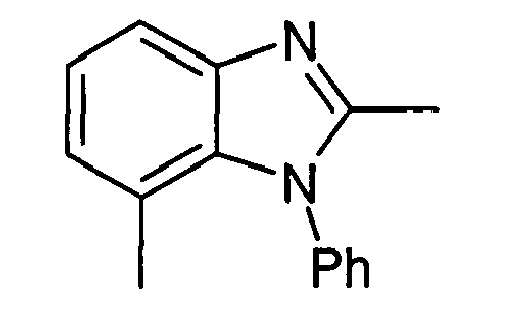
- Method A applied to 2-chloro-3-nitrotoluene (68 mg, 0.5 mmol) and N-phenylacetamide (81 mg, 0.6 mmol) yielded the title compound as a pale yellow solid. mp 107-109°C. 1H NMR (DMSO) δ 1.83 (s, 3 H), 2.34 (s, 3 H), 7.02 (d, J = 7.8 Hz, 1 H), 7.22 (t, J = 7.8 Hz, 1 H), 7.53 (d, J = 7.8 Hz, 1 H), 7.55-7.63 (m, 5 H); 13C NMR δ 13.3, 17.1, 114.8, 121.7, 123.0, 125.5, 128.6, 129.4, 129.9, 136.0, 144.5, 151.2, 157.2. HRMS (FAB): calculated for C15H15N2 [M+H+]: 223.1235; found: 223.1231.
Method C afforded 85 mg of the title compound (77 % yield). -
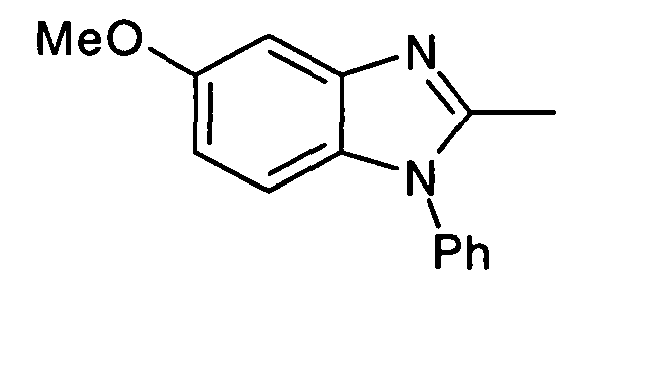
- Method A applied to 4-chloro-3-nitroanisol (84 mg, 0.5 mmol) and N-phenylacetamide (81 mg, 0.6 mmol) yielded the title compound as a pale yellow solid. mp 88-90°C. 1H NMR (DMSO) δ 2.61 (s, 3 H), 3.88 (s, 3 H), 7.07 (d, J = 8.9 Hz, 1 H), 7.25 (d, J = 8.9 Hz, 1 H), 7.38 (br s, 1 H), 7.65-7.73 (m, 5 H); 13C NMR δ 12.5, 55.9, 97.7,112.6,114.7, 126.9, 127.8, 130.2, 130.3, 132.8, 133.1, 151.2, 157.6, 157.8. HRMS (FAB): calculated for C15H15N2O [M+H+]: 239.1184; found: 239.1180.
-

- The title compound was prepared following Method A at larger scale, from 4-chloro-3-nitrobenzoic acid methyl ester (5.39 g, 25 mmol), N-phenylacetamide (3.38 g, 25 mmol), palladium trifluorocetate (416 mg, 1.25 mmol), BINAP (778 mg, 1.25 mmol) and CS2CO3 11.4 g, 35 mmol) and refluxing just for 5 hours, giving rise to the title compound as colorless crystals (5.19 g, 78%). mp 108 °C to 110 °C. 1H NMR (DMSO) δ 2.55 (s, 3 H), 3.78 (s, 3 H), 7.30 (d, J = 8.2 Hz, 1 H), 7.52-7.71 (m, 5 H), 7.92 (d, J = 8.2 Hz, 1 H), 8.30 (br s, 1 H); 13C NMR δ 13.6, 52.1, 110.8, 118.5, 124.7, 124.8, 127.0, 129.7, 130.1, 134.0, 137.9, 153.7, 157.8, 166.2. HRMS (FAB): calculated for C16H15N2O2 [M+H+]: 267.1134; found: 267.1128.
-

- Method A applied to 4-dimethoxymethyl-1-iodo-2-nitrobenzene (155 mg, 0.5 mmol) and N-phenylacetamide (81 mg, 0.6 mmol) yielded the title compound as pale yellow oil (79 mg, 67% yield). 1H NMR (DMSO) δ 2.50 (s, 3 H), 7.31 (d, J = 8.3 Hz, 1 H), 7.61-7.68 (m, 5 H), 7.82 (d, J = 8.3 Hz, 1 H), 8.25 (s, 1 H), 10.10 (s, 1 H); 13C NMR δ 13.6, 111.4, 120.1, 124.2, 127.0, 129.8, 130.2, 132.3, 139.1, 154.7, 158.3, 192.4. HRMS (FAB): calculated for C15H13N2O [M+H+]: 237.1028; found: 237.1024.
-
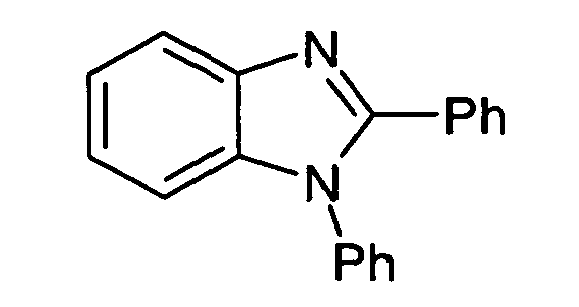
- Method A applied to 1-iodo-2-nitrobenzene (125 mg, 0.5 mmol) and benzanilide (118 mg, 0.6 mmol) yielded the title compound as pale yellow solid (112mg, 83%). mp 105-107°C.1H NMR (DMSO) δ 7.24 (d, J = 7.9 Hz, 1 H), 7.35-7.62 (m, 12 H), 7.84 (d, J = 7.6 Hz, 1 H);13C NMR δ 111.0, 118.1, 123.7, 124.1, 127.5, 127.9, 128.4, 129.2, 129.3, 130.0, 130.2, 135.5, 136.2, 139.3, 151.3. HRMS (FAB): calculated for C19H15N2 [M+H+]: 271.1235; found: 271.1230.
-

- Method A applied to 1-iodo-2-nitrobenzene (125 mg, 0.5 mmol) and nicotinanilide (119 mg, 0.6 mmol) yielded the title compound as brown solid (68 mg, 50%). mp 110-112°C. 1H NMR (DMSO) δ 7.26 (d, J = 7.3 Hz, 1 H), 7.32-7.63 (m, 8 H), 7.86 (d, J = 7.6 Hz, 1 H), 7.89 (d, J = 7.8 Hz, 1 H), 8.62 (d, J = 3.0 Hz, 1 H), 8.72 (br s, 1 H); 13C NMR δ 111.0, 118.7, 123.8, 124.0, 124.4, 125.4, 127.6, 129.5, 130.2, 135.2, 136.4, 137.7, 140.3, 148.6, 149.6, 158.3. HRMS (FAB): calculated for C18H14N3 [M+H+]: 272.1188; found: 272.1180.
-

- Method A applied to 1-iodo-2-nitrobenzene (125 mg, 0.5 mmol) and myristanilide (182 mg, 0.6 mmol) yielded the title compound as colorless oil (130 mg, 69%). 1H NMR (DMSO) δ 0.74 (t, J = 6.9 Hz, 3 H), 1.14-1.28 (m, 20 H), 1.68 (p, J = 7.6 Hz, 2 H), 2.83 (t, J = 7.6 Hz, 2 H), 7.14 (d, J = 8.1 Hz, 1 H), 7.29 (dd, J = 8.1, 7.7 Hz, 1 H), 7.47 (dd, J = 8.1, 7.7 Hz, 1 H), 7.56-7.68 (m, 5 H), 7.74 (d, J = 7.7 Hz, 1 H); 13C NMR δ 13.9, 22.0, 26.3, 26.4, 28.3, 28.4, 28.7, 28.8, 28.9, 29.9, 31.2, 110.7, 116.9, 123.5, 123.7, 127.2, 129.6, 130.1, 134.2, 135.0, 137.6, 154.7. HRMS (FAB): calculated for C26H36N2 [M+H+]: 377.2957; found: 377.2953.
Method C afforded 149 mg of the title compound (79 % yield). -

- Method A applied to 1-iodo-2-nitrobenzene (125 mg, 0.5 mmol) and N-methylacetamide (44 mg, 0.6 mmol) yielded the title compound as pale yellow solid (62 mg, 85%). mp 101 °C to 103°C.1H NMR (DMSO) δ 2.79 (s, 3 H), 3.92 (s, 3 H), 7.46-7.55 (m, 2 H), 7.78 (d, J = 7.4 Hz, 1 H), 7.89 (d, J = 7.1 Hz, 1 H); 13C NMR δ 11.6, 30.8, 112.3, 114.1, 124.9, 125.3, 132.6, 151.9, 158.3. HRMS (FAB): calculated for C9H11N2 [M+H+]: 147.0922; found: 147.0917.
Method C afforded 38 mg of the title compound (52 % yield). -

- Method A applied to 1-iodo-2-nitrobenzene (125 mg, 0.5 mmol) and N-phenylethylacetamide (98 mg, 0.6 mmol) yielded the title compound as pale yellow solid (54 mg, 46%). mp 104 °C to 106°C. 1H NMR (DMSO) δ 2.51 (s, 3 H), 3.10 (d, J = 7.0 Hz, 2 H), 4.63 (d, J = 7.0 Hz, 2 H), 7.09-7.52 (m, 7 H), 7.72 (d, J = 4.6 Hz, 1 H), 7.84 (d, J = 4.6 Hz, 1 H); 13C NMR δ 11.1, 34.1, 45.8, 112.5, 114.2, 125.1, 125.5, 126.9, 128.5, 128.9, 131.6, 137.2, 151.2, 158.0. HRMS (FAB): calculated for C16H17N2 [M+H+]: 237.1392; found: 237.1383.
-

- Method A applied to 1-iodo-2-nitrobenzene (125 mg, 0.5 mmol) and 2-acetamidopyridine (82 mg, 0.6 mmol) yielded the title compound as brown solid (40 mg, 38%). mp 121-123°C. 1H NMR (DMSO) δ 2.69 (s, 3 H), 7.36-7.46 (m, 2 H), 7.53 (d, J= 7.4 Hz, 1 H), 7.68 (dd, J = 7.6, 4.7 Hz, 1 H), 7.77 (d, J = 7.6 Hz, 1 H), 7.81 (d, J = 7.9 Hz, 1 H), 8.21 (dd, J = 7.9, 7.6 Hz, 1 H), 8.75 (d, J = 4.7 Hz); 13C NMR δ 13.6, 112.0, 116.1, 121.0, 124.7, 124.9, 133.0, 135.2, 140.1, 147.2, 150.0, 151.7, 157.9. HRMS (FAB): calculated for C13H12N3 [M+H+]: 210.1031; found: 210.1025.
-

- Method A applied to 1-iodo-2-nitrobenzene (125 mg, 0.5 mmol) and 5-phenylcarbamoyl-pentanoic acid methyl ester (141 mg, 0.6 mmol) yielded the title compound as brown oil (136 mg, 88%). 1H NMR (DMSO) δ 1.50-1.74 (m, 4 H), 2.27 (d, J = 7.2 Hz, 2 H), 2.89 (d, J = 7.5 Hz, 2 H), 3.52 (s, 3 H), 7.22 (d , J = 8.1 Hz, 1 H), 7.38 (apparent t, J = 7.6 Hz, 1 H), 7.46 (apparent t, J = 7.6 Hz, 1 H), 7.52-7.72 (m, 5 H), 7.79 (d, J = 7.8 Hz, 1 H); 13C NMR δ 23.3, 25.3, 25.4, 32.2, 50.9, 111.3, 115.6, 124.3, 124.4, 126.8, 130.0, 132.4, 133.2, 133.4, 153.9, 172.3. HRMS (FAB): calculated for C19H21N2O2 [M+H+]: 309.1603; found: 309.1595.
-

- Method A applied to 1-iodo-2-nitrobenzene (125 mg, 0.5 mmol) and 7-chloro-heptanoic acid phenylamide (144 mg, 0.6 mmol) yielded the title compound as pale yellow oil (95 mg, 64 %). 1H NMR (DMSO) δ 1.34-1.77 (m, 6 H), 2.92 (t, J = 7.6 Hz, 2 H), 3.53 (t, J = 6.7 Hz, 2 H), 7.26 (d, J = 7.8 Hz, 1 H), 7.43 (t, J = 7.8 Hz, 1 H), 7.52 (d, J = 8.9 Hz, 1 H), 7.64-7.72 (m, 5 H), 7.85 (d, J = 7.8 Hz, 1 H); 13C NMR δ 25.3, 25.5, 25.7, 31.3, 44.9, 111.5, 115.7, 124.8, 124.9, 127.2, 130.2, 130.3, 133.2, 134.1, 154.5. HRMS (FAB): calculated for C18H20N2Cl [M+H+]: 299.1315; found: 299.1306.
-

- Method A applied to 1-iodo-2-nitrobenzene (125 mg, 0.5 mmol) and p-acetanisidide (99 mg, 0.6 mmol) yielded the title compound as colorless solid (107 mg, 90 %). mp 121 °C to 123 °C. 1H NMR (DMSO) δ 2.61 (s, 3 H), 3.87 (s, 3 H), 7.23 (d, J = 9.1 Hz, 2 H), 7.28 (d, J = 8.7 Hz, 1 H), 7.52 (dd, J = 8.1, 7.4 Hz, 1 H), 7.48 (dd, J = 7.8, 7.4 Hz, 1 H), 7.59 (d, J = 9.1 Hz, 2 H), 7.83 (d, J = 7.8 Hz, 1 H); 13C NMR δ 12.6, 55.6, 111.7, 115.1, 115.3, 125.1, 125.3, 128.4, 132.5, 134.1, 152.3, 158.2, 160.2. HRMS (FAB): calculated for C15H15N2O [M+H+]: 239.1184; found: 239.1179.
-

- Method A applied to 1-iodo-2-nitrobenzene (125 mg, 0.5 mmol) and p-acetamidobenzonitrilo (96 mg, 0.6 mmol) yielded the title compound as brown solid (96 mg, 82 %). mp 166 °C to 168 °C. 1H NMR (DMSO) δ 2.62 (s, 3 H), 7.33 (d, J = 7.8 Hz, 1 H), 7.42 (t, J = 7.8 Hz, 1 H), 7.47 (t, J = 7.8 Hz, 1 H), 7.89 (d, J = 8.9 Hz, 2 H), 8.20 (d, J = 8.9 Hz, 2 H); 13C NMR δ 13.0, 111.2, 112.6, 116.0, 117.9, 124.7, 124.8, 128.2, 133.7, 134.4, 135.0, 137.5, 151.8. HRMS (FAB): calculated for C15H12N3 [M+H+]: 234.1031; found: 234.1025.
-

- Method A applied to 1-iodo-2-nitrobenzene (125 mg, 0.5 mmol) and methyl 4-acetamido-2-ethoxybenzoate (142 mg, 0.6 mmol) yielded the title compound as pale brown oil (118 mg, 76 %). 1H NMR (DMSO) δ 1.34 (d, J = 6.9 Hz, 3 H), 2.69 (s, 3 H), 3.87 (s, 3 H), 4.13 (q, J = 6.9 Hz, 2 H), 7.32 (dd, J = 8.1, 2.0 Hz, 1 H), 7.43-7.57 (m, 4 H), 7.86 (d, J = 7.8 Hz, 1 H), 7.92 (d, J = 8.1 Hz, 1 H); 13C NMR δ 12.7, 14.3, 52.2, 64.7, 112.0, 112.6, 115.1, 118.5, 122.1, 125.4, 132.0, 132.5, 133.4, 136.7, 152.1, 158.3, 165.5. HRMS (FAB): calculated for C18H19N2O3 [M+H+]: 311.1396; found: 311.1387.
-

- Method A applied to 3-chloro-2-nitrotoluene (86 mg, 0.5 mmol) and N-phenylacetamide (81 mg, 0.6 mmol) yielded the title compound as brown solid (37 mg, 33 %). 1H NMR (DMSO) δ 2.46 (s, 3 H), 2.55 (s, 3 H), 6.88 (d, J = 7.3 Hz, 1 H), 7.04-7.11 (m, 2 H), 7.50-7.64 (m, 5 H); 13C NMR δ 13.8, 16.3, 107.5, 122.5, 122.6, 126.8, 129.9, 135.1, 135.3, 150.3, 158.3.
-

- Method A applied to 4-chloro-3-nitrobenzonitrilo (91 mg, 0.5 mmol) and N-phenylacetamide (81 mg, 0.6 mmol) yielded the title compound as brown solid (40 mg, 34 %). 1H NMR (DMSO) δ 2.54 (s, 3 H), 7.28 (d, J = 8.3 Hz, 1 H), 7.52-7.59 (m, 6 H), 8.12 (s, 1 H); 13C NMR δ 13.8,104.6, 111.4, 119.3, 122.7, 126.2, 127.0, 129.6, 130.1, 134.2, 138.5, 140.4, 154.6.
-

- Method A applied to 1-iodo-2-nitrobenzene (125 mg, 0.5 mmol) and 2-acetamidopyridine (82 mg, 0.6 mmol) yielded the title compound as yelloy oil (40 mg, 38 %).1H NMR (DMSO) δ 2.74 (s, 3 H), 7.42-7.49 (m, 2 H), 7.56 (d, 1 H), 7.70 (dd, 1 H), 7.78-7.88 (m, 2 H), 8.22 (dd, 1 H), 8.77 (dd, 1 H); 13C NMR δ 13.6, 112.0, 116.1, 121.0, 124.7, 124.9, 133.0, 135.2, 140.1, 147.2, 150.0, 151.7.
-

- Method A applied to 1-iodo-2-nitrobenzene (125 mg, 0.5 mmol) and 5-octanoylaminopentanoic acid tert-butyl ester (180 mg, 0.6 mmol) yielded the title compound as yelloy oil (40 mg, 38 %). 1H NMR (DMSO) δ 0.86 (t, J = 6.8 Hz, 3 H), 1.22-1.86 (m, 23 H), 2.27 (t, J = 7.3, 2 H), 3.14 (t, J = 7.8 Hz, 2 H), 4.43 (t, J = 7.2 Hz), 7.49-7.54 (m, 2 H), 7.77 (d, J = 8.8 Hz, 1 H), 7.93 (d, J = 8.8 Hz).
-

- Method A applied to 1-iodo-2-nitrobenzene (125 mg, 0.5 mmol) and 6-acetylaminohexanoic acid methyl ester (112 mg, 0.6 mmol) yielded the title compound as yellow oil (20 mg, 15 %). 1H NMR (DMSO) δ 1.32-1.83 (m, 6 H), 2.29 (t, J = 7.1 Hz, 2 H), 2.80 (s, 3 H), 3.55 (s, 3 H), 4.38 (t, J = 7.3, 2 H), 7.48-7.56 (m, 2 H), 7.76 (d, J = 8.1 Hz, 1 H), 7.91 (d, J = 8.1 Hz).
-

- Method A applied to 1-iodo-2-nitrobenzene (125 mg, 0.5 mmol) and 2-cyclopentyl-N-(2-me-thyl-butyl)-acetamide (118 mg, 0.6 mmol) yielded the title compound as yellow oil (66 mg, 40 %). 1H NMR (DMSO) δ 0.82 (d, 3 H), 0.88 (t, 3 H), 1.19-2.52 (m, 14 H), 3.06 (d, 2 H), 3.87 (s, 3 H), 4.13 (dd, 1 H), 4.24 (dd, 1 H), 7.83 (d, 1 H), 7.94 (d, 1 H), 8.20 (s, 1 H).
-

- Method A applied to 4-chloro-3-nitropyridine (79 mg, 0.5 mmol), N-phenylacetamide (81 mg, 0.6 mmol) afforded the title compound as brown solid (76 mg, 73). mp 134-136°C. 1H NMR (DMSO) δ 2.54 (s, 3 H), 7.65-7.73 (m, 6 H), 8.54 (d, J = 5.2 Hz, 1 H), 9.44 (s, 1 H); 13C NMR δ 14.4, 108.2, 126.9, 130.2, 130.3, 133.4, 134.0, 134.8, 139.2, 145.0, 159.2. HRMS (FAB): calculated for C13H12N3 [M+H+]: 210.1031; found: 210.1025.
-

- Method A applied to 3-chloro-2-nitropyridine (79 mg) and N-phenylacetamide (81 mg, 0.6 mmol) afforded the title compound as brown viscous oil (45 mg, 43% yield). 1H NMR (DMSO) δ 2.54 (s, 3 H), 7.35-7.68 (m, 6 H), 7.77 (d, J = 8.8 Hz, 1 H), 8.58 (br s, 1 H); 13C NMR δ 14.0, 118.9, 120.1, 126.8, 128.5, 129.6, 130.1, 133.9, 143.0, 151.6, 156.7. HRMS (FAB): calculated for C13H12N3 [M+H+]: 210.1031; found: 210.1026.
-

- Method A applied to 2-chloro-3-nitropyridine (79 mg, 0.5 mmol) and N-phenylacetamide (81 mg, 0.6 mmol) afforded the title compound as pale yellow viscous oil (93 mg, 89%). 1H NMR (DMSO) δ 2.48 (s, 3 H), 7.24 (dd, 1 H), 7.53-7.63 (m, 5 H), 8.02 (d, 1 H), 8.20 (d, 1H); 13C NMR δ 14.6, 118.3, 125.9, 127.4, 128.7, 129.3, 134.1, 134.3, 143.0, 148.7, 152.9. HRMS (FAB): calculated for C13H12N3 [M+H+]: 210.1031; found: 210.1027.
-

- Method A applied to 2-chloro-5-methyl-3-nitropyridine (86 mg, 0.5 mmol) and N-phenylacetamide (81 mg, 0.6 mmol) afforded the title compound as brown solid (90 mg, 81%). mp 77-79°C. 1H NMR (DMSO) δ 2.44 (s, 3 H), 2.54 (s, 3 H), 7.56-7.63 (m, 5 H), 7.95 (s, 1 H), 8.20 (s, 1 H); 13C NMR δ 13.1, 17.9, 124.4, 127.5, 129.5, 129.6, 129.8, 132.9, 145.1, 145.7, 153.2. HRMS (FAB): calculated for C14H14N3 [M+H+]: 224.1187; found: 224.1184.
-

- Method A applied to 2-chloro-6-methoxy-3-nitropyridine (94mg, 0.5 mmol) and N-phenylacetamide (81 mg, 0.6 mmol) afforded the title compound as pale yellow solid (112 mg, 94%). mp 114-116°C. 1H NMR (DMSO) δ 2.56 (s, 3 H), 3.76 (s, 3 H), 6.85 (d, J = 8.6 Hz, 1 H), 7.53-7.68 (m, 5 H), 8.12 (d, J = 8.6 Hz, 1 H). 13C NMR δ 13.8, 53.4, 107.7, 122.9, 127.0, 128.0, 128.4, 129.2, 132.6, 144.1, 150.3, 161.1. HRMS (FAB): calculated for C14H14N3O [M+H+]: 240.1237; found: 240.1234.
-

- Method A applied to 2-chloro-6-methyl-3-nitropyridine (86 mg, 0.5 mmol) and N-phenylacetamide (81 mg, 0.6 mmol) afforded the title compound as brown viscous oil (70 mg, 63%). 1H NMR (DMSO) δ 2.42 (s, 3 H), 3.31 (s, 3 H), 7.11 (d, J = 8.0 Hz, 1 H), 7.51-7.63 (m, 5 H), 7.89 (d, J = 8.0 Hz, 1 H); 13C NMR δ 14.6, 23.8, 118.0, 126.1, 127.7, 128.7, 129.4, 132.1, 134.8, 148.3, 150.9, 151.1. HRMS: calculated for C14H14N3 [M+H+]: 224.1188; found: 224.1184.
-

- Method A applied to 2-chloro-4-methyl-3-nitropyridine (86 mg, 0.5 mmol) and N-phenylacetamide (81 mg, 0.6 mmol) afforded the title compound as pale yellow solid (70 mg, 63%). mp 117-119°C. 1H NMR (DMSO) δ 2.59 (s, 3 H), 2.73 (s, 3 H), 7.26 (d, J = 4.8 Hz, 1 H), 7.58-7.72 (m, 5 H), 8.22 (d, J = 4.8 Hz, 1 H); 13C NMR δ 13.8, 16.0, 120.8, 127.3, 129.3, 129.4, 129.5, 130.1, 136.0, 144.2, 146.4, 152.1. HRMS (FAB): calculated for C14H14N3 [M+H+]: 224.1188; found: 224.1180.
-

- Method B applied to 2-chloro-6-methoxy-3-nitro-pyridine (94 mg, 0.5 mmol) and N-pyridin-3-ylacetamide (82 mg, 0.6 mmol) afforded the title compound as viscous oil (74 mg, 49%). 1H NMR (DMSO) δ 3.79 (s, 3 H), 6.83 (d, J = 8.1 Hz, 1 H), 7.44-7.83 (m, 7 H), 8.14 (d, J = 8.1 Hz, 1 H), 8.57 (d, J = 8.1 Hz, 1 H), 8.68 (s, 1 H).
-

- Method B applied to 2-chloro-6-methyl-3-nitropyridine (86 mg, 0.5 mmol) and 5-phenylcarbamoyl-pentanoic acid methyl ester (141 mg, 0.6 mmol) afforded the title compound as viscous oil (61 mg, 38%). 1H NMR (DMSO) δ 1.52-1.73 (m, 4 H), 2.22 (t, J = 6.8 Hz, 2 H), 2.48 (s, 3 H), 2.75 (t, J = 6.8 Hz, 2 H), 3.53 (s, 3 H), 7.13 (d, J = 8.0 Hz), 7.47-7.63 (m, 5 H), 7.93 (d, J = 8.0 Hz).
-

- Method B applied to 2-chloro-5-methyl-3-nitropyridine (86 mg, 0.5 mmol) and N-phenethyl-acetamide (98 mg, 0.6 mmol) afforded the title compound as viscous oil (54 mg, 43%). 1H NMR (DMSO) δ 2.38 (s, 3 H), 2.46 (s, 3 H), 3.12 (t, 2 H), 4.53 (t, 2 H), 7.08-7.29 (m, 5 H), 7.93 (s, 1 H), 8.32 (s, 1 H).
-

- Method B applied to 4-chloro-3-nitropyridine (79 mg, 0.5 mmol) and tetradecanoic acid phenylamide (182 mg, 0.6 mmol) afforded the title compound as viscous oil (64 mg, 34%). 1H NMR (DMSO) δ 0.83 (t, J = 6.7 Hz, 3 H), 1.16-1.32 (m, 20 H), 1.73 (p, J = 6.7 Hz, 2 H), 2.83 (t, J = 6.7 Hz, 2 H). 7.63-7.71 (m, 6 H), 8.56 (d, J = 5.2 Hz, 1 H), 9.43 (s, 1 H).
-
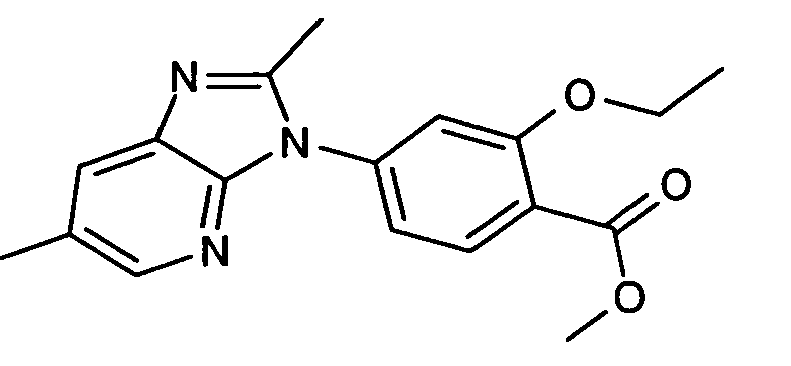
- Method B applied to 2-chloro-5-methyl-3-nitropyridine (86 mg, 0.5 mmol) and 4-acetylamino-2-ethoxybenzoic acid methyl ester (142 mg, 0.6 mmol) afforded the title compound as viscous oil (136 mg, 84%). 1H NMR (DMSO) δ 1.34 (t, J = 6.9 Hz, 3 H), 2.46 (s, 3 H), 2.61 (s, 3 H), 3.82 (s, 3 H), 4.12 (q, J = 6.9 Hz, 2 H), 7.22 (d, J = 8.0 Hz, 1 H), 7.50 (s, 1 H), 7.83 (d, J = 8.0 Hz, 1 H), 7.98 (s, 1 H), 8.21 (s, 1 H).
-

- Method B applied to 2-chloro-6-methoxy-3-nitropyridine (94 mg, 0.5 mmol) and N-pyridin-2-ylacetamide (82 mg, 0.6 mmol) afforded the title compound as viscous oil (32 mg, 27%). 1H NMR (DMSO) δ 2.66 (s, 3 H), 3.82 (s, 3 H), 6.81 (d, J = 8.5 Hz, 1 H), 7.58 (dd, J = 7.6, 4.7 Hz, 1 H), 7.95 (d, J = 7.9 Hz, 1 H), 8.04 (d, J = 8.5 Hz, 1 H), 8.14 (dd, J = 7.9, 7.6 Hz, 1 H), 8.69 (d, J = 4.7 Hz, 1 H).
-

- Method B applied to 2-chloro-6-methoxy-3-nitropyridine (94 mg, 0.5 mmol) and 6-chlorohexanoic acid phenylamide (113 mg, 0.6 mmol) afforded the title compound as viscous oil (94 mg, 57%). 1H NMR (DMSO) δ 1.34-1.41 (m, 2 H), 1.62-1.71 (m, 6 H), 2.78 (t, J = 6.8 Hz, 2 H), 3.73 (s, 3 H), 6.73 (d, J = 8.6 Hz, 1 H), 7.53-7.63 (m, 5 H), 7.98 (d, J = 8.6 Hz, 1 H).
-

- Method B applied to 4-chloro-3-nitropyridine (79 mg, 0.5 mmol) and N-(4-methoxyphenyl)acetamide (99 mg, 0.6 mmol) afforded the title compound as viscous oil (84 mg, 70%). 1H NMR (DMSO) δ 2.55 (s, 3 H), 3.88 (s, 3 H), 7.21 (d, J = 8.8 Hz, 2 H), 7.57 (d, J = 8.8 Hz, 2 H), 7.69 (d, J = 5.4 Hz, 1 H), 8.57 (d, J = 5.4 Hz, 1 H), 9.44 (s, 1 H).

X is Cl, Br, I, triflate or nonaflate, with a compound of formula III
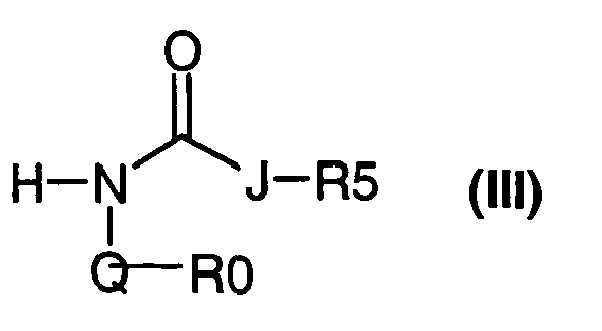
in the presence of a palladium catalyst, a base, a ligand and an aprotic solvent to give a compound of formula IV

optionally the compound of formula I is converted to its physiologically tolerated salt.
Claims (26)
- A process for preparing a compound of formula I

A1, A2, A3, A4 are independently from each other selected from carbon or nitrogen atoms to form a stable aromatic or heteroaromatic ring;
Q is -(C1-C6)-alkylene, wherein alkylene is unsubstituted or mono-, di- or trisubstituted independently of one another by R14; or
-(C3-C8)-cycloalkylene, wherein cycloalkylene is unsubstituted or mono-, di- or trisubstituted independently of one another by R14; or
-(C6-C14)-aryl, wherein aryl is unsubstituted or mono-, di-, tri- or four times substituted independently of one another by R13; or
-(C4-C14)-heteroaryl, wherein heteroaryl is unsubstituted or mono-, di-, tri- or four times substituted independently of one another by R13;
J is -(C1-C6)-alkylene, wherein alkylene is unsubstituted or mono-, di- or trisubstituted independently of one another by R14; or
-(C3-C8)-cycloalkylene, wherein cycloalkylene is unsubstituted or mono-, di- or trisubstituted independently of one another by R14; or
-(C6-C14)-aryl, wherein aryl is unsubstituted or mono-, di-, tri- or four times substituted independently of one another by R13; or
-(C4-C14)-heteroaryl, wherein heteroaryl is unsubstituted or mono-, di-, tri- or four times substituted independently of one another by R13;
R0, R1, R2, R3, R4 and R5 are independent of one another identical or different and area) hydrogen atom,b) -(C1-C4)-alkyl, wherein alkyl is unsubstituted or substituted one to three times by R13,c) halogen,d) phenyloxy-, wherein phenyloxy is unsubstituted or substituted one to three times by R13,e) -(C1-C3)-perfluoroalkyl,f) -N(R10)-(C1-C4)-alkyl, wherein alkyl is unsubstituted or substituted one to three times by R13,g) -(C6-C14)-aryl, wherein aryl is unsubstituted or mono-, di-, tri- or four times substituted independently of one another by R13,h) -(C4-C14)-heteroaryl, wherein heteroaryl is unsubstituted or mono-, di-, tri- or four times substituted independently of one another by R13,i) -(C3-C8)-cycloalkylene, wherein said cycloalkylene is unsubstituted or mono-, di-, tri- or four times substituted independently of one another by R13, orj) a 3- to 7-membered cyclic residue, containing up to 1, 2, 3 or 4 heteroatoms chosen from nitrogen, sulphur or oxygen, wherein said cyclic residue is unsubstituted or mono-, di-, tri- or four times substituted independently of one another by R13,k) -O-CF3,l) -O-(C1-C4)-alkyl, wherein alkyl is unsubstituted or substituted one to three times by R13,m) -NO2,n) -CN,o) -OH,p) -C(O)-R10,q) -C(O)-O-R11,r) -C(O)-N-R11R12,s) -N(R11)(R12),t) -N(R10)-SO2-R10,v) -S-R10,w) -SOn-R10, wherein n is 1 or 2,x) -SO2-N(R11)(R12) ory) at least one of R1, R2, R3 or R4 are absent in case one or more of A1, A2, A3 or A4 are nitrogen atom,alternatively, if two R1, R2, R3, R4 or R5 are attached to adjacent atoms they can form together with the atoms which they are attached to a 5- or 8- membered ring, containing up to 0, 1, 2, 3 or 4 heteroatoms chosen from nitrogen, sulphur or oxygen, wherein said ring is unsubstituted or substituted one, two, three or four times by R14,
R10 is hydrogen atom, -(C1-C3)-perfluoroalkyl or -(C1-C6)-alkyl,
R11 and R12 are independently of one another identical or different and area) hydrogen atom,b) -(C1-C6)-alkyl, wherein alkyl is unsubstituted or mono-, di- or trisubstituted independently of one another by R13,c) -(C6-C14)-aryl-, wherein aryl is unsubstituted or mono-, di- or trisubstituted independently of one another by R13,d) -(C4-C14)-heteroaryl, wherein heteroaryl is unsubstituted or mono-, di- or trisubstituted independently of one another by R13 orR13 is halogen, -NO2, -CN, =O, -OH, -(C1-C8)-alkyl, -(C1-C8)-alkoxy, -CF3, phenyl, phenyloxy-, -C(O)-O-R17, -C(O)-N-(R17)(R18), -N(R17)(R18), -N(R10)-SO2-R10, -S-R10, -SOn-R10, wherein n is 1 or 2, -SO2-N(R17)(R18), -C(O)-R10, -(C6-C14)-aryl, wherein aryl is unsubstituted or mono-, di- or trisubstituted independently of one another by R14, -(C4-C14)-heteroaryl, wherein heteroaryl is unsubstituted or mono-, di- or trisubstituted independently of one another by R14, -(C3-C8)-cycloalkylene, wherein said cycloalkylene is unsubstituted or mono-, di- or trisubstituted independently of one another by R14, or a 3- to 7-membered cyclic residue, containing up to 1, 2, 3 or 4 heteroatoms chosen from nitrogen, sulphur or oxygen, wherein said cyclic residue is unsubstituted or mono-, di- or trisubstituted independently of one another by R14,
R14 is halogen, -OH, =O, -CN, -CF3, -(C1-C8)-alkyl, -(C1-C4)-alkoxy, -NO2, -C(O)-OH, -CN, -NH2, -C(O)-O-(C1-C4)-alkyl, -(C1-C8)-alkylsulfonyl, -C(O)-NH-(C1-C8)-alkyl, -C(O)-N-[(C1-C8)-alkyl] 2, -C(O)-NH2, -SR10, -N(R10)-C(O)-NH-(C1-C8)-alkyl, or -N(R10)-C(O)-N H-[(C1-C8)-alkyl]2,
R17 and R18 are independently of one another identical or different and area) hydrogen atom,b) -(C1-C6)-alkyl,c) -(C6-C14)-aryl- ord) -(C4-C14)-heteroaryl,said process comprises a reaction of a compound of formula II
X is Cl, Br, I, triflate or nonaflate, with a compound of formula III
in the presence of a palladium catalyst, a base, a ligand and an aprotic solvent to give a compound of formula IV
optionally the compound of formula I is converted to its physiologically tolerated salt. - The process according to claim 1, wherein a compound of formula I is prepared, wherein
A1, A2, A3, A4 are independently from each other selected from carbon or nitrogen atoms to form a stable aromatic or heteroaromatic ring;
Q is -(C1-C6)-alkylene, wherein alkylene is unsubstituted or mono-, di- or trisubstituted independently of one another by R14; or
-(C3-C6)-cycloalkylene, wherein cycloalkylene is unsubstituted or mono-, di- or trisubstituted independently of one another by R14; or
phenyl, wherein phenyl is unsubstituted or mono-, di-, tri- or four times substituted independently of one another by R13; or
-(C4-C14)-heteroaryl, wherein heteroaryl is unsubstituted or mono-, di-, tri- or four times substituted independently of one another by R13;
J is -(C1-C6)-alkylene, wherein alkylene is unsubstituted or mono-, di- or trisubstituted independently of one another by R14; or
-(C3-C6)-cycloalkylene, wherein cycloalkylene is unsubstituted or mono-, di- or trisubstituted independently of one another by R14; or
phenyl, wherein phenyl is unsubstituted or mono-, di-, tri- or four times substituted independently of one another by R13; or
-(C4-C14)-heteroaryl, wherein heteroaryl is unsubstituted or mono-, di-, tri- or four times substituted independently of one another by R13;
R0, R1, R2, R3, R4 and R5 are independent of one another identical or different and area) hydrogen atom,b) F,c) Cl,d) -(C1-C4)-alkyl, wherein alkyl is unsubstituted or substituted one to three times by R13,e) -(C1-C3)-perfluoroalkyl,f) phenyl, wherein phenyl is unsubstituted or substituted one to three times by R13,g) -(C4-C14)-heteroaryl, wherein heteroaryl is unsubstituted or mono-, di-, tri- or four times substituted independently of one another by R13,h) -(C3-C8)-cycloalkylene, wherein said cycloalkylene is unsubstituted or mono-, di-, tri- or four times substituted independently of one another by R13, ori) a 3- to 7-membered cyclic residue, containing up to 1, 2, 3 or 4 heteroatoms chosen from nitrogen, sulphur or oxygen, wherein said cyclic residue is unsubstituted or mono-, di-, tri- or four times substituted independently of one another by R13,j) -O-CF3,k) -O-(C1-C4)-alkyl, wherein alkyl is unsubstituted or substituted one to three times by R13,l) -N(R10)-(C1-C4)-alkyl, wherein alkyl is unsubstituted or substituted one to three times by R13,m) -CN,n) -OH,o) phenyloxy-, wherein phenyloxy is unsubstituted or substituted one to three times by R13,p) -C(O)-O-R11,q) -C(O)-N-(R11)(R12),r) -N(R11)(R12),s) -N(R10)-SO2-R10,t) -S-R10,v) -SOn-R10, wherein n is 1 or 2,w) -SO2-N(R11)(R12),x) -C(O)-R10 ory) at least one of R1, R2, R3 or R4 are absent in case one or more of A1, A2, A3 or A4 are nitrogen atom,R10 is hydrogen atom, -(C1-C3)-perfluoroalkyl or -(C1-C6)-alkyl,
R11 and R12 are independently of one another identical or different and area) hydrogen atom,b) -(C1-C4)-alkyl, wherein alkyl is unsubstituted or mono-, di- or trisubstituted independently of one another by R13,c) phenyl, wherein phenyl is unsubstituted or mono-, di- or trisubstituted independently of one another by R13,d) -(C4-C14)-heteroaryl, wherein heteroaryl is unsubstituted or mono-, di- or trisubstituted independently of one another by R13 orR13 is F, Cl, -CN, =O, -OH, -(C1-C8)-alkyl, -(C1-C8)-alkoxy, -CF3, phenyl, phenyloxy-, -C(O)-O-R17, -C(O)-N-(R17)(R18), -N(R17)(R18), -SOn-R10, -N(R10)-SO2-R10, -S-R10, wherein n is 1 or 2, -SO2-N(R17)(R18), -C(O)-R10, phenyl, wherein phenyl is unsubstituted or mono-, di- or trisubstituted independently of one another by R14, -(C4-C14)-heteroaryl, wherein heteroaryl is unsubstituted or mono-, di- or trisubstituted independently of one another by R14, -(C3-C6)-cycloalkylene, wherein said cycloalkylene is unsubstituted or mono-, di- or trisubstituted independently of one another by R14, or a 3- to 7-membered cyclic residue, containing up to 1, 2, 3 or 4 heteroatoms chosen from nitrogen, sulphur or oxygen, wherein said cyclic residue is unsubstituted or mono-, di- or trisubstituted independently of one another by R14,
R14 is F, Cl, -OH, =O, -CN, -CF3, -(C1-C8)-alkyl, -(C1-C4)-alkoxy, -C(O)-OH, -CN, -NH2, -C(O)-O-(C1-C4)-alkyl, -(C1-C8)-alkylsulfonyl, -C(O)-NH-(C1-C8)-alkyl, -C(O)-N-[(C1-C8)-alkyl] 2, -C(O)-NH2, -SR10, -N(R10)-C(O)-NH-(C1-C8)-alkyl or -N(R10)-C(O)-NH-[(C1-C8)-alkyl] 2,
R17 and R18 are independently of one another identical or different and area) hydrogen atom,b) -(C1-C4)-alkyl,c) phenyl ord) -(C4-C14)-heteroaryl andX is Cl, Br or I. - The process according to claim 1 wherein one of the following compounds of formula I are prepared:5-Chloro-2-methyl-1-phenyl-1H-benzimidazole;2-Methyl-1-phenyl-1H-benzimidazole;7 -Chloro-2-methyl-1-phenyl-1H-benzimidazole;2,7-Dimethyl-1-phenyl-1H-benzimidazole;5-Methoxy-2-methyl-1-phenyl-1H-benzimidazole;2-Methyl-1-phenyl-1H-benzimidazole-5-carbaldehyde;1,2-Diphenyl-1H-benzimidazole;1-Phenyl-2-pyridin-3-yl-1H-benzimidazole;1-Phenyl-2-tridecyl-1H-benzimidazole;1,2-dimethyl-1H-benzimidazole;2-Methyl-1-phenethyl-1H-benzimidazole;2-Methyl-1-pyridin-2-yl-1H-benzimidazole;5-(1-Phenyl-1H-benzoimidazol-2-yl)-pentanoic acid methyl ester;2-(5-Chloro-pentyl)-1-phenyl-1H-benzimidazole;1-(4-Methoxy-phenyl)-2-methyl-1H-benzimidazole;4-(2-Methyl-benzoimidazol-1-yl)-benzonitrile;2-Ethoxy-4-(2-methyl-benzoimidazol-1-yl)-benzoic acid methyl ester:2,4-Dimethyl-1-phenyl-1H-benzimidazole:5-cyano-2-methyl-1-phenyl-1H-benzimidazole:2-Methyl-1-pyridin-2-yl-1H-benzimidazole;5-(2-Heptyl-benzoimidazol-1-yl)-pentanoic acid tert-butyl ester;6-(2-Methyl-benzoimidazol-1-yl)-hexanoic acid methyl ester;2-Cyclopentylmethyl-1-(2-methyl-butyl)-1H-benzimidazole-5-carboxylic acid methyl ester;2-Methyl-1-phenyl-1H-imidazo[4,5-c]pyridine;2-Methyl-1-phenyl-1H-imidazo[4,5-b]pyridine;2-Methyl-3-phenyl-3H-imidazo[4,5-b]pyridine;2,6-Dimethyl-3-phenyl-3H-imidazo[4,5-b]pyridine;5-Methoxy-2-methyl-3-phenyl-3H-imidazo[4,5-b]pyridine;2,5-Dimethyl-3-phenyl-3H-imidazo[4,5-b]pyridine;2,7-Dimethyl-3-phenyl-3H-imidazo[4,5-b]pyridine;5-Methoxy-3-phenyl-2-pyridin-3-yl-3H-imidazo[4,5-b]pyridine;5-(5-Methyl-3-phenyl-3H-imidazo[4,5-b]pyridin-2-yl)-pentanoic acid methyl ester;2,6-Dimethyl-3-phenethyl-3H-imidazo[4,5-b]pyridine;1-Phenyl-2-tridecyl-1H-imidazo[4,5-c]pyridine;4-(2,6-Dimethylimidazo[4,5-b]pyridin-3-yl)-2-ethoxybenzoic acid methyl ester;5-Methoxy-2-methyl-3-pyridin-2-yl-3H-imidazo[4,5-b]pyridine;2-(5-Chloro-pentyl)-5-methoxy-3-phenyl-3H-imidazo[4,5-b]pyridine or1-(4-Methoxyphenyl)-2-methyl-1H-imidazo[4,5-c]pyridine.
- The process according to claim 1, wherein the palladium catalyst is selected from: Pd-alkanoates, Pd-alkanoate complexes, Pd-acetonates, Pd-halides, Pd-halide complexes and Pd-phosphine complexes.
- The process according to claim 4, wherein the palladium catalyst is selected from: palladium (II) acetate, palladium (II) trifluoroacetate, tris(dibenzylideneacetone)dipalladium(0), tris(dibenzylideneacetone)dipalladium(0) chloroform adduct, palladium (II) chloride, 2,2'-bis(diphenylphosphino)-1,1'-binaphthylpalladium(II) chloride, acetato(2'-di-tert-butylphosphino-1, 1'-biphenyl-2-yl)palladium(II), (1,2-Bis(diphenylphosphino)ethane)dichloropalladium(II), Bis[1,2-bis(diphenylphosphino)ethane]palladium (0), [(2S,3S)-Bis(diphenylphosphino)butane] [eta3-allyl]palladium(II) perchlorate, and 1,3-bis(2,4,6-trimethylphenyl)imidazol-2-ylidene(1,4-naphthoqui none)palladium (0) dimer.
- The process according to claim 4, wherein the palladium catalyst is palladium (II) acetate, 2,2'-bis(diphenylphosphino)-1,1'-binaphthylpalladium(II) chloride, or palladium (II) trifluoroacetate.
- The process according to claim 6, wherein the palladium catalyst is palladium (II) trifluoroacetate.
- The process according to claim 1, wherein the base is selected out of the group of carbonates, phosphates, fluorides, alkoxides and hydroxides with a suitable metal as counterion.
- The process according to claim 8, wherein the base is selected out of the group: potassium carbonate, potassium phosphate and caesium carbonate.
- The process according to claim 9, wherein the base is caesium carbonate.
- The process according to claim 1, wherein the ligand is selected out of the group:(+/-)-2,2'-bis(diphenylphosphino)-1,1'-binaphthalene, 4,5-Bis(diphenylphosphino)-9,9-dimethylxanthene, (R)-(-)-1-[(S)-2-(diphenylphosphino) ferrocenyl] ethyldicyclohexylphosphine, 1,2-Bis(diphenylphosphino)ethane , 1,3-Bis(diphenylphosphino)propane, (R)-(-)-1-[(S)-2-(Dicyclohexylphosphino)ferrocenyl]ethyldi-tert-butylphosphine, (R)-(+)-1,1'-Bis(diphenylphosphino)-2,2'-bis(N,N-diiisopropylamido)ferrocene, (S,S)-1-[1-(Di-tert-butylphosphino)ethyl]-2-(diphenylphosphino)ferrocene, (1R,2R)-(+)-1,2-Diaminocyclohexane-N,N-bis(2-diphenylphosphino-1-naphtoy), (-)-1,2-Bis((2S,5S)-2,5-diiso-propylphospholano)benzene, Bis[(2-diphenylphosphino)phenyl]ether, (S)-(-)-2,2'-Bis(di-para-tolylphosphino)-1,1'-binaphyl, 4,5-Bis(bis(3,5-bis(trifluoromethyl)phenyl)phosphino)-9,9-dimethylxanthen, 2,2'-bis[(2',4',6'-triisopropyl)dicyclohexylphosphino]biphenyl, and 2,2'-bis(di-tert-butylphosphino)biphenyl, tri-tert-butylphosphine.
- The process according to claim 11, wherein the ligand is selected out of the group: 2,2'-bis(diphenylphosphino)-1,1'-binaphthalene or 4,5-Bis(diphenylphosphino)-9,9-dimethylxanthene.
- The process according to claim 12, wherein the ligand is 2,2'-bis(diphenylphosphino)-1,1'-binaphthalene.
- The process according to claim 1, wherein the aprotic solvent is selected out of the group: benzene, toluene, xylene, mesitylene, acetonitrile, tetrahydrofurane, dimethylformamide, n-methylpyrrolodinone, dimethylacetamide, dimethylsulfoxide, (2-methoxyethyl)ether and pyridine.
- The process according to claim 14, wherein the aprotic solvent is selected out of the group: benzene, mesitylene and toluene.
- The process according to claim 15, wherein the aprotic solvent is toluene.
- The process according to claim 1, wherein the reaction between the compound of formula II and formula III is carried out in the temperature range from 60 °C to 150°C.
- The process according to claim 17, wherein the reaction between the compound of formula II and formula III is carried out in the temperature range from 70 °C to 90 °C.
- The process according to claim 1, wherein the second solvent is selected out of the group: methanol, ethanol, propanol, acetic acid, methylene chloride, dimethylformamide, tetrahydrofurane, pyridine, p-xylene, ethylacetate, benzene, toluene, xylene, mesitylene and acetonitrile.
- The process according to claim 19, wherein the second solvent is selected out of the group: methanol, ethanol, acetic acid, methylene chloride, dimethylformamide, pyridine and p-xylene.
- The process according to claim 20, wherein the second solvent is acetic acid.
- The process according to claim 1, wherein the reducing reagent is selected out of the group: H2/Raney-Ni, H2/Pd-C, H2/PtO2, H2/Ru, NaBH4/NiCl2, NaBH4/FeC12, H3PO2/Pd Sn/HCl, SnCl2/HCI, Fe/HOAc, Fe/HCl, FeSO4/HCl, Fe/FeSO4, Zn/HCl, Na2S, and Na2S2O4.
- The process according to claim 22, wherein the reducing reagent is Fe/HOAc.
- The process according to claim 1, wherein the reduction reaction of the compound of formula IV to the compound of formula I is carried out in the temperature range from 80 °C to 140 °C.
- The process according to claim 24, wherein the reaction is carried out in the temperature range from 110 °C to 120 °C.
- The use of a compound of the formula I as prepared in claim 1 in all its stereoisomeric forms and mixtures thereof in any ratio and/or their tolerable salts for the production of pharmaceuticals, diagnostic agents, liquid crystals, polymers, herbicides, fungicidals, nematicidals, parasiticides, insecticides, acaricitdes and arthropodicides.
Priority Applications (14)
| Application Number | Priority Date | Filing Date | Title |
|---|---|---|---|
| EP06014789A EP1878724A1 (en) | 2006-07-15 | 2006-07-15 | A regioselective palladium catalyzed synthesis of benzimidazoles and azabenzimidazoles |
| AU2007276514A AU2007276514A1 (en) | 2006-07-15 | 2007-06-30 | A regioselective palladium catalyzed synthesis of benzimidazoles and azabenzimidazoles |
| EP07764976A EP2044033B1 (en) | 2006-07-15 | 2007-06-30 | A regioselective palladium catalyzed synthesis of benzimidazoles and azabenzimidazoles |
| JP2009519817A JP5271264B2 (en) | 2006-07-15 | 2007-06-30 | Regioselective palladium-catalyzed synthesis of benzimidazole and azabenzimidazole |
| KR1020097000869A KR20090029267A (en) | 2006-07-15 | 2007-06-30 | Regioselective Palladium Catalyzed Synthesis of Benzimidazole and Azabenzimidazole |
| CA002657717A CA2657717A1 (en) | 2006-07-15 | 2007-06-30 | A regioselective palladium catalyzed synthesis of benzimidazoles and azabenzimidazoles |
| AT07764976T ATE544757T1 (en) | 2006-07-15 | 2007-06-30 | REGIOSELECTIVE PALLADIUM-CATALYzed SYNTHESIS OF BENZIMIDAZOLES AND AZABENZIMIDAZOLES |
| CN2007800268865A CN101490014B (en) | 2006-07-15 | 2007-06-30 | A regioselective palladium catalyzed synthesis of benzimidazoles and azabenzimidazoles |
| PCT/EP2007/005816 WO2008009348A1 (en) | 2006-07-15 | 2007-06-30 | A regioselective palladium catalyzed synthesis of benzimidazoles and azabenzimidazoles |
| BRPI0714202-1A BRPI0714202A2 (en) | 2006-07-15 | 2007-06-30 | regioselective synthesis of palladium catalysed benzimidazoles and azabenzimidazais |
| MX2009000276A MX2009000276A (en) | 2006-07-15 | 2007-08-07 | Cooking device and method for operating a cooking device. |
| IL196431A IL196431A0 (en) | 2006-07-15 | 2009-01-11 | A regioselective palladium catalyzed synthesis of benzimidazoles and azabenzimidazoles |
| US12/353,271 US8188282B2 (en) | 2006-07-15 | 2009-01-14 | Regioselective palladium catalyzed synthesis of benzimidazoles and azabenzimidazoles |
| NO20090264A NO20090264L (en) | 2006-07-15 | 2009-01-16 | A regioselective palladium-catalyzed synthesis of benzimidazoles and azabenzimidazoles |
Applications Claiming Priority (1)
| Application Number | Priority Date | Filing Date | Title |
|---|---|---|---|
| EP06014789A EP1878724A1 (en) | 2006-07-15 | 2006-07-15 | A regioselective palladium catalyzed synthesis of benzimidazoles and azabenzimidazoles |
Publications (1)
| Publication Number | Publication Date |
|---|---|
| EP1878724A1 true EP1878724A1 (en) | 2008-01-16 |
Family
ID=37564112
Family Applications (2)
| Application Number | Title | Priority Date | Filing Date |
|---|---|---|---|
| EP06014789A Withdrawn EP1878724A1 (en) | 2006-07-15 | 2006-07-15 | A regioselective palladium catalyzed synthesis of benzimidazoles and azabenzimidazoles |
| EP07764976A Not-in-force EP2044033B1 (en) | 2006-07-15 | 2007-06-30 | A regioselective palladium catalyzed synthesis of benzimidazoles and azabenzimidazoles |
Family Applications After (1)
| Application Number | Title | Priority Date | Filing Date |
|---|---|---|---|
| EP07764976A Not-in-force EP2044033B1 (en) | 2006-07-15 | 2007-06-30 | A regioselective palladium catalyzed synthesis of benzimidazoles and azabenzimidazoles |
Country Status (13)
| Country | Link |
|---|---|
| US (1) | US8188282B2 (en) |
| EP (2) | EP1878724A1 (en) |
| JP (1) | JP5271264B2 (en) |
| KR (1) | KR20090029267A (en) |
| CN (1) | CN101490014B (en) |
| AT (1) | ATE544757T1 (en) |
| AU (1) | AU2007276514A1 (en) |
| BR (1) | BRPI0714202A2 (en) |
| CA (1) | CA2657717A1 (en) |
| IL (1) | IL196431A0 (en) |
| MX (1) | MX2009000276A (en) |
| NO (1) | NO20090264L (en) |
| WO (1) | WO2008009348A1 (en) |
Cited By (6)
| Publication number | Priority date | Publication date | Assignee | Title |
|---|---|---|---|---|
| WO2010030360A1 (en) * | 2008-09-11 | 2010-03-18 | Arena Pharmaceuticals, Inc. | 3H-IMIDAZO[4,5-b]PYRIDIN-5-OL DERIVATIVES USEFUL IN THE TREATMENT OF GPR81 RECEPTOR DISORDERS |
| US8435988B2 (en) | 2010-10-06 | 2013-05-07 | Glaxosmithkline Llc | Benzimidazole derivatives as P13 kinase inhibitors |
| US8952177B2 (en) | 2013-03-15 | 2015-02-10 | Janssen Pharmaceutica Nv | 1,2,6-substituted benzimidazoles as FLAP modulators |
| US9067917B2 (en) | 2013-03-15 | 2015-06-30 | Janssen Pharmaceutica Nv | 1,2,5-substituted benzimidazoles as FLAP modulators |
| WO2020073011A1 (en) | 2018-10-05 | 2020-04-09 | Annapurna Bio, Inc. | Compounds and compositions for treating conditions associated with apj receptor activity |
| US11891382B2 (en) | 2017-04-26 | 2024-02-06 | Basilea Pharmaceutica International AG | Processes for the preparation of furazanobenzimidazoles and crystalline forms thereof |
Families Citing this family (20)
| Publication number | Priority date | Publication date | Assignee | Title |
|---|---|---|---|---|
| CN102361857B (en) | 2008-09-26 | 2015-09-16 | 默沙东公司 | Can be used as the ring-type benzimidizole derivatives of antidiabetic |
| US8410284B2 (en) | 2008-10-22 | 2013-04-02 | Merck Sharp & Dohme Corp | Cyclic benzimidazole derivatives useful as anti-diabetic agents |
| JP2012507530A (en) | 2008-10-29 | 2012-03-29 | メルク・シャープ・エンド・ドーム・コーポレイション | Novel cyclic benzimidazole derivatives that are useful anti-diabetic agents |
| WO2010051206A1 (en) | 2008-10-31 | 2010-05-06 | Merck Sharp & Dohme Corp. | Novel cyclic benzimidazole derivatives useful anti-diabetic agents |
| JP2013520502A (en) | 2010-02-25 | 2013-06-06 | メルク・シャープ・エンド・ドーム・コーポレイション | Novel cyclic benzimidazole derivatives that are useful anti-diabetic drugs |
| CN105017257B (en) * | 2014-04-30 | 2017-05-24 | 华东理工大学 | Derivative of tetrahydroindeno-6-vinyl-1,3a-diazapentalene and preparation method and application thereof |
| BR112017014064A2 (en) | 2014-12-31 | 2018-07-17 | Syngenta Crop Protection A.G. | active polycyclic derivatives with pesticide-active sulfur-containing substituents |
| KR102536024B1 (en) * | 2015-03-12 | 2023-05-24 | 에프엠씨 코포레이션 | Heterocyclic-substituted bicyclic azole insecticides |
| UA120960C2 (en) * | 2015-03-27 | 2020-03-10 | Сінгента Партісіпейшнс Аг | Microbiocidal heterobicyclic derivatives |
| DE102016000837A1 (en) | 2016-01-27 | 2017-07-27 | Giesecke & Devrient Gmbh | Method and device for examining value documents |
| GB201617630D0 (en) | 2016-10-18 | 2016-11-30 | Cellcentric Ltd | Pharmaceutical compounds |
| CA3055292A1 (en) | 2016-12-29 | 2018-07-05 | Selenity Therapeutics (Bermuda), Ltd. | Metalloenzyme inhibitor compounds |
| WO2018125799A2 (en) | 2016-12-29 | 2018-07-05 | Viamet Pharmaceuticals (Bermuda), Ltd. | Metalloenzyme inhibitor compounds |
| WO2019055877A1 (en) | 2017-09-15 | 2019-03-21 | Forma Therapeutics, Inc. | Tetrahydro-imidazo quinoline compositions as cbp/p300 inhibitors |
| GB201806320D0 (en) | 2018-04-18 | 2018-05-30 | Cellcentric Ltd | Process |
| IL279734B2 (en) | 2018-06-29 | 2024-11-01 | Forma Therapeutics Inc | CREB-binding protein (CBP) inhibition |
| CA3126224A1 (en) | 2019-01-08 | 2020-07-16 | Corxel Pharmaceuticals Hong Kong Limited | Metalloenzyme inhibitor compounds |
| TW202102494A (en) | 2019-03-15 | 2021-01-16 | 美商弗瑪治療公司 | Inhibiting cyclic amp-responsive element-binding protein (creb) |
| US11801243B2 (en) | 2020-09-23 | 2023-10-31 | Forma Therapeutics, Inc. | Bromodomain inhibitors for androgen receptor-driven cancers |
| US11795168B2 (en) | 2020-09-23 | 2023-10-24 | Forma Therapeutics, Inc. | Inhibiting cyclic amp-responsive element-binding protein (CREB) binding protein (CBP) |
Citations (4)
| Publication number | Priority date | Publication date | Assignee | Title |
|---|---|---|---|---|
| US6124323A (en) * | 1995-12-22 | 2000-09-26 | Warner-Lambert Company | 4-substituted piperidine analogs and their use as subtype selective NMDA receptor antagonists |
| US20050116626A1 (en) * | 2003-11-18 | 2005-06-02 | Chien-Hong Cheng | Iridium complexes as light emitting materials and organic light emitting diode device |
| US20050203078A1 (en) * | 2004-02-28 | 2005-09-15 | Boehringer Ingelheim International Gmbh | New carboxylic acid amides, the preparation thereof and their use as medicaments |
| WO2006069807A1 (en) * | 2004-12-30 | 2006-07-06 | Laboratorios Del Dr. Esteve, S.A. | Substituted phenyl-piperazine compounds, their preparation and use in medicaments |
-
2006
- 2006-07-15 EP EP06014789A patent/EP1878724A1/en not_active Withdrawn
-
2007
- 2007-06-30 BR BRPI0714202-1A patent/BRPI0714202A2/en not_active IP Right Cessation
- 2007-06-30 KR KR1020097000869A patent/KR20090029267A/en not_active Withdrawn
- 2007-06-30 CN CN2007800268865A patent/CN101490014B/en not_active Expired - Fee Related
- 2007-06-30 JP JP2009519817A patent/JP5271264B2/en not_active Expired - Fee Related
- 2007-06-30 AT AT07764976T patent/ATE544757T1/en active
- 2007-06-30 EP EP07764976A patent/EP2044033B1/en not_active Not-in-force
- 2007-06-30 WO PCT/EP2007/005816 patent/WO2008009348A1/en not_active Ceased
- 2007-06-30 CA CA002657717A patent/CA2657717A1/en not_active Abandoned
- 2007-06-30 AU AU2007276514A patent/AU2007276514A1/en not_active Abandoned
- 2007-08-07 MX MX2009000276A patent/MX2009000276A/en active IP Right Grant
-
2009
- 2009-01-11 IL IL196431A patent/IL196431A0/en unknown
- 2009-01-14 US US12/353,271 patent/US8188282B2/en not_active Expired - Fee Related
- 2009-01-16 NO NO20090264A patent/NO20090264L/en not_active Application Discontinuation
Patent Citations (4)
| Publication number | Priority date | Publication date | Assignee | Title |
|---|---|---|---|---|
| US6124323A (en) * | 1995-12-22 | 2000-09-26 | Warner-Lambert Company | 4-substituted piperidine analogs and their use as subtype selective NMDA receptor antagonists |
| US20050116626A1 (en) * | 2003-11-18 | 2005-06-02 | Chien-Hong Cheng | Iridium complexes as light emitting materials and organic light emitting diode device |
| US20050203078A1 (en) * | 2004-02-28 | 2005-09-15 | Boehringer Ingelheim International Gmbh | New carboxylic acid amides, the preparation thereof and their use as medicaments |
| WO2006069807A1 (en) * | 2004-12-30 | 2006-07-06 | Laboratorios Del Dr. Esteve, S.A. | Substituted phenyl-piperazine compounds, their preparation and use in medicaments |
Non-Patent Citations (4)
| Title |
|---|
| BROWNING R G ET AL: "Palladium-catalyzed aryl-amidation. Synthesis of non-racemic N-aryl lactams", TETRAHEDRON, ELSEVIER SCIENCE PUBLISHERS, AMSTERDAM, NL, vol. 60, no. 2, 5 January 2004 (2004-01-05), pages 359 - 365, XP004481168, ISSN: 0040-4020 * |
| CHRISTOPHER T. BRAIN, JAMES T. STEER, JOURNAL OF ORGANIC CHEMISTRY, vol. 68, 2003, pages 6814 - 6816, XP002413648 * |
| JINGJUN YIN, STEPHEN L. BUCHWALD, ORGANIC LETTERS, vol. 2, no. 8, 2000, pages 1101 - 1104, XP002413650 * |
| JOHN W. SCHULENBERG, S. ARCHER, JOURNAL OF ORGANIC CHEMISTRY, vol. 30, no. 4, 1965, pages 1279 - 1281, XP002413649 * |
Cited By (23)
| Publication number | Priority date | Publication date | Assignee | Title |
|---|---|---|---|---|
| US8507473B2 (en) | 2008-09-11 | 2013-08-13 | Arena Pharmaceuticals, Inc. | 3H-imidazo[4,5-b]pyridin-5-ol derivatives useful in the treatment of GPR81 receptor disorders |
| WO2010030360A1 (en) * | 2008-09-11 | 2010-03-18 | Arena Pharmaceuticals, Inc. | 3H-IMIDAZO[4,5-b]PYRIDIN-5-OL DERIVATIVES USEFUL IN THE TREATMENT OF GPR81 RECEPTOR DISORDERS |
| US9156797B2 (en) | 2010-10-06 | 2015-10-13 | Glaxosmithkline Llc | Benzimidazole derivatives as PI3 kinase inhibitors |
| US9872860B2 (en) | 2010-10-06 | 2018-01-23 | Glaxosmithkline Llc | Benzimidazole derivatives as PI3 kinase inhibitors |
| US8674090B2 (en) | 2010-10-06 | 2014-03-18 | Glaxosmithkline Llc | Benzimidazole derivatives as PI3 kinase inhibitors |
| US8865912B2 (en) | 2010-10-06 | 2014-10-21 | Glaxosmithkline Llc | Benzimidazole derivatives as PI3 kinase inhibitors |
| US10660898B2 (en) | 2010-10-06 | 2020-05-26 | Glaxosmithkline Llc | Benzimidazole derivatives as PI3 kinase inhibitors |
| US9062003B2 (en) | 2010-10-06 | 2015-06-23 | Glaxosmithkline Llc | Benzimidazole derivatives as PI3 kinase inhibitors |
| US8541411B2 (en) | 2010-10-06 | 2013-09-24 | Glaxosmithkline Llc | Benzimidazole derivatives as PI3 kinase inhibitors |
| US10314845B2 (en) | 2010-10-06 | 2019-06-11 | Glaxosmithkline Llc | Benzimidazole derivatives as PI3 kinase inhibitors |
| US8435988B2 (en) | 2010-10-06 | 2013-05-07 | Glaxosmithkline Llc | Benzimidazole derivatives as P13 kinase inhibitors |
| US9067917B2 (en) | 2013-03-15 | 2015-06-30 | Janssen Pharmaceutica Nv | 1,2,5-substituted benzimidazoles as FLAP modulators |
| US9682972B2 (en) | 2013-03-15 | 2017-06-20 | Janssen Pharmaceutica Nv | 1,2,5-substituted benzimidazoles as flap modulators |
| US9682971B2 (en) | 2013-03-15 | 2017-06-20 | Janssen Pharmaceutica Nv | 1,2,5-Substituted benzimidazoles as flap modulators |
| US9695149B2 (en) | 2013-03-15 | 2017-07-04 | Janssen Pharmaceutica Nv | 1,2,6-substituted benzimidazoles as flap modulators |
| US9265770B2 (en) | 2013-03-15 | 2016-02-23 | Janssen Pharmaceutica Nv | 1,2,5-substituted benzimidazoles as FLAP modulators |
| US9089569B2 (en) | 2013-03-15 | 2015-07-28 | Janssen Pharmaceutica Nv | 1,2,6-substituted benzimidazoles as flap modulators |
| US8952177B2 (en) | 2013-03-15 | 2015-02-10 | Janssen Pharmaceutica Nv | 1,2,6-substituted benzimidazoles as FLAP modulators |
| US11891382B2 (en) | 2017-04-26 | 2024-02-06 | Basilea Pharmaceutica International AG | Processes for the preparation of furazanobenzimidazoles and crystalline forms thereof |
| WO2020073011A1 (en) | 2018-10-05 | 2020-04-09 | Annapurna Bio, Inc. | Compounds and compositions for treating conditions associated with apj receptor activity |
| US11471455B2 (en) | 2018-10-05 | 2022-10-18 | Annapurna Bio, Inc. | Compounds and compositions for treating conditions associated with APJ receptor activity |
| US11944622B2 (en) | 2018-10-05 | 2024-04-02 | Annapurna Bio, Inc. | Compounds and compositions for treating conditions associated with APJ receptor activity |
| EP4364798A2 (en) | 2018-10-05 | 2024-05-08 | Annapurna Bio Inc. | Compounds and compositions for treating conditions associated with apj receptor activity |
Also Published As
| Publication number | Publication date |
|---|---|
| WO2008009348A1 (en) | 2008-01-24 |
| CA2657717A1 (en) | 2008-01-24 |
| CN101490014A (en) | 2009-07-22 |
| CN101490014B (en) | 2011-12-14 |
| JP2009544589A (en) | 2009-12-17 |
| EP2044033A1 (en) | 2009-04-08 |
| BRPI0714202A2 (en) | 2013-02-19 |
| NO20090264L (en) | 2009-03-25 |
| MX2009000276A (en) | 2009-01-26 |
| ATE544757T1 (en) | 2012-02-15 |
| US8188282B2 (en) | 2012-05-29 |
| AU2007276514A1 (en) | 2008-01-24 |
| KR20090029267A (en) | 2009-03-20 |
| JP5271264B2 (en) | 2013-08-21 |
| US20090203912A1 (en) | 2009-08-13 |
| IL196431A0 (en) | 2009-09-22 |
| EP2044033B1 (en) | 2012-02-08 |
Similar Documents
| Publication | Publication Date | Title |
|---|---|---|
| EP2044033B1 (en) | A regioselective palladium catalyzed synthesis of benzimidazoles and azabenzimidazoles | |
| EP2173747B1 (en) | A regioselective metal catalyzed synthesis of annelated benzimidazoles and azabenzimidazoles | |
| EP2173721B1 (en) | A regioselective copper catalyzed synthesis of benzimidazoles and azabenzimidazoles | |
| EP2134682B1 (en) | A transition metal catalyzed synthesis of n-aminoindoles | |
| AU2008282156B2 (en) | Process for preparing 5-fluoro-1H-pyrazolo [3, 4-b] pyridin-3-amine and derivatives thereof | |
| EP2170833B1 (en) | A transition metal catalyzed synthesis of 2h-indazoles | |
| EP2173716B1 (en) | A process for the palladium-catalyzed coupling of terminal alkynes with heteroaryl tosylates and heteroaryl benzenesulfonates | |
| HK1133880A (en) | A regioselective palladium catalyzed synthesis of benzimidazoles and azabenzimidazoles | |
| OA13169A (en) | Azaindole-derivatives as factor Xa inhibitors. | |
| HK1142895A (en) | A regioselective metal catalyzed synthesis of annelated benzimidazoles and azabenzimidazoles | |
| HK1141287A (en) | A transition metal catalyzed synthesis of n-aminoindoles | |
| HK1142894A (en) | A regioselective copper catalyzed synthesis of benzimidazoles and azabenzimidazoles |
Legal Events
| Date | Code | Title | Description |
|---|---|---|---|
| PUAI | Public reference made under article 153(3) epc to a published international application that has entered the european phase |
Free format text: ORIGINAL CODE: 0009012 |
|
| AK | Designated contracting states |
Kind code of ref document: A1 Designated state(s): AT BE BG CH CY CZ DE DK EE ES FI FR GB GR HU IE IS IT LI LT LU LV MC NL PL PT RO SE SI SK TR |
|
| AX | Request for extension of the european patent |
Extension state: AL BA HR MK YU |
|
| AKX | Designation fees paid | ||
| STAA | Information on the status of an ep patent application or granted ep patent |
Free format text: STATUS: THE APPLICATION IS DEEMED TO BE WITHDRAWN |
|
| 18D | Application deemed to be withdrawn |
Effective date: 20080717 |
|
| REG | Reference to a national code |
Ref country code: DE Ref legal event code: 8566 |