EP1876756A1 - Monitoring an MSTP network - Google Patents
Monitoring an MSTP network Download PDFInfo
- Publication number
- EP1876756A1 EP1876756A1 EP06013982A EP06013982A EP1876756A1 EP 1876756 A1 EP1876756 A1 EP 1876756A1 EP 06013982 A EP06013982 A EP 06013982A EP 06013982 A EP06013982 A EP 06013982A EP 1876756 A1 EP1876756 A1 EP 1876756A1
- Authority
- EP
- European Patent Office
- Prior art keywords
- network
- monitoring
- msti
- region
- mstp
- Prior art date
- Legal status (The legal status is an assumption and is not a legal conclusion. Google has not performed a legal analysis and makes no representation as to the accuracy of the status listed.)
- Withdrawn
Links
- 238000012544 monitoring process Methods 0.000 title claims abstract description 19
- DWSYCUKCNSVBRA-UHFFFAOYSA-N 4-(5-methylsulfonyltetrazol-1-yl)phenol Chemical compound CS(=O)(=O)C1=NN=NN1C1=CC=C(C=C1)O DWSYCUKCNSVBRA-UHFFFAOYSA-N 0.000 title claims abstract 3
- 101710167643 Serine/threonine protein phosphatase PstP Proteins 0.000 title claims abstract 3
- 101001042190 Medicago scutellata Bowman-Birk type proteinase inhibitor Proteins 0.000 claims abstract description 27
- 238000000034 method Methods 0.000 claims abstract description 16
- 238000004590 computer program Methods 0.000 claims abstract description 5
- 238000010586 diagram Methods 0.000 description 3
Images
Classifications
-
- H—ELECTRICITY
- H04—ELECTRIC COMMUNICATION TECHNIQUE
- H04L—TRANSMISSION OF DIGITAL INFORMATION, e.g. TELEGRAPHIC COMMUNICATION
- H04L41/00—Arrangements for maintenance, administration or management of data switching networks, e.g. of packet switching networks
- H04L41/22—Arrangements for maintenance, administration or management of data switching networks, e.g. of packet switching networks comprising specially adapted graphical user interfaces [GUI]
-
- H—ELECTRICITY
- H04—ELECTRIC COMMUNICATION TECHNIQUE
- H04L—TRANSMISSION OF DIGITAL INFORMATION, e.g. TELEGRAPHIC COMMUNICATION
- H04L12/00—Data switching networks
- H04L12/28—Data switching networks characterised by path configuration, e.g. LAN [Local Area Networks] or WAN [Wide Area Networks]
- H04L12/46—Interconnection of networks
- H04L12/4604—LAN interconnection over a backbone network, e.g. Internet, Frame Relay
- H04L12/462—LAN interconnection over a bridge based backbone
-
- H—ELECTRICITY
- H04—ELECTRIC COMMUNICATION TECHNIQUE
- H04L—TRANSMISSION OF DIGITAL INFORMATION, e.g. TELEGRAPHIC COMMUNICATION
- H04L43/00—Arrangements for monitoring or testing data switching networks
-
- H—ELECTRICITY
- H04—ELECTRIC COMMUNICATION TECHNIQUE
- H04L—TRANSMISSION OF DIGITAL INFORMATION, e.g. TELEGRAPHIC COMMUNICATION
- H04L45/00—Routing or path finding of packets in data switching networks
- H04L45/48—Routing tree calculation
Definitions
- the present invention relates to a method according to the preamble of claim 1, to a system according the preamble of claim 4 and to a computer program product according to the preamble of claim 5.
- GUIs Graphical User Interfaces
- GUIs are essential for defining, understanding, exploring, monitoring and/or controlling network data, since they allow the network managers to visualize massive network and software-related data, while efficiently create, render and interact with complex geometric network objects.
- MSTP Multiple Spanning Tree Protocol
- a drawback of current methods for monitoring MSTP networks is that they do not enable, in a simple and quick manner, network managers to have an overall view.
- MST Instances MST Instances
- network managers when they want to see the different MSTIs of an MSTP network region are opening several networks and in each of the opened network are monitoring a specific different MSTI.
- network managers in order to acquire the different information on MSTIs, need first to open the network and then, for each open network, they need to change the context.
- the aforementioned aim is achieved by a method, a system and a computer program product for monitoring a network running MSTP protocol, the MSTP network comprising a plurality of network elements groupable in one or more network regions having several MSTIs, the invention comprising the steps of:
- the switching may preferably be performed by a click or by typing a corresponding key on a keyboard.
- the monitored network information may advantageously comprise active links and/or root network element of the selected MSTI over the selected network region.
- the proposed invention enables network managers to monitor network information in an ergonomic way, by simply selecting the specific MSTI they desire to monitor within a given MSTP network.
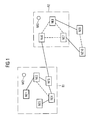
- Figure 1 show a plurality of network elements NE1, NE2,.., NE10 running the MSTP protocol within a communications network in an example embodiment according to the present invention.
- a subset of the plurality of network elements e.g. the first five network elements NE1,--,NE5, are grouped within a first network region R1.
- Another subset of the plurality of network elements e.g. NE6, NE7, NE8, are grouped within a second network region R2.
- Each MSTP region has typically several MST Instances 0, 1 and 2 MI0, MI1, MI2.
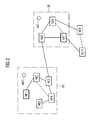
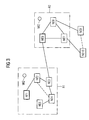
- Figure 1 Figure 2 and Figure 3 show respectively MSTI 0, MSTI 1 and MSTI 3 MI0, MI1, MI2 in the second network region R2, with its active and/or inactive links and, when existing, its root network element.
- Inactive links are denoted with dashed lines
- active links are denoted with continuous lines
- root network elements are represented by a thicker box.
- a network manager may select in a communications network one or more network regions R1, R2 each containing a group of network elements NE1,..,NE7.
- the three figures show a first selected network region R1 on MSTI 2 MI2, thus enabling the network manager to monitor active and inactive links, to see the root network element NE1 on MSTI 2 MI2 of the first region R1.
- a network region may be a logical group or a geographical group of network elements NE1, NE3, NE5.
- the network manager may switch, in a region R1, from a MSTI MI0 (see Figure 1) to another MSTI MI1, MI2 (see Figure 2 or 3) in order to monitor the network information, e.g. by viewing the relevant links and root elements.
- the region containers R1, R2 may represent window or displays on a computer screen.
- the bullets denoted with MI0, MI1, MI2 may be arrow buttons, scrollable menus, text boxes or any mean enabling the user to switch from one MSTI to another MSTI in a quick way, by performing a single step.
- the user can switch MSTIs within a specific selected region R1, R2 only by typing a key in a keyboard.
- the newly selected MSTI is showed on the same region container R1.
- the user can conveniently switch back and forth among MSTIs MI0, MI1 MI2 in order to simply monitor the network information of different MSTIs of network regions R1, R2 in a sequential way.
- Figures 1 to 3 show an example of switching MSTI context on the MSTP region container R1, thus enabling the region container R1 to act as multi context navigation window for MSTP protocol.
- the user does not need to monitor the different MSTIs from additional window pop-ups but sequentially within the same region display R1.
- the user is able, in a convenient manner, to monitor the network information of the MSTIs MI0, MI1, MI2 over one selected network region R2 without require to change the MSTI MI0, MI1, MI2 over the other selected network regions R1.
- List of reference signs NE1, .. , NE10 network elements R1, R2 network region, region MI0, MI1, MI2 MSTI instances List of used acronyms GUI Graphical user interface MSTI Multiple Spanning Tree Protocol Instance MSTP Multiple Spanning Tree Protocol
Landscapes
- Engineering & Computer Science (AREA)
- Computer Networks & Wireless Communication (AREA)
- Signal Processing (AREA)
- Human Computer Interaction (AREA)
- Data Exchanges In Wide-Area Networks (AREA)
- Small-Scale Networks (AREA)
Abstract
Description
- The present invention relates to a method according to the preamble of claim 1, to a system according the preamble of claim 4 and to a computer program product according to the preamble of claim 5.
- in recent years, the fast growing of communications networks and the large amount of services over such networks have led to a remarkable growth in traffic and in the complexity of such communication networks.
- In complex communications networks, network managers are faced with the challenge of being capable of defining and monitoring a huge amount of network relevant data in an efficient manner.
- In order to define and control the parameters of their managed communication networks, a variety of network software management tools have been developed for network managers.
- To facilitate the monitoring operations of the network managers, such network software management tools typically make use of Graphical User Interfaces (GUIs).
- GUIs are essential for defining, understanding, exploring, monitoring and/or controlling network data, since they allow the network managers to visualize massive network and software-related data, while efficiently create, render and interact with complex geometric network objects.
- Unfortunately, with the known monitoring techniques, not always is possible, for the network managers, to monitor network relevant data of large and complex networks, in an efficient and easy way.
- In fact, nowadays communication networks often require a variety of protocols, running at the same time, and, as a consequence, network managers are required to monitor almost simultaneously different network protocols and their relevant parameters.
- Some protocols are easy to be monitored since they are simple and require few parameters. As protocols get more complex, denser are their graphical representations. An example of a complex protocol running on current communication networks is Multiple Spanning Tree Protocol (MSTP).
- A drawback of current methods for monitoring MSTP networks is that they do not enable, in a simple and quick manner, network managers to have an overall view.
- In fact, in MSTP protocols various levels of information are defined, such as, for example, the MST Instances (MSTIs) that, in order to be monitored, require a GUI representation splitted in several contexts.
- In current monitoring methods for MSTP networks, network managers when they want to see the different MSTIs of an MSTP network region are opening several networks and in each of the opened network are monitoring a specific different MSTI. Thus, network managers, in order to acquire the different information on MSTIs, need first to open the network and then, for each open network, they need to change the context.
- Hence, current methods for monitoring MSTP networks have the drawback of being inefficient.
In fact, they require, when monitoring several MSTIs, an interruption of the network managers thinking flow. Moreover, the known methods cause a lost of focus for network managers thus increasing their required time in understanding the monitored information. - In addition, current methods for monitoring MSTP networks have the drawback of not being ergonomic and mistake prone. In fact, network managers are not able to monitor, with a minimized number of actions, several MSTIs in a network.
- It is therefore aim of the present invention to overcome the above-mentioned drawbacks, in particular by providing a method, a system and a computer program product for monitoring a MSTP network which simplifies the monitoring of several MSTIs in a network.
- The aforementioned aim is achieved by a method, a system and a computer program product for monitoring a network running MSTP protocol, the MSTP network comprising a plurality of network elements groupable in one or more network regions having several MSTIs, the invention comprising the steps of:
- selecting one or more network regions from the plurality of network elements; and
- monitoring network information of at least two of the MSTIs of at least one of the network regions by switching MSTI within a same display of the network region.
- In the invention the switching may preferably be performed by a click or by typing a corresponding key on a keyboard.
- In the invention the monitored network information may advantageously comprise active links and/or root network element of the selected MSTI over the selected network region.
- The proposed invention enables network managers to monitor network information in an ergonomic way, by simply selecting the specific MSTI they desire to monitor within a given MSTP network.
- The invention will now be described in preferred but not exclusive embodiments with reference to the accompanying drawings, wherein:
- Figure 1
- is a block diagram illustrating a first specific MSTI monitored within a given MSTP region in an example embodiment according to the present invention;
- Figure 2
- is a block diagram illustrating a second specific MSTI monitored within a given MSTP region in an example embodiment according to the present invention;
- Figure 3
- is a block diagram illustrating a second specific MSTI monitored within a given MSTP region in an example embodiment according to the present invention.
- Figure 1, Figure 2 and Figure 3 show a plurality of network elements NE1, NE2,.., NE10 running the MSTP protocol within a communications network in an example embodiment according to the present invention.
- A subset of the plurality of network elements, e.g. the first five network elements NE1,--,NE5, are grouped within a first network region R1. Another subset of the plurality of network elements, e.g. NE6, NE7, NE8, are grouped within a second network region R2. Each MSTP region has typically several MST Instances 0, 1 and 2 MI0, MI1, MI2.
- Figure 1, Figure 2 and Figure 3 show respectively MSTI 0, MSTI 1 and MSTI 3 MI0, MI1, MI2 in the second network region R2, with its active and/or inactive links and, when existing, its root network element. Inactive links are denoted with dashed lines, active links are denoted with continuous lines and root network elements are represented by a thicker box.
- According to the present invention, a network manager may select in a communications network one or more network regions R1, R2 each containing a group of network elements NE1,..,NE7. For example, the three figures show a first selected network region R1 on MSTI 2 MI2, thus enabling the network manager to monitor active and inactive links, to see the root network element NE1 on MSTI 2 MI2 of the first region R1. A network region may be a logical group or a geographical group of network elements NE1, NE3, NE5.
- The network manager may switch, in a region R1, from a MSTI MI0 (see Figure 1) to another MSTI MI1, MI2 (see Figure 2 or 3) in order to monitor the network information, e.g. by viewing the relevant links and root elements.
- The region containers R1, R2 may represent window or displays on a computer screen. The bullets denoted with MI0, MI1, MI2 may be arrow buttons, scrollable menus, text boxes or any mean enabling the user to switch from one MSTI to another MSTI in a quick way, by performing a single step.
- In a further embodiment according to the present invention, the user can switch MSTIs within a specific selected region R1, R2 only by typing a key in a keyboard.
- When the user switches MSTI, e.g. by clicking on an arrow button on the region R1 or by typing the relevant key in the keyboard, the newly selected MSTI is showed on the same region container R1. The user can conveniently switch back and forth among MSTIs MI0, MI1 MI2 in order to simply monitor the network information of different MSTIs of network regions R1, R2 in a sequential way.
- Figures 1 to 3 show an example of switching MSTI context on the MSTP region container R1, thus enabling the region container R1 to act as multi context navigation window for MSTP protocol. Advantageously, the user does not need to monitor the different MSTIs from additional window pop-ups but sequentially within the same region display R1. Moreover, the user is able, in a convenient manner, to monitor the network information of the MSTIs MI0, MI1, MI2 over one selected network region R2 without require to change the MSTI MI0, MI1, MI2 over the other selected network regions R1.
List of reference signs NE1, .. , NE10 network elements R1, R2 network region, region MI0, MI1, MI2 MSTI instances List of used acronyms GUI Graphical user interface MSTI Multiple Spanning Tree Protocol Instance MSTP Multiple Spanning Tree Protocol
Claims (5)
- A method for monitoring a network running Multiple Spanning Tree Protocol, herein-after referred to as MTSP, said MSTP network comprising a plurality of network elements (NE1, NE3, NE10) groupable in one or more network regions (R1, R2) having several Multiple Spanning Tree Instances (MI0 MI1, MI2), herein-after referred to as MTSIs, said method comprising the steps of;- selecting one or more network regions (R1, R2) from said plurality of network elements (NE1, NE3, NE10); and- monitoring network information of at least two of the MSTIs (MI0, MI1, MI2) of at least one of said network regions (R1, R2) by switching MSTI (MIO, MI1, MI2) within a same display of the network region (R2).
- The method according to claim 1, wherein said switching is performed by a click or by typing a corresponding key on a keyboard.
- The method according to any of the preceding claims, wherein said monitored network information comprise active links and/or root network element of the selected MSTI (MIO, MI1, MI2) over the selected network region (R2).
- A system having means for performing the steps of the method according to any of the claims 1 to 3.
- A computer program product for performing steps of the method according to any of the claims 1 to 3.
Priority Applications (2)
| Application Number | Priority Date | Filing Date | Title |
|---|---|---|---|
| EP06013982A EP1876756A1 (en) | 2006-07-06 | 2006-07-06 | Monitoring an MSTP network |
| PCT/EP2007/005737 WO2008003428A1 (en) | 2006-07-06 | 2007-06-28 | Monitoring an mstp network |
Applications Claiming Priority (1)
| Application Number | Priority Date | Filing Date | Title |
|---|---|---|---|
| EP06013982A EP1876756A1 (en) | 2006-07-06 | 2006-07-06 | Monitoring an MSTP network |
Publications (1)
| Publication Number | Publication Date |
|---|---|
| EP1876756A1 true EP1876756A1 (en) | 2008-01-09 |
Family
ID=37432493
Family Applications (1)
| Application Number | Title | Priority Date | Filing Date |
|---|---|---|---|
| EP06013982A Withdrawn EP1876756A1 (en) | 2006-07-06 | 2006-07-06 | Monitoring an MSTP network |
Country Status (2)
| Country | Link |
|---|---|
| EP (1) | EP1876756A1 (en) |
| WO (1) | WO2008003428A1 (en) |
Cited By (1)
| Publication number | Priority date | Publication date | Assignee | Title |
|---|---|---|---|---|
| CN101567892B (en) * | 2009-06-04 | 2012-06-27 | 华为技术有限公司 | Method and device for realizing MSTP multiprocess |
Families Citing this family (1)
| Publication number | Priority date | Publication date | Assignee | Title |
|---|---|---|---|---|
| CN102281195B (en) * | 2011-08-03 | 2014-07-30 | 华为技术有限公司 | Switch and switch system |
-
2006
- 2006-07-06 EP EP06013982A patent/EP1876756A1/en not_active Withdrawn
-
2007
- 2007-06-28 WO PCT/EP2007/005737 patent/WO2008003428A1/en not_active Ceased
Non-Patent Citations (2)
| Title |
|---|
| MYUNGHEE SON ET AL: "Topology discovery in large Ethernet mesh networks", IEICE TRANSACTIONS ON COMMUNICATIONS INST. ELECTRON. INF. & COMMUN. ENG JAPAN, vol. E89-B, no. 1, January 2006 (2006-01-01), pages 66 - 75, XP002409144, ISSN: 0916-8516 * |
| WELCHER P J: "Switching: CiscoWorks 2000/CWSI", TECHNICAL PAPER, 1 February 2003 (2003-02-01), pages 1 - 11, XP002409143, Retrieved from the Internet <URL:http://www.netcraftsmen.net/welcher/papers/cwsi.pdf> [retrieved on 20061127] * |
Cited By (1)
| Publication number | Priority date | Publication date | Assignee | Title |
|---|---|---|---|---|
| CN101567892B (en) * | 2009-06-04 | 2012-06-27 | 华为技术有限公司 | Method and device for realizing MSTP multiprocess |
Also Published As
| Publication number | Publication date |
|---|---|
| WO2008003428A1 (en) | 2008-01-10 |
Similar Documents
| Publication | Publication Date | Title |
|---|---|---|
| US20230393725A1 (en) | Industrial automation visualization dashboard creation paradigm | |
| EP1094635B1 (en) | Apparatus and method for selecting network entities | |
| US6028602A (en) | Method for managing contents of a hierarchical data model | |
| US7415671B2 (en) | Interactive hierarchical status display | |
| US9210047B2 (en) | Method and apparatus for presenting network path | |
| US10824304B2 (en) | Service management techniques | |
| US7502854B2 (en) | Systems and methods for managing faults in a network | |
| US20060171333A1 (en) | Network configuration management apparatus, network configuration management program and network configuration management method | |
| US9548904B2 (en) | Visualization for managing multiple IP address management systems | |
| US20040155899A1 (en) | Method and system for presenting an arrangement of management devices operable in a managed network | |
| US20070198930A1 (en) | Methods, Systems and Computer Program Products for Controlling Tree Diagram Graphical User Interfaces and/or For Partially Collapsing Tree Diagrams | |
| US20040085347A1 (en) | Storage area network management | |
| CN102004607A (en) | Menu display method and system | |
| US9065857B2 (en) | Managing multiple IP address management systems | |
| WO2019168743A1 (en) | Flexible communication account workspace | |
| CN105867864A (en) | Method and device for displaying of K virtual machines (KVMs) | |
| US20050229113A1 (en) | Highlighted objects window | |
| US20090171629A1 (en) | Network diagram display device, program and recording medium | |
| WO2008003428A1 (en) | Monitoring an mstp network | |
| US9264317B2 (en) | Scalable map displays | |
| US20210209559A1 (en) | Table grid with multi-level header and value | |
| US20050229096A1 (en) | Custom attributes and operator notes in an object information window | |
| US7480917B2 (en) | User interface for editing objects of a network object database | |
| US20040085346A1 (en) | Method, system and storage medium for displaying communication network connections | |
| EP1509029A1 (en) | Operation and maintenance center wizard |
Legal Events
| Date | Code | Title | Description |
|---|---|---|---|
| PUAI | Public reference made under article 153(3) epc to a published international application that has entered the european phase |
Free format text: ORIGINAL CODE: 0009012 |
|
| AK | Designated contracting states |
Kind code of ref document: A1 Designated state(s): AT BE BG CH CY CZ DE DK EE ES FI FR GB GR HU IE IS IT LI LT LU LV MC NL PL PT RO SE SI SK TR |
|
| AX | Request for extension of the european patent |
Extension state: AL BA HR MK YU |
|
| 17P | Request for examination filed |
Effective date: 20080709 |
|
| STAA | Information on the status of an ep patent application or granted ep patent |
Free format text: STATUS: THE APPLICATION HAS BEEN WITHDRAWN |
|
| 17Q | First examination report despatched |
Effective date: 20080806 |
|
| AKX | Designation fees paid |
Designated state(s): AT BE BG CH CY CZ DE DK EE ES FI FR GB GR HU IE IS IT LI LT LU LV MC NL PL PT RO SE SI SK TR |
|
| 18W | Application withdrawn |
Effective date: 20080827 |