EP1875446B1 - Dispositif, procede et systeme de securite pour transactions financieres, reposant sur l'identification d'un individu grâce a son profil bio-metrique, et utilisant une carte a microprocesseur - Google Patents
Dispositif, procede et systeme de securite pour transactions financieres, reposant sur l'identification d'un individu grâce a son profil bio-metrique, et utilisant une carte a microprocesseur Download PDFInfo
- Publication number
- EP1875446B1 EP1875446B1 EP06709348.4A EP06709348A EP1875446B1 EP 1875446 B1 EP1875446 B1 EP 1875446B1 EP 06709348 A EP06709348 A EP 06709348A EP 1875446 B1 EP1875446 B1 EP 1875446B1
- Authority
- EP
- European Patent Office
- Prior art keywords
- biometric
- authentication
- data
- party
- smart card
- Prior art date
- Legal status (The legal status is an assumption and is not a legal conclusion. Google has not performed a legal analysis and makes no representation as to the accuracy of the status listed.)
- Expired - Lifetime
Links
Images






Classifications
-
- G—PHYSICS
- G07—CHECKING-DEVICES
- G07F—COIN-FREED OR LIKE APPARATUS
- G07F7/00—Mechanisms actuated by objects other than coins to free or to actuate vending, hiring, coin or paper currency dispensing or refunding apparatus
- G07F7/08—Mechanisms actuated by objects other than coins to free or to actuate vending, hiring, coin or paper currency dispensing or refunding apparatus by coded identity card or credit card or other personal identification means
- G07F7/10—Mechanisms actuated by objects other than coins to free or to actuate vending, hiring, coin or paper currency dispensing or refunding apparatus by coded identity card or credit card or other personal identification means together with a coded signal, e.g. in the form of personal identification information, like personal identification number [PIN] or biometric data
- G07F7/1008—Active credit-cards provided with means to personalise their use, e.g. with PIN-introduction/comparison system
-
- G—PHYSICS
- G06—COMPUTING OR CALCULATING; COUNTING
- G06Q—INFORMATION AND COMMUNICATION TECHNOLOGY [ICT] SPECIALLY ADAPTED FOR ADMINISTRATIVE, COMMERCIAL, FINANCIAL, MANAGERIAL OR SUPERVISORY PURPOSES; SYSTEMS OR METHODS SPECIALLY ADAPTED FOR ADMINISTRATIVE, COMMERCIAL, FINANCIAL, MANAGERIAL OR SUPERVISORY PURPOSES, NOT OTHERWISE PROVIDED FOR
- G06Q20/00—Payment architectures, schemes or protocols
- G06Q20/30—Payment architectures, schemes or protocols characterised by the use of specific devices or networks
- G06Q20/34—Payment architectures, schemes or protocols characterised by the use of specific devices or networks using cards, e.g. integrated circuit [IC] cards or magnetic cards
- G06Q20/341—Active cards, i.e. cards including their own processing means, e.g. including an IC or chip
-
- G—PHYSICS
- G06—COMPUTING OR CALCULATING; COUNTING
- G06Q—INFORMATION AND COMMUNICATION TECHNOLOGY [ICT] SPECIALLY ADAPTED FOR ADMINISTRATIVE, COMMERCIAL, FINANCIAL, MANAGERIAL OR SUPERVISORY PURPOSES; SYSTEMS OR METHODS SPECIALLY ADAPTED FOR ADMINISTRATIVE, COMMERCIAL, FINANCIAL, MANAGERIAL OR SUPERVISORY PURPOSES, NOT OTHERWISE PROVIDED FOR
- G06Q20/00—Payment architectures, schemes or protocols
- G06Q20/38—Payment protocols; Details thereof
- G06Q20/40—Authorisation, e.g. identification of payer or payee, verification of customer or shop credentials; Review and approval of payers, e.g. check credit lines or negative lists
- G06Q20/401—Transaction verification
- G06Q20/4014—Identity check for transactions
-
- G—PHYSICS
- G06—COMPUTING OR CALCULATING; COUNTING
- G06Q—INFORMATION AND COMMUNICATION TECHNOLOGY [ICT] SPECIALLY ADAPTED FOR ADMINISTRATIVE, COMMERCIAL, FINANCIAL, MANAGERIAL OR SUPERVISORY PURPOSES; SYSTEMS OR METHODS SPECIALLY ADAPTED FOR ADMINISTRATIVE, COMMERCIAL, FINANCIAL, MANAGERIAL OR SUPERVISORY PURPOSES, NOT OTHERWISE PROVIDED FOR
- G06Q20/00—Payment architectures, schemes or protocols
- G06Q20/38—Payment protocols; Details thereof
- G06Q20/40—Authorisation, e.g. identification of payer or payee, verification of customer or shop credentials; Review and approval of payers, e.g. check credit lines or negative lists
- G06Q20/401—Transaction verification
- G06Q20/4014—Identity check for transactions
- G06Q20/40145—Biometric identity checks
-
- G—PHYSICS
- G07—CHECKING-DEVICES
- G07C—TIME OR ATTENDANCE REGISTERS; REGISTERING OR INDICATING THE WORKING OF MACHINES; GENERATING RANDOM NUMBERS; VOTING OR LOTTERY APPARATUS; ARRANGEMENTS, SYSTEMS OR APPARATUS FOR CHECKING NOT PROVIDED FOR ELSEWHERE
- G07C9/00—Individual registration on entry or exit
- G07C9/20—Individual registration on entry or exit involving the use of a pass
- G07C9/22—Individual registration on entry or exit involving the use of a pass in combination with an identity check of the pass holder
- G07C9/25—Individual registration on entry or exit involving the use of a pass in combination with an identity check of the pass holder using biometric data, e.g. fingerprints, iris scans or voice recognition
- G07C9/257—Individual registration on entry or exit involving the use of a pass in combination with an identity check of the pass holder using biometric data, e.g. fingerprints, iris scans or voice recognition electronically
-
- H—ELECTRICITY
- H04—ELECTRIC COMMUNICATION TECHNIQUE
- H04L—TRANSMISSION OF DIGITAL INFORMATION, e.g. TELEGRAPHIC COMMUNICATION
- H04L9/00—Cryptographic mechanisms or cryptographic arrangements for secret or secure communications; Network security protocols
- H04L9/32—Cryptographic mechanisms or cryptographic arrangements for secret or secure communications; Network security protocols including means for verifying the identity or authority of a user of the system or for message authentication, e.g. authorization, entity authentication, data integrity or data verification, non-repudiation, key authentication or verification of credentials
- H04L9/3226—Cryptographic mechanisms or cryptographic arrangements for secret or secure communications; Network security protocols including means for verifying the identity or authority of a user of the system or for message authentication, e.g. authorization, entity authentication, data integrity or data verification, non-repudiation, key authentication or verification of credentials using a predetermined code, e.g. password, passphrase or PIN
- H04L9/3231—Biological data, e.g. fingerprint, voice or retina
-
- Y—GENERAL TAGGING OF NEW TECHNOLOGICAL DEVELOPMENTS; GENERAL TAGGING OF CROSS-SECTIONAL TECHNOLOGIES SPANNING OVER SEVERAL SECTIONS OF THE IPC; TECHNICAL SUBJECTS COVERED BY FORMER USPC CROSS-REFERENCE ART COLLECTIONS [XRACs] AND DIGESTS
- Y04—INFORMATION OR COMMUNICATION TECHNOLOGIES HAVING AN IMPACT ON OTHER TECHNOLOGY AREAS
- Y04S—SYSTEMS INTEGRATING TECHNOLOGIES RELATED TO POWER NETWORK OPERATION, COMMUNICATION OR INFORMATION TECHNOLOGIES FOR IMPROVING THE ELECTRICAL POWER GENERATION, TRANSMISSION, DISTRIBUTION, MANAGEMENT OR USAGE, i.e. SMART GRIDS
- Y04S40/00—Systems for electrical power generation, transmission, distribution or end-user application management characterised by the use of communication or information technologies, or communication or information technology specific aspects supporting them
- Y04S40/20—Information technology specific aspects, e.g. CAD, simulation, modelling, system security
Definitions
- the present invention relates to an innovative device for securing payments, or transactions, made by microprocessor card, and to validate the identity of the holder of the microprocessor card through a bio-metric control client / server, that these payments, or transactions, are made directly at the point of sale or from a PC (personal computer or shared self-service computer) connected to the Internet, or by mobile phone, by laptop (also called laptop) ), by PDA (Personal Device Assistant) or other, or through any other mobile or fixed equipment, able to connect through any telecommunication network, and perform a transaction where biometrics between in play from the generating point of said transaction.
- PC personal computer or shared self-service computer
- PDA Personal Device Assistant
- the present invention also relates to the case of an employee of a financial institution carrying a microprocessor card and who performs an interbank transfer in a professional capacity.
- This invention may equally well apply to electronic transfers of State-to-State funds, or of a Community of States to a Community of States, or to States, or international bodies to States, and vice versa
- the present invention is designed to be an identity authentication system, of client / server type, of a microprocessor card carrier, based on the one hand, on the use of the microprocessor card and, on the other hand, on the other hand, on the identification of the bearer by means of bio-metric data stored on an extended memory microprocessor card, in comparison with a bio-metric database, external and remote, secured and operated by the Third Party of Authentication or by the Financial Institution, however, for reasons of security and performance, without making any transfer of said bio-metric data through the telecommunication network.
- microprocessor or not are identified by their identity document; it is then found that Many fraud à la carte, microprocessor or not, occur with the issuance of several cards by different financial institutions to the same individual, without it being possible to confuse it by its identity as it is provided today with Financial issuing institutions. Among other things, these frauds are due to the use of false papers, identity theft in any form whatsoever, or the pure and simple theft of microprocessor cards or not, blank or already allocated.
- the device according to the invention makes it possible to remedy these drawbacks and these frauds, by delivering to the Financial Institutions a reinforced and inviolable security mode for the transactions carried out with a microprocessor card.
- microprocessor cards are made possible today by effectively increasing the memory size of microprocessor cards from a level of less than 100 KB to a level of more than 512 KB.
- This significant increase in memory size microprocessor cards will allow the inclusion of stored information or software developed in a Java® environment (Sun) or .net® (Microsoft), or with any other available language.
- the provision of cards to be used on both a low-speed connection port - used today - and a fast broadband compatible port allows for quick real-time exchanges on these cards.
- microprocessor and to read the software, or stored information, at high speed.
- the availability of the two microprocessor-based telecommunications ports will allow the complete and progressive migration of the payment terminal fleet, without any blockage or incompatibility.
- the Global Device of the invention itself comprises several devices which are described hereinafter. These devices have a nomenclature in X00100.
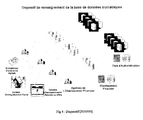
- the Figure 1 represents the Global Device of the invention.
- This device corresponds to the storage on the microprocessor of the personal microprocessor card issued by the financial institution, one or more encrypted bio-metric data which are provided by the cardholder, and which are associated to a convergence identifier according to the device [X00200].
- the bio-metric data is encrypted before storage on the memory of the microprocessor included in the microprocessor card.
- the software associated with the hardware will detect a series of critical points.
- the senor will be programmed to select a number of points larger or smaller from 5 to more than 30. Indeed, depending on the computing power available on the terminal, which will evolve over time, and the time required to perform the calculations, as well as the transmission of the elements resulting from these same calculations, the parameters will be modifiable. Each point will be described by coordinates on the sensor.
- This device corresponds to the information of the bio-metric database, and comprises the system, according to the invention, transmission or rebuttal of transmission following identity theft.
- the identity check is based on the establishment of two files.
- the first file contains a sequence of the type: Convergence Number, Last Name, First Name, National Identity Number, Date of birth, Bank Establishment, Agency Number, Account Number, and any other information necessary for the proper operation of the services. financial and banking.
- the convergence identifier will be a temporary identifier, the definitive identifier being provided only after the validation of the validity of the data by the Third Party Authentication.
- the second file contains a sequence of the type: Convergence number linked to the bio-metric information stored on the bio-metric database of the remote servers of the Third Party of Authentication.
- a master server with the second file, that of the Third Party Authentication will be installed redundantly in the premises of the Financial Institution, and can then be used in the case of a temporary failure of remote servers .
- the Third Party Authentication will only have an excerpt from the first file, the Convergence Number, Last Name, First Name, National Identity Number, Date of birth, Bank Establishment, Agency Number.
- the Account Number will not be stored on remote servers of the Authentication Third Party.
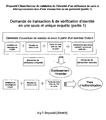
- the Figures 2 and 3 represent the Second Device [X00200], or information device of the bio-metric database.
- the device represents, by applicant individual or holder of a microprocessor card, bio-metric and personal identity data (last name, first name, date of birth, etc.) collected by the Financial Institution. , transmission and duplication on the server of the Third Party Authentication or remote servers. This data is transferred by the Financial Institution to the remote servers, and includes a temporary identifier number generated by the software provided by the Third Party Authentication to the Financial Institution.
- the device performs a comparative analysis of the data supplied with the existing data on the database of the remote servers of the Third Party Authentication, if however these data already exist. It will then be correlated between personal data and bio-metrics to inform the Financial Institution on the authentication of the individual.
- the authentication will be rejected and reported to the Financial Institution.
- the Financial Institution will receive the temporary identifier associated with a refutation code. This refutation code will be immediately interpreted by the software provided by the Third Party Authentication to the Financial Institution, and will recommend a non-issuance of the card due to identity theft.
- the individual In the case where the individual is not already represented by his bio-metrics and personal data on the remote servers of the Third Party Authentication, his identity will be registered as valid. It will be generated an ID number. This identifier will be called the convergence identifier. The temporary identifier issued by the Financial Institution will then be associated with the convergence identifier, and these two types of identifier will be retransmitted simultaneously to the requesting Financial Institution. The transmission of these data on the server of the Financial Institution will confirm the authentication of the individual for issuing the microprocessor card.
- an individual may have several different convergence identifiers, if, however, he has applied for a bank card to several different Financial Institutions, but only one convergence identifier per financial institution. Note also that if an individual makes several simultaneous requests to obtain a microprocessor card in the same bank network (the same financial institution), from the second request, the temporary identifier number, associated with a code reported and recognized as a multiple applicant, will be issued and transferred to the Financial Institution, the decision to issue a card, or not, returning to the Financial Institution.
- the device according to the invention will offer a security all the more increased as the number of information collected will be exhaustive.
- the device according to the invention does not provide for the transport of biometric data per se.
- the Figures 4 , 5 and 6 represent the Third Device [X00300], or device for transferring bio-metric data recorded by financial institutions to remote servers of the Third Party Authentication.
- the payment, or the transaction is made by the use of a microprocessor card payment terminal at the point of sale, having, on the one hand, a local connection with a bio-metric impression sensor, and, on the other hand, a microcontroller associated with a flash memory, or any other equivalent device, incoporated at the terminal.
- This microcontroller associated with a flash memory, or any other equivalent device includes the original version of the software - an integral part of the device according to the invention - which will perform the comparison calculation with respect to the selection of the randomly chosen points, as described in FIG. first device [X00100].
- a Microcontroller associated with a Flash Memory, or any other equivalent device, containing the software image described above, will be incorporated into the point of sale terminal.
- An extended-memory microprocessor card reader, connected to a USB-type, or IEEE1394, or other equivalent, will be provided for users wishing to make a payment or a transaction over a telecommunication network, Internet type or other.
- a software image can be integrated into the personal computer or PC, the mobile phone, the laptop (also called laptop), the PDA (Personal Device Assistant) or other, or any other equipment mobile or fixed, able to connect through any telecommunication network, and perform a transaction where biometrics comes into play from the generating point of said transaction, or to any other tool using connectivity through a remote network and incorporating a bio-metric sensor, a computer, and a memory for storing said software (volatile or non-volatile memory).
- the algorithmic will be provided on a physical medium of type CD or DVD Rom, or downloadable, that the user of a remote system will be able to load on his machine.
- Update versions will be deployed at variable frequency in order to be able to generate different algorithms, offering different calculation results; these variants allow the identifier manager to guarantee a very high level of security and quality on the validation of the identity of the persons using this system.
- the software version included and available on each machine will be checked.
- the point-of-sale terminal, or on the personal computer version, or on any other connected tool it may be decided to perform a download that may allow another authentication calculation, in the case where the version used during from the previous transaction would be obsolete.
- the personal computer or PC the mobile phone, the laptop (also called laptop), PDA (Personal Device Assistant) or other, or any other mobile or fixed equipment, likely to connect through a network any telecommunication, and to perform a transaction where the biometrics comes into play from the generating point of said transaction, or any other tool using connectivity through a remote network and incorporating a computer, and a memory for storing said software (volatile or non-volatile memory), must include one or more bio-metric sensors, either integrated or connected as peripherals.
- a consumer At the point of sale, during a purchase, a consumer will present his microprocessor card, he will then be asked to affix, for example, his finger on a bio-metric sensor.
- the device according to the invention - based on a client / server architecture, comprising hardware - a microcontroller associated with a flash memory, or equivalent device - bio-metric sensors (fingers, facial, iris, retina, voice or other) and original software programmed and stored on the microprocessor card - supports the identification of the holder of the microprocessor card.
- a client / server architecture comprising hardware - a microcontroller associated with a flash memory, or equivalent device - bio-metric sensors (fingers, facial, iris, retina, voice or other) and original software programmed and stored on the microprocessor card - supports the identification of the holder of the microprocessor card.
- the device according to the invention is based on a single request architecture, comprising two components, the first, a transaction request destined for the Financial Institution, and the second, a request for identity validation intended for the servers of the Third Party. Authentication, or Financial Institution.
- the device [X00400] correlates, in local mode, between the encrypted data stored on the microprocessor of the microprocessor card and described in the first device [X00100], and the bio-metric data collected from the carrier. of the microprocessor card. This is possible thanks to an original software developed according to the invention and integrated in a Microcontroller associated with a Flash Memory, or any other equivalent device, which is inserted into the transaction terminal.
- the software and the microcontroller associated with a flash memory, or any other equivalent device will incorporate a management of the translation of the orthonormal matrix, in order to avoid the pitfalls of positioning on the sensor, (it is possible, for example, to orient its finger several degrees to the right or to the left relative to the theoretical axis of the sensor).
- the impression sensor will be of thermometric or other type, in order to verify whether the subject is alive or not, and whether it is not an image copy of said imprint.
- Other types of sensors will include an infrared check, or other, controlling the temperature of the subject.
- the device according to the invention [X00400] performs a correlation between the encrypted data described in the Device [X00200], and the encrypted data resident on the remote servers of the Third Party Authentication, this via a local calculation whose the results are retransmitted to remote servers of the Authentication Third Party, or the Financial Institution, which performs the same calculations and analyzes the results again.
- These results are accompanied by the encrypted convergence identifier, and the Java® (Sun) or .net® (Microsoft) code part, or any other available language, stored on the microprocessor card, as well as information relating to the transaction itself.
- the convergence identifier, the results of the local calculation, the part of Java® code (Sun) or .net® (Microsoft), or any other available language, are retransmitted in a single request, by the terminal, to the Financial Institution, which itself transmits to the Third Party Authentication, or the Financial Institution, the convergence identifier, the results of the local calculation, the code part Java® (Sun) or .net® (Microsoft), or any other available language, for identity verification.
- the Financial Institution carries out its own financial verifications on the account of the holder of the microprocessor card, pending the acceptance or refutation of the identity of the holder of the microprocessor card by the Third Party Authentication, or by the Financial Institution itself. Once the acceptance or the refutation of the identity of the holder of the microprocessor card pronounced by the Third Party of Authentication, the Financial Institution closes the transaction.
- the procedure will be strictly identical if the purchase is done through the Internet, or by any other means, or through any other wired or wireless telecommunications network (GSM, UMTS, Bluetooth, WiFi, or other), or by mobile phone, by laptop (also called laptop), by PDA (Personal Device Assistant) or other, or by any other mobile or fixed equipment, able to connect through any telecommunication network, and to perform a transaction where biometrics comes into play from the generating point of said transaction.
- GSM Global System for Mobile communications
- UMTS Universal Mobile communications
- WiFi Wireless Fidelity
- mobile phone by laptop (also called laptop), by PDA (Personal Device Assistant) or other, or by any other mobile or fixed equipment, able to connect through any telecommunication network, and to perform a transaction where biometrics comes into play from the generating point of said transaction.
- laptop also called laptop
- PDA Personal Device Assistant
- the Figures 7 and 8 represent the Fourth Device [X00400], or client / server device validating the identity of a microprocessor card user during a point-of-sale purchase or over the Internet, or through any other network wired or wireless telecommunications (GSM, UMTS, Bluetooth, WiFi, or other type), or by mobile phone, by laptop (also called laptop), by PDA (Personal Device Assistant) or other, or by l intermediate any other mobile or fixed equipment, capable of connecting through any telecommunication network, and perform a transaction where biometrics comes into play from the generating point of said transaction.
- GSM Global System for Mobile Communications
- UMTS Universal Mobile communications
- WiFi Wireless Fidelity
- the Financial Institution authorizes or not the transaction of 100 Euros, according to the financial solvency data, by sending a positive or negative order on any of the other types of terminals available on the market, like the mobile phone, the laptop (also called laptop), the PDA (personal device assistant) or other, or any other mobile or fixed equipment, able to connect through any telecommunication network, and perform a transaction where biometrics comes into play from the generating point of the transaction ( Figure 12 )
- the Figure 9 , 10 , 11 and 12 represent device in stages [X00500].
Landscapes
- Engineering & Computer Science (AREA)
- Business, Economics & Management (AREA)
- Accounting & Taxation (AREA)
- Physics & Mathematics (AREA)
- General Physics & Mathematics (AREA)
- Computer Security & Cryptography (AREA)
- Theoretical Computer Science (AREA)
- General Business, Economics & Management (AREA)
- Strategic Management (AREA)
- Computer Networks & Wireless Communication (AREA)
- Finance (AREA)
- General Health & Medical Sciences (AREA)
- Signal Processing (AREA)
- Biomedical Technology (AREA)
- Biodiversity & Conservation Biology (AREA)
- Life Sciences & Earth Sciences (AREA)
- Health & Medical Sciences (AREA)
- Microelectronics & Electronic Packaging (AREA)
- Human Computer Interaction (AREA)
- Financial Or Insurance-Related Operations Such As Payment And Settlement (AREA)
- Measurement Of The Respiration, Hearing Ability, Form, And Blood Characteristics Of Living Organisms (AREA)
- Control Of Vending Devices And Auxiliary Devices For Vending Devices (AREA)
Description
- La présente invention concerne un dispositif innovant pour sécuriser les paiements, ou transactions, effectués par carte à microprocesseur, et pour valider l'identité du porteur de la carte à microprocesseur par l'intermédiaire d'un contrôle bio-métrique client/serveur, que ces paiements, ou transactions, soient opérés directement sur le point de vente ou bien à partir d'un PC (ordinateur personnel ou ordinateur en libre-service partagé) connecté à Internet, ou bien par téléphone mobile, par ordinateur portable (encore appelé laptop), par PDA (Personal Device Assistant) ou autre, ou encore par l'intermédiaire de tout autre équipement mobile ou fixe, susceptible de se connecter au travers d'un réseau de télécommunication quelconque, et d'effectuer une transaction où la biométrie entre en jeu à partir du point générateur de ladite transaction. La présente invention concerne également le cas d'un employé d'un Etablissement Financier porteur d'une carte à microprocesseur et qui effectue un transfert interbancaire à titre professionnel. Cette invention peut tout aussi bien s'appliquer aux transferts électroniques de fonds d'Etats à Etats, ou de Communauté d'Etats à Communauté d'Etats, ou à Etats, ou encore d'organismes internationaux à Etats, et réciproquement
- La présente invention est conçue pour être un système d'authentification d'identité, de type client/serveur, d'un porteur de carte à microprocesseur, reposant d'une part, sur l'utilisation de la carte à microprocesseur et, d'autre part, sur l'identification du porteur au moyen de données bio-métriques stockées sur une carte à microprocesseur à mémoire étendue, par comparaison avec une base de données bio-métriques, externe et distante, sécurisée et opérée par le Tiers d'Authentification ou par l'Etablissement Financier, toutefois, pour des raisons de sécurité et de performance, sans opérer de transfert desdites données bio-métriques au travers du réseau de télécommunication.
- Aujourd'hui dans le monde, les paiements ou les transactions sont généralement effectués à l'aide d'une carte à piste magnétique, dont le bordereau émis doit être signé lors d'un acte d'achat. Dans certains pays, la signature est remplacée par un Code PIN à plusieurs chiffres, qui est comparé à celui résidant sur la mémoire de la carte à microprocesseur.
- D'une part, compte-tenu du volume en très forte croissance dans le monde, des transactions d'achat ou de transferts financiers, utilisant comme support une carte avec ou sans microprocesseur, de plus en plus de paiements, ou transactions, sont susceptibles de faire l'objet de fraudes, certaines transactions ne requérant pas de Code PIN. Le Code PIN assure une meilleure sécurité que la signature seule du bordereau d'achat, mais peut-être également usurpé ou volé à son propriétaire.
- D'autre part, à l'heure actuelle les porteurs de cartes, à microprocesseurs ou non, sont identifiés par leur pièce d'identité; il est alors constaté que de nombreuses fraudes à la carte, à microprocesseur ou non, surviennent avec la délivrance de plusieurs cartes par différents Etablissements Financiers à un même individu, sans qu'il soit possible de le confondre par son identité telle qu'elle est fournie aujourd'hui auprès des Etablissements Financiers émetteurs. Entre autres, ces fraudes sont dues à l'utilisation de faux papiers, à l'usurpation d'identité sous quelque forme que ce soit, ou encore le vol pur et simple de cartes à microprocesseur ou non, vierges ou déjà attribuées.
- On pourra également se référer au document
WO 2004/10053 - Le dispositif selon l'invention permet de remédier à ces inconvénients et à ces fraudes, en délivrant aux Etablissements Financiers un mode de sécurisation renforcée et inviolable pour les transactions réalisées avec une carte à microprocesseur.
- Ces dispositifs sont rendus possibles, aujourd'hui, de par l'augmentation effective de la taille mémoire des cartes à microprocesseur qui passent d'un niveau inférieur à 100 Ko à un niveau de plus de 512 Ko. Cette augmentation notable de la taille mémoire des cartes à microprocesseur va permettre d'inclure à l'intérieur des cartes de l'information stockée ou des logiciels développés en environnement Java® (Sun) ou .net® (Microsoft), ou avec tout autre langage disponible.
- De plus, la mise à disposition de cartes permettant d'être utilisées à la fois sur un port de connexion bas débit - utilisé aujourd'hui - et un port rapide haut débit compatible, permet de procéder à des échanges rapides temps réel sur ces cartes à microprocesseur, et de pouvoir lire les logiciels, ou informations stockées, à grande vitesse. La disponibilité des deux ports de télécommunication sur microprocesseur, va permettre la migration complète et progressive du parc des terminaux de paiement, sans aucun blocage ou incompatibilité.
- Cette capacité de mémoire disponible va nous permettre, d'une part, de stocker des informations graphiques à un niveau de précision suffisant pour être parfaitement exploitables, et d'autre part, d'embarquer des clefs logiciels ainsi que des algorithmes de calcul, et aussi de durcir cette algorithmique, au fur et à mesure des possibilités offertes par de nouveaux développements. On notera que la taille actuelle et courante des mémoires des cartes à microprocesseur, ainsi que la non-disponibilité d'un port de communication rapide à haut débit, ne permettait en aucun cas un tel processus.
- Le Dispositif Global de l'invention comprend lui-même plusieurs dispositifs qui sont décrits ci-après. Ces dispositifs ont une nomenclature en X00100.
- La
Figure 1 représente le Dispositif Global de l'invention. - Format de stockage de l'information sur la carte à microprocesseur.
- Ce dispositif selon l'invention correspond au stockage sur le microprocesseur de la carte à microprocesseur personnelle délivrée par l'Etablissement Financier, d'une ou de plusieurs données bio-métriques cryptées qui sont fournies par le porteur de la carte, et qui sont associées à un identifiant de convergence selon le dispositif [X00200]. Les données bio-métriques sont cryptées avant stockage sur la mémoire du microprocesseur inclus dans la carte à microprocesseur.
- Pour une empreinte bio-métrique quelconque, digitale, faciale, iris, rétine, voix, ou autre, le logiciel associé au matériel (Microcontrôleur associé à une Mémoire Flash, ou dispositif équivalent) détectera une série de points critiques.
- Pour des raisons tant sécuritaires que techniques, le capteur sera programmé pour sélectionner un nombre de points plus ou moins grands de 5 à plus de 30. En effet, suivant la puissance de calcul disponible sur le terminal, qui évoluera dans la durée, et le temps nécessaire pour effectuer les calculs, ainsi que la transmission des éléments résultant de ces mêmes calculs, les paramètres seront modifiables. Chaque point sera décrit par des coordonnées sur le capteur.
- Dispositif de renseignement de la base de données biométriques.
- Ce dispositif correspond au renseignement de la base de données bio-métriques, et comprend le système, selon l'invention, d'émission ou de réfutation d'émission suite à usurpation d'identité. Le contrôle d'identité est fondé sur l'établissement de deux fichiers.
- Le premier fichier contient une séquence du type : Numéro de convergence, Nom, Prénom, Numéro National d'Identité, Date de naissance, Etablissement Bancaire, Numéro d'Agence, Numéro de Compte, et toute autre information nécessaire à la bonne exploitation des services financiers et bancaires. A la création, l'identifiant de convergence sera un identifiant temporaire, l'identifiant définitif n'étant fourni qu'à l'issue de l'acquittement de la validité des données par le Tiers d'Authentification.
- Le deuxième fichier contient une séquence du type : Numéro de Convergence lié aux informations bio-métriques stockées sur la base de données bio-métriques des serveurs distants du Tiers d'Authentification.
- Pour des raisons de sécurité, un serveur maître comportant le deuxième fichier, celui du Tiers d'Authentification, sera installé en redondance dans les locaux de l'Etablissement Financier, et pourra alors être utilisé dans le cas d'une défaillance momentanée des serveurs distants.
- Le Tiers d'Authentification ne disposera que d'un extrait du premier fichier, soit le Numéro de convergence, Nom, Prénom, Numéro National d'Identité, Date de naissance, Etablissement Bancaire, Numéro d'Agence. Le Numéro de Compte ne sera pas stocké sur les serveurs distants du Tiers d'Authentification.
- Les
Figures 2 et3 représentent le Deuxième Dispositif [X00200], ou dispositif de renseignement de la base de données bio-métriques. - Dispositif de transfert des données bio-métriques enregistrées par les établissements financiers vers les serveurs distants du Tiers d'Authentification.
- Le dispositif selon l'invention représente, par individu demandeur ou porteur d'une carte à microprocesseur, des données bio-métriques et d'identité personnelle (nom, prénom, date de naissance, etc..), recueillies par l'Etablissement Financier, la transmission et la duplication sur le serveur du Tiers d'Authentification ou serveurs distants. Ces données sont transférées par l'Etablissement Financier sur les serveurs distants, et comprennent un numéro d'identifiant temporaire généré par le logiciel fourni par le Tiers d'Authentification à l'Etablissement Financier.
- Une fois les données stockées, le dispositif selon l'invention effectue une analyse comparative des données fournies avec les données existantes sur la base de données des serveurs distants du Tiers d'Authentification, si toutefois ces données existent déjà. Il sera ensuite effectué une corrélation entre les données personnelles et bio-métriques afin de renseigner l'Etablissement Financier sur l'authentification de l'individu.
- Si l'individu existe déjà avec des données bio-métriques similaires mais d'identité personnelle différente, l'authentification sera rejetée et signalée à l'Etablissement Financier. En retour, l'Etablissement Financier recevra l'identifiant temporaire associé à un code de réfutation. Ce code de réfutation sera immédiatement interprété par le logiciel fourni par le Tiers d'Authentification à l'Etablissement Financier, et recommandera une non-émission de la carte pour cause d'usurpation d'identité.
- Dans le cas où l'individu n'est pas déjà représenté par ses données bio-métriques et personnelles sur les serveurs distants du Tiers d'Authentification, son identité sera enregistrée comme valide. Il sera généré un numéro d'identifiant. Cet identifiant sera appelé identifiant de convergence. L'identifiant temporaire émis par l'Etablissement Financier sera alors associé à l'identifiant de convergence, et ces deux types d'identifiant seront retransmis simultanément à l'Etablissement Financier demandeur. La transmission de ces données sur le serveur de l'Etablissement Financier confirmera l'authentification de l'individu pour émission de la carte à microprocesseur.
- On notera qu'un individu pourra avoir plusieurs identifiants de convergence différents, si toutefois il a effectué une demande de carte bancaire à plusieurs Etablissements Financiers différents, mais un seul identifiant de convergence par Etablissement Financier. On notera de plus, que si un individu établit plusieurs demandes simultanées d'obtention de carte à microprocesseur dans un même réseau bancaire (le même Etablissement Financier), à partir de la deuxième demande, le numéro d'identifiant temporaire, associé à un code signalé et reconnu comme un demandeur multiple, sera émis et transféré à l'Etablissement Financier, la décision d'émettre une carte, ou non, revenant à l'Etablissement Financier.
- Le Tiers d'Authentification offrant ses services à plusieurs Etablissements Financiers, le dispositif selon l'invention offrira une sécurité d'autant plus accrue que le nombre d'informations recueillies sera exhaustif.
- Il est précisé que, pour des raisons de sécurité et de performance, le dispositif selon l'invention ne prévoit pas le transport de données biométriques en elles-mêmes.
- Les
Figures 4 ,5 et6 représentent le Troisième Dispositif [X00300], ou dispositif de transfert des données bio-métriques enregistrées par les établissements financiers vers les serveurs distants du Tiers d'Authentification. - Dispositif d'authentification biométrique : il s'agit de la procédure client/serveur de validation de l'identité d'un utilisateur de carte à microprocesseur lors d'un achat, ou d'une transaction, sur point de vente ou sur Internet, ou bien par l'intermédiaire de tout autre réseau de télécommunication filaire ou sans fil (de type GSM, UMTS, Bluetooth, WiFi, ou autre), ou bien par téléphone mobile, par ordinateur portable (encore appelé laptop), par PDA (Personal Device Assistant) ou autre, ou encore par l'intermédiaire de tout autre équipement mobile ou fixe, susceptible de se connecter au travers d'un réseau de télécommunication quelconque, et d'effectuer une transaction où la biométrie entre en jeu à partir du point générateur de ladite transaction.
- 1.4. 1. Principe original de paiement bio-métrique par carte à microprocesseur, lors d'un achat, ou d'une transaction, sur point de vente ou sur Internet, ou bien par l'intermédiaire de tout autre réseau de télécommunication filaire ou sans fil (de type GSM, UMTS, Bluetooth, WiFi, ou autre), ou bien par téléphone mobile, par ordinateur portable (encore appelé laptop), par PDA (Personal Device Assistant) ou autre, ou encore par l'intermédiaire de tout autre équipement mobile ou fixe, susceptible de se connecter au travers d'un réseau de télécommunication quelconque, et d'effectuer une transaction où la biométrie entre en jeu à partir du point générateur de ladite transaction.
- Le paiement, ou la transaction, s'effectue par l'utilisation d'un terminal de paiement par carte à microprocesseur sur le point de vente, possédant, d'une part, une connectique locale avec un capteur d'empreinte bio-métrique, et, d'autre part, un Microcontrôleur associé à une Mémoire Flash, ou tout autre dispositif équivalent, incoporé au terminal. Ce Microcontrôleur associé à une Mémoire Flash, ou tout autre dispositif équivalent, inclue la version originale du logiciel - partie intégrante du dispositif selon l'invention - qui effectuera le calcul de comparaison par rapport à la sélection des points aléatoirement choisis, comme décrit dans le premier dispositif [X00100].
- Modalités du processus logiciel/Microcontrôleur associé à une Mémoire Flash, ou tout autre dispositif équivalent :
- I. Capture de l'empreinte bio-métrique,
- II. Lecture des identifiants,
- III. Echantillonnage des points remarquables, choisis aléatoirement,
- IV. Calcul algorithmique,
- V. Cryptage des résultats, envoi à l'Etablissement Financier des résultats de calculs cryptés et de l'identifiant de convergence, ces derniers étant associés à la demande de paiement ou de transaction.
- Un Microcontrôleur associé à une Mémoire Flash, ou tout autre dispositif équivalent, contenant l'image logicielle décrite plus haut, sera incorporé dans le terminal point de vente. Il sera fourni un lecteur de carte à microprocesseur à mémoire étendue, connectée à un port rapide de type USB, ou IEEE1394, ou autre équivalent, pour les utilisateurs souhaitant effectuer un paiement ou une transaction par l'intermédiaire d'un réseau de télécommunication, de type Internet ou autre. De la même manière, une image logicielle pourra être intégrée à l'ordinateur personnel ou PC, au téléphone mobile, à l'ordinateur portable (encore appelé laptop), au PDA (Personal Device Assistant) ou autre, ou encore à tout autre équipement mobile ou fixe, susceptible de se connecter au travers d'un réseau de télécommunication quelconque, et d'effectuer une transaction où la biométrie entre en jeu à partir du point générateur de ladite transaction, ou encore à tout autre outil utilisant une connectivité au travers d'un réseau distant et incorporant un capteur bio-métrique, un calculateur, et une mémoire permettant le stockage dudit logiciel (mémoire volatile ou non volatile).
- L'algorithmique sera fournie sur un support physique de type CD ou DVD Rom, ou téléchargeable, que l'utilisateur d'un système distant pourra charger sur sa machine.
- Des versions d'actualisation (mises-à-jour) seront déployées à fréquence variable afin de pouvoir générer des algorithmiques différentes, offrant des résultats de calcul différents ; ces variantes permettent au gestionnaire des identifiants de garantir un très haut niveau de sécurité et de qualité sur la validation de l'identité des personnes utilisant ce système.
- De manière identique, soit sur le terminal point de vente, soit sur l'ordinateur personnel distant connecté, ou soit sur tout autre outil connecté, il sera procédé à la vérification de la version logicielle incluse et disponible sur chaque machine. Sur le terminal point de vente, ou sur la version d'ordinateur personnel, ou bien sur tout autre outil connecté, il pourra être décidé d'effectuer un téléchargement pouvant permettre un autre calcul d'authentification, dans le cas où la version utilisée lors de la transaction précédente serait obsolète.
- L'ordinateur personnel ou PC, le téléphone mobile, l'ordinateur portable (encore appelé laptop), le PDA (Personal Device Assistant) ou autre, ou encore tout autre équipement mobile ou fixe, susceptible de se connecter au travers d'un réseau de télécommunication quelconque, et d'effectuer une transaction où la biométrie entre en jeu à partir du point générateur de ladite transaction, ou tout autre outil utilisant une connectivité au travers d'un réseau distant et incorporant un calculateur, et une mémoire permettant le stockage dudit logiciel (mémoire volatile ou non volatile), devra comporter un ou plusieurs capteurs bio-métriques, soit intégrés, soit connectés en tant que périphériques.
- Sur le point de vente, lors d'un achat, un consommateur présentera sa carte à microprocesseur, il lui sera alors demandé d'apposer, par exemple, son doigt sur un capteur bio-métrique.
- Le Dispositif selon l'invention - basé sur une architecture client/serveur, comprenant du matériel - un Microcontrôleur associé à une Mémoire Flash, ou dispositif équivalent - des capteurs bio-métriques (doigts, facial, iris, rétine, voix ou autres) et un logiciel original programmé et stocké sur la carte à microprocesseur - prend en charge l'identification du porteur de la carte à microprocesseur.
- Le dispositif selon l'invention repose sur une architecture de requête unique, comportant deux volets, le premier, une demande de transaction à destination de l'Etablissement Financier, et le deuxième, une demande de validation d'identité à destination des serveurs du Tiers d'Authentification, ou de l'Etablissement Financier.
- Le Dispositif [X00400] selon l'invention effectue une corrélation, en mode local, entre les données cryptées stockées sur le microprocesseur de la carte à microprocesseur et décrites dans le premier dispositif [X00100], et les données bio-métriques recueillies auprès du porteur de la carte à microprocesseur. Ceci est possible grâce à un logiciel original développé selon l'invention et intégré dans un Microcontrôleur associé à une Mémoire Flash, ou tout autre dispositif équivalent, qui est inséré dans le terminal support de la transaction.
- Le logiciel et le Microcontrôleur associé à une Mémoire Flash, ou tout autre dispositif équivalent, incorporeront une gestion de la translation de la matrice orthonormée, afin d'éviter les écueils de positionnement sur le capteur, (on peut, par exemple, orienter son doigt de plusieurs degrés à droite ou à gauche par rapport à l'axe théorique du capteur).
- La position des points par rapport au référentiel (Matrice du capteur) ainsi que la position des points entre eux, ainsi que leur orientation vectorielle fera l'objet d'une analyse qui, dans un premier temps, sera comparée au même calcul disponible sur la carte à microprocesseur elle même.
- Cette comparaison fera apparaître une corrélation immédiate ou non par rapport à l'empreinte vivante.
- On notera que le capteur d'empreinte sera de type thermométrique ou autre, afin de vérifier si le sujet est vivant ou non, et s'il ne s'agit pas d'une copie image de ladite empreinte. Les autres types de capteur comporteront une vérification infrarouge, ou autre, contrôlant la température du sujet.
- Le Dispositif selon l'invention [X00400] effectue une corrélation entre les données cryptées décrites dans le Dispositif [X00200], et les données cryptées résidentes sur les serveurs distants du Tiers d'Authentification, ceci par l'intermédiaire d'un calcul local dont les résultats sont retransmis aux serveurs distants du Tiers d'Authentification, ou de l'Etablissement Financier, qui effectue les mêmes calculs et en analyse de nouveau les résultats. Ces résultats sont accompagnés de l'identifiant de convergence crypté, et de la partie de code Java® (Sun) ou .net® (Microsoft), ou de tout autre langage disponible, stockés sur la carte à microprocesseur, ainsi que des informations relatives à la transaction elle-même.
- L'identifiant de convergence, les résultats du calcul local, la partie de code Java® (Sun) ou .net® (Microsoft), ou de tout autre langage disponible, sont retransmis en une requête unique, par le terminal, à l'Etablissement Financier, qui lui même retransmet au Tiers d'Authentification, ou à l'Etablissement Financier, l'identifiant de convergence, les résultats du calcul local, la partie de code Java® ( Sun) ou .net® (Microsoft), ou de tout autre langage disponible, pour vérification d'identité.
- Pendant la préparation des résultats par le Tiers d'Authentification, l'Etablissement Financier effectue ses propres vérifications financières sur le compte du porteur de la carte à microprocesseur, en attente de l'acceptation ou de la réfutation de l'identité du porteur de la carte à microprocesseur par le Tiers d'Authentification, ou par l'Etablissement Financier lui-même. Une fois l'acceptation ou la réfutation de l'identité du porteur de la carte à microprocesseur prononcée par le Tiers d'Authentification, l'Etablissement Financier clôture la transaction.
- Les opérations de contrôle d'identité sont effectuées en temps réel.
- La procédure sera strictement identique si l'achat se fait au travers d'Internet, ou par tout autre moyen, ou bien par l'intermédiaire de tout autre réseau de télécommunication filaire ou sans fil (de type GSM, UMTS, Bluetooth, WiFi, ou autre), ou bien par téléphone mobile, par ordinateur portable (encore appelé laptop), par PDA (Personal Device Assistant) ou autre, ou encore par l'intermédiaire de tout autre équipement mobile ou fixe, susceptible de se connecter au travers d'un réseau de télécommunication quelconque, et d'effectuer une transaction où la biométrie entre en jeu à partir du point générateur de ladite transaction.
- Les
Figures 7 et8 représentent le Quatrième Dispositif [X00400], ou dispositif client/serveur de validation de l'identité d'un utilisateur de carte à microprocesseur lors d'un achat sur point de vente ou sur Internet, ou bien par l'intermédiaire de tout autre réseau de télécommunication filaire ou sans fil (de type GSM, UMTS, Bluetooth, WiFi, ou autre), ou bien par téléphone mobile, par ordinateur portable (encore appelé laptop), par PDA (Personal Device Assistant) ou autre, ou encore par l'intermédiaire de tout autre équipement mobile ou fixe, susceptible de se connecter au travers d'un réseau de télécommunication quelconque, et d'effectuer une transaction où la biométrie entre en jeu à partir du point générateur de ladite transaction. -
- Etape 1 : L'Etablissement Financier reçoit de la part d'un porteur une demande d'émission d'une carte à microprocesseur.
- Etape 2 : L'Etablissement Financier demande au futur porteur de la carte à microprocesseur de se soumettre à une capture de ses empreintes bio-métriques.
- Etape 3 : Procédure de stockage des empreintes bio-métriques sur le serveur de l'agence bancaire, puis transfert sur le serveur central de l'Etablissement Financier, avec destruction des données présentes sur le serveur de l'agence pour des raisons de sécurité.
- Etape 4: Procédure de stockage des empreintes bio-métriques sur les serveurs distants du Tiers d'Authentification.
- Etape 5 : L'Etablissement Financier demande une validation de l'identité en émettant une requête aux serveurs distants du Tiers d'Authentification.
- Etape 6 : La requête précédente est acceptée, aucune empreinte biométrique similaire n'ayant déjà été déposée par le demandeur pour l'émission d'une carte à microprocesseur.
- Etape 7 : L'Etablissement Financier décide d'émettre la carte au nom du demandeur, et la ou les empreintes bio-métriques fournies, l'identifiant de convergence, les résultats du calcul local, la partie de code Java® (Sun) ou .net® (Microsoft), ou de tout autre langage disponible, sont stockées sur le Microcontrôleur associé à une Mémoire Flash, ou tout autre dispositif équivalent, inclus dans la carte à microprocesseur.
- Etape 8 : Le porteur de la carte à microprocesseur se présente à un point de vente et veut procéder à l'achat d'une marchandise d'une valeur de 100 Euros.
- Etape 9 : La carte à microprocesseur du porteur est insérée dans le terminal de paiement, et il est demandé au porteur d'apposer son doigt, ou toute autre partie du corps, sur le capteur bio-métrique ou face au capteur bio-métrique approprié, suivant la région du corps devant être validée.
- Etape 10 : En mode local, le terminal de paiement valide la cohérence des deux empreintes, celle de la carte et celle du capteur.
- Etape 11 : Ayant validé en mode local la cohérence des deux empreintes (celle stockée sur la carte à microprocesseur, et celle de la partie vivante du corps, le terminal de paiement envoie, en mode distant, une requête unique comprenant deux volets, l'un à destination de l'Etablissement Financier, et l'autre à destination des serveurs du Tiers d'Authentification, comme décrit en [X00400].
- Etape 12 : Le Tiers d'Authentification valide à son tour la cohérence de l'identité bio-métrique du porteur de la carte à microprocesseur et de l'identité bio-métrique stockée sur ses serveurs ; il émet alors, en retour, un code de validation ou de réfutation d'identité à destination de l'Etablissement Financier.
- Etape 13 : L'Etablissement Financier autorise ou non la transaction de 100 Euros, en fonction des données de solvabilité financière, en envoyant un ordre positif ou négatif au terminal de paiement (
Figure 11 ). - De la même manière, l'Etablissement Financier autorise ou non la transaction de 100 Euros, en fonction des données de solvabilité financière, en envoyant un ordre positif ou négatif sur l'un quelconque des autres types de terminaux disponibles sur le marché, comme le téléphone mobile, l'ordinateur portable (encore appelé laptop), le PDA (Personal Device Assistant) ou autre, ou encore tout autre équipement mobile ou fixe, susceptible de se connecter au travers d'un réseau de télécommunication quelconque, et d'effectuer une transaction où la biométrie entre en jeu à partir du point générateur de ladite transaction (
Figure 12 ) - Les
Figure 9 ,10 ,11 et12 représentent dispositif par étapes [X00500].
Claims (4)
- Système destiné à fournir une authentification bio-métrique d'un porteur de carte à microprocesseur qui effectue une transaction électronique où la biométrie entre en jeu à partir du point générateur de ladite transaction, ledit porteur de carte à microprocesseur étant connecté à un moyen de communication et à un terminal de paiement biométrique, ou tout autre terminal transactionnel comportant un lecteur de carte à microprocesseur conçu pour recevoir un logiciel dédié opérant comme une passerelle de communication envers des serveurs distants d'un Tiers d'Authentification, et comportant une liaison à un ou plusieurs capteurs bio-métriques, intégrés ou non au terminal, lequel est connecté à un ordinateur relié audit moyen de communication ;
caractérisé en ce qu'il comprend :- un premier dispositif (X00100) adapté pour stocker sur le microprocesseur de la carte à microprocesseur personnelle délivrée par un établissement financier, une ou plusieurs données bio-métriques cryptées fournies par le porteur de la carte, et associées à un identifiant de convergence issu d'un deuxième dispositif, les données bio-métriques, étant à caractéristique morphologique - empreintes digitales, faciales, iris, rétine, voix, ou autre, et cryptées avant stockage sur la mémoire du microprocesseur inclus dans la carte à microprocesseur.- ledit deuxième dispositif (X00200) adapté à recevoir les données biométriques du porteur, et calculer un identifiant de convergence temporaire associé à ces données biométriques, et adapté à renseigner la base de données biométriques dedits serveurs distants, et à contrôler l'identité à l'aide de fichiers, d'une part un fichier issu d'une prise d'empreinte biométrique temps-réel et d'autre part une base de données centrale comportant pour chaque individu un fichier maitre stable sur les serveurs distants comprenant une séquence de données contenant un identifiant de convergence source lié aux informations biométriques stockées sur la base de données biométriques des serveurs distants du Tiers d'Authentification, permettant d'effectuer la corrélation des identités par comparaison des deux fichiers, l'identifiant de convergence étant à la création un identifiant de convergence temporaire généré par un logiciel fourni par le Tiers d'Authentification à l'établissement financier, un identifiant définitif n'étant fourni qu'à l'issu de l'acquittement de la validité des données par le Tiers d'Authentification,- un troisième dispositif (X00300) permettant le transfert des données biométriques enregistrées par l'établissement financier vers les serveurs distants du Tiers d'Authentification, ces données comprenant l'identifiant de convergence temporaire ;les premier, deuxième et troisième dispositifs étant mis en oeuvre lors de l'enregistrement des données biométriques ;- un quatrième dispositif (X00400) qui est mis en oeuvre pour l'authentification biométrique et permettant ladite authentification bio-métrique, en effectuant un calcul de corrélation local entre les données cryptées stockées sur le microprocesseur de la carte à microprocesseur et décrites dans le premier dispositif, et les données biométriques recueillies auprès du porteur de la carte à microprocesseur, dont le résultat est retransmis aux serveurs distants du Tiers d'Authentification et de l'établissement financier, effectue le même calcul et en analyse de nouveau le résultat, en effectuant une corrélation distante entre les données des fichiers issus d'une prise d'empreinte biométrique temps-réel et cryptées, et les données cryptées résidentes sur les serveurs distants du Tiers d'Authentification, à savoir le fichier maître stable de chaque individu, en utilisant l'identifiant de convergence. - Système selon la revendication 1, caractérisé en ce que le terminal de lecture de la carte à microprocesseur est un terminal mobile, personnel et portable dont le moyen de communication avec le serveur distant d'authentification est le réseau Internent, ou tout autre réseau de télécommunication filaire ou sans fil de type GSM5 UMTS, Bluetooth, WiFi, ou autre.
- Système selon la revendication 1, caractérisé en ce que le premier fichier contient une séquence du type : Numéro de convergence, Nom, Prénom, Numéro National d'Identité, Date de naissance, Etablissement Bancaire, Numéro d'Agence, Numéro de Compte.
- Système selon la revendication 1, caractérisé en ce que le deuxième fichier contient une séquence du type : Numéro de Convergence encore appelé Identifiant de convergence lié aux informations biométriques stockées sur la base de données biométriques des serveurs distants du Tiers d'Authentification.
Applications Claiming Priority (2)
| Application Number | Priority Date | Filing Date | Title |
|---|---|---|---|
| FR0502247A FR2882878B1 (fr) | 2005-03-07 | 2005-03-07 | Dispositif, procede et systeme de securite pour transactions financieres, reposant sur l'identification d'un individu grace a son profil biometrique, et utilisant une carte a microprocesseur |
| PCT/FR2006/000382 WO2006095067A1 (fr) | 2005-03-07 | 2006-02-21 | Dispositif, procede et systeme de securite pour transactions financieres, reposant sur l’identification d’un individu grace a son profil bio-metrique, et utilisant une carte a microprocesseur |
Publications (2)
| Publication Number | Publication Date |
|---|---|
| EP1875446A1 EP1875446A1 (fr) | 2008-01-09 |
| EP1875446B1 true EP1875446B1 (fr) | 2015-05-27 |
Family
ID=34981968
Family Applications (1)
| Application Number | Title | Priority Date | Filing Date |
|---|---|---|---|
| EP06709348.4A Expired - Lifetime EP1875446B1 (fr) | 2005-03-07 | 2006-02-21 | Dispositif, procede et systeme de securite pour transactions financieres, reposant sur l'identification d'un individu grâce a son profil bio-metrique, et utilisant une carte a microprocesseur |
Country Status (5)
| Country | Link |
|---|---|
| US (1) | US9728028B2 (fr) |
| EP (1) | EP1875446B1 (fr) |
| ES (1) | ES2545537T3 (fr) |
| FR (1) | FR2882878B1 (fr) |
| WO (1) | WO2006095067A1 (fr) |
Families Citing this family (39)
| Publication number | Priority date | Publication date | Assignee | Title |
|---|---|---|---|---|
| US20070233614A1 (en) * | 2006-03-30 | 2007-10-04 | Early Warning Services, Llc | Management of biometric information |
| US9137388B2 (en) * | 2006-06-23 | 2015-09-15 | Tp Lab, Inc. | Telephone with card-reader |
| FR2911209A1 (fr) * | 2007-01-09 | 2008-07-11 | Andres Brantuas | Systeme de paiement securise. |
| US8693737B1 (en) * | 2008-02-05 | 2014-04-08 | Bank Of America Corporation | Authentication systems, operations, processing, and interactions |
| JP5180678B2 (ja) * | 2008-05-19 | 2013-04-10 | 株式会社日立製作所 | Icカード、icカードシステムおよびその方法 |
| CA2787623C (fr) * | 2009-01-20 | 2018-07-31 | Beyond Access, Inc. | Systeme d'acces a un reseau securise portable personnel |
| JP5802137B2 (ja) | 2009-02-05 | 2015-10-28 | ダブリューダブリューパス コーポレイションWwpass Corporation | 安全なプライベート・データ記憶装置を有する集中型の認証システム、および方法 |
| WO2010099475A1 (fr) * | 2009-02-26 | 2010-09-02 | Kynen Llc | Système et procédé d'authentification d'utilisateur |
| US7690032B1 (en) | 2009-05-22 | 2010-03-30 | Daon Holdings Limited | Method and system for confirming the identity of a user |
| JP5730907B2 (ja) * | 2010-01-20 | 2015-06-10 | オーセンティケイション ホールディングス リミテッド ライアビリティ カンパニー | 個人用のポータブルで安全性の確保されたネットワークアクセスシステム |
| US8880425B2 (en) * | 2010-04-07 | 2014-11-04 | The Western Union Company | Mobile agent point-of-sale (POS) |
| WO2012112921A2 (fr) | 2011-02-18 | 2012-08-23 | Creditregistry Corporation | Processus de non-répudiation pour l'approbation des demandes de crédits et la prévention de l'usurpation d'identité |
| US8806603B2 (en) | 2012-04-11 | 2014-08-12 | Jerome Svigals | Dual device system for secure transactions |
| US8453223B2 (en) | 2011-09-23 | 2013-05-28 | Jerome Svigals | Method, device and system for secure transactions |
| US8997188B2 (en) | 2012-04-11 | 2015-03-31 | Jerome Svigals | System for enabling a smart device to securely accept unsolicited transactions |
| US9319404B2 (en) | 2011-09-23 | 2016-04-19 | Jerome Svigals | Security for the internet of things |
| US9432378B1 (en) | 2011-09-23 | 2016-08-30 | Jerome Svigals | Internet of things security |
| US9344437B2 (en) | 2011-09-23 | 2016-05-17 | Jerome Svigals | Internet of things security |
| US9009807B2 (en) | 2012-04-11 | 2015-04-14 | Jerome Svigals | Smart device lockout |
| JP2016500173A (ja) * | 2012-10-15 | 2016-01-07 | パワード カード ソリューションズ、リミティッド ライアビリティ カンパニー | モバイル装置および電源付きディスプレイカードを用いた、安全な遠隔アクセスおよび遠隔支払いのためのシステムおよび方法。 |
| GB2511769A (en) * | 2013-03-12 | 2014-09-17 | Mastercard International Inc | Methods, devices and systems for verification of financial transactions |
| KR101761882B1 (ko) * | 2013-05-16 | 2017-07-26 | 한국전자통신연구원 | 클라우드 id 카드를 이용하여 개인 정보를 제공하기 위한 시스템 및 그 방법 |
| CN103366274A (zh) * | 2013-05-25 | 2013-10-23 | 中山市中商港科技有限公司 | 一种混合式电子商务即时支付方法 |
| KR101343349B1 (ko) * | 2013-10-15 | 2013-12-20 | 권영대 | 지문 인증을 수행하는 보안카드와 그에 따른 보안카드 처리 시스템 및 그 처리 방법 |
| US10395227B2 (en) | 2015-01-14 | 2019-08-27 | Tactilis Pte. Limited | System and method for reconciling electronic transaction records for enhanced security |
| SG11201705771RA (en) * | 2015-01-14 | 2017-08-30 | Tactilis Sdn Bhd | System and method for requesting reconciliation of electronic transaction records for enhanced security |
| US9607189B2 (en) | 2015-01-14 | 2017-03-28 | Tactilis Sdn Bhd | Smart card system comprising a card and a carrier |
| US10037528B2 (en) | 2015-01-14 | 2018-07-31 | Tactilis Sdn Bhd | Biometric device utilizing finger sequence for authentication |
| JP6046765B2 (ja) | 2015-03-24 | 2016-12-21 | タタ コンサルタンシー サービシズ リミテッドTATA Consultancy Services Limited | 秘密情報にアクセスするための、多重パーティ及び多重レベルの承認を可能にするシステム及び方法 |
| US9619804B1 (en) | 2016-03-16 | 2017-04-11 | Clover Network, Inc. | Network of biometrically secure devices with enhanced privacy protection |
| US10621584B2 (en) | 2016-03-16 | 2020-04-14 | Clover Network, Inc. | Network of biometrically secure devices with enhanced privacy protection |
| MY188926A (en) | 2016-05-11 | 2022-01-13 | Sambit Sahoo | Biometric unique combination identification system |
| US20190266600A1 (en) * | 2018-02-28 | 2019-08-29 | Mahendra R | System and method for monetary transaction |
| WO2019190639A1 (fr) * | 2018-03-26 | 2019-10-03 | Mastercard International Incorporated | Système et procédé conçus pour permettre la réception de paiements électroniques |
| US11941603B2 (en) | 2020-03-20 | 2024-03-26 | The Western Union Company | Multipurpose smartphone device |
| US11100379B1 (en) * | 2020-04-03 | 2021-08-24 | Sentrycard Technologies, Inc. | Multi-purpose smart card with user trusted bond |
| MX2022015833A (es) * | 2020-06-11 | 2023-04-14 | Vonage Business Inc | Sistemas y metodos para verificar la identidad utilizando datos biometricos. |
| US12020202B2 (en) | 2021-12-01 | 2024-06-25 | T-Mobile Usa, Inc. | Smart container and orchestration engine configured to dynamically adapt multi-carrier transport processes |
| CN117152870B (zh) * | 2023-09-12 | 2026-04-17 | 日立楼宇技术(广州)有限公司 | 离线电梯或门禁通行系统及方法 |
Citations (1)
| Publication number | Priority date | Publication date | Assignee | Title |
|---|---|---|---|---|
| WO2004100053A1 (fr) * | 2003-05-01 | 2004-11-18 | Us Biometrics Corporation | Systeme et procede pour empecher la fraude d'identite |
Family Cites Families (22)
| Publication number | Priority date | Publication date | Assignee | Title |
|---|---|---|---|---|
| US5870723A (en) * | 1994-11-28 | 1999-02-09 | Pare, Jr.; David Ferrin | Tokenless biometric transaction authorization method and system |
| US20020138351A1 (en) * | 1995-05-08 | 2002-09-26 | Image Data, Llc | Positive identification system and method |
| AU7484898A (en) * | 1997-05-09 | 1998-11-27 | Gte Government Systems Corporation | Biometric certificates |
| ATE282990T1 (de) * | 1998-05-11 | 2004-12-15 | Citicorp Dev Ct Inc | System und verfahren zur biometrischen authentifizierung eines benutzers mit einer chipkarte |
| US6256737B1 (en) * | 1999-03-09 | 2001-07-03 | Bionetrix Systems Corporation | System, method and computer program product for allowing access to enterprise resources using biometric devices |
| WO2001008055A1 (fr) * | 1999-07-23 | 2001-02-01 | Grosvenor Leisure Incorporated | Transaction sure et terminal permettant d'executer ladite transaction |
| US6719200B1 (en) * | 1999-08-06 | 2004-04-13 | Precise Biometrics Ab | Checking of right to access |
| GB9923802D0 (en) * | 1999-10-08 | 1999-12-08 | Hewlett Packard Co | User authentication |
| US6591249B2 (en) * | 2000-03-26 | 2003-07-08 | Ron Zoka | Touch scan internet credit card verification purchase process |
| US6880084B1 (en) * | 2000-09-27 | 2005-04-12 | International Business Machines Corporation | Methods, systems and computer program products for smart card product management |
| EP1239629B1 (fr) * | 2001-03-05 | 2011-01-12 | TELEFONAKTIEBOLAGET LM ERICSSON (publ) | Procédé d'utilisation et de transmission sécurisée de données biométriques pour l'authentification |
| US7181017B1 (en) * | 2001-03-23 | 2007-02-20 | David Felsher | System and method for secure three-party communications |
| US8548927B2 (en) * | 2001-07-10 | 2013-10-01 | Xatra Fund Mx, Llc | Biometric registration for facilitating an RF transaction |
| US6990471B1 (en) * | 2001-08-02 | 2006-01-24 | Oracle International Corp. | Method and apparatus for secure electronic commerce |
| US9189788B1 (en) * | 2001-09-21 | 2015-11-17 | Open Invention Network, Llc | System and method for verifying identity |
| US6950536B2 (en) * | 2002-01-25 | 2005-09-27 | Houvener Robert C | High volume mobile identity verification system and method using tiered biometric analysis |
| US7207058B2 (en) * | 2002-12-31 | 2007-04-17 | American Express Travel Related Services Company, Inc. | Method and system for transmitting authentication context information |
| US20050232471A1 (en) * | 2004-04-20 | 2005-10-20 | Richard Baer | Biometric data card and authentication method |
| US7805614B2 (en) * | 2004-04-26 | 2010-09-28 | Northrop Grumman Corporation | Secure local or remote biometric(s) identity and privilege (BIOTOKEN) |
| US7314165B2 (en) * | 2004-07-01 | 2008-01-01 | American Express Travel Related Services Company, Inc. | Method and system for smellprint recognition biometrics on a smartcard |
| US7107220B2 (en) * | 2004-07-30 | 2006-09-12 | Sbc Knowledge Ventures, L.P. | Centralized biometric authentication |
| US7665667B2 (en) * | 2004-10-09 | 2010-02-23 | Gemalto Inc. | System and method for updating access control mechanisms |
-
2005
- 2005-03-07 FR FR0502247A patent/FR2882878B1/fr not_active Expired - Lifetime
-
2006
- 2006-02-21 WO PCT/FR2006/000382 patent/WO2006095067A1/fr not_active Ceased
- 2006-02-21 EP EP06709348.4A patent/EP1875446B1/fr not_active Expired - Lifetime
- 2006-02-21 ES ES06709348.4T patent/ES2545537T3/es not_active Expired - Lifetime
- 2006-02-21 US US11/908,034 patent/US9728028B2/en not_active Expired - Fee Related
Patent Citations (1)
| Publication number | Priority date | Publication date | Assignee | Title |
|---|---|---|---|---|
| WO2004100053A1 (fr) * | 2003-05-01 | 2004-11-18 | Us Biometrics Corporation | Systeme et procede pour empecher la fraude d'identite |
Non-Patent Citations (1)
| Title |
|---|
| ARGUENON V ET AL: "Système de reconnaissance faciale à base de carte à puce", COLLOQUE SUR LES RISQUES ET LA SÉCURITÉ D'INTERNET ET DES SYSTÈMES,, 1 January 2005 (2005-01-01), pages 1 - 12, XP007921360 * |
Also Published As
| Publication number | Publication date |
|---|---|
| WO2006095067A1 (fr) | 2006-09-14 |
| US9728028B2 (en) | 2017-08-08 |
| FR2882878A1 (fr) | 2006-09-08 |
| FR2882878B1 (fr) | 2007-04-27 |
| ES2545537T3 (es) | 2015-09-11 |
| EP1875446A1 (fr) | 2008-01-09 |
| US20080282334A1 (en) | 2008-11-13 |
Similar Documents
| Publication | Publication Date | Title |
|---|---|---|
| FR2882878A1 (fr) | Dispositif, procede et systeme de securite pour transactions financieres, reposant sur l'identification d'un individu grace a son profil biometrique, et utilisant une carte a microprocesseur | |
| WO2023107446A1 (fr) | Utilisation de la biométrie dans la création d'une clé sécurisée ou d'une signature numérique | |
| FR2762118A1 (fr) | Procedure securisee de controle de transfert d'unites de valeur dans un systeme de jeu a carte a puce | |
| US20180374101A1 (en) | Facial biometrics card emulation for in-store payment authorization | |
| FR3098947A1 (fr) | Procédé de traitement d’une transaction émise depuis une entité de preuve | |
| CN109493217A (zh) | 防止重复支付的方法、系统、设备及计算机可读存储介质 | |
| EP3262553B1 (fr) | Procede de transaction sans support physique d'un identifiant de securite et sans jeton, securise par le decouplage structurel des identifiants personnels et de services | |
| FR3025915A1 (fr) | Procedes et dispositifs de gestion de transactions composites | |
| EP0829831B1 (fr) | Méthode d'authentification de cartes | |
| EP1634220B1 (fr) | Procede et dispositif d'identification biometrique adaptes a la verification sur carte a puce | |
| FR2914763A1 (fr) | Cryptogramme dynamique | |
| FR2802685A1 (fr) | Systeme de comparaison de numero personnel d'identification (pin) pour une carte dotee d'un affichage variable | |
| WO2020260023A1 (fr) | Procede et systeme pour valider un enrolement d'une personne sur un dispositif biometrique | |
| FR3148653A1 (fr) | Procédé de mise en œuvre d’une transaction portant sur un jeton non fongible associé de manière unique à un produit physique. | |
| WO2006013258A1 (fr) | Procede d'authentification a distance d’un utilisateur | |
| WO2022096841A1 (fr) | Procede d'authentification securise par le decouplage structurel des identifiants personnels et de services | |
| EP4652557A1 (fr) | Systèmes et procédés utilisant un portefeuille électronique, une monnaie numérique intelligente et des données biométriques pour des transactions | |
| EP4738285A1 (fr) | Procédé et terminal d encodage biométrique et d'identification biométrique | |
| WO2005013214A2 (fr) | Procede d’exploitation de moyens de paiement privatifs et leurs applications | |
| EP3284209B1 (fr) | Procédés de génération et de vérification d'une clé de sécurité d'une unité monétaire virtuelle | |
| FR3159844A1 (fr) | Procédé d’échanges de jetons non-fongibles sur une chaîne de blocs | |
| FR2782564A1 (fr) | Objet portatif du type porte-monnaie electronique permettant le paiement dans differentes devises et protocole de paiement associe | |
| FR2958818A1 (fr) | Procede d'authentification biometrique, systeme d'authentification, programme, dispositif sans contact et terminal correspondants. | |
| FR2980012A1 (fr) | Systeme et procede d'authentification par code personnel | |
| EP3496022A1 (fr) | Procédé de sécurisation d'une transaction électronique |
Legal Events
| Date | Code | Title | Description |
|---|---|---|---|
| PUAI | Public reference made under article 153(3) epc to a published international application that has entered the european phase |
Free format text: ORIGINAL CODE: 0009012 |
|
| 17P | Request for examination filed |
Effective date: 20070807 |
|
| AK | Designated contracting states |
Kind code of ref document: A1 Designated state(s): AT BE BG CH CY CZ DE DK EE ES FI FR GB GR HU IE IS IT LI LT LU LV MC NL PL PT RO SE SI SK TR |
|
| DAX | Request for extension of the european patent (deleted) | ||
| 17Q | First examination report despatched |
Effective date: 20090316 |
|
| REG | Reference to a national code |
Ref country code: DE Ref legal event code: R079 Ref document number: 602006045522 Country of ref document: DE Free format text: PREVIOUS MAIN CLASS: G07F0007100000 Ipc: H04L0009320000 |
|
| RIC1 | Information provided on ipc code assigned before grant |
Ipc: H04L 9/32 20060101AFI20141126BHEP |
|
| GRAP | Despatch of communication of intention to grant a patent |
Free format text: ORIGINAL CODE: EPIDOSNIGR1 |
|
| GRAJ | Information related to disapproval of communication of intention to grant by the applicant or resumption of examination proceedings by the epo deleted |
Free format text: ORIGINAL CODE: EPIDOSDIGR1 |
|
| GRAP | Despatch of communication of intention to grant a patent |
Free format text: ORIGINAL CODE: EPIDOSNIGR1 |
|
| INTG | Intention to grant announced |
Effective date: 20150107 |
|
| INTG | Intention to grant announced |
Effective date: 20150120 |
|
| GRAS | Grant fee paid |
Free format text: ORIGINAL CODE: EPIDOSNIGR3 |
|
| GRAA | (expected) grant |
Free format text: ORIGINAL CODE: 0009210 |
|
| AK | Designated contracting states |
Kind code of ref document: B1 Designated state(s): AT BE BG CH CY CZ DE DK EE ES FI FR GB GR HU IE IS IT LI LT LU LV MC NL PL PT RO SE SI SK TR |
|
| REG | Reference to a national code |
Ref country code: GB Ref legal event code: FG4D Free format text: NOT ENGLISH |
|
| REG | Reference to a national code |
Ref country code: CH Ref legal event code: EP |
|
| REG | Reference to a national code |
Ref country code: AT Ref legal event code: REF Ref document number: 729335 Country of ref document: AT Kind code of ref document: T Effective date: 20150615 |
|
| REG | Reference to a national code |
Ref country code: IE Ref legal event code: FG4D Free format text: LANGUAGE OF EP DOCUMENT: FRENCH |
|
| REG | Reference to a national code |
Ref country code: DE Ref legal event code: R096 Ref document number: 602006045522 Country of ref document: DE |
|
| REG | Reference to a national code |
Ref country code: ES Ref legal event code: FG2A Ref document number: 2545537 Country of ref document: ES Kind code of ref document: T3 Effective date: 20150911 |
|
| REG | Reference to a national code |
Ref country code: CH Ref legal event code: NV Representative=s name: OFFICE ERNEST T. FREYLINGER S.A., CH |
|
| REG | Reference to a national code |
Ref country code: AT Ref legal event code: MK05 Ref document number: 729335 Country of ref document: AT Kind code of ref document: T Effective date: 20150527 |
|
| REG | Reference to a national code |
Ref country code: LT Ref legal event code: MG4D |
|
| PG25 | Lapsed in a contracting state [announced via postgrant information from national office to epo] |
Ref country code: FI Free format text: LAPSE BECAUSE OF FAILURE TO SUBMIT A TRANSLATION OF THE DESCRIPTION OR TO PAY THE FEE WITHIN THE PRESCRIBED TIME-LIMIT Effective date: 20150527 Ref country code: LT Free format text: LAPSE BECAUSE OF FAILURE TO SUBMIT A TRANSLATION OF THE DESCRIPTION OR TO PAY THE FEE WITHIN THE PRESCRIBED TIME-LIMIT Effective date: 20150527 Ref country code: PT Free format text: LAPSE BECAUSE OF FAILURE TO SUBMIT A TRANSLATION OF THE DESCRIPTION OR TO PAY THE FEE WITHIN THE PRESCRIBED TIME-LIMIT Effective date: 20150928 |
|
| REG | Reference to a national code |
Ref country code: NL Ref legal event code: MP Effective date: 20150527 |
|
| PG25 | Lapsed in a contracting state [announced via postgrant information from national office to epo] |
Ref country code: BG Free format text: LAPSE BECAUSE OF FAILURE TO SUBMIT A TRANSLATION OF THE DESCRIPTION OR TO PAY THE FEE WITHIN THE PRESCRIBED TIME-LIMIT Effective date: 20150827 Ref country code: IS Free format text: LAPSE BECAUSE OF FAILURE TO SUBMIT A TRANSLATION OF THE DESCRIPTION OR TO PAY THE FEE WITHIN THE PRESCRIBED TIME-LIMIT Effective date: 20150927 Ref country code: LV Free format text: LAPSE BECAUSE OF FAILURE TO SUBMIT A TRANSLATION OF THE DESCRIPTION OR TO PAY THE FEE WITHIN THE PRESCRIBED TIME-LIMIT Effective date: 20150527 Ref country code: AT Free format text: LAPSE BECAUSE OF FAILURE TO SUBMIT A TRANSLATION OF THE DESCRIPTION OR TO PAY THE FEE WITHIN THE PRESCRIBED TIME-LIMIT Effective date: 20150527 Ref country code: GR Free format text: LAPSE BECAUSE OF FAILURE TO SUBMIT A TRANSLATION OF THE DESCRIPTION OR TO PAY THE FEE WITHIN THE PRESCRIBED TIME-LIMIT Effective date: 20150828 |
|
| REG | Reference to a national code |
Ref country code: FR Ref legal event code: PLFP Year of fee payment: 11 |
|
| PG25 | Lapsed in a contracting state [announced via postgrant information from national office to epo] |
Ref country code: EE Free format text: LAPSE BECAUSE OF FAILURE TO SUBMIT A TRANSLATION OF THE DESCRIPTION OR TO PAY THE FEE WITHIN THE PRESCRIBED TIME-LIMIT Effective date: 20150527 Ref country code: DK Free format text: LAPSE BECAUSE OF FAILURE TO SUBMIT A TRANSLATION OF THE DESCRIPTION OR TO PAY THE FEE WITHIN THE PRESCRIBED TIME-LIMIT Effective date: 20150527 |
|
| PG25 | Lapsed in a contracting state [announced via postgrant information from national office to epo] |
Ref country code: PL Free format text: LAPSE BECAUSE OF FAILURE TO SUBMIT A TRANSLATION OF THE DESCRIPTION OR TO PAY THE FEE WITHIN THE PRESCRIBED TIME-LIMIT Effective date: 20150527 Ref country code: RO Free format text: LAPSE BECAUSE OF NON-PAYMENT OF DUE FEES Effective date: 20150527 Ref country code: CZ Free format text: LAPSE BECAUSE OF FAILURE TO SUBMIT A TRANSLATION OF THE DESCRIPTION OR TO PAY THE FEE WITHIN THE PRESCRIBED TIME-LIMIT Effective date: 20150527 Ref country code: SK Free format text: LAPSE BECAUSE OF FAILURE TO SUBMIT A TRANSLATION OF THE DESCRIPTION OR TO PAY THE FEE WITHIN THE PRESCRIBED TIME-LIMIT Effective date: 20150527 |
|
| REG | Reference to a national code |
Ref country code: DE Ref legal event code: R097 Ref document number: 602006045522 Country of ref document: DE |
|
| PLBE | No opposition filed within time limit |
Free format text: ORIGINAL CODE: 0009261 |
|
| STAA | Information on the status of an ep patent application or granted ep patent |
Free format text: STATUS: NO OPPOSITION FILED WITHIN TIME LIMIT |
|
| 26N | No opposition filed |
Effective date: 20160301 |
|
| PG25 | Lapsed in a contracting state [announced via postgrant information from national office to epo] |
Ref country code: SI Free format text: LAPSE BECAUSE OF FAILURE TO SUBMIT A TRANSLATION OF THE DESCRIPTION OR TO PAY THE FEE WITHIN THE PRESCRIBED TIME-LIMIT Effective date: 20150527 |
|
| PG25 | Lapsed in a contracting state [announced via postgrant information from national office to epo] |
Ref country code: MC Free format text: LAPSE BECAUSE OF FAILURE TO SUBMIT A TRANSLATION OF THE DESCRIPTION OR TO PAY THE FEE WITHIN THE PRESCRIBED TIME-LIMIT Effective date: 20150527 |
|
| REG | Reference to a national code |
Ref country code: IE Ref legal event code: MM4A |
|
| REG | Reference to a national code |
Ref country code: FR Ref legal event code: PLFP Year of fee payment: 12 |
|
| PG25 | Lapsed in a contracting state [announced via postgrant information from national office to epo] |
Ref country code: IE Free format text: LAPSE BECAUSE OF NON-PAYMENT OF DUE FEES Effective date: 20160221 |
|
| PG25 | Lapsed in a contracting state [announced via postgrant information from national office to epo] |
Ref country code: SE Free format text: LAPSE BECAUSE OF FAILURE TO SUBMIT A TRANSLATION OF THE DESCRIPTION OR TO PAY THE FEE WITHIN THE PRESCRIBED TIME-LIMIT Effective date: 20150527 Ref country code: NL Free format text: LAPSE BECAUSE OF FAILURE TO SUBMIT A TRANSLATION OF THE DESCRIPTION OR TO PAY THE FEE WITHIN THE PRESCRIBED TIME-LIMIT Effective date: 20150527 |
|
| REG | Reference to a national code |
Ref country code: FR Ref legal event code: PLFP Year of fee payment: 13 |
|
| PG25 | Lapsed in a contracting state [announced via postgrant information from national office to epo] |
Ref country code: CY Free format text: LAPSE BECAUSE OF FAILURE TO SUBMIT A TRANSLATION OF THE DESCRIPTION OR TO PAY THE FEE WITHIN THE PRESCRIBED TIME-LIMIT Effective date: 20150527 Ref country code: HU Free format text: LAPSE BECAUSE OF FAILURE TO SUBMIT A TRANSLATION OF THE DESCRIPTION OR TO PAY THE FEE WITHIN THE PRESCRIBED TIME-LIMIT; INVALID AB INITIO Effective date: 20060221 |
|
| PG25 | Lapsed in a contracting state [announced via postgrant information from national office to epo] |
Ref country code: TR Free format text: LAPSE BECAUSE OF FAILURE TO SUBMIT A TRANSLATION OF THE DESCRIPTION OR TO PAY THE FEE WITHIN THE PRESCRIBED TIME-LIMIT Effective date: 20150527 |
|
| PGFP | Annual fee paid to national office [announced via postgrant information from national office to epo] |
Ref country code: LU Payment date: 20240227 Year of fee payment: 19 |
|
| PGFP | Annual fee paid to national office [announced via postgrant information from national office to epo] |
Ref country code: ES Payment date: 20240308 Year of fee payment: 19 |
|
| PGFP | Annual fee paid to national office [announced via postgrant information from national office to epo] |
Ref country code: DE Payment date: 20240307 Year of fee payment: 19 Ref country code: GB Payment date: 20240325 Year of fee payment: 19 |
|
| PGFP | Annual fee paid to national office [announced via postgrant information from national office to epo] |
Ref country code: IT Payment date: 20240229 Year of fee payment: 19 Ref country code: FR Payment date: 20240226 Year of fee payment: 19 Ref country code: BE Payment date: 20240227 Year of fee payment: 19 |
|
| PGFP | Annual fee paid to national office [announced via postgrant information from national office to epo] |
Ref country code: CH Payment date: 20240402 Year of fee payment: 19 |
|
| REG | Reference to a national code |
Ref country code: DE Ref legal event code: R119 Ref document number: 602006045522 Country of ref document: DE |
|
| REG | Reference to a national code |
Ref country code: CH Ref legal event code: PL |
|
| PG25 | Lapsed in a contracting state [announced via postgrant information from national office to epo] |
Ref country code: LU Free format text: LAPSE BECAUSE OF NON-PAYMENT OF DUE FEES Effective date: 20250221 |
|
| PG25 | Lapsed in a contracting state [announced via postgrant information from national office to epo] |
Ref country code: CH Free format text: LAPSE BECAUSE OF NON-PAYMENT OF DUE FEES Effective date: 20250228 |
|
| GBPC | Gb: european patent ceased through non-payment of renewal fee |
Effective date: 20250221 |
|
| REG | Reference to a national code |
Ref country code: BE Ref legal event code: MM Effective date: 20250228 |
|
| PG25 | Lapsed in a contracting state [announced via postgrant information from national office to epo] |
Ref country code: DE Free format text: LAPSE BECAUSE OF NON-PAYMENT OF DUE FEES Effective date: 20250902 |
|
| PG25 | Lapsed in a contracting state [announced via postgrant information from national office to epo] |
Ref country code: GB Free format text: LAPSE BECAUSE OF NON-PAYMENT OF DUE FEES Effective date: 20250221 |
|
| PG25 | Lapsed in a contracting state [announced via postgrant information from national office to epo] |
Ref country code: FR Free format text: LAPSE BECAUSE OF NON-PAYMENT OF DUE FEES Effective date: 20250228 Ref country code: IT Free format text: LAPSE BECAUSE OF NON-PAYMENT OF DUE FEES Effective date: 20250221 |
|
| PG25 | Lapsed in a contracting state [announced via postgrant information from national office to epo] |
Ref country code: BE Free format text: LAPSE BECAUSE OF NON-PAYMENT OF DUE FEES Effective date: 20250228 |
|
| REG | Reference to a national code |
Ref country code: ES Ref legal event code: FD2A Effective date: 20260401 |
|
| PG25 | Lapsed in a contracting state [announced via postgrant information from national office to epo] |
Ref country code: ES Free format text: LAPSE BECAUSE OF NON-PAYMENT OF DUE FEES Effective date: 20250222 |