EP1875177B1 - A radiometer with spectral response equivalent to the erythema action curve cie, for measuring the total effective irradiance - Google Patents
A radiometer with spectral response equivalent to the erythema action curve cie, for measuring the total effective irradiance Download PDFInfo
- Publication number
- EP1875177B1 EP1875177B1 EP06727462A EP06727462A EP1875177B1 EP 1875177 B1 EP1875177 B1 EP 1875177B1 EP 06727462 A EP06727462 A EP 06727462A EP 06727462 A EP06727462 A EP 06727462A EP 1875177 B1 EP1875177 B1 EP 1875177B1
- Authority
- EP
- European Patent Office
- Prior art keywords
- radiometer
- diffuser
- spectral response
- measuring
- erythema
- Prior art date
- Legal status (The legal status is an assumption and is not a legal conclusion. Google has not performed a legal analysis and makes no representation as to the accuracy of the status listed.)
- Expired - Lifetime
Links
Images


Classifications
-
- G—PHYSICS
- G01—MEASURING; TESTING
- G01J—MEASUREMENT OF INTENSITY, VELOCITY, SPECTRAL CONTENT, POLARISATION, PHASE OR PULSE CHARACTERISTICS OF INFRARED, VISIBLE OR ULTRAVIOLET LIGHT; COLORIMETRY; RADIATION PYROMETRY
- G01J1/00—Photometry, e.g. photographic exposure meter
- G01J1/42—Photometry, e.g. photographic exposure meter using electric radiation detectors
- G01J1/429—Photometry, e.g. photographic exposure meter using electric radiation detectors applied to measurement of ultraviolet light
-
- G—PHYSICS
- G01—MEASURING; TESTING
- G01J—MEASUREMENT OF INTENSITY, VELOCITY, SPECTRAL CONTENT, POLARISATION, PHASE OR PULSE CHARACTERISTICS OF INFRARED, VISIBLE OR ULTRAVIOLET LIGHT; COLORIMETRY; RADIATION PYROMETRY
- G01J1/00—Photometry, e.g. photographic exposure meter
- G01J1/02—Details
- G01J1/04—Optical or mechanical part supplementary adjustable parts
-
- G—PHYSICS
- G01—MEASURING; TESTING
- G01J—MEASUREMENT OF INTENSITY, VELOCITY, SPECTRAL CONTENT, POLARISATION, PHASE OR PULSE CHARACTERISTICS OF INFRARED, VISIBLE OR ULTRAVIOLET LIGHT; COLORIMETRY; RADIATION PYROMETRY
- G01J1/00—Photometry, e.g. photographic exposure meter
- G01J1/02—Details
- G01J1/04—Optical or mechanical part supplementary adjustable parts
- G01J1/0407—Optical elements not provided otherwise, e.g. manifolds, windows, holograms, gratings
- G01J1/0474—Diffusers
-
- G—PHYSICS
- G02—OPTICS
- G02B—OPTICAL ELEMENTS, SYSTEMS OR APPARATUS
- G02B5/00—Optical elements other than lenses
- G02B5/02—Diffusing elements; Afocal elements
- G02B5/0205—Diffusing elements; Afocal elements characterised by the diffusing properties
- G02B5/0236—Diffusing elements; Afocal elements characterised by the diffusing properties the diffusion taking place within the volume of the element
-
- G—PHYSICS
- G02—OPTICS
- G02B—OPTICAL ELEMENTS, SYSTEMS OR APPARATUS
- G02B5/00—Optical elements other than lenses
- G02B5/02—Diffusing elements; Afocal elements
- G02B5/0273—Diffusing elements; Afocal elements characterized by the use
- G02B5/0278—Diffusing elements; Afocal elements characterized by the use used in transmission
-
- G—PHYSICS
- G02—OPTICS
- G02B—OPTICAL ELEMENTS, SYSTEMS OR APPARATUS
- G02B5/00—Optical elements other than lenses
- G02B5/20—Filters
- G02B5/28—Interference filters
- G02B5/285—Interference filters comprising deposited thin solid films
-
- G—PHYSICS
- G01—MEASURING; TESTING
- G01J—MEASUREMENT OF INTENSITY, VELOCITY, SPECTRAL CONTENT, POLARISATION, PHASE OR PULSE CHARACTERISTICS OF INFRARED, VISIBLE OR ULTRAVIOLET LIGHT; COLORIMETRY; RADIATION PYROMETRY
- G01J1/00—Photometry, e.g. photographic exposure meter
- G01J1/02—Details
- G01J1/04—Optical or mechanical part supplementary adjustable parts
- G01J1/0488—Optical or mechanical part supplementary adjustable parts with spectral filtering
Definitions
- the present invention relates to an optical sensor, suitable to simulate the action curve of the human skin erythema and a radiometer comprising the same, suitable to measure the total effective irradiance of UV sources.
- This regulation also explicitly contemplates the tanning appliances for cosmetic use, which are recommended to be used with a maximum effective exposure dosage of 100 J/m 2 for the untanned skin in the first session and a maximum exposure dosage of 15KJ/m 2 per individual per year.
- the dosage has to be calculated based on the appliance effective irradiance, which is obtained per each wavelength by means of a weight factor, such as defined by the erythema action curve (CIE Research Note, 1987, "A reference action spectrum for the ultraviolet induced erythema in human skin", CIE J.6, 17-22).
- spectroradiometers the measurement of the irradiance from a source can be carried out using two types of instruments: spectroradiometers and radiometers.
- the spectroradiometer allows measuring the resolved irradiance for each single wavelength.
- the total effective irradiance is then obtained using the weight factor as given by the erythema curve and integrating on the entire spectral range.
- a radiometer In order to measure the total irradiance of a source, a radiometer is thus preferred, which is considerably less expensive (costs are from ten to one hundred times lower) and user-friendly, such as to be operated even by untrained users.
- the phosphorus-based radiometers are based on the conversion of ultraviolet light to visible light by means of phosphorus. This instrument can approximate the spectral curve of the erythema in the 280-320 nm region and is thus mainly used for measuring solar UVB irradiance.
- Solutions with GaN sensors coupled with interference filters made of hard oxides have a response that greatly differs from that of the erythema for long wavelengths, where the sensitivity of the GaN photodiodes is very low.
- AlGaN photodiodes directly obtained by doping the GaN sensor with A1 have been developed in order to simulate the erythema spectral response, but the response actually greatly differs from the nominal one, and they further offer low sensitivity.
- Radiometers are also known to use sensors comprising an interference filter and a photodiode; however, their spectral response curves differ from the ones of the skin erythema, particularly in the UVA region where the irradiance from the tanning lamps is the greatest.
- the dosimeter uses a SiC, or preferably AlGaN photodiode.
- Document WO 2005/015 138 A1 discloses an ultraviolet meter including a first sensor for measuring UV rays B and a second sensor for measuring UV rays A.
- US 6 392 239 describes a system of absorbance and interference filters, the response curve of which approximates with the erythema action curve (Diffey Standard).
- the materials used for providing the multi-layer interference filter are hafnium oxide, zirconium oxide and silicon oxide.
- US 6 822 789 describes a UV radiation-absorbing filter system, which in an embodiment are used along with a system of interference filters - consisting of 38 layers of hafnium oxide and/or zirconium oxide and silicon oxide - in order to modify and increase the spectral transmission characteristics of the matrix.
- the object of the present invention is to provide a novel, compact and user-friendly radiometer having a spectral response corresponding to that of the erythema action curve and particularly suitable for providing a measurement of the effective irradiance from UV sources, particularly such as tanning appliances.
- the subject of the invention is a radiometer having the characteristics as defined in the claims below.
- the diffuser is arranged to collect the radiation from different directions. Particularly, as the radiation from a UV source, such as a tanning bed, comes from every directions, when an irradiance measurement has to be carried out, the instrument inlet optic has to be a Lambert diffuser.
- the diffuser can be made of teflon or quartz, which offer different transmission curves.
- Fig. 2 shows the measured transmission curves of a standard quartz diffuser and of a teflon one having a thickness.of 500 micron.
- the teflon provides a response curve which behaves well according to the cosine rule.
- laboratory tests have been carried out by lightning the diffuser with collimated radiation from several angles of incidence and by measuring the transmitted radiation by means of a photodiode. The measure has been then weighed with the cosine of the angle of incidence and compared with the theoretical response curve of an ideal Lambert diffuser.
- Fig. 2a The two normalized curves are illustrated in Fig. 2a , where teflon is seen to behave well up to angles of incidence of 80 a .
- the quartz on the contrary, may require to be worked in suitable forms.
- a Sic photodiode is used as the detector, which is sensitive in the spectral region of interest (250-400 nm) and blind in the visible and near-infrared and thus does not require to be used in combination with UV bandpass filters.
- SiC photodiodes are easily available on the market, they are stable at high temperatures and their high Shunt resistance value allows small currents to be detected.
- Fig. 3 there are shown the relative (not absolute) spectral responses that are measured using a halogen lamp as the source and obtained by comparison with a Si photodiode calibrated relative to six SiC commercial photodiodes: as may be seen, the response is similar for all the photodiodes.
- the average relative spectral response of the six spectral responses is reported in Fig. 4 .
- the scaling factor allows changing the filter peak transmission.
- the filter transmission peak has been defined to be 100%.
- the filter target curve is reported in Fig. 5 .
- the filter design can be provided using a commercial software.
- the filter substrate is preferably UV Graded Fused Silica, a material that transmits in the spectral region of interest in a uniform manner.
- the filter consists of 30-40 alternating layers of MgF 2 and ZrO 2 .
- Table 1 there is reported the filter structure adoptive with a SiC photodiode and a quartz diffuser.
- the optimum thicknesses can be slightly varied as compared with those reported in Table 1 as they depend on the optical constants of the materials, which can slightly change according to the deposition process employed.
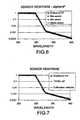
- the sensor response curve is obtained, which has to be compared with the erythema action one.
- both curves are reported along with the curves obtained for the photodiodes which greatly diverge from the average curve ( Fig.6 - SiC 2 and SiC 5). It derives that by using any of the measured photodiodes, the sensor maintains a curve very similar to the erythema a one.
- the interference filters respond spectrally in a different way to the radiation incident at different angles
- an analysis has been carried out relating the solid angle acceptable by the system: the filter and the whole sensor response has been simulated at different acceptance solid angles on the filter.
- the performance are fully acceptable for a 40° cone. This defines, downstream of the diffuser, the opening of the filter + photodiode system and guides the mechanical positioning of the filter relative to the diffuser based on the physical dimension of the filter and the insertion of diaphragms before the filter, if required.
- the effective irradiance of several (high and low pressure) lamps used in a beauty environment with respective filters has been calculated by multiplying the erythema nominal action curve by the one of the sensor described above.
- the curve integrals have been then calculated such as to obtain an estimate of the total effective irradiance in both cases.
- the relative error occurring with the described sensor is in the order of a few percentages.
- a 75% flux loss has been further considered, corresponding to an acceptance angular cone of 45°.
- the currents which are measured by small-sized photodiodes are in the order of nA's. The sensor effectiveness is thus appropriated.
- the sensor output value thus directly provides the measure of the total effective irradiance of the source, without requiring a further processing of the measured data.
- the sensor described can be for example assembled in an aluminum container; the shape of the probe is preferably cylindrical.
- the probe is connected by means of a wire to a photocurrent meter.
- commercial meters can be used, which are already arranged for the effective irradiance values (W/m 2 ) to be visualized on a graphic display when the probe has been calibrated.
- the instrument can be provided in an easily portable form and lightweight ( ⁇ 0,5 kg).
- the radiometer thus conceived is user-friendly, compact and cost-effective.
- the users are those who have to monitor the skin damage resulting from ultraviolet exposure, in particular solarium owners, manufacturers of tanning lamps and tanning beds.
- the exposure conditions can be greatly modified by simply replacing the tanning lamp of an appliance, as lamps of the same type but from different stocks often exhibit different spectral emissions; hence there is the need of frequently monitoring the condition of these appliances.
- the use of the sensor can also be extended to monitoring the atmospheric ultraviolet.
- the senor or radiometer according to the invention can comprise further accessories, such as a UVB filter (in order to be able to select the 250-320 and 320-400 nm bands in an independent manner).
- a UVB filter in order to be able to select the 250-320 and 320-400 nm bands in an independent manner.
Landscapes
- Physics & Mathematics (AREA)
- General Physics & Mathematics (AREA)
- Spectroscopy & Molecular Physics (AREA)
- Optics & Photonics (AREA)
- Photometry And Measurement Of Optical Pulse Characteristics (AREA)
- Luminescent Compositions (AREA)
- Confectionery (AREA)
- Investigating Or Analysing Materials By The Use Of Chemical Reactions (AREA)
- Spectrometry And Color Measurement (AREA)
- Length Measuring Devices By Optical Means (AREA)
Abstract
Description
- The present invention relates to an optical sensor, suitable to simulate the action curve of the human skin erythema and a radiometer comprising the same, suitable to measure the total effective irradiance of UV sources.
- It is known that a prolonged and excessive exposure to UV radiation causes the skin ageing process, can help the onset of skin erythemas, burns and skin neoplastic forms.
- The European Standard EN60335-2-27 and the corresponding Italian Standard CEI EN60335-2-27 ("Safety of electric household and similar appliances",
part 2, "Particular provisions for household and similar appliances for skin treatment with ultraviolet radiation"), in force from May 1st 1998, deal with the toxicity of appliances with ultraviolet emission (250-400 nm), and set the threshold levels at which a human being can be exposed. - This regulation also explicitly contemplates the tanning appliances for cosmetic use, which are recommended to be used with a maximum effective exposure dosage of 100 J/m2 for the untanned skin in the first session and a maximum exposure dosage of 15KJ/m2 per individual per year.
- The dosage has to be calculated based on the appliance effective irradiance, which is obtained per each wavelength by means of a weight factor, such as defined by the erythema action curve (CIE Research Note, 1987, "A reference action spectrum for the ultraviolet induced erythema in human skin", CIE J.6, 17-22).
- Currently, the measurement of the irradiance from a source can be carried out using two types of instruments: spectroradiometers and radiometers.
- The spectroradiometer allows measuring the resolved irradiance for each single wavelength. In the case of UV irradiance, the total effective irradiance is then obtained using the weight factor as given by the erythema curve and integrating on the entire spectral range.
- However, an accurate measurement which also allows the source appliance to be classified according to the types defined by the above-mentioned CEI EN60335-2-27 standard, can be carried out only by means of double monochromator spectroradiometers, which are very complex and have such a size that they can only be used in a laboratory.
- In order to measure the total irradiance of a source, a radiometer is thus preferred, which is considerably less expensive (costs are from ten to one hundred times lower) and user-friendly, such as to be operated even by untrained users.
- Various types of radiometers using different sensors are available on the market. The phosphorus-based radiometers, of the Robertson-Berger type, are based on the conversion of ultraviolet light to visible light by means of phosphorus. This instrument can approximate the spectral curve of the erythema in the 280-320 nm region and is thus mainly used for measuring solar UVB irradiance.
- One of the main problems occurring with the instruments using phosphorus is that their spectral response strongly varies with the temperature and thus they require a thermal control of the system.
- Solutions with GaN sensors coupled with interference filters made of hard oxides have a response that greatly differs from that of the erythema for long wavelengths, where the sensitivity of the GaN photodiodes is very low.
- AlGaN photodiodes directly obtained by doping the GaN sensor with A1 have been developed in order to simulate the erythema spectral response, but the response actually greatly differs from the nominal one, and they further offer low sensitivity.
- Radiometers are also known to use sensors comprising an interference filter and a photodiode; however, their spectral response curves differ from the ones of the skin erythema, particularly in the UVA region where the irradiance from the tanning lamps is the greatest.
- A solution providing the coupling of a photodiode and an interference filter is reported in
US 6 426 503 , which describes a portable radiometer or dosimeter having the characteristics as set forth in the preamble ofclaim 1 below, comprising an interference filter which - in the example described - is formed by 75 layers of hafnium, silicon and aluminum oxide, having characteristics of transmission similar to the erythema action curve. - As a detector, the dosimeter uses a SiC, or preferably AlGaN photodiode.
- Document
WO 2005/015 138 A1 discloses an ultraviolet meter including a first sensor for measuring UV rays B and a second sensor for measuring UV rays A. -
US 6 392 239 describes a system of absorbance and interference filters, the response curve of which approximates with the erythema action curve (Diffey Standard). The materials used for providing the multi-layer interference filter are hafnium oxide, zirconium oxide and silicon oxide. -
US 6 822 789 describes a UV radiation-absorbing filter system, which in an embodiment are used along with a system of interference filters - consisting of 38 layers of hafnium oxide and/or zirconium oxide and silicon oxide - in order to modify and increase the spectral transmission characteristics of the matrix. - The object of the present invention is to provide a novel, compact and user-friendly radiometer having a spectral response corresponding to that of the erythema action curve and particularly suitable for providing a measurement of the effective irradiance from UV sources, particularly such as tanning appliances.
- In view of this object, the subject of the invention is a radiometer having the characteristics as defined in the claims below.
- Further characteristics and advantages of the radiometer according to the invention will be apparent from the detailed description below, with reference to a specific embodiment given by way of non-limiting example.
- In the annexed drawings:
-
Fig.1 is a schematic representation of the structure of the sensor according to the invention, which essentially consists of atransmission diffuser 1, aninterference filter 2 and aphotodiode UV 3. - The diffuser is arranged to collect the radiation from different directions. Particularly, as the radiation from a UV source, such as a tanning bed, comes from every directions, when an irradiance measurement has to be carried out, the instrument inlet optic has to be a Lambert diffuser.
- To the purpose, the diffuser can be made of teflon or quartz, which offer different transmission curves.
Fig. 2 shows the measured transmission curves of a standard quartz diffuser and of a teflon one having a thickness.of 500 micron. - As to the teflon, it provides a response curve which behaves well according to the cosine rule. In this respect, laboratory tests have been carried out by lightning the diffuser with collimated radiation from several angles of incidence and by measuring the transmitted radiation by means of a photodiode. The measure has been then weighed with the cosine of the angle of incidence and compared with the theoretical response curve of an ideal Lambert diffuser.
- The two normalized curves are illustrated in
Fig. 2a , where teflon is seen to behave well up to angles of incidence of 80a. The quartz, on the contrary, may require to be worked in suitable forms. - Within the scope of the present invention, a Sic photodiode is used as the detector, which is sensitive in the spectral region of interest (250-400 nm) and blind in the visible and near-infrared and thus does not require to be used in combination with UV bandpass filters. SiC photodiodes are easily available on the market, they are stable at high temperatures and their high Shunt resistance value allows small currents to be detected.
- In
Fig. 3 there are shown the relative (not absolute) spectral responses that are measured using a halogen lamp as the source and obtained by comparison with a Si photodiode calibrated relative to six SiC commercial photodiodes: as may be seen, the response is similar for all the photodiodes. - The average relative spectral response of the six spectral responses is reported in
Fig. 4 . This represents, with a scaling factor less than one, the nominal response curve of the photodiode, preferably used in the sensor according to the invention. - From the ratio of the nominal erythema action curve to the product between the photodiode spectral response curve and the transmission of the diffuser, it is possible to get the response curve, which the interference filter must have, with a scaling factor less than one.
- The scaling factor allows changing the filter peak transmission. To maximize the signal, the filter transmission peak has been defined to be 100%. The filter target curve is reported in
Fig. 5 . - The filter design can be provided using a commercial software. The filter substrate is preferably UV Graded Fused Silica, a material that transmits in the spectral region of interest in a uniform manner.
- The filter consists of 30-40 alternating layers of MgF2 and ZrO2.
- By way of example, in Table 1 there is reported the filter structure adoptive with a SiC photodiode and a quartz diffuser. The optimum thicknesses can be slightly varied as compared with those reported in Table 1 as they depend on the optical constants of the materials, which can slightly change according to the deposition process employed.
TABLE 1 # layer Material Physical thickness(nm) 1 ZrO2 60.40 2 MgF2 94.38 3 ZrO2 62.94 4 MgF2 21.23 5 ZrO2 73.84 6 MgF2 34.89 7 ZrO2 68.47 8 MgF2 35.38 9 ZrO2 63.38 10 MgO2 68.69 11 ZrO2 62.25 12 MgF2 37.86 13 ZrO2 57.49 14 MgF2 61.08 15 ZrO2 44.13 16 MgF2 75.79 17 ZrO2 44.51 18 MgF2 66.37 19 ZrO2 38.60 20 MgF2 70.48 21 ZrO2 39.18 22 MgF2 65.47 23 ZrO2 107.67 24 MgF2 67.72 25 ZrO2 39.86 26 MgF2 68.81 27 ZrO2 38.15 28 MgF2 26.88 29 ZrO2 61.82 30 MgF2 27.69 31 ZrO2 111.12 - In the above-mentioned
Fig. 5 , there is also reported the simulation of the filter performance per collimated incident radiation (substrate thickness of 1 mm); as may be seen, the response curve is very proximate to the nominal one. - By multiplying the filter transmission curve by the photodiode and diffuser response ones and normalizing the same to its maximum value (or to a more suitable point, which is established during the instrument calibration step) the sensor response curve is obtained, which has to be compared with the erythema action one. In
Fig. 6 , both curves are reported along with the curves obtained for the photodiodes which greatly diverge from the average curve (Fig.6 -SiC 2 and SiC 5). It derives that by using any of the measured photodiodes, the sensor maintains a curve very similar to the erythema a one. - Since the interference filters respond spectrally in a different way to the radiation incident at different angles, an analysis has been carried out relating the solid angle acceptable by the system: the filter and the whole sensor response has been simulated at different acceptance solid angles on the filter. As may be seen in
Fig. 7 , the performance are fully acceptable for a 40° cone. This defines, downstream of the diffuser, the opening of the filter + photodiode system and guides the mechanical positioning of the filter relative to the diffuser based on the physical dimension of the filter and the insertion of diaphragms before the filter, if required. - To assess the sensor performance, the effective irradiance of several (high and low pressure) lamps used in a beauty environment with respective filters (filters are inserted in the lamps to the discretion of the manufacturer of the tanning system) has been calculated by multiplying the erythema nominal action curve by the one of the sensor described above.
- The curve integrals have been then calculated such as to obtain an estimate of the total effective irradiance in both cases. The relative error occurring with the described sensor is in the order of a few percentages.
- Finally, an analysis of the tolerances on the filter thicknesses has been carried out: random variations have been introduced on the physical thickness of the individual layers and the effective irradiation calculations have been repeated using the varied sensor response curves. Tolerances in the order of 1 nm rms on the single layer have resulted to be definitely acceptable.
- Linearity tests on the photodiode have been carried out, and the same results to be linear in the scale of tens of pA to 4 µA.
- To assess the sensor effectiveness, reference has been made to the integral of a lamp effective irradiance curve. The transmission of the diffuser has been estimated as being 5 to 50%, of the filter at the 40% peak, and the sensor response effectiveness has been used as per the specifications.
- A 75% flux loss has been further considered, corresponding to an acceptance angular cone of 45°. The currents which are measured by small-sized photodiodes (such as 0,22 mm2) are in the order of nA's. The sensor effectiveness is thus appropriated.
- The sensor output value thus directly provides the measure of the total effective irradiance of the source, without requiring a further processing of the measured data.
- The sensor described can be for example assembled in an aluminum container; the shape of the probe is preferably cylindrical. The probe is connected by means of a wire to a photocurrent meter. To the purpose, commercial meters can be used, which are already arranged for the effective irradiance values (W/m2) to be visualized on a graphic display when the probe has been calibrated.
- The instrument can be provided in an easily portable form and lightweight (< 0,5 kg).
- The radiometer thus conceived is user-friendly, compact and cost-effective.
- In particular, the users are those who have to monitor the skin damage resulting from ultraviolet exposure, in particular solarium owners, manufacturers of tanning lamps and tanning beds.
- For example, the exposure conditions can be greatly modified by simply replacing the tanning lamp of an appliance, as lamps of the same type but from different stocks often exhibit different spectral emissions; hence there is the need of frequently monitoring the condition of these appliances.
- The use of the sensor can also be extended to monitoring the atmospheric ultraviolet.
- It is understood that the sensor or radiometer according to the invention can comprise further accessories, such as a UVB filter (in order to be able to select the 250-320 and 320-400 nm bands in an independent manner).
Claims (3)
- A radiometer for measuring the effective UV irradiance of the type comprising, in an optical pathway sequence, an interference filter and a detector, characterized in that said interference filter comprises 30 to 40 alternating layers of magnesium fluoride and zirconium oxide, said detector is a SiC photodiode and in that said radiometer has a spectral response that does not differ punctually by more than 20% from the erythema action curve CIE in the range between 250 to 400 nm.
- The radiometer according to claim 1, characterized in that it further comprises a diffuser and wherein the diffuser/interference filter/detector system has a spectral response equivalent to the erythema action curve CIE.
- The radiometer according to claim 2, characterized in that said diffuser is a Lambert diffuser made of Teflon or quartz.
Applications Claiming Priority (2)
| Application Number | Priority Date | Filing Date | Title |
|---|---|---|---|
| IT000249A ITTO20050249A1 (en) | 2005-04-14 | 2005-04-14 | RADIOMETER WITH SPECTRAL ANSWER EQUIVALENT TO THE CIE CURVE OF ERITEMA ACTION, FOR EFFECTIVE TOTAL IRRADIATION MEASURES |
| PCT/IB2006/000848 WO2006109140A1 (en) | 2005-04-14 | 2006-04-11 | A radiometer with spectral response equivalent to the erythema action curve cie, for measuring the total effective irradiance |
Publications (2)
| Publication Number | Publication Date |
|---|---|
| EP1875177A1 EP1875177A1 (en) | 2008-01-09 |
| EP1875177B1 true EP1875177B1 (en) | 2010-03-03 |
Family
ID=36648563
Family Applications (1)
| Application Number | Title | Priority Date | Filing Date |
|---|---|---|---|
| EP06727462A Expired - Lifetime EP1875177B1 (en) | 2005-04-14 | 2006-04-11 | A radiometer with spectral response equivalent to the erythema action curve cie, for measuring the total effective irradiance |
Country Status (6)
| Country | Link |
|---|---|
| US (1) | US7947962B2 (en) |
| EP (1) | EP1875177B1 (en) |
| AT (1) | ATE459863T1 (en) |
| DE (1) | DE602006012648D1 (en) |
| IT (1) | ITTO20050249A1 (en) |
| WO (1) | WO2006109140A1 (en) |
Cited By (1)
| Publication number | Priority date | Publication date | Assignee | Title |
|---|---|---|---|---|
| DE102012022052A1 (en) * | 2012-11-09 | 2014-05-15 | Black Photon Instruments GmbH | Optoelectronic sensor used for measuring solar radiation, has optical filter whose transmission characteristic is proportional to photon energy and inversely proportional to external quantum efficiency of photovoltaic cell |
Families Citing this family (10)
| Publication number | Priority date | Publication date | Assignee | Title |
|---|---|---|---|---|
| EP2299250B1 (en) * | 2009-09-17 | 2014-04-23 | LayTec Aktiengesellschaft | Pyrometer adapted for detecting UV-radiation and use thereof |
| US9024271B2 (en) * | 2011-06-24 | 2015-05-05 | Shahid Aslam | Wearable radiation detector |
| CN103649696B (en) * | 2011-10-11 | 2016-05-18 | 三菱电机株式会社 | Laser output measuring mechanism |
| CN103731518B (en) | 2012-10-15 | 2017-04-26 | 华为终端有限公司 | Method and structure for increasing receiving angle of optical sensor and handheld terminal |
| US20170027447A1 (en) * | 2014-04-18 | 2017-02-02 | The General Hospital Corporation | System and method for improved light delivery to and from subjects |
| US10132679B2 (en) * | 2014-05-23 | 2018-11-20 | Maxim Integrated Products, Inc. | Ultraviolet sensor having filter |
| JP6875390B2 (en) * | 2015-10-20 | 2021-05-26 | スペクトラフィ インコーポレイテッドSpectrafy Inc. | All-sky solar spectrum device and method |
| US9778103B1 (en) | 2016-05-13 | 2017-10-03 | Eit, Llc | UV radiometry instruments and methods |
| WO2021074734A1 (en) | 2019-10-14 | 2021-04-22 | 3M Innovative Properties Company | Compositions comprising cyclic olefins and thermally conductive filler |
| KR102915528B1 (en) | 2019-12-20 | 2026-01-21 | 쓰리엠 이노베이티브 프로퍼티즈 캄파니 | Adhesive articles, adhesive compositions and methods comprising polymers and polymerizable cyclic olefins |
Family Cites Families (5)
| Publication number | Priority date | Publication date | Assignee | Title |
|---|---|---|---|---|
| NZ209325A (en) * | 1984-08-23 | 1987-07-31 | Nz Government | Uv actinometer using disulphides |
| US5837894A (en) * | 1995-02-09 | 1998-11-17 | Honeywell Inc. | Wide field of view sensor with diffractive optic corrector |
| PL181650B1 (en) * | 1996-12-30 | 2001-08-31 | Jan Kuklinski | Optical system for converting ultraviolet radiation |
| US6426503B1 (en) * | 2000-06-09 | 2002-07-30 | Southwest Research Institute | Opto-electronic ultra-violet radiation dosimeter |
| WO2005015138A1 (en) * | 2003-08-11 | 2005-02-17 | Alphacube Co., Ltd. | Ultraviolet light measure |
-
2005
- 2005-04-14 IT IT000249A patent/ITTO20050249A1/en unknown
-
2006
- 2006-04-11 AT AT06727462T patent/ATE459863T1/en not_active IP Right Cessation
- 2006-04-11 EP EP06727462A patent/EP1875177B1/en not_active Expired - Lifetime
- 2006-04-11 DE DE602006012648T patent/DE602006012648D1/en not_active Expired - Lifetime
- 2006-04-11 US US11/918,314 patent/US7947962B2/en not_active Expired - Fee Related
- 2006-04-11 WO PCT/IB2006/000848 patent/WO2006109140A1/en not_active Ceased
Cited By (1)
| Publication number | Priority date | Publication date | Assignee | Title |
|---|---|---|---|---|
| DE102012022052A1 (en) * | 2012-11-09 | 2014-05-15 | Black Photon Instruments GmbH | Optoelectronic sensor used for measuring solar radiation, has optical filter whose transmission characteristic is proportional to photon energy and inversely proportional to external quantum efficiency of photovoltaic cell |
Also Published As
| Publication number | Publication date |
|---|---|
| ATE459863T1 (en) | 2010-03-15 |
| US20090218504A1 (en) | 2009-09-03 |
| DE602006012648D1 (en) | 2010-04-15 |
| US7947962B2 (en) | 2011-05-24 |
| WO2006109140A8 (en) | 2007-03-15 |
| WO2006109140A1 (en) | 2006-10-19 |
| EP1875177A1 (en) | 2008-01-09 |
| ITTO20050249A1 (en) | 2006-10-15 |
Similar Documents
| Publication | Publication Date | Title |
|---|---|---|
| Diffey | Sources and measurement of ultraviolet radiation | |
| US6501542B2 (en) | Apparatus and method for measuring optical characteristics of an object | |
| Diffey | A comparison of dosimeters used for solar ultraviolet radiometry | |
| Mohamed et al. | Wearable light spectral sensor optimized for measuring daily α-opic light exposure | |
| US7947962B2 (en) | Radiometer with spectral response equivalent to the erythema action curve CIE, for measuring the total effective irradiance | |
| CN105277278A (en) | Semiconductor integrated device for UV index detection and related calibration system and method | |
| Butson et al. | Ultraviolet radiation dosimetry with radiochromic film | |
| US20210389181A1 (en) | Photosensors for color measurement | |
| Driscoll | Dosimetry methods for UV radiation | |
| CN119147095A (en) | Spectral radiance measurement and calibration method for point light source | |
| Landry et al. | Optical radiation measurements: instrumentation and sources of error | |
| Diffey | Possible errors involved in the dosimetry of solar UV-B radiation | |
| Coleman et al. | Clinical ultraviolet dosimetry with a CCD monochromator array spectroradiometer | |
| Oliver et al. | The use of diode array spectroradiometers for dosimetry in phototherapy | |
| Turnbull et al. | Utilising polyphenylene oxide for high exposure solar UVA dosimetry | |
| Garoli et al. | Ultraviolet filters for sensors matching biological action spectra | |
| Diffey et al. | Dosimetry of ultraviolet radiation | |
| Brown et al. | Advances in radiometry for ocean color | |
| Reda et al. | Construction and characterization of a phototherapy radiometer for optical radiation measurements | |
| Gugg-Helminger | CIE 220: 2016-Characterization and Calibration Method of UV Radiometers | |
| Faramawy | Optical Sensors | |
| Eppeldauer et al. | 4. Transfer Standard Filter Radiometers: Applications to Fundamental Scales | |
| Forment et al. | Stray light performance of a combined monochromator–spectrograph UV irradiance measuring instrument | |
| Coleman | A new UKAS accredited calibration system for ultraviolet radiometers | |
| Podobedov et al. | Evaluation of optical radiation detectors in the range from 0.8 μm to 20 μm at the NIST infrared spectral calibration facility |
Legal Events
| Date | Code | Title | Description |
|---|---|---|---|
| PUAI | Public reference made under article 153(3) epc to a published international application that has entered the european phase |
Free format text: ORIGINAL CODE: 0009012 |
|
| 17P | Request for examination filed |
Effective date: 20071114 |
|
| AK | Designated contracting states |
Kind code of ref document: A1 Designated state(s): AT BE BG CH CY CZ DE DK EE ES FI FR GB GR HU IE IS IT LI LT LU LV MC NL PL PT RO SE SI SK TR |
|
| 17Q | First examination report despatched |
Effective date: 20080124 |
|
| DAX | Request for extension of the european patent (deleted) | ||
| GRAP | Despatch of communication of intention to grant a patent |
Free format text: ORIGINAL CODE: EPIDOSNIGR1 |
|
| GRAS | Grant fee paid |
Free format text: ORIGINAL CODE: EPIDOSNIGR3 |
|
| RIN1 | Information on inventor provided before grant (corrected) |
Inventor name: NICOLOSI, PIERGIORGIO Inventor name: CECCHERINI, PAOLO Inventor name: PELIZZO, MARIA-GUGLIELMINA |
|
| GRAA | (expected) grant |
Free format text: ORIGINAL CODE: 0009210 |
|
| AK | Designated contracting states |
Kind code of ref document: B1 Designated state(s): AT BE BG CH CY CZ DE DK EE ES FI FR GB GR HU IE IS IT LI LT LU LV MC NL PL PT RO SE SI SK TR |
|
| REG | Reference to a national code |
Ref country code: GB Ref legal event code: FG4D |
|
| REG | Reference to a national code |
Ref country code: CH Ref legal event code: EP |
|
| REG | Reference to a national code |
Ref country code: IE Ref legal event code: FG4D |
|
| REF | Corresponds to: |
Ref document number: 602006012648 Country of ref document: DE Date of ref document: 20100415 Kind code of ref document: P |
|
| REG | Reference to a national code |
Ref country code: NL Ref legal event code: T3 |
|
| PG25 | Lapsed in a contracting state [announced via postgrant information from national office to epo] |
Ref country code: LT Free format text: LAPSE BECAUSE OF FAILURE TO SUBMIT A TRANSLATION OF THE DESCRIPTION OR TO PAY THE FEE WITHIN THE PRESCRIBED TIME-LIMIT Effective date: 20100303 |
|
| LTIE | Lt: invalidation of european patent or patent extension |
Effective date: 20100303 |
|
| PG25 | Lapsed in a contracting state [announced via postgrant information from national office to epo] |
Ref country code: FI Free format text: LAPSE BECAUSE OF FAILURE TO SUBMIT A TRANSLATION OF THE DESCRIPTION OR TO PAY THE FEE WITHIN THE PRESCRIBED TIME-LIMIT Effective date: 20100303 Ref country code: AT Free format text: LAPSE BECAUSE OF FAILURE TO SUBMIT A TRANSLATION OF THE DESCRIPTION OR TO PAY THE FEE WITHIN THE PRESCRIBED TIME-LIMIT Effective date: 20100303 Ref country code: LV Free format text: LAPSE BECAUSE OF FAILURE TO SUBMIT A TRANSLATION OF THE DESCRIPTION OR TO PAY THE FEE WITHIN THE PRESCRIBED TIME-LIMIT Effective date: 20100303 Ref country code: PL Free format text: LAPSE BECAUSE OF FAILURE TO SUBMIT A TRANSLATION OF THE DESCRIPTION OR TO PAY THE FEE WITHIN THE PRESCRIBED TIME-LIMIT Effective date: 20100303 Ref country code: SI Free format text: LAPSE BECAUSE OF FAILURE TO SUBMIT A TRANSLATION OF THE DESCRIPTION OR TO PAY THE FEE WITHIN THE PRESCRIBED TIME-LIMIT Effective date: 20100303 |
|
| PG25 | Lapsed in a contracting state [announced via postgrant information from national office to epo] |
Ref country code: RO Free format text: LAPSE BECAUSE OF FAILURE TO SUBMIT A TRANSLATION OF THE DESCRIPTION OR TO PAY THE FEE WITHIN THE PRESCRIBED TIME-LIMIT Effective date: 20100303 Ref country code: SE Free format text: LAPSE BECAUSE OF FAILURE TO SUBMIT A TRANSLATION OF THE DESCRIPTION OR TO PAY THE FEE WITHIN THE PRESCRIBED TIME-LIMIT Effective date: 20100303 Ref country code: BE Free format text: LAPSE BECAUSE OF FAILURE TO SUBMIT A TRANSLATION OF THE DESCRIPTION OR TO PAY THE FEE WITHIN THE PRESCRIBED TIME-LIMIT Effective date: 20100303 Ref country code: CY Free format text: LAPSE BECAUSE OF FAILURE TO SUBMIT A TRANSLATION OF THE DESCRIPTION OR TO PAY THE FEE WITHIN THE PRESCRIBED TIME-LIMIT Effective date: 20100303 Ref country code: EE Free format text: LAPSE BECAUSE OF FAILURE TO SUBMIT A TRANSLATION OF THE DESCRIPTION OR TO PAY THE FEE WITHIN THE PRESCRIBED TIME-LIMIT Effective date: 20100303 Ref country code: ES Free format text: LAPSE BECAUSE OF FAILURE TO SUBMIT A TRANSLATION OF THE DESCRIPTION OR TO PAY THE FEE WITHIN THE PRESCRIBED TIME-LIMIT Effective date: 20100614 Ref country code: GR Free format text: LAPSE BECAUSE OF FAILURE TO SUBMIT A TRANSLATION OF THE DESCRIPTION OR TO PAY THE FEE WITHIN THE PRESCRIBED TIME-LIMIT Effective date: 20100604 |
|
| PG25 | Lapsed in a contracting state [announced via postgrant information from national office to epo] |
Ref country code: SK Free format text: LAPSE BECAUSE OF FAILURE TO SUBMIT A TRANSLATION OF THE DESCRIPTION OR TO PAY THE FEE WITHIN THE PRESCRIBED TIME-LIMIT Effective date: 20100303 Ref country code: MC Free format text: LAPSE BECAUSE OF NON-PAYMENT OF DUE FEES Effective date: 20100430 Ref country code: IS Free format text: LAPSE BECAUSE OF FAILURE TO SUBMIT A TRANSLATION OF THE DESCRIPTION OR TO PAY THE FEE WITHIN THE PRESCRIBED TIME-LIMIT Effective date: 20100703 Ref country code: CZ Free format text: LAPSE BECAUSE OF FAILURE TO SUBMIT A TRANSLATION OF THE DESCRIPTION OR TO PAY THE FEE WITHIN THE PRESCRIBED TIME-LIMIT Effective date: 20100303 Ref country code: BG Free format text: LAPSE BECAUSE OF FAILURE TO SUBMIT A TRANSLATION OF THE DESCRIPTION OR TO PAY THE FEE WITHIN THE PRESCRIBED TIME-LIMIT Effective date: 20100603 |
|
| REG | Reference to a national code |
Ref country code: CH Ref legal event code: PL |
|
| PLBE | No opposition filed within time limit |
Free format text: ORIGINAL CODE: 0009261 |
|
| STAA | Information on the status of an ep patent application or granted ep patent |
Free format text: STATUS: NO OPPOSITION FILED WITHIN TIME LIMIT |
|
| PG25 | Lapsed in a contracting state [announced via postgrant information from national office to epo] |
Ref country code: IE Free format text: LAPSE BECAUSE OF NON-PAYMENT OF DUE FEES Effective date: 20100411 Ref country code: PT Free format text: LAPSE BECAUSE OF FAILURE TO SUBMIT A TRANSLATION OF THE DESCRIPTION OR TO PAY THE FEE WITHIN THE PRESCRIBED TIME-LIMIT Effective date: 20100705 Ref country code: DK Free format text: LAPSE BECAUSE OF FAILURE TO SUBMIT A TRANSLATION OF THE DESCRIPTION OR TO PAY THE FEE WITHIN THE PRESCRIBED TIME-LIMIT Effective date: 20100303 |
|
| 26N | No opposition filed |
Effective date: 20101206 |
|
| PG25 | Lapsed in a contracting state [announced via postgrant information from national office to epo] |
Ref country code: CH Free format text: LAPSE BECAUSE OF NON-PAYMENT OF DUE FEES Effective date: 20100430 Ref country code: LI Free format text: LAPSE BECAUSE OF NON-PAYMENT OF DUE FEES Effective date: 20100430 |
|
| PGFP | Annual fee paid to national office [announced via postgrant information from national office to epo] |
Ref country code: FR Payment date: 20110512 Year of fee payment: 6 Ref country code: DE Payment date: 20110421 Year of fee payment: 6 |
|
| PGFP | Annual fee paid to national office [announced via postgrant information from national office to epo] |
Ref country code: GB Payment date: 20110421 Year of fee payment: 6 Ref country code: NL Payment date: 20110426 Year of fee payment: 6 |
|
| PGFP | Annual fee paid to national office [announced via postgrant information from national office to epo] |
Ref country code: IT Payment date: 20110421 Year of fee payment: 6 |
|
| PG25 | Lapsed in a contracting state [announced via postgrant information from national office to epo] |
Ref country code: LU Free format text: LAPSE BECAUSE OF NON-PAYMENT OF DUE FEES Effective date: 20100411 Ref country code: HU Free format text: LAPSE BECAUSE OF FAILURE TO SUBMIT A TRANSLATION OF THE DESCRIPTION OR TO PAY THE FEE WITHIN THE PRESCRIBED TIME-LIMIT Effective date: 20100904 |
|
| PG25 | Lapsed in a contracting state [announced via postgrant information from national office to epo] |
Ref country code: TR Free format text: LAPSE BECAUSE OF FAILURE TO SUBMIT A TRANSLATION OF THE DESCRIPTION OR TO PAY THE FEE WITHIN THE PRESCRIBED TIME-LIMIT Effective date: 20100303 |
|
| REG | Reference to a national code |
Ref country code: NL Ref legal event code: V1 Effective date: 20121101 |
|
| GBPC | Gb: european patent ceased through non-payment of renewal fee |
Effective date: 20120411 |
|
| REG | Reference to a national code |
Ref country code: FR Ref legal event code: ST Effective date: 20121228 |
|
| PG25 | Lapsed in a contracting state [announced via postgrant information from national office to epo] |
Ref country code: GB Free format text: LAPSE BECAUSE OF NON-PAYMENT OF DUE FEES Effective date: 20120411 |
|
| REG | Reference to a national code |
Ref country code: DE Ref legal event code: R119 Ref document number: 602006012648 Country of ref document: DE Effective date: 20121101 |
|
| PG25 | Lapsed in a contracting state [announced via postgrant information from national office to epo] |
Ref country code: FR Free format text: LAPSE BECAUSE OF NON-PAYMENT OF DUE FEES Effective date: 20120430 Ref country code: IT Free format text: LAPSE BECAUSE OF NON-PAYMENT OF DUE FEES Effective date: 20120411 |
|
| PG25 | Lapsed in a contracting state [announced via postgrant information from national office to epo] |
Ref country code: NL Free format text: LAPSE BECAUSE OF NON-PAYMENT OF DUE FEES Effective date: 20121101 |
|
| PG25 | Lapsed in a contracting state [announced via postgrant information from national office to epo] |
Ref country code: DE Free format text: LAPSE BECAUSE OF NON-PAYMENT OF DUE FEES Effective date: 20121101 |