EP1871347B1 - Pharmaceutical composition - Google Patents
Pharmaceutical composition Download PDFInfo
- Publication number
- EP1871347B1 EP1871347B1 EP06750475.3A EP06750475A EP1871347B1 EP 1871347 B1 EP1871347 B1 EP 1871347B1 EP 06750475 A EP06750475 A EP 06750475A EP 1871347 B1 EP1871347 B1 EP 1871347B1
- Authority
- EP
- European Patent Office
- Prior art keywords
- weight
- range
- present
- per cent
- methyl
- Prior art date
- Legal status (The legal status is an assumption and is not a legal conclusion. Google has not performed a legal analysis and makes no representation as to the accuracy of the status listed.)
- Expired - Lifetime
Links
Classifications
-
- A—HUMAN NECESSITIES
- A61—MEDICAL OR VETERINARY SCIENCE; HYGIENE
- A61K—PREPARATIONS FOR MEDICAL, DENTAL OR TOILETRY PURPOSES
- A61K9/00—Medicinal preparations characterised by special physical form
- A61K9/20—Pills, tablets, discs, rods
-
- A—HUMAN NECESSITIES
- A61—MEDICAL OR VETERINARY SCIENCE; HYGIENE
- A61K—PREPARATIONS FOR MEDICAL, DENTAL OR TOILETRY PURPOSES
- A61K31/00—Medicinal preparations containing organic active ingredients
- A61K31/33—Heterocyclic compounds
- A61K31/395—Heterocyclic compounds having nitrogen as a ring hetero atom, e.g. guanethidine or rifamycins
- A61K31/495—Heterocyclic compounds having nitrogen as a ring hetero atom, e.g. guanethidine or rifamycins having six-membered rings with two or more nitrogen atoms as the only ring heteroatoms, e.g. piperazine or tetrazines
- A61K31/505—Pyrimidines; Hydrogenated pyrimidines, e.g. trimethoprim
- A61K31/517—Pyrimidines; Hydrogenated pyrimidines, e.g. trimethoprim ortho- or peri-condensed with carbocyclic ring systems, e.g. quinazoline, perimidine
-
- A—HUMAN NECESSITIES
- A61—MEDICAL OR VETERINARY SCIENCE; HYGIENE
- A61K—PREPARATIONS FOR MEDICAL, DENTAL OR TOILETRY PURPOSES
- A61K31/00—Medicinal preparations containing organic active ingredients
- A61K31/33—Heterocyclic compounds
- A61K31/395—Heterocyclic compounds having nitrogen as a ring hetero atom, e.g. guanethidine or rifamycins
- A61K31/495—Heterocyclic compounds having nitrogen as a ring hetero atom, e.g. guanethidine or rifamycins having six-membered rings with two or more nitrogen atoms as the only ring heteroatoms, e.g. piperazine or tetrazines
- A61K31/505—Pyrimidines; Hydrogenated pyrimidines, e.g. trimethoprim
- A61K31/519—Pyrimidines; Hydrogenated pyrimidines, e.g. trimethoprim ortho- or peri-condensed with heterocyclic rings
-
- A—HUMAN NECESSITIES
- A61—MEDICAL OR VETERINARY SCIENCE; HYGIENE
- A61K—PREPARATIONS FOR MEDICAL, DENTAL OR TOILETRY PURPOSES
- A61K47/00—Medicinal preparations characterised by the non-active ingredients used, e.g. carriers or inert additives; Targeting or modifying agents chemically bound to the active ingredient
- A61K47/30—Macromolecular organic or inorganic compounds, e.g. inorganic polyphosphates
- A61K47/36—Polysaccharides; Derivatives thereof, e.g. gums, starch, alginate, dextrin, hyaluronic acid, chitosan, inulin, agar or pectin
- A61K47/38—Cellulose; Derivatives thereof
-
- A—HUMAN NECESSITIES
- A61—MEDICAL OR VETERINARY SCIENCE; HYGIENE
- A61K—PREPARATIONS FOR MEDICAL, DENTAL OR TOILETRY PURPOSES
- A61K9/00—Medicinal preparations characterised by special physical form
- A61K9/20—Pills, tablets, discs, rods
- A61K9/2004—Excipients; Inactive ingredients
- A61K9/2013—Organic compounds, e.g. phospholipids, fats
-
- A—HUMAN NECESSITIES
- A61—MEDICAL OR VETERINARY SCIENCE; HYGIENE
- A61K—PREPARATIONS FOR MEDICAL, DENTAL OR TOILETRY PURPOSES
- A61K9/00—Medicinal preparations characterised by special physical form
- A61K9/20—Pills, tablets, discs, rods
- A61K9/2004—Excipients; Inactive ingredients
- A61K9/2022—Organic macromolecular compounds
- A61K9/2027—Organic macromolecular compounds obtained by reactions only involving carbon-to-carbon unsaturated bonds, e.g. polyvinyl pyrrolidone, poly(meth)acrylates
-
- A—HUMAN NECESSITIES
- A61—MEDICAL OR VETERINARY SCIENCE; HYGIENE
- A61K—PREPARATIONS FOR MEDICAL, DENTAL OR TOILETRY PURPOSES
- A61K9/00—Medicinal preparations characterised by special physical form
- A61K9/20—Pills, tablets, discs, rods
- A61K9/2004—Excipients; Inactive ingredients
- A61K9/2022—Organic macromolecular compounds
- A61K9/205—Polysaccharides, e.g. alginate, gums; Cyclodextrin
- A61K9/2054—Cellulose; Cellulose derivatives, e.g. hydroxypropyl methylcellulose
-
- A—HUMAN NECESSITIES
- A61—MEDICAL OR VETERINARY SCIENCE; HYGIENE
- A61K—PREPARATIONS FOR MEDICAL, DENTAL OR TOILETRY PURPOSES
- A61K9/00—Medicinal preparations characterised by special physical form
- A61K9/20—Pills, tablets, discs, rods
- A61K9/2004—Excipients; Inactive ingredients
- A61K9/2022—Organic macromolecular compounds
- A61K9/205—Polysaccharides, e.g. alginate, gums; Cyclodextrin
- A61K9/2059—Starch, including chemically or physically modified derivatives; Amylose; Amylopectin; Dextrin
-
- A—HUMAN NECESSITIES
- A61—MEDICAL OR VETERINARY SCIENCE; HYGIENE
- A61K—PREPARATIONS FOR MEDICAL, DENTAL OR TOILETRY PURPOSES
- A61K9/00—Medicinal preparations characterised by special physical form
- A61K9/20—Pills, tablets, discs, rods
- A61K9/28—Dragees; Coated pills or tablets, e.g. with film or compression coating
-
- A—HUMAN NECESSITIES
- A61—MEDICAL OR VETERINARY SCIENCE; HYGIENE
- A61K—PREPARATIONS FOR MEDICAL, DENTAL OR TOILETRY PURPOSES
- A61K9/00—Medicinal preparations characterised by special physical form
- A61K9/20—Pills, tablets, discs, rods
- A61K9/28—Dragees; Coated pills or tablets, e.g. with film or compression coating
- A61K9/2806—Coating materials
- A61K9/2833—Organic macromolecular compounds
- A61K9/286—Polysaccharides, e.g. gums; Cyclodextrin
- A61K9/2866—Cellulose; Cellulose derivatives, e.g. hydroxypropyl methylcellulose
-
- A—HUMAN NECESSITIES
- A61—MEDICAL OR VETERINARY SCIENCE; HYGIENE
- A61P—SPECIFIC THERAPEUTIC ACTIVITY OF CHEMICAL COMPOUNDS OR MEDICINAL PREPARATIONS
- A61P35/00—Antineoplastic agents
-
- A—HUMAN NECESSITIES
- A61—MEDICAL OR VETERINARY SCIENCE; HYGIENE
- A61P—SPECIFIC THERAPEUTIC ACTIVITY OF CHEMICAL COMPOUNDS OR MEDICINAL PREPARATIONS
- A61P43/00—Drugs for specific purposes, not provided for in groups A61P1/00-A61P41/00
-
- C—CHEMISTRY; METALLURGY
- C07—ORGANIC CHEMISTRY
- C07D—HETEROCYCLIC COMPOUNDS
- C07D405/00—Heterocyclic compounds containing both one or more hetero rings having oxygen atoms as the only ring hetero atoms, and one or more rings having nitrogen as the only ring hetero atom
- C07D405/02—Heterocyclic compounds containing both one or more hetero rings having oxygen atoms as the only ring hetero atoms, and one or more rings having nitrogen as the only ring hetero atom containing two hetero rings
- C07D405/04—Heterocyclic compounds containing both one or more hetero rings having oxygen atoms as the only ring hetero atoms, and one or more rings having nitrogen as the only ring hetero atom containing two hetero rings directly linked by a ring-member-to-ring-member bond
Definitions
- the present invention relates to oral pharmaceutical compositions, as described in the claims, containing, as an active ingredient, N- ⁇ 3-Chloro-4-[(3-fluorobenzyl) oxy]phenyl ⁇ -6-[5-( ⁇ [2-(methanesulphonyl)ethyl] amino ⁇ methyl)-2-furyl]-4-quinazolinamine ditosylate monohydrate as well as use of the compositions in the treatment of proliferative diseases such as cancer.
- the pharmaceutical compositions contain N- ⁇ 3-Chloro-4-[(3-fluorobenzyl)oxy]phenyl ⁇ -6-[5-( ⁇ [2-(methanesulphonyl)ethyl] amino ⁇ methyl)-2-furyl]-4-quinazolinamine ditosylate monohydrate active ingredient that is an inhibitor of EGFR and/or erbB2 protein tyrosine kinase.
- Pharmaceutically active compounds may be formulated for administration by numerous routes. Typically, the appropriate route will depend on the disease being treated, the chemical and physical properties of the pharmaceutically active substance as well as the subjects to be treated. Suitable pharmaceutical formulations include those for oral, rectal, nasal, topical (including buccal, sub-lingual, and transdermal), vaginal or parenteral (including intramuscular, sub-cutaneous, intravenous, and directly into the affected tissue) administration or in a form suitable for administration by inhalation or insufflation. Pharmaceutical compositions for the treatment of cancer typically have been injectible, parenteral formulations for intravenous infusion of the pharmaceutically active compound.
- Anti-cancer solid dosage forms have been available in tablet form, for example Alkeran®, Leukeran®, Myleran®, Purinethol®, Tabloid®, and recently Xeloda®, but these have been the exception rather than the norm.
- Tablets offer several advantages to both the manufacturer and to the patient. Tablets may be manufactured economically and are conveniently shipped, stored and dispensed. The patient can take advantage of a dosage form, which can be produced with an accurate dosage and has ease of administration and portability.
- 4-Quinazolinamines as dual inhibitors of the protein tyrosine kinases EGFR (Epithelial Growth Factor Receptor - also known as erbB-1) and erbB-2 have been disclosed in International Patent Application PCT/EP99/00048 filed January 8, 1999 , and published as WO 99/35146 on July 15, 1999 .
- the anhydrous and monohydrate ditosylate forms of specific 4-quinazolinamines were disclosed in International Patent Application PCT/US01/20706 filed June 28, 2001 , and published as WO 02/02552 on January 10, 2002 .
- the present inventors have now identified a novel oral pharmaceutical formulation containing as an active ingredient a 4-quinazolinamine, which is effective as an EGFR and/or erbB2 protein tyrosine kinase inhibitor.
- a pharmaceutical formulation produced by fluid bed granulation provides high drug dissolution while maintaining good flow characteristics during processing.
- the present invention provides an oral pharmaceutical composition, which is a core tablet composition, comprising:
- the present invention also provides an oral pharmaceutical composition, which is a tablet composition, comprising:
- an oral pharmaceutical composition comprising
- the term "effective amount” means that amount of a drug or pharmaceutical agent that will elicit the biological or medical response of a tissue, system, animal or human that is being sought, for instance, by a researcher or clinician.
- therapeutically effective amount means any amount which, as compared to a corresponding subject who has not received such amount, results in improved treatment, healing, prevention, or amelioration of a disease, disorder, or side effect, or a decrease in the rate of advancement of a disease or disorder.
- the term also includes within its scope amounts effective to enhance normal physiological function.
- the term "optionally” means that the subsequently described event(s) may or may not occur, and includes both event(s), which occur, and events that do not occur.
- solvate refers to a complex of variable stoichiometry formed by a solute (in this disclosure, a compound of formula (I), (II), or a salt thereof) and a solvent.
- solvents for the purpose of the disclosure may not interfere with the biological activity of the solute.
- suitable solvents include, but are not limited to, water, methanol, ethanol and acetic acid.
- the solvent used is a pharmaceutically acceptable solvent.
- suitable pharmaceutically acceptable solvents include, without limitation, water, ethanol and acetic acid. Most preferably the solvent used is water.
- core tablet is defined as a tablet without a film coating. Accordingly, as used herein the term “tablet” is defined as the core tablet with a film coating.
- PTK protein tyrosine kinase
- EP European Pharmacopeia
- USP United States Pharmacopeia
- NF National Formulary
- JP Japanese Pharmacopeia
- JPE Japanese Pharmaceutical Excipients.
- the disclosed oral pharmaceutical composition includes an active ingredient, which is selected from a compound of formula (I) or a salt or solvate thereof, where R 1 is Cl or Br; X is CH, N, or CF; and Het is furan or thiazole.
- the side chain CH 3 SO 2 CH 2 CH 2 NHCH 2 of the compounds of formula (I) may be linked to any suitable position of the group Het.
- the phenyl group of the quinazoline core may be linked to any suitable position of the group Het.
- R 1 is Cl; X is CH; and Het is furan.
- the present invention relates to a compound of Formula (II) or salts or solvates thereof.
- the compound of formula (II) has the chemical name N- ⁇ 3-Chloro-4-[(3-fluorobenzyl) oxy]phenyl ⁇ -6-[5-( ⁇ [2-(methanesulphonyl) ethyl]amino ⁇ methyl)-2-furyl]-4-quinazolinamine and is designated GW572016.
- the compound is the ditosylate salt of the compound of formula II. In another embodiment, the compound is the monohydrate form of the ditosylate salt of formula (II). In another embodiment, the compound is the anhydrate form of the ditosylate salt of the compound of formula (II).
- the compounds of formula (I), including the compounds of formulae (II) include within their scope substantially pure anhydrate or hydrate forms, as well as mixtures of hydrate and anhydrate forms. It is also understood, that such compounds include crystalline or amorphous forms and mixtures of crystalline and amorphous forms.
- the active ingredient is present in a range of 5 to 85, preferably 30 to 60 more preferably 42 to 48 per cent by weight or 45-51 percent by weight of the oral pharmaceutical composition.
- the active ingredient is N- ⁇ 3-Chloro-4-[(3-fluorobenzyl) oxy]phenyl ⁇ -6-[5-( ⁇ [2-(methanesulphonyl) ethyl] amino ⁇ methyl)-2-furyl]-4-quinazolinamine ditosylate monohydrate which is present in a range of 5 to 85, preferably 30 to 60 more preferably 42 to 48 per cent by weight or 45 to 51 percent by weight of the oral pharmaceutical composition.
- the free base and HCl salts of the compounds of Formulae (I) and (II) may be prepared according to the procedures of International Patent Application No. PCT/EP99/00048, filed January 8, 1999 , and published as WO 99/35146 on July 15, 1999 , referred to above. A schematic of such procedures is presented in Scheme A following. The specific page references given are to WO 99/35146 .
- the free base of the compound of formula II is used as an example of the general scheme.
- the ditosylate salts including the anhydrous and hydrated forms thereof, of the compounds of Formulae (I) and (II) may be prepared according to the procedures of International Patent Application No. PCT/US01/20706, filed June 28, 2001 , and published as WO 02/02552 on January 10, 2002 and International; patent Application No. PCT/US03/10747, filed April 8, 2003 , and published as WO 03/086467 on October 23, 2003 .
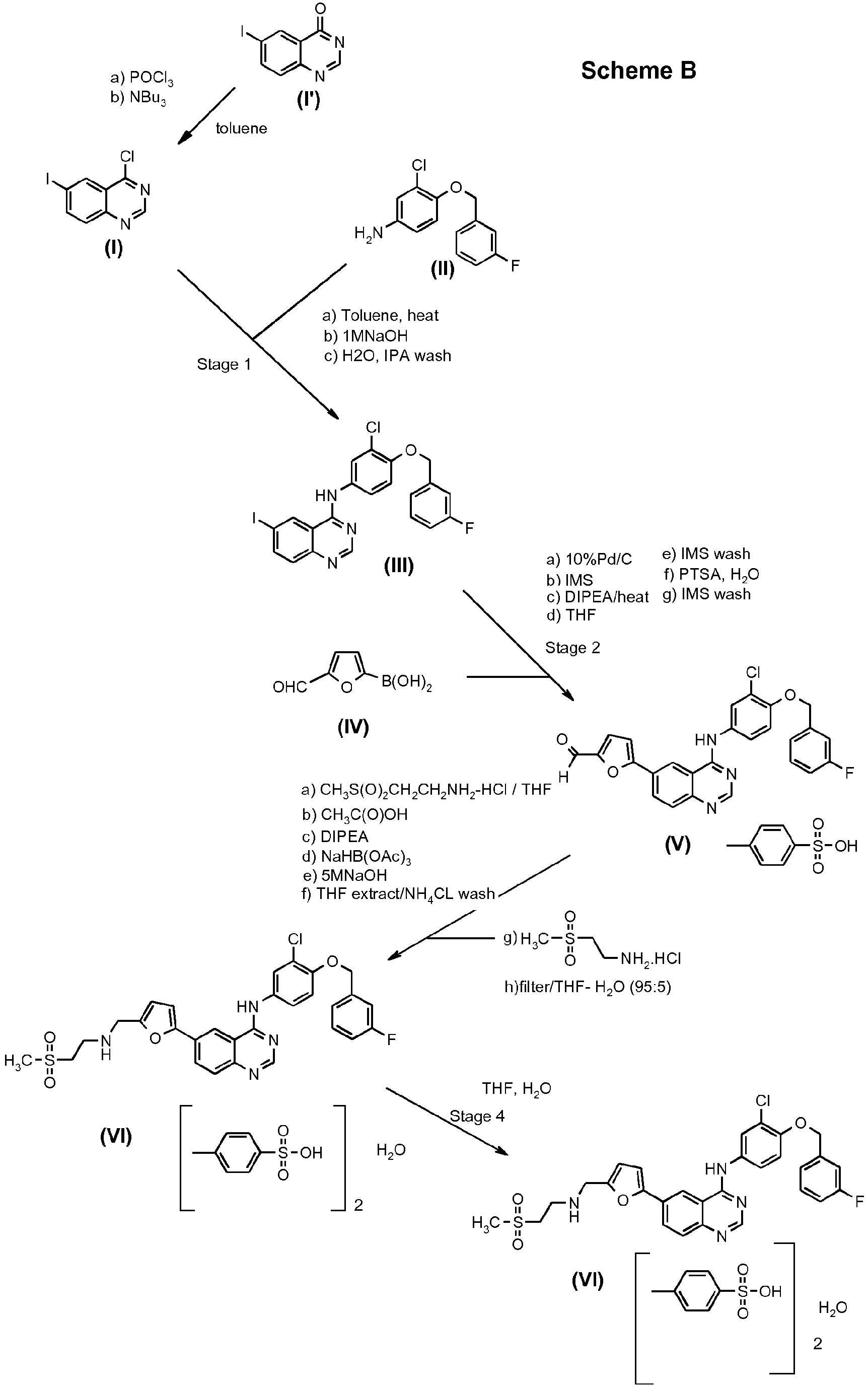
- a further process is illustrated in Scheme B following.
- Scheme B following illustrates the preparation of the ditosylate salt of the compound of formula (II).
- the preparation proceeds in four stages: Stage 1: reaction of quinazoline (I) , which is prepared from 3H-6-iodoquinazolin-4-one (I'), with amine (II) to give iodoquinazoline (III); Stage 2: preparation of the corresponding aldehyde salt (V) by reaction of iodoquinazoline (III) and boronic acid (IV) followed by treatment with p-toluenesulfonic acid salt; Stage 3: preparation of the ditosylate salt of GW572016 (VI) from aldehyde salt (V) ; and Stage 4: recrystallization of the GW572016 ditosylate salt (VI).
- Scheme C shows an alternate preparation of the ditosylate salt of the compound of formula (II).
- the oral pharmaceutical composition of the present invention also includes at least one binder.
- a binder is used to impart cohesiveness qualities to powdered materials so that tablets or granules formed will remain together and not fall apart. Any suitable binder that is compatible with the active ingredient and to good flow properties and dissolution may be utilized.
- Exemplary binders include, but are not limited to gelatin, starch, cellulose, cellulose derivatives such as methyl cellulose, hydroxylpropyl cellulose, hydroxypropylmethyl cellulose, ethyl cellulose, and carboxymethyl cellulose, sucrose, polyvinyl pyrrolidone, natural sugars such as glucose or beta-lactose, corn sweeteners, natural and synthetic gums such as acacia, tragacanth or sodium alginate, polyethylene glycol, waxes and the like.
- the at least one binder is polyvinyl pyrrolidone polymer or povidone, which is available from International Specialty Products of Wayne , New Jersey as the Plasdone® line of products including Plasdone K-29/32®.
- the at least one binder is present in a range of 2 to 11, preferably 4 to 9 more preferably 5.5 to 7.5 per cent by weight of the oral pharmaceutical composition.
- the binder is povidone, which is present in a range of 2 to 11, preferably 4 to 9 more preferably 5.5 to 7.5 per cent by weight of the oral pharmaceutical composition.
- the oral pharmaceutical composition of the present invention also includes at least one disintegrant.
- a disintegrant functions to ensure or facilitate the breakup or disintegration of the composition after administration thereby facilitating dissolution of the active substance.
- Any suitable disintegrant which is compatible with the active ingredient and to good flow properties and dissolution may be utilized.
- Exemplary disintegrants include, but are not limited to starch, cellulose and cellulose derivatives such as methyl cellulose, hydroxylpropyl cellulose, hydroxypropylmethyl cellulose, ethyl cellulose, and crosslinked sodium carboxymethyl cellulose, crosslinked polyvinyl pyrrolidone, sodium starch glycolate, agar, bentonite, and xanthan gum.
- the at least one disintegrant is sodium starch glycolate, which is available from DMV International of Veghel, The Netherlands as Primojel®.
- Primojel® is a purified sodium starch glycolate, Ph. Eur" USP/NF, JPE, produced by cross-linking and carboxymethylation of potato starch with subsequent purification.
- Sodium starch glycolate is also available from JRS Pharma of Patterson, New York as the Explotab® or VivaStar® line of products including Explotab®, VivaStarP®, and Explotab CLV®.
- disintegrant may be added into a tablet making process at two stages.
- Disintegrant can be added to the granulation mixture before granulation.
- This disintegrant is termed intra-granular disintegrant in that it becomes part of the granules formed.
- Disintegrant may also be added to the formed granules to form a compression mixture before compression.
- This disintegrant is termed extra-granular disintegrant in that it is not part of the granules, but rather is in mixture with the granules.
- the at least one disintegrant is present in a range of 1 to 10, preferably 2 to 8 more preferably 3.5 to 5.5 per cent by weight of the oral pharmaceutical composition.
- the disintegrant is sodium starch glycolate, which is present in a range of 1 to 10, preferably 2 to 8 more preferably 3.5 to 5.5 per cent by weight of the oral pharmaceutical composition.
- the disintegrant is extra-granular disintegrant, which is present in a range of 1 to 10, preferably 2 to 8 more preferably 3.5 to 5.5 per cent by weight of the oral pharmaceutical composition.
- the oral pharmaceutical composition of the present invention also includes at least one diluent.
- a diluent or filler is used to increase the bulk of the composition so that the final product has a practical size or volume, for instance for a tablet a practical size for proper compression.
- Any suitable diluent that is compatible with the active ingredient and to good flow properties and dissolution may be utilized.
- Exemplary diluents include, but are not limited to lactose, sucrose or powdered sugar, mannitol, sorbitol, xylitol, inositol, calcium phosphate, calcium carbonate, calcium sulfate, dry starch, cellulose, including microcrystalline cellulose or silicified microcrystalline cellulose and the like.
- the at least one diluent is microcrystalline cellulose, which is available from Blanver, of Cotia, Brazil as the Tabulose® line of products including Tabulose®101, 102, 103, 112, 250, 301, and 302; or from FMC of Philadelphia, Pennsylvania as the Avicel® line of products including Avicel® PH 101, 102, 103, 105, 112, 113, 200, 301, and 302; or from JRS Pharma of Patterson, New York, which is available from as the Vivapur® line of products including Vivapur® 99, 101, 102, 103, 105,112, 200, 301, and 302.
- the at least diluent is silicified microcrystalline cellulose, which is available from JRS Pharma of Patterson, New York as ProSolv® line of products.
- the at least one diluent is present in a range of 10 to 70, preferably 35 to 50 more preferably 40 to 46 per cent by weight of the oral pharmaceutical composition.
- the diluent is microcrystalline cellulose, which is present in a range of 10 to 70, preferably 35 to 50 more preferably 40 to 46 per cent by weight of the oral pharmaceutical composition.
- the diluent is silicified microcrystalline cellulose, which is present in a range of 10 to 70, preferably 35 to 50 more preferably 40 to 46 per cent by weight of the oral pharmaceutical composition.
- the oral pharmaceutical composition of the present invention also includes at least one lubricant.
- a lubricant is used to prevent adhesion of material to the surface of dies and punches in tablet formation, reduce inter-particle friction, facilitate ejection of tablets from the die cavity, and may improve the flow characteristics of a powder or granules.
- Any suitable lubricant that is compatible with the active ingredient and to good flow properties and dissolution profile may be utilized.
- Exemplary lubricants include, but are not limited to talc, magnesium stearate, calcium stearate, zinc stearate, sodium stearyl fumarate, stearic acid, glyceryl behenate, hydrogenated vegetable oils, and polyethylene glycol.
- the at least one lubricant is magnesium stearate, which is available from Mallincrodkt Corporation of St. Louis, Missouri.
- the at least one lubricant is present in a range of 0.1 to 5, preferably 0.6 to 1.3 more preferably 0.8 to 1.2 per cent by weight of the oral pharmaceutical composition.
- the lubricant is magnesium stearate, which is present in a range of 0.1 to 5, preferably 0.6 to 1.3 more preferably 0.8 to 1.2 per cent by weight of the oral pharmaceutical composition.
- the oral pharmaceutical composition is a core tablet composition.
- the core tablet composition of the present invention includes (i) an active ingredient that is N- ⁇ 3-Chloro-4-[(3-fluorobenzyl)oxy]phenyl ⁇ -6-[5-( ⁇ [2-(methanesulphonyl) ethyl] amino ⁇ methyl)-2-furyl]-4-quinazolinamine ditosylate monohydrate; (ii) povidone; (iii) sodium starch glycolate; (iv) microcrystalline cellulose; and (v) magnesium stearate.
- the core tablet composition of the present invention includes (i) an active ingredient that is N- ⁇ 3-Chloro-4-[(3-fluorobenzyl)oxy]phenyl ⁇ -6-[5-( ⁇ [2-(methanesulphonyl) ethyl] amino ⁇ methyl)-2-furyl]-4-quinazolinamine ditosylate monohydrate; (ii) at least one binder; (iii) at least one disintegrant; (iv) at least one diluent; and (v) at least one lubricant.
- the core tablet composition of the present invention includes (i) an active ingredient that is N- ⁇ 3-Chloro-4-[(3-fluorobenzyl)oxy]phenyl ⁇ -6-[5-( ⁇ [2-(methanesulphonyl) ethyl] amino ⁇ methyl)-2-furyl]-4-quinazolinamine ditosylate monohydrate which is present in a range of 5 to 85, preferably 30 to 60, more preferably 42 to 48 percent by weight; (ii) at least one binder, which is present in a range of 2 to 11, preferably 4 to 9, more preferably 5.5 to 7.5 per cent by weight; (iii) at least one disintegrant, which is present in a range of 1 to 10, preferably 2 to 8, more preferably 3.5 to 5.5 per cent by weight; (iv) at least one diluent, which is present in a range of 10 to 70, preferably 35 to 50, more preferably 40 to 46 per cent by weight; and (v) at least one
- the core tablet composition of the present disclosure includes (i) an active ingredient that is N- ⁇ 3-Chloro-4-[(3-fluorobenzyl)oxy]phenyl ⁇ -6-[5-( ⁇ [2-(methanesulphonyl) ethyl] amino ⁇ methyl)-2-furyl]-4-quinazolinamine ditosylate monohydrate which is present in a range of 5 to 85 percent by weight; (ii) povidone, which is present in a range of 2 to 11 per cent by weight; (iii) sodium starch glycolate, which is present in a range of 1 to 10 per cent by weight; (iv) microcrystalline cellulose which may be present in a range of 10 to 70 per cent by weight; and (v) magnesium stearate, which may be present in a range of 0.1 to 5 per cent by weight of the core tablet composition.
- an active ingredient that is N- ⁇ 3-Chloro-4-[(3-fluorobenzyl)oxy]phenyl ⁇ -6-
- the core tablet composition of the present invention includes (i) an active ingredient that is N- ⁇ 3-Chloro-4-[(3-fluorobenzyl)oxy]phenyl ⁇ -6-[5-( ⁇ [2-(methanesulphonyl) ethyl] amino ⁇ methyl)-2-furyl]-4-quinazolinamine ditosylate monohydrate which is present in a range of 30 to 60 per cent by weight; (ii) povidone, which is present in a range of 4 to 9 per cent by weight; (iii) sodium starch glycolate, which is present in a range of 2 to 8 per cent by weight; (iv) microcrystalline cellulose, which may be present in a range of 35 to 50 per cent by weight; and (v) magnesium stearate, which may be present in a range of 0.6 to 1.3 per cent by weight of the core tablet composition.
- an active ingredient that is N- ⁇ 3-Chloro-4-[(3-fluorobenzyl)oxy]phenyl
- the core tablet composition of the present invention includes (i) an active ingredient that is N- ⁇ 3-Chloro-4-[(3-fluorobenzyl)oxy]phenyl ⁇ -6-[5-( ⁇ [2-(methanesulphonyl) ethyl] amino ⁇ methyl)-2-furyl]-4-quinazolinamine ditosylate monohydrate which is present in a range of 42 to 48 per cent by weight; (ii) povidone, which is present in a range of 5.5 to 7.5 per cent by weight; (iii) sodium starch glycolate, which is present in a range of 3.5 to 5.5 per cent by weight; (iv) microcrystalline cellulose, which may be present in a range of 40 to 46 per cent by weight; and (v) magnesium stearate, which may be present in a range of 0.8 to 1.2 per cent by weight of the core tablet composition.
- an active ingredient that is N- ⁇ 3-Chloro-4-[(3-fluorobenzyl)oxy
- the core tablet composition of the present invention includes (i) an active ingredient that is N- ⁇ 3-Chloro-4-[(3-fluorobenzyl)oxy]phenyl ⁇ -6-[5-( ⁇ [2-(methanesulphonyl) ethyl] amino ⁇ methyl)-2-furyl]-4-quinazolinamine ditosylate monohydrate; (ii) povidone; (iii) sodium starch glycolate; (iv) microcrystalline cellulose; and (v) magnesium stearate.
- the active ingredients disclosed herein have been shown to be effective inhibitors of EGFR and/or erbB2 kinases as well as having anti-tumour efficacy versus various cancer cell lines whose cells express EGFR and/or erbB2. See for instance the aforementioned International Patent Application No. PCT/EP99/00048, filed January 8, 1999 , and published as WO 99/35146 on July 15, 1999 ; International Patent Application No. PCT/US01/20706, filed June 28, 2001 , and published as WO 02/02552 on January 10, 2002 ; and International Patent Application No. PCT/US03/10747, filed on April 8, 2003 and published as WO 03/086467 on October 23, 2003 .
- a method for treating a disorder in a mammal characterized by aberrant activity of at least one erbB family PTK which includes administering an oral pharmaceutical composition as described herein.
- the aberrant PTK activity referred to herein is any erbB family PTK activity that deviates from the normal erbB family protein kinase activity expected in a particular mammalian subject.
- Aberrant erbB family PTK activity may take the form of, for instance, an abnormal increase in activity, or an aberration in the timing and or control of PTK activity. Such aberrant activity may result then, for example, from overexpression or mutation of the protein kinase leading to inappropriate or uncontrolled activation.
- unwanted PTK activity may reside in an abnormal source, such as a malignancy. That is, the level of PTK activity does not have to be abnormal to be considered aberrant, rather the activity derives from an abnormal source.
- the disclosed oral pharmaceutical compositions contain compounds of formula (I) or anhydrate or hydrated salt forms thereof that are inhibitors of one or more erbB family PTKs and as such have utility in the treatment of disorders in mammals which are characterized by aberrant PTK activity, particularly humans.
- the disorder treated is characterized by at least one erbB family PTK, selected from EGFR, c-erb-B2 and c-erb-B4, exhibiting aberrant activity.
- the disorder treated is characterized by at least two erbB family PTKs, selected from EGFR, c-erb-B2 and c-erb-B4, exhibiting aberrant activity.
- the compounds of formula (I) or anhydrate or hydrate forms thereof inhibit at least one erbB family PTK, selected from EGFR, c-erb-B2 and c-erb-B4. In another embodiment of the treatment method, the compounds of formula I or anhydrate or hydrate forms thereof inhibit at least two erbB family PTKs selected from EGFR, c-erb-B2 and c-erb-B4.
- the disorders referred to may be any disorder which is characterized by aberrant PTK activity. As recited above such disorders include, but are not limited to, cancer and psoriasis.
- the disorder is cancer.
- the cancer is non-small cell lung, bladder, prostate, brain, head and neck, breast, ovarian, gastric, colorectal, or pancreatic cancer.
- a therapeutically effective amount of a compound of formula (I) and anhydrate or hydrate forms thereof will depend on a number of factors including, but not limited to, the age and weight of the mammal, the precise disorder requiring treatment and its severity, the nature of the formulation, and the route of administration, and will ultimately be at the discretion of the attendant physician or veterinarian.
- the compounds of formula (I) and anhydrate or hydrate forms thereof will be given for treatment in the range of 0.1 to 100 mg/kg body weight of recipient (mammal) per day and more usually in the range of 1 to 50 mg/kg body weight per day.
- Acceptable daily dosages may be from about 0.1 to about 2000 mg/day, and preferably from about 10 to about 1800 mg/day.
- compositions containing compounds of formula (I) or anhydrate or hydrated salt forms thereof, described above, are useful in therapy.
- the oral pharmaceutical compositiondescribed herein and at least one additional cancer treatment therapy may be employed in combination concomitantly or sequentially in any therapeutically appropriate combination with such other anti-cancer therapies.
- the additional anti-cancer therapy is typically selected from one or more of surgical, radiological, or chemotherapeutic therapies.
- the additional anti-cancer therapy is at least one surgical therapy.
- the additional anti-cancer therapy is at least one radiological therapy.
- the additional anti-cancer therapy is at least one of surgical, radiological, or chemotherapeutic therapy.
- the additional anti-cancer therapy is at least one chemotherapeutic therapy including administration of at least one anti-neoplastic agent.
- the administration in combination of a compound of formula (I) or salts, solvates, or physiologically functional derivatives thereof with other anti-neoplastic agents may be in combination in accordance with the disclosure by administration concomitantly in (1) a unitary pharmaceutical composition including both compounds or (2) separate pharmaceutical compositions each including one of the compounds.
- the combination may be administered separately in a sequential manner wherein one anti-neoplastic agent is administered first and the other second or vice versa. Such sequential administration may be close in time or remote in time.
- Anti-neoplastic agents may induce anti-neoplastic effects in a cell-cycle specific manner, i.e., are phase specific and act at a specific phase of the cell cycle, or bind DNA and act in a non cell-cycle specific manner, i.e., are non-cell cycle specific and operate by other mechanisms.
- Anti-neoplastic agents useful in combination with the compounds or salts, solvates or physiologically functional derivatives thereof of formula I include the following:
- the disclosed oral pharmaceutical composition is a tablet that is prepared using a fluid bed granulation process.
- the disclosed tablet forming process includes a step (a) admixing the active ingredient and at least one diluent to form a granulation mixture.
- the admixing is done, for instance, in a fluid bed granulator by placing the active ingredient and diluent in the bowl of a GLATT® GPCG30 fluid bed granulator available from Glatt Air Technologies of Ramsey, New Jersey or a GLATT® WSTCD 160/200 fluid bed granulator available from the Glatt Group of Companies of Binzen, Germany.
- the diluent may optionally be sieved prior to admixing with the active.
- the diluent is sieved using a US Mesh sized 16, 20, or 24, preferably a 20 sieve.
- the admixed active and diluent are then fluidized in the GLATT® GPCG30 or GLATT® WSTCD 160/200 to form a fluidized mixture using standard process parameters known in the art.
- Suitable active ingredients and diluents are as described above for the oral pharmaceutical composition.
- step (a) includes admixing the active ingredient, at least one diluent, and at least binder to form a granulation mixture.
- the admixing is performed as recited above.
- Suitable active ingredients, diluents, and binders are as described above for the oral pharmaceutical composition.
- the disclosed fluidized mixture includes (i) an active ingredient that is N- ⁇ 3-Chloro-4-[(3-fluorobenzyl)oxy]phenyl ⁇ -6-[5-( ⁇ [2-(methanesulphonyl) ethyl] amino ⁇ methyl)-2-furyl]-4-quinazolinamine ditosylate monohydrate; and (ii) at least one diluent.
- the disclosed fluidized mixture includes (i) an active ingredient that is N- ⁇ 3-Chloro-4-[(3-fluorobenzyl)oxy]phenyl ⁇ -6-[5-( ⁇ [2-(methanesulphonyl) ethyl] amino ⁇ methyl)-2-furyl]-4-quinazolinamine ditosylate monohydrate which is present in a range of 35 to 67, preferably 45 to 57 percent by weight; and (ii) at least one diluent which is present in a range of 33 to 65, preferably 43 to 55 percent by weight of the fluidized mixture.
- the disclosed fluidized mixture includes (i) an active ingredient that is N- ⁇ 3-Chloro-4-[(3-fluorobenzyl)oxy]phenyl ⁇ -6-[5-( ⁇ [2-(methanesulphonyl) ethyl] amino ⁇ methyl)-2-furyl]-4-quinazolinamine ditosylate monohydrate; and (ii) microcrystalline cellulose.
- the disclosed fluidized mixture includes (i) an active ingredient that is N- ⁇ 3-Chloro-4-[(3-fluorobenzyl)oxy]phenyl ⁇ -6-[5-( ⁇ [2-(methanesulphonyl) ethyl] amino ⁇ methyl)-2-furyl]-4-quinazolinamine ditosylate monohydrate which is present in a range of 35 to 67, preferably 45 to 57 percent by weight; and (ii) microcrystalline cellulose which is present in a range of 33 to 65, preferably 43 to 55 percent by weight of the fluidized mixture.
- the fluidized mixture is granulated in step (b) using a granulating solution.
- the granulating solution may be an aqueous, non-aqueous or a aqueous/non-aqueous solution.
- the solution may or may not include the at least one binder. That is, the granulating solution may be an aqueous, non-aqueous, or an aqueous/non-aqueous solution of the at least one binder or in another embodiment, the at least one binder is included in the fluidized mixture and the granulating solution is water, a non-aqueous liquid, or an aqueous/non-aqueous liquid.
- the aqueous solution is of course water or a water solution with the at least one binder.
- the non-aqueous solution includes, but is not limited to, alcohols such as ethanol, or isopropanol; other organics such as acetone; or mixtures of alcohols or other organics such as an acetone/ethanol mixture, or acetone/isopropanol mixture; and the like with or without the at least one binder.
- the aqueous/non-aqueous solution is, but is not limited to, water/ethanol, water/acetone, or water/isopropanol mixtures with or without the at least one binder.
- the aqueous solution is a 5 to 25, preferably 10 to 25, more preferably a 15 to 25 percent solution of at least one binder in purified water (USP).
- the aqueous solution is a 5 to 25, preferably 10 to 25, more preferably 15 to 25 percent solution of povidone in purified water (USP).
- the aqueous solution is prepared for instance in a suitable tank with a propeller type mixer such as a Lighting Mixer with suitable bowl. The aqueous mixture is sprayed onto the fluidized mixture after formation of the fluidized mixture at a rate adequate to insure proper granule formation.
- the specific combination of batch size, inlet air temperature, inlet air dewpoint, and inlet air volume will determine acceptable binder solution spray rates.
- An additional amount of water may be added as needed to provide proper granulation wetness.
- the inlet air temperature may be raised to facilitate the drying process until an acceptable moisture content (such as Loss On Drying - LOD) is reached.
- the dried granules may be passed through, for instance, a cone mill, such as a Comil® available from Quadro Engineering Incorporated of Waterloo, Ontario, using an appropriate combination of screen size and impeller speed to produce the desired active granule product.
- the disclosed active granules includes (i) an active ingredient that is N- ⁇ 3-Chloro-4-[(3-fluorobenzyl)oxy]phenyl ⁇ -6-[5-( ⁇ [2-(methanesulphonyl) ethyl] amino ⁇ methyl)-2-furyl]-4-quinazolinamine ditosylate monohydrate; (ii) at least one diluent; and (iii) at least one binder.
- the disclosed active granules includes (i) an active ingredient that is N- ⁇ 3-Chloro-4-[(3-fluorobenzyl)oxy]phenyl ⁇ -6-[5-( ⁇ [2-(methanesulphonyl) ethyl] amino ⁇ methyl)-2-furyl]-4-quinazolinamine ditosylate monohydrate; (ii) microcrystalline cellulose; and (iii) povidone.
- the disclosed active granules includes (i) an active ingredient that is N- ⁇ 3-Chloro-4-[(3-fluorobenzyl)oxy]phenyl ⁇ -6-[5-( ⁇ [2-(methanesulphonyl) ethyl] amino ⁇ methyl)-2-furyl]-4-quinazolinamine ditosylate monohydrate which is present in a range of 5 to 85, preferably 30 to 60, more preferably 45 to 51 percent by weight; (ii) at least one diluent, which is present in a range of 4 to 93, preferably 31 to 66, more preferably 41 to 49 per cent by weight; and (iii) at least one binder, which is present in a range of 2 to 11, preferably 4 to 9, more preferably 6 to 8 per cent by weight of the active granules.
- the disclosed active granules includes (i) an active ingredient that is N- ⁇ 3-Chloro-4-[(3-fluorobenzyl)oxy]phenyl ⁇ -6-[5-( ⁇ [2-(methanesulphonyl) ethyl] amino ⁇ methyl)-2-furyl]-4-quinazolinamine ditosylate monohydrate which is present in a range of 5 to 85 percent by weight; (ii) microcrystalline cellulose, which is present in a range of 4 to 93 per cent by weight; and (iii) povidone, which is present in a range of 2 to 11 per cent by weight of the active granules.
- the disclosed active granules includes (i) an active ingredient that is N- ⁇ 3-Chloro-4-[(3-fluorobenzyl)oxy]phenyl ⁇ -6-[5-( ⁇ [2-(methanesulphonyl) ethyl] amino ⁇ methyl)-2-furyl]-4-quinazolinamine ditosylate monohydrate which is present in a range of 30 to 60 per cent by weight; (ii) microcrystalline cellulose, which is present in a range of 31 to 66 per cent by weight; and (iii) povidone, which is present in a range of 4 to 9 per cent by weight of the active granules.
- the disclosed active granules includes (i) an active ingredient that is N- ⁇ 3-Chloro-4-[(3-fluorobenzyl)oxy]phenyl ⁇ -6-[5-( ⁇ [2-(methanesulphonyl) ethyl] amino ⁇ methyl)-2-furyl]-4-quinazolinamine ditosylate monohydrate which is present in a range of 45 to 51 per cent by weight; (ii) microcrystalline cellulose, which is present in a range of 41 to 49 per cent by weight; and (iii) povidone which is present in a range of 6 to 8 per cent by weight of the active granules.
- the active granules are blended in step (c) with at least one disintegrant and at least one lubricant to form a compression blend.
- the active granules may be first blended with the at least one disintegrant and then the active granules/disintegrant mixture blended with at least one lubricant to form a compression blend.
- the active granules, the at least one disintegrant, and the at least one lubricant are blended together to form the compression mixture.
- the ingredients are blended, using for instance a V-Blender available from Granulair Technologies of Lausanne, Switzerland or BULS cube blender available from Matcon, Incorporated of Sewell, New Jersey, at low rpm until blend uniformity is achieved. As is recognized in the art, the time needed to achieve such uniformity will vary according to the amount and character of the ingredients and specific process equipment.
- the components of the compression blend i.e., the active granules, disintegrant, and lubricant are as described above.
- the disclosed compression blend includes (i) active granules; (ii) at least one disintegrant; and (iii) at least one lubricant.
- the disclosed compression blend includes (i) active granules which are present in a range of 85 to 99, preferably 87 to 91, more preferably 93 to 96 percent by weight; (ii) at least one disintegrant, which is present in a range of 1 to 10, preferably 2 to 8, more preferably 3.5 to 5.5 per cent by weight; and (iii) at least one lubricant which is present in a range of 0.1 to 5, preferably 0.6 to 1.3, more preferably 0.8 to 1.2 per cent by weight of the compression blend.
- the disclosed compression blend includes (i) active granules; (ii) sodium starch glycolate; and (iii) magnesium stearate.
- the disclosed compression blend includes (i) active granules which are present in a range of 85 to 99 percent by weight; (ii) sodium starch glycolate, which is present in a range of 1 to 10 per cent by weight; and (iii) magnesium stearate, which is present in a range of 0.1 to 5 per cent by weight of the compression blend.
- the disclosed compression blend includes (i) active granules which are present in a range of 87 to 91 per cent by weight; (ii) sodium starch glycolate, which is present in a range of 2 to 8 per cent by weight; and (iii) magnesium stearate, which is present in a range of 0.6 to 1.3 per cent by weight of the compression blend.
- the disclosed compression blend includes (i) active granules which are present in a range of 93 to 96 per cent by weight; (ii) sodium starch glycolate, which is present in a range of 3.5 to 5.5 per cent by weight; and (iii) magnesium stearate, which may be present in a range of 0.8 to 1.2 per cent by weight of the compression blend.
- Core tablets are formed from the compression blend (step (d)) by compressing the blend into tablet form.
- Any suitable means for tablet compression may be used, including, but not limited to, a single punch machine, rotary tablet machines and instrumented tablet machines.
- the tableting is done by a rotary tablet machine, for instance a Hata model HT-AP18SSU rotary tablet press available from Elizabeth-Hata International of North Huntingdon, Pennsylvania or William Fette GmbH of Schwarzenbek, Germany.
- the Hata press is fitted with a 19.05 x 10.41 mm standard concave tooling.
- In-process controls for uniformity of weight, average weight, hardness, friability, and disintegration time are applied during the compression run and adjustments to the tablet press are made if necessary.
- the composition of the core tablets are as described above.
- the tablets may optionally be film coated (step (e)) by any suitable means.
- the tablets are film coated using a coater such as a Compulab Accella Coata available from Thomas Engineering, Inc. of Hoffman Estates, Illinois or the Glatt Group of Companies of Binzen, Germany. Coating of the tablets will enhance patient acceptance and control dust.
- the tablets are coated with 12 per cent by weight aqueous suspension of Orange Opadry® YS-1-13065A aqueous suspension available from Colorcon, Incorporated of Westpoint, Pennsylvania.
- the tablets are immediate release tablets containing 250mg of N- ⁇ 3-Chloro-4-[(3-fluorobenzyl)oxy]phenyl ⁇ -6-[5-( ⁇ [2-(methanesulphonyl) ethyl] amino ⁇ methyl)-2-furyl]-4-quinazolinamine.
- the tablets have an average dissolution of 80 percent or greater, preferably 85 percent or greater, more preferably 90 percent or greater drug dissolution after 45 minutes when evaluated using a USP Type II apparatus at 55 rpm paddle speed in 900 ml of 0.1 N HCl containing 2% w/w Tween 80® at 37°C.
- a tablet in one embodiment, includes (i) an active ingredient that is N- ⁇ 3-Chloro-4-[(3-fluorobenzyl) oxy]phenyl ⁇ -6-[5-( ⁇ [2-(methanesulphonyl) ethyl] amino ⁇ methyl)-2-furyl]-4-quinazolinamine ditosylate monohydrate; (ii) at least one binder; (iii) at least one disintegrant; and (iv) a film coat.
- a tablet includes (i) an active ingredient that is N- ⁇ 3-Chloro-4-[(3-fluorobenzyl) oxy]phenyl ⁇ -6-[5-( ⁇ [2-(methanesulphonyl) ethyl] amino ⁇ methyl)-2-furyl]-4-quinazolinamine ditosylate monohydrate; (ii) at least one binder; (iii) at least one disintegrant; (iv) at least one diluent; and (v) a film coat.
- a tablet of the present invention includes (i) an active ingredient that is N- ⁇ 3-Chloro-4-[(3-fluorobenzyl)oxy]phenyl ⁇ -6-[5-( ⁇ [2-(methanesulphonyl) ethyl] amino ⁇ methyl)-2-furyl]-4-quinazolinamine ditosylate monohydrate; (ii) at least one binder; (iii) at least one disintegrant; (iv) at least one diluent; (v) a lubricant; and (vi) a film coat.
- a disclosed tablet includes (i) an active ingredient that is N- ⁇ 3-Chloro-4-[(3-fluorobenzyl) oxy]phenyl ⁇ -6-[5-( ⁇ [2-(methanesulphonyl) ethyl] amino ⁇ methyl)-2-furyl]-4-quinazolinamine ditosylate monohydrate; (ii) povidone; (iii) sodium starch glycolate; and (iv) a film coat.
- a tablet includes (i) an active ingredient that is N- ⁇ 3-Chloro-4-[(3-fluorobenzyl) oxy]phenyl ⁇ -6-[5-( ⁇ [2-(methanesulphonyl) ethyl] amino ⁇ methyl)-2-furyl]-4-quinazolinamine ditosylate monohydrate; (ii) povidone; (iii) sodium starch glycolate; (iv) microcrystalline cellulose; and (v) a film coat.
- a tablet of the present invention includes (i) an active ingredient that is N- ⁇ 3-Chloro-4-[(3-fluorobenzyl)oxy]phenyl ⁇ -6-[5-( ⁇ [2-(methanesulphonyl) ethyl] amino ⁇ methyl)-2-furyl]-4-quinazolinamine ditosylate monohydrate; (ii) povidone; (iii) sodium starch glycolate; (iv) microcrystalline cellulose; (v) magnesium stearate, and (vi) a film coat.
- a tablet of the present invention includes (i) an active ingredient that is N- ⁇ 3-Chloro-4-[(3-fluorobenzyl)oxy]phenyl ⁇ -6-[5-( ⁇ [2-(methanesulphonyl) ethyl] amino ⁇ methyl)-2-furyl]-4-quinazolinamine ditosylate monohydrate which is present in a range of 5 to 85, preferably 30 to 60, more preferably 45 to 51 percent by weight; (ii) at least one binder, which is present in a range of 2 to 11, preferably 4 to 9, more preferably 5.5 to 7.5 per cent by weight; (iii) at least one disintegrant, which is present in a range of 1 to 10, preferably 2 to 8, more preferably 3.5 to 5.5 per cent by weight; (iv) at least one diluent, which is present in a range of 10 to 70, preferably 35 to 50, more preferably 40 to 46 per cent by weight; (v) at least one lubric acid,
- a tablet composition of the present invention includes (i) an active ingredient that is N- ⁇ 3-Chloro-4-[(3-fluorobenzyl)oxy]phenyl ⁇ -6-[5-( ⁇ [2-(methanesulphonyl) ethyl] amino ⁇ methyl)-2-furyl]-4-quinazolinamine ditosylate monohydrate; (ii) povidone; (iii) sodium starch glycolate; (iv) microcrystalline cellulose; (v) magnesium stearate; and (vi) a film coat.
- a disclosed tablet composition includes (i) an active ingredient that is N- ⁇ 3-Chloro-4-[(3-fluorobenzyl)oxy]phenyl ⁇ -6-[5-( ⁇ [2-(methanesulphonyl) ethyl] amino ⁇ methyl)-2-furyl]-4-quinazolinamine ditosylate monohydrate which is present in a range of 5 to 85 percent by weight; (ii) povidone, which is present in a range of 2 to 11 per cent by weight; (iii) sodium starch glycolate, which is present in a range of 1 to 10 per cent by weight; (iv) microcrystalline cellulose, which may be present in a range of 10 to 70 per cent by weight; (v) magnesium stearate, which may be present in a range of 0.1 to 5 per cent by weight; and (vi) a film coat which is present in a range of 2.0 to 4.0 percent by weight of the core tablet composition.
- a tablet composition of the present invention includes (i) an active ingredient that is N- ⁇ 3-Chloro-4-[(3-fluorobenzyl)oxy]phenyl ⁇ -6-[5-( ⁇ [2-(methanesulphonyl) ethyl] amino ⁇ methyl)-2-furyl]-4-quinazolinamine ditosylate monohydrate which is present in a range of 30 to 47 per cent by weight; (ii) povidone, which is present in a range of 4 to 9 per cent by weight; (iii) sodium starch glycolate, which is present in a range of 2 to 8 per cent by weight; (iv) microcrystalline cellulose, which may be present in a range of 35 to 50 per cent by weight; (v) magnesium stearate, which may be present in a range of 0.6 to 1.3 per cent by weight; and (vi) a film coat which is present in a range of 2.5 to 3.5 percent by weight of the core tablet composition.
- a tablet composition of the present invention includes (i) an active ingredient that is N- ⁇ 3-Chloro-4-[(3-fluorobenzyl)oxy]phenyl ⁇ -6-[5-( ⁇ [2-(methanesulphonyl) ethyl] amino ⁇ methyl)-2-furyl]-4-quinazolinamine ditosylate monohydrate which is present in a range of 30 to 60 per cent by weight; (ii) povidone, which is present in a range of 4 to 9 per cent by weight; (iii) sodium starch glycolate, which is present in a range of 2 to 8 per cent by weight; (iv) microcrystalline cellulose, which may be present in a range of 35 to 50 per cent by weight; (v) magnesium stearate, which may be present in a range of 0.6 to 1.3 per cent by weight; and (vi) a film coat which is present in a range of 2.5 to 3.5 percent by weight of the core tablet composition.
- a tablet composition of the present invention includes (i) an active ingredient that is N- ⁇ 3-Chloro-4-[(3-fluorobenzyl)oxy]phenyl ⁇ -6-[5-( ⁇ [2-(methanesulphonyl) ethyl] amino ⁇ methyl)-2-furyl]-4-quinazolinamine ditosylate monohydrate which is present in a range of 42 to 48 per cent by weight; (ii) povidone, which is present in a range of 5.5 to 7.5 per cent by weight; (iii) sodium starch glycolate, which is present in a range of 3.5 to 5.5 per cent by weight; (iv) microcrystalline cellulose, which may be present in a range of 40 to 46 per cent by weight; (v) magnesium stearate, which may be present in a range of 0.8 to 1.2 per cent by weight; and (vi) a film coat which is present in a range of 2.8 to 3.2 percent by weight of the core tablet composition.
- a tablet composition includes (i) an active ingredient that is N- ⁇ 3-Chloro-4-[(3-fluorobenzyl) oxy]phenyl ⁇ -6-[5-( ⁇ [2-(methanesulphonyl) ethyl] amino ⁇ methyl)-2-furyl]-4-quinazolinamine ditosylate monohydrate which is present in a range of 45 to 51 per cent by weight; (ii) povidone, which is present in a range of 5.5 to 7.5 per cent by weight; (iii) sodium starch glycolate, which is present in a range of 3.5 to 5.5 per cent by weight; (iv) microcrystalline cellulose, which may be present in a range of 40 to 46 per cent by weight; (v) magnesium stearate, which may be present in a range of 0.8 to 1.2 per cent by weight; and (vi) a film coat which is present in a range of 2.8 to 3.2 percent by weight of the core tablet composition.
- the disclosed composition may also be administered in the form of capsules, caplets, gelcaps, pills, and any other oral dosage forms known in the pharmaceutical art.
- a method of producing a ditosylate salt of a compound of Formula (I) is disclosed herein: or salts or solvates thereof, wherein R 1 is Cl or Br; X is CH, N, or CF; and Het is thiazole or furan; wherein the method comprises the steps of:
- the method comprises the step of recrystallizing the compound of formula (VIII) in the presence of at least 25 volumes of THF, at least 27 volumes of THF, or at least 30 volumes of THF.
- Also disclosed is a method of producing a ditosylate salt of an N -phenyl-4-quinazolinamine derivative where said method comprises the step of recrystallizing the N-phenyl-4-quinazolinamine derivative in the presence of at least 20 volumes of THF.
- the method comprises the step of recrystallizing the compound of formula (VIII) in the presence of at least 25 volumes of THF, at least 27 volumes of THF, or at least 30 volumes of THF.
- the N -phenyl-4-quinazolinamine derivative is N -(3-chloro-4-fluorophenyl)-7-(methyloxy)-6- ⁇ [3-(4-morpholinyl)propyl]oxy ⁇ -4-quinazolinamine.
- Table 1 contains a description of the components used in the preparation of a granulation mixture and Table 2 contains a description of the components used in the preparation of a compression blend for one embodiment of N- ⁇ 3-Chloro-4-[(3-fluorobenzyl)oxy]phenyl ⁇ -6-[5-( ⁇ [2-(methanesulphonyl)ethyl]amino ⁇ methyl)-2-furyl]-4-quinazolinamine Tablets, 250 mg for a batch size of 20,000 tablets.
- the actual amount of drug substance may be adjusted based on the purity of the specific lot of drug substance included in the batch.
- the amount of diluent microcrystalline cellulose
- the N- ⁇ 3-Chloro-4-[(3-fluorobenzyl)oxy]phenyl ⁇ -6-[5-( ⁇ [2-(methanesulphonyl) ethyl]amino ⁇ methyl)-2-furyl]-4-quinazolin amine ditosylate monohydrate and microcrystalline cellulose were fluidized in the Glat 30 bowl and spraying of the 10% povidone solution began immediately at approximately 220g/minute with an inlet air temperature of 54°C. The inlet air dewpoint was maintained between 10 to 15 °C. After the povidone solution was applied purified water was added as needed to obtain a proper granulation wetness.
- the inlet air temperature was raised to 60°C and drying was continued until an LOD of approximately 2.5% was reached.
- the dried active granules were passed through a Comil Model 197S cone mill fitted with a 0.075 inch round holed screen at approximately 1720 RPM (28.6 Hz).
- Sieve analysis was performed and tapped density profiles established. Sieve analysis was performed using a Retsch sieve shaker, Model AS200 Digit. Approximately 20 g of active dried granules was placed on the top of a nest of tared sieves of 20, 30, 40, 60, 100, and 200 mesh. Shaking was done for 5 minutes at an amplitude setting of 60 with the pulse on. This sieve analysis revealed little batch to batch variation in particle size of the active granules. The granules were also characterized for Bulk Density (BD) and Tapped Density (TD). BD and TD of the granules was measured by adding a weighed amount of granules into a 100 ml graduated cylinder and measuring the volume initially and after 25, 50, 200, 500, and 1250 taps respectively.
- BD Bulk Density
- TD Tapped Density
- a compression blend was formed by combining the prepared active granules and sodium starch glycolate in a bin which was transferred to a tumble blender where the ingredients were blended for 15 minutes @ 12 RPM. The bin was then removed from the tumble blender and magnesium stearate added to the blend of active granules and sodium starch glycolate. The bin was sealed and transferred back to the tumble blender and blended for 3 minutes @ 12 RPM to obtain the compression mix. Tablets were compressed from the compression blend using a Hata model HT-AP18SSU rotary tablet press fitted with 19.05 x 10.41 mm standard concave tooling. The tablet press was adjusted to provide tablets with the following specifications.
- Uncoated tablets were characterized for weight, hardness, disintegration and dissolution. Tablets were weighed and hardness determined using, for example, a Dr. Schleuniger® Pharmatron Testlink Instrument available from Dr Schleuniger® Pharmatron of Solothurn, Switzerland. Disintegration was determined in 1 L of water at 37°C and drug dissolution was evaluated using a USP Type II apparatus at 55 rpm paddle speed in 900 ml of 0.1 N HCl/2% w/w Tween 80 at 37°C. Results for three groups of tablets follow:
- the produced tablets were coated in a Thomas Engineering Inc., Compu-Lab coater using 12% w/w Orange Opadry®/YS-1-13065-A aqueous suspension at a pan speed of 6-8 rpm.
- Two spray nozzles (orifice opening - 1.2 mm) were used to deliver coating solution at a total rate of 90-120 g/min.
- the airflow was maintained at 500 to 700 cfm with the outlet air temperature ranging from 50 to 63°C.
- the gun to bed distance was kept at 8.5 to 9 inches. Sufficient film coating was applied to achieve a 3 percent by weight gain assuming 100% coating efficiency.
- Coated tablets were characterized for drug dissolution using a USP Type II apparatus at 55 rpm paddle speed in 900 ml of 0.1 N HCl/2% w/w Tween 80 at 37°C. The results follow:
- Table 4 contains a description of the components used in the preparation of a granulation mixture and Table 5 contains a description of the components used in the preparation of a compression blend for one embodiment of N- ⁇ 3-Chloro-4-[(3-fluorobenzyl)oxy]phenyl ⁇ -6-[5-( ⁇ [2-(methanesulphonyl)ethyl]amino ⁇ methyl)-2-furyl]-4-quinazolinamine Tablets, 250 mg for a batch size of 120,000 tablets.
- the actual amount of drug substance may be adjusted based on the purity of the specific lot of drug substance included in the batch.
- the amount of diluent microcrystalline cellulose
- the N- ⁇ 3-Chloro-4-[(3-fluorobenzyl) oxy]phenyl ⁇ -6-[5-( ⁇ [2-(methanesulphonyl) ethyl]amino ⁇ methyl)-2-furyl]-4-quinazolin amine ditosylate monohydrate and microcrystalline cellulose were fluidized in the Glatt WSTCD 160/200 bowl and spraying of the 20% povidone solution began immediately at approximately 2000 g/minute with an inlet air temperature of 58°C. The inlet air humidity was maintained below 10 g/kg. After the povidone solution was applied purified water was added as needed to obtain a proper granulation wetness.
- the inlet air temperature was raised to 60°C and drying was continued until an LOD of approximately 2.5% was reached.
- the dried active granules were passed through a Comil Model 196S cone mill fitted with a 0.075 inch round holed screen at approximately 1000 RPM.
- Sieve analysis was performed and tapped density profiles established. Sieve analysis was performed using a Retsch sieve shaker, Model AS200 Digit. Approximately 20 g of active dried granules was placed on the top of a nest of tared sieves of 20, 30, 40, 60, 100, and 200 mesh. Shaking was done for 5 minutes at an amplitude setting of 60 with the pulse on. This sieve analysis revealed little batch to batch variation in particle size of the active granules. The granules were also characterized for Bulk Density (BD) and Tapped Density (TD). BD and TD of the granules was measured by adding a weighed amount of granules into a 100 ml graduated cylinder and measuring the volume initially and after 25, 50, 100, 200, 300, 500, and 1250 taps respectively.
- BD Bulk Density
- TD Tapped Density
- a compression blend was formed by combining the prepared active granules and sodium starch glycolate in a bin which was transferred to a Bin blender where the ingredients were blended for 15 minutes @ 17 RPM. The bin was then removed from the tumble blender and magnesium stearate added to the blend of active granules and sodium starch glycolate. The bin was sealed and transferred back to the tumble blender and blended for 3 minutes @ 17 RPM to obtain the compression mix. Tablets were compressed from the compression blend using a Fette model 2090 rotary tablet press fitted with 19.05 x 10.41 mm standard concave tooling. The tablet press was adjusted to provide tablets with the following specifications.
- Uncoated tablets were characterized for weight, hardness, disintegration and dissolution. Tablets were weighed and hardness determined using, for example, a Dr. Schleuniger® Pharmatron Testlink Instrument available from Dr Schleuniger® Pharmatron of Solothurn, Switzerland. Disintegration was determined in 900 mL of water at 37°C and drug dissolution was evaluated using a USP Type II apparatus at 55 rpm paddle speed in 900 ml of 0.1 N HCl containing 2% w/w Tween 80 at 37°C.
- the produced tablets were coated in a GLATT® 1500 coater using 12% w/w Orange Opadry®/YS-1-13065-A aqueous suspension at a pan speed of 5 - 7 rpm.
- Five spray nozzles (orifice opening - 1.2 mm) were used to deliver coating solution at a total rate of 450-550 g/min.
- the airflow was maintained at 3800 - 4200 cmh with the outlet air temperature ranging from 50 to 70°C.
- the gun to bed distance was kept at 18 - 30 cm. Sufficient film coating was applied to achieve a 3 percent by weight gain assuming 100% coating efficiency.
- Table 6 Component Amount (mg/tab) 2 Reference to Standard Function Active 1 405 Active Microcrystalline Cellulose 387 EP, JPE, NF Diluent Povidone 58.5 EP, JP, USP Binder Purified Water 3 qs EP, JP, USP Granulating liquid Sodium Starch Glycolate 40.5 EP, JPE, USP Disintegrant Magnesium Stearate 9.0 EP, JPE, NF Lubricant Opadry® YS-1-13065-A 27 N/A Film coat Purified Water 3 qs EP, JP, USP Film coat solvent Total tablet weight 927 1 N- ⁇ 3-Chloro-4-[(3-fluorobenzyl)oxy]phenyl ⁇ -6-[5-( ⁇ [2-(methanesulphonyl) ethyl]amino ⁇ methyl)-2-furyl]-4-quinazolinamine ditosylate monohydrate, equivalent to 250 mg 1 N- ⁇ 3-Chloro-4-[(3-fluor
Landscapes
- Health & Medical Sciences (AREA)
- Chemical & Material Sciences (AREA)
- Life Sciences & Earth Sciences (AREA)
- Pharmacology & Pharmacy (AREA)
- Veterinary Medicine (AREA)
- Public Health (AREA)
- General Health & Medical Sciences (AREA)
- Medicinal Chemistry (AREA)
- Animal Behavior & Ethology (AREA)
- Epidemiology (AREA)
- Organic Chemistry (AREA)
- Bioinformatics & Cheminformatics (AREA)
- Engineering & Computer Science (AREA)
- Nuclear Medicine, Radiotherapy & Molecular Imaging (AREA)
- General Chemical & Material Sciences (AREA)
- Chemical Kinetics & Catalysis (AREA)
- Biophysics (AREA)
- Molecular Biology (AREA)
- Inorganic Chemistry (AREA)
- Pharmaceuticals Containing Other Organic And Inorganic Compounds (AREA)
- Medicinal Preparation (AREA)
- Acyclic And Carbocyclic Compounds In Medicinal Compositions (AREA)
Description
- The present invention relates to oral pharmaceutical compositions, as described in the claims, containing, as an active ingredient, N-{3-Chloro-4-[(3-fluorobenzyl) oxy]phenyl}-6-[5-({[2-(methanesulphonyl)ethyl] amino}methyl)-2-furyl]-4-quinazolinamine ditosylate monohydrate as well as use of the compositions in the treatment of proliferative diseases such as cancer. In particular, the pharmaceutical compositions contain N-{3-Chloro-4-[(3-fluorobenzyl)oxy]phenyl}-6-[5-({[2-(methanesulphonyl)ethyl] amino}methyl)-2-furyl]-4-quinazolinamine ditosylate monohydrate active ingredient that is an inhibitor of EGFR and/or erbB2 protein tyrosine kinase.
- Pharmaceutically active compounds may be formulated for administration by numerous routes. Typically, the appropriate route will depend on the disease being treated, the chemical and physical properties of the pharmaceutically active substance as well as the subjects to be treated. Suitable pharmaceutical formulations include those for oral, rectal, nasal, topical (including buccal, sub-lingual, and transdermal), vaginal or parenteral (including intramuscular, sub-cutaneous, intravenous, and directly into the affected tissue) administration or in a form suitable for administration by inhalation or insufflation. Pharmaceutical compositions for the treatment of cancer typically have been injectible, parenteral formulations for intravenous infusion of the pharmaceutically active compound. Generally, use of intravenous formulation has been indicated because of the cytotoxic nature of the anticancer formulation and/or the weakened condition of the patient. Anti-cancer solid dosage forms have been available in tablet form, for example Alkeran®, Leukeran®, Myleran®, Purinethol®, Tabloid®, and recently Xeloda®, but these have been the exception rather than the norm.
- Tablets offer several advantages to both the manufacturer and to the patient. Tablets may be manufactured economically and are conveniently shipped, stored and dispensed. The patient can take advantage of a dosage form, which can be produced with an accurate dosage and has ease of administration and portability.
- 4-Quinazolinamines as dual inhibitors of the protein tyrosine kinases EGFR (Epithelial Growth Factor Receptor - also known as erbB-1) and erbB-2 have been disclosed in International Patent Application
PCT/EP99/00048 filed January 8, 1999 , and published asWO 99/35146 on July 15, 1999 PCT/US01/20706 filed June 28, 2001 , and published asWO 02/02552 on January 10, 2002 - Of particular interest is N-{3-Chloro-4-[(3-fluorobenzyl)oxy]phenyl}-6-[5-({[2-(methanesulphonyl)ethyl] amino}methyl)-2-furyl]-4-quinazolinamine ditosylate monohydrate. This compound is now in development as GW572016 in the treatment of various cancers, including breast, lung, bladder, head and neck, and gastric cancers. GW572016 has poor flow characteristics and is poorly soluble in aqueous media over the physiologically relevant pH range. Typically, for a pharmaceutical composition containing a drug having poor solubility in water and a high drug load, it is difficult to maintain the high dissolution properties and good flow characteristics needed for typical pharmaceutical manufacturing processes. Further, due to the poorly soluble active ingredient, high drug dissolution is required to achieve acceptable bioavailability. The present inventors have now identified a novel oral pharmaceutical formulation containing as an active ingredient a 4-quinazolinamine, which is effective as an EGFR and/or erbB2 protein tyrosine kinase inhibitor. Such a pharmaceutical formulation produced by fluid bed granulation provides high drug dissolution while maintaining good flow characteristics during processing.
- The present invention provides an oral pharmaceutical composition, which is a core tablet composition, comprising:
- (i) N-{3-Chloro-4-[(3-fluorobenzyl)oxy]phenyl}-6-[5-({[2-(methanesulphonyl)ethyl] amino}methyl)-2-furyl]-4-quinazolinamine ditosylate monohydrate present in a range of 30 to 60 percent by weight;
- (ii) povidone present in a range of 4 to 9 per cent by weight;
- (iii) sodium starch glycolate present in a range of 2 to 8 per cent by weight;
- (iv) microcrystalline cellulose present in a range of 35 to 50 per cent by weight; and
- (v) magnesium stearate present in a range 0.6 to 1.3 per cent by weight.
- The present invention also provides an oral pharmaceutical composition, which is a tablet composition, comprising:
- (i) N-{3-Chloro-4-[(3-fluorobenzyl)oxy]phenyl}-6-[5-({[2-(methanesulphonyl)ethyl] amino}methyl)-2-furyl]-4-quinazolinamine ditosylate monohydrate present in a range of 30 to 60 percent by weight;
- (ii) povidone present in a range of 4 to 9 per cent by weight;
- (iii) sodium starch glycolate present in a range of 2 to 8 per cent by weight;
- (iv) microcrystalline cellulose present in a range of 35 to 50 per cent by weight; and
- (v) magnesium stearate present in a range 0.6 to 1.3 per cent by weight; and
- (vi) a film coat present in the range of 2.5 to 3.5 percent by weight of the core tablet composition.
- In accordance with the present invention, there is provided an oral pharmaceutical composition, comprising
- (i) an active ingredient, which is a compound of formula (I),

- (ii) at least one binder;
- (iii) at least one disintegrant;
- (iv) at least one lubricant; and
- (v) at least one diluent
- As used herein, the term "effective amount" means that amount of a drug or pharmaceutical agent that will elicit the biological or medical response of a tissue, system, animal or human that is being sought, for instance, by a researcher or clinician. Furthermore, the term "therapeutically effective amount" means any amount which, as compared to a corresponding subject who has not received such amount, results in improved treatment, healing, prevention, or amelioration of a disease, disorder, or side effect, or a decrease in the rate of advancement of a disease or disorder. The term also includes within its scope amounts effective to enhance normal physiological function.
- As used herein, the term "optionally" means that the subsequently described event(s) may or may not occur, and includes both event(s), which occur, and events that do not occur.
- As used herein, the term "solvate" refers to a complex of variable stoichiometry formed by a solute (in this disclosure, a compound of formula (I), (II), or a salt thereof) and a solvent. Such solvents for the purpose of the disclosure may not interfere with the biological activity of the solute. Examples of suitable solvents include, but are not limited to, water, methanol, ethanol and acetic acid. Preferably the solvent used is a pharmaceutically acceptable solvent. Examples of suitable pharmaceutically acceptable solvents include, without limitation, water, ethanol and acetic acid. Most preferably the solvent used is water.
- As used herein the term "core tablet" is defined as a tablet without a film coating. Accordingly, as used herein the term "tablet" is defined as the core tablet with a film coating.
- As used herein the term "PTK" means protein tyrosine kinase.
- As used herein the term "EP" means European Pharmacopeia; the term "USP" means United States Pharmacopeia; the term "NF" means National Formulary, the term "JP" means Japanese Pharmacopeia; and the term "JPE" Japanese Pharmaceutical Excipients.
- It is to be understood that the following embodiments refer to compound of formula (I) or formula (II) as defined herein unless specifically limited by the definition of each formula or specifically limited otherwise. It is also understood that the embodiments of the present disclosure, including uses, compositions, and processes for making, described herein, while being described with regard to compounds of formula (I) are applicable to compounds of formulae (II).
- As recited above, the disclosed oral pharmaceutical composition includes an active ingredient, which is selected from a compound of formula (I)

- The side chain CH3SO2CH2CH2NHCH2 of the compounds of formula (I) may be linked to any suitable position of the group Het. Similarly, the phenyl group of the quinazoline core may be linked to any suitable position of the group Het.
- In one embodiment, R1 is Cl; X is CH; and Het is furan.The present invention relates to a compound of Formula (II) or salts or solvates thereof.

- The compound of formula (II) has the chemical name N-{3-Chloro-4-[(3-fluorobenzyl) oxy]phenyl}-6-[5-({[2-(methanesulphonyl) ethyl]amino}methyl)-2-furyl]-4-quinazolinamine and is designated GW572016.
- In one embodiment, the compound is the ditosylate salt of the compound of formula II. In another embodiment, the compound is the monohydrate form of the ditosylate salt of formula (II). In another embodiment, the compound is the anhydrate form of the ditosylate salt of the compound of formula (II).
- The compounds of formula (I), including the compounds of formulae (II) include within their scope substantially pure anhydrate or hydrate forms, as well as mixtures of hydrate and anhydrate forms. It is also understood, that such compounds include crystalline or amorphous forms and mixtures of crystalline and amorphous forms.
- The active ingredient is present in a range of 5 to 85, preferably 30 to 60 more preferably 42 to 48 per cent by weight or 45-51 percent by weight of the oral pharmaceutical composition. In one embodiment, the active ingredient is N-{3-Chloro-4-[(3-fluorobenzyl) oxy]phenyl}-6-[5-({[2-(methanesulphonyl) ethyl] amino}methyl)-2-furyl]-4-quinazolinamine ditosylate monohydrate which is present in a range of 5 to 85, preferably 30 to 60 more preferably 42 to 48 per cent by weight or 45 to 51 percent by weight of the oral pharmaceutical composition.
- The free base and HCl salts of the compounds of Formulae (I) and (II) may be prepared according to the procedures of International Patent Application No.
PCT/EP99/00048, filed January 8, 1999 , and published asWO 99/35146 on July 15, 1999 WO 99/35146 


- The ditosylate salts, including the anhydrous and hydrated forms thereof, of the compounds of Formulae (I) and (II) may be prepared according to the procedures of International Patent Application No.
PCT/US01/20706, filed June 28, 2001 , and published asWO 02/02552 on January 10, 2002 PCT/US03/10747, filed April 8, 2003 , and published asWO 03/086467 on October 23, 2003 - Scheme B following illustrates the preparation of the ditosylate salt of the compound of formula (II). The preparation proceeds in four stages: Stage 1: reaction of quinazoline (I), which is prepared from 3H-6-iodoquinazolin-4-one (I'), with amine (II) to give iodoquinazoline (III); Stage 2: preparation of the corresponding aldehyde salt (V) by reaction of iodoquinazoline (III) and boronic acid (IV) followed by treatment with p-toluenesulfonic acid salt; Stage 3: preparation of the ditosylate salt of GW572016 (VI) from aldehyde salt (V); and Stage 4: recrystallization of the GW572016 ditosylate salt (VI). Scheme C shows an alternate preparation of the ditosylate salt of the compound of formula (II).

- The oral pharmaceutical composition of the present invention also includes at least one binder. A binder is used to impart cohesiveness qualities to powdered materials so that tablets or granules formed will remain together and not fall apart. Any suitable binder that is compatible with the active ingredient and to good flow properties and dissolution may be utilized. Exemplary binders include, but are not limited to gelatin, starch, cellulose, cellulose derivatives such as methyl cellulose, hydroxylpropyl cellulose, hydroxypropylmethyl cellulose, ethyl cellulose, and carboxymethyl cellulose, sucrose, polyvinyl pyrrolidone, natural sugars such as glucose or beta-lactose, corn sweeteners, natural and synthetic gums such as acacia, tragacanth or sodium alginate, polyethylene glycol, waxes and the like.
- In one embodiment, the at least one binder is polyvinyl pyrrolidone polymer or povidone, which is available from International Specialty Products of Wayne , New Jersey as the Plasdone® line of products including Plasdone K-29/32®.
- The at least one binder is present in a range of 2 to 11, preferably 4 to 9 more preferably 5.5 to 7.5 per cent by weight of the oral pharmaceutical composition. In one embodiment, the binder is povidone, which is present in a range of 2 to 11, preferably 4 to 9 more preferably 5.5 to 7.5 per cent by weight of the oral pharmaceutical composition.
- The oral pharmaceutical composition of the present invention also includes at least one disintegrant. A disintegrant functions to ensure or facilitate the breakup or disintegration of the composition after administration thereby facilitating dissolution of the active substance. Any suitable disintegrant which is compatible with the active ingredient and to good flow properties and dissolution may be utilized. Exemplary disintegrants include, but are not limited to starch, cellulose and cellulose derivatives such as methyl cellulose, hydroxylpropyl cellulose, hydroxypropylmethyl cellulose, ethyl cellulose, and crosslinked sodium carboxymethyl cellulose, crosslinked polyvinyl pyrrolidone, sodium starch glycolate, agar, bentonite, and xanthan gum.
- In one embodiment, the at least one disintegrant is sodium starch glycolate, which is available from DMV International of Veghel, The Netherlands as Primojel®. Primojel® is a purified sodium starch glycolate, Ph. Eur" USP/NF, JPE, produced by cross-linking and carboxymethylation of potato starch with subsequent purification. Sodium starch glycolate is also available from JRS Pharma of Patterson, New York as the Explotab® or VivaStar® line of products including Explotab®, VivaStarP®, and Explotab CLV®.
- It is understood by those skilled in the art that the disintegrant described above may be added into a tablet making process at two stages. Disintegrant can be added to the granulation mixture before granulation. This disintegrant is termed intra-granular disintegrant in that it becomes part of the granules formed. Disintegrant may also be added to the formed granules to form a compression mixture before compression. This disintegrant is termed extra-granular disintegrant in that it is not part of the granules, but rather is in mixture with the granules.
- The at least one disintegrant is present in a range of 1 to 10, preferably 2 to 8 more preferably 3.5 to 5.5 per cent by weight of the oral pharmaceutical composition. In one embodiment, the disintegrant is sodium starch glycolate, which is present in a range of 1 to 10, preferably 2 to 8 more preferably 3.5 to 5.5 per cent by weight of the oral pharmaceutical composition. In one embodiment, the disintegrant is extra-granular disintegrant, which is present in a range of 1 to 10, preferably 2 to 8 more preferably 3.5 to 5.5 per cent by weight of the oral pharmaceutical composition.
- The oral pharmaceutical composition of the present invention also includes at least one diluent. A diluent or filler is used to increase the bulk of the composition so that the final product has a practical size or volume, for instance for a tablet a practical size for proper compression. Any suitable diluent that is compatible with the active ingredient and to good flow properties and dissolution may be utilized. Exemplary diluents include, but are not limited to lactose, sucrose or powdered sugar, mannitol, sorbitol, xylitol, inositol, calcium phosphate, calcium carbonate, calcium sulfate, dry starch, cellulose, including microcrystalline cellulose or silicified microcrystalline cellulose and the like.
- In one embodiment, the at least one diluent is microcrystalline cellulose, which is available from Blanver, of Cotia, Brazil as the Tabulose® line of products including Tabulose®101, 102, 103, 112, 250, 301, and 302; or from FMC of Philadelphia, Pennsylvania as the Avicel® line of products including Avicel® PH 101, 102, 103, 105, 112, 113, 200, 301, and 302; or from JRS Pharma of Patterson, New York, which is available from as the Vivapur® line of products including Vivapur® 99, 101, 102, 103, 105,112, 200, 301, and 302. In another embodiment, the at least diluent is silicified microcrystalline cellulose, which is available from JRS Pharma of Patterson, New York as ProSolv® line of products.
- The at least one diluent is present in a range of 10 to 70, preferably 35 to 50 more preferably 40 to 46 per cent by weight of the oral pharmaceutical composition. In one embodiment, the diluent is microcrystalline cellulose, which is present in a range of 10 to 70, preferably 35 to 50 more preferably 40 to 46 per cent by weight of the oral pharmaceutical composition. In one embodiment, the diluent is silicified microcrystalline cellulose, which is present in a range of 10 to 70, preferably 35 to 50 more preferably 40 to 46 per cent by weight of the oral pharmaceutical composition.
- The oral pharmaceutical composition of the present invention also includes at least one lubricant. A lubricant is used to prevent adhesion of material to the surface of dies and punches in tablet formation, reduce inter-particle friction, facilitate ejection of tablets from the die cavity, and may improve the flow characteristics of a powder or granules. Any suitable lubricant that is compatible with the active ingredient and to good flow properties and dissolution profile may be utilized. Exemplary lubricants include, but are not limited to talc, magnesium stearate, calcium stearate, zinc stearate, sodium stearyl fumarate, stearic acid, glyceryl behenate, hydrogenated vegetable oils, and polyethylene glycol.
- In one embodiment, the at least one lubricant is magnesium stearate, which is available from Mallincrodkt Corporation of St. Louis, Missouri.
- The at least one lubricant is present in a range of 0.1 to 5, preferably 0.6 to 1.3 more preferably 0.8 to 1.2 per cent by weight of the oral pharmaceutical composition. In one embodiment, the lubricant is magnesium stearate, which is present in a range of 0.1 to 5, preferably 0.6 to 1.3 more preferably 0.8 to 1.2 per cent by weight of the oral pharmaceutical composition.
- In one embodiment, the oral pharmaceutical composition is a core tablet composition.
- In one embodiment, the core tablet composition of the present invention includes (i) an active ingredient that is N-{3-Chloro-4-[(3-fluorobenzyl)oxy]phenyl}-6-[5-({[2-(methanesulphonyl) ethyl] amino}methyl)-2-furyl]-4-quinazolinamine ditosylate monohydrate; (ii) povidone; (iii) sodium starch glycolate; (iv) microcrystalline cellulose; and (v) magnesium stearate.
- In one embodiment, the core tablet composition of the present invention includes (i) an active ingredient that is N-{3-Chloro-4-[(3-fluorobenzyl)oxy]phenyl}-6-[5-({[2-(methanesulphonyl) ethyl] amino}methyl)-2-furyl]-4-quinazolinamine ditosylate monohydrate; (ii) at least one binder; (iii) at least one disintegrant; (iv) at least one diluent; and (v) at least one lubricant.
- In one embodiment, the core tablet composition of the present invention includes (i) an active ingredient that is N-{3-Chloro-4-[(3-fluorobenzyl)oxy]phenyl}-6-[5-({[2-(methanesulphonyl) ethyl] amino}methyl)-2-furyl]-4-quinazolinamine ditosylate monohydrate which is present in a range of 5 to 85, preferably 30 to 60, more preferably 42 to 48 percent by weight; (ii) at least one binder, which is present in a range of 2 to 11, preferably 4 to 9, more preferably 5.5 to 7.5 per cent by weight; (iii) at least one disintegrant, which is present in a range of 1 to 10, preferably 2 to 8, more preferably 3.5 to 5.5 per cent by weight; (iv) at least one diluent, which is present in a range of 10 to 70, preferably 35 to 50, more preferably 40 to 46 per cent by weight; and (v) at least one lubricant, which is present in a range of 0.1 to 5, preferably 0.6 to 1.3, more preferably 0.8 to 1.2 per cent by weight of the core tablet composition.
- In one embodiment, the core tablet composition of the present disclosure includes (i) an active ingredient that is N-{3-Chloro-4-[(3-fluorobenzyl)oxy]phenyl}-6-[5-({[2-(methanesulphonyl) ethyl] amino}methyl)-2-furyl]-4-quinazolinamine ditosylate monohydrate which is present in a range of 5 to 85 percent by weight; (ii) povidone, which is present in a range of 2 to 11 per cent by weight; (iii) sodium starch glycolate, which is present in a range of 1 to 10 per cent by weight; (iv) microcrystalline cellulose which may be present in a range of 10 to 70 per cent by weight; and (v) magnesium stearate, which may be present in a range of 0.1 to 5 per cent by weight of the core tablet composition.
- In one embodiment, the core tablet composition of the present invention includes (i) an active ingredient that is N-{3-Chloro-4-[(3-fluorobenzyl)oxy]phenyl}-6-[5-({[2-(methanesulphonyl) ethyl] amino}methyl)-2-furyl]-4-quinazolinamine ditosylate monohydrate which is present in a range of 30 to 60 per cent by weight; (ii) povidone, which is present in a range of 4 to 9 per cent by weight; (iii) sodium starch glycolate, which is present in a range of 2 to 8 per cent by weight; (iv) microcrystalline cellulose, which may be present in a range of 35 to 50 per cent by weight; and (v) magnesium stearate, which may be present in a range of 0.6 to 1.3 per cent by weight of the core tablet composition.
- In one embodiment, the core tablet composition of the present invention includes (i) an active ingredient that is N-{3-Chloro-4-[(3-fluorobenzyl)oxy]phenyl}-6-[5-({[2-(methanesulphonyl) ethyl] amino}methyl)-2-furyl]-4-quinazolinamine ditosylate monohydrate which is present in a range of 42 to 48 per cent by weight; (ii) povidone, which is present in a range of 5.5 to 7.5 per cent by weight; (iii) sodium starch glycolate, which is present in a range of 3.5 to 5.5 per cent by weight; (iv) microcrystalline cellulose, which may be present in a range of 40 to 46 per cent by weight; and (v) magnesium stearate, which may be present in a range of 0.8 to 1.2 per cent by weight of the core tablet composition.
- In one embodiment, the core tablet composition of the present invention includes (i) an active ingredient that is N-{3-Chloro-4-[(3-fluorobenzyl)oxy]phenyl}-6-[5-({[2-(methanesulphonyl) ethyl] amino}methyl)-2-furyl]-4-quinazolinamine ditosylate monohydrate; (ii) povidone; (iii) sodium starch glycolate; (iv) microcrystalline cellulose; and (v) magnesium stearate.
- The active ingredients disclosed herein have been shown to be effective inhibitors of EGFR and/or erbB2 kinases as well as having anti-tumour efficacy versus various cancer cell lines whose cells express EGFR and/or erbB2. See for instance the aforementioned International Patent Application No.
PCT/EP99/00048, filed January 8, 1999 , and published asWO 99/35146 on July 15, 1999 PCT/US01/20706, filed June 28, 2001 , and published asWO 02/02552 on January 10, 2002 PCT/US03/10747, filed on April 8, 2003 and published asWO 03/086467 on October 23, 2003 - Accordingly, also disclosed herein, is a method for treating a disorder in a mammal characterized by aberrant activity of at least one erbB family PTK which includes administering an oral pharmaceutical composition as described herein.
- The aberrant PTK activity referred to herein is any erbB family PTK activity that deviates from the normal erbB family protein kinase activity expected in a particular mammalian subject. Aberrant erbB family PTK activity may take the form of, for instance, an abnormal increase in activity, or an aberration in the timing and or control of PTK activity. Such aberrant activity may result then, for example, from overexpression or mutation of the protein kinase leading to inappropriate or uncontrolled activation. Furthermore, it is also understood that unwanted PTK activity may reside in an abnormal source, such as a malignancy. That is, the level of PTK activity does not have to be abnormal to be considered aberrant, rather the activity derives from an abnormal source.
- The disclosed oral pharmaceutical compositions contain compounds of formula (I) or anhydrate or hydrated salt forms thereof that are inhibitors of one or more erbB family PTKs and as such have utility in the treatment of disorders in mammals which are characterized by aberrant PTK activity, particularly humans. In one embodiment of the present disclosure, the disorder treated is characterized by at least one erbB family PTK, selected from EGFR, c-erb-B2 and c-erb-B4, exhibiting aberrant activity. In another embodiment, the disorder treated is characterized by at least two erbB family PTKs, selected from EGFR, c-erb-B2 and c-erb-B4, exhibiting aberrant activity. In one embodiment of the treatment method, the compounds of formula (I) or anhydrate or hydrate forms thereof inhibit at least one erbB family PTK, selected from EGFR, c-erb-B2 and c-erb-B4. In another embodiment of the treatment method, the compounds of formula I or anhydrate or hydrate forms thereof inhibit at least two erbB family PTKs selected from EGFR, c-erb-B2 and c-erb-B4.
- The disorders referred to may be any disorder which is characterized by aberrant PTK activity. As recited above such disorders include, but are not limited to, cancer and psoriasis. In a preferred embodiment, the disorder is cancer. In a more preferred embodiment, the cancer is non-small cell lung, bladder, prostate, brain, head and neck, breast, ovarian, gastric, colorectal, or pancreatic cancer.
- A therapeutically effective amount of a compound of formula (I) and anhydrate or hydrate forms thereof will depend on a number of factors including, but not limited to, the age and weight of the mammal, the precise disorder requiring treatment and its severity, the nature of the formulation, and the route of administration, and will ultimately be at the discretion of the attendant physician or veterinarian. Typically, the compounds of formula (I) and anhydrate or hydrate forms thereof will be given for treatment in the range of 0.1 to 100 mg/kg body weight of recipient (mammal) per day and more usually in the range of 1 to 50 mg/kg body weight per day. Acceptable daily dosages, may be from about 0.1 to about 2000 mg/day, and preferably from about 10 to about 1800 mg/day.
- The oral pharmaceutical compositions containing compounds of formula (I) or anhydrate or hydrated salt forms thereof, described above, are useful in therapy.
- The oral pharmaceutical compositiondescribed herein and at least one additional cancer treatment therapy may be employed in combination concomitantly or sequentially in any therapeutically appropriate combination with such other anti-cancer therapies. The additional anti-cancer therapy is typically selected from one or more of surgical, radiological, or chemotherapeutic therapies. In one embodiment, the additional anti-cancer therapy is at least one surgical therapy. In another embodiment, the additional anti-cancer therapy is at least one radiological therapy. In one embodiment, the additional anti-cancer therapy is at least one of surgical, radiological, or chemotherapeutic therapy. In one embodiment, the additional anti-cancer therapy is at least one chemotherapeutic therapy including administration of at least one anti-neoplastic agent. The administration in combination of a compound of formula (I) or salts, solvates, or physiologically functional derivatives thereof with other anti-neoplastic agents may be in combination in accordance with the disclosure by administration concomitantly in (1) a unitary pharmaceutical composition including both compounds or (2) separate pharmaceutical compositions each including one of the compounds. Alternatively, the combination may be administered separately in a sequential manner wherein one anti-neoplastic agent is administered first and the other second or vice versa. Such sequential administration may be close in time or remote in time.
- Anti-neoplastic agents may induce anti-neoplastic effects in a cell-cycle specific manner, i.e., are phase specific and act at a specific phase of the cell cycle, or bind DNA and act in a non cell-cycle specific manner, i.e., are non-cell cycle specific and operate by other mechanisms.
- Anti-neoplastic agents useful in combination with the compounds or salts, solvates or physiologically functional derivatives thereof of formula I include the following:
- (1) cell cycle specific anti-neoplastic agents including, but not limited to, diterpenoids such as paclitaxel and its analog docetaxel; vinca alkaloids such as vinblastine, vincristine, vindesine, and vinorelbine; epipodophyllotoxins such as etoposide and teniposide; gemcitabine; fluoropyrimidines such as 5-fluorouracil and fluorodeoxyuridine ; antimetabolites such as allopurinol, fludurabine, methotrexate, cladrabine, cytarabine, mercaptopurine and thioguanine; and camptothecins such as 9-amino camptothecin, irinotecan, topotecan, CPT-11 and the various optical forms of 7-(4-methylpiperazino-methylene)-10,11-ethylenedioxy-20-camptothecin;
- (2) cytotoxic chemotherapeutic agents including, but not limited to, alkylating agents such as melphalan, chlorambucil, cyclophosphamide, mechlorethamine, hexamethylmelamine, busulfan, carmustine, lomustine, and dacarbazine; anti-tumour antibiotics such as doxorubicin, daunomycin, epirubicin, idarubicin, mitomycin-C, dacttinomycin and mithramycin; and platinum coordination complexes such as cisplatin, carboplatin, and oxaliplatin; and
- (3) other chemotherapeutic agents including, but not limited to, anti-estrogens such as tamoxifen, toremifene, raloxifene, droloxifene and iodoxyfene; progestrogens such as megestrol acetate; aromatase inhibitors such as anastrozole, letrazole, vorazole, and exemestane; antiandrogens such as flutamide, nilutamide, bicalutamide, and cyproterone acetate; LHRH agonists and antagagonists such as goserelin acetate and luprolide, testosterone 5α-dihydroreductase inhibitors such as finasteride; metalloproteinase inhibitors such as marimastat; antiprogestogens; urokinase plasminogen activator receptor function inhibitors; growth factor function inhibitors such as inhibitors of the functions of hepatocyte growth factor; erb-B2, erb-B4, epidermal growth factor receptor (EGFR), platelet derived growth factor receptor (PDGFR), insulin growth factor receptor (IGF-R1), vascular endothelial growth factor receptor (VEGFR, and TIE-2 (other than those VEGFR and TIE-2 inhibitors disclosed herein); and other tyrosine kinase inhibitors such as inhibitors of CDK2 and CDK4 inhibitors.
- Additional description of these and additional anti-cancer therapies can be found in published
US Application 2004/0053946A1 published March 18, 2004 - In one embodiment, the disclosed oral pharmaceutical composition is a tablet that is prepared using a fluid bed granulation process.
- Accordingly, there is provided a process for preparing a tablet, comprising:
- (a) admixing and fluidizing the active ingredient and at least one diluent to form a fluidized mixture;
- (b) granulating said mixture utilizing a granulating solution of at least one binder to form active granules;
- (c) blending the active granules with a disintegrant;
- (d) adding a lubricant to the active granule/disintegrant mixture and blending to form a compression blend; and
- (e) forming tablets from the compression blend.
- Also disclosed is a process for preparing a tablet, comprising:
- (a) admixing and fluidizing the active ingredient and at least one diluent to form a fluidized mixture;
- (b) granulating said mixture utilizing an aqueous solution of at least one binder to form active granules;
- (c) blending the active granules with a disintegrant;
- (d) adding a lubricant to the active granule/disintegrant mixture and blending to form a compression blend; and
- (e) forming tablets from the compression blend.
- As disclosed herein, there is provided a process for preparing a tablet, comprising:
- (a) admixing and fluidizing the active ingredient and at least one diluent to form a fluidized mixture;
- (b) granulating said mixture utilizing a granulating solution of at least one binder to form active granules;
- (c) blending the active granules with a disintegrant and at least one lubricant to form a compression blend;
- (d) forming tablets from the compression blend; and
- (e) film coating the tablets.
- Also as disclosed herein, there is provided a process for preparing a tablet, comprising:
- (a) admixing and fluidizing the active ingredient and at least one diluent to form a fluidized mixture;
- (b) granulating said mixture utilizing an aqueous solution of at least one binder to form active granules;
- (c) blending the active granules with a disintegrant and at least one lubricant to form a compression blend;
- (d) forming tablets from the compression blend; and
- (e) film coating the tablets.
- In addition as disclosed herein, there is provided a process for preparing a tablet, comprising:
- (a) admixing and fluidizing the active ingredient, at least one diluent, and at least one binder to form a fluidized mixture;
- (b) granulating said mixture utilizing a granulating solution to form active granules;
- (c) blending the active granules with a disintegrant and at least one lubricant to form a compression blend;
- (d) forming tablets from the compression blend; and
- (e) film coating the tablets.
- Also as disclosed, there is provided a process for preparing a tablet, comprising:
- (a) admixing and fluidizing the active ingredient, at least one diluent, and at least one binder to form a fluidized mixture;
- (b) granulating said mixture utilizing a granulating solution to form active granules;
- (c) blending the active granules with a disintegrant and at least one lubricant to form a compression blend;
- (d) forming tablets from the compression blend; and
- (e) film coating the tablets.
- As recited above, the disclosed tablet forming process includes a step (a) admixing the active ingredient and at least one diluent to form a granulation mixture. The admixing is done, for instance, in a fluid bed granulator by placing the active ingredient and diluent in the bowl of a GLATT® GPCG30 fluid bed granulator available from Glatt Air Technologies of Ramsey, New Jersey or a GLATT® WSTCD 160/200 fluid bed granulator available from the Glatt Group of Companies of Binzen, Germany. The diluent may optionally be sieved prior to admixing with the active. If sieved, the diluent is sieved using a US Mesh sized 16, 20, or 24, preferably a 20 sieve. The admixed active and diluent are then fluidized in the GLATT® GPCG30 or GLATT® WSTCD 160/200 to form a fluidized mixture using standard process parameters known in the art.
- Suitable active ingredients and diluents are as described above for the oral pharmaceutical composition.
- In an alternative embodiment, step (a) includes admixing the active ingredient, at least one diluent, and at least binder to form a granulation mixture. The admixing is performed as recited above. Suitable active ingredients, diluents, and binders are as described above for the oral pharmaceutical composition.
- Accordingly, in one embodiment, the disclosed fluidized mixture includes (i) an active ingredient that is N-{3-Chloro-4-[(3-fluorobenzyl)oxy]phenyl}-6-[5-({[2-(methanesulphonyl) ethyl] amino}methyl)-2-furyl]-4-quinazolinamine ditosylate monohydrate; and (ii) at least one diluent.
- In one embodiment, the disclosed fluidized mixture includes (i) an active ingredient that is N-{3-Chloro-4-[(3-fluorobenzyl)oxy]phenyl}-6-[5-({[2-(methanesulphonyl) ethyl] amino}methyl)-2-furyl]-4-quinazolinamine ditosylate monohydrate which is present in a range of 35 to 67, preferably 45 to 57 percent by weight; and (ii) at least one diluent which is present in a range of 33 to 65, preferably 43 to 55 percent by weight of the fluidized mixture.
- In another embodiment, the disclosed fluidized mixture includes (i) an active ingredient that is N-{3-Chloro-4-[(3-fluorobenzyl)oxy]phenyl}-6-[5-({[2-(methanesulphonyl) ethyl] amino}methyl)-2-furyl]-4-quinazolinamine ditosylate monohydrate; and (ii) microcrystalline cellulose.
- In a further embodiment, the disclosed fluidized mixture includes (i) an active ingredient that is N-{3-Chloro-4-[(3-fluorobenzyl)oxy]phenyl}-6-[5-({[2-(methanesulphonyl) ethyl] amino}methyl)-2-furyl]-4-quinazolinamine ditosylate monohydrate which is present in a range of 35 to 67, preferably 45 to 57 percent by weight; and (ii) microcrystalline cellulose which is present in a range of 33 to 65, preferably 43 to 55 percent by weight of the fluidized mixture.
- After preparation, the fluidized mixture is granulated in step (b) using a granulating solution. The granulating solution may be an aqueous, non-aqueous or a aqueous/non-aqueous solution. The solution may or may not include the at least one binder. That is, the granulating solution may be an aqueous, non-aqueous, or an aqueous/non-aqueous solution of the at least one binder or in another embodiment, the at least one binder is included in the fluidized mixture and the granulating solution is water, a non-aqueous liquid, or an aqueous/non-aqueous liquid. The aqueous solution is of course water or a water solution with the at least one binder. The non-aqueous solution includes, but is not limited to, alcohols such as ethanol, or isopropanol; other organics such as acetone; or mixtures of alcohols or other organics such as an acetone/ethanol mixture, or acetone/isopropanol mixture; and the like with or without the at least one binder. The aqueous/non-aqueous solution is, but is not limited to, water/ethanol, water/acetone, or water/isopropanol mixtures with or without the at least one binder.
- In one embodiment, the aqueous solution is a 5 to 25, preferably 10 to 25, more preferably a 15 to 25 percent solution of at least one binder in purified water (USP). Preferably, the aqueous solution is a 5 to 25, preferably 10 to 25, more preferably 15 to 25 percent solution of povidone in purified water (USP). The aqueous solution is prepared for instance in a suitable tank with a propeller type mixer such as a Lighting Mixer with suitable bowl. The aqueous mixture is sprayed onto the fluidized mixture after formation of the fluidized mixture at a rate adequate to insure proper granule formation. As is known in the art, the specific combination of batch size, inlet air temperature, inlet air dewpoint, and inlet air volume will determine acceptable binder solution spray rates. An additional amount of water may be added as needed to provide proper granulation wetness. At the end of granulation the inlet air temperature, may be raised to facilitate the drying process until an acceptable moisture content (such as Loss On Drying - LOD) is reached. The dried granules may be passed through, for instance, a cone mill, such as a Comil® available from Quadro Engineering Incorporated of Waterloo, Ontario, using an appropriate combination of screen size and impeller speed to produce the desired active granule product.
- Accordingly, in one embodiment, the disclosed active granules includes (i) an active ingredient that is N-{3-Chloro-4-[(3-fluorobenzyl)oxy]phenyl}-6-[5-({[2-(methanesulphonyl) ethyl] amino}methyl)-2-furyl]-4-quinazolinamine ditosylate monohydrate; (ii) at least one diluent; and (iii) at least one binder.
- In one embodiment, the disclosed active granules includes (i) an active ingredient that is N-{3-Chloro-4-[(3-fluorobenzyl)oxy]phenyl}-6-[5-({[2-(methanesulphonyl) ethyl] amino}methyl)-2-furyl]-4-quinazolinamine ditosylate monohydrate; (ii) microcrystalline cellulose; and (iii) povidone.
- In one embodiment, the disclosed active granules includes (i) an active ingredient that is N-{3-Chloro-4-[(3-fluorobenzyl)oxy]phenyl}-6-[5-({[2-(methanesulphonyl) ethyl] amino}methyl)-2-furyl]-4-quinazolinamine ditosylate monohydrate which is present in a range of 5 to 85, preferably 30 to 60, more preferably 45 to 51 percent by weight; (ii) at least one diluent, which is present in a range of 4 to 93, preferably 31 to 66, more preferably 41 to 49 per cent by weight; and (iii) at least one binder, which is present in a range of 2 to 11, preferably 4 to 9, more preferably 6 to 8 per cent by weight of the active granules.
- In one embodiment, the disclosed active granules includes (i) an active ingredient that is N-{3-Chloro-4-[(3-fluorobenzyl)oxy]phenyl}-6-[5-({[2-(methanesulphonyl) ethyl] amino}methyl)-2-furyl]-4-quinazolinamine ditosylate monohydrate which is present in a range of 5 to 85 percent by weight; (ii) microcrystalline cellulose, which is present in a range of 4 to 93 per cent by weight; and (iii) povidone, which is present in a range of 2 to 11 per cent by weight of the active granules.
- In one embodiment, the disclosed active granules includes (i) an active ingredient that is N-{3-Chloro-4-[(3-fluorobenzyl)oxy]phenyl}-6-[5-({[2-(methanesulphonyl) ethyl] amino}methyl)-2-furyl]-4-quinazolinamine ditosylate monohydrate which is present in a range of 30 to 60 per cent by weight; (ii) microcrystalline cellulose, which is present in a range of 31 to 66 per cent by weight; and (iii) povidone, which is present in a range of 4 to 9 per cent by weight of the active granules.
- In one embodiment, the disclosed active granules includes (i) an active ingredient that is N-{3-Chloro-4-[(3-fluorobenzyl)oxy]phenyl}-6-[5-({[2-(methanesulphonyl) ethyl] amino}methyl)-2-furyl]-4-quinazolinamine ditosylate monohydrate which is present in a range of 45 to 51 per cent by weight; (ii) microcrystalline cellulose, which is present in a range of 41 to 49 per cent by weight; and (iii) povidone which is present in a range of 6 to 8 per cent by weight of the active granules.
- After preparation the active granules are blended in step (c) with at least one disintegrant and at least one lubricant to form a compression blend. The active granules may be first blended with the at least one disintegrant and then the active granules/disintegrant mixture blended with at least one lubricant to form a compression blend. Alternatively, the active granules, the at least one disintegrant, and the at least one lubricant are blended together to form the compression mixture.
- The ingredients are blended, using for instance a V-Blender available from Granulair Technologies of Lausanne, Switzerland or BULS cube blender available from Matcon, Incorporated of Sewell, New Jersey, at low rpm until blend uniformity is achieved. As is recognized in the art, the time needed to achieve such uniformity will vary according to the amount and character of the ingredients and specific process equipment.
- The components of the compression blend, i.e., the active granules, disintegrant, and lubricant are as described above.
- In one embodiment, the disclosed compression blend includes (i) active granules; (ii) at least one disintegrant; and (iii) at least one lubricant.
- In one embodiment, the disclosed compression blend includes (i) active granules which are present in a range of 85 to 99, preferably 87 to 91, more preferably 93 to 96 percent by weight; (ii) at least one disintegrant, which is present in a range of 1 to 10, preferably 2 to 8, more preferably 3.5 to 5.5 per cent by weight; and (iii) at least one lubricant which is present in a range of 0.1 to 5, preferably 0.6 to 1.3, more preferably 0.8 to 1.2 per cent by weight of the compression blend.
- In one embodiment, the disclosed compression blend includes (i) active granules; (ii) sodium starch glycolate; and (iii) magnesium stearate.
- In one embodiment, the disclosed compression blend includes (i) active granules which are present in a range of 85 to 99 percent by weight; (ii) sodium starch glycolate, which is present in a range of 1 to 10 per cent by weight; and (iii) magnesium stearate, which is present in a range of 0.1 to 5 per cent by weight of the compression blend.
- In one embodiment, the disclosed compression blend includes (i) active granules which are present in a range of 87 to 91 per cent by weight; (ii) sodium starch glycolate, which is present in a range of 2 to 8 per cent by weight; and (iii) magnesium stearate, which is present in a range of 0.6 to 1.3 per cent by weight of the compression blend.
- In one embodiment, the disclosed compression blend includes (i) active granules which are present in a range of 93 to 96 per cent by weight; (ii) sodium starch glycolate, which is present in a range of 3.5 to 5.5 per cent by weight; and (iii) magnesium stearate, which may be present in a range of 0.8 to 1.2 per cent by weight of the compression blend.
- Core tablets are formed from the compression blend (step (d)) by compressing the blend into tablet form. Any suitable means for tablet compression may be used, including, but not limited to, a single punch machine, rotary tablet machines and instrumented tablet machines. In one embodiment, the tableting is done by a rotary tablet machine, for instance a Hata model HT-AP18SSU rotary tablet press available from Elizabeth-Hata International of North Huntingdon, Pennsylvania or William Fette GmbH of Schwarzenbek, Germany. The Hata press is fitted with a 19.05 x 10.41 mm standard concave tooling. In-process controls for uniformity of weight, average weight, hardness, friability, and disintegration time are applied during the compression run and adjustments to the tablet press are made if necessary. The composition of the core tablets are as described above.
- The tablets may optionally be film coated (step (e)) by any suitable means. In one embodiment, the tablets are film coated using a coater such as a Compulab Accella Coata available from Thomas Engineering, Inc. of Hoffman Estates, Illinois or the Glatt Group of Companies of Binzen, Germany. Coating of the tablets will enhance patient acceptance and control dust. In one embodiment, the tablets are coated with 12 per cent by weight aqueous suspension of Orange Opadry® YS-1-13065A aqueous suspension available from Colorcon, Incorporated of Westpoint, Pennsylvania.
- In one embodiment, the tablets are immediate release tablets containing 250mg of N-{3-Chloro-4-[(3-fluorobenzyl)oxy]phenyl}-6-[5-({[2-(methanesulphonyl) ethyl] amino}methyl)-2-furyl]-4-quinazolinamine.
- In another embodiment, the tablets have an average dissolution of 80 percent or greater, preferably 85 percent or greater, more preferably 90 percent or greater drug dissolution after 45 minutes when evaluated using a USP Type II apparatus at 55 rpm paddle speed in 900 ml of 0.1 N HCl containing 2% w/w Tween 80® at 37°C.
- In one embodiment, a tablet includes (i) an active ingredient that is N-{3-Chloro-4-[(3-fluorobenzyl) oxy]phenyl}-6-[5-({[2-(methanesulphonyl) ethyl] amino}methyl)-2-furyl]-4-quinazolinamine ditosylate monohydrate; (ii) at least one binder; (iii) at least one disintegrant; and (iv) a film coat.
- In one embodiment, a tablet includes (i) an active ingredient that is N-{3-Chloro-4-[(3-fluorobenzyl) oxy]phenyl}-6-[5-({[2-(methanesulphonyl) ethyl] amino}methyl)-2-furyl]-4-quinazolinamine ditosylate monohydrate; (ii) at least one binder; (iii) at least one disintegrant; (iv) at least one diluent; and (v) a film coat.
- In one embodiment, a tablet of the present invention includes (i) an active ingredient that is N-{3-Chloro-4-[(3-fluorobenzyl)oxy]phenyl}-6-[5-({[2-(methanesulphonyl) ethyl] amino}methyl)-2-furyl]-4-quinazolinamine ditosylate monohydrate; (ii) at least one binder; (iii) at least one disintegrant; (iv) at least one diluent; (v) a lubricant; and (vi) a film coat.
- In one embodiment, a disclosed tablet includes (i) an active ingredient that is N-{3-Chloro-4-[(3-fluorobenzyl) oxy]phenyl}-6-[5-({[2-(methanesulphonyl) ethyl] amino}methyl)-2-furyl]-4-quinazolinamine ditosylate monohydrate; (ii) povidone; (iii) sodium starch glycolate; and (iv) a film coat.
- In one embodiment, a tablet includes (i) an active ingredient that is N-{3-Chloro-4-[(3-fluorobenzyl) oxy]phenyl}-6-[5-({[2-(methanesulphonyl) ethyl] amino}methyl)-2-furyl]-4-quinazolinamine ditosylate monohydrate; (ii) povidone; (iii) sodium starch glycolate; (iv) microcrystalline cellulose; and (v) a film coat.
- In one embodiment, a tablet of the present invention includes (i) an active ingredient that is N-{3-Chloro-4-[(3-fluorobenzyl)oxy]phenyl}-6-[5-({[2-(methanesulphonyl) ethyl] amino}methyl)-2-furyl]-4-quinazolinamine ditosylate monohydrate; (ii) povidone; (iii) sodium starch glycolate; (iv) microcrystalline cellulose; (v) magnesium stearate, and (vi) a film coat.
- In one embodiment, a tablet of the present invention includes (i) an active ingredient that is N-{3-Chloro-4-[(3-fluorobenzyl)oxy]phenyl}-6-[5-({[2-(methanesulphonyl) ethyl] amino}methyl)-2-furyl]-4-quinazolinamine ditosylate monohydrate which is present in a range of 5 to 85, preferably 30 to 60, more preferably 45 to 51 percent by weight; (ii) at least one binder, which is present in a range of 2 to 11, preferably 4 to 9, more preferably 5.5 to 7.5 per cent by weight; (iii) at least one disintegrant, which is present in a range of 1 to 10, preferably 2 to 8, more preferably 3.5 to 5.5 per cent by weight; (iv) at least one diluent, which is present in a range of 10 to 70, preferably 35 to 50, more preferably 40 to 46 per cent by weight; (v) at least one lubricant, which is present in a range of 0.1 to 5, preferably 0.6 to 1.3, more preferably 0.8 to 1.2 per cent by weight, and (vi) a film coat which is present in the range of 2.0 to 4, preferably 2.5 to 3.5, more preferably 2.8 to 3.2 percent by weight of the core tablet composition.
- In one embodiment, a tablet composition of the present invention includes (i) an active ingredient that is N-{3-Chloro-4-[(3-fluorobenzyl)oxy]phenyl}-6-[5-({[2-(methanesulphonyl) ethyl] amino}methyl)-2-furyl]-4-quinazolinamine ditosylate monohydrate; (ii) povidone; (iii) sodium starch glycolate; (iv) microcrystalline cellulose; (v) magnesium stearate; and (vi) a film coat.
- In one embodiment, a disclosed tablet composition includes (i) an active ingredient that is N-{3-Chloro-4-[(3-fluorobenzyl)oxy]phenyl}-6-[5-({[2-(methanesulphonyl) ethyl] amino}methyl)-2-furyl]-4-quinazolinamine ditosylate monohydrate which is present in a range of 5 to 85 percent by weight; (ii) povidone, which is present in a range of 2 to 11 per cent by weight; (iii) sodium starch glycolate, which is present in a range of 1 to 10 per cent by weight; (iv) microcrystalline cellulose, which may be present in a range of 10 to 70 per cent by weight; (v) magnesium stearate, which may be present in a range of 0.1 to 5 per cent by weight; and (vi) a film coat which is present in a range of 2.0 to 4.0 percent by weight of the core tablet composition.
- In one embodiment, a tablet composition of the present invention includes (i) an active ingredient that is N-{3-Chloro-4-[(3-fluorobenzyl)oxy]phenyl}-6-[5-({[2-(methanesulphonyl) ethyl] amino}methyl)-2-furyl]-4-quinazolinamine ditosylate monohydrate which is present in a range of 30 to 47 per cent by weight; (ii) povidone, which is present in a range of 4 to 9 per cent by weight; (iii) sodium starch glycolate, which is present in a range of 2 to 8 per cent by weight; (iv) microcrystalline cellulose, which may be present in a range of 35 to 50 per cent by weight; (v) magnesium stearate, which may be present in a range of 0.6 to 1.3 per cent by weight; and (vi) a film coat which is present in a range of 2.5 to 3.5 percent by weight of the core tablet composition.
- In another embodiment, a tablet composition of the present invention includes (i) an active ingredient that is N-{3-Chloro-4-[(3-fluorobenzyl)oxy]phenyl}-6-[5-({[2-(methanesulphonyl) ethyl] amino}methyl)-2-furyl]-4-quinazolinamine ditosylate monohydrate which is present in a range of 30 to 60 per cent by weight; (ii) povidone, which is present in a range of 4 to 9 per cent by weight; (iii) sodium starch glycolate, which is present in a range of 2 to 8 per cent by weight; (iv) microcrystalline cellulose, which may be present in a range of 35 to 50 per cent by weight; (v) magnesium stearate, which may be present in a range of 0.6 to 1.3 per cent by weight; and (vi) a film coat which is present in a range of 2.5 to 3.5 percent by weight of the core tablet composition.
- In one embodiment, a tablet composition of the present invention includes (i) an active ingredient that is N-{3-Chloro-4-[(3-fluorobenzyl)oxy]phenyl}-6-[5-({[2-(methanesulphonyl) ethyl] amino}methyl)-2-furyl]-4-quinazolinamine ditosylate monohydrate which is present in a range of 42 to 48 per cent by weight; (ii) povidone, which is present in a range of 5.5 to 7.5 per cent by weight; (iii) sodium starch glycolate, which is present in a range of 3.5 to 5.5 per cent by weight; (iv) microcrystalline cellulose, which may be present in a range of 40 to 46 per cent by weight; (v) magnesium stearate, which may be present in a range of 0.8 to 1.2 per cent by weight; and (vi) a film coat which is present in a range of 2.8 to 3.2 percent by weight of the core tablet composition.
- In one embodiment, a tablet composition includes (i) an active ingredient that is N-{3-Chloro-4-[(3-fluorobenzyl) oxy]phenyl}-6-[5-({[2-(methanesulphonyl) ethyl] amino}methyl)-2-furyl]-4-quinazolinamine ditosylate monohydrate which is present in a range of 45 to 51 per cent by weight; (ii) povidone, which is present in a range of 5.5 to 7.5 per cent by weight; (iii) sodium starch glycolate, which is present in a range of 3.5 to 5.5 per cent by weight; (iv) microcrystalline cellulose, which may be present in a range of 40 to 46 per cent by weight; (v) magnesium stearate, which may be present in a range of 0.8 to 1.2 per cent by weight; and (vi) a film coat which is present in a range of 2.8 to 3.2 percent by weight of the core tablet composition.
- In addition to tablets, the disclosed composition may also be administered in the form of capsules, caplets, gelcaps, pills, and any other oral dosage forms known in the pharmaceutical art.
- A method of producing a ditosylate salt of a compound of Formula (I) is disclosed herein:

- (a) Reacting a compound of Formula (IV):
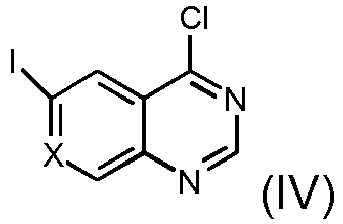
with amine to give a compound of formula (V)
- (b) reacting the compound of formula (V) with boronic acid of formula (VI):

followed by treatment with p-toluenesulfonic acid salt to form a compound of Formula (VII):
- (c) preparing the ditosylate salt of a compound of formula (VII) to form a compound of formula (VIII):

- (d) recrystallizing the compound of formula (VIII) prepared according to step (c) in the presence of tetrahydrofurman (THF).
- Also disclosed is a method of producing a ditosylate salt of a compound of Formula (I) where said method comprises the step of recrystallizing the compound of formula (VIII) is performed in the presence of at least 20 volumes of THF. In particular embodiments, the method comprises the step of recrystallizing the compound of formula (VIII) in the presence of at least 25 volumes of THF, at least 27 volumes of THF, or at least 30 volumes of THF.
- Also disclosed are methods of producing a ditosylate salt of a compound of formula (I) as described above wherein the compound is a compound of formula (II) or formula (III).
- Also disclosed is a method of producing a ditosylate salt of an N-phenyl-4-quinazolinamine derivative where said method comprises the step of recrystallizing the N-phenyl-4-quinazolinamine derivative in the presence of at least 20 volumes of THF. In particular embodiments, the method comprises the step of recrystallizing the compound of formula (VIII) in the presence of at least 25 volumes of THF, at least 27 volumes of THF, or at least 30 volumes of THF. In one aspect, the N-phenyl-4-quinazolinamine derivative is N-(3-chloro-4-fluorophenyl)-7-(methyloxy)-6-{[3-(4-morpholinyl)propyl]oxy}-4-quinazolinamine.
- The following examples are intended for illustration only and are not intended to limit the scope of the invention in any way. The physical data given for the compounds exemplified is consistent with the assigned structure of those compounds.
- As used herein the symbols and conventions used in these processes, schemes and examples are consistent with those used in the contemporary scientific literature, for example, the Journal of the American Chemical Society or the Journal of Biological Chemistry. Standard single-letter or three-letter abbreviations are generally used to designate amino acid residues, which are assumed to be in the L-configuration unless otherwise noted. Unless otherwise noted, all starting materials were obtained from commercial suppliers and used without further purification. Specifically, the following abbreviations may be used in the examples and throughout the specification:
- g (grams); mg (milligrams);
- L (liters); mL (milliliters);
- µL (microliters); psi (pounds per square inch);
- mm (millimeters); kN: (kiloNewton) cfm (cubic feet per minute) kP (kilopond)
- M (molar); mM (millimolar);
- N (Normal) Kg (kilogram)
- i. v. (intravenous); mol (moles);
- mmol (millimoles); RT (room temperature);
- min (minutes); h (hours);
- RSD (relative standard deviation) rpm (revolutions per minute)
- mp (melting point); TLC (thin layer chromatography);
- Tr (retention time); RP (reverse phase);
- THF (tetrahydrofuran); DMSO (dimethylsulfoxide);
- EtOAc (ethyl acetate); DME (1,2-dimethoxyethane); DCM
- (dichloromethane); DCE (dichloroethane); DMF (N,N-dimethylformamide); HOAc (acetic acid);
- POCl3 (phosphorus oxychloride); NBu3 (tri-n-butylamine);
- MeOH (methanol); IMS (industrial methylated spirit);
- DIPEA (diisopropylethyleneamine); PTSA (p-toluene sulfonic acid);
- TMSE (2-(trimethylsilyl)ethyl); TMS (trimethylsilyl);
- TIPS (triisopropylsilyl); TBS (t-butyldimethylsilyl);
- Unless otherwise indicated, all temperatures are expressed in °C (degrees Centigrade). All reactions conducted under an inert atmosphere at room temperature unless otherwise noted.
- Table 1 contains a description of the components used in the preparation of a granulation mixture and Table 2 contains a description of the components used in the preparation of a compression blend for one embodiment of N-{3-Chloro-4-[(3-fluorobenzyl)oxy]phenyl}-6-[5-({[2-(methanesulphonyl)ethyl]amino}methyl)-2-furyl]-4-quinazolinamine Tablets, 250 mg for a batch size of 20,000 tablets.
Table 1 Component Amount (mg/tab)* Amount (kg/batch)** Function Granulation Mixture Active1 405 8.100 Active Microcrystalline Cellulose NF, PhEur, JP 387 7.740 Diluent Glidant Povidone USP, PhEur, JP2 58.5 1.170 Binder qs qs Granulating liquid Purified Water3 Total dry granules 850.5 17.01 1 N-{3-Chloro-4-[(3-fluorobenzyl)oxy]phenyl}-6-[5-({[2-(methanesulphonyl) ethyl]amino}methyl)-2-furyl]-4-quinazolinamine. Prepared according to the procedure of Scheme B. The actual amount of drug substance may be adjusted based on the purity of the specific lot of drug substance included in the batch. The amount of diluent (microcrystalline cellulose) is then adjusted to maintain a core tablet weight of 900mg.
2 Plasdone K29/32
3 Removed during drying process.
* Based on theoretical drug substance factor of 1.62 = 1.00
** Quantities for a 20,000 tablet granulation.Table 2 Component Amount (mg/tab) Amount (kg/batch)* Function Compression Blend Granules1 850.5 102.06 Active Granules Sodium Starch Glycolate2 40.5 4.86 Disintegrant Magnesium Stearate 9 1.08 Lubricant Total Weight 900.0 108.0 Coatinq Opadry®/Orange YS-1-13065-A 27.0 3.24 Film Coat qs qs Purified Water3 Total Tablet Weight 927.0 111.24 1 Granules prepared from Granular Mix of Table 1
2 Primojel NF, Pharm Eur, JPE
3 Removed during drying process
* 120000 Tablets - For this example all ingredients were weighed to amounts which were consistent with the weight percents recited in Tables 1 and 2.
- N-{3-Chloro-4-[(3-fluorobenzyl)oxy]phenyl}-6-[5-({[2-(methanesulphonyl) ethyl]amino}methyl)-2-furyl]-4-quinazolin amine ditosylate monohydrate and microcrystalline cellulose NF, PH.Eur., JP were added to the bowl of a Glatt 30 granulator. A 10% solution of povidone in water was prepared using a Lightnin' mixer with a suitable tank. The N-{3-Chloro-4-[(3-fluorobenzyl)oxy]phenyl}-6-[5-({[2-(methanesulphonyl) ethyl]amino}methyl)-2-furyl]-4-quinazolin amine ditosylate monohydrate and microcrystalline cellulose were fluidized in the Glat 30 bowl and spraying of the 10% povidone solution began immediately at approximately 220g/minute with an inlet air temperature of 54°C. The inlet air dewpoint was maintained between 10 to 15 °C. After the povidone solution was applied purified water was added as needed to obtain a proper granulation wetness. At the end of granulation the inlet air temperature was raised to 60°C and drying was continued until an LOD of approximately 2.5% was reached. The dried active granules were passed through a Comil Model 197S cone mill fitted with a 0.075 inch round holed screen at approximately 1720 RPM (28.6 Hz).
- Sieve analysis was performed and tapped density profiles established. Sieve analysis was performed using a Retsch sieve shaker, Model AS200 Digit. Approximately 20 g of active dried granules was placed on the top of a nest of tared sieves of 20, 30, 40, 60, 100, and 200 mesh. Shaking was done for 5 minutes at an amplitude setting of 60 with the pulse on. This sieve analysis revealed little batch to batch variation in particle size of the active granules. The granules were also characterized for Bulk Density (BD) and Tapped Density (TD). BD and TD of the granules was measured by adding a weighed amount of granules into a 100 ml graduated cylinder and measuring the volume initially and after 25, 50, 200, 500, and 1250 taps respectively.
- BD and TD showed minimal variation between batches.
- A compression blend was formed by combining the prepared active granules and sodium starch glycolate in a bin which was transferred to a tumble blender where the ingredients were blended for 15 minutes @ 12 RPM. The bin was then removed from the tumble blender and magnesium stearate added to the blend of active granules and sodium starch glycolate. The bin was sealed and transferred back to the tumble blender and blended for 3 minutes @ 12 RPM to obtain the compression mix. Tablets were compressed from the compression blend using a Hata model HT-AP18SSU rotary tablet press fitted with 19.05 x 10.41 mm standard concave tooling. The tablet press was adjusted to provide tablets with the following specifications.
Weight of 10 tablets 9.00 g Weight Range of 10 tablets 8.80-9.20 g Individual Tablet Weight 900.0 mg Individual Weight Range 855.0 - 945.0 mg Target Average Tablet Hardness 18 kp Individual Hardness Range 9 - 27 kp Individual Thickness Range 5.00 - 8.00 mm Compression Speed Range 15 - 45 RPM - Uncoated tablets were characterized for weight, hardness, disintegration and dissolution. Tablets were weighed and hardness determined using, for example, a Dr. Schleuniger® Pharmatron Testlink Instrument available from Dr Schleuniger® Pharmatron of Solothurn, Switzerland. Disintegration was determined in 1 L of water at 37°C and drug dissolution was evaluated using a USP Type II apparatus at 55 rpm paddle speed in 900 ml of 0.1 N HCl/2% w/w Tween 80 at 37°C. Results for three groups of tablets follow:
- Average Weight: #1 = 900.2 ± 1.23 mg; n = 120
#2 = 902.6± 1.28 mg; n = 90
#3 = 901.8 ± 0.99; n = 60 - Average Hardness: #1 = 18.6 kp
#2 = 19.1 kp
#3 = 18.6 kp - Disintegration: #1 = 2 min 2 seconds
#2 = 1 minute 59 seconds
#3 = 1 minute 57 seconds - The produced tablets were coated in a Thomas Engineering Inc., Compu-Lab coater using 12% w/w Orange Opadry®/YS-1-13065-A aqueous suspension at a pan speed of 6-8 rpm. Two spray nozzles (orifice opening - 1.2 mm) were used to deliver coating solution at a total rate of 90-120 g/min. The airflow was maintained at 500 to 700 cfm with the outlet air temperature ranging from 50 to 63°C. The gun to bed distance was kept at 8.5 to 9 inches. Sufficient film coating was applied to achieve a 3 percent by weight gain assuming 100% coating efficiency.
- Coated tablets were characterized for drug dissolution using a USP Type II apparatus at 55 rpm paddle speed in 900 ml of 0.1 N HCl/2% w/w Tween 80 at 37°C. The results follow:
- % Dissolution (45 min): Range = 81-95 %
Average = #1 = 87
#2 = 93
#3 = 94 - N-{3-Chloro-4-[(3-fluorobenzyl)oxy]phenyl}-6-[5-({[2-(methanesulphonyl) ethyl]amino}methyl)-2-furyl]-4-quinazolin amine ditosylate monohydrate is prepared according to the procedure of Scheme C as follows:
- Stage 1- A stirred suspension of 3H-6-iodoquinazolin-4-one in toluene (5 vols) is treated with tri-n-butylamine (1.2 equiv.), and then heated to 70-80°C. Phosphorous oxychloride (1.1equiv.) is added and the reaction mixture is then heated to reflux and stirred at this temperature for at least 2 hours. The reaction mixture is then cooled to 55°C and toluene (5vol) added followed by 3-chloro-4-{[(3-fluorophenyl)methyl]oxy}aniline (1.03 equiv.). The reaction mixture is then warmed to 70-90°C and stirred for at least 2 hours. The resultant slurry is transferred to a second vessel. The temperature is adjusted to 70-75°C and 8 molar aqueous sodium hydroxide solution (2 vols) added over 1 hour, followed by water (6vol.) maintaining the contents at 70-85°C. The mixture is stirred at 70-85°C for ca. 1 hour and then cooled to 20-25°C. The suspension is stirred for ca. 2 hours and the product collected by filtration, and washed successively with water, 0.1 molar aqueous sodium hydroxide, water, and IMS, then dried in vacuo.
- Stage 2- A mixture of N-(3-chloro-4-{[(3-fluorophenyl)methyl]oxy}phenyl)-6-iodo-4-quinazolinamine (1 wt), (5-formyl-2-furanyl)boronic acid (0.374 wt, 1.35eq) and 10% Palladium on charcoal (0.028 wt 50% water wet) is slurried in ethanol (industrial methylated spirits, 15 vols) to give a grey suspension. The resultant slurry is stirred for 5 minutes and then treated with N,N-di-isopropylethylamine (0.396 vols, 1.15eq.). The reaction slurry is heated to 70°C for typically 3 hours when the reaction is complete (by HPLC analysis). The mixture is a thick green slurry at this point which is treated with THF (15 vols) to dissolve the product that has precipitated, leaving only the Pd/C catalyst out of solution. The mixture is then filtered hot through GFA filter to remove the catalyst. The vessel is rinsed with IMS (1vol) and the wash used to rinse catalyst bed. A solution of p-toluenesulfonic acid monohydrate (1.50wt, 4.0 eq.) in water (1.5 vols) is added to the filtered solution over 5 minutes at 65°C. The reaction solution is cooled to 60°C, with crystallization observed at 60-65°C. The resultant slurry is then stirred for at least 1 hour at 60°C and then cooled to 20-25°C and then held at this temperature for a further 1 hour. The product is isolated by filtration and the cake washed with IMS (3vols). The product may be stored as a wet cake or dried.
- Stage 3- 5-{4-[(3-Chloro-4-{[(3-fluorophenyl)methyl]oxy}phenyl)amino]-6-quinazolinyl}-2-furancarbaldehyde 4-methylbenzenesulfonate (1 wt) and 2-(methylsulfonyl)ethylamine hydrochloride (0.4 wt, 1.60 equiv.) are suspended in THF (10 vols). Sequentially, acetic acid (0.354 vol., 4.00 equiv.) and diisopropylethylamine (DIPEA, 1.08 vols, 4.00 equiv.) are added. The resulting solution is stirred at 30°-35°C for ca. 1 hour then cooled to ca. 22°C. Sodium triacetoxyborohydride (0.66 wt, 2.00 equiv.) is then added. The resulting mixture is stirred at ca. 22°C for 2-4 hours then sampled for HPLC analysis. The reaction is quenched by addition of aqueous sodium hydroxide (25% w/w, 3 vols.) followed by water (2 vols.). The aqueous phase is then separated, extracted with THF (2 vols) and the combined THF extracts are then washed twice with 25%w/v aqueous ammonium chloride solution (2 x 5 vols). A solution of p-toluenesulfonic acid monohydrate (p-TSA, 0.74 wt, 2.5 equiv.) in water (1 vol) is prepared, warmed to ca. 60°C, and N-(3-chloro-4-{[(3-fluorophenyl)methyl]oxy}phenyl)-6-[5-({[2-(methylsulfonyl)ethyl]amino}methyl)-2-furanyl]-4-quinazolinamine 4-methylbenzenesulfonate hydrate seeds are added. The THF solution of the free base is added to the p-TSA solution over at least 1 hr, maintaining the batch temperature at 60±3°C. The resulting suspension is stirred at ca. 60°C for 1-2 hours, cooled to 20-25°C over an hour and aged at this temperature for ca. 1 hr. The solid is collected by filtration, washed with 95:5 THF: Water (3 x 2 vols) and dried in vacuum at ca. 35°C to give N-(3-chloro-4-{[(3-fluorophenyl)methyl]oxy}phenyl)-6-[5-({[2-(methylsulfonyl)ethyl]amino}methyl)-2-furanyl]-4-quinazolinamine 4-methylbenzenesulfonate hydrate as a bright yellow crystalline solid.
- Stage 4- A slurry of N-(3-chloro-4-{[(3-fluorophenyl)methyl]oxy}phenyl)-6-[5-({[2-(methylsulfonyl)ethyl]amino}methyl)-2-furanyl]-4-quinazolinamine 4-methylbenzenesulfonate hydrate (1.00 rel. wt) in aqueous tetrahydrofuran (80:20 THF: Water, 17 vols.) is heated to 63-64°C and held for at least 30 min until a solution forms. The solution is clarified while hot and a line wash applied (80:20 THF: Water, 0.5 vol.). THF (15.5 vols) is added over ca. 1 hour whilst maintaining the temperature at 60-63°C and the solution seeded with GW572016F (0.002 rel. wt). The batch is maintained at 60-63°C for at least 30 minutes to allow crystallization to become established. The batch is cooled to ca. 5°C over ca. 2 hours and the product isolated by filtration. It is washed twice with aqueous THF (90:10 THF: Water, 2 x 2 vols.) followed once with aqueous THF (19:1 THF: Water, 1 x 2 vols.). The batch is dried under vacuum up to 45°C to give N-(3-chloro-4-{[(3-fluorophenyl)methyl]oxy}phenyl)-6-[5-({[2-(methylsulfonyl)ethyl]amino}methyl)-2-furanyl]-4-quinazolinamine 4-methylbenzenesulfonate hydrate as a bright yellow crystalline solid.
- Table 4 contains a description of the components used in the preparation of a granulation mixture and Table 5 contains a description of the components used in the preparation of a compression blend for one embodiment of N-{3-Chloro-4-[(3-fluorobenzyl)oxy]phenyl}-6-[5-({[2-(methanesulphonyl)ethyl]amino}methyl)-2-furyl]-4-quinazolinamine Tablets, 250 mg for a batch size of 120,000 tablets.
Table 4 Component Amount (mg/tab)* Amount (kg/batch)** Function Granulation Mixture Active2 405 48.6 Active Microcrystalline Cellulose NF, PhEur, JP 387 46.44 Diluent Glidant Povidone USP, PhEur, JP 58.5 7.02 Binder qs qs Granulating liquid Purified Water2 Total dry granules 850.5 102.06 1 N-{3-Chloro-4-[(3-fluorobenzyl)oxy]phenyl}-6-[5-({[2-(methanesulphonyl) ethyl]amino}methyl)-2-furyl]-4-quinazolinamine. Prepared according to the procedure of Scheme B. The actual amount of drug substance may be adjusted based on the purity of the specific lot of drug substance included in the batch. The amount of diluent (microcrystalline cellulose) is then adjusted to maintain a core tablet weight of 900mg.
2 Removed during drying process.
* Based on theoretical drug substance factor of 1.62 = 1.00
** Quantities for a 120,000 tablet granulation.Table 5 Component Amount (mg/tab) Amount (kg/batch)* Function Compression Blend Granules 1 850.5 306.18 Active Granules Sodium Starch Glycolate 40.5 14.58 Disintegrant Magnesium Stearate 9 3.24 Lubricant Total Weight 900.0 324.0 Coating Opadry®/Orange YS-1- 27.0 9.72 Film Coat 13065-A qs qs Purified Water2 Total Tablet Weight 927.0 333.72 1 Granules prepared from Granular Mix of Table 4
2 Removed during drying process
* 360,000 Tablets - For this example all ingredients were weighed to amounts which were consistent with the weight percents recited in Tables 4 and 5.
- N-{3-Chloro-4-[(3-fluorobenzyl)oxy]phenyl}-6-[5-({[2-(methanesulphonyl) ethyl]amino}methyl)-2-furyl]-4-quinazolin amine ditosylate monohydrate and microcrystalline cellulose NF, PH.Eur., JP were added to the bowl of a Glatt WSTCD 160/200 granulator. A 20% solution of povidone in water was prepared using a Lightnin' mixer with a suitable tank. The N-{3-Chloro-4-[(3-fluorobenzyl) oxy]phenyl}-6-[5-({[2-(methanesulphonyl) ethyl]amino}methyl)-2-furyl]-4-quinazolin amine ditosylate monohydrate and microcrystalline cellulose were fluidized in the Glatt WSTCD 160/200 bowl and spraying of the 20% povidone solution began immediately at approximately 2000 g/minute with an inlet air temperature of 58°C. The inlet air humidity was maintained below 10 g/kg. After the povidone solution was applied purified water was added as needed to obtain a proper granulation wetness. At the end of granulation the inlet air temperature was raised to 60°C and drying was continued until an LOD of approximately 2.5% was reached. The dried active granules were passed through a Comil Model 196S cone mill fitted with a 0.075 inch round holed screen at approximately 1000 RPM.
- Sieve analysis was performed and tapped density profiles established. Sieve analysis was performed using a Retsch sieve shaker, Model AS200 Digit. Approximately 20 g of active dried granules was placed on the top of a nest of tared sieves of 20, 30, 40, 60, 100, and 200 mesh. Shaking was done for 5 minutes at an amplitude setting of 60 with the pulse on. This sieve analysis revealed little batch to batch variation in particle size of the active granules. The granules were also characterized for Bulk Density (BD) and Tapped Density (TD). BD and TD of the granules was measured by adding a weighed amount of granules into a 100 ml graduated cylinder and measuring the volume initially and after 25, 50, 100, 200, 300, 500, and 1250 taps respectively.
- A compression blend was formed by combining the prepared active granules and sodium starch glycolate in a bin which was transferred to a Bin blender where the ingredients were blended for 15 minutes @ 17 RPM. The bin was then removed from the tumble blender and magnesium stearate added to the blend of active granules and sodium starch glycolate. The bin was sealed and transferred back to the tumble blender and blended for 3 minutes @ 17 RPM to obtain the compression mix. Tablets were compressed from the compression blend using a Fette model 2090 rotary tablet press fitted with 19.05 x 10.41 mm standard concave tooling. The tablet press was adjusted to provide tablets with the following specifications.
Weight of 10 tablets 9.00 g Weight Range of 10 tablets 8.80-9.20 g Individual Tablet Weight 900.0 mg Individual Weight Range 855.0 - 945.0 mg Target Average Tablet Hardness 18 kp Individual Hardness Range 9 - 27 kp Individual Thickness Range 5.00 - 8.00 mm Compression Speed Range 40,000 - 100,000 tpm - Uncoated tablets were characterized for weight, hardness, disintegration and dissolution. Tablets were weighed and hardness determined using, for example, a Dr. Schleuniger® Pharmatron Testlink Instrument available from Dr Schleuniger® Pharmatron of Solothurn, Switzerland. Disintegration was determined in 900 mL of water at 37°C and drug dissolution was evaluated using a USP Type II apparatus at 55 rpm paddle speed in 900 ml of 0.1 N HCl containing 2% w/w Tween 80 at 37°C.
- The produced tablets were coated in a GLATT® 1500 coater using 12% w/w Orange Opadry®/YS-1-13065-A aqueous suspension at a pan speed of 5 - 7 rpm. Five spray nozzles (orifice opening - 1.2 mm) were used to deliver coating solution at a total rate of 450-550 g/min. The airflow was maintained at 3800 - 4200 cmh with the outlet air temperature ranging from 50 to 70°C. The gun to bed distance was kept at 18 - 30 cm. Sufficient film coating was applied to achieve a 3 percent by weight gain assuming 100% coating efficiency.
- Coated tablets were characterized for drug dissolution using a USP Type II apparatus at 55 rpm paddle speed in 900 ml of 0.1 N HCl containing 2% w/w Tween 80 at 37°C. =
Table 6 recites the tablet composition.Table 6 Component Amount (mg/tab)2 Reference to Standard Function Active1 405 Active Microcrystalline Cellulose 387 EP, JPE, NF Diluent Povidone 58.5 EP, JP, USP Binder Purified Water3 qs EP, JP, USP Granulating liquid Sodium Starch Glycolate 40.5 EP, JPE, USP Disintegrant Magnesium Stearate 9.0 EP, JPE, NF Lubricant Opadry® YS-1-13065-A 27 N/A Film coat Purified Water3 qs EP, JP, USP Film coat solvent Total tablet weight 927 1 N-{3-Chloro-4-[(3-fluorobenzyl)oxy]phenyl}-6-[5-({[2-(methanesulphonyl) ethyl]amino}methyl)-2-furyl]-4-quinazolinamine ditosylate monohydrate, equivalent to 250 mg 1 N-{3-Chloro-4-[(3-fluorobenzyl)oxy]phenyl}-6-[5-({[2-(methanesulphonyl) ethyl]amino}methyl)-2-furyl]-4-quinazolinamine.
2 Theoretical core tablet weight is 900 mg.
3 Removed during drying.
| Component | Amount (mg/tab)2 | Reference to Standard | Function |
| Active1 | 405 | Active | |
| Microcrystalline Cellulose | 387 | NF | Diluent |
| Povidone | 58.5 | EP, JP, USP | Binder |
| Purified Water3 | qs | EP, JPE, NF | Granulating liquid |
| Sodium Starch Glycolate | 40.5 | EP, JP, USP | Disintegrant |
| Magnesium Stearate | 9.0 | EP, JPE, NF | Lubricant |
| Opadry® YS-1-13065-A | 27 | EP6, JPE, NF | Film coat |
| Purified Water3 | qs | EP, JP, USP | Film coat solvent |
| Total tablet weight | 927 |
| 1 N-{3-Chloro-4-[(3-fluorobenzyl)oxy]phenyl}-6-[5-({[2-(methanesulphonyl) ethyl]amino}methyl)-2-furyl]-4-quinazolinamine ditosylate monohydrate, equivalent to 250 mg 1 N-{3-Chloro-4-[(3-fluorobenzyl)oxy]phenyl}-6-[5-({[2-(methanesulphonyl) ethyl]amino}methyl)-2-furyl]-4-quinazolinamine. 2 Theoretical core tablet weight is 900 mg. 3 Removed during drying. |
Claims (6)
- An oral pharmaceutical composition, which is a core tablet composition, comprising:(i) N-{3-Chloro-4-[(3-fluorobenzyl)oxy]phenyl}-6-[5-({[2-(methanesulphonyl)ethyl] amino}methyl)-2-furyl]-4-quinazolinamine ditosylate monohydrate present in a range of 30 to 60 percent by weight;(ii) povidone present in a range of 4 to 9 per cent by weight;(iii) sodium starch glycolate present in a range of 2 to 8 per cent by weight;(iv) microcrystalline cellulose present in a range of 35 to 50 per cent by weight; and(v) magnesium stearate present in a range 0.6 to 1.3 per cent by weight.
- The oral pharmaceutical composition of claim 1 wherein:(i) said N-{3-Chloro-4-[(3-fluorobenzyl) oxy]phenyl}-6-[5-(([2-(methanesulphonyl)ethyl] amino}methyl)-2-furyl]-4-quinazolinamine ditosylate monohydrate is present in a range of 42 to 48 percent by weight;(ii) said povidone is present in a range of 5.5 to 7.5 per cent by weight;(iii) said sodium starch glycolate is present in a range of 3.5 to 5.5 per cent by weight;(iv) said microcrystalline cellulose is present in a range of 40 to 46 per cent by weight; and(v) said magnesium stearate, is present in a range 0.8 to 1.2 per cent by weight.
- An oral pharmaceutical composition, which is a tablet composition, comprising:(i) N-{3-Chloro-4-[(3-fluorobenzyl)oxy]phenyl}-6-[5-({[2-(methanesulphonyl)ethyl] amino}methyl)-2-furyl]-4-quinazolinamine ditosylate monohydrate present in a range of 30 to 60 percent by weight;(ii) povidone present in a range of 4 to 9 per cent by weight;(iii) sodium starch glycolate present in a range of 2 to 8 per cent by weight;(iv) microcrystalline cellulose present in a range of 35 to 50 per cent by weight; and(v) magnesium stearate present in a range 0.6 to 1.3 per cent by weight; and(vi) a film coat present in the range of 2.5 to 3.5 percent by weight of the core tablet composition.
- The oral pharmaceutical composition of claim 3 comprising:(i) N-{3-Chloro-4-[(3-fluorobenzyl) oxy]phenyl}-6-[5-(([2-(methanesulphonyl)ethyl] amino}methyl)-2-furyl]-4-quinazolinamine ditosylate monohydrate present in a range of 42 to 48 percent by weight;(ii) povidone present in a range of 5.5 to 7.5 per cent by weight;(iii) sodium starch glycolate present in a range of 3.5 to 5.5 per cent by weight;(iv) microcrystalline cellulose present in a range of 40 to 46 per cent by weight;(v) magnesium stearate, present in a range 0.8 to 1.2 per cent by weight; and(vi) a film coat present in the range of 2.8 to 3.2 percent by weight of the core tablet composition.
- The oral pharmaceutical composition of claim 3 comprising:N-{3-Chloro-4-[(3-fluorobenzyl)oxy]phenyl}-6-[5-({[2-(methanesulphonyl)ethyl] amino}methyl)-2-furyl]-4-quinazolinamine ditosylate monohydrate present in a range of 30 to 47 percent by weight.
- The oral pharmaceutical composition of any one of claims 1 to 5 for use in therapy.
Priority Applications (2)
| Application Number | Priority Date | Filing Date | Title |
|---|---|---|---|
| SI200632109A SI1871347T1 (en) | 2005-04-19 | 2006-04-18 | Pharmaceutical composition |
| HRP20161429TT HRP20161429T1 (en) | 2005-04-19 | 2006-04-18 | Pharmaceutical composition |
Applications Claiming Priority (2)
| Application Number | Priority Date | Filing Date | Title |
|---|---|---|---|
| US67280505P | 2005-04-19 | 2005-04-19 | |
| PCT/US2006/014447 WO2006113649A1 (en) | 2005-04-19 | 2006-04-18 | Pharmaceutical composition |
Publications (3)
| Publication Number | Publication Date |
|---|---|
| EP1871347A1 EP1871347A1 (en) | 2008-01-02 |
| EP1871347A4 EP1871347A4 (en) | 2012-10-31 |
| EP1871347B1 true EP1871347B1 (en) | 2016-08-03 |
Family
ID=37115487
Family Applications (1)
| Application Number | Title | Priority Date | Filing Date |
|---|---|---|---|
| EP06750475.3A Expired - Lifetime EP1871347B1 (en) | 2005-04-19 | 2006-04-18 | Pharmaceutical composition |
Country Status (28)
| Country | Link |
|---|---|
| US (3) | US8821927B2 (en) |
| EP (1) | EP1871347B1 (en) |
| JP (1) | JP5202302B2 (en) |
| KR (1) | KR101356748B1 (en) |
| CN (1) | CN101203211B (en) |
| AR (1) | AR054252A1 (en) |
| AU (1) | AU2006236423B2 (en) |
| BR (1) | BRPI0609962B1 (en) |
| CA (1) | CA2606207C (en) |
| CY (1) | CY1118179T1 (en) |
| DK (1) | DK1871347T3 (en) |
| EA (1) | EA200702253A1 (en) |
| ES (1) | ES2601503T3 (en) |
| HR (1) | HRP20161429T1 (en) |
| HU (1) | HUE030982T2 (en) |
| IL (1) | IL186336A0 (en) |
| LT (1) | LT1871347T (en) |
| MA (1) | MA29404B1 (en) |
| MX (1) | MX2007013089A (en) |
| NO (1) | NO20075111L (en) |
| NZ (1) | NZ562223A (en) |
| PE (1) | PE20061430A1 (en) |
| PL (1) | PL1871347T3 (en) |
| PT (1) | PT1871347T (en) |
| SI (1) | SI1871347T1 (en) |
| TW (1) | TW200716204A (en) |
| WO (1) | WO2006113649A1 (en) |
| ZA (1) | ZA200708705B (en) |
Families Citing this family (18)
| Publication number | Priority date | Publication date | Assignee | Title |
|---|---|---|---|---|
| ES2601503T3 (en) * | 2005-04-19 | 2017-02-15 | Novartis Ag | Pharmaceutical composition |
| US8252805B2 (en) | 2008-05-07 | 2012-08-28 | Teva Pharmaceutical Industries Ltd. | Forms of lapatinib ditosylate and processes for preparation thereof |
| EP2158912A1 (en) * | 2008-08-25 | 2010-03-03 | Ratiopharm GmbH | Pharmaceutical composition comprising N-[3-chhloro-4-[3-fluorophenyl)methoxy)phenyl]6-[5[[[2-(methylsulfonyl)ethyl]amino]methyl]-2-furyl]-4-quinazolinamine |
| EP2158913A1 (en) * | 2008-08-25 | 2010-03-03 | Ratiopharm GmbH | Pharmaceutical composition comprising N-[3-chhloro-4-[(3-fluorophenyl)methoxy]phenyl]6-(5[[[2-(methylsulfonyl)ethyl]amino]methyl]-2-furyl]-4-quinazolinamine |
| WO2010099150A1 (en) * | 2009-02-24 | 2010-09-02 | Smithkline Beecham (Cork) Limited | Pharmaceutical tablet and process |
| US20120245351A1 (en) * | 2009-09-29 | 2012-09-27 | Natco Pharma Limited | Process for the preparation of lapatinib and its pharmaceutically acceptable salts |
| EP2572199B1 (en) | 2010-05-21 | 2017-03-08 | Novartis AG | Combination |
| JP5858989B2 (en) | 2010-05-21 | 2016-02-10 | ノバルティス アーゲー | combination |
| US8642661B2 (en) | 2010-08-03 | 2014-02-04 | Altherx, Inc. | Pharmaceutical combinations of beta-3 adrenergic receptor agonists and muscarinic receptor antagonists |
| US9907767B2 (en) | 2010-08-03 | 2018-03-06 | Velicept Therapeutics, Inc. | Pharmaceutical compositions and the treatment of overactive bladder |
| EA029119B1 (en) * | 2013-02-19 | 2018-02-28 | Хексаль Аг | Pharmaceutical composition comprising n-[3-chloro-4-(3-fluorobenzyloxy)phenyl]-6-[5({[2-(methylsulfonyl)ethyl]amino}methyl)-2-furyl]quinazolin-4-amine or a pharmaceutically acceptable salt, solvate or solvated salt thereof |
| WO2014170910A1 (en) | 2013-04-04 | 2014-10-23 | Natco Pharma Limited | Process for the preparation of lapatinib |
| US9636340B2 (en) | 2013-11-12 | 2017-05-02 | Ayyappan K. Rajasekaran | Kinase inhibitors |
| CN107205964A (en) | 2014-12-03 | 2017-09-26 | 威力塞帕特治疗股份有限公司 | Compositions and methods using modified release sorabegron for lower urinary tract symptoms |
| CN106389373B (en) * | 2015-07-29 | 2019-07-02 | 四川科伦药物研究院有限公司 | A kind of xylene monosulfonic acid Lapatinib tablet and preparation method thereof |
| CN106511289A (en) * | 2015-09-10 | 2017-03-22 | 湖北生物医药产业技术研究院有限公司 | Benzenesulfonicacid lapatinib tablets and preparing method thereof |
| US10065922B2 (en) | 2015-10-23 | 2018-09-04 | Velicept Therapeutics, Inc. | Solabegron zwitterion and uses thereof |
| EP4725489A2 (en) | 2019-08-02 | 2026-04-15 | OneHealthCompany, Inc. | Treatment of canine cancers |
Family Cites Families (11)
| Publication number | Priority date | Publication date | Assignee | Title |
|---|---|---|---|---|
| US5506248A (en) * | 1993-08-02 | 1996-04-09 | Bristol-Myers Squibb Company | Pharmaceutical compositions having good dissolution properties |
| GB9508538D0 (en) | 1995-04-27 | 1995-06-14 | Zeneca Ltd | Quinazoline derivatives |
| US5760041A (en) | 1996-02-05 | 1998-06-02 | American Cyanamid Company | 4-aminoquinazoline EGFR Inhibitors |
| BR9809398A (en) | 1997-04-25 | 2000-06-13 | Janssen Pharmaceutica Nv | Quinazolinones that inhibit farnesyl transferase |
| TW436485B (en) | 1997-08-01 | 2001-05-28 | American Cyanamid Co | Substituted quinazoline derivatives |
| RS49779B (en) | 1998-01-12 | 2008-06-05 | Glaxo Group Limited, | BICYCLIC HETEROAROMATIC COMPOUNDS AS PROTEIN TYROSINE KINASE INHIBITORS |
| BR0111947A (en) * | 2000-06-30 | 2003-05-06 | Glaxo Group Ltd | Compound, pharmaceutical composition, method for treatment of a disorder in a mammal, use of a compound and process for preparing, a compound |
| EP1353693B1 (en) | 2001-01-16 | 2005-03-16 | Glaxo Group Limited | Pharmaceutical combination containing a 4-quinazolineamine and paclitaxel, carboplatin or vinorelbine for the treatment of cancer |
| WO2003086467A1 (en) | 2002-04-08 | 2003-10-23 | Smithkline Beecham Corporation | Cancer treatment method comprising administering an erb-family inhibitor and a raf and/or ras inhibitor |
| US20060094068A1 (en) | 2002-06-19 | 2006-05-04 | Bacus Sarah S | Predictive markers in cancer therapy |
| ES2601503T3 (en) * | 2005-04-19 | 2017-02-15 | Novartis Ag | Pharmaceutical composition |
-
2006
- 2006-04-18 ES ES06750475.3T patent/ES2601503T3/en not_active Expired - Lifetime
- 2006-04-18 LT LTEP06750475.3T patent/LT1871347T/en unknown
- 2006-04-18 DK DK06750475.3T patent/DK1871347T3/en active
- 2006-04-18 HR HRP20161429TT patent/HRP20161429T1/en unknown
- 2006-04-18 PL PL06750475T patent/PL1871347T3/en unknown
- 2006-04-18 NZ NZ562223A patent/NZ562223A/en not_active IP Right Cessation
- 2006-04-18 AR AR20060101526A patent/AR054252A1/en not_active Application Discontinuation
- 2006-04-18 US US11/911,843 patent/US8821927B2/en active Active
- 2006-04-18 EP EP06750475.3A patent/EP1871347B1/en not_active Expired - Lifetime
- 2006-04-18 PT PT67504753T patent/PT1871347T/en unknown
- 2006-04-18 EA EA200702253A patent/EA200702253A1/en unknown
- 2006-04-18 CN CN2006800219417A patent/CN101203211B/en not_active Expired - Lifetime
- 2006-04-18 MX MX2007013089A patent/MX2007013089A/en active IP Right Grant
- 2006-04-18 SI SI200632109A patent/SI1871347T1/en unknown
- 2006-04-18 KR KR1020077026740A patent/KR101356748B1/en not_active Expired - Lifetime
- 2006-04-18 PE PE2006000406A patent/PE20061430A1/en not_active Application Discontinuation
- 2006-04-18 AU AU2006236423A patent/AU2006236423B2/en not_active Revoked
- 2006-04-18 HU HUE06750475A patent/HUE030982T2/en unknown
- 2006-04-18 BR BRPI0609962-9A patent/BRPI0609962B1/en active IP Right Grant
- 2006-04-18 CA CA2606207A patent/CA2606207C/en not_active Expired - Lifetime
- 2006-04-18 JP JP2008507783A patent/JP5202302B2/en not_active Expired - Lifetime
- 2006-04-18 WO PCT/US2006/014447 patent/WO2006113649A1/en not_active Ceased
- 2006-04-18 TW TW095113811A patent/TW200716204A/en unknown
-
2007
- 2007-10-07 IL IL186336A patent/IL186336A0/en unknown
- 2007-10-09 NO NO20075111A patent/NO20075111L/en not_active Application Discontinuation
- 2007-10-11 ZA ZA200708705A patent/ZA200708705B/en unknown
- 2007-10-25 MA MA30318A patent/MA29404B1/en unknown
-
2014
- 2014-07-28 US US14/444,637 patent/US20140335177A1/en not_active Abandoned
-
2016
- 2016-01-29 US US15/009,927 patent/US20160143909A1/en not_active Abandoned
- 2016-11-03 CY CY20161101115T patent/CY1118179T1/en unknown
Also Published As
Similar Documents
| Publication | Publication Date | Title |
|---|---|---|
| US20160143909A1 (en) | Pharmaceutical composition | |
| US20250109136A1 (en) | Dosage form compositions comprising an inhibitor of bruton's tyrosine kinase | |
| AU2011278950B2 (en) | c-Met modulator pharmaceutical compositions | |
| AU2019246824A1 (en) | Pharmaceutical compositions of therapeutically active compounds and their methods of use | |
| US10525059B2 (en) | Pharmaceutical compositions comprising Afatinib | |
| US20110111059A1 (en) | Compositions Comprising Quinazoline Derivatives, Preparation Methods and Uses Thereof | |
| KR20200095955A (en) | Oral solid formulation comprising pyridopyrimidin-based hydrochloride and preparation method thereof | |
| JP7370126B2 (en) | Pharmaceutical tablets containing erlotinib as the active ingredient | |
| WO2010099150A1 (en) | Pharmaceutical tablet and process | |
| WO2002011726A1 (en) | Highly absorbable solid preparation | |
| HK40074566A (en) | C-met modulator pharmaceutical compositions |
Legal Events
| Date | Code | Title | Description |
|---|---|---|---|
| PUAI | Public reference made under article 153(3) epc to a published international application that has entered the european phase |
Free format text: ORIGINAL CODE: 0009012 |
|
| 17P | Request for examination filed |
Effective date: 20071009 |
|
| AK | Designated contracting states |
Kind code of ref document: A1 Designated state(s): AT BE BG CH CY CZ DE DK EE ES FI FR GB GR HU IE IS IT LI LT LU LV MC NL PL PT RO SE SI SK TR |
|
| AX | Request for extension of the european patent |
Extension state: HR |
|
| RAX | Requested extension states of the european patent have changed |
Extension state: HR Payment date: 20071009 |
|
| REG | Reference to a national code |
Ref country code: HK Ref legal event code: DE Ref document number: 1115809 Country of ref document: HK |
|
| A4 | Supplementary search report drawn up and despatched |
Effective date: 20121002 |
|
| RIC1 | Information provided on ipc code assigned before grant |
Ipc: A61K 9/20 20060101AFI20120926BHEP Ipc: A61K 31/519 20060101ALI20120926BHEP |
|
| 17Q | First examination report despatched |
Effective date: 20131113 |
|
| TPAC | Observations filed by third parties |
Free format text: ORIGINAL CODE: EPIDOSNTIPA |
|
| REG | Reference to a national code |
Ref country code: HK Ref legal event code: WD Ref document number: 1115809 Country of ref document: HK |
|
| RAP1 | Party data changed (applicant data changed or rights of an application transferred) |
Owner name: NOVARTIS AG |
|
| GRAP | Despatch of communication of intention to grant a patent |
Free format text: ORIGINAL CODE: EPIDOSNIGR1 |
|
| RIC1 | Information provided on ipc code assigned before grant |
Ipc: A61K 9/28 20060101ALI20160208BHEP Ipc: A61K 31/517 20060101ALI20160208BHEP Ipc: A61K 9/20 20060101AFI20160208BHEP Ipc: C07D 405/04 20060101ALI20160208BHEP |
|
| INTG | Intention to grant announced |
Effective date: 20160223 |
|
| GRAS | Grant fee paid |
Free format text: ORIGINAL CODE: EPIDOSNIGR3 |
|
| GRAA | (expected) grant |
Free format text: ORIGINAL CODE: 0009210 |
|
| AK | Designated contracting states |
Kind code of ref document: B1 Designated state(s): AT BE BG CH CY CZ DE DK EE ES FI FR GB GR HU IE IS IT LI LT LU LV MC NL PL PT RO SE SI SK TR |
|
| AX | Request for extension of the european patent |
Extension state: HR |
|
| REG | Reference to a national code |
Ref country code: GB Ref legal event code: FG4D |
|
| REG | Reference to a national code |
Ref country code: CH Ref legal event code: EP Ref country code: AT Ref legal event code: REF Ref document number: 816891 Country of ref document: AT Kind code of ref document: T Effective date: 20160815 |
|
| REG | Reference to a national code |
Ref country code: IE Ref legal event code: FG4D |
|
| REG | Reference to a national code |
Ref country code: DE Ref legal event code: R096 Ref document number: 602006049796 Country of ref document: DE |
|
| REG | Reference to a national code |
Ref country code: HR Ref legal event code: TUEP Ref document number: P20161429 Country of ref document: HR |
|
| REG | Reference to a national code |
Ref country code: PT Ref legal event code: SC4A Ref document number: 1871347 Country of ref document: PT Date of ref document: 20161110 Kind code of ref document: T Free format text: AVAILABILITY OF NATIONAL TRANSLATION Effective date: 20161103 |
|
| REG | Reference to a national code |
Ref country code: NL Ref legal event code: FP |
|
| REG | Reference to a national code |
Ref country code: SE Ref legal event code: TRGR |
|
| REG | Reference to a national code |
Ref country code: DK Ref legal event code: T3 Effective date: 20161121 |
|
| REG | Reference to a national code |
Ref country code: EE Ref legal event code: FG4A Ref document number: E012577 Country of ref document: EE Effective date: 20161101 |
|
| REG | Reference to a national code |
Ref country code: HR Ref legal event code: T1PR Ref document number: P20161429 Country of ref document: HR |
|
| REG | Reference to a national code |
Ref country code: RO Ref legal event code: EPE |
|
| REG | Reference to a national code |
Ref country code: SK Ref legal event code: T3 Ref document number: E 22391 Country of ref document: SK |
|
| REG | Reference to a national code |
Ref country code: ES Ref legal event code: FG2A Ref document number: 2601503 Country of ref document: ES Kind code of ref document: T3 Effective date: 20170215 |
|
| REG | Reference to a national code |
Ref country code: GR Ref legal event code: EP Ref document number: 20160402738 Country of ref document: GR Effective date: 20170130 |
|
| REG | Reference to a national code |
Ref country code: FR Ref legal event code: PLFP Year of fee payment: 12 |
|
| REG | Reference to a national code |
Ref country code: DE Ref legal event code: R097 Ref document number: 602006049796 Country of ref document: DE |
|
| PLBE | No opposition filed within time limit |
Free format text: ORIGINAL CODE: 0009261 |
|
| STAA | Information on the status of an ep patent application or granted ep patent |
Free format text: STATUS: NO OPPOSITION FILED WITHIN TIME LIMIT |
|
| REG | Reference to a national code |
Ref country code: HU Ref legal event code: AG4A Ref document number: E030982 Country of ref document: HU |
|
| 26N | No opposition filed |
Effective date: 20170504 |
|
| PG25 | Lapsed in a contracting state [announced via postgrant information from national office to epo] |
Ref country code: MC Free format text: LAPSE BECAUSE OF FAILURE TO SUBMIT A TRANSLATION OF THE DESCRIPTION OR TO PAY THE FEE WITHIN THE PRESCRIBED TIME-LIMIT Effective date: 20160803 |
|
| REG | Reference to a national code |
Ref country code: FR Ref legal event code: PLFP Year of fee payment: 13 |
|
| REG | Reference to a national code |
Ref country code: HR Ref legal event code: ODRP Ref document number: P20161429 Country of ref document: HR Payment date: 20190327 Year of fee payment: 14 |
|
| REG | Reference to a national code |
Ref country code: AT Ref legal event code: UEP Ref document number: 816891 Country of ref document: AT Kind code of ref document: T Effective date: 20160803 |
|
| PGFP | Annual fee paid to national office [announced via postgrant information from national office to epo] |
Ref country code: LV Payment date: 20200330 Year of fee payment: 15 Ref country code: EE Payment date: 20200330 Year of fee payment: 15 |
|
| REG | Reference to a national code |
Ref country code: HR Ref legal event code: ODRP Ref document number: P20161429 Country of ref document: HR Payment date: 20200330 Year of fee payment: 15 |
|
| PGFP | Annual fee paid to national office [announced via postgrant information from national office to epo] |
Ref country code: IS Payment date: 20200326 Year of fee payment: 15 |
|
| PGFP | Annual fee paid to national office [announced via postgrant information from national office to epo] |
Ref country code: CY Payment date: 20200327 Year of fee payment: 15 Ref country code: LT Payment date: 20200404 Year of fee payment: 15 Ref country code: LU Payment date: 20200414 Year of fee payment: 15 |
|
| REG | Reference to a national code |
Ref country code: HR Ref legal event code: PBON Ref document number: P20161429 Country of ref document: HR Effective date: 20210418 |
|
| REG | Reference to a national code |
Ref country code: EE Ref legal event code: MM4A Ref document number: E012577 Country of ref document: EE Effective date: 20210430 |
|
| REG | Reference to a national code |
Ref country code: LT Ref legal event code: MM4D Effective date: 20210418 |
|
| PG25 | Lapsed in a contracting state [announced via postgrant information from national office to epo] |
Ref country code: LU Free format text: LAPSE BECAUSE OF NON-PAYMENT OF DUE FEES Effective date: 20210418 |
|
| PG25 | Lapsed in a contracting state [announced via postgrant information from national office to epo] |
Ref country code: LT Free format text: LAPSE BECAUSE OF NON-PAYMENT OF DUE FEES Effective date: 20210418 Ref country code: CY Free format text: LAPSE BECAUSE OF NON-PAYMENT OF DUE FEES Effective date: 20210418 Ref country code: EE Free format text: LAPSE BECAUSE OF NON-PAYMENT OF DUE FEES Effective date: 20210430 |
|
| PG25 | Lapsed in a contracting state [announced via postgrant information from national office to epo] |
Ref country code: LV Free format text: LAPSE BECAUSE OF NON-PAYMENT OF DUE FEES Effective date: 20210418 |
|
| PGFP | Annual fee paid to national office [announced via postgrant information from national office to epo] |
Ref country code: IE Payment date: 20220323 Year of fee payment: 17 Ref country code: GB Payment date: 20220323 Year of fee payment: 17 Ref country code: CH Payment date: 20220330 Year of fee payment: 17 |
|
| PGFP | Annual fee paid to national office [announced via postgrant information from national office to epo] |
Ref country code: SK Payment date: 20220324 Year of fee payment: 17 Ref country code: SE Payment date: 20220328 Year of fee payment: 17 Ref country code: NL Payment date: 20220330 Year of fee payment: 17 Ref country code: GR Payment date: 20220331 Year of fee payment: 17 Ref country code: CZ Payment date: 20220325 Year of fee payment: 17 |
|
| PGFP | Annual fee paid to national office [announced via postgrant information from national office to epo] |
Ref country code: RO Payment date: 20220407 Year of fee payment: 17 Ref country code: HU Payment date: 20220329 Year of fee payment: 17 Ref country code: DK Payment date: 20220412 Year of fee payment: 17 |
|
| PGFP | Annual fee paid to national office [announced via postgrant information from national office to epo] |
Ref country code: SI Payment date: 20220329 Year of fee payment: 17 Ref country code: FI Payment date: 20220412 Year of fee payment: 17 |
|
| REG | Reference to a national code |
Ref country code: DK Ref legal event code: EAP Effective date: 20221209 |
|
| REG | Reference to a national code |
Ref country code: SK Ref legal event code: MA4A Ref document number: E 22391 Country of ref document: SK Effective date: 20221208 |
|
| PG25 | Lapsed in a contracting state [announced via postgrant information from national office to epo] |
Ref country code: SK Free format text: LAPSE BECAUSE OF THE APPLICANT RENOUNCES Effective date: 20221208 Ref country code: CZ Free format text: LAPSE BECAUSE OF THE APPLICANT RENOUNCES Effective date: 20221214 |
|
| REG | Reference to a national code |
Ref country code: ES Ref legal event code: GD2A Effective date: 20230327 |
|
| REG | Reference to a national code |
Ref country code: FR Ref legal event code: PLFP Year of fee payment: 18 |
|
| PG25 | Lapsed in a contracting state [announced via postgrant information from national office to epo] |
Ref country code: GR Free format text: LAPSE BECAUSE OF THE APPLICANT RENOUNCES Effective date: 20230104 |
|
| PG25 | Lapsed in a contracting state [announced via postgrant information from national office to epo] |
Ref country code: DK Free format text: LAPSE BECAUSE OF THE APPLICANT RENOUNCES Effective date: 20221209 |
|
| PGFP | Annual fee paid to national office [announced via postgrant information from national office to epo] |
Ref country code: PT Payment date: 20230417 Year of fee payment: 18 Ref country code: BG Payment date: 20230331 Year of fee payment: 18 |
|
| PGFP | Annual fee paid to national office [announced via postgrant information from national office to epo] |
Ref country code: AT Payment date: 20230327 Year of fee payment: 18 |
|
| PGFP | Annual fee paid to national office [announced via postgrant information from national office to epo] |
Ref country code: BE Payment date: 20230418 Year of fee payment: 18 |
|
| REG | Reference to a national code |
Ref country code: SE Ref legal event code: EUG |
|
| REG | Reference to a national code |
Ref country code: CH Ref legal event code: PL |
|
| REG | Reference to a national code |
Ref country code: NL Ref legal event code: MM Effective date: 20230501 |
|
| GBPC | Gb: european patent ceased through non-payment of renewal fee |
Effective date: 20230418 |
|
| PG25 | Lapsed in a contracting state [announced via postgrant information from national office to epo] |
Ref country code: GB Free format text: LAPSE BECAUSE OF NON-PAYMENT OF DUE FEES Effective date: 20230418 |
|
| PG25 | Lapsed in a contracting state [announced via postgrant information from national office to epo] |
Ref country code: SI Free format text: LAPSE BECAUSE OF NON-PAYMENT OF DUE FEES Effective date: 20230419 Ref country code: SE Free format text: LAPSE BECAUSE OF NON-PAYMENT OF DUE FEES Effective date: 20230419 Ref country code: RO Free format text: LAPSE BECAUSE OF NON-PAYMENT OF DUE FEES Effective date: 20230418 Ref country code: NL Free format text: LAPSE BECAUSE OF NON-PAYMENT OF DUE FEES Effective date: 20230501 Ref country code: LI Free format text: LAPSE BECAUSE OF NON-PAYMENT OF DUE FEES Effective date: 20230430 Ref country code: GB Free format text: LAPSE BECAUSE OF NON-PAYMENT OF DUE FEES Effective date: 20230418 Ref country code: CH Free format text: LAPSE BECAUSE OF NON-PAYMENT OF DUE FEES Effective date: 20230430 |
|
| REG | Reference to a national code |
Ref country code: IE Ref legal event code: MM4A |
|
| REG | Reference to a national code |
Ref country code: SI Ref legal event code: KO00 Effective date: 20240116 |
|
| PG25 | Lapsed in a contracting state [announced via postgrant information from national office to epo] |
Ref country code: IE Free format text: LAPSE BECAUSE OF NON-PAYMENT OF DUE FEES Effective date: 20230418 |
|
| PG25 | Lapsed in a contracting state [announced via postgrant information from national office to epo] |
Ref country code: IE Free format text: LAPSE BECAUSE OF NON-PAYMENT OF DUE FEES Effective date: 20230418 |
|
| PG25 | Lapsed in a contracting state [announced via postgrant information from national office to epo] |
Ref country code: PT Free format text: LAPSE BECAUSE OF NON-PAYMENT OF DUE FEES Effective date: 20241018 |
|
| REG | Reference to a national code |
Ref country code: AT Ref legal event code: MM01 Ref document number: 816891 Country of ref document: AT Kind code of ref document: T Effective date: 20240418 |
|
| REG | Reference to a national code |
Ref country code: BE Ref legal event code: MM Effective date: 20240430 |
|
| PG25 | Lapsed in a contracting state [announced via postgrant information from national office to epo] |
Ref country code: PT Free format text: LAPSE BECAUSE OF NON-PAYMENT OF DUE FEES Effective date: 20241018 |
|
| PG25 | Lapsed in a contracting state [announced via postgrant information from national office to epo] |
Ref country code: BE Free format text: LAPSE BECAUSE OF NON-PAYMENT OF DUE FEES Effective date: 20240430 |
|
| PG25 | Lapsed in a contracting state [announced via postgrant information from national office to epo] |
Ref country code: BG Free format text: LAPSE BECAUSE OF NON-PAYMENT OF DUE FEES Effective date: 20240418 |
|
| PG25 | Lapsed in a contracting state [announced via postgrant information from national office to epo] |
Ref country code: AT Free format text: LAPSE BECAUSE OF NON-PAYMENT OF DUE FEES Effective date: 20240418 |
|
| PG25 | Lapsed in a contracting state [announced via postgrant information from national office to epo] |
Ref country code: BG Free format text: LAPSE BECAUSE OF NON-PAYMENT OF DUE FEES Effective date: 20240418 Ref country code: BE Free format text: LAPSE BECAUSE OF NON-PAYMENT OF DUE FEES Effective date: 20240430 Ref country code: AT Free format text: LAPSE BECAUSE OF NON-PAYMENT OF DUE FEES Effective date: 20240418 |
|
| PGFP | Annual fee paid to national office [announced via postgrant information from national office to epo] |
Ref country code: FR Payment date: 20250321 Year of fee payment: 20 Ref country code: PL Payment date: 20250321 Year of fee payment: 20 |
|
| PGFP | Annual fee paid to national office [announced via postgrant information from national office to epo] |
Ref country code: TR Payment date: 20250328 Year of fee payment: 20 |
|
| PG25 | Lapsed in a contracting state [announced via postgrant information from national office to epo] |
Ref country code: FI Free format text: LAPSE BECAUSE OF THE APPLICANT RENOUNCES Effective date: 20221212 |
|
| PGFP | Annual fee paid to national office [announced via postgrant information from national office to epo] |
Ref country code: DE Payment date: 20250319 Year of fee payment: 20 |
|
| PGFP | Annual fee paid to national office [announced via postgrant information from national office to epo] |
Ref country code: ES Payment date: 20250506 Year of fee payment: 20 |
|
| PGFP | Annual fee paid to national office [announced via postgrant information from national office to epo] |
Ref country code: IT Payment date: 20250326 Year of fee payment: 20 |
|
| PG25 | Lapsed in a contracting state [announced via postgrant information from national office to epo] |
Ref country code: IS Free format text: LAPSE BECAUSE OF NON-PAYMENT OF DUE FEES Effective date: 20211103 |
|
| REG | Reference to a national code |
Ref country code: DE Ref legal event code: R071 Ref document number: 602006049796 Country of ref document: DE |
|
| REG | Reference to a national code |
Ref country code: ES Ref legal event code: FD2A Effective date: 20260424 |
|
| PG25 | Lapsed in a contracting state [announced via postgrant information from national office to epo] |
Ref country code: HU Free format text: LAPSE BECAUSE OF THE APPLICANT RENOUNCES Effective date: 20221209 |