EP1869536B1 - Multi-threaded processor comprising customisable bifurcated thread scheduler for automatic low power mode invocation - Google Patents
Multi-threaded processor comprising customisable bifurcated thread scheduler for automatic low power mode invocation Download PDFInfo
- Publication number
- EP1869536B1 EP1869536B1 EP06739851A EP06739851A EP1869536B1 EP 1869536 B1 EP1869536 B1 EP 1869536B1 EP 06739851 A EP06739851 A EP 06739851A EP 06739851 A EP06739851 A EP 06739851A EP 1869536 B1 EP1869536 B1 EP 1869536B1
- Authority
- EP
- European Patent Office
- Prior art keywords
- instruction
- thread
- scheduler
- priority
- processor
- Prior art date
- Legal status (The legal status is an assumption and is not a legal conclusion. Google has not performed a legal analysis and makes no representation as to the accuracy of the status listed.)
- Expired - Lifetime
Links
Images


Classifications
-
- G—PHYSICS
- G06—COMPUTING OR CALCULATING; COUNTING
- G06F—ELECTRIC DIGITAL DATA PROCESSING
- G06F1/00—Details not covered by groups G06F3/00 - G06F13/00 and G06F21/00
- G06F1/26—Power supply means, e.g. regulation thereof
- G06F1/32—Means for saving power
- G06F1/3203—Power management, i.e. event-based initiation of a power-saving mode
-
- G—PHYSICS
- G06—COMPUTING OR CALCULATING; COUNTING
- G06F—ELECTRIC DIGITAL DATA PROCESSING
- G06F9/00—Arrangements for program control, e.g. control units
- G06F9/06—Arrangements for program control, e.g. control units using stored programs, i.e. using an internal store of processing equipment to receive or retain programs
- G06F9/46—Multiprogramming arrangements
-
- G—PHYSICS
- G06—COMPUTING OR CALCULATING; COUNTING
- G06F—ELECTRIC DIGITAL DATA PROCESSING
- G06F1/00—Details not covered by groups G06F3/00 - G06F13/00 and G06F21/00
-
- G—PHYSICS
- G06—COMPUTING OR CALCULATING; COUNTING
- G06F—ELECTRIC DIGITAL DATA PROCESSING
- G06F1/00—Details not covered by groups G06F3/00 - G06F13/00 and G06F21/00
- G06F1/26—Power supply means, e.g. regulation thereof
-
- G—PHYSICS
- G06—COMPUTING OR CALCULATING; COUNTING
- G06F—ELECTRIC DIGITAL DATA PROCESSING
- G06F9/00—Arrangements for program control, e.g. control units
- G06F9/06—Arrangements for program control, e.g. control units using stored programs, i.e. using an internal store of processing equipment to receive or retain programs
- G06F9/30—Arrangements for executing machine instructions, e.g. instruction decode
- G06F9/30003—Arrangements for executing specific machine instructions
- G06F9/30076—Arrangements for executing specific machine instructions to perform miscellaneous control operations, e.g. NOP
- G06F9/3009—Thread control instructions
-
- G—PHYSICS
- G06—COMPUTING OR CALCULATING; COUNTING
- G06F—ELECTRIC DIGITAL DATA PROCESSING
- G06F9/00—Arrangements for program control, e.g. control units
- G06F9/06—Arrangements for program control, e.g. control units using stored programs, i.e. using an internal store of processing equipment to receive or retain programs
- G06F9/30—Arrangements for executing machine instructions, e.g. instruction decode
- G06F9/38—Concurrent instruction execution, e.g. pipeline or look ahead
- G06F9/3836—Instruction issuing, e.g. dynamic instruction scheduling or out of order instruction execution
- G06F9/3851—Instruction issuing, e.g. dynamic instruction scheduling or out of order instruction execution from multiple instruction streams, e.g. multistreaming
-
- G—PHYSICS
- G06—COMPUTING OR CALCULATING; COUNTING
- G06F—ELECTRIC DIGITAL DATA PROCESSING
- G06F9/00—Arrangements for program control, e.g. control units
- G06F9/06—Arrangements for program control, e.g. control units using stored programs, i.e. using an internal store of processing equipment to receive or retain programs
- G06F9/30—Arrangements for executing machine instructions, e.g. instruction decode
- G06F9/38—Concurrent instruction execution, e.g. pipeline or look ahead
- G06F9/3861—Recovery, e.g. branch miss-prediction, exception handling
- G06F9/3863—Recovery, e.g. branch miss-prediction, exception handling using multiple copies of the architectural state, e.g. shadow registers
-
- G—PHYSICS
- G06—COMPUTING OR CALCULATING; COUNTING
- G06F—ELECTRIC DIGITAL DATA PROCESSING
- G06F9/00—Arrangements for program control, e.g. control units
- G06F9/06—Arrangements for program control, e.g. control units using stored programs, i.e. using an internal store of processing equipment to receive or retain programs
- G06F9/30—Arrangements for executing machine instructions, e.g. instruction decode
- G06F9/38—Concurrent instruction execution, e.g. pipeline or look ahead
- G06F9/3885—Concurrent instruction execution, e.g. pipeline or look ahead using a plurality of independent parallel functional units
- G06F9/3888—Concurrent instruction execution, e.g. pipeline or look ahead using a plurality of independent parallel functional units controlled by a single instruction for multiple threads [SIMT] in parallel
-
- G—PHYSICS
- G06—COMPUTING OR CALCULATING; COUNTING
- G06F—ELECTRIC DIGITAL DATA PROCESSING
- G06F9/00—Arrangements for program control, e.g. control units
- G06F9/06—Arrangements for program control, e.g. control units using stored programs, i.e. using an internal store of processing equipment to receive or retain programs
- G06F9/46—Multiprogramming arrangements
- G06F9/48—Program initiating; Program switching, e.g. by interrupt
- G06F9/4806—Task transfer initiation or dispatching
- G06F9/4843—Task transfer initiation or dispatching by program, e.g. task dispatcher, supervisor, operating system
- G06F9/485—Task life-cycle, e.g. stopping, restarting, resuming execution
-
- G—PHYSICS
- G06—COMPUTING OR CALCULATING; COUNTING
- G06F—ELECTRIC DIGITAL DATA PROCESSING
- G06F9/00—Arrangements for program control, e.g. control units
- G06F9/06—Arrangements for program control, e.g. control units using stored programs, i.e. using an internal store of processing equipment to receive or retain programs
- G06F9/46—Multiprogramming arrangements
- G06F9/48—Program initiating; Program switching, e.g. by interrupt
- G06F9/4806—Task transfer initiation or dispatching
- G06F9/4843—Task transfer initiation or dispatching by program, e.g. task dispatcher, supervisor, operating system
- G06F9/4881—Scheduling strategies for dispatcher, e.g. round robin, multi-level priority queues
- G06F9/4893—Scheduling strategies for dispatcher, e.g. round robin, multi-level priority queues taking into account power or heat criteria
-
- Y—GENERAL TAGGING OF NEW TECHNOLOGICAL DEVELOPMENTS; GENERAL TAGGING OF CROSS-SECTIONAL TECHNOLOGIES SPANNING OVER SEVERAL SECTIONS OF THE IPC; TECHNICAL SUBJECTS COVERED BY FORMER USPC CROSS-REFERENCE ART COLLECTIONS [XRACs] AND DIGESTS
- Y02—TECHNOLOGIES OR APPLICATIONS FOR MITIGATION OR ADAPTATION AGAINST CLIMATE CHANGE
- Y02D—CLIMATE CHANGE MITIGATION TECHNOLOGIES IN INFORMATION AND COMMUNICATION TECHNOLOGIES [ICT], I.E. INFORMATION AND COMMUNICATION TECHNOLOGIES AIMING AT THE REDUCTION OF THEIR OWN ENERGY USE
- Y02D10/00—Energy efficient computing, e.g. low power processors, power management or thermal management
Definitions
- the present invention relates generally to power management in a multithreaded processor. More particularly, the invention relates to a technique for automatically invoking a low power mode processor state.
- a thread is simply a sequence, or stream, of program instructions.
- a multithreaded microprocessor concurrently executes multiple threads according to some scheduling policy that dictates the fetching and issuing of instructions of the various threads, such as interleaved, blocked, or simultaneous multithreading.
- a multithreaded microprocessor typically allows the multiple threads to share the functional units of the microprocessor (e.g., instruction fetch and decode units, caches, branch prediction units, and load/store, integer, floating-point, SIMD, etc. execution units) in a concurrent fashion.
- multithreaded microprocessors include multiple sets of resources, or contexts, for storing the unique state of each thread, such as multiple program counters and general purpose register sets, to facilitate the ability to quickly switch between threads to fetch and issue instructions.
- cache misses typically have a relatively long latency. It is common for the memory access time of a contemporary microprocessor-based computer system to be between one and two orders of magnitude greater than the cache hit access time. Instructions dependent upon the data missing in the cache are stalled in the pipeline waiting for the data to come from memory. Consequently, some or all of the pipeline stages of a single-threaded microprocessor may be idle performing no useful work for many clock cycles.
- Multithreaded microprocessors may solve this problem by issuing instructions from other threads during the memory fetch latency, thereby enabling the pipeline stages to make forward progress performing useful work, somewhat analogously to, but at a finer level of granularity than, an operating system performing a task switch on a page fault.
- Other examples of performance-constraining issues addressed by multithreading microprocessors are pipeline stalls and their accompanying idle cycles due to a data dependence; or due to a long latency instruction such as a divide instruction, floating-point instruction, or the like; or due to a limited hardware resource conflict.
- the ability of a multithreaded microprocessor to issue instructions from other threads to pipeline stages that would otherwise be idle may significantly reduce the time required to execute the program or collection of programs comprising the threads.
- the invention includes a processor with a processor core executing, multiple threads.
- a bifurcated thread scheduler includes an internal processor core component and an external processor core component. The bifurcated thread scheduler identifies when all of the multiple threads are blocked and thereafter automatically enters a default low power sleep mode.
- the bifurcated thread scheduler is configured to identify when a blocked thread is subject to: a wait instruction, a yield instruction, a blocking inter-thread communication (ITC) access, and a stopped priority request from the external processor core component.
- ITC inter-thread communication
- the bifurcated thread scheduler is configured to enter the default low power sleep mode without issuing a wait instruction.
- the bifurcated thread scheduler may perform housekeeping functions prior to entering the default low power sleep mode.
- the invention also includes a method of managing power in a computing system. Multiple threads are executed. A default low power sleep mode is automatically entered when all of the multiple threads are identified as being blocked. When a thread is not longer blocked, the low power sleep mode is automatically exited.
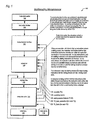
- FIGURE 1 illustrates a multithreading microprocessor that may be used in accordance with an embodiment of the invention.
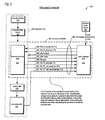
- FIGURE 2 illustrates a bifurcated scheduler, including a dispatch scheduler and a policy manager, utilized in accordance with an embodiment of the invention.
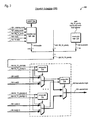
- FIGURE 3 illustrates a dispatch scheduler that may be used with the bifurcated scheduler of Figure 2 .
- FIGURE 4 illustrates processing operations associated with the dispatch scheduler of Figure 3 .
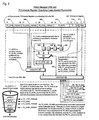
- FIGURE 5 illustrates a policy manager that may be used with the bifurcated scheduler of Figure 2 .
- FIGURE 6 illustrates processing operations associated with the policy manager of Figure 5 .
- Like reference numerals refer to corresponding parts throughout the several views of the drawings.
- Figure 1 illustrates a pipelined multithreading microprocessor 100 according to an embodiment of the invention.
- This exemplary multithreading microprocessor 100 is used to disclose concepts of the invention. It should be appreciated that the concepts of the invention may also be applied to alternate multithreading microprocessor designs.
- the microprocessor 100 is configured to concurrently execute a plurality of threads.
- a thread - also referred to herein as a thread of execution, or instruction stream - comprises a sequence, or stream, of program instructions.
- the threads may be from different programs executing on the microprocessor 100, or may be instruction streams from different parts of the same program executing on the microprocessor 100, or a combination thereof.
- Each thread has an associated thread context (TC).
- a thread context comprises a collection of storage elements, such as registers or latches, and/or bits in the storage elements of the microprocessor 100 that describe the state of execution of a thread. That is, the thread context describes the state of its respective thread, which is unique to the thread, rather than state shared with other threads of execution executing concurrently on the microprocessor 100.
- the microprocessor 100 is configured to quickly switch between threads to fetch and issue instructions.
- each thread context includes a program counter (PC), a general purpose register set, and thread control registers, which are included in register files 112 of the microprocessor 100.
- PC program counter
- thread control registers which are included in register files 112 of the microprocessor 100.
- the microprocessor 100 concurrently executes the threads according to a scheduling policy that dictates the fetching and issuing of instructions of the various threads.
- a scheduling policy that dictates the fetching and issuing of instructions of the various threads.
- Various embodiments for scheduling the dispatching of instructions from the multiple threads are described herein.
- the terms instruction "issue” and “dispatch” are used interchangeably herein.
- the multithreaded microprocessor 100 allows the multiple threads to share the functional units of the microprocessor 100 (e.g., instruction fetch and decode units, caches, branch prediction units, and execution units, such as load/store, integer, floating-point, SIMD, and other execution units) in a concurrent fashion.
- the microprocessor 100 includes an instruction cache 102 for caching program instructions - in particular, the instructions of the various threads - fetched from a system memory of a system including the microprocessor 100.
- the microprocessor 100 also includes an instruction fetcher 104, or instruction fetch pipeline 104, coupled to concurrently fetch instructions of the multiple threads from the instruction cache 102 and/or system memory into instruction/skid buffers 106, coupled to the instruction fetcher 104.
- the instruction fetch pipeline 104 includes a four-stage pipeline.
- the instruction/skid buffers 106 provide instructions to an instruction scheduler 108, or thread scheduler 108. In one embodiment, each thread has its own instruction/skid buffer 106.
- the scheduler 108 selects an instruction from one of the threads and issues the instruction for execution within the execution stages of the microprocessor 100 pipeline.
- the register files 112 are coupled to the scheduler 108 and provide instruction operands to execution units 114 that execute the instructions.
- the microprocessor 100 also includes a data cache 118 coupled to the execution units 114.
- the execution units 114 may include, but are not limited to, integer execution units, floating-point execution units, SIMD execution units, load/store units, and branch execution units.
- the integer execution unit pipeline includes four stages: a register file (RF) access stage in which the register file 112 is accessed, an address generation (AG) stage, an execute (EX) stage, and a memory second (MS) stage.
- RF register file
- AG address generation
- EX execute
- MS memory second
- the data cache 118 is a two-cycle cache that is accessed during a first clock cycle in the EX stage and is accessed during a second clock cycle in the MS stage.
- Each thread context includes its own register file 112, and each register file includes its own program counter, general-purpose register set, and thread control registers.
- the instruction fetcher 104 fetches instructions of the threads based on the program counter value of each thread context.
- the microprocessor 100 pipeline also includes a write-back stage 116 that writes instruction results back into the register files 112.
- the microprocessor 100 pipeline also includes an exception resolution stage coupled between the execution units 114 and the write-back stage 116.
- the execution units 114 generate a TC_instr_committed signal 124 associated with each thread context to indicate that an instruction of the specified thread has been committed for execution.
- An instruction has been committed for execution if the instruction is guaranteed not to be flushed by the microprocessor 100 pipeline, but instead is committed to eventually complete execution, which generates a result and updates the architectural state of the microprocessor 100.
- multiple instructions may be committed per clock cycle, and the TC_instr_committed signals 124 indicate the number of instructions committed for the thread context that clock cycle.
- the TC_instr_committed signals 124 are provided to the scheduler 108.
- the scheduler 108 updates a virtual water level indicator for the thread that is used by the thread scheduling policy of the scheduler 108 to accomplish required quality-of-service, as described below.
- the TC_instr_committed signals 124 are also provided to the respective instruction/skid buffers 106.
- the instruction/skid buffer 106 updates a pointer to effectively remove the instruction from the buffer 106.
- instructions are removed from a conventional instruction buffer and are issued for execution.
- the instruction/skid buffers 106 continue to store instructions after they have been issued for execution. The instructions are not removed from the instruction/skid buffers 106 until the execution units 114 indicate that an instruction has been committed for execution via the respective TC_instr_committed signal 124.
- the scheduler 108 provides to the execution units 114 a runnable TCs signal 132.
- the runnable TCs signal 132 specifies which of the thread contexts are runnable, i.e., which thread contexts the scheduler 108 may currently issue instructions from.
- a thread context is runnable if the thread context is active and is not blocked by other conditions (such as being Halted, Waiting, Suspended, or Yielded).
- the execution units 114 use the runnable TCs signal 132 to determine whether a stalled thread context is the only runnable thread context for deciding whether or not to flush the instructions of the stalled thread context.
- the execution units 114 provide to the scheduler 108 a stalling events signal 126.
- the stalling events signal 126 indicates that an instruction has stalled, or would have stalled, in an execution unit 114 for the reason specified by the particular stalling event signal 126.
- the stalling events signal 126 includes an identifier identifying the thread context of the stalled instruction.
- the execution units 114 also provide to the scheduler 108 an unstalling events signal 128. In response to the stalling events signal 126, the scheduler 108 stops issuing instructions for the stalled thread context until a relevant unstalling event 128 is signaled.
- Examples of events that would cause an execution unit 114 to stall in response to an instruction include, but are not limited to, the following.
- the instruction may be dependent upon unavailable data, such as data from a load instruction that misses in the data cache 118.
- an add instruction may specify an operand which is unavailable because a preceding load instruction that missed in the data cache 118 and the operand has not yet been fetched from system memory.
- the instruction may be dependent upon data from a long-running instruction, such as a divide or other long arithmetic instruction, or an instruction that moves a value from a coprocessor register, for example.
- the instruction may introduce a conflict for a limited hardware resource.
- the microprocessor 100 includes a single divider circuit. If the divider is already executing a divide instruction, then a second divide instruction must stall waiting for the first divide instruction to finish.
- the microprocessor 100 instruction set includes a group of instructions for performing low-level management operations of the instruction cache 102. If an instruction cache management instruction is already being executed, then a second instruction cache management instruction must stall waiting for the first to finish.
- the microprocessor 100 includes a load queue that includes a relatively small number of slots for storing in-progress data cache 118 refills.
- a load queue entry is allocated and a processor bus transaction is initiated to obtain the missing data from system memory.
- the data is returned on the bus, it is stored into the load queue and is subsequently written into the data cache 118.
- the load queue entry is freed.
- a load miss causes a pipeline stall.
- the instruction may follow an EHB instruction.
- the microprocessor 100 instruction set includes an EHB (Execution Hazard Barrier) instruction that is used by software to stop instruction execution until all execution hazards have been cleared. Typically, instructions following an EHB instruction will stall in the pipeline until the EHB instruction is retired.
- EHB Exchange Hazard Barrier
- the instruction may follow a load or store instruction addressed to inter-thread communication (ITC) space in its same thread context.
- the microprocessor 100 supports loads and stores to an ITC space comprising synchronized storage, which can block for arbitrarily long times causing instructions in the same thread context following the ITC load or store to stall.
- examples of unstalling events 128 include, but are not limited to, the following: load data that missed in the data cache 118 is returned; a limited hardware resource is freed up, such as a divider circuit, the instruction cache 102, or a load queue slot; an EHB instruction, long-running instruction, or load/store instruction to inter-thread communication (ITC) space completes.
- load data that missed in the data cache 118 is returned
- a limited hardware resource is freed up, such as a divider circuit, the instruction cache 102, or a load queue slot
- an EHB instruction, long-running instruction, or load/store instruction to inter-thread communication (ITC) space completes.
- the execution units 114 also generate a TC_flush signal 122 associated with each thread context to indicate that the instructions of the specified thread in the execution portion of the pipeline (i.e., portion of the pipeline below the scheduler 108) have been flushed, or nullified.
- flushing or nullifying an instruction comprises clearing a valid bit associated with the instruction in the pipeline, which prevents the pipeline from updating the architectural state of the microprocessor 100 in response to results of the instruction.
- One reason an execution unit 114 may generate a TC_flush signal 122 is when an instruction of a thread would stall in the execution unit 114, as described above.
- Nullifying or flushing the instruction removes the reason for the instruction to be stalled, since the results generated for the instruction will be disregarded and therefore need not be correct.
- instructions of other threads may continue to execute and utilize the execution bandwidth of the execution pipeline, thereby potentially increasing the overall performance of the microprocessor 100, as described in more detail below.
- only instructions of the stalling thread are flushed, which may advantageously reduce the number of pipeline bubbles introduced by the flush, and in some cases may cause only one bubble associated with the stalling instruction, depending upon the composition of instructions from the various threads present in the execution unit 114 pipeline.
- the TC_flush signal 122 indicates that all uncommitted instructions of the thread context have been flushed.
- the execution unit 114 may flush fewer than the number of uncommitted instructions present in the execution unit 114, namely the stalling instruction and any newer instructions of the stalling thread context, but not flush uncommitted instructions of the thread context that are older than the stalling instruction.
- the TC_flush signal 122 also indicates a number of instructions that were flushed by the execution unit 114.
- the TC_flush signals 122 are provided by the execution units 114 to their respective instruction/skid buffers 106.
- the instruction/skid buffer 106 uses the TC_flush signal 122 to roll back the state of the instructions in the buffer 106. Because the instruction/skid buffers 106 continue to store instructions until they have been committed not to be flushed, any instructions that are flushed may be subsequently re-issued from the instruction/skid buffers 106 without having to be re-fetched from the instruction cache 102. This has the advantage of potentially reducing the penalty associated with flushing stalled instructions from the execution pipeline to enable instructions from other threads to execute. Reducing the likelihood of having to re-fetch instructions is becoming increasingly important since instruction fetch times appear to be increasing.
- the penalty associated with an instruction re-fetch may be one, two, or more clock cycles more than in earlier designs.
- the bifurcated scheduler 108 comprises a dispatch scheduler (DS) 602 portion and a policy manager (PM) 604 portion.
- the dispatch scheduler 602 portion is comprised within a processor core 606 of microprocessor 100; whereas, the policy manager 604 portion is comprised outside of the processor core 606.
- the processor core 606 is the portion of the microprocessor 100 that is not customizable by the customer; whereas, the policy manager 604 is customizable by the customer.
- the processor core 606 is a synthesizable core, also referred to as a soft core.
- the design of a synthesizable core is capable of being reduced to a manufacturable representation quickly and easily using automated tools, commonly referred to as synthesis tools.
- the processor core 606 provides an interface 628 comprising a plurality of signals to the policy manager 604.
- the inputs to the dispatch scheduler 602 and output signals from the dispatch scheduler 602 are registered, to advantageously enable the non-core policy manager 604 logic to interface with the processor core 606 in a manner that alleviates certain timing problems that might be otherwise introduced by a bifurcated scheduler.
- the interface 628 is easy for the customer to understand, which eases the design of the policy manager 604 scheduling policy.
- Table 1 the various signals comprising the policy manager interface 628 according to one embodiment are shown. Table 1 specifies the signal name, the direction of the signal relative to the policy manager 604, and a brief description of each signal. Table 1 describes an embodiment in which the microprocessor 100 includes nine thread contexts for storing state associated with up to nine threads of execution. Furthermore, the embodiment enables the microprocessor 100 to be configured as up to two virtual processing elements (VPEs).
- VPEs virtual processing elements
- the microprocessor 100 substantially conforms to a MIPS32 or MIPS64 Instruction Set Architecture (ISA) and includes a control Coprocessor 0, referred to in Table 1 as CP0, which includes thread control registers substantially conforming to a Coprocessor 0 specified in the MIPS Privileged Resource Architecture (PRA) and the MIPS Multithreading Application Specific Extension (MT ASE).
- PRA MIPS Privileged Resource Architecture
- MT ASE MIPS Multithreading Application Specific Extension
- PM_vpemap[8:0] Input Assignment of TCs to VPEs Encoding Meaning 1#0 TC belongs to VPE 0 1#1 TC belongs to VPE 1 PM_cp0_reg_ex Input Register number for CP0 read. PM_cp0_sel_ex Input Register select for CP0 read. PM_cp0_rvpe_ex Input VPE select for CP0 read. PM_cpO_rtc_ex Input TC select for CP0 read. PM_cp0_run_ex Input Clock Enable for register holding PM cp0 rdata ms. PM_cp0_rdata_ms Output CP0 read data.
- PM_cp0_sel_er Input Register select for CP0 write.
- PM_cp0_wvpe_er Input VPE select for CP0 write.
- PM_cp0_wtc_er Input TC select for CP0 write.
- PM_tc_instr_committed contains which TC executed the FORK.
- the policy manager 604 specifies to the dispatch scheduler 602 the priority of the respective thread context via the PM_TC_priority 652 output.
- the PM_TC_priority 652 comprises two bits and the dispatch scheduler 602 allows the policy manager 604 to specify one of four different priorities for a thread context.
- the policy manager 604 instructs the dispatch scheduler 602 to stop issuing instructions for a thread context by generating a true value on the respective PM_TC_block 654 output.
- the policy manager 604 may affect how the dispatch scheduler 602 issues instructions for the various thread contexts via the PM_TC_priority 652 and PM_TC_block 654 outputs.
- the processor core 606 provides the PM_gclk 658 to the policy manager 604, which enables the policy manager 604 to adjust the PM_TC_priority 652 periodically based on the PM_gclk 658.
- the dispatch scheduler 602 communicates the state for each thread context via respective PM_TC_state 642 input. As shown in Table 1, a thread context may be in one of eight states as follows. InActive: the dispatch scheduler 602 may not issue instructions of the thread context because the thread context is not currently associated with a thread of execution. Active: the thread context is currently associated with a thread of execution; therefore, the dispatch scheduler 602 may issue instructions of the thread context for execution if no other blocking conditions are present.
- the dispatch scheduler 602 may not issue instructions of the thread context for execution because the thread has executed a YIELD instruction, which causes the thread context to be blocked on a specified event.
- the dispatch scheduler may not issue instructions of the thread context for execution because the thread context has been halted by itself or by another thread.
- the dispatch scheduler 602 may not issue instructions of the thread context for execution because the thread executed a DMT or DVPE instruction, or because the microprocessor 100 or VPE is currently servicing an exception.
- a DMT instruction suspends multithreading operation for the VPE.
- a DVPE instruction suspends multithreading operation for the entire microprocessor 100.
- the dispatch scheduler 602 may not issue instructions of the thread context for execution because the thread context is blocked waiting to load/store data from/to a location in inter-thread communication (ITC) space specified by a load/store instruction executed by the thread. Waiting due to WAIT: the dispatch scheduler 602 may not issue instructions of the thread context for execution because the thread has executed a WAIT instruction, which causes the thread context to be blocked until an interrupt has occurred. Used as SRS: the dispatch scheduler 602 may not issue instructions of the thread context because the thread context is not and cannot be associated with a thread of execution because the thread context register set is used for shadow register set operation.
- ITC inter-thread communication
- the dispatch scheduler 602 communicates to the policy manager 604 that it has issued an instruction for a thread context via a respective PM_TC_inst_issued 646 input.
- the execution units 114 communicate to the policy manager 604 that they have committed an instruction of a thread context via a respective PM_TC_instr_committed 644 input.
- the PM_TC_instr_committed 644 signal indicates execution of the instruction has been completed.
- the PM_TC_instr_committed 644 signal indicates the instruction is guaranteed not to be flushed, i.e., to eventually complete execution, but may not have yet been completed.
- the PM_TC_instr_committed 644 input provides to the policy manager 604 information about executed instructions as opposed to merely dispatched instructions (as communicated by the PM_TC_inst_issued input 646), which may be different since some instructions may be speculatively dispatched and never complete. This may be an important distinction to the policy manager 604 since some threads in an application may require a particular quality-of-service.
- the PM_TC_instr_committed signal 644 is a registered version of the TC_instr_committed signal 124.
- the processor core 606 provides feedback about the issuance and execution of instructions for the various thread contexts and state of the thread contexts via the PM_TC_inst_issued 646, PM_TC_instr_committed 644, and PM_TC_state 642 inputs.
- the dispatch scheduler 602 also provides to the policy manager 604 a relax function, whose purpose is to enable the microprocessor 100 to save power when the application thread contexts do not require full processor bandwidth, without actually going to sleep.
- the relax function operates as if there is an additional thread context to be scheduled. However, when the relax thread context is selected for issue, the dispatch scheduler 602 does not issue an instruction.
- the policy manager 604 maintains a RELAX_LEVEL counter (per-VPE) that operates similar to the TC_LEVEL 918 counters described below, except that it uses a RELAX_RATE for incrementing and is decremented when a relaxed instruction slot completes.
- the microprocessor 100 includes a VPESchedule register per-VPE similar to the TCSchedule register 902 that enables software to specify the RELAX_RATE.
- the relax function is enabled or disabled via the PM_vpe_relax_enable signals specified in Table 1, and the relax thread context priority is specified via the PM_vpe_relax_priority signals.
- the dispatch scheduler 602 also provides to the policy manager 604 an exception function, whose purpose is to enable an exception thread context to have its own independent priority from the normal thread contexts.
- the policy manager maintains an EXC_LEVEL counter (per-VPE) that operates similar to the TC_LEVEL 918 counters described below, except that it uses an EXC_RATE for incrementing and is decremented when an exception instruction slot completes.
- EXC_LEVEL counter per-VPE
- software specifies the EXC_RATE via the VPESchedule registers.
- the exception function is enabled or disabled via the PM_vpe_exc_enable signals specified in Table 1, and the exception thread context priority is specified via the PM_vpe_exc_priority signals.
- the instruction selection logic 202 includes a tree of muxes 724 controlled by comparators 714. Each mux 724 receives an instruction 206 from two different thread contexts. Each mux 724 also receives the instruction's 206 associated DS_TC_priority 208. The comparator 714 associated with each mux 724 also receives the pair of DS_TC_priority signals for the two thread contexts and controls its associated mux 724 to select the instruction 206 and DS_TC_priority 208 with the highest DS_TC_priohty 208 value. The selected instructions 206 and DS_TC_priorities 208 propagate down the tree until the final mux 724 selects the selected instruction 204 with the highest DS_TC_priority 208 for provision to the execution pipeline.
- Figure 3 shows logic of the dispatch scheduler 602, namely a stalled indicator 704, issuable instruction logic 708, and round-robin logic 712.
- the stalled indicator 704 and issuable instruction logic 708 are replicated within the dispatch scheduler 602 for each thread context to generate a DS_TC_priority 208 for each thread context.
- the round-robin logic 712 is instantiated once for each possible PM_TC_priority 652 and generates a round-robin indicator for each PM_TC_priority 652.
- Figure 3 illustrates an embodiment in which the policy manager 604 may specify one of four possible PM_TC_priorities 652; hence, the round-robin logic 712 is instantiated four times in the dispatch scheduler 602 and generates four respective round-robin indicators.
- the round-robin indicator includes one bit per thread context of the microprocessor 100.
- the bit of the round-robin indicator associated with its respective thread context is provided as round-robin bit 748. If the round-robin bit 748 is true, then it is the thread context's turn in the round-robin scheme to be issued among the other thread contexts that are currently at the same PM_TC_priority 652.
- the issuable instruction logic 708 receives the unstalling events signal 128 and stalling events signal 126 from the execution units 114 of Figure 1 , the PM_TC_block 654 signal from the policy manager 604 of Figure 2 , an empty signal 318 from the instruction/skid buffer 106, and TC state 742 signals.
- the TC state 742 signals convey similar information to the PM_TC_state 642 signals of Figure 2 .
- the issuable instruction logic 708 sets the stalled indicator 704 to mark the thread context stalled in response to a stalling events signal 126 that identifies the thread context.
- the issuable instruction logic 708 also stores state in response to the stalling event 126 to remember the cause of the stall.
- the issuable instruction logic 708 clears the stalled indicator 704 in response to an unstalling events signal 128 if the unstalling event 128 is relevant to the cause of the stall.
- the issuable instruction logic 708 generates an issuable 746 signal in response to its inputs.
- the issuable 746 signal is true if the instruction 206 pointed to by the read pointer of the instruction/skid buffer 106 for the thread context is issuable.
- an instruction is issuable if the TC state signals 742 indicate the thread context is in the Active state and is not blocked by other conditions (such as being Halted, Waiting, Suspended, or Yielded), the stalled indicator 704 is false, and the PM_TC_block 654 and empty 318 signals are false.
- the issuable 746 bit, the PM_TC_priority 652 bits, and the round-robin bit 748 are combined to create the DS_TC_priority 208.
- the issuable bit 746 is the most significant bit
- the round-robin bit 748 is the least significant bit
- the PM_TC_priority 652 is the two middle significant bits.
- the issuable bit 746 is the most significant bit of the DS_TC_priority 652
- a non-issuable instruction will be lower priority than all issuable instructions.
- the round-robin bit 748 is only used to select a thread if more than one thread context has an issuable instruction and has the same highest PM_TC_priority 652.
- FIG. 4 a flowchart illustrating operation of the dispatch scheduler 602 of Figure 3 according to the present invention is shown. Flow begins at block 802.
- the dispatch scheduler 602 initializes each round-robin indicator for each PM_TC_priority 652. Flow proceeds to block 804.
- the dispatch scheduler 602 determines, for each thread context, whether the thread context has an issuable instruction 206. That is, the issuable instruction logic 708 for each thread context generates a value on the issauble 746 signal. In one embodiment, the issuable instruction logic 708 generates a true signal on the issuable 746 signal.
- the issuable instruction logic 708 generates a true signal on the issuable 746 signal only if the TC state signals 742 indicate the thread context is in the Active state and is not blocked by other conditions (such as being Halted, Waiting, Suspended, or Yielded), the stalled indicator 704 is false, and the PM_TC_block 654 and empty 318 signals are false. Flow proceeds to decision block 806.
- the dispatch scheduler 602 determines, by examining the issuable 746 signal for each of the thread contexts, whether there are any thread contexts that have an issuable instruction 206. If not, a default low power sleep mode is entered. In some embodiments, certain housekeeping tasks are performed prior to entering a low power sleep mode. For example, the housekeeping tasks may include flushing pending transactions from buffers or completing long running operations (e.g. divides). The low power sleep mode achieves reduced power by not performing any pipeline operations.
- the default low power sleep mode is exited 808, if necessary.
- the dispatch scheduler 602 generates the DS_TC_priority 208 for the instruction 206 of each thread context based on the issuable 746 bit of the thread context, the PM_TC_priority 652 of the thread context, and the round-robin bit 748 of the PM_TC priority 652 of the thread contect. Flow proceeds to block 812.
- the dispatch scheduler 602 issues the instruction 206 with the highest DS_TC_priority 208.
- the dispatch scheduler 602 issues the instruction from the thread context that has an issuable instruction and has the highest PM_TC_priority 652. If multiple thread contexts meet that criteria, the dispatch scheduler 602 issues the instruction from the thread context whose turn it is to issue as indicated by the round-robin bit 748 for the PM_TC_priority 652 of the thread contexts. Flow proceeds to block 814.
- the round-robin logic 712 updates the round-robin indicator for the PM_TC_priority 652 based on which of the thread contexts was selected to have its instruction issued. Flow returns to block 804.
- Figure 4 illustrates that the invention includes a technique for automatically entering a default low power sleep mode. Observe that this mode is entered based upon simple criteria (i.e., the blocked state of threads). Therefore, a sophisticated control technique is not necessary. Further observe that the default low power sleep mode results in power conservation, but does not degrade processor performance since all of the threads are already in a blocked state.
- a top level clock gater only shuts down the clock when all units are idle and there are no runnable thread contexts.
- thread contexts are runnable when none of the following conditions are met: a WAIT instruction is executed, a YIELD instruction is executed, a Halt bit is set, a free bit is not set, and a thread context is waiting on an inter-thread communication (ITC) access.
- ITC inter-thread communication
- FIG. 5 a block diagram illustrating the policy manager 604 of Figure 2 and a TCSchedule register 902 according to the present invention is shown.
- the microprocessor 100 includes a TCSchedule register 902 for each thread context.
- the TCSchedule register 902 is software-programmable and provides a means for software to provide a thread scheduling hint to the policy manager 604.
- the TCSchedule register 902 is comprised within the Coprocessor 0 register discussed above with respect to Figure 2 and Table 1, and in particular is comprised within the policy manager 604.
- the TCSchedule register 902 includes six fields: TC_LEVEL_PARAM1 908, TC_LEVEL_PARAM2 906, TC_LEVEL_PARAM3 904, TC_RATE 912, OV 914, and PRIO 916.
- the TC LEVEL PARAM1 908, TC_LEVEL_PARAM2 906, TC_LEVEL_PARAM3 904, and TC_RATE 912 fields comprise four bits
- the PRIO 916 field comprises two bits
- the OV 914 field is a single bit.
- the policy manager 604 logic shown in Figure 5 comprises control logic 924; comparators 922 coupled to provide their output to the control logic 924; a TC_LEVEL 918 register coupled to provide its output as an input to the comparators 922; and a three-input mux 926 that is coupled to provide its output as the input to the TC_LEVEL 918 register.
- the mux 926 receives on its first input the output of the TC_LEVEL 918 register for retaining the correct value.
- the mux 926 receives on its second input the output of a decrementer 932 whose input is the output of the TC_LEVEL 918 register.
- the mux 926 receives on its third input the output of an incrementer 934 whose input is the output of an adder 936 that adds the output of the TC_LEVEL 918 register and the output of a multiplier 938 that multiplies the TC_RATE 912 by 2.
- the TC_RATE 912 is an indication of the desired execution rate of the thread context, i.e., the number of instructions to be completed per unit time. In the embodiment of Figure 5 , the TC_RATE 912 indicates the number of instructions of the thread that should be completed every 16 clock cycles.
- the policy manager 604 employs a modified leaky-bucket algorithm to accomplish the high-level thread scheduling policy of the scheduler 108.
- the TC_LEVEL 918 register is analogous to the water level in a bucket.
- the TC_LEVEL 918 is essentially a measure of the amount of work that needs to be done by the thread context.
- the TC_LEVEL 918 register comprises a 12-bit register initialized to zero.
- the control logic 924 generates a control signal 928 to control which input the mux 926 selects.
- the mux 926 selects the output of the incrementer 936 for storing in the TC_LEVEL 918 register, which increases the TC_LEVEL 918 by the quantity (TC_RATE * 2 + 1): In one embodiment, the number of clock cycles between updates of the TC_LEVEL 918 based on the TC_RATE 912 is also programmable. On other clock cycles, the mux 926 selects the output of the decrementer 932 to decrement the TC_LEVEL 918 if the PM_TC_instr_committed signal 644 indicates an instruction for the thread context has been committed for execution.
- TC_RATE 912 indicates the number of instructions per 16 clock cycles it is desired for the microprocessor 100 to execute for the thread context.
- the TC_LEVEL_PARAM fields 904/906/908 are programmed with monotonically increasing values that define virtual water pressure ranges.
- the comparators 922 compare the TC_LEVEL 918 with the TC_LEVEL_PARAMs 904/906/908 and provide their result to the control logic 924, which generates the PM_TC_priority 652 based on which of the virtual water pressure ranges the TC_LEVEL 918 falls in.
- the control logic 924 generates a PM_TC_priority 652 value of 3 (the highest priority) if the most significant nibble of the TC_LEVEL 918 is above the TC_LEVEL_PARAM3 904 value; the control logic 924 generates a PM_TC_priority 652 value of 2 if the most significant nibble of the TC_LEVEL 918 is between the TC_LEVEL_PARAM3 904 value and the TC_LEVEL_PARAM2 906 value; the control logic 924 generates a PM_TC_priority 652 value of 1 if the most significant nibble of the TC_LEVEL 918 is between the TC_LEVEL_PARAM2 906 value and the TC_LEVEL_PARAM1 908 value; and the control logic 924 generates a PM_TC_priority 652 value of 0 (the lowest priority) if the most significant nibble of the TC_LEVEL 918 is below the TC_LE
- different threads may require different instruction execution rates, which is programmable using the TC_RATE 912 field.
- different threads may require different resolutions, i.e., the period of time over which the instruction execution rate is measured. That is, some threads, although perhaps not requiring a high execution rate, may not be starved for instruction execution beyond a minimum time period. That is, the thread requires a particular quality-of-service.
- the TC_LEVEL_PARAMs 904/906/908 may be employed to accomplish a required resolution for each thread.
- TC_LEVEL_PARAMs 904/906/908 By assigning TC_LEVEL_PARAMs 904/906/908 that are relatively close to one another, a higher resolution may be accomplished; whereas, assigning TC_LEVEL_PARAMs 904/906/908 that are relatively far apart, creates a lower resolution.
- software may achieve the desired quality-of-service goals via the policy manager 604 by adjusting the TC_LEVEL_PARAMs 904/906/908 for each thread context to achieve the needed resolution on the instruction execution rate.
- the control logic 924 ignores the values of the TC_LEVEL_PARAMs 904/906/908, TC_RATE 912, and TC_LEVEL 918, and instead generates a value on the PM_TC_priority 652 signal equal to the value specified in the PRIO field 916. This allows software to bypass the leaky bucket policy and directly control the priority of one or more of the thread contexts, if necessary.
- the microprocessor 100 if the TC_LEVEL 918 saturates to its maximum value for a predetermined number of clock cycles, then the microprocessor 100 signals an interrupt to enable software to make thread scheduling adjustments at a higher level, in particular by changing the values in one or more of the TCSchedule registers 902. In one embodiment, the interrupt may be masked by software.
- the microprocessor 100 instruction set includes a YIELD instruction, which a thread context may execute to instruct the scheduler 108 to stop issuing instructions for the thread context until a specified event occurs.
- the policy manager 604 when a thread is YIELDed, temporarily disables updates of the thread's TC_LEVEL 918 so that the thread's PM_TC_priority is preserved until the thread becomes unYIELDed.
- the policy manager 604 continues to update the thread's TC_LEVEL 918, likely causing the thread's PM_TC_priority to increase, such that when the thread becomes unYIELDed it will temporarily have a high priority to aid the thread in essentially priming its pump.
- the behavior of the policy manager 604 toward a YIELDed thread is programmable by software.
- the scheduler 108 is not limited in any way to the values used in the embodiment; rather, the scheduler 108 may be configured to use various different number of bits, priorities, levels, rates, etc. as required by the particular application in which the microprocessor 100 is to be used.
- a policy manager 604 which employs a modified leaky-bucket thread scheduling policy, it should be understood that the policy manager 604 may be configured to employ any of various thread scheduling policies while still enjoying the benefits of a bifurcated scheduler 108.
- the policy manager 604 employs a simple round-robin thread scheduling policy in which the PM_TC_priority 652 outputs for all the thread contexts are tied to the same value.
- the policy manager 604 employs a time-sliced thread scheduling policy in which the PM_TC_priority 652 output is raised to the highest priority for one thread context for a number of consecutive clock cycles specified in the TCSchedule register 902 of the thread context, then the PM_TC_priority 652 output is raised to the highest priority for another thread context for a, perhaps different, number of consecutive clock cycles specified in the TCSchedule register 902 of the thread context, and so on for each thread context in a time-sliced fashion.
- the microprocessor 100 instruction set includes a FORK instruction for allocating an available thread context and scheduling execution of a new thread within the newly allocated thread context.
- a thread context FORK when a thread context FORKs a new thread context, the TC_RATE 912 for the parent thread context is split between itself and the child thread context evenly, i.e., the new TC_RATE 912 is the old TC_RATE 912 divided by two. This has the advantage of preventing a thread context from requesting more processing bandwidth than originally allotted.
- bifurcating the scheduler 108 enables the dispatch scheduler 602, which is included in the processor core 606, to be relatively simple, which enables the dispatch scheduler 602 to be relatively small in terms of area and power, and places the application-specific complexity of the thread scheduling policy in the policy manager 604, which is outside the processor core 606.
- This is advantageous since some applications may not require a complex policy manager 604 and can therefore not be burdened with the additional area and power requirements that would be imposed upon all applications if the scheduler 108 were not bifurcated, as described herein.
- FIG. 6 a flowchart illustrating operation of the policy manager 604 of Figure 5 according to the present invention is shown. Although operation is shown for only a single thread context in Figure 6 , the operation specified in Figure 6 occurs within the policy manager 604 for each thread context. Flow begins at block 1002.
- the policy manager 604 initializes the TC_LEVEL 918 to zero. Flow proceeds to block 1004.
- the policy manager 604 waits one cycle of the PM_gclk 658. Flow proceeds to decision block 1006.
- the policy manager 604 determines whether 32 PM_gclks 658 have ticked since the last time flow arrived at decision block 1006. If not, flow proceeds to decision block 1012; otherwise, flow proceeds to block 1008.
- TC_LEVEL 918 is increased by twice the value of TC_RATE 912 plus one. Flow proceeds to decision block 1012.
- the policy manager 604 determines whether PM_TC_instr_committed 644 is true. If not, flow proceeds to decision block 1016; otherwise, flow proceeds to block 1014.
- the policy manager 604 determines whether the OV bit 914 is set. If not, flow proceeds to decision block 1022; otherwise, flow proceeds to block 1018.
- the policy manager 604 generates a value on PM_TC_priority 652 equal to the value of the PRIO 916 field. Flow returns to block 1004.
- the policy manager 604 determines whether the TC_LEVEL 918 is greater than the TC_LEVEL_PARAM3 904 value. If not, flow proceeds to decision block 1026; otherwise, flow proceeds to block 1024.
- the policy manager 604 generates a value of 3 (the highest priority) on PM_TC_priority 652. Flow returns to block 1004.
- the policy manager 604 determines whether the TC_LEVEL 918 is greater than the TC_LEVEL_PARAM2 906 value. If not, flow proceeds to decision block 1032; otherwise, flow proceeds to block 1028.
- the policy manager 604 generates a value of 2 on PM_TC_priority 652. Flow returns to block 1004.
- the policy manager 604 determines whether the TC_LEVEL 918 is greater than the TC_LEVEL_PARAM1 908 value. If not, flow proceeds to block 1036; otherwise, flow proceeds to block 1034.
- the policy manager 604 generates a value of 1 on PM_TC_priority 652. Flow returns to block 1004.
- the policy manager 604 At block 1036, the policy manager 604 generates a value of 0 (lowest priority) on PM_TC_priority 652. Flow returns to block 1004.
- implementations may also be embodied in software (e.g., computer readable code, program code, instructions and/or data disposed in any form, such as source, object or machine language) disposed, for example, in a computer usable (e.g., readable) medium configured to store the software.
- software e.g., computer readable code, program code, instructions and/or data disposed in any form, such as source, object or machine language
- a computer usable (e.g., readable) medium configured to store the software.
- Such software can enable, for example, the function, fabrication, modeling, simulation, description and/or testing of the apparatus and methods described herein.
- this can be accomplished through the use of general programming languages (e.g., C, C++), GDSII databases, hardware description languages (HDL) including Verilog HDL, VHDL, and so on, or other available programs, databases, and/or circuit (i.e., schematic) capture tools.
- Such software can be disposed in any known computer usable medium including semiconductor, magnetic disk, optical disc (e.g., CD-ROM, DVD-ROM, etc.) and as a computer data signal embodied in a computer usable (e.g., readable) transmission medium (e.g., carrier wave or any other medium including digital, optical, or analog-based medium).
- the software can be transmitted over communication networks including the Internet and intranets.
- the apparatus and method described herein may be included in a semiconductor intellectual property core, such as a microprocessor core (e.g., embodied in HDL) and transformed to hardware in the production of integrated circuits. Additionally, the apparatus and methods described herein may be embodied as a combination of hardware and software. Thus, the present invention should not be limited by any of the above-described exemplary embodiments, but should be defined only in accordance with the following claims and their equivalents.
Landscapes
- Engineering & Computer Science (AREA)
- Theoretical Computer Science (AREA)
- Software Systems (AREA)
- Physics & Mathematics (AREA)
- General Engineering & Computer Science (AREA)
- General Physics & Mathematics (AREA)
- Multimedia (AREA)
- Advance Control (AREA)
- Power Sources (AREA)
- Microcomputers (AREA)
- Multi Processors (AREA)
Abstract
Description
- The present invention relates generally to power management in a multithreaded processor. More particularly, the invention relates to a technique for automatically invoking a low power mode processor state.
- Microprocessor designers employ many techniques to increase microprocessor performance. Most microprocessors operate using a clock signal running at a fixed frequency. Each clock cycle the circuits of the microprocessor perform their respective functions. One measure of a microprocessor's performance is the time required to execute a program or collection of programs. From this perspective, the performance of a microprocessor is a function of its clock frequency, the average number of clock cycles required to execute an instruction (or alternately stated, the average number of instructions executed per clock cycle), and the number of instructions executed in the program or collection of programs.
- Semiconductor scientists and engineers are continually making it possible for microprocessors to run at faster clock frequencies, chiefly by reducing transistor size, resulting in faster switching times. The number of instructions executed is largely fixed by the task to be performed by the program, although it is also affected by the instruction set architecture of the microprocessor. Architectural and organizational concepts, such as parallelism, have realized large performance increases.
- One notion of parallelism that has improved the instructions per clock cycle, as well as the clock frequency, of microprocessors is pipelining, which overlaps execution of multiple instructions within pipeline stages of the microprocessor. In an ideal situation, each clock cycle one instruction moves down the pipeline to a new stage, which performs a different function on the instruction. Thus, although each individual instruction takes multiple clock cycles to complete, because the multiple cycles of the individual instructions overlap, the average number of clock cycles per instruction is reduced. The performance improvements of pipelining may be realized to the extent that the instructions in the program permit it, that is, to the extent that an instruction does not depend upon its predecessors in order to execute and can therefore execute in parallel with its predecessors, which is commonly referred to as instruction-level parallelism. Another way in which instruction-level parallelism is exploited by contemporary microprocessors is the issuing of multiple instructions for execution per clock cycle. These microprocessors are commonly referred to as superscalar microprocessors.
- The foregoing discussion pertains to parallelism at the individual instruction-level. However, the performance improvement that may be achieved through exploitation of instruction-level parallelism is limited. Various constraints imposed by limited instruction-level parallelism and other performance-constraining issues have recently renewed an interest in exploiting parallelism at the level of blocks, or sequences, or streams of instructions, commonly referred to as thread-level parallelism. A thread is simply a sequence, or stream, of program instructions. A multithreaded microprocessor concurrently executes multiple threads according to some scheduling policy that dictates the fetching and issuing of instructions of the various threads, such as interleaved, blocked, or simultaneous multithreading. A multithreaded microprocessor typically allows the multiple threads to share the functional units of the microprocessor (e.g., instruction fetch and decode units, caches, branch prediction units, and load/store, integer, floating-point, SIMD, etc. execution units) in a concurrent fashion. However, multithreaded microprocessors include multiple sets of resources, or contexts, for storing the unique state of each thread, such as multiple program counters and general purpose register sets, to facilitate the ability to quickly switch between threads to fetch and issue instructions.
- One example of a performance-constraining issue addressed by multithreading microprocessors is that cache misses typically have a relatively long latency. It is common for the memory access time of a contemporary microprocessor-based computer system to be between one and two orders of magnitude greater than the cache hit access time. Instructions dependent upon the data missing in the cache are stalled in the pipeline waiting for the data to come from memory. Consequently, some or all of the pipeline stages of a single-threaded microprocessor may be idle performing no useful work for many clock cycles. Multithreaded microprocessors may solve this problem by issuing instructions from other threads during the memory fetch latency, thereby enabling the pipeline stages to make forward progress performing useful work, somewhat analogously to, but at a finer level of granularity than, an operating system performing a task switch on a page fault. Other examples of performance-constraining issues addressed by multithreading microprocessors are pipeline stalls and their accompanying idle cycles due to a data dependence; or due to a long latency instruction such as a divide instruction, floating-point instruction, or the like; or due to a limited hardware resource conflict. Again, the ability of a multithreaded microprocessor to issue instructions from other threads to pipeline stages that would otherwise be idle may significantly reduce the time required to execute the program or collection of programs comprising the threads.
- Increased microprocessor performance achieved through multithreading and other techniques results in increased microprocessor power consumption. Power consumption is a critical factor in many applications. Accordingly, there is an increasing emphasis on power management techniques. Most power management techniques are predicated upon a proactive understanding of processor state. That is, power management operations are invoked in accordance with a global understanding of processor operations and through the weighing of various processing throughout and power management tradeoffs. Such techniques rely upon sophisticated control schemes. It would be highly desirable to achieve power conservation through a simple control scheme that relies upon relatively little information about the processor state. Ideally, such a technique would be automatically invoked with minimal processor performance penalty.
Patent documentsUS2005/021931 ,US6,357,016 ,US2002/062345 ,US2004/243868 andUS2002/007387 describe various techniques for managing the scheduling of multiple threads in a processor. - The invention includes a processor with a processor core executing, multiple threads. A bifurcated thread scheduler includes an internal processor core component and an external processor core component. The bifurcated thread scheduler identifies when all of the multiple threads are blocked and thereafter automatically enters a default low power sleep mode. In one embodiment, the bifurcated thread scheduler is configured to identify when a blocked thread is subject to: a wait instruction, a yield instruction, a blocking inter-thread communication (ITC) access, and a stopped priority request from the external processor core component. Advantageously, the bifurcated thread scheduler is configured to enter the default low power sleep mode without issuing a wait instruction. The bifurcated thread scheduler may perform housekeeping functions prior to entering the default low power sleep mode.
- The invention also includes a method of managing power in a computing system. Multiple threads are executed. A default low power sleep mode is automatically entered when all of the multiple threads are identified as being blocked. When a thread is not longer blocked, the low power sleep mode is automatically exited.
- The invention is more fully appreciated in connection with the following detailed description taken in conjunction with the accompanying drawings, in which:
-
FIGURE 1 illustrates a multithreading microprocessor that may be used in accordance with an embodiment of the invention. -
FIGURE 2 illustrates a bifurcated scheduler, including a dispatch scheduler and a policy manager, utilized in accordance with an embodiment of the invention. -
FIGURE 3 illustrates a dispatch scheduler that may be used with the bifurcated scheduler ofFigure 2 . -
FIGURE 4 illustrates processing operations associated with the dispatch scheduler ofFigure 3 . -
FIGURE 5 illustrates a policy manager that may be used with the bifurcated scheduler ofFigure 2 . -
FIGURE 6 illustrates processing operations associated with the policy manager ofFigure 5 .
Like reference numerals refer to corresponding parts throughout the several views of the drawings. -
Figure 1 illustrates apipelined multithreading microprocessor 100 according to an embodiment of the invention. Thisexemplary multithreading microprocessor 100 is used to disclose concepts of the invention. It should be appreciated that the concepts of the invention may also be applied to alternate multithreading microprocessor designs. - The
microprocessor 100 is configured to concurrently execute a plurality of threads. A thread - also referred to herein as a thread of execution, or instruction stream - comprises a sequence, or stream, of program instructions. The threads may be from different programs executing on themicroprocessor 100, or may be instruction streams from different parts of the same program executing on themicroprocessor 100, or a combination thereof. - Each thread has an associated thread context (TC). A thread context comprises a collection of storage elements, such as registers or latches, and/or bits in the storage elements of the
microprocessor 100 that describe the state of execution of a thread. That is, the thread context describes the state of its respective thread, which is unique to the thread, rather than state shared with other threads of execution executing concurrently on themicroprocessor 100. By storing the state of each thread in the thread contexts, themicroprocessor 100 is configured to quickly switch between threads to fetch and issue instructions. In one embodiment, each thread context includes a program counter (PC), a general purpose register set, and thread control registers, which are included inregister files 112 of themicroprocessor 100. - The
microprocessor 100 concurrently executes the threads according to a scheduling policy that dictates the fetching and issuing of instructions of the various threads. Various embodiments for scheduling the dispatching of instructions from the multiple threads are described herein. The terms instruction "issue" and "dispatch" are used interchangeably herein. Themultithreaded microprocessor 100 allows the multiple threads to share the functional units of the microprocessor 100 (e.g., instruction fetch and decode units, caches, branch prediction units, and execution units, such as load/store, integer, floating-point, SIMD, and other execution units) in a concurrent fashion. - The
microprocessor 100 includes aninstruction cache 102 for caching program instructions - in particular, the instructions of the various threads - fetched from a system memory of a system including themicroprocessor 100. Themicroprocessor 100 also includes aninstruction fetcher 104, or instruction fetchpipeline 104, coupled to concurrently fetch instructions of the multiple threads from theinstruction cache 102 and/or system memory into instruction/skid buffers 106, coupled to theinstruction fetcher 104. In one embodiment, the instruction fetchpipeline 104 includes a four-stage pipeline. The instruction/skid buffers 106 provide instructions to aninstruction scheduler 108, orthread scheduler 108. In one embodiment, each thread has its own instruction/skid buffer 106. Each clock cycle, thescheduler 108 selects an instruction from one of the threads and issues the instruction for execution within the execution stages of themicroprocessor 100 pipeline. The register files 112 are coupled to thescheduler 108 and provide instruction operands toexecution units 114 that execute the instructions. Themicroprocessor 100 also includes adata cache 118 coupled to theexecution units 114. Theexecution units 114 may include, but are not limited to, integer execution units, floating-point execution units, SIMD execution units, load/store units, and branch execution units. - In one embodiment, the integer execution unit pipeline includes four stages: a register file (RF) access stage in which the
register file 112 is accessed, an address generation (AG) stage, an execute (EX) stage, and a memory second (MS) stage. In the EX stage, simple ALU operations are performed (such as adds, subtracts, shifts, etc.). Additionally, thedata cache 118 is a two-cycle cache that is accessed during a first clock cycle in the EX stage and is accessed during a second clock cycle in the MS stage. Each thread context includes itsown register file 112, and each register file includes its own program counter, general-purpose register set, and thread control registers. Theinstruction fetcher 104 fetches instructions of the threads based on the program counter value of each thread context. It is noted that some of theexecution units 114 may be pipelined, and some extensively. Themicroprocessor 100 pipeline also includes a write-back stage 116 that writes instruction results back into the register files 112. In one embodiment, themicroprocessor 100 pipeline also includes an exception resolution stage coupled between theexecution units 114 and the write-back stage 116. - In one embodiment, the
execution units 114 generate a TC_instr_committed signal 124 associated with each thread context to indicate that an instruction of the specified thread has been committed for execution. An instruction has been committed for execution if the instruction is guaranteed not to be flushed by themicroprocessor 100 pipeline, but instead is committed to eventually complete execution, which generates a result and updates the architectural state of themicroprocessor 100. In one embodiment, multiple instructions may be committed per clock cycle, and the TC_instr_committed signals 124 indicate the number of instructions committed for the thread context that clock cycle. The TC_instr_committed signals 124 are provided to thescheduler 108. In response to the TC_instr_committed signal 124, thescheduler 108 updates a virtual water level indicator for the thread that is used by the thread scheduling policy of thescheduler 108 to accomplish required quality-of-service, as described below. - The TC_instr_committed signals 124 are also provided to the respective instruction/skid buffers 106. In response to the TC_instr_committed signal 124, the instruction/
skid buffer 106 updates a pointer to effectively remove the instruction from thebuffer 106. In a conventional microprocessor, instructions are removed from a conventional instruction buffer and are issued for execution. However, the instruction/skid buffers 106 continue to store instructions after they have been issued for execution. The instructions are not removed from the instruction/skid buffers 106 until theexecution units 114 indicate that an instruction has been committed for execution via the respective TC_instr_committed signal 124. - The
scheduler 108 provides to the execution units 114 arunnable TCs signal 132. Therunnable TCs signal 132 specifies which of the thread contexts are runnable, i.e., which thread contexts thescheduler 108 may currently issue instructions from. In one embodiment, a thread context is runnable if the thread context is active and is not blocked by other conditions (such as being Halted, Waiting, Suspended, or Yielded). In particular, theexecution units 114 use the runnable TCs signal 132 to determine whether a stalled thread context is the only runnable thread context for deciding whether or not to flush the instructions of the stalled thread context. - The
execution units 114 provide to the scheduler 108 a stalling events signal 126. The stalling events signal 126 indicates that an instruction has stalled, or would have stalled, in anexecution unit 114 for the reason specified by the particular stalling event signal 126. In addition, the stalling events signal 126 includes an identifier identifying the thread context of the stalled instruction. Theexecution units 114 also provide to thescheduler 108 an unstalling events signal 128. In response to the stalling events signal 126, thescheduler 108 stops issuing instructions for the stalled thread context until arelevant unstalling event 128 is signaled. - Examples of events that would cause an
execution unit 114 to stall in response to an instruction include, but are not limited to, the following. First, the instruction may be dependent upon unavailable data, such as data from a load instruction that misses in thedata cache 118. For example, an add instruction may specify an operand which is unavailable because a preceding load instruction that missed in thedata cache 118 and the operand has not yet been fetched from system memory. Second, the instruction may be dependent upon data from a long-running instruction, such as a divide or other long arithmetic instruction, or an instruction that moves a value from a coprocessor register, for example. - Third, the instruction may introduce a conflict for a limited hardware resource. For example, in one embodiment the
microprocessor 100 includes a single divider circuit. If the divider is already executing a divide instruction, then a second divide instruction must stall waiting for the first divide instruction to finish. For another example, in one embodiment themicroprocessor 100 instruction set includes a group of instructions for performing low-level management operations of theinstruction cache 102. If an instruction cache management instruction is already being executed, then a second instruction cache management instruction must stall waiting for the first to finish. For another example, in one embodiment, themicroprocessor 100 includes a load queue that includes a relatively small number of slots for storing in-progress data cache 118 refills. When a load instruction misses in thedata cache 118, a load queue entry is allocated and a processor bus transaction is initiated to obtain the missing data from system memory. When the data is returned on the bus, it is stored into the load queue and is subsequently written into thedata cache 118. When the bus transaction is complete and all the data is written to thedata cache 118, the load queue entry is freed. However, when the load queue is full, a load miss causes a pipeline stall. - Fourth, the instruction may follow an EHB instruction. In one embodiment, the
microprocessor 100 instruction set includes an EHB (Execution Hazard Barrier) instruction that is used by software to stop instruction execution until all execution hazards have been cleared. Typically, instructions following an EHB instruction will stall in the pipeline until the EHB instruction is retired. - Fifth, the instruction may follow a load or store instruction addressed to inter-thread communication (ITC) space in its same thread context. In one embodiment, the
microprocessor 100 supports loads and stores to an ITC space comprising synchronized storage, which can block for arbitrarily long times causing instructions in the same thread context following the ITC load or store to stall. - Conversely, examples of
unstalling events 128 include, but are not limited to, the following: load data that missed in thedata cache 118 is returned; a limited hardware resource is freed up, such as a divider circuit, theinstruction cache 102, or a load queue slot; an EHB instruction, long-running instruction, or load/store instruction to inter-thread communication (ITC) space completes. - The
execution units 114 also generate a TC_flush signal 122 associated with each thread context to indicate that the instructions of the specified thread in the execution portion of the pipeline (i.e., portion of the pipeline below the scheduler 108) have been flushed, or nullified. In one embodiment, flushing or nullifying an instruction comprises clearing a valid bit associated with the instruction in the pipeline, which prevents the pipeline from updating the architectural state of themicroprocessor 100 in response to results of the instruction. One reason anexecution unit 114 may generate a TC_flush signal 122 is when an instruction of a thread would stall in theexecution unit 114, as described above. Nullifying or flushing the instruction removes the reason for the instruction to be stalled, since the results generated for the instruction will be disregarded and therefore need not be correct. Advantageously, by flushing the stalling instruction, instructions of other threads may continue to execute and utilize the execution bandwidth of the execution pipeline, thereby potentially increasing the overall performance of themicroprocessor 100, as described in more detail below. In one embodiment, only instructions of the stalling thread are flushed, which may advantageously reduce the number of pipeline bubbles introduced by the flush, and in some cases may cause only one bubble associated with the stalling instruction, depending upon the composition of instructions from the various threads present in theexecution unit 114 pipeline. In one embodiment, the TC_flush signal 122 indicates that all uncommitted instructions of the thread context have been flushed. In another embodiment, theexecution unit 114 may flush fewer than the number of uncommitted instructions present in theexecution unit 114, namely the stalling instruction and any newer instructions of the stalling thread context, but not flush uncommitted instructions of the thread context that are older than the stalling instruction. In this embodiment, the TC_flush signal 122 also indicates a number of instructions that were flushed by theexecution unit 114. - The TC_flush signals 122 are provided by the
execution units 114 to their respective instruction/skid buffers 106. The instruction/skid buffer 106 uses the TC_flush signal 122 to roll back the state of the instructions in thebuffer 106. Because the instruction/skid buffers 106 continue to store instructions until they have been committed not to be flushed, any instructions that are flushed may be subsequently re-issued from the instruction/skid buffers 106 without having to be re-fetched from theinstruction cache 102. This has the advantage of potentially reducing the penalty associated with flushing stalled instructions from the execution pipeline to enable instructions from other threads to execute. Reducing the likelihood of having to re-fetch instructions is becoming increasingly important since instruction fetch times appear to be increasing. This is because, among other things, it is becoming more common for instruction caches to require more clock cycles to access than in older microprocessor designs, largely due to the decrease in processor clock periods. Thus, the penalty associated with an instruction re-fetch may be one, two, or more clock cycles more than in earlier designs. - Referring now to
Figure 2 , a block diagram illustrating thescheduler 108 within themicroprocessor 100 ofFigure 1 according to one embodiment of the present invention in which thescheduler 108 is bifurcated is shown. Thebifurcated scheduler 108 comprises a dispatch scheduler (DS) 602 portion and a policy manager (PM) 604 portion. Thedispatch scheduler 602 portion is comprised within aprocessor core 606 ofmicroprocessor 100; whereas, thepolicy manager 604 portion is comprised outside of theprocessor core 606. Theprocessor core 606 is the portion of themicroprocessor 100 that is not customizable by the customer; whereas, thepolicy manager 604 is customizable by the customer. In one embodiment, theprocessor core 606 is a synthesizable core, also referred to as a soft core. The design of a synthesizable core is capable of being reduced to a manufacturable representation quickly and easily using automated tools, commonly referred to as synthesis tools. - The
processor core 606 provides aninterface 628 comprising a plurality of signals to thepolicy manager 604. In one embodiment, the inputs to thedispatch scheduler 602 and output signals from thedispatch scheduler 602 are registered, to advantageously enable thenon-core policy manager 604 logic to interface with theprocessor core 606 in a manner that alleviates certain timing problems that might be otherwise introduced by a bifurcated scheduler. Furthermore, theinterface 628 is easy for the customer to understand, which eases the design of thepolicy manager 604 scheduling policy. - In Table 1 below, the various signals comprising the
policy manager interface 628 according to one embodiment are shown. Table 1 specifies the signal name, the direction of the signal relative to thepolicy manager 604, and a brief description of each signal. Table 1 describes an embodiment in which themicroprocessor 100 includes nine thread contexts for storing state associated with up to nine threads of execution. Furthermore, the embodiment enables themicroprocessor 100 to be configured as up to two virtual processing elements (VPEs). In one embodiment, themicroprocessor 100 substantially conforms to a MIPS32 or MIPS64 Instruction Set Architecture (ISA) and includes acontrol Coprocessor 0, referred to in Table 1 as CP0, which includes thread control registers substantially conforming to aCoprocessor 0 specified in the MIPS Privileged Resource Architecture (PRA) and the MIPS Multithreading Application Specific Extension (MT ASE). Several of the signals described in Table 1 are used to access CP0 registers.Table 1. Signal Name Direction Description PM_gclk Input Processor Clock PM_gfcllc Input Free running Processor Clock PM_greset_pre Input Global Reset. Register before use. PM_gscanenable Input Global Scan Enable. PM_vpemap[8:0] Input Assignment of TCs to VPEs Encoding Meaning 1#0 TC belongs to VPE 01#1 TC belongs to VPE 1PM_cp0_reg_ex Input Register number for CP0 read. PM_cp0_sel_ex Input Register select for CP0 read. PM_cp0_rvpe_ex Input VPE select for CP0 read. PM_cpO_rtc_ex Input TC select for CP0 read. PM_cp0_run_ex Input Clock Enable for register holding PM cp0 rdata ms. PM_cp0_rdata_ms Output CP0 read data. Input to hold register controlled by PM_cp0_run_ex should be zero when PM CP0 registers not selected. PM_cp0_wr_er Input CP0 register write strobe. PM_cp0_reg_er Input Register number for CP0 write. PM_cp0_sel_er Input Register select for CP0 write. PM_cp0_wvpe_er Input VPE select for CP0 write. PM_cp0_wtc_er Input TC select for CP0 write. PM_cp0_wdata_er Input CP0 write data. PM_vpe_dm[1:0] Input Debug Mode. DM bit of the CP0 Debug Register Signal Name Direction Description for the two VPEs. PM_vpe_ex1[1:0] Input Exception Level. EXL bit of the CP0 Status Register for the two VPEs. PM_vp_er1[1:0] Input Error Level. ERL bit of the CP0 Status Register for the two VPEs. PM_tc_state_0[2:0] Input State of TC 0.Encoding Meaning 3#000 InActive. 3#001 Active. 3#010 Yielded. 3#011 Halted. 3#100 Suspended. 3#101 Waiting on ITC. 3#110 WAITing due to WAIT. 3#111 Used as SRS. PM_tc_state_1[2:0] Input State of TC 1. See PM_tc_state_0 for encoding.PM_tc_state_2[2:0] Input State of TC 2. See PM_tc_state_0 for encoding.PM_tc_state_3[2:0] Input State of TC 3. See PM_tc_state_0 for encoding.PM_tc_state_4[2:0] Input State of TC 4. See PM_tc_state_0 for encoding. PM_tc_state_5[2:0] Input State of TC 5. See PM_tc_state_0 for encoding. PM_tc_state_6[2:0] Input State of TC 6. See PM_tc_state_0 for encoding. PM_tc_state_7[2:0] Input State of TC 7. See PM_tc_state_0 for encoding.PM_tc_state_ [2:0] Input State of TC 8. See PM_tc_state_0 for encoding. PM_tc_ss[8:0] Input Single Stepping. SSt bit of the Debug Register for the 9 TCs. PM_tc_inst_issued[8:0] Input Instruction issued by Dispatch Scheduler. PM-tc-instr-conimitted[8:0] Input Instruction committed. PM_tc_fork[8:0] Input FORK instruction has created a new TC.
PM_tc_instr_committed contains which TC executed the FORK.PM_tc_pnority_0[l :0] Output Priority ofTC 0. PM_tc_priority_1 [1:0] Output Priority of TC 1.PM_tc_priority_2 [1:0] Output Priority of TC 2.PM_tc_priority_3[1:0] Output Priority of TC 3.PM_tc_priority_4[1:0] Output Priority of TC 4. PM_tc_priority_5[1:0] Output Priority of TC 5. PM_tc_priority_6[1:0] Output Priority of TC 6. PM_tc _priority_7[1:0] Output Priority of TC 7.PM_tc_priority_8[1:0] Output Priority ofTC 8. PM_tc_block[8:0] Output Prevent Dispatch Scheduler from issuing instructions for selected TCs. PM_vpe_relax_enable[1:0] Output Relax function Enabled for the two VPEs. PM_vpe_relax_priority_0[1:0] Output Relax Priority of VPE 0.PM_vpe_relax_priority_1[1:0] Output Relax Priority of VPE 1.PM_vpe_exc_enable[1:0] Output Exception function Enabled for the two VPEs. PM_vpe_exc_priority_0[1:0] Output Exception Priority of VPE 0.PM_vpe_exc_priority_1[1:0] Output Exception Priority ofVPE 1. - Some of the particular signals of the
policy manager interface 628 specified in Table 1 will now be described in more detail. Thepolicy manager 604 specifies to thedispatch scheduler 602 the priority of the respective thread context via thePM_TC_priority 652 output. In one embodiment, thePM_TC_priority 652 comprises two bits and thedispatch scheduler 602 allows thepolicy manager 604 to specify one of four different priorities for a thread context. Thepolicy manager 604 instructs thedispatch scheduler 602 to stop issuing instructions for a thread context by generating a true value on therespective PM_TC_block 654 output. Thus, thepolicy manager 604 may affect how thedispatch scheduler 602 issues instructions for the various thread contexts via thePM_TC_priority 652 andPM_TC_block 654 outputs. - The
processor core 606 provides thePM_gclk 658 to thepolicy manager 604, which enables thepolicy manager 604 to adjust thePM_TC_priority 652 periodically based on thePM_gclk 658. Thedispatch scheduler 602 communicates the state for each thread context viarespective PM_TC_state 642 input. As shown in Table 1, a thread context may be in one of eight states as follows. InActive: thedispatch scheduler 602 may not issue instructions of the thread context because the thread context is not currently associated with a thread of execution. Active: the thread context is currently associated with a thread of execution; therefore, thedispatch scheduler 602 may issue instructions of the thread context for execution if no other blocking conditions are present. Yielded: thedispatch scheduler 602 may not issue instructions of the thread context for execution because the thread has executed a YIELD instruction, which causes the thread context to be blocked on a specified event. Halted: the dispatch scheduler may not issue instructions of the thread context for execution because the thread context has been halted by itself or by another thread. Suspended: thedispatch scheduler 602 may not issue instructions of the thread context for execution because the thread executed a DMT or DVPE instruction, or because themicroprocessor 100 or VPE is currently servicing an exception. A DMT instruction suspends multithreading operation for the VPE. A DVPE instruction suspends multithreading operation for theentire microprocessor 100. Waiting on ITC: thedispatch scheduler 602 may not issue instructions of the thread context for execution because the thread context is blocked waiting to load/store data from/to a location in inter-thread communication (ITC) space specified by a load/store instruction executed by the thread. Waiting due to WAIT: thedispatch scheduler 602 may not issue instructions of the thread context for execution because the thread has executed a WAIT instruction, which causes the thread context to be blocked until an interrupt has occurred. Used as SRS: thedispatch scheduler 602 may not issue instructions of the thread context because the thread context is not and cannot be associated with a thread of execution because the thread context register set is used for shadow register set operation. - The
dispatch scheduler 602 communicates to thepolicy manager 604 that it has issued an instruction for a thread context via a respective PM_TC_inst_issued 646 input. Theexecution units 114 communicate to thepolicy manager 604 that they have committed an instruction of a thread context via a respective PM_TC_instr_committed 644 input. In one embodiment, the PM_TC_instr_committed 644 signal indicates execution of the instruction has been completed. In another embodiment, the PM_TC_instr_committed 644 signal indicates the instruction is guaranteed not to be flushed, i.e., to eventually complete execution, but may not have yet been completed. The salient point is that the PM_TC_instr_committed 644 input provides to thepolicy manager 604 information about executed instructions as opposed to merely dispatched instructions (as communicated by the PM_TC_inst_issued input 646), which may be different since some instructions may be speculatively dispatched and never complete. This may be an important distinction to thepolicy manager 604 since some threads in an application may require a particular quality-of-service. In one embodiment, the PM_TC_instr_committed signal 644 is a registered version of the TC_instr_committed signal 124. Thus, theprocessor core 606 provides feedback about the issuance and execution of instructions for the various thread contexts and state of the thread contexts via the PM_TC_inst_issued 646, PM_TC_instr_committed 644, andPM_TC_state 642 inputs. - In one embodiment, the
dispatch scheduler 602 also provides to the policy manager 604 a relax function, whose purpose is to enable themicroprocessor 100 to save power when the application thread contexts do not require full processor bandwidth, without actually going to sleep. The relax function operates as if there is an additional thread context to be scheduled. However, when the relax thread context is selected for issue, thedispatch scheduler 602 does not issue an instruction. Thepolicy manager 604 maintains a RELAX_LEVEL counter (per-VPE) that operates similar to theTC_LEVEL 918 counters described below, except that it uses a RELAX_RATE for incrementing and is decremented when a relaxed instruction slot completes. In one embodiment, themicroprocessor 100 includes a VPESchedule register per-VPE similar to the TCSchedule register 902 that enables software to specify the RELAX_RATE. The relax function is enabled or disabled via the PM_vpe_relax_enable signals specified in Table 1, and the relax thread context priority is specified via the PM_vpe_relax_priority signals. - In one embodiment, the
dispatch scheduler 602 also provides to thepolicy manager 604 an exception function, whose purpose is to enable an exception thread context to have its own independent priority from the normal thread contexts. The policy manager maintains an EXC_LEVEL counter (per-VPE) that operates similar to theTC_LEVEL 918 counters described below, except that it uses an EXC_RATE for incrementing and is decremented when an exception instruction slot completes. When the exception mode is enabled and an exception is taken for the VPE, then the thread contexts of the VPE will all be set to the exception priority. In one embodiment, software specifies the EXC_RATE via the VPESchedule registers. The exception function is enabled or disabled via the PM_vpe_exc_enable signals specified in Table 1, and the exception thread context priority is specified via the PM_vpe_exc_priority signals. - Referring now to
Figure 3 , a block diagram illustrating in more detail thedispatch scheduler 602 ofFigure 2 andinstruction selection logic 202 associated with instruction/skid buffers 106. Theinstruction selection logic 202 includes a tree ofmuxes 724 controlled bycomparators 714. Eachmux 724 receives aninstruction 206 from two different thread contexts. Eachmux 724 also receives the instruction's 206 associatedDS_TC_priority 208. Thecomparator 714 associated with eachmux 724 also receives the pair of DS_TC_priority signals for the two thread contexts and controls its associatedmux 724 to select theinstruction 206 andDS_TC_priority 208 with thehighest DS_TC_priohty 208 value. The selectedinstructions 206 andDS_TC_priorities 208 propagate down the tree until thefinal mux 724 selects the selectedinstruction 204 with thehighest DS_TC_priority 208 for provision to the execution pipeline. -
Figure 3 shows logic of thedispatch scheduler 602, namely a stalledindicator 704,issuable instruction logic 708, and round-robin logic 712. In one embodiment, the stalledindicator 704 andissuable instruction logic 708 are replicated within thedispatch scheduler 602 for each thread context to generate aDS_TC_priority 208 for each thread context. In contrast, the round-robin logic 712 is instantiated once for eachpossible PM_TC_priority 652 and generates a round-robin indicator for eachPM_TC_priority 652. For example,Figure 3 illustrates an embodiment in which thepolicy manager 604 may specify one of fourpossible PM_TC_priorities 652; hence, the round-robin logic 712 is instantiated four times in thedispatch scheduler 602 and generates four respective round-robin indicators. - In one embodiment, the round-robin indicator includes one bit per thread context of the
microprocessor 100. The bit of the round-robin indicator associated with its respective thread context is provided as round-robin bit 748. If the round-robin bit 748 is true, then it is the thread context's turn in the round-robin scheme to be issued among the other thread contexts that are currently at thesame PM_TC_priority 652. - The
issuable instruction logic 708 receives the unstalling events signal 128 and stalling events signal 126 from theexecution units 114 ofFigure 1 , thePM_TC_block 654 signal from thepolicy manager 604 ofFigure 2 , anempty signal 318 from the instruction/skid buffer 106, and TC state 742 signals. In one embodiment, the TC state 742 signals convey similar information to thePM_TC_state 642 signals ofFigure 2 . Theissuable instruction logic 708 sets the stalledindicator 704 to mark the thread context stalled in response to a stalling events signal 126 that identifies the thread context. Theissuable instruction logic 708 also stores state in response to the stalling event 126 to remember the cause of the stall. Conversely, theissuable instruction logic 708 clears the stalledindicator 704 in response to an unstalling events signal 128 if theunstalling event 128 is relevant to the cause of the stall. Theissuable instruction logic 708 generates an issuable 746 signal in response to its inputs. The issuable 746 signal is true if theinstruction 206 pointed to by the read pointer of the instruction/skid buffer 106 for the thread context is issuable. In one embodiment, an instruction is issuable if the TC state signals 742 indicate the thread context is in the Active state and is not blocked by other conditions (such as being Halted, Waiting, Suspended, or Yielded), the stalledindicator 704 is false, and thePM_TC_block 654 and empty 318 signals are false. - The issuable 746 bit, the
PM_TC_priority 652 bits, and the round-robin bit 748 are combined to create theDS_TC_priority 208. In the embodiment ofFigure 3 , theissuable bit 746 is the most significant bit, the round-robin bit 748 is the least significant bit, and thePM_TC_priority 652 is the two middle significant bits. As may be observed, because theissuable bit 746 is the most significant bit of theDS_TC_priority 652, a non-issuable instruction will be lower priority than all issuable instructions. Conversely, the round-robin bit 748 is only used to select a thread if more than one thread context has an issuable instruction and has the samehighest PM_TC_priority 652. - Referring now to
Figure 4 , a flowchart illustrating operation of thedispatch scheduler 602 ofFigure 3 according to the present invention is shown. Flow begins atblock 802. - At
block 802, thedispatch scheduler 602 initializes each round-robin indicator for eachPM_TC_priority 652. Flow proceeds to block 804. - At
block 804, thedispatch scheduler 602 determines, for each thread context, whether the thread context has anissuable instruction 206. That is, theissuable instruction logic 708 for each thread context generates a value on theissauble 746 signal. In one embodiment, theissuable instruction logic 708 generates a true signal on the issuable 746 signal. In one embodiment, theissuable instruction logic 708 generates a true signal on the issuable 746 signal only if the TC state signals 742 indicate the thread context is in the Active state and is not blocked by other conditions (such as being Halted, Waiting, Suspended, or Yielded), the stalledindicator 704 is false, and thePM_TC_block 654 and empty 318 signals are false. Flow proceeds todecision block 806. - at
decision block 806, thedispatch scheduler 602 determines, by examining the issuable 746 signal for each of the thread contexts, whether there are any thread contexts that have anissuable instruction 206. If not, a default low power sleep mode is entered. In some embodiments, certain housekeeping tasks are performed prior to entering a low power sleep mode. For example, the housekeeping tasks may include flushing pending transactions from buffers or completing long running operations (e.g. divides). The low power sleep mode achieves reduced power by not performing any pipeline operations. - Flow then returns to block 804 until at least one thread context has an issuable instruction. In the event of an issuable instruction, the default low power sleep mode is exited 808, if necessary.
- At block 810, the
dispatch scheduler 602 generates theDS_TC_priority 208 for theinstruction 206 of each thread context based on the issuable 746 bit of the thread context, thePM_TC_priority 652 of the thread context, and the round-robin bit 748 of thePM_TC priority 652 of the thread contect. Flow proceeds to block 812. - At
block 812, thedispatch scheduler 602 issues theinstruction 206 with thehighest DS_TC_priority 208. In other words, thedispatch scheduler 602 issues the instruction from the thread context that has an issuable instruction and has thehighest PM_TC_priority 652. If multiple thread contexts meet that criteria, thedispatch scheduler 602 issues the instruction from the thread context whose turn it is to issue as indicated by the round-robin bit 748 for thePM_TC_priority 652 of the thread contexts. Flow proceeds to block 814. - At
block 814, the round-robin logic 712 updates the round-robin indicator for thePM_TC_priority 652 based on which of the thread contexts was selected to have its instruction issued. Flow returns to block 804. - Thus,
Figure 4 illustrates that the invention includes a technique for automatically entering a default low power sleep mode. Observe that this mode is entered based upon simple criteria (i.e., the blocked state of threads). Therefore, a sophisticated control technique is not necessary. Further observe that the default low power sleep mode results in power conservation, but does not degrade processor performance since all of the threads are already in a blocked state. - Various implementations of the invention are possible. For example, in one implementation, a top level clock gater only shuts down the clock when all units are idle and there are no runnable thread contexts. In one embodiment, disclosed using instructions from the MIPS32 34K Processor Core Family Instruction Set, thread contexts are runnable when none of the following conditions are met: a WAIT instruction is executed, a YIELD instruction is executed, a Halt bit is set, a free bit is not set, and a thread context is waiting on an inter-thread communication (ITC) access. This embodiment requires at least some of the logic on the yield and ITC interfaces to be on the free-running processor clock (e.g., gfclk) so that external activity in those blocks can wake up the core.
- Referring now to
Figure 5 , a block diagram illustrating thepolicy manager 604 ofFigure 2 and a TCSchedule register 902 according to the present invention is shown. - The
microprocessor 100 includes a TCSchedule register 902 for each thread context. The TCSchedule register 902 is software-programmable and provides a means for software to provide a thread scheduling hint to thepolicy manager 604. In one embodiment, the TCSchedule register 902 is comprised within theCoprocessor 0 register discussed above with respect toFigure 2 and Table 1, and in particular is comprised within thepolicy manager 604. The TCSchedule register 902 includes six fields:TC_LEVEL_PARAM1 908,TC_LEVEL_PARAM2 906,TC_LEVEL_PARAM3 904,TC_RATE 912,OV 914, andPRIO 916. In the embodiment ofFigure 5 , theTC LEVEL PARAM1 908,TC_LEVEL_PARAM2 906,TC_LEVEL_PARAM3 904, andTC_RATE 912 fields comprise four bits, thePRIO 916 field comprises two bits, and theOV 914 field is a single bit. - The
policy manager 604 logic shown inFigure 5 comprisescontrol logic 924;comparators 922 coupled to provide their output to thecontrol logic 924; aTC_LEVEL 918 register coupled to provide its output as an input to thecomparators 922; and a three-input mux 926 that is coupled to provide its output as the input to theTC_LEVEL 918 register. Themux 926 receives on its first input the output of theTC_LEVEL 918 register for retaining the correct value. Themux 926 receives on its second input the output of adecrementer 932 whose input is the output of theTC_LEVEL 918 register. Themux 926 receives on its third input the output of anincrementer 934 whose input is the output of anadder 936 that adds the output of theTC_LEVEL 918 register and the output of amultiplier 938 that multiplies theTC_RATE 912 by 2. TheTC_RATE 912 is an indication of the desired execution rate of the thread context, i.e., the number of instructions to be completed per unit time. In the embodiment ofFigure 5 , theTC_RATE 912 indicates the number of instructions of the thread that should be completed every 16 clock cycles. Although the logic just listed is shown only once inFigure 5 , the logic is replicated within thepolicy manager 604 for each thread context to generate thePM_TC_block 654 andPM_TC_priority 652 signals and to receive thePM_TC_state 642, PM_TC_inst_committed 644, PM_TC_inst_issued 646, andPM_gclk 658 signals for each thread context. - The
policy manager 604 employs a modified leaky-bucket algorithm to accomplish the high-level thread scheduling policy of thescheduler 108. TheTC_LEVEL 918 register is analogous to the water level in a bucket. TheTC_LEVEL 918 is essentially a measure of the amount of work that needs to be done by the thread context. In one embodiment, theTC_LEVEL 918 register comprises a 12-bit register initialized to zero. Thecontrol logic 924 generates acontrol signal 928 to control which input themux 926 selects. Every 32 clock cycles, themux 926 selects the output of theincrementer 936 for storing in theTC_LEVEL 918 register, which increases theTC_LEVEL 918 by the quantity (TC_RATE * 2 + 1): In one embodiment, the number of clock cycles between updates of theTC_LEVEL 918 based on theTC_RATE 912 is also programmable. On other clock cycles, themux 926 selects the output of thedecrementer 932 to decrement theTC_LEVEL 918 if the PM_TC_instr_committed signal 644 indicates an instruction for the thread context has been committed for execution. Thus, software can affect the virtual water level in the thread context's bucket by adjusting theTC_RATE 912 value of the thread's TCSchedule register 902. In the embodiment ofFigure 5 , the value of theTC_RATE 912 indicates the number of instructions per 16 clock cycles it is desired for themicroprocessor 100 to execute for the thread context. - As the water level in a leaky bucket increases, so does the water pressure, which causes the water to leak out at a higher rate. Analogously, the TC_LEVEL_PARAM fields 904/906/908 are programmed with monotonically increasing values that define virtual water pressure ranges. The
comparators 922 compare theTC_LEVEL 918 with theTC_LEVEL_PARAMs 904/906/908 and provide their result to thecontrol logic 924, which generates thePM_TC_priority 652 based on which of the virtual water pressure ranges theTC_LEVEL 918 falls in. As illustrated by the leaky bucket ofFigure 5 , thecontrol logic 924 generates aPM_TC_priority 652 value of 3 (the highest priority) if the most significant nibble of theTC_LEVEL 918 is above theTC_LEVEL_PARAM3 904 value; thecontrol logic 924 generates aPM_TC_priority 652 value of 2 if the most significant nibble of theTC_LEVEL 918 is between theTC_LEVEL_PARAM3 904 value and theTC_LEVEL_PARAM2 906 value; thecontrol logic 924 generates aPM_TC_priority 652 value of 1 if the most significant nibble of theTC_LEVEL 918 is between theTC_LEVEL_PARAM2 906 value and theTC_LEVEL_PARAM1 908 value; and thecontrol logic 924 generates aPM_TC_priority 652 value of 0 (the lowest priority) if the most significant nibble of theTC_LEVEL 918 is below theTC_LEVEL_PARAM1 908 value. Analogously, increasing thePM_TC_priority 652 level increases the pressure on thedispatch scheduler 602 to issue instructions for the thread context, while decreasing thePM_TC_priority 652 level decreases the pressure on thedispatch scheduler 602 to issue instructions for the thread context. - As discussed above, in some applications using the
microprocessor 100, different threads may require different instruction execution rates, which is programmable using theTC_RATE 912 field. Furthermore, different threads may require different resolutions, i.e., the period of time over which the instruction execution rate is measured. That is, some threads, although perhaps not requiring a high execution rate, may not be starved for instruction execution beyond a minimum time period. That is, the thread requires a particular quality-of-service. As may be observed fromFigure 5 and the explanation thereof, theTC_LEVEL_PARAMs 904/906/908 may be employed to accomplish a required resolution for each thread. By assigningTC_LEVEL_PARAMs 904/906/908 that are relatively close to one another, a higher resolution may be accomplished; whereas, assigningTC_LEVEL_PARAMs 904/906/908 that are relatively far apart, creates a lower resolution. Thus, software may achieve the desired quality-of-service goals via thepolicy manager 604 by adjusting theTC_LEVEL_PARAMs 904/906/908 for each thread context to achieve the needed resolution on the instruction execution rate. - If the
OV bit 914 is set, thecontrol logic 924 ignores the values of theTC_LEVEL_PARAMs 904/906/908,TC_RATE 912, andTC_LEVEL 918, and instead generates a value on thePM_TC_priority 652 signal equal to the value specified in thePRIO field 916. This allows software to bypass the leaky bucket policy and directly control the priority of one or more of the thread contexts, if necessary. - In one embodiment, if the
TC_LEVEL 918 saturates to its maximum value for a predetermined number of clock cycles, then themicroprocessor 100 signals an interrupt to enable software to make thread scheduling adjustments at a higher level, in particular by changing the values in one or more of the TCSchedule registers 902. In one embodiment, the interrupt may be masked by software. - In one embodiment, the
microprocessor 100 instruction set includes a YIELD instruction, which a thread context may execute to instruct thescheduler 108 to stop issuing instructions for the thread context until a specified event occurs. In one embodiment, when a thread is YIELDed, thepolicy manager 604 temporarily disables updates of the thread'sTC_LEVEL 918 so that the thread's PM_TC_priority is preserved until the thread becomes unYIELDed. In another embodiment, thepolicy manager 604 continues to update the thread'sTC_LEVEL 918, likely causing the thread's PM_TC_priority to increase, such that when the thread becomes unYIELDed it will temporarily have a high priority to aid the thread in essentially priming its pump. In one embodiment, the behavior of thepolicy manager 604 toward a YIELDed thread is programmable by software. - It should be understood that although an embodiment is described in which specific numbers of bits are used to specify the
PM_TC_priority 652,TC_LEVEL_PARAMs 904/906/908,TC_RATE 912,TC_LEVEL 918, etc., thescheduler 108 is not limited in any way to the values used in the embodiment; rather, thescheduler 108 may be configured to use various different number of bits, priorities, levels, rates, etc. as required by the particular application in which themicroprocessor 100 is to be used. Furthermore, although apolicy manager 604 has been described which employs a modified leaky-bucket thread scheduling policy, it should be understood that thepolicy manager 604 may be configured to employ any of various thread scheduling policies while still enjoying the benefits of abifurcated scheduler 108. For example, in one embodiment, thepolicy manager 604 employs a simple round-robin thread scheduling policy in which thePM_TC_priority 652 outputs for all the thread contexts are tied to the same value. In another embodiment, thepolicy manager 604 employs a time-sliced thread scheduling policy in which thePM_TC_priority 652 output is raised to the highest priority for one thread context for a number of consecutive clock cycles specified in the TCSchedule register 902 of the thread context, then thePM_TC_priority 652 output is raised to the highest priority for another thread context for a, perhaps different, number of consecutive clock cycles specified in the TCSchedule register 902 of the thread context, and so on for each thread context in a time-sliced fashion. - In one embodiment, the
microprocessor 100 instruction set includes a FORK instruction for allocating an available thread context and scheduling execution of a new thread within the newly allocated thread context. In one embodiment, when a thread context FORKs a new thread context, theTC_RATE 912 for the parent thread context is split between itself and the child thread context evenly, i.e., thenew TC_RATE 912 is theold TC_RATE 912 divided by two. This has the advantage of preventing a thread context from requesting more processing bandwidth than originally allotted. - As may be observed from the foregoing, bifurcating the
scheduler 108 enables thedispatch scheduler 602, which is included in theprocessor core 606, to be relatively simple, which enables thedispatch scheduler 602 to be relatively small in terms of area and power, and places the application-specific complexity of the thread scheduling policy in thepolicy manager 604, which is outside theprocessor core 606. This is advantageous since some applications may not require acomplex policy manager 604 and can therefore not be burdened with the additional area and power requirements that would be imposed upon all applications if thescheduler 108 were not bifurcated, as described herein. - Referring now to
Figure 6 , a flowchart illustrating operation of thepolicy manager 604 ofFigure 5 according to the present invention is shown. Although operation is shown for only a single thread context inFigure 6 , the operation specified inFigure 6 occurs within thepolicy manager 604 for each thread context. Flow begins atblock 1002. - At
block 1002, thepolicy manager 604 initializes theTC_LEVEL 918 to zero. Flow proceeds to block 1004. - At
block 1004, thepolicy manager 604 waits one cycle of thePM_gclk 658. Flow proceeds todecision block 1006. - At
decision block 1006, thepolicy manager 604 determines whether 32PM_gclks 658 have ticked since the last time flow arrived atdecision block 1006. If not, flow proceeds todecision block 1012; otherwise, flow proceeds to block 1008. - At
block 1008, theTC_LEVEL 918 is increased by twice the value ofTC_RATE 912 plus one. Flow proceeds todecision block 1012. - At
decision block 1012, thepolicy manager 604 determines whether PM_TC_instr_committed 644 is true. If not, flow proceeds todecision block 1016; otherwise, flow proceeds to block 1014. - At
block 1014, theTC_LEVEL 918 is decremented. Flow proceeds todecision block 1016. - At
decision block 1016, thepolicy manager 604 determines whether theOV bit 914 is set. If not, flow proceeds todecision block 1022; otherwise, flow proceeds to block 1018. - At
block 1018, thepolicy manager 604 generates a value onPM_TC_priority 652 equal to the value of thePRIO 916 field. Flow returns to block 1004. - At
decision block 1022, thepolicy manager 604 determines whether theTC_LEVEL 918 is greater than theTC_LEVEL_PARAM3 904 value. If not, flow proceeds todecision block 1026; otherwise, flow proceeds to block 1024. - At
block 1024, thepolicy manager 604 generates a value of 3 (the highest priority) onPM_TC_priority 652. Flow returns to block 1004. - At
decision block 1026, thepolicy manager 604 determines whether theTC_LEVEL 918 is greater than theTC_LEVEL_PARAM2 906 value. If not, flow proceeds todecision block 1032; otherwise, flow proceeds to block 1028. - At
block 1028, thepolicy manager 604 generates a value of 2 onPM_TC_priority 652. Flow returns to block 1004. - At
decision block 1032, thepolicy manager 604 determines whether theTC_LEVEL 918 is greater than theTC_LEVEL_PARAM1 908 value. If not, flow proceeds to block 1036; otherwise, flow proceeds to block 1034. - At
block 1034, thepolicy manager 604 generates a value of 1 onPM_TC_priority 652. Flow returns to block 1004. - At
block 1036, thepolicy manager 604 generates a value of 0 (lowest priority) onPM_TC_priority 652. Flow returns to block 1004. - While various embodiments of the present invention have been described above, it should be understood that they have been presented by way of example, and not limitation. It will be apparent to persons skilled in the relevant computer arts that various changes in form and detail can be made therein without departing from the spirit and scope of the invention.
- For example, in addition to the low power virtual threads implemented in hardware (e.g., within or coupled to a Central Processing Unit ("CPU"), microprocessor, microcontroller, digital signal processor, processor core, System on Chip ("SOC"), or any other programmable device), implementations may also be embodied in software (e.g., computer readable code, program code, instructions and/or data disposed in any form, such as source, object or machine language) disposed, for example, in a computer usable (e.g., readable) medium configured to store the software. Such software can enable, for example, the function, fabrication, modeling, simulation, description and/or testing of the apparatus and methods described herein. For example, this can be accomplished through the use of general programming languages (e.g., C, C++), GDSII databases, hardware description languages (HDL) including Verilog HDL, VHDL, and so on, or other available programs, databases, and/or circuit (i.e., schematic) capture tools. Such software can be disposed in any known computer usable medium including semiconductor, magnetic disk, optical disc (e.g., CD-ROM, DVD-ROM, etc.) and as a computer data signal embodied in a computer usable (e.g., readable) transmission medium (e.g., carrier wave or any other medium including digital, optical, or analog-based medium). As such, the software can be transmitted over communication networks including the Internet and intranets.
- It is understood that the apparatus and method described herein may be included in a semiconductor intellectual property core, such as a microprocessor core (e.g., embodied in HDL) and transformed to hardware in the production of integrated circuits. Additionally, the apparatus and methods described herein may be embodied as a combination of hardware and software. Thus, the present invention should not be limited by any of the above-described exemplary embodiments, but should be defined only in accordance with the following claims and their equivalents.
Claims (6)
- A processor, comprising:a processor core (606) comprising execution units (114) for executing multiple threads; anda bifurcated thread scheduler (108) comprising a scheduler component (602) internal to the processor core, a policy manager component (604) external to the processor core, and an interface (628) between components internal to the processor core (606) and components external to the processor core (606), wherein the execution units (114) and the scheduler component (602) are arranged to send signals to the policy manager (608) via the interface (628) and the policy manager (604) is arranged to send signals to the scheduler component (602) via the interface (628)and wherein said bifurcated thread scheduler is configured to evaluate the execution state of said multiple threads against a variety of criteria to determine when all of said multiple threads are blocked and thereafter to automatically enter a default low power sleep mode,and wherein said policy manager (604) is customisable and the scheduler component (602) is not.
- The processor of claim 1 wherein said bifurcated thread scheduler (108) is configured to evaluate a criterion indicative of when a blocked thread is subject to a wait instruction.
- The processor of claim 1 wherein said bifurcated thread scheduler (108) is configured to evaluate a criterion indicative of when a blocked thread is subject to a yield instruction.
- The processor of claim 1 wherein said bifurcated thread scheduler (108) is configured to evaluate a criterion indicative of when a blocked thread is subject to a blocking inter-thread communication (ITC) access.
- The processor of claim 1 wherein said bifurcated thread scheduler (108) is configured to enter said default low power sleep mode without issuing a wait instruction.
- The processor of claim 1 wherein said processor is configured to perform housekeeping functions prior to entering said default low power sleep mode.
Applications Claiming Priority (2)
| Application Number | Priority Date | Filing Date | Title |
|---|---|---|---|
| US11/107,492 US7627770B2 (en) | 2005-04-14 | 2005-04-14 | Apparatus and method for automatic low power mode invocation in a multi-threaded processor |
| PCT/US2006/011327 WO2006113068A2 (en) | 2005-04-14 | 2006-03-28 | Apparatus and method for automatic low power mode invocation in a multi-threaded processor |
Publications (3)
| Publication Number | Publication Date |
|---|---|
| EP1869536A2 EP1869536A2 (en) | 2007-12-26 |
| EP1869536A4 EP1869536A4 (en) | 2010-03-03 |
| EP1869536B1 true EP1869536B1 (en) | 2012-03-21 |
Family
ID=37109964
Family Applications (1)
| Application Number | Title | Priority Date | Filing Date |
|---|---|---|---|
| EP06739851A Expired - Lifetime EP1869536B1 (en) | 2005-04-14 | 2006-03-28 | Multi-threaded processor comprising customisable bifurcated thread scheduler for automatic low power mode invocation |
Country Status (6)
| Country | Link |
|---|---|
| US (1) | US7627770B2 (en) |
| EP (1) | EP1869536B1 (en) |
| JP (1) | JP5081143B2 (en) |
| KR (1) | KR101100470B1 (en) |
| CN (1) | CN101542412B (en) |
| WO (1) | WO2006113068A2 (en) |
Families Citing this family (72)
| Publication number | Priority date | Publication date | Assignee | Title |
|---|---|---|---|---|
| US7363039B2 (en) | 2002-08-08 | 2008-04-22 | Qualcomm Incorporated | Method of creating and utilizing diversity in multiple carrier communication system |
| US6961595B2 (en) | 2002-08-08 | 2005-11-01 | Flarion Technologies, Inc. | Methods and apparatus for operating mobile nodes in multiple states |
| US8190163B2 (en) | 2002-08-08 | 2012-05-29 | Qualcomm Incorporated | Methods and apparatus of enhanced coding in multi-user communication systems |
| US7411895B2 (en) | 2003-02-19 | 2008-08-12 | Qualcomm Incorporated | Controlled superposition coding in multi-user communication systems |
| US8593932B2 (en) | 2003-05-16 | 2013-11-26 | Qualcomm Incorporated | Efficient signal transmission methods and apparatus using a shared transmission resource |
| US7925291B2 (en) | 2003-08-13 | 2011-04-12 | Qualcomm Incorporated | User specific downlink power control channel Q-bit |
| US9032404B2 (en) | 2003-08-28 | 2015-05-12 | Mips Technologies, Inc. | Preemptive multitasking employing software emulation of directed exceptions in a multithreading processor |
| US7870553B2 (en) | 2003-08-28 | 2011-01-11 | Mips Technologies, Inc. | Symmetric multiprocessor operating system for execution on non-independent lightweight thread contexts |
| US7836450B2 (en) | 2003-08-28 | 2010-11-16 | Mips Technologies, Inc. | Symmetric multiprocessor operating system for execution on non-independent lightweight thread contexts |
| US7849297B2 (en) * | 2003-08-28 | 2010-12-07 | Mips Technologies, Inc. | Software emulation of directed exceptions in a multithreading processor |
| US7694304B2 (en) * | 2003-08-28 | 2010-04-06 | Mips Technologies, Inc. | Mechanisms for dynamic configuration of virtual processor resources |
| US7657891B2 (en) * | 2005-02-04 | 2010-02-02 | Mips Technologies, Inc. | Multithreading microprocessor with optimized thread scheduler for increasing pipeline utilization efficiency |
| US7681014B2 (en) * | 2005-02-04 | 2010-03-16 | Mips Technologies, Inc. | Multithreading instruction scheduler employing thread group priorities |
| US7490230B2 (en) | 2005-02-04 | 2009-02-10 | Mips Technologies, Inc. | Fetch director employing barrel-incrementer-based round-robin apparatus for use in multithreading microprocessor |
| US7631130B2 (en) * | 2005-02-04 | 2009-12-08 | Mips Technologies, Inc | Barrel-incrementer-based round-robin apparatus and instruction dispatch scheduler employing same for use in multithreading microprocessor |
| US20070174411A1 (en) * | 2006-01-26 | 2007-07-26 | Brokenshire Daniel A | Apparatus and method for efficient communication of producer/consumer buffer status |
| US20070204268A1 (en) * | 2006-02-27 | 2007-08-30 | Red. Hat, Inc. | Methods and systems for scheduling processes in a multi-core processor environment |
| US7721127B2 (en) * | 2006-03-28 | 2010-05-18 | Mips Technologies, Inc. | Multithreaded dynamic voltage-frequency scaling microprocessor |
| US8755313B2 (en) | 2007-01-11 | 2014-06-17 | Qualcomm Incorporated | Using DTX and DRX in a wireless communication system |
| US8898438B2 (en) * | 2007-03-14 | 2014-11-25 | XMOS Ltd. | Processor architecture for use in scheduling threads in response to communication activity |
| US8214662B2 (en) * | 2007-04-09 | 2012-07-03 | Panasonic Corporation | Multiprocessor control unit, control method performed by the same, and integrated circuit |
| JP2008276331A (en) * | 2007-04-25 | 2008-11-13 | Toshiba Corp | Multiprocessor control apparatus and method |
| WO2008155806A1 (en) * | 2007-06-20 | 2008-12-24 | Fujitsu Limited | Method and device for barrier synchronization, and multicore processor |
| US8225120B2 (en) * | 2008-02-01 | 2012-07-17 | International Business Machines Corporation | Wake-and-go mechanism with data exclusivity |
| US8788795B2 (en) | 2008-02-01 | 2014-07-22 | International Business Machines Corporation | Programming idiom accelerator to examine pre-fetched instruction streams for multiple processors |
| US8880853B2 (en) * | 2008-02-01 | 2014-11-04 | International Business Machines Corporation | CAM-based wake-and-go snooping engine for waking a thread put to sleep for spinning on a target address lock |
| US8341635B2 (en) | 2008-02-01 | 2012-12-25 | International Business Machines Corporation | Hardware wake-and-go mechanism with look-ahead polling |
| US8725992B2 (en) | 2008-02-01 | 2014-05-13 | International Business Machines Corporation | Programming language exposing idiom calls to a programming idiom accelerator |
| US8015379B2 (en) | 2008-02-01 | 2011-09-06 | International Business Machines Corporation | Wake-and-go mechanism with exclusive system bus response |
| US8312458B2 (en) | 2008-02-01 | 2012-11-13 | International Business Machines Corporation | Central repository for wake-and-go mechanism |
| US8516484B2 (en) | 2008-02-01 | 2013-08-20 | International Business Machines Corporation | Wake-and-go mechanism for a data processing system |
| US8452947B2 (en) | 2008-02-01 | 2013-05-28 | International Business Machines Corporation | Hardware wake-and-go mechanism and content addressable memory with instruction pre-fetch look-ahead to detect programming idioms |
| US8612977B2 (en) | 2008-02-01 | 2013-12-17 | International Business Machines Corporation | Wake-and-go mechanism with software save of thread state |
| US8732683B2 (en) | 2008-02-01 | 2014-05-20 | International Business Machines Corporation | Compiler providing idiom to idiom accelerator |
| US8316218B2 (en) | 2008-02-01 | 2012-11-20 | International Business Machines Corporation | Look-ahead wake-and-go engine with speculative execution |
| US8145849B2 (en) | 2008-02-01 | 2012-03-27 | International Business Machines Corporation | Wake-and-go mechanism with system bus response |
| US8250396B2 (en) | 2008-02-01 | 2012-08-21 | International Business Machines Corporation | Hardware wake-and-go mechanism for a data processing system |
| US8640141B2 (en) * | 2008-02-01 | 2014-01-28 | International Business Machines Corporation | Wake-and-go mechanism with hardware private array |
| US8386822B2 (en) | 2008-02-01 | 2013-02-26 | International Business Machines Corporation | Wake-and-go mechanism with data monitoring |
| US8171476B2 (en) | 2008-02-01 | 2012-05-01 | International Business Machines Corporation | Wake-and-go mechanism with prioritization of threads |
| US8127080B2 (en) * | 2008-02-01 | 2012-02-28 | International Business Machines Corporation | Wake-and-go mechanism with system address bus transaction master |
| US8261276B2 (en) * | 2008-03-31 | 2012-09-04 | International Business Machines Corporation | Power-efficient thread priority enablement |
| US8458722B2 (en) * | 2008-06-09 | 2013-06-04 | International Business Machines Corporation | Thread selection according to predefined power characteristics during context switching on compute nodes |
| US8156287B2 (en) * | 2009-01-15 | 2012-04-10 | International Business Machines Corporation | Adaptive data prefetch |
| US8082315B2 (en) | 2009-04-16 | 2011-12-20 | International Business Machines Corporation | Programming idiom accelerator for remote update |
| US8230201B2 (en) | 2009-04-16 | 2012-07-24 | International Business Machines Corporation | Migrating sleeping and waking threads between wake-and-go mechanisms in a multiple processor data processing system |
| US8145723B2 (en) | 2009-04-16 | 2012-03-27 | International Business Machines Corporation | Complex remote update programming idiom accelerator |
| US8886919B2 (en) | 2009-04-16 | 2014-11-11 | International Business Machines Corporation | Remote update programming idiom accelerator with allocated processor resources |
| US8656408B2 (en) | 2010-09-30 | 2014-02-18 | International Business Machines Corporations | Scheduling threads in a processor based on instruction type power consumption |
| US8677361B2 (en) * | 2010-09-30 | 2014-03-18 | International Business Machines Corporation | Scheduling threads based on an actual power consumption and a predicted new power consumption |
| US8490118B2 (en) | 2010-12-02 | 2013-07-16 | Microsoft Corporation | Wait on address synchronization interface |
| CN102541511B (en) * | 2010-12-30 | 2015-07-08 | 世意法(北京)半导体研发有限责任公司 | Method of line flush for processor capable of executing instructions out of order |
| US8489905B2 (en) | 2011-07-25 | 2013-07-16 | Servergy, Inc. | Method and system for building a low power computer system |
| CN102955555A (en) * | 2011-08-19 | 2013-03-06 | 苏州简约纳电子有限公司 | Multi-thread processing method and multithread processing device |
| CN102955716B (en) * | 2011-08-19 | 2016-05-18 | 苏州简约纳电子有限公司 | A kind of multiline procedure processor and processing method |
| KR101867960B1 (en) * | 2012-01-05 | 2018-06-18 | 삼성전자주식회사 | Dynamically reconfigurable apparatus for operating system in manycore system and method of the same |
| US9317297B2 (en) * | 2012-09-27 | 2016-04-19 | Intel Corporation | Replay execution of instructions in thread chunks in the chunk order recorded during previous execution |
| CN103336571B (en) * | 2013-06-13 | 2016-02-03 | 中国科学院计算技术研究所 | A kind of method and system reducing multithread program power consumption |
| EP3019952A4 (en) | 2013-07-09 | 2017-03-29 | NXP USA, Inc. | Method and apparatus for controlling an operating mode of a processing module |
| US10043230B2 (en) * | 2013-09-20 | 2018-08-07 | Nvidia Corporation | Approach to reducing voltage noise in a stalled data pipeline |
| US9965320B2 (en) | 2013-12-27 | 2018-05-08 | Intel Corporation | Processor with transactional capability and logging circuitry to report transactional operations |
| US9552033B2 (en) | 2014-04-22 | 2017-01-24 | Qualcomm Incorporated | Latency-based power mode units for controlling power modes of processor cores, and related methods and systems |
| US9396089B2 (en) | 2014-05-30 | 2016-07-19 | Apple Inc. | Activity tracing diagnostic systems and methods |
| US9619012B2 (en) * | 2014-05-30 | 2017-04-11 | Apple Inc. | Power level control using power assertion requests |
| KR102154080B1 (en) | 2014-07-25 | 2020-09-09 | 삼성전자주식회사 | Power management system, system on chip including the same and mobile device including the same |
| US9898409B2 (en) * | 2014-10-09 | 2018-02-20 | The Regents Of The University Of Michigan | Issue control for multithreaded processing |
| EP3308349B1 (en) | 2015-06-10 | 2025-01-29 | Mobileye Vision Technologies Ltd. | Image processor and methods for processing an image |
| US10379904B2 (en) * | 2016-08-31 | 2019-08-13 | Intel Corporation | Controlling a performance state of a processor using a combination of package and thread hint information |
| WO2018182813A1 (en) * | 2017-03-31 | 2018-10-04 | Mcafee, Llc | Asynchronous data objects for an event driven programming language |
| US11042213B2 (en) | 2019-03-30 | 2021-06-22 | Intel Corporation | Autonomous core perimeter for low power processor states |
| CN114721726B (en) * | 2022-06-10 | 2022-08-12 | 成都登临科技有限公司 | Method for multi-thread group to obtain instructions in parallel, processor and electronic equipment |
| CN115941602B (en) * | 2022-10-14 | 2025-12-12 | 阿里巴巴(中国)有限公司 | Message processing methods, systems, devices and storage media |
Family Cites Families (40)
| Publication number | Priority date | Publication date | Assignee | Title |
|---|---|---|---|---|
| US6343363B1 (en) * | 1994-09-22 | 2002-01-29 | National Semiconductor Corporation | Method of invoking a low power mode in a computer system using a halt instruction |
| US5805923A (en) * | 1995-05-26 | 1998-09-08 | Sony Corporation | Configurable power management system having a clock stabilization filter that can be enabled or bypassed depending upon whether a crystal or can oscillator is used |
| US5983356A (en) * | 1996-06-18 | 1999-11-09 | National Semiconductor Corporation | Power conservation method and apparatus activated by detecting shadowed interrupt signals indicative of system inactivity and excluding prefetched signals |
| US6662234B2 (en) * | 1998-03-26 | 2003-12-09 | National Semiconductor Corporation | Transmitting data from a host computer in a reduced power state by an isolation block that disconnects the media access control layer from the physical layer |
| US6308279B1 (en) * | 1998-05-22 | 2001-10-23 | Intel Corporation | Method and apparatus for power mode transition in a multi-thread processor |
| US6477562B2 (en) * | 1998-12-16 | 2002-11-05 | Clearwater Networks, Inc. | Prioritized instruction scheduling for multi-streaming processors |
| US6357016B1 (en) * | 1999-12-09 | 2002-03-12 | Intel Corporation | Method and apparatus for disabling a clock signal within a multithreaded processor |
| US6594755B1 (en) * | 2000-01-04 | 2003-07-15 | National Semiconductor Corporation | System and method for interleaved execution of multiple independent threads |
| US7137117B2 (en) * | 2000-06-02 | 2006-11-14 | Microsoft Corporation | Dynamically variable idle time thread scheduling |
| US7043538B2 (en) | 2000-07-06 | 2006-05-09 | Nms Communication Corporation | Thin instant messaging proxy interface with persistent sessions |
| KR100613201B1 (en) * | 2000-08-28 | 2006-08-18 | 마이크로코넥트 엘엘씨 | How to measure CPI usage |
| US6687838B2 (en) * | 2000-12-07 | 2004-02-03 | Intel Corporation | Low-power processor hint, such as from a PAUSE instruction |
| US6986066B2 (en) * | 2001-01-05 | 2006-01-10 | International Business Machines Corporation | Computer system having low energy consumption |
| GB2372847B (en) * | 2001-02-19 | 2004-12-29 | Imagination Tech Ltd | Control of priority and instruction rates on a multithreaded processor |
| US7318164B2 (en) * | 2001-12-13 | 2008-01-08 | International Business Machines Corporation | Conserving energy in a data processing system by selectively powering down processors |
| US6586911B1 (en) * | 2002-02-06 | 2003-07-01 | National Semiconductor Corporation | Sleep mode power management |
| US6710578B1 (en) * | 2002-08-27 | 2004-03-23 | Motorola, Inc. | Power resource management in a portable communication device |
| US7024568B2 (en) * | 2002-09-06 | 2006-04-04 | National Semiconductor Corporation | Method and system for providing self-calibration for adaptively adjusting a power supply voltage in a digital processing system |
| US7131015B2 (en) * | 2002-11-12 | 2006-10-31 | Arm Limited | Performance level selection in a data processing system using a plurality of performance request calculating algorithms |
| US7194385B2 (en) * | 2002-11-12 | 2007-03-20 | Arm Limited | Performance level setting of a data processing system |
| AU2003282365A1 (en) * | 2002-11-26 | 2004-06-18 | Mplicity Ltd. | A processor capable of multi-threaded execution of a plurality of instruction-sets |
| AU2003283550A1 (en) * | 2003-01-13 | 2004-08-10 | Arm Limited | Data processing performance control |
| US7152170B2 (en) * | 2003-02-20 | 2006-12-19 | Samsung Electronics Co., Ltd. | Simultaneous multi-threading processor circuits and computer program products configured to operate at different performance levels based on a number of operating threads and methods of operating |
| US7401207B2 (en) * | 2003-04-25 | 2008-07-15 | International Business Machines Corporation | Apparatus and method for adjusting instruction thread priority in a multi-thread processor |
| US7788669B2 (en) * | 2003-05-02 | 2010-08-31 | Microsoft Corporation | System for isolating first computing environment from second execution environment while sharing resources by copying data from first portion to second portion of memory |
| US7448037B2 (en) * | 2004-01-13 | 2008-11-04 | International Business Machines Corporation | Method and data processing system having dynamic profile-directed feedback at runtime |
| US7330988B2 (en) * | 2004-06-30 | 2008-02-12 | Sun Microsystems, Inc. | Method and apparatus for power throttling in a multi-thread processor |
| US20060168254A1 (en) * | 2004-11-01 | 2006-07-27 | Norton Scott J | Automatic policy selection |
| US7526661B2 (en) * | 2004-12-02 | 2009-04-28 | Intel Corporation | Performance state-based thread management |
| US8756605B2 (en) * | 2004-12-17 | 2014-06-17 | Oracle America, Inc. | Method and apparatus for scheduling multiple threads for execution in a shared microprocessor pipeline |
| US7657883B2 (en) * | 2005-02-04 | 2010-02-02 | Mips Technologies, Inc. | Instruction dispatch scheduler employing round-robin apparatus supporting multiple thread priorities for use in multithreading microprocessor |
| US7853777B2 (en) * | 2005-02-04 | 2010-12-14 | Mips Technologies, Inc. | Instruction/skid buffers in a multithreading microprocessor that store dispatched instructions to avoid re-fetching flushed instructions |
| US7506140B2 (en) * | 2005-02-04 | 2009-03-17 | Mips Technologies, Inc. | Return data selector employing barrel-incrementer-based round-robin apparatus |
| US7631130B2 (en) * | 2005-02-04 | 2009-12-08 | Mips Technologies, Inc | Barrel-incrementer-based round-robin apparatus and instruction dispatch scheduler employing same for use in multithreading microprocessor |
| US7664936B2 (en) * | 2005-02-04 | 2010-02-16 | Mips Technologies, Inc. | Prioritizing thread selection partly based on stall likelihood providing status information of instruction operand register usage at pipeline stages |
| US7490230B2 (en) * | 2005-02-04 | 2009-02-10 | Mips Technologies, Inc. | Fetch director employing barrel-incrementer-based round-robin apparatus for use in multithreading microprocessor |
| US7613904B2 (en) * | 2005-02-04 | 2009-11-03 | Mips Technologies, Inc. | Interfacing external thread prioritizing policy enforcing logic with customer modifiable register to processor internal scheduler |
| US7752627B2 (en) * | 2005-02-04 | 2010-07-06 | Mips Technologies, Inc. | Leaky-bucket thread scheduler in a multithreading microprocessor |
| US7657891B2 (en) * | 2005-02-04 | 2010-02-02 | Mips Technologies, Inc. | Multithreading microprocessor with optimized thread scheduler for increasing pipeline utilization efficiency |
| US7434072B2 (en) * | 2005-04-25 | 2008-10-07 | Arm Limited | Integrated circuit power management control |
-
2005
- 2005-04-14 US US11/107,492 patent/US7627770B2/en active Active
-
2006
- 2006-03-28 JP JP2008506488A patent/JP5081143B2/en not_active Expired - Fee Related
- 2006-03-28 CN CN200680016774.7A patent/CN101542412B/en not_active Expired - Lifetime
- 2006-03-28 EP EP06739851A patent/EP1869536B1/en not_active Expired - Lifetime
- 2006-03-28 WO PCT/US2006/011327 patent/WO2006113068A2/en not_active Ceased
- 2006-03-28 KR KR1020077026399A patent/KR101100470B1/en not_active Expired - Fee Related
Also Published As
| Publication number | Publication date |
|---|---|
| CN101542412B (en) | 2016-01-20 |
| JP2008538436A (en) | 2008-10-23 |
| US7627770B2 (en) | 2009-12-01 |
| WO2006113068A3 (en) | 2009-04-09 |
| CN101542412A (en) | 2009-09-23 |
| KR20070121840A (en) | 2007-12-27 |
| WO2006113068A2 (en) | 2006-10-26 |
| US20060236136A1 (en) | 2006-10-19 |
| EP1869536A2 (en) | 2007-12-26 |
| JP5081143B2 (en) | 2012-11-21 |
| EP1869536A4 (en) | 2010-03-03 |
| KR101100470B1 (en) | 2011-12-29 |
Similar Documents
| Publication | Publication Date | Title |
|---|---|---|
| US7627770B2 (en) | Apparatus and method for automatic low power mode invocation in a multi-threaded processor | |
| US7613904B2 (en) | Interfacing external thread prioritizing policy enforcing logic with customer modifiable register to processor internal scheduler | |
| US7657891B2 (en) | Multithreading microprocessor with optimized thread scheduler for increasing pipeline utilization efficiency | |
| US7853777B2 (en) | Instruction/skid buffers in a multithreading microprocessor that store dispatched instructions to avoid re-fetching flushed instructions | |
| US7664936B2 (en) | Prioritizing thread selection partly based on stall likelihood providing status information of instruction operand register usage at pipeline stages | |
| US7752627B2 (en) | Leaky-bucket thread scheduler in a multithreading microprocessor | |
| US7600135B2 (en) | Apparatus and method for software specified power management performance using low power virtual threads | |
| US7509447B2 (en) | Barrel-incrementer-based round-robin apparatus and instruction dispatch scheduler employing same for use in multithreading microprocessor | |
| US8078840B2 (en) | Thread instruction fetch based on prioritized selection from plural round-robin outputs for different thread states | |
| US7657883B2 (en) | Instruction dispatch scheduler employing round-robin apparatus supporting multiple thread priorities for use in multithreading microprocessor | |
| US7660969B2 (en) | Multithreading instruction scheduler employing thread group priorities | |
| US8145884B2 (en) | Apparatus, method and instruction for initiation of concurrent instruction streams in a multithreading microprocessor | |
| US7506140B2 (en) | Return data selector employing barrel-incrementer-based round-robin apparatus |
Legal Events
| Date | Code | Title | Description |
|---|---|---|---|
| PUAI | Public reference made under article 153(3) epc to a published international application that has entered the european phase |
Free format text: ORIGINAL CODE: 0009012 |
|
| 17P | Request for examination filed |
Effective date: 20071029 |
|
| AK | Designated contracting states |
Kind code of ref document: A2 Designated state(s): AT BE BG CH CY CZ DE DK EE ES FI FR GB GR HU IE IS IT LI LT LU LV MC NL PL PT RO SE SI SK TR |
|
| AX | Request for extension of the european patent |
Extension state: AL BA HR MK YU |
|
| DAX | Request for extension of the european patent (deleted) | ||
| R17D | Deferred search report published (corrected) |
Effective date: 20090409 |
|
| RIC1 | Information provided on ipc code assigned before grant |
Ipc: G06F 1/32 20060101ALI20090706BHEP Ipc: G06F 1/00 20060101AFI20090706BHEP |
|
| A4 | Supplementary search report drawn up and despatched |
Effective date: 20100203 |
|
| RIC1 | Information provided on ipc code assigned before grant |
Ipc: G06F 9/48 20060101ALN20100128BHEP Ipc: G06F 9/38 20060101AFI20100128BHEP Ipc: G06F 1/32 20060101ALI20090706BHEP |
|
| RBV | Designated contracting states (corrected) |
Designated state(s): DE FR GB |
|
| 17Q | First examination report despatched |
Effective date: 20100715 |
|
| REG | Reference to a national code |
Ref country code: DE Ref legal event code: R079 Ref document number: 602006028309 Country of ref document: DE Free format text: PREVIOUS MAIN CLASS: G06F0001000000 Ipc: G06F0009380000 |
|
| RIC1 | Information provided on ipc code assigned before grant |
Ipc: G06F 1/32 20060101ALI20110727BHEP Ipc: G06F 9/38 20060101AFI20110727BHEP Ipc: G06F 9/48 20060101ALN20110727BHEP |
|
| RTI1 | Title (correction) |
Free format text: MULTI-THREADED PROCESSOR COMPRISING CUSTOMISABLE BIFURCATED THREAD SCHEDULER FOR AUTOMATIC LOW POWER MODE INVOCATION |
|
| GRAP | Despatch of communication of intention to grant a patent |
Free format text: ORIGINAL CODE: EPIDOSNIGR1 |
|
| GRAS | Grant fee paid |
Free format text: ORIGINAL CODE: EPIDOSNIGR3 |
|
| GRAA | (expected) grant |
Free format text: ORIGINAL CODE: 0009210 |
|
| AK | Designated contracting states |
Kind code of ref document: B1 Designated state(s): DE FR GB |
|
| REG | Reference to a national code |
Ref country code: GB Ref legal event code: FG4D |
|
| REG | Reference to a national code |
Ref country code: DE Ref legal event code: R096 Ref document number: 602006028309 Country of ref document: DE Effective date: 20120516 |
|
| PLBE | No opposition filed within time limit |
Free format text: ORIGINAL CODE: 0009261 |
|
| STAA | Information on the status of an ep patent application or granted ep patent |
Free format text: STATUS: NO OPPOSITION FILED WITHIN TIME LIMIT |
|
| REG | Reference to a national code |
Ref country code: FR Ref legal event code: ST Effective date: 20130104 |
|
| 26N | No opposition filed |
Effective date: 20130102 |
|
| PG25 | Lapsed in a contracting state [announced via postgrant information from national office to epo] |
Ref country code: FR Free format text: LAPSE BECAUSE OF NON-PAYMENT OF DUE FEES Effective date: 20120521 |
|
| REG | Reference to a national code |
Ref country code: DE Ref legal event code: R097 Ref document number: 602006028309 Country of ref document: DE Effective date: 20130102 |
|
| REG | Reference to a national code |
Ref country code: GB Ref legal event code: 732E Free format text: REGISTERED BETWEEN 20140612 AND 20140618 |
|
| REG | Reference to a national code |
Ref country code: DE Ref legal event code: R081 Ref document number: 602006028309 Country of ref document: DE Owner name: ARM FINANCE OVERSEAS LTD., GB Free format text: FORMER OWNER: MIPS TECHNOLOGIES, INC., MOUNTAIN VIEW, CALIF., US Effective date: 20140703 Ref country code: DE Ref legal event code: R081 Ref document number: 602006028309 Country of ref document: DE Owner name: ARM FINANCE OVERSEAS LTD., GB Free format text: FORMER OWNER: MIPS TECHNOLOGIES, INC., MOUNTAIN VIEW, CALIF., US Effective date: 20120323 |
|
| P01 | Opt-out of the competence of the unified patent court (upc) registered |
Effective date: 20230515 |
|
| PGFP | Annual fee paid to national office [announced via postgrant information from national office to epo] |
Ref country code: DE Payment date: 20250218 Year of fee payment: 20 |
|
| PGFP | Annual fee paid to national office [announced via postgrant information from national office to epo] |
Ref country code: GB Payment date: 20250220 Year of fee payment: 20 |
|
| REG | Reference to a national code |
Ref country code: DE Ref legal event code: R071 Ref document number: 602006028309 Country of ref document: DE |
|
| REG | Reference to a national code |
Ref country code: GB Ref legal event code: PE20 Expiry date: 20260327 |