EP1867654B1 - Process for production of optically active quinuclidinol - Google Patents
Process for production of optically active quinuclidinol Download PDFInfo
- Publication number
- EP1867654B1 EP1867654B1 EP05727919.2A EP05727919A EP1867654B1 EP 1867654 B1 EP1867654 B1 EP 1867654B1 EP 05727919 A EP05727919 A EP 05727919A EP 1867654 B1 EP1867654 B1 EP 1867654B1
- Authority
- EP
- European Patent Office
- Prior art keywords
- bis
- aminomethyl
- pica
- group
- phosphino
- Prior art date
- Legal status (The legal status is an assumption and is not a legal conclusion. Google has not performed a legal analysis and makes no representation as to the accuracy of the status listed.)
- Expired - Lifetime
Links
- IVLICPVPXWEGCA-UHFFFAOYSA-N 3-quinuclidinol Chemical compound C1C[C@@H]2C(O)C[N@]1CC2 IVLICPVPXWEGCA-UHFFFAOYSA-N 0.000 title claims description 39
- 238000004519 manufacturing process Methods 0.000 title claims description 15
- 238000000034 method Methods 0.000 title description 53
- -1 tetrahydroborate anion Chemical class 0.000 claims description 143
- 125000000217 alkyl group Chemical group 0.000 claims description 88
- 125000001424 substituent group Chemical group 0.000 claims description 82
- 125000000753 cycloalkyl group Chemical group 0.000 claims description 79
- 125000003342 alkenyl group Chemical group 0.000 claims description 76
- ZKMZPXWMMSBLNO-UHFFFAOYSA-N 1-azabicyclo[2.2.2]octan-3-one Chemical class C1CC2C(=O)CN1CC2 ZKMZPXWMMSBLNO-UHFFFAOYSA-N 0.000 claims description 68
- OKTJSMMVPCPJKN-UHFFFAOYSA-N Carbon Chemical compound [C] OKTJSMMVPCPJKN-UHFFFAOYSA-N 0.000 claims description 53
- 229910052799 carbon Inorganic materials 0.000 claims description 53
- 125000001997 phenyl group Chemical group [H]C1=C([H])C([H])=C(*)C([H])=C1[H] 0.000 claims description 53
- 239000012327 Ruthenium complex Substances 0.000 claims description 52
- 239000001257 hydrogen Substances 0.000 claims description 52
- 229910052739 hydrogen Inorganic materials 0.000 claims description 52
- 125000004435 hydrogen atom Chemical group [H]* 0.000 claims description 46
- 125000003118 aryl group Chemical group 0.000 claims description 45
- 125000004423 acyloxy group Chemical group 0.000 claims description 40
- 125000003545 alkoxy group Chemical group 0.000 claims description 40
- 125000004093 cyano group Chemical group *C#N 0.000 claims description 40
- 150000002148 esters Chemical class 0.000 claims description 40
- 125000005843 halogen group Chemical group 0.000 claims description 40
- 125000000449 nitro group Chemical group [O-][N+](*)=O 0.000 claims description 40
- UFHFLCQGNIYNRP-UHFFFAOYSA-N Hydrogen Chemical compound [H][H] UFHFLCQGNIYNRP-UHFFFAOYSA-N 0.000 claims description 38
- 125000003884 phenylalkyl group Chemical group 0.000 claims description 38
- 150000001875 compounds Chemical class 0.000 claims description 36
- OFBQJSOFQDEBGM-UHFFFAOYSA-N Pentane Chemical compound CCCCC OFBQJSOFQDEBGM-UHFFFAOYSA-N 0.000 claims description 35
- 241001482237 Pica Species 0.000 claims description 34
- 125000000392 cycloalkenyl group Chemical group 0.000 claims description 33
- 125000001624 naphthyl group Chemical group 0.000 claims description 33
- FVZVCSNXTFCBQU-UHFFFAOYSA-N phosphanyl Chemical group [PH2] FVZVCSNXTFCBQU-UHFFFAOYSA-N 0.000 claims description 30
- 239000003446 ligand Substances 0.000 claims description 27
- 229920006395 saturated elastomer Polymers 0.000 claims description 24
- 239000002585 base Substances 0.000 claims description 19
- 229930195734 saturated hydrocarbon Natural products 0.000 claims description 19
- 229930195735 unsaturated hydrocarbon Natural products 0.000 claims description 19
- 229910052707 ruthenium Inorganic materials 0.000 claims description 16
- ADHFMENDOUEJRK-UHFFFAOYSA-N 9-[(4-fluorophenyl)methyl]-n-hydroxypyrido[3,4-b]indole-3-carboxamide Chemical compound C1=NC(C(=O)NO)=CC(C2=CC=CC=C22)=C1N2CC1=CC=C(F)C=C1 ADHFMENDOUEJRK-UHFFFAOYSA-N 0.000 claims description 15
- WOXFMYVTSLAQMO-UHFFFAOYSA-N 2-Pyridinemethanamine Chemical compound NCC1=CC=CC=N1 WOXFMYVTSLAQMO-UHFFFAOYSA-N 0.000 claims description 13
- 150000002431 hydrogen Chemical group 0.000 claims description 11
- KJTLSVCANCCWHF-UHFFFAOYSA-N Ruthenium Chemical compound [Ru] KJTLSVCANCCWHF-UHFFFAOYSA-N 0.000 claims description 10
- 150000001450 anions Chemical group 0.000 claims description 10
- 125000002496 methyl group Chemical group [H]C([H])([H])* 0.000 claims description 10
- AUKXFNABVHIUAC-UHFFFAOYSA-N pyrrolidin-2-ylmethylamine Chemical compound NCC1CCCN1 AUKXFNABVHIUAC-UHFFFAOYSA-N 0.000 claims description 10
- 125000001495 ethyl group Chemical group [H]C([H])([H])C([H])([H])* 0.000 claims description 8
- 125000001436 propyl group Chemical group [H]C([*])([H])C([H])([H])C([H])([H])[H] 0.000 claims description 8
- HXFYXLLVIVSPLT-UHFFFAOYSA-N (6-methylpyridin-2-yl)methanamine Chemical compound CC1=CC=CC(CN)=N1 HXFYXLLVIVSPLT-UHFFFAOYSA-N 0.000 claims description 6
- 229910052783 alkali metal Inorganic materials 0.000 claims description 6
- 229910052784 alkaline earth metal Inorganic materials 0.000 claims description 6
- PXBRQCKWGAHEHS-UHFFFAOYSA-N dichlorodifluoromethane Chemical compound FC(F)(Cl)Cl PXBRQCKWGAHEHS-UHFFFAOYSA-N 0.000 claims description 6
- 125000000999 tert-butyl group Chemical group [H]C([H])([H])C(*)(C([H])([H])[H])C([H])([H])[H] 0.000 claims description 6
- 150000001340 alkali metals Chemical class 0.000 claims description 5
- RHPBLLCTOLJFPH-UHFFFAOYSA-N piperidin-2-ylmethanamine Chemical compound NCC1CCCCN1 RHPBLLCTOLJFPH-UHFFFAOYSA-N 0.000 claims description 5
- 150000003242 quaternary ammonium salts Chemical class 0.000 claims description 5
- QNLAYSBIWHHNIT-UHFFFAOYSA-N (3-methylpyridin-2-yl)methanamine Chemical compound CC1=CC=CN=C1CN QNLAYSBIWHHNIT-UHFFFAOYSA-N 0.000 claims description 3
- PEEZBLLORUWHPZ-UHFFFAOYSA-N (4-benzylpyridin-2-yl)methanamine Chemical compound C1=NC(CN)=CC(CC=2C=CC=CC=2)=C1 PEEZBLLORUWHPZ-UHFFFAOYSA-N 0.000 claims description 3
- QVDFBCYBLHPIOI-UHFFFAOYSA-N (4-methylpyridin-2-yl)methanamine Chemical compound CC1=CC=NC(CN)=C1 QVDFBCYBLHPIOI-UHFFFAOYSA-N 0.000 claims description 3
- KUGZSPNESAJGED-UHFFFAOYSA-N (4-phenylpyridin-2-yl)methanamine Chemical compound C1=NC(CN)=CC(C=2C=CC=CC=2)=C1 KUGZSPNESAJGED-UHFFFAOYSA-N 0.000 claims description 3
- NXTVBKWLOZSCQE-UHFFFAOYSA-N (5-methylpyridin-2-yl)methanamine Chemical compound CC1=CC=C(CN)N=C1 NXTVBKWLOZSCQE-UHFFFAOYSA-N 0.000 claims description 3
- KNIJLYUDLSFLDZ-UHFFFAOYSA-N (6-phenylpyridin-2-yl)methanamine Chemical compound NCC1=CC=CC(C=2C=CC=CC=2)=N1 KNIJLYUDLSFLDZ-UHFFFAOYSA-N 0.000 claims description 3
- LIRMWKKKRKVIPI-UHFFFAOYSA-N 3-[1-bis(3,5-diethylphenyl)phosphanylethyl]hexan-2-yl-bis(3,5-diethylphenyl)phosphane Chemical compound C=1C(CC)=CC(CC)=CC=1P(C=1C=C(CC)C=C(CC)C=1)C(C)C(CCC)C(C)P(C=1C=C(CC)C=C(CC)C=1)C1=CC(CC)=CC(CC)=C1 LIRMWKKKRKVIPI-UHFFFAOYSA-N 0.000 claims description 3
- MDXFTQJULQIQCK-UHFFFAOYSA-N 3-[1-bis(3,5-dimethylphenyl)phosphanylethyl]hexan-2-yl-bis(3,5-dimethylphenyl)phosphane Chemical compound C=1C(C)=CC(C)=CC=1P(C=1C=C(C)C=C(C)C=1)C(C)C(CCC)C(C)P(C=1C=C(C)C=C(C)C=1)C1=CC(C)=CC(C)=C1 MDXFTQJULQIQCK-UHFFFAOYSA-N 0.000 claims description 3
- GKZZWXWHUFNYRY-UHFFFAOYSA-N 3-[1-bis(4-methylphenyl)phosphanylethyl]hexan-2-yl-bis(4-methylphenyl)phosphane Chemical compound C=1C=C(C)C=CC=1P(C=1C=CC(C)=CC=1)C(C)C(CCC)C(C)P(C=1C=CC(C)=CC=1)C1=CC=C(C)C=C1 GKZZWXWHUFNYRY-UHFFFAOYSA-N 0.000 claims description 3
- RIVMBFKOBFMDQT-UHFFFAOYSA-N 4-bis(3,5-diethylphenyl)phosphanylpentan-2-yl-bis(3,5-diethylphenyl)phosphane Chemical compound CCC1=CC(CC)=CC(P(C(C)CC(C)P(C=2C=C(CC)C=C(CC)C=2)C=2C=C(CC)C=C(CC)C=2)C=2C=C(CC)C=C(CC)C=2)=C1 RIVMBFKOBFMDQT-UHFFFAOYSA-N 0.000 claims description 3
- BQUNSIYVDVZZEA-UHFFFAOYSA-N 4-bis(3,5-dimethylphenyl)phosphanylpentan-2-yl-bis(3,5-dimethylphenyl)phosphane Chemical compound C=1C(C)=CC(C)=CC=1P(C=1C=C(C)C=C(C)C=1)C(C)CC(C)P(C=1C=C(C)C=C(C)C=1)C1=CC(C)=CC(C)=C1 BQUNSIYVDVZZEA-UHFFFAOYSA-N 0.000 claims description 3
- ZHIOKCFUZLQANC-UHFFFAOYSA-N 4-bis(4-methylphenyl)phosphanylpentan-2-yl-bis(4-methylphenyl)phosphane Chemical compound C=1C=C(C)C=CC=1P(C=1C=CC(C)=CC=1)C(C)CC(C)P(C=1C=CC(C)=CC=1)C1=CC=C(C)C=C1 ZHIOKCFUZLQANC-UHFFFAOYSA-N 0.000 claims description 3
- MRISGBJFRJKQKX-UHFFFAOYSA-N [3-[1-bis(3,5-diethylphenyl)phosphanylethyl]-3-ethyl-4-methylpentan-2-yl]-bis(3,5-diethylphenyl)phosphane Chemical compound CCC1=CC(CC)=CC(P(C(C)C(CC)(C(C)C)C(C)P(C=2C=C(CC)C=C(CC)C=2)C=2C=C(CC)C=C(CC)C=2)C=2C=C(CC)C=C(CC)C=2)=C1 MRISGBJFRJKQKX-UHFFFAOYSA-N 0.000 claims description 3
- JFNXDLUQUIBUNS-UHFFFAOYSA-N [3-[1-bis(3,5-diethylphenyl)phosphanylethyl]-3-methylhexan-2-yl]-bis(3,5-diethylphenyl)phosphane Chemical compound C=1C(CC)=CC(CC)=CC=1P(C=1C=C(CC)C=C(CC)C=1)C(C)C(C)(CCC)C(C)P(C=1C=C(CC)C=C(CC)C=1)C1=CC(CC)=CC(CC)=C1 JFNXDLUQUIBUNS-UHFFFAOYSA-N 0.000 claims description 3
- ZSQRXNYKHKDZHC-UHFFFAOYSA-N [3-[1-bis(3,5-dimethylphenyl)phosphanylethyl]-3,4-dimethylpentan-2-yl]-bis(3,5-dimethylphenyl)phosphane Chemical compound C=1C(C)=CC(C)=CC=1P(C=1C=C(C)C=C(C)C=1)C(C)C(C)(C(C)C)C(C)P(C=1C=C(C)C=C(C)C=1)C1=CC(C)=CC(C)=C1 ZSQRXNYKHKDZHC-UHFFFAOYSA-N 0.000 claims description 3
- BSWAPLLPHMTDJB-UHFFFAOYSA-N [3-[1-bis(3,5-dimethylphenyl)phosphanylethyl]-3-ethylhexan-2-yl]-bis(3,5-dimethylphenyl)phosphane Chemical compound C=1C(C)=CC(C)=CC=1P(C=1C=C(C)C=C(C)C=1)C(C)C(CC)(CCC)C(C)P(C=1C=C(C)C=C(C)C=1)C1=CC(C)=CC(C)=C1 BSWAPLLPHMTDJB-UHFFFAOYSA-N 0.000 claims description 3
- NRLOMXOLORYOQR-UHFFFAOYSA-N [3-[1-bis(3,5-dimethylphenyl)phosphanylethyl]-3-propan-2-ylhexan-2-yl]-bis(3,5-dimethylphenyl)phosphane Chemical compound C=1C(C)=CC(C)=CC=1P(C=1C=C(C)C=C(C)C=1)C(C)C(C(C)C)(CCC)C(C)P(C=1C=C(C)C=C(C)C=1)C1=CC(C)=CC(C)=C1 NRLOMXOLORYOQR-UHFFFAOYSA-N 0.000 claims description 3
- AYYBBEGCURNPKQ-UHFFFAOYSA-N [3-[1-bis(3,5-dimethylphenyl)phosphanylethyl]-3-propylhexan-2-yl]-bis(3,5-dimethylphenyl)phosphane Chemical compound C=1C(C)=CC(C)=CC=1P(C=1C=C(C)C=C(C)C=1)C(C)C(CCC)(CCC)C(C)P(C=1C=C(C)C=C(C)C=1)C1=CC(C)=CC(C)=C1 AYYBBEGCURNPKQ-UHFFFAOYSA-N 0.000 claims description 3
- ULKOTZWMCCJINY-UHFFFAOYSA-N [3-[1-bis(3,5-dimethylphenyl)phosphanylethyl]-4-methyl-3-propan-2-ylpentan-2-yl]-bis(3,5-dimethylphenyl)phosphane Chemical compound C=1C(C)=CC(C)=CC=1P(C=1C=C(C)C=C(C)C=1)C(C)C(C(C)C)(C(C)C)C(C)P(C=1C=C(C)C=C(C)C=1)C1=CC(C)=CC(C)=C1 ULKOTZWMCCJINY-UHFFFAOYSA-N 0.000 claims description 3
- AMVMENJBVIKCEB-UHFFFAOYSA-N [3-[1-bis(3,5-dimethylphenyl)phosphanylethyl]-4-methylpentan-2-yl]-bis(3,5-dimethylphenyl)phosphane Chemical compound C=1C(C)=CC(C)=CC=1P(C=1C=C(C)C=C(C)C=1)C(C)C(C(C)C)C(C)P(C=1C=C(C)C=C(C)C=1)C1=CC(C)=CC(C)=C1 AMVMENJBVIKCEB-UHFFFAOYSA-N 0.000 claims description 3
- APDQHTLFPNELDJ-UHFFFAOYSA-N [3-[1-bis(4-methylphenyl)phosphanylethyl]-3,4-dimethylpentan-2-yl]-bis(4-methylphenyl)phosphane Chemical compound C=1C=C(C)C=CC=1P(C=1C=CC(C)=CC=1)C(C)C(C)(C(C)C)C(C)P(C=1C=CC(C)=CC=1)C1=CC=C(C)C=C1 APDQHTLFPNELDJ-UHFFFAOYSA-N 0.000 claims description 3
- CVSHORNWWRJEPR-UHFFFAOYSA-N [3-[1-bis(4-methylphenyl)phosphanylethyl]-3-ethyl-4-methylpentan-2-yl]-bis(4-methylphenyl)phosphane Chemical compound C=1C=C(C)C=CC=1P(C=1C=CC(C)=CC=1)C(C)C(C(C)C)(CC)C(C)P(C=1C=CC(C)=CC=1)C1=CC=C(C)C=C1 CVSHORNWWRJEPR-UHFFFAOYSA-N 0.000 claims description 3
- XDFASWDXPGKZNV-UHFFFAOYSA-N [3-[1-bis(4-methylphenyl)phosphanylethyl]-3-methylhexan-2-yl]-bis(4-methylphenyl)phosphane Chemical compound C=1C=C(C)C=CC=1P(C=1C=CC(C)=CC=1)C(C)C(C)(CCC)C(C)P(C=1C=CC(C)=CC=1)C1=CC=C(C)C=C1 XDFASWDXPGKZNV-UHFFFAOYSA-N 0.000 claims description 3
- XCWYZIXPSHNMRA-UHFFFAOYSA-N [3-[1-bis(4-methylphenyl)phosphanylethyl]-3-propan-2-ylhexan-2-yl]-bis(4-methylphenyl)phosphane Chemical compound C=1C=C(C)C=CC=1P(C=1C=CC(C)=CC=1)C(C)C(C(C)C)(CCC)C(C)P(C=1C=CC(C)=CC=1)C1=CC=C(C)C=C1 XCWYZIXPSHNMRA-UHFFFAOYSA-N 0.000 claims description 3
- ZXKFDTZODVDYED-UHFFFAOYSA-N [3-[1-bis(4-methylphenyl)phosphanylethyl]-4-methyl-3-propan-2-ylpentan-2-yl]-bis(4-methylphenyl)phosphane Chemical compound C=1C=C(C)C=CC=1P(C=1C=CC(C)=CC=1)C(C)C(C(C)C)(C(C)C)C(C)P(C=1C=CC(C)=CC=1)C1=CC=C(C)C=C1 ZXKFDTZODVDYED-UHFFFAOYSA-N 0.000 claims description 3
- ZPOTWAMWTBMUMQ-UHFFFAOYSA-N [4-bis(3,5-diethylphenyl)phosphanyl-3,3-diethylpentan-2-yl]-bis(3,5-diethylphenyl)phosphane Chemical compound CCC1=CC(CC)=CC(P(C(C)C(CC)(CC)C(C)P(C=2C=C(CC)C=C(CC)C=2)C=2C=C(CC)C=C(CC)C=2)C=2C=C(CC)C=C(CC)C=2)=C1 ZPOTWAMWTBMUMQ-UHFFFAOYSA-N 0.000 claims description 3
- SIGKQAWQYVJJEN-UHFFFAOYSA-N [4-bis(3,5-diethylphenyl)phosphanyl-3,3-dimethylpentan-2-yl]-bis(3,5-diethylphenyl)phosphane Chemical compound CCC1=CC(CC)=CC(P(C(C)C(C)(C)C(C)P(C=2C=C(CC)C=C(CC)C=2)C=2C=C(CC)C=C(CC)C=2)C=2C=C(CC)C=C(CC)C=2)=C1 SIGKQAWQYVJJEN-UHFFFAOYSA-N 0.000 claims description 3
- UGZVKIQYKDDJRA-UHFFFAOYSA-N [4-bis(3,5-diethylphenyl)phosphanyl-3-methylpentan-2-yl]-bis(3,5-diethylphenyl)phosphane Chemical compound CCC1=CC(CC)=CC(P(C(C)C(C)C(C)P(C=2C=C(CC)C=C(CC)C=2)C=2C=C(CC)C=C(CC)C=2)C=2C=C(CC)C=C(CC)C=2)=C1 UGZVKIQYKDDJRA-UHFFFAOYSA-N 0.000 claims description 3
- AVXOESWKKURTML-UHFFFAOYSA-N [4-bis(3,5-dimethylphenyl)phosphanyl-3,3-diethylpentan-2-yl]-bis(3,5-dimethylphenyl)phosphane Chemical compound C=1C(C)=CC(C)=CC=1P(C=1C=C(C)C=C(C)C=1)C(C)C(CC)(CC)C(C)P(C=1C=C(C)C=C(C)C=1)C1=CC(C)=CC(C)=C1 AVXOESWKKURTML-UHFFFAOYSA-N 0.000 claims description 3
- JVSIHODQUUVXLH-UHFFFAOYSA-N [4-bis(3,5-dimethylphenyl)phosphanyl-3,3-dimethylpentan-2-yl]-bis(3,5-dimethylphenyl)phosphane Chemical compound C=1C(C)=CC(C)=CC=1P(C=1C=C(C)C=C(C)C=1)C(C)C(C)(C)C(C)P(C=1C=C(C)C=C(C)C=1)C1=CC(C)=CC(C)=C1 JVSIHODQUUVXLH-UHFFFAOYSA-N 0.000 claims description 3
- ZZVWGSFRGNXCDV-UHFFFAOYSA-N [4-bis(3,5-dimethylphenyl)phosphanyl-3-ethyl-3-methylpentan-2-yl]-bis(3,5-dimethylphenyl)phosphane Chemical compound C=1C(C)=CC(C)=CC=1P(C=1C=C(C)C=C(C)C=1)C(C)C(C)(CC)C(C)P(C=1C=C(C)C=C(C)C=1)C1=CC(C)=CC(C)=C1 ZZVWGSFRGNXCDV-UHFFFAOYSA-N 0.000 claims description 3
- ZILHQDGTNMEODM-UHFFFAOYSA-N [4-bis(3,5-dimethylphenyl)phosphanyl-3-ethylpentan-2-yl]-bis(3,5-dimethylphenyl)phosphane Chemical compound C=1C(C)=CC(C)=CC=1P(C=1C=C(C)C=C(C)C=1)C(C)C(CC)C(C)P(C=1C=C(C)C=C(C)C=1)C1=CC(C)=CC(C)=C1 ZILHQDGTNMEODM-UHFFFAOYSA-N 0.000 claims description 3
- CRLCNFSEUMRFPB-UHFFFAOYSA-N [4-bis(4-methylphenyl)phosphanyl-3,3-diethylpentan-2-yl]-bis(4-methylphenyl)phosphane Chemical compound C=1C=C(C)C=CC=1P(C=1C=CC(C)=CC=1)C(C)C(CC)(CC)C(C)P(C=1C=CC(C)=CC=1)C1=CC=C(C)C=C1 CRLCNFSEUMRFPB-UHFFFAOYSA-N 0.000 claims description 3
- KNVSHMGKPBFOIS-UHFFFAOYSA-N [4-bis(4-methylphenyl)phosphanyl-3,3-dimethylpentan-2-yl]-bis(4-methylphenyl)phosphane Chemical compound C=1C=C(C)C=CC=1P(C=1C=CC(C)=CC=1)C(C)C(C)(C)C(C)P(C=1C=CC(C)=CC=1)C1=CC=C(C)C=C1 KNVSHMGKPBFOIS-UHFFFAOYSA-N 0.000 claims description 3
- OYMKXLXREBNETC-UHFFFAOYSA-N [4-bis(4-methylphenyl)phosphanyl-3-ethylpentan-2-yl]-bis(4-methylphenyl)phosphane Chemical compound C=1C=C(C)C=CC=1P(C=1C=CC(C)=CC=1)C(C)C(CC)C(C)P(C=1C=CC(C)=CC=1)C1=CC=C(C)C=C1 OYMKXLXREBNETC-UHFFFAOYSA-N 0.000 claims description 3
- AVKUERGKIZMTKX-NJBDSQKTSA-N ampicillin Chemical compound C1([C@@H](N)C(=O)N[C@H]2[C@H]3SC([C@@H](N3C2=O)C(O)=O)(C)C)=CC=CC=C1 AVKUERGKIZMTKX-NJBDSQKTSA-N 0.000 claims description 3
- ZSIQJIWKELUFRJ-UHFFFAOYSA-N azepane Chemical compound C1CCCNCC1 ZSIQJIWKELUFRJ-UHFFFAOYSA-N 0.000 claims description 3
- WUVAGGPQELVKAP-UHFFFAOYSA-N [3-[1-bis(3,5-diethylphenyl)phosphanylethyl]-3,4-dimethylpentan-2-yl]-bis(3,5-diethylphenyl)phosphane Chemical compound CCC1=CC(CC)=CC(P(C(C)C(C)(C(C)C)C(C)P(C=2C=C(CC)C=C(CC)C=2)C=2C=C(CC)C=C(CC)C=2)C=2C=C(CC)C=C(CC)C=2)=C1 WUVAGGPQELVKAP-UHFFFAOYSA-N 0.000 claims description 2
- WUGXLMDIKBFLJG-UHFFFAOYSA-N [3-[1-bis(3,5-diethylphenyl)phosphanylethyl]-3-ethylhexan-2-yl]-bis(3,5-diethylphenyl)phosphane Chemical compound C=1C(CC)=CC(CC)=CC=1P(C=1C=C(CC)C=C(CC)C=1)C(C)C(CC)(CCC)C(C)P(C=1C=C(CC)C=C(CC)C=1)C1=CC(CC)=CC(CC)=C1 WUGXLMDIKBFLJG-UHFFFAOYSA-N 0.000 claims description 2
- OUZPDFLKHSOMFP-UHFFFAOYSA-N [3-[1-bis(3,5-diethylphenyl)phosphanylethyl]-3-propan-2-ylhexan-2-yl]-bis(3,5-diethylphenyl)phosphane Chemical compound C=1C(CC)=CC(CC)=CC=1P(C=1C=C(CC)C=C(CC)C=1)C(C)C(C(C)C)(CCC)C(C)P(C=1C=C(CC)C=C(CC)C=1)C1=CC(CC)=CC(CC)=C1 OUZPDFLKHSOMFP-UHFFFAOYSA-N 0.000 claims description 2
- ASRZMUVQRHIZMS-UHFFFAOYSA-N [3-[1-bis(3,5-diethylphenyl)phosphanylethyl]-3-propylhexan-2-yl]-bis(3,5-diethylphenyl)phosphane Chemical compound C=1C(CC)=CC(CC)=CC=1P(C=1C=C(CC)C=C(CC)C=1)C(C)C(CCC)(CCC)C(C)P(C=1C=C(CC)C=C(CC)C=1)C1=CC(CC)=CC(CC)=C1 ASRZMUVQRHIZMS-UHFFFAOYSA-N 0.000 claims description 2
- ZIXANGRJMSVEPC-UHFFFAOYSA-N [3-[1-bis(3,5-diethylphenyl)phosphanylethyl]-4-methyl-3-propan-2-ylpentan-2-yl]-bis(3,5-diethylphenyl)phosphane Chemical compound CCC1=CC(CC)=CC(P(C(C)C(C(C)C)(C(C)C)C(C)P(C=2C=C(CC)C=C(CC)C=2)C=2C=C(CC)C=C(CC)C=2)C=2C=C(CC)C=C(CC)C=2)=C1 ZIXANGRJMSVEPC-UHFFFAOYSA-N 0.000 claims description 2
- PDXCCJCWCKWUNU-UHFFFAOYSA-N [3-[1-bis(3,5-diethylphenyl)phosphanylethyl]-4-methylpentan-2-yl]-bis(3,5-diethylphenyl)phosphane Chemical compound CCC1=CC(CC)=CC(P(C(C)C(C(C)C)C(C)P(C=2C=C(CC)C=C(CC)C=2)C=2C=C(CC)C=C(CC)C=2)C=2C=C(CC)C=C(CC)C=2)=C1 PDXCCJCWCKWUNU-UHFFFAOYSA-N 0.000 claims description 2
- OBFIXLJMCPBDQE-UHFFFAOYSA-N [3-[1-bis(4-methylphenyl)phosphanylethyl]-3-propylhexan-2-yl]-bis(4-methylphenyl)phosphane Chemical compound C=1C=C(C)C=CC=1P(C=1C=CC(C)=CC=1)C(C)C(CCC)(CCC)C(C)P(C=1C=CC(C)=CC=1)C1=CC=C(C)C=C1 OBFIXLJMCPBDQE-UHFFFAOYSA-N 0.000 claims description 2
- KMBMCBSGQJKEAK-UHFFFAOYSA-N [4-bis(3,5-diethylphenyl)phosphanyl-3-ethyl-3-methylpentan-2-yl]-bis(3,5-diethylphenyl)phosphane Chemical compound CCC1=CC(CC)=CC(P(C(C)C(C)(CC)C(C)P(C=2C=C(CC)C=C(CC)C=2)C=2C=C(CC)C=C(CC)C=2)C=2C=C(CC)C=C(CC)C=2)=C1 KMBMCBSGQJKEAK-UHFFFAOYSA-N 0.000 claims description 2
- HUNSYBJURFUMGS-UHFFFAOYSA-N [4-bis(3,5-diethylphenyl)phosphanyl-3-ethylpentan-2-yl]-bis(3,5-diethylphenyl)phosphane Chemical compound C=1C(CC)=CC(CC)=CC=1P(C=1C=C(CC)C=C(CC)C=1)C(C)C(CC)C(C)P(C=1C=C(CC)C=C(CC)C=1)C1=CC(CC)=CC(CC)=C1 HUNSYBJURFUMGS-UHFFFAOYSA-N 0.000 claims description 2
- YOHVTQHWOPUYGB-UHFFFAOYSA-N [4-bis(3,5-dimethylphenyl)phosphanyl-3-methylpentan-2-yl]-bis(3,5-dimethylphenyl)phosphane Chemical compound C=1C(C)=CC(C)=CC=1P(C=1C=C(C)C=C(C)C=1)C(C)C(C)C(C)P(C=1C=C(C)C=C(C)C=1)C1=CC(C)=CC(C)=C1 YOHVTQHWOPUYGB-UHFFFAOYSA-N 0.000 claims description 2
- NIMLQPWOYIZMGR-UHFFFAOYSA-N [4-bis(4-methylphenyl)phosphanyl-3-ethyl-3-methylpentan-2-yl]-bis(4-methylphenyl)phosphane Chemical compound C=1C=C(C)C=CC=1P(C=1C=CC(C)=CC=1)C(C)C(C)(CC)C(C)P(C=1C=CC(C)=CC=1)C1=CC=C(C)C=C1 NIMLQPWOYIZMGR-UHFFFAOYSA-N 0.000 claims description 2
- LVYGXVVRZGNPMS-UHFFFAOYSA-N [4-bis(4-methylphenyl)phosphanyl-3-methylpentan-2-yl]-bis(4-methylphenyl)phosphane Chemical compound C=1C=C(C)C=CC=1P(C=1C=CC(C)=CC=1)C(C)C(C)C(C)P(C=1C=CC(C)=CC=1)C1=CC=C(C)C=C1 LVYGXVVRZGNPMS-UHFFFAOYSA-N 0.000 claims description 2
- KCNKJCHARANTIP-SNAWJCMRSA-N allyl-{4-[3-(4-bromo-phenyl)-benzofuran-6-yloxy]-but-2-enyl}-methyl-amine Chemical compound C=1OC2=CC(OC/C=C/CN(CC=C)C)=CC=C2C=1C1=CC=C(Br)C=C1 KCNKJCHARANTIP-SNAWJCMRSA-N 0.000 claims description 2
- JYNZIOFUHBJABQ-UHFFFAOYSA-N allyl-{6-[3-(4-bromo-phenyl)-benzofuran-6-yloxy]-hexyl-}-methyl-amin Chemical compound C=1OC2=CC(OCCCCCCN(C)CC=C)=CC=C2C=1C1=CC=C(Br)C=C1 JYNZIOFUHBJABQ-UHFFFAOYSA-N 0.000 claims description 2
- SYGWYBOJXOGMRU-UHFFFAOYSA-N chembl233051 Chemical compound C1=CC=C2C3=CC(C(N(CCN(C)C)C4=O)=O)=C5C4=CC=CC5=C3SC2=C1 SYGWYBOJXOGMRU-UHFFFAOYSA-N 0.000 claims description 2
- 125000001183 hydrocarbyl group Chemical group 0.000 claims 8
- LFQSCWFLJHTTHZ-UHFFFAOYSA-N Ethanol Chemical compound CCO LFQSCWFLJHTTHZ-UHFFFAOYSA-N 0.000 description 109
- 238000006243 chemical reaction Methods 0.000 description 65
- 229910052717 sulfur Inorganic materials 0.000 description 61
- 239000002904 solvent Substances 0.000 description 58
- KFZMGEQAYNKOFK-UHFFFAOYSA-N Isopropanol Chemical compound CC(C)O KFZMGEQAYNKOFK-UHFFFAOYSA-N 0.000 description 53
- 150000002430 hydrocarbons Chemical group 0.000 description 46
- XKRFYHLGVUSROY-UHFFFAOYSA-N Argon Chemical compound [Ar] XKRFYHLGVUSROY-UHFFFAOYSA-N 0.000 description 44
- DHCWLIOIJZJFJE-UHFFFAOYSA-L dichlororuthenium Chemical compound Cl[Ru]Cl DHCWLIOIJZJFJE-UHFFFAOYSA-L 0.000 description 40
- 239000003054 catalyst Substances 0.000 description 33
- VURFVHCLMJOLKN-UHFFFAOYSA-N Diphosphine Natural products PP VURFVHCLMJOLKN-UHFFFAOYSA-N 0.000 description 32
- AWJUIBRHMBBTKR-UHFFFAOYSA-N isoquinoline Chemical compound C1=NC=CC2=CC=CC=C21 AWJUIBRHMBBTKR-UHFFFAOYSA-N 0.000 description 32
- RTZKZFJDLAIYFH-UHFFFAOYSA-N Diethyl ether Chemical compound CCOCC RTZKZFJDLAIYFH-UHFFFAOYSA-N 0.000 description 28
- ZMXDDKWLCZADIW-UHFFFAOYSA-N N,N-Dimethylformamide Chemical compound CN(C)C=O ZMXDDKWLCZADIW-UHFFFAOYSA-N 0.000 description 26
- YMWUJEATGCHHMB-UHFFFAOYSA-N Dichloromethane Chemical compound ClCCl YMWUJEATGCHHMB-UHFFFAOYSA-N 0.000 description 24
- OKKJLVBELUTLKV-UHFFFAOYSA-N Methanol Chemical compound OC OKKJLVBELUTLKV-UHFFFAOYSA-N 0.000 description 24
- VLKZOEOYAKHREP-UHFFFAOYSA-N n-Hexane Chemical compound CCCCCC VLKZOEOYAKHREP-UHFFFAOYSA-N 0.000 description 24
- HBIHVBJJZAHVLE-UHFFFAOYSA-L dibromoruthenium Chemical compound Br[Ru]Br HBIHVBJJZAHVLE-UHFFFAOYSA-L 0.000 description 23
- 238000005984 hydrogenation reaction Methods 0.000 description 23
- IVLICPVPXWEGCA-ZETCQYMHSA-N (3r)-1-azabicyclo[2.2.2]octan-3-ol Chemical compound C1CC2[C@@H](O)CN1CC2 IVLICPVPXWEGCA-ZETCQYMHSA-N 0.000 description 22
- 229910052786 argon Inorganic materials 0.000 description 22
- WEVYAHXRMPXWCK-UHFFFAOYSA-N Acetonitrile Chemical compound CC#N WEVYAHXRMPXWCK-UHFFFAOYSA-N 0.000 description 21
- IAZDPXIOMUYVGZ-UHFFFAOYSA-N Dimethylsulphoxide Chemical compound CS(C)=O IAZDPXIOMUYVGZ-UHFFFAOYSA-N 0.000 description 21
- YXFVVABEGXRONW-UHFFFAOYSA-N Toluene Chemical compound CC1=CC=CC=C1 YXFVVABEGXRONW-UHFFFAOYSA-N 0.000 description 21
- 230000003287 optical effect Effects 0.000 description 20
- 230000000052 comparative effect Effects 0.000 description 18
- JUJWROOIHBZHMG-UHFFFAOYSA-N Pyridine Chemical group C1=CC=NC=C1 JUJWROOIHBZHMG-UHFFFAOYSA-N 0.000 description 17
- LRHPLDYGYMQRHN-UHFFFAOYSA-N N-Butanol Chemical compound CCCCO LRHPLDYGYMQRHN-UHFFFAOYSA-N 0.000 description 16
- SMWDFEZZVXVKRB-UHFFFAOYSA-N Quinoline Chemical compound N1=CC=CC2=CC=CC=C21 SMWDFEZZVXVKRB-UHFFFAOYSA-N 0.000 description 16
- 230000015572 biosynthetic process Effects 0.000 description 16
- 238000003786 synthesis reaction Methods 0.000 description 16
- 239000000203 mixture Substances 0.000 description 15
- WYURNTSHIVDZCO-UHFFFAOYSA-N Tetrahydrofuran Chemical compound C1CCOC1 WYURNTSHIVDZCO-UHFFFAOYSA-N 0.000 description 14
- 150000003303 ruthenium Chemical class 0.000 description 13
- UHOVQNZJYSORNB-UHFFFAOYSA-N Benzene Chemical compound C1=CC=CC=C1 UHOVQNZJYSORNB-UHFFFAOYSA-N 0.000 description 12
- UHOVQNZJYSORNB-MZWXYZOWSA-N benzene-d6 Chemical compound [2H]C1=C([2H])C([2H])=C([2H])C([2H])=C1[2H] UHOVQNZJYSORNB-MZWXYZOWSA-N 0.000 description 12
- 239000000758 substrate Substances 0.000 description 12
- 238000004817 gas chromatography Methods 0.000 description 9
- 239000011521 glass Substances 0.000 description 9
- 229910000073 phosphorus hydride Inorganic materials 0.000 description 9
- LPNYRYFBWFDTMA-UHFFFAOYSA-N potassium tert-butoxide Chemical compound [K+].CC(C)(C)[O-] LPNYRYFBWFDTMA-UHFFFAOYSA-N 0.000 description 9
- 239000000047 product Substances 0.000 description 9
- NEVSIKZIRPLONH-UHFFFAOYSA-N 2,3-dihydro-1h-isoindol-1-ylmethanamine Chemical compound C1=CC=C2C(CN)NCC2=C1 NEVSIKZIRPLONH-UHFFFAOYSA-N 0.000 description 8
- XYFCBTPGUUZFHI-UHFFFAOYSA-N Phosphine Natural products P XYFCBTPGUUZFHI-UHFFFAOYSA-N 0.000 description 8
- MUALRAIOVNYAIW-UHFFFAOYSA-N binap Chemical compound C1=CC=CC=C1P(C=1C(=C2C=CC=CC2=CC=1)C=1C2=CC=CC=C2C=CC=1P(C=1C=CC=CC=1)C=1C=CC=CC=1)C1=CC=CC=C1 MUALRAIOVNYAIW-UHFFFAOYSA-N 0.000 description 8
- 230000003247 decreasing effect Effects 0.000 description 8
- 229910052736 halogen Inorganic materials 0.000 description 8
- 239000000463 material Substances 0.000 description 8
- 229940073584 methylene chloride Drugs 0.000 description 8
- 239000003960 organic solvent Substances 0.000 description 8
- 238000002360 preparation method Methods 0.000 description 8
- UMJSCPRVCHMLSP-UHFFFAOYSA-N pyridine Chemical group COC1=CC=CN=C1 UMJSCPRVCHMLSP-UHFFFAOYSA-N 0.000 description 8
- 239000004215 Carbon black (E152) Substances 0.000 description 7
- SECXISVLQFMRJM-UHFFFAOYSA-N N-Methylpyrrolidone Chemical compound CN1CCCC1=O SECXISVLQFMRJM-UHFFFAOYSA-N 0.000 description 7
- CTQNGGLPUBDAKN-UHFFFAOYSA-N O-Xylene Chemical compound CC1=CC=CC=C1C CTQNGGLPUBDAKN-UHFFFAOYSA-N 0.000 description 7
- 150000001338 aliphatic hydrocarbons Chemical class 0.000 description 7
- 150000004945 aromatic hydrocarbons Chemical class 0.000 description 7
- 150000001728 carbonyl compounds Chemical class 0.000 description 7
- 150000002367 halogens Chemical class 0.000 description 7
- 125000005842 heteroatom Chemical group 0.000 description 7
- 229930195733 hydrocarbon Natural products 0.000 description 7
- YLQBMQCUIZJEEH-UHFFFAOYSA-N tetrahydrofuran Natural products C=1C=COC=1 YLQBMQCUIZJEEH-UHFFFAOYSA-N 0.000 description 7
- 239000008096 xylene Substances 0.000 description 7
- BLWVQJUFROCHOL-UHFFFAOYSA-N 2-benzyl-1-azabicyclo[2.2.2]octan-5-one Chemical compound O=C1CN2CCC1CC2CC1=CC=CC=C1 BLWVQJUFROCHOL-UHFFFAOYSA-N 0.000 description 6
- 108090000790 Enzymes Proteins 0.000 description 6
- 102000004190 Enzymes Human genes 0.000 description 6
- 238000009876 asymmetric hydrogenation reaction Methods 0.000 description 6
- 230000000694 effects Effects 0.000 description 6
- 244000005700 microbiome Species 0.000 description 6
- WVDDGKGOMKODPV-ZQBYOMGUSA-N phenyl(114C)methanol Chemical compound O[14CH2]C1=CC=CC=C1 WVDDGKGOMKODPV-ZQBYOMGUSA-N 0.000 description 6
- 238000001394 phosphorus-31 nuclear magnetic resonance spectrum Methods 0.000 description 6
- 239000002994 raw material Substances 0.000 description 6
- IVLICPVPXWEGCA-SSDOTTSWSA-N (3s)-1-azabicyclo[2.2.2]octan-3-ol Chemical compound C1CC2[C@H](O)CN1CC2 IVLICPVPXWEGCA-SSDOTTSWSA-N 0.000 description 5
- LAXRNWSASWOFOT-UHFFFAOYSA-J (cymene)ruthenium dichloride dimer Chemical compound [Cl-].[Cl-].[Cl-].[Cl-].[Ru+2].[Ru+2].CC(C)C1=CC=C(C)C=C1.CC(C)C1=CC=C(C)C=C1 LAXRNWSASWOFOT-UHFFFAOYSA-J 0.000 description 5
- VEAFKIYNHVBNIP-UHFFFAOYSA-N 1,3-Diphenylpropane Chemical class C=1C=CC=CC=1CCCC1=CC=CC=C1 VEAFKIYNHVBNIP-UHFFFAOYSA-N 0.000 description 5
- 150000001298 alcohols Chemical class 0.000 description 5
- 125000002723 alicyclic group Chemical group 0.000 description 5
- 125000001931 aliphatic group Chemical group 0.000 description 5
- FWXAUDSWDBGCMN-ZEQRLZLVSA-N chiraphos Chemical compound C=1C=CC=CC=1P([C@@H](C)[C@H](C)P(C=1C=CC=CC=1)C=1C=CC=CC=1)C1=CC=CC=C1 FWXAUDSWDBGCMN-ZEQRLZLVSA-N 0.000 description 5
- 125000002950 monocyclic group Chemical group 0.000 description 5
- 239000007858 starting material Substances 0.000 description 5
- PONXTPCRRASWKW-ZIAGYGMSSA-N (1r,2r)-1,2-diphenylethane-1,2-diamine Chemical compound C1([C@@H](N)[C@H](N)C=2C=CC=CC=2)=CC=CC=C1 PONXTPCRRASWKW-ZIAGYGMSSA-N 0.000 description 4
- VYXHVRARDIDEHS-QGTKBVGQSA-N (1z,5z)-cycloocta-1,5-diene Chemical compound C\1C\C=C/CC\C=C/1 VYXHVRARDIDEHS-QGTKBVGQSA-N 0.000 description 4
- FYGHSUNMUKGBRK-UHFFFAOYSA-N 1,2,3-trimethylbenzene Chemical compound CC1=CC=CC(C)=C1C FYGHSUNMUKGBRK-UHFFFAOYSA-N 0.000 description 4
- ZBCGUKLMWHOMAI-UHFFFAOYSA-N 2,2-dipropyl-1-azabicyclo[2.2.2]octan-5-one Chemical compound C1CN2C(CCC)(CCC)CC1C(=O)C2 ZBCGUKLMWHOMAI-UHFFFAOYSA-N 0.000 description 4
- QOPBJIHGSQNGTB-UHFFFAOYSA-N 2,3-dihydro-1h-indol-2-ylmethanamine Chemical compound C1=CC=C2NC(CN)CC2=C1 QOPBJIHGSQNGTB-UHFFFAOYSA-N 0.000 description 4
- UGYHGZBKZOGBMP-UHFFFAOYSA-N 2-benzyl-1-azabicyclo[2.2.2]octan-3-one Chemical compound O=C1C(CC2)CCN2C1CC1=CC=CC=C1 UGYHGZBKZOGBMP-UHFFFAOYSA-N 0.000 description 4
- DKZFMFKOKYWEHB-UHFFFAOYSA-N 2-propyl-1-azabicyclo[2.2.2]octan-5-one Chemical compound C1CN2C(CCC)CC1C(=O)C2 DKZFMFKOKYWEHB-UHFFFAOYSA-N 0.000 description 4
- OMTMEUKXQPNVIK-UHFFFAOYSA-N 3,3-dipropyl-1-azabicyclo[2.2.2]octan-5-one Chemical compound C1CC2C(CCC)(CCC)CN1CC2=O OMTMEUKXQPNVIK-UHFFFAOYSA-N 0.000 description 4
- POXQIAUPDOKLDL-UHFFFAOYSA-N 5-benzyl-1-azabicyclo[2.2.2]octan-3-one Chemical compound O=C1CN(C2)CCC1C2CC1=CC=CC=C1 POXQIAUPDOKLDL-UHFFFAOYSA-N 0.000 description 4
- GZGHSEGMEBFYCE-UHFFFAOYSA-N 5-propyl-1-azabicyclo[2.2.2]octan-3-one Chemical compound C1CC2C(CCC)CN1CC2=O GZGHSEGMEBFYCE-UHFFFAOYSA-N 0.000 description 4
- 229940126062 Compound A Drugs 0.000 description 4
- NLDMNSXOCDLTTB-UHFFFAOYSA-N Heterophylliin A Natural products O1C2COC(=O)C3=CC(O)=C(O)C(O)=C3C3=C(O)C(O)=C(O)C=C3C(=O)OC2C(OC(=O)C=2C=C(O)C(O)=C(O)C=2)C(O)C1OC(=O)C1=CC(O)=C(O)C(O)=C1 NLDMNSXOCDLTTB-UHFFFAOYSA-N 0.000 description 4
- DKGAVHZHDRPRBM-UHFFFAOYSA-N Tert-Butanol Chemical compound CC(C)(C)O DKGAVHZHDRPRBM-UHFFFAOYSA-N 0.000 description 4
- 229940027991 antiseptic and disinfectant quinoline derivative Drugs 0.000 description 4
- 239000003814 drug Substances 0.000 description 4
- 239000000543 intermediate Substances 0.000 description 4
- HFPZCAJZSCWRBC-UHFFFAOYSA-N p-cymene Chemical compound CC(C)C1=CC=C(C)C=C1 HFPZCAJZSCWRBC-UHFFFAOYSA-N 0.000 description 4
- BDERNNFJNOPAEC-UHFFFAOYSA-N propan-1-ol Chemical compound CCCO BDERNNFJNOPAEC-UHFFFAOYSA-N 0.000 description 4
- 150000003839 salts Chemical group 0.000 description 4
- 241000894007 species Species 0.000 description 4
- WDYGPMAMBXJESZ-SFHVURJKSA-N (2s)-1,1-bis(4-methoxyphenyl)-3-methylbutane-1,2-diamine Chemical compound C1=CC(OC)=CC=C1C(N)([C@@H](N)C(C)C)C1=CC=C(OC)C=C1 WDYGPMAMBXJESZ-SFHVURJKSA-N 0.000 description 3
- AUKXFNABVHIUAC-YFKPBYRVSA-N (S)-pyrrolidin-2-ylmethylamine Chemical compound NC[C@@H]1CCCN1 AUKXFNABVHIUAC-YFKPBYRVSA-N 0.000 description 3
- FSNYTEYOTCTPSO-UHFFFAOYSA-N 1-azabicyclo[2.2.2]octan-2-ol Chemical class C1CN2C(O)CC1CC2 FSNYTEYOTCTPSO-UHFFFAOYSA-N 0.000 description 3
- ZWEHNKRNPOVVGH-UHFFFAOYSA-N 2-Butanone Chemical compound CCC(C)=O ZWEHNKRNPOVVGH-UHFFFAOYSA-N 0.000 description 3
- ZPUWUUCVJBGCBA-UHFFFAOYSA-N 4-benzyl-1-azabicyclo[2.2.2]octan-3-one Chemical compound O=C1CN(CC2)CCC12CC1=CC=CC=C1 ZPUWUUCVJBGCBA-UHFFFAOYSA-N 0.000 description 3
- VEXZGXHMUGYJMC-UHFFFAOYSA-M Chloride anion Chemical compound [Cl-] VEXZGXHMUGYJMC-UHFFFAOYSA-M 0.000 description 3
- ZMANZCXQSJIPKH-UHFFFAOYSA-N Triethylamine Chemical compound CCN(CC)CC ZMANZCXQSJIPKH-UHFFFAOYSA-N 0.000 description 3
- IOPQYDKQISFMJI-UHFFFAOYSA-N [1-[2-bis(4-methylphenyl)phosphanylnaphthalen-1-yl]naphthalen-2-yl]-bis(4-methylphenyl)phosphane Chemical compound C1=CC(C)=CC=C1P(C=1C(=C2C=CC=CC2=CC=1)C=1C2=CC=CC=C2C=CC=1P(C=1C=CC(C)=CC=1)C=1C=CC(C)=CC=1)C1=CC=C(C)C=C1 IOPQYDKQISFMJI-UHFFFAOYSA-N 0.000 description 3
- WIWBLJMBLGWSIN-UHFFFAOYSA-L dichlorotris(triphenylphosphine)ruthenium(ii) Chemical compound [Cl-].[Cl-].[Ru+2].C1=CC=CC=C1P(C=1C=CC=CC=1)C1=CC=CC=C1.C1=CC=CC=C1P(C=1C=CC=CC=1)C1=CC=CC=C1.C1=CC=CC=C1P(C=1C=CC=CC=1)C1=CC=CC=C1 WIWBLJMBLGWSIN-UHFFFAOYSA-L 0.000 description 3
- 150000002894 organic compounds Chemical class 0.000 description 3
- 125000003367 polycyclic group Chemical group 0.000 description 3
- HGHPGHVNTQSTNM-UHFFFAOYSA-N quinolin-2-ylmethanamine Chemical compound C1=CC=CC2=NC(CN)=CC=C21 HGHPGHVNTQSTNM-UHFFFAOYSA-N 0.000 description 3
- 230000002441 reversible effect Effects 0.000 description 3
- 150000003304 ruthenium compounds Chemical class 0.000 description 3
- JDNQPKBFOBQRBN-UHFFFAOYSA-N ruthenium monohydride Chemical compound [RuH] JDNQPKBFOBQRBN-UHFFFAOYSA-N 0.000 description 3
- YLBWRMSQRFEIEB-VIFPVBQESA-N 1-[[(2s)-pyrrolidin-2-yl]methyl]pyrrolidine Chemical compound C1CCCN1C[C@@H]1CCCN1 YLBWRMSQRFEIEB-VIFPVBQESA-N 0.000 description 2
- FJXLZNSVOSVTPH-UHFFFAOYSA-N 1-azabicyclo[2.2.2]octan-2-one Chemical class C1CN2C(=O)CC1CC2 FJXLZNSVOSVTPH-UHFFFAOYSA-N 0.000 description 2
- ZUOSHZGBGKMXPD-UHFFFAOYSA-N 2,2-dibutyl-1-azabicyclo[2.2.2]octan-5-one Chemical compound C1CN2C(CCCC)(CCCC)CC1C(=O)C2 ZUOSHZGBGKMXPD-UHFFFAOYSA-N 0.000 description 2
- STXFVODQZSUYMV-UHFFFAOYSA-N 2,2-diethyl-1-azabicyclo[2.2.2]octan-5-one Chemical compound C1CN2C(CC)(CC)CC1C(=O)C2 STXFVODQZSUYMV-UHFFFAOYSA-N 0.000 description 2
- KKPRFGMKIWDIGJ-UHFFFAOYSA-N 2,2-dimethyl-1-azabicyclo[2.2.2]octan-5-one Chemical compound C1CN2C(C)(C)CC1C(=O)C2 KKPRFGMKIWDIGJ-UHFFFAOYSA-N 0.000 description 2
- UGXFJIIDSQDTTP-UHFFFAOYSA-N 2,2-dipropyl-1-azabicyclo[2.2.2]octan-3-one Chemical compound C1CC2CCN1C(CCC)(CCC)C2=O UGXFJIIDSQDTTP-UHFFFAOYSA-N 0.000 description 2
- OTSCEMCYLOTCHM-UHFFFAOYSA-N 2-butyl-1-azabicyclo[2.2.2]octan-5-one Chemical compound C1CN2C(CCCC)CC1C(=O)C2 OTSCEMCYLOTCHM-UHFFFAOYSA-N 0.000 description 2
- YFMPJOWVXCIDAQ-UHFFFAOYSA-N 2-ethyl-1-azabicyclo[2.2.2]octan-5-one Chemical compound C1CN2C(CC)CC1C(=O)C2 YFMPJOWVXCIDAQ-UHFFFAOYSA-N 0.000 description 2
- BSRRQSMLTLAELI-UHFFFAOYSA-N 2-methyl-1-azabicyclo[2.2.2]octan-5-one Chemical compound C1CN2C(C)CC1C(=O)C2 BSRRQSMLTLAELI-UHFFFAOYSA-N 0.000 description 2
- LWMLPRIFDATEIJ-UHFFFAOYSA-N 2-propyl-1-azabicyclo[2.2.2]octan-3-one Chemical compound C1CC2CCN1C(CCC)C2=O LWMLPRIFDATEIJ-UHFFFAOYSA-N 0.000 description 2
- WQYBMGYUAHCAKW-UHFFFAOYSA-N 2-tert-butyl-1-azabicyclo[2.2.2]octan-5-one Chemical compound C1CN2C(C(C)(C)C)CC1C(=O)C2 WQYBMGYUAHCAKW-UHFFFAOYSA-N 0.000 description 2
- KESVYTNCHAAVEL-UHFFFAOYSA-N 3,3-dibutyl-1-azabicyclo[2.2.2]octan-5-one Chemical compound C1CC2C(CCCC)(CCCC)CN1CC2=O KESVYTNCHAAVEL-UHFFFAOYSA-N 0.000 description 2
- PGJQIAAMGXOJPL-UHFFFAOYSA-N 3,3-diethyl-1-azabicyclo[2.2.2]octan-5-one Chemical compound C1CC2C(CC)(CC)CN1CC2=O PGJQIAAMGXOJPL-UHFFFAOYSA-N 0.000 description 2
- ZZVYNMGKFBHAKA-UHFFFAOYSA-N 3,3-dimethyl-1-azabicyclo[2.2.2]octan-5-one Chemical compound C1CC2C(C)(C)CN1CC2=O ZZVYNMGKFBHAKA-UHFFFAOYSA-N 0.000 description 2
- CTYPJIUQROQJBG-UHFFFAOYSA-N 4-diphenylphosphanylpentan-2-yl(diphenyl)phosphane Chemical compound C=1C=CC=CC=1P(C=1C=CC=CC=1)C(C)CC(C)P(C=1C=CC=CC=1)C1=CC=CC=C1 CTYPJIUQROQJBG-UHFFFAOYSA-N 0.000 description 2
- TXBUALQZMGNAPR-UHFFFAOYSA-N 4-propyl-1-azabicyclo[2.2.2]octan-3-one Chemical compound C1CN2CCC1(CCC)C(=O)C2 TXBUALQZMGNAPR-UHFFFAOYSA-N 0.000 description 2
- LVFHYDPGBQUOIE-UHFFFAOYSA-N 5-butyl-1-azabicyclo[2.2.2]octan-3-one Chemical compound C1CC2C(CCCC)CN1CC2=O LVFHYDPGBQUOIE-UHFFFAOYSA-N 0.000 description 2
- KVPLWVOHUDJNNA-UHFFFAOYSA-N 5-ethyl-1-azabicyclo[2.2.2]octan-3-one Chemical compound C1CC2C(CC)CN1CC2=O KVPLWVOHUDJNNA-UHFFFAOYSA-N 0.000 description 2
- SYZOSLGACBALGR-UHFFFAOYSA-N 5-methyl-1-azabicyclo[2.2.2]octan-3-one Chemical compound C1CC2C(C)CN1CC2=O SYZOSLGACBALGR-UHFFFAOYSA-N 0.000 description 2
- HXVXUOXFZNFNDX-UHFFFAOYSA-N 5-tert-butyl-1-azabicyclo[2.2.2]octan-3-one Chemical compound C1CC2C(C(C)(C)C)CN1CC2=O HXVXUOXFZNFNDX-UHFFFAOYSA-N 0.000 description 2
- CSCPPACGZOOCGX-UHFFFAOYSA-N Acetone Chemical compound CC(C)=O CSCPPACGZOOCGX-UHFFFAOYSA-N 0.000 description 2
- KWOLFJPFCHCOCG-UHFFFAOYSA-N Acetophenone Chemical compound CC(=O)C1=CC=CC=C1 KWOLFJPFCHCOCG-UHFFFAOYSA-N 0.000 description 2
- CPELXLSAUQHCOX-UHFFFAOYSA-M Bromide Chemical compound [Br-] CPELXLSAUQHCOX-UHFFFAOYSA-M 0.000 description 2
- HEDRZPFGACZZDS-UHFFFAOYSA-N Chloroform Chemical compound ClC(Cl)Cl HEDRZPFGACZZDS-UHFFFAOYSA-N 0.000 description 2
- KRHYYFGTRYWZRS-UHFFFAOYSA-M Fluoride anion Chemical compound [F-] KRHYYFGTRYWZRS-UHFFFAOYSA-M 0.000 description 2
- WMFOQBRAJBCJND-UHFFFAOYSA-M Lithium hydroxide Chemical compound [Li+].[OH-] WMFOQBRAJBCJND-UHFFFAOYSA-M 0.000 description 2
- NBIIXXVUZAFLBC-UHFFFAOYSA-N Phosphoric acid Chemical compound OP(O)(O)=O NBIIXXVUZAFLBC-UHFFFAOYSA-N 0.000 description 2
- 241000589516 Pseudomonas Species 0.000 description 2
- 108090000787 Subtilisin Proteins 0.000 description 2
- UNRBEYYLYRXYCG-SSDOTTSWSA-N [(2r)-1-ethylpyrrolidin-2-yl]methanamine Chemical compound CCN1CCC[C@@H]1CN UNRBEYYLYRXYCG-SSDOTTSWSA-N 0.000 description 2
- CESWIDSGELLUFE-UHFFFAOYSA-N [3-[1-bis(3,5-dimethylphenyl)phosphanylethyl]-3-methylhexan-2-yl]-bis(3,5-dimethylphenyl)phosphane Chemical compound C=1C(C)=CC(C)=CC=1P(C=1C=C(C)C=C(C)C=1)C(C)C(C)(CCC)C(C)P(C=1C=C(C)C=C(C)C=1)C1=CC(C)=CC(C)=C1 CESWIDSGELLUFE-UHFFFAOYSA-N 0.000 description 2
- PCRZTLCKNOCRMZ-UHFFFAOYSA-N [3-[1-bis(4-methylphenyl)phosphanylethyl]-3-ethylhexan-2-yl]-bis(4-methylphenyl)phosphane Chemical compound C=1C=C(C)C=CC=1P(C=1C=CC(C)=CC=1)C(C)C(CC)(CCC)C(C)P(C=1C=CC(C)=CC=1)C1=CC=C(C)C=C1 PCRZTLCKNOCRMZ-UHFFFAOYSA-N 0.000 description 2
- NOVMXOAQUKPIIW-UHFFFAOYSA-N [3-[1-bis(4-methylphenyl)phosphanylethyl]-4-methylpentan-2-yl]-bis(4-methylphenyl)phosphane Chemical compound C=1C=C(C)C=CC=1P(C=1C=CC(C)=CC=1)C(C)C(C(C)C)C(C)P(C=1C=CC(C)=CC=1)C1=CC=C(C)C=C1 NOVMXOAQUKPIIW-UHFFFAOYSA-N 0.000 description 2
- YRKCREAYFQTBPV-UHFFFAOYSA-N acetylacetone Chemical compound CC(=O)CC(C)=O YRKCREAYFQTBPV-UHFFFAOYSA-N 0.000 description 2
- 239000000654 additive Substances 0.000 description 2
- 230000000996 additive effect Effects 0.000 description 2
- 239000003905 agrochemical Substances 0.000 description 2
- 150000001491 aromatic compounds Chemical class 0.000 description 2
- 238000011914 asymmetric synthesis Methods 0.000 description 2
- QCSYMWLANYRIAC-UHFFFAOYSA-N azepan-2-ylmethanamine Chemical compound NCC1CCCCCN1 QCSYMWLANYRIAC-UHFFFAOYSA-N 0.000 description 2
- 150000004985 diamines Chemical class 0.000 description 2
- 150000001993 dienes Chemical class 0.000 description 2
- 239000007789 gas Substances 0.000 description 2
- 125000000623 heterocyclic group Chemical group 0.000 description 2
- YUWFEBAXEOLKSG-UHFFFAOYSA-N hexamethylbenzene Chemical compound CC1=C(C)C(C)=C(C)C(C)=C1C YUWFEBAXEOLKSG-UHFFFAOYSA-N 0.000 description 2
- 230000007062 hydrolysis Effects 0.000 description 2
- 238000006460 hydrolysis reaction Methods 0.000 description 2
- XMBWDFGMSWQBCA-UHFFFAOYSA-M iodide Chemical compound [I-] XMBWDFGMSWQBCA-UHFFFAOYSA-M 0.000 description 2
- TXMHNJDESIWXIA-UHFFFAOYSA-N isoquinolin-3-ylmethanamine Chemical compound C1=CC=C2C=NC(CN)=CC2=C1 TXMHNJDESIWXIA-UHFFFAOYSA-N 0.000 description 2
- 239000004973 liquid crystal related substance Substances 0.000 description 2
- 229910052751 metal Inorganic materials 0.000 description 2
- 239000002184 metal Substances 0.000 description 2
- BDAGIHXWWSANSR-UHFFFAOYSA-N methanoic acid Natural products OC=O BDAGIHXWWSANSR-UHFFFAOYSA-N 0.000 description 2
- 238000002156 mixing Methods 0.000 description 2
- SJYNFBVQFBRSIB-UHFFFAOYSA-N norbornadiene Chemical compound C1=CC2C=CC1C2 SJYNFBVQFBRSIB-UHFFFAOYSA-N 0.000 description 2
- 230000009257 reactivity Effects 0.000 description 2
- 230000002829 reductive effect Effects 0.000 description 2
- 229910052703 rhodium Inorganic materials 0.000 description 2
- 239000010948 rhodium Substances 0.000 description 2
- MHOVAHRLVXNVSD-UHFFFAOYSA-N rhodium atom Chemical compound [Rh] MHOVAHRLVXNVSD-UHFFFAOYSA-N 0.000 description 2
- 238000003756 stirring Methods 0.000 description 2
- 239000000126 substance Substances 0.000 description 2
- 238000010189 synthetic method Methods 0.000 description 2
- 238000009901 transfer hydrogenation reaction Methods 0.000 description 2
- RRKODOZNUZCUBN-CCAGOZQPSA-N (1z,3z)-cycloocta-1,3-diene Chemical compound C1CC\C=C/C=C\C1 RRKODOZNUZCUBN-CCAGOZQPSA-N 0.000 description 1
- WDYGPMAMBXJESZ-GOSISDBHSA-N (2r)-1,1-bis(4-methoxyphenyl)-3-methylbutane-1,2-diamine Chemical compound C1=CC(OC)=CC=C1C(N)([C@H](N)C(C)C)C1=CC=C(OC)C=C1 WDYGPMAMBXJESZ-GOSISDBHSA-N 0.000 description 1
- NXKMRSSEICPSAD-UHFFFAOYSA-N (3-diphenylphosphanyl-2,2-dimethyl-1,3-diphenylpropyl)-diphenylphosphane Chemical compound C=1C=CC=CC=1P(C=1C=CC=CC=1)C(C=1C=CC=CC=1)C(C)(C)C(C=1C=CC=CC=1)P(C=1C=CC=CC=1)C1=CC=CC=C1 NXKMRSSEICPSAD-UHFFFAOYSA-N 0.000 description 1
- KORFDERLECDIGW-UHFFFAOYSA-N (3-diphenylphosphanyl-2-methyl-1,3-diphenylpropyl)-diphenylphosphane Chemical compound C=1C=CC=CC=1P(C=1C=CC=CC=1)C(C=1C=CC=CC=1)C(C)C(C=1C=CC=CC=1)P(C=1C=CC=CC=1)C1=CC=CC=C1 KORFDERLECDIGW-UHFFFAOYSA-N 0.000 description 1
- ORYACPILKQTAOF-PEHGTWAWSA-N (3s)-3-(1-azabicyclo[2.2.2]octan-2-yl)butanoic acid Chemical compound C1CN2C([C@H](CC(O)=O)C)CC1CC2 ORYACPILKQTAOF-PEHGTWAWSA-N 0.000 description 1
- AUBNYIIOYJCWHG-UHFFFAOYSA-N (4-diphenylphosphanyl-3,3-diethylpentan-2-yl)-diphenylphosphane Chemical compound C=1C=CC=CC=1P(C=1C=CC=CC=1)C(C)C(CC)(CC)C(C)P(C=1C=CC=CC=1)C1=CC=CC=C1 AUBNYIIOYJCWHG-UHFFFAOYSA-N 0.000 description 1
- CQBYZZOJPDVOOR-UHFFFAOYSA-N (4-diphenylphosphanyl-3,3-dimethylpentan-2-yl)-diphenylphosphane Chemical compound C=1C=CC=CC=1P(C=1C=CC=CC=1)C(C)C(C)(C)C(C)P(C=1C=CC=CC=1)C1=CC=CC=C1 CQBYZZOJPDVOOR-UHFFFAOYSA-N 0.000 description 1
- NGRDMVYBXASJNI-UHFFFAOYSA-N (4-diphenylphosphanyl-3-ethyl-3-methylpentan-2-yl)-diphenylphosphane Chemical compound C=1C=CC=CC=1P(C=1C=CC=CC=1)C(C)C(C)(CC)C(C)P(C=1C=CC=CC=1)C1=CC=CC=C1 NGRDMVYBXASJNI-UHFFFAOYSA-N 0.000 description 1
- BYBKWMOWKHHENJ-UHFFFAOYSA-N (4-diphenylphosphanyl-3-ethylpentan-2-yl)-diphenylphosphane Chemical compound C=1C=CC=CC=1P(C=1C=CC=CC=1)C(C)C(CC)C(C)P(C=1C=CC=CC=1)C1=CC=CC=C1 BYBKWMOWKHHENJ-UHFFFAOYSA-N 0.000 description 1
- WREFXNGPCLHVSW-UHFFFAOYSA-N (4-diphenylphosphanyl-3-methylpentan-2-yl)-diphenylphosphane Chemical compound C=1C=CC=CC=1P(C=1C=CC=CC=1)C(C)C(C)C(C)P(C=1C=CC=CC=1)C1=CC=CC=C1 WREFXNGPCLHVSW-UHFFFAOYSA-N 0.000 description 1
- FBSWGUXPHOSZAC-UHFFFAOYSA-N (4-methylquinolin-2-yl)methanamine Chemical compound C1=CC=C2C(C)=CC(CN)=NC2=C1 FBSWGUXPHOSZAC-UHFFFAOYSA-N 0.000 description 1
- 0 *NCc1ccccn1 Chemical compound *NCc1ccccn1 0.000 description 1
- DUPHQGPEFBIEPC-UHFFFAOYSA-N 1-isoquinolin-1-yl-1-phenylethanamine Chemical compound N=1C=CC2=CC=CC=C2C=1C(N)(C)C1=CC=CC=C1 DUPHQGPEFBIEPC-UHFFFAOYSA-N 0.000 description 1
- GUZDLRWFYAQNBE-UHFFFAOYSA-N 1-isoquinolin-1-yl-n,n'-diphenylmethanediamine Chemical compound C=1C=CC=CC=1NC(C=1C2=CC=CC=C2C=CN=1)NC1=CC=CC=C1 GUZDLRWFYAQNBE-UHFFFAOYSA-N 0.000 description 1
- OQHHJZSNZSTOQC-UHFFFAOYSA-N 1-isoquinolin-1-ylethanamine Chemical compound C1=CC=C2C(C(N)C)=NC=CC2=C1 OQHHJZSNZSTOQC-UHFFFAOYSA-N 0.000 description 1
- WZIZPZSBSBZPGG-UHFFFAOYSA-N 1-isoquinolin-3-yl-1-phenylethanamine Chemical compound C=1C2=CC=CC=C2C=NC=1C(N)(C)C1=CC=CC=C1 WZIZPZSBSBZPGG-UHFFFAOYSA-N 0.000 description 1
- HNYIYYKVOXCXDC-UHFFFAOYSA-N 1-isoquinolin-3-yl-n,n'-diphenylmethanediamine Chemical compound C=1C=CC=CC=1NC(C=1N=CC2=CC=CC=C2C=1)NC1=CC=CC=C1 HNYIYYKVOXCXDC-UHFFFAOYSA-N 0.000 description 1
- YJPCQCPOMLCUBJ-UHFFFAOYSA-N 1-isoquinolin-3-ylethanamine Chemical compound C1=CC=C2C=NC(C(N)C)=CC2=C1 YJPCQCPOMLCUBJ-UHFFFAOYSA-N 0.000 description 1
- LNETULKMXZVUST-UHFFFAOYSA-M 1-naphthoate Chemical compound C1=CC=C2C(C(=O)[O-])=CC=CC2=C1 LNETULKMXZVUST-UHFFFAOYSA-M 0.000 description 1
- PERPHDBMFMZGGD-UHFFFAOYSA-N 1-phenyl-1-pyridin-2-ylethanamine Chemical compound C=1C=CC=NC=1C(N)(C)C1=CC=CC=C1 PERPHDBMFMZGGD-UHFFFAOYSA-N 0.000 description 1
- DTAPNCKYETVAES-UHFFFAOYSA-N 1-phenyl-1-quinolin-2-ylethanamine Chemical compound C=1C=C2C=CC=CC2=NC=1C(N)(C)C1=CC=CC=C1 DTAPNCKYETVAES-UHFFFAOYSA-N 0.000 description 1
- PDNHLCRMUIGNBV-UHFFFAOYSA-N 1-pyridin-2-ylethanamine Chemical compound CC(N)C1=CC=CC=N1 PDNHLCRMUIGNBV-UHFFFAOYSA-N 0.000 description 1
- OSJLYUIRCUMENX-UHFFFAOYSA-N 1-quinolin-2-ylethanamine Chemical compound C1=CC=CC2=NC(C(N)C)=CC=C21 OSJLYUIRCUMENX-UHFFFAOYSA-N 0.000 description 1
- YXMOGYHTCFHCJS-UHFFFAOYSA-N 2,2-dibutyl-1-azabicyclo[2.2.2]octan-3-one Chemical compound C1CC2CCN1C(CCCC)(CCCC)C2=O YXMOGYHTCFHCJS-UHFFFAOYSA-N 0.000 description 1
- HCTJDJPBZMKQNZ-UHFFFAOYSA-N 2,2-diethyl-1-azabicyclo[2.2.2]octan-3-one Chemical compound C1CC2CCN1C(CC)(CC)C2=O HCTJDJPBZMKQNZ-UHFFFAOYSA-N 0.000 description 1
- SPEQMFXWAHTACU-UHFFFAOYSA-N 2,2-dimethyl-1-azabicyclo[2.2.2]octan-3-one Chemical compound C1CC2CCN1C(C)(C)C2=O SPEQMFXWAHTACU-UHFFFAOYSA-N 0.000 description 1
- AFABGHUZZDYHJO-UHFFFAOYSA-N 2-Methylpentane Chemical compound CCCC(C)C AFABGHUZZDYHJO-UHFFFAOYSA-N 0.000 description 1
- OQWMKHBPXUEJET-UHFFFAOYSA-N 2-butyl-1-azabicyclo[2.2.2]octan-3-one Chemical compound C1CC2CCN1C(CCCC)C2=O OQWMKHBPXUEJET-UHFFFAOYSA-N 0.000 description 1
- HGTFCYLHGGFUSJ-UHFFFAOYSA-N 2-ethyl-1-azabicyclo[2.2.2]octan-3-one Chemical compound C1CC2CCN1C(CC)C2=O HGTFCYLHGGFUSJ-UHFFFAOYSA-N 0.000 description 1
- PFILLUBNZUCEAL-UHFFFAOYSA-N 2-isoquinolin-1-ylpropan-1-amine Chemical compound C1=CC=C2C(C(CN)C)=NC=CC2=C1 PFILLUBNZUCEAL-UHFFFAOYSA-N 0.000 description 1
- GSSDETHCSWIUGF-UHFFFAOYSA-N 2-isoquinolin-3-ylpropan-2-amine Chemical compound C1=CC=C2C=NC(C(C)(N)C)=CC2=C1 GSSDETHCSWIUGF-UHFFFAOYSA-N 0.000 description 1
- LGOHLIRGPFPGKT-UHFFFAOYSA-N 2-methyl-1-azabicyclo[2.2.2]octan-3-one Chemical compound C1CC2CCN1C(C)C2=O LGOHLIRGPFPGKT-UHFFFAOYSA-N 0.000 description 1
- DQSQBZXDMHDHEO-UHFFFAOYSA-N 2-pyridin-2-ylpropan-2-amine Chemical compound CC(C)(N)C1=CC=CC=N1 DQSQBZXDMHDHEO-UHFFFAOYSA-N 0.000 description 1
- XIYXPOCFWRVWKB-UHFFFAOYSA-N 2-quinolin-2-ylpropan-2-amine Chemical compound C1=CC=CC2=NC(C(C)(N)C)=CC=C21 XIYXPOCFWRVWKB-UHFFFAOYSA-N 0.000 description 1
- NZBRANADQSRSPE-UHFFFAOYSA-N 2-tert-butyl-1-azabicyclo[2.2.2]octan-3-one Chemical compound C1CC2CCN1C(C(C)(C)C)C2=O NZBRANADQSRSPE-UHFFFAOYSA-N 0.000 description 1
- DKASDMAHYNJHHX-UHFFFAOYSA-N 3-(1-diphenylphosphanylethyl)hexan-2-yl-diphenylphosphane Chemical compound C=1C=CC=CC=1P(C=1C=CC=CC=1)C(C)C(CCC)C(C)P(C=1C=CC=CC=1)C1=CC=CC=C1 DKASDMAHYNJHHX-UHFFFAOYSA-N 0.000 description 1
- BFILOVVITSZEOF-UHFFFAOYSA-N 3-[1-bis(4-tert-butylphenyl)phosphanylethyl]hexan-2-yl-bis(4-tert-butylphenyl)phosphane Chemical compound C=1C=C(C(C)(C)C)C=CC=1P(C=1C=CC(=CC=1)C(C)(C)C)C(C)C(CCC)C(C)P(C=1C=CC(=CC=1)C(C)(C)C)C1=CC=C(C(C)(C)C)C=C1 BFILOVVITSZEOF-UHFFFAOYSA-N 0.000 description 1
- 238000004679 31P NMR spectroscopy Methods 0.000 description 1
- OSWFIVFLDKOXQC-UHFFFAOYSA-N 4-(3-methoxyphenyl)aniline Chemical compound COC1=CC=CC(C=2C=CC(N)=CC=2)=C1 OSWFIVFLDKOXQC-UHFFFAOYSA-N 0.000 description 1
- NOLMSXJJRKOIOF-UHFFFAOYSA-N 4-bis(4-tert-butylphenyl)phosphanylpentan-2-yl-bis(4-tert-butylphenyl)phosphane Chemical compound C=1C=C(C(C)(C)C)C=CC=1P(C=1C=CC(=CC=1)C(C)(C)C)C(C)CC(C)P(C=1C=CC(=CC=1)C(C)(C)C)C1=CC=C(C(C)(C)C)C=C1 NOLMSXJJRKOIOF-UHFFFAOYSA-N 0.000 description 1
- UEIMBNXQWOOMCB-UHFFFAOYSA-N 4-butyl-1-azabicyclo[2.2.2]octan-3-one Chemical compound C1CN2CCC1(CCCC)C(=O)C2 UEIMBNXQWOOMCB-UHFFFAOYSA-N 0.000 description 1
- MQLXVPCPKKWLQM-UHFFFAOYSA-N 4-ethyl-1-azabicyclo[2.2.2]octan-3-one Chemical compound C1CN2CCC1(CC)C(=O)C2 MQLXVPCPKKWLQM-UHFFFAOYSA-N 0.000 description 1
- LAINWKHIMOCWRM-UHFFFAOYSA-N 4-methyl-1-azabicyclo[2.2.2]octan-3-one Chemical compound C1CN2CCC1(C)C(=O)C2 LAINWKHIMOCWRM-UHFFFAOYSA-N 0.000 description 1
- XEKDBGNXWVIVQO-UHFFFAOYSA-N 4-tert-butyl-1-azabicyclo[2.2.2]octan-3-one Chemical compound C1CN2CCC1(C(C)(C)C)C(=O)C2 XEKDBGNXWVIVQO-UHFFFAOYSA-N 0.000 description 1
- HBAQYPYDRFILMT-UHFFFAOYSA-N 8-[3-(1-cyclopropylpyrazol-4-yl)-1H-pyrazolo[4,3-d]pyrimidin-5-yl]-3-methyl-3,8-diazabicyclo[3.2.1]octan-2-one Chemical class C1(CC1)N1N=CC(=C1)C1=NNC2=C1N=C(N=C2)N1C2C(N(CC1CC2)C)=O HBAQYPYDRFILMT-UHFFFAOYSA-N 0.000 description 1
- 206010003210 Arteriosclerosis Diseases 0.000 description 1
- 241000228212 Aspergillus Species 0.000 description 1
- IJGRMHOSHXDMSA-UHFFFAOYSA-N Atomic nitrogen Chemical compound N#N IJGRMHOSHXDMSA-UHFFFAOYSA-N 0.000 description 1
- 241000222120 Candida <Saccharomycetales> Species 0.000 description 1
- ROSDSFDQCJNGOL-UHFFFAOYSA-N Dimethylamine Chemical compound CNC ROSDSFDQCJNGOL-UHFFFAOYSA-N 0.000 description 1
- 108090000371 Esterases Proteins 0.000 description 1
- PIICEJLVQHRZGT-UHFFFAOYSA-N Ethylenediamine Chemical compound NCCN PIICEJLVQHRZGT-UHFFFAOYSA-N 0.000 description 1
- 108010022535 Farnesyl-Diphosphate Farnesyltransferase Proteins 0.000 description 1
- 239000002841 Lewis acid Substances 0.000 description 1
- 238000005481 NMR spectroscopy Methods 0.000 description 1
- ZLMJMSJWJFRBEC-UHFFFAOYSA-N Potassium Chemical compound [K] ZLMJMSJWJFRBEC-UHFFFAOYSA-N 0.000 description 1
- 241000235527 Rhizopus Species 0.000 description 1
- 229910021603 Ruthenium iodide Inorganic materials 0.000 description 1
- 102100037997 Squalene synthase Human genes 0.000 description 1
- FEWJPZIEWOKRBE-UHFFFAOYSA-N Tartaric acid Natural products [H+].[H+].[O-]C(=O)C(O)C(O)C([O-])=O FEWJPZIEWOKRBE-UHFFFAOYSA-N 0.000 description 1
- VCZSNVRYEHOLSV-UHFFFAOYSA-N [2-[bis(3,5-diethylphenyl)phosphanyl-phenylmethyl]-1-phenyl-2-propylpentyl]-bis(3,5-diethylphenyl)phosphane Chemical compound C=1C(CC)=CC(CC)=CC=1P(C=1C=C(CC)C=C(CC)C=1)C(C=1C=CC=CC=1)C(CCC)(CCC)C(C=1C=CC=CC=1)P(C=1C=C(CC)C=C(CC)C=1)C1=CC(CC)=CC(CC)=C1 VCZSNVRYEHOLSV-UHFFFAOYSA-N 0.000 description 1
- ULKPRKBMNQAOLQ-UHFFFAOYSA-N [2-[bis(3,5-diethylphenyl)phosphanyl-phenylmethyl]-2-ethyl-1-phenylbutyl]-bis(3,5-diethylphenyl)phosphane Chemical compound CCC1=CC(CC)=CC(P(C(C=2C=CC=CC=2)C(CC)(CC)C(P(C=2C=C(CC)C=C(CC)C=2)C=2C=C(CC)C=C(CC)C=2)C=2C=CC=CC=2)C=2C=C(CC)C=C(CC)C=2)=C1 ULKPRKBMNQAOLQ-UHFFFAOYSA-N 0.000 description 1
- HCXXRPHSXMQUGY-UHFFFAOYSA-N [2-[bis(3,5-diethylphenyl)phosphanyl-phenylmethyl]-3-methyl-1-phenyl-2-propan-2-ylbutyl]-bis(3,5-diethylphenyl)phosphane Chemical compound CCC1=CC(CC)=CC(P(C(C=2C=CC=CC=2)C(C(C)C)(C(C)C)C(P(C=2C=C(CC)C=C(CC)C=2)C=2C=C(CC)C=C(CC)C=2)C=2C=CC=CC=2)C=2C=C(CC)C=C(CC)C=2)=C1 HCXXRPHSXMQUGY-UHFFFAOYSA-N 0.000 description 1
- WJOUJJWJRYUMEN-UHFFFAOYSA-N [2-[bis(3,5-diethylphenyl)phosphanyl-phenylmethyl]-3-methyl-1-phenylbutyl]-bis(3,5-diethylphenyl)phosphane Chemical compound CCC1=CC(CC)=CC(P(C(C(C(C)C)C(P(C=2C=C(CC)C=C(CC)C=2)C=2C=C(CC)C=C(CC)C=2)C=2C=CC=CC=2)C=2C=CC=CC=2)C=2C=C(CC)C=C(CC)C=2)=C1 WJOUJJWJRYUMEN-UHFFFAOYSA-N 0.000 description 1
- AAMCOZWAABMDIZ-UHFFFAOYSA-N [2-[bis(3,5-dimethylphenyl)phosphanyl-phenylmethyl]-1-phenyl-2-propan-2-ylpentyl]-bis(3,5-dimethylphenyl)phosphane Chemical compound C=1C(C)=CC(C)=CC=1P(C=1C=C(C)C=C(C)C=1)C(C=1C=CC=CC=1)C(C(C)C)(CCC)C(C=1C=CC=CC=1)P(C=1C=C(C)C=C(C)C=1)C1=CC(C)=CC(C)=C1 AAMCOZWAABMDIZ-UHFFFAOYSA-N 0.000 description 1
- SBNVVWCRXYIJKH-UHFFFAOYSA-N [2-[bis(3,5-dimethylphenyl)phosphanyl-phenylmethyl]-1-phenyl-2-propylpentyl]-bis(3,5-dimethylphenyl)phosphane Chemical compound C=1C(C)=CC(C)=CC=1P(C=1C=C(C)C=C(C)C=1)C(C=1C=CC=CC=1)C(CCC)(CCC)C(C=1C=CC=CC=1)P(C=1C=C(C)C=C(C)C=1)C1=CC(C)=CC(C)=C1 SBNVVWCRXYIJKH-UHFFFAOYSA-N 0.000 description 1
- RHLYTTHEUBUZPM-UHFFFAOYSA-N [2-[bis(3,5-dimethylphenyl)phosphanyl-phenylmethyl]-1-phenylbutyl]-bis(3,5-dimethylphenyl)phosphane Chemical compound C=1C(C)=CC(C)=CC=1P(C=1C=C(C)C=C(C)C=1)C(C=1C=CC=CC=1)C(CC)C(C=1C=CC=CC=1)P(C=1C=C(C)C=C(C)C=1)C1=CC(C)=CC(C)=C1 RHLYTTHEUBUZPM-UHFFFAOYSA-N 0.000 description 1
- WSVLBKCYINLNGL-UHFFFAOYSA-N [2-[bis(3,5-dimethylphenyl)phosphanyl-phenylmethyl]-1-phenylpentyl]-bis(3,5-dimethylphenyl)phosphane Chemical compound C=1C(C)=CC(C)=CC=1P(C=1C=C(C)C=C(C)C=1)C(C=1C=CC=CC=1)C(CCC)C(C=1C=CC=CC=1)P(C=1C=C(C)C=C(C)C=1)C1=CC(C)=CC(C)=C1 WSVLBKCYINLNGL-UHFFFAOYSA-N 0.000 description 1
- ZLTBXQBKKDLUCV-UHFFFAOYSA-N [2-[bis(3,5-dimethylphenyl)phosphanyl-phenylmethyl]-2-ethyl-1-phenylbutyl]-bis(3,5-dimethylphenyl)phosphane Chemical compound C=1C(C)=CC(C)=CC=1P(C=1C=C(C)C=C(C)C=1)C(C=1C=CC=CC=1)C(CC)(CC)C(C=1C=CC=CC=1)P(C=1C=C(C)C=C(C)C=1)C1=CC(C)=CC(C)=C1 ZLTBXQBKKDLUCV-UHFFFAOYSA-N 0.000 description 1
- XTIHICRGHPVJMZ-UHFFFAOYSA-N [2-[bis(3,5-dimethylphenyl)phosphanyl-phenylmethyl]-2-methyl-1-phenylbutyl]-bis(3,5-dimethylphenyl)phosphane Chemical compound C=1C(C)=CC(C)=CC=1P(C=1C=C(C)C=C(C)C=1)C(C=1C=CC=CC=1)C(C)(CC)C(C=1C=CC=CC=1)P(C=1C=C(C)C=C(C)C=1)C1=CC(C)=CC(C)=C1 XTIHICRGHPVJMZ-UHFFFAOYSA-N 0.000 description 1
- QWRJMOIPLRUIRB-UHFFFAOYSA-N [2-[bis(3,5-dimethylphenyl)phosphanyl-phenylmethyl]-3-methyl-1-phenyl-2-propan-2-ylbutyl]-bis(3,5-dimethylphenyl)phosphane Chemical compound C=1C(C)=CC(C)=CC=1P(C=1C=C(C)C=C(C)C=1)C(C=1C=CC=CC=1)C(C(C)C)(C(C)C)C(C=1C=CC=CC=1)P(C=1C=C(C)C=C(C)C=1)C1=CC(C)=CC(C)=C1 QWRJMOIPLRUIRB-UHFFFAOYSA-N 0.000 description 1
- AQEQKEWHSPTUFX-UHFFFAOYSA-N [2-[bis(3,5-dimethylphenyl)phosphanyl-phenylmethyl]-3-methyl-1-phenylbutyl]-bis(3,5-dimethylphenyl)phosphane Chemical compound C=1C(C)=CC(C)=CC=1P(C=1C=C(C)C=C(C)C=1)C(C=1C=CC=CC=1)C(C(C)C)C(C=1C=CC=CC=1)P(C=1C=C(C)C=C(C)C=1)C1=CC(C)=CC(C)=C1 AQEQKEWHSPTUFX-UHFFFAOYSA-N 0.000 description 1
- KHTSRJWARDCEEX-UHFFFAOYSA-N [2-[bis(4-methylphenyl)phosphanyl-phenylmethyl]-1-phenylbutyl]-bis(4-methylphenyl)phosphane Chemical compound C=1C=C(C)C=CC=1P(C=1C=CC(C)=CC=1)C(C=1C=CC=CC=1)C(CC)C(C=1C=CC=CC=1)P(C=1C=CC(C)=CC=1)C1=CC=C(C)C=C1 KHTSRJWARDCEEX-UHFFFAOYSA-N 0.000 description 1
- USLBUBNERCGKFL-UHFFFAOYSA-N [2-[bis(4-methylphenyl)phosphanyl-phenylmethyl]-1-phenylpentyl]-bis(4-methylphenyl)phosphane Chemical compound C=1C=C(C)C=CC=1P(C=1C=CC(C)=CC=1)C(C=1C=CC=CC=1)C(CCC)C(C=1C=CC=CC=1)P(C=1C=CC(C)=CC=1)C1=CC=C(C)C=C1 USLBUBNERCGKFL-UHFFFAOYSA-N 0.000 description 1
- KXGRYZVGWIWQOC-UHFFFAOYSA-N [2-[bis(4-methylphenyl)phosphanyl-phenylmethyl]-2-ethyl-1-phenylbutyl]-bis(4-methylphenyl)phosphane Chemical compound C=1C=C(C)C=CC=1P(C=1C=CC(C)=CC=1)C(C=1C=CC=CC=1)C(CC)(CC)C(C=1C=CC=CC=1)P(C=1C=CC(C)=CC=1)C1=CC=C(C)C=C1 KXGRYZVGWIWQOC-UHFFFAOYSA-N 0.000 description 1
- KGZZWGXDEOFHSI-UHFFFAOYSA-N [2-[bis(4-methylphenyl)phosphanyl-phenylmethyl]-2-ethyl-1-phenylpentyl]-bis(4-methylphenyl)phosphane Chemical compound C=1C=C(C)C=CC=1P(C=1C=CC(C)=CC=1)C(C=1C=CC=CC=1)C(CC)(CCC)C(C=1C=CC=CC=1)P(C=1C=CC(C)=CC=1)C1=CC=C(C)C=C1 KGZZWGXDEOFHSI-UHFFFAOYSA-N 0.000 description 1
- IVOPXXVEFMBQNN-UHFFFAOYSA-N [2-[bis(4-methylphenyl)phosphanyl-phenylmethyl]-3-methyl-1-phenylbutyl]-bis(4-methylphenyl)phosphane Chemical compound C=1C=C(C)C=CC=1P(C=1C=CC(C)=CC=1)C(C=1C=CC=CC=1)C(C(C)C)C(C=1C=CC=CC=1)P(C=1C=CC(C)=CC=1)C1=CC=C(C)C=C1 IVOPXXVEFMBQNN-UHFFFAOYSA-N 0.000 description 1
- WMHNKLFYDOWLNT-UHFFFAOYSA-N [2-[bis(4-tert-butylphenyl)phosphanyl-phenylmethyl]-1-phenyl-2-propylpentyl]-bis(4-tert-butylphenyl)phosphane Chemical compound C=1C=C(C(C)(C)C)C=CC=1P(C=1C=CC(=CC=1)C(C)(C)C)C(C=1C=CC=CC=1)C(CCC)(CCC)C(C=1C=CC=CC=1)P(C=1C=CC(=CC=1)C(C)(C)C)C1=CC=C(C(C)(C)C)C=C1 WMHNKLFYDOWLNT-UHFFFAOYSA-N 0.000 description 1
- MIPGIQFGBFUMFN-UHFFFAOYSA-N [2-[bis(4-tert-butylphenyl)phosphanyl-phenylmethyl]-2,3-dimethyl-1-phenylbutyl]-bis(4-tert-butylphenyl)phosphane Chemical compound C=1C=C(C(C)(C)C)C=CC=1P(C=1C=CC(=CC=1)C(C)(C)C)C(C=1C=CC=CC=1)C(C)(C(C)C)C(C=1C=CC=CC=1)P(C=1C=CC(=CC=1)C(C)(C)C)C1=CC=C(C(C)(C)C)C=C1 MIPGIQFGBFUMFN-UHFFFAOYSA-N 0.000 description 1
- UMWKRYGVEOZPBM-UHFFFAOYSA-N [2-[bis(4-tert-butylphenyl)phosphanyl-phenylmethyl]-2-ethyl-1-phenylpentyl]-bis(4-tert-butylphenyl)phosphane Chemical compound C=1C=C(C(C)(C)C)C=CC=1P(C=1C=CC(=CC=1)C(C)(C)C)C(C=1C=CC=CC=1)C(CC)(CCC)C(C=1C=CC=CC=1)P(C=1C=CC(=CC=1)C(C)(C)C)C1=CC=C(C(C)(C)C)C=C1 UMWKRYGVEOZPBM-UHFFFAOYSA-N 0.000 description 1
- HXGWGKINCPCQFS-UHFFFAOYSA-N [2-[bis(4-tert-butylphenyl)phosphanyl-phenylmethyl]-2-ethyl-3-methyl-1-phenylbutyl]-bis(4-tert-butylphenyl)phosphane Chemical compound C=1C=C(C(C)(C)C)C=CC=1P(C=1C=CC(=CC=1)C(C)(C)C)C(C=1C=CC=CC=1)C(C(C)C)(CC)C(C=1C=CC=CC=1)P(C=1C=CC(=CC=1)C(C)(C)C)C1=CC=C(C(C)(C)C)C=C1 HXGWGKINCPCQFS-UHFFFAOYSA-N 0.000 description 1
- PBLDQLKEQLZOOG-UHFFFAOYSA-N [2-[bis(4-tert-butylphenyl)phosphanyl-phenylmethyl]-2-methyl-1-phenylbutyl]-bis(4-tert-butylphenyl)phosphane Chemical compound C=1C=C(C(C)(C)C)C=CC=1P(C=1C=CC(=CC=1)C(C)(C)C)C(C=1C=CC=CC=1)C(C)(CC)C(C=1C=CC=CC=1)P(C=1C=CC(=CC=1)C(C)(C)C)C1=CC=C(C(C)(C)C)C=C1 PBLDQLKEQLZOOG-UHFFFAOYSA-N 0.000 description 1
- HIKPHLNKYPDIJJ-UHFFFAOYSA-N [2-[bis(4-tert-butylphenyl)phosphanyl-phenylmethyl]-2-methyl-1-phenylpentyl]-bis(4-tert-butylphenyl)phosphane Chemical compound C=1C=C(C(C)(C)C)C=CC=1P(C=1C=CC(=CC=1)C(C)(C)C)C(C=1C=CC=CC=1)C(C)(CCC)C(C=1C=CC=CC=1)P(C=1C=CC(=CC=1)C(C)(C)C)C1=CC=C(C(C)(C)C)C=C1 HIKPHLNKYPDIJJ-UHFFFAOYSA-N 0.000 description 1
- WYUDARHKEBMRFE-UHFFFAOYSA-N [2-[bis(4-tert-butylphenyl)phosphanyl-phenylmethyl]-3-methyl-1-phenyl-2-propan-2-ylbutyl]-bis(4-tert-butylphenyl)phosphane Chemical compound C=1C=C(C(C)(C)C)C=CC=1P(C=1C=CC(=CC=1)C(C)(C)C)C(C=1C=CC=CC=1)C(C(C)C)(C(C)C)C(C=1C=CC=CC=1)P(C=1C=CC(=CC=1)C(C)(C)C)C1=CC=C(C(C)(C)C)C=C1 WYUDARHKEBMRFE-UHFFFAOYSA-N 0.000 description 1
- BXECUPNQMWUCAM-UHFFFAOYSA-N [2-[diphenylphosphanyl(phenyl)methyl]-1-phenyl-2-propylpentyl]-diphenylphosphane Chemical compound C=1C=CC=CC=1P(C=1C=CC=CC=1)C(C=1C=CC=CC=1)C(CCC)(CCC)C(C=1C=CC=CC=1)P(C=1C=CC=CC=1)C1=CC=CC=C1 BXECUPNQMWUCAM-UHFFFAOYSA-N 0.000 description 1
- VEJAGUNVXLZRPW-UHFFFAOYSA-N [2-[diphenylphosphanyl(phenyl)methyl]-1-phenylbutyl]-diphenylphosphane Chemical compound C=1C=CC=CC=1P(C=1C=CC=CC=1)C(C=1C=CC=CC=1)C(CC)C(C=1C=CC=CC=1)P(C=1C=CC=CC=1)C1=CC=CC=C1 VEJAGUNVXLZRPW-UHFFFAOYSA-N 0.000 description 1
- RMEHYBRNNNMCFH-UHFFFAOYSA-N [2-[diphenylphosphanyl(phenyl)methyl]-1-phenylpentyl]-diphenylphosphane Chemical compound C=1C=CC=CC=1P(C=1C=CC=CC=1)C(C=1C=CC=CC=1)C(CCC)C(C=1C=CC=CC=1)P(C=1C=CC=CC=1)C1=CC=CC=C1 RMEHYBRNNNMCFH-UHFFFAOYSA-N 0.000 description 1
- VMNOCTSCGDOMKW-UHFFFAOYSA-N [2-[diphenylphosphanyl(phenyl)methyl]-2,3-dimethyl-1-phenylbutyl]-diphenylphosphane Chemical compound C=1C=CC=CC=1P(C=1C=CC=CC=1)C(C=1C=CC=CC=1)C(C)(C(C)C)C(C=1C=CC=CC=1)P(C=1C=CC=CC=1)C1=CC=CC=C1 VMNOCTSCGDOMKW-UHFFFAOYSA-N 0.000 description 1
- BWFYFFXWXZBDSI-UHFFFAOYSA-N [2-[diphenylphosphanyl(phenyl)methyl]-2-ethyl-1-phenylbutyl]-diphenylphosphane Chemical compound C=1C=CC=CC=1P(C=1C=CC=CC=1)C(C=1C=CC=CC=1)C(CC)(CC)C(C=1C=CC=CC=1)P(C=1C=CC=CC=1)C1=CC=CC=C1 BWFYFFXWXZBDSI-UHFFFAOYSA-N 0.000 description 1
- DSKFIORIDOADAE-UHFFFAOYSA-N [2-[diphenylphosphanyl(phenyl)methyl]-2-ethyl-3-methyl-1-phenylbutyl]-diphenylphosphane Chemical compound C=1C=CC=CC=1P(C=1C=CC=CC=1)C(C=1C=CC=CC=1)C(C(C)C)(CC)C(C=1C=CC=CC=1)P(C=1C=CC=CC=1)C1=CC=CC=C1 DSKFIORIDOADAE-UHFFFAOYSA-N 0.000 description 1
- LNUCRMPMZYHAGO-UHFFFAOYSA-N [2-[diphenylphosphanyl(phenyl)methyl]-2-methyl-1-phenylpentyl]-diphenylphosphane Chemical compound C=1C=CC=CC=1P(C=1C=CC=CC=1)C(C=1C=CC=CC=1)C(C)(CCC)C(C=1C=CC=CC=1)P(C=1C=CC=CC=1)C1=CC=CC=C1 LNUCRMPMZYHAGO-UHFFFAOYSA-N 0.000 description 1
- ZJOSFSQAMSLVEL-UHFFFAOYSA-N [2-[diphenylphosphanyl(phenyl)methyl]-3-methyl-1-phenyl-2-propan-2-ylbutyl]-diphenylphosphane Chemical compound C=1C=CC=CC=1P(C=1C=CC=CC=1)C(C=1C=CC=CC=1)C(C(C)C)(C(C)C)C(C=1C=CC=CC=1)P(C=1C=CC=CC=1)C1=CC=CC=C1 ZJOSFSQAMSLVEL-UHFFFAOYSA-N 0.000 description 1
- PHVOLHXGUWQOIO-UHFFFAOYSA-N [2-[diphenylphosphanyl(phenyl)methyl]-3-methyl-1-phenylbutyl]-diphenylphosphane Chemical compound C=1C=CC=CC=1P(C=1C=CC=CC=1)C(C=1C=CC=CC=1)C(C(C)C)C(C=1C=CC=CC=1)P(C=1C=CC=CC=1)C1=CC=CC=C1 PHVOLHXGUWQOIO-UHFFFAOYSA-N 0.000 description 1
- SKHRPWSBFZHUJT-UHFFFAOYSA-N [3-(1-diphenylphosphanylethyl)-3,4-dimethylpentan-2-yl]-diphenylphosphane Chemical compound C=1C=CC=CC=1P(C=1C=CC=CC=1)C(C)C(C)(C(C)C)C(C)P(C=1C=CC=CC=1)C1=CC=CC=C1 SKHRPWSBFZHUJT-UHFFFAOYSA-N 0.000 description 1
- FKZWSMNNIQBSMA-UHFFFAOYSA-N [3-(1-diphenylphosphanylethyl)-3-ethyl-4-methylpentan-2-yl]-diphenylphosphane Chemical compound C=1C=CC=CC=1P(C=1C=CC=CC=1)C(C)C(C(C)C)(CC)C(C)P(C=1C=CC=CC=1)C1=CC=CC=C1 FKZWSMNNIQBSMA-UHFFFAOYSA-N 0.000 description 1
- LYUFSCPVUFTMBR-UHFFFAOYSA-N [3-(1-diphenylphosphanylethyl)-3-ethylhexan-2-yl]-diphenylphosphane Chemical compound C=1C=CC=CC=1P(C=1C=CC=CC=1)C(C)C(CC)(CCC)C(C)P(C=1C=CC=CC=1)C1=CC=CC=C1 LYUFSCPVUFTMBR-UHFFFAOYSA-N 0.000 description 1
- URTZWVDSVDGQQT-UHFFFAOYSA-N [3-(1-diphenylphosphanylethyl)-3-methylhexan-2-yl]-diphenylphosphane Chemical compound C=1C=CC=CC=1P(C=1C=CC=CC=1)C(C)C(C)(CCC)C(C)P(C=1C=CC=CC=1)C1=CC=CC=C1 URTZWVDSVDGQQT-UHFFFAOYSA-N 0.000 description 1
- ZPFNQMRBSLYEKV-UHFFFAOYSA-N [3-(1-diphenylphosphanylethyl)-3-propan-2-ylhexan-2-yl]-diphenylphosphane Chemical compound C=1C=CC=CC=1P(C=1C=CC=CC=1)C(C)C(C(C)C)(CCC)C(C)P(C=1C=CC=CC=1)C1=CC=CC=C1 ZPFNQMRBSLYEKV-UHFFFAOYSA-N 0.000 description 1
- AMYQFNWEKFVBHX-UHFFFAOYSA-N [3-(1-diphenylphosphanylethyl)-3-propylhexan-2-yl]-diphenylphosphane Chemical compound C=1C=CC=CC=1P(C=1C=CC=CC=1)C(C)C(CCC)(CCC)C(C)P(C=1C=CC=CC=1)C1=CC=CC=C1 AMYQFNWEKFVBHX-UHFFFAOYSA-N 0.000 description 1
- JRJMHISKSJUQLS-UHFFFAOYSA-N [3-(1-diphenylphosphanylethyl)-4-methyl-3-propan-2-ylpentan-2-yl]-diphenylphosphane Chemical compound C=1C=CC=CC=1P(C=1C=CC=CC=1)C(C)C(C(C)C)(C(C)C)C(C)P(C=1C=CC=CC=1)C1=CC=CC=C1 JRJMHISKSJUQLS-UHFFFAOYSA-N 0.000 description 1
- RXXJANKNQAYDMQ-UHFFFAOYSA-N [3-(1-diphenylphosphanylethyl)-4-methylpentan-2-yl]-diphenylphosphane Chemical compound C=1C=CC=CC=1P(C=1C=CC=CC=1)C(C)C(C(C)C)C(C)P(C=1C=CC=CC=1)C1=CC=CC=C1 RXXJANKNQAYDMQ-UHFFFAOYSA-N 0.000 description 1
- OEJBGICQXZPYKN-UHFFFAOYSA-N [3-[1-bis(3,5-dimethylphenyl)phosphanylethyl]-3-ethyl-4-methylpentan-2-yl]-bis(3,5-dimethylphenyl)phosphane Chemical compound C=1C(C)=CC(C)=CC=1P(C=1C=C(C)C=C(C)C=1)C(C)C(C(C)C)(CC)C(C)P(C=1C=C(C)C=C(C)C=1)C1=CC(C)=CC(C)=C1 OEJBGICQXZPYKN-UHFFFAOYSA-N 0.000 description 1
- XQWLJAWTYMCZBZ-UHFFFAOYSA-N [3-[1-bis(4-tert-butylphenyl)phosphanylethyl]-3-propan-2-ylhexan-2-yl]-bis(4-tert-butylphenyl)phosphane Chemical compound C=1C=C(C(C)(C)C)C=CC=1P(C=1C=CC(=CC=1)C(C)(C)C)C(C)C(C(C)C)(CCC)C(C)P(C=1C=CC(=CC=1)C(C)(C)C)C1=CC=C(C(C)(C)C)C=C1 XQWLJAWTYMCZBZ-UHFFFAOYSA-N 0.000 description 1
- FYTOHZKIVIPNBO-UHFFFAOYSA-N [3-[1-bis(4-tert-butylphenyl)phosphanylethyl]-3-propylhexan-2-yl]-bis(4-tert-butylphenyl)phosphane Chemical compound C=1C=C(C(C)(C)C)C=CC=1P(C=1C=CC(=CC=1)C(C)(C)C)C(C)C(CCC)(CCC)C(C)P(C=1C=CC(=CC=1)C(C)(C)C)C1=CC=C(C(C)(C)C)C=C1 FYTOHZKIVIPNBO-UHFFFAOYSA-N 0.000 description 1
- UZLFOQLKPUGRMK-UHFFFAOYSA-N [3-[1-bis(4-tert-butylphenyl)phosphanylethyl]-4-methyl-3-propan-2-ylpentan-2-yl]-bis(4-tert-butylphenyl)phosphane Chemical compound C=1C=C(C(C)(C)C)C=CC=1P(C=1C=CC(=CC=1)C(C)(C)C)C(C)C(C(C)C)(C(C)C)C(C)P(C=1C=CC(=CC=1)C(C)(C)C)C1=CC=C(C(C)(C)C)C=C1 UZLFOQLKPUGRMK-UHFFFAOYSA-N 0.000 description 1
- CIXDUCQCEIJWDC-UHFFFAOYSA-N [3-[1-bis(4-tert-butylphenyl)phosphanylethyl]-4-methylpentan-2-yl]-bis(4-tert-butylphenyl)phosphane Chemical compound C=1C=C(C(C)(C)C)C=CC=1P(C=1C=CC(=CC=1)C(C)(C)C)C(C)C(C(C)C)C(C)P(C=1C=CC(=CC=1)C(C)(C)C)C1=CC=C(C(C)(C)C)C=C1 CIXDUCQCEIJWDC-UHFFFAOYSA-N 0.000 description 1
- BICVZAYXQWKJRD-UHFFFAOYSA-N [3-bis(3,5-diethylphenyl)phosphanyl-1,3-diphenylpropyl]-bis(3,5-diethylphenyl)phosphane Chemical compound CCC1=CC(CC)=CC(P(C(CC(P(C=2C=C(CC)C=C(CC)C=2)C=2C=C(CC)C=C(CC)C=2)C=2C=CC=CC=2)C=2C=CC=CC=2)C=2C=C(CC)C=C(CC)C=2)=C1 BICVZAYXQWKJRD-UHFFFAOYSA-N 0.000 description 1
- ATHCDBOOSFQXPT-UHFFFAOYSA-N [3-bis(3,5-dimethylphenyl)phosphanyl-1,3-diphenylpropyl]-bis(3,5-dimethylphenyl)phosphane Chemical compound CC1=CC(C)=CC(P(C(CC(P(C=2C=C(C)C=C(C)C=2)C=2C=C(C)C=C(C)C=2)C=2C=CC=CC=2)C=2C=CC=CC=2)C=2C=C(C)C=C(C)C=2)=C1 ATHCDBOOSFQXPT-UHFFFAOYSA-N 0.000 description 1
- UXHGOSLRMLRAKR-UHFFFAOYSA-N [3-bis(3,5-dimethylphenyl)phosphanyl-2-methyl-1,3-diphenylpropyl]-bis(3,5-dimethylphenyl)phosphane Chemical compound C=1C(C)=CC(C)=CC=1P(C=1C=C(C)C=C(C)C=1)C(C=1C=CC=CC=1)C(C)C(C=1C=CC=CC=1)P(C=1C=C(C)C=C(C)C=1)C1=CC(C)=CC(C)=C1 UXHGOSLRMLRAKR-UHFFFAOYSA-N 0.000 description 1
- GFGZHQCWZWATGF-UHFFFAOYSA-N [3-bis(4-methylphenyl)phosphanyl-1,3-diphenylpropyl]-bis(4-methylphenyl)phosphane Chemical compound C1=CC(C)=CC=C1P(C=1C=CC(C)=CC=1)C(C=1C=CC=CC=1)CC(C=1C=CC=CC=1)P(C=1C=CC(C)=CC=1)C1=CC=C(C)C=C1 GFGZHQCWZWATGF-UHFFFAOYSA-N 0.000 description 1
- QSKODNPGIWZAFX-UHFFFAOYSA-N [3-bis(4-methylphenyl)phosphanyl-2,2-dimethyl-1,3-diphenylpropyl]-bis(4-methylphenyl)phosphane Chemical compound C1=CC(C)=CC=C1P(C=1C=CC(C)=CC=1)C(C(C)(C)C(P(C=1C=CC(C)=CC=1)C=1C=CC(C)=CC=1)C=1C=CC=CC=1)C1=CC=CC=C1 QSKODNPGIWZAFX-UHFFFAOYSA-N 0.000 description 1
- RVNVDLRZOHJDCB-UHFFFAOYSA-N [3-bis(4-methylphenyl)phosphanyl-2-methyl-1,3-diphenylpropyl]-bis(4-methylphenyl)phosphane Chemical compound C=1C=C(C)C=CC=1P(C=1C=CC(C)=CC=1)C(C=1C=CC=CC=1)C(C)C(C=1C=CC=CC=1)P(C=1C=CC(C)=CC=1)C1=CC=C(C)C=C1 RVNVDLRZOHJDCB-UHFFFAOYSA-N 0.000 description 1
- FAVPAJNZSCIJAV-UHFFFAOYSA-N [3-bis(4-tert-butylphenyl)phosphanyl-1,3-diphenylpropyl]-bis(4-tert-butylphenyl)phosphane Chemical compound C1=CC(C(C)(C)C)=CC=C1P(C=1C=CC(=CC=1)C(C)(C)C)C(C=1C=CC=CC=1)CC(C=1C=CC=CC=1)P(C=1C=CC(=CC=1)C(C)(C)C)C1=CC=C(C(C)(C)C)C=C1 FAVPAJNZSCIJAV-UHFFFAOYSA-N 0.000 description 1
- UJAIPJIQDBPNJR-UHFFFAOYSA-N [3-bis(4-tert-butylphenyl)phosphanyl-2-methyl-1,3-diphenylpropyl]-bis(4-tert-butylphenyl)phosphane Chemical compound C=1C=C(C(C)(C)C)C=CC=1P(C=1C=CC(=CC=1)C(C)(C)C)C(C=1C=CC=CC=1)C(C)C(C=1C=CC=CC=1)P(C=1C=CC(=CC=1)C(C)(C)C)C1=CC=C(C(C)(C)C)C=C1 UJAIPJIQDBPNJR-UHFFFAOYSA-N 0.000 description 1
- RZOURTMYDUKHBD-UHFFFAOYSA-N [4-bis(4-tert-butylphenyl)phosphanyl-3,3-diethylpentan-2-yl]-bis(4-tert-butylphenyl)phosphane Chemical compound C=1C=C(C(C)(C)C)C=CC=1P(C=1C=CC(=CC=1)C(C)(C)C)C(C)C(CC)(CC)C(C)P(C=1C=CC(=CC=1)C(C)(C)C)C1=CC=C(C(C)(C)C)C=C1 RZOURTMYDUKHBD-UHFFFAOYSA-N 0.000 description 1
- QAVQMCMRCVLIPZ-UHFFFAOYSA-N [4-bis(4-tert-butylphenyl)phosphanyl-3,3-dimethylpentan-2-yl]-bis(4-tert-butylphenyl)phosphane Chemical compound C=1C=C(C(C)(C)C)C=CC=1P(C=1C=CC(=CC=1)C(C)(C)C)C(C)C(C)(C)C(C)P(C=1C=CC(=CC=1)C(C)(C)C)C1=CC=C(C(C)(C)C)C=C1 QAVQMCMRCVLIPZ-UHFFFAOYSA-N 0.000 description 1
- WQPFGBMLWGZXBO-UHFFFAOYSA-N [4-bis(4-tert-butylphenyl)phosphanyl-3-ethyl-3-methylpentan-2-yl]-bis(4-tert-butylphenyl)phosphane Chemical compound C=1C=C(C(C)(C)C)C=CC=1P(C=1C=CC(=CC=1)C(C)(C)C)C(C)C(C)(CC)C(C)P(C=1C=CC(=CC=1)C(C)(C)C)C1=CC=C(C(C)(C)C)C=C1 WQPFGBMLWGZXBO-UHFFFAOYSA-N 0.000 description 1
- GJXPZRFKNDZWJQ-UHFFFAOYSA-N [4-bis(4-tert-butylphenyl)phosphanyl-3-ethylpentan-2-yl]-bis(4-tert-butylphenyl)phosphane Chemical compound C=1C=C(C(C)(C)C)C=CC=1P(C=1C=CC(=CC=1)C(C)(C)C)C(C)C(CC)C(C)P(C=1C=CC(=CC=1)C(C)(C)C)C1=CC=C(C(C)(C)C)C=C1 GJXPZRFKNDZWJQ-UHFFFAOYSA-N 0.000 description 1
- LRDULTWMTGVOHH-UHFFFAOYSA-N [4-bis(4-tert-butylphenyl)phosphanyl-3-methylpentan-2-yl]-bis(4-tert-butylphenyl)phosphane Chemical compound C=1C=C(C(C)(C)C)C=CC=1P(C=1C=CC(=CC=1)C(C)(C)C)C(C)C(C)C(C)P(C=1C=CC(=CC=1)C(C)(C)C)C1=CC=C(C(C)(C)C)C=C1 LRDULTWMTGVOHH-UHFFFAOYSA-N 0.000 description 1
- IQTOZJLNDCQJSB-UHFFFAOYSA-N [Ru+2].P.NCC1=NC=CC=C1 Chemical class [Ru+2].P.NCC1=NC=CC=C1 IQTOZJLNDCQJSB-UHFFFAOYSA-N 0.000 description 1
- OESULCRBAWULNC-UHFFFAOYSA-N [RuH3].P Chemical compound [RuH3].P OESULCRBAWULNC-UHFFFAOYSA-N 0.000 description 1
- 238000009825 accumulation Methods 0.000 description 1
- 239000004480 active ingredient Substances 0.000 description 1
- 239000011149 active material Substances 0.000 description 1
- 230000001476 alcoholic effect Effects 0.000 description 1
- 150000001342 alkaline earth metals Chemical class 0.000 description 1
- 125000004450 alkenylene group Chemical group 0.000 description 1
- 229910000147 aluminium phosphate Inorganic materials 0.000 description 1
- 150000001412 amines Chemical class 0.000 description 1
- 230000003042 antagnostic effect Effects 0.000 description 1
- 208000011775 arteriosclerosis disease Diseases 0.000 description 1
- 239000012298 atmosphere Substances 0.000 description 1
- UORVGPXVDQYIDP-UHFFFAOYSA-N borane Chemical class B UORVGPXVDQYIDP-UHFFFAOYSA-N 0.000 description 1
- 150000001638 boron Chemical class 0.000 description 1
- 229940124630 bronchodilator Drugs 0.000 description 1
- 239000000168 bronchodilator agent Substances 0.000 description 1
- 125000002091 cationic group Chemical group 0.000 description 1
- 239000007795 chemical reaction product Substances 0.000 description 1
- 239000003153 chemical reaction reagent Substances 0.000 description 1
- 239000007810 chemical reaction solvent Substances 0.000 description 1
- JIXOCHSERUXVMW-UHFFFAOYSA-M chlororuthenium Chemical compound [Ru]Cl JIXOCHSERUXVMW-UHFFFAOYSA-M 0.000 description 1
- 150000004696 coordination complex Chemical class 0.000 description 1
- JHIVVAPYMSGYDF-UHFFFAOYSA-N cyclohexanone Chemical compound O=C1CCCCC1 JHIVVAPYMSGYDF-UHFFFAOYSA-N 0.000 description 1
- 229910001873 dinitrogen Inorganic materials 0.000 description 1
- 230000000058 esterolytic effect Effects 0.000 description 1
- KTWOOEGAPBSYNW-UHFFFAOYSA-N ferrocene Chemical group [Fe+2].C=1C=C[CH-]C=1.C=1C=C[CH-]C=1 KTWOOEGAPBSYNW-UHFFFAOYSA-N 0.000 description 1
- 235000019253 formic acid Nutrition 0.000 description 1
- 230000005176 gastrointestinal motility Effects 0.000 description 1
- XLYOFNOQVPJJNP-UHFFFAOYSA-M hydroxide Chemical compound [OH-] XLYOFNOQVPJJNP-UHFFFAOYSA-M 0.000 description 1
- 239000003112 inhibitor Substances 0.000 description 1
- 230000002401 inhibitory effect Effects 0.000 description 1
- 239000002198 insoluble material Substances 0.000 description 1
- 229910052741 iridium Inorganic materials 0.000 description 1
- GKOZUEZYRPOHIO-UHFFFAOYSA-N iridium atom Chemical compound [Ir] GKOZUEZYRPOHIO-UHFFFAOYSA-N 0.000 description 1
- 235000013847 iso-butane Nutrition 0.000 description 1
- NNPPMTNAJDCUHE-UHFFFAOYSA-N isobutane Chemical compound CC(C)C NNPPMTNAJDCUHE-UHFFFAOYSA-N 0.000 description 1
- 125000001449 isopropyl group Chemical group [H]C([H])([H])C([H])(*)C([H])([H])[H] 0.000 description 1
- FEWQWMKPPJZYCQ-UHFFFAOYSA-N isoquinolin-1-ylmethanamine Chemical class C1=CC=C2C(CN)=NC=CC2=C1 FEWQWMKPPJZYCQ-UHFFFAOYSA-N 0.000 description 1
- 150000002576 ketones Chemical class 0.000 description 1
- 150000007517 lewis acids Chemical class 0.000 description 1
- JILPJDVXYVTZDQ-UHFFFAOYSA-N lithium methoxide Chemical compound [Li+].[O-]C JILPJDVXYVTZDQ-UHFFFAOYSA-N 0.000 description 1
- 238000005259 measurement Methods 0.000 description 1
- QOCJSQFGSGHSLS-UHFFFAOYSA-N n,n'-diphenyl-1-pyridin-2-ylmethanediamine Chemical compound C=1C=CC=CC=1NC(C=1N=CC=CC=1)NC1=CC=CC=C1 QOCJSQFGSGHSLS-UHFFFAOYSA-N 0.000 description 1
- MTAGXJXAOCZIGG-UHFFFAOYSA-N n,n'-diphenyl-1-quinolin-2-ylmethanediamine Chemical compound C=1C=CC=CC=1NC(C=1N=C2C=CC=CC2=CC=1)NC1=CC=CC=C1 MTAGXJXAOCZIGG-UHFFFAOYSA-N 0.000 description 1
- PNJRDSAZIJFTNJ-UHFFFAOYSA-N n-(isoquinolin-1-ylmethyl)aniline Chemical compound N=1C=CC2=CC=CC=C2C=1CNC1=CC=CC=C1 PNJRDSAZIJFTNJ-UHFFFAOYSA-N 0.000 description 1
- WBGSVABWDOWYBV-UHFFFAOYSA-N n-(isoquinolin-3-ylmethyl)aniline Chemical compound C=1C2=CC=CC=C2C=NC=1CNC1=CC=CC=C1 WBGSVABWDOWYBV-UHFFFAOYSA-N 0.000 description 1
- FTCFXBBBKDOQJA-UHFFFAOYSA-N n-(pyridin-2-ylmethyl)aniline Chemical compound C=1C=CC=NC=1CNC1=CC=CC=C1 FTCFXBBBKDOQJA-UHFFFAOYSA-N 0.000 description 1
- WBPMBVAAVPXDKI-UHFFFAOYSA-N n-(pyrrolidin-2-ylmethyl)ethanamine Chemical compound CCNCC1CCCN1 WBPMBVAAVPXDKI-UHFFFAOYSA-N 0.000 description 1
- KAVVLRNYYAGVOS-UHFFFAOYSA-N n-(quinolin-2-ylmethyl)aniline Chemical compound C=1C=C2C=CC=CC2=NC=1CNC1=CC=CC=C1 KAVVLRNYYAGVOS-UHFFFAOYSA-N 0.000 description 1
- OOTKJPZEEVPWCR-UHFFFAOYSA-N n-methyl-1-pyridin-2-ylmethanamine Chemical compound CNCC1=CC=CC=N1 OOTKJPZEEVPWCR-UHFFFAOYSA-N 0.000 description 1
- HFRAIQDUWJODKF-UHFFFAOYSA-N n-methyl-1-pyrrolidin-2-ylmethanamine Chemical compound CNCC1CCCN1 HFRAIQDUWJODKF-UHFFFAOYSA-N 0.000 description 1
- 125000004433 nitrogen atom Chemical group N* 0.000 description 1
- 238000005580 one pot reaction Methods 0.000 description 1
- 125000002524 organometallic group Chemical group 0.000 description 1
- 230000003647 oxidation Effects 0.000 description 1
- 238000007254 oxidation reaction Methods 0.000 description 1
- GTCCGKPBSJZVRZ-UHFFFAOYSA-N pentane-2,4-diol Chemical compound CC(O)CC(C)O GTCCGKPBSJZVRZ-UHFFFAOYSA-N 0.000 description 1
- 239000002831 pharmacologic agent Substances 0.000 description 1
- 230000001766 physiological effect Effects 0.000 description 1
- 229910052700 potassium Inorganic materials 0.000 description 1
- 239000011591 potassium Substances 0.000 description 1
- BDAWXSQJJCIFIK-UHFFFAOYSA-N potassium methoxide Chemical compound [K+].[O-]C BDAWXSQJJCIFIK-UHFFFAOYSA-N 0.000 description 1
- 230000035484 reaction time Effects 0.000 description 1
- 238000001953 recrystallisation Methods 0.000 description 1
- PMKLSZDLLHGDMO-UHFFFAOYSA-L ruthenium(2+);triphenylphosphane;dichloride Chemical compound Cl[Ru]Cl.C1=CC=CC=C1P(C=1C=CC=CC=1)C1=CC=CC=C1.C1=CC=CC=C1P(C=1C=CC=CC=1)C1=CC=CC=C1 PMKLSZDLLHGDMO-UHFFFAOYSA-L 0.000 description 1
- WYRXRHOISWEUST-UHFFFAOYSA-K ruthenium(3+);tribromide Chemical compound [Br-].[Br-].[Br-].[Ru+3] WYRXRHOISWEUST-UHFFFAOYSA-K 0.000 description 1
- LJZVDOUZSMHXJH-UHFFFAOYSA-K ruthenium(3+);triiodide Chemical compound [Ru+3].[I-].[I-].[I-] LJZVDOUZSMHXJH-UHFFFAOYSA-K 0.000 description 1
- YBCAZPLXEGKKFM-UHFFFAOYSA-K ruthenium(iii) chloride Chemical compound [Cl-].[Cl-].[Cl-].[Ru+3] YBCAZPLXEGKKFM-UHFFFAOYSA-K 0.000 description 1
- IJDNQMDRQITEOD-UHFFFAOYSA-N sec-butylidene Natural products CCCC IJDNQMDRQITEOD-UHFFFAOYSA-N 0.000 description 1
- 210000002966 serum Anatomy 0.000 description 1
- 229910000033 sodium borohydride Inorganic materials 0.000 description 1
- 239000012279 sodium borohydride Substances 0.000 description 1
- 230000002194 synthesizing effect Effects 0.000 description 1
- 235000002906 tartaric acid Nutrition 0.000 description 1
- 239000011975 tartaric acid Substances 0.000 description 1
- CZDYPVPMEAXLPK-UHFFFAOYSA-N tetramethylsilane Chemical compound C[Si](C)(C)C CZDYPVPMEAXLPK-UHFFFAOYSA-N 0.000 description 1
- 229940124597 therapeutic agent Drugs 0.000 description 1
- 231100000331 toxic Toxicity 0.000 description 1
- 230000002588 toxic effect Effects 0.000 description 1
- NHDIQVFFNDKAQU-UHFFFAOYSA-N tripropan-2-yl borate Chemical compound CC(C)OB(OC(C)C)OC(C)C NHDIQVFFNDKAQU-UHFFFAOYSA-N 0.000 description 1
Classifications
-
- C—CHEMISTRY; METALLURGY
- C07—ORGANIC CHEMISTRY
- C07F—ACYCLIC, CARBOCYCLIC OR HETEROCYCLIC COMPOUNDS CONTAINING ELEMENTS OTHER THAN CARBON, HYDROGEN, HALOGEN, OXYGEN, NITROGEN, SULFUR, SELENIUM OR TELLURIUM
- C07F9/00—Compounds containing elements of Groups 5 or 15 of the Periodic Table
- C07F9/02—Phosphorus compounds
- C07F9/28—Phosphorus compounds with one or more P—C bonds
- C07F9/50—Organo-phosphines
- C07F9/5027—Polyphosphines
-
- B—PERFORMING OPERATIONS; TRANSPORTING
- B01—PHYSICAL OR CHEMICAL PROCESSES OR APPARATUS IN GENERAL
- B01J—CHEMICAL OR PHYSICAL PROCESSES, e.g. CATALYSIS OR COLLOID CHEMISTRY; THEIR RELEVANT APPARATUS
- B01J31/00—Catalysts comprising hydrides, coordination complexes or organic compounds
- B01J31/16—Catalysts comprising hydrides, coordination complexes or organic compounds containing coordination complexes
- B01J31/18—Catalysts comprising hydrides, coordination complexes or organic compounds containing coordination complexes containing nitrogen, phosphorus, arsenic or antimony as complexing atoms, e.g. in pyridine ligands, or in resonance therewith, e.g. in isocyanide ligands C=N-R or as complexed central atoms
- B01J31/1805—Catalysts comprising hydrides, coordination complexes or organic compounds containing coordination complexes containing nitrogen, phosphorus, arsenic or antimony as complexing atoms, e.g. in pyridine ligands, or in resonance therewith, e.g. in isocyanide ligands C=N-R or as complexed central atoms the ligands containing nitrogen
- B01J31/181—Cyclic ligands, including e.g. non-condensed polycyclic ligands, comprising at least one complexing nitrogen atom as ring member, e.g. pyridine
- B01J31/1815—Cyclic ligands, including e.g. non-condensed polycyclic ligands, comprising at least one complexing nitrogen atom as ring member, e.g. pyridine with more than one complexing nitrogen atom, e.g. bipyridyl, 2-aminopyridine
-
- B—PERFORMING OPERATIONS; TRANSPORTING
- B01—PHYSICAL OR CHEMICAL PROCESSES OR APPARATUS IN GENERAL
- B01J—CHEMICAL OR PHYSICAL PROCESSES, e.g. CATALYSIS OR COLLOID CHEMISTRY; THEIR RELEVANT APPARATUS
- B01J31/00—Catalysts comprising hydrides, coordination complexes or organic compounds
- B01J31/16—Catalysts comprising hydrides, coordination complexes or organic compounds containing coordination complexes
- B01J31/18—Catalysts comprising hydrides, coordination complexes or organic compounds containing coordination complexes containing nitrogen, phosphorus, arsenic or antimony as complexing atoms, e.g. in pyridine ligands, or in resonance therewith, e.g. in isocyanide ligands C=N-R or as complexed central atoms
- B01J31/1805—Catalysts comprising hydrides, coordination complexes or organic compounds containing coordination complexes containing nitrogen, phosphorus, arsenic or antimony as complexing atoms, e.g. in pyridine ligands, or in resonance therewith, e.g. in isocyanide ligands C=N-R or as complexed central atoms the ligands containing nitrogen
- B01J31/181—Cyclic ligands, including e.g. non-condensed polycyclic ligands, comprising at least one complexing nitrogen atom as ring member, e.g. pyridine
- B01J31/1815—Cyclic ligands, including e.g. non-condensed polycyclic ligands, comprising at least one complexing nitrogen atom as ring member, e.g. pyridine with more than one complexing nitrogen atom, e.g. bipyridyl, 2-aminopyridine
- B01J31/182—Cyclic ligands, including e.g. non-condensed polycyclic ligands, comprising at least one complexing nitrogen atom as ring member, e.g. pyridine with more than one complexing nitrogen atom, e.g. bipyridyl, 2-aminopyridine comprising aliphatic or saturated rings
-
- B—PERFORMING OPERATIONS; TRANSPORTING
- B01—PHYSICAL OR CHEMICAL PROCESSES OR APPARATUS IN GENERAL
- B01J—CHEMICAL OR PHYSICAL PROCESSES, e.g. CATALYSIS OR COLLOID CHEMISTRY; THEIR RELEVANT APPARATUS
- B01J31/00—Catalysts comprising hydrides, coordination complexes or organic compounds
- B01J31/16—Catalysts comprising hydrides, coordination complexes or organic compounds containing coordination complexes
- B01J31/24—Phosphines, i.e. phosphorus bonded to only carbon atoms, or to both carbon and hydrogen atoms, including e.g. sp2-hybridised phosphorus compounds such as phosphabenzene, phosphole or anionic phospholide ligands
-
- C—CHEMISTRY; METALLURGY
- C07—ORGANIC CHEMISTRY
- C07B—GENERAL METHODS OF ORGANIC CHEMISTRY; APPARATUS THEREFOR
- C07B53/00—Asymmetric syntheses
-
- C—CHEMISTRY; METALLURGY
- C07—ORGANIC CHEMISTRY
- C07D—HETEROCYCLIC COMPOUNDS
- C07D453/00—Heterocyclic compounds containing quinuclidine or iso-quinuclidine ring systems, e.g. quinine alkaloids
- C07D453/02—Heterocyclic compounds containing quinuclidine or iso-quinuclidine ring systems, e.g. quinine alkaloids containing not further condensed quinuclidine ring systems
-
- C—CHEMISTRY; METALLURGY
- C07—ORGANIC CHEMISTRY
- C07F—ACYCLIC, CARBOCYCLIC OR HETEROCYCLIC COMPOUNDS CONTAINING ELEMENTS OTHER THAN CARBON, HYDROGEN, HALOGEN, OXYGEN, NITROGEN, SULFUR, SELENIUM OR TELLURIUM
- C07F15/00—Compounds containing elements of Groups 8, 9, 10 or 18 of the Periodic Table
- C07F15/0006—Compounds containing elements of Groups 8, 9, 10 or 18 of the Periodic Table compounds of the platinum group
- C07F15/0046—Ruthenium compounds
-
- C—CHEMISTRY; METALLURGY
- C07—ORGANIC CHEMISTRY
- C07F—ACYCLIC, CARBOCYCLIC OR HETEROCYCLIC COMPOUNDS CONTAINING ELEMENTS OTHER THAN CARBON, HYDROGEN, HALOGEN, OXYGEN, NITROGEN, SULFUR, SELENIUM OR TELLURIUM
- C07F15/00—Compounds containing elements of Groups 8, 9, 10 or 18 of the Periodic Table
- C07F15/0006—Compounds containing elements of Groups 8, 9, 10 or 18 of the Periodic Table compounds of the platinum group
- C07F15/0046—Ruthenium compounds
- C07F15/0053—Ruthenium compounds without a metal-carbon linkage
-
- B—PERFORMING OPERATIONS; TRANSPORTING
- B01—PHYSICAL OR CHEMICAL PROCESSES OR APPARATUS IN GENERAL
- B01J—CHEMICAL OR PHYSICAL PROCESSES, e.g. CATALYSIS OR COLLOID CHEMISTRY; THEIR RELEVANT APPARATUS
- B01J2231/00—Catalytic reactions performed with catalysts classified in B01J31/00
- B01J2231/60—Reduction reactions, e.g. hydrogenation
- B01J2231/64—Reductions in general of organic substrates, e.g. hydride reductions or hydrogenations
- B01J2231/641—Hydrogenation of organic substrates, i.e. H2 or H-transfer hydrogenations, e.g. Fischer-Tropsch processes
- B01J2231/643—Hydrogenation of organic substrates, i.e. H2 or H-transfer hydrogenations, e.g. Fischer-Tropsch processes of R2C=O or R2C=NR (R= C, H)
-
- B—PERFORMING OPERATIONS; TRANSPORTING
- B01—PHYSICAL OR CHEMICAL PROCESSES OR APPARATUS IN GENERAL
- B01J—CHEMICAL OR PHYSICAL PROCESSES, e.g. CATALYSIS OR COLLOID CHEMISTRY; THEIR RELEVANT APPARATUS
- B01J2531/00—Additional information regarding catalytic systems classified in B01J31/00
- B01J2531/80—Complexes comprising metals of Group VIII as the central metal
- B01J2531/82—Metals of the platinum group
- B01J2531/821—Ruthenium
Definitions
- the present invention relates to a novel ruthenium complex, and to a process for preparing optically active 3-quinuclidinols using said complex as a catalyst. More particularly, the invention relates to a novel ruthenium complex, which is a highly efficient catalyst useful for preparing optically active 3-quinuclidinols effective as synthetic intermediates for optically active and physiologically-active compounds utilized in pharmaceuticals and agricultural chemicals or for liquid-crystal materials, and to a process for preparing optically active 3-quinuclidinols using this ruthenium complex as a catalyst.
- optically active organic compounds which occur naturally.
- these compounds with a physiologically active type only one kind of enantiomer has a desired activity.
- the other kind of enantiomer without the desired activity does not have a physiological activity useful in organisms, and in addition, in some cases it is known to be rather toxic to organisms. Therefore, as a safe synthetic method of pharmaceuticals, the development of a process for synthesizing desired compounds, or optically active compounds with high optical purity which are used as their intermediates, has been desired.
- Optically active alcohols are useful as asymmetric sources for the synthesis of various optically active materials. They are generally prepared by optical resolution of racemates, or by asymmetric synthesis which uses biological catalysts or asymmetric metal complexes as a catalyst. In particular, the preparation of optically active alcohols by asymmetric synthesis is considered to be an indispensable technology for the preparation of a large amount of optically active alcohols.
- (R)-3-quinuclidinol is one of the industrially useful optically active alcohols as a synthetic intermediate for optically active and physiologically-active compounds utilized in pharmaceuticals and agricultural chemicals or for liquid crystal materials.
- Optically active 3-quinuclidinol is used as an important intermediate for various physiologically-active or pharmacologically-active ingredients in, for example, therapeutic agents for arteriosclerosis having a squalene-synthase inhibitory effect, bronchodilators having a muscarine-receptor antagonistic activity, and inhibitors of gastrointestinal motility.
- a conventional process for the preparation of optically active 3-quinuclidinol for example, a process by the resolution of an acetylated form of racemic 3-quinuclidinol using optically active tartaric acid followed by hydrolysis is known.
- complex operations including repetition of re-crystallization for more than several times are required.
- a substance such as racemic 3-quinuclidinol ester is used as a raw material, to which the microorganisms and enzymes listed below are reacted for the selective and asymmetric hydrolysis of (S)-3-quinuclidinol ester, so that the remaining (R)-3-quinuclidinol ester is hydrolyzed to obtain (R)-3-quinuclidinol;
- microorganisms and enzymes for example, subtilisin protease, Aspergillus- or Pseudomonas-derived esterolytic enzyme, or microorganisms and enzymes belonging to Aspergillus, Rhizopus, Candida or Pseudomonas are used.
- racemic 3-quinuclidinol ester is used as a raw material, and (R)-3-quinuclidinol ester is selectively asymmetric-hydrolized using mare serum esterase.
- a process using racemic 3-quinuclidinol as a raw material, wherein only (S) form are converted to (S)-3-quinuclidinyl butyric acid using subtilisin protease, so that (R) forms are prepared is known.
- these processes have problems such as low optical purity or difficulty in mass production due to complex synthetic processes.
- any of these processes is a method to obtain a desired optical enantiomer by optical resolution of racemic 3-quinuclidionol, the other undesired enantiomer remains. Accordingly in these processes, additional processes are required for undesired enantiomers, such as a process to reverse the steric configuration of asymmetric carbons in an undesired enantiomer to convert it into the desired one, or a process to convert an undesired enantiomer into a racemate and to obtain the desired one by re-application of optical resolution; as a result, production cost increases.
- any of these processes is far from a simple, economically efficient and effective process for the preparation of (R)-3-quinuclidinol.
- a process for the asymmetric hydrogenation of prochiral carbonyl compounds in the presence of an asymmetric metal complex catalyst there is a process for the asymmetric hydrogenation of prochiral carbonyl compounds in the presence of an asymmetric metal complex catalyst.
- a process for the asymmetric hydrogenation of carbonyl compounds in the presence of a ruthenium metal complex having an optically active diphosphine compound such as BINAP, etc. as the ligand, a base such as a hydroxide of alkali metal or alkaline earth metal, and an optically active 1,2-ethylenediamine-type diamine compound is disclosed.
- JP A No. 9-194480 discloses a method for hydrogenating a quinuclidinone derivative selected from the compounds consisting of 3-quinuclidinone and its adduct with Lewis acid, and specific tertiary and quaternary salts corresponding therewith, in the presence of a rhodium, iridium or ruthenium complex having an optically active diphosphine compound as the ligand.
- a quinuclidinone derivative selected from the compounds consisting of 3-quinuclidinone and its adduct with Lewis acid, and specific tertiary and quaternary salts corresponding therewith, in the presence of a rhodium, iridium or ruthenium complex having an optically active diphosphine compound as the ligand.
- 3-quinuclidinone was asymmetrically hydrogenated, the enantiometric excess of the optically active 3-quinuclidinol obtained was extremely low at 20% or less.
- JP A No. 2003-277380 discloses a process for the preparation of optically active 3-quinuclidinol by hydrogenating 3-quinuclidinone, in the presence of an optically active ruthenium complex having an optically active bidentate diphosphine compound and an optically active 1,2-ethylenediamine-type diamine compound as the ligands, and a base.
- BARATTA Walter, et al.
- 2-(Aminomethyl)pyridine-Phosphine Ruthenium(II) Complexes: Novel highly active transfer hydrogenation catalysts discloses the ruthenium complex, cis -RuCl 2 [(S,S)-Skewphos] (ampy), which was found to be a highly efficient transfer hydrogenation catalyst.
- this ruthenium complex has an optically active diphosphine compound, (S,S)-SKEWPHOS, and an optically active diamine compound, ampy.
- Said ruthenium complex afforded enantioselective reduction of methyl-aryl ketones, e. g. acetophenone, with an ee in the range of 83-94%.
- 2-(aminomethyl)pyridine-phosphine ruthenium(II) complexes for enantioselective reduction of 3-quinuclidinones is not mentioned in this document.
- the purpose of the present invention is to provide a novel ruthenium complex having an optically active diphosphine compound with asymmetry on carbon which is easily synthesized and a specific diamine compound or an optically active diamine compound as the ligands, and to provide a process for preparing an optically active alcoholic compound using said complex as a catalyst, that is a process for preparing an optically active 3-quinuclidinols which is superior than a process with conventional ruthenium complex having an optically active diphosphine compound with axial asymmetry and an optically active 1,2-ethylenediamine-type diamine compound as the ligands, in terms of reactivity and enantioselectivity in the asymmetric hydrogenation reaction of 3-quinuclidinones.
- an optically active diphosphine compound having asymmetry on carbon there is, for example, an optically active SKEWPHOS.
- SKEWPHOS an optically active diphosphine compound having asymmetry on carbon
- a novel ruthenium complex catalyst having an optically active SKEWPHOS derivative compound and a specific diamine compound or an optically active diamine compound as the ligands has excellent properties as an asymmetric hydrogenation catalyst for 3-quinuclidinones, and that the above purpose can be achieved, thus accomplishing the invention.
- the invention relates to a ruthenium complex of general formula (1): RuXYAB (1) wherein X and Y may be mutually identical or different and denote hydrogen or an anion group,
- the invention relates to the above ruthenium complex, wherein
- the invention relates to the above ruthenium complex, wherein
- the invention relates to a process for preparing the compound of the above-described general formula (1): RuXYAB (1) wherein a compound of general formula (5): RuXYA (5) (wherein X, Y and A are as defined above is reacted with the compound B to obtain said compound of general formula (1).
- the invention relates to a process (a) for preparing optically active 3-quinuclidinols, wherein 3-quinuclidinones are reacted with hydrogen or a hydrogen-donating compound in the presence of a ruthenium complex of general formula (1): RuXYAB (1) wherein X is hydrogen, Y is a tetrahydroborate anion or a tetrafluoroborate anion,
- A is a compound of general formula (2):
- the invention relates to a process (b) for preparing optically active 3-quinuclidinols, wherein 3-quinuclidinones are reacted with hydrogen or a hydrogen-donating compound in the presence of a ruthenium complex of general formula (1): RuXYAB (1)
- the invention relates to a process (c) for preparing optically active 3-quinuclidinols, wherein 3-quinuclidinones are reacted with hydrogen or a hydrogen-donating compound in the presence of a ruthenium complex of general formula (5): RuXYA (5)
- the invention relates to a process (d) for preparing optically active 3-quinuclidinols, wherein 3-quinuclidinones are reacted with hydrogen or a hydrogen-donating compound in the presence of a ruthenium complex of general formula (5): RuXYA (5)
- novel ruthenium complex catalyst of the invention which has an easily synthesized optically active diphosphine compound and a specific diamine compound or an optically active diamine compound as the ligands, can be easily prepared, and moreover, it can reduce 3-quinuclidinones to 3-quinuclidinols with a high yield and high steric selectivity; in addition, it has extremely excellent properties in terms of economic efficiency and production cost.
- the present invention has the characteristics as described above; the mode for carrying out the invention is explained in detail.
- RuXYAB (1) representing a ruthenium complex of the invention comprises an optically active diphosphine compound A represented by general formula (2): and a diamine compound or an optically active diamine compound B represented by general formula (3) or (4): here, substituents X and Y may be mutually identical or different, and denote a hydrogen atom or an anion group; and the optically active diphosphine compound A in the optically active ruthenium complex of general formula (1) is selected from the group defined above, and the diamine compound or the optically active diamine compound B is selected from the group defined above.
- Said anion group includes, for example, fluorine anion, chlorine anion, bromine anion, iodine anion, acetoxy anion, benzoyloxy anion, (2,6-dihydroxybenzoyl)oxy anion, (2,5-dihydroxybenzoyl)oxy anion, (3-aminobenzoyl)oxy anion, (2,6-methoxybenzoyl)oxy anion, (2,4,6-triisopropylbenzoyl)oxy anion, 1-naphthalenecarboxylic acid anion, 2-naphthalenecarboxylic acid anion, trifluoroacetoxy anion, trifluoromethanesulfoxy anion, tetrahydroborate anion, and tetrafluoroborate anion.
- halogen anions such as fluorine anion, chlorine anion, bromine anion and iodine anion, and tetrahydroborate anion and tetrafluo
- optically active diphosphine compound A in the optically active ruthenium complex of general formula (1) is represented by general formula (2).
- R 1 and R 2 may be mutually identical or different and are as defined for above processes (a) to (d); methyl, ethyl, propyl and substituted phenyl groups are preferred, and methyl and phenyl groups are particularly preferred.
- R 3 and R 4 may be mutually identical or different and are hydrogen or a hydrocarbon group having a carbon number of 1-3; specifically, methyl, ethyl, propyl and isopropyl groups are preferred.
- R 5 , R 6 , R 7 and R 8 may be mutually identical or different and are as defined for above processes (a) to (d); among them, phenyl and substituted phenyl groups are preferred; a phenyl group and a substituted phenyl group with 1 to 5 methyl, ethyl, propyl or t-butyl groups are particularly preferred.
- optically active diphosphine compound of general formula (2) examples include the followings:
- R 9 denotes a hydrogen atom, an alkyl group having a carbon number of 1-20, alkenyl, cycloalkyl, cycloalkenyl, phenyl, naphthyl or phenylalkyl which may have one or more substituents selected from alkyl, alkenyl, cycloalkyl, aryl, alkoxy, ester, acyloxy, halogen atoms, nitro and cyano.
- hydrogen atoms and alkyl, phenyl and phenylalkyl groups are preferred, and hydrogen atoms are particularly preferred.
- R 10 and R 11 may be mutually identical or different and denote a hydrogen atom, an alkyl group having a carbon number of 1-20, alkenyl, cycloalkyl, cycloalkenyl, phenyl, naphthyl or phenylalkyl which may have one or more substituents selected from alkyl, alkenyl, cycloalkyl, aryl, alkoxy, ester, acyloxy, halogen atoms, nitro and cyano.
- substituents selected from alkyl, alkenyl, cycloalkyl, aryl, alkoxy, ester, acyloxy, halogen atoms, nitro and cyano.
- hydrogen atoms and alkyl, phenyl and phenylalkyl groups are preferred; it is particularly preferred that all substituents are hydrogen atoms.
- R 10 and R 11 may be mutually bonded to form a saturated or unsaturated hydrocarbon group which may have one or more substituents such as alkyl, alkenyl, cycloalkyl, aryl, alkoxy, ester, acyloxy, halogen atoms, nitro, or cyano; in case that R 10 and R 11 are mutually bonded to form a saturated or unsaturated hydrocarbon group which may have one or more substituents such as alkyl, alkenyl, cycloalkyl, aryl, alkoxy, ester, acyloxy, halogen atoms, nitro, or cyano, R 10 and R 11 may be a saturated or unsaturated, aliphatic or alicyclic hydrocarbon group, a monocyclic and aromatic or araliphatic hydrocarbon group. Examples include hydrocarbon groups such as alkyl, alkenyl, cycloalkyl, cycloalkenyl, phenyl and naphthyl.
- R 12 , R 13 , R 14 and R 15 may be mutually identical or different and denote a hydrogen atom, an alkyl group having a carbon number of 1-20, alkenyl, cycloalkyl, cycloalkenyl, phenyl, naphthyl or phenylalkyl which may have one or more substituents selected from alkyl, alkenyl, cycloalkyl, aryl, alkoxy, ester, acyloxy, halogen atoms, nitro and cyano.
- R 12 and R 13 , R 13 and R 14 , or R 14 and R 15 may be mutually bonded to form a saturated or unsaturated hydrocarbon group, or to form a saturated or unsaturated hydrocarbon group containing N.
- R 12 and R 13 , R 13 and R 14 , or R 14 and R 15 representing those which may be mutually bonded to form a saturated or unsaturated hydrocarbon group, may be a saturated or unsaturated, aliphatic or alicyclic hydrocarbon group, a monocyclic and aromatic or araliphatic hydrocarbon group, a heterocyclic group, or any species of these hydrocarbon groups or heterocyclic groups having one or more substituents, which may contain an N atom.
- hydrocarbon groups such as alkyl, alkenyl, cycloalkyl, cycloalkenyl, phenyl, naphthyl, phenylalkyl and pyridine, and said hydrocarbon groups further having various acceptable substituents such as alkyl, alkenyl, cycloalkyl, aryl, alkoxy, ester, acyloxy, halogen atoms, nitro group and cyano group.
- alkyl and alkenyl are preferred, and alkenyl is particularly preferred.
- examples of the diamine compound of general formula (3) include:
- R 16 , R 17 and R 18 are a hydrogen atom
- R 16 and R 17 may be mutually identical or different and denote a hydrogen atom, an alkyl group having a carbon number of 1-20, alkenyl, cycloalkyl, cycloalkenyl, phenyl, naphthyl or phenylalkyl which may have one or more substituents selected from alkyl, alkenyl, cycloalkyl, aryl, alkoxy, ester, acyloxy, halogen atoms, nitro and cyano.
- R 16 and R 17 may be mutually bonded to form a ring containing N
- R 18 denotes a hydrogen atom, an alkyl group having a carbon number of 1-20, alkenyl, cycloalkyl, cycloalkenyl, phenyl, naphthyl or phenylalkyl which may have one or more substituents selected from alkyl, alkenyl, cycloalkyl, aryl, alkoxy, ester, acyloxy, halogen atoms, nitro and cyano.
- hydrogen atoms, alkyl, phenyl and phenylalkyl groups are preferred, and hydrogen atoms are preferred.
- R 19 and R 20 may be mutually identical or different and denote a hydrogen atom, an alkyl group having a carbon number of 1-20, alkenyl, cycloalkyl, cycloalkenyl, phenyl, naphthyl or phenylalkyl which may have one or more substituents selected from alkyl, alkenyl, cycloalkyl, aryl, alkoxy, ester, acyloxy, halogen atoms, nitro and cyano; R 19 and R 20 may be mutually bonded to form a saturated or unsaturated hydrocarbon group which may have one or more substituents selected from alkyl, alkenyl, cycloalkyl, aryl, alkoxy, ester, acyloxy, halogen atoms, nitro, and cyano; R 21 may be mutually identical or different and denotes a hydrogen atom, an alkyl group having a carbon number of 1-20, alkenyl, cycloalky
- R 16 and R 17 representing those which may be mutually bonded to form a ring containing N, may be alkyl group having a carbon number of 1-20, alkenyl, cycloalkyl, cycloalkenyl, phenyl, naphthyl and phenylalkyl, and said hydrocarbon groups further having various acceptable substituents such as alkyl, alkenyl, cycloalkyl, aryl, alkoxy, ester, acyloxy, halogen atoms, nitro group and cyano group. Among them, alkyl and alkenyl are preferred, and alkyl is particularly preferred.
- R 19 and R 20 which may be mutually identical or different, representing a hydrogen atom, an alkyl group having a carbon number of 1-20, alkenyl, cycloalkyl, cycloalkenyl, phenyl, naphthyl or phenylalkyl which may have one or more substituents selected from alkyl, alkenyl, cycloalkyl, aryl, alkoxy, ester, acyloxy, halogen atoms, nitro group and cyano group.
- R 19 and R 20 are those which may be mutually bonded to form a saturated or unsaturated hydrocarbon group which may have one or more substituents selected from alkyl, alkenyl, cycloalkyl, aryl, alkoxy, ester, acyloxy, halogen atoms, nitro, and cyano.
- substituents selected from alkyl, alkenyl, cycloalkyl, aryl, alkoxy, ester, acyloxy, halogen atoms, nitro, and cyano.
- substituents hydrogen atoms, alkyl, phenyl and phenylalkyl groups are preferred, and hydrogen atoms are particularly preferred.
- R 21 which may be mutually identical or different, representing a hydrogen atom, an alkyl group having a carbon number of 1-20, alkenyl, cycloalkyl, cycloalkenyl, phenyl, naphthyl and phenylalkyl which may have one or more substituents selected from alkyl, alkenyl, cycloalkyl, aryl, alkoxy, ester, acyloxy, halogen atoms, nitro group and cyano group, may be 2-aminomethylpyrrolidine, 2-aminomethylpiperidine, and 2-(aminomethyl)homopiperidine, wherein 1-10 substituents of a hydrogen atom, a saturated or unsaturated, aliphatic or alicyclic hydrocarbon group, a monocyclic or polycyclic, aromatic or araliphatic hydrocarbon group, or any species of these hydrocarbon groups having one or more substituents may be present on the ring.
- Examples include hydrogen atoms, hydrocarbon groups such as alkyl, alkenyl, cycloalkyl, cycloalkenyl, phenyl, naphthyl and phenylalkyl, and said hydrocarbon groups further having various acceptable substituents such as alkyl, alkenyl, cycloalkyl, aryl, alkoxy, ester, acyloxy, halogen atoms, nitro group and cyano group.
- hydrocarbon groups such as alkyl, alkenyl, cycloalkyl, cycloalkenyl, phenyl, naphthyl and phenylalkyl
- hydrocarbon groups further having various acceptable substituents such as alkyl, alkenyl, cycloalkyl, aryl, alkoxy, ester, acyloxy, halogen atoms, nitro group and cyano group.
- adjacent R 21 which may be mutually bonded to form a saturated or unsaturated hydrocarbon group may be a saturated or unsaturated, aliphatic or alicyclic hydrocarbon group, a monocyclic or polycyclic, aromatic or araliphatic hydrocarbon group, or any species of these hydrocarbon groups having one or more substituents.
- hydrocarbon groups such as alkyl, alkenyl, cycloalkyl, cycloalkenyl, phenyl, naphthyl and phenylalkyl, and said hydrocarbon groups further having various acceptable substituents such as alkyl, alkenyl, cycloalkyl, aryl, alkoxy, ester, acyloxy, halogen atoms, nitro group and cyano group.
- examples of the diamine compound of general formula (4) include:
- optically active diamine compounds which can be used are not limited to the illustrated compounds such as 2-picolylamine derivatives, 2-aminomethylquinoline derivatives, 1-aminomethylisoquinoline derivatives, 3-aminomethylisoquinoline derivatives, 2-aminomethylpyrrolidine derivatives, 2-aminomethylpiperidine derivatives, 2-(aminomethyl)homopiperidine derivatives, 2-aminomethylindoline derivatives, 1-aminomethylisoindoline derivatives, and 3-aminomethylisoindoline derivatives.
- RuXYA (5) has an optically active diphosphine compound A represented by general formula (2): wherein R 1 and R 2 may be mutually identical or different and are an alkyl group having a carbon number of 1-20 or a cyclic hydrocarbon group; R 3 and R 4 may be mutually identical or different and are hydrogen or a hydrocarbon group having a carbon number of 1-3; R 5 , R 6 , R 7 and R 8 may be mutually identical or different and are a substituted phenyl group with 1 to 5 independently selected from a methyl group, an ethyl group, a propyl group and a t-butyl group, and here, substituents X and Y may be mutually identical or different and denote hydrogen or an anion group.
- R 1 and R 2 may be mutually identical or different and are an alkyl group having a carbon number of 1-20 or a cyclic hydrocarbon group
- R 3 and R 4 may be mutually identical or different and are hydrogen or a hydrocarbon group having a carbon number
- some of the optically active ruthenium complexes represented by general formula (5) contain one or more organic compounds which are a reagent.
- the organic compounds denote coordinate organic solvents, and examples include aromatic hydrocarbon solvents such as toluene and xylene, aliphatic hydrocarbon solvents such as pentane and hexane, halogen-containing hydrocarbon solvents such as methylene chloride, ether type solvents such as ether and tetrahydrofuran, alcohol type solvents such as methanol, ethanol, 2-propanol, butanol and benzyl alcohol, ketone type solvents such as acetone, methyl ethyl ketone and cyclohexyl ketone, organic solvents containing a hetero atom such as acetonitrile, DMF, N-methylpyrrolidone, DMSO and triethylamine.
- aromatic hydrocarbon solvents such as toluene and xylene
- 3-quinuclidinones used in the hydrogenation reaction the following substances can be used as a ketone substrate: (1) 3-quinuclidinones, (2) 3-quinuclidinone derivatives having a substituent at 2-position: 2-methyl-3-quinuclidinone, 2,2-dimethyl-3-quinuclidinone, 2-ethyl-3-quinuclidinone, 2,2-diethyl-3-quinuclidinone, 2-n-propyl-3-quinuclidinone, 2,2-di-n-propyl-3-quinuclidinone, 2-i-propyl-3-quinuclidinone, 2,2-di-i-propyl-3-quinuclidinone, 2-n-butyl-3-quinuclidinone, 2,2-di-n-butyl-3-quinuclidinone, 2-t-butyl-3-quinuclidinone, 2-benzyl-3-quinuclidinone, (3) 3-quinuclidinone
- the ruthenium complex of general formula (1) can be synthesized by reacting an optically active ruthenium complex of general formula (5) with a diamine compound or an optically active diamine compound.
- the optically active ruthenium complex of general formula (5) can be synthesized by reacting an optically active diphosphine compound with a ruthenium complex which is a raw material.
- ruthenium complexes As a ruthenium complex which is a starting material for the synthesis of complexes, ruthenium complexes of zero valency, monovalency, divalency, trivalency and a higher valency can be used. In case of using zero-valent or monovalent ruthenium complexes, oxidation of the ruthenium is necessary before the final step. In case of using divalent ruthenium complexes, the synthesis can be carried out by reacting the ruthenium complex with an optically active diphosphine compound, and with a diamine compound or an optically active diamine compound in this sequence, or in the reverse sequence, or simultaneously. In case of using trivalent, tetravalent or higher-valent ruthenium complexes as a starting material, reduction of the ruthenium is necessary before the final step.
- inorganic ruthenium compounds such as ruthenium chloride (III) hydrate, ruthenium bromide (III) hydrate and ruthenium iodide (III) hydrate; ruthenium compounds coordinated with diene such as a [ruthenium dichloride (norbornadiene)]polynuclear complex, a [ruthenium dichloride (cycloocta-1,5-diene)] polynuclear complex and bis(methylallyl)ruthenium(cycloocta-1,5-diene); ruthenium complexes coordinated with an aromatic compound such as a [ruthenium dichloride(benzene)] dinuclear complex, a [ruthenium dichloride (p-cymene)] dinuclear complex, a [ruthenium dichloride (trimethylbenzene)] dinuclear complex and a [ruthenium dichloride (hexamethylbenzen
- any ruthenium complexes having a ligand replaceable with an optically active diphosphine compound, a diamine compound or an optically active diamine compound may be used without limitation to those described above.
- a variety of ruthenium complexes shown in COMPREHENSIVE ORGANOMETALLIC CHEMISTRY II Vol. 7, p.294-296 (PERGAMON ) can be used as a starting material.
- a phosphine-ruthenium halide complex can be synthesized by reacting ruthenium halide (III) with an excess of a phosphine compound. Subsequently, by reacting the obtained phosphine-ruthenium halide complex with an amine compound, the amine-phosphine-ruthenium halide complex desired can be obtained.
- RuCl 2 (PPh 3 ) 3 by reacting RuCl 2 (PPh 3 ) 3 in benzene with ethylenediamine, RuCl 2 (PPh 3 ) 2 (en) is obtained.
- the reaction is in an inhomogeneous system, and there is a tendency that unreacted raw materials remain.
- the reaction solvent in case of changing the reaction solvent to a solvent such as methylene chloride or chloroform, the reaction can be carried out in a homogeneous condition, so that operability can be improved.
- the reaction of a ruthenium halide with a phosphine compound is carried out in an aromatic hydrocarbon solvent such as toluene or xylene, an aliphatic hydrocarbon solvent such as pentane or hexane, a halogen-containing hydrocarbon solvent such as methylenechloride, an ether type solvent such as ether or tetrahydrofuran, an alcohol type solvent such as methanol, ethanol, 2-propanol, butanol or benzyl alcohol, an organic solvent containing a hetero atom such as acetonitrile, DMF, N-methylpyrrolidone or DMSO, at a reaction temperature between -100°C and 200°C, to obtain a phosphine-ruthenium halide complex.
- an aromatic hydrocarbon solvent such as toluene or xylene
- an aliphatic hydrocarbon solvent such as pentane or hexane
- a halogen-containing hydrocarbon solvent
- the reaction of the obtained phosphine-ruthenium halide complex with an amine compound is carried out in an aromatic hydrocarbon solvent such as toluene or xylene, an aliphatic hydrocarbon solvent such as pentane or hexane, a halogen-containing hydrocarbon solvent such as methylenechloride, an ether type solvent such as ether or tetrahydrofuran, an alcohol type solvent such as methanol, ethanol, 2-propanol, butanol or benzyl alcohol, an organic solvent containing a hetero atom such as acetonitrile, DMF, N-methylpyrrolidone or DMSO, at a reaction temperature between -100° C and 200° C, to obtain an amine-phosphine-ruthenium halide complex.
- an aromatic hydrocarbon solvent such as toluene or xylene
- an aliphatic hydrocarbon solvent such as pentane or hexane
- a ruthenium compound coordinated with diene such as a [ruthenium dichloride(norbornadiene)] polynuclear complex, a [ruthenium dichloride (cycloocta-1,5-diene)] polynuclear complex or bis(methylallyl)ruthenium(cyclooctadiene); or a ruthenium complex coordinated with an aromatic compound such as a [ruthenium dichloride (benzene)] dinuclear complex, a [ruthenium dichloride (p-cymene)] dinuclear complex, a [ruthenium dichloride (trimethylbenzene)] dinuclear complex or a[ruthenium dichloride(hexamethylbenzene)
- diene such as a [ruthenium dichloride(norbornadiene)] polynuclear complex, a [ruthenium dichloride (cycloocta-1,5-diene)] polynuclear complex or bis
- the reaction of the obtained phosphine-ruthenium halide complex with an amine compound is carried out in an aromatic hydrocarbon solvent such as toluene or xylene, an aliphatic hydrocarbon solvent such as pentane or hexane, a halogen-containing hydrocarbon solvent such as methylenechloride, an ether type solvent such as ether or tetrahydrofuran, an alcohol type solvent such as methanol, ethanol, 2-propanol, butanol or benzyl alcohol, an organic solvent containing a hetero atom such as acetonitrile, DMF, N-methylpyrrolidone or DMSO, at a reaction temperature between -100°C and 200°C, to obtain an amine-phosphine-ruthenium complex.
- an aromatic hydrocarbon solvent such as toluene or xylene
- an aliphatic hydrocarbon solvent such as pentane or hexane
- a halogen-containing hydrocarbon solvent
- a cationic ruthenium complex such as [chlororuthenium(BINAP)(benzene)]chloride is reacted with an amine compound to obtain an amine-phosphine-ruthenium halide complex.
- a ruthenium hydride complex can be obtained.
- the amine-phosphine-ruthenium halide complex is reacted with a hydrogenated boron metal salt such as sodium borohydride or potassium borohydride in an aromatic hydrocarbon solvent such as toluene or xylene, an aliphatic hydrocarbon solvent such as pentane or hexane, a halogen-containing hydrocarbon solvent such as methylenechloride, an ether type solvent such as ether or tetrahydrofuran, an alcohol type solvent such as methanol, ethanol, 2-propanol, butanol or benzyl alcohol, an organic solvent containing a hetero atom such as acetonitrile, DMA, DMF, N-methylpyrrolidone or DMSO, at a reaction temperature between -100°C and 200°C
- An optically active ruthenium complex of general formula (1) in which X is hydrogen and Y is a tetrahydroborate anion or a tetrafluoroborate anion is mixed with a 3-quinuclidinones without addition of a base, and the mixture is stirred under hydrogen pressure or under the presence of a hydrogen-donating material.
- the 3-quinuclidinones can be hydrogenated.
- An optically active ruthenium complex of general formula (5) in which X is hydrogen and Y is a tetrahydroborate anion or a tetrafluoroborate anion is added with a diamine compound or an optically active diamine compound represented by general formula (3) or (4) without addition of a base, then mixed with a carbonyl compound, and the mixture is stirred under hydrogen pressure or under the presence of a hydrogen-donating material.
- 3-quinuclidinones can be hydrogenated.
- the amount of a diamine compound or an optically active diamine ligand used here is 0.5-2.5 equivalents, preferably 1-2 equivalents, relative to the amount of the ruthenium complex of general formula (5).
- alkali metal salts such as KOH, KOCH 3 , KOCH(CH 3 ) 2 , KOC(CH 3 ) 3 , KC 10 H 8 , LiOH, LiOCH 3 , LiOCH(CH 3 ) 2 and LiOC(CH 3 ) 3 , alkaline earth metal salts, or quaternary ammonium salts are used.
- the amount of a base added is an amount achieving the base concentration of 0.001-0.1, preferably 0.01-0.05.
- the hydrogen-donating material means a lower alcohol such as methanol, ethanol, n-propanol, isopropanol or butanol, and formic acid; ethanol or a mixture of ethanol with other lower alcohol is preferred.
- any solvents which can solubilize reaction materials and catalysts can be used.
- examples which can be used are: aromatic hydrocarbon solvents such as toluene and xylene, aliphatic hydrocarbon solvents such as pentane and hexane, halogen-containing hydrocarbon solvents such as methylenechloride, ether type solvents such as ether and tetrahydrofuran, alcohol type solvents such as methanol, ethanol, n-propanol, 2-propanol, butanol and benzyl alcohol, organic solvents containing a hetero atom such as acetonitrile, DMF, N-methylpyrrolidone and DMSO. Since reaction products are alcohol compounds, alcohol type solvents are more preferable. When a reaction substrate is hardly soluble in a solvent, a mixture solvent made by selecting the above solvents can be used.
- the amount of a solvent in the preparation of optically active quinuclidinols is determined on the basis of solubility of a reaction substrate and economic efficiency.
- the substrate concentration is preferably 20-50wt%, although from 1% or less to almost no solvent concentration may be applied for the reaction depending on the substrate.
- reaction temperature in the preparation of optically active quinuclidinols reaction is carried out preferabty at -30° C to 100° C, and more preferably at 0° C to 80° C. Considering economic efficiency, the range from 20° C to 50° C is most preferred. In the present invention, one of the characteristics is that reactions can take place even at a low temperature of -30° C to 0° C. Reaction time varies depending on reaction conditions such as a concentration of reaction substrate, temperature and pressure; however, a reaction is completed within several minutes to several tens of hours. Examples are illustrated specifically.
- optically active diphosphine compounds in the optically active ruthenium complexes of general formulae (1) and (5) can be obtained as either (+)-forms or (-)-forms, though the indication is omitted here.
- optically active 3-quinuclidinols with a desirable absolute configuration can be obtained.
- a combination of the absolute configuration of a diphosphine compound in an optically active ruthenium complex of general formula (1) and the absolute configuration of an optically active diamine compound, and a combination of the absolute configuration of a diphosphine compound in an optically active ruthenium complex of general formula (5) and the absolute configuration of an optically active diamine compound added, are important to obtain high optical yields.
- Hydrogenation of carbonyl compounds in the invention can be carried out in a batch type reaction or in a continuous type reaction.
- the invention is explained in detail showing examples.
- the invention is not limited to the following examples.
- all reactions were carried out under an inactive gas atmosphere such as argon gas or nitrogen gas.
- solvent used in the reaction those which had been dried and degassed were used.
- Hydrogenation of 3-quinuclidinone was carried out in an autoclave under hydrogen pressure.
- RuBr 2 [(S,S)-xylskewphos](pica) (1.8 mg, 0.002 mmol), 3-quinuclidinone (0.25 g, 2 mmol), KOC(CH 3 ) 3 (9 mg, 0.08 mmol) were placed in a 100-mL glass autoclave, replaced with argon, subsequently added with ethanol (4 mL), degassed and replaced with argon. Hydrogen was introduced until the pressure became 1 ⁇ 10 6 Pa (10 atm) at 30° C, and the reaction was started.
- RuBr 2 [(S,S)-xylskewphos](pica) 0.5 mg, 0.54 ⁇ mol
- KOC(CH 3 ) 3 219 mg, 1.9 mmol
- Hydrogen was introduced until the pressure became 1 ⁇ 10 6 Pa (10 atm) at 30° C, and the reaction was started.
- RuCl 2 [(R,R)-xylskewphos][(S)-ampy] (1.6 mg, 0.002 mmol)
- 3-quinuclidinone (0.25 g, 2 mmol)
- KOC(CH 3 ) 3 9 mg, 0.08 mmol
- Hydrogen was introduced until the pressure became 1 ⁇ 10 6 Pa (10 atm) at 30° C, and the reaction was started.
- RuCl 2 [(R)-binap][(R,R)-dpen] (0.21 mg, 0.0021 mmol)
- 3-quinuclidinone 0.526 g, 4.2 mmol
- KOC(CH 3 ) 3 9.4 mg, 0.084 mmol
- Hydrogen was introduced until the pressure became 1 ⁇ 10 6 Pa (10 atm) at 30° C, and the reaction was started.
- RuCl 2 [(R)-binap][(R.R)-dpen] (0.21 mg, 0.0021 mmol), 3-quinuclidinone (0.526 g, 4.2 mmol), KOC(CH 3 ) 3 (9.4 mg, 0.084 mmol) were placed in a 100-mL glass autoclave, replaced with argon, subsequently added with 2-propanol (10 mL) and B(Oi-Pr) 3 (0.0079 g, 0.042 mmol), degassed and replaced with argon. Hydrogen was introduced until the pressure became 1 ⁇ 10 6 Pa (10 atm) at 30° C, and the reaction was started.
- RuCl 2 [(S)-binap][(R,R)-dpen] (0.2 mg, 0.002 mmol) synthesized by the method described in JP (A) No. 11-289600 , 3-quinuclidinone (0.250 g, 2 mmol), KOC(CH 3 ) 3 (9 mg, 0.08 mmol) were placed in a 100-mL glass autoclave, replaced with argon, subsequently added with 2-propanol (4 mL), degassed and replaced with argon. Hydrogen was introduced until the pressure became 1 ⁇ 10 6 Pa (10 atm) at 30° C, and the reaction was started.
- the above novel ruthenium complexes according to the invention are superior than conventional ruthenium complex catalysts having an optically active diphosphine compound with axial asymmetry or asymmetry on carbon and an optically active 1,2-diethylenediamine-type diamine compound as the ligands, in terms of reactivity, enantioselectivity and others in the asymmetric hydrogenation of 3-quinuclidinols, and they have excellent industrial usefulness.
Landscapes
- Chemical & Material Sciences (AREA)
- Organic Chemistry (AREA)
- Inorganic Chemistry (AREA)
- Chemical Kinetics & Catalysis (AREA)
- Materials Engineering (AREA)
- Engineering & Computer Science (AREA)
- Life Sciences & Earth Sciences (AREA)
- Molecular Biology (AREA)
- General Health & Medical Sciences (AREA)
- Biochemistry (AREA)
- Health & Medical Sciences (AREA)
- Catalysts (AREA)
- Organic Low-Molecular-Weight Compounds And Preparation Thereof (AREA)
- Nitrogen Condensed Heterocyclic Rings (AREA)
- Low-Molecular Organic Synthesis Reactions Using Catalysts (AREA)
Description
- The present invention relates to a novel ruthenium complex, and to a process for preparing optically active 3-quinuclidinols using said complex as a catalyst. More particularly, the invention relates to a novel ruthenium complex, which is a highly efficient catalyst useful for preparing optically active 3-quinuclidinols effective as synthetic intermediates for optically active and physiologically-active compounds utilized in pharmaceuticals and agricultural chemicals or for liquid-crystal materials, and to a process for preparing optically active 3-quinuclidinols using this ruthenium complex as a catalyst.
- There are many optically active organic compounds which occur naturally. In many of these compounds with a physiologically active type, only one kind of enantiomer has a desired activity. The other kind of enantiomer without the desired activity does not have a physiological activity useful in organisms, and in addition, in some cases it is known to be rather toxic to organisms. Therefore, as a safe synthetic method of pharmaceuticals, the development of a process for synthesizing desired compounds, or optically active compounds with high optical purity which are used as their intermediates, has been desired.
- Optically active alcohols are useful as asymmetric sources for the synthesis of various optically active materials. They are generally prepared by optical resolution of racemates, or by asymmetric synthesis which uses biological catalysts or asymmetric metal complexes as a catalyst. In particular, the preparation of optically active alcohols by asymmetric synthesis is considered to be an indispensable technology for the preparation of a large amount of optically active alcohols. (R)-3-quinuclidinol is one of the industrially useful optically active alcohols as a synthetic intermediate for optically active and physiologically-active compounds utilized in pharmaceuticals and agricultural chemicals or for liquid crystal materials. Optically active 3-quinuclidinol is used as an important intermediate for various physiologically-active or pharmacologically-active ingredients in, for example, therapeutic agents for arteriosclerosis having a squalene-synthase inhibitory effect, bronchodilators having a muscarine-receptor antagonistic activity, and inhibitors of gastrointestinal motility. As a conventional process for the preparation of optically active 3-quinuclidinol, for example, a process by the resolution of an acetylated form of racemic 3-quinuclidinol using optically active tartaric acid followed by hydrolysis is known. However, to increase optical purity, complex operations including repetition of re-crystallization for more than several times are required. In addition, as a process to utilize microorganisms and enzymes, the following process is known: a substance such as racemic 3-quinuclidinol ester is used as a raw material, to which the microorganisms and enzymes listed below are reacted for the selective and asymmetric hydrolysis of (S)-3-quinuclidinol ester, so that the remaining (R)-3-quinuclidinol ester is hydrolyzed to obtain (R)-3-quinuclidinol; as microorganisms and enzymes, for example, subtilisin protease, Aspergillus- or Pseudomonas-derived esterolytic enzyme, or microorganisms and enzymes belonging to Aspergillus, Rhizopus, Candida or Pseudomonas are used. Also reported is a process wherein racemic 3-quinuclidinol ester is used as a raw material, and (R)-3-quinuclidinol ester is selectively asymmetric-hydrolized using mare serum esterase. Furthermore, a process using racemic 3-quinuclidinol as a raw material, wherein only (S) form are converted to (S)-3-quinuclidinyl butyric acid using subtilisin protease, so that (R) forms are prepared, is known. However, these processes have problems such as low optical purity or difficulty in mass production due to complex synthetic processes. Moreover, because any of these processes is a method to obtain a desired optical enantiomer by optical resolution of racemic 3-quinuclidionol, the other undesired enantiomer remains. Accordingly in these processes, additional processes are required for undesired enantiomers, such as a process to reverse the steric configuration of asymmetric carbons in an undesired enantiomer to convert it into the desired one, or a process to convert an undesired enantiomer into a racemate and to obtain the desired one by re-application of optical resolution; as a result, production cost increases. Thus, any of these processes is far from a simple, economically efficient and effective process for the preparation of (R)-3-quinuclidinol. Other known processes include a process for preparing optically active 3-quinuclidinol from 3-quinuclidinone utilizing asymmetric reductive reaction by microorganisms and enzymes. In these reactions, wild-type microorganisms are reacted to substrate compounds to directly produce optically active compounds. This reaction process is a one-step reaction, achieving significant simplification of the reaction process. However, problems such as low optical purity and low accumulation concentration of products still exist.
- As a process to obtain optically active alcohol, there is a process for the asymmetric hydrogenation of prochiral carbonyl compounds in the presence of an asymmetric metal complex catalyst. As an example, a process for the asymmetric hydrogenation of carbonyl compounds in the presence of a ruthenium metal complex having an optically active diphosphine compound such as BINAP, etc. as the ligand, a base such as a hydroxide of alkali metal or alkaline earth metal, and an optically active 1,2-ethylenediamine-type diamine compound, is disclosed. In addition, a process for the hydrogenation of carbonyl compounds using a ruthenium complex having an optically active diphosphine compound such as BINAP, etc. and an optically active 1,2-ethylenediamine-type diamine compound as the ligands, is disclosed. Furthermore, it is reported in
JP A No. 2003-252884 - As a synthetic method of optically active 3-quinuclidinol,
JP A No. 9-194480 JP A No. 2003-277380 - BARATTA, Walter, et al. ("2-(Aminomethyl)pyridine-Phosphine Ruthenium(II) Complexes: Novel highly active transfer hydrogenation catalysts"; Organometallics, 2005, 24(7), 1660-1669) discloses the ruthenium complex, cis-RuCl2[(S,S)-Skewphos] (ampy), which was found to be a highly efficient transfer hydrogenation catalyst. As ligands, this ruthenium complex has an optically active diphosphine compound, (S,S)-SKEWPHOS, and an optically active diamine compound, ampy. Hence, this complex has the general formula RuXYAB, wherein A is the optically active diphosphine compound, SKEWPHOS (2,4-bis(diphenylphosphino)pentane), and B is the diamine ligand, ampy (2-(aminomethyl)pyridine = 2-picolylamine). Said ruthenium complex afforded enantioselective reduction of methyl-aryl ketones, e. g. acetophenone, with an ee in the range of 83-94%. Use of 2-(aminomethyl)pyridine-phosphine ruthenium(II) complexes for enantioselective reduction of 3-quinuclidinones is not mentioned in this document.
- Under these circumstances, the purpose of the present invention is to provide a novel ruthenium complex having an optically active diphosphine compound with asymmetry on carbon which is easily synthesized and a specific diamine compound or an optically active diamine compound as the ligands, and to provide a process for preparing an optically active alcoholic compound using said complex as a catalyst, that is a process for preparing an optically active 3-quinuclidinols which is superior than a process with conventional ruthenium complex having an optically active diphosphine compound with axial asymmetry and an optically active 1,2-ethylenediamine-type diamine compound as the ligands, in terms of reactivity and enantioselectivity in the asymmetric hydrogenation reaction of 3-quinuclidinones.
- The inventors of the present invention devoted themselves to studies to achieve the above purpose. As an optically active diphosphine compound having asymmetry on carbon, there is, for example, an optically active SKEWPHOS. The inventors noticed that said compound can easily be synthesized without optical resolution using an optically active 2,4-pentanediol obtained from 2,4-pentanedione as a raw material, so they synthesized a variety of novel ruthenium complexes having an optically active SKEWPHOS derivative and a specific diamine compound or an optically active diamine compound as the ligands, and made extensive studies on their performance as an asymmetric hydrogenation catalyst for 3-quinuclidinones. As a result, the inventors found that a novel ruthenium complex catalyst having an optically active SKEWPHOS derivative compound and a specific diamine compound or an optically active diamine compound as the ligands has excellent properties as an asymmetric hydrogenation catalyst for 3-quinuclidinones, and that the above purpose can be achieved, thus accomplishing the invention.
- Namely, the invention relates to a ruthenium complex of general formula (1):
RuXYAB (1)
wherein X and Y may be mutually identical or different and denote hydrogen or an anion group, - A is one selected from the group consisting of
TolSKEWPHOS: 2,4-bis(di-4-tolylphosphino)pentane, 2,4-bis(di-4-tolylphos-phino)-3-methylpentane, 2,4-bis(di-4-tolylphosphino)-3,3-dimethylpentane, 2,4-bis(di-4-tolylphosphino)-3-ethylpentane, 2,4-bis(di-4-tolylphosphino)-3,3-diethyl-pentane, 2,4-bis(di-4-tolylphosphino)-3-n-propylpentane, 2,4-bis(di-4-tolylphos-phino)-3,3-di-n-propylpentane, 2,4-bis(di-4-tolylphosphino)-3-isopropylpentane, 2,4-bis(di-4-tolylphosphino)-3,3-diisopropylpentane, 2,4-bis(di-4-tolylphos-phino)-3-ethyl-3-methylpentane, 2,4-bis(di-4-tolylphosphino)-3-methyl-3-n-propyl-pentane, 2,4-bis(di-4-tolylphosphino)-3-methyl-3-isopropylpentane, 2,4-bis(di-4-tolyl-phosphino)-3-ethyl-3-n-propylpentane, 2,4-bis(di-4-tolylphosphino)-3-ethyl-3-iso-propylpentane, 2,4-bis(di-4-tolylphosphino)-3-n-propyl-3-isopropylpentane, XylSKEWPHOS: 2,4-bis(di-3,5-xylylphosphino)pentane, 2,4-bis(di-3,5-xylylphos-phino)-3-methylpentane, 2,4-bis(di-3,5-xylylphosphino)-3,3-dimethylpentane, 2,4-bis(di-3,5-xylylphosphino)-3-ethylpentane, 2,4-bis(di-3,5-xylylphosphino)-3,3-di-ethylpentane, 2,4-bis(di-3,5-xylylphosphino)-3-n-propylpentane, 2,4-bis(di-3,5-xylyl-phosphino)-3,3-di-n-propylpentane, 2,4-bis(di-3,5-xylylphosphino)-3-isopropyl-pentane, 2,4-bis(di-3,5-xylylphosphino)-3,3-diisopropylpentane, 2,4-bis(di-3,5-xylyl-phosphino)-3-ethyl-3-methylpentane, 2,4-bis(di-3,5-xylylphosphino)-3-methyl--3-n-propylpentane, 2,4-bis(di-3,5-xylylphosphino)-3-methyl-3-isopropylpentane, 2,4-bis(di-3,5-xylylphosphino)-3-ethyl-3-n-propylpentane, 2,4-bis(di-3,5-xylylphos-phino)-3-ethyl-3-isopropylpentane, 2,4-bis(di-3,5-xylylphosphino)-3-n-propyl-3-iso-propylpentane, 3,5-diEtSKEWPHOS: 2,4-bis[bis(3,5-diethylphenyl)phosphino]pentane, 2,4-bis[bis(3,5-diethylphenyl)phosphino]-3-methylpentane, 2,4-bis[bis(3,5-diethylphenyl)phosphino]-3,3-dimethylpentane, 2,4-bis[bis(3,5-diethylphenyl)phos-phino]-3-ethylpentane, 2,4-bis[bis(3,5-diethylphenyl)phosphino]-3,3-diethylpentane, 2,4-bis[bis(3,5-diethylphenyl)phosphino]-3-n-propylpentane, 2,4-bis[bis(3,5-diethyl-phenyl)phosphino]-3,3-di-n-propylpentane, 2,4-bis[bis(3,5-diethylphenyl)phos-phino]-3-isopropylpentane, 2,4-bis[bis(3,5-diethylphenyl)phosphino]-3,3-diisopropyl-pentane, 2,4-bis[bis(3,5-diethylphenyl)phosphino]-3-ethyl-3-methylpentane, 2,4-bis[bis(3,5-diethylphenyl)phosphino]-3-methyl-3-n-propylpentane, 2,4-bis[bis(3,5-diethylphenyl)phosphino]-3-methyl-3-isopropylpentane, 2,4-bis[bis(3,5-diethylphenyl)phosphino]-3-ethyl-3-n-propylpentane, 2,4-bis[bis(3,5-diethylphenyl)phosphino]-3-ethyl-3-isopropylpentane and 2,4-bis[bis(3,5-diethylphenyl)phosphino]-3-n- propyl-3-isopropylpentane, - B is one selected from the group consisting of
PICA: 2-picolylamine, 3-Me-PICA:2-(aminomethyl)-3-methylpyridine, 4-Me-PICA:2-(aminomethyl)-4-methylpyridine, 5-Me-PICA:2-(aminomethyl)-5-methylpyridine, 6-Me-PICA:2-(aminomethyl)-6-methylpyridine, 3-Et-PICA:2-(aminomethyl)-3-ethylpyridine, 4-Et-PICA:2-(aminomethyl)-4-ethylpyridine, 5-Et-PICA:2-(aminomethyl)-5-ethylpyridine, 6-Et-PICA:2-(amino-methyl)-6-ethylpyridine, 3-n-Pr-PICA:2-(aminomethyl)-3-n-propylpyridine, 4-n-Pr-PICA:2-(aminomethyl)-4-n-propylpyridine, 5-n-Pr-PICA:2-(amino-methyl)-5-n-propylpyridine, 6-n-Pr-PICA:2-(aminomethyl)-6-n-propylpyridine, 3-i-Pr-PICA:2-(aminomethyl)-3-i-propylpyridine, 4-i-Pr-PICA:2-(aminomethyl)-4-i-pro-pylpyridine, 5-i-Pr-PICA:2-(aminomethyl)-5-i-propylpyridine, 6-i-Pr-PICA:2-(amino-methyl)-6-i-propylpyridine, 3-Ph-PICA:2-(aminomethyl)-3-phenylpyridine, 4-Ph-PICA:2-(aminomethyl)-4-phenylpyridine, 5-Ph-PICA:2-(aminomethyl)-5-phenyl-pyridine, 6-Ph-PICA:2-(aminomethyl)-6-phenylpyridine, 3-Bn-PICA:2-(amino-methyl)-3-benzylpyridine, 4-Bn-PICA:2-(aminomethyl)-4-benzylpyridine, 5-Bn-PICA:2-(aminomethyl)-5-benzylpyridine, 6-Bn-PICA:2-(aminomethyl)-6-benzyl-pyridine,
AMPY:2-aminomethylpyrrolidine, AMPI:2-aminomethylpiperidine and
AMHPI:2-(aminomethyl)homopiperidine, - Furthermore, the invention relates to the above ruthenium complex, wherein
- A is one selected from the group consisting of TolSKEWPHOS:2,4-bis(di-4-tolylphosphino)pentane, XylSKEWPHOS:2,4-bis(di-3,5-xylylphosphino)pentane, and 3,5-diEtSKEWPHOS:2,4-bis[bis(3,5-diethyl-phenyl)phosphino]pentane,
- B is one selected from the group consisting of 2-picolylamine, 2-(aminomethyl)-6-methylpyridine and 2-aminomethylpyrrolidine.
- Furthermore, the invention relates to the above ruthenium complex, wherein
- A is XylSKEWPHOS:2,4-bis(di-3,5-xylylphosphino)pentane,
- B is 2-picolylamine or 2-aminomethylpyrrolidine.
- In addition, the invention relates to a process for preparing the compound of the above-described general formula (1):
RuXYAB (1)
wherein a compound of general formula (5):
RuXYA (5)
(wherein X, Y and A are as defined above is reacted with the compound B to obtain said compound of general formula (1). - Furthermore, the invention relates to a process (a) for preparing optically active 3-quinuclidinols, wherein 3-quinuclidinones are reacted with hydrogen or a hydrogen-donating compound in the presence of a ruthenium complex of general formula (1):
RuXYAB (1)
wherein X is hydrogen, Y is a tetrahydroborate anion or a tetrafluoroborate anion, - A is a compound of general formula (2):

- wherein R1 and R2 may be mutually identical or different and are alkyl group having a carbon number of 1-20, alkenyl, cycloalkyl, cycloalkenyl, phenyl, naphthyl or phenylalkyl which may have one or more substituents selected from alkyl, alkenyl, cycloalkyl, aryl, alkoxy, ester, acyloxy, halogen atoms, nitro and cyano;
- R3 and R4 may be mutually identical or different and are hydrogen or a hydrocarbon group having a carbon number of 1-3;
- R5, R6, R7 and R8 may be mutually identical or different and are alkyl, alkenyl, cycloalkyl, cycloalkenyl, phenyl, naphthyl or phenylalkyl which may have one or more substituents selected from alkyl, alkenyl, cycloalkyl, aryl, alkoxy, ester, acyloxy, halogen atoms, nitro and cyano,
- B is a compound of general formula (3) or (4):


- R10 and R11 may be mutually identical or different and denote a hydrogen atom, alkyl group having a carbon number of 1-20
- alkenyl, cycloalkyl, cycloalkenyl, phenyl, naphthyl or phenylalkyl which may have one or more substituents selected from alkyl, alkenyl, cycloalkyl, aryl, alkoxy, ester, acyloxy, halogen atoms, nitro and cyano,
- R10 and R11 may be mutually bonded to form a saturated or unsaturated hydrocarbon group which may have one or more substituents selected from alkyl, alkenyl, cycloalkyl, aryl, alkoxy, ester, acyloxy, halogen atoms, nitro, and cyano;
- R12, R13, R14 and R15 may be mutually identical or different and denote a hydrogen atom, alkyl group having a carbon number of 1-20, alkenyl, cycloalkyl, cycloalkenyl, phenyl, naphthyl or phenylalkyl which may have one or more substituents selected from alkyl, alkenyl, cycloalkyl, aryl, alkoxy, ester, acyloxy, halogen atoms, nitro and cyano,
- R12 and R13, R13 and R14, or R14 and R15 may be mutually bonded to form a saturated or unsaturated hydrocarbon group, or to form a saturated or unsaturated hydrocarbon group containing N;
- wherein in general formula (4), at least one of R16, R17 and R18 is a hydrogen atom, R16 and R17 may be mutually identical or different and denote a hydrogen atom, alkyl group having a carbon number of 1-20, alkenyl, cycloalkyl, cycloalkenyl, phenyl, naphthyl or phenylalkyl which may have one or more substituents selected from alkyl, alkenyl, cycloalkyl, aryl, alkoxy, ester, acyloxy, halogen atoms, nitro and cyano, or R16 and R17 may be mutually bonded to form a ring containing N, R18 denotes a hydrogen atom, alkyl group having a carbon number of 1-20, alkenyl, cycloalkyl, cycloalkenyl, phenyl, naphthyl or phenylalkyl which may have one or more substituents selected from alkyl, alkenyl, cycloalkyl, aryl, alkoxy, ester, acyloxy, halogen atoms, nitro and cyano;
- R19 and R20 may be mutually identical or different and denote a hydrogen atom, alkyl group having a carbon number of 1-20, alkenyl, cycloalkyl, cycloalkenyl, phenyl, naphthyl or phenylalkyl which may have one or more substituents selected from alkyl, alkenyl, cycloalkyl, aryl, alkoxy, ester, acyloxy, halogen atoms, nitro and cyano, R19 and R20 may be mutually bonded to form a saturated or unsaturated hydrocarbon group which may have one or more substituents selected from alkyl, alkenyl, cycloalkyl, aryl, alkoxy, ester, acyloxy, halogen atoms, nitro, and cyano;
- R21 may be mutually identical or different and independently denote a hydrogen atom, alkyl group having a carbon number of 1-20, alkenyl, cycloalkyl, cycloalkenyl, phenyl, naphthyl or phenylalkyl which may have one or more substituents selected from alkyl, alkenyl, cycloalkyl, aryl, alkoxy, ester, acyloxy, halogen atoms, nitro and cyano, and adjacent R21 may be mutually bonded to form a saturated or unsaturated hydrocarbon group;
- m denotes an integer of 1-10; n denotes an integer of 1-3,
- and wherein each ligand of the ruthenium atom may be arbitrarily coordinated.
- In addition, the invention relates to a process (b) for preparing optically active 3-quinuclidinols, wherein 3-quinuclidinones are reacted with hydrogen or a hydrogen-donating compound in the presence of a ruthenium complex of general formula (1):
RuXYAB (1)
- wherein X and Y may be mutually identical or different and denote hydrogen or an anion group,
- A is a compound of general formula (2):

- wherein R1 and R2 may be mutually identical or different and are an alkyl group having a carbon number of 1-20 or a cyclic hydrocarbon group;
- R3 and R4 may be mutually identical or different and are hydrogen or a hydrocarbon group having a carbon number of 1-3;
- R5, R6, R7 and R8 may be mutually identical or different and are a substituted phenyl group with 1 to 5 independently selected from a methyl group, an ethyl group, a propyl group and a t-butyl group,
- B is as defined in the above process (a),
- and a base represented by an alkali metal or alkaline earth metal salt, or a quaternary ammonium salt, to obtain the optically active 3-quinuclidinols.
- In addition, the invention relates to a process (c) for preparing optically active 3-quinuclidinols, wherein 3-quinuclidinones are reacted with hydrogen or a hydrogen-donating compound in the presence of a ruthenium complex of general formula (5):
RuXYA (5)
- wherein X is hydrogen, Y is a tetrahydroborate anion or a tetrafluoroborate anion, and A is as defined in the above process (a),
- and a diamine compound of general formula (3) or (4) or an optically active diamine compound of general formula (3) or (4):


- wherein R9-R21, n and m are as defined in the above process (a),
- to obtain the optically active 3-quinuclidinols.
- In addition, the invention relates to a process (d) for preparing optically active 3-quinuclidinols, wherein 3-quinuclidinones are reacted with hydrogen or a hydrogen-donating compound in the presence of a ruthenium complex of general formula (5):
RuXYA (5)
- wherein X and Y may be mutually identical or different and denote hydrogen or an anion group,
- A is a compound of general formula (2):

- wherein R1 and R2 may be mutually identical or different and are an alkyl group having a carbon number of 1-20 or a cyclic hydrocarbon group;
- R3 and R4 may be mutually identical or different and are hydrogen or a hydrocarbon group having a carbon number of 1-3;
- R5, R6, R7 and R8 may be mutually identical or different and are a substituted phenyl group with 1 to 5 independently selected from a methyl group, an ethyl group, a propyl group and a t-butyl group,
- a diamine compound of general formula (3) or (4) or an optically active diamine compound of general formula (3) or (4):


- wherein R9-R21, n and m are as defined in the above process (a),
- and a base such as an alkali metal or alkaline earth metal salt, or a quaternary ammonium salt,
- to obtain the optically active 3-quinuclidinols.
- The novel ruthenium complex catalyst of the invention, which has an easily synthesized optically active diphosphine compound and a specific diamine compound or an optically active diamine compound as the ligands, can be easily prepared, and moreover, it can reduce 3-quinuclidinones to 3-quinuclidinols with a high yield and high steric selectivity; in addition, it has extremely excellent properties in terms of economic efficiency and production cost.
- The present invention has the characteristics as described above; the mode for carrying out the invention is explained in detail.
- First, general formula (1) :
RuXYAB (1)
representing a ruthenium complex of the invention comprises an optically active diphosphine compound A represented by general formula (2):


- Said anion group includes, for example, fluorine anion, chlorine anion, bromine anion, iodine anion, acetoxy anion, benzoyloxy anion, (2,6-dihydroxybenzoyl)oxy anion,
(2,5-dihydroxybenzoyl)oxy anion, (3-aminobenzoyl)oxy anion, (2,6-methoxybenzoyl)oxy anion, (2,4,6-triisopropylbenzoyl)oxy anion, 1-naphthalenecarboxylic acid anion,
2-naphthalenecarboxylic acid anion, trifluoroacetoxy anion, trifluoromethanesulfoxy anion, tetrahydroborate anion, and tetrafluoroborate anion. Of these, halogen anions such as fluorine anion, chlorine anion, bromine anion and iodine anion, and tetrahydroborate anion and tetrafluoroborate anion are preferred. - In above-defined processes (a) to (d), the optically active diphosphine compound A in the optically active ruthenium complex of general formula (1) is represented by general formula (2).

- Here, R1 and R2 may be mutually identical or different and are as defined for above processes (a) to (d); methyl, ethyl, propyl and substituted phenyl groups are preferred, and methyl and phenyl groups are particularly preferred.
- R3 and R4 may be mutually identical or different and are hydrogen or a hydrocarbon group having a carbon number of 1-3; specifically, methyl, ethyl, propyl and isopropyl groups are preferred.
- R5, R6, R7 and R8 may be mutually identical or different and are as defined for above processes (a) to (d); among them, phenyl and substituted phenyl groups are preferred; a phenyl group and a substituted phenyl group with 1 to 5 methyl, ethyl, propyl or t-butyl groups are particularly preferred.
- Examples of the optically active diphosphine compound of general formula (2) include the followings:
- (1) Illustrative of pentane derivatives having diphenylphosphino groups at 2- and 4-positions are SKEWPHOS having one or two alkyl substituents with a carbon number of 1-3 at 3-position or having no alkyl substituent:
- 2,4-bis(diphenylphosphino)pentane,
- 2,4-bis(diphenylphosphino)-3-methylpentane,
- 2,4-bis(diphenylphosphino)-3,3-dimethylpentane,
- 2,4-bis(diphenylphosphino)-3-ethylpentane,
- 2,4-bis(diphenylphosphino)-3,3-diethylpentane,
- 2,4-bis(diphenylphosphino)-3-n-propylpentane,
- 2,4-bis(diphenylphosphino)-3,3-di-n-propylpentane,
- 2,4-bis(diphenylphosphino)-3-isopropylpentane,
- 2,4-bis(diphenylphosphino)-3,3-diisopropylpentane,
- 2,4-bis(diphenylphosphino)-3-ethyl-3-methylpentane,
- 2,4-bis(diphenylphosphino)-3-methyl-3-n-propylpentane,
- 2,4-bis(diphenylphosphino)-3-methyl-3-isopropylpentane,
- 2,4-bis(diphenylphosphino)-3-ethyl-3-n-propylpentane,
- 2,4-bis(diphenylphosphino)-3-ethyl-3-isopropylpentane,
- 2,4-bis(diphenylphosphino)-3-n-propyl-3-isopropylpentane, etc.
- (2) Illustrative of pentane derivatives having di-4-tolylphosphino groups at 2- and 4-positions are TolSKEWPHOS having one or two alkyl substituents with a carbon number of 1-3 at 3-position or having no alkyl substituent:
- 2,4-bis(di-4-tolylphosphino)pentane,
- 2,4-bis(di-4-tolylphosphino)-3-methylpentane,
- 2,4-bis(di-4-tolylphosphino)-3,3-dimethylpentane,
- 2,4-bis(di-4-tolylphosphino)-3-ethylpentane,
- 2,4-bis(di-4-tolylphosphino)-3,3-diethylpentane,
- 2,4-bis(di-4-tolylphosphino)-3-n-propylpentane,
- 2,4-bis(di-4-tolylphosphino)-3,3-di-n-propylpentane,
- 2,4-bis(di-4-tolylphosphino)-3-isopropylpentane,
- 2,4-bis(di-4-tolylphosphino)-3,3-diisopropylpentane,
- 2,4-bis(di-4-tolylphosphino)-3-ethyl-3-methylpentane,
- 2,4-bis(di-4-tolylphosphino)-3-methyl-3-n-propylpentane,
- 2,4-bis(di-4-tolylphosphino)-3-methyl-3-isopropylpentane,
- 2,4-bis(di-4-tolylphosphino)-3-ethyl-3-n-propylpentane,
- 2,4-bis(di-4-tolylphosphino)-3-ethyl-3-isopropylpentane,
- 2,4-bis(di-4-tolylphosphino)-3-n-propyl-3-isopropylpentane, etc.
- (3) Illustrative of pentane derivatives having (4-t-butylphenyl)phosphino groups at 2- and 4-positions are 4-t-BuSKEWPHOS having one or two alkyl substituents with a carbon number of 1-3 at 3-position or having no alkyl substituent:
- 2,4-bis[di(4-t-butylphenyl)phosphino]pentane,
- 2,4-bis[di(4-t-butylphenyl)phosphino]-3-methylpentane,
- 2,4-bis[di(4-t-butylphenyl)phosphino]-3,3-dimethylpentane,
- 2,4-bis[di(4-t-butylphenyl)phosphino]-3-ethylpentane,
- 2,4-bis[di(4-t-butylphenyl)phosphino]-3,3-diethylpentane,
- 2,4-bis[di(4-t-butylphenyl)phosphino]-3-n-propylpentane,
- 2,4-bis[di(4-t-butylphenyl)phosphino]-3,3-di-n-propylpentane,
- 2,4-bis[di(4-t-butylphenyl)phosphino]-3-isopropylpentane,
- 2,4-bis[di(4-t-butylphenyl)phosphino]-3,3-diisopropylpentane,
- 2,4-bis[di(4-t-butylphenyl)phosphino]-3-ethyl-3-methylpentan e,
- 2,4-bis[di(4-t-butylphenyl)phosphino]-3-methyl-3-n-propylpen tane,
- 2,4-bis[di(4-t-butylphenyl)phosphino]-3-methyl-3-isopropylpe ntane,
- 2,4-bis[di(4-t-butylphenyl)phosphino]-3-ethyl-3-n-propylpent ane,
- 2,4-bis[di(4-t-butylphenyl)phosphino]-3-ethyl-3-isopropylpen tane,
- 2,4-bis[di(4-t-butylphenyl)phosphino]-3-n-propyl-3-isopropyl pentane, etc.
- (4) Illustrative of pentane derivatives having di-3,5-xylylphosphino groups at 2- and 4-positions are XylSKEWPHOS having one or two alkyl substituents with a carbon number of 1-3 at 3-position or having no alkyl substituent:
- 2,4-bis(di-3,5-xylylphosphino)pentane,
- 2,4-bis(di-3,5-xylylphosphino)-3-methylpentane,
- 2,4-bis(di-3,5-xylylphosphino)-3,3-dimethylpentane,
- 2,4-bis(di-3,5-xylylphosphino)-3-ethylpentane,
- 2,4-bis(di-3,5-xylylphosphino)-3,3-diethylpentane,
- 2,4-bis(di-3,5-xylylphosphino)-3-n-propylpentane,
- 2,4-bis(di-3,5-xylylphosphino)-3,3-di-n-propylpentane,
- 2,4-bis(di-3,5-xylylphosphino)-3-isopropylpentane,
- 2,4-bis(di-3,5-xylylphosphino)-3,3-diisopropylpentane,
- 2,4-bis(di-3,5-xylylphosphino)-3-ethyl-3-methylpentane,
- 2,4-bis(di-3,5-xylylphosphino)-3-methyl-3-n-propylpentane,
- 2,4-bis(di-3,5-xylylphosphino)-3-methyl-3-isopropylpentane,
- 2,4-bis(di-3,5-xylylphosphino)-3-ethyl-3-n-propylpentane,
- 2,4-bis(di-3,5-xylylphosphino)-3-ethyl-3-isopropylpentane,
- 2,4-bis(di-3,5-xylylphosphino)-3-n-propyl-3-isopropylpentane,
- etc.
- (5) Illustrative of pentane derivatives having (3,5-diethylphenyl)phosphino groups at 2- and 4-positions are 3,5-diEtSKEWPHOS having one or two alkyl substituents with a carbon number of 1-3 at 3-position or having no alkyl substituent:
- 2,4-bis[bis(3,5-diethylphenyl)phosphino]pentane,
- 2,4-bis[bis(3,5-diethylphenyl)phosphino]-3-methylpentane,
- 2,4-bis[bis(3,5-diethylphenyl)phosphino]-3,3-dimethylpentane,
- 2,4-bis[bis(3,5-diethylphenyl)phosphino]-3-ethylpentane,
- 2,4-bis[bis(3,5-diethylphenyl)phosphino]-3,3-diethylpentane,
- 2,4-bis[bis(3,5-diethylphenyl)phosphino]-3-n-propylpentane,
- 2,4-bis[bis(3,5-diethylphenyl)phosphino]-3,3-di-n-propylpent ane,
- 2,4-bis[bis(3,5-diethylphenyl)phosphino]-3-isopropylpentane,
- 2,4-bis[bis(3,5-diethylphenyl)phosphino]-3,3-diisopropylpent ane,
- 2,4-bis[bis(3,5-diethylphenyl)phosphino]-3-ethyl-3-methylpen tane,
- 2,4-bis[bis(3,5-diethylphenyl)phosphino]-3-methyl-3-n-propyl pentane,
- 2,4-bis[bis(3,5-diethylphenyl)phosphino]-3-methyl-3-isopropy lpentane,
- 2,4-bis[bis(3,5-diethylphenyl)phosphino]-3-ethyl-3-n-propylp entane,
- 2,4-bis[bis(3,5-diethylphenyl)phosphino]-3-ethyl-3-isopropyl pentane,
- 2,4-bis[bis(3,5-diethylphenyl)phosphino]-3-n-propyl-3-isopro pylpentane, etc.
- (6) Illustrative of 1,3-diphenylpropane derivatives having diphenylphosphino groups at 1- and 3-positions are those having one or two alkyl substituents with a carbon number of 1-3 at 2-position, such as
- 1,3-bis(diphenylphosphino)-1,3-diphenyl-2-methylpropane,
- 1,3-bis(diphenylphosphino)-1,3-diphenyl-2,2-dimethylpropane,
- 1,3-bis(diphenylphosphino)-1,3-diphenyl-2-ethylpropane,
- 1,3-bis(diphenylphosphino)-1,3-diphenyl-2,2-diethylpropane,
- 1,3-bis(diphenylphosphino)-1,3-diphenyl-2-n-propylpropane,
- 1,3-bis(diphenylphosphino)-1,3-diphenyl-2,2-di-n-propylpropa ne,
- 1,3-bis(diphenylphosphino)-1,3-diphenyl-2-isopropylpropane,
- 1,3-bis(diphenylphosphino)-1,3-diphenyl-2,2-diisopropylpropa ne,
- 1,3-bis(diphenylphosphino)-1,3-diphenyl-2-ethyl-2-methylprop ane,
- 1,3-bis(diphenylphosphino)-1,3-diphenyl-2-methyl-2-n-propylp ropane,
- 1,3-bis(diphenylphosphino)-1,3-diphenyl-2-methyl-2-isopropyl propane,
- 1,3-bis(diphenylphosphino)-1,3-diphenyl-2-ethyl-2-n-propylpr opane,
- 1,3-bis-(diphenylphosphino)-1,3-diphenyl-2-ethyl-2-isopropyl propane,
- 1,3-bis(diphenylphosphino)-1,3-diphenyl-2-n-propyl-2-isoprop ylpropane.
- (7) Illustrative of 1,3-diphenylpropane derivatives having di-4-tolylphosphino groups at 1- and 3-positions are those having one or two alkyl substituents with a carbon number of 1-3 at 2-position or having no alkyl substituent, such as 1,3-bis(di-4-tolylphosphino)-1,3-diphenylpropane,
- 1,3-bis(di-4-tolylphosphino)-1,3-diphenyl-2-methylpropane,
- 1,3-bis(di-4-tolylphosphino)-1,3-diphenyl-2,2-dimethylpropan
- e, 1,3-bis(di-4-tolylphosphino)-1,3-diphenyl-2-ethylpropane,
- 1,3-bis(di-4-tolylphosphino)-1,3-diphenyl-2,2-diethylpropane,
- 1,3-bis(di-4-tolylphosphino)-1,3-diphenyl-2-n-propylpropane,
- 1,3-bis(di-4-tolylphosphino)-1,3-diphenyl-2,2-di-n-propylpro pane,
- 1,3-bis(di-4-tolylphosphino)-1,3-diphenyl-2-isopropylpropane,
- 1,3-bis(di-4-tolylphosphino)-1,3-diphenyl-2,2-diisopropylpro pane,
- 1,3-bis(di-4-tolylphosphino)-1,3-diphenyl-2-ethyl-2-methylpr opane,
- 1,3-bis(di-4-tolylphosphino)-1,3-diphenyl-2-methyl-2-n-propy lpropane,
- 1,3-bis-(di-4-tolylphosphino)-1,3-diphenyl-2-methyl-2-isopro pylpropane,
- 1,3-bis(di-4-tolylphosphino)-1,3-diphenyl-2-ethyl-2-n-propyl propane,
- 1,3-bis(di-4-tolylphosphino)-1,3-diphenyl-2-ethyl-2-isopropy lpropane,
- 1,3-bis(di-4-tolylphosphino)-1,3-diphenyl-2-n-propyl-2-isopr opylpropane.
- (8) Illustrative of 1,3-diphenylpropane derivatives having di(4-t-butylphenyl)phosphino groups at 1- and 3-positions are those having one or two alkyl substituents with a carbon number of 1-3 at 2-position or having no alkyl substituent, such as
- 1,3-bis[di(4-t-butylphenyl)phosphino]-1,3-diphenylpropane,
- 1,3-bis[di(4-t-butylphenyl)phosphino]-1,3-diphenyl-2-methylp ropane,
- 1,3-bis[di(4-t-butylphenyl)phosphino]-1,3-diphenyl-2,2-dimet hylpropane,
- 1,3-bis[di(4-t-butylphenyl)phosphino]-1,3-diphenyl-2-ethylpr opane,
- 1,3-bis[di(4-t-butylphenyl)phosphino]-1,3-diphenyl-2,2-dieth ylpropane,
- 1,3-bis[di(4-t-butylphenyl)phosphino]-1,3-diphenyl-2-n-propy lpropane,
- 1,3-bis[di(4-t-butylphenyl)phosphino]-1,3-diphenyl-2,2-di-n-propylpropane,
- 1,3-bis[di(4-t-butylphenyl)phosphino]-1,3-diphenyl-2-isoprop ylpropane,
- 1,3-bis[di(4-t-butylphenyl)phosphino]-1,3-diphenyl-2,2-diiso propylpropane,
- 1,3-bis[di(4-t-butylphenyl)phosphino]-1,3-diphenyl-2-ethyl-2 -methylpropane,
- 1,3-bis[di(4-t-butylphenyl)phosphino]-1,3-diphenyl-2-methyl-2-n-propylpropane,
- 1,3-bis[di(4-t-butylphenyl)phosphino]-1,3-diphenyl-2-methyl-2-isopropylpropane,
- 1,3-bis[di(4-t-butylphenyl)phosphino]-1,3-diphenyl-2-ethyl-2 -n-propylpropane,
- 1,3-bis[di(4-t-butylphenyl)phosphino]-1,3-diphenyl-2-ethyl-2 -isopropylpropane,
- 1,3-bis[di(4-t-butylphenyl)phosphino]-1,3-diphenyl-2-n-propy 1-2-isopropylpropane.
- (9) Illustrative of 1,3-diphenylpropane derivatives having di-3,5-xylylphosphino groups at 1- and 3-positions are those having one or two alkyl substituents with a carbon number of 1-3 at 2-position or having no alkyl substituent, such as
- 1,3-bis(di-3,5-xylylphosphino)-1,3-diphenylpropane,
- 1,3-bis(di-3,5-xylylphosphino)-1,3-diphenyl-2-methylpropane,
- 1,3-bis(di-3,5-xylylphosphino)-1,3-diphenyl-2,2-dimethylprop ane,
- 1,3-bis(di-3,5-xylylphosphino)-1,3-diphenyl-2-ethylpropane,
- 1,3-bis(di-3,5-xylylphosphino)-1,3-diphenyl-2,2-diethylpropa ne,
- 1,3-bis(di-3,5-xylylphosphino)-1,3-diphenyl-2-n-propylpropan e,
- 1,3-bis(di-3,5-xylylphosphino)-1,3-diphenyl-2,2-di-n-propylp ropane,
- 1,3-bis(di-3,5-xylylphosphino)-1,3-diphenyl-2-isopropylpropa ne,
- 1,3-bis(di-3,5-xylylphosphino)-1,3-diphenyl-2,2-diisopropylp ropane,
- 1,3-bis(di-3,5-xylylphosphino)-1,3-diphenyl-2-ethyl-2-methyl propane,
- 1,3-bis(di-3,5-xylylphosphino)-1,3-diphenyl-2-methyl-2-n-pro pylpropane,
- 1,3-bis(di-3,5-xylylphosphino)-1,3-diphenyl-2-methyl-2-isopr opylpropane,
- 1,3-bis(di-3,5-xylylphosphino)-1,3-diphenyl-2-ethyl-2-n-prop ylpropane,
- 1,3-bis(di-3,5-xylylphosphino)-1,3-diphenyl-2-ethyl--2-isopro pylpropane,
- 1,3-bis(di-3,5-xylylphosphino)-1,3-diphenyl-2-n-propyl-2-iso propylpropane.
- (10) Illustrative of 1,3-diphenylpropane derivatives having bis(3,5-diethylphenyl)phosphino groups at 1- and 3-positions are those having one or two alkyl substituents with a carbon number of 1-3 at 2-position or having no alkyl substituent, such as
- 1,3-bis[bis(3,5-diethylphenyl)phosphino]-1,3-diphenylpropane,
- 1,3-bis[bis(3,5-dietYiylphenyl)phosphino]-1,3-diphenyl-2-meth ylpropane,
- 1,3-bis(bis(3,5-diethylphenyl)phosphino]-1,3-diphenyl-2,2-di methylpropane,
- 1,3-bis[bis(3,5-diethylphenyl)phosphino]-1,3-diphenyl-2-ethy lpropane,
- 1,3-bis[bis(3,5-diethylphenyl)phosphino]-1,3-diphenyl-2,2-di ethylpropane,
- 1,3-bis[bis(3,5-diethylphenyl)phosphino]-1,3-diphenyl-2-n-pr opylpropane,
- 1,3-bis[bis(3,5-diethylphenyl)phosphino]-1,3-diphenyl-2,2-di -n-propylpropane,
- 1,3-bis[bis(3,5-diethylphenyl)phosphino]-1,3-diphenyl-2-isop ropylpropane,
- 1,3-bis[bis(3,5-diethylphenyl)phosphino]-1,3-diphenyl-2,2-di isopropylpropane,
- 1,3-bis[bis(3,5-diethylphenyl)phosphino]-1,3-diphenyl-2-ethy 1-2-methylpropane,
- 1,3-bis[bis(3,5-diethylphenyl)phosphino]-1,3-diphenyl-2-meth yl-2-n-propylpropane,
- 1,3-bis[bis(3,5-diethylphenyl)phosphino]-1,3-diphenyl-2-meth yl-2-isopropylpropane,
- 1,3-bis[bis(3,5-diethylphenyl)phosphino]-1,3-diphenyl-2-ethy 1-2-n-propylpropane,
- 1,3-bis[bis(3,5-diethylphenyl)phosphino]-1,3-diphenyl-2-ethy 1-2-isopropylpropane,
- 1,3-bis[bis(3,5-diethylphenyl)phosphino]-1,3-diphenyl-2-n-pr opyl-2-isopropylpropane. In particular, SKEWPHOS, TolSKEWPHOS,
- 3,5-diEtSKEWPHOS, 4-t-BuSKEWPHOS and Xy1SKEWPHOS are preferable.
- In the following general formula (3) or (4) which represents an amine ligand or an optically active diamine compound denoted by B in the optically active ruthenium complex of general formula (1),


- R10 and R11 may be mutually identical or different and denote a hydrogen atom, an alkyl group having a carbon number of 1-20, alkenyl, cycloalkyl, cycloalkenyl, phenyl, naphthyl or phenylalkyl which may have one or more substituents selected from alkyl, alkenyl, cycloalkyl, aryl, alkoxy, ester, acyloxy, halogen atoms, nitro and cyano. Among them, hydrogen atoms and alkyl, phenyl and phenylalkyl groups are preferred; it is particularly preferred that all substituents are hydrogen atoms.
- R10 and R11 may be mutually bonded to form a saturated or unsaturated hydrocarbon group which may have one or more substituents such as alkyl, alkenyl, cycloalkyl, aryl, alkoxy, ester, acyloxy, halogen atoms, nitro, or cyano; in case that R10 and R11 are mutually bonded to form a saturated or unsaturated hydrocarbon group which may have one or more substituents such as alkyl, alkenyl, cycloalkyl, aryl, alkoxy, ester, acyloxy, halogen atoms, nitro, or cyano, R10 and R11 may be a saturated or unsaturated, aliphatic or alicyclic hydrocarbon group, a monocyclic and aromatic or araliphatic hydrocarbon group. Examples include hydrocarbon groups such as alkyl, alkenyl, cycloalkyl, cycloalkenyl, phenyl and naphthyl.
- R12, R13, R14 and R15 may be mutually identical or different and denote a hydrogen atom, an alkyl group having a carbon number of 1-20, alkenyl, cycloalkyl, cycloalkenyl, phenyl, naphthyl or phenylalkyl which may have one or more substituents selected from alkyl, alkenyl, cycloalkyl, aryl, alkoxy, ester, acyloxy, halogen atoms, nitro and cyano. Among them, hydrogen atoms, alkyl, phenyl and phenylalkyl are preferred, and hydrogen atoms are particularly preferred; R12 and R13, R13 and R14, or R14 and R15 may be mutually bonded to form a saturated or unsaturated hydrocarbon group, or to form a saturated or unsaturated hydrocarbon group containing N.
- Said R12 and R13, R13 and R14, or R14 and R15 representing those which may be mutually bonded to form a saturated or unsaturated hydrocarbon group, may be a saturated or unsaturated, aliphatic or alicyclic hydrocarbon group, a monocyclic and aromatic or araliphatic hydrocarbon group, a heterocyclic group, or any species of these hydrocarbon groups or heterocyclic groups having one or more substituents, which may contain an N atom. Examples include hydrocarbon groups such as alkyl, alkenyl, cycloalkyl, cycloalkenyl, phenyl, naphthyl, phenylalkyl and pyridine, and said hydrocarbon groups further having various acceptable substituents such as alkyl, alkenyl, cycloalkyl, aryl, alkoxy, ester, acyloxy, halogen atoms, nitro group and cyano group.
- Among them, alkyl and alkenyl are preferred, and alkenyl is particularly preferred.
- Thus, examples of the diamine compound of general formula (3) include:
- (1) those wherein all the substituents are hydrogen, such as PICA:2-picolylamine,
- (2) those having a substituent in R9, such as Me-PICA:2-(N-methylaminomethyl)pyridine, Et-PICA:2-(N-ethylaminomethyl)pyridine, n-PrPICA:2-(N-n-propylaminomethyl)pyridine, i-PrPICA:2-(N-isopropylaminomethyl)pyridine, n-BtPICA:2-(N-n-butylaminomethyl)pyridine, t-BtPICA:2-(N-t-butylaminomethyl)pyridine, PhPICA:2-(N-phenylaminomethyl)pyridine, BnPICA:2-(N-benzylaminomethyl)pyridine,
- (3) those having one or more substituents in R10 and R11, such as 2-(1-aminoethyl)pyridine, 2-(1-phenylaminomethyl)pyridine, 2-(1-methyl-1-aminoethyl)pyridine, 2-(1-phenyl-1-aminoethyl)pyridine, 2-(1,1-diphenylaminomethyl)pyridine,
- (4) those having a substituent on the pyridine ring, such as 3-Me-PICA:2-(aminomethyl)-3-methylpyridine, 4-Me-PICA:2-(aminomethyl)-4-methylpyridine, 5-Me-PICA:2-(aminomethyl)-5-methylpyridine, 6-Me-PICA:2-(aminomethyl)-6-methylpyridine, 3-Et-PICA:2-(aminomethyl)-3-ethylpyridine, 4-Et-PICA:2-(aminomethyl)-4-ethylpyridine, 5-Et-PICA:2-(aminomethyl)-5-ethylpyridine, 6-Et-PICA:2-(aminomethyl)-6-ethylpyridine, 3-n-Pr-PICA:2-(aminomethyl)-3-n-propylpyridine, 4-n-Pr-PICA:2-(aminomethyl)-4-n-propylpyridine, 5-n-Pr-PICA:2-(aminomethyl)-5-n-propylpyridine, 6-n-Pr-PICA:2-(aminomethyl)-6-n-propylpyridine, 3-i-Pr-PICA:2-(aminomethyl)-3-i-propylpyridine, 4-i-Pr-PICA:2-(aminomethyl)-4-i-propylpyridine, 5-i-Pr-PICA:2-(aminomethyl)-5-i-propylpyridine, 6-i-Pr-PICA:2-(aminomethyl)-6-i-propylpyridine, 3-Ph-PICA:2-(aminomethyl)-3-phenylpyridine, 4-Ph-PICA:2-(aminomethyl)-4-phenylpyridine, 5-Ph-PICA:2-(aminomethyl)-5-phenylpyridine, 6-Ph-PICA:2-(aminomethyl)-6-phenylpyridine, 3-Bn-PICA:2-(aminomethyl)-3-benzylpyridine, 4-Bn-PICA:2-(aminomethyl)-4-benzylpyridine, 5-Bn-PICA:2-(aminomethyl)-5-benzylpyridine, 6-Bn-PICA:2-(aminomethyl)-6-benzylpyridine,
- (5) 2-quinoline derivatives wherein R9 is hydrogen, such as AMQ:2-aminomethylquinoline,
- (6) 2-quinoline derivatives having a substituent in R9, such as MeAMQ:2-(N-methylaminomethyl)quinoline, EtAMQ:2-(N-ethylaminomethyl)quinoline, n-PrAMQ:2-(N-n-propylaminomethyl)quinoline, i-PrAMQ:2-(N-isopropylaminomethyl)quinoline, n-BuAMQ:2-(N-n-butylaminomethyl)quinoline, t-BuAMQ:2-(N-t-butylaminomethyl)quinoline, PhAMQ:2-(N-phenylaminomethyl)quinoline, BnAMQ:2-(N-benzylaminomethyl)quinoline,
- (7) 2-quinoline derivatives having one or more substituents in R10 and R11, such as 2- (1-aminoethyl) quinoline, 2-(1-phenylaminomethyl)quinoline, 2-(1-methyl-1-aminoethyl)quinoline, 2-(1-phenyl-1-aminoethyl)quinoline, 2-(1,1-diphenylaminomethyl)quinoline,
- (8) 2-quinoline derivatives having a substituent on the ring, such as 3-MeAMQ:2-(aminomethyl)-3-methylquinoline, 4-MeAMQ:2-(aminomethyl)-4-methylquinoline, 5-MeAMQ:2-(aminomethyl)-5-methylquinoline, 6-MeAMQ:2-(aminomethyl)-6-methylquinoline, 7-MeAMQ:2-(aminomethyl)-7-methylquinoline, 8-MeAMQ:2-(aminomethyl)-8-methylquinoline, 3-EtAMQ:2-(aminomethyl)-3-ethylquinoline, 4-EtAMQ:2-(aminomethyl)-4-ethylquinoline, 5-EtAMQ:2-(aminomethyl)-5-ethylquinoline, 6-EtAMQ:2-(aminomethyl)-6-ethylquinoline, 7-EtAMQ:2-(aminomethyl)-7-ethylquinoline, 8-EtAMQ:2-(aminomethyl)-8-ethylquinoline, 3-n-PrAMQ:2-(aminomethyl)-3-n-propylquinoline, 4-n-PrAMQ:2-(aminomethyl)-4-n-propylquinoline, 5-n-PrAMQ:2-(aminomethyl)-5-n-propylquinoline, 6-n-PrAMQ:2-(aminomethyl)-6-n-propylquinoline, 7-n-PrAMQ:2-(aminomethyl)-7-n-propylquinoline, 8-n-PrAMQ:2-(aminomethyl)-8-n-propylquinoline, 3-i-PrAMQ:2-(aminomethyl)-3-i-propylquinoline, 4-i-PrAMQ:2-(aminomethyl)-4-i-propylquinoline, 5-i-PrAMQ:2-(aminomethyl)-5-i-propylquinoline, 6-i-PrAMQ:2-(aminomethyl)-6-i-propylquinoline, 7-i-PrAMQ:2-(aminomethyl)-7-i-propylquinoline, 8-i-PrAMQ:2-(aminomethyl)-8-i-propylquinoline, 3-n-BuAMQ:2-(aminomethyl)-3-n-butylquinoline, 4-n-BuAMQ:2-(aminomethyl)-4-n-butylquinoline, 5-n-BuAMQ:2-(aminomethyl)-5-n-butylquinoline, 6-n-BuAMQ:2-(aminomethyl)-6-n-butylquinoline, 7-n-BuAMQ:2-(aminomethyl)-7-n-butylquinoline, 8-n-BuAMQ:2-(aminomethyl)-8-n-butylquinoline, 3-t-BuAMQ:2-(aminomethyl)-3-t-butylquinoline, 4-t-BuAMQ:2-(aminomethyl)-4-t-butylquinoline, 5-t-BuAMQ:2-(aminomethyl)-5-t-butylquinoline, 6-t-BuAMQ:2-(aminomethyl)-6-t-butylquinoline, 7-t-BuAMQ:2-(aminomethyl)-7-t-butylquinoline, 8-t-BuAMQ:2-(aminomethyl)-8-t-butylquinoline, 3-PhAMQ:2-(aminomethyl)-3-phenylquinoline, 4-PhAMQ:2-(aminomethyl)-4-phenylquinoline, 5-PhAMQ:2-(aminomethyl)-5-phenylquinoline, 6-PhAMQ:2-(aminomethyl)-6-phenylquinoline, 7-PhAMQ:2-(aminomethyl)-7-phenylquinoline, 8-PhAMQ:2-(aminomethyl)-8-phenylquinoline, 3-BnAMQ:2-(aminomethyl)-3-benzylquinoline, 4-BnAMQ:2-(aminomethyl)-4-benzylquinoline, 5-BnAMQ:2-(aminomethyl)-5-benzylquinoline, 6-BnAMQ:2-(aminomethyl)-6-benzylquinoline, 7-BnAMQ:2-(aminomethyl)-7-benzylquinoline, 8-BnAMQ:2-(aminomethyl)-8-benzylquinoline,
- (9) 1-isoquinoline derivatives wherein R9 is hydrogen, such as AM-1-IQ:1-aminomethylisoquinoline,
- (10) 1-isoquinoline derivatives having a substituent in R9, such as MeAM-1-IQ:1-(N-methylaminomethyl)isoquinoline, EtAM-1-IQ:1-(N-ethylaminomethyl)isoquinoline, n-PrAM-1-IQ:1-(N-n-propylaminomethyl)isoquinoline, i-PrAM-1-IQ:1-(N-isopropylaminomethyl)isoquinoline, n-BuAM-1-IQ:1-(N-n-butylaminomethyl)isoquinoline, t-BuAM-1-IQ:1-(N-t-butylaminomethyl)isoquinoline, PhAM-1-IQ:1-(N-phenylaminomethyl)isoquinoline, BnAM-1-IQ:1-(N-benzylaminomethyl)isoquinoline,
- (11) 1-isoquinoline derivatives having one or more substituents in R10 and R11, such as 1- (1-aminoethyl) isoquinoline, 1-(1-phenylaminomethyl)isoquinoline, 1-(1-methyl-aminoethyl)isoquinoline, 1-(1-phenyl-1-aminoethyl)isoquinoline, 1-(1,1-diphenylaminomethyl)isoquinoline,
- (12) 1-isoquinoline derivatives having a substituent on the ring, such as
3-MeAM-1-IQ:1-(aminomethyl)-3-methylisoquinoline, 4-MeAM-1-IQ:1-(aminomethyl)-4-methylisoquinoline, 5-MeAM-1-IQ:1-(aminomethyl)-5-methylisoquinoline, 6-MeAM-1-IQ:1-(aminomethyl)-6-methylisoquinoline, 7-MeAM-1-IQ:1-(aminomethyl)-7-methylisoquinoline, 8-MeAM-1-IQ:1-(aminomethyl)-8-methylisoquinoline, 3-EtAM-1-IQ:1-(aminomethyl)-3-ethylisoquinoline, 4-EtAM-1-IQ:1-(aminomethyl)-4-ethylisoquinoline, 5-EtAM-1-IQ:1-(aminomethyl)-5-ethylisoquinoline, 6-EtAM-1-IQ:1-(aminomethyl)-6-ethylisoquinoline, 7-EtAM-1-IQ:1-(aminomethyl)-7-ethylisoquinoline, 8-EtAM-1-IQ:1-(aminomethyl)-8-ethylisoquinoline, 3-n-PrAM-1-IQ:1-(aminomethyl)-3-n-propylisoquinoline, 4-n-PrAM-1-IQ:1-(aminomethyl)-4-n-propylisoquinoline, 5-n-PrAM-1-IQ:1-(aminomethyl)-5-n-propylisoquinoline, 6-n-PrAM-1-IQ:1-(aminomethyl)-6-n-propylisoquinoline, 7-n-PrAM-1-IQ:1-(aminomethyl)-7-n-propylisoquinoline, 8-n-PrAM-1-IQ:1-(aminomethyl)-8-n-propylisoquinoline, 3-i-PrAM-1-IQ:1-(aminomethyl)-3-i-propylisoquinoline, 4-i-PrAM-1-IQ:1-(aminomethyl)-4-i-propylisoquinoline, 5-i-PrAM-1-IQ:1-(aminomethyl)-5-i-propylisoquinoline, 6-i-PrAM-1-IQ:1-(aminomethyl)-6-i-propylisoquinoline, 7-i-PrAM-1-IQ:1-(aminomethyl)-7-i-propylisoquinoline, 8-i-PrAM-1-IQ:1-(aminomethyl)-8-i-propylisoquinoline, 3-n-BuAM-1-IQ:1-(aminomethyl)-3-n-butylisoquinoline, 4-n-BuAM-1-IQ:1-(aminomethyl)-4-n-butylisoquinoline, 5-n-BuAM-1-IQ:1-(aminomethyl)-5-n-butylisoquinoline, 6-n-BuAM-1-IQ:1-(aminomethyl)-6-n-butylisoquinoline, 7-n-BuAM-1-IQ:1-(aminomethyl)-7-n-butylisoquinoline, 8-n-BuAM-1-IQ:1-(aminomethyl)-8-n-butylisoquinoline, 3-t-BuAM-1-IQ:1-(aminomethyl)-3-t-butylisoquinoline, 4-t-BuAM-1-IQ:1-(aminomethyl)-4-t-butylisoquinoline, 5-t-BuAM-1-IQ:1-(aminomethyl)-5-t-butylisoquinoline, 6-t-BuAM-1-IQ:1-(aminomethyl)-6-t-butylisoquinoline, 7-t-BuAM-1-IQ:1-(aminomethyl)-7-t-butylisoquinoline, 8-t-BuAM-1-IQ:1-(aminomethyl)-8-t-butylisoquinoline, 3-PhAM-1-IQ:1-(aminomethyl)-3-phenylisoquinoline, 4-PhAM-1-IQ:1-(aminomethyl)-4-phenylisoquinoline, 5-PhAM-1-IQ:1-(aminomethyl)-5-phenylisoquinoline, 6-PhAM-1-IQ:1-(aminomethyl)-6-phenylisoquinoline, 7-PhAM-1-IQ:1-(aminomethyl)-7-phenylisoquinoline, 8-PhAM-1-IQ:1-(aminomethyl)-8-phenylisoquinoline, 3-BnAM-1-IQ:1-(aminomethyl)-3-benzylisoquinoline, 4-BnAM-1-IQ:1-(aminomethyl)-4-benzylisoquinoline, 5-BnAM-1-IQ:1-(aminomethyl)-5-benzylisoquinoline, 6-BnAM-1-IQ:1-(aminomethyl)-6-benzylisoquinoline, 7-BnAM-1-IQ:1-(aminomethyl)-7-benzylisoquinoline, 8-BnAM-1-IQ:1-(aminomethyl)-8-benzylisoquinoline, - (13) 3-isoquinoline derivatives wherein R9 is hydrogen, such as AM-3-IQ:3-aminomethylisoquinoline,
- (14) 3-isoquinoline derivatives having a substituent in R9, such as MeAM-3-IQ:3-(N-methylaminomethyl)isoquinoline, EtAM-3-IQ:3-(N-ethylaminomethyl)isoquinoline, n-PrAM-3-IQ:3-(N-n-propylaminomethyl)isoquinoline, i-PrAM-3-IQ:3-(N-isopropylaminomethyl)isoquinoline, n-BuAM-3-IQ:3-(N-n-butylaminomethyl)isoquinoline, t-BuAM-3-IQ:3-(N-t-butylaminomethyl)isoquinoline, PhAM-3-IQ:3-(N-phenylaminomethyl)isoquinoline, BnAM-3-IQ:3-(N-benzylaminomethyl)isoquinoline,
- (15) 3-isoquinoline derivatives having one or more substituents in R10 and R11, such as 3- (1-aminoethyl) isoquinoline, 3-(1-phenylaminomethyl)isoquinoline, 3-(1-methyl-1-aminoethyl)isoquinoline, 3-(1-phenyl-1-aminoethyl)isoquinoline, 3-(1,1-diphenylaminomethyl)isoquinoline,
- (16) 3-isoquinoline derivatives having a substituent on the ring, such as
1-MeAM-3-IQ:3-(aminomethyl)-1-methylisoquinoline, 4-MeAM-3-IQ:3-(aminomethyl)-4-methylisoquinoline, 5-MeAM-3-IQ:3-(aminomethyl)-5-methylisoquinoline, 6-MeAM-3-IQ:3-(aminomethyl)-6-methylisoquinoline, 7-MeAM-3-IQ:3-(aminomethyl)-7-methylisoquinoline, 8-MeAM-3-IQ:3-(aminomethyl)-8-methylisoquinoline, 1-EtAM-3-IQ:3-(aminomethyl)-1-ethylisoquinoline, 4-EtAM-3-IQ:3-(aminomethyl)-4-ethylisoquinoline, 5-EtAM-3-IQ:3-(aminomethyl)-5-ethylisoquinoline, 6-EtAM-3-IQ:3-(aminomethyl)-6-ethylisoquinoline, 7-EtAM-3-IQ:3-(aminomethyl)-7-ethylisoquinoline, 8-EtAM-3-IQ:3-(aminomethyl)-8-ethylisoquinoline, 1-n-PrAM-3-IQ:3-(aminomethyl)-1-n-propylisoquinoline, 4-n-PrAM-3-IQ:3-(aminomethyl)-4-n-propylisoquinoline, 5-n-PrAM-3-IQ:3-(aminomethyl)-5-n-propylisoquinoline, 6-n-PrAM-3-IQ:3-(aminomethyl)-6-n-propylisoquinoline, 7-n-PrAM-3-IQ:3-(aminomethyl)-7-n-propylisoquinoline, 8-n-PrAM-3-IQ:3-(aminomethyl)-8-n-propylisoquinoline, 1-i-PrAM-3-IQ:3-(aminomethyl)-1-i-propylisoquinoline, 4-i-PrAM-3-IQ:3-(aminomethyl)-4-i-propylisoquinoline, 5-i-PrAM-3-IQ:3-(aminomethyl)-5-i-propylisoquinoline, 6-i-PrAM-3-IQ:3-(aminomethyl)-6-i-propylisoquinoline, 7-i-PrAM-3-IQ:3-(aminomethyl)-7-i-propylisoquinoline, 8-i-PrAM-3-IQ:3-(aminomethyl)-8-i-propylisoquinoline, 1-n-BuAM-3-IQ:3-(aminomethyl)-1-n-butylisoquinoline, 4-n-BuAM-3-IQ:3-(aminomethyl)-4-n-butylisoquinoline, 5-n-BuAM-3-IQ:3-(aminomethyl)-5-n-butylisoquinoline, 6-n-BuAM-3-IQ:3-(aminomethyl)-6-n-butylisoquinoline, 7-n-BuAM-3-IQ:3-(aminomethyl)-7-n-butylisoquinoline, 8-n-BuAM-3-IQ:3-(aminomethyl)-8-n-butylisoquinoline, 1-t-BuAM-3-IQ:3-(aminomethyl)-1-t-butylisoquinoline, 4-t-BuAM-3-IQ:3-(aminomethyl)-4-t-butylisoquinoline, 5-t-BuAM-3-IQ:3-(aminomethyl)-5-t-butylisoquinoline, 6-t-BuAM-3-IQ:3-(aminomethyl)-6-t-butylisoquinoline, 7-t-BuAM-3-IQ:3-(aminomethyl)-7-t-butylisoquinoline, 8-t-BuAM-3-IQ:3-(aminomethyl)-8-t-butylisoquinoline, 1-PhAM-3-IQ:3-(aminomethyl)-1-phenylisoquinoline, 4-PhAM-3-IQ:3-(aminomethyl)-4-phenylisoquinoline, 5-PhAM-3-IQ:3-(aminomethyl)-5-phenylisoquinoline, 6-PhAM-3-IQ:3-(aminomethyl)-6-phenylisoquinoline, 7-PhAM-3-IQ:3-(aminomethyl)-7-phenylisoquinoline, 8-PhAM-3-IQ:3-(aminomethyl)-8-phenylisoquinoline, 1-BnAM-3-IQ:3-(aminomethyl)-1-benzylisoquinoline, 4-BnAM-3-IQ:3-(aminomethyl)-4-benzylisoquinoline, 5-BnAM-3-IQ:3-(aminomethyl)-5-benzylisoquinoline, 6-BnAM-3-IQ:3-(aminomethyl)-6-benzylisoquinoline, 7-BnAM-3-IQ:3-(aminomethyl)-7-benzylisoquinoline, 8-BnAM-3-IQ:3-(aminomethyl)-8-benzylisoquinoline. In particular, 2-(aminomethyl)-6-methylpyridine and 2-picolylamine are preferred. - In general formula (4), at least one of R16, R17 and R18 is a hydrogen atom, R16 and R17 may be mutually identical or different and denote a hydrogen atom, an alkyl group having a carbon number of 1-20, alkenyl, cycloalkyl, cycloalkenyl, phenyl, naphthyl or phenylalkyl which may have one or more substituents selected from alkyl, alkenyl, cycloalkyl, aryl, alkoxy, ester, acyloxy, halogen atoms, nitro and cyano. Among them, hydrogen atoms, alkyl, phenyl, phenylalkyl, cyclic alkylene, and alkenylene groups are preferred; it is particularly preferred that all substituents are hydrogen atoms. R16 and R17 may be mutually bonded to form a ring containing N, R18 denotes a hydrogen atom, an alkyl group having a carbon number of 1-20, alkenyl, cycloalkyl, cycloalkenyl, phenyl, naphthyl or phenylalkyl which may have one or more substituents selected from alkyl, alkenyl, cycloalkyl, aryl, alkoxy, ester, acyloxy, halogen atoms, nitro and cyano. Among them, hydrogen atoms, alkyl, phenyl and phenylalkyl groups are preferred, and hydrogen atoms are preferred.
- R19 and R20 may be mutually identical or different and denote a hydrogen atom, an alkyl group having a carbon number of 1-20, alkenyl, cycloalkyl, cycloalkenyl, phenyl, naphthyl or phenylalkyl which may have one or more substituents selected from alkyl, alkenyl, cycloalkyl, aryl, alkoxy, ester, acyloxy, halogen atoms, nitro and cyano; R19 and R20 may be mutually bonded to form a saturated or unsaturated hydrocarbon group which may have one or more substituents selected from alkyl, alkenyl, cycloalkyl, aryl, alkoxy, ester, acyloxy, halogen atoms, nitro, and cyano;
R21 may be mutually identical or different and denotes a hydrogen atom, an alkyl group having a carbon number of 1-20, alkenyl, cycloalkyl, cycloalkenyl, phenyl, naphthyl or phenylalkyl which may have one or more substituents selected from alkyl, alkenyl, cycloalkyl, aryl, alkoxy, ester, acyloxy, halogen atoms, nitro and cyano, and adjacent R21 may be mutually bonded to form a saturated or unsaturated hydrocarbon group;
m denotes an integer of 1-10; n denotes an integer of 1-3. - In addition, R16 and R17 representing those which may be mutually bonded to form a ring containing N, may be alkyl group having a carbon number of 1-20, alkenyl, cycloalkyl, cycloalkenyl, phenyl, naphthyl and phenylalkyl, and said hydrocarbon groups further having various acceptable substituents such as alkyl, alkenyl, cycloalkyl, aryl, alkoxy, ester, acyloxy, halogen atoms, nitro group and cyano group. Among them, alkyl and alkenyl are preferred, and alkyl is particularly preferred.
- R19 and R20 which may be mutually identical or different, representing a hydrogen atom, an alkyl group having a carbon number of 1-20, alkenyl, cycloalkyl, cycloalkenyl, phenyl, naphthyl or phenylalkyl which may have one or more substituents selected from alkyl, alkenyl, cycloalkyl, aryl, alkoxy, ester, acyloxy, halogen atoms, nitro group and cyano group. In addition, R19 and R20 are those which may be mutually bonded to form a saturated or unsaturated hydrocarbon group which may have one or more substituents selected from alkyl, alkenyl, cycloalkyl, aryl, alkoxy, ester, acyloxy, halogen atoms, nitro, and cyano. Among these substituents, hydrogen atoms, alkyl, phenyl and phenylalkyl groups are preferred, and hydrogen atoms are particularly preferred.
- Said R21 which may be mutually identical or different, representing a hydrogen atom, an alkyl group having a carbon number of 1-20, alkenyl, cycloalkyl, cycloalkenyl, phenyl, naphthyl and phenylalkyl which may have one or more substituents selected from alkyl, alkenyl, cycloalkyl, aryl, alkoxy, ester, acyloxy, halogen atoms, nitro group and cyano group, may be 2-aminomethylpyrrolidine, 2-aminomethylpiperidine, and 2-(aminomethyl)homopiperidine, wherein 1-10 substituents of a hydrogen atom, a saturated or unsaturated, aliphatic or alicyclic hydrocarbon group, a monocyclic or polycyclic, aromatic or araliphatic hydrocarbon group, or any species of these hydrocarbon groups having one or more substituents may be present on the ring. Examples include hydrogen atoms, hydrocarbon groups such as alkyl, alkenyl, cycloalkyl, cycloalkenyl, phenyl, naphthyl and phenylalkyl, and said hydrocarbon groups further having various acceptable substituents such as alkyl, alkenyl, cycloalkyl, aryl, alkoxy, ester, acyloxy, halogen atoms, nitro group and cyano group. In addition, adjacent R21 which may be mutually bonded to form a saturated or unsaturated hydrocarbon group may be a saturated or unsaturated, aliphatic or alicyclic hydrocarbon group, a monocyclic or polycyclic, aromatic or araliphatic hydrocarbon group, or any species of these hydrocarbon groups having one or more substituents. Examples include hydrocarbon groups such as alkyl, alkenyl, cycloalkyl, cycloalkenyl, phenyl, naphthyl and phenylalkyl, and said hydrocarbon groups further having various acceptable substituents such as alkyl, alkenyl, cycloalkyl, aryl, alkoxy, ester, acyloxy, halogen atoms, nitro group and cyano group.
- Thus, examples of the diamine compound of general formula (4) include:
- (1) those wherein all substituents are hydrogen, such as AMPY:2-aminomethylpyrrolidine, AMPI:2-aminomethylpiperidine, AMHPI:2-(aminomethyl)homopiperidine,
- (2) those wherein R16 is hydrogen and having a substituent in R17, such as 2-(N-methylaminomethyl)pyrrolidine, 2-(N-ethylaminomethyl)pyrrolidine,
- 2-((N-n-propylaminomethyl)pyrrolidine,
- 2-((N-isopropylaminomethyl)pyrrolidine,
- 2-((N-methylaminomethyl)piperidine,
- 2-((N-ethylaminomethyl)piperidine,
- 2-((N-n-propylaminomethyl)piperidine,
- 2-((N-isopropylaminomethyl)piperidine,
- 2-((N-methylaminomethyl)homopiperidine,
- 2-((N-ethylaminomethyl)homopiperidine,
- 2-((N-n-propylaminomethyl)homopiperidine,
- 2-((N-isopropylaminomethyl)homopiperidine,
- (3) those wherein R16 and R17 are mutually bonded to form a hydrocarbon group, such as
- 1-((2-pyrrolidinylmethyl)pyrrolidine,
- 1-((2-piperidinylmethyl)pyrrolidine,
- 1-((2-homopiperidinylmethyl)pyrrolidine,
- (4) those wherein R16 and R17 are hydrogen and having one or more substituents in R19 and R20, such as
- 2-((1-aminoethyl)pyrrolidine,
- 2-((1-phenylaminomethyl)pyrrolidine,
- 2-((1-methyl-1-aminoethyl)pyrrolidine,
- 2-((1-phenyl-1-aminoethyl)pyrrolidine,
- 2-((1,1-diphenylaminomethyl)pyrrolidine,
- 2-((1-aminoethyl)piperidine,
- 2-((1-phenylaminomethyl)piperidine,
- 2-((1-methyl-1-aminoethyl)piperidine,
- 2-((1-phenyl-1-aminoethyl)piperidine,
- 2-((1,1-diphenylaminomethyl)piperidine,
- 2-((1-aminoethyl)homopiperidine,
- 2-((1-phenylaminomethyl)homopiperidine,
- 2-((1-methyl-1-aminoethyl)homopiperidine,
- 2-((1-phenyl-1-aminoethyl)homopiperidine,
- 2-((1,1-diphenylaminomethyl)homopiperidine,
- (5) those having a substituent in R18, such as
- 2-((aminomethyl)-1-methylpyrrolidine,
- 2-((aminomethyl)-1-ethylpyrrolidine,
- 2-((aminomethyl)-1-n-propylpyrrolidine,
- 2-((aminomethyl)-1-isopropylpyrrolidine,
- 2-((aminomethyl)-1-methylpiperidine,
- 2-((aminomethyl)-1-ethylpiperidine,
- 2-((aminomethyl)-1-n-propylpiperidine,
- 2-((aminomethyl)-1-isopropylpiperidine,
- 2-((aminomethyl)-1-methylhomopiperidine,
- 2-((aminomethyl)-1-ethylhomopiperidine,
- 2-((aminomethyl)-l-n-propylhomopiperidine,
- 2-((aminomethyl)-1-isopropylhomopiperidine,
- (6) those having a substituent in R21, such as
- 2-((aminomethyl)-3-methylpyrrolidine,
- 2-((aminomethyl)-4-methylpyrrolidine,
- 2-((aminomethyl)-5-methylpyrrolidine,
- 2-((aminomethyl)-3-ethylpyrrolidine,
- 2-((aminomethyl)-4-ethylpyrrolidine,
- 2-((aminomethyl)-5-ethylpyrrolidine,
- 2-((aminomethyl)-3-n-propylpyrrolidine,
- 2-((aminomethyl)-4-n-propylpyrrolidine,
- 2-((aminomethyl)-5-n-propylpyrrolidine,
- 2-((aminomethyl)-3-phenylpyrrolidine,
- 2-((aminomethyl)-4-phenylpyrrolidine,
- 2-((aminomethyl)-5-phenylpyrrolidine,
- 2-((aminomethyl)-3-methylpiperidine,
- 2-((aminomethyl)-4-methylpiperidine,
- 2-((aminomethyl)-5-methylpiperidine,
- 2-((aminomethyl)-6-methylpiperidine,
- 2-((aminomethyl)-3-ethylpiperidine,
- 2-((aminomethyl)-4-ethylpiperidine,
- 2-((aminomethyl)-5-ethylpiperidine,
- 2-((aminomethyl)-6-ethylpiperidine,
- 2-((aminomethyl)-3-n-propylpiperidine,
- 2-((aminomethyl)-4-n-propylpiperidine,
- 2-((aminomethyl)-5-n-propylpiperidine,
- 2-((aminomethyl)-6-n-propylpiperidine,
- 2-((aminomethyl)-3-phenylpiperidine,
- 2-((aminomethyl)-4-phenylpiperidine,
- 2-((aminomethyl)-5-phenylpiperidine,
- 2-((aminomethyl)-6-phenylpiperidine,
- 2-((aminomethyl)-3-methylhomopiperidine,
- 2-((aminomethyl)-4-methylhomopiperidine,
- 2-((aminomethyl)-5-methylhomopiperidine,
- 2-((aminomethyl)-6-methylhomopiperidine,
- 2-((aminomethyl)-7-methylhomopiperidine,
- 2-((aminomethyl)-3-ethylhomopiperidine,
- 2-((aminomethyl)-4-ethylhomopiperidine,
- 2-((aminomethyl)-5-ethylhomopiperidine,
- 2-((aminomethyl)-6-ethylhomopiperidine,
- 2-((aminomethyl)-7-ethylhomopiperidine,
- 2-((aminomethyl)-3-n-propylhomopiperidine,
- 2-((aminomethyl)-4-n-propylhomopiperidine,
- 2-((aminomethyl)-5-n-propylhomopiperidine,
- 2-((aminomethyl)-6-n-propylhomopiperidine,
- 2-((aminomethyl)-7-n-propylhomopiperidine,
- 2-((aminomethyl)-3-phenylhomopiperidine,
- 2-((aminomethyl)-4-phenylhomopiperidine,
- 2-((aminomethyl)-5-phenylhomopiperidine,
- 2-((aminomethyl)-6-phenylhomopiperidine,
- 2-((aminomethyl)-7-phenylhomopiperidine,
- (7) those wherein adjacent substituents in R21 are bonded, such as 2-aminomethylindoline, 1-aminomethylisoindoline, 3-aminomethylisoindoline; as well as 2-aminomethylindoline derivatives, 1-aminomethylisoindoline derivatives and 3-aminomethylisoindoline derivatives in which substituents R16, R17, R18, R19 and R20 are replaced by a hydrogen atom, a saturated or unsaturated, aliphatic or alicyclic hydrocarbon group, a monocyclic or polycyclic, aromatic or araliphatic hydrocarbon group, or any species of these hydrocarbon groups having one or more substituents. Examples include 2-aminomethylindoline derivatives, 1-aminomethylisoindoline derivatives and 3-aminomethylisoindoline derivatives having a hydrogen atom, a hydrocarbon group such as alkyl, alkenyl, cycloalkyl, cycloalkenyl, phenyl, naphthyl or phenylalkyl, and said hydrocarbon group further having various acceptable substituents such as alkyl, alkenyl, cycloalkyl, aryl, alkoxy, ester, acyloxy, halogen atoms, nitro group and cyano group. In particular, 2-aminomethylpyrrolidine is preferred.
- The optically active diamine compounds which can be used are not limited to the illustrated compounds such as 2-picolylamine derivatives, 2-aminomethylquinoline derivatives, 1-aminomethylisoquinoline derivatives, 3-aminomethylisoquinoline derivatives,
2-aminomethylpyrrolidine derivatives, 2-aminomethylpiperidine derivatives, 2-(aminomethyl)homopiperidine derivatives, 2-aminomethylindoline derivatives, 1-aminomethylisoindoline derivatives, and 3-aminomethylisoindoline derivatives. - Next, general formula (5) representing the ruthenium complex used in process (d) of the invention:
RuXYA (5)
has an optically active diphosphine compound A represented by general formula (2):
and here, substituents X and Y may be mutually identical or different and denote hydrogen or an anion group. - Furthermore, some of the optically active ruthenium complexes represented by general formula (5) contain one or more organic compounds which are a reagent. Here, the organic compounds denote coordinate organic solvents, and examples include aromatic hydrocarbon solvents such as toluene and xylene, aliphatic hydrocarbon solvents such as pentane and hexane, halogen-containing hydrocarbon solvents such as methylene chloride, ether type solvents such as ether and tetrahydrofuran, alcohol type solvents such as methanol, ethanol, 2-propanol, butanol and benzyl alcohol, ketone type solvents such as acetone, methyl ethyl ketone and cyclohexyl ketone, organic solvents containing a hetero atom such as acetonitrile, DMF, N-methylpyrrolidone, DMSO and triethylamine.
- Furthermore, as a 3-quinuclidinones used in the hydrogenation reaction, the following substances can be used as a ketone substrate: (1) 3-quinuclidinones, (2) 3-quinuclidinone derivatives having a substituent at 2-position: 2-methyl-3-quinuclidinone, 2,2-dimethyl-3-quinuclidinone, 2-ethyl-3-quinuclidinone, 2,2-diethyl-3-quinuclidinone, 2-n-propyl-3-quinuclidinone, 2,2-di-n-propyl-3-quinuclidinone, 2-i-propyl-3-quinuclidinone, 2,2-di-i-propyl-3-quinuclidinone, 2-n-butyl-3-quinuclidinone, 2,2-di-n-butyl-3-quinuclidinone, 2-t-butyl-3-quinuclidinone, 2-benzyl-3-quinuclidinone, (3) 3-quinuclidinone derivatives having a substituent at 4-position: 4-methyl-3-quinuclidinone, 4,4-dimethyl-3-quinuclidinone, 4-ethyl-3-quinuclidinone, 4,4-diethyl-3-quinuclidinone, 4-n-propyl-3-quinuclidinone, 4,4-di-n-propyl-3-quinuclidinone, 4-i-propyl-3-quinuclidinone, 4,4-di-t-propyl-3-quinuclidinone, 4-n-butyl-3-quinuclidinone, 4,4-di-n-butyl-3-quinuclidinone, 4-t-butyl-3-quinuclidinone, 4-benzyl-3-quinuclidinone, (4) 3-quinuclidinone derivatives having a substituent at 5-position: 5-methyl-3-quinuclidinone, 5,5-dimethyl-3-quinuclidinone, 5-ethyl-3-quinuclidinone, 5,5-diethyl-3-quinuclidinone, 5-n-propyl-3-quinuclidinone, 5,5-di-n-propyl-3-quinuclidinone, 5-i-propyl-3-quinuclidinone, 5,5-di-i-propyl-3-quinuclidinone, 5-n-butyl-3-quinuclidinone, 5,5-di-n-butyl-3-quinuclidinone, 5-t-butyl-3-quinuclidinone, 5-benzyl-3-quinuclidinone, (5) 3-quinuclidinone derivatives having a substituent at 6-position: 6-methyl-3-quinuclidinone, 6,6-dimethyl-3-quinuclidinone, 6-ethyl-3-quinuclidinone, 6,6-diethyl-3-quinuclidinone, 6-n-propyl-3-quinuclidinone, 6,6-di-n-propyl-3-quinuclidinone, 6-i-propyl-3-quinuclidinone, 6,6-di-i-propyl-3-quinuclidinone, 6-n-butyl-3-quinuclidinone, 6,6-di-n-butyl-3-quinuclidinone, 6-t-butyl-3-quinuclidinone, 6-benzyl-3-quinuclidinone, (6) 3-quinuclidinone derivatives having a substituent at 7-position: 7-methyl-3-quinuclidinone, 7,7-dimethyl-3-quinuclidinone, 7-ethyl-3-quinuclidinone, 7,7-diethyl-3-quinuclidinone, 7-n-propyl-3-quinuclidinone, 7,7-di-n-propyl-3-quinuclidinone, 7-i-propyl-3-quinuclidinone, 7,7-di-i-propyl-3-quinuclidinone, 7-n-butyl-3-quinuclidinone, 7,7-di-n-butyl-3-quinuclidinone, 7-t-butyl-3-quinuclidinone, 7-benzyl-3-quinuclidinone, (7) 3-quinuclidinone derivatives having a substituent at 8-position: 8-methyl-3-quinuclidinone, 8,8-dimethyl-3-quinuclidinone, 8-ethyl-3-quinuclidinone, 8,8-diethyl-3-quinuclidinone, 8-n-propyl-3-quinuclidinone, 8,8-di-n-propyl-3-quinuclidinone, 8-i-propyl-3-quinuclidinone, 8,8-di-i-propyl-3-quinuclidinone, 8-n-butyl-3-quinuclidinone, 8,8-di-n-butyl-3-quinuclidinone, 8-t-butyl-3-quinuclidinone, 8-benzyl-3-quinuclidinone; in addition, as 2-4 substitutes, 3-quinuclidinone derivatives having 2 to 4 arbitrary substituents at the following positions: (8) 2- and 4-positions, (9) 2- and 5-positions, (10) 2- and 6-positions, (11) 2- and 7-positions, (12) 2- and 8-positions, (13) 4- and 5-positions, (14) 4- and 6-positions, (15) 4- and 7-positions, (16) 4- and 8-positions, (17) 5- and 6-positions, (18) 5- and 7-positions, (19) 5- and 8-positions, (20) 6- and 7-positions, (21) 6- and 8-positions, (22) 7- and 8-positions;
as 3-6 substitutes, 3-quinuclidinone derivatives having 3 to 6 arbitrary substituents at the following positions: (23) 2-, 4-, 5-positions, (24) 2-, 4-, 6-positions, (25) 2-, 4-, 7-positions, (26) 2-, 4-, 8-positions, (27) 2-, 5-, 6-positions, (28) 2-, 5-, 7-positions, (29) 2-, 5-, 8-positions, (30) 2-, 6-, 7-positions, (31) 2-, 6-, 8-positions, (32) 2-, 7-, 8-positions, (33) 4-, 5-, 6-positions, (34) 4-, 5-, 7-positions, (35) 4-, 5-, 8-positions, (36) 5-, 6-, 7-positions, (37) 5-, 6-, 8-positions, (38) 6-, 7-, 8-positions;
as 4-8 substitutes, 3-quinuclidinone derivatives having 4 to 8 arbitrary substituents at the following positions: (39) 2-, 4-, 5-, 6-positions, (40) 2-, 4-, 5-, 7-positions, (41) 2-, 4-, 5-, 8-positions, (42) 2-, 4-, 6-, 7-positions, (43) 2-, 4-, 6-, 8-positions, (44) 2-, 5-, 6-, 7-positions, (45) 2-, 5-, 6-, 8-positions, (46) 2-, 6-, 7-, 8-positions, (47) 4-, 5-, 6-, 7-positions, (48) 4-, 5-, 6-, 8-positions, (49) 5-, 6-, 7-, 8-positions;
as 5-10 substitutes, 3-quinuclidinone derivatives having 5 to 10 arbitrary substituents at the following positions: (50) 2-, 4-, 5-, 6-, 7-positions, (51) 2-, 4-, 5-, 6-, 8-positions, (52) 2-, 4-, 6-, 7-, 8-positions, (53) 2-, 5-, 6-, 7-, 8-positions, (54) 4-, 5-, 6-, 7-, 8-positions;
as 6-11 substitutes, 3-quinuclidinone derivatives having 6 to 11 arbitrary substituents including alkyl groups with a carbon number of 1-10 or cyclic hydrocarbon groups which may have one or more substituents, at (55) 2-, 4-, 5-, 6-, 7-, 8-positions. - The ruthenium complex of general formula (1) can be synthesized by reacting an optically active ruthenium complex of general formula (5) with a diamine compound or an optically active diamine compound. The optically active ruthenium complex of general formula (5) can be synthesized by reacting an optically active diphosphine compound with a ruthenium complex which is a raw material.
- As a ruthenium complex which is a starting material for the synthesis of complexes, ruthenium complexes of zero valency, monovalency, divalency, trivalency and a higher valency can be used. In case of using zero-valent or monovalent ruthenium complexes, oxidation of the ruthenium is necessary before the final step. In case of using divalent ruthenium complexes, the synthesis can be carried out by reacting the ruthenium complex with an optically active diphosphine compound, and with a diamine compound or an optically active diamine compound in this sequence, or in the reverse sequence, or simultaneously. In case of using trivalent, tetravalent or higher-valent ruthenium complexes as a starting material, reduction of the ruthenium is necessary before the final step.
- As ruthenium complexes used as a starting material, inorganic ruthenium compounds such as ruthenium chloride (III) hydrate, ruthenium bromide (III) hydrate and ruthenium iodide (III) hydrate; ruthenium compounds coordinated with diene such as a [ruthenium dichloride (norbornadiene)]polynuclear complex, a [ruthenium dichloride (cycloocta-1,5-diene)] polynuclear complex and bis(methylallyl)ruthenium(cycloocta-1,5-diene); ruthenium complexes coordinated with an aromatic compound such as a [ruthenium dichloride(benzene)] dinuclear complex, a [ruthenium dichloride (p-cymene)] dinuclear complex, a [ruthenium dichloride (trimethylbenzene)] dinuclear complex and a [ruthenium dichloride (hexamethylbenzene)] dinuclear complex; and complexes coordinated with a phosphine compound such as dichlorotris(triphenylphosphine)ruthenium are used. Additionally, any ruthenium complexes having a ligand replaceable with an optically active diphosphine compound, a diamine compound or an optically active diamine compound may be used without limitation to those described above. For example, a variety of ruthenium complexes shown in COMPREHENSIVE ORGANOMETALLIC CHEMISTRY II Vol. 7, p.294-296 (PERGAMON) can be used as a starting material.
- In case of using trivalent ruthenium complexes as a starting material, for example, a phosphine-ruthenium halide complex can be synthesized by reacting ruthenium halide (III) with an excess of a phosphine compound. Subsequently, by reacting the obtained phosphine-ruthenium halide complex with an amine compound, the amine-phosphine-ruthenium halide complex desired can be obtained.
- Namely, by reacting RuCl2(PPh3)3 in benzene with ethylenediamine, RuCl2(PPh3)2(en) is obtained. However, with this method, the reaction is in an inhomogeneous system, and there is a tendency that unreacted raw materials remain. In the meantime, in case of changing the reaction solvent to a solvent such as methylene chloride or chloroform, the reaction can be carried out in a homogeneous condition, so that operability can be improved.
- The reaction of a ruthenium halide with a phosphine compound is carried out in an aromatic hydrocarbon solvent such as toluene or xylene, an aliphatic hydrocarbon solvent such as pentane or hexane, a halogen-containing hydrocarbon solvent such as methylenechloride, an ether type solvent such as ether or tetrahydrofuran, an alcohol type solvent such as methanol, ethanol, 2-propanol, butanol or benzyl alcohol, an organic solvent containing a hetero atom such as acetonitrile, DMF, N-methylpyrrolidone or DMSO, at a reaction temperature between -100°C and 200°C, to obtain a phosphine-ruthenium halide complex.
- The reaction of the obtained phosphine-ruthenium halide complex with an amine compound is carried out in an aromatic hydrocarbon solvent such as toluene or xylene, an aliphatic hydrocarbon solvent such as pentane or hexane, a halogen-containing hydrocarbon solvent such as methylenechloride, an ether type solvent such as ether or tetrahydrofuran, an alcohol type solvent such as methanol, ethanol, 2-propanol, butanol or benzyl alcohol, an organic solvent containing a hetero atom such as acetonitrile, DMF, N-methylpyrrolidone or DMSO, at a reaction temperature between -100° C and 200° C, to obtain an amine-phosphine-ruthenium halide complex.
- In the meantime, it is also possible to use the following reaction method: using a divalent ruthenium complex from the beginning, this complex is reacted with a phosphine compound and an amine compound in this sequence, or in the reverse sequence, or simultaneously. As an example, a ruthenium compound coordinated with diene such as a [ruthenium dichloride(norbornadiene)] polynuclear complex, a [ruthenium dichloride (cycloocta-1,5-diene)] polynuclear complex or bis(methylallyl)ruthenium(cyclooctadiene); or a ruthenium complex coordinated with an aromatic compound such as a [ruthenium dichloride (benzene)] dinuclear complex, a [ruthenium dichloride (p-cymene)] dinuclear complex, a [ruthenium dichloride (trimethylbenzene)] dinuclear complex or a[ruthenium dichloride(hexamethylbenzene)]dinuclear complex; or a complex coordinated with a phosphine compound such as dichlorotris(triphenylphosphine)ruthenium is reacted with a phosphine compound in an aromatic hydrocarbon solvent such as toluene or xylene, an aliphatic hydrocarbon solvent such as pentane or hexane, a halogen-containing hydrocarbon solvent such as methylenechloride, an ether type solvent such as ether or tetrahydrofuran, an alcohol type solvent such as methanol, ethanol, 2-propanol, butanol or benzyl alcohol, an organic solvent containing a hetero atom such as acetonitrile, DMF, N-methylpyrrolidone or DMSO, at a reaction temperature between -100°C and 200°C, to obtain a phosphine-ruthenium halide complex.
- The reaction of the obtained phosphine-ruthenium halide complex with an amine compound is carried out in an aromatic hydrocarbon solvent such as toluene or xylene, an aliphatic hydrocarbon solvent such as pentane or hexane, a halogen-containing hydrocarbon solvent such as methylenechloride, an ether type solvent such as ether or tetrahydrofuran, an alcohol type solvent such as methanol, ethanol, 2-propanol, butanol or benzyl alcohol, an organic solvent containing a hetero atom such as acetonitrile, DMF, N-methylpyrrolidone or DMSO, at a reaction temperature between -100°C and 200°C, to obtain an amine-phosphine-ruthenium complex. In addition, in a similar condition, a cationic ruthenium complex such as [chlororuthenium(BINAP)(benzene)]chloride is reacted with an amine compound to obtain an amine-phosphine-ruthenium halide complex.
- Moreover, by reducing the obtained
amine-phosphine-ruthenium halide complex using a boron hydride salt, a ruthenium hydride complex can be obtained. For example, the amine-phosphine-ruthenium halide complex is reacted with a hydrogenated boron metal salt such as sodium borohydride or potassium borohydride in an aromatic hydrocarbon solvent such as toluene or xylene, an aliphatic hydrocarbon solvent such as pentane or hexane, a halogen-containing hydrocarbon solvent such as methylenechloride, an ether type solvent such as ether or tetrahydrofuran, an alcohol type solvent such as methanol, ethanol, 2-propanol, butanol or benzyl alcohol, an organic solvent containing a hetero atom such as acetonitrile, DMA, DMF, N-methylpyrrolidone or DMSO, at a reaction temperature between -100°C and 200°C, to obtain an ruthenium hydride complex. In addition, first a phosphine ruthenium halide complex is converted to a phosphine-ruthenium hydride complex, which is then reacted with an amine compound to obtain a ruthenium hydride complex. - For example, in case of using the ruthenium complex synthesized as above represented by general formula (1) or (5) as a hydrogenation catalyst, its amount of use varies depending on the type of reaction vessel and economic efficiency; however, it should be 1/100 to 1/10,000,000 relative to the 3-quinuclidinones which is a reaction substrate, and preferably 1/500 to 1/1,000,000.
- An optically active ruthenium complex of general formula (1) in which X is hydrogen and Y is a tetrahydroborate anion or a tetrafluoroborate anion is mixed with a 3-quinuclidinones without addition of a base, and the mixture is stirred under hydrogen pressure or under the presence of a hydrogen-donating material. By this, the 3-quinuclidinones can be hydrogenated. In case of using an excess of 3-quinuclidinones relative to the catalyst, it may be desirable to add a base. In the meantime, in case that X or Y is a group other than hydrogen, it is also effective to hydrogenate 3-quinuclidinones by mixing the optically active ruthenium complex with 3-quinuclidinones under the presence of a base, then stirring the mixture under hydrogen pressure or under the presence of a hydrogen-donating material.
- An optically active ruthenium complex of general formula (5) in which X is hydrogen and Y is a tetrahydroborate anion or a tetrafluoroborate anion is added with a diamine compound or an optically active diamine compound represented by general formula (3) or (4) without addition of a base, then mixed with a carbonyl compound, and the mixture is stirred under hydrogen pressure or under the presence of a hydrogen-donating material. By this, 3-quinuclidinones can be hydrogenated. In case of using an excess of 3-quinuclidinones relative to the catalyst, it may be desirable to add a base. In the meantime, in case that X or Y is a group other than hydrogen, it is also effective to hydrogenate 3-quinuclidinones by mixing the optically active ruthenium complex with 3-quinuclidinone after the addition of a base and a diamine compound or an optically active diamine compound represented by general formula (3) or (4), then stirring the mixture under hydrogen pressure or under the presence of a hydrogen-donating material.
- The amount of a diamine compound or an optically active diamine ligand used here is 0.5-2.5 equivalents, preferably 1-2 equivalents, relative to the amount of the ruthenium complex of general formula (5).
- In addition, as to a base used in the invention, alkali metal salts such as KOH, KOCH3, KOCH(CH3)2, KOC(CH3)3, KC10H8, LiOH, LiOCH3, LiOCH(CH3)2 and LiOC(CH3)3, alkaline earth metal salts, or quaternary ammonium salts are used. The amount of a base added is an amount achieving the base concentration of 0.001-0.1, preferably 0.01-0.05.
- Further, the hydrogen-donating material means a lower alcohol such as methanol, ethanol, n-propanol, isopropanol or butanol, and formic acid; ethanol or a mixture of ethanol with other lower alcohol is preferred.
- As a solvent, any solvents which can solubilize reaction materials and catalysts can be used. Examples which can be used are: aromatic hydrocarbon solvents such as toluene and xylene, aliphatic hydrocarbon solvents such as pentane and hexane, halogen-containing hydrocarbon solvents such as methylenechloride, ether type solvents such as ether and tetrahydrofuran, alcohol type solvents such as methanol, ethanol, n-propanol, 2-propanol, butanol and benzyl alcohol, organic solvents containing a hetero atom such as acetonitrile, DMF, N-methylpyrrolidone and DMSO. Since reaction products are alcohol compounds, alcohol type solvents are more preferable. When a reaction substrate is hardly soluble in a solvent, a mixture solvent made by selecting the above solvents can be used.
- The amount of a solvent in the preparation of optically active quinuclidinols is determined on the basis of solubility of a reaction substrate and economic efficiency. For example, in case of ethanol, the substrate concentration is preferably 20-50wt%, although from 1% or less to almost no solvent concentration may be applied for the reaction depending on the substrate.
- In addition, while a hydrogen pressure of 1 × 10⁵ Pa (1 atm) is enough in the preparation of optically active quinuclidinols of the invention owing to the extremely high activity of the present catalyst system, the range of 1 × 10⁵ Pa - 2 × 10⁷ Pa (1-200 atm) preferably 3 × 10⁵ Pa - 1 × 10⁷ Pa (3-100 atm) is desirable considering economic efficiency; however, high activities can also be maintained at 5 × 10⁶ Pa (50 atm) or less considering the economic efficiency of an entire process.
- As to the reaction temperature in the preparation of optically active quinuclidinols, reaction is carried out preferabty at -30° C to 100° C, and more preferably at 0° C to 80° C. Considering economic efficiency, the range from 20° C to 50° C is most preferred. In the present invention, one of the characteristics is that reactions can take place even at a low temperature of -30° C to 0° C. Reaction time varies depending on reaction conditions such as a concentration of reaction substrate, temperature and pressure; however, a reaction is completed within several minutes to several tens of hours. Examples are illustrated specifically.
- Meanwhile, optically active diphosphine compounds in the optically active ruthenium complexes of general formulae (1) and (5) can be obtained as either (+)-forms or (-)-forms, though the indication is omitted here. In addition, by selecting either of these (+)-form and (-)-form, the optically active 3-quinuclidinols with a desirable absolute configuration can be obtained. Furthermore, a combination of the absolute configuration of a diphosphine compound in an optically active ruthenium complex of general formula (1) and the absolute configuration of an optically active diamine compound, and a combination of the absolute configuration of a diphosphine compound in an optically active ruthenium complex of general formula (5) and the absolute configuration of an optically active diamine compound added, are important to obtain high optical yields.
- Hydrogenation of carbonyl compounds in the invention can be carried out in a batch type reaction or in a continuous type reaction. Hereinafter, the invention is explained in detail showing examples. However, the invention is not limited to the following examples. Meanwhile, in the below examples all reactions were carried out under an inactive gas atmosphere such as argon gas or nitrogen gas. In addition, as to solvent used in the reaction, those which had been dried and degassed were used. Hydrogenation of 3-quinuclidinone was carried out in an autoclave under hydrogen pressure.
- The equipments listed below were used in the following measurements.
- NMR: LA400-type apparatus (400 MHz)
- (Manufactured by NIHON DENSHI Co., Ltd.)
- Internal standard: 1H-MMR Tetramethylsilane
- External standard: 31P-NMR 85% Phosphoric acid
- Optical purity: Gas chromatography µm)
- Chirasil-DEX CB (0.25 mm × 25 m, DF=0.25 wm)
- (Manufactured by CHROMPACK Co., Ltd.)
- BETA DEX 120 (0.25 mm x 30m, DF = 0.25 µm)
- (Manufactured by SUPELCO)
- (S,S)-XylSKEWPHOS (110 mg, 0.2 mmol) and Ru(cycloocta-1,5-diene)(methylallyl)2 (64 mg, 0.2 mmol) were placed in a 50-mL Schlenk tube replaced with argon. Then, hexane 5 mL was added and the mixture was stirred at 70° C for 6 h. The insoluble material was filtered by a glass filter, and the solvent was distilled off.
- Synthesis was carried out similar to the Example 1, except that 2-aminomethylquinoline was used as the diamine compound in place of 2-picolylamine, and 100 mg of RuBr2[(S,S)-xylskewphos] (amq) (90% yield) was obtained.
- RuBr2[(S,S)-xylskewphos](pica) (1.8 mg, 0.002 mmol), 3-quinuclidinone (0.25 g, 2 mmol), KOC(CH3)3 (9 mg, 0.08 mmol) were placed in a 100-mL glass autoclave, replaced with argon, subsequently added with ethanol (4 mL), degassed and replaced with argon. Hydrogen was introduced until the pressure became 1 × 10⁶ Pa (10 atm) at 30° C, and the reaction was started. After the reaction solution was stirred for 19 h, the reaction pressure was decreased to a normal pressure, and the quantity and optical purity of the product 3-quinuclidinol were determined by gas chromatography of the reaction solution; the result showed that (R)-3-quinuclidinol with 84%ee was formed with a yield of 92%.
- Hydrogenation of 3-quinuclidinone was carried out similar to the Example 9 except that 2-propanol was used as the solvent in place of ethanol, and (R)-3-quinuclidinol with 78%ee was formed with a yield of 99%.
- Hydrogenation of 3-quinuclidinone was carried out similar to the Example 9 except that RuCl2[(S,S)-3,S-diEtskewphos](pica) was used as the catalyst in place of RuBr2[(S,S)-xylskewphos](pica), and (R)-3-quinuclidinol with 81 %ee was formed with a yield of 94%.
- Hydrogenation of 3-quinuclidinone was carried out similar to the Example 9 except that RuBr2[(S,S)-tolskewphos](pica) was used as the catalyst in place of RuBr2 [(S,S)-xylskewphos](pica), and (R)-3-quinuclidinol with 78%ee was formed with a yield of 72%.
- Hydrogenation of 3-quinuclidinone was carried out similar to the Example 9 except that RuBr2[(S,S)-4-t-Buskew-phos](pica) was used as the catalyst in place of RuBr2[(S,S)-xylskewphos](pica), and (R)-3-quinuclidinol with 57%ee was formed with a yield of 96%.
- Hydrogenation of 3-quinuclidinone was carried out similar to the Example 9 except that RuBr2[(S,S)-skewphos] (pica) was used as the catalyst in place of RuBr2[(S,S)-xylskewphos](pica), and (R)-3-quinuclidinol with 72%ee was formed with a yield of 92%.
- Hydrogenation of 3-quinucildinone was carried out similar to the Example 9 except that RuBr2[(S,S)-xylskew-phos](6-Me-pica) was used as the catalyst in place of RuBr2[(S,S)-xylskewphos](pica), and (R)-3-quinuclidinol with 82%ee was formed with a yield of 95%.
- Hydrogenation of 3-quinuclidinone was carried out similar to the Example 9 except that RuCl2[(S,S)-xylskew-phos](bnpica) was used as the catalyst in place of RuBr2[(S,S)-xylskewphos](pica), and (R)-3-quinuclidinol with 66%ee was formed with a yield of 90%.
- RuBr2[(S,S)-xylskewphos](pica) (0.5 mg, 0.54 µmol), 3-quinuclidinone (20.37 g, 162.7 mmol), KOC(CH3)3 (219 mg, 1.9 mmol) were placed in a 500-mL glass autoclave, replaced with argon, subsequently added with ethanol (65 mL), degassed and replaced with argon. Hydrogen was introduced until the pressure became 1 × 10⁶ Pa (10 atm) at 30° C, and the reaction was started. After the reaction solution was stirred for 19 h, the reaction pressure was decreased to a normal pressure, and the quantity and optical purity of the product 3-quinuclidinol were determined by gas chromatography of the reaction solution; the result showed that (R)-3-quinuclidinol with 89%ee was formed with a yield of 98%.
- Hydrogenation of 3-quinuclidinone was carried out similar to the Example 17 except that the amount of KOC (CH3)3 was reduced from 219 mg (1.9 mmol) to 146 mg (1.3 mmol), and (R)-3-quinuclidinol with 89%ee was formed with a yield of 59%.
Table 1 Ru complex Substrate/Ru complex/ base H2 (atm) [Pa] Solvent Temperature(°C) Time(h) Yield(%) ee(%) Example 9 (S,S)-XylSKEWPHOS PICA 1000/1/40 (10) [1×10⁶] EtOH 30 19 92 84 (R) Example 10 (S,S)-XylSKEWPHOS PICA 1000/1/40 (10) [1×10⁶] 2-propanol 30 19 99 78 (R) Example 11 (S,S)-3,5-diEtSKEWPHOSPICA 1000/1/40 (10) [1×10⁶] EtOH 30 19 94 81 (R) Example 12 (S,S)-TolSKEWPHOS PICA 1000/1/40 (10) [1×10⁶] EtOH 30 19 72 78 (R) Example 13 (S,S)-4-t-BuSKEWPHOS PICA 1000/1/40 (10) [1×10⁶] EtOH 30 19 96 57 (R) Example 14 (S,S)-SKEWPHOS PICA 1000/1/40 (10) [1×10⁶] EtOH 30 19 92 72 (R) Example 15 (S,S)-XylSKEWPHOS 6-Me-PICA 1000/1/40 (10) [1×10⁶] EtOH 30 19 95 82 (R) Example 16 (S,S)-XylSKEWPHOS BnPICA 1000/1/40 (10) [1×10⁶] EtOH 30 19 90 66 (R) Example 17 (S,S)-XylSKEWPMOS PICA 300000/l/3600 (10) [1×10⁶] EtOH 30 19 98 89 (R) Example 18 (S,S)-XylSKEWPHOS PICA 300000/1/2400 (10) [1×10⁶] EtOH 30 19 59 89 (R) Diphosphine ligand Amin ligand 
Ar =C6H5 J4s . (S,S)-SKEWPHOS 

4-CH3C6H4 (S,S)- TolSKEWPHOS 4-C(CH3)5C6H4 (S,S)-4-t-BuSKEWPHOS 3,5-(CH3)2C6H3 (8,6)-XylSKEWPHOS R = H PICA 3,5-(C2H5)2C6H3 (8,6)-3,5-diEtSKEWPHOS R = CH2C6H5 BnPICA 6-Me-PICA - (R,R)-XylSKEWPHOS (41 mg, 0.074 mmol) and [RuCl2(p-cymene)]2 (23 mg, 0.037 mmol) were placed In a 50-mL Schlenk tube replaced with argon. Then, dimethylformamide (5 mL) was added and the mixture was degassed and stirred for 7 h while being heated at 100° C. Then, (S)-2-aminomethylpyrrolidine (7.4 mg, 0.074 mmol) was added and the mixture was degassed and stirred at room temperature for 6 h. The solvent was distilled off to obtain 55 mg of RuCl2[(R,R)-xylskewphos][(S)-ampy] (90% yield).
31P-NMR spectrum (161.7 MHz, C6D6): δ60.5 (d, J=49 Hz), 43.9 (d, J=49 Hz), 39.8 (d, J=61 Hz), 30.2 (d, J=61 Hz). - (S,S)-XylSKEWPHOS (41 mg, 0.074 mmol) and [RuCl2(p-cymene)]2 (23 mg, 0.037 mmol) were placed in a 50-mL Schlenk tube replaced with argon. Then, dimethylformamide (5 mL) was added and the mixture was degassed and stirred for 7 h while being heated at 100°C. Then, (S)-2-aminomethylpyrrolidine (7.4 mg, 0.074 mmol) was added and the mixture was degassed and stirred at room temperature. The solvent was distilled off to obtain 52 mg of RuCl2 [(S,S)-xylskewphos][(S)-ampy] (85% yield).
31P-NMR spectrum (161.7 MHz, C6D6): δ39.8 (d, J=61 Hz), 30.2 (d, J=61 Hz). - Synthesis was carried out similar to the Example 20, except that (R)-2-(aminomethyl)-1-ethylpyrrolidine was used as the diamine compound in place of (S)-2-aminomethylpyrrolidine, and 50 mg of RuCl2[(S,S)-xylskewphos][
(R)-ampy] (80% yield) was obtained.
31P-NMR spectrum (161.7 MHz, C6D6): δ39.8 (d, J=59 Hz), 30.3 (d, J=61 Hz). - Synthesis was carried out similar to the Example 19, except that (R)-2-(aminomethyl)-1-ethylpyrrolidine was used as the diamine compound in place of (S)-F2-aminomethylpyrrolidine, and 52 mg of RuCl2[(R,R)-xylskewphos][
(R)-amepy] (83% yield) was obtained.
31P-NMR spectrum (161.7 MHz, C6D6): δ65.1 (d, J=43 Hz), 47.8 (d, J=45 Hz), 39.8 (d, J=59 Hz), 30.3 (d, J=61 Hz). - (R,R)-XylSKEWPHOS (22 mg, 0.040 mmol) and (RuCl2(p-cymene)]2 (13 mg, 0.020 mmol) were placed in a 50-mL Schlenk tube replaced with argon. Then, dimethylformamide (3 mL) was added and the mixture was degassed and stirred for 4 h while being heated at 100°C. Then, (S)-1-(2-pyrrolidinylmethyl)pyrrolidine (6.1 mg, 0.040 mmol) was added and the mixture was degassed and stirred at room temperature for 12 h. The solvent was distilled off to obtain 33 mg of RuCl2[(R,R)-xylskewphos][(S)-pmpy] (95% yield).
31P-NMR spectrum (161.7 MHz, C6D6): δ52.8 (d, J=49 Hz), 39.8 (d, J=58 Hz), δ32.7 (d, J=49 Hz), 30.3 (d, J=58 Hz). - (S,S)-XylSKEWPHOS (43 mg, 0.078 mmol) and [RuCl2(p-cymene)]2 (24 mg, 0.040 mmol) were placed in a 50-mL Schlenk tube replaced with argon. Then, dimethylformamide (3 mL) was added and the mixture was degassed and stirred for 4 h while being heated at 100°C. Then, (S)-1-(2-pyrrolidinylmethyl)pyrrolidine (12 mg, 0.078mmol)was added and the mixture was degassed and stirred at room temperature for 12 h. The solvent was distilled off to obtain 61 mg of RuCl2[(S,S)-xylskewphos][(S)-pmpy] (90% yield).
31P-NMR spectrum (161.7 MHz, C6D6): δ45.1 (d, J=49 Hz), 40.9 (d, J=47 Hz), 39.8 (d, J=60 Hz), 30.2 (d, J=61 Hz). - RuCl2[(R,R)-xylskewphos][(S)-ampy] (1.6 mg, 0.002 mmol), 3-quinuclidinone (0.25 g, 2 mmol), KOC(CH3)3 (9 mg, 0.08 mmol) were placed in a 100-mL glass autoclave, replaced with argon, subsequently added with ethanol (4 mL), degassed and replaced with argon. Hydrogen was introduced until the pressure became 1 × 10⁶ Pa (10 atm) at 30° C, and the reaction was started. After the reaction solution was stirred for 19 h, the reaction pressure was decreased to a normal pressure, and the quantity and optical purity of the product 3-quinuclidinol were determined by gas chromatography of the reaction solution; the result showed that (S)-3-quinuclidinol with 86%ee was formed with a yield of 96%.
- Hydrogenation of 3-quinuclidinone was carried out similar to the Example 25 except that 2-propanol was used as the solvent in place of ethanol, and (S)-3-quinuclidinol with 66%ee was formed with a yield of 99%.
- Hydrogenation of 3-quinuclidinone was carried out similar to the Example 25 except that ethanol:t-butanol=3: 1 was used as the solvent in place of ethanol, and (S)-3-quinuclidinol with 86%ee was formed with a yield of 95%.
- RuCl2[(R,R)-xylskewphos][(S)-ampy] (3.3 mg, 0.004 mmol), 3-quinuclidinone (0.25 g, 2 mmol), KOC(CH3)3 (18 mg, 0.16 mmol) were placed In a 100-mL glass autoclave, replaced with argon, subsequently added with ethanol (4 mL), degassed and replaced with argon. Hydrogen was introduced until the pressure became 1 × 10⁶ Pa (10 atm) at 0° C, and the reaction was started. After the reaction solution was stirred for 19 h, the reaction pressure was decreased to a normal pressure, and the quantity and optical purity of the product 3-quinuclidinol were determined by gas chromatography of the reaction solution; the result showed that (S)-3-quinuclidinol with 88%ee was formed with a yield of 89%.
- Hydrogenation of 3-quinuclidinone was carried out similar to the Example 25 except that RuCl2[(S,S)-xylskew-phos][(R)-ampy] was used as the catalyst in place of RuCl2[(R,R)-xylskewphos][(S)-ampy], and (R)-3-quinuclidinol with 65%ee was formed with a yield of 89%.
Table 2 Ru complex Substrate/Ru complex/base H2 (atm) [Pa] Solvent Temperature(° C) Time(h) Yield (%) ee (%) Example 25 (R, R)-XylSKEWPHOS (S)-AMP 1000/1/40 (10) [1×10⁶] EtOH 30 19 96 86 (S) Example 26 (R, R)-XylSKEWPHOS (S)-AMP 1000/1/40 (10) [1×10⁶] 2-propanol 30 19 99 66 (S) Example 27 (R, R)-XylSKEWPHOS (S)-AMP 1000/1/40 (10) [1×10⁶] EtOH:t-BuOH=3:1 30 19 95 86 (S) Example 28 (R, R)-XylSKEWPHOS (S)-AM P 500/1/40 (10) [1×10⁶] EtOH 0 19 89 88 (S) Example 29 (S, S)-XylSKEWPHOS (R)-AMEP 1000/1/40 (10) [1×10⁶] EtOH 30 19 89 65 (R) Diphosphine ligand Amin ligand 


Ar = 3,5-(CH3)2C6H3 (S,S)-XylSKEWPHOS (S)-AMPY (R)-AMEPY - Hydrogenation of 3-quinuclidinone was carried out similar to the Example 9 in which the synthesis was carried out by the method described in JP (A) No.
11-289600 2003-252884 - RuCl2[(R)-binap][(R,R)-dpen] (0.21 mg, 0.0021 mmol), 3-quinuclidinone (0.526 g, 4.2 mmol), KOC(CH3)3 (9.4 mg, 0.084 mmol) were placed in a 100-mL glass autoclave, replaced with argon, subsequently added with 2-propanol (10 mL), degassed and replaced with argon. Hydrogen was introduced until the pressure became 1 × 10⁶ Pa (10 atm) at 30° C, and the reaction was started. After the reaction solution was stirred for 14 h, the reaction pressure was decreased to a normal pressure, and the quantity and optical purity of the product 3-quinuclidinol were determined by gas chromatography of the reaction solution; the result showed that (R)-3-quinuclidlnol with 40%ee was formed with a yield of 5%.
- RuCl2[(R)-binap][(R.R)-dpen] (0.21 mg, 0.0021 mmol), 3-quinuclidinone (0.526 g, 4.2 mmol), KOC(CH3)3 (9.4 mg, 0.084 mmol) were placed in a 100-mL glass autoclave, replaced with argon, subsequently added with 2-propanol (10 mL) and B(Oi-Pr)3 (0.0079 g, 0.042 mmol), degassed and replaced with argon. Hydrogen was introduced until the pressure became 1 × 10⁶ Pa (10 atm) at 30° C, and the reaction was started. After the reaction solution was stirred for 14 h, the reaction pressure was decreased to a normal pressure, and the quantity and optical purity of the product 3-quinuclidinol were determined by gas chromatography of the reaction solution; the result showed that (R)-3-quinuclidinol with 47%ee was formed with a yield of 36%.
- RuCl2[(S)-binap][(R,R)-dpen] (0.2 mg, 0.002 mmol) synthesized by the method described in JP (A) No.
11-289600 - Hydrogenation of 3-quinuclidinone was carried out similar to the Example 25, except that RuCl2[(S)-tolbinap] [(S)-ampy] synthesized by the method described in the Example 19 was used as the catalyst in place of RuBr2[(R, R)-xylskewphos] [(S)-ampy], and (S)-3-quinuclidinol with 32%ee was formed with a yield of 3%.
- Hydrogenation of 3-quinucildinone was carried out similar to the Example 9, except that RuCl2[(S,S)-meduphos] (pica) synthesized by the method described in the Example 19 was used as the catalyst in place of RuBr2[(S,S)-xylskewphos](pica), and (R)-3-quinuclidinol with 14%ee was formed with a yield of 95%.
- Hydrogenation of 3-quinuclidinone was carried out similar to the Example 9, except that RuCl2[(S,S)-norphos] (pica) synthesized by the method described in the Example 19 was used as the catalyst in place of RuBr2[(S,S)-xylskew-phos](pica), and (R)-3-quinuclidinol with 12%ee was formed with a yield of 94%.
- Hydrogenation of 3-quinuclidinone was carried out similar to the Example 9, except that RuCl2[(S,S)-chiraphos] (pica) synthesized by the method described in the Example 1 was used as the catalyst in place of RuBr2[(S,S)-xylskew-phos](pica), and (R)-3-quinuclidinol with 24%ee was formed with a yield of 89%.
- Hydrogenation of 3-quinuclidinone was carried out similar to the Example 25, except that RuCl2[(S,S)-chiraphos] [(S-ampy] synthesized by the method described in the Example 19 was used as the catalyst in place of RuBr2[(R, R)-xylskewphos] [(S)-ampy], and (R)-3-quinuclidinol with 7%ee was formed with a yield of 91%.
Table 3 Ru complex Substrate/Ru complex/ base Additive H2 (atm) [Pa] Solvent Temperature (°C) Time (h) Yield (%) ee (%) Comparative example 1 (S,S)-XylSKEWPHOS (S)-DAIPEN 1000/1/40 - (10) [1×10⁶] EtOH 30 19 50 38 (S) Comparative example 2 (R)-BINAP (R,R)-DPEN 2000/1/40 - (10) [1×10⁶] 2-propanol 30 14 5 40 (R) Comparative example 3 (R)-BINAP (R,R)-DPEN 2000/1/40 B(OI-Pr)3:Ru= 20:1 (10) [1×10⁶] 2-propanol 30 14 36 47 (R) Comparative example 4 (S)-BINAP (R,R)-DPEN 1000/1/40 - (10) [1×10⁶] 2-propanol 30 19 52 9 (R) Comparative example 5 (S)-TolBINAP (S)-AMPY 1000/1/40 - (10) [1×10⁶] EtOH 30 19 3 32 (S) Comparative example 6 (S,S)-MeDUPHOS PICA 1000/1/40 - (10) [1×10⁶] EtOH 30 19 95 14 (R) Comparative example 7 (S,S)-NORPHOS PICA 1000/1/40 - (10) [1×10⁶] EtOH 30 19 94 12 (R) Comparative example 8 (S,S)-CHIRAPHOS PICA 1000/1/40 - (10) [1×10⁶] EtOH 30 19 89 24 (R) Comparative example 9 (S,S)-CHIRAPHOS (S)-AMPY 1000/1/40 - (10) [1×10⁶] EtOH 30 19 91 7 (R) Diphosphine ligand 


Ar = 3,5-(CH3)2C6H3 (S,S)-XylSKEWPHOS Ar = C6H5 (S)-BINAP Ar = C6H5 (R)-BINAP 4-(CH3)C6H4 (S)-TolBINAP Ru complex Substrate/Ru complex/ base Additive H2 (atm) Solvent Temperature (°C) Time (h) Yield (%) ee (%) 
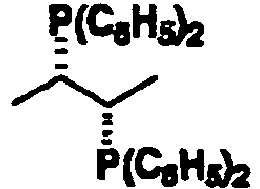

(S,S)-NORPHOS (S,S)-CHIRAPHOS (S,S)-MeDUPHOS Amin ligand 


(R)-DAIPEN (S)-DAIPEN (R,R)-DPEN PICA (S)-AMPY - RuCl2[(S,S)-xylskewphos] (dmf)n (0.002 mmol) prepared from (S,S)-XylSKEWPHOS and [RuCl2(p-cymene)]2, 2-picolylamine (0.2 mg, 0.002 mmol), 3-quinuclidinone (0.250 g, 2 mmol), and KOC(CH3)3 (9 mg, 0.08 mmol) were placed in a 100-mL glass autoclave, replaced with argon, subsequently added with ethanol (4 mL), degassed and replaced with argon. Hydrogen was introduced until the pressure became 1 × 10⁶ Pa (10 atm) at 30° C, and the reaction was started. After the reaction solution was stirred for 19 h, the reaction pressure was decreased to a normal pressure, and the quantity and optical purity of the product 3-quinuclidinol were determined by gas chromatography of the reaction solution; the result showed that (R)-3-quinuclidinol with 90%ee was formed with a yield of 100%.
- The above novel ruthenium complexes according to the invention are superior than conventional ruthenium complex catalysts having an optically active diphosphine compound with axial asymmetry or asymmetry on carbon and an optically active 1,2-diethylenediamine-type diamine compound as the ligands, in terms of reactivity, enantioselectivity and others in the asymmetric hydrogenation of 3-quinuclidinols, and they have excellent industrial usefulness.
Claims (8)
- A ruthenium complex of general formula (1):
RuXYAB (1)
wherein X and Y may be mutually identical or different and denote hydrogen or an anion group,A is one selected from the group consisting ofTolSKEWPHOS : 2,4-bis(di-4-tolylphosphino)pentane, 2,4-bis(di-4-tolylphosphino)-3-methyl-pentane, 2,4-bis(di-4-tolylphosphino)-3,3-dimethylpentane, 2,4-bis(di-4-tolylphosphino)-3-ethyl-pentane, 2,4-bis(di-4-tolylphosphino)-3,3-diethylpentane, 2,4-bis(di-4-tolylphosphino)-3-n-propylpentane, 2,4-bis(di-4-tolylphosphino)-3,3-di-n-propylpentane, 2,4-bis(di-4-tolylphos-phino)-3-isopropylpentane, 2,4-bis(di-4-tolylphosphino)-3,3-diisopropylpentane, 2,4-bis(di-4-tolylphosphino)-3-ethyl-3-methylpentane, 2,4-bis(di-4-tolylphosphino)-3-methyl-3-n-propyl-pentane, 2,4-bis(di-4-tolylphosphino)-3-methyl-3-isopropylpentane, 2,4-bis(di-4-tolylphos-phino)-3-ethyl-3-n-propylpentane, 2,4-bis(di-4-tolylphosphino)-3-ethyl-3-isopropylpentane, 2,4-bis(di-4-tolylphosphino)-3-n-propyl-3-isopropylpentane,XylSKEWPHOS: 2,4-bis(di-3,5-xylylphosphino)pentane, 2,4-bis(di-3,5-xylylphosphino)-3-methylpentane, 2,4-bis(di-3,5-xylylphosphino)-3,3-dimethylpentane, 2,4-bis(di-3,5-xylyl-phosphino)-3-ethylpentane, 2,4-bis(di-3,5-xylylphosphino)-3,3-diethylpentane, 2,4-bis(di-3,5-xylylphosphino)-3-n-propylpentane, 2,4-bis(di-3,5-xylylphosphino)-3,3-di-n-propylpentane, 2,4-bis(di-3,5-xylylphosphino)-3-isopropylpentane, 2,4-bis(di-3,5-xylylphosphino)-3,3-diisopropyl-pentane, 2,4-bis(di-3,5-xylylphosphino)-3-ethyl-3-methylpentane, 2,4-bis(di-3,5-xylylphos-phino)-3-methyl-3-n-propylpentane, 2,4-bis(di-3,5-xylylphosphino)-3-methyl-3-isopropyl-pentane, 2,4-bis(di-3,5-xylylphosphino)-3-ethyl-3-n-propylpentane, 2,4-bis(di-3,5-xylylphos-phino)-3-ethyl-3-isopropylpentane, 2,4-bis(di-3,5-xylylphosphino)-3-n-propyl-3-isopropyl-pentane,3,5-diEtSKEWPHOS: 2,4-bis[bis(3,5-diethylphenyl)phosphino]pentane, 2,4-bis[bis(3,5-diethyl-phenyl)phosphino]-3-methylpentane, 2,4-bis[bis(3,5-diethylphenyl)phosphino]-3,3-dimethyl-pentane, 2,4-bis[bis(3,5-diethylphenyl)phosphino]-3-ethylpentane, 2,4-bis[bis(3,5-diethyl-phenyl)phosphino]-3,3-diethylpentane, 2,4-bis[bis(3,5-diethylphenyl)phosphino]-3-n-propyl-pentane, 2,4-bis[bis(3,5-diethylphenyl)phosphino]-3,3-di-n-propylpentane, 2,4-bis[bis(3,5-diethylphenyl)phosphino]-3-isopropylpentane, 2,4-bis[bis(3,5-diethylphenyl)phosphino]-3,3-diisopropylpentane, 2,4-bis[bis(3,5-diethylphenyl)phosphino]-3-ethyl-3-methylpentane, 2,4-bis[bis(3,5-diethylphenyl)phosphino]-3-methyl-3-n-propylpentane, 2,4-bis[bis(3,5-diethyl-phenyl)phosphino]-3-methyl-3-isopropylpentane, 2,4-bis[bis(3,5-diethylphenyl)phosphino]-3-ethyl-3-n-propylpentane, 2,4-bis[bis(3,5-diethylphenyl)phosphino]-3-ethyl-3-isopropylpentane and 2,4-bis[bis(3,5-diethylphenyl)phosphino]-3-n-propyl-3-isopropylpentane,B is one selected from the group consisting ofPICA:2-picolylamine,3-Me-PICA:2-(aminomethyl)-3-methylpyridine, 4-Me-PICA:2-(aminomethyl)-4-methylpyridine, 5-Me-PICA:2-(aminomethyl)-5-methylpyridine, 6-Me-PICA:2-(aminomethyl)-6-methylpyridine, 3-Et-PICA:2-(aminomethyl)-3-ethylpyridine, 4-Et-PICA:2-(aminomethyl)-4-ethylpyridine, 5-Et-PICA:2-(aminomethyl)-5-ethylpyridine, 6-Et-PICA:2-(aminomethyl)-6-ethylpyridine, 3-n-Pr-PICA:2-(aminomethyl)-3-n-propylpyridine, 4-n-Pr-PICA:2-(aminomethyl)-4-n-propylpyridine, 5-n-Pr-PICA:2-(aminomethyl)-5-n-propylpyridine, 6-n-Pr-PICA:2-(aminomethyl)-6-n-propyl-pyridine, 3-i-Pr-PICA:2-(aminomethyl)-3-i-propylpyridine, 4-i-Pr-PICA:2-(aminomethyl)-4-i-propylpyridine, 5-i-Pr-PICA:2-(aminomethyl)-5-i-propylpyridine, 6-i-Pr-PICA:2-(aminomethyl)-6-i-propylpyridine, 3-Ph-PICA:2-(aminomethyl)-3-phenylpyridine, 4-Ph-PICA:2-(aminomethyl)-4-phenylpyridine, 5-Ph-PICA:2-(aminomethyl)-5-phenylpyridine, 6-Ph-PICA:2-(aminomethyl)-6-phenylpyridine, 3-Bn-PICA:2-(aminomethyl)-3-benzylpyridine, 4-Bn-PICA:2-(aminomethyl)-4-benzylpyridine, 5-Bn-PICA:2-(aminomethyl)-5-benzylpyridine, 6-Bn-PICA:2-(aminomethyl)-6-benzylpyridine,AMPY:2-aminomethylpyrrolidine, AMPI:2-aminomethylpiperidine and AMHPI:2-(amino-methyl)homopiperidine,and wherein each ligand of the ruthenium may be arbitrarily coordinated. - The ruthenium complex according to Claim 1, wherein
A is one selected from the group consisting of TolSKEWPHOS:2,4-bis(di-4-tolylphos-phino)pentane, XylSKEWPHOS:2,4-bis(di-3,5-xylylphosphino)pentane, and 3,5-diEtSKEWPHOS:2,4-bis[bis(3,5-diethylphenyl)phosphino]pentane,
B is one selected from the group consisting of 2-picolylamine, 2-(aminomethyl)-6-methylpyridine and 2-aminomethylpyrrolidine, and the ruthenium may be arbitrarily coordinated with each ligand. - The ruthenium complex according to Claim 1 or 2, wherein
A is XyISKEWPHOS:2,4-bis(di-3,5-xylylphosphino)pentane,
B is 2-picolylamine or 2-aminomethylpyrrolidine. - A process for preparing the compound of general formula (1) according to any one of Claims 1-3,
RuXYAB (1)
wherein a compound of general formula (5):
RuXYA (5)
(wherein X, Y and A are as defined in Claim 1) is reacted with the compound B to obtain said compound of general formula (1). - A process for preparing optically active 3-quinuclidinols, wherein 3-quinuclidinones are reacted with hydrogen or a hydrogen-donating compound in the presence of a ruthenium complex of general formula (1):
RuXYAB (1)
wherein X is hydrogen, Y is a tetrahydroborate anion or a tetrafluoroborate anion,
A is a compound of general formula (2): wherein R1 and R2 may be mutually identical or different and are alkyl group having a carbon number of 1-20, alkenyl, cycloalkyl, cycloalkenyl, phenyl, naphthyl or phenylalkyl which may have one or more substituents selected from alkyl, alkenyl, cycloalkyl, aryl, alkoxy, ester, acyloxy, halogen atoms, nitro and cyano;R3 and R4 may be mutually identical or different and are hydrogen or a hydrocarbon group having a carbon number of 1-3;R5, R6, R7 and R8 may be mutually identical or different and are alkyl, alkenyl, cycloalkyl, cycloalkenyl, phenyl, naphthyl or phenylalkyl which may have one or more substituents selected from alkyl, alkenyl, cycloalkyl, aryl, alkoxy, ester, acyloxy, halogen atoms, nitro and cyano,B is a compound of general formula (3) or (4):
 wherein in general formula (3),R9 denotes a hydrogen atom, alkyl group having a carbon number of 1-20, alkenyl, cycloalkyl, cycloalkenyl, phenyl, naphthyl or phenylalkyl which may have one or more substituents selected from alkyl, alkenyl, cycloalkyl, aryl, alkoxy, ester, acyloxy, halogen atoms, nitro and cyano;R10 and R11 may be mutually identical or different and denote a hydrogen atom, alkyl group having a carbon number of 1-20, alkenyl, cycloalkyl, cycloalkenyl, phenyl, naphthyl or phenylalkyl which may have one or more substituents selected from alkyl, alkenyl, cycloalkyl, aryl, alkoxy, ester, acyloxy, halogen atoms, nitro and cyano,R10 and R11 may be mutually bonded to form a saturated or unsaturated hydrocarbon group which may have one or more substituents selected from alkyl, alkenyl, cycloalkyl, aryl, alkoxy, ester, acyloxy, halogen atoms, nitro, and cyano;R12, R13, R14 and R15 may be mutually identical or different and denote a hydrogen atom, alkyl group having a carbon number of 1-20, alkenyl, cycloalkyl, cycloalkenyl, phenyl, naphthyl or phenylalkyl which may have one or more substituents selected from alkyl, alkenyl, cycloalkyl, aryl, alkoxy, ester, acyloxy, halogen atoms, nitro and cyano,R12 and R13, R13 and R14, or R14 and R15 may be mutually bonded to form a saturated or unsaturated hydrocarbon group, or to form a saturated or unsaturated hydrocarbon group containing N;wherein in general formula (4),at least one of R16, R17 and R18 is a hydrogen atom, R16 and R17 may be mutually identical or different and denote a hydrogen atom, alkyl group having a carbon number of 1-20, alkenyl, cycloalkyl, cycloalkenyl, phenyl, naphthyl or phenylalkyl which may have one or more substituents selected from alkyl, alkenyl, cycloalkyl, aryl, alkoxy, ester, acyloxy, halogen atoms, nitro and cyano, or R16 and R17 may be mutually bonded to form a ring containing N, R18 denotes a hydrogen atom, alkyl group having a carbon number of 1-20, alkenyl, cycloalkyl, cycloalkenyl, phenyl, naphthyl or phenylalkyl which may have one or more substituents selected from alkyl, alkenyl, cycloalkyl, aryl, alkoxy, ester, acyloxy, halogen atoms, nitro and cyano;R19 and R20 may be mutually identical or different and denote a hydrogen atom, alkyl group having a carbon number of 1-20, alkenyl, cycloalkyl, cycloalkenyl, phenyl, naphthyl or phenylalkyl which may have one or more substituents selected from alkyl, alkenyl, cycloalkyl, aryl, alkoxy, ester, acyloxy, halogen atoms, nitro and cyano, R19 and R20 may be mutually bonded to form a saturated or unsaturated hydrocarbon group which may have one or more substituents selected from alkyl, alkenyl, cycloalkyl, aryl, alkoxy, ester, acyloxy, halogen atoms, nitro, and cyano;R21 may be mutually identical or different and independently denote a hydrogen atom, alkyl group having a carbon number of 1-20, alkenyl, cycloalkyl, cycloalkenyl, phenyl, naphthyl or phenylalkyl which may have one or more substituents selected from alkyl, alkenyl, cycloalkyl, aryl, alkoxy, ester, acyloxy, halogen atoms, nitro and cyano, and adjacent R21 may be mutually bonded to form a saturated or unsaturated hydrocarbon group; m denotes an integer of 1-10; n denotes an integer of 1-3,and wherein each ligand of the ruthenium atom may be arbitrarily coordinated.
 - A process for preparing optically active 3-quinuclidinols, wherein 3-quinuclidinones are reacted with hydrogen or a hydrogen-donating compound in the presence of a ruthenium complex of general formula (1):
RuXYAB (1)
wherein X and Y may be mutually identical or different and denote hydrogen or an anion group, A is a compound of general formula (2): wherein R1 and R2 may be mutually identical or different and are an alkyl group having a carbon number of 1-20 or a cyclic hydrocarbon group;R3 and R4 may be mutually identical or different and are hydrogen or a hydrocarbon group having a carbon number of 1-3;R5, R6, R7 and R8 may be mutually identical or different and are a substituted phenyl group with 1 to 5 independently selected from a methyl group, an ethyl group, a propyl group and a t-butyl group,B is as defined in Claim 5,and a base represented by an alkali metal or alkaline earth metal salt, or a quaternary ammonium salt, to obtain the optically active 3-quinuclidinols.
 - A process for preparing optically active 3-quinuclidinols, wherein 3-quinuclidinones are reacted with hydrogen or a hydrogen-donating compound in the presence of a ruthenium complex of general formula (5):
RuXYA (5)
wherein X is hydrogen, Y is a tetrahydroborate anion or a tetrafluoroborate anion, and A is as defined in Claim 5,and a diamine compound of general formula (3) or (4) or an optically active diamine compound of general formula (3) or (4):
 wherein R9-R21, n and m are as defined in Claim 5, to obtain the optically active 3-quinuclidinols.
 - A process for preparing optically active 3-quinuclidinols, wherein 3-quinuclidinones are reacted with hydrogen or a hydrogen-donating compound in the presence of a ruthenium complex of general formula (5):
RuXYA (5)
wherein X and Y may be mutually identical or different and denote hydrogen or an anion group, A is a compound of general formula (2): wherein R1 and R2 may be mutually identical or different and are an alkyl group having a carbon number of 1-20 or a cyclic hydrocarbon group;R3 and R4 may be mutually identical or different and are hydrogen or a hydrocarbon group having a carbon number of 1-3;R5, R6, R7 and R8 may be mutually identical or different and are a substituted phenyl group with 1 to 5 independently selected from a methyl group, an ethyl group, a propyl group and a t-butyl group,a diamine compound of general formula (3) or (4) or an optically active diamine compound of general formula (3) or (4):
 wherein R9-R21, n and m are as defined in Claim 5,and a base such as an alkali metal or alkaline earth metal salt, or a quaternary ammonium salt, to obtain the optically active 3-quinuclidinols.
Applications Claiming Priority (1)
| Application Number | Priority Date | Filing Date | Title |
|---|---|---|---|
| PCT/JP2005/006048 WO2006103756A1 (en) | 2005-03-30 | 2005-03-30 | Process for production of optically active quinuclidinol |
Publications (3)
| Publication Number | Publication Date |
|---|---|
| EP1867654A1 EP1867654A1 (en) | 2007-12-19 |
| EP1867654A4 EP1867654A4 (en) | 2008-06-25 |
| EP1867654B1 true EP1867654B1 (en) | 2014-06-11 |
Family
ID=37053030
Family Applications (1)
| Application Number | Title | Priority Date | Filing Date |
|---|---|---|---|
| EP05727919.2A Expired - Lifetime EP1867654B1 (en) | 2005-03-30 | 2005-03-30 | Process for production of optically active quinuclidinol |
Country Status (4)
| Country | Link |
|---|---|
| US (1) | US8212037B2 (en) |
| EP (1) | EP1867654B1 (en) |
| JP (1) | JP5078608B2 (en) |
| WO (1) | WO2006103756A1 (en) |
Families Citing this family (8)
| Publication number | Priority date | Publication date | Assignee | Title |
|---|---|---|---|---|
| ITPD20040115A1 (en) * | 2004-05-04 | 2004-08-04 | Univ Degli Studi Udine | RUTHENIUM COMPLEXES WITH 2- (AMINOMETHYL) PYRIDINS AND PHOSPHINS, THEIR PREPARATION AND USE AS CATALYSTS |
| CN101522634B (en) * | 2006-10-11 | 2011-06-29 | 日本曹达株式会社 | Process for producing azabicycloalkanol derivatives |
| CN101796050B (en) * | 2007-09-06 | 2015-08-12 | 日本曹达株式会社 | The manufacture method of optical activity 3-quinuclidinol derivatives |
| JP5507931B2 (en) * | 2009-09-01 | 2014-05-28 | 関東化学株式会社 | Method for producing optically active alcohol having aromatic heterocycle |
| EP2832738A4 (en) | 2012-03-28 | 2016-02-24 | Takeda Pharmaceutical | RHODIUM CATALYST AND PROCESS FOR PRODUCING AN AMINO COMPOUND |
| JP6437187B2 (en) | 2013-07-26 | 2018-12-12 | 関東化學株式会社 | Method for producing optically active secondary alcohol |
| GB201509664D0 (en) | 2015-06-03 | 2015-07-15 | Johnson Matthey Plc And Universit Di Udine | Process |
| CN115651016A (en) * | 2022-11-01 | 2023-01-31 | 中国科学技术大学 | Chiral diphosphine ligand with alkyl skeleton and preparation method thereof |
Family Cites Families (4)
| Publication number | Priority date | Publication date | Assignee | Title |
|---|---|---|---|---|
| PT785198E (en) | 1996-01-19 | 2000-11-30 | Lonza Ag | PROCESS FOR THE PRODUCTION OF OPTICALLY ACTIVE 3-QUINUCLIDINOL. |
| JP3566955B2 (en) | 2001-12-28 | 2004-09-15 | 関東化学株式会社 | Novel ruthenium complex and method for producing alcohol compound using the same as catalyst |
| JP2003277380A (en) * | 2002-03-20 | 2003-10-02 | Kawaken Fine Chem Co Ltd | Method for producing optically active 3-quinuclidinol |
| ITPD20040115A1 (en) | 2004-05-04 | 2004-08-04 | Univ Degli Studi Udine | RUTHENIUM COMPLEXES WITH 2- (AMINOMETHYL) PYRIDINS AND PHOSPHINS, THEIR PREPARATION AND USE AS CATALYSTS |
-
2005
- 2005-03-30 WO PCT/JP2005/006048 patent/WO2006103756A1/en not_active Ceased
- 2005-03-30 JP JP2007510282A patent/JP5078608B2/en not_active Expired - Lifetime
- 2005-03-30 US US11/887,340 patent/US8212037B2/en active Active
- 2005-03-30 EP EP05727919.2A patent/EP1867654B1/en not_active Expired - Lifetime
Also Published As
| Publication number | Publication date |
|---|---|
| EP1867654A1 (en) | 2007-12-19 |
| US8212037B2 (en) | 2012-07-03 |
| JPWO2006103756A1 (en) | 2008-09-04 |
| WO2006103756A1 (en) | 2006-10-05 |
| EP1867654A4 (en) | 2008-06-25 |
| US20090216019A1 (en) | 2009-08-27 |
| JP5078608B2 (en) | 2012-11-21 |
Similar Documents
| Publication | Publication Date | Title |
|---|---|---|
| Baratta et al. | Chiral pincer ruthenium and osmium complexes for the fast and efficient hydrogen transfer reduction of ketones | |
| JP4004123B2 (en) | Method for producing alcohol compound using ruthenium complex as catalyst | |
| EP2294075B1 (en) | Novel ruthenium complexes having hybrid amine ligands, their preparation and use | |
| US5763688A (en) | Method for producing an alcohol | |
| EP1305278B1 (en) | Ruthenium complexes and their use in asymmetric hydrogenation | |
| US6486337B2 (en) | Ruthenium-disphosphine complexes and their use as catalysts | |
| EP0479542B1 (en) | A phosphino binaphthyl compound and transition metal complexes thereof | |
| JP3566955B2 (en) | Novel ruthenium complex and method for producing alcohol compound using the same as catalyst | |
| US8212037B2 (en) | Process for production of optically active quinuclidinols | |
| CN101959898B (en) | The ruthenium complexe with the Ferrocenyl diphosp hine ligand of (P-P) coordination, the method preparing them and their purposes in homogeneous catalysis | |
| Fogg et al. | Chiral and achiral diphosphine complexes of ruthenium (ii) incorporating labile nitrile ligands: Synthesis and solution chemistry of mono-and dinuclear derivatives of Ru2Cl4 (PP) 2 (PP= Chelating diphosphine) | |
| JP6437187B2 (en) | Method for producing optically active secondary alcohol | |
| CN114478362A (en) | A kind of preparation method of chiral pyridinol derivative | |
| EP1419815B1 (en) | Phosphine compounds, transition metal complexes with the compounds contained as ligands therein, and asymmetric synthesis catalysts containing the complexes | |
| JP5507931B2 (en) | Method for producing optically active alcohol having aromatic heterocycle | |
| US6348612B1 (en) | Chiral amido-phosphine-phosphinite compounds | |
| US6794525B2 (en) | Optically active chiral diphosphine ligands | |
| JP6291179B2 (en) | Method for producing optically active secondary alcohol | |
| JP5232374B2 (en) | Method for producing optically active quinuclidinols having a substituent at the 2-position | |
| JP2012031119A (en) | Axially chiral isoquinoline derivative, its production method, and asymmetric synthesis method | |
| US20100069684A1 (en) | Assymmetric hydrogeneration of prochiral compounds | |
| JP4637876B2 (en) | Catalyst for synthesis of optically active alcohol compounds | |
| CN101243100A (en) | ferrocene-diphosphine ligand | |
| JP2019011367A (en) | Method for producing optically active secondary alcohol | |
| JP2005281252A (en) | Method for producing neutral rhodium-phosphine complex |
Legal Events
| Date | Code | Title | Description |
|---|---|---|---|
| PUAI | Public reference made under article 153(3) epc to a published international application that has entered the european phase |
Free format text: ORIGINAL CODE: 0009012 |
|
| 17P | Request for examination filed |
Effective date: 20071016 |
|
| AK | Designated contracting states |
Kind code of ref document: A1 Designated state(s): DE GB |
|
| RBV | Designated contracting states (corrected) |
Designated state(s): DE GB |
|
| RBV | Designated contracting states (corrected) |
Designated state(s): DE GB |
|
| A4 | Supplementary search report drawn up and despatched |
Effective date: 20080527 |
|
| DAX | Request for extension of the european patent (deleted) | ||
| 17Q | First examination report despatched |
Effective date: 20080915 |
|
| GRAP | Despatch of communication of intention to grant a patent |
Free format text: ORIGINAL CODE: EPIDOSNIGR1 |
|
| RIC1 | Information provided on ipc code assigned before grant |
Ipc: B01J 31/18 20060101ALI20140108BHEP Ipc: C07D 453/02 20060101ALI20140108BHEP Ipc: C07F 15/00 20060101ALI20140108BHEP Ipc: C07F 9/50 20060101AFI20140108BHEP Ipc: C07B 53/00 20060101ALI20140108BHEP Ipc: B01J 31/24 20060101ALI20140108BHEP |
|
| INTG | Intention to grant announced |
Effective date: 20140123 |
|
| GRAS | Grant fee paid |
Free format text: ORIGINAL CODE: EPIDOSNIGR3 |
|
| GRAA | (expected) grant |
Free format text: ORIGINAL CODE: 0009210 |
|
| AK | Designated contracting states |
Kind code of ref document: B1 Designated state(s): DE GB |
|
| REG | Reference to a national code |
Ref country code: GB Ref legal event code: FG4D |
|
| REG | Reference to a national code |
Ref country code: DE Ref legal event code: R096 Ref document number: 602005043869 Country of ref document: DE Effective date: 20140717 |
|
| REG | Reference to a national code |
Ref country code: DE Ref legal event code: R097 Ref document number: 602005043869 Country of ref document: DE |
|
| PLBE | No opposition filed within time limit |
Free format text: ORIGINAL CODE: 0009261 |
|
| STAA | Information on the status of an ep patent application or granted ep patent |
Free format text: STATUS: NO OPPOSITION FILED WITHIN TIME LIMIT |
|
| 26N | No opposition filed |
Effective date: 20150312 |
|
| REG | Reference to a national code |
Ref country code: DE Ref legal event code: R097 Ref document number: 602005043869 Country of ref document: DE Effective date: 20150312 |
|
| P01 | Opt-out of the competence of the unified patent court (upc) registered |
Effective date: 20230530 |
|
| PGFP | Annual fee paid to national office [announced via postgrant information from national office to epo] |
Ref country code: DE Payment date: 20240320 Year of fee payment: 20 Ref country code: GB Payment date: 20240320 Year of fee payment: 20 |
|
| REG | Reference to a national code |
Ref country code: DE Ref legal event code: R071 Ref document number: 602005043869 Country of ref document: DE |
|
| REG | Reference to a national code |
Ref country code: GB Ref legal event code: PE20 Expiry date: 20250329 |
|
| PG25 | Lapsed in a contracting state [announced via postgrant information from national office to epo] |
Ref country code: GB Free format text: LAPSE BECAUSE OF EXPIRATION OF PROTECTION Effective date: 20250329 |