EP1867281A1 - Improved dynamic eye tracking system - Google Patents
Improved dynamic eye tracking system Download PDFInfo
- Publication number
- EP1867281A1 EP1867281A1 EP20070075447 EP07075447A EP1867281A1 EP 1867281 A1 EP1867281 A1 EP 1867281A1 EP 20070075447 EP20070075447 EP 20070075447 EP 07075447 A EP07075447 A EP 07075447A EP 1867281 A1 EP1867281 A1 EP 1867281A1
- Authority
- EP
- European Patent Office
- Prior art keywords
- eye
- neighbor
- candidate
- boundary
- tracking system
- Prior art date
- Legal status (The legal status is an assumption and is not a legal conclusion. Google has not performed a legal analysis and makes no representation as to the accuracy of the status listed.)
- Granted
Links
Images


Classifications
-
- A—HUMAN NECESSITIES
- A61—MEDICAL OR VETERINARY SCIENCE; HYGIENE
- A61B—DIAGNOSIS; SURGERY; IDENTIFICATION
- A61B5/00—Measuring for diagnostic purposes; Identification of persons
- A61B5/16—Devices for psychotechnics; Testing reaction times ; Devices for evaluating the psychological state
- A61B5/18—Devices for psychotechnics; Testing reaction times ; Devices for evaluating the psychological state for vehicle drivers or machine operators
-
- A—HUMAN NECESSITIES
- A61—MEDICAL OR VETERINARY SCIENCE; HYGIENE
- A61B—DIAGNOSIS; SURGERY; IDENTIFICATION
- A61B3/00—Apparatus for testing the eyes; Instruments for examining the eyes
- A61B3/10—Objective types, i.e. instruments for examining the eyes independent of the patients' perceptions or reactions
- A61B3/113—Objective types, i.e. instruments for examining the eyes independent of the patients' perceptions or reactions for determining or recording eye movement
-
- A—HUMAN NECESSITIES
- A61—MEDICAL OR VETERINARY SCIENCE; HYGIENE
- A61B—DIAGNOSIS; SURGERY; IDENTIFICATION
- A61B5/00—Measuring for diagnostic purposes; Identification of persons
- A61B5/16—Devices for psychotechnics; Testing reaction times ; Devices for evaluating the psychological state
- A61B5/163—Devices for psychotechnics; Testing reaction times ; Devices for evaluating the psychological state by tracking eye movement, gaze, or pupil change
-
- G—PHYSICS
- G06—COMPUTING OR CALCULATING; COUNTING
- G06F—ELECTRIC DIGITAL DATA PROCESSING
- G06F3/00—Input arrangements for transferring data to be processed into a form capable of being handled by the computer; Output arrangements for transferring data from processing unit to output unit, e.g. interface arrangements
- G06F3/01—Input arrangements or combined input and output arrangements for interaction between user and computer
- G06F3/011—Arrangements for interaction with the human body, e.g. for user immersion in virtual reality
- G06F3/013—Eye tracking input arrangements
-
- G—PHYSICS
- G06—COMPUTING OR CALCULATING; COUNTING
- G06V—IMAGE OR VIDEO RECOGNITION OR UNDERSTANDING
- G06V20/00—Scenes; Scene-specific elements
- G06V20/50—Context or environment of the image
- G06V20/59—Context or environment of the image inside of a vehicle, e.g. relating to seat occupancy, driver state or inner lighting conditions
- G06V20/597—Recognising the driver's state or behaviour, e.g. attention or drowsiness
-
- G—PHYSICS
- G06—COMPUTING OR CALCULATING; COUNTING
- G06V—IMAGE OR VIDEO RECOGNITION OR UNDERSTANDING
- G06V40/00—Recognition of biometric, human-related or animal-related patterns in image or video data
- G06V40/10—Human or animal bodies, e.g. vehicle occupants or pedestrians; Body parts, e.g. hands
- G06V40/18—Eye characteristics, e.g. of the iris
- G06V40/19—Sensors therefor
-
- G—PHYSICS
- G08—SIGNALLING
- G08B—SIGNALLING SYSTEMS, e.g. PERSONAL CALLING SYSTEMS; ORDER TELEGRAPHS; ALARM SYSTEMS
- G08B21/00—Alarms responsive to a single specified undesired or abnormal condition and not otherwise provided for
- G08B21/02—Alarms for ensuring the safety of persons
- G08B21/06—Alarms for ensuring the safety of persons indicating a condition of sleep, e.g. anti-dozing alarms
Definitions
- the field of this invention relates to an improved method of eye tracking for a driver state monitoring system and the like.
- Driver state monitors are intended to track the movement of the eye and determine if the driver is becoming distracted or drowsy.
- a camera can be used to generate an image of the driver's face and portions of the image can be analyzed to assess a driver's gaze or drowsiness. If such a condition exists, the system can detect the condition and provide an appropriate signal that can set off an alarm to either awaken the driver or alert the driver..
- Eye position tracking in two dimensional grey scale image sequences must be at small time intervals to be useful for monitoring purposes.
- the eye position tracking must also be precise in tracking the eye center in two dimensional images and avoid drift during position tracking due to light changes in outdoor conditions. Other obstacles may also cause the monitoring to be ineffective.
- Major head motion such as turning the head, closure of the eye lid such as blinking, blink frequency, existence of glasses and sunglasses may all be conditions that may cause a monitoring system to fail by mistracking the eye position.
- One of the most challenging problems in computer vision remains the eye position tracking problem.
- Image processing, computer vision and pattern recognition tools like mathematical morphological operators, contour extraction, interest point detector, eigen analysis and Kalman filter have been utilized in target tracking in visible and infrared imagery.
- IRHE inverse receptive hole extractor
- IRHE Inverse Receptive Hole Extraction
- What is needed is a dynamic improved eye position tracking system which takes into account located and tracked neighbors such as eyebrows or eyeglass frames to determine a constrained search window in which the eye must be located which improves the eye position tracking.
- a dynamic eye tracking system to track movement of an eye includes detecting if a neighbor exists around the eye using initial coordinates of the eye for over a predetermined amount of time for example till the next video frame within a predefined area. A boundary is then formed for the neighbor within the predefined area. Potential eye candidates are tracked and the eye candidates are eliminated if they are beyond the boundary defined by the detected neighbors within said predefined area.
- the system determines if there is a persistent neighbor above the eye and determining if the eye image is merged with an image of the neighbor around the eye. If so, this system offsets a previously known boundary position by the change in the eye position.
- the dynamic eye tracking system preferably compares a local inverse receptive hole extraction for candidates not past the boundary and a local iris candidate not past the boundary to provide an eye candidate.
- the dynamic eye tracking system preferably uses a single template correlation by comparing with pre-loaded acceptable images of eyes to determine if there is an eye and then determine if the eye candidate is beyond the boundary determined by the neighbors. It is also desired that the dynamic eye tracking system compares previously saved templates from above, below, to the left and to the right of the eye and find a predetermined minimum correlation and execute an appearance check at the intersection of vertical lines between above and below templates and a horizontal line extending between left and right eye templates.
- a dynamic eye tracking system executes in sequence any one of a series of eye candidate subroutines to determine if an acceptable eye candidate exists and for each subroutine then determines if the eye candidate is beyond or within a boundary defined by the neighbors within a predefined area.
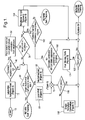
- Figure 1 is a master flow chart illustrating one embodiment of an eye tracking system according to the invention
- Figure 2 is a subsidiary flow chart detailing a learn eye neighborhood subroutine section 12 shown in the master flow chart of Figure 1;
- Figure 3 is a subsidiary flow chart detailing a searching for neighbors subroutine section 14 of the subsidiary flow chart shown in Figure 2.
- Figure 4 is a subsidiary flow chart detailing a local inverse receptive hole extraction subroutine section 58 shown in the master flow chart of Figure 1;
- Figure 5 is a subsidiary flow chart detailing an iris extraction subroutine section 60 shown in the master flow chart of Figure 1;
- Figure 6 is a subsidiary flow chart detailing a comparison subroutine section 70 shown in the master flow chart of Figure 1;
- Figure 7 is a subsidiary flow chart detailing a single template correlation subroutine section 108 shown in the master flow chart of Figure 1;
- Figure 8 is a subsidiary flow chart detailing a four moving parts subroutine section 134 shown in the master flow chart of Figure 1;
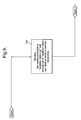
- Figure 9 is a subsidiary flow chart detailing a neighbor to eye recovery subroutine section 164 shown in the master flow chart of Figure 1.
- a dynamic routine tracking system is shown where at the start 10, initial eye coordinates, found by an eye detection system, are passed to an eye tracking algorithm. Known speeds for eye tracking devices are about 30 frames per second to find eye coordinates and to track eye location. After the initial eye coordinates are determined, the eye neighborhood is then determined at 12 for each new frame taken. For example, the system determines if an eyebrow exists, tracks it, and determines if it is merged with the eye. Another example is to determine if an eyeglass rim exists. Subroutine 12 is shown in more detail in Figure 2.
- the neighbor to the left, right, above and below the eye is searched for and found by subroutines 14, 16, 18, and 20.
- Each of the subroutines 14, 16, 18 and 20 is identical in form and is illustrated in Figure 3.
- the question is asked if a neighbor has not been previously found such as an eyebrow or glass frame section at 22. If not, then a neighbor is searched for at 34 by finding a center Receptive Hole Extraction (RHE) component in a neighbor detection window.
- RHE Center Receptive Hole Extraction
- a window may be 32x80 pixels for the UP and DOWN window and 96x32 pixels for the left and right neighbor search windows.
- RHE Receptive Hole Extraction
- a neighbor tracking window may be 96x32 pixels for UP and DOWN neighbors and 48x32 pixels for LEFT and RIGHT neighbors.
- subroutine 12 continues by predicting the eye position from all the persistent neighbors at 36.
- the term "persistent" means that the neighbor occurs or is detected in more than one successive frame. The question is asked after predicting the eye position if any persistent neighbors exist at 38. If a particular persistent neighbor does not exist and that neighbor has a valid previously known boundary, the offset boundary is changed by the change in eye position and is used as a valid boundary in eye candidate quality checks at 50. The subroutine ends and goes back to main routine in Figure 1 at 40.
- a persistent neighbor exists, it is then determined if any valid neighbors are merged with the detected eye at 42. After this determination is made, if the neighbor above the eye, for example, an eyebrow or eyeglass frame is persistent and a neighbor is merged with the eye as determined at 44, one then goes back to main routine at 40. In other words, special importance is given to neighbors above the eye if they are persistent because they are usually associated with more stable objects like eyebrows or long, horizontal eyeglass frames.
- the subroutine asks if a neighbor is merged with the eye at 46. If not, the boundary between the neighbor and eye is found at 48 and the subroutine ends and goes back to the main routine shown in Figure 1 at 40.
- the offset boundary is changed by the change in eye position and is used as a valid boundary in eye candidate quality checks at 50.
- the subroutine ends and goes back to the main routine shown in Figure 1 at 40.
- the main routine asks at 40 if the persistent neighbor above the eye was found from subroutine 12. If the persistent neighbor above the eye exists a search window over the predicted eye coordinates determined by the surrounding neighbors is then used at 52 to limit the search for the eye. This helps maintain tracking is case of motion. The eye is tracked and a determination is made if any neighbor is merged with eye at 54.
- a tracking search window is processed at the last known eye position or the predicted position from neighbors. If the area of any single object in the search window is greater than half the search window size at 56 then the tracking program is exited. If not, then two programs are run in parallel, namely a known local Inverse Receptive Hole Extraction (IRHE) program 58 and an Iris Extraction program 60.
- IRHE Inverse Receptive Hole Extraction
- the Local IRHE program 58 is shown in more detail in Figure 4. It uses a known Appearance-based Approach at 62 which the candidates that look like an eye from its database. The Appearance-based Approach uses a wider level which uses a larger region about the eye that includes neighbors. If there are any remaining eye candidates at 64, the program sorts them out using the appearance-based approach and saves all potential eye candidates in order of best appearance at 66. A second sort is done to determine which is the best candidate that does not fall past the neighbor boundaries at 68. The candidate or lack of candidate signal is then brought back to a comparator 70 at the main routine shown in Figure 1.
- the Iris Extraction Program 60 is shown in more detail in Figure 5.
- the program 60 finds an RHE component closest to the center of the tracking search window with a predetermined minimum size for example 15 pixels. If the Iris candidate exists at 72 than it is verified with of a level I and/or II appearance checks. If no iris exists or the appearance-based approach program 74 determines that the candidates appearance is undesirable at 76 by it classification rules, then no candidate signal is formed at 78 and the program return to the main routine at 70.
- the candidate location is then determined at 80 and if is located beyond the boundary of the neighbor than it is rejected as a candidate. If the candidate is not outside the boundary, then it is determined to be an acceptable candidate at 82 and the program returns to the main program at 70.
- the comparator If only the IRHE candidate exists with desirable appearance at 92, then the comparator returns this candidate as winner at 94. Otherwise, if only the IRIS candidate appearance is good at 96 with desirable appearance, then return this candidate as winner at 98.
- a Single Template Correlation 108 as shown in detail in Figure 7 is implemented.
- the Single Template correlation first uses a normalized cross correlation (NCC) function at 110 to match eye template from the previous frame to current tracking search window. If the correlation is above an acceptable threshold as indicated at 112, then the candidate is verified with a known Level I and/or Level II Appearance-based Approach.
- NCC normalized cross correlation
- a known multiple template matching routine 116 returns a good match, i.e. match four templates around last eye point to same points in current frame. If three or four templates correlate above a certain threshold, e.g. 65%, the previous eye position is valid at 118 and the subroutine return to the main program at 132. The previous eye position candidate is verified with Level II Open Eye and/or Closed Eye appearance-based approach at 114 and 120. If the candidate appearance is desirable at 122 or 124, then the candidate location is checked at 126. If it is not outside the boundary then it is determine to be an acceptable candidate at 128 and the program returns to the main program at 132. On the other hand, if the candidate is located beyond the boundary of the neighbor than it is rejected as a candidate and no winning candidate is determined and the subroutine returns to the main program 132 in Figure 1.
- a certain threshold e.g. 65%
- a Four Moving Parts subroutine 134 If there is no track winner indicated at 132 than a Four Moving Parts subroutine 134 is executed. As shown in Figure 8, the Four Moving Parts subroutine 134 first sees if 'candidate appearance undesirable' counter equal zero, then all templates around eye from previous frame are extracted and updated at 136. The updated templates are matched to corresponding search windows in current frame at 138. If at least one template from the vertical plane and one from the horizontal plane exceed the correlation threshold at 140 for example greater than 60% above and/or below eye AND left and/or right of eye, then the intersection of the horizontal and vertical lines is found at 142. The vertical line is the line drawn between the above and below the eye templates. The horizontal line is the line drawn between the left and right eye templates. On the other hand, if the correlation is less than 60% at 140, no track winner is indicated at the main program at 160.
- a known Level II OPEN and CLOSED appearance check is conducted at 146. If it fails at 148, then candidate appearance undesirable counter 150 is incremented one count. The counter 150 is used to exit tracking if appearance fails for a certain number, N, of frames. If the appearance check did not fail, the counter is reset at 152.
- the candidate location is then checked at 154. If the candidate is located beyond the boundary of the neighbor than it is rejected as a candidate. If it is not outside the boundary then it is determine to be an acceptable candidate at 156 and the subroutine returns to the main program at 160. Otherwise, if the candidate is past the boundaries of the neighbor, no winning candidate is determined at 155 and the subroutine returns to the main program at 160.
- the Neighbor to Eye Recovery subroutine is shown in more detail in Figure 9.
- the current 'neighbor above eye' position and the previous eye to 'neighbor above eye' distance vector are used to find a new eye position.
- the State Vector is updated at 166 if there is a tracking candidate winner at 106 or at 132 or after the Neighbor to Eye Recovery 164 is performed. After the State Vector 166 is updated, the tracking program is exited and restarted at 10.
- the tracking program becomes more robust by forming boundaries determined by detected persistent neighbors and using these boundaries to eliminate otherwise false positive tracking of the eye by determining that the candidate is beyond the boundary determined by the neighbor. Vast areas of detection may be eliminated and the tracking window can be more clearly concentrated near where the eye actually is.
Landscapes
- Engineering & Computer Science (AREA)
- Health & Medical Sciences (AREA)
- Life Sciences & Earth Sciences (AREA)
- Physics & Mathematics (AREA)
- Theoretical Computer Science (AREA)
- General Physics & Mathematics (AREA)
- General Health & Medical Sciences (AREA)
- Human Computer Interaction (AREA)
- Biophysics (AREA)
- Biomedical Technology (AREA)
- Heart & Thoracic Surgery (AREA)
- Medical Informatics (AREA)
- Molecular Biology (AREA)
- Surgery (AREA)
- Animal Behavior & Ethology (AREA)
- Public Health (AREA)
- Veterinary Medicine (AREA)
- Ophthalmology & Optometry (AREA)
- Multimedia (AREA)
- General Engineering & Computer Science (AREA)
- Child & Adolescent Psychology (AREA)
- Developmental Disabilities (AREA)
- Educational Technology (AREA)
- Hospice & Palliative Care (AREA)
- Psychiatry (AREA)
- Psychology (AREA)
- Social Psychology (AREA)
- Pathology (AREA)
- Emergency Management (AREA)
- Business, Economics & Management (AREA)
- Image Analysis (AREA)
- Closed-Circuit Television Systems (AREA)
- Control Of Position, Course, Altitude, Or Attitude Of Moving Bodies (AREA)
Abstract
Description
- The field of this invention relates to an improved method of eye tracking for a driver state monitoring system and the like.
- Driver state monitors are intended to track the movement of the eye and determine if the driver is becoming distracted or drowsy. In the motor vehicle environment for example, a camera can be used to generate an image of the driver's face and portions of the image can be analyzed to assess a driver's gaze or drowsiness. If such a condition exists, the system can detect the condition and provide an appropriate signal that can set off an alarm to either awaken the driver or alert the driver..
- Eye position tracking in two dimensional grey scale image sequences must be at small time intervals to be useful for monitoring purposes. The eye position tracking must also be precise in tracking the eye center in two dimensional images and avoid drift during position tracking due to light changes in outdoor conditions. Other obstacles may also cause the monitoring to be ineffective. Major head motion such as turning the head, closure of the eye lid such as blinking, blink frequency, existence of glasses and sunglasses may all be conditions that may cause a monitoring system to fail by mistracking the eye position.One of the most challenging problems in computer vision remains the eye position tracking problem. Image processing, computer vision and pattern recognition tools like mathematical morphological operators, contour extraction, interest point detector, eigen analysis and Kalman filter have been utilized in target tracking in visible and infrared imagery. In eye position tracking, it is common to extract the iris area and track it in successive frames with contour-based methods like active contour. Methods like bottom-hat morphological operators are usually employed in extracting the dark facial features in a face image. When dark feature like iris-eye and eyebrow are merged together into one big dark area due to shadow then the bottom-up morphological operator is not helpful. Another way being introduced to work around this issue is inverse receptive hole extractor (IRHE). Tracking methods like Kalman filter and correlation based techniques have some limitations when tracking the eye position in closed and open states as well for any facial feature complexity (dark-features vs. light-features, with and without glasses, with and without eyebrow, eye makeup, etc.). They tend to lose tracking of the eye or track the eye neighbors when the eye goes from open to closed. In particular, computer vision analysis systems such as Receptive Extraction or Inverse Receptive Hole Extraction (IRHE) techniques along with IRIS Extraction programs and Appearance-based Approach techniques have greatly improved tracking. These IRHE advances are disclosed in
USSN 11/300,621 filed on December 14, 2005 by Riad Hammoud - Other methods as disclosed in
USSN 11/150,684 filed on June 10, 2005 by Riad Hammound and Andrew Wilhelm USSN 10/828,005 filed on April 10, 2004 by Riad Hammoud - What is needed is a dynamic improved eye position tracking system which takes into account located and tracked neighbors such as eyebrows or eyeglass frames to determine a constrained search window in which the eye must be located which improves the eye position tracking.
- This invention provides a eye tracking method for use in driver state monitors and the like which provides improved accurate eye tracking even when the eye being tracked is located in a cluttered eye region. The seminal idea of this novel method is to recognize that the subject appears with a neighbor for example, an eyebrow during tracking, and then to track both eye and the neighbor and to eliminate an eye candidate if it is beyond a dynamic moving boundary defined by the neighbor.In accordance with one aspect of the invention, a dynamic eye tracking system to track movement of an eye includes detecting if a neighbor exists around the eye using initial coordinates of the eye for over a predetermined amount of time for example till the next video frame within a predefined area. A boundary is then formed for the neighbor within the predefined area. Potential eye candidates are tracked and the eye candidates are eliminated if they are beyond the boundary defined by the detected neighbors within said predefined area.
- In one embodiment, the system determines if there is a persistent neighbor above the eye and determining if the eye image is merged with an image of the neighbor around the eye. If so, this system offsets a previously known boundary position by the change in the eye position.
- If there is no persistent neighbor above the eye or if there is a persistent neighbor above the eye but no neighbors are merged with the eye, then, the dynamic eye tracking system preferably compares a local inverse receptive hole extraction for candidates not past the boundary and a local iris candidate not past the boundary to provide an eye candidate.
- If the local inverse receptive hole extraction and the local iris extraction provides no acceptable eye candidate, the dynamic eye tracking system preferably uses a single template correlation by comparing with pre-loaded acceptable images of eyes to determine if there is an eye and then determine if the eye candidate is beyond the boundary determined by the neighbors. It is also desired that the dynamic eye tracking system compares previously saved templates from above, below, to the left and to the right of the eye and find a predetermined minimum correlation and execute an appearance check at the intersection of vertical lines between above and below templates and a horizontal line extending between left and right eye templates.
- In accordance with another aspect of the invention, a dynamic eye tracking system executes in sequence any one of a series of eye candidate subroutines to determine if an acceptable eye candidate exists and for each subroutine then determines if the eye candidate is beyond or within a boundary defined by the neighbors within a predefined area.
- Reference now is made to the accompanying drawings in which:
- Figure 1 is a master flow chart illustrating one embodiment of an eye tracking system according to the invention;
- Figure 2 is a subsidiary flow chart detailing a learn eye
neighborhood subroutine section 12 shown in the master flow chart of Figure 1; - Figure 3 is a subsidiary flow chart detailing a searching for
neighbors subroutine section 14 of the subsidiary flow chart shown in Figure 2. - Figure 4 is a subsidiary flow chart detailing a local inverse receptive hole
extraction subroutine section 58 shown in the master flow chart of Figure 1; - Figure 5 is a subsidiary flow chart detailing an iris
extraction subroutine section 60 shown in the master flow chart of Figure 1; - Figure 6 is a subsidiary flow chart detailing a
comparison subroutine section 70 shown in the master flow chart of Figure 1; - Figure 7 is a subsidiary flow chart detailing a single template
correlation subroutine section 108 shown in the master flow chart of Figure 1; - Figure 8 is a subsidiary flow chart detailing a four moving
parts subroutine section 134 shown in the master flow chart of Figure 1; and - Figure 9 is a subsidiary flow chart detailing a neighbor to eye
recovery subroutine section 164 shown in the master flow chart of Figure 1. - Referring now to Figure 1, a dynamic routine tracking system is shown where at the
start 10, initial eye coordinates, found by an eye detection system, are passed to an eye tracking algorithm. Known speeds for eye tracking devices are about 30 frames per second to find eye coordinates and to track eye location. After the initial eye coordinates are determined, the eye neighborhood is then determined at 12 for each new frame taken. For example, the system determines if an eyebrow exists, tracks it, and determines if it is merged with the eye. Another example is to determine if an eyeglass rim exists.Subroutine 12 is shown in more detail in Figure 2. - The neighbor to the left, right, above and below the eye is searched for and found by
subroutines subroutines - On the other hand, if the neighbor is found, then the neighbor is tracked at 24 by finding a center Receptive Hole Extraction (RHE) component in the neighbor tracking window. A neighbor tracking window may be 96x32 pixels for UP and DOWN neighbors and 48x32 pixels for LEFT and RIGHT neighbors. An inquiry is made to determine if the tracking was valid at 26. If so, the distance between the eye and the neighbor is measured and questioned to be within valid parameters. For example, Xmin Left/Right = 20 pixels; Xmax Left/right = 80 pixel;. Ymin Left/Right=15; Ymax Left/Right=20 pixels; Ymin up/Down=15 pixels; Ymax Up/Down=60 pixels; and Xmax up/down=40 pixels. If the parameters are valid, the neighbor is valid at 30 and the subroutine returns to Figure 2. If the parameters are invalid, the neighbor is denoted as not found or invalid and the subroutine is returned to Figure 2.
- After the
subroutines subroutine 12 continues by predicting the eye position from all the persistent neighbors at 36. For purposes of this invention, the term "persistent" means that the neighbor occurs or is detected in more than one successive frame. The question is asked after predicting the eye position if any persistent neighbors exist at 38. If a particular persistent neighbor does not exist and that neighbor has a valid previously known boundary, the offset boundary is changed by the change in eye position and is used as a valid boundary in eye candidate quality checks at 50. The subroutine ends and goes back to main routine in Figure 1 at 40. - On the other hand, if a persistent neighbor exists, it is then determined if any valid neighbors are merged with the detected eye at 42. After this determination is made, if the neighbor above the eye, for example, an eyebrow or eyeglass frame is persistent and a neighbor is merged with the eye as determined at 44, one then goes back to main routine at 40. In other words, special importance is given to neighbors above the eye if they are persistent because they are usually associated with more stable objects like eyebrows or long, horizontal eyeglass frames.
- If the neighbor above the eye is not persistent or there are no neighbors merged with the eye, the subroutine asks if a neighbor is merged with the eye at 46. If not, the boundary between the neighbor and eye is found at 48 and the subroutine ends and goes back to the main routine shown in Figure 1 at 40.
- If the neighbor is merged with the eye and the neighbor has a valid previously known boundary, the offset boundary is changed by the change in eye position and is used as a valid boundary in eye candidate quality checks at 50. The subroutine ends and goes back to the main routine shown in Figure 1 at 40.
- The main routine asks at 40 if the persistent neighbor above the eye was found from
subroutine 12. If the persistent neighbor above the eye exists a search window over the predicted eye coordinates determined by the surrounding neighbors is then used at 52 to limit the search for the eye. This helps maintain tracking is case of motion. The eye is tracked and a determination is made if any neighbor is merged with eye at 54. - If no neighbor is merged with the eye at 54 or a persistent neighbor above the eye does not exist at 40; then a tracking search window is processed at the last known eye position or the predicted position from neighbors. If the area of any single object in the search window is greater than half the search window size at 56 then the tracking program is exited. If not, then two programs are run in parallel, namely a known local Inverse Receptive Hole Extraction (IRHE)
program 58 and anIris Extraction program 60. - The
Local IRHE program 58 is shown in more detail in Figure 4. It uses a known Appearance-based Approach at 62 which the candidates that look like an eye from its database. The Appearance-based Approach uses a wider level which uses a larger region about the eye that includes neighbors. If there are any remaining eye candidates at 64, the program sorts them out using the appearance-based approach and saves all potential eye candidates in order of best appearance at 66. A second sort is done to determine which is the best candidate that does not fall past the neighbor boundaries at 68. The candidate or lack of candidate signal is then brought back to acomparator 70 at the main routine shown in Figure 1. - The
Iris Extraction Program 60 is shown in more detail in Figure 5. Theprogram 60 finds an RHE component closest to the center of the tracking search window with a predetermined minimum size for example 15 pixels. If the Iris candidate exists at 72 than it is verified with of a level I and/or II appearance checks. If no iris exists or the appearance-basedapproach program 74 determines that the candidates appearance is undesirable at 76 by it classification rules, then no candidate signal is formed at 78 and the program return to the main routine at 70. - If the appearance is determined to be good at 76, the candidate location is then determined at 80 and if is located beyond the boundary of the neighbor than it is rejected as a candidate. If the candidate is not outside the boundary, then it is determined to be an acceptable candidate at 82 and the program returns to the main program at 70.
- Referring now to Figure 6, the comparison between the two
subprograms - If only the IRHE candidate exists with desirable appearance at 92, then the comparator returns this candidate as winner at 94. Otherwise, if only the IRIS candidate appearance is good at 96 with desirable appearance, then return this candidate as winner at 98.
- Otherwise if only the IRHE candidate exists with an unsure appearance at 100, this candidate is selected at 102. Otherwise there is no tracking winner selected at 104 and the subroutine returns to the main program at 106.
- If there is no track winner as indicated at 106, a
Single Template Correlation 108 as shown in detail in Figure 7 is implemented. The Single Template correlation first uses a normalized cross correlation (NCC) function at 110 to match eye template from the previous frame to current tracking search window. If the correlation is above an acceptable threshold as indicated at 112, then the candidate is verified with a known Level I and/or Level II Appearance-based Approach. - Otherwise a known multiple template matching routine 116 returns a good match, i.e. match four templates around last eye point to same points in current frame. If three or four templates correlate above a certain threshold, e.g. 65%, the previous eye position is valid at 118 and the subroutine return to the main program at 132. The previous eye position candidate is verified with Level II Open Eye and/or Closed Eye appearance-based approach at 114 and 120. If the candidate appearance is desirable at 122 or 124, then the candidate location is checked at 126. If it is not outside the boundary then it is determine to be an acceptable candidate at 128 and the program returns to the main program at 132. On the other hand, if the candidate is located beyond the boundary of the neighbor than it is rejected as a candidate and no winning candidate is determined and the subroutine returns to the
main program 132 in Figure 1. - If there is no track winner indicated at 132 than a Four Moving
Parts subroutine 134 is executed. As shown in Figure 8, the Four Moving Parts subroutine 134 first sees if 'candidate appearance undesirable' counter equal zero, then all templates around eye from previous frame are extracted and updated at 136. The updated templates are matched to corresponding search windows in current frame at 138. If at least one template from the vertical plane and one from the horizontal plane exceed the correlation threshold at 140 for example greater than 60% above and/or below eye AND left and/or right of eye, then the intersection of the horizontal and vertical lines is found at 142. The vertical line is the line drawn between the above and below the eye templates. The horizontal line is the line drawn between the left and right eye templates. On the other hand, if the correlation is less than 60% at 140, no track winner is indicated at the main program at 160. - After the intersection of the horizontal and vertical lines is found, a known Level II OPEN and CLOSED appearance check is conducted at 146. If it fails at 148, then candidate appearance
undesirable counter 150 is incremented one count. Thecounter 150 is used to exit tracking if appearance fails for a certain number, N, of frames. If the appearance check did not fail, the counter is reset at 152. - The candidate location is then checked at 154. If the candidate is located beyond the boundary of the neighbor than it is rejected as a candidate. If it is not outside the boundary then it is determine to be an acceptable candidate at 156 and the subroutine returns to the main program at 160. Otherwise, if the candidate is past the boundaries of the neighbor, no winning candidate is determined at 155 and the subroutine returns to the main program at 160.
- If no desirable eye candidate is found or a candidate's appearance from the Four Moving Parts subroutine is undesirable for a certain number of consecutive frames, for example 60 frames, it is then determined if any modules had eye candidate(s) in neighboring regions at 162. If not, the tracking program is exited. If so, then a Neighbor to Eye Recovery subroutine is initiated at 164. The Neighbor to Eye Recovery is also initiated if the eye is determined to be merged with a neighbor at 54.
- The Neighbor to Eye Recovery subroutine is shown in more detail in Figure 9. The current 'neighbor above eye' position and the previous eye to 'neighbor above eye' distance vector are used to find a new eye position. The State Vector is updated at 166 if there is a tracking candidate winner at 106 or at 132 or after the Neighbor to
Eye Recovery 164 is performed. After the State Vector 166 is updated, the tracking program is exited and restarted at 10. - In this fashion, the tracking program becomes more robust by forming boundaries determined by detected persistent neighbors and using these boundaries to eliminate otherwise false positive tracking of the eye by determining that the candidate is beyond the boundary determined by the neighbor. Vast areas of detection may be eliminated and the tracking window can be more clearly concentrated near where the eye actually is.
- Variations and modifications are possible without departing from the scope and spirit of the present invention as defined by the appended claims.
Claims (6)
- A dynamic eye tracking system to track movement of an eye characterized by:detecting if a neighbor exists about the eye using initial coordinates of the eye for over a predetermined amount of time within a predefined area (12);forming a boundary (48) for said neighbor within said predefined area;tracking potential eye candidates (52, 58, 60, 108, 134); anddetermining if said eye candidates are beyond the boundary (68, 80, 126) and eliminating the eye candidates outside the boundary defined by the detected neighbors within said predefined area.
- A dynamic eye tracking system as defined in claim 1 further characterized by:determining if there is a persistent neighbor above said eye (38); anddetermining if the eye image is merged with an image of said neighbor around said eye (42), and if so offsetting a previously known boundary of the neighbor by the change in the eye position to update said boundary for said merged neighbor image (50).
- A dynamic eye tracking system as defined in claim 2 further characterized by:comparing (70) a local inverse receptive hole extraction (58) for candidates not past said boundary and a local iris candidate (60) not past said boundary to provide a eye candidate if there is no persistent neighbor above said eye or said eye is not merged with said neighbor above said eye.
- A dynamic eye tracking system as defined in claim 3 further characterized by:using a single template correlation (108) by comparing with pre-loaded acceptable images of eyes to determine if there is an eye candidate if said local inverse receptive hole extraction and said local iris extraction provides no acceptable eye candidate, and to determine if said eye provided is beyond the boundary determined by said neighbor.
- A dynamic eye tracking system as defined in claim 4 further characterized by:comparing previously saved templates from above, below, to the left, and to the right of the eye and find a predetermined minimum correlation and execute an appearance check at the intersection of a vertical line between above and below templates and a horizontal line between left and right eye templates (134).
- A dynamic eye tracking system as defined in claim 1 further characterized by:executing in sequence any one of a series of eye candidate subroutines (70, 108, 134) to determine if an acceptable eye candidate exists and for each subroutine then determine if said eye candidate is beyond or within a boundary defined by said neighbors within a predefined area (68, 80, 154).
Applications Claiming Priority (1)
| Application Number | Priority Date | Filing Date | Title |
|---|---|---|---|
| US11/452,116 US7742621B2 (en) | 2006-06-13 | 2006-06-13 | Dynamic eye tracking system |
Publications (2)
| Publication Number | Publication Date |
|---|---|
| EP1867281A1 true EP1867281A1 (en) | 2007-12-19 |
| EP1867281B1 EP1867281B1 (en) | 2012-01-25 |
Family
ID=38596258
Family Applications (1)
| Application Number | Title | Priority Date | Filing Date |
|---|---|---|---|
| EP20070075447 Active EP1867281B1 (en) | 2006-06-13 | 2007-06-07 | Improved dynamic eye tracking system |
Country Status (3)
| Country | Link |
|---|---|
| US (1) | US7742621B2 (en) |
| EP (1) | EP1867281B1 (en) |
| AT (1) | ATE542474T1 (en) |
Cited By (2)
| Publication number | Priority date | Publication date | Assignee | Title |
|---|---|---|---|---|
| WO2011067788A3 (en) * | 2009-12-02 | 2011-10-06 | Tata Consultancy Services Limited | A cost effective and robust system and method for eye tracking and driver drowsiness identification |
| CN108446644A (en) * | 2018-03-26 | 2018-08-24 | 刘福珍 | A kind of virtual display system for New-energy electric vehicle |
Families Citing this family (25)
| Publication number | Priority date | Publication date | Assignee | Title |
|---|---|---|---|---|
| EP2023812B1 (en) | 2006-05-19 | 2016-01-27 | The Queen's Medical Center | Motion tracking system for real time adaptive imaging and spectroscopy |
| US20090123031A1 (en) * | 2007-11-13 | 2009-05-14 | Smith Matthew R | Awareness detection system and method |
| CN102013013B (en) * | 2010-12-23 | 2013-07-03 | 华南理工大学广州汽车学院 | Fatigue driving monitoring method |
| US9952046B1 (en) * | 2011-02-15 | 2018-04-24 | Guardvant, Inc. | Cellular phone and personal protective equipment usage monitoring system |
| EP2747641A4 (en) | 2011-08-26 | 2015-04-01 | Kineticor Inc | METHODS, SYSTEMS, AND DEVICES FOR CORRECTING INTRA-SCAN MOVEMENTS |
| JP5418579B2 (en) * | 2011-12-06 | 2014-02-19 | 株式会社デンソー | Open / close eye detection device |
| KR20130121303A (en) * | 2012-04-27 | 2013-11-06 | 한국전자통신연구원 | System and method for gaze tracking at a distance |
| JP6007682B2 (en) * | 2012-08-31 | 2016-10-12 | 富士通株式会社 | Image processing apparatus, image processing method, and program |
| US9265458B2 (en) | 2012-12-04 | 2016-02-23 | Sync-Think, Inc. | Application of smooth pursuit cognitive testing paradigms to clinical drug development |
| US9305365B2 (en) | 2013-01-24 | 2016-04-05 | Kineticor, Inc. | Systems, devices, and methods for tracking moving targets |
| US9717461B2 (en) | 2013-01-24 | 2017-08-01 | Kineticor, Inc. | Systems, devices, and methods for tracking and compensating for patient motion during a medical imaging scan |
| US10327708B2 (en) | 2013-01-24 | 2019-06-25 | Kineticor, Inc. | Systems, devices, and methods for tracking and compensating for patient motion during a medical imaging scan |
| CN109008972A (en) | 2013-02-01 | 2018-12-18 | 凯内蒂科尔股份有限公司 | The motion tracking system of real-time adaptive motion compensation in biomedical imaging |
| US9380976B2 (en) | 2013-03-11 | 2016-07-05 | Sync-Think, Inc. | Optical neuroinformatics |
| WO2015148391A1 (en) | 2014-03-24 | 2015-10-01 | Thomas Michael Ernst | Systems, methods, and devices for removing prospective motion correction from medical imaging scans |
| EP3188660A4 (en) | 2014-07-23 | 2018-05-16 | Kineticor, Inc. | Systems, devices, and methods for tracking and compensating for patient motion during a medical imaging scan |
| US9465991B2 (en) | 2014-08-11 | 2016-10-11 | Microsoft Technology Licensing, Llc | Determining lens characteristics |
| CN104240446A (en) * | 2014-09-26 | 2014-12-24 | 长春工业大学 | Fatigue driving warning system on basis of human face recognition |
| CN104751149B (en) * | 2015-04-16 | 2018-06-12 | 罗普特(厦门)科技集团有限公司 | Personnel based on detection of electrons degree judgement platform tired out |
| US9943247B2 (en) | 2015-07-28 | 2018-04-17 | The University Of Hawai'i | Systems, devices, and methods for detecting false movements for motion correction during a medical imaging scan |
| WO2017091479A1 (en) | 2015-11-23 | 2017-06-01 | Kineticor, Inc. | Systems, devices, and methods for tracking and compensating for patient motion during a medical imaging scan |
| CN106580245A (en) * | 2016-12-21 | 2017-04-26 | 天津牧瞳星科技有限公司 | Vehicle-mounted safety test eye tracker |
| CN108961681B (en) * | 2018-07-23 | 2021-02-02 | 奇瑞汽车股份有限公司 | Fatigue driving reminding method and device and storage medium |
| CN111291590B (en) * | 2018-12-06 | 2021-03-19 | 广州汽车集团股份有限公司 | Driver fatigue detection method, driver fatigue detection device, computer equipment and storage medium |
| US20230105891A1 (en) * | 2020-02-06 | 2023-04-06 | Mitsubishi Electric Corporation | Sign detection device, driving assistance control device, and sign detection method |
Citations (4)
| Publication number | Priority date | Publication date | Assignee | Title |
|---|---|---|---|---|
| JPH10236181A (en) * | 1997-02-24 | 1998-09-08 | Nissan Motor Co Ltd | Dozing state detection device |
| US5859921A (en) * | 1995-05-10 | 1999-01-12 | Mitsubishi Denki Kabushiki Kaisha | Apparatus for processing an image of a face |
| JP2001001786A (en) * | 1999-06-09 | 2001-01-09 | Hyundai Motor Co Ltd | Eye-detection method in doze alarming system |
| US20030146901A1 (en) * | 2002-02-04 | 2003-08-07 | Canon Kabushiki Kaisha | Eye tracking using image data |
Family Cites Families (10)
| Publication number | Priority date | Publication date | Assignee | Title |
|---|---|---|---|---|
| JP3350296B2 (en) | 1995-07-28 | 2002-11-25 | 三菱電機株式会社 | Face image processing device |
| US6652458B2 (en) | 2000-06-20 | 2003-11-25 | The Mclean Hospital Corporation | ADHD detection by eye saccades |
| US6926429B2 (en) | 2002-01-30 | 2005-08-09 | Delphi Technologies, Inc. | Eye tracking/HUD system |
| US6873714B2 (en) | 2002-02-19 | 2005-03-29 | Delphi Technologies, Inc. | Auto calibration and personalization of eye tracking system using larger field of view imager with higher resolution |
| JP4162503B2 (en) * | 2003-01-31 | 2008-10-08 | 富士通株式会社 | Eye state determination device, eye state determination method, and computer program |
| US6859144B2 (en) | 2003-02-05 | 2005-02-22 | Delphi Technologies, Inc. | Vehicle situation alert system with eye gaze controlled alert signal generation |
| US20050100191A1 (en) | 2003-11-11 | 2005-05-12 | Harbach Andrew P. | Imaging system and method for monitoring an eye |
| US7331671B2 (en) | 2004-03-29 | 2008-02-19 | Delphi Technologies, Inc. | Eye tracking method based on correlation and detected eye movement |
| US7362885B2 (en) | 2004-04-20 | 2008-04-22 | Delphi Technologies, Inc. | Object tracking and eye state identification method |
| US7676063B2 (en) * | 2005-03-22 | 2010-03-09 | Microsoft Corp. | System and method for eye-tracking and blink detection |
-
2006
- 2006-06-13 US US11/452,116 patent/US7742621B2/en active Active
-
2007
- 2007-06-07 EP EP20070075447 patent/EP1867281B1/en active Active
- 2007-06-07 AT AT07075447T patent/ATE542474T1/en active
Patent Citations (4)
| Publication number | Priority date | Publication date | Assignee | Title |
|---|---|---|---|---|
| US5859921A (en) * | 1995-05-10 | 1999-01-12 | Mitsubishi Denki Kabushiki Kaisha | Apparatus for processing an image of a face |
| JPH10236181A (en) * | 1997-02-24 | 1998-09-08 | Nissan Motor Co Ltd | Dozing state detection device |
| JP2001001786A (en) * | 1999-06-09 | 2001-01-09 | Hyundai Motor Co Ltd | Eye-detection method in doze alarming system |
| US20030146901A1 (en) * | 2002-02-04 | 2003-08-07 | Canon Kabushiki Kaisha | Eye tracking using image data |
Cited By (4)
| Publication number | Priority date | Publication date | Assignee | Title |
|---|---|---|---|---|
| WO2011067788A3 (en) * | 2009-12-02 | 2011-10-06 | Tata Consultancy Services Limited | A cost effective and robust system and method for eye tracking and driver drowsiness identification |
| CN102696041A (en) * | 2009-12-02 | 2012-09-26 | 塔塔咨询服务有限公司 | A cost effective and robust system and method for eye tracking and driver drowsiness identification |
| US9483695B2 (en) | 2009-12-02 | 2016-11-01 | Tata Consultancy Services Limited | Cost effective and robust system and method for eye tracking and driver drowsiness identification |
| CN108446644A (en) * | 2018-03-26 | 2018-08-24 | 刘福珍 | A kind of virtual display system for New-energy electric vehicle |
Also Published As
| Publication number | Publication date |
|---|---|
| ATE542474T1 (en) | 2012-02-15 |
| US20070286457A1 (en) | 2007-12-13 |
| US7742621B2 (en) | 2010-06-22 |
| EP1867281B1 (en) | 2012-01-25 |
Similar Documents
| Publication | Publication Date | Title |
|---|---|---|
| EP1867281B1 (en) | Improved dynamic eye tracking system | |
| US11232326B2 (en) | System and process for detecting, tracking and counting human objects of interest | |
| US7331671B2 (en) | Eye tracking method based on correlation and detected eye movement | |
| US7362885B2 (en) | Object tracking and eye state identification method | |
| Kawato et al. | Detection and tracking of eyes for gaze-camera control | |
| Tan et al. | Efficient and robust segmentation of noisy iris images for non-cooperative iris recognition | |
| EP2860663B1 (en) | Eye part detection apparatus | |
| US5715325A (en) | Apparatus and method for detecting a face in a video image | |
| CN107292251B (en) | Driver fatigue detection method and system based on human eye state | |
| Lee et al. | Blink detection robust to various facial poses | |
| KR101903127B1 (en) | Gaze estimation method and apparatus | |
| EP1868138A2 (en) | Method of tracking a human eye in a video image | |
| Abate et al. | BIRD: Watershed based iris detection for mobile devices | |
| WO2010011785A1 (en) | System and method for a non-cooperative iris image acquisition system | |
| KR20000050399A (en) | Method of extraction of face from video image | |
| JP2000235648A (en) | Eye extraction device and blink detection device | |
| Darshana et al. | Efficient PERCLOS and gaze measurement methodologies to estimate driver attention in real time | |
| EP3259734A1 (en) | Glare reduction | |
| Veeraraghavan et al. | Detecting driver fatigue through the use of advanced face monitoring techniques | |
| He et al. | A novel iris segmentation method for hand-held capture device | |
| Gu et al. | Robust visual tracking via adaptive occlusion detection | |
| Huang et al. | An optimized eye locating and tracking system for driver fatigue monitoring | |
| KR100338805B1 (en) | Method for detecting drowsiness level | |
| Hammal et al. | Eyes segmentation applied to gaze direction and vigilance estimation | |
| CN120954076B (en) | Pupil detection and blink identification method and system based on horizontal Haar characteristics |
Legal Events
| Date | Code | Title | Description |
|---|---|---|---|
| PUAI | Public reference made under article 153(3) epc to a published international application that has entered the european phase |
Free format text: ORIGINAL CODE: 0009012 |
|
| AK | Designated contracting states |
Kind code of ref document: A1 Designated state(s): AT BE BG CH CY CZ DE DK EE ES FI FR GB GR HU IE IS IT LI LT LU LV MC MT NL PL PT RO SE SI SK TR |
|
| AX | Request for extension of the european patent |
Extension state: AL BA HR MK YU |
|
| 17P | Request for examination filed |
Effective date: 20080619 |
|
| AKX | Designation fees paid |
Designated state(s): AT BE BG CH CY CZ DE DK EE ES FI FR GB GR HU IE IS IT LI LT LU LV MC MT NL PL PT RO SE SI SK TR |
|
| 17Q | First examination report despatched |
Effective date: 20080730 |
|
| GRAP | Despatch of communication of intention to grant a patent |
Free format text: ORIGINAL CODE: EPIDOSNIGR1 |
|
| GRAS | Grant fee paid |
Free format text: ORIGINAL CODE: EPIDOSNIGR3 |
|
| GRAA | (expected) grant |
Free format text: ORIGINAL CODE: 0009210 |
|
| AK | Designated contracting states |
Kind code of ref document: B1 Designated state(s): AT BE BG CH CY CZ DE DK EE ES FI FR GB GR HU IE IS IT LI LT LU LV MC MT NL PL PT RO SE SI SK TR |
|
| REG | Reference to a national code |
Ref country code: GB Ref legal event code: FG4D |
|
| REG | Reference to a national code |
Ref country code: CH Ref legal event code: EP |
|
| REG | Reference to a national code |
Ref country code: AT Ref legal event code: REF Ref document number: 542474 Country of ref document: AT Kind code of ref document: T Effective date: 20120215 |
|
| REG | Reference to a national code |
Ref country code: IE Ref legal event code: FG4D |
|
| REG | Reference to a national code |
Ref country code: DE Ref legal event code: R096 Ref document number: 602007020192 Country of ref document: DE Effective date: 20120322 |
|
| REG | Reference to a national code |
Ref country code: NL Ref legal event code: VDEP Effective date: 20120125 |
|
| LTIE | Lt: invalidation of european patent or patent extension |
Effective date: 20120125 |
|
| PG25 | Lapsed in a contracting state [announced via postgrant information from national office to epo] |
Ref country code: NL Free format text: LAPSE BECAUSE OF FAILURE TO SUBMIT A TRANSLATION OF THE DESCRIPTION OR TO PAY THE FEE WITHIN THE PRESCRIBED TIME-LIMIT Effective date: 20120125 Ref country code: IS Free format text: LAPSE BECAUSE OF FAILURE TO SUBMIT A TRANSLATION OF THE DESCRIPTION OR TO PAY THE FEE WITHIN THE PRESCRIBED TIME-LIMIT Effective date: 20120525 Ref country code: LT Free format text: LAPSE BECAUSE OF FAILURE TO SUBMIT A TRANSLATION OF THE DESCRIPTION OR TO PAY THE FEE WITHIN THE PRESCRIBED TIME-LIMIT Effective date: 20120125 Ref country code: BE Free format text: LAPSE BECAUSE OF FAILURE TO SUBMIT A TRANSLATION OF THE DESCRIPTION OR TO PAY THE FEE WITHIN THE PRESCRIBED TIME-LIMIT Effective date: 20120125 Ref country code: BG Free format text: LAPSE BECAUSE OF FAILURE TO SUBMIT A TRANSLATION OF THE DESCRIPTION OR TO PAY THE FEE WITHIN THE PRESCRIBED TIME-LIMIT Effective date: 20120425 |
|
| PG25 | Lapsed in a contracting state [announced via postgrant information from national office to epo] |
Ref country code: GR Free format text: LAPSE BECAUSE OF FAILURE TO SUBMIT A TRANSLATION OF THE DESCRIPTION OR TO PAY THE FEE WITHIN THE PRESCRIBED TIME-LIMIT Effective date: 20120426 Ref country code: PT Free format text: LAPSE BECAUSE OF FAILURE TO SUBMIT A TRANSLATION OF THE DESCRIPTION OR TO PAY THE FEE WITHIN THE PRESCRIBED TIME-LIMIT Effective date: 20120525 Ref country code: FI Free format text: LAPSE BECAUSE OF FAILURE TO SUBMIT A TRANSLATION OF THE DESCRIPTION OR TO PAY THE FEE WITHIN THE PRESCRIBED TIME-LIMIT Effective date: 20120125 Ref country code: LV Free format text: LAPSE BECAUSE OF FAILURE TO SUBMIT A TRANSLATION OF THE DESCRIPTION OR TO PAY THE FEE WITHIN THE PRESCRIBED TIME-LIMIT Effective date: 20120125 Ref country code: PL Free format text: LAPSE BECAUSE OF FAILURE TO SUBMIT A TRANSLATION OF THE DESCRIPTION OR TO PAY THE FEE WITHIN THE PRESCRIBED TIME-LIMIT Effective date: 20120125 |
|
| REG | Reference to a national code |
Ref country code: AT Ref legal event code: MK05 Ref document number: 542474 Country of ref document: AT Kind code of ref document: T Effective date: 20120125 |
|
| PG25 | Lapsed in a contracting state [announced via postgrant information from national office to epo] |
Ref country code: CY Free format text: LAPSE BECAUSE OF FAILURE TO SUBMIT A TRANSLATION OF THE DESCRIPTION OR TO PAY THE FEE WITHIN THE PRESCRIBED TIME-LIMIT Effective date: 20120125 |
|
| PG25 | Lapsed in a contracting state [announced via postgrant information from national office to epo] |
Ref country code: SE Free format text: LAPSE BECAUSE OF FAILURE TO SUBMIT A TRANSLATION OF THE DESCRIPTION OR TO PAY THE FEE WITHIN THE PRESCRIBED TIME-LIMIT Effective date: 20120125 Ref country code: SI Free format text: LAPSE BECAUSE OF FAILURE TO SUBMIT A TRANSLATION OF THE DESCRIPTION OR TO PAY THE FEE WITHIN THE PRESCRIBED TIME-LIMIT Effective date: 20120125 Ref country code: DK Free format text: LAPSE BECAUSE OF FAILURE TO SUBMIT A TRANSLATION OF THE DESCRIPTION OR TO PAY THE FEE WITHIN THE PRESCRIBED TIME-LIMIT Effective date: 20120125 Ref country code: EE Free format text: LAPSE BECAUSE OF FAILURE TO SUBMIT A TRANSLATION OF THE DESCRIPTION OR TO PAY THE FEE WITHIN THE PRESCRIBED TIME-LIMIT Effective date: 20120125 Ref country code: CZ Free format text: LAPSE BECAUSE OF FAILURE TO SUBMIT A TRANSLATION OF THE DESCRIPTION OR TO PAY THE FEE WITHIN THE PRESCRIBED TIME-LIMIT Effective date: 20120125 Ref country code: RO Free format text: LAPSE BECAUSE OF FAILURE TO SUBMIT A TRANSLATION OF THE DESCRIPTION OR TO PAY THE FEE WITHIN THE PRESCRIBED TIME-LIMIT Effective date: 20120125 |
|
| PG25 | Lapsed in a contracting state [announced via postgrant information from national office to epo] |
Ref country code: SK Free format text: LAPSE BECAUSE OF FAILURE TO SUBMIT A TRANSLATION OF THE DESCRIPTION OR TO PAY THE FEE WITHIN THE PRESCRIBED TIME-LIMIT Effective date: 20120125 Ref country code: IT Free format text: LAPSE BECAUSE OF FAILURE TO SUBMIT A TRANSLATION OF THE DESCRIPTION OR TO PAY THE FEE WITHIN THE PRESCRIBED TIME-LIMIT Effective date: 20120125 |
|
| PLBE | No opposition filed within time limit |
Free format text: ORIGINAL CODE: 0009261 |
|
| STAA | Information on the status of an ep patent application or granted ep patent |
Free format text: STATUS: NO OPPOSITION FILED WITHIN TIME LIMIT |
|
| 26N | No opposition filed |
Effective date: 20121026 |
|
| PG25 | Lapsed in a contracting state [announced via postgrant information from national office to epo] |
Ref country code: MC Free format text: LAPSE BECAUSE OF NON-PAYMENT OF DUE FEES Effective date: 20120630 Ref country code: AT Free format text: LAPSE BECAUSE OF FAILURE TO SUBMIT A TRANSLATION OF THE DESCRIPTION OR TO PAY THE FEE WITHIN THE PRESCRIBED TIME-LIMIT Effective date: 20120125 |
|
| REG | Reference to a national code |
Ref country code: CH Ref legal event code: PL |
|
| REG | Reference to a national code |
Ref country code: CH Ref legal event code: PL |
|
| REG | Reference to a national code |
Ref country code: DE Ref legal event code: R097 Ref document number: 602007020192 Country of ref document: DE Effective date: 20121026 |
|
| REG | Reference to a national code |
Ref country code: IE Ref legal event code: MM4A |
|
| PG25 | Lapsed in a contracting state [announced via postgrant information from national office to epo] |
Ref country code: IE Free format text: LAPSE BECAUSE OF NON-PAYMENT OF DUE FEES Effective date: 20120607 Ref country code: LI Free format text: LAPSE BECAUSE OF NON-PAYMENT OF DUE FEES Effective date: 20120630 Ref country code: ES Free format text: LAPSE BECAUSE OF FAILURE TO SUBMIT A TRANSLATION OF THE DESCRIPTION OR TO PAY THE FEE WITHIN THE PRESCRIBED TIME-LIMIT Effective date: 20120506 Ref country code: CH Free format text: LAPSE BECAUSE OF NON-PAYMENT OF DUE FEES Effective date: 20120630 |
|
| PG25 | Lapsed in a contracting state [announced via postgrant information from national office to epo] |
Ref country code: MT Free format text: LAPSE BECAUSE OF FAILURE TO SUBMIT A TRANSLATION OF THE DESCRIPTION OR TO PAY THE FEE WITHIN THE PRESCRIBED TIME-LIMIT Effective date: 20120125 |
|
| PG25 | Lapsed in a contracting state [announced via postgrant information from national office to epo] |
Ref country code: TR Free format text: LAPSE BECAUSE OF FAILURE TO SUBMIT A TRANSLATION OF THE DESCRIPTION OR TO PAY THE FEE WITHIN THE PRESCRIBED TIME-LIMIT Effective date: 20120125 |
|
| PG25 | Lapsed in a contracting state [announced via postgrant information from national office to epo] |
Ref country code: LU Free format text: LAPSE BECAUSE OF NON-PAYMENT OF DUE FEES Effective date: 20120607 |
|
| PG25 | Lapsed in a contracting state [announced via postgrant information from national office to epo] |
Ref country code: HU Free format text: LAPSE BECAUSE OF FAILURE TO SUBMIT A TRANSLATION OF THE DESCRIPTION OR TO PAY THE FEE WITHIN THE PRESCRIBED TIME-LIMIT Effective date: 20070607 |
|
| REG | Reference to a national code |
Ref country code: FR Ref legal event code: PLFP Year of fee payment: 10 |
|
| REG | Reference to a national code |
Ref country code: FR Ref legal event code: PLFP Year of fee payment: 11 |
|
| REG | Reference to a national code |
Ref country code: FR Ref legal event code: PLFP Year of fee payment: 12 |
|
| REG | Reference to a national code |
Ref country code: DE Ref legal event code: R081 Ref document number: 602007020192 Country of ref document: DE Owner name: APTIV TECHNOLOGIES LIMITED, BB Free format text: FORMER OWNER: DELPHI TECHNOLOGIES, INC., TROY, MICH., US |
|
| REG | Reference to a national code |
Ref country code: GB Ref legal event code: 732E Free format text: REGISTERED BETWEEN 20190117 AND 20190123 |
|
| REG | Reference to a national code |
Ref country code: GB Ref legal event code: 732E Free format text: REGISTERED BETWEEN 20190124 AND 20190130 |
|
| PGFP | Annual fee paid to national office [announced via postgrant information from national office to epo] |
Ref country code: PT Payment date: 20190301 Year of fee payment: 9 |
|
| GBPC | Gb: european patent ceased through non-payment of renewal fee |
Effective date: 20200607 |
|
| PG25 | Lapsed in a contracting state [announced via postgrant information from national office to epo] |
Ref country code: GB Free format text: LAPSE BECAUSE OF NON-PAYMENT OF DUE FEES Effective date: 20200607 |
|
| P01 | Opt-out of the competence of the unified patent court (upc) registered |
Effective date: 20230425 |
|
| REG | Reference to a national code |
Ref country code: DE Ref legal event code: R081 Ref document number: 602007020192 Country of ref document: DE Owner name: APTIV TECHNOLOGIES AG, CH Free format text: FORMER OWNER: APTIV TECHNOLOGIES LIMITED, ST. MICHAEL, BB |
|
| PGFP | Annual fee paid to national office [announced via postgrant information from national office to epo] |
Ref country code: DE Payment date: 20250519 Year of fee payment: 19 |
|
| PGFP | Annual fee paid to national office [announced via postgrant information from national office to epo] |
Ref country code: FR Payment date: 20250513 Year of fee payment: 19 |