EP1865637A1 - Wireless communication apparatus and wireless communication method - Google Patents
Wireless communication apparatus and wireless communication method Download PDFInfo
- Publication number
- EP1865637A1 EP1865637A1 EP06732346A EP06732346A EP1865637A1 EP 1865637 A1 EP1865637 A1 EP 1865637A1 EP 06732346 A EP06732346 A EP 06732346A EP 06732346 A EP06732346 A EP 06732346A EP 1865637 A1 EP1865637 A1 EP 1865637A1
- Authority
- EP
- European Patent Office
- Prior art keywords
- wireless communication
- subchannels
- communication apparatus
- transmission power
- timing
- Prior art date
- Legal status (The legal status is an assumption and is not a legal conclusion. Google has not performed a legal analysis and makes no representation as to the accuracy of the status listed.)
- Withdrawn
Links
Images



Classifications
-
- H—ELECTRICITY
- H04—ELECTRIC COMMUNICATION TECHNIQUE
- H04L—TRANSMISSION OF DIGITAL INFORMATION, e.g. TELEGRAPHIC COMMUNICATION
- H04L5/00—Arrangements affording multiple use of the transmission path
- H04L5/003—Arrangements for allocating sub-channels of the transmission path
- H04L5/0053—Allocation of signalling, i.e. of overhead other than pilot signals
-
- H—ELECTRICITY
- H04—ELECTRIC COMMUNICATION TECHNIQUE
- H04L—TRANSMISSION OF DIGITAL INFORMATION, e.g. TELEGRAPHIC COMMUNICATION
- H04L1/00—Arrangements for detecting or preventing errors in the information received
- H04L1/0001—Systems modifying transmission characteristics according to link quality, e.g. power backoff
- H04L1/0002—Systems modifying transmission characteristics according to link quality, e.g. power backoff by adapting the transmission rate
- H04L1/0003—Systems modifying transmission characteristics according to link quality, e.g. power backoff by adapting the transmission rate by switching between different modulation schemes
-
- H—ELECTRICITY
- H04—ELECTRIC COMMUNICATION TECHNIQUE
- H04L—TRANSMISSION OF DIGITAL INFORMATION, e.g. TELEGRAPHIC COMMUNICATION
- H04L1/00—Arrangements for detecting or preventing errors in the information received
- H04L1/0001—Systems modifying transmission characteristics according to link quality, e.g. power backoff
- H04L1/0009—Systems modifying transmission characteristics according to link quality, e.g. power backoff by adapting the channel coding
-
- H—ELECTRICITY
- H04—ELECTRIC COMMUNICATION TECHNIQUE
- H04L—TRANSMISSION OF DIGITAL INFORMATION, e.g. TELEGRAPHIC COMMUNICATION
- H04L27/00—Modulated-carrier systems
- H04L27/26—Systems using multi-frequency codes
- H04L27/2601—Multicarrier modulation systems
-
- H—ELECTRICITY
- H04—ELECTRIC COMMUNICATION TECHNIQUE
- H04L—TRANSMISSION OF DIGITAL INFORMATION, e.g. TELEGRAPHIC COMMUNICATION
- H04L27/00—Modulated-carrier systems
- H04L27/26—Systems using multi-frequency codes
- H04L27/2601—Multicarrier modulation systems
- H04L27/2626—Arrangements specific to the transmitter only
-
- H—ELECTRICITY
- H04—ELECTRIC COMMUNICATION TECHNIQUE
- H04L—TRANSMISSION OF DIGITAL INFORMATION, e.g. TELEGRAPHIC COMMUNICATION
- H04L27/00—Modulated-carrier systems
- H04L27/26—Systems using multi-frequency codes
- H04L27/2601—Multicarrier modulation systems
- H04L27/2647—Arrangements specific to the receiver only
-
- H—ELECTRICITY
- H04—ELECTRIC COMMUNICATION TECHNIQUE
- H04L—TRANSMISSION OF DIGITAL INFORMATION, e.g. TELEGRAPHIC COMMUNICATION
- H04L5/00—Arrangements affording multiple use of the transmission path
- H04L5/0001—Arrangements for dividing the transmission path
- H04L5/0003—Two-dimensional division
- H04L5/0005—Time-frequency
- H04L5/0007—Time-frequency the frequencies being orthogonal, e.g. OFDM(A) or DMT
-
- H—ELECTRICITY
- H04—ELECTRIC COMMUNICATION TECHNIQUE
- H04W—WIRELESS COMMUNICATION NETWORKS
- H04W52/00—Power management, e.g. Transmission Power Control [TPC] or power classes
- H04W52/04—Transmission power control [TPC]
-
- H—ELECTRICITY
- H04—ELECTRIC COMMUNICATION TECHNIQUE
- H04L—TRANSMISSION OF DIGITAL INFORMATION, e.g. TELEGRAPHIC COMMUNICATION
- H04L1/00—Arrangements for detecting or preventing errors in the information received
- H04L1/12—Arrangements for detecting or preventing errors in the information received by using return channel
- H04L1/16—Arrangements for detecting or preventing errors in the information received by using return channel in which the return channel carries supervisory signals, e.g. repetition request signals
- H04L1/18—Automatic repetition systems, e.g. Van Duuren systems
- H04L1/1812—Hybrid protocols; Hybrid automatic repeat request [HARQ]
Definitions
- the present invention relates to a wireless communication apparatus and wireless communication methods.
- OFDM Orthogonal Frequency Division Multiplexing
- base station performs adaptive control including scheduling and adaptive modulation of transmission packets in TTI units, per subcarrier or per subchannel bundling a plurality of subcarriers.
- control information including scheduling information and modulation parameters is transmitted from the base station.
- This control information needs to be transmitted just before the data packet transmission, to make adaptive modulation follow channel variations changing at high speed.
- a wireless communication mobile station apparatus (hereinafter simply “mobile station") demodulates and decodes data packets using modulation parameters for data packets acquired by demodulating and decoding the control information.
- mobile station needs to transmit responses such as ACK (ACKnowledgement) or NACK (Negative ACKnowledgement) for received data packets in a short time period (within several TTI' s, for example).
- the wireless communication apparatus of the present invention employs a configuration having: a wireless communication apparatus dividing a plurality of subcarriers forming a multicarrier signal into a plurality of subchannels and performing adaptive control per subchannel, the wireless communication apparatus comprising: a timing setting section that sets different transmission timings for the plurality of subchannels; and a transmitting section that transmits the multicarrier signal including the plurality of subchannels after the transmission timing setting.
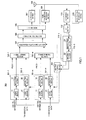
- FIG.1 shows the configuration of wireless communication apparatus 100 according to this embodiment.
- Wireless communication apparatus 100 divides a plurality of subcarriers forming an OFDM symbol, which is a multicarrier signal, into a plurality of subchannels, and performs adaptive control including scheduling and adaptive modulation per subchannel.
- OFDM symbol which is a multicarrier signal
- FIG.1 shows the configuration of wireless communication apparatus 100 according to this embodiment.
- Wireless communication apparatus 100 divides a plurality of subcarriers forming an OFDM symbol, which is a multicarrier signal, into a plurality of subchannels, and performs adaptive control including scheduling and adaptive modulation per subchannel.
- control channel coding and modulating sections 101-1 to 101-m each comprised of coding section 11 and modulating section 12, data channel coding and modulating sections 102-1 to 102-m, each comprised of coding section 21 and modulating section 22, and frame forming sections 103-1 to 103-m, are all provided to equal m, the number of subchannels.
- demodulating and decoding sections 113-1 to 113-n each comprised of demodulating section 31 and decoding section 32, are provided to equal n, the number of mobile stations wireless communication apparatus 100 is able to communicate with.
- coding section 11 performs encoding processing on control information that is outputted from adaptive control section 114 per subchannel
- modulating section 12 performs modulation processing on the control information after encoding.
- Control information is necessary to perform adaptive control and includes MCS (Modulation and Coding Scheme) information, which designates the modulation scheme and the coding rate for transmission data per subchannel, and allocation information, which shows to which subcarriers each transmission data is assigned.
- MCS Modulation and Coding Scheme
- encoding section 21 performs encoding processing on transmission data of each subchannel and modulation section 22 performs modulation processing on the transmission data after encoding using modulation schemes including QPSK and 16QAM.
- the coding rate and modulation scheme are in accordance with MCS information inputted from adaptive control section 114.
- Frame forming sections 103-1 to 103-m multiplex a pilot, control information and transmission data upon subchannels 1 to m, respectively, and form frames. That is, frame forming sections 103-1 to 103-m multiplex a pilot channel, a control channel and a data channel upon subchannels 1 to m. Here, frame forming sections 103-1 to 103-m time- multiplex the pilot channel, control information and transmission data, in order.
- Subcarrier allocating section 104 allocates the subcarriers designated by adaptive control section 114, to frames formed in frame forming sections 103-1 to 103-m.
- Timing control section 105 sets different frame timing offsets to frames (i.e. a plurality of frames formed for each subchannel 1 to m) inputted from subcarrier allocating section 104. That is, timing control section 105 performs timing control of setting different transmission timings between subchannels 1 to m. By this control, frames of differing subchannels are inputted to IFFT (Inverse Fast Fourier Transform) section 106, in parallel, at different timings.
- IFFT Inverse Fast Fourier Transform
- IFFT section 106 performs IFFT on the frames allocated to the subcarriers after the timing control and acquires an OFDM symbol.
- GI attaching section 107 attaches the same signal as the tail part of an OFDM symbol, to the beginning of that OFDM symbol, to provide a guard interval ("GI").
- Radio transmitting processing section 108 performs transmission processing including D/A conversion, amplification and up-conversion, on the OFDM symbol with an attachment of a GI, and transmits the result from antenna 109 to a mobile station. That is, radio transmitting processing section 108 transmits an OFDM symbol including subchannels 1 to m, each set with a different transmission timing, to a mobile station.
- wireless communication system 100 performs adaptive control per subchannel bundling a plurality of subcarriers, and performs data transmission.
- radio receiving processing section 110 receives n OFDM symbols, transmitted from a maximum of n mobile stations at the same time via antenna 109, and performs receiving processing including down-conversion and D/A conversion, on these OFDM symbols.
- GI removing section 111 removes the GI from the OFDM symbol after the receiving processing.
- FFT (Fast Fourier Transform) section 112 performs FFT on the OFDM symbol after the GI removal and acquires the mobile station-specific signals multiplexed in the frequency domain.
- mobile stations transmit signals using different subcarriers or different subchannels, and the mobile station-specific signals include received quality information reported from each mobile station.
- each mobile station is able to measure received quality of each subchannel, from, for example, the received SNR, received SIR, received CINR, received power, interference power, bit error rate, throughput, MCS that achieves a predetermined error rate, and so on.
- received quality information may be referred to as "CQI" (Channel Quality Indicator) or "CSI" (Channel State Information), for example.
- demodulating section 31 performs demodulation processing on the signal after FFT and performs decoding on processing the signal after demodulation. By this means, received data is acquired. In addition, received quality information of each subchannel in received data, is inputted to adaptive control section 114.
- Adaptive control section 114 performs adaptive control, based on received quality information for each subchannel reported from the mobile stations. That is, based on received quality information per subchannel, adaptive control section 114 selects MCS that can achieve the required error rate (MCS selection) per subcarrier, and outputs MCS information to coding and modulating sections 102-1 to 102-m. Adaptive control section 114 also performs on each of the subchannels, frequency scheduling that determines to which subcarriers each transmission data is allocated, using scheduling algorithms such as the maximum SIR method and the proportional fairness method. Further, adaptive control section 114 generates control information including MCS information and allocation information, per subchannel, and outputs each control information to the corresponding one of coding and modulating sections 101-1 to 101-m.
- the CPICH is the channel for the pilot
- the HS-SCCH is the channel for the above control information
- the HS-DSCH is the channel for transmission data.
- the mobile station will be able to perform receiving processing as follows.
- the receiving processing in the mobile station will be explained below using FIG.3. Further, for ease of explanation, in FIG.3, the transmission signal from a base station will be shown as four subchannels.
- the data of each subchannel needs to be finished being decoded within one TTI after the data is received at the mobile station.
- the mobile station successively performs the following processing for every subchannels 1 to 4. That is, when the baseband signal is received, the mobile station stores the pilot channel (CPICH) and control information (HS-SCCH) in a memory (processing (1)). After having received the pilot channel and control information, the mobile station performs channel estimation and signal correction for the control information using channel estimation values (processing (2)). Next, the mobile station demodulates and decodes the corrected control information (processing (3)).
- each subchannel has a different frame timing, so that it is enough to provide only one circuit (hardware) per processing (1) to (3), to perform the series of processing (1) to (3).
- the mobile station successively stores the data (HS-DSCH) in memory #1 to #3 (processing (4)). Every time data is stored in a memory, the mobile station performs receiving processing on the data in accordance with MCS information included in demodulated control information (processing (5)).
- processing (5) the mobile station first performs signal correction on data using channel estimation values. Secondly, the mobile station performs repetition and symbol combination of the data. Next, the mobile station deinterleaves the data. Then, the mobile station performs turbo decoding on the data.
- two decoding circuits #1 and #2 are used for turbo decoding. That is, processing (4) requires three memories, and processing (5) requires only one channel estimation circuit, signal correction circuit, repetition combination circuit, and deinterleaving circuit and two turbo decoding circuits.
- processing (1) to (3) requires four circuits per processing, and processing (5) requires four channel estimation circuits, signal correction circuits, repetition combination circuits and deinterleaving circuits.
- a mobile station receives frames of different subchannels at different timings, so that it is possible to perform receiving processing for a large number of frames at different timings. Consequently, circuit scale can be reduced.
- received quality information for each subchannel is fed back from the mobile station to the base station on uplink.
- the frame timing varies per subchannel, so that the feedback timing for received quality information also varies per subchannel.
- the present embodiment thus prevents concentration of uplink feed back information in time, so that the interference which the feed back information causes against uplink data can be reduced.
- the maximum required transmission power increases. Consequently, as explained above, each feedback information is transmitted at a different timing. By this means, the maximum required transmission power can be reduced.
- transmission power control is performed on frames in each subchannel.
- different frame timings are set per cell.
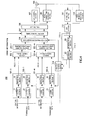
- FIG.4 shows the configuration of wireless communication apparatus 200 according to the present embodiment.
- the same reference numerals are assigned to the same parts as in Embodiment 1 (FIG.1) and explanations thereof will be omitted.
- transmission power control sections 201-1 to 201-m are provided to equal the number of subchannels m, and control the transmission power of the pilot channel (CPICH), control information (HS-SCCH) and transmission data (HS-DSCH) of each frame inputted from frame forming sections 103-1 to 103-m.
- Transmission power control sections 201-1 to 201-m set transmission power, such that, for example, the CPICH: HS-SCCH: HS-DSCH power ratio is 2:2:1. That is, transmission power control sections 201-1 to 201-m set the transmission power of the pilot channel greater than the transmission power of the data channel.
- transmission power control sections 201-1 to 201-m set the transmission power of the control channel greater than the transmission power of the data channel.
- Timing control section 202 receives as input timing information designated from a radio network controller (RNC), and performs the above timing control according to this timing information.
- This timing information designates a different frame timing offset per cell. That is, timing control section 202 sets transmission timings for each frame a timing that is different from transmission timings set in neighboring cells.
- RNC radio network controller
- timing control section 202 sets transmission timings for each frame a timing that is different from transmission timings set in neighboring cells.
- the subchannel-specific timing offsets vary between cells, so that it is possible to prevent a pilot transmission timing in one cell from overlapping with a pilot transmission timing in another, neighboring cell.
- frame timing offsets vary between subchannels. For this reason, if the total transmission power is 10 and one OFDM symbol is comprised of eight subchannels, as shown in FIG.6, as explained above, the CPICH: HS-SCCH: HS-DSCH power ratio can be set 2:2:1, for example. That is, the transmission power of the HS-DSCH can be set as 1, while the transmission power of the CPICH is 2 and the transmission power of the HS-SCCH is 2.
- the CPICH: HS-SCCH: HS-DSCH power ratio is 1:1:1. Consequently, if the total transmission power is 10 and one OFDM symbol is comprised of eight subchannels, as shown in FIG.7, the transmission power of the CPICH, the transmission power of the HS-SCCH and the transmission power of the HS-DSCH all need to be set as 1.25.
- channel estimation with high accuracy is required.
- channel estimation accuracy is low, even if received power of data is large, error rate increases. That is, under the condition where the total transmission power is fixed, as in the present embodiment, by setting the transmission power of the pilot (CPICH) for performing channel estimation greater than the transmission power of data (HS-DSCH), the error rate decreases, and, as a result, throughput improves.
- CPICH transmission power of the pilot
- HS-DSCH transmission power of data
- the transmission power of the HS-SCCH needs to be set greater than the transmission power of the HS-DSCH.
- the transmission power of the HS-SCCH is made greater than in related art.
- the CPICH: HS-SCCH: HS-DSCH power ratio is 2:2:1.
- the CPICH and HS-SCCH of every subchannel are transmitted at the same timing. That is, under the condition where the total transmission power is 10 and fixed, when one OFDM symbol is comprised of eight subchannels, if the transmission power of the CPICH and the HS-SCCH is 1.25, the transmission power of the HS-DSCH is decreased to 1.25/2. As a result, the data error rate increases and throughput decreases.
- the frame timing varies per subchannel, that is, the transmission timings for the pilot channel, the control channel, and the data channel vary per subchannel, so that, under the condition where total transmission power is fixed, the present embodiment can set the above-described power ratio at which error rate characteristics become optimal between the pilot channel, the control channel and the data channel, thereby improving throughput.
- transmission power ratio can be set so as to maintain the total transmission power and to minimize the required transmission power achieving the required error rate.
- the wireless communication apparatus may be provided in mobile stations.
- signals received at the base station i.e., signals that mobile station transmits on uplink
- signals that mobile station transmits on uplink may be transmitted in the OFDM scheme
- these signals may be transmitted using other transmission schemes including single carrier schemes and CDMA schemes.
- timing control sections 105 and 202 may be provided before subcarrier allocation section 104 as well.
- the present invention may be applied to subcarriers as well. That is to say, it is equally possible to set different transmission timings for a plurality of subcarriers in a wireless communication apparatus performing adaptive control per subcarrier.
- a subchannel may as well be comprised of nonconsecutive subcarriers.
- a subchannel may be referred to as a "subcarrier block", a "sub-band,” or a "chunk”.
- the mobile station may be referred to as "UE"
- the base station apparatus may be referred to as "Node-B”
- the subcarrier may be referred to as a tone.
- adaptive control besides scheduling and adaptive modulation, adaptive transmission power control, adaptive spreading factor control and so on may be employed. In addition, for adaptive control, combinations of them, or any one of them may be performed.
- the pilot channel includes the P-CPICH (Primary Common Pilot Channel), the S-CPICH (Secondary Common Pilot Channel) and the dedicated pilot channel in the DPCCH (Dedicated Physical Control Channel).
- the control channel includes the DCCH (Dedicated Physical Control Channel), the P-CCPCH (Primary Common Control Physical Channel), the S-CCPCH (Secondary Common Control Physical Channel), and the DPCCH (Dedicated Physical Control Channel).
- DCCH Dedicated Physical Control Channel
- P-CCPCH Primary Common Control Physical Channel
- S-CCPCH Secondary Common Control Physical Channel
- DPCCH Dedicated Physical Control Channel
- the data channel includes the DSCH (Downlink Shared Channel), the DPCH (Dedicated Physical Channel), and the DCH (Dedicated Channel).
- the present invention may be implemented by software.
- Each function block employed in the description of each of the aforementioned embodiments may typically be implemented as an LSI constituted by an integrated circuit. These may be individual chips or partially or totally contained on a single chip. "LSI” is adopted here but this may also be referred to as “IC”, “system LSI”, “super LSI” or “ultra LSI” depending on differing extents of integration.
- circuit integration is not limited to LSI's, and implementation using dedicated circuitry or general purpose processors is also possible.
- FPGA Field Programmable Gate Array
- reconfigurable processor where connections and settings of circuit cells within an LSI can be reconfigured is also possible.
- the present invention is applicable, for example, to mobile communication systems.
Landscapes
- Engineering & Computer Science (AREA)
- Signal Processing (AREA)
- Computer Networks & Wireless Communication (AREA)
- Quality & Reliability (AREA)
- Mobile Radio Communication Systems (AREA)
Abstract
Description
- The present invention relates to a wireless communication apparatus and wireless communication methods.
- Looking toward next-generation mobile communication systems, various studies have been conducted on radio transmission schemes suitable for high-speed packet transmissions, to achieve data rates over 100 Mbps and low delay transmissions to accommodate various traffics.
- OFDM (Orthogonal Frequency Division Multiplexing), whereby data is transmitted in parallel using a large number of subcarriers, is becoming a focus of attention in recent years, as a transmission scheme that enables high-speed transmission in a multipath communication environment. Moreover, to achieve low delay transmissions, the use of short TTI' s (Transmission Time Intervals) of approximately 0.5ms, for example, has been studied (see, for example, non-patent document 1). In OFDM, a wireless communication base station apparatus (hereinafter simply "base station") performs adaptive control including scheduling and adaptive modulation of transmission packets in TTI units, per subcarrier or per subchannel bundling a plurality of subcarriers. By this means, throughput can be significantly improved.
- Non-patent Document 1: "Effect of Frequency-domain Packet Scheduling in Forward Link Spread OFDM Broadband Packet Wireless Access" Nagata et al, Technical Report of IEICE, RCS2004-228, November 2004.
- When adaptive control such as scheduling and adaptive modulation is performed, prior to data packet transmissions, control information including scheduling information and modulation parameters is transmitted from the base station. This control information needs to be transmitted just before the data packet transmission, to make adaptive modulation follow channel variations changing at high speed. A wireless communication mobile station apparatus (hereinafter simply "mobile station") demodulates and decodes data packets using modulation parameters for data packets acquired by demodulating and decoding the control information. Moreover, to implement low delay transmission, a mobile station needs to transmit responses such as ACK (ACKnowledgement) or NACK (Negative ACKnowledgement) for received data packets in a short time period (within several TTI' s, for example).
- Here, when adaptive control is performed per subcarrier or per subchannel as described above, a large volume of control information and a large number of data packets are necessarily transmitted. Consequently, a mobile station needs to perform processing for receiving many data packets at the same time, within a limited time. As a result, circuit scale of the mobile station is increased.
- It is therefore an object of the present invention to provide a wireless communication apparatus and a wireless communication method that make it possible to reduce circuit scale of the wireless communication apparatus of the data receiving side.
- The wireless communication apparatus of the present invention employs a configuration having: a wireless communication apparatus dividing a plurality of subcarriers forming a multicarrier signal into a plurality of subchannels and performing adaptive control per subchannel, the wireless communication apparatus comprising: a timing setting section that sets different transmission timings for the plurality of subchannels; and a transmitting section that transmits the multicarrier signal including the plurality of subchannels after the transmission timing setting.
- According to the present invention, it is possible to reduce circuit scale of wireless communication apparatus of the data receiving side.
-
- FIG.1 is a block diagram showing a configuration of a wireless communication apparatus according to
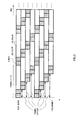
Embodiment 1 of the present invention; - FIG.2 illustrates timing control according to
Embodiment 1 of the present invention; - FIG.3 illustrates receiving processing at a mobile station according to
Embodiment 1 of the present invention; - FIG.4 is a block diagram showing the configuration of the wireless communication apparatus according to
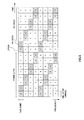
Embodiment 2 of the present invention; - FIG.5 illustrates timing control according to
Embodiment 2 of the present invention; - FIG.6 illustrates transmission power control according to
Embodiment 2 of the present invention; and - FIG.7 illustrates conventional transmission power control.
- Embodiments of the present invention will be explained below in detail with reference to the accompanying drawings.
- FIG.1 shows the configuration of
wireless communication apparatus 100 according to this embodiment.Wireless communication apparatus 100 divides a plurality of subcarriers forming an OFDM symbol, which is a multicarrier signal, into a plurality of subchannels, and performs adaptive control including scheduling and adaptive modulation per subchannel. In this connection, in the following description, a case will be explained wherewireless communication apparatus 100 is provided in a base station used in a mobile communication system. - In
wireless communication system 100, control channel coding and modulating sections 101-1 to 101-m, each comprised ofcoding section 11 and modulatingsection 12, data channel coding and modulating sections 102-1 to 102-m, each comprised ofcoding section 21 and modulatingsection 22, and frame forming sections 103-1 to 103-m, are all provided to equal m, the number of subchannels. In addition, demodulating and decoding sections 113-1 to 113-n, each comprised of demodulatingsection 31 anddecoding section 32, are provided to equal n, the number of mobile stationswireless communication apparatus 100 is able to communicate with. - In coding and modulating sections 101-1 to 101-m,
coding section 11 performs encoding processing on control information that is outputted fromadaptive control section 114 per subchannel, and modulatingsection 12 performs modulation processing on the control information after encoding. Control information is necessary to perform adaptive control and includes MCS (Modulation and Coding Scheme) information, which designates the modulation scheme and the coding rate for transmission data per subchannel, and allocation information, which shows to which subcarriers each transmission data is assigned. Incidentally, the coding rate inencoding section 11 and the modulation scheme inmodulation section 12 are determined in advance. - In coding and modulating sections 102-1 to 102-m, encoding
section 21 performs encoding processing on transmission data of each subchannel andmodulation section 22 performs modulation processing on the transmission data after encoding using modulation schemes including QPSK and 16QAM. The coding rate and modulation scheme are in accordance with MCS information inputted fromadaptive control section 114. - Frame forming sections 103-1 to 103-m multiplex a pilot, control information and transmission data upon
subchannels 1 to m, respectively, and form frames. That is, frame forming sections 103-1 to 103-m multiplex a pilot channel, a control channel and a data channel uponsubchannels 1 to m. Here, frame forming sections 103-1 to 103-m time- multiplex the pilot channel, control information and transmission data, in order. -
Subcarrier allocating section 104 allocates the subcarriers designated byadaptive control section 114, to frames formed in frame forming sections 103-1 to 103-m. -
Timing control section 105 sets different frame timing offsets to frames (i.e. a plurality of frames formed for eachsubchannel 1 to m) inputted fromsubcarrier allocating section 104. That is,timing control section 105 performs timing control of setting different transmission timings betweensubchannels 1 to m. By this control, frames of differing subchannels are inputted to IFFT (Inverse Fast Fourier Transform)section 106, in parallel, at different timings. - IFFT
section 106 performs IFFT on the frames allocated to the subcarriers after the timing control and acquires an OFDM symbol. -
GI attaching section 107 attaches the same signal as the tail part of an OFDM symbol, to the beginning of that OFDM symbol, to provide a guard interval ("GI"). - Radio
transmitting processing section 108 performs transmission processing including D/A conversion, amplification and up-conversion, on the OFDM symbol with an attachment of a GI, and transmits the result fromantenna 109 to a mobile station. That is, radiotransmitting processing section 108 transmits an OFDMsymbol including subchannels 1 to m, each set with a different transmission timing, to a mobile station. - In this way,
wireless communication system 100 performs adaptive control per subchannel bundling a plurality of subcarriers, and performs data transmission. - On the other hand, radio
receiving processing section 110 receives n OFDM symbols, transmitted from a maximum of n mobile stations at the same time viaantenna 109, and performs receiving processing including down-conversion and D/A conversion, on these OFDM symbols. -
GI removing section 111 removes the GI from the OFDM symbol after the receiving processing. - FFT (Fast Fourier Transform)
section 112 performs FFT on the OFDM symbol after the GI removal and acquires the mobile station-specific signals multiplexed in the frequency domain. Here, mobile stations transmit signals using different subcarriers or different subchannels, and the mobile station-specific signals include received quality information reported from each mobile station. Besides, each mobile station is able to measure received quality of each subchannel, from, for example, the received SNR, received SIR, received CINR, received power, interference power, bit error rate, throughput, MCS that achieves a predetermined error rate, and so on. In addition, received quality information may be referred to as "CQI" (Channel Quality Indicator) or "CSI" (Channel State Information), for example. - In demodulating and decoding sections 113-1 to 113-n, demodulating
section 31 performs demodulation processing on the signal after FFT and performs decoding on processing the signal after demodulation. By this means, received data is acquired. In addition, received quality information of each subchannel in received data, is inputted toadaptive control section 114. -
Adaptive control section 114 performs adaptive control, based on received quality information for each subchannel reported from the mobile stations. That is, based on received quality information per subchannel,adaptive control section 114 selects MCS that can achieve the required error rate (MCS selection) per subcarrier, and outputs MCS information to coding and modulating sections 102-1 to 102-m.Adaptive control section 114 also performs on each of the subchannels, frequency scheduling that determines to which subcarriers each transmission data is allocated, using scheduling algorithms such as the maximum SIR method and the proportional fairness method. Further,adaptive control section 114 generates control information including MCS information and allocation information, per subchannel, and outputs each control information to the corresponding one of coding and modulating sections 101-1 to 101-m. - When the above timing control is performed on frames of differing subchannels, as shown in FIG.2, a different timing offset is set per subchannel. For this reason, m frames (in FIG.2, m= 8) that have conventionally been transmitted at the same timing, are transmitted at different timings. Consequently, if a plurality of subchannels is allocated to one mobile station, the CPICH (Common Pilot Channel), HS-SCCH (Shared Control Channel for HS-DSCH) and HS-DSCH (High Speed Downlink Shared Channel) of each subchannel are received at a different timing of an interval of the timing offset at that mobile station. Furthermore, in FIG.2, the number of subchannels m is 8, and the timing offset is 1/4 frame per subchannel. That is, in FIG.2, the same transmission timings are repeated every four subchannels. The CPICH is the channel for the pilot, the HS-SCCH is the channel for the above control information and the HS-DSCH is the channel for transmission data.
- If the CPICH, HS-SCCH and HS-DSCH of different subchannels are received at different timings at a mobile station, the mobile station will be able to perform receiving processing as follows. The receiving processing in the mobile station will be explained below using FIG.3. Further, for ease of explanation, in FIG.3, the transmission signal from a base station will be shown as four subchannels. In addition, to fulfill the delay requirement, it is assumed that the data of each subchannel needs to be finished being decoded within one TTI after the data is received at the mobile station.
- The mobile station successively performs the following processing for every
subchannels 1 to 4. That is, when the baseband signal is received, the mobile station stores the pilot channel (CPICH) and control information (HS-SCCH) in a memory (processing (1)). After having received the pilot channel and control information, the mobile station performs channel estimation and signal correction for the control information using channel estimation values (processing (2)). Next, the mobile station demodulates and decodes the corrected control information (processing (3)). Here, each subchannel has a different frame timing, so that it is enough to provide only one circuit (hardware) per processing (1) to (3), to perform the series of processing (1) to (3). - Next, the mobile station successively stores the data (HS-DSCH) in
memory # 1 to #3 (processing (4)). Every time data is stored in a memory, the mobile station performs receiving processing on the data in accordance with MCS information included in demodulated control information (processing (5)). In processing (5), the mobile station first performs signal correction on data using channel estimation values. Secondly, the mobile station performs repetition and symbol combination of the data. Next, the mobile station deinterleaves the data. Then, the mobile station performs turbo decoding on the data. Here, to finish decoding within one TTI, which is the time limit for decoding, twodecoding circuits # 1 and #2 are used for turbo decoding. That is, processing (4) requires three memories, and processing (5) requires only one channel estimation circuit, signal correction circuit, repetition combination circuit, and deinterleaving circuit and two turbo decoding circuits. - On the other hand, when all subchannels are transmitted from a base station at the same timing, as in related art, in order to finish decoding within a time limit of one TTI, processing (1) to (3) requires four circuits per processing, and processing (5) requires four channel estimation circuits, signal correction circuits, repetition combination circuits and deinterleaving circuits.
- In this way, according to the present embodiment, a mobile station receives frames of different subchannels at different timings, so that it is possible to perform receiving processing for a large number of frames at different timings. Consequently, circuit scale can be reduced.
- Further, received quality information for each subchannel is fed back from the mobile station to the base station on uplink. As in related art, when all subchannels are transmitted from a base station at the same timing, to synchronize the control delay in adaptive control for all subchannels, received quality information also needs to be fed back at the same time for all subchannels. However, according to the present embodiment, the frame timing varies per subchannel, so that the feedback timing for received quality information also varies per subchannel. The present embodiment thus prevents concentration of uplink feed back information in time, so that the interference which the feed back information causes against uplink data can be reduced. In addition, when a mobile station multiplexes a significant volume of feed back information and transmits the result all at the same time, the maximum required transmission power increases. Consequently, as explained above, each feedback information is transmitted at a different timing. By this means, the maximum required transmission power can be reduced.
- In this way, according to the present embodiment, by transmitting frames of different subchannel at different timing by a base station which is a wireless communication apparatus of the data transmitting side, circuit scale of a mobile station which is a wireless communication apparatus of the data receiving side can be reduced.
- According to this embodiment, transmission power control is performed on frames in each subchannel. In addition, according to the present embodiment, different frame timings are set per cell.
- FIG.4 shows the configuration of
wireless communication apparatus 200 according to the present embodiment. In FIG.4, the same reference numerals are assigned to the same parts as in Embodiment 1 (FIG.1) and explanations thereof will be omitted. - In
wireless communication apparatus 200, transmission power control sections 201-1 to 201-m are provided to equal the number of subchannels m, and control the transmission power of the pilot channel (CPICH), control information (HS-SCCH) and transmission data (HS-DSCH) of each frame inputted from frame forming sections 103-1 to 103-m. Transmission power control sections 201-1 to 201-m set transmission power, such that, for example, the CPICH: HS-SCCH: HS-DSCH power ratio is 2:2:1. That is, transmission power control sections 201-1 to 201-m set the transmission power of the pilot channel greater than the transmission power of the data channel. In addition, transmission power control sections 201-1 to 201-m set the transmission power of the control channel greater than the transmission power of the data channel. -
Timing control section 202 receives as input timing information designated from a radio network controller (RNC), and performs the above timing control according to this timing information. This timing information designates a different frame timing offset per cell. That is,timing control section 202 sets transmission timings for each frame a timing that is different from transmission timings set in neighboring cells. By this timing control, for example, withwireless communication apparatus 200 incell 1, timing offsets are set as shown in FIG.2 above, and, withwireless communication 200 apparatus incell 2, whichneighbors cell 1, timing offsets are set as shown in FIG.5. In this way, according to the present embodiment, the subchannel-specific timing offsets vary between cells, so that it is possible to prevent a pilot transmission timing in one cell from overlapping with a pilot transmission timing in another, neighboring cell. As a result, at a mobile station located near a cell boundary, it is possible to prevent the pilots from interfering each other. Consequently, by preventing interference between pilots, at the mobile station, the accuracy of channel estimation improves, and, as a result, throughput improves. - Here, the above transmission power control will be explained in detail using FIG.6,and explained in comparison with conventional transmission power control (FIG.7). In addition, in FIGS.6 and 7, the numerals show transmission power values. Furthermore, in both FIG.6 and FIG.7, the maximum power (total transmission power) per OFDM symbol is 10.
- According to the present embodiment, frame timing offsets vary between subchannels. For this reason, if the total transmission power is 10 and one OFDM symbol is comprised of eight subchannels, as shown in FIG.6, as explained above, the CPICH: HS-SCCH: HS-DSCH power ratio can be set 2:2:1, for example. That is, the transmission power of the HS-DSCH can be set as 1, while the transmission power of the CPICH is 2 and the transmission power of the HS-SCCH is 2.
- However, in related art without such transmission power control, the CPICH: HS-SCCH: HS-DSCH power ratio is 1:1:1. Consequently, if the total transmission power is 10 and one OFDM symbol is comprised of eight subchannels, as shown in FIG.7, the transmission power of the CPICH, the transmission power of the HS-SCCH and the transmission power of the HS-DSCH all need to be set as 1.25.
- Here, to demodulate data without error at the mobile station, channel estimation with high accuracy is required. When channel estimation accuracy is low, even if received power of data is large, error rate increases. That is, under the condition where the total transmission power is fixed, as in the present embodiment, by setting the transmission power of the pilot (CPICH) for performing channel estimation greater than the transmission power of data (HS-DSCH), the error rate decreases, and, as a result, throughput improves.
- In addition, for the HS-SCCH, adaptivemodulation is not performed and the modulation scheme and the coding rate are fixed, and, in addition, retransmission by HARQ (Hybrid Automatic Repeat Request) is not performed. As a result, according to the present embodiment, the transmission power of the HS-SCCH needs to be set greater than the transmission power of the HS-DSCH. In addition, if the transmission power of the HS-SCCH is not enough and control information is in error, data cannot be correctly decoded, and, in addition, HARQ gain for data cannot be acquired, and as a result throughput decreases significantly. As a result, as in the present embodiment, the transmission power of the HS-SCCH is made greater than in related art.
- Furthermore, even with related art, it is possible to set the CPICH: HS-SCCH: HS-DSCH power ratio to 2:2:1. However, when all subchannels are transmitted at the same timing as in related art, as shown in FIG.7, the CPICH and HS-SCCH of every subchannel are transmitted at the same timing. That is, under the condition where the total transmission power is 10 and fixed, when one OFDM symbol is comprised of eight subchannels, if the transmission power of the CPICH and the HS-SCCH is 1.25, the transmission power of the HS-DSCH is decreased to 1.25/2. As a result, the data error rate increases and throughput decreases.
- Consequently, the frame timing varies per subchannel, that is, the transmission timings for the pilot channel, the control channel, and the data channel vary per subchannel, so that, under the condition where total transmission power is fixed, the present embodiment can set the above-described power ratio at which error rate characteristics become optimal between the pilot channel, the control channel and the data channel, thereby improving throughput. In other words, transmission power ratio can be set so as to maintain the total transmission power and to minimize the required transmission power achieving the required error rate.
- Furthermore, the wireless communication apparatus according to the above embodiments may be provided in mobile stations.
- In addition, although cases have been described with the above embodiments where signals received at the base station (i.e., signals that mobile station transmits on uplink) are transmitted in the OFDM scheme, these signals may be transmitted using other transmission schemes including single carrier schemes and CDMA schemes.
- Moreover, although configurations have been described with the above embodiments where
timing control sections subcarrier allocation section 104,timing control sections subcarrier allocation section 104 as well. - Moreover, although cases have been described with the above embodiments where the present invention is applied to subchannels the present invention may be applied to subcarriers as well. That is to say, it is equally possible to set different transmission timings for a plurality of subcarriers in a wireless communication apparatus performing adaptive control per subcarrier.
- Moreover, although cases have been described with the above embodiments where a different timing offset is set on a per frame basis, it is equally possible to set a different timing offset on a per subframe basis or on a per slot basis.
- Moreover,althoughcaseshavebeen described with the above embodiments where a subchannel is comprised of consecutive subcarriers, a subchannel may as well be comprised of nonconsecutive subcarriers. Moreover, a subchannel may be referred to as a "subcarrier block", a "sub-band," or a "chunk".
- Moreover, the mobile station may be referred to as "UE", the base station apparatus may be referred to as "Node-B", and the subcarrier may be referred to as a tone.
- Moreover, as for adaptive control, besides scheduling and adaptive modulation, adaptive transmission power control, adaptive spreading factor control and so on may be employed. In addition, for adaptive control, combinations of them, or any one of them may be performed.
- Moreover, besides the CPICH, according to 3GPP standards, the pilot channel includes the P-CPICH (Primary Common Pilot Channel), the S-CPICH (Secondary Common Pilot Channel) and the dedicated pilot channel in the DPCCH (Dedicated Physical Control Channel).
- Moreover, besides the HS-SCCH, according to 3GPP standards, the control channel includes the DCCH (Dedicated Physical Control Channel), the P-CCPCH (Primary Common Control Physical Channel), the S-CCPCH (Secondary Common Control Physical Channel), and the DPCCH (Dedicated Physical Control Channel).
- Moreover, besides the HS-DSCH, according to 3GPP standards, the data channel includes the DSCH (Downlink Shared Channel), the DPCH (Dedicated Physical Channel), and the DCH (Dedicated Channel).
- For example, although with the above embodiments cases have been described where the present invention is configured by hardware, the present invention may be implemented by software.
- Each function block employed in the description of each of the aforementioned embodiments may typically be implemented as an LSI constituted by an integrated circuit. These may be individual chips or partially or totally contained on a single chip. "LSI" is adopted here but this may also be referred to as "IC", "system LSI", "super LSI" or "ultra LSI" depending on differing extents of integration.
- Further, the method of circuit integration is not limited to LSI's, and implementation using dedicated circuitry or general purpose processors is also possible. After LSI manufacture, utilization of an FPGA (Field Programmable Gate Array) or a reconfigurable processor where connections and settings of circuit cells within an LSI can be reconfigured is also possible.
- Further, if integrated circuit technology comes out to replace LSI's as a result of the advancement of semiconductor technology or a derivative other technology, it is naturally also possible to carry out function block integration using this technology. Application of biotechnology is also possible.
- The present application is based on
Japanese Patent Application No.2005-133721, filed on April 28, 2005 - The present invention is applicable, for example, to mobile communication systems.
Claims (7)
- A wireless communication apparatus dividing a plurality of subcarriers forming a multicarrier signal into a plurality of subchannels and performing adaptive control per subchannel, the wireless communication apparatus comprising:a timing setting section that sets different transmission timings for the plurality of subchannels; anda transmitting section that transmits the multicarrier signal including the plurality of subchannels after the transmission timing setting.
- The wireless communication apparatus according to claim 1, further comprising:a multiplexing section that multiplexes a pilot channel and a data channel upon each subchannel; anda power setting section that sets a transmission power for the pilot channel greater than a transmission power for the data channel.
- The wireless communication apparatus according to claim 1, further comprising:a multiplexing section that multiplexes a control channel and a data channel upon each subchannel; anda power setting section that sets a transmission power for the control channel greater than a transmission power for the data channel.
- The wireless communication apparatus according to claim 1, wherein the timing setting section sets different transmission timings from transmission timings set by a wireless communication apparatus in a neighboring cell.
- A wireless communication base station apparatus comprising the wireless communication apparatus according to claim 1.
- A wireless communication mobile station apparatus comprising the wireless communication apparatus according to claim 1.
- A wireless communication method of dividing a plurality of subcarriers forming a multicarrier signal into a plurality of subchannels and performing adaptive control per subchannel, the method comprising setting different timing offsets for a plurality of frames formed in the plurality of subchannels.
Applications Claiming Priority (2)
| Application Number | Priority Date | Filing Date | Title |
|---|---|---|---|
| JP2005133721 | 2005-04-28 | ||
| PCT/JP2006/308690 WO2006118124A1 (en) | 2005-04-28 | 2006-04-26 | Wireless communication apparatus and wireless communication method |
Publications (2)
| Publication Number | Publication Date |
|---|---|
| EP1865637A1 true EP1865637A1 (en) | 2007-12-12 |
| EP1865637A4 EP1865637A4 (en) | 2013-05-01 |
Family
ID=37307923
Family Applications (1)
| Application Number | Title | Priority Date | Filing Date |
|---|---|---|---|
| EP06732346.9A Withdrawn EP1865637A4 (en) | 2005-04-28 | 2006-04-26 | APPARATUS AND METHOD FOR WIRELESS COMMUNICATION |
Country Status (6)
| Country | Link |
|---|---|
| US (1) | US8320356B2 (en) |
| EP (1) | EP1865637A4 (en) |
| JP (1) | JP4926047B2 (en) |
| KR (1) | KR101214102B1 (en) |
| CN (1) | CN101167283B (en) |
| WO (1) | WO2006118124A1 (en) |
Cited By (3)
| Publication number | Priority date | Publication date | Assignee | Title |
|---|---|---|---|---|
| US7912092B2 (en) | 2006-12-27 | 2011-03-22 | Sharp Laboratories Of America, Inc. | Systems and methods for transmitting a transmission time interval signal with staggered reference signals |
| TWI400969B (en) * | 2008-08-15 | 2013-07-01 | Innovative Sonic Ltd | Method and apparatus of handling tti bundling retransmission |
| RU2744910C2 (en) * | 2016-07-26 | 2021-03-17 | Нтт Докомо, Инк. | User terminal and a radio communication method |
Families Citing this family (18)
| Publication number | Priority date | Publication date | Assignee | Title |
|---|---|---|---|---|
| RU2418368C2 (en) * | 2005-08-19 | 2011-05-10 | Панасоник Корпорэйшн | Radio communication mobile station device, radio communication base station device and cqi messaging technique |
| JP4640844B2 (en) * | 2007-01-09 | 2011-03-02 | 株式会社エヌ・ティ・ティ・ドコモ | Transmission device, transmission method, and communication system |
| JP4920445B2 (en) * | 2007-02-16 | 2012-04-18 | 京セラ株式会社 | Transmission method, notification method, terminal device, and base station device |
| KR100930716B1 (en) * | 2007-10-17 | 2009-12-09 | 한국전자통신연구원 | Signal transmission method and signal reception method |
| IL194097A (en) * | 2008-09-15 | 2012-05-31 | Mariana Goldhamer | Ofdma-based operation of a wireless subscriber terminal in a plurality of cells |
| US9137764B2 (en) | 2009-03-17 | 2015-09-15 | Htc Corporation | Method of managing timing alignment functionality for multiple component carriers and related communication device |
| CN101646234A (en) * | 2009-09-01 | 2010-02-10 | 中兴通讯股份有限公司 | Obtaining method of timing lead |
| CN102440048A (en) * | 2009-10-20 | 2012-05-02 | 华为技术有限公司 | Method, base station and system for performing timing-adjustment on component carriers |
| JP2011234295A (en) * | 2010-04-30 | 2011-11-17 | Panasonic Corp | Base station device, communication terminal device, transmission method and demodulation method |
| JP4675432B2 (en) * | 2010-08-31 | 2011-04-20 | 株式会社エヌ・ティ・ティ・ドコモ | Receiving apparatus and receiving method for receiving transmission signal modulated by OFDM method |
| US8842542B2 (en) | 2012-02-08 | 2014-09-23 | Qualcomm Incorporated | Method and apparatus for scheduling resources for uplink MIMO communication |
| US8953713B2 (en) | 2010-11-08 | 2015-02-10 | Qualcomm Incorporated | System and method for uplink multiple input multiple output transmission |
| US9516609B2 (en) | 2010-11-08 | 2016-12-06 | Qualcomm Incorporated | System and method for uplink multiple input multiple output transmission |
| US9380490B2 (en) | 2010-11-08 | 2016-06-28 | Qualcomm Incorporated | System and method for uplink multiple input multiple output transmission |
| US9007888B2 (en) | 2010-11-08 | 2015-04-14 | Qualcomm Incorporated | System and method for uplink multiple input multiple output transmission |
| US9084207B2 (en) * | 2010-11-08 | 2015-07-14 | Qualcomm Incorporated | System and method for uplink multiple input multiple output transmission |
| JP5779268B2 (en) * | 2014-04-04 | 2015-09-16 | シャープ株式会社 | Communication system, mobile station, and signal processing method |
| CN113875296B (en) | 2019-04-11 | 2025-09-19 | 马维尔亚洲私人有限公司 | Simultaneous transmission in multiple frequency bins |
Family Cites Families (21)
| Publication number | Priority date | Publication date | Assignee | Title |
|---|---|---|---|---|
| JP3135417B2 (en) | 1993-05-26 | 2001-02-13 | 株式会社日立製作所 | Broadcasting system, broadcast transmitting / receiving system and broadcast receiver |
| US5872774A (en) * | 1997-09-19 | 1999-02-16 | Qualcomm Incorporated | Mobile station assisted timing synchronization in a CDMA communication system |
| US6526039B1 (en) * | 1998-02-12 | 2003-02-25 | Telefonaktiebolaget Lm Ericsson | Method and system for facilitating timing of base stations in an asynchronous CDMA mobile communications system |
| US6208871B1 (en) * | 1998-02-27 | 2001-03-27 | Motorola, Inc. | Method and apparatus for providing a time adjustment to a wireless communication system |
| JP3691307B2 (en) * | 1999-09-28 | 2005-09-07 | 三洋電機株式会社 | Digital broadcast receiver |
| JP2001186559A (en) * | 1999-12-22 | 2001-07-06 | Nec Corp | Mobile communication system and simple synchronization method between base stations used therefor |
| CA2406438C (en) * | 2000-04-07 | 2006-10-17 | Interdigital Technology Corporation | Base station synchronization for wireless communication systems |
| JP2002016577A (en) | 2000-06-28 | 2002-01-18 | Sony Corp | Communication method and communication device |
| US6775242B2 (en) * | 2001-07-09 | 2004-08-10 | Qualcomm Incorporated | Method and apparatus for time-aligning transmissions from multiple base stations in a CDMA communication system |
| JP3694479B2 (en) * | 2001-12-07 | 2005-09-14 | 松下電器産業株式会社 | Multi-carrier transceiver apparatus, multi-carrier wireless communication method, and multi-carrier wireless communication program |
| JP3860762B2 (en) * | 2002-02-14 | 2006-12-20 | 株式会社エヌ・ティ・ティ・ドコモ | Mobile communication system, channel synchronization establishment method, and mobile station |
| US7551546B2 (en) * | 2002-06-27 | 2009-06-23 | Nortel Networks Limited | Dual-mode shared OFDM methods/transmitters, receivers and systems |
| US6928062B2 (en) * | 2002-10-29 | 2005-08-09 | Qualcomm, Incorporated | Uplink pilot and signaling transmission in wireless communication systems |
| US6999467B2 (en) * | 2003-07-28 | 2006-02-14 | Motorola, Inc. | Method and apparatus for transmission and reception within an OFDM communication system |
| JP4526898B2 (en) * | 2003-09-16 | 2010-08-18 | パナソニック株式会社 | Relay device, terminal device, and relay method |
| EP1524793B1 (en) * | 2003-10-16 | 2008-11-26 | Mitsubishi Electric Information Technology Centre Europe B.V. | Method of mapping chips of a spread out symbol to sub-channels of a multi-carrier transmission network |
| US7242722B2 (en) * | 2003-10-17 | 2007-07-10 | Motorola, Inc. | Method and apparatus for transmission and reception within an OFDM communication system |
| WO2005081437A1 (en) * | 2004-02-17 | 2005-09-01 | Huawei Technologies Co., Ltd. | Multiplexing scheme in a communication system |
| US7606295B2 (en) * | 2005-02-24 | 2009-10-20 | Interdigital Technology Corporation | Generalized rake receiver for wireless communication |
| US20060203850A1 (en) * | 2005-03-14 | 2006-09-14 | Johnson Walter L | Method and apparatus for distributing timing information in an asynchronous wireless communication system |
| JP4592477B2 (en) * | 2005-03-31 | 2010-12-01 | 株式会社エヌ・ティ・ティ・ドコモ | Wireless communication system, base station, mobile station, and wireless communication method |
-
2006
- 2006-04-26 EP EP06732346.9A patent/EP1865637A4/en not_active Withdrawn
- 2006-04-26 JP JP2007514754A patent/JP4926047B2/en not_active Expired - Fee Related
- 2006-04-26 CN CN200680014236.4A patent/CN101167283B/en not_active Expired - Fee Related
- 2006-04-26 KR KR1020077024710A patent/KR101214102B1/en not_active Expired - Fee Related
- 2006-04-26 WO PCT/JP2006/308690 patent/WO2006118124A1/en not_active Ceased
- 2006-04-26 US US11/912,636 patent/US8320356B2/en not_active Expired - Fee Related
Cited By (3)
| Publication number | Priority date | Publication date | Assignee | Title |
|---|---|---|---|---|
| US7912092B2 (en) | 2006-12-27 | 2011-03-22 | Sharp Laboratories Of America, Inc. | Systems and methods for transmitting a transmission time interval signal with staggered reference signals |
| TWI400969B (en) * | 2008-08-15 | 2013-07-01 | Innovative Sonic Ltd | Method and apparatus of handling tti bundling retransmission |
| RU2744910C2 (en) * | 2016-07-26 | 2021-03-17 | Нтт Докомо, Инк. | User terminal and a radio communication method |
Also Published As
| Publication number | Publication date |
|---|---|
| CN101167283A (en) | 2008-04-23 |
| CN101167283B (en) | 2014-05-07 |
| US8320356B2 (en) | 2012-11-27 |
| EP1865637A4 (en) | 2013-05-01 |
| US20080273517A1 (en) | 2008-11-06 |
| JPWO2006118124A1 (en) | 2008-12-18 |
| JP4926047B2 (en) | 2012-05-09 |
| KR20080003371A (en) | 2008-01-07 |
| WO2006118124A1 (en) | 2006-11-09 |
| KR101214102B1 (en) | 2012-12-20 |
Similar Documents
| Publication | Publication Date | Title |
|---|---|---|
| US8320356B2 (en) | Wireless communication apparatus and wireless communication method | |
| US8374189B2 (en) | Control channel transmitting method, receiving method, base station and terminal | |
| JP6077529B2 (en) | Control channel transmission method and apparatus for dedicated reference signal in wireless communication system | |
| US8774107B2 (en) | Radio communication system, radio transmission apparatus, and retransmission method | |
| JP5106423B2 (en) | Radio communication base station apparatus and radio communication method | |
| KR20050000709A (en) | Apparatus and method for transmitting/receiving data according to channel states in communication systems using multiple access scheme | |
| EP1879306A1 (en) | Wireless communication base station apparatus and wireless communication method | |
| JP5159639B2 (en) | Base station apparatus and mapping method | |
| US8064393B2 (en) | Wireless communication base station apparatus and wireless communication method in multicarrier communication | |
| CN119893466A (en) | Apparatus and method for transceiving physical side link feedback channel in wireless communication system | |
| US7756215B2 (en) | Radio communication base station apparatus and radio communication method in multi-carrier communications | |
| RU2414105C2 (en) | Mobile station, base station and communication method | |
| JP5230577B2 (en) | Control channel transmission method, base station, terminal, and radio communication system |
Legal Events
| Date | Code | Title | Description |
|---|---|---|---|
| PUAI | Public reference made under article 153(3) epc to a published international application that has entered the european phase |
Free format text: ORIGINAL CODE: 0009012 |
|
| 17P | Request for examination filed |
Effective date: 20071024 |
|
| AK | Designated contracting states |
Kind code of ref document: A1 Designated state(s): AT BE BG CH CY CZ DE DK EE ES FI FR GB GR HU IE IS IT LI LT LU LV MC NL PL PT RO SE SI SK TR |
|
| DAX | Request for extension of the european patent (deleted) | ||
| RAP1 | Party data changed (applicant data changed or rights of an application transferred) |
Owner name: PANASONIC CORPORATION |
|
| A4 | Supplementary search report drawn up and despatched |
Effective date: 20130405 |
|
| RIC1 | Information provided on ipc code assigned before grant |
Ipc: H04B 1/707 20110101ALI20130328BHEP Ipc: H04L 5/00 20060101ALI20130328BHEP Ipc: H04L 27/26 20060101ALI20130328BHEP Ipc: H04L 1/00 20060101ALI20130328BHEP Ipc: H04J 11/00 20060101AFI20130328BHEP |
|
| 17Q | First examination report despatched |
Effective date: 20130422 |
|
| RAP1 | Party data changed (applicant data changed or rights of an application transferred) |
Owner name: HARRIS CORPORATION |
|
| RAP1 | Party data changed (applicant data changed or rights of an application transferred) |
Owner name: PANASONIC INTELLECTUAL PROPERTY CORPORATION OF AME |
|
| RAP1 | Party data changed (applicant data changed or rights of an application transferred) |
Owner name: WI-FI ONE, LLC |
|
| STAA | Information on the status of an ep patent application or granted ep patent |
Free format text: STATUS: EXAMINATION IS IN PROGRESS |
|
| STAA | Information on the status of an ep patent application or granted ep patent |
Free format text: STATUS: THE APPLICATION IS DEEMED TO BE WITHDRAWN |
|
| 18D | Application deemed to be withdrawn |
Effective date: 20171018 |