EP1865624A1 - Layer-2 mobility network - Google Patents
Layer-2 mobility network Download PDFInfo
- Publication number
- EP1865624A1 EP1865624A1 EP05720727A EP05720727A EP1865624A1 EP 1865624 A1 EP1865624 A1 EP 1865624A1 EP 05720727 A EP05720727 A EP 05720727A EP 05720727 A EP05720727 A EP 05720727A EP 1865624 A1 EP1865624 A1 EP 1865624A1
- Authority
- EP
- European Patent Office
- Prior art keywords
- multicast
- mobile terminal
- switch
- message
- router
- Prior art date
- Legal status (The legal status is an assumption and is not a legal conclusion. Google has not performed a legal analysis and makes no representation as to the accuracy of the status listed.)
- Ceased
Links
Images






Classifications
-
- H—ELECTRICITY
- H04—ELECTRIC COMMUNICATION TECHNIQUE
- H04L—TRANSMISSION OF DIGITAL INFORMATION, e.g. TELEGRAPHIC COMMUNICATION
- H04L45/00—Routing or path finding of packets in data switching networks
- H04L45/16—Multipoint routing
-
- H—ELECTRICITY
- H04—ELECTRIC COMMUNICATION TECHNIQUE
- H04L—TRANSMISSION OF DIGITAL INFORMATION, e.g. TELEGRAPHIC COMMUNICATION
- H04L45/00—Routing or path finding of packets in data switching networks
- H04L45/02—Topology update or discovery
- H04L45/04—Interdomain routing, e.g. hierarchical routing
-
- H—ELECTRICITY
- H04—ELECTRIC COMMUNICATION TECHNIQUE
- H04W—WIRELESS COMMUNICATION NETWORKS
- H04W36/00—Hand-off or reselection arrangements
- H04W36/0005—Control or signalling for completing the hand-off
- H04W36/0007—Control or signalling for completing the hand-off for multicast or broadcast services, e.g. MBMS
-
- H—ELECTRICITY
- H04—ELECTRIC COMMUNICATION TECHNIQUE
- H04W—WIRELESS COMMUNICATION NETWORKS
- H04W36/00—Hand-off or reselection arrangements
- H04W36/0005—Control or signalling for completing the hand-off
- H04W36/0011—Control or signalling for completing the hand-off for data sessions of end-to-end connection
-
- H—ELECTRICITY
- H04—ELECTRIC COMMUNICATION TECHNIQUE
- H04W—WIRELESS COMMUNICATION NETWORKS
- H04W36/00—Hand-off or reselection arrangements
- H04W36/24—Reselection being triggered by specific parameters
- H04W36/30—Reselection being triggered by specific parameters by measured or perceived connection quality data
- H04W36/302—Reselection being triggered by specific parameters by measured or perceived connection quality data due to low signal strength
-
- H—ELECTRICITY
- H04—ELECTRIC COMMUNICATION TECHNIQUE
- H04W—WIRELESS COMMUNICATION NETWORKS
- H04W40/00—Communication routing or communication path finding
- H04W40/24—Connectivity information management, e.g. connectivity discovery or connectivity update
- H04W40/248—Connectivity information update
-
- H—ELECTRICITY
- H04—ELECTRIC COMMUNICATION TECHNIQUE
- H04W—WIRELESS COMMUNICATION NETWORKS
- H04W36/00—Hand-off or reselection arrangements
- H04W36/02—Buffering or recovering information during reselection ; Modification of the traffic flow during hand-off
-
- H—ELECTRICITY
- H04—ELECTRIC COMMUNICATION TECHNIQUE
- H04W—WIRELESS COMMUNICATION NETWORKS
- H04W4/00—Services specially adapted for wireless communication networks; Facilities therefor
- H04W4/06—Selective distribution of broadcast services, e.g. multimedia broadcast multicast service [MBMS]; Services to user groups; One-way selective calling services
- H04W4/08—User group management
-
- H—ELECTRICITY
- H04—ELECTRIC COMMUNICATION TECHNIQUE
- H04W—WIRELESS COMMUNICATION NETWORKS
- H04W80/00—Wireless network protocols or protocol adaptations to wireless operation
- H04W80/04—Network layer protocols, e.g. mobile IP [Internet Protocol]
Definitions
- the present invention relates to a layer 2 mobility network, which is a integrated heterogeneous mobile wireless network in which heterogeneous wireless access systems are integrated in a layer 2 base, and, more particularly to a layer 2 mobility network that carries out multicast communication.
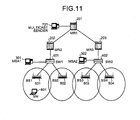
- Fig. 11 is a conceptual diagram of a structure of the conventional integrated heterogeneous mobile wireless network described in the Non-Patent Literature 1.
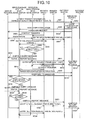
- Fig. 12 is a sequence chart for explaining a control operation for handoff carried out in the same sub-network in the integrated heterogeneous mobile wireless network shown in Fig. 11.
- Fig. 13 is a sequence chart for explaining a control operation for handoff carried out between different sub-networks in the integrated heterogeneous mobile wireless network shown in Fig. 11.
- a source a transmission source: Multicast Sender
- contents such as streaming data provided by a source (a transmission source: Multicast Sender) 701 of multicast communication are input to a multicast router (MR1).
- a multicast router MR1
- MR2 multicast router
- MR3 multicast router
- a switch (SW1) 401 is connected to the multicast router (MR2) 202.
- the switch (SW1) 401 has an IGMP-Snooping (Internet Group Management Protocol-Snooping) function of connecting a wireless base station (Base Station: BS1) 501 and a wireless base station (BS2) 502 subordinate to the switch (SW1) 401 to the multicast router (MR2) 202.
- IGMP-Snooping Internet Group Management Protocol-Snooping
- a switch (SW2) 402 is connected to the multicast router (MR2) 203.
- the switch (SW2) 402 has an IGMP-Snooping function of connecting a wireless base station (BS3) 503 and a wireless base station (BS2) 504 subordinate to the switch (SW2) 402 to the multicast router (MR3) 203.
- MSAs Mobility Support Agents
- FIG. 12 A handoff control operation carried out in the network shown in Fig. 11 is explained below.
- a handoff control operation in the same sub-network is performed as shown in Fig. 12.
- the mobile terminal MH is receiving multicast data (Multicast Data) through a route of the multicast router MR1, the switch SW1, and the wireless base station BS1 (S1001).
- the mobile terminal MH performs handoff to the wireless base station BS2 (S1002)
- the mobile terminal MH transmits in a wireless manner an IGMP report message (IGMP Report) to the wireless base station BS2 as soon as possible in a process in which the wireless base station BS1 is transmitting in a wireless manner multicast data (Multicast Data) received from the switch SW1 (S1003).
- This IGMP report message is communicated from the wireless base station BS2 to the switch SW1 (S1004).
- the switch SW1 When the switch SW1 receives the IGMP report message, the switch SW1 transfers the multicast data (Multicast Data) transmitted from the multicast router MR1 to both the wireless base stations BS1 and BS2 (S1005). Consequently, the mobile terminal MH can continuously receive the multicast data (Multicast Data) in a new location.
- Multicast Data multicast data
- the mobile terminal MH transmits in a wireless manner an advertisement request message (Advertisement Request) to the wireless base station BS2 by broadcast (Broadcast).
- This advertisement request message is transferred to the agent (MSA1) through the switch SW1 (S1006).
- the agent (MSA1) receives the advertisement request message, the agent (MSA1) delivers an advertisement message (Advertisement) including a network prefix by broadcast (Broadcast).
- This advertisement message (Advertisement) is delivered to the mobile terminal MH through the switch SW1 and the wireless base station BS2 (S1007).
- the mobile terminal MH When the mobile terminal MH receives the advertisement message (Advertisement), the mobile terminal MH compares a previous prefix and the prefix included in the advertisement (Advertisement) and judges whether a handoff form is handoff in the same sub-network or handoff between different sub-networks. When the mobile terminal MH judges that the handoff form is the handoff in the same sub-network, the mobile terminal MH transmits in a wireless manner an IGMP leave message (IGMP Leave) to give trigger for checking a port of a receiver present under the switch SW1 to the switch SW1. This IGMP leave message is transferred to the multicast router MR1 through the wireless base station BS2 and the switch SW1 (S1008).
- IGMP Leave IGMP leave message
- the multicast router MR1 When the multicast router MR1 receives the IGMP leave message, the multicast router MR1 transmits an IGMP query message (IGMP Query (Group Specific)) to check whether receivers are present under the wireless base stations BS1 and BS2. This IGMP query message is transferred from the switch SW1 to both the wireless base station sBS1 and BS2 (S1009).
- IGMP query message IGMP Query (Group Specific)
- the mobile terminal MH When the mobile terminal MH receives the IGMP query message, the mobile terminal MH transmits in a wireless manner an IGMP report message (IGMP Report) to the wireless base station BS2.
- IGMP Report This IGMP report message is communicated from the wireless base station BS2 to the switch SW1 (S1010). Consequently, the switch SW1 continuously delivers the multicast data (Multicast Data) to a port to which the wireless base station BS2, which is a new location of the mobile terminal MH, is connected.
- the switch SW1 stops the distribution of the multicast data (Multicast Data) to the port to which the wireless base station BS1 is connected (S1011).
- the mobile terminal MH is receiving multicast data (Multicast Data) through a route of the multicast routers MR1 and MR2, the switch SW1, and the wireless base station BS2 (S1011).
- the mobile terminal MH performs handoff to the wireless base station BS3 (S1012)
- the mobile terminal MH transmits in a wireless manner an IGMP report message (IGMP Report) to the wireless base station BS3 as soon as possible in a process in which the wireless base station BS2 is transmitting in a wireless manner multicast data (Multicast Data) received from the switch SW1 (S1013).
- This IGMP report message is communicated from the wireless base station BS3 to the switch SW3 and the multicast router MR3 (S1014).
- the multicast router MR1 delivers the multicast data (Multicast Data) to both the multicast routers MR2 and MR3 (S1015). Consequently, the mobile terminal MH can continuously receive the multicast data (Multicast Data) in a new location.
- the mobile terminal MH transmits in a wireless manner an advertisement request message (Advertisement Request) to the wireless base station BS3 by broadcast (Broadcast).
- This advertisement request message is transferred to the agent (MSA2) through the wireless base station BS3 and the switch SW2 (S1016).
- the agent (MSA2) receives the advertisement request message, the agent (MSA2) delivers an advertisement message (Advertisement) including a network prefix by broadcast.
- This advertisement message (Advertisement) is delivered to the mobile terminal MH through the switch SW2 and the wireless base station BS3 (S1017).
- the mobile terminal MH When the mobile terminal MH receives the advertisement message (Advertisement), the mobile terminal MH updates an address (S1018) because handoff between different sub-networks is performed and transmits in a wireless manner a leave request message (Leave Request) to the agent MSA1 in a sub-network at a previous location.
- This leave request message (Leave Request) is transferred to the agent MSA1 through the wireless base station BS3, the switch SW2, the multicast routers MR3, MR1, and MR2, and the switch SW1 (S1019).
- the agent MSA1 in the sub-network in the previous location transmits an IGMP leave message (IGMP Leave) to the multicast router MR2 through the switch SW1 as a response (S1020).
- IGMP Leave IGMP leave message
- the multicast router MR2 transmits an IGMP query message (IGMP Query (Group specific)) to check whether a receiver is present under the wireless base station BS2.
- IGMP query message is transferred from the switch SW1 to the wireless base station BS2 (S1021).
- S1021 since there is no receiver, no response is received. Consequently, both the switch SW1 in the previous location and the multicast router MR2 stop the distribution of the multicast data (Multicast Data).
- the mobile terminal MH can continue to receive the distribution of the multicast data (Multicast Data) in a new location through a distribution route of the multicast router MR3, the switch SW2, and the wireless base station BGS3 (S1022).
- the IGMP report message is transmitted immediately after movement to realize a reduction in a delay time until the start of multicast packet reception after the movement. It is identified whether handoff is the handoff in the same sub-network or the handoff between the different sub-networks from broadcast information (Advertisement).
- the mobile terminal directly transmits the IGMP leave message (IGMP-Leave) when the handoff is the handoff in the same sub-network and transmits the IGMP leave message (IGMP-Leave) in cooperation with the agent MSA when the handoff is the handoff between the different sub-networks. In this way, a reduction in a delay time until the stop of the distribution of a multicast packet in the previous location wireless base station is realized.
- Non-Patent Literature 1 Yuki Moritani, Kensho Matsumoto, Ken-ichi Yamasaki "Handoff for a multicast receiver that takes into account IGMP-Snooping" The Institute of Electronics, Information and Communication Engineers Transaction (NS2003-104, NS2003-70, CS2003-79 (2003-09), Figs. 1 to 3 )
- the IGMP query message (IGMP-Query) transmitted from the multicast router to check presence of the multicast receiver is propagated to the entire sub-network.
- IGMP-Query The IGMP query message transmitted from the multicast router to check presence of the multicast receiver is propagated to the entire sub-network.
- IGMP-Report the IGMP report message transmitted by the mobile terminal to the multicast router to request multicast delivery
- a traffic amount increases according to the number of mobile terminals and the number of times of handoff.
- IGMP of IPv4 is used for the multicast procedure.
- MLD of IPv6 is used.
- the present invention has been devised in view of the above and it is an object of the present invention to obtain a layer 2 mobility network as a integrated heterogeneous mobile wireless network that can stop unnecessary transfer (forwarding) and suppress traffic during multicast delivery even if all switches constituting a sub-network are not implemented with a function of snooping various messages in a multicast procedure "IGMP/MLD” and also suppresses control traffic related to the multicast procedure "IGMP/MLD” and is excellent in scalability.
- a layer 2 mobility network includes a layer 2 switch that is a base of a heterogeneous wireless access system; an IP multicast router that performs a mutual connection in an IP layer with an external network to which a source of a multicast communication is connected; and a gateway switch interposed between a plurality of the layer 2 switches and the IP multicast router connected via a relay transfer path.
- an apparatus located at an edge of the network including a radio access point of the heterogeneous wireless access system or the layer 2 switch, has a first function of transmitting a report message in a multicast procedure transmitted from the mobile terminal to the gateway switch and snooping the report message to learn a transfer route for multicast and a second function of transmitting an entry update request frame for causing an entry forming the learned transfer route for multicast in a direction of the gateway switch, and the gateway switch has a function of transferring a received report message to a port to which the IP multicast router is connected after the transfer route for multicast is formed.
- the switches and the gateway switch constituting the relay transfer path that connects the layer 2 switch and the gateway switch can learn the entry forming the transfer route for multicast according to the entry update request frame from the apparatus located at the edge of the network and establish the route for multicast delivery to the mobile terminal even if the switches are not implemented with the function of snooping the report message transmitted by the mobile terminal to request multicast delivery.
- the gateway switch can confirm, by receiving the entry update request frame from the relay transfer path, that the transfer route for multicast is formed.
- the gateway switch can transfer the report message for requesting multicast delivery to the IP multicast router with the reception of the entry update request frame from the relay transfer path as a trigger. Consequently, it is possible to start multicast delivery to the mobile terminal within a relatively short time.
- Fig. 1 is a conceptual diagram of a structure of a layer 2 mobility network as an integrated heterogeneous mobile wireless network according to a first embodiment of the present invention.
- an external network 1 is, for example, the Internet or an intranet.
- a layer 2 mobility network 2 is connected to the external network 1.
- the layer 2 mobility network 2 is a heterogeneous radio integrated network in which heterogeneous wireless access systems are integrated in a layer 2 base.
- a multicast delivery terminal 3 is connected to the external network 1.
- the multicast delivery terminal 3 is a terminal serving as a source (a transmission source) of multicast communication to a mobile terminal, which makes connection to the layer 2 mobility network 2, and can provide contents such as streaming data.
- the layer 2 mobility network 2 includes a gateway router 11 connected to the external network 1.
- the gateway router 11 is an IP multicast router that performs mutual connection (routing) in an IP (Internet Protocol) layer with the external network 1 and terminates a multicast function of IPv4/IPv6.
- a gateway switch 21 is connected under the gateway router 11. The gateway switch 21 has a function of managing positional information of all mobile terminals in the layer 2 mobility network 2.
- a signaling server 31 is connected to the gateway switch 21.
- Branch switches 61 to 64 that relay and transfer a layer 2 frame are arranged between the gateway switch 21 and edge switches (layer 2 switches) 71 to 74 to which the heterogeneous wireless access systems are subordinate.
- the signaling server 31 has a function of applying handover control among the heterogeneous wireless access systems to a mobile terminal that moves in the layer 2 mobility network 2 and a function of acquiring layer 2 trigger information (a radio quality measurement result, etc.) serving as a material for judgment in executing the handover control from the mobile terminal and instructing the mobile terminal to switch a radio interface.
- layer 2 trigger information a radio quality measurement result, etc.
- Wireless base stations 81 to 84 and 91 to 94 corresponding to the respective wireless access systems are subordinate to the edge switches 71 to 74.
- the wireless base stations 81 to 84 are, for example, wireless base stations in a cellular type system.
- the wireless base stations 91 to 94 are, for example, wireless base stations in a hotspot type system.
- Mobile terminals 101 and 102 make wireless connection to such heterogeneous wireless access systems and perform multicast communication.
- the wireless base stations 81 and 91 are connected to the edge switch 71 and the wireless base stations 82 and 92 are connected to the edge switch 72.
- the edge switches 71 and 72 are connected to the gateway switch 21 via the branch switches 63 and 61.
- the wireless base stations 83 and 93 are connected to the edge switch 73 and the wireless base stations 84 and 94 are connected to the edge switch 74.
- the edge switches 73 and 74 are connected to the gateway switch 21 via the branch switches 64 and 62.
- a control operation for multicast communication according to the present invention is realized using the layer 2 mobility network 2 having the structure shown in Fig. 1.
- apparatuses located at the edges of a network such as the edge switches 71 to 74, which are the layer 2 switches, or the wireless base stations 81 to 84 and 91 to 94, which are the radio access points, have a function of transmitting a report message in a multicast procedure "IGMP (Internet Group Management Protocol)/MLD (Multicast Listener Discovery)" transmitted from the mobile terminals to the gateway switch 21 and snooping the report message to learn a transfer route for multicast and a function of transmitting an entry update request frame for causing the switches to learn an entry forming the learned transfer route for multicast in a direction of the gateway switch 21.
- IGMP Internet Group Management Protocol
- MLD Multicast Listener Discovery
- the gateway switch 21 has a function of transferring, after the transfer route for multicast is created, the received IGMP/MLD report message to a port to which the gateway router 11, which is an IP multicast router, is connected.
- a control operation for multicast communication according to the first embodiment is explained below referring to Fig. 2.
- Fig. 2 is a sequence chart for explaining a control operation for multicast communication carried out in the layer 2 mobility network shown in Fig. 1.
- the mobile terminal 101 sets association (Association) with the wireless base station 81 or 91/the edge switch 71 (S101).
- This association (Association) is a context for communication.
- the association is PDP-Context in the case of the 3G cellular and is Association of the IEEE802.11 in the case of the wireless LAN.
- the wireless base station 81 or 91/the edge switch 71 transmits, with the setting of this association (Association) as a trigger, an entry update request frame (Update Entry Request for Unicast) for causing the respective switches to learn an entry forming a transfer route of unicast to the mobile terminal 101 in the direction of the gateway switch 21.
- the branch switches 61 and 63 and the gateway switch 21 present on the transfer route to the mobile terminal 101 receive this entry update request frame (Update Entry Request for Unicast) to thereby learn the entry forming a transfer route of unicast to the mobile terminal 101 (S102).
- the mobile terminal 101 transmits, to request multicast delivery, an IGMP/MLD report message to the gateway router 11 that supports the multicast delivery (S103).
- the IGMP/MLD report message is IGMP Membership Report in the case of IPv4 and is MLD Listener Report in the case of IPv6.
- the wireless base station 81 or 91/the edge switch 71 snoops an IP packet including the IGMP/MLD report message transmitted from the mobile terminal 101 (S104), then, transfers the IP packet in the direction of the gateway switch 21 (S105), and judges whether the snooped IP packet is the IGMP/MLD report message (S106).
- the wireless base station 81 or 91/the edge switch 71 learns the entry for multicast delivery (S107) and transmits an entry update request frame (Update Entry Request for Multicast) for causing the respective switches to learn an entry forming a transfer route of multicast to the mobile terminal 101 in the direction of the gateway switch 21 (S108).
- the branch switches 61 and 63 and the gateway switch 21 present on the transfer route to the mobile terminal 101 receive this entry update request frame (S108) to thereby learn the entry forming a transfer route of multicast to the mobile terminal 101.
- the gateway switch 21 When the gateway switch 21 confirms the reception of the IGMP/MLD report message (S105) out of various IP packets transferred from the wireless base station 81 or 91/the edge switch 71, after receiving the entry update request frame (S108), the gateway switch 21 transfers the IGMP/MLD report message (S105) received earlier to the gateway router 11 (S109).
- the gateway router 11 receives the IGMP/MLD report message to thereby recognize the presence of the mobile terminal 101 that requests multicast delivery and start the distribution of content data such as streaming data transmitted from the multicast delivery terminal 3.
- the apparatus located at the edge of the network snoops the IGMP/MLD report message transmitted from the mobile terminal in the process of relaying and transferring the IGMP/MLD report message in the direction of the gateway and learns the transfer route for multicast.
- the apparatus transmits the entry update request frame for causing the switches to learn the entry forming the learned transfer route for multicast in the direction of the gateway switch.
- the respective branch switches and the gateway switch present on a route to the gateway switch can learn the entry forming the transfer route for multicast and establish a route for IP multicast delivery to the mobile terminal.
- the gateway switch can confirm, by receiving the entry update request frame from the branch switches, that the transfer route for multicast is created.
- the gateway switch can transfer the IGMP/MLD report message received earlier to the port to which the IP multicast router (the gateway router 11) is connected with the reception of the entry update request frame from the branch switches as a trigger.
- the gateway switch can transfer the IGMP/MLD report message received earlier to the port to which the IP multicast router (the gateway router 11) is connected with the reception of the entry update request frame from the branch switches as a trigger.
- apparatuses located at the edges of a network such as the edge switches 71 to 74, which are the layer 2 switches, or the wireless base station 81 to 84 and 91 to 94, which are the radio access points, have a function of managing a multicast delivery status for each of the mobile terminals in addition to the functions explained in the first embodiment.
- the apparatuses have a function of checking, when report messages of the multicast procedure "IGMP/MLD" are received from a plurality of mobile terminals, whether the same multicast group and the same distribution source have already been requested referring to a management table for managing the multicast delivery status for each of the mobile terminals rather than immediately transferring the report message to the gateway router 11, which is an IP multicast router.
- the apparatuses perform the operations explained in the first embodiment only when, as a result of the check, the same multicast group and the same distribution source have not been requested.
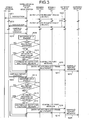
- the gateway switch 21 has the functions explained in the first embodiment. A control operation for multicast communication according to the second embodiment is explained below referring to Fig. 3.
- Fig. 3 is a sequence chart for explaining, as the second embodiment of the present invention, a control operation for multicast communication carried out in the layer 2 mobility network shown in Fig. 1.
- the mobile terminals 101 and 102 make wireless connection to the wireless base station 81 or the wireless base station 91 subordinate to the edge switch 71. Because the same control operations are applied to the mobile terminals 101 and 102, the control operations are explained in parallel.
- the mobile terminals 101 and 102 set association (Association) with the wireless base station 81 or 91/the edge switch 71 (S201 and S203).
- This association (Association) is a context for communication.
- the association is PDP-Context in the case of the 3G cellular and is Association of the IEEE802.11 in the case of the wireless LAN.
- the wireless base station 81 or 91/the edge switch 71 transmits, with the setting of this association (Association) as a trigger, an entry update request frame (Update Entry Request for Unicast) for causing the respective switches to learn an entry forming transfer routes of unicast to the mobile terminals 101 and 102 in the direction of the gateway switch 21 (S202 and S204).
- the branch switches 61 and 63 and the gateway switch 21 present on the transfer routes to the mobile terminals 101 and 102 receive this entry update request frame (S202 and S204) to thereby learn the entry forming transfer routes of unicast to the mobile terminals 101 and 102.
- the mobile terminals 101 and 102 transmit, to request multicast delivery, IGMP/MLD report messages to the gateway router 11 that supports the multicast delivery (S205 and S213).
- the IGMP/MLD report messages are IGMP Membership Report in the case of IPv4 and are MLD Listener Report in the case of IPv6.
- the wireless base station 81 or 91/the edge switch 71 snoops IP packets transmitted from the mobile terminals 101 and 102 (S206 and S214) and judges whether the snooped IP packets are the IGMP/MLD report messages (S207 and S125). As a result, when the IP packets are not the IGMP/MLD report messages (S207 : No and S215 : No), the wireless base station 81 or 91/the edge switch 71 shifts to other processing.
- the wireless base station 81 or 91/the edge switch 71 checks whether an entry for transfer to a group/source, distribution to which is requested, is present referring to a table for managing a multicast delivery status for each of the mobile terminals rather than immediately relaying and transferring the IP packets in the direction of the gateway router 11 (S208 and S216).
- the wireless base station 81 or 91/the edge switch 71 shifts to other processing.
- the wireless base station 81 or 91/the edge switch 71 learns an entry forming transfer routes to a multicast group including the mobile terminals 101 and 102 (S209 and S217). Thereafter, the wireless base station 81 or 91/the edge switch 71 transfers the IGMP/MLD report messages (S205 and S123) transmitted from the mobile terminals 101 and 102 in the direction of the gateway router 11 to the gateway switch 21 (S210 and S218).
- the wireless base station 81 or 91/the edge switch 71 transmits an entry update request frame (Update Entry Request for Multicast) for causing the branch switches 63 and 61 and the gateway switch 21 to learn an entry forming transfer paths of multicast including the mobile terminals 101 and 102 in the direction of the gateway switch 21 (S211 and S219).
- an entry update request frame Update Entry Request for Multicast
- the gateway switch 21 When the gateway switch 21 confirms the reception of the IGMP/MLD report messages (S210 and S218) transferred from the wireless base station 81 or 91/the edge switch 71, after receiving the entry update request frames (S211 and S219), the gateway switch 21 transfers IGMP/MLD report messages received earlier to the gateway router 11 (S212 and S220).
- the gateway router 11 receives the IGMP/MLD report messages to thereby recognize the presence of the mobile terminals 101 and 102 that are requesting multicast delivery and start the distribution of content data such as streaming data transmitted from the multicast delivery terminal 3.
- the apparatus located at the edge of the network manages a multicast delivery status for each of the mobile terminals and, before transferring IGMP/MLD report messages transmitted from a plurality of mobile terminals to the IP multicast router, checks whether the same multicast group and the same distribution source have already been requested. When the same multicast group and the same distribution source have not been requested, the apparatus learns a transfer route for multicast and performs the transfer of the IGMP/MLD report messages and the transmission of an entry update request frame for causing the switches to learn an entry forming the learned transfer route for multicast.
- the branch switches and the gateway switch can establish a route for IP multicast delivery to the mobile terminals.
- the branch switches and the gateway switch can establish a route for IP multicast delivery to the mobile terminals.
- requests for multicast delivery are received from a plurality of mobile terminals, because the apparatus located at the edge of the network stops unnecessary transfer, it is possible to reduce control traffic of a multicast procedure related to the establishment of a route for IP multicast delivery. Therefore, it is possible to establish a integrated heterogeneous mobile wireless network excellent is scalability.
- apparatuses located at the edges of a network such as the edge switches 71 to 74, which are the layer 2 switches, or the wireless base stations 81 to 84 and 91 to 94, which are the radio access points, have a function of snooping a leave message in the multicast procedure "IGMP/MLD" from the mobile terminal in a process of transferring the leave message to the gateway router 11, which is the IP multicast router, and confirming that an IGMP/MLD report message responding to an IGMP/MLD query message from the gateway router 11 is transmitted from the mobile terminal, a function of transmitting, when the IGMP/MLD report message is not transmitted from the mobile terminal in a fixed time, an entry deletion request frame for deleting the entry forming a transfer route for multicast in the direction of the gateway switch 21, and a function of learning a transfer route for multicast again when the IGMP/MLD report message is transmitted from the
- Fig. 4 is a sequence chart for explaining, as the third embodiment of the present invention, a control operation for multicast communication carried out in the layer 2 mobility network shown in Fig. 1.
- Fig. 4 when the mobile terminals 101 and 102 are receiving multicast delivery via the wireless base station 81 or the wireless base station 91 subordinate to the edge switch 71, a mobile terminal leaves the multicast group.
- the mobile terminal 101 transmits, to leaves the multicast group, an IGMP/MLD leave message to the gateway router 11, which supports the multicast delivery, through the gateway switch 21 (S301).
- the wireless base station 81 or 91/the edge switch 71 snoops the IGMP/MLD leave message, which the wireless base station 81 or 91/the edge switch 71 relays and transfers, and waits for an IGMP/MLD query message transmitted from the gateway router 11 (S303).
- the IGMP/MLD leave message is IGMP Membership Leave in the case of IPv4 and is MLD Listener Done in the case of IPv6.
- the gateway router 11 When the gateway router 11 receives the IGMP/MLD leave message, to check whether other mobile terminals that request distribution remain, the gateway router 11 transmits an IGMP/MLD query message, which targets notified multicast group/source, to the wireless base station 81 or 91/the edge switch 71 through the gateway switch 21 (S302).
- the IGMP/MLD query message is IGMP membership Query in the case of IPv4 and is MLD Listener Query in the case of IPv6.
- the wireless base station 81 or 91/the edge switch 71 snoops the IGMP/MLD query message transmitted from the gateway router 11 and checks whether the message is an IGMP/MLD query message (S303). Because the IGMP/MLD query message is transmitted a plurality of number of times (twice in default), the wireless base station 81 or 91/the edge switch 71 performs the check according to the number of times set by the gateway router 11.
- the wireless base station 81 or 91/the edge switch 71 recognizes that the IGMP/MLD query message is transmitted (S303: Yes), starts a report monitor timer (S304), and monitors whether an IGMP/MLD report message (S305), which targets the multicast group/source designated by the query message, is transmitted from another mobile terminal (in the present example, the mobile terminal 102) (S306).
- the wireless base station 81 or 91/the edge switch 71 cannot recognize that the IGMP/MLD query message is transmitted (S303 : No), the wireless base station 81 or 91/the edge switch 71 performs other processing.
- the wireless base station 81 or 91/the edge switch 71 deletes an entry forming a transfer route for multicast designated by the query message (S311).
- the wireless base station 81 or 91/the edge switch 71 transits an entry deletion request frame (Cancel Entry Request for Multicast) in the direction of the gateway switch 21 (S312).
- the IP packet is the IGMP/MLD report message (S306: Yes)
- the wireless base station 81 or 91/the edge switch 71 stops the report monitor timer (S307).
- the wireless base station 81 or 91/the edge switch 71 learns the entry to be transferred to the multicast group again (S308) and transmits an entry update request frame (Update Entry Request for Multicast) in the direction of the gateway switch 21 to cause the branch switches 63 and 61 and the gateway switch 21 to learn an entry forming a transfer route for multicast including the mobile terminal 101 (S309).
- an entry update request frame Update Entry Request for Multicast
- the gateway switch 21 transfers the IGMP/MLD report message (S305) transferred from the wireless base station 81 or 91/the edge switch 71 to the gateway router 11 after the reception of the entry update request frame (S309) (S310).
- the apparatus located at the edge of the network snoops the IGMP/MLD leave message from the mobile terminal when the message is transferred to the IP multicast router (the gateway router 11).
- the apparatus monitors the IGMP/MLD report message responding to the IGMP/MLD query message from the IP multicast router transmitted in the fixed time.
- the apparatus transmits the entry deletion request frame for deleting the entry forming a transfer route for multicast in the direction of the gateway switch.
- the apparatus learns a transfer route for multicast again and transmits the entry update request frame for causing the switches to learn the transfer of the IGMP/MLD report message and an entry forming the learned transfer route for multicast in the direction of the gateway switch.
- the branch switches and the gateway switch can delete a route for IP multicast delivery to the mobile terminal that has left the multicast delivery.
- the branch switches and the gateway switch can establish a route for IP multicast delivery to the other mobile terminals.
- apparatuses located at the edges of a network such as the edge switches 71 to 74, which are the layer 2 switches, or the wireless base stations 81 to 84 and 91 to 94, which are the radio access points, have a function of managing a multicast delivery status for each of mobile terminals and also have a function of checking, when a leave message in the multicast procedure "IGMP/MLD" from the mobile terminal is received, whether terminals that request distribution of multicast by the same multicast group and the same distribution source remain referring to a management table rather than immediately transferring the leave message to the gateway router 11, which is the IP multicast router, and a function of transferring, when no such terminal remains, the leave message from the mobile terminal to the gateway switch 21 and transmitting an entry deletion request frame for deleting an entry forming the transfer route for multicast in the direction of the gateway switch 21.
- the gateway switch 21 has a function of transferring, after a transfer route for multicast is deleted, the received leave message to a port to which the gateway router 11, which is the IP multicast router, is connected.
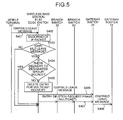
- a control operation for multicast communication according to the fourth embodiment is explained referring to Fig. 5.
- Fig. 5 is a sequence chart for explaining, as the fourth embodiment of the present invention, a control operation for multicast communication carried out in the layer 2 mobility network shown in Fig. 1.
- the mobile terminal 101 transmits, to leave multicast communication, an IGMP/MLD leave message to the gateway router 11 that supports the multicast communication (S401).
- the IGMP/MLD leave message is IGMP Membership Leave in the case of IPv4 and is MLD Listener Done in the case of IPv6.
- the wireless base station 81 or 91/the edge switch 71 snoops an IP packet from the mobile terminal 101 (S402) and checks whether the IP packet is an IGMP/MLD leave message (S403). When the IP packet is not the IGMP/MLD leave message (S403 : No), the wireless base station 81 or 91/the edge switch 71 shifts to other processing. However, when the IP packet is the IGMP/MLD leave message (S403: Yes), the wireless base station 81 or 91/the edge switch 71 checks whether other mobile terminals that transmit distribution requests to a group/source, leave from which is requested, remain referring to a table for managing a multicast delivery status for each of mobile terminals (S404).
- the wireless base station 81 or 91/the edge switch 71 shifts to other processing.
- the wireless base station 81 or 91/the edge switch 71 deletes an entry to be transferred to a multicast group, leave from which is requested (S405).
- the wireless base station 81 or 91/the edge switch 71 transfers the IGMP/MLD leave message (S401) transmitted from the mobile terminal 101 in the direction of the gateway router 11 to the gateway switch 21 (S406).
- the wireless base station 81 or 91/the edge switch 71 transmits an entry deletion request frame (Cancel Entry Request for Multicast) for causing the branch switches 63 and 61 and the gateway switch 21 to delete an entry forming a transfer route for multicast including the mobile terminal 101 in the direction of the gateway switch 21 (S407).
- an entry deletion request frame Created Entry Request for Multicast
- the gateway switch 21 When the gateway switch 21 confirms the reception of the IGMP/MLD leave message (S406) transferred from the wireless base station 81 or 91/the edge switch 71, the gateway switch 21 transfers the IGMP/MLD leave message to the gateway router 11 after the reception of the entry deletion request frame (S407) (S408).
- the gateway router 11 receives the IGMP/MLD leave message to thereby recognize that the mobile terminal that requests multicast delivery is not present and stop the distribution of content data such as streaming data transmitted from the multicast delivery terminal 3.
- the apparatus located at the edge of the network manages a multicast delivery status for each of the mobile terminals and, before transferring the IGMP/MLD leave message from mobile terminal to the IP multicast router (the gateway router 11), checks whether mobile terminals that request the distribution of multicast of the same multicast group and the same distribution source remain. Only when no such mobile terminal remains, the apparatus performs the transfer of the IGMP/MLD leave message and the transmission of the entry deletion request frame for deleting an entry forming a transfer route for multicast.
- the branch switches and the gateway switch can delete a route for IP multicast delivery to the mobile terminal that has left the multicast delivery.
- the branch switches and the gateway switch can delete a route for IP multicast delivery to the mobile terminal that has left the multicast delivery.
- the apparatus located at the edge of the network stops unnecessary transfer, it is possible to reduce control traffic of a multicast procedure related to the deletion of the route for the IP multicast delivery. Therefore, it is possible to establish a integrated heterogeneous mobile wireless network excellent in scalability.
- the gateway switch 21 has a function of performing filtering for not relaying and transferring a query message in the multicast procedure "IGMP/MLD" from the gateway router 11, which is the IP multicast router, into the network.
- Apparatuses located at the edges of a network such as the edge switches 71 to 74, which are the layer 2 switches, or the wireless base stations 81 to 84 and 91 to 94, which are the radio access points, have a function of managing a multicast delivery status for each of mobile terminals and transmitting, on behalf of the IP multicast router (the gateway router 11), an IGMP/MLD query message to the mobile terminals subordinate to the gateway router 11 and a function of treating, when IGMP/MLD report messages are sent from a plurality of mobile terminals belonging to the same multicast group to the same distribution source, requests from the mobile terminals as one request and transmitting the IGMP/MLD report messages to the IP multicast router when there is no entry to be transferred to a group/source, which is requested perform distribution.
- a control operation for multicast communication according to the fifth embodiment is explained below referring to Fig. 6.
- Fig. 6 is a sequence chart for explaining, as the fifth embodiment of the present invention, a control operation for multicast communication carried out in the layer 2 mobility network shown in Fig. 1.
- the mobile terminals 101 and 102 are radio-connected to the wireless base station 81 or the wireless base station 91 subordinate to the edge switch 71.
- the gateway router 11 that supports multicasts distribution periodically transmits an IGMP/MLD query message in a direction of mobile terminals to check the necessity of requested distribution to a multicast group/source (S501).
- the IGMP/MLD query message is IGMP Membership Query in IPv4 and is MLD Listener Query in IPv6.
- the gateway switch 21 that first receives a message transmitted by the gateway router 11 in the direction of the mobile terminals checks whether the received message is the IGMP/MLD query message (S502). When the message is the IGMP/MLD query message (S502 : Yes), the gateway switch 21 discards the query message without transferring the query message to the mobile terminal side. On the other hand, when the message is not the query message (S502: No), the gateway switch 21 searches through a forwarding table (S503) and transfers an MAC (Media Access Control) frame to the mobile terminal side according to the forwarding table (S504). In this way, the gateway switch 21 filters the IGMP/MLD query message from the gateway router 11.
- S503 forwarding table
- MAC Media Access Control
- the wireless base station 81 or 91/the edge switch 71 periodically transmits, on behalf of the gateway router 11, the IGMP/MLD query message to the mobile terminals 101 and 102 and the like subordinate to the gateway router 11 to check the necessity of requested distribution to the multicast group/source (S505). Thereafter, because the same control operations are applied to IGMP/MLD report messages transmitted from the mobile terminals 101 and 102, the control operations are explained in parallel.
- the mobile terminals 101 and 102 transmit in a wireless manner, in a process for transmitting and receiving various packets, the IGMP/MLD report messages to the gateway router 11 as a response to the received IGMP/MLD query message (S506 and S514).
- the wireless base station 81 or 91/the edge switch 71 snoops IP packets transmitted from the mobile terminals 101 and 102 (S507 and S515) and judges whether the IP packets are IGMP/MLD report messages (S508 and S516). As a result, when the IP packets are not the IGMP/MLD report messages (S508: No and S516: No), the wireless base station 81 or 91/the edge switch 71 shifts to other processing.
- the wireless base station 81 or 91/the edge switch 71 further checks whether an entry for transfer to the group/source, distribution to which is requested, is present referring to a table for managing a multicast delivery status for each of the mobile terminals rather than immediately relaying and transferring the IGMP/MLD report messages in the direction of the gateway router 11 (S509 and S517).
- the wireless base station 81 or 91/the edge switch 71 shifts to other processing.
- the wireless base station 81 or 91/the edge switch 71 learns an entry forming a transfer route to the multicast group including the mobile terminals 101 and 102 (S510 and S518).
- the wireless base station 81 or 91/the edge switch 71 transfers the IGMP/MLD report messages (S506 and S514), which are transmitted from the mobile terminals 101 and 102 in the direction of the gateway router 11, to the gateway switch 21 (S511 and S519).
- the wireless base station 81 or 91/the edge switch 71 transmits an entry update request frame (Update Entry Request for Multicast) for causing the branch switches 63 and 61 and the gateway switch 21 to learn the entry forming the transfer route for multicast including the mobile terminals 101 and 102 in the direction of the gateway switch 21 (S512 and S520).
- an entry update request frame Update Entry Request for Multicast
- the gateway switch 21 When the gateway switch 21 confirms the reception of the IGMP/MLD report messages (S511 and S519) transferred from the wireless base station 81 or 91/the edge switch 71, after receiving the entry update request frames (S512 and S520), the gateway switch 21 transfers the IGMP/MLD report messages received earlier to the gateway router 11 (S513 and S521).
- the gateway router 11 receives the IGMP/MLD report messages to thereby recognize the presence of the mobile terminals 101 and 102, which request the multicast delivery, and start the distribution of content data such as streaming data transmitted from the multicast delivery terminal 3.
- the gateway switch filters the IGMP/MLD query message from the IP multicast router.
- the apparatus located at the edge of the network manages a multicast delivery status for each of the mobile terminals and transmits, on behalf of the IP multicast router, the IGMP/MLD query message to the respective mobile terminals.
- the IGMP/MLD report messages are transmitted from a plurality of mobile terminals belonging to the same multicast group to the same distribution source. In this case, only when an entry for transfer to the group/source, distribution to which is requested, is not present, the IGMP/MLD report messages are transmitted to the IP multicast router.
- the gateway switch 21 has a function of snooping a report message in the multicast procedure "IGMP/MLD" transmitted from an apparatus located at the edge of the network, registering a multicast group/source, distribution to which is requested, in a table for managing a multicast delivery status for each of mobile terminals, and transmitting the received IGMP/MLD report message to the IP multicast router (the gateway router 11) after receiving an entry update request frame transmitted after the IGMP/MLD report message, a function of transmitting, on behalf of the mobile terminals, the IGMP/MLD report message to the IP multicast router when the IGMP/MLD query message periodically transmitted by the IP multicast router is not transferred to the respective mobile terminals but is transferred to the multicast group/source, distribution to which is requested referring to the management table, a function of receiving an IGMP/MLD
- Fig. 7 is a sequence chart for explaining, as the sixth embodiment of the present invention, a control operation for multicast communication carried out in the layer 2 mobility network shown in Fig. 1.
- the mobile terminal 101 transmits, to request multicast delivery, an IGMP/MLD report message to the gateway router 11 that supports the multicast delivery (S601).
- the IGMP/MLD report message is IGMP Membership Report in the case of IPv4 and is MLD Listener Report in the case of IPv6.
- the wireless base station 81 or 91/the edge switch 71 snoops an IP packet transmitted from the mobile terminal 101 (S602) and judges whether the IP packet is an IGMP/MLD report message (S603). As a result, when the IP packet is not the IGMP/MLD report message (S603: No), the wireless base station 81 or 91/the edge switch 71 shifts to other processing.
- the wireless base station 81 or 91/the edge switch 71 further checks whether an entry for transfer to a group/source, distribution to which is requested, is present referring to a table for managing a multicast delivery status for each of the mobile terminals rather than immediately relaying and transferring the IGMP/MLD report message in the direction of the gateway router 11 (S604).
- the wireless base station 81 or 91/the edge switch 71 shifts to other processing.
- the wireless base station 81 or 91/the edge switch 71 learns an entry forming a transfer route to a multicast group including the mobile terminal 101 and transfers the IGMP/MLD report message (S601), which is transmitted from the mobile terminal 101 in the direction of the gateway router 11, to the gateway switch 21 (S605).
- the wireless base station 81 or 91/the edge switch 71 transmits an entry update request frame (Update Entry Request for Multicast) for causing the branch switches 63 and 61 and the gateway switch 21 to learn an entry forming a transfer route of multicast including the mobile terminal 101 in the direction of the gateway switch 21 (S606).
- an entry update request frame Update Entry Request for Multicast
- the gateway switch 21 receives the IGMP/MLD report message (S605) transferred from the wireless base station 81 or 91/the edge switch 71 and registers the multicast group/source, distribution to which is requested, in a table for managing a multicast delivery status for each of the mobile terminals (S607). After receiving the entry update request frame (S606), the gateway switch 21 transfers the IGMP/MLD report message (S605) received earlier to the gateway router 11 (S608).
- the gateway router 11 that supports multicast delivery periodically transmits the IGMP/MLD query message in the direction of the mobile terminals to check the necessity of requested distribution to the multicast group/source (S609).
- the IGMP/MLD query message is IGMP Membership Query in IPV4 and is MLD Listener Query in IPv6.
- the gateway switch 21 that first receives a message transmitted by the gateway router 11 in the direction of the mobile terminals checks whether the received message is the IGMP/MLD query message (S610). When the message is not the query message (S610: No), the gateway switch 21 shifts to other processing. However, when the received message is the query message (S610: Yes), the gateway switch 21 further checks the multicast group/source, distribution to which is requested, referring to the management table (S611).
- the gateway switch 21 judges, based on information registered in the management table, that the distribution to the multicast group/source is requested (S611: Yes), the gateway switch 21 transmits, on behalf of the mobile terminals, the IGMP/MLD report message to the gateway router 11 (S612).
- the IGMP/MLD report message transmitted here is IGMP Membership Report when the query message received at S610 is IGMP Membership Query.
- the IGMP/MLD report message is MLD Listener Report when the query message is MLD Listener Query.
- the gateway switch 21 judges, based on the information registered in the management table, that the deliver to the multicast group/source is not requested (S611: No), the gateway switch 21 does not transmit, on behalf of the mobile terminals, the IGMP/MLD report message to the gateway router 11 because no mobile terminal that request multicast delivery is present.
- the gateway router 11 When the gateway router 11 receives the report message (S612) responding to the transmitted query message (S609), the gateway router 11 judges that the request for distribution to the corresponding multicast group/source is continuing and continuously performs distribution of content data such as streaming data transmitted from the multicast delivery terminal 3.
- the mobile terminal 101 transmits, to leave the multicast delivery, an IGMP/MLD leave message to the gateway router 11 that supports the multicast delivery (S613).
- the IGMP/MLD leave message is IGMP Membership Leave in the case of IPv4 and is MLD Listener Done in the case of IPv6.
- the wireless base station 81 or 91/the edge switch 71 snoops an IP packet from the mobile terminal 101 (S614) and checks whether the IP packet is an IGMP/MLD leave message (S615). As a result, when the IP packet is not the IGMP/MLD leave message (S615: No), the wireless base station 81 or 91/the edge switch 71 shifts to other processing.
- the wireless base station 81 or 91/the edge switch 71 checks whether other mobile terminals that transmit a distribution request to a group/source, leave from which is requested, remain referring to a table for managing a multicast delivery status for each of the mobile terminals rather than immediately relaying and transferring the IGMP/MLD leave message from the mobile terminal 101 in the direction of the gateway router 11 (S616).
- the wireless base station 81 or 91/the edge switch 71 shifts to other processing.
- the wireless base station 81 or 91/the edge switch 71 deletes an entry to be transferred to the multicast group, leave from which is requested, and transfers the IGMP/MLD leave message (S613), which is transmitted from the mobile terminal 101 in the direction of the gateway router 11, to the gateway switch 21 (S617).
- the wireless base station 81 or 91/the edge switch 71 transmits an entry deletion request frame (Cancel Entry Request for Multicast) for causing the branch switches 63 and 61 and the gateway switch 21 to delete an entry forming a transfer route for multicast including the mobile terminal 101 in the direction of the gateway switch 21 (S618).
- an entry deletion request frame (Cancel Entry Request for Multicast) for causing the branch switches 63 and 61 and the gateway switch 21 to delete an entry forming a transfer route for multicast including the mobile terminal 101 in the direction of the gateway switch 21 (S618).
- the gateway switch 21 receives the IGMP/MLD leave message (S613) transferred from the wireless base station 81 or 91/the edge switch 71, deletes the multicast group/source, leave from which is displayed (S619), and, after receiving the entry deletion request frame (S618), transfers the IGMP/MLD leave message received earlier (S613) to the gateway router 11 (S620).
- the gateway switch snoops the IGMP/MLD report message and the leave message transmitted from the apparatus located at the edge of the network to thereby manage a multicast delivery status for each of the mobile terminals, transmits, on behalf of the respective mobile terminals, the IGMP/MLD report message to the IP multicast router without transferring the IGMP/MLD query message from the IP multicast router to the respective mobile terminals, and, when there is no mobile terminal that request multicast delivery, does not transmit the IGMP/MLD report message.
- apparatuses located at the edges of a network such as the edge switches 71 to 74, which are the layer 2 switches, or the wireless base stations 81 to 84 and 91 to 94, which are the radio access points, have a function of managing a multicast delivery status for each of the mobile terminals.
- An apparatus located at the edge in a previous location which has received notification of the start of handover from the network side, has a function of transferring, together with an identifier of a mobile terminal to be handed over, a context including information concerning multicast delivery of the mobile terminal to an apparatus located at the edge of a new location and a function of checking, after receiving a response to the transfer of the context from the apparatus located at the edge of the new location, whether other mobile terminals that request a multicast group and a distribution source requested by the handed-over mobile terminal remain and performing, when no such other mobile terminal does not remain, the transfer of a leave message in the multicast procedure "IGMP/MLD" and the transmission of an entry deletion frame for deleting an entry forming a transfer route for multicast to a gateway switch.
- IGMP/MLD the multicast procedure
- the apparatus located at the edge of the new location has a function of checking, based on the information concerning multicast delivery received from the apparatus located at the edge of the previous location and information concerning multicast delivery managed by the apparatus itself, whether the multicast delivery requested by the handed-over mobile terminal is carried out and, when the requested multicast delivery is not performed, transmitting, on behalf of the handed-over mobile terminal, an IGMP/MLD report message to an IP multicast router and transmitting an entry update frame for causing switches to learn an entry forming a transfer route for multicast in the direction of a gateway switch.
- a control operation for multicast communication according to the seventh embodiment is explained below referring to Fig. 8.
- Fig. 8 is a sequence chart for explaining, as the seventh embodiment of the present invention, a control operation for multicast communication carried out in the layer 2 mobility network shown in Fig. 1.
- a control operation performed when the mobile terminal 101 is handed over, based on a start instruction from the signaling server 31 on the network side, from the wireless base station 81 or 91 subordinate to the edge switch 71 to the wireless base station 82 or 92 subordinate to the edge switch 72 is shown.
- the mobile terminal 101 transmits, when a radio quality of connection is deteriorated to be lower than a fixed threshold, a measurement result of the radio quality to the signaling server 31 as layer 2 trigger information for giving a trigger for handover control (S701).
- the signaling server 31 judges the necessity of handover based on the layer 2 trigger information transmitted from the mobile terminal 101 (S702), transmits handover notification (Handover Notification) to the wireless base station 81 or 91/the edge switch 71 (S703), and transmits a handover request (Handover Request) to the mobile terminal 101 (S704).
- the wireless base station 81 or 91/the edge switch 71 transfers, together with an identifier of the mobile terminal 101 to be handed over, a context including information concerning multicast delivery of the mobile terminal 101 to the wireless base station 82 or 92/the edge switch 72 in a designated handover destination through the branch switch 63 (Context Transfer) (S705).
- the mobile terminal 101 With the reception of the handover request (S704) as a trigger, the mobile terminal 101 sets association (Association) with the wireless base station 82 or 92/the edge switch 72 in the designated handover destination (S706). With the setting of this association as a trigger, the wireless base station 82 or 92/the edge switch 72 transmits an entry update request frame (Update Entry Request for Unicast) to the gateway switch 21 to form a new transfer route for unicast to the mobile terminal 101 (S707).
- an entry update request frame Update Entry Request for Unicast
- the branch switch 63 which has received the entry update request frame (S707), transmits an entry deletion request frame (Cancel Entry Request for Unicast) for deleting an entry forming a route before handover to the wireless base station 81 or 91/the edge switch 71 in the old route direction because the branch switch 63 itself is an origin for a route change in the layer 2 network of the tree structure shown in Fig. 1 (S708).
- an entry deletion request frame Created Entry Request for Unicast
- the wireless base station 82 or 92/the edge switch 72 checks presence or absence of a request for distribution to a multicast group/source of the mobile terminal 101 from the context information (S705) transmitted from the wireless base station 81 or 91/the edge switch 71 and, at the same time, when there is the distribution request, checks whether the requested distribution of the multicast group/source is performed (S709). As a result, when there is the distribution request and the distribution is not performed (S709: No), the wireless base station 82 or 92/the edge switch 72 transmits an IGMP/MLD report message to the gateway switch 21 to cause the switches to perform the distribution to the multicast group/source requested by the mobile terminal 101 (S710).
- the IGMP/MLD report message is IGMP Membership Report in the case of IPv4 and is MLD Listener Report in the case of IPv6.
- the wireless base station 82 or 92/the edge switch 71 transmits, after the transmission of the IGMP/MLD report message (S710), an entry update request frame (Update Entry Request for Multicast) in the direction of the gateway switch 21 to cause the switches to learn an entry forming a transfer route for multicast (S711).
- the gateway switch 21 transfers, after the reception of the entry update request frame (S711), the IGMP/MLD report message (S710) received earlier to the gateway router 11 (S712).
- the wireless base station 82 or 92/the edge switch 72 transmits a response to the transfer of the context information (Context Transfer Acknowledge) to the wireless base station 81 or 91/the edge switch 71 through the branch switch 63 (S713). This operation is also performed when there is the distribution request and the distribution is performed (S709: Yes).
- the wireless base station 81 or 91/the edge switch 71 transmits completion notification of the handover operation (Handover Complete) to the signaling server 31 (S714).
- a response to the handover request (S704) (Handover Response) is transmitted from the mobile terminal 101 to the signaling server 31 (S715).
- the wireless base station 81 or 91/the edge switch 71 checks whether information on other mobile terminals that request the multicast group/source, distribution to which is requested by the mobile terminal 101, is present (S716). As a result, when the information is present (S716: Yes), the wireless base station 81 or 91/the edge switch 71 shifts to other processing. However, when the information is not present (S716: No), the wireless base station 81 or 91/the edge switch 71 transmits an entry deletion request frame for deleting the entry forming the transfer route for multicast delivery to the gateway switch 21 (S717).
- the branch switch 63 when the branch switch 63 receives the entry deletion request frame (S717) from a port different from a port from which the entry update request frame (S711) for learning the entry forming a route for multicast delivery is transmitted, the branch switch 63 judges that the distribution route has been changed with the branch switch 63 itself as an origin and does not transfer the received entry deletion request frame (S717) to the higher-order branch switch 61 and the gateway switch 21. In Fig. 8, the operations in this case are shown.
- the branch switch 63 When the branch switch 63 receives the entry deletion request frame (S717) from a port same as the port from which the entry update request frame (S711) is received, the branch switch 63 transfers the received entry deletion request frame to the higher-order branch switch 61 and the gateway switch 21. Consequently, all the entries forming the route for multicast delivery in the previous location are deleted.
- the apparatus located at the edge of the network manages a multicast delivery status for each of the mobile terminals.
- the apparatus located at the edge of the previous location which has received the start notification of handover from the network side, transfers, together with an identifier of a mobile terminal to be handed over, a context including information concerning multicast delivery of the mobile terminal to the apparatus located at the edge of the new location.
- the apparatus located at the edge of the new location checks, based on the received information concerning multicast delivery and information concerning multicast delivery managed by the apparatus itself, whether multicast delivery requested by the mobile terminal to be handed over is performed.
- the apparatus transmits, on behalf of the mobile terminal to be handed over, an IGMP/MLD report message to an IP multicast router.
- the apparatus located at the edge of the new location transmits an entry update frame for causing the switches to learn an entry forming a transfer route for multicast.
- the apparatus located at the edge of the previous location performs, when other mobile terminals that request the multicast group and the distribution source requested by the handed-over mobile terminal do not remain, the transfer of an IGMP/MLD leave message and the transmission of an entry deletion frame for deleting the entry forming the transfer route for multicast.
- the respective branch switches and the gateway switch can provide continuous IP multicast delivery to the mobile terminal to be handed over even if the branch switches and the gateway switch are not implemented with the function of snooping an IGMP/MLD message.
- the apparatus located at the edge of the new location stops unnecessary transfer, it is possible to realize efficiency of control traffic. Therefore, it is possible to establish a integrated heterogeneous mobile wireless network excellent in scalability.
- apparatuses located at the edges of a network such as the edge switches 71 to 74, which are the layer 2 switches, or the wireless base stations 81 to 84 and 91 to 94, which are the radio access points, have a function of managing a multicast delivery status for each of mobile terminals.
- An apparatus located at the edge in a previous location which has received notification of the start of handover from a mobile terminal side that starts handover, has a function of transferring, together with an identifier of a mobile terminal to be handed over, a context including information concerning multicast delivery of the mobile terminal to an apparatus located at the edge of a new location and a function of checking, after receiving a response to the transfer of the context from the apparatus located at the edge of the new location, whether other mobile terminals that request a multicast group and a distribution source requested by the handed-over mobile terminal remain and performing, when no such other mobile terminal does not remain, the transfer of a leave message in the multicast procedure "IGMP/MLD" and the transmission of an entry deletion frame for deleting an entry forming a transfer route for multicast.
- IGMP/MLD the multicast procedure
- the apparatus located at the edge of the new location has a function of checking, based on the information concerning multicast delivery received from the apparatus located at the edge of the previous location and information concerning multicast delivery managed by the apparatus itself, whether the multicast delivery requested by the mobile terminal to be handed over is carried out and, when the requested multicast delivery is not performed, transmitting, on behalf of the mobile terminal to be handed over, an IGMP/MLD report message to an IP multicast router and transmitting an entry update frame for causing switches to learn an entry forming a transfer route for multicast in the direction of a gateway switch.
- a control operation for multicast communication according to the eighth embodiment is explained below referring to Fig. 9.
- Fig. 9 is a sequence chart for explaining, as the eighth embodiment of the present invention, a control operation for multicast communication carried out in the layer 2 mobility network shown in Fig. 1.
- a control operation performed when the mobile terminal 101 detects the generation of trigger information for starting handover and is handed over from the wireless base station 81 or 91 subordinate to the edge switch 71 to the wireless base station 82 or 92 subordinate to the edge switch 72 is shown.
- the mobile terminal 101 detects, when a radio quality of connection with the wireless base station 81 or 91/the edge switch 71 is deteriorated to be lower than a fixed threshold, layer 2 trigger information as a trigger for switching wireless connection (S801) and sets association (Association) with another wireless base station 82 or 92/the edge switch 72 (S802).
- the wireless base station 82 or 92/the edge switch 72 transmits, with the setting of this association as a trigger, an entry update request frame (Update Entry Request for Unicast) in the direction of the gateway switch 21 to cause the respective switches to learn an entry forming a transfer route for unicast (S803).
- an entry update request frame Update Entry Request for Unicast
- the branch switch 63 which has received the entry update request frame (S803), transmits an entry deletion request frame (Cancel Entry Request for Unicast) for deleting an entry forming a route before handover to the wireless base station 81 or 91/the edge switch 71 in the old route direction because the branch switch 63 itself is an origin for a route change in the layer 2 network of the tree structure shown in Fig. 1 (S804).
- an entry deletion request frame (Cancel Entry Request for Unicast) for deleting an entry forming a route before handover to the wireless base station 81 or 91/the edge switch 71 in the old route direction because the branch switch 63 itself is an origin for a route change in the layer 2 network of the tree structure shown in Fig. 1 (S804).
- the wireless base station 81 or 91/the edge switch 71 receives the entry deletion request frame (S804), the wireless base station 81 or 91/the edge switch 71 deletes the entry forming the transfer route to the mobile terminal 101.
- the wireless base station 82 or 92/the edge switch 72 transmits movement notification (Move Notify) to the wireless base station 81 or 91/the edge switch 71 through the branch switch 63 from information on the wireless base station 81 or 91/the edge switch 71, which has been connected the mobile terminal 101 immediately before the setting with the mobile terminal 101, obtained in the association setting (S805).
- the wireless base station 81 or 91/the edge switch 71 transfers, together with the identifier of the handed-over mobile terminal 101, a context including information concerning multicast delivery of the mobile terminal 101 to the wireless base station 82 or 92/the edge switch 72 (Context Transfer) (S806).
- the wireless base station 82 or 92/the edge switch 72 checks presence or absence of a distribution request to a multicast group/source from the context information transmitted from the wireless base station 81 or 91/edgte switch 71 and, at the same time, when the distribution request is present, checks whether the distribution of the requested multicast group/source is performed (S807). As a result, when the distribution request is present and the distribution is not performed (S807: No), the wireless base station 82 or 92/the edge switch 72 transmits an IGMP/MLD report message to the gateway switch 21 to cause the gateway switch 21 to perform the distribution to the multicast group/source requested by the mobile terminal 101 (S808).
- the IGMP/MLD report message is IGMP Membership Report in the case of IPv4 and is MLD Listener Report in the case of IPv6.
- the wireless base station 82 or 92/the edge switch 72 transmits, after the transmission of the IGMP/MLD report message (S808), an entry update request frame (Update Entry Request for Multicast) for causing the switches to learn an entry forming a transfer route for multicast to the mobile terminal 101 in the direction of the gateway switch 21 (S809).
- the gateway switch 21 transfers, after the reception of the entry update request frame (S809), the IGMP/MLD report message (S808) received earlier to the gateway router 11 (S810).
- the wireless base station 82 or 92/the edge switch 72 transmits a response to the transfer of the context information (Context Transfer Acknowledge) to the wireless base station 81 or 91/the edge switch 71 through the branch switch 63 (S811). This operation is also performed when there is the distribution request and the distribution is performed (S807: Yes).
- the wireless base station 81 or 91/the edge switch 71 With the reception of the response to the transfer of the context information (S811) as a trigger, the wireless base station 81 or 91/the edge switch 71 checks whether information on other mobile terminals that request the multicast group/source, distribution to which is requested by the mobile terminal 101, is present (S812). As a result, when the information is present (S812: Yes), the wireless base station 81 or 91/the edge switch 71 shifts to other processing. However, when the information is not present (S812: No), the wireless base station 81 or 91/the edge switch 71 transmits an entry deletion request frame for deleting the entry forming the transfer route for multicast delivery to the gateway switch 21 (S813).
- the branch switch 63 judges that the distribution route has been changed with the branch switch 63 itself as an origin and does not transfer the received entry deletion request frame (S813) to the higher-order branch switch 61 and the gateway switch 21. In Fig. 9, the operations in this case are shown.
- the branch switch 63 When the branch switch 63 receives the entry deletion request frame (S813) from a port same as the port from which the entry update request frame (S809) is received, the branch switch 63 transfers the received entry deletion request frame to the higher-order branch switch 61 and the gateway switch 21. Consequently, all the entries forming the route for multicast delivery in the previous location are deleted.
- the apparatus located at the edge of the network manages a multicast delivery status for each of the mobile terminals.
- the apparatus located at the edge of the previous location which has received the start notification of handover from the mobile terminal, transfers, together with an identifier of a mobile terminal to be handed over, a context including information concerning multicast delivery of the mobile terminal to the apparatus located at the edge of the new location.
- the apparatus located at the edge of the new location checks, based on the received information concerning multicast delivery and information concerning multicast delivery managed by the apparatus itself, whether multicast delivery requested by the mobile terminal to be handed over is performed.
- the apparatus transmits, on behalf of the mobile terminal to be handed over, an IGMP/MLD report message to an IP multicast router.
- the apparatus located at the edge of the new location transmits an entry update frame for causing the switches to learn an entry forming a transfer route for multicast.
- the apparatus located at the edge of the previous location performs, when other mobile terminals that request the multicast group and the distribution source requested by the handed-over mobile terminal do not remain, the transfer of an IGMP/MLD leave message and the transmission of an entry deletion frame for deleting the entry forming the transfer route for multicast.
- the respective branch switches can provide continuous IP multicast delivery to the mobile terminal to be handed over even if the branch switches are not implemented with the function of snooping an IGMP/MLD message.
- the apparatus located at the edge of the new location stops unnecessary transfer, it is possible to realize efficiency of control traffic. Therefore, it is possible to establish a integrated heterogeneous mobile wireless network excellent in scalability.
- apparatuses located at the edges of a network such as the edge switches 71 to 74, which are the layer 2 switches, or the wireless base stations 81 to 84 and 91 to 94, which are the radio access points, have a function of managing a multicast delivery status for each of the mobile terminals.
- An apparatus located at the edge in a previous location which has received notification of the start of handover from the network side, has a function of transferring, together with an identifier of a mobile terminal to be handed over, a context including information concerning multicast delivery of the mobile terminal to an apparatus located at the edge of a new location and a function of transmitting, on behalf of an IP multicast router, a query message in the multicast procedure "IGMP/MLD" to the handed-over mobile terminal, checking whether other mobile terminals that request a multicast group and a distribution source requested by the handed-over mobile terminal remain, and performing, when no such other mobile terminal does not remain, the transfer of an IGMP/MLD leave message and the transmission of an entry deletion frame for deleting an entry forming a transfer route for multicast to the gateway switch 21.
- the apparatus located at the edge of the new location has a function of transmitting, on behalf of the IP multicast router, a query message in the multicast procedure to a mobile terminal that has moved to the new location, snooping a report message in the multicast procedure transmitted by the mobile terminal, and transmitting an entry update frame for causing the switches to learn an entry forming a transfer route for multicast to the gateway switch 21 and a function of transmitting a response to the transfer of the context including notification of leave to the apparatus located at the edge of the previous location.
- a control operation for multicast communication according to the ninth embodiment is explained below referring to Fig. 10.
- Fig. 10 is a sequence chart for explaining, as the ninth embodiment of the present invention, a control operation for multicast communication carried out in the layer 2 mobility network shown in Fig. 1.
- a control operation performed when the mobile terminal 101 is handed over, based on a start instruction of the signaling server 31, from the wireless base station 81 or 91 subordinate to the edge switch 71 to the wireless base station 82 or 92 subordinate to the edge switch 72 is shown.
- the mobile terminal 101 transmits, when a radio quality of connection is deteriorated to be lower than a fixed threshold, a measurement result of the radio quality to the signaling server 31 as layer 2 trigger information for giving a trigger for handover control (S901).
- the signaling server 31 judges the necessity of handover based on the layer 2 trigger information transmitted from the mobile terminal 101 (S902), transmits handover notification (Handover Notification) to the wireless base station 81 or 91/the edge switch 71 (S903), and transmits a handover request (Handover Request) to the mobile terminal 101 (S904).
- the wireless base station 81 or 91/the edge switch 71 transfers, together with an identifier of the mobile terminal 101 to be handed over, a context including information concerning multicast delivery of the mobile terminal 101 to the wireless base station 82 or 92/the edge switch 72 in a designated handover destination through the branch switch 63 (Context Transfer) (S905).
- the mobile terminal 101 With the reception of the handover request (S904) as a trigger, the mobile terminal 101 sets association (Association) with the wireless base station 82 or 92/the edge switch 72 in the designated handover destination (S906). With the setting of this association as a trigger, the wireless base station 82 or 92/the edge switch 72 transmits an entry update request frame (Update Entry Request for Unicast) to in the direction of the gateway switch 21 to form a new transfer route for unicast to the mobile terminal 101 (S907).
- an entry update request frame Update Entry Request for Unicast
- the branch switch 63 which has received the entry update request frame (S907), transmits an entry deletion request frame (Cancel Entry Request for Unicast) for deleting an entry forming a route before handover to the wireless base station 81 or 91/the edge switch 71 in the old route direction because the branch switch 63 itself is an origin for a route change in the layer 2 network of the tree structure shown in Fig. 1 (S908).
- an entry deletion request frame Created Entry Request for Unicast
- the wireless base station 82 or 92/the edge switch 72 checks presence or absence of a distribution request to a multicast group/source of the mobile terminal 101 from the context information (S905) transmitted from the wireless base station 81 or 91/the edge switch 71 (S909). As a result, when there is the distribution request (S909: Yes), the wireless base station 82 or 92/the edge switch 72 transmits, on behalf of the gateway router 11, an IGMP/MLD query message in the direction of the mobile terminal 101 (S910).
- the IGMP/MLD query message is IGMP Membership Query in the case of IPv4 and is MLD Listener Query in the case of IPv6.
- the mobile terminal 101 which has received the IGMP/MLD query message (S910), transmits an IGMP/MLD report message to the gateway router 11 through the wireless base station 82 or 92/the edge switch 72 to request the distribution of multicast (S911).
- the IGMP/MLD report message is IGMP Membership Report in the case of IPv4 and is MLD Listener Report in the case of IPv6.
- the wireless base station 82 or 92/the edge switch 72 snoops the IGMP/MLD report message (S911) relayed and transferred in the direction of the gateway router 11 and transmits an entry update request frame (Update Entry Request for Multicast) for causing the switches to learn an entry forming a transfer route for multicast in the direction of the gateway switch 21 (S912).
- the gateway switch 21 transfers the IGMP/MLD report message (S911) received earlier to the gateway router 11 after the reception of the entry update request frame (S912).
- the wireless base station 82 or 92/the edge switch 72 transmits a response to the transfer of the context information (S905) (Context Transfer Acknowledge) to the wireless base station 81 or 91/the edge switch 71 through the branch switch 63 (S914). This operation is also performed when there is no distribution request (S909: No).
- the wireless base'station 81 or 91/the edge switch 71 transmits completion notification of the handover operation (Handover Complete) to the signaling server 31 (S915).
- a response to the handover request (S904) (Handover Response) is transmitted to the signaling server 31 from the mobile terminal 101 (S916).
- the wireless base station 81 or 91/the edge switch 71 checks whether the handed-over mobile terminal 101 has made a request for distribution to a multicast group/source (S917). As a result, when the handed-over mobile terminal 101 has not made the distribution request (S917: No), the wireless base station 81 or 91/the edge switch 71 shifts to other processing (S917: Yes).
- the wireless base station 81 or 91/the edge switch 71 transmits, on behalf of the gateway router 11, an IGMP/MLD query message to the mobile terminals side to check presence or absence of other mobile terminals that make the distribution request (S918) and checks presence or absence of the transmission of an IGMP/MLD report message from the other mobile terminals (S919).
- the wireless base station 81 or 91/the edge switch 71 transmits the received IGMP/MLD report message (S920) to the gateway switch 21 (S921). Thereafter, the wireless base station 81 or 91/the edge switch 71 transmits an entry update request frame (Update Entry Request for Multicast) for causing the switches to learn an entry forming a transfer route for multicast in the direction of the gateway switch 21 (S922).
- an entry update request frame Update Entry Request for Multicast
- the gateway switch 21 transfers, after the reception of the entry update request frame (S922), the IGMP/MLD report message (S920) received earlier to the gateway router 11 (S923).
- the wireless base station 81 or 91/the edge switch 71 transmits an entry deletion request frame for deleting the entry forming the transfer route for multicast delivery to the gateway switch 21 (S924).
- the branch switch 63 judges that the distribution route has been changed with the branch switch 63 itself as an origin and does not transfer the entry deletion request frame (S924) to the higher-order branch switch 61 and the gateway switch 21. In Fig. 10, the operations in this case are shown.
- the branch switch 63 Only when the branch switch 63 receives the entry deletion request frame from a port same as the port from which the entry update request frame (S922) is received, the branch switch 63 transfers the entry deletion request frame (S924) to the higher-order branch switch 61 and the gateway switch 21. Consequently, all the entries forming the route for multicast delivery in the previous location are deleted.
- the apparatus located at the edge of the network manages a multicast delivery status for each of the mobile terminals.
- the apparatus located at the edge of the previous location which has received the start notification of handover from the network side, transfers, together with an identifier of a mobile terminal to be handed over, a context including information concerning multicast delivery of the mobile terminal to the apparatus located at the edge of the new location.
- the apparatus located at the edge of the new location transmits, on behalf of the IP multicast router, an IGMP/MLD query message to a mobile terminal that has moved to the new location, snoops an IGMP/MLD report message transmitted by the mobile terminal, and transmits an entry update frame for causing the switches to learn an entry forming a transfer route for multicast.
- the apparatus located at the edge of the new location transmits a response to the transfer of the context including notification of leave to the apparatus located at the edge of the previous location.
- the apparatus located at the edge of the previous location transmits, on behalf of the IP multicast router, an IGMP/MLD query message to the mobile terminals subordinate to the apparatus.
- the apparatus When other mobile terminals that request the multicast group and the distribution source requested by the handed-over mobile terminal do not remain, the apparatus performs the transfer of an IGMP/MLD leave message and the transmission of an entry deletion frame for deleting an entry forming a transfer route for multicast to the gateway switch.
- the respective branch switches and the gateway switch can provide continuous IP multicast delivery to the mobile terminal to be handed over even if the branch switches and the gateway switch are not implemented with the function of snooping an IGMP/MLD message.
- the apparatus located at the edge of the new location stops unnecessary transfer, it is possible to realize efficiency of control traffic. Therefore, it is possible to establish a integrated heterogeneous mobile wireless network excellent in scalability.
- the layer 2 mobility network according to the present invention is useful for stopping unnecessary transfer (forwarding) and suppress traffic during multicast delivery even if all switches constituting a sub-network are not implemented with a function of snooping various messages of the multicast procedure "IGMP/MLD".
- the layer 2 mobility network is suitable for establishing a integrated heterogeneous mobile wireless network that suppresses control traffic related to the multicast procedure "IGMP/MLD" and is excellent in scalability.
Landscapes
- Engineering & Computer Science (AREA)
- Computer Networks & Wireless Communication (AREA)
- Signal Processing (AREA)
- Mobile Radio Communication Systems (AREA)
- Data Exchanges In Wide-Area Networks (AREA)
Abstract
Description
- The present invention relates to a
layer 2 mobility network, which is a integrated heterogeneous mobile wireless network in which heterogeneous wireless access systems are integrated in alayer 2 base, and, more particularly to alayer 2 mobility network that carries out multicast communication. - In mobile communication, not only voice communication but also the access to the Internet, distribution/communication of electronic mails and images, and the like can be relatively easily performed. Therefore, the mobile communication is used by a large number of people because of its convenience. In recent years, further development for an increase in speed and capacity is expected. In a situation in which the second generation (2G) and the third generation (3G) cellular systems and wireless access systems such as a wireless LAN are diversified, as the next generation wireless network after the third generation, a system for carrying out multicast communication according to a multicast procedure "IGMP (Internet Group Management Protocol)/MLD (Multicast Listener Discovery)" in a integrated heterogeneous mobile wireless network, in which heterogeneous wireless access systems are integrated in a
layer 2 base, is examined. - As an example of the system, there is "Handoff for multicast receiver that takes into account IGMP-Snooping" described in a
Non-Patent Literature 1. An outline of theNon-Patent Literature 1 is explained below referring to Figs. 11 to 13. Fig. 11 is a conceptual diagram of a structure of the conventional integrated heterogeneous mobile wireless network described in the Non-PatentLiterature 1. Fig. 12 is a sequence chart for explaining a control operation for handoff carried out in the same sub-network in the integrated heterogeneous mobile wireless network shown in Fig. 11. Fig. 13 is a sequence chart for explaining a control operation for handoff carried out between different sub-networks in the integrated heterogeneous mobile wireless network shown in Fig. 11. - In Fig. 11, contents such as streaming data provided by a source (a transmission source: Multicast Sender) 701 of multicast communication are input to a multicast router (MR1). Under the multicast router (MR1) 201, a multicast router (MR2) 202 and a multicast router (MR3) 203 are arranged to provide a mobile terminal (MH: Mobile Host) 601 with multicast delivery.
- A switch (SW1) 401 is connected to the multicast router (MR2) 202. The switch (SW1) 401 has an IGMP-Snooping (Internet Group Management Protocol-Snooping) function of connecting a wireless base station (Base Station: BS1) 501 and a wireless base station (BS2) 502 subordinate to the switch (SW1) 401 to the multicast router (MR2) 202.
- A switch (SW2) 402 is connected to the multicast router (MR2) 203. The switch (SW2) 402 has an IGMP-Snooping function of connecting a wireless base station (BS3) 503 and a wireless base station (BS2) 504 subordinate to the switch (SW2) 402 to the multicast router (MR3) 203.
- In this network, to increase speed of a handoff operation for a multicast receiver,
agents - A handoff control operation carried out in the network shown in Fig. 11 is explained below. First, a handoff control operation in the same sub-network is performed as shown in Fig. 12. In Fig. 12, the mobile terminal MH is receiving multicast data (Multicast Data) through a route of the multicast router MR1, the switch SW1, and the wireless base station BS1 (S1001). When the mobile terminal MH performs handoff to the wireless base station BS2 (S1002), the mobile terminal MH transmits in a wireless manner an IGMP report message (IGMP Report) to the wireless base station BS2 as soon as possible in a process in which the wireless base station BS1 is transmitting in a wireless manner multicast data (Multicast Data) received from the switch SW1 (S1003). This IGMP report message is communicated from the wireless base station BS2 to the switch SW1 (S1004).
- When the switch SW1 receives the IGMP report message, the switch SW1 transfers the multicast data (Multicast Data) transmitted from the multicast router MR1 to both the wireless base stations BS1 and BS2 (S1005). Consequently, the mobile terminal MH can continuously receive the multicast data (Multicast Data) in a new location.
- The mobile terminal MH transmits in a wireless manner an advertisement request message (Advertisement Request) to the wireless base station BS2 by broadcast (Broadcast). This advertisement request message is transferred to the agent (MSA1) through the switch SW1 (S1006). When the agent (MSA1) receives the advertisement request message, the agent (MSA1) delivers an advertisement message (Advertisement) including a network prefix by broadcast (Broadcast). This advertisement message (Advertisement) is delivered to the mobile terminal MH through the switch SW1 and the wireless base station BS2 (S1007).
- When the mobile terminal MH receives the advertisement message (Advertisement), the mobile terminal MH compares a previous prefix and the prefix included in the advertisement (Advertisement) and judges whether a handoff form is handoff in the same sub-network or handoff between different sub-networks. When the mobile terminal MH judges that the handoff form is the handoff in the same sub-network, the mobile terminal MH transmits in a wireless manner an IGMP leave message (IGMP Leave) to give trigger for checking a port of a receiver present under the switch SW1 to the switch SW1. This IGMP leave message is transferred to the multicast router MR1 through the wireless base station BS2 and the switch SW1 (S1008).
- When the multicast router MR1 receives the IGMP leave message, the multicast router MR1 transmits an IGMP query message (IGMP Query (Group Specific)) to check whether receivers are present under the wireless base stations BS1 and BS2. This IGMP query message is transferred from the switch SW1 to both the wireless base station sBS1 and BS2 (S1009).
- When the mobile terminal MH receives the IGMP query message, the mobile terminal MH transmits in a wireless manner an IGMP report message (IGMP Report) to the wireless base station BS2. This IGMP report message is communicated from the wireless base station BS2 to the switch SW1 (S1010). Consequently, the switch SW1 continuously delivers the multicast data (Multicast Data) to a port to which the wireless base station BS2, which is a new location of the mobile terminal MH, is connected. On the other hand, because there is no response to the IGMP query message from a port to which the wireless base station BS1, which is a previous location of the mobile terminal MH, is connected, the switch SW1 stops the distribution of the multicast data (Multicast Data) to the port to which the wireless base station BS1 is connected (S1011).
- A handoff control operation between different sub-networks is performed as shown in Fig. 13. In Fig. 13, the mobile terminal MH is receiving multicast data (Multicast Data) through a route of the multicast routers MR1 and MR2, the switch SW1, and the wireless base station BS2 (S1011). When the mobile terminal MH performs handoff to the wireless base station BS3 (S1012), the mobile terminal MH transmits in a wireless manner an IGMP report message (IGMP Report) to the wireless base station BS3 as soon as possible in a process in which the wireless base station BS2 is transmitting in a wireless manner multicast data (Multicast Data) received from the switch SW1 (S1013). This IGMP report message is communicated from the wireless base station BS3 to the switch SW3 and the multicast router MR3 (S1014).
- When the multicast router MR receives the IGMP report message from the multicast router MR3, the multicast router MR1 delivers the multicast data (Multicast Data) to both the multicast routers MR2 and MR3 (S1015). Consequently, the mobile terminal MH can continuously receive the multicast data (Multicast Data) in a new location.
- The mobile terminal MH transmits in a wireless manner an advertisement request message (Advertisement Request) to the wireless base station BS3 by broadcast (Broadcast). This advertisement request message is transferred to the agent (MSA2) through the wireless base station BS3 and the switch SW2 (S1016). When the agent (MSA2) receives the advertisement request message, the agent (MSA2) delivers an advertisement message (Advertisement) including a network prefix by broadcast. This advertisement message (Advertisement) is delivered to the mobile terminal MH through the switch SW2 and the wireless base station BS3 (S1017).
- When the mobile terminal MH receives the advertisement message (Advertisement), the mobile terminal MH updates an address (S1018) because handoff between different sub-networks is performed and transmits in a wireless manner a leave request message (Leave Request) to the agent MSA1 in a sub-network at a previous location. This leave request message (Leave Request) is transferred to the agent MSA1 through the wireless base station BS3, the switch SW2, the multicast routers MR3, MR1, and MR2, and the switch SW1 (S1019).
- The agent MSA1 in the sub-network in the previous location transmits an IGMP leave message (IGMP Leave) to the multicast router MR2 through the switch SW1 as a response (S1020). When the multi-cast router MR2 receives the IGMP leave message (IGMP Leave), the multicast router MR2 transmits an IGMP query message (IGMP Query (Group specific)) to check whether a receiver is present under the wireless base station BS2. This IGMP query message is transferred from the switch SW1 to the wireless base station BS2 (S1021). However, since there is no receiver, no response is received. Consequently, both the switch SW1 in the previous location and the multicast router MR2 stop the distribution of the multicast data (Multicast Data). The mobile terminal MH can continue to receive the distribution of the multicast data (Multicast Data) in a new location through a distribution route of the multicast router MR3, the switch SW2, and the wireless base station BGS3 (S1022).
- As described above, in the conventional integrated heterogeneous mobile wireless network shown in Fig. 11, the IGMP report message is transmitted immediately after movement to realize a reduction in a delay time until the start of multicast packet reception after the movement. It is identified whether handoff is the handoff in the same sub-network or the handoff between the different sub-networks from broadcast information (Advertisement). The mobile terminal directly transmits the IGMP leave message (IGMP-Leave) when the handoff is the handoff in the same sub-network and transmits the IGMP leave message (IGMP-Leave) in cooperation with the agent MSA when the handoff is the handoff between the different sub-networks. In this way, a reduction in a delay time until the stop of the distribution of a multicast packet in the previous location wireless base station is realized.
- Non-Patent Literature 1: Yuki Moritani, Kensho Matsumoto, Ken-ichi Yamasaki "Handoff for a multicast receiver that takes into account IGMP-Snooping" The Institute of Electronics, Information and Communication Engineers Transaction (NS2003-104, NS2003-70, CS2003-79 (2003-09), Figs. 1 to 3)
- In the conventional mobile network in which the heterogeneous wireless access systems are integrated, multicast communication is realized. However, there is a problem in that, to stop unnecessary transfer (forwarding) involved in the movement of a mobile terminal, which is a multicast receiver, and control traffic during multicast delivery, all switches constituting a sub-network under a multicast router have to be implemented with an IGMP-Snooping function.
- The IGMP query message (IGMP-Query) transmitted from the multicast router to check presence of the multicast receiver is propagated to the entire sub-network. Thus, as the number of mobile terminals and the structure of the sub-network increase, a traffic amount increases. There is also a problem in that, concerning the IGMP report message (IGMP-Report) transmitted by the mobile terminal to the multicast router to request multicast delivery, a traffic amount increases according to the number of mobile terminals and the number of times of handoff. In the above explanation, IGMP of IPv4 is used for the multicast procedure. However, the same holds true when MLD of IPv6 is used.
- The present invention has been devised in view of the above and it is an object of the present invention to obtain a
layer 2 mobility network as a integrated heterogeneous mobile wireless network that can stop unnecessary transfer (forwarding) and suppress traffic during multicast delivery even if all switches constituting a sub-network are not implemented with a function of snooping various messages in a multicast procedure "IGMP/MLD" and also suppresses control traffic related to the multicast procedure "IGMP/MLD" and is excellent in scalability. - To achieve the above object, a
layer 2 mobility network according to the present invention includes alayer 2 switch that is a base of a heterogeneous wireless access system; an IP multicast router that performs a mutual connection in an IP layer with an external network to which a source of a multicast communication is connected; and a gateway switch interposed between a plurality of thelayer 2 switches and the IP multicast router connected via a relay transfer path. As functions of executing a multicast delivery to a mobile terminal, an apparatus located at an edge of the network, including a radio access point of the heterogeneous wireless access system or thelayer 2 switch, has a first function of transmitting a report message in a multicast procedure transmitted from the mobile terminal to the gateway switch and snooping the report message to learn a transfer route for multicast and a second function of transmitting an entry update request frame for causing an entry forming the learned transfer route for multicast in a direction of the gateway switch, and the gateway switch has a function of transferring a received report message to a port to which the IP multicast router is connected after the transfer route for multicast is formed. - According to the present invention, the switches and the gateway switch constituting the relay transfer path that connects the
layer 2 switch and the gateway switch can learn the entry forming the transfer route for multicast according to the entry update request frame from the apparatus located at the edge of the network and establish the route for multicast delivery to the mobile terminal even if the switches are not implemented with the function of snooping the report message transmitted by the mobile terminal to request multicast delivery. The gateway switch can confirm, by receiving the entry update request frame from the relay transfer path, that the transfer route for multicast is formed. Thus, the gateway switch can transfer the report message for requesting multicast delivery to the IP multicast router with the reception of the entry update request frame from the relay transfer path as a trigger. Consequently, it is possible to start multicast delivery to the mobile terminal within a relatively short time. - According to the present invention, there is an effect that it is possible to establish a route for IP multicast delivery to the mobile terminal even if all the switches constituting the sub-network are not implemented with the function of snooping the report message for the multicast procedure.
-
- [Fig. 1] Fig. 1 is a conceptual diagram of a structure of a
layer 2 mobility network as a integrated heterogeneous mobile wireless network according to a first embodiment of the present invention. - [Fig. 2] Fig. 2 is a sequence chart for explaining a control operation for multicast communication carried out in the
layer 2 mobility network shown in Fig. 1. - [Fig. 3] Fig. 3 is a sequence chart for explaining, as a second embodiment of the present invention, a control operation for multicast communication carried out in the
layer 2 mobility network shown in Fig. 1. - [Fig. 4] Fig. 4 is a sequence chart for explaining, as a third embodiment of the present invention, a control operation for multicast communication carried out in the
layer 2 mobility network shown in Fig. 1. - [Fig. 5] Fig. 5 is a sequence chart for explaining, as a fourth embodiment of the present invention, a control operation for multicast communication carried out in the
layer 2 mobility network shown in Fig. 1. - [Fig. 6] Fig. 6 is a sequence chart for explaining, as a fifth embodiment of the present invention, a control operation for multicast communication carried out in the
layer 2 mobility network shown in Fig. 1. - [Fig. 7] Fig. 7 is a sequence chart for explaining, as a sixth embodiment of the present invention, a control operation for multicast communication carried out in the
layer 2 mobility network shown in fig. 1. - [Fig. 8] Fig. 8 is a sequence chart for explaining, as a seventh embodiment of the present invention, a control operation for multicast communication carried out in the
layer 2 mobility network shown in Fig. 1. - [Fig. 9] Fig. 9 is a sequence chart for explaining, as an eighth embodiment of the present invention, a control operation for multicast communication carried out in the
layer 2 mobility network shown in Fig. 1. - [Fig. 10] Fig. 10 is a sequence chart for explaining, as a ninth embodiment of the present invention, a control operation for multicast communication carried out in the
layer 2 mobility network shown in Fig. 1. - [Fig. 11] Fig. 11 is a conceptual diagram of a structure of the conventional integrated heterogeneous mobile wireless network.
- [Fig. 12] Fig. 12 is a sequence chart for explaining a control operation for handoff for a multicast receiver carried out in the same sub-network in the integrated heterogeneous mobile wireless network shown in Fig. 11.
- [Fig. 13] Fig. 13 is a sequence chart for explaining a control operation for handoff for a multicast receiver carried out between different sub-networks in the integrated heterogeneous mobile wireless network shown in Fig. 11.
-
- 1
- External network
- 2
-
Layer 2 mobility network (Integrated heterogeneous mobile wireless network) - 3
- Multicast delivery terminal
- 11
- Gateway router (IP multicast router)
- 21
- Gateway switch
- 31
- Signaling server
- 61 to 64
- Branch switched
- 71 to 74
- Edge switches (
Layer 2 switches) - 81 to 84
- Wireless base stations (cellular type)
- 91 to 94
- Wireless base station (hotspot type)
- 101, 102
- Mobile terminals
- Exemplary embodiments of a
layer 2 mobility network according to the present invention are explained in detail below with reference to the accompanying drawings. - Fig. 1 is a conceptual diagram of a structure of a
layer 2 mobility network as an integrated heterogeneous mobile wireless network according to a first embodiment of the present invention. In Fig. 1, anexternal network 1 is, for example, the Internet or an intranet. Alayer 2mobility network 2 is connected to theexternal network 1. Thelayer 2mobility network 2 is a heterogeneous radio integrated network in which heterogeneous wireless access systems are integrated in alayer 2 base. A multicast delivery terminal 3 is connected to theexternal network 1. The multicast delivery terminal 3 is a terminal serving as a source (a transmission source) of multicast communication to a mobile terminal, which makes connection to thelayer 2mobility network 2, and can provide contents such as streaming data. - The
layer 2mobility network 2 includes agateway router 11 connected to theexternal network 1. Thegateway router 11 is an IP multicast router that performs mutual connection (routing) in an IP (Internet Protocol) layer with theexternal network 1 and terminates a multicast function of IPv4/IPv6. Agateway switch 21 is connected under thegateway router 11. Thegateway switch 21 has a function of managing positional information of all mobile terminals in thelayer 2mobility network 2. - A signaling
server 31 is connected to thegateway switch 21. Branch switches 61 to 64 that relay and transfer alayer 2 frame are arranged between thegateway switch 21 and edge switches (layer 2 switches) 71 to 74 to which the heterogeneous wireless access systems are subordinate. - The signaling
server 31 has a function of applying handover control among the heterogeneous wireless access systems to a mobile terminal that moves in thelayer 2mobility network 2 and a function of acquiringlayer 2 trigger information (a radio quality measurement result, etc.) serving as a material for judgment in executing the handover control from the mobile terminal and instructing the mobile terminal to switch a radio interface. -
Wireless base stations 81 to 84 and 91 to 94 corresponding to the respective wireless access systems are subordinate to the edge switches 71 to 74. Thewireless base stations 81 to 84 are, for example, wireless base stations in a cellular type system. Thewireless base stations 91 to 94 are, for example, wireless base stations in a hotspot type system.Mobile terminals - In Fig. 1, the
wireless base stations edge switch 71 and thewireless base stations edge switch 72. The edge switches 71 and 72 are connected to thegateway switch 21 via the branch switches 63 and 61. Thewireless base stations edge switch 73 and thewireless base stations edge switch 74. The edge switches 73 and 74 are connected to thegateway switch 21 via the branch switches 64 and 62. - In this first embodiment and embodiments explained after the first embodiment, a control operation for multicast communication according to the present invention is realized using the
layer 2mobility network 2 having the structure shown in Fig. 1. - In the first embodiment, as functions in carrying out multicast delivery to the mobile terminals, apparatuses located at the edges of a network such as the edge switches 71 to 74, which are the
layer 2 switches, or thewireless base stations 81 to 84 and 91 to 94, which are the radio access points, have a function of transmitting a report message in a multicast procedure "IGMP (Internet Group Management Protocol)/MLD (Multicast Listener Discovery)" transmitted from the mobile terminals to thegateway switch 21 and snooping the report message to learn a transfer route for multicast and a function of transmitting an entry update request frame for causing the switches to learn an entry forming the learned transfer route for multicast in a direction of thegateway switch 21. - The
gateway switch 21 has a function of transferring, after the transfer route for multicast is created, the received IGMP/MLD report message to a port to which thegateway router 11, which is an IP multicast router, is connected. A control operation for multicast communication according to the first embodiment is explained below referring to Fig. 2. - Fig. 2 is a sequence chart for explaining a control operation for multicast communication carried out in the
layer 2 mobility network shown in Fig. 1. In Fig. 2, to make wireless connection to thewireless base station 81 or thewireless base station 91 and start communication, themobile terminal 101 sets association (Association) with thewireless base station - The
wireless base station edge switch 71 transmits, with the setting of this association (Association) as a trigger, an entry update request frame (Update Entry Request for Unicast) for causing the respective switches to learn an entry forming a transfer route of unicast to themobile terminal 101 in the direction of thegateway switch 21. The branch switches 61 and 63 and thegateway switch 21 present on the transfer route to themobile terminal 101 receive this entry update request frame (Update Entry Request for Unicast) to thereby learn the entry forming a transfer route of unicast to the mobile terminal 101 (S102). - The
mobile terminal 101 transmits, to request multicast delivery, an IGMP/MLD report message to thegateway router 11 that supports the multicast delivery (S103). The IGMP/MLD report message is IGMP Membership Report in the case of IPv4 and is MLD Listener Report in the case of IPv6. - The
wireless base station edge switch 71 snoops an IP packet including the IGMP/MLD report message transmitted from the mobile terminal 101 (S104), then, transfers the IP packet in the direction of the gateway switch 21 (S105), and judges whether the snooped IP packet is the IGMP/MLD report message (S106). - When the snooped IP packet is the IGMP/MLD report message (S106: Yes) as a result of the judgment, the
wireless base station edge switch 71 learns the entry for multicast delivery (S107) and transmits an entry update request frame (Update Entry Request for Multicast) for causing the respective switches to learn an entry forming a transfer route of multicast to themobile terminal 101 in the direction of the gateway switch 21 (S108). The branch switches 61 and 63 and thegateway switch 21 present on the transfer route to themobile terminal 101 receive this entry update request frame (S108) to thereby learn the entry forming a transfer route of multicast to themobile terminal 101. - When the
gateway switch 21 confirms the reception of the IGMP/MLD report message (S105) out of various IP packets transferred from thewireless base station edge switch 71, after receiving the entry update request frame (S108), thegateway switch 21 transfers the IGMP/MLD report message (S105) received earlier to the gateway router 11 (S109). Thegateway router 11 receives the IGMP/MLD report message to thereby recognize the presence of themobile terminal 101 that requests multicast delivery and start the distribution of content data such as streaming data transmitted from the multicast delivery terminal 3. - As described above, according to the first embodiment, the apparatus located at the edge of the network snoops the IGMP/MLD report message transmitted from the mobile terminal in the process of relaying and transferring the IGMP/MLD report message in the direction of the gateway and learns the transfer route for multicast. The apparatus transmits the entry update request frame for causing the switches to learn the entry forming the learned transfer route for multicast in the direction of the gateway switch. Thus, the respective branch switches and the gateway switch present on a route to the gateway switch can learn the entry forming the transfer route for multicast and establish a route for IP multicast delivery to the mobile terminal.
- The gateway switch can confirm, by receiving the entry update request frame from the branch switches, that the transfer route for multicast is created. Thus, the gateway switch can transfer the IGMP/MLD report message received earlier to the port to which the IP multicast router (the gateway router 11) is connected with the reception of the entry update request frame from the branch switches as a trigger. Thus, it is possible to start the multicast delivery within a relatively short time.
- In this second embodiment, as functions in carrying out multicast delivery to mobile terminals, apparatuses located at the edges of a network such as the edge switches 71 to 74, which are the
layer 2 switches, or thewireless base station 81 to 84 and 91 to 94, which are the radio access points, have a function of managing a multicast delivery status for each of the mobile terminals in addition to the functions explained in the first embodiment. Further, the apparatuses have a function of checking, when report messages of the multicast procedure "IGMP/MLD" are received from a plurality of mobile terminals, whether the same multicast group and the same distribution source have already been requested referring to a management table for managing the multicast delivery status for each of the mobile terminals rather than immediately transferring the report message to thegateway router 11, which is an IP multicast router. The apparatuses perform the operations explained in the first embodiment only when, as a result of the check, the same multicast group and the same distribution source have not been requested. Thegateway switch 21 has the functions explained in the first embodiment. A control operation for multicast communication according to the second embodiment is explained below referring to Fig. 3. - Fig. 3 is a sequence chart for explaining, as the second embodiment of the present invention, a control operation for multicast communication carried out in the
layer 2 mobility network shown in Fig. 1. In Fig. 3, themobile terminals wireless base station 81 or thewireless base station 91 subordinate to theedge switch 71. Because the same control operations are applied to themobile terminals - In Fig. 3, to make wireless connection to the
wireless base station 81 or thewireless base station 91 and start communication, themobile terminals wireless base station - The
wireless base station edge switch 71 transmits, with the setting of this association (Association) as a trigger, an entry update request frame (Update Entry Request for Unicast) for causing the respective switches to learn an entry forming transfer routes of unicast to themobile terminals gateway switch 21 present on the transfer routes to themobile terminals mobile terminals - In a process of transmitting various IP packets, the
mobile terminals gateway router 11 that supports the multicast delivery (S205 and S213). The IGMP/MLD report messages are IGMP Membership Report in the case of IPv4 and are MLD Listener Report in the case of IPv6. - The
wireless base station edge switch 71 snoops IP packets transmitted from themobile terminals 101 and 102 (S206 and S214) and judges whether the snooped IP packets are the IGMP/MLD report messages (S207 and S125). As a result, when the IP packets are not the IGMP/MLD report messages (S207 : No and S215 : No), thewireless base station edge switch 71 shifts to other processing. However, when the IP packets are the IGMP/MLD report messages (S207 : Yes and S215: Yes), thewireless base station edge switch 71 checks whether an entry for transfer to a group/source, distribution to which is requested, is present referring to a table for managing a multicast delivery status for each of the mobile terminals rather than immediately relaying and transferring the IP packets in the direction of the gateway router 11 (S208 and S216). - When the entry for transfer to the group/source, distribution to which is requested, is present (S208: Yes and S216: Yes), the
wireless base station edge switch 71 shifts to other processing. However, when the entry is not present (S208: No and S216: No), thewireless base station edge switch 71 learns an entry forming transfer routes to a multicast group including themobile terminals 101 and 102 (S209 and S217). Thereafter, thewireless base station edge switch 71 transfers the IGMP/MLD report messages (S205 and S123) transmitted from themobile terminals gateway router 11 to the gateway switch 21 (S210 and S218). Thewireless base station edge switch 71 transmits an entry update request frame (Update Entry Request for Multicast) for causing the branch switches 63 and 61 and thegateway switch 21 to learn an entry forming transfer paths of multicast including themobile terminals - When the
gateway switch 21 confirms the reception of the IGMP/MLD report messages (S210 and S218) transferred from thewireless base station edge switch 71, after receiving the entry update request frames (S211 and S219), thegateway switch 21 transfers IGMP/MLD report messages received earlier to the gateway router 11 (S212 and S220). Thegateway router 11 receives the IGMP/MLD report messages to thereby recognize the presence of themobile terminals - As described above, according to the second embodiment, the apparatus located at the edge of the network manages a multicast delivery status for each of the mobile terminals and, before transferring IGMP/MLD report messages transmitted from a plurality of mobile terminals to the IP multicast router, checks whether the same multicast group and the same distribution source have already been requested. When the same multicast group and the same distribution source have not been requested, the apparatus learns a transfer route for multicast and performs the transfer of the IGMP/MLD report messages and the transmission of an entry update request frame for causing the switches to learn an entry forming the learned transfer route for multicast. Thus, even if the branch switches and the gateway switch are not implemented with the function of snooping the IGMP/MLD report messages, the branch switches and the gateway switch can establish a route for IP multicast delivery to the mobile terminals. In addition, even if requests for multicast delivery are received from a plurality of mobile terminals, because the apparatus located at the edge of the network stops unnecessary transfer, it is possible to reduce control traffic of a multicast procedure related to the establishment of a route for IP multicast delivery. Therefore, it is possible to establish a integrated heterogeneous mobile wireless network excellent is scalability.
- In this third embodiment, as functions at the time when a mobile terminal that has been receiving multicast delivery leaves the multicast group, apparatuses located at the edges of a network such as the edge switches 71 to 74, which are the
layer 2 switches, or thewireless base stations 81 to 84 and 91 to 94, which are the radio access points, have a function of snooping a leave message in the multicast procedure "IGMP/MLD" from the mobile terminal in a process of transferring the leave message to thegateway router 11, which is the IP multicast router, and confirming that an IGMP/MLD report message responding to an IGMP/MLD query message from thegateway router 11 is transmitted from the mobile terminal, a function of transmitting, when the IGMP/MLD report message is not transmitted from the mobile terminal in a fixed time, an entry deletion request frame for deleting the entry forming a transfer route for multicast in the direction of thegateway switch 21, and a function of learning a transfer route for multicast again when the IGMP/MLD report message is transmitted from the mobile terminal in the fixed time and transmitting an entry update request frame for causing the switches to learn an entry forming the learned transfer route for multicast in the direction of the gateway switch. A control operation for multicast communication according to the third embodiment is explained below referring to Fig. 4. - Fig. 4 is a sequence chart for explaining, as the third embodiment of the present invention, a control operation for multicast communication carried out in the
layer 2 mobility network shown in Fig. 1. In Fig. 4, when themobile terminals wireless base station 81 or thewireless base station 91 subordinate to theedge switch 71, a mobile terminal leaves the multicast group. - In Fig. 4, the
mobile terminal 101 transmits, to leaves the multicast group, an IGMP/MLD leave message to thegateway router 11, which supports the multicast delivery, through the gateway switch 21 (S301). In that case, thewireless base station edge switch 71 snoops the IGMP/MLD leave message, which thewireless base station edge switch 71 relays and transfers, and waits for an IGMP/MLD query message transmitted from the gateway router 11 (S303). The IGMP/MLD leave message is IGMP Membership Leave in the case of IPv4 and is MLD Listener Done in the case of IPv6. - When the
gateway router 11 receives the IGMP/MLD leave message, to check whether other mobile terminals that request distribution remain, thegateway router 11 transmits an IGMP/MLD query message, which targets notified multicast group/source, to thewireless base station edge switch 71 through the gateway switch 21 (S302). The IGMP/MLD query message is IGMP membership Query in the case of IPv4 and is MLD Listener Query in the case of IPv6. - The
wireless base station edge switch 71 snoops the IGMP/MLD query message transmitted from thegateway router 11 and checks whether the message is an IGMP/MLD query message (S303). Because the IGMP/MLD query message is transmitted a plurality of number of times (twice in default), thewireless base station edge switch 71 performs the check according to the number of times set by thegateway router 11. - When the IGMP/MLD query message is transmitted the set number of times, the
wireless base station edge switch 71 recognizes that the IGMP/MLD query message is transmitted (S303: Yes), starts a report monitor timer (S304), and monitors whether an IGMP/MLD report message (S305), which targets the multicast group/source designated by the query message, is transmitted from another mobile terminal (in the present example, the mobile terminal 102) (S306). When thewireless base station edge switch 71 cannot recognize that the IGMP/MLD query message is transmitted (S303 : No), thewireless base station edge switch 71 performs other processing. - When the IGMP/MLD report message is not transmitted from another mobile terminal before the report monitor timer times out or when, as a result of snooping a transmitted IP packet, the IP packet is not the IGMP/MLD report message (S306: No), the
wireless base station edge switch 71 deletes an entry forming a transfer route for multicast designated by the query message (S311). - To cause the branch switches 63 and 61 and the
gateway switch 21 to delete the entry forming the transfer route for multicast, thewireless base station edge switch 71 transits an entry deletion request frame (Cancel Entry Request for Multicast) in the direction of the gateway switch 21 (S312). - On the other hand, when the IGMP/MLD report message is transmitted from another mobile terminal before the timeout of the report monitor timer or when, as a result of snooping the transmitted IP packet, the IP packet is the IGMP/MLD report message (S306: Yes), the
wireless base station edge switch 71 stops the report monitor timer (S307). - Thereafter, the
wireless base station edge switch 71 learns the entry to be transferred to the multicast group again (S308) and transmits an entry update request frame (Update Entry Request for Multicast) in the direction of thegateway switch 21 to cause the branch switches 63 and 61 and thegateway switch 21 to learn an entry forming a transfer route for multicast including the mobile terminal 101 (S309). - The
gateway switch 21 transfers the IGMP/MLD report message (S305) transferred from thewireless base station edge switch 71 to thegateway router 11 after the reception of the entry update request frame (S309) (S310). - Consequently, when the
mobile terminal 101 leaves, when another terminal mobile terminal such as themobile terminal 102 does not respond to the IGMP/MLD query message transmitted by thegateway router 11, which is the IP multicast router, a route for IP multicast delivery to themobile terminal 101 is deleted. On the other hand, when another mobile terminal responds, a route for IP multicast delivery to the other mobile terminal is formed anew. - As described above, according to the third embodiment, when a mobile terminal that has been receiving multicast delivery leaves the multicast group, the apparatus located at the edge of the network snoops the IGMP/MLD leave message from the mobile terminal when the message is transferred to the IP multicast router (the gateway router 11). The apparatus monitors the IGMP/MLD report message responding to the IGMP/MLD query message from the IP multicast router transmitted in the fixed time. When the IGMP/MLD report message is not transmitted from the mobile terminal in the fixed time, the apparatus transmits the entry deletion request frame for deleting the entry forming a transfer route for multicast in the direction of the gateway switch. When the IGMP/MLD report message is transmitted from the mobile terminal in the fixed time, the apparatus learns a transfer route for multicast again and transmits the entry update request frame for causing the switches to learn the transfer of the IGMP/MLD report message and an entry forming the learned transfer route for multicast in the direction of the gateway switch. Thus, even if the respective branch switches and the gateway switch are not implemented with the function of snooping the IGMP/MLD leave message, the branch switches and the gateway switch can delete a route for IP multicast delivery to the mobile terminal that has left the multicast delivery. When other mobile terminals that request multicast delivery remain even if a request for leave from the multicast delivery is received from the mobile terminal, even if the respective branch switches and the gateway switch are not implemented with the function of snooping the IGMP/MLD report message, the branch switches and the gateway switch can establish a route for IP multicast delivery to the other mobile terminals.
- In this fourth embodiment, as functions at the time when a mobile terminal that has been receiving multicast delivery leaves the multicast group, apparatuses located at the edges of a network such as the edge switches 71 to 74, which are the
layer 2 switches, or thewireless base stations 81 to 84 and 91 to 94, which are the radio access points, have a function of managing a multicast delivery status for each of mobile terminals and also have a function of checking, when a leave message in the multicast procedure "IGMP/MLD" from the mobile terminal is received, whether terminals that request distribution of multicast by the same multicast group and the same distribution source remain referring to a management table rather than immediately transferring the leave message to thegateway router 11, which is the IP multicast router, and a function of transferring, when no such terminal remains, the leave message from the mobile terminal to thegateway switch 21 and transmitting an entry deletion request frame for deleting an entry forming the transfer route for multicast in the direction of thegateway switch 21. - The
gateway switch 21 has a function of transferring, after a transfer route for multicast is deleted, the received leave message to a port to which thegateway router 11, which is the IP multicast router, is connected. A control operation for multicast communication according to the fourth embodiment is explained referring to Fig. 5. - Fig. 5 is a sequence chart for explaining, as the fourth embodiment of the present invention, a control operation for multicast communication carried out in the
layer 2 mobility network shown in Fig. 1. In Fig. 5, in a process of transmitting various IP packets, themobile terminal 101 transmits, to leave multicast communication, an IGMP/MLD leave message to thegateway router 11 that supports the multicast communication (S401). The IGMP/MLD leave message is IGMP Membership Leave in the case of IPv4 and is MLD Listener Done in the case of IPv6. - The
wireless base station edge switch 71 snoops an IP packet from the mobile terminal 101 (S402) and checks whether the IP packet is an IGMP/MLD leave message (S403). When the IP packet is not the IGMP/MLD leave message (S403 : No), thewireless base station edge switch 71 shifts to other processing. However, when the IP packet is the IGMP/MLD leave message (S403: Yes), thewireless base station edge switch 71 checks whether other mobile terminals that transmit distribution requests to a group/source, leave from which is requested, remain referring to a table for managing a multicast delivery status for each of mobile terminals (S404). - As a result, when such mobile terminals remain (S404: Yes), the
wireless base station edge switch 71 shifts to other processing. However, when no such mobile terminal remains (S404: No), thewireless base station edge switch 71 deletes an entry to be transferred to a multicast group, leave from which is requested (S405). Thewireless base station edge switch 71 transfers the IGMP/MLD leave message (S401) transmitted from themobile terminal 101 in the direction of thegateway router 11 to the gateway switch 21 (S406). Thewireless base station edge switch 71 transmits an entry deletion request frame (Cancel Entry Request for Multicast) for causing the branch switches 63 and 61 and thegateway switch 21 to delete an entry forming a transfer route for multicast including themobile terminal 101 in the direction of the gateway switch 21 (S407). - When the
gateway switch 21 confirms the reception of the IGMP/MLD leave message (S406) transferred from thewireless base station edge switch 71, thegateway switch 21 transfers the IGMP/MLD leave message to thegateway router 11 after the reception of the entry deletion request frame (S407) (S408). - The
gateway router 11 receives the IGMP/MLD leave message to thereby recognize that the mobile terminal that requests multicast delivery is not present and stop the distribution of content data such as streaming data transmitted from the multicast delivery terminal 3. - As described above, according to the fourth embodiment, when the mobile terminal that has been receiving multicast delivery leaves the multicast group, the apparatus located at the edge of the network manages a multicast delivery status for each of the mobile terminals and, before transferring the IGMP/MLD leave message from mobile terminal to the IP multicast router (the gateway router 11), checks whether mobile terminals that request the distribution of multicast of the same multicast group and the same distribution source remain. Only when no such mobile terminal remains, the apparatus performs the transfer of the IGMP/MLD leave message and the transmission of the entry deletion request frame for deleting an entry forming a transfer route for multicast. Thus, even if the respective branch switches and the gateway switch are not implemented with the function of snooping the IGMP/MLD leave message, the branch switches and the gateway switch can delete a route for IP multicast delivery to the mobile terminal that has left the multicast delivery. In addition, even if there are leave requests from a plurality of mobile terminals, because the apparatus located at the edge of the network stops unnecessary transfer, it is possible to reduce control traffic of a multicast procedure related to the deletion of the route for the IP multicast delivery. Therefore, it is possible to establish a integrated heterogeneous mobile wireless network excellent in scalability.
- In this fifth embodiment, as functions for coping with requests for multicast delivery to the same distribution source by a plurality of mobile terminals belonging to the same multicast group, the
gateway switch 21 has a function of performing filtering for not relaying and transferring a query message in the multicast procedure "IGMP/MLD" from thegateway router 11, which is the IP multicast router, into the network. Apparatuses located at the edges of a network such as the edge switches 71 to 74, which are thelayer 2 switches, or thewireless base stations 81 to 84 and 91 to 94, which are the radio access points, have a function of managing a multicast delivery status for each of mobile terminals and transmitting, on behalf of the IP multicast router (the gateway router 11), an IGMP/MLD query message to the mobile terminals subordinate to thegateway router 11 and a function of treating, when IGMP/MLD report messages are sent from a plurality of mobile terminals belonging to the same multicast group to the same distribution source, requests from the mobile terminals as one request and transmitting the IGMP/MLD report messages to the IP multicast router when there is no entry to be transferred to a group/source, which is requested perform distribution. A control operation for multicast communication according to the fifth embodiment is explained below referring to Fig. 6. - Fig. 6 is a sequence chart for explaining, as the fifth embodiment of the present invention, a control operation for multicast communication carried out in the
layer 2 mobility network shown in Fig. 1. In Fig. 6, themobile terminals wireless base station 81 or thewireless base station 91 subordinate to theedge switch 71. - In Fig. 6, the
gateway router 11 that supports multicasts distribution periodically transmits an IGMP/MLD query message in a direction of mobile terminals to check the necessity of requested distribution to a multicast group/source (S501). The IGMP/MLD query message is IGMP Membership Query in IPv4 and is MLD Listener Query in IPv6. - The
gateway switch 21 that first receives a message transmitted by thegateway router 11 in the direction of the mobile terminals checks whether the received message is the IGMP/MLD query message (S502). When the message is the IGMP/MLD query message (S502 : Yes), thegateway switch 21 discards the query message without transferring the query message to the mobile terminal side. On the other hand, when the message is not the query message (S502: No), thegateway switch 21 searches through a forwarding table (S503) and transfers an MAC (Media Access Control) frame to the mobile terminal side according to the forwarding table (S504). In this way, thegateway switch 21 filters the IGMP/MLD query message from thegateway router 11. - On the other hand, the
wireless base station edge switch 71 periodically transmits, on behalf of thegateway router 11, the IGMP/MLD query message to themobile terminals gateway router 11 to check the necessity of requested distribution to the multicast group/source (S505). Thereafter, because the same control operations are applied to IGMP/MLD report messages transmitted from themobile terminals - The
mobile terminals gateway router 11 as a response to the received IGMP/MLD query message (S506 and S514). - The
wireless base station edge switch 71 snoops IP packets transmitted from themobile terminals 101 and 102 (S507 and S515) and judges whether the IP packets are IGMP/MLD report messages (S508 and S516). As a result, when the IP packets are not the IGMP/MLD report messages (S508: No and S516: No), thewireless base station edge switch 71 shifts to other processing. However, when the IP packets are the IGMP/MLD report messages (S508: Yes and S516: Yes), thewireless base station edge switch 71 further checks whether an entry for transfer to the group/source, distribution to which is requested, is present referring to a table for managing a multicast delivery status for each of the mobile terminals rather than immediately relaying and transferring the IGMP/MLD report messages in the direction of the gateway router 11 (S509 and S517). - When the entry for transfer to the group/source, distribution to which is requested, is present (S509: Yes and S517: Yes), the
wireless base station edge switch 71 shifts to other processing. However, when the entry is not present (S509: No and S517: No), thewireless base station edge switch 71 learns an entry forming a transfer route to the multicast group including themobile terminals 101 and 102 (S510 and S518). Thereafter, thewireless base station edge switch 71 transfers the IGMP/MLD report messages (S506 and S514), which are transmitted from themobile terminals gateway router 11, to the gateway switch 21 (S511 and S519). Thewireless base station edge switch 71 transmits an entry update request frame (Update Entry Request for Multicast) for causing the branch switches 63 and 61 and thegateway switch 21 to learn the entry forming the transfer route for multicast including themobile terminals - When the
gateway switch 21 confirms the reception of the IGMP/MLD report messages (S511 and S519) transferred from thewireless base station edge switch 71, after receiving the entry update request frames (S512 and S520), thegateway switch 21 transfers the IGMP/MLD report messages received earlier to the gateway router 11 (S513 and S521). Thegateway router 11 receives the IGMP/MLD report messages to thereby recognize the presence of themobile terminals - As described above, according to the fifth embodiment, the gateway switch filters the IGMP/MLD query message from the IP multicast router. The apparatus located at the edge of the network manages a multicast delivery status for each of the mobile terminals and transmits, on behalf of the IP multicast router, the IGMP/MLD query message to the respective mobile terminals. The IGMP/MLD report messages are transmitted from a plurality of mobile terminals belonging to the same multicast group to the same distribution source. In this case, only when an entry for transfer to the group/source, distribution to which is requested, is not present, the IGMP/MLD report messages are transmitted to the IP multicast router. Thus, it is possible to reduce control traffic of a multicast procedure related to maintenance of an IP multicast delivery route to the mobile terminals. Therefore, it is possible to establish a integrated heterogeneous mobile wireless network excellent in scalability.
- In this sixth embodiment, as functions of the gateway switch 21 for the request of and the leave from multicast delivery, in the second embodiment (Fig. 3) and the fourth embodiment (Fig. 5), the gateway switch 21 has a function of snooping a report message in the multicast procedure "IGMP/MLD" transmitted from an apparatus located at the edge of the network, registering a multicast group/source, distribution to which is requested, in a table for managing a multicast delivery status for each of mobile terminals, and transmitting the received IGMP/MLD report message to the IP multicast router (the gateway router 11) after receiving an entry update request frame transmitted after the IGMP/MLD report message, a function of transmitting, on behalf of the mobile terminals, the IGMP/MLD report message to the IP multicast router when the IGMP/MLD query message periodically transmitted by the IP multicast router is not transferred to the respective mobile terminals but is transferred to the multicast group/source, distribution to which is requested referring to the management table, a function of receiving an IGMP/MLD leave message transmitted from the apparatus located at the edge of the network, deleting a multicast group/source, leave from which is displayed, from the management table, and transmitting the received IGMP/MLD leave message to the IP multicast router after the reception of the entry deletion request frame transmitted after the IGMP/MLD leave massage, and a function of not transmitting, on behalf of the mobile terminals, a report message in the multicast procedure to the IP multicast router when there is no mobile terminal that request multicast delivery referring to the management table. A control operation for multicast communication according to the sixth embodiment is explained below referring to Fig. 7.
- Fig. 7 is a sequence chart for explaining, as the sixth embodiment of the present invention, a control operation for multicast communication carried out in the
layer 2 mobility network shown in Fig. 1. In Fig. 7, in a process of transmitting various IP packets, themobile terminal 101 transmits, to request multicast delivery, an IGMP/MLD report message to thegateway router 11 that supports the multicast delivery (S601). The IGMP/MLD report message is IGMP Membership Report in the case of IPv4 and is MLD Listener Report in the case of IPv6. - The
wireless base station edge switch 71 snoops an IP packet transmitted from the mobile terminal 101 (S602) and judges whether the IP packet is an IGMP/MLD report message (S603). As a result, when the IP packet is not the IGMP/MLD report message (S603: No), thewireless base station edge switch 71 shifts to other processing. However, when the IP packet is the IGMP/MLD report message (S603: Yes), thewireless base station edge switch 71 further checks whether an entry for transfer to a group/source, distribution to which is requested, is present referring to a table for managing a multicast delivery status for each of the mobile terminals rather than immediately relaying and transferring the IGMP/MLD report message in the direction of the gateway router 11 (S604). - When the entry for the transfer to the group/source, distribution to which is requested, is present (S604: Yes), the
wireless base station edge switch 71 shifts to other processing. However, when the entry is not present (S604 : No), thewireless base station edge switch 71 learns an entry forming a transfer route to a multicast group including themobile terminal 101 and transfers the IGMP/MLD report message (S601), which is transmitted from themobile terminal 101 in the direction of thegateway router 11, to the gateway switch 21 (S605). Thewireless base station edge switch 71 transmits an entry update request frame (Update Entry Request for Multicast) for causing the branch switches 63 and 61 and thegateway switch 21 to learn an entry forming a transfer route of multicast including themobile terminal 101 in the direction of the gateway switch 21 (S606). - The
gateway switch 21 receives the IGMP/MLD report message (S605) transferred from thewireless base station edge switch 71 and registers the multicast group/source, distribution to which is requested, in a table for managing a multicast delivery status for each of the mobile terminals (S607). After receiving the entry update request frame (S606), thegateway switch 21 transfers the IGMP/MLD report message (S605) received earlier to the gateway router 11 (S608). - The
gateway router 11 that supports multicast delivery periodically transmits the IGMP/MLD query message in the direction of the mobile terminals to check the necessity of requested distribution to the multicast group/source (S609). The IGMP/MLD query message is IGMP Membership Query in IPV4 and is MLD Listener Query in IPv6. - The
gateway switch 21 that first receives a message transmitted by thegateway router 11 in the direction of the mobile terminals checks whether the received message is the IGMP/MLD query message (S610). When the message is not the query message (S610: No), thegateway switch 21 shifts to other processing. However, when the received message is the query message (S610: Yes), thegateway switch 21 further checks the multicast group/source, distribution to which is requested, referring to the management table (S611). - When the
gateway switch 21 judges, based on information registered in the management table, that the distribution to the multicast group/source is requested (S611: Yes), thegateway switch 21 transmits, on behalf of the mobile terminals, the IGMP/MLD report message to the gateway router 11 (S612). The IGMP/MLD report message transmitted here is IGMP Membership Report when the query message received at S610 is IGMP Membership Query. The IGMP/MLD report message is MLD Listener Report when the query message is MLD Listener Query. - On the other hand, when the
gateway switch 21 judges, based on the information registered in the management table, that the deliver to the multicast group/source is not requested (S611: No), thegateway switch 21 does not transmit, on behalf of the mobile terminals, the IGMP/MLD report message to thegateway router 11 because no mobile terminal that request multicast delivery is present. - When the
gateway router 11 receives the report message (S612) responding to the transmitted query message (S609), thegateway router 11 judges that the request for distribution to the corresponding multicast group/source is continuing and continuously performs distribution of content data such as streaming data transmitted from the multicast delivery terminal 3. - In a process of transmitting various IP packets, the
mobile terminal 101 transmits, to leave the multicast delivery, an IGMP/MLD leave message to thegateway router 11 that supports the multicast delivery (S613). The IGMP/MLD leave message is IGMP Membership Leave in the case of IPv4 and is MLD Listener Done in the case of IPv6. - The
wireless base station edge switch 71 snoops an IP packet from the mobile terminal 101 (S614) and checks whether the IP packet is an IGMP/MLD leave message (S615). As a result, when the IP packet is not the IGMP/MLD leave message (S615: No), thewireless base station edge switch 71 shifts to other processing. However, when the IP packet is the IGMP/MLD leave message (S615: Yes), thewireless base station edge switch 71 checks whether other mobile terminals that transmit a distribution request to a group/source, leave from which is requested, remain referring to a table for managing a multicast delivery status for each of the mobile terminals rather than immediately relaying and transferring the IGMP/MLD leave message from themobile terminal 101 in the direction of the gateway router 11 (S616). - As a result, when such mobile terminals remain (S616: Yes), the
wireless base station edge switch 71 shifts to other processing. However, when no such mobile terminal remains (S616: No), thewireless base station edge switch 71 deletes an entry to be transferred to the multicast group, leave from which is requested, and transfers the IGMP/MLD leave message (S613), which is transmitted from themobile terminal 101 in the direction of thegateway router 11, to the gateway switch 21 (S617). Thewireless base station edge switch 71 transmits an entry deletion request frame (Cancel Entry Request for Multicast) for causing the branch switches 63 and 61 and thegateway switch 21 to delete an entry forming a transfer route for multicast including themobile terminal 101 in the direction of the gateway switch 21 (S618). - The
gateway switch 21 receives the IGMP/MLD leave message (S613) transferred from thewireless base station edge switch 71, deletes the multicast group/source, leave from which is displayed (S619), and, after receiving the entry deletion request frame (S618), transfers the IGMP/MLD leave message received earlier (S613) to the gateway router 11 (S620). - As described above, according to the sixth embodiment, the gateway switch snoops the IGMP/MLD report message and the leave message transmitted from the apparatus located at the edge of the network to thereby manage a multicast delivery status for each of the mobile terminals, transmits, on behalf of the respective mobile terminals, the IGMP/MLD report message to the IP multicast router without transferring the IGMP/MLD query message from the IP multicast router to the respective mobile terminals, and, when there is no mobile terminal that request multicast delivery, does not transmit the IGMP/MLD report message. Thus, it is possible to reduce control traffic of a multicast procedure related to the maintenance of an IP multicast delivery route to the mobile terminals. Therefore, it is possible to establish a integrated heterogeneous mobile wireless network excellent is scalability.
- In this seventh embodiment; as functions at the time when a network side starts handover based on
layer 2 trigger information for starting handover transmitted from mobile terminals, apparatuses located at the edges of a network such as the edge switches 71 to 74, which are thelayer 2 switches, or thewireless base stations 81 to 84 and 91 to 94, which are the radio access points, have a function of managing a multicast delivery status for each of the mobile terminals. - An apparatus located at the edge in a previous location, which has received notification of the start of handover from the network side, has a function of transferring, together with an identifier of a mobile terminal to be handed over, a context including information concerning multicast delivery of the mobile terminal to an apparatus located at the edge of a new location and a function of checking, after receiving a response to the transfer of the context from the apparatus located at the edge of the new location, whether other mobile terminals that request a multicast group and a distribution source requested by the handed-over mobile terminal remain and performing, when no such other mobile terminal does not remain, the transfer of a leave message in the multicast procedure "IGMP/MLD" and the transmission of an entry deletion frame for deleting an entry forming a transfer route for multicast to a gateway switch.
- The apparatus located at the edge of the new location has a function of checking, based on the information concerning multicast delivery received from the apparatus located at the edge of the previous location and information concerning multicast delivery managed by the apparatus itself, whether the multicast delivery requested by the handed-over mobile terminal is carried out and, when the requested multicast delivery is not performed, transmitting, on behalf of the handed-over mobile terminal, an IGMP/MLD report message to an IP multicast router and transmitting an entry update frame for causing switches to learn an entry forming a transfer route for multicast in the direction of a gateway switch. A control operation for multicast communication according to the seventh embodiment is explained below referring to Fig. 8.
- Fig. 8 is a sequence chart for explaining, as the seventh embodiment of the present invention, a control operation for multicast communication carried out in the
layer 2 mobility network shown in Fig. 1. In Fig. 8, a control operation performed when themobile terminal 101 is handed over, based on a start instruction from the signalingserver 31 on the network side, from thewireless base station edge switch 71 to thewireless base station edge switch 72 is shown. - In Fig. 8, the
mobile terminal 101 transmits, when a radio quality of connection is deteriorated to be lower than a fixed threshold, a measurement result of the radio quality to the signalingserver 31 aslayer 2 trigger information for giving a trigger for handover control (S701). The signalingserver 31 judges the necessity of handover based on thelayer 2 trigger information transmitted from the mobile terminal 101 (S702), transmits handover notification (Handover Notification) to thewireless base station - With the reception of the handover notification (S703) as a trigger, the
wireless base station edge switch 71 transfers, together with an identifier of themobile terminal 101 to be handed over, a context including information concerning multicast delivery of themobile terminal 101 to thewireless base station edge switch 72 in a designated handover destination through the branch switch 63 (Context Transfer) (S705). - With the reception of the handover request (S704) as a trigger, the
mobile terminal 101 sets association (Association) with thewireless base station edge switch 72 in the designated handover destination (S706). With the setting of this association as a trigger, thewireless base station edge switch 72 transmits an entry update request frame (Update Entry Request for Unicast) to thegateway switch 21 to form a new transfer route for unicast to the mobile terminal 101 (S707). - The
branch switch 63, which has received the entry update request frame (S707), transmits an entry deletion request frame (Cancel Entry Request for Unicast) for deleting an entry forming a route before handover to thewireless base station edge switch 71 in the old route direction because thebranch switch 63 itself is an origin for a route change in thelayer 2 network of the tree structure shown in Fig. 1 (S708). When thewireless base station edge switch 71 receives the entry deletion request frame (S708), thewireless base station edge switch 71 deletes the entry forming the transfer route to themobile terminal 101. - The
wireless base station edge switch 72 checks presence or absence of a request for distribution to a multicast group/source of the mobile terminal 101 from the context information (S705) transmitted from thewireless base station edge switch 71 and, at the same time, when there is the distribution request, checks whether the requested distribution of the multicast group/source is performed (S709). As a result, when there is the distribution request and the distribution is not performed (S709: No), thewireless base station edge switch 72 transmits an IGMP/MLD report message to thegateway switch 21 to cause the switches to perform the distribution to the multicast group/source requested by the mobile terminal 101 (S710). The IGMP/MLD report message is IGMP Membership Report in the case of IPv4 and is MLD Listener Report in the case of IPv6. - The
wireless base station edge switch 71 transmits, after the transmission of the IGMP/MLD report message (S710), an entry update request frame (Update Entry Request for Multicast) in the direction of thegateway switch 21 to cause the switches to learn an entry forming a transfer route for multicast (S711). Thegateway switch 21 transfers, after the reception of the entry update request frame (S711), the IGMP/MLD report message (S710) received earlier to the gateway router 11 (S712). - Thereafter, the
wireless base station edge switch 72 transmits a response to the transfer of the context information (Context Transfer Acknowledge) to thewireless base station edge switch 71 through the branch switch 63 (S713). This operation is also performed when there is the distribution request and the distribution is performed (S709: Yes). With the reception of the response to the transfer of the context information (S713) as a trigger, thewireless base station edge switch 71 transmits completion notification of the handover operation (Handover Complete) to the signaling server 31 (S714). A response to the handover request (S704) (Handover Response) is transmitted from themobile terminal 101 to the signaling server 31 (S715). - The
wireless base station edge switch 71 checks whether information on other mobile terminals that request the multicast group/source, distribution to which is requested by themobile terminal 101, is present (S716). As a result, when the information is present (S716: Yes), thewireless base station edge switch 71 shifts to other processing. However, when the information is not present (S716: No), thewireless base station edge switch 71 transmits an entry deletion request frame for deleting the entry forming the transfer route for multicast delivery to the gateway switch 21 (S717). - At this point, when the
branch switch 63 receives the entry deletion request frame (S717) from a port different from a port from which the entry update request frame (S711) for learning the entry forming a route for multicast delivery is transmitted, thebranch switch 63 judges that the distribution route has been changed with thebranch switch 63 itself as an origin and does not transfer the received entry deletion request frame (S717) to the higher-order branch switch 61 and thegateway switch 21. In Fig. 8, the operations in this case are shown. - When the
branch switch 63 receives the entry deletion request frame (S717) from a port same as the port from which the entry update request frame (S711) is received, thebranch switch 63 transfers the received entry deletion request frame to the higher-order branch switch 61 and thegateway switch 21. Consequently, all the entries forming the route for multicast delivery in the previous location are deleted. - As described above, according to the seventh embodiment, the apparatus located at the edge of the network manages a multicast delivery status for each of the mobile terminals. When handover is started from the network side based on the
layer 2 trigger information for starting handover transmitted from the mobile terminals, the apparatus located at the edge of the previous location, which has received the start notification of handover from the network side, transfers, together with an identifier of a mobile terminal to be handed over, a context including information concerning multicast delivery of the mobile terminal to the apparatus located at the edge of the new location. On the other hand, the apparatus located at the edge of the new location checks, based on the received information concerning multicast delivery and information concerning multicast delivery managed by the apparatus itself, whether multicast delivery requested by the mobile terminal to be handed over is performed. When the requested multicast delivery is not performed, the apparatus transmits, on behalf of the mobile terminal to be handed over, an IGMP/MLD report message to an IP multicast router. The apparatus located at the edge of the new location transmits an entry update frame for causing the switches to learn an entry forming a transfer route for multicast. After receiving a response to the transfer of the context, the apparatus located at the edge of the previous location performs, when other mobile terminals that request the multicast group and the distribution source requested by the handed-over mobile terminal do not remain, the transfer of an IGMP/MLD leave message and the transmission of an entry deletion frame for deleting the entry forming the transfer route for multicast. Thus, the respective branch switches and the gateway switch can provide continuous IP multicast delivery to the mobile terminal to be handed over even if the branch switches and the gateway switch are not implemented with the function of snooping an IGMP/MLD message. In addition, because the apparatus located at the edge of the new location stops unnecessary transfer, it is possible to realize efficiency of control traffic. Therefore, it is possible to establish a integrated heterogeneous mobile wireless network excellent in scalability. - In this eighth embodiment, as functions at the time when a mobile terminal, which has detected
layer 2 trigger information for starting handover, starts handover of the terminal itself, apparatuses located at the edges of a network such as the edge switches 71 to 74, which are thelayer 2 switches, or thewireless base stations 81 to 84 and 91 to 94, which are the radio access points, have a function of managing a multicast delivery status for each of mobile terminals. - An apparatus located at the edge in a previous location, which has received notification of the start of handover from a mobile terminal side that starts handover, has a function of transferring, together with an identifier of a mobile terminal to be handed over, a context including information concerning multicast delivery of the mobile terminal to an apparatus located at the edge of a new location and a function of checking, after receiving a response to the transfer of the context from the apparatus located at the edge of the new location, whether other mobile terminals that request a multicast group and a distribution source requested by the handed-over mobile terminal remain and performing, when no such other mobile terminal does not remain, the transfer of a leave message in the multicast procedure "IGMP/MLD" and the transmission of an entry deletion frame for deleting an entry forming a transfer route for multicast.
- The apparatus located at the edge of the new location has a function of checking, based on the information concerning multicast delivery received from the apparatus located at the edge of the previous location and information concerning multicast delivery managed by the apparatus itself, whether the multicast delivery requested by the mobile terminal to be handed over is carried out and, when the requested multicast delivery is not performed, transmitting, on behalf of the mobile terminal to be handed over, an IGMP/MLD report message to an IP multicast router and transmitting an entry update frame for causing switches to learn an entry forming a transfer route for multicast in the direction of a gateway switch. A control operation for multicast communication according to the eighth embodiment is explained below referring to Fig. 9.
- Fig. 9 is a sequence chart for explaining, as the eighth embodiment of the present invention, a control operation for multicast communication carried out in the
layer 2 mobility network shown in Fig. 1. In Fig. 9, a control operation performed when themobile terminal 101 detects the generation of trigger information for starting handover and is handed over from thewireless base station edge switch 71 to thewireless base station edge switch 72 is shown. - In Fig. 9, the
mobile terminal 101 detects, when a radio quality of connection with thewireless base station edge switch 71 is deteriorated to be lower than a fixed threshold,layer 2 trigger information as a trigger for switching wireless connection (S801) and sets association (Association) with anotherwireless base station wireless base station edge switch 72 transmits, with the setting of this association as a trigger, an entry update request frame (Update Entry Request for Unicast) in the direction of thegateway switch 21 to cause the respective switches to learn an entry forming a transfer route for unicast (S803). - The
branch switch 63, which has received the entry update request frame (S803), transmits an entry deletion request frame (Cancel Entry Request for Unicast) for deleting an entry forming a route before handover to thewireless base station edge switch 71 in the old route direction because thebranch switch 63 itself is an origin for a route change in thelayer 2 network of the tree structure shown in Fig. 1 (S804). When thewireless base station edge switch 71 receives the entry deletion request frame (S804), thewireless base station edge switch 71 deletes the entry forming the transfer route to themobile terminal 101. - Thereafter, the
wireless base station edge switch 72 transmits movement notification (Move Notify) to thewireless base station edge switch 71 through thebranch switch 63 from information on thewireless base station edge switch 71, which has been connected themobile terminal 101 immediately before the setting with themobile terminal 101, obtained in the association setting (S805). In response to the movement notification (S805), thewireless base station edge switch 71 transfers, together with the identifier of the handed-overmobile terminal 101, a context including information concerning multicast delivery of themobile terminal 101 to thewireless base station - The
wireless base station edge switch 72 checks presence or absence of a distribution request to a multicast group/source from the context information transmitted from thewireless base station edgte switch 71 and, at the same time, when the distribution request is present, checks whether the distribution of the requested multicast group/source is performed (S807). As a result, when the distribution request is present and the distribution is not performed (S807: No), thewireless base station edge switch 72 transmits an IGMP/MLD report message to thegateway switch 21 to cause thegateway switch 21 to perform the distribution to the multicast group/source requested by the mobile terminal 101 (S808). The IGMP/MLD report message is IGMP Membership Report in the case of IPv4 and is MLD Listener Report in the case of IPv6. - The
wireless base station edge switch 72 transmits, after the transmission of the IGMP/MLD report message (S808), an entry update request frame (Update Entry Request for Multicast) for causing the switches to learn an entry forming a transfer route for multicast to themobile terminal 101 in the direction of the gateway switch 21 (S809). Thegateway switch 21 transfers, after the reception of the entry update request frame (S809), the IGMP/MLD report message (S808) received earlier to the gateway router 11 (S810). - Thereafter, the
wireless base station edge switch 72 transmits a response to the transfer of the context information (Context Transfer Acknowledge) to thewireless base station edge switch 71 through the branch switch 63 (S811). This operation is also performed when there is the distribution request and the distribution is performed (S807: Yes). - With the reception of the response to the transfer of the context information (S811) as a trigger, the
wireless base station edge switch 71 checks whether information on other mobile terminals that request the multicast group/source, distribution to which is requested by themobile terminal 101, is present (S812). As a result, when the information is present (S812: Yes), thewireless base station edge switch 71 shifts to other processing. However, when the information is not present (S812: No), thewireless base station edge switch 71 transmits an entry deletion request frame for deleting the entry forming the transfer route for multicast delivery to the gateway switch 21 (S813). - At this point, when the
branch switch 63 receives the entry deletion request frame (S813) from a port different from a port from which the entry update request frame (S809) for learning the entry forming a route for multicast delivery is transmitted, thebranch switch 63 judges that the distribution route has been changed with thebranch switch 63 itself as an origin and does not transfer the received entry deletion request frame (S813) to the higher-order branch switch 61 and thegateway switch 21. In Fig. 9, the operations in this case are shown. - When the
branch switch 63 receives the entry deletion request frame (S813) from a port same as the port from which the entry update request frame (S809) is received, thebranch switch 63 transfers the received entry deletion request frame to the higher-order branch switch 61 and thegateway switch 21. Consequently, all the entries forming the route for multicast delivery in the previous location are deleted. - As described above, according to the eighth embodiment, the apparatus located at the edge of the network manages a multicast delivery status for each of the mobile terminals. When the mobile terminal, which has detected
layer 2 trigger information for starting hand over, starts handover of the mobile terminal itself, the apparatus located at the edge of the previous location, which has received the start notification of handover from the mobile terminal, transfers, together with an identifier of a mobile terminal to be handed over, a context including information concerning multicast delivery of the mobile terminal to the apparatus located at the edge of the new location. On the other hand, the apparatus located at the edge of the new location checks, based on the received information concerning multicast delivery and information concerning multicast delivery managed by the apparatus itself, whether multicast delivery requested by the mobile terminal to be handed over is performed. When the requested multicast delivery is not performed, the apparatus transmits, on behalf of the mobile terminal to be handed over, an IGMP/MLD report message to an IP multicast router. The apparatus located at the edge of the new location transmits an entry update frame for causing the switches to learn an entry forming a transfer route for multicast. After receiving a response to the transfer of the context, the apparatus located at the edge of the previous location performs, when other mobile terminals that request the multicast group and the distribution source requested by the handed-over mobile terminal do not remain, the transfer of an IGMP/MLD leave message and the transmission of an entry deletion frame for deleting the entry forming the transfer route for multicast. Thus, the respective branch switches can provide continuous IP multicast delivery to the mobile terminal to be handed over even if the branch switches are not implemented with the function of snooping an IGMP/MLD message. In addition, because the apparatus located at the edge of the new location stops unnecessary transfer, it is possible to realize efficiency of control traffic. Therefore, it is possible to establish a integrated heterogeneous mobile wireless network excellent in scalability. - In this ninth embodiment, as functions at the time when a network side starts handover based on
layer 2 trigger information for starting handover transmitted from mobile terminals, apparatuses located at the edges of a network such as the edge switches 71 to 74, which are thelayer 2 switches, or thewireless base stations 81 to 84 and 91 to 94, which are the radio access points, have a function of managing a multicast delivery status for each of the mobile terminals. - An apparatus located at the edge in a previous location, which has received notification of the start of handover from the network side, has a function of transferring, together with an identifier of a mobile terminal to be handed over, a context including information concerning multicast delivery of the mobile terminal to an apparatus located at the edge of a new location and a function of transmitting, on behalf of an IP multicast router, a query message in the multicast procedure "IGMP/MLD" to the handed-over mobile terminal, checking whether other mobile terminals that request a multicast group and a distribution source requested by the handed-over mobile terminal remain, and performing, when no such other mobile terminal does not remain, the transfer of an IGMP/MLD leave message and the transmission of an entry deletion frame for deleting an entry forming a transfer route for multicast to the
gateway switch 21. - The apparatus located at the edge of the new location has a function of transmitting, on behalf of the IP multicast router, a query message in the multicast procedure to a mobile terminal that has moved to the new location, snooping a report message in the multicast procedure transmitted by the mobile terminal, and transmitting an entry update frame for causing the switches to learn an entry forming a transfer route for multicast to the
gateway switch 21 and a function of transmitting a response to the transfer of the context including notification of leave to the apparatus located at the edge of the previous location. A control operation for multicast communication according to the ninth embodiment is explained below referring to Fig. 10. - Fig. 10 is a sequence chart for explaining, as the ninth embodiment of the present invention, a control operation for multicast communication carried out in the
layer 2 mobility network shown in Fig. 1. In Fig. 10, a control operation performed when themobile terminal 101 is handed over, based on a start instruction of the signalingserver 31, from thewireless base station edge switch 71 to thewireless base station edge switch 72 is shown. - In Fig. 10, the
mobile terminal 101 transmits, when a radio quality of connection is deteriorated to be lower than a fixed threshold, a measurement result of the radio quality to the signalingserver 31 aslayer 2 trigger information for giving a trigger for handover control (S901). The signalingserver 31 judges the necessity of handover based on thelayer 2 trigger information transmitted from the mobile terminal 101 (S902), transmits handover notification (Handover Notification) to thewireless base station - With the reception of the handover notification (S903) as a trigger, the
wireless base station edge switch 71 transfers, together with an identifier of themobile terminal 101 to be handed over, a context including information concerning multicast delivery of themobile terminal 101 to thewireless base station edge switch 72 in a designated handover destination through the branch switch 63 (Context Transfer) (S905). - With the reception of the handover request (S904) as a trigger, the
mobile terminal 101 sets association (Association) with thewireless base station edge switch 72 in the designated handover destination (S906). With the setting of this association as a trigger, thewireless base station edge switch 72 transmits an entry update request frame (Update Entry Request for Unicast) to in the direction of thegateway switch 21 to form a new transfer route for unicast to the mobile terminal 101 (S907). - The
branch switch 63, which has received the entry update request frame (S907), transmits an entry deletion request frame (Cancel Entry Request for Unicast) for deleting an entry forming a route before handover to thewireless base station edge switch 71 in the old route direction because thebranch switch 63 itself is an origin for a route change in thelayer 2 network of the tree structure shown in Fig. 1 (S908). When thewireless base station edge switch 71 receives the entry deletion request frame (S908), thewireless base station edge switch 71 deletes the entry forming the transfer route to themobile terminal 101. - The
wireless base station edge switch 72 checks presence or absence of a distribution request to a multicast group/source of the mobile terminal 101 from the context information (S905) transmitted from thewireless base station wireless base station edge switch 72 transmits, on behalf of thegateway router 11, an IGMP/MLD query message in the direction of the mobile terminal 101 (S910). The IGMP/MLD query message is IGMP Membership Query in the case of IPv4 and is MLD Listener Query in the case of IPv6. - The
mobile terminal 101, which has received the IGMP/MLD query message (S910), transmits an IGMP/MLD report message to thegateway router 11 through thewireless base station edge switch 72 to request the distribution of multicast (S911). The IGMP/MLD report message is IGMP Membership Report in the case of IPv4 and is MLD Listener Report in the case of IPv6. - The
wireless base station edge switch 72 snoops the IGMP/MLD report message (S911) relayed and transferred in the direction of thegateway router 11 and transmits an entry update request frame (Update Entry Request for Multicast) for causing the switches to learn an entry forming a transfer route for multicast in the direction of the gateway switch 21 (S912). Thegateway switch 21 transfers the IGMP/MLD report message (S911) received earlier to thegateway router 11 after the reception of the entry update request frame (S912). - Thereafter, the
wireless base station edge switch 72 transmits a response to the transfer of the context information (S905) (Context Transfer Acknowledge) to thewireless base station edge switch 71 through the branch switch 63 (S914). This operation is also performed when there is no distribution request (S909: No). - With the response to the transfer of the context information (S914) as a trigger, the
wireless base'station edge switch 71 transmits completion notification of the handover operation (Handover Complete) to the signaling server 31 (S915). A response to the handover request (S904) (Handover Response) is transmitted to the signalingserver 31 from the mobile terminal 101 (S916). - The
wireless base station edge switch 71 checks whether the handed-overmobile terminal 101 has made a request for distribution to a multicast group/source (S917). As a result, when the handed-overmobile terminal 101 has not made the distribution request (S917: No), thewireless base station edge switch 71 shifts to other processing (S917: Yes). However, when the handed-overmobile terminal 101 has made the distribution request (S917: Yes), thewireless base station edge switch 71 transmits, on behalf of thegateway router 11, an IGMP/MLD query message to the mobile terminals side to check presence or absence of other mobile terminals that make the distribution request (S918) and checks presence or absence of the transmission of an IGMP/MLD report message from the other mobile terminals (S919). - When an IGMP/MLD report message (S920) is transmitted from the other mobile terminals (S919: Yes), the
wireless base station edge switch 71 transmits the received IGMP/MLD report message (S920) to the gateway switch 21 (S921). Thereafter, thewireless base station edge switch 71 transmits an entry update request frame (Update Entry Request for Multicast) for causing the switches to learn an entry forming a transfer route for multicast in the direction of the gateway switch 21 (S922). - The
gateway switch 21 transfers, after the reception of the entry update request frame (S922), the IGMP/MLD report message (S920) received earlier to the gateway router 11 (S923). - On the other hand, when no IGMP/MLD report message is transmitted from the other mobile terminals in response to the IGMP/MLD query message (S918) (S919: No), there is no information on other mobile terminals that request the multicast group/source, distribution to which is requested by the
mobile terminal 101. Thus, thewireless base station edge switch 71 transmits an entry deletion request frame for deleting the entry forming the transfer route for multicast delivery to the gateway switch 21 (S924). - At this point, when the
branch switch 63 receives the entry deletion request frame (S924) from a port different from a port from which the entry update request frame (S922) for learning an entry forming a route for multicast delivery is transmitted, thebranch switch 63 judges that the distribution route has been changed with thebranch switch 63 itself as an origin and does not transfer the entry deletion request frame (S924) to the higher-order branch switch 61 and thegateway switch 21. In Fig. 10, the operations in this case are shown. - Only when the
branch switch 63 receives the entry deletion request frame from a port same as the port from which the entry update request frame (S922) is received, thebranch switch 63 transfers the entry deletion request frame (S924) to the higher-order branch switch 61 and thegateway switch 21. Consequently, all the entries forming the route for multicast delivery in the previous location are deleted. - As described above, according to the ninth embodiment, the apparatus located at the edge of the network manages a multicast delivery status for each of the mobile terminals. When handover is started from the network side based on the
layer 2 trigger information for starting handover transmitted from the mobile terminals, the apparatus located at the edge of the previous location, which has received the start notification of handover from the network side, transfers, together with an identifier of a mobile terminal to be handed over, a context including information concerning multicast delivery of the mobile terminal to the apparatus located at the edge of the new location. On the other hand, the apparatus located at the edge of the new location transmits, on behalf of the IP multicast router, an IGMP/MLD query message to a mobile terminal that has moved to the new location, snoops an IGMP/MLD report message transmitted by the mobile terminal, and transmits an entry update frame for causing the switches to learn an entry forming a transfer route for multicast. Moreover, the apparatus located at the edge of the new location transmits a response to the transfer of the context including notification of leave to the apparatus located at the edge of the previous location. At the same time, the apparatus located at the edge of the previous location transmits, on behalf of the IP multicast router, an IGMP/MLD query message to the mobile terminals subordinate to the apparatus. When other mobile terminals that request the multicast group and the distribution source requested by the handed-over mobile terminal do not remain, the apparatus performs the transfer of an IGMP/MLD leave message and the transmission of an entry deletion frame for deleting an entry forming a transfer route for multicast to the gateway switch. Thus, the respective branch switches and the gateway switch can provide continuous IP multicast delivery to the mobile terminal to be handed over even if the branch switches and the gateway switch are not implemented with the function of snooping an IGMP/MLD message. In addition, because the apparatus located at the edge of the new location stops unnecessary transfer, it is possible to realize efficiency of control traffic. Therefore, it is possible to establish a integrated heterogeneous mobile wireless network excellent in scalability. - As described above, the
layer 2 mobility network according to the present invention is useful for stopping unnecessary transfer (forwarding) and suppress traffic during multicast delivery even if all switches constituting a sub-network are not implemented with a function of snooping various messages of the multicast procedure "IGMP/MLD". In particular, thelayer 2 mobility network is suitable for establishing a integrated heterogeneous mobile wireless network that suppresses control traffic related to the multicast procedure "IGMP/MLD" and is excellent in scalability.
Claims (10)
- A layer 2 mobility network comprising:a layer 2 switch that is a base of a heterogeneous wireless access system;an IP multicast router that performs a mutual connection in an IP layer with an external network to which a source of a multicast communication is connected; anda gateway switch interposed between a plurality of the layer 2 switches and the IP multicast router connected via a relay transfer path, whereinas functions of executing a multicast delivery to a mobile terminal, an apparatus located at an edge of the network, including a radio access point of the heterogeneous wireless access system or the layer 2 switch, has a first function of transmitting a report message in a multicast procedure transmitted from the mobile terminal to the gateway switch and snooping the report message to learn a transfer route for multicast and a second function of transmitting an entry update request frame for causing an entry forming the learned transfer route for multicast in a direction of the gateway switch, and the gateway switch has a function of transferring a received report message to a port to which the IP multicast router is connected after the transfer route for multicast is formed.
- The layer 2 mobility network according to claim 1, wherein when the apparatus located at the edge of the network receives the report message in the multicast procedure from the mobile terminal, the apparatus checks whether a same multicast group and a same distribution source have already been requested by referring to a management table for managing a multicast delivery status for each of mobile terminals before carrying out the first function, and when the same multicast group and the same distribution source have not been requested, executes the first function and the second function.
- The layer 2 mobility network according to claim 1, wherein as functions when the mobile terminal that has been receiving a multicast delivery leaves the multicast delivery, the apparatus located at the edge of the network has a function of snooping, when the apparatus receives a leave message in the multicast procedure from the mobile terminal, the leave message before transferring the leave message to the IP multicast router and confirming that a report message in the multicast procedure responding to a query message in the multicast procedure from the IP multicast router is transmitted from the mobile terminal in a fixed time and a function of transmitting, when the report message in the multicast procedure is not transmitted from the mobile terminal in the fixed time, an entry deletion request frame for deleting the entry forming the transfer route for multicast in the direction of the gateway switch.
- The layer 2 mobility network according claim 1, wherein as functions when the mobile terminal that has been receiving a multicast delivery leaves the multicast delivery, the apparatus located at the edge of the network has, a function of snooping, when the apparatus receives a leave message in the multicast procedure from the mobile terminal, the leave message before transferring the leave message to the IP multicast router and confirming that a report message in the multicast procedure responding to a query message in the multicast procedure from the IP multicast router is transmitted from the mobile terminal in a fixed time and a function of learning a transfer route for multicast again when the report message in the multicast procedure is transmitted from the mobile terminal in the fixed time and transmitting an entry update request frame for causing the switches to learn an entry forming the learned transfer route for multicast in the direction of the gateway switch.
- The layer 2 mobility network according to claim 1, wherein as functions when the mobile terminal that has been receiving a multicast delivery leaves the multicast delivery, the apparatus located at the edge of the network has a function of checking, when the apparatus receives a leave message in the multicast procedure from the mobile terminal, whether terminals that request multicast delivery of a same multicast group and a same distribution source remain referring to a management table for managing a multicast delivery status for each of mobile terminals before transferring the leave message to the IP multicast router and a function of transferring, when no such terminal remains, the leave message in the multicast procedure received from the mobile terminal to the gateway switch and transmitting an entry deletion request frame for deleting an entry forming the transfer route for multicast in the direction of the gateway switch, and the gateway switch has a function of transferring, after the transfer route for multicast is deleted, the received leave message to a port to which the IP multicast router is connected.
- The layer 2 mobility network according to claim 1, wherein as functions for coping with requests for a multicast delivery to a same distribution source by a plurality of mobile terminals belonging to a same multicast group, the gateway switch has a function of performing filtering for not relaying and transferring a query message in the multicast procedure periodically transmitted from the IP multicast router into the network, and the apparatus located at the edge of the network has a function of periodically transmitting, on behalf of the IP multicast router, a query message in the multicast procedure to a plurality of mobile terminals subordinate to the IP multicast router and a function of checking, when the apparatus receives report messages in the multicast procedure from the mobile terminals subordinate to the IP multicast router, before carrying out the first function, whether the same multicast group and the same distribution source have already been requested referring to a management table for managing a multicast delivery status for each of the mobile terminals and, when the same multicast group and the same distribution source have not been requested, carrying out the first function and the second function for the mobile terminals.
- A layer 2 mobility network comprising:a layer 2 switch that is a base of a heterogeneous wireless access system;an IP multicast router that performs a mutual connection in an IP layer with an external network to which a source of a multicast communication is connected; anda gateway switch interposed between a plurality of the layer 2 switches and the IP multicast router connected via a relay transfer path, whereinan apparatus located at an edge of the network, including a radio access point of the heterogeneous wireless access system or the layer 2 switch, has a function of checking, when the apparatus receives a report message in a multicast procedure from the mobile terminal, a same multicast group and a same distribution source have already been requested referring to a management table for managing a multicast delivery status for each of mobile terminals, and when the same multicast group and the same distribution source have not been requested, transmitting the report message to the gateway switch, snooping the report message to learn a transfer router for multicast, and transmitting an entry update request frame for causing the switches to learn an entry forming the learned transfer router for multicast in a direction of the gateway switch and a function of checking, when the apparatus receives a leave message in the multicast procedure from the mobile terminal, before transferring the leave message to the IP multicast router, whether mobile terminals that request multicast delivery of the same multicast group and the same distribution source remain referring to the management table for managing a multicast delivery status for each of the mobile terminals and, when no such mobile terminal remains, transferring the leave message in the multicast procedure received from the mobile terminal to the gateway switch and transmitting an entry deletion request frame for deleting an entry forming the transfer route for multicast in the direction of the gateway switch, andthe gateway switch has a function of snooping a report message in the multicast procedure transmitted from the apparatus located at the edge of the network, registering a multicast group/source, distribution to which is requested, in the table for managing a multicast delivery status for each of mobile terminals, and transmitting the received report message in the multicast procedure to the IP multicast router after receiving the entry update request frame transmitted after the report message, a function of transmitting, on behalf of the mobile terminal, the report message in the multicast procedure to the IP multicast router when a query message periodically transmitted by the IP multicast router is not transferred to the respective mobile terminals but is transferred to the multicast group/source, distribution to which is requested referring to the management table, and a function of receiving a leave message in the multicast procedure transmitted from the apparatus located at the edge of the network, deleting a multicast group/source, leave from which is displayed, from the management table, and transmitting the received leave message in the multicast procedure to the IP multicast router after the reception of the entry deletion request frame transmitted after the leave massage.
- The layer 2 mobility network according to claim 7, wherein the gateway switch does not transmit, on behalf of the mobile terminal, a report message in the multicast procedure to the IP multicast router when the query message in the multicast procedure periodically transmitted by the IP multicast router is not transferred to the respective mobile terminals and there is no mobile terminal that request multicast delivery referring to the management table.
- The layer 2 mobility network according to claim 1, wherein as functions when a network side starts handover based on layer 2 trigger information for starting handover transmitted from the mobile terminal or as functions at the time when a mobile terminal that has detected layer 2 trigger information for starting handover starts handover of the mobile terminal itself, the apparatus located at the edge of the network such as the radio access point of the heterogeneous wireless access system or the layer 2 switch has a function of managing a multicast delivery status for each of the mobile terminals, an apparatus located at an edge of a previous location, which has received notification of the start of handover, has a function of transferring, together with an identifier of a mobile terminal to be handed over, a context including information concerning multicast delivery of the mobile terminal to an apparatus located at an edge of a new location and a function of checking, after receiving a response to the transfer of the context from the apparatus located at the edge of the new location, whether other mobile terminals that request a multicast group and a distribution source requested by the handed-over mobile terminal remain and performing, when no such other mobile terminal does not remain, transfer of a leave message in the multicast procedure and transmission of an entry deletion frame for deleting an entry forming a transfer route for multicast to the gateway switch, and the apparatus located at the edge of the new location has a function of checking, based on the information concerning multicast delivery received from the apparatus located at the edge of the previous location and information concerning multicast delivery managed by the apparatus itself, whether the multicast delivery requested by the handed-over mobile terminal is carried out and, when the requested multicast delivery is not performed, transmitting, on behalf of the handed-over mobile terminal, a report message in a multicast procedure to the IP multicast router and transmitting an entry update frame for causing the switches to learn an entry forming a transfer route for multicast in the direction of the gateway switch.
- The layer 2 mobility network according to claim 1, wherein as functions when a network side starts handover based on layer 2 trigger information for starting handover transmitted from the mobile terminal, the apparatus located at the edge of the network such as the radio access point of the heterogeneous wireless access system or the layer 2 switch has a function of managing a multicast delivery status for each of the mobile terminals, an apparatus located at an edge in a previous location, which has received notification of the start of handover from the network, has a function of transferring, together with an identifier of a mobile terminal to be handed over, a context including information concerning multicast delivery of the mobile terminal to an apparatus located at an edge of a new location and a function of transmitting, on behalf of the IP multicast router, a query message in the multicast procedure to a mobile terminal subordinate to the IP multicast router and, when other mobile terminals that request a multicast group and a distribution source requested by the handed-over mobile terminal do not remain, performing transfer of a leave message in the multicast procedure and transmission of an entry deletion frame for deleting an entry forming a transfer route for multicast to the gateway switch, and the apparatus located at the edge of the new location has a function of transmitting, on behalf of the IP multicast router, a query message in the multicast procedure to a mobile terminal that has moved to the new location, snooping a report message in the multicast procedure transmitted by the mobile terminal, and transmitting an entry update frame for causing the switches to learn an entry forming a transfer route for multicast to the gateway switch and a function of transmitting a response to the transfer of the context including notification of leave to the apparatus located at the edge of the previous location.
Applications Claiming Priority (1)
| Application Number | Priority Date | Filing Date | Title |
|---|---|---|---|
| PCT/JP2005/004459 WO2006097989A1 (en) | 2005-03-14 | 2005-03-14 | Layer-2 mobility network |
Publications (2)
| Publication Number | Publication Date |
|---|---|
| EP1865624A1 true EP1865624A1 (en) | 2007-12-12 |
| EP1865624A4 EP1865624A4 (en) | 2009-04-15 |
Family
ID=36991349
Family Applications (1)
| Application Number | Title | Priority Date | Filing Date |
|---|---|---|---|
| EP05720727A Ceased EP1865624A4 (en) | 2005-03-14 | 2005-03-14 | NETWORK OF MOBILITY OF LAYER 2 |
Country Status (5)
| Country | Link |
|---|---|
| US (1) | US8064445B2 (en) |
| EP (1) | EP1865624A4 (en) |
| JP (1) | JP4476325B2 (en) |
| CN (1) | CN101142764B (en) |
| WO (1) | WO2006097989A1 (en) |
Cited By (1)
| Publication number | Priority date | Publication date | Assignee | Title |
|---|---|---|---|---|
| WO2014004880A1 (en) * | 2012-06-29 | 2014-01-03 | Brocade Communications Systems, Inc. | Efficient layer-2 multicast topology construction |
Families Citing this family (22)
| Publication number | Priority date | Publication date | Assignee | Title |
|---|---|---|---|---|
| KR101234035B1 (en) * | 2005-05-18 | 2013-02-15 | 엘지전자 주식회사 | mobile terminal and method of link status reporting using heterogeneous network handover |
| JP4723457B2 (en) * | 2006-11-06 | 2011-07-13 | 富士通株式会社 | Relay device, wireless communication system, and multicast relay method |
| JP4723458B2 (en) * | 2006-11-07 | 2011-07-13 | 富士通株式会社 | Relay device, wireless communication system, and multicast relay method |
| JP2008288875A (en) * | 2007-05-17 | 2008-11-27 | Panasonic Corp | Client terminal, multicast communication control method, program, and recording medium |
| JP4775716B2 (en) * | 2007-06-18 | 2011-09-21 | Necアクセステクニカ株式会社 | Relay device, relay method, and relay program |
| JP5040573B2 (en) * | 2007-10-09 | 2012-10-03 | 株式会社ナカヨ通信機 | Wireless access point and wireless relay method |
| PL4024777T3 (en) * | 2008-01-23 | 2025-09-01 | Novacloud Licensing Llc | Selection among edge nodes in a fixed access communications network |
| US8427944B2 (en) * | 2008-05-19 | 2013-04-23 | Entropic Communications, Inc. | Bitloading applied to network multicast messages |
| TWI365652B (en) * | 2008-07-30 | 2012-06-01 | Ralink Technology Corp | System and method for connecting a wireless network device |
| EP2340634B1 (en) * | 2008-10-15 | 2014-02-12 | Orange | Method and devices for managing transmission of a data flow |
| KR101146139B1 (en) * | 2008-12-22 | 2012-05-16 | 한국전자통신연구원 | Method for providing mobility of mobile node in packet transport network, packet transport network system and Gateway switch |
| EP2237616A1 (en) * | 2009-03-30 | 2010-10-06 | Alcatel Lucent | Method of performing an intra-segment handover |
| JP5210245B2 (en) * | 2009-05-28 | 2013-06-12 | アラクサラネットワークス株式会社 | Network relay device and inter-network relay method |
| CN102006289B (en) * | 2010-08-05 | 2014-04-16 | 清华大学 | Spoofed source address filtering method and device |
| JP5645269B2 (en) * | 2011-10-17 | 2014-12-24 | 株式会社日立製作所 | Network system |
| US8873552B2 (en) | 2012-03-19 | 2014-10-28 | International Business Machines Corporation | Unregistered multicast (MC) packet forwarding to multicast router ports |
| US8953618B2 (en) * | 2012-10-10 | 2015-02-10 | Telefonaktiebolaget L M Ericsson (Publ) | IP multicast service leave process for MPLS-based virtual private cloud networking |
| US9641462B2 (en) | 2013-04-23 | 2017-05-02 | Cisco Technology, Inc. | Accelerating network convergence for layer 3 roams in a next generation network closet campus |
| US10638376B2 (en) * | 2014-03-04 | 2020-04-28 | Nokia Solutions And Networks Management International Gmbh | RAN based gateway functions |
| WO2015174916A1 (en) * | 2014-05-14 | 2015-11-19 | Telefonaktiebolaget L M Ericsson (Publ) | Periodic management stabilization for internet of things |
| US12284702B2 (en) * | 2019-12-04 | 2025-04-22 | Lg Electronics Inc. | Link setup for multilink operation |
| US12532369B2 (en) | 2020-07-10 | 2026-01-20 | Lg Electronics Inc. | Multi-link setup in wireless communication system |
Family Cites Families (14)
| Publication number | Priority date | Publication date | Assignee | Title |
|---|---|---|---|---|
| US6298060B1 (en) | 1998-04-30 | 2001-10-02 | Nippon Telegraph And Telephone Corporation | Layer 2 integrated access scheme |
| JP3266188B2 (en) * | 1998-10-19 | 2002-03-18 | 日本電気株式会社 | Multicast communication device and multicast communication method |
| JP3526027B2 (en) | 2000-08-22 | 2004-05-10 | 日本電気株式会社 | IP multicast route control method and router |
| KR20040045845A (en) * | 2001-10-19 | 2004-06-02 | 지멘스 악티엔게젤샤프트 | Method and mobile communication network for providing multicast and/or broadcasting services |
| JP2004048334A (en) | 2002-07-11 | 2004-02-12 | Sony Corp | Data transfer control device, communication terminal device, data communication system and method, and computer program |
| JP3640652B2 (en) | 2002-09-20 | 2005-04-20 | アンリツ株式会社 | Switch, network using the same, and multicast transmission method |
| US7350077B2 (en) | 2002-11-26 | 2008-03-25 | Cisco Technology, Inc. | 802.11 using a compressed reassociation exchange to facilitate fast handoff |
| US7512124B2 (en) * | 2002-12-31 | 2009-03-31 | Alcatel Lucent | Multicast optimization in a VLAN tagged network |
| JP4141304B2 (en) | 2003-03-27 | 2008-08-27 | 富士通株式会社 | Communication method, receiving terminal, L2 switch and L3 switch in multicast communication network |
| JP4170929B2 (en) * | 2003-03-28 | 2008-10-22 | 株式会社エヌ・ティ・ティ・ドコモ | Mobile communication system, mobile terminal, and mobile communication method |
| JP3883133B2 (en) | 2003-03-31 | 2007-02-21 | 富士通株式会社 | Communication system and communication apparatus |
| JP2004343243A (en) * | 2003-05-13 | 2004-12-02 | Mitsubishi Electric Corp | Multicast communication method and station side device in PON system |
| JPWO2005032062A1 (en) | 2003-09-24 | 2006-12-07 | 三菱電機株式会社 | Layer 2 mobile network |
| JPWO2005032061A1 (en) | 2003-09-24 | 2006-12-07 | 三菱電機株式会社 | Hierarchical layer 2 network |
-
2005
- 2005-03-14 US US11/886,437 patent/US8064445B2/en not_active Expired - Fee Related
- 2005-03-14 WO PCT/JP2005/004459 patent/WO2006097989A1/en not_active Ceased
- 2005-03-14 JP JP2007507959A patent/JP4476325B2/en not_active Expired - Fee Related
- 2005-03-14 EP EP05720727A patent/EP1865624A4/en not_active Ceased
- 2005-03-14 CN CN2005800491040A patent/CN101142764B/en not_active Expired - Fee Related
Cited By (2)
| Publication number | Priority date | Publication date | Assignee | Title |
|---|---|---|---|---|
| WO2014004880A1 (en) * | 2012-06-29 | 2014-01-03 | Brocade Communications Systems, Inc. | Efficient layer-2 multicast topology construction |
| US9143336B2 (en) | 2012-06-29 | 2015-09-22 | Brocade Communications Systems, Inc. | Efficient layer-2 multicast topology construction |
Also Published As
| Publication number | Publication date |
|---|---|
| CN101142764B (en) | 2013-03-27 |
| JPWO2006097989A1 (en) | 2008-08-21 |
| EP1865624A4 (en) | 2009-04-15 |
| CN101142764A (en) | 2008-03-12 |
| US8064445B2 (en) | 2011-11-22 |
| JP4476325B2 (en) | 2010-06-09 |
| US20080192668A1 (en) | 2008-08-14 |
| WO2006097989A1 (en) | 2006-09-21 |
Similar Documents
| Publication | Publication Date | Title |
|---|---|---|
| JP4476325B2 (en) | Layer 2 mobility network | |
| JP6525117B1 (en) | Communications system | |
| EP1417848B1 (en) | A system and method for performing handoff in a wireless data network | |
| KR102379860B1 (en) | Method and apparatus for operating a wireless communication system in which mobility management and session management are separated | |
| US6647264B1 (en) | Mobile communication system and method for transmission of connection less packets | |
| US7894378B2 (en) | Method for updating a multicast state of a multicast group | |
| JP4292890B2 (en) | Multicast distribution method, distribution apparatus and system | |
| RU2482634C2 (en) | Mobile communication system and method of controlling communication | |
| JP2002044143A (en) | Communication control method, router and communication control method | |
| EP1620974A1 (en) | Route discovery device and method in a mobile ad-hoc network | |
| JP6278468B2 (en) | Route control method and system for mobile communication terminal | |
| CN101572929A (en) | Method, device and system for transmitting messages in switching process | |
| WO2005094015A1 (en) | Dynamic network management system, dynamic network management device, and dynamic network management method | |
| JP3742060B2 (en) | Mobile IP packet communication system | |
| JP2006217382A (en) | Mobile router, radio base station, location management apparatus, and mobile router handover method | |
| JP3991001B2 (en) | Data relay apparatus, distribution path management apparatus, distribution path management system, and distribution path management method | |
| KR20120072060A (en) | Apparatus, system and method for managing node based on network lacked continuous network connectivity | |
| JP2007228450A (en) | Mobile communication system | |
| US20090180437A1 (en) | Communication apparatus and handover method | |
| WO2015176319A1 (en) | Binding registration and data forwarding method, related equipment, and network system | |
| JP4476844B2 (en) | Mobile network communication method and mobile communication control device | |
| JP4325674B2 (en) | Wireless communication system, mobile station, and handover control method | |
| JP4606985B2 (en) | Wireless communication system | |
| JP4853678B2 (en) | Mobile communication system and radio base station | |
| JP2003037626A (en) | Mobile communication method and mobile communication system using IP network |
Legal Events
| Date | Code | Title | Description |
|---|---|---|---|
| PUAI | Public reference made under article 153(3) epc to a published international application that has entered the european phase |
Free format text: ORIGINAL CODE: 0009012 |
|
| 17P | Request for examination filed |
Effective date: 20071008 |
|
| AK | Designated contracting states |
Kind code of ref document: A1 Designated state(s): DE FR GB |
|
| RAP1 | Party data changed (applicant data changed or rights of an application transferred) |
Owner name: NATIONAL INSTITUTE OF INFORMATION AND COMMUNICATIO Owner name: MITSUBISHI ELECTRIC CORPORATION |
|
| DAX | Request for extension of the european patent (deleted) | ||
| RBV | Designated contracting states (corrected) |
Designated state(s): DE FR GB |
|
| A4 | Supplementary search report drawn up and despatched |
Effective date: 20090316 |
|
| 17Q | First examination report despatched |
Effective date: 20090817 |
|
| REG | Reference to a national code |
Ref country code: DE Ref legal event code: R003 |
|
| STAA | Information on the status of an ep patent application or granted ep patent |
Free format text: STATUS: THE APPLICATION HAS BEEN REFUSED |
|
| 18R | Application refused |
Effective date: 20120425 |