EP1864980A1 - Antifungal agent containing pyridine derivative - Google Patents
Antifungal agent containing pyridine derivative Download PDFInfo
- Publication number
- EP1864980A1 EP1864980A1 EP06730370A EP06730370A EP1864980A1 EP 1864980 A1 EP1864980 A1 EP 1864980A1 EP 06730370 A EP06730370 A EP 06730370A EP 06730370 A EP06730370 A EP 06730370A EP 1864980 A1 EP1864980 A1 EP 1864980A1
- Authority
- EP
- European Patent Office
- Prior art keywords
- group
- compound
- alkoxy
- benzofuran
- production example
- Prior art date
- Legal status (The legal status is an assumption and is not a legal conclusion. Google has not performed a legal analysis and makes no representation as to the accuracy of the status listed.)
- Withdrawn
Links
- 239000003429 antifungal agent Substances 0.000 title claims abstract description 15
- 229940121375 antifungal agent Drugs 0.000 title claims abstract description 15
- 150000003222 pyridines Chemical class 0.000 title description 8
- 150000001875 compounds Chemical class 0.000 claims abstract description 698
- 125000004435 hydrogen atom Chemical group [H]* 0.000 claims abstract description 54
- 125000001424 substituent group Chemical group 0.000 claims abstract description 48
- 125000005843 halogen group Chemical group 0.000 claims abstract description 23
- 125000003277 amino group Chemical group 0.000 claims abstract description 18
- 125000004430 oxygen atom Chemical group O* 0.000 claims abstract description 14
- 125000002887 hydroxy group Chemical group [H]O* 0.000 claims abstract description 9
- 125000004093 cyano group Chemical group *C#N 0.000 claims abstract description 6
- 229910052717 sulfur Inorganic materials 0.000 claims abstract description 6
- 125000004434 sulfur atom Chemical group 0.000 claims abstract description 6
- -1 4-methylbutoxy group Chemical group 0.000 claims description 365
- 238000004519 manufacturing process Methods 0.000 claims description 248
- 238000000034 method Methods 0.000 claims description 105
- 125000004191 (C1-C6) alkoxy group Chemical group 0.000 claims description 66
- 125000004169 (C1-C6) alkyl group Chemical group 0.000 claims description 61
- 150000003839 salts Chemical class 0.000 claims description 59
- 125000006552 (C3-C8) cycloalkyl group Chemical group 0.000 claims description 30
- 125000000623 heterocyclic group Chemical group 0.000 claims description 18
- 125000000041 C6-C10 aryl group Chemical group 0.000 claims description 15
- 125000004104 aryloxy group Chemical group 0.000 claims description 15
- 239000003814 drug Substances 0.000 claims description 14
- 125000000882 C2-C6 alkenyl group Chemical group 0.000 claims description 11
- 125000003601 C2-C6 alkynyl group Chemical group 0.000 claims description 10
- 125000006700 (C1-C6) alkylthio group Chemical group 0.000 claims description 7
- 125000003320 C2-C6 alkenyloxy group Chemical group 0.000 claims description 7
- 208000031888 Mycoses Diseases 0.000 claims description 7
- 125000005133 alkynyloxy group Chemical group 0.000 claims description 7
- 230000036961 partial effect Effects 0.000 claims description 7
- 125000004890 (C1-C6) alkylamino group Chemical group 0.000 claims description 6
- 125000006719 (C6-C10) aryl (C1-C6) alkyl group Chemical group 0.000 claims description 6
- 206010017533 Fungal infection Diseases 0.000 claims description 6
- 125000004184 methoxymethyl group Chemical group [H]C([H])([H])OC([H])([H])* 0.000 claims description 6
- 125000001301 ethoxy group Chemical group [H]C([H])([H])C([H])([H])O* 0.000 claims description 4
- 125000002510 isobutoxy group Chemical group [H]C([H])([H])C([H])(C([H])([H])[H])C([H])([H])O* 0.000 claims description 4
- 125000000956 methoxy group Chemical group [H]C([H])([H])O* 0.000 claims description 4
- 125000000951 phenoxy group Chemical group [H]C1=C([H])C([H])=C(O*)C([H])=C1[H] 0.000 claims description 4
- 125000004916 (C1-C6) alkylcarbonyl group Chemical group 0.000 claims description 3
- 125000006323 alkenyl amino group Chemical group 0.000 claims description 3
- 125000006319 alkynyl amino group Chemical group 0.000 claims description 3
- 125000001769 aryl amino group Chemical group 0.000 claims description 3
- 125000001797 benzyl group Chemical group [H]C1=C([H])C([H])=C(C([H])=C1[H])C([H])([H])* 0.000 claims description 3
- 125000000051 benzyloxy group Chemical group [H]C1=C([H])C([H])=C(C([H])=C1[H])C([H])([H])O* 0.000 claims description 3
- 125000000000 cycloalkoxy group Chemical group 0.000 claims description 3
- 125000006310 cycloalkyl amino group Chemical group 0.000 claims description 3
- 125000005745 ethoxymethyl group Chemical group [H]C([H])([H])C([H])([H])OC([H])([H])* 0.000 claims description 3
- 239000004480 active ingredient Substances 0.000 claims description 2
- 125000005336 allyloxy group Chemical group 0.000 claims description 2
- 125000004397 aminosulfonyl group Chemical group NS(=O)(=O)* 0.000 claims description 2
- 125000004106 butoxy group Chemical group [*]OC([H])([H])C([H])([H])C(C([H])([H])[H])([H])[H] 0.000 claims description 2
- 125000000484 butyl group Chemical group [H]C([*])([H])C([H])([H])C([H])([H])C([H])([H])[H] 0.000 claims description 2
- 125000004115 pentoxy group Chemical group [*]OC([H])([H])C([H])([H])C([H])([H])C(C([H])([H])[H])([H])[H] 0.000 claims description 2
- 239000008194 pharmaceutical composition Substances 0.000 claims description 2
- 125000002572 propoxy group Chemical group [*]OC([H])([H])C(C([H])([H])[H])([H])[H] 0.000 claims description 2
- 125000003396 thiol group Chemical group [H]S* 0.000 claims description 2
- 230000000843 anti-fungal effect Effects 0.000 abstract description 5
- 230000002503 metabolic effect Effects 0.000 abstract description 5
- 230000000704 physical effect Effects 0.000 abstract description 5
- 229910052739 hydrogen Inorganic materials 0.000 description 319
- XEKOWRVHYACXOJ-UHFFFAOYSA-N Ethyl acetate Chemical compound CCOC(C)=O XEKOWRVHYACXOJ-UHFFFAOYSA-N 0.000 description 285
- 238000006243 chemical reaction Methods 0.000 description 122
- WYURNTSHIVDZCO-UHFFFAOYSA-N Tetrahydrofuran Chemical compound C1CCOC1 WYURNTSHIVDZCO-UHFFFAOYSA-N 0.000 description 120
- 239000000243 solution Substances 0.000 description 119
- ZMXDDKWLCZADIW-UHFFFAOYSA-N N,N-Dimethylformamide Chemical compound CN(C)C=O ZMXDDKWLCZADIW-UHFFFAOYSA-N 0.000 description 114
- HEDRZPFGACZZDS-MICDWDOJSA-N Trichloro(2H)methane Chemical compound [2H]C(Cl)(Cl)Cl HEDRZPFGACZZDS-MICDWDOJSA-N 0.000 description 90
- 238000000425 proton nuclear magnetic resonance spectrum Methods 0.000 description 87
- IAZDPXIOMUYVGZ-WFGJKAKNSA-N Dimethyl sulfoxide Chemical compound [2H]C([2H])([2H])S(=O)C([2H])([2H])[2H] IAZDPXIOMUYVGZ-WFGJKAKNSA-N 0.000 description 84
- FAPWRFPIFSIZLT-UHFFFAOYSA-M Sodium chloride Chemical compound [Na+].[Cl-] FAPWRFPIFSIZLT-UHFFFAOYSA-M 0.000 description 76
- 239000002904 solvent Substances 0.000 description 76
- XLYOFNOQVPJJNP-UHFFFAOYSA-N water Chemical compound O XLYOFNOQVPJJNP-UHFFFAOYSA-N 0.000 description 74
- 230000002829 reductive effect Effects 0.000 description 64
- YMWUJEATGCHHMB-UHFFFAOYSA-N Dichloromethane Chemical compound ClCCl YMWUJEATGCHHMB-UHFFFAOYSA-N 0.000 description 63
- 239000002585 base Substances 0.000 description 63
- 230000035484 reaction time Effects 0.000 description 62
- YLQBMQCUIZJEEH-UHFFFAOYSA-N tetrahydrofuran Natural products C=1C=COC=1 YLQBMQCUIZJEEH-UHFFFAOYSA-N 0.000 description 60
- LFQSCWFLJHTTHZ-UHFFFAOYSA-N Ethanol Chemical compound CCO LFQSCWFLJHTTHZ-UHFFFAOYSA-N 0.000 description 57
- OKKJLVBELUTLKV-UHFFFAOYSA-N Methanol Chemical compound OC OKKJLVBELUTLKV-UHFFFAOYSA-N 0.000 description 54
- IMNFDUFMRHMDMM-UHFFFAOYSA-N N-Heptane Chemical compound CCCCCCC IMNFDUFMRHMDMM-UHFFFAOYSA-N 0.000 description 54
- YXFVVABEGXRONW-UHFFFAOYSA-N Toluene Chemical compound CC1=CC=CC=C1 YXFVVABEGXRONW-UHFFFAOYSA-N 0.000 description 54
- 239000012044 organic layer Substances 0.000 description 52
- 239000003054 catalyst Substances 0.000 description 51
- 238000010898 silica gel chromatography Methods 0.000 description 50
- ZMANZCXQSJIPKH-UHFFFAOYSA-N Triethylamine Chemical compound CCN(CC)CC ZMANZCXQSJIPKH-UHFFFAOYSA-N 0.000 description 48
- HEMHJVSKTPXQMS-UHFFFAOYSA-M Sodium hydroxide Chemical compound [OH-].[Na+] HEMHJVSKTPXQMS-UHFFFAOYSA-M 0.000 description 45
- 239000000706 filtrate Substances 0.000 description 45
- 239000007787 solid Substances 0.000 description 44
- 238000010992 reflux Methods 0.000 description 42
- 239000011541 reaction mixture Substances 0.000 description 41
- CSNNHWWHGAXBCP-UHFFFAOYSA-L Magnesium sulfate Chemical compound [Mg+2].[O-][S+2]([O-])([O-])[O-] CSNNHWWHGAXBCP-UHFFFAOYSA-L 0.000 description 40
- RIOQSEWOXXDEQQ-UHFFFAOYSA-N triphenylphosphine Chemical compound C1=CC=CC=C1P(C=1C=CC=CC=1)C1=CC=CC=C1 RIOQSEWOXXDEQQ-UHFFFAOYSA-N 0.000 description 40
- 239000011780 sodium chloride Substances 0.000 description 39
- VLKZOEOYAKHREP-UHFFFAOYSA-N n-Hexane Chemical compound CCCCCC VLKZOEOYAKHREP-UHFFFAOYSA-N 0.000 description 37
- 238000001914 filtration Methods 0.000 description 32
- BWHMMNNQKKPAPP-UHFFFAOYSA-L potassium carbonate Chemical compound [K+].[K+].[O-]C([O-])=O BWHMMNNQKKPAPP-UHFFFAOYSA-L 0.000 description 32
- 238000001035 drying Methods 0.000 description 30
- 238000000605 extraction Methods 0.000 description 29
- 239000000047 product Substances 0.000 description 29
- 239000000203 mixture Substances 0.000 description 28
- 230000000694 effects Effects 0.000 description 23
- IAZDPXIOMUYVGZ-UHFFFAOYSA-N Dimethylsulphoxide Chemical compound CS(C)=O IAZDPXIOMUYVGZ-UHFFFAOYSA-N 0.000 description 22
- WEVYAHXRMPXWCK-UHFFFAOYSA-N Acetonitrile Chemical compound CC#N WEVYAHXRMPXWCK-UHFFFAOYSA-N 0.000 description 21
- VEXZGXHMUGYJMC-UHFFFAOYSA-N Hydrochloric acid Chemical class Cl VEXZGXHMUGYJMC-UHFFFAOYSA-N 0.000 description 21
- SECXISVLQFMRJM-UHFFFAOYSA-N N-Methylpyrrolidone Chemical compound CN1CCCC1=O SECXISVLQFMRJM-UHFFFAOYSA-N 0.000 description 21
- 239000003795 chemical substances by application Substances 0.000 description 21
- 238000003756 stirring Methods 0.000 description 21
- DTQVDTLACAAQTR-UHFFFAOYSA-N Trifluoroacetic acid Chemical compound OC(=O)C(F)(F)F DTQVDTLACAAQTR-UHFFFAOYSA-N 0.000 description 20
- NFHFRUOZVGFOOS-UHFFFAOYSA-N palladium;triphenylphosphane Chemical compound [Pd].C1=CC=CC=C1P(C=1C=CC=CC=1)C1=CC=CC=C1.C1=CC=CC=C1P(C=1C=CC=CC=1)C1=CC=CC=C1.C1=CC=CC=C1P(C=1C=CC=CC=1)C1=CC=CC=C1.C1=CC=CC=C1P(C=1C=CC=CC=1)C1=CC=CC=C1 NFHFRUOZVGFOOS-UHFFFAOYSA-N 0.000 description 20
- 238000005406 washing Methods 0.000 description 19
- UHOVQNZJYSORNB-UHFFFAOYSA-N Benzene Chemical compound C1=CC=CC=C1 UHOVQNZJYSORNB-UHFFFAOYSA-N 0.000 description 18
- RTZKZFJDLAIYFH-UHFFFAOYSA-N Diethyl ether Chemical compound CCOCC RTZKZFJDLAIYFH-UHFFFAOYSA-N 0.000 description 17
- 239000007858 starting material Substances 0.000 description 17
- JUJWROOIHBZHMG-UHFFFAOYSA-N Pyridine Chemical compound C1=CC=NC=C1 JUJWROOIHBZHMG-UHFFFAOYSA-N 0.000 description 16
- 229910000027 potassium carbonate Inorganic materials 0.000 description 16
- KWYUFKZDYYNOTN-UHFFFAOYSA-M Potassium hydroxide Chemical compound [OH-].[K+] KWYUFKZDYYNOTN-UHFFFAOYSA-M 0.000 description 15
- 239000000725 suspension Substances 0.000 description 15
- VYPSYNLAJGMNEJ-UHFFFAOYSA-N Silicium dioxide Chemical compound O=[Si]=O VYPSYNLAJGMNEJ-UHFFFAOYSA-N 0.000 description 14
- UIIMBOGNXHQVGW-UHFFFAOYSA-M Sodium bicarbonate Chemical compound [Na+].OC([O-])=O UIIMBOGNXHQVGW-UHFFFAOYSA-M 0.000 description 14
- 238000010438 heat treatment Methods 0.000 description 14
- 230000002538 fungal effect Effects 0.000 description 13
- XYFCBTPGUUZFHI-UHFFFAOYSA-N Phosphine Chemical compound P XYFCBTPGUUZFHI-UHFFFAOYSA-N 0.000 description 12
- YNHIGQDRGKUECZ-UHFFFAOYSA-L bis(triphenylphosphine)palladium(ii) dichloride Chemical compound [Cl-].[Cl-].[Pd+2].C1=CC=CC=C1P(C=1C=CC=CC=1)C1=CC=CC=C1.C1=CC=CC=C1P(C=1C=CC=CC=1)C1=CC=CC=C1 YNHIGQDRGKUECZ-UHFFFAOYSA-L 0.000 description 12
- 239000003153 chemical reaction reagent Substances 0.000 description 11
- 230000002401 inhibitory effect Effects 0.000 description 11
- 150000007530 organic bases Chemical class 0.000 description 11
- CYPYTURSJDMMMP-WVCUSYJESA-N (1e,4e)-1,5-diphenylpenta-1,4-dien-3-one;palladium Chemical compound [Pd].[Pd].C=1C=CC=CC=1\C=C\C(=O)\C=C\C1=CC=CC=C1.C=1C=CC=CC=1\C=C\C(=O)\C=C\C1=CC=CC=C1.C=1C=CC=CC=1\C=C\C(=O)\C=C\C1=CC=CC=C1 CYPYTURSJDMMMP-WVCUSYJESA-N 0.000 description 10
- JKOIDZWCYZVKTN-UHFFFAOYSA-N 2-amino-6-(methoxymethyl)pyridine-3-carboxylic acid Chemical compound COCC1=CC=C(C(O)=O)C(N)=N1 JKOIDZWCYZVKTN-UHFFFAOYSA-N 0.000 description 10
- QGZKDVFQNNGYKY-UHFFFAOYSA-N ammonia Natural products N QGZKDVFQNNGYKY-UHFFFAOYSA-N 0.000 description 10
- FAMRKDQNMBBFBR-BQYQJAHWSA-N diethyl azodicarboxylate Substances CCOC(=O)\N=N\C(=O)OCC FAMRKDQNMBBFBR-BQYQJAHWSA-N 0.000 description 10
- 150000002148 esters Chemical class 0.000 description 10
- FAMRKDQNMBBFBR-UHFFFAOYSA-N ethyl n-ethoxycarbonyliminocarbamate Chemical compound CCOC(=O)N=NC(=O)OCC FAMRKDQNMBBFBR-UHFFFAOYSA-N 0.000 description 10
- IKDUDTNKRLTJSI-UHFFFAOYSA-N hydrazine monohydrate Substances O.NN IKDUDTNKRLTJSI-UHFFFAOYSA-N 0.000 description 10
- 239000000843 powder Substances 0.000 description 10
- RYHBNJHYFVUHQT-UHFFFAOYSA-N 1,4-Dioxane Chemical compound C1COCCO1 RYHBNJHYFVUHQT-UHFFFAOYSA-N 0.000 description 9
- NGNBDVOYPDDBFK-UHFFFAOYSA-N 2-[2,4-di(pentan-2-yl)phenoxy]acetyl chloride Chemical compound CCCC(C)C1=CC=C(OCC(Cl)=O)C(C(C)CCC)=C1 NGNBDVOYPDDBFK-UHFFFAOYSA-N 0.000 description 9
- RJLKTEFYNSLABM-UHFFFAOYSA-N 2-amino-n-[(6-hydroxy-1-benzofuran-2-yl)methyl]-6-(methoxymethyl)pyridine-3-carboxamide Chemical compound NC1=NC(COC)=CC=C1C(=O)NCC1=CC2=CC=C(O)C=C2O1 RJLKTEFYNSLABM-UHFFFAOYSA-N 0.000 description 9
- QTBSBXVTEAMEQO-UHFFFAOYSA-N Acetic acid Chemical class CC(O)=O QTBSBXVTEAMEQO-UHFFFAOYSA-N 0.000 description 9
- CSCPPACGZOOCGX-UHFFFAOYSA-N Acetone Chemical compound CC(C)=O CSCPPACGZOOCGX-UHFFFAOYSA-N 0.000 description 9
- QAOWNCQODCNURD-UHFFFAOYSA-N Sulfuric acid Chemical class OS(O)(=O)=O QAOWNCQODCNURD-UHFFFAOYSA-N 0.000 description 9
- 210000004027 cell Anatomy 0.000 description 9
- 239000003921 oil Substances 0.000 description 9
- 235000019198 oils Nutrition 0.000 description 9
- 238000002360 preparation method Methods 0.000 description 9
- 159000000000 sodium salts Chemical class 0.000 description 9
- LYCAIKOWRPUZTN-UHFFFAOYSA-N Ethylene glycol Chemical compound OCCO LYCAIKOWRPUZTN-UHFFFAOYSA-N 0.000 description 8
- 230000001032 anti-candidal effect Effects 0.000 description 8
- FJDQFPXHSGXQBY-UHFFFAOYSA-L caesium carbonate Chemical compound [Cs+].[Cs+].[O-]C([O-])=O FJDQFPXHSGXQBY-UHFFFAOYSA-L 0.000 description 8
- 229910000024 caesium carbonate Inorganic materials 0.000 description 8
- 230000003197 catalytic effect Effects 0.000 description 8
- 238000001816 cooling Methods 0.000 description 8
- 208000015181 infectious disease Diseases 0.000 description 8
- 239000012299 nitrogen atmosphere Substances 0.000 description 8
- XKJCHHZQLQNZHY-UHFFFAOYSA-N phthalimide Chemical compound C1=CC=C2C(=O)NC(=O)C2=C1 XKJCHHZQLQNZHY-UHFFFAOYSA-N 0.000 description 8
- YTJMLBGHXQRLCA-UHFFFAOYSA-N 2,6-diaminopyridine-3-carboxylic acid Chemical compound NC1=CC=C(C(O)=O)C(N)=N1 YTJMLBGHXQRLCA-UHFFFAOYSA-N 0.000 description 7
- KEAYESYHFKHZAL-UHFFFAOYSA-N Sodium Chemical compound [Na] KEAYESYHFKHZAL-UHFFFAOYSA-N 0.000 description 7
- 239000002253 acid Substances 0.000 description 7
- 125000002618 bicyclic heterocycle group Chemical group 0.000 description 7
- 230000002349 favourable effect Effects 0.000 description 7
- 239000003446 ligand Substances 0.000 description 7
- 239000012280 lithium aluminium hydride Substances 0.000 description 7
- 235000017557 sodium bicarbonate Nutrition 0.000 description 7
- 229910000030 sodium bicarbonate Inorganic materials 0.000 description 7
- 239000012312 sodium hydride Substances 0.000 description 7
- 229910000104 sodium hydride Inorganic materials 0.000 description 7
- QRIFKXRFWRVKBA-UHFFFAOYSA-N 2,6-diamino-n-[(6-hydroxy-1-benzofuran-2-yl)methyl]pyridine-3-carboxamide Chemical compound NC1=NC(N)=CC=C1C(=O)NCC1=CC2=CC=C(O)C=C2O1 QRIFKXRFWRVKBA-UHFFFAOYSA-N 0.000 description 6
- YYROPELSRYBVMQ-UHFFFAOYSA-N 4-toluenesulfonyl chloride Chemical compound CC1=CC=C(S(Cl)(=O)=O)C=C1 YYROPELSRYBVMQ-UHFFFAOYSA-N 0.000 description 6
- CONKBQPVFMXDOV-QHCPKHFHSA-N 6-[(5S)-5-[[4-[2-(2,3-dihydro-1H-inden-2-ylamino)pyrimidin-5-yl]piperazin-1-yl]methyl]-2-oxo-1,3-oxazolidin-3-yl]-3H-1,3-benzoxazol-2-one Chemical compound C1C(CC2=CC=CC=C12)NC1=NC=C(C=N1)N1CCN(CC1)C[C@H]1CN(C(O1)=O)C1=CC2=C(NC(O2)=O)C=C1 CONKBQPVFMXDOV-QHCPKHFHSA-N 0.000 description 6
- WSFSSNUMVMOOMR-UHFFFAOYSA-N Formaldehyde Chemical compound O=C WSFSSNUMVMOOMR-UHFFFAOYSA-N 0.000 description 6
- 150000008065 acid anhydrides Chemical class 0.000 description 6
- 239000003638 chemical reducing agent Substances 0.000 description 6
- KRKNYBCHXYNGOX-UHFFFAOYSA-N citric acid Chemical compound OC(=O)CC(O)(C(O)=O)CC(O)=O KRKNYBCHXYNGOX-UHFFFAOYSA-N 0.000 description 6
- 239000012230 colorless oil Substances 0.000 description 6
- UAOMVDZJSHZZME-UHFFFAOYSA-N diisopropylamine Chemical compound CC(C)NC(C)C UAOMVDZJSHZZME-UHFFFAOYSA-N 0.000 description 6
- LXNAVEXFUKBNMK-UHFFFAOYSA-N palladium(II) acetate Substances [Pd].CC(O)=O.CC(O)=O LXNAVEXFUKBNMK-UHFFFAOYSA-N 0.000 description 6
- YJVFFLUZDVXJQI-UHFFFAOYSA-L palladium(ii) acetate Chemical compound [Pd+2].CC([O-])=O.CC([O-])=O YJVFFLUZDVXJQI-UHFFFAOYSA-L 0.000 description 6
- 239000012071 phase Substances 0.000 description 6
- 229910000073 phosphorus hydride Inorganic materials 0.000 description 6
- 239000002994 raw material Substances 0.000 description 6
- 238000004007 reversed phase HPLC Methods 0.000 description 6
- 238000003786 synthesis reaction Methods 0.000 description 6
- 239000003826 tablet Substances 0.000 description 6
- LWIHDJKSTIGBAC-UHFFFAOYSA-K tripotassium phosphate Chemical compound [K+].[K+].[K+].[O-]P([O-])([O-])=O LWIHDJKSTIGBAC-UHFFFAOYSA-K 0.000 description 6
- BWHDROKFUHTORW-UHFFFAOYSA-N tritert-butylphosphane Chemical compound CC(C)(C)P(C(C)(C)C)C(C)(C)C BWHDROKFUHTORW-UHFFFAOYSA-N 0.000 description 6
- BIBCSCZYDSSSCJ-UHFFFAOYSA-N (5-phenylmethoxy-1-benzofuran-2-yl)methanamine Chemical compound C=1C=C2OC(CN)=CC2=CC=1OCC1=CC=CC=C1 BIBCSCZYDSSSCJ-UHFFFAOYSA-N 0.000 description 5
- OJMLMLDZPUWOEA-UHFFFAOYSA-N (6-phenoxy-1-benzofuran-2-yl)methanamine Chemical compound C1=C2OC(CN)=CC2=CC=C1OC1=CC=CC=C1 OJMLMLDZPUWOEA-UHFFFAOYSA-N 0.000 description 5
- RLUFFKPSRKGADC-UHFFFAOYSA-N (6-phenylmethoxy-1-benzofuran-2-yl)methanamine Chemical compound C1=C2OC(CN)=CC2=CC=C1OCC1=CC=CC=C1 RLUFFKPSRKGADC-UHFFFAOYSA-N 0.000 description 5
- 0 *c(nc1N)ccc1I Chemical compound *c(nc1N)ccc1I 0.000 description 5
- YNLAIPQJFQDNMM-UHFFFAOYSA-N 2-amino-n-[(5-bromo-1-benzofuran-2-yl)methyl]-6-(methoxymethyl)pyridine-3-carboxamide Chemical compound NC1=NC(COC)=CC=C1C(=O)NCC1=CC2=CC(Br)=CC=C2O1 YNLAIPQJFQDNMM-UHFFFAOYSA-N 0.000 description 5
- CTQNGGLPUBDAKN-UHFFFAOYSA-N O-Xylene Chemical compound CC1=CC=CC=C1C CTQNGGLPUBDAKN-UHFFFAOYSA-N 0.000 description 5
- 239000012298 atmosphere Substances 0.000 description 5
- 230000015572 biosynthetic process Effects 0.000 description 5
- 125000004432 carbon atom Chemical group C* 0.000 description 5
- 238000009833 condensation Methods 0.000 description 5
- 230000005494 condensation Effects 0.000 description 5
- 238000007796 conventional method Methods 0.000 description 5
- 239000013078 crystal Substances 0.000 description 5
- 229940079593 drug Drugs 0.000 description 5
- 150000004677 hydrates Chemical class 0.000 description 5
- 239000007924 injection Substances 0.000 description 5
- 238000002347 injection Methods 0.000 description 5
- 239000011259 mixed solution Substances 0.000 description 5
- UMJSCPRVCHMLSP-UHFFFAOYSA-N pyridine Natural products COC1=CC=CN=C1 UMJSCPRVCHMLSP-UHFFFAOYSA-N 0.000 description 5
- 125000005931 tert-butyloxycarbonyl group Chemical group [H]C([H])([H])C(OC(*)=O)(C([H])([H])[H])C([H])([H])[H] 0.000 description 5
- 239000008096 xylene Substances 0.000 description 5
- NWZSZGALRFJKBT-KNIFDHDWSA-N (2s)-2,6-diaminohexanoic acid;(2s)-2-hydroxybutanedioic acid Chemical compound OC(=O)[C@@H](O)CC(O)=O.NCCCC[C@H](N)C(O)=O NWZSZGALRFJKBT-KNIFDHDWSA-N 0.000 description 4
- NZLDDKMTOHXJBS-UHFFFAOYSA-N (6-phenylmethoxy-1-benzothiophen-2-yl)methanamine Chemical compound C1=C2SC(CN)=CC2=CC=C1OCC1=CC=CC=C1 NZLDDKMTOHXJBS-UHFFFAOYSA-N 0.000 description 4
- GQHTUMJGOHRCHB-UHFFFAOYSA-N 2,3,4,6,7,8,9,10-octahydropyrimido[1,2-a]azepine Chemical compound C1CCCCN2CCCN=C21 GQHTUMJGOHRCHB-UHFFFAOYSA-N 0.000 description 4
- SFIOZCQIRGTQTF-UHFFFAOYSA-N 2,6-diamino-n-[(5-hydroxy-1-benzofuran-2-yl)methyl]pyridine-3-carboxamide Chemical compound NC1=NC(N)=CC=C1C(=O)NCC1=CC2=CC(O)=CC=C2O1 SFIOZCQIRGTQTF-UHFFFAOYSA-N 0.000 description 4
- WKBOTKDWSSQWDR-UHFFFAOYSA-N Bromine atom Chemical group [Br] WKBOTKDWSSQWDR-UHFFFAOYSA-N 0.000 description 4
- HEDRZPFGACZZDS-UHFFFAOYSA-N Chloroform Chemical compound ClC(Cl)Cl HEDRZPFGACZZDS-UHFFFAOYSA-N 0.000 description 4
- 229910021591 Copper(I) chloride Inorganic materials 0.000 description 4
- 229910021595 Copper(I) iodide Inorganic materials 0.000 description 4
- QOSSAOTZNIDXMA-UHFFFAOYSA-N Dicylcohexylcarbodiimide Chemical compound C1CCCCC1N=C=NC1CCCCC1 QOSSAOTZNIDXMA-UHFFFAOYSA-N 0.000 description 4
- WQZGKKKJIJFFOK-GASJEMHNSA-N Glucose Natural products OC[C@H]1OC(O)[C@H](O)[C@@H](O)[C@@H]1O WQZGKKKJIJFFOK-GASJEMHNSA-N 0.000 description 4
- 241001465754 Metazoa Species 0.000 description 4
- 241000699670 Mus sp. Species 0.000 description 4
- JGFZNNIVVJXRND-UHFFFAOYSA-N N,N-Diisopropylethylamine (DIPEA) Chemical compound CCN(C(C)C)C(C)C JGFZNNIVVJXRND-UHFFFAOYSA-N 0.000 description 4
- MZRVEZGGRBJDDB-UHFFFAOYSA-N N-Butyllithium Chemical compound [Li]CCCC MZRVEZGGRBJDDB-UHFFFAOYSA-N 0.000 description 4
- PCLIMKBDDGJMGD-UHFFFAOYSA-N N-bromosuccinimide Chemical compound BrN1C(=O)CCC1=O PCLIMKBDDGJMGD-UHFFFAOYSA-N 0.000 description 4
- KAESVJOAVNADME-UHFFFAOYSA-N Pyrrole Chemical compound C=1C=CNC=1 KAESVJOAVNADME-UHFFFAOYSA-N 0.000 description 4
- 229910000564 Raney nickel Inorganic materials 0.000 description 4
- NPXOKRUENSOPAO-UHFFFAOYSA-N Raney nickel Chemical compound [Al].[Ni] NPXOKRUENSOPAO-UHFFFAOYSA-N 0.000 description 4
- CDBYLPFSWZWCQE-UHFFFAOYSA-L Sodium Carbonate Chemical compound [Na+].[Na+].[O-]C([O-])=O CDBYLPFSWZWCQE-UHFFFAOYSA-L 0.000 description 4
- VMHLLURERBWHNL-UHFFFAOYSA-M Sodium acetate Chemical compound [Na+].CC([O-])=O VMHLLURERBWHNL-UHFFFAOYSA-M 0.000 description 4
- PXIPVTKHYLBLMZ-UHFFFAOYSA-N Sodium azide Chemical compound [Na+].[N-]=[N+]=[N-] PXIPVTKHYLBLMZ-UHFFFAOYSA-N 0.000 description 4
- CKVQIAAYECYMQF-UHFFFAOYSA-N [6-(cyclopropylmethoxy)-1h-indol-2-yl]methanamine Chemical compound C1=C2NC(CN)=CC2=CC=C1OCC1CC1 CKVQIAAYECYMQF-UHFFFAOYSA-N 0.000 description 4
- 150000001298 alcohols Chemical class 0.000 description 4
- VSCWAEJMTAWNJL-UHFFFAOYSA-K aluminium trichloride Chemical compound Cl[Al](Cl)Cl VSCWAEJMTAWNJL-UHFFFAOYSA-K 0.000 description 4
- 150000001412 amines Chemical class 0.000 description 4
- 235000001014 amino acid Nutrition 0.000 description 4
- 150000001413 amino acids Chemical class 0.000 description 4
- 125000003118 aryl group Chemical group 0.000 description 4
- 125000005605 benzo group Chemical group 0.000 description 4
- RROBIDXNTUAHFW-UHFFFAOYSA-N benzotriazol-1-yloxy-tris(dimethylamino)phosphanium Chemical compound C1=CC=C2N(O[P+](N(C)C)(N(C)C)N(C)C)N=NC2=C1 RROBIDXNTUAHFW-UHFFFAOYSA-N 0.000 description 4
- WQZGKKKJIJFFOK-VFUOTHLCSA-N beta-D-glucose Chemical compound OC[C@H]1O[C@@H](O)[C@H](O)[C@@H](O)[C@@H]1O WQZGKKKJIJFFOK-VFUOTHLCSA-N 0.000 description 4
- ILAHWRKJUDSMFH-UHFFFAOYSA-N boron tribromide Chemical compound BrB(Br)Br ILAHWRKJUDSMFH-UHFFFAOYSA-N 0.000 description 4
- AEILLAXRDHDKDY-UHFFFAOYSA-N bromomethylcyclopropane Chemical compound BrCC1CC1 AEILLAXRDHDKDY-UHFFFAOYSA-N 0.000 description 4
- 210000002421 cell wall Anatomy 0.000 description 4
- 239000003086 colorant Substances 0.000 description 4
- OXBLHERUFWYNTN-UHFFFAOYSA-M copper(I) chloride Chemical compound [Cu]Cl OXBLHERUFWYNTN-UHFFFAOYSA-M 0.000 description 4
- LSXDOTMGLUJQCM-UHFFFAOYSA-M copper(i) iodide Chemical compound I[Cu] LSXDOTMGLUJQCM-UHFFFAOYSA-M 0.000 description 4
- 235000014113 dietary fatty acids Nutrition 0.000 description 4
- 239000000194 fatty acid Substances 0.000 description 4
- 229930195729 fatty acid Natural products 0.000 description 4
- 239000008187 granular material Substances 0.000 description 4
- 150000007529 inorganic bases Chemical class 0.000 description 4
- NUJOXMJBOLGQSY-UHFFFAOYSA-N manganese dioxide Chemical compound O=[Mn]=O NUJOXMJBOLGQSY-UHFFFAOYSA-N 0.000 description 4
- 230000007246 mechanism Effects 0.000 description 4
- CTSLXHKWHWQRSH-UHFFFAOYSA-N oxalyl chloride Chemical compound ClC(=O)C(Cl)=O CTSLXHKWHWQRSH-UHFFFAOYSA-N 0.000 description 4
- NROKBHXJSPEDAR-UHFFFAOYSA-M potassium fluoride Chemical compound [F-].[K+] NROKBHXJSPEDAR-UHFFFAOYSA-M 0.000 description 4
- 230000003449 preventive effect Effects 0.000 description 4
- VVWRJUBEIPHGQF-UHFFFAOYSA-N propan-2-yl n-propan-2-yloxycarbonyliminocarbamate Chemical compound CC(C)OC(=O)N=NC(=O)OC(C)C VVWRJUBEIPHGQF-UHFFFAOYSA-N 0.000 description 4
- 239000001632 sodium acetate Substances 0.000 description 4
- 235000017281 sodium acetate Nutrition 0.000 description 4
- 230000002194 synthesizing effect Effects 0.000 description 4
- HJUGFYREWKUQJT-UHFFFAOYSA-N tetrabromomethane Chemical compound BrC(Br)(Br)Br HJUGFYREWKUQJT-UHFFFAOYSA-N 0.000 description 4
- FYSNRJHAOHDILO-UHFFFAOYSA-N thionyl chloride Chemical compound ClS(Cl)=O FYSNRJHAOHDILO-UHFFFAOYSA-N 0.000 description 4
- JOXIMZWYDAKGHI-UHFFFAOYSA-N toluene-4-sulfonic acid Chemical compound CC1=CC=C(S(O)(=O)=O)C=C1 JOXIMZWYDAKGHI-UHFFFAOYSA-N 0.000 description 4
- UOODONZLFBRQNV-UHFFFAOYSA-N (5-bromo-1-benzofuran-2-yl)methanamine Chemical compound BrC1=CC=C2OC(CN)=CC2=C1 UOODONZLFBRQNV-UHFFFAOYSA-N 0.000 description 3
- PEKKHZQRSVKPPX-UHFFFAOYSA-N (5-phenylmethoxy-1-benzofuran-2-yl)methanol Chemical compound C=1C=C2OC(CO)=CC2=CC=1OCC1=CC=CC=C1 PEKKHZQRSVKPPX-UHFFFAOYSA-N 0.000 description 3
- LMOQVYBNUKGQQL-UHFFFAOYSA-N (6-phenylmethoxy-1-benzofuran-2-yl)methanol Chemical compound C1=C2OC(CO)=CC2=CC=C1OCC1=CC=CC=C1 LMOQVYBNUKGQQL-UHFFFAOYSA-N 0.000 description 3
- VUGNEZBUJIAOSE-UHFFFAOYSA-N 2-[(4-fluorophenyl)methyl]-1-benzofuran-5-carbaldehyde Chemical compound C1=CC(F)=CC=C1CC1=CC2=CC(C=O)=CC=C2O1 VUGNEZBUJIAOSE-UHFFFAOYSA-N 0.000 description 3
- GIVHLQYCINZALL-UHFFFAOYSA-N 2-[(5-bromo-1-benzofuran-2-yl)methyl]isoindole-1,3-dione Chemical compound O=C1C2=CC=CC=C2C(=O)N1CC1=CC2=CC(Br)=CC=C2O1 GIVHLQYCINZALL-UHFFFAOYSA-N 0.000 description 3
- DCRJFTXZIGGZSE-UHFFFAOYSA-N 2-amino-6-(methoxymethyl)-n-[(5-phenylmethoxy-1-benzofuran-2-yl)methyl]pyridine-3-carboxamide Chemical compound NC1=NC(COC)=CC=C1C(=O)NCC1=CC2=CC(OCC=3C=CC=CC=3)=CC=C2O1 DCRJFTXZIGGZSE-UHFFFAOYSA-N 0.000 description 3
- RSFDXSQGEAMDTE-UHFFFAOYSA-N 2-amino-6-(methoxymethyl)-n-[(6-phenylmethoxy-1-benzofuran-2-yl)methyl]pyridine-3-carboxamide Chemical compound NC1=NC(COC)=CC=C1C(=O)NCC(OC1=C2)=CC1=CC=C2OCC1=CC=CC=C1 RSFDXSQGEAMDTE-UHFFFAOYSA-N 0.000 description 3
- INERBKPRIWEQRQ-UHFFFAOYSA-N 2-amino-6-chloropyridine-3-carboxylic acid Chemical compound NC1=NC(Cl)=CC=C1C(O)=O INERBKPRIWEQRQ-UHFFFAOYSA-N 0.000 description 3
- GFMNJBKHMQJSFF-UHFFFAOYSA-N 2-amino-n-[(6-hydroxy-1-benzofuran-2-yl)methyl]pyridine-3-carboxamide Chemical compound NC1=NC=CC=C1C(=O)NCC1=CC2=CC=C(O)C=C2O1 GFMNJBKHMQJSFF-UHFFFAOYSA-N 0.000 description 3
- ZCYVEMRRCGMTRW-UHFFFAOYSA-N 7553-56-2 Chemical group [I] ZCYVEMRRCGMTRW-UHFFFAOYSA-N 0.000 description 3
- VHUUQVKOLVNVRT-UHFFFAOYSA-N Ammonium hydroxide Chemical compound [NH4+].[OH-] VHUUQVKOLVNVRT-UHFFFAOYSA-N 0.000 description 3
- 241000233866 Fungi Species 0.000 description 3
- PEDCQBHIVMGVHV-UHFFFAOYSA-N Glycerol Natural products OCC(O)CO PEDCQBHIVMGVHV-UHFFFAOYSA-N 0.000 description 3
- UFHFLCQGNIYNRP-UHFFFAOYSA-N Hydrogen Chemical compound [H][H] UFHFLCQGNIYNRP-UHFFFAOYSA-N 0.000 description 3
- 239000012359 Methanesulfonyl chloride Substances 0.000 description 3
- 229920003171 Poly (ethylene oxide) Polymers 0.000 description 3
- DNIAPMSPPWPWGF-UHFFFAOYSA-N Propylene glycol Chemical compound CC(O)CO DNIAPMSPPWPWGF-UHFFFAOYSA-N 0.000 description 3
- 101710099182 S-layer protein Proteins 0.000 description 3
- 101710183296 Surface layer protein Proteins 0.000 description 3
- UUPTZPWGSQQNEE-UHFFFAOYSA-N [2-(phenoxymethyl)-1-benzofuran-5-yl]methanamine Chemical compound C=1C2=CC(CN)=CC=C2OC=1COC1=CC=CC=C1 UUPTZPWGSQQNEE-UHFFFAOYSA-N 0.000 description 3
- KKTXYTXIDMRCIU-UHFFFAOYSA-N [2-[(4-fluorophenyl)methyl]-1-benzofuran-5-yl]methanamine Chemical compound C=1C2=CC(CN)=CC=C2OC=1CC1=CC=C(F)C=C1 KKTXYTXIDMRCIU-UHFFFAOYSA-N 0.000 description 3
- BUKPYZORSXAKBT-UHFFFAOYSA-N [2-[[[2-amino-6-(methoxymethyl)pyridine-3-carbonyl]amino]methyl]-1-benzofuran-6-yl] trifluoromethanesulfonate Chemical compound NC1=NC(COC)=CC=C1C(=O)NCC1=CC2=CC=C(OS(=O)(=O)C(F)(F)F)C=C2O1 BUKPYZORSXAKBT-UHFFFAOYSA-N 0.000 description 3
- 230000002378 acidificating effect Effects 0.000 description 3
- 229910021529 ammonia Inorganic materials 0.000 description 3
- IVRMZWNICZWHMI-UHFFFAOYSA-N azide group Chemical group [N-]=[N+]=[N-] IVRMZWNICZWHMI-UHFFFAOYSA-N 0.000 description 3
- 239000011230 binding agent Substances 0.000 description 3
- 239000002775 capsule Substances 0.000 description 3
- 238000009903 catalytic hydrogenation reaction Methods 0.000 description 3
- 229910052801 chlorine Inorganic materials 0.000 description 3
- 125000001309 chloro group Chemical group Cl* 0.000 description 3
- 201000010099 disease Diseases 0.000 description 3
- 208000037265 diseases, disorders, signs and symptoms Diseases 0.000 description 3
- 238000004090 dissolution Methods 0.000 description 3
- 239000001257 hydrogen Substances 0.000 description 3
- 239000005457 ice water Substances 0.000 description 3
- 239000002054 inoculum Substances 0.000 description 3
- 229910052740 iodine Inorganic materials 0.000 description 3
- 239000000314 lubricant Substances 0.000 description 3
- QARBMVPHQWIHKH-UHFFFAOYSA-N methanesulfonyl chloride Chemical compound CS(Cl)(=O)=O QARBMVPHQWIHKH-UHFFFAOYSA-N 0.000 description 3
- 125000005948 methanesulfonyloxy group Chemical group 0.000 description 3
- 230000003287 optical effect Effects 0.000 description 3
- 244000052769 pathogen Species 0.000 description 3
- 230000007918 pathogenicity Effects 0.000 description 3
- 239000000546 pharmaceutical excipient Substances 0.000 description 3
- 125000001997 phenyl group Chemical group [H]C1=C([H])C([H])=C(*)C([H])=C1[H] 0.000 description 3
- 230000004260 plant-type cell wall biogenesis Effects 0.000 description 3
- NLKNQRATVPKPDG-UHFFFAOYSA-M potassium iodide Chemical compound [K+].[I-] NLKNQRATVPKPDG-UHFFFAOYSA-M 0.000 description 3
- 229910000160 potassium phosphate Inorganic materials 0.000 description 3
- 235000011009 potassium phosphates Nutrition 0.000 description 3
- FYRHIOVKTDQVFC-UHFFFAOYSA-M potassium phthalimide Chemical compound [K+].C1=CC=C2C(=O)[N-]C(=O)C2=C1 FYRHIOVKTDQVFC-UHFFFAOYSA-M 0.000 description 3
- LPNYRYFBWFDTMA-UHFFFAOYSA-N potassium tert-butoxide Chemical compound [K+].CC(C)(C)[O-] LPNYRYFBWFDTMA-UHFFFAOYSA-N 0.000 description 3
- 239000012898 sample dilution Substances 0.000 description 3
- 229920006395 saturated elastomer Polymers 0.000 description 3
- FVAUCKIRQBBSSJ-UHFFFAOYSA-M sodium iodide Chemical compound [Na+].[I-] FVAUCKIRQBBSSJ-UHFFFAOYSA-M 0.000 description 3
- 239000006188 syrup Substances 0.000 description 3
- 235000020357 syrup Nutrition 0.000 description 3
- 229940124597 therapeutic agent Drugs 0.000 description 3
- UOHDZXTWPSGQLO-UHFFFAOYSA-N tributyl(methoxymethyl)stannane Chemical compound CCCC[Sn](CCCC)(CCCC)COC UOHDZXTWPSGQLO-UHFFFAOYSA-N 0.000 description 3
- GTLDTDOJJJZVBW-UHFFFAOYSA-N zinc cyanide Chemical compound [Zn+2].N#[C-].N#[C-] GTLDTDOJJJZVBW-UHFFFAOYSA-N 0.000 description 3
- JYYWIDBNICYLBN-UHFFFAOYSA-N (5-bromo-1-benzofuran-2-yl)methanol Chemical compound BrC1=CC=C2OC(CO)=CC2=C1 JYYWIDBNICYLBN-UHFFFAOYSA-N 0.000 description 2
- STNDAQWRZOKVJI-UHFFFAOYSA-N (6-but-2-ynoxy-1-benzofuran-2-yl)methanol Chemical compound CC#CCOC1=CC=C2C=C(CO)OC2=C1 STNDAQWRZOKVJI-UHFFFAOYSA-N 0.000 description 2
- JZUVUZMTYCJNDV-UHFFFAOYSA-N (6-methoxy-1-benzothiophen-2-yl)methanol Chemical compound COC1=CC=C2C=C(CO)SC2=C1 JZUVUZMTYCJNDV-UHFFFAOYSA-N 0.000 description 2
- ZGRBTXIIWUMYJM-UHFFFAOYSA-N (6-phenoxy-1-benzofuran-2-yl)methanol Chemical compound C1=C2OC(CO)=CC2=CC=C1OC1=CC=CC=C1 ZGRBTXIIWUMYJM-UHFFFAOYSA-N 0.000 description 2
- 125000004973 1-butenyl group Chemical group C(=CCC)* 0.000 description 2
- 125000004972 1-butynyl group Chemical group [H]C([H])([H])C([H])([H])C#C* 0.000 description 2
- 125000001637 1-naphthyl group Chemical group [H]C1=C([H])C([H])=C2C(*)=C([H])C([H])=C([H])C2=C1[H] 0.000 description 2
- 125000005978 1-naphthyloxy group Chemical group 0.000 description 2
- 125000006017 1-propenyl group Chemical group 0.000 description 2
- 125000006322 1-propynyl amino group Chemical group 0.000 description 2
- 125000000530 1-propynyl group Chemical group [H]C([H])([H])C#C* 0.000 description 2
- HZNVUJQVZSTENZ-UHFFFAOYSA-N 2,3-dichloro-5,6-dicyano-1,4-benzoquinone Chemical compound ClC1=C(Cl)C(=O)C(C#N)=C(C#N)C1=O HZNVUJQVZSTENZ-UHFFFAOYSA-N 0.000 description 2
- MPNYEOHUDBSABW-UHFFFAOYSA-N 2,5-bis(phenylmethoxy)benzaldehyde Chemical compound C=1C=C(OCC=2C=CC=CC=2)C(C=O)=CC=1OCC1=CC=CC=C1 MPNYEOHUDBSABW-UHFFFAOYSA-N 0.000 description 2
- CLFRCXCBWIQVRN-UHFFFAOYSA-N 2,5-dihydroxybenzaldehyde Chemical compound OC1=CC=C(O)C(C=O)=C1 CLFRCXCBWIQVRN-UHFFFAOYSA-N 0.000 description 2
- UVHJKDPEXPMRQV-UHFFFAOYSA-N 2,6-diamino-n-[(5-phenylmethoxy-1-benzofuran-2-yl)methyl]pyridine-3-carboxamide Chemical compound NC1=NC(N)=CC=C1C(=O)NCC1=CC2=CC(OCC=3C=CC=CC=3)=CC=C2O1 UVHJKDPEXPMRQV-UHFFFAOYSA-N 0.000 description 2
- KDOIEMOLODMJQV-UHFFFAOYSA-N 2,6-diamino-n-[(6-phenylmethoxy-1-benzofuran-2-yl)methyl]pyridine-3-carboxamide Chemical compound NC1=NC(N)=CC=C1C(=O)NCC(OC1=C2)=CC1=CC=C2OCC1=CC=CC=C1 KDOIEMOLODMJQV-UHFFFAOYSA-N 0.000 description 2
- FGFFSQGEADMOQP-UHFFFAOYSA-N 2,6-diamino-n-[[6-(2-methylpropoxy)-1-benzofuran-2-yl]methyl]pyridine-3-carboxamide Chemical compound O1C2=CC(OCC(C)C)=CC=C2C=C1CNC(=O)C1=CC=C(N)N=C1N FGFFSQGEADMOQP-UHFFFAOYSA-N 0.000 description 2
- CDAXKTMLMHBCRK-UHFFFAOYSA-N 2,6-diamino-n-[[6-(3-methylbut-2-enoxy)-1-benzofuran-2-yl]methyl]pyridine-3-carboxamide Chemical compound O1C2=CC(OCC=C(C)C)=CC=C2C=C1CNC(=O)C1=CC=C(N)N=C1N CDAXKTMLMHBCRK-UHFFFAOYSA-N 0.000 description 2
- GKNKHWZHNKGLJS-UHFFFAOYSA-N 2,6-diamino-n-[[6-[(2-fluorophenyl)methoxy]-1-benzofuran-2-yl]methyl]pyridine-3-carboxamide Chemical compound NC1=NC(N)=CC=C1C(=O)NCC(OC1=C2)=CC1=CC=C2OCC1=CC=CC=C1F GKNKHWZHNKGLJS-UHFFFAOYSA-N 0.000 description 2
- AJPKQSSFYHPYMH-UHFFFAOYSA-N 2,6-dichloropyridine-3-carboxylic acid Chemical compound OC(=O)C1=CC=C(Cl)N=C1Cl AJPKQSSFYHPYMH-UHFFFAOYSA-N 0.000 description 2
- FZARVFTUXRAMCG-UHFFFAOYSA-N 2-(bromomethyl)-5-iodo-1-benzofuran Chemical compound IC1=CC=C2OC(CBr)=CC2=C1 FZARVFTUXRAMCG-UHFFFAOYSA-N 0.000 description 2
- GQVZFWVWKDXABW-UHFFFAOYSA-N 2-(phenoxymethyl)-1-benzofuran-5-carbonitrile Chemical compound C=1C2=CC(C#N)=CC=C2OC=1COC1=CC=CC=C1 GQVZFWVWKDXABW-UHFFFAOYSA-N 0.000 description 2
- WZKGYNCMFHJPAI-UHFFFAOYSA-N 2-[(6-but-2-ynoxy-1-benzofuran-2-yl)methyl]isoindole-1,3-dione Chemical compound O=C1C2=CC=CC=C2C(=O)N1CC1=CC2=CC=C(OCC#CC)C=C2O1 WZKGYNCMFHJPAI-UHFFFAOYSA-N 0.000 description 2
- DIVGRGDLPHPUJL-UHFFFAOYSA-N 2-[(6-hydroxy-1-benzothiophen-2-yl)methyl]isoindole-1,3-dione Chemical compound O=C1C2=CC=CC=C2C(=O)N1CC1=CC2=CC=C(O)C=C2S1 DIVGRGDLPHPUJL-UHFFFAOYSA-N 0.000 description 2
- ORUFUVACRKWGAL-UHFFFAOYSA-N 2-[(6-phenoxy-1-benzofuran-2-yl)methyl]isoindole-1,3-dione Chemical compound O=C1C2=CC=CC=C2C(=O)N1CC(OC1=C2)=CC1=CC=C2OC1=CC=CC=C1 ORUFUVACRKWGAL-UHFFFAOYSA-N 0.000 description 2
- AHDULCYLUWIUGT-UHFFFAOYSA-N 2-[(6-phenylmethoxy-1-benzofuran-2-yl)methyl]isoindole-1,3-dione Chemical compound O=C1C2=CC=CC=C2C(=O)N1CC(OC1=C2)=CC1=CC=C2OCC1=CC=CC=C1 AHDULCYLUWIUGT-UHFFFAOYSA-N 0.000 description 2
- QAMNRTZETBUPDE-UHFFFAOYSA-N 2-[(6-phenylmethoxy-1-benzothiophen-2-yl)methyl]isoindole-1,3-dione Chemical compound O=C1C2=CC=CC=C2C(=O)N1CC(SC1=C2)=CC1=CC=C2OCC1=CC=CC=C1 QAMNRTZETBUPDE-UHFFFAOYSA-N 0.000 description 2
- SIHCKPIIUYRAJQ-UHFFFAOYSA-N 2-[[2-[(4-fluorophenyl)methyl]-1-benzofuran-5-yl]methyl]isoindole-1,3-dione Chemical compound C1=CC(F)=CC=C1CC1=CC2=CC(CN3C(C4=CC=CC=C4C3=O)=O)=CC=C2O1 SIHCKPIIUYRAJQ-UHFFFAOYSA-N 0.000 description 2
- HJTPRTSPYHDSQP-UHFFFAOYSA-N 2-amino-6-(methoxymethyl)-n-[[2-(phenoxymethyl)-1-benzofuran-5-yl]methyl]pyridine-3-carboxamide Chemical compound NC1=NC(COC)=CC=C1C(=O)NCC1=CC=C(OC(COC=2C=CC=CC=2)=C2)C2=C1 HJTPRTSPYHDSQP-UHFFFAOYSA-N 0.000 description 2
- OWCLCWGVYMLTHE-UHFFFAOYSA-N 2-amino-6-(methoxymethyl)-n-[[6-(pyridin-4-ylmethoxy)-1-benzofuran-2-yl]methyl]pyridine-3-carboxamide Chemical compound NC1=NC(COC)=CC=C1C(=O)NCC(OC1=C2)=CC1=CC=C2OCC1=CC=NC=C1 OWCLCWGVYMLTHE-UHFFFAOYSA-N 0.000 description 2
- GTUWTKJEORQISD-UHFFFAOYSA-N 2-amino-6-(methoxymethyl)pyridine-3-carboxamide Chemical compound COCC1=CC=C(C(N)=O)C(N)=N1 GTUWTKJEORQISD-UHFFFAOYSA-N 0.000 description 2
- QWZSZUHRVSOZTL-UHFFFAOYSA-N 2-amino-n-[(6-butoxy-1-benzofuran-2-yl)methyl]-6-(methoxymethyl)pyridine-3-carboxamide Chemical compound O1C2=CC(OCCCC)=CC=C2C=C1CNC(=O)C1=CC=C(COC)N=C1N QWZSZUHRVSOZTL-UHFFFAOYSA-N 0.000 description 2
- CPIQWWHFJIMYKR-UHFFFAOYSA-N 2-amino-n-[(6-pentoxy-1-benzofuran-2-yl)methyl]pyridine-3-carboxamide Chemical compound O1C2=CC(OCCCCC)=CC=C2C=C1CNC(=O)C1=CC=CN=C1N CPIQWWHFJIMYKR-UHFFFAOYSA-N 0.000 description 2
- FJGHUZHJDFVHBW-UHFFFAOYSA-N 2-amino-n-[(6-phenylmethoxy-1-benzofuran-2-yl)methyl]pyridine-3-carboxamide Chemical compound NC1=NC=CC=C1C(=O)NCC(OC1=C2)=CC1=CC=C2OCC1=CC=CC=C1 FJGHUZHJDFVHBW-UHFFFAOYSA-N 0.000 description 2
- IKAHJGPSZWZMDR-UHFFFAOYSA-N 2-amino-n-[[6-(2,2-dimethylpropoxy)-1-benzofuran-2-yl]methyl]pyridine-3-carboxamide Chemical compound O1C2=CC(OCC(C)(C)C)=CC=C2C=C1CNC(=O)C1=CC=CN=C1N IKAHJGPSZWZMDR-UHFFFAOYSA-N 0.000 description 2
- KMYSEEYWPISTHF-UHFFFAOYSA-N 2-amino-n-[[6-(2-ethoxyethoxy)-1-benzofuran-2-yl]methyl]-6-(methoxymethyl)pyridine-3-carboxamide Chemical compound O1C2=CC(OCCOCC)=CC=C2C=C1CNC(=O)C1=CC=C(COC)N=C1N KMYSEEYWPISTHF-UHFFFAOYSA-N 0.000 description 2
- 125000004974 2-butenyl group Chemical group C(C=CC)* 0.000 description 2
- 125000000069 2-butynyl group Chemical group [H]C([H])([H])C#CC([H])([H])* 0.000 description 2
- QIQZAISWDRNIFG-UHFFFAOYSA-N 2-hydroxy-5-phenylmethoxybenzaldehyde Chemical compound C1=C(C=O)C(O)=CC=C1OCC1=CC=CC=C1 QIQZAISWDRNIFG-UHFFFAOYSA-N 0.000 description 2
- 125000006020 2-methyl-1-propenyl group Chemical group 0.000 description 2
- 125000001622 2-naphthyl group Chemical group [H]C1=C([H])C([H])=C2C([H])=C(*)C([H])=C([H])C2=C1[H] 0.000 description 2
- 125000005979 2-naphthyloxy group Chemical group 0.000 description 2
- 125000006325 2-propenyl amino group Chemical group [H]C([H])=C([H])C([H])([H])N([H])* 0.000 description 2
- 125000003903 2-propenyl group Chemical group [H]C([*])([H])C([H])=C([H])[H] 0.000 description 2
- 125000006321 2-propynyl amino group Chemical group [H]C#CC([H])([H])N([H])* 0.000 description 2
- 125000001494 2-propynyl group Chemical group [H]C#CC([H])([H])* 0.000 description 2
- MSYGAHOHLUJIKV-UHFFFAOYSA-N 3,5-dimethyl-1-(3-nitrophenyl)-1h-pyrazole-4-carboxylic acid ethyl ester Chemical compound CC1=C(C(=O)OCC)C(C)=NN1C1=CC=CC([N+]([O-])=O)=C1 MSYGAHOHLUJIKV-UHFFFAOYSA-N 0.000 description 2
- FPQQSJJWHUJYPU-UHFFFAOYSA-N 3-(dimethylamino)propyliminomethylidene-ethylazanium;chloride Chemical compound Cl.CCN=C=NCCCN(C)C FPQQSJJWHUJYPU-UHFFFAOYSA-N 0.000 description 2
- 125000004975 3-butenyl group Chemical group C(CC=C)* 0.000 description 2
- 125000000474 3-butynyl group Chemical group [H]C#CC([H])([H])C([H])([H])* 0.000 description 2
- CRBDUBHARIRLKP-UHFFFAOYSA-N 5-(1,3-dioxolan-2-yl)-2-[(4-fluorophenyl)methyl]-1-benzofuran Chemical compound C1=CC(F)=CC=C1CC1=CC2=CC(C3OCCO3)=CC=C2O1 CRBDUBHARIRLKP-UHFFFAOYSA-N 0.000 description 2
- RZXNKPUFIBUVHQ-UHFFFAOYSA-N 6-(cyclopropylmethoxy)-1h-indole-2-carbaldehyde Chemical compound C1=C2NC(C=O)=CC2=CC=C1OCC1CC1 RZXNKPUFIBUVHQ-UHFFFAOYSA-N 0.000 description 2
- 229920001817 Agar Polymers 0.000 description 2
- XKRFYHLGVUSROY-UHFFFAOYSA-N Argon Chemical compound [Ar] XKRFYHLGVUSROY-UHFFFAOYSA-N 0.000 description 2
- VTYYLEPIZMXCLO-UHFFFAOYSA-L Calcium carbonate Chemical compound [Ca+2].[O-]C([O-])=O VTYYLEPIZMXCLO-UHFFFAOYSA-L 0.000 description 2
- 241000222122 Candida albicans Species 0.000 description 2
- FBPFZTCFMRRESA-FSIIMWSLSA-N D-Glucitol Natural products OC[C@H](O)[C@H](O)[C@@H](O)[C@H](O)CO FBPFZTCFMRRESA-FSIIMWSLSA-N 0.000 description 2
- FBPFZTCFMRRESA-JGWLITMVSA-N D-glucitol Chemical compound OC[C@H](O)[C@@H](O)[C@H](O)[C@H](O)CO FBPFZTCFMRRESA-JGWLITMVSA-N 0.000 description 2
- VZCYOOQTPOCHFL-OWOJBTEDSA-N Fumaric acid Chemical compound OC(=O)\C=C\C(O)=O VZCYOOQTPOCHFL-OWOJBTEDSA-N 0.000 description 2
- 108010010803 Gelatin Proteins 0.000 description 2
- XEEYBQQBJWHFJM-UHFFFAOYSA-N Iron Chemical compound [Fe] XEEYBQQBJWHFJM-UHFFFAOYSA-N 0.000 description 2
- KFZMGEQAYNKOFK-UHFFFAOYSA-N Isopropanol Chemical compound CC(C)O KFZMGEQAYNKOFK-UHFFFAOYSA-N 0.000 description 2
- AFVFQIVMOAPDHO-UHFFFAOYSA-N Methanesulfonic acid Chemical compound CS(O)(=O)=O AFVFQIVMOAPDHO-UHFFFAOYSA-N 0.000 description 2
- LQZMLBORDGWNPD-UHFFFAOYSA-N N-iodosuccinimide Chemical compound IN1C(=O)CCC1=O LQZMLBORDGWNPD-UHFFFAOYSA-N 0.000 description 2
- MBBZMMPHUWSWHV-BDVNFPICSA-N N-methylglucamine Chemical class CNC[C@H](O)[C@@H](O)[C@H](O)[C@H](O)CO MBBZMMPHUWSWHV-BDVNFPICSA-N 0.000 description 2
- VEQPNABPJHWNSG-UHFFFAOYSA-N Nickel(2+) Chemical compound [Ni+2] VEQPNABPJHWNSG-UHFFFAOYSA-N 0.000 description 2
- 208000001388 Opportunistic Infections Diseases 0.000 description 2
- ISWSIDIOOBJBQZ-UHFFFAOYSA-N Phenol Chemical compound OC1=CC=CC=C1 ISWSIDIOOBJBQZ-UHFFFAOYSA-N 0.000 description 2
- NBIIXXVUZAFLBC-UHFFFAOYSA-N Phosphoric acid Chemical class OP(O)(O)=O NBIIXXVUZAFLBC-UHFFFAOYSA-N 0.000 description 2
- 239000002202 Polyethylene glycol Substances 0.000 description 2
- SMWDFEZZVXVKRB-UHFFFAOYSA-N Quinoline Chemical compound N1=CC=CC2=CC=CC=C21 SMWDFEZZVXVKRB-UHFFFAOYSA-N 0.000 description 2
- 239000012980 RPMI-1640 medium Substances 0.000 description 2
- 239000007868 Raney catalyst Substances 0.000 description 2
- XUIMIQQOPSSXEZ-UHFFFAOYSA-N Silicon Chemical compound [Si] XUIMIQQOPSSXEZ-UHFFFAOYSA-N 0.000 description 2
- WQDUMFSSJAZKTM-UHFFFAOYSA-N Sodium methoxide Chemical compound [Na+].[O-]C WQDUMFSSJAZKTM-UHFFFAOYSA-N 0.000 description 2
- 229920002125 Sokalan® Polymers 0.000 description 2
- CZMRCDWAGMRECN-UGDNZRGBSA-N Sucrose Chemical compound O[C@H]1[C@H](O)[C@@H](CO)O[C@@]1(CO)O[C@@H]1[C@H](O)[C@@H](O)[C@H](O)[C@@H](CO)O1 CZMRCDWAGMRECN-UGDNZRGBSA-N 0.000 description 2
- 229930006000 Sucrose Natural products 0.000 description 2
- 102000011017 Type 4 Cyclic Nucleotide Phosphodiesterases Human genes 0.000 description 2
- 108010037584 Type 4 Cyclic Nucleotide Phosphodiesterases Proteins 0.000 description 2
- ANPYPXSKHQNKTD-UHFFFAOYSA-N [2-[(4-fluorophenyl)methyl]-1-benzofuran-5-yl]methanol Chemical compound C=1C2=CC(CO)=CC=C2OC=1CC1=CC=C(F)C=C1 ANPYPXSKHQNKTD-UHFFFAOYSA-N 0.000 description 2
- LCGAHGHIBANCCL-UHFFFAOYSA-N [5-(1,3-dioxolan-2-yl)-1-benzofuran-2-yl]-(4-fluorophenyl)methanone Chemical compound C1=CC(F)=CC=C1C(=O)C1=CC2=CC(C3OCCO3)=CC=C2O1 LCGAHGHIBANCCL-UHFFFAOYSA-N 0.000 description 2
- LUENMAYUYMFEPN-UHFFFAOYSA-N [6-(cyclopropylmethoxy)-1h-indol-2-yl]methanol Chemical compound C1=C2NC(CO)=CC2=CC=C1OCC1CC1 LUENMAYUYMFEPN-UHFFFAOYSA-N 0.000 description 2
- YKIOKAURTKXMSB-UHFFFAOYSA-N adams's catalyst Chemical compound O=[Pt]=O YKIOKAURTKXMSB-UHFFFAOYSA-N 0.000 description 2
- 239000008272 agar Substances 0.000 description 2
- 235000010419 agar Nutrition 0.000 description 2
- 125000000217 alkyl group Chemical group 0.000 description 2
- BHELZAPQIKSEDF-UHFFFAOYSA-N allyl bromide Chemical compound BrCC=C BHELZAPQIKSEDF-UHFFFAOYSA-N 0.000 description 2
- 125000002490 anilino group Chemical group [H]N(*)C1=C([H])C([H])=C([H])C([H])=C1[H] 0.000 description 2
- 239000010775 animal oil Substances 0.000 description 2
- 239000003963 antioxidant agent Substances 0.000 description 2
- 239000007864 aqueous solution Substances 0.000 description 2
- 125000004429 atom Chemical group 0.000 description 2
- PCCNIENXBRUYFK-UHFFFAOYSA-O azanium;cerium(4+);pentanitrate Chemical compound [NH4+].[Ce+4].[O-][N+]([O-])=O.[O-][N+]([O-])=O.[O-][N+]([O-])=O.[O-][N+]([O-])=O.[O-][N+]([O-])=O PCCNIENXBRUYFK-UHFFFAOYSA-O 0.000 description 2
- RQPZNWPYLFFXCP-UHFFFAOYSA-L barium dihydroxide Chemical compound [OH-].[OH-].[Ba+2] RQPZNWPYLFFXCP-UHFFFAOYSA-L 0.000 description 2
- 229910001863 barium hydroxide Inorganic materials 0.000 description 2
- WPYMKLBDIGXBTP-UHFFFAOYSA-N benzoic acid Chemical compound OC(=O)C1=CC=CC=C1 WPYMKLBDIGXBTP-UHFFFAOYSA-N 0.000 description 2
- AGEZXYOZHKGVCM-UHFFFAOYSA-N benzyl bromide Chemical compound BrCC1=CC=CC=C1 AGEZXYOZHKGVCM-UHFFFAOYSA-N 0.000 description 2
- 239000006227 byproduct Substances 0.000 description 2
- XJHCXCQVJFPJIK-UHFFFAOYSA-M caesium fluoride Chemical compound [F-].[Cs+] XJHCXCQVJFPJIK-UHFFFAOYSA-M 0.000 description 2
- PFKFTWBEEFSNDU-UHFFFAOYSA-N carbonyldiimidazole Chemical compound C1=CN=CN1C(=O)N1C=CN=C1 PFKFTWBEEFSNDU-UHFFFAOYSA-N 0.000 description 2
- ZDQWVKDDJDIVAL-UHFFFAOYSA-N catecholborane Chemical compound C1=CC=C2O[B]OC2=C1 ZDQWVKDDJDIVAL-UHFFFAOYSA-N 0.000 description 2
- 229920002678 cellulose Polymers 0.000 description 2
- 239000001913 cellulose Substances 0.000 description 2
- 235000010980 cellulose Nutrition 0.000 description 2
- 238000005660 chlorination reaction Methods 0.000 description 2
- FCYRSDMGOLYDHL-UHFFFAOYSA-N chloromethoxyethane Chemical compound CCOCCl FCYRSDMGOLYDHL-UHFFFAOYSA-N 0.000 description 2
- 230000021615 conjugation Effects 0.000 description 2
- DOBRDRYODQBAMW-UHFFFAOYSA-N copper(i) cyanide Chemical compound [Cu+].N#[C-] DOBRDRYODQBAMW-UHFFFAOYSA-N 0.000 description 2
- OPQARKPSCNTWTJ-UHFFFAOYSA-L copper(ii) acetate Chemical compound [Cu+2].CC([O-])=O.CC([O-])=O OPQARKPSCNTWTJ-UHFFFAOYSA-L 0.000 description 2
- 239000012043 crude product Substances 0.000 description 2
- 125000004122 cyclic group Chemical group 0.000 description 2
- 125000006311 cyclobutyl amino group Chemical group [H]N(*)C1([H])C([H])([H])C([H])([H])C1([H])[H] 0.000 description 2
- 125000001995 cyclobutyl group Chemical group [H]C1([H])C([H])([H])C([H])(*)C1([H])[H] 0.000 description 2
- 125000001352 cyclobutyloxy group Chemical group C1(CCC1)O* 0.000 description 2
- 125000000113 cyclohexyl group Chemical group [H]C1([H])C([H])([H])C([H])([H])C([H])(*)C([H])([H])C1([H])[H] 0.000 description 2
- 125000002933 cyclohexyloxy group Chemical group C1(CCCCC1)O* 0.000 description 2
- 125000006312 cyclopentyl amino group Chemical group [H]N(*)C1([H])C([H])([H])C([H])([H])C([H])([H])C1([H])[H] 0.000 description 2
- 125000001511 cyclopentyl group Chemical group [H]C1([H])C([H])([H])C([H])([H])C([H])(*)C1([H])[H] 0.000 description 2
- 125000001887 cyclopentyloxy group Chemical group C1(CCCC1)O* 0.000 description 2
- 125000006317 cyclopropyl amino group Chemical group 0.000 description 2
- 125000001559 cyclopropyl group Chemical group [H]C1([H])C([H])([H])C1([H])* 0.000 description 2
- 125000000131 cyclopropyloxy group Chemical group C1(CC1)O* 0.000 description 2
- 239000008121 dextrose Substances 0.000 description 2
- 238000006193 diazotization reaction Methods 0.000 description 2
- 125000003963 dichloro group Chemical group Cl* 0.000 description 2
- 229940043279 diisopropylamine Drugs 0.000 description 2
- 238000010790 dilution Methods 0.000 description 2
- 239000012895 dilution Substances 0.000 description 2
- MKRTXPORKIRPDG-UHFFFAOYSA-N diphenylphosphoryl azide Chemical compound C=1C=CC=CC=1P(=O)(N=[N+]=[N-])C1=CC=CC=C1 MKRTXPORKIRPDG-UHFFFAOYSA-N 0.000 description 2
- NOPFSRXAKWQILS-UHFFFAOYSA-N docosan-1-ol Chemical compound CCCCCCCCCCCCCCCCCCCCCCO NOPFSRXAKWQILS-UHFFFAOYSA-N 0.000 description 2
- 239000003221 ear drop Substances 0.000 description 2
- 229940047652 ear drops Drugs 0.000 description 2
- 239000010696 ester oil Substances 0.000 description 2
- LYXCGIXQWDOMTK-UHFFFAOYSA-N ethyl 2,6-diamino-3,4-dihydropyridine-5-carboxylate Chemical compound CCOC(=O)C1=C(N)N=C(N)CC1 LYXCGIXQWDOMTK-UHFFFAOYSA-N 0.000 description 2
- OKIQORABWAQGMT-UHFFFAOYSA-N ethyl 2,6-diaminopyridine-3-carboxylate Chemical compound CCOC(=O)C1=CC=C(N)N=C1N OKIQORABWAQGMT-UHFFFAOYSA-N 0.000 description 2
- JJBSSOVJSWUZPC-UHFFFAOYSA-N ethyl 3,3-diaminoprop-2-enoate;hydrochloride Chemical compound Cl.CCOC(=O)C=C(N)N JJBSSOVJSWUZPC-UHFFFAOYSA-N 0.000 description 2
- GUNWYFHEGPESIN-UHFFFAOYSA-N ethyl 4-cyano-2-(diaminomethylidene)butanoate Chemical compound CCOC(=O)C(=C(N)N)CCC#N GUNWYFHEGPESIN-UHFFFAOYSA-N 0.000 description 2
- XLJWAHXKBCDQNP-UHFFFAOYSA-N ethyl 5-bromo-1-benzofuran-2-carboxylate Chemical compound BrC1=CC=C2OC(C(=O)OCC)=CC2=C1 XLJWAHXKBCDQNP-UHFFFAOYSA-N 0.000 description 2
- OOJTWQIPRFFGTN-UHFFFAOYSA-N ethyl 5-phenylmethoxy-1-benzofuran-2-carboxylate Chemical compound C=1C=C2OC(C(=O)OCC)=CC2=CC=1OCC1=CC=CC=C1 OOJTWQIPRFFGTN-UHFFFAOYSA-N 0.000 description 2
- MICFSEYTPDUIOK-UHFFFAOYSA-N ethyl 6-but-2-ynoxy-1-benzofuran-2-carboxylate Chemical compound C1=C(OCC#CC)C=C2OC(C(=O)OCC)=CC2=C1 MICFSEYTPDUIOK-UHFFFAOYSA-N 0.000 description 2
- POMCYSYSYAUYBI-UHFFFAOYSA-N ethyl 6-hydroxy-1-benzofuran-2-carboxylate Chemical compound C1=C(O)C=C2OC(C(=O)OCC)=CC2=C1 POMCYSYSYAUYBI-UHFFFAOYSA-N 0.000 description 2
- KHPPSSKPSKVPHV-UHFFFAOYSA-N ethyl 6-methoxy-1-benzothiophene-2-carboxylate Chemical compound C1=C(OC)C=C2SC(C(=O)OCC)=CC2=C1 KHPPSSKPSKVPHV-UHFFFAOYSA-N 0.000 description 2
- WNVYXRWUVMTQKW-UHFFFAOYSA-N ethyl 6-phenoxy-1-benzofuran-2-carboxylate Chemical compound C1=C2OC(C(=O)OCC)=CC2=CC=C1OC1=CC=CC=C1 WNVYXRWUVMTQKW-UHFFFAOYSA-N 0.000 description 2
- VTPLPAMKVRPRIL-UHFFFAOYSA-N ethyl 6-phenylmethoxy-1-benzofuran-2-carboxylate Chemical compound C1=C2OC(C(=O)OCC)=CC2=CC=C1OCC1=CC=CC=C1 VTPLPAMKVRPRIL-UHFFFAOYSA-N 0.000 description 2
- 125000001495 ethyl group Chemical group [H]C([H])([H])C([H])([H])* 0.000 description 2
- 125000000031 ethylamino group Chemical group [H]C([H])([H])C([H])([H])N([H])[*] 0.000 description 2
- 125000004705 ethylthio group Chemical group C(C)S* 0.000 description 2
- 125000002534 ethynyl group Chemical group [H]C#C* 0.000 description 2
- 125000005290 ethynyloxy group Chemical group C(#C)O* 0.000 description 2
- 239000003889 eye drop Substances 0.000 description 2
- 229940012356 eye drops Drugs 0.000 description 2
- 239000003885 eye ointment Substances 0.000 description 2
- 229910052731 fluorine Inorganic materials 0.000 description 2
- 125000001153 fluoro group Chemical group F* 0.000 description 2
- 238000009472 formulation Methods 0.000 description 2
- 239000008273 gelatin Substances 0.000 description 2
- 229920000159 gelatin Polymers 0.000 description 2
- 229940014259 gelatin Drugs 0.000 description 2
- 235000019322 gelatine Nutrition 0.000 description 2
- 235000011852 gelatine desserts Nutrition 0.000 description 2
- 239000011521 glass Substances 0.000 description 2
- 239000008103 glucose Substances 0.000 description 2
- 235000011187 glycerol Nutrition 0.000 description 2
- 229930004094 glycosylphosphatidylinositol Natural products 0.000 description 2
- 229910052736 halogen Inorganic materials 0.000 description 2
- 230000026030 halogenation Effects 0.000 description 2
- 238000005658 halogenation reaction Methods 0.000 description 2
- 150000002367 halogens Chemical group 0.000 description 2
- 125000005842 heteroatom Chemical group 0.000 description 2
- 230000007062 hydrolysis Effects 0.000 description 2
- 238000006460 hydrolysis reaction Methods 0.000 description 2
- 230000003301 hydrolyzing effect Effects 0.000 description 2
- 238000001727 in vivo Methods 0.000 description 2
- 239000011261 inert gas Substances 0.000 description 2
- 238000011081 inoculation Methods 0.000 description 2
- 125000006316 iso-butyl amino group Chemical group [H]N(*)C([H])([H])C([H])(C([H])([H])[H])C([H])([H])[H] 0.000 description 2
- 125000000959 isobutyl group Chemical group [H]C([H])([H])C([H])(C([H])([H])[H])C([H])([H])* 0.000 description 2
- 125000003253 isopropoxy group Chemical group [H]C([H])([H])C([H])(O*)C([H])([H])[H] 0.000 description 2
- 125000001449 isopropyl group Chemical group [H]C([H])([H])C([H])(*)C([H])([H])[H] 0.000 description 2
- JVTAAEKCZFNVCJ-UHFFFAOYSA-N lactic acid Chemical compound CC(O)C(O)=O JVTAAEKCZFNVCJ-UHFFFAOYSA-N 0.000 description 2
- ZCSHNCUQKCANBX-UHFFFAOYSA-N lithium diisopropylamide Chemical compound [Li+].CC(C)[N-]C(C)C ZCSHNCUQKCANBX-UHFFFAOYSA-N 0.000 description 2
- 239000006210 lotion Substances 0.000 description 2
- 239000007937 lozenge Substances 0.000 description 2
- HQKMJHAJHXVSDF-UHFFFAOYSA-L magnesium stearate Chemical compound [Mg+2].CCCCCCCCCCCCCCCCCC([O-])=O.CCCCCCCCCCCCCCCCCC([O-])=O HQKMJHAJHXVSDF-UHFFFAOYSA-L 0.000 description 2
- 238000005259 measurement Methods 0.000 description 2
- 229960003194 meglumine Drugs 0.000 description 2
- 230000004060 metabolic process Effects 0.000 description 2
- DDKQJIIOOPBFCO-UHFFFAOYSA-N methyl 2-amino-6-(methoxymethyl)pyridine-3-carboxylate Chemical compound COCC1=CC=C(C(=O)OC)C(N)=N1 DDKQJIIOOPBFCO-UHFFFAOYSA-N 0.000 description 2
- JEIXBBIBJBCFBI-UHFFFAOYSA-N methyl 2-amino-6-chloropyridine-3-carboxylate Chemical compound COC(=O)C1=CC=C(Cl)N=C1N JEIXBBIBJBCFBI-UHFFFAOYSA-N 0.000 description 2
- IVBCWXLXRWKJEF-UHFFFAOYSA-N methyl 6-(cyclopropylmethoxy)-1h-indole-2-carboxylate Chemical compound C1=C2NC(C(=O)OC)=CC2=CC=C1OCC1CC1 IVBCWXLXRWKJEF-UHFFFAOYSA-N 0.000 description 2
- PFHGZEXEKZRMIP-UHFFFAOYSA-N methyl 6-hydroxy-1h-indole-2-carboxylate Chemical compound C1=C(O)C=C2NC(C(=O)OC)=CC2=C1 PFHGZEXEKZRMIP-UHFFFAOYSA-N 0.000 description 2
- 229920000609 methyl cellulose Polymers 0.000 description 2
- 125000002496 methyl group Chemical group [H]C([H])([H])* 0.000 description 2
- 125000000250 methylamino group Chemical group [H]N(*)C([H])([H])[H] 0.000 description 2
- 235000010981 methylcellulose Nutrition 0.000 description 2
- 239000001923 methylcellulose Substances 0.000 description 2
- 125000002816 methylsulfanyl group Chemical group [H]C([H])([H])S[*] 0.000 description 2
- 150000007522 mineralic acids Chemical class 0.000 description 2
- 125000006606 n-butoxy group Chemical group 0.000 description 2
- 125000004108 n-butyl group Chemical group [H]C([H])([H])C([H])([H])C([H])([H])C([H])([H])* 0.000 description 2
- 125000002004 n-butylamino group Chemical group [H]N(*)C([H])([H])C([H])([H])C([H])([H])C([H])([H])[H] 0.000 description 2
- 125000004708 n-butylthio group Chemical group C(CCC)S* 0.000 description 2
- 125000003506 n-propoxy group Chemical group [H]C([H])([H])C([H])([H])C([H])([H])O* 0.000 description 2
- 125000004888 n-propyl amino group Chemical group [H]N(*)C([H])([H])C([H])([H])C([H])([H])[H] 0.000 description 2
- 125000004123 n-propyl group Chemical group [H]C([H])([H])C([H])([H])C([H])([H])* 0.000 description 2
- 125000004706 n-propylthio group Chemical group C(CC)S* 0.000 description 2
- 229940100662 nasal drops Drugs 0.000 description 2
- 230000007935 neutral effect Effects 0.000 description 2
- 125000000449 nitro group Chemical group [O-][N+](*)=O 0.000 description 2
- 229910052757 nitrogen Inorganic materials 0.000 description 2
- 239000002674 ointment Substances 0.000 description 2
- 150000007524 organic acids Chemical class 0.000 description 2
- 235000005985 organic acids Nutrition 0.000 description 2
- 239000012074 organic phase Substances 0.000 description 2
- 239000007800 oxidant agent Substances 0.000 description 2
- 230000003647 oxidation Effects 0.000 description 2
- 238000007254 oxidation reaction Methods 0.000 description 2
- 230000001590 oxidative effect Effects 0.000 description 2
- MUJIDPITZJWBSW-UHFFFAOYSA-N palladium(2+) Chemical compound [Pd+2] MUJIDPITZJWBSW-UHFFFAOYSA-N 0.000 description 2
- 229920001223 polyethylene glycol Polymers 0.000 description 2
- 239000001267 polyvinylpyrrolidone Substances 0.000 description 2
- 229920000036 polyvinylpyrrolidone Polymers 0.000 description 2
- 235000013855 polyvinylpyrrolidone Nutrition 0.000 description 2
- TZLVRPLSVNESQC-UHFFFAOYSA-N potassium azide Chemical compound [K+].[N-]=[N+]=[N-] TZLVRPLSVNESQC-UHFFFAOYSA-N 0.000 description 2
- 239000011698 potassium fluoride Substances 0.000 description 2
- 235000003270 potassium fluoride Nutrition 0.000 description 2
- 125000001844 prenyl group Chemical group [H]C([*])([H])C([H])=C(C([H])([H])[H])C([H])([H])[H] 0.000 description 2
- 239000003755 preservative agent Substances 0.000 description 2
- 230000008569 process Effects 0.000 description 2
- 239000008213 purified water Substances 0.000 description 2
- 230000009467 reduction Effects 0.000 description 2
- 238000006722 reduction reaction Methods 0.000 description 2
- 238000006798 ring closing metathesis reaction Methods 0.000 description 2
- 239000000523 sample Substances 0.000 description 2
- 125000005920 sec-butoxy group Chemical group 0.000 description 2
- 125000002914 sec-butyl group Chemical group [H]C([H])([H])C([H])([H])C([H])(*)C([H])([H])[H] 0.000 description 2
- 125000003548 sec-pentyl group Chemical group [H]C([H])([H])C([H])([H])C([H])([H])C([H])(*)C([H])([H])[H] 0.000 description 2
- 239000000741 silica gel Substances 0.000 description 2
- 229910002027 silica gel Inorganic materials 0.000 description 2
- 229910052710 silicon Inorganic materials 0.000 description 2
- 239000010703 silicon Substances 0.000 description 2
- 239000000377 silicon dioxide Substances 0.000 description 2
- 229910000029 sodium carbonate Inorganic materials 0.000 description 2
- LPXPTNMVRIOKMN-UHFFFAOYSA-M sodium nitrite Chemical compound [Na+].[O-]N=O LPXPTNMVRIOKMN-UHFFFAOYSA-M 0.000 description 2
- MFRIHAYPQRLWNB-UHFFFAOYSA-N sodium tert-butoxide Chemical compound [Na+].CC(C)(C)[O-] MFRIHAYPQRLWNB-UHFFFAOYSA-N 0.000 description 2
- 239000000600 sorbitol Substances 0.000 description 2
- 235000010356 sorbitol Nutrition 0.000 description 2
- PRAKJMSDJKAYCZ-UHFFFAOYSA-N squalane Chemical compound CC(C)CCCC(C)CCCC(C)CCCCC(C)CCCC(C)CCCC(C)C PRAKJMSDJKAYCZ-UHFFFAOYSA-N 0.000 description 2
- 239000003381 stabilizer Substances 0.000 description 2
- 229960004793 sucrose Drugs 0.000 description 2
- 150000003461 sulfonyl halides Chemical class 0.000 description 2
- 239000000829 suppository Substances 0.000 description 2
- 239000004094 surface-active agent Substances 0.000 description 2
- 230000004083 survival effect Effects 0.000 description 2
- 208000024891 symptom Diseases 0.000 description 2
- 238000001308 synthesis method Methods 0.000 description 2
- 125000004213 tert-butoxy group Chemical group [H]C([H])([H])C(O*)(C([H])([H])[H])C([H])([H])[H] 0.000 description 2
- 125000006318 tert-butyl amino group Chemical group [H]N(*)C(C([H])([H])[H])(C([H])([H])[H])C([H])([H])[H] 0.000 description 2
- 125000000999 tert-butyl group Chemical group [H]C([H])([H])C(*)(C([H])([H])[H])C([H])([H])[H] 0.000 description 2
- 238000012360 testing method Methods 0.000 description 2
- NHGXDBSUJJNIRV-UHFFFAOYSA-M tetrabutylammonium chloride Chemical compound [Cl-].CCCC[N+](CCCC)(CCCC)CCCC NHGXDBSUJJNIRV-UHFFFAOYSA-M 0.000 description 2
- FPGGTKZVZWFYPV-UHFFFAOYSA-M tetrabutylammonium fluoride Chemical compound [F-].CCCC[N+](CCCC)(CCCC)CCCC FPGGTKZVZWFYPV-UHFFFAOYSA-M 0.000 description 2
- VZGDMQKNWNREIO-UHFFFAOYSA-N tetrachloromethane Chemical compound ClC(Cl)(Cl)Cl VZGDMQKNWNREIO-UHFFFAOYSA-N 0.000 description 2
- HNKJADCVZUBCPG-UHFFFAOYSA-N thioanisole Chemical compound CSC1=CC=CC=C1 HNKJADCVZUBCPG-UHFFFAOYSA-N 0.000 description 2
- VZCYOOQTPOCHFL-UHFFFAOYSA-N trans-butenedioic acid Natural products OC(=O)C=CC(O)=O VZCYOOQTPOCHFL-UHFFFAOYSA-N 0.000 description 2
- YNUHFVFOHOAHOO-UHFFFAOYSA-N tributyl(ethoxymethyl)stannane Chemical compound CCCC[Sn](CCCC)(CCCC)COCC YNUHFVFOHOAHOO-UHFFFAOYSA-N 0.000 description 2
- DBGVGMSCBYYSLD-UHFFFAOYSA-N tributylstannane Chemical compound CCCC[SnH](CCCC)CCCC DBGVGMSCBYYSLD-UHFFFAOYSA-N 0.000 description 2
- 235000015112 vegetable and seed oil Nutrition 0.000 description 2
- 239000008158 vegetable oil Substances 0.000 description 2
- 125000000391 vinyl group Chemical group [H]C([*])=C([H])[H] 0.000 description 2
- 229920003169 water-soluble polymer Polymers 0.000 description 2
- 239000001211 (E)-4-phenylbut-3-en-2-one Substances 0.000 description 1
- DSSYKIVIOFKYAU-XCBNKYQSSA-N (R)-camphor Chemical compound C1C[C@@]2(C)C(=O)C[C@@H]1C2(C)C DSSYKIVIOFKYAU-XCBNKYQSSA-N 0.000 description 1
- MIOPJNTWMNEORI-GMSGAONNSA-N (S)-camphorsulfonic acid Chemical compound C1C[C@@]2(CS(O)(=O)=O)C(=O)C[C@@H]1C2(C)C MIOPJNTWMNEORI-GMSGAONNSA-N 0.000 description 1
- DIOHEXPTUTVCNX-UHFFFAOYSA-N 1,1,1-trifluoro-n-phenyl-n-(trifluoromethylsulfonyl)methanesulfonamide Chemical compound FC(F)(F)S(=O)(=O)N(S(=O)(=O)C(F)(F)F)C1=CC=CC=C1 DIOHEXPTUTVCNX-UHFFFAOYSA-N 0.000 description 1
- 125000004733 1,1,2-trimethylpropylthio group Chemical group CC(C(C)C)(S*)C 0.000 description 1
- 125000004906 1,1-dimethylbutylamino group Chemical group CC(CCC)(C)N* 0.000 description 1
- 125000004725 1,1-dimethylbutylthio group Chemical group CC(CCC)(S*)C 0.000 description 1
- 125000004900 1,1-dimethylpropylamino group Chemical group CC(CC)(C)N* 0.000 description 1
- 125000004719 1,1-dimethylpropylthio group Chemical group CC(CC)(S*)C 0.000 description 1
- 125000005919 1,2,2-trimethylpropyl group Chemical group 0.000 description 1
- 125000005927 1,2,2-trimethylpropyloxy group Chemical group 0.000 description 1
- 125000004734 1,2,2-trimethylpropylthio group Chemical group CC(C(C)(C)C)S* 0.000 description 1
- 125000001399 1,2,3-triazolyl group Chemical group N1N=NC(=C1)* 0.000 description 1
- 125000001376 1,2,4-triazolyl group Chemical group N1N=C(N=C1)* 0.000 description 1
- 125000005918 1,2-dimethylbutyl group Chemical group 0.000 description 1
- 125000004907 1,2-dimethylbutylamino group Chemical group CC(C(CC)C)N* 0.000 description 1
- 125000005926 1,2-dimethylbutyloxy group Chemical group 0.000 description 1
- 125000004726 1,2-dimethylbutylthio group Chemical group CC(C(CC)C)S* 0.000 description 1
- 125000004901 1,2-dimethylpropylamino group Chemical group CC(C(C)C)N* 0.000 description 1
- 125000005923 1,2-dimethylpropyloxy group Chemical group 0.000 description 1
- 125000004720 1,2-dimethylpropylthio group Chemical group CC(C(C)C)S* 0.000 description 1
- POPJFZORWAEPGW-UHFFFAOYSA-N 1,3,2-benzodioxazole Chemical group C1=CC=C2ONOC2=C1 POPJFZORWAEPGW-UHFFFAOYSA-N 0.000 description 1
- 108010070892 1,3-beta-glucan synthase Proteins 0.000 description 1
- 125000004908 1,3-dimethylbutylamino group Chemical group CC(CC(C)C)N* 0.000 description 1
- 125000004727 1,3-dimethylbutylthio group Chemical group CC(CC(C)C)S* 0.000 description 1
- LMDZBCPBFSXMTL-UHFFFAOYSA-N 1-Ethyl-3-(3-dimethylaminopropyl)carbodiimide Substances CCN=C=NCCCN(C)C LMDZBCPBFSXMTL-UHFFFAOYSA-N 0.000 description 1
- ASOKPJOREAFHNY-UHFFFAOYSA-N 1-Hydroxybenzotriazole Chemical compound C1=CC=C2N(O)N=NC2=C1 ASOKPJOREAFHNY-UHFFFAOYSA-N 0.000 description 1
- LNNXOEHOXSYWLD-UHFFFAOYSA-N 1-bromobut-2-yne Chemical compound CC#CCBr LNNXOEHOXSYWLD-UHFFFAOYSA-N 0.000 description 1
- 125000004735 1-ethyl-1-methylpropylthio group Chemical group C(C)C(CC)(S*)C 0.000 description 1
- 125000004736 1-ethyl-2-methylpropylthio group Chemical group C(C)C(C(C)C)S* 0.000 description 1
- 125000006218 1-ethylbutyl group Chemical group [H]C([H])([H])C([H])([H])C([H])([H])C([H])(*)C([H])([H])C([H])([H])[H] 0.000 description 1
- 125000004912 1-ethylbutylamino group Chemical group C(C)C(CCC)N* 0.000 description 1
- 125000004731 1-ethylbutylthio group Chemical group C(C)C(CCC)S* 0.000 description 1
- 125000004895 1-methylbutylamino group Chemical group CC(CCC)N* 0.000 description 1
- 125000004713 1-methylbutylthio group Chemical group CC(CCC)S* 0.000 description 1
- 125000004902 1-methylpentylamino group Chemical group CC(CCCC)N* 0.000 description 1
- 125000004721 1-methylpentylthio group Chemical group CC(CCCC)S* 0.000 description 1
- 125000001462 1-pyrrolyl group Chemical group [*]N1C([H])=C([H])C([H])=C1[H] 0.000 description 1
- 125000004909 2,2-dimethylbutylamino group Chemical group CC(CN*)(CC)C 0.000 description 1
- 125000004728 2,2-dimethylbutylthio group Chemical group CC(CS*)(CC)C 0.000 description 1
- 125000004910 2,3-dimethylbutylamino group Chemical group CC(CN*)C(C)C 0.000 description 1
- 125000004729 2,3-dimethylbutylthio group Chemical group CC(CS*)C(C)C 0.000 description 1
- CSRLNIFMMZUQBP-UHFFFAOYSA-N 2,6-diamino-n-[(6-but-2-enoxy-1-benzofuran-2-yl)methyl]pyridine-3-carboxamide Chemical compound O1C2=CC(OCC=CC)=CC=C2C=C1CNC(=O)C1=CC=C(N)N=C1N CSRLNIFMMZUQBP-UHFFFAOYSA-N 0.000 description 1
- YGMRXUYJSOHBFR-UHFFFAOYSA-N 2,6-diamino-n-[(6-but-2-ynoxy-1-benzofuran-2-yl)methyl]pyridine-3-carboxamide Chemical compound O1C2=CC(OCC#CC)=CC=C2C=C1CNC(=O)C1=CC=C(N)N=C1N YGMRXUYJSOHBFR-UHFFFAOYSA-N 0.000 description 1
- VYWYLNIKVGNGTM-UHFFFAOYSA-N 2,6-diamino-n-[(6-butoxy-1-benzofuran-2-yl)methyl]pyridine-3-carboxamide Chemical compound O1C2=CC(OCCCC)=CC=C2C=C1CNC(=O)C1=CC=C(N)N=C1N VYWYLNIKVGNGTM-UHFFFAOYSA-N 0.000 description 1
- OEEVROHWNMFGEP-UHFFFAOYSA-N 2,6-diamino-n-[(6-ethoxy-1-benzofuran-2-yl)methyl]pyridine-3-carboxamide Chemical compound O1C2=CC(OCC)=CC=C2C=C1CNC(=O)C1=CC=C(N)N=C1N OEEVROHWNMFGEP-UHFFFAOYSA-N 0.000 description 1
- NIXZHEDYVONCPN-UHFFFAOYSA-N 2,6-diamino-n-[(6-pentoxy-1-benzofuran-2-yl)methyl]pyridine-3-carboxamide Chemical compound O1C2=CC(OCCCCC)=CC=C2C=C1CNC(=O)C1=CC=C(N)N=C1N NIXZHEDYVONCPN-UHFFFAOYSA-N 0.000 description 1
- NQRUBXJMRINLQE-UHFFFAOYSA-N 2,6-diamino-n-[(6-phenoxy-1-benzofuran-2-yl)methyl]pyridine-3-carboxamide Chemical compound NC1=NC(N)=CC=C1C(=O)NCC(OC1=C2)=CC1=CC=C2OC1=CC=CC=C1 NQRUBXJMRINLQE-UHFFFAOYSA-N 0.000 description 1
- CZYNSEFCYSPQPM-UHFFFAOYSA-N 2,6-diamino-n-[(6-prop-2-ynoxy-1-benzofuran-2-yl)methyl]pyridine-3-carboxamide Chemical compound NC1=NC(N)=CC=C1C(=O)NCC1=CC2=CC=C(OCC#C)C=C2O1 CZYNSEFCYSPQPM-UHFFFAOYSA-N 0.000 description 1
- WZMBGJXHDZFOSK-UHFFFAOYSA-N 2,6-diamino-n-[(6-propoxy-1-benzofuran-2-yl)methyl]pyridine-3-carboxamide Chemical compound O1C2=CC(OCCC)=CC=C2C=C1CNC(=O)C1=CC=C(N)N=C1N WZMBGJXHDZFOSK-UHFFFAOYSA-N 0.000 description 1
- HFNQFKKZVMGYCF-UHFFFAOYSA-N 2,6-diamino-n-[[5-(cyclopropylmethoxy)-1-benzofuran-2-yl]methyl]pyridine-3-carboxamide Chemical compound NC1=NC(N)=CC=C1C(=O)NCC1=CC2=CC(OCC3CC3)=CC=C2O1 HFNQFKKZVMGYCF-UHFFFAOYSA-N 0.000 description 1
- XVXULEPTLJCBFO-UHFFFAOYSA-N 2,6-diamino-n-[[6-(2,2-dimethylpropoxy)-1-benzofuran-2-yl]methyl]pyridine-3-carboxamide Chemical compound O1C2=CC(OCC(C)(C)C)=CC=C2C=C1CNC(=O)C1=CC=C(N)N=C1N XVXULEPTLJCBFO-UHFFFAOYSA-N 0.000 description 1
- GBSXLDLMEGZCCI-UHFFFAOYSA-N 2,6-diamino-n-[[6-(2-methylbutoxy)-1-benzofuran-2-yl]methyl]pyridine-3-carboxamide Chemical compound O1C2=CC(OCC(C)CC)=CC=C2C=C1CNC(=O)C1=CC=C(N)N=C1N GBSXLDLMEGZCCI-UHFFFAOYSA-N 0.000 description 1
- XZEISAPSXKYSBX-UHFFFAOYSA-N 2,6-diamino-n-[[6-(2-phenoxyethoxy)-1-benzofuran-2-yl]methyl]pyridine-3-carboxamide Chemical compound NC1=NC(N)=CC=C1C(=O)NCC(OC1=C2)=CC1=CC=C2OCCOC1=CC=CC=C1 XZEISAPSXKYSBX-UHFFFAOYSA-N 0.000 description 1
- GJLHMTCIAGKIHI-UHFFFAOYSA-N 2,6-diamino-n-[[6-(3-methylbutoxy)-1-benzofuran-2-yl]methyl]pyridine-3-carboxamide Chemical compound O1C2=CC(OCCC(C)C)=CC=C2C=C1CNC(=O)C1=CC=C(N)N=C1N GJLHMTCIAGKIHI-UHFFFAOYSA-N 0.000 description 1
- AJWMLCDDDMOODJ-UHFFFAOYSA-N 2,6-diamino-n-[[6-(cyclopropylmethoxy)-1-benzofuran-2-yl]methyl]pyridine-3-carboxamide Chemical compound NC1=NC(N)=CC=C1C(=O)NCC(OC1=C2)=CC1=CC=C2OCC1CC1 AJWMLCDDDMOODJ-UHFFFAOYSA-N 0.000 description 1
- GKBQNFSYCKCLSW-UHFFFAOYSA-N 2,6-diamino-n-[[6-(cyclopropylmethoxy)-1h-indol-2-yl]methyl]pyridine-3-carboxamide Chemical compound NC1=NC(N)=CC=C1C(=O)NCC(NC1=C2)=CC1=CC=C2OCC1CC1 GKBQNFSYCKCLSW-UHFFFAOYSA-N 0.000 description 1
- JCRDYTQWBSKXBD-UHFFFAOYSA-N 2,6-diamino-n-[[6-[(3-fluorophenyl)methoxy]-1-benzofuran-2-yl]methyl]pyridine-3-carboxamide Chemical compound NC1=NC(N)=CC=C1C(=O)NCC(OC1=C2)=CC1=CC=C2OCC1=CC=CC(F)=C1 JCRDYTQWBSKXBD-UHFFFAOYSA-N 0.000 description 1
- BXYMZXMUBAMYOO-UHFFFAOYSA-N 2,6-diamino-n-[[6-[(4-fluorophenyl)methoxy]-1-benzofuran-2-yl]methyl]pyridine-3-carboxamide Chemical compound NC1=NC(N)=CC=C1C(=O)NCC(OC1=C2)=CC1=CC=C2OCC1=CC=C(F)C=C1 BXYMZXMUBAMYOO-UHFFFAOYSA-N 0.000 description 1
- XGLVDUUYFKXKPL-UHFFFAOYSA-N 2-(2-methoxyethoxy)-n,n-bis[2-(2-methoxyethoxy)ethyl]ethanamine Chemical compound COCCOCCN(CCOCCOC)CCOCCOC XGLVDUUYFKXKPL-UHFFFAOYSA-N 0.000 description 1
- QZUPNKHXOIBWRD-UHFFFAOYSA-N 2-(4-fluorobenzoyl)-1-benzofuran-5-carbaldehyde Chemical compound C1=CC(F)=CC=C1C(=O)C1=CC2=CC(C=O)=CC=C2O1 QZUPNKHXOIBWRD-UHFFFAOYSA-N 0.000 description 1
- VHVPQPYKVGDNFY-DFMJLFEVSA-N 2-[(2r)-butan-2-yl]-4-[4-[4-[4-[[(2r,4s)-2-(2,4-dichlorophenyl)-2-(1,2,4-triazol-1-ylmethyl)-1,3-dioxolan-4-yl]methoxy]phenyl]piperazin-1-yl]phenyl]-1,2,4-triazol-3-one Chemical compound O=C1N([C@H](C)CC)N=CN1C1=CC=C(N2CCN(CC2)C=2C=CC(OC[C@@H]3O[C@](CN4N=CN=C4)(OC3)C=3C(=CC(Cl)=CC=3)Cl)=CC=2)C=C1 VHVPQPYKVGDNFY-DFMJLFEVSA-N 0.000 description 1
- QIFGYEMSUXHQLB-UHFFFAOYSA-N 2-[(5-phenylmethoxy-1-benzofuran-2-yl)methyl]isoindole-1,3-dione Chemical compound O=C1C2=CC=CC=C2C(=O)N1CC(OC1=CC=2)=CC1=CC=2OCC1=CC=CC=C1 QIFGYEMSUXHQLB-UHFFFAOYSA-N 0.000 description 1
- CQHUZZNGLVEBDG-UHFFFAOYSA-N 2-amino-6-(methoxymethyl)-n-[(6-phenoxy-1-benzofuran-2-yl)methyl]pyridine-3-carboxamide Chemical compound NC1=NC(COC)=CC=C1C(=O)NCC(OC1=C2)=CC1=CC=C2OC1=CC=CC=C1 CQHUZZNGLVEBDG-UHFFFAOYSA-N 0.000 description 1
- DFQNGWUZCGFYHH-UHFFFAOYSA-N 2-amino-6-(methoxymethyl)-n-[(6-phenylmethoxy-1-benzothiophen-2-yl)methyl]pyridine-3-carboxamide Chemical compound NC1=NC(COC)=CC=C1C(=O)NCC(SC1=C2)=CC1=CC=C2OCC1=CC=CC=C1 DFQNGWUZCGFYHH-UHFFFAOYSA-N 0.000 description 1
- BAYRRJNUHCMPKZ-UHFFFAOYSA-N 2-amino-6-(methoxymethyl)-n-[(6-prop-2-ynoxy-1-benzofuran-2-yl)methyl]pyridine-3-carboxamide Chemical compound NC1=NC(COC)=CC=C1C(=O)NCC1=CC2=CC=C(OCC#C)C=C2O1 BAYRRJNUHCMPKZ-UHFFFAOYSA-N 0.000 description 1
- LXYDGNDKOIXUAH-UHFFFAOYSA-N 2-amino-6-(methoxymethyl)-n-[(6-propoxy-1-benzofuran-2-yl)methyl]pyridine-3-carboxamide Chemical compound O1C2=CC(OCCC)=CC=C2C=C1CNC(=O)C1=CC=C(COC)N=C1N LXYDGNDKOIXUAH-UHFFFAOYSA-N 0.000 description 1
- BGFVOPFSKQHFID-UHFFFAOYSA-N 2-amino-6-(methoxymethyl)-n-[[5-(methoxymethyl)-1-benzofuran-2-yl]methyl]pyridine-3-carboxamide Chemical compound C=1C2=CC(COC)=CC=C2OC=1CNC(=O)C1=CC=C(COC)N=C1N BGFVOPFSKQHFID-UHFFFAOYSA-N 0.000 description 1
- YFIBUCTXHIQUHO-UHFFFAOYSA-N 2-amino-6-(methoxymethyl)-n-[[6-(2-methylbutoxy)-1-benzofuran-2-yl]methyl]pyridine-3-carboxamide Chemical compound O1C2=CC(OCC(C)CC)=CC=C2C=C1CNC(=O)C1=CC=C(COC)N=C1N YFIBUCTXHIQUHO-UHFFFAOYSA-N 0.000 description 1
- BXYXOCOZZJYSFM-UHFFFAOYSA-N 2-amino-6-(methoxymethyl)-n-[[6-(2-methylpropoxy)-1-benzofuran-2-yl]methyl]pyridine-3-carboxamide Chemical compound NC1=NC(COC)=CC=C1C(=O)NCC1=CC2=CC=C(OCC(C)C)C=C2O1 BXYXOCOZZJYSFM-UHFFFAOYSA-N 0.000 description 1
- YKHLRRSFXPJJGA-UHFFFAOYSA-N 2-amino-6-(methoxymethyl)-n-[[6-(3-methylbut-2-enoxy)-1-benzofuran-2-yl]methyl]pyridine-3-carboxamide Chemical compound NC1=NC(COC)=CC=C1C(=O)NCC1=CC2=CC=C(OCC=C(C)C)C=C2O1 YKHLRRSFXPJJGA-UHFFFAOYSA-N 0.000 description 1
- YNZIYBPCQGJNFO-UHFFFAOYSA-N 2-amino-6-(methoxymethyl)-n-[[6-(3-methylbutoxy)-1-benzofuran-2-yl]methyl]pyridine-3-carboxamide Chemical compound NC1=NC(COC)=CC=C1C(=O)NCC1=CC2=CC=C(OCCC(C)C)C=C2O1 YNZIYBPCQGJNFO-UHFFFAOYSA-N 0.000 description 1
- JIUQBGKLZUCILO-UHFFFAOYSA-N 2-amino-6-(methoxymethyl)-n-[[6-(methoxymethyl)-1-benzofuran-2-yl]methyl]pyridine-3-carboxamide Chemical compound O1C2=CC(COC)=CC=C2C=C1CNC(=O)C1=CC=C(COC)N=C1N JIUQBGKLZUCILO-UHFFFAOYSA-N 0.000 description 1
- KVYWIPHNKVJASO-UHFFFAOYSA-N 2-amino-6-(methoxymethyl)-n-[[6-(oxan-2-ylmethoxy)-1-benzofuran-2-yl]methyl]pyridine-3-carboxamide Chemical compound NC1=NC(COC)=CC=C1C(=O)NCC(OC1=C2)=CC1=CC=C2OCC1OCCCC1 KVYWIPHNKVJASO-UHFFFAOYSA-N 0.000 description 1
- PAJBBWQHROQSBE-UHFFFAOYSA-N 2-amino-6-(methoxymethyl)-n-[[6-(pyridin-2-ylmethoxy)-1-benzofuran-2-yl]methyl]pyridine-3-carboxamide Chemical compound NC1=NC(COC)=CC=C1C(=O)NCC(OC1=C2)=CC1=CC=C2OCC1=CC=CC=N1 PAJBBWQHROQSBE-UHFFFAOYSA-N 0.000 description 1
- LYTXDJJAXNTFIP-UHFFFAOYSA-N 2-amino-6-(methoxymethyl)-n-[[6-(pyridin-3-ylmethoxy)-1-benzofuran-2-yl]methyl]pyridine-3-carboxamide Chemical compound NC1=NC(COC)=CC=C1C(=O)NCC(OC1=C2)=CC1=CC=C2OCC1=CC=CN=C1 LYTXDJJAXNTFIP-UHFFFAOYSA-N 0.000 description 1
- UEOGPLQFNQFCRO-UHFFFAOYSA-N 2-amino-n-[(5-butyl-1-benzofuran-2-yl)methyl]-6-(methoxymethyl)pyridine-3-carboxamide Chemical compound C=1C2=CC(CCCC)=CC=C2OC=1CNC(=O)C1=CC=C(COC)N=C1N UEOGPLQFNQFCRO-UHFFFAOYSA-N 0.000 description 1
- BDSBACAWZKDASQ-UHFFFAOYSA-N 2-amino-n-[(6-benzyl-1-benzofuran-2-yl)methyl]-6-(methoxymethyl)pyridine-3-carboxamide Chemical compound NC1=NC(COC)=CC=C1C(=O)NCC(OC1=C2)=CC1=CC=C2CC1=CC=CC=C1 BDSBACAWZKDASQ-UHFFFAOYSA-N 0.000 description 1
- AVLFIYVPAPSBSD-UHFFFAOYSA-N 2-amino-n-[(6-but-2-enoxy-1-benzofuran-2-yl)methyl]-6-(methoxymethyl)pyridine-3-carboxamide Chemical compound NC1=NC(COC)=CC=C1C(=O)NCC1=CC2=CC=C(OCC=CC)C=C2O1 AVLFIYVPAPSBSD-UHFFFAOYSA-N 0.000 description 1
- MOUJUNCDQLJCJH-UHFFFAOYSA-N 2-amino-n-[(6-but-2-enoxy-1-benzofuran-2-yl)methyl]pyridine-3-carboxamide Chemical compound O1C2=CC(OCC=CC)=CC=C2C=C1CNC(=O)C1=CC=CN=C1N MOUJUNCDQLJCJH-UHFFFAOYSA-N 0.000 description 1
- PLGBZNIPDZGMGO-UHFFFAOYSA-N 2-amino-n-[(6-but-2-ynoxy-1-benzofuran-2-yl)methyl]-6-(methoxymethyl)pyridine-3-carboxamide Chemical compound NC1=NC(COC)=CC=C1C(=O)NCC1=CC2=CC=C(OCC#CC)C=C2O1 PLGBZNIPDZGMGO-UHFFFAOYSA-N 0.000 description 1
- WPXCXSJLKCSLRW-UHFFFAOYSA-N 2-amino-n-[(6-but-2-ynoxy-1-benzofuran-2-yl)methyl]pyridine-3-carboxamide Chemical compound O1C2=CC(OCC#CC)=CC=C2C=C1CNC(=O)C1=CC=CN=C1N WPXCXSJLKCSLRW-UHFFFAOYSA-N 0.000 description 1
- FBPUBGPXSGSSJJ-UHFFFAOYSA-N 2-amino-n-[(6-butoxy-1-benzofuran-2-yl)methyl]pyridine-3-carboxamide Chemical compound O1C2=CC(OCCCC)=CC=C2C=C1CNC(=O)C1=CC=CN=C1N FBPUBGPXSGSSJJ-UHFFFAOYSA-N 0.000 description 1
- AIWSXMCARWRCOM-UHFFFAOYSA-N 2-amino-n-[(6-ethoxy-1-benzofuran-2-yl)methyl]-6-(methoxymethyl)pyridine-3-carboxamide Chemical compound O1C2=CC(OCC)=CC=C2C=C1CNC(=O)C1=CC=C(COC)N=C1N AIWSXMCARWRCOM-UHFFFAOYSA-N 0.000 description 1
- WBTRJFPKSXCSBS-UHFFFAOYSA-N 2-amino-n-[(6-ethoxy-1-benzofuran-2-yl)methyl]pyridine-3-carboxamide Chemical compound O1C2=CC(OCC)=CC=C2C=C1CNC(=O)C1=CC=CN=C1N WBTRJFPKSXCSBS-UHFFFAOYSA-N 0.000 description 1
- SNVWZABFZAINKT-UHFFFAOYSA-N 2-amino-n-[(6-methoxy-1-benzofuran-2-yl)methyl]-6-(methoxymethyl)pyridine-3-carboxamide Chemical compound NC1=NC(COC)=CC=C1C(=O)NCC1=CC2=CC=C(OC)C=C2O1 SNVWZABFZAINKT-UHFFFAOYSA-N 0.000 description 1
- DARCKRBZGXJSBS-UHFFFAOYSA-N 2-amino-n-[(6-prop-2-ynoxy-1-benzofuran-2-yl)methyl]pyridine-3-carboxamide Chemical compound NC1=NC=CC=C1C(=O)NCC1=CC2=CC=C(OCC#C)C=C2O1 DARCKRBZGXJSBS-UHFFFAOYSA-N 0.000 description 1
- LXNWZSQUXCGLAN-UHFFFAOYSA-N 2-amino-n-[(6-propoxy-1-benzofuran-2-yl)methyl]pyridine-3-carboxamide Chemical compound O1C2=CC(OCCC)=CC=C2C=C1CNC(=O)C1=CC=CN=C1N LXNWZSQUXCGLAN-UHFFFAOYSA-N 0.000 description 1
- OWRBYKAEHQHFGN-UHFFFAOYSA-N 2-amino-n-[[2-[(4-fluorophenyl)methyl]-1-benzofuran-5-yl]methyl]-6-(methoxymethyl)pyridine-3-carboxamide Chemical compound NC1=NC(COC)=CC=C1C(=O)NCC1=CC=C(OC(CC=2C=CC(F)=CC=2)=C2)C2=C1 OWRBYKAEHQHFGN-UHFFFAOYSA-N 0.000 description 1
- PGYQGMKFRPGGMH-UHFFFAOYSA-N 2-amino-n-[[5-(cyclopropylmethoxy)-1-benzofuran-2-yl]methyl]-6-(methoxymethyl)pyridine-3-carboxamide Chemical compound NC1=NC(COC)=CC=C1C(=O)NCC1=CC2=CC(OCC3CC3)=CC=C2O1 PGYQGMKFRPGGMH-UHFFFAOYSA-N 0.000 description 1
- FYMCWBDUNXAVNH-UHFFFAOYSA-N 2-amino-n-[[5-(ethoxymethyl)-1-benzofuran-2-yl]methyl]-6-(methoxymethyl)pyridine-3-carboxamide Chemical compound C=1C2=CC(COCC)=CC=C2OC=1CNC(=O)C1=CC=C(COC)N=C1N FYMCWBDUNXAVNH-UHFFFAOYSA-N 0.000 description 1
- YJGCVCCBCZFQFP-UHFFFAOYSA-N 2-amino-n-[[6-(2-methoxyethoxy)-1-benzofuran-2-yl]methyl]-6-(methoxymethyl)pyridine-3-carboxamide Chemical compound O1C2=CC(OCCOC)=CC=C2C=C1CNC(=O)C1=CC=C(COC)N=C1N YJGCVCCBCZFQFP-UHFFFAOYSA-N 0.000 description 1
- UWWBWRSULNFYMQ-UHFFFAOYSA-N 2-amino-n-[[6-(2-methylbutoxy)-1-benzofuran-2-yl]methyl]pyridine-3-carboxamide Chemical compound O1C2=CC(OCC(C)CC)=CC=C2C=C1CNC(=O)C1=CC=CN=C1N UWWBWRSULNFYMQ-UHFFFAOYSA-N 0.000 description 1
- LMDKZVJSLPUMAP-UHFFFAOYSA-N 2-amino-n-[[6-(2-methylpropoxy)-1-benzofuran-2-yl]methyl]pyridine-3-carboxamide Chemical compound O1C2=CC(OCC(C)C)=CC=C2C=C1CNC(=O)C1=CC=CN=C1N LMDKZVJSLPUMAP-UHFFFAOYSA-N 0.000 description 1
- MGNPXUJUBGLCMJ-UHFFFAOYSA-N 2-amino-n-[[6-(3-methylbut-2-enoxy)-1-benzofuran-2-yl]methyl]pyridine-3-carboxamide Chemical compound O1C2=CC(OCC=C(C)C)=CC=C2C=C1CNC(=O)C1=CC=CN=C1N MGNPXUJUBGLCMJ-UHFFFAOYSA-N 0.000 description 1
- ITAFIWDRWROSEW-UHFFFAOYSA-N 2-amino-n-[[6-(3-methylbutoxy)-1-benzofuran-2-yl]methyl]pyridine-3-carboxamide Chemical compound O1C2=CC(OCCC(C)C)=CC=C2C=C1CNC(=O)C1=CC=CN=C1N ITAFIWDRWROSEW-UHFFFAOYSA-N 0.000 description 1
- VKXSUFNSVOQPEA-UHFFFAOYSA-N 2-amino-n-[[6-(cyclopropylmethoxy)-1-benzofuran-2-yl]methyl]-6-(methoxymethyl)pyridine-3-carboxamide Chemical compound NC1=NC(COC)=CC=C1C(=O)NCC(OC1=C2)=CC1=CC=C2OCC1CC1 VKXSUFNSVOQPEA-UHFFFAOYSA-N 0.000 description 1
- XUVKRXOBFLJFBT-UHFFFAOYSA-N 2-amino-n-[[6-(cyclopropylmethoxy)-1-benzofuran-2-yl]methyl]pyridine-3-carboxamide Chemical compound NC1=NC=CC=C1C(=O)NCC(OC1=C2)=CC1=CC=C2OCC1CC1 XUVKRXOBFLJFBT-UHFFFAOYSA-N 0.000 description 1
- OSNYPXBSGXEBBB-UHFFFAOYSA-N 2-amino-n-[[6-(cyclopropylmethoxy)-1h-indol-2-yl]methyl]-6-(methoxymethyl)pyridine-3-carboxamide Chemical compound NC1=NC(COC)=CC=C1C(=O)NCC(NC1=C2)=CC1=CC=C2OCC1CC1 OSNYPXBSGXEBBB-UHFFFAOYSA-N 0.000 description 1
- DGHZQFABVXHTRM-UHFFFAOYSA-N 2-amino-n-[[6-[(2-chlorophenyl)methoxy]-1-benzofuran-2-yl]methyl]-6-(methoxymethyl)pyridine-3-carboxamide Chemical compound NC1=NC(COC)=CC=C1C(=O)NCC(OC1=C2)=CC1=CC=C2OCC1=CC=CC=C1Cl DGHZQFABVXHTRM-UHFFFAOYSA-N 0.000 description 1
- KBKPJZSCYXWLHY-UHFFFAOYSA-N 2-amino-n-[[6-[(2-fluorophenyl)methoxy]-1-benzofuran-2-yl]methyl]-6-(methoxymethyl)pyridine-3-carboxamide Chemical compound NC1=NC(COC)=CC=C1C(=O)NCC(OC1=C2)=CC1=CC=C2OCC1=CC=CC=C1F KBKPJZSCYXWLHY-UHFFFAOYSA-N 0.000 description 1
- JWKXMVQDISNQPK-UHFFFAOYSA-N 2-amino-n-[[6-[(3-fluorophenyl)methoxy]-1-benzofuran-2-yl]methyl]-6-(methoxymethyl)pyridine-3-carboxamide Chemical compound NC1=NC(COC)=CC=C1C(=O)NCC(OC1=C2)=CC1=CC=C2OCC1=CC=CC(F)=C1 JWKXMVQDISNQPK-UHFFFAOYSA-N 0.000 description 1
- YTYUALCGQPAFIA-UHFFFAOYSA-N 2-amino-n-[[6-[(4-fluorophenyl)methoxy]-1-benzofuran-2-yl]methyl]-6-(methoxymethyl)pyridine-3-carboxamide Chemical compound NC1=NC(COC)=CC=C1C(=O)NCC(OC1=C2)=CC1=CC=C2OCC1=CC=C(F)C=C1 YTYUALCGQPAFIA-UHFFFAOYSA-N 0.000 description 1
- KPIVDNYJNOPGBE-UHFFFAOYSA-N 2-aminonicotinic acid Chemical compound NC1=NC=CC=C1C(O)=O KPIVDNYJNOPGBE-UHFFFAOYSA-N 0.000 description 1
- ICSNLGPSRYBMBD-UHFFFAOYSA-N 2-aminopyridine Chemical group NC1=CC=CC=N1 ICSNLGPSRYBMBD-UHFFFAOYSA-N 0.000 description 1
- PCFUWBOSXMKGIP-UHFFFAOYSA-N 2-benzylpyridine Chemical compound C=1C=CC=NC=1CC1=CC=CC=C1 PCFUWBOSXMKGIP-UHFFFAOYSA-N 0.000 description 1
- RGHQKFQZGLKBCF-UHFFFAOYSA-N 2-bromoethyl acetate Chemical compound CC(=O)OCCBr RGHQKFQZGLKBCF-UHFFFAOYSA-N 0.000 description 1
- 125000003858 2-ethylbutoxy group Chemical group [H]C([H])([H])C([H])([H])C([H])(C([H])([H])O*)C([H])([H])C([H])([H])[H] 0.000 description 1
- 125000006176 2-ethylbutyl group Chemical group [H]C([H])([H])C([H])([H])C([H])(C([H])([H])*)C([H])([H])C([H])([H])[H] 0.000 description 1
- 125000004913 2-ethylbutylamino group Chemical group C(C)C(CN*)CC 0.000 description 1
- 125000004732 2-ethylbutylthio group Chemical group C(C)C(CS*)CC 0.000 description 1
- UNWQNFJBBWXFBG-UHFFFAOYSA-N 2-fluoro-4-methoxybenzaldehyde Chemical compound COC1=CC=C(C=O)C(F)=C1 UNWQNFJBBWXFBG-UHFFFAOYSA-N 0.000 description 1
- 125000002941 2-furyl group Chemical group O1C([*])=C([H])C([H])=C1[H] 0.000 description 1
- AMLKEDBYDOCGEG-UHFFFAOYSA-N 2-hydroxy-4-phenylmethoxybenzaldehyde Chemical compound C1=C(C=O)C(O)=CC(OCC=2C=CC=CC=2)=C1 AMLKEDBYDOCGEG-UHFFFAOYSA-N 0.000 description 1
- 125000004493 2-methylbut-1-yl group Chemical group CC(C*)CC 0.000 description 1
- 125000004896 2-methylbutylamino group Chemical group CC(CN*)CC 0.000 description 1
- 125000004714 2-methylbutylthio group Chemical group CC(CS*)CC 0.000 description 1
- 125000005916 2-methylpentyl group Chemical group 0.000 description 1
- 125000004903 2-methylpentylamino group Chemical group CC(CN*)CCC 0.000 description 1
- 125000005924 2-methylpentyloxy group Chemical group 0.000 description 1
- 125000004722 2-methylpentylthio group Chemical group CC(CS*)CCC 0.000 description 1
- 125000004924 2-naphthylethyl group Chemical group C1=C(C=CC2=CC=CC=C12)CC* 0.000 description 1
- BGRXBNZMPMGLQI-UHFFFAOYSA-N 2-octyldodecyl tetradecanoate Chemical compound CCCCCCCCCCCCCC(=O)OCC(CCCCCCCC)CCCCCCCCCC BGRXBNZMPMGLQI-UHFFFAOYSA-N 0.000 description 1
- 125000000094 2-phenylethyl group Chemical group [H]C1=C([H])C([H])=C(C([H])=C1[H])C([H])([H])C([H])([H])* 0.000 description 1
- 125000004105 2-pyridyl group Chemical group N1=C([*])C([H])=C([H])C([H])=C1[H] 0.000 description 1
- 125000000389 2-pyrrolyl group Chemical group [H]N1C([*])=C([H])C([H])=C1[H] 0.000 description 1
- 125000000175 2-thienyl group Chemical group S1C([*])=C([H])C([H])=C1[H] 0.000 description 1
- ABMAMWMVFXPTCN-UHFFFAOYSA-N 3,3-bis(diphenoxyphosphoryl)-4-naphthalen-1-yl-2h-naphthalene Chemical group C=1C=CC=CC=1OP(C1(C(=C2C=CC=CC2=CC1)C=1C2=CC=CC=C2C=CC=1)P(=O)(OC=1C=CC=CC=1)OC=1C=CC=CC=1)(=O)OC1=CC=CC=C1 ABMAMWMVFXPTCN-UHFFFAOYSA-N 0.000 description 1
- 125000004911 3,3-dimethylbutylamino group Chemical group CC(CCN*)(C)C 0.000 description 1
- 125000004730 3,3-dimethylbutylthio group Chemical group CC(CCS*)(C)C 0.000 description 1
- LZTJXGNPPQWOHG-UHFFFAOYSA-N 3-(ethyliminomethylideneamino)-1-n,1-n'-dimethylpropane-1,1-diamine;hydrochloride Chemical compound Cl.CCN=C=NCCC(NC)NC LZTJXGNPPQWOHG-UHFFFAOYSA-N 0.000 description 1
- BMYNFMYTOJXKLE-UHFFFAOYSA-N 3-azaniumyl-2-hydroxypropanoate Chemical class NCC(O)C(O)=O BMYNFMYTOJXKLE-UHFFFAOYSA-N 0.000 description 1
- 125000003682 3-furyl group Chemical group O1C([H])=C([*])C([H])=C1[H] 0.000 description 1
- 125000003542 3-methylbutan-2-yl group Chemical group [H]C([H])([H])C([H])(*)C([H])(C([H])([H])[H])C([H])([H])[H] 0.000 description 1
- 125000005917 3-methylpentyl group Chemical group 0.000 description 1
- 125000004904 3-methylpentylamino group Chemical group CC(CCN*)CC 0.000 description 1
- 125000005925 3-methylpentyloxy group Chemical group 0.000 description 1
- 125000004723 3-methylpentylthio group Chemical group CC(CCS*)CC 0.000 description 1
- 125000003349 3-pyridyl group Chemical group N1=C([H])C([*])=C([H])C([H])=C1[H] 0.000 description 1
- 125000001397 3-pyrrolyl group Chemical group [H]N1C([H])=C([*])C([H])=C1[H] 0.000 description 1
- 125000001541 3-thienyl group Chemical group S1C([H])=C([*])C([H])=C1[H] 0.000 description 1
- HIQIXEFWDLTDED-UHFFFAOYSA-N 4-hydroxy-1-piperidin-4-ylpyrrolidin-2-one Chemical compound O=C1CC(O)CN1C1CCNCC1 HIQIXEFWDLTDED-UHFFFAOYSA-N 0.000 description 1
- 125000000339 4-pyridyl group Chemical group N1=C([H])C([H])=C([*])C([H])=C1[H] 0.000 description 1
- KDDQRKBRJSGMQE-UHFFFAOYSA-N 4-thiazolyl Chemical group [C]1=CSC=N1 KDDQRKBRJSGMQE-UHFFFAOYSA-N 0.000 description 1
- MKKSTJKBKNCMRV-UHFFFAOYSA-N 5-bromo-2-hydroxybenzaldehyde Chemical compound OC1=CC=C(Br)C=C1C=O MKKSTJKBKNCMRV-UHFFFAOYSA-N 0.000 description 1
- PYDCVXKUKSUSFG-UHFFFAOYSA-N 5-iodo-2-(phenoxymethyl)-1-benzofuran Chemical compound C=1C2=CC(I)=CC=C2OC=1COC1=CC=CC=C1 PYDCVXKUKSUSFG-UHFFFAOYSA-N 0.000 description 1
- RUKAGZXVAJDQAD-UHFFFAOYSA-N 5-iodo-2-methyl-1-benzofuran Chemical compound IC1=CC=C2OC(C)=CC2=C1 RUKAGZXVAJDQAD-UHFFFAOYSA-N 0.000 description 1
- 125000004938 5-pyridyl group Chemical group N1=CC=CC(=C1)* 0.000 description 1
- CWDWFSXUQODZGW-UHFFFAOYSA-N 5-thiazolyl Chemical group [C]1=CN=CS1 CWDWFSXUQODZGW-UHFFFAOYSA-N 0.000 description 1
- 125000004939 6-pyridyl group Chemical group N1=CC=CC=C1* 0.000 description 1
- 244000215068 Acacia senegal Species 0.000 description 1
- DLFVBJFMPXGRIB-UHFFFAOYSA-N Acetamide Chemical compound CC(N)=O DLFVBJFMPXGRIB-UHFFFAOYSA-N 0.000 description 1
- NLHHRLWOUZZQLW-UHFFFAOYSA-N Acrylonitrile Chemical compound C=CC#N NLHHRLWOUZZQLW-UHFFFAOYSA-N 0.000 description 1
- QGZKDVFQNNGYKY-UHFFFAOYSA-O Ammonium Chemical compound [NH4+] QGZKDVFQNNGYKY-UHFFFAOYSA-O 0.000 description 1
- APKFDSVGJQXUKY-KKGHZKTASA-N Amphotericin-B Natural products O[C@H]1[C@@H](N)[C@H](O)[C@@H](C)O[C@H]1O[C@H]1C=CC=CC=CC=CC=CC=CC=C[C@H](C)[C@@H](O)[C@@H](C)[C@H](C)OC(=O)C[C@H](O)C[C@H](O)CC[C@@H](O)[C@H](O)C[C@H](O)C[C@](O)(C[C@H](O)[C@H]2C(O)=O)O[C@H]2C1 APKFDSVGJQXUKY-KKGHZKTASA-N 0.000 description 1
- 239000004475 Arginine Substances 0.000 description 1
- 241000228212 Aspergillus Species 0.000 description 1
- 241000758250 Aspergillus fumigatus A1163 Species 0.000 description 1
- 241000416162 Astragalus gummifer Species 0.000 description 1
- IJGRMHOSHXDMSA-UHFFFAOYSA-N Atomic nitrogen Chemical compound N#N IJGRMHOSHXDMSA-UHFFFAOYSA-N 0.000 description 1
- 239000005711 Benzoic acid Substances 0.000 description 1
- OYPRJOBELJOOCE-UHFFFAOYSA-N Calcium Chemical compound [Ca] OYPRJOBELJOOCE-UHFFFAOYSA-N 0.000 description 1
- 241000222120 Candida <Saccharomycetales> Species 0.000 description 1
- 102000018208 Cannabinoid Receptor Human genes 0.000 description 1
- 108050007331 Cannabinoid receptor Proteins 0.000 description 1
- 229920002134 Carboxymethyl cellulose Polymers 0.000 description 1
- 108010020326 Caspofungin Proteins 0.000 description 1
- XJUZRXYOEPSWMB-UHFFFAOYSA-N Chloromethyl methyl ether Chemical compound COCCl XJUZRXYOEPSWMB-UHFFFAOYSA-N 0.000 description 1
- 241000723346 Cinnamomum camphora Species 0.000 description 1
- 244000223760 Cinnamomum zeylanicum Species 0.000 description 1
- 208000035473 Communicable disease Diseases 0.000 description 1
- RYGMFSIKBFXOCR-UHFFFAOYSA-N Copper Chemical compound [Cu] RYGMFSIKBFXOCR-UHFFFAOYSA-N 0.000 description 1
- 229920002261 Corn starch Polymers 0.000 description 1
- 241001337994 Cryptococcus <scale insect> Species 0.000 description 1
- FBPFZTCFMRRESA-KVTDHHQDSA-N D-Mannitol Chemical compound OC[C@@H](O)[C@@H](O)[C@H](O)[C@H](O)CO FBPFZTCFMRRESA-KVTDHHQDSA-N 0.000 description 1
- 239000004375 Dextrin Substances 0.000 description 1
- 229920001353 Dextrin Polymers 0.000 description 1
- FEWJPZIEWOKRBE-JCYAYHJZSA-N Dextrotartaric acid Chemical compound OC(=O)[C@H](O)[C@@H](O)C(O)=O FEWJPZIEWOKRBE-JCYAYHJZSA-N 0.000 description 1
- LCGLNKUTAGEVQW-UHFFFAOYSA-N Dimethyl ether Chemical group COC LCGLNKUTAGEVQW-UHFFFAOYSA-N 0.000 description 1
- 239000001856 Ethyl cellulose Substances 0.000 description 1
- ZZSNKZQZMQGXPY-UHFFFAOYSA-N Ethyl cellulose Chemical compound CCOCC1OC(OC)C(OCC)C(OCC)C1OC1C(O)C(O)C(OC)C(CO)O1 ZZSNKZQZMQGXPY-UHFFFAOYSA-N 0.000 description 1
- 102000002702 GPI-Linked Proteins Human genes 0.000 description 1
- 108010043685 GPI-Linked Proteins Proteins 0.000 description 1
- 229940127488 Glucan Synthase Inhibitors Drugs 0.000 description 1
- WHUUTDBJXJRKMK-UHFFFAOYSA-N Glutamic acid Chemical class OC(=O)C(N)CCC(O)=O WHUUTDBJXJRKMK-UHFFFAOYSA-N 0.000 description 1
- 229920000084 Gum arabic Polymers 0.000 description 1
- 239000004354 Hydroxyethyl cellulose Substances 0.000 description 1
- 229920000663 Hydroxyethyl cellulose Polymers 0.000 description 1
- 229920002153 Hydroxypropyl cellulose Polymers 0.000 description 1
- 108010076876 Keratins Proteins 0.000 description 1
- 102000011782 Keratins Human genes 0.000 description 1
- AHLPHDHHMVZTML-BYPYZUCNSA-N L-Ornithine Chemical class NCCC[C@H](N)C(O)=O AHLPHDHHMVZTML-BYPYZUCNSA-N 0.000 description 1
- ODKSFYDXXFIFQN-BYPYZUCNSA-P L-argininium(2+) Chemical class NC(=[NH2+])NCCC[C@H]([NH3+])C(O)=O ODKSFYDXXFIFQN-BYPYZUCNSA-P 0.000 description 1
- CKLJMWTZIZZHCS-REOHCLBHSA-N L-aspartic acid Chemical class OC(=O)[C@@H](N)CC(O)=O CKLJMWTZIZZHCS-REOHCLBHSA-N 0.000 description 1
- WHUUTDBJXJRKMK-VKHMYHEASA-N L-glutamic acid Chemical class OC(=O)[C@@H](N)CCC(O)=O WHUUTDBJXJRKMK-VKHMYHEASA-N 0.000 description 1
- KDXKERNSBIXSRK-YFKPBYRVSA-N L-lysine Chemical class NCCCC[C@H](N)C(O)=O KDXKERNSBIXSRK-YFKPBYRVSA-N 0.000 description 1
- GUBGYTABKSRVRQ-QKKXKWKRSA-N Lactose Natural products OC[C@H]1O[C@@H](O[C@H]2[C@H](O)[C@@H](O)C(O)O[C@@H]2CO)[C@H](O)[C@@H](O)[C@H]1O GUBGYTABKSRVRQ-QKKXKWKRSA-N 0.000 description 1
- KDXKERNSBIXSRK-UHFFFAOYSA-N Lysine Chemical class NCCCCC(N)C(O)=O KDXKERNSBIXSRK-UHFFFAOYSA-N 0.000 description 1
- 239000004472 Lysine Chemical class 0.000 description 1
- FYYHWMGAXLPEAU-UHFFFAOYSA-N Magnesium Chemical compound [Mg] FYYHWMGAXLPEAU-UHFFFAOYSA-N 0.000 description 1
- 229930195725 Mannitol Natural products 0.000 description 1
- 244000246386 Mentha pulegium Species 0.000 description 1
- 235000016257 Mentha pulegium Nutrition 0.000 description 1
- 235000004357 Mentha x piperita Nutrition 0.000 description 1
- 108010021062 Micafungin Proteins 0.000 description 1
- 238000006751 Mitsunobu reaction Methods 0.000 description 1
- 239000004909 Moisturizer Substances 0.000 description 1
- 241000699666 Mus <mouse, genus> Species 0.000 description 1
- FXHOOIRPVKKKFG-UHFFFAOYSA-N N,N-Dimethylacetamide Chemical compound CN(C)C(C)=O FXHOOIRPVKKKFG-UHFFFAOYSA-N 0.000 description 1
- NQTADLQHYWFPDB-UHFFFAOYSA-N N-Hydroxysuccinimide Chemical compound ON1C(=O)CCC1=O NQTADLQHYWFPDB-UHFFFAOYSA-N 0.000 description 1
- GRYLNZFGIOXLOG-UHFFFAOYSA-N Nitric acid Chemical class O[N+]([O-])=O GRYLNZFGIOXLOG-UHFFFAOYSA-N 0.000 description 1
- AHLPHDHHMVZTML-UHFFFAOYSA-N Orn-delta-NH2 Chemical class NCCCC(N)C(O)=O AHLPHDHHMVZTML-UHFFFAOYSA-N 0.000 description 1
- UTJLXEIPEHZYQJ-UHFFFAOYSA-N Ornithine Chemical class OC(=O)C(C)CCCN UTJLXEIPEHZYQJ-UHFFFAOYSA-N 0.000 description 1
- 229910019142 PO4 Inorganic materials 0.000 description 1
- 229930040373 Paraformaldehyde Natural products 0.000 description 1
- 239000004743 Polypropylene Substances 0.000 description 1
- 229920001214 Polysorbate 60 Polymers 0.000 description 1
- 239000004372 Polyvinyl alcohol Substances 0.000 description 1
- OFOBLEOULBTSOW-UHFFFAOYSA-N Propanedioic acid Natural products OC(=O)CC(O)=O OFOBLEOULBTSOW-UHFFFAOYSA-N 0.000 description 1
- 229920001800 Shellac Polymers 0.000 description 1
- UIIMBOGNXHQVGW-DEQYMQKBSA-M Sodium bicarbonate-14C Chemical compound [Na+].O[14C]([O-])=O UIIMBOGNXHQVGW-DEQYMQKBSA-M 0.000 description 1
- 229920002472 Starch Polymers 0.000 description 1
- 235000021355 Stearic acid Nutrition 0.000 description 1
- KDYFGRWQOYBRFD-UHFFFAOYSA-N Succinic acid Chemical class OC(=O)CCC(O)=O KDYFGRWQOYBRFD-UHFFFAOYSA-N 0.000 description 1
- 206010042938 Systemic candida Diseases 0.000 description 1
- FEWJPZIEWOKRBE-UHFFFAOYSA-N Tartaric acid Natural products [H+].[H+].[O-]C(=O)C(O)C(O)C([O-])=O FEWJPZIEWOKRBE-UHFFFAOYSA-N 0.000 description 1
- 244000299461 Theobroma cacao Species 0.000 description 1
- 235000009470 Theobroma cacao Nutrition 0.000 description 1
- 229910021626 Tin(II) chloride Inorganic materials 0.000 description 1
- 229920001615 Tragacanth Polymers 0.000 description 1
- 239000007983 Tris buffer Substances 0.000 description 1
- YKTSYUJCYHOUJP-UHFFFAOYSA-N [O--].[Al+3].[Al+3].[O-][Si]([O-])([O-])[O-] Chemical compound [O--].[Al+3].[Al+3].[O-][Si]([O-])([O-])[O-] YKTSYUJCYHOUJP-UHFFFAOYSA-N 0.000 description 1
- ZORCJRPBFFXGNL-UHFFFAOYSA-N [cyclopenta-2,4-dien-1-yl(phenoxy)phosphoryl]oxybenzene iron(2+) Chemical compound [Fe++].O=P(Oc1ccccc1)(Oc1ccccc1)[c-]1cccc1.O=P(Oc1ccccc1)(Oc1ccccc1)[c-]1cccc1 ZORCJRPBFFXGNL-UHFFFAOYSA-N 0.000 description 1
- 229940124532 absorption promoter Drugs 0.000 description 1
- 235000010489 acacia gum Nutrition 0.000 description 1
- 239000000205 acacia gum Substances 0.000 description 1
- 239000000642 acaricide Substances 0.000 description 1
- 239000012190 activator Substances 0.000 description 1
- 239000003905 agrochemical Substances 0.000 description 1
- 125000001931 aliphatic group Chemical group 0.000 description 1
- 150000001338 aliphatic hydrocarbons Chemical class 0.000 description 1
- 229910052784 alkaline earth metal Inorganic materials 0.000 description 1
- 150000001336 alkenes Chemical class 0.000 description 1
- 125000003342 alkenyl group Chemical group 0.000 description 1
- 125000003545 alkoxy group Chemical group 0.000 description 1
- 125000000304 alkynyl group Chemical group 0.000 description 1
- AZDRQVAHHNSJOQ-UHFFFAOYSA-N alumane Chemical class [AlH3] AZDRQVAHHNSJOQ-UHFFFAOYSA-N 0.000 description 1
- 229910000147 aluminium phosphate Inorganic materials 0.000 description 1
- SNAAJJQQZSMGQD-UHFFFAOYSA-N aluminum magnesium Chemical compound [Mg].[Al] SNAAJJQQZSMGQD-UHFFFAOYSA-N 0.000 description 1
- 230000009435 amidation Effects 0.000 description 1
- 238000007112 amidation reaction Methods 0.000 description 1
- 150000001408 amides Chemical class 0.000 description 1
- 125000004202 aminomethyl group Chemical group [H]N([H])C([H])([H])* 0.000 description 1
- 150000003863 ammonium salts Chemical class 0.000 description 1
- APKFDSVGJQXUKY-INPOYWNPSA-N amphotericin B Chemical compound O[C@H]1[C@@H](N)[C@H](O)[C@@H](C)O[C@H]1O[C@H]1/C=C/C=C/C=C/C=C/C=C/C=C/C=C/[C@H](C)[C@@H](O)[C@@H](C)[C@H](C)OC(=O)C[C@H](O)C[C@H](O)CC[C@@H](O)[C@H](O)C[C@H](O)C[C@](O)(C[C@H](O)[C@H]2C(O)=O)O[C@H]2C1 APKFDSVGJQXUKY-INPOYWNPSA-N 0.000 description 1
- 229960003942 amphotericin b Drugs 0.000 description 1
- 150000008064 anhydrides Chemical class 0.000 description 1
- 230000001741 anti-phlogistic effect Effects 0.000 description 1
- ODKSFYDXXFIFQN-UHFFFAOYSA-N arginine Natural products OC(=O)C(N)CCCNC(N)=N ODKSFYDXXFIFQN-UHFFFAOYSA-N 0.000 description 1
- 229910052786 argon Inorganic materials 0.000 description 1
- 235000003704 aspartic acid Nutrition 0.000 description 1
- QVGXLLKOCUKJST-UHFFFAOYSA-N atomic oxygen Chemical compound [O] QVGXLLKOCUKJST-UHFFFAOYSA-N 0.000 description 1
- ZXVOCOLRQJZVBW-UHFFFAOYSA-N azane;ethanol Chemical compound N.CCO ZXVOCOLRQJZVBW-UHFFFAOYSA-N 0.000 description 1
- CBHOOMGKXCMKIR-UHFFFAOYSA-N azane;methanol Chemical compound N.OC CBHOOMGKXCMKIR-UHFFFAOYSA-N 0.000 description 1
- 125000003828 azulenyl group Chemical group 0.000 description 1
- TZCXTZWJZNENPQ-UHFFFAOYSA-L barium sulfate Inorganic materials [Ba+2].[O-]S([O-])(=O)=O TZCXTZWJZNENPQ-UHFFFAOYSA-L 0.000 description 1
- 235000015278 beef Nutrition 0.000 description 1
- 125000004533 benzofuran-5-yl group Chemical group O1C=CC2=C1C=CC(=C2)* 0.000 description 1
- 125000004618 benzofuryl group Chemical group O1C(=CC2=C1C=CC=C2)* 0.000 description 1
- 235000010233 benzoic acid Nutrition 0.000 description 1
- 125000005874 benzothiadiazolyl group Chemical group 0.000 description 1
- 125000004540 benzothiazol-5-yl group Chemical group S1C=NC2=C1C=CC(=C2)* 0.000 description 1
- 125000001164 benzothiazolyl group Chemical group S1C(=NC2=C1C=CC=C2)* 0.000 description 1
- 125000004196 benzothienyl group Chemical group S1C(=CC2=C1C=CC=C2)* 0.000 description 1
- 125000004541 benzoxazolyl group Chemical group O1C(=NC2=C1C=CC=C2)* 0.000 description 1
- FFBHFFJDDLITSX-UHFFFAOYSA-N benzyl N-[2-hydroxy-4-(3-oxomorpholin-4-yl)phenyl]carbamate Chemical compound OC1=C(NC(=O)OCC2=CC=CC=C2)C=CC(=C1)N1CCOCC1=O FFBHFFJDDLITSX-UHFFFAOYSA-N 0.000 description 1
- 125000000440 benzylamino group Chemical group [H]N(*)C([H])([H])C1=C([H])C([H])=C([H])C([H])=C1[H] 0.000 description 1
- 229930008407 benzylideneacetone Natural products 0.000 description 1
- OQFSQFPPLPISGP-UHFFFAOYSA-N beta-carboxyaspartic acid Natural products OC(=O)C(N)C(C(O)=O)C(O)=O OQFSQFPPLPISGP-UHFFFAOYSA-N 0.000 description 1
- 229920001400 block copolymer Polymers 0.000 description 1
- 230000037396 body weight Effects 0.000 description 1
- 239000004327 boric acid Substances 0.000 description 1
- GDTBXPJZTBHREO-UHFFFAOYSA-N bromine Substances BrBr GDTBXPJZTBHREO-UHFFFAOYSA-N 0.000 description 1
- 229910052794 bromium Inorganic materials 0.000 description 1
- RDHPKYGYEGBMSE-UHFFFAOYSA-N bromoethane Chemical compound CCBr RDHPKYGYEGBMSE-UHFFFAOYSA-N 0.000 description 1
- KDYFGRWQOYBRFD-NUQCWPJISA-N butanedioic acid Chemical class O[14C](=O)CC[14C](O)=O KDYFGRWQOYBRFD-NUQCWPJISA-N 0.000 description 1
- 239000011575 calcium Substances 0.000 description 1
- 229910052791 calcium Inorganic materials 0.000 description 1
- 235000001465 calcium Nutrition 0.000 description 1
- 229910000019 calcium carbonate Inorganic materials 0.000 description 1
- 235000010216 calcium carbonate Nutrition 0.000 description 1
- FNAQSUUGMSOBHW-UHFFFAOYSA-H calcium citrate Chemical compound [Ca+2].[Ca+2].[Ca+2].[O-]C(=O)CC(O)(CC([O-])=O)C([O-])=O.[O-]C(=O)CC(O)(CC([O-])=O)C([O-])=O FNAQSUUGMSOBHW-UHFFFAOYSA-H 0.000 description 1
- 239000001354 calcium citrate Substances 0.000 description 1
- 159000000007 calcium salts Chemical class 0.000 description 1
- 229960000846 camphor Drugs 0.000 description 1
- 229930008380 camphor Natural products 0.000 description 1
- 125000002915 carbonyl group Chemical group [*:2]C([*:1])=O 0.000 description 1
- 235000010948 carboxy methyl cellulose Nutrition 0.000 description 1
- 239000001768 carboxy methyl cellulose Substances 0.000 description 1
- 150000001733 carboxylic acid esters Chemical class 0.000 description 1
- 239000008112 carboxymethyl-cellulose Substances 0.000 description 1
- JYIKNQVWKBUSNH-WVDDFWQHSA-N caspofungin Chemical compound C1([C@H](O)[C@@H](O)[C@H]2C(=O)N[C@H](C(=O)N3CC[C@H](O)[C@H]3C(=O)N[C@H](NCCN)[C@H](O)C[C@@H](C(N[C@H](C(=O)N3C[C@H](O)C[C@H]3C(=O)N2)[C@@H](C)O)=O)NC(=O)CCCCCCCC[C@@H](C)C[C@@H](C)CC)[C@H](O)CCN)=CC=C(O)C=C1 JYIKNQVWKBUSNH-WVDDFWQHSA-N 0.000 description 1
- 229960003034 caspofungin Drugs 0.000 description 1
- 239000004359 castor oil Substances 0.000 description 1
- 235000019438 castor oil Nutrition 0.000 description 1
- 229940082500 cetostearyl alcohol Drugs 0.000 description 1
- 239000002738 chelating agent Substances 0.000 description 1
- 238000002512 chemotherapy Methods 0.000 description 1
- LADPCMZCENPFGV-UHFFFAOYSA-N chloromethoxymethylbenzene Chemical compound ClCOCC1=CC=CC=C1 LADPCMZCENPFGV-UHFFFAOYSA-N 0.000 description 1
- 229940061627 chloromethyl methyl ether Drugs 0.000 description 1
- 235000017803 cinnamon Nutrition 0.000 description 1
- 125000000259 cinnolinyl group Chemical group N1=NC(=CC2=CC=CC=C12)* 0.000 description 1
- 235000015165 citric acid Nutrition 0.000 description 1
- 239000002734 clay mineral Substances 0.000 description 1
- 238000000576 coating method Methods 0.000 description 1
- 229910052802 copper Inorganic materials 0.000 description 1
- 239000010949 copper Substances 0.000 description 1
- GBRBMTNGQBKBQE-UHFFFAOYSA-L copper;diiodide Chemical compound I[Cu]I GBRBMTNGQBKBQE-UHFFFAOYSA-L 0.000 description 1
- 239000008120 corn starch Substances 0.000 description 1
- 229940099112 cornstarch Drugs 0.000 description 1
- 239000002537 cosmetic Substances 0.000 description 1
- 125000004850 cyclobutylmethyl group Chemical group C1(CCC1)C* 0.000 description 1
- 125000000582 cycloheptyl group Chemical group [H]C1([H])C([H])([H])C([H])([H])C([H])([H])C([H])(*)C([H])([H])C1([H])[H] 0.000 description 1
- 125000003113 cycloheptyloxy group Chemical group C1(CCCCCC1)O* 0.000 description 1
- 125000000258 cyclohexylethoxy group Chemical group [H]C([H])(O*)C([H])([H])C1([H])C([H])([H])C([H])([H])C([H])([H])C([H])([H])C1([H])[H] 0.000 description 1
- 125000000062 cyclohexylmethoxy group Chemical group [H]C([H])(O*)C1([H])C([H])([H])C([H])([H])C([H])([H])C([H])([H])C1([H])[H] 0.000 description 1
- 125000004210 cyclohexylmethyl group Chemical group [H]C([H])(*)C1([H])C([H])([H])C([H])([H])C([H])([H])C([H])([H])C1([H])[H] 0.000 description 1
- 125000000640 cyclooctyl group Chemical group [H]C1([H])C([H])([H])C([H])([H])C([H])([H])C([H])(*)C([H])([H])C([H])([H])C1([H])[H] 0.000 description 1
- 125000004410 cyclooctyloxy group Chemical group C1(CCCCCCC1)O* 0.000 description 1
- YEIOLSIOGKBJAR-UHFFFAOYSA-N cyclopenta-1,3-dien-1-yl(diphenyl)phosphanium;dichloronickel;iron(2+) Chemical compound [Cl-].[Cl-].[Fe+2].[Ni+2].C1=C[CH-]C([PH+](C=2C=CC=CC=2)C=2C=CC=CC=2)=C1.C1=C[CH-]C([PH+](C=2C=CC=CC=2)C=2C=CC=CC=2)=C1 YEIOLSIOGKBJAR-UHFFFAOYSA-N 0.000 description 1
- KFGVRWGDTLZAAO-UHFFFAOYSA-N cyclopenta-1,3-diene dicyclohexyl(cyclopenta-1,3-dien-1-yl)phosphane iron(2+) Chemical compound [Fe++].c1cc[cH-]c1.C1CCC(CC1)P(C1CCCCC1)c1ccc[cH-]1 KFGVRWGDTLZAAO-UHFFFAOYSA-N 0.000 description 1
- USVZFSNDGFNNJT-UHFFFAOYSA-N cyclopenta-1,4-dien-1-yl(diphenyl)phosphane (2,3-dichlorocyclopenta-1,4-dien-1-yl)-diphenylphosphane iron(2+) Chemical compound [Fe++].c1cc[c-](c1)P(c1ccccc1)c1ccccc1.Clc1c(cc[c-]1Cl)P(c1ccccc1)c1ccccc1 USVZFSNDGFNNJT-UHFFFAOYSA-N 0.000 description 1
- 125000004851 cyclopentylmethyl group Chemical group C1(CCCC1)C* 0.000 description 1
- 125000004186 cyclopropylmethyl group Chemical group [H]C([H])(*)C1([H])C([H])([H])C1([H])[H] 0.000 description 1
- 238000004163 cytometry Methods 0.000 description 1
- 230000007423 decrease Effects 0.000 description 1
- 230000000994 depressogenic effect Effects 0.000 description 1
- 239000000645 desinfectant Substances 0.000 description 1
- 238000011161 development Methods 0.000 description 1
- 235000019425 dextrin Nutrition 0.000 description 1
- 125000000664 diazo group Chemical group [N-]=[N+]=[*] 0.000 description 1
- 235000013681 dietary sucrose Nutrition 0.000 description 1
- ZBCBWPMODOFKDW-UHFFFAOYSA-N diethanolamine Chemical class OCCNCCO ZBCBWPMODOFKDW-UHFFFAOYSA-N 0.000 description 1
- HPNMFZURTQLUMO-UHFFFAOYSA-N diethylamine Chemical class CCNCC HPNMFZURTQLUMO-UHFFFAOYSA-N 0.000 description 1
- VLNZUSMTOFYNPS-UHFFFAOYSA-N diethylphosphorylformonitrile Chemical compound CCP(=O)(CC)C#N VLNZUSMTOFYNPS-UHFFFAOYSA-N 0.000 description 1
- 230000004069 differentiation Effects 0.000 description 1
- 229910001873 dinitrogen Inorganic materials 0.000 description 1
- SZXQTJUDPRGNJN-UHFFFAOYSA-N dipropylene glycol Chemical compound OCCCOCCCO SZXQTJUDPRGNJN-UHFFFAOYSA-N 0.000 description 1
- 239000012153 distilled water Substances 0.000 description 1
- CNXMDTWQWLGCPE-UHFFFAOYSA-N ditert-butyl-(2-phenylphenyl)phosphane Chemical group CC(C)(C)P(C(C)(C)C)C1=CC=CC=C1C1=CC=CC=C1 CNXMDTWQWLGCPE-UHFFFAOYSA-N 0.000 description 1
- 229960000735 docosanol Drugs 0.000 description 1
- 239000003995 emulsifying agent Substances 0.000 description 1
- CCIVGXIOQKPBKL-UHFFFAOYSA-M ethanesulfonate Chemical compound CCS([O-])(=O)=O CCIVGXIOQKPBKL-UHFFFAOYSA-M 0.000 description 1
- 150000002170 ethers Chemical class 0.000 description 1
- 125000005448 ethoxyethyl group Chemical group [H]C([H])([H])C([H])([H])OC([H])([H])C([H])([H])* 0.000 description 1
- OAYLNYINCPYISS-UHFFFAOYSA-N ethyl acetate;hexane Chemical compound CCCCCC.CCOC(C)=O OAYLNYINCPYISS-UHFFFAOYSA-N 0.000 description 1
- PQJJJMRNHATNKG-UHFFFAOYSA-N ethyl bromoacetate Chemical compound CCOC(=O)CBr PQJJJMRNHATNKG-UHFFFAOYSA-N 0.000 description 1
- 235000019325 ethyl cellulose Nutrition 0.000 description 1
- 229920001249 ethyl cellulose Polymers 0.000 description 1
- RIFGWPKJUGCATF-UHFFFAOYSA-N ethyl chloroformate Chemical compound CCOC(Cl)=O RIFGWPKJUGCATF-UHFFFAOYSA-N 0.000 description 1
- 125000004672 ethylcarbonyl group Chemical group [H]C([H])([H])C([H])([H])C(*)=O 0.000 description 1
- 229960004884 fluconazole Drugs 0.000 description 1
- RFHAOTPXVQNOHP-UHFFFAOYSA-N fluconazole Chemical compound C1=NC=NN1CC(C=1C(=CC(F)=CC=1)F)(O)CN1C=NC=N1 RFHAOTPXVQNOHP-UHFFFAOYSA-N 0.000 description 1
- 125000002485 formyl group Chemical group [H]C(*)=O 0.000 description 1
- 239000003205 fragrance Substances 0.000 description 1
- 239000001530 fumaric acid Substances 0.000 description 1
- 125000002541 furyl group Chemical group 0.000 description 1
- 239000007789 gas Substances 0.000 description 1
- 235000001727 glucose Nutrition 0.000 description 1
- 239000004220 glutamic acid Chemical class 0.000 description 1
- 235000013922 glutamic acid Nutrition 0.000 description 1
- 125000005456 glyceride group Chemical group 0.000 description 1
- ZEMPKEQAKRGZGQ-XOQCFJPHSA-N glycerol triricinoleate Natural products CCCCCC[C@@H](O)CC=CCCCCCCCC(=O)OC[C@@H](COC(=O)CCCCCCCC=CC[C@@H](O)CCCCCC)OC(=O)CCCCCCCC=CC[C@H](O)CCCCCC ZEMPKEQAKRGZGQ-XOQCFJPHSA-N 0.000 description 1
- 239000001963 growth medium Substances 0.000 description 1
- 150000008282 halocarbons Chemical class 0.000 description 1
- 125000002192 heptalenyl group Chemical group 0.000 description 1
- UBHWBODXJBSFLH-UHFFFAOYSA-N hexadecan-1-ol;octadecan-1-ol Chemical compound CCCCCCCCCCCCCCCCO.CCCCCCCCCCCCCCCCCCO UBHWBODXJBSFLH-UHFFFAOYSA-N 0.000 description 1
- 125000006038 hexenyl group Chemical group 0.000 description 1
- 125000005980 hexynyl group Chemical group 0.000 description 1
- 235000001050 hortel pimenta Nutrition 0.000 description 1
- 229930195733 hydrocarbon Natural products 0.000 description 1
- 150000002430 hydrocarbons Chemical class 0.000 description 1
- 239000008172 hydrogenated vegetable oil Substances 0.000 description 1
- FUKUFMFMCZIRNT-UHFFFAOYSA-N hydron;methanol;chloride Chemical compound Cl.OC FUKUFMFMCZIRNT-UHFFFAOYSA-N 0.000 description 1
- WGCNASOHLSPBMP-UHFFFAOYSA-N hydroxyacetaldehyde Natural products OCC=O WGCNASOHLSPBMP-UHFFFAOYSA-N 0.000 description 1
- 235000019447 hydroxyethyl cellulose Nutrition 0.000 description 1
- 125000004029 hydroxymethyl group Chemical group [H]OC([H])([H])* 0.000 description 1
- 235000010977 hydroxypropyl cellulose Nutrition 0.000 description 1
- 239000001863 hydroxypropyl cellulose Substances 0.000 description 1
- 235000010979 hydroxypropyl methyl cellulose Nutrition 0.000 description 1
- 239000001866 hydroxypropyl methyl cellulose Substances 0.000 description 1
- 229920003088 hydroxypropyl methyl cellulose Polymers 0.000 description 1
- UFVKGYZPFZQRLF-UHFFFAOYSA-N hydroxypropyl methyl cellulose Chemical compound OC1C(O)C(OC)OC(CO)C1OC1C(O)C(O)C(OC2C(C(O)C(OC3C(C(O)C(O)C(CO)O3)O)C(CO)O2)O)C(CO)O1 UFVKGYZPFZQRLF-UHFFFAOYSA-N 0.000 description 1
- 125000005945 imidazopyridyl group Chemical group 0.000 description 1
- 230000036737 immune function Effects 0.000 description 1
- 238000000338 in vitro Methods 0.000 description 1
- 125000003454 indenyl group Chemical group C1(C=CC2=CC=CC=C12)* 0.000 description 1
- 125000004531 indol-5-yl group Chemical group [H]N1C([H])=C([H])C2=C([H])C(*)=C([H])C([H])=C12 0.000 description 1
- 125000001041 indolyl group Chemical group 0.000 description 1
- 230000001939 inductive effect Effects 0.000 description 1
- 239000002917 insecticide Substances 0.000 description 1
- 239000002198 insoluble material Substances 0.000 description 1
- 239000011630 iodine Substances 0.000 description 1
- 229910052742 iron Inorganic materials 0.000 description 1
- 125000004491 isohexyl group Chemical group C(CCC(C)C)* 0.000 description 1
- 125000005921 isopentoxy group Chemical group 0.000 description 1
- 125000001972 isopentyl group Chemical group [H]C([H])([H])C([H])(C([H])([H])[H])C([H])([H])C([H])([H])* 0.000 description 1
- 125000005956 isoquinolyl group Chemical group 0.000 description 1
- 125000001786 isothiazolyl group Chemical group 0.000 description 1
- 239000007951 isotonicity adjuster Substances 0.000 description 1
- 125000000842 isoxazolyl group Chemical group 0.000 description 1
- 229960004130 itraconazole Drugs 0.000 description 1
- 239000004310 lactic acid Substances 0.000 description 1
- 235000014655 lactic acid Nutrition 0.000 description 1
- 239000008101 lactose Substances 0.000 description 1
- 239000007788 liquid Substances 0.000 description 1
- 238000009630 liquid culture Methods 0.000 description 1
- 229940057995 liquid paraffin Drugs 0.000 description 1
- OVEHNNQXLPJPPL-UHFFFAOYSA-N lithium;n-propan-2-ylpropan-2-amine Chemical compound [Li].CC(C)NC(C)C OVEHNNQXLPJPPL-UHFFFAOYSA-N 0.000 description 1
- 239000011777 magnesium Substances 0.000 description 1
- 229910052749 magnesium Inorganic materials 0.000 description 1
- 159000000003 magnesium salts Chemical class 0.000 description 1
- 235000019359 magnesium stearate Nutrition 0.000 description 1
- SCEZYJKGDJPHQO-UHFFFAOYSA-M magnesium;methanidylbenzene;chloride Chemical compound [Mg+2].[Cl-].[CH2-]C1=CC=CC=C1 SCEZYJKGDJPHQO-UHFFFAOYSA-M 0.000 description 1
- VZCYOOQTPOCHFL-UPHRSURJSA-N maleic acid Chemical compound OC(=O)\C=C/C(O)=O VZCYOOQTPOCHFL-UPHRSURJSA-N 0.000 description 1
- 239000011976 maleic acid Substances 0.000 description 1
- 239000000594 mannitol Substances 0.000 description 1
- 235000010355 mannitol Nutrition 0.000 description 1
- 239000000463 material Substances 0.000 description 1
- 238000000691 measurement method Methods 0.000 description 1
- 239000001525 mentha piperita l. herb oil Substances 0.000 description 1
- AUHZEENZYGFFBQ-UHFFFAOYSA-N mesitylene Substances CC1=CC(C)=CC(C)=C1 AUHZEENZYGFFBQ-UHFFFAOYSA-N 0.000 description 1
- 125000001827 mesitylenyl group Chemical group [H]C1=C(C(*)=C(C([H])=C1C([H])([H])[H])C([H])([H])[H])C([H])([H])[H] 0.000 description 1
- 239000002207 metabolite Substances 0.000 description 1
- 229910052751 metal Inorganic materials 0.000 description 1
- 239000002184 metal Substances 0.000 description 1
- UKVIEHSSVKSQBA-UHFFFAOYSA-N methane;palladium Chemical compound C.[Pd] UKVIEHSSVKSQBA-UHFFFAOYSA-N 0.000 description 1
- 229940098779 methanesulfonic acid Drugs 0.000 description 1
- OPUUCOLVBDQWEY-UHFFFAOYSA-N methyl 6-methoxy-1h-indole-2-carboxylate Chemical compound C1=C(OC)C=C2NC(C(=O)OC)=CC2=C1 OPUUCOLVBDQWEY-UHFFFAOYSA-N 0.000 description 1
- 125000004674 methylcarbonyl group Chemical group CC(=O)* 0.000 description 1
- 229960002159 micafungin Drugs 0.000 description 1
- KOOAFHGJVIVFMZ-WZPXRXMFSA-M micafungin sodium Chemical compound [Na+].C1=CC(OCCCCC)=CC=C1C1=CC(C=2C=CC(=CC=2)C(=O)N[C@@H]2C(N[C@H](C(=O)N3C[C@H](O)C[C@H]3C(=O)N[C@H](C(=O)N[C@H](C(=O)N3C[C@H](C)[C@H](O)[C@H]3C(=O)N[C@H](O)[C@H](O)C2)[C@H](O)CC(N)=O)[C@H](O)[C@@H](O)C=2C=C(OS([O-])(=O)=O)C(O)=CC=2)[C@@H](C)O)=O)=NO1 KOOAFHGJVIVFMZ-WZPXRXMFSA-M 0.000 description 1
- 239000002480 mineral oil Substances 0.000 description 1
- 238000002156 mixing Methods 0.000 description 1
- 230000001333 moisturizer Effects 0.000 description 1
- 239000002808 molecular sieve Substances 0.000 description 1
- 125000002757 morpholinyl group Chemical group 0.000 description 1
- JXTPJDDICSTXJX-UHFFFAOYSA-N n-Triacontane Natural products CCCCCCCCCCCCCCCCCCCCCCCCCCCCCC JXTPJDDICSTXJX-UHFFFAOYSA-N 0.000 description 1
- 125000001298 n-hexoxy group Chemical group [H]C([H])([H])C([H])([H])C([H])([H])C([H])([H])C([H])([H])C([H])([H])O* 0.000 description 1
- 125000001280 n-hexyl group Chemical group C(CCCCC)* 0.000 description 1
- 125000004718 n-hexylthio group Chemical group C(CCCCC)S* 0.000 description 1
- 125000003935 n-pentoxy group Chemical group [H]C([H])([H])C([H])([H])C([H])([H])C([H])([H])C([H])([H])O* 0.000 description 1
- 125000000740 n-pentyl group Chemical group [H]C([H])([H])C([H])([H])C([H])([H])C([H])([H])C([H])([H])* 0.000 description 1
- 125000004712 n-pentylthio group Chemical group C(CCCC)S* 0.000 description 1
- 125000006252 n-propylcarbonyl group Chemical group [H]C([H])([H])C([H])([H])C([H])([H])C(*)=O 0.000 description 1
- GSBXXONXMOZQSW-UHFFFAOYSA-N n-pyridin-4-ylformamide Chemical class O=CNC1=CC=NC=C1 GSBXXONXMOZQSW-UHFFFAOYSA-N 0.000 description 1
- 230000001069 nematicidal effect Effects 0.000 description 1
- 239000005645 nematicide Substances 0.000 description 1
- 125000005484 neopentoxy group Chemical group 0.000 description 1
- 125000001971 neopentyl group Chemical group [H]C([*])([H])C(C([H])([H])[H])(C([H])([H])[H])C([H])([H])[H] 0.000 description 1
- 230000003472 neutralizing effect Effects 0.000 description 1
- 229960003966 nicotinamide Drugs 0.000 description 1
- 239000011570 nicotinamide Substances 0.000 description 1
- 229910017604 nitric acid Inorganic materials 0.000 description 1
- 125000004433 nitrogen atom Chemical group N* 0.000 description 1
- 125000006574 non-aromatic ring group Chemical group 0.000 description 1
- 239000000820 nonprescription drug Substances 0.000 description 1
- QIQXTHQIDYTFRH-UHFFFAOYSA-N octadecanoic acid Chemical compound CCCCCCCCCCCCCCCCCC(O)=O QIQXTHQIDYTFRH-UHFFFAOYSA-N 0.000 description 1
- OQCDKBAXFALNLD-UHFFFAOYSA-N octadecanoic acid Natural products CCCCCCCC(C)CCCCCCCCC(O)=O OQCDKBAXFALNLD-UHFFFAOYSA-N 0.000 description 1
- 229940073665 octyldodecyl myristate Drugs 0.000 description 1
- JRZJOMJEPLMPRA-UHFFFAOYSA-N olefin Natural products CCCCCCCC=C JRZJOMJEPLMPRA-UHFFFAOYSA-N 0.000 description 1
- 229940069265 ophthalmic ointment Drugs 0.000 description 1
- 229960003104 ornithine Drugs 0.000 description 1
- 125000002971 oxazolyl group Chemical group 0.000 description 1
- 229910052760 oxygen Inorganic materials 0.000 description 1
- 239000001301 oxygen Substances 0.000 description 1
- 239000003002 pH adjusting agent Substances 0.000 description 1
- UQPUONNXJVWHRM-UHFFFAOYSA-N palladium;triphenylphosphane Chemical compound [Pd].C1=CC=CC=C1P(C=1C=CC=CC=1)C1=CC=CC=C1 UQPUONNXJVWHRM-UHFFFAOYSA-N 0.000 description 1
- 239000012188 paraffin wax Substances 0.000 description 1
- 229920002866 paraformaldehyde Polymers 0.000 description 1
- 238000007911 parenteral administration Methods 0.000 description 1
- 230000001717 pathogenic effect Effects 0.000 description 1
- 235000010987 pectin Nutrition 0.000 description 1
- 239000001814 pectin Substances 0.000 description 1
- 229920001277 pectin Polymers 0.000 description 1
- 125000002255 pentenyl group Chemical group C(=CCCC)* 0.000 description 1
- 125000005981 pentynyl group Chemical group 0.000 description 1
- 235000019477 peppermint oil Nutrition 0.000 description 1
- 239000000825 pharmaceutical preparation Substances 0.000 description 1
- 230000000144 pharmacologic effect Effects 0.000 description 1
- NBIIXXVUZAFLBC-UHFFFAOYSA-K phosphate Chemical compound [O-]P([O-])([O-])=O NBIIXXVUZAFLBC-UHFFFAOYSA-K 0.000 description 1
- 239000010452 phosphate Substances 0.000 description 1
- UHZYTMXLRWXGPK-UHFFFAOYSA-N phosphorus pentachloride Chemical compound ClP(Cl)(Cl)(Cl)Cl UHZYTMXLRWXGPK-UHFFFAOYSA-N 0.000 description 1
- FAIAAWCVCHQXDN-UHFFFAOYSA-N phosphorus trichloride Chemical compound ClP(Cl)Cl FAIAAWCVCHQXDN-UHFFFAOYSA-N 0.000 description 1
- 239000002504 physiological saline solution Substances 0.000 description 1
- 125000004193 piperazinyl group Chemical group 0.000 description 1
- 125000003386 piperidinyl group Chemical group 0.000 description 1
- 239000004584 polyacrylic acid Substances 0.000 description 1
- 150000004291 polyenes Chemical class 0.000 description 1
- 229920000642 polymer Polymers 0.000 description 1
- 235000010482 polyoxyethylene sorbitan monooleate Nutrition 0.000 description 1
- 229920002503 polyoxyethylene-polyoxypropylene Polymers 0.000 description 1
- 229920000137 polyphosphoric acid Polymers 0.000 description 1
- 229920001155 polypropylene Polymers 0.000 description 1
- 229920000053 polysorbate 80 Polymers 0.000 description 1
- 229920002451 polyvinyl alcohol Polymers 0.000 description 1
- 229920001289 polyvinyl ether Polymers 0.000 description 1
- 159000000001 potassium salts Chemical class 0.000 description 1
- 239000000651 prodrug Substances 0.000 description 1
- 229940002612 prodrug Drugs 0.000 description 1
- 230000001681 protective effect Effects 0.000 description 1
- 235000018102 proteins Nutrition 0.000 description 1
- 108090000623 proteins and genes Proteins 0.000 description 1
- 102000004169 proteins and genes Human genes 0.000 description 1
- 238000000746 purification Methods 0.000 description 1
- 125000003226 pyrazolyl group Chemical group 0.000 description 1
- SHNUBALDGXWUJI-UHFFFAOYSA-N pyridin-2-ylmethanol Chemical compound OCC1=CC=CC=N1 SHNUBALDGXWUJI-UHFFFAOYSA-N 0.000 description 1
- 125000004076 pyridyl group Chemical group 0.000 description 1
- 125000005344 pyridylmethyl group Chemical group [H]C1=C([H])C([H])=C([H])C(=N1)C([H])([H])* 0.000 description 1
- 125000005554 pyridyloxy group Chemical group 0.000 description 1
- 125000000246 pyrimidin-2-yl group Chemical group [H]C1=NC(*)=NC([H])=C1[H] 0.000 description 1
- 125000004527 pyrimidin-4-yl group Chemical group N1=CN=C(C=C1)* 0.000 description 1
- 125000004528 pyrimidin-5-yl group Chemical group N1=CN=CC(=C1)* 0.000 description 1
- 125000000719 pyrrolidinyl group Chemical group 0.000 description 1
- 125000006085 pyrrolopyridyl group Chemical group 0.000 description 1
- 125000000168 pyrrolyl group Chemical group 0.000 description 1
- 150000003242 quaternary ammonium salts Chemical class 0.000 description 1
- 125000002294 quinazolinyl group Chemical group N1=C(N=CC2=CC=CC=C12)* 0.000 description 1
- 125000005493 quinolyl group Chemical group 0.000 description 1
- 125000001567 quinoxalinyl group Chemical group N1=C(C=NC2=CC=CC=C12)* 0.000 description 1
- 230000001105 regulatory effect Effects 0.000 description 1
- 239000011347 resin Substances 0.000 description 1
- 229920005989 resin Polymers 0.000 description 1
- 238000009738 saturating Methods 0.000 description 1
- 230000035945 sensitivity Effects 0.000 description 1
- ZLGIYFNHBLSMPS-ATJNOEHPSA-N shellac Chemical compound OCCCCCC(O)C(O)CCCCCCCC(O)=O.C1C23[C@H](C(O)=O)CCC2[C@](C)(CO)[C@@H]1C(C(O)=O)=C[C@@H]3O ZLGIYFNHBLSMPS-ATJNOEHPSA-N 0.000 description 1
- 239000004208 shellac Substances 0.000 description 1
- 229940113147 shellac Drugs 0.000 description 1
- 235000013874 shellac Nutrition 0.000 description 1
- 235000012239 silicon dioxide Nutrition 0.000 description 1
- URGAHOPLAPQHLN-UHFFFAOYSA-N sodium aluminosilicate Chemical compound [Na+].[Al+3].[O-][Si]([O-])=O.[O-][Si]([O-])=O URGAHOPLAPQHLN-UHFFFAOYSA-N 0.000 description 1
- 239000012279 sodium borohydride Substances 0.000 description 1
- 229910000033 sodium borohydride Inorganic materials 0.000 description 1
- QDRKDTQENPPHOJ-UHFFFAOYSA-N sodium ethoxide Chemical compound [Na+].CC[O-] QDRKDTQENPPHOJ-UHFFFAOYSA-N 0.000 description 1
- 235000009518 sodium iodide Nutrition 0.000 description 1
- 235000010288 sodium nitrite Nutrition 0.000 description 1
- JBJWASZNUJCEKT-UHFFFAOYSA-M sodium;hydroxide;hydrate Chemical compound O.[OH-].[Na+] JBJWASZNUJCEKT-UHFFFAOYSA-M 0.000 description 1
- 239000012453 solvate Substances 0.000 description 1
- 235000012424 soybean oil Nutrition 0.000 description 1
- 239000003549 soybean oil Substances 0.000 description 1
- 241000894007 species Species 0.000 description 1
- 229940032094 squalane Drugs 0.000 description 1
- 235000011150 stannous chloride Nutrition 0.000 description 1
- 235000019698 starch Nutrition 0.000 description 1
- 239000008107 starch Substances 0.000 description 1
- 230000003068 static effect Effects 0.000 description 1
- 239000008117 stearic acid Substances 0.000 description 1
- 210000002784 stomach Anatomy 0.000 description 1
- 239000005720 sucrose Substances 0.000 description 1
- 235000000346 sugar Nutrition 0.000 description 1
- 238000009495 sugar coating Methods 0.000 description 1
- 150000008163 sugars Chemical class 0.000 description 1
- 150000003462 sulfoxides Chemical class 0.000 description 1
- 230000009885 systemic effect Effects 0.000 description 1
- 239000000454 talc Substances 0.000 description 1
- 229910052623 talc Inorganic materials 0.000 description 1
- 239000003760 tallow Substances 0.000 description 1
- 239000011975 tartaric acid Substances 0.000 description 1
- 235000002906 tartaric acid Nutrition 0.000 description 1
- 125000001973 tert-pentyl group Chemical group [H]C([H])([H])C([H])([H])C(*)(C([H])([H])[H])C([H])([H])[H] 0.000 description 1
- JRMUNVKIHCOMHV-UHFFFAOYSA-M tetrabutylammonium bromide Chemical compound [Br-].CCCC[N+](CCCC)(CCCC)CCCC JRMUNVKIHCOMHV-UHFFFAOYSA-M 0.000 description 1
- 125000003718 tetrahydrofuranyl group Chemical group 0.000 description 1
- 125000001412 tetrahydropyranyl group Chemical group 0.000 description 1
- OULAJFUGPPVRBK-UHFFFAOYSA-N tetratriacontyl alcohol Natural products CCCCCCCCCCCCCCCCCCCCCCCCCCCCCCCCCCO OULAJFUGPPVRBK-UHFFFAOYSA-N 0.000 description 1
- 125000003831 tetrazolyl group Chemical group 0.000 description 1
- 125000000335 thiazolyl group Chemical group 0.000 description 1
- 125000005302 thiazolylmethyl group Chemical group [H]C1=C([H])N=C(S1)C([H])([H])* 0.000 description 1
- 125000004588 thienopyridyl group Chemical group S1C(=CC2=C1C=CC=N2)* 0.000 description 1
- 125000001544 thienyl group Chemical group 0.000 description 1
- 125000005301 thienylmethyl group Chemical group [H]C1=C([H])C([H])=C(S1)C([H])([H])* 0.000 description 1
- 125000005297 thienyloxy group Chemical group S1C(=CC=C1)O* 0.000 description 1
- CWERGRDVMFNCDR-UHFFFAOYSA-N thioglycolic acid Chemical compound OC(=O)CS CWERGRDVMFNCDR-UHFFFAOYSA-N 0.000 description 1
- 125000004568 thiomorpholinyl group Chemical group 0.000 description 1
- AXZWODMDQAVCJE-UHFFFAOYSA-L tin(II) chloride (anhydrous) Chemical compound [Cl-].[Cl-].[Sn+2] AXZWODMDQAVCJE-UHFFFAOYSA-L 0.000 description 1
- 235000010487 tragacanth Nutrition 0.000 description 1
- 239000000196 tragacanth Substances 0.000 description 1
- 229940116362 tragacanth Drugs 0.000 description 1
- BWHOZHOGCMHOBV-BQYQJAHWSA-N trans-benzylideneacetone Chemical compound CC(=O)\C=C\C1=CC=CC=C1 BWHOZHOGCMHOBV-BQYQJAHWSA-N 0.000 description 1
- 125000001425 triazolyl group Chemical group 0.000 description 1
- 235000013337 tricalcium citrate Nutrition 0.000 description 1
- ILWRPSCZWQJDMK-UHFFFAOYSA-N triethylazanium;chloride Chemical compound Cl.CCN(CC)CC ILWRPSCZWQJDMK-UHFFFAOYSA-N 0.000 description 1
- ITMCEJHCFYSIIV-UHFFFAOYSA-N triflic acid Chemical compound OS(=O)(=O)C(F)(F)F ITMCEJHCFYSIIV-UHFFFAOYSA-N 0.000 description 1
- 210000003462 vein Anatomy 0.000 description 1
- 238000011179 visual inspection Methods 0.000 description 1
- 229940088594 vitamin Drugs 0.000 description 1
- 239000011782 vitamin Substances 0.000 description 1
- 235000013343 vitamin Nutrition 0.000 description 1
- 229930003231 vitamin Natural products 0.000 description 1
- 229960004740 voriconazole Drugs 0.000 description 1
- BCEHBSKCWLPMDN-MGPLVRAMSA-N voriconazole Chemical compound C1([C@H](C)[C@](O)(CN2N=CN=C2)C=2C(=CC(F)=CC=2)F)=NC=NC=C1F BCEHBSKCWLPMDN-MGPLVRAMSA-N 0.000 description 1
- 238000010792 warming Methods 0.000 description 1
- 239000001993 wax Substances 0.000 description 1
Classifications
-
- C—CHEMISTRY; METALLURGY
- C07—ORGANIC CHEMISTRY
- C07D—HETEROCYCLIC COMPOUNDS
- C07D401/00—Heterocyclic compounds containing two or more hetero rings, having nitrogen atoms as the only ring hetero atoms, at least one ring being a six-membered ring with only one nitrogen atom
- C07D401/02—Heterocyclic compounds containing two or more hetero rings, having nitrogen atoms as the only ring hetero atoms, at least one ring being a six-membered ring with only one nitrogen atom containing two hetero rings
- C07D401/12—Heterocyclic compounds containing two or more hetero rings, having nitrogen atoms as the only ring hetero atoms, at least one ring being a six-membered ring with only one nitrogen atom containing two hetero rings linked by a chain containing hetero atoms as chain links
-
- A—HUMAN NECESSITIES
- A61—MEDICAL OR VETERINARY SCIENCE; HYGIENE
- A61P—SPECIFIC THERAPEUTIC ACTIVITY OF CHEMICAL COMPOUNDS OR MEDICINAL PREPARATIONS
- A61P31/00—Antiinfectives, i.e. antibiotics, antiseptics, chemotherapeutics
- A61P31/10—Antimycotics
-
- C—CHEMISTRY; METALLURGY
- C07—ORGANIC CHEMISTRY
- C07D—HETEROCYCLIC COMPOUNDS
- C07D405/00—Heterocyclic compounds containing both one or more hetero rings having oxygen atoms as the only ring hetero atoms, and one or more rings having nitrogen as the only ring hetero atom
- C07D405/02—Heterocyclic compounds containing both one or more hetero rings having oxygen atoms as the only ring hetero atoms, and one or more rings having nitrogen as the only ring hetero atom containing two hetero rings
- C07D405/12—Heterocyclic compounds containing both one or more hetero rings having oxygen atoms as the only ring hetero atoms, and one or more rings having nitrogen as the only ring hetero atom containing two hetero rings linked by a chain containing hetero atoms as chain links
-
- C—CHEMISTRY; METALLURGY
- C07—ORGANIC CHEMISTRY
- C07D—HETEROCYCLIC COMPOUNDS
- C07D405/00—Heterocyclic compounds containing both one or more hetero rings having oxygen atoms as the only ring hetero atoms, and one or more rings having nitrogen as the only ring hetero atom
- C07D405/14—Heterocyclic compounds containing both one or more hetero rings having oxygen atoms as the only ring hetero atoms, and one or more rings having nitrogen as the only ring hetero atom containing three or more hetero rings
-
- C—CHEMISTRY; METALLURGY
- C07—ORGANIC CHEMISTRY
- C07D—HETEROCYCLIC COMPOUNDS
- C07D409/00—Heterocyclic compounds containing two or more hetero rings, at least one ring having sulfur atoms as the only ring hetero atoms
- C07D409/02—Heterocyclic compounds containing two or more hetero rings, at least one ring having sulfur atoms as the only ring hetero atoms containing two hetero rings
- C07D409/12—Heterocyclic compounds containing two or more hetero rings, at least one ring having sulfur atoms as the only ring hetero atoms containing two hetero rings linked by a chain containing hetero atoms as chain links
Definitions
- the present invention relates to novel antifungal agents containing pyridine derivatives.
- Patent document 1 discloses an example of the prior art relating to an antifungal agent based on such a new mechanism.
- Patent document 1 describes pyridine derivatives that demonstrate effects against the onset, progression and prolongation of infections by preventing a pathogen from demonstrating pathogenicity by inhibiting the expression of cell wall surface layer protein by inhibiting the transport process of GPI (glycosyl phosphatidyl inositol) anchored protein into the cell wall, and inhibiting the cell wall assembly together with inhibiting the adherence of fungi to cells.
- GPI glycose.glycosyl phosphatidyl inositol
- the group of compounds disclosed in Patent document 1 has 2-benzylpyridine as a common structure thereof, which is clearly structurally different from the compounds according to the present invention.
- the group of compounds disclosed in Patent document 1 demonstrates activity in vitro, they have problems in vivo such as being easily metabolized.
- patent documents 2 to 8 disclose examples of the prior art that the most structurally similar to the pyridine derivative (I) as claimed in the present invention.
- Patent document 2 describes N-(4-pyridyl)carboxamide derivatives having effects as an agricultural chemical, and particularly as an insecticide, miticide or nematocide.
- Patent documents 3 to 6 describe 2-aryloxynicotinamide derivatives having inhibitory action on phosphodiesterase 4 (PDE4), while patent document 7 describes 6-(arylamino)nicotinamide derivatives having cannabinoid receptor regulatory action, and patent document 8 describes 6-(aryloxy)nicotinamide derivatives having Na + /Ca 2+ exchanger inhibitory action.
- compounds according to the present invention are not described in any of Patent documents 2 to 8, and antifungal action against ordinary fungal species such as Candida, Aspergillus or Cryptococcus species and the like are not disclosed at all in the compounds disclosed in Patent documents 2 to 8.
- An object of the present invention is to provide an antifungal agent having superior antifungal action not found in conventional antifungal agents that is also superior in terms of physical properties, safety and metabolic stability.
- the present invention provides:
- Pyridine derivatives (I) according to the present invention 1) demonstrate effects against the onset, progression and prolongation of infections by preventing the pathogens from demonstrating pathogenicity by inhibiting the expression of cell wall surface layer protein and inhibiting the cell wall assembly together with inhibiting the adherence of fungi to cells, and 2) is superior in terms of physical properties, safety and metabolic stability, and extremely useful as a preventive or therapeutic agent for fungal infections.
- the structural formulas of compounds may represent a certain isomer for the sake of convenience, all isomers such as geometrical isomers, optical isomers based on asymmetric carbons, stereoisomers, rotamers and tautomers capable of structurally occurring for a compound as well as isomeric mixtures are included in the present invention, are not limited to the descriptions of formulas provided for the sake of convenience, and may be a single isomer or a mixture thereof.
- optical isomers and racemates may be present in the compounds according to the present invention as a result of having asymmetric carbons in a molecule thereof, these are not limited in the present invention, and all such optical isomers and racemates are included therein.
- crystal polymorphism may also be present, this is similarly not limited, and crystals may have a single crystal form or a mixture composed of two or more crystal forms.
- Solvates such as anhydrides and hydrates are included in the compounds according to the present invention.
- compound formed as a result of the compounds according to the present invention being subjected to metabolism in the body such as oxidation, reduction, hydrolysis or conjugation (so-called metabolites) and compounds that form the compounds according to the present invention as a result of being subjected to metabolism in the body such as oxidation, reduction, hydrolysis or conjugation (so-called prodrugs) are also included within the scope of the present invention.
- C 1-6 alkyl group refers to a monovalent, linear or branched alkyl group having 1 to 6 carbon atoms derived by removing a single arbitrary hydrogen atom from an aliphatic hydrocarbon having 1 to 6 carbon atoms; specific examples of which include a methyl group, an ethyl group, a n -propyl group, an isopropyl group, a n -butyl group, an isobutyl group, a sec -butyl group, a tert -butyl group, a n -pentyl group, an isopentyl group, a sec -pentyl group, a neopentyl group, a 1-methylbutyl group, a 2-methylbutyl group, a 1,1-dimethylpropyl group, a 1,2-dimethylpropyl group, a n -hexyl group, an isohexyl group
- Preferable examples include a methyl group, an ethyl group, a n -propyl group, an isopropyl group, a n -butyl group, an isobutyl group, a sec -butyl group, a tert -butyl group or the like.
- C 2-6 alkenyl group used in the present specification refers to a linear or branched alkenyl group having 2 to 6 carbons that may contain 1 to 2 double bonds; specific examples of which include an ethenyl group, a 1-propenyl group, a 2-propenyl group, a 1-butenyl group, a 2-butenyl group, a 3-butenyl group, a 2-methyl-1-propenyl group, a pentenyl group, a 3-methyl-2-butenyl group, a hexenyl group, a hexanedienyl group or the like.
- Preferable examples include an ethenyl group, a 1-propenyl group, a 2-propenyl group, a 1-butenyl group, a 2-butenyl group, a 3-butenyl group, a 2-methyl-1-propenyl group, a 3-methyl-2-butenyl group or the like.
- C 2-6 alkynyl group used in the present specification refers to a linear or branched alkynyl group having 2 to 6 carbon atoms that may contain 1 to 2 triple bonds; specific examples of which include an ethynyl group, a 1-propynyl group, a 2-propynyl group, a 1-butynyl group, a 2-butynyl group, a 3-butynyl group, a pentynyl group, a hexynyl group, a hexanediynyl group or the like.
- Preferable examples include an ethynyl group, a 1-propynyl group, a 2-propynyl group, a 1-butynyl group, a 2-butynyl group, a 3-butynyl group or the like.
- C 3-8 cycloalkyl group used in the present specification refers to a cyclic aliphatic hydrocarbon group having 3 to 8 carbon atoms; specific examples of which include a cyclopropyl group, a cyclobutyl group, a cyclopentyl group, a cyclohexyl group, a cycloheptyl group, a cyclooctyl group or the like. Preferable examples include a cyclopropyl group, a cyclobutyl group, a cyclopentyl group, a cyclohexyl group or the like.
- C 1-6 alkoxy group used in the present specification refers to a group in which an oxygen atom is bonded to the end of the previously defined "C 1-6 alkyl group”; specific examples of which include a methoxy group, an ethoxy group, a n-propoxy group , an isopropoxy group, a n -butoxy group, an isobutoxy group, a sec-butoxy group, a tert -butoxy group, a n -pentyloxy group, an isopentyloxy group, a sec-pentyloxy group, a neopentyloxy group, a 1-methylbutoxy group, a 2-methylbutoxy group, a 1,1-dimethylpropoxy group, a 1,2-dimethylpropoxy group, a n -hexyloxy group, an isohexyloxy group, a 1-methylpentyloxy group, a 2-methylpentyloxy group, a 3-methylpent
- Preferable examples include a methoxy group, an ethoxy group, a n-propoxy group, an isopropoxy group, a n-butoxy group, an isobutoxy group, a sec-butoxy group, a tert -butoxy group or the like.
- C 1-6 alkylthio group used in the present specification refers to a group in which a sulfur atom is bonded to the end of the previously defined “C 1-6 alkyl group”; specific examples of which include a methylthio group, an ethylthio group, a n -propylthio group, an isopropylthio group, a n -butylthio group, an isobutylthio group, a sec-butylthio group, a tert -butylthio group, a n -pentylthio group, an isopentylthio group, a sec-pentylthio group, a neopentylthio group, a 1-methylbutylthio group, a 2-methylbutylthio group, a 1,1-dimethylpropylthio group, a 1,2-dimethylpropylthio group, a n-hexylthi
- Preferable examples include a methylthio group, an ethylthio group, a n -propylthio group, an isopropylthio group, a n -butylthio group, an isobutylthio group, a sec-butylthio group, a tert -butylthio group or the like.
- C 1-6 alkylcarbonyl group used in the present specification refers to a group in which a carbonyl group is bonded to the end of the previously defined “C 1-6 alkyl group”; specific examples of which include a methylcarbonyl group, an ethylcarbonyl group, a n -propylcarbonyl group, an isopropylcarbonyl group or the like.
- C 2-6 alkenyloxy group used in the present specification refers to a group in which an oxygen atom is bonded to the end of the previously defined “C 2-6 alkenyl group”; specific examples of which include an ethenyloxy group, a 1-propenyloxy group, a 2-propenyloxy group, a 1-butenyloxy group, a 2-butenyloxy group, a 3-butenyloxy group, a 2-methyl-1-propenyloxy group, a pentenyloxy group, a 3-methyl-2-butenyloxy group, a hexenyloxy group, a hexanedienyloxy group or the like.
- Preferable examples include an ethenyloxy group, a 1-propenyloxy group, a 2-propenyloxy group, a 1-butenyloxy group, a 2-butenyloxy group, a 3-butenyloxy group, a 2-methyl-1-propenyloxy group, a 3-methyl-2-butenyloxy group or the like.
- C 2-6 alkynyloxy group used in the present specification refers to a group in which an oxygen atom is bonded to the end of the previously defined “C 2-6 alkynyl group”; specific examples of which include an ethynyloxy group, a 1-propynyloxy group, a 2-propynyloxy group, a 1-butynyloxy group, a 2-butynyloxy group, a 3-butynyloxy group, a pentynyloxy group, a hexynyloxy group, a hexanediynyl group or the like.
- Preferable examples include an ethynyloxy group, a 1-propynyloxy group, a 2-propynyloxy group, a 1-butynyloxy group, a 2-butynyloxy group, a 3-butynyloxy group or the like.
- C 3-8 cycloalkoxy group used in the present specification refers to a group in which an oxygen atom is bonded to the end of the previously defined “C 3-8 cycloalkyl group”; specific examples of which include a cyclopropoxy group, a cyclobutoxy group, a cyclopentyloxy group, a cyclohexyloxy group, a cycloheptyloxy group, a cyclooctyloxy group or the like. Preferable examples include a cyclopropoxy group, a cyclobutoxy group, a cyclopentyloxy group, a cyclohexyloxy group or the like.
- C 3-8 cycloalkyl C 1-6 alkyl group used in the present specification refers to a group in which an arbitrary hydrogen atom of the previously defined “C 1-6 alkyl group” is replaced with the previously defined “C 3-8 cycloalkyl group”; specific examples of which include a cyclopropylmethyl group, a cyclobutylmethyl group, a cyclopentylmethyl group, a cyclohexylmethyl group, a cyclopropylethyl group, a cyclobutylethyl group, a cyclopentylethyl group, a cyclohexylethyl group or the like.
- C 3-8 cycloalkyl C 1-6 alkoxy group used in the present specification refers to a group in which an arbitrary hydrogen atom of the previously defined “C 1-6 alkoxy group” is replaced with the previously defined “C 3-8 cycloalkyl group”; specific examples of which include a cyclopropylmethoxy group, a cyclobutylmethoxy group, a cyclopentylmethoxy group, a cyclohexylmethoxy group, a cyclopropylethoxy group, a cyclobutylethoxy group, a cyclopentylethoxy group, a cyclohexylethoxy group or the like.
- C 3-8 cycloalkyl C 1-6 alkylthio group used in the present specification refers to a group in which an arbitrary hydrogen atom of the previously defined “C 1-6 alkylthio group” is replaced with the previously defined “C 3-8 cycloalkyl group”; specific examples of which include a cyclopropylmethylthio group, a cyclobutylmethylthio group, a cyclopentylmethylthio group, a cyclohexylmethylthio group, a cyclopropylethylthio group, a cyclobutylethylthio group, a cyclopentylethylthio group, a cyclohexylethylthio group or the like.
- C 6-10 aryl group used in the present specification refers to an aromatic hydrocarbon cyclic group having 6 to 10 carbon atoms; specific examples of which include a phenyl group, a 1-naphthyl group, a 2-naphthyl group, an indenyl group, an azulenyl group, a heptalenyl group or the like. Preferable examples include a phenyl group, a 1-naphthyl group, a 2-naphthyl group or the like.
- C 6-10 aryloxy group used in the present specification refers to a group in which an oxygen atom is bonded to the end of the previously defined “C 6-10 aryl group”; specific examples of which include a phenoxy group, a 1-naphthyloxy group, a 2-naphthyloxy group, an indenyloxy group, an azulenyloxy group, a heptalenyloxy group or the like. Preferable examples include a phenoxy group, a 1-naphthyloxy group, a 2-naphthyloxy group or the like.
- C 6-10 aryl C 1-6 alkyl group used in the present specification refers to a group in which an arbitrary hydrogen atom of the previously defined “C 1-6 alkyl group” is replaced with the previously defined “C 6-10 aryl group”; specific examples of which include a benzyl group, a 1-naphthylmethyl group, a 2-naphthylmethyl group, a phenethyl group, a 1-naphthylethyl group, a 2-naphthylethyl group, a 3-phenyl-1-propyl group or the like.
- C 6-10 aryloxy C 1-6 alkyl group used in the present specification refers to a group in which an arbitrary hydrogen atom of the previously defined “C 1-6 alkyl group” is replaced with the previously defined “C 6-10 aryloxy group”; specific examples of which include a phenoxymethyl group, a 1-napthyloxymethyl group, a 2-naphthyloxymethyl group, an indenyloxymethyl group, an azulenyloxymethyl group, a heptalenyloxymethyl group or the like. Preferable examples include a phenoxymethyl group, a 1-naphthyloxymethyl group, a 2-naphthyloxymethyl group or the like.
- C 1-6 alkoxy C 1-6 alkyl group used in the present specification refers to a group in which an arbitrary hydrogen atom of the previously defined “C 1-6 alkyl group” is replaced with the previously defined “C 1-6 alkoxy group”; specific examples of which include a methoxymethyl group, an ethoxymethyl group, a n -propoxymethyl group, a methoxyethyl group, an ethoxyethyl group or the like.
- C 1-6 alkoxy C 1-6 alkoxy group used in the present specification refers to a group in which an arbitrary hydrogen atom of the previously defined “C 1-6 alkoxy group” is replaced with the previously defined “C 1-6 alkoxy group”; specific examples of which include a methoxymethoxy group, an ethoxymethoxy group, a n-propoxymethoxy group, a methoxyethoxy group, an ethoxyethoxy group, a methoxypropoxy group or the like.
- C 6-10 aryl C 1-6 alkoxy group used in the present specification refers to a group in which an arbitrary hydrogen atom of the previously defined “C 1-6 alkoxy group” is replaced with the previously defined “C 6-10 aryl group”; specific examples of which include a benzyloxy group, a 1-naphthylmethoxy group, a 2-naphthylmethoxy group, a phenethyloxy group, a 1-naphthylethoxy group, a 2-naphthylethoxy group, a 3-phenyl-1-propoxy group or the like.
- C 6-10 aryloxy C 1-6 alkoxy group used in the present specification refers to a group in which an arbitrary hydrogen atom of the previously defined “C 1-6 alkoxy group” is replaced with the previously defined “C 6-10 aryloxy group”; specific examples of which include a phenoxymethoxy group, a 1-naphthyloxymethoxy group, a 2-naphthyloxymethoxy group, a phenoxyethoxy group, a 1-naphthyloxyethoxy group, a 2-naphthyloxyethoxy group, a 3-phenoxy-1-propoxy group or the like.
- the term "mono-C 1-6 alkylamino group” used in the present specification refers to a group in which one hydrogen atom in an amino group is replaced with the previously defined "C 1-6 alkyl group”; specific examples of which include a methylamino group, an ethylamino group, a n -propylamino group, an isopropylamino group, a n -butylamino group, an isobutylamino group, a sec-butylamino group, a tert -butylamino group, a n -pentylamino group, an isopentylamino group, a sec-pentylamino group, a neopentylamino group, a 1-methylbutylamino group, a 2-methylbutylamino group, a 1,1-dimethylpropylamino group, a 1,2-dimethylpropylamino group, a n -
- Preferable examples include a methylamino group, an ethylamino group , a n -propylamino group, an isopropylamino group, a n -butylamino group, an isobutylamino group, a sec-butylamino group, a tert -butylamino group or the like.
- the term "mono-C 2-6 alkenylamino group” used in the present specification refers to a group in which one hydrogen atom in an amino group is replaced with the previously defined “C 2-6 alkenyl group”; specific examples of which include an ethenylamino group, a 1-propenylamino group, a 2-propenylamino group, a 1-butenylamino group, a 2-butenylamino group, a 3-butenylamino group, a 2-methyl-1-propenylamino group, a pentenylamino group, a 3-methyl-2-butenylamino group, a hexenylamino group, a hexanedienylamino group or the like.
- Preferable examples include an ethenylamino group, a 1-propenylamino group, a 2-propenylamino group, a 1-butenylamino group, a 2-butenylamino group, a 3-butenylamino group, a 2-methyl-1-propenylamino group, a 3-methyl-2-heptenylamino group or the like.
- the term "mono-C 2-6 alkynylamino group” used in the present specification refers to a group in which one hydrogen atom in an amino group is replaced with the previously defined “C 2-6 alkynyl group”; specific examples of which include an ethynylamino group, a 1-propynylamino group, a 2-propynylamino group, a 1-butynylamino group, a 2-butynylamino group, a 3-butynylamino group, a pentynylamino group, a hexynylamino group, a hexanediynyl group or the like.
- Preferable examples include an ethynylamino group, a 1-propynylamino group, a 2-propynylamino group, a 1-butynylamino group, a 2-butynylamino group, a 3-butynylamino group or the like.
- the "mono-C 3-8 cycloalkylamino group” used in the present specification refers to a group in which one hydrogen atom in an amino group is replaced with the previously defined “C 3-8 cycloalkyl group”; specific examples of which include a cyclopropylamino group, a cyclobutylamino group, a cyclopentylamino group, a cyclohexylamino group, a cycloheptylamino group, a cyclooctylamino group or the like. Preferable examples include a cyclopropylamino group, a cyclobutylamino group, a cyclopentylamino group, a cyclohexylamino group or the like.
- the term "mono-C 6-10 arylamino group” used in the present specification refers to a group in which one hydrogen atom in an amino group is replaced with the previously defined "C 6-10 aryl group”; specific examples of which include a phenylamino group, a 1-naphthylamino group, a 2-naphthylamino group, an indenylamino group, an azulenylamino group, a heptalenylamino group or the like. Preferable examples include a phenylamino group, a 1-naphthylamino group, a 2-naphthylamino group or the like.
- the "mono-C 3-8 cycloalkyl C 1-6 alkylamino group” used in the present specification refers to a group in which one hydrogen atom in amino group is replaced with the previously defined “C 3-8 cycloalkyl C 1-6 alkyl group”; specific examples of which include a cyclopropylmethylamino group, a cyclobutylmethylamino group, a cyclopentylmethylamino group, a cyclohexylmethylamino group, a cyclopropylethylamino group, a cyclobutylethylamino group, a cyclopentylethylamino group, a cyclohexylethylamino group or the like.
- the term "mono-C 6-10 aryl C 1-6 alkylamino group” used in the present specification refers to a group in which one hydrogen atom in an amino group is replaced with the previously defined “C 6-10 aryl C 1-6 alkyl group”; specific examples of which include a benzylamino group, a 1-naphthylmethylamino group, a 2-naphthylmethylamino group, a phenethylamino group, a 1-naphthylethylamino group, a 2-naphthylethylamino group or the like.
- di-C 1-6 alkylamino group used in the present specification refers to a group in which two hydrogen atoms in an amino group are respectively replaced with the same or different previously defined "C 1-6 alkyl group”; specific examples of which include a N,N-dimethylamino group, a N,N-diethylamino group, a N,N-di- n -propylamino group, a N,N-di-isopropylamino group, a N,N-di- n -butylamino group, a N,N-di-isobutylamino group, a N,N-di- sec -butylamino group, a N,N-di- tert -butylamino group, a N-ethyl-N-methylamino group, a N- n -propyl-N-methylamino group, a N-isopropyl-N-
- halogen atom used in the present specification refers to a fluorine atom, a chlorine atom, a bromine atom or an iodine atom, preferably a fluorine atom, a chlorine atom or a bromine atom.
- heteroatom used in the present specification refers to a nitrogen atom, sulfur atom or oxygen atom.
- 5- to 10-membered heterocyclic group used in the present specification refers to a monovalent group having 5 to 10 atoms that compose an aromatic or non-aromatic ring derived by removing a hydrogen atom from the ring that contains one to a plurality of heteroatoms among the atoms that compose the ring.
- aromatic "5- to 10-membered heterocyclic groups” include furyl groups (such as a 2-furyl or 3-furyl group), thienyl groups (such as a 2-thienyl or 3-thienyl group), pyrrolyl groups (such as a 1-pyrrolyl, 2-pyrrolyl or 3-pyrrolyl group), pyridyl groups (such as a 2-pyridyl, 3-pyridyl or 4-pyridyl group), a pyradinyl group and pyradazinyl groups (such as a 3-pyradazinyl or 4-pyradazinyl group), pyrmidinyl groups (such as a 2-pyrimidinyl, 4-pyrimidinyl or 5-pyrimidinyl group), triazolyl groups (such as a 1,2,3-triazolyl or 1,2,4-triazolyl group), tetrazolyl groups (such as a 1 H-tetrazolyl or 2H-t-t
- non-aromatic "5-to 10-membered heterocyclic groups” include a pyrrolidinyl group, a piperidinyl group, a homopiperidinyl group, a piperazinyl group, a homopiperazinyl group, a morpholinyl group, a thiomorpholinyl group, a tetrahydrofuryl group, a tetrahydropyranyl group or the like.
- the term "5- to 10-membered heterocyclic C 1-6 alkyl group” used in the present specification refers to a group in which an arbitrary hydrogen atom in the previously defined “C 1-6 alkyl group” is replaced with the previously defined “5- to 10-membered heterocyclic group”; specific examples of which include a furylmethyl group, a thienylmethyl group, a pyrrolylmethyl group, a pyridylmethyl group, a triazolylmethyl group, a tetrazolylmethyl group, a thiazolylmethyl group, a pyrazolylmethyl group, an oxazolylmethyl group, a benzo[1,3]dioxolmethyl group, a tetrahydrofurylmethyl group, a furylethyl group, a thienylethyl group, a pyrrolylethyl group, a pyridylethyl group, a triazolylethyl group
- 5- to 10-membered heterocycloxy group used in the present specification refers to a group in which an oxygen atom is bonded to the end of the previously defined “5- to 10-membered heterocyclic group”; specific examples of which include a furyloxy group, a thienyloxy group, a pyrrolyloxy group, a pyridyloxy group, a triazolyloxy group, a tetrazolyloxy group, a thiazolyloxy group, a pyrazolyloxy group, an oxazolyloxy group, a benzo[1,3]dioxoloxy group, a tetrahydrofuryloxy group or the like.
- the "5- to 10-membered heterocyclic C 1-6 alkoxy group” used in the present specification refers to a group in which an arbitrary hydrogen atom in the previously defined “C 1-6 alkoxy group” is replaced with the previously defined “5- to 10-membered heterocyclic group”; specific examples of which include a furylmethoxy group, a thienylmethoxy group, a pyrrolylmethoxy group, a pyridylmethoxy group, a triazolylmethoxy group, a tetrazolylmethoxy group, a thiazolylmethoxy group, a pyrazolylmethoxy group, an oxazolylmethoxy group, a benzo[1,3]dioxolmethoxy group, a tetrahydrofurylmethoxy group, a furylethoxy group, a thienylethoxy group, a pyrrolylethoxy group, a pyri
- the term "5- to 10-membered heterocycloxy C 1-6 alkyl group” used in the present specification refers to a group in which an arbitrary hydrogen atom in the previously defined “C 1-6 alkyl group” is replaced with the previously defined “5- to 10-membered heterocycloxy group", specific examples of which include a furyloxymethyl group, a thienyloxymethyl group, a pyrrolyloxymethyl group, a pyridyloxymethyl group, a triazolyloxymethyl group, a tetrazolyloxymethyl group, a thiazolyloxymethyl group, a pyrazolyloxymethyl group, an oxazolyloxymethyl group, a benzo[1,3]dioxoloxymethyl group, a tetrahydrofuryloxymethyl group, a furyloxyethyl group, a thienyloxyethyl group, a pyrrolyloxyethyl group, a pyridyl
- X represents an oxygen atom, a sulfur atom or -NH-, and represents particularly preferable an oxygen atom.
- R 1 preferably represents a hydrogen atom, a halogen atom, a cyano group, an amino group or an arbitrary group selected from the substituent group a, represents particularly preferably a hydrogen atom, an amino group or a C 1-6 alkoxy C 1-6 alkyl group, and said C 1-6 alkoxy C 1-6 alkyl group preferably represents a methoxymethyl group.
- bonding site of R 1 is preferably a position represented by the partial structure of the following formula (II):
- R 2 and R 3 independently represent a hydrogen atom, a halogen atom, a hydroxyl group or an arbitrary group selected from the substituent group c, preferably represent a hydrogen atom, a halogen atom, or an arbitrary group selected from the substituent group c-1, and an arbitrary group selected from the substituent group c-1 is preferably a group selected from the substituent group c-2.
- one of R 2 and R 3 is preferably a hydrogen atom.
- bonding positions of R 2 and R 3 to the benzene ring are preferably positions represented by the partial structure of the following formula:
- salts of inorganic acids examples include salts of inorganic acids, salts of organic acids, salts of inorganic bases, salts of organic bases and salts of acidic or basic amino acids, and pharmaceutically acceptable salts are particularly preferable.
- salts of the inorganic acids include salts of hydrochloric acid, hydrobromic acid, sulfuric acid, nitric acid, phosphoric acid or the like.
- salts of the organic acids include salts of acetic acid, succinic acid, fumaric acid, maleic acid, tartaric acid, citric acid, lactic acid, stearic acid, benzoic acid, methanesulfonic acid, ethanesulfonic acid, p-toluenesulfonic acid or the like.
- salts of the inorganic bases include alkaline metal salts such as sodium salts or potassium salts; alkaline earth metal salts such as calcium salts or magnesium salts; aluminum salts, ammonium salts or the like.
- salts or the organic bases include salts of diethylamine, diethanolamine, meglumine, N,N-dibenzylethyldiamine or the like.
- salts of the acidic amino acids include salts of aspartic acid or glutamic acid.
- salts of the basic amino acids include salts of arginine, lysine, ornithine or the like.
- antifungal agent used in the present specification refers to a preventive agent and/or therapeutic agent of the fungal infections.
- Compounds according to the present invention or salts, or hydrates thereof can be formulated as, for example, tablets, powders, grains, granules, coated tablets, capsules, syrups, lozenges, inhalants, suppositories, injections, ointments, ophthalmic ointments, tapes, eye drops, nose drops, ear drops, poultices or lotions according to the conventional methods.
- excipients can be used for formulation, and are formulated according to the conventional methods by blending components typically used as raw materials of the pharmaceutical preparations.
- a binder, a disintegration agent, a lubricant, a colorant, corrective and the like are added followed by forming into a powder, grains, granules, tablet, coated tablet or capsule and the like in accordance with the conventional methods.
- these components include animal and vegetable oils such as soybean oil, beef tallow or synthetic glycerides; hydrocarbons such as liquid paraffin, squalane or solid paraffin; ester oils such as octyldodecyl myristate or isopropyl myristate; higher alcohols such as cetostearyl alcohol or behenyl alcohol; silicon resin; silicon oil; surfactants such as polyoxyethylene fatty acid ester, sorbitan fatty acid ester, glycerin fatty acid ester, polyoxyethylene sorbitan fatty acid ester, polyoxyethylene hydrogenated castor oil or polyoxyethylene polyoxypropylene block copolymer; water-soluble polymers such as hydroxyethyl cellulose, polyacrylic acid, carboxyvinyl polymer, polyethylene glycol, polyvinyl pyrrolidone or methyl cellulose; lower alcohols such as ethanol or isopropanol; polyvalent alcohols such as glycerin, propylene glycol, di
- excipients examples include lactose, cornstarch, saccharose, glucose, mannitol, sorbitol, crystalline cellulose, silicon dioxide or the like.
- binders include polyvinyl alcohol, polyvinyl ether, methyl cellulose, ethyl cellulose, gum Arabic, tragacanth, gelatin, shellac, hydroxypropyl methyl cellulose, hydroxypropyl cellulose, polyvinyl pyrrolidone, polypropylene glycol-polyoxyethylene glycol block polymer, meglumine or the like.
- disintegration agents examples include starch, agar, gelatin powder, crystalline cellulose, calcium carbonate, sodium bicarbonate, calcium citrate, dextrin, pectin, calcium carboxymethyl cellulose or the like.
- examples of the lubricants include magnesium stearate, talc, polyethylene glycol, silica, hydrogenated vegetable oil or the like.
- examples of colorants include those for which addition to pharmaceuticals is allowed, and examples of correctives include cocoa powder, peppermint, aromatic powder, peppermint oil, camphor, cinnamon powder or the like. These tablets and granules may naturally be suitably coated with a sugar coating or other coatings as necessary.
- a pH adjuster, a dissolution agent, an isotonic agent or the like, and as necessary, a dissolution assistant or a stabilizer or the like are added to the compound according to the present invention, or pharmaceutically acceptable salt thereof, followed by formulating in accordance with the conventional methods.
- a dissolution assistant or a stabilizer or the like are added to the compound according to the present invention, or pharmaceutically acceptable salt thereof, followed by formulating in accordance with the conventional methods.
- base raw materials that can be used during formulation include various raw materials commonly used in pharmaceuticals, over-the-counter medicines, cosmetics and the like.
- base raw materials used include animal and vegetable oils, mineral oils, ester oils, waxes, polyvalent alcohols, water-soluble polymers, clay minerals and purified water, and although pH adjusters, antioxidants, chelating agents, preservatives, anti-mold agents, colorants, fragrances and the like can also be added as necessary, the base raw materials of the preparations for external use of the present invention are not limited thereto.
- components such as components having differentiation-inducing action, circulation promoters, disinfectants, antiphlogistics, cell activators, vitamins, amino acids, moisturizers or keratin dissolution agents or the like can also be blended as necessary.
- the amounts of the base raw materials added are those amounts that yield the ordinary set concentrations for production of preparations for external use.
- the compound may be administered by oral administration or parenteral administration in accordance with ordinarily used methods.
- the compound may be administered after formulating in the form of the tablet, the powder, the granules, the capsule, the syrup, the lozenge, the inhalant, the suppository, the injection, the ointment, the ophthalmic ointment, the tape, the eye drops, the nose drops, the ear drops, the poultice or the lotion.
- the dose of the medicament according to the present invention can be suitably selected according to the degree of symptoms, age, gender, body weight, administration form, type of salt, specific type of disease or the like.
- the normal adult dose is from 1 to 10000 mg per day, preferably from 10 to 2000 mg/day administered in a single dose or divided among several doses.
- the normal adult dose is generally from 0.1 to 10000 mg per day, preferably from 1 to 2000 mg per day.
- a commercially available product can be used as is for compound (1 b) or compound (1 b) can be produced from a commercially available product using the known method. Moreover, compound (1 b) can also be produced using the method described in the production examples of the examples or [Production Process 1-2-1] and the like.
- a commercially available product can be used as is for compound (1 c) or compound (1c) can be produced from a commercially available product using the known method. Moreover, compound (1c) can also be produced using a method described in the production examples of the examples or [Production Process 1-3-1] and the like.
- This step is a step for obtaining compound (1a) by condensing compound (1 b) and compound (1c) using a condensation agent in a solvent.
- solvents include halogenated hydrocarbons such as dichloromethane or chloroform; sulfoxides such as dimethylsulfoxide; esters such as ethyl acetate; ethers such as tetrahydrofuran or 1,4-dioxane; amides such as N,N-dimethylformamide, N,N-dimethylacetoamide or the like.
- condensation agents examples include Bop (benzotriazole-1-yl oxytris(dimethylamino)phosphonium hexafluorophosphate), WSC (1-ethyl-3-(3,3-dimethylaminopropyl)carbodiimide hydrochloride), DOC (N,N'-dicyclohexylcarbodiimide), CDI (carbonyldiimidazole), diethyl phosphoryl cyanide or the like.
- 1 to 1.5 equivalents of compound (1 c) are used with respect to compound (1 b).
- 1 to 1.5 equivalents of condensation agent are used with respect to compound (1 b).
- 1 equivalent to an excess of organic base such as triethylamine may be added as necessary.
- the reaction temperature is from room temperature to 80°C and the reaction time is from 10 minutes to 30 hours.
- compound (1a) can also be produced from compound (1b) and compound (1c) using alternative methods described in (1), (2) or (3).
- compound (1 a) can be obtained by reacting acid chloride with compound (1c).
- the step for obtaining the acid chloride is carried out by reacting 1 equivalent to an excess of acid chloride synthesis reagent with compound (1 b) in the absence of a solvent or in the presence of a solvent such as dichloromethane, benzene or toluene.
- a catalytic amount of N,N-dimethylformamide may also be added to the reaction system.
- acid chloride synthesis reagents include thionyl chloride, oxalyl chloride, phosphorous trichloride, phosphorous pentachloride or the like.
- the reaction temperature is from cooling with ice to the reflux temperature, and the reaction time is from 10 minutes to 24 hours.
- the step for condensing acid chloride and compound (1c) is carried out by reacting acid chloride with compound (1c) in a solvent such as dichloromethane, tetrahydrofuran or N,N-dimethylformamide and in the presence of 1 to 3 equivalents of base with respect to the acid chloride, examples of which include organic bases such as triethylamine or pyridine and inorganic bases such as potassium carbonate or cesium carbonate. 1 to 1.5 equivalents of compound (1c) are used with respect to acid chloride.
- the reaction time is 10 minutes to 24 hours and the reaction temperature is 0°C to the reflux temperature.
- compound (1 a) can be obtained by reacting the mixed acid anhydride with compound (1c).
- the step for obtaining the mixed acid anhydride is carried out by reacting compound (1 b) with a chloroformic acid ester such as ethyl chloroformate in the presence of a base such as triethylamine. 1 to 2 equivalents of the chloroformic acid ester and base are used with respect to compound (1 b).
- the reaction time is from 10 minutes to 5 hours and the reaction temperature is from 0°C to room temperature.
- the step for condensing the mixed acid anhydride and compound (1c) is carried out by reacting the mixed acid anhydride and compound (1c) in a solvent such as dichloromethane, tetrahydrofuran, N,N-dimethylformamide or the like. 1 to 1.5 equivalents of compound (1 c) are used with respect to the mixed acid anhydride.
- the reaction time is from 10 minutes to 24 hours and the reaction temperature is from 0 to 50°C.
- compound (1 a) can be obtained by reacting the active ester with compound (1c).
- the step for obtaining the active ester is carried out by reacting compound (1 b) with an active ester synthesis reagent in a solvent such as 1,4-dioxane, tetrahydrofuran or the like and in the presence of a condensation agent such as DCC.
- active ester synthesis reagents include N-hydroxysuccinimide or the like. 1 to 1.5 equivalents of the active ester synthesis reagent and the condensation agent are used with respect to compound (1b).
- the reaction temperature is from 0°C to room temperature and the reaction time is from 2 to 24 hours.
- the step for condensing the active ester and compound (1 c) is carried out by reacting the active ester with compound (1c) in a solvent such as dichloromethane, tetrahydrofuran, N,N-dimethylformamide or the like. 1 to 1.5 equivalents of compound (1 c) are used with respect to the active ester.
- the reaction temperature is from 0 to 50°C and the reaction time is from 10 minutes to 24 hours.
- substituents on the pyridine ring and the heterobicyclic rings of compound (1 a) can be converted using the known method following Step 1, substituents on the pyridine ring of compound (1a) can be converted using the method described in Production Process 2-1, Production Process 2-2, Production Process 2-3 or Production Process 2-4, and substituents on the heterobicyclic rings of compound (1 a) can be converted using the method described in Production Process 2-5, Production Process 2-6 or Production Process 2-7.
- Hal represents a halogen atom
- R 4 represents a C 1-6 alkyl group, a C 2-6 alkenyl group, a C 2-6 alkynyl group, a C 3-8 cycloalkyl group or a C 3-8 cycloalkyl C 1-6 alkyl group.
- each of the compounds in the flow chart above can be produced from commercially available products by the known method.
- each of the compounds can also be produced using the methods described in the examples.
- This step is a step for obtaining compound (1 b-2) by reacting compound (1 b-1) and compound (1b-1-1).
- Compound (1b-2) can be obtained by reacting compound (1 b-1) and compound (1b-1-1) in a solvent such as tetrahydrofuran, toluene or the like and in the presence of a catalyst such as copper (I) chloride, copper (I) iodide or the like and a base such as potassium carbonate, cesium carbonate, potassium phosphate, pyridine, 1,8-diazabicyclo[5.4.0]undec-7-ene or the like.
- a catalyst such as copper (I) chloride, copper (I) iodide or the like
- a base such as potassium carbonate, cesium carbonate, potassium phosphate, pyridine, 1,8-diazabicyclo[5.4.0]undec-7-ene or the like.
- 1 to 3 equivalents of compound (1b-1-1) are used with respect to compound (1
- each of the compounds in the flow chart above can be produced from commercially available products by the known method.
- each of the compounds can also be produced using the methods described in the examples.
- This step is a step for obtaining compound (1b-4) by reacting compound (1b-3) and compound (1b-1-2).
- Compound (1b-4) can be obtained by reacting compound (1b-3) and compound (1b-1-2) in a solvent such as N-N-dimethylformamide, N-methylpyrrolidinone or the like and in the presence of a base such as potassium carbonate, tert -butoxy potassium or the like. 1 equivalent to an excess of base are used with respect to compound (1 b-3).
- the reaction temperature is from room temperature to 130°C and the reaction time is from 10 minutes to 24 hours.
- This step is a step for obtaining compound (1b-5) by aminating compound (1b-4).
- Compound (1b-5) can be obtained by reacting compound (1b-4) in a sealed tube in the presence of a base such as concentrated aqueous ammonia or the like. 1.5 equivalents to an excess of base are used with respect to compound (1 b-4).
- the reaction temperature is from 130 to 190°C and the reaction time is from 1 to 48 hours.
- This step is a step for obtaining compound (1b-6) by cyanating compound (1b-5).
- Compound (1b-6) can be obtained by reacting compound (1b-5) and zinc cyanide in a nitrogen atmosphere in a solvent such as N,N-dimethylformamide, N-methylpyrrolidinone or the like and in the presence of a catalyst.
- catalysts that can be used include tetrakis(triphenylphosphine)palladium (0) or the like.
- 1 to 2 equivalents of zinc cyanide are used with respect to compound (1 b-5). 0.01 to 0.1 equivalents of catalyst are used with respect to compound (1 b-5).
- the reaction temperature is from 50°C to the reflux temperature and the reaction time is from 5 minutes to 24 hours.
- Compound (1b-6) can be obtained by reacting compound (1 b-5) and copper cyanide under nitrogen atmosphere in a solvent such as N,N-dimethylformamide, N-methylpyrrolidinone or the like. 1 equivalent to an excess of copper cyanide are used with respect to compound (1 b-5).
- the reaction temperature is from 50°C to the reflux temperature and the reaction time is from 10 minutes to 72 hours.
- This step is a step for obtaining compound (1b-7) by hydrolyzing compound (1b-6).
- Compound (1b-7) can be obtained by hydrolyzing compound (1b-6) in an aqueous solution of an acid such as hydrochloric acid, sulfuric acid or the like, or in an aqueous solution of a base such as sodium hydroxide, potassium hydroxide or the like.
- the reaction temperature is from room temperature to the reflux temperature and the reaction time is from 10 minutes to 10 hours.
- each of the compounds in the flow chart above can be produced from commercially available products by a known method.
- each of the compounds can also be produced using the methods described in the examples.
- This step is a step for obtaining compound (1 b-8) by reacting compound (1 b-1) and compound (1b-1-3).
- Compound (1b-8) can be produced using the same method as that in Step 1-1.
- R 41 represents a C 1-6 alkyl group
- L represents a halogen atom or a leaving group such as a methanesulfonyloxy group, p-toluenesulfonyloxy group or the like.
- a commercially available product can be used as is for each of the compounds in the above flow chart and each of the compounds can be produced from commercially available products by the known method.
- each of the compounds can also be produced using the method described in the production examples of the examples or [Production Process 1-3-2] to [Production Process 1-3-5].
- each of the compounds in the above flow chart can also be produced by converting substituents on the heterobicyclic ring using the method described in [Production Process 2-5] to [Production Process 2-7] or the like.
- This step is a step for obtaining compound (1c-2) by reducing compound (1c-1).
- Lithium aluminum hydride for example, can be used for the reducing agent, and ether such as tetrahydrofuran, diethyl ether or the like can be used as solvent. 1 to 10 equivalents of reducing agent are used with respect to compound (1c-1).
- the reaction temperature is from 0°C to the reflux temperature and the reaction time is from 5 minutes to 24 hours.
- This step is a step for obtaining compound (1 c-3) by converting a hydroxyl group of compound (1c-2) to a leaving group.
- compound (1 c-3) can be obtained by reacting compound (1 c-2) with methanesulfonyl chloride or p-toluenesulfonyl chloride in a solvent such as dichloromethane and in the presence of an organic base such as triethylamine or the like. 1 equivalent to an excess of organic base is used with respect to compound (1 c-2). 1 to 3 equivalents of methanesulfonyl chloride or p-toluenesulfonyl chloride are used with respect to compound (1c-2).
- the reaction temperature is from 0°C to room temperature and the reaction time is from 10 minutes to 24 hours.
- compound (1c-3) can be obtained by allowing a chlorination reagent such as thionyl chloride, oxalyl chloride or the like to act on compound (1c-2). 1 equivalent to an excess of the chlorination reagent are used with respect to compound (1c-2).
- the reaction temperature is from 0°C to room temperature and the reaction time is from 10 minutes to 24 hours.
- This step is a step for obtaining compound (1c-4) by reacting compound (1c-3) and potassium phthalimide.
- Compound (1c-4) can be obtained by reacting compound (1c-3) with potassium phthalimide in a solvent such as N,N-dimethylformamide or the like. 1 to 2 equivalents of potassium phthalimide are used with respect to compound (1c-3).
- the reaction temperature is from room temperature to 160°C and the reaction time is from 10 minutes to 48 hours.
- This step is a step for obtaining compound (1c-8) from compound (1c-4).
- Compound (1c-8) can be obtained by adding 1 equivalent to an excess of hydrazine hydrate to compound (1 c-4) in a solvent such as ethanol or the like.
- the reaction temperature is from 80°C to the reflux temperature and the reaction time is from 10 minutes to 24 hours.
- This step is a step for obtaining compound (1c-4) by reacting compound (1c-2) with phthalimide.
- Compound (1c-4) can be obtained by reacting compound (1c-2) with phthalimide, triphenylphosphine and diethyl azodicarboxylate or diisopropyl azodicarboxylate in a solvent such as dichloromethane, tetrahydrofuran or the like. 1 to 2 equivalents of phthalimide, triphenylphosphine and diethyl azodicarboxylate or diisopropyl azodicarboxylate are used with respect to compound (1c-2).
- the reaction temperature is from -20 to 80°C and the reaction time is from 5 minutes to 48 hours.
- This step is a step for obtaining compound (1c-5) by reacting compound (1c-3) with an amine protected with a tert -butoxycarbonyl group.
- Compound (1c-5) can be obtained by reacting compound (1 c-3) with an amine protected with a tert -butoxycarbonyl group in a solvent such as N,N-dimethylformamide or the like and in the presence of a base such as sodium hydride or the like. 1 to 2 equivalents of base are used with respect to compound (1c-3). 1 to 2 equivalents of the amine protected with the tert -butoxycarbonyl group are used with respect to compound (1c-3).
- the reaction temperature is from room temperature to 80°C and the reaction time is from 1 to 24 hours.
- This step is a step for obtaining compound (1c-8) by deprotecting the tert -butoxycarbonyl group of compound (1c-5).
- Compound (1c-8) can be obtained by deprotecting the tert -butoxycarbonyl group of compound (1c-5) in a solvent such as dichloromethane or the like and in the presence of 2 equivalents to an excess of acid such as trifluoroacetic acid or the like with respect to compound (1c-5).
- the reaction temperature is from 0 to 60°C and the reaction time is from 10 minutes to 24 hours.
- This step is a step for obtaining compound (1c-6) by converting the leaving group of compound (1c-3) to an azide group.
- Compound (1c-6) can be obtained by reacting compound (1c-3) with an azidation reagent such as sodium azide, potassium azide or the like in a solvent such as N,N-dimethylformamide or the like. 1 to 5 equivalents of the azidation reagent are used with respect to compound (1c-3).
- the reaction temperature is from room temperature to 80°C and the reaction time is from 10 minutes to 48 hours.
- This step is a step for obtaining compound (1c-8) by reducing the azide group of compound (1c-6).
- Compound (1c-8) can be obtained by carrying out catalytic hydrogenation using Lindlar's catalyst in a solvent such as ethanol or the like. A catalytic amount to an excess of Lindlar's catalyst is used with respect to compound (1c-6).
- the reaction temperature is from room temperature to 80°C
- the reaction time is from 30 minutes to 36 hours
- the reaction pressure is from 1 to 4 atmospheres.
- compound (1 c-8) can be obtained by allowing triphenylphosphine to act in a solvent such as dichloromethane, tetrahydrofuran or the like. 1.0 to 2.0 equivalents of triphenylphosphine are used with respect to compound (1c-6).
- This step is a step for obtaining compound (1c-6) by converting the hydroxyl group of compound (1c-2) to an azide group.
- Compound (1c-6) can be obtained by reacting compound (1c-2) with diphenylphosphorylazide in a solvent such as benzene, toluene or the like and in the presence of an organic base such as 1,8-diazabicyclo[5,4,0]undec-7-ene or the like. 1 to 1.5 equivalents of organic base are used with respect to compound (1c-2). 1 to 1.5 equivalents of diphenylphosphorylazide are used with respect to compound (1c-2).
- the reaction temperature is from room temperature to 80°C and the reaction time is from 10 minutes to 48 hours.
- This step is a step for obtaining compound (1c-7) by oxidizing the hydroxymethyl group of compound (1c-2).
- Compound (1c-7) can be obtained by oxidizing compound (1 c-2) using an oxidizing agent such as manganese dioxide or the like in a solvent such as chloroform, dichloromethane or the like. 1 equivalent to an excess of oxidizing agent are used with respect to compound (1c-2).
- the reaction temperature is from room temperature to the reflux temperature and the reaction time is from 30 minutes to 24 hours.
- This step is a step for obtaining compound (1c-8) by converting the formyl group of compound (1c-7) to an aminomethyl group.
- Compound (1c-8) can be obtained by carrying out catalytic hydrogenation using a Raney nickel catalyst in a solvent such as ammonia-containing methanol, ammonia-containing ethanol or the like. A catalytic amount to an excess of Raney nickel catalyst is used with respect to compound (1c-7).
- the reaction temperature is from 0°C to room temperature, the reaction time is from 30 minutes to 36 hours and the reaction pressure is 1 to 4 atmospheres.
- This step is a step for obtaining compound (1c-11) by reacting compound (1c-9) and compound (1c-9-1).
- Compound (1c-11) can be obtained by reacting compound (1 c-9) and compound (1c-9-1) in a solvent such as N,N-dimethylformamide, dimethylsulfoxide or the like and in the presence of a base such as sodium hydroxide, potassium carbonate, cesium carbonate or the like. 1 to 2 equivalents of compound (1c-9-1) are used with respect to compound (1c-9). 2 equivalents to an excess of base are used with respect to compound (1c-9).
- the reaction temperature is from room temperature to the reflux temperature and the reaction time is from 5 minutes to 24 hours.
- This step is a step for obtaining compound (1c-11) by reacting compound (1c-10) and compound (1c-10-1).
- Compound (1c-11) can be obtained by reacting compound (1c-10) and compound (1c-10-1) in a solvent such as N,N-dimethylformamide, N-methylpyrrolidinone or the like and in the presence of a catalyst such as diacetobis(triphenylphosphine)palladium (II)/copper iodide or the like and a base such as sodium acetate or the like.
- a catalyst such as diacetobis(triphenylphosphine)palladium (II)/copper iodide or the like
- a base such as sodium acetate or the like.
- 1 to 1.5 equivalents of compound (1c-10-1) are used with respect to compound (1c-10).
- 0.05 to 0.5 equivalents of catalyst are used with respect to compound (1c-10).
- 2 equivalents to an excess of base are used with respect to compound (1
- R 5 represents a hydrogen atom, halogen, a C 1-6 alkyl group or a C 1-6 alkoxy group.
- This step is a step for obtaining compound (1-13) by reacting compound (1-12) and compound (1c-12-1).
- Compound (1-13) can be obtained by reacting compound (1-12) and compound (1c-12-1) in a solvent such as tetrahydrofuran, N,N-dimethylformamide, dimethylsulfoxide or the like and in the presence of a base such as potassium tert-butoxide or the like. 1 to 1.5 equivalents of compound (1c-12-1) are used with respect to compound (1-12). 1 to 1.5 equivalents of base are used with respect to compound (1-12).
- the reaction temperature is from room temperature to the reflux temperature and the reaction time is from 30 minutes to 24 hours.
- This step is a step for obtaining compound (1c-16) by reacting compound (1c-14) or compound (1c-15) and compound (1c-14-1).
- Compound (1c-16) can be obtained by reacting compound (1c-14) or compound (1c-15) with compound (1c-14-1) in a solvent such as N,N-dimethylformamide, dimethylsulfoxide or the like and in the presence of a base such as potassium carbonate, sodium hydroxide or the like.
- a base such as potassium carbonate, sodium hydroxide or the like.
- 1 to 1.5 equivalents of compound (1c-14-1) are used with respect to compound (1c-14) or compound (1c-15).
- 2 to 5 equivalents of base are used with respect to compound (1c-14) or compound (1c-15).
- the reaction temperature is from room temperature to the reflux temperature and the reaction time is from 5 minutes to 24 hours.
- This step is a step for obtaining compound (1c-18) by reacting compound (1c-17) and compound (1c-17-1).
- Compound (1c-18) can be obtained by reacting compound (1 c-17) and compound (1 c-17-1) in a solvent such as methanol, ethanol or the like and in the presence of a base such as sodium methoxide, sodium ethoxide or the like. 1 to 2 equivalents of compound (1c-17-1) are used with respect to compound (1c-17). 1 to 3 equivalents of base are used with respect to compound (1c-17).
- the reaction temperature is from room temperature to the reflux temperature and the reaction time is from 30 minutes to 48 hours.
- This step is a step for obtaining compound (1c-19) by ring closure of compound (1c-18).
- Compound (1c-19) can be obtained by heating compound (1c-18) in the presence of a solvent such as toluene, xylene, mesitylene or the like.
- the reaction temperature is the reflux temperature and the reaction time is from 30 minutes to 48 hours.
- This step is a step for obtaining compound (1 c-20) by reacting compound (1c-17) and compound (1c-17-2).
- Compound (1c-20) can be obtained by reacting compound (1c-17) and compound (1c-17-2) in a solvent such as N,N-dimethylformamide, tetrahydrofuran or the like and in the presence of a base such as sodium hydride, cesium carbonate, barium hydroxide or the like.
- 1 to 2 equivalents of compound (1c-17-2) are used with respect to compound (1c-17).
- 1 to 2 equivalents of base are used with respect to compound (1c-17).
- the reaction temperature is from room temperature to the reflux temperature and the reaction time is from 30 minutes to 24 hours.
- This step is a step for obtaining compound (1 c-20) by reacting compound (1c-17) using (carbetoxymethylene)triphenylphosphorane instead of compound (1c-17-2).
- Compound (1c-20) can be obtained by reacting compound (1c-17) with (carbetoxymethylene)triphenylphosphorane in a solvent such as benzene, toluene or the like. 1 to 1.5 equivalents of (carbetoxymethylene)triphenylphosphorane are used with respect to compound (1c-17).
- the reaction temperature is the reflux temperature and the reaction time is from 30 minutes to 24 hours.
- This step is a step for obtaining compound (1c-18) by azidating the olefin site of an unsaturated carboxylic acid ester of compound (1c-20).
- Compound (1c-18) can be obtained by reacting an azidation agent such as sodium azide, potassium azide or the like in a solvent such as acetonitrile, acetone or the like and in the presence of a ammonium cerium (IV) nitrate followed by further treating with a base such as sodium acetate or the like in a solvent such as acetonitrile, acetone or the like. 1 to 2 equivalents of the azidation agent are used with respect to compound (1c-20).
- an azidation agent such as sodium azide, potassium azide or the like
- a solvent such as acetonitrile, acetone or the like
- a base such as sodium acetate or the like
- solvent such as acetonitrile, acetone or the like.
- the temperature of the reaction with the azidation agent is from 0°C to room temperature and the temperature during treatment with a base such as sodium acetate or the like is from room temperature to the reflux temperature.
- the reaction time is from 1 to 24 hours.
- This step is a step for obtaining compound (1 c-22) by reducing the nitro group of compound (1c-21).
- Compound (1c-22) can be obtained by carrying out catalytic hydrogenation using a catalyst such as platinum dioxide or the like in a solvent such as methanol, ethanol or the like. A catalytic amount to an excess of catalyst is used with respect to compound (1c-21).
- the reaction temperature is from room temperature to 80°C and the reaction time is from 30 minutes to 24 hours.
- This step is a step for obtaining compound (1 c-22) by reducing the nitro group of compound (1c-21).
- Compound (1c-22) can be obtained by reacting compound (1c-21) with a reducing agent such as iron (powder) in a solvent such as ethanol or the like and in the presence of an excess amount of acetic acid. 2 to 5 equivalents of the reducing agent are used with respect to compound (1c-21).
- the reaction temperature is the reflux temperature and the reaction time is from 30 minutes to 24 hours.
- This step is a step for obtaining compound (1 c-23) by diazotizing the amino group of compound (1c-22).
- Compound (1c-23) can be obtained by diazidating compound (1c-22) in a solvent such as hydrochloric acid or the like and in the presence of a diazotization agent such as sodium nitrite or the like. 1 to 1.5 equivalents of the diazotization agent are used with respect to compound (1 c-22).
- the reaction temperature is from 0 to 5°C and the reaction time is from 5 minutes to 12 hours.
- This step is a step for obtaining compound (1c-24) by reducing the diazo group of compound (1c-23).
- Compound (1c-24) can be obtained by reacting compound (1c-23) in a solvent such as hydrochloric acid or the like in the presence of a reducing agent such as tin (II) chloride or the like. 1 to 3 equivalents of the reducing agent are used with respect to compound (1c-23).
- the reaction temperature is from 0 to 5°C and the reaction time is from 30 minutes to 24 hours.
- This step is a step for obtaining compound (1c-25) by reacting compound (1c-24) and compound (1c-24-1).
- Compound (1c-25) can be obtained by reacting compound (1 c-24) and compound (1c-24-1) in a solvent such as water-containing ethanol or the like and in the presence of a base such as potassium hydroxide, sodium acetate or the like. 1 equivalent to an excess of base are used with respect to compound (1c-24).
- the reaction temperature is from room temperature to the reflux temperature and the reaction time is from 30 minutes to 24 hours.
- This step is a step for obtaining compound (1c-19) by ring closure of compound (1c-25).
- Compound (1c-19) can be obtained by reacting compound (1c-25) in a solvent such as toluene, benzene or the like, for example, in the presence of an acid such as polyphosphoric acid, hydrochloric acid, sulfuric acid, para-toluenesulfonic acid or the like. 1 equivalent to an excess of acid are used with respect to compound (1c-25).
- the reaction temperature is from 80 to 200°C and the reaction time is from 30 minutes to 24 hours.
- R N1 represents a C 1-6 alkyl group, a C 2-6 alkenyl group , a C 2-6 alkynyl group, a C 3-8 cycloalkyl group or a C 3-8 cycloalkyl C 1-6 alkyl group
- R N2 represents a hydrogen atom or a C 1-6 alkyl group
- R a represents a C 2-6 alkenyl group
- R b1 and R b2 are the same as or different from each other and represent a hydrogen atom or a C 1-6 alkyl group or together form a cyclic boric acid ester
- R c1 , R c2 , R c3 and R c4 are the same as or different from each other and represent a hydrogen atom, a C 1-6 alkyl group, a C 2-6 alkenyl group, a C 2-6 alkynyl group, a C 3-8 cycloal
- This step is a step for obtaining compound (2-2) by reacting compound (2-1) and compound (2-1-1).
- a solvent such as dimethylsulfoxide, tetrahydrofuran, toluene, acetonitrile, N,N-dimethylformamide or the like can be used for the solvent.
- the reaction can also be carried out in the absence of a solvent.
- the reaction is preferably carried out in a sealed tube, the reaction time is from 1 to 60 hours, and the reaction temperature is from 50 to 200°C.
- an organic base such as N,N'-diisopropyl ethylamine, triethylamine, pyridine, 1,8-diazabicyclo[5,4,0]undec-7-ene or the like, or an inorganic base such as potassium carbonate, sodium carbonate or the like may be added with respect to compound (2-1).
- an organic base such as N,N'-diisopropyl ethylamine, triethylamine, pyridine, 1,8-diazabicyclo[5,4,0]undec-7-ene or the like
- an inorganic base such as potassium carbonate, sodium carbonate or the like
- This step is a step for obtaining compound (2-3) by reacting compound (2-1) and compound (2-1-2).
- Compound (2-3) can be obtained by reacting compound (2-1) and compound (2-1-2) in the presence of a catalyst.
- a catalyst such as tetrakis(triphenylphosphine)palladium (0), dichlorobis(triphenylphosphine) palladium (II) or the like can be used for the catalyst.
- a solvent such as toluene, 1,4-dioxane, xylene or the like can be used for the solvent.
- 2 to 3 equivalents of compound (2-1-2) are used with respect to compound (2-1).
- 0.05 to 0.3 equivalents of the catalyst are used with respect to compound (2-1).
- the reaction temperature is from 100 to 140°C and the reaction time is from 1 to 24 hours.
- This step is a step for obtaining compound (2-3) by reacting compound (2-1) and compound (2-1-3).
- Compound (2-3) can be obtained by reacting compound (2-1) and compound (2-1-3) in the presence of a catalyst.
- a catalyst such as dichloro(1,1'-bis(diphenylphosphino)propane)nickel (II), dichloro(1,1'-bis(diphenylphosphino)ferrocene)nickel (II), tetrakis(triphenylphosphine)palladium (0) or the like can be used for the catalyst.
- a solvent such as tetrahydrofuran, 1,4-dioxane or the like can be used for the solvent.
- reaction temperature is from 0°C to the reflux temperature and the reaction time is from 5 minutes to 24 hours.
- This step is a step for obtaining compound (2-3) by reacting compound (2-1) and compound (2-1-4).
- Compound (2-3) can be obtained by reacting compound (2-1) and compound (2-1-4) in the presence of a catalyst and base.
- a catalyst such as palladium (II) acetate, tetrakis(triphenylphosphine)palladium (0), dichlorobis(triphenylphosphine)palladium (II), tris(dibenzylideneacetone)dipalladium (0) or the like can be used for the catalyst.
- a phosphate ligand such as triphenylphosphine, tri- tert -butylphosphine or the like
- a base such as potassium carbonate, sodium carbonate, cesium carbonate, potassium fluoride, cesium fluoride, potassium phosphate, sodium hydroxide, barium hydroxide, potassium hydroxide or the like can be used for the base.
- This reaction is preferably carried out under an inert gas atmosphere such as nitrogen gas, argon gas or the like, and a solvent such as tetrahydrofuran, 1,4-dioxane, methanol, ethanol, toluene, water or the like can be used for the solvent.
- a quaternary ammonium salt such as tetrabutyl ammonium bromide or the like can also be added depending on the reagents used.
- 0.05 to 0.3 equivalents of catalyst are used with respect to compound (2-1).
- 2 equivalents to an excess of base are used with respect to compound (2-1).
- the reaction temperature is from room temperature to the reflux temperature and the reaction time is from 30 minutes to 24 hours.
- This step is a step for obtaining compound (2-4) by reacting compound (2-1) and compound (2-1-5).
- Compound (2-4) can be obtained by reacting compound (2-1) and compound (2-1-5) in the presence of a catalyst and base.
- a catalyst such as palladium (II) acetate, tetrakis(triphenylphosphine)palladium (0), dichlorobis(triphenylphosphine)palladium (II), tris(dibenzylideneacetone)dipalladium (0) or the like can be used for the catalyst.
- a base such as triethylamine, N,N'-diisopropylethylamine, pyridine or the like can be used for the base.
- a solvent such as tetrahydrofuran, acetonitrile, 1,4-dioxane, N,N-dimethylformamide, N-methylpyrrolidinone, dimethylsulfoxide, toluene or the like can be used for the solvent.
- 0.1 to 0.3 equivalents of copper (I) iodide or tetrabutyl ammonium fluoride may be added with respect to compound (2-1).
- 1 to 5 equivalents of compound (2-1-5) are used with respect to compound (2-1).
- 0.05 to 0.3 equivalents of catalyst are used with respect to compound (2-1).
- 2 to 5 equivalents of base are used with respect to compound (2-1).
- the reaction temperature is from room temperature to 150°C and the reaction time is from 30 minutes to 24 hours.
- This step is a step for obtaining compound (2-5) by reducing the triple bond of compound (2-4) to a double bond.
- Compound (2-5) can be obtained by using a catalyst such as Lindlar's catalyst, palladium-barium sulfate or the like in a solvent such as tetrahydrofuran, ethyl acetate, acetonitrile, methanol, ethanol or the like and under a hydrogen atmosphere.
- a preferable solvent is ethyl acetate.
- 0.1 to 1 equivalent of quinoline may be added with respect to compound (2-4).
- a catalytic amount to an excess of catalyst is used with respect to compound (2-4).
- the reaction temperature is room temperature
- the reaction time is from 15 minutes to 24 hours
- the reaction pressure is from 1 to 4 atmospheres.
- This step is a step for obtaining compound (2-6) by reducing compound (2-5).
- Compound (2-6) can be obtained by using a catalyst such as palladium-carbon, Raney nickel, platinum dioxide or the like in a solvent such as tetrahydrofuran, ethyl acetate, acetonitrile, methanol, ethanol or the like and under a hydrogen atmosphere. A catalytic amount to an excess of catalyst are used with respect to compound (2-5).
- the reaction temperature is room temperature
- the reaction time is from 5 minutes to 24 hours
- the reaction pressure is from 1 to 4 atmospheres.
- This step is a step for obtaining compound (2-6) by reducing compound (2-4).
- Compound (2-6) can be produced using the same method as in [Step 2-7].
- This step is a step for obtaining compound (2-7) by reacting compound (2-1) and compound (2-1-6).
- Compound (2-7) can be obtained by reacting compound (2-1) and compound (2-1-6) in the presence of a catalyst and base.
- a catalyst such as palladium (II) acetate, tetrakis(triphenylphosphine)palladium (0), dichlorobis(triphenylphosphine)palladium (II), tris(dibenzylideneacetone)dipalladium (0) or the like can be used for the catalyst.
- a base such as triethylamine, N,N'-diisopropylethylamine, N,N'-dicyclohexylmethylamine or the like can be used for the base.
- a solvent such as acetonitrile, tetrahydrofuran, 1,4-dioxane, benzene, toluene, xylene, N,N-dimethylformamide, N-methylpyrrolidinone or the like can be used for the solvent.
- phosphine ligand such as triphenylphosphine, tri- tert -butylphosphine, 2-(di- tert -butylphosphino)biphenyl
- 0.25 to 1.5 equivalents of a phosphine ligand such as triphenylphosphine, tri- tert -butylphosphine, 2-(di- tert -butylphosphino)biphenyl
- a phosphine ligand such as triphenylphosphine, tri- tert -butylphosphine, 2-(di- tert -butylphosphino)biphenyl
- the reaction temperature is from room temperature to 150°C and the reaction time is from 5 minutes to 24 hours.
- This step is a step for obtaining compound (2-8) by reducing compound (2-7).
- Compound (2-8) can be produced using the same method as in [Step 2-7].
- This step is a step for obtaining compound (2-9) by reacting compound (2-1) and compound (2-2-1).
- This reaction is preferably carried out under an inert gas atmosphere, and although varying according to the starting materials and reagents used, a solvent such as N-methypyrrolidinone, 1,4-dioxane or the like can be used for the solvent.
- a catalyst such as palladium (II) acetate, tetrakis(triphenylphosphine)palladium (0), dichlorobis(triphenylphosphine)palladium (II), tris(dibenzylideneacetone)dipalladium (0) or the like can be used for the catalyst.
- a phosphine ligand and preferably a phosphine ligand such as triphenylphosphine, tri- tert -butylphosphine, diphenylphosphinoferrocene or the like may be added.
- 1 to 10 equivalents of compound (2-2-1) are used with respect to compound (2-1).
- 0.001 to 0.2 equivalents of catalyst are used with respect to compound (2-1).
- 0.001 to 0.4 equivalents of phosphine ligand are used with respect to compound (2-1).
- the reaction temperature is from room temperature to the reflux temperature and the reaction time is from 10 minutes to 24 hours.
- This step is a step for obtaining compound (2-10) by reacting compound (2-1) and compound (2-3-1).
- Compound (2-10) can be obtained by reacting compound (2-1) with catechol borane in a solvent such as tetrahydrofuran, 1,4-dioxane or the like and then reacting with compound (2-3-1) in the presence of a base and catalyst.
- a base such as sodium hydroxide, potassium hydroxide, potassium carbonate, cesium carbonate or the like can be used for the base.
- a catalyst such as palladium (II) acetate, tetrakis(triphenylphosphine)palladium (0), dichlorobis(triphenylphosphine)palladium (II), tris(dibenzylideneacetone)dipalladium (0) or the like can be used for the catalyst.
- 1 equivalent to an excess of compound (2-3-1) can be used with respect to compound (2-1).
- 1 equivalent of catechol borane can be used with respect to compound (2-3-1).
- 2 equivalents to an excess of base can be used with respect to compound (2-1).
- 0.05 to 1 equivalent of catalyst can be used with respect to compound (2-1).
- the reaction temperature is from 0°C to the reflux temperature and the reaction time is from 1 to 24 hours.
- This step is a step for obtaining compound (2-11) from compound (2-10).
- Compound (2-11) can be obtained by reacting compound (2-10) in a solvent such as acetone, methanol, tetrahydrofuran, water or the like and under acidic conditions with an acid such as sulfuric acid, hydrochloric acid, para-toluenesulfonic acid or the like. A catalytic amount to an excess of acid can be used with respect to compound (2-10).
- the reaction temperature is from 0°C to the reflux temperature and the reaction time is from 5 minutes to 24 hours.
- This step is a step for obtaining compound (2-12) by reacting compound (2-1) and compound (1b-1-1).
- Compound (2-12) can be produced using the same method as in [Production Process 1-2-1].
- This step is a step for obtaining compound (2-13) by reacting compound (2-1) and compound (1b-1-3).
- Compound (2-13) can be produced using the same method as in [Production Process 1-2-3].
- R 1 , R a , R b1 , R b2 , R c1 , R c2 , R c3 , R c4 , R N1 , R N2 and X are the same as previously defined, and Ar 1 represents a C 6-10 aryl group optionally having 1 to 3 groups selected from the group consisting of a halogen atom, a C 1-6 alkyl group and a C 1-6 alkoxy group.
- This step is a step for obtaining compound (2-15) by reacting compound (2-14) and compound (2-1-2).
- Compound (2-15) can be produced using the same method as in [Step 2-2].
- This step is a step for obtaining compound (2-15) by reacting compound (2-14) and compound (2-1-3).
- Compound (2-15) can be produced using the same method as in [Step 2-3].
- This step is a step for obtaining compound (2-15) by reacting compound (2-14) and compound (2-1-4).
- Compound (2-15) can be produced using the same method as in [Step 2-4].
- This step is a step for obtaining compound (2-16) by reacting compound (2-14) and compound (2-1-5).
- Compound (2-16) can be produced using the same method as in [Step 2-5].
- This step is a step for obtaining compound (2-17) by reducing the triple bond of compound (2-16) to a double bond.
- Compound (2-17) can be produced using the same method as in [Step 2-6].
- This step is a step for obtaining compound (2-18) by reducing compound (2-17).
- Compound (2-18) can be produced using the same method as in [Step 2-7].
- This step is a step for obtaining compound (2-18) by reducing compound (2-16).
- Compound (2-18) can be produced using the same method as in [Step 2-8].
- This step is a step for obtaining compound (2-19) by reacting compound (2-14) and compound (2-1-6).
- Compound (2-19) can be produced using the same method as in [Step 2-9].
- This step is a step for obtaining compound (2-20) by reducing compound (2-19).
- Compound (2-20) can be produced using the same method as in [Step 2-10].
- This step is a step for obtaining compound (2-21) by reacting compound (2-14) and compound (2-1-1).
- Compound (2-21) can be obtained by reacting compound (2-14) with compound (2-1-1) in a solvent such as tetrahydrofuran, benzene, toluene, xylene or the like and in the presence of catalyst such as tris(benzylideneacetone)dipalladium (0), dichloro(1,1'-bis(diphenylphosphono)ferrocene)palladium (II), palladium (II) acetate or the like, a phosphine ligand such as 2,2-bis(diphenylphosphono)-1,1'-binaphthyl or the like, and a base such as sodium tert -butoxide or the like.
- a solvent such as tetrahydrofuran, benzene, toluene, xylene or the like
- catalyst such as tris(benz
- This step is a step for obtaining compound (2-22) by reacting compound (2-14) and compound (2-5-1).
- Compound (2-22) can be obtained by reacting compound (2-14) and compound (2-5-1) in a solvent such as tetrahydrofuran, toluene or the like and in the presence of a catalyst such as copper (I) chloride, copper (I) iodide or the like, and a base such as potassium carbonate, cesium carbonate, potassium phosphate, pyridine or the like.
- a catalyst such as copper (I) chloride, copper (I) iodide or the like
- a base such as potassium carbonate, cesium carbonate, potassium phosphate, pyridine or the like.
- 1 to 3 equivalents of compound (2-5-1) are used with respect to compound (2-14).
- 0.5 to 3 equivalents of catalyst are used with respect to compound (2-14).
- 2 to 10 equivalents of base are used with respect to compound (2-14).
- the reaction temperature is from 50°C to the
- R 1 , R 5 , R a , Hal and X are the same as previously defined, R w1 represents a hydrogen atom, halogen, an alkyl group or an alkoxy group, V represents a C 3-8 cycloalkyl group, a C 6-10 aryl group, a 5- to 10-membered heterocyclic group or a C 1-6 alkoxy group, and p1 represents an integer of 1 to 6.
- This step is a step for obtaining compound (2-24) by reacting compound (2-23) and compound (2-6-1).
- Compound (2-24) can be obtained by reacting compound (2-23) and compound (2-6-1) in the presence of a catalyst and a base.
- a copper catalyst such as copper (II) acetate or the like can be used for the catalyst.
- a base such as triethylamine, N,N'-diisopropylethylamine or the like can be used for the base.
- a solvent such as dichloromethane, tetrahydrofuran, toluene or the like can be used for the solvent, and dichloromethane is used preferably. This reaction is preferably carried out in the presence of oxygen.
- molecular sieves 4A may also be added.
- 0.1 to 0.3 equivalents of compound (2-6-1) are used with respect compound.
- 2 equivalents to an excess of base are used with respect to compound (2-23).
- 1 to 4 equivalents of catalyst are used with respect to compound (2-23).
- the reaction temperature is from room temperature to 50°C and the reaction time is from 24 hours to 5 days.
- This step is a step for obtaining compound (2-25) by reacting compound (2-23) and compound (2-6-2).
- Compound (2-25) can be obtained by reacting compound (2-23) and compound (2-6-2) in a solvent such as N,N-dimethylformamide, N-methylpyrrolidinone, tetrahydrofuran or the like and in the presence of a base such as potassium carbonate, cesium carbonate, sodium hydride or the like.
- a catalytic amount of sodium iodide or potassium iodide may be added.
- the reaction temperature is from room temperature to 160°C and the reaction time is from 10 minutes to 48 hours.
- a method using the Mitsunobu reaction can be used as an alternative method.
- Compound (2-25) can be obtained by reacting compound (2-23), compound (2-6-3), triphenylphosphine and diethylazodicarboxylate or diisopropylazodicarboxylate in a solvent such as dichloromethane, tetrahydrofuran or the like. 1 to 1.5 equivalents of compound (2-6-3) are used with respect to compound (2-23). 1 to 1.5 equivalents of triphenylphosphine are used with respect to compound (2-23). 1 to 1.5 equivalents of diethylazodicarboxylate or diisopropylazodicarboxylate are used with respect to compound (2-23).
- the reaction temperature is from room temperature to the reflux temperature and the reaction time is from 5 minutes to 24 hours.
- This step is a step for obtaining compound (2-26) by reacting compound (2-23) and compound (1c-12-1).
- Compound (2-26) can be produced using the same method as in [Step 1-21].
- This step is a step for obtaining compound (2-27) by reacting compound (2-14) and compound (2-2-1).
- Compound (2-27) can be produced using the same method as in [Step 2-11].
- This step is a step for obtaining compound (2-2-1) by reacting compound (2-2-2) and compound (2-2-5).
- Compound (2-2-1) can be obtained by extracting a hydrogen atom of compound (2-2-2) with a strong base such as lithium diisopropylamine or the like in a solvent such as tetrahydrofuran or the like and then reacting with compound (2-2-5).
- a compound such as chloromethyl ethyl ether, chloromethyl benzyl ether or the like can be used for compound (2-2-5).
- 1 to 2 equivalents of strong base are used with respect to compound (2-2-2).
- 1 to 2 equivalents of compound (2-2-5) are used with respect to compound (2-2-2).
- the reaction temperature is from -78°C to the reflux temperature and the reaction time is from 1 to 24 hours.
- This step is a step for obtaining compound (2-2-3) by reacting compound (2-2-2) and a formaldehyde equivalent.
- Compound (2-2-3) can be obtained by extracting a hydrogen atom of compound (2-2-2) with a base such as lithium diisopropylamide or the like in a solvent such as tetrahydrofuran or the like and then reacting with paraformaldehyde. 1 to 2 equivalents of strong base are used with respect to compound (2-2-2). 1 to 2 equivalents of formaldehyde equivalent are used with respect to compound (2-2-2).
- the reaction temperature is from -78°C to the reflux temperature and the reaction time is from 1 to 24 hours.
- This step is a step for obtaining compound (2-2-4) by converting the hydroxyl group of compound (2-2-3) to a leaving group.
- compound (2-2-4) can be obtained by reacting compound (2-2-3) with sulfonyl halide such as methanesulfonyl chloride, p-toluenesulfonyl chloride or the like in a solvent such as dichloromethane or the like and in the presence of an organic base such as triethylamine or the like. 1 to 3 equivalents of the organic base are used with respect to compound (2-2-3). 1 to 2 equivalents of sulfonyl halide are used with respect to compound (2-2-3).
- the reaction temperature is from 0°C to the reflux temperature and the reaction time is from 10 minutes to 24 hours.
- compound (2-2-4) can be obtained by allowing a halogenation agent such as carbon tetrabromide, N-bromosuccinimide, N-iodosuccinimide or the like to act on compound (2-2-3) in a solvent such as dichloromethane or the like and in the presence of triphenylphosphine.
- a halogenation agent such as carbon tetrabromide, N-bromosuccinimide, N-iodosuccinimide or the like
- a solvent such as dichloromethane or the like
- triphenylphosphine 1 to 2 equivalents of triphenylphoshine are used with respect to compound (2-2-3).
- 1 to 2 equivalents of halogenation agent are used with respect to compound (2-2-3).
- the reaction temperature is from 0°C to room temperature and the reaction time is from 10 minutes to 24 hours.
- This step is a step for obtaining compound (2-2-1) by reacting compound (2-2-4) and compound (2-2-6).
- Compound (2-2-1) can be obtained by extracting a hydrogen atom of compound (2-2-6) by using a base such as sodium hydride or the like in a solvent such as N,N-dimethylformamide or the like and then reacting with compound (2-2-4). 1 to 10 equivalents of compound (2-2-6) are used with respect to compound (2-2-4). 1 to 10 equivalents of base are used with respect to compound (2-2-4).
- the reaction temperature is from 0°C to the reflux temperature and the reaction time is from 10 minutes to 24 hours.
- the compounds according to the present invention can be produced in accordance with, for example, the methods described in the following production examples and examples. However, these are only exemplary and are not intended under any circumstances to limit the compounds according to the present invention to any of the following specific examples thereof.
- the starting material in the form of 2,6-diaminonicotinic acid was synthesized according to the method described below.
- 2,6-diamino-nicotinic acid ethyl ester (2 g, 11 mmol) described in Production Example 1-1-3 was dissolved in ethanol (15 mL) followed by the addition of 1 N aqueous sodium hydroxide solution (15 mL) and stirring for 2 hours while heating under reflux. After allowing the reaction mixture to return to room temperature, the ethanol was distilled off under a reduced pressure and the residue was cooled with ice and neutralized with 1 N hydrochloric acid. After filtering the precipitated solid and washing with water, the solid was dried to obtain the title compound (1.72 g, 11 mmol, quantitative).
- the starting material in the form of C-(6-benzyloxy-benzofuran-2-yl)-methylamine was synthesized according to the method described below.
- the starting material in the form of 2,6-diamino-N-(6-hydroxy-benzofuran-2-ylmethyl)-nicotinamide was synthesized according to the method described below.
- the starting material in the form of 2-amino-6-methoxymethyl-nicotinic acid was synthesized according to the method described below.
- n-Butyl lithium (2.4 M, n-hexane solution, 25 mL, 61 mmol) was dropped into a mixture of diisopropylamine (9.4 mL, 67 mmol) and tetrahydrofuran (150 mL) at -78°C followed by stirring for 30 minutes at the same temperature.
- Tributyl tin hydride (16 mL, 61 mmol) was dropped in at the same temperature followed by stirring for 30 minutes while cooling with ice. The reaction mixture was brought to a temperature of -78°C followed by dropping in chloromethyl methyl ether (4.6 mL, 61 mmol) and gradually warming to room temperature.
- the starting material in the form of 2-amino-N-(6-hydroxy-benzofuran-2-ylmethyl)-6-methoxymethyl-nicotinamide was synthesized according to the method described below.
- the starting material in the form of C-(5-benzyloxy-benzofuran-2-yl)-methylamine was synthesized according to the method described below.
- the precipitated solid was filtered out and washed with toluene.
- 1 N aqueous hydrochloric acid solution (20 mL) was added to the filtered solid followed by stirring for 1 hour while refluxing and heating.
- the reaction solution was allowed to cool to room temperature followed by extraction with ethyl acetate.
- the organic layer was washed with sat. NaCl followed by drying over anhydrous magnesium sulfate and filtering.
- the starting material in the form C-(6-but-2-ynyloxy-benzofuran-2-yl)-methylamine was synthesized according to the method described below.
- Example 24 The title compounds of Examples 24 to 35 were obtained by synthesizing according to the same reaction as Example 6 and purified by reverse phase high-performance liquid chromatography (using an acetonitrile-aqueous mobile phase (containing 0.1 % trifluoroacetic acid)).
- reaction solution After allowing the reaction solution to cool to room temperature, the reaction solution was filtered and purified by reverse phase high-performance liquid chromatography (using an acetonitrile-aqueous mobile phase (containing 0.1 % trifluoroacetic acid)) followed by further purifying by silica gel column chromatography (ethyl acetate) to obtain the title compound (0.7 mg, 6%) as a white solid.
- the starting material in the form of trifluoromethanesulfonic acid 2-(((2-amino-6-methoxymethyl-pyridin-3-carbonyl)-amino)-methyl)-benzofuran-6-yl ester was synthesized according to the method described below.
- the starting material in the form of C-(6-phenoxy-benzofuran-2-yl)-methylamine was synthesized according to the method described below.
- the starting material in the form of 2,6-diamino-N-(5-hydroxy-benzofuran-2-ylmethyl)-nicotinamide was synthesized according to the method described below.
- the starting material in the form of 2-amino-N-(5-bromo-benzofuran-2-ylmethyl)-6-methoxymethyl-nicotinamide was synthesized according to the method described below.
- Example 59 to 72 The title compounds of Examples 59 to 72 were obtained by synthesizing from 2-amino-N-(6-hydroxy-benzofuran-2-ylmethyl)-nicotinamide described in Production Example 59-1 in accordance with the same method as Example 5 and purifying by reverse phase high-performance liquid chromatography (using an acetonitrile-aqueous mobile phase (containing 0.1% trifluoroacetic acid)).
- the starting material in the form of 2-amino-N-(6-hydroxy-benzofuran-2-ylmethyl)-nicotinamide was synthesized according to the method described below.
- Example 4 The title compound was obtained from C-(6-cyclopropylmethoxy-1 H -indol-2-yl)-methylamine described in Production Example 73-1-5 and 2-amino-6-methoxymethylnicotinic acid described in Example 4-1-5 in accordance with the same method as Example 4.
- the starting material in the form of C-(6-cyclopropylmethoxy-1 H -indol-2-yl)-methylamine was synthesized according to the method described below.
- the title compound was obtained from C-(2-phenoxymethyl-benzofuran-5-yl)-methylamine described in Production Example 75-1-3 and 2-amino-6-methoxymethyl-nicotinic acid described in Production Example 4-1-5 in accordance with the same method as Example 4.
- the starting material in the form of C-(2-phenoxymethyl-benzofuran-5-yl)-methylamine was synthesized according to the method described below.
- the starting material in the form of C-(2-(4-fluoro-benzyl)-benzofuran-5-yl)-methylamine was synthesized according to the method described below.
- the reaction mixture was gradually warmed to room temperature followed by additionally stirring at room temperature for 3 hours.
- the reaction mixture was distributed among water (100 mL), saturated aqueous ammonia (50 mL) and diethyl ether (100 mL).
- the organic layer was separated followed by washing with sat. NaCl and concentrating under a reduced pressure.
- Example 1 Example 1
- Example 2 Example 8
- Example 3 Example 9
- Example 4 Example 10
- Example 11 Example 6
- Example 12 [Table 2]
- Example 13 Example 19
- Example 14 Example 20
- Example 15 Example 21
- Example 16 Example 22
- Example 17 Example 23
- Example 18 Example 24
- Example 29 Example 35
- Example 30 Example 36 [Table 4]
- Example 37 Example 43
- Example 38 Example 44
- Example 45 Example 40
- Example 41 Example 47
- Example 42 Example 48 [Table 5]
- Example 49 Example 55
- Example 50 Example 56
- Example 57 Example 52
- Example 58 Example 53
- Example 59 Example 54
- Example 60 [Table 6]
- Example 61 Example 67
- Example 62 Example 68
- Example 63 Example 69
- Example 64 Example 70
- Example 71 Example 66
- Example 73 Example 73
- Example 79 Example 74
- Example 80 Example 75
- Example 81 Example 76
- Example 77 Example 78 [Table 8] Production Example 1-1-1 Production
- Pyridine derivatives (I) or salts, or hydrates thereof according to the present invention demonstrate superior inhibitory activity on the GPI-anchored protein transport process, anti- Candida activity and anti- Aspergillus activity, and are also superior in terms of physical properties, safety and metabolic stability, making then extremely useful as a preventive or therapeutic agents for fungal infections.
- the antifungal activity of compound (I) of the present invention was assessed by measuring: 1) anti-Candida activity and anti-Aspergillus activity, and 2) activity in the experimental systemic candidal infection model in mice, in order to demonstrate the usefulness of compounds (I) according to the present invention.
- a fungal suspension from a standing culture 48 hours at 30°C in a Sabouraud dextrose liquid culture medium (SDB) was diluted 10000-fold with 1.3-times concentrated RPMI1640 medium to prepare a fungal suspension containing 1 to 2 ⁇ 10 4 cells/ml.
- SDB Sabouraud dextrose liquid culture medium
- a . fumigatus Tsukuba strain -80°C stored strain was diluted 1000-fold with 1.3-times concentrated RPMI1640 medium to prepare a fungal suspension containing 2 to 3 ⁇ 10 3 cells / ml.
- sample dilution solutions 8 samples / plate (A to H) of sample dilution solutions were prepared. On the first row was dispensed 240 ⁇ l of sterile distilled water, and on the 2 nd to 12 th row were dispersed 125 ⁇ L of 4% dimethylsulfoxide solution. Weighed sample was dissolved in dimethylsulfoxide to prepare a 5 mg/ml solution followed by adding 10 ⁇ L of the solutions to the first row of the prepared plates and preparing 12-step serial 2-fold dilutions (125 ⁇ L of solution + 125 ⁇ L of 4% dimethylsulfoxide solution) on the plates. This sample dilution solution was dispensed in the amount of 25 ⁇ L to a flat-bottom 96-well plates for MIC measurement MIC to prepare a sample dilution plate.
- the fungal suspension prepared in (1) was used in the amount of 75 ⁇ L / well to inoculate the flat-bottomed 96-well plates containing 25 ⁇ L / well of the test compound prepared in (2), and a standing culture was carried out aerobically for 48 hours at 35°C.
- the minimum concentration that clearly inhibited fungal growth as compared with the control by visual inspection was defined as the minimum growth inhibitory concentration (MIC).
- Anti- Aspergillus activity ( ⁇ g/ml)
- Example No. Anti- Aspergillus activity ( ⁇ g/ml) 1 1.56 38 0.78 57 1.56 2 3.13 39 1.56 58 1.56 3 0.78 40 3.13 59 3.13 4 3.13 42 3.13 65 3.13 5 0.78 43 6.25 69 0.39 6 1.56 44 6.25 70 1.56 7 1.56 45 12.5 72 1.56 12 1.56 47 1.56 73 25 13 1.56 49 6.25 77 3.13 16 6.25 51 0.78 78 1.56 22 1.56 52 0.78 79 12.5 24 3.13 53 6.25 81 6.25 29 6.25 54 0.39 -- --
- a standing culture of C. albicans E81022 strain was static cultured for 48 hours at 30°C in Sabouraud's dextrose agar (SDA), and the recovered fungal cells were suspended in sterilized physiological saline. By counting the fungal number on cytometry plate, the suspension was diluted to 2 ⁇ 10 7 cells / mL with sterilized saline to serve fungai inoculant.
- SDA Sabouraud's dextrose agar
- the fungal inoculum was used in the amounts of 0.2 mL to inoculate 4.5 to 5.5 week-old femal ICR mice in the tail vein (4 ⁇ 10 6 cells/mouse).
- agent solution dissolved or suspended in sterilized saline containing 6.5% dimethylsulfoxide and 3.5% Tween 80
- the agent concentration was set at 10 mg/kg and the number of animals in one group was 5 animals.
- the protective effect was determined by observing life / death until 14 days after infection and calculating the mean survival days.
- mice administered with the compound according to the present invention survived for a long time as compared to the non-administered group, clearly demonstrating that the compounds according to the present invention demonstrate anti-Candida activity in vivo as well.
- Table 15 Example Nos Mean Survival Days 1 9.6 2 8.6 3 8.6 4 10.2 5 12.8 6 11.4 7 8.8 9 9.6
- pyridine derivatives (I), or salts or hydrates thereof according to the present invention 1) inhibit expression of cell wall surface layer protein, inhibit cell wall assembly and inhibit the adherence of fungi to cells to prevent pathogens from demonstrating pathogenicity, thereby demonstrating effects against the onset, progression and prolongation of infections; and 2) are superior in terms of physical properties, safety and metabolic stability, and are extremely useful as preventives or therapeutics for fungal infections.
Landscapes
- Chemical & Material Sciences (AREA)
- Organic Chemistry (AREA)
- Health & Medical Sciences (AREA)
- Communicable Diseases (AREA)
- Oncology (AREA)
- Chemical Kinetics & Catalysis (AREA)
- General Chemical & Material Sciences (AREA)
- Medicinal Chemistry (AREA)
- Nuclear Medicine, Radiotherapy & Molecular Imaging (AREA)
- Pharmacology & Pharmacy (AREA)
- Life Sciences & Earth Sciences (AREA)
- Animal Behavior & Ethology (AREA)
- General Health & Medical Sciences (AREA)
- Public Health (AREA)
- Veterinary Medicine (AREA)
- Pharmaceuticals Containing Other Organic And Inorganic Compounds (AREA)
- Plural Heterocyclic Compounds (AREA)
Abstract

Description
- The present invention relates to novel antifungal agents containing pyridine derivatives.
- Countermeasures against opportunistic infections are becoming increasingly important due to the increase in patients and elderly persons having depressed immune function due to the use of chemotherapy and other advanced treatment methods in recent years. As is indicated by the fact that opportunistic infections caused by different low virulent organisms are occurring with increasing frequency, the problem of infections will continue to be present as long as there are underlying diseases causing decreases in patients' resistance. Thus, in a society consisting of a large proportion of elderly persons that is certain to appear in the near future, new measures against infectious diseases, including the problem of resistant organisms, are expected to become an important issue.
- In the field of antifungal agents, polyene-based amphotericin B or azole-based fluconazole, itraconazole or voriconazole and the like were developed in the past for the treatment of, for example, deep mycoses. Since existing drugs already available on the market frequently have a similar mechanism, the appearance of azole-resistant organisms is currently becoming a problem.
- Although naturally-occurring cyclic hexapeptides in the form of caspofungin and micafungin and the like have recently been developed as 1,3-β-glucan synthase inhibitors employing a new mechanism, since these drugs are only available in the form of injections, they are still not adequate as antifungal agents.
- In view of the present circumstances in which existing antifungal agents cannot be said to be adequate, there is a strong desire for the development of a highly safe drug based on a new mechanism.
- Patent document 1 discloses an example of the prior art relating to an antifungal agent based on such a new mechanism. Patent document 1 describes pyridine derivatives that demonstrate effects against the onset, progression and prolongation of infections by preventing a pathogen from demonstrating pathogenicity by inhibiting the expression of cell wall surface layer protein by inhibiting the transport process of GPI (glycosyl phosphatidyl inositol) anchored protein into the cell wall, and inhibiting the cell wall assembly together with inhibiting the adherence of fungi to cells. However, the group of compounds disclosed in Patent document 1 has 2-benzylpyridine as a common structure thereof, which is clearly structurally different from the compounds according to the present invention. Moreover, although the group of compounds disclosed in Patent document 1 demonstrates activity in vitro, they have problems in vivo such as being easily metabolized.
- However, patent documents 2 to 8 disclose examples of the prior art that the most structurally similar to the pyridine derivative (I) as claimed in the present invention. Patent document 2 describes N-(4-pyridyl)carboxamide derivatives having effects as an agricultural chemical, and particularly as an insecticide, miticide or nematocide. Patent documents 3 to 6 describe 2-aryloxynicotinamide derivatives having inhibitory action on phosphodiesterase 4 (PDE4), while patent document 7 describes 6-(arylamino)nicotinamide derivatives having cannabinoid receptor regulatory action, and patent document 8 describes 6-(aryloxy)nicotinamide derivatives having Na+/Ca2+ exchanger inhibitory action. However, compounds according to the present invention are not described in any of Patent documents 2 to 8, and antifungal action against ordinary fungal species such as Candida, Aspergillus or Cryptococcus species and the like are not disclosed at all in the compounds disclosed in Patent documents 2 to 8.
- Patent document 1 : the pamphlet of
International Publication WO 02/04626 - Patent document 2 : the specification of
US Patent No. 5852042 - Patent document 3 : the specification of
European Patent Publication No. 1229034 - Patent document 4 : the pamphlet of International Publications
WO 02/060875 - Patent document 5 : the pamphlet of International Publication
WO 02/060896 - Patent document 6 : the pamphlet of International Publication
WO 03/068232 - Patent document 7 : the pamphlet of International Publication
WO 2004/029027 - Patent document 8 : the pamphlet of International Publication
WO 2004/000813 - An object of the present invention is to provide an antifungal agent having superior antifungal action not found in conventional antifungal agents that is also superior in terms of physical properties, safety and metabolic stability.
- As a result of conducting extensive studies with the foregoing in view, the inventors of the present invention succeeded in synthesizing novel pyridine derivatives represented by the following formula (I):
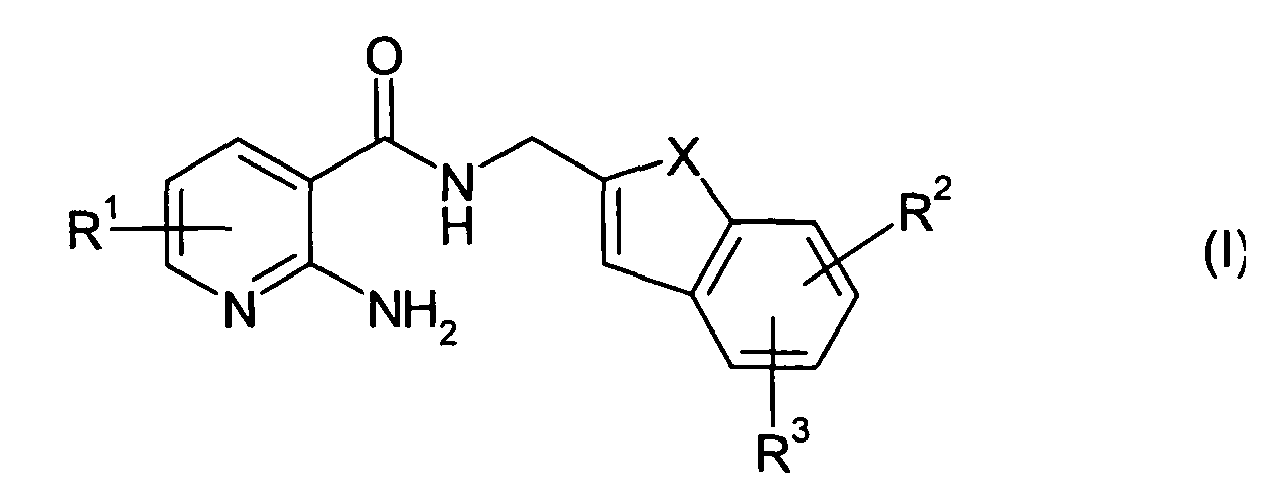
- Namely, the present invention provides:
- [1] : a compound represented by the following formula (I), or a salt or hydrate thereof;

R1 represents a hydrogen atom, a halogen atom, a cyano group, an amino group or an arbitrary group selected from substituent group a; and
R2 and R3 independently represent a hydrogen atom, a halogen atom, a hydroxyl group or an arbitrary group selected from substituent group c, except for a case in which R2 and R3 are both hydrogen atoms:
(substituent group a)
a C1-6 alkyl group, a C2-6 alkenyl group, a C2-6 alkynyl group, a C3-8 cycloalkyl group, a C3-8 cycloalkyl C1-6 alkyl group, a C1-6 alkoxy group, a C2-6 alkenyloxy group, a C2-6 alkynyloxy group, a C3-8 cycloalkoxy group, a C3-8 cycloalkyl C1-6 alkoxy group, a C1-6 alkylthio group, a C3-8 cycloalkyl C1-6 alkylthio group, a mono-C1-6 alkylamino group, a mono-C2-6 alkenylamino group, a mono-C2-6 alkynylamino group, a mono-C3-8 cycloalkylamino group, a mono-C3-8 cycloalkyl C1-6 alkylamino group, a di-C1-6 alkylamino group, a C1-6 alkylcarbonyl group and a C1-6 alkoxy C1-6 alkyl group, and each group described in substituent group a may have 1 to 3 arbitrary groups selected from the following substituent group b:
(substituent group b)
a halogen atom, a hydroxyl group, a mercapto group, a cyano group, a C1-6 alkyl group, a C6-10 aryl group, a 5- to 10-membered heterocyclic group, a C1-6 alkoxy group and an aminosulfonyl group,
(substituent group c)
a C1-6 alkyl group, a C2-6 alkenyl group, a C2-6 alkynyl group, a C3-8 cycloalkyl C1-6 alkyl group, a C6-10 aryl C1-6 alkyl group, a 5- to 10-membered heterocyclic C1-6 alkyl group, a C1-6 alkoxy group, a C2-6 alkenyloxy group, a C2-6 alkynyloxy group, a C5-10 aryloxy group, a C3-8 cycloalkyl C1-6 alkoxy group, a C6-10 aryl C1-6 alkoxy group, a C6-10 aryloxy C1-6 alkoxy group, a 5- to 10-membered heterocyclic C1-6 alkoxy group, a C1-6 alkoxy C1-6 alkoxy group, a mono-C6-10 arylamino group, a mono-C6-10 aryl C1-6 alkylamino group, a C6-10 aryloxy C1-6 alkyl group, a C1-6 alkoxy C1-6 alkyl group and a 5- to 10-membered heterocycloxy C1-6 alkyl group, and
each group described in substituent group c may have 1 to 3 groups selected from the group consisting of a halogen atom, a C1-6 alkyl group and a C1-6 alkoxy group] - [2] : the compound, or the salt or the hydrate thereof according to item [1], wherein R1 represents a hydrogen atom, an amino group or a C1-6 alkoxy C1-6 alkyl group;
- [3] : the compound, or the salt or the hydrate thereof according to item [1], wherein R1 represents a hydrogen atom, an amino group or a methoxymethyl group;
- [4] : the compound, or the salt or the hydrate thereof according to any one of items [1] to [3], wherein R2 and R3 independently represents a hydrogen atom, a halogen atom or an arbitrary group selected from substituent group c-1;
[(substituent group c-1)
a C1-6 alkyl group, a C6-10 aryl C1-6 alkyl group, a C1-6 alkoxy group, a C2-6 alkenyloxy group, a C2-6 alkynyloxy group, a C6-10 aryloxy group, a C3-8 cycloalkyl C1-6 alkoxy group, a C6-10 aryl C1-6 alkoxy group, a C6-10 aryloxy C1-6 alkoxy group, a 5- to 10-membered heterocyclic C1-6 alkoxy group, a C1-6 alkoxy C1-6 alkoxy group and a C1-6 alkoxy C1-6 alkyl group, and each group described in substituent group c-1 may have 1 to 3 groups selected from the group consisting of a halogen atom, a C1-6 alkyl group and a C1-6 alkoxy group] - [5] : the compound, or the salt or the hydrate thereof according to any one of items [1] to [3], wherein R2 and R3 independently represents a hydrogen atom, a halogen atom or an arbitrary group selected from substituent group c-2;
[(substituent group c-2)
a butyl group, a benzyl group, a methoxy group, an ethoxy group, a propoxy group, a butoxy group, a pentyloxy group, an isobutoxy group, a 4-methylbutoxy group, a 2-methylbutoxy group, a 2,2-dimethylpropoxy group, an allyloxy group, a 3-methyl-but-2-enyloxy group, a but-2-enyloxy group, a prop-2-ynyloxy group, a but-2-ynyloxy group, a phenoxy group, a cyclopropylmethoxy group, a phenoxyethoxy group, a benzyloxy group, a 2-fluoro-benzyloxy group, a 3-fluoro-benzyloxy group, a 4-fluoro-benzyloxy group, a 2-chloro-benzyloxy group, a tetrahydropyran-2-ylmethoxy group, a 2-pyridylmethoxy group, a 3-pyridylmethoxy group, a 4-pyridylmethoxy group, a methoxyethoxy group, an ethoxyethoxy group, a methoxymethyl group and an ethoxymethyl group] - [6] : the compound, or the salt or the hydrate thereof according to item [4] or [5], wherein only one of R2 and R3 is a hydrogen atom;
- [7] : the compound, or the salt or the hydrate thereof according to any one of items [1] to [6], wherein a bonding position of R1 is a position represented by the partial structure of the following formula (II);

- [8] : the compound, or the salt or the hydrate thereof according to any one of items [1] to [7], wherein bonding positions of R2 and R3 are the positions represented by the partial structure of the following formula (III);

- [9] : the compound, or the salt or the hydrate thereof according to any one of items [1] to [8], wherein X represents an oxygen atom;
- [10] : a compound selected from the group consisting of the following compounds, or a salt or a hydrate thereof:


- [11] : a pharmaceutical composition comprising the compound, or the salt or the hydrate thereof according to any one of items [1] to [10];
- [12] : a medicament comprising the compound, or the salt or the hydrate thereof according to any one of items [1] to [10];
- [13] : an antifungal agent comprising, as an active ingredient, the compound, or the salt or the hydrate thereof according to any one of items [1] to [10];
- [14] : a method for preventing and/or treating a fungal infection by administering a pharmacologically effective amount of the compound, or the salt or the hydrate thereof according to any one of items [1] to [10];
- [15]: a use of the compound, or the salt or the hydrate thereof according to any one of items [1] to [10], for manufacturing an antifungal agent.
- Pyridine derivatives (I) according to the present invention, or salts or hydrates thereof, 1) demonstrate effects against the onset, progression and prolongation of infections by preventing the pathogens from demonstrating pathogenicity by inhibiting the expression of cell wall surface layer protein and inhibiting the cell wall assembly together with inhibiting the adherence of fungi to cells, and 2) is superior in terms of physical properties, safety and metabolic stability, and extremely useful as a preventive or therapeutic agent for fungal infections.
- The following defines the symbols, terms and the like described in the present specification, and provides a detailed explanation of the present invention by showing embodiments thereof.
- In the present specification, although the structural formulas of compounds may represent a certain isomer for the sake of convenience, all isomers such as geometrical isomers, optical isomers based on asymmetric carbons, stereoisomers, rotamers and tautomers capable of structurally occurring for a compound as well as isomeric mixtures are included in the present invention, are not limited to the descriptions of formulas provided for the sake of convenience, and may be a single isomer or a mixture thereof. Thus, although optical isomers and racemates may be present in the compounds according to the present invention as a result of having asymmetric carbons in a molecule thereof, these are not limited in the present invention, and all such optical isomers and racemates are included therein. In addition, although crystal polymorphism may also be present, this is similarly not limited, and crystals may have a single crystal form or a mixture composed of two or more crystal forms. Solvates such as anhydrides and hydrates are included in the compounds according to the present invention.
- In addition, compound formed as a result of the compounds according to the present invention being subjected to metabolism in the body such as oxidation, reduction, hydrolysis or conjugation (so-called metabolites) and compounds that form the compounds according to the present invention as a result of being subjected to metabolism in the body such as oxidation, reduction, hydrolysis or conjugation (so-called prodrugs) are also included within the scope of the present invention.
- The term "C1-6 alkyl group" used in the present specification refers to a monovalent, linear or branched alkyl group having 1 to 6 carbon atoms derived by removing a single arbitrary hydrogen atom from an aliphatic hydrocarbon having 1 to 6 carbon atoms; specific examples of which include a methyl group, an ethyl group, a n-propyl group, an isopropyl group, a n-butyl group, an isobutyl group, a sec-butyl group, a tert-butyl group, a n-pentyl group, an isopentyl group, a sec-pentyl group, a neopentyl group, a 1-methylbutyl group, a 2-methylbutyl group, a 1,1-dimethylpropyl group, a 1,2-dimethylpropyl group, a n-hexyl group, an isohexyl group, a 1-methylpentyl group, a 2-methylpentyl group, a 3-methylpentyl group, a 1,1-dimethylbutyl group, a 1,2-dimethylbutyl group, a 2,2-dimethylbutyl group, a 1,3-dimethylbutyl group, a 2,3-dimethylbutyl group, a 3,3-dimethylbutyl group, a 1-ethylbutyl group, a 2-ethylbutyl group, a 1,1,2-trimethylpropyl group, a 1,2,2-trimethylpropyl group, a 1-ethyl-1-methylpropyl group, a 1-ethyl-2-methylpropyl group or the like. Preferable examples include a methyl group, an ethyl group, a n-propyl group, an isopropyl group, a n-butyl group, an isobutyl group, a sec-butyl group, a tert-butyl group or the like.
- The term "C2-6 alkenyl group" used in the present specification refers to a linear or branched alkenyl group having 2 to 6 carbons that may contain 1 to 2 double bonds; specific examples of which include an ethenyl group, a 1-propenyl group, a 2-propenyl group, a 1-butenyl group, a 2-butenyl group, a 3-butenyl group, a 2-methyl-1-propenyl group, a pentenyl group, a 3-methyl-2-butenyl group, a hexenyl group, a hexanedienyl group or the like. Preferable examples include an ethenyl group, a 1-propenyl group, a 2-propenyl group, a 1-butenyl group, a 2-butenyl group, a 3-butenyl group, a 2-methyl-1-propenyl group, a 3-methyl-2-butenyl group or the like.
- The term "C2-6 alkynyl group" used in the present specification refers to a linear or branched alkynyl group having 2 to 6 carbon atoms that may contain 1 to 2 triple bonds; specific examples of which include an ethynyl group, a 1-propynyl group, a 2-propynyl group, a 1-butynyl group, a 2-butynyl group, a 3-butynyl group, a pentynyl group, a hexynyl group, a hexanediynyl group or the like. Preferable examples include an ethynyl group, a 1-propynyl group, a 2-propynyl group, a 1-butynyl group, a 2-butynyl group, a 3-butynyl group or the like.
- The term "C3-8 cycloalkyl group" used in the present specification refers to a cyclic aliphatic hydrocarbon group having 3 to 8 carbon atoms; specific examples of which include a cyclopropyl group, a cyclobutyl group, a cyclopentyl group, a cyclohexyl group, a cycloheptyl group, a cyclooctyl group or the like. Preferable examples include a cyclopropyl group, a cyclobutyl group, a cyclopentyl group, a cyclohexyl group or the like.
- The term "C1-6 alkoxy group" used in the present specification refers to a group in which an oxygen atom is bonded to the end of the previously defined "C1-6 alkyl group"; specific examples of which include a methoxy group, an ethoxy group, a n-propoxy group , an isopropoxy group, a n-butoxy group, an isobutoxy group, a sec-butoxy group, a tert-butoxy group, a n-pentyloxy group, an isopentyloxy group, a sec-pentyloxy group, a neopentyloxy group, a 1-methylbutoxy group, a 2-methylbutoxy group, a 1,1-dimethylpropoxy group, a 1,2-dimethylpropoxy group, a n-hexyloxy group, an isohexyloxy group, a 1-methylpentyloxy group, a 2-methylpentyloxy group, a 3-methylpentyloxy group, a 1,1-dimethylbutoxy group, a 1,2-dimethylbutoxy group, a 2,2-dimethylbutoxy group, a 1,3-dimethylbutoxy group, a 2,3-dimethylbutoxy group, a 3,3-dimethylbutoxy group, a 1-ethylbutoxy group, a 2-ethylbutoxy group, a 1,1,2-trimethylpropoxy group, a 1,2,2-trimethylpropoxy group, a 1-ethyl-1-methylpropoxy group, a 1-ethyl-2-methylpropoxy group or the like. Preferable examples include a methoxy group, an ethoxy group, a n-propoxy group, an isopropoxy group, a n-butoxy group, an isobutoxy group, a sec-butoxy group, a tert-butoxy group or the like.
- The term "C1-6 alkylthio group" used in the present specification refers to a group in which a sulfur atom is bonded to the end of the previously defined "C1-6 alkyl group"; specific examples of which include a methylthio group, an ethylthio group, a n-propylthio group, an isopropylthio group, a n-butylthio group, an isobutylthio group, a sec-butylthio group, a tert-butylthio group, a n-pentylthio group, an isopentylthio group, a sec-pentylthio group, a neopentylthio group, a 1-methylbutylthio group, a 2-methylbutylthio group, a 1,1-dimethylpropylthio group, a 1,2-dimethylpropylthio group, a n-hexylthio group, an isohexylthio group, a 1-methylpentylthio group, a 2-methylpentylthio group, a 3-methylpentylthio group, a 1,1-dimethylbutylthio group, a 1,2-dimethylbutylthio group, a 2,2-dimethylbutylthio group, a 1,3-dimethylbutylthio group, a 2,3-dimethylbutylthio group, a 3,3-dimethylbutylthio group, a 1-ethylbutylthio group, a 2-ethylbutylthio group, a 1,1,2-trimethylpropylthio group, a 1,2,2-trimethylpropylthio group, a 1-ethyl-1-methylpropylthio group, a 1-ethyl-2-methylpropylthio group or the like. Preferable examples include a methylthio group, an ethylthio group, a n-propylthio group, an isopropylthio group, a n-butylthio group, an isobutylthio group, a sec-butylthio group, a tert-butylthio group or the like.
- The term "C1-6 alkylcarbonyl group" used in the present specification refers to a group in which a carbonyl group is bonded to the end of the previously defined "C1-6 alkyl group"; specific examples of which include a methylcarbonyl group, an ethylcarbonyl group, a n-propylcarbonyl group, an isopropylcarbonyl group or the like.
- The term "C2-6 alkenyloxy group" used in the present specification refers to a group in which an oxygen atom is bonded to the end of the previously defined "C2-6 alkenyl group"; specific examples of which include an ethenyloxy group, a 1-propenyloxy group, a 2-propenyloxy group, a 1-butenyloxy group, a 2-butenyloxy group, a 3-butenyloxy group, a 2-methyl-1-propenyloxy group, a pentenyloxy group, a 3-methyl-2-butenyloxy group, a hexenyloxy group, a hexanedienyloxy group or the like. Preferable examples include an ethenyloxy group, a 1-propenyloxy group, a 2-propenyloxy group, a 1-butenyloxy group, a 2-butenyloxy group, a 3-butenyloxy group, a 2-methyl-1-propenyloxy group, a 3-methyl-2-butenyloxy group or the like.
- The term "C2-6 alkynyloxy group" used in the present specification refers to a group in which an oxygen atom is bonded to the end of the previously defined "C2-6 alkynyl group"; specific examples of which include an ethynyloxy group, a 1-propynyloxy group, a 2-propynyloxy group, a 1-butynyloxy group, a 2-butynyloxy group, a 3-butynyloxy group, a pentynyloxy group, a hexynyloxy group, a hexanediynyl group or the like. Preferable examples include an ethynyloxy group, a 1-propynyloxy group, a 2-propynyloxy group, a 1-butynyloxy group, a 2-butynyloxy group, a 3-butynyloxy group or the like.
- The term "C3-8 cycloalkoxy group" used in the present specification refers to a group in which an oxygen atom is bonded to the end of the previously defined "C3-8 cycloalkyl group"; specific examples of which include a cyclopropoxy group, a cyclobutoxy group, a cyclopentyloxy group, a cyclohexyloxy group, a cycloheptyloxy group, a cyclooctyloxy group or the like. Preferable examples include a cyclopropoxy group, a cyclobutoxy group, a cyclopentyloxy group, a cyclohexyloxy group or the like.
- The term "C3-8 cycloalkyl C1-6 alkyl group" used in the present specification refers to a group in which an arbitrary hydrogen atom of the previously defined "C1-6 alkyl group" is replaced with the previously defined "C3-8 cycloalkyl group"; specific examples of which include a cyclopropylmethyl group, a cyclobutylmethyl group, a cyclopentylmethyl group, a cyclohexylmethyl group, a cyclopropylethyl group, a cyclobutylethyl group, a cyclopentylethyl group, a cyclohexylethyl group or the like.
- The term "C3-8 cycloalkyl C1-6 alkoxy group" used in the present specification refers to a group in which an arbitrary hydrogen atom of the previously defined "C1-6 alkoxy group" is replaced with the previously defined "C3-8 cycloalkyl group"; specific examples of which include a cyclopropylmethoxy group, a cyclobutylmethoxy group, a cyclopentylmethoxy group, a cyclohexylmethoxy group, a cyclopropylethoxy group, a cyclobutylethoxy group, a cyclopentylethoxy group, a cyclohexylethoxy group or the like.
- The term "C3-8 cycloalkyl C1-6 alkylthio group" used in the present specification refers to a group in which an arbitrary hydrogen atom of the previously defined "C1-6 alkylthio group" is replaced with the previously defined "C3-8 cycloalkyl group"; specific examples of which include a cyclopropylmethylthio group, a cyclobutylmethylthio group, a cyclopentylmethylthio group, a cyclohexylmethylthio group, a cyclopropylethylthio group, a cyclobutylethylthio group, a cyclopentylethylthio group, a cyclohexylethylthio group or the like.
- The term "C6-10 aryl group" used in the present specification refers to an aromatic hydrocarbon cyclic group having 6 to 10 carbon atoms; specific examples of which include a phenyl group, a 1-naphthyl group, a 2-naphthyl group, an indenyl group, an azulenyl group, a heptalenyl group or the like. Preferable examples include a phenyl group, a 1-naphthyl group, a 2-naphthyl group or the like.
- The term "C6-10 aryloxy group" used in the present specification refers to a group in which an oxygen atom is bonded to the end of the previously defined "C6-10 aryl group"; specific examples of which include a phenoxy group, a 1-naphthyloxy group, a 2-naphthyloxy group, an indenyloxy group, an azulenyloxy group, a heptalenyloxy group or the like. Preferable examples include a phenoxy group, a 1-naphthyloxy group, a 2-naphthyloxy group or the like.
- The "C6-10 aryl C1-6 alkyl group" used in the present specification refers to a group in which an arbitrary hydrogen atom of the previously defined "C1-6 alkyl group" is replaced with the previously defined "C6-10 aryl group"; specific examples of which include a benzyl group, a 1-naphthylmethyl group, a 2-naphthylmethyl group, a phenethyl group, a 1-naphthylethyl group, a 2-naphthylethyl group, a 3-phenyl-1-propyl group or the like.
- The "C6-10 aryloxy C1-6 alkyl group" used in the present specification refers to a group in which an arbitrary hydrogen atom of the previously defined "C1-6 alkyl group" is replaced with the previously defined "C6-10 aryloxy group"; specific examples of which include a phenoxymethyl group, a 1-napthyloxymethyl group, a 2-naphthyloxymethyl group, an indenyloxymethyl group, an azulenyloxymethyl group, a heptalenyloxymethyl group or the like. Preferable examples include a phenoxymethyl group, a 1-naphthyloxymethyl group, a 2-naphthyloxymethyl group or the like.
- The term "C1-6 alkoxy C1-6 alkyl group" used in the present specification refers to a group in which an arbitrary hydrogen atom of the previously defined "C1-6 alkyl group" is replaced with the previously defined "C1-6 alkoxy group"; specific examples of which include a methoxymethyl group, an ethoxymethyl group, a n-propoxymethyl group, a methoxyethyl group, an ethoxyethyl group or the like.
- The term "C1-6 alkoxy C1-6 alkoxy group" used in the present specification refers to a group in which an arbitrary hydrogen atom of the previously defined "C1-6 alkoxy group" is replaced with the previously defined "C1-6 alkoxy group"; specific examples of which include a methoxymethoxy group, an ethoxymethoxy group, a n-propoxymethoxy group, a methoxyethoxy group, an ethoxyethoxy group, a methoxypropoxy group or the like.
- The term "C6-10 aryl C1-6 alkoxy group" used in the present specification refers to a group in which an arbitrary hydrogen atom of the previously defined "C1-6 alkoxy group" is replaced with the previously defined "C6-10 aryl group"; specific examples of which include a benzyloxy group, a 1-naphthylmethoxy group, a 2-naphthylmethoxy group, a phenethyloxy group, a 1-naphthylethoxy group, a 2-naphthylethoxy group, a 3-phenyl-1-propoxy group or the like.
- The term "C6-10 aryloxy C1-6 alkoxy group" used in the present specification refers to a group in which an arbitrary hydrogen atom of the previously defined "C1-6 alkoxy group" is replaced with the previously defined "C6-10 aryloxy group"; specific examples of which include a phenoxymethoxy group, a 1-naphthyloxymethoxy group, a 2-naphthyloxymethoxy group, a phenoxyethoxy group, a 1-naphthyloxyethoxy group, a 2-naphthyloxyethoxy group, a 3-phenoxy-1-propoxy group or the like.
- The term "mono-C1-6 alkylamino group" used in the present specification refers to a group in which one hydrogen atom in an amino group is replaced with the previously defined "C1-6 alkyl group"; specific examples of which include a methylamino group, an ethylamino group, a n-propylamino group, an isopropylamino group, a n-butylamino group, an isobutylamino group, a sec-butylamino group, a tert-butylamino group, a n-pentylamino group, an isopentylamino group, a sec-pentylamino group, a neopentylamino group, a 1-methylbutylamino group, a 2-methylbutylamino group, a 1,1-dimethylpropylamino group, a 1,2-dimethylpropylamino group, a n-hexylamino group, an isohexylamino group, a 1-methylpentylamino group, a 2-methylpentylamino group, a 3-methylpentylamino group, a 1,1-dimethylbutylamino group, a 1,2-dimethylbutylamino group, a 2,2-dimethylbutylamino group, a 1,3-dimethylbutylamino group, a 2,3-dimethylbutylamino group, a 3,3-dimethylbutylamino group, a 1-ethylbutylamino group, a 2-ethylbutylamino group, a 1,1,2-trimethylpropylamino group, a 1,2,2-trimethylpropylamino group, a 1-ethyl-1-methylpropylamino group, a 1-ethyl-2-methylpropylamino group or the like. Preferable examples include a methylamino group, an ethylamino group , a n-propylamino group, an isopropylamino group, a n-butylamino group, an isobutylamino group, a sec-butylamino group, a tert-butylamino group or the like.
- The term "mono-C2-6 alkenylamino group" used in the present specification refers to a group in which one hydrogen atom in an amino group is replaced with the previously defined "C2-6 alkenyl group"; specific examples of which include an ethenylamino group, a 1-propenylamino group, a 2-propenylamino group, a 1-butenylamino group, a 2-butenylamino group, a 3-butenylamino group, a 2-methyl-1-propenylamino group, a pentenylamino group, a 3-methyl-2-butenylamino group, a hexenylamino group, a hexanedienylamino group or the like. Preferable examples include an ethenylamino group, a 1-propenylamino group, a 2-propenylamino group, a 1-butenylamino group, a 2-butenylamino group, a 3-butenylamino group, a 2-methyl-1-propenylamino group, a 3-methyl-2-heptenylamino group or the like.
- The term "mono-C2-6 alkynylamino group" used in the present specification refers to a group in which one hydrogen atom in an amino group is replaced with the previously defined "C2-6 alkynyl group"; specific examples of which include an ethynylamino group, a 1-propynylamino group, a 2-propynylamino group, a 1-butynylamino group, a 2-butynylamino group, a 3-butynylamino group, a pentynylamino group, a hexynylamino group, a hexanediynyl group or the like. Preferable examples include an ethynylamino group, a 1-propynylamino group, a 2-propynylamino group, a 1-butynylamino group, a 2-butynylamino group, a 3-butynylamino group or the like.
- The "mono-C3-8 cycloalkylamino group" used in the present specification refers to a group in which one hydrogen atom in an amino group is replaced with the previously defined "C3-8 cycloalkyl group"; specific examples of which include a cyclopropylamino group, a cyclobutylamino group, a cyclopentylamino group, a cyclohexylamino group, a cycloheptylamino group, a cyclooctylamino group or the like. Preferable examples include a cyclopropylamino group, a cyclobutylamino group, a cyclopentylamino group, a cyclohexylamino group or the like.
- The term "mono-C6-10 arylamino group" used in the present specification refers to a group in which one hydrogen atom in an amino group is replaced with the previously defined "C6-10 aryl group"; specific examples of which include a phenylamino group, a 1-naphthylamino group, a 2-naphthylamino group, an indenylamino group, an azulenylamino group, a heptalenylamino group or the like. Preferable examples include a phenylamino group, a 1-naphthylamino group, a 2-naphthylamino group or the like.
- The "mono-C3-8 cycloalkyl C1-6 alkylamino group" used in the present specification refers to a group in which one hydrogen atom in amino group is replaced with the previously defined "C3-8 cycloalkyl C1-6 alkyl group"; specific examples of which include a cyclopropylmethylamino group, a cyclobutylmethylamino group, a cyclopentylmethylamino group, a cyclohexylmethylamino group, a cyclopropylethylamino group, a cyclobutylethylamino group, a cyclopentylethylamino group, a cyclohexylethylamino group or the like.
- The term "mono-C6-10 aryl C1-6 alkylamino group" used in the present specification refers to a group in which one hydrogen atom in an amino group is replaced with the previously defined "C6-10 aryl C1-6 alkyl group"; specific examples of which include a benzylamino group, a 1-naphthylmethylamino group, a 2-naphthylmethylamino group, a phenethylamino group, a 1-naphthylethylamino group, a 2-naphthylethylamino group or the like.
- The "di-C1-6 alkylamino group" used in the present specification refers to a group in which two hydrogen atoms in an amino group are respectively replaced with the same or different previously defined "C1-6 alkyl group"; specific examples of which include a N,N-dimethylamino group, a N,N-diethylamino group, a N,N-di-n-propylamino group, a N,N-di-isopropylamino group, a N,N-di-n-butylamino group, a N,N-di-isobutylamino group, a N,N-di-sec-butylamino group, a N,N-di-tert-butylamino group, a N-ethyl-N-methylamino group, a N-n-propyl-N-methylamino group, a N-isopropyl-N-methylamino group, a N-n-butyl-N-methylamino group, a N-isobutyl-N-methylamino group, a N-sec-butyl-N-methylamino group, a N-tert-butyl-N-methylamino group or the like. Preferable examples include a N,N-dimethylamino group, a N,N-diethylamino group, a N-ethyl-N-methylamino group or the like.
- The term "halogen atom" used in the present specification refers to a fluorine atom, a chlorine atom, a bromine atom or an iodine atom, preferably a fluorine atom, a chlorine atom or a bromine atom.
- The term "heteroatom" used in the present specification refers to a nitrogen atom, sulfur atom or oxygen atom.
- The term "5- to 10-membered heterocyclic group" used in the present specification refers to a monovalent group having 5 to 10 atoms that compose an aromatic or non-aromatic ring derived by removing a hydrogen atom from the ring that contains one to a plurality of heteroatoms among the atoms that compose the ring. Specific examples of aromatic "5- to 10-membered heterocyclic groups" include furyl groups (such as a 2-furyl or 3-furyl group), thienyl groups (such as a 2-thienyl or 3-thienyl group), pyrrolyl groups (such as a 1-pyrrolyl, 2-pyrrolyl or 3-pyrrolyl group), pyridyl groups (such as a 2-pyridyl, 3-pyridyl or 4-pyridyl group), a pyradinyl group and pyradazinyl groups (such as a 3-pyradazinyl or 4-pyradazinyl group), pyrmidinyl groups (such as a 2-pyrimidinyl, 4-pyrimidinyl or 5-pyrimidinyl group), triazolyl groups (such as a 1,2,3-triazolyl or 1,2,4-triazolyl group), tetrazolyl groups (such as a 1 H-tetrazolyl or 2H-tetrazolyl group), thiazolyl groups (such as a 2-thiazolyl, 4-thiazolyl or 5-thiazolyl group), pyrazolyl groups (such as a 3-pyrazolyl or 4-pyrazolyl group), oxazolyl groups (such as a 2-oxazolyl, 4-oxazolyl or 5-oxazolyl group), isoxazolyl groups (such as a 3-isoxazolyl, 4-isoxazolyl or 5-isoxazolyl group), isothiazolyl groups (such as a 3-isothiazolyl, 4-isothiazolyl or 5-isothiazolyl group), quinolyl groups (such as a 5-quinolyl, 6-quinolyl, 7-quinolyl or 8-quinolyl group), isoquinolyl groups (such as a 5-isoquinolyl, 6-isoquinolyl, 7-isoquinolyl or 8-isoquinolyl group), naphthylidinyl groups (such as a [1,5]naphthylidin-2-yl, [1,5]naphthylidin-3-yl, [1,8]naphthylidin-2-yl or [1,8]naphthylidin-3-yl group), quinoxalinyl groups (such as a 5-quinoxalinyl, 6-quinoxalinyl, 7-quinoxalinyl or 8-quinoxalinyl group), cinnolinyl groups (such as a 5-cinnolinyl, 6-cinnolinyl, 7-cinnolinyl or 8-cinnolinyl group), quinazolinyl groups (such as a 4-quinazolinyl, 5-quinazolinyl, 6-quinazolinyl, 7-quinazolinyl or 8-quinazolinyl group), imidazopyridyl groups (such as an imidazo[1,2-a]pyridin-6-yl group), benzothiazolyl groups (such as a benzothiazol-4-yl, benzothiazol-5-yl, benzothiazol-6-yl or benzothiazol-7-yl group), benzoxazolyl groups (such as a benzoxazoly-4-yl, benzoxazol-5-yl, benzoxazol-6-yl or benzoxazol-7-yl group), benzoimidazolyl groups (such as a benzoimidazol-4-yl, benzoimidazol-5-yl, benzoimidazol-6-yl or benzoimidazol-7-yl group), indolyl groups (such as an indol-4-yl, indol-5-yl, indol-6-yl or indol-7-yl group), pyrrolopyridyl groups (such as a 1 H-pyrrolo[2,3-b]pyridin-5-yl group or pyrrolo[3,2,-b]pyridin-1-yl group), thienopyridyl groups (such as a thieno[2,3-b]pyridin-5-yl or thieno[3,2-b]pyridin-6-yl group), furopyridyl groups (such as a furu[2,3-b]pyridin-5-yl or furu[3,2-b]pyridin-6-yl group), 2,3-dihydro-1H-pyrrolo(2,3-b)pyridin-5-yl group, benzothiadiazolyl groups (such as a benzo[1,2,5]thiadiazol-5-yl group), benzoxadiazolyl groups (such as a benzo[1,2,5]oxadiazol-5-yl group), pyridopyrimidinyl groups (such as a pyrido[2,3-d]pyrimidin-4-yl group), benzofuryl groups (such as a benzofuran-4-yl, benzofuran-5-yl, benzofuran-6-yl or benzofuran-7-yl group), benzothienyl groups (such as a benzothiophen-4-yl, benzothiophen-5-yl, benzothiophen-6-yl or
benzothiophen-7-yl group), benzo[1,3]dioxazole groups (such as a benzo[1,3]dioxol-5-yl group) or the like. Specific examples of the non-aromatic "5-to 10-membered heterocyclic groups" include a pyrrolidinyl group, a piperidinyl group, a homopiperidinyl group, a piperazinyl group, a homopiperazinyl group, a morpholinyl group, a thiomorpholinyl group, a tetrahydrofuryl group, a tetrahydropyranyl group or the like. - The term "5- to 10-membered heterocyclic C1-6 alkyl group" used in the present specification refers to a group in which an arbitrary hydrogen atom in the previously defined "C1-6 alkyl group" is replaced with the previously defined "5- to 10-membered heterocyclic group"; specific examples of which include a furylmethyl group, a thienylmethyl group, a pyrrolylmethyl group, a pyridylmethyl group, a triazolylmethyl group, a tetrazolylmethyl group, a thiazolylmethyl group, a pyrazolylmethyl group, an oxazolylmethyl group, a benzo[1,3]dioxolmethyl group, a tetrahydrofurylmethyl group, a furylethyl group, a thienylethyl group, a pyrrolylethyl group, a pyridylethyl group, a triazolylethyl group, a tetrazolylethyl group, a thiazolylethyl group, a pyrazolylethyl group, an oxazolylethyl group, a benzo[1,3]dioxolethyl group, a tetrahydrofurylethyl group or the like.
- The term "5- to 10-membered heterocycloxy group" used in the present specification refers to a group in which an oxygen atom is bonded to the end of the previously defined "5- to 10-membered heterocyclic group"; specific examples of which include a furyloxy group, a thienyloxy group, a pyrrolyloxy group, a pyridyloxy group, a triazolyloxy group, a tetrazolyloxy group, a thiazolyloxy group, a pyrazolyloxy group, an oxazolyloxy group, a benzo[1,3]dioxoloxy group, a tetrahydrofuryloxy group or the like.
- The "5- to 10-membered heterocyclic C1-6 alkoxy group" used in the present specification refers to a group in which an arbitrary hydrogen atom in the previously defined "C1-6 alkoxy group" is replaced with the previously defined "5- to 10-membered heterocyclic group"; specific examples of which include a furylmethoxy group, a thienylmethoxy group, a pyrrolylmethoxy group, a pyridylmethoxy group, a triazolylmethoxy group, a tetrazolylmethoxy group, a thiazolylmethoxy group, a pyrazolylmethoxy group, an oxazolylmethoxy group, a benzo[1,3]dioxolmethoxy group, a tetrahydrofurylmethoxy group, a furylethoxy group, a thienylethoxy group, a pyrrolylethoxy group, a pyridylethoxy group, a triazolylethoxy group, a tetrazolylethoxy group, a thiazolylethoxy group, a pyrazolylethoxy group, an oxazolylethoxy group, a benzo[1,3]dioxolethoxy group, a tetrahydrofurylethoxy group or the like.
- The term "5- to 10-membered heterocycloxy C1-6 alkyl group" used in the present specification refers to a group in which an arbitrary hydrogen atom in the previously defined "C1-6 alkyl group" is replaced with the previously defined "5- to 10-membered heterocycloxy group", specific examples of which include a furyloxymethyl group, a thienyloxymethyl group, a pyrrolyloxymethyl group, a pyridyloxymethyl group, a triazolyloxymethyl group, a tetrazolyloxymethyl group, a thiazolyloxymethyl group, a pyrazolyloxymethyl group, an oxazolyloxymethyl group, a benzo[1,3]dioxoloxymethyl group, a tetrahydrofuryloxymethyl group, a furyloxyethyl group, a thienyloxyethyl group, a pyrrolyloxyethyl group, a pyridyloxyethyl group, a triazolyloxyethyl group, a tetrazolyloxyethyl group, a thiazolyloxyethyl group, a pyrazolyloxyethyl group, an oxazolyloxyethyl group, a benzo[1,3]dioxoloxyethyl group, a tetrahydrofuryloxyethyl group or the like.
- The term "may have a substituent" used in the present specification refers to optionally having one or a plurality of substituents arbitrarily combined at a substitutable site.
- The term "has a substituent" used in the present specification refers to having one or a plurality of substituents arbitrarily combined at a substitutable site.
- X represents an oxygen atom, a sulfur atom or -NH-, and represents particularly preferable an oxygen atom.
- R1 preferably represents a hydrogen atom, a halogen atom, a cyano group, an amino group or an arbitrary group selected from the substituent group a, represents particularly preferably a hydrogen atom, an amino group or a C1-6 alkoxy C1-6 alkyl group, and said C1-6 alkoxy C1-6 alkyl group preferably represents a methoxymethyl group.
- In addition, the bonding site of R1 is preferably a position represented by the partial structure of the following formula (II):

- R2 and R3 independently represent a hydrogen atom, a halogen atom, a hydroxyl group or an arbitrary group selected from the substituent group c, preferably represent a hydrogen atom, a halogen atom, or an arbitrary group selected from the substituent group c-1, and an arbitrary group selected from the substituent group c-1 is preferably a group selected from the substituent group c-2.
- In addition, one of R2 and R3 is preferably a hydrogen atom.
- Moreover, the bonding positions of R2 and R3 to the benzene ring are preferably positions represented by the partial structure of the following formula:
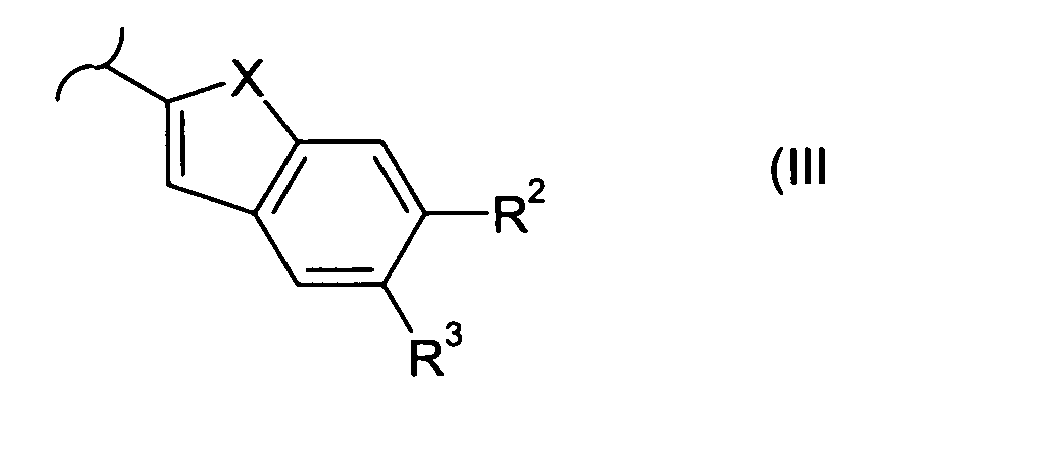
- Specific examples showing the preferable bonding positions include the partial structures represented by the following formulas:

- Although preferable specific examples of the compounds according to the present invention include the group of compounds represented by the following formulas, the present invention is not limited to this group of compounds:


- Examples of a "salt" used in the present specification include salts of inorganic acids, salts of organic acids, salts of inorganic bases, salts of organic bases and salts of acidic or basic amino acids, and pharmaceutically acceptable salts are particularly preferable.
- Preferable examples of the salts of the inorganic acids include salts of hydrochloric acid, hydrobromic acid, sulfuric acid, nitric acid, phosphoric acid or the like. Preferable examples of salts of the organic acids include salts of acetic acid, succinic acid, fumaric acid, maleic acid, tartaric acid, citric acid, lactic acid, stearic acid, benzoic acid, methanesulfonic acid, ethanesulfonic acid, p-toluenesulfonic acid or the like.
- Preferable examples of the salts of the inorganic bases include alkaline metal salts such as sodium salts or potassium salts; alkaline earth metal salts such as calcium salts or magnesium salts; aluminum salts, ammonium salts or the like. Preferable examples of the salts or the organic bases include salts of diethylamine, diethanolamine, meglumine, N,N-dibenzylethyldiamine or the like.
- Preferable examples of the salts of the acidic amino acids include salts of aspartic acid or glutamic acid. Preferable examples of the salts of the basic amino acids include salts of arginine, lysine, ornithine or the like.
- The term "antifungal agent" used in the present specification refers to a preventive agent and/or therapeutic agent of the fungal infections.
- Compounds according to the present invention or salts, or hydrates thereof, can be formulated as, for example, tablets, powders, grains, granules, coated tablets, capsules, syrups, lozenges, inhalants, suppositories, injections, ointments, ophthalmic ointments, tapes, eye drops, nose drops, ear drops, poultices or lotions according to the conventional methods. Commonly used excipients, binders, lubricants, colorants, correctives and, as necessary, stabilizers, emulsifiers, absorption promoters, surfactants, pH adjusters, preservatives, antioxidants and the like can be used for formulation, and are formulated according to the conventional methods by blending components typically used as raw materials of the pharmaceutical preparations. For example, when manufacturing an oral preparation, the compound according to the present invention, or a pharmaceutically acceptable salt thereof, an excipient, and as necessary, a binder, a disintegration agent, a lubricant, a colorant, corrective and the like are added followed by forming into a powder, grains, granules, tablet, coated tablet or capsule and the like in accordance with the conventional methods. Examples of these components include animal and vegetable oils such as soybean oil, beef tallow or synthetic glycerides; hydrocarbons such as liquid paraffin, squalane or solid paraffin; ester oils such as octyldodecyl myristate or isopropyl myristate; higher alcohols such as cetostearyl alcohol or behenyl alcohol; silicon resin; silicon oil; surfactants such as polyoxyethylene fatty acid ester, sorbitan fatty acid ester, glycerin fatty acid ester, polyoxyethylene sorbitan fatty acid ester, polyoxyethylene hydrogenated castor oil or polyoxyethylene polyoxypropylene block copolymer; water-soluble polymers such as hydroxyethyl cellulose, polyacrylic acid, carboxyvinyl polymer, polyethylene glycol, polyvinyl pyrrolidone or methyl cellulose; lower alcohols such as ethanol or isopropanol; polyvalent alcohols such as glycerin, propylene glycol, dipropylene glycol or sorbitol; sugars such as glucose or sucrose; inorganic powders such as silicic anhydride, magnesium aluminum silicate or aluminum silicate; and purified water. Examples of the excipients include lactose, cornstarch, saccharose, glucose, mannitol, sorbitol, crystalline cellulose, silicon dioxide or the like. Examples of the binders include polyvinyl alcohol, polyvinyl ether, methyl cellulose, ethyl cellulose, gum Arabic, tragacanth, gelatin, shellac, hydroxypropyl methyl cellulose, hydroxypropyl cellulose, polyvinyl pyrrolidone, polypropylene glycol-polyoxyethylene glycol block polymer, meglumine or the like. Examples of the disintegration agents include starch, agar, gelatin powder, crystalline cellulose, calcium carbonate, sodium bicarbonate, calcium citrate, dextrin, pectin, calcium carboxymethyl cellulose or the like. Examples of the lubricants include magnesium stearate, talc, polyethylene glycol, silica, hydrogenated vegetable oil or the like. Examples of colorants include those for which addition to pharmaceuticals is allowed, and examples of correctives include cocoa powder, peppermint, aromatic powder, peppermint oil, camphor, cinnamon powder or the like. These tablets and granules may naturally be suitably coated with a sugar coating or other coatings as necessary. In addition, when manufacturing a liquid preparation such as syrup or injection, a pH adjuster, a dissolution agent, an isotonic agent or the like, and as necessary, a dissolution assistant or a stabilizer or the like are added to the compound according to the present invention, or pharmaceutically acceptable salt thereof, followed by formulating in accordance with the conventional methods. There are no limitations on methods used to produce preparations for external use, and these can be produced in accordance with the conventional methods. Namely, examples of base raw materials that can be used during formulation include various raw materials commonly used in pharmaceuticals, over-the-counter medicines, cosmetics and the like. Specific examples of base raw materials used include animal and vegetable oils, mineral oils, ester oils, waxes, polyvalent alcohols, water-soluble polymers, clay minerals and purified water, and although pH adjusters, antioxidants, chelating agents, preservatives, anti-mold agents, colorants, fragrances and the like can also be added as necessary, the base raw materials of the preparations for external use of the present invention are not limited thereto. In addition, components such as components having differentiation-inducing action, circulation promoters, disinfectants, antiphlogistics, cell activators, vitamins, amino acids, moisturizers or keratin dissolution agents or the like can also be blended as necessary. Furthermore, the amounts of the base raw materials added are those amounts that yield the ordinary set concentrations for production of preparations for external use.
- In the case of administering the compound according to the present invention or the salt, or the hydrate thereof, there are no particular limitations on the form thereof, and said compound may be administered by oral administration or parenteral administration in accordance with ordinarily used methods. For example, the compound may be administered after formulating in the form of the tablet, the powder, the granules, the capsule, the syrup, the lozenge, the inhalant, the suppository, the injection, the ointment, the ophthalmic ointment, the tape, the eye drops, the nose drops, the ear drops, the poultice or the lotion.
- The dose of the medicament according to the present invention can be suitably selected according to the degree of symptoms, age, gender, body weight, administration form, type of salt, specific type of disease or the like.
- Although the dose differs considerably depending on the type of disease, degree of symptoms, patient age and gender, drug sensitivity or the like, in the case of the oral preparation, the normal adult dose is from 1 to 10000 mg per day, preferably from 10 to 2000 mg/day administered in a single dose or divided among several doses. In the case of the injection, the normal adult dose is generally from 0.1 to 10000 mg per day, preferably from 1 to 2000 mg per day.
- The following provides the description of the production process for compounds represented by formula (I) (referred to as compound (I) hereinbelow) according to the present invention. Although compounds according to the present invention can be synthesized using the conventional organic synthesis means, they can be produced according to, for example, the typical synthesis method described below.
-

-

- A commercially available product can be used as is for compound (1 b) or compound (1 b) can be produced from a commercially available product using the known method. Moreover, compound (1 b) can also be produced using the method described in the production examples of the examples or [Production Process 1-2-1] and the like.
- A commercially available product can be used as is for compound (1 c) or compound (1c) can be produced from a commercially available product using the known method. Moreover, compound (1c) can also be produced using a method described in the production examples of the examples or [Production Process 1-3-1] and the like.
- This step is a step for obtaining compound (1a) by condensing compound (1 b) and compound (1c) using a condensation agent in a solvent. There are no particular limitations on the solvent used, and examples of solvents used include halogenated hydrocarbons such as dichloromethane or chloroform; sulfoxides such as dimethylsulfoxide; esters such as ethyl acetate; ethers such as tetrahydrofuran or 1,4-dioxane; amides such as N,N-dimethylformamide, N,N-dimethylacetoamide or the like. Examples of the condensation agents include Bop (benzotriazole-1-yl oxytris(dimethylamino)phosphonium hexafluorophosphate), WSC (1-ethyl-3-(3,3-dimethylaminopropyl)carbodiimide hydrochloride), DOC (N,N'-dicyclohexylcarbodiimide), CDI (carbonyldiimidazole), diethyl phosphoryl cyanide or the like. 1 to 1.5 equivalents of compound (1 c) are used with respect to compound (1 b). 1 to 1.5 equivalents of condensation agent are used with respect to compound (1 b). In addition, 1 equivalent to an excess of organic base such as triethylamine may be added as necessary. The reaction temperature is from room temperature to 80°C and the reaction time is from 10 minutes to 30 hours.
- In addition, compound (1a) can also be produced from compound (1b) and compound (1c) using alternative methods described in (1), (2) or (3).
- Alternative Method (1): After converting compound (1b) to acid chloride, compound (1 a) can be obtained by reacting acid chloride with compound (1c). The step for obtaining the acid chloride is carried out by reacting 1 equivalent to an excess of acid chloride synthesis reagent with compound (1 b) in the absence of a solvent or in the presence of a solvent such as dichloromethane, benzene or toluene. A catalytic amount of N,N-dimethylformamide may also be added to the reaction system. Examples of acid chloride synthesis reagents include thionyl chloride, oxalyl chloride, phosphorous trichloride, phosphorous pentachloride or the like. The reaction temperature is from cooling with ice to the reflux temperature, and the reaction time is from 10 minutes to 24 hours.
- The step for condensing acid chloride and compound (1c) is carried out by reacting acid chloride with compound (1c) in a solvent such as dichloromethane, tetrahydrofuran or N,N-dimethylformamide and in the presence of 1 to 3 equivalents of base with respect to the acid chloride, examples of which include organic bases such as triethylamine or pyridine and inorganic bases such as potassium carbonate or cesium carbonate. 1 to 1.5 equivalents of compound (1c) are used with respect to acid chloride. The reaction time is 10 minutes to 24 hours and the reaction temperature is 0°C to the reflux temperature.
- Alternative Method (2): After converting compound (1b) to a mixed acid anhydride, compound (1 a) can be obtained by reacting the mixed acid anhydride with compound (1c). The step for obtaining the mixed acid anhydride is carried out by reacting compound (1 b) with a chloroformic acid ester such as ethyl chloroformate in the presence of a base such as triethylamine. 1 to 2 equivalents of the chloroformic acid ester and base are used with respect to compound (1 b). The reaction time is from 10 minutes to 5 hours and the reaction temperature is from 0°C to room temperature.
- The step for condensing the mixed acid anhydride and compound (1c) is carried out by reacting the mixed acid anhydride and compound (1c) in a solvent such as dichloromethane, tetrahydrofuran, N,N-dimethylformamide or the like. 1 to 1.5 equivalents of compound (1 c) are used with respect to the mixed acid anhydride. The reaction time is from 10 minutes to 24 hours and the reaction temperature is from 0 to 50°C.
- Alternative Method (3): After converting compound (1b) to an active ester, compound (1 a) can be obtained by reacting the active ester with compound (1c). The step for obtaining the active ester is carried out by reacting compound (1 b) with an active ester synthesis reagent in a solvent such as 1,4-dioxane, tetrahydrofuran or the like and in the presence of a condensation agent such as DCC. Examples of active ester synthesis reagents include N-hydroxysuccinimide or the like. 1 to 1.5 equivalents of the active ester synthesis reagent and the condensation agent are used with respect to compound (1b). The reaction temperature is from 0°C to room temperature and the reaction time is from 2 to 24 hours.
- The step for condensing the active ester and compound (1 c) is carried out by reacting the active ester with compound (1c) in a solvent such as dichloromethane, tetrahydrofuran, N,N-dimethylformamide or the like. 1 to 1.5 equivalents of compound (1 c) are used with respect to the active ester. The reaction temperature is from 0 to 50°C and the reaction time is from 10 minutes to 24 hours.
- Furthermore, the substituents on the pyridine ring and the heterobicyclic rings of compound (1 a) can be converted using the known method following Step 1, substituents on the pyridine ring of compound (1a) can be converted using the method described in Production Process 2-1, Production Process 2-2, Production Process 2-3 or Production Process 2-4, and substituents on the heterobicyclic rings of compound (1 a) can be converted using the method described in Production Process 2-5, Production Process 2-6 or Production Process 2-7.
-

- Commercially available products can be used as is for each of the compounds in the flow chart above, and each of the compounds can be produced from commercially available products by the known method. In addition, each of the compounds can also be produced using the methods described in the examples.
- This step is a step for obtaining compound (1 b-2) by reacting compound (1 b-1) and compound (1b-1-1). Compound (1b-2) can be obtained by reacting compound (1 b-1) and compound (1b-1-1) in a solvent such as tetrahydrofuran, toluene or the like and in the presence of a catalyst such as copper (I) chloride, copper (I) iodide or the like and a base such as potassium carbonate, cesium carbonate, potassium phosphate, pyridine, 1,8-diazabicyclo[5.4.0]undec-7-ene or the like. 1 to 3 equivalents of compound (1b-1-1) are used with respect to compound (1b-1). 0.5 to 3 equivalents of catalyst are used with respect to compound (1b-1). 2 to 10 equivalents of base are used with respect to compound (1b-1). The reaction temperature is from 50°C to the reflux temperature and the reaction time is from 1 to 48 hours.
-

- Commercially available products can be used as is for each of the compounds in the flow chart above, and each of the compounds can be produced from commercially available products by the known method. In addition, each of the compounds can also be produced using the methods described in the examples.
- This step is a step for obtaining compound (1b-4) by reacting compound (1b-3) and compound (1b-1-2). Compound (1b-4) can be obtained by reacting compound (1b-3) and compound (1b-1-2) in a solvent such as N-N-dimethylformamide, N-methylpyrrolidinone or the like and in the presence of a base such as potassium carbonate, tert-butoxy potassium or the like. 1 equivalent to an excess of base are used with respect to compound (1 b-3). The reaction temperature is from room temperature to 130°C and the reaction time is from 10 minutes to 24 hours.
- This step is a step for obtaining compound (1b-5) by aminating compound (1b-4). Compound (1b-5) can be obtained by reacting compound (1b-4) in a sealed tube in the presence of a base such as concentrated aqueous ammonia or the like. 1.5 equivalents to an excess of base are used with respect to compound (1 b-4). The reaction temperature is from 130 to 190°C and the reaction time is from 1 to 48 hours.
- This step is a step for obtaining compound (1b-6) by cyanating compound (1b-5). Compound (1b-6) can be obtained by reacting compound (1b-5) and zinc cyanide in a nitrogen atmosphere in a solvent such as N,N-dimethylformamide, N-methylpyrrolidinone or the like and in the presence of a catalyst. Examples of catalysts that can be used include tetrakis(triphenylphosphine)palladium (0) or the like. 1 to 2 equivalents of zinc cyanide are used with respect to compound (1 b-5). 0.01 to 0.1 equivalents of catalyst are used with respect to compound (1 b-5). The reaction temperature is from 50°C to the reflux temperature and the reaction time is from 5 minutes to 24 hours.
- Alternative Method: Compound (1b-6) can be obtained by reacting compound (1 b-5) and copper cyanide under nitrogen atmosphere in a solvent such as N,N-dimethylformamide, N-methylpyrrolidinone or the like. 1 equivalent to an excess of copper cyanide are used with respect to compound (1 b-5). The reaction temperature is from 50°C to the reflux temperature and the reaction time is from 10 minutes to 72 hours.
- This step is a step for obtaining compound (1b-7) by hydrolyzing compound (1b-6). Compound (1b-7) can be obtained by hydrolyzing compound (1b-6) in an aqueous solution of an acid such as hydrochloric acid, sulfuric acid or the like, or in an aqueous solution of a base such as sodium hydroxide, potassium hydroxide or the like. The reaction temperature is from room temperature to the reflux temperature and the reaction time is from 10 minutes to 10 hours.
-

- Commercially available products can be used as is for each of the compounds in the flow chart above, and each of the compounds can be produced from commercially available products by a known method. In addition, each of the compounds can also be produced using the methods described in the examples.
- This step is a step for obtaining compound (1 b-8) by reacting compound (1 b-1) and compound (1b-1-3). Compound (1b-8) can be produced using the same method as that in Step 1-1.
-

- A commercially available product can be used as is for each of the compounds in the above flow chart and each of the compounds can be produced from commercially available products by the known method. In addition, each of the compounds can also be produced using the method described in the production examples of the examples or [Production Process 1-3-2] to [Production Process 1-3-5]. Moreover, each of the compounds in the above flow chart can also be produced by converting substituents on the heterobicyclic ring using the method described in [Production Process 2-5] to [Production Process 2-7] or the like.
- This step is a step for obtaining compound (1c-2) by reducing compound (1c-1). Lithium aluminum hydride, for example, can be used for the reducing agent, and ether such as tetrahydrofuran, diethyl ether or the like can be used as solvent. 1 to 10 equivalents of reducing agent are used with respect to compound (1c-1). The reaction temperature is from 0°C to the reflux temperature and the reaction time is from 5 minutes to 24 hours.
- This step is a step for obtaining compound (1 c-3) by converting a hydroxyl group of compound (1c-2) to a leaving group.
- In the case L is a methanesulfonyloxy group or p-toluenesulfonyloxy group, compound (1 c-3) can be obtained by reacting compound (1 c-2) with methanesulfonyl chloride or p-toluenesulfonyl chloride in a solvent such as dichloromethane and in the presence of an organic base such as triethylamine or the like. 1 equivalent to an excess of organic base is used with respect to compound (1 c-2). 1 to 3 equivalents of methanesulfonyl chloride or p-toluenesulfonyl chloride are used with respect to compound (1c-2). The reaction temperature is from 0°C to room temperature and the reaction time is from 10 minutes to 24 hours.
- In the case L is a chlorine atom, compound (1c-3) can be obtained by allowing a chlorination reagent such as thionyl chloride, oxalyl chloride or the like to act on compound (1c-2). 1 equivalent to an excess of the chlorination reagent are used with respect to compound (1c-2). The reaction temperature is from 0°C to room temperature and the reaction time is from 10 minutes to 24 hours.
- This step is a step for obtaining compound (1c-4) by reacting compound (1c-3) and potassium phthalimide. Compound (1c-4) can be obtained by reacting compound (1c-3) with potassium phthalimide in a solvent such as N,N-dimethylformamide or the like. 1 to 2 equivalents of potassium phthalimide are used with respect to compound (1c-3). The reaction temperature is from room temperature to 160°C and the reaction time is from 10 minutes to 48 hours.
- This step is a step for obtaining compound (1c-8) from compound (1c-4). Compound (1c-8) can be obtained by adding 1 equivalent to an excess of hydrazine hydrate to compound (1 c-4) in a solvent such as ethanol or the like. The reaction temperature is from 80°C to the reflux temperature and the reaction time is from 10 minutes to 24 hours.
- This step is a step for obtaining compound (1c-4) by reacting compound (1c-2) with phthalimide. Compound (1c-4) can be obtained by reacting compound (1c-2) with phthalimide, triphenylphosphine and diethyl azodicarboxylate or diisopropyl azodicarboxylate in a solvent such as dichloromethane, tetrahydrofuran or the like. 1 to 2 equivalents of phthalimide, triphenylphosphine and diethyl azodicarboxylate or diisopropyl azodicarboxylate are used with respect to compound (1c-2). The reaction temperature is from -20 to 80°C and the reaction time is from 5 minutes to 48 hours.
- This step is a step for obtaining compound (1c-5) by reacting compound (1c-3) with an amine protected with a tert-butoxycarbonyl group. Compound (1c-5) can be obtained by reacting compound (1 c-3) with an amine protected with a tert-butoxycarbonyl group in a solvent such as N,N-dimethylformamide or the like and in the presence of a base such as sodium hydride or the like. 1 to 2 equivalents of base are used with respect to compound (1c-3). 1 to 2 equivalents of the amine protected with the tert-butoxycarbonyl group are used with respect to compound (1c-3). The reaction temperature is from room temperature to 80°C and the reaction time is from 1 to 24 hours.
- This step is a step for obtaining compound (1c-8) by deprotecting the tert-butoxycarbonyl group of compound (1c-5). Compound (1c-8) can be obtained by deprotecting the tert-butoxycarbonyl group of compound (1c-5) in a solvent such as dichloromethane or the like and in the presence of 2 equivalents to an excess of acid such as trifluoroacetic acid or the like with respect to compound (1c-5). The reaction temperature is from 0 to 60°C and the reaction time is from 10 minutes to 24 hours.
- This step is a step for obtaining compound (1c-6) by converting the leaving group of compound (1c-3) to an azide group. Compound (1c-6) can be obtained by reacting compound (1c-3) with an azidation reagent such as sodium azide, potassium azide or the like in a solvent such as N,N-dimethylformamide or the like. 1 to 5 equivalents of the azidation reagent are used with respect to compound (1c-3). The reaction temperature is from room temperature to 80°C and the reaction time is from 10 minutes to 48 hours.
- This step is a step for obtaining compound (1c-8) by reducing the azide group of compound (1c-6). Compound (1c-8) can be obtained by carrying out catalytic hydrogenation using Lindlar's catalyst in a solvent such as ethanol or the like. A catalytic amount to an excess of Lindlar's catalyst is used with respect to compound (1c-6). The reaction temperature is from room temperature to 80°C, the reaction time is from 30 minutes to 36 hours, and the reaction pressure is from 1 to 4 atmospheres.
- As an alternative method, compound (1 c-8) can be obtained by allowing triphenylphosphine to act in a solvent such as dichloromethane, tetrahydrofuran or the like. 1.0 to 2.0 equivalents of triphenylphosphine are used with respect to compound (1c-6).
- This step is a step for obtaining compound (1c-6) by converting the hydroxyl group of compound (1c-2) to an azide group. Compound (1c-6) can be obtained by reacting compound (1c-2) with diphenylphosphorylazide in a solvent such as benzene, toluene or the like and in the presence of an organic base such as 1,8-diazabicyclo[5,4,0]undec-7-ene or the like. 1 to 1.5 equivalents of organic base are used with respect to compound (1c-2). 1 to 1.5 equivalents of diphenylphosphorylazide are used with respect to compound (1c-2). The reaction temperature is from room temperature to 80°C and the reaction time is from 10 minutes to 48 hours.
- This step is a step for obtaining compound (1c-7) by oxidizing the hydroxymethyl group of compound (1c-2). Compound (1c-7) can be obtained by oxidizing compound (1 c-2) using an oxidizing agent such as manganese dioxide or the like in a solvent such as chloroform, dichloromethane or the like. 1 equivalent to an excess of oxidizing agent are used with respect to compound (1c-2). The reaction temperature is from room temperature to the reflux temperature and the reaction time is from 30 minutes to 24 hours.
- This step is a step for obtaining compound (1c-8) by converting the formyl group of compound (1c-7) to an aminomethyl group. Compound (1c-8) can be obtained by carrying out catalytic hydrogenation using a Raney nickel catalyst in a solvent such as ammonia-containing methanol, ammonia-containing ethanol or the like. A catalytic amount to an excess of Raney nickel catalyst is used with respect to compound (1c-7). The reaction temperature is from 0°C to room temperature, the reaction time is from 30 minutes to 36 hours and the reaction pressure is 1 to 4 atmospheres.
-

- Commercially available products can be used as is for compound (1c-9) and compound (1c-10). Commercially available products can also be used as is for compound (1c-9-1) and compound (1c-10-1), or they can be produced from commercially available products using known methods.
- This step is a step for obtaining compound (1c-11) by reacting compound (1c-9) and compound (1c-9-1). Compound (1c-11) can be obtained by reacting compound (1 c-9) and compound (1c-9-1) in a solvent such as N,N-dimethylformamide, dimethylsulfoxide or the like and in the presence of a base such as sodium hydroxide, potassium carbonate, cesium carbonate or the like. 1 to 2 equivalents of compound (1c-9-1) are used with respect to compound (1c-9). 2 equivalents to an excess of base are used with respect to compound (1c-9). The reaction temperature is from room temperature to the reflux temperature and the reaction time is from 5 minutes to 24 hours.
- This step is a step for obtaining compound (1c-11) by reacting compound (1c-10) and compound (1c-10-1). Compound (1c-11) can be obtained by reacting compound (1c-10) and compound (1c-10-1) in a solvent such as N,N-dimethylformamide, N-methylpyrrolidinone or the like and in the presence of a catalyst such as diacetobis(triphenylphosphine)palladium (II)/copper iodide or the like and a base such as sodium acetate or the like. 1 to 1.5 equivalents of compound (1c-10-1) are used with respect to compound (1c-10). 0.05 to 0.5 equivalents of catalyst are used with respect to compound (1c-10). 2 equivalents to an excess of base are used with respect to compound (1c-10). The reaction temperature is from room temperature to 80°C and the reaction time is from 30 minutes to 24 hours.
-

- Commercially available products can be used as is for compound (1-12) and compound (1 c-12-1), or they can be produced from commercially available products using the known methods.
- This step is a step for obtaining compound (1-13) by reacting compound (1-12) and compound (1c-12-1). Compound (1-13) can be obtained by reacting compound (1-12) and compound (1c-12-1) in a solvent such as tetrahydrofuran, N,N-dimethylformamide, dimethylsulfoxide or the like and in the presence of a base such as potassium tert-butoxide or the like. 1 to 1.5 equivalents of compound (1c-12-1) are used with respect to compound (1-12). 1 to 1.5 equivalents of base are used with respect to compound (1-12). The reaction temperature is from room temperature to the reflux temperature and the reaction time is from 30 minutes to 24 hours.
-

- Commercially available products can be used as is for compound (1c-14), compound (1 c-15) and compound (1c-14-1), or they can be produced from commercially available products using the known methods.
- This step is a step for obtaining compound (1c-16) by reacting compound (1c-14) or compound (1c-15) and compound (1c-14-1). Compound (1c-16) can be obtained by reacting compound (1c-14) or compound (1c-15) with compound (1c-14-1) in a solvent such as N,N-dimethylformamide, dimethylsulfoxide or the like and in the presence of a base such as potassium carbonate, sodium hydroxide or the like. 1 to 1.5 equivalents of compound (1c-14-1) are used with respect to compound (1c-14) or compound (1c-15). 2 to 5 equivalents of base are used with respect to compound (1c-14) or compound (1c-15). The reaction temperature is from room temperature to the reflux temperature and the reaction time is from 5 minutes to 24 hours.
-

- Commercially available products can be used as is for compound (1 c-17), compound (1c-21), compound (1c-17-1), compound (1c-17-2) and compound (1c-24-1), or they can be produced from commercially available products using the known methods.
- This step is a step for obtaining compound (1c-18) by reacting compound (1c-17) and compound (1c-17-1). Compound (1c-18) can be obtained by reacting compound (1 c-17) and compound (1 c-17-1) in a solvent such as methanol, ethanol or the like and in the presence of a base such as sodium methoxide, sodium ethoxide or the like. 1 to 2 equivalents of compound (1c-17-1) are used with respect to compound (1c-17). 1 to 3 equivalents of base are used with respect to compound (1c-17). The reaction temperature is from room temperature to the reflux temperature and the reaction time is from 30 minutes to 48 hours.
- This step is a step for obtaining compound (1c-19) by ring closure of compound (1c-18). Compound (1c-19) can be obtained by heating compound (1c-18) in the presence of a solvent such as toluene, xylene, mesitylene or the like. The reaction temperature is the reflux temperature and the reaction time is from 30 minutes to 48 hours.
- This step is a step for obtaining compound (1 c-20) by reacting compound (1c-17) and compound (1c-17-2). Compound (1c-20) can be obtained by reacting compound (1c-17) and compound (1c-17-2) in a solvent such as N,N-dimethylformamide, tetrahydrofuran or the like and in the presence of a base such as sodium hydride, cesium carbonate, barium hydroxide or the like. 1 to 2 equivalents of compound (1c-17-2) are used with respect to compound (1c-17). 1 to 2 equivalents of base are used with respect to compound (1c-17). The reaction temperature is from room temperature to the reflux temperature and the reaction time is from 30 minutes to 24 hours.
- This step is a step for obtaining compound (1 c-20) by reacting compound (1c-17) using (carbetoxymethylene)triphenylphosphorane instead of compound (1c-17-2). Compound (1c-20) can be obtained by reacting compound (1c-17) with (carbetoxymethylene)triphenylphosphorane in a solvent such as benzene, toluene or the like. 1 to 1.5 equivalents of (carbetoxymethylene)triphenylphosphorane are used with respect to compound (1c-17). The reaction temperature is the reflux temperature and the reaction time is from 30 minutes to 24 hours.
- This step is a step for obtaining compound (1c-18) by azidating the olefin site of an unsaturated carboxylic acid ester of compound (1c-20). Compound (1c-18) can be obtained by reacting an azidation agent such as sodium azide, potassium azide or the like in a solvent such as acetonitrile, acetone or the like and in the presence of a ammonium cerium (IV) nitrate followed by further treating with a base such as sodium acetate or the like in a solvent such as acetonitrile, acetone or the like. 1 to 2 equivalents of the azidation agent are used with respect to compound (1c-20). 1.5 to 2 equivalents of ammonium cerium (IV) nitrate are used with respect to the azidation agent. The temperature of the reaction with the azidation agent is from 0°C to room temperature and the temperature during treatment with a base such as sodium acetate or the like is from room temperature to the reflux temperature. The reaction time is from 1 to 24 hours.
- This step is a step for obtaining compound (1 c-22) by reducing the nitro group of compound (1c-21). Compound (1c-22) can be obtained by carrying out catalytic hydrogenation using a catalyst such as platinum dioxide or the like in a solvent such as methanol, ethanol or the like. A catalytic amount to an excess of catalyst is used with respect to compound (1c-21). The reaction temperature is from room temperature to 80°C and the reaction time is from 30 minutes to 24 hours.
- This step is a step for obtaining compound (1 c-22) by reducing the nitro group of compound (1c-21). Compound (1c-22) can be obtained by reacting compound (1c-21) with a reducing agent such as iron (powder) in a solvent such as ethanol or the like and in the presence of an excess amount of acetic acid. 2 to 5 equivalents of the reducing agent are used with respect to compound (1c-21). The reaction temperature is the reflux temperature and the reaction time is from 30 minutes to 24 hours.
- This step is a step for obtaining compound (1 c-23) by diazotizing the amino group of compound (1c-22). Compound (1c-23) can be obtained by diazidating compound (1c-22) in a solvent such as hydrochloric acid or the like and in the presence of a diazotization agent such as sodium nitrite or the like. 1 to 1.5 equivalents of the diazotization agent are used with respect to compound (1 c-22). The reaction temperature is from 0 to 5°C and the reaction time is from 5 minutes to 12 hours.
- This step is a step for obtaining compound (1c-24) by reducing the diazo group of compound (1c-23). Compound (1c-24) can be obtained by reacting compound (1c-23) in a solvent such as hydrochloric acid or the like in the presence of a reducing agent such as tin (II) chloride or the like. 1 to 3 equivalents of the reducing agent are used with respect to compound (1c-23). The reaction temperature is from 0 to 5°C and the reaction time is from 30 minutes to 24 hours.
- This step is a step for obtaining compound (1c-25) by reacting compound (1c-24) and compound (1c-24-1). Compound (1c-25) can be obtained by reacting compound (1 c-24) and compound (1c-24-1) in a solvent such as water-containing ethanol or the like and in the presence of a base such as potassium hydroxide, sodium acetate or the like. 1 equivalent to an excess of base are used with respect to compound (1c-24). The reaction temperature is from room temperature to the reflux temperature and the reaction time is from 30 minutes to 24 hours.
- This step is a step for obtaining compound (1c-19) by ring closure of compound (1c-25). Compound (1c-19) can be obtained by reacting compound (1c-25) in a solvent such as toluene, benzene or the like, for example, in the presence of an acid such as polyphosphoric acid, hydrochloric acid, sulfuric acid, para-toluenesulfonic acid or the like. 1 equivalent to an excess of acid are used with respect to compound (1c-25). The reaction temperature is from 80 to 200°C and the reaction time is from 30 minutes to 24 hours.
-

- Commercially available products can be used as is for compound (2-1-1), compound (2-1-2), compound (2-1-3), compound (2-1-4), compound (2-1-5) and compound (2-1-6), or they can be produced from commercially available products using the known methods.
- This step is a step for obtaining compound (2-2) by reacting compound (2-1) and compound (2-1-1). A solvent such as dimethylsulfoxide, tetrahydrofuran, toluene, acetonitrile, N,N-dimethylformamide or the like can be used for the solvent. In addition, the reaction can also be carried out in the absence of a solvent. The reaction is preferably carried out in a sealed tube, the reaction time is from 1 to 60 hours, and the reaction temperature is from 50 to 200°C. Furthermore, 2 equivalents to an excess of an organic base such as N,N'-diisopropyl ethylamine, triethylamine, pyridine, 1,8-diazabicyclo[5,4,0]undec-7-ene or the like, or an inorganic base such as potassium carbonate, sodium carbonate or the like may be added with respect to compound (2-1).
- This step is a step for obtaining compound (2-3) by reacting compound (2-1) and compound (2-1-2). Compound (2-3) can be obtained by reacting compound (2-1) and compound (2-1-2) in the presence of a catalyst. A catalyst such as tetrakis(triphenylphosphine)palladium (0), dichlorobis(triphenylphosphine) palladium (II) or the like can be used for the catalyst. A solvent such as toluene, 1,4-dioxane, xylene or the like can be used for the solvent. 2 to 3 equivalents of compound (2-1-2) are used with respect to compound (2-1). 0.05 to 0.3 equivalents of the catalyst are used with respect to compound (2-1). The reaction temperature is from 100 to 140°C and the reaction time is from 1 to 24 hours.
- This step is a step for obtaining compound (2-3) by reacting compound (2-1) and compound (2-1-3). Compound (2-3) can be obtained by reacting compound (2-1) and compound (2-1-3) in the presence of a catalyst. A catalyst such as dichloro(1,1'-bis(diphenylphosphino)propane)nickel (II), dichloro(1,1'-bis(diphenylphosphino)ferrocene)nickel (II), tetrakis(triphenylphosphine)palladium (0) or the like can be used for the catalyst. A solvent such as tetrahydrofuran, 1,4-dioxane or the like can be used for the solvent. 3 equivalents to an excess of compound (2-1-3) can be used with respect to compound (2-1). 0.05 to 0.3 equivalents of the catalyst can be used with respect to compound (2-1). The reaction temperature is from 0°C to the reflux temperature and the reaction time is from 5 minutes to 24 hours.
- This step is a step for obtaining compound (2-3) by reacting compound (2-1) and compound (2-1-4). Compound (2-3) can be obtained by reacting compound (2-1) and compound (2-1-4) in the presence of a catalyst and base. A catalyst such as palladium (II) acetate, tetrakis(triphenylphosphine)palladium (0), dichlorobis(triphenylphosphine)palladium (II), tris(dibenzylideneacetone)dipalladium (0) or the like can be used for the catalyst. In order to obtain a favorable result, 0.25 to 1.5 equivalents of a phosphate ligand (such as triphenylphosphine, tri-tert-butylphosphine or the like) may be added with respect to compound (2-1). A base such as potassium carbonate, sodium carbonate, cesium carbonate, potassium fluoride, cesium fluoride, potassium phosphate, sodium hydroxide, barium hydroxide, potassium hydroxide or the like can be used for the base. This reaction is preferably carried out under an inert gas atmosphere such as nitrogen gas, argon gas or the like, and a solvent such as tetrahydrofuran, 1,4-dioxane, methanol, ethanol, toluene, water or the like can be used for the solvent. A quaternary ammonium salt such as tetrabutyl ammonium bromide or the like can also be added depending on the reagents used. 0.05 to 0.3 equivalents of catalyst are used with respect to compound (2-1). 2 equivalents to an excess of base are used with respect to compound (2-1). The reaction temperature is from room temperature to the reflux temperature and the reaction time is from 30 minutes to 24 hours.
- This step is a step for obtaining compound (2-4) by reacting compound (2-1) and compound (2-1-5). Compound (2-4) can be obtained by reacting compound (2-1) and compound (2-1-5) in the presence of a catalyst and base. A catalyst such as palladium (II) acetate, tetrakis(triphenylphosphine)palladium (0), dichlorobis(triphenylphosphine)palladium (II), tris(dibenzylideneacetone)dipalladium (0) or the like can be used for the catalyst. A base such as triethylamine, N,N'-diisopropylethylamine, pyridine or the like can be used for the base. A solvent such as tetrahydrofuran, acetonitrile, 1,4-dioxane, N,N-dimethylformamide, N-methylpyrrolidinone, dimethylsulfoxide, toluene or the like can be used for the solvent. In addition, in order to obtain a favorable result, 0.1 to 0.3 equivalents of copper (I) iodide or tetrabutyl ammonium fluoride may be added with respect to compound (2-1). 1 to 5 equivalents of compound (2-1-5) are used with respect to compound (2-1). 0.05 to 0.3 equivalents of catalyst are used with respect to compound (2-1). 2 to 5 equivalents of base are used with respect to compound (2-1). The reaction temperature is from room temperature to 150°C and the reaction time is from 30 minutes to 24 hours.
- This step is a step for obtaining compound (2-5) by reducing the triple bond of compound (2-4) to a double bond. Compound (2-5) can be obtained by using a catalyst such as Lindlar's catalyst, palladium-barium sulfate or the like in a solvent such as tetrahydrofuran, ethyl acetate, acetonitrile, methanol, ethanol or the like and under a hydrogen atmosphere. A preferable solvent is ethyl acetate. In order to obtain a favorable result, 0.1 to 1 equivalent of quinoline may be added with respect to compound (2-4). A catalytic amount to an excess of catalyst is used with respect to compound (2-4). The reaction temperature is room temperature, the reaction time is from 15 minutes to 24 hours, and the reaction pressure is from 1 to 4 atmospheres.
- This step is a step for obtaining compound (2-6) by reducing compound (2-5). Compound (2-6) can be obtained by using a catalyst such as palladium-carbon, Raney nickel, platinum dioxide or the like in a solvent such as tetrahydrofuran, ethyl acetate, acetonitrile, methanol, ethanol or the like and under a hydrogen atmosphere. A catalytic amount to an excess of catalyst are used with respect to compound (2-5). The reaction temperature is room temperature, the reaction time is from 5 minutes to 24 hours, and the reaction pressure is from 1 to 4 atmospheres.
- This step is a step for obtaining compound (2-6) by reducing compound (2-4). Compound (2-6) can be produced using the same method as in [Step 2-7].
- This step is a step for obtaining compound (2-7) by reacting compound (2-1) and compound (2-1-6). Compound (2-7) can be obtained by reacting compound (2-1) and compound (2-1-6) in the presence of a catalyst and base. A catalyst such as palladium (II) acetate, tetrakis(triphenylphosphine)palladium (0), dichlorobis(triphenylphosphine)palladium (II), tris(dibenzylideneacetone)dipalladium (0) or the like can be used for the catalyst. A base such as triethylamine, N,N'-diisopropylethylamine, N,N'-dicyclohexylmethylamine or the like can be used for the base. A solvent such as acetonitrile, tetrahydrofuran, 1,4-dioxane, benzene, toluene, xylene, N,N-dimethylformamide, N-methylpyrrolidinone or the like can be used for the solvent. In addition, in order to obtain a favorable result, 0.25 to 1.5 equivalents of a phosphine ligand (such as triphenylphosphine, tri-tert-butylphosphine, 2-(di-tert-butylphosphino)biphenyl) or the like may be added with respect to compound (2-1). 1 to 4 equivalents of compound (2-1-6) are used with respect to compound (2-1). 0.05 to 0.3 equivalents of catalyst are used with respect to compound (2-1). 2 to 5 equivalents of base are used with respect to compound (2-1). The reaction temperature is from room temperature to 150°C and the reaction time is from 5 minutes to 24 hours.
- This step is a step for obtaining compound (2-8) by reducing compound (2-7). Compound (2-8) can be produced using the same method as in [Step 2-7].
-

- This step is a step for obtaining compound (2-9) by reacting compound (2-1) and compound (2-2-1). This reaction is preferably carried out under an inert gas atmosphere, and although varying according to the starting materials and reagents used, a solvent such as N-methypyrrolidinone, 1,4-dioxane or the like can be used for the solvent. A catalyst such as palladium (II) acetate, tetrakis(triphenylphosphine)palladium (0), dichlorobis(triphenylphosphine)palladium (II), tris(dibenzylideneacetone)dipalladium (0) or the like can be used for the catalyst. In order to obtain a favorable result, a phosphine ligand, and preferably a phosphine ligand such as triphenylphosphine, tri-tert-butylphosphine, diphenylphosphinoferrocene or the like may be added. 1 to 10 equivalents of compound (2-2-1) are used with respect to compound (2-1). 0.001 to 0.2 equivalents of catalyst are used with respect to compound (2-1). 0.001 to 0.4 equivalents of phosphine ligand are used with respect to compound (2-1). The reaction temperature is from room temperature to the reflux temperature and the reaction time is from 10 minutes to 24 hours.
-

- This step is a step for obtaining compound (2-10) by reacting compound (2-1) and compound (2-3-1). Compound (2-10) can be obtained by reacting compound (2-1) with catechol borane in a solvent such as tetrahydrofuran, 1,4-dioxane or the like and then reacting with compound (2-3-1) in the presence of a base and catalyst. A base such as sodium hydroxide, potassium hydroxide, potassium carbonate, cesium carbonate or the like can be used for the base. A catalyst such as palladium (II) acetate, tetrakis(triphenylphosphine)palladium (0), dichlorobis(triphenylphosphine)palladium (II), tris(dibenzylideneacetone)dipalladium (0) or the like can be used for the catalyst. 1 equivalent to an excess of compound (2-3-1) can be used with respect to compound (2-1). 1 equivalent of catechol borane can be used with respect to compound (2-3-1). 2 equivalents to an excess of base can be used with respect to compound (2-1). 0.05 to 1 equivalent of catalyst can be used with respect to compound (2-1). The reaction temperature is from 0°C to the reflux temperature and the reaction time is from 1 to 24 hours.
- This step is a step for obtaining compound (2-11) from compound (2-10). Compound (2-11) can be obtained by reacting compound (2-10) in a solvent such as acetone, methanol, tetrahydrofuran, water or the like and under acidic conditions with an acid such as sulfuric acid, hydrochloric acid, para-toluenesulfonic acid or the like. A catalytic amount to an excess of acid can be used with respect to compound (2-10). The reaction temperature is from 0°C to the reflux temperature and the reaction time is from 5 minutes to 24 hours.
-

- This step is a step for obtaining compound (2-12) by reacting compound (2-1) and compound (1b-1-1). Compound (2-12) can be produced using the same method as in [Production Process 1-2-1].
- This step is a step for obtaining compound (2-13) by reacting compound (2-1) and compound (1b-1-3). Compound (2-13) can be produced using the same method as in [Production Process 1-2-3].
-

- Commercially available products can be used as is for compound (2-1-2), compound (2-1-3), compound (2-1-4), compound (2-1-5), compound (2-1-6), compound (2-1-1) and compound (2-5-1), or they can be produced from commercially available products using the known methods.
- This step is a step for obtaining compound (2-15) by reacting compound (2-14) and compound (2-1-2). Compound (2-15) can be produced using the same method as in [Step 2-2].
- This step is a step for obtaining compound (2-15) by reacting compound (2-14) and compound (2-1-3). Compound (2-15) can be produced using the same method as in [Step 2-3].
- This step is a step for obtaining compound (2-15) by reacting compound (2-14) and compound (2-1-4). Compound (2-15) can be produced using the same method as in [Step 2-4].
- This step is a step for obtaining compound (2-16) by reacting compound (2-14) and compound (2-1-5). Compound (2-16) can be produced using the same method as in [Step 2-5].
- This step is a step for obtaining compound (2-17) by reducing the triple bond of compound (2-16) to a double bond. Compound (2-17) can be produced using the same method as in [Step 2-6].
- This step is a step for obtaining compound (2-18) by reducing compound (2-17). Compound (2-18) can be produced using the same method as in [Step 2-7].
- This step is a step for obtaining compound (2-18) by reducing compound (2-16). Compound (2-18) can be produced using the same method as in [Step 2-8].
- This step is a step for obtaining compound (2-19) by reacting compound (2-14) and compound (2-1-6). Compound (2-19) can be produced using the same method as in [Step 2-9].
- This step is a step for obtaining compound (2-20) by reducing compound (2-19). Compound (2-20) can be produced using the same method as in [Step 2-10].
- This step is a step for obtaining compound (2-21) by reacting compound (2-14) and compound (2-1-1). Compound (2-21) can be obtained by reacting compound (2-14) with compound (2-1-1) in a solvent such as tetrahydrofuran, benzene, toluene, xylene or the like and in the presence of catalyst such as tris(benzylideneacetone)dipalladium (0), dichloro(1,1'-bis(diphenylphosphono)ferrocene)palladium (II), palladium (II) acetate or the like, a phosphine ligand such as 2,2-bis(diphenylphosphono)-1,1'-binaphthyl or the like, and a base such as sodium tert-butoxide or the like. 1 to 3 equivalents of compound (2-1-1) are used with respect to compound (2-14). 0.05 to 0.3 equivalents of catalyst are used with respect to compound (2-14). 1.5 equivalents to an excess of base are used with respect to compound (2-14). 0.25 to 1.5 equivalents of phosphine ligand are used with respect to compound (2-14). The reaction temperature is from 50°C o the reflux temperature and the reaction time is from 1 to 48 hours.
- This step is a step for obtaining compound (2-22) by reacting compound (2-14) and compound (2-5-1). Compound (2-22) can be obtained by reacting compound (2-14) and compound (2-5-1) in a solvent such as tetrahydrofuran, toluene or the like and in the presence of a catalyst such as copper (I) chloride, copper (I) iodide or the like, and a base such as potassium carbonate, cesium carbonate, potassium phosphate, pyridine or the like. 1 to 3 equivalents of compound (2-5-1) are used with respect to compound (2-14). 0.5 to 3 equivalents of catalyst are used with respect to compound (2-14). 2 to 10 equivalents of base are used with respect to compound (2-14). The reaction temperature is from 50°C to the reflux temperature and the reaction time is from 1 to 48 hours.
-

- Commercially available products can be used as is for compound (2-6-1), compound (2-6-2), compound (2-6-3) and compound (1c-12-1), or they can be produced from commercially available products using the known methods.
- This step is a step for obtaining compound (2-24) by reacting compound (2-23) and compound (2-6-1). Compound (2-24) can be obtained by reacting compound (2-23) and compound (2-6-1) in the presence of a catalyst and a base. A copper catalyst such as copper (II) acetate or the like can be used for the catalyst. A base such as triethylamine, N,N'-diisopropylethylamine or the like can be used for the base. A solvent such as dichloromethane, tetrahydrofuran, toluene or the like can be used for the solvent, and dichloromethane is used preferably. This reaction is preferably carried out in the presence of oxygen. In order to obtain a favorable result, molecular sieves 4A may also be added. 0.1 to 0.3 equivalents of compound (2-6-1) are used with respect compound. 2 equivalents to an excess of base are used with respect to compound (2-23). 1 to 4 equivalents of catalyst are used with respect to compound (2-23). The reaction temperature is from room temperature to 50°C and the reaction time is from 24 hours to 5 days.
- This step is a step for obtaining compound (2-25) by reacting compound (2-23) and compound (2-6-2). Compound (2-25) can be obtained by reacting compound (2-23) and compound (2-6-2) in a solvent such as N,N-dimethylformamide, N-methylpyrrolidinone, tetrahydrofuran or the like and in the presence of a base such as potassium carbonate, cesium carbonate, sodium hydride or the like. In order to obtain a favorable result, a catalytic amount of sodium iodide or potassium iodide may be added. The reaction temperature is from room temperature to 160°C and the reaction time is from 10 minutes to 48 hours.
- A method using the Mitsunobu reaction can be used as an alternative method. Compound (2-25) can be obtained by reacting compound (2-23), compound (2-6-3), triphenylphosphine and diethylazodicarboxylate or diisopropylazodicarboxylate in a solvent such as dichloromethane, tetrahydrofuran or the like. 1 to 1.5 equivalents of compound (2-6-3) are used with respect to compound (2-23). 1 to 1.5 equivalents of triphenylphosphine are used with respect to compound (2-23). 1 to 1.5 equivalents of diethylazodicarboxylate or diisopropylazodicarboxylate are used with respect to compound (2-23). The reaction temperature is from room temperature to the reflux temperature and the reaction time is from 5 minutes to 24 hours.
- This step is a step for obtaining compound (2-26) by reacting compound (2-23) and compound (1c-12-1). Compound (2-26) can be produced using the same method as in [Step 1-21].
-

- This step is a step for obtaining compound (2-27) by reacting compound (2-14) and compound (2-2-1). Compound (2-27) can be produced using the same method as in [Step 2-11].
-
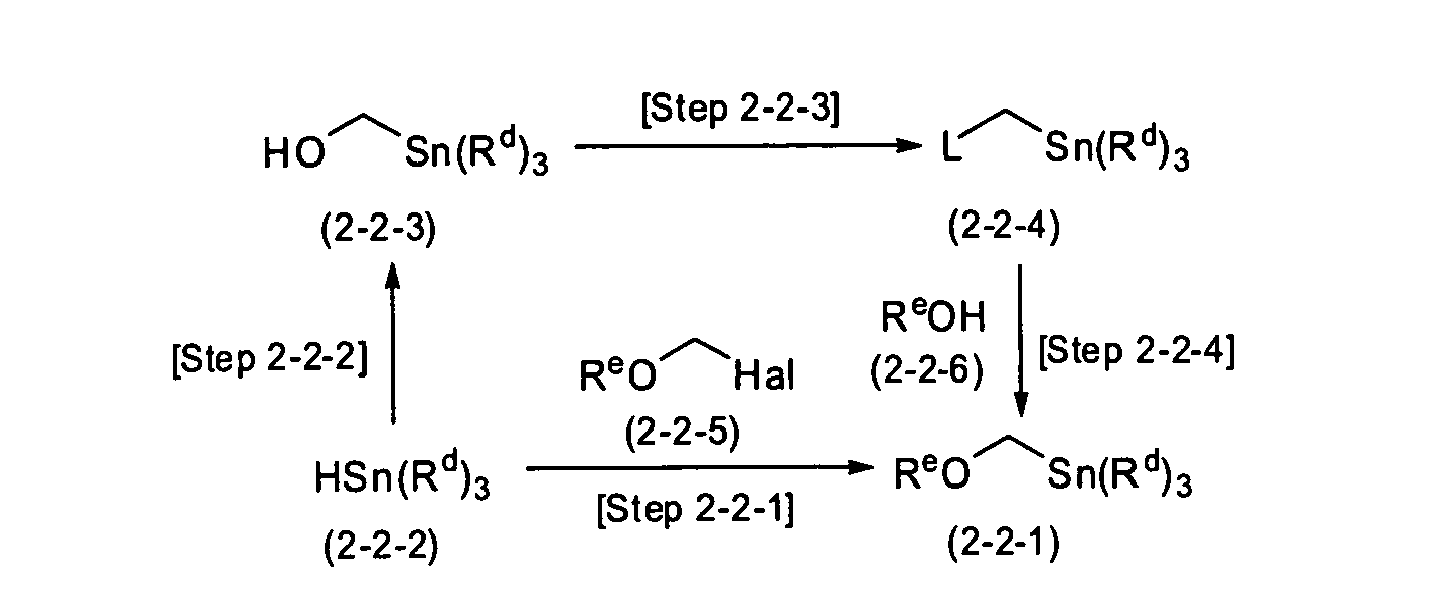
- Commercially available products can be used as is for compound (2-2-2), compound (2-2-5) and compound (2-2-6), or they can be produced from commercially available products using the known methods.
- This step is a step for obtaining compound (2-2-1) by reacting compound (2-2-2) and compound (2-2-5). Compound (2-2-1) can be obtained by extracting a hydrogen atom of compound (2-2-2) with a strong base such as lithium diisopropylamine or the like in a solvent such as tetrahydrofuran or the like and then reacting with compound (2-2-5). A compound such as chloromethyl ethyl ether, chloromethyl benzyl ether or the like can be used for compound (2-2-5). 1 to 2 equivalents of strong base are used with respect to compound (2-2-2). 1 to 2 equivalents of compound (2-2-5) are used with respect to compound (2-2-2). The reaction temperature is from -78°C to the reflux temperature and the reaction time is from 1 to 24 hours.
- This step is a step for obtaining compound (2-2-3) by reacting compound (2-2-2) and a formaldehyde equivalent. Compound (2-2-3) can be obtained by extracting a hydrogen atom of compound (2-2-2) with a base such as lithium diisopropylamide or the like in a solvent such as tetrahydrofuran or the like and then reacting with paraformaldehyde. 1 to 2 equivalents of strong base are used with respect to compound (2-2-2). 1 to 2 equivalents of formaldehyde equivalent are used with respect to compound (2-2-2). The reaction temperature is from -78°C to the reflux temperature and the reaction time is from 1 to 24 hours.
- This step is a step for obtaining compound (2-2-4) by converting the hydroxyl group of compound (2-2-3) to a leaving group.
- In the case L is a methanesulfonyloxy group, p-toluenesulfonyloxy group or the like, compound (2-2-4) can be obtained by reacting compound (2-2-3) with sulfonyl halide such as methanesulfonyl chloride, p-toluenesulfonyl chloride or the like in a solvent such as dichloromethane or the like and in the presence of an organic base such as triethylamine or the like. 1 to 3 equivalents of the organic base are used with respect to compound (2-2-3). 1 to 2 equivalents of sulfonyl halide are used with respect to compound (2-2-3). The reaction temperature is from 0°C to the reflux temperature and the reaction time is from 10 minutes to 24 hours.
- In the case L is a bromine atom or an iodine atom, compound (2-2-4) can be obtained by allowing a halogenation agent such as carbon tetrabromide, N-bromosuccinimide, N-iodosuccinimide or the like to act on compound (2-2-3) in a solvent such as dichloromethane or the like and in the presence of triphenylphosphine. 1 to 2 equivalents of triphenylphoshine are used with respect to compound (2-2-3). 1 to 2 equivalents of halogenation agent are used with respect to compound (2-2-3). The reaction temperature is from 0°C to room temperature and the reaction time is from 10 minutes to 24 hours.
- This step is a step for obtaining compound (2-2-1) by reacting compound (2-2-4) and compound (2-2-6). Compound (2-2-1) can be obtained by extracting a hydrogen atom of compound (2-2-6) by using a base such as sodium hydride or the like in a solvent such as N,N-dimethylformamide or the like and then reacting with compound (2-2-4). 1 to 10 equivalents of compound (2-2-6) are used with respect to compound (2-2-4). 1 to 10 equivalents of base are used with respect to compound (2-2-4). The reaction temperature is from 0°C to the reflux temperature and the reaction time is from 10 minutes to 24 hours.
- The compounds according to the present invention can be produced in accordance with, for example, the methods described in the following production examples and examples. However, these are only exemplary and are not intended under any circumstances to limit the compounds according to the present invention to any of the following specific examples thereof.
- To a dimethylsulfoxide (10 mL) solution of C-(6-benzyloxy-benzofuran-2-yl)-methylamine (300 mg, 1.18 mmol) described in Production Example 1-2-4 were added 2,6-diaminonicotinic acid (181 mg) described in Production Example 1-1-4, 1-hydroxybenzotriazole (319 mg, 2.36 mmol), triethylamine (329 µL, 2.36 mmol) and 1-ethyl-3-(3-dimethylaminopropyl)carbodiimide hydrochloride (452 mg, 2.36 mmol) at room temperature, which was stirred at room temperature for 26 hours. To the reaction solution was added water at room temperature followed by extracting with ethyl acetate. After washing the organic layer with water and sat. NaCl, the organic layer was dried over anhydrous magnesium sulfate and filtered. The filtrate was concentrated under a reduced pressure and the residue was purified by silica gel column chromatography (ethyl acetate) to obtain the title compound (227 mg, 60%) as a white solid.
1H-NMR spectrum (DMSO-d6) δ (ppm): 4.47 (2H, d, J=5.5 Hz), 5.13 (2H, s), 5.67 (1 H, d, J=8.6 Hz), 6.11 (2H, brs), 6.59 (1 H, s), 6.91 (1 H, dd, J=2.2 Hz, J=8.4 Hz), 6.97 (2H, brs), 7.23 (1 H, d, J=2.0 Hz), 7.32 (1 H, t, J=7.3 Hz), 7.39 (2H, t, J=7.3 Hz), 7.43 (1 H, d, J=8.4 Hz), 7.46 (2H, d, J=7.3 Hz), 7.68 (1 H, d, J=8.6 Hz), 8.34 (1 H, t, J=5.5 Hz). - The starting material in the form of 2,6-diaminonicotinic acid was synthesized according to the method described below.
- (1-Ethoxyformimidoyl)1-acetic acid ethyl ester hydrochloride (50 g, 0.26 mol) was suspended in an ammonia-ethanol solution (300 mL, room temperature, prepared by saturating ethanol with ammonia gas), which was stirred at room temperature for 4 hours. Following completion of the reaction, the precipitated salt was filtered out and the filtrate was concentrated under a reduced pressure to one-third the original volume at room temperature. To this filtrate was added hydrochloric acid-methanol (130 mL, hydrochloric acid content: 7.5%), followed by concentrating under a reduced pressure to obtain 3,3-diamino-acrylic acid ethyl ester hydrochloride (40 g, 0.24 mol, 92%) as a solid.
- The resulting 3,3-diamino-acrylic acid ethyl ester hydrochloride (2.2 g, 13.2 mmol) was suspended in tetrahydrofuran (40 mL) followed by the addition of triethylamine (2 mL, 14.3 mmol) and acrylonitrile (1.2 mL, 19.3 mmol) and refluxing while heating for 6 hours. Following completion of the reaction, the resulting triethylamine hydrochloride was filtered out and the filtrate was concentrated to obtain the title compound (0.6 g, 3.3 mmol, 25%).
1H-NMR spectrum (CDCl3) δ (ppm): 1.26 (3H, t, J=7.2 Hz), 2.42-2.49 (2H, m), 2.50-2.57 (2H, m), 4.12 (2H, q, J=7.2 Hz), 4.22 (2H, brs), 6.45 (2H, brs). - A tetrahydrofuran (7 mL) solution of 2-(2-cyanoethyl)3,3-diaminopropenoic acid ethyl ester (0.55 g, 3 mmol) described in Production Example 1-1-1 was dropped into a tetrahydrofuran (7 mL) suspension of sodium hydride (208 mg, 5.2 mmol, 60% in oil), which was refluxed while heating and stirring for 19 hours 20 minutes. Following completion of the reaction, the reaction mixture was poured into ice water and extracted with ethyl acetate. The organic layer was dried over anhydrous magnesium sulfate and then concentrated to obtain the title compound (0.188 g, 1 mmol, 34%) as a crude product.
1H-NMR spectrum (CDCl3) δ (ppm): 1.27 (3H, t, J=7.2 Hz), 2.28-2.34 (2H, m), 2.46-2.52 (2H, m), 4.14 (2H, q, J=7.2 Hz). - To a tetrahydrofuran (300 mL) solution of 2,6-diamino-4,5-dihydronicotinic acid ethyl ester (4.5 g, 24.6 mmol) described in Production Example 1-1-2 was added 2, 3-dichloro-5,6-dicyano-1,4-benzoquinone (5.6 g, 24.7 mmol), which was stirred at room temperature for 40 minutes. Next, the reaction mixture was concentrated and the resulting residue was purified by NH silica gel column chromatography (ethyl acetate) to obtain a target compound as a solid. This solid was washed with hexane and dried to obtain the title compound (3.1 g, 17.1 mmol, 69.5%).
1H-NMR spectrum (CDCl3) δ (ppm): 1.35 (3H, t, J=7.2 Hz), 4.27 (2H, q, J=7.2 Hz), 4.60 (2H, brs), 5.82 (1 H, d, J=6.4 Hz), 7.90 (1 H, d, J=8.4 Hz). - 2,6-diamino-nicotinic acid ethyl ester (2 g, 11 mmol) described in Production Example 1-1-3 was dissolved in ethanol (15 mL) followed by the addition of 1 N aqueous sodium hydroxide solution (15 mL) and stirring for 2 hours while heating under reflux. After allowing the reaction mixture to return to room temperature, the ethanol was distilled off under a reduced pressure and the residue was cooled with ice and neutralized with 1 N hydrochloric acid. After filtering the precipitated solid and washing with water, the solid was dried to obtain the title compound (1.72 g, 11 mmol, quantitative).
1H-NMR spectrum (DMSO-d6) δ (ppm): 5.70 (1 H, d, J=8.4 Hz), 6.31 (2H, brs), 6.58-7.12 (1 H, brs), 7.62 (1 H, d, J=8.4 Hz). - The starting material in the form of C-(6-benzyloxy-benzofuran-2-yl)-methylamine was synthesized according to the method described below.
- To a N,N-dimethylformamide (200 mL) solution of 4-benzyloxy-2-hydroxybenzaldehyde (18.6 g, 81.4 mmol) were added ethyl bromoacetate (9.94 mL, 89.6 mmol) and potassium carbonate (22.6 g, 163 mmol) at room temperature, which was stirred at 125°C for 3 hours. To the reaction mixture was added water at room temperature followed by extraction with ethyl acetate. After washing the organic layer with water and sat. NaCl, the organic layer was dried over anhydrous magnesium sulfate and filtered followed by concentrating the filtrate under a reduced pressure. The residue was purified by NH silica gel column chromatography (heptane:ethyl acetate = 7:3) to obtain the title compound (18.4 g, 76%) as a white solid.
1H-NMR spectrum (DMSO-d6) δ (ppm): 1.33 (3H, t, J=7.1 Hz), 4.34 (2H, q, J=7.1 Hz), 5.19 (2H, s), 7.07 (1 H, dd, J=2.2 Hz, J=8.6 Hz), 7.35 (1 H, t, J=7.1 Hz), 7.37-7.43 (3H, m), 7.49 (2H, d, J=7.0 Hz), 7.67-7.69 (2H, m). - To a tetrahydrofuran (370 mL) solution of 6-benzyloxy-benzofuran-2-carboxylic acid ethyl ester (18.4 g, 62.1 mmol) described in Production Example 1-2-1 was added lithium aluminum hydride (7.07 g, 186 mmol) at 0°C, which was stirred at room temperature for 4 hours. To the reaction mixture were added water (7.07 mL), 5 N aqueous sodium hydroxide solution (7.07 mL) and water (21.2 mL) at 0°C. After filtering the mixture through Celite, the filtrate was concentrated under a reduced pressure. The residue was purified by silica gel column chromatography (heptane:ethyl acetate = 1:1) to obtain the title compound (14.2 g, 90%) as a white solid.
1H-NMR spectrum (DMSO-d6) δ (ppm): 4.51 (2H, d, J=5.1 Hz), 5.14 (2H, s), 5.39 (1 H, t, J=5.3 Hz), 6.65 (1 H, s), 6.92 (1 H, d, J=8.6 Hz), 7.23 (1 H, s), 7.31-7.48 (6H, m). - To a tetrahydrofuran (300 mL) solution of (6-benzyloxy-benzofuran-2-yl)-methanol (14.2 g, 55.8 mmol) described in Production Example 1-2-2 were added phthalimide (9.03 g, 61.4 mmol), triphenylphosphine (17.6 g, 67 mmol) and diethylazodicarboxylate (29.2 g, 67 mmol) at 0°C, which was stirred at room temperature for 7 hours 30 minutes . To the reaction mixture was added water at room temperature followed by extraction with ethyl acetate. After washing the organic layer with water and sat. NaCl, the organic layer was dried over anhydrous magnesium sulfate and filtered. The filtrate was concentrated under a reduced pressure and the residue was purified by NH silica gel column chromatography (heptane:ethyl acetate = 3:1) to obtain a mixture of the title compound and a by-product (14.3 g) as a white solid. This was then used in the next reaction without additional purification.
- To a mixed ethanol (50 mL) and tetrahydrofuran (50 mL) solution of 2-(6-benzyloxy-benzofuran-2-ylmethyl)- isoindole-1-dione (5.60 g, 14.6 mmol) described in Production Example 1-2-3 was added hydrazine hydrate (7.08 mL, 146 mmol) at room temperature, which was stirred for 1 hour while heating under reflux. To the reaction solution was added water was added at room temperature followed by extracting with ethyl acetate. After washing the organic layer with sat. NaCl, the organic layer was dried over anhydrous magnesium sulfate and filtered. The filtrate was concentrated under a reduced pressure and the residue was purified by NH silica gel column chromatography (ethyl acetate) to obtain the title compound (1.83 g, 50%) as a pale yellow oil.
1H-NMR spectrum (DMSO-d6) δ (ppm): 3.76 (2H, s), 5.12 (2H, s), 6.55 (1 H, s), 6.89 (1 H, dd, J=2.0 Hz, 8.4 Hz), 7.18 (1 H, s), 7.31 (1 H, t, J=6.8 Hz), 7.36-7.46 (5H, m). - To a tetrahydrofuran (2 mL) solution of 2,6-diamino-N-(6-hydroxy-benzofuran-2-ylmethyl)-nicotinamide (101 mg, 339 µmol) described in Production Example 2-1 was added 5 N aqueous sodium hydroxide solution (68 µL, 339 µmol) at room temperature. The reaction solution was concentrated under a reduced pressure to obtain a sodium salt of 2,6-diamino-N-(6-hydroxy-benzofuran-2-ylmethyl)-nicotinamide (130 mg). To an N,N-dimethylformamide (500 µL) solution of the resulting sodium salt (4 mg, 13 µmol) was added bromoethane (2.85 mg, 26.2 µmol) at room temperature, which was stirred at room temperature for 2 hours. After filtering the reaction solution, the filtrate was purified by reverse phase high-performance liquid chromatography (using an acetonitrile-aqueous mobile phase (containing 0.1 % trifluoroacetic acid)) to obtain the title compound (2.6 mg, 61 %) as a trifluoroacetatic acid salt.
MS m/e (ESI): 327.15 (MH+) - The starting material in the form of 2,6-diamino-N-(6-hydroxy-benzofuran-2-ylmethyl)-nicotinamide was synthesized according to the method described below.
- To a trifluoroacetic acid (5 mL) solution of 2,6-diamino-N-(6-benzyloxy-benzofuran-2-ylmethyl)-nicotinamide (238 mg, 612 µmol) described in Example 1 was added thioanisole (287 µL, 2.45 mmol) at 0°C, which was stirred at room temperature for 2 hours. To the reaction solution were added sodium bicarbonate and water at 0°C, followed by extraction with ethyl acetate. After washing the organic layer with sat. NaCl, the organic layer was dried over anhydrous magnesium sulfate and filtered. The filtrate was concentrated under a reduced pressure and the residue was purified by NH silica gel column chromatography (ethyl acetate:methanol = 10:1) to obtain the title compound (101 mg, 55%) as a pale brown solid.
1H-NMR spectrum (DMSO-d6) δ (ppm): 4.43 (2H, d, J=5.7 Hz), 5.65 (1 H, d, J=8.6 Hz), 6.08 (2H, brs), 6.50 (1 H, s), 6.67 (1 H, dd, J=2.4 Hz, 8.4 Hz), 6.84 (1 H, s), 6.95 (2H, brs), 7.29 (1 H, d, J=8.4 Hz), 7.66 (1 H, d, J=8.6 Hz), 8.30 (1 H, t, J=5.7 Hz), 9.45 (1 H, s). - To an N,N-dimethylformamide (8 mL) solution of a sodium salt of 2,6-diamino-N-(6-hydroxy-benzofuran-2-ylmethyl)-nicotinamide (400 mg, 1.25 mmol) obtained in the same manner as Example 2 was added cyclopropylmethyl bromide (364 µL, 3.75 mmol) at room temperature, which was stirred at room temperature for 20 hours. To the reaction solution was added water at room temperature followed by extraction with ethyl acetate. After washing the organic layer with water and sat. NaCl, the organic layer was dried over anhydrous magnesium sulfate and filtered. The filtrate was concentrated under a reduced pressure and the residue was purified by NH silica gel column chromatography (ethyl acetate) to obtain the title compound (99 mg, 23%) as a white solid.
MS m/e (ESI): 353.25 (MH+)
1H-NMR spectrum (DMSO-d6) δ (ppm): 0.019 (2H, dt, J=4.9 Hz, 10.1 Hz), 0.27 (2H, dt, J=4.8 Hz, 12.6 Hz), 0.90-0.94 (1 H, m), 3.52 (2H, d, J=7.1 Hz), 4.17 (2H, d, J=5.5 Hz), 5.37 (1 H, d, J=8.6 Hz), 5.81 (2H, brs), 6.27 (1 H, s), 6.53 (1 H, dd, J=2.4 Hz, 8.6 Hz), 6.67 (2H, brs), 6.80 (1 H, s), 7.10 (1 H, d, J=8.4 Hz), 7.38 (1 H, d, J=8.2 Hz), 8.04 (1 H, t, J=5.7 Hz). - To a N,N-dimethylformamide (8 mL) solution of C-(6-benzyloxy-benzofuran-2-yl)-methylamine (400 mg, 1.58 mmol) described in Production Example 1-2-4 were added 2-amino-6-methoxymethyl-nicotinic acid (316 mg, 1.74 mmol) described in Production Example 4-1-5, triethylamine (660 µL, 4.74 mmol) and benzotriazol-1-yloxytris(dimethylamino)phosphonium hexafluorophosphate (908 mg, 2.05 mmol) at room temperature, which was stirred at room temperature for 2 hours 30 minutes. To the reaction solution was added water at room temperature followed by extraction with ethyl acetate. After washing the organic layer with water and sat. NaCl, the organic layer was dried over anhydrous magnesium sulfate and filtered. The filtrate was concentrated under a reduced pressure and purified by silica gel column chromatography (heptane:ethyl acetate = 1:2) to obtain the title compound (454 mg, 69%) as a white solid.
1H-NMR spectrum (DMSO-d6) δ (ppm): 3.32 (3H, s), 4.28 (2H, s), 4.52 (2H, d, J=5.3 Hz), 5.11 (2H, s), 6.59 (1 H, d, J=7.9 Hz), 6.64 (1 H, s), 6.90 (1 H, dd, J=2.4 Hz, 8.6 Hz), 7.13 (2H, s), 7.22 (1 H, d, J=1.8 Hz), 7.31 (1 H, d, J=7.3 Hz), 7.37 (2H, t, J=7.7 Hz), 7.44 (3H, t, J=8.4 Hz), 7.97 (1 H, d, J=7.9 Hz), 8.96 (1 H, t, J=5.3 Hz). - The starting material in the form of 2-amino-6-methoxymethyl-nicotinic acid was synthesized according to the method described below.
- 2,6-Dichloronicotinic acid (0.38 g, 2 mmol) and copper (I) iodide (720 mg, 3.8 mmol) were added to liquid ammonia (approx. 20 mL) in a sealed tube at -78°C, which was heated for 25 hours (oil bath temperature: 115°C). The oil bath temperature was raised to 125°C followed by additionally heating for 14 hours 30 minutes. The reaction mixture was allowed to return to room temperature followed by distilling off the ammonia. The insoluble material that precipitated following addition of methanol was filtered out and the filtrate was concentrated to obtain the title compound (0.25 g, 1.45 mmol, 72%) as a solid.
1H-NMR spectrum (DMSO-d6) δ (ppm): 6.63 (1 H, d, J=8.0 Hz), 7.55 (2H, brs), 8.02 (1H, d, J=8.0 Hz). - To a mixture of 2,6-dichloronicotinic acid (40 g (purity: 90%), 0.19 mol), acetoamide (80 g, 1.4 mol), potassium carbonate (78 g, 0.56 mol), copper (I) chloride (0.93 g, 9.4 mmol) and xylene (80 mL) was added tris(2-(2-methoxyethoxy)ethyl)amine (3.0 mL, 9.4 mmol), which was stirred overnight at 145°C. After allowing to cool on standing, to the reaction mixture was added copper (I) chloride (0.46 g, 4.6 mmol), followed by stirring overnight at 145°C. After cooling the reaction mixture to 105°C, water (100 mL) was added followed by stirring for 1 hour at the same temperature and allowing to cool to room temperature on standing. After neutralizing the reaction mixture with 5 N hydrochloric acid (150 mL) and aqueous citric acid, ethyl acetate was added. This mixture was filtered through Celite. After separating the organic phase and washing with sat. NaCl, the solvent was concentrated under a reduced pressure. The residue was purified by silica gel column chromatography (ethyl acetate) and recrystallized from an ethyl acetate-hexane system to obtain the title compound (1.4 g, 8.3 mmol, 4.5%) as white crystals.
1H-NMR spectrum (DMSO-d6) δ (ppm): 6.61 (H1, d, J=8.1 Hz), 7.53 (2H, brs), 8.01 (1 H, d, J=8.1 Hz). - Concentrated sulfuric acid (25 mL) and 2-amino-6-chloro-nicotinic acid (4.3 g, 25 mmol) described in Production Example 4-1-1A (or 4-1-1B) were added to methanol (50 mL) while cooling with ice followed by stirring for 5 hours at 70°C. After allowing to cool on standing, the reaction mixture was neutralized with sodium bicarbonate (90 g). The resulting solid was filtered to obtain the title compound (3.2 g, 17 mmol, 68%) as a pale brown solid.
1H-NMR spectrum (CDCl3) δ (ppm): 3.88 (3H, s), 6.62 (1 H, d J=8.2 Hz), 8.05 (1 H, d, J=8.1 Hz). - n-Butyl lithium (2.4 M, n-hexane solution, 25 mL, 61 mmol) was dropped into a mixture of diisopropylamine (9.4 mL, 67 mmol) and tetrahydrofuran (150 mL) at -78°C followed by stirring for 30 minutes at the same temperature. Tributyl tin hydride (16 mL, 61 mmol) was dropped in at the same temperature followed by stirring for 30 minutes while cooling with ice. The reaction mixture was brought to a temperature of -78°C followed by dropping in chloromethyl methyl ether (4.6 mL, 61 mmol) and gradually warming to room temperature. Water (100 mL) was added to the reaction mixture followed by extraction with diethyl ether (300 mL). After washing the organic layer with sat. NaCl, the organic layer was distilled under a reduced pressure. The residue was purified by neutral silica gel column chromatography (heptane/ethyl acetate = 30/1) to obtain the title compound (18 g, 0.52 mmol, 86%) as a colorless oil.
1H-NMR spectrum (CDCl3) δ (ppm): 0.88-0.93 (15H, m), 1.26-1.35 (6H, m), 1.47-1.55 (6H, m), 3.30 (3H, s), 3.71 (2H, t, J=6.8 Hz). - A mixture of 2-amino-6-chloro-nicotinic acid methyl ester (1.4 g, 7.6 mmol) described in Production Example 4-1-2, tributyl methoxymethyl stannane (3.1 g, 9.1 mmol) described in Production Example 4-1-3, tetrakis(triphenylphosphine) palladium (440 mg, 0.38 mmol) and N-methylpyrrolidinone (20 mL) was stirred for 3.5 hours at 130°C. The reaction mixture was allowed to cool on standing followed by the addition of aqueous potassium fluoride solution while cooling with ice and filtering through Celite. After washing the organic layer with sat. NaCl, the organic layer was distilled under a reduced pressure. The residue was purified by silica gel column chromatography (heptane/ethyl acetate = 2/1) to obtain the title compound (0.93 g, 4.7 mmol, 63%) as a pale brown oil.
1H-NMR spectrum (CDCl3) δ (ppm): 3.47 (3H, s), 3.88 (3H, s), 4.41 (2H, s), 6.74 (1H, d, J=7.9 Hz), 8.14 (1 H, d, J=7.9 Hz). - To a mixture of 2-amino-6-methoxymethyl-nicotinic acid methyl ester (2.9 g, 15 mmol) described in Production Example 4-1-4, tetrahydrofuran (30 mL), methanol (7.5 mL) and water (7.5 ml) was added sodium hydroxide monohydrate (1.2 g, 29 mmol), which was stirred overnight at room temperature. To the reaction mixture was added acetic acid (1.7 mL, 29 mmol), followed by distilling off the solvent under a reduced pressure. The residue was dissolved in methanol/ethyl acetate (1/3) and filtered using silica gel. The filtrate was collected, concentrated under a reduced pressure and the residue was washed with water to obtain the title compound (2.1 g, 12 mmol, 80%) as a pale yellow solid.
1H-NMR spectrum (DMSO-d6) δ (ppm): 3.32 (3H, s), 4.29 (2H, s), 6.61 (1 H, d, J=7.9 Hz), 7.16 (2H, brs), 8.02 (1 H, d, J=7.9 Hz). - To a tetrahydrofuran (7 ml) solution of 2-amino-N-(6-hydroxy-benzofuran-2-ylmethyl)-6-methoxymethyl-nicotinamide (331 mg, 1.01 mmol) described in Production Example 5-1 was added 5 N aqueous sodium hydroxide solution (202 µL, 1.01 mmol) at room temperature. The reaction solution was concentrated under a reduced pressure to obtain 2-amino-N-(6-hydroxy-benzofuran-2-ylmethyl)-6-methoxymethyl-nicotinamide (416 mg). To an N,N-dimethylformamide (1 mL) solution of the resulting sodium salt (30 mg, 86 µmol) was added allyl bromide (29.7 µL, 344 µmol), followed by stirring for 23 hours at room temperature. Water was added to the reaction solution at room temperature followed by extraction with ethyl acetate. The organic layer was washed with water and sat. NaCl followed by drying over anhydrous magnesium sulfate and filtering. The filtrate was concentrated under a reduced pressure and the residue was purified by NH silica gel column chromatography (heptane:ethyl acetate = 1:2) to obtain the title compound (17 mg, 54%) as a white solid.
MS m/e (ESI): 368.28 (MH+)
1H-NMR spectrum (DMSO-d6) δ (ppm): 3.40 (3H, s), 4.30 (2H, s), 4.55 (2H, d, J=5.5 Hz), 4.59 (2H, d, J=5.3 Hz), 5.26 (1 H, d, J=10.4 Hz), 5.41 (1 H, dd, J=1.7 Hz, 17.2 Hz), 6.00-6.11 (1 H, m), 6.62 (1 H, d, J=7.7 Hz), 6.66 (1 H, s), 6.87 (1 H, dd, J=2.2 Hz, 8.4 Hz), 7.16 (2H, s), 7.17 (1 H, s), 7.44 (1 H, d, J=8.4 Hz), 8.00 (1 H, d, J=7.9 Hz), 8.99 (1H, t, J=5.5 Hz). - The starting material in the form of 2-amino-N-(6-hydroxy-benzofuran-2-ylmethyl)-6-methoxymethyl-nicotinamide was synthesized according to the method described below.
- To a trifluoroacetic acid (11 mL) solution of 2-amino-N-(6-benzyloxy-benzofuran-2-ylmethyl)-6- methoxymethyl-nicotinamide (557 mg, 1.33 mmol) described in Example 4 was added thioanisole (626 µL, 5.35 mmol) at 0°C, which was stirred at 0°C for 3 hours. To the reaction solution were added sodium bicarbonate and water at 0°C followed by extraction with ethyl acetate and tetrahydrofuran. The organic layer was washed with sat. NaCl followed by drying over anhydrous magnesium sulfate and filtering. The filtrate was concentrated under a reduced pressure and the residue was purified by NH silica gel column chromatography (ethyl acetate:methanol = 10:1) to obtain the title compound (331 mg, 76%) as a white solid.
1H-NMR spectrum (DMSO-d6) δ (ppm): 3.32 (3H, s), 4.27 (2H, s), 4.49 (2H, d, J=4.8 Hz), 6.57 (1 H, s), 6.59 (1 H, d, J=8.2 Hz), 6.67 (1 H, dd, J=2.0 Hz, 8.4 Hz), 6.84 (1 H, s), 7.12 (2H, brs), 7.30 (1 H, d, J=8.4 Hz), 7.97 (1 H, d, J=7.9 Hz), 8.93 (1 H, t, J=5.3 Hz), 9.45 (1H, s). - To a tetrahydrofuran (7 mL) solution of 2-amino-N-(6-hydroxy-benzofuran-2-ylmethyl)- 6-methoxymethyl-nicotinamide (331 mg, 1.01 mmol) described in Production Example 5-1 was added 5 N aqueous sodium hydroxide solution (202 µL, 1.01 mmol) at room temperature. The reaction solution was concentrated under a reduced pressure to obtain 2-amino-N-(6-hydroxy-benzofuran-2-ylmethyl)- 6-methoxymethyl-nicotinamide (416 mg). To an N,N-dimethylformamide (1 mL) solution of the resulting sodium salt (30 mg, 86 µmol) was added cyclopropylmethyl bromide (33.3 µL, 343 µmol) at room temperature, which was stirred at room temperature for 17.5 hours. Water was added to the reaction solution at room temperature followed by extracting with ethyl acetate. The organic layer was washed with water and sat. NaCl, followed by drying over anhydrous magnesium sulfate and filtering. The filtrate was concentrated under a reduced pressure and the residue was purified by NH silica gel column chromatography (heptane:ethyl acetate = 1:2) to obtain the title compound (19 mg, 58%) as a white solid.
MS m/e (ESI): 382.27 (MH+)
1H-NMR spectrum (DMSO-d6) δ (ppm): 0.02 (2H, dt, J=5.2 Hz, 10.4 Hz), 0.27 (2H, dt, J=6.0 Hz, 12.0 Hz), 0.91-0.96 (1 H, m), 3.04 (3H, s), 3.53 (2H, d, J=7.1 Hz), 3.99 (2H, s), 4.24 (2H, d, J=5.3 Hz), 6.31 (1 H, d, J=7.9 Hz), 6.34 (1 H, s), 6.54 (1 H, dd, J=1.5 Hz, 8.6 Hz), 6.82 (1 H, s), 6.85 (2H, s), 7.12 (1 H, d, J=8.8 Hz), 7.69 (1 H, d, J=8.1 Hz), 8.68 (1 H, t, J=5.2 Hz). - To a N,N-dimethylformamide (5 mL) solution of C-(5-benzyloxy-benzofuran-2-yl)-methylamine (135 mg, 533 µmol) described in Production Example 7-1-6 were added 2-amino-6-methoxymethyl-nicotinic acid (107 mg, 586 µmol) described in Production Example 4-1-5, triethylamine (223 µL, 1.60 mmol) and benzotriazol-1-yloxytris(dimethylamino)phosphonium hexafluorophosphate (306 mg, 693 µmol) at room temperature, which was stirred at room temperature for 27 hours. Water was added to the reaction solution at room temperature followed by extracting with ethyl acetate. The organic layer was washed with water and sat. NaCl followed by drying over anhydrous magnesium sulfate and filtering. The filtrate was concentrated under a reduced pressure and the residue was purified by silica gel column chromatography (heptane:ethyl acetate = 1:5) to obtain the title compound (166 mg, 75%) as a white solid.
1H-NMR spectrum (DMSO-d6) δ (ppm): 3.35 (3H, s), 4.03 (2H, s), 4.56 (2H, d, J=5.3 Hz), 5.11 (2H, s), 6.62 (1 H, d, J=8.2 Hz), 6.67 (1 H, s), 6.93 (1 H, dd, J=2.6 Hz, 9.0 Hz), 7.15 (2H, brs), 7.19 (1 H, d, J=2.6 Hz), 7.32 (1 H, t, J=7.1 Hz), 7.39 (2H, t, J=7.1 Hz), 7.43-7.47 (3H, m), 8.00 (1 H, d, J=7.9 Hz), 9.01 (1 H, t, J=5.5 Hz). - The starting material in the form of C-(5-benzyloxy-benzofuran-2-yl)-methylamine was synthesized according to the method described below.
- To an N,N-dimethylformamide (100 mL) solution of 2,5-dihydroxybenzaldehyde (10.0 g, 72.4 mmol) were added sodium hydride (5.79 g, 145 mmol) and benzyl bromide (18.9 mL, 159 mmol) at 0°C, which was stirred at room temperature for 24 hours. Water was added to the reaction solution at 0°C followed by extraction with ethyl acetate. The organic layer was washed with water and sat. NaCl, followed by drying over anhydrous magnesium sulfate and filtering. The filtrate was concentrated under a reduced pressure and the residue was purified by silica gel column chromatography (heptane:ethyl acetate = 4:1) to obtain the title compound (17.6 g, 76%) as a white solid.
1H-NMR spectrum (DMSO-d6) δ (ppm): 5.11 (2H, s), 5.24 (2H, s), 7.27-7.50 (13H, m), 10.38 (1 H, s). - To a mixed suspension of magnesium (305 mg, 12.6 mmol) in diethyl ether (7.5 mL) and toluene (7.5 mL) was added bromine (354 µL, 6.91 mmol) at 0°C, which was stirred at room temperature for 5 minutes under nitrogen atmosphere and was refluxed while heating for 5 minutes. After the reaction mixture was cooled to room temperature, a toluene (20 mL) solution of 2,5-bis-benzyloxy-benzaldehyde (2.00 g, 6.28 mmol) described in Production Example 7-1-1 were added followed by stirring at room temperature for 24 hours under nitrogen atmosphere. Moreover, after stirring for 6 hours while refluxing while heating, the reaction mixture was cooled to room temperature. The precipitated solid was filtered out and washed with toluene. 1 N aqueous hydrochloric acid solution (20 mL) was added to the filtered solid followed by stirring for 1 hour while refluxing and heating. The reaction solution was allowed to cool to room temperature followed by extraction with ethyl acetate. The organic layer was washed with sat. NaCl followed by drying over anhydrous magnesium sulfate and filtering. The filtrate was concentrated under a reduced pressure and the residue was purified by silica gel column chromatography (heptane:ethyl acetate = 1:1) to obtain the title compound (830 mg, 58%) as a pale yellow solid.
1H-NMR spectrum (CDCl3) δ (ppm): 5.07 (2H, s), 6.94 (1 H, d, J=9.0 Hz), 7.08 (1 H, d, J=2.9 Hz), 7.22 (1 H, dd, J=3.1 Hz, 9.0 Hz), 7.33-7.44 (5H, m), 9.84 (1 H, s), 10.67 (1 H, s). - To a N,N-dimethylformamide (10 mL) solution of 5-benzyloxy-2-hydroxy-benzaldehyde (830 mg, 3.64 mmol) described in Production Example 7-1-2 were added bromoethyl acetate (446 µL, 4.00 mmol) and potassium carbonate (1.01 g, 7.28 mmol) at room temperature, which was stirred at 120°C for 8 hours. Water was added to the reaction solution at 0°C followed by extraction with ethyl acetate. The organic layer was washed with water and sat. NaCl followed by drying over anhydrous magnesium sulfate and filtering. The filtrate was concentrated under a reduced pressure and the residue was purified by NH silica gel column chromatography (heptane:ethyl acetate = 2:1) to obtain the title compound (890 mg, 83%) as a pale yellow oil.
1H-NMR spectrum (DMSO-d6) δ (ppm): 1.33 (3H, t, J=7.1 Hz), 4.35 (2H, q, J=7.1 Hz), 5.15 (2H, s), 7.21 (1 H, dd, J=2.6 Hz, 9.0 Hz), 7.32-7.42 (4H, m), 7.48 (2H, d, J=7.0 Hz), 7.66 (1 H, d, J=9.3 Hz), 7.68 (1 H, s). - To a tetrahydrofuran (20 mL) solution of 5-benzyloxy-benzofuran-2-carboxylic acid ethyl ester (890 mg, 3.00 mmol) described in Production Example 7-1-3 was added lithium aluminum hydride (342 mg, 9.00 mmol) at 0°C, which was stirred at room temperature for 3 hours. To the reaction solution were added water (342 µL), 5 N aqueous sodium hydroxide solution (342 µL) and water (1.03 mL) at 0°C followed by filtering through Celite. The filtrate was concentrated under a reduced pressure and the residue was purified by silica gel column chromatography (heptane:ethyl acetate = 3:1) to obtain the title compound (561 mg, 74%) as a white solid.
1H-NMR spectrum (DMSO-d6) δ (ppm): 4.53 (2H, d, J=5.5 Hz), 5.11 (2H, s), 5.44 (1 H, t, J=5.7 Hz), 6.67 (1 H, s), 6.93 (1 H, dd, J=2.4 Hz, 8.8 Hz), 7.20 (1 H, d, J=2.2 Hz), 7.33 (1 H, t, J=7.1 Hz), 7.38-7.47 (5H, m). - To a tetrahydrofuran (10 mL) solution of (5-benzyloxy-benzofuran-2-yl)-methanol (561 mg, 2.21 mmol) described in Production Example 7-1-4 were added phthalimide (358 mg, 2.43 mmol), triphenylphosphine (696 mg, 2.65 mmol) and diethylazodicarboxylate (1.21 mL, 2.65 mmol) at 0°C, which was stirred at room temperature for 9 hours. Water was added to the reaction solution at room temperature followed by extraction with ethyl acetate. The organic layer was washed with sat. NaCl followed by drying over anhydrous magnesium sulfate and filtering. The filtrate was concentrated under a reduced pressure and the residue was purified by NH silica gel column chromatography (heptane:ethyl acetate = 7:3) to obtain the title compound (635 mg, 75%) as a white solid.
1H-NMR spectrum (DMSO-d6) δ (ppm): 4.92 (2H, s), 5.10 (2H, s), 6.81 (1 H, s), 6.93 (1 H, dd, J=2.4 Hz, 9.0 Hz), 7.17 (1 H, d, J=2.4 Hz), 7.31 (1 H, t, J=7.0 Hz), 7.36-7.46 (5H, m), 7.83-7.94 (4H, m). - To a mixed solution of 2-(5-benzyloxy-benzofuran-2-ylmethyl)-indole-1,3-dione (635 mg, 1.66 mmol) described in Production Example 7-1-5 in ethanol (6 mL) and tetrahydrofuran (6 mL) was added hydrazine hydrate (805 µL, 16.6 mmol) at room temperature, which was stirred for 1 hour while refluxing and heating. Water was added to the reaction solution at room temperature followed by extraction with ethyl acetate. The organic layer was washed with sat. NaCl followed by drying over anhydrous magnesium sulfate and filtering. The filtrate was concentrated under a reduced pressure and the residue was purified by NH silica gel column chromatography (ethyl acetate) to obtain the title compound (337 mg, 80%) as a white solid.
1H-NMR spectrum (DMSO-d6) δ (ppm): 3.78 (2H, s), 5.11 (2H, s), 6.60 (1 H, s), 6.89 (1 H, dd, J=2.6 Hz, 8.6 Hz), 7.17 (1 H, d, J=2.6 Hz), 7.33 (1 H, t, J=7.0 Hz), 7.38-7.41 (3H, m), 7.46 (2H, d, J=8.1 Hz). - The title compound was obtained from C-(6-but-2-ynyloxy-benzofuran-2-yl)-methylamine described in Production Example 8-1-3 according the same method as Example 1.
1H-NMR spectrum (DMSO-d6) δ (ppm): 1.81 (3H, s), 4.46 (2H, d, J=5.6 Hz), 4.74 (2H, d, J=1.8 Hz), 5.65 (1 H, d, J=8.4 Hz), 6.09 (2H, brs), 6.58 (1 H, s), 6.83 (1 H, dd, J=1.5 Hz, 8.6 Hz), 6.95 (2H, brs), 7.16 (1 H, s), 7.42 (1 H, d, J=8.4 Hz), 7.66 (1 H, d, J=8.6 Hz), 8.33 (1 H, t, J=5.7 Hz). - The starting material in the form C-(6-but-2-ynyloxy-benzofuran-2-yl)-methylamine was synthesized according to the method described below.
- To a mixed solution of 6-hydroxy-benzofuran-2-carboxylic acid ethyl ester (250 mg, 1.21 mmol) in tetrahydrofuran (5 mL) and N,N-dimethylformamide (5 mL) were added sodium hydride (58 mg, 2.42 mmol) and 1-bromo-2-butyne (127 µL) at room temperature, which was stirred at room temperature for 1 hour. Water was added to the reaction solution followed by extraction with ethyl acetate. The organic layer was washed with water and sat. NaCl followed by drying over anhydrous magnesium sulfate and filtering. The filtrate was concentrated under a reduced pressure and the residue was purified by silica gel column chromatography (heptane:ethyl acetate = 5:1) to obtain the title compound (254 mg, 81%) as a white solid.
1H-NMR spectrum (CDCl3) δ (ppm): 1.42 (3H, t, J=7.2 Hz), 1.87 (3H, s), 4.43 (2H, q, J=7.2 Hz), 4.70 (2H, s), 6.97 (1 H, dd, J=1.6 Hz, 8.4 Hz), 7.20 (1 H, s), 7.46 (1 H, s), 7.53 (1 H, d, J=8.4 Hz). - The title compound (198 mg, 93%) was obtained as a white solid from 6-but-2-ynyloxy-benzofuran-2-carboxylic acid ethyl ester (254 mg, 983 µmol) described in Production Example 8-1-1 according to the same method as Production Example 7-1-4.
1H-NMR spectrum (CDCl3) δ (ppm): 1.85 (1H, t, J=6.2 Hz), 1.87 (3H, t, J=2.2 Hz), 4.69 (2H, q, J=2.2 Hz), 4.74 (2H, d, J=6.2 Hz), 6.60 (1 H, s), 6.91 (1 H, dd, J=2.4 Hz, 8.6 Hz), 7.11 (1 H, d, J=1.8 Hz), 7.42 (1 H, d, J=8.6 Hz) - 2-(6-But-2-ynyloxy-benzofuran-2-ylmethyl)-isoindole-1,3-dione was obtained as a crude product (214 mg) from (6-but-2-ynyloxy-benzofuran-2-yl)- methanol (198 mg, 916 µmol) described in Production Example 8-1-2 according to the same method as Production Example 7-1-5. Then, the title compound (120 mg) was obtained as a pale yellow oil from the crude 2-(6-but-2-ynyloxy-benzofuran-2-ylmethyl)-isoindole-1,3- dione (214 mg) according to the same method as Production Example 7-1-6.
- The title compound was obtained from a sodium salt of 2,6-diamino-N-(6-hydroxy-benzofuran-2-ylmethyl)-nicotinamide according to the same method as Example 3.
MS m/e (ESI): 339.25 (MH+)
1H-NMR spectrum (DMSO-d6) δ (ppm): 4.45 (2H, d, J=5.5 Hz), 4.56 (2H, d, J=5.1 Hz), 5.24 (1 H, d, J=10.6 Hz), 5.39 (1 H, dd, J=1.8 Hz, 17.4 Hz), 5.65 (1 H, d, J=8.6 Hz), 5.98-6.07 (1 H, m), 6.09 (2H, brs), 6.56 (1 H, s), 6.83 (1 H, dd, J=2.4 Hz, 8.6 Hz), 6.95 (2H, brs), 7.13 (1 H, d, J=1.8 Hz), 7.40 (1 H, d, J=8.6 Hz), 7.65 (1 H, d, J=8.6 Hz), 8.32 (1 H, t, J=5.6 Hz). - The title compounds of Examples 10 to 23 were obtained according to the same method as Example 2.
- MS m/e (ESI): 341.19 (MH+)
- MS m/e (ESI): 355.23 (MH+)
- MS m/e (ESI): 369.27 (MH+)
- MS m/e (ESI): 355.28 (MH+)
- MS m/e (ESI): 369.31 (MH+)
- MS m/e (ESI): 369.33 (MH+)
- MS m/e (ESI): 369.33 (MH+)
- MS m/e (ESI): 367.31 (MH+)
- MS m/e (ESI): 353.31 (MH+)
- MS m/e (ESI): 337.28 (MH+)
- MS m/e (ESI): 407.16 (MH+)
- MS m/e (ESI): 407.23 (MH+)
- MS m/e (ESI): 407.20 (MH+)
- MS m/e (ESI): 423.24 (MH+)
- The title compounds of Examples 24 to 35 were obtained by synthesizing according to the same reaction as Example 6 and purified by reverse phase high-performance liquid chromatography (using an acetonitrile-aqueous mobile phase (containing 0.1 % trifluoroacetic acid)).
- MS m/e (ESI): 342.36 (MH+)
- MS m/e (ESI): 384.40 (MH+)
- MS m/e (ESI): 398.42 (MH+)
- MS m/e (ESI): 384.15 (MH+)
- MS m/e (ESI): 398.34 (MH+)
- MS m/e (ESI): 398.43 (MH+)
- MS m/e (ESI): 398.43 (MH+)
- MS m/e (ESI): 396.40 (MH+)
- MS m/e (ESI): 380.24 (MH+)
- MS m/e (ESI): 426.28 (MH+)
- MS m/e (ESI): 436.26 (MH+)
- MS m/e (ESI): 452.23 (MH+)
- The title compounds of Examples 36 to 43 were obtained according to the same method as Example 6.
- MS m/e (ESI): 356.37 (MH+)
1H-NMR spectrum (CDCl3) δ (ppm): 1.44 (3H, t, J=7.0 Hz), 3.45 (3H, s), 4.05 (2H, q, J=7.0 Hz), 4.39 (2H, s), 4.69 (2H, d, J=5.5 Hz), 6.41 (2H, brs), 6.47 (1 H, t, J=4.8 Hz), 6.58 (1 H, s), 6.70 (1 H, dd, J=0.37 Hz, 7.9 Hz), 6.85 (1 H, dd, J=2.2 Hz, 8.4 Hz), 6.97 (1 H, s), 7.37 (1 H, d, J=8.6 Hz), 7.64 (1 H, d, J=7.9 Hz). - MS m/e (ESI): 370.39 (MH+)
1H-NMR spectrum (CDCl3) δ (ppm): 1.05 (3H, t, J=7.3 Hz), 1.83 (2H, dt, J=6.8 Hz, 7.3 Hz), 3.45 (3H, s), 3.94 (2H, t, J=6.6 Hz), 4.39 (2H, s), 4.69 (2H, d, J=5.5 Hz), 6.40 (2H, brs), 6.46 (1 H, t, J=5.3 Hz), 6.58 (1 H, s), 6.69 (1 H, d, J=7.9 Hz), 6.85 (1 H, dd, J=2.2 Hz, 8.6 Hz), 6.97 (1 H, d, J=2.0 Hz), 7.37 (1 H, d, J=8.4 Hz), 7.64 (1 H, d, J=7.9 Hz). - MS m/e (ESI): 382.39 (MH+)
1H-NMR spectrum (CDCl3) δ (ppm): 1.76 (3H, t, J=6.2 Hz), 3.45 (3H, s), 4.39 (2H, s), 4.48 (2H, dt, J=1.1 Hz, 6.0 Hz), 4.69 (2H, d, J=5.7 Hz), 5.69-5.80 (1 H, m), 5.84-5.93 (1 H, m), 6.40 (2H, brs), 6.47 (1 H, t, J=5.3 Hz), 6.58 (1 H, s), 6.69 (1 H, d, J=7.9 Hz), 6.87 (1 H, ddd, J=2.0 Hz, 3.8Hz, 8.6 Hz), 6.99 (1 H, dd, J=2.0 Hz, 4.2 Hz), 7.37 (1 H, dd, J=3.1 Hz, 8.4 Hz), 7.63 (1 H, d, J=7.9 Hz). - MS m/e (ESI): 366.37 (MH+)
1H-NMR spectrum (CDCl3) δ (ppm): 2.54 (1 H, t, J=2.4 Hz), 3.45 (3H, s), 4.39 (2H, s), 4.70 (2H, d, J=5.5 Hz), 4.72 (2H, d, J=2.2 Hz), 6.41 (2H, brs), 6.47 (1 H, t, J=5.1 Hz), 6.60 (1 H, s), 6.70 (1 H, d, J=7.9 Hz), 6.92 (1 H, dd, J=2.2 Hz, 8.4 Hz), 7.10 (1 H, d, J=1.8 Hz), 7.41 (1 H, d, J=8.6 Hz), 7.64 (1 H, d, J=7.9 Hz). - MS m/e (ESI): 386.24 (MH+)
1H-NMR spectrum (CDCl3) δ (ppm): 3.44 (3H, s), 3.47 (3H, s), 3.78 (2H, t, J=4.8 Hz), 4.15 (2H, t, J=4.8 Hz), 4.39 (2H, s), 4.70 (2H, d, J=5.5 Hz), 6.40 (2H, brs), 6.44 (1 H, brs), 6.60 (1 H, s), 6.71 (1 H, d, J=7.9 Hz), 6.90 (1 H, dd, J=2.2 Hz, 7.9 Hz), 7.01 (1 H, s), 7.38 (1 H, d, J=8.6 Hz), 7.65 (1 H, d, J=7.9 Hz). - MS m/e (ESI): 400.27 (MH+)
1H-NMR spectrum (DMSO-d6) δ (ppm): 1.11 (3H, t, J=7.0 Hz), 3.32 (3H, s), 3.48 (2H, q, J=7.0 Hz), 3.68 (2H, t, J=4.8 Hz), 4.08 (2H, t, J=4.8 Hz), 4.27 (2H, s), 4.52 (2H, d, J=4.2 Hz), 6.59 (1 H, d, J=7.9 Hz), 6.63 (1 H, s), 6.83 (1 H, dd, J=2.2 Hz, 8.4 Hz), 7.10-7.16 (3H, m), 7.41 (1 H, d, J=8.4 Hz), 7.97 (1 H, d, J=8.1 Hz), 8.96 (1 H, t, J=5.1 Hz). - MS m/e (ESI): 436.26 (MH+)
1H-NMR spectrum (CDCl3) δ (ppm): 3.45 (3H, s), 4.39 (2H, s), 4.69 (2H, d, J=5.5 Hz), 5.16 (2H, s), 6.41 (2H, brs), 6.47 (1 H, t, J=5.3 Hz), 6.59 (1 H, s), 6.69 (1 H, d, J=7.9 Hz), 6.94 (1 H, dd, J=2.2 Hz, 8.6 Hz), 7.07 (1 H, d, J=2.2 Hz), 7.07-7.12 (1 H, m), 7.16 (1 H, dt, J=0.92 Hz, 7.5 Hz), 7.29-7.34 (1 H, m), 7.39 (1 H, d, J=8.6 Hz), 7.52 (1 H, dt, J=1.7 Hz, 7.5 Hz), 7.64 (1 H, d, J=8.1 Hz). - MS m/e (ESI): 436.26 (MH+)
1H-NMR spectrum (DMSO-d6) δ (ppm): 3.32 (3H, s), 4.27 (2H, s), 4.52 (2H, d, J=4.8 Hz), 5.14 (2H, s), 6.59 (1 H, d, J=8.1 Hz), 6.64 (1 H, s), 6.91 (1 H, dd, J=2.2 Hz, 8.4 Hz), 7.13 (3H, brs), 7.22 (1 H, s), 7.26-7.29 (2H, m), 7.39-7.44 (2H, m), 7.97 (1 H, d, J=8.1 Hz), 8.96 (1 H, brs). - To a tetrahydrofuran (2 mL) solution of 2-amino-N-(6-hydroxy-benzofuran-2-ylmethyl)6- methoxymethyl-nicotinamide (20 mg, 61 µmol) described in Production Example 5-1 were added 2-(hydroxymethyl)pyridine (6.5 µL, 67 µmol), triphenylphosphine (19.2 mg, 73 µmol) and diethylazodicarboxylate (33 µL, 73 µmol) at room temperature, which was stirred at room temperature for 30 minutes. After filtering the reaction solution, the filtrate was purified by reverse phase high-performance liquid chromatography (using an acetonitrile-aqueous mobile phase (containing 0.1% trifluoroacetic acid)) to obtain a mixture of the title compound and
2-amino-N-(6-hydroxy-benzofuran-2-ylmethyl)-6-methoxymethyl- nicotinamide. Then, this mixture was purified by silica gel column chromatography (ethyl acetate:methanol = 10:1) to obtain the title compound (6 mg, 24%) as a white solid. MS m/e (ESI): 419.26 (MH+)
1H-NMR spectrum (CDCl3) δ (ppm): 3.45 (3H, s) 4.39 (2H, s), 4.69 (2H, d, J=5.5 Hz), 5.24 (2H, s), 6.40 (2H, brs), 6.44 (1 H, brs), 6.60 (1 H, s), 6.71 (1 H, d, J=8.1 Hz), 6.96 (1 H, dd, J=2.2 Hz, 8.6 Hz), 7.06 (1 H, d, J=2.2 Hz), 7.24 (1 H, ddd, J=1.1 Hz, 4.9 Hz, 7.5 Hz), 7.40 (1 H, d, J=8.4 Hz), 7.54 (1 H, d, J=7.9 Hz), 7.64 (1 H, d, J=7.9 Hz), 7.72 (1 H, ddd, J=1.8 Hz, 5.9 Hz, 7.7 Hz), 8.61 (1 H, d, J=4.2 Hz). - The title compound was obtained according to the same method as Example 44.
MS m/e (ESI): 419.36 (MH+)
1H-NMR spectrum (CDCl3) δ (ppm): 3.45 (3H, s), 4.39 (2H, s), 4.70 (2H, d, J=5.5 Hz), 5.10 (2H, s), 6.41 (2H, brs), 6.52 (1 H, brs), 6.61 (1 H, s) 6.71 (1 H, d, J=7.9 Hz), 6.93 (1 H, dd, J=2.2 Hz, 8.6 Hz), 7.05 (1 H, s), 7.33 (1 H, dd, J=4.9 Hz, 7.9 Hz), 7.41 (1 H, d, J=8.4 Hz), 7.66 (1 H, d, J=7.9 Hz), 7.80 (1 H, d, J=7.9 Hz), 8.59 (1 H, d, J=4.0 Hz), 8.69 (1 H, s). - The title compound was obtained according to the same method as Example 44.
MS m/e (ESI): 419.39 (MH+)
1H-NMR spectrum (CDCl3) δ (ppm): 3.46 (3H, s), 4.39 (2H, s), 4.70 (2H, d, J=5.7 Hz), 5.13 (2H, s), 6.41 (2H, brs), 6.43 (1 H, brs), 6.61 (1 H, s), 6.71 (1 H, d, J=7.9 Hz), 6.93 (1 H, dd, J=2.2 Hz, 8.4 Hz), 7.01 (1 H, d, J=2.2 Hz), 7.37 (2H, d, J=6.0 Hz), 7.42 (1 H, d, J=8.6 Hz), 7.64 (1 H, d, J=7.9 Hz), 8.62 (2H, dd, J=1.7 Hz, 4.6 Hz) - To a 1-methyl-2-pyrrolidinone (500 µL) solution of trifluoromethanesulfonic acid 2-(((2-amino-6-methoxymethyl-pyridin-3-carbonyl)-amino)-methyl)-benzofuran-6-yl ester (15 mg, 33 µmol) described in Production Example 47-1 were added tributyl-methoxymethyl-stannane (14 mg, 43 µmol), tetrakis(triphenylphosphine)palladium (0) (3.78 mg, 3.3 µmol) and tetrabutyl ammonium chloride (1.82 mg, 6.5 µmol) at room temperature, which was stirred at 135°C for 4 hours under nitrogen atmosphere. After allowing the reaction solution to cool to room temperature, the reaction solution was filtered and purified by reverse phase high-performance liquid chromatography (using an acetonitrile-aqueous mobile phase (containing 0.1 % trifluoroacetic acid)) followed by further purifying by silica gel column chromatography (ethyl acetate) to obtain the title compound (0.7 mg, 6%) as a white solid.
MS m/e (ESI): 356.23 (MH+)
1H-NMR spectrum (CDCl3) δ (ppm): 3.40 (3H, s), 3.46 (3H, s), 4.40 (2H, s), 4.56 (2H, s), 4.74 (2H, d, J=5.5 Hz), 6.42 (3H, brs), 6.66 (1 H, s), 6.72 (1 H, d, J=7.9 Hz), 7.20 (1 H, dd, J=1.3 Hz, 7.9 Hz), 7.45 (1 H, s), 7.50 (1 H, d, J=8.1 Hz), 7.65 (1 H, d, J=8.1 Hz). - The starting material in the form of trifluoromethanesulfonic acid 2-(((2-amino-6-methoxymethyl-pyridin-3-carbonyl)-amino)-methyl)-benzofuran-6-yl ester was synthesized according to the method described below.
- To a tetrahydrofuran solution of 2-amino-N-(6-hydroxy-benzofuran-2-ylmethyl)-6- methoxymethyl-nicotinamide (331 mg, 1.01 mmol) described in Production Example 5-1 was added 5 N aqueous sodium hydroxide solution (202 µL, 1.01 mmol), followed by concentrating the reaction solution under a reduced pressure to obtain a sodium salt (416 mg). To a mixed solution of the sodium salt (100 mg, 286 µmol) in methylene chloride (2 mL) and N,N-dimethylformamide (1 mL) were added triethylamine (79 µL, 572 µmol) and N-phenyltrifluoromethanesulfonimide (153 mg, 429 µmol) at room temperature, which was stirred for 15 hours. Water was added to the reaction solution followed by extraction with ethyl acetate. The organic phase was washed with sat. NaCl followed by drying over anhydrous magnesium sulfate and filtering. The residue was concentrated under a reduced pressure and the residue was purified by NH silica gel column chromatography (heptane:ethyl acetate = 1:1) to obtain the title compound (101 mg, 77%) as a white solid.
1H-NMR spectrum (DMSO-d6) δ (ppm): 3.35 (3H, s), 4.30 (2H, s), 4.62 (2H, d, J=5.1 Hz), 6.63 (1 H, d, J=7.9 Hz), 6.89 (1 H, s), 7.16 (2H, brs), 7.36 (1 H, dd, J=2.2 Hz, 8.4 Hz), 7.75 (1 H, d, J=8.6 Hz), 7.91 (1 H, d, J=2.4 Hz), 8.01 (1 H, d, J=8.1 Hz), 9.06 (1 H, m). - To a tetrahydrofuran (1 mL) solution of trifluoromethanesulfonic acid (2-(((2-amino-6-methoxymethyl-pyridin-3-carbonyl)-amino)-methyl)-benzofuran-6-yl ester (5 mg, 11 µmol) described in Production Example 47-1 were added (1,1'-bis(diphenylphosphino)ferrocene)dichloro nickel (II) (1.49 mg, 2.2 µmol) and benzyl magnesium chloride (56 µL, 55 µmol) at room temperature, which was stirred at room temperature for 25 hours under nitrogen atmosphere. Water was added to the reaction solution followed by extraction with ethyl acetate. The organic layer was washed with sat. NaCl followed by drying over anhydrous magnesium sulfate and filtering. The filtrate was concentrated under a reduced pressure and the residue was purified by silica gel column chromatography (ethyl acetate) to obtain the title compound (0.5 mg, 11%) as a white solid.
1H-NMR spectrum (CDCl3) δ (ppm): 3.46 (3H, s), 4.08 (2H, s), 4.39 (2H, s), 4.71 (2H, d, J=5.5 Hz), 6.39 (3H, brs), 6.63 (1 H, s), 6.72 (1 H, d, J=7.9 Hz), 7.09 (1 H, d, J=7.9 Hz), 7.19-7.21 (3H, m), 7.26-7.30 (3H, m), 7.44 (1 H, d, J=7.9 Hz), 7.63 (1 H, d, J=7.9 Hz). - The title compound was obtained by synthesizing from C-(6-phenoxy-benzofuran-2-yl)-methylamine described in Production Example 49-1-4 and 2-amino-6-methoxymethyl nicotinic acid described in Production Example 4-1-5 in accordance with the same method as Example 7 followed by purifying by reverse phase high-performance liquid chromatography (using an acetonitrile-aqueous mobile phase (containing 0.1% trifluoroacetic acid)). MS m/e (ESI): 403.89 (MH+)
- The starting material in the form of C-(6-phenoxy-benzofuran-2-yl)-methylamine was synthesized according to the method described below.
- To a mixed solution of 6-hydroxy-benzofuran-2-carboxylic acid ethyl ester (200 mg, 967 µmol) in tetrahydrofuran (4 mL) and N,N-dimethylformamide (4 mL) were added diphenylindonium iodine (395 mg, 967 µmol) and potassium t-butoxide (109 mg, 967 µmol) at 0°C, which was stirred at room temperature for 40 minutes under nitrogen atmosphere. After further stirring for 3 hours at 60°C, water was added to the reaction solution at room temperature followed by extraction with ethyl acetate, washing the organic layer with sat. NaCl, drying over anhydrous magnesium sulfate and filtering. The filtrate was concentrated under a reduced pressure and the residue was purified by silica gel column chromatography (hexane:ethyl acetate = 20:1) to obtain the title compound (189 mg, 69%) as a colorless oil.
1H-NMR spectrum (DMSO-d6) δ (ppm): 1.33 (3H, t, J=7.1 Hz), 4.35 (2H, q, J=7.1 Hz), 7.05-7.10 (3H, m), 7.19 (1 H, dt, J=1.1 Hz, 7.7 Hz), 7.37 (1 H, s), 7.43 (2H, dd, J=7.3 Hz, 7.9 Hz), 7.76 (1 H, s), 7.80 (1 H, d, J=8.2 Hz). - To a tetrahydrofuran (5 mL) solution of 6-phenoxy-benzofuran-2-carboxylic acid ethyl ester (251 mg, 889 µmol) described in Production Example 49-1-1 was added lithium aluminum hydride (135 mg, 3.56 mmol) at 0°C, which was stirred at room temperature for 2 hours. To the reaction solution were added water (135 µL), 5 N aqueous sodium hydroxide solution (135 µL) and water (405 µL) at 0°C, followed by filtering through celite. The filtrate was concentrated under a reduced pressure and the residue was purified by NH silica gel column chromatography (hexane:ethyl acetate = 1:1) to obtain the title compound (177 mg, 83%) as a colorless oil.
1H-NMR spectrum (CDCl3) δ (ppm): 1.85 (1 H, t, J=6.0 Hz), 4.75 (2H, d, J=6.0 Hz), 6.64 (1 H, s), 6.97 (1 H, dd, J=2.0 Hz, 8.4 Hz), 7.01 (2H, dd, J=1.1 Hz, 8.8 Hz), 7.08-7.13 (2H, m), 7.33 (2H, dd, J=7.5 Hz, 8.6 Hz), 7.48 (1 H, d, J=8.4 Hz). - To a tetrahydrofuran (4 mL) solution of (6-phenoxy-benzofuran-2-yl)-methanol (177 mg, 737 µmol) described in Production Example 49-1-2 were added phthalimide (119 mg, 811 µmol), triphenylphosphine (232 mg, 884 µmol) and diethylazodicarboxylate (403 µL, 884 mmol) at 0°C, which was stirred at room temperature for 4 hours and 30 minutes. Water was added to the reaction solution followed by extraction with ethyl acetate. The organic layer was washed with sat. NaCl followed by drying over anhydrous magnesium sulfate and filtering. The filtrate was concentrated under a reduced pressure and the residue was purified by NH silica gel column chromatography (hexane:ethyl acetate = 5:1) to obtain the title compound (209 mg, 77%) as a colorless oil.
1H-NMR spectrum (DMSO-d6) δ (ppm): 4.94 (2H, s), 6.90 (1 H, s), 6.94 (1 H, dd, J=2.2 Hz, 8.4 Hz), 6.98 (2H, dd, J=1.1 Hz, 8.9 Hz), 7.11 (1 H, dt, J=1.1 Hz, 7.5 Hz), 7.22 (1 H, d, J=1.8 Hz), 7.36 (2H, dd, J=7.5 Hz, 8.6 Hz), 7.58 (1 H, d, J=8.6 Hz), 7.86-7.94 (4H, m). - To an ethanol (5 mL) solution of 2-(6-phenoxy-benzofuran-2-ylmethyl)-isoindole-1,3-dione (209 mg, 566 µmol) described in Production Example 49-1-3 was added hydrazine hydrate (549 µL, 11.3 mmol) at room temperature, which was stirred for 1 hour while heating under reflux. Water was added to the reaction solution at room temperature followed by extraction with ethyl acetate. The organic layer was dried over anhydrous magnesium sulfate and filtered. The filtrate was concentrated under a reduced pressure and the residue was purified by silica gel column chromatography (ethyl acetate:methanol = 10:1) to obtain the title compound (92 mg, 68%) as a colorless oil.
1H-NMR spectrum (DMSO-d6) δ (ppm): 3.80 (2H, s), 6.67 (1 H, d, J=0.92 Hz), 6.92 (1 H, dd, J=2.2 Hz, 8.4 Hz), 6.98 (2H, dd, J=1.1 Hz, 8.8 Hz), 7.11 (1 H, dt, J=1.1 Hz, 7.5 Hz), 7.21 (1 H, s), 7.37 (2H, dd, J=7.5 Hz, 8.4 Hz), 7.56 (1 H, d, J=8.4 Hz). - The title compound was obtained from C-(6-phenoxy-benzofuran-2-yl)-methylamine described in Production Example 49-1-4 and 2,6-diaminonicotinic acid described in Production Example 1-1-4 in accordance with the same method as Example 1.
1H-NMR spectrum (DMSO-d6) δ (ppm): 4.50 (2H, d, J=5.7 Hz), 5.68 (1 H, d, J=8.6 Hz), 6.12 (2H, brs), 6.69 (1 H, s), 6.93 (1 H, dd, J=2.0 Hz, J=8.4 Hz), 6.97 (2H, brs), 6.98 (2H, d, J=8.1 Hz), 7.11 (1 H, t, J=7.5 Hz), 7.25 (1 H, d, J=1.8 Hz), 7.37 (2H, t, J=8.2 Hz), 7.57 (1 H, d, J=8.4 Hz), 7.68 (1 H, d, J=8.6 Hz), 8.38 (1 H, t, J=5.7 Hz). - The title compound was obtained from C-(5-benzyloxy-benzofuran-2-yl)-methylamine described Production Example 7-1-6 and 2,6-diaminonicotinic acid described in Production Example 1-1-4 in accordance with the same method as Example 1.
1H-NMR spectrum (DMSO-d6) δ (ppm): 4.48 (2H, d, J=5.7 Hz), 5.10 (2H, s), 5.68 (1 H, d, J=8.4 Hz), 6.11 (2H, s), 6.60 (1 H, s), 6.91 (1 H, dd, J=2.8 Hz, 9.0 Hz), 6.96 (2H, s), 7.17 (1 H, d, J=2.4 Hz), 7.32 (1 H, t, J=7.3 Hz), 7.37-7.41 (3H, m), 7.44 (2H, t, J=7.3 Hz), 7.68 (1 H, d, J=8.6 Hz), 8.37 (1 H, t, J=5.7 Hz). - The title compound was obtained from 2,6-diamino-N-(5-hydroxy-benzofuran-2-ylmethyl)-nicotinamide described in Production Example 52-1 and allyl bromide in accordance with the same method as Example 2. MS m/e (ESI): 339.34 (MH+)
- The starting material in the form of 2,6-diamino-N-(5-hydroxy-benzofuran-2-ylmethyl)-nicotinamide was synthesized according to the method described below.
- The title compound (136 mg, as equivalent) was obtained as a white powder from 2,6-diamino-N-(5-benzyloxy-benzofuran-2-ylmethyl)-nicotinamide (151 mg, 389 µmol) described in Example 51 in accordance with the same method as Production Example 2-1.
1H-NMR spectrum (DMSO-d6) δ (ppm): 4.45 (2H; s), 5.81 (1 H, d, J=8.8 Hz), 6.53 (1 H, s), 6.65 (1 H, d, J=8.6 Hz), 6.84 (1 H, s), 7.26 (1 H, d, J=8.6 Hz), 7.89 (1 H, d, J=8.1 Hz), 8.62 (1 H, s), 9.08 (1 H, s). - The title compound was obtained from 2,6-diamino-N-(5-hydroxy-benzofuran-2-ylmethyl)-nicotinamide described in Production Example 52-1 and cyclopropylmethyl bromide in accordance with the same method as Example 52.
MS m/e (ESI): 353.37 (MH+) - The title compound was obtained from 2-amino-N-(5-benzyloxy-benzofuran-2-ylmethyl)-6-methoxymethyl-nicotinamide described in Example 7 in accordance with the same method as Example 5.
1H-NMR spectrum (CDCl3) δ (ppm): 3.46 (3H, s), 4.40 (2H, s), 4.54 (2H, ddd, J=1.3 Hz, J=1.5 Hz, J=5.3 Hz), 4.71 (2H, d, J=5.7 Hz), 5.29 (1 H, ddd, J=1.3 Hz, 1.5 Hz, 11.9 Hz), 5.43 (1 H, ddd, J=1.3 Hz, 1.5 Hz, 17.2 Hz), 6.03-6.13 (1 H, m), 6.39 (3H, brs), 6.61 (1 H, s), 6.72 (1 H, d, J=7.9 Hz), 6.91 (1 H, dd, J=2.7 Hz, 8.8 Hz), 7.01 (1 H, d, J=2.6 Hz), 7.33 (1 H, d, J=9.0 Hz), 7.65 (1 H, d, J=7.9 Hz). - The title compound was obtained from 2-amino-N-(5-benzyloxy-benzofuran-2-ylmethyl)-6-methoxymethyl-nicotinamide described in Example 7 in accordance with the same method as Example 54.
1H-NMR spectrum (CDCl3) δ (ppm): 0.36 (2H, dt, J=4.8 Hz, 5.9 Hz), 0.65 (2H, dt, J=4.8 Hz, 5.9 Hz), 1.26-1.31 (1 H, m), 3.46 (3H, s), 3.82 (2H, d, J=7.0 Hz), 4.40 (2H, s), 4.71 (2H, d, J=5.7 Hz), 6.39 (3H, brs), 6.60 (1 H, d, J=0.73 Hz), 6.72 (1 H, d, J=7.9 Hz), 6.90 (1 H, dd, J=2.6 Hz, 8.8 Hz), 6.98 (1 H, d, J=2.6 Hz), 7.33 (1 H, d, J=8.8 Hz), 7.65 (1 H, d, J=8.1 Hz). - The title compound was obtained from 2-amino-N-(5-bromo-benzofuran-2-ylmethyl)-6-methoxymethyl-nicotinamide described in Production Example 56-1-5 in accordance with the same method as Example 47.
MS m/e (ESI): 356.29 (MH+)
1H-NMR spectrum (CDCl3) δ (ppm): 3.39 (3H, s), 3.46 (3H, s), 4.41 (2H, s), 4.53 (2H, s), 4.74 (2H, d, J=5.7 Hz), 6.44 (3H, brs), 6.61 (1 H, s), 6.72 (1 H, d, J=7.9 Hz), 7.25-7.26 (1 H, m), 7.42 (1 H, d, J=8.6 Hz), 7.51 (1 H, s), 7.67 (1 H, d, J=7.9 Hz). - The starting material in the form of 2-amino-N-(5-bromo-benzofuran-2-ylmethyl)-6-methoxymethyl-nicotinamide was synthesized according to the method described below.
- The title compound (7.29 g, 77%) was obtained as a white solid from 5-bromosalicylaldehyde (7.05 g, 35.1 mmol) in accordance with the same method as Production Example 1-2-1.
1H-NMR spectrum (DMSO-d6) δ (ppm): 1.31 (3H, dt, J=1.8 Hz, 7.1 Hz), 4.35 (2H, dq, J=1.8 Hz, 7.1 Hz), 7.65 (1 H, ddd, J=0.37 Hz, 1.7 Hz, 8.8 Hz), 7.70-7.73 (2H, m), 8.01 (1 H, t, J=1.7 Hz). - To a tetrahydrofuran (20 mL) solution of lithium aluminum hydride (706 mg, 18.6 mmol) was added aluminum chloride (2.98 g, 22.3 mmol), which was stirred until the aluminum chloride dissolved in tetrahydrofuran. Then, to the reaction mixture was added 5-bromo- benzofuran-2-carboxylic acid ethyl ester (1.00 g, 3.72 mmol) described in Production Example 56-1-1 at 0°C followed by stirring at 0°C for 20 minutes. To the reaction solution was added aqueous ammonium followed by filtering through Celite. The filtrate was concentrated under a reduced pressure and the residue was purified by silica gel column chromatography (heptane:ethyl acetate = 2:1) to obtain the title compound (780 mg, 92%) as a white solid.
1H-NMR spectrum (DMSO-d6) δ (ppm): 4.57 (2H, d, J=5.6 Hz), 5.54 (1 H, t, J=5.9 Hz), 6.75 (1 H, s), 7.41 (1 H, dd, J=2.0 Hz, 8.4 Hz), 7.53 (1 H, d, J=8.6 Hz), 7.81 (1 H, d, J=2.0 Hz). - The title compound (1.24 g, as equivalent) was obtained as a white solid from (5-bromo- benzofuran-2-yl)-methanol (780 mg, 3.44 mmol) described in Production Example 56-1-2 in accordance with the same method as Production Example 1-2-3. 1H-NMR spectrum (DMSO-d6) δ (ppm): 4.97 (2H, s), 6.90 (1H, s), 7.41 (1H, ddd, J=2.4 Hz, 2.8 Hz, 8.8 Hz), 7.53 (1 H, dd, J=1.2 Hz, 8.8 Hz), 7.80 (1 H, t, J=2.2 Hz), 7.87-7.95 (4H, m).
- The title compound (976 mg, as equivalent) was obtained as a pale yellow oily material from 2-(5-bromo-benzofuran-2-ylmethyl)-isoindole-1,3-dione (1.24 g, 3.48 mmol) described in Production Example 56-1-3 in accordance with the same method as Production Example 1-2-4.
1H-NMR spectrum (DMSO-d6) δ (ppm): 3.82 (2H, s), 6.68 (1 H, s), 7.37 (1 H, dd, J=2.2 Hz, 8.6 Hz), 7.49 (1 H, d, J=8.6 Hz), 7.78 (1 H, d, J=1.8 Hz). - To an N,N-dimethylformamide (10 mL) solution of C(5-bromo-benzofuran-2-yl)-methylamine (455 mg, 2.01 mmol) described in Production Example 56-1-4 were added 2-amino-6-methoxymethyl-nicotinic acid (293 mg, 1.61 mmol) described in Production Example 4-1-5, triethylamine (700 µL, 5.03 µmol) and benzotriazol-1-yloxytris(dimethylamino)phosphonium hexafluorophosphate (1.07 g, 2.41 mmol) at room temperature, which was stirred for 12 hours. Water was added to the reaction solution at room temperature followed by extraction with ethyl acetate. The organic layer was washed with water and sat. NaCl followed by drying over anhydrous magnesium sulfate and filtering. The filtrate was concentrated under a reduced pressure and the residue was purified by NH silica gel column chromatography (heptane:ethyl acetate = 1:1) to obtain the title compound (255 mg, 33%) as a white solid.
1H-NMR spectrum (DMSO-d6) δ (ppm): 3.35 (3H, s), 4.30 (2H, s), 4.60 (2H, d, J=5.1 Hz), 6.62 (1 H, d, J=7.9 Hz), 6.75 (1 H, s), 7.15 (2H, brs), 7.40 (1 H, ddd, J=0.9 Hz, 1.1 Hz, 8.6 Hz), 7.54 (1 H, d, J=8.6 Hz), 7.80 (1 H, d, J=2.2 Hz), 8.00 (1 H, d, J=8.1 Hz), 9.05 (1 H, t, J=5.9 Hz). - The title compound was obtained as a by-product of Example 56.
MS m/e (ESI): 368.32 (MH+)
1H-NMR spectrum (CDCl3) δ (ppm): 0.924 (3H, t, J=7.2 Hz), 1.35 (2H, dt, J=7.2 Hz, 7.6 Hz), 1.57-1.65 (2H, m), 2.67 (2H, t, J=7.6 Hz), 3.45 (3H, s), 4.40 (2H, s), 4.72 (2H, d, J=5.7 Hz), 6.39 (3H, brs), 6.62 (1 H, s), 6.71 (1 H, dd, J=0.6 Hz, 7.9 Hz), 7.09 (1 H, d, J=7.0 Hz), 7.32-7.35 (2H, m), 7.64 (1 H, d, J=7.7 Hz). - The title compound was obtained from C-(6-benzyloxy-benzofuran-2-yl)-methylamine described in Production Example 1-2-4 and 2-aminonicotinic acid in accordance with the same method as Example 4.
1H-NMR spectrum (DMSO-d6) δ (ppm): 4.53 (2H, d, J=5.3 Hz), 5.11 (2H, s), 6.56 (1 H, dd, J=7.7 Hz, 7.9 Hz), 6.64 (1 H, s), 6.90 (1 H, dd, J=2.2 Hz, 8.4 Hz), 7.07 (2H, s), 7.22 (1 H, d, J=1.8 Hz), 7.30 (1 H, t, J=7.5 Hz), 7.37 (2H, t, J=7.9 Hz), 7.42 (1 H, d, J=8.4 Hz), 7.43-7.45 (2H, m), 7.93 (1 H, dd, J=1.8 Hz, 8.0 Hz), 8.06 (1 H, dd, J=1.7 Hz, 4.8 Hz), 8.98 (1 H, t, J=5.3 Hz). - The title compounds of Examples 59 to 72 were obtained by synthesizing from 2-amino-N-(6-hydroxy-benzofuran-2-ylmethyl)-nicotinamide described in Production Example 59-1 in accordance with the same method as Example 5 and purifying by reverse phase high-performance liquid chromatography (using an acetonitrile-aqueous mobile phase (containing 0.1% trifluoroacetic acid)).
- MS m/e (ESI): 312.13 (MH+)
- The starting material in the form of 2-amino-N-(6-hydroxy-benzofuran-2-ylmethyl)-nicotinamide was synthesized according to the method described below.
- To a trifluoroacetic acid solvent of 2-amino-N-(6-benzyloxy-benzofuran-2-ylmethyl)-nicotinamide (323 mg, 865 µmol) described in Example 58 at 0°C, which was stirred at room temperature for 3 hours. Sodium bicarbonate and water were added to the reaction solution at 0°C followed by extraction with ethyl acetate. The organic layer was washed with sat. NaCl followed by drying by adding anhydrous magnesium sulfate and filtering. The filtrate was concentrated under a reduced pressure and the resulting residue was purified by NH silica gel column chromatography (ethyl acetate:methanol = 10:1) to obtain the title compound (219 mg, 89%) as a white solid.
1H-NMR spectrum (DMSO-d6) δ (ppm): 4.50 (2H, d, J=5.1 Hz), 6.55-6.58 (1 H, m), 6.58 (1 H, s), 6.68 (1 H, d, J=8.2 Hz), 6.85 (1 H, d, J=1.8 Hz), 7.07 (2H, brs, 7.30 (1 H, d, J=8.2 Hz), 7.93 (1 H, dd, J=1.5 Hz, 7.7 Hz), 8.06 (1 H, d, J=6.0 Hz), 8.96 (1 H, t, J=5.3 Hz), 9.44 (1 H, brs). - MS m/e (ESI): 326.17 (MH+)
- MS m/e (ESI): 340.22 (MH+)
- MS m/e (ESI): 354.26 (MH+)
- MS m/e (ESI): 340.37 (MH+)
- MS m/e (ESI): 354.37 (MH+)
- MS m/e (ESI): 354.29(MH+)
- MS m/e (ESI): 354.32 (MH+)
- MS m/e (ESI): 324.33 (MH+)
- MS m/e (ESI): 352.35 (MH+)
- MS m/e (ESI): 338.28 (MH+)
- MS m/e (ESI): 322.27 (MH+)
- MS m/e (ESI): 336.34 (MH+)
- MS m/e (ESI): 338.34 (MH+)
- The title compound was obtained from C-(6-cyclopropylmethoxy-1H-indol-2-yl)-methylamine described in Production Example 73-1-5 and 2-amino-6-methoxymethylnicotinic acid described in Example 4-1-5 in accordance with the same method as Example 4.
1H-NMR spectrum (DMSO-d6) δ (ppm): 0.30-0.34 (2H, m), 0.54-0.58 (2H, m), 1.20-1.26 (1 H, m), 3.34 (3H, s), 3.77 (2H, d, J=7.0 Hz), 4.29 (2H, s), 4.51 (2H, s), 6.18 (1 H, s), 6.59-6.62 (2H, m), 6.83 (1 H, d, J=2.2 Hz), 7.12 (2H, brs), 7.29 (1 H, d, J=8.6 Hz), 7.98 (1 H, d, J=7.9 Hz), 8.87 (1 H, brs), 10.67 (1 H, s). - The starting material in the form of C-(6-cyclopropylmethoxy-1H-indol-2-yl)-methylamine was synthesized according to the method described below.
- To a dichloromethane (10 mL) solution of 6-methoxy-1H-indole-2-carboxylic acid methyl ester (500 mg, 2.44 mmol) was added boron tribromide (12.2 mL, 12.2 mmol) at -78°C, which was stirred for 50 minutes at 0°C under nitrogen atmosphere. To the reaction solution was added water at 0°C followed by extraction with ethyl acetate. The organic layer was washed with sat. NaCl followed by drying over anhydrous magnesium sulfate and filtering. The filtrate was concentrated under a reduced pressure and the residue was purified by silica gel column chromatography (heptane:ethyl acetate = 1:1) to obtain the title compound (395 mg, 85%) as a white solid.
1H-NMR spectrum (CDCl3) δ (ppm): 3.92 (3H, s), 4.97 (1H, s), 6.74 (1H, dd, J=2.2 Hz, 8.6 Hz), 6.82 (1 H, s), 7.16 (1 H, dd, J=1.1 Hz, 2.2 Hz), 7.54 (1 H, d, J=8.8 Hz), 8.70 (1 H, brs). - To a tetrahydrofuran (8 mL) solution of 6-hydroxy-1H-indole-2-carboxylic acid methyl ester (395 mg, 2.07 mmol) described in Production Example 73-1-1 was added 5 N aqueous sodium hydroxide solution (414 µL, 2.07 mmol), which was concentrated under a reduced pressure. To an N,N-dimethylformamide (8 mL) solution of the residue was added cyclopropylmethyl bromide (241 µL, 2.48 mmol) at room temperature followed by stirring at room temperature for 12 hours. Moreover, after stirring at 50°C for 4 hours, water was added to the reaction solution at room temperature followed by extraction with ethyl acetate. The organic layer was washed with water and sat. NaCl followed by drying over anhydrous magnesium sulfate and filtering. The filtrate was concentrated under a reduced pressure and the residue was purified by NH silica gel column chromatography (heptane:ethyl acetate = 3:1) to obtain the title compound (297 mg, 59%) as a white solid.
1H-NMR spectrum (CDCl3) δ (ppm): 0.36-0.40 (2H, m), 0.64-0.69 (2H, m), 1.28-1.35 (1 H, m), 3.84 (2H, d, J=7.0 Hz), 3.92 (3H, s), 6.81 (1 H, d, J=2.2 Hz), 6.85 (1 H, dd, J=2.2 Hz, 8.8 Hz), 7.15 (1 H, dd, J=0.92 Hz, 2.0 Hz), 7.55 (1 H, d, J=8.8 Hz), 8.70 (1 H, brs). - The title compound (197 mg, 75%) was obtained as a white solid from 6-cyclopropylmethoxy-1H-indole-2-carboxylic acid methyl ester (297 mg, 1.21 mmol) described in Production Example 73-1-2 in accordance with the same method as Production Example 1-2-2.
1H-NMR spectrum (CDCl3) δ (ppm): 0.35-0.38 (2H, m), 0.63-0.67 (2H, m), 1.29-1.33 (1 H, m), 1.69 (1 H, t, J=5.6 Hz), 3.83 (2H, d, J=6.8 Hz), 4.79 (2H, d, J=6.0 Hz), 6.33 (1 H, dd, J=0.80 Hz, 2.4 Hz), 6.79 (1 H, dd, J=2.4 Hz, 8.4 Hz), 6.84 (1 H, d, J=2.0 Hz), 7.43 (1 H, d, J=8.8 Hz), 8.18 (1 H, brs). - To a dichloromethane (5 mL) solution of (6-cyclopropylmethoxy-1H-indol-2-yl)-methanol (197 mg, 907 µmol) described in Production Example 73-1-3 was added manganese dioxide (789 mg, 9.07 mmol) at room temperature, which was stirred at room temperature for 17 hours. The reaction solution was filtered followed by concentrating the filtrate under a reduced pressure. The residue was purified by silica gel column chromatography (heptane:ethyl acetate = 1:1) to obtain the title compound (144 mg, 74%) as a pale brown solid.
1H-NMR spectrum (CDCl3) δ (ppm): 0.37-0.41 (2H, m), 0.65-0.70 (2H, m), 1.28-1.34 (1 H, m), 3.86 (2H, d, J=6.8 Hz), 6.79 (1 H, d, J=2.0 Hz), 6.87 (1 H, dd, J=2.2 Hz, 8.8 Hz), 7.20 (1 H, dd, J=0.92 Hz, 2.2 Hz), 7.60 (1 H, d, J=8.8 Hz), 8.93 (1 H, brs), 9.72 (1H, s). - To an ammonia-methanol (5 mL) solution of 6-cyclopropylmethoxy-1H-indole-2-carbaldehyde (144 mg, 669 µmol) described in Production Example 73-1-4 was added Raney nickel, which was stirred at room temperature for 8 hours under hydrogen atmosphere. The reaction mixture was filtered through Celite and the filtrate was concentrated under a reduced pressure. The residue was purified by NH silica gel column chromatography (ethyl acetate:methanol = 10:1) to obtain the title compound (91 mg, 63%) as a pale brown oil.
1H-NMR spectrum (CDCl3) δ (ppm): 0.34-0.38 (2H, m), 0.62-0.67 (2H, m), 1.26-1.32 (1 H, m), 3.83 (2H, d, J=7.0 Hz), 4.02 (2H, s), 6.24 (1 H, s), 6.77 (1 H, dd, J=2.2 Hz, 8.6 Hz), 6.84 (1 H, d, J=2.2 Hz), 7.40 (1 H, d, J=8.6 Hz), 8.35 (1 H, brs). - The title compound was obtained from C-(6-cyclopropylmethoxy-1H-indol-2-yl)-methylamine described in Production Example 73-1-5 and 2,6-diaminonicotinic acid described in Production Example 1-1-4 in accordance with the same method as Example 1.
1H-NMR spectrum (DMSO-d6) δ (ppm): 0.00-0.026 (2H, m), 0.22-0.27 (2H, m), 0.86-0.94 (1 H, m), 3.46 (2H, d, J=6.8 Hz), 4.14 (2H, d, J=5.5 Hz), 5.36 (1 H, d, J=8.6 Hz), 5.77 (2H, s), 5.82 (1 H, s), 6.28 (1 H, dd, J=2.4 Hz, 8.6 Hz), 6.53 (1 H, d, J=2.4 Hz), 6.67 (2H, brs), 6.97 (1 H, d, J=8.6 Hz), 7.36 (1 H, d, J=8.6 Hz), 7.93 (1 H, t, J=5.9 Hz), 10.25 (1H, s). - The title compound was obtained from C-(2-phenoxymethyl-benzofuran-5-yl)-methylamine described in Production Example 75-1-3 and 2-amino-6-methoxymethyl-nicotinic acid described in Production Example 4-1-5 in accordance with the same method as Example 4.
1H-NMR spectrum (CDCl3) δ (ppm): 3.45 (3H, s), 4.39 (2H, s), 4.76 (2H, d, J=5.2 Hz), 5.17 (2H, s), 6.03 (1 H, brs), 6.42 (2H, brs), 6.68-6.70 (1 H, m), 6.76-6.77 (1 H, m), 6.98-7.04 (3H, m), 7.29-7.34 (3H, m), 7.46-7.49 (1 H, m), 7.54 (1 H, d, J=1.2 Hz), 7.60 (1 H, d, J=8.0 Hz). - The starting material in the form of C-(2-phenoxymethyl-benzofuran-5-yl)-methylamine was synthesized according to the method described below.
- To a carbon tetrachloride (28 mL) solution of 5-iodo-2-methylbenzofuran (500 mg, 1.94 mmol) were added N-bromosuccinimide (410 mg, 2.3 mmol) and 2,2-azobis(isobutyronitrile) (47.8 mg, 0.291 mmol). This mixture was stirred for 2 hours and 45 minutes while heating under reflux. After allowing the reaction mixture to cool on standing, the reaction mixture was concentrated under a reduced pressure. The resulting residue was purified by silica gel column chromatography (hexane:ethyl acetate = 10:1) to obtain 2-bromomethyl-5-iodo-benzofuran (320 mg, 49%).
- To an N,N-dimethylformamide (20 mL) solution of 2-bromomethyl-5-iodo-benzofuran (270 mg, 0.801 mmol) and phenol (113 mg, 1.2 mmol) was added potassium carbonate (332 mg, 2.4 mmol). This mixture was stirred at room temperature for 14 hours. The reaction mixture was poured into sat. NaCl and extracted with ethyl acetate. The organic layer was separated and dried over anhydrous magnesium sulfate followed by concentrating under a reduced pressure. The resulting residue was purified by silica gel column chromatography (hexane:ethyl acetate = 7:1) to obtain the title compound (251 mg, 90%).
1H-NMR spectrum (CDCl3) δ (ppm): 5.16 (2H, s), 6.72 (1 H, s), 6.98-7.02 (3H, m), 7.28-7.33 (3H, m), 7.57 (1 H, dd, J=1.6 Hz, 8.4 Hz), 7.89 (1 H, d, J=1.6 Hz). [Production Example 75-1-2] 2-Phenoxymethyl-benzofuran-5-carbonitrile - To a 1-methyl-2-pyrrolidinone (10 mL) solution of 5-iodo-2-phenoxymethyl-benzofuran (250 mg, 0.714 mmol) described in Production Example 75-1-1 were added zinc cyanide (168 mg, 1.43 mmol) and tetraquis(triphenylphosphine) palladium (0) (165 mg, 0.143 mmol). This mixture was stirred at 130°C for 3 hours. After adding ice water and concentrated aqueous ammonia to the reaction mixture and stirring, the reaction mixture was extracted with ethyl acetate. The organic layer was separated followed by washing with sat. NaCl, drying over anhydrous magnesium sulfate and concentrating under a reduced pressure. The resulting residue was purified by silica gel column chromatography (hexane:ethyl acetate = 5:1) to obtain the title compound (27 mg, 15%).
1H-NMR spectrum (CDCl3) δ (ppm): 5.19 (2H, s), 6.85 (1H, s), 7.00-7.04 (3H, m), 7.31-7.35 (2H, m), 7.58 (2H, d, J=1.2 Hz), 7.91 (1 H, m). - A tetrahydrofuran (1 mL) solution of 2-phenoxymethyl-benzofuran-5-carbonitrile (25 mg, 0.1 mmol) described in Production Example 75-1-2 was dropped into a tetrahydrofuran (5 mL) suspension of lithium aluminum hydride (19 mg, 0.5 mmol). This mixture was stirred at room temperature for 3 hours and 45 minutes. After adding ice water to the reaction mixture and stirring, insoluble matter was filtered out through Celite followed by rinsing with ethyl acetate. The organic layer was separated followed by washing with sat. NaCl, drying over anhydrous magnesium sulfate and concentrating under a reduced pressure to obtain the title compound (12 mg, 47%).
1H-NMR spectrum (CDCl3) δ (ppm): 3.90 (2H, s), 5.16 (2H, s), 6.82 (1H, d, J=8.0 Hz), 6.98-7.03 (2H, m), 7.21-7.25 (2H, m), 7.29-7.33 (2H, m), 7.44-7.52 (2H, m). - The title compound was obtained from C-(2-(4-fluoro-benzyl)-benzofuran-5-yl)-methylamine described in Production Example 76-1-4 and 2-amino-6-methoxymethyl-nicotinic acid described in Production Example 4-1-5 in accordance with the same method as Example 4.
1H-NMR spectrum (CDCl3) δ (ppm): 3.44 (3H, s), 4.07 (2H, s), 4.38 (2H, s), 7.64 (2H, d, J=5.6 Hz), 6.31 (1 H, brs), 6.35 (1 H, s), 6.41 (2H, brs), 6.67 (1 H, d, J=7.6 Hz), 6.99-7.03 (2H, m), 7.18-7.26 (3H, m), 7.38 (1H, d, J=8.4 Hz), 7.45 (1H, s), 7.58 (1H, d, J=8.0 Hz). - The starting material in the form of C-(2-(4-fluoro-benzyl)-benzofuran-5-yl)-methylamine was synthesized according to the method described below.
- 2-(4-fluorobenzoyl)-1-benzofuran-5-carbaldehyde (500 mg, 1.86 mmol) and ethylene glycol (2.31 g, 37.2 mmol) were suspended in toluene (20 mL) followed by the addition of (1S)-(+)-10-camphorsulfonic acid (30 mg). This suspension was heated under reflux for 2 hours. After allowing the reaction mixture to cool on standing, saturated aqueous sodium bicarbonate solution was poured thereinto followed by extraction with ethyl acetate. The organic layer was separated followed by washing with sat. NaCl and drying over anhydrous magnesium sulfate. The organic layer was filtered using a glass filter and the filtrate was filtered with a glass filter coated with NH-silica gel. This filtrate was concentrated under a reduced pressure to obtain
- To an ethylene glycol (5 mL) suspension of (5-[1,3]-dioxolan-2-yl-benzofuran-2-yl)-(4-fluoro-phenyl)-methanone (370 mg, 1.18 mmol) were added hydrazine monohydrate (165 mg, 2.8 mmol) and potassium hydroxide (152 mg, 2.71 mmol). After stirring this suspension for 2 hours at 100°C, this suspension was further stirred for 1 hour at 160°C. After allowing the reaction mixture to cool on standing, sat. NaCl was poured thereinto followed by extraction with ethyl acetate. The organic layer was separated followed by drying over anhydrous magnesium sulfate and concentrating under a reduced pressure. The resulting residue was purified by silica gel column chromatography (hexane:ethyl acetate = 5:1) to obtain 5-[1,3]-dioxolan-2-yl-2-(4-fluoro-benzyl)-benzofuran (151 mg, 43%).
- Into a methylene chloride (4 mL) solution of 5-[1,3]dioxolan-2-yl-2-(4-fluoro-benzyl)-benzofuran (100 mg, 0.335 mmol) and carbon tetrabromide (222 mg, 0.67 mmol) was dropped a methylene chloride (1 mL) solution of triphenylphosphine (176 mg, 0.67 mmol), while cooling with ice.
- After stirring this mixture for 1 hour while cooling with ice, this solution was stirred at room temperature for 14 hours. The reaction mixture was concentrated under a reduced pressure and the resulting residue was purified by silica gel column chromatography (hexane:ethyl acetate = 5:1) to obtain the title compound (84 mg, 99%).
1H-NMR spectrum (CDCl3) δ (ppm): 4.08 (2H, brs), 6.45 (1 H, m), 6.98-7.02 (2H, m), 7.23-7.26 (2H, m), 7.48 (1 H, d, J=8.8 Hz), 7.76 (1 H, dd, J=1.6 Hz, 8.4 Hz), 7.99 (1 H, d, J=1.6 Hz), 9.99 (1 H, s). - To a methanol (5 mL) solution of 2-(4-fluoro-benzyl)-benzofuran-5-carbaldehyde (84 mg, 0.33 mmol) described in Production Example 76-1-1 was added sodium borohydride (18.7 mg, 0.495 mmol).
- This mixture was stirred at room temperature for 30 minutes. Sat. NaCl was poured into the reaction mixture followed by extraction with ethyl acetate. The organic layer was separated followed by drying over anhydrous magnesium sulfate and concentrating under a reduced pressure to obtain the title compound (83 mg, 98%).
1H-NMR spectrum (CDCl3) δ (ppm): 4.07 (2H, s), 4.73 (2H, s), 6.35 (1 H, m), 6.99-7.03 (2H, m), 7.20-7.27 (3H, m), 7.38 (1 H, d, J=8.4 Hz), 7.47 (1 H, m). - To a tetrahydrofuran (5 mL) solution of (2-(4-fluoro-benzyl)-benzofuran-5-yl)-methanol (83 mg, 0.324 mmol) described in Production Example 76-1-2 were added triphenylphosphine (93.5 mg, 0.356 mmol), phthalimide (52.4 mg, 0.356 mmol) and diethylazodicarboxylate (62.1 mg, 0.356 mmol). This mixture was stirred at room temperature for 14 hours. The reaction mixture was concentrated and the resulting residue was purified by silica gel column chromatography (hexane:ethyl acetate = 5:1) to obtain the title compound (81 mg, 65%).
1H-NMR spectrum (CDCl3) δ (ppm): 4.04 (2H, s), 4.90 (2H, s), 6.33 (1 H, s), 6.96-7.01 (2H, m), 7.20-7.24 (2H, m), 7.32-7.33 (2H, m), 7.57 (1 H, s), 7.68-7.70 (2H, m), 7.82-7.84 (2H, m). - To a mixed solution of 2-(2-(4-fluoro-benzyl)-benzofuran-5-ylmethyl)-isoindole-1,3-dione (81 mg, 0.21 mmol) described in Production Example 76-1-3 in ethanol (5 mL) and tetrahydrofuran (3 mL) was added hydrazine monohydrate (52.6 mg, 1.05 mmol). This mixture was stirred for 3 hours while heating under reflux. After allowing the reaction mixture to cool on standing, saturated aqueous sodium bicarbonate solution was poured thereinto followed by extraction with ethyl acetate. The organic layer was separated followed by washing with sat. NaCl, drying over anhydrous magnesium sulfate and concentrating under a reduced pressure to obtain the title compound (42 mg, 78%). 1H-NMR spectrum (CDCl3) δ (ppm): 3.91 (2H, s), 4.06 (2H, s), 6.34 (1H, s), 6.98-7.03 (2H, m), 7.16 (1 H, dd, J=1.6 Hz, 8.4 Hz), 7.23-7.27 (2H, m), 7.35 (1 H, d, J=8.4 Hz), 7.41 (1 H, s).
- The title compound was obtained from C-(6-benzyloxy-benzo[b]thiophen-2-yl)-methylamine described in Production Example 77-1-5 and 2-amino-6-methoxymethyl-nicotinamide described in Production Example 4-1-5 in accordance with the same method as Example 4.
1H-NMR spectrum (CDCl3) δ (ppm): 3.46 (3H, s), 4.40 (2H, s), 4.80-4.81 (2H, m), 5.12 (2H, s), 6.37-6.40 (3H, m), 6.70 (1 H, d, J=8.0 Hz), 7.05 (1 H, dd, J=2.4 Hz, 8.4 Hz), 7.16 (1 H, s), 7.33-7.35 (2H, m), 7.38-7.42 (2H, m), 7.44-7.47 (2H, m), 7.59-7.62 (2H, m). - The starting material in the form of C-(6-benzyloxy-benzo[b]thiophen-2-yl)-methylamine was synthesized according to the method described below.
- To an N,N-dimethylformamide (50 mL) solution of 2-fluoro-4-methoxybenzaldehyde (5.0 g, 32.5 mmol) and 2-mercapto-acetate (3.56 mL, 32.5 mmol) was added potassium carbonate (12.1 g, 87.5 mmol). This mixture was stirred at room temperature for 5 hours. The reaction mixture was distributed between ethyl acetate and water. The organic layer was separated followed by washing with water, drying over anhydrous magnesium sulfate and filtering. The filtrate was concentrated under a reduced pressure and the resulting residue was purified by silica gel chromatography (heptane:ethyl acetate = 20:1 to 10:1) and NH silica gel chromatography (heptane:ethyl acetate = 10:1) to obtain the title compound (6.72 g, 88%).
1H-NMR spectrum (CDCl3) δ (ppm): 1.41 (3H, t, J=7.2 Hz), 3.90 (3H, s), 4.39 (2H, q, J=7.2 Hz), 7.02 (1 H, dd, J=2.4 Hz, 9.0 Hz), 7.29 (1 H, d, J=2.4 Hz), 7.74 (1 H, d, J=9.0 Hz), 7.97 (1 H, s). - To a tetrahydrofuran (100 mL) solution of (6-methoxy-benzo[b]-thiophene-2-carboxylic acid ethyl ester (5.0 g, 21.1 mmol) described in Production Example 77-1-1 was added lithium aluminum hydride (2.0 g, 52.8 mmol). The suspension was stirred at room temperature for 30 minutes. The reaction mixture was distributed between water and ethyl acetate. The organic layer was separated followed by drying over anhydrous magnesium sulfate and filtering. The residue was concentrated under a reduced pressure to obtain the title compound (4.1 g, quantitative).
1H-NMR spectrum (CDCl3) δ (ppm): 1.92 (1 H, t, J=6.0 Hz), 3.86 (3H, s), 4.87 (2H, d, J=6.0 Hz), 6.97 (1 H, dd, J=2.4 Hz, 8.8 Hz), 7.12 (1 H, s), 7.29 (1 H, d, J=2.4 Hz), 7.60 (1 H, d, J=8.8 Hz). - To a tetrahydrofuran (40 mL) solution of (6-methoxy-benzo[b]thiophen-2-yl)-methanol (4.1 g, 21.1 mmol) described in Production Example 77-1-2 were added diethyl azodicarboxylate (3.32 mL, 21.1 mmol), phthalimide (3.1 g, 21.1 mmol) and triphenylphosphine (5.53 g, 21.1 mmol). The mixture was stirred at room temperature for 3 hours. The reaction mixture was concentrated under a reduced pressure and the resulting residue was purified by silica gel chromatography (heptane:ethyl acetate = 10:1 to 4:1) to obtain the title compound (2.34 g, 34%).
1H-NMR spectrum (CDCl3) δ (ppm): 3.83 (3H, s), 5.06 (2H, s), 6.94 (1 H, dd, J=2.4 Hz, 8.8 Hz), 7.21 (1 H, d, J=2.4 Hz), 7.58 (1 H, d, J=8.8 Hz), 7.70-7.78 (3H, m), 7.85-7.89 (2H, m). - Into a methylene chloride (10 mL) solution of 2-(6-methoxy-benzo[b]thiophen-2-ylmethyl-isoindole-1,3-dione (1.0 g, 3.09 mmol) described in Production Example 77-1-3 was dropped a heptane (1 M) solution of boron tribromide (15.5 mL, 15.5 mmol) while cooling with ice. The mixture was stirred at 0°C for 4 hours. The reaction mixture was made alkaline with saturated aqueous sodium bicarbonate solution followed by extraction with ethyl acetate. The organic layer was separated followed by drying over anhydrous magnesium sulfate and filtering. The filtrate was concentrated under a reduced pressure to obtain 2-(6-hydroxy-benzo[b]thiophen-2-ylmethyl)-isoindole-1,3-dione (540 mg, 57%).
- To an N,N-dimethylformamide (3 mL) solution of 2-(6-hydroxy-benzo[b]thiophen-2-ylmethyl)-isoindole-1,3-dione (121 mg, 0.391 mmol) were added potassium carbonate (162 mg, 1.17 mmol) and benzyl bromide (70 µL, 0.587 mmol). The mixture was stirred at 100°C for 30 minutes. The reaction mixture was distributed between ethyl acetate and water. The organic layer was washed with water followed by drying over anhydrous magnesium sulfate and filtering. The filtrate was concentrated under a reduced pressure and the resulting residue was purified by silica gel chromatography (hexane:ethyl acetate = 10:1 to 4:1 and then 1:1) to obtain the title compound (144 mg, 92%).
1H-NMR spectrum (DMSO-d6) δ (ppm): 5.05 (2H, s), 5.09 (2H, s), 7.00-7.03 (2H, m), 7.26-7.45 (4H, m), 7.58-7.60 (1 H, m), 7.70-7.72 (2H, m), 7.82-7.87 (3H, m), 7.98-8.00 (1 H, m). - To an ethanol (5 mL) solution of 2-(6-benzyloxy-benzo[b]thiophen-2-ylmethyl)-isoindole-1,3-dione (144 mg, 0.36 mmol) described in Production Example 77-1-4 was added hydrazine monohydrate (18.7 mg, 0.374 mmol). The mixture was stirred for 4 hours while heating under reflux. The reaction mixture was allowed to cool on standing followed by the addition of water and concentrating under a reduced pressure until the total volume of the solution was reduced by half. The solution was distributed between ethyl acetate and water. The organic layer was separated followed by washing with 2 N aqueous sodium hydroxide solution and water, drying over anhydrous magnesium sulfate and filtering. The filtrate was concentrated under a reduced pressure to obtain the title compound (104 mg, quantitative). This amine was used in the subsequent reaction without purifying.
- The title compound was obtained from C-(6-benzyloxy-benzo[b]-thiophen-2-yl)-methylamine described in Production Example 77-1-5 and 2,6-diaminonicotinic acid described in Production Example 1-1-4 in accordance with the same method as Example 1.
1H-NMR spectrum (CDCl3) δ (ppm): 4.51 (2H, brs), 4.77 (2H, d, J=6.0 Hz), 5.12 (2H, s), 5.78 (1 H, d, J=8.4 Hz), 6.11 (1 H, brs), 6.45 (2H, brs), 7.04 (1 H, dd, J=2.4 Hz, 8.8 Hz), 7.13 (1 H, s), 7.31-7.35 (2H, m), 7.37-7.41 (3H, m), 7.44-7.46 (2H, m), 7.59 (1 H, d, J=8.8 Hz). - To an N,N-dimethylformamide (10 mL) solution of C-(5-bromo-benzofuran-2-yl)-methylamine (455 mg, 2.01 mmol) described in Production Example 56-1-4 were added 2-amino-6-methoxymethyl-nicotinic acid (293 mg, 1.61 mmol) described in Production Example 4-1-5, triethylamine (700 µL, 5.03 mmol) and benzotriazol-1-yloxytris(dimethylamino)phosphonium hexafluorophosphate (1.07 g, 2.41 mmol) at room temperature, which was stirred for 12 hours. Water was added to the reaction solution at room temperature followed by extraction with ethyl acetate. The organic layer was washed with water and sat. NaCl followed by drying over anhydrous magnesium sulfate, filtering and concentrating the filtrate under a reduced pressure. The residue was purified by NH silica gel column chromatography (heptane:ethyl acetate = 1:1) to obtain the title compound (255 mg, 33%) as a white solid.
1H-NMR spectrum (DMSO-d6) δ (ppm): 3.35 (3H, s), 4.30 (2H, s), 4.60 (2H, d, J=5.1 Hz), 6.62 (1 H, d, J=7.9 Hz), 6.75 (1 H, s), 7.15 (2H, brs), 7.40 (1 H, ddd, J=0.9 Hz, 1.1 Hz, 8.6 Hz), 7.54 (1 H, d, J=8.6 Hz), 7.80 (1 H, d, J=2.2 Hz), 8.00 (1 H, d, J=8.1 Hz), 9.05 (1 H, t, J=5.9 Hz). - The title compound was obtained in accordance with the same method as Example 2.
MS m/e (ESI): 341.19 (MH+) - The title compound was obtained from 2-amino-N-(5-bromo-benzofuran-2-ylmethyl)-6-methoxymethylnicotinamide described in Production Example 56-1-5 and tributyl-ethoxymethyl-stannane described in Production Example 81-1 in accordance with the same method as Example 47.
MS m/e (ESI): 370.21 (MH+) - To a mixture of diisopropylamine (2.1 mL, 15 mmol) and tetrahydrofuran (30 mL) was dropped n-butyl lithium (2.4 M n-hexane solution, 5.0 mL, 12 mmol) at -78°C, which was stirred for 30 minutes at the same temperature. Tributyl tin hydride (3.3 mL, 12 mmol) was dropped at the same temperature followed by stirring for 40 minutes under ice-cold conditions. The reaction mixture was cooled to -78°C and chloromethyl ethyl ether (1.1 mL, 12 mmol) was dropped into the reaction mixture. The reaction mixture was gradually warmed to room temperature followed by additionally stirring at room temperature for 3 hours. The reaction mixture was distributed among water (100 mL), saturated aqueous ammonia (50 mL) and diethyl ether (100 mL). The organic layer was separated followed by washing with sat. NaCl and concentrating under a reduced pressure. The residue was purified by neutral silica gel column chromatography (heptane:diethyl ether = 30:1) to obtain the title compound (2.8 g, 65%) as a colorless oil.
1H-NMR spectrum (CDCl3) δ (ppm): 0.87-0.92 (15H, m), 1.16 (3H, t, J=7.0 Hz), 1.26-1.35 (6H, m), 1.43-1.55 (6H, m), 3.36 (2H, q, J=7.0 Hz), 3.74 (2H, t, J=6.5 Hz). - The structural formulas of the compounds obtained in the above-mentioned production examples and examples are shown in the following Tables 1 to 12.
[Table 1] Example 1 Example 7 

Example 2 Example 8 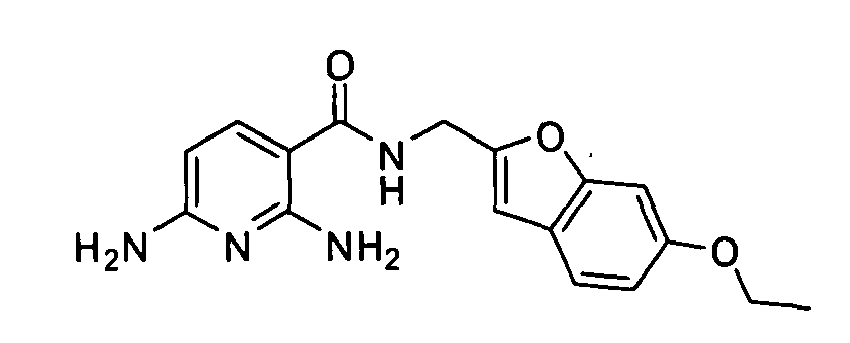

Example 3 Example 9 

Example 4 Example 10 

Example 5 Example 11 
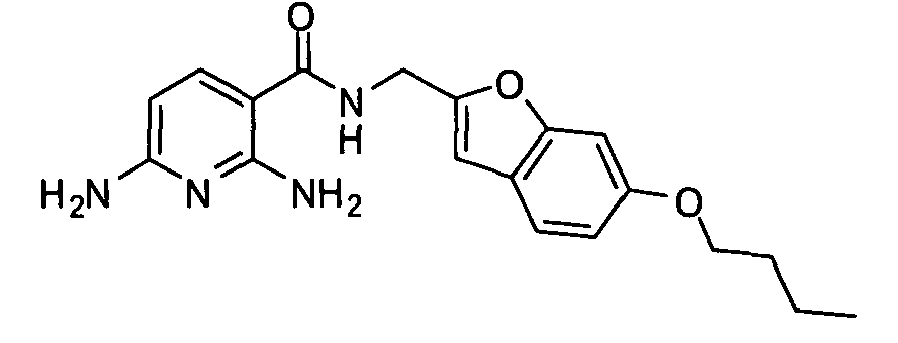
Example 6 Example 12 

[Table 2] Example 13 Example 19 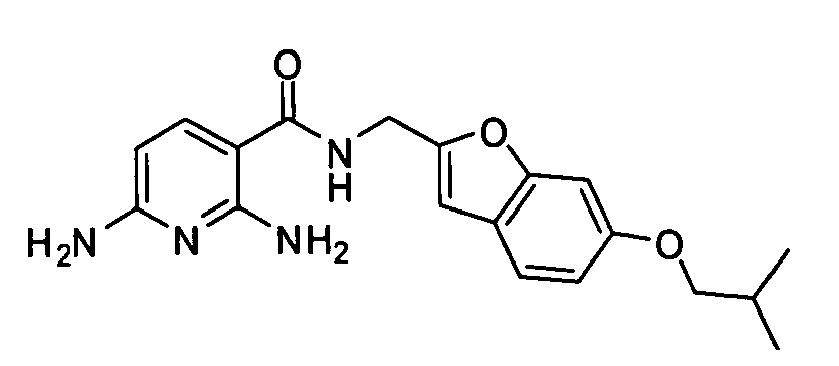

Example 14 Example 20 

Example 15 Example 21 

Example 16 Example 22 

Example 17 Example 23 

Example 18 Example 24 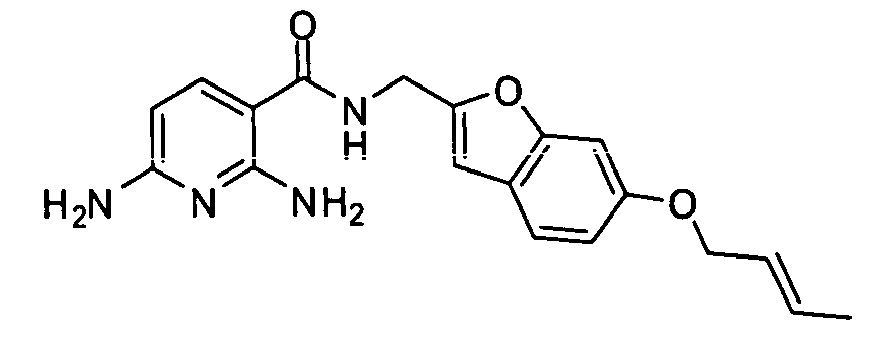

[Table 3] Example 25 Example 31 

Example 26 Example 32 

Example 27 Example 33 

Example 28 Example 34 
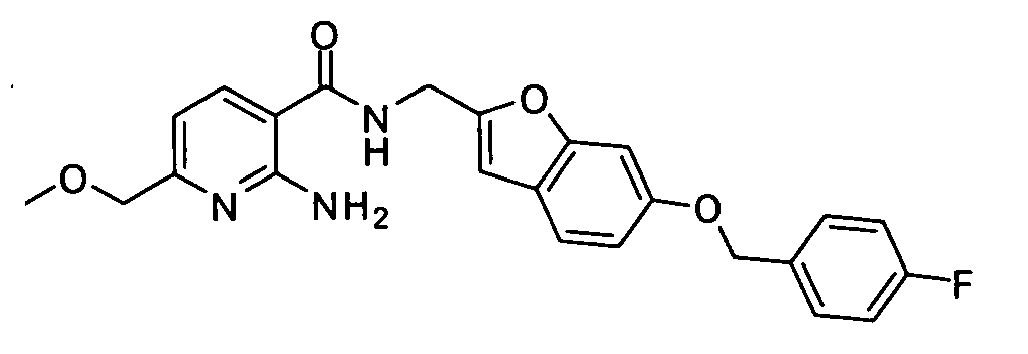
Example 29 Example 35 

Example 30 Example 36 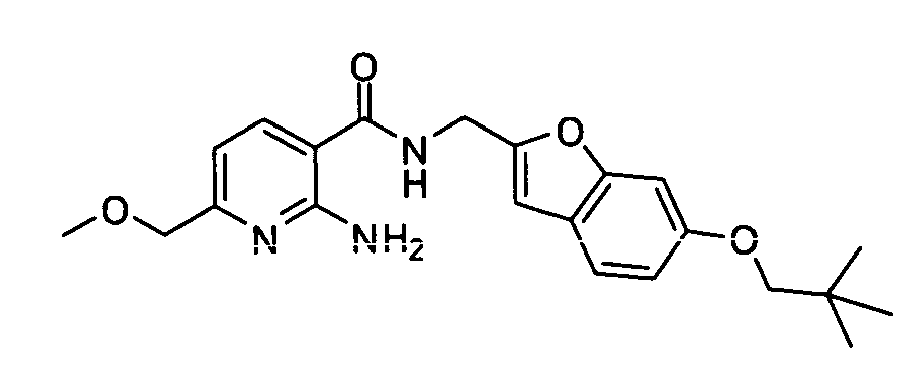

[Table 4] Example 37 Example 43 

Example 38 Example 44 

Example 39 Example 45 

Example 40 Example 46 

Example 41 Example 47 

Example 42 Example 48 

[Table 5] Example 49 Example 55 

Example 50 Example 56 

Example 51 Example 57 

Example 52 Example 58 

Example 53 Example 59 

Example 54 Example 60 

[Table 6] Example 61 Example 67 

Example 62 Example 68 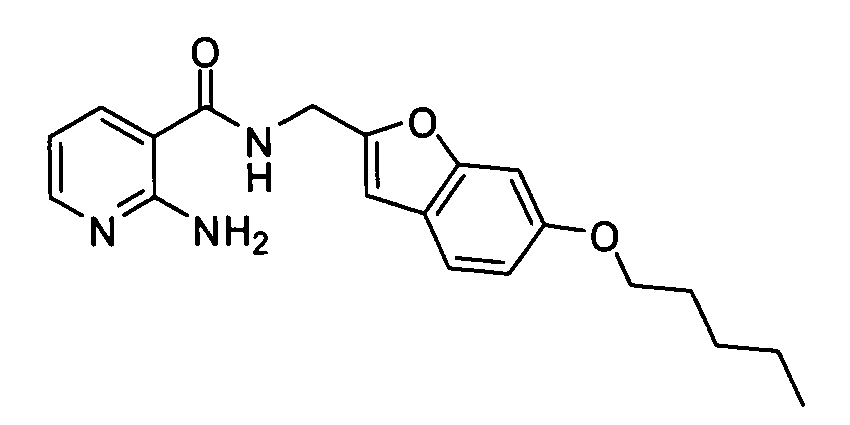

Example 63 Example 69 

Example 64 Example 70 

Example 65 Example 71 

Example 66 Example 72 

[Table 7] Example 73, Example 79 

Example 74 Example 80 

Example 75 Example 81 
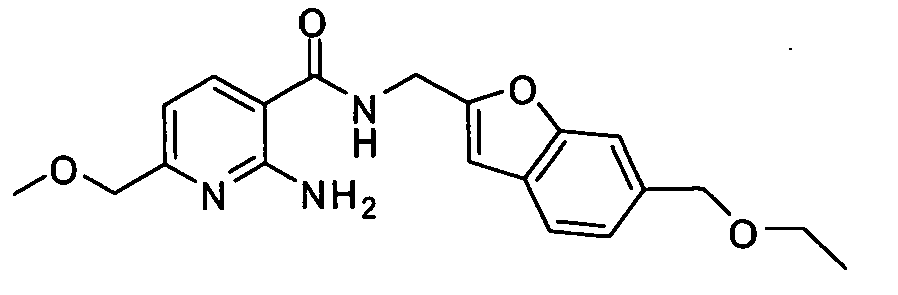
Example 76 
Example 77 
Example 78 
[Table 8] Production Example 1-1-1 Production Example 4-1-1 

Production Example 1-1-2 Production Example 4-1-2 

Production Example 1-1-3 Production Example 4-1-3 

Production Example 1-1-4, Production Example 4-1-4 

Production Example 4-1-5 
[Table 9] Production Example 1-2-1 Production Example 7-1-1 

Production Example 1-2-2 Production Example 7-1-2 

Production Example 1-2-3 Production Example 7-1-3 

Production Example 1-2-4 Production Example 7-1-4 

Production Example 2-1 Production Example 7-1-5 

Production Example 5-1 Production Example 7-1-6 

[Table 10] Production Example 8-1-1 Production Example 49-1-3 

Production Example 8-1-2 Production Example 49-1-4 

Production Example 8-1-3 Production Example 52-1 

Production 
Production Example 49-1-1 
Production Example 49-1-2 
[Table 11] Production Example 56-1-1 Production Example 73-1-1 

Production Example 56-1-2 Production Example 73-1-2 

Production Example 56-1-3 Production Example 73-1-3 

Production Example 56-1-4 Production Example 73-1-4 
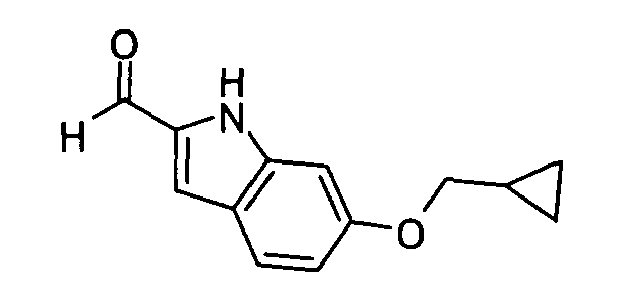
Production Example 56-1-5 Production Example 73-1-5 

Production Example 59-1 Production Example 81-1 

[Table 12] Production Example 75-1-1 Production Example 76-1-4 

Production Example 75-1-2 Production Example 77-1-1 

Production Example 75-1-3 Production Example 77-1-2 

Production Example 76-1-1 Production Example 77-1-3 

Production Example 76-1-2 Production Example 77-1-4 

Production Example 76-1-3 Production Example 77-1-5 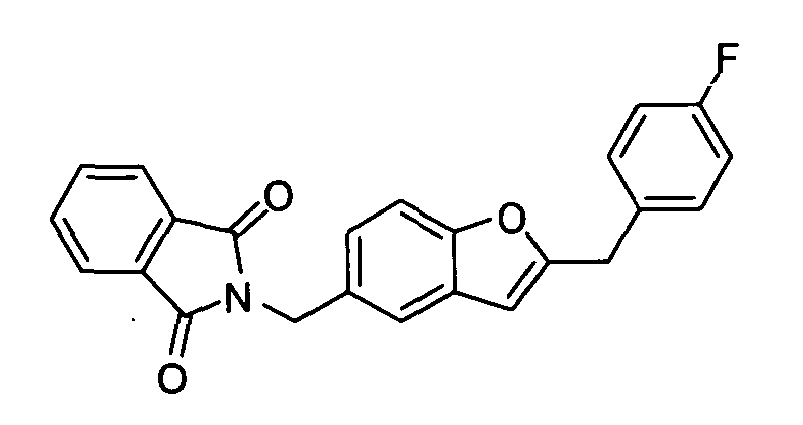

- Pyridine derivatives (I) or salts, or hydrates thereof according to the present invention demonstrate superior inhibitory activity on the GPI-anchored protein transport process, anti-Candida activity and anti-Aspergillus activity, and are also superior in terms of physical properties, safety and metabolic stability, making then extremely useful as a preventive or therapeutic agents for fungal infections.
- The antifungal activity of compound (I) of the present invention was assessed by measuring: 1) anti-Candida activity and anti-Aspergillus activity, and 2) activity in the experimental systemic candidal infection model in mice, in order to demonstrate the usefulness of compounds (I) according to the present invention.
- For the C. albicans E81022 strain, a fungal suspension from a standing culture 48 hours at 30°C in a Sabouraud dextrose liquid culture medium (SDB) was diluted 10000-fold with 1.3-times concentrated RPMI1640 medium to prepare a fungal suspension containing 1 to 2 × 10⁴ cells/ml. For the A. fumigatus Tsukuba strain, -80°C stored strain was diluted 1000-fold with 1.3-times concentrated RPMI1640 medium to prepare a fungal suspension containing 2 to 3 × 10³ cells / ml.
- Using a U-shaped bottomed 96-well plates, 8 samples / plate (A to H) of sample dilution solutions were prepared. On the first row was dispensed 240 µl of sterile distilled water, and on the 2nd to 12th row were dispersed 125 µL of 4% dimethylsulfoxide solution. Weighed sample was dissolved in dimethylsulfoxide to prepare a 5 mg/ml solution followed by adding 10 µL of the solutions to the first row of the prepared plates and preparing 12-step serial 2-fold dilutions (125 µL of solution + 125 µL of 4% dimethylsulfoxide solution) on the plates. This sample dilution solution was dispensed in the amount of 25 µL to a flat-bottom 96-well plates for MIC measurement MIC to prepare a sample dilution plate.
- The fungal suspension prepared in (1) was used in the amount of 75 µL / well to inoculate the flat-bottomed 96-well plates containing 25 µL / well of the test compound prepared in (2), and a standing culture was carried out aerobically for 48 hours at 35°C.
- The minimum concentration that clearly inhibited fungal growth as compared with the control by visual inspection was defined as the minimum growth inhibitory concentration (MIC).
- The following representative compounds prepared in the examples were measured for the anti-Candida activity and anti-Aspergillus activity by the measurement method described in 1. As a result, as shown in Tables 13 and 14, it was found that the compounds according to the present invention clearly had anti-Candida activity and anti-Aspergillus activity.
[Table 13] Example No. Anti-Candida activity (µg/ml) Example No. Anti-Candida activity (µg/ml) Example No. Anti-Candidaactivity (µg/ml) 1 0.39 24 6.25 49 0.39 2 1.56 25 0.78 51 0.2 3 1.56 29 1.56 52 1.56 4 0.78 33 12.5 53 6.25 5 0.78 37 0.2 54 1.56 6 0.78 38 0.39 57 6.25 7 0.39 39 1.56 58 0.1 8 1.56 40 3.13 59 0.78 12 0.78 41 3.13 65 1.56 13 0.39 42 1.56 69 0.39 14 1.56 43 0.78 70 0.78 16 3.13 44 0.78 72 0.78 17 0.78 45 12.5 77 0.39 22 0.39 46 0.39 78 0.39 23 1.56 47 0.78 80 3.13 [Table 14] Example No. Anti-Aspergillus activity (µg/ml) Example No. Anti-Aspergillus activity (µg/ml) Example No. Anti-Aspergillus activity (µg/ml) 1 1.56 38 0.78 57 1.56 2 3.13 39 1.56 58 1.56 3 0.78 40 3.13 59 3.13 4 3.13 42 3.13 65 3.13 5 0.78 43 6.25 69 0.39 6 1.56 44 6.25 70 1.56 7 1.56 45 12.5 72 1.56 12 1.56 47 1.56 73 25 13 1.56 49 6.25 77 3.13 16 6.25 51 0.78 78 1.56 22 1.56 52 0.78 79 12.5 24 3.13 53 6.25 81 6.25 29 6.25 54 0.39 -- -- - A standing culture of C. albicans E81022 strain was static cultured for 48 hours at 30°C in Sabouraud's dextrose agar (SDA), and the recovered fungal cells were suspended in sterilized physiological saline. By counting the fungal number on cytometry plate, the suspension was diluted to 2 × 10⁷ cells / mL with sterilized saline to serve fungai inoculant.
- The fungal inoculum was used in the amounts of 0.2 mL to inoculate 4.5 to 5.5 week-old femal ICR mice in the tail vein (4 × 10⁶ cells/mouse).
- From 0.5 to 1 hour after fungal inoculation, 0.2 mL of agent solution (dissolved or suspended in sterilized saline containing 6.5% dimethylsulfoxide and 3.5% Tween 80) was administered into the stomach using a peroral probe, three times every 4 hours. The agent concentration was set at 10 mg/kg and the number of animals in one group was 5 animals.
- The protective effect was determined by observing life / death until 14 days after infection and calculating the mean survival days.
- As a result, as shown in Table 15, mice administered with the compound according to the present invention survived for a long time as compared to the non-administered group, clearly demonstrating that the compounds according to the present invention demonstrate anti-Candida activity in vivo as well.
[Table 15] Example Nos Mean Survival Days 1 9.6 2 8.6 3 8.6 4 10.2 5 12.8 6 11.4 7 8.8 9 9.6 Non-administered group 2.4 to 4.0 - According to the present invention, pyridine derivatives (I), or salts or hydrates thereof according to the present invention, 1) inhibit expression of cell wall surface layer protein, inhibit cell wall assembly and inhibit the adherence of fungi to cells to prevent pathogens from demonstrating pathogenicity, thereby demonstrating effects against the onset, progression and prolongation of infections; and 2) are superior in terms of physical properties, safety and metabolic stability, and are extremely useful as preventives or therapeutics for fungal infections.
Claims (15)
- A compound represented by the following formula (I), or a salt or hydrate thereof:

R1 represents a hydrogen atom, a halogen atom, a cyano group, an amino group or an arbitrary group selected from substituent group a; and
R2 and R3 independently represent a hydrogen atom, a halogen atom, a hydroxyl group or an arbitrary group selected from substituent group c, except for a case in which R2 and R3 are both hydrogen atoms:
[substituent group a]
a C1-6 alkyl group, a C2-6 alkenyl group, a C2-6 alkynyl group, a C3-8 cycloalkyl group, a C3-8 cycloalkyl C1-6 alkyl group, a C1-6 alkoxy group, a C2-6 alkenyloxy group, a C2-6 alkynyloxy group, a C3-8 cycloalkoxy group, a C3-8 cycloalkyl C1-6 alkoxy group, a C1-6 alkylthio group, a C3-8 cycloalkyl C1-6 alkylthio group, a mono-C1-6 alkylamino group, a mono-C2-6 alkenylamino group, a mono-C2-6 alkynylamino group, a mono-C3-8 cycloalkylamino group, a mono-C3-8 cycloalkyl C1-6 alkylamino group, a di-C1-6 alkylamino group, a C1-6 alkylcarbonyl group and a C1-6 alkoxy C1-6 alkyl group, and each group described in substituent group a may have 1 to 3 arbitrary groups selected from the following substituent group b:
[substituent group b]
a halogen atom, a hydroxyl group, a mercapto group, a cyano group, a C1-6 alkyl group, a C6-10 aryl group, a 5- to 10-membered heterocyclic group, a C1-6 alkoxy group and an aminosulfonyl group,
[substituent group c]
a C1-6 alkyl group, a C2-6 alkenyl group, a C2-6 alkynyl group, a C3-8 cycloalkyl C1-6 alkyl group, a C6-10 aryl C1-6 alkyl group, a 5- to 10-membered heterocyclic C1-6 alkyl group, a C1-6 alkoxy group, a C2-6 alkenyloxy group, a C2-6 alkynyloxy group, a C5-10 aryloxy group, a C3-8 cycloalkyl C1-6 alkoxy group, a C6-10 aryl C1-6 alkoxy group, a C6-10 aryloxy C1-6 alkoxy group, a 5- to 10-membered heterocyclic C1-6 alkoxy group, a C1-6 alkoxy C1-6 alkoxy group, a mono-C6-10 arylamino group, a mono-C6-10 aryl C1-6 alkylamino group, a C6-10 aryloxy C1-6 alkyl group, a C1-6 alkoxy C1-6 alkyl group and a 5- to 10-membered heterocycloxy C1-6 alkyl group, and
each group described in substituent group c may have 1 to 3 groups selected from the group consisting of a halogen atom, a C1-6 alkyl group and a C1-6 alkoxy group. - The compound, or the salt or the hydrate thereof according to Claim 1, wherein R1 represents a hydrogen atom, an amino group or a C1-6 alkoxy C1-6 alkyl group.
- The compound, or the salt or the hydrate thereof according to Claim 1, wherein R1 represents a hydrogen atom, an amino group or a methoxymethyl group.
- The compound, or the salt or the hydrate thereof according to any one of Claims 1 to 3, wherein R2 and R3 independently represents a hydrogen atom, a halogen atom or an arbitrary group selected from substituent group c-1:
[substituent group c-1]
a C1-6 alkyl group, a C6-10 aryl C1-6 alkyl group, a C1-6 alkoxy group, a C2-6 alkenyloxy group, a C2-6 alkynyloxy group, a C6-10 aryloxy group, a C3-8 cycloalkyl C1-6 alkoxy group, a C6-10 aryl C1-6 alkoxy group, a C6-10 aryloxy C1-6 alkoxy group, a 5- to 10-membered heterocyclic C1-6 alkoxy group, a C1-6 alkoxy C1-6 alkoxy group and a C1-6 alkoxy C1-6 alkyl group, and each group described in substituent group c-1 may have 1 to 3 groups selected from the group consisting of a halogen atom, a C1-6 alkyl group and a C1-6 alkoxy group. - The compound, or the salt or the hydrate thereof according to any one of Claims 1 to 3, wherein R2 and R3 independently represents a hydrogen atom, a halogen atom or an arbitrary group selected from substituent group c-2:
[substituent group c-2]
a butyl group, a benzyl group, a methoxy group, an ethoxy group, a propoxy group, a butoxy group, a pentyloxy group, an isobutoxy group, a 4-methylbutoxy group, a 2-methylbutoxy group, a 2,2-dimethylpropoxy group, an allyloxy group, a 3-methyl-but-2-enyloxy group, a but-2-enyloxy group, a prop-2-ynyloxy group, a but-2-ynyloxy group, a phenoxy group, a cyclopropylmethoxy group, a phenoxyethoxy group, a benzyloxy group, a 2-fluoro-benzyloxy group, a 3-fluoro-benzyloxy group, a 4-fluoro-benzyloxy group, a 2-chloro-benzyloxy group, a tetrahydropyran-2-ylmethoxy group, a 2-pyridylmethoxy group, a 3-pyridylmethoxy group, a 4-pyridylmethoxy group, a methoxyethoxy group, an ethoxyethoxy group, a methoxymethyl group and an ethoxymethyl group. - The compound, or the salt or the hydrate thereof according to Claim 4 or 5, wherein only one of R2 and R3 is a hydrogen atom.
- The compound, or the salt or the hydrate thereof according to any one of Claims 1 to 6, wherein a bonding position of R1 is a position represented by the partial structure of the following formula (II):

- The compound, or the salt or the hydrate thereof according to any one of Claims 1 to 7, wherein bonding positions of R2 and R3 are the positions represented by the partial structure of the following formula (III):

- The compound, or the salt or the hydrate thereof according to any one of Claims 1 to 8, wherein X represents an oxygen atom.
- A compound selected from the group consisting of the following compounds, or a salt or a hydrate thereof:


- A pharmaceutical composition comprising the compound, or the salt or the hydrate thereof according to any one of Claims 1 to 10.
- A medicament comprising the compound, or the salt or the hydrate thereof according to any one of Claims 1 to 10.
- An antifungal agent comprising, as an active ingredient, the compound, or the salt or the hydrate thereof according to any one of Claims 1 to 10.
- A method for preventing and/or treating a fungal infection by administering a pharmacologically effective amount of the compound, or the salt or the hydrate thereof according to any one of Claims 1 to 10.
- A use of the compound, or the salt or the hydrate thereof according to any one of Claims 1 to 10, for manufacturing an antifungal agent.
Applications Claiming Priority (2)
| Application Number | Priority Date | Filing Date | Title |
|---|---|---|---|
| JP2005098255 | 2005-03-30 | ||
| PCT/JP2006/306422 WO2006106711A1 (en) | 2005-03-30 | 2006-03-29 | Antifungal agent containing pyridine derivative |
Publications (2)
| Publication Number | Publication Date |
|---|---|
| EP1864980A1 true EP1864980A1 (en) | 2007-12-12 |
| EP1864980A4 EP1864980A4 (en) | 2010-08-18 |
Family
ID=37073275
Family Applications (1)
| Application Number | Title | Priority Date | Filing Date |
|---|---|---|---|
| EP06730370A Withdrawn EP1864980A4 (en) | 2005-03-30 | 2006-03-29 | Antifungal agent containing pyridine derivative |
Country Status (4)
| Country | Link |
|---|---|
| US (1) | US7829585B2 (en) |
| EP (1) | EP1864980A4 (en) |
| JP (1) | JP4874958B2 (en) |
| WO (1) | WO2006106711A1 (en) |
Cited By (2)
| Publication number | Priority date | Publication date | Assignee | Title |
|---|---|---|---|---|
| US8592399B2 (en) | 2008-10-17 | 2013-11-26 | Akaal Pharma Pty Ltd. | S1P receptors modulators and their use thereof |
| US9181182B2 (en) | 2008-10-17 | 2015-11-10 | Akaal Pharma Pty Ltd | S1P receptors modulators |
Families Citing this family (34)
| Publication number | Priority date | Publication date | Assignee | Title |
|---|---|---|---|---|
| US7932272B2 (en) | 2003-09-30 | 2011-04-26 | Eisai R&D Management Co., Ltd. | Antifungal agent containing heterocyclic compound |
| WO2006106711A1 (en) | 2005-03-30 | 2006-10-12 | Eisai R & D Management Co., Ltd. | Antifungal agent containing pyridine derivative |
| TWI385169B (en) | 2005-10-31 | 2013-02-11 | Eisai R&D Man Co Ltd | Heterocyclic substituted pyridine derivatives and antifungal agent containing same |
| AU2007279092B2 (en) * | 2006-07-24 | 2012-12-13 | Ucb Pharma S.A. | Substituted aniline derivatives |
| WO2008035726A1 (en) | 2006-09-21 | 2008-03-27 | Eisai R & D Management Co., Ltd. | Pyridine derivative substituted by heteroaryl ring, and antifungal agent comprising the same |
| TW200841879A (en) | 2007-04-27 | 2008-11-01 | Eisai R&D Man Co Ltd | Pyridine derivatives substituted by heterocyclic ring and phosphonoamino group, and anti-fungal agent containing same |
| CN101622251B (en) | 2007-04-27 | 2012-07-04 | 卫材R&D管理有限公司 | Salts of heterocyclic substituted pyridine derivatives or crystals thereof |
| US8513287B2 (en) * | 2007-12-27 | 2013-08-20 | Eisai R&D Management Co., Ltd. | Heterocyclic ring and phosphonoxymethyl group substituted pyridine derivatives and antifungal agent containing same |
| FR2928070A1 (en) * | 2008-02-27 | 2009-09-04 | Sumitomo Chemical Co | AGRICULTURAL COMPOSITION, USE OF A COMPOUND FOR ITS PRODUCTION AND PROCESS FOR CONTROLLING OR PREVENTING PLANT DISEASES. |
| HRP20190509T1 (en) | 2008-03-12 | 2019-05-03 | Ube Industries, Ltd. | PYRIDYLAMINOOCETIC ACID COMPOUND |
| US8188119B2 (en) | 2008-10-24 | 2012-05-29 | Eisai R&D Management Co., Ltd | Pyridine derivatives substituted with heterocyclic ring and γ-glutamylamino group, and antifungal agents containing same |
| WO2010074101A1 (en) * | 2008-12-25 | 2010-07-01 | 住友化学株式会社 | Aminopyridine compound and use of same |
| PT2415763E (en) | 2009-03-30 | 2016-03-30 | Ube Industries | Pharmaceutical composition for treating or preventing glaucoma |
| JP2012176900A (en) * | 2009-06-24 | 2012-09-13 | Eisai R & D Management Co Ltd | Pyridin derivative containing ((phosphonooxy)methyl) pyridinium ring and anti-fungal agent containing these derivative |
| US9012450B2 (en) | 2011-12-28 | 2015-04-21 | Global Blood Therapeutics, Inc. | Substituted heteroaryl aldehyde compounds and methods for their use in increasing tissue oxygenation |
| PL2797416T3 (en) | 2011-12-28 | 2017-12-29 | Global Blood Therapeutics, Inc. | Substituted benzaldehyde compounds and methods for their use in increasing tissue oxygenation |
| WO2014145040A1 (en) | 2013-03-15 | 2014-09-18 | Global Blood Therapeutics, Inc. | Substituted aldehyde compounds and methods for their use in increasing tissue oxygenation |
| US9458139B2 (en) | 2013-03-15 | 2016-10-04 | Global Blood Therapeutics, Inc. | Compounds and uses thereof for the modulation of hemoglobin |
| EP2968299B1 (en) | 2013-03-15 | 2021-01-20 | Global Blood Therapeutics, Inc. | Compounds and uses thereof for the modulation of hemoglobin |
| US9422279B2 (en) | 2013-03-15 | 2016-08-23 | Global Blood Therapeutics, Inc. | Compounds and uses thereof for the modulation of hemoglobin |
| JP6426694B2 (en) | 2013-03-15 | 2018-11-21 | グローバル ブラッド セラピューティクス インコーポレイテッド | Compounds for the modification of hemoglobin and their use |
| US20140274961A1 (en) | 2013-03-15 | 2014-09-18 | Global Blood Therapeutics, Inc. | Compounds and uses thereof for the modulation of hemoglobin |
| US9604999B2 (en) | 2013-03-15 | 2017-03-28 | Global Blood Therapeutics, Inc. | Compounds and uses thereof for the modulation of hemoglobin |
| BR112015021982B1 (en) | 2013-03-15 | 2022-12-13 | Global Blood Therapeutics, Inc | COMPOUNDS AND THEIR USES FOR HEMOGLOBIN MODULATION |
| US8952171B2 (en) | 2013-03-15 | 2015-02-10 | Global Blood Therapeutics, Inc. | Compounds and uses thereof for the modulation of hemoglobin |
| US9802900B2 (en) | 2013-03-15 | 2017-10-31 | Global Blood Therapeutics, Inc. | Bicyclic heteroaryl compounds and uses thereof for the modulation of hemoglobin |
| US10266551B2 (en) | 2013-03-15 | 2019-04-23 | Global Blood Therapeutics, Inc. | Compounds and uses thereof for the modulation of hemoglobin |
| EA201992707A1 (en) | 2013-11-18 | 2020-06-30 | Глобал Блад Терапьютикс, Инк. | COMPOUNDS AND THEIR APPLICATIONS FOR HEMOGLOBIN MODULATION |
| AP2016009261A0 (en) | 2014-02-07 | 2016-06-30 | Global Blood Therapeutics Inc | Crystalline polymorphs of the free base of 2-hydroxy-6-((2-(1-isopropyl-1h-pyrazol-5-yl)pyridin-3-yl)methoxy)benzaldehyde |
| MA41841A (en) | 2015-03-30 | 2018-02-06 | Global Blood Therapeutics Inc | ALDEHYDE COMPOUNDS FOR THE TREATMENT OF PULMONARY FIBROSIS, HYPOXIA, AND AUTOIMMUNE AND CONNECTIVE TISSUE DISEASES |
| PL3383392T3 (en) | 2015-12-04 | 2025-11-17 | Global Blood Therapeutics, Inc. | Dosing regimens for 2-hydroxy-6-((2-(1-isopropyl-1h-pyrazol-5-yl)pyridin-3-yl)methoxy)benzaldehyde |
| TWI663160B (en) | 2016-05-12 | 2019-06-21 | 全球血液治療公司 | Process for synthesizing 2-hydroxy-6-((2-(1-isopropyl-1h-pyrazol-5-yl)-pyridin-3-yl)methoxy)benzaldehyde |
| TW202332423A (en) | 2016-10-12 | 2023-08-16 | 美商全球血液治療公司 | Tablets comprising 2-hydroxy-6-((2-(1-isopropyl-1h-pyrazol-5-yl)pyridin-3-yl)methoxy)benzaldehyde |
| EP3860975B1 (en) | 2018-10-01 | 2023-10-18 | Global Blood Therapeutics, Inc. | Modulators of hemoglobin for the treatment of sickle cell disease |
Family Cites Families (96)
| Publication number | Priority date | Publication date | Assignee | Title |
|---|---|---|---|---|
| JPS542325A (en) | 1977-06-07 | 1979-01-09 | Sankyo Co Ltd | Agricultural and horticultural pesticide |
| JPS5973575A (en) | 1982-10-05 | 1984-04-25 | Shionogi & Co Ltd | Propynylaminoisoxazole derivative |
| GB8311003D0 (en) | 1983-04-22 | 1983-05-25 | Shell Int Research | Aniline compounds |
| DE3316187A1 (en) | 1983-05-04 | 1984-11-08 | Cassella Ag, 6000 Frankfurt | 2-(Aminomethyl)pyrrole derivatives, process for their preparation, and their use |
| EP0124067B1 (en) | 1983-05-04 | 1986-12-17 | CASSELLA Aktiengesellschaft | 2-(aminoalkyl)-pyrrole derivatives, process for their manufacture and their use |
| WO1986003203A1 (en) | 1984-11-22 | 1986-06-05 | Yoshitomi Pharmaceutical Industries, Ltd. | Thienylthiazole derivatives |
| US4851423A (en) | 1986-12-10 | 1989-07-25 | Schering Corporation | Pharmaceutically active compounds |
| IL89028A0 (en) | 1988-01-29 | 1989-08-15 | Lilly Co Eli | Quinoline,quinazoline and cinnoline derivatives |
| US5034393A (en) | 1989-07-27 | 1991-07-23 | Dowelanco | Fungicidal use of pyridopyrimidine, pteridine, pyrimidopyrimidine, pyrimidopyridazine, and pyrimido-1,2,4-triazine derivatives |
| JPH03161470A (en) | 1989-11-17 | 1991-07-11 | Nisshin Flour Milling Co Ltd | Indole derivative |
| JPH05294935A (en) | 1991-03-15 | 1993-11-09 | Green Cross Corp:The | Aminopyridine compound |
| US5371086A (en) | 1991-03-15 | 1994-12-06 | The Green Cross Corporation | Aminopyridine compounds |
| EP0533130A1 (en) | 1991-09-19 | 1993-03-24 | Hoechst Aktiengesellschaft | 2-Hydroxymethylpyridines, the corresponding pyridine-N-oxides and derivatives thereof, process for their preparation and their use |
| DK0610396T3 (en) | 1991-10-23 | 2001-01-29 | Baylor College Medicine | Fingerprint identification of bacterial strains using repetitive DNA sequence amplification |
| US5250564A (en) | 1991-12-12 | 1993-10-05 | Trustees Of The University Of Pennsylvania | Aromatic peptidomimetics |
| JPH0725853A (en) | 1993-07-14 | 1995-01-27 | Ishihara Sangyo Kaisha Ltd | Amido compound or its salt, its production and controller for harmful animal containing the same |
| IL112778A0 (en) | 1994-03-04 | 1995-05-26 | Merck & Co Inc | Substituted heterocycles, their preparation and pharmaceutical compositions containing them |
| GB9510757D0 (en) | 1994-09-19 | 1995-07-19 | Wellcome Found | Therapeuticaly active compounds |
| DE4434637A1 (en) | 1994-09-28 | 1996-04-04 | Hoechst Schering Agrevo Gmbh | Substituted pyridines, processes for their preparation and their use as pesticides and fungicides |
| JPH08175933A (en) | 1994-12-20 | 1996-07-09 | J O Kosumeteitsukusu Kk | Lip stick cosmetic having resistance to color transfer |
| JPH08175993A (en) | 1994-12-21 | 1996-07-09 | Green Cross Corp:The | Antioxidant |
| ES2169773T3 (en) | 1995-04-11 | 2002-07-16 | Mitsui Chemicals Inc | DERIVATIVES OF REPLACED THIOPHEN AND AGRICULTURAL AND HORTICOL FUNGICIDES CONTAINING THESE DERIVATIVES AS ACTIVE INGREDIENT. |
| US5710171A (en) | 1995-05-24 | 1998-01-20 | Merck & Co., Inc. | Bisphenyl inhibitors of farnesyl-protein transferase |
| US6080767A (en) | 1996-01-02 | 2000-06-27 | Aventis Pharmaceuticals Products Inc. | Substituted n-[(aminoiminomethyl or aminomethyl)phenyl]propyl amides |
| WO1997027852A1 (en) | 1996-01-30 | 1997-08-07 | Merck & Co., Inc. | Inhibitors of farnesyl-protein transferase |
| US6313127B1 (en) | 1996-02-02 | 2001-11-06 | Zeneca Limited | Heterocyclic compounds useful as pharmaceutical agents |
| US5945431A (en) | 1996-03-15 | 1999-08-31 | Biochem Therapeutics Incorporated | Cytomegalovirus inhibiting compounds |
| US6174905B1 (en) * | 1996-09-30 | 2001-01-16 | Mitsui Chemicals, Inc. | Cell differentiation inducer |
| EP0944582B1 (en) | 1996-12-11 | 2003-07-02 | Abbott GmbH & Co. KG | Ketobenzamides as calpain inhibitors |
| CA2285548C (en) | 1997-04-04 | 2006-07-11 | Pfizer Products Inc. | Nicotinamide derivatives |
| US20020111495A1 (en) | 1997-04-04 | 2002-08-15 | Pfizer Inc. | Nicotinamide acids, amides, and their mimetics active as inhibitors of PDE4 isozymes |
| EP0986384B1 (en) | 1997-05-07 | 2012-02-22 | University Of Pittsburgh | Inhibitors of protein isoprenyl transferases |
| DE19727117A1 (en) | 1997-06-26 | 1999-01-07 | Boehringer Ingelheim Pharma | Phenylalkyl derivatives, pharmaceutical compositions containing them and processes for their preparation |
| TW390963B (en) | 1997-09-26 | 2000-05-21 | Shinetsu Handotai Kk | Method and apparatus for detecting heavy metals in silicon wafer bulk withhigh sensitivity |
| US6022884A (en) | 1997-11-07 | 2000-02-08 | Amgen Inc. | Substituted pyridine compounds and methods of use |
| AU754965B2 (en) | 1997-12-31 | 2002-11-28 | University Of Kansas, The | Water soluble prodrugs of tertiary amine containing drugs and methods of making thereof |
| NZ507760A (en) | 1998-03-26 | 2002-10-25 | Japan Tobacco Inc | Amide derivatives and nociceptin antagonists |
| KR100672186B1 (en) | 1998-03-31 | 2007-01-19 | 아카디아 파마슈티칼스 인코포레이티드 | Compounds that are active against muscarinic receptors |
| PE20000942A1 (en) | 1998-07-31 | 2000-09-28 | Lilly Co Eli | DERIVATIVES OF AMIDE, CARBAMATE AND UREA |
| BR9912729A (en) | 1998-08-04 | 2001-05-02 | Astrazeneca Ab | Amide derivative, process to prepare it, and use of it |
| JP2000178243A (en) | 1998-12-14 | 2000-06-27 | Teijin Ltd | Biphenylamidine derivative |
| US6235728B1 (en) | 1999-02-19 | 2001-05-22 | Bristol-Myers Squibb Company | Water-soluble prodrugs of azole compounds |
| CA2360740A1 (en) | 1999-03-02 | 2000-09-08 | Boehringer Ingelheim Pharmaceuticals, Inc. | Compounds useful as reversible inhibitors of cathepsin s |
| CA2366932C (en) | 1999-04-15 | 2009-08-25 | Bristol-Myers Squibb Company | Cyclic protein tyrosine kinase inhibitors |
| CH1196397H1 (en) | 1999-06-02 | 2007-05-31 | Nps Pharma Inc | Metabotropic glutamate receptor antagonists for the treatment of diseases of the central nervous system. |
| GB9919588D0 (en) | 1999-08-18 | 1999-10-20 | Hoechst Schering Agrevo Gmbh | Fungicidal compounds |
| EP1214292B1 (en) | 1999-09-24 | 2007-06-13 | Genentech, Inc. | Tyrosine derivatives |
| TWI262185B (en) | 1999-10-01 | 2006-09-21 | Eisai Co Ltd | Carboxylic acid derivatives having anti-hyperglycemia and anti-hyperlipemia action, and pharmaceutical composition containing the derivatives |
| GB9923710D0 (en) | 1999-10-08 | 1999-12-08 | Proteus Molecular Design | Chemical compounds |
| JP4831907B2 (en) * | 1999-10-08 | 2011-12-07 | アフィニアム・ファーマシューティカルズ・インコーポレイテッド | FabI inhibitor |
| AU7896100A (en) | 1999-10-14 | 2001-04-23 | Endorecherche Inc. | Selective estrogen receptor modulators in the treatment or reduction of the riskof acquiring hypertension, cardiovascular diseases, and insulin resistance |
| CA2397575A1 (en) | 2000-01-13 | 2001-07-19 | Tularik Inc. | Antibacterial agents |
| US6414013B1 (en) | 2000-06-19 | 2002-07-02 | Pharmacia & Upjohn S.P.A. | Thiophene compounds, process for preparing the same, and pharmaceutical compositions containing the same background of the invention |
| US6513676B2 (en) | 2000-06-21 | 2003-02-04 | Martin L. Clemmons | Universal cup holder with food tray accessories |
| CN100467597C (en) | 2000-07-07 | 2009-03-11 | 卫材R&D管理有限公司 | fungal cell wall synthesis genes |
| NZ524421A (en) * | 2000-09-15 | 2005-02-25 | Anormed Inc | Chemokine receptor binding heterocyclic compounds |
| IL154004A0 (en) | 2000-09-18 | 2003-07-31 | Du Pont | Pyridinyl amides and imides for use as fungicides |
| EP1217000A1 (en) | 2000-12-23 | 2002-06-26 | Aventis Pharma Deutschland GmbH | Inhibitors of factor Xa and factor VIIa |
| EP1229034B1 (en) | 2001-01-31 | 2005-04-13 | Pfizer Products Inc. | Nicotinamide derivatives and their mimetics as inhibitors of PDE4 isozymes |
| JP2002275159A (en) | 2001-03-16 | 2002-09-25 | Japan Tobacco Inc | Hcp inhibitor and compound having hcp inhibiting activity |
| SI1373263T1 (en) | 2001-04-05 | 2005-04-30 | Torrent Pharmaceuticals Ltd | Heterocyclic compounds for aging-related and diabetic vascular complications |
| GB0109122D0 (en) | 2001-04-11 | 2001-05-30 | Smithkline Beecham Spa | Novel compounds |
| EP1275301A1 (en) | 2001-07-10 | 2003-01-15 | Bayer CropScience S.A. | Trisubstituted heterocyclic compounds and their use as fungicides |
| EP1275653A1 (en) | 2001-07-10 | 2003-01-15 | Bayer CropScience S.A. | Oxazolopyridines and their use as fungicides |
| WO2003006628A2 (en) * | 2001-07-13 | 2003-01-23 | Virtual Drug Development, Inc. | Nad synthetase inhibitors and uses thereof |
| US20040198773A1 (en) | 2001-09-26 | 2004-10-07 | Barry Hart | Substituted 3-pyridyl oxazoles as c17,20 lyase inhibitors |
| KR100437972B1 (en) | 2001-10-27 | 2004-07-02 | 한국과학기술연구원 | Pyrrolidinone Derivatives, Their Preparation and Pharmaceutical Composition Comprising the Same |
| EP1451156A4 (en) | 2001-11-27 | 2005-05-25 | Merck & Co Inc | 4-AMINOQUINOLINE COMPOUNDS |
| MXPA04004982A (en) | 2001-11-27 | 2004-08-11 | Hoffmann La Roche | Benzothiazole derivatives. |
| GB0203193D0 (en) * | 2002-02-11 | 2002-03-27 | Pfizer Ltd | Nicotinamide derivatives useful as pde4 inhibitors |
| MXPA04007737A (en) * | 2002-02-11 | 2004-10-15 | Pfizer | Nicotinamide derivatives useful as pde4 inhibitors. |
| US20030191158A1 (en) | 2002-02-11 | 2003-10-09 | Magee Thomas V. | Nicotinamide derivatives and a tiotropium salt in combination for the treatment of diseases |
| CN100369898C (en) | 2002-02-12 | 2008-02-20 | 史密丝克莱恩比彻姆公司 | Nicotinamide derivatives useful as p38 inhibitors |
| CA2478587C (en) | 2002-03-08 | 2011-05-17 | Basf Aktiengesellschaft | Fungicidal mixtures based on prothioconazole and containing an insecticide |
| AU2003230829B8 (en) | 2002-04-26 | 2008-12-11 | Eli Lilly And Company | Triazole derivatives as tachykinin receptor antagonists |
| SI1501808T1 (en) | 2002-04-26 | 2008-10-31 | Lilly Co Eli | Tachykinin receptor antagonists |
| EP1369420A1 (en) | 2002-06-06 | 2003-12-10 | Aventis Pharma Deutschland GmbH | Inhibitors of the GPib - vWF interaction |
| AU2003244181A1 (en) | 2002-06-25 | 2004-01-06 | Yamanouchi Pharmaceutical Co., Ltd. | Phenoxypyridine derivative or salt thereof |
| PA8578101A1 (en) | 2002-08-13 | 2004-05-07 | Warner Lambert Co | HETEROBIARILO DERIVATIVES AS METALOPROTEINASE IN MATRIX INHIBITORS |
| GB0222495D0 (en) | 2002-09-27 | 2002-11-06 | Glaxo Group Ltd | Compounds |
| JP4537855B2 (en) | 2002-10-09 | 2010-09-08 | 久光製薬株式会社 | Novel pyrazole compounds having antifungal activity |
| CA2721200A1 (en) | 2002-11-22 | 2004-06-10 | Eisai R&D Management Co., Ltd. | Methods of screening for compounds that inhibit the biosynthesis of gpi in malaria parasites |
| AU2003293376A1 (en) | 2002-12-10 | 2004-06-30 | Imclone Systems Incorporated | Anti-angiogenic compounds and their use in cancer treatment |
| JP4896518B2 (en) * | 2002-12-13 | 2012-03-14 | ワイエム・バイオサイエンシズ・オーストラリア・ピーティーワイ・リミテッド | Nicotinamide kinase inhibitor |
| TW200500360A (en) | 2003-03-01 | 2005-01-01 | Astrazeneca Ab | Hydroxymethyl compounds |
| DE10315572A1 (en) | 2003-04-05 | 2004-10-14 | Merck Patent Gmbh | Substituted pyrazoles |
| JP4156460B2 (en) | 2003-07-09 | 2008-09-24 | Tdk株式会社 | Work pickup method and apparatus, and mounting machine |
| ATE412642T1 (en) * | 2003-07-25 | 2008-11-15 | Novartis Ag | INHIBITORS OF P-38 KINASE |
| US7932272B2 (en) | 2003-09-30 | 2011-04-26 | Eisai R&D Management Co., Ltd. | Antifungal agent containing heterocyclic compound |
| WO2006016548A1 (en) | 2004-08-09 | 2006-02-16 | Eisai R & D Management Co., Ltd. | Novel antimalaria agent containing heterocyclic compound |
| WO2006106711A1 (en) | 2005-03-30 | 2006-10-12 | Eisai R & D Management Co., Ltd. | Antifungal agent containing pyridine derivative |
| CA2626767C (en) | 2005-10-31 | 2012-01-17 | Eisai R&D Management Co., Ltd. | Heterocyclic substituted pyridine derivatives and antifungal agent containing same |
| TWI385169B (en) | 2005-10-31 | 2013-02-11 | Eisai R&D Man Co Ltd | Heterocyclic substituted pyridine derivatives and antifungal agent containing same |
| US20090084621A1 (en) | 2007-09-27 | 2009-04-02 | Giovannini Mario R | Rack-mounted service center having separately removable housing |
| WO2009081970A1 (en) | 2007-12-26 | 2009-07-02 | Eisai R & D Management Co., Ltd. | Process for production of heterocycle-substituted pyridine derivative |
| US8513287B2 (en) | 2007-12-27 | 2013-08-20 | Eisai R&D Management Co., Ltd. | Heterocyclic ring and phosphonoxymethyl group substituted pyridine derivatives and antifungal agent containing same |
-
2006
- 2006-03-29 WO PCT/JP2006/306422 patent/WO2006106711A1/en not_active Ceased
- 2006-03-29 US US11/887,249 patent/US7829585B2/en not_active Expired - Fee Related
- 2006-03-29 EP EP06730370A patent/EP1864980A4/en not_active Withdrawn
- 2006-03-29 JP JP2007512776A patent/JP4874958B2/en not_active Expired - Fee Related
Cited By (5)
| Publication number | Priority date | Publication date | Assignee | Title |
|---|---|---|---|---|
| US8592399B2 (en) | 2008-10-17 | 2013-11-26 | Akaal Pharma Pty Ltd. | S1P receptors modulators and their use thereof |
| US9181182B2 (en) | 2008-10-17 | 2015-11-10 | Akaal Pharma Pty Ltd | S1P receptors modulators |
| US9193716B2 (en) | 2008-10-17 | 2015-11-24 | Akaal Pharma Pty Ltd. | S1P receptors modulators and their use thereof |
| EP2344484B1 (en) * | 2008-10-17 | 2016-06-08 | Akaal Pharma Pty Ltd | S1p receptors modulators and use thereof |
| US9707205B2 (en) | 2008-10-17 | 2017-07-18 | Akaal Pharma Pty Ltd. | S1P receptors modulators and their use thereof |
Also Published As
| Publication number | Publication date |
|---|---|
| WO2006106711A1 (en) | 2006-10-12 |
| JP4874958B2 (en) | 2012-02-15 |
| US20090062348A1 (en) | 2009-03-05 |
| EP1864980A4 (en) | 2010-08-18 |
| JPWO2006106711A1 (en) | 2008-09-11 |
| US7829585B2 (en) | 2010-11-09 |
Similar Documents
| Publication | Publication Date | Title |
|---|---|---|
| US7829585B2 (en) | Antifungal agent containing pyridine derivative | |
| JP4795022B2 (en) | Novel antifungal agent containing a heterocyclic compound | |
| US8841327B2 (en) | Heterocycles substituted pyridine derivatives and antifungal agent containing thereof | |
| JP5897566B2 (en) | Cyclic N, N'-diarylthiourea and N, N'-diarylurea-androgen receptor antagonists, anticancer agents, methods for their preparation and uses | |
| AU2470900A (en) | Non-peptide gnrh agents, methods and intermediates for their preparation | |
| NZ578930A (en) | Pyridine derivatives substituted by heterocycle ring and phosphonoamino and antifungal agent containing the same | |
| TW201018676A (en) | Pyridine derivatives substituted with heterocyclic ring and γ-glutamylamino group, and antifungal agents containing same | |
| WO2006016548A1 (en) | Novel antimalaria agent containing heterocyclic compound | |
| JPWO2006016548A1 (en) | Novel antimalarial agents containing heterocyclic compounds | |
| AU2006309762B2 (en) | Heterocyclic substituted pyridine derivatives and antifungal agent containing same | |
| CA2611711A1 (en) | Piperazine-piperidine antagonists and agonists of the 5-ht1a receptor | |
| TW200408636A (en) | Mew prodrugs of 1-methyl-2-(4-amidinophenylaminomethyl)-benzimidazol-5-yl-carboxylic acid-(N-2-pyridyl-N-2-hydroxycarbonylethyl)-amide, the preparation thereof and their use as pharmaceutical compositions | |
| JP2021505672A (en) | Antifungal agent that is a heterocyclic substituted pyridine derivative | |
| CN102219753B (en) | A kind of triazole compound and its preparation method and application | |
| CN103304555B (en) | One group of benzene-oxazolyl derivative and preparation method thereof and the related application as IMPDH inhibitor | |
| WO2019001307A1 (en) | Amide compound, composition containing same, and use thereof | |
| KR102069395B1 (en) | Treatment of type i and type ii diabetes | |
| KR100521841B1 (en) | Novel ortho-naphthopyranoquinone derivatives and using for antimicrobial agent and antifungal agent thereof | |
| CN101711242B (en) | ((bicyclic heteroaryl) imidazolyl) methyl heteroaryl compounds as adrenergic receptor agonists | |
| CN121108109A (en) | A PROTAC compound targeting ALK protein and its antitumor application | |
| AU2013211455B2 (en) | Methods and compositions for stimulating neurogenesis and inhibiting neuronal degeneration | |
| JP5284788B2 (en) | Heteroaryl ring-substituted pyridine derivatives and antifungal agents containing them | |
| TW200305402A (en) | Medicinal compositions for anti-tumor | |
| EP1712550A2 (en) | Substituted triazole diamine derivatives as kinase inhibitors | |
| JPH07116149B2 (en) | Allenylamines |
Legal Events
| Date | Code | Title | Description |
|---|---|---|---|
| PUAI | Public reference made under article 153(3) epc to a published international application that has entered the european phase |
Free format text: ORIGINAL CODE: 0009012 |
|
| 17P | Request for examination filed |
Effective date: 20070927 |
|
| AK | Designated contracting states |
Kind code of ref document: A1 Designated state(s): AT BE BG CH CY CZ DE DK EE ES FI FR GB GR HU IE IS IT LI LT LU LV MC NL PL PT RO SE SI SK TR |
|
| AX | Request for extension of the european patent |
Extension state: AL BA HR MK YU |
|
| RIN1 | Information on inventor provided before grant (corrected) |
Inventor name: HANEDA, TORU Inventor name: TANAKA, KEIGO Inventor name: INOUE, SATOSHI Inventor name: NAKAMOTO, KAZUTAKA |
|
| A4 | Supplementary search report drawn up and despatched |
Effective date: 20100719 |
|
| GRAP | Despatch of communication of intention to grant a patent |
Free format text: ORIGINAL CODE: EPIDOSNIGR1 |
|
| STAA | Information on the status of an ep patent application or granted ep patent |
Free format text: STATUS: THE APPLICATION IS DEEMED TO BE WITHDRAWN |
|
| 18D | Application deemed to be withdrawn |
Effective date: 20130205 |