EP1864843A2 - Four-wheel rolling vehicle with electric drive - Google Patents
Four-wheel rolling vehicle with electric drive Download PDFInfo
- Publication number
- EP1864843A2 EP1864843A2 EP07108107A EP07108107A EP1864843A2 EP 1864843 A2 EP1864843 A2 EP 1864843A2 EP 07108107 A EP07108107 A EP 07108107A EP 07108107 A EP07108107 A EP 07108107A EP 1864843 A2 EP1864843 A2 EP 1864843A2
- Authority
- EP
- European Patent Office
- Prior art keywords
- electric
- vehicle
- wheel rolling
- drive according
- rolling vehicle
- Prior art date
- Legal status (The legal status is an assumption and is not a legal conclusion. Google has not performed a legal analysis and makes no representation as to the accuracy of the status listed.)
- Withdrawn
Links
Images



Classifications
-
- B—PERFORMING OPERATIONS; TRANSPORTING
- B60—VEHICLES IN GENERAL
- B60K—ARRANGEMENT OR MOUNTING OF PROPULSION UNITS OR OF TRANSMISSIONS IN VEHICLES; ARRANGEMENT OR MOUNTING OF PLURAL DIVERSE PRIME-MOVERS IN VEHICLES; AUXILIARY DRIVES FOR VEHICLES; INSTRUMENTATION OR DASHBOARDS FOR VEHICLES; ARRANGEMENTS IN CONNECTION WITH COOLING, AIR INTAKE, GAS EXHAUST OR FUEL SUPPLY OF PROPULSION UNITS IN VEHICLES
- B60K17/00—Arrangement or mounting of transmissions in vehicles
- B60K17/34—Arrangement or mounting of transmissions in vehicles for driving both front and rear wheels, e.g. four wheel drive vehicles
- B60K17/356—Arrangement or mounting of transmissions in vehicles for driving both front and rear wheels, e.g. four wheel drive vehicles having fluid or electric motor, for driving one or more wheels
-
- B—PERFORMING OPERATIONS; TRANSPORTING
- B60—VEHICLES IN GENERAL
- B60G—VEHICLE SUSPENSION ARRANGEMENTS
- B60G21/00—Interconnection systems for two or more resiliently-suspended wheels, e.g. for stabilising a vehicle body with respect to acceleration, deceleration or centrifugal forces
- B60G21/007—Interconnection systems for two or more resiliently-suspended wheels, e.g. for stabilising a vehicle body with respect to acceleration, deceleration or centrifugal forces means for adjusting the wheel inclination
-
- B—PERFORMING OPERATIONS; TRANSPORTING
- B60—VEHICLES IN GENERAL
- B60K—ARRANGEMENT OR MOUNTING OF PROPULSION UNITS OR OF TRANSMISSIONS IN VEHICLES; ARRANGEMENT OR MOUNTING OF PLURAL DIVERSE PRIME-MOVERS IN VEHICLES; AUXILIARY DRIVES FOR VEHICLES; INSTRUMENTATION OR DASHBOARDS FOR VEHICLES; ARRANGEMENTS IN CONNECTION WITH COOLING, AIR INTAKE, GAS EXHAUST OR FUEL SUPPLY OF PROPULSION UNITS IN VEHICLES
- B60K6/00—Arrangement or mounting of plural diverse prime-movers for mutual or common propulsion, e.g. hybrid propulsion systems comprising electric motors and internal combustion engines
- B60K6/20—Arrangement or mounting of plural diverse prime-movers for mutual or common propulsion, e.g. hybrid propulsion systems comprising electric motors and internal combustion engines the prime-movers consisting of electric motors and internal combustion engines, e.g. HEVs
- B60K6/22—Arrangement or mounting of plural diverse prime-movers for mutual or common propulsion, e.g. hybrid propulsion systems comprising electric motors and internal combustion engines the prime-movers consisting of electric motors and internal combustion engines, e.g. HEVs characterised by apparatus, components or means specially adapted for HEVs
- B60K6/28—Arrangement or mounting of plural diverse prime-movers for mutual or common propulsion, e.g. hybrid propulsion systems comprising electric motors and internal combustion engines the prime-movers consisting of electric motors and internal combustion engines, e.g. HEVs characterised by apparatus, components or means specially adapted for HEVs characterised by the electric energy storing means, e.g. batteries or capacitors
-
- B—PERFORMING OPERATIONS; TRANSPORTING
- B60—VEHICLES IN GENERAL
- B60K—ARRANGEMENT OR MOUNTING OF PROPULSION UNITS OR OF TRANSMISSIONS IN VEHICLES; ARRANGEMENT OR MOUNTING OF PLURAL DIVERSE PRIME-MOVERS IN VEHICLES; AUXILIARY DRIVES FOR VEHICLES; INSTRUMENTATION OR DASHBOARDS FOR VEHICLES; ARRANGEMENTS IN CONNECTION WITH COOLING, AIR INTAKE, GAS EXHAUST OR FUEL SUPPLY OF PROPULSION UNITS IN VEHICLES
- B60K6/00—Arrangement or mounting of plural diverse prime-movers for mutual or common propulsion, e.g. hybrid propulsion systems comprising electric motors and internal combustion engines
- B60K6/20—Arrangement or mounting of plural diverse prime-movers for mutual or common propulsion, e.g. hybrid propulsion systems comprising electric motors and internal combustion engines the prime-movers consisting of electric motors and internal combustion engines, e.g. HEVs
- B60K6/42—Arrangement or mounting of plural diverse prime-movers for mutual or common propulsion, e.g. hybrid propulsion systems comprising electric motors and internal combustion engines the prime-movers consisting of electric motors and internal combustion engines, e.g. HEVs characterised by the architecture of the hybrid electric vehicle
- B60K6/46—Series type
-
- B—PERFORMING OPERATIONS; TRANSPORTING
- B60—VEHICLES IN GENERAL
- B60L—PROPULSION OF ELECTRICALLY-PROPELLED VEHICLES; SUPPLYING ELECTRIC POWER FOR AUXILIARY EQUIPMENT OF ELECTRICALLY-PROPELLED VEHICLES; ELECTRODYNAMIC BRAKE SYSTEMS FOR VEHICLES IN GENERAL; MAGNETIC SUSPENSION OR LEVITATION FOR VEHICLES; MONITORING OPERATING VARIABLES OF ELECTRICALLY-PROPELLED VEHICLES; ELECTRIC SAFETY DEVICES FOR ELECTRICALLY-PROPELLED VEHICLES
- B60L50/00—Electric propulsion with power supplied within the vehicle
- B60L50/50—Electric propulsion with power supplied within the vehicle using propulsion power supplied by batteries or fuel cells
- B60L50/60—Electric propulsion with power supplied within the vehicle using propulsion power supplied by batteries or fuel cells using power supplied by batteries
- B60L50/61—Electric propulsion with power supplied within the vehicle using propulsion power supplied by batteries or fuel cells using power supplied by batteries by batteries charged by engine-driven generators, e.g. series hybrid electric vehicles
-
- B—PERFORMING OPERATIONS; TRANSPORTING
- B60—VEHICLES IN GENERAL
- B60L—PROPULSION OF ELECTRICALLY-PROPELLED VEHICLES; SUPPLYING ELECTRIC POWER FOR AUXILIARY EQUIPMENT OF ELECTRICALLY-PROPELLED VEHICLES; ELECTRODYNAMIC BRAKE SYSTEMS FOR VEHICLES IN GENERAL; MAGNETIC SUSPENSION OR LEVITATION FOR VEHICLES; MONITORING OPERATING VARIABLES OF ELECTRICALLY-PROPELLED VEHICLES; ELECTRIC SAFETY DEVICES FOR ELECTRICALLY-PROPELLED VEHICLES
- B60L58/00—Methods or circuit arrangements for monitoring or controlling batteries or fuel cells, specially adapted for electric vehicles
- B60L58/40—Methods or circuit arrangements for monitoring or controlling batteries or fuel cells, specially adapted for electric vehicles for controlling a combination of batteries and fuel cells
-
- B—PERFORMING OPERATIONS; TRANSPORTING
- B62—LAND VEHICLES FOR TRAVELLING OTHERWISE THAN ON RAILS
- B62K—CYCLES; CYCLE FRAMES; CYCLE STEERING DEVICES; RIDER-OPERATED TERMINAL CONTROLS SPECIALLY ADAPTED FOR CYCLES; CYCLE AXLE SUSPENSIONS; CYCLE SIDECARS, FORECARS, OR THE LIKE
- B62K5/00—Cycles with handlebars, equipped with three or more main road wheels
- B62K5/01—Motorcycles with four or more wheels
-
- B—PERFORMING OPERATIONS; TRANSPORTING
- B60—VEHICLES IN GENERAL
- B60K—ARRANGEMENT OR MOUNTING OF PROPULSION UNITS OR OF TRANSMISSIONS IN VEHICLES; ARRANGEMENT OR MOUNTING OF PLURAL DIVERSE PRIME-MOVERS IN VEHICLES; AUXILIARY DRIVES FOR VEHICLES; INSTRUMENTATION OR DASHBOARDS FOR VEHICLES; ARRANGEMENTS IN CONNECTION WITH COOLING, AIR INTAKE, GAS EXHAUST OR FUEL SUPPLY OF PROPULSION UNITS IN VEHICLES
- B60K7/00—Disposition of motor in, or adjacent to, traction wheel
- B60K7/0007—Disposition of motor in, or adjacent to, traction wheel the motor being electric
-
- B—PERFORMING OPERATIONS; TRANSPORTING
- B60—VEHICLES IN GENERAL
- B60Y—INDEXING SCHEME RELATING TO ASPECTS CROSS-CUTTING VEHICLE TECHNOLOGY
- B60Y2200/00—Type of vehicle
- B60Y2200/10—Road Vehicles
- B60Y2200/12—Motorcycles, Trikes; Quads; Scooters
-
- B—PERFORMING OPERATIONS; TRANSPORTING
- B60—VEHICLES IN GENERAL
- B60Y—INDEXING SCHEME RELATING TO ASPECTS CROSS-CUTTING VEHICLE TECHNOLOGY
- B60Y2200/00—Type of vehicle
- B60Y2200/10—Road Vehicles
- B60Y2200/12—Motorcycles, Trikes; Quads; Scooters
- B60Y2200/124—Buggies, Quads
-
- B—PERFORMING OPERATIONS; TRANSPORTING
- B62—LAND VEHICLES FOR TRAVELLING OTHERWISE THAN ON RAILS
- B62K—CYCLES; CYCLE FRAMES; CYCLE STEERING DEVICES; RIDER-OPERATED TERMINAL CONTROLS SPECIALLY ADAPTED FOR CYCLES; CYCLE AXLE SUSPENSIONS; CYCLE SIDECARS, FORECARS, OR THE LIKE
- B62K2204/00—Adaptations for driving cycles by electric motor
-
- Y—GENERAL TAGGING OF NEW TECHNOLOGICAL DEVELOPMENTS; GENERAL TAGGING OF CROSS-SECTIONAL TECHNOLOGIES SPANNING OVER SEVERAL SECTIONS OF THE IPC; TECHNICAL SUBJECTS COVERED BY FORMER USPC CROSS-REFERENCE ART COLLECTIONS [XRACs] AND DIGESTS
- Y02—TECHNOLOGIES OR APPLICATIONS FOR MITIGATION OR ADAPTATION AGAINST CLIMATE CHANGE
- Y02T—CLIMATE CHANGE MITIGATION TECHNOLOGIES RELATED TO TRANSPORTATION
- Y02T10/00—Road transport of goods or passengers
- Y02T10/60—Other road transportation technologies with climate change mitigation effect
- Y02T10/62—Hybrid vehicles
-
- Y—GENERAL TAGGING OF NEW TECHNOLOGICAL DEVELOPMENTS; GENERAL TAGGING OF CROSS-SECTIONAL TECHNOLOGIES SPANNING OVER SEVERAL SECTIONS OF THE IPC; TECHNICAL SUBJECTS COVERED BY FORMER USPC CROSS-REFERENCE ART COLLECTIONS [XRACs] AND DIGESTS
- Y02—TECHNOLOGIES OR APPLICATIONS FOR MITIGATION OR ADAPTATION AGAINST CLIMATE CHANGE
- Y02T—CLIMATE CHANGE MITIGATION TECHNOLOGIES RELATED TO TRANSPORTATION
- Y02T10/00—Road transport of goods or passengers
- Y02T10/60—Other road transportation technologies with climate change mitigation effect
- Y02T10/64—Electric machine technologies in electromobility
-
- Y—GENERAL TAGGING OF NEW TECHNOLOGICAL DEVELOPMENTS; GENERAL TAGGING OF CROSS-SECTIONAL TECHNOLOGIES SPANNING OVER SEVERAL SECTIONS OF THE IPC; TECHNICAL SUBJECTS COVERED BY FORMER USPC CROSS-REFERENCE ART COLLECTIONS [XRACs] AND DIGESTS
- Y02—TECHNOLOGIES OR APPLICATIONS FOR MITIGATION OR ADAPTATION AGAINST CLIMATE CHANGE
- Y02T—CLIMATE CHANGE MITIGATION TECHNOLOGIES RELATED TO TRANSPORTATION
- Y02T10/00—Road transport of goods or passengers
- Y02T10/60—Other road transportation technologies with climate change mitigation effect
- Y02T10/70—Energy storage systems for electromobility, e.g. batteries
-
- Y—GENERAL TAGGING OF NEW TECHNOLOGICAL DEVELOPMENTS; GENERAL TAGGING OF CROSS-SECTIONAL TECHNOLOGIES SPANNING OVER SEVERAL SECTIONS OF THE IPC; TECHNICAL SUBJECTS COVERED BY FORMER USPC CROSS-REFERENCE ART COLLECTIONS [XRACs] AND DIGESTS
- Y02—TECHNOLOGIES OR APPLICATIONS FOR MITIGATION OR ADAPTATION AGAINST CLIMATE CHANGE
- Y02T—CLIMATE CHANGE MITIGATION TECHNOLOGIES RELATED TO TRANSPORTATION
- Y02T10/00—Road transport of goods or passengers
- Y02T10/60—Other road transportation technologies with climate change mitigation effect
- Y02T10/7072—Electromobility specific charging systems or methods for batteries, ultracapacitors, supercapacitors or double-layer capacitors
-
- Y—GENERAL TAGGING OF NEW TECHNOLOGICAL DEVELOPMENTS; GENERAL TAGGING OF CROSS-SECTIONAL TECHNOLOGIES SPANNING OVER SEVERAL SECTIONS OF THE IPC; TECHNICAL SUBJECTS COVERED BY FORMER USPC CROSS-REFERENCE ART COLLECTIONS [XRACs] AND DIGESTS
- Y02—TECHNOLOGIES OR APPLICATIONS FOR MITIGATION OR ADAPTATION AGAINST CLIMATE CHANGE
- Y02T—CLIMATE CHANGE MITIGATION TECHNOLOGIES RELATED TO TRANSPORTATION
- Y02T90/00—Enabling technologies or technologies with a potential or indirect contribution to GHG emissions mitigation
- Y02T90/40—Application of hydrogen technology to transportation, e.g. using fuel cells
Definitions
- the present invention relates to a four-wheel rolling vehicle with an electric drive.
- rolling will refer to the characteristic of the vehicle of oscillating around a longitudinal axis with respect to the vehicle itself, said oscillation being referred to with the term rolling.
- the Applicant has already developed an innovative, four-wheel rolling vehicle, object of the PCT patent application published with the number WO 2005/058680 A1 , equipped with two front steering wheels and two drive rear wheels, said front wheels being equipped with a suspension group consisting of at least two horizontal crossbars connected to the chassis of the vehicle, and at least two suspensions, independent from each other and constrained to the two crossbars, so as to form an articulated quadrilateral which allows the rolling of the vehicle, said back wheels being, on the contrary, equipped with independent longitudinal arm suspensions, also constrained to the chassis, so as to allow the rolling of the vehicle.
- the four-wheel rolling vehicle object of WO 2005/058680 A1 is particularly reliable and safe, as its stability is guaranteed for any running and ground conditions.
- a rear-wheel drive vehicle (generally used in the case of two-wheel vehicles, motorbikes and motorcycles in particular) has opposite problems of roadhold in curves, i.e. as a consequence of a strong acceleration, or even a blander acceleration but immediately after braking (with the load that has moved towards the front of the vehicle), it can happen that the rear part of the vehicle tends to veer, with a consequent loss of control on the part of the driver.
- a differential system i.e. a mechanic organ capable of equitably distributing the torque moment between the two wheels, leaving them free to rotate at a different angular velocity, in order to prevent one or both wheels from slipping in curves, wherein the outer wheel must rotate at a higher speed with respect to the inner wheel as it has to cover a curved path having a greater length, the rolling radiuses being the same.
- At least two differentials must be present in four-wheel drive vehicles (a front one and a rear one) possibly plus a third in the centre to distribute the power between the front and rear axes.
- a vehicle without an intermediate differential could not circulate on asphalted roads, as a slight difference in the average speed of the front and rear wheels would cause a torsion on the transmission which would damage the vehicle.
- a drive is present on integral four-wheel vehicles for disconnecting the four-wheel drive.
- This problem does not arise on rough surfaces and dirt roads, in which the speed differences are absorbed by the sliding of the wheels on ground with a low friction coefficient.
- An objective of the present invention is therefore to solve the problems of the known art by providing a four-wheel rolling vehicle with an integral electric drive equipped with an electric motor for each wheel, capable of guaranteeing the appropriate distribution of the torque moment between the drive wheels respectively belonging to the front torque or rear torque and distributing the torque between the front and rear axes, in order to provide the maximum drive in complete safety on any surface and under any condition of use.
- a further objective of the present invention is to provide a four-wheel rolling vehicle with an integral electric drive having extreme structural and functional simplicity.
- a four-wheel rolling vehicle with an integral electric drive is equipped with two front steering wheels 11, a chassis 12, handlebars 13, two rear wheels 14, a front suspension group 15 for the front wheels 11 and independent longitudinal arm suspensions 16 for the rear wheels 14.
- the front suspension group 15 consists of an upper crossbar 17 connected to the chassis 12 of the vehicle by means of a hinge 18 in correspondence with its half, two lower crossbars 19 connected to an end of the chassis 12 of the vehicle by means of hinges 20 and at least two suspensions 20 independent of each other and constrained above one to each end of the upper crossbar 17 and below to the respective lower crossbar 19, so as to form an articulated quadrilateral which allows the rolling of the vehicle.
- This solution allows the vehicle to have two front guiding wheels in parallel, steering and inclinable, so that it can be guided like a motorcycle (front part inclinable - rolling movement - together with the rear).
- the front wheels can in turn be inclined like the back wheels, always remaining in contact with the ground, however, and therefore guaranteeing a greater adherence to the road surface.
- the characteristic of the vehicle according to the present invention consists in providing each wheel, both the front wheels 11 and the back wheels 14, with a corresponding electric motor 21, housed in the hub of the wheel (whose dimensions are, if necessary, suitably increased to guarantee the necessary space in its interior).
- an electric accumulator group 22 is also installed on board the vehicle 10, which can consist for example of batteries based on Pb, Pb-gel, Ni-Mh, Li-Ion, with or without the combination of supercondensers.
- the electric accumulator group 22 feeds, through electric connections 23 and by means of a suitable electronic control board 24, possibly functionally divided into sub-control boards, assisted by on-board commands, the electric motor groups 21 installed in each of the four wheels, both the front wheels 11 and the back wheels 14. The transmission of the driving torque is therefore directed on the four wheels.
- the electric accumulator group 22, housed inside the chassis 12 of the four-wheel rolling vehicle, can be extracted to allow transportation and recharging "at home".
- the recharging can be effected without extraction of the electric accumulator 22, or "on site", by means of a battery-charger (not shown) on- or not on-board, possibly also housed inside the chassis 12 and equipped with a wire with a plug for connection to the electric power supply or, more generally, to an electric energy source.
- control board 24 and/or its sub-control boards can intervene by directly limiting the torque supplied by the motor or corresponding motors, re-establishing the adherence conditions.
- control board 24 and/or its sub-control boards can intervene by directly increasing the torque supplied by the motor or corresponding motors, re-establishing the adherence conditions with the same pressure of the braking plant.
- the electronic management of the motors is offered as an aid and/or alternative to the known ABS system (present or absent on the vehicle).
- the electronic control board 24 acts directly or through its sub-control boards on the torque supplied by the electric motors 21, in order to recuperate the correct angular yaw velocity.
- the wheels are all equipped with a motor, they can however be used upon the command of the driver in pairs, the front wheels only, the back wheels only or all together.
- the selection of the drive mode depends on various factors: performances required, autonomy and adherence.
- the triggering of the integral drive is conveniently reserved for particular driving situations which, thanks to a selector (not shown), can be selected by the driver of the vehicle.
- the drive on all wheels generally privileges performances and motility and is always advisable under low adherence conditions, but it can in any case be established on the basis of personal considerations of the driver.
- this shows an alternative embodiment of the vehicle of the present invention, in particular aimed at increasing the autonomy of the vehicle.
- an internal combustion engine 25 is envisaged, functioning under stationary or semi-stationary regime conditions or in any case suitable for maintaining the correct electric energy balance on-board the vehicle, as generator for recharging the electric accumulators 22.
- This solution creates a drive system called "thermal/electric serial hybrid", with electric motors 21 fed by electric accumulators, the accumulator group 22 being recharged by the internal combustion engine 25 according to recharging cycles depending on the condition of the batteries themselves and type of use to which the vehicle 10 is subjected, according to logics predefined and activated by the control board 24 and/or the sub-control boards.
- the internal combustion engine 25 can be fed with different fuels, such as gasoline for motor vehicles, gas oil, methane, gaseous hydrogen, LPG, alcohol.
- fuels such as gasoline for motor vehicles, gas oil, methane, gaseous hydrogen, LPG, alcohol.
- this shows a further embodiment, particularly aimed at increasing the autonomy of the vehicle 10, obtained using a turbogas motor, of which the disk wheel 26 and alternator/generator 27 are schematized.
- the turbogas motor when operating under stationary or semi-stationary regime or in any case suitable for maintaining the correct electric energy balance on-board the vehicle, acts as generator for the recharging of the electric accumulators 22.
- This solution creates a drive system called "turbogas/electric serial hybrid", with electric motors fed through the electric accumulator group 22, as in the case already described.
- the accumulator group 22 is then recharged by the turbogas motor according to recharging systems depending on the condition of the batteries themselves and type of use to which the vehicle is subjected, according to logics predefined and activated by the control board 24 and/or the sub-control boards.
- the turbogas motor can be projected to be fed by different types of fuel, such as kerosene, gasoline for motor vehicles, gas oil, methane, LPG, alcohol.
- fuel such as kerosene, gasoline for motor vehicles, gas oil, methane, LPG, alcohol.
- FIG. 6 A further embodiment of the vehicle 10 aimed at increasing the autonomy of the vehicle is shown in figure 6 and envisages the use of one or more fuel cells 28 as generator for the recharging of the electric accumulators: this solution creates a system called "fuel cell electric drive”, with electric motors 21 fed by the electric accumulator group 22 as in the cases already described.
- Compressed gaseous hydrogen or hydrogen adsorbed on metallic hydrides, or other types of specific fuels for fuel cells, can be used as feeding.
- the four-wheel rolling vehicle thus conceived can undergo numerous modifications and variants, all included in the invention; furthermore all the details can be substituted by technically equivalent elements.
- the materials used, as also the dimensions, can vary according to the technical requirements.
Landscapes
- Engineering & Computer Science (AREA)
- Mechanical Engineering (AREA)
- Transportation (AREA)
- Chemical & Material Sciences (AREA)
- Combustion & Propulsion (AREA)
- Sustainable Development (AREA)
- Life Sciences & Earth Sciences (AREA)
- Sustainable Energy (AREA)
- Power Engineering (AREA)
- Electric Propulsion And Braking For Vehicles (AREA)
- Arrangement Or Mounting Of Propulsion Units For Vehicles (AREA)
- Vehicle Body Suspensions (AREA)
- Hybrid Electric Vehicles (AREA)
Abstract
Description
- The present invention relates to a four-wheel rolling vehicle with an electric drive.
- In the description, the term rolling will refer to the characteristic of the vehicle of oscillating around a longitudinal axis with respect to the vehicle itself, said oscillation being referred to with the term rolling.
- Four-wheel rolling vehicles capable of combining the characteristics of motorcycles, in terms of handiness, with the properties of stability and braking typical of four-wheel vehicles, are being studied by the Applicant, as a result of their advantages in terms of active safety due to their design and consequent motion dynamics.
- In this respect, the Applicant has already developed an innovative, four-wheel rolling vehicle, object of the PCT patent application published with the number
WO 2005/058680 A1 , equipped with two front steering wheels and two drive rear wheels, said front wheels being equipped with a suspension group consisting of at least two horizontal crossbars connected to the chassis of the vehicle, and at least two suspensions, independent from each other and constrained to the two crossbars, so as to form an articulated quadrilateral which allows the rolling of the vehicle, said back wheels being, on the contrary, equipped with independent longitudinal arm suspensions, also constrained to the chassis, so as to allow the rolling of the vehicle. - Thanks to the particular solutions developed for allowing the vehicle to roll, still maintaining the contact of all its wheels with the ground, the four-wheel rolling vehicle object of
WO 2005/058680 A1 , is particularly reliable and safe, as its stability is guaranteed for any running and ground conditions. - With reference to the different driving solutions available for ground transportation vehicles, regardless of the number of wheels, it is also known that, depending on the position of the drive with respect to the vehicle, the transfer of weights and therefore the balance of the motor vehicle, particularly during acceleration and braking, influences the dynamic behaviour of the vehicle, according to different modes.
- To oppose the driving or braking torque during acceleration, in fact, the reaction resulting on the axes shifts towards the rear part of the vehicle, whereas during braking the opposite happens. This means that in a front-wheel drive vehicle, during acceleration, the front portion tends to become lighter, with a consequent decrease in the load on the front-drive wheels which are more often than not also the steering wheels, with the consequence that, especially for high acceleration or on slippery roads, the wheels can loose adherence and the vehicle tends to veer towards the outside of the curve.
- On the contrary, a rear-wheel drive vehicle (generally used in the case of two-wheel vehicles, motorbikes and motorcycles in particular) has opposite problems of roadhold in curves, i.e. as a consequence of a strong acceleration, or even a blander acceleration but immediately after braking (with the load that has moved towards the front of the vehicle), it can happen that the rear part of the vehicle tends to veer, with a consequent loss of control on the part of the driver.
- Vehicles in which the driving force is distributed on all the wheels, called four-wheel drive vehicles, have been developed in order to overcome these problems relating to vehicles with only front- or rear- wheel drive, in particular to facilitate driving over rough road surfaces, with a high slope or poor adherence.
- Continuing with the analysis of drive systems of the known type, it is also known that, for each pair of driving wheels on the same axis, a differential system is necessary, i.e. a mechanic organ capable of equitably distributing the torque moment between the two wheels, leaving them free to rotate at a different angular velocity, in order to prevent one or both wheels from slipping in curves, wherein the outer wheel must rotate at a higher speed with respect to the inner wheel as it has to cover a curved path having a greater length, the rolling radiuses being the same.
- At least two differentials must be present in four-wheel drive vehicles (a front one and a rear one) possibly plus a third in the centre to distribute the power between the front and rear axes. A vehicle without an intermediate differential could not circulate on asphalted roads, as a slight difference in the average speed of the front and rear wheels would cause a torsion on the transmission which would damage the vehicle. For this reason, a drive is present on integral four-wheel vehicles for disconnecting the four-wheel drive. This problem, on the other hand, does not arise on rough surfaces and dirt roads, in which the speed differences are absorbed by the sliding of the wheels on ground with a low friction coefficient.
- A great help for ensuring driving safety on four-wheel vehicles, on the other hand, is to provide them with an integral drive; this also applies to four-wheel rolling vehicles, as described in
WO 2005/058680 A1 , provided the drive system is capable, as already described in the case of integral four-wheel drive vehicles of the traditional type, of guaranteeing suitable distribution of the torque moment between the drive wheels belonging to the front torque or rear torque respectively, analogously to or better than what is normally obtained with a mechanism of the mechanical differential type. - In order to achieve this purpose, in the case of a rolling vehicle, a series of production problems must be solved, due to the different architecture of the chassis and in particular the specific articulated quadrilateral configuration of the front suspensions, which combines, in a single mechanism, the suspension movements, rolling and steering, as well as the longitudinal arm suspension system independent of the back wheels, which do not allow the use of the same movement differential transmission expedients adopted in the case of integral drive motor vehicles of the non-rolling type.
- The opportunity of providing said four-wheel rolling vehicles with an integral drive system equipped with "driving torque control" which, with respect to those used in four-wheel vehicles of the traditional type, guarantees greater flexibility of use and mechanical production simplicity, is evident.
- An objective of the present invention is therefore to solve the problems of the known art by providing a four-wheel rolling vehicle with an integral electric drive equipped with an electric motor for each wheel, capable of guaranteeing the appropriate distribution of the torque moment between the drive wheels respectively belonging to the front torque or rear torque and distributing the torque between the front and rear axes, in order to provide the maximum drive in complete safety on any surface and under any condition of use.
- A further objective of the present invention is to provide a four-wheel rolling vehicle with an integral electric drive having extreme structural and functional simplicity.
- These and other objectives are achieved by the four-wheel rolling vehicle with an integral electric drive according to the present invention which has the characteristics of the enclosed claim 1.
- Further characteristics and advantages of the present invention will appear more evident from the present description provided for illustrative and nonlimiting purposes, with reference to the enclosed drawings, in which:
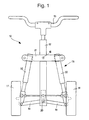
- figure 1 shows a schematic front view of a front suspension group of a four-wheel rolling vehicle with an integral electric drive, according to the present invention;
- figure 2 shows a schematic plan view of the rear portion of a four-wheel rolling vehicle with an integral electric drive, according to the present invention;
- figure 3 shows a schematic plan view of the rear portion of a rolling vehicle of figure 2, with a feeding system according to a first embodiment of the present invention;
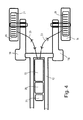
- figure 4 shows a schematic plan view of the rear portion of a rolling vehicle of figure 2, with a feeding system according to a second embodiment of the present invention;
- figure 5 shows a schematic plan view of the rear portion of a rolling vehicle of figure 2, with a feeding system according to a third embodiment of the present invention; and
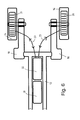
- figure 6 shows a schematic plan view of the rear portion of a rolling vehicle of figure 2, with a feeding system according to a fourth embodiment of the present invention.
- With reference to the figures, a four-wheel rolling vehicle with an integral electric drive, indicated as a whole with 10, according to a preferred embodiment of the present invention, is equipped with two
front steering wheels 11, achassis 12,handlebars 13, tworear wheels 14, afront suspension group 15 for thefront wheels 11 and independentlongitudinal arm suspensions 16 for therear wheels 14. In particular, thefront suspension group 15 consists of anupper crossbar 17 connected to thechassis 12 of the vehicle by means of ahinge 18 in correspondence with its half, twolower crossbars 19 connected to an end of thechassis 12 of the vehicle by means ofhinges 20 and at least twosuspensions 20 independent of each other and constrained above one to each end of theupper crossbar 17 and below to the respectivelower crossbar 19, so as to form an articulated quadrilateral which allows the rolling of the vehicle. - This solution allows the vehicle to have two front guiding wheels in parallel, steering and inclinable, so that it can be guided like a motorcycle (front part inclinable - rolling movement - together with the rear). As the front steering system can roll with respect to the rear part, the front wheels can in turn be inclined like the back wheels, always remaining in contact with the ground, however, and therefore guaranteeing a greater adherence to the road surface.
- As already mentioned, the characteristic of the vehicle according to the present invention consists in providing each wheel, both the
front wheels 11 and theback wheels 14, with a correspondingelectric motor 21, housed in the hub of the wheel (whose dimensions are, if necessary, suitably increased to guarantee the necessary space in its interior). - With reference in particular to figure 3, which for the sake of simplicity only shows the rear part of the
vehicle 10, anelectric accumulator group 22 is also installed on board thevehicle 10, which can consist for example of batteries based on Pb, Pb-gel, Ni-Mh, Li-Ion, with or without the combination of supercondensers. Theelectric accumulator group 22 feeds, throughelectric connections 23 and by means of a suitableelectronic control board 24, possibly functionally divided into sub-control boards, assisted by on-board commands, theelectric motor groups 21 installed in each of the four wheels, both thefront wheels 11 and theback wheels 14. The transmission of the driving torque is therefore directed on the four wheels. - The
electric accumulator group 22, housed inside thechassis 12 of the four-wheel rolling vehicle, can be extracted to allow transportation and recharging "at home". Alternatively, the recharging can be effected without extraction of theelectric accumulator 22, or "on site", by means of a battery-charger (not shown) on- or not on-board, possibly also housed inside thechassis 12 and equipped with a wire with a plug for connection to the electric power supply or, more generally, to an electric energy source. - It is evident how the solution of the present invention allows, through the control effected by the
electronic board 24, possibly functionally divided into sub-control boards, the single running of each of theelectric motors 21 installed in each of the four wheels, consequently being able to obtain higher performances in terms of driving safety of the vehicle. - Furthermore, through a speed and acceleration sensor system (not shown), connected on the one hand to the single wheels and on the other to the
electronic board 24, possibly functionally divided into sub-control boards, it is possible to check at any moment the adherence condition of the single wheel. - Consequently, in the case of veering during acceleration, revealed on one or more of the
front wheels 11 orback wheels 14, thecontrol board 24 and/or its sub-control boards can intervene by directly limiting the torque supplied by the motor or corresponding motors, re-establishing the adherence conditions. - In the case of veering during braking, revealed on one or more wheels, the
control board 24 and/or its sub-control boards can intervene by directly increasing the torque supplied by the motor or corresponding motors, re-establishing the adherence conditions with the same pressure of the braking plant. In this sense, therefore, the electronic management of the motors is offered as an aid and/or alternative to the known ABS system (present or absent on the vehicle). - Furthermore, by installing on board the vehicle one or more accelerometers and/or gyroscopes (not shown), it is possible to check at any moment the yaw movement of the vehicle itself and compare it with the geometric inclination and steering angle, to obtain a possible shifting from the trajectory desired by the driver. In the case of a revealed shifting, the
electronic control board 24 acts directly or through its sub-control boards on the torque supplied by theelectric motors 21, in order to recuperate the correct angular yaw velocity. - In addition to the embodiment described with reference to figures 1-3, in which there is an
electric motor 21 for each of the wheels of the vehicle, an alternative embodiment is also envisaged in which the motors are alternatively present only on the twofront wheels 11 or only on therear wheels 14. - If the wheels are all equipped with a motor, they can however be used upon the command of the driver in pairs, the front wheels only, the back wheels only or all together.
- The selection of the drive mode depends on various factors: performances required, autonomy and adherence. The triggering of the integral drive is conveniently reserved for particular driving situations which, thanks to a selector (not shown), can be selected by the driver of the vehicle. The drive on all wheels generally privileges performances and motility and is always advisable under low adherence conditions, but it can in any case be established on the basis of personal considerations of the driver.
- With reference to figure 4, this shows an alternative embodiment of the vehicle of the present invention, in particular aimed at increasing the autonomy of the vehicle. According to this embodiment, in fact, the presence of an
internal combustion engine 25 is envisaged, functioning under stationary or semi-stationary regime conditions or in any case suitable for maintaining the correct electric energy balance on-board the vehicle, as generator for recharging theelectric accumulators 22. This solution creates a drive system called "thermal/electric serial hybrid", withelectric motors 21 fed by electric accumulators, theaccumulator group 22 being recharged by theinternal combustion engine 25 according to recharging cycles depending on the condition of the batteries themselves and type of use to which thevehicle 10 is subjected, according to logics predefined and activated by thecontrol board 24 and/or the sub-control boards. - The
internal combustion engine 25 can be fed with different fuels, such as gasoline for motor vehicles, gas oil, methane, gaseous hydrogen, LPG, alcohol. - Furthermore, with reference to figure 5, this shows a further embodiment, particularly aimed at increasing the autonomy of the
vehicle 10, obtained using a turbogas motor, of which thedisk wheel 26 and alternator/generator 27 are schematized. The turbogas motor, when operating under stationary or semi-stationary regime or in any case suitable for maintaining the correct electric energy balance on-board the vehicle, acts as generator for the recharging of theelectric accumulators 22. This solution creates a drive system called "turbogas/electric serial hybrid", with electric motors fed through theelectric accumulator group 22, as in the case already described. In this case, theaccumulator group 22 is then recharged by the turbogas motor according to recharging systems depending on the condition of the batteries themselves and type of use to which the vehicle is subjected, according to logics predefined and activated by thecontrol board 24 and/or the sub-control boards. - The turbogas motor can be projected to be fed by different types of fuel, such as kerosene, gasoline for motor vehicles, gas oil, methane, LPG, alcohol.
- A further embodiment of the
vehicle 10 aimed at increasing the autonomy of the vehicle is shown in figure 6 and envisages the use of one ormore fuel cells 28 as generator for the recharging of the electric accumulators: this solution creates a system called "fuel cell electric drive", withelectric motors 21 fed by theelectric accumulator group 22 as in the cases already described. - Compressed gaseous hydrogen or hydrogen adsorbed on metallic hydrides, or other types of specific fuels for fuel cells, can be used as feeding.
- According to all the alternative embodiments previously illustrated, it is possible to assemble a super- condenser in parallel with the
accumulator group 22, in order to effectively handle sudden requests for electric power (for example during acceleration) which could damage or not be handled by the batteries. - These embodiments also allow to use the vehicle in the "electric" mode only, momentarily deactivating the recharging unit of the batteries for any reason. It is also possible to use the recharging unit of the batteries also when the vehicle is at a standstill and with the burglar alarm inserted (mechanical and/or electric and/or electronic), in order to recharge the
accumulator group 22 during stops and/or during parking, when allowed. - The four-wheel rolling vehicle thus conceived can undergo numerous modifications and variants, all included in the invention; furthermore all the details can be substituted by technically equivalent elements. In practice, the materials used, as also the dimensions, can vary according to the technical requirements.
Claims (15)
- A four-wheel electric-drive rolling vehicle (10) with front steering wheels (11) connected to a chassis (12) by means of an articulated quadrilateral front suspension group (15) and rear wheels (14) connected to said chassis (12) by means of independent, longitudinal arm suspensions (16), characterized in that it comprises at least a pair of electric driving motors (21), an electric motor for each of the front wheels (11), and/or an electric motor for each of the rear wheels (14), respectively, said motors (21) being fed by at least one electric accumulator group (22), through electric connections (23).
- The four-wheel rolling vehicle (10) with an electric drive according to claim 1, characterized in that said electric motors (21) are housed in the hubs of the wheels (11, 14) .
- The four-wheel rolling vehicle (10) with an electric drive according to claim 1, characterized in that said at least one electric accumulator group (22) can be extracted to allow transportation and recharging "at home".
- The four-wheel rolling vehicle (10) with an electric drive according to claim 1, characterized in that it comprises at least one battery-charger for the recharging of said at least one electric accumulator group (22) "on site".
- The four-wheel rolling vehicle (10) with an electric drive according to claim 1, characterized in that it comprises at least one electronic board (24), possibly functionally divided into sub-control boards, for the electric drive control, of the energy flow and recharging of each electric motor (21).
- The four-wheel rolling vehicle (10) with an electric drive according to claim 5, characterized in that said control board (24), possibly functionally divided into sub-control boards, is connected to speed and acceleration sensors, connected to the single wheels (11, 14) to check their adherence conditions, at any moment.
- The four-wheel rolling vehicle (10) with an electric drive according to claim 5, characterized in that said board and/or sub boards are connected to one or more accelerometers and/or gyroscopes to check the yaw movement of the vehicle at any moment and compare it with the geometric inclination and steering angle, to obtain the possible shifting from the trajectory desired by the driver.
- The four-wheel rolling vehicle(10) with an electric drive according to claim 1, characterized in that it comprises four electric motors (21), one for each wheel, and a selector for the use of the motors of the front wheels alone (11), the back wheels (14) alone or contemporaneously all the electric motors (21).
- The four-wheel rolling vehicle (10) with an electric drive according to claim 1, characterized in that it also comprises an internal combustion engine (25), functioning under stationary or semi-stationary regime or in any case suitable for maintaining the correct electric energy balance on-board the vehicle, as generator for recharging the electric accumulators (22).
- The four-wheel rolling vehicle (10) with an electric drive according to claim 9, characterized in that said internal combustion engine (25) can be fed with different fuels, such as gasoline for motor vehicles, gas oil, methane, gaseous hydrogen, LPG, alcohol.
- The four-wheel rolling vehicle (10) with an electric drive according to claim 1, characterized in that it also comprises a turbogas motor, functioning under stationary or semi-stationary regime or in any case suitable for maintaining the correct electric energy balance onboard the vehicle, as generator for recharging the electric accumulators (22).
- The four-wheel rolling vehicle (10) with an electric drive according to claim 11, characterized in that it can be fed with different fuels, such as kerosene, gasoline for motor vehicles, gas oil, methane, LPG, alcohol.
- The four-wheel rolling vehicle (10) with an electric drive according to claim 1, characterized in that it also comprises one or more fuel cells (28), as generator for the recharging of the electric accumulators (22).
- The four-wheel rolling vehicle (10) with an electric drive according to claim 13, characterized in that it can be fed with different fuels, such as compressed gaseous hydrogen, or hydrogen adsorbed on metallic hydrides.
- The four-wheel rolling vehicle (10) with an electric drive according to claim 1, characterized in that it also comprises a supercondenser, situated in parallel to the accumulator group (22).
Applications Claiming Priority (1)
| Application Number | Priority Date | Filing Date | Title |
|---|---|---|---|
| IT000976A ITMI20060976A1 (en) | 2006-05-17 | 2006-05-17 | 4-WHEEL ROLLER VEHICLE WITH ELECTRIC TRACTION |
Publications (3)
| Publication Number | Publication Date |
|---|---|
| EP1864843A2 true EP1864843A2 (en) | 2007-12-12 |
| EP1864843A3 EP1864843A3 (en) | 2009-11-04 |
| EP1864843A8 EP1864843A8 (en) | 2010-01-13 |
Family
ID=38255167
Family Applications (1)
| Application Number | Title | Priority Date | Filing Date |
|---|---|---|---|
| EP07108107A Withdrawn EP1864843A3 (en) | 2006-05-17 | 2007-05-14 | Four-wheel rolling vehicle with electric drive |
Country Status (6)
| Country | Link |
|---|---|
| US (1) | US20070278023A1 (en) |
| EP (1) | EP1864843A3 (en) |
| JP (1) | JP2007312596A (en) |
| CN (1) | CN101074037A (en) |
| IT (1) | ITMI20060976A1 (en) |
| TW (1) | TW200815232A (en) |
Cited By (5)
| Publication number | Priority date | Publication date | Assignee | Title |
|---|---|---|---|---|
| CN101638106B (en) * | 2008-07-31 | 2011-07-20 | 上海坤孚企业(集团)有限公司 | Wheel inclination structure for turning of electric motorcar |
| CN101638107B (en) * | 2008-07-31 | 2011-07-20 | 上海坤孚企业(集团)有限公司 | Balancing device for electro-tricycle |
| EP2692612A1 (en) * | 2012-08-02 | 2014-02-05 | Rodney Ian Rawlinson | Wheeled vehicle |
| EP3257732A1 (en) * | 2016-06-16 | 2017-12-20 | Yamaha Hatsudoki Kabushiki Kaisha | Vehicle |
| IT201600097100A1 (en) * | 2016-09-28 | 2018-03-28 | Piaggio & C Spa | SUSPENSION ASSEMBLY FOR A TILTING, FORWARD AND TILTING VEHICLE |
Families Citing this family (22)
| Publication number | Priority date | Publication date | Assignee | Title |
|---|---|---|---|---|
| US8521384B2 (en) * | 2008-01-28 | 2013-08-27 | Textron Innovations Inc. | Turf maintenance vehicle all-wheel drive system |
| US8091677B2 (en) * | 2008-03-27 | 2012-01-10 | GM Global Technology Operations LLC | System and method of differentiating rotational speed and torque between wheels of a hybrid vehicle |
| JP2010058759A (en) * | 2008-09-05 | 2010-03-18 | Yamaha Motor Co Ltd | Vehicle body frame for saddle riding type four-wheel vehicle |
| AU2009304587B2 (en) * | 2008-10-16 | 2014-12-11 | Boorne, John Hanson | Electric motor vehicle |
| US9020618B2 (en) * | 2010-04-26 | 2015-04-28 | Empire Technology Development Llc | Accelerometer based controller and/or controlled device |
| US8733482B2 (en) * | 2010-05-27 | 2014-05-27 | Boxx Corp. | Motor assembly for two wheeled vehicle |
| DE102010021996A1 (en) * | 2010-05-29 | 2011-12-01 | Audi Ag | Method for operating two drives and motor vehicle with two drives that work on mutually decoupled wheels |
| TWI408073B (en) * | 2010-07-19 | 2013-09-11 | Univ Nat Taiwan Science Tech | Three-wheeled motorized vehicle with high safety |
| KR101034814B1 (en) * | 2010-12-22 | 2011-05-16 | 오봉석 | Electric four-wheeled motorcycle |
| EP2714479A1 (en) * | 2011-05-27 | 2014-04-09 | Robert Bosch GmbH | Inclination-dependent adaptation of brake force regulation in single-tracked vehicles |
| US8596660B2 (en) | 2012-01-18 | 2013-12-03 | National Taiwan University Of Science And Technology | Three-wheeled motor vehicle with high safety |
| JP2013233895A (en) * | 2012-05-10 | 2013-11-21 | Jtekt Corp | Vehicle |
| JP2014196096A (en) | 2013-03-29 | 2014-10-16 | ヤマハ発動機株式会社 | Antiskid device, vehicle, and two-wheeled motor vehicle |
| US20140358343A1 (en) * | 2013-05-28 | 2014-12-04 | Raymond Louis Chastang, JR. | Vehicle tire frictional drive rotational power and energy source |
| US9061564B1 (en) | 2013-12-18 | 2015-06-23 | Automotive Research & Testing Center | Active vehicle with a variable inclination apparatus and method of using the same |
| US10016666B2 (en) * | 2015-09-04 | 2018-07-10 | Sun Mountain Sports, Inc. | Collapsible single passenger riding golf bag cart |
| KR20150117626A (en) * | 2015-09-30 | 2015-10-20 | 권용범 | Driving control by self-load for transportation with more than two electro-motion wheel. |
| US20180079291A1 (en) * | 2016-09-22 | 2018-03-22 | Top Flight Technologies, Inc. | Power generation and distribution for land-based vehicle propulsion |
| CN107499430B (en) * | 2017-09-15 | 2024-02-02 | 王志明 | Movable swing car |
| JP6787865B2 (en) * | 2017-10-13 | 2020-11-18 | 株式会社シマノ | Bicycle drive unit |
| CN108327471A (en) * | 2018-04-27 | 2018-07-27 | 陈炜 | Wheeled robot suspension frame structure |
| IT202100015359A1 (en) * | 2021-06-11 | 2022-12-11 | Piaggio & C Spa | ROLLING SADDLE VEHICLE WITH LOAD CAPACITY IN THE FRONT PART. |
Citations (1)
| Publication number | Priority date | Publication date | Assignee | Title |
|---|---|---|---|---|
| WO2005058680A1 (en) | 2003-12-19 | 2005-06-30 | Piaggio & C.S.P.A. | Four-wheeled vehicle |
Family Cites Families (17)
| Publication number | Priority date | Publication date | Assignee | Title |
|---|---|---|---|---|
| GB9706909D0 (en) * | 1997-04-04 | 1997-05-21 | Adds Graham J | Electric vehicles |
| US5921338A (en) * | 1997-08-11 | 1999-07-13 | Robin L. Edmondson | Personal transporter having multiple independent wheel drive |
| US6672415B1 (en) * | 1999-05-26 | 2004-01-06 | Toyota Jidosha Kabushiki Kaisha | Moving object with fuel cells incorporated therein and method of controlling the same |
| JP2002165309A (en) * | 2000-11-20 | 2002-06-07 | Honda Motor Co Ltd | Fuel cell four-wheeled vehicle |
| JP3771441B2 (en) * | 2000-12-05 | 2006-04-26 | 本田技研工業株式会社 | Fuel cell vehicle |
| JP4109852B2 (en) * | 2001-10-19 | 2008-07-02 | ヤマハ発動機株式会社 | Throttle opening detection device for electric motorcycle |
| JP3993564B2 (en) * | 2004-01-13 | 2007-10-17 | 三菱重工業株式会社 | Series hybrid electric vehicle |
| JP3998000B2 (en) * | 2004-03-24 | 2007-10-24 | 株式会社日立製作所 | Control device for hybrid four-wheel drive vehicle and hybrid four-wheel drive vehicle |
| DE102004023619A1 (en) * | 2004-05-10 | 2005-12-01 | Volkswagen Ag | Electric energy system in a hybrid vehicle |
| US7374012B2 (en) * | 2004-05-24 | 2008-05-20 | Yamaha Hatsudoki Kabushiki Kaisha | Operation control system for small-sized vehicle |
| US7440834B2 (en) * | 2004-07-13 | 2008-10-21 | Nissan Motor Co., Ltd. | Drive force distribution system for four wheel independent drive vehicle |
| US7207588B2 (en) * | 2004-07-19 | 2007-04-24 | Mattel, Inc. | Children's ride-on vehicle assemblies having trailing vehicle detection systems |
| DE102005019489A1 (en) * | 2005-04-27 | 2006-11-09 | Krauss-Maffei Wegmann Gmbh & Co. Kg | Four-wheel drive motor vehicle |
| US7398842B2 (en) * | 2005-05-24 | 2008-07-15 | Fontecchio Bruce E | Articulating quad-drive wheelchair |
| US7849945B2 (en) * | 2006-02-24 | 2010-12-14 | Honda Motor Co., Ltd | Modular electric powertrain for a vehicle |
| US7451034B2 (en) * | 2006-03-10 | 2008-11-11 | Ford Global Technologies, Llc | Traction control using dynamic tire friction potential |
| US20090014223A1 (en) * | 2007-07-09 | 2009-01-15 | Jones Robert M | Differential for a lightweight vehicle |
-
2006
- 2006-05-17 IT IT000976A patent/ITMI20060976A1/en unknown
-
2007
- 2007-05-11 US US11/801,808 patent/US20070278023A1/en not_active Abandoned
- 2007-05-14 EP EP07108107A patent/EP1864843A3/en not_active Withdrawn
- 2007-05-15 TW TW096117138A patent/TW200815232A/en unknown
- 2007-05-17 CN CNA2007101049265A patent/CN101074037A/en active Pending
- 2007-05-17 JP JP2007156873A patent/JP2007312596A/en active Pending
Patent Citations (1)
| Publication number | Priority date | Publication date | Assignee | Title |
|---|---|---|---|---|
| WO2005058680A1 (en) | 2003-12-19 | 2005-06-30 | Piaggio & C.S.P.A. | Four-wheeled vehicle |
Cited By (8)
| Publication number | Priority date | Publication date | Assignee | Title |
|---|---|---|---|---|
| CN101638106B (en) * | 2008-07-31 | 2011-07-20 | 上海坤孚企业(集团)有限公司 | Wheel inclination structure for turning of electric motorcar |
| CN101638107B (en) * | 2008-07-31 | 2011-07-20 | 上海坤孚企业(集团)有限公司 | Balancing device for electro-tricycle |
| EP2692612A1 (en) * | 2012-08-02 | 2014-02-05 | Rodney Ian Rawlinson | Wheeled vehicle |
| EP3257732A1 (en) * | 2016-06-16 | 2017-12-20 | Yamaha Hatsudoki Kabushiki Kaisha | Vehicle |
| IT201600097100A1 (en) * | 2016-09-28 | 2018-03-28 | Piaggio & C Spa | SUSPENSION ASSEMBLY FOR A TILTING, FORWARD AND TILTING VEHICLE |
| WO2018060869A1 (en) * | 2016-09-28 | 2018-04-05 | Piaggio & C. S.P.A. | Suspension assembly for a tilting vehicle, forecarriage and tilting vehicle |
| IL265405A (en) * | 2016-09-28 | 2019-05-30 | Piaggio & C Spa | Suspension assembly for a tilting vehicle, forecarriage and tilting vehicle |
| US11505026B2 (en) | 2016-09-28 | 2022-11-22 | Piaggio & C. S.P.A. | Suspension assembly for a tilting vehicle, forecarriage and tilting vehicle |
Also Published As
| Publication number | Publication date |
|---|---|
| ITMI20060976A1 (en) | 2007-11-18 |
| US20070278023A1 (en) | 2007-12-06 |
| EP1864843A8 (en) | 2010-01-13 |
| TW200815232A (en) | 2008-04-01 |
| EP1864843A3 (en) | 2009-11-04 |
| CN101074037A (en) | 2007-11-21 |
| JP2007312596A (en) | 2007-11-29 |
Similar Documents
| Publication | Publication Date | Title |
|---|---|---|
| EP1864843A2 (en) | Four-wheel rolling vehicle with electric drive | |
| US12440404B2 (en) | Drifting kart | |
| KR102351557B1 (en) | motor gearbox assembly | |
| US7743859B2 (en) | Hybrid drivetrains for trailers | |
| US20090014223A1 (en) | Differential for a lightweight vehicle | |
| US8973690B2 (en) | Front wheel energy recovery system | |
| US8190344B2 (en) | Optimization of vehicle stability and steering during a regenerative braking event | |
| US20110163516A1 (en) | Flywheel assemblies and vehicles including same | |
| JP4911111B2 (en) | Vehicle control device | |
| US12103503B2 (en) | Vehicle wheel assembly | |
| US20230202561A1 (en) | Independent wheel shiftable wheel drives | |
| EP1982905A1 (en) | Electrically powered vehicle, having wheels arranged in a rhombus-like configuration | |
| US11919332B2 (en) | Vehicle wheel assembly and method | |
| JP3906826B2 (en) | Control device for hybrid four-wheel drive vehicle | |
| JP7735664B2 (en) | Electric vehicle control device | |
| HK1113337A (en) | Four-wheel rolling vehicle with electric drive | |
| CN117507849A (en) | Driving device, vehicle, and control method for driving device | |
| Fijalkowski | A FAMILY OF DRIVING, BRAKING, STEERING, ABSORBING, ROLLING AND THROTTLING CONTROLS „X-BY-WIRE AUTOMOTIVE CONTROL” | |
| Fijalkowski | CONCEPTION OF ELECTRO-MECHANICAL DIFFERENTIALS FOR REDUCTION OF SELF-GENERATED WIND-UP TORQUES IN DBW 4WD PROPULSION MECHATRONIC CONTROL SYSTEMS FOR JOINT LIGHT TACTICAL VEHICLES | |
| WO2004029436A1 (en) | Full hybrid electric car |
Legal Events
| Date | Code | Title | Description |
|---|---|---|---|
| PUAI | Public reference made under article 153(3) epc to a published international application that has entered the european phase |
Free format text: ORIGINAL CODE: 0009012 |
|
| AK | Designated contracting states |
Kind code of ref document: A2 Designated state(s): AT BE BG CH CY CZ DE DK EE ES FI FR GB GR HU IE IS IT LI LT LU LV MC MT NL PL PT RO SE SI SK TR |
|
| AX | Request for extension of the european patent |
Extension state: AL BA HR MK YU |
|
| PUAL | Search report despatched |
Free format text: ORIGINAL CODE: 0009013 |
|
| AK | Designated contracting states |
Kind code of ref document: A3 Designated state(s): AT BE BG CH CY CZ DE DK EE ES FI FR GB GR HU IE IS IT LI LT LU LV MC MT NL PL PT RO SE SI SK TR |
|
| AX | Request for extension of the european patent |
Extension state: AL BA HR MK RS |
|
| 17P | Request for examination filed |
Effective date: 20100318 |
|
| 17Q | First examination report despatched |
Effective date: 20100414 |
|
| AKX | Designation fees paid |
Designated state(s): AT BE BG CH CY CZ DE DK EE ES FI FR GB GR HU IE IS IT LI LT LU LV MC MT NL PL PT RO SE SI SK TR |
|
| STAA | Information on the status of an ep patent application or granted ep patent |
Free format text: STATUS: THE APPLICATION IS DEEMED TO BE WITHDRAWN |
|
| 18D | Application deemed to be withdrawn |
Effective date: 20100825 |