EP1863339B1 - Container apparatus, container closure and method - Google Patents
Container apparatus, container closure and method Download PDFInfo
- Publication number
- EP1863339B1 EP1863339B1 EP06733864.0A EP06733864A EP1863339B1 EP 1863339 B1 EP1863339 B1 EP 1863339B1 EP 06733864 A EP06733864 A EP 06733864A EP 1863339 B1 EP1863339 B1 EP 1863339B1
- Authority
- EP
- European Patent Office
- Prior art keywords
- closure member
- interlocking closure
- container
- opening
- interlocking
- Prior art date
- Legal status (The legal status is an assumption and is not a legal conclusion. Google has not performed a legal analysis and makes no representation as to the accuracy of the status listed.)
- Expired - Lifetime
Links
Images


Classifications
-
- A—HUMAN NECESSITIES
- A01—AGRICULTURE; FORESTRY; ANIMAL HUSBANDRY; HUNTING; TRAPPING; FISHING
- A01K—ANIMAL HUSBANDRY; AVICULTURE; APICULTURE; PISCICULTURE; FISHING; REARING OR BREEDING ANIMALS, NOT OTHERWISE PROVIDED FOR; NEW BREEDS OF ANIMALS
- A01K15/00—Devices for taming animals, e.g. nose-rings or hobbles; Devices for overturning animals in general; Training or exercising equipment; Covering boxes
- A01K15/02—Training or exercising equipment, e.g. mazes or labyrinths for animals ; Electric shock devices; Toys specially adapted for animals
- A01K15/025—Toys specially adapted for animals
- A01K15/026—Chewable toys, e.g. for dental care of pets
-
- A—HUMAN NECESSITIES
- A01—AGRICULTURE; FORESTRY; ANIMAL HUSBANDRY; HUNTING; TRAPPING; FISHING
- A01K—ANIMAL HUSBANDRY; AVICULTURE; APICULTURE; PISCICULTURE; FISHING; REARING OR BREEDING ANIMALS, NOT OTHERWISE PROVIDED FOR; NEW BREEDS OF ANIMALS
- A01K5/00—Feeding devices for stock or game ; Feeding wagons; Feeding stacks
- A01K5/01—Feed troughs; Feed pails
- A01K5/0114—Pet food dispensers; Pet food trays
Definitions
- the present invention relates in general to container apparatus and, in particular, to a container apparatus that dispenses items, such as edible treats. Still more particularly, the present invention is related to a closure for a container apparatus.
- U.S. Patent No. 6,634,318 to Rucker further discloses the use of an edible plug to seal the hole through which the treats are dispensed from the interior cavity of the toy so that the treats do not prematurely spill out of the hole and the duration of a dog's interaction with the toy is extended.
- Rucker specifically teaches that it is desirable that the edible plug should be designed to be readily dislodged by the dog. Consequently, Rucker's plug is designed with a conic or cylindrical section and, when installed, has a larger diameter portion external to the toy and a smaller diameter portion inside the toy. This design permits the dog to easily remove the plug from the toy using its teeth, either by shearing the larger diameter portion from the smaller diameter portion or by pulling the plug out of hole.
- the present invention recognizes that conventional edible plug designs such as that disclosed by Rucker in U.S. Patent No. 6,634,318 are easily removed, particularly by large or aggressive dogs. Consequently, the toy will not present a challenge of any significant duration to such dogs and will not serve to alleviate the boredom for which such toys are claimed as solutions.
- the present invention provides an improved container apparatus, container closure, and method.
- a container apparatus comprising: a container having an interior compartment and an opening communicating with said interior compartment; a first interlocking closure member at least partially within said compartment and extending through said opening to an exterior of said container; and a second interlocking closure member, removably secured to said first interlocking closure member by engagement of the first and second interlocking closure members, and covering said opening, such that items placed within said interior compartment are restricted from being dispensed via said opening, wherein at least one of said first interlocking closure member and said second interlocking closure member is edible.
- a closure apparatus for restricting access to an opening of a container, said closure apparatus comprising: a first interlocking closure member having an elongate body having at least one external thread, said first interlocking closure member has a larger diameter and a smaller diameter orthogonal to a long axis of said elongate body; and an edible second interlocking closure member having a body sized to restrict access to an opening in a container, said body having a threaded recess having at least one internal thread formed therein to removably couple said second interlocking closure member to said first interlocking closure member by engaging said external thread of said first interlocking closure member.
- an animal treat method comprising: providing a container having an interior compartment for containing animal treats; providing at least one opening in the container communicating with said interior compartment; and inserting animal treats into the interior compartment; inserting a first interlocking closure member at least partially within the compartment and extending through said opening to an exterior of said container; and removably securing a second interlocking closure member to said first interlocking closure member by engagement of the first and second interlocking closure members, and covering said opening, such that items placed within said interior compartment are restricted from being dispensed via said opening, wherein at least one of said first interlocking closure member and said second interlocking closure member is edible. In this manner, items placed within the interior compartment are restricted from being dispensed via the opening.
- Figure 1A is a section view of a container in accordance with one embodiment of the present invention.
- Figure 1B is a plan view of the container of Figure 1A ;
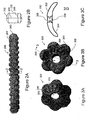
- Figure 2A depicts a plan view of a first interlocking closure member in accordance with the present invention
- Figure 2B illustrates a section view of the first interlocking closure member of Figure 2A ;
- Figure 3A depicts a top view of a second interlocking closure member in accordance with the present invention.
- Figure 3B illustrates a bottom view of the second interlocking closure member of Figure 3A ;
- Figure 3C is a section view of the second interlocking closure member of Figures 3A - 3B ;
- Figures 4A and 4B are section views of a container with first and second interlocking closure members installed in accordance with the present invention.
- Container 100 includes an exterior surface 102 and an interior surface 104 that defines one or more interior compartments 106 for holding items 108, such as edible and/or nutritious animal treats.
- Interior surface 104 and exterior surface 102 have at least one communicating opening 110 through which items 108 may be dispensed from the compartment 106 of container 100.
- opening 110 takes the form of two orthogonal slits having tear-resistant lobes 120 at each of the four slit ends. Opening 110 thus defines four symmetrical, evenly spaced flaps 118 .
- the configuration of flaps 118 and opening 110 allows form(s) used to create the interior surface 104 of container 100 to easily be removed following fabrication of container 100 and allows the user to easily insert items 108 and/or other objects into container 100 while preventing items 108 from being too readily released from compartment 106.
- any size, shape, or number of flaps 118 may be used as may be desired and/or convenient.
- Container 100 may be made of any substance or combination of substances now known or hereafter developed.
- container 100 is formed of a deformable yet durable, tear resistant plastic-like and/or rubber-like material.
- container 100 is highly resilient and highly resistant to permanent deformation and destruction, for example, when chewed and/or clawed upon by an animal, such as a dog.
- Container 100 and interior and exterior surfaces 102 and 104 may be molded in any desired shape, for example, rectangular, circular, cylindrical, spherical, prismatic, oblong, ovoid and/or irregular.
- container 100 is substantially, but not precisely spherical and includes at least one at least partially circumferential raised element 110 on exterior surface 102 to promote irregular rolling motion.
- the term "container" or "ball” includes any of the foregoing or other desired shapes.
- exterior surface 102 of container 100 further defines a recess 114 at the location of at least one of the one or more openings 110 .
- Recess 114 may advantageously, but not necessarily be circular, elliptical, or ovoid in shape.
- recess 114 defines a circumferential lip 116 at least partially and preferably fully surrounding opening 110 that is capable of receiving and retaining a removable cap for restricting the dispensing of items from container 100 .
- the removable cap may take any shape in section or plan now known or hereafter developed or desired. For example, as described further below with reference to Figures 3A-3C , the removable cap may be dome-shaped to facilitate rolling container 100.
- the removable cap may also be edible and may further be an edible animal treat or animal food, such as a dog treat or food.
- at least one removable cap may be edible and at least one removable cap may be inedible and intended for semi-permanent installation.
- first interlocking closure member 200 has an elongate body 202 having external threads 204 formed thereon.
- First interlocking closure member 200 preferably, but not necessarily has a length greater than a diameter of container 100 measured at an opening 110 .
- External threads 204 are preferably formed on elongate body 202 at least adjacent to its two ends and may, as shown, be formed on substantially the entire length of elongate body 202 .
- first interlocking closure member 200 may alternatively have a non-radially symmetric cross-section that has at least one larger diameter and at least one smaller diameter.
- Figure 2B which illustrates a section of first interlocking closure member 200 along line 2—2
- elongate body 202 has a substantially rectangular cross-section
- the overall cross-section of first interlocking closure member 200 has a larger diameter 204 inclusive of threads 202 and a smaller diameter 206 having threads 202 of smaller (or no) radial dimension.
- first interlocking closure member 200 can be made utilizing any known or hereafter discovered technique, for example, by injection molding.
- First interlocking closure member 200 is preferably formed of a rigid or substantially rigid material.
- the material maybe anon-ingestible material such as a plastic or an edible food product.
- first interlocking closure member 200 is formed entirely of a gluten-based food product that is not only edible by an animal without harm, but is also nutritious.
- "ingestible" is used to identify items that, with respect to a particular animal, are sized and configured such that they can be ingested or swallowed. Not all items that are “ingestible” are “edible” or “nutritious”.
- Edible is defined herein to identify a subset of ingestible items that are not harmful to the intended ingesting animal. Edible items need not be nutritious or beneficial to the ingesting animal. Finally, the term “nutritious” is utilized to identify ingestible and edible items that are beneficial to the health of the intended ingesting animal.
- Second interlocking closure member 300 is preferably sized and shaped to fit snugly within recess 114 and be retained by lip 116 .
- Figures 3A-3C illustrate an embodiment in which second interlocking closure member 300 has a maximum perimeter that describes a substantially circular shape.
- second interlocking closure member 300 could be employed for embodiments of recess 114 having circular or other configurations.
- second interlocking closure member 300 has a domed cross-section, as particularly shown in Figure 3C , which illustrates a section of second interlocking closure member 300 along line 3—3.
- second interlocking closure member 300 has a generally convex first surface 302 and a generally concave second surface 304 .
- One or more of the first and second surfaces 302 and 304 may alternatively be flat or irregular in profile, and one or more first and second surfaces 302 may be textured or otherwise molded to facilitate gripping or biting by an animal's teeth.
- a threaded recess 306 having at least one thread 308 is formed and sized within second interlocking closure member 300 to permit it to be threadedly coupled to first interlocking closure member 200, as described further below. Threaded recess 306 may advantageously, but not necessarily be realized as a centrally located through hole as shown.
- Second interlocking closure member 300 is preferably injection molded or otherwise formed of a rigid or semi-rigid edible or nutritious food product, such as a wheat gluten-based food product.
- first and second interlocking closure members 200, 300 may alternatively or additionally be formed of other nutritious food products including rice, corn, and/or other grains and meat(s).
- FIG. 4A there is depicted a first section view of a container 100 with first and second interlocking closure members 200, 300 installed in accordance with the present invention.
- a user inserts items 108, such as edible and/or nutritious animal treats, within the interior compartment(s) 106 of container 100 .
- the user installs a second interlocking closure member 300a in place within each of one or more recesses 114 so that each second interlocking closure member 300 is retained by the lip 116 of its respective recess 114 and restricts the dispensing of items 108 from container 100 by blocking an opening 110 .
- the user may alternatively or additionally install at least one second interlocking closure member 300b so that it blocks an opening 114 of container 100 but is not retained by a lip 116.
- This alternative or additional installation of a second interlocking closure member 300b facilitates the removal of second interlocking closure member 300b, for example, through a dog or other animal chewing or licking second interlocking closure member 300b .
- FIG. 4A depicts a first interlocking closure member 200 threaded through two second interlocking closure members 300a, 300b, increasing the security with which the second interloclcing closure members 300a, 300b are retained covering openings 110.
- FIG. 4B there is depicted a second section view of a container 100 with first and second interlocking closure members 200, 300 installed in accordance with the present invention.
- a user inserts items 108 , such as edible and/or nutritious animal treats, within the interior compartment(s) 106 of container 100 .
- the user then threads a second interlocking closure member 300d a selected distance onto a distal end of first interlocking closure member 200 .
- second interlocking closure member 300d has flat parallel first and second surfaces 302, 304 and thus no domed profile.
- the user then inserts the distal end of first interlocking closure member 200 and second interlocking closure member 300d through opening 110 into compartment 106 of container 100 .
- Second interlocking closure member 300c can be, but need not be installed snugly against exterior surface 102 of container 100. As indicated in Figure 4A , second interlocking closure member 300c can be selectively installed with either of its first and second surfaces 302, 304 outwardly facing. Assuming that the user installs second interlocking closure member 300c with its first surface 302 outwardly facing, second interlocking closure member 300c may, if desired, be retained by the lip 116 of its respective recess 114 . A non-ingestible, non-edible cap 400 may further be installed to block access to at least one opening 110 .
- an animal for example, a dog, interacts with container 100 .
- the dog may roll, push, lick and/or bite container 100 and/or first and second interlocking closure elements 200, 300 .
- the taste and/or scent of first and second interlocking closure members 200, 300 and/or items 108 preferably encourages the dog to attempt to remove and/or eat first and second interlocking closure members 200, 300 .
- the dog is presented with a varying level of challenge to eat and or remove first and/or second interlocking closure members 200, 300.
- container 100 Thereafter, as the animal continues to play with container 100 , items 108 , which are preferably edible and nutritious animal treats, are dispensed from compartment 106 via one or more openings 110 , further rewarding the animal's interaction. Once all items 108 and first and second interlocking closure members 200, 300 have been removed and/or eaten, container 100 may be reconfigured with items 108 and a new interlocking first and second closure members 200, 300 .
- first and second interlocking members 200, 300 and items 108 may be edible
- various groups of one or more elements that may be used with the present invention e.g., container 100 , first interlocking member 200 , second interlocking member(s) 300 and/or items 108
- container 100 first interlocking member 200 , second interlocking member(s) 300 and/or items 108
- first interlocking closure member need not have a uniform radial diameter or uniform larger and smaller diameters over its entire length.
- one end of the first interlocking closure member may be of greater radial diameter than the other, and the larger diameter end may be sufficient size relative to the size or shape of an opening 114 to effectively prevent that end from easily passing through an opening 110 , thereby retaining that end of the first interlocking closure member either inside of compartment 106 or outside of container 100 (until consumed or removed by adequate interaction with an animal). Consequently, in this embodiment, a second interlocking closure member 300 may be retained in place over the inside or outside of an opening 114 by the first interlocking closure member without the concurrent use of another second interlocking closure member 300 .
Landscapes
- Life Sciences & Earth Sciences (AREA)
- Environmental Sciences (AREA)
- Health & Medical Sciences (AREA)
- Animal Husbandry (AREA)
- Biodiversity & Conservation Biology (AREA)
- Dentistry (AREA)
- Birds (AREA)
- General Health & Medical Sciences (AREA)
- Physical Education & Sports Medicine (AREA)
- Animal Behavior & Ethology (AREA)
- Zoology (AREA)
- Packging For Living Organisms, Food Or Medicinal Products That Are Sensitive To Environmental Conditiond (AREA)
- Closures For Containers (AREA)
- Cartons (AREA)
- Feeding And Watering For Cattle Raising And Animal Husbandry (AREA)
Description
- The present invention relates in general to container apparatus and, in particular, to a container apparatus that dispenses items, such as edible treats. Still more particularly, the present invention is related to a closure for a container apparatus.
- It is well known in the art that boredom is a significant contributor to destructive behavior in domesticated animals. For example,
U.S. Patent No. 6,634,318 to Rucker and the prior art referenced therein disclose that barking, digging and other destructive behaviors are common problem behaviors of canines that become discontented or bored. As further disclosed in these patents, one common approach utilized in the art to address such destructive behaviors in dogs is to provide a toy that dispenses food (e.g., treats) from its hollow interior cavity through a hole as a dog interacts with the toy. -
U.S. Patent No. 6,634,318 to Rucker further discloses the use of an edible plug to seal the hole through which the treats are dispensed from the interior cavity of the toy so that the treats do not prematurely spill out of the hole and the duration of a dog's interaction with the toy is extended. Rucker specifically teaches that it is desirable that the edible plug should be designed to be readily dislodged by the dog. Consequently, Rucker's plug is designed with a conic or cylindrical section and, when installed, has a larger diameter portion external to the toy and a smaller diameter portion inside the toy. This design permits the dog to easily remove the plug from the toy using its teeth, either by shearing the larger diameter portion from the smaller diameter portion or by pulling the plug out of hole. - The present invention recognizes that conventional edible plug designs such as that disclosed by
Rucker in U.S. Patent No. 6,634,318 are easily removed, particularly by large or aggressive dogs. Consequently, the toy will not present a challenge of any significant duration to such dogs and will not serve to alleviate the boredom for which such toys are touted as solutions. In view of the foregoing and other shortcomings in the art, the present invention provides an improved container apparatus, container closure, and method. - According to one aspect of the invention there is provided a container apparatus, comprising: a container having an interior compartment and an opening communicating with said interior compartment; a first interlocking closure member at least partially within said compartment and extending through said opening to an exterior of said container; and a second interlocking closure member, removably secured to said first interlocking closure member by engagement of the first and second interlocking closure members, and covering said opening, such that items placed within said interior compartment are restricted from being dispensed via said opening, wherein at least one of said first interlocking closure member and said second interlocking closure member is edible.
- According to another aspect of the invention there is provided a closure apparatus for restricting access to an opening of a container, said closure apparatus comprising: a first interlocking closure member having an elongate body having at least one external thread, said first interlocking closure member has a larger diameter and a smaller diameter orthogonal to a long axis of said elongate body; and an edible second interlocking closure member having a body sized to restrict access to an opening in a container, said body having a threaded recess having at least one internal thread formed therein to removably couple said second interlocking closure member to said first interlocking closure member by engaging said external thread of said first interlocking closure member.
- According to yet another aspect there is provided an animal treat method comprising: providing a container having an interior compartment for containing animal treats; providing at least one opening in the container communicating with said interior compartment; and inserting animal treats into the interior compartment; inserting a first interlocking closure member at least partially within the compartment and extending through said opening to an exterior of said container; and removably securing a second interlocking closure member to said first interlocking closure member by engagement of the first and second interlocking closure members, and covering said opening, such that items placed within said interior compartment are restricted from being dispensed via said opening, wherein at least one of said first interlocking closure member and said second interlocking closure member is edible. In this manner, items placed within the interior compartment are restricted from being dispensed via the opening.
- All objects, features, and advantages of the present invention will become apparent in the following detailed written description.
- The novel features believed characteristic of the invention are set forth in the appended claims. However, the invention, as well as a preferred mode of use, will best be understood by reference to the following detailed description of an illustrative embodiment when read in conjunction with the accompanying drawings, wherein:
-
Figure 1A is a section view of a container in accordance with one embodiment of the present invention; -
Figure 1B is a plan view of the container ofFigure 1A ; -
Figure 2A depicts a plan view of a first interlocking closure member in accordance with the present invention; -
Figure 2B illustrates a section view of the first interlocking closure member ofFigure 2A ; -
Figure 3A depicts a top view of a second interlocking closure member in accordance with the present invention; -
Figure 3B illustrates a bottom view of the second interlocking closure member ofFigure 3A ; -
Figure 3C is a section view of the second interlocking closure member ofFigures 3A -3B; and -
Figures 4A and 4B are section views of a container with first and second interlocking closure members installed in accordance with the present invention. - With reference now to the figures and in particular with reference to
Figures 1A and 1B , there are illustrated a section view and plan view, respectively, of acontainer 100 in accordance with one embodiment of the present invention.Container 100 includes anexterior surface 102 and aninterior surface 104 that defines one or moreinterior compartments 106 for holdingitems 108, such as edible and/or nutritious animal treats.Interior surface 104 andexterior surface 102 have at least one communicatingopening 110 through whichitems 108 may be dispensed from thecompartment 106 ofcontainer 100. - In one embodiment, opening 110 takes the form of two orthogonal slits having tear-
resistant lobes 120 at each of the four slit ends.Opening 110 thus defines four symmetrical, evenly spacedflaps 118. The configuration offlaps 118 andopening 110 allows form(s) used to create theinterior surface 104 ofcontainer 100 to easily be removed following fabrication ofcontainer 100 and allows the user to easily insertitems 108 and/or other objects intocontainer 100 while preventingitems 108 from being too readily released fromcompartment 106. Obviously, any size, shape, or number offlaps 118 may be used as may be desired and/or convenient. -
Container 100 may be made of any substance or combination of substances now known or hereafter developed. In one preferred embodiment,container 100 is formed of a deformable yet durable, tear resistant plastic-like and/or rubber-like material. Preferably,container 100 is highly resilient and highly resistant to permanent deformation and destruction, for example, when chewed and/or clawed upon by an animal, such as a dog.Container 100 and interior andexterior surfaces container 100 is substantially, but not precisely spherical and includes at least one at least partially circumferential raisedelement 110 onexterior surface 102 to promote irregular rolling motion. As used herein, the term "container" or "ball" includes any of the foregoing or other desired shapes. - As further illustrated in
Figures 1A and 1B ,exterior surface 102 ofcontainer 100 further defines arecess 114 at the location of at least one of the one ormore openings 110.Recess 114 may advantageously, but not necessarily be circular, elliptical, or ovoid in shape. At its upper extent,recess 114 defines acircumferential lip 116 at least partially and preferably fully surroundingopening 110 that is capable of receiving and retaining a removable cap for restricting the dispensing of items fromcontainer 100. The removable cap may take any shape in section or plan now known or hereafter developed or desired. For example, as described further below with reference toFigures 3A-3C , the removable cap may be dome-shaped to facilitaterolling container 100. The removable cap may also be edible and may further be an edible animal treat or animal food, such as a dog treat or food. In embodiments in whichmultiple openings 110 are provided, at least one removable cap may be edible and at least one removable cap may be inedible and intended for semi-permanent installation. - Referring now to
Figures 2A-2B , there are depicted plan and section views, respectively, of a firstinterlocking closure member 200 in accordance with one embodiment of the present invention. As depicted, firstinterlocking closure member 200 has anelongate body 202 havingexternal threads 204 formed thereon. Firstinterlocking closure member 200 preferably, but not necessarily has a length greater than a diameter ofcontainer 100 measured at anopening 110.External threads 204 are preferably formed onelongate body 202 at least adjacent to its two ends and may, as shown, be formed on substantially the entire length ofelongate body 202. Althoughelongate body 202 andthreads 204 of firstinterlocking closure member 200 may be formed with a substantially circular cross-section, firstinterlocking closure member 200 may alternatively have a non-radially symmetric cross-section that has at least one larger diameter and at least one smaller diameter. For example, as shown inFigure 2B , which illustrates a section of firstinterlocking closure member 200 alongline 2—2,elongate body 202 has a substantially rectangular cross-section, and the overall cross-section of firstinterlocking closure member 200 has alarger diameter 204 inclusive ofthreads 202 and asmaller diameter 206 havingthreads 202 of smaller (or no) radial dimension. As will be appreciated from the description ofFigures 4A and 4B below, a non-radially symmetric cross-section facilitates the insertion into and removal of firstinterlocking closure member 200 fromcontainer 100 via opening(s) 110. Firstinterlocking closure member 200 can be made utilizing any known or hereafter discovered technique, for example, by injection molding. - First
interlocking closure member 200 is preferably formed of a rigid or substantially rigid material. The material maybe anon-ingestible material such as a plastic or an edible food product. In a particularly preferred embodiment, firstinterlocking closure member 200 is formed entirely of a gluten-based food product that is not only edible by an animal without harm, but is also nutritious. As the terms are employed herein, distinction is made and observed between the terms "ingestible", "edible", and "nutritious". In particular, "ingestible" is used to identify items that, with respect to a particular animal, are sized and configured such that they can be ingested or swallowed. Not all items that are "ingestible" are "edible" or "nutritious". "Edible" is defined herein to identify a subset of ingestible items that are not harmful to the intended ingesting animal. Edible items need not be nutritious or beneficial to the ingesting animal. Finally, the term "nutritious" is utilized to identify ingestible and edible items that are beneficial to the health of the intended ingesting animal. - With reference now to
Figures 3A-3C , there are illustrated top, bottom and section views of a secondinterlocking closure member 300 in accordance with one embodiment of the present invention. Secondinterlocking closure member 300 is preferably sized and shaped to fit snugly withinrecess 114 and be retained bylip 116. For example,Figures 3A-3C illustrate an embodiment in which secondinterlocking closure member 300 has a maximum perimeter that describes a substantially circular shape. Of course, other regular or irregular shapes of secondinterlocking closure member 300 could be employed for embodiments ofrecess 114 having circular or other configurations. - The illustrated embodiment of second
interlocking closure member 300 has a domed cross-section, as particularly shown inFigure 3C , which illustrates a section of secondinterlocking closure member 300 alongline 3—3. In this embodiment, secondinterlocking closure member 300 has a generally convexfirst surface 302 and a generally concavesecond surface 304. One or more of the first andsecond surfaces second surfaces 302 may be textured or otherwise molded to facilitate gripping or biting by an animal's teeth. A threadedrecess 306 having at least onethread 308 is formed and sized within secondinterlocking closure member 300 to permit it to be threadedly coupled to firstinterlocking closure member 200, as described further below. Threadedrecess 306 may advantageously, but not necessarily be realized as a centrally located through hole as shown. - Second
interlocking closure member 300 is preferably injection molded or otherwise formed of a rigid or semi-rigid edible or nutritious food product, such as a wheat gluten-based food product. Of course, first and secondinterlocking closure members - Referring now to
Figure 4A , there is depicted a first section view of acontainer 100 with first and secondinterlocking closure members items 108, such as edible and/or nutritious animal treats, within the interior compartment(s) 106 ofcontainer 100. Thereafter, the user installs a second interlocking closure member 300a in place within each of one ormore recesses 114 so that each secondinterlocking closure member 300 is retained by thelip 116 of itsrespective recess 114 and restricts the dispensing ofitems 108 fromcontainer 100 by blocking anopening 110. As indicated inFigure 4A , the user may alternatively or additionally install at least one secondinterlocking closure member 300b so that it blocks anopening 114 ofcontainer 100 but is not retained by alip 116. This alternative or additional installation of a secondinterlocking closure member 300b facilitates the removal of secondinterlocking closure member 300b, for example, through a dog or other animal chewing or licking secondinterlocking closure member 300b. The user can then optionally increase the length of interaction of an animal withcontainer 100 by threading the firstinterlocking closure member 200 within the threadedrecess 306 of one or more secondinterlocking closure members 300a, 300b so that the second interlocking closure member(s) 300 is/are removably secured to the firstinterlocking closure member 200 by at least one internal thread of each secondinterlocking closure member 300 engaging at least one external thread of the firstinterlocking closure member 200. For example,Figure 4A depicts a firstinterlocking closure member 200 threaded through two secondinterlocking closure members 300a, 300b, increasing the security with which the secondinterloclcing closure members 300a, 300b are retained coveringopenings 110. - With reference now to
Figure 4B , there is depicted a second section view of acontainer 100 with first and secondinterlocking closure members items 108, such as edible and/or nutritious animal treats, within the interior compartment(s) 106 ofcontainer 100. The user then threads a secondinterlocking closure member 300d a selected distance onto a distal end of firstinterlocking closure member 200. It should be noted that in the illustrated embodiment second interlockingclosure member 300d has flat parallel first andsecond surfaces interlocking closure member 200 and secondinterlocking closure member 300d throughopening 110 intocompartment 106 ofcontainer 100. The user thereafter threads another secondinterlocking closure member 300c onto the proximal end of first interlocking closure member 200 a selected distance to restrict external access toopening 110. Secondinterlocking closure member 300c can be, but need not be installed snugly againstexterior surface 102 ofcontainer 100. As indicated inFigure 4A , secondinterlocking closure member 300c can be selectively installed with either of its first andsecond surfaces interlocking closure member 300c with itsfirst surface 302 outwardly facing, secondinterlocking closure member 300c may, if desired, be retained by thelip 116 of itsrespective recess 114. A non-ingestible,non-edible cap 400 may further be installed to block access to at least oneopening 110. - In either of the installations shown in
Figures 4A and 4B , an animal, for example, a dog, interacts withcontainer 100. For example, the dog may roll, push, lick and/or bitecontainer 100 and/or first and second interlockingclosure elements interlocking closure members items 108 preferably encourages the dog to attempt to remove and/or eat first and secondinterlocking closure members interlocking closure members interlocking closure members container 100,items 108, which are preferably edible and nutritious animal treats, are dispensed fromcompartment 106 via one ormore openings 110, further rewarding the animal's interaction. Once allitems 108 and first and secondinterlocking closure members container 100 may be reconfigured withitems 108 and a new interlocking first andsecond closure members - While the invention has been particularly shown as described with reference to a preferred embodiment, it will be understood by those skilled in the art that various changes in form and detail may be made therein without departing from the scope of the invention. For example, because one or more elements used with the present invention (e.g., first and second interlocking
members container 100, first interlockingmember 200, second interlocking member(s) 300 and/or items 108) may be sold separately or packaged together. - In addition, it will be appreciated that the first interlocking closure member need not have a uniform radial diameter or uniform larger and smaller diameters over its entire length. For example, in an alternative embodiment of the present invention, one end of the first interlocking closure member may be of greater radial diameter than the other, and the larger diameter end may be sufficient size relative to the size or shape of an
opening 114 to effectively prevent that end from easily passing through anopening 110, thereby retaining that end of the first interlocking closure member either inside ofcompartment 106 or outside of container 100 (until consumed or removed by adequate interaction with an animal). Consequently, in this embodiment, a secondinterlocking closure member 300 may be retained in place over the inside or outside of anopening 114 by the first interlocking closure member without the concurrent use of another secondinterlocking closure member 300.
Claims (18)
- A container apparatus, comprising:a container (100) having an interior compartment (106) and an opening (110) communicating with said interior compartment (106);a first interlocking closure member (200) at least partially within said compartment (106) and extending through said opening (110) to an exterior of said container; anda second interlocking closure member (300), removably secured to said first interlocking closure member (200) by engagement of the first and second interlocking closure members, and covering said opening, such that items (108) placed within said interior compartment (106) are restricted from being dispensed via said opening (110), wherein at least one of said first interlocking closure member (200) and said second interlocking closure member (300) is edible.
- The container apparatus of Claim 1, wherein said second interlocking closure member (300) is edible.
- The container apparatus of Claim 1, wherein:said first interlocking closure member (200) has an elongate body having at least one external thread (204);said second interlocking closure member (300) has a threaded recess (306) having at least one internal thread (308); andsaid second interlocking closure member (300) is removably secured by said at least one internal thread (308) of said second interlocking closure member (300) engaging said at least one external thread (204) of said first interlocking closure member (200).
- The container apparatus of Claim 3, wherein said second interlocking closure member (300) has a body defining a through hole including said threaded recess (306).
- The container apparatus of Claim 1, wherein:said container (100) has an exterior surface (102) defining a recess (114) at said opening (110) and a lip (116) at least partially surrounding said opening (110); andsaid second interlocking closure member (300) is retained at least partially within said recess (114) by said lip (116).
- The container apparatus of Claim 1, wherein said container (100) includes at least one flap (118) limiting the size of said opening (110).
- The container apparatus of Claim 1, wherein:said opening (110) comprises a first opening; andsaid container apparatus has a second opening communicating with said interior compartment (106).
- The container apparatus of Claim 7, wherein:said first interlocking closure member (200) has an elongate body extending from an exterior of said container through said interior compartment (106) via said first and second openings.
- The container apparatus of Claim 8, wherein:said elongate body of said first interlocking closure member (200) has a proximal end and a distal end;said second interlocking closure member (300) is removably secured to said first interlocking closure member (200) toward said proximal end; andsaid container apparatus further comprises another second interlocking closure (300b) member removably coupled to said first interlocking closure member (200) toward said distal end.
- The container apparatus of Claim 9, wherein said another second interlocking closure member (300b) is external to said container (100).
- The container apparatus of Claim 10, wherein said another second interlocking closure member (300b) is disposed within said interior compartment (106).
- The container apparatus of Claim 1, wherein:in section, said first interlocking closure member (200) has a larger diameter (204) and a smaller diameter (206).
- A closure apparatus for restricting access to an opening of a container, said closure apparatus comprising:a first interlocking closure member (200) having an elongate body having at least one external thread, said first interlocking closure member (200) has a larger diameter (204) and a smaller diameter (206) orthogonal to a long axis of said elongate body; andan edible second interlocking closure member (300) having a body sized to restrict access to an opening (110) in a container (100), said body having a threaded recess (306) having at least one internal thread (308) formed therein to removably couple said second interlocking closure member (300) to said first interlocking closure member (200) by engaging said external thread (204) of said first interlocking closure member (200).
- The container apparatus of Claim 2 or the closure apparatus of Claim 13, wherein said first interlocking closure member (200) is edible.
- The closure apparatus of Claim 13, wherein said body of said second interlocking closure (300) member defines a through hole including said threaded recess (306).
- The container apparatus of Claim 1 or the closure apparatus of Claim 13, wherein said second interlocking closure member (300) is dome shaped.
- The closure apparatus of Claim 13, and further comprising another second interlocking closure member (300b).
- An animal treat method comprising:providing a container (100) having an interior compartment (106) for containing animal treats (108);providing at least one opening (110) in the container (100) communicating with said interior compartment (106); andinserting animal treats (108) into the interior compartment (106);inserting a first interlocking closure member (200) at least partially within the compartment (106) and extending through said opening (110) to an exterior of said container (100); andremovably securing a second interlocking closure member (300) to said first interlocking closure member (200) by engagement of the first and second interlocking closure members, and covering said opening (110), such that items placed within said interior compartment (106) are restricted from being dispensed via said opening (110), wherein at least one of said first interlocking closure member (200) and said second interlocking closure member (300) is edible.
Applications Claiming Priority (2)
| Application Number | Priority Date | Filing Date | Title |
|---|---|---|---|
| US11/091,604 US7270085B2 (en) | 2005-03-28 | 2005-03-28 | Container apparatus with edible container closure |
| PCT/US2006/002532 WO2006104548A2 (en) | 2005-03-28 | 2006-01-25 | Container apparatus, container closure and method |
Publications (3)
| Publication Number | Publication Date |
|---|---|
| EP1863339A2 EP1863339A2 (en) | 2007-12-12 |
| EP1863339A4 EP1863339A4 (en) | 2012-07-25 |
| EP1863339B1 true EP1863339B1 (en) | 2013-07-31 |
Family
ID=37033930
Family Applications (1)
| Application Number | Title | Priority Date | Filing Date |
|---|---|---|---|
| EP06733864.0A Expired - Lifetime EP1863339B1 (en) | 2005-03-28 | 2006-01-25 | Container apparatus, container closure and method |
Country Status (3)
| Country | Link |
|---|---|
| US (3) | US7270085B2 (en) |
| EP (1) | EP1863339B1 (en) |
| WO (1) | WO2006104548A2 (en) |
Families Citing this family (51)
| Publication number | Priority date | Publication date | Assignee | Title |
|---|---|---|---|---|
| WO2004087274A2 (en) * | 2003-03-25 | 2004-10-14 | Alise Shatoff | Food dispensing interlocking animal toy system |
| USD642342S1 (en) * | 2004-03-25 | 2011-07-26 | Canine Genius, Inc. | Food dispensing animal toy |
| US20060254531A1 (en) * | 2005-05-13 | 2006-11-16 | Jonathan Willinger | Baffled treatball |
| US20070068464A1 (en) * | 2005-07-20 | 2007-03-29 | Smith Susan M | Treat ball |
| US20080121190A1 (en) * | 2006-06-12 | 2008-05-29 | Reynolds Ellsworth Moulton | Portion controlling treat dispenser |
| US7640894B2 (en) * | 2006-06-19 | 2010-01-05 | Artemis Rubber Technology Inc. | Treat dispenser for animals |
| JP5177822B2 (en) * | 2007-03-05 | 2013-04-10 | 株式会社共立商会 | Pet toys |
| US8087387B2 (en) * | 2007-07-13 | 2012-01-03 | Angela Gamble | Special rawhide holding device for pets |
| US7810455B2 (en) * | 2007-10-10 | 2010-10-12 | T.F.H. Publications, Inc. | Pet chew including compressible central portion |
| US20090151649A1 (en) * | 2007-12-14 | 2009-06-18 | Summit Applied Technologies, Inc. | Chewable animal toy |
| US20090217885A1 (en) * | 2008-03-03 | 2009-09-03 | Steven Edward Peter | Pet treat holder toy |
| ES2698229T3 (en) * | 2008-10-01 | 2019-02-01 | Triple Crown Dog Acad Inc | Self-stabilizing dispenser |
| TW201014520A (en) * | 2008-10-03 | 2010-04-16 | Benext Inno Product Dev Ltd | Pet treat dispensing toy |
| US7930996B2 (en) | 2008-10-07 | 2011-04-26 | T.F.H. Publications, Inc. | Durable bone with soft core |
| USD632027S1 (en) * | 2009-01-02 | 2011-02-01 | Joan Elizabeth Johnston | Feed ball |
| US8464665B1 (en) * | 2009-01-13 | 2013-06-18 | Keith Scheffler | Pet toy convertible between a bone shape and a ball shape |
| US20110005469A1 (en) * | 2009-07-01 | 2011-01-13 | Jennifer Lynn Dean | Hanging toy for horses and animals |
| USD672927S1 (en) * | 2011-03-03 | 2012-12-18 | Doskocil Manufacturing Company, Inc. | Animal entertainment ball |
| US8746182B2 (en) | 2011-06-17 | 2014-06-10 | Jw Pet Company, Inc. | Treat dispenser |
| US8584620B2 (en) | 2011-07-21 | 2013-11-19 | Jw Pet Company, Inc. | Overmolded pet toy |
| US8820268B2 (en) | 2011-09-01 | 2014-09-02 | Jw Pet Company, Inc. | Treat dispenser |
| US10111407B2 (en) * | 2012-03-23 | 2018-10-30 | T.F.H. Publication, Inc. | Pet chew toy product |
| US9107390B1 (en) * | 2012-07-30 | 2015-08-18 | Zigoo LLC | Pet toy juicer and food dispenser |
| USD680698S1 (en) * | 2012-08-17 | 2013-04-23 | Worldwise, Inc. | Pet treat ball |
| US8904967B2 (en) | 2013-03-13 | 2014-12-09 | The Kong Company Llc | Pet toy treat dispenser |
| US9210912B1 (en) * | 2013-03-15 | 2015-12-15 | Michael A. Conde | Pet toy with hidden treat cavity |
| JP6351702B2 (en) * | 2013-03-15 | 2018-07-04 | ジェンマーク ダイアグノスティクス, インコーポレイテッド | System, method and apparatus for operating a deformable fluid container |
| US9526230B2 (en) | 2013-04-25 | 2016-12-27 | Zigoo LLC | Pet toy |
| US9961880B2 (en) | 2013-10-14 | 2018-05-08 | The Kong Company, Llc. | Pet toy with treat holding receptacles |
| USD722730S1 (en) | 2013-10-30 | 2015-02-17 | The Kong Company, Llc | Pet toy |
| US9288969B2 (en) | 2013-11-12 | 2016-03-22 | Tristan M Christianson | Puzzle pet toy and treat dispenser |
| US20150359195A1 (en) * | 2014-06-17 | 2015-12-17 | Zigoo LLC | Pet Toy and Feeder |
| US9992975B2 (en) | 2015-01-27 | 2018-06-12 | Starmark Pet Products, Inc | Article including a sound-producing member |
| US9901075B2 (en) * | 2015-03-02 | 2018-02-27 | Starmark Pet Products, Inc. | Molded pet treat delivery systems |
| US10085418B2 (en) * | 2015-03-24 | 2018-10-02 | Feline Environmental Enrichment Design Corporation | Systems for feeding cats, methods of use of the systems and packaging for the systems |
| US10660305B2 (en) | 2015-03-24 | 2020-05-26 | Feline Environmental Enrichment Design Corporation | Systems for feeding cats, methods of use of the systems and packaging for the systems |
| USD812820S1 (en) | 2016-01-19 | 2018-03-13 | Big Heart Pet, Inc. | Treat dispenser |
| USD821661S1 (en) | 2016-01-19 | 2018-06-26 | Big Heart Pet, Inc. | Treat dispenser |
| CN106135051A (en) * | 2016-08-22 | 2016-11-23 | 无锡东晟生物科技有限公司 | A kind of Pet toy with feeding function |
| US11477965B2 (en) * | 2017-01-31 | 2022-10-25 | Pup Dog, Llc | Securing device for animal chew |
| US11116180B2 (en) | 2017-03-21 | 2021-09-14 | Benebone LLC | Pet toy |
| USD840610S1 (en) | 2017-03-21 | 2019-02-12 | Benebone LLC | Holder for pet chew toy |
| US10716290B1 (en) * | 2017-08-14 | 2020-07-21 | Himalayan Corporation | Protective housing for dog chews |
| CN207219765U (en) * | 2017-09-18 | 2018-04-13 | 南京通孚轻纺有限公司 | A kind of improved pet treat toy |
| USD877427S1 (en) | 2018-03-15 | 2020-03-03 | Starmark Pet Products, Inc | Animal toy |
| USD870986S1 (en) * | 2018-03-20 | 2019-12-24 | Doskocil Manufacturing Company, Inc. | Pet toy |
| CN208908851U (en) * | 2018-03-22 | 2019-05-31 | 珠海横琴休普科技有限公司 | A kind of adjustable thread sky leakage food toy |
| US11246293B2 (en) | 2019-03-14 | 2022-02-15 | Starmark Pet Products, Inc. | Treat dispenser with multi-position recess |
| US11363801B1 (en) | 2019-06-19 | 2022-06-21 | Gramercy Products, Inc. | Pet feeder/puzzle ball with selectable number of dispensing openings to vary dispensing rates |
| JP7170010B2 (en) * | 2020-08-03 | 2022-11-11 | Nissha株式会社 | Conductive circuit sheet integrated molded product and its manufacturing method |
| US20250151699A1 (en) * | 2023-11-13 | 2025-05-15 | Worldwise, Inc. | Pet toys |
Family Cites Families (37)
| Publication number | Priority date | Publication date | Assignee | Title |
|---|---|---|---|---|
| US727085A (en) * | 1902-07-19 | 1903-05-05 | Int Harvester Co | Draft connection for mowers. |
| US1893941A (en) * | 1932-06-20 | 1933-01-10 | Macelhone Methods Inc | Ice cream cone |
| US2903365A (en) * | 1957-01-22 | 1959-09-08 | Edward D O'brian | Confection structures |
| US3366486A (en) * | 1965-08-24 | 1968-01-30 | Maryland Baking Co Inc | Edible containers for foods |
| US3469997A (en) * | 1966-12-06 | 1969-09-30 | Emil R Rossi | Method of producing handle-anchored formed sugar block |
| US4943063A (en) * | 1989-03-29 | 1990-07-24 | Moreau Claude R M | Convertible comestible |
| US5595142A (en) * | 1993-07-15 | 1997-01-21 | Chill; Michael | Therapeutic animal toy |
| USD373450S (en) * | 1993-08-20 | 1996-09-03 | Booda Products, Inc. | Chew toy for dogs |
| USD373229S (en) * | 1993-08-20 | 1996-08-27 | Booda Products, Inc. | Chew toy for dogs |
| US5447584A (en) * | 1994-05-25 | 1995-09-05 | Creative Capers Entertainment, Inc. | Articles made from an edible, water soluble composition of low density for use in toys, games and arts and craft projects |
| AU6723196A (en) * | 1995-08-07 | 1997-03-05 | Stephen B. Hoy | Edible animal greeting cards |
| US5947061A (en) * | 1996-06-13 | 1999-09-07 | Bounce, Inc. | Pet toy product with integral treats receiving receptacles |
| DE29710703U1 (en) | 1997-06-19 | 1997-08-14 | Herbert Kuroczik GmbH, 45478 Mülheim | Surprise lolly |
| US5895662A (en) * | 1997-12-31 | 1999-04-20 | Meyer; Martha C. | Meat product pet medicine capsule |
| US6076486A (en) * | 1998-03-11 | 2000-06-20 | Oliano; Gerald V. | Animal chew toy and holder |
| US6474268B1 (en) * | 1998-07-24 | 2002-11-05 | The Hartz Mountain Corporation | Composite chew toy |
| DE29821473U1 (en) * | 1998-12-01 | 1999-04-08 | Wang, Steve Yueh-Yu, Taipeh/T'ai-pei | Dog toy giving off dog food |
| DE69933583T2 (en) * | 1999-01-14 | 2007-10-18 | Charles D. Burnsville Mann | TOY FOR PETS |
| US6186096B1 (en) * | 2000-05-16 | 2001-02-13 | Keith Miller | Pet chew with dispensable food product |
| US20020155196A1 (en) * | 2000-08-18 | 2002-10-24 | Kiely Alice Mary O. | Edible cookie supports for comestibles with optional, edible mess guards and drip guards |
| US6634318B1 (en) * | 2000-08-25 | 2003-10-21 | David Nathan Rucker | Closure for pet feeding toy |
| US6484671B2 (en) * | 2001-02-02 | 2002-11-26 | Marketing And Creative Sales | Treat dispensing toy |
| US6557496B2 (en) * | 2001-02-02 | 2003-05-06 | Marketing And Creative Sales, Inc. | Treat dispensing toy |
| USD477124S1 (en) * | 2002-04-10 | 2003-07-15 | Recot, Inc. | Snack food |
| USD478705S1 (en) * | 2002-04-18 | 2003-08-26 | Societe Des Produits Nestle S.A. | Pet treat |
| EP1581045B1 (en) * | 2002-11-13 | 2007-03-21 | Premier Pet Products, LLC | Treat retaining pet toy |
| US7359022B2 (en) * | 2002-11-22 | 2008-04-15 | Lg.Philips Lcd Co., Ltd. | Wire structure of display device |
| USD492467S1 (en) * | 2002-12-20 | 2004-07-06 | J. R. Simplot Company | Helical food product |
| US7001357B2 (en) * | 2003-02-07 | 2006-02-21 | Berry Sr Donald P | Baby safe feeder with integrally fitted food container |
| WO2004087274A2 (en) * | 2003-03-25 | 2004-10-14 | Alise Shatoff | Food dispensing interlocking animal toy system |
| USD494735S1 (en) * | 2003-07-31 | 2004-08-24 | Nestec S.A. | Pet food snack |
| US20050095326A1 (en) * | 2003-10-29 | 2005-05-05 | Najjar Ellias M. | Multi-headed confectionary |
| US7555997B2 (en) * | 2003-11-12 | 2009-07-07 | Triple Crown Dog Academy, Inc. | Container apparatus and method |
| US7063044B2 (en) * | 2004-01-12 | 2006-06-20 | The Hartz Mountain Corporation | Multipart chew toy |
| US20050284874A1 (en) * | 2004-06-29 | 2005-12-29 | Spice Lucks | Display stopper for beverage container lids |
| US20060040019A1 (en) * | 2004-08-23 | 2006-02-23 | Cecere Al L | Combination bottle top beverage dispenser and candy sucker |
| US7647894B2 (en) * | 2005-08-30 | 2010-01-19 | T.F.H. Publications, Inc. | Treat holder for pets |
-
2005
- 2005-03-28 US US11/091,604 patent/US7270085B2/en not_active Expired - Lifetime
-
2006
- 2006-01-25 EP EP06733864.0A patent/EP1863339B1/en not_active Expired - Lifetime
- 2006-01-25 WO PCT/US2006/002532 patent/WO2006104548A2/en not_active Ceased
-
2007
- 2007-08-02 US US11/833,084 patent/US7506613B2/en not_active Expired - Lifetime
- 2007-08-02 US US11/833,076 patent/US7500450B2/en not_active Expired - Lifetime
Also Published As
| Publication number | Publication date |
|---|---|
| US20060213454A1 (en) | 2006-09-28 |
| US7506613B2 (en) | 2009-03-24 |
| US20080017131A1 (en) | 2008-01-24 |
| US20070267382A1 (en) | 2007-11-22 |
| WO2006104548A2 (en) | 2006-10-05 |
| US7270085B2 (en) | 2007-09-18 |
| US7500450B2 (en) | 2009-03-10 |
| EP1863339A4 (en) | 2012-07-25 |
| WO2006104548A3 (en) | 2007-09-07 |
| EP1863339A2 (en) | 2007-12-12 |
Similar Documents
| Publication | Publication Date | Title |
|---|---|---|
| US7270085B2 (en) | Container apparatus with edible container closure | |
| US5813366A (en) | Animal toy | |
| US11246293B2 (en) | Treat dispenser with multi-position recess | |
| US9788526B2 (en) | Pet toy for retaining replaceable treats, and methods | |
| US5865147A (en) | Animal exercise toy containing animal meal | |
| EP3413705B1 (en) | A modular dog toy | |
| EP1659856B1 (en) | Treat dispensing pet toy | |
| US6186096B1 (en) | Pet chew with dispensable food product | |
| US7793618B2 (en) | Dual-purpose packaging for a pet-related product, and related process | |
| US5832877A (en) | Pet toy product with integral treat receiving receptacles | |
| US6158391A (en) | Treat dispensing toy | |
| US20230148566A1 (en) | Prolonged ingestion apparatus and method and system for use | |
| TWI692301B (en) | Pet toy, animal treat delivery system, method of making the same and method of using the same | |
| US20090151649A1 (en) | Chewable animal toy | |
| US20130118417A1 (en) | Chew toy with edible piece | |
| EP3130223B1 (en) | Molded pet treat delivery systems | |
| US20050120973A1 (en) | Treat dispensing chewing toy | |
| CN115428747B (en) | Pet toy with treat member retention feature | |
| US20130104811A1 (en) | Chew toy with edible piece | |
| US8113150B1 (en) | Interactive pet toy | |
| WO2025171157A1 (en) | Chew toy | |
| CA3065658A1 (en) | Pet food container | |
| KR20240002096U (en) | Toy of pet dog | |
| HK1227624B (en) | Pet treat delivery systems |
Legal Events
| Date | Code | Title | Description |
|---|---|---|---|
| PUAI | Public reference made under article 153(3) epc to a published international application that has entered the european phase |
Free format text: ORIGINAL CODE: 0009012 |
|
| 17P | Request for examination filed |
Effective date: 20071015 |
|
| AK | Designated contracting states |
Kind code of ref document: A2 Designated state(s): AT BE BG CH CY CZ DE DK EE ES FI FR GB GR HU IE IS IT LI LT LU LV MC NL PL PT RO SE SI SK TR |
|
| AX | Request for extension of the european patent |
Extension state: AL BA HR MK YU |
|
| DAX | Request for extension of the european patent (deleted) | ||
| A4 | Supplementary search report drawn up and despatched |
Effective date: 20120627 |
|
| RIC1 | Information provided on ipc code assigned before grant |
Ipc: A01K 29/00 20060101AFI20120621BHEP Ipc: A01K 15/02 20060101ALI20120621BHEP Ipc: A01K 5/01 20060101ALI20120621BHEP |
|
| RIC1 | Information provided on ipc code assigned before grant |
Ipc: A01K 15/02 20060101ALI20130228BHEP Ipc: A01K 29/00 20060101AFI20130228BHEP Ipc: A01K 5/01 20060101ALI20130228BHEP |
|
| GRAP | Despatch of communication of intention to grant a patent |
Free format text: ORIGINAL CODE: EPIDOSNIGR1 |
|
| INTG | Intention to grant announced |
Effective date: 20130416 |
|
| RIN1 | Information on inventor provided before grant (corrected) |
Inventor name: DUNN, ROBERT, TROY Inventor name: GABRIEL, JESSY, B. Inventor name: WOLFE, JERRY, JOE, JR. Inventor name: BENSON, HAROLD, KEITH |
|
| GRAS | Grant fee paid |
Free format text: ORIGINAL CODE: EPIDOSNIGR3 |
|
| GRAA | (expected) grant |
Free format text: ORIGINAL CODE: 0009210 |
|
| AK | Designated contracting states |
Kind code of ref document: B1 Designated state(s): AT BE BG CH CY CZ DE DK EE ES FI FR GB GR HU IE IS IT LI LT LU LV MC NL PL PT RO SE SI SK TR |
|
| REG | Reference to a national code |
Ref country code: GB Ref legal event code: FG4D Ref country code: CH Ref legal event code: EP |
|
| REG | Reference to a national code |
Ref country code: AT Ref legal event code: REF Ref document number: 624066 Country of ref document: AT Kind code of ref document: T Effective date: 20130815 |
|
| REG | Reference to a national code |
Ref country code: IE Ref legal event code: FG4D |
|
| REG | Reference to a national code |
Ref country code: DE Ref legal event code: R096 Ref document number: 602006037624 Country of ref document: DE Effective date: 20130926 |
|
| REG | Reference to a national code |
Ref country code: AT Ref legal event code: MK05 Ref document number: 624066 Country of ref document: AT Kind code of ref document: T Effective date: 20130731 |
|
| REG | Reference to a national code |
Ref country code: NL Ref legal event code: VDEP Effective date: 20130731 |
|
| REG | Reference to a national code |
Ref country code: LT Ref legal event code: MG4D |
|
| PG25 | Lapsed in a contracting state [announced via postgrant information from national office to epo] |
Ref country code: PT Free format text: LAPSE BECAUSE OF FAILURE TO SUBMIT A TRANSLATION OF THE DESCRIPTION OR TO PAY THE FEE WITHIN THE PRESCRIBED TIME-LIMIT Effective date: 20131202 Ref country code: AT Free format text: LAPSE BECAUSE OF FAILURE TO SUBMIT A TRANSLATION OF THE DESCRIPTION OR TO PAY THE FEE WITHIN THE PRESCRIBED TIME-LIMIT Effective date: 20130731 Ref country code: CY Free format text: LAPSE BECAUSE OF FAILURE TO SUBMIT A TRANSLATION OF THE DESCRIPTION OR TO PAY THE FEE WITHIN THE PRESCRIBED TIME-LIMIT Effective date: 20130703 Ref country code: IS Free format text: LAPSE BECAUSE OF FAILURE TO SUBMIT A TRANSLATION OF THE DESCRIPTION OR TO PAY THE FEE WITHIN THE PRESCRIBED TIME-LIMIT Effective date: 20131130 Ref country code: SE Free format text: LAPSE BECAUSE OF FAILURE TO SUBMIT A TRANSLATION OF THE DESCRIPTION OR TO PAY THE FEE WITHIN THE PRESCRIBED TIME-LIMIT Effective date: 20130731 Ref country code: BE Free format text: LAPSE BECAUSE OF FAILURE TO SUBMIT A TRANSLATION OF THE DESCRIPTION OR TO PAY THE FEE WITHIN THE PRESCRIBED TIME-LIMIT Effective date: 20130731 Ref country code: LT Free format text: LAPSE BECAUSE OF FAILURE TO SUBMIT A TRANSLATION OF THE DESCRIPTION OR TO PAY THE FEE WITHIN THE PRESCRIBED TIME-LIMIT Effective date: 20130731 |
|
| PG25 | Lapsed in a contracting state [announced via postgrant information from national office to epo] |
Ref country code: LV Free format text: LAPSE BECAUSE OF FAILURE TO SUBMIT A TRANSLATION OF THE DESCRIPTION OR TO PAY THE FEE WITHIN THE PRESCRIBED TIME-LIMIT Effective date: 20130731 Ref country code: GR Free format text: LAPSE BECAUSE OF FAILURE TO SUBMIT A TRANSLATION OF THE DESCRIPTION OR TO PAY THE FEE WITHIN THE PRESCRIBED TIME-LIMIT Effective date: 20131101 Ref country code: SI Free format text: LAPSE BECAUSE OF FAILURE TO SUBMIT A TRANSLATION OF THE DESCRIPTION OR TO PAY THE FEE WITHIN THE PRESCRIBED TIME-LIMIT Effective date: 20130731 Ref country code: PL Free format text: LAPSE BECAUSE OF FAILURE TO SUBMIT A TRANSLATION OF THE DESCRIPTION OR TO PAY THE FEE WITHIN THE PRESCRIBED TIME-LIMIT Effective date: 20130731 Ref country code: FI Free format text: LAPSE BECAUSE OF FAILURE TO SUBMIT A TRANSLATION OF THE DESCRIPTION OR TO PAY THE FEE WITHIN THE PRESCRIBED TIME-LIMIT Effective date: 20130731 Ref country code: NL Free format text: LAPSE BECAUSE OF FAILURE TO SUBMIT A TRANSLATION OF THE DESCRIPTION OR TO PAY THE FEE WITHIN THE PRESCRIBED TIME-LIMIT Effective date: 20130731 |
|
| PG25 | Lapsed in a contracting state [announced via postgrant information from national office to epo] |
Ref country code: CY Free format text: LAPSE BECAUSE OF FAILURE TO SUBMIT A TRANSLATION OF THE DESCRIPTION OR TO PAY THE FEE WITHIN THE PRESCRIBED TIME-LIMIT Effective date: 20130731 |
|
| PG25 | Lapsed in a contracting state [announced via postgrant information from national office to epo] |
Ref country code: CZ Free format text: LAPSE BECAUSE OF FAILURE TO SUBMIT A TRANSLATION OF THE DESCRIPTION OR TO PAY THE FEE WITHIN THE PRESCRIBED TIME-LIMIT Effective date: 20130731 Ref country code: EE Free format text: LAPSE BECAUSE OF FAILURE TO SUBMIT A TRANSLATION OF THE DESCRIPTION OR TO PAY THE FEE WITHIN THE PRESCRIBED TIME-LIMIT Effective date: 20130731 Ref country code: SK Free format text: LAPSE BECAUSE OF FAILURE TO SUBMIT A TRANSLATION OF THE DESCRIPTION OR TO PAY THE FEE WITHIN THE PRESCRIBED TIME-LIMIT Effective date: 20130731 Ref country code: RO Free format text: LAPSE BECAUSE OF FAILURE TO SUBMIT A TRANSLATION OF THE DESCRIPTION OR TO PAY THE FEE WITHIN THE PRESCRIBED TIME-LIMIT Effective date: 20130731 Ref country code: DK Free format text: LAPSE BECAUSE OF FAILURE TO SUBMIT A TRANSLATION OF THE DESCRIPTION OR TO PAY THE FEE WITHIN THE PRESCRIBED TIME-LIMIT Effective date: 20130731 |
|
| PG25 | Lapsed in a contracting state [announced via postgrant information from national office to epo] |
Ref country code: IT Free format text: LAPSE BECAUSE OF FAILURE TO SUBMIT A TRANSLATION OF THE DESCRIPTION OR TO PAY THE FEE WITHIN THE PRESCRIBED TIME-LIMIT Effective date: 20130731 Ref country code: ES Free format text: LAPSE BECAUSE OF FAILURE TO SUBMIT A TRANSLATION OF THE DESCRIPTION OR TO PAY THE FEE WITHIN THE PRESCRIBED TIME-LIMIT Effective date: 20130731 |
|
| PLBE | No opposition filed within time limit |
Free format text: ORIGINAL CODE: 0009261 |
|
| STAA | Information on the status of an ep patent application or granted ep patent |
Free format text: STATUS: NO OPPOSITION FILED WITHIN TIME LIMIT |
|
| 26N | No opposition filed |
Effective date: 20140502 |
|
| REG | Reference to a national code |
Ref country code: DE Ref legal event code: R119 Ref document number: 602006037624 Country of ref document: DE |
|
| REG | Reference to a national code |
Ref country code: DE Ref legal event code: R097 Ref document number: 602006037624 Country of ref document: DE Effective date: 20140502 |
|
| PG25 | Lapsed in a contracting state [announced via postgrant information from national office to epo] |
Ref country code: LU Free format text: LAPSE BECAUSE OF FAILURE TO SUBMIT A TRANSLATION OF THE DESCRIPTION OR TO PAY THE FEE WITHIN THE PRESCRIBED TIME-LIMIT Effective date: 20140125 Ref country code: MC Free format text: LAPSE BECAUSE OF FAILURE TO SUBMIT A TRANSLATION OF THE DESCRIPTION OR TO PAY THE FEE WITHIN THE PRESCRIBED TIME-LIMIT Effective date: 20130731 |
|
| REG | Reference to a national code |
Ref country code: CH Ref legal event code: PL |
|
| GBPC | Gb: european patent ceased through non-payment of renewal fee |
Effective date: 20140125 |
|
| REG | Reference to a national code |
Ref country code: DE Ref legal event code: R119 Ref document number: 602006037624 Country of ref document: DE Effective date: 20140801 |
|
| PG25 | Lapsed in a contracting state [announced via postgrant information from national office to epo] |
Ref country code: DE Free format text: LAPSE BECAUSE OF NON-PAYMENT OF DUE FEES Effective date: 20140801 Ref country code: LI Free format text: LAPSE BECAUSE OF NON-PAYMENT OF DUE FEES Effective date: 20140131 Ref country code: CH Free format text: LAPSE BECAUSE OF NON-PAYMENT OF DUE FEES Effective date: 20140131 |
|
| REG | Reference to a national code |
Ref country code: FR Ref legal event code: ST Effective date: 20140930 |
|
| REG | Reference to a national code |
Ref country code: IE Ref legal event code: MM4A |
|
| PG25 | Lapsed in a contracting state [announced via postgrant information from national office to epo] |
Ref country code: GB Free format text: LAPSE BECAUSE OF NON-PAYMENT OF DUE FEES Effective date: 20140125 Ref country code: FR Free format text: LAPSE BECAUSE OF NON-PAYMENT OF DUE FEES Effective date: 20140131 |
|
| PG25 | Lapsed in a contracting state [announced via postgrant information from national office to epo] |
Ref country code: IE Free format text: LAPSE BECAUSE OF NON-PAYMENT OF DUE FEES Effective date: 20140125 |
|
| PG25 | Lapsed in a contracting state [announced via postgrant information from national office to epo] |
Ref country code: BG Free format text: LAPSE BECAUSE OF FAILURE TO SUBMIT A TRANSLATION OF THE DESCRIPTION OR TO PAY THE FEE WITHIN THE PRESCRIBED TIME-LIMIT Effective date: 20130731 |
|
| PG25 | Lapsed in a contracting state [announced via postgrant information from national office to epo] |
Ref country code: TR Free format text: LAPSE BECAUSE OF FAILURE TO SUBMIT A TRANSLATION OF THE DESCRIPTION OR TO PAY THE FEE WITHIN THE PRESCRIBED TIME-LIMIT Effective date: 20130731 Ref country code: HU Free format text: LAPSE BECAUSE OF FAILURE TO SUBMIT A TRANSLATION OF THE DESCRIPTION OR TO PAY THE FEE WITHIN THE PRESCRIBED TIME-LIMIT; INVALID AB INITIO Effective date: 20060125 |