EP1862551A1 - Genetic markers for high oleic acid content in plants - Google Patents
Genetic markers for high oleic acid content in plants Download PDFInfo
- Publication number
- EP1862551A1 EP1862551A1 EP06290855A EP06290855A EP1862551A1 EP 1862551 A1 EP1862551 A1 EP 1862551A1 EP 06290855 A EP06290855 A EP 06290855A EP 06290855 A EP06290855 A EP 06290855A EP 1862551 A1 EP1862551 A1 EP 1862551A1
- Authority
- EP
- European Patent Office
- Prior art keywords
- seq
- fad2
- sequence
- amino acid
- nucleic acid
- Prior art date
- Legal status (The legal status is an assumption and is not a legal conclusion. Google has not performed a legal analysis and makes no representation as to the accuracy of the status listed.)
- Withdrawn
Links
Images


Classifications
-
- C—CHEMISTRY; METALLURGY
- C12—BIOCHEMISTRY; BEER; SPIRITS; WINE; VINEGAR; MICROBIOLOGY; ENZYMOLOGY; MUTATION OR GENETIC ENGINEERING
- C12N—MICROORGANISMS OR ENZYMES; COMPOSITIONS THEREOF; PROPAGATING, PRESERVING, OR MAINTAINING MICROORGANISMS; MUTATION OR GENETIC ENGINEERING; CULTURE MEDIA
- C12N9/00—Enzymes; Proenzymes; Compositions thereof; Processes for preparing, activating, inhibiting, separating or purifying enzymes
- C12N9/0004—Oxidoreductases (1.)
- C12N9/0071—Oxidoreductases (1.) acting on paired donors with incorporation of molecular oxygen (1.14)
- C12N9/0083—Miscellaneous (1.14.99)
-
- C—CHEMISTRY; METALLURGY
- C12—BIOCHEMISTRY; BEER; SPIRITS; WINE; VINEGAR; MICROBIOLOGY; ENZYMOLOGY; MUTATION OR GENETIC ENGINEERING
- C12N—MICROORGANISMS OR ENZYMES; COMPOSITIONS THEREOF; PROPAGATING, PRESERVING, OR MAINTAINING MICROORGANISMS; MUTATION OR GENETIC ENGINEERING; CULTURE MEDIA
- C12N15/00—Mutation or genetic engineering; DNA or RNA concerning genetic engineering, vectors, e.g. plasmids, or their isolation, preparation or purification; Use of hosts therefor
- C12N15/09—Recombinant DNA-technology
- C12N15/63—Introduction of foreign genetic material using vectors; Vectors; Use of hosts therefor; Regulation of expression
- C12N15/79—Vectors or expression systems specially adapted for eukaryotic hosts
- C12N15/82—Vectors or expression systems specially adapted for eukaryotic hosts for plant cells, e.g. plant artificial chromosomes (PACs)
- C12N15/8241—Phenotypically and genetically modified plants via recombinant DNA technology
- C12N15/8242—Phenotypically and genetically modified plants via recombinant DNA technology with non-agronomic quality (output) traits, e.g. for industrial processing; Value added, non-agronomic traits
- C12N15/8243—Phenotypically and genetically modified plants via recombinant DNA technology with non-agronomic quality (output) traits, e.g. for industrial processing; Value added, non-agronomic traits involving biosynthetic or metabolic pathways, i.e. metabolic engineering, e.g. nicotine, caffeine
- C12N15/8247—Phenotypically and genetically modified plants via recombinant DNA technology with non-agronomic quality (output) traits, e.g. for industrial processing; Value added, non-agronomic traits involving biosynthetic or metabolic pathways, i.e. metabolic engineering, e.g. nicotine, caffeine involving modified lipid metabolism, e.g. seed oil composition
Definitions
- the present invention relates to new genetic and protein markers useful for selecting plants having a high oleic acid content.
- oleic acid content of vegetable oils is a desirable trait both because of the health benefits and of the stability to oxidation and heat of oleic acid.
- oleic acid is effective in lowering plasma cholesterol levels (Bonanome et al., 1988; Liu et al., 2002).
- oleic acid (C18:1) a much less vulnerable fatty acid than its multiply insaturated counterparts.
- the rate of oxidation of linolenic acid (C18:3) is 100 times that of oleic acid (Debruyne, 2004).
- FAD2 delta12 oleate desaturase catalyses the transformation of oleic acid (C18:1) to linoleic acid (C18:2); plants having lowered FAD2 activity thus enjoy higher oleic acid content thanks to limited catabolism of the latter.
- WO 2004/072259 provides a Brassica napus plant having high oleic acid content, wherein its fad2 gene presents a STOP codon instead of a Glutamine (Q) codon at position 185 of FAD2.
- US 2005/0039233 provides a Brassica juncea plant having high oleic acid content, wherein its fad2 gene presents a STOP codon instead of a Tryptophan (W) codon at position 101 of FAD2.
- Brassica napus (rapeseed) is an amphidiploid which contains the genomes of two diploid ancestors, Brassica rapa (the A genome) and Brassica oleracea (the C genome) (Pires et al., 2004).
- the oleic acid content is 61 % for the traditional oil of rapeseed (Stan Skrypetz, 2005).
- the present invention notably arises from the finding, by the Inventors, of five previously unrecognised mutations in the fad2 genes of Brassica napus plants:
- the present invention relates to a mutated nucleic acid sequence of a delta-12 oleate desaturase enzyme (FAD2)-encoding nucleic acid from a plant, in particular a Cruciferae plant, wherein said mutated nucleic acid sequence comprises the non-conservative mutation of at least one nucleotide of at least one codon representing an amino acid selected from the group consisting of:
- FAD2 delta-12 oleate desaturase enzyme
- the homology percentage of a given nucleic acid sequence with respect to the mutated nucleic acid sequence is calculated by counting the number of identical nucleotides between said given nucleic acid sequence and the mutated nucleic acid sequence for all positions of an optimal sequence alignment of said given nucleic acid sequence and the mutated nucleic acid sequence and by dividing this number by the total number of nucleotides of said given sequence.
- the optimal sequence alignment can be produced manually, optionally by introducing gaps between nucleotides, or by using computer-based alignment tools, such as BLAST ( Altschul et al. (1997) Nucleic Acids Res 25 : 3389-402 ).
- Stringent conditions for a given nucleic acid sequence can be easily determined by the man skilled in the art, for instance as described in Sambrook et al. (2001). Particular stringent conditions notably encompass 15mM NaCl/1.5mM sodium citrate (0.1X SSC) and 0.1% sodium lauryl sulphate (SDS) at 50-65°C.
- 0.1X SSC 15mM NaCl/1.5mM sodium citrate
- SDS sodium lauryl sulphate
- FAD2 from Cruciferae are usually constituted of 383 or 384 amino acids. However, it is within the ordinary skills of the man skilled in the art to adapt the positions given for the above defined mutations to FAD2 having more or less than 383 or 384 amino acids.
- FIG. 14 An exemplary alignment of FAD2 sequences from various Cruciferae species is given in FIG. 14.
- a nucleic acid sequence which "does not encode a functional FAD2" relates to a nucleic acid sequence which encodes a FAD2 having an activity lower than that of the corresponding natural FAD2 measured in the same conditions, in particular the encoded FAD2 has no activity.
- mutant plants carrying nucleic acids with the above-defined mutations have an increased oleic acid content as compared to otherwise genetically identical plants (i.e. plants which are genetically identical except for said mutations).
- the invention particularly relates to a mutated nucleic acid sequence as defined above, wherein said mutated nucleic acid sequence comprises at least one mutation selected from:
- the invention more particularly relates to a mutated nucleic acid sequence as defined above, wherein:
- the plant is of the Brassica genus.
- the mutated nucleic acid sequence is represented by SEQ ID NO: 22 and comprises at least one mutation selected from the group constituted of:
- the mutated nucleic acid sequence is selected from the group constituted of: SEQ ID NO: 24; SEQ ID NO: 26; SEQ ID NO: 28; SEQ ID NO: 30; SEQ ID NO: 32.
- SEQ ID NO: 24 represents the fad2A gene of B . napus (i.e. the fad2 gene from B. rapa genome) harboring a G to A substitution at position 269, which corresponds to a W to STOP codon substitution at position 90 of the FAD2A protein.
- This mutation is in particular found in the oleic acid overproducing rapeseed line denoted 'HOR4' in the following Example.
- SEQ ID NO: 26 represents the fad2A gene of B. napus harboring a C to T substitution at position 346, which corresponds to a Q to STOP codon substitution at position 116 of the FAD2A protein. This mutation is in particular found in the oleic acid overproducing rapeseed line denoted 'HOR3' in the following Example. 'HOR3' has been deposited at the NCIMB (Aberdeen, Scotland) on May 17, 2006 under accession number 41402.
- SEQ ID NO: 28 represents the fad2C gene of B. napus (i.e.
- SEQ ID NO: 30 represents the fad2A gene of B . napus harboring a C to T substitution at position 775, which corresponds to a P to S substitution at position 259 of the FAD2A protein.
- SEQ ID NO: 32 represents the fad2A gene of B . napus harboring a C to T substitution at position 827, which corresponds to a T to M substitution at position 276 of the FAD2A protein.
- SEQ ID NO: 32 represents the fad2A gene of B . napus harboring a C to T substitution at position 827, which corresponds to a T to M substitution at position 276 of the FAD2A protein.
- This mutation is in particular found in the oleic acid overproducing rapeseed line denoted 'HOR2' in the following Example.
- 'HOR2' has been deposited at the NCIMB (Aberdeen, Scotland) on May 17, 2006 under accession number 41401.
- the present invention also relates to a nucleic acid fragment of a mutated nucleic acid as defined above, said fragment comprising at least 10, preferably at least 100, more preferably at least 1000 nucleotides, and comprising at least one nucleotide contiguous to at least one codon representing an amino acid selected from the group consisting of:
- the above-defined nucleic acid fragment comprises the mutated nucleotide.
- the above-defined nucleic acid fragment is selected from the group constituted of SEQ ID NO: 12, SEQ ID NO: 14, SEQ ID NO: 17, SEQ ID NO: 34 and SEQ ID NO: 35, SEQ ID NO: 3, SEQ ID NO: 4, SEQ ID NO: 5, SEQ ID NO: 6 and SEQ ID NO: 7.
- the present invention also relates to a plant, preferably a Cruciferae plant, more preferably a plant of the Brassica genus, and even more preferably a plant of the Brassica napus species, having an increased oleic acid content, or a part of said plant, wherein the plant comprises at least one mutated nucleic acid sequence as defined above or a nucleic acid fragment as defined above which comprises the mutated nucleotide.
- a part of plant notably relates to a plant cell, a seed, a meristem, a cal, an inflorescence, a bud, or a leaf.
- At least one copy of the fad2 gene which is comprised in the genome of said plant is represented by a mutated nucleic acid as defined above.
- each copy of the fad2 gene which is comprised in the genome of said plant is represented by a mutated nucleic acid as defined above.
- the above-defined plant, or part of plant is a plant of the Brassica napus species wherein both copies of the fad2A gene are independently represented by SEQ ID NO: 24, SEQ ID NO: 26, SEQ ID NO: 30 or SEQ ID NO: 32, and/or both copies of the fad2C gene are represented by SEQ ID NO: 28.
- the above-defined plant, or part of plant is selected from the group constituted of:
- the present invention also relates to the use of a nucleic acid as defined above for selecting plants, or part of plants, having an increased oleic acid content.
- the present invention also relates to a method for selecting plants having an increased oleic acid content by mutagenesis, comprising the following steps:
- Mutagenesis can be carried out according to methods well known to the man skilled in the art, such as those described in McCallum et al. (2000). In particular, mutagenesis is carried out using ethyl methanesulphonate (EMS)
- the present invention also relates to a method for selecting plants having an increased oleic acid content by crossing, comprising the following steps:
- Crossing can be carried out according to methods well known to the man skilled in the art, such as those described in Gallais (1997).
- progeny in particular relates to the seedlings of the crossed plants.
- the parent plant is obtained according to the above-defined method for selecting plants having an increased oleic acid content by mutagenesis.
- the parent plant, or part of the parent plant is selected from the group constituted of:
- PCR techniques such as the TaqMan ® assay (real-time PCR) or allele-specific PCR, Northern or Southern blotting, DNA micro or macro-array, Molecular Beacons, DASH (Dynamic Allele Specific Hybridization), primer extension, oligonucleotide ligation and endonuclease cleavage.
- the selection step is carried by polymerase chain reaction (PCR), preferably with at least one of the following primer pairs:
- the present invention also relates to a plant as obtainable according to the above-defined methods for selecting plants.
- the present invention also relates to a kit for the selection of plants having a high oleic acid content, comprising:
- the above-defined kit comprises:
- the present invention also relates to a mutated FAD2 from plant encoded by a mutated nucleic acid sequence as defined above.
- the present invention also relate to a nucleic acid selected from the group constituted of SEQ ID NO: 13, SEQ ID NO: 15, SEQ ID NO: 16, SEQ ID NO: 36, SEQ ID NO: 37, SEQ ID NO: 38, SEQ ID NO: 39.
- the present invention also relates to a specific antibody to a mutated delta-12 oleate desaturase enzyme (FAD2) from plant as defined above.
- FAD2 mutated delta-12 oleate desaturase enzyme
- antibody also encompasses antibody fragments such as Fab, F(ab)' 2 , or scFv fragments.
- antibody fragments such as Fab, F(ab)' 2 , or scFv fragments.
- Such an antibody can be readily prepared by the man skilled in the art from mutated delta-12 oleate desaturase enzymes according to the invention by following standard procedures.
- the antibody is a monoclonal antibody.
- Antibodies according to the invention are notably useful for detecting mutated delta-12 oleate desaturase enzymes according to the invention, in particular in plant cellular extracts.
- FIG. 1 shows partial genomic nucleotide sequences of the fad2A gene (fad2 gene from B . rapa genome) cloned from 'LLR1' lines (both LLR1#S007' and 'LLR1#PR-2601' lines) and 'HOR1' lines (both 'HOR1#S005', 'HOR1#B005' and 'HOR1#NPZ-12' lines).
- the top is 'LLR1' sequence (SEQ ID NO: 1) and bottom is 'HOR1' sequence (SEQ ID NO: 3).
- Arrowhead indicates a single nucleotide mutation of C to T, which results in an amino acid modification.
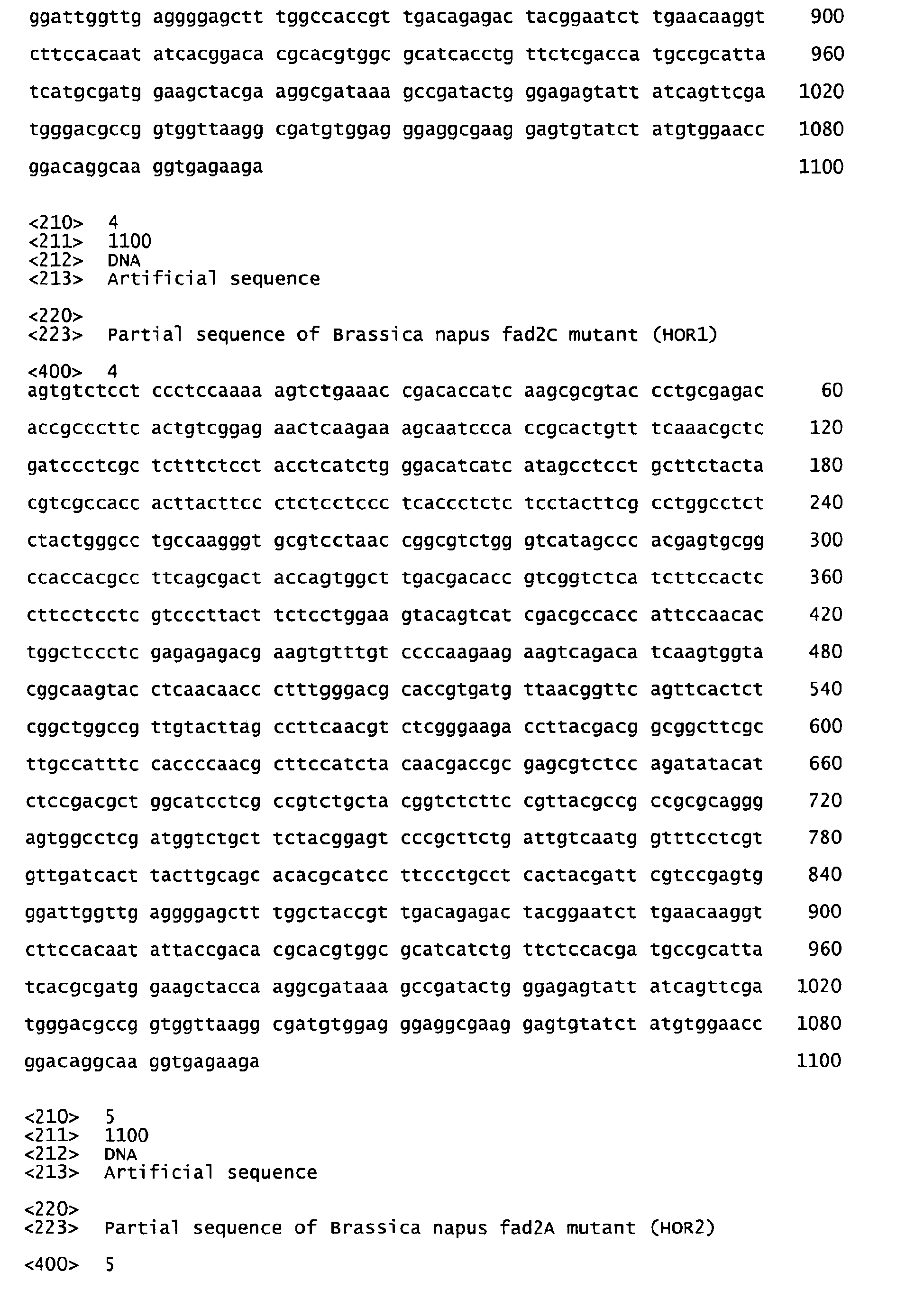
- FIG. 2 shows partial genomic nucleotide sequences of the fad2C gene (fad2 gene from B. oleracea genome) cloned from 'LLR1' lines (both LLR1#S007' and 'LLR1#PR-2601' lines) and 'HOR1' lines (both 'HOR1#S005', 'HOR1#B005' and 'HOR1#NPZ-12' lines).
- the top is 'LLR1' sequence (SEQ ID NO: 2) and bottom is 'HOR1' sequence (SEQ ID NO: 4).
- FIG. 3 shows partial genomic nucleotide sequences of the fad2A gene (fad2 gene from B. rapa genome) cloned from 'LLR1' lines (both LLR1#S007' and 'LLR1#PR-2601' lines) and 'HOR2' lines. The top is 'LLR1' sequence (SEQ ID NO: 1) and bottom is 'HOR2' sequence (SEQ ID NO: 5).
- FIG. 4 shows partial genomic nucleotide sequences of the fad2A gene (fad2 gene from B. rapa genome) cloned from 'LLR1' lines (both LLR1#S007' and 'LLR1#PR-2601' lines) and 'HOR3' lines. The top is 'LLR1' sequence (SEQ ID NO: 1) and bottom is 'HOR3' sequence (SEQ ID NO: 6).
- FIG. 5 shows partial genomic nucleotide sequences of the fad2A gene (fad2 gene from B. rapa genome) cloned from 'LLR1' lines (both LLR1#S007' and 'LLR1#PR-2601' lines) and 'HOR4' lines. The top is 'LLR1' sequence (SEQ ID NO: 1) and bottom is 'HOR4' sequence (SEQ ID NO: 7).
- FIG. 6 provides amino acid sequences of the fad2A genes, degenerated from the genomic nucleotide sequence cloned from 'LLR1' lines, 'HOR1', a published B . rapa fad2 gene and a published B. napus fad2 gene. Arrowhead indicates the position of the amino acid substitution (P to S) resulting from a single nucleotide mutation (C to T) in 'HOR1' line.
- P to S amino acid substitution
- C to T single nucleotide mutation
- FIG. 7 provides amino acid sequences of the fad2C genes, degenerated from the genomic nucleotide sequence cloned from 'LLR1' lines, 'HOR1' lines, a published B . oleracea fad2 gene and a published B. napus fad2 gene.
- Arrowhead indicates the position of the amino acid substitution (P to S) resulting from a single nucleotide mutation (C to T) in 'HOR1' line.
- FIG. 8 provides amino acid sequences of the fad2A genes, degenerated from the genomic nucleotide sequence cloned from 'LLR1' lines, 'HOR2' lines, a published B.
- FIG. 9 provides amino acid sequences of the fad2A genes, degenerated from the genomic nucleotide sequence cloned from 'LLR1' lines, 'HOR3' lines, a published B . rapa fad2 gene and a published B. napus fad2 gene. Arrowhead indicates the position of the stop codon resulting from a single nucleotide mutation (C to T) in 'HOR3' line.
- FIG. 9 provides amino acid sequences of the fad2A genes, degenerated from the genomic nucleotide sequence cloned from 'LLR1' lines, 'HOR3' lines, a published B . rapa fad2 gene and a published B. napus fad2 gene. Arrowhead indicates the position of the stop codon resulting from a single nucleotide mutation (C to T) in 'HOR3' line.
- FIG. 10 provides amino acid sequences of the fad2A genes, degenerated from the genomic nucleotide sequence cloned from 'LLR1' lines, 'HOR4' lines, a published B. rapa fad2 gene and a published B. napus fad2 gene. Arrowhead indicates the position of the stop codon resulting from a single nucleotide mutation (G to A) in 'HOR4' line.
- FIG. 11 provides electrophoresis results of PCR products amplified from the mutant allele-specific markers for the fad2A gene (194 bp) and from the fad3 gene (internal PCR control, 57 bp) of one of the 6 DH populations.
- FIG. 12 provides electrophoresis results of PCR products amplified from the mutant allele-specific markers for the fad2C gene (123 bp) and from the fad3 gene (internal PCR control, 57 bp) of one of the 6 DH populations.
- FIG. 13 provides histogram showing the correlation of the mutant allele-specific markers and oleic acid content in field and greenhouse trials.
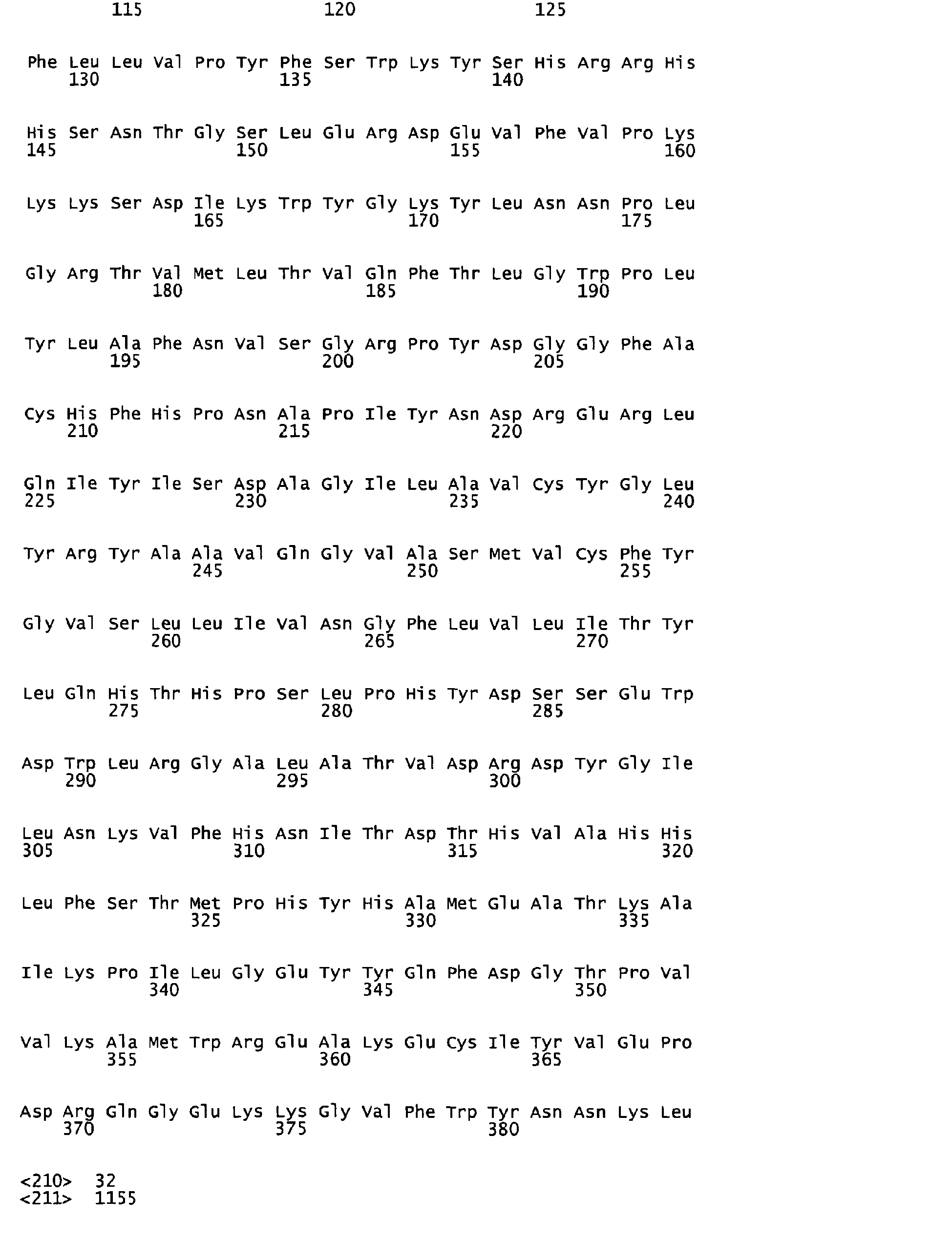
- FIG. 14 provides a sequence alignment of FAD2 from different Brassica species and from Arabidopsis thaliana.
- Genus and species Sequence accession number Common name 1 Brassica rapa CAG26981 Wild turnip 2 Brassica rapa CAD30827 Wild turnip 3 Brassica napus AAS92240 Rapeseed 4 Brassica rapa AAC99622 Wild turnip 5 Brassica napus AAT0241 Rapeseed 6 Brassica napus AAF78778 Rapeseed 7 Brassica oleracea AAF14564 Cabbage 8 Brassica carinata AAD19742 Ethiopian mustard 9 Arabidopsis thaliana NP_187819 Wall-cress
- 'HOR1#S005', 'HOR1#B005' and 'HOR1#NPZ-12' have been obtained by crossing an ethyl methanesulphonate (EMS) mutant line 'HOR1' with three classical rapeseed lines (S005, B005 and NPZ-12); these three mutant lines have an oleic acid content at about 80 to 90%.
- EMS ethyl methanesulphonate
- 'LLR1#S007' and 'LLR1#PR-2601' are rapeseed lines with oleic acid content at about 60%.
- 'HOR2', 'HOR3' and 'HOR4' are three more independent EMS mutant lines with oleic acid content at about 75 to 85%.
- DH double haploid
- Each DH population comprised of 64, 32, 115, 72, 63 and 53 lines respectively.
- a complete fatty acid analysis of the seeds of the DH lines and their respective parents was implemented by using gas chromatography. All the 399 DH lines were used for marker and statistical analysis. No DH population has been produced with 'HOR2', 'HOR3' and 'HOR4' mutant lines.
- DNA of both parental lines and 399 DH lines was extracted from leaves of 2-week-old field grown plants using a CTAB-based method modified from Dellaporta et al . (1983).Absorbance at 260 nm was used for DNA quantification.
- a UV-microtiter plate 195 ⁇ l of ultrapure sterile water were added into each well and then 5 ⁇ l of each DNA sample were added. The plate was then briefly agitated and read using the Spectra Max M2 microplate spectrophotometer from Molecular Devices.
- PCR amplification reactions used for fad2 alleles cloning contained 3-4 ng/ ⁇ l of genomic DNA, 1.25 ⁇ M of each primer, 2.5mM MgCl 2 , 0.3mM of each dNTP, 1 X PCR buffer and 0.12U/ ⁇ l of Taq DNA polymerase. Amplifications were performed in a PTC-225 MJResearch PCR system programmed for 30 cycles of 30 sec at 94°C, 30 sec at 60°C, 30 sec at 72°C and ending with 5 min at 72°C.
- PCR amplification reactions used for genotyping the 399 DH lines contained 3-4 ng/ ⁇ l of genomic DNA, 0.625 ⁇ M of each primer (SEQ ID NO: 8, SEQ ID NO:9, SEQ ID NO: 10 and SEQ ID NO: 11), 1.5mM MgCl 2 , 0.3mM of each dNTP, 1 X PCR buffer and 0.06U/ ⁇ l of Taq DNA polymerase. Amplifications were performed in a PTC-225 MJResearch PCR system programmed for 30 cycles of 30 sec at 94°C, 30 sec at 60°C, 10 sec at 72°C and ending with 5 min at 72°C.
- the fad2 fragments of parental lines 'LLR1#S007', 'LLR1#PR-2601', 'HOR1#S005', 'HOR1#B005', 'HOR1#NPZ-12', 'HOR2', 'HOR3' and 'HOR4' were amplified by using primers designed with Primer 3 software on fad2 gene sequence from GenBank Accession AY577313.
- the fad2 fragments amplified from each of the parents by the primers FAD2BnF1 and FAD2BnR1 were ligated to pGEM ® -T Easy cloning vector using a pGEM ® -T Easy Vector System kit (Promega Corp., Madison, USA) per manufacturer's instructions.
- the ligated products were transformed into competent cells and the cells plated on LB-agar plates containing ampicillin, X-GAL and IPTG to enable white/blue selection. White colonies in the transformation plates were picked and identification of the cloned PCR products were verified by PCR using universal M13 Forward and Reverse primers flanking the insert fragment. PCR revealed the insert fragment of the expected size.
- the positive clones containing the insert were sequenced by Genome Express (Meylan, France).
- primers designed with Primer 3 software on fad2 gene sequence from GenBank Accession AY577313 were used to amplify genomic DNA fragments of the fad2 gene from B .
- the primer pair FAD2BnF1 AGTGTCTCCTCCCTCCAAAAA (SEQ ID NO: 8) and FAD2BnR1 : TCTTCTCACCTTGCCTGTCC (SEQ ID NO: 9) amplified a fad2 fragment of the same length (1100 bp) from each of the six parents. The amplified fragments were then cloned and sequenced to investigate the sequence differences of fad2 gene between the five parents.
- the single nucleotide mutation in fad2A gene, C to T, at position 752 of the amplified fragment occurred in the fad2A gene sequence of all the 'HOR1' clones (both 'HOR1#S005', 'HOR1#B005' and 'HOR1#NPZ-12') (SEQ ID NO: 3) but not the 'LLR1' clones (both 'LLR1#S007' and 'LLR1#PR-2601') (SEQ ID. NO: 1) (see FIG. 1).
- the single nucleotide mutation in fad2C gene, C to T, at position 623 of the amplified fragment occurred in the fad2C gene sequence of all the 'HOR1' clones (both 'HOR1#S005', 'HOR1#B005' and 'HOR1#NPZ-12') (SEQ ID NO: 4) but not the 'LLR1' clones (both 'LLR1#S007' and 'LLR1#PR-2601') (SEQ ID. NO: 2) (see FIG. 2).
- Proline (P) to serine (S) substitution in FAD2A protein has been localized in an extracellular domain whereas the proline (P) to serine (S) substitution in FAD2C protein has been found in a transmembrane domain.
- Proline is a non-polar amino acid which tends to reside within the center of the protein whereas Serine is a polar and relatively hydrophobic amino acid which tends to be present on the surface of a protein.
- the sequence analysis identified a single nucleotide mutation in the fad2A gene.
- the single nucleotide mutation in fad2A gene, C to T, at position 804 of the amplified fragment (i.e. position 827 in the full length fad2A gene) occurred in the fad2A gene sequence of all the 'HOR2' clones (SEQ ID NO: 5) but not the 'LLR1' clones (both 'LLR1#S007' and 'LLR1#PR-2601') (SEQ ID. NO: 1) (see FIG. 3 ).
- this single nucleotide mutation occurred in the coding sequence of fad2A gene (see FIG. 8).
- the mutation of C to T in fad2A gene occurred at the second nucleotide of a codon resulting in a Threonine (T) to Methionine (M) substitution at amino acid 276.
- TMHMM Server v. 2.0 predicted of transmembrane domains, extracellular and intracellular domains
- the Threonine (T) to Methionine (M) substitution in FAD2A protein has been localized in an extracellular domain.
- Methionine (M) is a non-polar amino acid which tends to reside within the center of the protein whereas Threonine (T) is a polar and relatively hydrophobic amino acid which tends to be present on the surface of a protein.
- the sequence analysis identified a single nucleotide mutation in the fad2A gene.
- the single nucleotide mutation in fad2A gene, C to T, at position 323 of the amplified fragment (i.e. position 346 in the full length fad2A gene) occurred in the fad2A gene sequence of all the 'HOR3' clones (SEQ ID NO: 6) but not the 'LLR1' clones (both 'LLR1#S007' and 'LLR1#PR-2601') (SEQ ID. NO: 1) (see FIG. 4 ).
- this single nucleotide mutation occurred in the coding sequence of fad2A gene (see FIG. 9).
- the mutation of C to T in fad2A gene occurred at the first nucleotide of a codon creating a stop codon (TAG) that causes early termination of the polypeptide chain during translation.
- TAG stop codon
- the stop codon results in the incorporation of only 115 amino acids into the polypeptide instead of all 384 amino acids of the full-length polypeptide.
- the sequence analysis identified a single nucleotide mutation in the fad2A gene.
- the single nucleotide mutation in fad2A gene, G to A, at position 246 of the amplified fragment (i.e. position 269 in the full length fad2A gene) occurred in the fad2A gene sequence of all the 'HOR4' clones (SEQ ID NO: 7) but not the 'LLR1' clones (both 'LLR1#S007' and 'LLR1#PR-2601') (SEQ ID. NO: 1) (see FIG. 5).
- this single nucleotide mutation occurred in the coding sequence of fad2A gene (see FIG. 10).
- the mutation of G to A in fad2A gene occurred at the first nucleotide of a codon creating a stop codon (TAG) that causes early termination of the polypeptide chain during translation.
- TAG stop codon
- the stop codon results in the incorporation of only 89 amino acids into the polypeptide instead of all 384 amino acids of the full-length polypeptide.
- PCR primers have been designed in order to provide codominant markers for determining if the mutations are found on only one (heterozygote) or on the two alleles (homozygote) of a fad2 gene.
- the PCR amplification product is cut by the Bsr Bl enzyme, which yields the following differentiated restriction profile:
- the PCR amplification product is cut by the Mn /l enzyme, which yields the following differentiated restriction profile:
- the PCR amplification product is cut by the Bfal enzyme, which yields the following differentiated restriction profile: • C346T
Landscapes
- Health & Medical Sciences (AREA)
- Life Sciences & Earth Sciences (AREA)
- Genetics & Genomics (AREA)
- Chemical & Material Sciences (AREA)
- Engineering & Computer Science (AREA)
- Zoology (AREA)
- Biotechnology (AREA)
- Organic Chemistry (AREA)
- Wood Science & Technology (AREA)
- Bioinformatics & Cheminformatics (AREA)
- Molecular Biology (AREA)
- Biomedical Technology (AREA)
- General Engineering & Computer Science (AREA)
- General Health & Medical Sciences (AREA)
- Biochemistry (AREA)
- Microbiology (AREA)
- Nutrition Science (AREA)
- Plant Pathology (AREA)
- Biophysics (AREA)
- Physics & Mathematics (AREA)
- Cell Biology (AREA)
- Oil, Petroleum & Natural Gas (AREA)
- Medicinal Chemistry (AREA)
- Breeding Of Plants And Reproduction By Means Of Culturing (AREA)
- Micro-Organisms Or Cultivation Processes Thereof (AREA)
- Enzymes And Modification Thereof (AREA)
- Measuring Or Testing Involving Enzymes Or Micro-Organisms (AREA)
Abstract
The present invention relates to a mutated nucleic acid sequence of a delta-12 oleate desaturase enzyme (FAD2)-encoding nucleic acid from a Cruciferae plant, wherein said mutated nucleic acid sequence comprises the non-conservative mutation of at least one nucleotide of at least one codon representing an amino acid selected from the group consisting of:
- the amino acid at position 90 of the amino acid sequence of said FAD2,
- the amino acid at position 116 of the amino acid sequence of said FAD2,
- the amino acid at position 216 of the amino acid sequence of said FAD2,
- the amino acid at position 259 of the amino acid sequence of said FAD2,
- the amino acid at position 276 of the amino acid sequence of said FAD2.
- the amino acid at position 90 of the amino acid sequence of said FAD2,
- the amino acid at position 116 of the amino acid sequence of said FAD2,
- the amino acid at position 216 of the amino acid sequence of said FAD2,
- the amino acid at position 259 of the amino acid sequence of said FAD2,
- the amino acid at position 276 of the amino acid sequence of said FAD2.
Description
- The present invention relates to new genetic and protein markers useful for selecting plants having a high oleic acid content.
- High oleic acid content of vegetable oils is a desirable trait both because of the health benefits and of the stability to oxidation and heat of oleic acid. In particular, it has been shown that oleic acid is effective in lowering plasma cholesterol levels (Bonanome et al., 1988; Liu et al., 2002). Furthermore, its single insaturated bond makes oleic acid (C18:1) a much less vulnerable fatty acid than its multiply insaturated counterparts. For instance, the rate of oxidation of linolenic acid (C18:3) is 100 times that of oleic acid (Debruyne, 2004).
- One of the most promising paths towards such plants is to select plants essentially deprived of FAD2 activity. Indeed, FAD2 (delta12 oleate desaturase) catalyses the transformation of oleic acid (C18:1) to linoleic acid (C18:2); plants having lowered FAD2 activity thus enjoy higher oleic acid content thanks to limited catabolism of the latter.
- As such,
WO 2004/072259 provides a Brassica napus plant having high oleic acid content, wherein its fad2 gene presents a STOP codon instead of a Glutamine (Q) codon at position 185 of FAD2. - Furthermore,
US 2005/0039233 provides a Brassica juncea plant having high oleic acid content, wherein its fad2 gene presents a STOP codon instead of a Tryptophan (W) codon at position 101 of FAD2. - Brassica napus (rapeseed) is an amphidiploid which contains the genomes of two diploid ancestors, Brassica rapa (the A genome) and Brassica oleracea (the C genome) (Pires et al., 2004). The oleic acid content is 61 % for the traditional oil of rapeseed (Stan Skrypetz, 2005).
- The present invention notably arises from the finding, by the Inventors, of five previously unrecognised mutations in the fad2 genes of Brassica napus plants:
- G to A substitution at position 269 of the fad2A gene (fad2 gene from B. rapa genome), corresponding to a W to STOP codon substitution at position 90 of the FAD2A protein,
- C to T substitution at position 346 of the fad2A gene (fad2 gene from B. rapa genome), corresponding to a Q to STOP codon substitution at
position 116 of the FAD2A protein, - C to T substitution at position 646 of the fad2C gene (fad2 gene from B. oleracea genome), corresponding to a P to S substitution at position 216 of the FAD2C protein,
- C to T substitution at position 775 of the fad2A gene (fad2 gene from B. rapa genome), corresponding to a P to S substitution at position 259 of the FAD2A protein,
- C to T substitution at position 827 of the fad2A gene (fad2 gene from B. rapa genome), corresponding to a T to M substitution at position 276 of the FAD2A protein,
- Thus, the present invention relates to a mutated nucleic acid sequence of a delta-12 oleate desaturase enzyme (FAD2)-encoding nucleic acid from a plant, in particular a Cruciferae plant, wherein said mutated nucleic acid sequence comprises the non-conservative mutation of at least one nucleotide of at least one codon representing an amino acid selected from the group consisting of:
- the amino acid at position 90 of the amino acid sequence of said FAD2,
- the amino acid at
position 116 of the amino acid sequence of said FAD2, - the amino acid at position 216 of the amino acid sequence of said FAD2 when said FAD2 sequence is constituted of 384 amino acids, or at position 215 when said FAD2 sequence is constituted of 383 amino acids,
- the amino acid at position 259 of the amino acid sequence of said FAD2 when said FAD2 sequence is constituted of 384 amino acids, or at position 258 when said FAD2 sequence is constituted of 383 amino acids,
- the amino acid at position 276 of the amino acid sequence of said FAD2 when said FAD2 sequence is constituted of 384 amino acids, or at position 275 when said FAD2 sequence is constituted of 383 amino acids,
- The homology percentage of a given nucleic acid sequence with respect to the mutated nucleic acid sequence is calculated by counting the number of identical nucleotides between said given nucleic acid sequence and the mutated nucleic acid sequence for all positions of an optimal sequence alignment of said given nucleic acid sequence and the mutated nucleic acid sequence and by dividing this number by the total number of nucleotides of said given sequence.
- The optimal sequence alignment can be produced manually, optionally by introducing gaps between nucleotides, or by using computer-based alignment tools, such as BLAST (Altschul et al. (1997) Nucleic Acids Res 25 : 3389-402).
- "Stringent conditions" for a given nucleic acid sequence can be easily determined by the man skilled in the art, for instance as described in Sambrook et al. (2001). Particular stringent conditions notably encompass 15mM NaCl/1.5mM sodium citrate (0.1X SSC) and 0.1% sodium lauryl sulphate (SDS) at 50-65°C.
- As intended herein, FAD2 from Cruciferae are usually constituted of 383 or 384 amino acids. However, it is within the ordinary skills of the man skilled in the art to adapt the positions given for the above defined mutations to FAD2 having more or less than 383 or 384 amino acids.
- An exemplary alignment of FAD2 sequences from various Cruciferae species is given in FIG. 14.
- As intended herein, a nucleic acid sequence which "does not encode a functional FAD2" relates to a nucleic acid sequence which encodes a FAD2 having an activity lower than that of the corresponding natural FAD2 measured in the same conditions, in particular the encoded FAD2 has no activity.
- Advantageously, mutant plants carrying nucleic acids with the above-defined mutations have an increased oleic acid content as compared to otherwise genetically identical plants (i.e. plants which are genetically identical except for said mutations).
- In an embodiment, the invention particularly relates to a mutated nucleic acid sequence as defined above, wherein said mutated nucleic acid sequence comprises at least one mutation selected from:
- a substitution of the codon representing the amino acid at position 90 of the amino acid sequence of said FAD2 by a STOP codon,
- a substitution of the codon representing the amino acid at
position 116 of the amino acid sequence of said FAD2 by a STOP codon, - a substitution of the codon representing the amino acid at position 216 of the amino acid sequence of said FAD2 when said FAD2 sequence is constituted of 384 amino acids, or at position 215 when said FAD2 sequence is constituted of 383 amino acids, by a codon representing any amino acid different from P,
- a substitution of the codon representing the amino acid at position 259 of the amino acid sequence of said FAD2 when said FAD2 sequence is constituted of 384 amino acids, or at position 258 when said FAD2 sequence is constituted of 383 amino acids, by a codon representing any amino acid different from P,
- a substitution of the codon representing the amino acid at position 276 of the amino acid sequence of said FAD2 when said FAD2 sequence is constituted of 384 amino acids, or at position 275 when said FAD2 sequence is constituted of 383 amino acids, by any amino acid different from T.
- In another embodiment, the invention more particularly relates to a mutated nucleic acid sequence as defined above, wherein:
- the codon representing the amino acid at position 216 of the amino acid sequence of said FAD2 when said FAD2 sequence is constituted of 384 amino acids, or at position 215 when said FAD2 sequence is constituted of 383 amino acids, is substituted by a codon representing S,
- the codon representing the amino acid at position 259 of the amino acid sequence of said FAD2 when said FAD2 sequence is constituted of 384 amino acids, or at position 258 when said FAD2 sequence is constituted of 383 amino acids, is substituted by a codon representing S,
- the codon representing the amino acid at position 276 of the amino acid sequence of said FAD2 when said FAD2 sequence is constituted of 384 amino acids, or at position 275 when said FAD2 sequence is constituted of 383 amino acids, is substituted by a codon representing M.
- In a preferred embodiment of the above defined mutated nucleic acid sequence, the plant is of the Brassica genus.
- In another preferred embodiment of the invention, the mutated nucleic acid sequence is represented by SEQ ID NO: 22 and comprises at least one mutation selected from the group constituted of:
- G to A substitution at position 269 of SEQ ID NO: 22,
- C to T substitution at position 346 of SEQ ID NO: 22,
- C to T substitution at position 646 of SEQ ID NO: 22,
- C to T substitution at position 775 of SEQ ID NO: 22,
- C to T substitution at position 827 of SEQ ID NO: 22,
- In yet another embodiment of the invention, the mutated nucleic acid sequence is selected from the group constituted of:
SEQ ID NO: 24;
SEQ ID NO: 26;
SEQ ID NO: 28;
SEQ ID NO: 30;
SEQ ID NO: 32.
SEQ ID NO: 24 represents the fad2A gene of B. napus (i.e. the fad2 gene from B. rapa genome) harboring a G to A substitution at position 269, which corresponds to a W to STOP codon substitution at position 90 of the FAD2A protein. This mutation is in particular found in the oleic acid overproducing rapeseed line denoted 'HOR4' in the following Example. 'HOR4' has been deposited at the NCIMB (Aberdeen, Scotland) on May 17, 2006 under accession number 41403.
SEQ ID NO: 26 represents the fad2A gene of B. napus harboring a C to T substitution at position 346, which corresponds to a Q to STOP codon substitution atposition 116 of the FAD2A protein. This mutation is in particular found in the oleic acid overproducing rapeseed line denoted 'HOR3' in the following Example. 'HOR3' has been deposited at the NCIMB (Aberdeen, Scotland) on May 17, 2006 under accession number 41402.
SEQ ID NO: 28 represents the fad2C gene of B. napus (i.e. the fad2 gene from B. oleracea genome) harboring a C to T substitution at position 646, which corresponds to a P to S substitution at position 216 of the FAD2C protein. This mutation is in particular found in the oleic acid overproducing rapeseed line denoted 'HOR1' in the following Example. 'HOR1' has been deposited at the NCIMB (Aberdeen, Scotland) on May 17, 2006 under accession number 41400.
SEQ ID NO: 30 represents the fad2A gene of B. napus harboring a C to T substitution at position 775, which corresponds to a P to S substitution at position 259 of the FAD2A protein. This mutation is in particular found in the oleic acid overproducing rapeseed line denoted 'HOR1' in the following Example.
SEQ ID NO: 32 represents the fad2A gene of B. napus harboring a C to T substitution at position 827, which corresponds to a T to M substitution at position 276 of the FAD2A protein. This mutation is in particular found in the oleic acid overproducing rapeseed line denoted 'HOR2' in the following Example. 'HOR2' has been deposited at the NCIMB (Aberdeen, Scotland) on May 17, 2006 under accession number 41401. - The present invention also relates to a nucleic acid fragment of a mutated nucleic acid as defined above, said fragment comprising at least 10, preferably at least 100, more preferably at least 1000 nucleotides, and comprising at least one nucleotide contiguous to at least one codon representing an amino acid selected from the group consisting of:
- the amino acid at position 90 of the amino acid sequence of said FAD2,
- the amino acid at
position 116 of the amino acid sequence of said FAD2, - the amino acid at position 216 of the amino acid sequence of said FAD2 when said FAD2 sequence is constituted of 384 amino acids, or at position 215 when said FAD2 sequence is constituted of 383 amino acids,
- the amino acid at position 259 of the amino acid sequence of said FAD2 when said FAD2 sequence is constituted of 384 amino acids, or at position 258 when said FAD2 sequence is constituted of 383 amino acids,
- the amino acid at position 276 of the amino acid sequence of said FAD2 when said FAD2 sequence is constituted of 384 amino acids, or at position 275 when said FAD2 sequence is constituted of 383 amino acids,
- In a preferred embodiment of the invention, the above-defined nucleic acid fragment comprises the mutated nucleotide.
- In another preferred embodiment of the invention, the above-defined nucleic acid fragment is selected from the group constituted of SEQ ID NO: 12, SEQ ID NO: 14, SEQ ID NO: 17, SEQ ID NO: 34 and SEQ ID NO: 35, SEQ ID NO: 3, SEQ ID NO: 4, SEQ ID NO: 5, SEQ ID NO: 6 and SEQ ID NO: 7.
- The present invention also relates to a plant, preferably a Cruciferae plant, more preferably a plant of the Brassica genus, and even more preferably a plant of the Brassica napus species, having an increased oleic acid content, or a part of said plant, wherein the plant comprises at least one mutated nucleic acid sequence as defined above or a nucleic acid fragment as defined above which comprises the mutated nucleotide.
- As intended herein, a part of plant notably relates to a plant cell, a seed, a meristem, a cal, an inflorescence, a bud, or a leaf.
- In a particular embodiment of the above-defined plant, or part of plant, at least one copy of the fad2 gene which is comprised in the genome of said plant is represented by a mutated nucleic acid as defined above.
- In another particular embodiment of the above-defined plant, or part of plant, each copy of the fad2 gene which is comprised in the genome of said plant is represented by a mutated nucleic acid as defined above.
- In a further embodiment of the invention, the above-defined plant, or part of plant, is a plant of the Brassica napus species wherein both copies of the fad2A gene are independently represented by SEQ ID NO: 24, SEQ ID NO: 26, SEQ ID NO: 30 or SEQ ID NO: 32, and/or both copies of the fad2C gene are represented by SEQ ID NO: 28.
- In yet another particular embodiment, the above-defined plant, or part of plant, is selected from the group constituted of:
- the plant deposited at the NCIMB (Aberdeen, Scotland) on May 17, 2006 under accession number 41403;
- the plant deposited at the NCIMB (Aberdeen, Scotland) on May 17, 2006 under accession number 41402;
- the plant deposited at the NCIMB (Aberdeen, Scotland) on May 17, 2006 under accession number 41400;
- the plant deposited at the NCIMB (Aberdeen, Scotland) on May 17, 2006 under accession number 41401.
- The present invention also relates to the use of a nucleic acid as defined above for selecting plants, or part of plants, having an increased oleic acid content.
- The present invention also relates to a method for selecting plants having an increased oleic acid content by mutagenesis, comprising the following steps:
- subjecting a plant or part of a plant to a mutagenic treatment,
- regenerating plants, or part of plants, from said treated plant or part of a plant,
- selecting from the regenerated plants those comprising at least one mutated nucleic acid sequence as defined above or a nucleic acid fragment as defined above which comprises the mutated nucleotide.
- Mutagenesis can be carried out according to methods well known to the man skilled in the art, such as those described in McCallum et al. (2000). In particular, mutagenesis is carried out using ethyl methanesulphonate (EMS)
- The regeneration of plants from plant parts, such as cells, can be carried out according to methods well known to the man skilled in the art, such as those described in Herman (2005).
- The present invention also relates to a method for selecting plants having an increased oleic acid content by crossing, comprising the following steps:
- crossing a plant, or part of a plant, with a parent plant, or part of a parent plant, comprising at least one mutated nucleic acid sequence as defined above or a nucleic acid fragment as defined above which comprises the mutated nucleotide,
- selecting from the progeny plants, or part of plants, obtained by crossing, those comprising at least one mutated nucleic acid sequence as defined above or a nucleic acid fragment as defined above which comprises the mutated nucleotide.
- Crossing can be carried out according to methods well known to the man skilled in the art, such as those described in Gallais (1997).
- As intended herein "progeny" in particular relates to the seedlings of the crossed plants.
- In a preferred embodiment of the above-defined method for selecting plants having an increased oleic acid content by crossing, the parent plant is obtained according to the above-defined method for selecting plants having an increased oleic acid content by mutagenesis.
- In a particularly preferred embodiment of the above-defined method for selecting plants having an increased oleic acid content by crossing, the parent plant, or part of the parent plant, is selected from the group constituted of:
- the plant deposited at the NCIMB (Aberdeen, Scotland) on May 17, 2006 under accession number 41403;
- the plant deposited at the NCIMB (Aberdeen, Scotland) on May 17, 2006 under accession number 41402;
- the plant deposited at the NCIMB (Aberdeen, Scotland) on May 17, 2006 under accession number 41400;
- the plant deposited at the NCIMB (Aberdeen, Scotland) on May 17, 2006 under accession number 41401.
- In particular, the following techniques can be used in the selection step of the above-defined selection methods: PCR techniques, such as the TaqMan® assay (real-time PCR) or allele-specific PCR, Northern or Southern blotting, DNA micro or macro-array, Molecular Beacons, DASH (Dynamic Allele Specific Hybridization), primer extension, oligonucleotide ligation and endonuclease cleavage.
- In an embodiment of the above defined methods for selecting plants, the selection step is carried by polymerase chain reaction (PCR), preferably with at least one of the following primer pairs:
- SEQ ID NO: 12 and SEQ ID NO: 13,
- SEQ ID NO: 14 and SEQ ID NO: 15,
- SEQ ID NO: 16 and SEQ ID NO: 17,
- SEQ ID NO: 34 and SEQ ID NO: 36,
- SEQ ID NO: 35 and SEQ ID NO: 36,
- SEQ ID NO: 37 and SEQ ID NO: 13,
- SEQ ID NO: 38 and SEQ ID NO: 14,
- SEQ ID NO: 39 and SEQ ID NO: 36.
- The present invention also relates to a plant as obtainable according to the above-defined methods for selecting plants.
- The present invention also relates to a kit for the selection of plants having a high oleic acid content, comprising:
- at least one plant, or part of plant, comprising at least one mutated nucleic acid sequence as defined above or a nucleic acid fragment as defined above which comprises the mutated nucleotide,
- at least one nucleic acid fragment as defined above.
- In a preferred embodiment of the invention, the above-defined kit, comprises:
- at least one plant, or part of plant, selected from the group constituted of
- the plant deposited at the NCIMB (Aberdeen, Scotland) on May 17, 2006 under accession number 41403;
- the plant deposited at the NCIMB (Aberdeen, Scotland) on May 17, 2006 under accession number 41402;
- the plant deposited at the NCIMB (Aberdeen, Scotland) on May 17, 2006 under accession number 41400;
- the plant deposited at the NCIMB (Aberdeen, Scotland) on May 17, 2006 under accession number 41401;
- at least one of the following primer pairs:
- SEQ ID NO: 12 and SEQ ID NO: 13,
- SEQ ID NO: 14 and SEQ ID NO: 15,
- SEQ ID NO: 16 and SEQ ID NO: 17.
- SEQ ID NO: 34 and SEQ ID NO: 36,
- SEQ ID NO: 35 and SEQ ID NO: 36,
- SEQ ID NO: 37 and SEQ ID NO: 13,
- SEQ ID NO: 38 and SEQ ID NO: 14,
- SEQ ID NO: 39 and SEQ ID NO: 36.
- The present invention also relates to a mutated FAD2 from plant encoded by a mutated nucleic acid sequence as defined above.
- The present invention also relate to a nucleic acid selected from the group constituted of SEQ ID NO: 13, SEQ ID NO: 15, SEQ ID NO: 16, SEQ ID NO: 36, SEQ ID NO: 37, SEQ ID NO: 38, SEQ ID NO: 39.
- The present invention also relates to a specific antibody to a mutated delta-12 oleate desaturase enzyme (FAD2) from plant as defined above.
- As intended herein, "antibody" also encompasses antibody fragments such as Fab, F(ab)'2, or scFv fragments. Such an antibody can be readily prepared by the man skilled in the art from mutated delta-12 oleate desaturase enzymes according to the invention by following standard procedures. In a preferred embodiment of the invention the antibody is a monoclonal antibody. Antibodies according to the invention are notably useful for detecting mutated delta-12 oleate desaturase enzymes according to the invention, in particular in plant cellular extracts.
- FIG. 1 shows partial genomic nucleotide sequences of the fad2A gene (fad2 gene from B. rapa genome) cloned from 'LLR1' lines (both LLR1#S007' and 'LLR1#PR-2601' lines) and 'HOR1' lines (both 'HOR1#S005', 'HOR1#B005' and 'HOR1#NPZ-12' lines). The top is 'LLR1' sequence (SEQ ID NO: 1) and bottom is 'HOR1' sequence (SEQ ID NO: 3). Arrowhead indicates a single nucleotide mutation of C to T, which results in an amino acid modification. The forward and reverse primers for PCR-based mutant allele-specific marker are bolded and underlined.
FIG. 2 shows partial genomic nucleotide sequences of the fad2C gene (fad2 gene from B. oleracea genome) cloned from 'LLR1' lines (both LLR1#S007' and 'LLR1#PR-2601' lines) and 'HOR1' lines (both 'HOR1#S005', 'HOR1#B005' and 'HOR1#NPZ-12' lines). The top is 'LLR1' sequence (SEQ ID NO: 2) and bottom is 'HOR1' sequence (SEQ ID NO: 4). Arrowhead indicates a single nucleotide mutation of C to T, which results in an amino acid modification. The forward and reverse primers for PCR-based mutant allele-specific marker are bolded and underlined.
FIG. 3 shows partial genomic nucleotide sequences of the fad2A gene (fad2 gene from B. rapa genome) cloned from 'LLR1' lines (both LLR1#S007' and 'LLR1#PR-2601' lines) and 'HOR2' lines. The top is 'LLR1' sequence (SEQ ID NO: 1) and bottom is 'HOR2' sequence (SEQ ID NO: 5). Arrowhead indicates a single nucleotide mutation of C to T, which results in an amino acid modification. The forward and reverse primers for PCR-based mutant allele-specific marker are bolded and underlined.
FIG. 4 shows partial genomic nucleotide sequences of the fad2A gene (fad2 gene from B. rapa genome) cloned from 'LLR1' lines (both LLR1#S007' and 'LLR1#PR-2601' lines) and 'HOR3' lines. The top is 'LLR1' sequence (SEQ ID NO: 1) and bottom is 'HOR3' sequence (SEQ ID NO: 6). Arrowhead indicates a single nucleotide mutation of C to T, which results in a stop codon (TAG) shaded in grey. The forward and reverse primers for PCR-based mutant allele-specific marker are bolded and underlined.
FIG. 5 shows partial genomic nucleotide sequences of the fad2A gene (fad2 gene from B. rapa genome) cloned from 'LLR1' lines (both LLR1#S007' and 'LLR1#PR-2601' lines) and 'HOR4' lines. The top is 'LLR1' sequence (SEQ ID NO: 1) and bottom is 'HOR4' sequence (SEQ ID NO: 7). Arrowhead indicates a single nucleotide mutation of G to A, which results in a stop codon (TAG) shaded in grey. The forward and reverse primers for PCR-based mutant allele-specific marker are bolded and underlined.
FIG. 6 provides amino acid sequences of the fad2A genes, degenerated from the genomic nucleotide sequence cloned from 'LLR1' lines, 'HOR1', a published B. rapa fad2 gene and a published B. napus fad2 gene. Arrowhead indicates the position of the amino acid substitution (P to S) resulting from a single nucleotide mutation (C to T) in 'HOR1' line.
FIG. 7 provides amino acid sequences of the fad2C genes, degenerated from the genomic nucleotide sequence cloned from 'LLR1' lines, 'HOR1' lines, a published B. oleracea fad2 gene and a published B. napus fad2 gene. Arrowhead indicates the position of the amino acid substitution (P to S) resulting from a single nucleotide mutation (C to T) in 'HOR1' line.
FIG. 8 provides amino acid sequences of the fad2A genes, degenerated from the genomic nucleotide sequence cloned from 'LLR1' lines, 'HOR2' lines, a published B. rapa fad2 gene and a published B. napus fad2 gene. Arrowhead indicates the position of the amino acid substitution (T to M) resulting from a single nucleotide mutation (C to T) in 'HOR2' line.
FIG. 9 provides amino acid sequences of the fad2A genes, degenerated from the genomic nucleotide sequence cloned from 'LLR1' lines, 'HOR3' lines, a published B. rapa fad2 gene and a published B. napus fad2 gene. Arrowhead indicates the position of the stop codon resulting from a single nucleotide mutation (C to T) in 'HOR3' line.
FIG. 10 provides amino acid sequences of the fad2A genes, degenerated from the genomic nucleotide sequence cloned from 'LLR1' lines, 'HOR4' lines, a published B. rapa fad2 gene and a published B. napus fad2 gene. Arrowhead indicates the position of the stop codon resulting from a single nucleotide mutation (G to A) in 'HOR4' line.
FIG. 11 provides electrophoresis results of PCR products amplified from the mutant allele-specific markers for the fad2A gene (194 bp) and from the fad3 gene (internal PCR control, 57 bp) of one of the 6 DH populations. M, 25 bp DNA ladder;lane 1, 'LLR1#S007';lane 2, 'HOR1#S005'; lane 3-23, DH lines from the cross of 'LLR1#S007' and 'HOR1#S005'; lane 24 : water control. The PCR products were separated by electrophoresis in an 2.5% agarose gel and stained with ethidium bromide.
FIG. 12 provides electrophoresis results of PCR products amplified from the mutant allele-specific markers for the fad2C gene (123 bp) and from the fad3 gene (internal PCR control, 57 bp) of one of the 6 DH populations. M, 25 bp DNA ladder;Lane 1, 'LLR1#S007';lane 2, 'HOR1#S005'; lane 3-23, DH lines from the cross of 'LLR1#S007' and 'HOR1#S005'; lane 24 : water control. The PCR products were separated by electrophoresis in an 2.5% agarose gel and stained with ethidium bromide.
FIG. 13 provides histogram showing the correlation of the mutant allele-specific markers and oleic acid content in field and greenhouse trials.
FIG. 14 provides a sequence alignment of FAD2 from different Brassica species and from Arabidopsis thaliana. Species, accession numbers and common names are listed hereafter:Genus and species Sequence accession number Common name 1 Brassica rapa CAG26981 Wild turnip 2 Brassica rapa CAD30827 Wild turnip 3 Brassica napus AAS92240 Rapeseed 4 Brassica rapa AAC99622 Wild turnip 5 Brassica napus AAT0241 Rapeseed 6 Brassica napus AAF78778 Rapeseed 7 Brassica oleracea AAF14564 Cabbage 8 Brassica carinata AAD19742 Ethiopian mustard 9 Arabidopsis thaliana NP_187819 Wall-cress - Winter rapeseed lines 'LLR1#S007' (wild type), 'LLR1#PR-2601' (wild type), 'HOR1#S005' (mutant type), 'HOR1#B005' (mutant type), 'HOR1#NPZ-12' (mutant type), 'HOR2' (mutant type), 'HOR3' (mutant type) and 'HOR4' (mutant type) were used in this study for cloning of fad2 (fatty acid desaturase-2) alleles.
- 'HOR1#S005', 'HOR1#B005' and 'HOR1#NPZ-12' have been obtained by crossing an ethyl methanesulphonate (EMS) mutant line 'HOR1' with three classical rapeseed lines (S005, B005 and NPZ-12); these three mutant lines have an oleic acid content at about 80 to 90%.
- 'LLR1#S007' and 'LLR1#PR-2601' are rapeseed lines with oleic acid content at about 60%.
- 'HOR2', 'HOR3' and 'HOR4' are three more independent EMS mutant lines with oleic acid content at about 75 to 85%.
- Six double haploid (DH) populations were developed by microspore culture from F1 plants of crosses between (Coventry et al., 1988):
- (1) 'LLR1#S007' and 'HOR1#S005' rapeseed lines,
- (2) 'LLR1#PR-2601' and 'HOR1#NPZ-12' rapeseed lines,
- (3) 'LLR1#S007' and 'HOR1#B005' rapeseed lines,
- (4) 'LLR1#S007' and 'HOR1#NPZ-12' rapeseed lines,
- (5) 'LLR1#PR-2601' and 'HOR1#B005' rapeseed lines and
- (6) 'LLR1#PR-2601' and 'HOR1#S005' rapeseed lines.
- Each DH population comprised of 64, 32, 115, 72, 63 and 53 lines respectively. A complete fatty acid analysis of the seeds of the DH lines and their respective parents was implemented by using gas chromatography. All the 399 DH lines were used for marker and statistical analysis. No DH population has been produced with 'HOR2', 'HOR3' and 'HOR4' mutant lines.
- DNA of both parental lines and 399 DH lines was extracted from leaves of 2-week-old field grown plants using a CTAB-based method modified from Dellaporta et al. (1983).Absorbance at 260 nm was used for DNA quantification. In a UV-microtiter plate, 195µl of ultrapure sterile water were added into each well and then 5µl of each DNA sample were added. The plate was then briefly agitated and read using the Spectra Max M2 microplate spectrophotometer from Molecular Devices.
- PCR amplification reactions used for fad2 alleles cloning contained 3-4 ng/µl of genomic DNA, 1.25µM of each primer, 2.5mM MgCl2, 0.3mM of each dNTP, 1 X PCR buffer and 0.12U/µl of Taq DNA polymerase. Amplifications were performed in a PTC-225 MJResearch PCR system programmed for 30 cycles of 30 sec at 94°C, 30 sec at 60°C, 30 sec at 72°C and ending with 5 min at 72°C.
- For genotyping the 399 DH, an internal PCR marker has been developed to control the PCR efficiency. A couple of primers (SEQ ID NO: 10 and SEQ ID NO: 11) has been designed on the fad3 gene to amplify a fragment at 57 bp. PCR amplification reactions used for genotyping the 399 DH lines contained 3-4 ng/µl of genomic DNA, 0.625µM of each primer (SEQ ID NO: 8, SEQ ID NO:9, SEQ ID NO: 10 and SEQ ID NO: 11), 1.5mM MgCl2, 0.3mM of each dNTP, 1 X PCR buffer and 0.06U/µl of Taq DNA polymerase. Amplifications were performed in a PTC-225 MJResearch PCR system programmed for 30 cycles of 30 sec at 94°C, 30 sec at 60°C, 10 sec at 72°C and ending with 5 min at 72°C.
- The fad2 fragments of parental lines 'LLR1#S007', 'LLR1#PR-2601', 'HOR1#S005', 'HOR1#B005', 'HOR1#NPZ-12', 'HOR2', 'HOR3' and 'HOR4' were amplified by using primers designed with
Primer 3 software on fad2 gene sequence from GenBank Accession AY577313. The fad2 fragments amplified from each of the parents by the primers FAD2BnF1 and FAD2BnR1 were ligated to pGEM®-T Easy cloning vector using a pGEM®-T Easy Vector System kit (Promega Corp., Madison, USA) per manufacturer's instructions. The ligated products were transformed into competent cells and the cells plated on LB-agar plates containing ampicillin, X-GAL and IPTG to enable white/blue selection. White colonies in the transformation plates were picked and identification of the cloned PCR products were verified by PCR using universal M13 Forward and Reverse primers flanking the insert fragment. PCR revealed the insert fragment of the expected size. The positive clones containing the insert were sequenced by Genome Express (Meylan, France). - Referring to FIG. 1-5, primers designed with
Primer 3 software on fad2 gene sequence from GenBank Accession AY577313 were used to amplify genomic DNA fragments of the fad2 gene from B. napus lines 'LLR1#S007', 'LLR1#PR-2601', 'HOR1#S005', 'HOR1#B005', 'HOR1#NPZ-12', 'HOR2', 'HOR3' and 'HOR4'. The primer pair FAD2BnF1 : AGTGTCTCCTCCCTCCAAAAA (SEQ ID NO: 8) and FAD2BnR1 : TCTTCTCACCTTGCCTGTCC (SEQ ID NO: 9) amplified a fad2 fragment of the same length (1100 bp) from each of the six parents. The amplified fragments were then cloned and sequenced to investigate the sequence differences of fad2 gene between the five parents. - The sequences were analysed and aligned by using Clustal W (Kyoto University Bioinformatics Center) and Genedoc Software (Nicholas et al., 1997). Linkage association between the markers and high oleic trait was determined by t-test analysis.
- In this study, 7 'LLR1' clones (both 'LLR1#S007' and 'LLR1#PR-2601'), 12 'HOR1' clones (both 'HOR1#S005', 'HOR1#B005' and 'HOR1#NPZ-12'), 12 'HOR2', 20 'HOR3' and 20 'HOR4' clones were sequenced. The sequence alignment of these clones with B. rapa and B. oleracea fad2 sequences found in public databases identified:
- (1) two fad2 genes originating from B. rapa (fad2A) and B. oleracea (fad2C) for 'HOR1' lines,
- (2) one fad2 gene originating from B. rapa (fad2A) for 'HOR2' line,
- (3) one fad2 gene originating from B. rapa (fad2A) for 'HOR3' line and
- (4) one fad2 gene originating from B. rapa (fad2A) for 'HOR4' line.
- For 'HOR1' lines, the sequence analysis identified a single nucleotide mutation in each fad2 gene.
- The single nucleotide mutation in fad2A gene, C to T, at position 752 of the amplified fragment (i.e. position 775 in the full length fad2A gene) occurred in the fad2A gene sequence of all the 'HOR1' clones (both 'HOR1#S005', 'HOR1#B005' and 'HOR1#NPZ-12') (SEQ ID NO: 3) but not the 'LLR1' clones (both 'LLR1#S007' and 'LLR1#PR-2601') (SEQ ID. NO: 1) (see FIG. 1).
- The single nucleotide mutation in fad2C gene, C to T, at position 623 of the amplified fragment (i.e. position 646 in the full length fad2C gene) occurred in the fad2C gene sequence of all the 'HOR1' clones (both 'HOR1#S005', 'HOR1#B005' and 'HOR1#NPZ-12') (SEQ ID NO: 4) but not the 'LLR1' clones (both 'LLR1#S007' and 'LLR1#PR-2601') (SEQ ID. NO: 2) (see FIG. 2).
- Further analysis indicated that these single nucleotide mutations occurred in the coding sequence of both fad2A and fad2C genes (see FIG. 6-7). As further shown in FIG. 1-2 and FIG. 6-7, the mutations of C to T in fad2A and fad2C genes occurred at the first nucleotide of a codon resulting in a Proline (P) to Serine (S) substitution at amino acid 259 and 216 respectively. After protein annotation using TMHMM Server v. 2.0 (prediction of transmembrane domains, extracellular and intracellular domains), the Proline (P) to serine (S) substitution in FAD2A protein has been localized in an extracellular domain whereas the proline (P) to serine (S) substitution in FAD2C protein has been found in a transmembrane domain. Proline is a non-polar amino acid which tends to reside within the center of the protein whereas Serine is a polar and relatively hydrophobic amino acid which tends to be present on the surface of a protein. These different properties could lead to a structural modification of the FAD2A and FAD2C proteins resulting in a non
active delta 12 oleate desaturase. - For 'HOR2' line, the sequence analysis identified a single nucleotide mutation in the fad2A gene. The single nucleotide mutation in fad2A gene, C to T, at position 804 of the amplified fragment (i.e. position 827 in the full length fad2A gene) occurred in the fad2A gene sequence of all the 'HOR2' clones (SEQ ID NO: 5) but not the 'LLR1' clones (both 'LLR1#S007' and 'LLR1#PR-2601') (SEQ ID. NO: 1) (see FIG. 3). Further analysis indicated that this single nucleotide mutation occurred in the coding sequence of fad2A gene (see FIG. 8). As further shown in FIG. 3 and FIG. 8, the mutation of C to T in fad2A gene occurred at the second nucleotide of a codon resulting in a Threonine (T) to Methionine (M) substitution at amino acid 276. After protein annotation using TMHMM Server v. 2.0 (prediction of transmembrane domains, extracellular and intracellular domains), the Threonine (T) to Methionine (M) substitution in FAD2A protein has been localized in an extracellular domain. Methionine (M) is a non-polar amino acid which tends to reside within the center of the protein whereas Threonine (T) is a polar and relatively hydrophobic amino acid which tends to be present on the surface of a protein. These different properties could lead to a structural modification of the FAD2A protein resulting in a non
active delta 12 oleate desaturase. - For 'HOR3' line, the sequence analysis identified a single nucleotide mutation in the fad2A gene. The single nucleotide mutation in fad2A gene, C to T, at position 323 of the amplified fragment (i.e. position 346 in the full length fad2A gene) occurred in the fad2A gene sequence of all the 'HOR3' clones (SEQ ID NO: 6) but not the 'LLR1' clones (both 'LLR1#S007' and 'LLR1#PR-2601') (SEQ ID. NO: 1) (see FIG. 4). Further analysis indicated that this single nucleotide mutation occurred in the coding sequence of fad2A gene (see FIG. 9). As further shown in FIG. 4 and FIG. 9, the mutation of C to T in fad2A gene occurred at the first nucleotide of a codon creating a stop codon (TAG) that causes early termination of the polypeptide chain during translation. The stop codon results in the incorporation of only 115 amino acids into the polypeptide instead of all 384 amino acids of the full-length polypeptide.
- For 'HOR4' line, the sequence analysis identified a single nucleotide mutation in the fad2A gene. The single nucleotide mutation in fad2A gene, G to A, at
position 246 of the amplified fragment (i.e. position 269 in the full length fad2A gene) occurred in the fad2A gene sequence of all the 'HOR4' clones (SEQ ID NO: 7) but not the 'LLR1' clones (both 'LLR1#S007' and 'LLR1#PR-2601') (SEQ ID. NO: 1) (see FIG. 5). Further analysis indicated that this single nucleotide mutation occurred in the coding sequence of fad2A gene (see FIG. 10). As further shown in FIG. 5 and FIG. 10, the mutation of G to A in fad2A gene occurred at the first nucleotide of a codon creating a stop codon (TAG) that causes early termination of the polypeptide chain during translation. The stop codon results in the incorporation of only 89 amino acids into the polypeptide instead of all 384 amino acids of the full-length polypeptide. - Molecular tests were developed for genotyping the 6 double haploids populations. For dominant tests, an internal PCR marker has been developed to control the PCR efficiency. A couple of primers (SEQ ID NO: 10 and SEQ ID NO: 11) has been designed on the fad3 gene to amplify a fragment at 57 bp. Forward and reverse PCR primers (SEQ ID NO: 14 and SEQ ID NO: 15 respectively) for detecting the C752T mutation have been used for genotyping DH lines from the cross of 'LLR1#S007' and 'HOR1#S005' (see FIG. 11), the cross of 'LLR1#PR-2601' and 'HOR1#NPZ-12' (data not shown), the cross of 'LLR1#S007' and 'HOR1#B005' (data not shown), the cross of 'LLR1#S007' and 'HOR1#NPZ-12' (data not shown), the cross of 'LLR1#PR-2601' and 'HOR1#B005' (data not shown) and the cross of 'LLR1#PR-2601' and 'HOR1#S005' (data not shown). Forward and reverse PCR primers (SEQ ID NO: 12 and SEQ ID NO: 13 respectively) for detecting the C623T mutation have been used for genotyping DH lines from the cross of 'LLR1#S007' and 'HOR1#S005' (see FIG. 12), the cross of 'LLR1#PR-2601' and 'HOR1#NPZ-12' (data not shown), the cross of 'LLR1#S007' and 'HOR1#B005' (data not shown), the cross of 'LLR1#S007' and 'HOR1#NPZ-12' (data not shown), the cross of 'LLR1#PR-2601' and 'HOR1#B005' (data not shown) and the cross of 'LLR1#PR-2601' and 'HOR1#S005' (data not shown). Forward and reverse PCR primers (SEQ ID NO: 16 and SEQ ID NO: 17 respectively) for detecting the C804T mutation have been used for testing 'HOR2' and wild type lines (data not shown).
- Furthermore, forward and reverse PCR primers have been used for testing 'HOR3' (SEQ ID NO: 34 and SEQ ID NO: 36),'HOR4'(SEQ ID NO: 35 and SEQ ID NO: 36) and wild type lines.
- After genotyping all the 399 DH lines, it was found that the alleles distribution was highly correlated to high C18:1 (see FIG. 13, Table 1).
Table 1. Correlation of the mutant allele-specific markers and oleic acid content in field and greenhouse trials of different DH lines categories. Number of line tested Greenhouse/Field Average oleic acid content (%) Greenhouse Field Wild type 119/133 63.1 ± 5.8 62.6 ± 3.0 With marker FAD2 1C 'HOR1' only 83/102 66.2 ± 5.5 66.3 ± 3.0 With marker FAD2 2A 'HOR1' only 66/79 71.5 ± 4.2 71 ± 3.3 With marker FAD2 1C 'HOR1' + FAD2 2A 'HOR1' 57/67 77.1 ± 3.1 77.7 ± 2.4 - Besides, PCR primers have been designed in order to provide codominant markers for determining if the mutations are found on only one (heterozygote) or on the two alleles (homozygote) of a fad2 gene.
- For the C646 mutation (found in 'HOR1') the following PCR primers are used:
- forward primer 5' ATT TCC ACC CCA ACC GCT 3' (SEQ ID NO: 37)
- reverse primer 5' AGG CCA CTC CCT GCG 3' (SEQ ID NO: 13)
- Taking advantage of the introduction of a BsrBI restriction site by the forward primer in the amplified fragment corresponding to the fad2C wild-type gene, the PCR amplification product is cut by the BsrBl enzyme, which yields the following differentiated restriction profile:
- wild-type homozygote: 16 bp + 108 bp
- mutated homozygote: 124 bp
- heterozygote: 16 bp + 108 bp + 124 bp
- For the C775T mutation (found in 'HOR1') the following PCR primers are used:
- forward primer 5' TCT ACC GCT ACG CTG CTG TC 3' (SEQ ID NO: 38)
- reverse primer 5' GTG CGT GTC CGT GAT ATT GT 3' (SEQ ID NO: 15)
- Taking advantage of the suppression of a Mn/l restriction site in the mutated fad2A gene harbouring the C775T mutation, the PCR amplification product is cut by the Mn/l enzyme, which yields the following differentiated restriction profile:
- wild-type homozygote: 14 bp + 26 bp + 41 bp + 66 bp + 83 bp
- mutated homozygote: 14 bp + 41 bp + 83 bp + 92 bp
- heterozygote: 14 bp + 26 bp + 41 bp + 66 bp + 83 bp + 92 bp
- For the C346T and G269A mutations (respectively found in 'HOR3' and 'HOR4') the following PCR primers are used:
- forward primer 5' AGT GTC TCC TCC CTC CAA AAA 3' (SEQ ID NO: 39)
- reverse primer 5' ATC GAG GCA ACT CCT TGG A 3' (SEQ ID NO: 36)
- The PCR amplification product is cut by the Bfal enzyme, which yields the following differentiated restriction profile:
• C346T - wild-type homozygote: 732bp
- mutated homozygote: 410bp + 322bp
- heterozygote: 732bp + 410bp + 322bp
-
- Bonanome A, Grundy SM. Effect of dietary stearic acid on plasma cholesterol and lipoprotein levels. N Engl J Med. 1988 May 12;318(19):1244-8.
- Liu, Q., Singh, S., Green, A. (2002). High-Oleic and High-Stearic Cottonseed Oils: Nutritionally Improved Cooking Oils Developed Using Gene Silencing. J Am Coll Nutr 21: 205S-211.
- Debruyne I. Soybean Oil Processing: Quality Criteria and Flavor Reversion. Oil Mill Gazetteer. Volume 110, July 2004.
- McCallum, C.M., Comai, L., Greene, E.A., and Henikoff, S. (2000). Targeting induced local lesions IN genomes (TILLING) for plant functional genomics. Plant Physiol. 123, 439-442.
- Herman E.B. (2005). Media and Techniques for Growth, Regeneration and Storage 2002-2005. .
- Gallais A. (1997). Théorie de la sélection en amélioration des plantes. Editions Masson.
- Coventry,J; L Kott and W Beversdorf: 1988. Manual for microspore culture of Brassica napus. University of Guelph Technical Bulletin, OAC Publication 0489 Dellaporta SL, Wood J, and Hicks JB (1983) A plant DNA minipreparation: version II. Plant Mol Biol Rep 1: 19-21.
- Nicholas K.B., Nicholas Jr H.B. & Deerfield II D.W. (1997) GeneDoc:Analysis and Visualization of Genetic Variation. http://www.psc.edu/biomed/genedoc [accessed on 6 April 2005].
- Sambrook J and Russell DW (2001) Molecular cloning: a laboratory manual. Cold Spring Harbor Laboratory Press. Cold Spring Harbor, New York.
- J. C. Pires, J. Zhao, M. E. Schranz, E. J. Leon, P. A. Quijada, L. N. Lukens and T. C. Osborn (2004). Flowering time divergence and genomic rearrangements in resynthesized Brassica polyploids (Brassicaceae). .
- Stan Skrypetz, 2005. Le Bulletin bimensuel. Agriculture et Agroalimentaire Canada. .
-
Konieczny A, Ausubel FM (1993) A procedure for mapping Arabidopsis mutations using co-dominant ecotype-specific PCR-based marker. Plant J 4: 403-410






or a hybridizing nucleic acid sequence which hybridizes under stringent conditions to said mutated nucleic acid sequence, provided that the complementary sequence of said hybridizing nucleic acid sequence presents said mutation and does not encode a functional FAD2,
or the complementary sequences of said mutated, homologous, or hybridizing nucleic acid sequences.
- wild-type homozygote: 732bp
- mutated homozygote: 244bp + 488bp
- heterozygote: 732bp + 244bp + 488bp
| SEQ ID NO: | Description |
| 1 | Partial nucleotide sequence of 'LLR1' fad2A |
| 2 | Partial nucleotide sequence of'LLR1' fad2C |
| 3 | Partial nucleotide sequence of 'HOR1' fad2A |
| 4 | Partial nucleotide sequence of 'HOR1' fad2C |
| 5 | Partial nucleotide sequence of 'HOR2' fad2A |
| 6 | Partial nucleotide sequence of 'HOR3' fad2A |
| 7 | Partial nucleotide sequence of 'HOR4' fad2A |
| 8 | PCR primer for amplifying a 1100 bp fad2 fragment |
| 9 | PCR primer for amplifying a 1100 bp fad2 fragment |
| 10 | PCR primer for amplifying a 57 bp fad3 fragment |
| 11 | PCR primer for amplifying a 57 bp fad3 fragment |
| 12 | Forward PCR primer for detecting the C646T mutation ('HOR1') |
| 13 | Reverse PCR primer for detecting the C646T mutation('HOR1) |
| 14 | Forward PCR primer for detecting the C775T mutation ('HOR1) |
| 15 | Reverse PCR primer for detecting the C775T mutation ('HOR1') |
| 16 | Forward PCR primer for detecting the C827T mutation ('HOR2') |
| 17 | Reverse PCR primer for detecting the C827T mutation ('HOR2') |
| 18 | Exemplary wild type B. napus fad2A nucleotide sequence |
| 19 | Exemplary wild type B. napus FAD2A protein sequence |
| 20 | Exemplary wild type B. napus fad2C nucleotide sequence |
| 21 | Exemplary wild type B. napus FAD2C protein sequence |
| 22 | Consensus sequence for mutated fad2 |
| 23 | Consensus sequence for mutated FAD2 |
| 24 | Nucleotide sequence for G269A mutated fad2 |
| 25 | Protein sequence for W90STOP mutated FAD2 |
| 26 | Nucleotide sequence for C346T mutated fad2 |
| 27 | Protein sequence for Q116STOP mutated FAD2 |
| 28 | Nucleotide sequence for C646T mutated fad2 |
| 29 | Protein sequence for P216S mutated FAD2 |
| 30 | Nucleotide sequence for C775T mutated fad2 |
| 31 | Protein sequence for P259S mutated FAD2 |
| 32 | Nucleotide sequence for C827T mutated fad2 |
| 33 | Protein sequence for T276M mutated FAD2 |
| 34 | Forward PCR primer for detecting the C346T mutation ('HOR3') |
| 35 | Forward PCR primer for detecting the G269A mutation ('HOR4') |
| 36 | Reverse PCR primer for detecting the C346T or G269A mutation ('HOR3/4') |
| 37 | Forward PCR primer for detecting the C646T mutation (codominant) |
| 38 | Forward PCR primer for detecting the C775T mutation (codominant) |
| 39 | Forward PCR primer for detecting the C346T or G269A mutation (codominant) |
Claims (23)
- A mutated nucleic acid sequence of a delta-12 oleate desaturase enzyme (FAD2)-encoding nucleic acid from a Cruciferae plant, wherein said mutated nucleic acid sequence comprises the non-conservative mutation of at least one nucleotide of at least one codon representing an amino acid selected from the group consisting of:- the amino acid at position 90 of the amino acid sequence of said FAD2,- the amino acid at position 116 of the amino acid sequence of said FAD2,- the amino acid at position 216 of the amino acid sequence of said FAD2 when said FAD2 sequence is constituted of 384 amino acids, or at position 215 when said FAD2 sequence is constituted of 383 amino acids,- the amino acid at position 259 of the amino acid sequence of said FAD2 when said FAD2 sequence is constituted of 384 amino acids, or at position 258 when said FAD2 sequence is constituted of 383 amino acids,- the amino acid at position 276 of the amino acid sequence of said FAD2 when said FAD2 sequence is constituted of 384 amino acids, or at position 275 when said FAD2 sequence is constituted of 383 amino acids,or a homologous nucleic acid sequence derived from said mutated nucleic acid sequence by substitution, insertion, or deletion of at least one nucleotide, and presenting at least 90% homology with said mutated nucleic acid sequence, provided that said homologous nucleic acid sequence presents said mutation and does not encode a functional FAD2,
or a hybridizing nucleic acid sequence which hybridizes under stringent conditions to said mutated nucleic acid sequence, provided that the complementary sequence of said hybridizing nucleic acid sequence presents said mutation and does not encode a functional FAD2,
or the complementary sequences of said mutated, homologous, or hybridizing nucleic acid sequences. - A mutated nucleic acid sequence according to claim 1, wherein said mutated nucleic acid sequence comprises at least one mutation selected from:- a substitution of the codon representing the amino acid at position 90 of the amino acid sequence of said FAD2 by a STOP codon,- a substitution of the codon representing the amino acid at position 116 of the amino acid sequence of said FAD2 by a STOP codon,- a substitution of the codon representing the amino acid at position 216 of the amino acid sequence of said FAD2 when said FAD2 sequence is constituted of 384 amino acids, or at position 215 when said FAD2 sequence is constituted of 383 amino acids, by a codon representing any amino acid different from P,- a substitution of the codon representing the amino acid at position 259 of the amino acid sequence of said FAD2 when said FAD2 sequence is constituted of 384 amino acids, or at position 258 when said FAD2 sequence is constituted of 383 amino acids, by a codon representing any amino acid different from P,- a substitution of the codon representing the amino acid at position 276 of the amino acid sequence of said FAD2 when said FAD2 sequence is constituted of 384 amino acids, or at position 275 when said FAD2 sequence is constituted of 383 amino acids, by any amino acid different from T.
- A mutated nucleic acid sequence according to claim 2, wherein:- the codon representing the amino acid at position 216 of the amino acid sequence of said FAD2 when said FAD2 sequence is constituted of 384 amino acids, or at position 215 when said FAD2 sequence is constituted of 383 amino acids, is substituted by a codon representing S,- the codon representing the amino acid at position 259 of the amino acid sequence of said FAD2 when said FAD2 sequence is constituted of 384 amino acids, or at position 258 when said FAD2 sequence is constituted of 383 amino acids, is substituted by a codon representing S,- the codon representing the amino acid at position 276 of the amino acid sequence of said FAD2 when said FAD2 sequence is constituted of 384 amino acids, or at position 275 when said FAD2 sequence is constituted of 383 amino acids, is substituted by a codon representing M.
- A mutated nucleic acid sequence according to any of claims 1 to 3, wherein the plant is of the Brassica genus.
- A mutated nucleic acid sequence according to any of claims 1 to 4, wherein said mutated nucleic acid sequence is represented by SEQ ID NO: 22 and comprises at least one mutation selected from the group constituted of:- G to A substitution at position 269 of SEQ ID NO: 22,- C to T substitution at position 346 of SEQ ID NO: 22,- C to T substitution at position 646 of SEQ ID NO: 22,- C to T substitution at position 775 of SEQ ID NO: 22,- C to T substitution at position 827 of SEQ ID NO: 22,
- A mutated nucleic acid sequence according to any of claims 1 to 5, wherein said mutated nucleic acid sequence is selected from the group constituted of:
SEQ ID NO: 24;
SEQ ID NO: 26;
SEQ ID NO: 28;
SEQ ID NO: 30;
SEQ ID NO: 32. - A nucleic acid fragment of a mutated nucleic acid according to any of claims 1 to 6, said fragment comprising at least 10 nucleotides and comprising at least one nucleotide contiguous to at least one codon representing an amino acid selected from the group consisting of:- the amino acid at position 90 of the amino acid sequence of said FAD2,- the amino acid at position 116 of the amino acid sequence of said FAD2,- the amino acid at position 216 of the amino acid sequence of said FAD2 when said FAD2 sequence is constituted of 384 amino acids, or at position 215 when said FAD2 sequence is constituted of 383 amino acids,- the amino acid at position 259 of the amino acid sequence of said FAD2 when said FAD2 sequence is constituted of 384 amino acids, or at position 258 when said FAD2 sequence is constituted of 383 amino acids,- the amino acid at position 276 of the amino acid sequence of said FAD2 when said FAD2 sequence is constituted of 384 amino acids, or at position 275 when said FAD2 sequence is constituted of 383 amino acids,or the complementary sequence of said nucleic acid fragment.
- A nucleic acid fragment according to claim 7, wherein said fragment comprises the mutated nucleotide.
- A nucleic acid fragment according to claim 7, wherein said nucleic acid fragment is selected from the group constituted of SEQ ID NO: 12, SEQ ID NO: 14, SEQ ID NO: 17, SEQ ID NO: 34 and SEQ ID NO: 35, SEQ ID NO: 3, SEQ ID NO: 4, SEQ ID NO: 5, SEQ ID NO: 6 and SEQ ID NO: 7.
- A plant having an increased oleic acid content, or a part of said plant, wherein the plant comprises at least one nucleic acid according to any of claims 1 to 6 or 8.
- The use of a nucleic acid according to any of claims 1 to 9 for selecting plants, or part of plants, having an increased oleic acid content.
- A method for selecting plants having an increased oleic acid content by mutagenesis, comprising the following steps:- subjecting a plant or part of a plant to a mutagenic treatment,- regenerating plants, or part of plants, from said treated plant or part of a plant,- selecting from the regenerated plants those comprising at least one nucleic acid according to any of claims 1 to 6 or 8.
- A method for selecting plants having an increased oleic acid content by crossing, comprising the following steps:- crossing a plant, or part of a plant, with a parent plant, or part of a parent plant, comprising at least one nucleic acid according to any of claims 1 to 6 or 8,- selecting from the progeny plants, or part of plants, obtained by crossing, those comprising at least one nucleic acid according to any of claims 1 to 6 or 8.
- A method according to claim 13, wherein the parent plant is obtained according to the method of claim 12.
- A method according to claim 13, wherein the parent plant, or part of the parent plant, is selected from the group constituted of:- the plant deposited at the NCIMB (Aberdeen, Scotland) on May 17, 2006 under accession number 41403;- the plant deposited at the NCIMB (Aberdeen, Scotland) on May 17, 2006 under accession number 41402;- the plant deposited at the NCIMB (Aberdeen, Scotland) on May 17, 2006 under accession number 41400;- the plant deposited at the NCIMB (Aberdeen, Scotland) on May 17, 2006 under accession number 41401.
- A method according to any of claims 12 to 15, wherein the selection step is carried by polymerase chain reaction (PCR).
- A method according to claim 16, wherein the PCR is carried with at least one of the following primer pairs:- SEQ ID NO: 12 and SEQ ID NO: 13,- SEQ ID NO: 14 and SEQ ID NO: 15,- SEQ ID NO: 16 and SEQ ID NO: 17,- SEQ ID NO: 34 and SEQ ID NO: 36,- SEQ ID NO: 35 and SEQ ID NO: 36,- SEQ ID NO: 37 and SEQ ID NO: 13,- SEQ ID NO: 38 and SEQ ID NO: 14,- SEQ ID NO: 39 and SEQ ID NO: 36.
- A plant as obtainable according to the method of any of claims 12 to 17.
- A kit for the selection of plants having a high oleic acid content, comprising:- at least one plant, or part of plant, comprising a nucleic acid according to any of claims 1 to 6 or 8,- at least one nucleic acid according to any of claims 7 to 9.
- A kit according to claim 19, comprising• at least one plant, or part of plant, selected from the group constituted of:- the plant deposited at the NCIMB (Aberdeen, Scotland) on May 17, 2006 under accession number 41403;- the plant deposited at the NCIMB (Aberdeen, Scotland) on May 17, 2006 under accession number 41402;- the plant deposited at the NCIMB (Aberdeen, Scotland) on May 17, 2006 under accession number 41400;- the plant deposited at the NCIMB (Aberdeen, Scotland) on May 17, 2006 under accession number 41401;• at least one of the following primer pairs:
- SEQ ID NO: 12 and SEQ ID NO: 13,
- SEQ ID NO: 14 and SEQ ID NO: 15,
- SEQ ID NO: 16 and SEQ ID NO: 17.
- SEQ ID NO: 34 and SEQ ID NO: 36,
- SEQ ID NO: 35 and SEQ ID NO: 36,
- SEQ ID NO: 37 and SEQ ID NO: 13,
- SEQ ID NO: 38 and SEQ ID NO: 14,
- SEQ ID NO: 39 and SEQ ID NO: 36. - A mutated FAD2 from plant encoded by a mutated nucleic acid sequence as defined in any of claims 1 to 6.
- A specific antibody to a mutated FAD2 from plant according to claim 21.
- A nucleic acid selected from the group constituted of SEQ ID NO: 13, SEQ ID NO: 15, SEQ ID NO: 16, SEQ ID NO: 36, SEQ ID NO: 37, SEQ ID NO: 38, SEQ ID NO: 39.
Priority Applications (11)
| Application Number | Priority Date | Filing Date | Title |
|---|---|---|---|
| EP06290855A EP1862551A1 (en) | 2006-05-29 | 2006-05-29 | Genetic markers for high oleic acid content in plants |
| PL07789404T PL2021477T3 (en) | 2006-05-29 | 2007-05-25 | Genetic markers for high oleic acid content in plants |
| EP07789404.6A EP2021477B1 (en) | 2006-05-29 | 2007-05-25 | Genetic markers for high oleic acid content in plants |
| AU2007266765A AU2007266765B2 (en) | 2006-05-29 | 2007-05-25 | Genetic markers for high oleic acid content in plants |
| CN200780025771.4A CN101490259B (en) | 2006-05-29 | 2007-05-25 | Genetic markers for high oleic acid content in plants |
| ES07789404.6T ES2651621T3 (en) | 2006-05-29 | 2007-05-25 | Genetic markers for high oleic acid content in plants |
| UAA200813687A UA97642C2 (en) | 2006-05-29 | 2007-05-25 | Genetic markers for high oleic acid content in plants |
| DK07789404.6T DK2021477T3 (en) | 2006-05-29 | 2007-05-25 | GENETIC MARKERS FOR HIGH OIL ACID CONTENTS IN PLANTS |
| PCT/IB2007/001384 WO2007138444A2 (en) | 2006-05-29 | 2007-05-25 | Genetic markers for high oleic acid content in plants |
| CA2653339A CA2653339C (en) | 2006-05-29 | 2007-05-25 | Genetic markers for high oleic acid content in plants |
| US12/302,321 US9012718B2 (en) | 2006-05-29 | 2007-05-25 | Brassica napus plants comprising mutated FAD2 alleles |
Applications Claiming Priority (1)
| Application Number | Priority Date | Filing Date | Title |
|---|---|---|---|
| EP06290855A EP1862551A1 (en) | 2006-05-29 | 2006-05-29 | Genetic markers for high oleic acid content in plants |
Publications (1)
| Publication Number | Publication Date |
|---|---|
| EP1862551A1 true EP1862551A1 (en) | 2007-12-05 |
Family
ID=37192429
Family Applications (2)
| Application Number | Title | Priority Date | Filing Date |
|---|---|---|---|
| EP06290855A Withdrawn EP1862551A1 (en) | 2006-05-29 | 2006-05-29 | Genetic markers for high oleic acid content in plants |
| EP07789404.6A Active EP2021477B1 (en) | 2006-05-29 | 2007-05-25 | Genetic markers for high oleic acid content in plants |
Family Applications After (1)
| Application Number | Title | Priority Date | Filing Date |
|---|---|---|---|
| EP07789404.6A Active EP2021477B1 (en) | 2006-05-29 | 2007-05-25 | Genetic markers for high oleic acid content in plants |
Country Status (10)
| Country | Link |
|---|---|
| US (1) | US9012718B2 (en) |
| EP (2) | EP1862551A1 (en) |
| CN (1) | CN101490259B (en) |
| AU (1) | AU2007266765B2 (en) |
| CA (1) | CA2653339C (en) |
| DK (1) | DK2021477T3 (en) |
| ES (1) | ES2651621T3 (en) |
| PL (1) | PL2021477T3 (en) |
| UA (1) | UA97642C2 (en) |
| WO (1) | WO2007138444A2 (en) |
Cited By (6)
| Publication number | Priority date | Publication date | Assignee | Title |
|---|---|---|---|---|
| WO2008084107A1 (en) * | 2007-01-11 | 2008-07-17 | Monsanto Sas | Fad2 mutants and high oleic acid plants |
| US8124845B2 (en) | 2006-01-04 | 2012-02-28 | Monsanto S.A.S. | FAD-2 mutants and high oleic plants |
| US8143485B2 (en) | 2006-03-21 | 2012-03-27 | Monsanto S.A.S. | FAD-2 mutants and high oleic plants |
| WO2012117256A3 (en) * | 2011-03-02 | 2013-01-03 | Plant Bioscience Limited | Mutants |
| US8637740B2 (en) | 2008-11-04 | 2014-01-28 | Dow Agrosciences, Llc. | Omega-9 quality Brassica juncea |
| US9963711B2 (en) | 2012-09-07 | 2018-05-08 | Sangamo Therapeutics, Inc. | FAD2 performance loci and corresponding target site specific binding proteins capable of inducing targeted breaks |
Families Citing this family (4)
| Publication number | Priority date | Publication date | Assignee | Title |
|---|---|---|---|---|
| UA119026C2 (en) * | 2011-07-01 | 2019-04-25 | Едванта Інтернешнл Бв | Nucleotide sequences mutated by insertion that encode a truncated oleate desaturase protein, proteins, methods and uses |
| CN103409438B (en) * | 2013-07-25 | 2015-02-04 | 中国科学院东北地理与农业生态研究所 | Allele of soybean fatty acid dehydrogenase fad2-1a and encoded protein thereof |
| CA2983893A1 (en) | 2015-04-28 | 2016-11-03 | Bayer Cropscience Nv | Brassica plants with modified seed oil composition |
| CN105671161B (en) * | 2016-03-02 | 2019-06-14 | 四川农业大学 | A method for determining high oleic acid content in Brassica napus based on BnaLCR78 gene |
Citations (4)
| Publication number | Priority date | Publication date | Assignee | Title |
|---|---|---|---|---|
| EP0945514A1 (en) * | 1998-03-17 | 1999-09-29 | E.I. Du Pont De Nemours And Company | Alteration of fatty acid profiles in plants using dominant negative mutation |
| WO2000007433A1 (en) * | 1998-08-03 | 2000-02-17 | Cargill, Incorporated | Plants, seeds and oils having an elevated total monounsaturated fatty acid content |
| WO2004072259A2 (en) * | 2003-02-11 | 2004-08-26 | Dow Agrosciences Llc | Altered fad2 and fad3 genes in brassica and the molecular marker-assisted detection thereof |
| US20050039233A1 (en) * | 2002-05-15 | 2005-02-17 | Saskatchewan Wheat Pool | High oleic acid Brassica juncea |
-
2006
- 2006-05-29 EP EP06290855A patent/EP1862551A1/en not_active Withdrawn
-
2007
- 2007-05-25 ES ES07789404.6T patent/ES2651621T3/en active Active
- 2007-05-25 PL PL07789404T patent/PL2021477T3/en unknown
- 2007-05-25 AU AU2007266765A patent/AU2007266765B2/en active Active
- 2007-05-25 DK DK07789404.6T patent/DK2021477T3/en active
- 2007-05-25 CA CA2653339A patent/CA2653339C/en active Active
- 2007-05-25 WO PCT/IB2007/001384 patent/WO2007138444A2/en not_active Ceased
- 2007-05-25 US US12/302,321 patent/US9012718B2/en active Active
- 2007-05-25 CN CN200780025771.4A patent/CN101490259B/en not_active Expired - Fee Related
- 2007-05-25 UA UAA200813687A patent/UA97642C2/en unknown
- 2007-05-25 EP EP07789404.6A patent/EP2021477B1/en active Active
Patent Citations (4)
| Publication number | Priority date | Publication date | Assignee | Title |
|---|---|---|---|---|
| EP0945514A1 (en) * | 1998-03-17 | 1999-09-29 | E.I. Du Pont De Nemours And Company | Alteration of fatty acid profiles in plants using dominant negative mutation |
| WO2000007433A1 (en) * | 1998-08-03 | 2000-02-17 | Cargill, Incorporated | Plants, seeds and oils having an elevated total monounsaturated fatty acid content |
| US20050039233A1 (en) * | 2002-05-15 | 2005-02-17 | Saskatchewan Wheat Pool | High oleic acid Brassica juncea |
| WO2004072259A2 (en) * | 2003-02-11 | 2004-08-26 | Dow Agrosciences Llc | Altered fad2 and fad3 genes in brassica and the molecular marker-assisted detection thereof |
Cited By (12)
| Publication number | Priority date | Publication date | Assignee | Title |
|---|---|---|---|---|
| US8124845B2 (en) | 2006-01-04 | 2012-02-28 | Monsanto S.A.S. | FAD-2 mutants and high oleic plants |
| US8143485B2 (en) | 2006-03-21 | 2012-03-27 | Monsanto S.A.S. | FAD-2 mutants and high oleic plants |
| WO2008084107A1 (en) * | 2007-01-11 | 2008-07-17 | Monsanto Sas | Fad2 mutants and high oleic acid plants |
| US8637740B2 (en) | 2008-11-04 | 2014-01-28 | Dow Agrosciences, Llc. | Omega-9 quality Brassica juncea |
| JP2016000035A (en) * | 2008-11-04 | 2016-01-07 | ダウ アグロサイエンシィズ エルエルシー | Omega 9 quality mustard |
| US20220000053A1 (en) * | 2008-11-04 | 2022-01-06 | Dow Agrosciences Llc | Omega-9 quality brassica juncea |
| WO2012117256A3 (en) * | 2011-03-02 | 2013-01-03 | Plant Bioscience Limited | Mutants |
| AU2012223022B2 (en) * | 2011-03-02 | 2017-05-25 | Plant Bioscience Limited | Mutants |
| EP3498848A3 (en) * | 2011-03-02 | 2019-07-10 | Plant Bioscience Limited | Mutants |
| US9963711B2 (en) | 2012-09-07 | 2018-05-08 | Sangamo Therapeutics, Inc. | FAD2 performance loci and corresponding target site specific binding proteins capable of inducing targeted breaks |
| EP2893023B1 (en) * | 2012-09-07 | 2018-08-15 | Dow AgroSciences LLC | Fad2 performance loci and corresponding target site specific binding proteins capable of inducing targeted breaks |
| US10577616B2 (en) | 2012-09-07 | 2020-03-03 | Dow Agrosciences Llc | FAD2 performance loci and corresponding target site specific binding proteins capable of inducing targeted breaks |
Also Published As
| Publication number | Publication date |
|---|---|
| DK2021477T3 (en) | 2017-10-16 |
| EP2021477B1 (en) | 2017-09-13 |
| AU2007266765A1 (en) | 2007-12-06 |
| WO2007138444A3 (en) | 2008-03-27 |
| UA97642C2 (en) | 2012-03-12 |
| EP2021477A2 (en) | 2009-02-11 |
| US9012718B2 (en) | 2015-04-21 |
| WO2007138444A2 (en) | 2007-12-06 |
| US20090307806A1 (en) | 2009-12-10 |
| AU2007266765B2 (en) | 2013-05-09 |
| CA2653339A1 (en) | 2007-12-06 |
| ES2651621T3 (en) | 2018-01-29 |
| CA2653339C (en) | 2017-06-06 |
| PL2021477T3 (en) | 2018-03-30 |
| CN101490259B (en) | 2014-05-07 |
| CN101490259A (en) | 2009-07-22 |
Similar Documents
| Publication | Publication Date | Title |
|---|---|---|
| US9012718B2 (en) | Brassica napus plants comprising mutated FAD2 alleles | |
| US11813302B2 (en) | Brassica events LBFLFK and LBFDAU and methods for detection thereof | |
| CN102119216B (en) | Plant genomic DNA flanking SPT events and methods for identifying SPT events | |
| EP2478000B1 (en) | Soybean transgenic event mon 87708 and methods of use thereof | |
| CN105112520A (en) | Elite event A5547-127 and methods and kits for identifying such event in biological samples | |
| CN101565708A (en) | Genes encoding acetolactate synthase | |
| US20050039233A1 (en) | High oleic acid Brassica juncea | |
| KR20250007514A (en) | Transgenic soybean event GM_CSM63714 and methods for detection and use thereof | |
| CA2592335A1 (en) | Brassica plant comprising a mutant fatty acid desaturase | |
| CN119464547B (en) | Transgenic potato event ST2400643 and detection method thereof | |
| CN116656869B (en) | Transgenic soybean event JK1001-2 and detection method thereof | |
| CN116640880B (en) | Transgenic soybean event JK1001-1 and detection method thereof | |
| WO2010076279A1 (en) | Six row-type barley | |
| JP6499817B2 (en) | Function deficient glucorafasatin synthase gene and use thereof | |
| CN116676417B (en) | Transgenic soybean event JK1001-3 and detection method thereof | |
| CN117286181A (en) | Efficient targeted mutagenesis gene editing system for CRISPR/Cas9 mediated tetraploid patchouli | |
| Chalmers | The development and utilization of genetic markers in barley |
Legal Events
| Date | Code | Title | Description |
|---|---|---|---|
| PUAI | Public reference made under article 153(3) epc to a published international application that has entered the european phase |
Free format text: ORIGINAL CODE: 0009012 |
|
| AK | Designated contracting states |
Kind code of ref document: A1 Designated state(s): AT BE BG CH CY CZ DE DK EE ES FI FR GB GR HU IE IS IT LI LT LU LV MC NL PL PT RO SE SI SK TR |
|
| AX | Request for extension of the european patent |
Extension state: AL BA HR MK YU |
|
| STAA | Information on the status of an ep patent application or granted ep patent |
Free format text: STATUS: THE APPLICATION HAS BEEN WITHDRAWN |
|
| 18W | Application withdrawn |
Effective date: 20080123 |