EP1858295A1 - Equalization in acoustic signal processing - Google Patents
Equalization in acoustic signal processing Download PDFInfo
- Publication number
- EP1858295A1 EP1858295A1 EP06010399A EP06010399A EP1858295A1 EP 1858295 A1 EP1858295 A1 EP 1858295A1 EP 06010399 A EP06010399 A EP 06010399A EP 06010399 A EP06010399 A EP 06010399A EP 1858295 A1 EP1858295 A1 EP 1858295A1
- Authority
- EP
- European Patent Office
- Prior art keywords
- microphone
- filtering means
- filter coefficients
- signal
- input signal
- Prior art date
- Legal status (The legal status is an assumption and is not a legal conclusion. Google has not performed a legal analysis and makes no representation as to the accuracy of the status listed.)
- Granted
Links
Images


Classifications
-
- H—ELECTRICITY
- H03—ELECTRONIC CIRCUITRY
- H03G—CONTROL OF AMPLIFICATION
- H03G3/00—Gain control in amplifiers or frequency changers
- H03G3/20—Automatic control
- H03G3/30—Automatic control in amplifiers having semiconductor devices
- H03G3/32—Automatic control in amplifiers having semiconductor devices the control being dependent upon ambient noise level or sound level
-
- H—ELECTRICITY
- H03—ELECTRONIC CIRCUITRY
- H03G—CONTROL OF AMPLIFICATION
- H03G5/00—Tone control or bandwidth control in amplifiers
- H03G5/16—Automatic control
-
- H—ELECTRICITY
- H04—ELECTRIC COMMUNICATION TECHNIQUE
- H04R—LOUDSPEAKERS, MICROPHONES, GRAMOPHONE PICK-UPS OR LIKE ACOUSTIC ELECTROMECHANICAL TRANSDUCERS; ELECTRIC HEARING AIDS; PUBLIC ADDRESS SYSTEMS
- H04R3/00—Circuits for transducers
- H04R3/04—Circuits for transducers for correcting frequency response
-
- H—ELECTRICITY
- H04—ELECTRIC COMMUNICATION TECHNIQUE
- H04R—LOUDSPEAKERS, MICROPHONES, GRAMOPHONE PICK-UPS OR LIKE ACOUSTIC ELECTROMECHANICAL TRANSDUCERS; ELECTRIC HEARING AIDS; PUBLIC ADDRESS SYSTEMS
- H04R2499/00—Aspects covered by H04R or H04S not otherwise provided for in their subgroups
- H04R2499/10—General applications
- H04R2499/13—Acoustic transducers and sound field adaptation in vehicles
Definitions
- the present invention relates to a system and a method for acoustic signal processing and, in particular, to enhancing the quality of speech signals in a communication system received from a remote party by equalizing the signals to be output by loudspeakers.
- the enhancement of the quality of signals received in a communication system is a central topic in acoustic and, in particular, speech signal processing.
- the communication between two parties is often carried out in a noisy background environment and noise reduction as well as echo compensation are necessary to guarantee intelligibility.
- a prominent example is hands-free voice communication in vehicles. Hands-free telephones provide comfortable and safe communication systems of particular use in vehicles.
- acoustic echo compensation which basically works as follows. A replica of the acoustic feedback is synthesized and a compensation signal is obtained from the received signal of the loudspeakers. This compensation signal is subtracted from the sending signal of the microphone thereby generating a resulting signal to be sent to the remote subscriber.
- a system for signal processing of an acoustic input signal in particular, a speech input signal
- the system comprising at least one microphone; an echo compensation filtering means configured to receive at least one microphone signal from the at least one microphone and comprising echo compensation filter coefficients determined on the basis of the at least one microphone signal; and an equalization filtering means configured to equalize the acoustic input signal and comprising equalization filter coefficients determined on the basis of the echo compensation filter coefficients.
- the equalization filtering means processes the acoustic input signal by boosting or attenuating the signals over a pre-determined frequency range.
- the equalization filtering means may comprise a shelving filter for selectively boosting/attenuating either the low or high frequency range and a peaking filter for boosting/attenuating signals with the center frequency, bandwidth in-band and out-band gains being separately adjustable.
- the equalization filtering means may comprise a parametric equalizer that combines one or more shelving filters and peaking filters.
- a microphone signal is echo compensated by the echo compensation filtering means.
- the filter coefficients of the echo compensation filtering means are to be determined appropriately.
- the number of the filter coefficients of the equalization filtering means can be chosen smaller than the number of the echo compensation filtering means in order to accelerate the total filtering process.
- the system may further comprise at least one loudspeaker and the equalization filtering means is advantageously configured to output the equalized acoustic input signal to the at least one loudspeaker and the at least one microphone signal is generated on the basis of at least one loudspeaker signal that is output by the at least one loudspeaker on the basis of the equalized acoustic input signal.
- the very first acoustic input signal(s) received from the remote party at the beginning of the conversation may be used to initialize the echo compensation filtering means and thereby the equalization filtering means. In particular, these very first acoustic input signal(s) may not be equalized.
- the above described system can be used for communication between the remote and the near parties that is characterized by an improved intelligibility due to the echo compensation in combination with the equalization wherein the latter is performed by determining equalization filter coefficients of the equalization filtering means based on the echo compensation filter coefficients of the echo compensation filtering means.
- the echo compensation filtering means is preferably an adaptive filtering means, i.e. the filter coefficients are not time-independent but rather can be dynamically adjusted. Adjustment may be performed every sampling time, preferably less often, e.g., a few times per second.
- the system can react on dynamic changes in a transfer function describing the overall transfer from the input signal via the loudspeaker(s) and the room, e.g., a passenger compartment, to the microphone(s). At least one microphone is preferably placed close to a listener. If the inventive system is installed in a passenger compartment a microphone can be installed, e.g., close to or in a head rest.
- the adaptive echo compensation filtering means is preferably an FIR filtering means configured to be adaptable by an NLMS algorithm for fast convergence of the calculation procedure of the echo compensation filter coefficients.
- the system disclosed herein may also comprise a predictive pre-filtering means, in particular, a linear prediction coding (LPC) filter to determine an FIR filter that can optimally predict future samples of the underlying autoregressive process based on a linear combination of past samples.
- LPC linear prediction coding
- a microphone amplifier(s) Downstream of the microphone(s) a microphone amplifier(s) may be connected and a loudspeaker amplifier(s) may be provided upstream of the loudspeaker(s) that may allow for a variable gain.
- the amplifiers may be simply necessary components within the A/D- and D/A-processing and/or may be controllable by a user to be useful for further increasing the intelligibility of the communication.
- the system for signal processing may further comprise a pre-filtering means that comprises filter coefficients that are determined to model the transfer function of the at least one microphone and that is configured to receive the equalized acoustic input signal and to output a signal based on the equalized acoustic input signal and the transfer function of the at least one microphone to the echo compensation filtering means.
- a pre-filtering means that comprises filter coefficients that are determined to model the transfer function of the at least one microphone and that is configured to receive the equalized acoustic input signal and to output a signal based on the equalized acoustic input signal and the transfer function of the at least one microphone to the echo compensation filtering means.
- the filter coefficients of the pre-filtering means may be determined to model the transfer function of the directional microphone only in direction of a loudspeaker that is located closer to the directional microphone than all the other loudspeakers. Other transfer functions are of minor importance and can be neglected for economic reasons in this case.
- the used microphone may be part of a microphone array comprising at least one directional microphone and the microphone signals to be echo compensated might be beamformed by a beamforming means used to improve the signal quality in the context of a multi-channel approach.
- the system according to the present invention may further comprise a reference filtering means comprising reference filter coefficients representing a predetermined reference frequency response and wherein the echo compensation filter coefficients and thus, the equalization filter coefficients are determined on the basis of the reference filter coefficients.
- a reference filtering means comprising reference filter coefficients representing a predetermined reference frequency response and wherein the echo compensation filter coefficients and thus, the equalization filter coefficients are determined on the basis of the reference filter coefficients.
- Either an FIR or an IIR filter may be used for the reference filtering means. Whereas stability problems might occur when employing an IIR filter, an IIR filter may replace an FIR filter for the same transfer function with a smaller demand for computing resources.
- the equalization filtering means can, thus, be configured to boost/attenuate frequency ranges in accordance with the filter coefficients of the reference filtering means that models the desired pre-determined frequency response.
- the system can be configured to determine the equalization filter coefficients on the basis of the echo compensation filter coefficients by solving a linear equation system using a recursive algorithm, in particular, the Levinson-Durbin algorithm.
- the Levinson-Durbin algorithm is a robust and relatively fast procedure, as compared, e.g., to standard Gauss elimination, for recursively solving linear equation systems.
- the mentioned linear equation system includes the equalization filter coefficients that are to be determined and the echo compensation filter coefficients.
- additional noise reduction filtering means may be employed to further increase the quality of the processed acoustic input signal.
- the acoustic input signal received from the remote part may be processed for noise reduction by the noise reduction filtering means before equalization.
- the present invention also provides a hands-free set comprising one of the examples for the system for signal processing described above and, in particular, a hands-free system configured to be installed in a vehicle as an automobile.
- the invention further provides a vehicles comprising the above-mentioned that is installed therein.
- a method for enhancing the quality of a first acoustic input signal comprising the steps of generating a loudspeaker signal from a second acoustic input signal by at least one loudspeaker; generating at least one microphone signal by at least one microphone on the basis of the loudspeaker signal; adapting filter coefficients of an echo compensation filtering means in order to echo compensate the at least one microphone signal; and equalizing the first acoustic input signal by an equalization filtering means comprising filter coefficients determined on the basis of the filter coefficients of the echo compensation filtering means.
- the microphone detects loudspeaker signals.
- the second acoustic input signal usually is a signal received from a remote party by a near party before, e.g., immediately before, the first acoustic input signal.
- the second acoustic input signal is received by the loudspeaker that generates a loudspeaker signal on the basis of the received second acoustic input signal.
- the echo compensating process for reducing the echo effects is carried out by an adaptive echo compensation filtering means, preferably, an adaptive FIR (finite impulse response) filter.
- the FIR filtering means may be dynamically, e.g., a few times per second, adapted by an NLMS (normalized least mean square) method. Both the microphone and the loudspeaker signals may be amplified.
- the echo compensation may be accompanied by predictive pre-filtering for increasing the convergence speed of the calculation procedure for the filter coefficients of the echo compensation filtering means.
- the equalization of the first acoustic input signal is carried out on the basis of the filter coefficients of the echo compensation filtering means. Thereby, the quality of the first acoustic input signal is significantly enhanced.
- the equalized first acoustic input signal can be output by a loudspeaker. The intelligibility of the signal output by the loudspeaker is improved as compared with a loudspeaker output of the first acoustic input signal without equalization and as compared to communication system of the art.
- Adapting of the filter coefficients of the echo compensation filtering means may be performed on the basis of a beamformed microphone signal, if directional microphones are employed.
- the echo compensation of the microphone signal may comprise LPC filtering.
- the second acoustic input signal is pre-filtered by means of a pre-filtering means that models the transfer function of the at least one microphone to generate a pre-filtered signal and the echo compensation filtering means is adapted on the basis of the pre-filtered signal.
- At least one of microphones used to generate the at least one microphone signal is a directional microphone
- the at least one microphone signal is generated by at least one directional microphone and the pre-filtering means according to an embodiment of the inventive method models the transfer function of the directional microphone in direction of a loudspeaker that is located closer to the directional microphone than all the other loudspeakers.
- the method disclosed herein may also comprise providing a fixed pre-determined reference frequency response and wherein the echo compensation filter coefficients are determined on the basis of the pre-determined reference frequency.
- the pre-determined reference response that characterizes the desired acoustic output signal output by the at least one loudspeaker may be provided by means of a reference filtering means including filter coefficients modeling the desired frequency response.
- ⁇ LR,k (n) are filter coefficients of the echo compensation filtering means.
- the length of the equalization filtering means N c (e.g. 10) is preferably shorter than the length of the echo compensation filtering means N (e.g. 256).
- the solution of the above equation system may be calculated by means of a recursive method as, e.g., the Levinson-Durbin algorithm.
- the disclosed method can advantageously be incorporated in a hands-free set, in particular, in a hands-free set installed in a vehicle.
- the invention also provides a computer program product, comprising one or more computer readable media having computer-executable instructions for performing the steps of one of the examples for the inventive method described above.
- Figure 1 illustrates basic components of an example for the inventive system including an equalization filtering means that is adjusted by means of an echo compensation filtering means.
- Figure 2 shows an example for the inventive system including an equalization filtering means that is adjusted by means of an adaptive echo compensation filtering means as well as a reference filtering means for a desired reference response and a pre-filtering means modeling the microphone transfer function.
- the upper index T denotes the transposition operation.
- narrow band drops or raises are ignored by the equalization filtering process.
- it is the spectral envelope of a speech signal received from the remote party that is modified only by the equalization filtering means 1.
- An output signal of the equalization filtering means 1 is received by a loudspeaker 3.
- the equalized signal output by the loudspeaker 3 can be detected by a microphone 4.
- the loudspeaker 3 and the microphone 4 are parts of a communication system of a near communication party.
- the microphone 4 used for communication of a near party with a remote communication party detects the signals that are received from the remote party, equalized by the equalization filtering means 1 and output by the loudspeaker 3.
- the microphone signals generated by the microphone 4 from the detected loudspeaker signals are filtered by the echo compensation filtering means 2.
- the equalization filter coefficients are calculated from the echo compensation filter coefficients as follows.
- the solution is calculated by means of the recursive Levinson-Durbin method.
- the thus calculated solution is phase minimal, i.e. signal travel time introduced by the filtering means is minimized. Any other recursive solution method known in the art might be used instead.
- Fig. 2 shows another example of the inventive system for signal processing.
- the system is installed in a passenger compartment of a vehicle.
- the system comprises an equalization filtering means 1 and an echo compensation filtering means 2.
- the equalization filtering means 1 is configured to equalize a signal received from a remote party.
- the echo compensation filtering means 2 is an adaptive FIR filter (finite impulse response filter). It would, however, also be possible to employ an IIR filter (infinite impulse response filter) for the echo compensation filtering means 2.
- the filter coefficients of the echo compensation filtering means 2 are adapted by means of an NLMS algorithm. Any other appropriate adaptive method can be used instead.
- the echo compensation filtering means 2 includes a predictive pre-filtering means.
- the equalized signal is output by loudspeakers 3 installed in the passenger compartment.
- the loudspeaker-room-listener transfer function is represented by H LR e (j ⁇ ) .
- the near communication party uses a microphone 4, preferably, installed close to the speaker/listener.
- a loudspeaker amplifier 5 is connected upstream of the loudspeakers 3 and a microphone amplifier 6 is connected downstream of the microphone 4.
- the equalization filter coefficients of the FIR equalization filtering means 1 are calculated by means of the echo compensation filter coefficients of the echo compensation filtering means 2. The calculation is performed by a linear algebra unit 7, solving the linear equation system above for the h c, 0 (n),h c, 1 (n),...,h c,Nc- 1 (n).
- the system for signal processing also comprises a reference filtering means 8 to provide a desired reference frequency response H ref (e i ⁇ ) of the total transfer from the input signal to a signal detected close to the ears of a listener, i.e. close to the microphone 4.
- the equalization filter coefficients are determined in order to approximate the reference frequency response by H c e j ⁇ ⁇ ⁇ H L ⁇ R ( e j ⁇ ⁇ ) ⁇ H r ⁇ e ⁇ f e j ⁇ ⁇ where H c (e j ⁇ ) denotes the frequency response of the equalization filtering means 1.
- the microphone 4 or all microphones used, in general, are located at some relatively large distance from the listener's/speaker's ear, the difference between the transfer in the case of a microphone near the ear and the case in which a microphone is located spaced apart can be determined and, if need be, the reference transfer function can be appropriately be adapted for large differences.
- the output of the equalization filtering means 1 is fed into a fixed pre-filtering means 9 used to model the transfer function H Mic (e j ⁇ ) of the microphone 4. If in the present example the microphone 4 is a directional microphone, the transfer function of this microphone to the loudspeaker 3 closest to this directional microphone should be used.
- the pre-filtering means 9 is connected upstream of the echo compensation filtering means 2 in order to avoid correction of the frequency response of the microphone 4.
- Amplification and/or damping caused by the equalization filtering means 1 might be modified by an appropriate modification of the first coefficient of the vector r ( n ).
Landscapes
- Physics & Mathematics (AREA)
- Engineering & Computer Science (AREA)
- Acoustics & Sound (AREA)
- Signal Processing (AREA)
- Cable Transmission Systems, Equalization Of Radio And Reduction Of Echo (AREA)
- Circuit For Audible Band Transducer (AREA)
- Telephone Function (AREA)
- Fittings On The Vehicle Exterior For Carrying Loads, And Devices For Holding Or Mounting Articles (AREA)
Abstract
Description
- The present invention relates to a system and a method for acoustic signal processing and, in particular, to enhancing the quality of speech signals in a communication system received from a remote party by equalizing the signals to be output by loudspeakers.
- The enhancement of the quality of signals received in a communication system is a central topic in acoustic and, in particular, speech signal processing. The communication between two parties is often carried out in a noisy background environment and noise reduction as well as echo compensation are necessary to guarantee intelligibility. A prominent example is hands-free voice communication in vehicles. Hands-free telephones provide comfortable and safe communication systems of particular use in vehicles.
- Of particular importance is the handling of signals of the remote subscriber, which are emitted by the loudspeakers and therefore received again by the microphone(s), since otherwise unpleasant echoes can severely affect the quality and intelligibility of voice conversation. In the worst case acoustic feedback can even lead to a complete breakdown of communication.
- One main problem lies in the reverberating characteristics of the room. In the case of hand-free telephones in motor vehicles the detection of the interior acoustics becomes very difficult, since abrupt changes in the acoustics, for example, owing to movements of the vehicle occupants have to be compensated.
- To overcome the above mentioned problems means for acoustic echo compensation are provided, which basically works as follows. A replica of the acoustic feedback is synthesized and a compensation signal is obtained from the received signal of the loudspeakers. This compensation signal is subtracted from the sending signal of the microphone thereby generating a resulting signal to be sent to the remote subscriber.
- Despite the recent developments and improvements in noise reduction and echo compensation, the intelligibility in hands-free telephony of the art, e.g., still suffers from distortions and the quality of acoustic signals output by loudspeakers are still noticeably distorted and deteriorated by noise and echo components.
- It is therefore the problem underlying the present invention to overcome the above-mentioned drawbacks and to provide a system and a method for acoustic and speech signal processing, in particular, suitable for hands-free telecommunication systems, exhibiting improved acoustic properties as efficient acoustic echo compensation and an improved equalization of the acoustic output signals.
- The problem is solved by a system according to claim 1 claiming a system for signal processing of an acoustic input signal, in particular, a speech input signal, the system comprising
at least one microphone;
an echo compensation filtering means configured to receive at least one microphone signal from the at least one microphone and comprising echo compensation filter coefficients determined on the basis of the at least one microphone signal; and
an equalization filtering means configured to equalize the acoustic input signal and comprising equalization filter coefficients determined on the basis of the echo compensation filter coefficients. - The equalization filtering means processes the acoustic input signal by boosting or attenuating the signals over a pre-determined frequency range. The equalization filtering means may comprise a shelving filter for selectively boosting/attenuating either the low or high frequency range and a peaking filter for boosting/attenuating signals with the center frequency, bandwidth in-band and out-band gains being separately adjustable. The equalization filtering means may comprise a parametric equalizer that combines one or more shelving filters and peaking filters.
- According to the present invention, a microphone signal is echo compensated by the echo compensation filtering means. For this, the filter coefficients of the echo compensation filtering means are to be determined appropriately. By determining the filter coefficients of the equalization filtering means on the basis of the filter coefficients of the echo compensation filtering means, the quality of the equalized acoustic signals, in particular, speech signals is significantly enhanced.
- The number of the filter coefficients of the equalization filtering means can be chosen smaller than the number of the echo compensation filtering means in order to accelerate the total filtering process.
- The system may further comprise at least one loudspeaker and the equalization filtering means is advantageously configured to output the equalized acoustic input signal to the at least one loudspeaker and the at least one microphone signal is generated on the basis of at least one loudspeaker signal that is output by the at least one loudspeaker on the basis of the equalized acoustic input signal.
- Consider a communication of a near party using the inventive system and a remote party. Acoustic input signals received from the remote party are processed by equalizing and the equalized signals are output by loudspeakers. The signals output by the loudspeakers are detected by a microphone that generates microphone signals.
- These microphone signals are echo compensated by the echo compensation filtering means. The very first acoustic input signal(s) received from the remote party at the beginning of the conversation may be used to initialize the echo compensation filtering means and thereby the equalization filtering means. In particular, these very first acoustic input signal(s) may not be equalized.
- After initialization the above described system can be used for communication between the remote and the near parties that is characterized by an improved intelligibility due to the echo compensation in combination with the equalization wherein the latter is performed by determining equalization filter coefficients of the equalization filtering means based on the echo compensation filter coefficients of the echo compensation filtering means.
- The echo compensation filtering means is preferably an adaptive filtering means, i.e. the filter coefficients are not time-independent but rather can be dynamically adjusted. Adjustment may be performed every sampling time, preferably less often, e.g., a few times per second. By employment of and adaptive echo compensation filtering means the system can react on dynamic changes in a transfer function describing the overall transfer from the input signal via the loudspeaker(s) and the room, e.g., a passenger compartment, to the microphone(s). At least one microphone is preferably placed close to a listener. If the inventive system is installed in a passenger compartment a microphone can be installed, e.g., close to or in a head rest.
- When used in passenger compartment in which microphones and loudspeakers are installed for communication with a remote party, dynamic changes caused by the movement of passengers, e.g., can be taken into account by accordingly automatically adjusting the filter coefficients of the adaptive echo compensation filtering means. It should be noted that front passengers in a cabin might represent the remote party and back passengers the near party or vice versa.
- The adaptive echo compensation filtering means is preferably an FIR filtering means configured to be adaptable by an NLMS algorithm for fast convergence of the calculation procedure of the echo compensation filter coefficients. In order to further increase the convergence speed of the calculation, the system disclosed herein may also comprise a predictive pre-filtering means, in particular, a linear prediction coding (LPC) filter to determine an FIR filter that can optimally predict future samples of the underlying autoregressive process based on a linear combination of past samples. In this context, it should be noted that any signal time delay / signal traveling time introduced by the filtering means should be kept as small as possible.
- Downstream of the microphone(s) a microphone amplifier(s) may be connected and a loudspeaker amplifier(s) may be provided upstream of the loudspeaker(s) that may allow for a variable gain. The amplifiers may be simply necessary components within the A/D- and D/A-processing and/or may be controllable by a user to be useful for further increasing the intelligibility of the communication.
- The system for signal processing may further comprise a pre-filtering means that comprises filter coefficients that are determined to model the transfer function of the at least one microphone and that is configured to receive the equalized acoustic input signal and to output a signal based on the equalized acoustic input signal and the transfer function of the at least one microphone to the echo compensation filtering means. The provision of such a pre-filtering means allows for preventing that the frequency response of the at least one microphone is undesirably corrected.
- If the system comprises at least one microphone that is a directional microphone, the filter coefficients of the pre-filtering means may be determined to model the transfer function of the directional microphone only in direction of a loudspeaker that is located closer to the directional microphone than all the other loudspeakers. Other transfer functions are of minor importance and can be neglected for economic reasons in this case.
- The used microphone may be part of a microphone array comprising at least one directional microphone and the microphone signals to be echo compensated might be beamformed by a beamforming means used to improve the signal quality in the context of a multi-channel approach.
- The system according to the present invention may further comprise a reference filtering means comprising reference filter coefficients representing a predetermined reference frequency response and wherein the echo compensation filter coefficients and thus, the equalization filter coefficients are determined on the basis of the reference filter coefficients. Either an FIR or an IIR filter may be used for the reference filtering means. Whereas stability problems might occur when employing an IIR filter, an IIR filter may replace an FIR filter for the same transfer function with a smaller demand for computing resources.
- The equalization filtering means can, thus, be configured to boost/attenuate frequency ranges in accordance with the filter coefficients of the reference filtering means that models the desired pre-determined frequency response.
- The system can be configured to determine the equalization filter coefficients on the basis of the echo compensation filter coefficients by solving a linear equation system using a recursive algorithm, in particular, the Levinson-Durbin algorithm. The Levinson-Durbin algorithm is a robust and relatively fast procedure, as compared, e.g., to standard Gauss elimination, for recursively solving linear equation systems. The mentioned linear equation system includes the equalization filter coefficients that are to be determined and the echo compensation filter coefficients.
- An example for a fast calculation of the desired equalization filter coefficients from the dynamically adjusted echo compensation filter coefficients of the adaptable echo compensation filtering means is given below (see Equations 1 and 2).
- According to another example of the system for signal processing, additional noise reduction filtering means, either adaptive or non-adaptive ones, may be employed to further increase the quality of the processed acoustic input signal. The acoustic input signal received from the remote part may be processed for noise reduction by the noise reduction filtering means before equalization.
- The present invention also provides a hands-free set comprising one of the examples for the system for signal processing described above and, in particular, a hands-free system configured to be installed in a vehicle as an automobile. The invention further provides a vehicles comprising the above-mentioned that is installed therein.
- The above mentioned problem is also solved by a method for enhancing the quality of a first acoustic input signal, comprising the steps of
generating a loudspeaker signal from a second acoustic input signal by at least one loudspeaker;
generating at least one microphone signal by at least one microphone on the basis of the loudspeaker signal;
adapting filter coefficients of an echo compensation filtering means in order to echo compensate the at least one microphone signal; and
equalizing the first acoustic input signal by an equalization filtering means comprising filter coefficients determined on the basis of the filter coefficients of the echo compensation filtering means. - The microphone detects loudspeaker signals. The second acoustic input signal usually is a signal received from a remote party by a near party before, e.g., immediately before, the first acoustic input signal. The second acoustic input signal is received by the loudspeaker that generates a loudspeaker signal on the basis of the received second acoustic input signal. The echo compensating process for reducing the echo effects is carried out by an adaptive echo compensation filtering means, preferably, an adaptive FIR (finite impulse response) filter. The FIR filtering means may be dynamically, e.g., a few times per second, adapted by an NLMS (normalized least mean square) method. Both the microphone and the loudspeaker signals may be amplified. In addition, the echo compensation may be accompanied by predictive pre-filtering for increasing the convergence speed of the calculation procedure for the filter coefficients of the echo compensation filtering means.
- The equalization of the first acoustic input signal is carried out on the basis of the filter coefficients of the echo compensation filtering means. Thereby, the quality of the first acoustic input signal is significantly enhanced. The equalized first acoustic input signal can be output by a loudspeaker. The intelligibility of the signal output by the loudspeaker is improved as compared with a loudspeaker output of the first acoustic input signal without equalization and as compared to communication system of the art.
- Adapting of the filter coefficients of the echo compensation filtering means may be performed on the basis of a beamformed microphone signal, if directional microphones are employed. The echo compensation of the microphone signal may comprise LPC filtering.
- According to one example of the inventive method the second acoustic input signal is pre-filtered by means of a pre-filtering means that models the transfer function of the at least one microphone to generate a pre-filtered signal and the echo compensation filtering means is adapted on the basis of the pre-filtered signal. Thereby, undesired correction of the frequency response of the microphone is prevented.
- If at least one of microphones used to generate the at least one microphone signal is a directional microphone, the at least one microphone signal is generated by at least one directional microphone and the pre-filtering means according to an embodiment of the inventive method models the transfer function of the directional microphone in direction of a loudspeaker that is located closer to the directional microphone than all the other loudspeakers.
- The method disclosed herein may also comprise providing a fixed pre-determined reference frequency response and wherein the echo compensation filter coefficients are determined on the basis of the pre-determined reference frequency. The pre-determined reference response that characterizes the desired acoustic output signal output by the at least one loudspeaker may be provided by means of a reference filtering means including filter coefficients modeling the desired frequency response.
- In the method described above the equalization may be performed by solving the linear algebraic equation system for Nc filter coefficients hc,i(n) of an equalization filtering means used for equalizing the first acoustic input signal

wherein the coefficient ri(n) are given by
where n is a discrete time index. Moreover, ĥLR,k(n) are filter coefficients of the echo compensation filtering means. The length of the equalization filtering means Nc (e.g. 10) is preferably shorter than the length of the echo compensation filtering means N (e.g. 256). The solution of the above equation system may be calculated by means of a recursive method as, e.g., the Levinson-Durbin algorithm. - Further filtering of the (equalized) first and/or second acoustic input signal to reduce noise may be preferred. The disclosed method can advantageously be incorporated in a hands-free set, in particular, in a hands-free set installed in a vehicle.
- The invention also provides a computer program product, comprising one or more computer readable media having computer-executable instructions for performing the steps of one of the examples for the inventive method described above.
- Additional features and advantages of the present invention will be described with reference to the drawings. In the description, reference is made to the accompanying figures that are meant to illustrate preferred embodiments of the invention. It is understood that such embodiments do not represent the full scope of the invention.
- Figure 1 illustrates basic components of an example for the inventive system including an equalization filtering means that is adjusted by means of an echo compensation filtering means.
- Figure 2 shows an example for the inventive system including an equalization filtering means that is adjusted by means of an adaptive echo compensation filtering means as well as a reference filtering means for a desired reference response and a pre-filtering means modeling the microphone transfer function.
- Basic components of an example of the system for signal processing disclosed herein are illustrated in Fig. 1. An acoustic input signal is filtered by an equalization filtering means 1 comprising equalization filter coefficients

that are determined for enhancement of the quality of the signal received from a remote party. The upper index T denotes the transposition operation. The equalization filter coefficients are calculated from echo compensation filter coefficients
of an echo compensation filtering means 2. Preferably, narrow band drops or raises are ignored by the equalization filtering process. According to this example, it is the spectral envelope of a speech signal received from the remote party that is modified only by the equalization filtering means 1. - An output signal of the equalization filtering means 1 is received by a loudspeaker 3. The equalized signal output by the loudspeaker 3 can be detected by a microphone 4.
- The loudspeaker 3 and the microphone 4 are parts of a communication system of a near communication party. The microphone 4 used for communication of a near party with a remote communication party detects the signals that are received from the remote party, equalized by the equalization filtering means 1 and output by the loudspeaker 3. The microphone signals generated by the microphone 4 from the detected loudspeaker signals, however, are filtered by the echo compensation filtering means 2. The equalization filter coefficients are calculated from the echo compensation filter coefficients as follows.
- First, the Nc+1 coefficients

of the vector
are calculated. This calculation is not necessarily performed for any sampling time, but preferably, a few times each second only. Moreover, the length of the equalization filtering means, i.e. the number of equalization filter coefficients, might be less than 20, preferably, between 10 and 20. The length of the echo compensation filtering means 2 may be chosen as, e.g., N = 256.The equalization filter coefficients are calculated by solving the linear equation system:
- According to this example, the solution is calculated by means of the recursive Levinson-Durbin method. The thus calculated solution is phase minimal, i.e. signal travel time introduced by the filtering means is minimized. Any other recursive solution method known in the art might be used instead.
- Fig. 2 shows another example of the inventive system for signal processing. In this example, the system is installed in a passenger compartment of a vehicle. The system comprises an equalization filtering means 1 and an echo compensation filtering means 2. The equalization filtering means 1 is configured to equalize a signal received from a remote party. The echo compensation filtering means 2 is an adaptive FIR filter (finite impulse response filter). It would, however, also be possible to employ an IIR filter (infinite impulse response filter) for the echo compensation filtering means 2. In this example, the filter coefficients of the echo compensation filtering means 2 are adapted by means of an NLMS algorithm. Any other appropriate adaptive method can be used instead.
- Preferably, the echo compensation filtering means 2 includes a predictive pre-filtering means. The equalized signal is output by loudspeakers 3 installed in the passenger compartment. The loudspeaker-room-listener transfer function is represented by HLR e(jΩ). The near communication party uses a microphone 4, preferably, installed close to the speaker/listener. A
loudspeaker amplifier 5 is connected upstream of the loudspeakers 3 and amicrophone amplifier 6 is connected downstream of the microphone 4. - The equalization filter coefficients of the FIR equalization filtering means 1 are calculated by means of the echo compensation filter coefficients of the echo compensation filtering means 2. The calculation is performed by a linear algebra unit 7, solving the linear equation system above for the h c,0 (n),h c,1 (n),...,h c,Nc-1 (n).
- The system for signal processing also comprises a reference filtering means 8 to provide a desired reference frequency response Href(eiΩ) of the total transfer from the input signal to a signal detected close to the ears of a listener, i.e. close to the microphone 4. The equalization filter coefficients are determined in order to approximate the reference frequency response by

where Hc(ejΩ) denotes the frequency response of the equalization filtering means 1. If the microphone 4 or all microphones used, in general, are located at some relatively large distance from the listener's/speaker's ear, the difference between the transfer in the case of a microphone near the ear and the case in which a microphone is located spaced apart can be determined and, if need be, the reference transfer function can be appropriately be adapted for large differences. - According to the present example, the output of the equalization filtering means 1 is fed into a fixed pre-filtering means 9 used to model the transfer function HMic(ejΩ) of the microphone 4. If in the present example the microphone 4 is a directional microphone, the transfer function of this microphone to the loudspeaker 3 closest to this directional microphone should be used. The pre-filtering means 9 is connected upstream of the echo compensation filtering means 2 in order to avoid correction of the frequency response of the microphone 4.
- At the beginning of a telephone call carried out with the above described system, the FIR equalization filtering means 1 is initialized by

- Amplification and/or damping caused by the equalization filtering means 1 might be modified by an appropriate modification of the first coefficient of the vector r(n).
Claims (21)
- System for signal processing of an acoustic input signal, comprising
at least one microphone (4);
an echo compensation filtering means (2) configured to receive at least one microphone signal from the at least one microphone (4) and comprising echo compensation filter coefficients determined on the basis of the at least one microphone signal; and
an equalization filtering means (1) configured to equalize the acoustic input signal and comprising equalization filter coefficients determined on the basis of the echo compensation filter coefficients. - The system according to claim 1, further comprising at least one loudspeaker (3) and
wherein the equalization filtering means (1) is configured to output the equalized acoustic input signal to the at least one loudspeaker (3); and
the at least one microphone signal is generated on the basis of a loudspeaker signal output by the at least one loudspeaker (3). - The system according to one of the preceding claims, wherein the echo compensation filtering means (2) is an adaptive filtering means.
- The system according to claim 3, wherein the adaptive echo compensation filtering means (2) is an FIR filtering means, in particular, configured to be adaptable by an normalized least means square algorithm.
- The system according to claim 3 or 4, wherein the echo compensation filtering means (2) comprises a predictive pre-filtering means.
- The system according to one of the claims 2 - 5, further comprising a loudspeaker amplifier (5) for each loudspeaker and/or a microphone amplifier (6) for each microphone, in particular, configured to be controlled by a user.
- The system according to one of the preceding claims, further comprising a pre-filtering means (9)
that comprises filter coefficients, which are determined for modeling the transfer function of the at least one microphone (4); and
that is configured to receive the equalized acoustic input signal; and
to output a signal based on the equalized acoustic input signal and the transfer function of the at least one microphone (4) to the echo compensation filtering means (2). - The system according to claim 7, comprising a microphone array comprising at least one directional microphone and further comprising a beamforming means.
- The system according to one of the claims 7 or 8, wherein at least one microphone (4) is a directional microphone, and wherein the filter coefficients of the pre-filtering means (9) are determined for modeling the transfer function of the directional microphone in direction of one or more loudspeakers that are located closer to the at least one directional microphone than all the other loudspeakers.
- The system according to one of the preceding claims, further comprising a reference filtering means (8) comprising reference filter coefficients representing a predetermined reference frequency response and wherein the echo compensation filter coefficients are determined on the basis of the reference filter coefficients.
- The system according to one of the preceding claims, wherein the system is configured to determine the equalization filter coefficients on the basis of the echo compensation filter coefficients by solving a linear equation system, particular, using a recursive algorithm.
- The system according to one of the preceding claims, further comprising an adaptive or non-adaptive noise reduction filtering means configured to reduce noise of the acoustic input signal and/or of the equalized acoustic input signal.
- Hands-free set comprising the system according to one of the claims 1-12.
- Hands-free set according to claim 13, configured to be installed in a passenger compartment of an automobile.
- Method for enhancing the quality of a first acoustic input signal, comprising the steps of:generating a loudspeaker signal from a second acoustic input signal by at least one loudspeaker (3);generating at least one microphone signal by at least one microphone (4) on the basis of the loudspeaker signal;adapting filter coefficients of an echo compensation filtering means (2) in order to echo compensate the at least one microphone signal; andequalizing the first acoustic input signal by an equalization filtering means comprising filter coefficients determined on the basis of the filter coefficients of the echo compensation filtering means (2).
- The method according to claim 15, further comprising
pre-filtering the second acoustic input signal by means of a pre-filtering means (9) that models the transfer function of the at least one microphone (4) to generate a pre-filtered signal;
and wherein the filter coefficients of the echo compensation filtering means (2) are adapted on the basis of the pre-filtered signal. - The method according to claim 16, wherein the at least one microphone signal is generated by at least one directional microphone and the pre-filtering models the transfer function of the directional microphone in direction of one or more loudspeakers that are located closer to the directional microphone than all the other loudspeakers.
- The method according to one of the claims 15-17, further comprising
providing a pre-determined reference frequency response and wherein the echo compensation filter coefficients are determined on the basis of the pre-determined reference frequency. - The method according to one of the claims 15-18, wherein the equalization is performed by solving the linear algebraic equation system
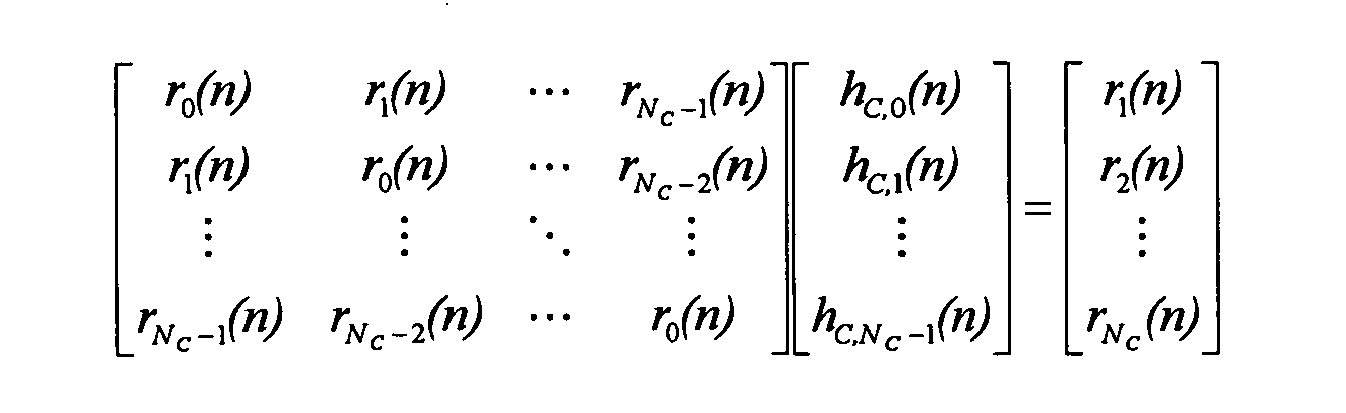
wherein the coefficients ri(n) are given by
where n is a discrete time index and ĥLR,.k (n) and hc,i(n) are filter coefficients of the echo compensation filtering means (2) and N filter coefficients of an equalization filtering means (1) used for equalizing the first acoustic input signal, respectively. - The method according to one of the claims 15-19, further comprising noise reduction filtering of the first acoustic input signal and/or the equalized first acoustic input signal and/or the second acoustic input signal.
- Computer program product, comprising one or more computer readable media having computer-executable instructions for performing the steps of the method according to one of the Claims 15-20.
Priority Applications (3)
| Application Number | Priority Date | Filing Date | Title |
|---|---|---|---|
| EP06010399.1A EP1858295B1 (en) | 2006-05-19 | 2006-05-19 | Equalization in acoustic signal processing |
| JP2007097268A JP5148150B2 (en) | 2006-05-19 | 2007-04-03 | Equalization in acoustic signal processing |
| US11/749,678 US8098848B2 (en) | 2006-05-19 | 2007-05-16 | System for equalizing an acoustic signal |
Applications Claiming Priority (1)
| Application Number | Priority Date | Filing Date | Title |
|---|---|---|---|
| EP06010399.1A EP1858295B1 (en) | 2006-05-19 | 2006-05-19 | Equalization in acoustic signal processing |
Publications (2)
| Publication Number | Publication Date |
|---|---|
| EP1858295A1 true EP1858295A1 (en) | 2007-11-21 |
| EP1858295B1 EP1858295B1 (en) | 2013-06-26 |
Family
ID=36829767
Family Applications (1)
| Application Number | Title | Priority Date | Filing Date |
|---|---|---|---|
| EP06010399.1A Expired - Lifetime EP1858295B1 (en) | 2006-05-19 | 2006-05-19 | Equalization in acoustic signal processing |
Country Status (3)
| Country | Link |
|---|---|
| US (1) | US8098848B2 (en) |
| EP (1) | EP1858295B1 (en) |
| JP (1) | JP5148150B2 (en) |
Cited By (1)
| Publication number | Priority date | Publication date | Assignee | Title |
|---|---|---|---|---|
| WO2013058728A1 (en) * | 2011-10-17 | 2013-04-25 | Nuance Communications, Inc. | Speech signal enhancement using visual information |
Families Citing this family (15)
| Publication number | Priority date | Publication date | Assignee | Title |
|---|---|---|---|---|
| EP2058804B1 (en) * | 2007-10-31 | 2016-12-14 | Nuance Communications, Inc. | Method for dereverberation of an acoustic signal and system thereof |
| US8385557B2 (en) * | 2008-06-19 | 2013-02-26 | Microsoft Corporation | Multichannel acoustic echo reduction |
| US9818394B2 (en) * | 2009-11-30 | 2017-11-14 | Graeme Colin Fuller | Realisation of controller transfer function for active noise cancellation |
| CN102883243B (en) * | 2012-10-15 | 2015-03-25 | 苏州上声电子有限公司 | Method for balancing frequency response of sound reproduction system through online iteration |
| EP2984650B1 (en) | 2013-04-10 | 2017-05-03 | Dolby Laboratories Licensing Corporation | Audio data dereverberation |
| US9565497B2 (en) * | 2013-08-01 | 2017-02-07 | Caavo Inc. | Enhancing audio using a mobile device |
| DE102013221394A1 (en) * | 2013-10-22 | 2015-04-23 | Rohde & Schwarz Gmbh & Co. Kg | Measuring device and method for measuring a high-frequency signal with de-embedding |
| CN106797513B (en) * | 2014-08-29 | 2020-06-09 | 哈曼国际工业有限公司 | Auto-calibrating noise-canceling headphones |
| DE102015114673A1 (en) * | 2015-09-02 | 2017-03-02 | Hoerbiger Antriebstechnik Holding Gmbh | Steel friction plate and friction clutch with such friction plates and method for producing such a friction plate |
| US10916257B2 (en) | 2016-12-06 | 2021-02-09 | Harman International Industries, Incorporated | Method and device for equalizing audio signals |
| DE102017212980B4 (en) * | 2017-07-27 | 2023-01-19 | Volkswagen Aktiengesellschaft | Method for compensating for noise in a hands-free device in a motor vehicle and hands-free device |
| US10924077B2 (en) * | 2018-08-29 | 2021-02-16 | Omnivision Technologies, Inc. | Low complexity loudness equalization |
| KR20220117217A (en) * | 2019-12-30 | 2022-08-23 | 하만 베커 오토모티브 시스템즈 게엠베하 | How to perform acoustic measurements |
| FR3119723B1 (en) * | 2021-02-09 | 2023-08-04 | Arkamys | Process for the automated adjustment of digital processing parameters applied to signals before broadcasting by loudspeakers and device for implementing such a process |
| FR3142031B1 (en) * | 2022-11-16 | 2024-11-08 | Arkamys | Method for equalizing an audio frequency signal broadcast in a broadcast environment, computer program product and corresponding device |
Citations (3)
| Publication number | Priority date | Publication date | Assignee | Title |
|---|---|---|---|---|
| US5768398A (en) | 1995-04-03 | 1998-06-16 | U.S. Philips Corporation | Signal amplification system with automatic equalizer |
| US20030108209A1 (en) | 2001-12-11 | 2003-06-12 | Mcintosh Jason Darrell | Communication device with active equalization and method therefor |
| US7006624B1 (en) | 1999-06-07 | 2006-02-28 | Telefonaktiebolaget L M Ericsson (Publ) | Loudspeaker volume range control |
Family Cites Families (6)
| Publication number | Priority date | Publication date | Assignee | Title |
|---|---|---|---|---|
| FR2791492B1 (en) * | 1999-03-26 | 2001-06-08 | France Telecom | ADAPTIVE IDENTIFICATION METHOD AND DEVICE, AND ADAPTIVE ECHO CANCELER USING SUCH A METHOD |
| US6744887B1 (en) * | 1999-10-05 | 2004-06-01 | Zhone Technologies, Inc. | Acoustic echo processing system |
| EP1413167A2 (en) * | 2001-07-20 | 2004-04-28 | Koninklijke Philips Electronics N.V. | Sound reinforcement system having an multi microphone echo suppressor as post processor |
| JP2003110690A (en) * | 2001-09-26 | 2003-04-11 | Toshiba Corp | Hands-free call system, anti-blocking method, anti-blocking program |
| US8116465B2 (en) * | 2004-04-28 | 2012-02-14 | Sony Corporation | Measuring apparatus and method, and recording medium |
| EP1591995B1 (en) * | 2004-04-29 | 2019-06-19 | Harman Becker Automotive Systems GmbH | Indoor communication system for a vehicular cabin |
-
2006
- 2006-05-19 EP EP06010399.1A patent/EP1858295B1/en not_active Expired - Lifetime
-
2007
- 2007-04-03 JP JP2007097268A patent/JP5148150B2/en not_active Expired - Fee Related
- 2007-05-16 US US11/749,678 patent/US8098848B2/en active Active
Patent Citations (3)
| Publication number | Priority date | Publication date | Assignee | Title |
|---|---|---|---|---|
| US5768398A (en) | 1995-04-03 | 1998-06-16 | U.S. Philips Corporation | Signal amplification system with automatic equalizer |
| US7006624B1 (en) | 1999-06-07 | 2006-02-28 | Telefonaktiebolaget L M Ericsson (Publ) | Loudspeaker volume range control |
| US20030108209A1 (en) | 2001-12-11 | 2003-06-12 | Mcintosh Jason Darrell | Communication device with active equalization and method therefor |
Non-Patent Citations (4)
| Title |
|---|
| BREINING C ET AL: "Acoustic echo control, an application of very-high-order adaptive filters", IEEE SIGNAL PROCESSING MAGAZINE, vol. 16, no. 4, 1 July 1999 (1999-07-01), PISCATAWAY, NJ, US, pages 42 - 68, XP011089842, ISSN: 1053-5888 * |
| C. BREINING ET AL.: "Acoustic echo control, an application of very- high-order adaptive filters", IEEE SIGNAL PROCESSING MAGAZINE, vol. 16, no. 4, 1 July 1999 (1999-07-01), pages 42 - 68, XP011089842 |
| G.-O. GLENTIS ET AL.: "Efficient Least Squares Adaptive Algorithms for FIR Transversal Filtering", IEEE SIGNAL PROCESSING MAGAZINE, 1 June 1999 (1999-06-01), pages 13 - 41, XP002268696, DOI: doi:10.1109/79.774932 |
| GLENTIS G O ET AL: "Efficient Least Squares Adaptive Algorithms for FIR Transversal Filtering", 1 June 1999, IEEE SIGNAL PROCESSING MAGAZINE, IEEE SERVICE CENTER, PISCATAWAY, NJ, US, PAGE(S) 13-41, ISSN: 1053-5888, XP002268696 * |
Cited By (2)
| Publication number | Priority date | Publication date | Assignee | Title |
|---|---|---|---|---|
| WO2013058728A1 (en) * | 2011-10-17 | 2013-04-25 | Nuance Communications, Inc. | Speech signal enhancement using visual information |
| US9293151B2 (en) | 2011-10-17 | 2016-03-22 | Nuance Communications, Inc. | Speech signal enhancement using visual information |
Also Published As
| Publication number | Publication date |
|---|---|
| US8098848B2 (en) | 2012-01-17 |
| US20080031471A1 (en) | 2008-02-07 |
| EP1858295B1 (en) | 2013-06-26 |
| JP5148150B2 (en) | 2013-02-20 |
| JP2007312364A (en) | 2007-11-29 |
Similar Documents
| Publication | Publication Date | Title |
|---|---|---|
| JP5148150B2 (en) | Equalization in acoustic signal processing | |
| US8805453B2 (en) | Hands-free telephony and in-vehicle communication | |
| US6674865B1 (en) | Automatic volume control for communication system | |
| US7171003B1 (en) | Robust and reliable acoustic echo and noise cancellation system for cabin communication | |
| US7117145B1 (en) | Adaptive filter for speech enhancement in a noisy environment | |
| EP3040984B1 (en) | Sound zone arrangment with zonewise speech suppresion | |
| US7039197B1 (en) | User interface for communication system | |
| EP1855457B1 (en) | Multi channel echo compensation using a decorrelation stage | |
| US8712068B2 (en) | Acoustic echo cancellation | |
| EP1848243B1 (en) | Multi-channel echo compensation system and method | |
| EP2859772B1 (en) | Wind noise detection for in-car communication systems with multiple acoustic zones | |
| EP2048659A1 (en) | Gain and spectral shape adjustment in audio signal processing | |
| US8175290B2 (en) | Feedback reduction system | |
| KR20040019339A (en) | Sound reinforcement system having an echo suppressor and loudspeaker beamformer | |
| US20120201396A1 (en) | Audio signal component compensation system | |
| JP2004537232A (en) | Acoustic reinforcement system with a post-processor that suppresses echoes of multiple microphones | |
| CN108353229B (en) | Audio Signal Processing in Vehicles | |
| US20200372926A1 (en) | Acoustical in-cabin noise cancellation system for far-end telecommunications | |
| WO2002032356A1 (en) | Transient processing for communication system | |
| KR102306739B1 (en) | Method and apparatus for voice enhacement in a vehicle | |
| Lüke et al. | In-car communication | |
| JP3947021B2 (en) | Call voice processing device | |
| CN107833580B (en) | Noise suppression based on dynamic increase of input noise characteristics | |
| JP2003218745A (en) | Noise canceller and voice detecting device | |
| JP5371599B2 (en) | Speech intelligibility improvement system and speech intelligibility improvement method |
Legal Events
| Date | Code | Title | Description |
|---|---|---|---|
| PUAI | Public reference made under article 153(3) epc to a published international application that has entered the european phase |
Free format text: ORIGINAL CODE: 0009012 |
|
| AK | Designated contracting states |
Kind code of ref document: A1 Designated state(s): AT BE BG CH CY CZ DE DK EE ES FI FR GB GR HU IE IS IT LI LT LU LV MC NL PL PT RO SE SI SK TR |
|
| AX | Request for extension of the european patent |
Extension state: AL BA HR MK YU |
|
| 17P | Request for examination filed |
Effective date: 20071210 |
|
| 17Q | First examination report despatched |
Effective date: 20080114 |
|
| AKX | Designation fees paid |
Designated state(s): AT BE BG CH CY CZ DE DK EE ES FI FR GB GR HU IE IS IT LI LT LU LV MC NL PL PT RO SE SI SK TR |
|
| RAP1 | Party data changed (applicant data changed or rights of an application transferred) |
Owner name: NUANCE COMMUNICATIONS, INC. |
|
| RIC1 | Information provided on ipc code assigned before grant |
Ipc: H04R 29/00 20060101ALI20120126BHEP Ipc: H03G 3/32 20060101ALN20120126BHEP Ipc: H03G 5/16 20060101ALN20120126BHEP Ipc: H04R 3/04 20060101AFI20120126BHEP |
|
| REG | Reference to a national code |
Ref country code: DE Ref legal event code: R079 Ref document number: 602006036948 Country of ref document: DE Free format text: PREVIOUS MAIN CLASS: H04R0029000000 Ipc: H04R0003040000 |
|
| GRAP | Despatch of communication of intention to grant a patent |
Free format text: ORIGINAL CODE: EPIDOSNIGR1 |
|
| RIC1 | Information provided on ipc code assigned before grant |
Ipc: H04R 29/00 20060101ALI20121217BHEP Ipc: H03G 5/16 20060101ALN20121217BHEP Ipc: H04R 3/04 20060101AFI20121217BHEP Ipc: H03G 3/32 20060101ALN20121217BHEP |
|
| GRAS | Grant fee paid |
Free format text: ORIGINAL CODE: EPIDOSNIGR3 |
|
| GRAA | (expected) grant |
Free format text: ORIGINAL CODE: 0009210 |
|
| AK | Designated contracting states |
Kind code of ref document: B1 Designated state(s): AT BE BG CH CY CZ DE DK EE ES FI FR GB GR HU IE IS IT LI LT LU LV MC NL PL PT RO SE SI SK TR |
|
| REG | Reference to a national code |
Ref country code: GB Ref legal event code: FG4D |
|
| REG | Reference to a national code |
Ref country code: CH Ref legal event code: EP |
|
| REG | Reference to a national code |
Ref country code: AT Ref legal event code: REF Ref document number: 619138 Country of ref document: AT Kind code of ref document: T Effective date: 20130715 |
|
| REG | Reference to a national code |
Ref country code: IE Ref legal event code: FG4D |
|
| REG | Reference to a national code |
Ref country code: DE Ref legal event code: R096 Ref document number: 602006036948 Country of ref document: DE Effective date: 20130822 |
|
| PG25 | Lapsed in a contracting state [announced via postgrant information from national office to epo] |
Ref country code: GR Free format text: LAPSE BECAUSE OF FAILURE TO SUBMIT A TRANSLATION OF THE DESCRIPTION OR TO PAY THE FEE WITHIN THE PRESCRIBED TIME-LIMIT Effective date: 20130927 Ref country code: FI Free format text: LAPSE BECAUSE OF FAILURE TO SUBMIT A TRANSLATION OF THE DESCRIPTION OR TO PAY THE FEE WITHIN THE PRESCRIBED TIME-LIMIT Effective date: 20130626 Ref country code: LT Free format text: LAPSE BECAUSE OF FAILURE TO SUBMIT A TRANSLATION OF THE DESCRIPTION OR TO PAY THE FEE WITHIN THE PRESCRIBED TIME-LIMIT Effective date: 20130626 Ref country code: SI Free format text: LAPSE BECAUSE OF FAILURE TO SUBMIT A TRANSLATION OF THE DESCRIPTION OR TO PAY THE FEE WITHIN THE PRESCRIBED TIME-LIMIT Effective date: 20130626 Ref country code: SE Free format text: LAPSE BECAUSE OF FAILURE TO SUBMIT A TRANSLATION OF THE DESCRIPTION OR TO PAY THE FEE WITHIN THE PRESCRIBED TIME-LIMIT Effective date: 20130626 |
|
| REG | Reference to a national code |
Ref country code: AT Ref legal event code: MK05 Ref document number: 619138 Country of ref document: AT Kind code of ref document: T Effective date: 20130626 |
|
| REG | Reference to a national code |
Ref country code: LT Ref legal event code: MG4D |
|
| PG25 | Lapsed in a contracting state [announced via postgrant information from national office to epo] |
Ref country code: BG Free format text: LAPSE BECAUSE OF FAILURE TO SUBMIT A TRANSLATION OF THE DESCRIPTION OR TO PAY THE FEE WITHIN THE PRESCRIBED TIME-LIMIT Effective date: 20130926 |
|
| REG | Reference to a national code |
Ref country code: NL Ref legal event code: VDEP Effective date: 20130626 |
|
| PG25 | Lapsed in a contracting state [announced via postgrant information from national office to epo] |
Ref country code: LV Free format text: LAPSE BECAUSE OF FAILURE TO SUBMIT A TRANSLATION OF THE DESCRIPTION OR TO PAY THE FEE WITHIN THE PRESCRIBED TIME-LIMIT Effective date: 20130626 |
|
| PG25 | Lapsed in a contracting state [announced via postgrant information from national office to epo] |
Ref country code: EE Free format text: LAPSE BECAUSE OF FAILURE TO SUBMIT A TRANSLATION OF THE DESCRIPTION OR TO PAY THE FEE WITHIN THE PRESCRIBED TIME-LIMIT Effective date: 20130626 Ref country code: IS Free format text: LAPSE BECAUSE OF FAILURE TO SUBMIT A TRANSLATION OF THE DESCRIPTION OR TO PAY THE FEE WITHIN THE PRESCRIBED TIME-LIMIT Effective date: 20131026 Ref country code: PT Free format text: LAPSE BECAUSE OF FAILURE TO SUBMIT A TRANSLATION OF THE DESCRIPTION OR TO PAY THE FEE WITHIN THE PRESCRIBED TIME-LIMIT Effective date: 20131028 Ref country code: BE Free format text: LAPSE BECAUSE OF FAILURE TO SUBMIT A TRANSLATION OF THE DESCRIPTION OR TO PAY THE FEE WITHIN THE PRESCRIBED TIME-LIMIT Effective date: 20130626 Ref country code: SK Free format text: LAPSE BECAUSE OF FAILURE TO SUBMIT A TRANSLATION OF THE DESCRIPTION OR TO PAY THE FEE WITHIN THE PRESCRIBED TIME-LIMIT Effective date: 20130626 Ref country code: CY Free format text: LAPSE BECAUSE OF FAILURE TO SUBMIT A TRANSLATION OF THE DESCRIPTION OR TO PAY THE FEE WITHIN THE PRESCRIBED TIME-LIMIT Effective date: 20130703 Ref country code: AT Free format text: LAPSE BECAUSE OF FAILURE TO SUBMIT A TRANSLATION OF THE DESCRIPTION OR TO PAY THE FEE WITHIN THE PRESCRIBED TIME-LIMIT Effective date: 20130626 Ref country code: CZ Free format text: LAPSE BECAUSE OF FAILURE TO SUBMIT A TRANSLATION OF THE DESCRIPTION OR TO PAY THE FEE WITHIN THE PRESCRIBED TIME-LIMIT Effective date: 20130626 |
|
| PG25 | Lapsed in a contracting state [announced via postgrant information from national office to epo] |
Ref country code: ES Free format text: LAPSE BECAUSE OF FAILURE TO SUBMIT A TRANSLATION OF THE DESCRIPTION OR TO PAY THE FEE WITHIN THE PRESCRIBED TIME-LIMIT Effective date: 20131007 Ref country code: NL Free format text: LAPSE BECAUSE OF FAILURE TO SUBMIT A TRANSLATION OF THE DESCRIPTION OR TO PAY THE FEE WITHIN THE PRESCRIBED TIME-LIMIT Effective date: 20130626 Ref country code: PL Free format text: LAPSE BECAUSE OF FAILURE TO SUBMIT A TRANSLATION OF THE DESCRIPTION OR TO PAY THE FEE WITHIN THE PRESCRIBED TIME-LIMIT Effective date: 20130626 Ref country code: RO Free format text: LAPSE BECAUSE OF FAILURE TO SUBMIT A TRANSLATION OF THE DESCRIPTION OR TO PAY THE FEE WITHIN THE PRESCRIBED TIME-LIMIT Effective date: 20130626 |
|
| PG25 | Lapsed in a contracting state [announced via postgrant information from national office to epo] |
Ref country code: CY Free format text: LAPSE BECAUSE OF FAILURE TO SUBMIT A TRANSLATION OF THE DESCRIPTION OR TO PAY THE FEE WITHIN THE PRESCRIBED TIME-LIMIT Effective date: 20130626 |
|
| PG25 | Lapsed in a contracting state [announced via postgrant information from national office to epo] |
Ref country code: DK Free format text: LAPSE BECAUSE OF FAILURE TO SUBMIT A TRANSLATION OF THE DESCRIPTION OR TO PAY THE FEE WITHIN THE PRESCRIBED TIME-LIMIT Effective date: 20130626 |
|
| PLBE | No opposition filed within time limit |
Free format text: ORIGINAL CODE: 0009261 |
|
| STAA | Information on the status of an ep patent application or granted ep patent |
Free format text: STATUS: NO OPPOSITION FILED WITHIN TIME LIMIT |
|
| PG25 | Lapsed in a contracting state [announced via postgrant information from national office to epo] |
Ref country code: IT Free format text: LAPSE BECAUSE OF FAILURE TO SUBMIT A TRANSLATION OF THE DESCRIPTION OR TO PAY THE FEE WITHIN THE PRESCRIBED TIME-LIMIT Effective date: 20130626 |
|
| 26N | No opposition filed |
Effective date: 20140327 |
|
| REG | Reference to a national code |
Ref country code: DE Ref legal event code: R097 Ref document number: 602006036948 Country of ref document: DE Effective date: 20140327 |
|
| PG25 | Lapsed in a contracting state [announced via postgrant information from national office to epo] |
Ref country code: LU Free format text: LAPSE BECAUSE OF FAILURE TO SUBMIT A TRANSLATION OF THE DESCRIPTION OR TO PAY THE FEE WITHIN THE PRESCRIBED TIME-LIMIT Effective date: 20140519 |
|
| REG | Reference to a national code |
Ref country code: CH Ref legal event code: PL |
|
| PG25 | Lapsed in a contracting state [announced via postgrant information from national office to epo] |
Ref country code: MC Free format text: LAPSE BECAUSE OF FAILURE TO SUBMIT A TRANSLATION OF THE DESCRIPTION OR TO PAY THE FEE WITHIN THE PRESCRIBED TIME-LIMIT Effective date: 20130626 Ref country code: CH Free format text: LAPSE BECAUSE OF NON-PAYMENT OF DUE FEES Effective date: 20140531 Ref country code: LI Free format text: LAPSE BECAUSE OF NON-PAYMENT OF DUE FEES Effective date: 20140531 |
|
| REG | Reference to a national code |
Ref country code: IE Ref legal event code: MM4A |
|
| PG25 | Lapsed in a contracting state [announced via postgrant information from national office to epo] |
Ref country code: IE Free format text: LAPSE BECAUSE OF NON-PAYMENT OF DUE FEES Effective date: 20140519 |
|
| REG | Reference to a national code |
Ref country code: FR Ref legal event code: PLFP Year of fee payment: 11 |
|
| PG25 | Lapsed in a contracting state [announced via postgrant information from national office to epo] |
Ref country code: TR Free format text: LAPSE BECAUSE OF FAILURE TO SUBMIT A TRANSLATION OF THE DESCRIPTION OR TO PAY THE FEE WITHIN THE PRESCRIBED TIME-LIMIT Effective date: 20130626 Ref country code: HU Free format text: LAPSE BECAUSE OF FAILURE TO SUBMIT A TRANSLATION OF THE DESCRIPTION OR TO PAY THE FEE WITHIN THE PRESCRIBED TIME-LIMIT; INVALID AB INITIO Effective date: 20060519 |
|
| REG | Reference to a national code |
Ref country code: FR Ref legal event code: PLFP Year of fee payment: 12 |
|
| REG | Reference to a national code |
Ref country code: FR Ref legal event code: PLFP Year of fee payment: 13 |
|
| PGFP | Annual fee paid to national office [announced via postgrant information from national office to epo] |
Ref country code: FR Payment date: 20180525 Year of fee payment: 13 |
|
| PGFP | Annual fee paid to national office [announced via postgrant information from national office to epo] |
Ref country code: DE Payment date: 20180731 Year of fee payment: 13 Ref country code: GB Payment date: 20180530 Year of fee payment: 13 |
|
| REG | Reference to a national code |
Ref country code: DE Ref legal event code: R119 Ref document number: 602006036948 Country of ref document: DE |
|
| GBPC | Gb: european patent ceased through non-payment of renewal fee |
Effective date: 20190519 |
|
| PG25 | Lapsed in a contracting state [announced via postgrant information from national office to epo] |
Ref country code: GB Free format text: LAPSE BECAUSE OF NON-PAYMENT OF DUE FEES Effective date: 20190519 Ref country code: DE Free format text: LAPSE BECAUSE OF NON-PAYMENT OF DUE FEES Effective date: 20191203 |
|
| PG25 | Lapsed in a contracting state [announced via postgrant information from national office to epo] |
Ref country code: FR Free format text: LAPSE BECAUSE OF NON-PAYMENT OF DUE FEES Effective date: 20190531 |