EP1858190A1 - Method for safely transmitting short ACK/NACK bitmaps in ARQ process inside edge compliant systems - Google Patents
Method for safely transmitting short ACK/NACK bitmaps in ARQ process inside edge compliant systems Download PDFInfo
- Publication number
- EP1858190A1 EP1858190A1 EP06425330A EP06425330A EP1858190A1 EP 1858190 A1 EP1858190 A1 EP 1858190A1 EP 06425330 A EP06425330 A EP 06425330A EP 06425330 A EP06425330 A EP 06425330A EP 1858190 A1 EP1858190 A1 EP 1858190A1
- Authority
- EP
- European Patent Office
- Prior art keywords
- rlc
- header
- short
- mac
- bitmap
- Prior art date
- Legal status (The legal status is an assumption and is not a legal conclusion. Google has not performed a legal analysis and makes no representation as to the accuracy of the status listed.)
- Granted
Links
Images



Classifications
-
- H—ELECTRICITY
- H04—ELECTRIC COMMUNICATION TECHNIQUE
- H04L—TRANSMISSION OF DIGITAL INFORMATION, e.g. TELEGRAPHIC COMMUNICATION
- H04L1/00—Arrangements for detecting or preventing errors in the information received
- H04L1/12—Arrangements for detecting or preventing errors in the information received by using return channel
- H04L1/16—Arrangements for detecting or preventing errors in the information received by using return channel in which the return channel carries supervisory signals, e.g. repetition request signals
- H04L1/1607—Details of the supervisory signal
- H04L1/1614—Details of the supervisory signal using bitmaps
-
- H—ELECTRICITY
- H04—ELECTRIC COMMUNICATION TECHNIQUE
- H04L—TRANSMISSION OF DIGITAL INFORMATION, e.g. TELEGRAPHIC COMMUNICATION
- H04L1/00—Arrangements for detecting or preventing errors in the information received
- H04L1/12—Arrangements for detecting or preventing errors in the information received by using return channel
- H04L1/16—Arrangements for detecting or preventing errors in the information received by using return channel in which the return channel carries supervisory signals, e.g. repetition request signals
- H04L1/1607—Details of the supervisory signal
- H04L1/1664—Details of the supervisory signal the supervisory signal being transmitted together with payload signals; piggybacking
Definitions
- the present invention relates to the field of packet data transmission inside mobile radio networks, and more precisely to a method for safely UUDL transmitting short ACK/NACK bitmaps in ARQ process inside EDGE compliant systems (used acronyms are given at the end of the description).
- ARQ signalling by means of so called “acknowledge” (ACK) and “not acknowledge” (NACK) signals is usual in telecommunication protocols.
- ACK/NACK signalling is described, for example, in 3GPP TS 44.060 V7.3.0 (ex GERAN 04.60).
- MCS1 nine MCSs, known as: MCS1,........., MCS9.
- a first type of GERAN data block is comprised of a first field as “header” and a second field as “payload”,
- the header includes both BSN and TFI fields. The latter is also designated as “RLC block”.
- MCS 1 to MCS6 coded blocks are characterized by these two fields.
- For MCS7 to MCS9 coded blocks three fields are used, a first field for the header, a second field for payload, known as “block RLC1", and a third field also for payload, known as "block RLC2".
- the header includes the TFI, a first BSN1 field assigned to the block RLC1, and a second BSN2 field assigned to the block RLC2.
- RLC ARQ functions available in GERAN support three modes of operation: RLC acknowledged mode, RLC unacknowledged mode and RLC non-persistent mode.
- RLC acknowledged mode operation uses retransmission of RLC data blocks to achieve high reliability.
- RLC unacknowledged mode operation does not utilize retransmission of RLC data blocks.
- RLC non-persistent mode operation uses non-exhaustive retransmission of RLC data blocks.
- the transmission of block sequence numbers as part of the ACK/NACK signal is not needed.
- a time based reporting is used.
- the base station, and hence the mobile station knows the transmission time and the timing of a dedicated radio block exactly, so the assignment of a received ACK/NACK indication to a formerly sent radio block is possible. For example, if a polling indication is received at a frame number N, the MS would send back a short bitmap for ACK/NACK, indicating the status of all received radio blocks in assigned timeslots during frame number N, N-1, and so on. This is depending on the size of the short bitmap and of the number of assigned timeslots.
- the receiver shall set the pair of bits in the short bitmap as described by the coding rule table of the citation shown in fig.3 .
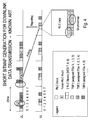
- Fig.4 shows how the coding rules of fig.3 apply for the generation of a short bitmap.
- a DL TBF is allocated on timeslots 0, 1, 2 & 3 (TBF1) and time multiplexed with other TBFs (TBF2 and TBF3) allocated on the same carrier as TBF1.
- the length of the short bitmap (relevant to the only TBF1) is assumed to be of 2 octets (sequentially read) each one spanning the 20 ms period of a radio block.
- the first pair of circled bits in the short bitmap shall refer to the radio block received on the first assigned timeslot of frame N
- the second pair of bits shall refer to the radio block received on the second assigned timeslot of frame N
- the next pair of bit shall refer to the radio block received on the first assigned timeslot of frame N-1 and so on.
- the method of the cited application can be used for ACK/NACK reporting both for uplink or downlink transmissions, indifferently, although PDAN message is the only one described and explicitly claimed.
- the instant of the PDAN transmission is scheduled by the base station with a polling request (RRBP) issued in the header of a RLC block transmitted in downlink.
- RRBP polling request
- a criterion must be implemented to inform the mobile that a short bitmap is used instead of traditional extended one with a PUAN message.
- the method of the cited application indicates a criterion of coexistence between extended and short bitmaps valid for the only ACK/NACK reporting set in uplink direction.
- the criterion avails of a substantial redefinition of both known RRBP and ES/P fields in the headers of the EGPRS downlink data blocks.
- a spare bit in the UL RLC/MAC header is used. A spare bit exists in all three EGPRS UL header types and will be used for this case.
- the gap for downlink reporting is filled up by the temporary 3GPP document TSG GERAN#29, Tdoc GP-060755 , San Jose Del Cabo, Mexico, 24-28 April 2006 which suggests:
- the invention achieves said object by providing a method for safely transmitting back to a first unit short ACK/NACK bitmaps generated by a second unit in ARQ signalling context inside a mobile radio system, wherein the transmissions scheduled for a temporary block flow, called TBF, avails of at least a carrier accessed in time division during timeslots of sequential frames for conveying RLC/MAC radio blocks each comprised of a header and a payload data part distributed on a set of allocated timeslots interleaved between a predetermined number of frames, wherein the short ACK/NACK bitmap includes as many bits as the RLC/MAC blocks received in a time window spanning one or more predetermined block periods before a starting point of time known to the first and the second unit, the logical value of each bit indicating errored or correctly decoded RLC/MAC blocks, so as to enable retransmission by the first unit of those blocks mapped as erroneously decoded by the second unit; said short bitmap being encoded by the second unit independently of the
- the short bitmap is allocated in the header of the RLC/MAC block used for conveying it, so as to be encoded with the header.
- the short bitmap allocated in the header is further allocated in a new zone of the RLC/MAC block independently encoded with respect of both the header and data part; the new zone carries broadcast or multicast information which is accessed by all the mobile stations allocated on the same timeslots. Profitably the new zone is placed immediately after the header part.
- the short bitmap is allocated only in said new broadcast/multicast zone.
- the short bitmap is allocated not in the header nor in the payload but in a new additional zone.
- the method of the invention independently of the used embodiment, makes the transmission of short ACK/NACK bitmaps in the ARQ process more reliable.
- the method implemented in accordance with the second or the third preferred embodiment is better in agreement with the broadcast/multicast opportunity offered on the downlink channel with respect to the point-to-point transmission in the uplink.
- a short bitmap allocated in the broadcast/multicast zone accounts for more than one user scheduled on the same time window, even different from the addressee of the payload of the radio block. The advantage is that all mobiles scheduled inside the same block period can be equally quickly informed on the ACK/NACK status of their recent transmissions.
- the method implemented in accordance with the fourth preferred embodiment allows a more reliable solution than allocating the bitmap in the payload, because the coding of the new zone can be made more robust, and more flexible than the first preferred embodiment of the invention, because the short bitmap can be avoided when not needed, so that data can be sent in the uplink.
- a reliable fast feedback mechanism can be realized sending back to the transmitter a feedback information at every possible occasion, without completely consuming the bandwidth on the feedback channel. This is made possible by piggybacking short bitmaps in different part of the radio blocks for both the forward and reverse links.
- the implementation of delay sensitive services in GERAN, like VolP, is appreciably improved.
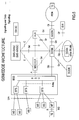
- the depicted GSM/EDGE functional architecture includes the following functional blocks: MSs (TE and MT), BSS (both BTSs and BSC), SGSN, GGSN, EIR, MSC/VLR, HLR, SMS-GMSC, SMS-IWMSC, and SM-SC.
- MSs TE and MT
- BSS both BTSs and BSC
- SGSN GGSN
- EIR MSC/VLR
- HLR HLR
- SMS-GMSC SMS-IWMSC
- SM-SC Short-GMSC
- the BSS includes a plurality of BTS connected to a BSC through a respective A-bis interface.
- the BSC is connected to the core network, mainly including MSC and SGSN, through the A and Gb interfaces accounting for circuit switched domain (CS) and packet switched domain (PS), respectively.
- CS circuit switched domain
- PS packet switched domain
- former BSSs are evolved in GERANs in order to allow higher data throughputs and incremental redundancy when erroneous data blocks are retransmitted.
- the Gn interface connects two GSN nodes in the same PLMN system, while the Gp interface connects two GSN nodes belonging to different PLMN systems.
- SNDCP network protocol units
- Dynamic allocation means that a particular transmission resource, consisting for instance of a PDCH channel on a physical timeslot, is made time division shareable among more MS mobiles, each of them being engaged in an active session of data transfer, or signalling, through the same transmission resource jointly assigned.
- the BSC includes a PCU implementing a proprietary scheduling algorithm.
- TBF temporary assignment of resources
- a TBF may include memory buffer to house the queues of RLC/MAC blocks.
- Each TBF assignment enables the unidirectional transfer of radio blocks (for payload data and signalling) within a cell between the network and a mobile station MS, or vice versa.
- the resources include one or more PDCH channels, i.e. at least a carrier and a timeslot, and a TFI value.
- the network does not assign any buffer in uplink direction (the buffer resides in the mobile).
- the network requires simply knowing the number of blocks that a MS mobile intends to transmit.
- the network sends to the mobile a PACKET DOWNLINK ASSIGNMENT message in the Ready state on the control channel, with enclosed the list of PDCH channels allocated for the downlink transfer.
- a buffer, relevant to the downlink TBF is purposely allocated to contain the RLC/MAC blocks to be sent.
- TBF Temporal Flow Identity
- the mobile shall assume that the TFI value is unique among TBF competitors in each direction, uplink or downlink.
- a RLC/MAC data block is identified to the TBF to which it is associated through its own field where the identifier TFI is written, and another field to indicate the uplink or downlink direction of the block. Should the RLC/MAC block be referred to a control message, a field is foreseen to indicate the message transmission direction and type.
- the header of each RLC/MAC block transmitted on a PDCH channel in "downlink" direction includes an additional field called USF, which is used by the network in the form of a flag to control the time division multiplexing of different mobile stations on a physical channel PDCH in uplink direction.
- USF additional field
- One USF is scheduled for the transmission of one radio block.
- Three bits are foreseen for the USF field that enable to unambiguously discriminate up to eight users sharing a time-slot, also in the borderline case in which the single TBF buffer are associated all the eight time slots of a TDMA frame.
- the Packet ACK/NACK message contains a starting sequence number (SSN) and a received block bitmap (RBB).
- the Packet ACK/NACK message is sent by the RLC receiver and is received by the RLC transmitter.
- the SSN and RBB are determined as defined in this sub-clause and transmitted in RLC acknowledged, RLC unacknowledged and RLC non-persistent modes. The SSN and RBB may be ignored by the RLC transmitter in unacknowledged mode.
- the RBB is defined as a binary valued array of WS elements, where the index of each element takes value 0, 1, 2, ..., WS-1 in the given order, respectively.
- the BSN values specified in the RBB are interpreted by subtracting the bit position in the bitmap from the starting sequence number (SSN) modulo SNS.
- the presence of the reporting with small bitmaps can be communicated by the network to the mobiles through the System Information broadcast on the Common Channel read by the mobiles periodically, or alternatively by means of a dedicated information element during the establishment of a new TBF.
- Legacy polling is still needed in order to support legacy MSs and LQC purposes for mobile that support fast Ack/Nack reporting.
- the result would be a substantially reduced legacy polling repetition rate being applied for MSs that support fast Ack/Nack reporting compared to MSs that only support the legacy Packet Ack/Nack reporting scheme.
- the repetition rate of the legacy polling need also to be chosen to cater for the case when the short bitmap moves outside the short bit map window with errors.
- the receiver needs to know this, if possible without any double decoding.
- a redefinition of the RRBP and ES/P fields in the header of the EGPRS DL data blocks can be utilized as described in GP-060755 - Annex A, subclause 10.2.1.5.3 already mentioned in the introduction.
- the minimum reserved room of two octets accounts for the maximum number of scheduled blocks inside the latest single 20 ms time window, to say two EGPRS RLC data blocks for each of the eight timeslots of the frame.
- the label TS1,1 means EGPRS RLC data block 1 on timeslot 1, and so on.
- Further room can be provided in the header to extend the reporting window. In this case, two octets can be added up for each additional 20 ms observation period.
- the room reserved in the header for the short bitmap is the only one effectively needed on the basis of the actual scheduling.
- the base station prepares a short bitmap providing feedback for all the TBFs of all the mobile stations allocated on the same timeslots, for a reporting window of one or more block periods.
- the knowledge of the fixed delay between the earliest uplink radio block considered in the reporting window and the actual radio block which conveys the B/M part, automatically enables the mobiles to retransmit the errored radio blocks mapped in the ACK/NACK signalling received back, starting from the earliest one.
- the B/M zone is encoded more robustly than the robustness used for adaptively encoding the remaining data part. Considered that the B/M zone between the header and the data part already contains the ACK/NACK information for all the TBFs, the short bitmap included in the header of downlink RLC/MAC block of fig.7 can be reduced or eliminated.
Landscapes
- Engineering & Computer Science (AREA)
- Computer Networks & Wireless Communication (AREA)
- Signal Processing (AREA)
- Mobile Radio Communication Systems (AREA)
- Detection And Prevention Of Errors In Transmission (AREA)
- Production Of Multi-Layered Print Wiring Board (AREA)
- Dot-Matrix Printers And Others (AREA)
Abstract
Description
- The present invention relates to the field of packet data transmission inside mobile radio networks, and more precisely to a method for safely UUDL transmitting short ACK/NACK bitmaps in ARQ process inside EDGE compliant systems (used acronyms are given at the end of the description).
- ARQ signalling by means of so called "acknowledge" (ACK) and "not acknowledge" (NACK) signals is usual in telecommunication protocols. Such kind of ACK/NACK signalling is described, for example, in 3GPP TS 44.060 V7.3.0 (ex GERAN 04.60). Within EDGE there are nine MCSs, known as: MCS1,........., MCS9.
- In fig.1 a first type of GERAN data block is comprised of a first field as "header" and a second field as "payload", The header includes both BSN and TFI fields. The latter is also designated as "RLC block".
MCS 1 to MCS6 coded blocks are characterized by these two fields. For MCS7 to MCS9 coded blocks three fields are used, a first field for the header, a second field for payload, known as "block RLC1", and a third field also for payload, known as "block RLC2". The header includes the TFI, a first BSN1 field assigned to the block RLC1, and a second BSN2 field assigned to the block RLC2. - The RLC ARQ functions available in GERAN support three modes of operation: RLC acknowledged mode, RLC unacknowledged mode and RLC non-persistent mode. RLC acknowledged mode operation uses retransmission of RLC data blocks to achieve high reliability. RLC unacknowledged mode operation does not utilize retransmission of RLC data blocks. RLC non-persistent mode operation uses non-exhaustive retransmission of RLC data blocks.
- Conventional ARQ with ACK/NACK feedback messages, such as PDAN or PUAN, reports bitmaps which occupy a whole radio block. Whenever there is a polling request transmitted in downlink (DL) direction by the base station for receiving back a PDAN message transmitted by the mobile in uplink (UL) direction to either acknowledge or not acknowledge RLC blocks received in downlink, uplink resources are used only for sending the uplink signalling message PDAN. These uplink resources therefore can not be used for sending data. Dual conclusions for waste of downlink resources should be drawn for a PUAN message issued by the base station in downlink to either acknowledge or not acknowledge RLC blocks transmitted by the MS in uplink. In consequence of above, the data transmission might be severely hurt by frequently transmitted ACK/NACK messages, especially in case of transmission over few timeslots.
-
European patent application No. 05023668.6, filed on 28.10.2005 - A first unit (BS) transmits a polling request at a point of time to the second unit (MS) and the polling request initialises an ACK/NACK examination of received RLC blocks there. The second unit examines received RLC blocks, which are assigned to a dedicated timeslot number of the carrier, and the examination is done for all timeslots of the set.
- During the examination one binary bit is used to indicate, if a considered RLC block shows errors or not. The indicating bits are used to form a short bitmap and the short bitmap is transmitted from the second unit to the first unit as ACK/NACK signal.
- The first unit analyses the short bitmap and identifies erroneous RLC blocks with respect to the transmission timing of the RLC blocks between the first and the second unit, with respect to the assigned set of timeslots and with respect to the point of time the polling request was sent, each of that facts being known at the first unit.
- In case of data transmission in uplink direction, the short bitmap will be part of a "normal" uplink data block. Because of this, there is the possibility to add and transmit normal payload within the data block, altogether with the short bitmap block. This feature is present in the uplink RLC block of fig.2.
- If there is no data transmission in uplink direction the short bitmap will be sent in uplink direction in a so called "access burst". The transmission and the reception of that kind of burst is normally done without disturbance, the transmission of the short bitmap is therefore save. If the access burst carries the short bitmap then battery power at the mobile station can be saved. Because of the slower transmission repetition of the access burst it is possible to reduce interference within the system / GERAN system.
- Under the cited method the transmission of block sequence numbers as part of the ACK/NACK signal is not needed. Instead of a block sequence number based ACK/NACK reporting, a time based reporting is used. The base station, and hence the mobile station, knows the transmission time and the timing of a dedicated radio block exactly, so the assignment of a received ACK/NACK indication to a formerly sent radio block is possible. For example, if a polling indication is received at a frame number N, the MS would send back a short bitmap for ACK/NACK, indicating the status of all received radio blocks in assigned timeslots during frame number N, N-1, and so on. This is depending on the size of the short bitmap and of the number of assigned timeslots. In most cases a very short bitmap is sufficient for ACK/NACK signalling. If we assume a mobile station with 4 assigned timeslots in downlink direction and a polling period of 40 ms, there will be a maximum of 4x2 = 8 radio blocks carrying a maximum of 16 RLC blocks submitted during two successive polling.
- Since there might be two RLC data blocks per radio block (in case of
MCS - In case of multiple TBFs allocated to the same mobile, the bitmap could encompass the information for all TBFs. In this case bits would be set to 1 for RLC blocks correctly received with any of the assigned DL TFIs. This would further optimize the procedure since feedback for all the TBFs could be provided at the same time. Fig.4 shows how the coding rules of fig.3 apply for the generation of a short bitmap. In the figure a DL TBF is allocated on
timeslots - The method of the cited application can be used for ACK/NACK reporting both for uplink or downlink transmissions, indifferently, although PDAN message is the only one described and explicitly claimed. The instant of the PDAN transmission is scheduled by the base station with a polling request (RRBP) issued in the header of a RLC block transmitted in downlink. There are no reasons for a mobile to poll the network (base station) for transmitting a feedback for its own uplink transmissions, because the network is the master of the scheduling on the downlink channel. Starting from the fast ACK/NACK uplink reporting for downlink transmissions, some other questions have to be considered in order to adapt the faster MAC protocol to the uplink data transmissions. First of all, a criterion must be implemented to inform the mobile that a short bitmap is used instead of traditional extended one with a PUAN message.
- The method of the cited application indicates a criterion of coexistence between extended and short bitmaps valid for the only ACK/NACK reporting set in uplink direction. The criterion avails of a substantial redefinition of both known RRBP and ES/P fields in the headers of the EGPRS downlink data blocks. Besides, in order for the base station receiver to know whether or not a short ACK/NACK bitmap is piggybacked in the RLC uplink data block, a spare bit in the UL RLC/MAC header is used. A spare bit exists in all three EGPRS UL header types and will be used for this case.
- The gap for downlink reporting is filled up by the temporary 3GPP document TSG GERAN#29, Tdoc GP-060755, San Jose Del Cabo, Mexico, 24-28 April 2006 which suggests:
- ACK/NACK reporting set in uplink direction:
- The spare bit in the UL RLC/MAC header is used. Reporting from the mobile of either short or extended bitmap is signalled by the network by using the poll (RRBP) and USF fields in the downlink direction.
- ACK/NACK reporting set in downlink direction:
- The spare bit in the DL RLC/MAC header is used. The same criterion of the cited application for ACK/NACK reporting in uplink direction is used for downlink reporting. To say, both RRBP and ES/P fields in the header of the EGPRS downlink data blocks are redefined for this aim.
- The ACK/NACK reporting as it results from the combined teaching of both the priority documents is nevertheless not optimal for the following reasons:
- A residual possibility of error exists even decoding the short bitmap with separate CRC. This mainly depends on the MCS adaptively selected for payload and hence for the included short bitmap.
- A too rigid mechanism for ACK/NACK reporting in downlink direction which considers reporting for a single TBF only, without considering the eventuality of additional reports from other MSs sharing the same timeslots inside the predetermined reporting window.
- In view of the highlighted state of the art, it is an object of the present invention to provide a method without the underlined limitations.
- The invention achieves said object by providing a method for safely transmitting back to a first unit short ACK/NACK bitmaps generated by a second unit in ARQ signalling context inside a mobile radio system, wherein the transmissions scheduled for a temporary block flow, called TBF, avails of at least a carrier accessed in time division during timeslots of sequential frames for conveying RLC/MAC radio blocks each comprised of a header and a payload data part distributed on a set of allocated timeslots interleaved between a predetermined number of frames, wherein the short ACK/NACK bitmap includes as many bits as the RLC/MAC blocks received in a time window spanning one or more predetermined block periods before a starting point of time known to the first and the second unit, the logical value of each bit indicating errored or correctly decoded RLC/MAC blocks, so as to enable retransmission by the first unit of those blocks mapped as erroneously decoded by the second unit; said short bitmap being encoded by the second unit independently of the redundancy code of the payload data part, using a modulation and coding scheme for the short bitmap generally more robust against the errors than the robustness of the modulation and coding scheme used in the payload data part, as disclosed in
claim 1. Additional advantageous features are described in the dependent claims. - According to a first preferred embodiment of the invention valid for both uplink and downlink reporting, the short bitmap is allocated in the header of the RLC/MAC block used for conveying it, so as to be encoded with the header.
- According to a second preferred embodiment of the invention valid for the downlink reporting only, the short bitmap allocated in the header is further allocated in a new zone of the RLC/MAC block independently encoded with respect of both the header and data part; the new zone carries broadcast or multicast information which is accessed by all the mobile stations allocated on the same timeslots. Profitably the new zone is placed immediately after the header part.
- According to a third preferred embodiment of the invention valid for short bitmaps transmitted in the downlink, the short bitmap is allocated only in said new broadcast/multicast zone.
- According to a fourth preferred embodiment of the invention valid for the uplink reporting, the short bitmap is allocated not in the header nor in the payload but in a new additional zone.
- The method of the invention, independently of the used embodiment, makes the transmission of short ACK/NACK bitmaps in the ARQ process more reliable. The method implemented in accordance with the second or the third preferred embodiment, is better in agreement with the broadcast/multicast opportunity offered on the downlink channel with respect to the point-to-point transmission in the uplink. Profitably, a short bitmap allocated in the broadcast/multicast zone accounts for more than one user scheduled on the same time window, even different from the addressee of the payload of the radio block. The advantage is that all mobiles scheduled inside the same block period can be equally quickly informed on the ACK/NACK status of their recent transmissions.
- The method implemented in accordance with the fourth preferred embodiment allows a more reliable solution than allocating the bitmap in the payload, because the coding of the new zone can be made more robust, and more flexible than the first preferred embodiment of the invention, because the short bitmap can be avoided when not needed, so that data can be sent in the uplink.
- In conclusion, a reliable fast feedback mechanism can be realized sending back to the transmitter a feedback information at every possible occasion, without completely consuming the bandwidth on the feedback channel. This is made possible by piggybacking short bitmaps in different part of the radio blocks for both the forward and reverse links. The implementation of delay sensitive services in GERAN, like VolP, is appreciably improved.
- The features of the present invention which are considered to be novel are set forth with particularity in the appended claims. The invention and its advantages may be understood with reference to the following detailed description of an embodiment thereof taken in conjunction with the accompanying drawings given for purely non-limiting explanatory purposes and wherein:
- fig.1, already described, shows the general structure of two types of radio blocks used within a GERAN system of the known art;
- fig.2, already described, shows an exemplary structure of a RLC data block of the prior art used in uplink direction;
- fig.3, already described, includes a table illustrating the coding rules used to build up a short bitmap included in the data part of the RLC data block of fig.2;
- fig.4, already described, shows the Polling/Reporting ACK/NACK ARQ signalling mechanism implemented for uplink reporting with short bitmaps inside a GERAN system of the known art;
- fig.5 shows the functional architecture of a GSM/EDGE network suitable to implement a RLC/MAC protocol modified as per the method of the invention;
- figures 6 to 12 show the structure of some exemplary RLC/MAC blocks modified as per the method of the invention.
- With reference to fig.5, the depicted GSM/EDGE functional architecture includes the following functional blocks: MSs (TE and MT), BSS (both BTSs and BSC), SGSN, GGSN, EIR, MSC/VLR, HLR, SMS-GMSC, SMS-IWMSC, and SM-SC. Inside the MS the first functional block TE is connected to the second functional block MT through a connection indicated by a Reference point R, typically supporting a standard serial interface. The following interfaces are foreseen: Um, A-bis, A, Gb, Gi, Gp, Gn, Gp, Gf, Gs, Gr, Gd, D, E, C, whose connectivity between the relevant blocks are directly visible in the figure.
- Every MS (MT) is connected to its serving BTS through the Um radio interface for exchanging voice and data services and the relevant signalling. The BSS includes a plurality of BTS connected to a BSC through a respective A-bis interface. The BSC is connected to the core network, mainly including MSC and SGSN, through the A and Gb interfaces accounting for circuit switched domain (CS) and packet switched domain (PS), respectively. Former BSSs are evolved in GERANs in order to allow higher data throughputs and incremental redundancy when erroneous data blocks are retransmitted. Furthermore, the Gn interface connects two GSN nodes in the same PLMN system, while the Gp interface connects two GSN nodes belonging to different PLMN systems.
- In operation, at the Um and A-bis interfaces several protocols are stacked upon the physical layer, in particular: SNDCP, LLC, RLC, and MAC. The SNDCP protocol controls the transfer of network protocol units (N-PDUs) between the MS mobile and SGSN node. The main functions of the SNDCP protocol are:
- Multiplexing of packet data protocols, for instance IP.
- Compression / decompression of the user data packets.
- Compression / decompression of the protocol control information.
- Segmentation of NPDUs within LLC frames and re-assembly of the LLC frames the NPDUs.
- Signalling procedures for accessing the radio channel are controlled by MAC, which also governs dynamic allocation of the resources (request and grant). Dynamic allocation means that a particular transmission resource, consisting for instance of a PDCH channel on a physical timeslot, is made time division shareable among more MS mobiles, each of them being engaged in an active session of data transfer, or signalling, through the same transmission resource jointly assigned. To the specific aim of dynamic allocation, the BSC includes a PCU implementing a proprietary scheduling algorithm.
- The sub-set of MAC procedures governing the multiplexing of the transmissions on the shared channels, provide the MS with temporary assignment of resources, called TBFs, on the physical layer to sustain the single transmission. A TBF may include memory buffer to house the queues of RLC/MAC blocks. Each TBF assignment enables the unidirectional transfer of radio blocks (for payload data and signalling) within a cell between the network and a mobile station MS, or vice versa. Control messages for the establishment/abatement of a connection between service points and the allocation/de-allocation of relevant supported physical resources, for instance the TBF buffers, contemplate different opportunities capable of covering the whole survey foreseen in the packet transfer mode of the RR sublayer. For simplicity, it is here described a very limited survey of establishment/abatement of TBF connections and of the relevant operation modes. We can start from the establishment of a TBF uplink connection following a Packet Transfer originated by the mobile. In this case the mobile requires the assignment of a GPRS channel sending a PACKET CHANNEL REQUEST message including the TBF resources requested for the transfer of packets to the network. In case of reception, the network replies with a PACKET UPLINK ASSIGNMENT message on the control channel allocating to the mobile the resources requested for the uplink transfer of packets. The resources include one or more PDCH channels, i.e. at least a carrier and a timeslot, and a TFI value. The network does not assign any buffer in uplink direction (the buffer resides in the mobile). The network requires simply knowing the number of blocks that a MS mobile intends to transmit. We can now proceed examining the assignment of a TBF downlink following a Packet Transfer ended towards the mobile. In this case at the end of the paging procedure, the network sends to the mobile a PACKET DOWNLINK ASSIGNMENT message in the Ready state on the control channel, with enclosed the list of PDCH channels allocated for the downlink transfer. A buffer, relevant to the downlink TBF, is purposely allocated to contain the RLC/MAC blocks to be sent.
- In the majority of the cases a TBF is kept alive only for the transfer of one or more LLC protocol units, to the right purpose of transferring the corresponding RLC/MAC blocks. The network assigns to each TBF its own temporary identifier, called TFI (Temporary Flow Identity). The mobile shall assume that the TFI value is unique among TBF competitors in each direction, uplink or downlink. A RLC/MAC data block is identified to the TBF to which it is associated through its own field where the identifier TFI is written, and another field to indicate the uplink or downlink direction of the block. Should the RLC/MAC block be referred to a control message, a field is foreseen to indicate the message transmission direction and type. In the case of dynamic allocation, the header of each RLC/MAC block transmitted on a PDCH channel in "downlink" direction includes an additional field called USF, which is used by the network in the form of a flag to control the time division multiplexing of different mobile stations on a physical channel PDCH in uplink direction. We can now better qualify the already mentioned PACKET UPLINK ASSIGNMENT message, sent by the network towards the mobiles, stating that it includes: the identifier TFI of the downlink/TBF buffer containing the control block carrying this message, the list of the allocated PDCH channels (time slots), and a corresponding USF value for each allocated channel (timeslot). One USF is scheduled for the transmission of one radio block. Three bits are foreseen for the USF field that enable to unambiguously discriminate up to eight users sharing a time-slot, also in the borderline case in which the single TBF buffer are associated all the eight time slots of a TDMA frame.
- According to 3GPP TS 44.060 V7.3.0, subclause 9.1.8.1, the Packet ACK/NACK message contains a starting sequence number (SSN) and a received block bitmap (RBB). The Packet ACK/NACK message is sent by the RLC receiver and is received by the RLC transmitter. The SSN and RBB are determined as defined in this sub-clause and transmitted in RLC acknowledged, RLC unacknowledged and RLC non-persistent modes. The SSN and RBB may be ignored by the RLC transmitter in unacknowledged mode. The RBB is defined as a binary valued array of WS elements, where the index of each element takes
value - The presence of the reporting with small bitmaps can be communicated by the network to the mobiles through the System Information broadcast on the Common Channel read by the mobiles periodically, or alternatively by means of a dedicated information element during the establishment of a new TBF. Legacy polling is still needed in order to support legacy MSs and LQC purposes for mobile that support fast Ack/Nack reporting. The result would be a substantially reduced legacy polling repetition rate being applied for MSs that support fast Ack/Nack reporting compared to MSs that only support the legacy Packet Ack/Nack reporting scheme. The repetition rate of the legacy polling need also to be chosen to cater for the case when the short bitmap moves outside the short bit map window with errors.
- For the coexistence between fast and extended legacy reporting we need to consider: a) ACK/NACK reporting sent in uplink direction; b) ACK/NACK reporting sent in downlink direction.
- Case a) - ACK/NACK reporting sent in uplink direction. The objective is to keep the network in control of how often an MS is allowed to send ACK/NACK reports. The reporting is commanded using the poll (RRBP) and USF fields in the downlink direction as described in GP-060755 - Annex A, subclause 10.2.1.5.2 already mentioned in the introduction.
- Case b) - ACK/NACK reporting sent in downlink direction. In order for the mobile station to determine that a short ACK/NACK report is included in the data block, the receiver needs to know this, if possible without any double decoding. A redefinition of the RRBP and ES/P fields in the header of the EGPRS DL data blocks can be utilized as described in GP-060755 - Annex A, subclause 10.2.1.5.3 already mentioned in the introduction.
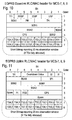
- With reference to fig.6, we see a new UUDL RLC/MAC block structure modified so as to include a short bitmap in the header. The detail of the new header for an EGPRS downlink block is reported in fig.10 while for an EGPRS uplink block is reported in fig.11, the fields other than the short bitmap are described in 3GPP TS 44.060 V7.3.0. The short bitmap is completed using the coding rules reported in the table of fig.3. Synchronization between transmission and reception is needed to implement the retransmission based on short bitmaps rather than asynchronous BSNs. The minimum reserved room of two octets accounts for the maximum number of scheduled blocks inside the latest single 20 ms time window, to say two EGPRS RLC data blocks for each of the eight timeslots of the frame. The label TS1,1 means EGPRS RLC data block 1 on
timeslot 1, and so on. Further room can be provided in the header to extend the reporting window. In this case, two octets can be added up for each additional 20 ms observation period. Alternatively, the room reserved in the header for the short bitmap is the only one effectively needed on the basis of the actual scheduling. - In fig.7 we see the structure of a new downlink RLC/MAC block, modified so as to include a short bitmap in the header and also in a new broadcast/multicast (B/M) zone, profitably allocated between the header and the data part.
- In fig.8 the short bitmap is allocated only in the B/M zone of the downlink RLC/MAC block. The block structure represented in fig.8 is detailed in fig.12.
- In fig.9 we see the structure of a new uplink RLC/MAC block, modified so as to include a short bitmap in a new zone, profitably allocated between the header and the data part.
- In operation, which type of downlink RLC/MAC block visible in fig.7 and fig.8 for conveying the short bitmap is communicated by the network to the MSs. For all types of new RLC/MAC block containing the short bitmap in said new zone as in the figures 7 to 9, the length of the new zone is communicated in the header of the RLC/MAC block.
- With reference to fig.12 the base station prepares a short bitmap providing feedback for all the TBFs of all the mobile stations allocated on the same timeslots, for a reporting window of one or more block periods. The knowledge of the fixed delay between the earliest uplink radio block considered in the reporting window and the actual radio block which conveys the B/M part, automatically enables the mobiles to retransmit the errored radio blocks mapped in the ACK/NACK signalling received back, starting from the earliest one. The B/M zone is encoded more robustly than the robustness used for adaptively encoding the remaining data part. Considered that the B/M zone between the header and the data part already contains the ACK/NACK information for all the TBFs, the short bitmap included in the header of downlink RLC/MAC block of fig.7 can be reduced or eliminated.
- On the basis of the above description some changes may be introduced in the exemplary embodiment by the skilled in the art without departing from the scope of the invention. It is thus contemplated that the present invention encompasses any and all such embodiments covered by the following claims.
-
- 3GPP - 3rd Generation Partnership Program
- ACK - Acknowledge (mode)
- ARQ - Automatic Repeat reQuest
- BCCH - Broadcast Control Channel
- BS - Base Station
- BSC - Base Station Controller
- BSN - Block Sequence Number
- BSS - Base Station Subsystem
- BTS - Base Transceiver Station
- CCCH - Common Control Channel
- CRC - Cyclic Redundancy Check
- CS - Circuit Switched
Coding Scheme - DL - Downlink
- E - Extension bit
- EDGE - Enhanced Data rates for GSM Evolution
- EGPRS - Enhanced GPRS
- ES/P - Extended / Supplementary Polling
- FACCH - Fast Associated Control Channel
- FPB - First Partial Bitmap
- GERAN - GSM/EDGE Radio Access Network
- GGSN - Gateway GSN
- GMSC - Gateway MSC
- GPRS - General Packet Radio Service
- GSM - Global System for Mobile communications
- IP - Internet Protocol
- IWMSC - InterWorking MSC
- LI - Length Indicator
- LLC - Logical Link Control
- LQC - Link Quality Control
- MAC - Medium Access Protocol
- MBMS - Multimedia Broadcast Multicast Service
- MCS - Modulation and Coding Scheme
- MS - Mobile Station
- MSC - Message Switching Centre
- MT - Mobile Terminated
- NACK - Not Acknowledge (mode)
- NPB - Next Partial Bitmap
- NPDU - Network PDU
- NSAPI - Network SAPI
- PACCH - Packet Associated Control Channel
- PBCCH - Packet Broadcast Control Channel
- PCCCH - Packet Common Control Channel
- PCU - Packet Control Unit
- PDAN - Packet Downlink ACK/NACK
- PDTCH - Packet Data Traffic Channel
- PDCH - Packet Data Channel
- PDU - Protocol Data Unit
- PFI - Packet Flow Identifier
- PLMN - Public Land Mobile Network
- PS - Packet Switched
- PUAN - Packet Uplink ACK/NACK
- RAN - Radio Access Network
- RBB - Received Block Bitmap
- RLC - Radio Link Control
- RRBP - Relative Reserved Block Period
- RTT - Round Trip Time
- RTTI - Reduced TTI
- SAPI - Service Access Point Identifier
- SGSN - Service GPRS Support Node
- SMS - Short Message Service
- SNS - Sequence Number Space
- SNDCP - Subnetwork Dependent Convergence Protocol
- TBF - Temporary Block Flow
- TFI - TBF identifier
- TLLI - Temporary Logical Link Indicator
- TTI - Transmit Time Interval
- UL - Uplink
- USF - Uplink State Flag
- VLR - Visitor Location Register
- VolP - Voice over IP
- WS - Window Size
The RLC gives a reliable radio link and maps the LLC frames within the physical GSM channels. The RLC/MAC avails of the following GPRS channels: PBCCH, PCCCH, PACCH, and PDTCH conveyed on PDCH. The RLC/MAC packet is mapped on radio blocks of the GSM multiframe. A radio block is transported by four consecutive Normal bursts. At physical layer the four Normal bursts are interleaved on four consecutive TDMA frames of 4,615 ms duration. The physical link layer protocol is responsible for FEC block code enabling error detection and correction at the receiver. Four convolutional coding schemes (CS-1,...CS4) are foreseen for the GPRS, and nine modulation and coding schemes (CS-1,...CS9) for the EGPRS, generating different bitrates.
Claims (10)
- Method for safely transmitting back to a first unit short ACK/NACK bitmaps generated by a second unit (BTS, MS) in ARQ signalling context inside a mobile radio system, wherein the transmissions scheduled for a temporary block flow, called TBF, avails of at least a carrier accessed in time division during timeslots of sequential frames for conveying RLC/MAC radio blocks each comprised of a header and a payload data part distributed on a set of allocated timeslots interleaved between a predetermined number of frames, wherein the short ACK/NACK bitmap includes as many bits as the RLC/MAC blocks received in a time window spanning one or more predetermined block periods before a starting point of time known to the first and the second unit, the logical value of each bit indicating errored or correctly decoded RLC/MAC blocks, so as to enable retransmission by the first unit of those blocks mapped as erroneously decoded by the second unit, characterized in that said short bitmap being encoded by the second unit independently of the redundancy code of the payload data part, using a modulation and coding scheme for the short bitmap generally more robust against the errors than the robustness of the modulation and coding scheme used in the payload data part.
- The method of claim 1, characterized in that said short bitmap is allocated in the header of the RLC/MAC block used for conveying it, so as to be encoded with the header.
- The method of claim 2, characterized in that said short bitmap is further allocated into a third part (B/M) of said RLC/MAC block transmitted in the downlink by a second unit configured as a base station (BTS) towards a plurality of first units configured as mobile stations (MS), said third part (B/M) being independently encoded with respect to both the header and the payload data part and being accessed by all the mobile stations (MS) allocated on the same timeslots.
- The method of claim 1, characterized in that said short bitmap is allocated into a third part (B/M) of said RLC/MAC block transmitted in the downlink by a second unit configured as a base station (BTS) towards a plurality of first units configured as mobile stations (MS), said third part (B/M) being independently encoded with respect to both the header and the payload data part and being accessed by all the mobile stations (MS) allocated on the same timeslots.
- The method of claim 1, characterized in that said short bitmap is allocated into a third part of said RLC/MAC block transmitted in the uplink by a second unit configured as a mobile station (MS) towards a first unit configured as base station (BTS), said third part being independently encoded with respect to both the header and the payload data.
- The method of any claim 3 to 5, characterized in that said third part is placed immediately after the header.
- The method of any claim 1 to 6, characterized in that the existence of fast reporting with short bitmaps is communicated through the system information to both first and second units (MS, BTS).
- The method of any claim 3 to 7, characterized in that the presence and the length of said third part is communicated in the header of the RLC/MAC block.
- The method of any claim 3 to 8 except 5, characterized in that said third part (B/M) of the RLC/MAC block transmitted in the downlink provides feedback information for all the TBFs of all the mobile stations allocated on the same timeslots, for a reporting window of one or more block periods.
- The method of claim 3, characterized in that said short bitmap allocated in the header is generated according to the ACK/NACK signalling of one or more RLC/MAC blocks belonging to only one TBF.
Priority Applications (9)
| Application Number | Priority Date | Filing Date | Title |
|---|---|---|---|
| AT06425330T ATE541378T1 (en) | 2006-05-16 | 2006-05-16 | METHOD FOR TRANSMITTING ACK/NACK BITMAPS IN AN ARQ PROCESS WITHIN AN EDGE-RELATED SYSTEM |
| ES06425330T ES2380787T3 (en) | 2006-05-16 | 2006-05-16 | Method for securely transmitting short ACK / NACK bitmaps in an ARQ process within EDGE compatible systems |
| EP06425330A EP1858190B1 (en) | 2006-05-16 | 2006-05-16 | Method for safely transmitting short ACK/NACK bitmaps in ARQ process inside edge compliant systems |
| PL06425330T PL1858190T3 (en) | 2006-05-16 | 2006-05-16 | Method for safely transmitting short ACK/NACK bitmaps in ARQ process inside edge compliant systems |
| CN200780017475XA CN101444031B (en) | 2006-05-16 | 2007-05-15 | Method for safely transmitting short ACK/NACK bitmaps in ARQ process inside EDGE compliant systems |
| US12/227,398 US8176377B2 (en) | 2006-05-16 | 2007-05-15 | Method for safely transmitting short ACK/NACK bitmaps in ARQ process inside edge compliant systems |
| BRPI0712095-8A BRPI0712095B1 (en) | 2006-05-16 | 2007-05-15 | return transmission method for a first ack / nack acknowledgment / no acknowledgment bitmaps unit |
| PCT/EP2007/004303 WO2007131768A1 (en) | 2006-05-16 | 2007-05-15 | Method for safely transmitting short ack/nack bitmaps in arq process inside edge compliant systems |
| RU2008149507/09A RU2430477C2 (en) | 2006-05-16 | 2007-05-15 | Method for reliable transmittion of short ack/nack bitmaps in arq process inside edge compatible systems |
Applications Claiming Priority (1)
| Application Number | Priority Date | Filing Date | Title |
|---|---|---|---|
| EP06425330A EP1858190B1 (en) | 2006-05-16 | 2006-05-16 | Method for safely transmitting short ACK/NACK bitmaps in ARQ process inside edge compliant systems |
Publications (2)
| Publication Number | Publication Date |
|---|---|
| EP1858190A1 true EP1858190A1 (en) | 2007-11-21 |
| EP1858190B1 EP1858190B1 (en) | 2012-01-11 |
Family
ID=36992773
Family Applications (1)
| Application Number | Title | Priority Date | Filing Date |
|---|---|---|---|
| EP06425330A Expired - Lifetime EP1858190B1 (en) | 2006-05-16 | 2006-05-16 | Method for safely transmitting short ACK/NACK bitmaps in ARQ process inside edge compliant systems |
Country Status (9)
| Country | Link |
|---|---|
| US (1) | US8176377B2 (en) |
| EP (1) | EP1858190B1 (en) |
| CN (1) | CN101444031B (en) |
| AT (1) | ATE541378T1 (en) |
| BR (1) | BRPI0712095B1 (en) |
| ES (1) | ES2380787T3 (en) |
| PL (1) | PL1858190T3 (en) |
| RU (1) | RU2430477C2 (en) |
| WO (1) | WO2007131768A1 (en) |
Cited By (8)
| Publication number | Priority date | Publication date | Assignee | Title |
|---|---|---|---|---|
| WO2008141016A1 (en) * | 2007-05-08 | 2008-11-20 | Interdigital Technology Corporation | Method and apparatus for providing piggybacked positive acknowledgement/negative acknowledgement field indicator and a polling indicator |
| WO2008152522A3 (en) * | 2007-05-04 | 2009-07-23 | Nokia Siemens Networks Oy | Aggregated harq report |
| WO2010036004A3 (en) * | 2008-09-23 | 2010-07-22 | Lg Electronics Inc. | Method and apparatus for handling abnormal situation in egprs system |
| EP2234311A1 (en) * | 2009-03-23 | 2010-09-29 | Research In Motion Limited | Systems and methods for allocating and transmitting uplink data block transmissions |
| US8670433B2 (en) | 2009-03-23 | 2014-03-11 | Blackberry Limited | Systems and methods for allocating and transmitting uplink data block transmissions with piggy-backed ACK/NACK bitmap field |
| CN103944690A (en) * | 2014-04-28 | 2014-07-23 | 南京熊猫电子股份有限公司 | Bitmap compression and decompression method in RLC data retransmission system |
| EP2920905B1 (en) * | 2012-11-13 | 2019-06-05 | Telefonaktiebolaget LM Ericsson (publ) | Extension of radio link control transmit window |
| CN112866956A (en) * | 2019-11-27 | 2021-05-28 | 成都鼎桥通信技术有限公司 | Voice data transmission method, device, equipment and storage medium |
Families Citing this family (26)
| Publication number | Priority date | Publication date | Assignee | Title |
|---|---|---|---|---|
| JP4410282B2 (en) * | 2006-01-18 | 2010-02-03 | パナソニック株式会社 | Radio transmission apparatus and radio transmission method |
| KR101454482B1 (en) * | 2007-05-17 | 2014-10-27 | 삼성전자주식회사 | System and method for transmitting and receiving common control information in a wireless communication system |
| US8995422B2 (en) * | 2007-06-21 | 2015-03-31 | Interdigital Technology Corporation | Signaling in a wireless communication system |
| KR20100082364A (en) * | 2007-10-01 | 2010-07-16 | 인터디지탈 패튼 홀딩스, 인크 | Method and apparatus for configuration of egprs time-based acknowledgment |
| US20100027503A1 (en) * | 2008-07-31 | 2010-02-04 | Qualcomm Incorporated | Method and apparatus for reducing data loss during handover in a wireless communication system |
| RU2495531C2 (en) * | 2009-05-12 | 2013-10-10 | Хуавэй Текнолоджиз Ко., Лтд. | Methods, systems and apparatus for obtaining interpretation and acknowledgement of data reception status |
| US8897252B2 (en) * | 2009-06-17 | 2014-11-25 | Htc Corporation | Method for transmitting data in a wireless communication system and system thereof |
| GB2474006B (en) * | 2009-08-11 | 2012-05-02 | Samsung Electronics Co Ltd | Network element, wireless communication units and methods for scheduling communications |
| CN101997641B (en) * | 2009-08-18 | 2013-10-16 | 中兴通讯股份有限公司 | Method and system for improving packet transmission speed |
| US20110069669A1 (en) * | 2009-09-11 | 2011-03-24 | Research In Motion Limited | System and methods for sending and receiving pan (piggy-backed ack/nack) so as to avoid decoding confusion |
| US8473803B2 (en) * | 2009-10-30 | 2013-06-25 | Samsung Electronics Co., Ltd. | Apparatus and method for generating ARQ feedback message in wireless communication system |
| KR101883425B1 (en) | 2011-08-01 | 2018-07-31 | 삼성전자주식회사 | Method for differentiation forgery by portable terminal device |
| CN103220248B (en) * | 2012-01-18 | 2016-03-02 | 电信科学技术研究院 | A kind of data transmission method and equipment |
| US9608789B2 (en) | 2012-05-11 | 2017-03-28 | Interdigital Patent Holdings, Inc. | Method and apparatus for transmitting acknowledgements in response to received frames |
| DE102012210816A1 (en) * | 2012-06-26 | 2014-01-02 | Siemens Aktiengesellschaft | Data packet for a bidirectional transmission of data packets in a data transmission between a first and a second communication device and method for transmitting such a data packet |
| US9451417B2 (en) * | 2013-11-27 | 2016-09-20 | Qualcomm Incorporated | System and method for multicast communications in Wi-Fi networks |
| US20160212749A1 (en) * | 2015-01-19 | 2016-07-21 | Qualcomm Incorporated | Systems and methods for use of multiple modulation and coding schemes in a physical protocol data unit |
| KR101755224B1 (en) * | 2015-06-09 | 2017-07-11 | 한국철도기술연구원 | System and method for retransimitting received data using index coding and statistical character |
| CN105119695A (en) * | 2015-09-17 | 2015-12-02 | 清华大学 | Space file transmission method based on quick negative acknowledgement (NAK) |
| KR102532586B1 (en) * | 2017-06-28 | 2023-05-16 | 텔레호낙티에볼라게트 엘엠 에릭슨(피유비엘) | Operation of a user equipment and a receiving radio node based on a harq codebook, configured by a configuring radio node |
| US10707995B2 (en) * | 2017-06-29 | 2020-07-07 | Qualcomm Incorporated | Method and apparatus for downlink retransmission under unreliable code block group (CBG) level feedback |
| WO2019028703A1 (en) * | 2017-08-09 | 2019-02-14 | Oppo广东移动通信有限公司 | Method for determining length of feedback response information and related products |
| US11582638B2 (en) * | 2019-01-03 | 2023-02-14 | Qualcomm Incorporated | Selective relay of data packets |
| US11750324B2 (en) * | 2021-11-30 | 2023-09-05 | Analog Devices International Unlimited Company | Methods for adaptive error avoidance to increase re-transmission reliability in time-slotted communication links |
| CN115816338B (en) * | 2023-01-09 | 2023-05-02 | 无锡万奈特测量设备有限公司 | Multi-point automatic measuring and positioning equipment for automobile damping tower |
| WO2025234734A1 (en) * | 2024-05-09 | 2025-11-13 | 엘지전자 주식회사 | Method and device for making report initiated by terminal in wireless communication system |
Citations (6)
| Publication number | Priority date | Publication date | Assignee | Title |
|---|---|---|---|---|
| EP0938207A2 (en) * | 1998-02-23 | 1999-08-25 | Lucent Technologies Inc. | System and method for incremental redundancy transmission in a communication system |
| EP0996248A1 (en) * | 1998-10-21 | 2000-04-26 | Telefonaktiebolaget L M Ericsson (Publ) | ARQ protocol with packet-based reliability level setting |
| US6772215B1 (en) * | 1999-04-09 | 2004-08-03 | Telefonaktiebolaget Lm Ericsson (Publ) | Method for minimizing feedback responses in ARQ protocols |
| US20040153706A1 (en) * | 2001-02-23 | 2004-08-05 | Stephane Cayla | Data transmission method with a level of error protection selected from among several pre-defined levels |
| EP1465371A1 (en) * | 2003-03-31 | 2004-10-06 | Nortel Networks Limited | Apparatus and associated method for setting up a dynamic polling interval in a radio telecommunications system |
| EP1626520A1 (en) * | 2004-08-12 | 2006-02-15 | Samsung Electronics Co., Ltd. | Method and apparatus for transmitting acknowledgement frames |
Family Cites Families (11)
| Publication number | Priority date | Publication date | Assignee | Title |
|---|---|---|---|---|
| US6975582B1 (en) * | 1995-07-12 | 2005-12-13 | Ericsson Inc. | Dual mode satellite/cellular terminal |
| US5828677A (en) * | 1996-03-20 | 1998-10-27 | Lucent Technologies Inc. | Adaptive hybrid ARQ coding schemes for slow fading channels in mobile radio systems |
| CA2394263C (en) * | 1999-12-20 | 2006-06-06 | Research In Motion Limited | Hybrid automatic repeat request system and method |
| US6665280B2 (en) * | 2002-03-22 | 2003-12-16 | Nokia Corporation | Method and apparatus providing multiple temporary block flow (TBF) mapping to upper layer when operating in GSM/EDGE radio access network (GERAN) A/Gb mode |
| MXPA05011936A (en) | 2003-05-22 | 2006-02-02 | Kimberly Clark Co | Method of evaluating the performance of a product using a virtual environment. |
| US7430190B2 (en) * | 2004-01-22 | 2008-09-30 | The Regents Of The University Of California | Systems and methods for resource allocation to multiple antenna arrays for maintaining a constant bit rate (CBR) channel |
| FI116114B (en) * | 2004-01-27 | 2005-09-15 | Nokia Corp | Processing receipt messages in a data terminal |
| FR2868646B1 (en) * | 2004-03-31 | 2006-07-14 | Evolium Sas Soc Par Actions Si | IMPROVED DEVICE AND METHOD FOR MANAGING THE TRANSMISSION OF DATA BLOCKS IN A DOWNLINK CHANNEL OF THE HS-DSCH TYPE OF A MOBILE COMMUNICATIONS NETWORK |
| JP4012172B2 (en) * | 2004-05-28 | 2007-11-21 | 株式会社東芝 | Wireless communication apparatus and wireless communication method |
| KR100678943B1 (en) * | 2004-08-24 | 2007-02-07 | 삼성전자주식회사 | Block AC frame transmission method and apparatus |
| JP5055132B2 (en) * | 2004-12-27 | 2012-10-24 | パンテック カンパニー リミテッド | Data burst allocation method and automatic retransmission request (HARQ) support method in orthogonal frequency division multiplexing (OFDM) wireless access system |
-
2006
- 2006-05-16 PL PL06425330T patent/PL1858190T3/en unknown
- 2006-05-16 AT AT06425330T patent/ATE541378T1/en active
- 2006-05-16 EP EP06425330A patent/EP1858190B1/en not_active Expired - Lifetime
- 2006-05-16 ES ES06425330T patent/ES2380787T3/en not_active Expired - Lifetime
-
2007
- 2007-05-15 US US12/227,398 patent/US8176377B2/en active Active
- 2007-05-15 RU RU2008149507/09A patent/RU2430477C2/en active
- 2007-05-15 WO PCT/EP2007/004303 patent/WO2007131768A1/en not_active Ceased
- 2007-05-15 BR BRPI0712095-8A patent/BRPI0712095B1/en active IP Right Grant
- 2007-05-15 CN CN200780017475XA patent/CN101444031B/en active Active
Patent Citations (6)
| Publication number | Priority date | Publication date | Assignee | Title |
|---|---|---|---|---|
| EP0938207A2 (en) * | 1998-02-23 | 1999-08-25 | Lucent Technologies Inc. | System and method for incremental redundancy transmission in a communication system |
| EP0996248A1 (en) * | 1998-10-21 | 2000-04-26 | Telefonaktiebolaget L M Ericsson (Publ) | ARQ protocol with packet-based reliability level setting |
| US6772215B1 (en) * | 1999-04-09 | 2004-08-03 | Telefonaktiebolaget Lm Ericsson (Publ) | Method for minimizing feedback responses in ARQ protocols |
| US20040153706A1 (en) * | 2001-02-23 | 2004-08-05 | Stephane Cayla | Data transmission method with a level of error protection selected from among several pre-defined levels |
| EP1465371A1 (en) * | 2003-03-31 | 2004-10-06 | Nortel Networks Limited | Apparatus and associated method for setting up a dynamic polling interval in a radio telecommunications system |
| EP1626520A1 (en) * | 2004-08-12 | 2006-02-15 | Samsung Electronics Co., Ltd. | Method and apparatus for transmitting acknowledgement frames |
Cited By (18)
| Publication number | Priority date | Publication date | Assignee | Title |
|---|---|---|---|---|
| WO2008152522A3 (en) * | 2007-05-04 | 2009-07-23 | Nokia Siemens Networks Oy | Aggregated harq report |
| US8054789B2 (en) | 2007-05-04 | 2011-11-08 | Nokia Siemens Networks Oy | Aggregated harq report |
| US7912093B2 (en) | 2007-05-08 | 2011-03-22 | Interdigital Technology Corporation | Method and apparatus for providing piggybacked positive acknowledgement/negative acknowledgement field indicator and a polling indicator |
| WO2008141016A1 (en) * | 2007-05-08 | 2008-11-20 | Interdigital Technology Corporation | Method and apparatus for providing piggybacked positive acknowledgement/negative acknowledgement field indicator and a polling indicator |
| US8249008B2 (en) | 2008-09-23 | 2012-08-21 | Lg Electronics Inc. | Method and apparatus for handling abnormal situation in EGPRS system |
| WO2010036004A3 (en) * | 2008-09-23 | 2010-07-22 | Lg Electronics Inc. | Method and apparatus for handling abnormal situation in egprs system |
| KR101421740B1 (en) * | 2008-09-23 | 2014-07-24 | 엘지전자 주식회사 | Mobile station for handling abnormal case |
| CN102132517A (en) * | 2008-09-23 | 2011-07-20 | Lg电子株式会社 | Method and apparatus for handling abnormal situation in EGPRS system |
| US8670433B2 (en) | 2009-03-23 | 2014-03-11 | Blackberry Limited | Systems and methods for allocating and transmitting uplink data block transmissions with piggy-backed ACK/NACK bitmap field |
| US8483153B2 (en) | 2009-03-23 | 2013-07-09 | Research In Motion Limited | Systems and methods for allocating and transmitting uplink data block transmissions |
| EP2615761A1 (en) * | 2009-03-23 | 2013-07-17 | Research In Motion Limited | Systems and methods for allocating and transmitting uplink data block transmissions |
| US8218494B2 (en) | 2009-03-23 | 2012-07-10 | Research In Motion Limited | Systems and methods for allocating and transmitting uplink data block transmissions |
| EP2234311A1 (en) * | 2009-03-23 | 2010-09-29 | Research In Motion Limited | Systems and methods for allocating and transmitting uplink data block transmissions |
| US9112687B2 (en) | 2009-03-23 | 2015-08-18 | Blackberry Limited | Systems and methods for allocating and transmitting uplink data block transmissions with piggy-backed ACK/NACK bitmap |
| EP2920905B1 (en) * | 2012-11-13 | 2019-06-05 | Telefonaktiebolaget LM Ericsson (publ) | Extension of radio link control transmit window |
| CN103944690A (en) * | 2014-04-28 | 2014-07-23 | 南京熊猫电子股份有限公司 | Bitmap compression and decompression method in RLC data retransmission system |
| CN103944690B (en) * | 2014-04-28 | 2017-05-17 | 南京熊猫电子股份有限公司 | Bitmap compression method in RLC data retransmission system |
| CN112866956A (en) * | 2019-11-27 | 2021-05-28 | 成都鼎桥通信技术有限公司 | Voice data transmission method, device, equipment and storage medium |
Also Published As
| Publication number | Publication date |
|---|---|
| ES2380787T3 (en) | 2012-05-18 |
| BRPI0712095B1 (en) | 2019-11-12 |
| CN101444031A (en) | 2009-05-27 |
| WO2007131768A1 (en) | 2007-11-22 |
| BRPI0712095A2 (en) | 2012-03-06 |
| US20100011273A1 (en) | 2010-01-14 |
| CN101444031B (en) | 2012-08-08 |
| RU2430477C2 (en) | 2011-09-27 |
| ATE541378T1 (en) | 2012-01-15 |
| US8176377B2 (en) | 2012-05-08 |
| PL1858190T3 (en) | 2012-06-29 |
| EP1858190B1 (en) | 2012-01-11 |
| RU2008149507A (en) | 2010-06-27 |
Similar Documents
| Publication | Publication Date | Title |
|---|---|---|
| EP1858190B1 (en) | Method for safely transmitting short ACK/NACK bitmaps in ARQ process inside edge compliant systems | |
| EP2030359B1 (en) | Method of supporting data retransmission in a mobile communication system | |
| JP5342563B2 (en) | Mobile terminal used in a mobile communication system and method performed by this mobile terminal | |
| EP1522160B1 (en) | Method and apparatus for reducing transmission-link errors | |
| US8144703B2 (en) | Method to reduce the transmission latency in GSM/EDGE delay-sensitive applications | |
| EP3186914B1 (en) | Communications device and methods | |
| JP6110398B2 (en) | Method and device for providing TFI | |
| WO2007112698A1 (en) | A method and apparatus for sending ack/nack | |
| EP2137864A2 (en) | Method and apparatus in a telecommunication system | |
| CN102111252A (en) | Hybrid automatic repeat request-based repeat resource distribution method | |
| EP1780926B1 (en) | Method for ACK/NACK signalling | |
| EP2220889B1 (en) | System and method for one-phase access in a communication system | |
| CN113508548B (en) | Communication apparatus, infrastructure equipment and method | |
| JP2004535136A (en) | How to send data packets | |
| US20070249343A1 (en) | Method and system of communications | |
| EP2008392A1 (en) | Method, communication entity and system for transmiting positive and negative acknowledgements in a radio communications system | |
| WO2022148616A2 (en) | Methods, communications devices, and infrastructure equipment | |
| EP1835670A1 (en) | Coexistence of legacy GPRS/EGPRS radio blocks and reduced transmit time interval (RTTI) radio blocks | |
| KR101516818B1 (en) | Apparatus and method for transmitting/receiving map in a communication system | |
| CN101136727A (en) | A method of reporting whether data is received correctly | |
| WO2007118703A1 (en) | Method to reduce the transmission latency in gsm/edge delay-sensitive applications | |
| CN101400050A (en) | Response method, response processing method for wireless block reception and transmission apparatus for wireless block | |
| CN101304599B (en) | Method, apparatus and terminal for improving unscramble short bitmap when rapidly answering | |
| CN101174928A (en) | Short bitmap reporting method, system and device |
Legal Events
| Date | Code | Title | Description |
|---|---|---|---|
| PUAI | Public reference made under article 153(3) epc to a published international application that has entered the european phase |
Free format text: ORIGINAL CODE: 0009012 |
|
| AK | Designated contracting states |
Kind code of ref document: A1 Designated state(s): AT BE BG CH CY CZ DE DK EE ES FI FR GB GR HU IE IS IT LI LT LU LV MC NL PL PT RO SE SI SK TR |
|
| AX | Request for extension of the european patent |
Extension state: AL BA HR MK YU |
|
| RAP1 | Party data changed (applicant data changed or rights of an application transferred) |
Owner name: NOKIA SIEMENS NETWORKS GMBH & CO. KG |
|
| 17P | Request for examination filed |
Effective date: 20080521 |
|
| AKX | Designation fees paid |
Designated state(s): AT BE BG CH CY CZ DE DK EE ES FI FR GB GR HU IE IS IT LI LT LU LV MC NL PL PT RO SE SI SK TR |
|
| 17Q | First examination report despatched |
Effective date: 20080709 |
|
| GRAP | Despatch of communication of intention to grant a patent |
Free format text: ORIGINAL CODE: EPIDOSNIGR1 |
|
| GRAS | Grant fee paid |
Free format text: ORIGINAL CODE: EPIDOSNIGR3 |
|
| GRAA | (expected) grant |
Free format text: ORIGINAL CODE: 0009210 |
|
| AK | Designated contracting states |
Kind code of ref document: B1 Designated state(s): AT BE BG CH CY CZ DE DK EE ES FI FR GB GR HU IE IS IT LI LT LU LV MC NL PL PT RO SE SI SK TR |
|
| REG | Reference to a national code |
Ref country code: GB Ref legal event code: FG4D |
|
| REG | Reference to a national code |
Ref country code: CH Ref legal event code: EP |
|
| REG | Reference to a national code |
Ref country code: AT Ref legal event code: REF Ref document number: 541378 Country of ref document: AT Kind code of ref document: T Effective date: 20120115 |
|
| REG | Reference to a national code |
Ref country code: IE Ref legal event code: FG4D |
|
| REG | Reference to a national code |
Ref country code: DE Ref legal event code: R096 Ref document number: 602006026972 Country of ref document: DE Effective date: 20120315 |
|
| REG | Reference to a national code |
Ref country code: NL Ref legal event code: T3 |
|
| REG | Reference to a national code |
Ref country code: ES Ref legal event code: FG2A Ref document number: 2380787 Country of ref document: ES Kind code of ref document: T3 Effective date: 20120518 |
|
| PG25 | Lapsed in a contracting state [announced via postgrant information from national office to epo] |
Ref country code: SI Free format text: LAPSE BECAUSE OF FAILURE TO SUBMIT A TRANSLATION OF THE DESCRIPTION OR TO PAY THE FEE WITHIN THE PRESCRIBED TIME-LIMIT Effective date: 20120111 |
|
| LTIE | Lt: invalidation of european patent or patent extension |
Effective date: 20120111 |
|
| REG | Reference to a national code |
Ref country code: PL Ref legal event code: T3 |
|
| PG25 | Lapsed in a contracting state [announced via postgrant information from national office to epo] |
Ref country code: BE Free format text: LAPSE BECAUSE OF FAILURE TO SUBMIT A TRANSLATION OF THE DESCRIPTION OR TO PAY THE FEE WITHIN THE PRESCRIBED TIME-LIMIT Effective date: 20120111 Ref country code: LT Free format text: LAPSE BECAUSE OF FAILURE TO SUBMIT A TRANSLATION OF THE DESCRIPTION OR TO PAY THE FEE WITHIN THE PRESCRIBED TIME-LIMIT Effective date: 20120111 Ref country code: IS Free format text: LAPSE BECAUSE OF FAILURE TO SUBMIT A TRANSLATION OF THE DESCRIPTION OR TO PAY THE FEE WITHIN THE PRESCRIBED TIME-LIMIT Effective date: 20120511 Ref country code: BG Free format text: LAPSE BECAUSE OF FAILURE TO SUBMIT A TRANSLATION OF THE DESCRIPTION OR TO PAY THE FEE WITHIN THE PRESCRIBED TIME-LIMIT Effective date: 20120411 |
|
| PG25 | Lapsed in a contracting state [announced via postgrant information from national office to epo] |
Ref country code: FI Free format text: LAPSE BECAUSE OF FAILURE TO SUBMIT A TRANSLATION OF THE DESCRIPTION OR TO PAY THE FEE WITHIN THE PRESCRIBED TIME-LIMIT Effective date: 20120111 Ref country code: GR Free format text: LAPSE BECAUSE OF FAILURE TO SUBMIT A TRANSLATION OF THE DESCRIPTION OR TO PAY THE FEE WITHIN THE PRESCRIBED TIME-LIMIT Effective date: 20120412 Ref country code: PT Free format text: LAPSE BECAUSE OF FAILURE TO SUBMIT A TRANSLATION OF THE DESCRIPTION OR TO PAY THE FEE WITHIN THE PRESCRIBED TIME-LIMIT Effective date: 20120511 Ref country code: LV Free format text: LAPSE BECAUSE OF FAILURE TO SUBMIT A TRANSLATION OF THE DESCRIPTION OR TO PAY THE FEE WITHIN THE PRESCRIBED TIME-LIMIT Effective date: 20120111 |
|
| REG | Reference to a national code |
Ref country code: AT Ref legal event code: MK05 Ref document number: 541378 Country of ref document: AT Kind code of ref document: T Effective date: 20120111 |
|
| PG25 | Lapsed in a contracting state [announced via postgrant information from national office to epo] |
Ref country code: CY Free format text: LAPSE BECAUSE OF FAILURE TO SUBMIT A TRANSLATION OF THE DESCRIPTION OR TO PAY THE FEE WITHIN THE PRESCRIBED TIME-LIMIT Effective date: 20120111 |
|
| PG25 | Lapsed in a contracting state [announced via postgrant information from national office to epo] |
Ref country code: EE Free format text: LAPSE BECAUSE OF FAILURE TO SUBMIT A TRANSLATION OF THE DESCRIPTION OR TO PAY THE FEE WITHIN THE PRESCRIBED TIME-LIMIT Effective date: 20120111 Ref country code: CZ Free format text: LAPSE BECAUSE OF FAILURE TO SUBMIT A TRANSLATION OF THE DESCRIPTION OR TO PAY THE FEE WITHIN THE PRESCRIBED TIME-LIMIT Effective date: 20120111 Ref country code: DK Free format text: LAPSE BECAUSE OF FAILURE TO SUBMIT A TRANSLATION OF THE DESCRIPTION OR TO PAY THE FEE WITHIN THE PRESCRIBED TIME-LIMIT Effective date: 20120111 Ref country code: SE Free format text: LAPSE BECAUSE OF FAILURE TO SUBMIT A TRANSLATION OF THE DESCRIPTION OR TO PAY THE FEE WITHIN THE PRESCRIBED TIME-LIMIT Effective date: 20120111 Ref country code: RO Free format text: LAPSE BECAUSE OF FAILURE TO SUBMIT A TRANSLATION OF THE DESCRIPTION OR TO PAY THE FEE WITHIN THE PRESCRIBED TIME-LIMIT Effective date: 20120111 |
|
| PLBE | No opposition filed within time limit |
Free format text: ORIGINAL CODE: 0009261 |
|
| STAA | Information on the status of an ep patent application or granted ep patent |
Free format text: STATUS: NO OPPOSITION FILED WITHIN TIME LIMIT |
|
| PG25 | Lapsed in a contracting state [announced via postgrant information from national office to epo] |
Ref country code: SK Free format text: LAPSE BECAUSE OF FAILURE TO SUBMIT A TRANSLATION OF THE DESCRIPTION OR TO PAY THE FEE WITHIN THE PRESCRIBED TIME-LIMIT Effective date: 20120111 |
|
| 26N | No opposition filed |
Effective date: 20121012 |
|
| PG25 | Lapsed in a contracting state [announced via postgrant information from national office to epo] |
Ref country code: MC Free format text: LAPSE BECAUSE OF NON-PAYMENT OF DUE FEES Effective date: 20120531 |
|
| REG | Reference to a national code |
Ref country code: CH Ref legal event code: PL |
|
| PG25 | Lapsed in a contracting state [announced via postgrant information from national office to epo] |
Ref country code: CH Free format text: LAPSE BECAUSE OF NON-PAYMENT OF DUE FEES Effective date: 20120531 Ref country code: LI Free format text: LAPSE BECAUSE OF NON-PAYMENT OF DUE FEES Effective date: 20120531 Ref country code: AT Free format text: LAPSE BECAUSE OF FAILURE TO SUBMIT A TRANSLATION OF THE DESCRIPTION OR TO PAY THE FEE WITHIN THE PRESCRIBED TIME-LIMIT Effective date: 20120111 |
|
| REG | Reference to a national code |
Ref country code: DE Ref legal event code: R097 Ref document number: 602006026972 Country of ref document: DE Effective date: 20121012 |
|
| REG | Reference to a national code |
Ref country code: IE Ref legal event code: MM4A |
|
| PG25 | Lapsed in a contracting state [announced via postgrant information from national office to epo] |
Ref country code: IE Free format text: LAPSE BECAUSE OF NON-PAYMENT OF DUE FEES Effective date: 20120516 |
|
| PG25 | Lapsed in a contracting state [announced via postgrant information from national office to epo] |
Ref country code: TR Free format text: LAPSE BECAUSE OF FAILURE TO SUBMIT A TRANSLATION OF THE DESCRIPTION OR TO PAY THE FEE WITHIN THE PRESCRIBED TIME-LIMIT Effective date: 20120111 |
|
| PG25 | Lapsed in a contracting state [announced via postgrant information from national office to epo] |
Ref country code: LU Free format text: LAPSE BECAUSE OF NON-PAYMENT OF DUE FEES Effective date: 20120516 |
|
| PG25 | Lapsed in a contracting state [announced via postgrant information from national office to epo] |
Ref country code: HU Free format text: LAPSE BECAUSE OF FAILURE TO SUBMIT A TRANSLATION OF THE DESCRIPTION OR TO PAY THE FEE WITHIN THE PRESCRIBED TIME-LIMIT Effective date: 20060516 |
|
| REG | Reference to a national code |
Ref country code: DE Ref legal event code: R081 Ref document number: 602006026972 Country of ref document: DE Owner name: NOKIA SOLUTIONS AND NETWORKS GMBH & CO. KG, DE Free format text: FORMER OWNER: SIEMENS S.P.A., MAILAND/MILANO, IT Effective date: 20120123 Ref country code: DE Ref legal event code: R081 Ref document number: 602006026972 Country of ref document: DE Owner name: NOKIA SOLUTIONS AND NETWORKS GMBH & CO. KG, DE Free format text: FORMER OWNER: NOKIA SIEMENS NETWORKS GMBH & CO. KG, 81541 MUENCHEN, DE Effective date: 20140731 |
|
| REG | Reference to a national code |
Ref country code: ES Ref legal event code: PC2A Owner name: NOKIA SOLUTIONS AND NETWORKS GMBH & CO.KG Effective date: 20141121 |
|
| REG | Reference to a national code |
Ref country code: NL Ref legal event code: TD Effective date: 20150126 |
|
| REG | Reference to a national code |
Ref country code: FR Ref legal event code: CD Owner name: NOKIA SOLUTIONS AND NETWORKS GMBH & CO.KG, DE Effective date: 20150211 |
|
| REG | Reference to a national code |
Ref country code: FR Ref legal event code: PLFP Year of fee payment: 10 |
|
| REG | Reference to a national code |
Ref country code: FR Ref legal event code: PLFP Year of fee payment: 11 |
|
| REG | Reference to a national code |
Ref country code: FR Ref legal event code: PLFP Year of fee payment: 12 |
|
| REG | Reference to a national code |
Ref country code: FR Ref legal event code: PLFP Year of fee payment: 13 |
|
| REG | Reference to a national code |
Ref country code: FR Ref legal event code: PLFP Year of fee payment: 18 |
|
| P01 | Opt-out of the competence of the unified patent court (upc) registered |
Effective date: 20230527 |
|
| PGFP | Annual fee paid to national office [announced via postgrant information from national office to epo] |
Ref country code: NL Payment date: 20250409 Year of fee payment: 20 |
|
| PGFP | Annual fee paid to national office [announced via postgrant information from national office to epo] |
Ref country code: DE Payment date: 20250402 Year of fee payment: 20 Ref country code: PL Payment date: 20250415 Year of fee payment: 20 |
|
| PGFP | Annual fee paid to national office [announced via postgrant information from national office to epo] |
Ref country code: ES Payment date: 20250605 Year of fee payment: 20 Ref country code: GB Payment date: 20250401 Year of fee payment: 20 |
|
| PGFP | Annual fee paid to national office [announced via postgrant information from national office to epo] |
Ref country code: IT Payment date: 20250422 Year of fee payment: 20 |
|
| PGFP | Annual fee paid to national office [announced via postgrant information from national office to epo] |
Ref country code: FR Payment date: 20250401 Year of fee payment: 20 |