EP1857108A1 - Preventive or therapeutic agent for herpesvirus-related disease - Google Patents
Preventive or therapeutic agent for herpesvirus-related disease Download PDFInfo
- Publication number
- EP1857108A1 EP1857108A1 EP06712758A EP06712758A EP1857108A1 EP 1857108 A1 EP1857108 A1 EP 1857108A1 EP 06712758 A EP06712758 A EP 06712758A EP 06712758 A EP06712758 A EP 06712758A EP 1857108 A1 EP1857108 A1 EP 1857108A1
- Authority
- EP
- European Patent Office
- Prior art keywords
- herpesvirus
- polymerase inhibitor
- compound
- agent
- general formula
- Prior art date
- Legal status (The legal status is an assumption and is not a legal conclusion. Google has not performed a legal analysis and makes no representation as to the accuracy of the status listed.)
- Granted
Links
Classifications
-
- C—CHEMISTRY; METALLURGY
- C07—ORGANIC CHEMISTRY
- C07D—HETEROCYCLIC COMPOUNDS
- C07D413/00—Heterocyclic compounds containing two or more hetero rings, at least one ring having nitrogen and oxygen atoms as the only ring hetero atoms
- C07D413/02—Heterocyclic compounds containing two or more hetero rings, at least one ring having nitrogen and oxygen atoms as the only ring hetero atoms containing two hetero rings
- C07D413/12—Heterocyclic compounds containing two or more hetero rings, at least one ring having nitrogen and oxygen atoms as the only ring hetero atoms containing two hetero rings linked by a chain containing hetero atoms as chain links
-
- A—HUMAN NECESSITIES
- A61—MEDICAL OR VETERINARY SCIENCE; HYGIENE
- A61K—PREPARATIONS FOR MEDICAL, DENTAL OR TOILETRY PURPOSES
- A61K31/00—Medicinal preparations containing organic active ingredients
- A61K31/33—Heterocyclic compounds
- A61K31/395—Heterocyclic compounds having nitrogen as a ring hetero atom, e.g. guanethidine or rifamycins
- A61K31/41—Heterocyclic compounds having nitrogen as a ring hetero atom, e.g. guanethidine or rifamycins having five-membered rings with two or more ring hetero atoms, at least one of which being nitrogen, e.g. tetrazole
- A61K31/42—Oxazoles
- A61K31/422—Oxazoles not condensed and containing further heterocyclic rings
-
- A—HUMAN NECESSITIES
- A61—MEDICAL OR VETERINARY SCIENCE; HYGIENE
- A61K—PREPARATIONS FOR MEDICAL, DENTAL OR TOILETRY PURPOSES
- A61K31/00—Medicinal preparations containing organic active ingredients
- A61K31/33—Heterocyclic compounds
- A61K31/395—Heterocyclic compounds having nitrogen as a ring hetero atom, e.g. guanethidine or rifamycins
- A61K31/41—Heterocyclic compounds having nitrogen as a ring hetero atom, e.g. guanethidine or rifamycins having five-membered rings with two or more ring hetero atoms, at least one of which being nitrogen, e.g. tetrazole
- A61K31/4245—Oxadiazoles
-
- A—HUMAN NECESSITIES
- A61—MEDICAL OR VETERINARY SCIENCE; HYGIENE
- A61K—PREPARATIONS FOR MEDICAL, DENTAL OR TOILETRY PURPOSES
- A61K31/00—Medicinal preparations containing organic active ingredients
- A61K31/33—Heterocyclic compounds
- A61K31/395—Heterocyclic compounds having nitrogen as a ring hetero atom, e.g. guanethidine or rifamycins
- A61K31/495—Heterocyclic compounds having nitrogen as a ring hetero atom, e.g. guanethidine or rifamycins having six-membered rings with two or more nitrogen atoms as the only ring heteroatoms, e.g. piperazine or tetrazines
- A61K31/505—Pyrimidines; Hydrogenated pyrimidines, e.g. trimethoprim
- A61K31/519—Pyrimidines; Hydrogenated pyrimidines, e.g. trimethoprim ortho- or peri-condensed with heterocyclic rings
- A61K31/52—Purines, e.g. adenine
-
- A—HUMAN NECESSITIES
- A61—MEDICAL OR VETERINARY SCIENCE; HYGIENE
- A61K—PREPARATIONS FOR MEDICAL, DENTAL OR TOILETRY PURPOSES
- A61K31/00—Medicinal preparations containing organic active ingredients
- A61K31/33—Heterocyclic compounds
- A61K31/395—Heterocyclic compounds having nitrogen as a ring hetero atom, e.g. guanethidine or rifamycins
- A61K31/495—Heterocyclic compounds having nitrogen as a ring hetero atom, e.g. guanethidine or rifamycins having six-membered rings with two or more nitrogen atoms as the only ring heteroatoms, e.g. piperazine or tetrazines
- A61K31/505—Pyrimidines; Hydrogenated pyrimidines, e.g. trimethoprim
- A61K31/519—Pyrimidines; Hydrogenated pyrimidines, e.g. trimethoprim ortho- or peri-condensed with heterocyclic rings
- A61K31/52—Purines, e.g. adenine
- A61K31/522—Purines, e.g. adenine having oxo groups directly attached to the heterocyclic ring, e.g. hypoxanthine, guanine, acyclovir
-
- A—HUMAN NECESSITIES
- A61—MEDICAL OR VETERINARY SCIENCE; HYGIENE
- A61K—PREPARATIONS FOR MEDICAL, DENTAL OR TOILETRY PURPOSES
- A61K45/00—Medicinal preparations containing active ingredients not provided for in groups A61K31/00 - A61K41/00
- A61K45/06—Mixtures of active ingredients without chemical characterisation, e.g. antiphlogistics and cardiaca
-
- A—HUMAN NECESSITIES
- A61—MEDICAL OR VETERINARY SCIENCE; HYGIENE
- A61P—SPECIFIC THERAPEUTIC ACTIVITY OF CHEMICAL COMPOUNDS OR MEDICINAL PREPARATIONS
- A61P31/00—Antiinfectives, i.e. antibiotics, antiseptics, chemotherapeutics
- A61P31/12—Antivirals
- A61P31/20—Antivirals for DNA viruses
- A61P31/22—Antivirals for DNA viruses for herpes viruses
-
- A—HUMAN NECESSITIES
- A61—MEDICAL OR VETERINARY SCIENCE; HYGIENE
- A61P—SPECIFIC THERAPEUTIC ACTIVITY OF CHEMICAL COMPOUNDS OR MEDICINAL PREPARATIONS
- A61P43/00—Drugs for specific purposes, not provided for in groups A61P1/00-A61P41/00
Definitions
- the present invention relates to
- liquid composition for oral administration examples include pharmaceutically acceptable emulsions, liquids, suspensions, syrups, elixirs, etc., in which inert solvents for general use such as purified water, ethanol, etc. can be incorporated.
- inert solvents for general use such as purified water, ethanol, etc.
- the composition may further contain auxiliary agents such as solubilizing agents, moistening agents and suspending agents; sweetening agents; flavoring agents; aromatic agents and preservatives.
- injections for parenteral administration include sterile aqueous or non-aqueous liquids, suspensions and emulsions.
- the aqueous solvents include, for example, distilled water for injections and physiological saline.
- the suitable daily dose of the novel compound (I) of the present invention is about 0.001 to 50 mg/kg/body weight, preferably 0.01 to 30 mg/kg/body weight, more preferably 0.05 to 10 mg/kg/body weight, for oral administration.
- the daily dose is about 0.0001 to 10 mg/kg/body weight, preferably 0.001 to 1.0 mg/kg/body weight.
- an external preparation containing from 0.0001 to 20%, preferably from 0.01 to 10%, of the compound (I) is desirable. This is topically administered at from one to several times per day in response to the symptom.
- the pharmaceutical composition of the present invention which comprises both of the helicase-primase inhibitor and polymerase inhibitor is produced by preparing it in such a manner that both of the components are contained in respective amounts that correspond to the aforementioned doses.
Landscapes
- Health & Medical Sciences (AREA)
- Chemical & Material Sciences (AREA)
- Life Sciences & Earth Sciences (AREA)
- Animal Behavior & Ethology (AREA)
- Veterinary Medicine (AREA)
- Public Health (AREA)
- Medicinal Chemistry (AREA)
- General Health & Medical Sciences (AREA)
- Pharmacology & Pharmacy (AREA)
- Epidemiology (AREA)
- Organic Chemistry (AREA)
- Virology (AREA)
- Nuclear Medicine, Radiotherapy & Molecular Imaging (AREA)
- General Chemical & Material Sciences (AREA)
- Chemical Kinetics & Catalysis (AREA)
- Engineering & Computer Science (AREA)
- Biotechnology (AREA)
- Molecular Biology (AREA)
- Communicable Diseases (AREA)
- Oncology (AREA)
- Bioinformatics & Cheminformatics (AREA)
- Pharmaceuticals Containing Other Organic And Inorganic Compounds (AREA)
Abstract
Description
- This invention relates to a medicament, particularly a medicament useful for preventing and treating diseases associated with herpesvirus.
- Viruses belonging to the Herpesviridae family cause various infectious diseases in human and animals. For example, it is known that varicella zoster virus (VZV) causes varicella and herpes zoster, and herpes simplex viruses types 1 and 2 (HSV-1 and HSV-2) cause infections such as herpes labialis, genital herpes, etc., respectively. In recent years, additionally, infectious diseases caused by herpesviruses such as cytomegalovirus (CMV), EB virus (Epstein-Barr virus; EBV), human herpesviruses 6, 7 and 8, etc. have been elucidated.
Currently, nucleic acid-based medicaments, so-called "polymerase inhibitor", such as acyclovir (ACV) and its prodrugs, i.e., valacyclovir (VCV), famciclovir (FCV), etc., are used as agents against herpesviruses such as VZV and HSV. These medicaments of nucleic acid series are mono-phosphorylated into nucleoside monophosphates by viral thymidine kinase encoded by VZV or HSV and are subsequently converted into triphosphate compounds by cellular enzymes. Finally, the tri-phosphorylated nucleoside analogues are incorporated during the replication of the viral genomes by herpesvirus DNA polymerase, to suppress the extension reaction of the viral DNA chains. Since the reaction mechanism of the existing anti-herpesvirus agents is based on the effect of the "competitive inhibition" toward deoxynucleoside triphosphate, as described above, it is necessary to use these drugs at a high concentration for the exertion of their antiviral effects. Actually, these anti-herpesvirus medicaments of nucleic acid series are clinically administered at a dose as high as several hundreds in mg to several grams per day. Since these medicaments of nucleic acid series can incorporate into the genome DNA of a host via the host DNA polymerase, further, the mutagenicity thereof draws concerns.
On the other hand, lately, several pharmaceutical drugs of non-nucleic acid-based and with anti-herpesvirus activity have been reported. For example, there is disclosed an amide or sulfonamide derivative suppressing the HSV helicase-primase enzyme complex to show anti-HSV-1 activity and anti-CMV activity, as represented by the following Formula (G), wherein the N atom is substituted with a thiazolylphenylcarbamoylmethyl group or the like (e.g., see Patent Reference 1).
Further, there is disclosed an amide or sulfonamide derivative having anti-HSV-1 activity and anti-CMV activity as represented by the following Formula (H) wherein the nitrogen atom is substituted with a thiazolylphenylcarbamoylmethyl group (e.g., see Patent Reference 2).
The present inventors previously found an amide compound substituted with a thiazolylphenylcarbamoylmethyl group and with favorable anti-herpesvirus activity, as represented by the following formula where the nitrogen atom of the amide group is substituted directly with an aromatic group aryl or heteroaryl group as ring A, or the salt thereof. Thus, the inventors filed a patent application (Patent Reference 3 and Patent Reference 4).
In addition, a compound represented by the following formula is disclosed in an application by the instant applicant and the like (Patent Reference 5) which was published after the priority date of the instant application.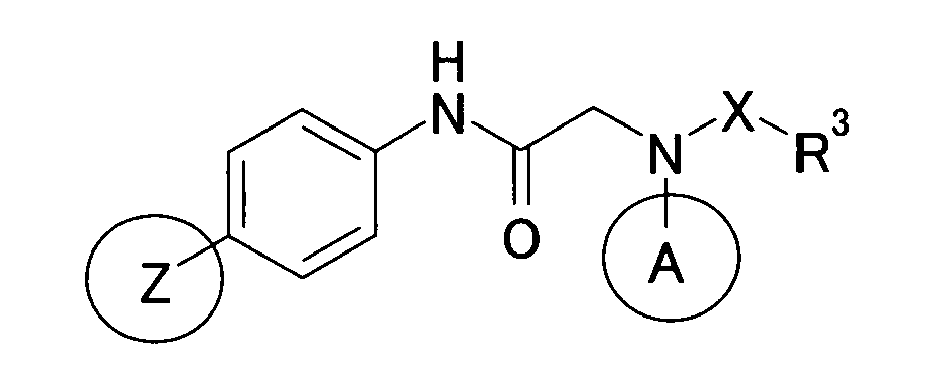
However, to date there are no illustrative reports on the concomitant use of these compounds with a polymerase inhibitor, and the effect of their concomitant use is not known at all.
On the other hand, regarding compounds having a helicase-primase inhibitory activity but having a skeleton represented by the following formula which is different from the instant application, there are reports on the effect of their concomitant use with acyclovir (e.g., see Patent Reference 6).
-
- Patent Reference 1: International Publication No.
97/24343 - Patent Reference 2: International Publication No.
00/29399 - Patent Reference 3: International Publication No.
02/38554 - Patent Reference 4: International Publication No.
03/95435 - Patent Reference 5: International Publication No.
05/014559 - Patent Reference 6:
German Patent Application Publication No. 10129717 Specification - To this day, development of an anti-herpesvirus agent having high safety is in great demand.
- The present inventors have conducted extensive studies on agents for preventing and treating diseases associated with herpesvirus and, as a result, found two or more compounds having an anti-herpesvirus activity based on the helicase-primase inhibitory activity. In addition, when their helicase-primase inhibition was concomitantly used with a polymerase inhibitor generally used as an anti-herpesvirus agent, it was found unexpectedly that they have a synergistic effect, thus resulting in the accomplishment of the invention.
- That is, the present invention relates to
- (1) an anti-herpesvirus agent characterized by combining a helicase-primase inhibitor, N-{2-[(4-substituted phenyl)amino]-2-oxoethyl}tetrahydro-2H-thiopyran-4-carboxamide compound represented by the following general formula (I), with a polymerase inhibitor

- (2) the anti-herpesvirus agent described in the aforementioned (1), wherein the polymerase inhibitor is an agent selected from acyclovir, valacyclovir and famciclovir.
In addition, it also relates to - (3) a medicament for treating herpesvirus infection, which comprises (a) a pharmaceutical preparation comprising the compound of general formula (I) as an active ingredient and (b) a package insert indicating that said pharmaceutical preparation is concomitantly used with an anti-herpesvirus agent comprising a polymerase inhibitor as an active ingredient.
Further, the invention also includes the following embodiments. - (4) A method for treating herpesvirus infection, which comprises administering an effective amount of the compound of the general formula (I) and an effective amount of a polymerase inhibitor to a patient.
- (5) Use of the compound of general formula (I), for the manufacture of a medicament to be used for treating herpesvirus infection through the concomitant use with a polymerase inhibitor.
- (6) An agent for enhancing herpesvirus infection treating activity of a polymerase inhibitor, which comprises the compound of the general formula (I) as an active ingredient.
- (7) An agent for treating herpesvirus infection of a patient undergoing herpesvirus infection treatment with a polymerase inhibitor, which comprises the compound of the general formula (I) as an active ingredient.
- (8) An agent for treating herpesvirus infection, wherein the anti-herpesvirus activity is enhanced in comparison with the administration of a polymerase inhibitor alone, which comprises a combination of the polymerase inhibitor and the compound of the general formula (I).
- (9) An agent for enhancing anti-herpesvirus activity for a patient administered with a polymerase inhibitor, which comprises an effective amount of the compound of the general formula (I).
- By combining a polymerase inhibitor as a conventional anti-herpesvirus agent with a helicase-primase inhibitor having a different mechanism of action, the anti-herpesvirus agent of the present invention achieved an extremely superior anti-herpesvirus activity compared with the administration of a polymerase inhibitor alone. Therefore, it is particularly effective in a case in which a sufficient therapeutic effect cannot be achieved only with a polymerase inhibitor. In addition, since the doses of both agents can be kept low by their concomitant use, it is possible to obtain a therapeutic effect which is similar to or greater than the case of respective single administration, together with lowering the undesirable actions of both agents to be concerned. Accordingly, the anti-herpesvirus agent of the present invention is useful as an anti-herpesvirus agent particularly having high safety for the prevention or treatment of various herpesvirus infections such as varicella (chickenpox) associated with VZV infection, herpes zoster associated with recurrent infection with latent VZV, labial herpes and herpes encephalitis associated with HSV-1 infection, genital herpes associated with HSV-2 infection and the like.
- Best Mode for Carrying Out the Invention
The helicase-primase inhibitor according to the present invention is an N-{2-[(4-substituted phenyl)amino]-2-oxoethyl}tetrahydro-2H-thiopyran-4-carboxamide compound represented by the following general formula (I). In this description, this may be simply referred sometimes as "helicase-primase inhibitor" hereinafter.
Also, the polymerase inhibitor is a compound which inhibits the enzyme activity possessed by a DNA-polymerase complex of herpesvirus, and its illustrative examples include nucleic acid-based drugs such as acyclovir (ACV) and its prodrugs valacyclovir (VCV), famciclovir (FCV) and the like. Particularly preferred is VCV. - The "anti-herpesvirus agent characterized by combining a helicase-primase inhibitor with a polymerase inhibitor" of the present invention includes a pharmaceutical preparation for preventing or treating a disease associated with herpesvirus, which comprises an effective amount of a helicase-primase inhibitor and an effective amount of polymerase inhibitor (admixture), and a kit which comprises two pharmaceutical preparations; an anti-herpesvirus agent as a first pharmaceutical preparation comprising a helicase-primase inhibitor as its active ingredient and another anti-herpesvirus agent as a second pharmaceutical preparation comprising a polymerase inhibitor as its active ingredient. In this connection, the two pharmaceutical preparations are administered through the same or different route of administration simultaneously or separately.
- The aforementioned "kit which comprises two pharmaceutical preparations" comprises two pharmaceutical preparations each of which contain respective active ingredients for concomitant use therapy of these active ingredients, and its example include a package which may contain a supplementary pharmaceutical preparation, such as placebo etc., which facilitates administration in response to their administration period on occasion demands or a display member. Also, the "simultaneously" means that the first pharmaceutical preparation and the second pharmaceutical preparation are administered through the same route of administration, and the "separately" means that the first pharmaceutical preparation and the second pharmaceutical preparation are separately administered through the same or different route of administration at the same or different administration frequency or administration interval. Preferably, they are simultaneously or separately administered under suitable administration conditions for respective pharmaceutical preparations concerning pharmaceutical preparation formulation, route of administration, administration frequency and the like, by taking bioavailability, stability and the like of each pharmaceutical preparation into consideration.
- In addition, the "medicine for anti-herpesvirus treatment, which comprises (a) a pharmaceutical preparation comprising a helicase-primase inhibitor as an active ingredient and (b) a package insert indicating that said pharmaceutical preparation is concomitantly used with an anti-herpesvirus treating agent comprising a polymerase inhibitor as the active ingredient" means a packaged medicine for anti-herpesvirus treatment, which comprises an effective amount of the pharmaceutical preparation comprising the helicase-primase inhibitor as the active ingredient, shown by (a), and the package insert relating to the aforementioned pharmaceutical preparation (a) indicating that said pharmaceutical preparation is concomitantly used with an anti-herpesvirus treating agent comprising a polymerase inhibitor as the active ingredient, shown by (b).
- Next, the helicase-primase inhibitor of the medicine of the present invention, N-{2-[(4-substituted phenyl)amino]-2-oxoethyl}tetrahydro-2H-thiopyran-4-carboxamide compound represented by the general formula (I), is further described.
In the invention, F, Cl, Br and I atoms may be exemplified as a "halogen atom".
The N-{2-[(4-substituted phenyl)amino]-2-oxoethyl}tetrahydro-2H-thiopyran-4-carboxamide compound represented by the general formula (I) may be its hydrates, various species of solvates and polymorphic substances. - Particularly, the following compounds are desirable as the compounds represented by the general formula (I).
- (1) A compound in which Z is a 1,2,4-oxadiazol-3-yl group.
- (2) A compound in which Z is a 4-oxazolyl group.
- (3) A compound in which A is a phenyl group which is substituted by at least one methyl group and may further have 1 or 2 substituents selected from the group consisting of a methyl group and halogen atoms.
- (4) A compound in which A is a 5-indanyl group.
- (5) A compound selected from the group consisting of
N-(2,6-dimethylphenyl)-N-(2-{[4-(1,3-oxazol-4-yl)phenyl]amino}-2-oxoethyl)tetrahydro-2H-thiopyran-4-carboxamide 1,1-dioxide,
N-(4-methylphenyl)-N-(2-{[4-(1,3-oxazol-4-yl)phenyl]amino}-2-oxoethyl)tetrahydro-2H-thiopyran-4-carboxamide 1,1-dioxide,
N-(3-methylphenyl)-N-(2-{[4-(1,3-oxazol-4-yl)phenyl]amino}-2-oxoethyl)tetrahydro-2H-thiopyran-4-carboxamide 1,1-dioxide,
N-(2-methylphenyl)-N-(2-{[4-(1,3-oxazol-4-yl)phenyl]amino}-2-oxoethyl)tetrahydro-2H-thiopyran-4-carboxamide 1,1-dioxide,
N-(2,4-dimethylphenyl)-N-(2-{[4-(1,3-oxazol-4-yl)phenyl]amino}-2-oxoethyl)tetrahydro-2H-thiopyran-4-carboxamide 1,1-dioxide,
N-(3,4-dimethylphenyl)-N-(2-{[4-(1,3-oxazol-4-yl)phenyl]amino}-2-oxoethyl)tetrahydro-2H-thiopyran-4-carboxamide 1,1-dioxide,
N-(2,3-dihydro-1H-inden-5-yl)-N-(2-{[4-(1,3-oxazol-4-yl)phenyl]amino}-2-oxoethyl)tetrahydro-2H-thiopyran-4-carboxamide 1,1-dioxide,
N-(4-chloro-3-methylphenyl)-N-(2-{[4-(1,3-oxazol-4-yl)phenyl]amino}-2-oxoethyl)tetrahydro-2H-thiopyran-4-carboxamide 1,1-dioxide,
N-(3-fluoro-4-methylphenyl)-N-(2-{[4-(1,3-oxazol-4-yl)phenyl]amino}-2-oxoethyl)tetrahydro-2H-thiopyran-4-carboxamide 1,1-dioxide,
N-(3-fluoro-2,4-dimethylphenyl)-N-(2-{[4-(1,3-oxazol-4-yl)phenyl]amino}-2-oxoethyl)tetrahydro-2H-thiopyran-4-carboxamide 1,1-dioxide,
N-(3,5-difluoro-4-methylphenyl)-N-(2-{[4-(1,3-oxazol-4-yl)phenyl]amino}-2-oxoethyl)tetrahydro-2H-thiopyran-4-carboxamide 1,1-dioxide,
N-(2-fluoro-4-methylphenyl)-N-(2-{[4-(1,3-oxazol-4-yl)phenyl]amino}-2-oxoethyl)tetrahydro-2H-thiopyran-4-carboxamide 1,1-dioxide,
N-(2,3-dimethylphenyl)-N-(2-{[4-(1,2,4-oxadiazol-3-yl)phenyl]amino}-2-oxoethyl)tetrahydro-2H-thiopyran-4-carboxamide 1,1-dioxide,
N-(2,4-dimethylphenyl)-N-(2-{[4-(1,2,4-oxadiazol-3-yl)phenyl]amino}-2-oxoethyl)tetrahydro-2H-thiopyran-4-carboxamide 1,1-dioxide,
N-(2,6-dimethylphenyl)-N-(2-{[4-(1,2,4-oxadiazol-3-yl)phenyl]amino}-2-oxoethyl)tetrahydro-2H-thiopyran-4-carboxamide 1,1-dioxide,
N-(4-fluoro-2,6-dimethylphenyl)-N-(2-{[4-(1,2,4-oxadiazol-3-yl)phenyl]amino}-2-oxoethyl)tetrahydro-2H-thiopyran-4-carboxamide 1,1-dioxide,
N-(2,3-dihydro-1H-inden-5-yl)-N-(2-{[4-(1,2,4-oxadiazol-3-yl)phenyl]amino}-2-oxoethyl)tetrahydro-2H-thiopyran-4-carboxamide 1,1-dioxide,
N-(3-fluoro-4-methylphenyl)-N-(2-{[4-(1,2,4-oxadiazol-3-yl)phenyl]amino}-2-oxoethyl)tetrahydro-2H-thiopyran-4-carboxamide 1,1-dioxide,
N-(4-chloro-3-methylphenyl)-N-(2-{[4-(1,2,4-oxadiazol-3-yl)phenyl]amino}-2-oxoethyl)tetrahydro-2H-thiopyran-4-carboxamide 1,1-dioxide, and
N-(3-fluoro-2,4-dimethylphenyl)-N-(2-{[4-(1,2,4-oxadiazol-3-yl)phenyl]amino}-2-oxoethyl)tetrahydro-2H-thiopyran-4-carboxamide 1,1-dioxide. - The anti-herpesvirus agent of the present invention characterized by combining a helicase-primase inhibitor with a polymerase inhibitor can be prepared as a medical mixture or as separate pharmaceutical preparations for a kit, from one or two or more species of effective amount of a helicase-primase inhibitor and one or two or more species of effective amount of polymerase inhibitor, by a generally used method using carriers, excipients and the like for medicaments generally used in this field. Administration thereof may be either oral via tablets, pills, capsules, granules, powders, liquids, etc. or parenteral dosing via injections such as intravenous injections, intramuscular injections, etc., external agents such as ointments, plasters, creams, jellies, cataplasm, sprays, lotions, eye drops, eye ointments, etc., suppositories, inhalation agents, and the like.
- As the solid composition for oral administration, tablets, powders, granules and the like are used. In such a solid composition, one or more active substances are mixed with at least one inert excipient, for example, lactose, mannitol, glucose, hydroxypropyl cellulose, microcrystalline cellulose, starch, polyvinylpyrrolidone, magnesium metasilicate aluminate, etc. According to general methods, the composition may contain inert additives such as lubricants, e.g., magnesium stearate, etc.; disintegrators, e.g., sodium carboxymethyl starch, etc.; and dissolution auxiliary agents. The tablets or pills may be coated with sugar coating or stomach-soluble or enteric coating.
Examples of the liquid composition for oral administration include pharmaceutically acceptable emulsions, liquids, suspensions, syrups, elixirs, etc., in which inert solvents for general use such as purified water, ethanol, etc. can be incorporated. In addition to the inert solvents, the composition may further contain auxiliary agents such as solubilizing agents, moistening agents and suspending agents; sweetening agents; flavoring agents; aromatic agents and preservatives.
Examples of the injections for parenteral administration include sterile aqueous or non-aqueous liquids, suspensions and emulsions. The aqueous solvents include, for example, distilled water for injections and physiological saline. The non-aqueous solvents include, for example, propylene glycol, polyethylene glycol, vegetable oils such as olive oil, alcohols such as ethanol, Polysorbate 80 (name in the pharmacopeia) and the like. Such compositions may further contain isotonic agents, antiseptics, moistening agents, emulsifying agents, dispersing agents, stabilizers and dissolution auxiliary agents. These are sterilized by filtering through bacteria-retaining filters, by incorporating sterilizing agents, or by irradiation. Alternatively, these may be produced into a sterile solid composition and then dissolved or suspended in sterile water or sterile solvents for injections prior to use. - Examples of the external agents include ointments, plasters, creams, jellies, cataplasms, sprays, lotions, eye drops, eye ointments and the like. The external agent contains generally used ointment bases, lotion bases, aqueous or non-aqueous liquids, suspensions, emulsions and the like. As the ointment or lotion bases, polyethylene glycol, propylene glycol, white Vaseline, white beeswax, polyoxyethylene hardened castor oil, glycerin monostearate, stearyl alcohol, cetyl alcohol, lauromacrogol, sorbitan sesquioleate, carboxyvinyl polymer, and the like can be mentioned as examples.
- When a compound conventionally known by the aforementioned reference is used as the helicase-primase inhibitor of the present invention, the appropriate dose and administration form described in said reference can be employed. Preferably, a dose smaller than the dose described in the reference is employed, because sufficient combined effect can be obtained with a further smaller amount. Generally, the suitable daily dose of the novel compound (I) of the present invention, which is the active ingredient of the present invention, is about 0.001 to 50 mg/kg/body weight, preferably 0.01 to 30 mg/kg/body weight, more preferably 0.05 to 10 mg/kg/body weight, for oral administration. For intravenous administration, the daily dose is about 0.0001 to 10 mg/kg/body weight, preferably 0.001 to 1.0 mg/kg/body weight. The dose is administered once or in separate portions per day, and is appropriately determined depending on each case, in terms of the symptom, age, sex and the like. When the compound (I) is to be used as an external agent, the agent containing the compound of the present invention in an amount of 0.0001 to 20%, preferably 0.01 to 10%, is desirable. The external agent is administered locally once or in separate portions per day depending on the symptom.
On the other hand, dose of the polymerase inhibitor of the present invention is decided in response to the activity of the polymerase inhibitor to be used. In the case of a polymerase inhibitor in which its clinically suited dose and administration frequency are already known, it is desirable to administer it at said clinical dose and administration frequency. Alternatively, by taking its synergistic effect with the helicase-primase inhibitor into consideration, it may be administered at an amount smaller than that. For example, in the case of ACV, VCV or FCV, its daily dose is generally from about 1 to 300 mg/kg, preferably from 5 to 200 mg/kg, more preferably from 10 to 150 mg/kg, per body weight in the case of oral administration, and its daily dose in the case of intravenous administration is from about 0.01 to 10 mg/kg, preferably from 0.1 to 1.0 mg/kg, per body weight, respectively, and this is administered once a day or by dividing it into two or more times. The dose is optionally decided by taking the symptom, age, sex and the like into consideration in response to individual cases. In addition, when used as an external preparation, an external preparation containing from 0.0001 to 20%, preferably from 0.01 to 10%, of the compound (I) is desirable. This is topically administered at from one to several times per day in response to the symptom.
The pharmaceutical composition of the present invention which comprises both of the helicase-primase inhibitor and polymerase inhibitor is produced by preparing it in such a manner that both of the components are contained in respective amounts that correspond to the aforementioned doses. - The helicase-primase inhibitor of the present invention can be prepared by the method described in the aforementioned reference, and a commercially available product can be used as the polymerase inhibitor.
Hereinafter, typical production methods of the compound (I) as the helicase-primase inhibitor of the medicament of the present invention are described in the following. In this connection, the production methods are not limited to the following examples.
In the following production methods, it is sometimes effective from the viewpoint of the production technique to replace a certain functional group depending on the type with an appropriate protective group, namely a group readily convertible to the functional group, at the stage of a raw material or intermediate. Afterwards, the protective group can be eliminated, if necessary, to obtain the desired compound. Examples of such a functional group includes an amino group, hydroxyl group, carboxyl group and the like. Protective groups thereof are, for example, those described in Protective Groups in Organic Synthesis, the third edition (T. W. Green and P. G. M. Wuts, eds., JOHN WILLY & SONS, INC.). These may be appropriately used depending on the reaction conditions. For introducing and eliminating such protective groups, the methods described in the reference can be suitably applied. -

The amidation reaction can be carried out by general methods. For example, the method described in "Courses in Experimental Chemistry" edited by the Chemical Society of Japan, the fourth edition (Maruzen), Vol.22, pp.137-173 may be applicable. Preferably, the reaction is carried out by converting Carboxylic Acid Compound (III) to a reactive derivative such as an acid halide (acid chloride, etc.) or an acid anhydride, and then reacting the resulting reactive derivative with Aniline Derivative (II). In the case of using a reactive derivative of carboxylic acid, a base [an inorganic base such as potassium carbonate, sodium hydroxide, etc. or an organic base such as triethylamine (TEA), diisopropylethylamine, pyridine, etc.] is preferably added. In addition, the amidation reaction may be carried out by reacting carboxylic acid in the presence of a condensation agent [1-ethyl-3-(3-dimethylaminopropyl)carbodiimide (WSC), 1,1'-carbonylbis-1H-imidazole (CDI), etc.]. In this case, additives such as 1-hydroxybenzotriazole (HOBt), etc. may be added. The reaction temperature can be appropriately selected depending on the raw material compound used. The solvent usable includes those inert to the reaction, for example, aromatic hydrocarbon-series solvents such as benzene, toluene, etc.; ether-series solvents such as tetrahydrofuran (THF), 1,4-dioxane, etc.; halogenated hydrocarbon-series solvents such as dichloromethane, chloroform, etc.; amide-series solvents such as N,N-dimethylformamide (DMF), N,N-dimethylacetamide, etc.; basic solvents such as pyridine, etc.; and the like. The solvent is appropriately selected depending on the type of the raw material compound and the like, and can be used alone or as a mixture of two or more of them. - The aforementioned raw material compounds can be easily produced using known reactions, e.g., those described in "Courses in Experimental Chemistry" edited by the Chemical Society of Japan (Maruzen), in the pamphlet of the
International Publication WO 02/38554 -

In the reaction scheme above, amidation can be carried out in the same manner as in the first production method above.
N-alkylation of Compound (VI) can be carried out using Halogenated Alkyl Compound (VII) according to usual methods, e.g., the method described in the aforementioned "Courses in Experimental Chemistry", the fourth edition (Maruzen), Vol.20, pp.279-318. The reaction can be carried out under the temperature of from cooling to heating. Examples of the solvent usable include solvents inert to the reaction, for example, those exemplified for the amidation in the first production method, etc. The reaction is carried out preferably in the presence of a base such as potassium carbonate, sodium hydroxide, sodium hydride, etc. The amidation can be carried out in the same manner as in the first production method above. Herein, the amidation may be first carried out and subsequently, the N-alkylation may be carried out. - Deprotection for obtaining Carboxylic Acid Compound (III) can be carried out by appropriately applying a general method depending on the ester type. In the case of alkyl esters such as an ethyl ester, etc., the deprotection can be preferably carried out by treating them with a base such as sodium hydroxide aqueous solution, etc. In the case of aralkyl esters such as a benzyl ester, etc., the deprotection can be carried out by reducing them with palladium-carbon (Pd-C) under hydrogen atmosphere. The reactions can be carried out according to the method described in the aforementioned "Protective Groups in Organic Synthesis", the third edition.
A desired raw material compound can be produced by subjecting the compound with a certain substituent type to a substituent modification reaction well known to those skilled in the art.
The compound (I) of the present invention obtained in this manner is isolated and purified in its free form or as a salt thereof after a salt formation process by a general method. The isolation and purification are carried out by employing general chemical procedures such as extraction, concentration, evaporation, crystallization, filtration, recrystallization, various chromatographic techniques and the like. - Effects as the medicament of the present invention were confirmed by the following pharmacological tests. Example 1 Helicase-primase inhibitory activity
Using an Baculoviruses for expressing respective proteins of UL5, UL52 and UL8 which constitute an HSV-1 helicase-primase complex (obtained from Dr. Nigel D. Stow, Medical Research Council, UK), a recombinant HSV-1 helicase-primase complex was prepared by the method described in a report of Crute et al. (J. B. C., 1991, Vol. 266, p. 21252 - 21256). Detection of DNA-dependent ATPase activity of the HSV-1 helicase-primase complex was carried out in reference to the method described in a report of Crute et al. (J. B. C., 1991, Vol. 266, p. 4484 - 4488). In brief, 520 ng of the HSV-1 helicase-primase complex was allowed to undergo the reaction at 30°C for 30 minutes in a reaction liquid containing 20 µg/ml of heat-denatured bovine sperm DNA and 2 mM ATP, and then concentration of phosphoric acid formed through the hydrolysis of ATP into ADP and monophosphate by the activity of ATPase was determined by adding the same volume of Malachite Green reagent (0.03% Malachite Green, 0.1% ammonium molybdate, 4.8% sulfuric acid) and measuring the resulting absorbance at 650 nm. The 50% inhibition concentration (IC50 value) of each compound to be tested for HSV-1 helicase-primase DNA-dependent ATPase was calculated as the concentration which halves the phosphoric acid concentration at the time of not adding the compound. The results are shown in the following table. -
[Table 1] Compounds to be tested IC50 value (µM) Compound of Preparation 2 0.084 Compound of Preparation 27 0.11 - Using a cutaneous HSV-1 infection mouse model prepared in accordance with the method of H. Machida et al. (Antiviral Res., 1992, 17, 133 - 143), in vivo activity of the pharmaceutical composition of the present invention was tested. The skin of each HR-1 hairless mouse [female, 7 weeks of age] was scratched lengthwise and breadthwise several times using a needle and a virus suspension (HSV-1 strain WT-51, 1.5 x 10⁴ PFU/15 µl) was dropped to the scarified region for infection, while anesthetized with diethyl ether.
Regarding the compounds to be tested, VCV was used as the polymerase inhibitor and made into a methyl cellulose suspension, the compound of Preparation 2, N-(4-methylphenyl)-N-(2-{[4-(1,3-oxazol-4-yl)phenyl]amino}-2-oxoethyl)tetrahydro-2H-thiopyran-4-carboxamide 1,1-dioxide, which is described later, was used as the helicase-primase inhibitor and made into a methyl cellulose suspension, and they were orally administered at the doses of the following table twice a day for 5 days starting after 3 hours of the infection. The symptom of the skin lesion caused by HSV-1 infection were classified in the following scores for 17 days: - Score 0: no signs of infection.
- Score 1: localized, barely perceptible small vesicles.
- Score 2: slight vesicle spread.
- Score 3: large patches of vesicles formed.
- Score 4: zosteriform vesicles.
- Score 5: large patches of ulcers formed.
- Score 6: zosteriform with severe large ulcers.
- Score 7: hind limb paralysis or death.
- The AUC value was calculated from each group's mean disease score, and the disease inhibitory rate of the group administered with each test compound to the placebo group was calculated using the AUC. The results are shown in Table below. The concomitant use group of VCV with the compound of Preparation 2 showed good lesion inhibitory activity in comparison with the VCV single administration group, and the concomitant use group of 30 mg/kg of VCV with 3 mg/kg of the compound of Preparation 2 almost completely inhibited the lesions.
-
[Table 2] VCV dose (mg/kg) Dose of the compound of Preparation 2 (mg/kg) Lesion inhibitory ratio (%) Comparative Example 1 0 0 0 Comparative Example 2 0 1 38 Comparative Example 3 0 3 52 Comparative Example 4 10 0 45 Comparative Example 5 30 0 57 Concomitant use 1 of the present invention 10 1 76 Concomitant use 2 of the present invention 10 3 83 Concomitant use 3 of the present invention 30 1 86 Concomitant use 4 of the present invention 30 3 91 - In the same manner as described in the above, VCV was used as the polymerase inhibitor and the compound of Preparation 27, N-(2,6-dimethylphenyl)-N-(2-{[4-(1,2,4-oxadiazol-3-yl)phenyl]amino}-2-oxoethyl)tetrahydro-2H-thiopyran-4-carboxamide 1,1-dioxide, which is described later, was used as the helicase-primase inhibitor, with the results shown in the following table.
[Table 3] VCV dose (mg/kg) Dose of the compound of Preparation 27 (mg/kg) Lesion inhibitory ratio (%) Comparative Example 6 0 0 0 Comparative Example 7 0 1 33 Comparative Example 8 0 3 68 Comparative Example 9 10 0 42 Comparative Example 10 30 0 52 Concomitant use 5 of the present invention 10 1 66 Concomitant use 6 of the present invention 10 3 86 Concomitant use 7 of the present invention 30 1 88 Concomitant use 8 of the present invention 30 3 100 - As in the above, it was confirmed in the in vivo animal model that the anti-herpesvirus activity was reinforced by the concomitant use of a VCV or the like polymerase inhibitor with a helicase-primase inhibitor, and more strong effect would be expected even at the same conventional polymerase inhibitor dose, or the same or further superior effect would be expected at a polymerase inhibitor dose of smaller than the conventional case. Even in a case in which a sufficient activity cannot be obtained by one mechanism, good anti-herpesvirus activity can be attained by the concomitant use of both agents, based on their synergistic effect by two mechanisms, so that excellent clinical effects can be obtained.
- Production examples of the compound (I), which is an active ingredient of the present invention, are shown below as Preparations. Herein, many of the raw material compounds for use in the following reactions are known in the pamphlet of the Patent Reference 1 (
International Publication WO 02/38554 - Reference Example 1:
5% Palladium-carbon powder was added to an ethanol-tetrahydrofuran mixed suspension of 4-(4-nitrophenyl)-1,3-oxazol and stirred for 12 hours at room temperature in a hydrogen atmosphere. The reaction solution was filtered through Celite and the filtrate was evaporated under reduced pressure. The resulting crude product is purified with a silica gel column chromatography to obtain [4-(1,3-oxazol-4-yl)phenyl]amine (pale yellow solid). Electron Impact-MS(M)+. 160. - Reference Example 2:
Potassium carboxylate and ethyl bromoacetate were added to a DMF solution of 4-methylaniline and heated while stirring. The reaction mixture was added with water and ethyl acetate. After the organic layer was separated, washed and dried, the solvent was evaporated under reduced pressure to obtain a crude product. The crude product was dissolved in methylene chloride, and pyridine, tetrahydro-2H-thiopyrane-4-carbonyl chloride 1,1-dioxide were added to the resulting solution and stirred. After the reaction solution was concentrated, 1M hydrochloric acid and chloroform were added. The organic layer separated was washed and dried and the solvent was evaporated under reduced pressure. The resulting crude product was purified with a silica gel column chromatography to obtain ethyl {[(1,1-dioxotetrahydro-2H-thiopyran-4-yl)carbonyl](4-methylphenyl)amino}acetate (colorless oily product). FAB-MS [(M+H)+]: 354. - Reference Examples 3 to 15:
Compounds of Reference Examples 3 to 15, which are described in Table 4 below, were obtained in the same manner as in Reference Example 2. -
- Preparation 1:
To an ethanol (10 ml) solution of ethyl {(2,6-dimethylphenyl)[(1,1-dioxide tetrahydro-2H-thiopyran-4-yl)carbonyl]amino}acetate (735 mg) was added aqueous 1M sodium hydroxide solution (2.3 mL). The mixture was stirred at room temperature for 5 hours. After 1M hydrochloric acid was added to the reaction mixture to make the solution acidic, water and chloroform were added thereto to separate the organic layer. Further, the organic layer was dried over anhydrous sodium sulfate and filtered, and then, the solvent was evaporated under reduced pressure. After the resulting crude carboxylic acid product was dissolved in chloroform (15 ml), WSC·HCl (422 mg) and [4-(1,3-oxazol-4-yl)phenyl]amine (320 mg) were added sequentially to the resulting solution, which was stirred at room temperature for 4 hours. After a saturated sodium hydrogencarbonate aqueous solution and chloroform were added to the reaction solution, the organic layer was separated. The organic layer was washed with a saturated sodium chloride solution, dried over anhydrous magnesium sulfate and filtered, from which the solvent was evaporated under reduced pressure. The resulting crude product was rinsed in hexane-ethyl acetate (= 3/2), and then recrystallized from ethanol, to obtain N-(2,6-dimethylphenyl)-N-(2-{[4-(1,3-oxazol-4-yl)phenyl]amino}-2-oxoethyl)tetrahydro-2H-thiopyran-4-carboxamide 1,1-dioxide (colorless crystal) in a yield of 610 mg. - Preparations 2 - 40:
Compounds of Preparations 2 to 40 shown in Tables 5 to 12 below were obtained in the same manner as in Preparation 1.
The physicochemical properties of the compounds of Reference Examples are shown in Table 4, while Tables 5 to 12 show the structures and physicochemical properties of the compounds of Preparations. - Abbreviations in the tables indicate as follows. Ref: Reference Example; Ex: Preparation; Dat: physicochemical properties {F+: FAB-MS [(M+H)+]; F-: FAB-MS [(M-H)-]; N1: 1H-NMR (DMSO-d6, TMS internal standard); mp: melting point (°C), solvent for crystallization is shown in the parentheses}; Ph: phenyl; Me: methyl; Et: ethyl; and iPr: isopropyl. Herein, the numerical figure before each substituent indicates the position for its substitution. For example, 3,4-(Cl)2-5-F-Ph indicates a 3,4-dichloro-5-fluorophenyl group.
-
[Table 4] 
Ref A R Dat Re f A R Dat 3 2,3-(Me)2-Ph Et F+: 368 4 4-Me-Ph Et F+: 354 5 2,5-(Me)2-Ph Et F+: 368 6 3-Me-Ph Et F+: 354 7 3,4-(Me)2-Ph Et F+:368 8 2-Me-Ph Et F+:354 9 2,4,6-(Me)3-Ph Et F+: 382 10 2,4-(Me)2-Ph Et F+: 368 11 4-F-3-Me-Ph Et F+: 372 12 2,6-(Me)2-Ph Et F+: 368 13 3-Br-4-Me-Ph Et F+: 432,434 14 4-F-2,6-(Me)2-Ph Et F+: 386 15 3,5-(Me)2-Ph Et F+:368 -
[Table 5] 
Ex A Dat 1 2,6-(Me)2-Ph F+: 482 N1: 1.87-2.42(5H, m), 2.13(6HX0.1, s), 2.33(6HX0.9, s), 2.97-3.27(4H, m), 4.19(2HX0.9, s), 4.48(2HX0.1, s), 7.0 7-7.25(3H, m), 7.62-7.66(2H, m), 7.72-7.75(2H, m), 8.43 (1H, d), 8.54(1H, d), 10.15(1H, brs) mp: 224-227 (EtOH) 2 4-Me-Ph F+: 468 N1: 1.98-2.06(4H, m), 2.34(3H, s), 2.68-2.70(1H, m), 2.9 7-3.02(4H, m), 4.35(2H, s), 7.28 (2H, d), 7.36(2H, d), 7 .63-7.66(2H, m), 7.72-7.76(2H, m), 8.43(1H, s), 8.54(1H , s), 10.14(1H, s) mp: 199-201 (EtOH-H2O) 3 3-Me-Ph F+: 468 N1: 2.01-2.09(4H, m), 2.35(3H, s), 2.71 (1H, m), 2.93-3.06 (4H, m), 4.36(2H, s), 7.17-7.38 (4H, m), 7.64(2H, d), 7. 73(2H, d), 8.43(1H, d), 8.54(1H, d), 10.15(1H, s) 4 2-Me-Ph F+: 468 N1: 1.88-2.15(4H, m), 2.15(3HX0.1, s), 2.26(3HX0.9, s), 2.41-2.46(1H, m), 2.83-3.05(4H, m), 3.86(1HX0.9, d), 4. 20(1HX0.1, d), 4.74(1HX0.9, d), 4.84(1HX0.1, d), 7.09-7 .77(8H, m), 8.43(1H, d), 8.53(1H, d), 10.14(1HX0.9, s), 10.19(1HX0.1, s) mp: 220-221 (EtOH) -
[Table 6] 5 2,3-(Me)2-Ph F+: 482 N1: 1.85-2.12(4H, m), 2.03(3HX0.1, s), 2.15(3HX0.9, s), 2.25(3HX0.1, s), 2.31(3HX0.9, s), 2.42-2.47(1H, m), 2.8 3-2.90(1H, m), 3.00-3.22(3H, m), 3.84(1HX0.9, d), 4.16( 1HX0.1, d), 4.72(1HX0.9, d), 4.84(1HX0.1, d), 7.07-7.36 (3H, m), 7.62-7.66(2H, m), 7.71-7.76(2H, m), 8.43(1H, brs), 8.54(1H, d), 10.12(1HX0.9, s), 10.16(1HX0.1, s) mp: 185-187 (EtOH) 6 2,4-(Me)2-Ph F+: 482 N1: 1.88-2.50(5H, m), 2.09(3HX0.1, s), 2.21(3HX0.9, s), 2.25(3HX0.1, s), 2.30(3HX0.9, s), 2.85-3.20(4H, m), 3.8 1(1HX0.9, d), 4.17(1HX0.1, d), 4.72(1HX0.9, d), 4.81 (1 HX0.1, d), 6.97-7.39(3H, m), 7.62-7.66(2H, m), 7.72-7.7 6(2H, m), 8.43(1H, s), 8.54(1H, s), 10.11(1HX0.9, s), 1 0.17(1HX0.1, s) mp: 176-177 (EtOH) 7 2,5-(Me)2-Ph F+: 482 N1: 1.86-2.51(5H, m), 2.08(3HX0.1, s), 2.20(3HX0.9, s), 2.22(3HX0.1, s), 2.30(3HX0.9, s), 2.87-3.26(4H, m), 3.8 4(1HX0.9, d), 4.21(1HX0.1, d), 4.70(1HX0.9, d), 4.80(1 HX0.1, d), 6.92-7.32(3H, m), 7.63-7.65(2H, m), 7.72-7.7 6(2H, m), 8.43(1H, s), 8.54(1H, s), 10.12(1HX0.9, s), 1 0.17(1HX0.1, s) mp: 201-202 (EtOH) 8 3,4-(Me)2-Ph F+: 482 N1: 1.92-2.08(4H, m), 2.09(3H, s), 2.24(3H, s), 2.71(1H, s), 2.94-3.06(4H, m), 4.33(2H, S), 7.17-7.24(3H, m), 7.6 4(2H, d), 7.73(2H, d), 8.43(1H, s), 8.54(1H, s), 10.12(1 H, s) 9 3,5-(Me)2-Ph F+: 482 N1: 1.96-2.14(4H, m), 2.30(6H, s), 2.73(1H, m), 2.95-3.04 (4H, m), 4.33(2H, S), 7.02(1H, s), 7.08(2H, s), 7.64(2H, d), 7.73(2H, d), 8.43(1H, s), 8.54(1H, s), 10.12(1H, s) mp: 205-206 (EtOH) -
[Table 7] 10 2,4,6-(Me)3-Ph F+: 496 N1: 1.87-2.45(5H, m), 2.08(3HX0.1, s), 2.09(6HX0.1, s), 2.27(3HX0.9, s), 2.28(6HX0.9, s), 3.01-3.26(4H, m), 4.1 6(2HX0.9, s), 4.44(2HX0.1, s), 6.88(2HX0.1, s), 7.01(2H X0.9, s), 7.61-7.65(2H, m), 7.71-7.75(2H, m), 8.43(1H, s), 8.54(1H, s), 10.12(1HX0.9, s), 10.14(1HX0.1, s) mp: 237-238 (EtOH) 11 
F+: 494 N1: 2.01-2.08(6H, m), 2.70-3.06(9H, m), 4.34(2H, s), 7.1 3-7.32(3H, m), 7.64(2H, d), 7.73(2H, d), 8.43(1H, s), 8. 54(1H, s), 10.13(1H, s) 12 3-Cl-4-Me-Ph F+: 502 N1: 2.01-2.06(4H, m), 2.36(3H, s), 2.68-2.75(1H, m), 3.0 1-3.06(4H, m), 4.37(2H, S), 7.37-7.40(1H, m), 7.46(1H, d), 7.60-7.66(3H, m), 7.74(2H, d), 8.44(1H, s), 8.55(1H, s), 10.18(1H, s) mp: 146-148 (EtOH) 13 4-Cl-3-Me-Ph F+: 502 N1: 2.00-2.06(4H, m), 2.36(3H, s), 2.68-2.75(1H, m), 3.0 1-3.04(4H, m), 4.36(2H, S), 7.33-7.36(1H, m), 7.48-7.52 (2H, m), 7.64(2H, d), 7.73(2H, d), 8.43(1H, s), 8.54(1H, s), 10.18(1H, s) mp: 133-135 (EtOH) 14 3-F-4-Me-Ph F+: 486 N1: 2.00-2.05(4H, m), 2.26(3H, s), 2.70-2.77(1H, m), 3.0 1-3.03(4H, m), 4.36(2H, S), 7.24-7.26(1H, m), 7.32-7.41 (2H, m), 7.64(2H, d), 7.73(2H, d), 8.43(1H, s), 8.54(1H, s), 10.17(1H, s) mp: 135-137 (EtOH) 15 3-Br-4-Me-Ph F+: 546, 548 N1: 2.00-2.06(4H, m), 2.38(3H, s), 2.68-2.74(1H, m), 3.0 1-3.04(4H, m), 4.36(2H, S), 7.41-7.47(2H, m), 7.64(2H, d), 7.73-7.76(3H, d), 8.43(1H, s), 8.54(1H, s), 10.18(1H, s) mp: 154-155 (EtOH) -
[Table 8] 16 5-F-2-Me-Ph F+: 486 N1: 1.88-2.15(4H, m), 2.11(3HX0.1, s), 2.23(3HX0.9, s), 2.45-2.49(1H, m), 2.96-3.16(4H, m), 3.92(1HX0.9, d), 4. 27(1HX0.1, d), 4.70(1HX0.9, d), 4.82(1HX0.1, d), 6.95-6 .98(1HX0.1, m), 7.06-7.10(1HX0.1, m), 7.20-7.25(1HX0.9 , m), 7.29-7.33(1HX0.1, m), 7.37-7.7.40(1HX0.9, m), 7.4 2-7.46(1HX0.9, m), 7.65(2H, d), 7.74(2H, d), 8.43(1H, s ), 8.54(1H, s), 10.18(1HX0.9, s), 10.23(1HX0.1, s) mp: 235-236 (EtOH) 17 3-F-2,4-(Me)2-Ph F+: 500 N1: 1.88-2.23(4H, m), 2.03(3HX0.1, s), 2.16(3HX0.9, s), 2.20(3HX0.1, s), 2.26(3HX0.9, s), 2.47-2.54(1H, m), 2.8 7-3.17(4H, m), 3.91(1HX0.9, d), 4.25(1HX0.1, d), 4.66(1 HX0.9, d), 4.80(1HX0.1, d), 6.88 (1HX0.1, d), 7.10(1HX 0.1, dd), 7.21 (1HX0.9, dd), 7.28(1HX0.9, d), 7.64(2H, d), 7.73(2H, s), 8.43(1H, s), 8.54(1H, s), 10.14(1HX0.9, s), 10.20(1HX0.1, s) mp: 185-186 (EtOH) 18 4-F-3,5-(Me)2-Ph F+: 500 N1: 2.00-2.05(4H, m), 2.24(6H, s), 2.67-2.74(1H, m), 3.0 0-3.04(4H, m), 4.33(2H, S), 7.23(2H, d), 7.65 (2H, d), 7.74(2H, d), 8.43(1H, s), 8.54(1H, s), 10.15(1H, s) mp: 188-189 (EtOH) 19 3,5-F2-4-Me-Ph F+: 504 N1: 1.99-2.05(4H, m), 2.17(3H, s), 2.75-2.82(1H, m), 2.9 9-3.10(4H, m), 4.37(2H, S), 7.28(2H, d), 7.65 (2H, d), 7.74(2H, d), 8.44(1H, s), 8.55(1H, s), 10.21(1H, s) mp: 221-223 (EtOH) 20 2-F-4-Me-Ph F+: 486 N1: 1.89-2.11(4H, m), 2.30(3HX0.1, s), 2.36(3HX0.9, s), 2.60-2.68(1H, m), 3.01-3.26(4H, m), 3.94(1HX0.9, d), 4. 02(1HX0.1, d), 4.50(1HX0.1, d), 4.76(1HX0.9, d), 7.00(1 HX0.1, d), 7.09(1HX0.1, d), 7.12(1HX0.9, d), 7.24(1HXO .9, d), 7.38 (1HX0.1, dd), 7.50(1HX0.9, dd), 7.63(2H, d) 7.73(2H, d), 8.44(1H, s), 8.55(1H, s), 10.17(1HX0.9, s ), 10.23(1HX0.1, s) -
[Table 9] 
Ex A Dat 21 4-Me-Ph F+: 469 N1: 1.94-2.11(4H, m), 2.34(3H, s), 2.65-2.75(1H, m), 2.92-3.08(4H, m), 4.38(2H, s), 7.28(2H, d), 7.37(2H, d), 7.79(2 H, d), 8.00(2H, d), 9.66(1 H, s), 10.38(1H, s) mp: 203-205 (EtOH) 22 3-Me-Ph F-: 467 N1: 1.96-2.11 (4H, m), 2.35(3H, s), 2.65-2.76(1H, m), 2.92-3.09(4H, m), 4.39(2H, s), 7.20-7.39(4H, m), 7.79(2H, d), 8.00(2H, d), 9.66(1H, s), 10.38(1H, s) 23 2-Me-Ph F+: 469 N1: 1.88-2.26(4H+3H, m), 2.42-2.52(1H, m), 2.84-3.18(4H, m), 3.91(1H×0.9, d), 4.44(1H×0.1, d), 4.75(1H×0.9, d), 4.87(1H×0.1, d), 7.08-7.54(4H, m), 7.75-7.81 (2H, m), 7. 97-8.04(2H, m), 9.66(1H×0.9, s), 9.67(1H×0.1, s), 10.37 (1H×0.9, s), 10.41(1H×0.1, s) mp: 216-217 (MeOH) 24 2,3-(Me)2-Ph F-: 481 N1: 1.83-2.31 (4H+3H+3H, m), 2.42-2.54(1H, m), 2.82-3.16( 4H, m), 3.88(1H × 0.9, d), 4.19(1H × 0.1, d), 4.72(1H × 0.9, d), 4.87(1H × 0.1, d), 7.05-7.37(3H, m), 7.75-7.80(2H, m) , 7.97-8.03(2H, m), 9.66(1H × 0.9, s), 9.66(1H × 0.1, s), 1 0.35(1H × 0.9, s), 10.38(1H × 0.1, s) mp: 223-225 (EtOH) 25 2,4-(Me)2-Ph F-: 481 N1: 1.84-2.33(4H+3H+3H, m), 2.42-2.52(1H, m), 2.84-3.19( 4H, m), 3.86(1H×0.9, d), 4.21(1H×0.1, d), 4.73(1H×0.9, d), 4.84(1H×0.1, d), 6.95-7.40(3H, m), 7.75-7.81 (2H, m) , 7.98-8.02(2H, m), 9.66(1H×0.9, s), 9.66(1H×0.1, s), 1 0.35(1H×0.9, s), 10.39(1H×0.1, s) mp: 139-141 (EtOH) -
[Table 10] 26 2,5-(Me)2-Ph F-: 481 N1: 1.84-2.32(4H+3H+3H, m), 2.42-2.52(1H, m), 2.87-3.18( 4H, m), 3.89(1H × 0.9, d), 4.25(1H × 0.1, d), 4.72(1H × 0.9, d), 4.83(1H × 0.1, d), 6.92-7.34(3H, m), 7.76-7.82(2H, m) , 7.98-8.04(2H, m), 9.66(1H × 0.9, s), 9.67(1H × 0.1, s), 1 0.37(1H × 0.9, s), 10.39(1H × 0.1, s) mp: 214-217 (EtOH) 27 2,6-(Me)2-Ph F-: 481 N1: 1.88-2.42(5H+6H, m), 2.98-3.27(4H, m), 4.22(2H×0.86, s) 4.51(2H×0.14, s), 7.1-7.3(3H, m), 7.76-7.81(2H, m), 7.99-8.03(2H, m), 9.66(1H, s), 10.38(1H, s) mp:220-222(EtOH-H2O) 28 3,4-(Me)2-Ph F+: 483 N1: 1.97-2.20(4H, m), 2.24(6H, s), 2.67-2.76(1H, m), 2.96-3.30(4H, m), 4.37(2H, s), 7.17-7.27(3H, m), 7.79(2H, d), 8.00(2H, d), 9.66(1H, s), 10.36(1H, s) mp: 141-143 (EtOH) 29 3,5-(Me)2-Ph F+: 483 N1: 1.98-2.12(4H, m), 2.30(6H, s), 2.65-2.78(1H, m), 2.93-3.10(4H, m), 4.36(2H, s), 7.00-7.12(3H, m), 7.79(2H, d), 8.00(2H, d), 9.66(1H, s), 10.37(1H, s) mp: 197-198 (iPrOH) 30 
F-: 495 N1: 1.83-2.52(4H+9H+1H, m), 2.99-3.26(4H, m), 4.18(2H× 0.9, s), 4.48(2H×0.1, s), 6.88(2H×0.1, s), 7.01(2H×0.9, s), 7.74-7.82(2H, m), 7.94-8.03(2H, m), 9.66(1H, s), 10. 36(1H, s) mp: 188-190 (EtOH) 31 
F-: 499 N1: 1.82-2.44(6H+5H, m), 2.98-3.30(4H, m), 4.21 (2H × 0.85, s), 4.50(2H × 0.15, s), 6.95(2Hx0.15, d), 7.08(2H × 0.85, d), 7.75-7.82(2H, m), 7.97-8.04(2H, m), 9.66(1H × 0.85, s ), 9.66(1H × 0.15, s), 10.40(1H, brs) mp: 226-229 (EtOH-MeCN-H2O) -
[Table 11] 32 
F+: 487 N1: 1.97-2.11 (4H, m), 2.26(3H, brs), 2.63-2.74(1H, m), 2. 95-3.07(4H, m), 4.38(2H, s), 7.21-7.45(3H, m), 7.79(2H, d), 8.00(2H, d), 9.66(1 H, s), 10.39(1H, s) mp: 136-138 (EtOH) 33 
F-: 493 N1: 1.96-2.20(6H, m), 2.70-2.78(1H, m), 2.84-3.08(8H, m) , 4.37(2H, s), 7.04-7.33(3H, m), 7.79(2H, d), 8.00(2H, d ), 9.66(1H, s), 10.37(1H, s) 34 4-Me-3-Br-Ph F-: 546 N1: 1.96-2.16(4H, m), 2.38(3H, s), 2.66-2.77(1H, m), 2.9 6-3.08(4H, m), 4.39(2H, s), 7.40-7.49(2H, m), 7.73-7.82( 3H, m), 8.00(2H, d), 9.66(1H, s), 10.41(1H, s) mp: 203-206 (iPrOH) 35 3-F-4-Me-Ph F+: 487 N1: 1.97-2.07 (4H, m), 2.26 (3H, s), 2.69-2.77 (1 H, m), 2.99-3.03 (4H, m), 4.39 (2H, s), 7.22-7.28 (1 H, m), 7.31-7.42 (2H, m), 7.80 (2H, d), 7.99 (2H, d), 9.66 (1 H, s), 10.40 (1 H, s) mp: 200-203 (EtOH) 36 3-Cl-4-Me-Ph F+: 503 N1: 1.97-2.11 (4H, m), 2.36 (3H, s), 2.65-2.78 (1H, m), 2 .97-3.08 (4H, m), 4.39 (2H, s), 7.39 (1H, dd), 7.45 (1H , d), 7.60 (1 H, d), 7.80 (2H, d), 7.99 (2H, d), 9.65 (1 H, s), 10.40 (1 H, s) mp: 204-205 (EtOH) 37 4-Cl-3-Me-Ph F+: 503 N1: 1.95-2.09 (4H, m), 2.36 (3H, s), 2.65-2.76 (1H, m), 2 .95-3.07 (4H, m), 4.39 (2H, s), 7.36 (1H, dd), 7.48 (1H d), 7.51 (1 H, d), 7.80 (2H, d), 7.99 (2H, d), 9.66 (1 H, s), 10.40 (1 H, s) mp: 196-199 (EtOH) 38 4-F-3,5-(Me)2-Ph F+: 501 N1: 1.94-2.12(4H, m), 2.24(6H, s), 2.64-2.74(1H, m), 2.9 4-3.08(4H, m), 4.35(2H, s), 7.23(2H, d), 7.79(2H, d), 7. 99(2H, d), 9.66(1H, s), 10.38(1H, s) -
[Table 12] 39 3-F-2,4-(Me)2-Ph F+: 501 N1: 1.84-2.34(4H+3H+3H, m), 2.48-2.55(1H, m), 2.85-3.22 (4H, m), 3.98(1H × 0.9, d), 4.30(1H × 0.1, d), 4.65(1H × 0 .9, d), 4.81(1H × 0.1, d), 7.22(1 H, t), 7.27(1H, d), 7.78(2 H, d), 7.98(2H, d), 9.66(1H, s), 10.37(1H × 0.9, s), 10.5 1(1Hx0.1, s) 40 2-F-4-Me-Ph F+: 487 N1: 1.90-2.18(4H, m), 2.30(3HX0.1, s), 2.36(3HX0.9, s), 2.62-2.68(1H, m), 3.01-3.23(4H, m), 3.99(1H, d), 4.77(1 H, d), 7.13(1H, d), 7.25(1H, d), 7.50(1 H, dd), 7.77(2H, d), 7.99(2H, d), 9.66(1H, s), 10.40(1HX0.9, s), 10.45(1H X0.1, s) mp: 197-198 (EtOH) - By combining a polymerase inhibitor as a conventional anti-herpesvirus agent with a helicase-primase inhibitor having a different functional mechanism, the anti-herpesvirus agent of the present invention achieved an extremely superior anti-herpesvirus activity compared with the administration of a polymerase inhibitor alone. Therefore, it is particularly effective in a case in which a sufficient therapeutic effect cannot be achieved only with a polymerase inhibitor. In addition, since the doses of both agents can be kept low by their concomitant use, it is possible to obtain a treatment effect which is similar to or greater than the case of respective single administration, together with lowering the undesirable actions of both agents to be concerned. Accordingly, the anti-herpesvirus agent of the present invention is useful as an anti-herpesvirus agent particularly having high safety for the prevention or treatment of various herpesvirus infections such as varicella (chickenpox) associated with VZV infection, herpes zoster associated with recurrent infection with latent VZV, labial herpes and herpes encephalitis associated with HSV-1 infection, genital herpes associated with HSV-2 infection and the like.
Claims (9)
- An anti-herpesvirus agent characterized by combining a helicase-primase inhibitor, N-{2-[(4-substituted phenyl)amino]-2-oxoethyl}tetrahydro-2H-thiopyran-4-carboxamide compound represented by the following general formula (I), with a polymerase inhibitor

- The anti-herpesvirus agent described in claim 1, wherein the polymerase inhibitor is an agent selected from acyclovir, valacyclovir and famciclovir.
- A medicament for treating herpesvirus infection, which comprises (a) a pharmaceutical preparation comprising the compound of general formula (I) of claim 1 as an active ingredient and (b) a package insert indicating that said pharmaceutical preparation is concomitantly used with an anti-herpesvirus agent comprising a polymerase inhibitor as an active ingredient.
- A method for treating herpesvirus infection, which comprises administering an effective amount of the compound of the general formula (I) of claim 1 and an effective amount of a polymerase inhibitor to a patient.
- Use of the compound of general formula (I) of claim 1, for the production of a medicine to be used for treating herpesvirus infection through the concomitant use with a polymerase inhibitor.
- An agent for enhancing herpesvirus infection treating activity of a polymerase inhibitor, which comprises the compound of the general formula (I) of claim 1 as an active ingredient.
- An agent for treating herpesvirus infection of a patient undergoing herpesvirus infection treatment with a polymerase inhibitor, which comprises the compound of the general formula (I) of claim 1 as an active ingredient.
- An agent for treating herpesvirus infection, wherein the anti-herpesvirus activity is enhanced in comparison with the administration of a polymerase inhibitor alone, which comprises a combination of the polymerase inhibitor and the compound of the general formula (I) of claim 1.
- An agent for enhancing anti-herpesvirus activity for a patient administered with a polymerase inhibitor, which comprises an effective amount of the compound of the general formula (I) of claim 1.
Applications Claiming Priority (2)
| Application Number | Priority Date | Filing Date | Title |
|---|---|---|---|
| JP2005027107 | 2005-02-02 | ||
| PCT/JP2006/301615 WO2006082821A1 (en) | 2005-02-02 | 2006-02-01 | Preventive or therapeutic agent for herpesvirus-related disease |
Publications (3)
| Publication Number | Publication Date |
|---|---|
| EP1857108A1 true EP1857108A1 (en) | 2007-11-21 |
| EP1857108A4 EP1857108A4 (en) | 2008-09-03 |
| EP1857108B1 EP1857108B1 (en) | 2010-12-08 |
Family
ID=36777205
Family Applications (1)
| Application Number | Title | Priority Date | Filing Date |
|---|---|---|---|
| EP06712758A Expired - Lifetime EP1857108B1 (en) | 2005-02-02 | 2006-02-01 | Preventive or therapeutic agent for herpesvirus-related disease |
Country Status (9)
| Country | Link |
|---|---|
| US (1) | US20090042915A1 (en) |
| EP (1) | EP1857108B1 (en) |
| JP (1) | JPWO2006082821A1 (en) |
| KR (1) | KR20070100833A (en) |
| CN (1) | CN101111247A (en) |
| CA (1) | CA2596686A1 (en) |
| DE (1) | DE602006018712D1 (en) |
| ES (1) | ES2355421T3 (en) |
| WO (1) | WO2006082821A1 (en) |
Cited By (1)
| Publication number | Priority date | Publication date | Assignee | Title |
|---|---|---|---|---|
| WO2020038812A1 (en) * | 2018-08-20 | 2020-02-27 | Rijksuniversiteit Groningen | New process for the preparation of amenamevir |
Families Citing this family (6)
| Publication number | Priority date | Publication date | Assignee | Title |
|---|---|---|---|---|
| EP2351565A1 (en) | 2008-10-20 | 2011-08-03 | Astellas Pharma Inc. | Medicine for preventing or treating pain related to herpes zoster |
| WO2012113920A1 (en) | 2011-02-24 | 2012-08-30 | Katholieke Universiteit Leuven | Arylsulfone derivatives with activity against human betaherpesviruses |
| CN108623577B (en) * | 2018-05-08 | 2020-09-25 | 山东百诺医药股份有限公司 | Preparation method of amonebvir and intermediate thereof |
| TW202038947A (en) | 2018-11-28 | 2020-11-01 | 德商創新分子有限責任公司 | Helicase primase inhibitors for treating cancer in a combination therapy with oncolytic viruses |
| CN113577099A (en) * | 2021-08-20 | 2021-11-02 | 三河市安霸生物技术有限公司 | Use of molybdenum and/or tungsten containing compounds against Human Papilloma Virus (HPV) or herpes virus (HSV) and pharmaceutical compositions thereof |
| WO2023161427A1 (en) * | 2022-02-24 | 2023-08-31 | Eisbach Bio Gmbh | Viral combination therapy |
Family Cites Families (4)
| Publication number | Priority date | Publication date | Assignee | Title |
|---|---|---|---|---|
| KR20030045180A (en) * | 2000-11-10 | 2003-06-09 | 야마노우치세이야쿠 가부시키가이샤 | Amide derivatives |
| DE10129717A1 (en) * | 2001-06-22 | 2003-01-02 | Bayer Ag | Combination preparation containing nucleoside compound and 5-sulfonyl-2-phenylacetamido-thiazole derivative, useful as antiviral agent effective againts herpes viruses, especially herpes simplex |
| WO2003095435A1 (en) * | 2002-05-09 | 2003-11-20 | Yamanouchi Pharmaceutical Co., Ltd. | Amide derivatives |
| TW200505894A (en) * | 2003-08-08 | 2005-02-16 | Yamanouchi Pharma Co Ltd | Tetrahydro-2H-thiopyran-4-carboxamide derivative |
-
2006
- 2006-02-01 US US11/815,375 patent/US20090042915A1/en not_active Abandoned
- 2006-02-01 EP EP06712758A patent/EP1857108B1/en not_active Expired - Lifetime
- 2006-02-01 ES ES06712758T patent/ES2355421T3/en not_active Expired - Lifetime
- 2006-02-01 JP JP2007501578A patent/JPWO2006082821A1/en not_active Withdrawn
- 2006-02-01 KR KR1020077020012A patent/KR20070100833A/en not_active Withdrawn
- 2006-02-01 DE DE602006018712T patent/DE602006018712D1/en not_active Expired - Lifetime
- 2006-02-01 WO PCT/JP2006/301615 patent/WO2006082821A1/en not_active Ceased
- 2006-02-01 CA CA002596686A patent/CA2596686A1/en not_active Abandoned
- 2006-02-01 CN CNA2006800034923A patent/CN101111247A/en active Pending
Cited By (1)
| Publication number | Priority date | Publication date | Assignee | Title |
|---|---|---|---|---|
| WO2020038812A1 (en) * | 2018-08-20 | 2020-02-27 | Rijksuniversiteit Groningen | New process for the preparation of amenamevir |
Also Published As
| Publication number | Publication date |
|---|---|
| CN101111247A (en) | 2008-01-23 |
| US20090042915A1 (en) | 2009-02-12 |
| ES2355421T3 (en) | 2011-03-25 |
| JPWO2006082821A1 (en) | 2008-06-26 |
| EP1857108B1 (en) | 2010-12-08 |
| DE602006018712D1 (en) | 2011-01-20 |
| CA2596686A1 (en) | 2006-08-10 |
| KR20070100833A (en) | 2007-10-11 |
| WO2006082821A1 (en) | 2006-08-10 |
| EP1857108A4 (en) | 2008-09-03 |
Similar Documents
| Publication | Publication Date | Title |
|---|---|---|
| US6903125B2 (en) | Tetrahydro-2H-thiopyran-4-carboxamide derivative | |
| JP2005089334A (en) | 8-hydroxyadenine compound | |
| EP1857108B1 (en) | Preventive or therapeutic agent for herpesvirus-related disease | |
| KR100192642B1 (en) | Pharmaceutical composition for treating herpes virus infection, comprising castanospermine ester | |
| EP1844775B1 (en) | Therapeutic agent for the treatment of herpes progenitalis after development of lesions | |
| EP1844776B1 (en) | Agent for prevention/treatment of disease caused by acyclovir-resistant herpesvirus | |
| CN111559982B (en) | 2- (2-substituted-4-hydroxypyrimidine-5-formamido) acetic acid compound and preparation method and application thereof | |
| JP5011739B2 (en) | Pharmaceutical composition containing tetrahydro-2H-thiopyran-4-carboxamide derivative | |
| WO2003095435A1 (en) | Amide derivatives | |
| JP3623228B1 (en) | Tetrahydro-2H-thiopyran-4-carboxamide derivative | |
| MX2007009351A (en) | Preventive or therapeutic agent for herpesvirus-related disease. | |
| EP4461726A1 (en) | Novel isoindolinone derivative compounds as caspase inhibitors | |
| JP2004026818A (en) | Amide derivative or salt thereof | |
| JP2005089451A (en) | Amide derivatives or salts thereof |
Legal Events
| Date | Code | Title | Description |
|---|---|---|---|
| PUAI | Public reference made under article 153(3) epc to a published international application that has entered the european phase |
Free format text: ORIGINAL CODE: 0009012 |
|
| 17P | Request for examination filed |
Effective date: 20070801 |
|
| AK | Designated contracting states |
Kind code of ref document: A1 Designated state(s): AT BE BG CH CY CZ DE DK EE ES FI FR GB GR HU IE IS IT LI LT LU LV MC NL PL PT RO SE SI SK TR |
|
| DAX | Request for extension of the european patent (deleted) | ||
| A4 | Supplementary search report drawn up and despatched |
Effective date: 20080801 |
|
| 17Q | First examination report despatched |
Effective date: 20081120 |
|
| GRAP | Despatch of communication of intention to grant a patent |
Free format text: ORIGINAL CODE: EPIDOSNIGR1 |
|
| GRAS | Grant fee paid |
Free format text: ORIGINAL CODE: EPIDOSNIGR3 |
|
| GRAA | (expected) grant |
Free format text: ORIGINAL CODE: 0009210 |
|
| AK | Designated contracting states |
Kind code of ref document: B1 Designated state(s): AT BE BG CH CY CZ DE DK EE ES FI FR GB GR HU IE IS IT LI LT LU LV MC NL PL PT RO SE SI SK TR |
|
| REG | Reference to a national code |
Ref country code: GB Ref legal event code: FG4D |
|
| REG | Reference to a national code |
Ref country code: CH Ref legal event code: EP |
|
| REG | Reference to a national code |
Ref country code: IE Ref legal event code: FG4D |
|
| REF | Corresponds to: |
Ref document number: 602006018712 Country of ref document: DE Date of ref document: 20110120 Kind code of ref document: P |
|
| REG | Reference to a national code |
Ref country code: NL Ref legal event code: T3 |
|
| REG | Reference to a national code |
Ref country code: ES Ref legal event code: FG2A Ref document number: 2355421 Country of ref document: ES Kind code of ref document: T3 Effective date: 20110325 |
|
| PG25 | Lapsed in a contracting state [announced via postgrant information from national office to epo] |
Ref country code: LT Free format text: LAPSE BECAUSE OF FAILURE TO SUBMIT A TRANSLATION OF THE DESCRIPTION OR TO PAY THE FEE WITHIN THE PRESCRIBED TIME-LIMIT Effective date: 20101208 |
|
| LTIE | Lt: invalidation of european patent or patent extension |
Effective date: 20101208 |
|
| PG25 | Lapsed in a contracting state [announced via postgrant information from national office to epo] |
Ref country code: SI Free format text: LAPSE BECAUSE OF FAILURE TO SUBMIT A TRANSLATION OF THE DESCRIPTION OR TO PAY THE FEE WITHIN THE PRESCRIBED TIME-LIMIT Effective date: 20101208 Ref country code: CY Free format text: LAPSE BECAUSE OF FAILURE TO SUBMIT A TRANSLATION OF THE DESCRIPTION OR TO PAY THE FEE WITHIN THE PRESCRIBED TIME-LIMIT Effective date: 20101208 Ref country code: AT Free format text: LAPSE BECAUSE OF FAILURE TO SUBMIT A TRANSLATION OF THE DESCRIPTION OR TO PAY THE FEE WITHIN THE PRESCRIBED TIME-LIMIT Effective date: 20101208 Ref country code: SE Free format text: LAPSE BECAUSE OF FAILURE TO SUBMIT A TRANSLATION OF THE DESCRIPTION OR TO PAY THE FEE WITHIN THE PRESCRIBED TIME-LIMIT Effective date: 20101208 Ref country code: FI Free format text: LAPSE BECAUSE OF FAILURE TO SUBMIT A TRANSLATION OF THE DESCRIPTION OR TO PAY THE FEE WITHIN THE PRESCRIBED TIME-LIMIT Effective date: 20101208 Ref country code: BG Free format text: LAPSE BECAUSE OF FAILURE TO SUBMIT A TRANSLATION OF THE DESCRIPTION OR TO PAY THE FEE WITHIN THE PRESCRIBED TIME-LIMIT Effective date: 20110308 Ref country code: LV Free format text: LAPSE BECAUSE OF FAILURE TO SUBMIT A TRANSLATION OF THE DESCRIPTION OR TO PAY THE FEE WITHIN THE PRESCRIBED TIME-LIMIT Effective date: 20101208 |
|
| PG25 | Lapsed in a contracting state [announced via postgrant information from national office to epo] |
Ref country code: PT Free format text: LAPSE BECAUSE OF FAILURE TO SUBMIT A TRANSLATION OF THE DESCRIPTION OR TO PAY THE FEE WITHIN THE PRESCRIBED TIME-LIMIT Effective date: 20110408 Ref country code: BE Free format text: LAPSE BECAUSE OF FAILURE TO SUBMIT A TRANSLATION OF THE DESCRIPTION OR TO PAY THE FEE WITHIN THE PRESCRIBED TIME-LIMIT Effective date: 20101208 Ref country code: CZ Free format text: LAPSE BECAUSE OF FAILURE TO SUBMIT A TRANSLATION OF THE DESCRIPTION OR TO PAY THE FEE WITHIN THE PRESCRIBED TIME-LIMIT Effective date: 20101208 Ref country code: IS Free format text: LAPSE BECAUSE OF FAILURE TO SUBMIT A TRANSLATION OF THE DESCRIPTION OR TO PAY THE FEE WITHIN THE PRESCRIBED TIME-LIMIT Effective date: 20110408 Ref country code: EE Free format text: LAPSE BECAUSE OF FAILURE TO SUBMIT A TRANSLATION OF THE DESCRIPTION OR TO PAY THE FEE WITHIN THE PRESCRIBED TIME-LIMIT Effective date: 20101208 Ref country code: GR Free format text: LAPSE BECAUSE OF FAILURE TO SUBMIT A TRANSLATION OF THE DESCRIPTION OR TO PAY THE FEE WITHIN THE PRESCRIBED TIME-LIMIT Effective date: 20110309 |
|
| PG25 | Lapsed in a contracting state [announced via postgrant information from national office to epo] |
Ref country code: PL Free format text: LAPSE BECAUSE OF FAILURE TO SUBMIT A TRANSLATION OF THE DESCRIPTION OR TO PAY THE FEE WITHIN THE PRESCRIBED TIME-LIMIT Effective date: 20101208 Ref country code: RO Free format text: LAPSE BECAUSE OF FAILURE TO SUBMIT A TRANSLATION OF THE DESCRIPTION OR TO PAY THE FEE WITHIN THE PRESCRIBED TIME-LIMIT Effective date: 20101208 Ref country code: SK Free format text: LAPSE BECAUSE OF FAILURE TO SUBMIT A TRANSLATION OF THE DESCRIPTION OR TO PAY THE FEE WITHIN THE PRESCRIBED TIME-LIMIT Effective date: 20101208 |
|
| PG25 | Lapsed in a contracting state [announced via postgrant information from national office to epo] |
Ref country code: MC Free format text: LAPSE BECAUSE OF NON-PAYMENT OF DUE FEES Effective date: 20110228 |
|
| REG | Reference to a national code |
Ref country code: CH Ref legal event code: PL |
|
| PLBE | No opposition filed within time limit |
Free format text: ORIGINAL CODE: 0009261 |
|
| STAA | Information on the status of an ep patent application or granted ep patent |
Free format text: STATUS: NO OPPOSITION FILED WITHIN TIME LIMIT |
|
| PG25 | Lapsed in a contracting state [announced via postgrant information from national office to epo] |
Ref country code: LI Free format text: LAPSE BECAUSE OF NON-PAYMENT OF DUE FEES Effective date: 20110228 Ref country code: CH Free format text: LAPSE BECAUSE OF NON-PAYMENT OF DUE FEES Effective date: 20110228 Ref country code: DK Free format text: LAPSE BECAUSE OF FAILURE TO SUBMIT A TRANSLATION OF THE DESCRIPTION OR TO PAY THE FEE WITHIN THE PRESCRIBED TIME-LIMIT Effective date: 20101208 |
|
| 26N | No opposition filed |
Effective date: 20110909 |
|
| REG | Reference to a national code |
Ref country code: IE Ref legal event code: MM4A |
|
| REG | Reference to a national code |
Ref country code: DE Ref legal event code: R097 Ref document number: 602006018712 Country of ref document: DE Effective date: 20110909 |
|
| PG25 | Lapsed in a contracting state [announced via postgrant information from national office to epo] |
Ref country code: IE Free format text: LAPSE BECAUSE OF NON-PAYMENT OF DUE FEES Effective date: 20110201 |
|
| PGFP | Annual fee paid to national office [announced via postgrant information from national office to epo] |
Ref country code: IT Payment date: 20120215 Year of fee payment: 7 |
|
| PGFP | Annual fee paid to national office [announced via postgrant information from national office to epo] |
Ref country code: GB Payment date: 20130130 Year of fee payment: 8 Ref country code: ES Payment date: 20130213 Year of fee payment: 8 Ref country code: FR Payment date: 20130301 Year of fee payment: 8 Ref country code: DE Payment date: 20130131 Year of fee payment: 8 |
|
| PG25 | Lapsed in a contracting state [announced via postgrant information from national office to epo] |
Ref country code: LU Free format text: LAPSE BECAUSE OF NON-PAYMENT OF DUE FEES Effective date: 20110201 |
|
| PGFP | Annual fee paid to national office [announced via postgrant information from national office to epo] |
Ref country code: NL Payment date: 20130216 Year of fee payment: 8 |
|
| PG25 | Lapsed in a contracting state [announced via postgrant information from national office to epo] |
Ref country code: TR Free format text: LAPSE BECAUSE OF FAILURE TO SUBMIT A TRANSLATION OF THE DESCRIPTION OR TO PAY THE FEE WITHIN THE PRESCRIBED TIME-LIMIT Effective date: 20101208 |
|
| PG25 | Lapsed in a contracting state [announced via postgrant information from national office to epo] |
Ref country code: HU Free format text: LAPSE BECAUSE OF FAILURE TO SUBMIT A TRANSLATION OF THE DESCRIPTION OR TO PAY THE FEE WITHIN THE PRESCRIBED TIME-LIMIT Effective date: 20101208 |
|
| REG | Reference to a national code |
Ref country code: DE Ref legal event code: R119 Ref document number: 602006018712 Country of ref document: DE |
|
| REG | Reference to a national code |
Ref country code: NL Ref legal event code: V1 Effective date: 20140901 |
|
| GBPC | Gb: european patent ceased through non-payment of renewal fee |
Effective date: 20140201 |
|
| PG25 | Lapsed in a contracting state [announced via postgrant information from national office to epo] |
Ref country code: NL Free format text: LAPSE BECAUSE OF NON-PAYMENT OF DUE FEES Effective date: 20140901 |
|
| REG | Reference to a national code |
Ref country code: FR Ref legal event code: ST Effective date: 20141031 |
|
| REG | Reference to a national code |
Ref country code: DE Ref legal event code: R119 Ref document number: 602006018712 Country of ref document: DE Effective date: 20140902 |
|
| PG25 | Lapsed in a contracting state [announced via postgrant information from national office to epo] |
Ref country code: GB Free format text: LAPSE BECAUSE OF NON-PAYMENT OF DUE FEES Effective date: 20140201 Ref country code: FR Free format text: LAPSE BECAUSE OF NON-PAYMENT OF DUE FEES Effective date: 20140228 Ref country code: DE Free format text: LAPSE BECAUSE OF NON-PAYMENT OF DUE FEES Effective date: 20140902 |
|
| REG | Reference to a national code |
Ref country code: ES Ref legal event code: FD2A Effective date: 20150330 |
|
| PG25 | Lapsed in a contracting state [announced via postgrant information from national office to epo] |
Ref country code: ES Free format text: LAPSE BECAUSE OF NON-PAYMENT OF DUE FEES Effective date: 20140202 |
|
| PG25 | Lapsed in a contracting state [announced via postgrant information from national office to epo] |
Ref country code: IT Free format text: LAPSE BECAUSE OF NON-PAYMENT OF DUE FEES Effective date: 20140201 |