EP1854814A1 - Hyper-branched polymer and process for production of the same - Google Patents
Hyper-branched polymer and process for production of the same Download PDFInfo
- Publication number
- EP1854814A1 EP1854814A1 EP06714573A EP06714573A EP1854814A1 EP 1854814 A1 EP1854814 A1 EP 1854814A1 EP 06714573 A EP06714573 A EP 06714573A EP 06714573 A EP06714573 A EP 06714573A EP 1854814 A1 EP1854814 A1 EP 1854814A1
- Authority
- EP
- European Patent Office
- Prior art keywords
- group
- hyperbranched polymer
- formula
- dithiocarbamate
- molecular terminal
- Prior art date
- Legal status (The legal status is an assumption and is not a legal conclusion. Google has not performed a legal analysis and makes no representation as to the accuracy of the status listed.)
- Granted
Links
- 238000000034 method Methods 0.000 title claims description 33
- 238000004519 manufacturing process Methods 0.000 title abstract description 15
- 229920000642 polymer Polymers 0.000 title description 26
- 229920000587 hyperbranched polymer Polymers 0.000 claims abstract description 115
- DKVNPHBNOWQYFE-UHFFFAOYSA-N carbamodithioic acid Chemical group NC(S)=S DKVNPHBNOWQYFE-UHFFFAOYSA-N 0.000 claims abstract description 58
- -1 dithiocarbamate compound Chemical class 0.000 claims abstract description 27
- 125000004435 hydrogen atom Chemical group [H]* 0.000 claims abstract description 24
- 125000003396 thiol group Chemical group [H]S* 0.000 claims abstract description 18
- 238000006177 thiolation reaction Methods 0.000 claims abstract description 17
- 239000012990 dithiocarbamate Substances 0.000 claims abstract description 15
- 239000003795 chemical substances by application Substances 0.000 claims abstract description 13
- 125000004432 carbon atom Chemical group C* 0.000 claims description 26
- 229910052757 nitrogen Inorganic materials 0.000 claims description 19
- 239000010409 thin film Substances 0.000 claims description 17
- 239000003960 organic solvent Substances 0.000 claims description 13
- RTZKZFJDLAIYFH-UHFFFAOYSA-N ether Substances CCOCC RTZKZFJDLAIYFH-UHFFFAOYSA-N 0.000 claims description 12
- 230000001678 irradiating effect Effects 0.000 claims description 10
- KWYUFKZDYYNOTN-UHFFFAOYSA-M Potassium hydroxide Chemical compound [OH-].[K+] KWYUFKZDYYNOTN-UHFFFAOYSA-M 0.000 claims description 9
- HEMHJVSKTPXQMS-UHFFFAOYSA-M Sodium hydroxide Chemical compound [OH-].[Na+] HEMHJVSKTPXQMS-UHFFFAOYSA-M 0.000 claims description 9
- 125000000217 alkyl group Chemical group 0.000 claims description 9
- 238000005227 gel permeation chromatography Methods 0.000 claims description 9
- QSHDDOUJBYECFT-UHFFFAOYSA-N mercury Chemical compound [Hg] QSHDDOUJBYECFT-UHFFFAOYSA-N 0.000 claims description 9
- 229910052753 mercury Inorganic materials 0.000 claims description 9
- DBGVGMSCBYYSLD-UHFFFAOYSA-N tributylstannane Chemical compound CCCC[SnH](CCCC)CCCC DBGVGMSCBYYSLD-UHFFFAOYSA-N 0.000 claims description 9
- OAKJQQAXSVQMHS-UHFFFAOYSA-N Hydrazine Chemical compound NN OAKJQQAXSVQMHS-UHFFFAOYSA-N 0.000 claims description 8
- 239000004793 Polystyrene Substances 0.000 claims description 8
- 229920002223 polystyrene Polymers 0.000 claims description 8
- QGZKDVFQNNGYKY-UHFFFAOYSA-N Ammonia Chemical compound N QGZKDVFQNNGYKY-UHFFFAOYSA-N 0.000 claims description 6
- VEXZGXHMUGYJMC-UHFFFAOYSA-N Hydrochloric acid Chemical compound Cl VEXZGXHMUGYJMC-UHFFFAOYSA-N 0.000 claims description 6
- CPELXLSAUQHCOX-UHFFFAOYSA-N Hydrogen bromide Chemical compound Br CPELXLSAUQHCOX-UHFFFAOYSA-N 0.000 claims description 6
- DTQVDTLACAAQTR-UHFFFAOYSA-N Trifluoroacetic acid Chemical compound OC(=O)C(F)(F)F DTQVDTLACAAQTR-UHFFFAOYSA-N 0.000 claims description 6
- 125000002947 alkylene group Chemical group 0.000 claims description 6
- 230000000379 polymerizing effect Effects 0.000 claims description 6
- 125000002496 methyl group Chemical group [H]C([H])([H])* 0.000 claims description 5
- 125000004433 nitrogen atom Chemical group N* 0.000 claims description 5
- 125000003545 alkoxy group Chemical group 0.000 claims description 4
- 125000003710 aryl alkyl group Chemical group 0.000 claims description 4
- MOOAHMCRPCTRLV-UHFFFAOYSA-N boron sodium Chemical compound [B].[Na] MOOAHMCRPCTRLV-UHFFFAOYSA-N 0.000 claims description 4
- 125000004122 cyclic group Chemical group 0.000 claims description 4
- 125000005843 halogen group Chemical group 0.000 claims description 4
- 125000002768 hydroxyalkyl group Chemical group 0.000 claims description 4
- 239000012280 lithium aluminium hydride Substances 0.000 claims description 4
- 125000003277 amino group Chemical group 0.000 claims description 3
- 229910021529 ammonia Inorganic materials 0.000 claims description 3
- NHOWLEZFTHYCTP-UHFFFAOYSA-N benzylhydrazine Chemical compound NNCC1=CC=CC=C1 NHOWLEZFTHYCTP-UHFFFAOYSA-N 0.000 claims description 3
- 125000003178 carboxy group Chemical group [H]OC(*)=O 0.000 claims description 3
- 125000004093 cyano group Chemical group *C#N 0.000 claims description 3
- 229910000042 hydrogen bromide Inorganic materials 0.000 claims description 3
- 125000002887 hydroxy group Chemical group [H]O* 0.000 claims description 3
- 125000000449 nitro group Chemical group [O-][N+](*)=O 0.000 claims description 3
- KEAYESYHFKHZAL-UHFFFAOYSA-N Sodium Chemical compound [Na] KEAYESYHFKHZAL-UHFFFAOYSA-N 0.000 claims description 2
- 238000010526 radical polymerization reaction Methods 0.000 abstract description 9
- 125000000391 vinyl group Chemical group [H]C([*])=C([H])[H] 0.000 abstract description 4
- 238000006243 chemical reaction Methods 0.000 description 54
- 150000001875 compounds Chemical class 0.000 description 31
- YXFVVABEGXRONW-UHFFFAOYSA-N Toluene Chemical compound CC1=CC=CC=C1 YXFVVABEGXRONW-UHFFFAOYSA-N 0.000 description 30
- IJGRMHOSHXDMSA-UHFFFAOYSA-N Atomic nitrogen Chemical compound N#N IJGRMHOSHXDMSA-UHFFFAOYSA-N 0.000 description 28
- 239000002904 solvent Substances 0.000 description 28
- 239000000243 solution Substances 0.000 description 25
- CSCPPACGZOOCGX-UHFFFAOYSA-N Acetone Chemical compound CC(C)=O CSCPPACGZOOCGX-UHFFFAOYSA-N 0.000 description 17
- OKKJLVBELUTLKV-UHFFFAOYSA-N Methanol Chemical compound OC OKKJLVBELUTLKV-UHFFFAOYSA-N 0.000 description 15
- 238000006116 polymerization reaction Methods 0.000 description 15
- WYURNTSHIVDZCO-UHFFFAOYSA-N Tetrahydrofuran Chemical compound C1CCOC1 WYURNTSHIVDZCO-UHFFFAOYSA-N 0.000 description 14
- 239000011541 reaction mixture Substances 0.000 description 14
- 239000000463 material Substances 0.000 description 13
- VLKZOEOYAKHREP-UHFFFAOYSA-N n-Hexane Chemical compound CCCCCC VLKZOEOYAKHREP-UHFFFAOYSA-N 0.000 description 11
- JHIVVAPYMSGYDF-UHFFFAOYSA-N cyclohexanone Chemical compound O=C1CCCCC1 JHIVVAPYMSGYDF-UHFFFAOYSA-N 0.000 description 10
- 239000000843 powder Substances 0.000 description 10
- ZWEHNKRNPOVVGH-UHFFFAOYSA-N 2-Butanone Chemical compound CCC(C)=O ZWEHNKRNPOVVGH-UHFFFAOYSA-N 0.000 description 9
- UHOVQNZJYSORNB-UHFFFAOYSA-N Benzene Chemical compound C1=CC=CC=C1 UHOVQNZJYSORNB-UHFFFAOYSA-N 0.000 description 9
- IMNFDUFMRHMDMM-UHFFFAOYSA-N N-Heptane Chemical compound CCCCCCC IMNFDUFMRHMDMM-UHFFFAOYSA-N 0.000 description 9
- 239000000412 dendrimer Substances 0.000 description 9
- 229920000736 dendritic polymer Polymers 0.000 description 9
- 239000007788 liquid Substances 0.000 description 8
- 238000010926 purge Methods 0.000 description 8
- 239000002002 slurry Substances 0.000 description 8
- 238000004458 analytical method Methods 0.000 description 7
- 239000001257 hydrogen Substances 0.000 description 7
- 229910052739 hydrogen Inorganic materials 0.000 description 7
- 230000000977 initiatory effect Effects 0.000 description 7
- 239000011369 resultant mixture Substances 0.000 description 7
- 229910052717 sulfur Inorganic materials 0.000 description 7
- YLQBMQCUIZJEEH-UHFFFAOYSA-N tetrahydrofuran Natural products C=1C=COC=1 YLQBMQCUIZJEEH-UHFFFAOYSA-N 0.000 description 7
- XKRFYHLGVUSROY-UHFFFAOYSA-N Argon Chemical compound [Ar] XKRFYHLGVUSROY-UHFFFAOYSA-N 0.000 description 6
- OKTJSMMVPCPJKN-UHFFFAOYSA-N Carbon Chemical compound [C] OKTJSMMVPCPJKN-UHFFFAOYSA-N 0.000 description 6
- YNQLUTRBYVCPMQ-UHFFFAOYSA-N Ethylbenzene Chemical compound CCC1=CC=CC=C1 YNQLUTRBYVCPMQ-UHFFFAOYSA-N 0.000 description 6
- NINIDFKCEFEMDL-UHFFFAOYSA-N Sulfur Chemical compound [S] NINIDFKCEFEMDL-UHFFFAOYSA-N 0.000 description 6
- 229910052799 carbon Inorganic materials 0.000 description 6
- 238000005259 measurement Methods 0.000 description 6
- 230000035484 reaction time Effects 0.000 description 6
- 238000003756 stirring Methods 0.000 description 6
- 239000011593 sulfur Substances 0.000 description 6
- 238000002411 thermogravimetry Methods 0.000 description 6
- XLYOFNOQVPJJNP-UHFFFAOYSA-N water Substances O XLYOFNOQVPJJNP-UHFFFAOYSA-N 0.000 description 6
- UFHFLCQGNIYNRP-UHFFFAOYSA-N Hydrogen Chemical compound [H][H] UFHFLCQGNIYNRP-UHFFFAOYSA-N 0.000 description 5
- 239000003638 chemical reducing agent Substances 0.000 description 5
- 239000006185 dispersion Substances 0.000 description 5
- 239000002245 particle Substances 0.000 description 5
- WSLDOOZREJYCGB-UHFFFAOYSA-N 1,2-Dichloroethane Chemical compound ClCCCl WSLDOOZREJYCGB-UHFFFAOYSA-N 0.000 description 4
- DGAQECJNVWCQMB-PUAWFVPOSA-M Ilexoside XXIX Chemical group C[C@@H]1CC[C@@]2(CC[C@@]3(C(=CC[C@H]4[C@]3(CC[C@@H]5[C@@]4(CC[C@@H](C5(C)C)OS(=O)(=O)[O-])C)C)[C@@H]2[C@]1(C)O)C)C(=O)O[C@H]6[C@@H]([C@H]([C@@H]([C@H](O6)CO)O)O)O.[Na+] DGAQECJNVWCQMB-PUAWFVPOSA-M 0.000 description 4
- FAPWRFPIFSIZLT-UHFFFAOYSA-M Sodium chloride Chemical compound [Na+].[Cl-] FAPWRFPIFSIZLT-UHFFFAOYSA-M 0.000 description 4
- 230000015572 biosynthetic process Effects 0.000 description 4
- 229920002521 macromolecule Polymers 0.000 description 4
- 239000011148 porous material Substances 0.000 description 4
- 238000000425 proton nuclear magnetic resonance spectrum Methods 0.000 description 4
- 150000003254 radicals Chemical class 0.000 description 4
- 239000011734 sodium Chemical group 0.000 description 4
- 229910052708 sodium Inorganic materials 0.000 description 4
- 238000004528 spin coating Methods 0.000 description 4
- 239000000126 substance Substances 0.000 description 4
- 238000003786 synthesis reaction Methods 0.000 description 4
- 238000005160 1H NMR spectroscopy Methods 0.000 description 3
- WEVYAHXRMPXWCK-UHFFFAOYSA-N Acetonitrile Chemical compound CC#N WEVYAHXRMPXWCK-UHFFFAOYSA-N 0.000 description 3
- XDTMQSROBMDMFD-UHFFFAOYSA-N Cyclohexane Chemical compound C1CCCCC1 XDTMQSROBMDMFD-UHFFFAOYSA-N 0.000 description 3
- NTIZESTWPVYFNL-UHFFFAOYSA-N Methyl isobutyl ketone Chemical compound CC(C)CC(C)=O NTIZESTWPVYFNL-UHFFFAOYSA-N 0.000 description 3
- UIHCLUNTQKBZGK-UHFFFAOYSA-N Methyl isobutyl ketone Natural products CCC(C)C(C)=O UIHCLUNTQKBZGK-UHFFFAOYSA-N 0.000 description 3
- CTQNGGLPUBDAKN-UHFFFAOYSA-N O-Xylene Chemical compound CC1=CC=CC=C1C CTQNGGLPUBDAKN-UHFFFAOYSA-N 0.000 description 3
- PPBRXRYQALVLMV-UHFFFAOYSA-N Styrene Natural products C=CC1=CC=CC=C1 PPBRXRYQALVLMV-UHFFFAOYSA-N 0.000 description 3
- 125000002723 alicyclic group Chemical group 0.000 description 3
- 150000001338 aliphatic hydrocarbons Chemical class 0.000 description 3
- 229910052786 argon Inorganic materials 0.000 description 3
- 150000004945 aromatic hydrocarbons Chemical class 0.000 description 3
- QVGXLLKOCUKJST-UHFFFAOYSA-N atomic oxygen Chemical compound [O] QVGXLLKOCUKJST-UHFFFAOYSA-N 0.000 description 3
- 150000002170 ethers Chemical class 0.000 description 3
- 239000010408 film Substances 0.000 description 3
- 238000010528 free radical solution polymerization reaction Methods 0.000 description 3
- 239000011261 inert gas Substances 0.000 description 3
- 238000004811 liquid chromatography Methods 0.000 description 3
- 239000000178 monomer Substances 0.000 description 3
- 239000012044 organic layer Substances 0.000 description 3
- 239000001301 oxygen Substances 0.000 description 3
- 229910052760 oxygen Inorganic materials 0.000 description 3
- 238000000926 separation method Methods 0.000 description 3
- 239000008096 xylene Substances 0.000 description 3
- RYHBNJHYFVUHQT-UHFFFAOYSA-N 1,4-Dioxane Chemical compound C1COCCO1 RYHBNJHYFVUHQT-UHFFFAOYSA-N 0.000 description 2
- HEDRZPFGACZZDS-UHFFFAOYSA-N Chloroform Chemical compound ClC(Cl)Cl HEDRZPFGACZZDS-UHFFFAOYSA-N 0.000 description 2
- RWSOTUBLDIXVET-UHFFFAOYSA-N Dihydrogen sulfide Chemical class S RWSOTUBLDIXVET-UHFFFAOYSA-N 0.000 description 2
- QIGBRXMKCJKVMJ-UHFFFAOYSA-N Hydroquinone Chemical compound OC1=CC=C(O)C=C1 QIGBRXMKCJKVMJ-UHFFFAOYSA-N 0.000 description 2
- CSNNHWWHGAXBCP-UHFFFAOYSA-L Magnesium sulfate Chemical compound [Mg+2].[O-][S+2]([O-])([O-])[O-] CSNNHWWHGAXBCP-UHFFFAOYSA-L 0.000 description 2
- HEDRZPFGACZZDS-MICDWDOJSA-N Trichloro(2H)methane Chemical compound [2H]C(Cl)(Cl)Cl HEDRZPFGACZZDS-MICDWDOJSA-N 0.000 description 2
- NIXOWILDQLNWCW-UHFFFAOYSA-N acrylic acid group Chemical group C(C=C)(=O)O NIXOWILDQLNWCW-UHFFFAOYSA-N 0.000 description 2
- 239000000853 adhesive Substances 0.000 description 2
- 230000001070 adhesive effect Effects 0.000 description 2
- 125000001931 aliphatic group Chemical group 0.000 description 2
- 125000001246 bromo group Chemical group Br* 0.000 description 2
- 125000001309 chloro group Chemical group Cl* 0.000 description 2
- 239000011248 coating agent Substances 0.000 description 2
- 238000002485 combustion reaction Methods 0.000 description 2
- 229920001577 copolymer Polymers 0.000 description 2
- 239000003431 cross linking reagent Substances 0.000 description 2
- 238000010908 decantation Methods 0.000 description 2
- 239000002270 dispersing agent Substances 0.000 description 2
- AUZONCFQVSMFAP-UHFFFAOYSA-N disulfiram Chemical compound CCN(CC)C(=S)SSC(=S)N(CC)CC AUZONCFQVSMFAP-UHFFFAOYSA-N 0.000 description 2
- 239000012776 electronic material Substances 0.000 description 2
- 125000001495 ethyl group Chemical group [H]C([H])([H])C([H])([H])* 0.000 description 2
- 239000000945 filler Substances 0.000 description 2
- 125000001153 fluoro group Chemical group F* 0.000 description 2
- 125000000524 functional group Chemical group 0.000 description 2
- 238000010438 heat treatment Methods 0.000 description 2
- IKDUDTNKRLTJSI-UHFFFAOYSA-N hydrazine hydrate Chemical compound O.NN IKDUDTNKRLTJSI-UHFFFAOYSA-N 0.000 description 2
- 150000002431 hydrogen Chemical class 0.000 description 2
- 125000002346 iodo group Chemical group I* 0.000 description 2
- 125000001449 isopropyl group Chemical group [H]C([H])([H])C([H])(*)C([H])([H])[H] 0.000 description 2
- 239000010410 layer Substances 0.000 description 2
- 239000012567 medical material Substances 0.000 description 2
- 229910052751 metal Inorganic materials 0.000 description 2
- 239000002184 metal Substances 0.000 description 2
- 125000001570 methylene group Chemical group [H]C([H])([*:1])[*:2] 0.000 description 2
- 125000000740 n-pentyl group Chemical group [H]C([H])([H])C([H])([H])C([H])([H])C([H])([H])C([H])([H])* 0.000 description 2
- 238000010534 nucleophilic substitution reaction Methods 0.000 description 2
- 150000002989 phenols Chemical class 0.000 description 2
- 229920001296 polysiloxane Polymers 0.000 description 2
- 229920001343 polytetrafluoroethylene Polymers 0.000 description 2
- 239000004810 polytetrafluoroethylene Substances 0.000 description 2
- 238000010992 reflux Methods 0.000 description 2
- 239000011347 resin Substances 0.000 description 2
- 229920005989 resin Polymers 0.000 description 2
- 239000000523 sample Substances 0.000 description 2
- 239000011780 sodium chloride Substances 0.000 description 2
- 239000006228 supernatant Substances 0.000 description 2
- 230000003746 surface roughness Effects 0.000 description 2
- 238000001308 synthesis method Methods 0.000 description 2
- CWERGRDVMFNCDR-UHFFFAOYSA-N thioglycolic acid Chemical compound OC(=O)CS CWERGRDVMFNCDR-UHFFFAOYSA-N 0.000 description 2
- 150000004684 trihydrates Chemical class 0.000 description 2
- NAWXUBYGYWOOIX-SFHVURJKSA-N (2s)-2-[[4-[2-(2,4-diaminoquinazolin-6-yl)ethyl]benzoyl]amino]-4-methylidenepentanedioic acid Chemical compound C1=CC2=NC(N)=NC(N)=C2C=C1CCC1=CC=C(C(=O)N[C@@H](CC(=C)C(O)=O)C(O)=O)C=C1 NAWXUBYGYWOOIX-SFHVURJKSA-N 0.000 description 1
- FQUYSHZXSKYCSY-UHFFFAOYSA-N 1,4-diazepane Chemical group C1CNCCNC1 FQUYSHZXSKYCSY-UHFFFAOYSA-N 0.000 description 1
- VXNZUUAINFGPBY-UHFFFAOYSA-N 1-Butene Chemical group CCC=C VXNZUUAINFGPBY-UHFFFAOYSA-N 0.000 description 1
- UVHXEHGUEKARKZ-UHFFFAOYSA-N 1-ethenylanthracene Chemical class C1=CC=C2C=C3C(C=C)=CC=CC3=CC2=C1 UVHXEHGUEKARKZ-UHFFFAOYSA-N 0.000 description 1
- WJFKNYWRSNBZNX-UHFFFAOYSA-N 10H-phenothiazine Chemical compound C1=CC=C2NC3=CC=CC=C3SC2=C1 WJFKNYWRSNBZNX-UHFFFAOYSA-N 0.000 description 1
- GPOGMJLHWQHEGF-UHFFFAOYSA-N 2-chloroethyl 2-methylprop-2-enoate Chemical compound CC(=C)C(=O)OCCCl GPOGMJLHWQHEGF-UHFFFAOYSA-N 0.000 description 1
- GAKLFAZBKQGUBO-UHFFFAOYSA-N 2-methyl-3-nitrophenol Chemical compound CC1=C(O)C=CC=C1[N+]([O-])=O GAKLFAZBKQGUBO-UHFFFAOYSA-N 0.000 description 1
- 125000004810 2-methylpropylene group Chemical group [H]C([H])([H])C([H])(C([H])([H])[*:2])C([H])([H])[*:1] 0.000 description 1
- IQUPABOKLQSFBK-UHFFFAOYSA-N 2-nitrophenol Chemical compound OC1=CC=CC=C1[N+]([O-])=O IQUPABOKLQSFBK-UHFFFAOYSA-N 0.000 description 1
- 125000000094 2-phenylethyl group Chemical group [H]C1=C([H])C([H])=C(C([H])=C1[H])C([H])([H])C([H])([H])* 0.000 description 1
- IWTYTFSSTWXZFU-UHFFFAOYSA-N 3-chloroprop-1-enylbenzene Chemical compound ClCC=CC1=CC=CC=C1 IWTYTFSSTWXZFU-UHFFFAOYSA-N 0.000 description 1
- XESZUVZBAMCAEJ-UHFFFAOYSA-N 4-tert-butylcatechol Chemical compound CC(C)(C)C1=CC=C(O)C(O)=C1 XESZUVZBAMCAEJ-UHFFFAOYSA-N 0.000 description 1
- KAKZBPTYRLMSJV-UHFFFAOYSA-N Butadiene Chemical group C=CC=C KAKZBPTYRLMSJV-UHFFFAOYSA-N 0.000 description 1
- VQTUBCCKSQIDNK-UHFFFAOYSA-N Isobutene Chemical group CC(C)=C VQTUBCCKSQIDNK-UHFFFAOYSA-N 0.000 description 1
- WHXSMMKQMYFTQS-UHFFFAOYSA-N Lithium Chemical group [Li] WHXSMMKQMYFTQS-UHFFFAOYSA-N 0.000 description 1
- YNAVUWVOSKDBBP-UHFFFAOYSA-N Morpholine Chemical group C1COCCN1 YNAVUWVOSKDBBP-UHFFFAOYSA-N 0.000 description 1
- WHNWPMSKXPGLAX-UHFFFAOYSA-N N-Vinyl-2-pyrrolidone Chemical class C=CN1CCCC1=O WHNWPMSKXPGLAX-UHFFFAOYSA-N 0.000 description 1
- GLUUGHFHXGJENI-UHFFFAOYSA-N Piperazine Chemical group C1CNCCN1 GLUUGHFHXGJENI-UHFFFAOYSA-N 0.000 description 1
- ZLMJMSJWJFRBEC-UHFFFAOYSA-N Potassium Chemical group [K] ZLMJMSJWJFRBEC-UHFFFAOYSA-N 0.000 description 1
- XUIMIQQOPSSXEZ-UHFFFAOYSA-N Silicon Chemical compound [Si] XUIMIQQOPSSXEZ-UHFFFAOYSA-N 0.000 description 1
- 239000003082 abrasive agent Substances 0.000 description 1
- 239000006096 absorbing agent Substances 0.000 description 1
- 150000003926 acrylamides Chemical class 0.000 description 1
- 150000008360 acrylonitriles Chemical class 0.000 description 1
- IYABWNGZIDDRAK-UHFFFAOYSA-N allene Chemical group C=C=C IYABWNGZIDDRAK-UHFFFAOYSA-N 0.000 description 1
- 229920005603 alternating copolymer Polymers 0.000 description 1
- 239000003963 antioxidant agent Substances 0.000 description 1
- 230000003078 antioxidant effect Effects 0.000 description 1
- LWGLGSPYKZTZBM-UHFFFAOYSA-N benzenecarbonothioylsulfanyl benzenecarbodithioate Chemical compound C=1C=CC=CC=1C(=S)SSC(=S)C1=CC=CC=C1 LWGLGSPYKZTZBM-UHFFFAOYSA-N 0.000 description 1
- 125000001797 benzyl group Chemical group [H]C1=C([H])C([H])=C(C([H])=C1[H])C([H])([H])* 0.000 description 1
- 229920001400 block copolymer Polymers 0.000 description 1
- 238000012662 bulk polymerization Methods 0.000 description 1
- 238000005266 casting Methods 0.000 description 1
- 239000012986 chain transfer agent Substances 0.000 description 1
- 238000000576 coating method Methods 0.000 description 1
- 239000013078 crystal Substances 0.000 description 1
- 125000000113 cyclohexyl group Chemical group [H]C1([H])C([H])([H])C([H])([H])C([H])(*)C([H])([H])C1([H])[H] 0.000 description 1
- 125000002933 cyclohexyloxy group Chemical group C1(CCCCC1)O* 0.000 description 1
- 125000001511 cyclopentyl group Chemical group [H]C1([H])C([H])([H])C([H])([H])C([H])(*)C1([H])[H] 0.000 description 1
- 238000010511 deprotection reaction Methods 0.000 description 1
- FGBWQDUVIQQXRW-UHFFFAOYSA-N diacetylmercury Chemical compound CC(=O)[Hg]C(C)=O FGBWQDUVIQQXRW-UHFFFAOYSA-N 0.000 description 1
- 238000009826 distribution Methods 0.000 description 1
- 238000001035 drying Methods 0.000 description 1
- 230000000694 effects Effects 0.000 description 1
- 238000007720 emulsion polymerization reaction Methods 0.000 description 1
- 125000001301 ethoxy group Chemical group [H]C([H])([H])C([H])([H])O* 0.000 description 1
- 230000001747 exhibiting effect Effects 0.000 description 1
- 239000010419 fine particle Substances 0.000 description 1
- 230000009477 glass transition Effects 0.000 description 1
- XMBWDFGMSWQBCA-UHFFFAOYSA-N hydrogen iodide Chemical compound I XMBWDFGMSWQBCA-UHFFFAOYSA-N 0.000 description 1
- 229910000043 hydrogen iodide Inorganic materials 0.000 description 1
- 229910000037 hydrogen sulfide Inorganic materials 0.000 description 1
- 125000004029 hydroxymethyl group Chemical group [H]OC([H])([H])* 0.000 description 1
- 238000005470 impregnation Methods 0.000 description 1
- 238000009776 industrial production Methods 0.000 description 1
- 239000003112 inhibitor Substances 0.000 description 1
- 239000000976 ink Substances 0.000 description 1
- 230000009878 intermolecular interaction Effects 0.000 description 1
- 125000003253 isopropoxy group Chemical group [H]C([H])([H])C([H])(O*)C([H])([H])[H] 0.000 description 1
- 229910052744 lithium Inorganic materials 0.000 description 1
- 229910052943 magnesium sulfate Inorganic materials 0.000 description 1
- 235000019341 magnesium sulphate Nutrition 0.000 description 1
- 239000000696 magnetic material Substances 0.000 description 1
- 150000002689 maleic acids Chemical class 0.000 description 1
- 125000005439 maleimidyl group Chemical class C1(C=CC(N1*)=O)=O 0.000 description 1
- 238000002844 melting Methods 0.000 description 1
- 230000008018 melting Effects 0.000 description 1
- 229910044991 metal oxide Inorganic materials 0.000 description 1
- 150000004706 metal oxides Chemical class 0.000 description 1
- 150000002739 metals Chemical class 0.000 description 1
- FQPSGWSUVKBHSU-UHFFFAOYSA-N methacrylamide Chemical class CC(=C)C(N)=O FQPSGWSUVKBHSU-UHFFFAOYSA-N 0.000 description 1
- 125000005395 methacrylic acid group Chemical group 0.000 description 1
- 125000000956 methoxy group Chemical group [H]C([H])([H])O* 0.000 description 1
- 239000000203 mixture Substances 0.000 description 1
- 239000012778 molding material Substances 0.000 description 1
- 125000002950 monocyclic group Chemical group 0.000 description 1
- 125000003935 n-pentoxy group Chemical group [H]C([H])([H])C([H])([H])C([H])([H])C([H])([H])C([H])([H])O* 0.000 description 1
- 239000002088 nanocapsule Substances 0.000 description 1
- 239000011356 non-aqueous organic solvent Substances 0.000 description 1
- 230000003287 optical effect Effects 0.000 description 1
- 125000004430 oxygen atom Chemical group O* 0.000 description 1
- 239000003973 paint Substances 0.000 description 1
- 238000010422 painting Methods 0.000 description 1
- 229950000688 phenothiazine Drugs 0.000 description 1
- 239000004038 photonic crystal Substances 0.000 description 1
- 230000000704 physical effect Effects 0.000 description 1
- OXNIZHLAWKMVMX-UHFFFAOYSA-N picric acid Chemical compound OC1=C([N+]([O-])=O)C=C([N+]([O-])=O)C=C1[N+]([O-])=O OXNIZHLAWKMVMX-UHFFFAOYSA-N 0.000 description 1
- 125000003367 polycyclic group Chemical group 0.000 description 1
- 229910052700 potassium Chemical group 0.000 description 1
- 239000011591 potassium Chemical group 0.000 description 1
- 125000004805 propylene group Chemical group [H]C([H])([H])C([H])([*:1])C([H])([H])[*:2] 0.000 description 1
- 125000000719 pyrrolidinyl group Chemical group 0.000 description 1
- 238000007348 radical reaction Methods 0.000 description 1
- 239000002516 radical scavenger Substances 0.000 description 1
- 229920005604 random copolymer Polymers 0.000 description 1
- 238000001953 recrystallisation Methods 0.000 description 1
- 238000010079 rubber tapping Methods 0.000 description 1
- 239000012266 salt solution Substances 0.000 description 1
- 229920006395 saturated elastomer Polymers 0.000 description 1
- 229910052710 silicon Inorganic materials 0.000 description 1
- 239000010703 silicon Substances 0.000 description 1
- 230000006641 stabilisation Effects 0.000 description 1
- 238000011105 stabilization Methods 0.000 description 1
- 150000003440 styrenes Chemical class 0.000 description 1
- 125000001424 substituent group Chemical group 0.000 description 1
- 125000004434 sulfur atom Chemical group 0.000 description 1
- 238000010557 suspension polymerization reaction Methods 0.000 description 1
- 230000002194 synthesizing effect Effects 0.000 description 1
- 125000000999 tert-butyl group Chemical group [H]C([H])([H])C(*)(C([H])([H])[H])C([H])([H])[H] 0.000 description 1
- CZDYPVPMEAXLPK-UHFFFAOYSA-N tetramethylsilane Chemical compound C[Si](C)(C)C CZDYPVPMEAXLPK-UHFFFAOYSA-N 0.000 description 1
- 150000003568 thioethers Chemical class 0.000 description 1
- BRNULMACUQOKMR-UHFFFAOYSA-N thiomorpholine Chemical group C1CSCCN1 BRNULMACUQOKMR-UHFFFAOYSA-N 0.000 description 1
- SCHZCUMIENIQMY-UHFFFAOYSA-N tris(trimethylsilyl)silicon Chemical compound C[Si](C)(C)[Si]([Si](C)(C)C)[Si](C)(C)C SCHZCUMIENIQMY-UHFFFAOYSA-N 0.000 description 1
- 229920002554 vinyl polymer Polymers 0.000 description 1
- 239000013585 weight reducing agent Substances 0.000 description 1
Images
Classifications
-
- C—CHEMISTRY; METALLURGY
- C08—ORGANIC MACROMOLECULAR COMPOUNDS; THEIR PREPARATION OR CHEMICAL WORKING-UP; COMPOSITIONS BASED THEREON
- C08F—MACROMOLECULAR COMPOUNDS OBTAINED BY REACTIONS ONLY INVOLVING CARBON-TO-CARBON UNSATURATED BONDS
- C08F12/00—Homopolymers and copolymers of compounds having one or more unsaturated aliphatic radicals, each having only one carbon-to-carbon double bond, and at least one being terminated by an aromatic carbocyclic ring
- C08F12/02—Monomers containing only one unsaturated aliphatic radical
- C08F12/04—Monomers containing only one unsaturated aliphatic radical containing one ring
-
- C—CHEMISTRY; METALLURGY
- C08—ORGANIC MACROMOLECULAR COMPOUNDS; THEIR PREPARATION OR CHEMICAL WORKING-UP; COMPOSITIONS BASED THEREON
- C08F—MACROMOLECULAR COMPOUNDS OBTAINED BY REACTIONS ONLY INVOLVING CARBON-TO-CARBON UNSATURATED BONDS
- C08F8/00—Chemical modification by after-treatment
- C08F8/04—Reduction, e.g. hydrogenation
-
- C—CHEMISTRY; METALLURGY
- C08—ORGANIC MACROMOLECULAR COMPOUNDS; THEIR PREPARATION OR CHEMICAL WORKING-UP; COMPOSITIONS BASED THEREON
- C08F—MACROMOLECULAR COMPOUNDS OBTAINED BY REACTIONS ONLY INVOLVING CARBON-TO-CARBON UNSATURATED BONDS
- C08F12/00—Homopolymers and copolymers of compounds having one or more unsaturated aliphatic radicals, each having only one carbon-to-carbon double bond, and at least one being terminated by an aromatic carbocyclic ring
- C08F12/02—Monomers containing only one unsaturated aliphatic radical
- C08F12/04—Monomers containing only one unsaturated aliphatic radical containing one ring
- C08F12/06—Hydrocarbons
- C08F12/12—Monomers containing a branched unsaturated aliphatic radical or a ring substituted by an alkyl radical
-
- C—CHEMISTRY; METALLURGY
- C08—ORGANIC MACROMOLECULAR COMPOUNDS; THEIR PREPARATION OR CHEMICAL WORKING-UP; COMPOSITIONS BASED THEREON
- C08F—MACROMOLECULAR COMPOUNDS OBTAINED BY REACTIONS ONLY INVOLVING CARBON-TO-CARBON UNSATURATED BONDS
- C08F12/00—Homopolymers and copolymers of compounds having one or more unsaturated aliphatic radicals, each having only one carbon-to-carbon double bond, and at least one being terminated by an aromatic carbocyclic ring
- C08F12/02—Monomers containing only one unsaturated aliphatic radical
- C08F12/04—Monomers containing only one unsaturated aliphatic radical containing one ring
- C08F12/14—Monomers containing only one unsaturated aliphatic radical containing one ring substituted by hetero atoms or groups containing heteroatoms
-
- C—CHEMISTRY; METALLURGY
- C08—ORGANIC MACROMOLECULAR COMPOUNDS; THEIR PREPARATION OR CHEMICAL WORKING-UP; COMPOSITIONS BASED THEREON
- C08F—MACROMOLECULAR COMPOUNDS OBTAINED BY REACTIONS ONLY INVOLVING CARBON-TO-CARBON UNSATURATED BONDS
- C08F12/00—Homopolymers and copolymers of compounds having one or more unsaturated aliphatic radicals, each having only one carbon-to-carbon double bond, and at least one being terminated by an aromatic carbocyclic ring
- C08F12/02—Monomers containing only one unsaturated aliphatic radical
- C08F12/32—Monomers containing only one unsaturated aliphatic radical containing two or more rings
-
- C—CHEMISTRY; METALLURGY
- C08—ORGANIC MACROMOLECULAR COMPOUNDS; THEIR PREPARATION OR CHEMICAL WORKING-UP; COMPOSITIONS BASED THEREON
- C08F—MACROMOLECULAR COMPOUNDS OBTAINED BY REACTIONS ONLY INVOLVING CARBON-TO-CARBON UNSATURATED BONDS
- C08F20/00—Homopolymers and copolymers of compounds having one or more unsaturated aliphatic radicals, each having only one carbon-to-carbon double bond, and only one being terminated by only one carboxyl radical or a salt, anhydride, ester, amide, imide or nitrile thereof
- C08F20/02—Monocarboxylic acids having less than ten carbon atoms, Derivatives thereof
- C08F20/10—Esters
-
- C—CHEMISTRY; METALLURGY
- C08—ORGANIC MACROMOLECULAR COMPOUNDS; THEIR PREPARATION OR CHEMICAL WORKING-UP; COMPOSITIONS BASED THEREON
- C08F—MACROMOLECULAR COMPOUNDS OBTAINED BY REACTIONS ONLY INVOLVING CARBON-TO-CARBON UNSATURATED BONDS
- C08F220/00—Copolymers of compounds having one or more unsaturated aliphatic radicals, each having only one carbon-to-carbon double bond, and only one being terminated by only one carboxyl radical or a salt, anhydride ester, amide, imide or nitrile thereof
- C08F220/02—Monocarboxylic acids having less than ten carbon atoms; Derivatives thereof
- C08F220/10—Esters
- C08F220/12—Esters of monohydric alcohols or phenols
- C08F220/16—Esters of monohydric alcohols or phenols of phenols or of alcohols containing two or more carbon atoms
- C08F220/18—Esters of monohydric alcohols or phenols of phenols or of alcohols containing two or more carbon atoms with acrylic or methacrylic acids
- C08F220/1802—C2-(meth)acrylate, e.g. ethyl (meth)acrylate
-
- C—CHEMISTRY; METALLURGY
- C08—ORGANIC MACROMOLECULAR COMPOUNDS; THEIR PREPARATION OR CHEMICAL WORKING-UP; COMPOSITIONS BASED THEREON
- C08F—MACROMOLECULAR COMPOUNDS OBTAINED BY REACTIONS ONLY INVOLVING CARBON-TO-CARBON UNSATURATED BONDS
- C08F28/00—Homopolymers and copolymers of compounds having one or more unsaturated aliphatic radicals, each having only one carbon-to-carbon double bond, and at least one being terminated by a bond to sulfur or by a heterocyclic ring containing sulfur
-
- C—CHEMISTRY; METALLURGY
- C08—ORGANIC MACROMOLECULAR COMPOUNDS; THEIR PREPARATION OR CHEMICAL WORKING-UP; COMPOSITIONS BASED THEREON
- C08F—MACROMOLECULAR COMPOUNDS OBTAINED BY REACTIONS ONLY INVOLVING CARBON-TO-CARBON UNSATURATED BONDS
- C08F8/00—Chemical modification by after-treatment
-
- C—CHEMISTRY; METALLURGY
- C08—ORGANIC MACROMOLECULAR COMPOUNDS; THEIR PREPARATION OR CHEMICAL WORKING-UP; COMPOSITIONS BASED THEREON
- C08G—MACROMOLECULAR COMPOUNDS OBTAINED OTHERWISE THAN BY REACTIONS ONLY INVOLVING UNSATURATED CARBON-TO-CARBON BONDS
- C08G83/00—Macromolecular compounds not provided for in groups C08G2/00 - C08G81/00
- C08G83/002—Dendritic macromolecules
- C08G83/005—Hyperbranched macromolecules
Definitions
- the present invention relates to a novel hyperbranched polymer and production method thereof.
- the hyperbranched polymer according to the present invention has such characteristics as being optically and thermally stable and is preferably utilized, for example, as paints, inks, adhesives, resin fillers, various molding materials, nanometer pore forming agents, chemical and mechanical abrasives, supporting materials for functional substances, nanocapsules, photonic crystals, resist materials, optical materials, electronic materials, information recording materials, printing materials, battery materials, medical materials and magnetic materials.
- Hyperbranched polymers are classified as dendritic polymers together with dendrimers. While related-art polymers generally have a string form, these dendritic polymers have a highly branched structure. Accordingly, expectations lie in practical application of such various characteristics thereof as having a specific structure, a nanometer size and surfaces capable of retaining many functional groups; being rendered having a low viscosity compared to linear polymers; exhibiting a behavior like fine particles with little entanglement of molecules; and capable of becoming amorphous with their solubility in a solvent controllable. Particularly, it is the most remarkable characteristic of dentritic polymers to have a large number of terminal groups.
- reactive functional group can be added as terminal groups with an extremely high density, so that its applications as, for example, a high sensitive scavenger for functional substances, a high sensitive multifunctional crosslinking agent, a dispersant for metals or metal oxides and a coating agent are expected.
- the hyperbranched polymer is superior to the dendrimer, there can be mentioned a simplicity to be synthesized which is advantageous particularly in an industrial production.
- the dendrimer is synthesized by repeating a protection and a deprotection
- the hyperbranched polymer is synthesized by an one-stage polymerization of a so-called AB x type monomer having in one molecule thereof, three or more substituents of two types.
- a synthesis method of a hyperbranched polymer by a photo-polymerization of a styrene compound having a dithiocarbamate group see Non-Patent Documents 1, 2 and 3
- a synthesis method of a hyperbranched polymer having a dithiocarbamate group by a photo-polymerization of an acryl compound having a dithiocarbamate group see Non-Patent Documents 4, 5 and 6 are known.
- these hyperbranched polymers have in the molecule thereof, a dithiocarbamate group having a photo-polymerization initiating ability, they remain in a living state relative to a light and do not have any high thermal stability.
- It is an object of the present invention is to provide a novel hyperbranched polymer that is optically and thermally stable, and a production method thereof. Further, another object of the present invention is to provide a novel hyperbranched polymer having a thiol group at a molecular terminal thereof and a production method thereof.
- the hyperbranched polymer according to the first aspect wherein the A 1 is a structure represented by Formula (4):
- the hyperbranched polymer according to the first aspect wherein a weight average molecular weight is 500 to 5000000, as measured by a gel permeation chromatography in a converted molecular weight as polystyrene.
- a method of producing the hyperbranched polymer having a hydrogen atom at a molecular terminal thereof according to the first aspect comprising:
- an optically and thermally stable hyperbranched polymer having a hydrogen atom at a molecular terminal thereof can be obtained.
- an optically and thermally stable hyperbranched polymer can be simply and effectively obtained.
- a hyperbranched polymer having a thiol group at a molecular terminal thereof can be obtained, which is expected for an application as, for example a high sensitive multifunctional crosslinking agent, a dispersant or coating agent for a metal.
- a hyperbranched polymer having a thiol group at a molecular terminal thereof can be simply and effectively obtained.
- an advantageous film composed of a hyperbranched polymer can be obtained.
- the hyperbranched polymer of the present invention is a hyperbranched polymer having a structure represented by Formula (1) and having a hydrogen atom or a thiol group at a molecular terminal thereof.
- R 1 represents a hydrogen atom or a methyl group.
- n is the number of repeating units which is an integer of 2 to 100000.
- a 1 represents a structure represented by Formula (2) or Formula (3).
- a 2 represents a linear, branched or cyclic alkylene group having 1 to 30 carbon atoms, which may contain an ether bond or an ester bond; and X 1 , X 2 , X 3 and X 4 individually represent a hydrogen atom, an alkyl group having 1 to 20 carbon atoms, an alkoxy group having 1 to 20 carbon atoms, a halogen group, a nitro group, a hydroxyl group, an amino group, a carboxyl group or a cyano group.
- alkylene group examples include a linear alkylene, such as methylene, ethylene, n-propylene, n-butylene and n-hexylene; and a branched alkylene, such as isopropylene, isobutylene and 2-methylpropylene.
- cyclic alkylene examples include an alicyclic aliphatic group having 3 to 30 carbon atoms and having a monocyclic, polycyclic or crosslinked cyclic structure. Specific examples thereof include groups having 4 or more carbon atoms and having a monocyclo, bicyclo, tricyclo, tetracyclo or pentacyclo structure.
- Examples of the alkyl group having 1 to 20 carbon atoms include a methyl group, an ethyl group, an isopropyl group, a cyclohexyl group and an n-pentyl group.
- Examples of the alkoxy group having 1 to 20 carbon atoms include a methoxy group, an ethoxy group, an isopropoxy group, a cyclohexyloxy group and an n-pentyloxy group.
- Examples of the halogen group include a fluoro group, a chloro group, a bromo group and an iodo group.
- X 1 , X 2 , X 3 and X 4 include a hydrogen atom and an alkyl group having 1 to 20 carbon atoms.
- a 1 in Formula (1) a structure represented by Formula (4) or Formula (5) is preferred.
- m represents an integer of 2 to 10 and is preferably 2 or 3.
- a repeating unit structure represented by Formula (8) is coupled to a structure of a polymerization initiation point part having a vinyl group represented by Formula (7).
- the hyperbranched polymer of the present invention contains both structures of Formulae (9) and (10). When the number n of repeating units is 3, one of two terminal hydrogen atoms in Formulae (9) and (10) is converted to Formula (8) and as the whole structure, Formulae (11) to (15) are expected.
- the hyperbranched polymer of the present invention contains any structure of Formulae (11) to (15). When the number n of repeating units is 4 or more, a further large number of structures can be expected.
- the hyperbranched polymer of the present invention contains any of such structures.
- the hyperbranched polymer having a structure represented by Formula (1) according to the present invention contains all of structures in which to the structure of the initiation point part represented by Formula (7), two or more of repeating units represented by Formula (8) are coupled. And there are a branched structure in which repeating units are bonded to each other regularly at three points and a linear structure in which repeating units are bonded to each other at two points, and the present invention contains the both structures.
- the repeating unit thereof may have a single type or two or more types.
- the sequence of the copolymer may be any one of a random copolymer, an alternating copolymer and a block copolymer.
- the hyperbranched polymer of the present invention has a weight average molecular weight Mw (measured by a gel permeation chromatography in a converted molecular weight as polystyrene) of 500 to 5000000, or 1000 to 1000000, or 2000 to 500000, or 3000 to 100000.
- the degree of dispersion which is a ratio of Mw (weight average molecular weight) / Mn (number average molecular weight) of the hyperbranched polymer is 1.0 to 7.0, or 1.1 to 6.0, or 1.2 to 5.0.
- the hyperbranched polymer of the present invention is produced either as a hyperbranched polymer having a hydrogen atom at a molecular terminal thereof by reducing a hyperbranched polymer having a dithiocarbamate group at a molecular terminal thereof obtained by living-radical polymerizing a dithiocarbamate compound represented by Formula (6), or as a hyperbranched polymer having a thiol group at a molecular terminal thereof by reacting the above hyperbranched polymer having a dithiocarbamate group at a molecular terminal thereof with a thiolation converting agent (means a compound capable of converting a dithiocarbamate group to a thiol group).
- R 1 and A 1 are the same as defined above, and R 2 and R 3 individually represent an alkyl group having 1 to 5 carbon atoms, a hydroxyalkyl group having 1 to 5 carbon atoms or an arylalkyl group having 7 to 12 carbon atoms. R 2 and R 3 may be bonded to each other to form together with a nitrogen atom, a ring.
- the alkyl group having 1 to 5 carbon atoms include, a methyl group, an ethyl group, an isopropyl group, a t-butyl group, a cyclopentyl group an n-pentyl group.
- Examples of the hydroxyalkyl group having 1 to 5 carbon atoms include a hydroxymethyl group, a hydroxyethyl group and a hydroxypropyl group.
- Examples of the arylalkyl group having 7 to 12 carbon atoms include a benzyl group and a phenethyl group.
- Examples of the ring formed with R 2 and R 3 which are bonded to each other and together with a nitrogen atom include a 4- to 8-membered ring; a ring cotaining 4 to 6 methylene groups in the ring; and a ring comprising an oxygen atom, a sulfur atom and 4 to 6 methylene groups in the ring.
- Specific examples of the ring formed with R 2 and R 3 which are bonded to each other and together with a nitrogen atom include a piperizine group, a pyrrolidine group, a morpholine group, a thiomorpholine group and a homopiperizine group.
- the compound of Formula (6) can be easily obtained by a nucleophilic substitution reaction between a compound of Formula (16) and a compound of Formula (17).
- Y represents a leaving group. Examples of the leaving group include a fluoro group, a chloro group, a bromo group, an iodo group, a mecyl group and a tocyl group.
- M represents lithium, sodium or potassium.
- the nucleophilic substitution reaction is usually performed preferably in an organic solvent capable of dissolving both the above two types of compounds. After the reaction, by a liquid separation treatment into water/nonaqueous organic solvent or by a recrystallization treatment, the compound of Formula (6) can be obtained in a high purity.
- the compound of Formula (6) can be produced referring to a method described in " Macro mol. Rapid Commun. 21, 665-668 (2000) “ or in “ Polymer International 51, 424-428 (2002) ".
- Specific examples of the compound of Formula (6) include N,N-diethyldithiocarbamylmethylstyrene and N,N-diethyldithiocarbamylethylmethacrylate. Then, by living-radical polymerizing the dithiocarbamate compound represented by Formula (6), a hyperbranched polymer having a dithiocarbamate group at a molecular terminal thereof can be obtained.
- the living-radical polymerization of the compound of Formula (6) can be performed by a known polymerization type, such as a bulk polymerization, a solution polymerization, a suspension polymerization and an emulsion polymerization.
- the solution polymerization is preferred.
- the polymerization reaction can be performed at any concentration of the compound of Formula (6).
- the concentration of the compound of Formula (6) may be any one. However, it is, for example 1 to 80 % by mass, or 2 to 70 % by mass, or 5 to 60 % by mass, or 30 to 50 % by mass.
- the solvent is not particularly limited so long as the solvent is a solvent capable of dissolving the compound of Formula (6).
- the solvent include aromatic hydrocarbons, such as benzene, toluene, xylene and ethylbenzene; ether compounds, such as tetrahydrofuran and diethyl ether; ketone compounds, such as acetone, methyl ethyl ketone, methyl isobutyl ketone and cyclohexanone; and aliphatic hydrocarbons, such as n-heptane, n-hexane and cyclohexane. These solvents may be used individually or in combination of two or more types thereof.
- the living-radical polymerization of the compound of Formula (6) can be performed in a solvent by heating or irradiating a light, such as an UV ray. By irradiating a light, such as an UV ray, the polymerization is preferably performed.
- a light such as an UV ray
- oxygen in the reaction system is fully purged and the purge of the reaction system is preferably performed using an inert gas, such as nitrogen and argon.
- the polymerization time is, for example 0.1 to 100 hours, or 1 to 50 hours, or 3 to 30 hours. Usually, according to the time course of the polymerization, the conversion ratio of the monomer (the compound of Formula (6)) is elevated.
- the polymerization temperature is not particularly limited. However, it is, for example 0 to 200°C, or 10 to 150°C, or 20 to 100°C. Also, the living-radical polymerization of the compound of Formula (6) can be performed referring to a method described in " Macromolecules Vol. 35, No. 9, 3781-3784 (2002) " or in " Macromolecules Vol. 36, No. 10, 3505-3510 (2002) ".
- the hyperbranched polymer having a dithiocarbamate group at a molecular terminal thereof can be obtained. It is believed that the hyperbranched polymer having a dithiocarbamate group at a molecular terminal thereof is produced as follows. That is, by irradiating a light or the like to the compound of Formula (6), an A 1 -S bond is cleaved and a radical species (Formula (18)) is generated. Next, the radical species of Formula (18) is reacted with the compound of Formula (6) to produce the compound of Formula (19).
- a C-S bond or an A 1 -S bond is cleaved to generate a radical species and the radical species is reacted with the compound of Formula (6) to give a compound of Formula (20) or (22).
- a hyperbranched polymer having a dithiocarbamate group at a molecular terminal thereof is produced.
- a chain transfer agent such as mercaptans or sulfides or a sulfide compound such as tetraethylthiuram disulfide can be used.
- an antioxidant such as hindered phenols, an ultra violet (UV) absorber such as bezotriazoles and a polymerization inhibitor such as 4-tert-butylcatechole, hydroquinone, nitrophenol, nitrocresol, picric acid, phenothiazine and dithiobenzoyl disulfide, can be used.
- a known vinyl monomer having no dithiocarbamate group or a compound having a unsaturated double bond can be added.
- These compounds can be used in a ratio of less than 50 mol % relative to the compound of Formula (6).
- Specific examples of these compounds include styrenes, vinylbiphenyls, vinylnaphtalenes, vinylanthracenes, acrylic esters, methacrylic esters, acrylamides, methacrylamides, vinylpyrrolidones, acrylonitriles, maleic acids, maleimides, divinyl compounds and trivinyl compounds.
- the hyperbranched polymer having a hydrogen atom at a molecular terminal thereof is described in detail.
- a hyperbranched polymer having a hydrogen atom at a molecular terminal thereof represented by Formula (22): can be obtained.
- the reducing method is not particularly limited so long as the method is a method capable of converting a dithiocarbamate group to a hydrogen atom.
- the reducing reaction can be performed using a known reducing agent, such as hydrogen, hydrogen iodide, hydrogen sulfide, lithium aluminum hydride, sodium boron hydride, tributyltin hydride, tris(trimethylsilyl) silane and thioglycolic acid.
- the amount of the reducing agent may be, relative to the number of dithiocarbamate groups in the hyperbranched polymer 1 to 20 times molar equivalent, or 1.5 to 15 times molar equivalent, or 2 to 10 times molar equivalent, or 3 to 5 times molar equivalent.
- the conditions for the reducing reaction are appropriately selected from reaction times of 0.01 to 100 hours and from reaction temperatures of 0 to 200 °C.
- the reaction time is 0.1 to 10 hours and the reaction temperature is 20 to 100°C.
- the reduction is preferably performed in water or an organic solvent.
- the solvent used is preferably a solvent capable of dissolving the hyperbranched polymer having a dithiocarbamate group and a reducing agent. It is preferred that when the solvent used is the same solvent as that used during the production of the hyperbranched polymer having a dithiocarbamate group, the reaction operation becomes simple.
- a reducing reaction performed in an organic solvent solution by using as a reducing agent, a compound used in a reduction under a radical reaction condition such as tributyltin hydride and by irradiating a light.
- organic solvent examples include aromatic hydrocarbons, such as benzene, toluene, xylene and ethylbenzene; ether compounds, such as tetrahydrofuran and diethyl ether; ketone compounds, such as acetone, methyl ethyl ketone, methyl isobutyl ketone and cyclohexanone; and aliphatic hydrocarbons, such as n-heptane, n-hexane and cyclohexane. These solvents may be used individually or in combination of two or more types thereof.
- aromatic hydrocarbons such as benzene, toluene, xylene and ethylbenzene
- ether compounds such as tetrahydrofuran and diethyl ether
- ketone compounds such as acetone, methyl ethyl ketone, methyl isobutyl ketone and cyclohexanone
- the light irradiation can be performed by irradiating from the inside or outside of the reaction system using an UV irradiating lamp, such as a low-pressure mercury lamp, a high-pressure mercury lamp, an ultra high-pressure mercury lamp and a xenone lamp.
- an UV irradiating lamp such as a low-pressure mercury lamp, a high-pressure mercury lamp, an ultra high-pressure mercury lamp and a xenone lamp.
- a reducing agent such as tributyltin hydride is used preferably in an amount of 1 to 10 times molar equivalent, or 1.5 to 5 times molar equivalent, or 2 to 4 times molar equivalent relative to the number of dithiocarbamate groups in the hyperbranched polymer.
- an organic solvent is used preferably in an amount of 0.2 to 1000 times mass, or 1 to 500 times mass, or 5 to 100 times mass, or 10 to 50 times mass relative to the mass of the hyperbranched polymer having a dithiocarbamate group at a molecular terminal thereof.
- oxygen in the reaction system is fully purged and the purge of the reaction system is preferably performed using an inert gas, such as nitrogen and argon.
- the reaction conditions are appropriately selected from reaction times of 0.01 to 100 hours and from reaction temperatures of 0 to 200°C.
- the reaction time is 0.1 to 2 hours and the reaction temperature is 20 to 60°C.
- the hyperbranched polymer of the present invention obtained by the reduction as described above can be separated from the solvent in the reaction mixture by distilling-off the solvent or by solid-liquid separation. Also, by introducing the reaction mixture into a poor solvent, the hyperbranched polymer of the present invention can be precipitated to be recovered as a powder.
- the hyperbranched polymer having a dithiocarbamate group at a molecular terminal thereof of the present invention a part of molecular terminals may remain being a dithiocarbamate group.
- the hyperbranched polymer having a thiol group at a molecular terminal thereof is described in detail.
- a hyperbranched polymer having a thiol group at a molecular terminal thereof represented by Formula (23): can be obtained.
- the reaction method is not particularly limited so long as the method is a method capable of converting the dithiocarbamate group to a thiol group.
- a thiolation converting agent such as hydrazine, benzyl hydrazine, ammonia, metallic sodium, sodium hydroxide, potassium hydroxide, lithium aluminum hydride, sodium boron hydride, hydrogen bromide, hydrochloric acid, trifluoroacetic acid and diacetyl mercury.
- the amount thereof may be 1 to 200 times molar equivalent, or 2 to 100 times molar equivalent, or 2.5 to 80 times molar equivalent, or 3 to 50 times molar equivalent relative to the number of dithiocarbamate groups in the hyperbranched polymer.
- the conditions for the thiolation reaction are appropriately selected from reaction times of 0.01 to 100 hours and from reaction temperatures of 0 to 200°C.
- the reaction time is 1 to 80 hours and the reaction temperature is 20 to 150°C.
- the thiolation reaction is preferably performed in water or an organic solvent.
- the solvent used is preferably a solvent capable of dissolving the above hyperbranched polymer having a dithiocarbamate group and the thiolation converting agent. Further, it is preferred that when the solvent used is the same solvent as that used during the production of the hyperbranched polymer having a dithiocarbamate group, the reaction operation becomes simple.
- a reaction performed by a reflux while heating using a compound, such as hydrazine in an organic solvent is preferred.
- organic solvent include aromatic hydrocarbons, such as benzene, toluene, xylene and ethylbenzene; ether compounds, such as tetrahydrofuran, 1,4-dioxane, and diethyl ether; ketone compounds, such as acetone, methyl ethyl ketone, methyl isobutyl ketone and cyclohexanone; and aliphatic hydrocarbons, such as n-heptane, n-hexane and cyclohexane.
- the organic solvent is preferably used in an amount of 0.2 to 1000 times mass, or 1 to 500 times mass, or 5 to 100 times mass, or 10 to 50 times mass, relative to the mass of the hyperbranched polymer having a dithiocarbamate group at a molecular terminal thereof.
- oxygen in the reaction system is fully purged and the purge of the reaction system is preferably performed using an inert gas, such as nitrogen and argon.
- the hyperbranched polymer of the present invention obtained by the thiolation reaction as described above can be separated from the solvent in the reaction mixture by distilling-off the solvent or by solid-liquid separation.
- the hyperbranched polymer of the present invention can be precipitated to be recovered as a powder.
- a part of molecular terminals may remain being a dithiocarbamate group.
- a thin film of the hyperbranched polymer represented by the above Formula (22) or Formula (23) can be obtained.
- a method for thinning a solution in which the hyperbranched polymer is dissolved in a solvent capable of dissolving the hyperbranched polymer at a concentration of 0.1 to 70 % by mass by an usual method, such as an impregnation method, a brush coating method, a casting method and a spin coating method.
- a spin coating method a thin film having a large area can be produced easily, with low cost and in a short time, so that the method has high economical efficiency.
- the obtained reaction crude powder was redissolved in toluene and the resultant liquid was separated into toluene / water. Thereafter, in a refrigerator having a temperature of -20°C, an objective was recrystallized from the toluene phase. The recrystallized substance was filtered and vacuum-dried to thereby obtain 206 g (yield; 97%) of an objective in the form of a white powder. The purity (area percentage) thereof was 100% as measured by a liquid chromatography. The melting point thereof was 56°C as measured by a DSC measurement.
- reaction mixture was charged into 3000 g of methanol to reprecipitate a polymer in a massive state having high viscosity and then a supernatant liquid was removed by a decantation. Further, the polymer was redissolved in 300 g of tetrahydrofuran and the resultant solution was charged into 3000 g of methanol to reprecipitate the polymer in a slurry state. The slurry was filtered and vacuum-dried to thereby obtain 48 g of an objective in the form of a white powder.
- the weight average molecular weight Mw and the degree of dispersion Mw/Mn of the polymer were measured by a gel permeation chromatography (in a converted molecular weight as polystyrene) and found to be respectively 20,900 and 4.9.
- the results of the element analysis were carbon: 64.6%, hydrogen: 7.4%, nitrogen: 5.0% and sulfur: 25.3%.
- thermogravimetric analysis it was found that the temperature at which the weight of the polymer was reduced by 5% was 248°C. Further, a 2% by mass cyclohexanone solution of the obtained objective was prepared and filtered using a microfilter made of polytetrafluoroethylene having a pore size of 0.2 ⁇ m.
- the resultant solution was coated to a silicone wafer by a spin coating method and the wafer was then heated on a hot plate at 150°C for 3 minutes to thereby obtain a thin film having a film thickness of 44 nm.
- a surface state of the obtained thin film was observed by an AFM measurement. It was observed that in the surface of the thin film, a large number of particles having a particle diameter of around 10 nm are scattered and the thin film had a surface roughness of 0.36 nm.
- reaction mixture was diluted by adding 500 g of toluene thereto and the diluted mixture was charged into 3600 g of methanol to thereby reprecipitate a hyperbranched polymer in a slurry state.
- the slurry was filtered and vacuum-dried to thereby obtain 5.3 g of a white powder-shaped hyperbranched polymer in which a dithiocarbamate group was replaced by a hydrogen atom.
- the weight average molecular weight Mw and the degree of dispersion Mw/Mn of the polymer were measured by a gel permeation chromatography (in a converted molecular weight as polystyrene) and found to be respectively 38,900 and 4.8.
- the results of the element analysis were carbon: 89.4%, hydrogen: 8.8%, nitrogen: less than 0.5% and sulfur: less than 0.5%.
- thermogravimetric analysis it was found that the temperature at which the weight of the polymer was reduced by 5% was 338 °C.
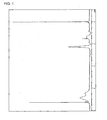
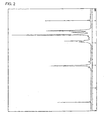
- the measured result of 1 H-NMR is shown in FIG. 1.
- the obtained hyperbranched polymer has a structure represented by Formula (24): Further, a 2% by mass cyclohexanone solution of the obtained objective was prepared and filtered using a microfilter made of polytetrafluoroethylene having a pore size of 0.2 ⁇ m.
- the resultant solution was coated onto a silicon wafer by a spin coating method and the wafer was then heated on a hot plate at 150°C for 3 minutes to thereby obtain a thin film having a film thickness of 42 nm.
- a surface state of the obtained thin film was observed by an AFM measurement. It was observed that in the surface of the thin film, there was no particle having a particle diameter of around 10 nm as observed in the second reference and the surface state was a homogeneous surface having a surface roughness of 0.28 nm.
- reaction crude powder was redissolved in 1,2-dichloroethane and the resultant liquid was separated into 1,2-dichloroethane / water. Thereafter, 1,2-dichloroethane was distilled off from the 1,2-dichloroethane phase to thereby obtain 171 g (yield; 97%) of an objective in the form of a yellow liquid. The purity (area percentage) thereof was 96% as measured by a liquid chromatography.
- reaction mixture was charged into 3000 g of methanol to reprecipitate a polymer in a massive state having high viscosity and then a supernatant liquid was removed by a decantation. Further, the polymer was redissolved in 400 g of tetrahydrofuran and the resultant solution was charged into 5000 g of methanol to reprecipitate the polymer in a slurry state. The slurry was filtered and vacuum-dried to thereby obtain 44 g of an objective in the form of a white powder.
- the weight average molecular weight Mw and the degree of dispersion Mw/Mn of the polymer were measured by a gel permeation chromatography (in a converted molecular weight as polystyrene) and found to be respectively 43,200 and 2.9.
- the results of the element analysis were carbon: 50.8%, hydrogen: 7.6%, nitrogen: 5.1% and sulfur: 25.6%.
- thermogravimetric analysis it was found that the temperature at which the weight of the polymer was reduced by 5% was 186°C.
- reaction mixture was charged into 2000 g of hexane to thereby reprecipitate a hyperbranched polymer in a slurry state.
- the slurry was filtered and vacuum-dried to thereby obtain 5.7 g of a white powder-shaped hyperbranched polymer.
- the weight average molecular weight Mw and the degree of dispersion Mw/Mn of the polymer were measured by a gel permeation chromatography (in a converted molecular weight as polystyrene) and found to be respectively 36,100 and 2.2.
- the results of the element analysis were carbon: 61.3%, hydrogen: 9.0%, nitrogen: less than 0.5% and sulfur: less than 0.5%.
- the results of the element analysis were carbon: 73.2%, hydrogen: 6.9%, sulfur: 18.6% and nitrogen: less than 1.0%.
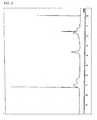
- the measured result of 1 H-NMR is shown in FIG. 3.
- the obtained hyperbranched polymer has a structure represented by Formula (26):
- Formula (26) As is apparent from the comparison of the results of the thermal gravimetric analysis in the second reference and in the first example and the results in the fourth reference and in the second example, a hyperbranched polymer in which at a molecular terminal thereof, a dithiocarbamate group was replaced by a hydrogen atom, has a high temperature at which the weight reduction by 5% is caused, so that such a polymer was thermally stable.
- the thin film produced in the second reference and the first example by replacing the dithiocarbamate group with a hydrogen atom at a molecular terminal of the polymer, there are not a large number of particles in the thin film surface, so that the thin film is homogeneous and excellent in thin film properties.
- the hyperbranched polymer according to the present invention is thermally stable and can be utilized as painting materials, adhesive materials, resin filler, various forming materials, nanometer pore forming agent, resist materials, electronic materials, printing materials, battery materials and medical materials.
Landscapes
- Chemical & Material Sciences (AREA)
- Health & Medical Sciences (AREA)
- Chemical Kinetics & Catalysis (AREA)
- Medicinal Chemistry (AREA)
- Polymers & Plastics (AREA)
- Organic Chemistry (AREA)
- General Chemical & Material Sciences (AREA)
- Addition Polymer Or Copolymer, Post-Treatments, Or Chemical Modifications (AREA)
- Polymerisation Methods In General (AREA)
Abstract
Description
- The present invention relates to a novel hyperbranched polymer and production method thereof. The hyperbranched polymer according to the present invention has such characteristics as being optically and thermally stable and is preferably utilized, for example, as paints, inks, adhesives, resin fillers, various molding materials, nanometer pore forming agents, chemical and mechanical abrasives, supporting materials for functional substances, nanocapsules, photonic crystals, resist materials, optical materials, electronic materials, information recording materials, printing materials, battery materials, medical materials and magnetic materials.
- Hyperbranched polymers are classified as dendritic polymers together with dendrimers. While related-art polymers generally have a string form, these dendritic polymers have a highly branched structure. Accordingly, expectations lie in practical application of such various characteristics thereof as having a specific structure, a nanometer size and surfaces capable of retaining many functional groups; being rendered having a low viscosity compared to linear polymers; exhibiting a behavior like fine particles with little entanglement of molecules; and capable of becoming amorphous with their solubility in a solvent controllable.
Particularly, it is the most remarkable characteristic of dentritic polymers to have a large number of terminal groups. The more the molecular weight is, the more the number of branched chains increases, so that the absolute number of terminal groups becomes larger as the molecular weight of dendritic polymers increases. In such a dendritic polymer having a large number of terminal groups, intermolecular interactions depend largely on the types of the terminal groups, resulting in variations in its glass transition temperature, solubility and thin film forming properties. Accordingly, such a dendritic polymer has characteristics which no general linear polymer has. Further, to such a dendritic polymer, reactive functional group can be added as terminal groups with an extremely high density, so that its applications as, for example, a high sensitive scavenger for functional substances, a high sensitive multifunctional crosslinking agent, a dispersant for metals or metal oxides and a coating agent are expected. - As a point at which the hyperbranched polymer is superior to the dendrimer, there can be mentioned a simplicity to be synthesized which is advantageous particularly in an industrial production. Generally, while the dendrimer is synthesized by repeating a protection and a deprotection, the hyperbranched polymer is synthesized by an one-stage polymerization of a so-called ABx type monomer having in one molecule thereof, three or more substituents of two types.
A method for synthesizing a hyperbranched polymer by a living radical polymerization of a compound having a vinyl group while having a photo-polymerization initiating ability, is known. For example, a synthesis method of a hyperbranched polymer by a photo-polymerization of a styrene compound having a dithiocarbamate group (see Non-PatentDocuments 1, 2 and 3) and a synthesis method of a hyperbranched polymer having a dithiocarbamate group by a photo-polymerization of an acryl compound having a dithiocarbamate group (see Non-Patent Documents 4, 5 and 6) are known. However, since these hyperbranched polymers have in the molecule thereof, a dithiocarbamate group having a photo-polymerization initiating ability, they remain in a living state relative to a light and do not have any high thermal stability. It has been desired that an optically and thermally stable hyperbranched polymer having no dithiocarbamate group is developed.
Though while a hyperbranched polymer of phenol derivatives is known (see Patent Document 1), an organic synthetic reaction in which a dithiocarbamate group is converted to a thiol group is reported (see Non-Patent Document 7), there is no report with respect to the stabilization of a hyperbranched polymer having a dithiocarbamate group in a molecule thereof. - [Patent Document 1]
Japanese Patent Application Publication No. JP-A-2000- 344836 - [Non-Patent Document 1] Koji Ishizu, Akihide Mori, Macromol. Rapid Commun. 21, 665-668 (2000)
- [Non-Patent Document 2] Koji Ishizu, Akihide Mori, Polymer International 50, 906-910 (2001)
- [Non-Patent Document 3] Koji Ishizu, Yoshihiro Ohta, Susumu Kawauchi, Macromolecules Vol. 35, No. 9, 3781-3784 (2002)
- [Non-Patent Document 4] Koji Ishizu, Takeshi Shibuya, Akihide Mori, Polymer International 51, 424-428 (2002)
- [Non-Patent Document 5] Koji Ishizu, Takeshi Shibuya, Susumu Kawauchi, Macromolecules Vol. 36, No. 10, 3505-3510 (2002)
- [Non-Patent Document 6] Koji Ishizu, Takeshi Shibuya, Jaebum Park, Satoshi Uchida, Polymer International 53, 259-265 (2004)
- [Non-Patent Document 7] Bernhard F. Riefling, Tetrahedron Letters 26, 2063-2064 (1985)
- It is an object of the present invention is to provide a novel hyperbranched polymer that is optically and thermally stable, and a production method thereof. Further, another object of the present invention is to provide a novel hyperbranched polymer having a thiol group at a molecular terminal thereof and a production method thereof.
- The present invention relates to the following aspects. According to a first aspect, a hyperbranched polymer represented by Formula (1):


and having a hydrogen atom or a thiol group at a molecular terminal thereof. According to a second aspect, the hyperbranched polymer according to the first aspect, wherein the A1 is a structure represented by Formula (4):

According to a fourth aspect, the hyperbranched polymer according to the first aspect, wherein a weight average molecular weight is 500 to 5000000, as measured by a gel permeation chromatography in a converted molecular weight as polystyrene. According to a fifth aspect, a method of producing the hyperbranched polymer having a hydrogen atom at a molecular terminal thereof according to the first aspect comprising: - living-radical polymerizing a dithiocarbamate compound represented by Formula (6):

- living-radical polymerizing the dithiocarbamate compound represented by Formula (6) to obtain a hyperbranched polymer having a dithiocarbamate group at a molecular terminal thereof; and
- reacting the hyperbranched polymer having a dithiocarbamate group at a molecular terminal thereof with a thiolation converting agent.
- reacting a hyperbranched polymer having a dithiocarbamate group at a molecular terminal thereof in an organic solvent solution dissolving the same with a thiolation converting agent.
According to a twelfth aspect, the production method according to the ninth aspect, wherein as the thiolation converting agent, used is at least one selected from hydrazine, benzyl hydrazine, ammonia, sodium metal, sodium hydroxide, potassium hydroxide, lithium aluminum hydride, sodium boron hydride, hydrogen bromide, hydrochloric acid, trifluoroacetic acid and mercury diacetylate.
According to a thirteenth aspect, a thin film composed of the hyperbranched polymer according to the first aspect. - According to the present invention, an optically and thermally stable hyperbranched polymer having a hydrogen atom at a molecular terminal thereof can be obtained. Also, according to the method of the present invention, an optically and thermally stable hyperbranched polymer can be simply and effectively obtained. Further, according to the present invention, a hyperbranched polymer having a thiol group at a molecular terminal thereof can be obtained, which is expected for an application as, for example a high sensitive multifunctional crosslinking agent, a dispersant or coating agent for a metal. Also, according to the method of the present invention, a hyperbranched polymer having a thiol group at a molecular terminal thereof can be simply and effectively obtained.
Further, according to the present invention, an advantageous film composed of a hyperbranched polymer can be obtained. - The hyperbranched polymer of the present invention is a hyperbranched polymer having a structure represented by Formula (1) and having a hydrogen atom or a thiol group at a molecular terminal thereof. In Formula (1), R1 represents a hydrogen atom or a methyl group. n is the number of repeating units which is an integer of 2 to 100000. A1 represents a structure represented by Formula (2) or Formula (3).
In Formula (2) and Formula (3), A2 represents a linear, branched or cyclic alkylene group having 1 to 30 carbon atoms, which may contain an ether bond or an ester bond; and X1, X2, X3 and X4 individually represent a hydrogen atom, an alkyl group having 1 to 20 carbon atoms, an alkoxy group having 1 to 20 carbon atoms, a halogen group, a nitro group, a hydroxyl group, an amino group, a carboxyl group or a cyano group.
Specific examples of the alkylene group include a linear alkylene, such as methylene, ethylene, n-propylene, n-butylene and n-hexylene; and a branched alkylene, such as isopropylene, isobutylene and 2-methylpropylene. Examples of the cyclic alkylene include an alicyclic aliphatic group having 3 to 30 carbon atoms and having a monocyclic, polycyclic or crosslinked cyclic structure. Specific examples thereof include groups having 4 or more carbon atoms and having a monocyclo, bicyclo, tricyclo, tetracyclo or pentacyclo structure. For example, structural examples (a) to (s) of the alicyclic part in the alicyclic aliphatic group are shown as follows.


As A1 in Formula (1), a structure represented by Formula (4) or Formula (5) is preferred.
In Formula (5), m represents an integer of 2 to 10 and is preferably 2 or 3. - In the hyperbranched polymer of the present invention having a structure represented by Formula (1), to a structure of a polymerization initiation point part having a vinyl group represented by Formula (7), a repeating unit structure represented by Formula (8) is coupled.


The hyperbranched polymer of the present invention contains both structures of Formulae (9) and (10). When the number n of repeating units is 3, one of two terminal hydrogen atoms in Formulae (9) and (10) is converted to Formula (8) and as the whole structure, Formulae (11) to (15) are expected. The hyperbranched polymer of the present invention contains any structure of Formulae (11) to (15).


The hyperbranched polymer of the present invention has a weight average molecular weight Mw (measured by a gel permeation chromatography in a converted molecular weight as polystyrene) of 500 to 5000000, or 1000 to 1000000, or 2000 to 500000, or 3000 to 100000. The degree of dispersion which is a ratio of Mw (weight average molecular weight) / Mn (number average molecular weight) of the hyperbranched polymer is 1.0 to 7.0, or 1.1 to 6.0, or 1.2 to 5.0. - Next, the production method of the hyperbranched polymer represented by Formula (1) of the present invention is described.
The hyperbranched polymer of the present invention is produced either as a hyperbranched polymer having a hydrogen atom at a molecular terminal thereof by reducing a hyperbranched polymer having a dithiocarbamate group at a molecular terminal thereof obtained by living-radical polymerizing a dithiocarbamate compound represented by Formula (6), or as a hyperbranched polymer having a thiol group at a molecular terminal thereof by reacting the above hyperbranched polymer having a dithiocarbamate group at a molecular terminal thereof with a thiolation converting agent (means a compound capable of converting a dithiocarbamate group to a thiol group).
In Formula (6), R1 and A1 are the same as defined above, and R2 and R3 individually represent an alkyl group having 1 to 5 carbon atoms, a hydroxyalkyl group having 1 to 5 carbon atoms or an arylalkyl group having 7 to 12 carbon atoms. R2 and R3 may be bonded to each other to form together with a nitrogen atom, a ring.
Examples of the alkyl group having 1 to 5 carbon atoms include, a methyl group, an ethyl group, an isopropyl group, a t-butyl group, a cyclopentyl group an n-pentyl group. Examples of the hydroxyalkyl group having 1 to 5 carbon atoms include a hydroxymethyl group, a hydroxyethyl group and a hydroxypropyl group. Examples of the arylalkyl group having 7 to 12 carbon atoms include a benzyl group and a phenethyl group.
Examples of the ring formed with R2 and R3 which are bonded to each other and together with a nitrogen atom include a 4- to 8-membered ring; a ring cotaining 4 to 6 methylene groups in the ring; and a ring comprising an oxygen atom, a sulfur atom and 4 to 6 methylene groups in the ring. Specific examples of the ring formed with R2 and R3 which are bonded to each other and together with a nitrogen atom include a piperizine group, a pyrrolidine group, a morpholine group, a thiomorpholine group and a homopiperizine group. - The compound of Formula (6) can be easily obtained by a nucleophilic substitution reaction between a compound of Formula (16) and a compound of Formula (17).


The nucleophilic substitution reaction is usually performed preferably in an organic solvent capable of dissolving both the above two types of compounds. After the reaction, by a liquid separation treatment into water/nonaqueous organic solvent or by a recrystallization treatment, the compound of Formula (6) can be obtained in a high purity. Also, the compound of Formula (6) can be produced referring to a method described in "Macro mol. Rapid Commun. 21, 665-668 (2000)" or in "Polymer International 51, 424-428 (2002)".
Specific examples of the compound of Formula (6) include N,N-diethyldithiocarbamylmethylstyrene and N,N-diethyldithiocarbamylethylmethacrylate.
Then, by living-radical polymerizing the dithiocarbamate compound represented by Formula (6), a hyperbranched polymer having a dithiocarbamate group at a molecular terminal thereof can be obtained. The living-radical polymerization of the compound of Formula (6) can be performed by a known polymerization type, such as a bulk polymerization, a solution polymerization, a suspension polymerization and an emulsion polymerization. The solution polymerization is preferred.
In the case of the solution polymerization, in a solvent capable of dissolving the compound of Formula (6), the polymerization reaction can be performed at any concentration of the compound of Formula (6). The concentration of the compound of Formula (6) may be any one. However, it is, for example 1 to 80 % by mass, or 2 to 70 % by mass, or 5 to 60 % by mass, or 30 to 50 % by mass. The solvent is not particularly limited so long as the solvent is a solvent capable of dissolving the compound of Formula (6). Examples of the solvent include aromatic hydrocarbons, such as benzene, toluene, xylene and ethylbenzene; ether compounds, such as tetrahydrofuran and diethyl ether; ketone compounds, such as acetone, methyl ethyl ketone, methyl isobutyl ketone and cyclohexanone; and aliphatic hydrocarbons, such as n-heptane, n-hexane and cyclohexane. These solvents may be used individually or in combination of two or more types thereof. - The living-radical polymerization of the compound of Formula (6) can be performed in a solvent by heating or irradiating a light, such as an UV ray. By irradiating a light, such as an UV ray, the polymerization is preferably performed. In the living-radical polymerization, it is necessary that before the initiation of the polymerization, oxygen in the reaction system is fully purged and the purge of the reaction system is preferably performed using an inert gas, such as nitrogen and argon. The polymerization time is, for example 0.1 to 100 hours, or 1 to 50 hours, or 3 to 30 hours. Usually, according to the time course of the polymerization, the conversion ratio of the monomer (the compound of Formula (6)) is elevated. The polymerization temperature is not particularly limited. However, it is, for example 0 to 200°C, or 10 to 150°C, or 20 to 100°C.
Also, the living-radical polymerization of the compound of Formula (6) can be performed referring to a method described in "Macromolecules Vol. 35, No. 9, 3781-3784 (2002)" or in "Macromolecules Vol. 36, No. 10, 3505-3510 (2002)". - By a living-radical polymerization of the dithiocarbamate compound represented by Formula (6), the hyperbranched polymer having a dithiocarbamate group at a molecular terminal thereof can be obtained. It is believed that the hyperbranched polymer having a dithiocarbamate group at a molecular terminal thereof is produced as follows. That is, by irradiating a light or the like to the compound of Formula (6), an A1-S bond is cleaved and a radical species (Formula (18)) is generated. Next, the radical species of Formula (18) is reacted with the compound of Formula (6) to produce the compound of Formula (19). Further, in the compound of Formula (19), a C-S bond or an A1-S bond is cleaved to generate a radical species and the radical species is reacted with the compound of Formula (6) to give a compound of Formula (20) or (22). In Formula (20) or (21), DC represents a dithiocarbamate group (-SC(=S)N(R2)R3). And it is believed that by repeating the same reaction from the compound of Formula (20) or (21), a hyperbranched polymer having a dithiocarbamate group at a molecular terminal thereof is produced.

- During the living-radical polymerization, for controlling the molecular weight or the molecular weight distribution, a chain transfer agent such as mercaptans or sulfides or a sulfide compound such as tetraethylthiuram disulfide can be used.
Further, if desired, an antioxidant such as hindered phenols, an ultra violet (UV) absorber such as bezotriazoles and a polymerization inhibitor such as 4-tert-butylcatechole, hydroquinone, nitrophenol, nitrocresol, picric acid, phenothiazine and dithiobenzoyl disulfide, can be used.
Further, during the living-radical polymerization, for controlling an extent of branching or a degree of polymerization, a known vinyl monomer having no dithiocarbamate group or a compound having a unsaturated double bond can be added. These compounds can be used in a ratio of less than 50 mol % relative to the compound of Formula (6). Specific examples of these compounds include styrenes, vinylbiphenyls, vinylnaphtalenes, vinylanthracenes, acrylic esters, methacrylic esters, acrylamides, methacrylamides, vinylpyrrolidones, acrylonitriles, maleic acids, maleimides, divinyl compounds and trivinyl compounds. - Next, the hyperbranched polymer having a hydrogen atom at a molecular terminal thereof is described in detail.
By reducing the hyperbranched polymer having a dithiocarbamate group at a molecular terminal thereof obtained as described above, that is by converting a dithiocarbamate group to a hydrogen atom, from the hyperbranched polymer having a structure represented by Formula (1) according to the present invention, a hyperbranched polymer having a hydrogen atom at a molecular terminal thereof represented by Formula (22):
The reducing method is not particularly limited so long as the method is a method capable of converting a dithiocarbamate group to a hydrogen atom.
The reducing reaction can be performed using a known reducing agent, such as hydrogen, hydrogen iodide, hydrogen sulfide, lithium aluminum hydride, sodium boron hydride, tributyltin hydride, tris(trimethylsilyl) silane and thioglycolic acid. The amount of the reducing agent may be, relative to the number of dithiocarbamate groups in the hyperbranched polymer 1 to 20 times molar equivalent, or 1.5 to 15 times molar equivalent, or 2 to 10 times molar equivalent, or 3 to 5 times molar equivalent. The conditions for the reducing reaction are appropriately selected from reaction times of 0.01 to 100 hours and from reaction temperatures of 0 to 200 °C.
Preferably, the reaction time is 0.1 to 10 hours and the reaction temperature is 20 to 100°C.
The reduction is preferably performed in water or an organic solvent. The solvent used is preferably a solvent capable of dissolving the hyperbranched polymer having a dithiocarbamate group and a reducing agent. It is preferred that when the solvent used is the same solvent as that used during the production of the hyperbranched polymer having a dithiocarbamate group, the reaction operation becomes simple. - As a reducing method, preferred is a reducing reaction performed in an organic solvent solution by using as a reducing agent, a compound used in a reduction under a radical reaction condition such as tributyltin hydride and by irradiating a light. Examples of the organic solvent include aromatic hydrocarbons, such as benzene, toluene, xylene and ethylbenzene; ether compounds, such as tetrahydrofuran and diethyl ether; ketone compounds, such as acetone, methyl ethyl ketone, methyl isobutyl ketone and cyclohexanone; and aliphatic hydrocarbons, such as n-heptane, n-hexane and cyclohexane. These solvents may be used individually or in combination of two or more types thereof. The light irradiation can be performed by irradiating from the inside or outside of the reaction system using an UV irradiating lamp, such as a low-pressure mercury lamp, a high-pressure mercury lamp, an ultra high-pressure mercury lamp and a xenone lamp. In the reducing reaction, a reducing agent, such as tributyltin hydride is used preferably in an amount of 1 to 10 times molar equivalent, or 1.5 to 5 times molar equivalent, or 2 to 4 times molar equivalent relative to the number of dithiocarbamate groups in the hyperbranched polymer. Also, an organic solvent is used preferably in an amount of 0.2 to 1000 times mass, or 1 to 500 times mass, or 5 to 100 times mass, or 10 to 50 times mass relative to the mass of the hyperbranched polymer having a dithiocarbamate group at a molecular terminal thereof. Further, in the reducing reaction, it is necessary that before the initiation of the reaction, oxygen in the reaction system is fully purged and the purge of the reaction system is preferably performed using an inert gas, such as nitrogen and argon. The reaction conditions are appropriately selected from reaction times of 0.01 to 100 hours and from reaction temperatures of 0 to 200°C. Preferably, the reaction time is 0.1 to 2 hours and the reaction temperature is 20 to 60°C. The hyperbranched polymer of the present invention obtained by the reduction as described above can be separated from the solvent in the reaction mixture by distilling-off the solvent or by solid-liquid separation. Also, by introducing the reaction mixture into a poor solvent, the hyperbranched polymer of the present invention can be precipitated to be recovered as a powder.
In the hyperbranched polymer having a dithiocarbamate group at a molecular terminal thereof of the present invention, a part of molecular terminals may remain being a dithiocarbamate group. - Next, the hyperbranched polymer having a thiol group at a molecular terminal thereof is described in detail.
By treating the hyperbranched polymer having a dithiocarbamate group at a molecular terminal thereof with a thiolation converting agent, that is, by converting the dithiocarbamate group to a thiol group, a hyperbranched polymer having a thiol group at a molecular terminal thereof represented by Formula (23):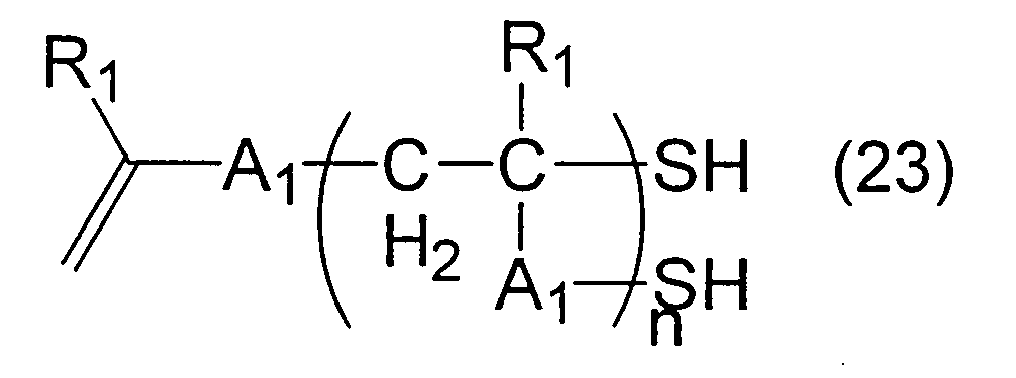
The reaction method is not particularly limited so long as the method is a method capable of converting the dithiocarbamate group to a thiol group. Specifically, using a thiolation converting agent, such as hydrazine, benzyl hydrazine, ammonia, metallic sodium, sodium hydroxide, potassium hydroxide, lithium aluminum hydride, sodium boron hydride, hydrogen bromide, hydrochloric acid, trifluoroacetic acid and diacetyl mercury, a thiolation rection can be performed. The amount thereof may be 1 to 200 times molar equivalent, or 2 to 100 times molar equivalent, or 2.5 to 80 times molar equivalent, or 3 to 50 times molar equivalent relative to the number of dithiocarbamate groups in the hyperbranched polymer. The conditions for the thiolation reaction are appropriately selected from reaction times of 0.01 to 100 hours and from reaction temperatures of 0 to 200°C. Preferably, the reaction time is 1 to 80 hours and the reaction temperature is 20 to 150°C.
The thiolation reaction is preferably performed in water or an organic solvent. The solvent used is preferably a solvent capable of dissolving the above hyperbranched polymer having a dithiocarbamate group and the thiolation converting agent. Further, it is preferred that when the solvent used is the same solvent as that used during the production of the hyperbranched polymer having a dithiocarbamate group, the reaction operation becomes simple. - As a method of the thiolation reaction, a reaction performed by a reflux while heating using a compound, such as hydrazine in an organic solvent is preferred. Examples of the organic solvent include aromatic hydrocarbons, such as benzene, toluene, xylene and ethylbenzene; ether compounds, such as tetrahydrofuran, 1,4-dioxane, and diethyl ether; ketone compounds, such as acetone, methyl ethyl ketone, methyl isobutyl ketone and cyclohexanone; and aliphatic hydrocarbons, such as n-heptane, n-hexane and cyclohexane. These solvents may be used individually or in combination of two or more types thereof. Further, the organic solvent is preferably used in an amount of 0.2 to 1000 times mass, or 1 to 500 times mass, or 5 to 100 times mass, or 10 to 50 times mass, relative to the mass of the hyperbranched polymer having a dithiocarbamate group at a molecular terminal thereof. Further, in this reaction, it is necessary that before the initiation of the reaction, oxygen in the reaction system is fully purged and the purge of the reaction system is preferably performed using an inert gas, such as nitrogen and argon.
The hyperbranched polymer of the present invention obtained by the thiolation reaction as described above can be separated from the solvent in the reaction mixture by distilling-off the solvent or by solid-liquid separation. Also, by introducing the reaction mixture into a poor solvent, the hyperbranched polymer of the present invention can be precipitated to be recovered as a powder.
In the hyperbranched polymer having a thiol group at a molecular terminal thereof of the present invention, a part of molecular terminals may remain being a dithiocarbamate group.
Further, according to the present invention, a thin film of the hyperbranched polymer represented by the above Formula (22) or Formula (23) can be obtained. As a production method of the thin film, there can be mentioned a method for thinning a solution in which the hyperbranched polymer is dissolved in a solvent capable of dissolving the hyperbranched polymer at a concentration of 0.1 to 70 % by mass, by an usual method, such as an impregnation method, a brush coating method, a casting method and a spin coating method. Particularly, by a spin coating method, a thin film having a large area can be produced easily, with low cost and in a short time, so that the method has high economical efficiency.
Hereinafter, the present invention is described in more detail referring to exmaples which should not be construed as limiting the scope of the present invention. - In the following examples, for each measurement of physical properties of a sample, the following apparatuses were used.
Liquid Chromatography: Apparatus: manufactured by Agilent; trade name: 1100 Series Column: Inertsil ODS-2 Column temp.: 40°C Solvent: Acetonitrile/water = 60/40 (volume ratio) Detector: RI Gel Permeation Chromatography: Apparatus: manufactured by Shimadzu Corporation; trade name: SCL-10AVP Column: Shodex KF-804L+KF-803L Column temp.: 40°C Solvent: Tetrahydrofuran Detector: RI 1H-NMR Spectrum Apparatus: manufactured by JEOL DATUM LTD.; trade name: JNM-LA400 Solvent: CDCl3 Internal standard: tetramethylsilane Element Analysis (carbon, hydrogen, nitrogen) Apparatus: manufactured by Perkin Elmer, Inc.; trade name: PE2400II Combustion tube temp.: 975°C Element Analysis (sulfur) Apparatus: manufactured by ThermoFinnigan Ltd.; trade name: Flash EA1112 Combustion tube temp.: 1000°C Thermogravimetric Analysis Apparatus: manufactured by Seiko Instruments Inc.; trade name: TG/DTA320 Temp. elevation rate: 10°C/min Air supply: 300 mL/min AFM Measurement Apparatus: manufactured by Veeco Instruments Inc.; trade name: Dimension 3100 Probe material: single crystal silicone Measurement mode: Tapping mode - Into a 2L reaction flask, 120 g of chloromethylstyrene (manufactured by Seimi Chemical Co., Ltd.; trade name: CMS-14), 181 g of Sodium N,N-diethyldithiocarbamidate trihydrate (manufactured by Kanto Chemical Co., Inc.) and 1400 g of acetone were charged and while stirring the resultant mixture, a reaction was performed at 40°C for 1 hour. After the completion of the reaction, deposited sodium chloride was filtered to be removed and then, acetone was distilled off from the reaction mixture using an evaporator to thereby obtain a reaction crude powder. The obtained reaction crude powder was redissolved in toluene and the resultant liquid was separated into toluene / water. Thereafter, in a refrigerator having a temperature of -20°C, an objective was recrystallized from the toluene phase. The recrystallized substance was filtered and vacuum-dried to thereby obtain 206 g (yield; 97%) of an objective in the form of a white powder. The purity (area percentage) thereof was 100% as measured by a liquid chromatography. The melting point thereof was 56°C as measured by a DSC measurement.
- Into a 300-ml reaction flask, 108 g of N,N-diethyldithiocarbamylmethylstyrene and 72 g of toluene were charged and the resultant mixture was stirred to prepare a light yellow transparent solution, followed by purging the inside of the reaction system with nitrogen. From the center of the solution, a high pressure mercury lamp of 100 W (manufactured by Sen Lights Co., Ltd. trade name: HL-100) was lighted to perform a photopolymerization reaction by an internal irradiation while stirring the reaction mixture at room temperature for 12 hours. Next, the reaction mixture was charged into 3000 g of methanol to reprecipitate a polymer in a massive state having high viscosity and then a supernatant liquid was removed by a decantation. Further, the polymer was redissolved in 300 g of tetrahydrofuran and the resultant solution was charged into 3000 g of methanol to reprecipitate the polymer in a slurry state. The slurry was filtered and vacuum-dried to thereby obtain 48 g of an objective in the form of a white powder. The weight average molecular weight Mw and the degree of dispersion Mw/Mn of the polymer were measured by a gel permeation chromatography (in a converted molecular weight as polystyrene) and found to be respectively 20,900 and 4.9. The results of the element analysis were carbon: 64.6%, hydrogen: 7.4%, nitrogen: 5.0% and sulfur: 25.3%. By a thermogravimetric analysis, it was found that the temperature at which the weight of the polymer was reduced by 5% was 248°C.
Further, a 2% by mass cyclohexanone solution of the obtained objective was prepared and filtered using a microfilter made of polytetrafluoroethylene having a pore size of 0.2 µm. The resultant solution was coated to a silicone wafer by a spin coating method and the wafer was then heated on a hot plate at 150°C for 3 minutes to thereby obtain a thin film having a film thickness of 44 nm. A surface state of the obtained thin film was observed by an AFM measurement. It was observed that in the surface of the thin film, a large number of particles having a particle diameter of around 10 nm are scattered and the thin film had a surface roughness of 0.36 nm. - Into a 300 mL reaction flask, 14 g of the hyperbranched polymer having a dithiocarbamate group at a molecular terminal thereof obtained in Second Reference, 28 g of tributyltin hydride (manufactured by Sigma-Aldrich Corp.) and 140 g of toluene were charged and the resultant mixture was stirred to prepare a colorless transparent solution, followed by purging the inside of the reaction system with nitrogen. From the center of the solution, a high pressure mercury lamp of 100 W (manufactured by Sen Lights Co., Ltd. trade name: HL-100) was lighted to perform a reaction by an internal irradiation while stirring the reaction mixture at room temperature for 15 minutes. Next, the reaction mixture was diluted by adding 500 g of toluene thereto and the diluted mixture was charged into 3600 g of methanol to thereby reprecipitate a hyperbranched polymer in a slurry state. The slurry was filtered and vacuum-dried to thereby obtain 5.3 g of a white powder-shaped hyperbranched polymer in which a dithiocarbamate group was replaced by a hydrogen atom. The weight average molecular weight Mw and the degree of dispersion Mw/Mn of the polymer were measured by a gel permeation chromatography (in a converted molecular weight as polystyrene) and found to be respectively 38,900 and 4.8. The results of the element analysis were carbon: 89.4%, hydrogen: 8.8%, nitrogen: less than 0.5% and sulfur: less than 0.5%. By a thermogravimetric analysis, it was found that the temperature at which the weight of the polymer was reduced by 5% was 338 °C. The measured result of 1H-NMR is shown in FIG. 1. As shown in FIG. 1, the obtained hyperbranched polymer has a structure represented by Formula (24):

- Into a 2L reaction flask, 100 g of chloroethylmethacrylate (manufactured by Lancaster Co., Ltd.), 178 g of Sodium N,N-diethyldithiocarbamidate trihydrate (manufactured by Kanto Chemical Co., Inc.) and 1100 g of acetone were charged and while stirring the resultant mixture, a reaction was performed at 40°C for 14 hours. After the completion of the reaction, deposited sodium chloride was filtered to be removed and then, acetone was distilled off from the reaction mixture using an evaporator to thereby obtain a reaction crude powder. The obtained reaction crude powder was redissolved in 1,2-dichloroethane and the resultant liquid was separated into 1,2-dichloroethane / water. Thereafter, 1,2-dichloroethane was distilled off from the 1,2-dichloroethane phase to thereby obtain 171 g (yield; 97%) of an objective in the form of a yellow liquid. The purity (area percentage) thereof was 96% as measured by a liquid chromatography.
- Into a 300-ml reaction flask, 90 g of N,N-diethyldithiocarbamylethylmethacrylate and 90 g of toluene were charged and the resultant mixture was stirred to prepare a light yellow transparent solution, followed by purging the inside of the reaction system with nitrogen. From the center of the solution, a high pressure mercury lamp of 100 W (manufactured by Sen Lights Co., Ltd. trade name: HL-100) was lighted to perform a photopolymerization reaction by an internal irradiation while stirring the reaction mixture at room temperature for 5 hours. Next, the reaction mixture was charged into 3000 g of methanol to reprecipitate a polymer in a massive state having high viscosity and then a supernatant liquid was removed by a decantation. Further, the polymer was redissolved in 400 g of tetrahydrofuran and the resultant solution was charged into 5000 g of methanol to reprecipitate the polymer in a slurry state. The slurry was filtered and vacuum-dried to thereby obtain 44 g of an objective in the form of a white powder. The weight average molecular weight Mw and the degree of dispersion Mw/Mn of the polymer were measured by a gel permeation chromatography (in a converted molecular weight as polystyrene) and found to be respectively 43,200 and 2.9. The results of the element analysis were carbon: 50.8%, hydrogen: 7.6%, nitrogen: 5.1% and sulfur: 25.6%. By a thermogravimetric analysis, it was found that the temperature at which the weight of the polymer was reduced by 5% was 186°C.
- Into a 300 mL reaction flask, 15 g of the hyperbranched polymer having a dithiocarbamate group at a molecular terminal thereof obtained in the fourth reference, 30 g of tributyltin hydride (manufactured by Sigma-Aldrich Corp.) and 135 g of tetrahydrofuran were charged and the resultant mixture was stirred to prepare a light yellow transparent solution, followed by purging the inside of the reaction system with nitrogen. From the center of the solution, a high pressure mercury lamp of 100 W (manufactured by Sen Lights Co., Ltd. trade name: HL-100) was lighted to perform a reaction by an internal irradiation while stirring the reaction mixture at room temperature for 1 hour. Next, the reaction mixture was charged into 2000 g of hexane to thereby reprecipitate a hyperbranched polymer in a slurry state. The slurry was filtered and vacuum-dried to thereby obtain 5.7 g of a white powder-shaped hyperbranched polymer. The weight average molecular weight Mw and the degree of dispersion Mw/Mn of the polymer were measured by a gel permeation chromatography (in a converted molecular weight as polystyrene) and found to be respectively 36,100 and 2.2. The results of the element analysis were carbon: 61.3%, hydrogen: 9.0%, nitrogen: less than 0.5% and sulfur: less than 0.5%. By a thermogravimetric analysis, it was found that the temperature at which the weight of the polymer was reduced by 5% was 308°C. The measured result of 1H-NMR is shown in FIG. 2. As shown in FIG. 2, the obtained hyperbranched polymer has a structure represented by Formula (25):

- Into an 100 mL reaction flask equipped with a refluxing tower, 5 g of the hyperbranched polymer having a dithiocarbamate group at a molecular terminal thereof obtained in the second reference and 50 g of 1,4-dioxane were charged and the resultant mixture was stirred to prepare a colorless transparent solution, followed by adding 50 g of hydrazine monohydrate (manufactured by Kanto Chemical Co., Inc.) to the solution and by purging the inside of the reaction system with nitrogen. The solution was refluxed for 3 days and the solution was cooled to room temperature. From the solution which was separated into two layers, the lower layer was removed and the organic layer was washed by adding a saturated salt solution thereto, followed by drying the organic layer by adding magnesium sulfate anhydrate thereto. The solution of the organic layer was concentrated and 5 g of chloroform was added thereto, followed by dropping the solution into 50 g of n-hexane to reprecipitate. The resultant reprecipitated colorless powder was dried to obtain 2.5 g of a hyperbranched polymer in which a dithiocarbamate group was replaced by a thiol group. The weight average molecular weight Mw of the polymer was measured by a gel permeation chromatography (in a converted molecular weight as polystyrene) and found to be 16,900. The results of the element analysis were carbon: 73.2%, hydrogen: 6.9%, sulfur: 18.6% and nitrogen: less than 1.0%. The measured result of 1H-NMR is shown in FIG. 3. As shown in FIG. 3, the obtained hyperbranched polymer has a structure represented by Formula (26):

Further, as is apparent from the comparison of the thin film produced in the second reference and the first example, by replacing the dithiocarbamate group with a hydrogen atom at a molecular terminal of the polymer, there are not a large number of particles in the thin film surface, so that the thin film is homogeneous and excellent in thin film properties. - The hyperbranched polymer according to the present invention is thermally stable and can be utilized as painting materials, adhesive materials, resin filler, various forming materials, nanometer pore forming agent, resist materials, electronic materials, printing materials, battery materials and medical materials.
-
- [FIG. 1] FIG. 1 is a 1H-NMR spectrum of a hyperbranched polymer obtained in a first example.
- [FIG. 2] FIG. 2 is a 1H-NMR spectrum of a hyperbranched polymer obtained in a second example.
- [FIG. 3] FIG. 3 is a 1H-NMR spectrum of a hyperbranched polymer obtained in a third example.
According to a sixth aspect, the production method according to the fifth aspect, wherein the dithiocarbamate compound is N,N-diethyldithiocarbamylmethylstyrene or N,N-diethyldithiocarbamylethylmethacrylate.
According to a seventh aspect, the production method according to the fifth aspect, wherein the reduction is performed by irradiating a light in the presence of tributyltin hydride.
According to an eighth aspect, the production method according to the fifth aspect, wherein the reduction is performed by irradiating a light in the presence of tributyltin hydride in an organic solvent solution containing the hyperbranched polymer having a dithiocarbamate group at a molecular terminal thereof.
According to a ninth aspect, a method of producing the hyperbranched polymer having a thiol group at a molecular terminal thereof according to the first aspect comprising:
According to an eleventh aspect, the production method of a hyperbranched polymer according to the ninth aspect comprising:
Claims (13)
- A hyperbranched polymer represented by Formula (1):


and having a hydrogen atom or a thiol group at a molecular terminal thereof. - The hyperbranched polymer according to claim 1, wherein the A1 is a structure represented by Formula (4):

- The hyperbranched polymer according claim 1, wherein the A1 is a structure represented by Formula (5):

- The hyperbranched polymer according to claim 1, wherein a weight average molecular weight is 500 to 5000000, as measured by a gel permeation chromatography in a converted molecular weight as polystyrene.
- A method of producing the hyperbranched polymer having a hydrogen atom at a molecular terminal thereof according to claim 1 comprising:living-radical polymerizing a dithiocarbamate compound represented by Formula (6):wherein R1 and A1 represent the same as defined above in Formula (1); R2 and R3 individually represent an alkyl group having 1 to 5 carbon atoms, a hydroxyalkyl group having 1 to 5 carbon atoms or an aryl alkyl group having 7 to 12 carbon atoms; and R2 and R3 may be bonded to each other to form a ring together with a nitrogen atom, to obtain a hyperbranched polymer having a dithiocarbamate group at a molecular terminal thereof; and

reducing the hyperbranched polymer. - The method according to claim 5, wherein the dithiocarbamate compound is N,N-diethyldithiocarbamylmethylstyrene or N,N-diethyldithiocarbamylethylmethacrylate.
- The method according to claim 5, wherein the reduction is performed by irradiating a light in the presence of tributyltin hydride.
- The method according to claim 5, wherein the reduction is performed by irradiating a light in the presence of tributyltin hydride in an organic solvent solution containing the hyperbranched polymer having a dithiocarbamate group at a molecular terminal thereof.
- A method of producing the hyperbranched polymer having a thiol group at a molecular terminal thereof according to claim 1 comprising:living-radical polymerizing the dithiocarbamate compound represented by Formula (6) to obtain a hyperbranched polymer having a dithiocarbamate group at a molecular terminal thereof; andreacting the hyperbranched polymer having a dithiocarbamate group at a molecular terminal thereof with a thiolation converting agent.
- The method according to claim 9, wherein the dithiocarbamate compound is N,N-diethyldithiocarbamylmethylstyrene or N,N-diethyldithiocarbamylethylmethacrylate.
- The method according to claim 9 comprising:reacting a hyperbranched polymer having a dithiocarbamate group at a molecular terminal thereof in an organic solvent solution containing the same with a thiolation converting agent.
- The method according to claim 9, wherein as the thiolation converting agent, used is at least one selected from hydrazine, benzyl hydrazine, ammonia, sodium metal, sodium hydroxide, potassium hydroxide, lithium aluminum hydride, sodium boron hydride, hydrogen bromide, hydrochloric acid, trifluoroacetic acid and mercury diacetylate.
- A thin film composed of the hyperbranched polymer according to claim 1.
Applications Claiming Priority (2)
| Application Number | Priority Date | Filing Date | Title |
|---|---|---|---|
| JP2005059184 | 2005-03-03 | ||
| PCT/JP2006/303434 WO2006093050A1 (en) | 2005-03-03 | 2006-02-24 | Hyper-branched polymer and process for production of the same |
Publications (3)
| Publication Number | Publication Date |
|---|---|
| EP1854814A1 true EP1854814A1 (en) | 2007-11-14 |
| EP1854814A4 EP1854814A4 (en) | 2009-11-11 |
| EP1854814B1 EP1854814B1 (en) | 2011-04-06 |
Family
ID=36941081
Family Applications (1)
| Application Number | Title | Priority Date | Filing Date |
|---|---|---|---|
| EP06714573A Expired - Lifetime EP1854814B1 (en) | 2005-03-03 | 2006-02-24 | Hyper-branched polymer and process for production of the same |
Country Status (8)
| Country | Link |
|---|---|
| US (1) | US20080139692A1 (en) |
| EP (1) | EP1854814B1 (en) |
| JP (1) | JP5187825B2 (en) |
| KR (1) | KR20070108870A (en) |
| CN (2) | CN101133090B (en) |
| DE (1) | DE602006021154D1 (en) |
| TW (1) | TW200640949A (en) |
| WO (1) | WO2006093050A1 (en) |
Cited By (2)
| Publication number | Priority date | Publication date | Assignee | Title |
|---|---|---|---|---|
| EP2202248A4 (en) * | 2007-09-12 | 2010-11-03 | Nissan Chemical Ind Ltd | PROCESS FOR PRODUCING A HYPERRAMIFIED POLYMER |
| US9029474B2 (en) | 2007-04-25 | 2015-05-12 | Nissan Chemical Industries, Ltd. | Process for production of surface-modified polymer structures |
Families Citing this family (30)
| Publication number | Priority date | Publication date | Assignee | Title |
|---|---|---|---|---|
| US20080176146A1 (en) * | 2005-03-18 | 2008-07-24 | National University Corporation The University Of Electro-Communications | Photosensitive Composition Containing Organic Fine Particles |
| JP5367268B2 (en) * | 2005-10-25 | 2013-12-11 | 日産化学工業株式会社 | Polymer structure with modified surface and / or interface, and method for producing the same |
| JP5630957B2 (en) * | 2006-05-19 | 2014-11-26 | 日産化学工業株式会社 | Hyperbranched polymer and method for producing the same |
| EP2036929A4 (en) * | 2006-06-19 | 2010-01-20 | Tokyo Inst Tech | HYPERRAMIFIED POLYMER AND PROCESS FOR PRODUCING THE SAME |
| CN102167756B (en) * | 2006-09-01 | 2012-12-26 | 日产化学工业株式会社 | Hyperbranched polymer and method for producing the same |
| EP2065408B1 (en) | 2006-09-07 | 2012-07-04 | Nissan Chemical Industries, Ltd. | Hyperbranched polymer and process for production thereof |
| WO2008117772A1 (en) * | 2007-03-26 | 2008-10-02 | Nissan Chemical Industries, Ltd. | Curable material containing photopolymerizable polymer and cured object |
| WO2009031507A1 (en) * | 2007-09-03 | 2009-03-12 | Kyushu University | Organic switching element and method for production thereof |
| WO2009031594A1 (en) * | 2007-09-03 | 2009-03-12 | Nissan Chemical Industries, Ltd. | Metal fine particle-dispersing agent composed of polymer compound having dithiocarbamate group |
| WO2009054455A1 (en) * | 2007-10-26 | 2009-04-30 | Kyusyu University | Hyperbranched polymer having nitroxyl group |
| JP5345335B2 (en) * | 2007-12-03 | 2013-11-20 | 国立大学法人九州大学 | Novel zwitterionic multibranched resin and protein chip surface modifier |
| JP5139046B2 (en) * | 2007-12-03 | 2013-02-06 | 国立大学法人九州大学 | Biosupport and biochip using hyperbranched polymer |
| JP5477573B2 (en) * | 2008-02-07 | 2014-04-23 | 日産化学工業株式会社 | Antibacterial hyperbranched polymer |
| KR101680259B1 (en) * | 2008-08-22 | 2016-11-29 | 닛산 가가쿠 고교 가부시키 가이샤 | Metal Microparticle-Dispersing Agent Comprising Branched Polymeric Compound Having Ammonium Group |
| TWI393755B (en) * | 2008-11-28 | 2013-04-21 | Ind Tech Res Inst | Powder coating method and paint thereof |
| WO2010087379A1 (en) * | 2009-01-27 | 2010-08-05 | 国立大学法人九州大学 | Hyperbranched polymer containing thioester groups |
| WO2010101254A1 (en) * | 2009-03-06 | 2010-09-10 | 日産化学工業株式会社 | Hyperbranched polymer production method |
| JP5534244B2 (en) * | 2009-03-06 | 2014-06-25 | 日産化学工業株式会社 | Method for producing hyperbranched polymer |
| JP5558756B2 (en) * | 2009-08-06 | 2014-07-23 | 日産化学工業株式会社 | Antibacterial hyperbranched polymer |
| SG186878A1 (en) | 2010-07-02 | 2013-02-28 | Tokuyama Corp | Photocurable composition for imprint and method for formation of pattern using the composition |
| CN102010504B (en) * | 2010-11-02 | 2012-06-27 | 东南大学 | Method for preparing hyperbranched polyester |
| WO2012111550A1 (en) | 2011-02-17 | 2012-08-23 | 株式会社トクヤマデンタル | Curable composition for dentistry |
| JP5872540B2 (en) * | 2011-03-10 | 2016-03-01 | 国立大学法人九州大学 | Method for producing chlorinated hyperbranched polymer |
| JP2013148798A (en) * | 2012-01-23 | 2013-08-01 | Konica Minolta Inc | Toner for electrostatic charge image development |
| WO2014010431A1 (en) * | 2012-07-10 | 2014-01-16 | 株式会社トクヤマデンタル | Dental adhesive composition, dental adhesive primer, dental adhesive bonding material, dental adhesive composite resin, and dental adhesive resin cement |
| CN103709308B (en) * | 2013-12-12 | 2015-12-30 | 苏州博纳化学科技有限公司 | A kind of preparation method of super cladodification dispersion agent |
| CN105628814B (en) * | 2015-12-30 | 2017-05-24 | 利民化工股份有限公司 | Analysis method for metham sodium |
| CN107976487A (en) * | 2017-12-21 | 2018-05-01 | 上海微谱化工技术服务有限公司 | A kind of method using preparative gpc analysis UV prepolymers |
| CN108299562B (en) * | 2018-02-09 | 2021-05-28 | 中国人民解放军陆军军医大学 | A kind of hyperbranched polymeric polypeptide and its preparation method and application |
| CN114891222B (en) * | 2022-07-01 | 2023-09-26 | 华南理工大学 | A poly(N-substituted) dithiocarbamate compound with discontinuous molecular weight and its preparation method and application |
Family Cites Families (10)
| Publication number | Priority date | Publication date | Assignee | Title |
|---|---|---|---|---|
| US6252025B1 (en) * | 1998-08-11 | 2001-06-26 | Eastman Kodak Company | Vinyl hyperbranched polymer with photographically useful end groups |
| US6414101B1 (en) * | 1999-03-26 | 2002-07-02 | Shin-Etsu Chemical Co., Ltd. | Dendritic polymers and making method |
| JP4067906B2 (en) * | 2001-07-31 | 2008-03-26 | 株式会社カネカ | Vinyl sulfide group-containing polymer and curable composition |
| FR2850659B1 (en) * | 2003-01-31 | 2006-06-23 | Oreal | HYPERBRANCH POLYMERS WITH LOW VITREOUS TRANSITION TEMPERATURE AND COSMETIC USES THEREOF |
| JP2004256563A (en) | 2003-02-24 | 2004-09-16 | Shiseido Co Ltd | Production method for star polymer |
| WO2005061566A1 (en) * | 2003-12-22 | 2005-07-07 | Lion Corporation | Hyperbranched polymer, process for producing the same and resist composition containing the hyperbranched polymer |
| SE0402187D0 (en) * | 2004-09-10 | 2004-09-10 | Boerje Sellergren | Imprinting using dendrimers as tomplates |
| US20080176146A1 (en) * | 2005-03-18 | 2008-07-24 | National University Corporation The University Of Electro-Communications | Photosensitive Composition Containing Organic Fine Particles |
| JP5008080B2 (en) * | 2005-03-18 | 2012-08-22 | 国立大学法人電気通信大学 | Photosensitive composition containing organic fine particles |
| JP5367268B2 (en) * | 2005-10-25 | 2013-12-11 | 日産化学工業株式会社 | Polymer structure with modified surface and / or interface, and method for producing the same |
-
2006
- 2006-02-24 DE DE602006021154T patent/DE602006021154D1/en not_active Expired - Lifetime
- 2006-02-24 EP EP06714573A patent/EP1854814B1/en not_active Expired - Lifetime
- 2006-02-24 KR KR1020077018394A patent/KR20070108870A/en not_active Ceased
- 2006-02-24 JP JP2007505894A patent/JP5187825B2/en not_active Expired - Lifetime
- 2006-02-24 CN CN2006800068667A patent/CN101133090B/en not_active Expired - Fee Related
- 2006-02-24 CN CN200910253349A patent/CN101724113A/en active Pending
- 2006-02-24 US US11/885,320 patent/US20080139692A1/en not_active Abandoned
- 2006-02-24 WO PCT/JP2006/303434 patent/WO2006093050A1/en not_active Ceased
- 2006-03-03 TW TW095107273A patent/TW200640949A/en unknown
Cited By (4)
| Publication number | Priority date | Publication date | Assignee | Title |
|---|---|---|---|---|
| US9029474B2 (en) | 2007-04-25 | 2015-05-12 | Nissan Chemical Industries, Ltd. | Process for production of surface-modified polymer structures |
| EP2202248A4 (en) * | 2007-09-12 | 2010-11-03 | Nissan Chemical Ind Ltd | PROCESS FOR PRODUCING A HYPERRAMIFIED POLYMER |
| US20100311933A1 (en) * | 2007-09-12 | 2010-12-09 | Nissan Chemical Industries, Ltd. | Method for producing hyperbranched polymer |
| US8362190B2 (en) * | 2007-09-12 | 2013-01-29 | Nissan Chemical Industries, Ltd. | Method for producing hyperbranched polymer |
Also Published As
| Publication number | Publication date |
|---|---|
| CN101133090B (en) | 2011-01-26 |
| JPWO2006093050A1 (en) | 2008-08-07 |
| JP5187825B2 (en) | 2013-04-24 |
| DE602006021154D1 (en) | 2011-05-19 |
| CN101724113A (en) | 2010-06-09 |
| EP1854814A4 (en) | 2009-11-11 |
| KR20070108870A (en) | 2007-11-13 |
| US20080139692A1 (en) | 2008-06-12 |
| EP1854814B1 (en) | 2011-04-06 |
| WO2006093050A1 (en) | 2006-09-08 |
| CN101133090A (en) | 2008-02-27 |
| TW200640949A (en) | 2006-12-01 |
Similar Documents
| Publication | Publication Date | Title |
|---|---|---|
| EP1854814B1 (en) | Hyper-branched polymer and process for production of the same | |
| US8338554B2 (en) | Hyperbranched polymer and method for producing the same | |
| EP2065408B1 (en) | Hyperbranched polymer and process for production thereof | |
| EP2036929A1 (en) | Hyperbranched polymer and method for producing the same | |
| JP5630957B2 (en) | Hyperbranched polymer and method for producing the same | |
| US8362190B2 (en) | Method for producing hyperbranched polymer | |
| US9243084B2 (en) | Method for producing chlorinated hyperbranched polymer |
Legal Events
| Date | Code | Title | Description |
|---|---|---|---|
| PUAI | Public reference made under article 153(3) epc to a published international application that has entered the european phase |
Free format text: ORIGINAL CODE: 0009012 |
|
| 17P | Request for examination filed |
Effective date: 20070918 |
|
| AK | Designated contracting states |
Kind code of ref document: A1 Designated state(s): AT BE BG CH CY CZ DE DK EE ES FI FR GB GR HU IE IS IT LI LT LU LV MC NL PL PT RO SE SI SK TR |
|
| DAX | Request for extension of the european patent (deleted) | ||
| RA4 | Supplementary search report drawn up and despatched (corrected) |
Effective date: 20090914 |
|
| A4 | Supplementary search report drawn up and despatched |
Effective date: 20090914 |
|
| 17Q | First examination report despatched |
Effective date: 20091228 |
|
| GRAP | Despatch of communication of intention to grant a patent |
Free format text: ORIGINAL CODE: EPIDOSNIGR1 |
|
| RIC1 | Information provided on ipc code assigned before grant |
Ipc: C08F 8/04 20060101AFI20100924BHEP Ipc: C08F 12/14 20060101ALI20100924BHEP Ipc: C08F 12/12 20060101ALI20100924BHEP Ipc: C08F 8/00 20060101ALN20100924BHEP Ipc: C08G 83/00 20060101ALI20100924BHEP Ipc: C08F 220/18 20060101ALI20100924BHEP Ipc: C08F 12/32 20060101ALI20100924BHEP |
|
| GRAS | Grant fee paid |
Free format text: ORIGINAL CODE: EPIDOSNIGR3 |
|
| GRAA | (expected) grant |
Free format text: ORIGINAL CODE: 0009210 |
|
| RIN1 | Information on inventor provided before grant (corrected) |
Inventor name: ISHIZU, KOJI Inventor name: YASUI, KEI C/O NISSAN CHEMICAL INDUSTRIES, LTD. Inventor name: OZAWA, MASAAKI C/O NISSAN CHEMICAL INDUSTRIES, Inventor name: TANAKA, AKIHIRO C/O NISSAN CHEMICAL INDUSTRIES, Inventor name: TAKEMOTO, HIROKI C/O NISSAN CHEMICAL INDUSTRIES, |
|
| AK | Designated contracting states |
Kind code of ref document: B1 Designated state(s): AT BE BG CH CY CZ DE DK EE ES FI FR GB GR HU IE IS IT LI LT LU LV MC NL PL PT RO SE SI SK TR |
|
| REG | Reference to a national code |
Ref country code: GB Ref legal event code: FG4D |
|
| REG | Reference to a national code |
Ref country code: CH Ref legal event code: EP |
|
| RAP2 | Party data changed (patent owner data changed or rights of a patent transferred) |
Owner name: NISSAN CHEMICAL INDUSTRIES, LTD. Owner name: TOKYO INSTITUTE OF TECHNOLOGY |
|
| REG | Reference to a national code |
Ref country code: IE Ref legal event code: FG4D |
|
| REF | Corresponds to: |
Ref document number: 602006021154 Country of ref document: DE Date of ref document: 20110519 Kind code of ref document: P |
|
| REG | Reference to a national code |
Ref country code: DE Ref legal event code: R096 Ref document number: 602006021154 Country of ref document: DE Effective date: 20110519 |
|
| REG | Reference to a national code |
Ref country code: NL Ref legal event code: VDEP Effective date: 20110406 |
|
| PG25 | Lapsed in a contracting state [announced via postgrant information from national office to epo] |
Ref country code: SI Free format text: LAPSE BECAUSE OF FAILURE TO SUBMIT A TRANSLATION OF THE DESCRIPTION OR TO PAY THE FEE WITHIN THE PRESCRIBED TIME-LIMIT Effective date: 20110406 |
|
| LTIE | Lt: invalidation of european patent or patent extension |
Effective date: 20110406 |
|
| PG25 | Lapsed in a contracting state [announced via postgrant information from national office to epo] |
Ref country code: SE Free format text: LAPSE BECAUSE OF FAILURE TO SUBMIT A TRANSLATION OF THE DESCRIPTION OR TO PAY THE FEE WITHIN THE PRESCRIBED TIME-LIMIT Effective date: 20110406 Ref country code: PT Free format text: LAPSE BECAUSE OF FAILURE TO SUBMIT A TRANSLATION OF THE DESCRIPTION OR TO PAY THE FEE WITHIN THE PRESCRIBED TIME-LIMIT Effective date: 20110808 Ref country code: LT Free format text: LAPSE BECAUSE OF FAILURE TO SUBMIT A TRANSLATION OF THE DESCRIPTION OR TO PAY THE FEE WITHIN THE PRESCRIBED TIME-LIMIT Effective date: 20110406 |
|
| PG25 | Lapsed in a contracting state [announced via postgrant information from national office to epo] |
Ref country code: GR Free format text: LAPSE BECAUSE OF FAILURE TO SUBMIT A TRANSLATION OF THE DESCRIPTION OR TO PAY THE FEE WITHIN THE PRESCRIBED TIME-LIMIT Effective date: 20110707 Ref country code: FI Free format text: LAPSE BECAUSE OF FAILURE TO SUBMIT A TRANSLATION OF THE DESCRIPTION OR TO PAY THE FEE WITHIN THE PRESCRIBED TIME-LIMIT Effective date: 20110406 Ref country code: ES Free format text: LAPSE BECAUSE OF FAILURE TO SUBMIT A TRANSLATION OF THE DESCRIPTION OR TO PAY THE FEE WITHIN THE PRESCRIBED TIME-LIMIT Effective date: 20110717 Ref country code: CY Free format text: LAPSE BECAUSE OF FAILURE TO SUBMIT A TRANSLATION OF THE DESCRIPTION OR TO PAY THE FEE WITHIN THE PRESCRIBED TIME-LIMIT Effective date: 20110406 Ref country code: BE Free format text: LAPSE BECAUSE OF FAILURE TO SUBMIT A TRANSLATION OF THE DESCRIPTION OR TO PAY THE FEE WITHIN THE PRESCRIBED TIME-LIMIT Effective date: 20110406 Ref country code: LV Free format text: LAPSE BECAUSE OF FAILURE TO SUBMIT A TRANSLATION OF THE DESCRIPTION OR TO PAY THE FEE WITHIN THE PRESCRIBED TIME-LIMIT Effective date: 20110406 Ref country code: IS Free format text: LAPSE BECAUSE OF FAILURE TO SUBMIT A TRANSLATION OF THE DESCRIPTION OR TO PAY THE FEE WITHIN THE PRESCRIBED TIME-LIMIT Effective date: 20110806 Ref country code: AT Free format text: LAPSE BECAUSE OF FAILURE TO SUBMIT A TRANSLATION OF THE DESCRIPTION OR TO PAY THE FEE WITHIN THE PRESCRIBED TIME-LIMIT Effective date: 20110406 |
|
| PG25 | Lapsed in a contracting state [announced via postgrant information from national office to epo] |
Ref country code: NL Free format text: LAPSE BECAUSE OF FAILURE TO SUBMIT A TRANSLATION OF THE DESCRIPTION OR TO PAY THE FEE WITHIN THE PRESCRIBED TIME-LIMIT Effective date: 20110406 |
|
| PG25 | Lapsed in a contracting state [announced via postgrant information from national office to epo] |
Ref country code: EE Free format text: LAPSE BECAUSE OF FAILURE TO SUBMIT A TRANSLATION OF THE DESCRIPTION OR TO PAY THE FEE WITHIN THE PRESCRIBED TIME-LIMIT Effective date: 20110406 Ref country code: CZ Free format text: LAPSE BECAUSE OF FAILURE TO SUBMIT A TRANSLATION OF THE DESCRIPTION OR TO PAY THE FEE WITHIN THE PRESCRIBED TIME-LIMIT Effective date: 20110406 |
|
| PLBE | No opposition filed within time limit |
Free format text: ORIGINAL CODE: 0009261 |
|
| STAA | Information on the status of an ep patent application or granted ep patent |
Free format text: STATUS: NO OPPOSITION FILED WITHIN TIME LIMIT |
|
| PG25 | Lapsed in a contracting state [announced via postgrant information from national office to epo] |
Ref country code: SK Free format text: LAPSE BECAUSE OF FAILURE TO SUBMIT A TRANSLATION OF THE DESCRIPTION OR TO PAY THE FEE WITHIN THE PRESCRIBED TIME-LIMIT Effective date: 20110406 Ref country code: RO Free format text: LAPSE BECAUSE OF FAILURE TO SUBMIT A TRANSLATION OF THE DESCRIPTION OR TO PAY THE FEE WITHIN THE PRESCRIBED TIME-LIMIT Effective date: 20110406 Ref country code: DK Free format text: LAPSE BECAUSE OF FAILURE TO SUBMIT A TRANSLATION OF THE DESCRIPTION OR TO PAY THE FEE WITHIN THE PRESCRIBED TIME-LIMIT Effective date: 20110406 Ref country code: PL Free format text: LAPSE BECAUSE OF FAILURE TO SUBMIT A TRANSLATION OF THE DESCRIPTION OR TO PAY THE FEE WITHIN THE PRESCRIBED TIME-LIMIT Effective date: 20110406 |
|
| 26N | No opposition filed |
Effective date: 20120110 |
|
| REG | Reference to a national code |
Ref country code: DE Ref legal event code: R097 Ref document number: 602006021154 Country of ref document: DE Effective date: 20120110 |
|
| PG25 | Lapsed in a contracting state [announced via postgrant information from national office to epo] |
Ref country code: MC Free format text: LAPSE BECAUSE OF NON-PAYMENT OF DUE FEES Effective date: 20120229 |
|
| REG | Reference to a national code |
Ref country code: CH Ref legal event code: PL |
|
| GBPC | Gb: european patent ceased through non-payment of renewal fee |
Effective date: 20120224 |
|
| PG25 | Lapsed in a contracting state [announced via postgrant information from national office to epo] |
Ref country code: LI Free format text: LAPSE BECAUSE OF NON-PAYMENT OF DUE FEES Effective date: 20120229 Ref country code: CH Free format text: LAPSE BECAUSE OF NON-PAYMENT OF DUE FEES Effective date: 20120229 |
|
| REG | Reference to a national code |
Ref country code: IE Ref legal event code: MM4A |
|
| REG | Reference to a national code |
Ref country code: FR Ref legal event code: ST Effective date: 20121031 |
|
| REG | Reference to a national code |
Ref country code: DE Ref legal event code: R119 Ref document number: 602006021154 Country of ref document: DE Effective date: 20120901 |
|
| PG25 | Lapsed in a contracting state [announced via postgrant information from national office to epo] |
Ref country code: FR Free format text: LAPSE BECAUSE OF NON-PAYMENT OF DUE FEES Effective date: 20120229 Ref country code: GB Free format text: LAPSE BECAUSE OF NON-PAYMENT OF DUE FEES Effective date: 20120224 Ref country code: IE Free format text: LAPSE BECAUSE OF NON-PAYMENT OF DUE FEES Effective date: 20120224 |
|
| PG25 | Lapsed in a contracting state [announced via postgrant information from national office to epo] |
Ref country code: BG Free format text: LAPSE BECAUSE OF FAILURE TO SUBMIT A TRANSLATION OF THE DESCRIPTION OR TO PAY THE FEE WITHIN THE PRESCRIBED TIME-LIMIT Effective date: 20110706 Ref country code: DE Free format text: LAPSE BECAUSE OF NON-PAYMENT OF DUE FEES Effective date: 20120901 |
|
| PG25 | Lapsed in a contracting state [announced via postgrant information from national office to epo] |
Ref country code: TR Free format text: LAPSE BECAUSE OF FAILURE TO SUBMIT A TRANSLATION OF THE DESCRIPTION OR TO PAY THE FEE WITHIN THE PRESCRIBED TIME-LIMIT Effective date: 20110406 |
|
| PG25 | Lapsed in a contracting state [announced via postgrant information from national office to epo] |
Ref country code: LU Free format text: LAPSE BECAUSE OF NON-PAYMENT OF DUE FEES Effective date: 20120224 |
|
| PG25 | Lapsed in a contracting state [announced via postgrant information from national office to epo] |
Ref country code: IT Free format text: LAPSE BECAUSE OF FAILURE TO SUBMIT A TRANSLATION OF THE DESCRIPTION OR TO PAY THE FEE WITHIN THE PRESCRIBED TIME-LIMIT Effective date: 20110406 Ref country code: HU Free format text: LAPSE BECAUSE OF FAILURE TO SUBMIT A TRANSLATION OF THE DESCRIPTION OR TO PAY THE FEE WITHIN THE PRESCRIBED TIME-LIMIT Effective date: 20060224 |