EP1853123B1 - Method for controlling bulk density of fried snack pieces - Google Patents
Method for controlling bulk density of fried snack pieces Download PDFInfo
- Publication number
- EP1853123B1 EP1853123B1 EP05825719A EP05825719A EP1853123B1 EP 1853123 B1 EP1853123 B1 EP 1853123B1 EP 05825719 A EP05825719 A EP 05825719A EP 05825719 A EP05825719 A EP 05825719A EP 1853123 B1 EP1853123 B1 EP 1853123B1
- Authority
- EP
- European Patent Office
- Prior art keywords
- forms
- contours
- submerger
- contoured
- snack product
- Prior art date
- Legal status (The legal status is an assumption and is not a legal conclusion. Google has not performed a legal analysis and makes no representation as to the accuracy of the status listed.)
- Expired - Lifetime
Links
Images


Classifications
-
- A—HUMAN NECESSITIES
- A23—FOODS OR FOODSTUFFS; TREATMENT THEREOF, NOT COVERED BY OTHER CLASSES
- A23L—FOODS, FOODSTUFFS OR NON-ALCOHOLIC BEVERAGES, NOT OTHERWISE PROVIDED FOR; PREPARATION OR TREATMENT THEREOF
- A23L5/00—Preparation or treatment of foods or foodstuffs, in general; Food or foodstuffs obtained thereby; Materials therefor
- A23L5/10—General methods of cooking foods, e.g. by roasting or frying
-
- A—HUMAN NECESSITIES
- A47—FURNITURE; DOMESTIC ARTICLES OR APPLIANCES; COFFEE MILLS; SPICE MILLS; SUCTION CLEANERS IN GENERAL
- A47J—KITCHEN EQUIPMENT; COFFEE MILLS; SPICE MILLS; APPARATUS FOR MAKING BEVERAGES
- A47J37/00—Baking; Roasting; Grilling; Frying
- A47J37/12—Deep fat fryers, e.g. for frying fish or chips
- A47J37/1214—Deep fat fryers, e.g. for frying fish or chips the food being transported through an oil-bath
-
- A—HUMAN NECESSITIES
- A23—FOODS OR FOODSTUFFS; TREATMENT THEREOF, NOT COVERED BY OTHER CLASSES
- A23L—FOODS, FOODSTUFFS OR NON-ALCOHOLIC BEVERAGES, NOT OTHERWISE PROVIDED FOR; PREPARATION OR TREATMENT THEREOF
- A23L5/00—Preparation or treatment of foods or foodstuffs, in general; Food or foodstuffs obtained thereby; Materials therefor
- A23L5/10—General methods of cooking foods, e.g. by roasting or frying
- A23L5/11—General methods of cooking foods, e.g. by roasting or frying using oil
- A23L5/12—Processes other than deep-frying or float-frying using cooking oil in direct contact with the food
-
- A—HUMAN NECESSITIES
- A23—FOODS OR FOODSTUFFS; TREATMENT THEREOF, NOT COVERED BY OTHER CLASSES
- A23L—FOODS, FOODSTUFFS OR NON-ALCOHOLIC BEVERAGES, NOT OTHERWISE PROVIDED FOR; PREPARATION OR TREATMENT THEREOF
- A23L7/00—Cereal-derived products; Malt products; Preparation or treatment thereof
- A23L7/10—Cereal-derived products
- A23L7/117—Flakes or other shapes of ready-to-eat type; Semi-finished or partly-finished products therefor
- A23L7/13—Snacks or the like obtained by oil frying of a formed cereal dough
Definitions
- the present invention relates to a method to control the bulk density of packaged fried snack pieces. More specifically, this invention relates to imparting a random shape or curvature to each snack piece during cooking or frying in such a way as to control the resultant bulk density of such product when packaged.
- U.S. Patent number 3,608,474 issued September 28, 1971 to Liepa discloses a random frying method for making potato chip products.
- Liepa '474 suggests slicing raw potatoes, cooking these loose slices in a reservoir of hot oil for a predetermined time where the slices are fried to a crisp state, and then removing the fried chips from the oil.
- the chips so prepared have a random surface curvature which is influenced by the diameter and thickness of the potato slices and is dependent both upon the amount of time the slices are immersed in the hot oil and the temperature of the oil.
- a constrained or form frying method is difficult to use with snack pieces of different sizes or shapes. Instead, random frying is typically used on these pieces of varying size or shape.
- Liepa '474 also teaches that the random shapes which the chips assume require that they be randomly packaged. Random packing is used because it is relatively cheap, requires less energy and is less complicated than packing snack pieces into a high-density nested arrangement or packed alignment. Randomly packed snack piece packages require larger amounts of store shelf and consumer pantry shelf space. Generally, when a consumer opens such package, the snack pieces have settled and the bulk density has increased leaving a substantial void within the package. It would be ideal if the randomly packed pieces filled the entire package at the time the package is opened even after some settling occurred during shipping and handling.
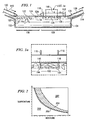
- uncooked chip pre-forms 120 are continuously fed by an entrance conveyor 110 into cooking oil 104 of a random frying section 106 of a continuous fryer 102.
- cooking oil 104 generally flows from an entrance conveyor 110 toward an exit conveyor 114 carrying chip pre-forms 122 with it.
- relatively moist chip pre-forms 122 are first introduced into cooking oil 104, their weight 122 is usually greater than the buoyancy forces acting on them and the moist chip pre-forms 122 remain submersed in the oil without aid.
- chip pre-forms 122 continue to cook and move along the path inside the continuous fryer 102 (from left to right in Figure 1 ), moisture escapes from the chip pre-forms 122 and the buoyancy forces become greater than the weight of the chip pre-forms 122.
- the chip pre-forms 124 generally float near the surface of the oil as they approach a prior art submerger 112.
- chip pre-forms 124 are generally, not rubbery, and do not have a tendency to stick to each other.
- a prior art submerger 112 generally turns at a speed slower than the flow of cooking oil 104.
- a prior art submerger 112 usually has one or more optional and generally straight paddles, cleats or fins 116. These fins 116 help gather the roughly monolayer of floating chip pre-forms 124 into a multi-layer of submerged chip pre-forms 126. The fins 116 also help ensure that submerged chip pre-forms 126 do not clump or stick together. By submerging the cooking chip pre-forms 126, the pre-forms 126 are more evenly cooked on both sides. Cooked chips 128 leave the prior art submerger 112 and exit the continuous fryer 102 on an endless exiting conveyor 114.
- any curvature in the cooked chips 128 is the result of random cooking forces acting on a submerged chip pre-form 132.
- Figure 6 illustrates typical resulting shapes of triangular snack pieces cooked according to the prior art.
- the snack pieces 128 are generally flat, but some have a minimal curvature. More or less curvature can be obtained by using the method of constrained frying.
- Liepa discloses a constrained frying method wherein mold halves each provide multiple openings distributed over the mold surfaces to permit the frying oil to pass through and come into contact with the constrained food product. The mold halves cooperate to hold the dough sections and restrain them during the trying so that the fried products conform in surface curvature with that of the mold surfaces.
- Liepa discloses the same molds and passes them through frying oil and form-fries dough pre-forms into crisp chips thereby imparting a uniform size and shape to each chip.
- U.S. Patent number 3,520,248, issued July 14, 1970 to MacKendrick discloses a machine to continuously and uniformly cut and cook snack pieces or chips from a sheet of dough.
- MacKendrick discloses a machine to positively convey snack pieces through the frying medium in the same controlled manner as disclosed by Liepa '474 where the resulting chips have a uniform color, texture, and shape.
- the MacKendrick invention improves the Liepa '474 machine by using a reciprocating cutter in place of a rotary cutter which can be operated at significantly higher speeds.
- U.S. Patent number 3,149,978 entitled "Process for Cooking Corn Dough in the Form of Chips" granted on September 22, 1964 to Anderson et al. teaches a method of imparting a controlled bent configuration to a corn masa dough chip which is cooked by deep-fat frying. Further, this invention teaches an apparatus for inducing a desired shape to the corn chips during cooking. The desired configuration is done through the use of a series of parallel wires which are mounted on a frame such that the wires may be controllably moved within the oil. The spacing of the wires is adjusted so that it is somewhat less than the diameter or maximum dimension of the chip which is to be cooked. The wires may be periodically immersed into the cooking oil to strike a portion of the cooking chips and then withdrawn.
- Dove, et al. discloses a single mold fryer.
- a single layer of cooking chips are given a uniform shape as chips are disposed against a curved or contoured submerged conveyor surface or mold surface by buoyancy forces.
- the Dove patent application has the same assignee as the present application and is entitled "Single Mold Form Fryer with Enhanced Product" having a filing date of January 21, 2003 and Serial Number 10/347,993.
- Such form frying imparts a relatively predictable and uniform shape to each snack piece, not a random curvature.
- FIG. 2 illustrates the various states of a generic polymer-like substance such as dough.
- polymer substances and farinaceous dough formulations can be pliable 202, rubbery 204 or glassy 208 at a given temperature depending on the composition of the substance. The state of a dough is especially dependent on moisture concentration.
- the state of an edible chip product made of a given dough formulation moves from a pliable rubbery state 204 through a glass transition state 206 into a permanent glassy state 208.
- the chip As the chip is cooled and subsequently packaged, the chip remains in a glassy state 208. It is at the glass transition state 206 where a cooking chip pre-form loses its pliability and assumes its final shape.
- the glass transition state 206 is somewhat of a misnomer since the term "transition" implies an equilibrium phenomenon that is invariant to the speed of the heating, cooling or other conditions.
- the actual transition point for a given product formulation may depend on the speed at which a substance is heated, cooled, or dehydrated (cooked).
- Cooked snack products are generally packaged in a random fashion in a bag or other similar container. Such random packing leads to a packaged product with a certain, relatively low bulk-density.
- Packages with low bulk density are essentially packages wherein the volume capacity of the package is much greater than the absolute volume of the snacks contained inside. The package could contain a much higher net weight of snack pieces than the volume capacity of the package if the pieces were not randomly packaged. This inefficiency is especially evident when chips have settled during shipping.
- Curved snack pieces generally have a lower bulk density when randomly packed as compared to generally flat snack pieces when randomly packed. Curved snack pieces tend not to seat against one another and tend to leave relatively larger voids between pieces as compared to flat snack pieces.
- Szwerc teaches that the use of curved pieces lowers packed product bulk density. Szwerc ⁇ 919 teaches that the snack piece's thickness, curvature, weight and orientation must be considered and potentially optimized to achieve densities above those obtained by randomly packing such pieces. Szwerc ⁇ 919 teaches the production of curved snack chips by baking. In U.S.
- US5392698 discloses a method and apparatus for preparing essentially fat-free chips without the use of a deep fat frying process.
- US3132949 on which the pre-characterising portion of claim 1 is based, discloses a process of preparing chip products from pre-cooked food products.
- US2934001 discloses a fry vat for continuous deep-frying of various types of food.
- US4187771 discloses a frying apparatus for food products including a fat holding tank and a transfer conveyor within the tank for transporting food products through the tank.
- US4170659 discloses a process of preparing a fried dough shell.
- US6412397 discloses an apparatus and method for making uniformly shaped snack food chips which can be stacked for packaging.
- US2004/0139861 discloses a single mold form fryer for the fabrication of snack food.
- the prior art does not teach methods which would provide sufficient control of the snack piece's thickness, curvature, weight, orientation, or shape to achieve a desired bulk density.
- the food industry does not design a product to have desired bulk density.
- the food industry conforms the size of a product package to a desired weight of randomly-packed product. The package is sufficiently large to accommodate variations in bulk density. Consequently, a need exists for a method to permanently impart a particular shape to snack pieces in such a way as to produce a snack product that will have a desired bulk density when randomly packaged. Further, a need exists for producing such a snack product without lowering the productivity or throughput of the process.
- the present invention provides a method for producing snack product pieces, the method being as defined in claim 1.
- a method and apparatus are disclosed which provide packaged fried snack products having a desired bulk density without reducing production efficiency or throughput. Such method and apparatus are also useful in controlling the amount of change in bulk density or amount of settling of a packaged product when exposed to settling forces during shipping or handling.
- the shape of a contoured submerger imparts a random curvature to, and determines the final shape of, each snack piece before and during dehydration through the glass transition of the snack piece during frying.
- the volume occupied by curved snack pieces is dependent upon the specific shape, dimensions, and arrangement of the individual snack pieces.
- randomly packed chips have a volumetric bulk density defined herein as the net weight of packaged snack pieces per the absolute volume of the container holding the snack pieces.
- Absolute volume is defined as the total liquid volume of the container holding the randomly packed snack pieces.
- the bulk density of randomly packed snack pieces can be measured by filling a cylindrical container of known volume and subsequently measuring the net weight of the container. The container is not packed or disturbed during the filling: the pieces may settle and ultimately take up less volume when exposed to settling forces. The bulk density after being exposed to such forces is termed the settled bulk density.
- a snack piece's thickness, curvature, weight and orientation must be considered and potentially optimized to achieve a desired bulk density.
- a desired bulk density may be obtained by imparting a certain random curvature to each snack piece.
- Snack pieces generally achieve their final shape during their transition from a rubbery state to a glass state as pre-form snack pieces are cooked, usually by frying, as explained previously and with reference to Figure 2 .
- a random curvature can be imparted to each snack piece during frying in a batch fryer using a contoured submerger while each snack piece transitions from a rubbery state to a glass state.
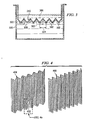
- chip pre-forms 302 are placed in a batch fryer 320 underneath a contoured submerger 310. As the chip pre-forms 302 cook, they are maintained against the contours of a contoured submerger 310 by buoyancy forces acting on the cooking chip pre-forms 302. The chip pre-forms 302 are given a random shape by the contours 306 of the submerger 310 as the chip pre-forms 302 are cooked. After a certain time, the cooked chips 302 are removed from the fryer 320 and may be further processed and packaged.
- chip pre-forms 120 are first introduced continuously into a random frying section 106 containing frying oil 104 in a continuous fryer 102.
- randomly frying chip pre-forms 122 lose sufficient moisture, typically having from 30 to 60 percent moisture when first introduced into the oil 104, and having about eight to fifteen percent moisture by weight when reaching a contoured submerger 512, they no longer have a tendency to stick to one another.
- the rubbery chip pre-forms 124 can be submerged beneath an endless contoured submerger 512. If frying chip pre-forms 122 reach, and are cooked under, a contoured submerger 512 with a higher than about ten percent moisture content, either in a single layer or in multiple layers, sticking and/or clumping can occur.
- the chip pre-forms 124 are aggregated and submerged for further cooking.
- An endless contoured submerger 512 generally does not cover the entire length of a random fryer 102.
- Chip pre-forms made of cereal flour and/or tuber flour have a residence time from about 15 to 90 seconds.
- Submerged chip pre-forms 526 may overlap to a lesser or higher degree such that there are multiple layers of chip pre-forms 526 along the length of the contoured submerger 512.
- chip pre-forms 526 While chip pre-forms 526 are losing moisture through cooking under the contoured submerger 512, the chip pre-forms 526 are going from a rubbery state through a glass transition and into a glass state. The final shape of each piece is obtained as each chip reaches this glass state. For a typical dough formulation, when cooking chip pre-forms 526 have about five percent moisture by weight, these pre-forms may be removed from the contoured submerger 512 without affecting the final shape of the finished shaped chip product 528.
- a contoured submerger 512 in a submerging section 108 of a continuous fryer 102 has contours 516 differing substantially from the prior art.
- a contoured submerger 512 is not merely a submerging conveyor belt with fins, as shown in a typical prior art embodiment in Figure 1 .
- a contoured submerger 512 has a V-shaped profile wherein each contour 516 has a contour height 530.
- the distance between sequential contours 516 is the contour spacing 518.
- the contour spacing 518 is uniform from contour 516 to contour 516. However, in other embodiments, the contour spacing 518 may be different between successive contours 516.
- the contours 516 provide improved aggregation of cooking rubbery chip pre-forms 124 as they reach a first contoured submerger 512.
- Contours are generally used in lieu of submerger fins and give improved functionality.
- each submerged chip pre-form 526 is forced under the oil 104 more consistently as the contours 516 of a first contoured submerger 512 engage the arriving rubbery chip pre-forms 124. Since the contour spacing 518 is generally shorter than the distance between sequential fins on a prior art submerging conveyor, the submerged chip pre-forms 526 move along in improved plug flow.
- each shaped, cooked piece 528 is dependent upon the overall profile or shape of a contoured submerger 512, the spacing between subsequent contours 518, the number of layers of cooking pre-forms 526 beneath the submerger 512, and the dough formulation and shape of each pre-form 526.
- a contour depth 530 of a contoured submerger 512 may be any size and may vary from contour 516 to contour 516. However, the contour depth 530 is preferably large enough to accommodate multiple layers of cooking chip pre-forms 526 while maintaining all such pre-forms 526 in plug flow as the contoured submerger 512 directs them toward a fryer exit conveyor 114.
- chip pre-forms 526 are maintained for a short duration in multiple layers on a first contoured submerger 512.
- the duration depends upon the moisture content of the submerged cooking chip pre-forms 526.
- the chip pre-forms obtain their final shape under a first contoured submerger 512 by passing into a glass state. At this point, cooking chip pre-forms 526 may pass to subsequent submergers without losing their shape. Subsequent submergers aid in cooking the cooking chip pre-forms 526 until they have a final desired moisture content; in one embodiment, a final moisture content is about two percent by weight. A final moisture content may be as low as one percent. Subsequent submergers may not be of the same shape, speed, contour, or size of a first contoured submerger 512. Subsequent submergers may even resemble prior art submergers.
- submerged cooking chip pre-forms 526 are not in their final shape when passed to subsequent submergers.
- submerged chip pre-forms 526 obtain an initial shape from a first contoured submerger 512, and their final shape from subsequent submergers. Such submerged chip pre-forms pass into a glass state under subsequent submergers. Finished shaped chip products 528 are removed from the cooking oil 104 on an exit conveyor 114.
- Such finished chip products 528 are subsequently packaged.
- Such finished chip products generally have a lower bulk density, and thus fill more of a container, even after finished chip product packages are exposed to settling forces such as during shipping and handling.
- Such lower bulk density generally provides finished chip products with higher consumer appeal than finished chip products having a higher bulk density.
- contours in a continuous fryer 102 generally lie perpendicular to the flow of chip pre-forms 302. However, the contours may run in any direction, or may have no direction or may have no uniform shape at all. The contours may even lie parallel to the flow of oil and chip pre-forms 302 in a continuous fryer 102.
- the contours may be composed of a non-repeating, noncontinuous set of surface features.
- a contoured submerger has a V-shaped profile having uniform contour spacing 1002, or alternatively, with non-uniform contour spacing 1004.
- a contoured submerger has a sinusoidal profile with uniform contour spacing 1006, or with non-uniform contour spacing 1008.
- a contoured submerger has a crenellated profile 1010 that may or may not have uniform contour spacing.
- a variation of this embodiment is a contour profile having crenellations that are each tapered 1012, and wherein the contour spacing may or may not be uniform.
- a contoured submerger is composed of non-uniformly sized spheres 1014 or, alternatively, conical protrusions 1016.
- a contoured submerger may be composed of a variety of similar shapes and/or profiles described herein.
- a contoured submerger may also have three dimensional contour profiles such as, but not limited to, an egg carton-like profile having peaks and valleys at regular or irregular intervals.
- Such embodiments shown in Figure 10 are by way of illustration and not limitation. The following examples more fully illustrate the practice of the invention.
- An exemplary embodiment of the methods for producing snack product pieces having a random curvature and a bulk density includes the following sequential steps: feeding snack product pre-forms into a fryer having fryer oil. This is followed by the step of using a contoured submerger to submerge the snack product pre-forms in the fryer oil.
- the contours of the submerger have a cross-sectional shape, a contour height, and a contour spacing.
- a random curvature is then given to the snack product pre-forms using the contoured submerger, in a next step.
- Frying of the snack product pre-forms in at least two submerged layers, to a final moisture content, to form fried snack product pieces is carried out with the at least two layers of pre-forms formed on the contoured submerger.
- the fried snack product pieces maintain their random curvature. After frying follows the step of moving the snack product pieces from the fryer.
- various contoured submergers having different shapes or contours were used to cook chip pre-forms shaped as equilateral triangles.
- various shapes or profiles of a contoured submerger 310 were tested in a batch fryer 320 so as to affect the bulk density of a particular formulation and shape of snack piece.
- one contoured submerger 310 was shaped as a sinusoidal wave, and the bulk density of the resultant cooked snack pieces was about 0.120 g / cu. cm (7.5 lb/cu. ft.; 0.0694 oz / cu. in); from that shape.
- the resultant bulk density of snack pieces was about 0.100 g / cu. cm (6.25 lb/cu. ft.; 0.0579 oz / cu. in.).
- resulting cooked and packaged chips had a bulk density over the range from about 0.096 g / cu. cm (6.0 lb/cu. ft.; 0.0556 oz / cu. in.) to about 0.120 g / cu. cm (7.5 lb/cu. ft.; 0.0694 oz / cu. in.); when cooked with these shaped or contoured submergers.
- a flat contoured submerger as understood and routinely used in the prior art, was used to cook pre-form snack pieces of the same shape, the pieces cooked therewith serving as a reference.
- the bulk density from the use of the flat contoured submerger 310 was about 0.136 g / cu. cm (8.5 lb/cu. ft.; 0.0787 oz / cu. in.).
- two contoured submergers differing from the submergers used in Example 1, and having different V-shaped profiles, were evaluated as to their effect on the bulk density of a snack product.
- Batches of snack product pre-forms in the shape of equilateral triangles were made from a dough sheet before being batch fried.
- the pre-forms in Example 2 were made from a dough formulation substantially different from that used in Example 1.
- the bulk density of pieces fried under the two contoured submergers in this example were compared against the bulk density of pieces fried under a control contoured submerger: a flat stainless steel perforated sheet or steel mesh.
- the two contoured submergers 404, 406 of Example 2 are shown in Figure 4 and both have V-shaped contour profiles.
- One contoured submerger 404 has contours with a larger contour spacing, or distance between successive contours, as compared to the other contoured submerger 406.
- batches of pre-form pieces were cooked with each of the three submergers described previously, and the resulting weight and volume were recorded for each sample.
- the control batches numbered 1-3 in Table 1 were cooked under the control or flat submerger.
- the S1 samples numbered 1-3 in Table 1 were cooked with the submerger having the more narrow V-shaped contours 406 as compared to the contours 404 of the submerger used to cook the S2 samples numbered 1-3.
- Example 2 Each batch of cooked chips of Example 2 were randomly packed into a rigid cylindrical container. Each batch received ten taps to simulate settling forces from shipping and handling. The volume after settling and the resultant settled bulk density of each batch are recorded in Table 1.
- the mean settled bulk density was 0.088g/cu.cm (0.0506 ounces per cubic inch (oz/cu. in.)) with a standard deviation of 0.006g/cu.cm (0.0032 oz/cu. in.).
- the mean bulk density was 0.073g/cu.cm (0.0420 oz/cu. in). with a standard deviation of 0.004g/cu.cm (0.0023 oz/cu. in.).
- the mean bulk density was 0.063g/cu.cm (0.0366 oz/cu. in.) with a standard deviation of 0.002g/cu.cm (0.0010 oz/cu. in.).
- Table 1 Results from frying snack pieces with two different V-shaped contoured submergers Initial Volume, Volume after Settled Bulk Settled Bulk Sample Weight, g L Settling, L Density, oz/cu. in. Density, g/cu.
- Control-1 302 4.0 3.7 0.0473 0.082
- Control-2 334 4.0 3.8 0.0508 0.088
- Control-3 353 4.2 3.8 0.0537 0.093 S1-1 259 4.0 3.8 0.0393 0.068 S1-2 285 3.9 3.8 0.0433 0.075 S1-3 278 3.9 3.7 0.0434 0.075 S2-1 256 4.2 4.0 0.0370 0.064 S2-2 246 4.1 4.0 0.0355 0.061 S2-3 245 4.1 3.8 0.0373 0.064
- Figure 8 and Figure 9 are drawings taken from photographs of pieces packed in a cylindrical container.
- Figure 8 shows control pieces 806 packed relatively densely.
- Figure 8 there are many snack pieces 806 which lie substantially parallel with one another.
- Figure 9 shows S2 pieces 904 packed in an identical container 802.
- the decreased bulk density, and thus larger volume of chips in the container is generally preferred for appearance purposes by consumers.
Landscapes
- Chemical & Material Sciences (AREA)
- Engineering & Computer Science (AREA)
- Food Science & Technology (AREA)
- Oil, Petroleum & Natural Gas (AREA)
- Health & Medical Sciences (AREA)
- Nutrition Science (AREA)
- Life Sciences & Earth Sciences (AREA)
- Polymers & Plastics (AREA)
- Confectionery (AREA)
- Preparation Of Fruits And Vegetables (AREA)
- Frying-Pans Or Fryers (AREA)
- General Preparation And Processing Of Foods (AREA)
Description
- The present invention relates to a method to control the bulk density of packaged fried snack pieces. More specifically, this invention relates to imparting a random shape or curvature to each snack piece during cooking or frying in such a way as to control the resultant bulk density of such product when packaged.
- In the food industry, there are two typical methods of frying snack pieces such as potato chips: random frying and constrained frying. One popular random frying method is to fry uncooked pre-formed snack pieces in a random frying section of a multi-layer continuous fryer and allow buoyancy forces to impart a random shape or curvature to each snack piece. Several patents illustrate such random frying methods, as those disclosed in
Pringle et al., U.S. Pat. No. 2,286,644 entitled "Method and Apparatus for Processing Potatoes" issued Jun. 16, 1942, andAnderson et al., U.S. Pat. No. 3,149,978 entitled "Process for Cooking Corn Dough in the Form of Chips" issued Sept. 22,1964 and assigned to Arthur D. Little, Inc. -
U.S. Patent number 3,608,474 issued September 28, 1971 to Liepa , discloses a random frying method for making potato chip products. Liepa '474 suggests slicing raw potatoes, cooking these loose slices in a reservoir of hot oil for a predetermined time where the slices are fried to a crisp state, and then removing the fried chips from the oil. The chips so prepared have a random surface curvature which is influenced by the diameter and thickness of the potato slices and is dependent both upon the amount of time the slices are immersed in the hot oil and the temperature of the oil. In the prior art, a constrained or form frying method is difficult to use with snack pieces of different sizes or shapes. Instead, random frying is typically used on these pieces of varying size or shape. - Liepa '474 also teaches that the random shapes which the chips assume require that they be randomly packaged. Random packing is used because it is relatively cheap, requires less energy and is less complicated than packing snack pieces into a high-density nested arrangement or packed alignment. Randomly packed snack piece packages require larger amounts of store shelf and consumer pantry shelf space. Generally, when a consumer opens such package, the snack pieces have settled and the bulk density has increased leaving a substantial void within the package. It would be ideal if the randomly packed pieces filled the entire package at the time the package is opened even after some settling occurred during shipping and handling.
- According to the prior art, and with reference to
Figure 1 , uncooked chip pre-forms 120 are continuously fed by anentrance conveyor 110 intocooking oil 104 of arandom frying section 106 of acontinuous fryer 102. In acontinuous fryer 102,cooking oil 104 generally flows from anentrance conveyor 110 toward anexit conveyor 114 carrying chip pre-forms 122 with it. As relatively moist chip pre-forms 122 are first introduced intocooking oil 104, theirweight 122 is usually greater than the buoyancy forces acting on them and the moist chip pre-forms 122 remain submersed in the oil without aid. As chip pre-forms 122 continue to cook and move along the path inside the continuous fryer 102 (from left to right inFigure 1 ), moisture escapes from the chip pre-forms 122 and the buoyancy forces become greater than the weight of the chip pre-forms 122. At that point, the chip pre-forms 124 generally float near the surface of the oil as they approach aprior art submerger 112. At this point, chip pre-forms 124 are generally, not rubbery, and do not have a tendency to stick to each other. - A
prior art submerger 112 generally turns at a speed slower than the flow ofcooking oil 104. Aprior art submerger 112 usually has one or more optional and generally straight paddles, cleats orfins 116. Thesefins 116 help gather the roughly monolayer of floating chip pre-forms 124 into a multi-layer of submerged chip pre-forms 126. Thefins 116 also help ensure that submerged chip pre-forms 126 do not clump or stick together. By submerging the cooking chip pre-forms 126, the pre-forms 126 are more evenly cooked on both sides. Cookedchips 128 leave theprior art submerger 112 and exit thecontinuous fryer 102 on an endless exitingconveyor 114. - According to the prior art, reference to
Figure 1a , the majority of submerged chip pre-forms 132 lay flat as they are transported along the cooking path. These pre-forms 132 leave the continuous fryer as generally flat cooked chips; any curvature in the cookedchips 128 is the result of random cooking forces acting on a submerged chip pre-form 132. However, by chance a few submerged chip pre-forms 134 overlap or randomly press against afin 116 or another submerged chip pre-forms 132 in such a way as to gain an exaggerated curvature.Figure 6 illustrates typical resulting shapes of triangular snack pieces cooked according to the prior art. Thesnack pieces 128 are generally flat, but some have a minimal curvature. More or less curvature can be obtained by using the method of constrained frying. - The other typical method of frying snack pieces is through the use of constrained or form frying. Several patents disclose methods of imparting a curvature to chip-type products made from a dough sheet by constrained frying methods. For example, a method to produce rippled chip-type products is disclosed in
U.S. Patent number 2,286,644 by Pringle et al., issued June 16, 1942 entitled "Method and Apparatus for Processing Potatoes." Other U.S. patents disclose other similar methods to impart a desired final curvature or shape to a snack piece. InU.S. Patent number 3,998,975 issued December 21, 1976, Liepa et al. discloses a method to form uncooked snack pieces into a desired shape by drying the pieces sufficiently and frying the pieces to a finished state before packaging. - In
U.S. Patent number 3,576,647 issued April 27, 1971, Liepa discloses a constrained frying method wherein mold halves each provide multiple openings distributed over the mold surfaces to permit the frying oil to pass through and come into contact with the constrained food product. The mold halves cooperate to hold the dough sections and restrain them during the trying so that the fried products conform in surface curvature with that of the mold surfaces. Similarly, in relatedU.S. Patents, number 3,608,474 issued September 28, 1971 , andU.S. Patent number 3,626,466 issued December 7, 1971, Liepa discloses the same molds and passes them through frying oil and form-fries dough pre-forms into crisp chips thereby imparting a uniform size and shape to each chip. -
U.S. Patent number 3,520,248, issued July 14, 1970 to MacKendrick , discloses a machine to continuously and uniformly cut and cook snack pieces or chips from a sheet of dough. MacKendrick discloses a machine to positively convey snack pieces through the frying medium in the same controlled manner as disclosed by Liepa '474 where the resulting chips have a uniform color, texture, and shape. The MacKendrick invention improves the Liepa '474 machine by using a reciprocating cutter in place of a rotary cutter which can be operated at significantly higher speeds. -
U.S. Patent number 3,149,978 entitled "Process for Cooking Corn Dough in the Form of Chips" granted on September 22, 1964 to Anderson et al., teaches a method of imparting a controlled bent configuration to a corn masa dough chip which is cooked by deep-fat frying. Further, this invention teaches an apparatus for inducing a desired shape to the corn chips during cooking. The desired configuration is done through the use of a series of parallel wires which are mounted on a frame such that the wires may be controllably moved within the oil. The spacing of the wires is adjusted so that it is somewhat less than the diameter or maximum dimension of the chip which is to be cooked. The wires may be periodically immersed into the cooking oil to strike a portion of the cooking chips and then withdrawn. When forcing the parallel wires into the cooking oil, the wires impart a curvature to the chips either when the wires strike the chips, pushing them deeper into the oil, or when the chips rise after being pushed momentarily deeper into the cooking oil, or by a combination of these actions. By this process not all of the chips are contacted and bent. Anderson et al. '978 teaches that it is preferred not to give a bend to all of the chips because it is desirable to package corn chips which are a combination of those having a flat and bent configuration, the latter amount consisting of about 25% to 75% of the total number of chips. - In a recent U.S. patent application, Dove, et al. discloses a single mold fryer. A single layer of cooking chips are given a uniform shape as chips are disposed against a curved or contoured submerged conveyor surface or mold surface by buoyancy forces. The Dove patent application has the same assignee as the present application and is entitled "Single Mold Form Fryer with Enhanced Product" having a filing date of January 21, 2003 and Serial Number 10/347,993. Such form frying imparts a relatively predictable and uniform shape to each snack piece, not a random curvature.
- Anderson et al. '978 mentioned above teaches that curvature must be imparted during frying before a critical time when the frying chips assume their permanent configuration or shape. This critical time occurs when a given dough formulation reaches a glass transition point.
Figure 2 illustrates the various states of a generic polymer-like substance such as dough. Referring toFigure 2 , polymer substances and farinaceous dough formulations can be pliable 202, rubbery 204 or glassy 208 at a given temperature depending on the composition of the substance. The state of a dough is especially dependent on moisture concentration. In a typical case, the state of an edible chip product made of a given dough formulation, as it loses moisture while cooking at a constant given temperature, moves from a pliablerubbery state 204 through aglass transition state 206 into a permanentglassy state 208. As the chip is cooled and subsequently packaged, the chip remains in aglassy state 208. It is at theglass transition state 206 where a cooking chip pre-form loses its pliability and assumes its final shape. Theglass transition state 206 is somewhat of a misnomer since the term "transition" implies an equilibrium phenomenon that is invariant to the speed of the heating, cooling or other conditions. The actual transition point for a given product formulation may depend on the speed at which a substance is heated, cooled, or dehydrated (cooked). - Cooked snack products are generally packaged in a random fashion in a bag or other similar container. Such random packing leads to a packaged product with a certain, relatively low bulk-density. Packages with low bulk density are essentially packages wherein the volume capacity of the package is much greater than the absolute volume of the snacks contained inside. The package could contain a much higher net weight of snack pieces than the volume capacity of the package if the pieces were not randomly packaged. This inefficiency is especially evident when chips have settled during shipping.
- Curved snack pieces generally have a lower bulk density when randomly packed as compared to generally flat snack pieces when randomly packed. Curved snack pieces tend not to seat against one another and tend to leave relatively larger voids between pieces as compared to flat snack pieces. In
U.S. Patent number 4,844,919, issued on July 4, 1989 , Szwerc teaches that the use of curved pieces lowers packed product bulk density. Szwerc `919 teaches that the snack piece's thickness, curvature, weight and orientation must be considered and potentially optimized to achieve densities above those obtained by randomly packing such pieces. Szwerc `919 teaches the production of curved snack chips by baking. InU.S. published patent application number 09/851040 entitled "Snack Piece Having Increased Packed Density," Zimmerman et al. teaches that the shape and thickness of snack pieces can contribute to lower packed densities. Zimmerman teaches that the interference between adjacent snack pieces due to irregular sizing leads to increased space between nested pieces, subsequently leading to a lower bulk density. -
US5392698 discloses a method and apparatus for preparing essentially fat-free chips without the use of a deep fat frying process.US3132949 , on which the pre-characterising portion ofclaim 1 is based, discloses a process of preparing chip products from pre-cooked food products.US2934001 discloses a fry vat for continuous deep-frying of various types of food.US4187771 discloses a frying apparatus for food products including a fat holding tank and a transfer conveyor within the tank for transporting food products through the tank.US4170659 discloses a process of preparing a fried dough shell.US6412397 discloses an apparatus and method for making uniformly shaped snack food chips which can be stacked for packaging.US2004/0139861 discloses a single mold form fryer for the fabrication of snack food. - However, the prior art does not teach methods which would provide sufficient control of the snack piece's thickness, curvature, weight, orientation, or shape to achieve a desired bulk density. Currently, the food industry does not design a product to have desired bulk density. The food industry conforms the size of a product package to a desired weight of randomly-packed product. The package is sufficiently large to accommodate variations in bulk density. Consequently, a need exists for a method to permanently impart a particular shape to snack pieces in such a way as to produce a snack product that will have a desired bulk density when randomly packaged. Further, a need exists for producing such a snack product without lowering the productivity or throughput of the process.
- Further, a need exists for a method to control the amount of change in bulk density during the time a snack product package is exposed to settling forces during shipping and handling. Specifically, a need exists to prevent settling of chips wherein a substantial void remains in the product package. A need exists for an optimal packing that would also minimize breakage of chips. The benefit of filling this need would be an improved perception by consumers that the package is more substantially filled with product. Further, there is a need for loosely packed consumer products. In such a case there would be a lower bulk density and less shingling of chips within each package.
- Further, a need exists for a method and apparatus which cooks snack pieces with a more consistent, controlled, and predictable cooking time. Such method and apparatus would produce chips with a more uniform color and texture. Such a method and apparatus would meet these criteria and could be used in a high-speed production environment. It is therefore an object of this invention to provide a method of imparting a controlled bent configuration to fried snack product pieces. These and other objects will become apparent in the following detailed description.
- The present invention provides a method for producing snack product pieces, the method being as defined in
claim 1. - A method and apparatus are disclosed which provide packaged fried snack products having a desired bulk density without reducing production efficiency or throughput. Such method and apparatus are also useful in controlling the amount of change in bulk density or amount of settling of a packaged product when exposed to settling forces during shipping or handling. The shape of a contoured submerger imparts a random curvature to, and determines the final shape of, each snack piece before and during dehydration through the glass transition of the snack piece during frying.
- The novel features believed characteristic of the invention are set forth in the appended claims. The invention itself, however, as well as a preferred mode of use, further objectives and advantages thereof, will be best understood by reference to the following detailed description of illustrative embodiments when read in conjunction with the accompanying drawings, wherein:
-
Figure 1 is a side cross-sectional view of a continuous fryer apparatus with a continuous submerging conveyor according to the prior art; -
Figure 1a is a close-up view of the continuous submerging conveyor shown inFigure 1 ; -
Figure 2 is a generic rubber/glass transition diagram for a polymeric substance such as a dough used for making snack pieces or chips showing temperature increasing from bottom to top on the vertical axis, and moisture content increasing from left to right on the horizontal axis; -
Figure 3 is a side cross-sectional view of a batch fryer having a contoured submerger which imparts a random curvature to cooking chip pre-forms according to one embodiment of the present invention; -
Figure 4 is a perspective view of two contoured submergers used in embodiments of the invention each with a different V-shaped contour profile or cross-sectional shape; -
Figure 4a is a close-up view of one of the contoured submergers shown inFigure 4 showing a triangular chip pre-form pressed against one of the contours of the submerger; -
Figure 5 is a side cross-sectional view of a continuous fryer apparatus with a continuous contoured submerging conveyor according to one embodiment of the present invention; -
Figure 5a is a close-up view of a continuous fryer apparatus with a continuous contoured submerging conveyor according to one embodiment of the present invention; -
Figure 6 is perspective view of triangular cooked snack pieces cooked under a flat submerger according to the prior art illustrating typical, slight, naturally-occurring curvatures of the cooked product; -
Figure 7 is perspective view of triangular cooked snack pieces cooked according to one embodiment of the present invention showing randomly generated curvatures imparted by a contoured submerger; -
Figure 8 is perspective view of a container of cooked snack pieces which were cooked under a flat submerger according to the prior art, and as shown inFigure 6 ; -
Figure 9 is perspective view of a container of cooked snack pieces which were cooked according to the present invention under a contoured submerger, and as shown inFigure 7 ; and, -
Figure 10 is a side cross-sectional view of various possible configurations of cross-sectional shapes of a contoured submerger according to the present invention. -
- 102
- continuous fryer
- 104
- frying or cooking oil
- 106
- random frying section of continuous fryer
- 108
- submerging section of continuous fryer
- 110
- entrance conveyor
- 112
- prior art submerger
- 114
- exit conveyor
- 116
- paddle or fin
- 120
- uncooked chip pre-form
- 122
- frying chip pre-form
- 122
- moist chip pre-form
- 124
- rubbery floating chip pre-form
- 126
- submerged chip pre-form
- 128
- cooked snack pieces
- 132
- submerged chip pre-form
- 134
- submerged chip pre-form with exaggerated curvature
- 202
- pliable state
- 204
- rubbery state
- 206
- glass transition state
- 208
- glassy state
- 302
- cooking chip pre-form
- 304
- distance between subsequent contours
- 306
- contours of the submerger
- 308
- batch fryer oil
- 310
- contoured submerger
- 320
- batch fryer
- 402
- chip pre-form conformed to contour of contoured submerger
- 404
- contoured submerger having V-shaped contour profile
- 406
- contoured submerger having V-shaped contour profile
- 512
- contoured submerger
- 516
- contours of contoured submerger
- 518
- contour spacing
- 512
- first contoured submerger
- 512
- endless contoured submerger
- 526
- cooking chip pre-form
- 528
- shaped cooked snack piece
- 530
- contour height
- 542
- subsequent submerger
- 802
- cylindrical container
- 804
- void space
- 806
- control snack piece
- 904
- shaped snack piece
- 1002
- V-shaped contour profile having uniform spacing
- 1004
- V-shaped contour profile having non-uniform spacing
- 1006
- sinusoidal contour profile having uniform spacing
- 1008
- sinusoidal contour profile having non-uniform spacing
- 1010
- crenellated contour profile having uniform spacing
- 1012
- contour profile having tapered crenellations and non-uniform spacing
- 1014
- contour profile composed of non-uniformly sized spheres
- 1016
- contour profile composed of conical protrusions
- While the invention is described below with respect to a preferred embodiment, other embodiments are possible. The concepts disclosed herein apply equally to other systems for frying various types of pliable snack pre-forms and imparting a random curvature to each snack piece.
- The volume occupied by curved snack pieces is dependent upon the specific shape, dimensions, and arrangement of the individual snack pieces. In the present invention, randomly packed chips have a volumetric bulk density defined herein as the net weight of packaged snack pieces per the absolute volume of the container holding the snack pieces. Absolute volume, as used herein, is defined as the total liquid volume of the container holding the randomly packed snack pieces. As one example, the bulk density of randomly packed snack pieces can be measured by filling a cylindrical container of known volume and subsequently measuring the net weight of the container. The container is not packed or disturbed during the filling: the pieces may settle and ultimately take up less volume when exposed to settling forces. The bulk density after being exposed to such forces is termed the settled bulk density.
- To control bulk density of snack pieces formed from a dough sheet, it is necessary to control the shape and curvature of each piece. However, merely creating snack pieces with curvature does not always produce higher or lower bulk densities as compared to flat pieces. A snack piece's thickness, curvature, weight and orientation must be considered and potentially optimized to achieve a desired bulk density. A desired bulk density may be obtained by imparting a certain random curvature to each snack piece.
- Snack pieces generally achieve their final shape during their transition from a rubbery state to a glass state as pre-form snack pieces are cooked, usually by frying, as explained previously and with reference to
Figure 2 . A random curvature can be imparted to each snack piece during frying in a batch fryer using a contoured submerger while each snack piece transitions from a rubbery state to a glass state. - In one embodiment, and with reference to
Figure 3 , chip pre-forms 302 are placed in abatch fryer 320 underneath acontoured submerger 310. As the chip pre-forms 302 cook, they are maintained against the contours of acontoured submerger 310 by buoyancy forces acting on thecooking chip pre-forms 302. The chip pre-forms 302 are given a random shape by thecontours 306 of thesubmerger 310 as thechip pre-forms 302 are cooked. After a certain time, the cookedchips 302 are removed from thefryer 320 and may be further processed and packaged. - In another embodiment and with reference to
Figure 5 , chip pre-forms 120 are first introduced continuously into arandom frying section 106 containingfrying oil 104 in acontinuous fryer 102. As randomly fryingchip pre-forms 122 lose sufficient moisture, typically having from 30 to 60 percent moisture when first introduced into theoil 104, and having about eight to fifteen percent moisture by weight when reaching acontoured submerger 512, they no longer have a tendency to stick to one another. At this point, the rubbery chip pre-forms 124 can be submerged beneath an endless contouredsubmerger 512. Iffrying chip pre-forms 122 reach, and are cooked under, acontoured submerger 512 with a higher than about ten percent moisture content, either in a single layer or in multiple layers, sticking and/or clumping can occur. - With reference to
Figure 5 , in a preferred embodiment, as rubbery chip pre-forms 124 reach acontoured submerger 512, thechip pre-forms 124 are aggregated and submerged for further cooking. An endless contouredsubmerger 512 generally does not cover the entire length of arandom fryer 102. Chip pre-forms made of cereal flour and/or tuber flour have a residence time from about 15 to 90 seconds. Submerged chip pre-forms 526 may overlap to a lesser or higher degree such that there are multiple layers ofchip pre-forms 526 along the length of thecontoured submerger 512. While chip pre-forms 526 are losing moisture through cooking under thecontoured submerger 512, thechip pre-forms 526 are going from a rubbery state through a glass transition and into a glass state. The final shape of each piece is obtained as each chip reaches this glass state. For a typical dough formulation, when cookingchip pre-forms 526 have about five percent moisture by weight, these pre-forms may be removed from the contouredsubmerger 512 without affecting the final shape of the finished shapedchip product 528. - With reference to
Figure 5 , acontoured submerger 512 in asubmerging section 108 of acontinuous fryer 102 hascontours 516 differing substantially from the prior art. Acontoured submerger 512 is not merely a submerging conveyor belt with fins, as shown in a typical prior art embodiment inFigure 1 . In one embodiment of the invention, acontoured submerger 512 has a V-shaped profile wherein eachcontour 516 has acontour height 530. The distance betweensequential contours 516 is thecontour spacing 518. In one embodiment, thecontour spacing 518 is uniform fromcontour 516 tocontour 516. However, in other embodiments, thecontour spacing 518 may be different betweensuccessive contours 516. - The
contours 516 provide improved aggregation of cooking rubbery chip pre-forms 124 as they reach a first contouredsubmerger 512. Generally, per unit length of conveyor, there aremore contours 516 than submerger fins (116 inFigure 1 ). Contours are generally used in lieu of submerger fins and give improved functionality. With the use ofcontours 516, each submergedchip pre-form 526 is forced under theoil 104 more consistently as thecontours 516 of a first contouredsubmerger 512 engage the arrivingrubbery chip pre-forms 124. Since thecontour spacing 518 is generally shorter than the distance between sequential fins on a prior art submerging conveyor, the submergedchip pre-forms 526 move along in improved plug flow. - With reference to
Figure 5a , while the cooking chip pre-forms are pressed upward against thecontours 516 of a contoured submerger by buoyancy forces, these pieces conform to the curvature or shape of thecontours 516. Because eachpiece 526 is located at a random place along thecontours 516, a random shape is imparted to eachpiece 526. A preferred random curvature, and resultant bulk density, is obtained when the spacing betweenadjacent contours 518 is larger than the largest dimension of eachsnack piece 526. However, other spacing ofcontours 518 can be used to produce finished shapedpieces 528 having a desired bulk density. The final curvature of each shaped, cookedpiece 528 is dependent upon the overall profile or shape of acontoured submerger 512, the spacing betweensubsequent contours 518, the number of layers ofcooking pre-forms 526 beneath thesubmerger 512, and the dough formulation and shape of each pre-form 526. Acontour depth 530 of acontoured submerger 512 may be any size and may vary fromcontour 516 tocontour 516. However, thecontour depth 530 is preferably large enough to accommodate multiple layers ofcooking chip pre-forms 526 while maintaining allsuch pre-forms 526 in plug flow as thecontoured submerger 512 directs them toward afryer exit conveyor 114. - In another embodiment, chip pre-forms 526 are maintained for a short duration in multiple layers on a first contoured
submerger 512. The duration depends upon the moisture content of the submergedcooking chip pre-forms 526. The chip pre-forms obtain their final shape under a first contouredsubmerger 512 by passing into a glass state. At this point,cooking chip pre-forms 526 may pass to subsequent submergers without losing their shape. Subsequent submergers aid in cooking thecooking chip pre-forms 526 until they have a final desired moisture content; in one embodiment, a final moisture content is about two percent by weight. A final moisture content may be as low as one percent. Subsequent submergers may not be of the same shape, speed, contour, or size of a first contouredsubmerger 512. Subsequent submergers may even resemble prior art submergers. - In a further embodiment, submerged
cooking chip pre-forms 526 are not in their final shape when passed to subsequent submergers. In such an embodiment, submergedchip pre-forms 526 obtain an initial shape from a first contouredsubmerger 512, and their final shape from subsequent submergers. Such submerged chip pre-forms pass into a glass state under subsequent submergers. Finished shapedchip products 528 are removed from thecooking oil 104 on anexit conveyor 114. -
Finished chip products 528 are subsequently packaged. Such finished chip products generally have a lower bulk density, and thus fill more of a container, even after finished chip product packages are exposed to settling forces such as during shipping and handling. Such lower bulk density generally provides finished chip products with higher consumer appeal than finished chip products having a higher bulk density. - Various embodiments of a contoured submerger are envisioned.
Figure 10 illustrates some of the various profiles or contours that may be used. In certain embodiments, contours in acontinuous fryer 102 generally lie perpendicular to the flow ofchip pre-forms 302. However, the contours may run in any direction, or may have no direction or may have no uniform shape at all. The contours may even lie parallel to the flow of oil and chip pre-forms 302 in acontinuous fryer 102. The contours may be composed of a non-repeating, noncontinuous set of surface features. - With reference to
Figure 10 , in one embodiment, a contoured submerger has a V-shaped profile havinguniform contour spacing 1002, or alternatively, withnon-uniform contour spacing 1004. In an alternate embodiment, a contoured submerger has a sinusoidal profile withuniform contour spacing 1006, or withnon-uniform contour spacing 1008. In still another embodiment, a contoured submerger has acrenellated profile 1010 that may or may not have uniform contour spacing. A variation of this embodiment is a contour profile having crenellations that are each tapered 1012, and wherein the contour spacing may or may not be uniform. - In another embodiment, a contoured submerger is composed of non-uniformly
sized spheres 1014 or, alternatively,conical protrusions 1016. In a variation of such embodiment, a contoured submerger may be composed of a variety of similar shapes and/or profiles described herein. A contoured submerger may also have three dimensional contour profiles such as, but not limited to, an egg carton-like profile having peaks and valleys at regular or irregular intervals. Such embodiments shown inFigure 10 are by way of illustration and not limitation. The following examples more fully illustrate the practice of the invention. - An exemplary embodiment of the methods for producing snack product pieces having a random curvature and a bulk density, includes the following sequential steps: feeding snack product pre-forms into a fryer having fryer oil. This is followed by the step of using a contoured submerger to submerge the snack product pre-forms in the fryer oil. The contours of the submerger have a cross-sectional shape, a contour height, and a contour spacing. A random curvature is then given to the snack product pre-forms using the contoured submerger, in a next step. Frying of the snack product pre-forms in at least two submerged layers, to a final moisture content, to form fried snack product pieces is carried out with the at least two layers of pre-forms formed on the contoured submerger. The fried snack product pieces maintain their random curvature. After frying follows the step of moving the snack product pieces from the fryer.
- In a first example, various contoured submergers having different shapes or contours were used to cook chip pre-forms shaped as equilateral triangles. With reference to
Figure 3 , various shapes or profiles of acontoured submerger 310 were tested in abatch fryer 320 so as to affect the bulk density of a particular formulation and shape of snack piece. In this example, one contouredsubmerger 310 was shaped as a sinusoidal wave, and the bulk density of the resultant cooked snack pieces was about 0.120 g / cu. cm (7.5 lb/cu. ft.; 0.0694 oz / cu. in); from that shape. Using a different contoured V-shapedsubmerger 310, the resultant bulk density of snack pieces was about 0.100 g / cu. cm (6.25 lb/cu. ft.; 0.0579 oz / cu. in.). Using various shapes of contoured submergers, resulting cooked and packaged chips had a bulk density over the range from about 0.096 g / cu. cm (6.0 lb/cu. ft.; 0.0556 oz / cu. in.) to about 0.120 g / cu. cm (7.5 lb/cu. ft.; 0.0694 oz / cu. in.); when cooked with these shaped or contoured submergers. Finally, a flat contoured submerger, as understood and routinely used in the prior art, was used to cook pre-form snack pieces of the same shape, the pieces cooked therewith serving as a reference. The bulk density from the use of the flat contouredsubmerger 310 was about 0.136 g / cu. cm (8.5 lb/cu. ft.; 0.0787 oz / cu. in.). - In a second example of the present invention, two contoured submergers, differing from the submergers used in Example 1, and having different V-shaped profiles, were evaluated as to their effect on the bulk density of a snack product. Batches of snack product pre-forms in the shape of equilateral triangles were made from a dough sheet before being batch fried. The pre-forms in Example 2 were made from a dough formulation substantially different from that used in Example 1. The bulk density of pieces fried under the two contoured submergers in this example were compared against the bulk density of pieces fried under a control contoured submerger: a flat stainless steel perforated sheet or steel mesh. The two
contoured submergers Figure 4 and both have V-shaped contour profiles. Onecontoured submerger 404 has contours with a larger contour spacing, or distance between successive contours, as compared to the other contouredsubmerger 406. - With reference to Table 1, batches of pre-form pieces were cooked with each of the three submergers described previously, and the resulting weight and volume were recorded for each sample. The control batches numbered 1-3 in Table 1 were cooked under the control or flat submerger. With reference to
Figure 4 , the S1 samples numbered 1-3 in Table 1 were cooked with the submerger having the more narrow V-shapedcontours 406 as compared to thecontours 404 of the submerger used to cook the S2 samples numbered 1-3. - Each batch of cooked chips of Example 2 were randomly packed into a rigid cylindrical container. Each batch received ten taps to simulate settling forces from shipping and handling. The volume after settling and the resultant settled bulk density of each batch are recorded in Table 1. For the control batches, the mean settled bulk density was 0.088g/cu.cm (0.0506 ounces per cubic inch (oz/cu. in.)) with a standard deviation of 0.006g/cu.cm (0.0032 oz/cu. in.). For the S1 samples, the mean bulk density was 0.073g/cu.cm (0.0420 oz/cu. in). with a standard deviation of 0.004g/cu.cm (0.0023 oz/cu. in.). And for the S2 samples, the mean bulk density was 0.063g/cu.cm (0.0366 oz/cu. in.) with a standard deviation of 0.002g/cu.cm (0.0010 oz/cu. in.). These measurements of bulk density vary substantially from one another because of the differently shaped contours of the submerger used to cook the snack pieces.
Table 1 Results from frying snack pieces with two different V-shaped contoured submergers Initial Volume, Volume after Settled Bulk Settled Bulk Sample Weight, g L Settling, L Density, oz/cu. in. Density, g/cu. cm Control-1 302 4.0 3.7 0.0473 0.082 Control-2 334 4.0 3.8 0.0508 0.088 Control-3 353 4.2 3.8 0.0537 0.093 S1-1 259 4.0 3.8 0.0393 0.068 S1-2 285 3.9 3.8 0.0433 0.075 S1-3 278 3.9 3.7 0.0434 0.075 S2-1 256 4.2 4.0 0.0370 0.064 S2-2 246 4.1 4.0 0.0355 0.061 S2-3 245 4.1 3.8 0.0373 0.064 -
Figure 8 and Figure 9 are drawings taken from photographs of pieces packed in a cylindrical container.Figure 8 showscontrol pieces 806 packed relatively densely. InFigure 8 , there aremany snack pieces 806 which lie substantially parallel with one another. There is substantial settling as evidenced by the void 804 at the top of the container wherechip pieces 806 initially filled thecontainer 802.Figure 9 showsS2 pieces 904 packed in anidentical container 802. There are many more void spaces and there is much less settling since there is very little void space formed at the top of thecontainer 802. The decreased bulk density, and thus larger volume of chips in the container, is generally preferred for appearance purposes by consumers. - While the invention has been particularly shown and described with reference to a preferred embodiment, it will be understood by those skilled in the art that various changes in form and detail may be made therein without departing from the scope of the invention, which is defined by the claims.
Claims (16)
- A method for producing snack product pieces having a random curvature and a bulk density, said method comprising the steps of:a) feeding snack product pre-forms into a fryer (102,320) having fryer oil (104,308);b) using a contoured submerger (310,512) to submerge the snack product pre-forms (302,526) in the fryer oil wherein contours (306,516) of the submerger (310,512) having a cross-sectional shape, a contour height (530), and a contour spacing (304,518);c) giving a random curvature to said snack product pre-forms (302,526) using said contoured submerger (310,512);d) frying said snack product pre-forms (302,526) to a final moisture content to form fried snack product pieces (528), further wherein the fried snack product pieces (528) maintain said random curvature; and,e) moving said snack product pieces (528) from said fryer (102,320);characterized by frying said snack product pre-forms (302,526) to the final moisture content in at least two submerged layers to form the fried snack product pieces (528), wherein the at least two layers of pre-forms (526) are formed on the submerger (310,512).
- The method of claim 1 wherein said contoured submerger (512) of step b) is an endless contoured submerging belt, and wherein said fryer of step a) is a continuous fryer (102).
- The method of claim 2 wherein the contours (516) of the contoured submerger (512) extend ouward from the contoured submerging belt, adjacent contours (516) spaced apart at a spacing larger than a largest dimension of the snack product pre-forms (526).
- The method of any foregoing claim wherein said cross-sectional shape of said contours (516) of said contoured submerger (310,512) of step b) is chosen to obtain a settled bulk density of a contoured snack product formed by the contours (516) of the submerger (310,512), the settled bulk density less than that of a snack product that is not contoured.
- The method of any foregoing claim further comprising the steps of:f) packaging said snack product pieces (528) of step e) in a container (802); and,g) allowing the snack product pieces (528) to settle such that the settled packaged snack product pieces (528) have a settled bulk density that is less than that of snack product that is not contoured.
- The method of any foregoing claim wherein said cross-sectional shape of each said contour (306,516) of said contoured submerger (310,512) of step b) is selected from the group consisting of: sinusoidal, V-shaped, crenellated, and tapered-crenellated contours.
- The method of any foregoing claim wherein said contour spacing (304,518) of step b) is different between at least two pairs of said contours (306,516) of said contoured submerger (310,512) of step b).
- The method of any foregoing claim wherein said contour height (530) of one of said contours (306,516) of said contoured submerger (310,512) of step b) is different in size from the height of another of said contours (306,516).
- The method of any foregoing claim wherein said contour height (530) of step b) of at least one of said contours (306,516) of step b) is greater than the largest dimension of said snack product pre-forms (302,526).
- The method of any foregoing claim wherein at least one of said contour spacings (304,518) of step b) is greater than the largest dimension of said snack product pre-forms (302,526).
- The method of any foregoing claim wherein the random curvature of step c) is obtained by conforming the shape of the pre-forms (302,526) to the shape of the contours (306,516) of the submerger (310,512) before the pre-forms (302,526) achieve a glassy state.
- The method of claim 1 wherein the feeding step comprises feeding to a continuous fryer (102) and wherein the using of a submerger (512) comprises using a conveyer having non-fin contours (516), the contours (516) forcing multiple layers of pre-forms (526) under fryer oil.
- The method of claim 12 wherein the step of using a conveyor includes using a conveyor having contours (516) selected from the group consisting of sinusoidal, V-shaped, crenellated, and tapered-crenellated contours (516).
- The method of claim 13 wherein the step of giving a random curvature to the snack product pre-forms (526) comprises the pre-forms (526) passing into a glass state under the non-fin contours (516) of the conveyor.
- The method of Claim 12 wherein the feeding step comprises feeding to a continuous fryer (102) and wherein the using of a submerger (512) comprises using successive conveyers in series, the conveyors having non-fin contours (516), the contours (516) forcing multiple layers of pre-forms (526) under fryer oil (104).
- The method of claim 1 wherein the step of feeding the snack product pre-forms (526) comprises feeding the pre-forms (526) into a random frying section (106) before the step of using a submerger (512), optionally wherein the pre-forms (526) are first fried to a moisture content of less than 10 % before the step of using a submerger (512).
Applications Claiming Priority (2)
| Application Number | Priority Date | Filing Date | Title |
|---|---|---|---|
| US11/041,399 US8318229B2 (en) | 2005-01-24 | 2005-01-24 | Method for controlling bulk density of fried snack pieces |
| PCT/US2005/042956 WO2006080979A2 (en) | 2005-01-24 | 2005-11-29 | Method for controlling bulk density of fried snack pieces |
Publications (3)
| Publication Number | Publication Date |
|---|---|
| EP1853123A2 EP1853123A2 (en) | 2007-11-14 |
| EP1853123A4 EP1853123A4 (en) | 2012-04-25 |
| EP1853123B1 true EP1853123B1 (en) | 2013-03-27 |
Family
ID=36697082
Family Applications (1)
| Application Number | Title | Priority Date | Filing Date |
|---|---|---|---|
| EP05825719A Expired - Lifetime EP1853123B1 (en) | 2005-01-24 | 2005-11-29 | Method for controlling bulk density of fried snack pieces |
Country Status (13)
| Country | Link |
|---|---|
| US (2) | US8318229B2 (en) |
| EP (1) | EP1853123B1 (en) |
| JP (1) | JP4717893B2 (en) |
| KR (1) | KR100893968B1 (en) |
| CN (1) | CN101437434B (en) |
| AR (1) | AR082746A1 (en) |
| AU (1) | AU2005325691B2 (en) |
| BR (1) | BRPI0519970A2 (en) |
| CA (1) | CA2594917C (en) |
| ES (1) | ES2410130T3 (en) |
| MX (1) | MX2007008799A (en) |
| TW (1) | TWI275376B (en) |
| WO (1) | WO2006080979A2 (en) |
Families Citing this family (10)
| Publication number | Priority date | Publication date | Assignee | Title |
|---|---|---|---|---|
| AU2009208374A1 (en) * | 2008-01-29 | 2009-08-06 | Potato Magic Australia Pty Ltd | Method of making a baked snack base product and the snack base product produced thereby |
| US8656690B2 (en) | 2009-10-23 | 2014-02-25 | Frito-Lay North America, Inc. | Method and apparatus for compacting product |
| US10548341B2 (en) | 2011-11-30 | 2020-02-04 | Frito-Lay North America, Inc. | Potato chip |
| US8945648B2 (en) | 2011-11-30 | 2015-02-03 | Frito-Lay North America, Inc. | Fried food product with reduced oil content |
| JP5372198B2 (en) * | 2012-03-30 | 2013-12-18 | 日清食品ホールディングス株式会社 | Instant noodle drying method and drying apparatus |
| CN102894018B (en) * | 2012-10-17 | 2015-08-26 | 蓬莱京鲁渔业有限公司 | A kind of continuous frying machine |
| US10123555B2 (en) * | 2013-04-19 | 2018-11-13 | Frito-Lay North America, Inc. | Method, apparatus and system for producing a food product |
| WO2015110681A1 (en) * | 2014-01-21 | 2015-07-30 | Ftth Diseños S.L. | Temperature warning body for fried food |
| US10517432B2 (en) * | 2016-09-26 | 2019-12-31 | Henny Penny Corporation | Filter screen modification to improve filtration performance |
| US12329318B2 (en) * | 2018-06-29 | 2025-06-17 | Henny Penny Corporation | Automatic fryer with heaters enabling reduced oil volume |
Family Cites Families (63)
| Publication number | Priority date | Publication date | Assignee | Title |
|---|---|---|---|---|
| US2286644A (en) * | 1937-03-05 | 1942-06-16 | George A Brace | Method and apparatus for processing potatoes |
| US2331114A (en) * | 1937-09-20 | 1943-10-05 | Sylvia O Ferry | Cooking apparatus |
| US2231114A (en) * | 1937-09-20 | 1941-02-11 | Sylvia O Ferry | Cooking apparatus |
| US2515618A (en) * | 1944-04-13 | 1950-07-18 | Sunbeam Corp | Liquid bath furnace |
| US2934001A (en) * | 1957-09-10 | 1960-04-26 | Facs Mfg Company Inc | Fry vat |
| US3149978A (en) * | 1960-04-27 | 1964-09-22 | Little Inc A | Process for cooking corn dough in the form of chips |
| US3132949A (en) * | 1961-07-17 | 1964-05-12 | Marvin N Crowe | Preparation of pre-cooked food product |
| US3578463A (en) * | 1967-03-08 | 1971-05-11 | Cryodry Corp | Microwave blanching |
| US3626466A (en) * | 1969-07-14 | 1971-12-07 | Procter & Gamble | Molding device for preparing chip-type products |
| US3608474A (en) * | 1969-07-14 | 1971-09-28 | Procter & Gamble | Apparatus for preparing chip-type products |
| US3576647A (en) * | 1969-10-07 | 1971-04-27 | Procter & Gamble | Preparation of chip-type products |
| US3948160A (en) * | 1973-08-20 | 1976-04-06 | Stickle Daniel T | Multifood product frying machine |
| US4170659A (en) * | 1977-07-18 | 1979-10-09 | The Pillsbury Company | Fried dough product and method |
| US4187771A (en) * | 1977-10-31 | 1980-02-12 | The Pillsbury Company | Frying apparatus |
| US4213417A (en) * | 1978-09-19 | 1980-07-22 | LeRoy Enterprises, Inc. | Apparatus for applying liquid coating to food products |
| US4394398A (en) * | 1980-05-14 | 1983-07-19 | Fmc Corporation | Method for removing rot from potatoes |
| US4333780A (en) * | 1980-12-02 | 1982-06-08 | The Dow Chemical Company | Submersion treatment of foamable thermoplastic sheet on preforms |
| US4386559A (en) * | 1980-12-09 | 1983-06-07 | General Foods Corporation | Apparatus for continuous preparation of reconstitutable batter-coated comestibles |
| US4530275A (en) * | 1984-03-29 | 1985-07-23 | Louis Sabatasso | Taco boat fryer |
| SE464611B (en) * | 1985-02-04 | 1991-05-27 | Heat Control Inc | SEAT AND APPLIANCE FOR FOOTBALL COOKING OF FOOD |
| KR870001710B1 (en) * | 1985-07-03 | 1987-09-25 | 주식회사 농심 | Method of manufacturing hollow snacks |
| US4706556A (en) * | 1986-01-13 | 1987-11-17 | Vanmark Corporation | Potato chip manufacturing machine |
| US4863750A (en) * | 1986-05-07 | 1989-09-05 | Frito-Lay, Inc. | Method for making potato chips having batch-fried texture and flavor |
| JPS62262954A (en) * | 1986-05-09 | 1987-11-16 | Fujikame:Kk | Frying in oil |
| JPS63309218A (en) | 1987-06-10 | 1988-12-16 | 北沢産業株式会社 | Fryer |
| US4769249A (en) * | 1987-06-22 | 1988-09-06 | Webb Wells A | Process for dehydrating and puffing food particles |
| US4844919A (en) | 1987-07-13 | 1989-07-04 | Nabisco Brands, Inc. | Concave shaped snack food and process for preparing same |
| US4852475A (en) * | 1988-04-25 | 1989-08-01 | Yang Chen Shi | Continuous processing machine assembly for frying raw materials |
| US4923705A (en) * | 1988-09-30 | 1990-05-08 | Borden, Inc. | Continuous method for making kettle style potato chips |
| US4933199A (en) * | 1989-02-01 | 1990-06-12 | Frito-Lay, Inc. | Process for preparing low oil potato chips |
| JPH0691867B2 (en) * | 1989-03-02 | 1994-11-16 | 株式会社サムソン | Continuous noodle boiling machine |
| DE68904561T2 (en) * | 1989-11-18 | 1993-10-28 | Frisco Findus Ag | Blanching pasta. |
| JP2631150B2 (en) * | 1990-06-12 | 1997-07-16 | ハウス食品株式会社 | Method for producing vegetable-containing snack food |
| US5298707A (en) * | 1991-06-07 | 1994-03-29 | Tgtbt, Ltd. | Apparatus for preparing fat free snack chips |
| JP2816271B2 (en) * | 1992-03-31 | 1998-10-27 | ハウス食品株式会社 | Continuous frying equipment |
| US5322006A (en) * | 1992-03-31 | 1994-06-21 | House Food Industrial Co., Ltd. | Continuous frying apparatus |
| ATE186177T1 (en) | 1994-07-08 | 1999-11-15 | Procter & Gamble | METHOD FOR PRODUCING IMPROVED WAVY-SHAPED SNACK CHIPS |
| US5623830A (en) * | 1995-04-07 | 1997-04-29 | The Boc Group, Inc. | Method and apparatus for freezing a food product in a predetermined shape |
| US5549918A (en) * | 1995-04-11 | 1996-08-27 | Recot, Inc. | Monolayer curl-salting process and apparatus |
| JP2894968B2 (en) | 1995-05-22 | 1999-05-24 | ハウス食品株式会社 | Feeder for continuous frying equipment |
| US5580598A (en) * | 1995-11-03 | 1996-12-03 | Heat And Control. Inc. | Multi-product food cooking system |
| JP3544606B2 (en) * | 1997-06-30 | 2004-07-21 | 旭エンジニアリング株式会社 | Continuous vacuum drying apparatus and method |
| DE69821030T2 (en) * | 1997-11-12 | 2004-09-16 | Chippery Potato Chip Factory Inc., Toronto | METHOD AND DEVICE FOR FRYING POTATO CHIPS |
| US6129939A (en) * | 1998-08-17 | 2000-10-10 | Recot, Inc. | Method for making bowl-shaped snack food products |
| US6067899A (en) * | 1998-12-29 | 2000-05-30 | Heat & Control, Inc. | Breaded products fryer |
| US6109216A (en) * | 1999-07-22 | 2000-08-29 | Aos Holding Company | Flammable vapor resistant water heater |
| DE19944552B4 (en) * | 1999-09-17 | 2004-05-27 | Gerd Bergmeier | Device for cooking eggs |
| AU3670701A (en) * | 2000-02-07 | 2001-08-14 | Recot Inc | Apparatus and method for making stackable snack food chips |
| SE516193C2 (en) * | 2000-02-28 | 2001-12-03 | Santa Maria Ab | Device for separating pastries |
| JP3741941B2 (en) * | 2000-08-03 | 2006-02-01 | 株式会社冨士製作所 | Noodle gelatinization equipment |
| WO2001084957A2 (en) | 2000-05-08 | 2001-11-15 | The Procter & Gamble Company | Overlapping snack products having increased packed density |
| JP2003532395A (en) | 2000-05-08 | 2003-11-05 | ザ プロクター アンド ギャンブル カンパニー | Ergonomic snack piece with improved dip housing |
| DE60039751D1 (en) * | 2000-05-18 | 2008-09-18 | Nestle Sa | Process for heat treatment of foodstuffs and apparatus suitable therefor |
| AU5114900A (en) * | 2000-05-24 | 2001-12-03 | Fruit Chips B.V. | Method and device for frying products |
| US20020034571A1 (en) | 2000-05-27 | 2002-03-21 | The Procter & Gamble Co. | Process for preparing tortilla chip dough |
| US6830767B2 (en) * | 2000-05-27 | 2004-12-14 | The Procter & Gamble Co. | Method for constrain-frying snack pieces having intact surface features |
| US6572910B2 (en) * | 2000-05-27 | 2003-06-03 | The Procter & Gamble Co. | Process for making tortilla chips with controlled surface bubbling |
| JP4383736B2 (en) * | 2000-07-13 | 2009-12-16 | ザ プロクター アンド ギャンブル カンパニー | Kit containing snack foods and dip seasonings |
| CN1444456A (en) * | 2000-07-24 | 2003-09-24 | 宝洁公司 | Potato chips based on potato flakes |
| JP3437165B2 (en) * | 2000-11-08 | 2003-08-18 | 株式会社 ケイ・エス・エイ | Flyer |
| US6467401B2 (en) * | 2001-03-13 | 2002-10-22 | Heat And Control, Inc. | Tostada forming and cooking |
| JP2004154106A (en) * | 2002-11-02 | 2004-06-03 | Akiji Kotani | Food frying method and apparatus therefor |
| US6875458B2 (en) * | 2003-01-21 | 2005-04-05 | Frito-Lay North America, Inc. | Single mold form fryer with enhanced product control |
-
2005
- 2005-01-24 US US11/041,399 patent/US8318229B2/en not_active Expired - Fee Related
- 2005-11-29 JP JP2007552121A patent/JP4717893B2/en not_active Expired - Fee Related
- 2005-11-29 MX MX2007008799A patent/MX2007008799A/en active IP Right Grant
- 2005-11-29 CN CN2005800471901A patent/CN101437434B/en not_active Expired - Fee Related
- 2005-11-29 KR KR1020077019353A patent/KR100893968B1/en not_active Expired - Fee Related
- 2005-11-29 BR BRPI0519970-0A patent/BRPI0519970A2/en not_active Application Discontinuation
- 2005-11-29 ES ES05825719T patent/ES2410130T3/en not_active Expired - Lifetime
- 2005-11-29 EP EP05825719A patent/EP1853123B1/en not_active Expired - Lifetime
- 2005-11-29 AU AU2005325691A patent/AU2005325691B2/en not_active Ceased
- 2005-11-29 CA CA2594917A patent/CA2594917C/en not_active Expired - Fee Related
- 2005-11-29 WO PCT/US2005/042956 patent/WO2006080979A2/en not_active Ceased
- 2005-12-09 AR ARP050105149A patent/AR082746A1/en not_active Application Discontinuation
- 2005-12-29 TW TW094147234A patent/TWI275376B/en not_active IP Right Cessation
-
2012
- 2012-10-22 US US13/657,291 patent/US20130036919A1/en not_active Abandoned
Also Published As
| Publication number | Publication date |
|---|---|
| CN101437434A (en) | 2009-05-20 |
| WO2006080979A3 (en) | 2008-12-11 |
| JP4717893B2 (en) | 2011-07-06 |
| ES2410130T3 (en) | 2013-07-01 |
| CA2594917A1 (en) | 2006-08-03 |
| AU2005325691A1 (en) | 2006-08-03 |
| US20130036919A1 (en) | 2013-02-14 |
| TW200631532A (en) | 2006-09-16 |
| US20060165859A1 (en) | 2006-07-27 |
| TWI275376B (en) | 2007-03-11 |
| KR100893968B1 (en) | 2009-04-20 |
| AR082746A1 (en) | 2013-01-09 |
| CN101437434B (en) | 2011-04-13 |
| BRPI0519970A2 (en) | 2009-04-07 |
| MX2007008799A (en) | 2007-09-27 |
| KR20070104626A (en) | 2007-10-26 |
| EP1853123A2 (en) | 2007-11-14 |
| CA2594917C (en) | 2011-06-07 |
| WO2006080979A2 (en) | 2006-08-03 |
| JP2008532482A (en) | 2008-08-21 |
| AU2005325691B2 (en) | 2010-04-08 |
| EP1853123A4 (en) | 2012-04-25 |
| US8318229B2 (en) | 2012-11-27 |
Similar Documents
| Publication | Publication Date | Title |
|---|---|---|
| US20130036919A1 (en) | Method for controlling bulk density of fried snack pieces | |
| US6291001B1 (en) | Method for cooking bowl-shaped snack food products | |
| US5298707A (en) | Apparatus for preparing fat free snack chips | |
| EP0324460B1 (en) | Method for controlling the surface bubbling of fabricated snack products | |
| US6558724B1 (en) | Cooking by enrobing through controlled curtain spillage | |
| MX2007001820A (en) | Single mold form fryer with product centering elements. | |
| CA2521455C (en) | Forming and cooking with controlled curtain spillage | |
| CA1177308A (en) | Apparatus and method for continuous preparation of reconstitutable batter-coated comestibles | |
| GB2481472A (en) | Manufacture of curved, low-oil potato chips | |
| CA2594647C (en) | Method for making a stable stacked snack food configuration | |
| CA1114229A (en) | Apparatus and method for the preparation of a food product | |
| US20240365839A1 (en) | Sauce glazing apparatus and application method | |
| KR20060046061A (en) | Processed Food, Processed Food Manufacturing System and Manufacturing Method | |
| MXPA01001791A (en) | Method and apparatus for making bowl-shaped snack food products | |
| MX2010005078A (en) | Vertical flow french fryer. |
Legal Events
| Date | Code | Title | Description |
|---|---|---|---|
| PUAI | Public reference made under article 153(3) epc to a published international application that has entered the european phase |
Free format text: ORIGINAL CODE: 0009012 |
|
| 17P | Request for examination filed |
Effective date: 20070824 |
|
| AK | Designated contracting states |
Kind code of ref document: A2 Designated state(s): AT BE BG CH CY CZ DE DK EE ES FI FR GB GR HU IE IS IT LI LT LU LV MC NL PL PT RO SE SI SK TR |
|
| AX | Request for extension of the european patent |
Extension state: AL BA HR MK YU |
|
| DAX | Request for extension of the european patent (deleted) | ||
| R17D | Deferred search report published (corrected) |
Effective date: 20081211 |
|
| RIC1 | Information provided on ipc code assigned before grant |
Ipc: A47J 37/12 20060101AFI20090126BHEP |
|
| A4 | Supplementary search report drawn up and despatched |
Effective date: 20120323 |
|
| RIC1 | Information provided on ipc code assigned before grant |
Ipc: A47J 37/12 20060101AFI20120319BHEP Ipc: A23L 1/01 20060101ALI20120319BHEP Ipc: A23L 1/164 20060101ALI20120319BHEP |
|
| REG | Reference to a national code |
Ref country code: DE Ref legal event code: R079 Ref document number: 602005038821 Country of ref document: DE Free format text: PREVIOUS MAIN CLASS: A23L0001010000 Ipc: A47J0037120000 |
|
| GRAP | Despatch of communication of intention to grant a patent |
Free format text: ORIGINAL CODE: EPIDOSNIGR1 |
|
| RIC1 | Information provided on ipc code assigned before grant |
Ipc: A47J 37/12 20060101AFI20120927BHEP Ipc: A23L 1/01 20060101ALI20120927BHEP Ipc: A23L 1/164 20060101ALI20120927BHEP |
|
| GRAS | Grant fee paid |
Free format text: ORIGINAL CODE: EPIDOSNIGR3 |
|
| GRAA | (expected) grant |
Free format text: ORIGINAL CODE: 0009210 |
|
| AK | Designated contracting states |
Kind code of ref document: B1 Designated state(s): AT BE BG CH CY CZ DE DK EE ES FI FR GB GR HU IE IS IT LI LT LU LV MC NL PL PT RO SE SI SK TR |
|
| REG | Reference to a national code |
Ref country code: GB Ref legal event code: FG4D |
|
| REG | Reference to a national code |
Ref country code: CH Ref legal event code: EP |
|
| REG | Reference to a national code |
Ref country code: AT Ref legal event code: REF Ref document number: 602828 Country of ref document: AT Kind code of ref document: T Effective date: 20130415 |
|
| REG | Reference to a national code |
Ref country code: IE Ref legal event code: FG4D |
|
| REG | Reference to a national code |
Ref country code: DE Ref legal event code: R096 Ref document number: 602005038821 Country of ref document: DE Effective date: 20130529 |
|
| REG | Reference to a national code |
Ref country code: ES Ref legal event code: FG2A Ref document number: 2410130 Country of ref document: ES Kind code of ref document: T3 Effective date: 20130701 |
|
| PG25 | Lapsed in a contracting state [announced via postgrant information from national office to epo] |
Ref country code: SE Free format text: LAPSE BECAUSE OF FAILURE TO SUBMIT A TRANSLATION OF THE DESCRIPTION OR TO PAY THE FEE WITHIN THE PRESCRIBED TIME-LIMIT Effective date: 20130327 Ref country code: BG Free format text: LAPSE BECAUSE OF FAILURE TO SUBMIT A TRANSLATION OF THE DESCRIPTION OR TO PAY THE FEE WITHIN THE PRESCRIBED TIME-LIMIT Effective date: 20130627 Ref country code: LT Free format text: LAPSE BECAUSE OF FAILURE TO SUBMIT A TRANSLATION OF THE DESCRIPTION OR TO PAY THE FEE WITHIN THE PRESCRIBED TIME-LIMIT Effective date: 20130327 |
|
| REG | Reference to a national code |
Ref country code: AT Ref legal event code: MK05 Ref document number: 602828 Country of ref document: AT Kind code of ref document: T Effective date: 20130327 |
|
| REG | Reference to a national code |
Ref country code: LT Ref legal event code: MG4D |
|
| PG25 | Lapsed in a contracting state [announced via postgrant information from national office to epo] |
Ref country code: LV Free format text: LAPSE BECAUSE OF FAILURE TO SUBMIT A TRANSLATION OF THE DESCRIPTION OR TO PAY THE FEE WITHIN THE PRESCRIBED TIME-LIMIT Effective date: 20130327 Ref country code: GR Free format text: LAPSE BECAUSE OF FAILURE TO SUBMIT A TRANSLATION OF THE DESCRIPTION OR TO PAY THE FEE WITHIN THE PRESCRIBED TIME-LIMIT Effective date: 20130628 Ref country code: SI Free format text: LAPSE BECAUSE OF FAILURE TO SUBMIT A TRANSLATION OF THE DESCRIPTION OR TO PAY THE FEE WITHIN THE PRESCRIBED TIME-LIMIT Effective date: 20130327 Ref country code: FI Free format text: LAPSE BECAUSE OF FAILURE TO SUBMIT A TRANSLATION OF THE DESCRIPTION OR TO PAY THE FEE WITHIN THE PRESCRIBED TIME-LIMIT Effective date: 20130327 |
|
| REG | Reference to a national code |
Ref country code: NL Ref legal event code: VDEP Effective date: 20130327 |
|
| PG25 | Lapsed in a contracting state [announced via postgrant information from national office to epo] |
Ref country code: BE Free format text: LAPSE BECAUSE OF FAILURE TO SUBMIT A TRANSLATION OF THE DESCRIPTION OR TO PAY THE FEE WITHIN THE PRESCRIBED TIME-LIMIT Effective date: 20130327 |
|
| PG25 | Lapsed in a contracting state [announced via postgrant information from national office to epo] |
Ref country code: AT Free format text: LAPSE BECAUSE OF FAILURE TO SUBMIT A TRANSLATION OF THE DESCRIPTION OR TO PAY THE FEE WITHIN THE PRESCRIBED TIME-LIMIT Effective date: 20130327 Ref country code: EE Free format text: LAPSE BECAUSE OF FAILURE TO SUBMIT A TRANSLATION OF THE DESCRIPTION OR TO PAY THE FEE WITHIN THE PRESCRIBED TIME-LIMIT Effective date: 20130327 Ref country code: SK Free format text: LAPSE BECAUSE OF FAILURE TO SUBMIT A TRANSLATION OF THE DESCRIPTION OR TO PAY THE FEE WITHIN THE PRESCRIBED TIME-LIMIT Effective date: 20130327 Ref country code: IS Free format text: LAPSE BECAUSE OF FAILURE TO SUBMIT A TRANSLATION OF THE DESCRIPTION OR TO PAY THE FEE WITHIN THE PRESCRIBED TIME-LIMIT Effective date: 20130727 Ref country code: RO Free format text: LAPSE BECAUSE OF FAILURE TO SUBMIT A TRANSLATION OF THE DESCRIPTION OR TO PAY THE FEE WITHIN THE PRESCRIBED TIME-LIMIT Effective date: 20130327 Ref country code: NL Free format text: LAPSE BECAUSE OF FAILURE TO SUBMIT A TRANSLATION OF THE DESCRIPTION OR TO PAY THE FEE WITHIN THE PRESCRIBED TIME-LIMIT Effective date: 20130327 Ref country code: PT Free format text: LAPSE BECAUSE OF FAILURE TO SUBMIT A TRANSLATION OF THE DESCRIPTION OR TO PAY THE FEE WITHIN THE PRESCRIBED TIME-LIMIT Effective date: 20130729 Ref country code: CZ Free format text: LAPSE BECAUSE OF FAILURE TO SUBMIT A TRANSLATION OF THE DESCRIPTION OR TO PAY THE FEE WITHIN THE PRESCRIBED TIME-LIMIT Effective date: 20130327 |
|
| PG25 | Lapsed in a contracting state [announced via postgrant information from national office to epo] |
Ref country code: CY Free format text: LAPSE BECAUSE OF FAILURE TO SUBMIT A TRANSLATION OF THE DESCRIPTION OR TO PAY THE FEE WITHIN THE PRESCRIBED TIME-LIMIT Effective date: 20130327 Ref country code: PL Free format text: LAPSE BECAUSE OF FAILURE TO SUBMIT A TRANSLATION OF THE DESCRIPTION OR TO PAY THE FEE WITHIN THE PRESCRIBED TIME-LIMIT Effective date: 20130327 |
|
| PG25 | Lapsed in a contracting state [announced via postgrant information from national office to epo] |
Ref country code: DK Free format text: LAPSE BECAUSE OF FAILURE TO SUBMIT A TRANSLATION OF THE DESCRIPTION OR TO PAY THE FEE WITHIN THE PRESCRIBED TIME-LIMIT Effective date: 20130327 |
|
| PLBE | No opposition filed within time limit |
Free format text: ORIGINAL CODE: 0009261 |
|
| STAA | Information on the status of an ep patent application or granted ep patent |
Free format text: STATUS: NO OPPOSITION FILED WITHIN TIME LIMIT |
|
| PG25 | Lapsed in a contracting state [announced via postgrant information from national office to epo] |
Ref country code: IT Free format text: LAPSE BECAUSE OF FAILURE TO SUBMIT A TRANSLATION OF THE DESCRIPTION OR TO PAY THE FEE WITHIN THE PRESCRIBED TIME-LIMIT Effective date: 20130327 |
|
| 26N | No opposition filed |
Effective date: 20140103 |
|
| REG | Reference to a national code |
Ref country code: DE Ref legal event code: R097 Ref document number: 602005038821 Country of ref document: DE Effective date: 20140103 |
|
| REG | Reference to a national code |
Ref country code: CH Ref legal event code: PL |
|
| GBPC | Gb: european patent ceased through non-payment of renewal fee |
Effective date: 20131129 |
|
| PG25 | Lapsed in a contracting state [announced via postgrant information from national office to epo] |
Ref country code: LI Free format text: LAPSE BECAUSE OF NON-PAYMENT OF DUE FEES Effective date: 20131130 Ref country code: CH Free format text: LAPSE BECAUSE OF NON-PAYMENT OF DUE FEES Effective date: 20131130 Ref country code: MC Free format text: LAPSE BECAUSE OF FAILURE TO SUBMIT A TRANSLATION OF THE DESCRIPTION OR TO PAY THE FEE WITHIN THE PRESCRIBED TIME-LIMIT Effective date: 20130327 |
|
| REG | Reference to a national code |
Ref country code: FR Ref legal event code: ST Effective date: 20140731 |
|
| REG | Reference to a national code |
Ref country code: IE Ref legal event code: MM4A |
|
| PG25 | Lapsed in a contracting state [announced via postgrant information from national office to epo] |
Ref country code: DE Free format text: LAPSE BECAUSE OF NON-PAYMENT OF DUE FEES Effective date: 20140603 |
|
| REG | Reference to a national code |
Ref country code: DE Ref legal event code: R119 Ref document number: 602005038821 Country of ref document: DE Effective date: 20140603 |
|
| PG25 | Lapsed in a contracting state [announced via postgrant information from national office to epo] |
Ref country code: IE Free format text: LAPSE BECAUSE OF NON-PAYMENT OF DUE FEES Effective date: 20131129 |
|
| PG25 | Lapsed in a contracting state [announced via postgrant information from national office to epo] |
Ref country code: GB Free format text: LAPSE BECAUSE OF NON-PAYMENT OF DUE FEES Effective date: 20131129 Ref country code: FR Free format text: LAPSE BECAUSE OF NON-PAYMENT OF DUE FEES Effective date: 20131202 |
|
| REG | Reference to a national code |
Ref country code: ES Ref legal event code: FD2A Effective date: 20150330 |
|
| PG25 | Lapsed in a contracting state [announced via postgrant information from national office to epo] |
Ref country code: ES Free format text: LAPSE BECAUSE OF NON-PAYMENT OF DUE FEES Effective date: 20131130 |
|
| PG25 | Lapsed in a contracting state [announced via postgrant information from national office to epo] |
Ref country code: TR Free format text: LAPSE BECAUSE OF FAILURE TO SUBMIT A TRANSLATION OF THE DESCRIPTION OR TO PAY THE FEE WITHIN THE PRESCRIBED TIME-LIMIT Effective date: 20130327 |
|
| PG25 | Lapsed in a contracting state [announced via postgrant information from national office to epo] |
Ref country code: HU Free format text: LAPSE BECAUSE OF FAILURE TO SUBMIT A TRANSLATION OF THE DESCRIPTION OR TO PAY THE FEE WITHIN THE PRESCRIBED TIME-LIMIT; INVALID AB INITIO Effective date: 20051129 Ref country code: LU Free format text: LAPSE BECAUSE OF NON-PAYMENT OF DUE FEES Effective date: 20131129 |