EP1852130A1 - Medicine for external application containing anti-inflammatory agent and soy lecithin - Google Patents
Medicine for external application containing anti-inflammatory agent and soy lecithin Download PDFInfo
- Publication number
- EP1852130A1 EP1852130A1 EP06714571A EP06714571A EP1852130A1 EP 1852130 A1 EP1852130 A1 EP 1852130A1 EP 06714571 A EP06714571 A EP 06714571A EP 06714571 A EP06714571 A EP 06714571A EP 1852130 A1 EP1852130 A1 EP 1852130A1
- Authority
- EP
- European Patent Office
- Prior art keywords
- external application
- inflammatory agent
- soy lecithin
- ultraviolet absorbent
- skin
- Prior art date
- Legal status (The legal status is an assumption and is not a legal conclusion. Google has not performed a legal analysis and makes no representation as to the accuracy of the status listed.)
- Granted
Links
Images

Classifications
-
- A—HUMAN NECESSITIES
- A61—MEDICAL OR VETERINARY SCIENCE; HYGIENE
- A61K—PREPARATIONS FOR MEDICAL, DENTAL OR TOILETRY PURPOSES
- A61K31/00—Medicinal preparations containing organic active ingredients
- A61K31/185—Acids; Anhydrides, halides or salts thereof, e.g. sulfur acids, imidic, hydrazonic or hydroximic acids
- A61K31/19—Carboxylic acids, e.g. valproic acid
- A61K31/192—Carboxylic acids, e.g. valproic acid having aromatic groups, e.g. sulindac, 2-aryl-propionic acids, ethacrynic acid
-
- A—HUMAN NECESSITIES
- A61—MEDICAL OR VETERINARY SCIENCE; HYGIENE
- A61K—PREPARATIONS FOR MEDICAL, DENTAL OR TOILETRY PURPOSES
- A61K9/00—Medicinal preparations characterised by special physical form
- A61K9/0012—Galenical forms characterised by the site of application
- A61K9/0014—Skin, i.e. galenical aspects of topical compositions
-
- A—HUMAN NECESSITIES
- A61—MEDICAL OR VETERINARY SCIENCE; HYGIENE
- A61P—SPECIFIC THERAPEUTIC ACTIVITY OF CHEMICAL COMPOUNDS OR MEDICINAL PREPARATIONS
- A61P17/00—Drugs for dermatological disorders
-
- A—HUMAN NECESSITIES
- A61—MEDICAL OR VETERINARY SCIENCE; HYGIENE
- A61P—SPECIFIC THERAPEUTIC ACTIVITY OF CHEMICAL COMPOUNDS OR MEDICINAL PREPARATIONS
- A61P29/00—Non-central analgesic, antipyretic or antiinflammatory agents, e.g. antirheumatic agents; Non-steroidal antiinflammatory drugs [NSAID]
-
- A—HUMAN NECESSITIES
- A61—MEDICAL OR VETERINARY SCIENCE; HYGIENE
- A61P—SPECIFIC THERAPEUTIC ACTIVITY OF CHEMICAL COMPOUNDS OR MEDICINAL PREPARATIONS
- A61P37/00—Drugs for immunological or allergic disorders
- A61P37/08—Antiallergic agents
Definitions
- the invention relates to an external application, which enables the use of an anti-inflammatory agent with better safety. More particularly, the invention relates to the external application, in which the penetration of an organic ultraviolet absorbent to skin is enhanced by soy lecithin and the onset of photo-allergies caused by an anti-inflammatory agent is suppressed by the organic ultraviolet absorbent.
- An anti-inflammatory agent is frequently used for the therapy and mitigation of the inflammation in muscular pain and lower-back pain, and it is used in a wide range of dosage forms such as an oral preparation, an injection, and an external application.
- an excessive exposure to light such as sunlight causes, even though rarely, contact dermatitis, photosensitivity and the like.
- Approaches to suppress photosensitivity have been reported, for example, blending of a UV absorber into a preparation for external application, as an attempt to suppress the formation of photodecomposition products by preventing photodecomposition of the anti-inflammatory agent (ref. Patent document 1); application of a UV blocking treatment to the backing of the patch containing a nonsteroidal anti-inflammatory analgesic (ref. Patent document 2); and blending of titanium oxide into an anti-inflammatory medicine for external application to the skin (ref. Patent document 3).
- a preparation to further facilitate the preventive effect on photosensitivity and the like has been desired.
- Patent document 1 JP, A, 60-155111 Patent document 2: WO 01/68061
- Patent document 3 JP, A, 9-169658
- Patent document 4 JP, A, 53-99316
- Patent document 5 JP, A, 56-22711
- Patent document 6 JP, A, 2000-136122
- the invention makes it an object to more surely prevent the photosensitivity caused by a transdermal preparation for an external application containing a photosensitive anti-inflammatory agent.
- the invention relates to an external application containing an anti-inflammatory agent, an organic ultraviolet absorbent, and soy lecithin.
- the invention relates to the external application as a patch, in which a backing is laminated to an adhesive base.
- the invention relates to the external application, wherein the anti-inflammatory agent is one or more of those selected from tiaprofenic acid, tolmetin and ketoprofen.
- the invention relates to the external application, wherein the organic ultraviolet absorbent is 4- tert -butyl-4'-methoxydibenzoylmethane.
- the invention relates to the external application, wherein the ratio of the anti-inflammatory agent: the organic ultraviolet absorbent: soy lecithin is 2:3-4:1-2.
- the onset of photo-allergies, such as photosensitivity, caused by anti-inflammatory agent is remarkably suppressed, and the anti-inflammatory analgesic effect can sufficiently be exerted; accordingly, the application as a medicine with extremely high safety is expected.
- the mechanism is not necessarily apparent, by which soy lecithin increases the transference of an organic ultraviolet absorbent to skin.
- soy lecithin increases the transference of an organic ultraviolet absorbent to skin.
- the surfactant action of lecithin increases the distribution of the organic ultraviolet absorbent, which has an extremely high lipophilicity, to the water-containing corneum.
- the external application of the invention is not particularly limited in its dosage form. Examples include applications such as a patch, a cream, an ointment and a lotion, an aerosol preparation and the like, however, a patch, which stays fit onto the body over time and can provide a drug over the time course, is preferable.
- the patch is constituted with an adhesive base and a backing laminated onto it.
- the external application of the invention contains an anti-inflammatory agent, an organic ultraviolet absorbent, and soy lecithin.
- anti-inflammatory agent one or more from ketoprofen, indomethacin, felbinac, diclofenac, flurbiprofen, loxoprofen, tiaprofenic acid, suprofen, tolmetin, carprofen, benoxaprofen, piroxicam, benzydamine, naproxen, ibuprofen, diflunisal, azapropazone, methyl salicylate, glycol salicylate, valdecoxib, celecoxib, rofecoxib, acetaminophen, mefenamic acid, clofezon, sulpyrine, aminoprofen, naproxen, pranoprofen, mepirizole, oxaprozin, tenoxicam, lornoxicam, meloxicam and/or pharmaceutically acceptable salts thereof are contained
- ketoprofen tiaprofenic acid, and tolmetin, which have skeletons similar to benzophenone, are preferable, and, ketoprofen is more particularly preferable.
- the blending amount is not particularly limited as long as it shows a sufficient drug effect, however, it is blended in 0.1 % by mass to 10 % by mass, preferably in 0.2 % by mass to 5 % by mass.
- the organic ultraviolet absorbent blended in the external application of the invention is not particularly limited as long as it is an ultraviolet absorbent to inhibit the onset of photo-allergies such as photosensitivity, and is selected from a group consisting of benzoylmethane derivatives, benzophenone derivatives, cinnamic derivatives, camphor derivatives, benzotriazole derivatives, amino compounds, and a benzoylpinacolone derivatives.
- it is selected from a group consisting of 4- tert -butyl-4'-methoxydibenzoylmethane, n-hexyl 2-(4-diethylamino-2-hydroxybenzoyl)benzoate, 4-hydroxy-3-methoxycinnamic acid, a branched alkyl ester of 4-hydroxy-3-methoxycinnamic acid, terephthalylidene-3.3'-dicamphor-10,10'-disulfonic acid, 2-(2H-benzotriazol-2-yl)-4-methyl-6-[2-methyl-3-[1,3,3,3-te tramethyl-1-[(trimethylsilyl)oxy]disiloxanyl]propyl]phenol, 2-hexyl dimethoxybenzylidenedioxoimidazolidinepropionate, 1-(3,4-dimethoxyphenyl)-4,4-dimehyl-1,3-pentanedione;
- the blending amount of the organic ultraviolet absorbent is not particularly limited as long as it shows a favorable reducing effect on photo-allergies, it is blended in 0.01 % by mass to 20 % by mass, preferably 1 % by mass to 10 % by mass.
- BM-DBM is in crystalline state at ordinary temperature
- resolvent normally usable resolvents can appropriately be selected, such as, for example, crotamiton, diethyl sebacate, diisopropyl sebacate, diisopropyl adipate, soy lecitin, hexyl laurate, propylene glycol monocaprylate, propylene glycol dicaprylate.
- the blending amount of the resolvent is not particularly limited, it is blended in 0.1 % by mass to 10 % by mass, preferably 1 % by mass to 5 % by mass, considering physical properties of a preparation.
- Soy lecithin blended in the external application of the invention is one of phospholipid, consisting of saturated fatty acids palmitic acid and stearic acid, and unsaturated fatty acids oleic acid and linoleic acid, etc.
- This soy lecithin can be blended in 0.1 % by mass to 5 % by mass, more preferably 1 % by mass to 2 % by mass in a preparation, considering physical properties of the preparation, particularly in case of a plaster, the adhesiveness of the plaster to skin.
- the external application of the invention sufficiently inhibits the onset of photo-allergies and the like caused by photodecomposition of the anti-inflammatory agent, and can sufficiently exert an anti-inflammatory action usually desired.
- the blend ratio of the anti-inflammatory agent: the organic ultraviolet absorbent: soy lecithin in the external application of the invention is not particularly limited, as long as it is a blend ratio having the effect of the invention; however, considering physical properties of the preparation, it is 2:1-10:0.1-5, preferably 2:3-4:1-2. It is not preferable that the blend ratio of the organic ultraviolet absorbent is at the lower limit of said range or less, since the obtained inhibitory effect on photo-allergies tends to be insufficient. The upper limit or over is not quite preferable, since crystallization tends to occur in the preparation.
- the blend ratio of soy lecithin is at the lower limit of said range or less, since the transference of the organic ultraviolet absorbent to the corneum tends not be increased.
- the ratio at the upper limit or over is neither preferable, since the physical properties of the preparation tend to be changed, for example, in the case of a plaster, to reduce the adhesive force.
- the adhesive base is not particularly limited as long as it is an adhesive base conventionally used in a patch; however, a rubber type, an acrylic type, a silicon type, or a mixture of two or more of these can be used.
- the rubber base is not particularly limited, and is selected from a polyisoprene rubber such as a synthetic rubber or a natural rubber, a styrene-butadiene copolymer, a styrene-isoprene copolymer, a styrene-isoprene-styrene block copolymer, a styrene-butadiene-styrene block copolymer, polyisobutylene and the like.
- a polyisoprene rubber such as a synthetic rubber or a natural rubber
- a styrene-butadiene copolymer such as a styrene-butadiene copolymer, a styrene-isoprene copolymer, a styrene-isoprene-styrene block copolymer, polyisobutylene and the like.
- the acrylic adhesive base is not particularly limited, a copolymer between alkyl methacrylate, which is obtained from a C 4 -C 18 aliphatic alcohol and methacrylic acid, and vinylpyrrolidone or other functional monomers are suitable.
- the acrylate polymer is not particularly limited as long as its weight-average molecular weight is not less than 2,500,000 and it can be dissolved with a liquefied plasticizer mentioned below; however, it is preferably a copolymer in which alkyl methacrylates are copolymerized as a main component.
- the alkyl methacrylate includes the alkyl methacrylate in which, specifically, alkyl groups are a straight chain alkyl group or a branched alkyl group with a carbon number of 4 or more, such as butyl, pentyl, hexyl, heptyl, octyl, nonyl, decyl, undecyl, dodecyl, tridecyl, used either alone or in combination of two or more.
- alkyl groups are a straight chain alkyl group or a branched alkyl group with a carbon number of 4 or more, such as butyl, pentyl, hexyl, heptyl, octyl, nonyl, decyl, undecyl, dodecyl, tridecyl, used either alone or in combination of two or more.
- examples include monomers having a carboxyl group such as methacrylic acid, itaconic acid, maleic acid and maleic anhydride; monomers having a sulfonyl group such as styrenesulfonic acid, allyl sulfonic acid, sulfopropyl methacrylate, methacryloyloxynaphthalenesulfonic acid and acrylamidomethylpropanesulfonic acid; monomers having a hydoxyl group such as hydroxyethyl methacrylate and hydoxylpropyl methacrylate; methacrylic acid derivatives having an amido group such as methacrylamide, dimethylmethacrylamide, N-butylmethacrylamide and N-methylolmethacrylamide; aminoalkyl methacrylates such as aminoethyl methacrylate, dimethylaminoethyl me
- copolymerizing amount of these monomers is appropriately set according to a weight average molecular weight of the copolymer to be obtained.
- an adhesive base of silicon type polydimethylsiloxane is preferable.
- the blending amount of these polymers used in the adhesive base based on the weight of the total composition is 5-50 % by mass, preferably 20-40 % by mass, more preferably 25-35 % by mass considering the formation of the adhesive layer and a sufficient penetration.
- a tackifier those with softening point of 60°C-150°C are preferable; for example, rosin esters, hydrogenated rosin esters, maleic acid degenerated rosin esters, polyterpene resins and petroleum resins can be used.
- Plasticizers include petroleum oils (e.g., paraffin type process oil, naphthene type process oil, aromatic type process oil, etc.), squalane, squalene, vegetable oils (e.g ., olive oil, camellia oil, castor oil, tall oil, peanut oil), silicone oil, dibasic acid esters (e.g.
- liquefied rubbers e.g ., polybutene, liquefied isoprene rubber
- liquefied fatty acid esters e.g ., isopropyl myristate, hexyl laurate, diethyl sebacate, diisopropyl sebacate
- diethylene glycol polyethylene glycol, glycol salicylate, propylene glycol, dipropylene glycol, triacetin , trietyl citrate, crotamiton, and the like.
- liquid paraffin, liquefied polybutene, isopropyl myristate, diethyl sebacate, hexyl laurate and the like can be used.
- fillers calcium carbonate, magnesium carbonate, silicates (e.g ., aluminum silicate, magnesium silicate, etc.), silicic acid, barium sulfate, calcium sulfate, calcium zincate, zinc oxide, titanium oxide, and the like can be used.
- the pressure-sensitive adhesive layer containing drugs can be produced by any method; however, for example, the dru-containing base composition is heat-melted, then applied onto an exfolitate paper or a backing, which is then affixed to the backing or the removable paper to give the preparation.
- base ingredients containing the drug are dissolved in a solvent such as toluene, hexane, or ethyl acetate, spread on the exfolitate paper or the backing, dried to remove the solvent, then affixed to the backing or the removable paper to give the patch.
- a stretch or non-stretch backing may be used.
- it is selected from woven fabric, knitted fabric, non-woven fabric, polyurethane, polyester, polyvinyl acetate, polyvinylidene chloride, polyethylene, polyethylene terephthalate, aluminum sheet, or a composite material thereof.
- a liner is not particularly limited as long as it can protect the adhesive layer till the patch is applied to the skin; however, specifically, a liner includes a film of polyesters (e.g., polyethylene terephthalate), polyvinyl chloride and polyvinylidene chloride and the like; a laminated film of high-quality paper and polyolefin and the like.
- the side attached to the adhesive layer is preferably siliconized, so that the operation upon peeling off the liner from the preparation is facilitated.
- Styrene-isoprene-styrene block polymer polyisobutylene, resin and liquid paraffin were stirred while heated under an atmosphere of nitrogen gas to give a solution. Then, ketoprofen, 1-menthol, 4- tert -butyl-4'-methoxydibenzoylmethane, solvent, and soy lecithin were added to the said solution and mixed to give a base for a plaster preparation as a uniform solution. Said base was spread over a silicone-treated polyester film at weight of 1 g per 70 cm 2 , then covered with a polyester woven fabric, transferred by crimping, and cut to a desired size to give a plaster preparation of the invention. The specific blending amount of each ingredient is shown in Table 1.
- a plaster preparation was obtained in the same way as that of the example 1 according the formula shown in Table 1.
- a plaster preparation was obtained in the same way as that of the example 1 according the formula shown in Table 1.
- Table 1 Ingredients Comparative example 1
- Example 2 Styrene-isoprene-styrene block copolymer 30
- 30 Liquid paraffin 36.5 35.5 34.5
- Resin 14 14
- Ketorofen 2 2 2
- BM-DBM 3 3
- Resolvent 5 5 5
- Soy lecithin 0 1 2
- the skin taken from a hairless mouse by a conventional method was divided into 4 equal parts and spread on a filter paper (7x7cm 2 ) containing 1mL of the physiological saline.
- a preparation cut in ⁇ 15mm was applied onto the skin, which was then covered with an appropriate vessel and left on a constant-temperature floor set at 35°C. 300 ⁇ L of purified water was added to the filter paper every 60 minutes from beneath. 6 hours after application, the skin of the hairless mouse was cut out using a cutting knife of ⁇ 20mm so that the preparation became the center.
- the preparation was slowly peeled off from the skin cut out to make a sample.
- BM-DBM and ketoprofen were extracted from the skin sample to obtain the intradermal amount of BM-DBM and ketoprofen.
- the preparation was prepared with the concentration of soy lecithin set to 0% (comparative example 1), 1% (example 1) and 2% (example 2), and the amount of BM-DBM transferred to the skin was evaluated. The results are shown in Fig.1. It was confirmed that in the patches in which the adding amount of soy lecithin was 1% (example 1) and 2% (example 2) respectively, the amount of BM-DBM transferred was promoted compared with the patch of the comparative example 1 containing no soy lecithin.
- Example 1 Resin 14.2%, Soy lecithin 1%
- Example 2 Resin 14%, Soy lecithin 2% Comparative example 1 Resin 14%, Soy lecithin None
- a skin photosensitization test using guinea pigs was carried out by referring to and partly modify the Adjuvant and Strip method by Satoh et al. (Nishinihon Hifuka, 42, 831-837 ). Namely, the dosal part of the cervix of a female white Hartley strain guinea pig was depilated; the adjuvant was applied to four corners of 2x2cm; a ketoprofen preparation cut in the same size was applied for 4 hours, followed by irradiation of UV-A (10 J/cm2) after peeling off. This of -inducing treatment was carried out successively for 5 days.
- the invention is enabled to exert anti-inflammatory analgesic effects while more surely preventing photo-allergies, in a external application containing an anti-inflammatory agent which is likely to induce photo-allergies, and therefore, its application as a drug with high safety can be expected.
Landscapes
- Health & Medical Sciences (AREA)
- Pharmacology & Pharmacy (AREA)
- Veterinary Medicine (AREA)
- Public Health (AREA)
- General Health & Medical Sciences (AREA)
- Chemical & Material Sciences (AREA)
- Animal Behavior & Ethology (AREA)
- Medicinal Chemistry (AREA)
- Life Sciences & Earth Sciences (AREA)
- Epidemiology (AREA)
- Chemical Kinetics & Catalysis (AREA)
- Organic Chemistry (AREA)
- Nuclear Medicine, Radiotherapy & Molecular Imaging (AREA)
- General Chemical & Material Sciences (AREA)
- Dermatology (AREA)
- Bioinformatics & Cheminformatics (AREA)
- Engineering & Computer Science (AREA)
- Pain & Pain Management (AREA)
- Rheumatology (AREA)
- Immunology (AREA)
- Pulmonology (AREA)
- Medicinal Preparation (AREA)
- Acyclic And Carbocyclic Compounds In Medicinal Compositions (AREA)
- Medicines That Contain Protein Lipid Enzymes And Other Medicines (AREA)
Abstract
Description
- The invention relates to an external application, which enables the use of an anti-inflammatory agent with better safety.
More particularly, the invention relates to the external application, in which the penetration of an organic ultraviolet absorbent to skin is enhanced by soy lecithin and the onset of photo-allergies caused by an anti-inflammatory agent is suppressed by the organic ultraviolet absorbent. - An anti-inflammatory agent is frequently used for the therapy and mitigation of the inflammation in muscular pain and lower-back pain, and it is used in a wide range of dosage forms such as an oral preparation, an injection, and an external application. Among these, when the anti-inflammatory agent is used for external application, an excessive exposure to light such as sunlight causes, even though rarely, contact dermatitis, photosensitivity and the like.
Approaches to suppress photosensitivity have been reported, for example, blending of a UV absorber into a preparation for external application, as an attempt to suppress the formation of photodecomposition products by preventing photodecomposition of the anti-inflammatory agent (ref. Patent document 1); application of a UV blocking treatment to the backing of the patch containing a nonsteroidal anti-inflammatory analgesic (ref. Patent document 2); and blending of titanium oxide into an anti-inflammatory medicine for external application to the skin (ref. Patent document 3). However, a preparation to further facilitate the preventive effect on photosensitivity and the like has been desired. - Patent document 1:
JP, A, 60-155111
Patent document 2:WO 01/68061
Patent document 3:JP, A, 9-169658
Patent document 4:JP, A, 53-99316
Patent document 5:JP, A, 56-22711
Patent document 6:JP, A, 2000-136122 - The invention makes it an object to more surely prevent the photosensitivity caused by a transdermal preparation for an external application containing a photosensitive anti-inflammatory agent.
- During an extensive research to attain the object above, the inventors noticed that when an organic ultraviolet absorbent is blended into an external application, photo-allergies or the like caused by an anti-inflammatory agent can sufficiently be suppressed by the transference of the organic ultraviolet absorbent to the skin, and that the photo-allergies and the like can sufficiently be prevented by improving the penetration of the organic ultraviolet absorbent to skin while not improving the transdermal absorption of the drug.
The inventors continued further research based on such notice, and consequently found that soy lecithin increases transference of the organic ultraviolet absorbent to the skin while does not increase a penetration of the anti-inflammatory agent to skin, and accordingly accomplished the invention. - Namely, the invention relates to an external application containing an anti-inflammatory agent, an organic ultraviolet absorbent, and soy lecithin.
In addition, the invention relates to the external application as a patch, in which a backing is laminated to an adhesive base.
Furthermore, the invention relates to the external application, wherein the anti-inflammatory agent is one or more of those selected from tiaprofenic acid, tolmetin and ketoprofen.
In addition, the invention relates to the external application, wherein the organic ultraviolet absorbent is 4-tert-butyl-4'-methoxydibenzoylmethane.
Furthermore, the invention relates to the external application, wherein the ratio of the anti-inflammatory agent: the organic ultraviolet absorbent: soy lecithin is 2:3-4:1-2. - In the external application of the invention, the onset of photo-allergies, such as photosensitivity, caused by anti-inflammatory agent is remarkably suppressed, and the anti-inflammatory analgesic effect can sufficiently be exerted; accordingly, the application as a medicine with extremely high safety is expected.
In the external application of the invention, the mechanism is not necessarily apparent, by which soy lecithin increases the transference of an organic ultraviolet absorbent to skin. However, it is considered that the surfactant action of lecithin increases the distribution of the organic ultraviolet absorbent, which has an extremely high lipophilicity, to the water-containing corneum. - In the following, the external application of the invention is explained in more detail.
The external application of the invention is not particularly limited in its dosage form. Examples include applications such as a patch, a cream, an ointment and a lotion, an aerosol preparation and the like, however, a patch, which stays fit onto the body over time and can provide a drug over the time course, is preferable.
The patch is constituted with an adhesive base and a backing laminated onto it. - The external application of the invention contains an anti-inflammatory agent, an organic ultraviolet absorbent, and soy lecithin.
As anti-inflammatory agent, one or more from ketoprofen, indomethacin, felbinac, diclofenac, flurbiprofen, loxoprofen, tiaprofenic acid, suprofen, tolmetin, carprofen, benoxaprofen, piroxicam, benzydamine, naproxen, ibuprofen, diflunisal, azapropazone, methyl salicylate, glycol salicylate, valdecoxib, celecoxib, rofecoxib, acetaminophen, mefenamic acid, clofezon, sulpyrine, aminoprofen, naproxen, pranoprofen, mepirizole, oxaprozin, tenoxicam, lornoxicam, meloxicam and/or pharmaceutically acceptable salts thereof are contained. Among these, ketoprofen, tiaprofenic acid, and tolmetin, which have skeletons similar to benzophenone, are preferable, and, ketoprofen is more particularly preferable.
The blending amount is not particularly limited as long as it shows a sufficient drug effect, however, it is blended in 0.1 % by mass to 10 % by mass, preferably in 0.2 % by mass to 5 % by mass. - The organic ultraviolet absorbent blended in the external application of the invention is not particularly limited as long as it is an ultraviolet absorbent to inhibit the onset of photo-allergies such as photosensitivity, and is selected from a group consisting of benzoylmethane derivatives, benzophenone derivatives, cinnamic derivatives, camphor derivatives, benzotriazole derivatives, amino compounds, and a benzoylpinacolone derivatives. More preferably, it is selected from a group consisting of 4-tert-butyl-4'-methoxydibenzoylmethane, n-hexyl 2-(4-diethylamino-2-hydroxybenzoyl)benzoate, 4-hydroxy-3-methoxycinnamic acid, a branched alkyl ester of 4-hydroxy-3-methoxycinnamic acid, terephthalylidene-3.3'-dicamphor-10,10'-disulfonic acid, 2-(2H-benzotriazol-2-yl)-4-methyl-6-[2-methyl-3-[1,3,3,3-te tramethyl-1-[(trimethylsilyl)oxy]disiloxanyl]propyl]phenol, 2-hexyl dimethoxybenzylidenedioxoimidazolidinepropionate, 1-(3,4-dimethoxyphenyl)-4,4-dimehyl-1,3-pentanedione; more preferably, 4-tert-butyl-4'-methoxydibenzoylmethane (hereinafter, BM-DBM), and similar compounds are included as the ultraviolet absorbent; in particular, 4-tert-butyl-4'-methoxydibenzoylmethane is preferable.
Although the blending amount of the organic ultraviolet absorbent is not particularly limited as long as it shows a favorable reducing effect on photo-allergies, it is blended in 0.01 % by mass to 20 % by mass, preferably 1 % by mass to 10 % by mass. - In addition, since BM-DBM is in crystalline state at ordinary temperature, it is preferable to simultaneously blend a resolvent for BM-DBM in order to be blended into the adhesive base of the patch. As such resolvent, normally usable resolvents can appropriately be selected, such as, for example, crotamiton, diethyl sebacate, diisopropyl sebacate, diisopropyl adipate, soy lecitin, hexyl laurate, propylene glycol monocaprylate, propylene glycol dicaprylate.
Although the blending amount of the resolvent is not particularly limited, it is blended in 0.1 % by mass to 10 % by mass, preferably 1 % by mass to 5 % by mass, considering physical properties of a preparation. - Soy lecithin blended in the external application of the invention is one of phospholipid, consisting of saturated fatty acids palmitic acid and stearic acid, and unsaturated fatty acids oleic acid and linoleic acid, etc.
This soy lecithin can be blended in 0.1 % by mass to 5 % by mass, more preferably 1 % by mass to 2 % by mass in a preparation, considering physical properties of the preparation, particularly in case of a plaster, the adhesiveness of the plaster to skin. - When the amount of the organic ultraviolet absorbent transferred to skin is not sufficient, photo-allergies due to the anti-inflammatory agent tend not surely be inhibited. In the external application of the invention, soy lecithin is contained, and therefore, the transference of the organic ultraviolet absorbent to skin is increased and the transdermal absorption amount of the anti-inflammatory agent is not increased. Therefore, the external application according to the invention sufficiently inhibits the onset of photo-allergies and the like caused by photodecomposition of the anti-inflammatory agent, and can sufficiently exert an anti-inflammatory action usually desired.
- The blend ratio of the anti-inflammatory agent: the organic ultraviolet absorbent: soy lecithin in the external application of the invention is not particularly limited, as long as it is a blend ratio having the effect of the invention; however, considering physical properties of the preparation, it is 2:1-10:0.1-5, preferably 2:3-4:1-2.
It is not preferable that the blend ratio of the organic ultraviolet absorbent is at the lower limit of said range or less, since the obtained inhibitory effect on photo-allergies tends to be insufficient. The upper limit or over is not quite preferable, since crystallization tends to occur in the preparation.
In addition, it is not preferable that the blend ratio of soy lecithin is at the lower limit of said range or less, since the transference of the organic ultraviolet absorbent to the corneum tends not be increased. The ratio at the upper limit or over is neither preferable, since the physical properties of the preparation tend to be changed, for example, in the case of a plaster, to reduce the adhesive force. - In the case that the dosage form of the external application of the invention is a patch, the adhesive base is not particularly limited as long as it is an adhesive base conventionally used in a patch; however, a rubber type, an acrylic type, a silicon type, or a mixture of two or more of these can be used.
The rubber base is not particularly limited, and is selected from a polyisoprene rubber such as a synthetic rubber or a natural rubber, a styrene-butadiene copolymer, a styrene-isoprene copolymer, a styrene-isoprene-styrene block copolymer, a styrene-butadiene-styrene block copolymer, polyisobutylene and the like.
Although the acrylic adhesive base is not particularly limited, a copolymer between alkyl methacrylate, which is obtained from a C4-C18 aliphatic alcohol and methacrylic acid, and vinylpyrrolidone or other functional monomers are suitable. - The acrylate polymer is not particularly limited as long as its weight-average molecular weight is not less than 2,500,000 and it can be dissolved with a liquefied plasticizer mentioned below; however, it is preferably a copolymer in which alkyl methacrylates are copolymerized as a main component. The alkyl methacrylate includes the alkyl methacrylate in which, specifically, alkyl groups are a straight chain alkyl group or a branched alkyl group with a carbon number of 4 or more, such as butyl, pentyl, hexyl, heptyl, octyl, nonyl, decyl, undecyl, dodecyl, tridecyl, used either alone or in combination of two or more.
- As a monomer which can be copolymerized with the said alkyl methacrylate, examples include monomers having a carboxyl group such as methacrylic acid, itaconic acid, maleic acid and maleic anhydride; monomers having a sulfonyl group such as styrenesulfonic acid, allyl sulfonic acid, sulfopropyl methacrylate, methacryloyloxynaphthalenesulfonic acid and acrylamidomethylpropanesulfonic acid; monomers having a hydoxyl group such as hydroxyethyl methacrylate and hydoxylpropyl methacrylate; methacrylic acid derivatives having an amido group such as methacrylamide, dimethylmethacrylamide, N-butylmethacrylamide and N-methylolmethacrylamide; aminoalkyl methacrylates such as aminoethyl methacrylate, dimethylaminoethyl methacrylate and t-butylaminoethyl methacrylate; alkoxyalkyl methacrylates such as methoxyethyl methacrylate, ethoxyethyl methacrylate and tetrahydrofurfuryl methacrylate; alkoxyalkylene glycol methacrylate such as methoxyethylene glycol methacrylate, methoxydiethylene glycol methacrylate, methoxypolyethylene glycol methacrylate and methoxypolypropylene glycol methacrylate; compounds having a vinyl group such as methacrylonitrile, vinyl acetate, vinyl propionate, N-vinyl-2-pyrrolidone, methylvinyl pyrrolidone, vinylpyridine, vinylpiperidine, vinylpyrimidine, vinylpiperazine, vinylpyrazine, vinylpyrrole, vinylimidazole, vinylcaprolactam, vinyloxazole and vinylmorpholine. These are used either alone or in combination of two or more. The copolymerizing amount of these monomers is appropriately set according to a weight average molecular weight of the copolymer to be obtained.
As an adhesive base of silicon type, polydimethylsiloxane is preferable. - The blending amount of these polymers used in the adhesive base based on the weight of the total composition is 5-50 % by mass, preferably 20-40 % by mass, more preferably 25-35 % by mass considering the formation of the adhesive layer and a sufficient penetration.
In the adhesive base, a tackifier, a plasticizer, a filler, an absorption promoter and the like are appropriately blended.
As a tackifier, those with softening point of 60°C-150°C are preferable; for example, rosin esters, hydrogenated rosin esters, maleic acid degenerated rosin esters, polyterpene resins and petroleum resins can be used. - Plasticizers include petroleum oils (e.g., paraffin type process oil, naphthene type process oil, aromatic type process oil, etc.), squalane, squalene, vegetable oils (e.g., olive oil, camellia oil, castor oil, tall oil, peanut oil), silicone oil, dibasic acid esters (e.g. , dibutyl phthalate, dioctyl phthalate, etc.), liquefied rubbers (e.g., polybutene, liquefied isoprene rubber), liquefied fatty acid esters (e.g., isopropyl myristate, hexyl laurate, diethyl sebacate, diisopropyl sebacate), diethylene glycol, polyethylene glycol, glycol salicylate, propylene glycol, dipropylene glycol, triacetin , trietyl citrate, crotamiton, and the like. In particular, liquid paraffin, liquefied polybutene, isopropyl myristate, diethyl sebacate, hexyl laurate and the like can be used.
- As fillers, calcium carbonate, magnesium carbonate, silicates (e.g., aluminum silicate, magnesium silicate, etc.), silicic acid, barium sulfate, calcium sulfate, calcium zincate, zinc oxide, titanium oxide, and the like can be used.
- Although the external application of the invention can be produced by any production methods known to those skilled in the art, in the following production of a patch is explained as an example.
The pressure-sensitive adhesive layer containing drugs can be produced by any method; however, for example, the dru-containing base composition is heat-melted, then applied onto an exfolitate paper or a backing, which is then affixed to the backing or the removable paper to give the preparation. Alternatively, base ingredients containing the drug are dissolved in a solvent such as toluene, hexane, or ethyl acetate, spread on the exfolitate paper or the backing, dried to remove the solvent, then affixed to the backing or the removable paper to give the patch. - As for the backing of the patch of the invention, a stretch or non-stretch backing may be used. For example, it is selected from woven fabric, knitted fabric, non-woven fabric, polyurethane, polyester, polyvinyl acetate, polyvinylidene chloride, polyethylene, polyethylene terephthalate, aluminum sheet, or a composite material thereof.
In addition, a liner is not particularly limited as long as it can protect the adhesive layer till the patch is applied to the skin; however, specifically, a liner includes a film of polyesters (e.g., polyethylene terephthalate), polyvinyl chloride and polyvinylidene chloride and the like; a laminated film of high-quality paper and polyolefin and the like. In such liner, the side attached to the adhesive layer is preferably siliconized, so that the operation upon peeling off the liner from the preparation is facilitated. - The invention is explained in more detail by the examples below. The invention, however, is not limited to these examples, and various alterations may be made without departing from the spirit of the invention. In addition, in the examples, "%" always means % by mass.
- Styrene-isoprene-styrene block polymer, polyisobutylene, resin and liquid paraffin were stirred while heated under an atmosphere of nitrogen gas to give a solution. Then, ketoprofen, 1-menthol, 4-tert-butyl-4'-methoxydibenzoylmethane, solvent, and soy lecithin were added to the said solution and mixed to give a base for a plaster preparation as a uniform solution. Said base was spread over a silicone-treated polyester film at weight of 1 g per 70 cm2, then covered with a polyester woven fabric, transferred by crimping, and cut to a desired size to give a plaster preparation of the invention.
The specific blending amount of each ingredient is shown in Table 1. - A plaster preparation was obtained in the same way as that of the example 1 according the formula shown in Table 1.
- A plaster preparation was obtained in the same way as that of the example 1 according the formula shown in Table 1.
[Table 1] Ingredients Comparative example 1 Example 1 Example 2 Styrene-isoprene-styrene block copolymer 30 30 30 Liquid paraffin 36.5 35.5 34.5 Polyisobutylene 7.5 7.5 7.5 Resin 14 14 14 Ketorofen 2 2 2 BM- DBM 3 3 3 Resolvent 5 5 5 Soy lecithin 0 1 2 - The skin taken from a hairless mouse by a conventional method was divided into 4 equal parts and spread on a filter paper (7x7cm2) containing 1mL of the physiological saline. A preparation cut in φ 15mm was applied onto the skin, which was then covered with an appropriate vessel and left on a constant-temperature floor set at 35°C. 300µL of purified water was added to the filter paper every 60 minutes from beneath. 6 hours after application, the skin of the hairless mouse was cut out using a cutting knife of ø20mm so that the preparation became the center. The preparation was slowly peeled off from the skin cut out to make a sample. BM-DBM and ketoprofen were extracted from the skin sample to obtain the intradermal amount of BM-DBM and ketoprofen.
- The preparation was prepared with the concentration of soy lecithin set to 0% (comparative example 1), 1% (example 1) and 2% (example 2), and the amount of BM-DBM transferred to the skin was evaluated. The results are shown in Fig.1. It was confirmed that in the patches in which the adding amount of soy lecithin was 1% (example 1) and 2% (example 2) respectively, the amount of BM-DBM transferred was promoted compared with the patch of the comparative example 1 containing no soy lecithin.
[Table 2] Example 1 Resin 14.2%, Soy lecithin 1% Example 2 Resin 14%, Soy lecithin 2% Comparative example 1 Resin 14%, Soy lecithin None - The preparations in which the concentration of soy lecithin was set to 0% (comparative example 1), 1% (example 1) and 2% (example 2) were prepared, and the amount of ketoprofen transferred to the skin was evaluated. The results are shown in Fig. 2. It was confirmed that the patches in which the adding amount of soy lecithin was 1% (example 1) and 2% (example 2) respectively, showed the same degree of the skin transfer amount of ketoprofen as that of the patch of the comparative example 1 containing no soy lecithin.
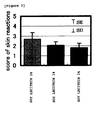
- A skin photosensitization test using guinea pigs was carried out by referring to and partly modify the Adjuvant and Strip method by Satoh et al. (Nishinihon Hifuka, 42, 831-837). Namely, the dosal part of the cervix of a female white Hartley strain guinea pig was depilated; the adjuvant was applied to four corners of 2x2cm; a ketoprofen preparation cut in the same size was applied for 4 hours, followed by irradiation of UV-A (10 J/cm2) after peeling off. This of -inducing treatment was carried out successively for 5 days. 3 weeks after the start of the sensitization, the dosal lumber region was depilated, and three preparations cut in the size of 1.5x1.5cm, in which BM-DBM was blended to a ketoprofen preparation and the concentration of soy lecithin was set to 0% (comparative example 1), 1% (example 1) and 2% (example 2), were applied for 4 hours, followed by irradiation of UV-A (2.5 J/cm2) after peeling off to carry out photo-induction. Skin reactions 24 hours after the irradiation were evaluated according to the standard of Satoh et al, by
total 7 points (0-4 points for erythema and 0-3 points for edema). The results are shown in Fig.3. - In this test, it was observed that the addition of soy lecithin suppresses the skin reaction better compared with BM-DBM only.
- As explained above, according to the invention, it is enabled to exert anti-inflammatory analgesic effects while more surely preventing photo-allergies, in a external application containing an anti-inflammatory agent which is likely to induce photo-allergies, and therefore, its application as a drug with high safety can be expected.
-
- Figure 1 shows the transferred amount of BM-DBM when the patch of the invention was applied.
- Figure 2 shows the transferred amount of ketoprofen when the patch of the invention was applied.
- Figure 3 shows the results of the reaction-inducing test when the patch of the invention was applied.
Claims (5)
- An external application, containing an anti-inflammatory agent, an organic ultraviolet absorbent and soy lecithin.
- The medicine for external application according to claim 1 as a patch, in which a backing is laminated to an adhesive layer.
- The external application according to claims 1 or 2, wherein the anti-inflammatory agent is one or more selected from tiaprofenic acid, tolmetin and ketoprofen.
- The external application according to any one of claims 1 to 3, wherein the organic ultraviolet absorbent is 4-tert-butyl-4'-methoxydibenzoylmethane.
- The external application according to any one of claims 1 to 4, wherein the ratio of the anti-inflammatory agent: the organic ultraviolet absorbent: soy lecithin is 2:3-4:1-2.
Applications Claiming Priority (2)
| Application Number | Priority Date | Filing Date | Title |
|---|---|---|---|
| JP2005050994 | 2005-02-25 | ||
| PCT/JP2006/303432 WO2006090839A1 (en) | 2005-02-25 | 2006-02-24 | Medicine for external application containing anti-inflammatory agent and soy lecithin |
Publications (3)
| Publication Number | Publication Date |
|---|---|
| EP1852130A1 true EP1852130A1 (en) | 2007-11-07 |
| EP1852130A4 EP1852130A4 (en) | 2008-04-16 |
| EP1852130B1 EP1852130B1 (en) | 2012-06-20 |
Family
ID=36927472
Family Applications (1)
| Application Number | Title | Priority Date | Filing Date |
|---|---|---|---|
| EP06714571A Expired - Lifetime EP1852130B1 (en) | 2005-02-25 | 2006-02-24 | Medicine for external application containing anti-inflammatory agent and soy lecithin |
Country Status (4)
| Country | Link |
|---|---|
| US (1) | US20090028806A1 (en) |
| EP (1) | EP1852130B1 (en) |
| JP (1) | JP5117846B2 (en) |
| WO (1) | WO2006090839A1 (en) |
Cited By (3)
| Publication number | Priority date | Publication date | Assignee | Title |
|---|---|---|---|---|
| EP2143445A4 (en) * | 2007-04-23 | 2010-11-03 | Hisamitsu Pharmaceutical Co | MEDICAMENT STAMP |
| CN105960234A (en) * | 2014-02-27 | 2016-09-21 | 久光制药株式会社 | poultice containing ketoprofen |
| EP3646874A4 (en) * | 2018-01-31 | 2021-03-17 | Unish Inc. | TRANSDERMAL PREPARATION OF PHOSPHATIDYLCHOLINE |
Families Citing this family (1)
| Publication number | Priority date | Publication date | Assignee | Title |
|---|---|---|---|---|
| JP5430905B2 (en) * | 2008-10-22 | 2014-03-05 | 久光製薬株式会社 | Patch |
Family Cites Families (17)
| Publication number | Priority date | Publication date | Assignee | Title |
|---|---|---|---|---|
| JPS5955819A (en) * | 1982-09-24 | 1984-03-31 | Nitto Electric Ind Co Ltd | Plaster for adhesive salve preparation |
| JPS60155111A (en) * | 1983-10-20 | 1985-08-15 | Hisamitsu Pharmaceut Co Inc | Stable pharmaceutical for external use containing "ketoprofen(r)" |
| US4701471A (en) * | 1986-04-16 | 1987-10-20 | Loucks Sr Joseph | Skin care composition |
| US4783450A (en) * | 1987-04-13 | 1988-11-08 | Warner-Lambert Company | Use of commercial lecithin as skin penetration enhancer |
| JPH07103016B2 (en) * | 1988-03-11 | 1995-11-08 | 積水化学工業株式会社 | Patch and method for producing the same |
| JP3661706B2 (en) * | 1993-10-28 | 2005-06-22 | 三省製薬株式会社 | Topical skin preparation |
| CA2332808C (en) * | 1998-05-15 | 2010-11-23 | Showa Denko K.K. | Compositions of ascorbic acid derivatives for treatment of skin diseases |
| JP2000327570A (en) * | 1999-05-24 | 2000-11-28 | Nof Corp | External preparation for skin |
| US6967023B1 (en) * | 2000-01-10 | 2005-11-22 | Foamix, Ltd. | Pharmaceutical and cosmetic carrier or composition for topical application |
| FR2804024B1 (en) * | 2000-01-21 | 2002-09-13 | Menarini France | NOVEL PHARMACEUTICAL COMPOSITIONS WITH ANTI-INFLAMMATORY ACTION AND PROCESS FOR THEIR PREPARATION |
| US6924410B2 (en) * | 2000-03-17 | 2005-08-02 | Hisamitsu Pharmaceutical Co., Ltd. | Ultraviolet-screening patch |
| WO2001078690A1 (en) * | 2000-04-18 | 2001-10-25 | Hisamitsu Pharmaceutical Co., Inc. | Patch containing anti-inflammatory agent |
| CN1253149C (en) * | 2001-05-31 | 2006-04-26 | 久光制药株式会社 | transdermal patch |
| JP2003081736A (en) * | 2001-09-14 | 2003-03-19 | Lion Corp | External preparation composition |
| JP2004231600A (en) * | 2003-01-31 | 2004-08-19 | Takemitsu Ishigaki | Skin care preparation for external use |
| GB0322342D0 (en) * | 2003-09-23 | 2003-10-22 | Gamble Reed | Skin patch |
| TWI341736B (en) * | 2003-12-26 | 2011-05-11 | Hisamitsu Pharmaceutical Co | Anti-infammatory adhesive preparations |
-
2006
- 2006-02-24 US US11/815,675 patent/US20090028806A1/en not_active Abandoned
- 2006-02-24 JP JP2007504813A patent/JP5117846B2/en not_active Expired - Lifetime
- 2006-02-24 WO PCT/JP2006/303432 patent/WO2006090839A1/en not_active Ceased
- 2006-02-24 EP EP06714571A patent/EP1852130B1/en not_active Expired - Lifetime
Cited By (4)
| Publication number | Priority date | Publication date | Assignee | Title |
|---|---|---|---|---|
| EP2143445A4 (en) * | 2007-04-23 | 2010-11-03 | Hisamitsu Pharmaceutical Co | MEDICAMENT STAMP |
| CN105960234A (en) * | 2014-02-27 | 2016-09-21 | 久光制药株式会社 | poultice containing ketoprofen |
| EP3646874A4 (en) * | 2018-01-31 | 2021-03-17 | Unish Inc. | TRANSDERMAL PREPARATION OF PHOSPHATIDYLCHOLINE |
| US11202763B2 (en) | 2018-01-31 | 2021-12-21 | Unish Inc. | Phosphatidylcholine transdermal absorption preparation |
Also Published As
| Publication number | Publication date |
|---|---|
| WO2006090839A1 (en) | 2006-08-31 |
| EP1852130B1 (en) | 2012-06-20 |
| US20090028806A1 (en) | 2009-01-29 |
| EP1852130A4 (en) | 2008-04-16 |
| JP5117846B2 (en) | 2013-01-16 |
| JPWO2006090839A1 (en) | 2008-07-24 |
Similar Documents
| Publication | Publication Date | Title |
|---|---|---|
| KR101408454B1 (en) | Method for prevention of coloration in donepezil-containing skin adhesive preparation, and method for reducing the production of donepezil analogue in donepezil-containing skin adhesive preparation | |
| CN103313705B (en) | Containing favourable this bright transdermal formulations all | |
| KR101848961B1 (en) | Ropinirole-containing adhesive skin patch and packaged product thereof | |
| KR101844625B1 (en) | Ropinirole-containing adhesive patch and packaging therefor | |
| WO2003032960A1 (en) | Percutaneous absorption preparations | |
| US10441551B2 (en) | Patch | |
| KR20090086565A (en) | Stabilized Donepezil-containing adhesive formulation | |
| TWI742331B (en) | Patch containing rotigotine | |
| WO2005011662A1 (en) | Adhesive patch | |
| JP2016069287A (en) | Rivastigmine containing transdermal patch | |
| WO2021161984A1 (en) | Diclofenac sodium-containing patch | |
| US20100239639A1 (en) | Medicated patch | |
| EP1698330B1 (en) | Anti-inflammatory analgesic patch | |
| TW202045157A (en) | Rotigotine stabilization method | |
| US20090028806A1 (en) | Medicine for External Application Containing Anti-Inflammatory Agent and Soy Lecithin | |
| JPWO2006080199A1 (en) | Patch | |
| JP5430905B2 (en) | Patch | |
| JP2010006761A (en) | Percutaneous absorption patch containing fentanyl or its salt and method for producing the same | |
| JP7842077B2 (en) | Patches for treating osteoarthritis | |
| TWI917561B (en) | Method for treating osteoarthritis | |
| JP2010030909A (en) | Transdermal absorption-type patch containing fentanyls, method for producing the same, method for inhibiting crystal deposition of fentanyls, and crystal deposition inhibitor | |
| HK40121916A (en) | Rotigotine-containing patch and method for improving stability of rotigotine | |
| JP4869583B2 (en) | Patch with little exfoliation | |
| TW202131916A (en) | Method for improving holding power of adhesive agent layer in ropinirole-containing transdermal patch, and ropinirole-containing transdermal patch having improved holding power | |
| HK1088844B (en) | Anti-inflammatory analgesic patch |
Legal Events
| Date | Code | Title | Description |
|---|---|---|---|
| PUAI | Public reference made under article 153(3) epc to a published international application that has entered the european phase |
Free format text: ORIGINAL CODE: 0009012 |
|
| 17P | Request for examination filed |
Effective date: 20070828 |
|
| AK | Designated contracting states |
Kind code of ref document: A1 Designated state(s): AT BE BG CH CY CZ DE DK EE ES FI FR GB GR HU IE IS IT LI LT LU LV MC NL PL PT RO SE SI SK TR |
|
| A4 | Supplementary search report drawn up and despatched |
Effective date: 20080319 |
|
| DAX | Request for extension of the european patent (deleted) | ||
| 17Q | First examination report despatched |
Effective date: 20080721 |
|
| GRAP | Despatch of communication of intention to grant a patent |
Free format text: ORIGINAL CODE: EPIDOSNIGR1 |
|
| GRAS | Grant fee paid |
Free format text: ORIGINAL CODE: EPIDOSNIGR3 |
|
| GRAA | (expected) grant |
Free format text: ORIGINAL CODE: 0009210 |
|
| AK | Designated contracting states |
Kind code of ref document: B1 Designated state(s): AT BE BG CH CY CZ DE DK EE ES FI FR GB GR HU IE IS IT LI LT LU LV MC NL PL PT RO SE SI SK TR |
|
| REG | Reference to a national code |
Ref country code: GB Ref legal event code: FG4D |
|
| REG | Reference to a national code |
Ref country code: CH Ref legal event code: EP |
|
| REG | Reference to a national code |
Ref country code: AT Ref legal event code: REF Ref document number: 562641 Country of ref document: AT Kind code of ref document: T Effective date: 20120715 |
|
| REG | Reference to a national code |
Ref country code: IE Ref legal event code: FG4D |
|
| REG | Reference to a national code |
Ref country code: DE Ref legal event code: R096 Ref document number: 602006030297 Country of ref document: DE Effective date: 20120816 |
|
| PG25 | Lapsed in a contracting state [announced via postgrant information from national office to epo] |
Ref country code: LT Free format text: LAPSE BECAUSE OF FAILURE TO SUBMIT A TRANSLATION OF THE DESCRIPTION OR TO PAY THE FEE WITHIN THE PRESCRIBED TIME-LIMIT Effective date: 20120620 Ref country code: SE Free format text: LAPSE BECAUSE OF FAILURE TO SUBMIT A TRANSLATION OF THE DESCRIPTION OR TO PAY THE FEE WITHIN THE PRESCRIBED TIME-LIMIT Effective date: 20120620 Ref country code: FI Free format text: LAPSE BECAUSE OF FAILURE TO SUBMIT A TRANSLATION OF THE DESCRIPTION OR TO PAY THE FEE WITHIN THE PRESCRIBED TIME-LIMIT Effective date: 20120620 |
|
| REG | Reference to a national code |
Ref country code: NL Ref legal event code: VDEP Effective date: 20120620 |
|
| REG | Reference to a national code |
Ref country code: AT Ref legal event code: MK05 Ref document number: 562641 Country of ref document: AT Kind code of ref document: T Effective date: 20120620 |
|
| REG | Reference to a national code |
Ref country code: LT Ref legal event code: MG4D Effective date: 20120620 |
|
| PG25 | Lapsed in a contracting state [announced via postgrant information from national office to epo] |
Ref country code: GR Free format text: LAPSE BECAUSE OF FAILURE TO SUBMIT A TRANSLATION OF THE DESCRIPTION OR TO PAY THE FEE WITHIN THE PRESCRIBED TIME-LIMIT Effective date: 20120921 Ref country code: LV Free format text: LAPSE BECAUSE OF FAILURE TO SUBMIT A TRANSLATION OF THE DESCRIPTION OR TO PAY THE FEE WITHIN THE PRESCRIBED TIME-LIMIT Effective date: 20120620 Ref country code: SI Free format text: LAPSE BECAUSE OF FAILURE TO SUBMIT A TRANSLATION OF THE DESCRIPTION OR TO PAY THE FEE WITHIN THE PRESCRIBED TIME-LIMIT Effective date: 20120620 |
|
| PG25 | Lapsed in a contracting state [announced via postgrant information from national office to epo] |
Ref country code: CZ Free format text: LAPSE BECAUSE OF FAILURE TO SUBMIT A TRANSLATION OF THE DESCRIPTION OR TO PAY THE FEE WITHIN THE PRESCRIBED TIME-LIMIT Effective date: 20120620 Ref country code: SK Free format text: LAPSE BECAUSE OF FAILURE TO SUBMIT A TRANSLATION OF THE DESCRIPTION OR TO PAY THE FEE WITHIN THE PRESCRIBED TIME-LIMIT Effective date: 20120620 Ref country code: IS Free format text: LAPSE BECAUSE OF FAILURE TO SUBMIT A TRANSLATION OF THE DESCRIPTION OR TO PAY THE FEE WITHIN THE PRESCRIBED TIME-LIMIT Effective date: 20121020 Ref country code: AT Free format text: LAPSE BECAUSE OF FAILURE TO SUBMIT A TRANSLATION OF THE DESCRIPTION OR TO PAY THE FEE WITHIN THE PRESCRIBED TIME-LIMIT Effective date: 20120620 Ref country code: BE Free format text: LAPSE BECAUSE OF FAILURE TO SUBMIT A TRANSLATION OF THE DESCRIPTION OR TO PAY THE FEE WITHIN THE PRESCRIBED TIME-LIMIT Effective date: 20120620 Ref country code: CY Free format text: LAPSE BECAUSE OF FAILURE TO SUBMIT A TRANSLATION OF THE DESCRIPTION OR TO PAY THE FEE WITHIN THE PRESCRIBED TIME-LIMIT Effective date: 20120620 Ref country code: EE Free format text: LAPSE BECAUSE OF FAILURE TO SUBMIT A TRANSLATION OF THE DESCRIPTION OR TO PAY THE FEE WITHIN THE PRESCRIBED TIME-LIMIT Effective date: 20120620 Ref country code: RO Free format text: LAPSE BECAUSE OF FAILURE TO SUBMIT A TRANSLATION OF THE DESCRIPTION OR TO PAY THE FEE WITHIN THE PRESCRIBED TIME-LIMIT Effective date: 20120620 |
|
| PG25 | Lapsed in a contracting state [announced via postgrant information from national office to epo] |
Ref country code: PT Free format text: LAPSE BECAUSE OF FAILURE TO SUBMIT A TRANSLATION OF THE DESCRIPTION OR TO PAY THE FEE WITHIN THE PRESCRIBED TIME-LIMIT Effective date: 20121022 Ref country code: PL Free format text: LAPSE BECAUSE OF FAILURE TO SUBMIT A TRANSLATION OF THE DESCRIPTION OR TO PAY THE FEE WITHIN THE PRESCRIBED TIME-LIMIT Effective date: 20120620 |
|
| PG25 | Lapsed in a contracting state [announced via postgrant information from national office to epo] |
Ref country code: NL Free format text: LAPSE BECAUSE OF FAILURE TO SUBMIT A TRANSLATION OF THE DESCRIPTION OR TO PAY THE FEE WITHIN THE PRESCRIBED TIME-LIMIT Effective date: 20120620 |
|
| PLBE | No opposition filed within time limit |
Free format text: ORIGINAL CODE: 0009261 |
|
| STAA | Information on the status of an ep patent application or granted ep patent |
Free format text: STATUS: NO OPPOSITION FILED WITHIN TIME LIMIT |
|
| PG25 | Lapsed in a contracting state [announced via postgrant information from national office to epo] |
Ref country code: DK Free format text: LAPSE BECAUSE OF FAILURE TO SUBMIT A TRANSLATION OF THE DESCRIPTION OR TO PAY THE FEE WITHIN THE PRESCRIBED TIME-LIMIT Effective date: 20120620 Ref country code: ES Free format text: LAPSE BECAUSE OF FAILURE TO SUBMIT A TRANSLATION OF THE DESCRIPTION OR TO PAY THE FEE WITHIN THE PRESCRIBED TIME-LIMIT Effective date: 20121001 |
|
| 26N | No opposition filed |
Effective date: 20130321 |
|
| REG | Reference to a national code |
Ref country code: DE Ref legal event code: R097 Ref document number: 602006030297 Country of ref document: DE Effective date: 20130321 |
|
| PG25 | Lapsed in a contracting state [announced via postgrant information from national office to epo] |
Ref country code: BG Free format text: LAPSE BECAUSE OF FAILURE TO SUBMIT A TRANSLATION OF THE DESCRIPTION OR TO PAY THE FEE WITHIN THE PRESCRIBED TIME-LIMIT Effective date: 20120920 |
|
| PG25 | Lapsed in a contracting state [announced via postgrant information from national office to epo] |
Ref country code: MC Free format text: LAPSE BECAUSE OF NON-PAYMENT OF DUE FEES Effective date: 20130228 |
|
| REG | Reference to a national code |
Ref country code: CH Ref legal event code: PL |
|
| PG25 | Lapsed in a contracting state [announced via postgrant information from national office to epo] |
Ref country code: LI Free format text: LAPSE BECAUSE OF NON-PAYMENT OF DUE FEES Effective date: 20130228 Ref country code: CH Free format text: LAPSE BECAUSE OF NON-PAYMENT OF DUE FEES Effective date: 20130228 |
|
| REG | Reference to a national code |
Ref country code: IE Ref legal event code: MM4A |
|
| PG25 | Lapsed in a contracting state [announced via postgrant information from national office to epo] |
Ref country code: IE Free format text: LAPSE BECAUSE OF NON-PAYMENT OF DUE FEES Effective date: 20130224 |
|
| PG25 | Lapsed in a contracting state [announced via postgrant information from national office to epo] |
Ref country code: TR Free format text: LAPSE BECAUSE OF FAILURE TO SUBMIT A TRANSLATION OF THE DESCRIPTION OR TO PAY THE FEE WITHIN THE PRESCRIBED TIME-LIMIT Effective date: 20120620 |
|
| PG25 | Lapsed in a contracting state [announced via postgrant information from national office to epo] |
Ref country code: LU Free format text: LAPSE BECAUSE OF NON-PAYMENT OF DUE FEES Effective date: 20130224 Ref country code: HU Free format text: LAPSE BECAUSE OF FAILURE TO SUBMIT A TRANSLATION OF THE DESCRIPTION OR TO PAY THE FEE WITHIN THE PRESCRIBED TIME-LIMIT; INVALID AB INITIO Effective date: 20060224 |
|
| REG | Reference to a national code |
Ref country code: FR Ref legal event code: PLFP Year of fee payment: 11 |
|
| REG | Reference to a national code |
Ref country code: FR Ref legal event code: PLFP Year of fee payment: 12 |
|
| REG | Reference to a national code |
Ref country code: FR Ref legal event code: PLFP Year of fee payment: 13 |
|
| P01 | Opt-out of the competence of the unified patent court (upc) registered |
Effective date: 20230522 |
|
| PGFP | Annual fee paid to national office [announced via postgrant information from national office to epo] |
Ref country code: DE Payment date: 20231229 Year of fee payment: 19 Ref country code: GB Payment date: 20240108 Year of fee payment: 19 |
|
| PGFP | Annual fee paid to national office [announced via postgrant information from national office to epo] |
Ref country code: IT Payment date: 20240111 Year of fee payment: 19 Ref country code: FR Payment date: 20240103 Year of fee payment: 19 |
|
| REG | Reference to a national code |
Ref country code: DE Ref legal event code: R119 Ref document number: 602006030297 Country of ref document: DE |
|
| GBPC | Gb: european patent ceased through non-payment of renewal fee |
Effective date: 20250224 |
|
| PG25 | Lapsed in a contracting state [announced via postgrant information from national office to epo] |
Ref country code: DE Free format text: LAPSE BECAUSE OF NON-PAYMENT OF DUE FEES Effective date: 20250902 |
|
| PG25 | Lapsed in a contracting state [announced via postgrant information from national office to epo] |
Ref country code: GB Free format text: LAPSE BECAUSE OF NON-PAYMENT OF DUE FEES Effective date: 20250224 |
|
| PG25 | Lapsed in a contracting state [announced via postgrant information from national office to epo] |
Ref country code: FR Free format text: LAPSE BECAUSE OF NON-PAYMENT OF DUE FEES Effective date: 20250228 Ref country code: IT Free format text: LAPSE BECAUSE OF NON-PAYMENT OF DUE FEES Effective date: 20250224 |