EP1850581A2 - Method for tetrahedral interpolation computations using data-level parallelism - Google Patents
Method for tetrahedral interpolation computations using data-level parallelism Download PDFInfo
- Publication number
- EP1850581A2 EP1850581A2 EP07106837A EP07106837A EP1850581A2 EP 1850581 A2 EP1850581 A2 EP 1850581A2 EP 07106837 A EP07106837 A EP 07106837A EP 07106837 A EP07106837 A EP 07106837A EP 1850581 A2 EP1850581 A2 EP 1850581A2
- Authority
- EP
- European Patent Office
- Prior art keywords
- zfrc
- xfrc
- yfrc
- interpolation
- tetrahedron
- Prior art date
- Legal status (The legal status is an assumption and is not a legal conclusion. Google has not performed a legal analysis and makes no representation as to the accuracy of the status listed.)
- Granted
Links
- 238000000034 method Methods 0.000 title claims abstract description 45
- 238000012545 processing Methods 0.000 claims description 12
- 230000009977 dual effect Effects 0.000 claims description 9
- 239000011159 matrix material Substances 0.000 claims description 5
- 238000013507 mapping Methods 0.000 claims description 4
- 238000012856 packing Methods 0.000 claims description 4
- 238000003672 processing method Methods 0.000 claims description 2
- 230000001131 transforming effect Effects 0.000 claims 2
- 230000009466 transformation Effects 0.000 abstract description 16
- 238000013461 design Methods 0.000 abstract description 4
- 230000006870 function Effects 0.000 abstract description 2
- 238000004364 calculation method Methods 0.000 description 5
- 238000000926 separation method Methods 0.000 description 3
- 238000012935 Averaging Methods 0.000 description 2
- 238000010420 art technique Methods 0.000 description 2
- 230000001419 dependent effect Effects 0.000 description 2
- 238000010586 diagram Methods 0.000 description 2
- 230000005540 biological transmission Effects 0.000 description 1
- 238000006243 chemical reaction Methods 0.000 description 1
- 238000000844 transformation Methods 0.000 description 1
Images



Classifications
-
- H—ELECTRICITY
- H04—ELECTRIC COMMUNICATION TECHNIQUE
- H04N—PICTORIAL COMMUNICATION, e.g. TELEVISION
- H04N1/00—Scanning, transmission or reproduction of documents or the like, e.g. facsimile transmission; Details thereof
- H04N1/46—Colour picture communication systems
- H04N1/56—Processing of colour picture signals
- H04N1/60—Colour correction or control
- H04N1/6016—Conversion to subtractive colour signals
- H04N1/6019—Conversion to subtractive colour signals using look-up tables
-
- H—ELECTRICITY
- H04—ELECTRIC COMMUNICATION TECHNIQUE
- H04N—PICTORIAL COMMUNICATION, e.g. TELEVISION
- H04N1/00—Scanning, transmission or reproduction of documents or the like, e.g. facsimile transmission; Details thereof
- H04N1/46—Colour picture communication systems
- H04N1/56—Processing of colour picture signals
- H04N1/60—Colour correction or control
- H04N1/6016—Conversion to subtractive colour signals
- H04N1/6022—Generating a fourth subtractive colour signal, e.g. under colour removal, black masking
- H04N1/6025—Generating a fourth subtractive colour signal, e.g. under colour removal, black masking using look-up tables
Definitions
- Embodiments are related to data-processing methods and systems. Embodiments are also related to image-processing devices and techniques. Embodiments are additionally related to color space transformation in image-processing applications.
- the interpolation stage calculates the estimated [CMYK] output value based on the given CMYK values of the nearest four nodes to the current location in the input 3D space.
- the approximation level (and the resulting color transformation accuracy) is generally dependent on the number of nodes, their relative positions, and the non-linearity of the color transformation in a given neighborhood.
- each cube of the input color space can be divided into six non-overlapping tetrahedrons of the same size.
- the space can be divided into five tetrahedrons (i.e., a fewer number), but in this case the center tetrahedron has a larger size and this somewhat complicates the calculations.
- Table 1 illustrates the node value delta computation for all possible tetrahedrons with reference to the existing method.
- TABLE 1 Tetrahedron Order in which the node values ⁇ s are computed ⁇ X ⁇ Y ⁇ Z 1 P1-P0 P2-P1 P3-P2 2 P1-P0 P3-P2 P2-P1 3 P2-P1 P3-P2 P1-P0 4 P2-P1 P1-P0 P3-P2 5 P3-P2 P1-P0 P2-P1 6 P3-P2 P2-P1 P1-P0
- the specific tetrahedron in which the input location resides can be easily determined by simply ordering the fractional delta values ( ⁇ X, ⁇ Y, ⁇ Z) in rank order.
- the interpolation algorithm computes the output value using rounding and limiting the final result to the preferred output range (e.g., between 0 and 255 for 8-bit output).
- the preferred output range e.g., between 0 and 255 for 8-bit output.
- Color space transformation via 3D Lookup table with tetrahedral interpolation is a well-known algorithm for converting from one color space (e.g., RGB or Lab) to another (e.g., CMYK for printing).
- the computational steps are processed in sequential fashion, one color separation at a time.
- the fractional position within a specific tetrahedron is the same for each color separation, the node values are different, thus requiring individual calculations per separation.
- the algorithm can be efficiently implemented in hardware by packing the data and processing the transformation of the color channels in parallel.
- a radial interpolation technique can accomplish an interpolation by generating successive subcubes.
- a value of a vertex of the final subcube generated can be used as the result of the interpolation.
- Subcubes are generated by averaging a selected vertex value with the vertex values of each of the remaining vertices.
- a pruned radial interpolation technique employs a subset of the vertex values of the initially selected cube to generate the result of the interpolation, thereby improving upon the efficiency of the radial interpolation.
- a tetrahedral interpolation technique accomplishes an interpolation by generating successive subcubes.
- a value of a vertex of the final subcube generated can be used as the result of the interpolation.
- Subcubes are generated by applying a mathematical relationship which allows computation of subcube vertex values through a series of logical AND, logical OR and averaging operations.
- a pruned tetrahedral interpolation technique employs a subset of the vertex values of the initially selected cube to generate the result of the interpolation, thereby improving upon the efficiency of the tetrahedral interpolation.
- a common hardware implementation of pruned radial interpolation and pruned tetrahedral interpolation uses the common hardware structure of the two techniques with multiplexing of the input vertex values to allow performance of either a pruned radial interpolation or a pruned tetrahedral interpolation.
- Non-symmetric pruned radial and Non-symmetric pruned tetrahedral interpolation permit interpolation using interpolation data values distributed throughout the color space with a resolution that varies according to characteristics of the color space.
- Multiplexing of the interpolation data values to the non-symmetric pruned radial interpolation hardware and to the non-symmetric pruned tetrahedral interpolation hardware allows for a common hardware implementation.
- Another prior art technique involves tetrahedral interpolation by rewriting the interpolation in terms of ordered differentials and color differences to lower the computational complexity.
- a system and method for tetrahedral interpolation computations using data-level parallelism that takes advantage of data-level parallelism in media processors is claimed. If the tetrahedron points in a 3D lookup table are packed together in a memory, the interpolation computation can be implemented without extra instructions to unpack them. An algebraic manipulation of the interpolation equation allows computing the difference on the fraction coefficients instead of the tetrahedron node values.
- FIG. 1 illustrates a block diagram depicting a basic functional architecture for tetrahedral interpolation computations using data-level parallelism in accordance with a preferred embodiment
- FIG. 2 illustrates a flowchart of operations depicting logical operational steps for tetrahedral interpolation computations using data-level parallelism in accordance with a preferred embodiment
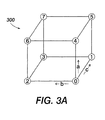
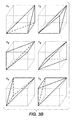
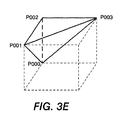
- FIGS. 3a-3e illustrates interpolation volumes in accordance with a preferred embodiment.
- FIG. 1 a block diagram of a system 100 is illustrated, which depicts the basic functional architecture of tetrahedral interpolation computations using data-level parallelism in accordance with a preferred embodiment.
- Color space transformation via 3D Lookup table with tetrahedral interpolation is a well-known algorithm for converting from one color space (e.g., RGB or Lab) 101 to another (e.g., CMYK 108 for printing).
- the data-level parallelism occurs in media processors (such as INTEL MXP5800) 102, if the tetrahedron points to usually 8-bit values per color channel with HW precision arithmetic 108, and into the 3D lookup table 104 are packed together in memory as one 32-bit word.
- the interpolation computation can be then be implemented without extra instructions to unpack them.
- a matrix form of interpolation can be obtained by configuring the media processor parallel instructions and the packed data from the 3D lookup table 105 and thus can be implemented within the existing HW precision without any loss of accuracy.
- An algebraic manipulation of the interpolation equation can then be applied to enable computation of the differences over fractional coefficients 107.
- a color space transformation can then be applied to output channel 108.
- a high-level flow chart 200 is illustrated depicting logical operational steps for implementing a basic functional architecture of tetrahedral interpolation computations utilizing data-level parallelism in accordance with the preferred embodiment.
- a first process can be initialized.
- the media processors' parallel instructions can be configured using fixed HW precision arithmetic (e.g., 8-bits) as illustrated at block 203.
- the process can practically guarantee that the delta of the fractions is always a positive result due to the subtraction of a small number from a large number, and thus can be used to identify the specific tetrahedron which contains the mapped input point as depicted at block 209. This applies for any tetrahedron case. In the end, this leads to the use of unsigned dual (or quad) instructions in the computation of the interpolation output as indicated at block 210.
- FIGS. 3a-3e illustrate graphical representations of an interpolation process 300 in accordance with preferred and alternative embodiments.
- the process 300 depicted in FIG. 3a illustrates interpolation volumes of the method for tetrahedral interpolation computations using data-level parallelism.
- FIG. 3b illustrates the face points for tetrahedral interpolation.
- FIG. 3c depicts a tetrahedron with reference to the face points.
- FIG. 3d illustrates the edge points for tetrahedral interpolation.
- FIG 3e illustrates a tetrahedral interpolation showing the four edge points.
- the algorithm can be slightly modified.
- most media processors use a fixed HW precision arithmetic (8-bits, for example). Since the node values are 8-bit unsigned values, the result of the subtraction operations in the existing equation with reference to table 1, generally requires 9 bits to preserve the full precision.
- Rank-ordering the fractional values can assure that the delta of the fractions is always a positive result due to the subtraction of a small number from a large number, and thus it can be used to identify the specific tetrahedron which contains the mapped input point. This applies for any tetrahedron case; below shows the fractional deltas for all possible tetrahedrons. In the end, this leads to the use of unsigned dual (or quad) instructions in the computation of the interpolation output.
- the implementation of the tetrahedral interpolation stage in media processors with data-level parallelism can be efficiently computed following the definition of the last term in the modified formed equation and the deltas defined in table2 below.
- modules may constitute hardware modules, such as, for example, electronic components of a computer system. Such modules may also constitute software modules.
- a software module can be typically implemented as a collection of routines and data structures that performs particular tasks or implements a particular abstract data type.
- Software modules generally are composed of two parts. First, a software module may list the constants, data types, variable, routines and the like that can be accessed by other modules or routines. Second, a software module can be configured as an implementation, which can be private (i.e., accessible perhaps only to the module), and that contains the source code that actually implements the routines or subroutines upon which the module is based. The term module, as utilized herein can therefore refer to software modules or implementations thereof. Such modules can be utilized separately or together to form a program product based on instruction media residing in a computer memory that can be implemented through signal-bearing media, including transmission media and recordable media, depending upon design considerations and media distribution goals. Such instruction media can thus be retrieved from the computer memory and processed via a processing unit, such as, for example, a microprocessor.
- a processing unit such as, for example, a microprocessor.
- modules can be referred to also as "instruction modules” and may be stored within a memory of a data-processing apparatus.
- instruction modules may be implemented in the context of a resulting program product (i.e., program "code").
- program code i.e., program "code”
- module and code can be utilized interchangeably herein to refer to the same device or media.
- many of the features depicted in FIGS. 1-2 can be provided by or in the form of such modules.
Landscapes
- Engineering & Computer Science (AREA)
- Multimedia (AREA)
- Signal Processing (AREA)
- Image Processing (AREA)
- Facsimile Image Signal Circuits (AREA)
- Color Image Communication Systems (AREA)
Abstract
Description
- Embodiments are related to data-processing methods and systems. Embodiments are also related to image-processing devices and techniques. Embodiments are additionally related to color space transformation in image-processing applications.
- In color space transformations based on three-dimensional (3D) lookup with tetrahedral interpolation, the interpolation stage calculates the estimated [CMYK] output value based on the given CMYK values of the nearest four nodes to the current location in the input 3D space. Such a methodology assumes that the color transformation is relatively smooth and that the nodes are placed close enough such that the transformation is approximately piece-wise linear between adjacent nodes.
- The approximation level (and the resulting color transformation accuracy) is generally dependent on the number of nodes, their relative positions, and the non-linearity of the color transformation in a given neighborhood. The interpolation computation equation that is the existing method can be provided as follows:

Where i ∈ {C, M, Y, K}. - The above equation can be computed per output color component (C, M, Y, and K), where the node delta values (ΔX, ΔY, ΔZ) are dependent on the tetrahedron containing the mapped input point in the input color space (e.g., in (L, a, b) or (Y, Cb, Cr)). In one application, each cube of the input color space can be divided into six non-overlapping tetrahedrons of the same size. Alternatively, the space can be divided into five tetrahedrons (i.e., a fewer number), but in this case the center tetrahedron has a larger size and this somewhat complicates the calculations. Thus, the focus can be on the six tetrahedron case. Table 1 below illustrates the node value delta computation for all possible tetrahedrons with reference to the existing method.
TABLE 1 Tetrahedron Order in which the node values Δs are computed ΔX ΔY ΔZ 1 P1-P0 P2-P1 P3- P2 2 P1-P0 P3-P2 P2- P1 3 P2-P1 P3-P2 P1- P0 4 P2-P1 P1-P0 P3- P2 5 P3-P2 P1-P0 P2-P1 6 P3-P2 P2-P1 P1-P0 - The specific tetrahedron in which the input location resides can be easily determined by simply ordering the fractional delta values (ΔX, ΔY, ΔZ) in rank order. The interpolation algorithm computes the output value using rounding and limiting the final result to the preferred output range (e.g., between 0 and 255 for 8-bit output). After the interpolated CMYK point has been calculated, each of its color components can be used as an address index to four different 1 D lookup tables. The values accessed from the four lookup tables represent the adjusted CMYK values that comprise the final output value. Then for each output channel (C, M, Y, and K), four output values representing the nearest nodes to the mapped Lab or YCC input point are looked-up in a table and used in a tetrahedral interpolation step to find the approximated CMYK output value. The resulting output value is then adjusted by a byte-to-byte mapping using four 1-D lookup tables.
- Color space transformation via 3D Lookup table with tetrahedral interpolation is a well-known algorithm for converting from one color space (e.g., RGB or Lab) to another (e.g., CMYK for printing). In software implementations on general purpose processors, for example, the computational steps are processed in sequential fashion, one color separation at a time. Although the fractional position within a specific tetrahedron is the same for each color separation, the node values are different, thus requiring individual calculations per separation. In contrast, the algorithm can be efficiently implemented in hardware by packing the data and processing the transformation of the color channels in parallel. By taking advantage of this application, it is believed that certain media processors with data-level parallelism can deliver higher-performance color space transformation relative to general purpose processors and common hardware implementations.
- One known prior art application involves interpolation techniques for improved efficiency and speed in performing color space conversions. In such a case, a radial interpolation technique can accomplish an interpolation by generating successive subcubes. A value of a vertex of the final subcube generated can be used as the result of the interpolation. Subcubes are generated by averaging a selected vertex value with the vertex values of each of the remaining vertices. A pruned radial interpolation technique employs a subset of the vertex values of the initially selected cube to generate the result of the interpolation, thereby improving upon the efficiency of the radial interpolation. A tetrahedral interpolation technique accomplishes an interpolation by generating successive subcubes.
- A value of a vertex of the final subcube generated can be used as the result of the interpolation. Subcubes are generated by applying a mathematical relationship which allows computation of subcube vertex values through a series of logical AND, logical OR and averaging operations. A pruned tetrahedral interpolation technique employs a subset of the vertex values of the initially selected cube to generate the result of the interpolation, thereby improving upon the efficiency of the tetrahedral interpolation. A common hardware implementation of pruned radial interpolation and pruned tetrahedral interpolation uses the common hardware structure of the two techniques with multiplexing of the input vertex values to allow performance of either a pruned radial interpolation or a pruned tetrahedral interpolation. Non-symmetric pruned radial and Non-symmetric pruned tetrahedral interpolation permit interpolation using interpolation data values distributed throughout the color space with a resolution that varies according to characteristics of the color space. Multiplexing of the interpolation data values to the non-symmetric pruned radial interpolation hardware and to the non-symmetric pruned tetrahedral interpolation hardware allows for a common hardware implementation.
- Another prior art technique involves tetrahedral interpolation by rewriting the interpolation in terms of ordered differentials and color differences to lower the computational complexity.
- One of the problems with these prior art techniques is that such methodologies and related devices are inefficient and cannot be easily adapted to a wide range of image processing applications. In order to overcome these problems, it is believed that the embodiments disclosed herein can be implemented for increased efficiency in both processing and hardware applications.
- The following summary is provided to facilitate an understanding of some of the innovative features unique to the embodiments disclosed and is not intended to be a full description. A full appreciation of the various aspects of the embodiments can be gained by taking the entire specification, claims, drawings, and abstract as a whole.
- It is, therefore, one aspect of the present invention to provide for improved data-processing systems and methods..
- It is another aspect of the present invention to provide for improved image-processing systems and methods.
- It is a further aspect of the present invention to provide for an efficient method for tetrahedral interpolation computations using data-level parallelism by taking advantage of media processor parallel instructions while providing a more efficient calculation of the approximated output point by delivering higher-performance color space transformation in image-processing applications
- The aforementioned aspects and other objectives and advantages can now be achieved as described herein. A system and method for tetrahedral interpolation computations using data-level parallelism that takes advantage of data-level parallelism in media processors is claimed. If the tetrahedron points in a 3D lookup table are packed together in a memory, the interpolation computation can be implemented without extra instructions to unpack them. An algebraic manipulation of the interpolation equation allows computing the difference on the fraction coefficients instead of the tetrahedron node values. Not only will this technique preserve the full precision without over or underflow, but the packed data from the 3D lookup can be used directly as is (without unpacking), thereby allowing a faster implementation of the color space transformation overall and implementing as part of a direct-copy image path on a media processor. Such systems and methods allow the implementation of the direct copy pipeline to function at the required performance rate as requested by a customer specification while obtaining the required product design speed.
- Features, aspects and advantages of the present invention will become better understood with regard to the following description, appended claims, and accompany drawings where:
- FIG. 1 illustrates a block diagram depicting a basic functional architecture for tetrahedral interpolation computations using data-level parallelism in accordance with a preferred embodiment;
- FIG. 2 illustrates a flowchart of operations depicting logical operational steps for tetrahedral interpolation computations using data-level parallelism in accordance with a preferred embodiment; and
- FIGS. 3a-3e illustrates interpolation volumes in accordance with a preferred embodiment.
- The particular values and configurations discussed in these non-limiting examples can be varied and are cited merely to illustrate the aspects of the present invention and are not intended to limit the scope of the invention.
- Referring to FIG. 1, a block diagram of a
system 100 is illustrated, which depicts the basic functional architecture of tetrahedral interpolation computations using data-level parallelism in accordance with a preferred embodiment. Color space transformation via 3D Lookup table with tetrahedral interpolation is a well-known algorithm for converting from one color space (e.g., RGB or Lab) 101 to another (e.g., CMYK 108 for printing). The data-level parallelism occurs in media processors (such as INTEL MXP5800) 102, if the tetrahedron points to usually 8-bit values per color channel with HW precision arithmetic 108, and into the 3D lookup table 104 are packed together in memory as one 32-bit word. The interpolation computation can be then be implemented without extra instructions to unpack them. A matrix form of interpolation can be obtained by configuring the media processor parallel instructions and the packed data from the 3D lookup table 105 and thus can be implemented within the existing HW precision without any loss of accuracy. An algebraic manipulation of the interpolation equation can then be applied to enable computation of the differences overfractional coefficients 107. A color space transformation can then be applied tooutput channel 108. - Referring to FIG. 2, a high-
level flow chart 200 is illustrated depicting logical operational steps for implementing a basic functional architecture of tetrahedral interpolation computations utilizing data-level parallelism in accordance with the preferred embodiment. As indicated atblock 201, a first process can be initialized. Thereafter, at depicted atblock 202, the media processors' parallel instructions can be configured using fixed HW precision arithmetic (e.g., 8-bits) as illustrated atblock 203. Thereafter, by taking the subtraction on the fractional values as indicated atblock 204, rather than the node values, the equation Outputi = 1/128(128*P0i+ Xfrc*ΔXi +YfrC*ΔYi +Zfrc*ΔZl), and the operation i ∈ {C, M, Y, K} can be re-organized as depicted atblock 205 by matrix form of interpolation with the use of dual instructions for multiply-accumulate operations associated with the interpolation as illustrated atblock 206. The formed alternative interpolation computation equation is provided as follows: Outputi = 1/128 [Δ0*P0I, + Δ1*P1I + Δ2*P2I + Δ3*P3I], where i ∈ {C, M, Y, K}, P0 I , P1I, P2I, P3 I represents the four tetrahedron points and the values ΔX i , ΔYi, ΔZ i are computed. By rank-ordering of the fractional values as illustrated atblock 208, the process can practically guarantee that the delta of the fractions is always a positive result due to the subtraction of a small number from a large number, and thus can be used to identify the specific tetrahedron which contains the mapped input point as depicted atblock 209. This applies for any tetrahedron case. In the end, this leads to the use of unsigned dual (or quad) instructions in the computation of the interpolation output as indicated atblock 210. - FIGS. 3a-3e illustrate graphical representations of an
interpolation process 300 in accordance with preferred and alternative embodiments. Theprocess 300 depicted in FIG. 3a illustrates interpolation volumes of the method for tetrahedral interpolation computations using data-level parallelism. FIG. 3b illustrates the face points for tetrahedral interpolation. FIG. 3c depicts a tetrahedron with reference to the face points. FIG. 3d illustrates the edge points for tetrahedral interpolation. Additionally; FIG 3e illustrates a tetrahedral interpolation showing the four edge points. - Based on the foregoing, it can be appreciated that by taking advantage of data-level parallelism in media processors (e.g., such as the INTEL MXP5800), i.e. if the tetrahedron points (usually 8-bit values per color channel) in the 3D lookup table are packed together in memory (as one 32-bit word, say), the interpolation computation can be implemented without extra instructions to unpack them. An algebraic manipulation of the interpolation equation allows computing the difference on the fraction coefficients instead of the tetrahedron node values.
- Not only will the inventive technique described herein preserve the full precision without over or underflow, but the packed data from the 3D lookup can be used directly as is (without unpacking), thereby allowing a faster implementation of the color space transformation overall. This method has been implemented as part of a direct-copy image path on a media processor. This method allows the implementation of the direct copy pipeline to work at the required performance rate as requested by the customer specifications. Without this method, the color space transformation performance would have failed to meet the required product design speed.
- In order to take advantage of the media processor parallel instructions, and to make a more efficient calculation of the approximated output point, the algorithm can be slightly modified. For cost/pertormance reason, most media processors use a fixed HW precision arithmetic (8-bits, for example). Since the node values are 8-bit unsigned values, the result of the subtraction operations in the existing equation with reference to table 1, generally requires 9 bits to preserve the full precision.
- Thus a general loss of precision might occur when the existing equation is used as is. However, by re-organizing the existing equation in matrix form, there is an opportunity to take the subtraction on the fractional values rather than the node values. Since the fractional values are limited to 7-bit unsigned values, the result of a subtraction operation requires 8 bits of precision and thus can be implemented within the existing HW precision without any loss of accuracy. This makes it particularly appealing for use of dual instructions for the multiply-accumulate operations associated with the interpolation.
- Rank-ordering the fractional values can assure that the delta of the fractions is always a positive result due to the subtraction of a small number from a large number, and thus it can be used to identify the specific tetrahedron which contains the mapped input point. This applies for any tetrahedron case; below shows the fractional deltas for all possible tetrahedrons. In the end, this leads to the use of unsigned dual (or quad) instructions in the computation of the interpolation output. Thus, the implementation of the tetrahedral interpolation stage in media processors with data-level parallelism can be efficiently computed following the definition of the last term in the modified formed equation and the deltas defined in table2 below.
- This summarizes the sequence of steps that can be applied for all tetrahedrons. After using the fractional values to identify the tetrahedron that contains the mapped input point, the fractional deltas can be computed according to below. Then the tetrahedron node values CM and YK (or CMYK is the packing in on 32-bit words) can be retrieved from the 3D lookup table and used directly in the unsigned-dual (or quad) multiply-accumulate instructions that compute the interpolation outputs. Once the interpolation of the CMYK channels has been calculated, the interpolation outputs are packed due to the use of dual (or quad) instructions and can be directly adjusted using a byte-to-byte mapping using tone reproduction curves.
- Table 2 below, for example illustrates the calculation of Fraction Deltas with reference to the modified method.
TABLE 2 Tetrahedron Fraction order defining the tetrahedron Delta computation on fraction Δ0 Δ1 Δ2 Δ3 1 Xfrc≥Yfrc≥Zfrc 128-Xfrc Xfrc-Yfrc Yfrc- Zfrc Zfrc 2 Xfrc≥Zfrc>Yfrc 128-Xfrc Xfrc-Zfrc Zfrc- Yfrc Yfrc 3 Zfrc>Xfrc≥Yfrc 128-Zfrc Zfrc-Xfrc Xfrc- Yfrc Yfrc 4 Yfrc>Xfrc≥Zfrc 128-Yfrc Yfrc-Xfrc Xfrc- Zfrc Zfrc 5 Yfrc≥Zfrc>Xfrc 128-Yfrc Yfrc-Zfrc Zfrc-Xfrc Xfrc 6 Zfrc>Yfrc>Xfrc 128-Zfrc Zfrc-Yfrc Yfrc-Xfrc Xfrc 
Where i ∈ {C, M, Y, K}, P0 i , P1i , P2 i, P3 i are the four tetrahedron points, and ΔXi , ΔYi , ΔZi are computed. - Note that embodiments can be implemented in the context of modules. Such modules may constitute hardware modules, such as, for example, electronic components of a computer system. Such modules may also constitute software modules. In the computer programming arts, a software module can be typically implemented as a collection of routines and data structures that performs particular tasks or implements a particular abstract data type.
- Software modules generally are composed of two parts. First, a software module may list the constants, data types, variable, routines and the like that can be accessed by other modules or routines. Second, a software module can be configured as an implementation, which can be private (i.e., accessible perhaps only to the module), and that contains the source code that actually implements the routines or subroutines upon which the module is based. The term module, as utilized herein can therefore refer to software modules or implementations thereof. Such modules can be utilized separately or together to form a program product based on instruction media residing in a computer memory that can be implemented through signal-bearing media, including transmission media and recordable media, depending upon design considerations and media distribution goals. Such instruction media can thus be retrieved from the computer memory and processed via a processing unit, such as, for example, a microprocessor.
- The system and/or method described above, for example, with respect to FIGS. 1-2 can be implemented as one or more such modules. Such modules can be referred to also as "instruction modules" and may be stored within a memory of a data-processing apparatus. Such instruction modules may be implemented in the context of a resulting program product (i.e., program "code"). Note that the term module and code can be utilized interchangeably herein to refer to the same device or media. Similarly, many of the features depicted in FIGS. 1-2 can be provided by or in the form of such modules.
Claims (10)
- A method of transforming color space for an image processing system, comprising:using fractional CMYK values to identify a tetrahedron that contains a mapped input point and calculating fractional deltas;retrieving tetrahedron node values CM and YK from a 3D lookup table;using the values directly in instructions that compute interpolation outputs;packing interpolation outputs based on use of dual or quad instructions; andadjusting packed interpolation output using a byte to byte mapping.
- A method of transforming color space for an image processing system, comprising:
using the formula 1/128 [Δ0*P0i + Δ1*P1i + Δ2*P2i + Δ3*P3i], to identify a tetrahedron that contains a mapped input point and calculating fractional deltas according to the table:Tetrahedron Fraction order defining the tetrahedron Delta computation on fraction fields Δ0 Δ1 Δ2 Δ3 1 Xfrc≥Yfrc≥Zfrc 128-Xfrc Xfrc-Yfrc Yfrc-Zfrc Zfrc 2 Xfrc≥Zfrc>Yfrc 128-Xfrc Xfrc-Zfrc Zfrc-Yfrc Yfrc 3 Zfrc>Xfrc≥Yfrc 128-Zfrc Zfrc-Xfrc Xfrc-Yfrc Yfrc 4 Yfrc>Xfrc≥Zfrc 128-Yfrc Yfrc-Xfrc Xfrc-Zfrc Zfrc 5 Yfrc≥Zfrc≥Xfrc 128-Yfrc Yfrc-Zfrc Zfrc-Xfrc Xfrc 6 Zfrc>Yfrc>Xfrc 128-Zfrc Zfrc-Yfrc Yfrc-Xfrc Xfrc
using the values directly in instructions that compute interpolation outputs;
packing interpolation outputs based on use of dual or quad instructions; and
adjusting packed interpolation output using a byte to byte mapping. - A data-processing method, comprising:providing media processors with data-level parallelism;providing a fixed HW precision that is 8 bits arithmetic;providing node values with 8 bits unsigned values; andan equation Outputi = 1/128(128*P0i + Xfrc*ΔXi+Yfrc*ΔYi,+Zfrc*ΔZiWhere i ∈ {C, M, Y, K}.
- A method of claim 3 wherein the said equation is re-organized into matrix form.
- A method of claim 3 wherein the said equation is set to take the subtraction on the fractional values rather than the node values.
- A method of claim 3 wherein the said result of a subtraction operation requires 8 bits of precision and the said result can be implemented within the existing HW precision.
- A method of claim 3 wherein the said method associated with the interpolation can be used for the dual instructions for the multiply-accumulate operations.
- A method of claim 3, wherein the said equation comprising:

can be modified with a method of the change of the delta operation for the case of tetrahedron 4 the equations with matrix comprising:

Where i ∈ {C, M, Y, K}, P0 i , P1 i , P2 i , P3 i are the four tetrahedron points, and ΔXi, ΔYi , ΔZi are computed. - A method as claimed in claim 8, wherein the rank-ordering of the fractional values, can be guaranteed that the delta of the fractions is always a positive result due to the subtraction of a small number from a large number, wherein it can be used to identify the specific tetrahedron which contains the mapped input point that applies for a tetrahedron case.
- A method as claimed in claim 3, wherein at the end process, leads to the use of unsigned dual (or quad) instructions in the computation of the interpolation output.
Applications Claiming Priority (1)
| Application Number | Priority Date | Filing Date | Title |
|---|---|---|---|
| US11/410,626 US7835044B2 (en) | 2006-04-25 | 2006-04-25 | Method for tetrahedral interpolation computations using data-level parallelism |
Publications (3)
| Publication Number | Publication Date |
|---|---|
| EP1850581A2 true EP1850581A2 (en) | 2007-10-31 |
| EP1850581A3 EP1850581A3 (en) | 2009-10-21 |
| EP1850581B1 EP1850581B1 (en) | 2018-12-26 |
Family
ID=38255072
Family Applications (1)
| Application Number | Title | Priority Date | Filing Date |
|---|---|---|---|
| EP07106837.3A Ceased EP1850581B1 (en) | 2006-04-25 | 2007-04-24 | Method for tetrahedral interpolation computations using data-level parallelism |
Country Status (5)
| Country | Link |
|---|---|
| US (1) | US7835044B2 (en) |
| EP (1) | EP1850581B1 (en) |
| JP (1) | JP4955446B2 (en) |
| KR (1) | KR20070105278A (en) |
| BR (1) | BRPI0701795A2 (en) |
Families Citing this family (5)
| Publication number | Priority date | Publication date | Assignee | Title |
|---|---|---|---|---|
| US7777760B2 (en) * | 2007-06-29 | 2010-08-17 | Apple Inc. | Display color correcting system |
| US8489650B2 (en) * | 2011-01-05 | 2013-07-16 | Beijing Uniwtech Co., Ltd. | System, implementation, application, and query language for a tetrahedral data model for unstructured data |
| US11386588B2 (en) * | 2016-12-27 | 2022-07-12 | Sony Corporation | Product design system and design image correction apparatus |
| CN113470591B (en) * | 2020-03-31 | 2023-11-14 | 京东方科技集团股份有限公司 | Monitor color adjustment method and device, electronic equipment, storage medium |
| CN112036244A (en) * | 2020-07-30 | 2020-12-04 | 广东技术师范大学 | A Human Pose Estimation Method Based on Neural Network |
Citations (4)
| Publication number | Priority date | Publication date | Assignee | Title |
|---|---|---|---|---|
| US5581376A (en) | 1994-08-29 | 1996-12-03 | Xerox Corporation | System for correcting color images using tetrahedral interpolation over a hexagonal lattice |
| US6031642A (en) | 1997-12-12 | 2000-02-29 | Hewlett-Packard Company | Tetrahedral and pruned tetrahedral interpolation |
| US20040049497A1 (en) | 2002-07-01 | 2004-03-11 | Xerox Corporation | Efficient interpolation technique using programmable node spacing |
| US20040109185A1 (en) | 2002-10-22 | 2004-06-10 | Ching-Yu Hung | Tetrahedral interpolation |
Family Cites Families (8)
| Publication number | Priority date | Publication date | Assignee | Title |
|---|---|---|---|---|
| US5751926A (en) * | 1992-12-23 | 1998-05-12 | International Business Machines Corporation | Function approximation using a centered cubic packing with tetragonal disphenoid extraction |
| DE4343362C2 (en) * | 1993-04-08 | 1996-08-14 | Linotype Hell Ag Werk Kiel | Process for creating harmonious color corrections |
| JPH07141489A (en) * | 1993-11-15 | 1995-06-02 | Canon Inc | Data converter |
| JPH07141499A (en) * | 1993-11-17 | 1995-06-02 | Oki Electric Ind Co Ltd | Color conversion device |
| JP2004056271A (en) * | 2002-07-17 | 2004-02-19 | Canon Inc | Image processing apparatus and method |
| US7231084B2 (en) * | 2002-09-27 | 2007-06-12 | Motorola, Inc. | Color data image acquistion and processing |
| JP2006109042A (en) * | 2004-10-05 | 2006-04-20 | Ricoh Co Ltd | Image processing apparatus and image processing system |
| US7483174B2 (en) * | 2005-06-30 | 2009-01-27 | Intel Corporation | Method, apparatus and system for performing tetrahedral color conversion for image processing |
-
2006
- 2006-04-25 US US11/410,626 patent/US7835044B2/en not_active Expired - Fee Related
-
2007
- 2007-04-24 EP EP07106837.3A patent/EP1850581B1/en not_active Ceased
- 2007-04-25 BR BRPI0701795-2A patent/BRPI0701795A2/en not_active IP Right Cessation
- 2007-04-25 KR KR1020070040341A patent/KR20070105278A/en not_active Ceased
- 2007-04-25 JP JP2007115069A patent/JP4955446B2/en not_active Expired - Fee Related
Patent Citations (4)
| Publication number | Priority date | Publication date | Assignee | Title |
|---|---|---|---|---|
| US5581376A (en) | 1994-08-29 | 1996-12-03 | Xerox Corporation | System for correcting color images using tetrahedral interpolation over a hexagonal lattice |
| US6031642A (en) | 1997-12-12 | 2000-02-29 | Hewlett-Packard Company | Tetrahedral and pruned tetrahedral interpolation |
| US20040049497A1 (en) | 2002-07-01 | 2004-03-11 | Xerox Corporation | Efficient interpolation technique using programmable node spacing |
| US20040109185A1 (en) | 2002-10-22 | 2004-06-10 | Ching-Yu Hung | Tetrahedral interpolation |
Also Published As
| Publication number | Publication date |
|---|---|
| US20070247648A1 (en) | 2007-10-25 |
| BRPI0701795A2 (en) | 2008-12-09 |
| KR20070105278A (en) | 2007-10-30 |
| JP4955446B2 (en) | 2012-06-20 |
| EP1850581B1 (en) | 2018-12-26 |
| JP2007293863A (en) | 2007-11-08 |
| US7835044B2 (en) | 2010-11-16 |
| EP1850581A3 (en) | 2009-10-21 |
Similar Documents
| Publication | Publication Date | Title |
|---|---|---|
| CN106951962B (en) | Complex arithmetic unit, method and electronic device for neural network | |
| EP3460726A1 (en) | Hardware implementation of a deep neural network with variable output data format | |
| US5642438A (en) | Method for image compression implementing fast two-dimensional discrete cosine transform | |
| WO2019118517A1 (en) | Systems and methods for converting a matrix input to a vectorized input for a matrix processor | |
| CN105389290B (en) | Efficient interpolation | |
| EP1850581B1 (en) | Method for tetrahedral interpolation computations using data-level parallelism | |
| US20120259904A1 (en) | Floating point format converter | |
| US20180255206A1 (en) | 2d lut color transforms with reduced memory footprint | |
| CN112673383A (en) | Data representation of dynamic precision in neural network cores | |
| US10810281B2 (en) | Outer product multipler system and method | |
| US10546045B2 (en) | Efficient extended-precision processing | |
| US7573612B2 (en) | Color conversion apparatus, color conversion method and color conversion program | |
| US5434808A (en) | Highly parallel discrete cosine transform engine | |
| JP2670875B2 (en) | Device for displaying parametric function using adaptive forward difference and integer arithmetic and method for realizing using integer arithmetic | |
| Selan | Using lookup tables to accelerate color transformations | |
| Chiu et al. | Real-time tone-mapping processor with integrated photographic and gradient compression using 0.13 μm technology on an ARM SoC platform | |
| EP1587304B1 (en) | Color device profile having a buffered look-up table | |
| Harris | A powering unit for an OpenGL lighting engine | |
| JP2025115357A (en) | Multiply and accumulate (MAC) operator and matrix multiplier including same | |
| JP2025070379A (en) | Inference Processing Unit | |
| JP4933405B2 (en) | Data conversion apparatus and control method thereof | |
| KR101527103B1 (en) | Device and method for discrete cosine transform | |
| Lu et al. | Multi-degree reduction of triangular Bézier surfaces with boundary constraints | |
| EP3923132B1 (en) | Device for performing multiply/accumulate operations | |
| Diaz-Toca et al. | Blind image deconvolution through Bezoutians |
Legal Events
| Date | Code | Title | Description |
|---|---|---|---|
| PUAI | Public reference made under article 153(3) epc to a published international application that has entered the european phase |
Free format text: ORIGINAL CODE: 0009012 |
|
| AK | Designated contracting states |
Kind code of ref document: A2 Designated state(s): AT BE BG CH CY CZ DE DK EE ES FI FR GB GR HU IE IS IT LI LT LU LV MC MT NL PL PT RO SE SI SK TR |
|
| AX | Request for extension of the european patent |
Extension state: AL BA HR MK YU |
|
| PUAL | Search report despatched |
Free format text: ORIGINAL CODE: 0009013 |
|
| AK | Designated contracting states |
Kind code of ref document: A3 Designated state(s): AT BE BG CH CY CZ DE DK EE ES FI FR GB GR HU IE IS IT LI LT LU LV MC MT NL PL PT RO SE SI SK TR |
|
| AX | Request for extension of the european patent |
Extension state: AL BA HR MK RS |
|
| 17P | Request for examination filed |
Effective date: 20100421 |
|
| AKX | Designation fees paid |
Designated state(s): DE FR GB |
|
| 17Q | First examination report despatched |
Effective date: 20100622 |
|
| GRAP | Despatch of communication of intention to grant a patent |
Free format text: ORIGINAL CODE: EPIDOSNIGR1 |
|
| INTG | Intention to grant announced |
Effective date: 20180831 |
|
| GRAS | Grant fee paid |
Free format text: ORIGINAL CODE: EPIDOSNIGR3 |
|
| GRAA | (expected) grant |
Free format text: ORIGINAL CODE: 0009210 |
|
| AK | Designated contracting states |
Kind code of ref document: B1 Designated state(s): DE FR GB |
|
| REG | Reference to a national code |
Ref country code: GB Ref legal event code: FG4D |
|
| REG | Reference to a national code |
Ref country code: DE Ref legal event code: R096 Ref document number: 602007057212 Country of ref document: DE |
|
| REG | Reference to a national code |
Ref country code: DE Ref legal event code: R097 Ref document number: 602007057212 Country of ref document: DE |
|
| PLBE | No opposition filed within time limit |
Free format text: ORIGINAL CODE: 0009261 |
|
| STAA | Information on the status of an ep patent application or granted ep patent |
Free format text: STATUS: NO OPPOSITION FILED WITHIN TIME LIMIT |
|
| 26N | No opposition filed |
Effective date: 20190927 |
|
| PGFP | Annual fee paid to national office [announced via postgrant information from national office to epo] |
Ref country code: GB Payment date: 20200323 Year of fee payment: 14 |
|
| PGFP | Annual fee paid to national office [announced via postgrant information from national office to epo] |
Ref country code: FR Payment date: 20200319 Year of fee payment: 14 |
|
| GBPC | Gb: european patent ceased through non-payment of renewal fee |
Effective date: 20210424 |
|
| PG25 | Lapsed in a contracting state [announced via postgrant information from national office to epo] |
Ref country code: GB Free format text: LAPSE BECAUSE OF NON-PAYMENT OF DUE FEES Effective date: 20210424 Ref country code: FR Free format text: LAPSE BECAUSE OF NON-PAYMENT OF DUE FEES Effective date: 20210430 |
|
| PGFP | Annual fee paid to national office [announced via postgrant information from national office to epo] |
Ref country code: DE Payment date: 20220322 Year of fee payment: 16 |
|
| REG | Reference to a national code |
Ref country code: DE Ref legal event code: R119 Ref document number: 602007057212 Country of ref document: DE |
|
| PG25 | Lapsed in a contracting state [announced via postgrant information from national office to epo] |
Ref country code: DE Free format text: LAPSE BECAUSE OF NON-PAYMENT OF DUE FEES Effective date: 20231103 |