EP1849764A1 - Process for reactive esterification distillation - Google Patents
Process for reactive esterification distillation Download PDFInfo
- Publication number
- EP1849764A1 EP1849764A1 EP07008793A EP07008793A EP1849764A1 EP 1849764 A1 EP1849764 A1 EP 1849764A1 EP 07008793 A EP07008793 A EP 07008793A EP 07008793 A EP07008793 A EP 07008793A EP 1849764 A1 EP1849764 A1 EP 1849764A1
- Authority
- EP
- European Patent Office
- Prior art keywords
- column
- citric acid
- alcohol
- acid
- reactive distillation
- Prior art date
- Legal status (The legal status is an assumption and is not a legal conclusion. Google has not performed a legal analysis and makes no representation as to the accuracy of the status listed.)
- Withdrawn
Links
- 238000000034 method Methods 0.000 title claims abstract description 63
- 230000008569 process Effects 0.000 title claims abstract description 59
- 238000005886 esterification reaction Methods 0.000 title claims description 61
- 230000032050 esterification Effects 0.000 title claims description 56
- 238000004821 distillation Methods 0.000 title description 13
- KRKNYBCHXYNGOX-UHFFFAOYSA-N citric acid Natural products OC(=O)CC(O)(C(O)=O)CC(O)=O KRKNYBCHXYNGOX-UHFFFAOYSA-N 0.000 claims abstract description 551
- 238000006243 chemical reaction Methods 0.000 claims abstract description 144
- 238000000066 reactive distillation Methods 0.000 claims abstract description 107
- -1 organic acid di- Chemical class 0.000 claims abstract description 63
- 239000002253 acid Substances 0.000 claims abstract description 27
- 238000012856 packing Methods 0.000 claims abstract description 18
- 239000003377 acid catalyst Substances 0.000 claims abstract description 16
- 150000005691 triesters Chemical class 0.000 claims abstract description 11
- LFQSCWFLJHTTHZ-UHFFFAOYSA-N Ethanol Chemical compound CCO LFQSCWFLJHTTHZ-UHFFFAOYSA-N 0.000 claims description 386
- 239000000203 mixture Substances 0.000 claims description 45
- XLYOFNOQVPJJNP-UHFFFAOYSA-N water Substances O XLYOFNOQVPJJNP-UHFFFAOYSA-N 0.000 claims description 37
- 150000007524 organic acids Chemical class 0.000 claims description 25
- 125000004432 carbon atom Chemical group C* 0.000 claims description 11
- NWUYHJFMYQTDRP-UHFFFAOYSA-N 1,2-bis(ethenyl)benzene;1-ethenyl-2-ethylbenzene;styrene Chemical compound C=CC1=CC=CC=C1.CCC1=CC=CC=C1C=C.C=CC1=CC=CC=C1C=C NWUYHJFMYQTDRP-UHFFFAOYSA-N 0.000 claims description 10
- 239000003456 ion exchange resin Substances 0.000 claims description 10
- 229920003303 ion-exchange polymer Polymers 0.000 claims description 10
- 230000002378 acidificating effect Effects 0.000 claims description 5
- 230000001476 alcoholic effect Effects 0.000 claims description 4
- 239000006227 byproduct Substances 0.000 abstract description 10
- 238000004519 manufacturing process Methods 0.000 abstract description 6
- 239000004014 plasticizer Substances 0.000 abstract description 6
- 239000002904 solvent Substances 0.000 abstract description 3
- 239000002699 waste material Substances 0.000 abstract description 2
- 239000012084 conversion product Substances 0.000 abstract 1
- 229960004106 citric acid Drugs 0.000 description 132
- OMPIYDSYGYKWSG-UHFFFAOYSA-N 2-(2-ethoxy-2-oxoethyl)-2-hydroxybutanedioic acid Chemical compound CCOC(=O)CC(O)(C(O)=O)CC(O)=O OMPIYDSYGYKWSG-UHFFFAOYSA-N 0.000 description 73
- 239000003054 catalyst Substances 0.000 description 55
- 235000013769 triethyl citrate Nutrition 0.000 description 55
- DOOTYTYQINUNNV-UHFFFAOYSA-N Triethyl citrate Chemical compound CCOC(=O)CC(O)(C(=O)OCC)CC(=O)OCC DOOTYTYQINUNNV-UHFFFAOYSA-N 0.000 description 54
- KGYXYKHTHJPEBX-UHFFFAOYSA-N 5-ethoxy-3-ethoxycarbonyl-3-hydroxy-5-oxopentanoic acid Chemical compound CCOC(=O)CC(O)(CC(O)=O)C(=O)OCC KGYXYKHTHJPEBX-UHFFFAOYSA-N 0.000 description 50
- 239000001069 triethyl citrate Substances 0.000 description 48
- VMYFZRTXGLUXMZ-UHFFFAOYSA-N triethyl citrate Natural products CCOC(=O)C(O)(C(=O)OCC)C(=O)OCC VMYFZRTXGLUXMZ-UHFFFAOYSA-N 0.000 description 48
- PXRKCOCTEMYUEG-UHFFFAOYSA-N 5-aminoisoindole-1,3-dione Chemical compound NC1=CC=C2C(=O)NC(=O)C2=C1 PXRKCOCTEMYUEG-UHFFFAOYSA-N 0.000 description 45
- ZFOZVQLOBQUTQQ-UHFFFAOYSA-N Tributyl citrate Chemical compound CCCCOC(=O)CC(O)(C(=O)OCCCC)CC(=O)OCCCC ZFOZVQLOBQUTQQ-UHFFFAOYSA-N 0.000 description 43
- 230000015572 biosynthetic process Effects 0.000 description 36
- 238000004088 simulation Methods 0.000 description 34
- LRHPLDYGYMQRHN-UHFFFAOYSA-N N-Butanol Chemical compound CCCCO LRHPLDYGYMQRHN-UHFFFAOYSA-N 0.000 description 25
- 238000006555 catalytic reaction Methods 0.000 description 24
- 238000011068 loading method Methods 0.000 description 24
- 239000000047 product Substances 0.000 description 22
- 101150003203 mec gene Proteins 0.000 description 21
- 238000003786 synthesis reaction Methods 0.000 description 20
- 241000282326 Felis catus Species 0.000 description 19
- 230000000694 effects Effects 0.000 description 19
- 238000002474 experimental method Methods 0.000 description 19
- WEVYAHXRMPXWCK-UHFFFAOYSA-N Acetonitrile Chemical compound CC#N WEVYAHXRMPXWCK-UHFFFAOYSA-N 0.000 description 18
- 238000011020 pilot scale process Methods 0.000 description 17
- KDYFGRWQOYBRFD-UHFFFAOYSA-N Succinic acid Natural products OC(=O)CCC(O)=O KDYFGRWQOYBRFD-UHFFFAOYSA-N 0.000 description 15
- FWIQGIQRNBVZEN-UHFFFAOYSA-N 4-ethoxy-2-(2-ethoxy-2-oxoethyl)-2-hydroxy-4-oxobutanoic acid Chemical compound CCOC(=O)CC(O)(C(O)=O)CC(=O)OCC FWIQGIQRNBVZEN-UHFFFAOYSA-N 0.000 description 12
- 241000183024 Populus tremula Species 0.000 description 12
- 150000002148 esters Chemical class 0.000 description 10
- 238000004128 high performance liquid chromatography Methods 0.000 description 10
- IDGUHHHQCWSQLU-UHFFFAOYSA-N ethanol;hydrate Chemical compound O.CCO IDGUHHHQCWSQLU-UHFFFAOYSA-N 0.000 description 8
- 239000007791 liquid phase Substances 0.000 description 8
- 230000003197 catalytic effect Effects 0.000 description 7
- 239000011521 glass Substances 0.000 description 7
- 241000894007 species Species 0.000 description 7
- LOLKAJARZKDJTD-UHFFFAOYSA-N 4-Ethoxy-4-oxobutanoic acid Chemical compound CCOC(=O)CCC(O)=O LOLKAJARZKDJTD-UHFFFAOYSA-N 0.000 description 6
- 241000196324 Embryophyta Species 0.000 description 6
- GWEVSGVZZGPLCZ-UHFFFAOYSA-N Titan oxide Chemical compound O=[Ti]=O GWEVSGVZZGPLCZ-UHFFFAOYSA-N 0.000 description 6
- 230000004913 activation Effects 0.000 description 6
- 239000000126 substance Substances 0.000 description 6
- 239000001384 succinic acid Substances 0.000 description 6
- 239000003930 superacid Substances 0.000 description 6
- JOXIMZWYDAKGHI-UHFFFAOYSA-N toluene-4-sulfonic acid Chemical compound CC1=CC=C(S(O)(=O)=O)C=C1 JOXIMZWYDAKGHI-UHFFFAOYSA-N 0.000 description 6
- YZUPZGFPHUVJKC-UHFFFAOYSA-N 1-bromo-2-methoxyethane Chemical compound COCCBr YZUPZGFPHUVJKC-UHFFFAOYSA-N 0.000 description 5
- RTZKZFJDLAIYFH-UHFFFAOYSA-N Diethyl ether Chemical compound CCOCC RTZKZFJDLAIYFH-UHFFFAOYSA-N 0.000 description 5
- 238000004458 analytical method Methods 0.000 description 5
- 229940057975 ethyl citrate Drugs 0.000 description 5
- 239000007788 liquid Substances 0.000 description 5
- 238000010992 reflux Methods 0.000 description 5
- 238000003756 stirring Methods 0.000 description 5
- DKMROQRQHGEIOW-UHFFFAOYSA-N Diethyl succinate Chemical compound CCOC(=O)CCC(=O)OCC DKMROQRQHGEIOW-UHFFFAOYSA-N 0.000 description 4
- 230000008901 benefit Effects 0.000 description 4
- 238000010924 continuous production Methods 0.000 description 4
- 238000010438 heat treatment Methods 0.000 description 4
- 238000005342 ion exchange Methods 0.000 description 4
- 239000012071 phase Substances 0.000 description 4
- 239000000376 reactant Substances 0.000 description 4
- 238000001577 simple distillation Methods 0.000 description 4
- 239000007787 solid Substances 0.000 description 4
- OKTJSMMVPCPJKN-UHFFFAOYSA-N Carbon Chemical compound [C] OKTJSMMVPCPJKN-UHFFFAOYSA-N 0.000 description 3
- OFOBLEOULBTSOW-UHFFFAOYSA-N Propanedioic acid Natural products OC(=O)CC(O)=O OFOBLEOULBTSOW-UHFFFAOYSA-N 0.000 description 3
- XBDQKXXYIPTUBI-UHFFFAOYSA-M Propionate Chemical compound CCC([O-])=O XBDQKXXYIPTUBI-UHFFFAOYSA-M 0.000 description 3
- KXKVLQRXCPHEJC-UHFFFAOYSA-N acetic acid trimethyl ester Natural products COC(C)=O KXKVLQRXCPHEJC-UHFFFAOYSA-N 0.000 description 3
- 150000001298 alcohols Chemical class 0.000 description 3
- 229960004543 anhydrous citric acid Drugs 0.000 description 3
- 238000007036 catalytic synthesis reaction Methods 0.000 description 3
- 238000013461 design Methods 0.000 description 3
- 238000011161 development Methods 0.000 description 3
- 125000001495 ethyl group Chemical group [H]C([H])([H])C([H])([H])* 0.000 description 3
- 230000014509 gene expression Effects 0.000 description 3
- 230000035484 reaction time Effects 0.000 description 3
- 230000004044 response Effects 0.000 description 3
- 239000011973 solid acid Substances 0.000 description 3
- 239000000243 solution Substances 0.000 description 3
- 238000009736 wetting Methods 0.000 description 3
- KRKNYBCHXYNGOX-UHFFFAOYSA-K Citrate Chemical compound [O-]C(=O)CC(O)(CC([O-])=O)C([O-])=O KRKNYBCHXYNGOX-UHFFFAOYSA-K 0.000 description 2
- DHMQDGOQFOQNFH-UHFFFAOYSA-N Glycine Chemical compound NCC(O)=O DHMQDGOQFOQNFH-UHFFFAOYSA-N 0.000 description 2
- BZLVMXJERCGZMT-UHFFFAOYSA-N Methyl tert-butyl ether Chemical compound COC(C)(C)C BZLVMXJERCGZMT-UHFFFAOYSA-N 0.000 description 2
- VYPSYNLAJGMNEJ-UHFFFAOYSA-N Silicium dioxide Chemical compound O=[Si]=O VYPSYNLAJGMNEJ-UHFFFAOYSA-N 0.000 description 2
- 229910021536 Zeolite Inorganic materials 0.000 description 2
- WNLRTRBMVRJNCN-UHFFFAOYSA-N adipic acid Chemical compound OC(=O)CCCCC(O)=O WNLRTRBMVRJNCN-UHFFFAOYSA-N 0.000 description 2
- 229910052782 aluminium Inorganic materials 0.000 description 2
- XAGFODPZIPBFFR-UHFFFAOYSA-N aluminium Chemical compound [Al] XAGFODPZIPBFFR-UHFFFAOYSA-N 0.000 description 2
- 238000013459 approach Methods 0.000 description 2
- 238000010923 batch production Methods 0.000 description 2
- KTUQUZJOVNIKNZ-UHFFFAOYSA-N butan-1-ol;hydrate Chemical compound O.CCCCO KTUQUZJOVNIKNZ-UHFFFAOYSA-N 0.000 description 2
- YHWCPXVTRSHPNY-UHFFFAOYSA-N butan-1-olate;titanium(4+) Chemical compound [Ti+4].CCCC[O-].CCCC[O-].CCCC[O-].CCCC[O-] YHWCPXVTRSHPNY-UHFFFAOYSA-N 0.000 description 2
- KDYFGRWQOYBRFD-NUQCWPJISA-N butanedioic acid Chemical compound O[14C](=O)CC[14C](O)=O KDYFGRWQOYBRFD-NUQCWPJISA-N 0.000 description 2
- 239000003729 cation exchange resin Substances 0.000 description 2
- 150000001860 citric acid derivatives Chemical class 0.000 description 2
- 239000004927 clay Substances 0.000 description 2
- 230000002596 correlated effect Effects 0.000 description 2
- 239000013078 crystal Substances 0.000 description 2
- XBDQKXXYIPTUBI-UHFFFAOYSA-N dimethylselenoniopropionate Natural products CCC(O)=O XBDQKXXYIPTUBI-UHFFFAOYSA-N 0.000 description 2
- HNPSIPDUKPIQMN-UHFFFAOYSA-N dioxosilane;oxo(oxoalumanyloxy)alumane Chemical compound O=[Si]=O.O=[Al]O[Al]=O HNPSIPDUKPIQMN-UHFFFAOYSA-N 0.000 description 2
- 238000009826 distribution Methods 0.000 description 2
- 230000007613 environmental effect Effects 0.000 description 2
- LZCLXQDLBQLTDK-UHFFFAOYSA-N ethyl 2-hydroxypropanoate Chemical compound CCOC(=O)C(C)O LZCLXQDLBQLTDK-UHFFFAOYSA-N 0.000 description 2
- 238000004817 gas chromatography Methods 0.000 description 2
- 239000013067 intermediate product Substances 0.000 description 2
- JEIPFZHSYJVQDO-UHFFFAOYSA-N iron(III) oxide Inorganic materials O=[Fe]O[Fe]=O JEIPFZHSYJVQDO-UHFFFAOYSA-N 0.000 description 2
- 239000000463 material Substances 0.000 description 2
- 125000000896 monocarboxylic acid group Chemical group 0.000 description 2
- 235000005985 organic acids Nutrition 0.000 description 2
- 239000002245 particle Substances 0.000 description 2
- 239000003208 petroleum Substances 0.000 description 2
- WLJVNTCWHIRURA-UHFFFAOYSA-N pimelic acid Chemical compound OC(=O)CCCCCC(O)=O WLJVNTCWHIRURA-UHFFFAOYSA-N 0.000 description 2
- 239000011541 reaction mixture Substances 0.000 description 2
- 238000011160 research Methods 0.000 description 2
- 238000012552 review Methods 0.000 description 2
- 238000005070 sampling Methods 0.000 description 2
- 238000000926 separation method Methods 0.000 description 2
- WBHQBSYUUJJSRZ-UHFFFAOYSA-M sodium bisulfate Chemical compound [Na+].OS([O-])(=O)=O WBHQBSYUUJJSRZ-UHFFFAOYSA-M 0.000 description 2
- 229910000342 sodium bisulfate Inorganic materials 0.000 description 2
- 229910001220 stainless steel Inorganic materials 0.000 description 2
- 239000010935 stainless steel Substances 0.000 description 2
- 238000012546 transfer Methods 0.000 description 2
- 239000010457 zeolite Substances 0.000 description 2
- MTCFGRXMJLQNBG-REOHCLBHSA-N (2S)-2-Amino-3-hydroxypropansäure Chemical compound OC[C@H](N)C(O)=O MTCFGRXMJLQNBG-REOHCLBHSA-N 0.000 description 1
- SIWVGXQOXWGJCI-UHFFFAOYSA-N 1,2-bis(ethenyl)benzene;2-ethenylbenzenesulfonic acid Chemical compound C=CC1=CC=CC=C1C=C.OS(=O)(=O)C1=CC=CC=C1C=C SIWVGXQOXWGJCI-UHFFFAOYSA-N 0.000 description 1
- RSWGJHLUYNHPMX-UHFFFAOYSA-N 1,4a-dimethyl-7-propan-2-yl-2,3,4,4b,5,6,10,10a-octahydrophenanthrene-1-carboxylic acid Chemical compound C12CCC(C(C)C)=CC2=CCC2C1(C)CCCC2(C)C(O)=O RSWGJHLUYNHPMX-UHFFFAOYSA-N 0.000 description 1
- DURPTKYDGMDSBL-UHFFFAOYSA-N 1-butoxybutane Chemical compound CCCCOCCCC DURPTKYDGMDSBL-UHFFFAOYSA-N 0.000 description 1
- RTBFRGCFXZNCOE-UHFFFAOYSA-N 1-methylsulfonylpiperidin-4-one Chemical compound CS(=O)(=O)N1CCC(=O)CC1 RTBFRGCFXZNCOE-UHFFFAOYSA-N 0.000 description 1
- TWUZWTIVCCRAAD-UHFFFAOYSA-N 2-(2-butoxy-2-oxoethyl)-2-hydroxybutanedioic acid Chemical compound CCCCOC(=O)CC(O)(C(O)=O)CC(O)=O TWUZWTIVCCRAAD-UHFFFAOYSA-N 0.000 description 1
- HIQIXEFWDLTDED-UHFFFAOYSA-N 4-hydroxy-1-piperidin-4-ylpyrrolidin-2-one Chemical compound O=C1CC(O)CN1C1CCNCC1 HIQIXEFWDLTDED-UHFFFAOYSA-N 0.000 description 1
- RZVAJINKPMORJF-UHFFFAOYSA-N Acetaminophen Chemical compound CC(=O)NC1=CC=C(O)C=C1 RZVAJINKPMORJF-UHFFFAOYSA-N 0.000 description 1
- 239000002028 Biomass Substances 0.000 description 1
- 239000004135 Bone phosphate Substances 0.000 description 1
- 102000004190 Enzymes Human genes 0.000 description 1
- 108090000790 Enzymes Proteins 0.000 description 1
- 230000005526 G1 to G0 transition Effects 0.000 description 1
- 239000004471 Glycine Substances 0.000 description 1
- QNAYBMKLOCPYGJ-REOHCLBHSA-N L-alanine Chemical compound C[C@H](N)C(O)=O QNAYBMKLOCPYGJ-REOHCLBHSA-N 0.000 description 1
- KDXKERNSBIXSRK-YFKPBYRVSA-N L-lysine Chemical compound NCCCC[C@H](N)C(O)=O KDXKERNSBIXSRK-YFKPBYRVSA-N 0.000 description 1
- KDXKERNSBIXSRK-UHFFFAOYSA-N Lysine Natural products NCCCCC(N)C(O)=O KDXKERNSBIXSRK-UHFFFAOYSA-N 0.000 description 1
- 239000004472 Lysine Substances 0.000 description 1
- MTCFGRXMJLQNBG-UHFFFAOYSA-N Serine Natural products OCC(N)C(O)=O MTCFGRXMJLQNBG-UHFFFAOYSA-N 0.000 description 1
- 150000007513 acids Chemical class 0.000 description 1
- 230000009471 action Effects 0.000 description 1
- 239000001361 adipic acid Substances 0.000 description 1
- 235000011037 adipic acid Nutrition 0.000 description 1
- 230000002411 adverse Effects 0.000 description 1
- 235000004279 alanine Nutrition 0.000 description 1
- 235000001014 amino acid Nutrition 0.000 description 1
- 150000001413 amino acids Chemical class 0.000 description 1
- JFCQEDHGNNZCLN-UHFFFAOYSA-N anhydrous glutaric acid Natural products OC(=O)CCCC(O)=O JFCQEDHGNNZCLN-UHFFFAOYSA-N 0.000 description 1
- 239000007864 aqueous solution Substances 0.000 description 1
- 239000011324 bead Substances 0.000 description 1
- 230000008238 biochemical pathway Effects 0.000 description 1
- 230000033228 biological regulation Effects 0.000 description 1
- 238000009529 body temperature measurement Methods 0.000 description 1
- 238000009835 boiling Methods 0.000 description 1
- 235000010633 broth Nutrition 0.000 description 1
- 125000000484 butyl group Chemical group [H]C([*])([H])C([H])([H])C([H])([H])C([H])([H])[H] 0.000 description 1
- 238000004422 calculation algorithm Methods 0.000 description 1
- 238000004364 calculation method Methods 0.000 description 1
- 229910052799 carbon Inorganic materials 0.000 description 1
- 239000012159 carrier gas Substances 0.000 description 1
- 230000008859 change Effects 0.000 description 1
- 238000001311 chemical methods and process Methods 0.000 description 1
- 239000007795 chemical reaction product Substances 0.000 description 1
- 239000003153 chemical reaction reagent Substances 0.000 description 1
- 239000003795 chemical substances by application Substances 0.000 description 1
- HNEGQIOMVPPMNR-IHWYPQMZSA-N citraconic acid Chemical compound OC(=O)C(/C)=C\C(O)=O HNEGQIOMVPPMNR-IHWYPQMZSA-N 0.000 description 1
- 229940018557 citraconic acid Drugs 0.000 description 1
- 238000000576 coating method Methods 0.000 description 1
- 229910052681 coesite Inorganic materials 0.000 description 1
- 150000001875 compounds Chemical class 0.000 description 1
- 238000005094 computer simulation Methods 0.000 description 1
- 238000006482 condensation reaction Methods 0.000 description 1
- 238000013270 controlled release Methods 0.000 description 1
- 230000000875 corresponding effect Effects 0.000 description 1
- 239000002537 cosmetic Substances 0.000 description 1
- 229910052906 cristobalite Inorganic materials 0.000 description 1
- 239000010779 crude oil Substances 0.000 description 1
- 238000001514 detection method Methods 0.000 description 1
- 238000012377 drug delivery Methods 0.000 description 1
- 235000014103 egg white Nutrition 0.000 description 1
- 210000000969 egg white Anatomy 0.000 description 1
- 238000005485 electric heating Methods 0.000 description 1
- 239000002702 enteric coating Substances 0.000 description 1
- 238000009505 enteric coating Methods 0.000 description 1
- 125000004494 ethyl ester group Chemical group 0.000 description 1
- 229940116333 ethyl lactate Drugs 0.000 description 1
- 238000004880 explosion Methods 0.000 description 1
- 150000002194 fatty esters Chemical class 0.000 description 1
- 230000002349 favourable effect Effects 0.000 description 1
- 239000012527 feed solution Substances 0.000 description 1
- 238000000855 fermentation Methods 0.000 description 1
- 230000004151 fermentation Effects 0.000 description 1
- 238000011049 filling Methods 0.000 description 1
- 239000012467 final product Substances 0.000 description 1
- 239000012530 fluid Substances 0.000 description 1
- 235000013305 food Nutrition 0.000 description 1
- 235000013373 food additive Nutrition 0.000 description 1
- 239000002778 food additive Substances 0.000 description 1
- 239000005003 food packaging material Substances 0.000 description 1
- 238000002290 gas chromatography-mass spectrometry Methods 0.000 description 1
- 239000011491 glass wool Substances 0.000 description 1
- 238000010348 incorporation Methods 0.000 description 1
- 229910052500 inorganic mineral Inorganic materials 0.000 description 1
- 230000003993 interaction Effects 0.000 description 1
- 238000011835 investigation Methods 0.000 description 1
- 150000004722 levulinic acids Chemical class 0.000 description 1
- 210000004185 liver Anatomy 0.000 description 1
- 230000014759 maintenance of location Effects 0.000 description 1
- VZCYOOQTPOCHFL-UPHRSURJSA-N maleic acid Chemical compound OC(=O)\C=C/C(O)=O VZCYOOQTPOCHFL-UPHRSURJSA-N 0.000 description 1
- 239000011976 maleic acid Substances 0.000 description 1
- 229940127554 medical product Drugs 0.000 description 1
- 239000012528 membrane Substances 0.000 description 1
- 229910052751 metal Inorganic materials 0.000 description 1
- 239000002184 metal Substances 0.000 description 1
- 239000011707 mineral Substances 0.000 description 1
- 230000004048 modification Effects 0.000 description 1
- 238000012986 modification Methods 0.000 description 1
- 238000012806 monitoring device Methods 0.000 description 1
- 231100000252 nontoxic Toxicity 0.000 description 1
- 230000003000 nontoxic effect Effects 0.000 description 1
- 239000003921 oil Substances 0.000 description 1
- 238000005457 optimization Methods 0.000 description 1
- 239000013520 petroleum-based product Substances 0.000 description 1
- 238000007639 printing Methods 0.000 description 1
- 238000004886 process control Methods 0.000 description 1
- 235000019260 propionic acid Nutrition 0.000 description 1
- 238000000746 purification Methods 0.000 description 1
- 239000005297 pyrex Substances 0.000 description 1
- IUVKMZGDUIUOCP-BTNSXGMBSA-N quinbolone Chemical compound O([C@H]1CC[C@H]2[C@H]3[C@@H]([C@]4(C=CC(=O)C=C4CC3)C)CC[C@@]21C)C1=CCCC1 IUVKMZGDUIUOCP-BTNSXGMBSA-N 0.000 description 1
- 238000011084 recovery Methods 0.000 description 1
- 239000011347 resin Substances 0.000 description 1
- 229920005989 resin Polymers 0.000 description 1
- 238000010517 secondary reaction Methods 0.000 description 1
- 210000002966 serum Anatomy 0.000 description 1
- 239000000377 silicon dioxide Substances 0.000 description 1
- 235000012239 silicon dioxide Nutrition 0.000 description 1
- 239000011949 solid catalyst Substances 0.000 description 1
- 229910052682 stishovite Inorganic materials 0.000 description 1
- 230000009044 synergistic interaction Effects 0.000 description 1
- 238000012360 testing method Methods 0.000 description 1
- VZCYOOQTPOCHFL-UHFFFAOYSA-N trans-butenedioic acid Natural products OC(=O)C=CC(O)=O VZCYOOQTPOCHFL-UHFFFAOYSA-N 0.000 description 1
- 229910052905 tridymite Inorganic materials 0.000 description 1
- 238000000825 ultraviolet detection Methods 0.000 description 1
- 238000010977 unit operation Methods 0.000 description 1
- 238000009834 vaporization Methods 0.000 description 1
- 230000008016 vaporization Effects 0.000 description 1
Images


























Classifications
-
- C—CHEMISTRY; METALLURGY
- C07—ORGANIC CHEMISTRY
- C07C—ACYCLIC OR CARBOCYCLIC COMPOUNDS
- C07C67/00—Preparation of carboxylic acid esters
- C07C67/08—Preparation of carboxylic acid esters by reacting carboxylic acids or symmetrical anhydrides with the hydroxy or O-metal group of organic compounds
-
- B—PERFORMING OPERATIONS; TRANSPORTING
- B01—PHYSICAL OR CHEMICAL PROCESSES OR APPARATUS IN GENERAL
- B01D—SEPARATION
- B01D3/00—Distillation or related exchange processes in which liquids are contacted with gaseous media, e.g. stripping
- B01D3/009—Distillation or related exchange processes in which liquids are contacted with gaseous media, e.g. stripping in combination with chemical reactions
-
- C—CHEMISTRY; METALLURGY
- C07—ORGANIC CHEMISTRY
- C07C—ACYCLIC OR CARBOCYCLIC COMPOUNDS
- C07C67/00—Preparation of carboxylic acid esters
- C07C67/03—Preparation of carboxylic acid esters by reacting an ester group with a hydroxy group
-
- Y—GENERAL TAGGING OF NEW TECHNOLOGICAL DEVELOPMENTS; GENERAL TAGGING OF CROSS-SECTIONAL TECHNOLOGIES SPANNING OVER SEVERAL SECTIONS OF THE IPC; TECHNICAL SUBJECTS COVERED BY FORMER USPC CROSS-REFERENCE ART COLLECTIONS [XRACs] AND DIGESTS
- Y02—TECHNOLOGIES OR APPLICATIONS FOR MITIGATION OR ADAPTATION AGAINST CLIMATE CHANGE
- Y02P—CLIMATE CHANGE MITIGATION TECHNOLOGIES IN THE PRODUCTION OR PROCESSING OF GOODS
- Y02P20/00—Technologies relating to chemical industry
- Y02P20/10—Process efficiency
Definitions
- the present invention relates generally to a process for the countercurrent, reactive distillation, esterification of organic di- and tri- acids with lower alcohols (C1 to C8) with the available acid groups esterified.
- the present invention relates to citric acid tri-esterification using reactive distillation with the alcohols, particularly ethanol.
- biorenewable-based chemicals There has been considerable interest in the development and use of biorenewable-based chemicals. This interest is fueled by ever-rising global crude oil prices, the increasing desirability to reduce dependence on petroleum-based industries, and potential environmental benefits.
- Bio-based chemicals are environmentally friendly because they often degrade into benign products, making them prime candidates for replacement of petroleum-based products.
- the esters of bio-based organic acids fall into the category of benign or "green" solvents and are promising replacements for halogenated petroleum-based solvents in a wide variety of uses.
- Citric acid can be esterified with alcohols such as ethanol and n-butanol to yield triethyl citrate and tri-n-butyl citrate, respectively. Both tri-ethyl citrate and tri-n-butyl citrate are used as non-toxic plasticizers in toys, medical products (e.g. as enteric coatings for controlled release drug delivery systems), printing ink coatings, cosmetics, etc. These plasticizers are suitable as food additives such as whipping agents for dried egg whites, food flavorings, or food packaging materials. Citrate esters rapidly metabolize in the body via liver and blood serum enzymes to liberate the citrate ion which is disposed of through the usual biochemical pathways.
- alcohols such as ethanol and n-butanol
- Tri-ethyl citrate is a water soluble plasticizer while tri-butyl citrate is a water insoluble plasticizer.
- the global market for citrate plasticizers has been estimated at around 11 billion pounds per year and according to 2003 statistical data, the U.S. share of this market is 2.4 billion pounds.
- Citric acid is a tri-basic acid. Upon esterification with an alcohol such as ethanol or n-butanol, it forms, through a series of reactions, a mixture of mono-alkyl, di-alkyl and tri-alkyl citrates as shown in Figure 1.
- the esterification of citric acid is an equilibrium-limited process. Such processes, when carried out in conventional reactors, suffer from limited conversion. To overcome this equilibrium limitation, continuous removal of one of the products of the reaction mixture is essential in order to drive the reaction to completion. One technique available for doing so is through the use of continuous reactive distillation.
- di- and tri-organic acids include succinic acid, maleic acid, glutaric acid, adipic acid, malonic acid and pimelic acid which are diacids. It also applies to other tri-acids which need to be esterified.
- Reactive distillation is a multifunctional process where chemical reaction and distillation occur simultaneously in a single vessel.
- the numerous advantages arising from the synergistic interaction of unit operations in a single unit over the conventional, sequential operation of a reactor followed by a distillation column include overcoming limitations of some equilibrium-limited chemical reactions (as in methyl acetate and MTBE production), improved selectivity by removal of the products from the reaction zone, thereby limiting by-product formation, "reacting away" some of the azeotropes present in conventional distillation processes, and utilizing the exothermic heat of reaction for vaporization and avoidance of hot spot formation.
- These potential advantages of reactive distillation lead to lower capital and operating costs as well as reduced environmental impact.
- Reactive distillation was first reported by Backhaus (Backhaus A. A. Continuous Process for the manufacture of Esters. U.S. Patent 1,400,849 (1921 )). The subject has witnessed an explosion of interest in the last ten years since its commercial application to MTBE and methyl acetate production. Reviews on reactive distillation are available from Sharma and Mahajani ( Sharma, M. M., Mahajani, S. M. Industrial Application of Reactive Distillation in Reactive Distillation Edited by Sundraum K. and Kienle A., Wiley VCH, Germany, 1 (2003 )); Mahajani and Chopade ( Mahajani, S. M.; Chopade, S. P. Reactive Distillation: Process of Commercial Importance.
- Katapak-S structured packing (Sulzer), used in this invention, is a well-known and highly versatile packing consisting of vertically-oriented enclosures filled with catalyst particles. Fluid dynamic properties and use of Katapak-S in reactive distillation systems have been described in the open literature by Moritz and Hasse (Chem. Eng. Sci. 54, 1367-1374 (1999) , Hanika et al (Chem. Eng. Sci.
- Liu et al Catalytic synthesis of tri-butyl citrate with dealuminated USY zeolite. 11, 175-177 (2003) ) using a dealuminated USY Zeolite, Meng et al. (Synthesis of tributyl citrate catalyzed by the nanosolid superacid SO42-/Fe2O3. Hebei Shifan Daxue Xuebao, Ziran Kexueban. 27, 64-66 (2003) ) using a nanosolid superacid SO 4 2- /Fe 2 O 3 , Zhao et al.
- U.S. Patent No. 5,008,046 to Bremus et al. describes a reactive distillation process using a column with plate type column with an acid catalyst under pressure.
- U.S. Patent No. 5,536,856 to Harrison et al. describes a similar column wherein resin acid catalyst particles were supported by a tray on the column. The use of columns with trays is quite expensive.
- the present invention relates to a process for the continuous esterification of an organic acid with two or three acid groups to produce an organic acid di- or tri-ester with the available acid groups esterified in a vertical column by reactive distillation comprising: (a) feeding a mixture comprising the organic acid with the two or three acid groups and containing between 3 to 8 carbon atoms as an aqueous or alcoholic solution into an upper port of the column and an alcohol containing 1 to 8 carbon atoms into a lower port of the column; (b) contacting in a reactive distillation the organic acid and the alcohol in countercurrent flow in a reaction zone between the ports at a temperature which reacts the organic acid and the alcohol over an insoluble acid catalyst mounted in structured packing elements and supported as a single unit of the elements in the column within the reaction zone to form the organic acid ester; (c) removing vaporized unreacted alcohol and water from the top of the column; and (d) collecting a product comprising the organic acid ester from the bottom of the column, wherein the organic acid ester formed
- the present invention also relates to a process for the continuous esterification of citric acid to produce a citric acid tri-ester in a vertical column by reactive distillation comprising: (a) feeding a mixture comprising the citric acid as an aqueous or alcoholic solution into an upper port of the column and an alcohol containing 1 to 8 carbon atoms into a lower port of the column; (b) contacting in a reactive distillation the citric acid and the alcohol in countercurrent flow in a reaction zone between the ports at a temperature which reacts the citric acid and the alcohol over an insoluble acid catalyst mounted in structured packing elements and supported in the column within the reaction zone to form the citric acid ester; (c) removing vaporized unreated alcohol and water from the top of the column; and (d) collecting a product comprising the citric acid ester from the bottom of the column, wherein the citric acid ester is reboiled by a heat exchanger at the bottom of the column.
- the alcohol is recovered and recycled into the lower port of the column.
- the insoluble acid catalyst is an acidic ion exchange resin.
- the feeding of the alcohol relative to the citric acid is such that a molar ratio of alcohol to citric acid is maintained between about 3 to about 40.
- the feeding of the alcohol relative to the feeding of the citric acid is such that the percentage of citric acid conversion to a tri-ester is greater than 50 percent.
- the present invention also relates to a process for the continuous esterification of an organic acid with two or three acid groups to produce an organic acid di- or tri-ester with the available acid groups esterified in a single vertical column by reactive distillation comprising:
- the present invention also relates to a process for the continuous esterification of citric acid to produce a citric acid ester in a single vertical column by reactive distillation comprising: (a) feeding a mixture of citric acid containing about 50 to 90% alcohol containing 1 to 8 carbon atoms into an upper port of the column ; (b) contacting in a reactive distillation the organic acid and the alcohol in countercurrent flow in a reaction zone between the ports at a temperature which reacts the organic acid and the alcohol over an insoluble acid catalyst mounted in structured packing elements and supported as a single unit of the elements in the column within the reaction zone to form the organic acid ester; (c) removing vaporized unreacted alcohol and water from the top of the column; and (d) collecting a product comprising the organic acid ester from the bottom of the column, wherein the organic acid ester formed is partially reboiled by a heat exchanger at the bottom of the column.
- the alcohol is recovered and recycled into the lower port of the column.
- the present invention also relates to a process for the continuous esterification of an organic acid with two or three acid groups to produce an organic acid di- or tri-ester with the available acid groups esterified in a single vertical column by reactive distillation comprising:
- Figure 1 is a schematic showing esterification of citric acid.
- Figure 2 is a schematic view of a pilot scale reactive distillation column for ethyl citrate synthesis.
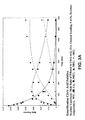
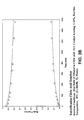
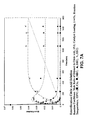
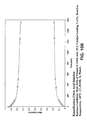
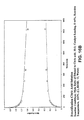
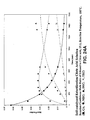
- Figures 3A and 3B are graphs showing Reaction Conditions: Mole Ratio of Ethanol to Citric acid, 15:1, Catalyst Loading, 5 wt%, Reaction Temperature, 78°C.
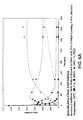
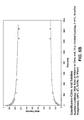
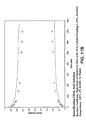
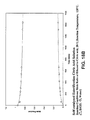
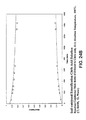
- Figures 4A and 4B are graphs showing Reaction Conditions: Mole Ratio of Ethanol to Citric acid, 15:1, Catalyst Loading, 5 wt%, Reaction Temperature, 90°C.
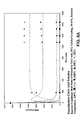
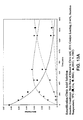
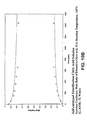
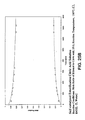
- Figure 5A and 5B are graphs showing Reaction Conditions: Mole Ratio of Ethanol to Citric acid, 15:1, Catalyst Loading, 5 wt%, Reaction Temperature, 100°C.
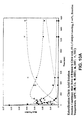
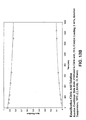
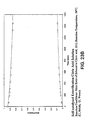
- Figures 6A and 6B are graphs showing Reaction Conditions: Mole Ratio of Ethanol to Citric acid, 15:1, Catalyst Loading, 5 wt%, Reaction Temperature, 110°C.
- Figures 7A and 7B are graphs showing Reaction Conditions: Mole Ratio of Ethanol to Citric acid, 15:1, Catalyst Loading, 5 wt%, Reaction Temperature, 120°C.
- Figures 8A and 8B are graphs showing Reaction Conditions: Mole Ratio of Ethanol to Citric acid, 15:1, Catalyst Loading, 10 wt%, Reaction Temperature, 120°C.
- Figures 9A and 9B are graphs showing Reaction Conditions: Mole Ratio of Ethanol to Citric acid, 15:1, Catalyst Loading, 3 wt%, Reaction Temperature, 120°C.
- Figures 10A and 10B are graphs showing Reaction Conditions: Mole Ratio of Ethanol to Citric acid, 15:1, Catalyst Loading, 2 wt%, Reaction Temperature, 120°C.
- Figures 11A and 11B are graphs showing Reaction Conditions: Mole Ratio of Ethanol to Citric acid, 15:1, Catalyst Loading, 1 wt%, Reaction Temperature, 120°C.
- Figures 12A and 12B are graphs showing Reaction Conditions: Mole Ratio of Ethanol to Citric acid, 15:1, Catalyst Loading, 3 wt%, Reaction Temperature, 78°C.
- Figures 13A and 13B are graphs showing Reaction Conditions: Mole Ratio of Ethanol to Citric acid, 15:1, Catalyst Loading, 2 wt%, Reaction Temperature, 78°C.
- Figures 14A and 14B are graphs showing Reaction Conditions: Mole Ratio of Ethanol to Citric acid, 15:1, Catalyst Loading, 1 wt%, Reaction Temperature, 78°C.
- Figures 15A and 15B are graphs showing Reaction Conditions: Mole Ratio of Ethanol to Citric acid, 20:1, Catalyst Loading, 5 wt%, Reaction Temperature, 120°C.
- Figures 16A and 16B are graphs showing Reaction Conditions: Mole Ratio of Ethanol to Citric acid, 10:1, Catalyst Loading, 5 wt%, Reaction Temperature, 120°C.
- Figures 17A and 17B are graphs showing Reaction Conditions: Mole Ratio of Ethanol to Citric acid, 5:1, Catalyst Loading, 5 wt%, Reaction Temperature, 120°C.
- Figures 18A and 18B are graphs showing Reaction Conditions: Mole Ratio of Ethanol to Citric acid, 20:1, Reaction Temperature, 120°C.
- Figures 19A and 19B are graphs showing Reaction Conditions: Mole Ratio of Ethanol to Citric acid, 15:1, Reaction Temperature, 120°C.
- Figures 20A and 20B are graphs showing Reaction Conditions: Mole Ratio of Ethanol to Citric acid, 10:1, Reaction Temperature, 120°C.
- Figures 21A and 21B are graphs showing Reaction Conditions: Mole Ratio of Ethanol to Citric acid, 5:1, Reaction Temperature, 120°C.
- Figures 22A and 22B are graphs showing Reaction Conditions: Mole Ratio of Ethanol to Citric acid, 15:1, Reaction Temperature, 78°C.
- Figures 23A and 23B are graphs showing Reaction Conditions: Mole Ratio of Ethanol to Citric acid, 15:1, Reaction Temperature, 90°C.
- Figures 24A and 24B are graphs showing Reaction Conditions: Mole Ratio of Ethanol to Citric acid, 15:1, Reaction Temperature, 100°C.
- Figures 25A and 25B are graphs showing Reaction Conditions: Mole Ratio of Ethanol to Citric acid, 15:1, Reaction Temperature, 110°C.
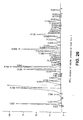
- Figure 26 is a graph showing HPLC analysis of reboiler composition from Run 1.
- Figure 27 is a graph showing HPLC analysis of reboiler composition from Run 2.
- Figure 28 is a graph showing analysis of reboiler composition from Run 3.
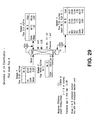
- Figure 29 shows simulation of CA esterification - Pilot scale Run 2.
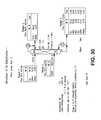
- Figure 30 shows simulation of CA esterification - Pilot scale Run 3.
- Figure 31 is a graph showing liquid phase composition profiles for Run 2 - ASPEN simulation.
- Figure 32 is a graph showing liquid phase composition profiles for Run 3 - ASPEN simulation.
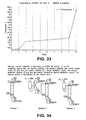
- Figure 33 is a graph showing temperature profiles for Run 2 - ASPEN simulation.
- Figure 34 shows different reactive distillation configurations for ASPEN simulations: (1) reactive distillation column with non-reactive rectifying, non-reactive stripping and reactive middle section, 2) plug flow pre-reactor, followed by a simple distillation column and reactive distillation column, 3) plug flow pre-reactor followed by reactive distillation column.
- the reactive sections are distinguished by the shaded areas.
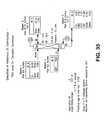
- Figure 35 shows a simulation of anhydrous CA esterification - Pilot scale for complete conversion.
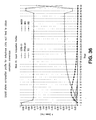
- Figure 36 is a graph showing liquid phase composition profile for anhydrous citric acid feed to obtain complete conversion.
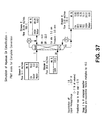
- Figure 37 shows a simulation of aqueous CA esterification - Pilot Scale for complete conversion.
- Figure 38 is a graph showing liquid phase composition profile for aqueous citric acid feed to obtain complete conversion.
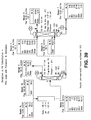
- Figure 39 shows a simulation of CA esterification - Pilot Scale with Prereactor & distillation.
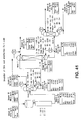
- Figure 40 shows a simulation of CA esterification - Pilot scale with prereactor.
- Figure 41 shows a simulation of CA esterification - plant scale with prereactor & distillation.
- Figure 42 shows a simulation of CA esterification - plant scale with prereactor & distillation.
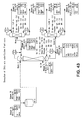
- Figure 43 shows a simulation of CA esterification - plant scale with prereactor & distillation.
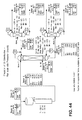
- Figure 44 shows a simulation of CA esterification - plant scale with prereactor.
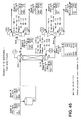
- Figure 45 shows a simulation of CA esterification - plant scale
- Figure 46 shows simulation of aqueous CA esterification - plant scale.
- Figure 47 is a schematic of experiment for Succinic Acid Esterification via Reactive Distillation.
- the improved process to make di- and tri-alkyl organic acid esters via reactive distillation is simple, inexpensive, and does not create large quantities of waste.
- the process is unique and has several advantages that distinguish it from prior methods for making esters.
- the use of a reactive distillation column is less expensive than the conventional batch process because it is a continuous process and because an insoluble acidic ion exchange resin in structured packing elements is used as a catalyst instead of a soluble mineral acid.
- the ester formation and purification of the product can take place in a single piece of equipment, whereas a conventional process may require up to ten separate pieces of equipment.
- This reactive distillation process avoids the inherent difficulties associated with membrane processes.
- TMS trimethylsilyl
- Citric acid and its ethyl esters were quantitatively analyzed on a Hewlett-Packard 1090 HPLC using a reversed phase C18 column (Novapak, 3.9 mm x 150 mm) held at 40°C.
- Citric acid (CA) and triethyl citrate (TEC) were identified and quantified by comparing HPLC retention time and peak area with their respective calibration standard. Standards for monoethyl citrate (MEC) and diethyl citrate (DEC) could not be obtained commercially.
- MEC monoethyl citrate
- DEC diethyl citrate
- the response factor values for CA and MEC were found to be the same; therefore MEC and DEC were each assigned the same response factor value as corresponding to TEC.
- the carbon balance for each reaction sample, based on citric acid and its esters was in the range of ⁇ 10%.
- esterification was performed in a 1 x 10 -4 m 3 stainless steel autoclave (5000 Multireactor System, Parr Instrument Co.) equipped with temperature and stirrer speed monitors and a sampling port.
- measured quantities of ethanol, citric acid and catalyst were added to the reactor and heating was started with slow stirring.
- the desired temperature was achieved in about 15 minutes, at which time the stirring rate was increased to 740 rpm. This time was considered as the zero reaction time.
- Samples were withdrawn at specific time intervals through a cooled metal tube and immediately transferred to an ice bath in order to ensure no further reaction took place before analysis. All samples were analyzed using the method described above.
- the Katapak-S packing is filled with approximately 150 g per meter length of Amberlyst-15, a strong acid macroporous cation exchange resin of 0.7 mm average bead size.
- the reactive section is enclosed by a non-reactive enriching section above height of 0.8 m and a non-stripping section below height of 1.0 m.
- Empty Katamax structured packing (Koch-Glitsch, Ltd.) is used to fill non-reactive column sections.
- the pressures were between 1.0 and 4.0 atmospheres.
- the temperatures were 80°C to 120°C.
- the column is equipped with an electronic reflux splitter to control reflux ratio, a total condenser with chiller capable of achieving a condenser temperature of-20°C, and a reboiler with an outlet to maintain a constant level and allow product withdrawal.
- the reboiler volume is 1.0 liter.
- Two feed pumps were utilized to feed solutions to the column at a controlled rate.
- the columns have several ports along their length that allow internal temperature measurements at ten locations equally divided over the column length, introduction of feed, and sample withdrawal.
- the columns are wrapped with a set of electric heating tapes that are controlled by surface thermocouples and Omega controllers and further insulated using glass wool in order to obtain near adiabatic operating conditions.
- the reactive distillation column was configured such that a feed consisting of 24 wt % citric acid in anhydrous ethanol (F1 in Figure 2) was fed near the top of rectification zone (0.2 m from top of column), while preheated ethanol (F2 in Figure 2), either in liquid or vapor form, was fed 1 m above the reboiler at the bottom of the reactive zone.
- the ratio of molar feed ratios of ethanol to citric acid was typically 15:1 to 20:1.
- the reflux ratio (L/D) was set to zero, although a small amount of internal reflux was noted experimentally (L/D ⁇ 0.05).
- the reboiler duty was held constant for all experiments.
- the column was started by turning on the external heating tapes and reboiler heater, and starting the feed pumps at the specified feed rates. Steady state was generally achieved after about a volume of bottoms product equivalent to three reboiler volumes had been collected. Samples were then collected from the distillate and bottoms streams for product analysis. Steady state flow rates of feed, bottoms, and distillate streams were measured by timed filling of graduated cylinders.
- the goal of column operation was to obtain tri-ethyl citrate along with some quantity of ethanol as the bottom product.
- the presence of ethanol in the reboiler was required to control reboiler temperature and thus prevent formation of oligomeric byproducts via secondary reactions of residual citric acid, mono-ethyl citrate and the di-ethyl citrate.
- the tri-ethyl citrate product can be purified by vacuum stripping out the ethanol in an additional separation column.
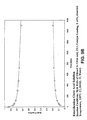
- Figures 3 to 7 show the effect of reaction temperature from 78° to 120°C on the esterification of citric acid with ethanol at a catalyst loading of 5 wt% and an initial mole ratio of ethanol to citric acid of 15:1.
- the rate of conversion of citric acid, mono-ethyl citrate, and di-ethyl citrate clearly increases with increasing reaction temperature.
- Figures 8 to 11 show the effect of varying catalyst loading from 1 to 10% on the esterification of citric acid with ethanol at 120°C and an initial mole ratio of ethanol to citric acid of 15:1. Additional data showing the effect of varying catalyst loading from 1 to 3% at reaction temperature of 78°C and initial mole ratio of ethanol to citric acid of 15:1 are shown in Figures 1 and Figures 12 to 14.
- the kinetic model is built on the assumption that each of the above forward and reverse reactions is first order in each reactant.
- the model is based on the mole fraction of each species in solution.
- the rates of the self-catalyzed reactions are substantially high and cannot be neglected. Moreover, the calculated reaction rate using Preliminary Model I are substantially lower than experimental rates at a reaction temperature of 120°C. This leads to the conclusion that self-catalyzed reactions cannot be neglected at higher temperatures especially for the reaction of citric acid.
- the self-catalyzed reactions have been correlated using a pseudo-homogeneous model based on the law of mass action as first order with respect to the catalytic acid concentration, reacting acid concentration and alcohol concentration.
- the strength of all the COOH groups have been taken to be the same.
- the acid strength of mono-ethyl citrate is taken as 2/3 of that of citric acid, and that for di-ethyl citrate as 1/3 of that of citric acid, since they contain 2 and 1 COOH groups, respectively.
- Table 3 Values of pre-exponential factor and energy of activation for Final Kinetic Model I (mole fraction based with both ion exchange catalyzed and self-catalyzed reaction) Reaction k Preexponential factor per gm catalyst basis (kmol i/kgmol n/min) E Energy of Activation CA + EtOH ⁇ MEC + W 20609598 69144 MEC + W ⁇ CA + EtOH 4907047 69144 MEC + EtOH ⁇ DEC + W 20174482 70803 DEC + W ⁇ MEC + EtOH 16812068 70803 DEC + EtOH ⁇ FEC + W 18060438 75294 TEC + W ⁇ DEC + EtOH 50167883 75294
- An activity-based kinetic model has been developed using activity coefficients generated in AspenPlus using UNIQUAC and UNIFAC.
- the self-catalyzed reactions fitted using the UNIQUAC model, which is similar to Eq. 4-6 in form but with activity instead of mole fraction.
- the kinetic data for the combined self-catalyzed and ion exchange catalyzed esterification reactions was fitted using the UNIQUAC model.
- the form of the equations is the same as Equations 14-16, except that activity has been substituted for mole fraction in each expression.
- the fit of the experimental data with the activity model is improved over the case when an activity based model is not used.
- the fit of the data with the final model is shown in Figures 3 to 25. The fit was good.
- the mole fraction model discussed previously was not as accurate.
- Run 1 the column was operated such that the reboiler temperature reached 235°C, indicating that there was no ethanol or water in the reboiler. Under these conditions, significant by-products were formed that included citraconic acid as shown by the HPLC analysis in Figure 26. It was concluded that a feasible reactive distillation process for tri-ethyl citrate formation requires the presence of ethanol in the reboiler to maintain a relatively low reboiler temperature. The ethanol and esters can be easily separated in a second column, thus eliminating by-product formation in the main reactive column. Results from Run 1 are shown in Table 4.
- Run 2 29% ethanol was present in the reboiler at steady state.
- Figure 27 shows the HPLC analysis of the reboiler composition - there are no detectable byproducts present.
- a desired reboiler composition of approximately 30% ethanol was chosen as a design and operating parameter for citric acid esterification in order to ensure that no by-products are formed in the reactive distillation column. (Typically this should be between 20 and 40% by volume ethanol).
- Run 2 did not achieve steady state even after 16 hr of operation because of the low reboiler flow rate, although it was very close to steady state based on samples collected over the course of experiment. Results from Run 2 are shown in Table 5.
- Run 4 was carried out at similar feed conditions to Run 3 except that the ethanol feed was superheated to 84°C. Results from this run are shown in Table 7.
- Table 7 Experimental Conditions and Results for Reactive Distillation
- Run 4 of the reactive distillation experiments above are modeled using the RADFRAC module of the ASPEN Plus simulation software to test its accuracy and reliability.
- the reaction kinetic parameters from the pseudo-homogeneous rate based model described are included in the simulation.
- the ASPEN-Plus molecule library does not contain mono and di-ethyl citrates, so these compounds were defined using the group contribution method. All other necessary physicochemical properties used are the default values from ASPEN.
- Figures 31 and 32 show the liquid phase composition profile in weight % over the column for Runs 4 and 3 respectively.
- Figure 33 shows the temperature profile over the column for Run 4. The experimental temperatures of the reboiler and condenser are plotted in the Figure 33 and the comparison with the predicted temperatures is good.
- Scheme 1 A stand-alone reactive distillation column which is fed either with an anhydrous saturated citric acid feed in ethanol containing 24 wt % citric acid or an 50 wt % aqueous citric acid feed.
- Scheme 2 Feeding a 50 wt % aqueous citric acid feed first to a pre-reactor where a reaction is allowed to go to nearly equilibrium. The outlet from the pre-reactor is then fed to a distillation column where most of the water is distilled out along with ethanol as the overhead. The bottom stream from the distillation column is then fed to a reactive distillation column where the reaction is taken to near completion in order to obtain high yields of tri-ethyl citrate.
- Scheme 3 Feeding a 50 wt % aqueous citric acid under similar conditions to Scheme 2 to a pre-reactor. The only difference is that the intermediate distillation column is removed in this configuration. The conversions obtained are compared to that obtained in Scheme 2.
- Case 1 Figure 35 shows the results for reactive distillation using Scheme 1 when anhydrous citric acid in ethanol was fed to a reactive distillation column containing 35 equilibrium stages and operating at 2.5 atm pressure. It can be observed that excellent conversion of citric acid to tri-ethyl citrate is observed at a citric acid flow rate of 5.45 x 10 -4 kmol/hr.
- the liquid phase composition profiles (wt %) are shown in Figure 36. It can be seen from Figure 24 that conversion of di-ethyl citrate to tri-ethyl citrate is the slowest step in the reactive distillation column, thus requiring a large number of stages to achieve nearly complete conversion.
- Case 2 Figure 37 shows the results for reactive distillation using Scheme 1 when an aqueous 50 wt% citric acid feed was used as the feed.
- the column is identical to Case 1 and the citric acid feed rate is 5.45 x 10 -4 kmol/hr.
- the liquid phase composition profiles (wt %) are shown in Figure 38. It was observed that the presence of water in citric acid feed (e.g., the use of aqueous feed versus crystalline citric acid dissolved in ethanol) does not adversely affect the operation of the reactive distillation column, since the water is mostly removed in the initial top stages. Again in this case, it is the conversion of di-ethyl citrate to tri-ethyl citrate that dictates the number of stages required in the reactive distillation column.
- Case 3 Using Scheme 2, 2.49 x 10 -3 kmol/hr of aqueous citric acid were fed to a plug flow reactor operating as an esterification pre-reactor at 100°C and 2.0 atm absolute pressure. At these conditions, a conversion close to the equilibrium value is obtained for a reactor space time of approximately 27 hours.
- the outlet from the plug flow reactor is fed to a simple distillation column of 10 stages operating at 1 atm pressure. About 90% of the water is removed along with ethanol from the distillate. The bottom stream is then fed to a reactive distillation column having 40 stages and operating at 2.5 atm pressure. Nearly complete conversion of citric acid to tri-ethyl citrate is observed under these conditions as shown in Figure 39.
- Case 4 The process in this case is similar to that used in Case 3 above, except that the intermediate simple distillation column to remove water and ethanol has been omitted. It can be seen from Figure 40 that the yield of tri-ethyl citrate in this case is lower than that in Case 3, where the removed water allows higher conversions.
- the temperature of the reboiler needs to be less than 120°C to prevent formation of by-products. If the pressure is elevated then higher temperatures can be used up to about 150°C can be used. Thus pressures up to 20 atmospheres can be used.
- ASPEN Plus is the most widely used simulation software in the chemical process industry.
- the software has desirable features which include the built-in module RADFRAC for simulation of reactive distillation processes.
- RADFRAC has the ability to simulate phase equilibria simultaneously with chemical equilibria or with incorporation of reaction kinetic data, the latter requiring estimation of liquid residence time or liquid holdup on each stage of the distillation column.
- the details of the RADFRAC algorithm used for simulation of reactive distillation systems are described in detail by Venkataraman et al., Reactive Distillation using ASPEN Plus., Chem. Eng. Prog., (1990), 69, 45-54 .
- ASPEN Plus is further supported by a strong physical and chemical properties database, including hydrodynamics of column packings such as those used in our laboratory, and the ability to predict properties of components not present in the database. Both equilibrium-based and kinetic-based chemical reaction models have been incorporated in the current study.
- Results are presented here on three related efforts: (1) batch esterification of citric acid in glass or autoclave reactors, from which a pseudo- homogenous kinetic model of the citric acid esterification system has been developed; (2) continuous citric acid esterification experiments in a pilot-scale packed reactive distillation column operating at 1 atm; and (3) simulation of the pilot-scale reactive distillation column and of a commercial-scale reactive distillation process for citric acid esterification using ASPEN Plus process simulation software with the experimentally developed kinetic model.
- Commercial-scale simulations have been conducted with and without use of an esterification pre-reactor and an intermediate simple distillation column in order to obtain high yield of tri-ethyl citrate.
- Esterification of citric acid was carried out with n-butanol in an autoclave (used as a pre-reactor) at 120°C to achieve an equilibrium composition of mono-, di-, and tri-butyl citrate esters.
- the operating temperature was limited to 120°C by the thermal instability of the catalyst (Amberlyst-15).
- 0.15 mol of citric acid was reacted with 2.25 mol of n-butanol (15:1 ratio) in the presence of Amberlyst-15 resin as catalyst.
- the catalyst quantity was maintained at a loading of 5 wt% of total mass of reactants. Equilibrium was achieved after 16 h of reaction with almost 99% conversion of citric acid; the distribution of various esters was 4% mono-, 30% di-, and 65% tri-butyl citrate.
- the final reaction mass obtained at equilibrium was used as a feed for reactive distillation.
- the equilibrium composition of butyl citrate esters was fed to the upper port in the column while an excess of n-butanol was fed through lower port of column.
- the objective of this Example was to achieve complete removal of water (reaction product) through the distillate and 100% formation of tri-butyl citrate in the bottoms product stream. No water was observed in the bottoms product stream, while the distillate showed the presence of water and n-butanol. Water and n-butanol form an azeotrope, which helps in removing the water from the reaction zone.
- the composition of butyl citrate esters in the bottoms product stream at steady state was 24 di- and 76% tri-butyl citrates.
- the reactive distillation experiment for esterification of succinic acid used a prereactor at 120°C to produce Feed 1 stream from the prereactor stream as shown in Figure 47.
- the prereactor feed constitutes a 10:1 molar ratio of ethanol to succinic acid.
- the stream Feed 1 represents an equilibrium mixture.
- SA succinic acid
- MES Monoethyl succinate
- Table 9 illustrate the capability of reactive distillation to produce diethyl succinate from succinic acid.
- the present invention can be applied to esterify organic acids besides citric acid, including other biomass-derived acids such as succinic acid, propionic acid, malic, glutaric, adipic, glyceric, 3-hydroxy propanoic, lactic, levulinic, and amino acids such as alanine, serine, glycine and lysine.
- other biomass-derived acids such as succinic acid, propionic acid, malic, glutaric, adipic, glyceric, 3-hydroxy propanoic, lactic, levulinic, and amino acids such as alanine, serine, glycine and lysine.
Landscapes
- Chemical & Material Sciences (AREA)
- Organic Chemistry (AREA)
- Chemical Kinetics & Catalysis (AREA)
- Organic Low-Molecular-Weight Compounds And Preparation Thereof (AREA)
- Low-Molecular Organic Synthesis Reactions Using Catalysts (AREA)
Abstract
Description
- This application is a continuation-in-part of
U.S. application Serial No. 10/894,307, filed July 19, 2004
STATEMENT REGARDING FEDERALLY SPONSORED RESEARCH OR DEVELOPMENT - None
- The present invention relates generally to a process for the countercurrent, reactive distillation, esterification of organic di- and tri- acids with lower alcohols (C1 to C8) with the available acid groups esterified. Specifically, the present invention relates to citric acid tri-esterification using reactive distillation with the alcohols, particularly ethanol.
- There has been considerable interest in the development and use of biorenewable-based chemicals. This interest is fueled by ever-rising global crude oil prices, the increasing desirability to reduce dependence on petroleum-based industries, and potential environmental benefits. Bio-based chemicals are environmentally friendly because they often degrade into benign products, making them prime candidates for replacement of petroleum-based products. The esters of bio-based organic acids fall into the category of benign or "green" solvents and are promising replacements for halogenated petroleum-based solvents in a wide variety of uses.
- . Citric acid can be esterified with alcohols such as ethanol and n-butanol to yield triethyl citrate and tri-n-butyl citrate, respectively. Both tri-ethyl citrate and tri-n-butyl citrate are used as non-toxic plasticizers in toys, medical products (e.g. as enteric coatings for controlled release drug delivery systems), printing ink coatings, cosmetics, etc. These plasticizers are suitable as food additives such as whipping agents for dried egg whites, food flavorings, or food packaging materials. Citrate esters rapidly metabolize in the body via liver and blood serum enzymes to liberate the citrate ion which is disposed of through the usual biochemical pathways.
- Tri-ethyl citrate is a water soluble plasticizer while tri-butyl citrate is a water insoluble plasticizer. The global market for citrate plasticizers has been estimated at around 11 billion pounds per year and according to 2003 statistical data, the U.S. share of this market is 2.4 billion pounds.
- Citric acid is a tri-basic acid. Upon esterification with an alcohol such as ethanol or n-butanol, it forms, through a series of reactions, a mixture of mono-alkyl, di-alkyl and tri-alkyl citrates as shown in Figure 1.
- The esterification of citric acid is an equilibrium-limited process. Such processes, when carried out in conventional reactors, suffer from limited conversion. To overcome this equilibrium limitation, continuous removal of one of the products of the reaction mixture is essential in order to drive the reaction to completion. One technique available for doing so is through the use of continuous reactive distillation.
- There are other di- and tri-organic acids. These include succinic acid, maleic acid, glutaric acid, adipic acid, malonic acid and pimelic acid which are diacids. It also applies to other tri-acids which need to be esterified.
- Reactive distillation (RD) is a multifunctional process where chemical reaction and distillation occur simultaneously in a single vessel. The numerous advantages arising from the synergistic interaction of unit operations in a single unit over the conventional, sequential operation of a reactor followed by a distillation column include overcoming limitations of some equilibrium-limited chemical reactions (as in methyl acetate and MTBE production), improved selectivity by removal of the products from the reaction zone, thereby limiting by-product formation, "reacting away" some of the azeotropes present in conventional distillation processes, and utilizing the exothermic heat of reaction for vaporization and avoidance of hot spot formation. These potential advantages of reactive distillation lead to lower capital and operating costs as well as reduced environmental impact. The major shortcomings of reactive distillation are requirements for much greater complexity in design and process control, often involving multiple steady states, and high process non-linearity due to the strong interaction between process variables. The operating window of reactive distillation processes has to be compatible with the thermal stability of the catalyst in order to ensure a long catalyst life since frequent catalyst change over is an expensive proposition. Reactive distillation requires a significantly greater research effort, in both experimental and in mathematical modeling, in order to develop a feasible process.
- Reactive distillation was first reported by Backhaus (Backhaus A. A. Continuous Process for the manufacture of Esters.
U.S. Patent 1,400,849 (1921 )). The subject has witnessed an explosion of interest in the last ten years since its commercial application to MTBE and methyl acetate production. Reviews on reactive distillation are available from Sharma and Mahajani (Sharma, M. M., Mahajani, S. M. Industrial Application of Reactive Distillation in Reactive Distillation Edited by Sundmacher K. and Kienle A., Wiley VCH, Germany, 1 (2003)); Mahajani and Chopade (Mahajani, S. M.; Chopade, S. P. Reactive Distillation: Process of Commercial Importance. Encyclopedia of Separation Science Edited by Wilson I. D., Edlard T. R., Poole C. A. and M. Cooke, Academic Press, London UK, 4075 (2001)), Taylor and Krishna (Taylor, R., et al., Modelling Reactive Distillation. Chem.. Eng. Sci., 55, 5183 (2000); and Modelling of Homogeneous and heterogeneous Reactive Distillation Processes, ) and Hiwale et al (Hiwale, R.S., et al., Industrial Application of Reactive Distillation: Recent Trends. Int. J. of Chem. React. Eng., 2, Review R1 (2004)). Reactive distillation in the presence of solid acid catalyst, also commonly referred to as catalytic distillation, has come a long way since its inception by Spes (Spes, H., Katalytische Reaktionen in Ionenaustaucherkolonnen unter Verschiebung des chemische Geleichgewichts. Chemiker Atg/Chemische Apparatur, 90, 443-446 (1966)). Industrially applied reactive distillation processes are rather limited in number currently, especially in comparison to potential applications (Stankiewicz and Moulijn, 2000). - The degree of complexity in reactive distillation processes increases with use of solid catalysts, but the development of modern structured column packings makes the use of such catalysts viable. Katapak-S structured packing (Sulzer), used in this invention, is a well-known and highly versatile packing consisting of vertically-oriented enclosures filled with catalyst particles. Fluid dynamic properties and use of Katapak-S in reactive distillation systems have been described in the open literature by Moritz and Hasse (Chem. Eng. Sci. 54, 1367-1374 (1999), Hanika et al (Chem. Eng. Sci. 54, 5205-5209 (1999), Van Baten et al (Catalysis Today, 69, 371-377 (2001), Gotze et al (Catalysis Today., 69, 201-208 (2001), Van Baten and Krishna (Catalysis Today, 69, 371-377 (2001), Smejkal et al (Chem. Eng. Sci., 56, 365-370 (2001), Ratheesh and Kannan (Chem. Eng. Ji., 104, 45-54 (2004), Kolodziej et al (Chem. Eng. Proc., 43, 457-464 (2004), Schmitt et al (Chem. Eng. Proc., 43, 397-409 (2004) and Schmitt et al (Chem. Eng. Proc. 44, 677-685 (2005).
- Synthesis of organic acid esters by reactive distillation is well established, but in most applications the ester has either the highest volatility of the reagents present (e.g., methyl acetate) or the lowest volatility, with water as the most volatile component (Schmitt et al., Chem. Eng. Proc. 43, 397-409 (2004)). In these cases, recovery of 100% pure ester is straightforward via optimization of column operating conditions. Tri-ethyl citrate production via reactive distillation does not fit into either of these categories. Formation of tri-ethyl citrate proceeds through a series of reactions yielding mono- and di-ethyl citrate as intermediate products. Since tri-ethyl citrate has a volatility that is lower than ethanol and water but higher than citric acid, mono- and di-ethyl citrates (those are essentially non-volatile). Therefore, it is only possible to isolate the pure product if complete conversion of citric acid and the intermediate products mono-ethyl citrate and di-ethyl citrate are achieved within the reactive distillation column. The primary challenge is therefore to achieve sufficiently rapid esterification kinetics so as to ensure complete conversion to the desired product triethyl citrate. Example of previous experimental work on similar esterification systems has been described by Bock et al (Chem. Eng. Prog. 36, 101-109 (1997)) for the synthesis of isopropyl myristate, and in Applicants'
parent application 10/894,307, filed July 19, 2004 - Prior information on the kinetics of citric acid esterification with ethanol or n-butanol is confined to mainly the Chinese and German patent literature.
Joerg et al. (Application WO 2003008369 A1 (2003 )) describes a process for synthesis of tri-ethyl citrate by a three stage batch process. Tao (Tao, X., Huazue Shijie, 39(6), 302-304 (1998)) discusses the synthesis of tri-ethyl citrate in the presence of p-toluenesulfonic acid as catalyst and removal of the formed water.Frappier et al (WO 9851657 (1998 -
U.S. Patent No. 5,008,046 to Bremus et al. describes a reactive distillation process using a column with plate type column with an acid catalyst under pressure.U.S. Patent No. 5,536,856 to Harrison et al. describes a similar column wherein resin acid catalyst particles were supported by a tray on the column. The use of columns with trays is quite expensive. - While the related art teaches organic acid esterification processes, there still exists a need for improved continuous processes for di- and tri-organic acid, particularly citric acid esterification.
- Therefore, it is an object of the present invention to provide an improved process for the continuous production of di- and tri-substituted organic acid esters in a single column using reactive distillation. It is particularly an object of the present invention to provide a process for producing triethyl citrate.
- These and other objects will become increasingly apparent by reference to the following description.
- The present invention relates to a process for the continuous esterification of an organic acid with two or three acid groups to produce an organic acid di- or tri-ester with the available acid groups esterified in a vertical column by reactive distillation comprising: (a) feeding a mixture comprising the organic acid with the two or three acid groups and containing between 3 to 8 carbon atoms as an aqueous or alcoholic solution into an upper port of the column and an alcohol containing 1 to 8 carbon atoms into a lower port of the column; (b) contacting in a reactive distillation the organic acid and the alcohol in countercurrent flow in a reaction zone between the ports at a temperature which reacts the organic acid and the alcohol over an insoluble acid catalyst mounted in structured packing elements and supported as a single unit of the elements in the column within the reaction zone to form the organic acid ester; (c) removing vaporized unreacted alcohol and water from the top of the column; and (d) collecting a product comprising the organic acid ester from the bottom of the column, wherein the organic acid ester formed is reboiled by a heat exchanger at the bottom of the column. Preferably the alcohol in step (c) is recovered and recycled into the lower port of the column.
- The present invention also relates to a process for the continuous esterification of citric acid to produce a citric acid tri-ester in a vertical column by reactive distillation comprising: (a) feeding a mixture comprising the citric acid as an aqueous or alcoholic solution into an upper port of the column and an alcohol containing 1 to 8 carbon atoms into a lower port of the column; (b) contacting in a reactive distillation the citric acid and the alcohol in countercurrent flow in a reaction zone between the ports at a temperature which reacts the citric acid and the alcohol over an insoluble acid catalyst mounted in structured packing elements and supported in the column within the reaction zone to form the citric acid ester; (c) removing vaporized unreated alcohol and water from the top of the column; and (d) collecting a product comprising the citric acid ester from the bottom of the column, wherein the citric acid ester is reboiled by a heat exchanger at the bottom of the column. Preferably the alcohol is recovered and recycled into the lower port of the column. Preferably the insoluble acid catalyst is an acidic ion exchange resin. Preferably the feeding of the alcohol relative to the citric acid is such that a molar ratio of alcohol to citric acid is maintained between about 3 to about 40. Preferably the feeding of the alcohol relative to the feeding of the citric acid is such that the percentage of citric acid conversion to a tri-ester is greater than 50 percent.
- . The present invention also relates to a process for the continuous esterification of an organic acid with two or three acid groups to produce an organic acid di- or tri-ester with the available acid groups esterified in a single vertical column by reactive distillation comprising:
- (a) feeding a mixture of the organic acid containing about 20 to 90% alcohol containing 1 to 8 carbon atoms into an upper port of the column and the same alcohol into a lower port of the column; (b) contacting in a reactive distillation the organic acid and the alcohol in countercurrent flow in a reaction zone between the ports at a temperature which reacts the organic acid and the alcohol over an insoluble acid catalyst mounted in structured packing elements and supported as a single unit of the elements in the column within the reaction zone to form the organic acid ester; (c) removing vaporized unreacted alcohol and water from the top of the column; and (d) collecting a product comprising the organic acid ester from the bottom of the column, wherein the organic acid ester formed is partially reboiled by a heat exchanger at the bottom of the column. Preferably the alcohol is recovered and recycled into the lower port of the column.
- The present invention also relates to a process for the continuous esterification of citric acid to produce a citric acid ester in a single vertical column by reactive distillation comprising: (a) feeding a mixture of citric acid containing about 50 to 90% alcohol containing 1 to 8 carbon atoms into an upper port of the column ; (b) contacting in a reactive distillation the organic acid and the alcohol in countercurrent flow in a reaction zone between the ports at a temperature which reacts the organic acid and the alcohol over an insoluble acid catalyst mounted in structured packing elements and supported as a single unit of the elements in the column within the reaction zone to form the organic acid ester; (c) removing vaporized unreacted alcohol and water from the top of the column; and (d) collecting a product comprising the organic acid ester from the bottom of the column, wherein the organic acid ester formed is partially reboiled by a heat exchanger at the bottom of the column. Preferably the alcohol is recovered and recycled into the lower port of the column.
- The present invention also relates to a process for the continuous esterification of an organic acid with two or three acid groups to produce an organic acid di- or tri-ester with the available acid groups esterified in a single vertical column by reactive distillation comprising:
- (a) feeding a mixture of the organic acid containing about 20 to 90% alcohol containing 1 to 8 carbon atoms into an upper port of the column and the same alcohol into a lower port of the column;
- (b) contacting in a reactive distillation the organic acid and the alcohol in countercurrent flow in a reaction zone between the ports at a temperature which reacts the organic acid and the alcohol over an insoluble acid catalyst mounted in structured packing elements and supported as a single unit of the elements in the column within the reaction zone to form the organic acid ester;
- (c) removing vaporized unreacted alcohol and water from the top of the column; and
- (d) collecting a product comprising the organic acid ester from the bottom of the column, wherein the organic acid ester formed is partially reboiled by a heat exchanger at the bottom of the column. Preferably the alcohol is recovered and recycled into the lower port of the column. Preferably the insoluble acid catalyst is an acidic ion exchange resin. Most preferably, the feeding of the alcohol relative to the citric acid is such that a molar ratio of alcohol to citric acid is maintained between about 3 to about 35. Preferably the feeding of the alcohol relative to the feeding of the citric acid is such that the percentage of citric acid conversion to the citric acid tri-ester is greater than 50 percent.
- Figure 1 is a schematic showing esterification of citric acid.
- Figure 2 is a schematic view of a pilot scale reactive distillation column for ethyl citrate synthesis.
- Figures 3A and 3B are graphs showing Reaction Conditions: Mole Ratio of Ethanol to Citric acid, 15:1, Catalyst Loading, 5 wt%, Reaction Temperature, 78°C.
- Figures 4A and 4B are graphs showing Reaction Conditions: Mole Ratio of Ethanol to Citric acid, 15:1, Catalyst Loading, 5 wt%, Reaction Temperature, 90°C.
- Figure 5A and 5B are graphs showing Reaction Conditions: Mole Ratio of Ethanol to Citric acid, 15:1, Catalyst Loading, 5 wt%, Reaction Temperature, 100°C.
- Figures 6A and 6B are graphs showing Reaction Conditions: Mole Ratio of Ethanol to Citric acid, 15:1, Catalyst Loading, 5 wt%, Reaction Temperature, 110°C.
- Figures 7A and 7B are graphs showing Reaction Conditions: Mole Ratio of Ethanol to Citric acid, 15:1, Catalyst Loading, 5 wt%, Reaction Temperature, 120°C.
- Figures 8A and 8B are graphs showing Reaction Conditions: Mole Ratio of Ethanol to Citric acid, 15:1, Catalyst Loading, 10 wt%, Reaction Temperature, 120°C.
- Figures 9A and 9B are graphs showing Reaction Conditions: Mole Ratio of Ethanol to Citric acid, 15:1, Catalyst Loading, 3 wt%, Reaction Temperature, 120°C.
- Figures 10A and 10B are graphs showing Reaction Conditions: Mole Ratio of Ethanol to Citric acid, 15:1, Catalyst Loading, 2 wt%, Reaction Temperature, 120°C.
- Figures 11A and 11B are graphs showing Reaction Conditions: Mole Ratio of Ethanol to Citric acid, 15:1, Catalyst Loading, 1 wt%, Reaction Temperature, 120°C.
- Figures 12A and 12B are graphs showing Reaction Conditions: Mole Ratio of Ethanol to Citric acid, 15:1, Catalyst Loading, 3 wt%, Reaction Temperature, 78°C.
- Figures 13A and 13B are graphs showing Reaction Conditions: Mole Ratio of Ethanol to Citric acid, 15:1, Catalyst Loading, 2 wt%, Reaction Temperature, 78°C.
- Figures 14A and 14B are graphs showing Reaction Conditions: Mole Ratio of Ethanol to Citric acid, 15:1, Catalyst Loading, 1 wt%, Reaction Temperature, 78°C.
- Figures 15A and 15B are graphs showing Reaction Conditions: Mole Ratio of Ethanol to Citric acid, 20:1, Catalyst Loading, 5 wt%, Reaction Temperature, 120°C.
- Figures 16A and 16B are graphs showing Reaction Conditions: Mole Ratio of Ethanol to Citric acid, 10:1, Catalyst Loading, 5 wt%, Reaction Temperature, 120°C.
- Figures 17A and 17B are graphs showing Reaction Conditions: Mole Ratio of Ethanol to Citric acid, 5:1, Catalyst Loading, 5 wt%, Reaction Temperature, 120°C.
- Figures 18A and 18B are graphs showing Reaction Conditions: Mole Ratio of Ethanol to Citric acid, 20:1, Reaction Temperature, 120°C.
- Figures 19A and 19B are graphs showing Reaction Conditions: Mole Ratio of Ethanol to Citric acid, 15:1, Reaction Temperature, 120°C.
- Figures 20A and 20B are graphs showing Reaction Conditions: Mole Ratio of Ethanol to Citric acid, 10:1, Reaction Temperature, 120°C.
- Figures 21A and 21B are graphs showing Reaction Conditions: Mole Ratio of Ethanol to Citric acid, 5:1, Reaction Temperature, 120°C.
- Figures 22A and 22B are graphs showing Reaction Conditions: Mole Ratio of Ethanol to Citric acid, 15:1, Reaction Temperature, 78°C.
- Figures 23A and 23B are graphs showing Reaction Conditions: Mole Ratio of Ethanol to Citric acid, 15:1, Reaction Temperature, 90°C.
- Figures 24A and 24B are graphs showing Reaction Conditions: Mole Ratio of Ethanol to Citric acid, 15:1, Reaction Temperature, 100°C.
- Figures 25A and 25B are graphs showing Reaction Conditions: Mole Ratio of Ethanol to Citric acid, 15:1, Reaction Temperature, 110°C.
- Figure 26 is a graph showing HPLC analysis of reboiler composition from
Run 1. - Figure 27 is a graph showing HPLC analysis of reboiler composition from
Run 2. - Figure 28 is a graph showing analysis of reboiler composition from
Run 3. - Figure 29 shows simulation of CA esterification -
Pilot scale Run 2. - Figure 30 shows simulation of CA esterification -
Pilot scale Run 3. - Figure 31 is a graph showing liquid phase composition profiles for Run 2 - ASPEN simulation.
- Figure 32 is a graph showing liquid phase composition profiles for Run 3 - ASPEN simulation.
- Figure 33 is a graph showing temperature profiles for Run 2 - ASPEN simulation.
- Figure 34 shows different reactive distillation configurations for ASPEN simulations: (1) reactive distillation column with non-reactive rectifying, non-reactive stripping and reactive middle section, 2) plug flow pre-reactor, followed by a simple distillation column and reactive distillation column, 3) plug flow pre-reactor followed by reactive distillation column. The reactive sections are distinguished by the shaded areas.
- Figure 35 shows a simulation of anhydrous CA esterification - Pilot scale for complete conversion.
- Figure 36 is a graph showing liquid phase composition profile for anhydrous citric acid feed to obtain complete conversion.
- Figure 37 shows a simulation of aqueous CA esterification - Pilot Scale for complete conversion.
- Figure 38 is a graph showing liquid phase composition profile for aqueous citric acid feed to obtain complete conversion.
- Figure 39 shows a simulation of CA esterification - Pilot Scale with Prereactor & distillation.
- Figure 40 shows a simulation of CA esterification - Pilot scale with prereactor.
- Figure 41 shows a simulation of CA esterification - plant scale with prereactor & distillation.
- Figure 42 shows a simulation of CA esterification - plant scale with prereactor & distillation.
- Figure 43 shows a simulation of CA esterification - plant scale with prereactor & distillation.
- Figure 44 shows a simulation of CA esterification - plant scale with prereactor.
- Figure 45 shows a simulation of CA esterification - plant scale
- Figure 46 shows simulation of aqueous CA esterification - plant scale.
- Figure 47 is a schematic of experiment for Succinic Acid Esterification via Reactive Distillation.
- All patents, patent applications, government publications, government regulations, and literature references cited in this specification are hereby incorporated herein by reference in their entirety. In case of conflict the present description, including definitions, will control.
- The improved process to make di- and tri-alkyl organic acid esters via reactive distillation is simple, inexpensive, and does not create large quantities of waste. The process is unique and has several advantages that distinguish it from prior methods for making esters. First, the use of a reactive distillation column is less expensive than the conventional batch process because it is a continuous process and because an insoluble acidic ion exchange resin in structured packing elements is used as a catalyst instead of a soluble mineral acid. The ester formation and purification of the product can take place in a single piece of equipment, whereas a conventional process may require up to ten separate pieces of equipment. This reactive distillation process avoids the inherent difficulties associated with membrane processes.
- Anhydrous citric acid crystals were obtained from Aldrich Chemicals. Absolute ethanol (99% purity) and HPLC grade water were obtained from J.T. Baker. The strong acid cation exchange resin catalyst Amberlyst-15 (Rohm and Hass, Philadelphia, PA) was obtained in H+ form and was used without modification. Purity of all chemicals was checked by gas chromatography or HPLC.
- The presence of citric acid, monoethyl citrate, diethyl citrate and triethyl citrate was first confirmed by GC-MS analysis of their trimethylsilyl (TMS) derivatives. Ethanol and water from reaction samples were analyzed by gas chromatography (Varian 3700 w/ TCD detection; 20 ml/min He as a carrier gas) using a packed stainless steel column (3.25 mm X 4 m) containing Porapak-Q as the stationary phase. The column temperature program involved initially holding at 140°C for 2 min, heating to 220°C at 20°C/min, and holding at 220°C for 6 min.
- Citric acid and its ethyl esters (mono, di and tri) were quantitatively analyzed on a Hewlett-Packard 1090 HPLC using a reversed phase C18 column (Novapak, 3.9 mm x 150 mm) held at 40°C. Water/acetonitrile (ACN) mixtures, buffered at pH=1.3, were used as mobile phase (1.0 ml/min) in a gradient mode (0% ACN (t=0) to 60% ACN (t=20 min) to 90% ACN (t=25 min) to 0% ACN (t=28 min)), and species were quantified by UV detection (Hitachi L400H) at a wavelength of 210 nm. Citric acid (CA) and triethyl citrate (TEC) were identified and quantified by comparing HPLC retention time and peak area with their respective calibration standard. Standards for monoethyl citrate (MEC) and diethyl citrate (DEC) could not be obtained commercially. On a mass basis, the response factor values for CA and MEC were found to be the same; therefore MEC and DEC were each assigned the same response factor value as corresponding to TEC. Using these response factor values, the carbon balance for each reaction sample, based on citric acid and its esters, was in the range of ±10%.
- Esterification reactions at 80°C (the normal boiling point of ethanol) were performed in a 1 x 10⁻⁴ m3 jacketed glass reactor equipped with a re-circulating constant temperature oil bath. A spiral coil condenser, open to the atmosphere, was placed on top of the reactor. The glass reactor was equipped with temperature and stirrer speed monitoring devices and a sampling port. In operation, measured quantities of ethanol and citric acid were added to the reactor and heating and stirring were started simultaneously. Once the desired temperature was achieved, usually in about 15 minutes, catalyst (
Amberlyst 15 ion exchange resin) was added and stirring speed was increased to 800 rpm. This point in time was considered as the zero reaction time. Samples were withdrawn at specific time intervals and immediately transferred to an ice bath (prior to analysis) in order to ensure that no further reaction took place. - For reaction temperatures of 90°C and above, esterification was performed in a 1 x 10⁻⁴ m3 stainless steel autoclave (5000 Multireactor System, Parr Instrument Co.) equipped with temperature and stirrer speed monitors and a sampling port. In operation, measured quantities of ethanol, citric acid and catalyst were added to the reactor and heating was started with slow stirring. The desired temperature was achieved in about 15 minutes, at which time the stirring rate was increased to 740 rpm. This time was considered as the zero reaction time. Samples were withdrawn at specific time intervals through a cooled metal tube and immediately transferred to an ice bath in order to ensure no further reaction took place before analysis. All samples were analyzed using the method described above.
- Experimental investigations of tri-ethyl citrate formation via continuous reactive distillation were performed in a pilot-scale glass column with an inner diameter of 50 mm and total height of 5.5 m constructed from Pyrex glass tubes (Asthana et al, Org. Process Res. & Dev., 9, 599-607 (2005),
Asthana et al., U.S. Patent Appl. 10/894,307 (2004 - The column is equipped with an electronic reflux splitter to control reflux ratio, a total condenser with chiller capable of achieving a condenser temperature of-20°C, and a reboiler with an outlet to maintain a constant level and allow product withdrawal. The reboiler volume is 1.0 liter. Two feed pumps were utilized to feed solutions to the column at a controlled rate. The columns have several ports along their length that allow internal temperature measurements at ten locations equally divided over the column length, introduction of feed, and sample withdrawal. The columns are wrapped with a set of electric heating tapes that are controlled by surface thermocouples and Omega controllers and further insulated using glass wool in order to obtain near adiabatic operating conditions.
- The reactive distillation column was configured such that a feed consisting of 24 wt % citric acid in anhydrous ethanol (F1 in Figure 2) was fed near the top of rectification zone (0.2 m from top of column), while preheated ethanol (F2 in Figure 2), either in liquid or vapor form, was fed 1 m above the reboiler at the bottom of the reactive zone. The ratio of molar feed ratios of ethanol to citric acid was typically 15:1 to 20:1. The reflux ratio (L/D) was set to zero, although a small amount of internal reflux was noted experimentally (L/D <0.05). The reboiler duty was held constant for all experiments.
- The column was started by turning on the external heating tapes and reboiler heater, and starting the feed pumps at the specified feed rates. Steady state was generally achieved after about a volume of bottoms product equivalent to three reboiler volumes had been collected. Samples were then collected from the distillate and bottoms streams for product analysis. Steady state flow rates of feed, bottoms, and distillate streams were measured by timed filling of graduated cylinders.
- The goal of column operation was to obtain tri-ethyl citrate along with some quantity of ethanol as the bottom product. The presence of ethanol in the reboiler was required to control reboiler temperature and thus prevent formation of oligomeric byproducts via secondary reactions of residual citric acid, mono-ethyl citrate and the di-ethyl citrate. We observed such byproducts in early experiments under conditions where no water or ethanol were present in the reboiler and high reboiler temperature was attained. The tri-ethyl citrate product can be purified by vacuum stripping out the ethanol in an additional separation column.
- The glass column operating pressure was limited to 1 atm for reasons of safety. From batch kinetic experiments, we observed that ethyl citrate formation was relatively slow at 80°C (the normal b.p. of EtOH). This kinetic limitation dictates that only relatively low conversion of citric acid to ethyl citrate can be obtained in the glass column - a major limitation in the experimental reactive distillation experiments.
- Several batch kinetic experiments were carried out to study the effects of reaction temperature, catalyst loading, and initial reactant molar ratio on the heterogeneously catalyzed esterification of citric acid with ethanol. It was observed from initial experimentation that the external mass-transfer resistances were negligible at a stirring speed of above 500 rpm. Hence all kinetic experiments were performed at 800 rpm. The influence of internal mass transfer resistances were neglected for reactions catalyzed by Amberlyst 15 (Gangadwala et al (Ind. Eng. Chem. Res. 42 2146-2155 (2003)), Liu et al (Catalytic synthesis of tri-butyl citrate with dealuminated USY zeolite. 11, 175-177 (2001)).
- Figures 3 to 7 show the effect of reaction temperature from 78° to 120°C on the esterification of citric acid with ethanol at a catalyst loading of 5 wt% and an initial mole ratio of ethanol to citric acid of 15:1. The rate of conversion of citric acid, mono-ethyl citrate, and di-ethyl citrate clearly increases with increasing reaction temperature.
- Figures 8 to 11 show the effect of varying catalyst loading from 1 to 10% on the esterification of citric acid with ethanol at 120°C and an initial mole ratio of ethanol to citric acid of 15:1. Additional data showing the effect of varying catalyst loading from 1 to 3% at reaction temperature of 78°C and initial mole ratio of ethanol to citric acid of 15:1 are shown in Figures 1 and Figures 12 to 14.
- The effect of varying the initial ethanol to citric acid mole ratio from 5:1 to 20:1 is shown in Figure 5 and Figures 15 to 17. Reactions were conducted at 5 wt% catalyst loading and 120°C. The equilibrium extent of conversion to tri-ethyl citrate increases with increasing initial ethanol to citric acid molar ratio.
- The self-catalyzed reactions of citric with ethanol at 120°C and initial mole ratio of ethanol to citric acid from 5:1 to 20:1 are shown in Figures 18 to 21. Figure 22 shows the self catalyzed reaction at 78°C and 15:1 mole ratio of ethanol to citric acid, and Figures 23, 24 and 25 show the self catalyzed reaction at 90°C, 100°C and 110°C, respectively with a 15:1 mole ratio of ethanol to citric acid. In comparing data in these figures to those from Figures 2 to 17, it is clear that the uncatalyzed rate contributes significantly to esterification at low catalyst loadings especially at higher reaction temperature of 120°C at atmospheric pressure.
- A pseudo-homogeneous kinetic model has been considered for the series reactions associated with esterification of citric acid with ethanol. In this first case the rate of the uncatalyzed reactions has been neglected and it is assumed that the reactions are catalyzed only by presence of the ion exchange resin catalyst. The reactions given in Figure 1 can be written as:


where mono-ethyl citrate is denoted as MEC, di-ethyl citrate as DEC, tri-ethyl citrate as TEC, ethanol as EtOH and water as W. No distinction is made in the model between the isomeric forms of mono-ethyl and di-ethyl citrate shown in Figure 1; from HPLC we observe the presence of the individual isomers in their statistically expected concentrations. - From experiments at very long reaction times, the equilibrium constants for the three reactions were determined to be Keq,CA = 4.2, Keq,MEC = 1.2, and Keq,DEC = 0.36. The equilibrium constants were essentially independent of temperature over the 80°C to 120°C range which was studied in this work.
- The kinetic model is built on the assumption that each of the above forward and reverse reactions is first order in each reactant. The model is based on the mole fraction of each species in solution. The general kinetic expressions for the second order reactions catalyzed by ion exchange resins are written as:


where the subscript cat denotes the catalysis in presence of ion exchange resin catalysts. Parameters for the model were estimated by minimizing the mean square difference between the experimental and calculated liquid phase mole fractions of the various species over the course of reaction.. Mathematically this is represented as
The calculated weight fractions of the components involved in the reaction are compared to the experimental ones, giving the mean relative deviation, represented as
- All data were included in the fitting of the kinetic parameters to experiments when the effect of self-catalyzed reaction were neglected. The values of the kinetic parameters in
Equations 4 to 6 that best fit the model are shown in Table 1.Table 1 : Values of pre-exponential factor and energy of activation for Preliminary Model I (ion-exchanged catalytic rate only). Reaction k
Preexponential factor per gm catalyst basis
(kmol i/kgmol n/min)E
Energy of ActivationCA + EtOH ↔ MEC + W 296260 60013 MEC + W ↔ CA + EtOH 70038 60013 MEC + EtOH ↔ DEC + W 132526 60016 DEC + W ↔ MEC + EtOH 109525 60016 DEC + EtOH ↔ TEC + W 32127 60013 TEC + W ↔ DEC + EtOH 89244 60013 - The rates of the self-catalyzed reactions are substantially high and cannot be neglected. Moreover, the calculated reaction rate using Preliminary Model I are substantially lower than experimental rates at a reaction temperature of 120°C. This leads to the conclusion that self-catalyzed reactions cannot be neglected at higher temperatures especially for the reaction of citric acid.
- In the second part of this work, the self-catalyzed reactions have been correlated using a pseudo-homogeneous model based on the law of mass action as first order with respect to the catalytic acid concentration, reacting acid concentration and alcohol concentration. In absence of any supporting information from literature, the strength of all the COOH groups have been taken to be the same. To elaborate, the acid strength of mono-ethyl citrate is taken as 2/3 of that of citric acid, and that for di-ethyl citrate as 1/3 of that of citric acid, since they contain 2 and 1 COOH groups, respectively.
- The reaction rate for the self-catalyzed reaction can be written in a generalized form as

The catalytic acid concentration in Eq (9) can be written as
Equations 


- The rate for the self catalyzed esterification reactions were determined from the experimental data. The values of the kinetic parameters in
Equations 11 to 13 which best describe the data are shown in Table 2.Table 2 : Values of pre-exponential factor and energy of activation for Preliminary Model II (self-catalyzed reactions). Reaction k
Preexponential factor per gm catalyst basis
(kmol i/kgmol n/min)E
Energy of ActivationCA + EtOH ↔ MEC + W 102027711 65487 MEC + W ↔ CA + EtOH 24292312 65487 MEC + EtOH ↔ DEC + W 98872409 67353 DEC + W ↔ MEC + EtOH 82393674 67353 DEC + EtOH ↔ FEC + W 90076999 69647 TEC + W ↔ DEC + EtOH 250213886 69647 - It was observed that the correlation between the experimental data and the calculated trend lines is good.
- In the third part of this work the ion exchange resin catalyzed reactions have been correlated using a pseudo homogeneous model by considering the rate of the self-catalyzed reactions along with the catalytic reactions. The following expressions were formulated for the overall reaction rate over the entire range of concentration by combining
Equations 4 to 6 withEquations 11 to 13:


- The values of the kinetic parameters in
Equations 14 to 16 that best fit the model are shown in Table 3. On comparison of predicted profiles from the earlier Preliminary Model I at 120°C with the present Final Kinetic Model I that takes into consideration the self-catalyzed reactions, it was observed that the agreement between the predicted concentration profiles and the experimental data is much better for using Final Kinetic Model I where the self-catalyzed reactions have been taken into account, especially for the case where 1% and 2% catalyst has been used.Table 3 : Values of pre-exponential factor and energy of activation for Final Kinetic Model I (mole fraction based with both ion exchange catalyzed and self-catalyzed reaction) Reaction k
Preexponential factor per gm catalyst basis
(kmol i/kgmol n/min)E
Energy of ActivationCA + EtOH ↔ MEC + W 20609598 69144 MEC + W ↔ CA + EtOH 4907047 69144 MEC + EtOH ↔ DEC + W 20174482 70803 DEC + W ↔ MEC + EtOH 16812068 70803 DEC + EtOH ↔ FEC + W 18060438 75294 TEC + W ↔ DEC + EtOH 50167883 75294 - However, it is observed that Final Kinetic Model I still does not agree very well in the case of reactions carried out at 78°C, 15:1 initial mole ratio of ethanol to citric acid carried out using 1%, 2% and 3% catalyst.
- An activity-based kinetic model has been developed using activity coefficients generated in AspenPlus using UNIQUAC and UNIFAC. The self-catalyzed reactions fitted using the UNIQUAC model, which is similar to Eq. 4-6 in form but with activity instead of mole fraction. The kinetic data for the combined self-catalyzed and ion exchange catalyzed esterification reactions was fitted using the UNIQUAC model. The form of the equations is the same as Equations 14-16, except that activity has been substituted for mole fraction in each expression. The fit of the experimental data with the activity model is improved over the case when an activity based model is not used. The fit of the data with the final model is shown in Figures 3 to 25. The fit was good. The mole fraction model discussed previously was not as accurate.
- Four reactive distillation experiments were performed for the heterogeneously catalyzed esterification of citric acid with ethanol to produce mono-ethyl, di-ethyl and tri-ethyl citrates and water through the series reactions. In all the runs, 23 wt% citric acid in ethanol was fed 0.2 m from the top of the column (port F1 in Figure 2) and absolute ethanol 1 m above the reboiler. The experimental details for
Runs Table 4 : Experimental Conditions and Results for Reactive Distillation RUN 1Feed F1 :Citric acid (23 wt % in Ethanol) - 7.02 g/min Citric acid - 0.0084 mol/min Ethanol - 0.11 mol/min Feed F2 :Ethanol (Absolute) -16 g/min - 0.34 mol/min Temp Feed F1: 25 C Temp Feed F2: 85 C Starting Reboiler Composition : 1000 ml absolute ethanol Sample No. Distillate Temp Bottoms Temp Citric Acid Conv % Distillate Composition Wt % Bottoms Composition Wt % Ethanol Water Citric Acid MEC DEC TEC Ethanol Water B1 (9 h) 78 235 NA NA NA NA NA NA NA 0.0 0.0 Notes : Steady state not achieved Table 5 : Experimental Conditions and Results for Reactive Distillation RUN 2Feed F1 :Citric acid (23 wt % in Ethanol) - 7.02 g/min Citric acid - 0.0084 mol/min Ethanol - 0.11 mol/min Feed F2 :Ethanol (Abolute) - 16 g/min - 0.34 mol/min Temp Feed F1: 25 C Temp Feed F2 : 78 C Starting Reboiler Composition : 1000 ml from Run 1Sample No. Distillate Temp Bottoms Temp Citric Acid Conv % Distillate Composition Wt % Bottoms Composition Wt % Ethanol Water Citric Acid MEC DEC TEC Ethanol Water B1 (9 h) 78 87 87 98.05 1.15 8.24 18.23 13.34 2.91 NA 0.0 B2 (16 h) 78 87 85 98.10 1.2 9.64 30.24 30.82 7.97 29.0 0.0 Notes : Steady state not achieved. Table 6 : Experimental Conditions and Results for Reactive Distillation RUN 3Feed F1 :Citric acid (23 wt % in Ethanol) - 20 g/min Citric acid - 0.023 mol/min Ethanol - 0.34 mol/min Feed F2 :Ethanol (Abolute) - 15 g/min - 0.32 mol/min Temp Feed F1: 25 C Temp Feed F2 : 78 C Starting Reboiler Composition : 1000 ml from Run 2Sample No. Distillate Temp C Bottoms Temp C Citric Acid Conv % Distillate Composition Wt % Bottoms Composition Wt % Ethanol Water Citric Acid MEC DEC TEC Ethanol Water B7 (7 h) 78 82 40.78 98.4 0.8 13.791 9.982 2.813 0.285 73.130 0.000 B8 (10 h) 78 82 40.99 98.4 0.74 13.499 9.838 2.741 0.330 73.603 0.000 Notes : Steady state achieved in 6 hours. Four samples were taken after steady state achieved. - In
Run 1 the column was operated such that the reboiler temperature reached 235°C, indicating that there was no ethanol or water in the reboiler. Under these conditions, significant by-products were formed that included citraconic acid as shown by the HPLC analysis in Figure 26. It was concluded that a feasible reactive distillation process for tri-ethyl citrate formation requires the presence of ethanol in the reboiler to maintain a relatively low reboiler temperature. The ethanol and esters can be easily separated in a second column, thus eliminating by-product formation in the main reactive column. Results fromRun 1 are shown in Table 4. - In
Run Run 2 did not achieve steady state even after 16 hr of operation because of the low reboiler flow rate, although it was very close to steady state based on samples collected over the course of experiment. Results fromRun 2 are shown in Table 5. - In
Run 3, carried out at significantly higher feed rates than inRun 2, a steady state was achieved. Figure 28 shows the HPLC analysis of the reboiler composition - there are no detectable byproducts present as in the earlier case ofRun 2. Results from this run are shown in Table 6, from where it can be seen that a very high concentration of ethanol is present in the reboiler along .with a lower conversion of citric acid than that observed inRun 2. Both of these results stem from the higher feed flow rates used inRun 3. -
Run 4 was carried out at similar feed conditions to Run 3 except that the ethanol feed was superheated to 84°C. Results from this run are shown in Table 7.Table 7 : Experimental Conditions and Results for Reactive Distillation RUN 4Feed F1 :Citric acid (23 wt % in Ethanol) - 20 g/min Citric acid - 0.023 mol/min Ethanol - 0.34 mol/min Feed F2 :Ethanol (Abolute) - 15 g/min - 0.32 mol/min Temp Feed F1: 25 C Temp Feed F2: 84 C Starting Reboiler Composition: 1000 ml from Run 3Sample No. Distillate Temp C Bottoms Temp C Citric Acid Conv % Distillate Composition Wt % Bottoms Composition Wt % Ethanol Water Citric Acid MEC DEC TEC Ethanol Water B ( 16 h) 78 91 61 98.2 0.96 18.2 24.6 14 2.2 40.4 0.000 Notes : Steady state achieved in 6 hours. Four samples were taken after steady state achieved. -
Run 4 of the reactive distillation experiments above are modeled using the RADFRAC module of the ASPEN Plus simulation software to test its accuracy and reliability. The reaction kinetic parameters from the pseudo-homogeneous rate based model described are included in the simulation. The ASPEN-Plus molecule library does not contain mono and di-ethyl citrates, so these compounds were defined using the group contribution method. All other necessary physicochemical properties used are the default values from ASPEN. - In the simulation of the experimental pilot scale data, the following parameter values were used:
- Reflux ratio - 0.01
- Total number of stages - 10
- Feed points - above
stage 3 and onstage 8 - Reactive stages - 3 to 8
- Height of stage - 0.6
- Murphree efficiency - 0.5
- Liquid holdup per stage - 0.0824 lit (~7% of stage volume)
- Fractional approach to maximum capacity - 0.135
- The results from the predictive ASPEN plus simulations are found to be in fair agreement with the experimental data as shown in Figure 29 for
experimental Run 4. The average deviation in species composition is 15%. A lumped wetting efficiency of about 35% was found to fairly represent the experimental data. - The results from the predictive ASPEN plus simulations are found to be in fair agreement with the experimental data as shown in Figures 29 and 30 for
experimental Runs Run 2 and 7.5 used in case ofRun 3 in order to best fit the experimental results. The difference between the two multiplication factors can be possibly attributed to the differences in the catalyst wetting efficiencies. This multiplication factor takes into account the effect of the catalyst loading in the reactive distillation column and the wetting efficiency of the catalyst. The average deviation of about 15% is an acceptable result considering the complexities of the reactive distillation process and the analytical challenges with no internal standards available for the mono-ethyl and di-ethyl citrates. - Figures 31 and 32 show the liquid phase composition profile in weight % over the column for
Runs Run 4. The experimental temperatures of the reboiler and condenser are plotted in the Figure 33 and the comparison with the predicted temperatures is good. - As mentioned earlier in this specification, the experimental yield of tri-ethyl citrate obtained in the pilot-scale reactive distillation column is low because of experimental limitations on column pressure and column height. Therefore, simulation of a commercial-scale process for complete citric acid conversion to tri-ethyl citrate was undertaken to ascertain process feasibility. Citric acid is available commercially in aqueous solution or as anhydrous crystals - clearly use of the aqueous feed is preferable from a cost standpoint.
- Three different reactive distillation configurations, shown in Figure 34, were investigated.
- Scheme 1: A stand-alone reactive distillation column which is fed either with an anhydrous saturated citric acid feed in ethanol containing 24 wt % citric acid or an 50 wt % aqueous citric acid feed.
- Scheme 2: Feeding a 50 wt % aqueous citric acid feed first to a pre-reactor where a reaction is allowed to go to nearly equilibrium. The outlet from the pre-reactor is then fed to a distillation column where most of the water is distilled out along with ethanol as the overhead. The bottom stream from the distillation column is then fed to a reactive distillation column where the reaction is taken to near completion in order to obtain high yields of tri-ethyl citrate.
- Scheme 3 : Feeding a 50 wt % aqueous citric acid under similar conditions to
Scheme 2 to a pre-reactor. The only difference is that the intermediate distillation column is removed in this configuration. The conversions obtained are compared to that obtained inScheme 2. - Results of simulations of the above three Schemes has first been done as an extension of the pilot-scale simulations; e.g., these simulations determine the number of stages that are required to achieve nearly complete citric acid conversion to triethyl citrate at pilot-scale flow rates.
- Case 1: Figure 35 shows the results for reactive
distillation using Scheme 1 when anhydrous citric acid in ethanol was fed to a reactive distillation column containing 35 equilibrium stages and operating at 2.5 atm pressure. It can be observed that excellent conversion of citric acid to tri-ethyl citrate is observed at a citric acid flow rate of 5.45 x 10⁻⁴ kmol/hr. The liquid phase composition profiles (wt %) are shown in Figure 36. It can be seen from Figure 24 that conversion of di-ethyl citrate to tri-ethyl citrate is the slowest step in the reactive distillation column, thus requiring a large number of stages to achieve nearly complete conversion. - Case 2: Figure 37 shows the results for reactive
distillation using Scheme 1 when an aqueous 50 wt% citric acid feed was used as the feed. The column is identical toCase 1 and the citric acid feed rate is 5.45 x 10⁻⁴ kmol/hr. The liquid phase composition profiles (wt %) are shown in Figure 38. It was observed that the presence of water in citric acid feed (e.g., the use of aqueous feed versus crystalline citric acid dissolved in ethanol) does not adversely affect the operation of the reactive distillation column, since the water is mostly removed in the initial top stages. Again in this case, it is the conversion of di-ethyl citrate to tri-ethyl citrate that dictates the number of stages required in the reactive distillation column. - Case 3: Using
Scheme 2, 2.49 x 10⁻³ kmol/hr of aqueous citric acid were fed to a plug flow reactor operating as an esterification pre-reactor at 100°C and 2.0 atm absolute pressure. At these conditions, a conversion close to the equilibrium value is obtained for a reactor space time of approximately 27 hours. The outlet from the plug flow reactor is fed to a simple distillation column of 10 stages operating at 1 atm pressure. About 90% of the water is removed along with ethanol from the distillate. The bottom stream is then fed to a reactive distillation column having 40 stages and operating at 2.5 atm pressure. Nearly complete conversion of citric acid to tri-ethyl citrate is observed under these conditions as shown in Figure 39. - Case 4: The process in this case is similar to that used in
Case 3 above, except that the intermediate simple distillation column to remove water and ethanol has been omitted. It can be seen from Figure 40 that the yield of tri-ethyl citrate in this case is lower than that inCase 3, where the removed water allows higher conversions. - Three different cases, based on Schemes 1-3 in Figure 34, were studied for the synthesis of 25 million 1b/ annum of tri-ethyl citrate. To achieve this, a citric acid feed of 903 kg/hr has been used in all the calculations. These simulations differ from those in the above section in that commercial-scale flow rates were used in all simulations. The assumptions made in all the process flow schemes are detailed below. Figures 41 to 43 show the various configurations and results for commercial-scale synthesis of ethyl citrate using final kinetic Model I in the simulation. Figures 44 to 46 show the various configurations and results for commercial scale synthesis of ethyl citrate using final kinetic Model II involving activity instead of mole fraction. Reactive Distillation Column
- Total condenser was considered with Condenser pressure set between 1.6 to 2.5 atm
-
Stage 2 pressure was set between 1.6 to 2.5 atm - Column pressure drop of 0.05 atm was considered
- Murphree Efficiency was set to 0.5
- Liquid holdup per stage was set to approximately 5.5 to 6% of the stage volume
- All the reactive and non-reactive stages in the column were considered to be of type KERAPAK, Vendor Sulzer, Material - Standard, Size - Standard
- HETP was set to 0.6
- Fractional approach to maximum capacity - 0.07
- If the reactive distillation is performed at atmospheric pressure (1 atmosphere) then the temperature of the reboiler needs to be less than 120°C to prevent formation of by-products. If the pressure is elevated then higher temperatures can be used up to about 150°C can be used. Thus pressures up to 20 atmospheres can be used.
- The possible permutations of process layouts and operating parameters in potential citric acid esterification reactive distillation process can be overwhelming. In order to achieve an optimized layout and operating conditions for an industrial scale reactive distillation column, laboratory and pilot scale experimental results were combined with process simulation modeling to minimize the volume of experimental data yet maintain highly credible design.
- ASPEN Plus is the most widely used simulation software in the chemical process industry. The software has desirable features which include the built-in module RADFRAC for simulation of reactive distillation processes. RADFRAC has the ability to simulate phase equilibria simultaneously with chemical equilibria or with incorporation of reaction kinetic data, the latter requiring estimation of liquid residence time or liquid holdup on each stage of the distillation column. The details of the RADFRAC algorithm used for simulation of reactive distillation systems are described in detail by Venkataraman et al., Reactive Distillation using ASPEN Plus., Chem. Eng. Prog., (1990), 69, 45-54. ASPEN Plus is further supported by a strong physical and chemical properties database, including hydrodynamics of column packings such as those used in our laboratory, and the ability to predict properties of components not present in the database. Both equilibrium-based and kinetic-based chemical reaction models have been incorporated in the current study.
- There has been no prior study on the application of reactive distillation for citrate esters formation, and no information is available in the open literature on the kinetics of citric acid esterification with ethanol in presence of ion exchange resins as catalysts. Therefore, the present work has been carried out with the goal of developing a favorable reactive distillation configuration to obtain high citric acid conversion and high selectivity to tri-ethyl citrate. Results are presented here on three related efforts: (1) batch esterification of citric acid in glass or autoclave reactors, from which a pseudo- homogenous kinetic model of the citric acid esterification system has been developed; (2) continuous citric acid esterification experiments in a pilot-scale packed reactive distillation column operating at 1 atm; and (3) simulation of the pilot-scale reactive distillation column and of a commercial-scale reactive distillation process for citric acid esterification using ASPEN Plus process simulation software with the experimentally developed kinetic model. Commercial-scale simulations have been conducted with and without use of an esterification pre-reactor and an intermediate simple distillation column in order to obtain high yield of tri-ethyl citrate.
- Esterification of citric acid was carried out with n-butanol in an autoclave (used as a pre-reactor) at 120°C to achieve an equilibrium composition of mono-, di-, and tri-butyl citrate esters. The operating temperature was limited to 120°C by the thermal instability of the catalyst (Amberlyst-15). In a typical reaction, 0.15 mol of citric acid was reacted with 2.25 mol of n-butanol (15:1 ratio) in the presence of Amberlyst-15 resin as catalyst. The catalyst quantity was maintained at a loading of 5 wt% of total mass of reactants. Equilibrium was achieved after 16 h of reaction with almost 99% conversion of citric acid; the distribution of various esters was 4% mono-, 30% di-, and 65% tri-butyl citrate.
- The final reaction mass obtained at equilibrium was used as a feed for reactive distillation. The equilibrium composition of butyl citrate esters was fed to the upper port in the column while an excess of n-butanol was fed through lower port of column. The objective of this Example was to achieve complete removal of water (reaction product) through the distillate and 100% formation of tri-butyl citrate in the bottoms product stream. No water was observed in the bottoms product stream, while the distillate showed the presence of water and n-butanol. Water and n-butanol form an azeotrope, which helps in removing the water from the reaction zone. The composition of butyl citrate esters in the bottoms product stream at steady state was 24 di- and 76% tri-butyl citrates. No monobutyl citrate was observed. Formation of di-butyl ether via condensation reaction of n-butanol was also observed but in very small quantity. This experiment illustrates the formation of tributyl citrate ester via reactive distillation. The results are shown in Table 8.
- Reaction conditions:
- Feed F1: Citric acid + n-Butanol (Equilibrium reaction mixture) = 7.2 g/min
- Feed in wt % (CA: 0; MBC: 0.82; DBC: 7.02; TBC: 17.36; BuOH: 77.35; Butyl
- Ether: 0.5; Water: 1.66)
- Note: 100% Citric acid conversion
- Feed F2: n-Butanol = 16 g/min = 0.21 mol/min
- Reboiler content: 1000 ml of n-Butanol
- F1 Feed temperature = 25°C
- F2 Feed Temperature = 25°C
- At Steady-state after 16 h
- Reboiler composition (B = Flow rate = 15.33 g/min)
- Distillate Composition (T = Flow rate = 7.80 g /min)
-
TABLE 8 Sample Product distribution in wt% (mol %) Temp. MBC DBC TBC BU2O Water BuOH B4 0 3.3
(0.86)11.7
(2.59)0 0.86
(3.84)86
(92.6)102 T4 0 0 0 1.5
(6.8)1.74
(6.4)96.7
(86.7) - The reactive distillation experiment for esterification of succinic acid used a prereactor at 120°C to produce
Feed 1 stream from the prereactor stream as shown in Figure 47. The prereactor feed constitutes a 10:1 molar ratio of ethanol to succinic acid. Thestream Feed 1 represents an equilibrium mixture. In the reactive distillation column, the conversion of residual succinic acid (SA) fromFeed 1 is about 45%. Monoethyl succinate (MES) is also about 50% converted in the RD column to produce additional diethyl succinate, the desired final product. The results of this Example shown in Table 9 illustrate the capability of reactive distillation to produce diethyl succinate from succinic acid.Table 9 Results of Succinic Acid Esterification via Reactive Distillation (All values are species flow rates in g/min) Species Prereactor Feed 1 Feed 2Distillate Bottoms Succinic acid 4.1 0.2 0 0 0.119 Monoethyl succinate 1.03 0 0 0.514 Diethyl succinate 4.73 0 0 5.39 EtOH 15.9 12.66 15 19.42 8.05 Water 1.29 0 1.36 0 Diethyl ether 0.096 0 0.10 0 TOTAL 20.0 20.0 15.0 20.9 14.1 - The person of skill in the art would recognize that the present invention can be applied to esterify organic acids besides citric acid, including other biomass-derived acids such as succinic acid, propionic acid, malic, glutaric, adipic, glyceric, 3-hydroxy propanoic, lactic, levulinic, and amino acids such as alanine, serine, glycine and lysine.
- It is intended that the foregoing description be only illustrative of the present invention and that the present invention be limited only by the hereinafter appended claims.
Claims (14)
- A process for the continuous esterification of an organic acid with two or three acid groups to produce an organic acid di- or tri- ester with the available acid groups esterified in a vertical column by reactive distillation comprising:(a) feeding a mixture comprising the organic acid with the two or three acid groups and containing between 3 to 8 carbon atoms as an aqueous or alcoholic solution into an upper port of the column and an alcohol containing 1 to 8 carbon atoms into a lower port of the column;(b) contacting in a reactive distillation the organic acid and the alcohol in countercurrent flow in a reaction zone between the ports at a temperature which reacts the organic acid and the alcohol over an insoluble acid catalyst mounted in structured packing elements and supported as a single unit of the elements in the column within the reaction zone to form the organic acid ester;(c) removing vaporized unreacted alcohol and water from the top of the column; and(d) collecting a product comprising the organic acid ester from the bottom of the column, wherein the organic acid ester formed is reboiled by a heat exchanger at the bottom of the column.
- The process of Claim 1 wherein the alcohol in step (c) is recovered and recycled into the lower port of the column.
- A process for the continuous esterification of citric acid to produce a citric acid tri-ester in a vertical column by reactive distillation comprising:(a) feeding a mixture comprising the citric acid as an aqueous or alcoholic solution into an upper port of the column and an alcohol containing 1 to 8 carbon atoms into a lower port of the column;(b) contacting in a reactive distillation the citric acid and the alcohol in countercurrent flow in a reaction zone between the ports at a temperature which reacts the citric acid and the alcohol over an insoluble acid catalyst mounted in structured packing elements and supported in the column within the reaction zone to form the citric acid ester;(c) removing vaporized unreacted alcohol and water from the top of the column; and(d) collecting a product comprising the citric acid ester from the bottom of the column, wherein the citric acid ester is reboiled by a heat exchanger at the bottom of the column.
- The process of Claim 3 wherein the alcohol is recovered and recycled into the lower port of the column.
- The process of Claims 1 or 3 wherein the insoluble acid catalyst is an acidic ion exchange resin.
- The process of Claim 3 wherein the feeding of the alcohol relative to the citric acid is such that a molar ratio of alcohol to citric acid is maintained between about 3 to about 40.
- The process of Claim 3 wherein the feeding of the alcohol relative to the feeding of the citric acid is such that the percentage of citric acid conversion to a tri-ester is greater than 50 percent.
- A process for the continuous esterification of an organic acid with two or three acid groups to produce an organic acid di- or tri-ester with the available acid groups esterified in a single vertical column by reactive distillation comprising:(a) feeding a mixture of the organic acid containing about 20 to 90% alcohol containing 1 to 8 carbon atoms into an upper port of the column and the same alcohol into a lower port of the column;(b) contacting in a reactive distillation the organic acid and the alcohol in countercurrent flow in a reaction zone between the ports at a temperature which reacts the organic acid and the alcohol over an insoluble acid catalyst mounted in structured packing elements and supported as a single unit of the elements in the column within the reaction zone to form the organic acid ester;(c) removing vaporized unreacted alcohol and water from the top of the column; and(d) collecting a product comprising the organic acid ester from the bottom of the column, wherein the organic acid ester formed is partially reboiled by a heat exchanger at the bottom of the column.
- The process of Claim 8 wherein the alcohol is recovered and recycled into the lower port of the column.
- A process for the continuous esterification of citric acid to produce a citric acid ester in a single vertical column by reactive distillation comprising:(a) feeding a mixture of citric acid containing about 50 to 90% alcohol containing 1 to 8 carbon atoms into an upper port of the column and the same alcohol into a lower port of the column;(b) contacting in a reactive distillation the citric acid and the alcohol in countercurrent flow in a reaction zone between the ports at a temperature which reacts the citric acid and the alcohol over an insoluble acid catalyst mounted in structured packing elements and supported in the column within the reaction zone to form the citric acid tri-ester;(c) removing vaporized unreacted alcohol and water from the top of the column; and(d) collecting a product comprising the citric acid ester from the bottom of' the column, wherein the citric acid ester formed is partially reboiled by a heat exchanger at the bottom of the column.
- The process of Claim 10 wherein the alcohol is recovered and recycled into the lower port of the column.
- The process of Claims 10 or 11 wherein the insoluble acid catalyst is an acidic ion exchange resin.
- The process of Claim 10 wherein the feeding of the alcohol relative to the citric acid is such that a molar ratio of alcohol to citric acid is maintained between about 3 to about 35.
- The process of Claim 10 wherein the feeding of the alcohol relative to the feeding of the citric acid is such that the percentage of citric acid conversion to the citric acid tri-ester is greater than 50 percent.
Applications Claiming Priority (1)
| Application Number | Priority Date | Filing Date | Title |
|---|---|---|---|
| US11/414,672 US7667068B2 (en) | 2004-07-19 | 2006-04-28 | Process for reactive esterification distillation |
Publications (1)
| Publication Number | Publication Date |
|---|---|
| EP1849764A1 true EP1849764A1 (en) | 2007-10-31 |
Family
ID=38371198
Family Applications (1)
| Application Number | Title | Priority Date | Filing Date |
|---|---|---|---|
| EP07008793A Withdrawn EP1849764A1 (en) | 2006-04-28 | 2007-04-30 | Process for reactive esterification distillation |
Country Status (2)
| Country | Link |
|---|---|
| US (1) | US7667068B2 (en) |
| EP (1) | EP1849764A1 (en) |
Cited By (4)
| Publication number | Priority date | Publication date | Assignee | Title |
|---|---|---|---|---|
| DE102011006557A1 (en) | 2011-03-31 | 2012-10-04 | Evonik Oxeno Gmbh | Mixture of Bersteinsäureestern |
| GB2525949A (en) * | 2013-12-06 | 2015-11-11 | Johnson Matthey Davy Technologies Ltd | Process |
| GB2525950A (en) * | 2013-12-06 | 2015-11-11 | Johnson Matthey Davy Technologies Ltd | Process |
| WO2017019447A1 (en) * | 2015-07-24 | 2017-02-02 | E I Du Pont De Nemours And Company | Reactive distillation process for the esterification of furandicarboxylic acid |
Families Citing this family (49)
| Publication number | Priority date | Publication date | Assignee | Title |
|---|---|---|---|---|
| GB0325530D0 (en) * | 2003-10-31 | 2003-12-03 | Davy Process Techn Ltd | Process |
| WO2011069008A1 (en) | 2009-12-02 | 2011-06-09 | Board Of Trustees Michigan State University | Carboxylic acid recovery and methods related thereto |
| US8575403B2 (en) | 2010-05-07 | 2013-11-05 | Celanese International Corporation | Hydrolysis of ethyl acetate in ethanol separation process |
| US8859827B2 (en) | 2011-11-18 | 2014-10-14 | Celanese International Corporation | Esterifying acetic acid to produce ester feed for hydrogenolysis |
| US8664454B2 (en) | 2010-07-09 | 2014-03-04 | Celanese International Corporation | Process for production of ethanol using a mixed feed using copper containing catalyst |
| US8901358B2 (en) | 2010-07-09 | 2014-12-02 | Celanese International Corporation | Esterification of vapor crude product in the production of alcohols |
| US9272970B2 (en) | 2010-07-09 | 2016-03-01 | Celanese International Corporation | Hydrogenolysis of ethyl acetate in alcohol separation processes |
| WO2012148509A1 (en) | 2011-04-26 | 2012-11-01 | Celanese International Corporation | Process for producing ethanol using a stacked bed reactor |
| US9150474B2 (en) | 2010-07-09 | 2015-10-06 | Celanese International Corporation | Reduction of acid within column through esterification during the production of alcohols |
| US8710279B2 (en) | 2010-07-09 | 2014-04-29 | Celanese International Corporation | Hydrogenolysis of ethyl acetate in alcohol separation processes |
| US8846986B2 (en) | 2011-04-26 | 2014-09-30 | Celanese International Corporation | Water separation from crude alcohol product |
| US8846988B2 (en) | 2010-07-09 | 2014-09-30 | Celanese International Corporation | Liquid esterification for the production of alcohols |
| US9458476B2 (en) | 2011-04-18 | 2016-10-04 | R.J. Reynolds Tobacco Company | Method for producing glycerin from tobacco |
| US8754268B2 (en) | 2011-04-26 | 2014-06-17 | Celanese International Corporation | Process for removing water from alcohol mixtures |
| TW201302684A (en) | 2011-04-26 | 2013-01-16 | Celanese Int Corp | Process for the production of ethanol from an acetic acid feed and a recycled ethyl acetate feed |
| US8907141B2 (en) | 2011-04-26 | 2014-12-09 | Celanese International Corporation | Process to recover alcohol with secondary reactors for esterification of acid |
| US9000233B2 (en) | 2011-04-26 | 2015-04-07 | Celanese International Corporation | Process to recover alcohol with secondary reactors for hydrolysis of acetal |
| US8884081B2 (en) | 2011-04-26 | 2014-11-11 | Celanese International Corporation | Integrated process for producing acetic acid and alcohol |
| US8592635B2 (en) | 2011-04-26 | 2013-11-26 | Celanese International Corporation | Integrated ethanol production by extracting halides from acetic acid |
| US8686199B2 (en) | 2011-04-26 | 2014-04-01 | Celanese International Corporation | Process for reducing the concentration of acetic acid in a crude alcohol product |
| US9073816B2 (en) | 2011-04-26 | 2015-07-07 | Celanese International Corporation | Reducing ethyl acetate concentration in recycle streams for ethanol production processes |
| US8895786B2 (en) | 2011-08-03 | 2014-11-25 | Celanese International Corporation | Processes for increasing alcohol production |
| US8829249B2 (en) | 2011-11-18 | 2014-09-09 | Celanese International Corporation | Integrated esterification and hydrogenolysis process for producing ethanol |
| US8802901B2 (en) | 2011-11-18 | 2014-08-12 | Celanese International Corporation | Continuous ethyl acetate production and hydrogenolysis thereof |
| US8829251B2 (en) | 2011-11-18 | 2014-09-09 | Celanese International Corporation | Liquid esterification method to produce ester feed for hydrogenolysis |
| US8853468B2 (en) | 2011-11-18 | 2014-10-07 | Celanese International Corporation | Vapor esterification method to produce ester feed for hydrogenolysis |
| US8748673B2 (en) | 2011-11-18 | 2014-06-10 | Celanese International Corporation | Process of recovery of ethanol from hydrogenolysis process |
| US9024089B2 (en) | 2011-11-18 | 2015-05-05 | Celanese International Corporation | Esterification process using extractive separation to produce feed for hydrogenolysis |
| US8927790B2 (en) | 2011-12-15 | 2015-01-06 | Celanese International Corporation | Multiple vapor feeds for hydrogenation process to produce alcohol |
| US8466302B1 (en) | 2011-12-21 | 2013-06-18 | Cpc Corporation, Taiwan | Process for producing propylene oxide |
| WO2014055650A1 (en) | 2012-10-02 | 2014-04-10 | The Michigan Biotechnology Institute | Integrated systems and methods for organic acid production |
| US8853469B2 (en) | 2012-11-20 | 2014-10-07 | Celanese International Corporation | Combined column for separating products of different hydrogenation reactors |
| CA2897700C (en) | 2012-12-11 | 2022-05-03 | Bracco Imaging S.P.A. | Continuous process for the preparation of (s)-2-acetyloxypropionic acid chloride |
| US9289011B2 (en) | 2013-03-07 | 2016-03-22 | R.J. Reynolds Tobacco Company | Method for producing lutein from tobacco |
| US8975451B2 (en) | 2013-03-15 | 2015-03-10 | Celanese International Corporation | Single phase ester feed for hydrogenolysis |
| EP2991965B1 (en) | 2013-05-03 | 2017-06-21 | Dow Global Technologies LLC | Process for equilibrium-limited reactions |
| HUE034786T2 (en) * | 2013-05-08 | 2018-02-28 | Basf Se | Process for continuously preparing di-c1-3-alkyl succinates |
| US9328054B1 (en) | 2013-09-27 | 2016-05-03 | Travis Danner | Method of alcoholisis of fatty acids and fatty acid gyicerides |
| US9174920B1 (en) | 2013-10-17 | 2015-11-03 | E3Tec Service, Llc | Integrated process of distillation with side reactors for synthesis of organic acid esters |
| US9265284B2 (en) | 2014-01-17 | 2016-02-23 | R.J. Reynolds Tobacco Company | Process for producing flavorants and related materials |
| DK3154928T3 (en) * | 2014-06-10 | 2020-05-18 | Bracco Imaging Spa | METHOD FOR PREPARING (S) -2-ACETYLOXYPROPIONIC ACID AND DERIVATIVES THEREOF |
| US10881133B2 (en) | 2015-04-16 | 2021-01-05 | R.J. Reynolds Tobacco Company | Tobacco-derived cellulosic sugar |
| WO2017085745A1 (en) | 2015-11-17 | 2017-05-26 | Council Of Scientific & Industrial Research | An auto-catalyzed process for the synthesis of tributyl citrate (tbc) |
| US10499684B2 (en) | 2016-01-28 | 2019-12-10 | R.J. Reynolds Tobacco Company | Tobacco-derived flavorants |
| CN105693516A (en) * | 2016-03-18 | 2016-06-22 | 江苏雷蒙化工科技有限公司 | System and method for continuously producing triethyl citrate |
| WO2018094755A1 (en) * | 2016-11-25 | 2018-05-31 | 南通市飞宇精细化学品有限公司 | Method for preparing copper citrate |
| US11091446B2 (en) | 2017-03-24 | 2021-08-17 | R.J. Reynolds Tobacco Company | Methods of selectively forming substituted pyrazines |
| CN110483301A (en) * | 2018-06-11 | 2019-11-22 | 上海睿升化工科技有限公司 | A kind of preparation method of 2- oxo-pentane -1,5- dicarboxylate |
| EP4211180A4 (en) * | 2020-09-09 | 2025-01-15 | The Governors of the University of Alberta | BIO-BASED CURRENTS FOR EPOXY RESINS |
Citations (6)
| Publication number | Priority date | Publication date | Assignee | Title |
|---|---|---|---|---|
| GB928182A (en) | 1960-02-06 | 1963-06-12 | Distillers Co Yeast Ltd | Continuous esterification process |
| US5008046A (en) | 1988-03-21 | 1991-04-16 | Henkel Kommanditgesellschaft Auf Aktien | Process for the continuous esterification of fatty acids |
| US5536856A (en) | 1989-01-17 | 1996-07-16 | Davy Process Technology Limited | Production of carboxylic acid ester by esterification and apparatus thereof |
| WO1998051657A1 (en) | 1997-05-12 | 1998-11-19 | Reilly Industries, Inc. | Processes for producing citrate esters |
| WO2003008369A1 (en) | 2001-07-11 | 2003-01-30 | Dhw Deutsche Hydrierwerke Gmbh Rodleben | Method for producing citric acid esters |
| US20060014977A1 (en) | 2004-07-19 | 2006-01-19 | Board Of Trustees Of Michigan State University | Process for production of organic acid esters |
Family Cites Families (12)
| Publication number | Priority date | Publication date | Assignee | Title |
|---|---|---|---|---|
| US1400849A (en) * | 1918-08-07 | 1921-12-20 | Us Ind Alcohol Co | Continuous process for the manufacture of esters |
| US2551625A (en) * | 1947-12-30 | 1951-05-08 | Standard Oil Dev Co | Distillation of oxygenated organic compounds |
| US2575243A (en) * | 1948-04-27 | 1951-11-13 | Standard Oil Dev Co | Extractive distillation of alcohols |
| US2587753A (en) * | 1949-04-26 | 1952-03-04 | Stanolind Oil & Gas Co | Method for purifying alcohols |
| DE1912730A1 (en) | 1969-03-13 | 1970-10-01 | Basf Ag | Process for the preparation of alpha-oxicarboxylic acid esters |
| US4435595A (en) * | 1982-04-26 | 1984-03-06 | Eastman Kodak Company | Reactive distillation process for the production of methyl acetate |
| US5719311A (en) * | 1996-11-19 | 1998-02-17 | Industrial Technology Research Institute | Catalytic processes for esterification of carboxylic acids |
| ATE218531T1 (en) * | 1997-11-24 | 2002-06-15 | Energea Umwelttechnologie Gmbh | METHOD FOR PRODUCING FATTY ACID METHYL ESTER AND SYSTEM FOR IMPLEMENTING THE METHOD |
| US6045703A (en) * | 1998-06-15 | 2000-04-04 | Union Carbide Chemicals & Plastics Technology Corporation | Separation processes |
| EP1213278B1 (en) * | 2000-11-30 | 2003-03-19 | La Chemial SpA | Process for esterification in a chromatographic reactor |
| CN1900139B (en) * | 2000-12-07 | 2012-11-14 | 奇派特石化有限公司 | Method of manufacturing polycondensate |
| GB0325530D0 (en) | 2003-10-31 | 2003-12-03 | Davy Process Techn Ltd | Process |
-
2006
- 2006-04-28 US US11/414,672 patent/US7667068B2/en not_active Expired - Lifetime
-
2007
- 2007-04-30 EP EP07008793A patent/EP1849764A1/en not_active Withdrawn
Patent Citations (6)
| Publication number | Priority date | Publication date | Assignee | Title |
|---|---|---|---|---|
| GB928182A (en) | 1960-02-06 | 1963-06-12 | Distillers Co Yeast Ltd | Continuous esterification process |
| US5008046A (en) | 1988-03-21 | 1991-04-16 | Henkel Kommanditgesellschaft Auf Aktien | Process for the continuous esterification of fatty acids |
| US5536856A (en) | 1989-01-17 | 1996-07-16 | Davy Process Technology Limited | Production of carboxylic acid ester by esterification and apparatus thereof |
| WO1998051657A1 (en) | 1997-05-12 | 1998-11-19 | Reilly Industries, Inc. | Processes for producing citrate esters |
| WO2003008369A1 (en) | 2001-07-11 | 2003-01-30 | Dhw Deutsche Hydrierwerke Gmbh Rodleben | Method for producing citric acid esters |
| US20060014977A1 (en) | 2004-07-19 | 2006-01-19 | Board Of Trustees Of Michigan State University | Process for production of organic acid esters |
Non-Patent Citations (14)
| Title |
|---|
| ASTHANA ET AL., ORG. PROCESS RES. & DEV., vol. 9, 2005, pages 599 - 607 |
| BOCK ET AL., CHEM. ENG. PROG, vol. 36, 1997, pages 101 - 109 |
| D.J. MILLER: "Reaction Kinetics of the Catalytic Esterification of Citric Acid with Ethanol", INDUSTRIAL AND ENGINEERING CHEMISTRY RESEARCH, vol. 46, 20 December 2006 (2006-12-20), XP002448003 * |
| DENG ET AL.: "The synthesis of tributyl citrate catalyzed by sodium hydrogen sulfate", JINGXI HUAGONG ZHONGJIANTI, vol. 33, 2003, pages 49 - 50 |
| FU ET AL.: "Synthesis of tributyl citrate catalyzed by S04 2- modified zirconium cross-linked solid clay", JINGZI HUAGONG, vol. 19, no. 1, 2002, pages 28 - 31 |
| GANGADWALA ET AL., IND. ENG. CHEM. RES, vol. 42, 2003, pages 2146 - 2155 |
| LIU ET AL., USY ZEOLITE, vol. 11, 2001, pages 175 - 177 |
| MENG ET AL.: "Synthesis of tributyl citrate catalyzed by the nanosolid superacid S042- /Fe203", HEBEI SHIFAN DAXUE XUEBAO, ZIRAN KEXUEBAN, vol. 27, 2003, pages 64 - 66 |
| NONG, L.: "Synthesis of Tributyl Citrate with Aluminum Phosphotungstate Supported on activated Carbon", JINGXI HUAGONG ZHONGJIANTI, vol. 34, 2004, pages 50 - 52 |
| OMOTA ET AL., CHEM. ENG. SCI., vol. 58, 2003, pages 3159 - 3174 |
| SCHMITT ET AL., CHEM. ENG. PROC, vol. 43, 2004, pages 397 - 409 |
| SHI ET AL.: "Synthesis of tributyl citrate catalyzed by solid superacid S2O82-/TiO2/SiO2", YINGYONG HUAGONG KEJI, vol. 33, 2004, pages 41 - 43 |
| TAO, X., HUAZUE SHIJIE, vol. 39, no. 6, 1998, pages 302 - 304 |
| ZHAO ET AL.: "Synthesis of tributyl citrate catalyzed by complex solid superacid WO3/TiO2/SO42", HUAGONG KEJI., vol. 10, no. 5, 2002, pages 11 - 13 |
Cited By (9)
| Publication number | Priority date | Publication date | Assignee | Title |
|---|---|---|---|---|
| DE102011006557A1 (en) | 2011-03-31 | 2012-10-04 | Evonik Oxeno Gmbh | Mixture of Bersteinsäureestern |
| WO2012130545A1 (en) | 2011-03-31 | 2012-10-04 | Evonik Oxeno Gmbh | Mixture of succinic esters as plasticizer |
| GB2525949A (en) * | 2013-12-06 | 2015-11-11 | Johnson Matthey Davy Technologies Ltd | Process |
| GB2525950A (en) * | 2013-12-06 | 2015-11-11 | Johnson Matthey Davy Technologies Ltd | Process |
| GB2525949B (en) * | 2013-12-06 | 2016-04-27 | Johnson Matthey Davy Technologies Ltd | Process for the production of dialkyl succinate |
| GB2525950B (en) * | 2013-12-06 | 2016-04-27 | Johnson Matthey Davy Technologies Ltd | Process for the production of dialkyl succinate |
| US9527796B2 (en) | 2013-12-06 | 2016-12-27 | Johnson Matthey Davy Technologies Limited | Process for the preparation of succinic acid ester |
| US9776948B2 (en) | 2013-12-06 | 2017-10-03 | Johnson Matthey Davy Technologies Limited | Process for the preparation of succinic acid ester |
| WO2017019447A1 (en) * | 2015-07-24 | 2017-02-02 | E I Du Pont De Nemours And Company | Reactive distillation process for the esterification of furandicarboxylic acid |
Also Published As
| Publication number | Publication date |
|---|---|
| US7667068B2 (en) | 2010-02-23 |
| US20060252956A1 (en) | 2006-11-09 |
Similar Documents
| Publication | Publication Date | Title |
|---|---|---|
| US7667068B2 (en) | Process for reactive esterification distillation | |
| KR0130555B1 (en) | Esterification process | |
| US7652167B2 (en) | Process for production of organic acid esters | |
| US6028215A (en) | Process for preparing esters of carboxylic acids | |
| Lai et al. | Production of high-purity ethyl acetate using reactive distillation: experimental and start-up procedure | |
| US20100041919A1 (en) | Process and apparatus for recovery of acetic acid from methyl acetate | |
| EP1406886A1 (en) | Process for the recovery of a polyol from an aqueous solution | |
| Patidar et al. | Esterification of fusel oil using reactive distillation–Part I: Reaction kinetics | |
| Hui et al. | Reactive distillation for producing n-butyl acetate: Experiment and simulation | |
| Martínez et al. | Isobutyl acetate by reactive distillation. Part III. Conceptual design, simulation and optimization | |
| ES2690070T3 (en) | Process for the preparation of succinic acid esters | |
| CN105073705B (en) | The preparation method of succinate | |
| Zheng et al. | Simulation study of direct hydration of cyclohexene to cyclohexanol using isophorone as cosolvent | |
| US4945173A (en) | Process for the production of gamma-butyrolactone | |
| US10047035B2 (en) | Process for continuously preparing di-C1-3-alkyl succinates | |
| Leyva et al. | Isoamyl propionate production by reactive distillation | |
| Lin et al. | Kinetics study on esterification of acrylic acid and ethanol over acidic cation-exchange resin beads Amberlyst 35 | |
| Zheng et al. | Recovery of PVA by-product methyl acetate via reactive and extractive distillation | |
| Ersingün et al. | Design and two step process optimization of a reactive distillation column for improving production amount of ethyl acetate and water | |
| Altman et al. | Pilot plant synthesis of n-propyl propionate via reactive distillation with decanter separator for reactant recovery. Experimental model validation and simulation studies | |
| JPS61289061A (en) | Manufacture of ethyl trifluoroacetoacetate | |
| Sert et al. | Esterification of acetic acid with butanol: operation in a packed bed reactive distillation column | |
| Kenig et al. | Modeling of reactive distillation | |
| Dirk-Faitakis et al. | Catalytic distillation for simultaneous hydrolysis of methyl acetate and etherification of methanol | |
| Barrera et al. | A novel process using ion exchange resins for the coproduction of ethyl and butyl acetates |
Legal Events
| Date | Code | Title | Description |
|---|---|---|---|
| PUAI | Public reference made under article 153(3) epc to a published international application that has entered the european phase |
Free format text: ORIGINAL CODE: 0009012 |
|
| 17P | Request for examination filed |
Effective date: 20070430 |
|
| AK | Designated contracting states |
Kind code of ref document: A1 Designated state(s): AT BE BG CH CY CZ DE DK EE ES FI FR GB GR HU IE IS IT LI LT LU LV MC MT NL PL PT RO SE SI SK TR |
|
| AX | Request for extension of the european patent |
Extension state: AL BA HR MK YU |
|
| AKX | Designation fees paid |
Designated state(s): AT BE BG CH CY CZ DE DK EE ES FI FR GB GR HU IE IS IT LI LT LU LV MC MT NL PL PT RO SE SI SK TR |
|
| 17Q | First examination report despatched |
Effective date: 20080926 |
|
| GRAP | Despatch of communication of intention to grant a patent |
Free format text: ORIGINAL CODE: EPIDOSNIGR1 |
|
| STAA | Information on the status of an ep patent application or granted ep patent |
Free format text: STATUS: THE APPLICATION IS DEEMED TO BE WITHDRAWN |
|
| 18D | Application deemed to be withdrawn |
Effective date: 20091030 |