EP1847546A1 - Imidazopyridine derivative - Google Patents
Imidazopyridine derivative Download PDFInfo
- Publication number
- EP1847546A1 EP1847546A1 EP06711782A EP06711782A EP1847546A1 EP 1847546 A1 EP1847546 A1 EP 1847546A1 EP 06711782 A EP06711782 A EP 06711782A EP 06711782 A EP06711782 A EP 06711782A EP 1847546 A1 EP1847546 A1 EP 1847546A1
- Authority
- EP
- European Patent Office
- Prior art keywords
- group
- compound
- formula
- hydrogen atom
- imidazo
- Prior art date
- Legal status (The legal status is an assumption and is not a legal conclusion. Google has not performed a legal analysis and makes no representation as to the accuracy of the status listed.)
- Granted
Links
- 0 *c(cc1-c2ccc[s]2)nc(N)c1[N+]([O-])=O Chemical compound *c(cc1-c2ccc[s]2)nc(N)c1[N+]([O-])=O 0.000 description 2
- ZASXMZMZGBNYQB-JYPDZDFGSA-N Cc(cc1)ccc1C(OCC(C(C1)OC(c2ccc(C)cc2)=O)O[C@H]1[n]1c2nccc(-c3ccc[s]3)c2nc1)=O Chemical compound Cc(cc1)ccc1C(OCC(C(C1)OC(c2ccc(C)cc2)=O)O[C@H]1[n]1c2nccc(-c3ccc[s]3)c2nc1)=O ZASXMZMZGBNYQB-JYPDZDFGSA-N 0.000 description 1
- WIPHNVWGXOHNEF-UHFFFAOYSA-N c1c[s]c(-c2ccnc3c2nc[nH]3)c1 Chemical compound c1c[s]c(-c2ccnc3c2nc[nH]3)c1 WIPHNVWGXOHNEF-UHFFFAOYSA-N 0.000 description 1
Classifications
-
- C—CHEMISTRY; METALLURGY
- C07—ORGANIC CHEMISTRY
- C07H—SUGARS; DERIVATIVES THEREOF; NUCLEOSIDES; NUCLEOTIDES; NUCLEIC ACIDS
- C07H19/00—Compounds containing a hetero ring sharing one ring hetero atom with a saccharide radical; Nucleosides; Mononucleotides; Anhydro-derivatives thereof
- C07H19/02—Compounds containing a hetero ring sharing one ring hetero atom with a saccharide radical; Nucleosides; Mononucleotides; Anhydro-derivatives thereof sharing nitrogen
- C07H19/04—Heterocyclic radicals containing only nitrogen atoms as ring hetero atom
- C07H19/052—Imidazole radicals
-
- A—HUMAN NECESSITIES
- A61—MEDICAL OR VETERINARY SCIENCE; HYGIENE
- A61P—SPECIFIC THERAPEUTIC ACTIVITY OF CHEMICAL COMPOUNDS OR MEDICINAL PREPARATIONS
- A61P35/00—Antineoplastic agents
Definitions
- the present invention relates to novel imidazo[4,5-b]pyridine derivative compounds and their pharmaceutically acceptable salts.
- the present invention also relates to a method for preparing the above compounds.
- the present invention further relates to pharmaceutical compositions comprising the above compounds, which can be used as anticancer agents.
- drugs have a property such that they act on cancer cells to inhibit their growth and/or function, while they do not have such activity on normal cells or such activity is weak on normal cells.
- Patent Document 1 JP 2005-232079 A ( Japanese Patent Application No. 2004-43377, filed on February 19, 2004 )
- Non-patent Document 1 M. Hocek, et al., Collect. Czech. Chem. Commun., Vol. 66, pp. 483-499 (2001)
- the present invention provides novel imidazo[4,5-b]pyridine derivatives, i.e., a 3-(2-deoxy- ⁇ -D-ribofuranosyl)-3H-imidazo[4,5-b]pyridine derivative and a 5-amino-3-(2-deoxy- ⁇ -D-ribofuranosyl)-3H-imidazo[4,5-b]pyridine derivative, each of which has a heterocyclic ring as a substituent at the 7-position.
- the imidazo[4,5-b]pyridine derivatives of the present invention are compounds represented by Formula (I) shown below:
- A represents an oxygen atom or a sulfur atom
- the present invention also provides a method for preparing a compound of Formula (I) according to the present invention or a pharmaceutically acceptable salt thereof.
- the method comprises treating a compound represented by Formula (II):
- the present invention further provides an intermediate for preparing a compound of Formula (I) according to the present invention.
- the intermediate is a compound represented by Formula (II):
- A represents an oxygen atom or a sulfur atom
- the present invention provides a pharmaceutical composition comprising a compound of Formula (I) according to the present invention.
- the present invention provides a compound of Formula (I) which can be used as an anticancer agent.
- the inventors of the present invention have succeeded in synthesizing a novel imidazo[4,5-b]pyridine derivative compound represented by Formula (I), and have found that the compound has cell growth inhibitory activity on cancer cells. Moreover, the inventors have found that this cancer cell growth inhibitory effect is dissociated from cell growth inhibitory activity on normal cells.
- a novel imidazo[4,5-b]pyridine derivative compound represented by Formula (I) has properties desirable as an anticancer agent in that the compound has a cell growth inhibitory effect on cancer cells and has a weaker cell growth inhibitory effect on normal cells. Based on this finding, the inventors have concluded that the compound is useful as an anticancer agent, and have completed the present invention.
- the present invention provides novel imidazo[4,5-b]pyridine derivatives, i.e., a 3-(2-deoxy- ⁇ -D-ribofuranosyl)-3H-imidazo[4,5-b]pyridine derivative and a 5-amino-3-(2-deoxy- ⁇ -D-ribofuranosyl)-3H-imidazo[4,5-b]pyridine derivative, each of which has a heterocyclic ring as a substituent at the 7-position.
- the imidazo[4,5-b]pyridine derivatives of the present invention are each a compound represented by Formula (I) shown below:
- A represents an oxygen atom or a sulfur atom
- a compound wherein R 4 is a hydrogen atom i.e., a 3-(2-deoxy- ⁇ -D-ribofuranosyl)-3H-imidazo[4,5-b]pyridine derivative having a heterocyclic ring as a substituent at the 7-position of the imidazo[4,5-b]pyridine ring is also represented herein by Formula (Ia).
- a compound wherein R 4 at the 5-position of the imidazo[4,5-b]pyridine ring is an amino group i.e., a 5-amino-3-(2-deoxy- ⁇ -D-ribofuranosyl)-3H-imidazo[4,5-b]pyridine derivative having a heterocyclic ring as a substituent at the 7-position is also represented herein by Formula (Ib).
- the compound of Formula (I) according to the present invention is a compound selected from the group consisting of:
- the present invention also provides a method for synthesizing a compound of Formula (I) according to the present invention or a pharmaceutically acceptable salt thereof.
- a 3-(2-deoxy- ⁇ -D-ribofuranosyl)-3H-imidazo[4,5-b]pyridine derivative of Formula (Ia) according to the present invention which has a heterocyclic ring as a substituent at the 7-position, may be synthesized through the synthetic pathway shown in the following reaction scheme (Scheme I):
- A represents an oxygen atom or a sulfur atom
- the compound of Formula (IIIa) is a known compound and can be synthesized using procedures known to those skilled in the art (see, e.g., Rec. Trav. Chim., 88, p. 1263-1274 (1963) ).
- the first reaction for synthesizing a compound of Formula (IVa) from Formula (IIIa) is a coupling reaction between 2-amino-3-nitro-4-chloropyridine and a compound having a 2-thienyl or 2-furyl group.
- the second reaction for synthesizing a compound of Formula (Va) from Formula (IVa) is a reaction in which the nitro group at the 3-position of the pyridine ring is reduced to convert into an amino group.
- the third reaction for synthesizing a compound of Formula (VIIa) from Formula (Va) is a ring-closure reaction in which the compound of Formula (Va) is reacted with an orthoformic acid alkyl ester to form an imidazo[4,5-b]pyridine ring.
- the fourth reaction for synthesizing a compound of Formula (IIa) from Formula (VIIa) is a coupling reaction between the 3-position of the imidazo[4,5-b]pyridine ring and the 1-position of a ribose. These first to fourth reactions may be accomplished by using any synthesis technique well known to those skilled in the art.
- the fifth reaction for synthesizing a compound of Formula (Ia) from Formula (IIa) is a deprotection reaction of the hydroxyl groups in the,ribose.
- Deprotection of the hydroxyl groups in the ribose may be accomplished by treatment with ammonia, methanolic ammonia, potassium hydroxide, sodium hydroxide, sodium methoxide, sodium ethoxide, hydrochloric acid, trifluoroacetic acid, tetrabutylammonium fluoride, boron tribromide, or hydrogen/palladium catalyst, etc.
- protecting groups for these hydroxyl groups are each an acetyl group, an isobutyryl group, a benzoyl group, a p-toluoyl group or the like
- their deprotection may be accomplished by hydrolysis treatment with an acid or base, such as ammonia, methanolic ammonia, potassium hydroxide, sodium hydroxide, sodium methoxide or sodium ethoxide.
- an acid or base such as ammonia, methanolic ammonia, potassium hydroxide, sodium hydroxide, sodium methoxide or sodium ethoxide.
- their deprotection may be accomplished by catalytic reduction with, e.g., hydrogen/palladium catalyst or by boron tribromide treatment.
- protecting groups are each a trityl group, a dimethoxytrityl group or the like, their deprotection may be accomplished by treatment with, e.g., trifluoroacetic acid or hydrochloric acid.
- protecting groups for the ribose hydroxyl groups are each a t-butyldimethylsilyl group, their deprotection may be accomplished by treatment with tetrabutylammonium fluoride, sodium hydroxide, potassium hydroxide, etc.
- protecting groups for the ribose hydroxyl groups are each preferably an acetyl group, an isobutyryl group, a benzoyl group, a p-toluoyl group or the like and deprotected by treatment with methanolic ammonia.
- protecting groups for the ribose hydroxyl groups are more preferably p-toluoyl groups and deprotected by treatment with methanolic ammonia.
- a 5-amino-3-(2-deoxy- ⁇ -D-ribofuranosyl)-3H-imidazo[4,5-b]pyridine derivative of Formula (Ib) according to the present invention which has a heterocyclic ring as a substituent at the 7-position, may be synthesized through the synthetic pathway shown in the following reaction scheme (Scheme II):
- A represents an oxygen atom or a sulfur atom
- the first reaction for synthesizing a compound of Formula (IVb) from Formula (IIIb) is a coupling reaction between 2-amino-3-nitro-4-chloro-6-protected aminopyridine and a compound having a 2-thienyl or 2-furyl group.
- the second reaction for synthesizing a compound of Formula (Vb) from Formula (IVb) is a reaction in which the nitro group at the 3-position of the pyridine ring is reduced to convert into an amino group.
- the third reaction for synthesizing a compound of Formula (VIb) from Formula (Vb) is a ring-closure reaction in which the compound of Formula (Vb) is reacted with an orthoformic acid alkyl ester to form an imidazo[4,5-b]pyridine ring.
- the fourth reaction for synthesizing a compound of Formula (VIIb) from Formula (VIb) is a reaction in which the protected amino group at the 5-position of the imidazo[4,5-b]pyridine ring is deprotected to convert into an amino group.
- the fifth reaction for synthesizing a compound of Formula (IIb) from Formula (VIIb) is a coupling reaction between the 3-position of the imidazo[4,5-b]pyridine ring and the 1-position of a ribose.
- These first to fifth reactions may be accomplished by using any synthesis technique well known to those skilled in the art.
- the sixth reaction for synthesizing a compound of Formula (Ib) from Formula (IIb) is a deprotection reaction of the hydroxyl groups in the ribose.
- Deprotection of the hydroxyl groups in the ribose may be accomplished by treatment with ammonia, methanolic ammonia, potassium hydroxide, sodium hydroxide, sodium methoxide, sodium ethoxide, hydrochloric acid, trifluoroacetic acid, tetrabutylammonium fluoride, boron tribromide, or hydrogen/palladium catalyst, etc.
- protecting groups for the ribose hydroxyl groups are each an acetyl group, an isobutyryl group, a benzoyl group, a p-toluoyl group or the like and deprotected by treatment with methanolic ammonia.
- protecting groups for the ribose hydroxyl groups in this reaction are more preferably p-toluoyl groups and deprotected by treatment with methanolic ammonia.
- the present invention further provides an intermediate for preparing a compound of Formula (I) according to the present invention.
- the intermediate is a compound represented by Formula (II):
- A represents an oxygen atom or a sulfur atom
- a pharmaceutically acceptable salt of the compound of the present invention may be any salt known in the art as a harmless salt, especially including an acid addition salt.
- a suitable acid addition salt may be formed, for example, by treating the compound of the present invention with an inorganic acid such as hydrochloric acid, hydrobromic acid, hydroiodic acid, sulfuric acid, nitric acid or phosphoric acid, or alternatively, with an organic acid such as acetic acid, maleic acid, succinic acid, mandelic acid, fumaric acid, malonic acid, pyruvic acid, oxalic acid, glycolic acid, salicylic acid, uronic acid (e.g., glucuronic acid or galacturonic acid), ⁇ -hydroxy acid (e.g., lactic acid, citric acid, gluconic acid or tartaric acid), amino acid (e.g., aspartic acid or glutamic acid), aromatic acid (e.g., benzoic acid or cinnamic acid), sulfonic
- the compound of Formula (I) according to the present invention has cancer cell growth inhibitory activity. Moreover, the cancer cell growth inhibitory activity of the compound of Formula (I) according to the present invention is dissociated from its growth inhibitory activity on normal cells, i.e., the compound has growth inhibitory activity that is lower in normal cells than in cancer cells. This means that the compound, when used at an appropriate concentration, can inhibit exclusively cancer cell growth without inhibiting normal cell growth.
- the cell growth inhibitory activity of the compound of Formula (I) according to the present invention can be evaluated, for example, by the MTT assay well known to those skilled in the art (see, e.g., Seikagaku Jiten (Biochemical Dictionary), third edition, page 220, Tokyo Kagaku Dojin Co., Ltd., Japan, 2000 ).
- the MTT assay is a technique for quantifying the number of living cells based on a phenomenon that light-yellow MTT (3-(4,5-dimethylthiazol-2-yl)-2,5-diphenyltetrazolium bromide) is cleaved into dark-blue formazan by the action of mitochondrial reductase when taken up into living cells, whereas MTT cannot be cleaved in dead cells.
- the number of living cells is quantified by measuring the absorbance of formazan generated.
- WST-1 and Alamar Blue are used in the art as indicators for use in the MTT assay. When performed on the compound of the present invention, the MTT assay may be used with modifications.
- Cancer cells which may be used to evaluate the cell growth inhibitory activity of the compound of Formula (I) according to the present invention include, but are not limited to, cultured cancer cells such as cultured human fibrosarcoma cells, cultured human acute lymphocytic leukemia CCRF-CEM cells, cultured human large intestine adenocarcinoma SW480 cells, cultured human alveolar cell carcinoma A549 cells, cultured human pancreatic adenocarcinoma PANC-1 cells, cultured human urinary bladder transitional cell carcinoma T24 cells, cultured human breast cancer MCF-7 cells, and cultured human liver cancer HuH7 cells.
- cultured cancer cells such as cultured human fibrosarcoma cells, cultured human acute lymphocytic leukemia CCRF-CEM cells, cultured human large intestine adenocarcinoma SW480 cells, cultured human alveolar cell carcinoma A549 cells, cultured human pancreatic adenocarcinoma PANC-1 cells, cultured human urinary bladder
- Normal cells which may be used to evaluate the cell growth inhibitory activity of the compound of the present invention include, but are not limited to, cells such as human fetal lung fibroblasts (normal diploid fibroblasts) and human peripheral blood lymphocytes. Preferred for use is human fetal lung fibroblast cell line WI-38.
- the cell growth inhibitory activity of the compound of Formula (I) according to the present invention can be evaluated, for example, as follows. MTT assay is performed on each serially diluted test compound to measure the absorbance at 570 nm in the case of using MTT as an indicator, followed by calculating % inhibition for each concentration of the test compound according to the following equation.
- the resulting % inhibition data for test compound concentrations is used to prepare a concentration-inhibition curve, from which the concentration required for each test compound to cause 50% inhibition of cell growth is then calculated as IC 50 .
- the cancer cell growth inhibitory activity of the compound of Formula (I) according to the present invention is dissociated from its growth inhibitory activity on normal cells.
- the compound of Formula (I) according to the present invention has a smaller IC 50 value for cancer cell growth inhibition than its IC 50 value for normal cells.
- the compound of Formula (I) according to the present invention has an IC 50 value for cancer cell growth inhibition that is 2/3 or smaller, more preferably 1/2 or smaller, even more preferably 1/3 or smaller, still more preferably 1/4 or smaller, yet more preferably 1/5 or smaller, and most preferably 1/10 or smaller than its IC 50 value for normal cells. This indicates that the compound is useful as an anticancer agent.
- the present invention provides a pharmaceutical composition comprising the compound of Formula (I) according to the present invention or a pharmaceutically acceptable salt thereof.
- the pharmaceutical composition of the present invention is a pharmaceutical composition for cancer treatment, i.e., an anticancer agent.
- pharmaceutical composition for cancer treatment means a pharmaceutical composition used for the purpose of curative treatment, alleviative treatment and prophylactic treatment of cancers.
- Curative treatment, alleviative treatment and prophylactic treatment of cancers include killing cancer cells, inhibiting cancer cell growth, blocking cancer metastasis, blocking cancer recurrence, or preventing cancerogenesis.
- cancer means any malignant disease including a condition of excessive cell growth, and the terms “cancer", “tumor” and “neoplasia” are used interchangeably.
- the pharmaceutical composition of the present invention may further comprise a pharmaceutically acceptable excipient, diluent or carrier.
- a pharmaceutically acceptable excipient, diluent or carrier is chemically inert and harmless either by nature or at the intended dosage, and hence does not affect the biological activity of the pharmaceutical composition of the present invention.
- the pharmaceutical composition of the present invention may be incorporated with an excipient such as starch or lactose and formulated in the form of tablets, capsules, pills, powders, granules, troches, solutions, emulsions, suspensions or elixirs for oral administration including the sublingual route.
- the pharmaceutical composition of the present invention may be formulated in sustained-release, enteric-coated or immediate-release form.
- the pharmaceutical composition of the present invention may further comprise additional ingredients such as a coloring agent, a flavoring agent, a disintegrating agent, a granulation binder and a lubricant.
- the pharmaceutical composition of the present invention may be formulated in the form of solutions or suspensions for parenteral administration, for example, by intravenous, intraarterial, intramuscular or subcutaneous injection or infusion.
- the pharmaceutical composition of the present invention formulated in the form of solutions or suspensions may also take the form of a lyophilized formulation which is dissolved and suspended in sterilized water or the like before use.
- Solutions or suspensions for injection or infusion are most preferably prepared in the form of an aseptic aqueous solution. Such solutions or suspensions for injection or infusion are prepared under dust-free and aseptic conditions, and adjusted to be isotonic with blood using other substances such as a buffer, a salt solution or glucose.
- Such solutions or suspensions for injection or infusion are also prepared to have a pH substantially equal to blood. Preparation of appropriate parenteral formulations under aseptic conditions may be readily accomplished by standard formulation techniques well known to those skilled in the art.
- compositions of the present invention may also be formulated in other forms such as solutions, suspensions, lotions, creams, ointments, gels, poultices, aerosols, catapasms, sprays, suppositories or pessaries. Formulation into these forms is well known to those skilled in the art.
- the present invention also relates to a method for cancer treatment using the compound or pharmaceutical composition of the present invention.
- cancer treatment includes curative treatment, alleviative treatment and prophylactic treatment.
- the compound or pharmaceutical composition of the present invention may be administered as a single dose or in divided doses.
- the daily dose level of the compound of the present invention will be usually 1 to 100 mg/kg body weight, preferably 2.5 to 20 mg/kg body weight.
- the dose of the compound or pharmaceutical composition of the present invention will vary depending on various factors such as the age, body weight, health condition of individual patients, the severity of disease, and the patient's response to the compound of the present invention.
- the dose shown above is a dose in average cases, and administration at a higher or lower dose may also be appropriate in some cases. Administration at such a dose also falls within the scope of the present invention.
- a suitable dose of the compound or pharmaceutical composition of the present invention can be determined by doctors on the basis of the above or other factors.
- the imidazo[4,5-b]pyridine derivatives of the present invention have high cancer cell growth inhibitory activity, whereas their cell growth inhibitory activity on normal cells is low. This indicates that the compounds of the present invention are useful as new anticancer agents.
- MTT assay was performed to examine two test compounds, i.e., 7-(2-thienyl)-3-(2-deoxy-1- ⁇ -D-ribofuranosyl)-3H-imidazo[4,5-b]pyridine (herein referred to as Compound IA) and 5-amino-7-(2-thienyl)-3-(2-deoxy-1- ⁇ -D-ribofuranosyl)-3H-imidazo[4,5-b]pyridine (herein referred to as Compound IB) for their cell growth inhibitory effect on cultured human fibrosarcoma HT-1080 cells and human fetal lung fibroblast (normal diploid fibroblast) WI-38 cells.
- Compound IA 7-(2-thienyl)-3-(2-deoxy-1- ⁇ -D-ribofuranosyl)-3H-imidazo[4,5-b]pyridine
- Compound IB 5-amino-7-(2-thienyl)-3-(2-deoxy-1- ⁇ -D-ribofura
- test compound solutions (10 ⁇ l each), which had been dissolved in PBS-5% DMSO and adjusted to various concentrations, were added and incubated at 37°C for 72 hours.
- a PBS solution of MTT 5 mg/ml was added in 25 ⁇ l volumes and incubated at 37°C for an additional 2 hours, followed by addition of a 50% DMF-20% SDS solution in 100 ⁇ l to each well. After incubation was continued at 37°C for 16 hours, the absorbance at 570 nm was measured using a microplate reader to calculate % inhibition according to the following equation.
- the concentration (IC 50 ⁇ M) required for each test compound to cause 50% inhibition of cell growth was calculated from a concentration-inhibition curve.
- the IC 50 values are shown in Table 1 below, along with their standard deviation.
- Table 1 Compound IC 50 ⁇ M HT-1080 cell WI-38 cell Compound IA 62 ⁇ 6 290 ⁇ 130 Compound IB 34 ⁇ 6 330 ⁇ 40
- Compounds IA and IB had IC 50 values of 62 ⁇ M and 34 ⁇ M, respectively, for cultured human fibrosarcoma HT-1080 cells.
- each compound had an IC 50 value of around 300 ⁇ M for the normal cells, human fetal lung fibroblast (normal diploid fibroblast) WI-38 cells.
- Compound IB has about 10-fold higher growth inhibitory activity on cancer cells than on normal cells
- Compound IA has about 5-fold higher growth inhibitory activity on cancer cells than on normal cells.
- the cancer cell growth inhibitory activity of these compounds is dissociated from their cell growth inhibitory activity on normal cells.
Landscapes
- Chemical & Material Sciences (AREA)
- Organic Chemistry (AREA)
- Health & Medical Sciences (AREA)
- Life Sciences & Earth Sciences (AREA)
- General Health & Medical Sciences (AREA)
- Engineering & Computer Science (AREA)
- Biochemistry (AREA)
- Biotechnology (AREA)
- Genetics & Genomics (AREA)
- Molecular Biology (AREA)
- Chemical Kinetics & Catalysis (AREA)
- General Chemical & Material Sciences (AREA)
- Medicinal Chemistry (AREA)
- Nuclear Medicine, Radiotherapy & Molecular Imaging (AREA)
- Pharmacology & Pharmacy (AREA)
- Animal Behavior & Ethology (AREA)
- Public Health (AREA)
- Veterinary Medicine (AREA)
- Pharmaceuticals Containing Other Organic And Inorganic Compounds (AREA)
- Saccharide Compounds (AREA)
- Low-Molecular Organic Synthesis Reactions Using Catalysts (AREA)
Abstract
Description
- This application claims priority to a Japanese patent application filed on January 20, 2005 under
Japanese Patent Application No. 2005-012685 - The present invention relates to novel imidazo[4,5-b]pyridine derivative compounds and their pharmaceutically acceptable salts. The present invention also relates to a method for preparing the above compounds. The present invention further relates to pharmaceutical compositions comprising the above compounds, which can be used as anticancer agents.
- Although various drugs have been used as anticancer agents, many problems remain in terms of their applicability and side effects, etc. For this reason, there is a demand for the development of new drugs. Hocek et al. (Collect. Czech. Chem. Commun., Vol. 66, pp. 483-499 (2001)) have synthesized 6-arylpurine nucleoside derivatives, and have demonstrated that these derivatives have cell growth inhibitory activity on various cancer cell lines. Also, the inventors of the present invention have synthesized purine nucleosides having various heterocyclic rings as a substituent at the 6-position of the purine ring, and have analyzed these compounds for their anticancer effect (
JP 2005-232079 A Japanese Patent Application No. 2004-43377 filed on February 19, 2004 - To be useful as anticancer agents, it is highly desired that drugs have a property such that they act on cancer cells to inhibit their growth and/or function, while they do not have such activity on normal cells or such activity is weak on normal cells.
- All documents cited herein are incorporated herein by reference in their entirety.
Patent Document 1:JP 2005-232079 A Japanese Patent Application No. 2004-43377, filed on February 19, 2004
Non-patent Document 1: M. Hocek, et al., Collect. Czech. Chem. Commun., Vol. 66, pp. 483-499 (2001) - The present invention provides novel imidazo[4,5-b]pyridine derivatives, i.e., a 3-(2-deoxy-β-D-ribofuranosyl)-3H-imidazo[4,5-b]pyridine derivative and a 5-amino-3-(2-deoxy-β-D-ribofuranosyl)-3H-imidazo[4,5-b]pyridine derivative, each of which has a heterocyclic ring as a substituent at the 7-position. The imidazo[4,5-b]pyridine derivatives of the present invention are compounds represented by Formula (I) shown below:
-

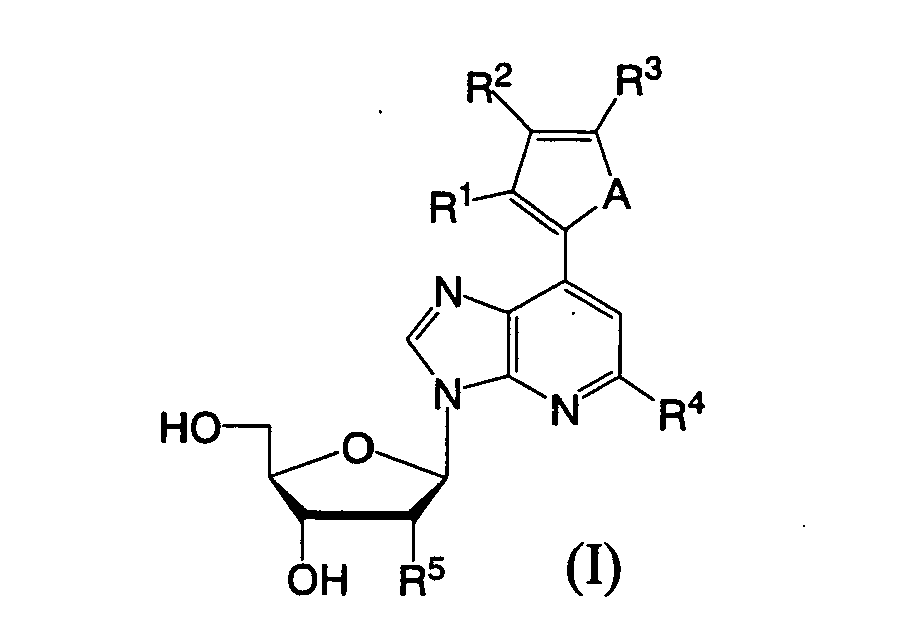
- [wherein A represents an oxygen atom or a sulfur atom;
- R1, R2 and R3 each independently represent a hydrogen atom or a C1-C4 alkyl group;
- R4 represents a hydrogen atom or an amino group; and
- R5 represents a hydrogen atom or a hydroxyl group] or a pharmaceutically acceptable salt thereof.
- The present invention also provides a method for preparing a compound of Formula (I) according to the present invention or a pharmaceutically acceptable salt thereof. The method comprises treating a compound represented by Formula (II):
-

- [wherein A represents an oxygen atom or a sulfur atom;
- R1, R2 and R3 each independently represent a hydrogen atom or a C1-C4 alkyl group;
- R4 represents a hydrogen atom or an amino group;
- R6 represents a hydrogen atom or a R9O group; and
- R7, R8 and R9, which may be the same or different, each represent a protecting group for a hydroxyl group selected from the group consisting of an acetyl group, an isobutyryl group, a benzoyl group, a p-toluoyl group, a benzyl group, a trityl group, a dimethoxytrityl group and a t-butyldimethylsilyl group]
with ammonia, methanolic ammonia, potassium hydroxide, sodium hydroxide, sodium methoxide, sodium ethoxide, hydrochloric acid, trifluoroacetic acid, tetrabutylammonium fluoride, boron tribromide, or hydrogen/palladium catalyst. - The present invention further provides an intermediate for preparing a compound of Formula (I) according to the present invention. The intermediate is a compound represented by Formula (II):
-

- [wherein A represents an oxygen atom or a sulfur atom;
- R1, R2 and R3 each independently represent a hydrogen atom or a C1-C4 alkyl group;
- R4 represents a hydrogen atom or an amino group;
- R6 represents a hydrogen atom or a R9O group; and
- R7, R8 and R9, which may be the same or different, each represent a protecting group for a hydroxyl group selected from the group consisting of an acetyl group, an isobutyryl group, a benzoyl group, a p-toluoyl group, a benzyl group, a trityl group, a dimethoxytrityl group and a t-butyldimethylsilyl group].
- Moreover, the present invention provides a pharmaceutical composition comprising a compound of Formula (I) according to the present invention. The present invention provides a compound of Formula (I) which can be used as an anticancer agent.
- As a result of extensive and intensive efforts made to solve the problems stated above, the inventors of the present invention have succeeded in synthesizing a novel imidazo[4,5-b]pyridine derivative compound represented by Formula (I), and have found that the compound has cell growth inhibitory activity on cancer cells. Moreover, the inventors have found that this cancer cell growth inhibitory effect is dissociated from cell growth inhibitory activity on normal cells. This means that a novel imidazo[4,5-b]pyridine derivative compound represented by Formula (I) has properties desirable as an anticancer agent in that the compound has a cell growth inhibitory effect on cancer cells and has a weaker cell growth inhibitory effect on normal cells. Based on this finding, the inventors have concluded that the compound is useful as an anticancer agent, and have completed the present invention.
- The present invention provides novel imidazo[4,5-b]pyridine derivatives, i.e., a 3-(2-deoxy-β-D-ribofuranosyl)-3H-imidazo[4,5-b]pyridine derivative and a 5-amino-3-(2-deoxy-β-D-ribofuranosyl)-3H-imidazo[4,5-b]pyridine derivative, each of which has a heterocyclic ring as a substituent at the 7-position. The imidazo[4,5-b]pyridine derivatives of the present invention are each a compound represented by Formula (I) shown below:
-

- [wherein A represents an oxygen atom or a sulfur atom;
- R1, R2 and R3 each independently represent a hydrogen atom or a C1-C4 alkyl group;
- R4 represents a hydrogen atom or an amino group; and
- R5 represents a hydrogen atom or a hydroxyl group] or a pharmaceutically acceptable salt thereof. In the above imidazo[4,5-b]pyridine derivatives of the present invention represented by Formula (I), A is preferably a sulfur atom. Likewise, in the above imidazo[4,5-b]pyridine derivatives of the present invention represented by Formula (I), any one of, desirably any two of, and more desirably all three of R1, R2 and R3 are each preferably a hydrogen atom. The imidazo[4,5-b]pyridine derivatives of the present invention are more preferably compounds of Formula (I) shown above wherein A is a sulfur atom, and any one of, desirably any two of, and more desirably all three of R1, R2 and R3 are each a hydrogen atom.
- Among compounds of Formula (I), a compound wherein R4 is a hydrogen atom, i.e., a 3-(2-deoxy-β-D-ribofuranosyl)-3H-imidazo[4,5-b]pyridine derivative having a heterocyclic ring as a substituent at the 7-position of the imidazo[4,5-b]pyridine ring is also represented herein by Formula (Ia). Likewise, among compounds of Formula (I), a compound wherein R4 at the 5-position of the imidazo[4,5-b]pyridine ring is an amino group, i.e., a 5-amino-3-(2-deoxy-β-D-ribofuranosyl)-3H-imidazo[4,5-b]pyridine derivative having a heterocyclic ring as a substituent at the 7-position is also represented herein by Formula (Ib).
- In one embodiment of the present invention, the compound of Formula (I) according to the present invention is a compound selected from the group consisting of:
- 7-(2-thienyl)-3-(2-deoxy-β-D-ribofuranosyl)-3H-imidazo[4,5-b]pyridine;
- 5-amino-7-(2-thienyl)-3-(2-deoxy-β-D-ribofuranosyl)-3H-imidazo[4,5-b]pyridine; and
- pharmaceutically acceptable salts thereof.
- The present invention also provides a method for synthesizing a compound of Formula (I) according to the present invention or a pharmaceutically acceptable salt thereof.
- In one embodiment of the present invention, a 3-(2-deoxy-β-D-ribofuranosyl)-3H-imidazo[4,5-b]pyridine derivative of Formula (Ia) according to the present invention, which has a heterocyclic ring as a substituent at the 7-position, may be synthesized through the synthetic pathway shown in the following reaction scheme (Scheme I):
-

- [wherein A represents an oxygen atom or a sulfur atom;
- R1, R2 and R3 each independently represent a hydrogen atom or a C1-C4 alkyl group;
- R5 represents a hydrogen atom or a hydroxyl group;
- R6 represents a hydrogen atom or a R9O group; and
- R7, R8 and R9, which may be the same or different, each represent a protecting group for a hydroxyl group, such as an acetyl group, an isobutyryl group, a benzoyl group, a p-toluoyl group, a benzyl group, a trityl group, a dimethoxytrityl group or a t-butyldimethylsilyl group].
- The compound of Formula (IIIa). (i.e., 2-amino-3-nitro-4-chloropyridine) is a known compound and can be synthesized using procedures known to those skilled in the art (see, e.g., Rec. Trav. Chim., 88, p. 1263-1274 (1963)).
- In Scheme I, the first reaction for synthesizing a compound of Formula (IVa) from Formula (IIIa) is a coupling reaction between 2-amino-3-nitro-4-chloropyridine and a compound having a 2-thienyl or 2-furyl group. The second reaction for synthesizing a compound of Formula (Va) from Formula (IVa) is a reaction in which the nitro group at the 3-position of the pyridine ring is reduced to convert into an amino group. The third reaction for synthesizing a compound of Formula (VIIa) from Formula (Va) is a ring-closure reaction in which the compound of Formula (Va) is reacted with an orthoformic acid alkyl ester to form an imidazo[4,5-b]pyridine ring. The fourth reaction for synthesizing a compound of Formula (IIa) from Formula (VIIa) is a coupling reaction between the 3-position of the imidazo[4,5-b]pyridine ring and the 1-position of a ribose. These first to fourth reactions may be accomplished by using any synthesis technique well known to those skilled in the art.
- In Scheme I, the fifth reaction for synthesizing a compound of Formula (Ia) from Formula (IIa) is a deprotection reaction of the hydroxyl groups in the,ribose. Deprotection of the hydroxyl groups in the ribose may be accomplished by treatment with ammonia, methanolic ammonia, potassium hydroxide, sodium hydroxide, sodium methoxide, sodium ethoxide, hydrochloric acid, trifluoroacetic acid, tetrabutylammonium fluoride, boron tribromide, or hydrogen/palladium catalyst, etc. In a case where protecting groups for these hydroxyl groups are each an acetyl group, an isobutyryl group, a benzoyl group, a p-toluoyl group or the like, their deprotection may be accomplished by hydrolysis treatment with an acid or base, such as ammonia, methanolic ammonia, potassium hydroxide, sodium hydroxide, sodium methoxide or sodium ethoxide. Likewise, in a case where protecting groups for these hydroxyl groups are each a benzyl group, their deprotection may be accomplished by catalytic reduction with, e.g., hydrogen/palladium catalyst or by boron tribromide treatment. In a case where protecting groups are each a trityl group, a dimethoxytrityl group or the like, their deprotection may be accomplished by treatment with, e.g., trifluoroacetic acid or hydrochloric acid. Moreover, in a case where protecting groups for the ribose hydroxyl groups are each a t-butyldimethylsilyl group, their deprotection may be accomplished by treatment with tetrabutylammonium fluoride, sodium hydroxide, potassium hydroxide, etc. In this reaction, protecting groups for the ribose hydroxyl groups are each preferably an acetyl group, an isobutyryl group, a benzoyl group, a p-toluoyl group or the like and deprotected by treatment with methanolic ammonia. In this reaction, protecting groups for the ribose hydroxyl groups are more preferably p-toluoyl groups and deprotected by treatment with methanolic ammonia.
- In another embodiment of the present invention, a 5-amino-3-(2-deoxy-β-D-ribofuranosyl)-3H-imidazo[4,5-b]pyridine derivative of Formula (Ib) according to the present invention, which has a heterocyclic ring as a substituent at the 7-position, may be synthesized through the synthetic pathway shown in the following reaction scheme (Scheme II):
-

- [wherein A represents an oxygen atom or a sulfur atom;
- R1, R2 and R3 each independently represent a hydrogen atom or a C1-C4 alkyl group;
- R5 represents a hydrogen atom or a hydroxyl group;
- R6 represents a hydrogen atom or a R9O group;
- R7, R8 and R9, which may be the same or different, each represent a protecting group for a hydroxyl group, such as an acetyl group, an isobutyryl group, a benzoyl group, a p-toluoyl group, a benzyl group, a trityl group, a dimethoxytrityl group or a t-butyldimethylsilyl group; and
- R10 represents a protecting group for an amino group, such as an acetyl group, an isobutyryl group, a benzoyl group, a phenoxyacetyl group, an ethoxycarbonyl group, a t-butoxycarbonyl group or a benzyloxycarbonyl group].
- In Scheme II, the first reaction for synthesizing a compound of Formula (IVb) from Formula (IIIb) is a coupling reaction between 2-amino-3-nitro-4-chloro-6-protected aminopyridine and a compound having a 2-thienyl or 2-furyl group. The second reaction for synthesizing a compound of Formula (Vb) from Formula (IVb) is a reaction in which the nitro group at the 3-position of the pyridine ring is reduced to convert into an amino group. The third reaction for synthesizing a compound of Formula (VIb) from Formula (Vb) is a ring-closure reaction in which the compound of Formula (Vb) is reacted with an orthoformic acid alkyl ester to form an imidazo[4,5-b]pyridine ring. The fourth reaction for synthesizing a compound of Formula (VIIb) from Formula (VIb) is a reaction in which the protected amino group at the 5-position of the imidazo[4,5-b]pyridine ring is deprotected to convert into an amino group. The fifth reaction for synthesizing a compound of Formula (IIb) from Formula (VIIb) is a coupling reaction between the 3-position of the imidazo[4,5-b]pyridine ring and the 1-position of a ribose. These first to fifth reactions may be accomplished by using any synthesis technique well known to those skilled in the art.
- In Scheme II, the sixth reaction for synthesizing a compound of Formula (Ib) from Formula (IIb) is a deprotection reaction of the hydroxyl groups in the ribose. Deprotection of the hydroxyl groups in the ribose may be accomplished by treatment with ammonia, methanolic ammonia, potassium hydroxide, sodium hydroxide, sodium methoxide, sodium ethoxide, hydrochloric acid, trifluoroacetic acid, tetrabutylammonium fluoride, boron tribromide, or hydrogen/palladium catalyst, etc. With respect to a combination between a protecting group for a hydroxyl group and a reagent used for deprotection of the protecting group, the same combination as described for deprotection of the ribose hydroxyl groups in Scheme I may be selected. A combination preferred for deprotection of the ribose hydroxyl groups is as follows: protecting groups for the ribose hydroxyl groups are each an acetyl group, an isobutyryl group, a benzoyl group, a p-toluoyl group or the like and deprotected by treatment with methanolic ammonia. Protecting groups for the ribose hydroxyl groups in this reaction are more preferably p-toluoyl groups and deprotected by treatment with methanolic ammonia.
- The present invention further provides an intermediate for preparing a compound of Formula (I) according to the present invention. The intermediate is a compound represented by Formula (II):
-

- [wherein A represents an oxygen atom or a sulfur atom;
- R1, R2 and R3 each independently represent a hydrogen atom or a C1-C4 alkyl group;
- R4 represents a hydrogen atom or an amino group;
- R6 represents a hydrogen atom or a R9O group;
- R7, R8 and R9, which may be the same or different, each represent a protecting group for a hydroxyl group, such as an acetyl group, an isobutyryl group, a benzoyl group, a p-toluoyl group, a benzyl group, a trityl group, a dimethoxytrityl group or a t-butyldimethylsilyl group]. In the above imidazo[4,5-b]pyridine derivative of the present invention represented by Formula (II), A is preferably a sulfur atom. Likewise, in the above imidazo[4,5-b]pyridine derivative of the present invention represented by Formula (II), any one of, desirably any two of, and more desirably all three of R1, R2 and R3 are each preferably a hydrogen atom. The imidazo[4,5-b]pyridine derivative of the present invention is more preferably a compound of Formula (II) shown above wherein A is a sulfur atom, and any one of, desirably any two of, and more desirably all three of R1, R2 and R3 are each a hydrogen atom.
- Among compounds of Formula (II), in particular, a compound wherein R4 is a hydrogen atom is also represented herein by Formula (IIa) and a compound wherein R4 is an amino group is also represented herein by Formula (IIb).
- As defined herein, a pharmaceutically acceptable salt of the compound of the present invention may be any salt known in the art as a harmless salt, especially including an acid addition salt. A suitable acid addition salt may be formed, for example, by treating the compound of the present invention with an inorganic acid such as hydrochloric acid, hydrobromic acid, hydroiodic acid, sulfuric acid, nitric acid or phosphoric acid, or alternatively, with an organic acid such as acetic acid, maleic acid, succinic acid, mandelic acid, fumaric acid, malonic acid, pyruvic acid, oxalic acid, glycolic acid, salicylic acid, uronic acid (e.g., glucuronic acid or galacturonic acid), α-hydroxy acid (e.g., lactic acid, citric acid, gluconic acid or tartaric acid), amino acid (e.g., aspartic acid or glutamic acid), aromatic acid (e.g., benzoic acid or cinnamic acid), sulfonic acid (e.g., p-toluenesulfonic acid, methanesulfonic acid, ethanesulfonic acid or benzenesulfonic acid) or a similar acid. Salt preparation may be accomplished by using any appropriate technique known in the art.
- The compound of Formula (I) according to the present invention has cancer cell growth inhibitory activity. Moreover, the cancer cell growth inhibitory activity of the compound of Formula (I) according to the present invention is dissociated from its growth inhibitory activity on normal cells, i.e., the compound has growth inhibitory activity that is lower in normal cells than in cancer cells. This means that the compound, when used at an appropriate concentration, can inhibit exclusively cancer cell growth without inhibiting normal cell growth.
- The cell growth inhibitory activity of the compound of Formula (I) according to the present invention can be evaluated, for example, by the MTT assay well known to those skilled in the art (see, e.g., Seikagaku Jiten (Biochemical Dictionary), third edition, page 220, Tokyo Kagaku Dojin Co., Ltd., Japan, 2000). Briefly, the MTT assay is a technique for quantifying the number of living cells based on a phenomenon that light-yellow MTT (3-(4,5-dimethylthiazol-2-yl)-2,5-diphenyltetrazolium bromide) is cleaved into dark-blue formazan by the action of mitochondrial reductase when taken up into living cells, whereas MTT cannot be cleaved in dead cells. The number of living cells is quantified by measuring the absorbance of formazan generated. In addition to MTT, WST-1 and Alamar Blue are used in the art as indicators for use in the MTT assay. When performed on the compound of the present invention, the MTT assay may be used with modifications.
- Cancer cells which may be used to evaluate the cell growth inhibitory activity of the compound of Formula (I) according to the present invention include, but are not limited to, cultured cancer cells such as cultured human fibrosarcoma cells, cultured human acute lymphocytic leukemia CCRF-CEM cells, cultured human large intestine adenocarcinoma SW480 cells, cultured human alveolar cell carcinoma A549 cells, cultured human pancreatic adenocarcinoma PANC-1 cells, cultured human urinary bladder transitional cell carcinoma T24 cells, cultured human breast cancer MCF-7 cells, and cultured human liver cancer HuH7 cells. Preferred for use is cultured human fibrosarcoma cell line HT-1080. Normal cells which may be used to evaluate the cell growth inhibitory activity of the compound of the present invention include, but are not limited to, cells such as human fetal lung fibroblasts (normal diploid fibroblasts) and human peripheral blood lymphocytes. Preferred for use is human fetal lung fibroblast cell line WI-38.
- The cell growth inhibitory activity of the compound of Formula (I) according to the present invention can be evaluated, for example, as follows. MTT assay is performed on each serially diluted test compound to measure the absorbance at 570 nm in the case of using MTT as an indicator, followed by calculating % inhibition for each concentration of the test compound according to the following equation.
-

Abssample : Absorbance in the presence of test compound
Absbackground : Absorbance in the absence of cells and test compound
Absnegative control : Absorbance in the absence of test compound - The resulting % inhibition data for test compound concentrations is used to prepare a concentration-inhibition curve, from which the concentration required for each test compound to cause 50% inhibition of cell growth is then calculated as IC50.
- The cancer cell growth inhibitory activity of the compound of Formula (I) according to the present invention is dissociated from its growth inhibitory activity on normal cells. The compound of Formula (I) according to the present invention has a smaller IC50 value for cancer cell growth inhibition than its IC50 value for normal cells. Preferably, the compound of Formula (I) according to the present invention has an IC50 value for cancer cell growth inhibition that is 2/3 or smaller, more preferably 1/2 or smaller, even more preferably 1/3 or smaller, still more preferably 1/4 or smaller, yet more preferably 1/5 or smaller, and most preferably 1/10 or smaller than its IC50 value for normal cells. This indicates that the compound is useful as an anticancer agent. Thus, the present invention provides a pharmaceutical composition comprising the compound of Formula (I) according to the present invention or a pharmaceutically acceptable salt thereof.
- In a preferred embodiment, the pharmaceutical composition of the present invention is a pharmaceutical composition for cancer treatment, i.e., an anticancer agent. As used herein, the phrase "pharmaceutical composition for cancer treatment" means a pharmaceutical composition used for the purpose of curative treatment, alleviative treatment and prophylactic treatment of cancers. Curative treatment, alleviative treatment and prophylactic treatment of cancers include killing cancer cells, inhibiting cancer cell growth, blocking cancer metastasis, blocking cancer recurrence, or preventing cancerogenesis. As used herein, the term "cancer" means any malignant disease including a condition of excessive cell growth, and the terms "cancer", "tumor" and "neoplasia" are used interchangeably.
- Examples of cancers treated by the pharmaceutical composition of the present invention include, but are not limited to: lung cancer; breast cancer; melanoma; sarcoma; fibrosarcoma; prostate cancer; cancer in the head and neck; cancer with unknown primary focus; lymphoma; leukemia; kidney cancer; cancer in the digestive tract such as esophageal cancer, gastric cancer, intestine cancer, colon cancer, anal cancer and rectal cancer; tumor in the brain; glioma; neuroblastoma; spongiocytoma; medulloblastoma; ependymoma; retinoblastoma; nasopharyngeal cancer; basal cell carcinoma; pancreatic cancer; bile duct cancer; Kaposi's sarcoma; thymoma; testis cancer; uterine cancer; vaginal cancer; uterine cervical cancer; ovarian cancer; liver cancer; endometrial cancer; vascular epithelioma; Hodgkin's lymphoma; non-Hodgkin's lymphoma; B-cell acute lymphoblastic leukemia/lymphoma; T-cell acute lymphoblastic leukemia/lymphoma; peripheral T-cell leukemia; adult T-cell leukemia/T-cell lymphoma; NK cell tumor; large granular lymphocytic leukemia; Langerhans' cell histiocytosis; bone marrow neoplasia; acute myelogenous leukemia; acute promyelocytic leukemia; acute myelomonocytic leukemia; acute monocytic leukemia; myelodysplastic syndrome; and chronic myeloproliferative disorder.
- The pharmaceutical composition of the present invention may further comprise a pharmaceutically acceptable excipient, diluent or carrier. Such a pharmaceutically acceptable excipient, diluent or carrier is chemically inert and harmless either by nature or at the intended dosage, and hence does not affect the biological activity of the pharmaceutical composition of the present invention.
- The pharmaceutical composition of the present invention may be incorporated with an excipient such as starch or lactose and formulated in the form of tablets, capsules, pills, powders, granules, troches, solutions, emulsions, suspensions or elixirs for oral administration including the sublingual route. The pharmaceutical composition of the present invention may be formulated in sustained-release, enteric-coated or immediate-release form. The pharmaceutical composition of the present invention may further comprise additional ingredients such as a coloring agent, a flavoring agent, a disintegrating agent, a granulation binder and a lubricant. These pharmaceutical compositions for oral administration may be readily prepared using techniques well known to those skilled in the art.
- The pharmaceutical composition of the present invention may be formulated in the form of solutions or suspensions for parenteral administration, for example, by intravenous, intraarterial, intramuscular or subcutaneous injection or infusion. The pharmaceutical composition of the present invention formulated in the form of solutions or suspensions may also take the form of a lyophilized formulation which is dissolved and suspended in sterilized water or the like before use. Solutions or suspensions for injection or infusion are most preferably prepared in the form of an aseptic aqueous solution. Such solutions or suspensions for injection or infusion are prepared under dust-free and aseptic conditions, and adjusted to be isotonic with blood using other substances such as a buffer, a salt solution or glucose. Such solutions or suspensions for injection or infusion are also prepared to have a pH substantially equal to blood. Preparation of appropriate parenteral formulations under aseptic conditions may be readily accomplished by standard formulation techniques well known to those skilled in the art.
- The pharmaceutical composition of the present invention may also be formulated in other forms such as solutions, suspensions, lotions, creams, ointments, gels, poultices, aerosols, catapasms, sprays, suppositories or pessaries. Formulation into these forms is well known to those skilled in the art.
- The present invention also relates to a method for cancer treatment using the compound or pharmaceutical composition of the present invention. As defined herein, cancer treatment includes curative treatment, alleviative treatment and prophylactic treatment. The compound or pharmaceutical composition of the present invention may be administered as a single dose or in divided doses. For oral and parenteral administration to human patients, the daily dose level of the compound of the present invention will be usually 1 to 100 mg/kg body weight, preferably 2.5 to 20 mg/kg body weight. However, the dose of the compound or pharmaceutical composition of the present invention will vary depending on various factors such as the age, body weight, health condition of individual patients, the severity of disease, and the patient's response to the compound of the present invention. The dose shown above is a dose in average cases, and administration at a higher or lower dose may also be appropriate in some cases. Administration at such a dose also falls within the scope of the present invention. A suitable dose of the compound or pharmaceutical composition of the present invention can be determined by doctors on the basis of the above or other factors.
- The imidazo[4,5-b]pyridine derivatives of the present invention have high cancer cell growth inhibitory activity, whereas their cell growth inhibitory activity on normal cells is low. This indicates that the compounds of the present invention are useful as new anticancer agents.
- The present invention will now be further described in the following examples, which are not intended to limit the technical scope of the invention. Based on the detailed description, various changes and modifications will be apparent to those skilled in the art, and such changes and modifications fall within the technical scope of the invention.
-

- To a solution of 2-amino-3-nitro-4-chloropyridine (1.74 g, 10 mmol; which had been synthesized as described in Rec. Trav. Chim., 88, 1263-1274 (1963)) and dichlorobis(triphenylphosphine)palladium(II) (350 mg, 0.50 mmol) in DMF (50 ml), 2-(tributylstanyl)thiophene (3.82 ml, 12 mmol) was added under a nitrogen atmosphere and stirred at 100°C for 4 hours. The solution was then poured into water (250 ml) and extracted three times with ethyl acetate (250 ml). The organic layers were dried over sodium sulfate and evaporated under reduced pressure to remove the solvent. The resulting residue was eluted by silica gel column chromatography with methylene chloride:ethyl acetate (100:0 to 49:1) to give 2-amlino-3-nitro-4-(2-thienyl)pyridine,(Rf 0.30/methylene chloride:ethyl acetate = 19:1) (2.07 g, yield 93%).
- 1H NMR (CDCl3); δ 8.17 (d, J = 5.1 Hz, 1H), 7.45 (dd, J = 5.0 and 1.1 Hz, 1H), 7.12 (dd, J = 3.6 and 1.1 Hz, 1H), 7.07 (dd, J = 5.0 and 3.6 Hz, 1H), 6.77 (d, J = 5.1 Hz, 1H), 5.66 (bs, 2H).
-


- To a solution of 2-amino-3-nitro-4-(2-thienyl)pyridine (2.06 g, 9.3 mmol) and 10% palladium-carbon (466 mg) in ethanol (130 ml)-ethyl acetate (65 ml), a 1 M aqueous sodium borohydride solution was added at 0°C. The mixture was stirred at 0°C for 1 hour and then poured into a 5% aqueous ammonium chloride solution (43 ml). The mixture was filtered through celite, and the filtrate was diluted with water (500 ml) and extracted three times with ethyl acetate (250 ml). The solution was dried over sodium sulfate and then evaporated under reduced pressure to remove the solvent. The residue was purified by column chromatography (methylene chloride:ethanol = 19:1 to 93:7) to give 2,3-diamino-4-(2-thienyl)pyridine (Rf 0.24/methylene chloride:ethanol = 9:1) (1.46 g, yield 82%).
- 1H NMR (CDCl3); δ 7.64 (d, J = 5.1 Hz, 1H), 7.40 (dd, J = 5.1 and 1.1 Hz, 1H), 7.23 (dd, J = 3.5 and 1.1 Hz, 1H), 7.14 (dd, J = 5.1 and 3.5 Hz, 1H), 6.74 (d, J = 5.1 Hz, 1H), 4.26 (bs, 2H), 3.72 (bs, 2H).
-

- Hydrochloric acid (35 wt%, 1.47 ml) was added to 2,3-diamino-4-(2-thienyl)pyridine (1.46 g, 7.61 mmol) and orthoformic acid ethyl ester (40.5 ml). This solution was stirred at room temperature for 3 days and then filtered. The residue was washed with ether to give 7-(2-thienyl)-3H-imidazo[4,5-b]pyridine (1.74 g, 96%).
- 1H NMR (DMSO-d6); δ 8.77 (s, 1H), 8.42 (d, J = 5.4 Hz, 1H), 8.25 (dd, J = 3.6 and 1.2 Hz, 1H), 7.88 (dd, J = 5.1 and 1.2 Hz, 1H), 7.66 (d, J = 5.4 Hz, 1H), 7.31 (dd, J = 5.1 and 3.6 Hz, 1H).
-

- To a solution of 7-(2-thienyl)-3H-imidazo[4,5-b]pyridine (951 mg, 4.0 mmol) in acetonitrile (40 ml), sodium hydride (320 mg, 60% suspension in oil) was added, and the solution was stirred overnight at room temperature. To the solution, 2-deoxy-3,5-di-O-(p-toluoyl)-α-D-erythropentofuranosyl chloride (836 mg) was added and stirred for 90 minutes. The solution was poured into water (250 ml) and extracted three times with ethyl acetate (200 ml). The organic layers were dried over sodium sulfate and evaporated under reduced pressure to remove the solvent. The residue was purified by silica gel column chromatography (methylene chloride:ethanol = 100:0 to 99:1) to give 7-(2-thienyl)-3-[3,5-di-O-(p-toluoyl)-2-deoxy-1-β-D-ribofuranosyl]-3H-imidazo[4,5-b]pyridine (Rf 0.38/methylene chloride:ethanol = 49:1) (1.33 g, yield 60%).
- 1H NMR (CDCl3); δ 8.32 (d, J = 5.3 Hz, 1H), 8.26 (s, 1H), 8.16 (dd, J = 3.8 and 1.2 Hz, 1H), 7.93 (m, 4H), 7.50 (dd, J = 5.1 and 1.2 Hz, 1H), 7.47 (d, J = 5.3 Hz, 1H), 7.22 (m, 5H), 6.68 (dd, J = 8.6 and 5.8 Hz, 1H), 5.82 (m, 1H), 4.69 (m, 3H), 3.18 (ddd, J = 14.2, 8.6 and 6.4 Hz, 1H), 2.86 (ddd, J = 14.2, 5.8 and 2.0 Hz, 1H), 2.43 (s, 3H), 2.37 (s, 3H).
-

- To 7-(2-thienyl)-3-[3,5-di-O-(p-toluoyl)-2-deoxy-1-β-D-ribofuranosyl]-3H-imidazo[4,5-b]pyridine (1.33 g, 2.40 mmol), methanolic ammonia (120 ml) was added at 0°C and then stirred at room temperature for 2 days. After evaporation under reduced pressure to remove the solvent, the residue was purified by silica gel column chromatography (methylene chloride:ethanol = 97:3 to 93:7) to give 7-(2-thienyl)-3-(2-deoxy-1-β-D-ribofuranosyl)-3H-imidazo[4,5-b]pyridine (717 mg, yield 94%).
- 1H NMR (DMSO-d6); δ 8.74 (s, 1H), 8.33 (d, J = 5.1 Hz, 1H), 8.28 (dd, J = 3.6 and 1.1 Hz, 1H), 7.82 (dd, J = 5.1 and 1.1 Hz, 1H), 7.64 (d, J = 5.1 Hz, 1H), 7.26 (dd, J = 5.1 and 3.6 Hz, 1H), 6.25 (dd, J = 7.3 and 6.4 Hz, 1H), 5.34 (bd, J = 4.1 Hz, 1H), 5.11 (bt, J = 5.4 Hz, 1H), 4.44 (m, 1H), 3.89 (m, 1H), 3.58 (m, 2H), 2.78 (ddd, J = 13.0, 7.3 and 5.9 Hz, 1H), 2.24 (ddd, J = 13.0, 6.4 and 3.0 Hz, 1H).
UV λmax; 311 nm ε = 2.04 × 10⁴ in 25 mM sodium phosphate buffer (pH = 6.8). -

- 2-Amino-3-nitro-4-chloro-6-ethoxycarbonylaminopyridine (1.30 g, 5.0 mmol) and dichlorobis(triphenylphosphine)palladium(II) (175 mg, 0.25 mmol) were dissolved in DMF (30 ml). To this solution, 2-(tributylstanyl)thiophene (1.91 ml, 6.0 mmol) was added under an argon atmosphere and stirred at 100°C for 2 hours. This mixture was poured into water (100 ml) and extracted three times with ethyl acetate (8100 ml). The organic layers were dried over sodium sulfate, followed by silica gel column chromatography (methylene chloride:ethyl acetate = 100:0 to 99:1) to purify the desired product, 2-amino-3-nitro-4-(2-thienyl)-6-ethoxycarbonylaminopyridine (Rf 0.52/methylene chloride:ethyl acetate = 19:1) (1.96 g, yield 85%).
- 1H NMR (DMSO-d6); δ 10.33 (bs, 1H), 7.70 (m, 1H), 7.24 (s, 1H), 7.10 (m, 2H), 7.02 (bs, 2H), 4.13 (q, J = 7.0 Hz, 2H), 1.22 (t, J = 7.0 Hz, 3H).
-

- 2-Amino-3-nitro-4-(2-thienyl)-6-ethoxycarbonylaminopyridine (1.57 g, 5.1 mmol) and 10% palladium-carbon (255 mg) were dissolved in ethanol (77 ml)-ethyl acetate (38 ml). To this mixture, a 1 M aqueous sodium borohydride solution (15.3 ml) was added at 0°C and stirred at 0°C for 1 hour. This solution was mixed with a 5% aqueous ammonium chloride solution (23.4 ml) and filtered through celite. The celite was washed with water (204 ml). The filtrate and this washing solution were mixed and evaporated under reduced pressure to remove ethanol and ethyl acetate, followed by extraction three times with ethyl acetate (150 ml). This solution was dried over sodium sulfate and evaporated under reduced pressure to remove the solvent, followed by silica gel column chromatography (methylene chloride:ethyl acetate = 7:3 to 1:1) to purify the desired product, 2,3-diamino-4-(2-thienyl)-6-ethoxycarbonylaminopyridine (Rf 0.39/methylene chloride:ethyl acetate = 1:2) (1.28 g, yield 90%).
- 1H NMR (DMSO-d6); δ 9.07 (bs, 1H), 7.60 (dd, J = 5.1 and 1.1 Hz, 1H), 7.34 (dd, J = 3.7 and 1.1 Hz, 1H), 7.16 (dd, J = 5.1 and 3.7 Hz, 1H), 6.96 (s, 1H), 5.59 (bs, 2H), 4.38 (bs, 2H), 4.04 (q, J = 7.0 Hz, 2H), 1.18 (t, J = 7.0 Hz, 3H). (2-3) Synthesis of 7-(2-thienyl)-5-ethoxycarbonylamino-3H-imidazo[4,5-b]pyridine
-

- Hydrochloric acid (35 wt%, 892 µl) was added to 2,3-diamino-4-(2-thienyl)-6-ethoxycarbonylaminopyridine (1.28 g, 4.61 mmol) and orthoformic acid ethyl ester (24.6 ml), followed by stirring at room temperature for 3 days. This solution was filtered and the product was washed with ether to give 7-(2-thienyl)-5-ethoxycarbonylamino-3H-imidazo[4,5-b]pyridine (1.36 g, yield 91%).
- 1H NMR (DMSO-d6); δ 10.25 (bs, 1H), 8.69 (bs, 1H), 8.20 (dd, J = 3.8 and 1.1 Hz, 1H), 8.12 (s, 1H), 7.81 (dd, J = 5.1 and 1.1 Hz, 1H), 7.28 (dd, J = 5.1 and 3.8 Hz, 1H), 4.17 (q, J = 7.2 Hz, 2H), 1.26 (t, J = 7.2 Hz, 3H).
-

- To a solution of 7-(2-thienyl)-5-ethoxycarbonylamino-3H-imidazo[4,5-b]pyridine (1.21 g, 3.72 mmol) in ethanol (130 ml), potassium hydroxide (7.29 g) was added and heated under reflux for 4 hours. To this solution, an aqueous ammonium chloride solution (7.65 g/26 ml) was added, followed by evaporation under reduced pressure to remove the solvent. The product was isolated by silica gel column chromatography (methylene chloride:ethanol = 9:1 to 7:3) to give 5-amino-7-(2-thienyl)-3H-imidazo[4,5-b]pyridine (870 mg).
- 1H NMR (DMSO-d6); δ 12.35 (bs, 1H), 8.19 (dd, J = 3.6 and 0.9 Hz, 1H), 7.95 (s, 1H), 7.67 (dd, J = 5.1 and 0.9 Hz, 1H), 7.20 (dd, J = 5.1 and 3.6 Hz, 1H), 6.64 (s, 1H), 5.86 (bs, 2H).
-

- To a solution of 5-amino-7-(2-thienyl)-3H-imidazo[4,5-b]pyridine (465 mg, 2.15 mmol) in acetonitrile (22 ml), sodium hydride (86 mg, 60% suspension in oil) was added and stirred at room temperature for 6 hours. To this mixture, 2-deoxy-3,5-di-O-(p-toluoyl)-α-D-erythropentofuranosyl chloride (836 mg) was added and stirred at room temperature for 1 hour. This solution was poured into water (100 ml) and extracted three times with methylene chloride (100 ml). This solution was dried over sodium sulfate and then evaporated to remove the solvent. The product was isolated by silica gel column chromatography (methylene chloride:ethyl acetate = 19.1 to 37:3) to give 5-amino-7-(2-thienyl)-3-[3,5-di-O-(p-toluoyl)-2-deoxy-1-β-D-ribofuranosyl]-3H-imidazo[4,5-b]pyridine (Rf 0.37/methylene chloride:ethyl acetate = 9:1) (1.05 g, yield 86%).
- 1H NMR (CDCl3); δ 8.10 (dd, J = 3.6 and 1.1 Hz, 1H), 7.94 (m, 5H), 7.44 (dd, J = 5.1 and 1.1 Hz, 1H), 7.23 (m, 4H), 7.16 (dd, J = 5.1 and 3.6 Hz, 1H), 6.50 (dd, J = 8.4 and 5.7 Hz, 1H), 5.82 (m, 1H), 4.85 (dd, J = 13.2 and 6.2 Hz, 1H), 4.64 (m, 2H), 4.53 (bs, 2H), 3.26 (ddd, J = 14.1, 8.4 and 5.9 Hz, 1H), 2.68 (ddd, J = 14.1, 5.7 and 1.9 Hz, 1H), 2.40 (s, 3H), 2.37 (s, 3H).
-

- To 5-amino-7-(2-thienyl)-3-[3,5-di-O-(p-toluoyl)-2-deoxy-1-β-D-ribofuranosyl]-3H-imidazo[4,5-b]pyridine (1.05 g, 1.85 mmol), methanolic ammonia (92 ml) was added and stirred at room temperature for 2 hours. After evaporation under reduced pressure to remove the solvent, the product was purified by silica gel column chromatography (methylene chloride:ethanol = 19:1 to 9:1) to give 5-amino-7-(2-thienyl)-3-(2-deoxy-1-β-D-ribofuranosyl)-3H-imidazo[4,5-b]pyridine (555 mg, yield 90%).
- 1H NMR (DMSO-d6); δ 8.24 (s, 1H), 8.19 (dd, J = 3.5 and 1.1 Hz, 1H), 7.70 (dd, J = 5.0 and 1.1 Hz, 1H), 7.21 (dd, J = 5.0 and 3.5 Hz, 1H), 6.70 (s, 1H), 6.33 (dd, J = 8.1 and 6.1 Hz, 1H), 6.03 (bs, 2H), 5.28 (bd, J = 3.2 Hz, 1H), 5.07 (bt, J = 5.4 Hz, 1H), 4.38 (m, 1H), 3.84 (m, 1H), 3.55 (m, 2H), 2.64 (ddd, J = 13.1, 6.1 and 5.7 Hz, 1H), 2.24 (ddd, J = 13.1, 5.9 and 3.0 Hz, 1H).
UV λmax; 307 nm ε = 2.11 × 10⁴, 247 nm ε = 1.44 × 10³, 222 nm ε = 1.70 × 10⁴ in 25 mM sodium phosphate buffer (pH = 6.8). - MTT assay was performed to examine two test compounds, i.e., 7-(2-thienyl)-3-(2-deoxy-1-β-D-ribofuranosyl)-3H-imidazo[4,5-b]pyridine (herein referred to as Compound IA) and 5-amino-7-(2-thienyl)-3-(2-deoxy-1-β-D-ribofuranosyl)-3H-imidazo[4,5-b]pyridine (herein referred to as Compound IB) for their cell growth inhibitory effect on cultured human fibrosarcoma HT-1080 cells and human fetal lung fibroblast (normal diploid fibroblast) WI-38 cells. These cells (1 × 10⁴ cells/ml) were seeded in 96-well microplates (IWAKI) at 90 µl/well. After culturing at 37°C for 3 to 4 hours, test compound solutions (10 µl each), which had been dissolved in PBS-5% DMSO and adjusted to various concentrations, were added and incubated at 37°C for 72 hours. To the wells containing these solutions, a PBS solution of MTT (5 mg/ml) was added in 25 µl volumes and incubated at 37°C for an additional 2 hours, followed by addition of a 50% DMF-20% SDS solution in 100 µl to each well. After incubation was continued at 37°C for 16 hours, the absorbance at 570 nm was measured using a microplate reader to calculate % inhibition according to the following equation.
-

Abssample : Absorbance in the presence of test compound
Absbackground : Absorbance in the absence of cells and test compound
Absnegative control : Absorbance in the absence of test compound - The concentration (IC50 µM) required for each test compound to cause 50% inhibition of cell growth was calculated from a concentration-inhibition curve. The IC50 values are shown in Table 1 below, along with their standard deviation.
- [Table 1]
Table 1 Compound IC50 µM HT-1080 cell WI-38 cell Compound IA 62 ± 6 290 ± 130 Compound IB 34 ± 6 330 ± 40 - As shown in Table 1, Compounds IA and IB had IC50 values of 62 µM and 34 µM, respectively, for cultured human fibrosarcoma HT-1080 cells. On the other hand, each compound had an IC50 value of around 300 µM for the normal cells, human fetal lung fibroblast (normal diploid fibroblast) WI-38 cells. This indicates that Compound IB has about 10-fold higher growth inhibitory activity on cancer cells than on normal cells, while Compound IA has about 5-fold higher growth inhibitory activity on cancer cells than on normal cells. Thus, the cancer cell growth inhibitory activity of these compounds is dissociated from their cell growth inhibitory activity on normal cells.
Claims (6)
- A compound represented by Formula (I):
 R1, R2 and R3 each independently represent a hydrogen atom or a C1-C4 alkyl group;R4 represents a hydrogen atom or an amino group; andR5 represents a hydrogen atom or a hydroxyl group] or a pharmaceutically acceptable salt thereof.
 - The compound according to claim 1 or a pharmaceutically acceptable salt thereof, wherein the compound is:7-(2-thienyl)-3-(2-deoxy-β-D-ribofuranosyl)-3H-imidazo[4,5-b]pyridine; or5-amino-7-(2-thienyl)-3-(2-deoxy-β-D-ribofuranosyl)-3H-imidazo[4,5-b]pyridine.
- A method for synthesizing the compound according to claim 1 or a pharmaceutically acceptable salt thereof, which comprises treating a compound represented by Formula (II):

 R1, R2 and R3 each independently represent a hydrogen atom or a C1-C4 alkyl group;R4 represents a hydrogen atom or an amino group;R6 represents a hydrogen atom or a R9O group; andR7, R8 and R9, which may be the same or different, each represent a protecting group for a hydroxyl group selected from the group consisting of an acetyl group, an isobutyryl group, a benzoyl group, a p-toluoyl group, a benzyl group, a trityl group, a dimethoxytrityl group and a t-butyldimethylsilyl group]
with ammonia, methanolic ammonia, potassium hydroxide, sodium hydroxide, sodium methoxide, sodium ethoxide, hydrochloric acid, trifluoroacetic acid, tetrabutylammonium fluoride, boron tribromide, or hydrogen/palladium catalyst. - A compound represented by Formula (II):

 R1, R2 and R3 each independently represent a hydrogen atom or a C1-C4 alkyl group;R4 represents a hydrogen atom or an amino group;R6 represents a hydrogen atom or a R9O group; andR7, R8 and R9, which may be the same or different, each represent a protecting group for a hydroxyl group selected from the group consisting of an acetyl group, an isobutyryl group, a benzoyl group, a p-toluoyl group, a benzyl group, a trityl group, a dimethoxytrityl group and a t-butyldimethylsilyl group].
 - A pharmaceutical composition comprising the compound according to claim 1 or 2.
- The pharmaceutical composition according to claim 5, which is used as an anticancer agent.
Applications Claiming Priority (2)
| Application Number | Priority Date | Filing Date | Title |
|---|---|---|---|
| JP2005012685A JP5002851B2 (en) | 2005-01-20 | 2005-01-20 | Imidazopyridine derivatives |
| PCT/JP2006/300502 WO2006077816A1 (en) | 2005-01-20 | 2006-01-17 | Imidazopyridine derivative |
Publications (3)
| Publication Number | Publication Date |
|---|---|
| EP1847546A1 true EP1847546A1 (en) | 2007-10-24 |
| EP1847546A4 EP1847546A4 (en) | 2008-05-07 |
| EP1847546B1 EP1847546B1 (en) | 2012-11-28 |
Family
ID=36692205
Family Applications (1)
| Application Number | Title | Priority Date | Filing Date |
|---|---|---|---|
| EP06711782A Expired - Lifetime EP1847546B1 (en) | 2005-01-20 | 2006-01-17 | Imidazopyridine derivative |
Country Status (5)
| Country | Link |
|---|---|
| US (1) | US7615628B2 (en) |
| EP (1) | EP1847546B1 (en) |
| JP (1) | JP5002851B2 (en) |
| CN (1) | CN101107261B (en) |
| WO (1) | WO2006077816A1 (en) |
Cited By (2)
| Publication number | Priority date | Publication date | Assignee | Title |
|---|---|---|---|---|
| EP3697787A4 (en) * | 2017-10-18 | 2022-12-14 | HK inno.N Corporation | HETEROCYCLIC COMPOUND FOR USE AS A PROTEIN KINASE INHIBITOR |
| EP4286395A4 (en) * | 2021-01-29 | 2025-01-08 | TAGCyx Biotechnologies Inc. | Method for producing imidazopyridine derivative |
Families Citing this family (4)
| Publication number | Priority date | Publication date | Assignee | Title |
|---|---|---|---|---|
| EP2913330A1 (en) | 2014-02-27 | 2015-09-02 | Laboratoire Biodim | Condensed derivatives of imidazole useful as pharmaceuticals |
| KR102195348B1 (en) | 2018-11-15 | 2020-12-24 | 에이치케이이노엔 주식회사 | Novel compound as a protein kinase inhibitor, and the pharmaceutical composition comprising thereof |
| WO2020240586A1 (en) * | 2019-05-28 | 2020-12-03 | Mankind Pharma Ltd. | Novel compounds for inhibition of janus kinase 1 |
| US20240182908A1 (en) * | 2020-12-18 | 2024-06-06 | Tagcyx Biotechnologies Inc. | Deoxyribonucleoside or deoxyribonucleotide having novel artificial base applicable to screening for dna aptamer, and nucleic acid containing the same |
Family Cites Families (5)
| Publication number | Priority date | Publication date | Assignee | Title |
|---|---|---|---|---|
| US4996308A (en) | 1988-03-25 | 1991-02-26 | Merrell Dow Pharmaceuticals Inc. | Derivatives with unsaturated substitutions for the 5'-hydroxymethyl group |
| AU4134793A (en) | 1992-06-22 | 1993-12-23 | Eli Lilly And Company | 2'-deoxy-2',2'-difluoro(2,6,8-substituted) purine nucleosides having anti-viral and anti-cancer activity and intermediates |
| US5552311A (en) * | 1993-09-14 | 1996-09-03 | University Of Alabama At Birmingham Research Foundation | Purine nucleoside phosphorylase gene therapy for human malignancy |
| KR20050006221A (en) | 2002-05-06 | 2005-01-15 | 제네랩스 테크놀로지스, 인코포레이티드 | Nucleoside derivatives for treating hepatitis c virus infection |
| JP2005232079A (en) | 2004-02-19 | 2005-09-02 | Institute Of Physical & Chemical Research | Anti-cancer agent |
-
2005
- 2005-01-20 JP JP2005012685A patent/JP5002851B2/en not_active Expired - Lifetime
-
2006
- 2006-01-17 CN CN200680002792XA patent/CN101107261B/en not_active Expired - Lifetime
- 2006-01-17 EP EP06711782A patent/EP1847546B1/en not_active Expired - Lifetime
- 2006-01-17 US US11/795,554 patent/US7615628B2/en not_active Expired - Lifetime
- 2006-01-17 WO PCT/JP2006/300502 patent/WO2006077816A1/en not_active Ceased
Non-Patent Citations (2)
| Title |
|---|
| No further relevant documents disclosed * |
| See also references of WO2006077816A1 * |
Cited By (2)
| Publication number | Priority date | Publication date | Assignee | Title |
|---|---|---|---|---|
| EP3697787A4 (en) * | 2017-10-18 | 2022-12-14 | HK inno.N Corporation | HETEROCYCLIC COMPOUND FOR USE AS A PROTEIN KINASE INHIBITOR |
| EP4286395A4 (en) * | 2021-01-29 | 2025-01-08 | TAGCyx Biotechnologies Inc. | Method for producing imidazopyridine derivative |
Also Published As
| Publication number | Publication date |
|---|---|
| US7615628B2 (en) | 2009-11-10 |
| CN101107261B (en) | 2011-02-09 |
| WO2006077816A1 (en) | 2006-07-27 |
| JP5002851B2 (en) | 2012-08-15 |
| EP1847546A4 (en) | 2008-05-07 |
| JP2006199617A (en) | 2006-08-03 |
| CN101107261A (en) | 2008-01-16 |
| HK1110079A1 (en) | 2008-07-04 |
| US20080125381A1 (en) | 2008-05-29 |
| EP1847546B1 (en) | 2012-11-28 |
Similar Documents
| Publication | Publication Date | Title |
|---|---|---|
| EP3181560A1 (en) | Pyridine amidopyrimidine derivative, preparation method and use thereof | |
| BG61036B1 (en) | INDOLPIROLOCARBAZOL DERIVATIVES | |
| BG61485B1 (en) | N ABOVE 4-OXYCARBONYL REPLACED BY 5'-DEOXY-5-FLUOROcytidines | |
| JPS63239294A (en) | Novel adenosine derivative and medicinal composition containing said compound as active ingredient | |
| CN119604498A (en) | Compounds as KAT6 inhibitors | |
| KR100585894B1 (en) | C2,5'-disubstituted and N6, C2,5'-trisubstituted adenosine derivatives and their different uses | |
| Kicsák et al. | Tricyclanos: conformationally constrained nucleoside analogues with a new heterotricycle obtained from ad-ribofuranose unit | |
| EP0609375A1 (en) | Novel 2,6-disubstituted purine derivatives | |
| EP3844152B1 (en) | Substituted heterocycles as c-myc targeting agents | |
| EP1847546B1 (en) | Imidazopyridine derivative | |
| Wang et al. | Synthesis of novel sugar or azasugar modified anthra [1, 2-d] imidazole-6, 11-dione derivatives and biological evaluation | |
| Lin et al. | Synthesis and antiviral activity of several 2, 5'-anhydro analogs of 3'-azido-3'-deoxythymidine (AZT), 3'-azido-2', 3'-dideoxyuridine (AZU), 3'-azido-2', 3'-dideoxy-5-halouridines, and 3'-deoxythymidine against human immunodeficiency virus (HIV-1) and Rauscher-Murine leukemia virus (R-MuLV) | |
| KR102606167B1 (en) | Fluorine-containing substituted benzothiophene compounds, pharmaceutical compositions and applications thereof | |
| CN115974855B (en) | EZH2 and HDAC double-target inhibitor, pharmaceutical composition, preparation method and application thereof | |
| TWI449528B (en) | 3'-ethynylcytidine derivative | |
| US6677310B1 (en) | Ring-expanded nucleosides and nucleotides | |
| HK1110079B (en) | Imidazopyridine derivative | |
| JP2015024981A (en) | Novel pyrimidine nucleoside compound or salt thereof | |
| WO2021092893A1 (en) | Use of diaryl ether compound in preparation of anti-tumor drug | |
| CN112375112B (en) | Benzimidazole derivative BI361 and preparation method and application thereof | |
| EP4596553A1 (en) | Salt of dioxane quinoline compound, crystal form thereof, preparation methods therefor and uses thereof | |
| CN112300235B (en) | Benzimidazole derivative BI321 and preparation method and application thereof | |
| JPS632279B2 (en) | ||
| CN115710253A (en) | Amino-containing benzimidazole derivatives, and preparation and application thereof | |
| WO2024008083A1 (en) | Compound as cdk7 kinase inhibitor and use thereof |
Legal Events
| Date | Code | Title | Description |
|---|---|---|---|
| PUAI | Public reference made under article 153(3) epc to a published international application that has entered the european phase |
Free format text: ORIGINAL CODE: 0009012 |
|
| 17P | Request for examination filed |
Effective date: 20070814 |
|
| AK | Designated contracting states |
Kind code of ref document: A1 Designated state(s): AT BE BG CH CY CZ DE DK EE ES FI FR GB GR HU IE IS IT LI LT LU LV MC NL PL PT RO SE SI SK TR |
|
| RBV | Designated contracting states (corrected) |
Designated state(s): AT BE BG CH CY CZ DE DK EE ES FI FR GB GR HU IE IS IT LI LT LU LV MC NL PL PT RO SE SI SK TR |
|
| RBV | Designated contracting states (corrected) |
Designated state(s): AT BE BG CH CY CZ DE DK EE ES FI FR GB GR HU IE IS IT LI LT LU LV MC NL PL PT RO SE SI SK TR |
|
| RBV | Designated contracting states (corrected) |
Designated state(s): CH DE FR GB IT LI SE |
|
| DAX | Request for extension of the european patent (deleted) | ||
| RBV | Designated contracting states (corrected) |
Designated state(s): CH DE FR GB IT LI SE |
|
| A4 | Supplementary search report drawn up and despatched |
Effective date: 20080409 |
|
| RIC1 | Information provided on ipc code assigned before grant |
Ipc: A61K 31/7052 20060101ALI20080403BHEP Ipc: C07H 19/052 20060101AFI20060803BHEP |
|
| REG | Reference to a national code |
Ref country code: HK Ref legal event code: DE Ref document number: 1110079 Country of ref document: HK |
|
| 17Q | First examination report despatched |
Effective date: 20080717 |
|
| GRAP | Despatch of communication of intention to grant a patent |
Free format text: ORIGINAL CODE: EPIDOSNIGR1 |
|
| RBV | Designated contracting states (corrected) |
Designated state(s): CH DE FR GB IT LI SE |
|
| GRAS | Grant fee paid |
Free format text: ORIGINAL CODE: EPIDOSNIGR3 |
|
| GRAA | (expected) grant |
Free format text: ORIGINAL CODE: 0009210 |
|
| AK | Designated contracting states |
Kind code of ref document: B1 Designated state(s): CH DE FR GB IT LI SE |
|
| REG | Reference to a national code |
Ref country code: GB Ref legal event code: FG4D Ref country code: DE Ref legal event code: R081 Ref document number: 602006033315 Country of ref document: DE Owner name: TAGCYX BIOTECHNOLOGIES, YOKOHAMA-SHI, JP Free format text: FORMER OWNER: RIKEN, WAKO-SHI, SAITAMA, JP Ref country code: DE Ref legal event code: R081 Ref document number: 602006033315 Country of ref document: DE Owner name: TAGCYX BIOTECHNOLOGIES, JP Free format text: FORMER OWNER: RIKEN, WAKO-SHI, SAITAMA, JP |
|
| REG | Reference to a national code |
Ref country code: CH Ref legal event code: EP |
|
| REG | Reference to a national code |
Ref country code: DE Ref legal event code: R096 Ref document number: 602006033315 Country of ref document: DE Effective date: 20130124 |
|
| PG25 | Lapsed in a contracting state [announced via postgrant information from national office to epo] |
Ref country code: SE Free format text: LAPSE BECAUSE OF FAILURE TO SUBMIT A TRANSLATION OF THE DESCRIPTION OR TO PAY THE FEE WITHIN THE PRESCRIBED TIME-LIMIT Effective date: 20121128 |
|
| REG | Reference to a national code |
Ref country code: HK Ref legal event code: GR Ref document number: 1110079 Country of ref document: HK |
|
| PG25 | Lapsed in a contracting state [announced via postgrant information from national office to epo] |
Ref country code: IT Free format text: LAPSE BECAUSE OF FAILURE TO SUBMIT A TRANSLATION OF THE DESCRIPTION OR TO PAY THE FEE WITHIN THE PRESCRIBED TIME-LIMIT Effective date: 20121128 |
|
| REG | Reference to a national code |
Ref country code: CH Ref legal event code: PL |
|
| PLBE | No opposition filed within time limit |
Free format text: ORIGINAL CODE: 0009261 |
|
| STAA | Information on the status of an ep patent application or granted ep patent |
Free format text: STATUS: NO OPPOSITION FILED WITHIN TIME LIMIT |
|
| PG25 | Lapsed in a contracting state [announced via postgrant information from national office to epo] |
Ref country code: CH Free format text: LAPSE BECAUSE OF NON-PAYMENT OF DUE FEES Effective date: 20130131 Ref country code: LI Free format text: LAPSE BECAUSE OF NON-PAYMENT OF DUE FEES Effective date: 20130131 |
|
| 26N | No opposition filed |
Effective date: 20130829 |
|
| REG | Reference to a national code |
Ref country code: DE Ref legal event code: R097 Ref document number: 602006033315 Country of ref document: DE Effective date: 20130829 |
|
| REG | Reference to a national code |
Ref country code: FR Ref legal event code: PLFP Year of fee payment: 11 |
|
| REG | Reference to a national code |
Ref country code: DE Ref legal event code: R082 Ref document number: 602006033315 Country of ref document: DE Representative=s name: DENNEMEYER & ASSOCIATES S.A., LU Ref country code: DE Ref legal event code: R081 Ref document number: 602006033315 Country of ref document: DE Owner name: TAGCYX BIOTECHNOLOGIES, YOKOHAMA-SHI, JP Free format text: FORMER OWNER: RIKEN, WAKO-SHI, SAITAMA, JP Ref country code: DE Ref legal event code: R081 Ref document number: 602006033315 Country of ref document: DE Owner name: TAGCYX BIOTECHNOLOGIES, JP Free format text: FORMER OWNER: RIKEN, WAKO-SHI, SAITAMA, JP |
|
| REG | Reference to a national code |
Ref country code: GB Ref legal event code: 732E Free format text: REGISTERED BETWEEN 20160421 AND 20160428 |
|
| REG | Reference to a national code |
Ref country code: FR Ref legal event code: TP Owner name: TAGCYX BIOTECHNOLOGIES, JP Effective date: 20160531 |
|
| REG | Reference to a national code |
Ref country code: FR Ref legal event code: PLFP Year of fee payment: 12 |
|
| REG | Reference to a national code |
Ref country code: FR Ref legal event code: PLFP Year of fee payment: 13 |
|
| REG | Reference to a national code |
Ref country code: DE Ref legal event code: R082 Ref document number: 602006033315 Country of ref document: DE Representative=s name: DENNEMEYER & ASSOCIATES S.A., LU Ref country code: DE Ref legal event code: R081 Ref document number: 602006033315 Country of ref document: DE Owner name: TAGCYX BIOTECHNOLOGIES, JP Free format text: FORMER OWNER: TAGCYX BIOTECHNOLOGIES, YOKOHAMA-SHI, KANAGAWA, JP |
|
| REG | Reference to a national code |
Ref country code: FR Ref legal event code: CA Effective date: 20180907 |
|
| PGFP | Annual fee paid to national office [announced via postgrant information from national office to epo] |
Ref country code: DE Payment date: 20250121 Year of fee payment: 20 |
|
| PGFP | Annual fee paid to national office [announced via postgrant information from national office to epo] |
Ref country code: FR Payment date: 20250127 Year of fee payment: 20 |
|
| PGFP | Annual fee paid to national office [announced via postgrant information from national office to epo] |
Ref country code: GB Payment date: 20250128 Year of fee payment: 20 |
|
| REG | Reference to a national code |
Ref country code: DE Ref legal event code: R082 Ref document number: 602006033315 Country of ref document: DE Representative=s name: DENNEMEYER & ASSOCIATES RECHTSANWALTSGESELLSCH, DE |
|
| REG | Reference to a national code |
Ref country code: DE Ref legal event code: R071 Ref document number: 602006033315 Country of ref document: DE |
|
| REG | Reference to a national code |
Ref country code: GB Ref legal event code: PE20 Expiry date: 20260116 |