EP1847545A1 - Substituted ethynyl gold-nitrogenated heterocyclic carbene complex and organic electroluminescent device using same - Google Patents
Substituted ethynyl gold-nitrogenated heterocyclic carbene complex and organic electroluminescent device using same Download PDFInfo
- Publication number
- EP1847545A1 EP1847545A1 EP06712647A EP06712647A EP1847545A1 EP 1847545 A1 EP1847545 A1 EP 1847545A1 EP 06712647 A EP06712647 A EP 06712647A EP 06712647 A EP06712647 A EP 06712647A EP 1847545 A1 EP1847545 A1 EP 1847545A1
- Authority
- EP
- European Patent Office
- Prior art keywords
- group
- mmol
- added
- mixture
- carbon atoms
- Prior art date
- Legal status (The legal status is an assumption and is not a legal conclusion. Google has not performed a legal analysis and makes no representation as to the accuracy of the status listed.)
- Granted
Links
- 0 CC(C)c1cccc(C(C)C)c1N1C2=*=C(C(c3ccccc3)C#C)C(C)c3cccc(C(C)C)c3N2C=C1 Chemical compound CC(C)c1cccc(C(C)C)c1N1C2=*=C(C(c3ccccc3)C#C)C(C)c3cccc(C(C)C)c3N2C=C1 0.000 description 5
- BFIMMTCNYPIMRN-UHFFFAOYSA-N Cc1cc(C)c(C)c(C)c1 Chemical compound Cc1cc(C)c(C)c(C)c1 BFIMMTCNYPIMRN-UHFFFAOYSA-N 0.000 description 1
Images

Classifications
-
- C—CHEMISTRY; METALLURGY
- C07—ORGANIC CHEMISTRY
- C07F—ACYCLIC, CARBOCYCLIC OR HETEROCYCLIC COMPOUNDS CONTAINING ELEMENTS OTHER THAN CARBON, HYDROGEN, HALOGEN, OXYGEN, NITROGEN, SULFUR, SELENIUM OR TELLURIUM
- C07F1/00—Compounds containing elements of Groups 1 or 11 of the Periodic Table
-
- C—CHEMISTRY; METALLURGY
- C09—DYES; PAINTS; POLISHES; NATURAL RESINS; ADHESIVES; COMPOSITIONS NOT OTHERWISE PROVIDED FOR; APPLICATIONS OF MATERIALS NOT OTHERWISE PROVIDED FOR
- C09K—MATERIALS FOR MISCELLANEOUS APPLICATIONS, NOT PROVIDED FOR ELSEWHERE
- C09K11/00—Luminescent materials, e.g. electroluminescent or chemiluminescent
- C09K11/06—Luminescent materials, e.g. electroluminescent or chemiluminescent containing organic luminescent materials
-
- H—ELECTRICITY
- H05—ELECTRIC TECHNIQUES NOT OTHERWISE PROVIDED FOR
- H05B—ELECTRIC HEATING; ELECTRIC LIGHT SOURCES NOT OTHERWISE PROVIDED FOR; CIRCUIT ARRANGEMENTS FOR ELECTRIC LIGHT SOURCES, IN GENERAL
- H05B33/00—Electroluminescent light sources
- H05B33/12—Light sources with substantially two-dimensional [2D] radiating surfaces
- H05B33/14—Light sources with substantially two-dimensional [2D] radiating surfaces characterised by the chemical or physical composition or the arrangement of the electroluminescent material, or by the simultaneous addition of the electroluminescent material in or onto the light source
-
- H—ELECTRICITY
- H10—SEMICONDUCTOR DEVICES; ELECTRIC SOLID-STATE DEVICES NOT OTHERWISE PROVIDED FOR
- H10K—ORGANIC ELECTRIC SOLID-STATE DEVICES
- H10K50/00—Organic light-emitting devices
- H10K50/10—OLEDs or polymer light-emitting diodes [PLED]
- H10K50/11—OLEDs or polymer light-emitting diodes [PLED] characterised by the electroluminescent [EL] layers
-
- H—ELECTRICITY
- H10—SEMICONDUCTOR DEVICES; ELECTRIC SOLID-STATE DEVICES NOT OTHERWISE PROVIDED FOR
- H10K—ORGANIC ELECTRIC SOLID-STATE DEVICES
- H10K50/00—Organic light-emitting devices
- H10K50/10—OLEDs or polymer light-emitting diodes [PLED]
- H10K50/14—Carrier transporting layers
-
- H—ELECTRICITY
- H10—SEMICONDUCTOR DEVICES; ELECTRIC SOLID-STATE DEVICES NOT OTHERWISE PROVIDED FOR
- H10K—ORGANIC ELECTRIC SOLID-STATE DEVICES
- H10K85/00—Organic materials used in the body or electrodes of devices covered by this subclass
- H10K85/30—Coordination compounds
- H10K85/341—Transition metal complexes, e.g. Ru(II)polypyridine complexes
-
- H—ELECTRICITY
- H10—SEMICONDUCTOR DEVICES; ELECTRIC SOLID-STATE DEVICES NOT OTHERWISE PROVIDED FOR
- H10P—GENERIC PROCESSES OR APPARATUS FOR THE MANUFACTURE OR TREATMENT OF DEVICES COVERED BY CLASS H10
- H10P14/00—Formation of materials, e.g. in the shape of layers or pillars
- H10P14/60—Formation of materials, e.g. in the shape of layers or pillars of insulating materials
- H10P14/66—Formation of materials, e.g. in the shape of layers or pillars of insulating materials characterised by the type of materials
-
- C—CHEMISTRY; METALLURGY
- C09—DYES; PAINTS; POLISHES; NATURAL RESINS; ADHESIVES; COMPOSITIONS NOT OTHERWISE PROVIDED FOR; APPLICATIONS OF MATERIALS NOT OTHERWISE PROVIDED FOR
- C09K—MATERIALS FOR MISCELLANEOUS APPLICATIONS, NOT PROVIDED FOR ELSEWHERE
- C09K2211/00—Chemical nature of organic luminescent or tenebrescent compounds
- C09K2211/10—Non-macromolecular compounds
- C09K2211/1003—Carbocyclic compounds
- C09K2211/1007—Non-condensed systems
-
- C—CHEMISTRY; METALLURGY
- C09—DYES; PAINTS; POLISHES; NATURAL RESINS; ADHESIVES; COMPOSITIONS NOT OTHERWISE PROVIDED FOR; APPLICATIONS OF MATERIALS NOT OTHERWISE PROVIDED FOR
- C09K—MATERIALS FOR MISCELLANEOUS APPLICATIONS, NOT PROVIDED FOR ELSEWHERE
- C09K2211/00—Chemical nature of organic luminescent or tenebrescent compounds
- C09K2211/10—Non-macromolecular compounds
- C09K2211/1018—Heterocyclic compounds
- C09K2211/1025—Heterocyclic compounds characterised by ligands
- C09K2211/1029—Heterocyclic compounds characterised by ligands containing one nitrogen atom as the heteroatom
-
- C—CHEMISTRY; METALLURGY
- C09—DYES; PAINTS; POLISHES; NATURAL RESINS; ADHESIVES; COMPOSITIONS NOT OTHERWISE PROVIDED FOR; APPLICATIONS OF MATERIALS NOT OTHERWISE PROVIDED FOR
- C09K—MATERIALS FOR MISCELLANEOUS APPLICATIONS, NOT PROVIDED FOR ELSEWHERE
- C09K2211/00—Chemical nature of organic luminescent or tenebrescent compounds
- C09K2211/10—Non-macromolecular compounds
- C09K2211/1018—Heterocyclic compounds
- C09K2211/1025—Heterocyclic compounds characterised by ligands
- C09K2211/1044—Heterocyclic compounds characterised by ligands containing two nitrogen atoms as heteroatoms
-
- C—CHEMISTRY; METALLURGY
- C09—DYES; PAINTS; POLISHES; NATURAL RESINS; ADHESIVES; COMPOSITIONS NOT OTHERWISE PROVIDED FOR; APPLICATIONS OF MATERIALS NOT OTHERWISE PROVIDED FOR
- C09K—MATERIALS FOR MISCELLANEOUS APPLICATIONS, NOT PROVIDED FOR ELSEWHERE
- C09K2211/00—Chemical nature of organic luminescent or tenebrescent compounds
- C09K2211/18—Metal complexes
- C09K2211/188—Metal complexes of other metals not provided for in one of the previous groups
-
- Y—GENERAL TAGGING OF NEW TECHNOLOGICAL DEVELOPMENTS; GENERAL TAGGING OF CROSS-SECTIONAL TECHNOLOGIES SPANNING OVER SEVERAL SECTIONS OF THE IPC; TECHNICAL SUBJECTS COVERED BY FORMER USPC CROSS-REFERENCE ART COLLECTIONS [XRACs] AND DIGESTS
- Y10—TECHNICAL SUBJECTS COVERED BY FORMER USPC
- Y10S—TECHNICAL SUBJECTS COVERED BY FORMER USPC CROSS-REFERENCE ART COLLECTIONS [XRACs] AND DIGESTS
- Y10S428/00—Stock material or miscellaneous articles
- Y10S428/917—Electroluminescent
Definitions
- the present invention relates to a substituted ethynyl gold-nitrogen containing heterocyclic carbene complex useful as, e.g., a luminescent material for electroluminescent devices (organic electroluminescent devices) and an organic electroluminescent device using the same.
- the object of the present invention is to provide an organic electroluminescent device that emits blue to green light when a voltage is applied and a substituted ethynyl gold-nitrogen containing heterocyclic carbene complex useful as, e.g., a luminescent material for the organic luminescent device.
- the present invention is directed to a substituted ethynyl gold-nitrogen containing heterocyclic carbene complex represented by the general formula (1):
- an organic electroluminescent device that emits blue to green light when a voltage is applied and a substituted ethynyl gold-nitrogen containing heterocyclic carbene complex useful as, e.g., a luminescent material for the organic luminescent device.
- Fig. 1 is a diagrammatic view of the electroluminescent device in Example 49, and, in the figure, reference numeral 1 designates glass substrate, 2 designates ITO film (positive electrode), 3 designates hole transport layer, 4 designates light emitting layer, 5 designates hole block layer, 6 designates Al electrode, and 7 designates electron transport layer.
- reference numeral 1 designates glass substrate
- 2 designates ITO film (positive electrode)
- 3 designates hole transport layer
- 4 designates light emitting layer
- 5 designates hole block layer
- 6 designates Al electrode
- 7 designates electron transport layer.
- the substituted ethynyl gold-nitrogen containing heterocyclic carbene complex of the present invention is represented by the general formula (1) above.
- L represents a nitrogen containing heterocyclic carbene ligand.
- X represents an alkyl group, a cycloalkyl group, an aryl group, an aralkyl group or a heterocyclic group.
- alkyl groups include alkyl groups having 1 to 10 carbon atoms, such as a methyl group, an ethyl group, a propyl group, a butyl group, a pentyl group, a hexyl group, a heptyl group, an octyl group, a nonyl group and a decyl group. These substituents include their isomers.
- cycloalkyl groups include cycloalkyl groups having 3 to 12 carbon atoms, such as a cyclopropyl group, a cyclobutyl group, a cyclopentyl group, a cyclohexyl group, a cycloheptyl group, a cyclooctyl group, a cyclononyl group, a cyclodecyl group, a cycloundecyl group and a cyclododecyl group.
- a cyclopropyl group such as a cyclopropyl group, a cyclobutyl group, a cyclopentyl group, a cyclohexyl group, a cycloheptyl group, a cyclooctyl group, a cyclononyl group, a cyclodecyl group, a cycloundecyl group and a cyclodode
- aryl groups include aryl groups having 6 to 18 carbon atoms, such as a phenyl group, a tolyl group, a xylyl group, a naphthyl group, a dimethylnaphthyl group, an anthryl group, a phenanthryl group, a chrysenyl group, a tetraphenyl group and a naphthacenyl group. These substituents include their isomers.
- aralkyl groups include aralkyl groups having 7 to 20 carbon atoms, such as a benzyl group, a naphthylmethyl group, an indenylmethyl group and a biphenylmethyl group.
- heterocyclic groups examples include a pyrrolyl group, a furanyl group, a thiophenyl group, an indolyl group, a benzofuranyl group, a benzothiophenyl group, a pyridyl group, a pyrazyl group, a pyrimidyl group, a pyridazyl group, a quinolyl group, an isoquinolyl group, a quinazolyl group, a quinoxalyl group and the like.
- One or more hydrogen atoms on the carbon atom(s) of X may be replaced by a halogen atom, an alkyl group, a cycloalkyl group, an alkenyl group, an aryl group, an aralkyl group, an alkoxy group, an aryloxy group or a dialkylamino group.
- halogen atoms include a fluorine atom, a chlorine atom, a bromine atom and an iodine atom.
- alkyl groups include alkyl groups having 1 to 20 carbon atoms, especially preferably having 1 to 12 carbon atoms, such as a methyl group, an ethyl group, a propyl group, a butyl group, a pentyl group, a hexyl group, a heptyl group, an octyl group, a nonyl group, a decyl group, an undecyl group and a dodecyl group.
- An isopropyl group or a tert-butyl group is preferably used. These substituents include their isomers.
- cycloalkyl groups include cycloalkyl groups having 3 to 7 carbon atoms, such as a cyclopropyl group, a cyclobutyl group, a cyclopentyl group, a cyclohexyl group, a cyclopentyl group, a cyclohexyl group and a cycloheptyl group.
- alkenyl groups include alkenyl groups having 2 to 20 carbon atoms, especially preferably having 2 to 12 carbon atoms, such as a vinyl group, a propenyl group, a butenyl group, a pentenyl group, a hexenyl group, a heptenyl group, an octenyl group, a nonenyl group, a decenyl group, an undecenyl group and a dodecenyl group. These substituents include their isomers.
- aryl groups include aryl groups having 6 to 20 carbon atoms, especially preferably having 6 to 16 carbon atoms, such as a phenyl group, a tolyl group, a xylyl group, a naphthyl group, a dimethylnaphthyl group, an anthryl group, a phenanthryl group, a fluorenyl group and a pyrenyl group. These substituents include their isomers.
- aralkyl groups include aralkyl groups having 7 to 20 carbon atoms, such as a benzyl group, a naphthylmethyl group, an indenylmethyl group and a biphenylmethyl group.
- alkoxy groups include alkoxy groups having 1 to 10 carbon atoms, such as a methoxy group, an ethoxy group, a propoxy group, a butoxy group, a pentanoxy group, a hexanoxy group, a heptanoxy group, an octanoxy group, a nonanoxy group and a decanoxy group. These substituents include their isomers.
- aryloxy groups include aryloxy groups having 6 to 14 carbon atoms, such as a phenoxy group, a tolyloxy group, a xylyloxy group, a naphthoxy group and a dimethylnaphthoxy group. These substituents include their isomers.
- dialkylamino groups include dialkylamino groups having 2 to 10 carbon atoms, such as a dimethylamino group, a diethylamino group and a dipropylamino group. These substituents include their isomers.
- acyl groups include acyl groups having 2 to 10 carbon atoms, such as an acetyl group, a propanoyl group and a butanoyl group. These substituents include their isomers.
- arylcarbonyl groups include arylcarbonyl groups having 7 to 11 carbon atoms, such as a benzoyl group, a fluorobenzoyl group and a naphthylcarbonyl group. These substituents include their isomers.
- the adjacent groups may be bonded together to form a ring.
- examples of the rings formed include a cyclopentene ring, a cyclohexene ring, a cycloheptene ring, a benzene ring, a naphthalene ring, a tetrahydrofuran ring, a benzopyran ring, an N-methylpyrrolidine ring, an N-methylpiperidine ring and the like.
- the nitrogen containing heterocyclic carbene ligand is represented by the general formula (2) or (3):
- R 1 and R 2 which may be identical or different from each other, represent an alkyl group, a cycloalkyl group, a polycycloalkyl group or an aryl group
- R 3 , R 4 , R 5 and R 6 which may be identical or different from each other, represent a hydrogen atom, a halogen atom, an alkyl group, an alkenyl group, an aryl group, an aralkyl group, an alkoxy group, an aryloxy group, a nitro group, a cyano group or a dialkylamino group; the adjacent groups may be bonded together to form a ring; and any hydrogen atom(s) in R 1 to R 6 may be replaced by a halogen atom, an alkyl group, a cycloalkyl group, an alkenyl group, an aryl group, an aralkyl group, an alkoxy group or an aryloxy group.
- R 1 and R 2 represent an alkyl group, a cycloalkyl group, a polycycloalkyl group or an aryl group, wherein the alkyl group, the cycloalkyl group and the aryl group are as defined above for X.
- polycycloalkyl groups include polycycloalkyl groups having 6 to 10 carbon atoms, such as a bicyclo-[2.1.1]-hexyl group, a bicyclo-[2.2.1]-heptyl group, a bicyclo-[2.2.2]-octyl group, a bicyclo-[3.3.0]-octyl group, a bicyclo-[4.3.0]-nonyl group, a bicyclo-[4.4.0]-octyl group and an adamantyl group.
- polycycloalkyl groups having 6 to 10 carbon atoms such as a bicyclo-[2.1.1]-hexyl group, a bicyclo-[2.2.1]-heptyl group, a bicyclo-[2.2.2]-octyl group, a bicyclo-[3.3.0]-octyl group, a bicyclo-[4.3.0]-nonyl group, a bicycl
- R 3 , R 4 , R 5 and R 6 represent a hydrogen atom, a halogen atom, an alkyl group, an alkenyl group, an aryl group, an aralkyl group, an alkoxy group, an aryloxy group, a nitro group, a cyano group or a dialkylamino group, wherein the alkyl group, the alkenyl group, the aryl group, the aralkyl group, the alkoxy group, the aryloxy group and the dialkylamino group are as defined above for X.
- Any hydrogen atom(s) in R 1 , R 2 , R 3 , R 4 , R 5 and R 6 may be replaced by a halogen atom, an alkyl group, a cycloalkyl group, an alkenyl group, an aryl group, an aralkyl group, an alkoxy group, or an aryloxy group, and these groups are as defined above for X.
- R 1 and R 2 a tert-butyl group, a 2,6-diisopropylphenyl group, a 2,4,6-trimethylphenyl group or an adamantyl group is preferred, and, with respect to R 3 , R 4 , R 5 and R 6 , a hydrogen atom or a halogen atom is preferred, and a chlorine atom is especially preferred.
- P represents a monodentate phosphine ligand by reacting a substituted ethynyl gold phosphine complex with a nitrogen containing heterocyclic carbene ligand (L).
- Examples of the monodentate phosphine ligands (P) include bis(pentafluorophenyl)phenylphosphine, (4-bromophenyl)diphenylphosphine, diallylphenylphosphine, dicyclohexylphenylphosphine, diethylphenylphosphine, 4-(dimethylamino)phenyldiphenylphosphine, dimethylphenylphosphine, diphenyl(2-methoxyphenyl)phosphine, diphenyl(pentafluorophenyl)phosphine, diphenylpropylphosphine, diphenyl-2-pyridylphosphine, diphenyl(p-tolyl)phosphine, diphenylvinylphosphine, ethyldiphenylphosphine, isopropyldiphenylphosphine, methyldiphenyl
- X and P are as defined above, and Y represents a halogen atom by reacting a gold halogenophosphine complex with a substituted ethyne (see, for example, Non-patent document 1).
- the gold halogenophosphine complex can be synthesized by a known method (see, for example, Non-patent document 2).
- substituted ethyne a product commercially available may be directly used, but, when the substituted ethyne is an ethynyl group-substituted fused heterocyclic compound represented by the general formula (14) :
- Z represents a halogen atom, an alkyl group, an alkenyl group, an aryl group, an aralkyl group, an alkoxy group, an aryloxy group, a nitro group, a cyano group or a dialkylamino group, and n is an integer of 0 to 6; more than one Z, which may be identical or different from each other, represents the alkyl group, the alkenyl group, the aryl group, the aralkyl group, the alkoxy group, the aryloxy group or the dialkylamino group, the adjacent groups may be bonded together to form a ring; and each of A and B represents a methine group or a nitrogen atom, and when A or B, or both A and B are a methine group, a hydrogen atom thereof may be replaced by a group represented by Z or an ethynyl group, namely, an ethynyl group-substituted fused heterocyclic compound
- Z, n, A and B are as defined above by reacting a fused heterocyclic compound substituted by a trifluoromethanesulfonyloxy group with 2-methyl-3-butyn-2-ol in the presence of a palladium catalyst to yield a 1-dimethylhydroxymethyl-fused heterocyclic acetylene compound, and then reacting the resulting compound with a base.
- ethynyl group-substituted fused heterocyclic compounds include 8-quinolylethyne, 7-quinolylethyne, 6-quinolylethyne, 5-quinolylethyne, 4-quinolylethyne, 3-quinolylethyne, 2-quinolylethyne, 8-quinazolylethyne, 7-quinazolylethyne, 6-quinazolylethyne, 5-quinazolylethyne, 8-quinoxalylethyne, 7-quinoxalylethyne, 6-quinoxalylethyne, 5-quinoxalylethyne, 5-fluoro-8-quinolylethyne, 5-chloro-8-quinolylethyne, 5-fluoro-8-quinazolylethyne, 5-chloro-8-quinazolylethyne, 5-fluoro-8-quinoxalylethyne,
- nitrogen-containing heterocyclic carbene ligand a product commercially available may be directly used, or a product synthesized by, for example, a known method may be used (see, for example, Non-patent document 4 and Patent document 1).
- the amount of the nitrogen-containing heterocyclic carbene ligand used is preferably 1 to 3 mol, further preferably 1 to 1.5 mol, relative to 1 mol of the substituted ethynyl gold phosphine complex.
- the solvent used in the synthesis of the substituted ethynyl gold-nitrogen containing heterocyclic carbene complex of the present invention there is no particular limitation as long as the solvent does not inhibit the reaction, and there is used, for example, an ether such as tetrahydrofuran, furan, dioxane, tetrahydropyran, diethyl ether, diisopropyl ether or dibutyl ether; an aliphatic hydrocarbon such as pentane, hexane, heptane or octane; an aromatic hydrocarbon such as benzene, toluene or xylene; a halogenated aliphatic hydrocarbon such as dichloromethane, dichloroethane or dichloropropane; or a halogenated aromatic hydrocarbon such as chlorobenzene.
- solvents may be used alone or in combination with each other.
- the amount of the solvent used is appropriately adjusted depending on homogeneity or stirred state of the reaction solution, but the amount is preferably 1 to 30 L, further preferably 5 to 20 L, relative to 1 mol of the substituted ethynyl gold phosphine complex.
- the substituted ethynyl gold-nitrogen containing heterocyclic carbene complex of the present invention is synthesized by, for example, a method in which a substituted ethynyl gold phosphine complex, a nitrogen containing heterocyclic carbene ligand (formed by reacting a nitrogen containing heterocyclic hydrohalide with a base) and a solvent are mixed to effect a reaction while stirring.
- the reaction temperature is preferably 0 to 120°C, further preferably 20 to 100°C, and with respect to the reaction pressure, there is no particular limitation.
- the substituted ethynyl gold-nitrogen containing heterocyclic carbene complex of the present invention is isolated and purified by a known method, such as neutralization, extraction, filtration, concentration, distillation, recrystallization, sublimation, or chromatography.
- Examples of the substituted ethynyl gold-nitrogen containing heterocyclic carbene complexes of the present invention include the following formulae (15) to (62):
- the substituted ethynyl gold-nitrogen containing heterocyclic carbene complex of the present invention emits blue light with the CIE chromaticity coordinates (0.150, 0.060) to (0.218, 0.385) and green light with the coordinates (0.187, 0.452) to (0.324, 0.554) in chloroform at a temperature of 77 K (kelvin) under ultraviolet light radiation, which suggests that the complex is advantageously used as an organic electroluminescent device.
- examples of complexes emitting light in a blue region include after-mentioned compounds Nos. 15 to 44, 47, 51, 53, 55 to 59 and 61
- examples of complexes emitting light in a green region include after-mentioned compounds Nos. 45, 46, 48, 49, 50, 52, 54, 60 and 62.
- At least one organic compound thin layer contains the substituted ethynyl gold-nitrogen containing heterocyclic carbene complex
- the organic electroluminescent device is preferably an organic electroluminescent device having a single organic compound layer or a plurality of organic compound layers between a pair of electrodes.
- the organic compound layer means a light emitting layer, an electron injection layer or a hole transport layer.
- the organic electroluminescent device of a single layer type has a light emitting layer between an anode and a cathode.
- the light emitting layer contains a luminescent material, and may further contain a hole injection material or an electron injection material for transporting to the luminescent material holes injected from the anode or electrons injected from the cathode.
- organic electroluminescent devices of a multilayer type include those having a multilayer stacked structure, such as (anode/hole injection layer/light emitting layer/cathode), (anode/light emitting layer/electron injection layer/cathode) or (anode/hole injection layer/light emitting layer/electron injection layer/cathode).
- the light emitting layer contains the substituted ethynyl gold-nitrogen containing heterocyclic carbene complex represented by the formula (1), and may further contain, for example, at least one material selected from the group consisting of a known light emitting material, a doping material, a hole injection material (e.g., a phthalocyanine derivative, a naphthalocyanine derivative, a porphyrin derivative, oxazole, oxadiazole, triazole, imidazole, imidazolone, imidazolethione, pyrazoline, pyrazolone, tetrahydroimidazole, oxazole, oxadiazole, hydrazone, acylhydrazone, polyarylalkane, stilbene, butadiene, benzidine-type triphenylamine, styrylamine-type triphenylamine, diamine-type triphenylamine or derivatives thereof, or a polymer material, such as polyviny
- the amount of the substituted ethynyl gold-nitrogen containing heterocyclic carbene complex added to the organic compound layer is 0.005 to 1 g, relative to 1 g of the organic compound layer.
- the light emitting materials, other doping materials, hole injection materials and electron injection materials can be used in combination.
- the hole injection layer, light emitting layer and electron injection layer may be individually formed by a layer construction comprised of two or more layers.
- a layer which injects holes from an electrode is called a hole injection layer
- a layer which receives holes from the hole injection layer and transports the holes to a light emitting layer is called a hole transport layer.
- a layer which injects electrons from an electrode is called an electron injection layer
- a layer which receives electrons from the electron injection layer and transports the electrons to a light emitting layer is called an electron transport layer.
- luminescent materials or host materials usable in the organic compound layer, together with the substituted ethynyl gold-nitrogen containing heterocyclic carbene complex include fused polycyclic aromatic compounds (e.g., anthracene, naphthalene, phenanthrene, pyrene, tetracene, pentacene, coronene, chrysene, fluorescein, perylene, rubrene and derivatives thereof), aromatic silicon compounds (e.g., phthaloperylene, naphthaloperylene, perynone, phthaloperynone, naphthaloperynone, diphenylbutadiene, tetraphenylbutadiene, coumarin, oxadiazole, aldazine, bisbenzoxazoline, bisstyryl, pyrazine, cyclopentadiene, quinoline metal complexes, aminoquinoline metal complexes, benzoquinoline
- a further effective hole injection material is an aromatic tertiary amine derivative or a phthalocyanine derivative
- aromatic tertiary amine derivatives such as triphenylamine, tritolylamine, tolyldiphenylamine, N,N'-diphenyl-N,N'-(3-methylphenyl)-1,1'-biphenyl-4,4'-diamine (hereinafter, referred to as "TPD"), N,N,N',N'-(4-methylphenyl)-1,1'-phenyl-4,4'-diamine, N,N,N',N'-(4-methylphenyl)-1,1'-biphenyl-4,4'-diamine, N,N'-diphenyl-N,N'-di- ⁇ -naphthyl-1,1'-b
- a further effective, known electron injection material is a metal complex compound or a nitrogen-containing five-membered ring derivative (preferably oxazole, thiazole, oxadiazole, thiadiazole or triazole derivatives), examples thereof include, but are not limited to, metal complex compounds, such as 8-hydroxyquinolinatolithium, bis(8-hydroxyquinolinato)zinc, bis(8-hydroxyquinolinato)copper, bis(8-hydroxyquinolinato)manganese, tris(8-hydroxyquinolinato)aluminum (hereinafter, referred to as "Alq 3 "), tris(2-methyl-8-hydroxyquinolinato)aluminum, tris(8-hydroxyquinolinato)gallium, bis(10-hydroxybenzo[h]quinolinato)beryllium, bis(10-hydroxybenzo[h]quinolinato)zinc, bis(2-methyl-8-quinolinato)chlorogallium, bis(2-methyl
- an inorganic compound layer can be formed between the light emitting layer and the electrode.
- an alkali metal fluoride such as LiF
- an alkaline earth metal fluoride such as BaF 2 or SrF 2
- an alkali metal oxide such as Li 2 O
- an alkaline earth metal oxide such as RaO or SrO
- a conductive material for the anode in the organic electroluminescent device of the present invention there can be used a conductive material having a work function larger than around 4 eV, for example, carbon atom, aluminum, vanadium, iron, cobalt, nickel, tungsten, silver, gold, platinum, palladium, or an alloy thereof, an ITO (substance comprising indium oxide containing tin oxide in an amount of 5 to 10%) substrate, a metal oxide used in an NESA substrate, such as tin oxide or indium oxide, or an organic conductive resin, such as polythiophene or polypyrrole. It is desired to use in the anode a conductive material having a work function larger by 0.1 eV or more than the work function of the conductive material used in the cathode of the device.
- a conductive substance having a work function smaller than around 4 eV for example, magnesium, calcium, tin, lead, titanium, yttrium, lithium, ruthenium, manganese, aluminum, or an alloy thereof can be used.
- the alloys include magnesium/silver, magnesium/indium, lithium/aluminum and the like.
- the metal ratio in the alloy there is no particular limitation, and it is controlled by changing the temperature of the deposition source, the atmosphere, the degree of vacuum or the like. It is desired to use in the cathode a conductive material having a work function smaller by 0.1 eV or more than the work function of the conductive material used in the anode of the device.
- the anode and cathode may be individually formed by a layer construction comprised of two or more layers, if necessary.
- the organic electroluminescent device of the present invention it is desired that at least one surface is transparent in the wavelength region of the light emitted by the device. Further, the substrate is desirably transparent.
- the transparent electrode is obtained using the above conductive material by a vapor deposition or sputtering process under conditions such that the electrode surely has predetermined light transmission properties.
- the electrode on the emission side desirably has a transmittance of 10% or more.
- the substrate there is no particular limitation as long as it has mechanical and thermal strength and transparency, but a glass substrate or a transparent resin film can be used.
- transparent resin films examples include polyethylene, ethylene-vinyl acetate copolymers, ethylene-vinyl alcohol copolymers, polypropylene, polystyrene, polymethyl methacrylate, polyvinyl chloride, polyvinyl alcohol, polyvinyl butyral, nylon, polyether ether ketone, polysulfone, polyether sulfone, tetrafluoroethylene-perfluoroalkyl vinyl ether copolymers, polyvinyl fluoride, tetrafluoroethylene-ethylene copolymers, tetrafluoroethylene-hexafluoropropylene copolymers, polychlorotrifluoroethylene, polyvinylidene fluoride, polyesters, polycarbonates, polyurethanes, polyimides, polyether imides, polyimides, polypropylene and the like.
- a protective layer may be formed on the surface of the device, or the whole of the device may be protected by silicone oil, a resin or the like.
- Each layer in the organic electroluminescent device can be formed by a dry film formation process, such as vacuum deposition, sputtering, plasma or ion plating, or a wet film formation process, such as spin coating, dipping or flow coating.
- a dry film formation process such as vacuum deposition, sputtering, plasma or ion plating
- a wet film formation process such as spin coating, dipping or flow coating.
- the thickness of the layer there is no particular limitation, but the thickness is preferably 5 nm to 10 ⁇ m, further preferably 10 nm to 0.2 ⁇ m.
- the substituted ethynyl gold-nitrogen containing heterocyclic carbene complex is dissolved or dispersed in a solvent, such as ethanol, chloroform, tetrahydrofuran, or dioxane, thus forming a thin film on each layer.
- a solvent such as ethanol, chloroform, tetrahydrofuran, or dioxane
- vapor deposition As a dry film formation process, preferred is vapor deposition, and, using a vapor deposition machine at a degree of vacuum of 2 ⁇ 10 -3 Pa or less and at a substrate temperature of room temperature, the substituted ethynyl gold-nitrogen containing heterocyclic carbene complex of the present invention placed in a deposition cell is heated and evaporated, thus forming a thin film.
- a thermocouple in contact with the deposition cell or a noncontact infrared thermometer can be preferably used.
- a deposition film thickness meter can be preferably used for controlling the deposition rate.
- a thickness meter in a system such that, using a quartz crystal oscillator disposed opposite the deposition source, a weight of the film deposited on the surface of the quartz crystal oscillator is measured from a change of the oscillation frequency of the oscillator and a film thickness is determined in real time from the weight measured.
- Co-deposition of a host material, such as CBP, and the substituted ethynyl gold-nitrogen containing heterocyclic carbene complex of the present invention can be performed by using individual deposition sources and independently controlling the individual temperatures.
- a resin for improving the film forming properties or for preventing pinholes from being caused in the film, a resin, e.g., an insulating resin, such as polystyrene, polycarbonate, polyacrylate, polyester, polyamide, polyurethane, polysulfone, polymethyl methacrylate, polymethyl acrylate, cellulose, or a copolymer thereof, a photoconductive resin, such as poly-N-vinylcarbazole or polysilane, or a conductive resin, such as polythiophene or polypyrrole, or an additive, such as an antioxidant, an ultraviolet absorber, or a plasticizer, may be used.
- an insulating resin such as polystyrene, polycarbonate, polyacrylate, polyester, polyamide, polyurethane, polysulfone, polymethyl methacrylate, polymethyl acrylate, cellulose, or a copolymer thereof
- a photoconductive resin such as poly-N-vinylcarbazole or polys
- the organic electroluminescent device of the present invention can be used in a flat luminescent object, such as a flat panel display for wall television or mobile phone, a backlight for copy machine, printer or liquid crystal display, a light source for instruments; a display board, a sign lamp or the like.
- a flat luminescent object such as a flat panel display for wall television or mobile phone, a backlight for copy machine, printer or liquid crystal display, a light source for instruments; a display board, a sign lamp or the like.
- reaction mixture was filtered and the filtrate was added dropwise to the other 25 ml Schlenk tube added with 8-quinolylethynyl(triphenylphosphine)gold (229 mg, 0.375 mmol) and toluene (7.5 ml). After completion of the dropwise addition, the reaction mixture was heated at 70°C for 8 hours. The reaction mixture was cooled to room temperature, and then the precipitate was collected by filtration and washed with toluene (20 ml). The precipitate was dried under reduced pressure to give 0.22 g of the desired compound as a bluish white solid (yield: 91%) .
- 1,3-diadamantylimidazolium chloride (IAdH + Cl - ; 0.053 g, 0.14 mmol), potassium tert-butoxide (85 mass% article, 24 mg, 0.19 mmol) and tetrahydrofuran (2.0 ml) were added to a 25 ml Schlenk tube, and the mixture was stirred at room temperature for 20 minutes. After tetrahydrofuran was distilled off under reduced pressure, toluene (3 ml) was added thereto and the mixture was stirred at 70°C for 5 minutes.
- reaction mixture was filtered and the filtrate was added dropwise to the other 25 ml Schlenk tube added with 8-quinolylethynyl(triphenylphosphine)gold (67 mg, 0.11 mmol) and 3 ml of toluene. After completion of the dropwise addition, the reaction mixture was heated at 70°C for 2.5 hours. The reaction mixture was cooled to room temperature, and then toluene was distilled off under reduced pressure and the resulting white solid was washed with diethyl ether (20 ml) to give 0.065 g of the desired compound as a white solid (yield: 87%) .
- 1,3-di-tert-butylimidazolium chloride (ItBuH + Cl - ; 0.087 g, 0.40 mmol), potassium tert-butoxide (85 mass% article, 69 mg, 0.52 mmol) and tetrahydrofuran (6.5 ml) were added to a 25 ml Schlenk tube, and the mixture was stirred at room temperature for 20 minutes. After tetrahydrofuran was distilled off under reduced pressure, toluene (6.5 ml) was added thereto and the mixture was stirred at 70°C for 5 minutes.
- reaction mixture was filtered and the filtrate was added dropwise to the other 50 ml Schlenk tube added with 8-quinolylethynyl(triphenylphosphine)gold (188 mg, 0.31 mmol) and 6.5 ml of toluene. After completion of the dropwise addition, the reaction mixture was heated at 70°C for 4 hours. The reaction mixture was cooled to room temperature, and then toluene was distilled off under reduced pressure and the resulting white solid was washed with diethyl ether (20 ml) to give 0.108 g of the desired compound as a white solid (yield: 66%).
- the reaction mixture was filtered and the filtrate was added dropwise to the other 25 ml Schlenk tube added with phenylethynyl(triphenylphosphine)gold (54 mg, 0.096 mmol) and 3 ml of toluene. After completion of the dropwise addition, the reaction mixture was heated at 70°C for 4 hours. The reaction mixture was cooled to room temperature, and then toluene was distilled off under reduced pressure. The resulting residue was extracted with diethyl ether (20 ml) and the insolubles were filtered off. The diethyl ether etract was concentrated and recrystallized in a n-hexane-diethyl ether system to give 0.047 g of the desired compound as a white solid (yield: 71%) .
- reaction mixture was filtered and the filtrate was added dropwise to the other 50 ml Schlenk tube added with phenylethynyl(triphenylphosphine)gold (200 mg, 0.357 mmol) and 7.5 ml of toluene. After completion of the dropwise addition, the reaction mixture was heated at 70°C for 2.5 hours. The reaction mixture was cooled to room temperature, and then toluene was distilled off under reduced pressure. The resulting residue was extracted with diethyl ether (20 ml) and the insolubles were filtered off. The diethyl ether extract was concentrated and recrystallized in a n-hexane-diethyl ether system to give 0.183 g of the desired compound as a white solid.
- 1,3-diadamantylimidazolium chloride (IAdH + Cl - ; 0.108 g, 0.29 mmol), potassium tert-butoxide (85 mass% article, 50.0 mg, 0.38 mmol) and tetrahydrofuran (4.5 ml) were added to a 25 ml Schlenk tube, and the mixture was stirred at room temperature for 20 minutes. After tetrahydrofuran was distilled off under reduced pressure, toluene (4.5 ml) was added thereto and the mixture was stirred at 70°C for 5 minutes.
- reaction mixture was filtered and the filtrate was added dropwise to the other 50 ml Schlenk tube added with phenylethynyl(triphenylphosphine)gold (123 mg, 0.22 mmol) and 4.5 ml of toluene. After completion of the dropwise addition, the reaction mixture was heated at 70°C for 2.5 hours. The reaction mixture was cooled to room temperature, and then toluene was distilled off under reduced pressure. The resulting residue was recrystallized in a methylene chloride-diethyl ether system to give 0.117 g of the desired compound as a white solid (yield: 84%).
- reaction mixture was filtered and the filtrate was added dropwise to the other 25 ml Schlenk tube added with phenylethynyl(triphenylphosphine)gold (168 mg, 0.30 mmol) and 6.0 ml of toluene. After completion of the dropwise addition, the reaction mixture was heated at 70°C for 2.5 hours. The reaction mixture was cooled to room temperature, and then toluene was distilled off under reduced pressure. The resulting white solid was recrystallized in a methylene chloride-diethyl ether-hexane system to give 0.127 g of the desired compound as a white solid (yield: 89%).
- reaction mixture was filtered and the filtrate was added dropwise to the other 25 ml Schlenk tube added with 4-fluorophenylethynyl(triphenylphosphine)gold (174 mg, 0.30 mmol) and 6.0 ml of toluene. After completion of the dropwise addition, the reaction mixture was heated at 70°C for 2.5 hours. The reaction mixture was cooled to room temperature, and then toluene was distilled off under reduced pressure. The resulting white solid was recrystallized in a n-hexane-diethyl ether-methylene chloride system to give 0.187 g of the desired compound as a white solid (yield: 88%).
- reaction mixture was filtered and the filtrate was added dropwise to the other 50 ml Schlenk tube added with 4-fluorophenylethynyl(triphenylphosphine)gold (185 mg, 0.32 mmol) and 6.7 ml of toluene. After completion of the dropwise addition, the reaction mixture was heated at 70°C for 2.5 hours. The reaction mixture was cooled to room temperature, and then toluene was distilled off under reduced pressure. The resulting white solid was recrystallized in a n-hexane-diethyl ether-methylene chloride system to give 0.150 g of the desired compound as a white solid (yield: 75%).
- reaction mixture was filtered and the filtrate was added dropwise to the other 25 ml Schlenk tube added with 4-methoxyphenylethynyl(triphenylphosphine)gold (183 mg, 0.31 mmol) and 6.2 ml of toluene. After completion of the dropwise addition, the reaction mixture was heated at 70°C for 2.5 hours. The reaction mixture was cooled to room temperature, and then toluene was distilled off under reduced pressure. The resulting white solid was recrystallized in a n-hexane-diethyl ether-methylene chloride system to give 0.180 g of the desired compound as a white solid (yield: 81%).
- reaction mixture was filtered and the filtrate was added dropwise to the other 50 ml Schlenk tube added with 4-methoxyphenylethynyl(triphenylphosphine)gold (207 mg, 0.35 mmol) and 7.0 ml of toluene. After completion of the dropwise addition, the reaction mixture was heated at 70°C for 2.5 hours. The reaction mixture was cooled to room temperature, and then toluene was distilled off under reduced pressure. The resulting white solid was recrystallized in a n-hexane-diethyl ether-methylene chloride system to give 0.189 g of the desired compound as a white solid (yield: 85%).
- reaction mixture was filtered and the filtrate was added dropwise to the other 25 ml Schlenk tube added with 5-fluoro-8-quinolylethynyl(triphenylphosphine)gold (189 mg, 0.300 mmol) and 6.0 ml of toluene.
- the reaction mixture was heated at 70°C for 2.5 hours.
- the reaction mixture was cooled to room temperature, and then toluene was distilled off under reduced pressure.
- the resulting residue was extracted with ether (20 ml) and the insolubles were filtered off.
- the ether extract was concentrated and recrystallized in a n-hexane-diethyl ether system to give 0.21 g of the desired compound as a white solid (yield: 87%).
- reaction mixture was filtered and the filtrate was added dropwise to the other 50 ml Schlenk tube added with 5-fluoro-8-quinolylethynyl(triphenylphosphine)gold (229 mg, 0.375 mmol) and 7.5 ml of toluene. After completion of the dropwise addition, the reaction mixture was heated at 70°C for 8 hours. The reaction mixture was filtered under heating, toluene was distilled off under reduced pressure, and then the resulting solid was recrystallized in a n-hexane-diethyl ether-methylene chloride system to give 0.20 g of the desired compound as a white solid (yield: 78%).
- 1,3-diadamantylimidazolium chloride (IAdH + Cl - ; 0.194 g, 0.52 mmol), potassium tert-butoxide (85 mass% article, 89 mg, 0.68 mmol) and tetrahydrofuran (8.0 ml) were added to a 25 ml Schlenk tube, and the mixture was stirred at room temperature for 20 minutes. After tetrahydrofuran was distilled off under reduced pressure, toluene (8 ml) was added thereto and the mixture was stirred at 70°C for 5 minutes.
- reaction mixture was filtered and the filtrate was added dropwise to the other 50 ml Schlenk tube added with 5-fluoro-8-quinolylethynyl(triphenylphosphine)gold (252 mg, 0.40 mmol) and 8 ml of toluene. After completion of the dropwise addition, the reaction mixture was heated at 70°C for 3 hours. The reaction mixture was cooled to room temperature, and then toluene was distilled off under reduced pressure. The resulting white solid was recrystallized in a n-hexane-diethyl ether-methylene chloride system to give 0.21 g of the desired compound as a white solid (yield: 73%).
- reaction mixture was filtered and the filtrate was added dropwise to the other 50 ml Schlenk tube added with 5-fluoro-8-quinolylethynyl(triphenylphosphine)gold (252 mg, 0.40 mmol) and 8 ml of toluene. After completion of the dropwise addition, the reaction mixture was heated at 70°C for 2.5 hours. The reaction mixture was cooled to room temperature, and then toluene was distilled off under reduced pressure. The resulting white solid was recrystallized in a n-hexane-methylene chloride system to give 0.15 g of the desired compound as a white solid (yield: 70%).
- reaction mixture was filtered and the filtrate was added dropwise to the other 20 ml Schlenk tube added with 5-chloro-8-quinolylethynyl(triphenylphosphine)gold (249 mg, 0.385 mmol) and 7.5 ml of toluene.
- the reaction mixture was heated at 70°C for 2.5 hours.
- the reaction mixture was cooled to room temperature, and then toluene was distilled off under reduced pressure.
- the resulting residue was extracted with ether (20 ml) and the insolubles were filtered off.
- the ether extract was concentrated and recrystallized in a n-hexane-diethyl ether system to give 0.27 g of the desired compound as a light red brown solid (yield: 91%).
- reaction mixture was filtered and the filtrate was added dropwise to the other 20 ml Schlenk tube added with 5-chloro-8-quinolylethynyl(triphenylphosphine)gold (249 mg, 0.385 mmol) and 7.5 ml of toluene. After completion of the dropwise addition, the reaction mixture was heated at 70°C for 7 hours. The reaction mixture was filtered at heating and then toluene was distilled off under reduced pressure. The resulting solid was recrystallized in an ethyl alcohol-diethyl ether system to give 0.14 g of the desired compound as a light pink solid (yield: 53%).
- 1,3-diadamantylimidazolium chloride (IAdH + Cl - ; 93 mg, 0.25 mmol), potassium tert-butoxide (85 mass% article, 43 mg, 0.33 mmol) and tetrahydrofuran (3.8 ml) were added to a 15 ml Schlenk tube, and the mixture was stirred at room temperature for 20 minutes. After tetrahydrofuran was distilled off under reduced pressure, toluene (3.8 ml) was added thereto and the mixture was stirred at 70°C for 5 minutes.
- reaction mixture was filtered and the filtrate was added dropwise to the other 20 ml Schlenk tube added with 5-chloro-8-quinolylethynyl(triphenylphosphine)gold (124 mg, 0.19 mmol) and 3.8 ml of toluene. After completion of the dropwise addition, the reaction mixture was heated at 70°C for 2.5 hours. The reaction mixture was cooled to room temperature, and then toluene was distilled off under reduced pressure. The resulting solid was recrystallized in a n-hexane-diethyl ether-methylene chloride system to give 0.12 g of the desired compound as a flesh-colored solid (yield: 85%).
- reaction mixture was filtered and the filtrate was added dropwise to the other 20 ml Schlenk tube added with 5-chloro-8-quinolylethynyl(triphenylphosphine)gold (124 mg, 0.19 mmol) and 3.8 ml of toluene. After completion of the dropwise addition, the reaction mixture was heated at 70°C for 2.5 hours. The reaction mixture was cooled to room temperature, and then toluene was distilled off under reduced pressure. The resulting solid was recrystallized in a n-hexane-methylene chloride system to give 0.10 g of the desired compound as a flesh-colored solid (yield: 93%).
- Toluene (9.0 ml) was added thereto and the mixture was stirred at 70°C for 5 minutes, and then the reaction mixture was filtered and the filtrate was added dropwise to the other 25 ml Schlenk tube added with 5-chloro-8-quinolylethynyl(triphenylphosphine)gold (300 mg, 0.46 mmol) and 9.0 ml of toluene. After completion of the dropwise addition, the reaction mixture was heated at 70°C for 3 hours. The reaction mixture was cooled to room temperature, and then 30 ml of toluene was added thereto, the mixture was washed with water and pH is made to 7.
- 1,3-bis(2,6-diisopropylphenyl)imidazolium chloride (447 mg, 95 mass% article, 1.00 mmol), potassium tert-butoxide (172 mg, 85 mass% article, 1.30 mmol) and 15.0 ml of tetrahydrofuran were added to a 30 ml Schlenk tube, and the mixture was stirred at room temperature for 20 minutes. Tetrahydrofuran was distilled off under reduced pressure, and then 15.0 ml of toluene was added thereto and the mixture was stirred at 70°C for 5 minutes.
- 1,3-bis(2,6-diisopropylphenyl)imidazolinium chloride (447 mg, 97 mass% article, 1.02 mmol), potassium tert-butoxide (172 mg, 85 mass% article, 1.30 mmol) and 15.0 ml of tetrahydrofuran were added to a 30 ml Schlenk tube, and the mixture was stirred at room temperature for 20 minutes. Tetrahydrofuran was distilled off under reduced pressure, and then 15.0 ml of toluene was added thereto and the mixture was stirred at 70°C for 5 minutes.
- 1,3-bis(2,6-diisopropylphenyl)imidazolium chloride (447 mg, 95 mass% article, 1.00 mmol), potassium tert-butoxide (172 mg, 85 mass% article, 1.30 mmol) and 15.0 ml of tetrahydrofuran were added to a 30 ml Schlenk tube, and the mixture was stirred at room temperature for 20 minutes. Tetrahydrofuran was distilled off under reduced pressure, and then 15.0 ml of toluene was added thereto and the mixture was stirred at 70°C for 5 minutes.
- 1,3-bis(2,6-diisopropylphenyl)imidazolium chloride 173 mg, 95 mass% article, 0.387 mmol
- potassium tert-butoxide 66.4 mg, 85 mass% article, 0.503 mmol
- 5.8 mL of tetrahydrofuran were added to a 30 mL Schlenk tube, and the mixture was stirred at room temperature for 20 minutes. Tetrahydrofuran was distilled off under reduced pressure, and then 5.8 mL of toluene was added thereto and the mixture was stirred at 70°C for 5 minutes.
- 1,3-bis(2,6-diisopropylphenyl)imidazolium chloride (254 mg, 95 mass% article, 0.569 mmol), potassium tert-butoxide (97.6 mg, 85 mass% article, 0.740 mmol) and 9.0 mL of tetrahydrofuran were added to a 30 mL Schlenk tube, and the mixture was stirred at room temperature for 20 minutes. After tetrahydrofuran was distilled off under reduced pressure, 9.0 mL of toluene was added thereto and the mixture was stirred at 70°C for 5 minutes.
- 1,3-bis(2,6-diisopropylphenyl)imidazolium chloride 136 mg, 95 mass% article, 0.303 mmol
- potassium tert-butoxide 51.9 mg, 85 mass% article, 0.393 mmol
- 5.0 mL of tetrahydrofuran were added to a 30 mL Schlenk tube, and the mixture was stirred at room temperature for 20 minutes. After tetrahydrofuran was distilled off under reduced pressure, 5.0 mL of toluene was added thereto and the mixture was stirred at 70°C for 5 minutes.
- 1,3-bis(2,6-diisopropylphenyl)imidazolium chloride (298 mg, 95 mass% article, 0.667 mmol), potassium tert-butoxide (114 mg, 85 mass% article, 0.867 mmol) and 14.0 mL of tetrahydrofuran were added to a 30 mL Schlenk tube, and the mixture was stirred at room temperature for 20 minutes. After tetrahydrofuran was distilled off under reduced pressure, 14.0 mL of toluene was added thereto and the mixture was stirred at 70°C for 5 minutes.
- 1,3-bis(2,6-diisopropylphenyl)imidazolium chloride 233.9 mg, 95 mass% article, 0.523 mmol
- potassium tert-butoxide 89.7 mg, 85 mass% article, 0.680 mmol
- 8.00 mL of tetrahydrofuran were added to a 30 mL Schlenk tube, and the mixture was stirred at room temperature for 20 minutes. After tetrahydrofuran was distilled off under reduced pressure, 8.00 mL of toluene was added thereto and the mixture was stirred at 70°C for 5 minutes.
- a hole transport layer 3 comprising N,N'-di(naphthalene-1-yl)-N,N'-diphenylbenzidine (hereinafter, abbreviated to ⁇ NPD) was vacuum-vapor-deposited at a film thickness of 40 nm
- a light emitting layer 4 containing 9.8% by weight of Au(IPr)(8QE) in n-butyltriphenyl germanium was vacuum-vapor-deposited at a film thickness of 30 nm
- a hole block layer 5 comprising 3-(4-biphenylyl)-4-phenyl-5-tert-butylphenyl-1,2,4-triazole (hereinafter, abbreviated to TAZ) was vacuum-vapor-deposited at 20 nm
- an electron transport layer 6 was vacuum-vapor-deposited at 20 nm
- the vapor deposition was carried out by charging the material in a crucible placed opposed to the substrate and heating the material with the crucible.
- the current efficiency thus determined was 0.31 cd/A at + 15 V.
- the color of the emitted light of this device was evaluated using an organic EL evaluation apparatus manufactured by PRECISE GAUGES co., ltd.
- the electroluminescence device was prepared similarly to Example 49 except that the light emitting layer 4 containing 9.8% by weight of Au(IMes)(8QE) in n-butyltriphenyl germanium was vacuum-vapor-deposited at a film thickness of 30 nm.
- the device When the interelectrode voltage was raised by performing energization making the ITO electrode 2 as the positive pole and making the Al electrode 7 as the negative pole in the above device, the device started to emit blue light of the degree which can be clearly recognized by the naked eye from near +6 V and the luminance of the emitted light at +20 V was 170 cd/m 2 .
- the maximum current efficiency of this device was 37 cd/A at +15 V.
- the electro-luminescence device was prepared similarly to Example 49 except that the light emitting layer 4 containing 9.8% by weight of Au(IAd) (8QE) in n-butyltriphenyl germanium was vacuum-vapor-deposited at the film thickness of 30 nm.
- the device When the interelectrode voltage was raised by performing energization making the ITO electrode 2 as the positive pole and making the Al electrode 7 as the negative pole in the above device, the device started to emit blue light of the degree which can be clearly recognized by the naked eye from near +9 V and the luminance of the emitted light at +20 V was 63 cd/m 2 .
- the maximum current efficiency of this device was 0.11 cd/A at +17 V.
- the electroluminescence device was prepared similarly to Example 49 except that the hole transport layer 3 comprising ⁇ NPD was vacuum-vapor-deposited at a film thickness of 40 nm, the light emitting layer 4 containing 9.6% by weight of Au(PPh 3 )(8QE) in n-butyltriphenyl germanium was vacuum-vapor-deposited at a film thickness of 30 nm, the hole block layer 5 comprising TAZ was vacuum-vapor-deposited at 20 nm, the electron transport layer 6 comprising Alq was vacuum-vapor-deposited at 30 nm and aluminum (Al) as an electrode 7 was vacuum-vapor-deposited at 100 nm on the ITO substrate.
- the hole transport layer 3 comprising ⁇ NPD was vacuum-vapor-deposited at a film thickness of 40 nm
- the light emitting layer 4 containing 9.6% by weight of Au(PPh 3 )(8QE) in n-butyltriphenyl germanium was vacuum-vapor-deposited at a film thickness of 30 nm
- the device When the interelectrode voltage was raised by performing energization making the ITO electrode 2 as the positive pole and making the A1 electrode I as the negative pole in the above device, the device started to emit blue light of the degree which can be clearly recognized by the naked eye from near +7 V and the luminance of the emitted light at +21 V was 119 cd/m 2 .
- the maximum current efficiency of this device was 0.28 cd/A at +15 V.
- a 25 mL Schlenk tube was replaced with argon gas and 12 g (45 mmol) of 8-trifluoromethanesulfonyloxyquinoline, 500 mg (0.44 mmol) of tetrakis(triphenylphosphine)palladium, 50 ml of piperidine and 4.75 ml (49 mmol) of 2-methyl-3-butyn-2-ol were added thereto, followed by stirring of the mixture at 80°C for 45 minutes. A saturated aqueous ammonium chloride solution was added to the reaction mixture, and then the mixture was extracted with diethyl ether and dried over magnesium sulfate and the solvent was distilled off under reduced pressure by an evaporator.
- the extract was washed with 1 mol/L (liter) of hydrochloric acid and water, and then the solvent was distilled off under reduced pressure by an evaporator to give a brown solid.
- the solid was dissolved in hot hexane (70°C) and suction filtration was carried out to remove the insolubles.
- the filtrate was cooled to -78°C to give 6.21 g of the desired compound as a brownish white solid (yield: 87%).
- the extract was washed with 1 mol/L (liter) of hydrochloric acid and water, and then the solvent was distilled off under reduced pressure by an evaporator to give a brown solid.
- the solid was dissolved in hot hexane (70°C) and suction filtration was carried out to remove the insolbles.
- the filtrate was cooled to -78°C to give 7.0 g of the desired compound as a pale orange-color solid (yield: 90%).
- a 100 ml three-neck flask was replaced with argon gas and 7.0 g (22.5 mmol) of 5-chloro-8-trifluoromethanesulfonyloxyquinoline, 266 mg (0.23 mmol) of tetrakis(triphenylphosphine)palladium, 23 ml of piperidine and 2.4 ml (24.7 mmol) of 2-methyl-3-butyn-2-ol were added thereto, followed by stirring of the mixture at 80°C for 1.5 hours.
- the precipitated white precipitate was filtered and successively washed with ethanol (12 mlxthree times), water (12 mlxthree times) and ethanol (6 mlxthree times), followed by drying under vacuum to give 0.23 g of the desired compound as a white powder (yield: 69%) .
- a 15 ml Schlenk tube was replaced with Ar and 880 mg (5 mmol) of 2-bromo-5-fluoropyridine, 58 mg (0.05 mmol) of tetrakis(triphenylphosphine)palladium, 5 mL of piperidine and 533 ⁇ l (5.5 mmol) of 2-methyl-3-butyn-2-ol were added thereto, followed by stirring of the mixture at 80°C for 1 hour.
- a saturated aqueous ammonium chloride solution was added to the reaction mixture, and then the mixture was extracted with diethyl ether. The extract was dried over magnesium sulfate and the solvent was distilled off under reduced pressure by an evaporator.
- a 15 ml Schlenk tube was replaced with Ar and 880 mg (5 mmol) of 5-bromo-2-fluoropyridine, 58 mg (0.05 mmol) of tetrakis(triphenylphosphine)palladium, 5 mL of piperidine and 533 ⁇ L (5.5 mmol) of 2-methyl-3-butyn-2-ol were added thereto, followed by stirring of the mixture at 80°C for 1 hour.
- a saturated aqueous ammonium chloride solution was added to the reaction mixture, and then the mixture was extracted with diethyl ether. The extract was dried over magnesium sulfate and the solvent was distilled off under reduced pressure by an evaporator.
- a 30 mL Schlenk tube was replaced with Ar and 1-bromo-naphthalene (1.00 g, 96 mass% article, 4.64 mmol), tetrakis(triphenylphosphine)palladium (53.6 mg, 0.0464 mmol), 5.60 mL of piperidine and 2-methyl-3-butyn-2-ol (597 mg, 98 mass% article, 6.94 mmol) were added thereto, followed by stirring of the mixture at 80°C for 3 hours. The reaction mixture was cooled to room temperature, and then a saturated aqueous ammonium chloride solution was added thereto and the mixture was extracted with diethyl ether.
- a 20 mL Schlenk tube was replaced with Ar and 1.8 g (7 mmol) of 9-bromoanthracene, 80.9 mg (0.07 mmol) of tetrakis(triphenylphosphine)palladium, 7 mL of piperidine and 46 ⁇ L (7.7 mmol) of 2-methyl-3-butyn-2-ol were added thereto, followed by stirring of the mixture at 100°C for 5 hours.
- a saturated aqueous ammonium chloride solution was added to the reaction mixture, and then the mixture was extracted with diethyl ether. The extract was dried over magnesium sulfate and the solvent was distilled off under reduced pressure by an evaporator.
- a 20 mL Schlenk tube was replaced with Ar and 1.8 g (7 mmol) of 9-bromophenanthrene, 80.9 mg (0.07 mmol) of tetrakis(triphenylphosphine)palladium, 7 mL of piperidine and 746 ⁇ L (7.7 mmol) of 2-methyl-3-butyn-2-ol were added thereto, followed by stirring of the mixture at 100°C for 3 hours.
- a saturated aqueous ammonium chloride solution was added to the reaction mixture, and then the mixture was extracted with diethyl ether. The extract was dried over magnesium sulfate and the solvent was distilled off under reduced pressure by an evaporator.
- the resulting orange-color solid was dissolved in 10 ml of hexane at 60°C, the insolubles were filtered off, and then the filtrate was cooled to give 9-phenanethrylethyne as a yellow solid (0.61 g, yield: 450).
- a 15 mL Schlenk tube was replaced with Ar and 1.97 g (7 mmol) of 1-bromopyrene, 80.9 mg (0.07 mmol) of tetrakis(triphenylphosphine)palladium, 7 mL of piperidine and 746 ⁇ L (7.7 mmol) of 2-methyl-3-butyn-2-ol were added thereto, followed by stirring of the mixture at 100°C for 3 hours.
- a saturated aqueous ammonium chloride solution was added to the reaction mixture, and then the mixture was extracted with diethyl ether. The extract was dried over magnesium sulfate and the solvent was distilled off under reduced pressure by an evaporator.
- 2-Bromo-5-fluoro-aniline (5.00 g, 95 mass% article, 25.0 mmol), m-nitrobenzenesulfonic acid (2.65 g, 13.1 mmol), 20.0 mL of 85 wt% aqueous phosphoric acid solution and ferrous sulfate heptahydrate (69.5 mg, 0.250 mmol) were placed in a 100 mL three-neck flask equipped with a magnetic stirrer, a reflux condenser, a thermometer and a dropping funnel and the mixture was heated to 80°C in an oil bath.
- 2-butylacrolein (7.44 g, 98 mass% article, 65.0 mmol) was added dropwise thereto through the dropping funnel for 1 hour. After completion of the dropwise addition, the mixture was heated and stirred at 100°C for 2 hours. Then, the reaction mixture was poured into water and neutralized to pH 7 by ammonia water. The neutralized liquid was extracted with dichloromethane and then, dichloromethane was removed under reduced pressure.
- a 25 mL Schlenk tube was replaced with Ar, 5-fluoro-3-methyl-8-quinolylethyne (600 mg, 2.50 mmol), tetrakis(triphenylphosphine)palladium (28.9 mg, 0.0250 mmol), 3.00 mL of piperidine and 2-methyl-3-butyn-2-ol (322 mg, 98 mass% article, 3.75 mmol) were added thereto and the mixture was stirred at 80°C for 3 hours. The reaction mixture was cooled to room temperature, and then a saturated aqueous ammonium chloride solution was added thereto.
- the mixture was extracted with diethyl ether and the extract was dried over magnesium sulfate, followed by distilling off of the solvent under reduced pressure by an evaporator.
- Dimethylhydroxymethyl-5-fluoro-3-methyl-8-quinolylacetylene (336 mg, 1.38 mmol) and NaOH (55.2 mg, KISHIDA CHEMICAL CO., Ltd., 0.7 mm granular, 98 mass%, 1.38 mmol) were placed in a 300 mL two-neck flask equipped with a reflux condenser and the air inside the flask was replaced with Ar. 3.0 mL of toluene was added thereto and the mixture was refluxed at 120°C for 30 minutes.
- 2-Bromo-5-fluoro-aniline (5.00 g, 95 mass% article, 25.0 mmol), m-nitrobenzenesulfonic acid (2.65 g, 13.0 mmol), 20.0 mL of 85 wt% aqueous phosphoric acid solution and ferrous sulfate heptahydrate (65.5 mg, 0.250 mmol) were placed in a 100 mL three-neck flask equipped with a magnetic stirrer, a reflux condenser, a thermometer and a dropping funnel and the mixture was heated to 80°C in an oil bath.
- crotonaldehyde (4.64 g, 98 mass% article, 65.0 mmol) was added dropwise thereto through the dropping funnel for 1 hour. After completion of the dropwise addition, the mixture was heated and stirred at 100°C for 2 hours. Then, the reaction mixture was poured into water and neutralized to pH 7 by ammonia water. The neutralized liquid was extracted with dichloromethane, and then dichloromethane was removed under reduced pressure.
- 2-Bromo-5-fluoro-aniline (5.00 g, 95 mass% article, 25.0 mmol), m-nitrobenzenesulfonic acid (2.65 g, 13.0 mmol), 20.0 mL of 85 wt% aqueous phosphoric acid solution and ferrous sulfate heptahydrate (65.5 mg, 0.250 mmol) were placed in a 100 mL three-neck flask equipped with a magnetic stirrer, a reflux condenser, a thermometer and a dropping funnel and the mixture was heated to 80°C in an oil bath.
- trans-2-hexenal (6.51 g, 98 mass% article, 65.0 mmol) was added dropwise thereto through the dropping funnel for 1 hour. After completion of the dropwise addition, the mixture was heated and stirred at 100°C for 2 hours. Then, the reaction mixture was poured into water and neutralized to pH 7 by ammonia water. The neutralized liquid was extracted with dichloromethane, and then dichloromethane was removed under reduced pressure.
- the extract was dried over magnesium sulfate, followed by distilling off of the solvent under reduced pressure by an evaporator.
- Dimethylhydroxymethyl-5-fluoro-2-propyl-8-quinolylacetylene (326 mg, 1.20 mmol) and NaOH (KISHIDA CHEMICAL CO., Ltd., 0.7 mm granular, 98 mass% article, 88.6 mg (2.22 mmol)) were placed in a 300 mL two-neck flask equipped with a reflux condenser and the air inside the flask was replaced with Ar. 3 mL of toluene was added thereto and the mixture was refluxed at 120°C for 30 minutes.
- a 30 mL Schlenk tube was replaced with Ar, 1.54 mL (17.5 mmol) of chloropyrazine, 404 mg (0.35 mmol) of tetrakis(triphenylphosphine)palladium, 17.5 mL of 1-methylpiperidine and 3.4 mL (5.5 mmol) of 2-methyl-3-butyn-2-ol were added thereto and the mixture was stirred at 100°C for 1.5 hours.
- a saturated aqueous ammonium chloride solution was added to the reaction mixture, and then the mixture was extracted with diethyl ether. The extract was dried over magnesium sulfate, followed by distilling off of the solvent under reduced pressure by an evaporator.
- the present invention provides a substituted ethynyl gold-nitrogen containing heterocyclic carbene complex useful as a light emitting material for an electric field light-emitting element (organic electroluminescence device) and an organic electro-luminescence device emitting blue to green light using it.
Landscapes
- Chemical & Material Sciences (AREA)
- Organic Chemistry (AREA)
- Engineering & Computer Science (AREA)
- Materials Engineering (AREA)
- Crystallography & Structural Chemistry (AREA)
- Inorganic Chemistry (AREA)
- Physics & Mathematics (AREA)
- Optics & Photonics (AREA)
- Electroluminescent Light Sources (AREA)
Abstract

a method for preparing the same, and an organic electroluminescent device comprising the substituted ethynyl gold-nitrogen containing heterocyclic carbene complex in at least one organic compound thin layer.
Description
- The present invention relates to a substituted ethynyl gold-nitrogen containing heterocyclic carbene complex useful as, e.g., a luminescent material for electroluminescent devices (organic electroluminescent devices) and an organic electroluminescent device using the same.
- Conventionally, the substituted ethynyl gold-nitrogen containing heterocyclic carbene complex of the present invention and an organic luminescent device using said complex as a luminescent material have not been known.
- Non-patent document 1: Journal of Chemical Society, Dalton Trans., 1986, 411
- Non-patent document 2: Lecture on Experimental Chemistry, Fourth edition, published by Maruzen Co., Ltd., page 455, Vol. 18 (1991)
- Non-patent document 3: J. Am. Chem. Soc., 109, 5478 (1987)
- Non-patent document 4: J. Am. Chem. Soc., 114, 5530 (1992)
- Patent document 1:
WO98/27064 - Accordingly, the object of the present invention is to provide an organic electroluminescent device that emits blue to green light when a voltage is applied and a substituted ethynyl gold-nitrogen containing heterocyclic carbene complex useful as, e.g., a luminescent material for the organic luminescent device.
- The present invention is directed to a substituted ethynyl gold-nitrogen containing heterocyclic carbene complex represented by the general formula (1):
-

- wherein:
- L represents a nitrogen containing heterocyclic carbene ligand; and
- X represents an alkyl group, a cycloalkyl group, an aryl group, an aralkyl group or a heterocyclic group; in which one or more hydrogen atoms on the carbon atom(s) of X may be replaced by a halogen atom, an alkyl group, a cycloalkyl group, an alkenyl group, an aryl group, an aralkyl group, an alkoxy group, an aryloxy group, a dialkylamino group, an acyl group or an arylcarbonyl group; and, when more than one hydrogen atom on the carbon atom(s) of X is replaced by the alkyl group, the alkenyl group, the aryl group, the aralkyl group, the alkoxy group, the aryloxy group, the dialkylamino group, the acyl group or the arylcarbonyl group, the adjacent groups may be bonded together to form a ring.
- In the present invention, there can be provided an organic electroluminescent device that emits blue to green light when a voltage is applied and a substituted ethynyl gold-nitrogen containing heterocyclic carbene complex useful as, e.g., a luminescent material for the organic luminescent device.
- [Fig. 1] Fig. 1 is a diagrammatic view of the electroluminescent device in Example 49, and, in the figure,
reference numeral 1 designates glass substrate, 2 designates ITO film (positive electrode), 3 designates hole transport layer, 4 designates light emitting layer, 5 designates hole block layer, 6 designates Al electrode, and 7 designates electron transport layer. - The substituted ethynyl gold-nitrogen containing heterocyclic carbene complex of the present invention is represented by the general formula (1) above. In the general formula (1), L represents a nitrogen containing heterocyclic carbene ligand. X represents an alkyl group, a cycloalkyl group, an aryl group, an aralkyl group or a heterocyclic group.
- Preferred examples of the alkyl groups include alkyl groups having 1 to 10 carbon atoms, such as a methyl group, an ethyl group, a propyl group, a butyl group, a pentyl group, a hexyl group, a heptyl group, an octyl group, a nonyl group and a decyl group. These substituents include their isomers.
- Preferred examples of the cycloalkyl groups include cycloalkyl groups having 3 to 12 carbon atoms, such as a cyclopropyl group, a cyclobutyl group, a cyclopentyl group, a cyclohexyl group, a cycloheptyl group, a cyclooctyl group, a cyclononyl group, a cyclodecyl group, a cycloundecyl group and a cyclododecyl group.
- Preferred examples of the aryl groups include aryl groups having 6 to 18 carbon atoms, such as a phenyl group, a tolyl group, a xylyl group, a naphthyl group, a dimethylnaphthyl group, an anthryl group, a phenanthryl group, a chrysenyl group, a tetraphenyl group and a naphthacenyl group. These substituents include their isomers.
- Preferred examples of the aralkyl groups include aralkyl groups having 7 to 20 carbon atoms, such as a benzyl group, a naphthylmethyl group, an indenylmethyl group and a biphenylmethyl group.
- Examples of the heterocyclic groups include a pyrrolyl group, a furanyl group, a thiophenyl group, an indolyl group, a benzofuranyl group, a benzothiophenyl group, a pyridyl group, a pyrazyl group, a pyrimidyl group, a pyridazyl group, a quinolyl group, an isoquinolyl group, a quinazolyl group, a quinoxalyl group and the like.
- One or more hydrogen atoms on the carbon atom(s) of X may be replaced by a halogen atom, an alkyl group, a cycloalkyl group, an alkenyl group, an aryl group, an aralkyl group, an alkoxy group, an aryloxy group or a dialkylamino group.
- Examples of the halogen atoms include a fluorine atom, a chlorine atom, a bromine atom and an iodine atom.
- Preferred examples of the alkyl groups include alkyl groups having 1 to 20 carbon atoms, especially preferably having 1 to 12 carbon atoms, such as a methyl group, an ethyl group, a propyl group, a butyl group, a pentyl group, a hexyl group, a heptyl group, an octyl group, a nonyl group, a decyl group, an undecyl group and a dodecyl group. An isopropyl group or a tert-butyl group is preferably used. These substituents include their isomers.
- Especially preferred examples of the cycloalkyl groups include cycloalkyl groups having 3 to 7 carbon atoms, such as a cyclopropyl group, a cyclobutyl group, a cyclopentyl group, a cyclohexyl group, a cyclopentyl group, a cyclohexyl group and a cycloheptyl group.
- Preferred examples of the alkenyl groups include alkenyl groups having 2 to 20 carbon atoms, especially preferably having 2 to 12 carbon atoms, such as a vinyl group, a propenyl group, a butenyl group, a pentenyl group, a hexenyl group, a heptenyl group, an octenyl group, a nonenyl group, a decenyl group, an undecenyl group and a dodecenyl group. These substituents include their isomers.
- Preferred examples of the aryl groups include aryl groups having 6 to 20 carbon atoms, especially preferably having 6 to 16 carbon atoms, such as a phenyl group, a tolyl group, a xylyl group, a naphthyl group, a dimethylnaphthyl group, an anthryl group, a phenanthryl group, a fluorenyl group and a pyrenyl group. These substituents include their isomers.
- Preferred examples of the aralkyl groups include aralkyl groups having 7 to 20 carbon atoms, such as a benzyl group, a naphthylmethyl group, an indenylmethyl group and a biphenylmethyl group.
- Especially preferred examples of the alkoxy groups include alkoxy groups having 1 to 10 carbon atoms, such as a methoxy group, an ethoxy group, a propoxy group, a butoxy group, a pentanoxy group, a hexanoxy group, a heptanoxy group, an octanoxy group, a nonanoxy group and a decanoxy group. These substituents include their isomers.
- Especially preferred examples of the aryloxy groups include aryloxy groups having 6 to 14 carbon atoms, such as a phenoxy group, a tolyloxy group, a xylyloxy group, a naphthoxy group and a dimethylnaphthoxy group. These substituents include their isomers.
- Especially preferred examples of the dialkylamino groups include dialkylamino groups having 2 to 10 carbon atoms, such as a dimethylamino group, a diethylamino group and a dipropylamino group. These substituents include their isomers.
- Especially preferred examples of the acyl groups include acyl groups having 2 to 10 carbon atoms, such as an acetyl group, a propanoyl group and a butanoyl group. These substituents include their isomers.
- Especially preferred examples of the arylcarbonyl groups include arylcarbonyl groups having 7 to 11 carbon atoms, such as a benzoyl group, a fluorobenzoyl group and a naphthylcarbonyl group. These substituents include their isomers.
- When more than one hydrogen atom on the carbon atom(s) of X is replaced by the alkyl group, the alkenyl group, the aryl group, the aralkyl group, the alkoxy group, the aryloxy group, the dialkylamino group, the acyl group or the arylcarbonyl group, the adjacent groups may be bonded together to form a ring.
- When the adjacent groups are bonded together to form a ring, examples of the rings formed include a cyclopentene ring, a cyclohexene ring, a cycloheptene ring, a benzene ring, a naphthalene ring, a tetrahydrofuran ring, a benzopyran ring, an N-methylpyrrolidine ring, an N-methylpiperidine ring and the like.
- The nitrogen containing heterocyclic carbene ligand is represented by the general formula (2) or (3):
-

- wherein R1 and R2, which may be identical or different from each other, represent an alkyl group, a cycloalkyl group, a polycycloalkyl group or an aryl group, and R3, R4, R5 and R6, which may be identical or different from each other, represent a hydrogen atom, a halogen atom, an alkyl group, an alkenyl group, an aryl group, an aralkyl group, an alkoxy group, an aryloxy group, a nitro group, a cyano group or a dialkylamino group; the adjacent groups may be bonded together to form a ring; and any hydrogen atom(s) in R1 to R6 may be replaced by a halogen atom, an alkyl group, a cycloalkyl group, an alkenyl group, an aryl group, an aralkyl group, an alkoxy group or an aryloxy group.
- R1 and R2 represent an alkyl group, a cycloalkyl group, a polycycloalkyl group or an aryl group, wherein the alkyl group, the cycloalkyl group and the aryl group are as defined above for X.
- Preferred examples of the polycycloalkyl groups include polycycloalkyl groups having 6 to 10 carbon atoms, such as a bicyclo-[2.1.1]-hexyl group, a bicyclo-[2.2.1]-heptyl group, a bicyclo-[2.2.2]-octyl group, a bicyclo-[3.3.0]-octyl group, a bicyclo-[4.3.0]-nonyl group, a bicyclo-[4.4.0]-octyl group and an adamantyl group.
- R3, R4, R5 and R6 represent a hydrogen atom, a halogen atom, an alkyl group, an alkenyl group, an aryl group, an aralkyl group, an alkoxy group, an aryloxy group, a nitro group, a cyano group or a dialkylamino group, wherein the alkyl group, the alkenyl group, the aryl group, the aralkyl group, the alkoxy group, the aryloxy group and the dialkylamino group are as defined above for X.
- Any hydrogen atom(s) in R1, R2, R3, R4, R5 and R6 may be replaced by a halogen atom, an alkyl group, a cycloalkyl group, an alkenyl group, an aryl group, an aralkyl group, an alkoxy group, or an aryloxy group, and these groups are as defined above for X. Particularly, with respect to R1 and R2, a tert-butyl group, a 2,6-diisopropylphenyl group, a 2,4,6-trimethylphenyl group or an adamantyl group is preferred, and, with respect to R3, R4, R5 and R6, a hydrogen atom or a halogen atom is preferred, and a chlorine atom is especially preferred.
- For instance, ligands represented by the formulae (4) to (13):
-
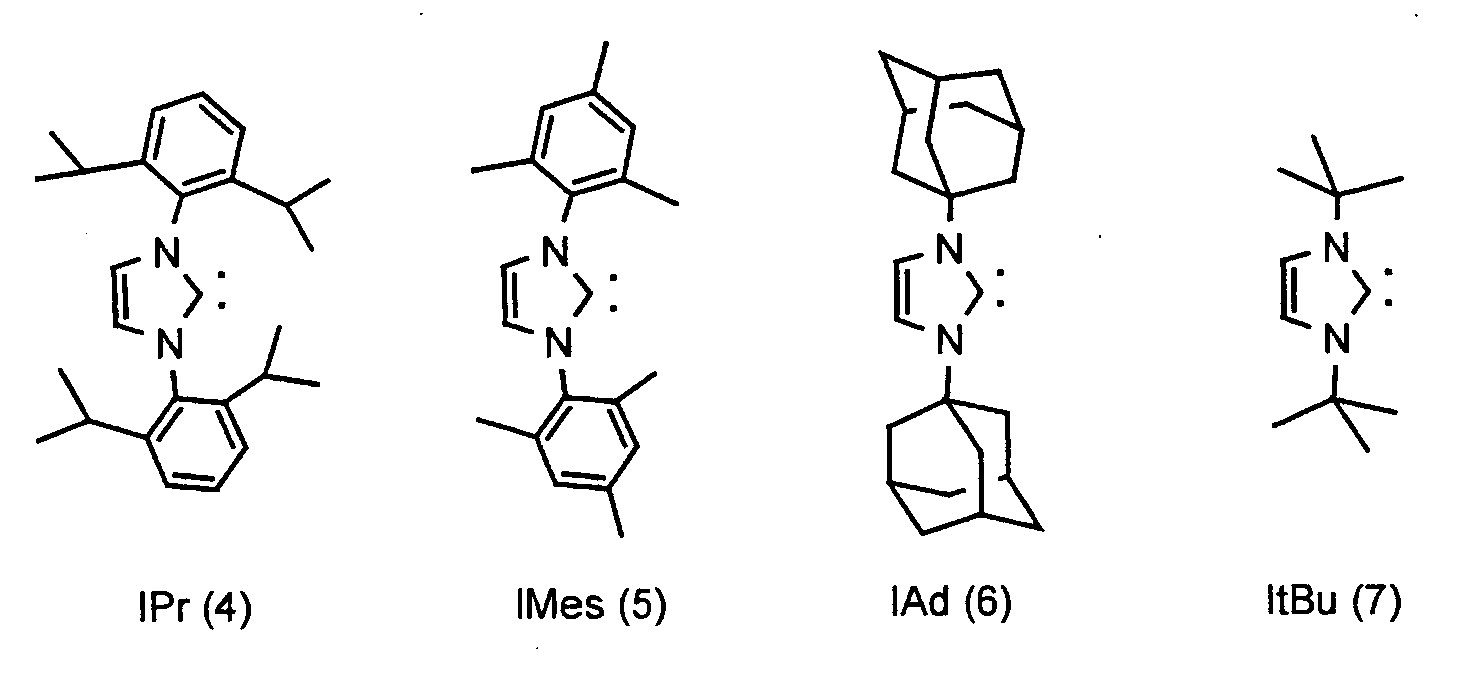


- are specific examples of the nitrogen containing heterocyclic carbene ligands (L) in the present invention.
- The substituted ethynyl gold-nitrogen containing heterocyclic carbene complex represented by the general formula (1) of the present invention is obtained as shown in, for example, the reaction scheme (1):
-


- wherein X and L are as defined above, and P represents a monodentate phosphine ligand by reacting a substituted ethynyl gold phosphine complex with a nitrogen containing heterocyclic carbene ligand (L).
- Examples of the monodentate phosphine ligands (P) include bis(pentafluorophenyl)phenylphosphine, (4-bromophenyl)diphenylphosphine, diallylphenylphosphine, dicyclohexylphenylphosphine, diethylphenylphosphine, 4-(dimethylamino)phenyldiphenylphosphine, dimethylphenylphosphine, diphenyl(2-methoxyphenyl)phosphine, diphenyl(pentafluorophenyl)phosphine, diphenylpropylphosphine, diphenyl-2-pyridylphosphine, diphenyl(p-tolyl)phosphine, diphenylvinylphosphine, ethyldiphenylphosphine, isopropyldiphenylphosphine, methyldiphenylphosphine, tribenzylphosphine, tributylphosphine, tri-t-butylphosphine, tricyclohexylphosphine, tricyclopentylphosphine, triethylphosphine, tri-2-furylphosphine, triisobutylphosphine, triisopropylphosphine, tripropylphosphine, trimethylphosphine, trioctylphosphine, triphenylphosphine, tris(4-chlorophenyl)phosphine, tris(3-chlorophenyl)phosphine, tris(2,6-dimethoxyphenyl)phosphine, tris(4-fluorophenyl)phosphine, tris(3-fluorophenylphosphine), tris(4-methoxyphenyl)phosphine, tris(3-methoxyphenyl)phosphine, tris(2-methoxyphenyl)phosphine, tris(4-trifluoromethylphenyl)phosphine, tris(pentafluorophenyl)phosphine, tris(2,4,6-trimethoxyphenyl)phosphine, tris(2,4,6-trimethylphenyl)phosphine, tri-m-tolylphosphine, tri-o-tolylphosphine, tri-p-tolylphosphine, benzyldiphenylphosphine, bis(2-methoxyphenyl)phenylphosphine, diphenylcyclohexylphosphine, 2-(di-t-butylphosphino)biphenyl, 2-(dicyclohexylphosphino)biphenyl, neomenthyldiphenylphosphine, p-tolyldiphenylphosphine, triallylphosphine, 2,4,4-trimethylpentylphosphine, tri(1-naphthyl)phosphine, tris(hydroxymethyl)phosphine, tris(hydroxypropyl)phosphine and the like. With respect to the monodentate phosphine ligand, a product commercially available can be directly used.
- The substituted ethynyl gold phosphine complex is obtained as shown in, for example, the reaction scheme (2):
-

- wherein X and P are as defined above, and Y represents a halogen atom by reacting a gold halogenophosphine complex with a substituted ethyne (see, for example, Non-patent document 1).
- The gold halogenophosphine complex can be synthesized by a known method (see, for example, Non-patent document 2).
- With respect to the substituted ethyne, a product commercially available may be directly used, but, when the substituted ethyne is an ethynyl group-substituted fused heterocyclic compound represented by the general formula (14) :
-

- wherein Z represents a halogen atom, an alkyl group, an alkenyl group, an aryl group, an aralkyl group, an alkoxy group, an aryloxy group, a nitro group, a cyano group or a dialkylamino group, and n is an integer of 0 to 6; more than one Z, which may be identical or different from each other, represents the alkyl group, the alkenyl group, the aryl group, the aralkyl group, the alkoxy group, the aryloxy group or the dialkylamino group, the adjacent groups may be bonded together to form a ring; and each of A and B represents a methine group or a nitrogen atom, and when A or B, or both A and B are a methine group, a hydrogen atom thereof may be replaced by a group represented by Z or an ethynyl group, namely, an ethynyl group-substituted fused heterocyclic compound substituted by a quinolyl group, a quinazolyl group or a quinoxalyl group, the compound is obtained as shown in the reaction scheme (3):
-


- wherein Z, n, A and B are as defined above by reacting a fused heterocyclic compound substituted by a trifluoromethanesulfonyloxy group with 2-methyl-3-butyn-2-ol in the presence of a palladium catalyst to yield a 1-dimethylhydroxymethyl-fused heterocyclic acetylene compound, and then reacting the resulting compound with a base.
- The fused heterocyclic compound substituted by a trifluoromethanesulfonyloxy group is obtained as shown in, for example, the reaction scheme (4):
-

- by reacting a fused heterocyclic compound substituted by a hydroxyl group with trifluoromethanesulfonic anhydride in the presence of a base (see, for example, Non-patent document 3).
- Specific examples of the ethynyl group-substituted fused heterocyclic compounds include 8-quinolylethyne, 7-quinolylethyne, 6-quinolylethyne, 5-quinolylethyne, 4-quinolylethyne, 3-quinolylethyne, 2-quinolylethyne, 8-quinazolylethyne, 7-quinazolylethyne, 6-quinazolylethyne, 5-quinazolylethyne, 8-quinoxalylethyne, 7-quinoxalylethyne, 6-quinoxalylethyne, 5-quinoxalylethyne, 5-fluoro-8-quinolylethyne, 5-chloro-8-quinolylethyne, 5-fluoro-8-quinazolylethyne, 5-chloro-8-quinazolylethyne, 5-fluoro-8-quinoxalylethyne, 5-chloro-8-quinoxalylethyne and the like.
- With respect to the nitrogen-containing heterocyclic carbene ligand, a product commercially available may be directly used, or a product synthesized by, for example, a known method may be used (see, for example, Non-patent document 4 and Patent document 1).
- In the synthesis of the substituted ethynyl gold-nitrogen containing heterocyclic carbene complex of the present invention, the amount of the nitrogen-containing heterocyclic carbene ligand used is preferably 1 to 3 mol, further preferably 1 to 1.5 mol, relative to 1 mol of the substituted ethynyl gold phosphine complex.
- With respect to the solvent used in the synthesis of the substituted ethynyl gold-nitrogen containing heterocyclic carbene complex of the present invention, there is no particular limitation as long as the solvent does not inhibit the reaction, and there is used, for example, an ether such as tetrahydrofuran, furan, dioxane, tetrahydropyran, diethyl ether, diisopropyl ether or dibutyl ether; an aliphatic hydrocarbon such as pentane, hexane, heptane or octane; an aromatic hydrocarbon such as benzene, toluene or xylene; a halogenated aliphatic hydrocarbon such as dichloromethane, dichloroethane or dichloropropane; or a halogenated aromatic hydrocarbon such as chlorobenzene. These solvents may be used alone or in combination with each other.
- The amount of the solvent used is appropriately adjusted depending on homogeneity or stirred state of the reaction solution, but the amount is preferably 1 to 30 L, further preferably 5 to 20 L, relative to 1 mol of the substituted ethynyl gold phosphine complex.
- The substituted ethynyl gold-nitrogen containing heterocyclic carbene complex of the present invention is synthesized by, for example, a method in which a substituted ethynyl gold phosphine complex, a nitrogen containing heterocyclic carbene ligand (formed by reacting a nitrogen containing heterocyclic hydrohalide with a base) and a solvent are mixed to effect a reaction while stirring. In this method, the reaction temperature is preferably 0 to 120°C, further preferably 20 to 100°C, and with respect to the reaction pressure, there is no particular limitation.
- After completion of the reaction, the substituted ethynyl gold-nitrogen containing heterocyclic carbene complex of the present invention is isolated and purified by a known method, such as neutralization, extraction, filtration, concentration, distillation, recrystallization, sublimation, or chromatography.
- Examples of the substituted ethynyl gold-nitrogen containing heterocyclic carbene complexes of the present invention include the following formulae (15) to (62):
-


-


- The substituted ethynyl gold-nitrogen containing heterocyclic carbene complex of the present invention emits blue light with the CIE chromaticity coordinates (0.150, 0.060) to (0.218, 0.385) and green light with the coordinates (0.187, 0.452) to (0.324, 0.554) in chloroform at a temperature of 77 K (kelvin) under ultraviolet light radiation, which suggests that the complex is advantageously used as an organic electroluminescent device.
With respect to the substituted ethynyl gold-nitrogen containing heterocyclic carbene complex of the present invention, examples of complexes emitting light in a blue region include after-mentioned compounds Nos. 15 to 44, 47, 51, 53, 55 to 59 and 61, and examples of complexes emitting light in a green region include after-mentioned compounds Nos. 45, 46, 48, 49, 50, 52, 54, 60 and 62. - Next, an embodiment of the organic electroluminescent device according to the present invention is described.
- In the organic electroluminescent device of the present invention, at least one organic compound thin layer contains the substituted ethynyl gold-nitrogen containing heterocyclic carbene complex, and the organic electroluminescent device is preferably an organic electroluminescent device having a single organic compound layer or a plurality of organic compound layers between a pair of electrodes. The organic compound layer means a light emitting layer, an electron injection layer or a hole transport layer.
- The organic electroluminescent device of a single layer type has a light emitting layer between an anode and a cathode. The light emitting layer contains a luminescent material, and may further contain a hole injection material or an electron injection material for transporting to the luminescent material holes injected from the anode or electrons injected from the cathode.
- Examples of the organic electroluminescent devices of a multilayer type include those having a multilayer stacked structure, such as (anode/hole injection layer/light emitting layer/cathode), (anode/light emitting layer/electron injection layer/cathode) or (anode/hole injection layer/light emitting layer/electron injection layer/cathode).
- The light emitting layer contains the substituted ethynyl gold-nitrogen containing heterocyclic carbene complex represented by the formula (1), and may further contain, for example, at least one material selected from the group consisting of a known light emitting material, a doping material, a hole injection material (e.g., a phthalocyanine derivative, a naphthalocyanine derivative, a porphyrin derivative, oxazole, oxadiazole, triazole, imidazole, imidazolone, imidazolethione, pyrazoline, pyrazolone, tetrahydroimidazole, oxazole, oxadiazole, hydrazone, acylhydrazone, polyarylalkane, stilbene, butadiene, benzidine-type triphenylamine, styrylamine-type triphenylamine, diamine-type triphenylamine or derivatives thereof, or a polymer material, such as polyvinylcarbazole, polysilane or a conductive polymer) and an electron injection material (e.g., fluorenone, anthraquinodimethane, diphenoquinone, thiopyran dioxide, oxazole, oxadiazole, triazole, imidazole, perylenetetracarboxylic acid, fluorenylidenemethane, anthraquinodimethane, anthrone, or derivatives thereof).
- The amount of the substituted ethynyl gold-nitrogen containing heterocyclic carbene complex added to the organic compound layer is 0.005 to 1 g, relative to 1 g of the organic compound layer.
- In the organic electroluminescent device, the light emitting materials, other doping materials, hole injection materials and electron injection materials can be used in combination. Further, the hole injection layer, light emitting layer and electron injection layer may be individually formed by a layer construction comprised of two or more layers. In this case, with respect to the hole injection layer, a layer which injects holes from an electrode is called a hole injection layer, and a layer which receives holes from the hole injection layer and transports the holes to a light emitting layer is called a hole transport layer. Similarly, with respect to the electron injection layer, a layer which injects electrons from an electrode is called an electron injection layer, and a layer which receives electrons from the electron injection layer and transports the electrons to a light emitting layer is called an electron transport layer. These layers are appropriately selected and used depending on factors, such as an energy level or heat resistance of the material or adhesion to the organic compound layer or metal electrode.
- Examples of luminescent materials or host materials usable in the organic compound layer, together with the substituted ethynyl gold-nitrogen containing heterocyclic carbene complex, include fused polycyclic aromatic compounds (e.g., anthracene, naphthalene, phenanthrene, pyrene, tetracene, pentacene, coronene, chrysene, fluorescein, perylene, rubrene and derivatives thereof), aromatic silicon compounds (e.g., phthaloperylene, naphthaloperylene, perynone, phthaloperynone, naphthaloperynone, diphenylbutadiene, tetraphenylbutadiene, coumarin, oxadiazole, aldazine, bisbenzoxazoline, bisstyryl, pyrazine, cyclopentadiene, quinoline metal complexes, aminoquinoline metal complexes, benzoquinoline metal complexes, imine, diphenylethylene, vinylanthracene, diaminocarbazole, pyran, thiopyran, polymethine, merocyanine, imidazole chelated oxinoid compounds, quinacridone, rubrene, stilbene based derivatives, and tetraphenylsilane), aromatic germanium compounds (e.g., tetraphenylgermanium), fluorescent dyes and the like.
- Among the known hole injection materials usable in the organic electroluminescent device of the present invention, a further effective hole injection material is an aromatic tertiary amine derivative or a phthalocyanine derivative, and specific examples include, but are not limited to, aromatic tertiary amine derivatives, such as triphenylamine, tritolylamine, tolyldiphenylamine, N,N'-diphenyl-N,N'-(3-methylphenyl)-1,1'-biphenyl-4,4'-diamine (hereinafter, referred to as "TPD"), N,N,N',N'-(4-methylphenyl)-1,1'-phenyl-4,4'-diamine, N,N,N',N'-(4-methylphenyl)-1,1'-biphenyl-4,4'-diamine, N,N'-diphenyl-N,N'-di-α-naphthyl-1,1'-biphenyl-4,4'-diamine (hereinafter, referred to as "α-NPD"), N,N'-(methylphenyl)-N,N'-(4-n-butylphenyl)-phenanthrene-9,10-diamine, N,N-bis(4-di-4-tolylaminophenyl)-4-phenyl-cyclohexane, and oligomers or polymers having the above aromatic tertiary amine skeleton; and phthalocyanine derivatives and naphthalocyanine derivatives, such as H2Pc, CuPc, CoPc, NiPc, ZnPc, PdPc, FePc, MnPc, ClAlPc, ClGaPc, ClInPc, ClSnPc, Cl2SiPc, (HO)AlPc, (HO)GaPc, VOPc, TiOPc, MoOPc, and GaPc-O-GaPc.
- In the organic electroluminescent device of the present invention, a further effective, known electron injection material is a metal complex compound or a nitrogen-containing five-membered ring derivative (preferably oxazole, thiazole, oxadiazole, thiadiazole or triazole derivatives), examples thereof include, but are not limited to, metal complex compounds, such as 8-hydroxyquinolinatolithium, bis(8-hydroxyquinolinato)zinc, bis(8-hydroxyquinolinato)copper, bis(8-hydroxyquinolinato)manganese, tris(8-hydroxyquinolinato)aluminum (hereinafter, referred to as "Alq3"), tris(2-methyl-8-hydroxyquinolinato)aluminum, tris(8-hydroxyquinolinato)gallium, bis(10-hydroxybenzo[h]quinolinato)beryllium, bis(10-hydroxybenzo[h]quinolinato)zinc, bis(2-methyl-8-quinolinato)chlorogallium, bis(2-methyl-8-quinolinato)(o-cresolato)gallium, bis(2-methyl-8-quinolinato)(1-naphtholato)aluminum and bis(2-methyl-8-quinolinato)(2-naphtholato)gallium; and nitrogen-containing five-membered ring derivatives, such as 2,5-bis(1-phenyl)-1,3,4-oxazole, dimethyl POPOP {wherein POPOP represents 1,4-bis(5-phenyloxazole-2-yl)benzene}, 2,5-bis(1-phenyl)-1,3,4-thiazole, 2,5-bis(1-phenyl)-1,3,4-oxadiazole, 2-(4'-tert-butylphenyl)-5-(4"-biphenyl)-1,3,4-oxadiazole, 2,5-bis(1-naphthyl)-1,3,4-oxadiazole, 1,4-bis[2-(5-phenyloxadiazolyl)]benzene, 1,4-bis[2-(5-phenyloxadiazolyl)-4-tert-butylbenzene], 2-(4'-tert-butylphenyl)-5-(4"-biphenyl)-1,3,4-thiadiazole, 2,5-bis(1-naphthyl)-1,3,4-thiadiazole, 1,4-bis[2-(5-phenylthiadiazolyl)]benzene, 2-(4'-tert-butylphenyl)-5-(4"-biphenyl)-1,3,4-triazole, 2,5-bis(1-naphthyl)-1,3,4-triazole and 1,4-bis[2-(5-phenyltriazolyl)]benzene.
- In the organic electroluminescent device of the present invention, for improving the electron injection properties, an inorganic compound layer can be formed between the light emitting layer and the electrode.
- As an inorganic compound layer, an alkali metal fluoride, such as LiF; an alkaline earth metal fluoride, such as BaF2 or SrF2; an alkali metal oxide, such as Li2O; or an alkaline earth metal oxide, such as RaO or SrO, can be used.
- As a conductive material for the anode in the organic electroluminescent device of the present invention, there can be used a conductive material having a work function larger than around 4 eV, for example, carbon atom, aluminum, vanadium, iron, cobalt, nickel, tungsten, silver, gold, platinum, palladium, or an alloy thereof, an ITO (substance comprising indium oxide containing tin oxide in an amount of 5 to 10%) substrate, a metal oxide used in an NESA substrate, such as tin oxide or indium oxide, or an organic conductive resin, such as polythiophene or polypyrrole. It is desired to use in the anode a conductive material having a work function larger by 0.1 eV or more than the work function of the conductive material used in the cathode of the device.
- As a conductive material for the cathode, a conductive substance having a work function smaller than around 4 eV, for example, magnesium, calcium, tin, lead, titanium, yttrium, lithium, ruthenium, manganese, aluminum, or an alloy thereof can be used. Examples of the alloys include magnesium/silver, magnesium/indium, lithium/aluminum and the like. With respect to the metal ratio in the alloy, there is no particular limitation, and it is controlled by changing the temperature of the deposition source, the atmosphere, the degree of vacuum or the like. It is desired to use in the cathode a conductive material having a work function smaller by 0.1 eV or more than the work function of the conductive material used in the anode of the device.
- The anode and cathode may be individually formed by a layer construction comprised of two or more layers, if necessary.
- In the organic electroluminescent device of the present invention, it is desired that at least one surface is transparent in the wavelength region of the light emitted by the device. Further, the substrate is desirably transparent.
- The transparent electrode is obtained using the above conductive material by a vapor deposition or sputtering process under conditions such that the electrode surely has predetermined light transmission properties.
- The electrode on the emission side desirably has a transmittance of 10% or more.
- With respect to the substrate, there is no particular limitation as long as it has mechanical and thermal strength and transparency, but a glass substrate or a transparent resin film can be used.
- Examples of transparent resin films include polyethylene, ethylene-vinyl acetate copolymers, ethylene-vinyl alcohol copolymers, polypropylene, polystyrene, polymethyl methacrylate, polyvinyl chloride, polyvinyl alcohol, polyvinyl butyral, nylon, polyether ether ketone, polysulfone, polyether sulfone, tetrafluoroethylene-perfluoroalkyl vinyl ether copolymers, polyvinyl fluoride, tetrafluoroethylene-ethylene copolymers, tetrafluoroethylene-hexafluoropropylene copolymers, polychlorotrifluoroethylene, polyvinylidene fluoride, polyesters, polycarbonates, polyurethanes, polyimides, polyether imides, polyimides, polypropylene and the like.
- In the organic electroluminescent device of the present invention, for improving the stability with respect to the temperature, humidity or atmosphere, a protective layer may be formed on the surface of the device, or the whole of the device may be protected by silicone oil, a resin or the like.
- Each layer in the organic electroluminescent device can be formed by a dry film formation process, such as vacuum deposition, sputtering, plasma or ion plating, or a wet film formation process, such as spin coating, dipping or flow coating. With respect to the thickness of the layer, there is no particular limitation, but the thickness is preferably 5 nm to 10 µm, further preferably 10 nm to 0.2 µm.
- When using a wet film formation process, the substituted ethynyl gold-nitrogen containing heterocyclic carbene complex is dissolved or dispersed in a solvent, such as ethanol, chloroform, tetrahydrofuran, or dioxane, thus forming a thin film on each layer.
- As a dry film formation process, preferred is vapor deposition, and, using a vapor deposition machine at a degree of vacuum of 2 × 10⁻³ Pa or less and at a substrate temperature of room temperature, the substituted ethynyl gold-nitrogen containing heterocyclic carbene complex of the present invention placed in a deposition cell is heated and evaporated, thus forming a thin film. In this instance, for controlling the temperature of the deposition source, a thermocouple in contact with the deposition cell or a noncontact infrared thermometer can be preferably used. For controlling the deposition rate, a deposition film thickness meter can be preferably used.
- As a deposition film thickness meter, there can be preferably used a thickness meter in a system such that, using a quartz crystal oscillator disposed opposite the deposition source, a weight of the film deposited on the surface of the quartz crystal oscillator is measured from a change of the oscillation frequency of the oscillator and a film thickness is determined in real time from the weight measured.
- Co-deposition of a host material, such as CBP, and the substituted ethynyl gold-nitrogen containing heterocyclic carbene complex of the present invention can be performed by using individual deposition sources and independently controlling the individual temperatures.
- In each organic thin film layer, for improving the film forming properties or for preventing pinholes from being caused in the film, a resin, e.g., an insulating resin, such as polystyrene, polycarbonate, polyacrylate, polyester, polyamide, polyurethane, polysulfone, polymethyl methacrylate, polymethyl acrylate, cellulose, or a copolymer thereof, a photoconductive resin, such as poly-N-vinylcarbazole or polysilane, or a conductive resin, such as polythiophene or polypyrrole, or an additive, such as an antioxidant, an ultraviolet absorber, or a plasticizer, may be used.
- The organic electroluminescent device of the present invention can be used in a flat luminescent object, such as a flat panel display for wall television or mobile phone, a backlight for copy machine, printer or liquid crystal display, a light source for instruments; a display board, a sign lamp or the like.
- Nextly, the present invention is specifically explained by listing Examples but a scope of the present invention is not limited to these.
- Under an argon atmosphere, 1,3-bis(2,6-diisopropylphenyl)imidazolium chloride (IPrH+Cl-; 0.21 g, 0.05 mmol), potassium tert-butoxide (85 mass% article, 83 mg, 0.63 mmol) and tetrahydrofuran (5.0 ml) were added to a 25 ml Schlenk tube and the mixture was stirred at room temperature for 20 minutes. After tetrahydrofuran was distilled off under reduced pressure, toluene (7.5 ml) was added thereto. After the mixture was stirred at 70°C for 5 minutes, the reaction mixture was filtered. The filtrate was added dropwise to the other 25 ml Schlenk tube added with 8-quinolylethynyl(triphenylphosphine)gold (229 mg, 0.375 mmol) and 7.5 ml of toluene. After completion of the dropwise addition, the reaction mixture was heated at 70°C for 4 hours. The reaction mixture was cooled to room temperature, and then toluene was distilled off under reduced pressure. The resulting residue was extracted with ether (20 ml), the insolubles were filtered off, and the ether extract was concentrated and recrystallized in a n-hexane-diethyl ether system to give 0.21 g of the desired compound as a white solid (yield: 73%) .
- 1H-NMR (300 MHz, CDCl3) δ: 8.91 (dd, 1H), 8.01 (dd, 1H), 7.79 (dd, 1H), 7.53-7.48 (m, 3H), 7.33-7.25 (m, 6H), 7.12 (s, 2H), 2.64 (sept, 4H), 1.40 (d, 12H), 1.22 (d, 12H) FAB-MS (M/Z): 738 (M+H)+
Luminescence analysis: (CHCl3, 77K, Ex250nm) λ (nm): 387 (max), 533, 571Elemental analysis: Found C: 62.13, H: 5.83, N: 5.65 Theoretical C: 61.87, H: 5.74, N: 5.70 - Under an argon atmosphere, 1,3-bis(2,4,6-trimethylphenyl)imidazolium chloride (IMesH+Cl-; 0.19 g, 0.53 mmol), potassium tert-butoxide (85 mass% article, 83 mg, 0.63 mmol) and tetrahydrofuran (5.0 ml) were added to a 25 ml Schlenk tube, and the mixture was stirred at room temperature for 20 minutes. After tetrahydrofuran was distilled off under reduced pressure, toluene (7.5 ml) was added thereto and the mixture was stirred at 70°C for 5 minutes. The reaction mixture was filtered and the filtrate was added dropwise to the other 25 ml Schlenk tube added with 8-quinolylethynyl(triphenylphosphine)gold (229 mg, 0.375 mmol) and toluene (7.5 ml). After completion of the dropwise addition, the reaction mixture was heated at 70°C for 8 hours. The reaction mixture was cooled to room temperature, and then the precipitate was collected by filtration and washed with toluene (20 ml). The precipitate was dried under reduced pressure to give 0.22 g of the desired compound as a bluish white solid (yield: 91%) .
- 1H-NMR (300 MHz, CDCl3) δ: 8.95 (dd, 1H), 8.03 (dd, 1H), 7.81 (dd, 1H), 7.54 (dd, 1H), 7.34-7.25 (m, 2H), 7.05 (s, 2H), 6.98 (s, 4H), 2.34 (s, 6H), 2. 13 (s, 12H) FAB-MS (M/Z): 654 (M+H)+
Luminescence analysis: (CHCl3, 77K, Ex250nm) λ (nm): 385 (max), 530, 570Elemental analysis: Found C: 59.06, H: 4.52, N: 6.31 Theoretical C: 58.81, H: 4.63, N: 6.43 - Under an argon atmosphere, 1,3-diadamantylimidazolium chloride (IAdH+Cl-; 0.053 g, 0.14 mmol), potassium tert-butoxide (85 mass% article, 24 mg, 0.19 mmol) and tetrahydrofuran (2.0 ml) were added to a 25 ml Schlenk tube, and the mixture was stirred at room temperature for 20 minutes. After tetrahydrofuran was distilled off under reduced pressure, toluene (3 ml) was added thereto and the mixture was stirred at 70°C for 5 minutes. The reaction mixture was filtered and the filtrate was added dropwise to the other 25 ml Schlenk tube added with 8-quinolylethynyl(triphenylphosphine)gold (67 mg, 0.11 mmol) and 3 ml of toluene. After completion of the dropwise addition, the reaction mixture was heated at 70°C for 2.5 hours. The reaction mixture was cooled to room temperature, and then toluene was distilled off under reduced pressure and the resulting white solid was washed with diethyl ether (20 ml) to give 0.065 g of the desired compound as a white solid (yield: 87%) .
- 1H-NMR (300 MHz, CDCl3) δ: 9.04 (dd, 1H), 8.09 (dd, 1H), 8.00 (dd, 1H), 7.60 (dd, 1H), 7.44-7.33 (m, 2H), 7.07 (s, 2H), 2.65-2.59 (m, 12H), 2.28 (m, 6H), 1.87-1.72 (m, 12H) [FAB-MS] (M/Z): 686 (M+H)+
Luminescence analysis: (CHCl3, 77K, Ex250nm) λ (nm): 387 (max)Elemental analysis: Found C: 59.64, H: 5.48, N: 5.99 Theoretical C: 59.56, H: 5.59, N: 6.13 - Under an argon atmosphere, 1,3-di-tert-butylimidazolium chloride (ItBuH+Cl-; 0.087 g, 0.40 mmol), potassium tert-butoxide (85 mass% article, 69 mg, 0.52 mmol) and tetrahydrofuran (6.5 ml) were added to a 25 ml Schlenk tube, and the mixture was stirred at room temperature for 20 minutes. After tetrahydrofuran was distilled off under reduced pressure, toluene (6.5 ml) was added thereto and the mixture was stirred at 70°C for 5 minutes. The reaction mixture was filtered and the filtrate was added dropwise to the other 50 ml Schlenk tube added with 8-quinolylethynyl(triphenylphosphine)gold (188 mg, 0.31 mmol) and 6.5 ml of toluene. After completion of the dropwise addition, the reaction mixture was heated at 70°C for 4 hours. The reaction mixture was cooled to room temperature, and then toluene was distilled off under reduced pressure and the resulting white solid was washed with diethyl ether (20 ml) to give 0.108 g of the desired compound as a white solid (yield: 66%).
- 1H-NMR (300 MHz, CDCl3) δ: 9.05 (dd, 1H), 8.09 (dd, 1H), 8.00 (dd, 1H), 7.62 (dd, 1H), 7.44-7.30 (m, 2H), 7.06 (s, 2H), 1.90 (s, 18H) FAB-MS (M/Z) : 530 (M+H)+
Luminescence analysis: (CHCl3, 77K, Ex240nm) λ (nm): 387 (max)Elemental analysis: Found C: 51.51, H: 4.85, N: 5.55 Theoretical C: 49.91, H: 4.95, N: 7.94 - Under an argon atmosphere, 1,3-bis(2,6-diisopropylphenyl)imidazolium chloride (IPrH+Cl-; 0.053 g, 0.125 mmol), potassium tert-butoxide (85 mass% article, 21.5 mg, 0.16 mmol) and tetrahydrofuran (2.0 ml) were added to a 25 ml Schlenk tube and the mixture was stirred at room temperature for 20 minutes. After tetrahydrofuran was distilled off under reduced pressure, toluene (3 ml) was added thereto and the mixture was stirred at 70°C for 5 minutes. The reaction mixture was filtered and the filtrate was added dropwise to the other 25 ml Schlenk tube added with phenylethynyl(triphenylphosphine)gold (54 mg, 0.096 mmol) and 3 ml of toluene. After completion of the dropwise addition, the reaction mixture was heated at 70°C for 4 hours. The reaction mixture was cooled to room temperature, and then toluene was distilled off under reduced pressure. The resulting residue was extracted with diethyl ether (20 ml) and the insolubles were filtered off. The diethyl ether etract was concentrated and recrystallized in a n-hexane-diethyl ether system to give 0.047 g of the desired compound as a white solid (yield: 71%) .
- 1H-NMR (300 MHz, CDCl3) δ: 7.49 (dd, 2H), 7.31-7.28 (m, 6H), 7.12 (s, 2H), 7.10-7.00 (m, 3H), 2.61 (sept, 4H), 1.38 (d, 12H), 1.21 (d, 12H) FAB-MS (M/Z): 687 (M+H)+
Luminescence analysis: (CHCl3, 77K, Ex250nm) λ (nm): 414 (max), 434, 454Elemental analysis: Found C: 60.95, H: 5.92, N: 4.02 Theoretical C: 61.22, H: 6.02, N: 4.08 - Under an argon atmosphere, 1,3-bis(2,4,6-trimethylphenyl)imidazolium chloride (IMesH+Cl-; 0.158 g, 0.464 mmol), potassium tert-butoxide (85 mass% article, 80.0 mg, 0.60 mmol) and tetrahydrofuran (7.5 ml) were added to a 25 ml Schlenk tube, and the mixture was stirred at room temperature for 20 minutes. After tetrahydrofuran was distilled off under reduced pressure, toluene (7.5 ml) was added thereto and the mixture was stirred at 70°C for 5 minutes. The reaction mixture was filtered and the filtrate was added dropwise to the other 50 ml Schlenk tube added with phenylethynyl(triphenylphosphine)gold (200 mg, 0.357 mmol) and 7.5 ml of toluene. After completion of the dropwise addition, the reaction mixture was heated at 70°C for 2.5 hours. The reaction mixture was cooled to room temperature, and then toluene was distilled off under reduced pressure. The resulting residue was extracted with diethyl ether (20 ml) and the insolubles were filtered off. The diethyl ether extract was concentrated and recrystallized in a n-hexane-diethyl ether system to give 0.183 g of the desired compound as a white solid.
- 1H-NMR (300 MHz, CDCl3) δ: 7.35-7.32 (m, 2H), 7.15-7.07 (m, 3H), 7.06 (s, 2H), 6.99 (s, 4H), 2.35 (s, 6H), 2.12 (s, 12H)
FAB-MS (M/Z): 603 (M+H)+
Luminescence analysis: (CHCl3, 77K, Ex240nm) λ (nm): 414 (max), 434, 453Elemental analysis: Found C: 57.65, H: 4.74, N: 4.48 Theoretical C: 57.81, H: 4.85, N: 4.65 - Under an argon atmosphere, 1,3-diadamantylimidazolium chloride (IAdH+Cl-; 0.108 g, 0.29 mmol), potassium tert-butoxide (85 mass% article, 50.0 mg, 0.38 mmol) and tetrahydrofuran (4.5 ml) were added to a 25 ml Schlenk tube, and the mixture was stirred at room temperature for 20 minutes. After tetrahydrofuran was distilled off under reduced pressure, toluene (4.5 ml) was added thereto and the mixture was stirred at 70°C for 5 minutes. The reaction mixture was filtered and the filtrate was added dropwise to the other 50 ml Schlenk tube added with phenylethynyl(triphenylphosphine)gold (123 mg, 0.22 mmol) and 4.5 ml of toluene. After completion of the dropwise addition, the reaction mixture was heated at 70°C for 2.5 hours. The reaction mixture was cooled to room temperature, and then toluene was distilled off under reduced pressure. The resulting residue was recrystallized in a methylene chloride-diethyl ether system to give 0.117 g of the desired compound as a white solid (yield: 84%).
- 1H-NMR (300 MHz, CDCl3) δ: 7.53-7.49 (m, 2H), 7.25-7.08 (m, 3H), 7.07 (s, 2H), 2.58-2.56 (m, 12H), 2.34-2.28 (m, 6H), 1.85-1.72 (m, 12H) FAB-MS (M/Z): 635 (M+H)+
Luminescence analysis: (CHCl3, 77K, Ex240nm) λ (nm): 415 (max), 435, 455Elemental analysis: Found C: 58.71, H: 5.76, N: 4.44 Theoretical C: 58.67, H: 5.88, N: 4.41 - Under an argon atmosphere, 1,3-di-tert-butylimidazolium chloride (ItBuH+Cl-; 0.082 g, 0.38 mmol), potassium tert-butoxide (85 mass% article, 65 mg, 0.49 mmol) and tetrahydrofuran (6.0 ml) were added to a 25 ml Schlenk tube, and the mixture was stirred at room temperature for 20 minutes. After tetrahydrofuran was distilled off under reduced pressure, toluene (6.0 ml) was added thereto and the mixture was stirred at 70°C for 5 minutes. The reaction mixture was filtered and the filtrate was added dropwise to the other 25 ml Schlenk tube added with phenylethynyl(triphenylphosphine)gold (168 mg, 0.30 mmol) and 6.0 ml of toluene. After completion of the dropwise addition, the reaction mixture was heated at 70°C for 2.5 hours. The reaction mixture was cooled to room temperature, and then toluene was distilled off under reduced pressure. The resulting white solid was recrystallized in a methylene chloride-diethyl ether-hexane system to give 0.127 g of the desired compound as a white solid (yield: 89%).
- 1H-NMR (300 MHz, CDCl3) δ: 7.53-7.49 (m, 2H), 7.29-7.06 (m, 3H), 7.03 (s, 2H), 1.89 (s, 18H) FAB-MS (M/Z): 479 (M+H)+
Luminescence analysis: (CHCl3, 77K, Ex240nm) λ (nm): 414 (max) 434, 454Elemental analysis: Found C: 47.30, H: 5.11, N: 5.76 Theoretical C: 47.70, H: 5.27, N: 5.86 - Under an argon atmosphere, 1,3-bis(2,6-diisopropylphenyl)imidazolium chloride (IPrH+Cl-; 0.166 g, 0.39 mmol), potassium tert-butoxide (85 wt% article, 67 mg, 0.51 mmol) and tetrahydrofuran (6.0 ml) were added to a 25 ml Schlenk tube, and the mixture was stirred at room temperature for 20 minutes. After tetrahydrofuran was distilled off under reduced pressure, toluene (6.0 ml) was added thereto and the mixture was stirred at 70°C for 5 minutes. The reaction mixture was filtered and the filtrate was added dropwise to the other 25 ml Schlenk tube added with 4-fluorophenylethynyl(triphenylphosphine)gold (174 mg, 0.30 mmol) and 6.0 ml of toluene. After completion of the dropwise addition, the reaction mixture was heated at 70°C for 2.5 hours. The reaction mixture was cooled to room temperature, and then toluene was distilled off under reduced pressure. The resulting white solid was recrystallized in a n-hexane-diethyl ether-methylene chloride system to give 0.187 g of the desired compound as a white solid (yield: 88%).
- 1H-NMR (300 MHz, CDCl3) δ: 7.49 (dd, 2H), 7.30-7.22 (m, 8H), 7.12 (s, 2H), 6.82-6.75 (m, 2H), 2.60 (sept, 4H), 1.38 (d, 12H), 1.21 (d, 12H) FAB-MS (M/Z) : 705 (M+H)+
Luminescence analysis: (CHC13, 77K, Ex250nm) λ (nm): 412 (max), 430, 451Elemental analysis: Found C: 59.32, H: 5.68, N: 3.95 Theoretical C: 59.66, H: 5.72, N: 3.98 - Under an argon atmosphere, 1,3-bis(2,4,6-trimethylphenyl)imidazolium chloride (IMesH+Cl-; 0.142 g, 0.416 mmol) and potassium tert-butoxide (85 mass% article, 71.0 mg, 0.541 mmol) and tetrahydrofuran (6.7 ml) were added to a 25 ml Schlenk tube, and the mixture was stirred at room temperature for 20 minutes. After tetrahydrofuran was distilled off under reduced pressure, toluene (6.7 ml) was added thereto and the mixture was stirred at 70°C for 5 minutes. The reaction mixture was filtered and the filtrate was added dropwise to the other 50 ml Schlenk tube added with 4-fluorophenylethynyl(triphenylphosphine)gold (185 mg, 0.32 mmol) and 6.7 ml of toluene. After completion of the dropwise addition, the reaction mixture was heated at 70°C for 2.5 hours. The reaction mixture was cooled to room temperature, and then toluene was distilled off under reduced pressure. The resulting white solid was recrystallized in a n-hexane-diethyl ether-methylene chloride system to give 0.150 g of the desired compound as a white solid (yield: 75%).
- 1H-NMR (300 MHz, CDCl3) δ: 7.32-7.26 (m, 2H), 7.06 (s, 2H), 6.99 (s, 4H), 6.81-6.78 (m, 2H), 2.35 (s, 6H), 2.12 (s, 12H)
FAB-MS (M/Z) : 621 (M+H)+
Luminescence analysis: (CHCl3, 77K, Ex240nm) λ (nm): 411 (max), 430, 450Elemental analysis: Found C: 55.85, H: 4.52, N: 4.60 Theoretical C: 56.13, H: 4.55, N: 4.51 - Under an argon atmosphere, 1,3-bis(2,6-diisopropylphenyl)imidazolium chloride (IPrH+C1-; 0.170 g, 0.40 mmol), potassium tert-butoxide (85 mass% article, 69 mg, 0.52 mmol) and tetrahydrofuran (6.2 ml) were added to a 25 ml Schlenk tube, and the mixture was stirred at room temperature for 20 minutes. After tetrahydrofuran was distilled off under reduced pressure, toluene (6.2 ml) was added thereto and the mixture was stirred at 70°C for 5 minutes. The reaction mixture was filtered and the filtrate was added dropwise to the other 25 ml Schlenk tube added with 4-methoxyphenylethynyl(triphenylphosphine)gold (183 mg, 0.31 mmol) and 6.2 ml of toluene. After completion of the dropwise addition, the reaction mixture was heated at 70°C for 2.5 hours. The reaction mixture was cooled to room temperature, and then toluene was distilled off under reduced pressure. The resulting white solid was recrystallized in a n-hexane-diethyl ether-methylene chloride system to give 0.180 g of the desired compound as a white solid (yield: 81%).
- 1H-NMR (300 MHz, CDCl3) δ: 7.49 (dd, 2H), 7.30-7.22 (m, 6H), 7.11 (s, 2H), 6.67-6.62 (m, 2H), 3.71 (s, 3H), 2.61 (sept, 4H), 1.38 (d, 12H), 1.21 (d, 12H) FAB-MS (M/Z): 716 (M+H)+
Luminescence analysis: (CHCl3, 77K, Ex250nm) λ (nm): 420 (max), 440Elemental analysis: Found C: 59.98, H: 6.01, N: 3.87 Theoretical C: 60.33, H: 6.05, N: 3.91 - Under an argon atmosphere, 1,3-bis(2,4,6-trimethylphenyl)imidazolium chloride (IMesH+Cl-; 0.155 g, 0.455 mmol), potassium tert-butoxide (85 mass% article, 78.0 mg, 0.59 mmol) and tetrahydrofuran (7.0 ml) were added to a 25 ml Schlenk tube, and the mixture was stirred at room temperature for 20 minutes. After tetrahydrofuran was distilled off under reduced pressure, toluene (7.0 ml) was added thereto and the mixture was stirred at 70°C for 5 minutes. The reaction mixture was filtered and the filtrate was added dropwise to the other 50 ml Schlenk tube added with 4-methoxyphenylethynyl(triphenylphosphine)gold (207 mg, 0.35 mmol) and 7.0 ml of toluene. After completion of the dropwise addition, the reaction mixture was heated at 70°C for 2.5 hours. The reaction mixture was cooled to room temperature, and then toluene was distilled off under reduced pressure. The resulting white solid was recrystallized in a n-hexane-diethyl ether-methylene chloride system to give 0.189 g of the desired compound as a white solid (yield: 85%).
- 1H-NMR (300 MHz, CDCl3) δ: 7.31-7.25 (m, 2H), 7.05 (s, 2H), 6.99 (s, 4H), 6.69-6.64 (m, 2H), 3.72 (s, 3H), 2.34 (s, 6H), 2.12 (s, 12H) FAB-MS (M/Z): 633 (M+H)+
Luminescence analysis: (CHCl3, 77K, Ex240nm) λ (nm): 419 (max), 440, 459Elemental analysis: Found C: 55.75, H: 4.92, N: 4.29 Theoretical C: 56.96, H: 4.94, N: 4.43 - Under an argon atmosphere, 1,3-bis(2,6-diisopropylphenyl)imidazolium chloride (IPrH+Cl-; 0.166 g, 0.39 mmol), potassium tert-butoxide (85 mass% article, 67 mg, 0.51 mmol) and tetrahydrofuran (6.0 ml) were added to a 25 ml Schlenk tube, and the mixture was stirred at room temperature for 20 minutes. After tetrahydrofuran was distilled off under reduced pressure, toluene (6.0 ml) was added thereto and the mixture was stirred at 70°C for 5 minutes. The reaction mixture was filtered and the filtrate was added dropwise to the other 25 ml Schlenk tube added with 5-fluoro-8-quinolylethynyl(triphenylphosphine)gold (189 mg, 0.300 mmol) and 6.0 ml of toluene. After completion of the dropwise addition, the reaction mixture was heated at 70°C for 2.5 hours. The reaction mixture was cooled to room temperature, and then toluene was distilled off under reduced pressure. The resulting residue was extracted with ether (20 ml) and the insolubles were filtered off. The ether extract was concentrated and recrystallized in a n-hexane-diethyl ether system to give 0.21 g of the desired compound as a white solid (yield: 87%).
- 1H-NMR (300 MHz, CDCl3) δ: 8.96 (dd, 1H), 8.29 (dd, 1H), 7.71 (dd, 1H), 7.50 (dd, 2H), 7.35-7.29 (m, 5H), 7.12 (s, 2H), 7.12-6.96 (m, 1H), 2.64 (sept, 4H), 1.40 (d, 12H), 1.22 (d, 12H) FAB-MS (M/Z): 756 (M+H)+
Luminescence analysis: (CHCl3, 77K, Ex250nm) λ (nm): 404 (max), 543Elemental analysis: Found C: 60.77, H: 5.78, N: 5.34 Theoretical C: 60.39, H: 5.47, N: 5.56 - Under an argon atmosphere, 1,3-bis(2,4,6-trimethylphenyl)imidazolium chloride (IMesH+Cl-; 0.17 g, 0.49 mmol), potassium tert-butoxide (85 mass% article, 84 mg, 0.64 mmol) and tetrahydrofuran (7.5 ml) were added to a 25 ml Schlenk tube, and the mixture was stirred at room temperature for 20 minutes. After tetrahydrofuran was distilled off under reduced pressure, toluene (7.5 ml) was added thereto and the mixture was stirred at 70°C for 5 minutes. The reaction mixture was filtered and the filtrate was added dropwise to the other 50 ml Schlenk tube added with 5-fluoro-8-quinolylethynyl(triphenylphosphine)gold (229 mg, 0.375 mmol) and 7.5 ml of toluene. After completion of the dropwise addition, the reaction mixture was heated at 70°C for 8 hours. The reaction mixture was filtered under heating, toluene was distilled off under reduced pressure, and then the resulting solid was recrystallized in a n-hexane-diethyl ether-methylene chloride system to give 0.20 g of the desired compound as a white solid (yield: 78%).
- 1H-NMR (300 MHz, CDCl3) δ: 8.99 (dd, 1H), 8.31 (dd, 1H), 7.73 (dd, 1H), 7.06 (s, 2H), 7.06-6.98 (m, 1H), 6.98 (s, 4H), 2.34 (s, 6H), 2.13 (s, 12H) FAB-MS (M/Z): 672 (M+H)+
Luminescence analysis: (CHCl3, 77K, Ex250nm) λ (nm): 401 (max), 541Elemental analysis: Found C: 57.13, H: 4.25, N: 6.16 Theoretical C: 57.23, H: 4.35, N: 6.23 - Under an argon atmosphere, 1,3-diadamantylimidazolium chloride (IAdH+Cl-; 0.194 g, 0.52 mmol), potassium tert-butoxide (85 mass% article, 89 mg, 0.68 mmol) and tetrahydrofuran (8.0 ml) were added to a 25 ml Schlenk tube, and the mixture was stirred at room temperature for 20 minutes. After tetrahydrofuran was distilled off under reduced pressure, toluene (8 ml) was added thereto and the mixture was stirred at 70°C for 5 minutes. The reaction mixture was filtered and the filtrate was added dropwise to the other 50 ml Schlenk tube added with 5-fluoro-8-quinolylethynyl(triphenylphosphine)gold (252 mg, 0.40 mmol) and 8 ml of toluene. After completion of the dropwise addition, the reaction mixture was heated at 70°C for 3 hours. The reaction mixture was cooled to room temperature, and then toluene was distilled off under reduced pressure. The resulting white solid was recrystallized in a n-hexane-diethyl ether-methylene chloride system to give 0.21 g of the desired compound as a white solid (yield: 73%).
- 1H-NMR (300 MHz, CDCl3) δ: 9.09 (dd, 1H), 8.37 (dd, 1H), 7.91 (dd, 1H), 7.42 (dd, 1H), 7.22-7.08 (m, 1H), 7.08 (s, 2H), 2.60-2.59 (m, 12H), 2.29 (m, 6H), 1.86-1.72 (m, 12H) FAB-MS (M/Z): 704 (M+H)+
Luminescence analysis: (CHCl3, 77K, Ex250nm) λ (nm): 401 (max), 544Elemental analysis: Found C: 58.10, H: 5.22, N: 6.00 Theoretical C: 58.04, H: 5.30, N: 5.97 - Under an argon atmosphere, 1,3-di-tert-butylimidazolium chloride (ItBuH+Cl-; 0.113 g, 0.52 mmol), potassium tert-butoxide (85 mass% article, 90 mg, 0.68 mmol) and tetrahydrofuran (6.5 ml) were added to a 25 ml Schlenk tube, and the mixture was stirred at room temperature for 20 minutes. After tetrahydrofuran was distilled off under reduced pressure, toluene (8 ml) was added thereto and the mixture was stirred at 70°C for 5 minutes. The reaction mixture was filtered and the filtrate was added dropwise to the other 50 ml Schlenk tube added with 5-fluoro-8-quinolylethynyl(triphenylphosphine)gold (252 mg, 0.40 mmol) and 8 ml of toluene. After completion of the dropwise addition, the reaction mixture was heated at 70°C for 2.5 hours. The reaction mixture was cooled to room temperature, and then toluene was distilled off under reduced pressure. The resulting white solid was recrystallized in a n-hexane-methylene chloride system to give 0.15 g of the desired compound as a white solid (yield: 70%).
- 1H-NMR (300 MHz, CDCl3) δ: 9.09 (dd, 1H), 8.38 (dd, 1H), 7.92 (dd, 1H), 7.42 (dd, 1H), 7.11 (dd, 1H), 7.06 (s, 2H), 1.90 (s, 18H) FAB-MS (M/Z): 548 (M+H)+
Luminescence analysis: (CHCl3, 77K, Ex240nm) λ (nm): 404 (max)Elemental analysis: Found C: 48.30, H: 4.53, N: 7.69 Theoretical C: 48.27, H: 4.60, N: 7.68 - Under an argon atmosphere, 1,3-bis(2,6-diisopropylphenyl)imidazolium chloride (IPrH+Cl-; 213 mg, 0.50 mmol), potassium tert-butoxide (85 mass% article, 86 mg, 0.65 mmol) and tetrahydrofuran (7.5 ml) were added to a 15 ml Schlenk tube, and the mixture was stirred at room temperature for 20 minutes. After tetrahydrofuran was distilled off under reduced pressure, toluene (7.5 ml) was added thereto and the mixture was stirred at 70°C for 5 minutes. The reaction mixture was filtered and the filtrate was added dropwise to the other 20 ml Schlenk tube added with 5-chloro-8-quinolylethynyl(triphenylphosphine)gold (249 mg, 0.385 mmol) and 7.5 ml of toluene. After completion of the dropwise addition, the reaction mixture was heated at 70°C for 2.5 hours. The reaction mixture was cooled to room temperature, and then toluene was distilled off under reduced pressure. The resulting residue was extracted with ether (20 ml) and the insolubles were filtered off. The ether extract was concentrated and recrystallized in a n-hexane-diethyl ether system to give 0.27 g of the desired compound as a light red brown solid (yield: 91%).
- 1H-NMR (300 MHz, CDCl3) δ: 8.96 (dd, 1H), 8.45 (dd, 1H), 7.69 (d, 1H), 7.50 (dd, 2H), 7.40 (dd, 2H), 7.35-7.29 (m, 5H), 7.12 (s, 2H), 2.64 (sept, 4H), 1.40 (d, 12H), 1.22 (d, 12H)
FAB-MS (M/Z): 773 (M+H)+
Luminescence analysis: (CHCl3, 77K, Ex250nm) λ (nm): 406 (max)Elemental analysis: Found C: 59.98, H: 5.50, N: 5.39 Theoretical C: 60.11, H: 5.35, N: 5.44 - Under an argon atmosphere, 1,3-bis(2,4,6-trimethylylphenyl)imidazolium chloride (IMesH+Cl-; 171 mg, 0.50 mmol), potassium tert-butoxide (85 mass% article, 86 mg, 0.65 mmol) and tetrahydrofuran (7.5 ml) were added to a 15 ml Schlenk tube, and the mixture was stirred at room temperature for 20 minutes. After tetrahydrofuran was distilled off under reduced pressure, toluene (7.5 ml) was added thereto and the mixture was stirred at 70°C for 5 minutes. The reaction mixture was filtered and the filtrate was added dropwise to the other 20 ml Schlenk tube added with 5-chloro-8-quinolylethynyl(triphenylphosphine)gold (249 mg, 0.385 mmol) and 7.5 ml of toluene. After completion of the dropwise addition, the reaction mixture was heated at 70°C for 7 hours. The reaction mixture was filtered at heating and then toluene was distilled off under reduced pressure. The resulting solid was recrystallized in an ethyl alcohol-diethyl ether system to give 0.14 g of the desired compound as a light pink solid (yield: 53%).
- 1H-NMR (300 MHz, CDCl3) δ: 8.99 (dd, 1H), 8.46 (dd, 1H), 7.70 (d, 1H), 7.41 (dd, 3H), 7.06 (s, 2H), 6.98 (s, 4H), 2.34 (s, 6H), 2.13 (s, 12H)
FAB-MS (M/Z): 688 (M+H)+
Luminescence analysis: (CHCl3, 77K, Ex250nm) λ (nm): 398 (max), 553Elemental analysis: Found C: 55.70, H: 4.36, N: 5.87 Theoretical C: 55.86, H: 4.25, N: 6.11 - Under an argon atmosphere, 1,3-diadamantylimidazolium chloride (IAdH+Cl-; 93 mg, 0.25 mmol), potassium tert-butoxide (85 mass% article, 43 mg, 0.33 mmol) and tetrahydrofuran (3.8 ml) were added to a 15 ml Schlenk tube, and the mixture was stirred at room temperature for 20 minutes. After tetrahydrofuran was distilled off under reduced pressure, toluene (3.8 ml) was added thereto and the mixture was stirred at 70°C for 5 minutes. The reaction mixture was filtered and the filtrate was added dropwise to the other 20 ml Schlenk tube added with 5-chloro-8-quinolylethynyl(triphenylphosphine)gold (124 mg, 0.19 mmol) and 3.8 ml of toluene. After completion of the dropwise addition, the reaction mixture was heated at 70°C for 2.5 hours. The reaction mixture was cooled to room temperature, and then toluene was distilled off under reduced pressure. The resulting solid was recrystallized in a n-hexane-diethyl ether-methylene chloride system to give 0.12 g of the desired compound as a flesh-colored solid (yield: 85%).
- 1H-NMR (300 MHz, CDCl3) δ: 9.09 (dd, 1H), 8.52 (dd, 1H), 7.90 (d, 1H), 7.51-7.26 (m, 2H), 6.91 (s, 2H), 2.60-2.59 (m, 12H), 2.29 (m, 6H), 1.86-1.72 (m, 12H)
FAB-MS (M/Z): 720 (M+H)+
Luminescence analysis: (CHCl3, 77K, Ex250nm) λ (nm): 401 (max), 554Elemental analysis: Found C: 57.39, H: 5.26, N: 5.78 Theoretical C: 56.71, H: 5.18, N: 5.84 - Under an argon atmosphere, 1,3-di-tert-butylimidazolium chloride (ItBuH+Cl-; 54 mg, 0.25 mmol), potassium tert-butoxide (85 mass% article, 43 mg, 0.33 mmol) and tetrahydrofuran (3.8 ml) were added to a 15 ml Schlenk tube, and the mixture was stirred at room temperature for 20 minutes. After tetrahydrofuran was distilled off under reduced pressure, toluene (3.8 ml) was added thereto and the mixture was stirred at 70°C for 5 minutes. The reaction mixture was filtered and the filtrate was added dropwise to the other 20 ml Schlenk tube added with 5-chloro-8-quinolylethynyl(triphenylphosphine)gold (124 mg, 0.19 mmol) and 3.8 ml of toluene. After completion of the dropwise addition, the reaction mixture was heated at 70°C for 2.5 hours. The reaction mixture was cooled to room temperature, and then toluene was distilled off under reduced pressure. The resulting solid was recrystallized in a n-hexane-methylene chloride system to give 0.10 g of the desired compound as a flesh-colored solid (yield: 93%).
- 1H-NMR (300 MHz, CDCl3) δ: 9.09 (dd, 1H), 8.55 (dd, 1H), 7.90 (d, 1H), 7.52-7.40 (m, 3H), 7.06 (s, 2H), 1.90 (s, 18H)
FAB-MS (M/Z): 564 (M+H)+
Luminescence analysis: (CHCl3, 77K, Ex240nm) λ (nm): 401 (max), 554Elemental analysis: Found C: 47.59, H: 4.61, N: 7.32 Theoretical C: 46.86, H: 4.47, N: 7.45 - Under an argon atmosphere, 1,3-bis(2,6-diisopropylphenyl)imidazolium chloride (IPrH+Cl-; 327 mg, 0.77 mmol), potassium tert-butoxide (85 mass% article, 132 mg, 1.0 mmol) and tetrahydrofuran (7.0 ml) were added to a 15 ml Schlenk tube, and the mixture was stirred at room temperature for 20 minutes. Thereafter, carbon tetrachloride (148 µl, 1.54 mmol) was added to the reaction mixture and the mixture was stirred at room temperature for 30 minutes. After tetrahydrofuran was distilled off under reduced pressure, toluene (7.0 ml) was added thereto and the mixture was stirred at 70°C for 5 minutes. The reaction mixture was filtered and the filtrate was added dropwise to the other 25 ml Schlenk tube added with 5-fluoro-8-quinolylethynyl(triphenylphosphine)gold (242 mg, 0.385 mmol) and 7.0 ml of toluene. After completion of the dropwise addition, the reaction mixture was heated at 70°C for 3 hours. The reaction mixture was cooled to room temperature, and then toluene was distilled off under reduced pressure. The resulting residue was washed with ether to give 0.27 g of the desired compound as a white solid (yield: 85%).
- 1H-NMR (300 MHz, CDCl3) δ: 8.95 (dd, 1H), 8.29 (dd, 1H), 7.69 (dd, 1H), 7.61-7.53 (m, 2H), 7.39-7.30 (m, 5H), 6.99 (dd, 1H), 2.56-2.45 (sept, 4H), 1.39 (d, 12H), 1.25 (d, 12H)
FAB-MS (M/Z): 724 (M+H)+
Luminescence analysis: (CHCl3, 77K, Ex250nm) λ (nm): 391 (max), 396, 404Elemental analysis: Found C: 55.74, H: 4.66, N: 5.11 Theoretical C: 55.35, H: 4.77, N: 5.10 - Under an argon atmosphere, 1,3-bis(2,4,6-trimethylphenyl)imidazolium chloride (IMesH+Cl-; 262.5 mg, 0.77 mmol), potassium tert-butoxide (85 mass% article, 132 mg, 1.0 mmol) and tetrahydrofuran (7.0 ml) were added to a 15 ml Schlenk tube, and the mixture was stirred at room temperature for 20 minutes. Thereafter, carbon tetrachloride (148 µl, 1.54 mmol) was added to the reaction mixture and the mixture was stirred at room temperature for 30 minutes. After tetrahydrofuran was distilled off under reduced pressure, toluene (7.0 ml) was added thereto and the mixture was stirred at 70°C for 5 minutes. The reaction mixture was filtered and the filtrate was added dropwise to the other 25 ml Schlenk tube added with 5-fluoro-8-quinolylethynyl(triphenylphosphine)gold (242 mg, 0.385 mmol) and 7.0 ml of toluene. After completion of the dropwise addition, the reaction mixture was heated at 70°C for 3 hours. The reaction mixture was cooled to room temperature, and then toluene was distilled off under reduced pressure. The resulting residue was dissolved in 20 ml of methylene chloride and washed with water. The organic layer was dried over sodium sulfate, and then methylene chloride was distilled off under reduced pressure. The resulting residue was recrystallized in an ethyl acetate-hexane system and the precipitate was dried under reduced pressure to give 0.20 g of the desired compound as a light brown solid (yield: 69%).
- 1H-NMR (300 MHz, CDCl3) δ: 8.98 (dd, 1H), 8.32 (dd, 1H), 7.72 (dd, 1H), 7.36 (dd, 1H), 7.07-6.91 (m, 5H), 2.33 (s, 6H), 2.12 (s, 12H)
FAB-MS (M/Z) : 740 (M+H)+
Luminescence analysis: (CHCl3, 77K, Ex250nm) λ (nm): 398 (max), 538Elemental analysis: Found C: 52.39, H: 3.72, N: 5.62 Theoretical C: 51.91, H: 3.68, N: 5.67 - Under an argon atmosphere, 1,3-bis(2,6-diisopropylphenyl)imidazolium chloride (IPrH+Cl-; 340 mg, 0.80 mmol), potassium tert-butoxide (85 mass% article, 137 mg, 1.04 mmol) and tetrahydrofuran (8.0 ml) were added to a 15 ml Schlenk tube, and the mixture was stirred at room temperature for 20 minutes. Thereafter, carbon tetrachloride (153 µl, 1.60 mmol) was added to the reaction mixture and the mixture was stirred at room temperature for 30 minutes. After tetrahydrofuran was distilled off under reduced pressure, toluene (8.0 ml) was added thereto and the mixture was stirred at 70°C for 5 minutes. The reaction mixture was filtered and the filtrate was added dropwise to the other 25 ml Schlenk tube added with 5-chloro-8-quinolylethynyl(triphenylphosphine)gold (259 mg, 0.40 mmol) and 8.0 ml of toluene. After completion of the dropwise addition, the reaction mixture was heated at 70°C for 3 hours. The reaction mixture was cooled to room temperature, and then 30 ml of toluene was added thereto and the mixture was washed with water and pH is made to 7. The organic layer was dried over sodium sulfate and toluene was distilled off under reduced pressure. The resulting was recrystallized in a diethyl ether-hexane system and the precipitate was dried under reduced pressure to give 0.21 g of the desired compound as a pale flesh-colored solid (yield: 63%) .
- 1H-NMR (300 MHz, CDCl3) δ: 8.94 (dd, 1H), 8.46 (dd, 1H), 7.69 (dd, 1H), 7.61-7.39 (m, 2H), 7.37-7.29 (m, 6H), 2.56-2.45 (sept, 4H), 1.39 (d, 12H), 1.25 (d, 12H)
FAB-MS (M/Z): 842 (M+H)+
Luminescence analysis: (CHCl3, 77K, Ex250nm) λ (nm): 394 (max), 558Elemental analysis: Found C: 54.80, H: 4.74, N: 4.91 Theoretical C: 54.27, H: 4.67, N: 5.00 - Under an argon atmosphere, 1,3-bis(2,4,6-trimethylphenyl)imidazolium chloride (IMesH+Cl-; 262.5 mg, 0.77 mmol), potassium tert-butoxide (85 mass% article, 132 mg, 1.0 mmol) and tetrahydrofuran (7.0 ml) were added to a 15 ml Schlenk tube, and the mixture was stirred at room temperature for 20 minutes. Thereafter, carbon tetrachloride (148 µl, 1.54 mmol) was added to the reaction mixture and the mixture was stirred at room temperature for 30 minutes. After tetrahydrofuran was distilled off under reduced pressure, toluene (7.0 ml) was added thereto and the mixture was stirred at 70°C for 5 minutes. The reaction mixture was filtered and the filtrate was added dropwise to the other 25 ml Schlenk tube added with 5-chloro-8-quinolylethynyl(triphenylphosphine)gold (249 mg, 0.385 mmol) and 7.0 ml of toluene. After completion of the dropwise addition, the reaction mixture was heated at 70°C for 3 hours. The reaction mixture was cooled to room temperature, and then 30 ml of toluene was added thereto, the mixture was washed with water and pH is made to 7. The organic layer was dried over sodium sulfate and toluene was distilled off under reduced pressure. The resulting residue was recrystallized in an ethyl acetate-hexane system and the precipitate was dried under reduced pressure to give 0.19 g of the desired compound as a pale brown solid (yield: 65%).
- 1H-NMR (300 MHz, CDCl3) δ: 8.98 (dd, 1H), 8.47 (dd, 1H), 7.70 (dd, 1H), 7.42 (dd, 2H), 7.02 (s, 4H), 2.33 (s, 6H), 2.12 (s, 12H)
FAB-MS (M/Z): 756 (M+H)+
Luminescence analysis: (CHCl3, 77K, Ex250nm) λ (nm): 381, 397 (max)Elemental analysis: Found C: 53.05, H: 4.13, N: 5.53 Theoretical C: 52.78, H: 4.00, N: 5.55 - Under an argon atmosphere, 1,3-bis(2,6-diisopropylphenyl)imidazolinium chloride (H2IPrH+Cl-; 278 mg, 0.65 mmol), potassium tert-butoxide (85 mass% article, 112 mg, 0.85 mmol) and tetrahydrofuran (10.0 ml) were added to a 15 ml Schlenk tube, the mixture was stirred at room temperature for 20 minutes, and then tetrahydrofuran was distilled off under reduced pressure. Toluene (10.0 ml) was added thereto and the mixture was stirred at 70°C for 5 minutes, and then the reaction mixture was filtered and the filtrate was added dropwise to the other 25 ml Schlenk tube added with 5-fluoro-8-quinolylethynyl(triphenylphosphine)gold (315 mg, 0.50 mmol) and 10.0 ml of toluene. After completion of the dropwise addition, the reaction mixture was heated at 70°C for 3 hours. The reaction mixture was cooled to room temperature, and then 30 ml of toluene was added thereto, the mixture was washed with water and pH is made to 7. The organic layer was dried over sodium sulfate and toluene was distilled off under reduced pressure. The resulting residue was recrystallized in an ethyl acetate-hexane system and the precipitate was dried under reduced pressure to give 0.31 g of the desired compound as a white solid (yield: 81%).
- 1H-NMR (300 MHz, CDCl3) δ: 8.92 (dd, 1H), 8.27 (dd, 1H), 7.66 (dd, 1H), 7.42 (dd, 2H), 7.34-7.21 (m, 5H), 6.97 (dd, 1H), 3.99 (s, 4H), 3.16-3.06 (m, 4H), 1.48 (d, 12H), 1.34 (d, 12H)
FAB-MS (M/Z) : 758 (M+H)+
Luminescence analysis: (CHCl3, 77K, Ex250nm) λ (nm): 402 (max), 544Elemental analysis: Found C: 60.23, H: 5.72, N: 5.55 Theoretical C: 60.09, H: 5.58, N: 5.48 - Under an argon atmosphere, 1,3-bis(2,6-diisopropylphenyl)imidazolinium chloride (H2IPrH+Cl-; 255 mg, 0.60 mmol), potassium tert-butoxide (85 mass% article, 103 mg, 0.78 mmol) and tetrahydrofuran (9.0 ml) were added to a 15 ml Schlenk tube, the mixture was stirred at room temperature for 20 minutes, and then tetrahydrofuran was distilled off under reduced pressure. Toluene (9.0 ml) was added thereto and the mixture was stirred at 70°C for 5 minutes, and then the reaction mixture was filtered and the filtrate was added dropwise to the other 25 ml Schlenk tube added with 5-chloro-8-quinolylethynyl(triphenylphosphine)gold (300 mg, 0.46 mmol) and 9.0 ml of toluene. After completion of the dropwise addition, the reaction mixture was heated at 70°C for 3 hours. The reaction mixture was cooled to room temperature, and then 30 ml of toluene was added thereto, the mixture was washed with water and pH is made to 7. The organic layer was dried over sodium sulfate and toluene was distilled off under reduced pressure. The resulting residue was recrystallized in an ethyl acetate-hexane system and the precipitate was dried under reduced pressure to give 0.23 g of the desired compound as a pale flesh-colored solid (yield: 66%).
- 1H-NMR (300 MHz, CDCl3) δ: 8.93 (dd, 1H), 8.43 (dd, 1H), 7.64 (d, 1H), 4.00 (s, 4H), 3.16-3.07 (m, 4H), 1.48 (d, 12H), 1. 34 (d, 12H)
FAB-MS (M/Z): 774 (M+H)+
Luminescence analysis: (CHCl3, 77K, Ex250nm) λ (nm): 402 (max), 555Elemental analysis: Found C: 58.95, H: 6.60, N: 5.43 Theoretical C: 59.13, H: 6.54, N: 5.41 - Under an argon atmosphere, 1,3-bis(2,6-diisopropylphenyl)imidazolium chloride (IPrH+Cl-; 175 mg, 0.41 mmol), potassium tert-butoxide (85 mass% article, 71 mg, 0.53 mmol) and tetrahydrofuran (6.5 ml) were added to a 20 ml Schlenk tube, the mixture was stirred at room temperature for 20 minutes, and then tetrahydrofuran was distilled off under reduced pressure. Toluene (6.5 ml) was added thereto and the mixture was stirred at 70°C for 5 minutes, and then the reaction mixture was filtered and the filtrate was added dropwise to the other 20 ml Schlenk tube added with 2-pyridylethynyl(triphenylphosphine)gold (178 mg, 0.32 mmol) and 6.5 ml of toluene. After completion of the dropwise addition, the reaction mixture was heated at 70°C for 3 hours. The reaction mixture was cooled to room temperature, and then the reaction mixture was filtered and concentrated. The resulting solid was dissolved in ethyl acetate and reprecipitated with hexane. The resulting precipitate was filtered to give 0.18 g of the desired compound as a white solid (yield: 83%).
- 1H-NMR (300 MHz, CDCl3) δ: 8.38-8.36 (m, 1H), 7.52-7.37 (m, 3H), 7.30-7.20 (m, 5H), 7.12 (s, 2H), 6.96-6.91 (m, 1H), 2.63-2.54 (sept, 4H), 1.37 (d, 12H), 1.21 (d, 12H)
(FAB-MS) (M/Z): 688 (M+H)+
Luminescence analysis: (CHCl3, 77K, Ex250nm) λ (nm): 417, 445, 457Elemental analysis: Found C: 59.32, H: 5.82, N: 6.05 Theoretical C: 59.38, H: 5.86, N: 6.11 - Under an argon atmosphere, 1,3-bis(2,6-diisopropylphenyl)imidazolium chloride (IPrH+Cl-; 195 mg, 0.46 mmol), potassium tert-butoxide (85 mass% article, 79 mg, 0.60 mmol) and tetrahydrofuran (7.3 ml) were added to a 25 ml Schlenk tube, the mixture was stirred at room temperature for 20 minutes, and then tetrahydrofuran was distilled off under reduced pressure. Toluene (7.3 ml) was added thereto and the mixture was stirred at 70°C for 5 minutes, and then the reaction mixture was filtered and the filtrate was added dropwise to the other 20 ml Schlenk tube added with 3-pyridylethynyl(triphenylphosphine)gold (198 mg, 0.35 mmol) and 7.3 ml of toluene. After completion of the dropwise addition, the reaction mixture was heated at 70°C for 3 hours. The reaction mixture was cooled to room temperature, and then the reaction mixture was filtered and concentrated. The resulting solid was dissolved in methylene chloride and reprecipitated with hexane. The resulting precipitate was filtered to give 0.22 g of the desired compound as a white solid (yield: 91%).
- 1H-NMR (300 MHz, CDCl3) δ: 8.52-8.51 (m, 1H), 8.27-8.25 (m, 1H), 7.58-7.48 (m, 3H), 7.31-7.27 (m, 4H), 7.14 (s, 2H), 7.04-7.00 (m, 1H), 2.65-2.56 (sept, 4H), 1.38 (d, 12H), 1.22 (d, 12H)
(FAB-MS) (M/Z): 688 (M+H)+
Luminescence analysis: (CHCl3, 77K, Ex250nm) λ (nm): 443, 450, 462Elemental analysis: Found C: 59.44, H: 5.82, N: 6.16 Theoretical C: 59.38, H: 5.86, N: 6.11 - Under an argon atmosphere, 1,3-bis(2,6-diisopropylphenyl)imidazolium chloride (IPrH+Cl-; 276 mg, 0.65 mmol), potassium tert-butoxide (85 mass% article, 112 mg, 0.845 mmol) and tetrahydrofuran (10 ml) were added to a 20 ml Schlenk tube, the mixture was stirred at room temperature for 20 minutes, and then tetrahydrofuran was distilled off under reduced pressure. Toluene (10 ml) was added thereto and the mixture was stirred at 70°C for 5 minutes, and then the reaction mixture was filtered and the filtrate was added dropwise to the other 30 ml Schlenk tube added with 5-fluoro-2-pyridylethynyl(triphenylphosphine)gold (290 mg, 0.5 mmol) and 10 ml of toluene. After completion of the dropwise addition, the reaction mixture was heated at 70°C for 3 hours. The reaction mixture was cooled to room temperature, and then toluene was added to the reaction mixture and the mixture was washed with water to make pH to 7. The mixture was dried over sodium sulfate, and then the solvent was distilled off under reduced pressure by an evaporator. The crude reaction product was purified by column chromatography (hexane/AcOEt=3/1) using silica gel and the resulting solid was dissolved in ethyl acetate and reprecipitated with hexane. The resulting precipitate was filtered to give 0.31 g of the desired compound as a yellow solid (yield: 89%).
- 1H-NMR (300 MHz, CDCl3) δ: 8.22 (d, 1H), 7.49(t, 2H), 7.19-7.29 (m, 6H), 7.12 (s, 2H), 2.54-2.63 (sept, 4H), 1.36 (d, 12H), 1.22 (d, 12H)
(FAB-MS) (M/Z): 706 (M+H)+
Luminescence analysis: (CHCl3, 77K, Ex250nm) λ (nm): 419, 436, 448, 460Elemental analysis: Found C: 57.62, H: 5.30, N: 5.91 Theoretical C: 57.87, H: 5.57, N: 5.95 - Under an argon atmosphere, 1,3-bis(2,6-diisopropylphenyl)imidazolium chloride (IPrH+Cl-; 276 mg, 0.65 mmol), potassium tert-butoxide (85 mass% article, 112 mg, 0.845 mmol) and tetrahydrofuran (10 ml) were added to a 20 ml Schlenk tube, the mixture was stirred at room temperature for 20 minutes, and then tetrahydrofuran was distilled off under reduced pressure. Toluene (10 ml) was added thereto and the mixture was stirred at 70°C for 5 minutes, and then the reaction mixture was filtered and the filtrate was added dropwise to the other 30 ml Schlenk tube added with 6-fluoro-3-pyridylethynyl(triphenylphosphine)gold (290 mg, 0.5 mmol) and 10 ml of toluene. After completion of the dropwise addition, the reaction mixture was heated at 70°C for 3 hours. The reaction mixture was cooled to room temperature, and then toluene was added to the reaction mixture and the mixture was washed with water to make pH to 7. The mixture was dried over sodium sulfate, and then the solvent was distilled off under reduced pressure by an evaporator. The crude reaction product was purified by column chromatography (hexane/AcOEt=3/1) using silica gel and the resulting solid was dissolved in ethyl acetate and reprecipitated with hexane. The resulting precipitate was filtered to give 0.32 g of the desired compound as a yellow solid (yield: 90%).
- 1H-NMR (300 MHz, CDCl3) δ: 8.11 (s, 1H), 7.61-7.67 (m, 1H), 7.48-7.53 (m, 2H), 7.26-7.31 (m, 4H), 7.14 (s, 1H), 6.64-6.68 (m, 1H), 2.55-2.64 (sept, 4H), 1.36 (d, 12H), 1.22 (d, 12H)
(FAB-MS) (M/Z): 706 (M+H)+
Luminescence analysis: (CHCl3, 77K, Ex250nm) λ (nm): 410, 428, 438, 449Elemental analysis: Found C: 57.11, H: 5.48, N: 5.87 Theoretical C: 57.87, H: 5.57, N: 5.95 - Under an argon atmosphere, 1,3-bis(2,6-diisopropylphenyl)imidazolium chloride (IPrH+Cl-; 194 mg, 0.46 mmol), potassium tert-butoxide (85 mass% article, 78 mg, 0.59 mmol) and tetrahydrofuran (7.2 ml) were added to a 20 ml Schlenk tube, the mixture was stirred at room temperature for 20 minutes, and then tetrahydrofuran was distilled off under reduced pressure. Toluene (7.2 ml) was added thereto and the mixture was stirred at 70°C for 5 minutes, and then the reaction mixture was filtered and the filtrate was added dropwise to the other 20 ml Schlenk tube added with 4-phenylphenylethynyl(triphenylphosphine)gold (223 mg, 0.35 mmol) and 7.2 ml of toluene. After completion of the dropwise addition, the reaction mixture was heated at 70°C for 3 hours. The reaction mixture was cooled to room temperature, and then the reaction mixture was filtered and concentrated. The resulting solid was dissolved in methylene chloride and reprecipitated with hexane. The resulting precipitate was filtered to give 0.26 g of the desired compound as a white solid (yield: 97%) .
- 1H-NMR (300 MHz, CDCl3) δ: 7.54-7.47 (m, 1H), 7.39-7.23 (m, 11H), 7.13 (s, 2H), 6.96-6.91 (m, 1H), 2.67-2.57 (sept, 4H), 1.39 (d, 12H), 1.22 (d, 12H)
(FAB-MS) (M/Z): 763 (M+H)+
Luminescence analysis: (CHCl3, 77K, Ex250nm) λ (nm): 485, 517Elemental analysis: Found C: 64.26, H: 5.76, N: 3.62 Theoretical C: 64.56, H: 5.95, N: 3.67 - Under an argon atmosphere, 1,3-bis(2,6-diisopropylphenyl)imidazolium chloride (IPrH+Cl-; 194 mg, 0.46 mmol), potassium tert-butoxide (85 mass% article, 78 mg, 0.59 mmol) and tetrahydrofuran (7.2 ml) were added to a 20 ml Schlenk tube, the mixture was stirred at room temperature for 20 minutes, and then tetrahydrofuran was distilled off under reduced pressure. Toluene (7.2 ml) was added thereto and the mixture was stirred at 70°C for 5 minutes, and then the reaction mixture was filtered and the filtrate was added dropwise to the other 20 ml Schlenk tube added with 4-nitrophenylethynyl(triphenylphosphine)gold (212 mg, 0.35 mmol) and 7.2 ml of toluene. After completion of the dropwise addition, the reaction mixture was heated at 70°C for 3 hours. The reaction mixture was cooled to room temperature, and then the reaction mixture was filtered and concentrated. The resulting solid was dissolved in ethyl acetate and reprecipitated with hexane. The resulting precipitate was filtered to give 0.17 g of the desired compound as a white solid (yield: 67%).
- 1H-NMR (300 MHz, CDCl3) δ: 7.99-7.96 (m, 2H), 7.53-7.48 (m, 2H), 7.39-7.29 (m, 6H), 7.15 (s, 2H), 6.96-6.91 (m, 1H), 2.62-2.57 (sept, 4H), 1.38 (d, 12H), 1.23 (d, 12H)
(FAB-MS) (M/Z): 730(M-H)+
Luminescence analysis: (CHCl3, 77K, Ex250nm) λ (nm): 494, 523Elemental analysis: Found C: 64.35, H: 5.46, N: 5.74 Theoretical C: 57.45, H: 5.51, N: 5.74 - Under an argon atmosphere, 1,3-bis(2,6-diisopropylphenyl)imidazolium chloride (IPrH+C1-; 194 mg, 0.46 mmol), potassium tert-butoxide (85 mass% article, 78 mg, 0.59 mmol) and tetrahydrofuran (7.2 ml) were added to a 20 ml Schlenk tube, the mixture was stirred at room temperature for 20 minutes, and then tetrahydrofuran was distilled off under reduced pressure. Toluene (7.2 ml) was added thereto and the mixture was stirred at 70°C for 5 minutes, and then the reaction mixture was filtered and the filtrate was added dropwise to the other 20 ml Schlenk tube added with 2,4-difluorophenylethynyl(triphenylphosphine)gold (209 mg, 0.35 mmol) and 7.2 ml of toluene. After completion of the dropwise addition, the reaction mixture was heated at 70°C for 3 hours. The reaction mixture was cooled to room temperature, and then the reaction mixture was filtered and concentrated. The resulting solid was dissolved in ethyl acetate and reprecipitated with hexane. The resulting precipitate was filtered to give 0.21 g of the desired compound as a white solid (yield: 84%).
- 1H-NMR (300 MHz, CDCl3) δ: 7.52-7.47 (m, 2H), 7.34-7.22 (m, 5H), 7.12 (s, 2H), 6.67-6.58 (m, 2H), 2.65-2.56 (sept, 4H), 1.37 (d, 12H), 1.21 (d, 12H)
(FAB-MS) (M/Z): 723 (M+H)+
Luminescence analysis: (CHCl3, 77K, Ex250nm) λ (nm): 414, 426, 442, 454, 468Elemental analysis: Found C: 57.93, H: 5.25, N: 3.91 Theoretical C: 58.17, H: 5.44, N: 3.88 - Under an argon atmosphere, 1,3-bis(2,6-diisopropylphenyl)imidazolium chloride (447 mg, 95 mass% article, 1.00 mmol), potassium tert-butoxide (172 mg, 85 mass% article, 1.30 mmol) and 15.0 ml of tetrahydrofuran were added to a 30 ml Schlenk tube, and the mixture was stirred at room temperature for 20 minutes. Tetrahydrofuran was distilled off under reduced pressure, and then 15.0 ml of toluene was added thereto and the mixture was stirred at 70°C for 5 minutes. The reaction mixture was filtered and the filtrate was added dropwise to the other 30 ml Schlenk tube added with (1-naphthylethynyl)(triphenylphosphine)gold (470 mg, 0.770 mmol) and 15.0 ml of toluene. After completion of the dropwise addition, the reaction mixture was heated at 70°C for 1 hour. The reaction mixture was cooled to room temperature, and then the crude reaction product obtained by distilling off toluene under reduced pressure was purified by column chromatography (Hexane/AcOEt=100/0->1/4) using silica gel to give 210 mg of the desired compound as a white solid (yield: 59.1%).
- 1H-NMR (300 MHz, CDCl3) δ: 8.40-8.37 (m, 1H), 7.71-7.68 (m, 1H), 7.57-7.46 (m, 5H), 7.40-7.30 (m, 6H), 7.16 (s, 2H), 2.65 (sept, 4H), 1.44 (d, 12H), 1.23 (d, 12H)
[MS] EI (m/z): 736(M+), CI (m/z): 737(MH+)
Luminescence analysis: (CHCl3, 77K, Ex250nm) λ (nm): 530Elemental analysis: Found C: 63.40, H: 6.05, N: 3.63 Theoretical C: 63.58, H: 5.88, N: 3.80 - Under an argon atmosphere, 1,3-bis(2,6-diisopropylphenyl)imidazolinium chloride (447 mg, 97 mass% article, 1.02 mmol), potassium tert-butoxide (172 mg, 85 mass% article, 1.30 mmol) and 15.0 ml of tetrahydrofuran were added to a 30 ml Schlenk tube, and the mixture was stirred at room temperature for 20 minutes. Tetrahydrofuran was distilled off under reduced pressure, and then 15.0 ml of toluene was added thereto and the mixture was stirred at 70°C for 5 minutes. The reaction mixture was filtered and the filtrate was added dropwise to the other 30 ml Schlenk tube added with (4-fluoro-1-naphthylethynyl(triphenylphosphine)gold (484 mg, 0.770 mmol) and 15.0 ml of toluene. After completion of the dropwise addition, the reaction mixture was heated at 70°C for 1 hour. The reaction mixture was cooled to room temperature, and then the crude reaction product obtained by distilling off toluene under reduced pressure was purified by column chromatography (Hexane/AcOEt=100/0->1/4) using silica gel to give 472 mg of the desired compound as a white solid (yield: 81.0%).
- 1H-NMR (300 MHz, CDCl3) δ: 8.32-8.29 (m, 1H), 7.97-7.94 (m, 1H), 7.44-6.92 (m, 9H), 6.92-6.86 (m, 1H), 4.03 (s, 4H), 3.13 (sept, 4H), 1.50 (d, 12H), 1.35 (d, 12H)
[MS] EI (m/z): 756 (M+), CI (m/z) : 757(MH+)
Luminescence analysis: (CHCl3, 77K, Ex250nm) λ (nm): 530Elemental analysis: Found C: 61.40, H: 5.91, N: 3.50 Theoretical C: 61.90, H: 5.86, N: 3.70 - Under an argon atmosphere, 1,3-bis(2,6-diisopropylphenyl)imidazolium chloride (447 mg, 95 mass% article, 1.00 mmol), potassium tert-butoxide (172 mg, 85 mass% article, 1.30 mmol) and 15.0 ml of tetrahydrofuran were added to a 30 ml Schlenk tube, and the mixture was stirred at room temperature for 20 minutes. Tetrahydrofuran was distilled off under reduced pressure, and then 15.0 ml of toluene was added thereto and the mixture was stirred at 70°C for 5 minutes. The reaction mixture was filtered and the filtrate was added dropwise to the other 30 ml Schlenk tube added with (4-fluoro-1-naphthylethynyl(triphenylphosphine)gold (484 mg, 0.770 mmol) and 15.0 ml of toluene. After completion of the dropwise addition, the reaction mixture was heated at 70°C for 1 hour. The reaction mixture was cooled to room temperature, and then the crude reaction product obtained by distilling off toluene under reduced pressure was purified by column chromatography (Hexane/AcOEt=100/0->1/4) using silica gel to give 320 mg of the desired compound as a white solid (yield: 87.6%).
- 1H-NMR (300 MHz, CDCl3) δ: 8.37-8.36 (m, 1H), 7.98-7.95 (m, 1H), 7.52-7.30 (m, 10H), 7.16 (s, 2H), 2.64 (sept, 4H), 1.42 (d, 12H), 1.23 (d, 12H)
[MS] EI (m/z): 754(M+), CI (m/z): 755(MH+)
Luminescence analysis: (CHCl3, 77K, Ex250nm) λ (nm): 529Elemental analysis: Found C: 62.01, H: 5.44, N: 3.53 Theoretical C: 62.06, H: 5.61, N: 3.71 - Under an argon atmosphere, 1,3-bis(2,6-diisopropylphenyl)imidazolium chloride (IPrH+Cl-; 276 mg, 0.65 mmol), potassium tert-butoxide (85 mass% article, 112 mg, 0.845 mmol) and tetrahydrofuran (10 ml) were added to a 20 ml Schlenk tube, the mixture was stirred at room temperature for 20 minutes, and then tetrahydrofuran was distilled off under reduced pressure. Toluene (10 ml) was added thereto and the mixture was stirred at 70°C for 5 minutes, and then the reaction mixture was filtered and the filtrate was added dropwise to the other 30 ml Schlenk tube added with 9-anthrylethynyl(triphenylphosphine)gold (330 mg, 0.5 mmol) and 10 ml of toluene. After completion of the dropwise addition, the reaction mixture was heated at 70°C for 3 hours. The reaction mixture was cooled to room temperature, and then toluene was added to the reaction mixture and the mixture was washed with water to make pH to 7. The mixture was dried over sodium sulfate, and then the solvent was distilled off under reduced pressure by an evaporator. The crude reaction product was purified by column chromatography (Hexane/AcOEt=3/1) using silica gel. The resulting solid was dissolved in ethyl acetate and reprecipitated with hexane. The resulting precipitate was filtered to give 0.24 g of the desired compound as a yellow solid (yield: 62%).
- 1H-NMR (300 MHz, CDCl3) δ: 8.58,-8.63 (m, 2H), 8.14 (s, 1H), 7.83-7.88 (m, 2H), 7.49-7.54 (m, 2H), 7.23-7.39 (m, 8H), 7.17 (s, 2H), 2.64-2.73 (sept, 4H), 1.48 (d, 12H), 1.24 (d, 12H)
(FAB-MS) (M/Z): 787 (M+H)+
Luminescence analysis: (CHCl3, 77K, Ex250nm) λ (nm): 409, 432, 453, 481Elemental analysis: Found C: 65.65, H: 5.66, N: 3.58 Theoretical C: 65.64, H: 5.76, N: 3.56 - Under an argon atmosphere, 1,3-bis(2,6-diisopropylphenyl)imidazolium chloride (IPrH+Cl-; 276 mg, 0.65 mmol), potassium tert-butoxide (85 mass% article, 112 mg, 0.845 mmol) and tetrahydrofuran (10 ml) were added to a 20 ml Schlenk tube, the mixture was stirred at room temperature for 20 minutes, and then tetrahydrofuran was distilled off under reduced pressure. Toluene (10 ml) was added thereto and the mixture was stirred at 70°C for 5 minutes, and then the reaction mixture was filtered and the filtrate was added dropwise to the other 30 ml Schlenk tube added with 9-phenanthrylethynyl(triphenylphosphine)gold (330 mg, 0.5 mmol) and 10 ml of toluene. After completion of the dropwise addition, the reaction mixture was heated at 70°C for 3 hours. The reaction mixture was cooled to room temperature, and then toluene was added to the reaction mixture and the mixture was washed with water to make pH to 7. The mixture was dried over sodium sulfate, and then the solvent was distilled off under reduced pressure by an evaporator. The crude reaction product was purified by column chromatography (Hexane/AcOEt=3/1) using silica gel. The resulting solid was dissolved in ethyl acetate and reprecipitated with hexane. The resulting precipitate was filtered to give 0.31 g of the desired compound as a yellow solid (yield: 80%).
- 1H-NMR (300 MHz, CDCl3) δ: 8.51-8.58 (m, 3H), 7.79 (s, 1H), 7.67-7.70 (m, 1H), 7.29-7.59 (m, 10H), 7.15 (s, 2H), 2.61-2.70 (sept, 4H), 1.43 (d, 12H), 1.25 (d, 12H)
(FAB-MS) (M/Z): 786 (M+H)+
Luminescence analysis: (CHCl3, 77K, Ex250nm) λ (nm): 524, 534, 569Elemental analysis: Found C: 65.55, H: 5.61, N: 3.55 Theoretical C: 65.64, H: 5.76, N: 3.56 - Under an argon atmosphere, 1,3-bis(2,6-diisopropylphenyl)imidazolium chloride (IPrH+Cl-; 276 mg, 0.65 mmol), potassium tert-butoxide (85 mass% article, 112 mg, 0.845 mmol) and tetrahydrofuran (10 ml) were added to a 20 ml Schlenk tube, the mixture was stirred at room temperature for 20 minutes, and then tetrahydrofuran was distilled off under reduced pressure. Toluene (10 ml) was added thereto and the mixture was stirred at 70°C for 5 minutes, and then the reaction mixture was filtered and the filtrate was added dropwise to the other 30 ml Schlenk tube added with 1-pyrenylethynyl(triphenylphosphine)gold (342 mg, 0.5 mmol) and 10 ml of toluene. After completion of the dropwise addition, the reaction mixture was heated at 70°C for 3 hours. The reaction mixture was cooled to room temperature, and then toluene was added to the reaction mixture and the mixture was washed with water to make pH to 7. The mixture was dried over sodium sulfate, and then the solvent was distilled off under reduced pressure by an evaporator. The crude reaction product was purified by column chromatography (Hexane/AcOEt=3/1) using silica gel. The resulting solid was dissolved in ethyl acetate and reprecipitated with hexane. The resulting precipitate was filtered to give 0.26 g of the desired compound as a pale yellow solid (yield: 64%).
- 1H-NMR (300 MHz, CDCl3) δ: 8.58-8.60 (d, 2H), 7.89-8.10 (m, 8H), 7.50-7.55 (m, 2H), 7.21-7.39 (m, 4H), 7.16 (s, 2H), 2.63-2.72 (sept, 4H), 1.48 (d, 12H), 1.24 (d, 12H)
(FAB-MS) (M/Z): 810 (M+H)+
Luminescence analysis: (CHCl3, 77K, Ex250nm) λ (nm): 397, 413Elemental analysis: Found C: 65.65, H: 5.66, N: 3.58 Theoretical C: 66.39, H: 5.58, N: 3.38 - Under an argon atmosphere, 1,3-bis(2,6-diisopropylphenyl)imidazolium chloride (IPrH+Cl-; 276 mg, 0.65 mmol), potassium tert-butoxide (85 mass% article, 112 mg, 0.845 mmol) and tetrahydrofuran (10 ml) were added to a 20 ml Schlenk tube, the mixture was stirred at room temperature for 20 minutes, and then tetrahydrofuran was distilled off under reduced pressure. Toluene (10 ml) was added thereto and the mixture was stirred at 70°C for 5 minutes, and then the reaction mixture was filtered and the filtrate was added dropwise to the other 30 ml Schlenk tube added with 2-fluorenylethynyl(triphenylphosphine)gold (324 mg, 0.5 mmol) and 10 ml of toluene. After completion of the dropwise addition, the reaction mixture was heated at 70°C for 3 hours. The reaction mixture was cooled to room temperature, and then toluene was added to the reaction mixture and the mixture was washed with water to make pH to 7. The mixture was dried over sodium sulfate, and then the solvent was distilled off under reduced pressure by an evaporator. The crude reaction product was purified by column chromatography (Hexane/AcOEt=5/1-3/1) using silica gel. The resulting solid was dissolved in ethyl acetate and reprecipitated with hexane. The resulting precipitate was filtered to give 0.30 g of the desired compound as a yellow solid (yield: 77%).
- 1H-NMR (300 MHz, CDCl3) δ: 7.64-7.67 (d, 2H), 7.44-7.54 (m, 5H), 7.18-7.34 (m, 7H), 7.18 (s, 2H), 3.74 (s, 2H), 2.57-2.66 (sept, 4H), 1.39 (d, 12H), 1.24 (d, 12H)
(FAB-MS) (M/Z): 775 (M+H)+
Luminescence analysis: (CHC13, 77K, Ex250nm) λ (nm): 481, 500, 511, 520Elemental analysis: Found C: 64.85, H: 5.87, N: 3.60 Theoretical C: 65.11, H: 5.85, N: 3.62 - Under an argon atmosphere, 1,3-bis(2,6-diisopropylphenyl)imidazolium chloride (173 mg, 95 mass% article, 0.387 mmol), potassium tert-butoxide (66.4 mg, 85 mass% article, 0.503 mmol) and 5.8 mL of tetrahydrofuran were added to a 30 mL Schlenk tube, and the mixture was stirred at room temperature for 20 minutes. Tetrahydrofuran was distilled off under reduced pressure, and then 5.8 mL of toluene was added thereto and the mixture was stirred at 70°C for 5 minutes. The reaction mixture was filtered and the filtrate was added dropwise to the other 30 mL Schlenk tube added with (5-fluoro-2-methyl-8-quinolylethynyl)(triphenylphosphine)gold (200 mg, 0.298 mmol) and 5.8 mL of toluene. After completion of the dropwise addition, the reaction mixture was heated at 70°C for 1 hour. The reaction mixture was cooled to room temperature, and then the crude reaction product obtained by distilling off toluene under reduced pressure was purified by column chromatography (Hexane/AcOEt=100/0->1/4) using silica gel to give 146 mg of the desired compound as a white solid (yield: 47.6%).
- 1H-NMR (300 MHz, CDCl3) δ: 8.93-8.91 (m, 1H), 8.24-8.20 (m, 1H), 7.51-7.46 (m, 2H), 7.30-7.22 (m, 5H), 7.14 (s, 2H), 6.96 (d, 1H), 2.89-2.84 (m, 2H), 2.63 (sept, 4H), 1.62-1.55 (m, 2H), 1.40 (d, 12H), 1.22 (d, 12H), 0.82(t, 3H) Luminescence analysis: (CHCl3, 77K, Ex250nm) λ (nm): 419
[MS] EI (m/z) : 797 (M+), CI (m/z) : 798(MH+)Elemental analysis: Found C: 61.64, H: 5.65, N: 5.15 Theoretical C: 61.72, H: 5.94, N: 5.27 - Under an argon atmosphere, 1,3-bis(2,6-diisopropylphenyl)imidazolium chloride (254 mg, 95 mass% article, 0.569 mmol), potassium tert-butoxide (97.6 mg, 85 mass% article, 0.740 mmol) and 9.0 mL of tetrahydrofuran were added to a 30 mL Schlenk tube, and the mixture was stirred at room temperature for 20 minutes. After tetrahydrofuran was distilled off under reduced pressure, 9.0 mL of toluene was added thereto and the mixture was stirred at 70°C for 5 minutes. The reaction mixture was filtered and the filtrate was added dropwise to the other 30 mL Schlenk tube added with (5-fluoro-3-butyl-8-quinolylethynyl)(triphenylphosphine)gold (300 mg, 0.438 mmol) and 9.0 mL of toluene. After completion of the dropwise addition, the reaction mixture was heated at 70°C for 1 hour. The reaction mixture was cooled to room temperature, and then the crude reaction product obtained by distilling off toluene under reduced pressure was purified by column chromatography (Hexane/AcOEt=100/0->1/4) using silica gel to give 210 mg of the desired compound as a white solid (yield: 59.1%).
- 1H-NMR (300 MHz, CDCl3) δ: 8.79 (d, 1H), 8.03-8.01 (m, 1H), 7.66-7.60 (m, 1H), 7.52-7.48 (m, 2H), 7.31-7.28 (m, 4H), 7.12 (s, 2H), 6.98-6.92 (m, 1H), 2.74(t, 2H), 2.64 (sept, 4H), 1.68-1.59 (m, 2H), 1.43-1.41 (m, 2H), 1.40 (d, 12H), 1.22 (d, 12H), 0.94(t, 3H)
[MS] FAB (m/z): 812 (MH+)
Luminescence analysis: (CHCl3, 77K, Ex250nm) λ (nm): 403, 543Elemental analysis: Found C: 61.69, H: 5.91, N: 5.17 Theoretical C: 62.14, H: 6.08, N: 5.18 - Under an argon atmosphere, 1,3-bis(2,6-diisopropylphenyl)imidazolium chloride (136 mg, 95 mass% article, 0.303 mmol), potassium tert-butoxide (51.9 mg, 85 mass% article, 0.393 mmol) and 5.0 mL of tetrahydrofuran were added to a 30 mL Schlenk tube, and the mixture was stirred at room temperature for 20 minutes. After tetrahydrofuran was distilled off under reduced pressure, 5.0 mL of toluene was added thereto and the mixture was stirred at 70°C for 5 minutes. The reaction mixture was filtered and the filtrate was added dropwise to the other 30 mL Schlenk tube added with (5-fluoro-3-methyl-8-quinolylethynyl)(triphenylphosphine)gold (150 mg, 0.233 mmol) and 5.0 mL of toluene. After completion of the dropwise addition, the reaction mixture was heated at 70°C for 1 hour. The reaction mixture was cooled to room temperature, and then the crude reaction product obtained by distilling off toluene under reduced pressure was purified by column chromatography (Hexane/AcOEt=100/0->1/4) using silica gel to give 82.0 mg of the desired compound as a white solid (yield: 45.7%).
- 1H-NMR (300 MHz, CDCl3) δ: 8.79 (d, 1H), 8.05-8.02 (m, 1H), 7.65-7.60 (m, 1H), 7.53-7.47 (m, 2H), 7.31-7.26 (m, 4H), 7.12 (s, 2H), 6.98-6.92 (m, 1H), 2.64 (sept, 4H), 2.46 (s, 3H), 1.40 (d, 12H), 1.21 (d, 12H)
[MS] EI (m/z): 769(M+), CI (m/z): 770(MH+)
Luminescence analysis: (CHCl3, 77K, Ex250nm) λ (nm): 406, 547Elemental analysis: Found C: 60.58, H: 5.27, N: 5.42 Theoretical C: 60.85, H: 5.63, N: 5.46 - Under an argon atmosphere, 1,3-bis(2,6-diisopropylphenyl)imidazolium chloride (298 mg, 95 mass% article, 0.667 mmol), potassium tert-butoxide (114 mg, 85 mass% article, 0.867 mmol) and 14.0 mL of tetrahydrofuran were added to a 30 mL Schlenk tube, and the mixture was stirred at room temperature for 20 minutes. After tetrahydrofuran was distilled off under reduced pressure, 14.0 mL of toluene was added thereto and the mixture was stirred at 70°C for 5 minutes. The reaction mixture was filtered and the filtrate was added dropwise to the other 30 mL Schlenk tube added with (5-fluoro-2-methyl-8-quinolylethynyl)(triphenylphosphine)gold (330 mg, 0.513 mmol) and 6.0 mL of toluene. After completion of the dropwise addition, the reaction mixture was heated at 70°C for 1 hour. The reaction mixture was cooled to room temperature, and then the crude reaction product obtained by distilling off toluene under reduced pressure was purified by column chromatography (Hexane/AcOEt=100/0->1/4) using silica gel to give 296 mg of the desired compound as a white solid (yield: 75.0%).
- 1H-NMR (300 MHz, CDCl3) δ: 8.16 (d, 1H), 7.67-7.62 (m, 1H), 7.52-7.46 (m, 2H), 7.32-7.24 (m, 4H), 7.21 (d, 1H), 7.13 (s, 2H), 6.93-6.88 (m, 1H), 2.72 (s, 3H), 2.64 (sept, 4H), 1.41 (d, 12H), 1.22 (d, 12H)
[MS] EI (m/z): 769(M+), CI (m/z): 770(MH+)
Luminescence analysis: (CHCl3, 77K, Ex250nm) λ (nm): 419Elemental analysis: Found C: 60.26, H: 5.41, N: 5.40 Theoretical C: 60.85, H: 5.63, N: 5.46 - Under an argon atmosphere, 1,3-bis(2,6-diisopropylphenyl)imidazolium chloride (233.9 mg, 95 mass% article, 0.523 mmol), potassium tert-butoxide (89.7 mg, 85 mass% article, 0.680 mmol) and 8.00 mL of tetrahydrofuran were added to a 30 mL Schlenk tube, and the mixture was stirred at room temperature for 20 minutes. After tetrahydrofuran was distilled off under reduced pressure, 8.00 mL of toluene was added thereto and the mixture was stirred at 70°C for 5 minutes. The reaction mixture was filtered and the filtrate was added dropwise to the other 30 mL Schlenk tube added with (5-fluoro-2-propyl-8-quinolylethynyl)(triphenylphosphine)gold (270 mg, 0.402 mmol) and 8.0 mL of toluene. After completion of the dropwise addition, the reaction mixture was heated at 70°C for 1 hour. The reaction mixture was cooled to room temperature, and then the crude reaction product obtained by distilling off toluene under reduced pressure was purified by column chromatography (Hexane/AcOEt=100/0->1/1) using silica gel to give 201 mg of the desired compound as a yellow solid (yield: 62.7%).
- 1H-NMR (300 MHz, CDCl3 δ: 8.16 (d, 1H), 7.65-7.60 (m, 1H), 7.51-7.46 (m, 2H), 7.31-7.25 (m, 4H), 7.22 (d, 1H), 7.13 (s, 2H), 6.92-6.88 (m, 1H), 2.96-2.91 (m, 2H), 2.64 (sept, 4H), 1.92-1.78 (m, 2H), 1.41 (d, 12H), 1.22 (d, 12H), 1.01(t, 3H)
[MS] EI (m/z): 797 (M+), CI (m/z): 798 (MH+)
Luminescence analysis: (CHCl3, 77K, Ex250nm) λ (nm): 401, 535Elemental analysis: Found C: 61.40, H: 5.57, N: 5.25 Theoretical C: 61.72, H: 5.94, N: 5.27 - Under an argon atmosphere, 1,3-bis(2,6-diisopropylphenyl)imidazolium chloride (IPrH+Cl-; 276 mg, 0.65 mmol), potassium tert-butoxide (85 mass% article, 112 mg, 0.845 mmol) and tetrahydrofuran (10 ml) were added to a 20 ml Schlenk tube, the mixture was stirred at room temperature for 20 minutes, and then tetrahydrofuran was distilled off under reduced pressure. Toluene (10 ml) was added thereto and the mixture was stirred at 70°C for 5 minutes, and then the reaction mixture was filtered and the filtrate was added dropwise to the other 30 ml Schlenk tube added with 4-benzoylphenylethynyl(triphenylphosphine)gold (332 mg, 0.5 mmol) and 10 ml of toluene. After completion of the dropwise addition, the reaction mixture was heated at 70°C for 3 hours. The reaction mixture was cooled to room temperature, and then toluene was added to the reaction mixture and the mixture was washed with water to make pH to 7. The mixture was dried over sodium sulfate, and then the solvent was distilled off under reduced pressure by an evaporator. The crude reaction product was purified by column chromatography (Hexane/AcOEt=3/1) using silica gel. The resulting solid was dissolved in ethyl acetate and reprecipitated with hexane. The resulting precipitate was filtered to give 0.37 g of the desired compound as a white solid (yield: 93%).
- 1H-NMR (300 MHz, CDCl3) δ: 7.26-7.71 (m, 15H), 7.14 (s, 2H), 2.56-2.65 (sept, 4H), 1.48 (d, 12H), 1.24 (d, 12H)
(FAB-MS) (M/Z): 791 (M+H)+
Luminescence analysis: (CHCl3, 77K, Ex250nm) λ (nm): 474, 507Elemental analysis: Found C: 63.56, H: 5.47, N: 3.47 Theoretical C: 63.79, H: 5.74, N: 3.54 - Under an argon atmosphere, 1,3-bis(2,6-diisopropylphenyl)imidazolium chloride (IPrH+Cl-; 225 mg, 0.53 mmol), potassium tert-butoxide (85 mass% article, 91 mg, 0.69 mmol) and tetrahydrofuran (8 ml) were added to a 15 mL Schlenk tube, the mixture was stirred at room temperature for 15 minutes, and then tetrahydrofuran was distilled off under reduced pressure. Toluene (8 ml) was added thereto and the mixture was stirred at 70°C for 5 minutes, and then the reaction mixture was filtered and the filtrate was added dropwise to the other 30 mL Schlenk tube added with pyrazinylethynyl(triphenylphosphine)gold (225 mg, 0.53 mmol) and 8 ml of toluene. After completion of the dropwise addition, the reaction mixture was heated at 70°C for 3 hours. The reaction mixture was cooled to room temperature, and then toluene was added to the reaction mixture and the mixture was washed with water to make pH to 7. The mixture was dried over sodium sulfate, and then the solvent was distilled off under reduced pressure by an evaporator. The crude reaction product was purified by column chromatography (Hexane/AcOEt=3/1) using silica gel. The resulting solid was dissolved in ethyl acetate and reprecipitated with hexane. The resulting precipitate was filtered to give 0.31 g of the desired compound as a yellow solid (yield: 89%).
- 1H-NMR (300 MHz, CDCl3) δ: 8.45 (d, 1H), 8.30 (dd, 1H), 8.17 (d, 1H), 7.52-7.49 (m, 2H), 7.31-7.29 (m, 4H), 2.61-2.55 (sept, 4H), 1.36 (d, 12H), 1.22 (d, 12H)
(FAB-MS) (M/Z): 689(MH+)
Luminescence analysis: (CHCl3, 77K, Ex250nm) λ (nm): 445, 463, 475, 491Elemental analysis: Found C: 57.41, H: 5.49, N: 8.06 Theoretical C: 57.55, H: 5.71, N: 8.14 - Under an argon atmosphere, 1,3-bis(2,6-diisopropylphenyl)imidazolium chloride (IPrH+Cl-; 255 mg, 0.6 mmol), potassium tert-butoxide (85 mass% article, 88.6 mg, 0.79 mmol) and tetrahydrofuran (9 ml) were added to a 20 ml Schlenk tube, the mixture was stirred at room temperature for 15 minutes, and then tetrahydrofuran was distilled off under reduced pressure. Toluene (9 ml) was added thereto and the mixture was stirred at 70°C for 5 minutes, and then the reaction mixture was filtered and the filtrate was added dropwise to the other 30 ml Schlenk tube added with 4-acetylphenylethynyl(triphenylphosphine)gold (280 mg, 0.465 mmol) and 9 ml of toluene. After completion of the dropwise addition, the reaction mixture was heated at 70°C for 3 hours. The reaction mixture was cooled to room temperature, and then toluene was added to the reaction mixture and the mixture was washed with water to make pH to 7. The mixture was dried over sodium sulfate, and then the solvent was distilled off under reduced pressure by an evaporator. The crude reaction product was purified by column chromatography (Hexane/AcOEt=5/1) using silica gel. The resulting solid was washed and filtered with hexane to give 0.33 g of the desired compound as a pale yellow solid (yield: 96%).
- 1H-NMR (300 MHz, CDCl3) δ: 7.69-7.72 (m, 2H), 7.42-7.53 (m, 2H), 7.31-7.37 (m, 6H), 7.14 (s, 2H), 2.54-2.71 (sept, 4H), 2.50 (s, 3H), 1.48 (d, 12H), 1.24 (d, 12H)
[MS] EI (m/z): 728(M+-1), CI (m/z): 729(MH+)
Luminescence analysis: (CHCl3, 77K, Ex250nm) λ (nm): 471, 504Elemental analysis: Found C: 61.06, H: 5.97, N: 3.87 Theoretical C: 60.98, H: 5.95, N: 3.84 - By using a glass with indium tin oxide (hereinafter, abbreviated to ITO) coating film manufactured by EHC as a transparent electrode substrate and using a vacuum vapor deposition device manufactured by ULVAC KIKO Inc., a hole transport layer 3 comprising N,N'-di(naphthalene-1-yl)-N,N'-diphenylbenzidine (hereinafter, abbreviated to αNPD) was vacuum-vapor-deposited at a film thickness of 40 nm, a light emitting layer 4 containing 9.8% by weight of Au(IPr)(8QE) in n-butyltriphenyl germanium was vacuum-vapor-deposited at a film thickness of 30 nm, a hole block layer 5 comprising 3-(4-biphenylyl)-4-phenyl-5-tert-butylphenyl-1,2,4-triazole (hereinafter, abbreviated to TAZ) was vacuum-vapor-deposited at 20 nm, an
electron transport layer 6 comprising tris-(8-hydroxyquinoline)aluminum (hereinafter, abbreviated to Alq) was vacuum-vapor-deposited at 30 nm and aluminum (Al) as an electrode 7 was vacuum-vapor-deposited at 100 nm on the same substrate at a degree of vacuum of 2×10⁻³Pa or less to prepare an electroluminescence device. (see Fig. 1). - Further, the vapor deposition was carried out by charging the material in a crucible placed opposed to the substrate and heating the material with the crucible.
- When an interelectrode voltage was raised by performing energization making the
ITO electrode 2 as a positive pole and making the Al electrode 7 as a negative pole in the device, the device started to emit blue light of the degree which can be clearly recognized by the naked eye from near +5 V and a luminance of the emitted light at +18 V was 205 cd/m2. Efficiency of a current relating to the light emitting of this device was determined by the following formula. -

- The current efficiency thus determined was 0.31 cd/A at + 15 V.
The color of the emitted light of this device was evaluated using an organic EL evaluation apparatus manufactured by PRECISE GAUGES co., ltd. A value of chromaticity coordinate determined according to JIS Z8701 from the emission spectrum of this device obtained at the interelectrode voltage of +18 V was x=0.16 and y=0.14. - The electroluminescence device was prepared similarly to Example 49 except that the light emitting layer 4 containing 9.8% by weight of Au(IMes)(8QE) in n-butyltriphenyl germanium was vacuum-vapor-deposited at a film thickness of 30 nm.
- When the interelectrode voltage was raised by performing energization making the
ITO electrode 2 as the positive pole and making the Al electrode 7 as the negative pole in the above device, the device started to emit blue light of the degree which can be clearly recognized by the naked eye from near +6 V and the luminance of the emitted light at +20 V was 170 cd/m2. The maximum current efficiency of this device was 37 cd/A at +15 V. - The value of chromaticity coordinate determined according to JIS Z8701 from the emission spectrum of this device obtained at the interelectrode voltage of +20 V was x=0.15 and y=0.13.
- The electro-luminescence device was prepared similarly to Example 49 except that the light emitting layer 4 containing 9.8% by weight of Au(IAd) (8QE) in n-butyltriphenyl germanium was vacuum-vapor-deposited at the film thickness of 30 nm.
- When the interelectrode voltage was raised by performing energization making the
ITO electrode 2 as the positive pole and making the Al electrode 7 as the negative pole in the above device, the device started to emit blue light of the degree which can be clearly recognized by the naked eye from near +9 V and the luminance of the emitted light at +20 V was 63 cd/m2. The maximum current efficiency of this device was 0.11 cd/A at +17 V. - The value of chromaticity coordinate determined according to JIS Z8701 from the emission spectrum of this device obtained at the interelectrode voltage of +20 V was x=0.27 and y=0.20.
- The electroluminescence device was prepared similarly to Example 49 except that the hole transport layer 3 comprising αNPD was vacuum-vapor-deposited at a film thickness of 40 nm, the light emitting layer 4 containing 9.6% by weight of Au(PPh3)(8QE) in n-butyltriphenyl germanium was vacuum-vapor-deposited at a film thickness of 30 nm, the hole block layer 5 comprising TAZ was vacuum-vapor-deposited at 20 nm, the
electron transport layer 6 comprising Alq was vacuum-vapor-deposited at 30 nm and aluminum (Al) as an electrode 7 was vacuum-vapor-deposited at 100 nm on the ITO substrate. - When the interelectrode voltage was raised by performing energization making the
ITO electrode 2 as the positive pole and making the A1 electrode I as the negative pole in the above device, the device started to emit blue light of the degree which can be clearly recognized by the naked eye from near +7 V and the luminance of the emitted light at +21 V was 119 cd/m2. The maximum current efficiency of this device was 0.28 cd/A at +15 V. - The value of chromaticity coordinate determined according to JIS Z8701 from the emission spectrum of this device obtained at the interelectrode voltage of +21 V was x=0.15 and y=0.11.
- A yellow solution in which 7.26 g (50 mmol) of 8-quinolinol, 50 ml of methylene chloride and 9.1 ml (65 mmol) of triethylamine were mixed was cooled to 0°C in an ice-bath, and then 9.3 ml (55 mmol) of trifluoromethanesulfonic anhydride was added dropwise thereto. After completion of the dropwise addition, the reaction mixture varied to approximately black was stirred for 1 hour while the reaction temperature was maintained to 0°C. After completion of the reaction, 200 ml of water and 250 ml of diethyl ether were added to the reaction mixture to separate the solution. The resulting organic layer was washed with 1 mol/L (liter) of hydrochloric acid (125 mlx2 times) and water (125 ml×once) in the order and subsequently dried over magnesium sulfate. After filtration, diethyl ether was distilled off from the filtrate under reduced pressure and the resulting residue was dissolved in 250 ml of hexane at 70°C. The insolubles were filtered off, and then the filtrate was cooled to give 12.6 g of the desired compound as a brownish white crystal (yield: 91%).
- 1H-NMR (300 MHz, CDCl3) δ: 9.11-9.03 (m, 1H), 8.30-8.19 (m, 1H), 7.89-7.81 (m, 1H), 7.65-7.50 (m, 3H)
EI-MS (m/e): 277(M+), CI-MS (m/z): 278 (MH+) - A 25 mL Schlenk tube was replaced with argon gas and 12 g (45 mmol) of 8-trifluoromethanesulfonyloxyquinoline, 500 mg (0.44 mmol) of tetrakis(triphenylphosphine)palladium, 50 ml of piperidine and 4.75 ml (49 mmol) of 2-methyl-3-butyn-2-ol were added thereto, followed by stirring of the mixture at 80°C for 45 minutes.
A saturated aqueous ammonium chloride solution was added to the reaction mixture, and then the mixture was extracted with diethyl ether and dried over magnesium sulfate and the solvent was distilled off under reduced pressure by an evaporator. The crude reaction product was purified by column chromatography (developing solvent: n-hexane/ethyl acetate=100/0-1/1) using silica gel to give dimethylhydroxymethyl-8-quinolylacetylene as a transparent yellow oil. Yield: 8.5 g (yield: 90%). - 1H-NMR (300 MHz, CDCl3) δ: 1.73 (s, 6H), 4.64 (s, 1H), 7.34-7.43 (m, 1H), 7.44-7.49 (m, 1H), 7.76 (dd, 1H), 7.85 (dd, 1H), 8.11-8.15 (dd, 1H), 9.12-9.14 (dd, 1H)
EI-MS (M/Z): 211 (M+-1), CI-MS (M/Z) : 212(MH+) - 8.5 g (40 mmol) of Dimethylhydroxymethyl-8-quinolylacetylene and 1. g (45 mmol) of sodium hydroxide (manufactured by KISHIDA CHEMICAL CO., Ltd., 0.7 mm granular, 98%) were placed in a 300 mL two-neck flask equipped with a reflux condenser and the air inside the flask was replaced with argon gas. 200 mL of toluene was added thereto and the mixture was refluxed at 120°C for 0.5 hours. Diethyl ether was added to the reaction mixture, the mixture was washed with a saturated aqueous ammonium chloride solution and dried over magnesium sulfate, and then the solvent was distilled off under reduced pressure by an evaporator. Hexane (250 ml) was added to the residue and the mixture was heated to 70°C. After filtering out the insolubles, the desired compound precipitated by cooling it to -78°C was filtered and washed with cold hexane (-78°C; 100 ml) and then dried under reduced pressure to give 4.9 g of the desired compound as a yellowish white solid (yield: 80%).
- 1H-NMR (300 MHz, CDCl3) δ: 3.60 (s, 1H), 7.32-7.53 (m, 2H), 7.83 (dd, 1H), 7.93 (dd, 1H), 8.17 (dd, 1H), 9.06-9.08 (m, 1H)
EI-MS (M/Z) : 153(M+-1), CI-MS(M/Z): 154 (MH+) - Under an argon atmosphere, Au(PPh3)Cl (0.20 g, 0.40 mmol), 8-quinolylethyne (92 mg, 0.60 mmol) and ethanol (8 ml) were added to a Schlenk tube (25 mL) and sodium ethoxide (165 µl, 0.42 mmol; 2.55 M, ethanol solution) was added dropwise thereto, followed by stirring of the mixture at room temperature for 17 hours. After completion of the reaction, the resulting white precipitate was filtered and washed with ethanol (5 ml×three times), water (5 ml×four times) and ethanol (5 ml×three times) and dried under vacuum to give 0.23 g of the desired compound as a pale yellow powder (yield: 96%).
- 1H-NMR (400MHz, CDCl3) δ: 9.07 (dd, 1H), 8.12 (dd, 1H), 7.99 (dd, 1H), 7.68 (dd, 1H), 7.62-7.36 (m, 17H)
31P-NMR (160 MHz, CDCl3): 42.8
FAB-MS (M/Z) : 612 (M+H)+
Luminescence analysis: (CHCl3, 77K, Ex250nm) λ (nm): 380, 526, 567Elemental analysis: Found C: 57.06, H: 3.45, N: 2.33 Theoretical C: 56.97, H: 3.46, N: 2.29 - 3.91 g (24 mmol) of 5-Fluoro-8-quinolinol and 24 ml of methylene chloride were added. The internal temperature was cooled to 4°C in an ice-water bath, and then 4.3 ml (31 mmol) of triethylamine was added thereto. After the internal temperature descends down to 1°C, 4.4 ml (26.4 mmol) of trifluoromethanesulfonic anhydride was added dropwise thereto. The reaction mixture varied to approximately black was stirred in the ice-water bath for 1 hour. After completion of the reaction, the reaction mixture was poured into water and the mixture was extracted with diethyl ether. The extract was washed with 1 mol/L (liter) of hydrochloric acid and water, and then the solvent was distilled off under reduced pressure by an evaporator to give a brown solid. The solid was dissolved in hot hexane (70°C) and suction filtration was carried out to remove the insolubles. The filtrate was cooled to -78°C to give 6.21 g of the desired compound as a brownish white solid (yield: 87%).
- 1H-NMR (300 MHz, CDCl3) δ: 7.20-7.28 (m, 1H), 7.55-7.63 (m, 2H), 8.47 (dd, 1H), 9.11 (dd, 1H)
EI-MS (M/e): 295(M+), CI-MS (M/e): 296 (MH+) - The air inside a 25 ml Schlenk tube was replaced with argon gas and 592 mg (2 mmol) of 5-fluoro-8-trifluoromethanesulfonyloxyquinoline, 46.2 mg (0.04 mmol) of tetrakis(triphenylphosphine)palladium, 6 ml of piperidine and 290 µl (3 mmol) of 2-methyl-3-butyn-2-ol were added thereto, followed by stirring of the mixture at 80°C for 1.5 hours.
After completion of the reaction, a saturated aqueous ammonium chloride solution (60 ml) was added to the reaction mixture and the mixture was extracted with methylene chloride (40 ml), followed by distilling off of the solvent from the extract using an evaporator. The resulting residue was purified by silica gel column chromatography (developing solvent: hexane/ethyl acetate=100/0-1/1) to give 0.27 g of the desired compound (dimethylhydroxymethyl-(5-fluoro-8-quinolyl)acetylene) as a yellow oil (yield: 59%). - 1H-NMR (300 MHz, CDCl3) δ: 1.71 (s, 6H), 3.85 (s, 1H), 7.14-7.18 (m, 1H), 7.44-7.49 (m, 1H), 7.78-7.83 (m, 1H), 8.42 (dd, 1H), 9.10-9.12 (m, 1H)
EI-MS (M/e): 229 (M+), CI-MS (M/Z) : 230(MH+) - The air inside a 50 mL two-neck flask equipped with a reflux condenser was replaced with argon gas and 0.27 g (1.17 mmol) of dimethylhydroxymethyl-(5-fluoro-8-quinolyl)acetylene obtained in the first step and 56 mg (1.37 mmol) of sodium hydroxide were added thereto. 9 ml of toluene was added thereto and the mixture was refluxed at 120°C for 0.5 hour. After completion of the reaction, the reaction mixture was allowed to cool to room temperature and diethyl ether (20 ml) was added to the reaction mixture. The mixture was washed with a saturated aqueous ammonium chloride solution (40 ml) and the solvent was distilled off under reduced pressure by an evaporator to give 0.19 g of the desired compound (5-fluoro-8-quinolylethyne) as a yellow solid (yield: 95%).
- 1H-NMR (300 MHz, CDCl3) δ: 3.55 (s, 1H), 7.17-7.23 (m, 1H), 7.51-7.55 (m, 1H), 7.90-7.95 (m, 1H), 8.44-8.49 (m, 1H), 9.10-9.12 (m, 1H)
EI-MS (M/e): 171(M+), CI-MS (M/e): 172 (MH+) - Under an argon atmosphere, Au(PPh3)Cl (0.20 g, 0.40 mmol), 5-fluoro-8-quinolylethyne (102 mg, 0.60 mmol) and ethanol (8 ml) were added to a 25 ml Schlenk tube, and then sodium ethoxide (165 µl, 0.42 mmol: 2.55 mol/L (liter) in ethanol solution) was added dropwise thereto, followed by stirring of the mixture at room temperature for 17 hours. After completion of the reaction, the resulting white precipitate was filtered and successively washed with ethanol (5 ml×three times), water (5 ml×four times) and ethanol (5 ml×three times), followed by drying under vacuum to give 0.22 g of the desired compound as a pale yellow powder (yield: 88%).
- 1H-NMR (400 MHz, CDCl3) δ: 9.11 (dd, 1H), 8.40 (dd, 1H), 7.91 (dd, 1H), 7.62-7.42 (m, 16H), 7.13 (dd, 1H)
31P-NMR (160 MHz, CDCl3): 42.8
FAB-MS (M/Z): 630 (M+H)+
Luminescence analysis: (CHCl3, 77K, Ex250nm) λ (nm): 392, 534Elemental analysis: Found C: 55.26, H: 3.34, N: 2.31 Theoretical C: 55.34, H: 3.20, N: 2.23 - 4.49 g (25 mmol) of 5-Chloro-8-quinolinol and 25 ml of methylene chloride were added. The internal temperature was cooled to 4°C in an ice-water bath, and then 4.5 ml (32.5 mmol) of triethylamine was added thereto. After the internal temperature descends down to 1°C, 4.63 ml (27.5 mmol) of trifluoromethanesulfonic anhydride was added dropwise thereto. The reaction mixture varied to approximately black was stirred in the ice-water bath for 1 hour. After completion of the reaction, the reaction mixture was poured into water and the mixture was extracted with diethyl ether. The extract was washed with 1 mol/L (liter) of hydrochloric acid and water, and then the solvent was distilled off under reduced pressure by an evaporator to give a brown solid. The solid was dissolved in hot hexane (70°C) and suction filtration was carried out to remove the insolbles. The filtrate was cooled to -78°C to give 7.0 g of the desired compound as a pale orange-color solid (yield: 90%).
- 1H-NMR (300 MHz, CDCl3) δ: 7.20-7.28 (m, 1H), 7.55-7.63 (m, 2H), 8.47 (dd, 1H), 9.11 (dd, 1H)
EI-MS (M/e): 295(M+), CI-MS (M/e): 296(MH+) - A 100 ml three-neck flask was replaced with argon gas and 7.0 g (22.5 mmol) of 5-chloro-8-trifluoromethanesulfonyloxyquinoline, 266 mg (0.23 mmol) of tetrakis(triphenylphosphine)palladium, 23 ml of piperidine and 2.4 ml (24.7 mmol) of 2-methyl-3-butyn-2-ol were added thereto, followed by stirring of the mixture at 80°C for 1.5 hours.
- After completion of the reaction, a saturated aqueous ammonium chloride solution (60 ml) was added to the reaction mixture and the mixture was extracted with methylene chloride (40 ml). The solvent was distilled off from the extract using an evaporator to give 6.4 g of crude (dimethylhydroxymethyl-(5-chloro-8-quinolyl)acetylene).
The product was used for second step without purification. - The air inside a 200 mL two-neck flask equipped with a reflux condenser was replaced with argon gas and 5.5 g (22.5 mmol) of dimethylhydroxymethyl-(5-chloro-8-quinolyl)acetylene obtained in the first step and 0.9 g (22.5 mmol) of sodium hydroxide were added thereto. 100 ml of toluene was added thereto and the mixture was refluxed at 120°C for 0.5 hour. After completion of the reaction, the reaction mixture was allowed to cool to room temperature and washed with a saturated aqueous ammonium chloride solution (150 ml), followed by distilling off of the solvent under reduced pressure by an evaporator. The resulting residue was purified by silica gel column chromatography (developing solvent: hexane/ethyl acetate=4/1) to give 3.3 g of the desired compound (5-chloro-8-quinolylethyne) as a reddish brown solid (yield: 79%).
- 1H-NMR (300 MHz, CDCl3) δ: 3.63 (s, 1H), 7.55-7.61 (m, 2H), 7.87 (dd, 1H), 8.60 (dd, 1H), 9.10 (dd, 1H)
- Under an argon atmosphere, Au(PPh3)Cl (0.20 g, 0.40 mmol), 5-chloro-8-quinolylethyne (113 mg, 0.60 mmol) and amyl alcohol (8 ml) were added to a Schlenk tube (20 mL), and then sodium t-butoxide (40 mg, 0.42 mmol) was added thereto and the mixture was stirred at room temperature for 17 hours. After completion of the reaction, the resulting white precipitate was filtered and successively washed with amyl alcohol (5 mlxthree times), hot water (5 mlxfour times) and ethanol (5 mlxthree times), followed by drying under vacuum to give 0.24 g of the desired compound as a pale yellow powder (yield: 91%).
- 1H-NMR (400MHz, CDCl3) δ: 9.10 (dd, 1H), 8.55 (dd, 1H), 7.89 (d, 1H), 7.62-7.42 (m, 17H)
31P-NMR (160 MHz, CDCl3): 41.8
FAB-MS (M/Z): 646 (M+H)+
Luminescence analysis: (CHCl3, 77K, Ex250nm) λ (nm): 390, 547Elemental analysis: Found C: 53.82, H: 3.08, N: 2.26 Theoretical C: 53.93, H: 3.12, N: 2.17 - Under an argon atmosphere, Au(PPh3)Cl (297 mg, 0.60 mmol), 2-pyridylethyne (92.8 mg, 0.90 mmol) and ethanol (12 ml) were added to a 20 ml Schlenk tube, and then sodium ethoxide (250 µl, 0.63 mmol: 2.55 mol/l (liter) in ethanol solution) was added dropwise thereto and the mixture was stirred at room temperature for 19 hours. The reaction mixture was concentrated to approximately 1 ml, and then 40 ml of diethyl ether was added thereto. The resulting white precipitate was successively washed with water (12 mlxthree times) and diethyl ether (6 mlxthree,times) and dried under vacuum to give 0.21 g of the desired compound as a white powder (yield: 64%).
- 1H-NMR (400MHz, CDCl3) δ: 8.52 (m, 1H): 7.59-7.40 (m, 17H), 7.09 (m, 1H)
(FAB-MS) (M/Z): 562 (M+H)+
Luminescence analysis: (CHCl3, 77K, Ex250nm) λ (nm): 416, 436, 443, 456Elemental analysis: Found C: 51.58, H: 3.42, N: 2.47 Theoretical C: 53.49, H: 3.41, N: 2.50 - Under an argon atmosphere, Au(PPh3)Cl (297 mg, 0.60 mmol), 3-pyridylethyne (92.8 mg, 0.90 mmol) and ethanol (12 ml) were added to a 20 ml Schlenk tube, and then sodium ethoxide (250 µl, 0.63 mmol: 2.55 mol/l (liter) in ethanol solution) was added dropwise thereto and the mixture was stirred at room temperature for 19 hours. The precipitated white precipitate was filtered and successively washed with ethanol (12 mlxthree times), water (12 mlxthree times) and ethanol (6 mlxthree times), followed by drying under vacuum to give 0.23 g of the desired compound as a white powder (yield: 69%) .
- 1H-NMR (400 MHz, CDCl3) δ: 8.75-8.74 (m, 1H), 8.43-8.41 (m, 1H), 7.78-7.74 (m, 1H), 7.60-7.43 (m, 15H), 7.20-7.15 (m, 1H)
(FAB-MS) (M/Z): 562 (M+H)+
Luminescence analysis: (CHCl3, 77K, Ex250nm) λ (nm): 422, 447Elemental analysis: Found C: 53.20, H: 3.38, N: 2.50 Theoretical C: 53.49, H: 3.41, N: 2.50 - A 15 ml Schlenk tube was replaced with Ar and 880 mg (5 mmol) of 2-bromo-5-fluoropyridine, 58 mg (0.05 mmol) of tetrakis(triphenylphosphine)palladium, 5 mL of piperidine and 533 µl (5.5 mmol) of 2-methyl-3-butyn-2-ol were added thereto, followed by stirring of the mixture at 80°C for 1 hour.
A saturated aqueous ammonium chloride solution was added to the reaction mixture, and then the mixture was extracted with diethyl ether. The extract was dried over magnesium sulfate and the solvent was distilled off under reduced pressure by an evaporator. The crude reaction product was purified by column chromatography (Hexane/AcOEt=5/1-3/1) using silica gel to give dimethylhydroxymethyl-5-fluoro-2-pyridylacetylene, i.e., the desired compound as a pale yellow crystal. Yield: 0.83 g (yield: 92%). - 1H-NMR (300 MHz, CDCl3) δ: 8.43 (s, 1H), 7.30-7.45 (m, 2H), 2.37 (s, 1H), 1.83 (d, 6H)
[MS] EI (m/z): 179(M+-1), CI (m/z): 180 (MH+) - 820 mg (4.58 mmol) of Dimethylhydroxymethyl-5-fluoro-2-pyridylacetylene and 192 mg (4.81 mmol) of NaOH (KISHIDA CHEMICAL CO., Ltd., 0.7 mm granular, 98%) were placed in a 50 mL two-neck flask equipped with a reflux condenser and the air inside the flask was replaced with Ar. 23 mL of toluene was added thereto and the mixture was refluxed at 120°C for 0.25 hour. Toluene was added to the reaction mixture and the mixture was washed with a saturated aqueous ammonium chloride solution and dried over magnesium sulfate. The solvent was distilled off under reduced pressure at 90 mmHg/70°C to give 5-fluoro-2-pyridylethyne as an orange-color liquid (0.35 g, yield: 63%).
- 1H-NMR (300 MHz, CDCl3) δ: 8.43 (s, 1H) 7.45-7.53 (m, 1H), 7.40-7.43 (m, 1H), 3.13 (d, 1H),
[MS] EI (m/z): 121 (M+-1), CI (m/z): 122 (MH+) - Under an argon atmosphere, Au(PPh3)Cl (474 mg, 0.96 mmol), 5-fluoro-2-pyridylethyne (174 mg, 1.44 mmol) and ethanol (19 ml) were added to a 20 ml Schlenk tube, and then sodium ethoxide (395 µl, 1.01 mmol: 2.55 mol/L (liter) in ethanol solution) was added dropwise thereto and the mixture was stirred at room temperature for 17 hours.
After completion of the reaction, the resulting white precipitate was filtered and successively washed with ethanol (12 mlxthree times), water (12 mlxthree times) and ethanol (6 mlxthree times), followed by drying under vacuum to give 0.48 g of the desired compound as a yellow powder (yield: 86%). - 1H-NMR (400 MHz, CDCl3) δ: 8.37 (d, 1H), 7.23-7.59 (m, 18H), (FAB-MS) (M/Z): 580 (M+H)+
Luminescence analysis: (CHCl3, 77K, Ex250nm) λ (nm): 418, 446, 457Elemental analysis: Found C: 51.51, H: 3.02, N: 2.47 Theoretical C: 51.83, H: 3.13, N: 2.42 - A 15 ml Schlenk tube was replaced with Ar and 880 mg (5 mmol) of 5-bromo-2-fluoropyridine, 58 mg (0.05 mmol) of tetrakis(triphenylphosphine)palladium, 5 mL of piperidine and 533 µL (5.5 mmol) of 2-methyl-3-butyn-2-ol were added thereto, followed by stirring of the mixture at 80°C for 1 hour.
A saturated aqueous ammonium chloride solution was added to the reaction mixture, and then the mixture was extracted with diethyl ether. The extract was dried over magnesium sulfate and the solvent was distilled off under reduced pressure by an evaporator. The crude reaction product was purified by column chromatography (Hexane/AcOEt=4/1) using silica gel to give dimethylhydroxymethyl-5-fluoro-2-pyridylacetylene, i.e., the desired compound as a yellow crystal. Yield: 0.83 g (yield: 93%). - 1H-NMR (300 MHz, CDCl3) δ: 8.28 (s, 1H), 7.77-7.84 (m, 1H), 6.88-6.92 (m, 1H), 2.27 (s, 1H), 1.62 (d, 6H)
[MS] EI (m/z): 179 (M+-1), CI (m/z): 180 (MH+) - 830 mg (4.63 mmol) of Dimethylhydroxymethyl-2-fluoro-5-pyridylacetylene and 195 mg (4.86 mmol) of NaOH (KISHIDA CHEMICAL CO., Ltd., 0.7 mm granular, 98%) were placed in a 50 mL two-neck flask equipped with a reflux condenser and the air inside the flask was replaced with Ar. 23 mL of toluene was added thereto and the mixture was refluxed at 120°C for 1 hour. Toluene was added to the reaction mixture and the mixture was washed with a saturated aqueous ammonium chloride solution and dried over magnesium sulfate. The solvent was distilled off under reduced pressure at 95 mmHg/72°C to give 6-fluoro-3-pyridylethyne as an orange-color liquid (0.18 g, yield: 32%).
- 1H-NMR (300 MHz, CDCl3) δ: 8.35 (s, 1H), 7.83-7.89 (m, 1H), 6.87-6.92 (m, 1H), 3.18 (d, 1H)
[MS] EI (m/z): 121 (M+-1), CI (m/z): 122 (MH+) - Under an argon atmosphere, Au(PPh3)Cl (488 mg, 0.99 mmol), 6-fluoro-3-pyridylethyne (179 mg, 1.48 mmol) and ethanol (20 ml) were added to a 20 ml Schlenk tube, and then sodium ethoxide (408 µl, 1.04 mmol: 2.55 mol/L (liter) in ethanol solution) was added dropwise thereto and the mixture was stirred at room temperature for 17 hours. After completion of the reaction, the resulting white precipitate was filtered and successively washed with ethanol (12 ml × three times), water (12 ml × three times) and ethanol (6 ml × three times), followed by drying under vacuum to give 0.42 g of the desired compound as a yellow powder (yield: 73%).
- 1H-NMR (400 MHz, CDCl3) δ: 8.35 (s, 1H), 7.81-7.87 (m, 1H), 6.80-6.84 (m, 1H)
(FAB-MS) (M/Z): 580 (M+H)+
Luminescence analysis: (CHCl3, 77K, Ex250nm) λ (nm): 413, 433, 442, 452Elemental analysis: Found C: 51.76, H: 3.05, N: 2.51 Theoretical C: 51.83, H: 3.13, N: 2.42 - Under an argon atmosphere, Au(PPh3)Cl (1.0 g, 2.02 mmol), 4-phenylphenylethyne (540 mg, 3.03 mmol) and ethanol (35 ml) were added to a 20 ml Schlenk tube, and then sodium ethoxide (0.83 ml, 2.12 mmol: 2.55 mol/l (liter) in ethanol solution) was added dropwise thereto and the mixture was heated under reflux for 1.5 hours. The reaction mixture was cooled to room temperature and the resulting white precipitate was filtered and successively washed with ethanol (20 ml×three times), water (20 ml×three times) and ethanol (20 ml×three times), followed by drying under vacuum to give 1.26 g of the desired compound as a white powder (yield: 98%).
- 1H-NMR (400 MHz, CDCl3) δ: 7.60-7.40 (m, 23H), 7.34-7.29 (m, 1H)
(FAB-MS) (M/Z): 637 (M+H)+Elemental analysis: Found C: 59.96, H: 3.86 Theoretical C: 60.39, H: 3.80 - Under an argon atmosphere, Au(PPh3)Cl (1.0 g, 2.02 mmol), 4-nitrophenylethyne (446 mg, 3.03 mmol) and ethanol (35 ml) were added to a 20 ml Schlenk tube, and then sodium ethoxide (0.83 ml, 2.12 mmol: 2.55 mol/l (liter) in ethanol solution) was added dropwise thereto and the mixture was heated under reflux for 1.5 hours. The reaction mixture was cooled to room temperature and the resulting white precipitate was filtered and successively washed with ethanol (20 ml×three times), water (20 ml×three times) and ethanol (20 ml×three times), followed by drying under vacuum to give 0.95 g of the desired compound as a white powder (yield: 78%).
- 1H-NMR (400 MHz, CDCl3) δ: 8.14-8.10 (m, 2H), 7.62-7.44 (m, 17H)
(FAB-MS) (M/Z): 606 (M+H)+Elemental analysis: Found C: 51.39, H: 3.10, N: 2.31 Theoretical C: 51.58, H: 3.16, N: 2.31 - Under an argon atmosphere, Au(PPh3)Cl (1.0 g, 2.02 mmol), 2,4-difluorophenylethyne (431 mg, 3.03 mmol) and ethanol (35 ml) were added to a 20 ml Schlenk tube, and then sodium ethoxide (0.83 ml, 2.12 mmol: 2.55 mol/l (liter) in ethanol solution) was added dropwise thereto and the mixture was stirred at room temperature for 23 hours. The reaction mixture was concentrated and the resulting white solid was successively washed with diethyl ether (20 ml×three times), water (20 ml×three times) and diethyl ether (20 ml×three times), followed by drying under vacuum to give 1.04 g of the desired compound as a white powder (yield: 86%).
- 1H-NMR (400 MHz, CDCl3) δ: 7.61-7.42 (m, 16H), 6.82-6.74 (m, 2H)
(FAB-MS) (M/Z) : 597 (M+H)+Elemental analysis: Found C: 52.04, H: 3.04 Theoretical C: 52.36, H: 3.04 - A 30 mL Schlenk tube was replaced with Ar and 1-bromo-naphthalene (1.00 g, 96 mass% article, 4.64 mmol), tetrakis(triphenylphosphine)palladium (53.6 mg, 0.0464 mmol), 5.60 mL of piperidine and 2-methyl-3-butyn-2-ol (597 mg, 98 mass% article, 6.94 mmol) were added thereto, followed by stirring of the mixture at 80°C for 3 hours. The reaction mixture was cooled to room temperature, and then a saturated aqueous ammonium chloride solution was added thereto and the mixture was extracted with diethyl ether. The extract was dried over magnesium sulfate and the solvent was distilled off under reduced pressure by an evaporator. The crude reaction product was purified by column chromatography (Hexane/AcOEt=100/0->1/5) using silica gel to give 898 mg of dimethylhydroxymethyl-1-naphthylacetylene as a yellow liquid (yield: 88.4%).
- 1H-NMR (300 MHz, CDCl3) δ: 8.30-8.27 (m, 1H), 7.85-7.80 (m, 2H), 7.66-7.63 (m, 1H), 7.48 (m, 2H), 7.43-7.38 (m, 1H), 2.15 (brs, 1H), 1.73 (s, 6H)
[MS] EI (m/z): 209(M+), CI (m/z): 210 (MH+) - Dimethylhydroxymethyl-1-naphthylacetylene (898 mg, 4.27 mmol) and NaOH (239 mg, KISHIDA CHEMICAL CO., Ltd., 0.7 mm granular, 98% article, 5.98 mmol) were placed in a 30 mL two-neck flask equipped with a reflux condenser and the air inside the flask was replaced with Ar. 20 mL of toluene was added thereto and the mixture was refluxed at 120°C for 30 minutes. Diethyl ether was added to the reaction mixture and the mixture was washed with a saturated aqueous ammonium chloride solution and dried over magnesium sulfate. The solvent was distilled off under reduced pressure by an evaporator. The crude reaction product was purified by column chromatography (Hexane/AcOEt=100/0->1/10) using silica gel to give 577 mg of the desired compound as a yellow solid (yield: 88.8%).
- 1H-NMR (300 MHz, CDCl3) δ: 8.38-8.34 (m, 1H), 7.86-7.75 (m, 2H), 7.61-7.59 (m, 1H), 7.58-7.42 (m, 2H), 7.41-7.38 (m, 1H), 3.42 (s, 1H)
[MS] EI (m/z): 151 (M+), CI (m/z): 152 (MH+) - Under an argon atmosphere, Au(PPh3)Cl (650 mg, 1.31 mmol), 1-naphthylethyne (300 mg, 1.97 mmol) and 26.0 mL of ethanol were added to a 30 ml Schlenk tube, and then sodium ethoxide (800 µl, 2.07 mmol: 2.55 mol/L (liter) in ethanol solution) was added dropwise thereto and the mixture was stirred at room temperature for 15 hours. After completion of the reaction, the resulting white precipitate was filtered and successively washed with 20 mL of ethanol three times, 20 mL of water four times and 20 mL of ethanol three times, followed by drying under vacuum to give 789 mg of the desired compound as a pale yellow powder (yield: 65.5%).
- 1H-NMR (300 MHz, CDCl3) δ: 8.65-8.63 (m, 1H), 7.82-7.70 (m, 2H), 7.63-7.37 (m, 19H)
[MS] FAB (m/z): 611 (MH+)Elemental analysis: Found C: 58.74, H: 3.64 Theoretical C: 59.03, H: 3.63 - A 30 mL Schlenk tube was replaced with Ar and 1-bromo-4-fluoronaphthalene (2.00 g, 97 mass% article, 8.62 mmol), tetrakis(triphenylphosphine)palladium (99.6 mg, 0.0862 mmol), 10.3 mL of piperidine and 2-methyl-3-butyn-2-ol (1.11 g, 98 mass% article, 12.9 mmol) were added thereto, followed by stirring of the mixture at 80°C for 3 hours. The reaction mixture was cooled to room temperature, and then a saturated aqueous ammonium chloride solution was added thereto and the mixture was extracted with diethyl ether. The extract was dried over magnesium sulfate and the solvent was distilled off under reduced pressure by an evaporator. The crude reaction product was purified by column chromatography (Hexane/AcOEt=100/0->1/5) using silica gel to give 1.88 g of dimethylhydroxymethyl-4-fluoro-1-naphthylacetylene as a yellow liquid (yield: 95.7%).
- 1H-NMR (300 MHz, CDCl3) δ: 8.28-8.25 (m, 1H), 8.12-8.09 (m, 1H), 7.65-7.54 (m, 3H), 7.11-7.05 (m, 1H), 2.19 (brs, 1H), 1.72 (s, 6H)
[MS] EI (m/z): 228(M+), CI (m/z): 229(MH+) - 1H-NMR (300 MHz, CDCl3) δ: 8.37-8.33 (m, 1H), 8.14-8.11 (m, 1H), 7.70-7.56 (m, 3H), 7.13-7.10 (m, 1H), 3.43 (s, 1H) [MS] EI (m/z): 170 (M+), CI (m/z): 171 (MH+)
- Under an argon atmosphere, Au(PPh3)Cl (582 mg, 1.18 mmol), 4-fluoro-1-naphthylethyne (300 mg, 1.77 mmol) and 23.0 mL of ethanol were added to a 30 ml Schlenk tube, and then sodium ethoxide (725 µl, 1.85 mmol: 2.55 mol/l (liter) in ethanol solution) was added dropwise thereto and the mixture was stirred at room temperature for 15 hours. After completion of the reaction, the resulting white precipitate was filtered and successively washed with 20.0 mL of ethanol three times, 20.0 mL of water three times and 20.0 mL of ethanol three times, followed by drying under vacuum to give 647 mg of the desired compound as a pale yellow powder (yield: 58.3%).
- 1H-NMR (300 MHz, CDCl3) δ: 8.64-8.60 (m, 1H), 8.08-8.05 (m, 1H), 7.67-7.44 (m, 18H), 7.08-7.18 (m, 1H)
[MS] FAB (m/z): 629(MH+)Elemental analysis: Found C: 57.00, H: 3.35 Theoretical C: 57.34, H: 3.37 - A 20 mL Schlenk tube was replaced with Ar and 1.8 g (7 mmol) of 9-bromoanthracene, 80.9 mg (0.07 mmol) of tetrakis(triphenylphosphine)palladium, 7 mL of piperidine and 46 µL (7.7 mmol) of 2-methyl-3-butyn-2-ol were added thereto, followed by stirring of the mixture at 100°C for 5 hours.
A saturated aqueous ammonium chloride solution was added to the reaction mixture, and then the mixture was extracted with diethyl ether. The extract was dried over magnesium sulfate and the solvent was distilled off under reduced pressure by an evaporator. The resulting crude reaction product was dissolved in 70 ml of hexane at 70°C and the insolubles were filtered off. The filtrate was cooled to give dimethylhydroxymethyl-9-anthrylacetylene, i.e., the desired compound as a yellow crystal. Yield: 1.66 g (yield: 91%). - 1H-NMR (300 MHz, CDCl3) δ: 8.41-8.51 (m, 3H), 7.98-8.01 (m, 2H), 7.46-7.59 (m, 4H), 2.24 (s, 1H), 1.83 (s, 6H)
[MS] EI (m/z): 260 (M+-1), CI (m/z): 261 (MH+) - 1.3 g (5 mmol) of Dimethylhydroxymethyl-9-anthrylacetylene and 210 mg (5.25 mmol) of NaOH (KISHIDA CHEMICAL CO., Ltd., 0.7 mm granular, 98%) were placed in a 50 mL two-neck flask equipped with a reflux condenser and the air inside the flask was replaced with Ar. 25 mL of toluene was added thereto and the mixture was refluxed at 120°C for 0.75 hour. Toluene was added to the reaction mixture and the mixture was washed with a saturated aqueous ammonium chloride solution and dried over magnesium sulfate. The solvent was distilled off under reduced pressure by an evaporator. The crude reaction product was purified by column chromatography (Hexane/AcOEt=10/1) using silica gel to give 9-anthryl ethyne as an orange-color solid (0.31 g, yield: 31%).
- 1H-NMR (300 MHz, CDCl3) δ: 8.40-8.59 (m, 3H), 7.95-8.06 (m, 2H), 7.47-7.67 (m, 4H), 3.97 (s, 1H)
[MS] EI (m/z): 202(M+-1), CI (m/z): 203 (MH+) - Under an argon atmosphere, Au(PPh3)Cl (445 mg, 0.90 mmol), 9-anthrylethyne (273 mg, 1.35 mmol) and ethanol (18 ml) were added to a 20 ml Schlenk tube, and then sodium ethoxide (371 µl, 0.945 mmol: 2.55 mol/L (liter) in ethanol solution) was added dropwise thereto and the mixture was stirred at room temperature for 18.5 hours. After completion of the reaction, the resulting white precipitate was filtered and successively washed with ethanol (12 ml× three times), water (12 mlx three times) and ethanol (6 ml× three times), followed by drying under vacuum to give 0.57 g of the desired compound as a yellow powder (yield: 96%).
- 1H-NMR (400 MHz, CDCl3) δ: 8.56-8.89 (m, 2H), 8.56-8.89 (m, 2H), 8.30 (s, 1H), 7.94-7.97 (m, 2H), 7.43-7.67 (m, 19H) (FAB-MS) (M/Z) : 660 (M+H)+
Luminescence analysis: (CHCl3, 77K, Ex250nm) λ (nm): 435, 450, 477Elemental analysis: Found C: 61.73, H: 3.58 Theoretical C: 61.83, H: 3.66 - A 20 mL Schlenk tube was replaced with Ar and 1.8 g (7 mmol) of 9-bromophenanthrene, 80.9 mg (0.07 mmol) of tetrakis(triphenylphosphine)palladium, 7 mL of piperidine and 746 µL (7.7 mmol) of 2-methyl-3-butyn-2-ol were added thereto, followed by stirring of the mixture at 100°C for 3 hours.
A saturated aqueous ammonium chloride solution was added to the reaction mixture, and then the mixture was extracted with diethyl ether. The extract was dried over magnesium sulfate and the solvent was distilled off under reduced pressure by an evaporator. The resulting crude reaction product was purified by column chromatography (Hexane/AcOEt=5/1) using silica gel to give dimethylhydroxymethyl-9-phenanethrylacetylene, i.e., the desired compound as a viscous yellow liquid. Yield: 1.76 g (yield: 97%). - 1H-NMR (300 MHz, CDCl3) δ: 8.59-8.67 (m, 2H), 8.35-8.40 (m, 1H), 7.94 (s, 1H), 7.81 (d, 1H), 7.53-7.79 (m, 4H), 2.31 (s, 1H), 1.75 (s, 6H)
[MS] EI (m/z): 260 (M+-1), CI (m/z): 261 (MH+) - 1.75 g (6.7 mmol) of Dimethylhydroxymethyl-9-phenanethrylacetylene and 282 mg (7.1 mmol) of NaOH (KISHIDA CHEMICAL CO., Ltd., 0.7 mm granular, 98%) were placed in a 50 mL two-neck flask equipped with a reflux condenser and the air inside the flask was replaced with Ar. 34 mL of toluene was added thereto and the mixture was refluxed at 120°C for 1.5 hours. Toluene was added to the reaction mixture and the mixture was washed with a saturated aqueous ammonium chloride solution and dried over magnesium sulfate. The solvent was distilled off under reduced pressure by an evaporator. The crude reaction product was purified by column chromatography (Hexane/AcOEt=15/1) using silica gel. The resulting orange-color solid was dissolved in 10 ml of hexane at 60°C, the insolubles were filtered off, and then the filtrate was cooled to give 9-phenanethrylethyne as a yellow solid (0.61 g, yield: 450).
- 1H-NMR (300 MHz, CDCl3) δ: 8.64-8.71 (m, 2H), 8.43-8.50 (m, 1H), 8.02 (s, 3H), 7.83-7.86 (m, 1H), 7.57-7.73 (m, 3H), 3.47 (s, 1H)
[MS] EI (m/z): 202 (M+-1), CI (m/z): 203 (MH+) - 1H-NMR (400 MHz, CDCl3) δ: 8.76-8.79 (d, 1H), 8.61-8.67 (m, 2H), 8.05 (s, 1H), 7.67-7.82 (m, 1H), 7.45-7.67 (m, 19H) (FAB-MS) (M/Z): 661 (M+H)+
Luminescence analysis: (CHCl3, 77K, Ex250nm) λ (nm): 380, 522, 532, 568Elemental analysis: Found C: 61.64, H: 3.53 Theoretical C: 61.83, H: 3.66 - A 15 mL Schlenk tube was replaced with Ar and 1.97 g (7 mmol) of 1-bromopyrene, 80.9 mg (0.07 mmol) of tetrakis(triphenylphosphine)palladium, 7 mL of piperidine and 746 µL (7.7 mmol) of 2-methyl-3-butyn-2-ol were added thereto, followed by stirring of the mixture at 100°C for 3 hours.
A saturated aqueous ammonium chloride solution was added to the reaction mixture, and then the mixture was extracted with diethyl ether. The extract was dried over magnesium sulfate and the solvent was distilled off under reduced pressure by an evaporator. The resulting crude reaction product was dissolved in 180 ml of hexane at 70°C and the insolubles were filtered off. The filtrate was cooled to give dimethylhydroxymethyl-9-pyrenylacetylene, i.e., the desired compound as a yellow crystal. Yield: 1.53 g (yield: 77%). - 1H-NMR (300 MHz, CDCl3) δ: 8.48-8.57 (m, 1H), 7.92-8.26 (m, 8H), 2.24 (s, 1H), 1.80 (s, 6H)
[MS] EI (m/z): 284 (M+-1), CI (m/z): 285 (MH+) - 1.5 g (5.28 mmol) of Dimethylhydroxymethyl-9-pyrenylacetylene and 222 mg (5.54 mmol) of NaOH (KISHIDA CHEMICAL CO., Ltd., 0.7 mm granular, 98%) were placed in a 50 mL two-neck flask equipped with a reflux condenser and the air inside the flask was replaced with Ar. 26 mL of toluene was added thereto and the mixture was refluxed at 120°C for 0.67 hour. Toluene was added to the reaction mixture and the mixture was washed with a saturated aqueous ammonium chloride solution and dried over magnesium sulfate. The solvent was distilled off under reduced pressure by an evaporator. The crude reaction product was purified by column chromatography (Hexane/AcOEt=10/1) using silica gel to give 1-pyrenylethyne as an orange-color solid (0.69 g, yield: 58%).
- 1H-NMR (300 MHz, CDCl3) δ: 8.57 (d, 1H), 7.24-8.27 (m, 8H), 3.62 (s, 1H)
[MS] EI (m/z): 226(M+-1), CI (m/z): 227 (MH+) - Under an argon atmosphere, Au(PPh3)Cl (445 mg, 0.90 mmol), 1-pyrenylethyne (305 mg, 1.35 mmol) and ethanol (18 ml) were added to a 20 ml Schlenk tube, and then sodium ethoxide (371 µl, 0.945 mmol: 2.55 mol/L (liter) in ethanol solution) was added dropwise thereto and the mixture was stirred at room temperature for 17 hours. After completion of the reaction, the resulting white precipitate was filtered and successively washed with ethanol (12 mlx three times), water (12 mlx three times) and ethanol (6 mlx three times), followed by drying under vacuum to give 0.62 g of the desired compound as a yellow powder (yield: 99%).
- 1H-NMR (400 MHz, CDCl3) δ: 8.87 (d, 1H), 7.95-8.23 (m, 8H), 7.46-7.66 (m, 15H)
(FAB-MS) (M/Z): 684 (M+H)+
Luminescence analysis: (CHCl3, 77K, Ex250nm) λ (nm): 319, 404Elemental analysis: Found C: 62.84, H: 3.51 Theoretical C: 63.17, H: 3.53 - A 30 mL Schlenk tube was replaced with Ar and 3.68 g (15 mmol) of 2-bromofluorene, 173 mg (0.15 mmol) of tetrakis(triphenylphosphine)palladium, 15 mL of piperidine and 1.6 mL (16.5 mmol) of 2-methyl-3-butyn-2-ol were added thereto, followed by stirring of the mixture at 100°C for 3 hours.
A saturated aqueous ammonium chloride solution was added to the reaction mixture, and then the mixture was extracted with diethyl ether. The extract was dried over magnesium sulfate and the solvent was distilled off under reduced pressure by an evaporator. The resulting crude reaction product was dissolved in 250 ml of hexane at 70°C and then the insolubles were filtered off. The filtrate was cooled to give dimethylhydroxymethyl-2-fluorenylacetylene, i.e., the desired compound as a white crystal. Yield: 2.91 g (yield: 78%). - 1H-NMR (300 MHz, CDCl3) δ: 7.25-8.14 (m, 7H), 3.87 (s, 2H), 2.07 (s, 1H), 1.64 (s, 6H)
[MS] EI (m/z): 248 (M+-1), CI (m/z): 249 (MH+) - 1.74 g (7 mmol) of Dimethylhydroxymethyl-2-fluorenylacetylene and 294 mg (7.35 mmol) of NaOH (KISHIDA CHEMICAL CO., Ltd., 0.7 mm granular, 98%) were placed in a 100 mL two-neck flask equipped with a reflux condenser and the air inside the flask was replaced with Ar. 35 mL of toluene was added thereto and the mixture was refluxed at 120°C for 1 hour. Toluene was added to the reaction mixture and the mixture was washed with a saturated aqueous ammonium chloride solution and dried over magnesium sulfate. The solvent was distilled off under reduced pressure by an evaporator. The resulting crude reaction product was dissolved in 40 ml of hexane at 70°C and then the insolubles were filtered off. The filtrate was cooled to give 2-fluorenylethyne, i.e., the desired compound as a yellow solid (1.12 g, yield: 84%).
- 1H-NMR (300 MHz, CDCl3) δ: 7.25-7.79 (m, 7H), 3.88 (s, 2H), 3.11 (s, 1H)
[MS] EI (m/z): 190(M+-1), CI(m/z): 191(MH+) - Under an argon atmosphere, Au(PPh3)Cl (445 mg, 0.90 mmol), 2-fluorenylethyne (257 mg, 1.35 mmol) and ethanol (18 ml) were added to a 30 ml Schlenk tube, and then sodium ethoxide (371 µl, 0.945 mmol: 2.55 mol/L (liter) in ethanol solution) was added dropwise thereto and the mixture was stirred at room temperature for 18 hours. After completion of the reaction, the resulting white precipitate was filtered and successively washed with ethanol (12 ml× three times), water (12 mlx three times) and ethanol (6 mlx three times), followed by drying under vacuum to give 0.58 g of the desired compound as a yellow powder (yield: 99%).
- 1H-NMR (400 MHz, CDCl3) δ: 7.22-7.74 (m, 22H), 3.86 (s, 2H), (FAB-MS) (M/Z): 649 (M+H)+
Luminescence analysis: (CHCl3, 77K, Ex250nm) λ (nm): 479, 498, 508, 518Elemental analysis: Found C: 61.34, H: 3.83 Theoretical C: 61.12, H: 3.73 - After a 100 mL three-neck flask equipped with a magnetic stirrer, a reflux condenser, a thermometer and a dropping funnel was replaced with Ar, 5 mL of DMF and NaH (0.88 g, 60 mass% article, 22.0 mmol) were placed therein and the temperature of the mixture was cooled to 0°C or lower in an ice bath, followed by stirring of the mixture. 5-Fluoro-8-quinolinol (3.42 g, 21.0 mmol) dissolved in 30.0 mL of DMF was added dropwise to this over 1 hour. After the mixture was stirred at the same temperature for 30 minutes, allyl bromide (2.54 g, 21.0 mmol) was added dropwise thereto. Further, the mixture was stirred at the same temperature for 30 minutes, and then the internal temperature was slowly raised to 150°C and the mixture was heated and stirred for 2 hours. This was cooled to room temperature, and then the reaction mixture was poured into water and the mixture was extracted with ethyl acetate. Then, ethyl acetate was removed under reduced pressure and the resulting crude reaction product was purified by column chromatography (Hexane/AcOEt=100/0->1/1) using silica gel, followed by drying under reduced pressure to give 4.10 g of 7-allyl-5-fluoro-8-quinolinol as a white solid (yield: 96.0%).
- 1H-NMR (300 MHz, CDCl3) δ: 8.81-8.79 (m, 1H), 8.47-8.43 (m, 1H), 8.01 (brs, 1H), 7.47-7.43 (m, 1H), 7.26-7.05 (m, 1H), 6.11-5.97 (m, 1H), 5.19-5.10 (m, 2H), 3.63-3.60 (m, 2H) [MS] EI (m/z): 203 (M+), CI (m/z): 204 (MH+)
- After a 100 mL three-neck flask equipped with a magnetic stirrer, a reflux condenser and a thermometer was replaced with Ar, 40.0 mL of methanol, 5 wt% Pd/C (0.40 g) and 7-allyl-5-fluoro-8-quinolinol (4.09 g) were thrown thereto and the mixture was stirred under slight pressurization of hydrogen. After replaced with Ar, the mixture was filtered to remove Pd/C and the filtrate was concentrated to give 3.98 g of 5-fluoro-7-propyl-8-quinolinol as a pale purple solid (yield: 96.0%).
- 1H-NMR (300 MHz, CDCl3) δ: 8.85-8.82 (m, 1H), 8.41-8.37 (m, 1H), 8.02 (brs, 1H), 7.94-7.44 (m, 1H), 7.10 (d, 1H), 2.88-2.83 (m, 2H), 1.83-1.71 (m, 2H), 1.03 (t, 3H)
[MS] EI (m/z): 205(M+), CI (m/z): 206 (MH+) - After a 250 mL three-neck flask equipped with a magnetic stirrer, a reflux condenser, a thermometer and a dropping funnel was replaced with Ar, 5-fluoro-7-propyl-8-quinolinol (3.98 g, 19.4 mmol), 20.0 mL of methylene chloride and triethylamine (3.53 mL, 25.2 mmol) were thrown thereto and the internal temperature was cooled to 0°C under stirring in an ice bath, followed by dropwise addition of trifluoromethanesulfonic anhydride (3.60 mL, 21.3 mmol). After completion of the dropwise addition, the reaction mixture varied to approximately black was stirred for 1 hour while maintaining the reaction temperature to 0°C. After completion of the reaction, 100 mL of water and 100 mL of diethyl ether were added to the reaction mixture to separate the solution and the resulting organic layer was washed with 1 mol/L of hydrochloric acid (60 mL × twice) and water (60 mL × once) in the order and dried over magnesium sulfate. After filtration, diethyl ether was distilled off from the filtrate under reduced pressure and the resulting residue was dissolved in 100 mL of hexane at 70°C. The insolubles were filtered off, and then the filtrate was cooled to give 4.19 g of 5-fluoro-7-propyl-8-trifluoromethanesulfonyloxyquinoline as a brownish white crystal (yield: 64.0%).
- 1H-NMR (300 MHz, CDCl3) δ: 9.05-9.00 (m, 1H), 8.42-8.38 (m, 1H), 7.55-7.50 (m, 1H), 7.15 (d, 1H), 2.91-2.85 (m, 2H), 1.81-1.69 (m, 2H), 1.02 (t, 3H)
[MS] EI (m/z): 337 (M+), CI (m/z) : 338 (MH+) - A 25 mL Schlenk tube was replaced with Ar and 5-fluoro-7-propyl-8-trifluoromethanesulfonyloxyquinoline (1.00 g, 2.97 mmol), tetrakis(triphenylphosphine)palladium (171.3 mg, 0.148 mmol), 3.55 mL of piperidine and 2-methyl-3-butyn-2-ol (381 mg, 98 mass% article, 3.75 mmol) were added thereto and the mixture was stirred at 80°C for 3 hours. The reaction mixture was cooled to room temperature, and then a saturated aqueous ammonium chloride solution was added thereto and the mixture was extracted with diethyl ether. The extract was dried over magnesium sulfate and the solvent was distilled off under reduced pressure by an evaporator. The crude reaction product was purified by column chromatography (Hexane/AcOEt=100/0->1/5) using silica gel to give 390 mg of dimethylhydroxymethyl-5-fluoro-7-propyl-8-quinolylacetylene as a yellowish brown solid (yield: 48.4%).
- 1H-NMR (300 MHz, CDCl3) δ: 9.05-9.02 (m, 1H), 8.39-8.35 (m, 1H), 7.43-7.39 (m, 1H), 7.11 (d, 1H), 2.99-2.94 (m, 2H), 2.28 (brs, 1H), 1.79-1.74 (m, 2H), 1.72 (s, 6H), 1.01 (t, 3H)
[MS] EI (m/z): 271 (M+), CI (m/z): 272 (MH+) - Dimethylhydroxymethyl-5-fluoro-7-propyl-8-quinolylacetylene (390 mg, 1.44 mmol) and NaOH (88.0 mg, KISHIDA CHEMICAL CO., Ltd., 0.7 mm granular, 98%) were placed in a 30 mL Schlenk tube equipped with a reflux condenser and the air inside the flask was replaced with Ar. 5.0 mL of toluene was added thereto and the mixture was refluxed at 120°C for 30 minutes. Diethyl ether was added to the reaction mixture and the mixture was washed with a saturated aqueous ammonium chloride solution and dried over magnesium sulfate. The solvent was distilled off under reduced pressure by an evaporator. The crude reaction product was purified by column chromatography (Hexane/AcOEt=100/0->1/10) using silica gel to give 206 mg of 5-fluoro-7-propyl-8-quinolylethyne as a yellow solid (yield: 66.6%).
- 1H-NMR (300 MHz, CDCl3) δ: 9.09-9.07 (m, 1H), 8.42-8.38 (m, 1H), 7.48-7.44 (m, 1H), 7.14 (d, 1H), 3.76 (s, 1H), 3.07-3.02 (m, 2H), 1.84-1.72 (m, 2H), 1.02 (t, 3H)
[MS] EI (m/z): 213 (M+), CI (m/z): 214 (MH+) - Under an argon atmosphere, Au(PPh3)Cl (107 mg, 0.216 mmol), 8-ethynyl-5-fluoro-7-propyl-quinoline (69.0 mg, 0.323 mmol) and 5.0 mL of tert-amyl alcohol were added to a 30 mL Schlenk tube, and then sodium tert-butoxide (22.8 mg, 0.227 mmol) was added thereto and the mixture was stirred at room temperature for 15 hours. After completion of the reaction, the resulting white precipitate was filtered and successively washed with 5.0 mL of amyl alcohol, 10.0 mL of water and 20.0 mL of ethanol, followed by drying under vacuum to give 60.0 mg of the desired compound as a pale yellow powder (yield: 41.3%) .
- 1H-NMR (300 MHz, CDCl3) δ: 9.08-9.06 (m, 1H), 8.35-8.32 (m, 1H), 7.62-7.35 (m, 16H), 7.09 (d, 1H), 3.21-3.15 (m, 2H), 1.87-1.79 (m, 2H), 1.05(t, 3H)
[MS] FAB (m/z): 672 (MH+)
Luminescence analysis: (CHCl3, 77K, Ex250nm) λ (nm): 360, 399, 541Elemental analysis: Found C: 54.56, H: 3.47, N: 1.71 Theoretical C: 57.24, H: 3.90, N: 2.09 - 2-Bromo-5-fluoro-aniline (5.00 g, 95 mass% article, 25.0 mmol), m-nitrobenzenesulfonic acid (2.65 g, 13.1 mmol), 20.0 mL of 85 wt% aqueous phosphoric acid solution and ferrous sulfate heptahydrate (69.5 mg, 0.250 mmol) were placed in a 100 mL three-neck flask equipped with a magnetic stirrer, a reflux condenser, a thermometer and a dropping funnel and the mixture was heated to 80°C in an oil bath. Subsequently, 2-butylacrolein (7.44 g, 98 mass% article, 65.0 mmol) was added dropwise thereto through the dropping funnel for 1 hour. After completion of the dropwise addition, the mixture was heated and stirred at 100°C for 2 hours. Then, the reaction mixture was poured into water and neutralized to pH 7 by ammonia water. The neutralized liquid was extracted with dichloromethane and then, dichloromethane was removed under reduced pressure.
The resulting crude reaction product was purified by column chromatography (Hexane/AcOEt=100/0->1/1) using silica gel, followed by drying under reduced pressure to give 1.35 g of 8-bromo-3-butyl-5-fluoroquinoline as a brown solid (yield: 19.2%). - 1H-NMR (300 MHz, CDCl3) δ: 8.93 (d, 1H), 8.21-8.17 (m, 1H), 7.94-7.87 (m, 1H), 7.14-7.07 (m, 1H), 2.86 (t, 2H), 1.77-1.67 (m, 2H), 1.44-1.35 (m, 2H), 0.96 (t, 3H)
[MS] EI (m/z): 281(M+), CI (m/z): 282 (MH+) - A 25 mL Schlenk tube was replaced with Ar, 8-bromo-3-butyl-5-fluoroquinoline (1.00 g, 3.54 mmol), tetrakis(triphenylphosphine)palladium (41.0 mg, 0.0354 mmol), 4.30 mL of piperidine and 2-methyl-3-butyn-2-ol (456 mg, 98 mass% article, 5.31 mmol) were added thereto and the mixture was stirred at 80°C for 3 hours. A saturated aqueous ammonium chloride solution was added to the reaction mixture, and then the mixture was extracted with diethyl ether. The extract was dried over magnesium sulfate, followed by distilling off of the solvent under reduced pressure by an evaporator. The crude reaction product was purified by column chromatography (Hexane/AcOEt=100/0->1/5) using silica gel to give 778 mg of dimethylhydroxymethyl-5-fluoro-3-butyl-8-quinolylacetylene as a blackish brown liquid (yield: 77.9%).
- 1H-NMR (300 MHz, CDCl3) δ: 8.92 (d, 1H), 8.16-8.14 (m, 1H), 7.75-7.70 (m, 1H), 7.16-7.10 (m, 1H), 2.76(t, 2H), 2.47 (brs, 1H), 1.72 (s, 6H), 1.67-1.58 (m, 2H), 1.42-1.22 (m, 2H), 0.92 (t, 3H)
[MS] EI (m/z): 285(M+), CI (m/z): 286 (MH+) - Dimethylhydroxymethyl-5-fluoro-3-butyl-8-quinolylacetylene (788 mg, 2.76 mmol) and NaOH (121 mg, KISHIDA CHEMICAL CO., Ltd., 0.7 mm granular, 98% article, 3.03 mmol) were placed in a 30 mL two-neck flask equipped with a reflux condenser and the air inside the flask was replaced with Ar. 18.0 mL of toluene was added thereto and the mixture was refluxed at 120°C for 30 minutes. Diethyl ether was added to the reaction mixture, and then the mixture was washed with a saturated aqueous ammonium chloride solution and dried over magnesium sulfate, followed by distilling off of the solvent under reduced pressure by an evaporator. The crude reaction product was purified by column chromatography (Hexane/AcOEt=100/0->1/10) using silica gel to give 449 mg of 5-fluoro-3-butyl-8-quinolylethyne as a yellow solid. This was immediately dissolved in 11.0 mL of ethanol, under an argon atmosphere, in a 30 mL Schlenk tube, and Au(PPh3)Cl (290 mg, 0.587 mmol) was added thereto, and then sodium ethoxide (243 µl, 0.620 mmol: 2.55 mol/L (liter) in ethanol solution) was added dropwise thereto, followed by stirring of the mixture at room temperature for 15 hours. After completion of the reaction, the resulting white precipitate was filtered and successively washed with 5 mL of water four times and 5 mL of ethanol twice, followed by drying under vacuum to give 751 mg of the desired compound as a pale yellow powder (yield: 39.7%).
- 1H-NMR (300 MHz, CDCl3) δ: 8.94 (d, 1H), 8.15-8.12 (m, 1H), 7.86-7.80 (m, 1H), 7.63-7.41 (m, 15H), 7.13-7.06 (m, 1H), 2.82(t, 2H), 1.76-1.64 (m, 2H), 1.45-1.32 (m, 2H), 0.94 (t, 3H)
[MS] FAB (m/z): 686 (MH+)Elemental analysis: Found C: 57.00, H: 4.10, N: 1.99 Theoretical C: 57.12, H: 4.12, N: 2.04 - 2-Bromo-5-fluoro-aniline (2.50 g, 95 mass% article, 12.5 mmol), m-nitrobenzenesulfonic acid (1.33 g, 6.53 mmol), 10.0 mL of 85 wt% aqueous phosphoric acid solution and ferrous sulfate heptahydrate (34.8 mg, 0.125 mmol) were placed in a 100 mL three-neck flask equipped with a magnetic stirrer, a reflux condenser, a thermometer and a dropping funnel and the mixture was heated to 80°C in an oil bath. Subsequently, 2.32 g of methacrolein (98 mass% article, 32.5 mmol) was added dropwise thereto through the dropping funnel for 1 hour. After completion of the dropwise addition, the mixture was heated and stirred at 100°C for 2 hours. Then, the reaction mixture was poured into water and neutralized to pH 7 by ammonia water. The neutralized liquid was extracted with dichloromethane and then, dichloromethane was removed under reduced pressure. The resulting crude reaction product was purified by column chromatography (Hexane/AcOEt=100/0->1/1) using silica gel, followed by drying under reduced pressure to give 730 mg of 8-bromo-5-fluoro-3-methyl-quinoline as a yellow white solid (yield: 24.3%).
- 1H-NMR (300 MHz, CDCl3) δ: 8.93 (d, 1H), 8.22-8.19 (m, 1H), 7.93-7.87 (m, 1H), 7.13-7.07 (m, 1H), 2.59 (s, 3H)
[MS] EI (m/z): 240 (M+), CI (m/z): 241 (MH+) - A 25 mL Schlenk tube was replaced with Ar, 5-fluoro-3-methyl-8-quinolylethyne (600 mg, 2.50 mmol), tetrakis(triphenylphosphine)palladium (28.9 mg, 0.0250 mmol), 3.00 mL of piperidine and 2-methyl-3-butyn-2-ol (322 mg, 98 mass% article, 3.75 mmol) were added thereto and the mixture was stirred at 80°C for 3 hours. The reaction mixture was cooled to room temperature, and then a saturated aqueous ammonium chloride solution was added thereto. The mixture was extracted with diethyl ether and the extract was dried over magnesium sulfate, followed by distilling off of the solvent under reduced pressure by an evaporator. The crude reaction product was purified by column chromatography (Hexane/AcOEt=100/0->1/5) using silica gel to give 336 mg of dimethylhydroxymethyl-5-fluoro-3-methyl-8-quinolylacetylene as a blackish brown liquid (yield: 55.2%).
- 1H-NMR (300 MHz, CDCl3) δ: 8.87 (d, 1H), 8.19-8.17 (m, 1H), 7.76-7.71 (m, 1H), 7.17-7.11 (m, 1H), 3.10 (brs, 3H), 2.54 (s, 3H), 1.71 (s, 6H)
[MS] EI (m/z): 243(M+), CI (m/z): 244 (MH+) - Dimethylhydroxymethyl-5-fluoro-3-methyl-8-quinolylacetylene (336 mg, 1.38 mmol) and NaOH (55.2 mg, KISHIDA CHEMICAL CO., Ltd., 0.7 mm granular, 98 mass%, 1.38 mmol) were placed in a 300 mL two-neck flask equipped with a reflux condenser and the air inside the flask was replaced with Ar. 3.0 mL of toluene was added thereto and the mixture was refluxed at 120°C for 30 minutes. Diethyl ether was added to the reaction mixture and the mixture was washed with a saturated aqueous ammonium chloride solution and dried over magnesium sulfate, followed by distilling off of the solvent under reduced pressure by an evaporator. The crude reaction product was purified by column chromatography (Hexane/AcOEt=100/0->1/10) using silica gel to give 130 mg of the desired compound as a brownish brown solid (yield: 50.7%).
- 1H-NMR (300 MHz, CDCl3) δ: 8.94 (d, 1H), 8.22-8.19 (m, 1H), 7.86-7.82 (m, 1H), 7.19-7.13 (m, 1H), 3.54 (s, 1H), 2.54 (s, 3H)
[MS] EI (m/z): 185(M+), CI (m/z): 186 (MH+) - Under an argon atmosphere, Au(PPh3)Cl (178 mg, 0.360 mmol), 8-ethynyl-5-fluoro-3-methyl-quinoline (100 mg, 0.540 mmol) and 8.00 mL of ethanol were added to a 30 mL Schlenk tube, and then sodium ethoxide (149 µl, 0.380 mmol: 2.55 mol/L (liter) in ethanol solution) was added dropwise thereto and the mixture was stirred at room temperature for 15 hours. After completion of the reaction, the resulting white precipitate was filtered and successively washed with 5 mL of ethanol three times, 5 mL of water four times and 5 mL of ethanol three times, followed by drying under vacuum to give 140 mg of the desired compound as a pale yellow powder (yield: 60.5%).
- 1H-NMR (300 MHz, CDCl3) δ: 8.94 (d, 1H), 8.16-8.13 (m, 1H), 7.85-7.80 (m, 1H), 7.61-7.42 (m, 15H), 7.12-7.06 (m, 1H), 2.54 (s, 3H)
[MS] FAB (m/z): 644 (MH+)Elemental analysis: Found C: 55.97, H: 3.41, N: 2.16 Theoretical C: 56.00, H: 3.45, N: 2.18 - 2-Bromo-5-fluoro-aniline (5.00 g, 95 mass% article, 25.0 mmol), m-nitrobenzenesulfonic acid (2.65 g, 13.0 mmol), 20.0 mL of 85 wt% aqueous phosphoric acid solution and ferrous sulfate heptahydrate (65.5 mg, 0.250 mmol) were placed in a 100 mL three-neck flask equipped with a magnetic stirrer, a reflux condenser, a thermometer and a dropping funnel and the mixture was heated to 80°C in an oil bath. Subsequently, crotonaldehyde (4.64 g, 98 mass% article, 65.0 mmol) was added dropwise thereto through the dropping funnel for 1 hour. After completion of the dropwise addition, the mixture was heated and stirred at 100°C for 2 hours. Then, the reaction mixture was poured into water and neutralized to pH 7 by ammonia water. The neutralized liquid was extracted with dichloromethane, and then dichloromethane was removed under reduced pressure. The resulting crude reaction product was purified by column chromatography (Hexane/AcOEt=100/0->1/1) using silica gel, followed by drying under reduced pressure to give 1.31 g of 8-bromo-5-fluoro-2-methyl-quinoline as a yellowish white solid (yield: 21.8%).
- 1H-NMR (300 MHz, CDCl3) δ: 8.31 (d, 1H), 7.96-7.91 (m, 1H), 7.40 (d, 1H), 7.08-7.02 (m, 1H), 2.83 (s, 3H)
[MS] EI (m/z): 240 (M+), CI (m/z): 241 (MH+) - 8-Bromo-5-fluoro-2-methyl-quinoline (600 mg, 2.50 mmol), tetrakis(triphenylphosphine)palladium (28.9 mg, 0.0250 mmol), 3.00 mL of piperidine and 2-methyl-3-butyn-2-ol (322 mg, 98 mass% article, 3.75 mmol) were added and the mixture was stirred at 80°C for 3 hours. The reaction mixture was cooled to room temperature, and then a saturated aqueous ammonium chloride solution was added thereto and the mixture was extracted with diethyl ether. The extract was dried over magnesium sulfate, followed by distilling off of the solvent under reduced pressure by an evaporator. The crude reaction product was purified by column chromatography (Hexane/AcOEt=100/0->1/5) using silica gel to give 402 mg of dimethylhydroxymethyl-5-fluoro-2-methyl-8-quinolylacetylene as a brownish brown liquid (yield: 66.2%).
- 1H-NMR (300 MHz, CDCl3) δ: 8.29 (d, 1H), 7.78-7.73 (m, 1H), 7.36 (d, 1H), 7.12-7.06 (m, 1H), 2.80 (s, 3H), 2.19 (brs, 1H), 1.72 (s, 6H)
[MS] EI (m/z): 243 (M+), CI (m/z): 244 (MH+) - 8-Ethynyl-5-fluoro-2-methyl-quinoline (402 mg, 1.65 mmol) and NaOH (141 mg, KISHIDA CHEMICAL CO., Ltd., 0.7 mm granular, 98 mass%, 3.47 mmol) were placed in a 300 mL two-neck flask equipped with a reflux condenser and the air inside the flask was replaced with Ar. 5.0 mL of toluene was added thereto and the mixture was refluxed at 120°C for 30 minutes. Diethyl ether was added to the reaction mixture and the mixture was washed with a saturated aqueous ammonium chloride solution and dried over magnesium sulfate, followed by distilling off of the solvent under reduced pressure by an evaporator. The crude reaction product was purified by column chromatography (Hexane/AcOEt=100/0->1/10) using silica gel to give 220 mg of the desired compound as a yellowish brown crystal (yield: 71.8%).
- 1H-NMR (300 MHz, CDCl3) δ: 8.32 (d, 1H), 7.90-7.60 (m, 1H), 7.40 (d, 1H), 7.15-7.09 (m, 1H), 3.51 (s, 1H), 2.80 (s, 3H) [MS] EI (m/z): 185(M+), CI (m/z): 186 (MH+)
- Under an argon atmosphere, Au(PPh3)Cl (356 mg, 0.720 mmol), 5-fluoro-2-methyl-quinolylethyne (200 mg, 1.08 mmol) and 16.0 mL of ethanol were added to a 30 mL Schlenk tube, and then sodium ethoxide (300 µl, 0.765 mmol: 2.55 mol/L (liter) in ethanol solution) was added dropwise thereto and the mixture was stirred at room temperature for 15 hours. After completion of the reaction, the resulting white precipitate was filtered and successively washed with 10 mL of ethanol three times, 10 mL of water four times and 10 mL of ethanol three times, followed by drying under vacuum to give 353 mg of the desired compound as a pale yellow powder (yield: 73.6%).
- 1H-NMR (300 MHz, CDCl3) δ: 8.27 (d, 1H), 7.89-7.84 (m, 1H), 7.89-7.45 (m, 15H), 7.32 (d, 1H), 7.08-7.02 (m, 1H), 2.84 (s, 3H)
[MS] FAB (m/z): 644 (MH+)Elemental analysis: Found C: 55.98, H: 3.42, N: 2.15 Theoretical C: 56.00, H: 3.45, N: 2.18 - 2-Bromo-5-fluoro-aniline (5.00 g, 95 mass% article, 25.0 mmol), m-nitrobenzenesulfonic acid (2.65 g, 13.0 mmol), 20.0 mL of 85 wt% aqueous phosphoric acid solution and ferrous sulfate heptahydrate (65.5 mg, 0.250 mmol) were placed in a 100 mL three-neck flask equipped with a magnetic stirrer, a reflux condenser, a thermometer and a dropping funnel and the mixture was heated to 80°C in an oil bath. Subsequently, trans-2-hexenal (6.51 g, 98 mass% article, 65.0 mmol) was added dropwise thereto through the dropping funnel for 1 hour. After completion of the dropwise addition, the mixture was heated and stirred at 100°C for 2 hours. Then, the reaction mixture was poured into water and neutralized to pH 7 by ammonia water. The neutralized liquid was extracted with dichloromethane, and then dichloromethane was removed under reduced pressure. The resulting crude reaction product was purified by column chromatography (Hexane/AcOEt=100/0->1/10) using silica gel, followed by drying under reduced pressure to give 625 mg of 8-bromo-5-fluoro-2-propylquinoline as a yellowish white solid (yield: 9.33%).
- 1H-NMR (300 MHz, CDCl3) δ: 8.32 (d, 1H), 7.95-7.90 (m, 1H), 7.40 (d, 1H), 7.08-7.01 (m, 1H), 3.05-3.00 (m, 2H), 1.95-1.85 (m, 2H), 1.05 (t, 3H)
[MS] EI (m/z): 268 (M+), CI (m/z): 269 (MH+) - A 25 mL Schlenk tube was replaced with Ar, 8-bromo-5-fluoro-2-propylquinoline (625 mg, 2.22 mmol), tetrakis(triphenylphosphine)palladium (25.6 mg, 0.0222 mmol), 2.70 mL of piperidine and 2-methyl-3-butyn-2-ol (285 mg, 98 mass% article, 3.32 mmol) were added and the mixture was stirred at 80°C for 3 hours. The reaction mixture was cooled to room temperature, and then a saturated aqueous ammonium chloride solution was added thereto and the mixture was extracted with diethyl ether. The extract was dried over magnesium sulfate, followed by distilling off of the solvent under reduced pressure by an evaporator. The crude reaction product was purified by column chromatography (Hexane/AcOEt=100/0->1/5) using silica gel to give 326 mg of dimethylhydroxymethyl-5-fluoro-2-propyl-8-quinolylacetylene as a brownish brown liquid (yield: 54.2%).
1H-NMR (300 MHz, CDCl3) δ: 8.30 (d, 1H), 7.78-7.73 (m, 1H), 7.36 (d, 1H), 7.12-7.06 (m, 1H), 3.04-2.99 (m, 2H), 2.45 (brs, 1H), 2.01-1.88 (m, 2H), 1.72 (s, 6H), 1.06(t, 3H)
[MS] EI (m/z): 271 (M+), CI (m/z): 272 (MH+) - Dimethylhydroxymethyl-5-fluoro-2-propyl-8-quinolylacetylene (326 mg, 1.20 mmol) and NaOH (KISHIDA CHEMICAL CO., Ltd., 0.7 mm granular, 98 mass% article, 88.6 mg (2.22 mmol)) were placed in a 300 mL two-neck flask equipped with a reflux condenser and the air inside the flask was replaced with Ar. 3 mL of toluene was added thereto and the mixture was refluxed at 120°C for 30 minutes. Diethyl ether was added to the reaction mixture and the mixture was washed with a saturated aqueous ammonium chloride solution and dried over magnesium sulfate, followed by distilling off of the solvent under reduced pressure by an evaporator. The crude reaction product was purified by column chromatography (Hexane/AcOEt=100/0->1/10) using silica gel to give 250 mg of the desired compound as a yellow solid (yield: 97.5%).
- 1H-NMR (300 MHz, CDCl3) δ: 8.32 (d, 1H), 7.89-7.84 (m, 1H), 7.40 (d, 1H), 7.14-7.08 (m, 1H), 3.49 (s, 1H), 3.06-3.01 (m, 2H), 1.97-1.60 (m, 2H), 0.86 (t, 3H)
[MS] EI (m/z): 213 (M+), CI (m/z): 214 (MH+) - Under an argon atmosphere, Au(PPh3)Cl (386 mg, 0.782 mmol), 5-fluoro-2-propyl-quinolylethyne (250 mg, 1.17 mmol) and 14.5 mL of ethanol were added to a 30 mL Schlenk tube, and then sodium ethoxide (321 µl, 0.819 mmol: 2.55 mol/L (liter) in ethanol solution) was added dropwise thereto and the mixture was stirred at room temperature for 15 hours. After completion of the reaction, the resulting white precipitate was filtered and successively washed with 10 mL of water four times and 10 mL of ethanol, followed by drying under vacuum to give 442 mg of the desired compound as a pale yellow powder (yield: 84.2%).
- 1H-NMR (300 MHz, CDCl3) δ: 8.28 (d, 1H), 7.89-7.84 (m, 1H), 7.71-7.41 (m, 15H), 7.34 (d, 1H) 7.07-7.02 (m, 1H), 3.10-3.05 (m, 2H), 1.96-1.84 (m, 2H) 1.05 (t, 3H)
[MS] FAB (m/z): 672 (MH+)Elemental analysis: Found C: 57.01, H: 4.12, N: 2.01 Theoretical C: 57.07, H: 4.19, N: 2.08 - A 30 mL Schlenk tube was replaced with Ar, 3.9 g (15 mmol) of 4-bromobenzophenone, 173 mg (0.15 mmol) of tetrakis(triphenylphosphine)palladium, 15 mL of piperidine and 1.6 mL (16.5 mmol) of 2-methyl-3-butyn-2-ol were added and the mixture was stirred at 100°C for 1 hour.
A saturated aqueous ammonium chloride solution was added to the reaction mixture, and then the mixture was extracted with diethyl ether. The extract was dried over magnesium sulfate, followed by distilling off of the solvent under reduced pressure by an evaporator. The resulting crude reaction product was dissolved in 300 ml of hexane at 70°C, the insolubles were filtered off, and then the filtrate was cooled to give dimethylhydroxymethyl-4-benzoylphenylacetylene, i.e., the desired compound as a yellow crystal. Yield: 3.47 g (yield: 88%). - 1H-NMR (300 MHz, CDCl3) δ: 7.72-7.80 (m, 4H), 7.46-7.63 (m, 5H), 2.09 (s, 1H), 1.64 (s, 6H)
[MS] EI (m/z): 264 (M+-1), CI (m/z): 265 (MH+) - 1.85 g (7 mmol) of dimethylhydroxymethyl-4-benzoylphenylacetylene and 294 mg (7.35 mmol) of NaOH (KISHIDA CHEMICAL CO., Ltd., 0.7 mm granular, 98 %) were placed in a 50 mL two-neck flask equipped with a reflux condenser and the air inside the flask was replaced with Ar. 35 mL of toluene was added thereto and the mixture was refluxed at 120°C for 0.5 hour. Toluene was added to the reaction mixture and the mixture was washed with a saturated aqueous ammonium chloride solution and dried over magnesium sulfate, followed by distilling off of the solvent under reduced pressure by an evaporator. The crude reaction product was purified by column chromatography (Hexane/AcOEt=10/1) using silica gel to give 4-benzoylphenylethyne as a pale brown solid (1.1 g, yield: 76%) .
- 1H-NMR (300 MHz, CDCl3) δ: 7.46-7.81 (m, 9H), 3.20 (s, 1H) [MS] EI (m/z): 206(M+-1), CI (m/z): 207 (MH+)
- Under an argon atmosphere, Au(PPh3)Cl (445 mg, 0.90 mmol), 4-benzoylphenylethyne (278 mg, 1.35 mmol) and ethanol (18 ml) were added to a 30 mL Schlenk tube, and then sodium ethoxide (371 µl, 0.945 mmol: 2.55 mol/L (liter) in ethanol solution) was added dropwise thereto and the mixture was stirred at room temperature for 23 hours. After completion of the reaction, the resulting white precipitate was filtered and successively washed with ethanol (12 mlx three times), water (12 mlx three times) and ethanol (6 mlx three times), followed by drying under vacuum to give 0.56 g of the desired compound as a yellow powder (yield: 94%).
- 1H-NMR (400 MHz, CDCl3) δ: 7.71-7.80 (m, 4H), 7.43-7.61 (m, 20H)
(FAB-MS) (M/Z): 665 (M+H)+
Luminescence analysis: (CHCl3, 77K, Ex250nm) λ (nm): 468, 502Elemental analysis: Found C: 59.63, H: 3.44 Theoretical C: 59.65, H: 3.64 - A 30 mL Schlenk tube was replaced with Ar, 1.54 mL (17.5 mmol) of chloropyrazine, 404 mg (0.35 mmol) of tetrakis(triphenylphosphine)palladium, 17.5 mL of 1-methylpiperidine and 3.4 mL (5.5 mmol) of 2-methyl-3-butyn-2-ol were added thereto and the mixture was stirred at 100°C for 1.5 hours.
A saturated aqueous ammonium chloride solution was added to the reaction mixture, and then the mixture was extracted with diethyl ether. The extract was dried over magnesium sulfate, followed by distilling off of the solvent under reduced pressure by an evaporator. The crude reaction product was purified by column chromatography (Hexane/AcOEt=5/1-4/1) using silica gel to give dimethylhydroxymethylpyrazylacetylene, i.e., the desired compound as a pale yellow liquid. Yield: 1.94 g (yield: 68%). - 1H-NMR (300 MHz, CDCl3) δ: 8.66 (s, 1H), 8.54 (d, 1H), 8.49 (d, 1H), 2.98 (s, 1H), 1.66 (s, 6H)
[MS] EI (m/z) : 162 (M+), CI (m/z): 163 (MH+) - 1.94 g (11.96 mmol) of pyrazylacetylene and 502 mg (12.56 mmol) of NaOH (KISHIDA CHEMICAL CO., Ltd., 0.7 mm granular, 98 %) were placed in a 100 mL two-neck flask equipped with a reflux condenser and the air inside the flask was replaced with Ar. 60 mL of toluene was added thereto and the mixture was refluxed at 120°C for 0.33 hour. Toluene was added to the reaction mixture and the mixture was washed with a saturated aqueous ammonium chloride solution and dried over magnesium sulfate, followed by distilling off of the solvent under reduced pressure. Then, 20 mL of hexane was added to the crude reaction product and the mixture was cooled to give pyrazylethyne, i.e., the desired compound as a yellow solid. (0.63 g, yield: 50%).
- 1H-NMR (300 MHz, CDCl3) δ: 8.71 (s, 1H), 8.56 (d, 1H), 8.52 (d, 1H), 3.35 (s, 1H)
[MS] EI (m/z): 104 (M+), CI (m/z): 105 (MH+) - Under an argon atmosphere, Au(PPh3)Cl (297 mg, 0.6 mmol), pyrazylethyne (94 mg, 0.9 mmol) and ethanol (12 ml) were added to a 20 mL Schlenk tube, and then sodium ethoxide (247 µl, 0.63 mmol: 2.55 mol/L (liter) in ethanol solution) was added dropwise thereto and the mixture was stirred at room temperature for 17 hours. After completion of the reaction, the resulting white precipitate was filtered and successively washed with ethanol (8 mlx three times), water (8 mlx three times) and ethanol (6 mlx twice), followed by drying under vacuum to give 0.27 g of the desired compound as a white powder (yield: 81%).
- 1H-NMR (400 MHz, CDCl3) δ: 8.65 (d, 1H), 8.47 (dd, 1H), 8.33 (d, 1H), 7.57-7.45 (m, 15H)
(FAB-MS) (M/Z) : 563 (MH+)
Luminescence analysis: (CHCl3, 77K, Ex250nm) λ (nm): 449, 471Elemental analysis: Found C: 51.18, H: 2.93, N: 4.97 Theoretical C: 51.26, H: 3.23, N: 4.98 - A 30 mL Schlenk tube was replaced with Ar, 1.59 g (8 mmol) of p-bromoacetophenone, 92.4 mg (0.08 mmol) of tetrakis(triphenylphosphine)palladium, 8 mL of piperidine and 853 µL (8.8 mmol) of 2-methyl-3-butyn-2-ol were added and the mixture was stirred at 100°C for 1 hour.
A saturated aqueous ammonium chloride solution was added to the reaction mixture, and then the mixture was extracted with diethyl ether. The extract was dried over magnesium sulfate, followed by distilling off of the solvent under reduced pressure by an evaporator. The resulting crude reaction product was purified by column chromatography (Hexane/AcOEt=5/1) using silica gel to give dimethylhydroxymethyl-4-acetylphenylacetylene, i.e., the desired compound as a viscous yellow liquid. Yield: 1.5 g (yield: 93%) . - 1H-NMR (300 MHz, CDCl3) δ: 7.86-7.92 (m, 2H), 7.46-7.50 (m, 2H), 2.59 (s, 3H), 2.24 (s, 1H), 1.63 (s, 6H)
[MS] EI (m/z): 202 (M+-1), CI (m/z): 203 (MH+) - 1.45 g (7.17 mmol) of dimethylhydroxymethyl-4-acetylphenylacetylene and 301 mg (7.53 mmol) of NaOH (KISHIDA CHEMICAL CO., Ltd., 0.7 mm granular, 98 %) were placed in a 100 mL two-neck flask equipped with a reflux condenser and the air inside the flask was replaced with Ar. 36 mL of toluene was added thereto and the mixture was refluxed at 120°C for 15 minutes. Toluene was added to the reaction mixture and the mixture was washed with a saturated aqueous ammonium chloride solution and dried over magnesium sulfate, followed by distilling off of the solvent under reduced pressure by an evaporator. Then, 25 mL of hexane was added to the resulting crude reaction product and the mixture was cooled to give 4-acetylphenylethyne as a yellow solid. (0.74 g; yield: 56%).
- 1H-NMR (300 MHz, CDCl3) δ: 7.88-7.94 (m, 2H), 7.53-7.59 (m, 2H), 3.25 (s, 1H), 2.60 (s, 3H)
[MS] EI (m/z): 144(M+-1), CI (m/z): 145 (MH+) - Under an argon atmosphere, Au(PPh3)Cl (297 mg, 0.60 mmol), 4-acetylphenylethyne (130 mg, 0.9 mmol) and ethanol (12 ml) were added to a 30 mL Schlenk tube, and then sodium ethoxide (247 µl, 0.63 mmol: 2.55 mol/L (liter) in ethanol solution) was added dropwise thereto and the mixture was stirred at room temperature for 17 hours. After completion of the reaction, the resulting white precipitate was filtered and successively washed with ethanol (12 mlx three times), water (12 ml× three times) and ethanol (6 mlx three times), followed by drying under vacuum to give 0.32 g of the desired compound as a white powder (yield: 89%).
- 1H-NMR (300 MHz, CDCl3) δ: 7.84-7.88 (m, 2H), 7.43-7.61 (m, 17H), 2.57 (s, 3H)
FAB-MS (M/Z): 603 (M+H)+
Luminescence analysis: (CHCl3, 77K, Ex250nm) λ (nm): 465, 499Elemental analysis: Found C: 55.86, H: 3.67 Theoretical C: 55.83, H: 3.68 - The present invention provides a substituted ethynyl gold-nitrogen containing heterocyclic carbene complex useful as a light emitting material for an electric field light-emitting element (organic electroluminescence device) and an organic electro-luminescence device emitting blue to green light using it.
Claims (13)
- A substituted ethynyl gold-nitrogen containing heterocyclic carbene complex represented by the general formula (1):
 L represents a nitrogen containing heterocyclic carbene ligand; andX represents an alkyl group, a cycloalkyl group, an aryl group, an aralkyl group or a heterocyclic group; in which one or more hydrogen atoms on the carbon atom(s) of X may be replaced by a halogen atom, an alkyl group, a cycloalkyl group, an alkenyl group, an aryl group, an aralkyl group, an alkoxy group, an aryloxy group, a dialkylamino group, an acyl group or an arylcarbonyl group; and, when more than one hydrogen atom on the carbon atom(s) of X is replaced by the alkyl group, the alkenyl group, the aryl group, the aralkyl group, the alkoxy group, the aryloxy group, the dialkylamino group, the acyl group or the arylcarbonyl group, the adjacent groups may be bonded together to form a ring.
 - The substituted ethynyl gold-nitrogen containing heterocyclic carbene complex according to claim 1, wherein L is a nitrogen containing heterocyclic carbene ligand represented by the general formula (2) or (3):

- The substituted ethynyl gold-nitrogen containing heterocyclic carbene complex according to claim 2, wherein R1 and R2 are an alkyl group having 1 to 20 carbon atoms, a cycloalkyl group having 3 to 7 carbon atoms, a polycycloalkyl group having 6 to 10 carbon atoms or an aryl group having 6 to 20 carbon atoms, and R3, R4, R5 and R6 are a hydrogen atom, a halogen atom, an alkyl group having 1 to 20 carbon atoms, an alkenyl group having 2 to 20 carbon atoms, an aryl group having 6 to 20 carbon atoms, an aralkyl group having 7 to 20 carbon atoms, an alkoxy group having 1 to 10 carbon atoms, an aryloxy group having 6 to 14 carbon atoms, a nitro group, a cyano group or a dialkylamino group having 2 to 10 carbon atoms.
- The substituted ethynyl gold-nitrogen containing heterocyclic carbene complex according to claim 3, wherein the polycycloalkyl group is a group selected from a bicyclo-[2.1.1]-hexyl group, a bicyclo-[2.2.1]-heptyl group, a bicyclo-[2.2.2]-octyl group, a bicyclo-[3.3.0]-octyl group, a bicyclo-[4.3.0]-nonyl group, a bicyclo-[4.4.0]-octyl group and an adamantyl group.
- The substituted ethynyl gold-nitrogen containing heterocyclic carbene complex according to claim 2, wherein R1 and R2 are a tert-butyl group, a 2,6-diisopropylphenyl group, a 2,4,6-trimethylphenyl group or an adamantyl group, and R3, R4, R5 and R6 are a hydrogen atom or a chlorine atom.
- The substituted ethynyl gold-nitrogen containing heterocyclic carbene complex according to claim 2, wherein R1 and R2 are a tert-butyl group, a 2,6-diisopropylphenyl group, a 2,4,6-trimethylphenyl group or an adamantyl group, and R3, R4, R5 and R6 are a hydrogen atom.
- The substituted ethynyl gold-nitrogen containing heterocyclic carbene complex according to any one of claims 1 to 6, wherein X is a group selected from an alkyl group having 1 to 12 carbon atoms, a cycloalkyl group having 3 to 12 carbon atoms, an aryl group having 6 to 18 carbon atoms, an aralkyl group having 7 to 20 carbon atoms and a heterocyclic group having 4 to 16 carbon atoms; in which one or more hydrogen atoms on the carbon atom(s) of X may be replaced by a fluorine atom, a chlorine atom, a bromine atom, an iodine atom, an alkyl group having 1 to 20 carbon atoms, a cycloalkyl group having 3 to 7 carbon atoms, an alkenyl group having 2 to 12 carbon atoms, an aryl group having 6 to 16 carbon atoms, an aralkyl group having 7 to 20 carbon atoms, an alkoxy group having 1 to 10 carbon atoms, an aryloxy group having 6 to 14 carbon atoms, a dialkylamino group having 2 to 10 carbon atoms, an acyl group having 2 to 10 carbon atoms or an arylcarbonyl group having 7 to 11 carbon atoms.
- The substituted ethynyl gold-nitrogen containing heterocyclic carbene complex according to any one of claims 1 to 6, wherein X is a group selected from a quinolyl group, a phenyl group, a fluorophenyl group, a difluorophenyl group, a methoxyphenyl group, a fluoroquinolyl group, a chloroquinolyl group, a pyridyl group, a fluoropyridyl group, a biphenyl group, a nitrophenyl group, a naphthyl group, a fluoronaphthyl group, an anthryl group, a phenanthryl group, a pyrenyl group, a fluorenyl group, a propyl-fluoroquinolyl group, a butyl-fluoroquinolyl group, a methyl-fluoroquinolyl group, a benzoylphenyl group, an acetylphenyl group, and a pyrazyl group.
- A method for preparing the substituted ethynyl gold-nitrogen containing heterocyclic carbene complex according to claim 1,
the method comprising reacting a substituted ethynyl gold phosphine complex with a nitrogen containing heterocyclic carbene ligand. - The method according to claim 9, wherein the nitrogen-containing heterocyclic carbene ligand is obtained by reacting a nitrogen containing heterocyclic hydrohalide with a base.
- The method according to claim 9, wherein, in the reaction, the nitrogen containing heterocyclic carbene ligand is used in an amount of 1 to 3 mol, relative to 1 mol of the substituted ethynyl gold phosphine complex.
- The method according to claim 9 or 11, wherein the reaction is conducted by mixing together the substituted ethynyl gold phosphine complex and the nitrogen containing heterocyclic carbene ligand and stirring the resulting mixture in the presence of a solvent at a temperature of 0 to 120°C.
- An organic electroluminescent device comprising a light emitting layer or a plurality of organic compound thin layers comprising a light emitting layer formed between a pair of electrodes,
wherein at least one organic compound thin layer contains the substituted ethynyl gold-nitrogen containing heterocyclic carbene complex according to claim 1.
Applications Claiming Priority (4)
| Application Number | Priority Date | Filing Date | Title |
|---|---|---|---|
| JP2005022390 | 2005-01-31 | ||
| JP2005116449 | 2005-04-14 | ||
| JP2005270082 | 2005-09-16 | ||
| PCT/JP2006/301504 WO2006080515A1 (en) | 2005-01-31 | 2006-01-31 | Substituted ethynyl gold-nitrogenated heterocyclic carbene complex and organic electroluminescent device using same |
Publications (3)
| Publication Number | Publication Date |
|---|---|
| EP1847545A1 true EP1847545A1 (en) | 2007-10-24 |
| EP1847545A4 EP1847545A4 (en) | 2011-02-16 |
| EP1847545B1 EP1847545B1 (en) | 2013-03-06 |
Family
ID=36740531
Family Applications (1)
| Application Number | Title | Priority Date | Filing Date |
|---|---|---|---|
| EP06712647A Expired - Lifetime EP1847545B1 (en) | 2005-01-31 | 2006-01-31 | Substituted ethynyl gold-nitrogenated heterocyclic carbene complex and organic electroluminescent device using same |
Country Status (7)
| Country | Link |
|---|---|
| US (1) | US8137821B2 (en) |
| EP (1) | EP1847545B1 (en) |
| JP (1) | JP4784600B2 (en) |
| KR (1) | KR101228609B1 (en) |
| CN (1) | CN101111499B (en) |
| TW (1) | TWI374143B (en) |
| WO (1) | WO2006080515A1 (en) |
Families Citing this family (11)
| Publication number | Priority date | Publication date | Assignee | Title |
|---|---|---|---|---|
| CN101454329B (en) * | 2006-05-25 | 2012-02-22 | 宇部兴产株式会社 | Substituted phenylethynyl gold-nitrogenated heterocyclic carbene complex |
| WO2008050733A1 (en) * | 2006-10-24 | 2008-05-02 | Ube Industries, Ltd. | Gold complex, method for production of the gold complex, and organic ultraviolet electroluminescent element using the gold complex |
| JP5181480B2 (en) * | 2007-01-24 | 2013-04-10 | 宇部興産株式会社 | Substituted phenylethynyl gold-nitrogen-containing heterocyclic carbene complex |
| TW200910664A (en) * | 2007-06-13 | 2009-03-01 | Ube Industries | Organic electroluminescent element and material therefor |
| TW200946537A (en) * | 2008-03-13 | 2009-11-16 | Ube Industries | Substituted ethynyl golden-cyclic alkylaminocarbene complex and organic electroluminescent element |
| JP5594139B2 (en) * | 2008-07-18 | 2014-09-24 | 宇部興産株式会社 | Process for the preparation of substituted ethynylgold-nitrogen-containing heterocyclic carbene complexes |
| JP5540507B2 (en) * | 2009-01-22 | 2014-07-02 | 宇部興産株式会社 | Organic electroluminescence device |
| JP5857967B2 (en) * | 2010-10-08 | 2016-02-10 | 宇部興産株式会社 | Gold carbene complex and organic electroluminescence device |
| US8530685B1 (en) | 2012-07-30 | 2013-09-10 | General Electric Company | Monodentate gold ethynyl complexes |
| US11932789B2 (en) * | 2019-11-11 | 2024-03-19 | Temple University- Of The Commonwealth System Of Higher Education | Luminescent compound |
| CN114315726B (en) * | 2020-09-29 | 2024-02-09 | 中国科学院上海有机化学研究所 | Preparation method of gem-difluoroallyl compound |
Family Cites Families (10)
| Publication number | Priority date | Publication date | Assignee | Title |
|---|---|---|---|---|
| DE4447066A1 (en) | 1994-12-29 | 1996-07-04 | Hoechst Ag | Metal complex compounds containing heterocyclic carbenes |
| AU5530998A (en) | 1996-12-18 | 1998-07-15 | E.I. Du Pont De Nemours And Company | Relatively stable (1,3-disubstitutedimidazol-2-ylidene)-type carbenes |
| US6864628B2 (en) * | 2000-08-28 | 2005-03-08 | Semiconductor Energy Laboratory Co., Ltd. | Light emitting device comprising light-emitting layer having triplet compound and light-emitting layer having singlet compound |
| JP2002170678A (en) * | 2000-12-01 | 2002-06-14 | Canon Inc | Organic electroluminescence device |
| DE10148722A1 (en) | 2001-10-02 | 2003-04-10 | Bayer Ag | New transition metal complexes with diamino carbene ligands and their use in transition metal catalyzed reactions |
| DE10152989A1 (en) | 2001-10-26 | 2003-05-08 | Bayer Ag | Complex N-heterocyslic carbenes and their use |
| GB0206169D0 (en) * | 2002-03-15 | 2002-04-24 | Isis Innovation | Rhenium compounds |
| JP2004175799A (en) * | 2002-11-15 | 2004-06-24 | Showa Denko Kk | Organic light emitting device material and organic light emitting device |
| TWI287939B (en) * | 2002-11-15 | 2007-10-01 | Showa Denko Kk | Organic light-emitting device material and organic light-emitting device |
| CN101454329B (en) * | 2006-05-25 | 2012-02-22 | 宇部兴产株式会社 | Substituted phenylethynyl gold-nitrogenated heterocyclic carbene complex |
-
2006
- 2006-01-31 JP JP2007500643A patent/JP4784600B2/en not_active Expired - Fee Related
- 2006-01-31 WO PCT/JP2006/301504 patent/WO2006080515A1/en not_active Ceased
- 2006-01-31 CN CN2006800037014A patent/CN101111499B/en not_active Expired - Fee Related
- 2006-01-31 KR KR1020077017919A patent/KR101228609B1/en not_active Expired - Fee Related
- 2006-01-31 EP EP06712647A patent/EP1847545B1/en not_active Expired - Lifetime
- 2006-01-31 US US11/883,320 patent/US8137821B2/en not_active Expired - Fee Related
- 2006-02-03 TW TW095103716A patent/TWI374143B/en not_active IP Right Cessation
Non-Patent Citations (2)
| Title |
|---|
| See also references of WO2006080515A1 * |
| WANG, H.M.J. ET AL.: "Synthesis, Structure, and spectroscopic properties of Gold(I)-carbene complexes", ORGANOMETALLICS, vol. 18, no. 7, 1999, pages 1216-1223, XP002597647, * |
Also Published As
| Publication number | Publication date |
|---|---|
| CN101111499A (en) | 2008-01-23 |
| EP1847545A4 (en) | 2011-02-16 |
| US20090091243A1 (en) | 2009-04-09 |
| KR101228609B1 (en) | 2013-02-01 |
| JP4784600B2 (en) | 2011-10-05 |
| TW200633985A (en) | 2006-10-01 |
| TWI374143B (en) | 2012-10-11 |
| WO2006080515A1 (en) | 2006-08-03 |
| CN101111499B (en) | 2012-05-23 |
| US8137821B2 (en) | 2012-03-20 |
| JPWO2006080515A1 (en) | 2008-06-19 |
| EP1847545B1 (en) | 2013-03-06 |
| KR20070104386A (en) | 2007-10-25 |
Similar Documents
| Publication | Publication Date | Title |
|---|---|---|
| EP2770036B1 (en) | Material for organic electroluminescent devices and organic electroluminescent devices made by using the same | |
| KR101426109B1 (en) | Gold complex, method for production of the gold complex, and organic ultraviolet electroluminescent element using the gold complex | |
| JP2005531552A (en) | New organic light emitting compound and organic light emitting device using the same | |
| JPWO2003080761A1 (en) | Material for organic electroluminescence device and organic electroluminescence device using the same | |
| KR20050084912A (en) | Electroluminescent device | |
| JP5533645B2 (en) | Substituted ethynyl gold-cyclic alkylaminocarbene complex and organic electroluminescence device | |
| EP1847545B1 (en) | Substituted ethynyl gold-nitrogenated heterocyclic carbene complex and organic electroluminescent device using same | |
| KR100617457B1 (en) | Arylphosphine oxide compounds and organic electroluminescence devices using the same | |
| JP4918810B2 (en) | Substituted phenylethynylcopper-nitrogen-containing heterocyclic carbene complex and organic electroluminescence device using the same | |
| JP4470940B2 (en) | Ethynyl group-substituted condensed heterocyclic compound heavy metal complex, its production method, its synthesis intermediate, its production method, and organic electroluminescence device | |
| JP5533796B2 (en) | Organic electroluminescence device | |
| JP5353245B2 (en) | Bis (3-arylamino) diphenyl metal compound and organic electroluminescence device containing the metal compound | |
| JP5250784B2 (en) | Organic electroluminescence device | |
| JP4556871B2 (en) | Heterocyclic substituted phenylacetylene compound, method for producing the same, and organic electroluminescence device using the same | |
| JP4406045B2 (en) | New organic light emitting compound and organic light emitting device using the same | |
| JP4479656B2 (en) | Alkynyl group-substituted fused heterocyclic compound, process for producing the same, and organic electroluminescence device using the same | |
| JPWO2008153088A1 (en) | Organic electroluminescence element and element material | |
| JP5857967B2 (en) | Gold carbene complex and organic electroluminescence device | |
| JP2006213673A (en) | New organogermanium compound | |
| JP2006290750A (en) | Novel coumarinylethine gold complex and organic electroluminescence device using the gold complex | |
| JP2013155127A (en) | Platinum sulfide complex and organic electroluminescent element |
Legal Events
| Date | Code | Title | Description |
|---|---|---|---|
| PUAI | Public reference made under article 153(3) epc to a published international application that has entered the european phase |
Free format text: ORIGINAL CODE: 0009012 |
|
| 17P | Request for examination filed |
Effective date: 20070821 |
|
| AK | Designated contracting states |
Kind code of ref document: A1 Designated state(s): AT BE BG CH CY CZ DE DK EE ES FI FR GB GR HU IE IS IT LI LT LU LV MC NL PL PT RO SE SI SK TR |
|
| DAX | Request for extension of the european patent (deleted) | ||
| A4 | Supplementary search report drawn up and despatched |
Effective date: 20110113 |
|
| GRAP | Despatch of communication of intention to grant a patent |
Free format text: ORIGINAL CODE: EPIDOSNIGR1 |
|
| GRAS | Grant fee paid |
Free format text: ORIGINAL CODE: EPIDOSNIGR3 |
|
| GRAA | (expected) grant |
Free format text: ORIGINAL CODE: 0009210 |
|
| AK | Designated contracting states |
Kind code of ref document: B1 Designated state(s): AT BE BG CH CY CZ DE DK EE ES FI FR GB GR HU IE IS IT LI LT LU LV MC NL PL PT RO SE SI SK TR |
|
| REG | Reference to a national code |
Ref country code: GB Ref legal event code: FG4D |
|
| REG | Reference to a national code |
Ref country code: CH Ref legal event code: EP Ref country code: AT Ref legal event code: REF Ref document number: 599559 Country of ref document: AT Kind code of ref document: T Effective date: 20130315 |
|
| REG | Reference to a national code |
Ref country code: IE Ref legal event code: FG4D |
|
| RAP2 | Party data changed (patent owner data changed or rights of a patent transferred) |
Owner name: UBE INDUSTRIES, LTD. |
|
| REG | Reference to a national code |
Ref country code: DE Ref legal event code: R096 Ref document number: 602006034893 Country of ref document: DE Effective date: 20130502 |
|
| REG | Reference to a national code |
Ref country code: AT Ref legal event code: MK05 Ref document number: 599559 Country of ref document: AT Kind code of ref document: T Effective date: 20130306 |
|
| PG25 | Lapsed in a contracting state [announced via postgrant information from national office to epo] |
Ref country code: AT Free format text: LAPSE BECAUSE OF FAILURE TO SUBMIT A TRANSLATION OF THE DESCRIPTION OR TO PAY THE FEE WITHIN THE PRESCRIBED TIME-LIMIT Effective date: 20130306 Ref country code: BG Free format text: LAPSE BECAUSE OF FAILURE TO SUBMIT A TRANSLATION OF THE DESCRIPTION OR TO PAY THE FEE WITHIN THE PRESCRIBED TIME-LIMIT Effective date: 20130606 Ref country code: SE Free format text: LAPSE BECAUSE OF FAILURE TO SUBMIT A TRANSLATION OF THE DESCRIPTION OR TO PAY THE FEE WITHIN THE PRESCRIBED TIME-LIMIT Effective date: 20130306 Ref country code: LT Free format text: LAPSE BECAUSE OF FAILURE TO SUBMIT A TRANSLATION OF THE DESCRIPTION OR TO PAY THE FEE WITHIN THE PRESCRIBED TIME-LIMIT Effective date: 20130306 Ref country code: ES Free format text: LAPSE BECAUSE OF FAILURE TO SUBMIT A TRANSLATION OF THE DESCRIPTION OR TO PAY THE FEE WITHIN THE PRESCRIBED TIME-LIMIT Effective date: 20130617 |
|
| REG | Reference to a national code |
Ref country code: NL Ref legal event code: VDEP Effective date: 20130306 |
|
| REG | Reference to a national code |
Ref country code: LT Ref legal event code: MG4D |
|
| PG25 | Lapsed in a contracting state [announced via postgrant information from national office to epo] |
Ref country code: FI Free format text: LAPSE BECAUSE OF FAILURE TO SUBMIT A TRANSLATION OF THE DESCRIPTION OR TO PAY THE FEE WITHIN THE PRESCRIBED TIME-LIMIT Effective date: 20130306 Ref country code: SI Free format text: LAPSE BECAUSE OF FAILURE TO SUBMIT A TRANSLATION OF THE DESCRIPTION OR TO PAY THE FEE WITHIN THE PRESCRIBED TIME-LIMIT Effective date: 20130306 Ref country code: GR Free format text: LAPSE BECAUSE OF FAILURE TO SUBMIT A TRANSLATION OF THE DESCRIPTION OR TO PAY THE FEE WITHIN THE PRESCRIBED TIME-LIMIT Effective date: 20130607 Ref country code: LV Free format text: LAPSE BECAUSE OF FAILURE TO SUBMIT A TRANSLATION OF THE DESCRIPTION OR TO PAY THE FEE WITHIN THE PRESCRIBED TIME-LIMIT Effective date: 20130306 |
|
| PG25 | Lapsed in a contracting state [announced via postgrant information from national office to epo] |
Ref country code: BE Free format text: LAPSE BECAUSE OF FAILURE TO SUBMIT A TRANSLATION OF THE DESCRIPTION OR TO PAY THE FEE WITHIN THE PRESCRIBED TIME-LIMIT Effective date: 20130306 |
|
| RAP2 | Party data changed (patent owner data changed or rights of a patent transferred) |
Owner name: UBE INDUSTRIES, LTD. |
|
| PG25 | Lapsed in a contracting state [announced via postgrant information from national office to epo] |
Ref country code: PT Free format text: LAPSE BECAUSE OF FAILURE TO SUBMIT A TRANSLATION OF THE DESCRIPTION OR TO PAY THE FEE WITHIN THE PRESCRIBED TIME-LIMIT Effective date: 20130708 Ref country code: RO Free format text: LAPSE BECAUSE OF FAILURE TO SUBMIT A TRANSLATION OF THE DESCRIPTION OR TO PAY THE FEE WITHIN THE PRESCRIBED TIME-LIMIT Effective date: 20130306 Ref country code: EE Free format text: LAPSE BECAUSE OF FAILURE TO SUBMIT A TRANSLATION OF THE DESCRIPTION OR TO PAY THE FEE WITHIN THE PRESCRIBED TIME-LIMIT Effective date: 20130306 Ref country code: SK Free format text: LAPSE BECAUSE OF FAILURE TO SUBMIT A TRANSLATION OF THE DESCRIPTION OR TO PAY THE FEE WITHIN THE PRESCRIBED TIME-LIMIT Effective date: 20130306 Ref country code: CZ Free format text: LAPSE BECAUSE OF FAILURE TO SUBMIT A TRANSLATION OF THE DESCRIPTION OR TO PAY THE FEE WITHIN THE PRESCRIBED TIME-LIMIT Effective date: 20130306 Ref country code: IS Free format text: LAPSE BECAUSE OF FAILURE TO SUBMIT A TRANSLATION OF THE DESCRIPTION OR TO PAY THE FEE WITHIN THE PRESCRIBED TIME-LIMIT Effective date: 20130706 Ref country code: NL Free format text: LAPSE BECAUSE OF FAILURE TO SUBMIT A TRANSLATION OF THE DESCRIPTION OR TO PAY THE FEE WITHIN THE PRESCRIBED TIME-LIMIT Effective date: 20130306 |
|
| PG25 | Lapsed in a contracting state [announced via postgrant information from national office to epo] |
Ref country code: PL Free format text: LAPSE BECAUSE OF FAILURE TO SUBMIT A TRANSLATION OF THE DESCRIPTION OR TO PAY THE FEE WITHIN THE PRESCRIBED TIME-LIMIT Effective date: 20130306 Ref country code: CY Free format text: LAPSE BECAUSE OF FAILURE TO SUBMIT A TRANSLATION OF THE DESCRIPTION OR TO PAY THE FEE WITHIN THE PRESCRIBED TIME-LIMIT Effective date: 20130306 |
|
| PLBE | No opposition filed within time limit |
Free format text: ORIGINAL CODE: 0009261 |
|
| STAA | Information on the status of an ep patent application or granted ep patent |
Free format text: STATUS: NO OPPOSITION FILED WITHIN TIME LIMIT |
|
| PG25 | Lapsed in a contracting state [announced via postgrant information from national office to epo] |
Ref country code: DK Free format text: LAPSE BECAUSE OF FAILURE TO SUBMIT A TRANSLATION OF THE DESCRIPTION OR TO PAY THE FEE WITHIN THE PRESCRIBED TIME-LIMIT Effective date: 20130306 |
|
| 26N | No opposition filed |
Effective date: 20131209 |
|
| PG25 | Lapsed in a contracting state [announced via postgrant information from national office to epo] |
Ref country code: IT Free format text: LAPSE BECAUSE OF FAILURE TO SUBMIT A TRANSLATION OF THE DESCRIPTION OR TO PAY THE FEE WITHIN THE PRESCRIBED TIME-LIMIT Effective date: 20130306 |
|
| REG | Reference to a national code |
Ref country code: DE Ref legal event code: R097 Ref document number: 602006034893 Country of ref document: DE Effective date: 20131209 |
|
| PG25 | Lapsed in a contracting state [announced via postgrant information from national office to epo] |
Ref country code: LU Free format text: LAPSE BECAUSE OF FAILURE TO SUBMIT A TRANSLATION OF THE DESCRIPTION OR TO PAY THE FEE WITHIN THE PRESCRIBED TIME-LIMIT Effective date: 20140131 Ref country code: MC Free format text: LAPSE BECAUSE OF FAILURE TO SUBMIT A TRANSLATION OF THE DESCRIPTION OR TO PAY THE FEE WITHIN THE PRESCRIBED TIME-LIMIT Effective date: 20130306 |
|
| REG | Reference to a national code |
Ref country code: CH Ref legal event code: PL |
|
| PG25 | Lapsed in a contracting state [announced via postgrant information from national office to epo] |
Ref country code: CH Free format text: LAPSE BECAUSE OF NON-PAYMENT OF DUE FEES Effective date: 20140131 Ref country code: LI Free format text: LAPSE BECAUSE OF NON-PAYMENT OF DUE FEES Effective date: 20140131 |
|
| REG | Reference to a national code |
Ref country code: FR Ref legal event code: ST Effective date: 20140930 |
|
| REG | Reference to a national code |
Ref country code: IE Ref legal event code: MM4A |
|
| PG25 | Lapsed in a contracting state [announced via postgrant information from national office to epo] |
Ref country code: FR Free format text: LAPSE BECAUSE OF NON-PAYMENT OF DUE FEES Effective date: 20140131 |
|
| PG25 | Lapsed in a contracting state [announced via postgrant information from national office to epo] |
Ref country code: IE Free format text: LAPSE BECAUSE OF NON-PAYMENT OF DUE FEES Effective date: 20140131 |
|
| PGFP | Annual fee paid to national office [announced via postgrant information from national office to epo] |
Ref country code: DE Payment date: 20160127 Year of fee payment: 11 |
|
| PGFP | Annual fee paid to national office [announced via postgrant information from national office to epo] |
Ref country code: GB Payment date: 20160127 Year of fee payment: 11 |
|
| PG25 | Lapsed in a contracting state [announced via postgrant information from national office to epo] |
Ref country code: TR Free format text: LAPSE BECAUSE OF FAILURE TO SUBMIT A TRANSLATION OF THE DESCRIPTION OR TO PAY THE FEE WITHIN THE PRESCRIBED TIME-LIMIT Effective date: 20130306 Ref country code: HU Free format text: LAPSE BECAUSE OF FAILURE TO SUBMIT A TRANSLATION OF THE DESCRIPTION OR TO PAY THE FEE WITHIN THE PRESCRIBED TIME-LIMIT; INVALID AB INITIO Effective date: 20060131 |
|
| REG | Reference to a national code |
Ref country code: DE Ref legal event code: R119 Ref document number: 602006034893 Country of ref document: DE |
|
| GBPC | Gb: european patent ceased through non-payment of renewal fee |
Effective date: 20170131 |
|
| PG25 | Lapsed in a contracting state [announced via postgrant information from national office to epo] |
Ref country code: DE Free format text: LAPSE BECAUSE OF NON-PAYMENT OF DUE FEES Effective date: 20170801 Ref country code: GB Free format text: LAPSE BECAUSE OF NON-PAYMENT OF DUE FEES Effective date: 20170131 |