EP1846174B1 - Method of applying and controlling the quality of an anti-friction coating on a rubber profile of a wiper blade - Google Patents
Method of applying and controlling the quality of an anti-friction coating on a rubber profile of a wiper blade Download PDFInfo
- Publication number
- EP1846174B1 EP1846174B1 EP05810689.9A EP05810689A EP1846174B1 EP 1846174 B1 EP1846174 B1 EP 1846174B1 EP 05810689 A EP05810689 A EP 05810689A EP 1846174 B1 EP1846174 B1 EP 1846174B1
- Authority
- EP
- European Patent Office
- Prior art keywords
- coating
- rubber profile
- rubber
- radiation
- detector arrangement
- Prior art date
- Legal status (The legal status is an assumption and is not a legal conclusion. Google has not performed a legal analysis and makes no representation as to the accuracy of the status listed.)
- Expired - Lifetime
Links
Images

Classifications
-
- B—PERFORMING OPERATIONS; TRANSPORTING
- B05—SPRAYING OR ATOMISING IN GENERAL; APPLYING FLUENT MATERIALS TO SURFACES, IN GENERAL
- B05D—PROCESSES FOR APPLYING FLUENT MATERIALS TO SURFACES, IN GENERAL
- B05D5/00—Processes for applying liquids or other fluent materials to surfaces to obtain special surface effects, finishes or structures
- B05D5/06—Processes for applying liquids or other fluent materials to surfaces to obtain special surface effects, finishes or structures to obtain multicolour or other optical effects
- B05D5/061—Special surface effect
-
- B—PERFORMING OPERATIONS; TRANSPORTING
- B60—VEHICLES IN GENERAL
- B60S—SERVICING, CLEANING, REPAIRING, SUPPORTING, LIFTING, OR MANOEUVRING OF VEHICLES, NOT OTHERWISE PROVIDED FOR
- B60S1/00—Cleaning of vehicles
- B60S1/02—Cleaning windscreens, windows or optical devices
- B60S1/04—Wipers or the like, e.g. scrapers
- B60S1/32—Wipers or the like, e.g. scrapers characterised by constructional features of wiper blade arms or blades
- B60S1/38—Wiper blades
- B60S2001/3827—Wiper blades characterised by the squeegee or blade rubber or wiping element
- B60S2001/3829—Wiper blades characterised by the squeegee or blade rubber or wiping element characterised by the material of the squeegee or coating thereof
Definitions
- the invention relates to a method of applying and controlling the quality of an anti-friction coating on a rubber profile of a wiper blade.
- the invention further relates to a rubber profile for a wiper blade.
- extrusion processes are favourable in view of mass series production because of the continuous production sequence.
- a preferred surface treatment is the application of a coating containing anti-friction constituents.
- solvent-based or water-based coatings are used.
- the extruded rubber profiles are cut into length before they are divided by a longitudinal cut into a finished rubber profile strip and a waste strip.
- the sharp edge of the rubber profile strip produced by the longitudinal cut represents the lip that later wipes across the wind shield of the vehicle. All of the above-mentioned process steps can be efficiently performed in an extrusion process line.
- the coating cannot be applied in random quantity on the rubber profile surface for several reasons.
- the cutting of the rubber profiles may cause fracture of the coating.
- there is a need to control the quality of the applied coating because only a continuous, uniform coating ensures a smooth gliding of the wiper blade on the windshield and a ream-free cleaning.
- conventional methods of measuring the thickness of coatings as used with metal work pieces are not applicable to rubber materials.
- Other quality control options including optical or visual methods are either unsatisfactory, expensive or they are not suitable to be embedded in an extrusion process line, e.g. because the method is destructive to the coating.
- a method of measuring the extent of coverage and the thickness of a water-based coating by incorporating an emulsion of an insoluble fluorescent compound and measuring the intensity of the fluorescence is generally known from US 5,650,455 .
- the method according to the invention provides a possibility to reliably control the quality of the anti-friction coating application process in the production of vehicle wiper blades at reasonable costs.
- the method comprises the following steps:
- the method according to the invention is non-destructive and has the advantage that all steps can be performed with available standard equipment and also rapidly enough to allow the method to be embedded in an extrusion process line without slowing down the speed of the process line.
- the intensity of the emitted radiation is proportional to the quantity of the fluorescent material. Provided that the fluorescent material is homogeneously distributed in the coating it is readily possible to determine the thickness of the coating with the detector arrangement by measuring the intensity of the emitted radiation.
- the detector arrangement simultaneously analyses the spectrum of the emitted radiation.
- the quantity of other elements contained in the investigated sample can be determined at the same time.
- a signal produced by the detector arrangement can be used to indicate a failure to a control unit of the rubber profile production line.
- the control unit in case of a failure indication automatically causes the current rubber profile to be sorted out so that the production process line needs no manual intervention.
- the radiation sensitive material contains titanium, preferably provided in the form of titanium dioxide (TiO2) particles contained in a water-based dispersion or in a powder.
- TiO2 particles can be added in appropriate quantities without causing detrimental effects to the coating.
- the radiation sensitive material is barium.
- the invention also provides a rubber profile for a wiper blade, the rubber profile having an anti-friction coating applied on its surface, characterized in that the coating contains a minor amount of a fluorescent material sensitive to a high energy radiation.
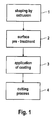
- Figure 1 demonstrates how a rubber profile for a vehicle wiper blade is basically processed in an extrusion process line as initially described.
- the rubber profiles are preferably formed of a chlorinated or brominated natural rubber.
- Anti-friction coatings based on graphite, for example, are well-known and provide good sliding characteristics.
- Block 1 represents the shaping of the rubber profile by means of extrusion.
- Block 1 is connected to block 2, block 2 representing a surface pre-treatment of the extruded rubber profile.
- block 3 representing a surface pre-treatment of the extruded rubber profile.
- block 4 representing a surface pre-treatment of the extruded rubber profile.
- the coating is applied to the extruded rubber profile. This step is shown by block 3.
- block 4 that is connected to block 3, the rubber profile is put through a cutting process.
- This cutting process may comprise a transversal as well as a longitudinal cut.
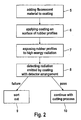
- an indicator material is homogeneously added to the coating.
- the added material is fluorescent, i.e. in response to high energy radiation such as ultra-violet radiation or X-rays the material emits radiation of lower energy.
- a suitable fluorescent element is titanium, which can be added to the coating in the form of titanium dioxide (TiO 2 ) particles contained in a water-based dispersion or in a powder. The concentration of TiO 2 in the coating is determined such that it does not effect the characteristics of the coating and may range from 0,01 % to 5% by mass, the preferred range being 0,1 % to 3%. Other suitable fluorescent materials and the criteria for their selection will be discussed later.
- Block 6 which is connected to block 5, represents applying of the coating to the surface of the rubber profiles. After the coating is applied the rubber profiles are exposed to a high energy radiation adapted to the fluorescent material. This is shown in block 7. The emitted radiation is registered in a detector arrangement that is capable of determining the intensity of the emitted radiation. This is shown in block 8, which is connected to block 7. Since the intensity of the emitted radiation is proportional to the quantity of the fluorescent material the thickness of the coating can be easily calculated once a calibration measurement has been made. For a thorough investigation both the upper and lower sides of the rubber profiles are examined.
- a determination step decides whether the quality of the rubber profile is satisfactory or not. If it is determined that the quality of a rubber profile coating is not satisfactory, i.e. it has not met the predefined requirements because it is too thin, not uniform or discontinuous, the detector arrangement indicates a failure to a control unit of the rubber profile production line. In this case the control unit automatically causes the faulty rubber profile to be sorted out without stopping the production process line. The sorting out is represented in block 9. Block 9 is connected to block 8. If the quality of the rubber profile is satisfactory, i.e. the rubber profile meets the predefined requirements, the rubber profile passes the determination step and proceeds to the cutting process. The cutting process is represented in block 10.
- the detector arrangement contains a spectrum analyzer.
- a spectrum analyzer it is rendered possible to determine at least a part of the elemental composition of the coating and also of the rubber profile substrate quantitatively.
- the content of chlorine or bromine in chlorinated or brominated rubber substrates can be verified.
- the concentrations of other elements contained in the rubber substrates like sulphur, calcium and zinc can also be examined.
- FIGS 3 and 4 show charts of sample measurements.
- different peaks can be seen representing the K ⁇ lines of the elements contained in the examined coating, e.g. chlorine, calcium, titanium and zinc.
- different graphs representing different titanium concentrations in the coating are shown. It is clearly visible that a higher concentration of titanium results in a higher peak of the measured K ⁇ line of titanium.
- the fluorescent element to be added should neither be contained in the rubber substrate nor in the coating.
- a chlorinated rubber titanium is favourable because the wavelength of the radiation emitted by titanium and chlorine are close to each other and yet well distinguishable, enabling a facilitated simultaneous analysis of both elements in a single measurement. Accordingly, in case of a brominated rubber barium would be the preferred fluorescent element. It is generally advisable to select a fluorescent element the emitted wavelength of which is close to the emitted wavelength of an element the concentration of which is to be determined or verified in the investigated sample.
- Lumogen® F dyes having good heat and light stability in amorphous resins may be used as a fluorescent material.
Landscapes
- Analysing Materials By The Use Of Radiation (AREA)
- Application Of Or Painting With Fluid Materials (AREA)
- Investigating, Analyzing Materials By Fluorescence Or Luminescence (AREA)
Description
- The invention relates to a method of applying and controlling the quality of an anti-friction coating on a rubber profile of a wiper blade. The invention further relates to a rubber profile for a wiper blade.
- Among the various shaping processes used in the automobile industry for the production of wiper blade rubber profiles extrusion processes are favourable in view of mass series production because of the continuous production sequence. After the shaping process the surfaces of the rubber profiles are treated to reduce the sliding friction. A preferred surface treatment is the application of a coating containing anti-friction constituents. In case of a liquid application solvent-based or water-based coatings are used. Following the surface treatment the extruded rubber profiles are cut into length before they are divided by a longitudinal cut into a finished rubber profile strip and a waste strip. The sharp edge of the rubber profile strip produced by the longitudinal cut represents the lip that later wipes across the wind shield of the vehicle. All of the above-mentioned process steps can be efficiently performed in an extrusion process line.
- Regarding the application process it is to be understood that the coating cannot be applied in random quantity on the rubber profile surface for several reasons. In particular, the cutting of the rubber profiles may cause fracture of the coating. Thus, there is a need to control the quality of the applied coating because only a continuous, uniform coating ensures a smooth gliding of the wiper blade on the windshield and a ream-free cleaning. However, conventional methods of measuring the thickness of coatings as used with metal work pieces are not applicable to rubber materials. Other quality control options including optical or visual methods are either unsatisfactory, expensive or they are not suitable to be embedded in an extrusion process line, e.g. because the method is destructive to the coating. Accordingly, hitherto mass produced wiper blades have been tested with regard to wiping quality only after their final assembly, i.e, when the product already has a significantly increased value. Moreover, even if detected a bad coating cannot be touched up. Rather, the faulty rubber profile has to be discharged, rendering the productivity economically unsatisfactory.
- A method of measuring the extent of coverage and the thickness of a water-based coating by incorporating an emulsion of an insoluble fluorescent compound and measuring the intensity of the fluorescence is generally known from
US 5,650,455 . - The method according to the invention provides a possibility to reliably control the quality of the anti-friction coating application process in the production of vehicle wiper blades at reasonable costs.
- According to the invention the method comprises the following steps:
- adding a minor amount of a fluorescent material sensitive to a high energy radiation to the coating;
- applying the coating on the rubber profile;
- exposing the coating to high energy radiation; and
- detecting the radiation emitted by the coating with a detector arrangement,
wherein the detector arrangement measures the intensity of the emitted radiation, and wherein the detector arrangement also contains a spectrum analyzer in order to determine at least a part of the elemental composition of the coating and also of the rubber profile substrate quantitatively. - Depending on the detected radiation conclusions regarding the quality of the applied coating can be drawn, especially regarding the integrity and thickness of the coating, without further preparation of the samples. The method according to the invention is non-destructive and has the advantage that all steps can be performed with available standard equipment and also rapidly enough to allow the method to be embedded in an extrusion process line without slowing down the speed of the process line.
- The intensity of the emitted radiation is proportional to the quantity of the fluorescent material. Provided that the fluorescent material is homogeneously distributed in the coating it is readily possible to determine the thickness of the coating with the detector arrangement by measuring the intensity of the emitted radiation.
- According to the present invention the detector arrangement simultaneously analyses the spectrum of the emitted radiation. Thus, the quantity of other elements contained in the investigated sample can be determined at the same time.
- If it is determined that a coating is unsatisfactory a signal produced by the detector arrangement can be used to indicate a failure to a control unit of the rubber profile production line. Preferably, the control unit in case of a failure indication automatically causes the current rubber profile to be sorted out so that the production process line needs no manual intervention.
- In a preferred embodiment of the invention the radiation sensitive material contains titanium, preferably provided in the form of titanium dioxide (TiO2) particles contained in a water-based dispersion or in a powder. Such dispersions or powders are widely used in the field of colorants. TiO2 particles can be added in appropriate quantities without causing detrimental effects to the coating.
- According to another embodiment of the invention the radiation sensitive material is barium.
- The invention also provides a rubber profile for a wiper blade, the rubber profile having an anti-friction coating applied on its surface, characterized in that the coating contains a minor amount of a fluorescent material sensitive to a high energy radiation.
- The quality of the coating of a rubber profile according to the invention can be examined as described above. Further details of the invention will become apparent from the following description and the accompanying drawings. In the drawings:
-
Figure 1 shows a flow chart of an extrusion process line in the production of wiper blade rubber profiles; -
Figure 2 shows a detailed flow chart of the coating application process in accordance with the invention; and -
Figures 3 and 4 show charts of sample measurements. -
Figure 1 demonstrates how a rubber profile for a vehicle wiper blade is basically processed in an extrusion process line as initially described. The rubber profiles are preferably formed of a chlorinated or brominated natural rubber. Anti-friction coatings based on graphite, for example, are well-known and provide good sliding characteristics. - The flow chart of
figure 1 showsblocks 1 to 4, representing steps of the method according to the invention.Block 1 represents the shaping of the rubber profile by means of extrusion.Block 1 is connected toblock 2,block 2 representing a surface pre-treatment of the extruded rubber profile. After the step ofblock 2, the coating is applied to the extruded rubber profile. This step is shown byblock 3. Finally, inblock 4 that is connected toblock 3, the rubber profile is put through a cutting process. This cutting process may comprise a transversal as well as a longitudinal cut. - In
Figure 2 the process of applying the anti-friction coating on the rubber profile substrates including a subsequent quality control process in accordance with the invention is shown in detail. - Before the coating is applied on the surface of the rubber profiles (e.g. by a spray gun) an indicator material is homogeneously added to the coating. This is shown in
block 5. The added material is fluorescent, i.e. in response to high energy radiation such as ultra-violet radiation or X-rays the material emits radiation of lower energy. A suitable fluorescent element is titanium, which can be added to the coating in the form of titanium dioxide (TiO2) particles contained in a water-based dispersion or in a powder. The concentration of TiO2 in the coating is determined such that it does not effect the characteristics of the coating and may range from 0,01 % to 5% by mass, the preferred range being 0,1 % to 3%. Other suitable fluorescent materials and the criteria for their selection will be discussed later. -
Block 6, which is connected toblock 5, represents applying of the coating to the surface of the rubber profiles. After the coating is applied the rubber profiles are exposed to a high energy radiation adapted to the fluorescent material. This is shown inblock 7. The emitted radiation is registered in a detector arrangement that is capable of determining the intensity of the emitted radiation. This is shown inblock 8, which is connected to block 7. Since the intensity of the emitted radiation is proportional to the quantity of the fluorescent material the thickness of the coating can be easily calculated once a calibration measurement has been made. For a thorough investigation both the upper and lower sides of the rubber profiles are examined. - A determination step decides whether the quality of the rubber profile is satisfactory or not. If it is determined that the quality of a rubber profile coating is not satisfactory, i.e. it has not met the predefined requirements because it is too thin, not uniform or discontinuous, the detector arrangement indicates a failure to a control unit of the rubber profile production line. In this case the control unit automatically causes the faulty rubber profile to be sorted out without stopping the production process line. The sorting out is represented in
block 9.Block 9 is connected to block 8. If the quality of the rubber profile is satisfactory, i.e. the rubber profile meets the predefined requirements, the rubber profile passes the determination step and proceeds to the cutting process. The cutting process is represented inblock 10. - The detector arrangement contains a spectrum analyzer. Thus, it is rendered possible to determine at least a part of the elemental composition of the coating and also of the rubber profile substrate quantitatively. In particular, the content of chlorine or bromine in chlorinated or brominated rubber substrates can be verified. Further, the concentrations of other elements contained in the rubber substrates like sulphur, calcium and zinc can also be examined.
-
Figures 3 and 4 show charts of sample measurements. In the chart ofFigure 3 different peaks can be seen representing the Kα lines of the elements contained in the examined coating, e.g. chlorine, calcium, titanium and zinc. In the chart ofFigure 4 different graphs representing different titanium concentrations in the coating are shown. It is clearly visible that a higher concentration of titanium results in a higher peak of the measured Kα line of titanium. - The fluorescent element to be added should neither be contained in the rubber substrate nor in the coating. In case of a chlorinated rubber titanium is favourable because the wavelength of the radiation emitted by titanium and chlorine are close to each other and yet well distinguishable, enabling a facilitated simultaneous analysis of both elements in a single measurement. Accordingly, in case of a brominated rubber barium would be the preferred fluorescent element. It is generally advisable to select a fluorescent element the emitted wavelength of which is close to the emitted wavelength of an element the concentration of which is to be determined or verified in the investigated sample.
- Alternatively, Lumogen® F dyes having good heat and light stability in amorphous resins may be used as a fluorescent material.
Claims (7)
- Method of applying and controlling the quality of an anti-friction coating on a rubber profile substrate of a wiper blade, the method comprising the following steps:- adding a minor amount of a fluorescent material sensitive to a high energy radiation to the coating;- applying the coating to the rubber profile;- exposing the coating to high energy radiation; and- detecting the radiation emitted by the coating with a detector arrangement, wherein the detector arrangement measures the intensity of the emitted radiation, and wherein the detector arrangement also contains a spectrum analyzer in order to determine at least a part of the elemental composition of the coating and also of the rubber profile substrate quantitatively.
- The method according to claim 1, characterized in that both the upper and lower sides of the rubber profiles are exposed to the radiation.
- The method according to claim 1 or 2, characterized in that a signal generated by the detector arrangement is used to indicate a failure to a control unit of a rubber profile production line.
- The method according to claim 3, characterized in that the control unit in case of a failure indication automatically causes the current rubber profile to be sorted out.
- The method according to any of claims 1 to 4, characterized in that the radiation sensitive material contains titanium, preferably provided in the form of titanium dioxide particles contained in a water based dispersion or in a powder with a concentration between 0.01% and 5% by mass, especially between 0.1% and 3%.
- The method according to any of claims 1 to 4, characterized in that the radiation sensitive material is barium.
- A rubber profile for a wiper blade, the rubber profile having an anti-friction coating applied on its surface, wherein the coating contains a minor amount of a fluorescent material sensitive to a high energy radiation, characterized in that:- the rubber profile is made of a chlorinated rubber and the radiation sensitive material contains titanium, preferably in the form of titanium dioxide particles, or in that- the rubber profile is made of a brominated rubber and the radiation sensitive material contains barium.
Priority Applications (2)
| Application Number | Priority Date | Filing Date | Title |
|---|---|---|---|
| EP05810689.9A EP1846174B1 (en) | 2004-11-29 | 2005-11-22 | Method of applying and controlling the quality of an anti-friction coating on a rubber profile of a wiper blade |
| PL05810689T PL1846174T3 (en) | 2004-11-29 | 2005-11-22 | Method of applying and controlling the quality of an anti-friction coating on a rubber profile of a wiper blade |
Applications Claiming Priority (3)
| Application Number | Priority Date | Filing Date | Title |
|---|---|---|---|
| EP04292806A EP1666165A1 (en) | 2004-11-29 | 2004-11-29 | Method of applying and controlling the quantity of an anti-friction coating on a rubber profile of a wiper blade |
| EP05810689.9A EP1846174B1 (en) | 2004-11-29 | 2005-11-22 | Method of applying and controlling the quality of an anti-friction coating on a rubber profile of a wiper blade |
| PCT/EP2005/012492 WO2006056407A1 (en) | 2004-11-29 | 2005-11-22 | Method of applying and controlling the quality of an anti-friction coating on a rubber profile of a wiper blade |
Publications (2)
| Publication Number | Publication Date |
|---|---|
| EP1846174A1 EP1846174A1 (en) | 2007-10-24 |
| EP1846174B1 true EP1846174B1 (en) | 2014-05-14 |
Family
ID=34931556
Family Applications (2)
| Application Number | Title | Priority Date | Filing Date |
|---|---|---|---|
| EP04292806A Withdrawn EP1666165A1 (en) | 2004-11-29 | 2004-11-29 | Method of applying and controlling the quantity of an anti-friction coating on a rubber profile of a wiper blade |
| EP05810689.9A Expired - Lifetime EP1846174B1 (en) | 2004-11-29 | 2005-11-22 | Method of applying and controlling the quality of an anti-friction coating on a rubber profile of a wiper blade |
Family Applications Before (1)
| Application Number | Title | Priority Date | Filing Date |
|---|---|---|---|
| EP04292806A Withdrawn EP1666165A1 (en) | 2004-11-29 | 2004-11-29 | Method of applying and controlling the quantity of an anti-friction coating on a rubber profile of a wiper blade |
Country Status (5)
| Country | Link |
|---|---|
| EP (2) | EP1666165A1 (en) |
| JP (1) | JP5324099B2 (en) |
| MX (1) | MX2007006367A (en) |
| PL (1) | PL1846174T3 (en) |
| WO (1) | WO2006056407A1 (en) |
Families Citing this family (1)
| Publication number | Priority date | Publication date | Assignee | Title |
|---|---|---|---|---|
| DE102006009653A1 (en) * | 2006-03-02 | 2007-09-06 | Robert Bosch Gmbh | wiper blade |
Family Cites Families (8)
| Publication number | Priority date | Publication date | Assignee | Title |
|---|---|---|---|---|
| DE2129744B2 (en) * | 1971-06-16 | 1973-04-26 | Feldmühle Anlagen und Produktions gesellschaft mbH, 4000 Dusseldorf | SQUEEGEE IN NATURAL OR SYNTHETIC RUBBER AND THE METHOD FOR ITS MANUFACTURING |
| US4045838A (en) * | 1976-03-15 | 1977-09-06 | Acushnet Company | Surface layer for windshield wiper blades |
| US5029337A (en) * | 1989-01-19 | 1991-07-02 | Tava Corporation | Method for measuring coating thickness |
| AU635591B2 (en) * | 1990-01-08 | 1993-03-25 | Acushnet Rubber Company, Inc. | Windshield wiper blade |
| US5650455A (en) * | 1995-10-17 | 1997-07-22 | Eastman Chemical Company | Method for dispersing optical brighteners in waterborne coating compositions |
| JPH09257728A (en) * | 1996-03-21 | 1997-10-03 | Sumitomo Metal Ind Ltd | How to measure the amount of applied oil film |
| FR2832208B1 (en) * | 2001-11-14 | 2004-01-30 | Valeo Systemes Dessuyage | SOLUTION FOR MAKING A COATING FOR A COLORABLE WIPER BLADE AND COLORED WIPER BLADE |
| WO2003042016A2 (en) * | 2001-11-14 | 2003-05-22 | Valeo Systemes D'essuyage | Water-retention coating for a windscreen wiper blade, wiper blade provided with same and method for coating a blade with same |
-
2004
- 2004-11-29 EP EP04292806A patent/EP1666165A1/en not_active Withdrawn
-
2005
- 2005-11-22 EP EP05810689.9A patent/EP1846174B1/en not_active Expired - Lifetime
- 2005-11-22 PL PL05810689T patent/PL1846174T3/en unknown
- 2005-11-22 WO PCT/EP2005/012492 patent/WO2006056407A1/en not_active Ceased
- 2005-11-22 MX MX2007006367A patent/MX2007006367A/en active IP Right Grant
- 2005-11-22 JP JP2007541826A patent/JP5324099B2/en not_active Expired - Fee Related
Also Published As
| Publication number | Publication date |
|---|---|
| WO2006056407A1 (en) | 2006-06-01 |
| EP1666165A1 (en) | 2006-06-07 |
| JP2008521673A (en) | 2008-06-26 |
| PL1846174T3 (en) | 2014-09-30 |
| JP5324099B2 (en) | 2013-10-23 |
| EP1846174A1 (en) | 2007-10-24 |
| MX2007006367A (en) | 2007-06-20 |
Similar Documents
| Publication | Publication Date | Title |
|---|---|---|
| Reynolds et al. | A review of metrology in lithium-ion electrode coating processes | |
| DE112015003094B4 (en) | X-ray fluorescence spectrometer and X-ray fluorescence analysis method | |
| CA2381398C (en) | X-ray fluorescence analysis of multilayered samples | |
| Fürbeth et al. | The delamination of polymeric coatings from electrogalvanized steel–a mechanistic approach.: Part 3: delamination kinetics and influence of CO2 | |
| AU2015200925B2 (en) | In Situ Indicator Detection and Quantitation to Correlate with an Additive | |
| Puomi et al. | Optimization of commercial zirconic acid based pretreatment on hot-dip galvanized and Galfan coated steel | |
| CA2722341C (en) | Method of measuring the cleanness of steel strip | |
| EP0269590A2 (en) | A method of controlling and/or measuring layer thickness such as the thickness of surface layers | |
| CN101395047A (en) | wiper blade | |
| WO2008122622A1 (en) | Device and method for analyzing a heterogeneous material by means of laser-induced plasma spectroscopy | |
| GB2613090A (en) | Two-part disinfectant system comprising a colour indicator | |
| EP1666165A1 (en) | Method of applying and controlling the quantity of an anti-friction coating on a rubber profile of a wiper blade | |
| Cristoforetti et al. | On the occurrence of filiform corrosion on organic-coated carbon steel exposed to cyclic aging test | |
| Hammer | A new look at the steel cord–rubber adhesive interphase by chemical depth profiling | |
| WO2000022421A1 (en) | Automatic detection of oil and determination of oil residues | |
| DE10148750B4 (en) | Device and method for the detection of mold infestation on a surface | |
| Swatland et al. | Fluorimetry via a quartz-glass rod for predicting the skin content and processing characteristics of poultry meat slurry | |
| Vilkovská et al. | Chemical Reagent for Detecting Tension Wood in Selected Tree Species. | |
| EP2376889A2 (en) | Rapid test for determining the effect irradiation has on the abrasion of a granulate | |
| Quesne et al. | Surface characterization of industrial flexible polyvinyl (chloride) films | |
| JP7654191B2 (en) | Coating durability evaluation method and highly durable coating | |
| Larsen et al. | Damage assessment of parchment: complexity and relations at different structural levels | |
| Kempenaers et al. | Micro-heterogeneity study of trace elements in BCR CRM 680 by means of synchrotron micro-XRF | |
| JPH09502265A (en) | Method and apparatus for determining the concentration of components present in dispersed form in a fluid stream | |
| JPH08178875A (en) | Rubber anti-adhesive agent concentration measurement method |
Legal Events
| Date | Code | Title | Description |
|---|---|---|---|
| PUAI | Public reference made under article 153(3) epc to a published international application that has entered the european phase |
Free format text: ORIGINAL CODE: 0009012 |
|
| 17P | Request for examination filed |
Effective date: 20070830 |
|
| AK | Designated contracting states |
Kind code of ref document: A1 Designated state(s): AT BE BG CH CY CZ DE DK EE ES FI FR GB GR HU IE IS IT LI LT LU LV MC NL PL PT RO SE SI SK TR |
|
| 17Q | First examination report despatched |
Effective date: 20071024 |
|
| DAX | Request for extension of the european patent (deleted) | ||
| GRAP | Despatch of communication of intention to grant a patent |
Free format text: ORIGINAL CODE: EPIDOSNIGR1 |
|
| INTG | Intention to grant announced |
Effective date: 20131119 |
|
| GRAS | Grant fee paid |
Free format text: ORIGINAL CODE: EPIDOSNIGR3 |
|
| GRAA | (expected) grant |
Free format text: ORIGINAL CODE: 0009210 |
|
| AK | Designated contracting states |
Kind code of ref document: B1 Designated state(s): AT BE BG CH CY CZ DE DK EE ES FI FR GB GR HU IE IS IT LI LT LU LV MC NL PL PT RO SE SI SK TR |
|
| REG | Reference to a national code |
Ref country code: GB Ref legal event code: FG4D |
|
| REG | Reference to a national code |
Ref country code: AT Ref legal event code: REF Ref document number: 667844 Country of ref document: AT Kind code of ref document: T Effective date: 20140615 |
|
| REG | Reference to a national code |
Ref country code: IE Ref legal event code: FG4D |
|
| REG | Reference to a national code |
Ref country code: DE Ref legal event code: R096 Ref document number: 602005043663 Country of ref document: DE Effective date: 20140626 |
|
| REG | Reference to a national code |
Ref country code: DE Ref legal event code: R082 Ref document number: 602005043663 Country of ref document: DE |
|
| REG | Reference to a national code |
Ref country code: PL Ref legal event code: T3 |
|
| REG | Reference to a national code |
Ref country code: NL Ref legal event code: VDEP Effective date: 20140514 Ref country code: AT Ref legal event code: MK05 Ref document number: 667844 Country of ref document: AT Kind code of ref document: T Effective date: 20140514 |
|
| REG | Reference to a national code |
Ref country code: LT Ref legal event code: MG4D |
|
| PG25 | Lapsed in a contracting state [announced via postgrant information from national office to epo] |
Ref country code: IS Free format text: LAPSE BECAUSE OF FAILURE TO SUBMIT A TRANSLATION OF THE DESCRIPTION OR TO PAY THE FEE WITHIN THE PRESCRIBED TIME-LIMIT Effective date: 20140914 Ref country code: GR Free format text: LAPSE BECAUSE OF FAILURE TO SUBMIT A TRANSLATION OF THE DESCRIPTION OR TO PAY THE FEE WITHIN THE PRESCRIBED TIME-LIMIT Effective date: 20140815 Ref country code: LT Free format text: LAPSE BECAUSE OF FAILURE TO SUBMIT A TRANSLATION OF THE DESCRIPTION OR TO PAY THE FEE WITHIN THE PRESCRIBED TIME-LIMIT Effective date: 20140514 Ref country code: FI Free format text: LAPSE BECAUSE OF FAILURE TO SUBMIT A TRANSLATION OF THE DESCRIPTION OR TO PAY THE FEE WITHIN THE PRESCRIBED TIME-LIMIT Effective date: 20140514 Ref country code: CY Free format text: LAPSE BECAUSE OF FAILURE TO SUBMIT A TRANSLATION OF THE DESCRIPTION OR TO PAY THE FEE WITHIN THE PRESCRIBED TIME-LIMIT Effective date: 20140514 |
|
| PG25 | Lapsed in a contracting state [announced via postgrant information from national office to epo] |
Ref country code: LV Free format text: LAPSE BECAUSE OF FAILURE TO SUBMIT A TRANSLATION OF THE DESCRIPTION OR TO PAY THE FEE WITHIN THE PRESCRIBED TIME-LIMIT Effective date: 20140514 Ref country code: SE Free format text: LAPSE BECAUSE OF FAILURE TO SUBMIT A TRANSLATION OF THE DESCRIPTION OR TO PAY THE FEE WITHIN THE PRESCRIBED TIME-LIMIT Effective date: 20140514 Ref country code: ES Free format text: LAPSE BECAUSE OF FAILURE TO SUBMIT A TRANSLATION OF THE DESCRIPTION OR TO PAY THE FEE WITHIN THE PRESCRIBED TIME-LIMIT Effective date: 20140514 Ref country code: AT Free format text: LAPSE BECAUSE OF FAILURE TO SUBMIT A TRANSLATION OF THE DESCRIPTION OR TO PAY THE FEE WITHIN THE PRESCRIBED TIME-LIMIT Effective date: 20140514 |
|
| PG25 | Lapsed in a contracting state [announced via postgrant information from national office to epo] |
Ref country code: PT Free format text: LAPSE BECAUSE OF FAILURE TO SUBMIT A TRANSLATION OF THE DESCRIPTION OR TO PAY THE FEE WITHIN THE PRESCRIBED TIME-LIMIT Effective date: 20140915 |
|
| PG25 | Lapsed in a contracting state [announced via postgrant information from national office to epo] |
Ref country code: DK Free format text: LAPSE BECAUSE OF FAILURE TO SUBMIT A TRANSLATION OF THE DESCRIPTION OR TO PAY THE FEE WITHIN THE PRESCRIBED TIME-LIMIT Effective date: 20140514 Ref country code: SK Free format text: LAPSE BECAUSE OF FAILURE TO SUBMIT A TRANSLATION OF THE DESCRIPTION OR TO PAY THE FEE WITHIN THE PRESCRIBED TIME-LIMIT Effective date: 20140514 Ref country code: CZ Free format text: LAPSE BECAUSE OF FAILURE TO SUBMIT A TRANSLATION OF THE DESCRIPTION OR TO PAY THE FEE WITHIN THE PRESCRIBED TIME-LIMIT Effective date: 20140514 Ref country code: EE Free format text: LAPSE BECAUSE OF FAILURE TO SUBMIT A TRANSLATION OF THE DESCRIPTION OR TO PAY THE FEE WITHIN THE PRESCRIBED TIME-LIMIT Effective date: 20140514 Ref country code: RO Free format text: LAPSE BECAUSE OF FAILURE TO SUBMIT A TRANSLATION OF THE DESCRIPTION OR TO PAY THE FEE WITHIN THE PRESCRIBED TIME-LIMIT Effective date: 20140514 |
|
| REG | Reference to a national code |
Ref country code: DE Ref legal event code: R097 Ref document number: 602005043663 Country of ref document: DE |
|
| PG25 | Lapsed in a contracting state [announced via postgrant information from national office to epo] |
Ref country code: NL Free format text: LAPSE BECAUSE OF FAILURE TO SUBMIT A TRANSLATION OF THE DESCRIPTION OR TO PAY THE FEE WITHIN THE PRESCRIBED TIME-LIMIT Effective date: 20140514 |
|
| PLBE | No opposition filed within time limit |
Free format text: ORIGINAL CODE: 0009261 |
|
| STAA | Information on the status of an ep patent application or granted ep patent |
Free format text: STATUS: NO OPPOSITION FILED WITHIN TIME LIMIT |
|
| 26N | No opposition filed |
Effective date: 20150217 |
|
| PG25 | Lapsed in a contracting state [announced via postgrant information from national office to epo] |
Ref country code: IT Free format text: LAPSE BECAUSE OF FAILURE TO SUBMIT A TRANSLATION OF THE DESCRIPTION OR TO PAY THE FEE WITHIN THE PRESCRIBED TIME-LIMIT Effective date: 20140514 |
|
| REG | Reference to a national code |
Ref country code: DE Ref legal event code: R097 Ref document number: 602005043663 Country of ref document: DE Effective date: 20150217 |
|
| PG25 | Lapsed in a contracting state [announced via postgrant information from national office to epo] |
Ref country code: LU Free format text: LAPSE BECAUSE OF FAILURE TO SUBMIT A TRANSLATION OF THE DESCRIPTION OR TO PAY THE FEE WITHIN THE PRESCRIBED TIME-LIMIT Effective date: 20141122 Ref country code: MC Free format text: LAPSE BECAUSE OF FAILURE TO SUBMIT A TRANSLATION OF THE DESCRIPTION OR TO PAY THE FEE WITHIN THE PRESCRIBED TIME-LIMIT Effective date: 20140514 |
|
| REG | Reference to a national code |
Ref country code: CH Ref legal event code: PL |
|
| PG25 | Lapsed in a contracting state [announced via postgrant information from national office to epo] |
Ref country code: LI Free format text: LAPSE BECAUSE OF NON-PAYMENT OF DUE FEES Effective date: 20141130 Ref country code: SI Free format text: LAPSE BECAUSE OF FAILURE TO SUBMIT A TRANSLATION OF THE DESCRIPTION OR TO PAY THE FEE WITHIN THE PRESCRIBED TIME-LIMIT Effective date: 20140514 Ref country code: CH Free format text: LAPSE BECAUSE OF NON-PAYMENT OF DUE FEES Effective date: 20141130 |
|
| REG | Reference to a national code |
Ref country code: IE Ref legal event code: MM4A |
|
| PG25 | Lapsed in a contracting state [announced via postgrant information from national office to epo] |
Ref country code: IE Free format text: LAPSE BECAUSE OF NON-PAYMENT OF DUE FEES Effective date: 20141122 |
|
| REG | Reference to a national code |
Ref country code: FR Ref legal event code: PLFP Year of fee payment: 11 |
|
| PG25 | Lapsed in a contracting state [announced via postgrant information from national office to epo] |
Ref country code: BG Free format text: LAPSE BECAUSE OF FAILURE TO SUBMIT A TRANSLATION OF THE DESCRIPTION OR TO PAY THE FEE WITHIN THE PRESCRIBED TIME-LIMIT Effective date: 20140514 |
|
| PG25 | Lapsed in a contracting state [announced via postgrant information from national office to epo] |
Ref country code: TR Free format text: LAPSE BECAUSE OF FAILURE TO SUBMIT A TRANSLATION OF THE DESCRIPTION OR TO PAY THE FEE WITHIN THE PRESCRIBED TIME-LIMIT Effective date: 20140514 Ref country code: HU Free format text: LAPSE BECAUSE OF FAILURE TO SUBMIT A TRANSLATION OF THE DESCRIPTION OR TO PAY THE FEE WITHIN THE PRESCRIBED TIME-LIMIT; INVALID AB INITIO Effective date: 20051122 |
|
| REG | Reference to a national code |
Ref country code: FR Ref legal event code: PLFP Year of fee payment: 12 |
|
| PGFP | Annual fee paid to national office [announced via postgrant information from national office to epo] |
Ref country code: GB Payment date: 20161121 Year of fee payment: 12 |
|
| PGFP | Annual fee paid to national office [announced via postgrant information from national office to epo] |
Ref country code: PL Payment date: 20161102 Year of fee payment: 12 |
|
| REG | Reference to a national code |
Ref country code: FR Ref legal event code: PLFP Year of fee payment: 13 |
|
| GBPC | Gb: european patent ceased through non-payment of renewal fee |
Effective date: 20171122 |
|
| PG25 | Lapsed in a contracting state [announced via postgrant information from national office to epo] |
Ref country code: GB Free format text: LAPSE BECAUSE OF NON-PAYMENT OF DUE FEES Effective date: 20171122 |
|
| PG25 | Lapsed in a contracting state [announced via postgrant information from national office to epo] |
Ref country code: PL Free format text: LAPSE BECAUSE OF NON-PAYMENT OF DUE FEES Effective date: 20171122 |
|
| PGFP | Annual fee paid to national office [announced via postgrant information from national office to epo] |
Ref country code: DE Payment date: 20221114 Year of fee payment: 18 |
|
| PGFP | Annual fee paid to national office [announced via postgrant information from national office to epo] |
Ref country code: BE Payment date: 20221125 Year of fee payment: 18 |
|
| P01 | Opt-out of the competence of the unified patent court (upc) registered |
Effective date: 20230528 |
|
| REG | Reference to a national code |
Ref country code: DE Ref legal event code: R119 Ref document number: 602005043663 Country of ref document: DE |
|
| REG | Reference to a national code |
Ref country code: BE Ref legal event code: MM Effective date: 20231130 |
|
| PG25 | Lapsed in a contracting state [announced via postgrant information from national office to epo] |
Ref country code: DE Free format text: LAPSE BECAUSE OF NON-PAYMENT OF DUE FEES Effective date: 20240601 |
|
| PG25 | Lapsed in a contracting state [announced via postgrant information from national office to epo] |
Ref country code: BE Free format text: LAPSE BECAUSE OF NON-PAYMENT OF DUE FEES Effective date: 20231130 |
|
| PG25 | Lapsed in a contracting state [announced via postgrant information from national office to epo] |
Ref country code: DE Free format text: LAPSE BECAUSE OF NON-PAYMENT OF DUE FEES Effective date: 20240601 Ref country code: BE Free format text: LAPSE BECAUSE OF NON-PAYMENT OF DUE FEES Effective date: 20231130 |
|
| PGFP | Annual fee paid to national office [announced via postgrant information from national office to epo] |
Ref country code: FR Payment date: 20241120 Year of fee payment: 20 |