EP1845115A1 - Catalyst components based on ferrocenium complexes used for olefin polymerisation - Google Patents
Catalyst components based on ferrocenium complexes used for olefin polymerisation Download PDFInfo
- Publication number
- EP1845115A1 EP1845115A1 EP06290538A EP06290538A EP1845115A1 EP 1845115 A1 EP1845115 A1 EP 1845115A1 EP 06290538 A EP06290538 A EP 06290538A EP 06290538 A EP06290538 A EP 06290538A EP 1845115 A1 EP1845115 A1 EP 1845115A1
- Authority
- EP
- European Patent Office
- Prior art keywords
- ligand
- oxidised
- solvent
- group
- oxidant
- Prior art date
- Legal status (The legal status is an assumption and is not a legal conclusion. Google has not performed a legal analysis and makes no representation as to the accuracy of the status listed.)
- Withdrawn
Links
- 239000003054 catalyst Substances 0.000 title claims abstract description 20
- 150000001336 alkenes Chemical class 0.000 title abstract description 5
- BOXSCYUXSBYGRD-UHFFFAOYSA-N cyclopenta-1,3-diene;iron(3+) Chemical class [Fe+3].C=1C=C[CH-]C=1.C=1C=C[CH-]C=1 BOXSCYUXSBYGRD-UHFFFAOYSA-N 0.000 title 1
- JRZJOMJEPLMPRA-UHFFFAOYSA-N olefin Natural products CCCCCCCC=C JRZJOMJEPLMPRA-UHFFFAOYSA-N 0.000 title 1
- 239000003446 ligand Substances 0.000 claims abstract description 50
- 238000000034 method Methods 0.000 claims abstract description 11
- 239000002904 solvent Substances 0.000 claims description 23
- RTZKZFJDLAIYFH-UHFFFAOYSA-N Diethyl ether Chemical compound CCOCC RTZKZFJDLAIYFH-UHFFFAOYSA-N 0.000 claims description 13
- 230000003213 activating effect Effects 0.000 claims description 13
- 239000007800 oxidant agent Substances 0.000 claims description 12
- 230000001590 oxidative effect Effects 0.000 claims description 11
- 239000003795 chemical substances by application Substances 0.000 claims description 10
- 229910052751 metal Inorganic materials 0.000 claims description 10
- 239000002184 metal Substances 0.000 claims description 10
- 239000002243 precursor Substances 0.000 claims description 10
- XEEYBQQBJWHFJM-UHFFFAOYSA-N Iron Chemical compound [Fe] XEEYBQQBJWHFJM-UHFFFAOYSA-N 0.000 claims description 8
- 238000010668 complexation reaction Methods 0.000 claims description 8
- VGGSQFUCUMXWEO-UHFFFAOYSA-N Ethene Chemical compound C=C VGGSQFUCUMXWEO-UHFFFAOYSA-N 0.000 claims description 7
- 239000005977 Ethylene Substances 0.000 claims description 7
- 229910052757 nitrogen Inorganic materials 0.000 claims description 7
- 238000007254 oxidation reaction Methods 0.000 claims description 7
- 229920000642 polymer Polymers 0.000 claims description 7
- ZCYVEMRRCGMTRW-UHFFFAOYSA-N 7553-56-2 Chemical compound [I] ZCYVEMRRCGMTRW-UHFFFAOYSA-N 0.000 claims description 6
- 229910052740 iodine Inorganic materials 0.000 claims description 6
- 239000011630 iodine Substances 0.000 claims description 6
- 125000000217 alkyl group Chemical group 0.000 claims description 5
- 125000004432 carbon atom Chemical group C* 0.000 claims description 5
- KTWOOEGAPBSYNW-UHFFFAOYSA-N ferrocene Chemical compound [Fe+2].C=1C=C[CH-]C=1.C=1C=C[CH-]C=1 KTWOOEGAPBSYNW-UHFFFAOYSA-N 0.000 claims description 5
- 229910052742 iron Inorganic materials 0.000 claims description 5
- 239000000203 mixture Substances 0.000 claims description 5
- VTLYFUHAOXGGBS-UHFFFAOYSA-N Fe3+ Chemical compound [Fe+3] VTLYFUHAOXGGBS-UHFFFAOYSA-N 0.000 claims description 4
- 229910002553 FeIII Inorganic materials 0.000 claims description 4
- XYFCBTPGUUZFHI-UHFFFAOYSA-N Phosphine Chemical compound P XYFCBTPGUUZFHI-UHFFFAOYSA-N 0.000 claims description 4
- 125000003118 aryl group Chemical group 0.000 claims description 4
- 125000000623 heterocyclic group Chemical group 0.000 claims description 4
- 239000000178 monomer Substances 0.000 claims description 4
- 125000001797 benzyl group Chemical group [H]C1=C([H])C([H])=C(C([H])=C1[H])C([H])([H])* 0.000 claims description 3
- 229910052736 halogen Inorganic materials 0.000 claims description 3
- 150000002367 halogens Chemical class 0.000 claims description 3
- 230000003647 oxidation Effects 0.000 claims description 3
- 238000003756 stirring Methods 0.000 claims description 3
- 239000004711 α-olefin Substances 0.000 claims description 3
- ZAMOUSCENKQFHK-UHFFFAOYSA-N Chlorine atom Chemical compound [Cl] ZAMOUSCENKQFHK-UHFFFAOYSA-N 0.000 claims description 2
- CWYNVVGOOAEACU-UHFFFAOYSA-N Fe2+ Chemical compound [Fe+2] CWYNVVGOOAEACU-UHFFFAOYSA-N 0.000 claims description 2
- 229910002547 FeII Inorganic materials 0.000 claims description 2
- UFHFLCQGNIYNRP-UHFFFAOYSA-N Hydrogen Chemical compound [H][H] UFHFLCQGNIYNRP-UHFFFAOYSA-N 0.000 claims description 2
- JUJWROOIHBZHMG-UHFFFAOYSA-N Pyridine Chemical group C1=CC=NC=C1 JUJWROOIHBZHMG-UHFFFAOYSA-N 0.000 claims description 2
- 125000003545 alkoxy group Chemical group 0.000 claims description 2
- 150000001408 amides Chemical class 0.000 claims description 2
- 150000001412 amines Chemical class 0.000 claims description 2
- 150000001450 anions Chemical class 0.000 claims description 2
- 125000004104 aryloxy group Chemical group 0.000 claims description 2
- 125000004429 atom Chemical group 0.000 claims description 2
- 229940075397 calomel Drugs 0.000 claims description 2
- 229910052801 chlorine Inorganic materials 0.000 claims description 2
- 239000000460 chlorine Substances 0.000 claims description 2
- 229910052804 chromium Inorganic materials 0.000 claims description 2
- 125000000058 cyclopentadienyl group Chemical group C1(=CC=CC1)* 0.000 claims description 2
- ZOMNIUBKTOKEHS-UHFFFAOYSA-L dimercury dichloride Chemical compound Cl[Hg][Hg]Cl ZOMNIUBKTOKEHS-UHFFFAOYSA-L 0.000 claims description 2
- -1 ethylene, propylene Chemical group 0.000 claims description 2
- 238000001704 evaporation Methods 0.000 claims description 2
- 125000001183 hydrocarbyl group Chemical group 0.000 claims description 2
- 229910052739 hydrogen Inorganic materials 0.000 claims description 2
- 239000001257 hydrogen Substances 0.000 claims description 2
- 150000002466 imines Chemical class 0.000 claims description 2
- 229910052759 nickel Inorganic materials 0.000 claims description 2
- 229910052760 oxygen Inorganic materials 0.000 claims description 2
- 229910052763 palladium Inorganic materials 0.000 claims description 2
- 230000000737 periodic effect Effects 0.000 claims description 2
- 229910052698 phosphorus Inorganic materials 0.000 claims description 2
- 229910000073 phosphorus hydride Inorganic materials 0.000 claims description 2
- 125000001424 substituent group Chemical group 0.000 claims description 2
- 229910052717 sulfur Inorganic materials 0.000 claims description 2
- 150000003568 thioethers Chemical class 0.000 claims description 2
- 238000005406 washing Methods 0.000 claims description 2
- VLKZOEOYAKHREP-UHFFFAOYSA-N n-Hexane Chemical compound CCCCCC VLKZOEOYAKHREP-UHFFFAOYSA-N 0.000 claims 3
- 238000002360 preparation method Methods 0.000 abstract description 3
- WYURNTSHIVDZCO-UHFFFAOYSA-N Tetrahydrofuran Chemical compound C1CCOC1 WYURNTSHIVDZCO-UHFFFAOYSA-N 0.000 description 26
- YXFVVABEGXRONW-UHFFFAOYSA-N Toluene Chemical compound CC1=CC=CC=C1 YXFVVABEGXRONW-UHFFFAOYSA-N 0.000 description 24
- 239000007787 solid Substances 0.000 description 21
- WEVYAHXRMPXWCK-UHFFFAOYSA-N Acetonitrile Chemical group CC#N WEVYAHXRMPXWCK-UHFFFAOYSA-N 0.000 description 13
- YLQBMQCUIZJEEH-UHFFFAOYSA-N tetrahydrofuran Natural products C=1C=COC=1 YLQBMQCUIZJEEH-UHFFFAOYSA-N 0.000 description 13
- IJGRMHOSHXDMSA-UHFFFAOYSA-N Atomic nitrogen Chemical compound N#N IJGRMHOSHXDMSA-UHFFFAOYSA-N 0.000 description 10
- CPOFMOWDMVWCLF-UHFFFAOYSA-N methyl(oxo)alumane Chemical compound C[Al]=O CPOFMOWDMVWCLF-UHFFFAOYSA-N 0.000 description 7
- HEDRZPFGACZZDS-MICDWDOJSA-N Trichloro(2H)methane Chemical compound [2H]C(Cl)(Cl)Cl HEDRZPFGACZZDS-MICDWDOJSA-N 0.000 description 6
- 230000015572 biosynthetic process Effects 0.000 description 6
- 239000008240 homogeneous mixture Substances 0.000 description 6
- 238000010992 reflux Methods 0.000 description 6
- 238000003786 synthesis reaction Methods 0.000 description 6
- VYPSYNLAJGMNEJ-UHFFFAOYSA-N Silicium dioxide Chemical group O=[Si]=O VYPSYNLAJGMNEJ-UHFFFAOYSA-N 0.000 description 4
- JOXIMZWYDAKGHI-UHFFFAOYSA-N toluene-4-sulfonic acid Chemical compound CC1=CC=C(S(O)(=O)=O)C=C1 JOXIMZWYDAKGHI-UHFFFAOYSA-N 0.000 description 4
- 229910021554 Chromium(II) chloride Inorganic materials 0.000 description 3
- YMWUJEATGCHHMB-UHFFFAOYSA-N Dichloromethane Chemical compound ClCCl YMWUJEATGCHHMB-UHFFFAOYSA-N 0.000 description 3
- OKKJLVBELUTLKV-UHFFFAOYSA-N Methanol Chemical compound OC OKKJLVBELUTLKV-UHFFFAOYSA-N 0.000 description 3
- XBWRJSSJWDOUSJ-UHFFFAOYSA-L chromium(ii) chloride Chemical compound Cl[Cr]Cl XBWRJSSJWDOUSJ-UHFFFAOYSA-L 0.000 description 3
- 150000001875 compounds Chemical class 0.000 description 3
- 230000005292 diamagnetic effect Effects 0.000 description 3
- 229960004132 diethyl ether Drugs 0.000 description 3
- 238000001035 drying Methods 0.000 description 3
- 150000002496 iodine Chemical class 0.000 description 3
- 239000002244 precipitate Substances 0.000 description 3
- VOITXYVAKOUIBA-UHFFFAOYSA-N triethylaluminium Chemical compound CC[Al](CC)CC VOITXYVAKOUIBA-UHFFFAOYSA-N 0.000 description 3
- MCULRUJILOGHCJ-UHFFFAOYSA-N triisobutylaluminium Chemical compound CC(C)C[Al](CC(C)C)CC(C)C MCULRUJILOGHCJ-UHFFFAOYSA-N 0.000 description 3
- LIKMAJRDDDTEIG-UHFFFAOYSA-N 1-hexene Chemical compound CCCCC=C LIKMAJRDDDTEIG-UHFFFAOYSA-N 0.000 description 2
- CSCPPACGZOOCGX-UHFFFAOYSA-N Acetone Chemical compound CC(C)=O CSCPPACGZOOCGX-UHFFFAOYSA-N 0.000 description 2
- XKRFYHLGVUSROY-UHFFFAOYSA-N Argon Chemical compound [Ar] XKRFYHLGVUSROY-UHFFFAOYSA-N 0.000 description 2
- ZOXJGFHDIHLPTG-UHFFFAOYSA-N Boron Chemical compound [B] ZOXJGFHDIHLPTG-UHFFFAOYSA-N 0.000 description 2
- WGQKYBSKWIADBV-UHFFFAOYSA-N benzylamine Chemical compound NCC1=CC=CC=C1 WGQKYBSKWIADBV-UHFFFAOYSA-N 0.000 description 2
- 229910052796 boron Inorganic materials 0.000 description 2
- 230000000694 effects Effects 0.000 description 2
- 125000002524 organometallic group Chemical group 0.000 description 2
- 239000002516 radical scavenger Substances 0.000 description 2
- 239000000377 silicon dioxide Substances 0.000 description 2
- 125000004209 (C1-C8) alkyl group Chemical group 0.000 description 1
- WOXFMYVTSLAQMO-UHFFFAOYSA-N 2-Pyridinemethanamine Chemical compound NCC1=CC=CC=N1 WOXFMYVTSLAQMO-UHFFFAOYSA-N 0.000 description 1
- BRKCUZKSHQHOFH-UHFFFAOYSA-N N=[Ni]=N Chemical class N=[Ni]=N BRKCUZKSHQHOFH-UHFFFAOYSA-N 0.000 description 1
- 238000004639 Schlenk technique Methods 0.000 description 1
- POQKGIPYRUOMMU-UHFFFAOYSA-N [O-]B[O-].C1=CC=CC=C1[C+](C=1C=CC=CC=1)C1=CC=CC=C1.C1=CC=CC=C1[C+](C=1C=CC=CC=1)C1=CC=CC=C1 Chemical compound [O-]B[O-].C1=CC=CC=C1[C+](C=1C=CC=CC=1)C1=CC=CC=C1.C1=CC=CC=C1[C+](C=1C=CC=CC=1)C1=CC=CC=C1 POQKGIPYRUOMMU-UHFFFAOYSA-N 0.000 description 1
- 239000012190 activator Substances 0.000 description 1
- 239000002168 alkylating agent Substances 0.000 description 1
- 229940100198 alkylating agent Drugs 0.000 description 1
- 239000004411 aluminium Substances 0.000 description 1
- 229910052782 aluminium Inorganic materials 0.000 description 1
- PNEYBMLMFCGWSK-UHFFFAOYSA-N aluminium oxide Inorganic materials [O-2].[O-2].[O-2].[Al+3].[Al+3] PNEYBMLMFCGWSK-UHFFFAOYSA-N 0.000 description 1
- 229910052786 argon Inorganic materials 0.000 description 1
- CTNFGBKAHAEKFE-UHFFFAOYSA-N bis(2-methylpropyl)alumanyloxy-bis(2-methylpropyl)alumane Chemical compound CC(C)C[Al](CC(C)C)O[Al](CC(C)C)CC(C)C CTNFGBKAHAEKFE-UHFFFAOYSA-N 0.000 description 1
- 238000006243 chemical reaction Methods 0.000 description 1
- 239000007795 chemical reaction product Substances 0.000 description 1
- 239000003153 chemical reaction reagent Substances 0.000 description 1
- 239000011651 chromium Substances 0.000 description 1
- 150000001868 cobalt Chemical class 0.000 description 1
- 230000000536 complexating effect Effects 0.000 description 1
- 230000021615 conjugation Effects 0.000 description 1
- 125000004122 cyclic group Chemical group 0.000 description 1
- 239000002274 desiccant Substances 0.000 description 1
- HQWPLXHWEZZGKY-UHFFFAOYSA-N diethylzinc Chemical compound CC[Zn]CC HQWPLXHWEZZGKY-UHFFFAOYSA-N 0.000 description 1
- 238000004821 distillation Methods 0.000 description 1
- 230000004907 flux Effects 0.000 description 1
- 125000001841 imino group Chemical group [H]N=* 0.000 description 1
- 238000006263 metalation reaction Methods 0.000 description 1
- 125000002496 methyl group Chemical group [H]C([H])([H])* 0.000 description 1
- PXHVJJICTQNCMI-UHFFFAOYSA-N nickel Substances [Ni] PXHVJJICTQNCMI-UHFFFAOYSA-N 0.000 description 1
- 150000002940 palladium Chemical class 0.000 description 1
- KDLHZDBZIXYQEI-UHFFFAOYSA-N palladium Substances [Pd] KDLHZDBZIXYQEI-UHFFFAOYSA-N 0.000 description 1
- 230000002441 reversible effect Effects 0.000 description 1
- 150000003839 salts Chemical class 0.000 description 1
- 239000007858 starting material Substances 0.000 description 1
- LFXVBWRMVZPLFK-UHFFFAOYSA-N trioctylalumane Chemical compound CCCCCCCC[Al](CCCCCCCC)CCCCCCCC LFXVBWRMVZPLFK-UHFFFAOYSA-N 0.000 description 1
Classifications
-
- C—CHEMISTRY; METALLURGY
- C07—ORGANIC CHEMISTRY
- C07F—ACYCLIC, CARBOCYCLIC OR HETEROCYCLIC COMPOUNDS CONTAINING ELEMENTS OTHER THAN CARBON, HYDROGEN, HALOGEN, OXYGEN, NITROGEN, SULFUR, SELENIUM OR TELLURIUM
- C07F17/00—Metallocenes
- C07F17/02—Metallocenes of metals of Groups 8, 9 or 10 of the Periodic Table
-
- C—CHEMISTRY; METALLURGY
- C08—ORGANIC MACROMOLECULAR COMPOUNDS; THEIR PREPARATION OR CHEMICAL WORKING-UP; COMPOSITIONS BASED THEREON
- C08F—MACROMOLECULAR COMPOUNDS OBTAINED BY REACTIONS ONLY INVOLVING CARBON-TO-CARBON UNSATURATED BONDS
- C08F10/00—Homopolymers and copolymers of unsaturated aliphatic hydrocarbons having only one carbon-to-carbon double bond
-
- C—CHEMISTRY; METALLURGY
- C08—ORGANIC MACROMOLECULAR COMPOUNDS; THEIR PREPARATION OR CHEMICAL WORKING-UP; COMPOSITIONS BASED THEREON
- C08F—MACROMOLECULAR COMPOUNDS OBTAINED BY REACTIONS ONLY INVOLVING CARBON-TO-CARBON UNSATURATED BONDS
- C08F10/00—Homopolymers and copolymers of unsaturated aliphatic hydrocarbons having only one carbon-to-carbon double bond
- C08F10/04—Monomers containing three or four carbon atoms
- C08F10/06—Propene
-
- C—CHEMISTRY; METALLURGY
- C08—ORGANIC MACROMOLECULAR COMPOUNDS; THEIR PREPARATION OR CHEMICAL WORKING-UP; COMPOSITIONS BASED THEREON
- C08F—MACROMOLECULAR COMPOUNDS OBTAINED BY REACTIONS ONLY INVOLVING CARBON-TO-CARBON UNSATURATED BONDS
- C08F110/00—Homopolymers of unsaturated aliphatic hydrocarbons having only one carbon-to-carbon double bond
- C08F110/02—Ethene
-
- C—CHEMISTRY; METALLURGY
- C08—ORGANIC MACROMOLECULAR COMPOUNDS; THEIR PREPARATION OR CHEMICAL WORKING-UP; COMPOSITIONS BASED THEREON
- C08F—MACROMOLECULAR COMPOUNDS OBTAINED BY REACTIONS ONLY INVOLVING CARBON-TO-CARBON UNSATURATED BONDS
- C08F2410/00—Features related to the catalyst preparation, the catalyst use or to the deactivation of the catalyst
- C08F2410/03—Multinuclear procatalyst, i.e. containing two or more metals, being different or not
-
- C—CHEMISTRY; METALLURGY
- C08—ORGANIC MACROMOLECULAR COMPOUNDS; THEIR PREPARATION OR CHEMICAL WORKING-UP; COMPOSITIONS BASED THEREON
- C08F—MACROMOLECULAR COMPOUNDS OBTAINED BY REACTIONS ONLY INVOLVING CARBON-TO-CARBON UNSATURATED BONDS
- C08F2420/00—Metallocene catalysts
- C08F2420/01—Cp or analog bridged to a non-Cp X neutral donor
-
- C—CHEMISTRY; METALLURGY
- C08—ORGANIC MACROMOLECULAR COMPOUNDS; THEIR PREPARATION OR CHEMICAL WORKING-UP; COMPOSITIONS BASED THEREON
- C08F—MACROMOLECULAR COMPOUNDS OBTAINED BY REACTIONS ONLY INVOLVING CARBON-TO-CARBON UNSATURATED BONDS
- C08F4/00—Polymerisation catalysts
- C08F4/42—Metals; Metal hydrides; Metallo-organic compounds; Use thereof as catalyst precursors
- C08F4/44—Metals; Metal hydrides; Metallo-organic compounds; Use thereof as catalyst precursors selected from light metals, zinc, cadmium, mercury, copper, silver, gold, boron, gallium, indium, thallium, rare earths or actinides
- C08F4/60—Metals; Metal hydrides; Metallo-organic compounds; Use thereof as catalyst precursors selected from light metals, zinc, cadmium, mercury, copper, silver, gold, boron, gallium, indium, thallium, rare earths or actinides together with refractory metals, iron group metals, platinum group metals, manganese, rhenium technetium or compounds thereof
- C08F4/619—Component covered by group C08F4/60 containing a transition metal-carbon bond
- C08F4/61912—Component covered by group C08F4/60 containing a transition metal-carbon bond in combination with an organoaluminium compound
-
- C—CHEMISTRY; METALLURGY
- C08—ORGANIC MACROMOLECULAR COMPOUNDS; THEIR PREPARATION OR CHEMICAL WORKING-UP; COMPOSITIONS BASED THEREON
- C08F—MACROMOLECULAR COMPOUNDS OBTAINED BY REACTIONS ONLY INVOLVING CARBON-TO-CARBON UNSATURATED BONDS
- C08F4/00—Polymerisation catalysts
- C08F4/42—Metals; Metal hydrides; Metallo-organic compounds; Use thereof as catalyst precursors
- C08F4/44—Metals; Metal hydrides; Metallo-organic compounds; Use thereof as catalyst precursors selected from light metals, zinc, cadmium, mercury, copper, silver, gold, boron, gallium, indium, thallium, rare earths or actinides
- C08F4/60—Metals; Metal hydrides; Metallo-organic compounds; Use thereof as catalyst precursors selected from light metals, zinc, cadmium, mercury, copper, silver, gold, boron, gallium, indium, thallium, rare earths or actinides together with refractory metals, iron group metals, platinum group metals, manganese, rhenium technetium or compounds thereof
- C08F4/619—Component covered by group C08F4/60 containing a transition metal-carbon bond
- C08F4/6192—Component covered by group C08F4/60 containing a transition metal-carbon bond containing at least one cyclopentadienyl ring, condensed or not, e.g. an indenyl or a fluorenyl ring
- C08F4/61922—Component covered by group C08F4/60 containing a transition metal-carbon bond containing at least one cyclopentadienyl ring, condensed or not, e.g. an indenyl or a fluorenyl ring containing at least two cyclopentadienyl rings, fused or not
- C08F4/61925—Component covered by group C08F4/60 containing a transition metal-carbon bond containing at least one cyclopentadienyl ring, condensed or not, e.g. an indenyl or a fluorenyl ring containing at least two cyclopentadienyl rings, fused or not two cyclopentadienyl rings being mutually non-bridged
Definitions
- the present invention discloses catalyst components based on ferricinium ligands, their method of preparation and their use in the polymerisation of olefins.
- some ferrocene complexes have been known to polymerise or co-polymerise ethylene such as for example the ferrocene-substituted bis(imino) pirydine iron and cobalt complexes disclosed by Gibson et al. in Gibson V.C., Long N.J., Oxford, P.J., White A.J.P., and Williams D.J., in Organometallics (ASAP article DOI : 10.1021/om0509589 ), or for example the ferrocene-substituted bis(imino) nickel and palladium complexes disclosed by Gibson et al. in J. Chem. Soc. Dalton Trans. 2003, 918-926 .
- the present invention reaches, at least partially, any one of those aims.
- the present invention discloses a ferricinium ligand of formula wherein Cp is a cyclopentadienyl group, unsubstituted or substituted, with chelating arms , wherein X and Y are the same or different with the restriction that at least one Y or X contains at least one chelating group in direct connection with the ferricinium, the other of Y or X being optionally present, wherein Z and W are each independently selected from alkyl, aryl, heterocycle group or non-heterocycle group containing ether, thioether, phosphine, imine, amine or amide, wherein iron has been oxidated with an oxidant capable to oxidate Fe II into Fe III but mild enough to preserve the ligand, and wherein A - is an anion associated to Fe III .
- the ligands of the present invention satisfy two conditions:
- the link between Y and Z and/or X and W can present a conjugation or not.
- the most preferred complex according to the present invention is
- the oxidation reaction can be carried out chemically or electrochemically.
- oxidant is selected in order to have a potential from 550 to 900 mV versus calomel reference.
- a potential from 550 to 900 mV versus calomel reference.
- iodine has a potential of about 600 mV and thus does not destroy the ligand.
- the reduced form of the oxidant and the oxidant itself are easily separated and removed from the oxidised ligand.
- the oxidised ligand is isolated before complexation with the metal.
- the present invention also discloses a method for preparing the oxidized ligand that comprises the steps of:
- the oxidation reaction is carried out at room temperature overnight.
- the preferred solvent is polar and dissolves all reaction products, more preferably, it is acetonitrile (MeCN).
- the ligand is then complexed with the metal by complexation reaction with a metallic precursor M(Hal) n R' v-n in a solvent, wherein M is a metal Group 6 to 10 of the Periodic Table, each Hal is the same or different and is halogen, each R' is the same or different and is substituted or unsubstituted hydrocarbyl having from 1 to 20 carbon atoms, substituted or unsubstituted aryloxy or alkoxy, v is the valence of M and n is zero or an integer at most equal to v.
- M is a metal Group 6 to 10 of the Periodic Table
- each Hal is the same or different and is halogen
- each R' is the same or different and is substituted or unsubstituted hydrocarbyl having from 1 to 20 carbon atoms, substituted or unsubstituted aryloxy or alkoxy
- v is the valence of M
- n is zero or an integer at most equal to v.
- M is Ni, Co, Fe, Pd or Cr.
- Hal is chlorine.
- n is equal to v.
- the solvent may be selected from dichloromethane or tetrahydrofuran and the complexation reaction is carried out at room temperature or at reflux.
- two types of metallic complexes could be formed, one where the metal is coordinated to one ligand and one where the metal is coordinated to two ligands.
- the relative amounts of each ligand and metal unit depend upon the nature of ligand and of the metal. The amount of ligand must therefore be of at least one equivalent of ligand per metallic equivalent.
- the present invention further discloses an active catalyst system comprising the metallic complex and an activating agent having an ionising action.
- the activating agent can be an aluminium alkyl represented by formula AlR + n X 3-n wherein R + is an alkyl having from 1 to 20 carbon atoms and X is a halogen.
- the preferred alkylating agents are triisobutyl aluminium (TIBAL) or triethyl aluminium (TEAL).
- it can be aluminoxane and comprise oligomeric linear and/or cyclic alkyl aluminoxanes represented by formula for oligomeric, linear aluminoxanes and by formula for oligomeric, cyclic aluminoxane, wherein n is 1-40, preferably 10-20, m is 3-40, preferably 3-20 and R* is a C 1 -C 8 alkyl group and preferably methyl.
- the amount of activating is selected to give an Al/M ratio of from 100 to 3000, preferably of about 1000.
- Suitable boron-containing activating agents may comprise a triphenylcarbenium boronate such as tetrakis-pentafluorophenyl-borato-triphenylcarbenium as described in EP-A-0427696 , or those of the general formula [L'-H] + [B Ar 1 Ar 2 X 3 X 4] - as described in EP-A-0277004 (page 6, line 30 to page 7, line 7).
- the amount of boron -containing activating agent is selected to give B/M ratio of from 0.5 to 5, preferably of about 1.
- the metallic complex may be deposited on a conventional support impregnated with an activating agent.
- the conventional support is silica impregnated with methylaluminoxane (MAO).
- MAO methylaluminoxane
- it can be an activating support such as fluorinated alumina silica.
- the present invention further discloses a method for preparing an active catalyst system that comprises the steps of:
- step d) the catalyst component is deposited on a support impregnated with an activating agent.
- the cocatalyst may be selected from triethylaluminium, triisobutylaluminum, tris-n-octylaluminium, tetraisobutyldialuminoxane or diethyl zinc.
- the active catalyst system is used in the oligomerisation and in the polymerisation of ethylene and alpha-olefins.
- the present invention discloses a method for the oligomerisation or the homo- or copolymerisation of ethylene and alpha-olefins that comprises the steps of:
- the pressure in the reactor can vary from 0.5 to 50 bars, preferably from 5 to 25 bars.
- the polymerisation temperature can range from 10 to 100°C, preferably from 50 to 85°C.
- the monomer and optional comonomer are selected from ethylene, propylene or 1-hexene.
- the present invention also discloses the polymers obtained with the new catalyst systems.
- the metallic complexes obtained in the previous step were acticated with 1000 equivalents with respect to metal Cr of methylaluminoxane (MAO) 30 % in toluene.
- MAO methylaluminoxane
- the catalyst component was deposited in a schlenk and 3.25 mL of MAO were added to the schlenk as activating agent. The solution was stirred for 5 minutes and then diluted with 1.75 mL of toluene.
- the reactor was dried under nitrogen at a temperature of 110 °C for a period of time of 30 minutes. The temperature was raised to 35 °C and 50 mL of toluene were added to the reactor under nitrogen reflux. A solution of scavenger consisting of 1 ml of MAO at 30 % and 4 mL of toluene were added to the reactor and the solution was stirred during a few minutes. 20 ⁇ mol of the selected catalyst component were added to the reactor under nitrogen reflux. The nitrogen flux was stopped, the reactor was purged and placed under an ethylene pressure of 15 bars. Stirring was continued for a period of time of one hour. The reactor was then purged and the polymerisation was stopped by addition of a 10 % solution of MeOH/HCl. The polymer was washed three times with 30 mL of acetone and dried under vacuum overnight at room temperature.
Landscapes
- Chemical & Material Sciences (AREA)
- Organic Chemistry (AREA)
- Health & Medical Sciences (AREA)
- Chemical Kinetics & Catalysis (AREA)
- Medicinal Chemistry (AREA)
- Polymers & Plastics (AREA)
- Transition And Organic Metals Composition Catalysts For Addition Polymerization (AREA)
Abstract
The present invention discloses catalyst components based on ferricinium ligands, their method of preparation and their use in the polymerisation of olefins.
Description
- The present invention discloses catalyst components based on ferricinium ligands, their method of preparation and their use in the polymerisation of olefins.
- In the search for new catalyst components capable of producing highly tunable polymers, some ferrocene complexes have been known to polymerise or co-polymerise ethylene such as for example the ferrocene-substituted bis(imino) pirydine iron and cobalt complexes disclosed by Gibson et al. in Gibson V.C., Long N.J., Oxford, P.J., White A.J.P., and Williams D.J., in Organometallics (ASAP article DOI : 10.1021/om0509589), or for example the ferrocene-substituted bis(imino) nickel and palladium complexes disclosed by Gibson et al. in J. Chem. Soc. Dalton Trans. 2003, 918-926.
- They carried out an oxidation of the metallic complex resulting from the metallation of the ferrocene complex. This complex was used in the polymerisation of ethylene and showed the same level of activity as the non-oxidised equivalent metallic complex.
- There is a need to develop new catalyst system having good activity and able to produce polymers tailored to specific needs.
- It is an aim of the present invention to prepare new catalyst components that can be used in the polymerisation of olefins.
- It is also an aim of the present invention to provide very active catalyst components.
- It is another aim of the present invention to provide a method for polymerising or copolymerising olefins.
- The present invention reaches, at least partially, any one of those aims.
- Accordingly, the present invention discloses a ferricinium ligand of formula

wherein X and Y are the same or different with the restriction that at least one Y or X contains at least one chelating group in direct connection with the ferricinium, the other of Y or X being optionally present,
wherein Z and W are each independently selected from alkyl, aryl, heterocycle group or non-heterocycle group containing ether, thioether, phosphine, imine, amine or amide,
wherein iron has been oxidated with an oxidant capable to oxidate FeII into FeIII but mild enough to preserve the ligand, and
wherein A- is an anion associated to FeIII. - The ligands of the present invention satisfy two conditions:
- The oxidation reaction of ferrocene into ferricinium is reversible.
- The oxidation reaction does not destroy the ligand.
- The oxidised ligand can react with metal precursors to produce corresponding complexes.
- In a preferred embodiment according to the present invention, X and/or Y are each independently selected to include atoms O, N, P, S or groups -CR=CR-, -CR=N-, -N=CR- or -C=C- wherein R is H, alkyl or aryl groups having at most 20 carbon atoms. The link between Y and Z and/or X and W can present a conjugation or not.
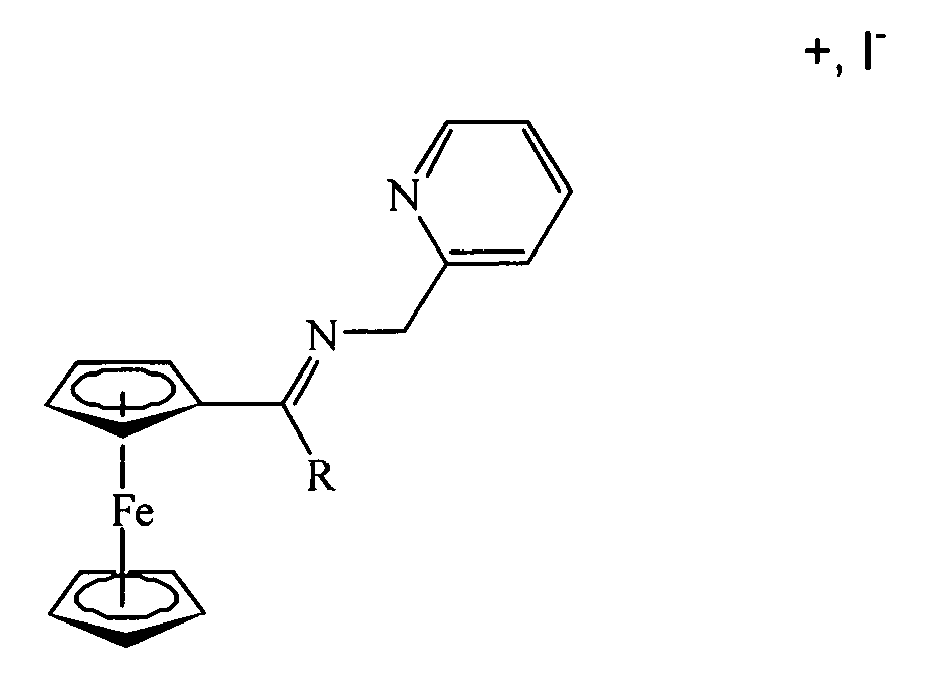
- More preferably, the groups Y-Z and/or X-W are each independently selected from CH ==N -CH2 -Ar wherein Ar is benzyl, furfuryl or pyridine group.
- Most preferably there is only one substituent group Y-Z or X-W, the other being hydrogen.
- The most preferred complex according to the present invention is
- The oxidation reaction can be carried out chemically or electrochemically.
- In a preferred embodiment according to the present invention, it is carried out chemically with a mild oxidant. The oxidant is selected in order to have a potential from 550 to 900 mV versus calomel reference. Among the most preferred oxidants, one can cite iodine. It has a potential of about 600 mV and thus does not destroy the ligand. In addition, the reduced form of the oxidant and the oxidant itself are easily separated and removed from the oxidised ligand.
- The oxidised ligand is isolated before complexation with the metal.
- The present invention also discloses a method for preparing the oxidized ligand that comprises the steps of:
- a) dissolving the ferrocene ligand into a solvent;
- b) adding iodine to the solution;
- c) stirring the mixture at a temperature of from 20 to 80 °C and during a period of time of from a few minutes to 12 hours;
- d) evaporating the solvent;
- e) washing with appropriate solvent to separate the reduced form of the oxidant and/or excess of the oxidant itself from the oxidised ligand.
- f) retrieving the oxidised ligand.
- Preferably the oxidation reaction is carried out at room temperature overnight.
- The preferred solvent is polar and dissolves all reaction products, more preferably, it is acetonitrile (MeCN).
- The following scheme can for example be used.


- The ligand is then complexed with the metal by complexation reaction with a metallic precursor M(Hal)nR'v-n in a solvent, wherein M is a metal Group 6 to 10 of the Periodic Table, each Hal is the same or different and is halogen, each R' is the same or different and is substituted or unsubstituted hydrocarbyl having from 1 to 20 carbon atoms, substituted or unsubstituted aryloxy or alkoxy, v is the valence of M and n is zero or an integer at most equal to v.
- Preferably M is Ni, Co, Fe, Pd or Cr.
Preferably Hal is chlorine.
Preferably n is equal to v.
The solvent may be selected from dichloromethane or tetrahydrofuran and the complexation reaction is carried out at room temperature or at reflux. - Typically, two types of metallic complexes could be formed, one where the metal is coordinated to one ligand and one where the metal is coordinated to two ligands. The relative amounts of each ligand and metal unit depend upon the nature of ligand and of the metal. The amount of ligand must therefore be of at least one equivalent of ligand per metallic equivalent.
- The present invention further discloses an active catalyst system comprising the metallic complex and an activating agent having an ionising action.
- Suitable activating agents are well known in the art. The activating agent can be an aluminium alkyl represented by formula AlR+ nX3-n wherein R+ is an alkyl having from 1 to 20 carbon atoms and X is a halogen. The preferred alkylating agents are triisobutyl aluminium (TIBAL) or triethyl aluminium (TEAL).
- Alternatively, it can be aluminoxane and comprise oligomeric linear and/or cyclic alkyl aluminoxanes represented by formula


wherein n is 1-40, preferably 10-20, m is 3-40, preferably 3-20 and R* is a C1-C8 alkyl group and preferably methyl. - The amount of activating is selected to give an Al/M ratio of from 100 to 3000, preferably of about 1000.
- Suitable boron-containing activating agents may comprise a triphenylcarbenium boronate such as tetrakis-pentafluorophenyl-borato-triphenylcarbenium as described in
EP-A-0427696 , or those of the general formula [L'-H] + [B Ar1 Ar2 X3 X4]- as described inEP-A-0277004 (page 6, line 30 to page 7, line 7). The amount of boron -containing activating agent is selected to give B/M ratio of from 0.5 to 5, preferably of about 1. - In another embodiment, according to the present invention, the metallic complex may be deposited on a conventional support impregnated with an activating agent. Preferably, the conventional support is silica impregnated with methylaluminoxane (MAO). Alternatively, it can be an activating support such as fluorinated alumina silica.
- The present invention further discloses a method for preparing an active catalyst system that comprises the steps of:
- a) providing an oxidized ferricinium ligand;
- b) complexing the ligand of step a) with a metallic salt M(Hal)nR'v-n in a solvent;
- c) retrieving a catalyst component;
- d) activating the catalyst component with an activating agent having an ionising action;
- e) optionally adding a cocatalyst;
- f) retrieving an active oligomerisation or polymerisation catalyst system.
- Alternatively, in step d), the catalyst component is deposited on a support impregnated with an activating agent.
- The cocatalyst may be selected from triethylaluminium, triisobutylaluminum, tris-n-octylaluminium, tetraisobutyldialuminoxane or diethyl zinc.
- The active catalyst system is used in the oligomerisation and in the polymerisation of ethylene and alpha-olefins.
- The present invention discloses a method for the oligomerisation or the homo- or copolymerisation of ethylene and alpha-olefins that comprises the steps of:
- a) injecting the active catalyst system into the reactor;
- b) injecting the monomer and optional comonomer;
- c) maintaining under polymerisation conditions;
- d) retrieving the oligomers and/or polymer.
- The pressure in the reactor can vary from 0.5 to 50 bars, preferably from 5 to 25 bars.
- The polymerisation temperature can range from 10 to 100°C, preferably from 50 to 85°C.
- Preferably the monomer and optional comonomer are selected from ethylene, propylene or 1-hexene.
- The present invention also discloses the polymers obtained with the new catalyst systems.
- All reactions were performed using standard Schlenk techniques or in an argon-filled glove-box. The starting materials and reagents, purchased from commercial suppliers, were degassed and purified by distillation under nitrogen using standard drying agents.
- All complexes were prepared according to the method described for example in Gibson et al. (Chem Soc Rev., 2004, 33, 313-328) or in Samuelson et al. (Journal of Organometallic Chemistry, 1999, 575, 108-118).
- 300 mg (1.4 mmol) of solid ferrocenecarboxaldehyde were introduced in a schlenk. 90 µL (2.1 mmol) of benzylamine and 2 mg of p-toluene sulfonic acid were added. The mixture was dissolved in 20 mL of toluene and the homogeneous mixture was stirred and heated at reflux overnight (16h). The solution was cooled down to room temperature (25 °C) and the solvent was vaporised under vacuum. After drying overnight under vacuum and at a temperature of 50 °C, 374.7 mg (1.28 mmol) of orange solid were obtained with a yield of 91 %.

- 300 mg (1.4 mmol) of solid ferrocenecarboxaldehyde were introduced in a schlenk. 138 µL (2.1 mmol) of furylamine and 2 mg of p-toluene sulfonic acid were added. The mixture was dissolved in 20 mL of toluene and the homogeneous mixture was stirred and heated at reflux overnight (16h). The solution was cooled down to room temperature and the solvent was vaporised under vacuum. After drying overnight under vacuum and at a temperature of 50 °C, 381 mg (1.30 mmol) of orange solid were obtained with a yield of 93 %.

- 300 mg (1.4 mmol) of solid ferrocenecarboxaldehyde were introduced in a schlenk. 138 µL (2.1 mmol) of aminomethylpyridine were added. The mixture was dissolved in 20 mL of toluene and the homogeneous mixture was stirred and heated at reflux overnight (16h). The solution was cooled down to room temperature and the solvent was vaporised under vacuum. After drying overnight under vacuum and at a temperature of 50 °C, 379 mg (1.25 mmol) of orange solid were obtained with a yield of 89 %.
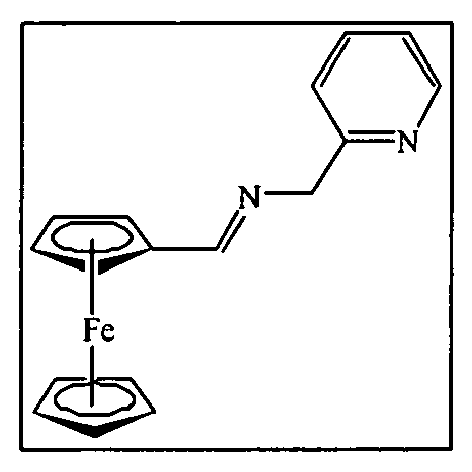
- 374.7 mg (1.28 mmol) of ligand F1 were dissolved in 40 mL of acetonitrile. 325 mg (1.28 mmol) of iodine were added. The homogeneous mixture was stirred at room temperature overnight (16h). The solvent was vaporised under vacuum and the resulting precipitate was washed three times with 30 mL of diethylether and dried overnight under vacuum. 486.2 mg (1.15 mmol) of dark blue solid were obtained with a yield of 90 %. The compound was diamagnetic.

- 381 mg (1.30 mmol) of ligand F2 were dissolved in 40 mL of acetonitrile. 330 mg (1.30 mmol) of iodine were added. The homogeneous mixture was stirred at room temperature overnight (16h). The solvent was vaporised under vacuum and the resulting precipitate was washed three times with 30 mL of diethylether and dried overnight under vacuum. 507.3 mg (1.20 mmol) of dark blue solid were obtained with a yield of 92 %. The compound was diamagnetic.

- 379 mg (1.25 mmol) of ligand F3 were dissolved in 40 mL of acetonitrile. 325 mg (1.28 mmol) of iodine were added. The homogeneous mixture was stirred at room temperature overnight (16h). The solvent was vaporised under vacuum and the resulting precipitate was washed three times with 30 mL of diethylether and dried overnight under vacuum. 459.8 mg (1.06 mmol) of dark solid were obtained with a yield of 85 %. The compound was diamagnetic.

- 2.46 mg (20 µmol) of metallic precursor CrCl2 were introduced in a schlenk. 16.9 mg (40 µmol) of oxidised ligand F1+ were added. The solids were dissolved in 200 µL of tetrahydrofuran (THF) to reach a concentration of 0.1 mol/L. The solution was stirred at room temperature for a period of time of 3 h and the solvent was vaporised. A dark solid was obtained.
- 7.49 mg (20 µmol) of metallic precursor CrCl3.3THFwere introduced in a schlenk. 16.9 mg (40 µmol) of oxidised ligand F1+ were added. The solids were dissolved in 200 µL of tetrahydrofuran (THF) to reach a concentration of 0.1 mol/L. The solution was stirred at room temperature for a period of time of 3 h and the solvent was vaporised. A dark solid was obtained.
- 2.46 mg (20 µmol) of metallic precursor CrCl2 were introduced in a schlenk. 16.9 mg (40 µmol) of oxidised ligand F2+ were added. The solids were dissolved in 200 µL of tetrahydrofuran (THF) to reach a concentration of 0.1 mol/L. The solution was stirred at room temperature for a period of time of 3 h and the solvent was vaporised. A dark solid was obtained.
- 7.49 mg (20 µmol) of metallic precursor CrCl3.3THFwere introduced in a schlenk. 16.9 mg (40 µmol) of oxidised ligand F2+ were added. The solids were dissolved in 200 µL of tetrahydrofuran (THF) to reach a concentration of 0.1 mol/L. The solution was stirred at room temperature for a period of time of 3 h and the solvent was vaporised. A dark solid was obtained.
- 2.46 mg (20 µmol) of metallic precursor CrCl2 were introduced in a schlenk. 17.4 mg (40 µmol) of oxidised ligand F3+ were added. The solids were dissolved in 200 µL of tetrahydrofuran (THF) to reach a concentration of 0.1 mol/L. The solution was stirred at room temperature for a period of time of 3 h and the solvent was vaporised. A dark solid was obtained.
- 7.49 mg (20 µmol) of metallic precursor CrCl3.3THFwere introduced in a schlenk. 16.9 mg (40 µmol) of oxidised ligand F3+ were added. The solids were dissolved in 200 µL of tetrahydrofuran (THF) to reach a concentration of 0.1 mol/L. The solution was stirred at room temperature for a period of time of 3 h and the solvent was vaporised. A dark solid was obtained.
- The metallic complexes obtained in the previous step were acticated with 1000 equivalents with respect to metal Cr of methylaluminoxane (MAO) 30 % in toluene.
- The addition of total MAO was carried out in two steps:
- 1. as activator; and
- 2. as scavenger, mixed with toluene.
- The catalyst component was deposited in a schlenk and 3.25 mL of MAO were added to the schlenk as activating agent. The solution was stirred for 5 minutes and then diluted with 1.75 mL of toluene.
- The reactor was dried under nitrogen at a temperature of 110 °C for a period of time of 30 minutes. The temperature was raised to 35 °C and 50 mL of toluene were added to the reactor under nitrogen reflux. A solution of scavenger consisting of 1 ml of MAO at 30 % and 4 mL of toluene were added to the reactor and the solution was stirred during a few minutes. 20µmol of the selected catalyst component were added to the reactor under nitrogen reflux. The nitrogen flux was stopped, the reactor was purged and placed under an ethylene pressure of 15 bars. Stirring was continued for a period of time of one hour. The reactor was then purged and the polymerisation was stopped by addition of a 10 % solution of MeOH/HCl. The polymer was washed three times with 30 mL of acetone and dried under vacuum overnight at room temperature.
Claims (14)
- An ferricinium ligand of formula

wherein X and Y are the same or different with the restriction that at least one Y or X contains at least one chelating group in direct connection with the ferricinium, the other of Y or X being optionally present,
wherein Z and W are each independently selected from alkyl, aryl, heterocycle group or non-heterocycle group containing ether, thioether, phosphine, imine, amine or amide,
wherein iron has been oxidated with an oxidant capable to oxidate FeII into FeIII but mild enough to preserve the ligand, and
wherein A- is an anion associated to FeIII. - The oxidised ligand of claim 1 wherein X and/or Y are each independently selected to include atoms O, N, P, S or groups -CR=CR-, -CR=N-, -N=CR- or -C=C- wherein R is H, alkyl or aryl groups having at most 20 carbon atoms.
- The oxidised ligand of claim 1 or claim 2 wherein groups Y-Z and/or X-W are each independently selected from CH ==N -CH2 -Ar wherein Ar is benzyl, furfuryl or pyridine group.
- The oxidised ligand of any one of the preceding claims wherein there is only one substituent group Y-Z or X-W, the other being hydrogen.
- The oxidised ligand of any one of the preceding claims wherein oxidation is carried chemically.
- The oxidised ligand of claim 5 wherein the oxidant has a potential of from 500 to 900 mV related to calomel reference.
- A method for preparing the oxidised ligand of any one of claims 1 to 6 that comprises the steps of:a) dissolving a ferrocene ligand into a solvent;b) adding iodine to the solution;c) stirring the mixture at a temperature of from 20 to 80 °C and during a period of time of from a few minutes to 12 hours;d) evaporating the solvent;e) washing with appropriate solvent to separate the reduced form of the oxidant and/or excess of the oxidant itself from the oxidised ligand.f) retrieving the oxidised ligand.
- A metallic complex obtained by complexation reaction of the oxidised ligand of any one of claims 1 to 6 with a metallic precursor M(Hal)nR'v-n in a solvent, wherein M is a metal Group 6 to 10 of the Periodic Table, each Hal is the same or different and is halogen, each R' is the same or different and is substituted or unsubstituted hydrocarbyl having from 1 to 20 carbon atoms, substituted or unsubstituted aryloxy or alkoxy, v is the valence of M and n is zero or an integer at most equal to v.
- The metallic complex of claim 8 wherein M is Ni, Co, Cr, Pd or Fe.
- The metallic complex of claim 8 or claim 9 wherein Hal is chlorine.
- An active catalyst component comprising the metallic complex of any one of claims 8 to 10 and an activating agent having an ionizing action.
- A method for oligomerising or homo- or co-polymerising ethylene and alpha-olefins that comprises the steps of:a) injecting the active catalyst system into the reactor;b) injecting the monomer and optional comonomer;c) maintaining under polymerisation conditions;d) retrieving the oligomers and/or polymer.
- The method of claim 12 wherein the monomer and optinal comonomer are each selected from ethylene, propylene or hexane.
- Polymers obtainable by the method of claim 12 or claim 13.
Priority Applications (5)
| Application Number | Priority Date | Filing Date | Title |
|---|---|---|---|
| EP06290538A EP1845115A1 (en) | 2006-03-30 | 2006-03-30 | Catalyst components based on ferrocenium complexes used for olefin polymerisation |
| PCT/EP2007/052910 WO2007113169A1 (en) | 2006-03-30 | 2007-03-27 | Catalyst components based on ferricinium complexes used for olefin polymerisation |
| US12/295,473 US7956003B2 (en) | 2006-03-30 | 2007-03-27 | Catalyst components based on ferricinium complexes used for olefin polymerisation |
| EP07727383A EP2029631A1 (en) | 2006-03-30 | 2007-03-27 | Catalyst components based on ferricinium complexes used for olefin polymerisation |
| US13/095,599 US20110201813A1 (en) | 2006-03-30 | 2011-04-27 | Catalyst Components Based on Ferricinium Complexes Used for Olefin Polymerization |
Applications Claiming Priority (1)
| Application Number | Priority Date | Filing Date | Title |
|---|---|---|---|
| EP06290538A EP1845115A1 (en) | 2006-03-30 | 2006-03-30 | Catalyst components based on ferrocenium complexes used for olefin polymerisation |
Publications (1)
| Publication Number | Publication Date |
|---|---|
| EP1845115A1 true EP1845115A1 (en) | 2007-10-17 |
Family
ID=36950576
Family Applications (2)
| Application Number | Title | Priority Date | Filing Date |
|---|---|---|---|
| EP06290538A Withdrawn EP1845115A1 (en) | 2006-03-30 | 2006-03-30 | Catalyst components based on ferrocenium complexes used for olefin polymerisation |
| EP07727383A Withdrawn EP2029631A1 (en) | 2006-03-30 | 2007-03-27 | Catalyst components based on ferricinium complexes used for olefin polymerisation |
Family Applications After (1)
| Application Number | Title | Priority Date | Filing Date |
|---|---|---|---|
| EP07727383A Withdrawn EP2029631A1 (en) | 2006-03-30 | 2007-03-27 | Catalyst components based on ferricinium complexes used for olefin polymerisation |
Country Status (3)
| Country | Link |
|---|---|
| US (2) | US7956003B2 (en) |
| EP (2) | EP1845115A1 (en) |
| WO (1) | WO2007113169A1 (en) |
Families Citing this family (1)
| Publication number | Priority date | Publication date | Assignee | Title |
|---|---|---|---|---|
| CN116422375B (en) * | 2023-06-14 | 2023-08-15 | 潍坊医学院 | Catalyst with photo-thermal-enzyme synergistic sterilization effect and application thereof |
Family Cites Families (1)
| Publication number | Priority date | Publication date | Assignee | Title |
|---|---|---|---|---|
| US5198511A (en) * | 1991-12-20 | 1993-03-30 | Minnesota Mining And Manufacturing Company | Polymerizable compositions containing olefin metathesis catalysts and cocatalysts, and methods of use therefor |
-
2006
- 2006-03-30 EP EP06290538A patent/EP1845115A1/en not_active Withdrawn
-
2007
- 2007-03-27 US US12/295,473 patent/US7956003B2/en not_active Expired - Fee Related
- 2007-03-27 EP EP07727383A patent/EP2029631A1/en not_active Withdrawn
- 2007-03-27 WO PCT/EP2007/052910 patent/WO2007113169A1/en not_active Ceased
-
2011
- 2011-04-27 US US13/095,599 patent/US20110201813A1/en not_active Abandoned
Non-Patent Citations (19)
| Title |
|---|
| BERNARDI L ET AL: "Diastereoselective additions of organometallic reagents to (SFc)-2-p-tolylsulfanylferrocene carboxaldehyde and to (SFc)-2-p-tolylsulfanyl ferrocenyl imines. Synthesis of new central and planar chiral ferrocenyl alcohols and amines", ARKIVOC, no. 2, 2004, pages 72 - 90, XP007901151, Retrieved from the Internet <URL:http://www.arkat-usa.org/ARKIVOC/JOURNAL_CONTENT/manuscripts/2004/BZ-959EP%20as%20published%20mainmanuscript.pdf> [retrieved on 20060922] * |
| BONINI B F ET AL: "One pot synthesis of new beta-lactams containing the ferrocene moiety", SYNLETT, no. 7, 2001, pages 1092 - 1096, XP009072796, ISSN: 0936-5214 * |
| BOSQUE R ET AL: "Heterodi- and Heterotrimetallic Compounds Containing Five-Membered Rings and .sigma.(Pd-Csp2, ferrocene) Bonds. X-ray Crystal Structure of the meso-Form of [Pd2{Fe[(eta5-C5H3) C(CH3)=NC6H5]}2Cl2(PPh3)2]", ORGANOMETALLICS, vol. 18, no. 7, 1999, pages 1267 - 1274, XP009072781, ISSN: 0276-7333 * |
| BOSQUE R ET AL: "Influences of the substituents at the iminic carbon atoms (hydrogen versus methyl) upon the properties of ferrocenylimines and their cyclopalladated derivatives", JOURNAL OF THE CHEMICAL SOCIETY, DALTON TRANSACTIONS: INORGANIC CHEMISTRY, no. 5, 1994, pages 735 - 745, XP009072834, ISSN: 0300-9246 * |
| BOSQUE R ET AL: "Substituent effects on the electrochemical behavior of iron(II) in Schiff bases derived from ferrocene and their cyclopalladated compounds", INORGANICA CHIMICA ACTA, vol. 244, no. 1, 1996, pages 141 - 145, XP009072783, ISSN: 0020-1693 * |
| BULLITA E ET AL: "Synthesis, X-ray structural determination and Mossbauer characterization of Schiff bases bearing ferrocene groups, their reduced analogs and related complexes", INORGANICA CHIMICA ACTA, vol. 287, no. 2, 1999, pages 117 - 133, XP009072782, ISSN: 0020-1693 * |
| CUI X ET AL: "Bis[1,1'-N,N'-(2-picolyl)aminomethyl]ferrocene as a redox sensor for transition metal ions", DALTON TRANSACTIONS, no. 11, 7 June 2004 (2004-06-07), pages 1743 - 1751, XP009072787, ISSN: 1477-9226 * |
| GIBSON V C ET AL: "Ferrocene-substituted bis(imino)pyridine iron and cobalt complexes: Toward redox-active catalysts for the polymerization of ethylene", ORGANOMETALLICS, vol. 25, no. 8, 7 March 2006 (2006-03-07), pages 1932 - 1939, XP009072751, ISSN: 0276-7333 * |
| GIBSON V C ET AL: "Synthetic, spectroscopic and olefin oligomerisation studies on nickel and palladium complexes containing ferrocene substituted nitrogen donor ligands", DALTON TRANSACTIONS, no. 5, 7 March 2003 (2003-03-07), pages 918 - 926, XP009072752, ISSN: 1477-9226 * |
| LEWKOWSKI J ET AL: "Alpha-(Ferrocenyl)-aminomethanephosphonous acids. First synthesis and preparation of their esters with cholesterol and adenosine", JOURNAL OF ORGANOMETALLIC CHEMISTRY, vol. 689, no. 9, 1 May 2004 (2004-05-01), pages 1684 - 1690, XP004502214, ISSN: 0022-328X * |
| LEWKOWSKI J ET AL: "First synthesis of 1,1'-ferrocene bis-aminophosphonic esters", JOURNAL OF ORGANOMETALLIC CHEMISTRY, vol. 689, no. 7, 1 April 2004 (2004-04-01), pages 1265 - 1270, XP004496429, ISSN: 0022-328X * |
| LEWKOWSKI J ET AL: "The first synthesis of ferrocenyl aminophosphonic esters", JOURNAL OF ORGANOMETALLIC CHEMISTRY, vol. 631, no. 1-2, 10 August 2001 (2001-08-10), pages 105 - 109, XP004305486, ISSN: 0022-328X * |
| LOPEZ C ET AL: "Cyclopalladated compounds derived from ferrocenylimines. Crystal structure of [Pd[(eta5-C5H5)Fe [eta5-C5H3CH=N(CH2)2Ph]]Cl(PEt3)]", JOURNAL OF THE CHEMICAL SOCIETY, DALTON TRANSACTIONS: INORGANIC CHEMISTRY, no. 15, 1992, pages 2321 - 2328, XP009072836, ISSN: 0300-9246 * |
| LOPEZ C ET AL: "Effects of the nature of the nitrogen donor atom (sp2 versus sp3) upon the properties and chemistry of palladated complexes with sigma(Pd-Csp2, ferrocene) bonds", JOURNAL OF THE CHEMICAL SOCIETY, DALTON TRANSACTIONS: INORGANIC CHEMISTRY, no. 20, 1994, pages 3039 - 3046, XP009072837, ISSN: 0300-9246 * |
| LOPEZ ET AL: "Relationships between 57Fe NMR, Mossbauer parameters, electrochemical properties and the structures of ferrocenylketimines", JOURNAL OF ORGANOMETALLIC CHEMISTRY, vol. 691, no. 3, 15 January 2006 (2006-01-15), pages 475 - 484, XP005226193, ISSN: 0022-328X * |
| PEET J H J ET AL: "Novel photoreaction products of N-substituted ferrocenylimines", JOURNAL OF ORGANOMETALLIC CHEMISTRY, vol. 88, no. 1, 1975, pages C1 - C3, XP009072795, ISSN: 0022-328X * |
| PEREZ S ET AL: "Trans-influences in mononuclear cyclopalladated compounds containing a sigma(Pd-Csp2, ferrocene) bond. X-ray crystal structures of [Pd{[(eta5-C5H3)-CH=N-CH2-C6H5]Fe(eta5-C5H5)}(X)(PPh3)] with X = Br- and I-", JOURNAL OF ORGANOMETALLIC CHEMISTRY, vol. 625, no. 1, 15 April 2001 (2001-04-15), pages 67 - 76, XP004234567, ISSN: 0022-328X * |
| WALTHER D ET AL: "Furfurylidene-imines as components of the oxidative coupling with carbon dioxide at nickel(0) centers: influence of the substituents on the structure of the resulting nickelacycles", ZEITSCHRIFT FUER ANORGANISCHE UND ALLGEMEINE CHEMIE, vol. 628, no. 4, 2002, pages 851 - 862, XP009072801, ISSN: 0044-2313 * |
| ZHAO G ET AL: "Cyclic Ether Induced Asymmetric Cyclopalladation: Synthesis and Structural Characterization of Enantiopure Bis(mu-acetato)-Bridged Dimers of Planar Chiral Cyclopalladated Ferrocenylimines and Their Derivatives", ORGANOMETALLICS, vol. 18, no. 8, 1999, pages 3623 - 3636, XP009072780, ISSN: 0276-7333 * |
Also Published As
| Publication number | Publication date |
|---|---|
| EP2029631A1 (en) | 2009-03-04 |
| US7956003B2 (en) | 2011-06-07 |
| US20110201813A1 (en) | 2011-08-18 |
| US20100063230A1 (en) | 2010-03-11 |
| WO2007113169A1 (en) | 2007-10-11 |
Similar Documents
| Publication | Publication Date | Title |
|---|---|---|
| US6541585B2 (en) | Polymerization of olefins | |
| Britovsek et al. | The search for new‐generation olefin polymerization catalysts: life beyond metallocenes | |
| US6127497A (en) | Elevated pressure polymerization processes with late transition metal catalyst systems | |
| US6531424B2 (en) | Polymerization of olefins | |
| PL198619B1 (en) | Polymerisation catalysts | |
| JPH02206607A (en) | Production of polyethylene | |
| US20030191015A1 (en) | Catalyst component for olefin polymerization | |
| US7148174B2 (en) | Non-metallocene catalyst system | |
| US6887958B1 (en) | Method for polymerizing olefins | |
| JP2004509129A (en) | Use of CR Complex for Polymerization of CR Complex and α-Olefin | |
| US20030191018A1 (en) | Polymerization of olefins | |
| Li et al. | Zirconium complexes based on an ethylene linked amidinate–amido ligand: synthesis, characterization and ethylene polymerization | |
| US7956003B2 (en) | Catalyst components based on ferricinium complexes used for olefin polymerisation | |
| US20110034652A1 (en) | Catalyst components based on ferrocenyl complexes used for olefin polymerisation | |
| EP1849791A1 (en) | Polymerisation of ethylene and alpha-olefins with pyridino-iminophenol complexes | |
| EP1997834A1 (en) | Catalysts | |
| WO2001068726A1 (en) | Atom transfer radical polymerisation catalyst | |
| EP1274746A1 (en) | Single-site catalysts containing chelating n-oxide ligands | |
| WO2008061900A1 (en) | Polymerisation of ethylene and alpha olefins with single site catalysts having an anionic scorpion-like ligand | |
| US20030225227A1 (en) | Process for the manufacture of polyolefins using non-metallocene catalysts | |
| US7022785B2 (en) | Diimine complexes for olefin polymerization | |
| Rahman | Zwitterionic late transition metal alkene polymerisation catalysts containing aminofulvene-aldiminate (AFA) ligands | |
| Rahman | Zwitterionic Late Transition Metal Alkene Polymerisation Catalysts containing | |
| JP2002255918A (en) | Transition metal compound, coordinating compound, catalyst for olefin polymerization, and method for producing polyolefin using the same | |
| Sibanyoni | The preparation of binuclear and polynuclear methyl complexes of palladium as catalyst precursors in phenylacetylene polymerization |
Legal Events
| Date | Code | Title | Description |
|---|---|---|---|
| PUAI | Public reference made under article 153(3) epc to a published international application that has entered the european phase |
Free format text: ORIGINAL CODE: 0009012 |
|
| AK | Designated contracting states |
Kind code of ref document: A1 Designated state(s): AT BE BG CH CY CZ DE DK EE ES FI FR GB GR HU IE IS IT LI LT LU LV MC NL PL PT RO SE SI SK TR |
|
| AX | Request for extension of the european patent |
Extension state: AL BA HR MK YU |
|
| AKX | Designation fees paid | ||
| REG | Reference to a national code |
Ref country code: DE Ref legal event code: 8566 |
|
| STAA | Information on the status of an ep patent application or granted ep patent |
Free format text: STATUS: THE APPLICATION IS DEEMED TO BE WITHDRAWN |
|
| 18D | Application deemed to be withdrawn |
Effective date: 20080418 |