EP1845104A1 - Par-2 agonist - Google Patents
Par-2 agonist Download PDFInfo
- Publication number
- EP1845104A1 EP1845104A1 EP05822433A EP05822433A EP1845104A1 EP 1845104 A1 EP1845104 A1 EP 1845104A1 EP 05822433 A EP05822433 A EP 05822433A EP 05822433 A EP05822433 A EP 05822433A EP 1845104 A1 EP1845104 A1 EP 1845104A1
- Authority
- EP
- European Patent Office
- Prior art keywords
- group
- glycyl
- salt
- compound
- cyclohexyl
- Prior art date
- Legal status (The legal status is an assumption and is not a legal conclusion. Google has not performed a legal analysis and makes no representation as to the accuracy of the status listed.)
- Withdrawn
Links
Classifications
-
- C—CHEMISTRY; METALLURGY
- C07—ORGANIC CHEMISTRY
- C07K—PEPTIDES
- C07K5/00—Peptides containing up to four amino acids in a fully defined sequence; Derivatives thereof
- C07K5/04—Peptides containing up to four amino acids in a fully defined sequence; Derivatives thereof containing only normal peptide links
- C07K5/10—Tetrapeptides
- C07K5/1002—Tetrapeptides with the first amino acid being neutral
- C07K5/1016—Tetrapeptides with the first amino acid being neutral and aromatic or cycloaliphatic
-
- A—HUMAN NECESSITIES
- A61—MEDICAL OR VETERINARY SCIENCE; HYGIENE
- A61P—SPECIFIC THERAPEUTIC ACTIVITY OF CHEMICAL COMPOUNDS OR MEDICINAL PREPARATIONS
- A61P1/00—Drugs for disorders of the alimentary tract or the digestive system
-
- A—HUMAN NECESSITIES
- A61—MEDICAL OR VETERINARY SCIENCE; HYGIENE
- A61P—SPECIFIC THERAPEUTIC ACTIVITY OF CHEMICAL COMPOUNDS OR MEDICINAL PREPARATIONS
- A61P1/00—Drugs for disorders of the alimentary tract or the digestive system
- A61P1/02—Stomatological preparations, e.g. drugs for caries, aphtae, periodontitis
-
- A—HUMAN NECESSITIES
- A61—MEDICAL OR VETERINARY SCIENCE; HYGIENE
- A61P—SPECIFIC THERAPEUTIC ACTIVITY OF CHEMICAL COMPOUNDS OR MEDICINAL PREPARATIONS
- A61P1/00—Drugs for disorders of the alimentary tract or the digestive system
- A61P1/04—Drugs for disorders of the alimentary tract or the digestive system for ulcers, gastritis or reflux esophagitis, e.g. antacids, inhibitors of acid secretion, mucosal protectants
-
- A—HUMAN NECESSITIES
- A61—MEDICAL OR VETERINARY SCIENCE; HYGIENE
- A61P—SPECIFIC THERAPEUTIC ACTIVITY OF CHEMICAL COMPOUNDS OR MEDICINAL PREPARATIONS
- A61P1/00—Drugs for disorders of the alimentary tract or the digestive system
- A61P1/12—Antidiarrhoeals
-
- A—HUMAN NECESSITIES
- A61—MEDICAL OR VETERINARY SCIENCE; HYGIENE
- A61P—SPECIFIC THERAPEUTIC ACTIVITY OF CHEMICAL COMPOUNDS OR MEDICINAL PREPARATIONS
- A61P1/00—Drugs for disorders of the alimentary tract or the digestive system
- A61P1/18—Drugs for disorders of the alimentary tract or the digestive system for pancreatic disorders, e.g. pancreatic enzymes
-
- A—HUMAN NECESSITIES
- A61—MEDICAL OR VETERINARY SCIENCE; HYGIENE
- A61P—SPECIFIC THERAPEUTIC ACTIVITY OF CHEMICAL COMPOUNDS OR MEDICINAL PREPARATIONS
- A61P11/00—Drugs for disorders of the respiratory system
-
- A—HUMAN NECESSITIES
- A61—MEDICAL OR VETERINARY SCIENCE; HYGIENE
- A61P—SPECIFIC THERAPEUTIC ACTIVITY OF CHEMICAL COMPOUNDS OR MEDICINAL PREPARATIONS
- A61P13/00—Drugs for disorders of the urinary system
-
- A—HUMAN NECESSITIES
- A61—MEDICAL OR VETERINARY SCIENCE; HYGIENE
- A61P—SPECIFIC THERAPEUTIC ACTIVITY OF CHEMICAL COMPOUNDS OR MEDICINAL PREPARATIONS
- A61P13/00—Drugs for disorders of the urinary system
- A61P13/10—Drugs for disorders of the urinary system of the bladder
-
- A—HUMAN NECESSITIES
- A61—MEDICAL OR VETERINARY SCIENCE; HYGIENE
- A61P—SPECIFIC THERAPEUTIC ACTIVITY OF CHEMICAL COMPOUNDS OR MEDICINAL PREPARATIONS
- A61P13/00—Drugs for disorders of the urinary system
- A61P13/12—Drugs for disorders of the urinary system of the kidneys
-
- A—HUMAN NECESSITIES
- A61—MEDICAL OR VETERINARY SCIENCE; HYGIENE
- A61P—SPECIFIC THERAPEUTIC ACTIVITY OF CHEMICAL COMPOUNDS OR MEDICINAL PREPARATIONS
- A61P15/00—Drugs for genital or sexual disorders; Contraceptives
-
- A—HUMAN NECESSITIES
- A61—MEDICAL OR VETERINARY SCIENCE; HYGIENE
- A61P—SPECIFIC THERAPEUTIC ACTIVITY OF CHEMICAL COMPOUNDS OR MEDICINAL PREPARATIONS
- A61P15/00—Drugs for genital or sexual disorders; Contraceptives
- A61P15/06—Antiabortive agents; Labour repressants
-
- A—HUMAN NECESSITIES
- A61—MEDICAL OR VETERINARY SCIENCE; HYGIENE
- A61P—SPECIFIC THERAPEUTIC ACTIVITY OF CHEMICAL COMPOUNDS OR MEDICINAL PREPARATIONS
- A61P17/00—Drugs for dermatological disorders
- A61P17/02—Drugs for dermatological disorders for treating wounds, ulcers, burns, scars, keloids, or the like
-
- A—HUMAN NECESSITIES
- A61—MEDICAL OR VETERINARY SCIENCE; HYGIENE
- A61P—SPECIFIC THERAPEUTIC ACTIVITY OF CHEMICAL COMPOUNDS OR MEDICINAL PREPARATIONS
- A61P19/00—Drugs for skeletal disorders
-
- A—HUMAN NECESSITIES
- A61—MEDICAL OR VETERINARY SCIENCE; HYGIENE
- A61P—SPECIFIC THERAPEUTIC ACTIVITY OF CHEMICAL COMPOUNDS OR MEDICINAL PREPARATIONS
- A61P19/00—Drugs for skeletal disorders
- A61P19/02—Drugs for skeletal disorders for joint disorders, e.g. arthritis, arthrosis
-
- A—HUMAN NECESSITIES
- A61—MEDICAL OR VETERINARY SCIENCE; HYGIENE
- A61P—SPECIFIC THERAPEUTIC ACTIVITY OF CHEMICAL COMPOUNDS OR MEDICINAL PREPARATIONS
- A61P19/00—Drugs for skeletal disorders
- A61P19/06—Antigout agents, e.g. antihyperuricemic or uricosuric agents
-
- A—HUMAN NECESSITIES
- A61—MEDICAL OR VETERINARY SCIENCE; HYGIENE
- A61P—SPECIFIC THERAPEUTIC ACTIVITY OF CHEMICAL COMPOUNDS OR MEDICINAL PREPARATIONS
- A61P19/00—Drugs for skeletal disorders
- A61P19/08—Drugs for skeletal disorders for bone diseases, e.g. rachitism, Paget's disease
-
- A—HUMAN NECESSITIES
- A61—MEDICAL OR VETERINARY SCIENCE; HYGIENE
- A61P—SPECIFIC THERAPEUTIC ACTIVITY OF CHEMICAL COMPOUNDS OR MEDICINAL PREPARATIONS
- A61P19/00—Drugs for skeletal disorders
- A61P19/08—Drugs for skeletal disorders for bone diseases, e.g. rachitism, Paget's disease
- A61P19/10—Drugs for skeletal disorders for bone diseases, e.g. rachitism, Paget's disease for osteoporosis
-
- A—HUMAN NECESSITIES
- A61—MEDICAL OR VETERINARY SCIENCE; HYGIENE
- A61P—SPECIFIC THERAPEUTIC ACTIVITY OF CHEMICAL COMPOUNDS OR MEDICINAL PREPARATIONS
- A61P21/00—Drugs for disorders of the muscular or neuromuscular system
-
- A—HUMAN NECESSITIES
- A61—MEDICAL OR VETERINARY SCIENCE; HYGIENE
- A61P—SPECIFIC THERAPEUTIC ACTIVITY OF CHEMICAL COMPOUNDS OR MEDICINAL PREPARATIONS
- A61P21/00—Drugs for disorders of the muscular or neuromuscular system
- A61P21/04—Drugs for disorders of the muscular or neuromuscular system for myasthenia gravis
-
- A—HUMAN NECESSITIES
- A61—MEDICAL OR VETERINARY SCIENCE; HYGIENE
- A61P—SPECIFIC THERAPEUTIC ACTIVITY OF CHEMICAL COMPOUNDS OR MEDICINAL PREPARATIONS
- A61P25/00—Drugs for disorders of the nervous system
-
- A—HUMAN NECESSITIES
- A61—MEDICAL OR VETERINARY SCIENCE; HYGIENE
- A61P—SPECIFIC THERAPEUTIC ACTIVITY OF CHEMICAL COMPOUNDS OR MEDICINAL PREPARATIONS
- A61P25/00—Drugs for disorders of the nervous system
- A61P25/02—Drugs for disorders of the nervous system for peripheral neuropathies
-
- A—HUMAN NECESSITIES
- A61—MEDICAL OR VETERINARY SCIENCE; HYGIENE
- A61P—SPECIFIC THERAPEUTIC ACTIVITY OF CHEMICAL COMPOUNDS OR MEDICINAL PREPARATIONS
- A61P25/00—Drugs for disorders of the nervous system
- A61P25/06—Antimigraine agents
-
- A—HUMAN NECESSITIES
- A61—MEDICAL OR VETERINARY SCIENCE; HYGIENE
- A61P—SPECIFIC THERAPEUTIC ACTIVITY OF CHEMICAL COMPOUNDS OR MEDICINAL PREPARATIONS
- A61P25/00—Drugs for disorders of the nervous system
- A61P25/08—Antiepileptics; Anticonvulsants
-
- A—HUMAN NECESSITIES
- A61—MEDICAL OR VETERINARY SCIENCE; HYGIENE
- A61P—SPECIFIC THERAPEUTIC ACTIVITY OF CHEMICAL COMPOUNDS OR MEDICINAL PREPARATIONS
- A61P25/00—Drugs for disorders of the nervous system
- A61P25/14—Drugs for disorders of the nervous system for treating abnormal movements, e.g. chorea, dyskinesia
-
- A—HUMAN NECESSITIES
- A61—MEDICAL OR VETERINARY SCIENCE; HYGIENE
- A61P—SPECIFIC THERAPEUTIC ACTIVITY OF CHEMICAL COMPOUNDS OR MEDICINAL PREPARATIONS
- A61P25/00—Drugs for disorders of the nervous system
- A61P25/14—Drugs for disorders of the nervous system for treating abnormal movements, e.g. chorea, dyskinesia
- A61P25/16—Anti-Parkinson drugs
-
- A—HUMAN NECESSITIES
- A61—MEDICAL OR VETERINARY SCIENCE; HYGIENE
- A61P—SPECIFIC THERAPEUTIC ACTIVITY OF CHEMICAL COMPOUNDS OR MEDICINAL PREPARATIONS
- A61P25/00—Drugs for disorders of the nervous system
- A61P25/24—Antidepressants
-
- A—HUMAN NECESSITIES
- A61—MEDICAL OR VETERINARY SCIENCE; HYGIENE
- A61P—SPECIFIC THERAPEUTIC ACTIVITY OF CHEMICAL COMPOUNDS OR MEDICINAL PREPARATIONS
- A61P25/00—Drugs for disorders of the nervous system
- A61P25/28—Drugs for disorders of the nervous system for treating neurodegenerative disorders of the central nervous system, e.g. nootropic agents, cognition enhancers, drugs for treating Alzheimer's disease or other forms of dementia
-
- A—HUMAN NECESSITIES
- A61—MEDICAL OR VETERINARY SCIENCE; HYGIENE
- A61P—SPECIFIC THERAPEUTIC ACTIVITY OF CHEMICAL COMPOUNDS OR MEDICINAL PREPARATIONS
- A61P27/00—Drugs for disorders of the senses
-
- A—HUMAN NECESSITIES
- A61—MEDICAL OR VETERINARY SCIENCE; HYGIENE
- A61P—SPECIFIC THERAPEUTIC ACTIVITY OF CHEMICAL COMPOUNDS OR MEDICINAL PREPARATIONS
- A61P27/00—Drugs for disorders of the senses
- A61P27/02—Ophthalmic agents
-
- A—HUMAN NECESSITIES
- A61—MEDICAL OR VETERINARY SCIENCE; HYGIENE
- A61P—SPECIFIC THERAPEUTIC ACTIVITY OF CHEMICAL COMPOUNDS OR MEDICINAL PREPARATIONS
- A61P29/00—Non-central analgesic, antipyretic or antiinflammatory agents, e.g. antirheumatic agents; Non-steroidal antiinflammatory drugs [NSAID]
-
- A—HUMAN NECESSITIES
- A61—MEDICAL OR VETERINARY SCIENCE; HYGIENE
- A61P—SPECIFIC THERAPEUTIC ACTIVITY OF CHEMICAL COMPOUNDS OR MEDICINAL PREPARATIONS
- A61P29/00—Non-central analgesic, antipyretic or antiinflammatory agents, e.g. antirheumatic agents; Non-steroidal antiinflammatory drugs [NSAID]
- A61P29/02—Non-central analgesic, antipyretic or antiinflammatory agents, e.g. antirheumatic agents; Non-steroidal antiinflammatory drugs [NSAID] without antiinflammatory effect
-
- A—HUMAN NECESSITIES
- A61—MEDICAL OR VETERINARY SCIENCE; HYGIENE
- A61P—SPECIFIC THERAPEUTIC ACTIVITY OF CHEMICAL COMPOUNDS OR MEDICINAL PREPARATIONS
- A61P3/00—Drugs for disorders of the metabolism
- A61P3/08—Drugs for disorders of the metabolism for glucose homeostasis
- A61P3/10—Drugs for disorders of the metabolism for glucose homeostasis for hyperglycaemia, e.g. antidiabetics
-
- A—HUMAN NECESSITIES
- A61—MEDICAL OR VETERINARY SCIENCE; HYGIENE
- A61P—SPECIFIC THERAPEUTIC ACTIVITY OF CHEMICAL COMPOUNDS OR MEDICINAL PREPARATIONS
- A61P31/00—Antiinfectives, i.e. antibiotics, antiseptics, chemotherapeutics
-
- A—HUMAN NECESSITIES
- A61—MEDICAL OR VETERINARY SCIENCE; HYGIENE
- A61P—SPECIFIC THERAPEUTIC ACTIVITY OF CHEMICAL COMPOUNDS OR MEDICINAL PREPARATIONS
- A61P31/00—Antiinfectives, i.e. antibiotics, antiseptics, chemotherapeutics
- A61P31/04—Antibacterial agents
-
- A—HUMAN NECESSITIES
- A61—MEDICAL OR VETERINARY SCIENCE; HYGIENE
- A61P—SPECIFIC THERAPEUTIC ACTIVITY OF CHEMICAL COMPOUNDS OR MEDICINAL PREPARATIONS
- A61P31/00—Antiinfectives, i.e. antibiotics, antiseptics, chemotherapeutics
- A61P31/12—Antivirals
-
- A—HUMAN NECESSITIES
- A61—MEDICAL OR VETERINARY SCIENCE; HYGIENE
- A61P—SPECIFIC THERAPEUTIC ACTIVITY OF CHEMICAL COMPOUNDS OR MEDICINAL PREPARATIONS
- A61P31/00—Antiinfectives, i.e. antibiotics, antiseptics, chemotherapeutics
- A61P31/12—Antivirals
- A61P31/14—Antivirals for RNA viruses
- A61P31/16—Antivirals for RNA viruses for influenza or rhinoviruses
-
- A—HUMAN NECESSITIES
- A61—MEDICAL OR VETERINARY SCIENCE; HYGIENE
- A61P—SPECIFIC THERAPEUTIC ACTIVITY OF CHEMICAL COMPOUNDS OR MEDICINAL PREPARATIONS
- A61P31/00—Antiinfectives, i.e. antibiotics, antiseptics, chemotherapeutics
- A61P31/12—Antivirals
- A61P31/14—Antivirals for RNA viruses
- A61P31/18—Antivirals for RNA viruses for HIV
-
- A—HUMAN NECESSITIES
- A61—MEDICAL OR VETERINARY SCIENCE; HYGIENE
- A61P—SPECIFIC THERAPEUTIC ACTIVITY OF CHEMICAL COMPOUNDS OR MEDICINAL PREPARATIONS
- A61P35/00—Antineoplastic agents
-
- A—HUMAN NECESSITIES
- A61—MEDICAL OR VETERINARY SCIENCE; HYGIENE
- A61P—SPECIFIC THERAPEUTIC ACTIVITY OF CHEMICAL COMPOUNDS OR MEDICINAL PREPARATIONS
- A61P35/00—Antineoplastic agents
- A61P35/04—Antineoplastic agents specific for metastasis
-
- A—HUMAN NECESSITIES
- A61—MEDICAL OR VETERINARY SCIENCE; HYGIENE
- A61P—SPECIFIC THERAPEUTIC ACTIVITY OF CHEMICAL COMPOUNDS OR MEDICINAL PREPARATIONS
- A61P37/00—Drugs for immunological or allergic disorders
- A61P37/02—Immunomodulators
- A61P37/04—Immunostimulants
-
- A—HUMAN NECESSITIES
- A61—MEDICAL OR VETERINARY SCIENCE; HYGIENE
- A61P—SPECIFIC THERAPEUTIC ACTIVITY OF CHEMICAL COMPOUNDS OR MEDICINAL PREPARATIONS
- A61P37/00—Drugs for immunological or allergic disorders
- A61P37/08—Antiallergic agents
-
- A—HUMAN NECESSITIES
- A61—MEDICAL OR VETERINARY SCIENCE; HYGIENE
- A61P—SPECIFIC THERAPEUTIC ACTIVITY OF CHEMICAL COMPOUNDS OR MEDICINAL PREPARATIONS
- A61P39/00—General protective or antinoxious agents
- A61P39/02—Antidotes
-
- A—HUMAN NECESSITIES
- A61—MEDICAL OR VETERINARY SCIENCE; HYGIENE
- A61P—SPECIFIC THERAPEUTIC ACTIVITY OF CHEMICAL COMPOUNDS OR MEDICINAL PREPARATIONS
- A61P43/00—Drugs for specific purposes, not provided for in groups A61P1/00-A61P41/00
-
- A—HUMAN NECESSITIES
- A61—MEDICAL OR VETERINARY SCIENCE; HYGIENE
- A61P—SPECIFIC THERAPEUTIC ACTIVITY OF CHEMICAL COMPOUNDS OR MEDICINAL PREPARATIONS
- A61P5/00—Drugs for disorders of the endocrine system
- A61P5/14—Drugs for disorders of the endocrine system of the thyroid hormones, e.g. T3, T4
-
- A—HUMAN NECESSITIES
- A61—MEDICAL OR VETERINARY SCIENCE; HYGIENE
- A61P—SPECIFIC THERAPEUTIC ACTIVITY OF CHEMICAL COMPOUNDS OR MEDICINAL PREPARATIONS
- A61P5/00—Drugs for disorders of the endocrine system
- A61P5/24—Drugs for disorders of the endocrine system of the sex hormones
-
- A—HUMAN NECESSITIES
- A61—MEDICAL OR VETERINARY SCIENCE; HYGIENE
- A61P—SPECIFIC THERAPEUTIC ACTIVITY OF CHEMICAL COMPOUNDS OR MEDICINAL PREPARATIONS
- A61P7/00—Drugs for disorders of the blood or the extracellular fluid
-
- A—HUMAN NECESSITIES
- A61—MEDICAL OR VETERINARY SCIENCE; HYGIENE
- A61P—SPECIFIC THERAPEUTIC ACTIVITY OF CHEMICAL COMPOUNDS OR MEDICINAL PREPARATIONS
- A61P7/00—Drugs for disorders of the blood or the extracellular fluid
- A61P7/02—Antithrombotic agents; Anticoagulants; Platelet aggregation inhibitors
-
- A—HUMAN NECESSITIES
- A61—MEDICAL OR VETERINARY SCIENCE; HYGIENE
- A61P—SPECIFIC THERAPEUTIC ACTIVITY OF CHEMICAL COMPOUNDS OR MEDICINAL PREPARATIONS
- A61P7/00—Drugs for disorders of the blood or the extracellular fluid
- A61P7/04—Antihaemorrhagics; Procoagulants; Haemostatic agents; Antifibrinolytic agents
-
- A—HUMAN NECESSITIES
- A61—MEDICAL OR VETERINARY SCIENCE; HYGIENE
- A61P—SPECIFIC THERAPEUTIC ACTIVITY OF CHEMICAL COMPOUNDS OR MEDICINAL PREPARATIONS
- A61P7/00—Drugs for disorders of the blood or the extracellular fluid
- A61P7/06—Antianaemics
-
- A—HUMAN NECESSITIES
- A61—MEDICAL OR VETERINARY SCIENCE; HYGIENE
- A61P—SPECIFIC THERAPEUTIC ACTIVITY OF CHEMICAL COMPOUNDS OR MEDICINAL PREPARATIONS
- A61P9/00—Drugs for disorders of the cardiovascular system
-
- A—HUMAN NECESSITIES
- A61—MEDICAL OR VETERINARY SCIENCE; HYGIENE
- A61P—SPECIFIC THERAPEUTIC ACTIVITY OF CHEMICAL COMPOUNDS OR MEDICINAL PREPARATIONS
- A61P9/00—Drugs for disorders of the cardiovascular system
- A61P9/02—Non-specific cardiovascular stimulants, e.g. drugs for syncope, antihypotensives
-
- A—HUMAN NECESSITIES
- A61—MEDICAL OR VETERINARY SCIENCE; HYGIENE
- A61P—SPECIFIC THERAPEUTIC ACTIVITY OF CHEMICAL COMPOUNDS OR MEDICINAL PREPARATIONS
- A61P9/00—Drugs for disorders of the cardiovascular system
- A61P9/04—Inotropic agents, i.e. stimulants of cardiac contraction; Drugs for heart failure
-
- A—HUMAN NECESSITIES
- A61—MEDICAL OR VETERINARY SCIENCE; HYGIENE
- A61P—SPECIFIC THERAPEUTIC ACTIVITY OF CHEMICAL COMPOUNDS OR MEDICINAL PREPARATIONS
- A61P9/00—Drugs for disorders of the cardiovascular system
- A61P9/08—Vasodilators for multiple indications
-
- A—HUMAN NECESSITIES
- A61—MEDICAL OR VETERINARY SCIENCE; HYGIENE
- A61P—SPECIFIC THERAPEUTIC ACTIVITY OF CHEMICAL COMPOUNDS OR MEDICINAL PREPARATIONS
- A61P9/00—Drugs for disorders of the cardiovascular system
- A61P9/14—Vasoprotectives; Antihaemorrhoidals; Drugs for varicose therapy; Capillary stabilisers
-
- C—CHEMISTRY; METALLURGY
- C07—ORGANIC CHEMISTRY
- C07K—PEPTIDES
- C07K7/00—Peptides having 5 to 20 amino acids in a fully defined sequence; Derivatives thereof
- C07K7/04—Linear peptides containing only normal peptide links
- C07K7/06—Linear peptides containing only normal peptide links having 5 to 11 amino acids
-
- A—HUMAN NECESSITIES
- A61—MEDICAL OR VETERINARY SCIENCE; HYGIENE
- A61K—PREPARATIONS FOR MEDICAL, DENTAL OR TOILETRY PURPOSES
- A61K38/00—Medicinal preparations containing peptides
Definitions
- the present invention relates to a PAR-2 agonist and a pharmaceutical compound for prophylactic/therapeutic against PAR-2 associated diseases including the PAR-2 agonist as an active ingredient and in particular relates to PAR-2 agonist useful for prevention of development and progress, amelioration of clinical state, treatment or the like, and development of pharmaceutical agent for fever, dryness of eye, corneal epithelial detachment, keratitis, corneal ulceration, conjunctival inflammation, dysfunction of masticatory, dysphagia, taste disorder, mouth odor, mouth discomfort, mouth infection, mouth inflammation, cardiovascular functional disorder, acute respiratory distress syndrome, peptic ulcer such as gastric ulceration and duodenal ulcer, gastric inflammation, visceral pain, diarrhea, enteritis such as ulcerative colitis, kidney disorder such as nephritis, pancreatitis, ulcer tissue, bone resorption, dysmenorrhea, premature labor, nephrosis, or symptom of low blood pressure.
- PAR Protease-activated receptor-2 is one of the protease-activated receptor (PAR) belonging to a G protein-coupled receptor family of 7-times transmembrane type cloned in 1994 by Nystedt et al. (Proc. Natl. Acad. Sci. USA, 91, 9208-9212(1994) ).
- PAR is a receptor family characterized by cleaving a specific site of amino-acid sequence in N terminal of the molecule with a serine protease such as thrombin or trypsin, and then binding a newly exposed cleavage N terminal fragment to a ligand binding site in the same molecule to activate.
- PAR-1, PAR-2, PAR-3 and PAR-4 are revealed their functions as receptors related to platelet agglutination with thrombin.
- PAR-2 has many similarities with other PARs in terms of structure and activation mechanism, it is suggested to be functionally discrete to other PAR since the PAR-2 is not activated by thrombin, and is activated by trypsin and tryptase.
- PAR-2 is known to be activated by a tissue factor/factor VIIa, factor Xa, acrosin (a type of sperm protease) and trypsin-like serine protease identified by a rat brain, further to trypsin and tryptase( Pharmacological Rev. 53, 245-282, (2001) , Br.J.Pharmacol., 123, 1434-1440(1998) ) and it is reported that PAR-2 activation is useful for prevention and treatment for decrease in saliva secretion, decrease in lacrimal secretion and alimentary diseases ( Japanese Patent Application Laid-open No. 2001-064203 , Japanese Patent Application Laid-open No. 2001-181208 , Japanese Patent Application Laid-open No. 2001-233790 , US Patent Publication No. 5888529 , and US Patent Publication No.5958407 ).
- a peptide (Tethered receptor agonist peptide :TRAP) consisted of mainly 6 amino acid such as Ser-Leu-lle-Gly-Lys-Val-OH, Ser-Leu-lle-Gly-Lys-Val-NH 2 , Ser-Leu-lle-Gly-Arg-Leu-OH, Ser-Leu-lle-Gly-Arg-Leu-NH 2 or the like having same sequence with PAR-2 ligand as PAR-2 activator is widely used.
- N ⁇ -benzoyl-Arg (NO 2 ) -Leu-NH 2 as a low molecular PAR-2 agonist is reported, PAR-2 activation of this compound is about one of hundred action strength of TRAP ( Bioorg.Med.Chem.Lett.2002, 12, 21-24 ) .
- PAR-2 activating agent a compound that N-terminal amino acid of TRAP substituted to acyl group such as 2-furoyl ( WO 03/104268 ), it is expected to obtain a compound having more simplified structure.
- a method for simplifying TRAP structure a method for reducing number of amino acid is assumed.
- a peptide consisted of 5 to 7 amino acid as PAR-2 activating agent is claimed, in case of a peptide consisted of 5 amino acids (AA 1 -AA 2 -AA 3 -AA 4 -AA 5 ) each amino acid is defined as AA 1 : small amino acid or threonine, AA 2 and AA 3 : neutral/nonpolar/large/nonaromatic amino acid, AA 4 : small amino acid, AA 5 :basic amino acid.
- the object of the present invention is to provide a PAR-2 agonist having PAR-2 activation potency same as TRAP or more improved potency, even in case of reducing amino acid of peptide consisted. That is, the object of the present invention is to provide a PAR-2 agonist useful for prevention of development and progress, amelioration of clinical state, treatment or the like, and development of pharmaceutical agent for fever, dryness of eye, corneal epithelial detachment, keratitis, corneal ulceration, conjunctival inflammation, dysfunction of masticatory, dysphagia, taste disorder, mouth odor, mouth discomfort, mouth infection, mouth inflammation, cardiovascular functional disorder, acute respiratory distress syndrome, peptic ulcer such as gastric ulceration and duodenal ulcer, gastric inflammation, visceral pain, diarrhea, enteritis such as ulcerative colitis, kidney disorder such as nephritis, pancreatitis, ulcer tissue, bone resorption, dysmenorrhea, premature labor, nephrosis, or symptom of low blood pressure
- the present invention also relates to a pharmaceutical composition for prophylaxis and therapy of the PAR-2 associated diseases, which consists of a compound represented by the general formula (1), a salt thereof or a solvate thereof and a pharmaceutically acceptable carrier.
- the present invention relates to a pharmaceutical composition for prophylaxis and therapy of no less than one disease selected from fever, dryness of eye, corneal epithelial detachment, keratitis, corneal ulceration, conjunctival inflammation, dysfunction of masticatory, dysphagia, taste disorder, mouth odor, mouth discomfort, mouth infection, mouth inflammation, cardiovascular functional disorder, acute respiratory distress syndrome, peptic ulcer such as gastric ulceration and duodenal ulcer, gastric inflammation, visceral pain, diarrhea, enteritis such as ulcerative colitis, kidney disorder such as nephritis, pancreatitis, ulcer tissue, bone resorption, dysmenorrhea, premature labor, nephrosis, or symptom of low blood pressure, which consists of a compound represented by the general formula (1), a salt thereof or a solvate thereof and a pharmaceutically acceptable carrier.
- a pharmaceutically acceptable carrier which consists of a compound represented by the general formula (1), a salt thereof or a solvate thereof
- the present invention relates to a prophylactic/therapeutic method for PAR-2 associated diseases, which includes administering an effective amount of the compound (1) of the present invention, a salt thereof or a solvate thereof to patients having or likely to have the PAR-2 associated diseases.
- the present invention relates to a prophylactic/therapeutic method which includes administering an effective amount of the compound (1) of the present inevention, a salt thereof or a solvate thereof to patients having or likely to have no less than one disease selected from fever, dryness of eye, corneal epithelial detachment, keratitis, corneal ulceration, conjunctival inflammation, dysfunction of masticatory, dysphagia, taste disorder, mouth odor, mouth discomfort, mouth infection, mouth inflammation, cardiovascular functional disorder, acute respiratory distress syndrome, peptic ulcer such as gastric ulceration and duodenal ulcer, gastric inflammation, visceral pain, diarrhea, enteritis such as ulcerative colitis, kidney disorder such as nephritis, pancreatitis, ulcer tissue, bone resorption, dysmenorrhea, premature labor, nephrosis, or symptom of low blood pressure.
- a prophylactic/therapeutic method which includes administering an effective amount of the compound (1) of the present inevention, a salt thereof or
- the present invention relates to a use of the compound (1) of the present invention, a salt thereof or a solvate thereof in producing a pharmaceutical composition for prophylaxis and therapy of the PAR-2 associated diseases.
- the present invention relates to the use of the compound (1) of the present invention, a salt thereof or a solvate thereof in producing a pharmaceutical composition for prophylaxis and therapy of no less than one disease selected from fever, dryness of eye, corneal epithelial detachment, keratitis, corneal ulceration, conjunctival inflammation, dysfunction of masticatory, dysphagia, taste disorder, mouth odor, mouth discomfort, mouth infection, mouth inflammation, cardiovascular functional disorder, acute respiratory distress syndrome, peptic ulcer such as gastric ulceration and duodenal ulcer, gastric inflammation, visceral pain, diarrhea, enteritis such as ulcerative colitis, kidney disorder such as nephritis, pancreatitis, ulcer tissue, bone resorption, dysmenorrhea, premature labor, nephrosis, or symptom of low blood pressure.
- a disease selected from fever, dryness of eye, corneal epithelial detachment, keratitis, corneal ulceration, conjunctival inflammation
- a PAR-2 agonist which can be an effective prophylactic/therapeutic agent against various PAR-2 associated diseases can be provided. Consequently, the present invention relates to a use of the compound represented by the present invention compound (1), a salt thereof or a solvate thereof as PAR-2 agonist.
- the present invention relates to a use of the compound represented by the present invention compound (1), a salt thereof or a solvate thereof as an active ingredient of pharmaceutical composition for prophylaxis and therapy of no less than one disease selected from fever, dryness of eye, corneal epithelial detachment, keratitis, corneal ulceration, conjunctival inflammation, dysfunction of masticatory, dysphagia, taste disorder, mouth odor, mouth discomfort, mouth infection, mouth inflammation, cardiovascular functional disorder, acute respiratory distress syndrome, peptic ulcer such as gastric ulceration and duodenal ulcer, gastric inflammation, visceral pain, diarrhea, enteritis such as ulcerative colitis, kidney disorder such as nephritis, pancreatitis, ulcer tissue, bone resorption, dysmenorrhea, premature labor, nephrosis, or symptom of low blood pressure.
- Ar in the general formula (1) represents a phenyl group or an aromatic heterocyclic group optionally having substituent(s), preferably an aromatic heterocyclic group optionally having substituent(s).
- the aromatic heterocyclic group of the present invention is a monocyclic, a polycyclic or a condensed ring system group comprising 5 to 7 membered aromatic heterocyclic ring wherein at least one ring having one, or two or more hetero atom(s) selected from nitrogen, oxygen or sulfur.
- Preferable aromatic heterocyclic group is for example, a furyl group, a pyridyl group, a benzofuryl group, an isoxazoryl group, or an imidazolyl group.
- the phenyl group and aromatic heterocyclic group as mentioned above may be unsubstituted, or optionally with substituent (s), the substituent (s) are C 1 -C 8 straight-chain or branched alkyl group, preferably C 1 -C 6 , more preferably C 1 -C 3 , such as a methyl group, an ethyl group or a n-propyl group; an alkoxy group consisted of C 1 -C 8 straight-chain or branched alkyl group, preferably C 1 -C 6 , more preferably C 1 -C 3 , such as a methoxy group or an ethoxy group; a halogen atom such as a bromine atom and a chlorine atom.
- Preferable substituted aromatic heterocyclic group is for example such as a bromofuryl group or a dimethylfuryl group.
- the hydrophobic amino acids or the amino acid absent of substituent(s) comprising more than two carbon atoms of the present invention can be ⁇ -amino acid linked amino group to ⁇ position of carboxyl group, and is not limited to natural amino acid or not.
- an amino acid having optical activity it can be D-isomer, L-isomer or racemate, preferably L-amino acid.
- the amino acid of AA 1 is a hydrophobic amino acid, substituted to ⁇ position of ⁇ -amino acid by C 2 -C 20 straight-chain or branched, or cyclic saturated or unsaturated hydrocarbon group, preferably C 2 -C 10 , more preferably C 3 -C 10 .
- the hydrocarbon group as mentioned above is for example C 2 -C 8 straight-chain or branched alkyl group, preferably C 2 -C 6 , more preferably C 3 -C 6 , such as isopropyl group, 2-methylpropyl group and 1-methyl-propyl group; C 5 -C 20 saturated cycloaliphatic hydrocarbon group, preferably C 5 -C 10 , more preferably C 6 -C 10 such as cyclohexylmethyl group and cyclohexylethyl group; C 7 -C 20 aromatic alphatic group (aralkyl group), preferably C 7 -C 12 , more preferably C 7 -C 10 , such as benzyl group and the like.
- AA 1 amino acid examples are ⁇ -cyclohexylalanine, phenylalanine, isoleucine, luecine, valine, more preferable AA 1 amino acid is ⁇ -cyclohexylalanine or phenylalanine.
- AA 2 amino acid represents an amino acid absent of substituent(s) having more than two carbon atoms, preferably an amino acid absent of substituent (s) comprising more than one carbon atom.
- preferable AA 2 amino acid are glycine and glycine derivatives such as halogenated glycines,like glycine, ⁇ -fluoroglycine, ⁇ , ⁇ -difluoroglycine, more preferable AA 2 amino acid is glycine.
- AA 3 amino acid represents an amino acid absent of substituent(s) having more than two carbon atoms, preferably an amino acid absent of substituent (s) comprising more than one carbon atom.
- preferable AA 3 amino acid are glycine and glycine derivatives such as halogenated glycines,like glycine, ⁇ -fluoroglycine, ⁇ , ⁇ -difluoroglycine, more preferable AA 2 amino acid is glycine.
- the amino acid of AA 4 is a hydrophobic amino acid, substituted to ⁇ position of ⁇ -amino acid by C 2 -C 20 straight-chain or branched, or cyclic saturated or unsaturated hydrocarbon group, preferably C 2 -C 10 , more preferably C 3 -C 10 .
- the hydrocarbon group as mentioned above is for example, C 2 -C 8 straight-chain or branched alkyl group, preferably C 2 -C 6 , more preferably C 3 -C 6 , such as isopropyl group, 2-methylpropyl group, and 1-methyl-propyl group; C 5 -C 20 saturated aliphatic-cycloaliphatic hydrocarbon group, such as cyclohexylmethyl group and cyclohexylethyl group, preferably C 5 -C 10 , more preferably C 6 -C 10 ; or C 7 -C 20 aromatic alphatic group (aralkyl group) , preferably C 7 -C 12 , more preferably C 7 -C 10 , such as benzyl group and the like.
- C 2 -C 8 straight-chain or branched alkyl group preferably C 2 -C 6 , more preferably C 3 -C 6 , such as isopropyl group, 2-methylpropyl group, and 1-methyl-
- Examples of more preferable AA 4 amino acid are ⁇ -cyclohexylalanine, phenylalanine, isoleucine, luecine, valine, more preferable, ⁇ -cyclohexylalanine, or phenylalanine.
- AA 1 and AA 4 amino acid in the general formula (1) are the same or independently a hydrophobic amino acid, preferably the same or independently ⁇ -cyclohexylalanine, phenylalanine, isoleucine, luecine, valine and the like.
- AA 2 and AA 3 amino acid in the general formula (1) are the same or independently an amino acid absent of substituent (s) having more than two carbon atoms, preferably the same or independently an amino acid absent of substituent(s) having more than one carbon atom such as glycine, ⁇ -fluoroglycine, ⁇ , ⁇ -difluoroglycine.
- X in the general formula (1) is C 2 -C 6 straight-chain or branched bivalent saturated aliphatic hydrocarbon group, preferably C 2 -C 4 , more preferably C 2 -C 3 , and preferably a straight-chain group represented by the following formula -(CH 2 ) n - (wherein n represents number 2 to 6)
- the bivalent saturated aliphatic hydrocarbon group is for example, ethylene group, propylene group, butylene group, 1-methylethylene group, 2-methylethylene group and the like.
- Preferable bivalent saturated aliphatic hydrocarbon group is ethylene group represented by the following formula -(CH 2 ) 2 -
- R 1 and R 2 represented by the general formula (1) are the same or independently C 1 -C 8 saturated or unsaturated aliphatic hydrocarbon group, preferably C 1 -C 6 , more preferably C 1 -C 3 , or a group optionally forms a ring together with the nitrogen atom adjacent to them.
- An aliphatic saturated hydrocarbon group is C 1 -C 8 straight-chain or branched alkyl group, for example, methyl group, ethyl group, n-propyl group and the like, preferably C 1 -C 6 , more preferably C 1 -C 3 .
- an unsaturated aliphatic hydrocarbon group is C 2 -C 8 straight-chain or branched alkenyl group or alkynyl group, preferably C 2 -C 6 , more preferably C 2 -C 3 .
- R 1 and R 2 form a ring together with the nitrogen atom adjacent to them, R 1 and R 2 form a 5 to 8 membered saturated or unsaturated alicyclic group having a carbon atom(s).
- These rings can be monocyclic, polycyclic or condensed, preferably monocyclic.
- Preferable examples of -NR 1 R 2 group represented by the general formula (1) are such as dimethylamino group, diethylamino group, di-n-propylamino group, diisopropylamino group, ethylmethylamino group, N-methyl-N-n-propylamino group, N-methyl-N-isopropylamino group, N-ethyl-N-n-isopropylamino group, N-ethyl-N-isopropylamino group, N-n-propyl-N-isopropylamino group, 1-pyrrolidinyl group, 1-piperidinyl group, more preferable example is 1-piperidinyl group.
- the salt of the compound represented by the general formula (1) is not particularly limited insofar as it is a pharmaceutically acceptable salt, and preferably an acid addition salt, for example, mineral acid addition salt such as hydrochloride, hydrobromide, hydroiodide, sulfate and phosphate, and organic acid addition salt such as benzoate, methanesulfonate, ethanesulfonate, benzenesulfonate, p-toluenesulfonate, oxalate, maleate, fumarate, tartrate, citrate and acetate.
- mineral acid addition salt such as hydrochloride, hydrobromide, hydroiodide, sulfate and phosphate
- organic acid addition salt such as benzoate, methanesulfonate, ethanesulfonate, benzenesulfonate, p-toluenesulfonate, oxalate, maleate, fumarate, tartrate, cit
- the compound represented by the general formula (1) when the compound represented by the general formula (1) is solvate forms such as hydrate, the compound also comprises the solvate. Further, when the compound represented by the general formula (1) has one or more than one asymmetric carbon atom(s), the present invention also comprises any configurational isomer(s).
- the PAR-2 activation of peptide derivatives represented by the general formula (1) can be tested by known various methods.
- PAR-2 activation of peptide derivates can be tested by the methods namely, "Hollenberg method” ( Hollenberg, M.D.,et al., Can.J.Physiol. Pharmacol., 75,832-841(1997) ), "Kawabata et al. method” ( Kawabata, A.,et al., J.Pharmacol.Exp.Ther., 288, 358-370(1999) ), "Howthorne et al.
- HCT-15 which is a human colorectal adenocarcinoma cell line and which exhibits PAR-2 inherently at high level, was put into a 96-well black-wall clear-bottom plate and introduced Ca 2+ sensitive fluorescent dye (Calcium Assay Reagent, Molecular Devices), and cultured for 1 hour at 37 °C in a medium (RPMI) having 2.5mM probenecid in a subconfluent cell without serum. Thereafter, the cells were stimulated with various concentration test compounds and measured at an excitation wavelength of 485nm and at a measurement wavelength of 525nm (cut-off 515nm) with a fluorometer scanning a multiple well (Flex Station, Molecular Devices). As a comparative compound, SLIGKV-OH which is a known PAR-2 activated peptide was used. The results are shown in FIG.1.
- FIG.1 Compound (Example No.) MW (Calculated value) Agonist activity (EC50, ⁇ M) Comparison compound (SLIGKV-OH) --- 15.6 ⁇ 0.9
- Example 1 642.83 16.5 ⁇ 3.4
- Example 2 636.78 2.9 ⁇ 0.6
- Example 3 721.73 0.7 ⁇ 0.2
- Example 4 653.86 1.6 ⁇ 0.1
- Example 5 692.89 0.8 ⁇ 0.2
- Example 7 653.86 7.6 ⁇ 2.6
- Example 9 642.83 14.9 ⁇ 1.3
- example 8 and example 9 extremely decreased number of amino acid(s), exhibited agonist activation almost same as the comparative peptide. Further, compounds of example 2 to example 7 exhibited stronger agonist activation than the comparative peptide.
- a compound represented by the general formula (1) can be synthesized by forming five amide-linkages present in the molecule by amidations of an appropriate carboxylic acid and an appropriate amine in arbitrary order. After the production of the peptide portion by a conventional synthtic method for peptides, the amide-linkages can be introduced on the N-terminal and the C-terminal.
- the dipeptide H-AA 2 -AA 3 -OH is synthesized initially, AA 1 is connected with this to form the peptide H-AA 1 -AA 2 -AA 3 -OH, any protection is introduced if necessary, followed by acylation of the amimo group on the N-terminal to form N-acylated peptide represented by the general formula (2), Ar-CO-AA 1 -AA 2 -AA 3 -OH (2) (Wherein Ar, AA 1 , AA 2 and AA 3 represent as mentioned above) and the product is reacted with the amino acid derivative represented by the general formula (3) H-AA 4 -NH-X-NR 1 R 2 (3) to produce the target compound represented by the general formula (1).
- the amino acid derivative represented by the general formula (3) can be produced preferably by reacting the amino acid AA 4 , amino group of which is protected, and the amine NH 2 -X-NR 1 -R 2 .
- N-acylation reaction and an amidation reaction various amidation methods used for conventional peptide synthesis are applicable.
- Various methods such as solid-phase methods and solution-phase methods can be also used.
- amidation method of the present invention arbitrary methods such as activted ester method and anhydride method for peptide synthesis can be applied, preferable amidation method is such as a method using a condensation reagent and a method using a reactive derivatve of the compound having a carboxyl group.
- the condensation reagent in the amidation are for example, 1,3-dicyclohexylcarbodiimide, 1-cyclohexyl-3-morpholinoethylcarbodiimide, 1-(3-diaminopropyl)-3-ethylcarbodiimide, 1,1'-carbonyldiimidazole, diethylphosphorocyanidate, diphenylphosphoryl azide, bis(2-oxo-3-oxazolydinyl)phosphonic chloride, 2-chrolo-1-methylpyridinium iodide and the like.
- the reactive derivatives of the compound having a carboxyl group are for example, an acyl halide such as acid chloride, acid azide, symmetric anhydride, or mixed anhydride formed with, for example, pivalic acid, an activated ester such as p-nitrophenyl ester and the like.
- an appropriate base or appropriate solvent can be used when these reactions are carried out.
- the bases are an organic bases such as pyridine, triethylamine, and N,N-diisopropylethylamine, or an inorganic base such as sodium carbonate, and sodium hydrogencarbonate.
- the solvent is such as N,N-dimethylformamide, tetrahydrofuran, 1,4-dioxane, acetonitrile, methylene chloride, and 1,2-dichroloethane.
- a condensation reagent such as 1,3-dicyclohexylcarbodiimide
- an appropriate activating agent such as 1-hydroxybenzotriazole and N-hydroxysuccinimide
- various reagents listed here can be modified for a solid-phase by binding on a resin such as polystyrene.
- the protected carboxyl group is such as methyl ester, ethyl ester, t-butyl ester, and benzyl ester; and the protected amino group is such as methyl carbamate, allyl carbamate, t-butyl carbamate, benzyl carbamate, 9-fluorenylmethyl carbamate, p-methoxybenzyl carbamate, a formamide, acetamide, 3-nitro-2-pyridinesulfenamide, phthalimide.
- these protecting groups can be removed by acid treatment, base treatment, reduction, hydrolysis and the like.
- the acid in these methods is hydrogen chloride, hydrogen fluoride, methanesulfonic acid, trifluoromethanesulfonic acid, trifluoroacetic acid, trimethylsilyl bromide, trimethylsilyl trifluoromethanesulfonate, tetrafuloroboric acid, boron tribromide and the like; and the base is piperidine, pyrrolidine, triethylamine, N,N-diisopropylethylamine and the like.
- sodium/liquid ammonia, palladium catalyst/hydrogen, palladium catalyst/formic acid and the like are used; and in hydrolysis condition, lithium hydroxide, sodium hydroxide and the like are used.
- the compound relating to the present invention obtained by the above method can be purified by the usual method, for example gel chromatography, partition chromatography, ion-exchange chromatography, affinity chromatography, countercurrent chromatography, high-performance liquid chromatography with various absorbents, or recrystallization and the like. Further, if necessary, the compound can be changed to the above-mentioned expected salt and solvate in the usual manner.
- the more specific examples of the method producing the compound represented by the general formula (1) are described in more detail by reference to the Examples.
- the pharmaceutical composition of the present invention contains the compound represented by the general formula (1), a salt thereof and a solvate thereof as the active ingredient, and the administration form is not particularly limited and can be suitably selected depending the therapeutic purpose, and the pharmaceutical composition can be for example an oral agent, an injection, a suppository, an ointment, an inhalant, eye drops, nasal drops, and an adhesive preparation, and the composition suitable for these administration forms can be produced by incorporating a pharmaceutically acceptable carrier into the active ingredient according to a preparation method known to those skilled in the art.
- tablets, coated tablets, granules, powder, capsules or the like can be produced in a usual manner after an excipient, if necessary a binder, a disintegrating agent, a lubricant, a coloring agent, a flavoring substance, a fragrant substance and the like are added to the compound represented by the general formula (1) of the present invention.
- Such additives may be those generally used in the art; for example, the excipient includes lactose, sucrose, sodium chloride, glucose, starch, calcium carbonate, kaolin, microcrystalline cellulose, silicic acid and the like, the binder includes water, ethanol, propanol, simple syrup, glucose solution, starch solution, gelatin solution, carboxymethyl cellulose, hydroxypropyl cellulose, hydroxypropyl starch, methyl cellulose, ethyl cellulose, shellac, calcium phosphate, polyvinylpyrrolidone and the like, the disintegrating agent includes dry starch, sodium alginate, powdered agar, sodium hydrogen carbonate, calcium carbonate, sodium lauryl sulfate, monoglyceride stearate, lactose and the like, the lubricant includes purified talc, stearate, borax, polyethylene glycol and the like, and the flavoring substance includes sucrose, wild orange peel, citric acid, tartaric acid and the like.
- an oral liquid preparation When an oral liquid preparation is prepared, an oral liquid for internal use, syrup, elixir and the like can be produced in a usual manner by adding a flavoring substance, a buffer agent, a stabilizer, a fragrant substance and the like to the compound represented by the general formula (1) of the present invention.
- the flavoring substance may be the one described above
- the buffer agent includes sodium citrate and the like
- the stabilizer includes tragacanth, gum arabic, gelatin and the like.
- subcutaneous, intramuscular and intravascular injections can be produced in a usual manner by adding a pH adjusting agent, a buffer agent, a stabilizer, a tonicity agent, a topical anesthetic agent or the like to the compound represented by the general formula (1) of the present invention.
- the pH adjusting agent and the buffer agent include sodium citrate, sodium acetate, sodium phosphate and the like.
- the stabilizer includes sodium pyrosulfite, EDTA, thioglycolic acid, thiolactic acid and the like.
- the topical anesthetic agent includes procaine hydrochloride, lidocaine hydrochloride and the like.
- the tonicity agent can be exemplified by sodium chloride, glucose and the like.
- a suppository When a suppository is prepared, it can be produced in a usual manner after pharmaceutical carriers known in the art, such as polyethylene glycol, lanolin, cacao seed oil, fatty acid triglyceride and the like and if necessary a surfactant such as Tween (registered trademark), are added to the compound represented by the general formula (1) of the present invention.
- pharmaceutical carriers such as polyethylene glycol, lanolin, cacao seed oil, fatty acid triglyceride and the like and if necessary a surfactant such as Tween (registered trademark), are added to the compound represented by the general formula (1) of the present invention.
- an ointment When an ointment is prepared, it can be produced in a usual manner by blending and mixing the compound represented by the general formula (1) of the present invention if necessary with usually used additives such as a base, a stabilizer, a moistening agent and a preservative.
- the base includes liquid paraffin, white petrolatum, Sarashi beeswax, octyldodecyl alcohol, paraffin and the like.
- the preservative includes methyl p-hydroxybenzoate, ethyl p-hydroxybenzoate, propyl p-hydroxybenzoate, and the like.
- the compound (1) of the present invention can be formed in a usual manner into an inhalant, eye drops and nasal drops.
- the amount of the active ingredient in the pharmaceutical composition of the invention administered varies depending on such as the age, sex, weight and symptom of the patient, therapeutic effect, treatment time, administration form, and administration frequency, and usually the compound (1) of the present invention is administered to an adult orally or parenterally in the range of 0.001 to 1000 mg, preferably 0.01 mg to 500 mg, more preferably 0.1 mg to 100mg all at once or in divided portions per day.
- the dose varies depending on various conditions, and thus a dose lower than the above dose may be sufficient in some cases or a dose higher than the above range may be necessary in other cases.
- the injection can be produced by dissolving or suspending the compound represented by the general formula (1) of the present invention at a concentration of 0.1 ⁇ g/mL to 10 mg/mL in a nontoxic pharmaceutically acceptable carrier such as physiological saline or commercial distilled water for injection.
- a nontoxic pharmaceutically acceptable carrier such as physiological saline or commercial distilled water for injection.
- the injection thus obtained can be administered in a dose of 1 ⁇ g to 100 mg, preferably 50 ⁇ g to 50 mg, for each administration, per body kg once to several times per day to a patient in need of treatment.
- the administration form can be exemplified by medically suitable administration forms such as intravenous injection, subcutaneous injection, intradermal injection, intramuscular injection and intraperitoneal injection.
- the intravenous injection is preferable.
- the injection can also be prepared as a suspension or emulsion with a non-aqueous diluent (for example, propylene glycol, polyethylene glycol and vegetable oils such as olive oil and alcohols such as ethanol) depending on the case.
- a non-aqueous diluent for example, propylene glycol, polyethylene glycol and vegetable oils such as olive oil and alcohols such as ethanol
- Sterilization of such injections can be carried out by filter sterilization, that is, through a bacteria-retaining filter, or with a sterilizer or through ⁇ -ray irradiation.
- the injection can be produced by a form for preparation just before use. That is, a germ-free solid composition is produced by lyophilization and can be dissolved in germ-free distilled water for injection or other solvent just before use.
- the thus obtained compound represented by the general formula (1) of the present invention has PAR-2 agonist action as shown later in the Test Example, therefore can be used as PAR-2 agonist, and is thus useful for prevention of development and progress, amelioration of clinical state, treatment and the like for the PAR-2-associated diseases, for example, fever, dryness of eye, corneal epithelial detachment, keratitis, corneal ulceration, conjunctival inflammation, dysfunction of masticatory, dysphagia, taste disorder, mouth odor, mouth discomfort, mouth infection, mouth inflammation, cardiovascular functional disorder, acute respiratory distress syndrome, peptic ulcer such as gastric ulceration and duodenal ulcer, gastric inflammation, visceral pain, diarrhea, enteritis such as ulcerative colitis, kidney disorder such as nephritis, pancreatitis, ulcer tissue, bone resorption, dysmenorrhea, premature labor, nephrosis, or symptom of low blood pressure.
- the PAR-2-associated diseases for example, fever, dryness of eye, corneal epit
- the compound represented by the general formula (1) is useful for prevention of development and progress, amelioration of clinical state, treatment for fever (rheumatic fever and influenza and other viral infection-related fever), common cold, dysmenorrheal, menstrual cramp, Crohn' s disease, emphysema, acute respiratory distress syndrome, transplant toxic potency, dyscrasia, tissue ulcer, peptic ulcer, gastritis, diverticulitis, recurrent gastrointestinal lesion, gastrointestinal bleeding, blood coagulation, anemia, gout, ankylosing spondylitis, restenosis, periodontal disease, skin fragility, osteoporosis, prosthesis implant loosening, aortic aneurysm(abdominal aortic aneurysm and cerebral aortic aneurysm), periarteritis nodosa, congestive heart failure, spasm, head injury, spinal cord injury, neurogenerative disease(acute neurogenerating disease and chronic neurogenerating disease), Huntington's disease, Parkinson'
- reaction mixture was stirred at room temperature for 0.5 hour.
- the reaction mixture was concentrated under reduced pressure, chloroform (30 mL) was added to the residues, and the solution was washed sequentially with 0.5M hydrochloric acid (3 x 5 mL), water (3 x 5 mL) and 5 % aqueous sodiumhydrogen carbonate solution (3 x 5 mL) .
- the organic layer was dried over anhydrous sodium sulfate and concentrated under reduced pressure , whereby 570 mg of a crude product was obtained.
- IRC-50 (0.3 mg) was swelled in water-ethanol (1:10), and filled in a glass tube, and the mixture was placed on the column, and then the column was eluted by water-ethanol (1:10, 7.5 mL). The eluate was concentrated under reduced pressure, whereby 20.3 mg of the title compound was obtained as a colorless oil.
- the colorless oil was purified by column chromatography on alumina [alumina 0.2 g, methanol-chloroform (1:10)]) and recrystallized from hexane-ethyl acetate to give 24.3 mg of the title compound as a colorless crystalline powder (yield 75 %).
- Nicotinoyl- ⁇ -cyclohexyl-L-alanyl-glycyl-glycine was produced in the same manner as Reference Example 1, by using nicotinoyl chloride in place of 2-furoyl chloride in Reference Example 1.
- the title compound was obtained as a colorless crystalline powder in the same manner as Example 1 from nicotinoyl- ⁇ -cyclohexyl-L-alanyl-glycyl-glycine and ⁇ -cyclohexyl-L-alanine 2-(1-piperidinyl)ethyl amide produced in Reference Example 2.
- Benzofuran-2-carbonyl- ⁇ -cyclohexyl-L-alanyl-glycyl-gl ycine was produced in the same manner as Reference Example 1, by using benzofuran-2-carbonyl chloride in place of 2-furoyl chloride in Reference Example 1.
- the title compound was obtained as a colorless crystalline powder in the same manner as Reference Example 1 from benzofuran-2-carbonyl- ⁇ -cyclohexyl-L-alanyl-glycyl-glycine and ⁇ -cyclohexyl-L-alanine 2-(1-piperidinyl)ethyl amide produced in Reference Example 2.
- Isoxazole-3-carbonyl- ⁇ -cyclohexyl-L-alanyl-glycyl-gly cine was produced in the same manner as Reference Example 1, by using isoxazole-3-carbonyl chloride in place of 2-furoyl chloride in Reference Example 1.
- the title compound was obtained as a colorless crystalline powder in the same manner as Example 1 from isoxazole-3-carbonyl- ⁇ -cyclohexyl-L-alanyl-glycyl-glycine and ⁇ -cyclohexyl-L-alanine 2-(1-piperidinyl)ethyl amide produced in Reference Example 2.
- Picolinoyl- ⁇ -cyclohexyl-L-alanyl-glycyl-glycine was produced in the same manner as Reference Example 1, by using picolinoyl chloride in place of 2-furoyl chloride in Reference Example 1.
- the title compound was obtained as a colorless crystalline powder in the same manner as Reference Example 1 from picolinoyl- ⁇ -cyclohexyl-L-alanyl-glycyl-glycine and ⁇ -cyclohexyl-L-alanine 2-(1-piperidinyl)ethyl amide produced in Reference Example 2.
- 4,5-Dimethyl-2-furoyl-p-cyclohexyl-L-alanyl-glycyl-gl ycine was produced in the same manner as Reference Example 1, by using 4,5-dimethyl-2-furoyl chloride in place of 2-furoyl chloride in Reference Example 1.
- the title compound was obtained as a colorless amorphous powder in the same manner as Example 1 from 4,5-dimethyl-2-furoyl- ⁇ -cyclohexyl-L-alanyl-glycyl -glycine and ⁇ -cyclohexyl-L-alanine 2-(1-piperidinyl)ethyl amide produced in Reference Example 2.
- Imidazole-4-carbonyl- ⁇ -cyclohexyl-L-alanyl-glycyl-glycine was produced in the same manner as Reference Example 1, by using imidazole-2-carbonyl chloride in place of 2-furoyl chloride in Reference Example 1.
- the tile compound was obtained as a colorless crystalline powder in the same manner as Reference Example 1 from imidazole-4-carbonyl- ⁇ -cyclohexyl-L-alanyl-glycyl-glycine and ⁇ -cyclohexyl-L-alanine 2-(1-piperidinyl)ethyl amide produced in Reference Example 2.
- PAR-2 agonist having PAR-2 activation potency same as TRAP or more improved potency, even in case of reducing amino acid of peptide consisted , and thus can be provided a useful compound having PAR-2 agonist action.
- PAR-2 agonist useful for prevention of development and progress, amelioration of clinical state, treatment or the like and PAR-2 agonist useful for pharmaceutical development, for the PAR-2 associated diseases, for example, fever, dryness of eye, corneal epithelial detachment, keratitis, corneal ulceration, conjunctival inflammation, dysfunction of masticatory, dysphagia, taste disorder, mouth odor, mouth discomfort, mouth infection, mouth inflammation, cardiovascular functional disorder, acute respiratory distress syndrome, peptic ulcer such as gastric ulceration and duodenal ulcer, gastric inflammation, visceral pain, diarrhea, enteritis such as ulcerative colitis, kidney disorder such as nephritis, pancreatitis, ulcer tissue, bone resorption, dysmenorrhea, premature labor, nephrosis, or symptom of low blood pressure.
- the compound and pharmaceutical composition of the present invention is industrially useful.
Landscapes
- Health & Medical Sciences (AREA)
- Chemical & Material Sciences (AREA)
- Life Sciences & Earth Sciences (AREA)
- Organic Chemistry (AREA)
- General Health & Medical Sciences (AREA)
- Medicinal Chemistry (AREA)
- Pharmacology & Pharmacy (AREA)
- Nuclear Medicine, Radiotherapy & Molecular Imaging (AREA)
- General Chemical & Material Sciences (AREA)
- Animal Behavior & Ethology (AREA)
- Chemical Kinetics & Catalysis (AREA)
- Public Health (AREA)
- Veterinary Medicine (AREA)
- Bioinformatics & Cheminformatics (AREA)
- Engineering & Computer Science (AREA)
- Neurology (AREA)
- Biomedical Technology (AREA)
- Neurosurgery (AREA)
- Physical Education & Sports Medicine (AREA)
- Diabetes (AREA)
- Cardiology (AREA)
- Rheumatology (AREA)
- Heart & Thoracic Surgery (AREA)
- Orthopedic Medicine & Surgery (AREA)
- Molecular Biology (AREA)
- Virology (AREA)
- Pain & Pain Management (AREA)
- Oncology (AREA)
- Immunology (AREA)
- Communicable Diseases (AREA)
- Endocrinology (AREA)
- Hematology (AREA)
- Biochemistry (AREA)
- Proteomics, Peptides & Aminoacids (AREA)
- Genetics & Genomics (AREA)
- Biophysics (AREA)
- Urology & Nephrology (AREA)
- Pulmonology (AREA)
- Hospice & Palliative Care (AREA)
- Psychiatry (AREA)
Abstract
Description
- The present invention relates to a PAR-2 agonist and a pharmaceutical compound for prophylactic/therapeutic against PAR-2 associated diseases including the PAR-2 agonist as an active ingredient and in particular relates to PAR-2 agonist useful for prevention of development and progress, amelioration of clinical state, treatment or the like, and development of pharmaceutical agent for fever, dryness of eye, corneal epithelial detachment, keratitis, corneal ulceration, conjunctival inflammation, dysfunction of masticatory, dysphagia, taste disorder, mouth odor, mouth discomfort, mouth infection, mouth inflammation, cardiovascular functional disorder, acute respiratory distress syndrome, peptic ulcer such as gastric ulceration and duodenal ulcer, gastric inflammation, visceral pain, diarrhea, enteritis such as ulcerative colitis, kidney disorder such as nephritis, pancreatitis, ulcer tissue, bone resorption, dysmenorrhea, premature labor, nephrosis, or symptom of low blood pressure.
- PAR (Protease-activated receptor)-2 is one of the protease-activated receptor (PAR) belonging to a G protein-coupled receptor family of 7-times transmembrane type cloned in 1994 by Nystedt et al. (Proc. Natl. Acad. Sci. USA, 91, 9208-9212(1994)). PAR is a receptor family characterized by cleaving a specific site of amino-acid sequence in N terminal of the molecule with a serine protease such as thrombin or trypsin, and then binding a newly exposed cleavage N terminal fragment to a ligand binding site in the same molecule to activate. Up to date, four types of PAR-1, PAR-2, PAR-3 and PAR-4 were cloned, PAR-1, PAR-3, and PAR-4 are revealed their functions as receptors related to platelet agglutination with thrombin. Although a PAR-2 has many similarities with other PARs in terms of structure and activation mechanism, it is suggested to be functionally discrete to other PAR since the PAR-2 is not activated by thrombin, and is activated by trypsin and tryptase.
- PAR-2 is known to be activated by a tissue factor/factor VIIa, factor Xa, acrosin (a type of sperm protease) and trypsin-like serine protease identified by a rat brain, further to trypsin and tryptase(Pharmacological Rev. 53, 245-282, (2001), Br.J.Pharmacol., 123, 1434-1440(1998)) and it is reported that PAR-2 activation is useful for prevention and treatment for decrease in saliva secretion, decrease in lacrimal secretion and alimentary diseases (
Japanese Patent Application Laid-open No. 2001-064203 Japanese Patent Application Laid-open No. 2001-181208 Japanese Patent Application Laid-open No. 2001-233790 US Patent Publication No. 5888529 , andUS Patent Publication No.5958407 ). - It is significant to obtain a simpler structure compound considering usefulness in the development of pharmaceutical preparation, while in biochemical experiment, a peptide (Tethered receptor agonist peptide :TRAP) consisted of mainly 6 amino acid such as Ser-Leu-lle-Gly-Lys-Val-OH, Ser-Leu-lle-Gly-Lys-Val-NH2, Ser-Leu-lle-Gly-Arg-Leu-OH, Ser-Leu-lle-Gly-Arg-Leu-NH2 or the like having same sequence with PAR-2 ligand as PAR-2 activator is widely used. Heretofore Nα-benzoyl-Arg (NO2) -Leu-NH2 as a low molecular PAR-2 agonist is reported, PAR-2 activation of this compound is about one of hundred action strength of TRAP (Bioorg.Med.Chem.Lett.2002, 12, 21-24) . As PAR-2 activating agent, a compound that N-terminal amino acid of TRAP substituted to acyl group such as 2-furoyl (
WO 03/104268 WO 96/23225 US Patent Publication No 5763575 ,US Patent Publication No 5874400 ) COR Therapeutics Inc.], a peptide consisted of 5 to 7 amino acid as PAR-2 activating agent is claimed, in case of a peptide consisted of 5 amino acids (AA1-AA2-AA3-AA4-AA5) each amino acid is defined as AA1: small amino acid or threonine, AA2 and AA3: neutral/nonpolar/large/nonaromatic amino acid, AA4: small amino acid, AA5:basic amino acid. Although these conditions were set, it is general for PAR-2 activation potency to decreased extremely in case of reducing amino acid of peptide consisted of 6 amino acids simply (Pharmacol.Rev.2001, 53, 245-282,J.Pharmacol.Exp.Ther.1999,290,753-760,Mol.Pharmacol .1996.49, 229-233). However, it is hardly difficult for producing a peptide consisted of 6 amino acids industrially, and a development of agonist having same or more activation with shorter peptide has been expected. - Accordingly, the object of the present invention is to provide a PAR-2 agonist having PAR-2 activation potency same as TRAP or more improved potency, even in case of reducing amino acid of peptide consisted. That is, the object of the present invention is to provide a PAR-2 agonist useful for prevention of development and progress, amelioration of clinical state, treatment or the like, and development of pharmaceutical agent for fever, dryness of eye, corneal epithelial detachment, keratitis, corneal ulceration, conjunctival inflammation, dysfunction of masticatory, dysphagia, taste disorder, mouth odor, mouth discomfort, mouth infection, mouth inflammation, cardiovascular functional disorder, acute respiratory distress syndrome, peptic ulcer such as gastric ulceration and duodenal ulcer, gastric inflammation, visceral pain, diarrhea, enteritis such as ulcerative colitis, kidney disorder such as nephritis, pancreatitis, ulcer tissue, bone resorption, dysmenorrhea, premature labor, nephrosis, or symptom of low blood pressure.
- In view of the circumstances described above, the present inventors made extensive study and as a result they found that a compound represented by the general formula (1) or a salt thereof or a solvate thereof have PAR-2 activation potency same as TRAP or more improved potency, and completed the present invention.
[General formula 1] Ar-CO-AA1-AA2-AA3-AA4-NH-X-NR1R2 (1)
wherein Ar represents a phenyl group or an aromatic heterocyclic group optionally having substituent(s);
AA1 represents a hydrophobic amino acid;
AA2 represents an amino acid absent of substituent(s) comprising more than two carbon atoms;
AA3 represents an amino acid absent of substituent(s) comprising more than two carbon atoms;
AA4 represents a hydrophobic amino acid;
X represents C2-C6 bivalent saturated aliphatic hydrocarbon group;
Each of R1 and R2 are same or independently represents C1-C8 saturated or unsaturated aliphatic hydrocarbon group, or R1 and R2 optionally form a ring together with the nitrogen atom adjacent to them.
Accordingly, the present invention provides the compound represented by the above-mentioned general formula (1), a salt thereof or a solvate thereof. - The present invention also relates to a pharmaceutical composition for prophylaxis and therapy of the PAR-2 associated diseases, which consists of a compound represented by the general formula (1), a salt thereof or a solvate thereof and a pharmaceutically acceptable carrier.
- Further, the present invention relates to a pharmaceutical composition for prophylaxis and therapy of no less than one disease selected from fever, dryness of eye, corneal epithelial detachment, keratitis, corneal ulceration, conjunctival inflammation, dysfunction of masticatory, dysphagia, taste disorder, mouth odor, mouth discomfort, mouth infection, mouth inflammation, cardiovascular functional disorder, acute respiratory distress syndrome, peptic ulcer such as gastric ulceration and duodenal ulcer, gastric inflammation, visceral pain, diarrhea, enteritis such as ulcerative colitis, kidney disorder such as nephritis, pancreatitis, ulcer tissue, bone resorption, dysmenorrhea, premature labor, nephrosis, or symptom of low blood pressure, which consists of a compound represented by the general formula (1), a salt thereof or a solvate thereof and a pharmaceutically acceptable carrier.
- Further, the present invention relates to a prophylactic/therapeutic method for PAR-2 associated diseases, which includes administering an effective amount of the compound (1) of the present invention, a salt thereof or a solvate thereof to patients having or likely to have the PAR-2 associated diseases.
- Further, the present invention relates to a prophylactic/therapeutic method which includes administering an effective amount of the compound (1) of the present inevention, a salt thereof or a solvate thereof to patients having or likely to have no less than one disease selected from fever, dryness of eye, corneal epithelial detachment, keratitis, corneal ulceration, conjunctival inflammation, dysfunction of masticatory, dysphagia, taste disorder, mouth odor, mouth discomfort, mouth infection, mouth inflammation, cardiovascular functional disorder, acute respiratory distress syndrome, peptic ulcer such as gastric ulceration and duodenal ulcer, gastric inflammation, visceral pain, diarrhea, enteritis such as ulcerative colitis, kidney disorder such as nephritis, pancreatitis, ulcer tissue, bone resorption, dysmenorrhea, premature labor, nephrosis, or symptom of low blood pressure.
- Further, the present invention relates to a use of the compound (1) of the present invention, a salt thereof or a solvate thereof in producing a pharmaceutical composition for prophylaxis and therapy of the PAR-2 associated diseases.
- Further, the present invention relates to the use of the compound (1) of the present invention, a salt thereof or a solvate thereof in producing a pharmaceutical composition for prophylaxis and therapy of no less than one disease selected from fever, dryness of eye, corneal epithelial detachment, keratitis, corneal ulceration, conjunctival inflammation, dysfunction of masticatory, dysphagia, taste disorder, mouth odor, mouth discomfort, mouth infection, mouth inflammation, cardiovascular functional disorder, acute respiratory distress syndrome, peptic ulcer such as gastric ulceration and duodenal ulcer, gastric inflammation, visceral pain, diarrhea, enteritis such as ulcerative colitis, kidney disorder such as nephritis, pancreatitis, ulcer tissue, bone resorption, dysmenorrhea, premature labor, nephrosis, or symptom of low blood pressure.
- According to the present invention, a PAR-2 agonist which can be an effective prophylactic/therapeutic agent against various PAR-2 associated diseases can be provided. Consequently, the present invention relates to a use of the compound represented by the present invention compound (1), a salt thereof or a solvate thereof as PAR-2 agonist.
- Further, the present invention relates to a use of the compound represented by the present invention compound (1), a salt thereof or a solvate thereof as an active ingredient of pharmaceutical composition for prophylaxis and therapy of no less than one disease selected from fever, dryness of eye, corneal epithelial detachment, keratitis, corneal ulceration, conjunctival inflammation, dysfunction of masticatory, dysphagia, taste disorder, mouth odor, mouth discomfort, mouth infection, mouth inflammation, cardiovascular functional disorder, acute respiratory distress syndrome, peptic ulcer such as gastric ulceration and duodenal ulcer, gastric inflammation, visceral pain, diarrhea, enteritis such as ulcerative colitis, kidney disorder such as nephritis, pancreatitis, ulcer tissue, bone resorption, dysmenorrhea, premature labor, nephrosis, or symptom of low blood pressure.
- Ar in the general formula (1) represents a phenyl group or an aromatic heterocyclic group optionally having substituent(s), preferably an aromatic heterocyclic group optionally having substituent(s). The aromatic heterocyclic group of the present invention is a monocyclic, a polycyclic or a condensed ring system group comprising 5 to 7 membered aromatic heterocyclic ring wherein at least one ring having one, or two or more hetero atom(s) selected from nitrogen, oxygen or sulfur. Preferable aromatic heterocyclic group is for example, a furyl group, a pyridyl group, a benzofuryl group, an isoxazoryl group, or an imidazolyl group.
- The phenyl group and aromatic heterocyclic group as mentioned above may be unsubstituted, or optionally with substituent (s), the substituent (s) are C1-C8 straight-chain or branched alkyl group, preferably C1-C6, more preferably C1-C3, such as a methyl group, an ethyl group or a n-propyl group; an alkoxy group consisted of C1-C8 straight-chain or branched alkyl group, preferably C1-C6, more preferably C1-C3, such as a methoxy group or an ethoxy group; a halogen atom such as a bromine atom and a chlorine atom. Preferable substituted aromatic heterocyclic group is for example such as a bromofuryl group or a dimethylfuryl group.
- The hydrophobic amino acids or the amino acid absent of substituent(s) comprising more than two carbon atoms of the present invention can be α-amino acid linked amino group to α position of carboxyl group, and is not limited to natural amino acid or not. For an amino acid having optical activity, it can be D-isomer, L-isomer or racemate, preferably L-amino acid.
- The amino acid of AA1 is a hydrophobic amino acid, substituted to α position of α-amino acid by C2-C20 straight-chain or branched, or cyclic saturated or unsaturated hydrocarbon group, preferably C2-C10, more preferably C3-C10.
The hydrocarbon group as mentioned above is for example C2-C8 straight-chain or branched alkyl group, preferably C2-C6, more preferably C3-C6, such as isopropyl group, 2-methylpropyl group and 1-methyl-propyl group;
C5-C20 saturated cycloaliphatic hydrocarbon group, preferably C5-C10, more preferably C6-C10 such as cyclohexylmethyl group and cyclohexylethyl group;
C7-C20 aromatic alphatic group (aralkyl group), preferably C7-C12, more preferably C7-C10, such as benzyl group and the like.
Examples of preferable AA1 amino acid are β-cyclohexylalanine, phenylalanine, isoleucine, luecine, valine, more preferable AA1 amino acid is β-cyclohexylalanine or phenylalanine. - AA2 amino acid represents an amino acid absent of substituent(s) having more than two carbon atoms, preferably an amino acid absent of substituent (s) comprising more than one carbon atom. Examples of preferable AA2 amino acid are glycine and glycine derivatives such as halogenated glycines,like glycine, α-fluoroglycine, α,α-difluoroglycine, more preferable AA2 amino acid is glycine.
- AA3 amino acid represents an amino acid absent of substituent(s) having more than two carbon atoms, preferably an amino acid absent of substituent (s) comprising more than one carbon atom. Examples of preferable AA3 amino acid are glycine and glycine derivatives such as halogenated glycines,like glycine, α-fluoroglycine, α,α-difluoroglycine, more preferable AA2 amino acid is glycine.
- The amino acid of AA4 is a hydrophobic amino acid, substituted to α position of α-amino acid by C2-C20 straight-chain or branched, or cyclic saturated or unsaturated hydrocarbon group, preferably C2-C10, more preferably C3-C10.
The hydrocarbon group as mentioned above is for example, C2-C8 straight-chain or branched alkyl group, preferably C2-C6, more preferably C3-C6, such as isopropyl group, 2-methylpropyl group, and 1-methyl-propyl group;
C5-C20 saturated aliphatic-cycloaliphatic hydrocarbon group, such as cyclohexylmethyl group and cyclohexylethyl group, preferably C5-C10, more preferably C6-C10; or
C7-C20 aromatic alphatic group (aralkyl group) , preferably C7-C12, more preferably C7-C10, such as benzyl group and the like.
Examples of more preferable AA4 amino acid are β-cyclohexylalanine, phenylalanine, isoleucine, luecine, valine, more preferable, β-cyclohexylalanine, or phenylalanine. - Accordingly, AA1 and AA4 amino acid in the general formula (1) are the same or independently a hydrophobic amino acid, preferably the same or independently β-cyclohexylalanine, phenylalanine, isoleucine, luecine, valine and the like. Further, AA2 and AA3 amino acid in the general formula (1) are the same or independently an amino acid absent of substituent (s) having more than two carbon atoms, preferably the same or independently an amino acid absent of substituent(s) having more than one carbon atom such as glycine, α-fluoroglycine, α,α-difluoroglycine.
- X in the general formula (1) is C2-C6 straight-chain or branched bivalent saturated aliphatic hydrocarbon group, preferably C2-C4, more preferably C2-C3, and preferably a straight-chain group represented by the following formula
-(CH2)n-
(wherein n represents number 2 to 6)
The bivalent saturated aliphatic hydrocarbon group is for example, ethylene group, propylene group, butylene group, 1-methylethylene group, 2-methylethylene group and the like. Preferable bivalent saturated aliphatic hydrocarbon group is ethylene group represented by the following formula
-(CH2)2-
- R1 and R2 represented by the general formula (1) are the same or independently C1-C8 saturated or unsaturated aliphatic hydrocarbon group, preferably C1-C6, more preferably C1-C3, or a group optionally forms a ring together with the nitrogen atom adjacent to them. An aliphatic saturated hydrocarbon group is C1-C8 straight-chain or branched alkyl group, for example, methyl group, ethyl group, n-propyl group and the like, preferably C1-C6, more preferably C1-C3. Further, an unsaturated aliphatic hydrocarbon group is C2-C8 straight-chain or branched alkenyl group or alkynyl group, preferably C2-C6, more preferably C2-C3.
- Wherein R1 and R2 form a ring together with the nitrogen atom adjacent to them, R1 and R2 form a 5 to 8 membered saturated or unsaturated alicyclic group having a carbon atom(s). These rings can be monocyclic, polycyclic or condensed, preferably monocyclic.
- Preferable examples of -NR1R2 group represented by the general formula (1) are such as dimethylamino group, diethylamino group, di-n-propylamino group, diisopropylamino group, ethylmethylamino group, N-methyl-N-n-propylamino group, N-methyl-N-isopropylamino group, N-ethyl-N-n-isopropylamino group, N-ethyl-N-isopropylamino group, N-n-propyl-N-isopropylamino group, 1-pyrrolidinyl group, 1-piperidinyl group, more preferable example is 1-piperidinyl group.
- The salt of the compound represented by the general formula (1) is not particularly limited insofar as it is a pharmaceutically acceptable salt, and preferably an acid addition salt, for example, mineral acid addition salt such as hydrochloride, hydrobromide, hydroiodide, sulfate and phosphate, and organic acid addition salt such as benzoate, methanesulfonate, ethanesulfonate, benzenesulfonate, p-toluenesulfonate, oxalate, maleate, fumarate, tartrate, citrate and acetate.
- Further, when the compound represented by the general formula (1) is solvate forms such as hydrate, the compound also comprises the solvate. Further, when the compound represented by the general formula (1) has one or more than one asymmetric carbon atom(s), the present invention also comprises any configurational isomer(s).
- The PAR-2 activation of peptide derivatives represented by the general formula (1) can be tested by known various methods. For example, PAR-2 activation of peptide derivates can be tested by the methods namely, "Hollenberg method" (Hollenberg, M.D.,et al., Can.J.Physiol. Pharmacol., 75,832-841(1997)), "Kawabata et al. method" (Kawabata, A.,et al., J.Pharmacol.Exp.Ther., 288, 358-370(1999)), "Howthorne et al. method" (Howthorne et al., A High-Throughput Microtiter Plate-Based Calcium Assay for the Study of Protease-Activated Receptor 2 Activation, Analytical Biochemistry 290, 378-379(2001)), and the like. The present inventors tested PAR-2 activation potency by the modified "Howthorne et al. method". More specifically the method is to assay intracellular calcium dynamic expressing human PAR-2 inherently. In this assay, under probenecid inhibiting anion-exchange transporter the inventors measured intracellular calcium dynamic mediated PAR-2 agonist(concentration variation) by a multiple-well plate reader wherein introducing Ca2+ sensitive fluorescent dye and stimulating this cell by PAR-2 agonist.
This method is explained below in more detail.
"HCT-15" which is a human colorectal adenocarcinoma cell line and which exhibits PAR-2 inherently at high level, was put into a 96-well black-wall clear-bottom plate and introduced Ca2+ sensitive fluorescent dye (Calcium Assay Reagent, Molecular Devices), and cultured for 1 hour at 37 °C in a medium (RPMI) having 2.5mM probenecid in a subconfluent cell without serum. Thereafter, the cells were stimulated with various concentration test compounds and measured at an excitation wavelength of 485nm and at a measurement wavelength of 525nm (cut-off 515nm) with a fluorometer scanning a multiple well (Flex Station, Molecular Devices). As a comparative compound, SLIGKV-OH which is a known PAR-2 activated peptide was used. The results are shown in FIG.1. - [FIG.1]
Compound (Example No.) MW (Calculated value) Agonist activity (EC50,µM) Comparison compound (SLIGKV-OH) --- 15.6 ± 0.9 Example 1 642.83 16.5 ± 3.4 Example 2 636.78 2.9 ± 0.6 Example 3 721.73 0.7 ± 0.2 Example 4 653.86 1.6 ± 0.1 Example 5 692.89 0.8 ± 0.2 Example 6 643.82 6.6 ± 3.1 Example 7 653.86 7.6 ± 2.6 Example 8 670.88 16.5 ± 2.1 Example 9 642.83 14.9 ± 1.3 - As a result, despite compounds of example 1, example 8 and example 9 extremely decreased number of amino acid(s), exhibited agonist activation almost same as the comparative peptide. Further, compounds of example 2 to example 7 exhibited stronger agonist activation than the comparative peptide.
- A compound represented by the general formula (1) can be synthesized by forming five amide-linkages present in the molecule by amidations of an appropriate carboxylic acid and an appropriate amine in arbitrary order. After the production of the peptide portion by a conventional synthtic method for peptides, the amide-linkages can be introduced on the N-terminal and the C-terminal. However, in a preferable production process, for example, the dipeptide H-AA2-AA3-OH is synthesized initially, AA1 is connected with this to form the peptide H-AA1-AA2-AA3-OH, any protection is introduced if necessary, followed by acylation of the amimo group on the N-terminal to form N-acylated peptide represented by the general formula (2),
Ar-CO-AA1-AA2-AA3-OH (2)
(Wherein Ar, AA1, AA2 and AA3 represent as mentioned above) and the product is reacted with the amino acid derivative represented by the general formula (3)
H-AA4-NH-X-NR1R2 (3)
to produce the target compound represented by the general formula (1).
The amino acid derivative represented by the general formula (3) can be produced preferably by reacting the amino acid AA4, amino group of which is protected, and the amine NH2-X-NR1-R2. - As an N-acylation reaction and an amidation reaction, various amidation methods used for conventional peptide synthesis are applicable. Various methods such as solid-phase methods and solution-phase methods can be also used.
- As for the amidation method of the present invention, arbitrary methods such as activted ester method and anhydride method for peptide synthesis can be applied, preferable amidation method is such as a method using a condensation reagent and a method using a reactive derivatve of the compound having a carboxyl group. The condensation reagent in the amidation are for example, 1,3-dicyclohexylcarbodiimide, 1-cyclohexyl-3-morpholinoethylcarbodiimide, 1-(3-diaminopropyl)-3-ethylcarbodiimide, 1,1'-carbonyldiimidazole, diethylphosphorocyanidate, diphenylphosphoryl azide, bis(2-oxo-3-oxazolydinyl)phosphonic chloride, 2-chrolo-1-methylpyridinium iodide and the like. Further, the reactive derivatives of the compound having a carboxyl group are for example, an acyl halide such as acid chloride, acid azide, symmetric anhydride, or mixed anhydride formed with, for example, pivalic acid, an activated ester such as p-nitrophenyl ester and the like. If necessary, an appropriate base or appropriate solvent can be used when these reactions are carried out. The bases are an organic bases such as pyridine, triethylamine, and N,N-diisopropylethylamine, or an inorganic base such as sodium carbonate, and sodium hydrogencarbonate. The solvent is such as N,N-dimethylformamide, tetrahydrofuran, 1,4-dioxane, acetonitrile, methylene chloride, and 1,2-dichroloethane. Further, when a condensation reagent such as 1,3-dicyclohexylcarbodiimide is used it is effective to add an appropriate activating agent such as 1-hydroxybenzotriazole and N-hydroxysuccinimide for accelerating the reaction and inhibiting racemization. Further, to simplify an isolation operation of the synthesized peptide various reagents listed here can be modified for a solid-phase by binding on a resin such as polystyrene.
- Further, in the process of synthesizing the compound represented by the general formula (1), if necessary, to inhibit unfavourable side reactions, functional groups present in starting materials and intermediates that should not engage with the expected reaction, can be protected and deprotected. As these protection and deprotection methods, a method used for conventional peptide synthesis is aplicable. For instance, the protected carboxyl group is such as methyl ester, ethyl ester, t-butyl ester, and benzyl ester; and the protected amino group is such as methyl carbamate, allyl carbamate, t-butyl carbamate, benzyl carbamate, 9-fluorenylmethyl carbamate, p-methoxybenzyl carbamate, a formamide, acetamide, 3-nitro-2-pyridinesulfenamide, phthalimide. According to each properties, these protecting groups can be removed by acid treatment, base treatment, reduction, hydrolysis and the like. The acid in these methods is hydrogen chloride, hydrogen fluoride, methanesulfonic acid, trifluoromethanesulfonic acid, trifluoroacetic acid, trimethylsilyl bromide, trimethylsilyl trifluoromethanesulfonate, tetrafuloroboric acid, boron tribromide and the like; and the base is piperidine, pyrrolidine, triethylamine, N,N-diisopropylethylamine and the like. Further, in reductive condition, sodium/liquid ammonia, palladium catalyst/hydrogen, palladium catalyst/formic acid and the like are used; and in hydrolysis condition, lithium hydroxide, sodium hydroxide and the like are used.
- The compound relating to the present invention obtained by the above method, if necessary, can be purified by the usual method, for example gel chromatography, partition chromatography, ion-exchange chromatography, affinity chromatography, countercurrent chromatography, high-performance liquid chromatography with various absorbents, or recrystallization and the like. Further, if necessary, the compound can be changed to the above-mentioned expected salt and solvate in the usual manner. The more specific examples of the method producing the compound represented by the general formula (1) are described in more detail by reference to the Examples.
- The pharmaceutical composition of the present invention contains the compound represented by the general formula (1), a salt thereof and a solvate thereof as the active ingredient, and the administration form is not particularly limited and can be suitably selected depending the therapeutic purpose, and the pharmaceutical composition can be for example an oral agent, an injection, a suppository, an ointment, an inhalant, eye drops, nasal drops, and an adhesive preparation, and the composition suitable for these administration forms can be produced by incorporating a pharmaceutically acceptable carrier into the active ingredient according to a preparation method known to those skilled in the art.
- When an oral solid preparation is produced, tablets, coated tablets, granules, powder, capsules or the like can be produced in a usual manner after an excipient, if necessary a binder, a disintegrating agent, a lubricant, a coloring agent, a flavoring substance, a fragrant substance and the like are added to the compound represented by the general formula (1) of the present invention. Such additives may be those generally used in the art; for example, the excipient includes lactose, sucrose, sodium chloride, glucose, starch, calcium carbonate, kaolin, microcrystalline cellulose, silicic acid and the like, the binder includes water, ethanol, propanol, simple syrup, glucose solution, starch solution, gelatin solution, carboxymethyl cellulose, hydroxypropyl cellulose, hydroxypropyl starch, methyl cellulose, ethyl cellulose, shellac, calcium phosphate, polyvinylpyrrolidone and the like, the disintegrating agent includes dry starch, sodium alginate, powdered agar, sodium hydrogen carbonate, calcium carbonate, sodium lauryl sulfate, monoglyceride stearate, lactose and the like, the lubricant includes purified talc, stearate, borax, polyethylene glycol and the like, and the flavoring substance includes sucrose, wild orange peel, citric acid, tartaric acid and the like.
- When an oral liquid preparation is prepared, an oral liquid for internal use, syrup, elixir and the like can be produced in a usual manner by adding a flavoring substance, a buffer agent, a stabilizer, a fragrant substance and the like to the compound represented by the general formula (1) of the present invention. In this case, the flavoring substance may be the one described above, and the buffer agent includes sodium citrate and the like, and the stabilizer includes tragacanth, gum arabic, gelatin and the like.
- When the injection is prepared, subcutaneous, intramuscular and intravascular injections can be produced in a usual manner by adding a pH adjusting agent, a buffer agent, a stabilizer, a tonicity agent, a topical anesthetic agent or the like to the compound represented by the general formula (1) of the present invention. In this case, the pH adjusting agent and the buffer agent include sodium citrate, sodium acetate, sodium phosphate and the like. The stabilizer includes sodium pyrosulfite, EDTA, thioglycolic acid, thiolactic acid and the like. The topical anesthetic agent includes procaine hydrochloride, lidocaine hydrochloride and the like. The tonicity agent can be exemplified by sodium chloride, glucose and the like.
- When a suppository is prepared, it can be produced in a usual manner after pharmaceutical carriers known in the art, such as polyethylene glycol, lanolin, cacao seed oil, fatty acid triglyceride and the like and if necessary a surfactant such as Tween (registered trademark), are added to the compound represented by the general formula (1) of the present invention.
- When an ointment is prepared, it can be produced in a usual manner by blending and mixing the compound represented by the general formula (1) of the present invention if necessary with usually used additives such as a base, a stabilizer, a moistening agent and a preservative. The base includes liquid paraffin, white petrolatum, Sarashi beeswax, octyldodecyl alcohol, paraffin and the like. The preservative includes methyl p-hydroxybenzoate, ethyl p-hydroxybenzoate, propyl p-hydroxybenzoate, and the like.
In addition to those described above, the compound (1) of the present invention can be formed in a usual manner into an inhalant, eye drops and nasal drops. - The amount of the active ingredient in the pharmaceutical composition of the invention administered varies depending on such as the age, sex, weight and symptom of the patient, therapeutic effect, treatment time, administration form, and administration frequency, and usually the compound (1) of the present invention is administered to an adult orally or parenterally in the range of 0.001 to 1000 mg, preferably 0.01 mg to 500 mg, more preferably 0.1 mg to 100mg all at once or in divided portions per day. However, the dose varies depending on various conditions, and thus a dose lower than the above dose may be sufficient in some cases or a dose higher than the above range may be necessary in other cases. For example, the injection can be produced by dissolving or suspending the compound represented by the general formula (1) of the present invention at a concentration of 0.1 µg/mL to 10 mg/mL in a nontoxic pharmaceutically acceptable carrier such as physiological saline or commercial distilled water for injection.
- The injection thus obtained can be administered in a dose of 1 µg to 100 mg, preferably 50 µg to 50 mg, for each administration, per body kg once to several times per day to a patient in need of treatment. The administration form can be exemplified by medically suitable administration forms such as intravenous injection, subcutaneous injection, intradermal injection, intramuscular injection and intraperitoneal injection. The intravenous injection is preferable. The injection can also be prepared as a suspension or emulsion with a non-aqueous diluent (for example, propylene glycol, polyethylene glycol and vegetable oils such as olive oil and alcohols such as ethanol) depending on the case. Sterilization of such injections can be carried out by filter sterilization, that is, through a bacteria-retaining filter, or with a sterilizer or through γ-ray irradiation. The injection can be produced by a form for preparation just before use. That is, a germ-free solid composition is produced by lyophilization and can be dissolved in germ-free distilled water for injection or other solvent just before use.
- The thus obtained compound represented by the general formula (1) of the present invention has PAR-2 agonist action as shown later in the Test Example, therefore can be used as PAR-2 agonist, and is thus useful for prevention of development and progress, amelioration of clinical state, treatment and the like for the PAR-2-associated diseases, for example, fever, dryness of eye, corneal epithelial detachment, keratitis, corneal ulceration, conjunctival inflammation, dysfunction of masticatory, dysphagia, taste disorder, mouth odor, mouth discomfort, mouth infection, mouth inflammation, cardiovascular functional disorder, acute respiratory distress syndrome, peptic ulcer such as gastric ulceration and duodenal ulcer, gastric inflammation, visceral pain, diarrhea, enteritis such as ulcerative colitis, kidney disorder such as nephritis, pancreatitis, ulcer tissue, bone resorption, dysmenorrhea, premature labor, nephrosis, or symptom of low blood pressure.
- Further, the compound represented by the general formula (1) is useful for prevention of development and progress, amelioration of clinical state, treatment for fever (rheumatic fever and influenza and other viral infection-related fever), common cold, dysmenorrheal, menstrual cramp, Crohn' s disease, emphysema, acute respiratory distress syndrome, transplant toxic potency, dyscrasia, tissue ulcer, peptic ulcer, gastritis, diverticulitis, recurrent gastrointestinal lesion, gastrointestinal bleeding, blood coagulation, anemia, gout, ankylosing spondylitis, restenosis, periodontal disease, skin fragility, osteoporosis, prosthesis implant loosening, aortic aneurysm(abdominal aortic aneurysm and cerebral aortic aneurysm), periarteritis nodosa, congestive heart failure, spasm, head injury, spinal cord injury, neurogenerative disease(acute neurogenerating disease and chronic neurogenerating disease), Huntington's disease, Parkinson's disease, migraine headache, depression, peripheral neuropathy, gingivitis, cerebral amyloid angiopathy, nootropic or recognition enhancement, amyotrophic lateral sclerosis, multiple sclerosis, corneal injury, yellow spot degeneration, tendinitis, myasthenia gravis, polymyositis, myositis, bursitis, burn, diabetes mellitus (types I and type II diabetes mellitus, diabetic retinopathy), tumor invasion, tumor growth, tumor metastasis, corneal scar, scleritis, immunodeficiency disorders(for example, human AIDS and feline AIDS), sepsis, preterm delivery, hypoprothrombinemia, hemophila, thyroidititis, sarcoidosis, Bechet's syndrome, anaphylaxis, kidney disorders and the like.
- Hereinafter, the present invention is described in more detail by reference to the Examples, but the technical scope of the present invention is not limited to the Examples.
-

- To a solution of 289.4mg (1.47 mmol) of glycyl-glycine ethyl ester hydrochloride in anhydrous tetrahydrofuran (5 mL), 155.9 mg(1.54 mmol) of triethylamine, 451.5 mg (1.47 mmol) of N-t-butoxycarbonyl-β-cyclohexyl-L-alanine dihydrate, 205.3 mg (1.52 mmol) of 1-hydroxybenzotriazole hydrate, and 292.7 mg (1.53 mmol) of 1-[3-(dimethylaminomethyl)propyl]-3-ethylcarbodiimide hydrochloride were added sequentially with stirring under ice cooling. After the mixture was stirred for 1 hour, the reaction mixture was stirred at room temperature for 0.5 hour. The reaction mixture was concentrated under reduced pressure, chloroform (30 mL) was added to the residues, and the solution was washed sequentially with 0.5M hydrochloric acid (3 x 5 mL), water (3 x 5 mL) and 5 % aqueous sodiumhydrogen carbonate solution (3 x 5 mL) . The organic layer was dried over anhydrous sodium sulfate and concentrated under reduced pressure , whereby 570 mg of a crude product was obtained. The crude product was purified by column chromatography on alumina (alumina 2 g, chloroform), to give 552.8 mg of N-t-butoxycarbonyl-β-cyclohexyl-L-alanyl-glycyl-glycine ethyl ester (yield 91 %) as a colorless crystalline powder.
- After 3.0 mL (12 mmol) of 4M hydrogenchloride/ethyl acetate solution was added to a solution of 506.2 mg (1.22 mmol) of N-t-butoxycarbonyl-β-cyclohexyl-L-alanyl-glycyl-glycine ethy lester in ethyl acetate (1 mL) with strring under ice cooling, the reaction mixture was stirred at room temperature for 4.5 hours. Diethyl ether (12 mL) was added to the mixture and the mixture was stirred under ice cooling. Then the precipitates were collected by filtration to obtain hygroscopic crude crystals. The crude crystals were suspended in diethyl ether (10 mL), and then collected by filtration, to give 370.3 mg of β-cyclohexyl-L-alanyl-glycyl-glycine ethyl ester hydrochloride (yield 86 %) as a colorless crystalline power.
- To a solution of 90.1 mg (0.258mmol) of β-cyclohexyl-L-alanyl-glycyl-glycine ethyl ester hydrochloride in methylenechloride (1mL), 100.0mg (0.774 mmol) of N,N-diisopropylethylamine and 37.2 mg (0.285mmol) of 2-furoyl chloride were added with stirring under ice cooling and the reaction mixture was stirred for 0.5 hour. Methanol (0.2 mL) was added and the reaction mixture was stirred at room temperature, and then concentrated under reduced pressure. Chloroform (25 mL) was added to the residue, and then the mixture was washed with 0.5M hydrochloric acid (3 x 5 mL) and 5 % aqueous sodium hydrogencarbonate solution (3 x 5 mL) . The organic layer was dried over anhydrous sodium sulfate and concentrated under reduced pressure, whereby 127 mg of the crude product was obtained. The crude product was purified by silica gel column chromatography [silica gel 7.5g, chloroform, methanol-chloroform (1:100)], to give 103.2 mg of 2-furoyl-β-cyclohexyl-L-alanyl-glycyl-glycine ethyl ester as a colorless oil (yield 98 %).
- Water (0.1 mL) and 2.7 mg of lithium hydroxide hydrate (0.0643 mmol) were added to a solution of 22.5 mg of 2-furoyl-β-cyclohexyl-L-alanyl-glycyl-glycine ethyl ester (0.0552 mmol) in tetrahydrofuran (0.2 mL) . After stirring for 1 hour at room temperature, water-ethanol (1:10, 0.5 mL) and 48.1 mg of IRC-50 (about 0.48 mg equivalent) were added and the mixture was stirred for 0.5 hour. IRC-50 (0.3 mg) was swelled in water-ethanol (1:10), and filled in a glass tube, and the mixture was placed on the column, and then the column was eluted by water-ethanol (1:10, 7.5 mL). The eluate was concentrated under reduced pressure, whereby 20.3 mg of the title compound was obtained as a colorless oil.
- Production of β-cyclohexyl-L-alanine 2-(1-piperidinyl)ethyl amide
-

- To a solution of 200.5 mg of N-t-butoxycarbonyl-β-cyclohexyl-L-alanine dihydrate (0.652 mmol) in tetrahydrofuran (1.5 mL), 101.7 mg of 1-(aminoethyl)piperidine (0.793 mmol), 89.7 mg of 1-hydroxybenzotriazole hydrate (0.664 mmol), and 146.1 mg of N,N'-dicyclohexylcarbodiimide (0.708 mmol) were added with stirring under ice cooling. The reaction mixture was stirred for 1 hour under ice cooling and for 1 hour at room temperature, and then concentrated under reduced pressure. Ethyl acetate (1 mL) was added to the residue. Insoluble materials were removed by filtration, and then the filtrate was concentrated under reduced pressure. The residue (438 mg) was purified by column chromatography on alumina (alumina 2 g, chloroform), whereby 267 mg of the crude product was obtained. The crude product was purified by silica gel column chromatography [silica gel 10 g, about 15 % ammonia/methanol-chloroform (1:100)] whereby 240.0 mg of N-t-butoxycarbonyl-β-cyclohexyl-L-alanine 2-(1-piperidinyl)ethyl amide was obtained as a colorless oil (yield 96 %).
- To a solution (0.5 mL) of 233.3 mg of N-t-butoxycarbonyl-β-cyclohexyl-L-alanine 2- (1-piperidinyl) ethyl amide (0. 611 mmol) in ethyl acetate, 1.5 mL of 4M hydrogen chloride/ethyl acetate solution (6 mmol) was added and the reaction mixture was stirred for 4.5 hours at room temperature. The reaction mixture was concentrated under reduced pressure, and the residue was purified by column chromatography on alumina [alumina 2.5 g, methanol-chloroform (1:5)], whereby 167.7 mg of the title compound (97 %) was obtained as a colorless oil (yield 97 %).
- Production of 2-furoyl-β-cyclohexyl-L-alanyl-glycyl-glycyl-β-cyclohexyl-L -alanyine 2-(1-piperidinyl)ethyl amide
-

- Methylene chloride (0.5 mL) solution of 20.3 mg of 2-furoyl-β-cyclohexyl-L-alanyl-glycyl-glycine (0.055 mmol) produced in Reference Example 1 was stirred under ice cooling, and then N,N-dimethylformamide (0.5 mL) solution of 16.3 mg of β-cyclohexyl-L-alanine 2-(1-piperidinyl)ethyl amide (0.0579 mmol) produced in Reference Example 2, 8.1 mg of 1-hydroxybenzotriazole hydrate (0.060 mmol), and 11.6 mg of N,N'-dicyclohexylcarbodiimide (0.0562 mmol) were added. After stirring for 1 hour under ice cooling and for 12 hours at room temperature, chloroform (30 mL) was added and the reaction mixture was washed with aqueous saturated sodium hydrogencarbonate solution (3 x 5 mL). The organic layer was dried over anhydrous sodium sulfate and concentrated under reduced pressure, whereby 52.4 mg of crude oil was obtained. The crude oil was purified by silica gel thin-layer chromatography [about 15 % ammonia/methanol-chloroform (1:10)] to give 30.5 mg of a colorless oil. The colorless oil was purified by column chromatography on alumina [alumina 0.2 g, methanol-chloroform (1:10)]) and recrystallized from hexane-ethyl acetate to give 24.3 mg of the title compound as a colorless crystalline powder (yield 75 %).
- Melting point: 192-194°C
1H-NMR (CDCl3) δ :
7.48 (1 H, br.s), 7.15-7.32 (3H, m), 7.14 (1 H, d, J=3.7 Hz), 6.96 (1 H, br. d, J = 7.8 Hz), 6.70 (1 H, br. s),
6.51 (1 H, br. dd, J = 2.0, 3.7 Hz), 4.60 (1 H, dt, J = 8.6, 6.7 Hz),
4.45 (1 H, dt, J = 6.3, 8.3 Hz), 4.06 (1 H, dd, J = 6.0, 16.8 Hz),
3.97 (1 H, dd, J = 6.0, 17.1 Hz), 3.89 (1 H, dd J = 6.0, 17.1 Hz),
3.84 (1 H, dd, J = 5.4, 16.8 Hz), 3.34 (1 H, dt, J = 13.7, 5.9 Hz),
3.26 (1 H, dt, J = 13.7, 5. 6 Hz), 2.30-2.47 (6 H, m), 1.51-1.88 (18 H, m),
1.05-1.48 (9 H, m), 0.82-1.05 (5 H, m). - Production of 2-furoyl-L-phenylalanyl-glycyl-glycyl-β-cyclohexyl-L-alanine 2-(1-piperidinyl)ethyl amide
-

- 2-Furoyl-L-phenylalanyl-glycyl-glycine was produced in the same manner as in Reference Example 1, by using L-phenylalanine in place of β-cyclohexyl-L-alanyl in Reference Example 1. In the same manner as Example 1, the title compound was obtained as a colorless crystalline powder from 2-furoyl-L-phenylalanyl-glycyl-glycine and β-cyclohexyl-L-alanine 2-(1-piperidinyl)ethyl amide produced in Reference Example 2.
Melting point: 183-187°C
1H-NMR [CD3OD-CDCl3 (1:10)] δ :
7.49 (1 H, br. s), 7.22-7.34 (5 H, m), 7.10 (1 H, br. d, J = 3.5 Hz),
6.51 (1 H, dd, J= 1.8, 3.5 Hz), 4.74 (1 H, br. t, J = 7.3 Hz) , 4.41 (1 H, br. dd, J = 5.4, 9.5 Hz), 3.93 (1 H, br. d, J = 16.8 Hz),
3.91 (1 H, br. d, J = 16.8 Hz) , 3.79 (1 H, br. d, J = 16.8 Hz) , 3.78 (1 H, br. d, J = 16.8 Hz), 3.09-3.30 (4 H, m), 2.34-2.52 (6 H, m),
1.41-1.79 (13 H, m), 1.08-1.36 (4 H, m), 0.83-1.02 (2 H, m). - Production of 5-bromo-2-furoyl-β-cyclohexyl-L-alanyl-glycyl-glycyl-β-cyclohexyl-L-alanine 2-(1-piperidinyl)ethyl amide
-

- In the same manner as Reference Example 1, 5-bromo-2-furoyl-β-cyclohexyl-L-alanyl-glycyl-glycine was produced by using 5-bromo-2-furoyl chloride in place of 2-furoyl chloride in Reference Example 1. In the same manner as Example 1, the tile compound was obtained as a colorless crystalline powder from 5-bromo-2-furoyl-β-cyclohexyl-L-alanyl-glycyl-glycine and β-cyclohexyl-L-alanine 2-(1-piperidinyl)ethyl amide produced in Reference Example 2.
Melting point: 107°C (dec.)
1H-NMR (CDCl3) δ :
7.48 (1 H, br. s), 7.30 (1 H, br. s ), 7.22 (1 H, br. d, J = 7.5 Hz),
7.12 (1 H, br. d, J = 8.5 Hz), 7.10 (1 H, d, J = 3.4 Hz), 6.85 (1 H, br. s),
6.45 (1 H, d, J =3.4 Hz), 4.66 (1 H, dt, J = 6.0, 8.7 Hz), 4.64 (1 H, dt, J = 6.3, 8.2 Hz), 4.06 (1 H, dd, J = 5.6, 16.8 Hz),
3.97 (2 H, dd, J = 2.1, 5.6 Hz), 3.88 (1 H, dd, J = 5.6, 16.8 Hz),
3.25-3.38 (2H, m) 2.30-2.47 (6 H, m), 1.50-1.85 (18 H, m), 1.05-1.48 (9 H, m), 0.82-1.05 (5 H, m). - Production of nicotinoyl-β-cyclohexyl-L-alanyl-glycyl-glycyl-β-cyclohexyl-L-alanine 2-(1-piperidinyl)ethyl amide
-
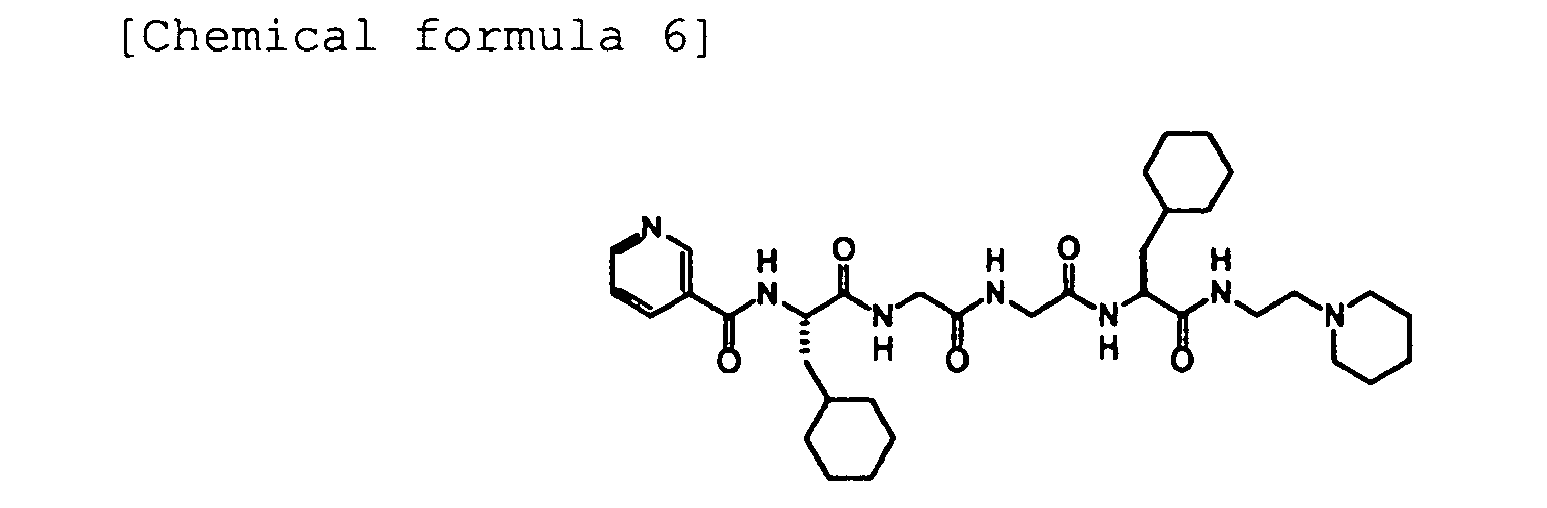
- Nicotinoyl-β-cyclohexyl-L-alanyl-glycyl-glycine was produced in the same manner as Reference Example 1, by using nicotinoyl chloride in place of 2-furoyl chloride in Reference Example 1. The title compound was obtained as a colorless crystalline powder in the same manner as Example 1 from nicotinoyl-β-cyclohexyl-L-alanyl-glycyl-glycine and β-cyclohexyl-L-alanine 2-(1-piperidinyl)ethyl amide produced in Reference Example 2.
Melting powder: 122-126°C
1 H-NMR (CDCl3) δ :
9.12 (1 H, br. d, J = 1.7 Hz), 8.69 (1 H, br. dd, J = 1.7, 4.8 Hz),
8.22-8.30 (1 H, m), 8.20 (1 H, br. s), 8.18 (1 H, br. s), 7.84 (1 H, br. s),
7.52 (1 H, br. s), 7.43 (1 H, br. s), 7.35 (1 H, dd, J = 4.8, 7.5 Hz),
4.91-5.01 (1 H, m), 4.59-4.60 (1 H, m), 4.09-4.13 (3 H, m), 3.98 (1 H, dd, J = 4.8, 17.0 Hz), 3.33 (1 H, dt , J = 13.4, 5.8 Hz),
3.16 (1 H, dt, J = 13.4, 4.8 Hz), 2.27-2.44 (6 H, m) 1.49-1.72 (18 H, m),
1.04-1.32 (9 H, m), 0.78-1.04 (5 H, m). - Production of benzofuran-2-carbonyl-β-cyclohexyl-L-alanyl-glycyl-glycyl-β -cyclohexyl-L-alanine 2-(1-piperidinyl)ethyl amide
-


- Benzofuran-2-carbonyl-β-cyclohexyl-L-alanyl-glycyl-gl ycine was produced in the same manner as Reference Example 1, by using benzofuran-2-carbonyl chloride in place of 2-furoyl chloride in Reference Example 1. The title compound was obtained as a colorless crystalline powder in the same manner as Reference Example 1 from benzofuran-2-carbonyl-β-cyclohexyl-L-alanyl-glycyl-glycine and β-cyclohexyl-L-alanine 2-(1-piperidinyl)ethyl amide produced in Reference Example 2.
Melting point: 199°C (dec)
1H-NMR (CDCl3) δ:
7.66 (1 H, br. d, J = 7.3 Hz), 7.48-7.54 (2 H, m), 7.40-7.46 (3 H, m),
7.27-7.32 (2 H, m), 7.03 (1 H, br. d, J = 8.2 Hz), 6.75 (1 H, br. s),
4.68 (1 H, dt, J = 8.7, 6.8 Hz), 4.55 (1 H, dt, J = 6.3, 8.5 Hz),
4.09 (1 H, dd, J = 6.0, 16.8 Hz), 3.99 (1 H, dd, J = 5.8, 17.0 Hz),
3.93 (1 H, dd, J = 5. 6, 17.0 Hz) , 3. 87 (1 H, dd, J = 5.3, 16.8 Hz),
3.25 (1 H, dt, J = 12.6, 6.3 Hz), 3.22 (1 H, dt, J = 12.6, 6.0 Hz),
2.30-2.43 (6 H, m) 1.50-1.88 (18 H, m), 1.08-1.49 (9 H, m), 0.82-1.08 (5 H, m). - Production of isoxazole-3-carbonyl-β-cyclohexyl-L-alanyl-glycyl-glycyl-β-cyclohexyl-L-alanine 2-(1-piperidinyl)ethyl amide
-

- Isoxazole-3-carbonyl-β-cyclohexyl-L-alanyl-glycyl-gly cine was produced in the same manner as Reference Example 1, by using isoxazole-3-carbonyl chloride in place of 2-furoyl chloride in Reference Example 1. The title compound was obtained as a colorless crystalline powder in the same manner as Example 1 from isoxazole-3-carbonyl-β-cyclohexyl-L-alanyl-glycyl-glycine and β-cyclohexyl-L-alanine 2-(1-piperidinyl)ethyl amide produced in Reference Example 2.
Melting point: 106°C (dec)
1H-NMR (CDCl3) δ:
8.32 (1 H, d, J = 1.7 Hz), 8.04 (1 H, br. s), 7.67 (1 H, br. s),
7.44 (1 H, br. s), 7.20 (1 H, br. d, J = 7.0 Hz), 6.98 (1 H, br. s),
6.95 (1 H, d, J = 1.7 Hz), 4.64-4.76 (1 H, m), 4.28-4.45 (1 H, m),
4.08 (1 H, br. dd, J = 5.6, 16.3 Hz), 3.96-4.02 (1 H, m), 3.94 (1H, br. dd, J=5.6, 19.5 Hz) , 3.77-3.89 (1H, m) , 3.38-3.41 (1 H, m),
3.26-3.38 (1 H, m), 3.26-3.38 (1 H, m), 2.37-2.65 (6 H, m) 1.52-1.95 (18 H, m), 1.05-1.52 (9 H, m), 0.80-1.05 (5 H, m). - Production of picolinoyl-β-cyclohexyl-L-alanyl-glycyl-glycyl -β-cyclohexyl-L-alanine 2-(1-piperidinyl)ethyl amide
-

- Picolinoyl-β-cyclohexyl-L-alanyl-glycyl-glycine was produced in the same manner as Reference Example 1, by using picolinoyl chloride in place of 2-furoyl chloride in Reference Example 1. The title compound was obtained as a colorless crystalline powder in the same manner as Reference Example 1 from picolinoyl-β-cyclohexyl-L-alanyl-glycyl-glycine and β-cyclohexyl-L-alanine 2-(1-piperidinyl)ethyl amide produced in Reference Example 2.
Melting point: 158-162°C
1H-NMR (CDCl3) δ :
8.59 (1 H, br. d, J = 4.6 Hz), 8.44 (1 H, br. d, J = 6.3 Hz), 8.12 (1 H, br. d, J = 7.8 Hz), 7.87 (1 H, br. dd, J= 1.4, 7.8 Hz),
7.54 (1 H, br. s), 7.47 (1 H, br. dd, J = 4.6, 7.8 Hz), 6.98 (1 H, br. d, J = 8.2 Hz), 6.77 (1 H, br. s),
4.52 (1 H, dt, J =9.2, 6.0 Hz), 4.46 (1 H, dt, J = 5.6, 8.2 Hz), 3.97-4.09 (2 H, m), 3.86-3.96 (2 H, m), 3.29 (1 H, dt, J = 5.8, 5.8 Hz),
3.28 (1 H, dt, J = 5.8, 5.6 Hz), 2.32-2.50 (6 H, m) 1.50-1.95 (18 H, m),
1.10-1.50 (9 H, m), 0.85-1.10 (5 H, m). - Production of 4,5-dimethyl-2-furoyl-β-cyclohexyl-L-alanyl-glycyl-glycyl-β -cyclohexyl-L-alanine 2-(1-piperidinyl)ethyl amide
-

- 4,5-Dimethyl-2-furoyl-p-cyclohexyl-L-alanyl-glycyl-gl ycine was produced in the same manner as Reference Example 1, by using 4,5-dimethyl-2-furoyl chloride in place of 2-furoyl chloride in Reference Example 1. The title compound was obtained as a colorless amorphous powder in the same manner as Example 1 from 4,5-dimethyl-2-furoyl-β-cyclohexyl-L-alanyl-glycyl -glycine and β-cyclohexyl-L-alanine 2-(1-piperidinyl)ethyl amide produced in Reference Example 2.
1H-NMR (CDCl3) δ:
7.46 (1 H, br. s), 7.41 (1 H, br. s ), 7.10 (1 H, br. d, J = 8.0 Hz),
6.97 (1 H, br. d, J = 7.0 Hz), 6.91 (1 H, s),
4.55 (1 H, dt, J = 9.0, 6.3 Hz), 4.45 (1 H, dt, J = 5. 8, 8. 5 Hz), 4.05 (1 H, dd, J = 6.0, 16.8 Hz), 3.93 (2 H, br. dd, J = 1.9, 5.8 Hz),
3.84 (1 H, dd, J = 5.3, 16.8 Hz), 3.31 (1 H, dt, J = 5.8, 5.8 Hz),
3.29 (1 H, dt, J = 5.8, 5.6 Hz), 2.30-2.45 (6 H, m), 2.25 (3 H, s),
1.95 (3 H, s), 1.50-1.85 (18 H, m), 1.05-1.50 (9H, m), 0.80-1.05 (5 H, m). - Production of imidazole-4-carbonyl-β-cyclohexyl-L-alanyl -glycyl-glycyl-β-cyclohexyl-L-alanine 2-(1-piperidinyl)ethyl amide
-

- Imidazole-4-carbonyl-β-cyclohexyl-L-alanyl-glycyl-glycine was produced in the same manner as Reference Example 1, by using imidazole-2-carbonyl chloride in place of 2-furoyl chloride in Reference Example 1. The tile compound was obtained as a colorless crystalline powder in the same manner as Reference Example 1 from imidazole-4-carbonyl-β-cyclohexyl-L-alanyl-glycyl-glycine and β-cyclohexyl-L-alanine 2-(1-piperidinyl)ethyl amide produced in Reference Example 2.
Melting point: 129-138°C (dec)
1H-NMR [CD3OD-CD3Cl (1:5)] δ :
7.61 (1 H, d, J = 0.9 Hz), 7.58 (1 H, d, J = 0.9 Hz),
4.38 (1 H, br. dd, J = 5.6, 9.2 Hz), 4.37 (1 H, br. dd, J = 5.1, 9.5 Hz),
3.97 (1 H, br. s), 3.93 (1 H, br. s), 3.87 (2 H, br. dd, J = 4.6, 16.8 Hz),
3.30 (1 H, br. dt, J = 13.6, 7.3 Hz), 3.28 (1 H, br. dt, J = 13.6, 7.0 Hz),
2.38-2.58 (6 H, m), 1.50-1.85 (18 H, m), 1.05-1.50 (9 H, m), 0.80-1.05 (5 H, m). - According to the present invention, there can be provided PAR-2 agonist having PAR-2 activation potency same as TRAP or more improved potency, even in case of reducing amino acid of peptide consisted , and thus can be provided a useful compound having PAR-2 agonist action. Further, there can be also provided PAR-2 agonist useful for prevention of development and progress, amelioration of clinical state, treatment or the like, and PAR-2 agonist useful for pharmaceutical development, for the PAR-2 associated diseases, for example, fever, dryness of eye, corneal epithelial detachment, keratitis, corneal ulceration, conjunctival inflammation, dysfunction of masticatory, dysphagia, taste disorder, mouth odor, mouth discomfort, mouth infection, mouth inflammation, cardiovascular functional disorder, acute respiratory distress syndrome, peptic ulcer such as gastric ulceration and duodenal ulcer, gastric inflammation, visceral pain, diarrhea, enteritis such as ulcerative colitis, kidney disorder such as nephritis, pancreatitis, ulcer tissue, bone resorption, dysmenorrhea, premature labor, nephrosis, or symptom of low blood pressure. Thus, the compound and pharmaceutical composition of the present invention is industrially useful.
Claims (22)
- A compound represented by the general formula (1), a salt thereof or a solvate thereof, wherein:
[General formula 1] Ar-CO-AA1-AA2-AA3-AA4-NH-X-NR1R2 (1)
Ar represents a phenyl group or an aromatic heterocyclic group optionally having substituent(s);
AA1 represents a hydrophobic amino acid;
AA2 represents an amino acid absent of substituent(s) comprising more than two carbon atoms;
AA3 represents an amino acid absent of substituent(s) comprising more than two carbon atoms;
AA4 represents a hydrophobic amino acid;
X represents C2-C6 straight- chain or branched bivalent saturated aliphatic hydrocarbon group;
Each of R1 and R2 are the same or independently represents C1-C8 saturated or unsaturated aliphatic hydrocarbon group, or R1 and R2 optionally form a ring together with the nitrogen atom adjacent to them. - A compound, a salt or a solvate according to claim 1, wherein Ar in the general formula (1) is optionally having substituent(s), and a monocyclic, a polycyclic or a condensed ring system group comprising 5 to 7 membered aromatic heterocyclic ring wherein at least one ring have one, or more than two hetero atom (s) selected from nitrogen atom, oxygen atom and sulfur atom.
- A compound, a salt or a solvate according to claim 1, wherein Ar in the general formula (1) is C1-C8 straight-chain or branched alkyl group, an alkoxy group consisting of C1-C8 straight-chain or branched alkyl group, phenyl group optionally having halogen atom(s) or an aromatic heterocyclic group as substituent(s).
- A compound, a salt or a solvate according to claim 1, wherein Ar in the general formula (1) is furyl group, pyridyl group, benzofuryl group, isoxazoryl group, imidazolyl group, buromofuryl group or dimethylfuryl group.
- A compound, a salt or a solvate according to claim 1, wherein amino acids of AA1 and AA4 in the general formula (1) are the same or independently β-cyclohexylalanine, phenylalanine, isoleucine, luecine or valine.
- A compound, a salt or a solvate according to claim 5, wherein amino acids of AA1 and AA4 in the general formula (1) are the same or independently β-cyclohexylalanine or phenylalanine.
- A compound, a salt or a solvate according to claim 6, wherein AA4 is β-cyclohexylalanine.
- A compound, a salt or a solvate according to claim 1, wherein amino acids of AA2 and AA3 in the general formula (1) are the same or independently glycine, α-fuluoroglycine or α,α-difuloroglycine.
- A compound, a salt or a solvate according to claim 7, wherein amino acids of AA2 and AA3 in the general formula (1) are glycine.
- A compound, a salt or a solvate according to claim 1, wherein X in the general formula (1) is a straight-chain group represented by the formula
-(CH2)n-
(in which n represents integer number 2 to 6). - A compound, a salt or a solvate according to claim 10 wherein X is ethylene group.
- A compound, or a salt or a solvate thereof according to claim 1 wherein R1 and R2 in the general formula (1) are the same or independently C1-C8 straight-chain or branched alkyl group, C2-C8 straight-chain or branched alkenyl group or C2-C8 straight-chain or branched alkynyl group, or R1 and R2 together with the nitrogen atom adjacent to them form a 5 to 8 membered saturated or unsaturated alicyclic ring group having nitrogen atom.
- A compound, a salt or a solvate according to claim 12 wherein -NR1R2 group in the general formula (1) is demithylamino group, diethylamino group, di-n-propylamino group, diisopropylamino group, ethylmethylamino group, N-methyl-N-n-propylamino group, N-methyl-N-isopropylamino group, N-ethyl-N-n-isopropylamino group, N-ethyl-N-isopropylamino group, N-n-propyl-N-isopropylamino group, 1-pyroridinyl group or 1-piperidinyl group.
- A compound, or a salt or a solvate thereof according to claim 13 wherein -NR1R2 in the general formula (1) is 1-piperidinyl group.
- 2-furoyl-β-cyclohexyl-L-alanyl-glycyl-glycyl-β-cycloh exyl-L-alanine 2-(1-piperidinyl)ethylamide, 2-furoyl-L-phenylalanyl-glycyl-glycyl-β-cyclohexyl-L-ala nine 2-(1-piperidinyl)ethylamide, 5-bromo-2-furoyl-β-cyclohexyl-L-alanyl-glycyl-glycyl-β-c yclohexyl-L-alanine 2-(1-piperidinyl)ethylamide, nicotinoyl-β-cyclohexyl-L-alanyl-glycyl-glycyl-β-cyclohe xyl-L-alanine 2-(1-piperidinyl)ethylamide, benzofuran-2-carbonyl-β-cyclohexyl-L-alanyl-glycyl-glycy 1-β-cyclohexyl-L-alanine 2-(1-piperidinyl)ethylamide, isoxazole-3-carbonyl-β-cyclohexyl-L-alanyl-glycyl-glycyl -β-cyclohexyl-L-alanine 2-(1-piperidinyl)ethylamide, picorinoyl-β-cyclohexyl-L-alanyl-glycyl-glycyl-β-cyclohe xyl-L-alanine 2-(1-piperidinyl)ethylamide, 4,5-dimethyl-2-furoyl-β-cyclohexyl-L-alanyl-glycyl-glycy 1-β-cyclohexyl-L-alanine 2-(1-piperidinyl)ethylamide, or imidazole-2-carbonyl-β-cyclohexyl-L-alanyl-glycyl-glycyl -β-cyclohexyl-L-alanine 2-(1-piperidinyl)ethylamide, or a salt or a solvate thereof.
- A pharmaceutical composition comprises a compound, or a salt or a solvate thereof according to claim 1, and a pharmaceutically acceptable carrier.
- A pharmaceutical composition according to claim 16 wherein the pharmaceutical composition is for prophylaxis and therapy of PAR-2 associated diseases.
- A pharmaceutical composition according to claim 16 wherein the pharmaceutical composition is for prophylaxis and therapy of at least one disease selected from fever, dryness of eye, corneal epithelialdetachment, keratitis, corneal ulceration, conjunctival inflammation, dysfunction of masticatory, dysphagia, taste disorder, mouth odor, mouth discomfort, mouth infection, mouth inflammation, cardiovascular functional disorder, acute respiratory distress syndrome, peptic ulcer such as gastric ulceration and duodenal ulcer, gastric inflammation, visceral pain, diarrhea, enteritis such as ulcerative colitis, kidney disorder such as nephritis, pancreatitis, ulcer tissue, bone resorption, dysmenorrhea, premature labor, nephrosis, or symptom of low blood pressure.
- A prophylactic/therapeutic method for the PAR-2 associated disease, which comprises administering an effective amount of the compound, a salt or a solvate thereof according to claim 1, to patients having, or likely to have, the PAR-2 associated diseases.
- A prophylactic/therapeutic method according to claim 19, wherein the PAR-associated diseases are fever, dryness of eye, corneal epithelial detachment, keratitis, corneal ulceration, conjunctival inflammation, dysfunction of masticatory, dysphagia, taste disorder, mouth odor, mouth discomfort, mouth infection, mouth inflammation, cardiovascular functional disorder, acute respiratory distress syndrome, peptic ulcer such as gastric ulceration and duodenal ulcer, gastric inflammation, visceral pain, diarrhea, enteritis such as ulcerative colitis, kidney disorder such as nephritis, pancreatitis, ulcer tissue, bone resorption, dysmenorrhea, premature labor, nephrosis, or symptom of low blood pressure.
- A use of the compound, the salt or the solvate thereof according to claim 1 for manufacturing a pharmaceutical composition for prophylaxis and therapy of the PAR-2 associated diseases.
- A use according to claim 21 wherein the PAR-2 associated diseases are fever, dryness of eye, corneal epithelial detachment, keratitis, corneal ulceration, conjunctival inflammation, dysfunction of masticatory, dysphagia, taste disorder, mouth odor, mouth discomfort, mouth infection, mouth inflammation, cardiovascular functional disorder, acute respiratory distress syndrome, peptic ulcer such as gastric ulceration and duodenal ulcer, gastric inflammation, visceral pain, diarrhea, enteritis such as ulcerative colitis, kidney disorder such as nephritis, pancreatitis, ulcer tissue, bone resorption, dysmenorrhea, premature labor, nephrosis, or symptom of low blood pressure.
Applications Claiming Priority (2)
| Application Number | Priority Date | Filing Date | Title |
|---|---|---|---|
| US63940304P | 2004-12-28 | 2004-12-28 | |
| PCT/JP2005/023852 WO2006070780A1 (en) | 2004-12-28 | 2005-12-27 | Par-2 agonist |
Publications (2)
| Publication Number | Publication Date |
|---|---|
| EP1845104A1 true EP1845104A1 (en) | 2007-10-17 |
| EP1845104A4 EP1845104A4 (en) | 2009-08-05 |
Family
ID=36614894
Family Applications (1)
| Application Number | Title | Priority Date | Filing Date |
|---|---|---|---|
| EP05822433A Withdrawn EP1845104A4 (en) | 2004-12-28 | 2005-12-27 | AGONIST OF THE RECEIVER PAR-2 |
Country Status (4)
| Country | Link |
|---|---|
| US (1) | US7910556B2 (en) |
| EP (1) | EP1845104A4 (en) |
| JP (1) | JP4927566B2 (en) |
| WO (1) | WO2006070780A1 (en) |
Cited By (2)
| Publication number | Priority date | Publication date | Assignee | Title |
|---|---|---|---|---|
| GB2450747A (en) * | 2007-07-06 | 2009-01-07 | Univ Sheffield | Treatment of sensorineural hearing loss |
| EP2598517A4 (en) * | 2010-07-28 | 2014-11-26 | Univ Queensland | MODULATORS OF PROTEASE ACTIVATED RECEPTORS |
Families Citing this family (4)
| Publication number | Priority date | Publication date | Assignee | Title |
|---|---|---|---|---|
| WO2006104190A1 (en) | 2005-03-29 | 2006-10-05 | Kowa Company, Ltd. | Par-2 agonist |
| EP2313110A1 (en) * | 2008-08-05 | 2011-04-27 | Boehringer Ingelheim International GmbH | Effectors of par-2 activation and their use in the modulation of inflammation |
| EP2427205A2 (en) * | 2009-05-04 | 2012-03-14 | INSERM - Institut National de la Santé et de la Recherche Médicale | Par2 agonists for use in the treatment or prevention of influenza virus type a infections |
| HK1223096A1 (en) | 2013-09-25 | 2017-07-21 | Vertex Pharmaceuticals Incorporated | Imidazopyridazines useful as inhibitors of the par-2 signaling pathway |
Family Cites Families (10)
| Publication number | Priority date | Publication date | Assignee | Title |
|---|---|---|---|---|
| US5716789A (en) | 1993-07-26 | 1998-02-10 | Cor Therapeutics, Inc. | Method to determine ligands, agonist and antagonist of C140 receptor |
| JPH11514207A (en) | 1995-01-25 | 1999-12-07 | シーオーアール・セラピューティックス・インコーポレーテッド | Recombinant C140 receptor, agonists and antagonists thereof, and nucleic acid encoding the receptor |
| US5888529A (en) | 1997-03-28 | 1999-03-30 | The Regents Of The University Of California | Ileus treatment method |
| JP4515560B2 (en) * | 1999-08-27 | 2010-08-04 | 扶桑薬品工業株式会社 | Salivary secretion promoting composition |
| JP3677421B2 (en) | 1999-12-27 | 2005-08-03 | 扶桑薬品工業株式会社 | Composition for promoting lacrimal secretion |
| JP4065642B2 (en) | 2000-02-24 | 2008-03-26 | 扶桑薬品工業株式会社 | Composition for prevention and treatment of digestive system diseases |
| JP2004501191A (en) * | 2000-06-28 | 2004-01-15 | テバ ファーマシューティカル インダストリーズ リミティド | Carvedilol |
| GB0213286D0 (en) | 2002-06-10 | 2002-07-24 | Univ Edinburgh | Par-2-Activating peptide derivative and pharmaceutical composition using the same |
| AU2003264917A1 (en) * | 2002-07-08 | 2004-01-23 | Pliva - Istrazivacki Institut D.O.O. | Hybrid molecules of macrolides with steroid/non-steroid anti-inflammatory, antineoplastic and antiviral active molecules |
| WO2006104190A1 (en) | 2005-03-29 | 2006-10-05 | Kowa Company, Ltd. | Par-2 agonist |
-
2005
- 2005-12-27 JP JP2006550779A patent/JP4927566B2/en not_active Expired - Fee Related
- 2005-12-27 EP EP05822433A patent/EP1845104A4/en not_active Withdrawn
- 2005-12-27 WO PCT/JP2005/023852 patent/WO2006070780A1/en not_active Ceased
- 2005-12-27 US US11/722,952 patent/US7910556B2/en not_active Expired - Fee Related
Cited By (4)
| Publication number | Priority date | Publication date | Assignee | Title |
|---|---|---|---|---|
| GB2450747A (en) * | 2007-07-06 | 2009-01-07 | Univ Sheffield | Treatment of sensorineural hearing loss |
| EP2598517A4 (en) * | 2010-07-28 | 2014-11-26 | Univ Queensland | MODULATORS OF PROTEASE ACTIVATED RECEPTORS |
| US8927503B2 (en) | 2010-07-28 | 2015-01-06 | The University Of Queensland | Modulations of protease activated receptors |
| US9701711B2 (en) | 2010-07-28 | 2017-07-11 | The University Of Queensland | Modulators of protease activated receptors |
Also Published As
| Publication number | Publication date |
|---|---|
| JP4927566B2 (en) | 2012-05-09 |
| US20090131330A1 (en) | 2009-05-21 |
| EP1845104A4 (en) | 2009-08-05 |
| JPWO2006070780A1 (en) | 2008-06-12 |
| US7910556B2 (en) | 2011-03-22 |
| WO2006070780A1 (en) | 2006-07-06 |
Similar Documents
| Publication | Publication Date | Title |
|---|---|---|
| KR101999195B1 (en) | Benzylamine derivatives as inhibitors of plasma kallikrein | |
| US4885283A (en) | Phosphinic acid derivatives | |
| US5691315A (en) | Endothelin antagonistic peptide derivatives | |
| TWI228123B (en) | Antithrombotic compounds | |
| CN101405294B (en) | Compounds for Enzyme Inhibition | |
| NO861141L (en) | PROCEDURE FOR THE PREPARATION OF THERAPEUTIC ACTIVITIES N, N [-DIALKYLGUANIDINO DIPEPTIDES. | |
| JPH0381256A (en) | Renin blocking agent | |
| US20060166896A1 (en) | Novel indazole peptidomimetics as thrombin receptor antagonists | |
| JP2000517305A (en) | Stable non-hygroscopic crystalline form of N- [NN- (4- (piperidin-4-yl) butanoyl) -N-ethylglycyl] compound | |
| EP0858262B1 (en) | Thrombin inhibitors | |
| US7910556B2 (en) | PAR-2 agonist | |
| US6642253B2 (en) | Thrombin inhibitors comprising an aminoisoquinoline group | |
| EP1806141B1 (en) | Par-2 antagonists | |
| EP1864994B1 (en) | Par-2 agonist | |
| US5922697A (en) | Compounds, compositions and methods for inhibiting the binding of proteins containing an SH2 domain to cognate phosphorylated proteins | |
| DE69606552T2 (en) | ACYLATED ENOL DERIVATIVES OF ALPHA KETOESTERS AND ALPHA KETOAMIDES | |
| WO1997010261A1 (en) | Peptide derivatives | |
| JPH06503315A (en) | Renin-inhibitory peptides of the cyclohexylstatin type, their preparation and their use in medicines | |
| CA3018344C (en) | Neuropeptide s receptor (npsr) agonists | |
| NZ620271B2 (en) | Benzylamine derivatives as inhibitors of plasma kallikrein | |
| CZ2001276A3 (en) | Urokinase inhibitors and pharmaceutical preparations in which they are comprised | |
| CS250699B2 (en) | Method of octahydro-6-azaindole's depetidic derivatives production | |
| HU196226B (en) | Process for producing new tripeptide derivatives of antiamnesic activity and pharmaceutical compositions containing them as active components |
Legal Events
| Date | Code | Title | Description |
|---|---|---|---|
| PUAI | Public reference made under article 153(3) epc to a published international application that has entered the european phase |
Free format text: ORIGINAL CODE: 0009012 |
|
| 17P | Request for examination filed |
Effective date: 20070727 |
|
| AK | Designated contracting states |
Kind code of ref document: A1 Designated state(s): AT BE BG CH CY CZ DE DK EE ES FI FR GB GR HU IE IS IT LI LT LU LV MC NL PL PT RO SE SI SK TR |
|
| DAX | Request for extension of the european patent (deleted) | ||
| RIC1 | Information provided on ipc code assigned before grant |
Ipc: A61P 9/00 20060101ALI20090623BHEP Ipc: A61P 29/00 20060101ALI20090623BHEP Ipc: A61P 1/04 20060101ALI20090623BHEP Ipc: A61P 19/08 20060101ALI20090623BHEP Ipc: A61P 11/00 20060101ALI20090623BHEP Ipc: A61P 13/10 20060101ALI20090623BHEP Ipc: C07K 5/107 20060101ALI20090623BHEP Ipc: A61P 1/00 20060101ALI20090623BHEP Ipc: A61K 38/00 20060101AFI20090623BHEP Ipc: A61P 27/02 20060101ALI20090623BHEP Ipc: A61P 27/00 20060101ALI20090623BHEP Ipc: A61P 15/06 20060101ALI20090623BHEP Ipc: A61P 13/00 20060101ALI20090623BHEP Ipc: C07K 5/10 20060101ALI20090623BHEP Ipc: A61P 1/12 20060101ALI20090623BHEP |
|
| A4 | Supplementary search report drawn up and despatched |
Effective date: 20090706 |
|
| 17Q | First examination report despatched |
Effective date: 20091009 |
|
| STAA | Information on the status of an ep patent application or granted ep patent |
Free format text: STATUS: THE APPLICATION IS DEEMED TO BE WITHDRAWN |
|
| 18D | Application deemed to be withdrawn |
Effective date: 20130219 |