EP1845099A1 - Artemisine (qinghaosu) derivatives, their preparation methods and their use, and pharmaceutical compositions containing the same - Google Patents
Artemisine (qinghaosu) derivatives, their preparation methods and their use, and pharmaceutical compositions containing the same Download PDFInfo
- Publication number
- EP1845099A1 EP1845099A1 EP06705603A EP06705603A EP1845099A1 EP 1845099 A1 EP1845099 A1 EP 1845099A1 EP 06705603 A EP06705603 A EP 06705603A EP 06705603 A EP06705603 A EP 06705603A EP 1845099 A1 EP1845099 A1 EP 1845099A1
- Authority
- EP
- European Patent Office
- Prior art keywords
- dihydroartemisinin
- phenyl
- compound
- ether
- methyl
- Prior art date
- Legal status (The legal status is an assumption and is not a legal conclusion. Google has not performed a legal analysis and makes no representation as to the accuracy of the status listed.)
- Granted
Links
- 0 C[C@](CCC1[C@](C)C(*)O2)C3C1[C@]2OC(C)CC3 Chemical compound C[C@](CCC1[C@](C)C(*)O2)C3C1[C@]2OC(C)CC3 0.000 description 6
Images


Classifications
-
- C—CHEMISTRY; METALLURGY
- C07—ORGANIC CHEMISTRY
- C07D—HETEROCYCLIC COMPOUNDS
- C07D493/00—Heterocyclic compounds containing oxygen atoms as the only ring hetero atoms in the condensed system
- C07D493/12—Heterocyclic compounds containing oxygen atoms as the only ring hetero atoms in the condensed system in which the condensed system contains three hetero rings
- C07D493/18—Bridged systems
-
- A—HUMAN NECESSITIES
- A61—MEDICAL OR VETERINARY SCIENCE; HYGIENE
- A61P—SPECIFIC THERAPEUTIC ACTIVITY OF CHEMICAL COMPOUNDS OR MEDICINAL PREPARATIONS
- A61P17/00—Drugs for dermatological disorders
-
- A—HUMAN NECESSITIES
- A61—MEDICAL OR VETERINARY SCIENCE; HYGIENE
- A61P—SPECIFIC THERAPEUTIC ACTIVITY OF CHEMICAL COMPOUNDS OR MEDICINAL PREPARATIONS
- A61P33/00—Antiparasitic agents
- A61P33/02—Antiprotozoals, e.g. for leishmaniasis, trichomoniasis, toxoplasmosis
- A61P33/06—Antimalarials
-
- A—HUMAN NECESSITIES
- A61—MEDICAL OR VETERINARY SCIENCE; HYGIENE
- A61P—SPECIFIC THERAPEUTIC ACTIVITY OF CHEMICAL COMPOUNDS OR MEDICINAL PREPARATIONS
- A61P37/00—Drugs for immunological or allergic disorders
-
- A—HUMAN NECESSITIES
- A61—MEDICAL OR VETERINARY SCIENCE; HYGIENE
- A61P—SPECIFIC THERAPEUTIC ACTIVITY OF CHEMICAL COMPOUNDS OR MEDICINAL PREPARATIONS
- A61P37/00—Drugs for immunological or allergic disorders
- A61P37/02—Immunomodulators
- A61P37/06—Immunosuppressants, e.g. drugs for graft rejection
Definitions
- the present invention relates to the pharmaceutical chemistry field, particularly, to new terpene artemisinin derivatives, their preparation method and their use, and their pharmaceutical compositions containing the artemisinin derivatives.
- Artemisinin an effective component of the traditional Chinese drug Qinghao ( Artemisia annua L.), is a peculiar sesquiterpenoid lactone having a peroxy group.
- the chemical structures of artemisinin and its derivative artesunate are : respectively. Artemisinin not only has excellent antimalarial effect, but also is effective to other parasites (e.g. Schistosoma japonicum etc). Moreover it has been found to be immunosuppressive, and was once used in a clinical trial of lupus erythematosus with promising results. With the extension of related research works, it has been found that artesunate, a derivative of artemisinin, has a stronger immunosuppressive activity than artemisinin.
- One object of the invention is to provide a type of more effective and safer artemisinin derivatives having immunosuppressive activity.
- Another object of the invention is to provide a preparation method of the above artemisinin derivatives.
- Still another object of the invention is to provide a pharmaceutical composition containing the above artemisinin derivatives.
- Still another object of the invention is to provide dosage forms of the above pharmaceutical composition containing the artemisinin derivatives of the present invention.
- Still another object of the invention is to provide the medical use of the above artemisinin derivatives.
- Still another object of the invention is to provide the medical use of the above pharmaceutical composition containing the artemisinin derivatives of the present invention.
- the present invention provides a type of artemisinin derivatives having the following structure I, wherein,
- the artemisinin derivatives according to the present invention may be 4-methoxycarbonylmethyl phenyl-dihydroartemisinin ether, 4-carboxylmethyl phenyl-dihydroartemisinin ether, 4-ethoxycarbonylmethoxy phenyl-dihydroartemisinin ether, 3-succinic acid monoacyl phenyl-dihydroartemisinin ether, 4-ethoxycarbonyl methylaminocarbonyl phenyl-dihydroartemisinin ether, 4-methoxycarbonyl ( ⁇ -methyl) methenyl phenyl-dihydroartemisinin ether, 4- o -methoxy phenoxycarbonyl ( ⁇ -methyl)methenyl phenyl-dihydroartemisinin ether, 4-ethoxycarbonyl ( ⁇ -methyl)methenyl oxy oxy phenyl-dihydroartemisinin ether, 4-carboxyl
- the present invention further provides a preparation method of the above artemisinin derivatives, which includes the following steps:
- the detailed preparation method can refer to the contents of the Chinese patents ZL 94113982.4 , ZL 01113407.0 and patent application No. CN 99807416 of the same inventor.
- the present invention further provides a pharmaceutical composition containing the above artemisinin derivatives, which comprises the compound of formula I or its pharmaceutically acceptable salts in a safe and effective dose range and the pharmaceutically acceptable carrier.
- the said pharmaceutical composition comprises 1-85 wt % of the artemisinin derivatives according to claim 1 or pharmaceutically acceptable salt thereof, 15-99 wt % of excipient, 0-60 wt % of other conventional auxiliary materials.
- the "safe and effective dose” means: the amount of the compound is sufficient to evidently improve the patients condition and does not cause a serious side effect.
- the safe and effective dose of the compound may be determined according to the specific conditions, such as the age and weight of the subject, the adaptive diseases, the route of administration, the course of treatment and any related therapy, etc. Generally, an adult is administered by 0.1 mg/day to 500 mg/day in a single dose or multiple doses. The dosage should be reduced accordingly for children.
- “Pharmaceutically acceptable carrier” refers to one or more compatible solid or liquid fillers or excipients, which are suitable for human body and must have sufficient high purity and low toxicity. "Compatible” herein means that each component of the composition can be blended with the compounds of the invention and with each other without obviously reducing the pharmacodynamic activity of the compound.
- the examples of pharmaceutically acceptable carrier partly includes sugars (e.g. glucose, sucrose, lactose, etc.), starch (e.g. maize starch, potato starch, etc.), cellulose and its derivatives (e.g.
- emulsifier e.g. Tween®
- moistening agent e.g. sodium dodecyl sulphate
- plasticizer e.g. dibutyl sebacate
- coloring agent e.g. dibutyl
- the present invention also provides dosage forms of the above pharmaceutical composition.
- the dosage form may be oral, parenteral, pernasal, lingual, ophthalmically, respiratory tract or rectal dosage form.
- the dosage form is enteric coated pill, sublingual tablet, patch, suppository, cream, ointment or gels for skin use.
- the present invention further provides the use of above artemisinin derivatives in preparing the drugs for treating or preventing diseases of immune system, and the use for treating or preventing diseases of immune system.
- the present invention provides the use of the pharmaceutical composition containing the above artemisinin derivatives in preparing the drugs for treating or preventing diseases of immune system, and the use for treating or preventing diseases of immune system.
- the artemisinin derivatives of present invention have effective immunosuppressive activities and can be used more safely.
- the compound containing the artemisinin derivatives can be manufactured into the dosage forms convenient for long term usage, such as tablets, pills and the like, and has more extensive production and use value.
- the artemisinin nucleus is represented by Q: wherein, the ripple line ( ) represents ⁇ substitute or/and ⁇ substitute; the solid line ( ) represents ⁇ substitute; the dash line ( ) represents ⁇ substitute.
- the obtained compound of preparation example 1 was hydrolyzed in KOH/C 2 H 5 OH solution, then the raw product was recrystallized to obtain a white crystallized compound (compound 2) with a melting point of 154-156°C.
- Preparation example 4 Preparation of 4-(dimethylamino ethoxy carbonyl methoxy) phenyl-dihydroartemisinin ether ( ⁇ type) (compound 4)
- Preparation example 7 Preparation of 4-hydroxy ( ⁇ -methyl) benzyl-dihydroartemisinin ether ( ⁇ type) (compound 7)
- the compound 6 obtained from preparation example 6 was hydrolyzed in a basic solution to obtain the compound 7.
- Preparation example 8 Preparation of 4-ethoxy carbonyl methoxy ( ⁇ -methyl) benzyl-dihydroartemisinin ether ( ⁇ type) (compound 8)
- the compound 7 obtained from preparation example 7 was reacted with ethyl chloroformate to obtain the compound 8.
- Preparation example 12 Preparation of (S)-2-ethoxy carbonyl methoxy ( ⁇ -cyano) benzyl-dihydroartemisinin ether (compound 12) and (R)-2-ethoxy carbonyl methoxy ( ⁇ -cyano) benzyl- dihydroartemisinin ether ( ⁇ type) (compound 13)
- the first fraction was (S)-2-ethoxy carbonyl methoxy ( ⁇ -cyano) benzyl-dihydroartemisinin ether, a white crystal with a melting point of 70-71 °C.
- the second fraction was (R)-2-ethoxy carbonyl methoxy ( ⁇ -cyano) benzyl-dihydroartemisinin ether, a white crystal with a melting point of 88-90 °C.
- Preparation example 17 Preparation of (S)- ⁇ -methyl formate-yl-1-menaphthyl-dihydroartemisinin ether (compound 18) and (R)- ⁇ -methyl formate-yl-1-menaphthyl-dihydroartemisinin ether ( ⁇ type) (compound 19)
- Preparation example 21 Preparation of 4- o -methoxy phenyloxy carbonyl-( ⁇ -methyl) methenylphenyl-dihydroartemisinin ether ( ⁇ type) (compound 23)
- Preparation example 22 Preparation of 4-ethoxycarbonyl -( ⁇ -methyl) methenyloxyphenyl-dihydroartemisinin ether ( ⁇ type) (compound 24)
- the compound of preparation example 22 was hydrolyzed in a basic solution to obtain the white amorphous compound 25.
- Preparation example 24 Preparation of 4- o -methoxy phenoxy carbonyl-( ⁇ -methyl) methenyloxyphenyl-dihydroartemisinin ether ( ⁇ type) (compound 26)
- Preparation example 25 Preparation of 3- o -methoxy phenoxy carbonyl-( ⁇ -methyl) methenyloxyphenyl-dihydroartemisinin ether ( ⁇ type) (compound 27)
- Preparation example 26 Preparation of 3-ethoxycarbonyl- ( ⁇ -methyl) methenyloxyphenyl-dihydroartemisinin ether ( ⁇ type) (compound 28)
- the compound of preparation example 26 was hydrolyzed in a basic solution to obtain the white amorphous solid compound 29.
- Preparation example 28 Preparation of 3- o -methoxy phenoxy carbonyl-( ⁇ -methyl) methenyloxyphenyl-dihydroartemisinin ether ( ⁇ type) (compound 30)
- the free acid obtained from the preparation example 27 was esterified to obtain the white amorphous solid compound 30.
- Preparation example 29 Preparation of 3-ethoxy carbonyl-( ⁇ -methyl) methenyloxy benzyl-dihydroartemisinin ether ( ⁇ type) (compound 31) and 3-ethoxy carbonyl-( ⁇ -methyl) methenyloxybenzyl-dihydroartemisinin ether ( ⁇ type) (compound 32)
- Preparation example 30 Preparation of 3-carboxy-(a-methyl) methenyloxy benzyl-dihydroartemisinin ether ( ⁇ type) (compound 33) and 3-carboxy-( ⁇ -methyl) methenyloxy benzyl-dihydroartemisinin ether ( ⁇ type) (compound 34)
- the compounds obtained from the preparation example 29 were hydrolyzed in a basic solution to obtain two white amorphous solid compounds 33 and 34.
- Preparation example 31 Preparation of 3- o -methoxy phenyloxy carbonyl-( ⁇ -methyl) methenyloxy benzyl-dihydroartemisinin ether ( ⁇ type) (compound 35)
- Preparation example 32 Preparation of 4-ethoxy carbonyl-( ⁇ -methyl) methenyloxy benzyl-dihydroartemisinin ether ( ⁇ type) (compound 36) and 4-ethoxy carbonyl-( ⁇ -methyl) methenyloxy benzyl-dihydroartemisinin ether ( ⁇ type) (compound 37)
- Elemental analysis (C 27 H 38 O 8 ): Calculated values: C 66.10 H 7.81 ( ⁇ type) Measured values: C 66.03 H 7.70 ( ⁇ type) Measured values: C 66.18 H 7.49.
- Preparation example 33 Preparation of 4-carboxy-( ⁇ -methyl) methenyloxy benzyl-dihydroartemisinin ether ( ⁇ type) (compound 38) and 4-carboxy-( ⁇ -methyl) methenyloxy benzyl-dihydroartemisinin ether ( ⁇ type) (compound 39)
- the compounds obtained from the preparation example 32 were hydrolyzed in a basic solution to obtain two white amorphous solid compounds 38 and 39.
- Preparation example 35 Preparation of 4-ethoxy carbonyl-( ⁇ -methyl) methenyloxy ( ⁇ -methyl) benzyl- dihydroartemisinin ether ( ⁇ type) (compound 41) and 4-ethoxy carbonyl-( ⁇ -methyl) methenyloxy ( ⁇ -methyl) benzyl-11- ⁇ -methyl dihydroartemisinin ether (compound 42)
- Preparation example 36 Preparation of 4-ethoxy carbonyl methoxy phenyl-dihydroartemisinin ether ( ⁇ type) (compound 43)
- Preparation example 37 Preparation of a tablet containing 4-carboxy ( ⁇ -methyl) methenyl phenyl-dihydroartemisinin ether ( ⁇ type)
- the formula is as follows: the content of each component was measured by weight percent 4-carboxy ( ⁇ -methyl) methenyl phenyl-dihydroartemisinin ether ( ⁇ type) 35 % starch 25 % microcrystalline cellulose 30 % sodium carboxymethyl starch 3 % starch paste (10%) 6 % magnesium stearate 1 %
- the active component was pulverized, and screened with 100 mesh sieve; after mixed homogeneously with microcrystalline cellulose, starch and sodium carboxymethyl starch, a proper amount of 10 % starch paste was added to prepare the damp mass; after granulation is carried out with 20 mesh sieve, the material was dried at 60°C, and granulae are processed; then the lubricant magnesium stearate was added into and mixed uniformly; tabletting was performed to obtain the final product.
- Preparation example 38 Preparation of a tablet containing 3-succinic acid monoacyl phenyl-dihydroartemisinin ether ( ⁇ type)
- the formula was as follows: all the content of each component was measured by weight percent 3-succinic acid monoacyl phenyl-dihydroartemisinin ether ( ⁇ type) 30 % microcrystalline cellulose 65 % crosslinked polyvidone 1.5 % micronized polyethylene glycol 4000 3 % micronized silica gel 0.5 %
- the active component was pulverized, and screened with 100 mesh sieve; after homogeneously mixed with the filler microcrystalline cellulose, the disintegrating agent crosslinked polyvidone, the lubricant micronized polyethylene glycol 4000, and the glidant micronized silica gel, tabletting was performed directly to obtain the final product.
- Preparation example 39 Preparation of an enteric coated tablet containing the salt of 4-(2-methoxy phenoxy) carbonyl ( ⁇ -methyl) methenyloxy phenyl-dihydroartemisinin ether
- the formula was as follows: the content of each component was measured by weight percent 4-(2-methoxy phenoxy)carbonyl ( ⁇ -methyl) methenyloxy phenyl-dihydroartemisinin ether 35 % pregelating starch 20 % microcrystalline cellulose 35 % crosslinking sodium carboxymethyl cellulose 4 % aqueous solution of polyvidone (8 %) 4 % talc powder 2 %
- the active component was pulverized, and screened with 100 mesh sieve; after homogeneously mixed with microcrystalline cellulose, pregelating starch and crosslinking sodium carboxymethyl cellulose, a proper amount of 8 % aqueous solution of polyvidone was added to prepare the damp mass; after granulation is carried out with 20 mesh sieve, the material was dried at 60°C, and granulae are processed; then the lubricant talc power was added into and mixed uniformly; tabletting was performed to obtain the core.
- the core was coated with 3% hydroxypropyl emthylcellulose (E5) alchol aqueous solution to form an isolation coating until the weight was increased by 8%; then Eudragit L30D was coated to form a enteric coating until the weight was increased by 10%, thereby the final product was obtained.
- E5 hydroxypropyl emthylcellulose
- Eudragit L30D was coated to form a enteric coating until the weight was increased by 10%, thereby the final product was obtained.
- Preparation example 40 Preparation of a hard capsule containing 4-methoxy carbonyl methyl phenyl-dihydroartemisinin ether ( ⁇ type)
- the formula was as follows: the content of each component was measured by weight percent 4-methoxy carbonyl methyl phenyl-dihydroartemisinin ether ( ⁇ type) 50 % pregelating starch 40 % talc powder 9 % micronized silica gel 1 %
- the active component and the adjuvants are homogeneously mixed and packed into empty capsule to obtain the final product.
- Preparation example 41 Preparation of a soft capsule containing 4-ethoxy carbonyl methoxy phenyl-dihydroartemisinin ether ( ⁇ type)
- the formula is as follows: the content of each component was measured by weight percent 4-ethoxycarbonylmethoxyphenyl-dihydroartemisinin ether ( ⁇ type) 45 % polyethylene glycol 400-1000 30 % suspending agent (10 ⁇ 30 % oil-wax mixture) 25 %
- the active component was pulverized and sieved, and other components were added and mixed thoroughly, then the soft capsule are prepared in a pelletizing machine.
- Preparation example 42 Preparation of a gel containing 4-methoxy carbonyl ( ⁇ -methyl) methenyl phenyl-dihydroartemisinin ether ( ⁇ type)
- the formula was as follows: the content of each component was measured by weight percent 4-methoxy carbonyl ( ⁇ -methyl) methenyl phenyl-dihydroartemisinin ether ( ⁇ type) 5 % crosslinking sodium polyacrylate 2 % polyethylene glycol 4000 8 % glycerol 10 % Benzalkonium bromide 1 % water 74 %
- the active component was added after being pulverized and sieved, and mixed homogenously; after crosslinking sodium polyacrylate was added into a proper amount of water (60°C) and stirred thoroughly, the matrix was mixed homogenouly with the active component, polyethylene glycol 4000 and glycerol, then sufficient water was added to obtain the final product.
- Preparation example 43 Preparation of a suppository containing 3-(2-methoxy phenoxy) carbonyl ( ⁇ -methyl) methenyloxy phenyl-dihydroartemisinin ether
- the formula was as follows: the content of each component was measured by weight percent 3-(2-methoxyphenoxy) carbonyl ( ⁇ -methyl) methenyloxy phenyl-dihydroartemisinin ether 15 % polyoxyethylene(40) monostearate 85 %
- the active component was pulverized and sieved, a small amount of molten matrix was added, after being ground and mixed sufficiently, the mixture was mixed with other molten matrix, and injected into suppository mold while maintaining the temperature.
- Preparation example 44 Preparation of a cream containing 4-ethoxycarbonyl methylamine carbonyl phenyl-dihydroartemisinin ether
- the formula was as follows: the content of each component was measured by weight percent 4-ethoxy carbonyl methylamine carbonyl phenyl-dihydroartemisinin ether 2.5 % glyceryl monostearate 8.5 % stearic acid 15 % white vaseline 10 % glycerol 8 % Tween-80 3 % water 53 %
- the active component was dissolved in a small amount of acetone, then glyceryl monostearate, stearic acid and white vaseline were added and heated together to be molten while maintaining the temperature at 80°C. Tween-80, glycerin and water were also heated to 80°C and added into the above oil phase slowly, the mixture was stirred along a same direction to obtain a white fine cream.
- Preparation example 45 Preparation of a patch containing 4-(dimethylamine ethoxy carbonyl methoxy) phenyl-dihydroartemisinin ether ( ⁇ type)
- the formula was as follows: the content of each component was measured by weight percent 4-(dimethylamine ethoxy carbonyl methoxy) phenyl-dihydroartemisinin ether ( ⁇ type) 15% acrylic resin 55% dibutyl sebacate 25% acetone 5%
- Acrylic resin used as matrix and plasticizer dibutyl sebacate of the amount as prescribed in the formula were dissloved in suitable amount of acetone and mixed homogenously; then active component dispersed in acetone was added and stirred homogenously while heating gently to obtain a clear solution.
- the solution was coated on a substrate or antistick layer and dried at 60°C, and the final product was obtained by cutting the substrate according to the desired dose.
- the inventor carried out the screening and study of in vitro and in vivo immunosuppressive activity of the artemisinin derivative with the following methods (see Modern Pharmacological Experimental Methods, Zhang Juntian ed. Beijing Medical University/Chinese Peking Union Medical University Union Press, published in 1998 ).
- mice inbred BALB/c male mice, 6-8 weeks old.
- RPMI-1640 culture solution purchased from Gibco, pH7.2
- FBS fetal bovine serum
- penicillin 100 U/mL penicillin
- 100 ⁇ g/mL streptomycin 100 ⁇ g/mL streptomycin
- 10 mM HEPES 2-[4-(2-Hydroxy ethyl)-1-piperazinyl] ethanesulfonic acid
- 50 ⁇ M 2-ME 50 ⁇ M 2-ME (2-Mercaptoethanol).
- Concanavalin A Concanavalin A
- LPS Lipopolysaccharide
- MLR Mixed lymphocyte reaction
- DTH Delayed hypersensitive response animal model
- mice were sensitized 3 days after administration: the sheep red blood cells were washed 3 times with saline, and the SRBC pressed volume was diluted by a rate of 5%. Each mouse was intraperitoneally injected with 0.2 mL, and dissected to take its spleen 6 days after sensitization. And the production amount of the antibodies was measured.
- 60 male SD rats were randomly divided into 5 groups. Inactivated BCG was prepared with sterile liquid paraffin to 10 g/L, and shaken to mix homogenously. Left rear foot pad of the rat was injected with 0.1 mL intracutaneously. The rats were observed for consecutive 28 days. The secondary swelling of paws on the opposite side of the injection site was the indication of arthritis. From day 12, displacement method was used to measure the paw volume below ankle joint every 4 days. Meanwhile, the severity of polyarticular arthritis pathology was scored according to the following standard: 0: no reddish swelling; 1: joint of little toe slightly swelling; 2: joint of toe and sole swelling; 3: paw below ankle joint swelling; 4: the whole paw including ankle joints swelling. The highest score of each rat was 16. The test sample was intraperitoneally injected from 2 days before immunization until 28 days after immunization. The effect of test sample on the induction and preventive/therapeutic treatment of the rat adjuvant-induced arthritis animal model was observed.
- lymphocytoxicity of the compound prepared in the examples of the present invention was relatively low, some of which were lower than the cytotoxicity of the control samples artemisinin and artesunate. Meanwhile, all the serial of compounds could significantly inhibit the proliferation response of the T and B lymphocytes induced and initiated by mitogens.
- the cytotoxic concentration of the compound that reduces cell viability by 50% (CC 50 ) the higher the value, the lower the toxicity of some compounds and the inhibitory concentration of the compound that reduces cell proliferation by 50% (IC 50 ), the lower the value, the stronger the toxicity for inhibiting the T lymphocyte proliferation response induced by Con A and B lymphocyte proliferation response induced by LPS were listed in the attached tables.
- SM735 3-succinic acid monoacyl phenyl-dihydroartemisinin ether ( ⁇ type) (SM735) prepared in the preparation example 3.
- ⁇ type 3-succinic acid monoacyl phenyl-dihydroartemisinin ether
- FIG 1(A) the cytotoxicity was detected by MTT method for co-cultrue of SM735 and BALB/c mouse spleen cells for 48 hours, CC 50 was 53.1 ⁇ 7.8 ⁇ M.
- SM735 inhibited the proliferation of spleen cells for 48 hours induced by ConA, IC 50 was 0.33 ⁇ 0.06 ⁇ M.
- SM735 inhibited the proliferation of spleen cells for 48 hours induced by LPS, IC 50 was 0.27 ⁇ 0.02 ⁇ M.
- SM735 inhibited one way mixed lymphocyte reaction, and its IC 50 was 0.86 ⁇ 0.18 ⁇ M.
- BALB/c mouse spleen cells and C57BL/6 mouse spleen cells inactivated with mitomycin C were co-cultured for 96 hours, and SM735 was added. Three different experiments showed the same results. All data were showed as mean value ⁇ standard error. The data were calculated by Origin ® statistics software after logarithm treatment.
- mice were immunized with sheep red blood cells, the ability of mouse B lymphocyte producing antibody was measured.
- Each group (6 mice) was administered with solvent control, 25 mg/kg cyclophosphamide or SM735 respectively for consecutive 4 days.
- Mouse spleen cell suspension, sheep red blood cells and guinea pig complement were co-incubated for half an hour at 37°C.
- the absorbance of cultural supernatant was measured at 520 nm wavelength to reflect the ability of B lymphocyte producing antibody.
- Data were shown as mean value ⁇ standard error. * P ⁇ 0.05, **p ⁇ 0.01 (two tailed Student 's t-test).
- TNF- ⁇ TNF- ⁇
- IL-6 TNF- ⁇
- IFN- ⁇ and IL-12 two important Th1 type T cell differentiation enhancing factor (the results was shown in Table 2); 6) It inhibited antibody and complement production by mouse B cell (antibody forming cell) when administered in vivo (FIG 2); 7) It inhibited DTH reaction induced by DNFB (FIG 3); 8) It had certain preventive and therapeutic effect in rat adjuvant-induced arthritis animal model (FIG 4).
Landscapes
- Health & Medical Sciences (AREA)
- Organic Chemistry (AREA)
- Chemical & Material Sciences (AREA)
- Veterinary Medicine (AREA)
- Life Sciences & Earth Sciences (AREA)
- Pharmacology & Pharmacy (AREA)
- Chemical Kinetics & Catalysis (AREA)
- General Chemical & Material Sciences (AREA)
- Medicinal Chemistry (AREA)
- Nuclear Medicine, Radiotherapy & Molecular Imaging (AREA)
- Engineering & Computer Science (AREA)
- Bioinformatics & Cheminformatics (AREA)
- Animal Behavior & Ethology (AREA)
- Immunology (AREA)
- General Health & Medical Sciences (AREA)
- Public Health (AREA)
- Tropical Medicine & Parasitology (AREA)
- Transplantation (AREA)
- Dermatology (AREA)
- Pharmaceuticals Containing Other Organic And Inorganic Compounds (AREA)
- Heterocyclic Carbon Compounds Containing A Hetero Ring Having Oxygen Or Sulfur (AREA)
- Acyclic And Carbocyclic Compounds In Medicinal Compositions (AREA)
Abstract
Description
- The present invention relates to the pharmaceutical chemistry field, particularly, to new terpene artemisinin derivatives, their preparation method and their use, and their pharmaceutical compositions containing the artemisinin derivatives.
- Artemisinin, an effective component of the traditional Chinese drug Qinghao (Artemisia annua L.), is a peculiar sesquiterpenoid lactone having a peroxy group. The chemical structures of artemisinin and its derivative artesunate are :

- One object of the invention is to provide a type of more effective and safer artemisinin derivatives having immunosuppressive activity.
- Another object of the invention is to provide a preparation method of the above artemisinin derivatives.
- Still another object of the invention is to provide a pharmaceutical composition containing the above artemisinin derivatives.
- Still another object of the invention is to provide dosage forms of the above pharmaceutical composition containing the artemisinin derivatives of the present invention.
- Still another object of the invention is to provide the medical use of the above artemisinin derivatives.
- Still another object of the invention is to provide the medical use of the above pharmaceutical composition containing the artemisinin derivatives of the present invention.
- According to an aspect of the invention, the present invention provides a type of artemisinin derivatives having the following structure I,

- X is O, O(CH2)n or OCHR1, wherein the said R1 is C1-C4 alkyl, CN, COOH, COOMe or COOEt, n is an integer of 1 to 4;
- P is Ar-Y-Z or Ar-Z, wherein, Ar is a phenyl group or a naphthyl group, Y is O(CH2)n, OCHMe, C1-C4 alkyl, wherein n is an integer of 1 to 4,
- Z is H, halogen, OR', COOR' or CONHCH2COOR', wherein R' is H, C1-C4 alkyl, o-methxoy phenyl or C1-C4 alkylamine group.
- Specifically, for the artemisinin derivatives of the present invention,
- X is O or OCH2;
- P is Ar-Y-Z, wherein,
- the said Ar is phenyl,
- Y is O(CH2)n, OCHMe, C1-C4 hydrocarbyl, wherein n is 1 or 2,
- Z is COOR', wherein, the said R' is H, Me, Et or o-methxoy phenyl.
- Preferably, the artemisinin derivatives according to the present invention may be 4-methoxycarbonylmethyl phenyl-dihydroartemisinin ether, 4-carboxylmethyl phenyl-dihydroartemisinin ether, 4-ethoxycarbonylmethoxy phenyl-dihydroartemisinin ether, 3-succinic acid monoacyl phenyl-dihydroartemisinin ether, 4-ethoxycarbonyl methylaminocarbonyl phenyl-dihydroartemisinin ether, 4-methoxycarbonyl (α-methyl) methenyl phenyl-dihydroartemisinin ether, 4-o-methoxy phenoxycarbonyl (α-methyl)methenyl phenyl-dihydroartemisinin ether, 4-ethoxycarbonyl (α-methyl)methenyl oxy phenyl-dihydroartemisinin ether, 4-carboxyl (α-methyl)methenyl oxy phenyl-dihydroartemisinin ether, 4-o-methoxyphenyloxycarbonyl-(α-methyl)methenyl oxy phenyl-dihydroartemisinin ether, or 3-o-methoxyphenyloxycarbonyl-(α-methyl)methenyl oxy phenyl-dihydroartemisinin ether.
- According to an aspect of the present invention, the present invention further provides a preparation method of the above artemisinin derivatives, which includes the following steps:
- 1) The dihydroartemisinin having the structure II or the acetyl dihydroartemisinin having the structure III is used as raw material, which react with phenol or alcohol containing carboxylic ester under an acidic catalysis condition, to obtain corresponding dihydroartemisinin ether products,

- 2) Then the dihydroartemisinin ether products are hydrolyzed to obtain intermediate products in a free acid form or free amino form;
- 3) The intermediate products of free acid form of step 2) are further processed as final products,
- 1) The dihydroartemisinin having the structure II or the acetyl dihydroartemisinin having the structure III is reacted with dihydric phenol under an acidic catalysis condition to obtain the compounds having the structure IV:

- 2) Then the above compounds having the structure IV are further modified to produce the final products.
- The detailed preparation method can refer to the contents of the Chinese patents ZL
94113982.4 , ZL01113407.0 and patent application No.CN 99807416 of the same inventor. - The present invention further provides a pharmaceutical composition containing the above artemisinin derivatives, which comprises the compound of formula I or its pharmaceutically acceptable salts in a safe and effective dose range and the pharmaceutically acceptable carrier. Preferably, the said pharmaceutical composition comprises 1-85 wt % of the artemisinin derivatives according to claim 1 or pharmaceutically acceptable salt thereof, 15-99 wt % of excipient, 0-60 wt % of other conventional auxiliary materials.
- The "safe and effective dose" means: the amount of the compound is sufficient to evidently improve the patients condition and does not cause a serious side effect. The safe and effective dose of the compound may be determined according to the specific conditions, such as the age and weight of the subject, the adaptive diseases, the route of administration, the course of treatment and any related therapy, etc. Generally, an adult is administered by 0.1 mg/day to 500 mg/day in a single dose or multiple doses. The dosage should be reduced accordingly for children.
- "Pharmaceutically acceptable carrier" refers to one or more compatible solid or liquid fillers or excipients, which are suitable for human body and must have sufficient high purity and low toxicity. "Compatible" herein means that each component of the composition can be blended with the compounds of the invention and with each other without obviously reducing the pharmacodynamic activity of the compound. The examples of pharmaceutically acceptable carrier partly includes sugars (e.g. glucose, sucrose, lactose, etc.), starch (e.g. maize starch, potato starch, etc.), cellulose and its derivatives (e.g. sodium carboxymethy cellulose, sodium ethyl cellulose, cellulose acetate, microcrystalline cellulose, etc.), acrylic acid resin, sodium polyacrylate, polyvidone, polyethylene glycol, polyoxyethylene monostearate, gelatin, silica gel, talc powder, stearic acid, magnesium stearate, calcium sulfate, vegetable oil (e.g. soybean oil, sesame oil, peanut oil, olive oil, etc). It also may be emulsifier (e.g. Tween®), moistening agent (e.g. sodium dodecyl sulphate), plasticizer (e.g. dibutyl sebacate), coloring agent, flavoring agent, stabilizer, preservative, nonpyrogenic water and the like. The selection of carrier for the compound of the present invention depends on the administration mode of the compound. Moreover, the persons skilled in the art can select the carrier suitable for a specific administration mode according to the prior art.
- The present invention also provides dosage forms of the above pharmaceutical composition. The dosage form may be oral, parenteral, pernasal, lingual, ophthalmically, respiratory tract or rectal dosage form. Preferably, the dosage form is enteric coated pill, sublingual tablet, patch, suppository, cream, ointment or gels for skin use.
- The present invention further provides the use of above artemisinin derivatives in preparing the drugs for treating or preventing diseases of immune system, and the use for treating or preventing diseases of immune system.
- The present invention provides the use of the pharmaceutical composition containing the above artemisinin derivatives in preparing the drugs for treating or preventing diseases of immune system, and the use for treating or preventing diseases of immune system.
- The artemisinin derivatives of present invention have effective immunosuppressive activities and can be used more safely. The compound containing the artemisinin derivatives can be manufactured into the dosage forms convenient for long term usage, such as tablets, pills and the like, and has more extensive production and use value.
-
- FIG 1 illustrates the effect of the compound according to the present invention on the non-specific lymphocyte toxicity, the inhibitory effect on the T cell proliferation induced by ConA, the inhibitory effect on the B cell proliferation induced by LPS, and the inhibitory effect on lymphocyte proliferation induced by alloantigen in mixed lymphocyte culture.
- FIG 2 illustrates the inhibition of the compound according to the present invention on the production of antibody and complement by the mouse B cells (antibody forming cells) when administrated in vivo.
- FIG 3 illustrates the inhibition of the compound of the present invention on the DTH reaction induced by DNFB.
- FIG 4 illustrates the certain preventive and therapeutic effect of the compound of the present invention in rat adjuvant-induced arthritis model.
- Hereinafter, the present invention will be explained detailedly with reference to the examples, but these examples are not construed to be the limit of the present invention.
- In the following examples, the artemisinin nucleus is represented by Q:
 ) represents β substitute or/and α substitute;
the solid line () represents β substitute;
the dash line () represents α substitute.
-

- Acetyl dihydroartemisinin and methyl 4-hydroxyphenylacetate were dissolved in dichloromethane, and trifluoroacetic acid was added dropwise. After the reaction was finished, some conventional processes was carried out. Separation was carried out with silica gel column chromatography, and then recrystallization was performed to obtain white crystallized product (compound 1) with a melting point of 108-112 °C.
- Elemental analysis (C24H32O7):
Calculated values: C 66.65 H 7.45 Measured values: C 67.03 H 7.21. -

- The obtained compound of preparation example 1 was hydrolyzed in KOH/C2H5OH solution, then the raw product was recrystallized to obtain a white crystallized compound (compound 2) with a melting point of 154-156°C.
- Elemental analysis (C23H30O7):
Calculated values: C 66.01 H 7.23 Measured values: C 65.95 H 7.29. -

- 3-Hydroxy phenyl-dihydroartemisinin ether was reacted with succinic anhydride. and a white amorphous solid compound (compound 3) was obtained by silica gel column chromatography.
- Elemental analysis (C25H32O9 · 1/2 H2O):
Calculated values: C 61.84 H 6.85 Measured values: C 62.09 H 6.86. -

- Condensation of 4-carboxy methoxy phenyl-dihydroartemisinin ether and N,N-dimethylethanolamine was carried out to obtain the compound 4.
- Elemental analysis (C27H39NO8):
Calculated values: C 64.14 H 7.77 N 2.77 Measured values: C 64.30 H 7.79 N 2.65. -
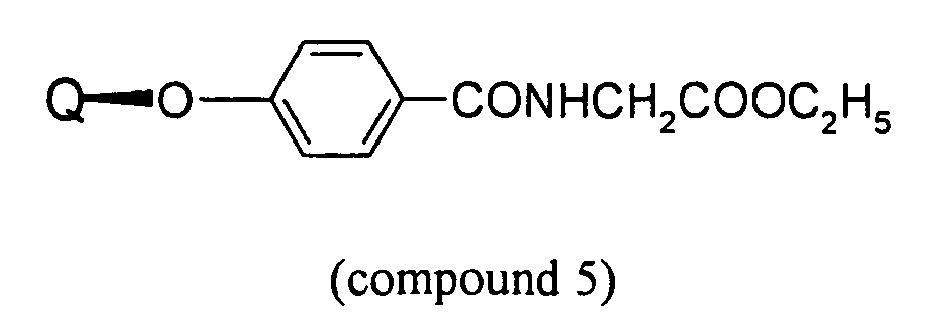
- Condensation of 4-carboxylphenyl-dihydroartemisinin ether and ethylglycinate was carried out to obtain the compound 5.
- Elemental analysis (C26H35NO8):
Calculated values: C 63.78 H 7.21 N 2.96 Measured values: C 64.04 H 7.26 N 3.30. -

- Condensation of dihydroartemisinin and 4-acetoxy- α-methylbenzylalcohol were carried out to obtain the compound 6.
- Elemental analysis (C25H34O7):
Calculated values: C 67.24 H 7.67 Measured values: C 67.14 H 7.61. -

- The compound 6 obtained from preparation example 6 was hydrolyzed in a basic solution to obtain the
compound 7. - Elemental analysis (C23H32O6):
Calculated values: C 68.29 H 7.97 Measured values: C 68.23 H 8.27. -

- The
compound 7 obtained from preparation example 7 was reacted with ethyl chloroformate to obtain thecompound 8. - Elemental analysis (C27H38O8):
Calculated values: C 66.10 H 7.81 Measured values: C 65.91 H8.17. -

- The compound obtained from preparation example 8 was hydrolyzed in a basic solution to obtain the compound 9.
- Elemental analysis (C25H34O8):
Calculated values: C 64.92 H 7.41 Measured values: C 64.66 H 7.50. -

- Condensation of dihydroartemisinin and 4-acetoxy-α- cyanobenzylalcohol and following basic hydrolysis gave the
compound 10. - Elemental analysis (C23H29NO6):
Calculated values: C 66.49 H 7.04 N 3.37 Measured values: C 66.53 H 7.04 N 3.16. -
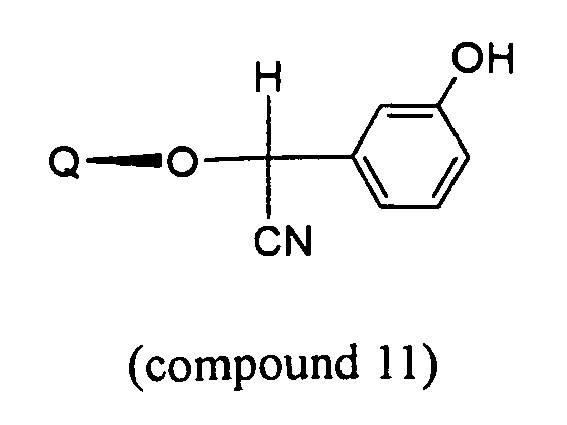
- Condensation of dihydroartemisinin and 3-acetoxy- α-cyanobenzylalcohol and following basic hydrolysis gave the compound 11.
- Elemental analysis (C23H29NO6):
Calculated values: C 66.49 H 7.04 N 3.37 Measured values: C 66.38 H 6.84 N 3.01. -

- Condensation of dihydroartemisinin and 2-ethoxy carbonyl methoxy (α-cyano) benzylalcohol was carried out. When the reaction was completed, conventional process was carried out and separation is performed with silica gel column chromatography.
- The first fraction was (S)-2-ethoxy carbonyl methoxy (α-cyano) benzyl-dihydroartemisinin ether, a white crystal with a melting point of 70-71 °C.
- Elemental analysis: (C27H35NO8)
Calculated values: C 64.65 H 7.03 N 2.79 Measured values: C 64.63 H 7.33 N 2.85. - The second fraction was (R)-2-ethoxy carbonyl methoxy (α-cyano) benzyl-dihydroartemisinin ether, a white crystal with a melting point of 88-90 °C.
- Elemental analysis: (C27H35NO8)
Calculated values: C 64.65 H 7.03 N 2.79 Measured values: C 65.08 H 7.33 N 2.71. -

- (S)-2-ethoxy carbonyl methoxy (α-cyano) benzyl-dihydroartemisinin ether obtained in preparation example 12 was hydrolyzed in a basic solution to obtain a white
crystallized compound 14 with a melting point of 143-144°C. - Elemental analysis (C25H31NO8):
Calculated values: C 63.41 1 H 6.60 N 2.96 Measured values: C 63.27 H 6.52 N 2.97. -

- Dihydroartemisinin and 2-bromo-5-acetoxy (α-cyano) benzylalcohol were used as raw materials, acidic condensation and basic hydrolysis were carried out to obtain a white crystallized compound (compound 15) with a melting point of 90-92 °C.
- Elemental analysis (C23H28BrNO6):
Calculated values: C 55.88 H 5.71 N 2.83 Measured values: C 55.52 H 5.76 N 2.82. -

- The condensation of dihydroartemisinin and 4-fluoro (α-methyl formate-yl) benzylalcohol was carried out to obtain the compound 16.
- Elemental analysis (C24H31FO7):
Calculated values: C 63.99 H 6.93 Measured values: C 64.29 H 6.98. -

- Condensation of dihydroartemisinin and 4-bromo (α-ethylformate-yl) benzylalcohol was carried out to obtain the compound 17.
- Elemental analysis (C25H33BrO7):
Calculated values: C 57.15 H 6.33 Measured values: C 56.87 H 6.16. -

- The condensation of dihydroartemisinin and α-methyl formate-yl menaphthyl-ol-1 was carried out and separation is performed with column chromatography to obtain the two
compounds 18 and 19. - (S)-α-methyl formate-yl-1-menaphthyl-dihydroartemisinin ether, an amorphous solid.
- Elemental analysis (C28H34O7):
Calculated values: C 69.69 H 7.10 Measured values: C 69.72 H 7.17. - (R)-α-methyl formate-yl-1-menaphthyl-dihydroartemisinin ether, an amorphous solid. Elemental analysis (C28H34O7):
Calculated values: C 69.69 H 7.10 Measured values: C 70.06 H 6.97. -

- Basic hydrolysis was performed for the compound (S)-α-methyl formate-yl-1-menaphthyl-dihydroartemisinin ether obtained in preparation example 17 to obtain the amorphous
solid compound 18. Elemental analysis (C27H32O7):Calculated values: C 69.21 H 6.88 Measured values: C 69.29 H 6.90. -

- Condensation of acetyl dihydroartemisinin and methyl 2-(4-hydroxyphenyl)isopropionate was carried out, and conventional process was carried out and separation was performed with silica gel column chromatography to obtain a colorless oily compound 21.
- Elemental analysis (C25H34O7):
Calculated values: C 67.24 H 7.67 Measured values: C 67.05 H 7.82. -

- Basic hydrolysis of the compound of preparation example 19 and recrystallization gave white crystallized compound 22 with a melting point of 152-154 °C.
- Elemental analysis (C24H32O7):
Calculated values: C 66.65 H 7.46 Measured values: C 66.63 H 7.53. -

- Condensation of the compound obtained from the preparation example 20 and 2-methoxyphenol was carried out to obtain the compound 23, which was a white amorphous solid.
- Elemental analysis (C31H38O8):
Calculated values: C 69.13 H 7.11 Measured values: C 69.08 H 7.00. -

- Condensation of acetyl dihydroartemisinin and ethyl 2-(4-hydroxyphenoxy) propionte was carried out, and after the reaction was completed, conventional processes and separation with silica gel column chromatography were performed to obtain the colorless oily compound 24.
- Elemental analysis (C26H36O8):
Calculated values: C 65.53 H 7.61 Measured values: C 65.46 H 7.66. -

- The compound of preparation example 22 was hydrolyzed in a basic solution to obtain the white
amorphous compound 25. - Elemental analysis (C24H32O8):
Calculated values: C 64.27 H 7.19 Measured values: C 64.25 H 7.40. -

- The aromatic esterification of carboxyl group of 4-carboxy- (α-methyl) methenylphenyl-dihydroartemisinin ether was carried out to obtain the compound 26 which was a white crystal with a melting point of 142-144 °C.
- Elemental analysis (C31H38O9):
Calculated values: C 67.13 H 6.91 Measured values: C 67.09 H 6.92. -

- The aromatic esterification of carboxyl group of 3-carboxy-(α-methyl) methenyloxyphenyl-dihydroartemisinin ether was carried out to obtain the compound 27 which was a white amorphous solid.
- Elemental analysis (C31H38O9) :
Calculated values: C 67.13 H 6.91 Measured values: C 67.12 H 7.04. -

- Condensation of acetyl dihydroartemisinin and ethyl 2-(3-hydroxy phenoxy)propionate was carried out, and after the reaction was completed, conventional process and separation with silica gel column chromatography were carried out to obtain the colorless oily compound 28.
- Elemental analysis (C26H36O8):
Calculated values: C 65.53 H 7.61 Measured values: C 65.17 H 7.76. -

- The compound of preparation example 26 was hydrolyzed in a basic solution to obtain the white amorphous solid compound 29.
- Elemental analysis (C24H32O8):
Calculated values: C 64.27 H 7.19 Measured values: C 64.42 H 7.50. -
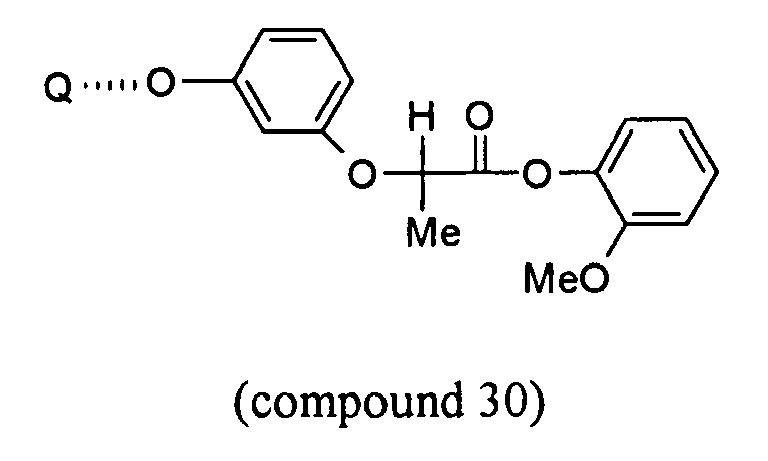
- The free acid obtained from the preparation example 27 was esterified to obtain the white amorphous
solid compound 30. - Elemental analysis (C31H38O9):
Calculated values: C 67.13 H 6.91 Measured values: C 67.52 H 7.33. -

- Condensation of dihydroartemisinin and ethyl 2-(3-hydroxymethyl phenoxy)propionate was carried out, and conventional process and separation with silica gel column chromatography were carried out to obtain two colorless oily compounds 31 and 32.
- Elemental analysis (C27H38O8):
Calculated values: C 66.10 H 7.81 (β type) Measured values: C 66.31 H 7.67. (α type) Measured values: C 66.15 H 7.91. -

- The compounds obtained from the preparation example 29 were hydrolyzed in a basic solution to obtain two white amorphous solid compounds 33 and 34.
- Elemental analysis (C25H34O8):
Calculated values: C 64.92 H 7.41 (β type) Measured values: C 64.64 H 7.61. (α type) Measured values: C 66.76 H 7.66. -

- The aromatic esterification of carboxyl group of the β type compound obtained from the preparation example 30 was carried out to obtain the colorless oily compound 35.
- Elemental analysis (C32H40O9):
Calculated values: C 67.59 H 7.09 Measured values: C 67.54 H 7.17. -

- Condensation of dihydroartemisinin and ethyl 2-(4-hydroxymethyl phenoxy)propionate was carried out, and conventional process and separation with silica gel column chromatography were performed to obtain two colorless oily compounds 36 and 37.
- Elemental analysis (C27H38O8):
Calculated values: C 66.10 H 7.81 (β type) Measured values: C 66.03 H 7.70 (α type) Measured values: C 66.18 H 7.49. -

- The compounds obtained from the preparation example 32 were hydrolyzed in a basic solution to obtain two white amorphous solid compounds 38 and 39.
- Elemental analysis (C25H34O8) :
Calculated values: C 64.92 H 7.41 (β type) Measured values: C 64.72 H 7.67 (α type) Measured values: C 64.56 H 7.75. -


- The aromatic esterification of carboxyl group of the β type compound obtained from the preparation example 33 was carried out to obtain the colorless oily compound 40.
- Elemental analysis (C32H40O9):
Calculated values: C 67.59 H 7.09 Measured values: C 67.55 H 7.21. -

- Condensation of dihydroartemisinin and ethyl 2-[4-(α-methyl) hydroxylmethyl phenoxy] propionate was carried out, and conventional process and the separation with silica gel column chromatography are performed to obtain two colorless oily compounds 41 and 42.
- Elemental analysis (C28H40O8):
Calculated values: C 66.65 H 7.99 (11-β) Measured values: C 66.60 H 7.88 (11-α) Measured values: C 66.77 H 8.11. -

- 4-carboxy methoxy phenyl-dihydroartemisinin ether was esterified to obtain the white amorphous solid compound 43.
- Elemental analysis (C25H34O8):
Calculated values: C 64.92 H 7.41 Measured values: C 64.62 H 7.40. - The formula is as follows: the content of each component was measured by weight percent
4-carboxy (α-methyl) methenyl phenyl-dihydroartemisinin ether (β type) 35 % starch 25 % microcrystalline cellulose 30 % sodium carboxymethyl starch 3 % starch paste (10%) 6 % magnesium stearate 1 % - The active component was pulverized, and screened with 100 mesh sieve; after mixed homogeneously with microcrystalline cellulose, starch and sodium carboxymethyl starch, a proper amount of 10 % starch paste was added to prepare the damp mass; after granulation is carried out with 20 mesh sieve, the material was dried at 60°C, and granulae are processed; then the lubricant magnesium stearate was added into and mixed uniformly; tabletting was performed to obtain the final product.
- The formula was as follows: all the content of each component was measured by weight percent
3-succinic acid monoacyl phenyl-dihydroartemisinin ether (β type) 30 % microcrystalline cellulose 65 % crosslinked polyvidone 1.5 % micronized polyethylene glycol 4000 3 % micronized silica gel 0.5 % - The active component was pulverized, and screened with 100 mesh sieve; after homogeneously mixed with the filler microcrystalline cellulose, the disintegrating agent crosslinked polyvidone, the lubricant micronized polyethylene glycol 4000, and the glidant micronized silica gel, tabletting was performed directly to obtain the final product.
- The formula was as follows: the content of each component was measured by weight percent
4-(2-methoxy phenoxy)carbonyl (α-methyl) methenyloxy phenyl-dihydroartemisinin ether 35 % pregelating starch 20 % microcrystalline cellulose 35 % crosslinking sodium carboxymethyl cellulose 4 % aqueous solution of polyvidone (8 %) 4 % talc powder 2 % - The active component was pulverized, and screened with 100 mesh sieve; after homogeneously mixed with microcrystalline cellulose, pregelating starch and crosslinking sodium carboxymethyl cellulose, a proper amount of 8 % aqueous solution of polyvidone was added to prepare the damp mass; after granulation is carried out with 20 mesh sieve, the material was dried at 60°C, and granulae are processed; then the lubricant talc power was added into and mixed uniformly; tabletting was performed to obtain the core.
- Subsequently, the core was coated with 3% hydroxypropyl emthylcellulose (E5) alchol aqueous solution to form an isolation coating until the weight was increased by 8%; then Eudragit L30D was coated to form a enteric coating until the weight was increased by 10%, thereby the final product was obtained.
- The formula was as follows: the content of each component was measured by weight percent
4-methoxy carbonyl methyl phenyl-dihydroartemisinin ether (β type) 50 % pregelating starch 40 % talc powder 9 % micronized silica gel 1 % - The active component and the adjuvants are homogeneously mixed and packed into empty capsule to obtain the final product.
- The formula is as follows: the content of each component was measured by weight percent
4-ethoxycarbonylmethoxyphenyl-dihydroartemisinin ether (β type) 45 % polyethylene glycol 400-1000 30 % suspending agent (10 ~ 30 % oil-wax mixture) 25 % - The active component was pulverized and sieved, and other components were added and mixed thoroughly, then the soft capsule are prepared in a pelletizing machine.
- The formula was as follows: the content of each component was measured by weight percent
4-methoxy carbonyl (α-methyl) methenyl phenyl-dihydroartemisinin ether (β type) 5 % crosslinking sodium polyacrylate 2 % polyethylene glycol 4000 8 % glycerol 10 % Benzalkonium bromide 1 % water 74 % - After polyethylene glycol 4000 and glycerol were heated to be molten and merged, the active component was added after being pulverized and sieved, and mixed homogenously; after crosslinking sodium polyacrylate was added into a proper amount of water (60°C) and stirred thoroughly, the matrix was mixed homogenouly with the active component, polyethylene glycol 4000 and glycerol, then sufficient water was added to obtain the final product.
- The formula was as follows: the content of each component was measured by weight percent
3-(2-methoxyphenoxy) carbonyl (α-methyl) methenyloxy phenyl- dihydroartemisinin ether 15 % polyoxyethylene(40) monostearate 85 % - The active component was pulverized and sieved, a small amount of molten matrix was added, after being ground and mixed sufficiently, the mixture was mixed with other molten matrix, and injected into suppository mold while maintaining the temperature.
- The formula was as follows: the content of each component was measured by weight percent
4-ethoxy carbonyl methylamine carbonyl phenyl-dihydroartemisinin ether 2.5 % glyceryl monostearate 8.5 % stearic acid 15 % white vaseline 10 % glycerol 8 % Tween-80 3 % water 53 % - The active component was dissolved in a small amount of acetone, then glyceryl monostearate, stearic acid and white vaseline were added and heated together to be molten while maintaining the temperature at 80°C. Tween-80, glycerin and water were also heated to 80°C and added into the above oil phase slowly, the mixture was stirred along a same direction to obtain a white fine cream.
- The formula was as follows: the content of each component was measured by weight percent
4-(dimethylamine ethoxy carbonyl methoxy) phenyl-dihydroartemisinin ether (β type) 15% acrylic resin 55% dibutyl sebacate 25% acetone 5% - Acrylic resin used as matrix and plasticizer dibutyl sebacate of the amount as prescribed in the formula were dissloved in suitable amount of acetone and mixed homogenously; then active component dispersed in acetone was added and stirred homogenously while heating gently to obtain a clear solution. The solution was coated on a substrate or antistick layer and dried at 60°C, and the final product was obtained by cutting the substrate according to the desired dose.
- The inventor carried out the screening and study of in vitro and in vivo immunosuppressive activity of the artemisinin derivative with the following methods (see Modern Pharmacological Experimental Methods, Zhang Juntian ed. Beijing Medical University/Chinese Peking Union Medical University Union Press, published in 1998).
- Experimental animals: inbred BALB/c male mice, 6-8 weeks old.
- RPMI-1640 culture solution (purchased from Gibco, pH7.2) with 10% fetal bovine serum (FBS), 100 U/mL penicillin, 100 µg/mL streptomycin, 10 mM HEPES (2-[4-(2-Hydroxy ethyl)-1-piperazinyl] ethanesulfonic acid), and 50 µM 2-ME (2-Mercaptoethanol).
- Stimulator: Concanavalin A (ConA), Lipopolysaccharide (LPS, from Escherichia Coli 055:B5), diluted with RPMI-1640 medium to suitable concentration before using.
-
- 1. Mice were killed by cervical dislocation, and their spleens were removed aseptically. A single spleen cell suspension was prepared and cell debris and clumps were removed. Erythrocytes were removed with MTT solution (10%SDS and 50% dimethylformamide, pH 7.2). The cell concentration was adjusted to 5×10⁶ with RPMI-1640 medium (containing 10% FBS).
- 2. 80 µL cell suspension, 40 µL testing sample, 40 µL medium containing 10 % FBS were added into 96 well plate; for the control group, 80 µL medium was added the total volume was 160 µL, and blank control group was set.
- 3. After incubated in 5% CO2 incubator at 37°C for 48 hours, 16 µL MTT (5 mg/mL) reagent was added into each well 6-7 hours before the termination of the incubation.
- 4. When the incubation is terminated, 80 µL MTT dissolving solution (10 % SDS, 50 % dimethylformamide; pH7.2) was added into each well, after placed in incubator for 6-7 hours, OD values was measured with a microplate reader at 570 nm.
-
- 1. BALB/c mice were killed by cervical dislocation, their spleens were removed aseptically, and a single spleen cell suspension was prepared. The cell concentration was adjusted to 4×10⁶/mL with RPMI-1640 medium containing 10 % FBS.
- 2. 100 µL cell suspension, 50 µL test sample solution, 50 µL concanavalin A (Con A) or lipopolysaccharide (LPS) were added into 96- well plate; for the control group, 50 µL medium containing 10 % FBS was added, the total volume was 200 µL.
- 3. After incubated in 5% CO2 incubator at 37°C for 48 hours, 0.5µCi [3H]-thymidine (25µL/well) was added into each well 7-8 hours before the termination of the incubation.
- 4. The incubation is terminated, the cells were harvested with a cell harvestor (HARVESTER96®, TOMTEC) on a glass fiber film, scintillation fluid was added, and the incorporation of [3H]-thymidine in the cell DNA was detected with a liquid scintillation counter (MicroBeta Trilux®, PerkinElmer), which indicated the state of cell proliferation.
-
- 1. C57BL/6 and BALB/c mice were killed by cervical dislocation, their spleens were removed aseptically, and a single spleen cell suspension was prepared. After the red blood cells were removed, the cell concentration was adjusted to 6×10⁶/mL with RPMI-1640 medium containing 10 % FBS.
- 2. The spleen cells of C57BL/6 mice were response cells, and the spleen cells of BALB/c mice (irradiated with Co60, 3000 rads) were stimulator cells, the two kinds of cells were mixed with equal volumes.
- 3. 100 µL mixed cell suspension, 100 µL test sample were added into a 96-well plate; for the control group, 100 µL medium containing 10 % serum was added, and single culture controls of the two kinds of cells were set.
- 4. Incubated in 5% CO2 incubator at 37°C for 3, 4 or 5 days. 25 µL 3H dilution (i.e. 3.8×10¹⁰Bq [3H]-thymidine) was added 1 day before the termination of the incubation.
- 5. The incubation was terminated, the plate was freezed in a -20°C refrigerator.
- 6. The cells were harvested with a cell harvestor (HARVESTER96®, TOMTEC) on a glass fiber film, the incorporation of [3H]-thymidine in DNA was detected with a liquid scintillation counter (MicroBeta Trilux®, PerkinElmer), which reflected the state of cell proliferation.
-
- 1. BALB/c mice were killed by cervical dislocation, their spleens were removed aseptically, and a single spleen cell suspension was prepared. After the red blood cells were removed, the cell concentration was adjusted to 5×10⁶/mL with RPMI-1640 medium containing 10% FBS.
- 2. 1mL cell suspension, 0.5 mL test sample and 0.5 mL ConA (final concentration 5µg/mL) or Sac (Staphylococcus aureus thallus containing staphylococcus protein A) (final concentration 0.01%) were added into 96-well plate; for the control group, 0.5 mL medium containing 10% FBS was added, the final volume was 2 mL.
- 3. Incubated in 5% CO2 incubator at 37°C for 24 or 48 hours, the supernatant was collected and freezed in -20°C refrigerator, the cytokines was to be detected.
- 4. Production of cytokines was detected with a double antibody sandwich enzyme linked immunosorbent assay (ELISA). TMB was used as substrate of the enzyme reaction, and the OD values was measured with a microplate reader at 450 nm. The production amount of cytokines of the samples was calculated according to the standard curve.
-
- 1. Each rear paw of BALB/c mice (female, 6-8 weeks old) was sensitized with 20 µL 0.5% DNFB (2, 4-dinitrofluorobenzene) on
day 0, and was reinforced next day (DNFB was dissolved in an oil agent [acetone: olive oil =4: 1]); - 2. Inside and outside of left ear of the mice were challenged with 10 µL 0.4% DNFB at day 7-9;
- 3. The test sample was administrated once 1 hour before challenge by i.p. injection or intragastric adminatration. After 12 hours, administered again;
- 4. 24-48 hours after challenge, each index was measured.
- Note: For BALB/c mice (female, 6-8 weeks old), the concentration of sensitizing agent was 0.7%, the concentration of challenging agent was 0.6%.
-
- 1. Fresh sheep red blood cells (SRBC) were washed 3 times with PBS (pH7.2), and diluted by 1: 20;
- 2. Fresh serum of guinea pig was diluted by 1: 10;
- 3. 2×10⁷/mL of mouse spleen cell suspension was prepared;
- 4. Each 1mL of the above three solutions was mixed and incubated at 37°C for 1.5 hours, then is centrifuged with 2500 rpm×15 min. OD value was measured at 520nM.
- BALB/c mice were sensitized 3 days after administration: the sheep red blood cells were washed 3 times with saline, and the SRBC pressed volume was diluted by a rate of 5%. Each mouse was intraperitoneally injected with 0.2 mL, and dissected to take its spleen 6 days after sensitization. And the production amount of the antibodies was measured.
- 60 male SD rats were randomly divided into 5 groups. Inactivated BCG was prepared with sterile liquid paraffin to 10 g/L, and shaken to mix homogenously. Left rear foot pad of the rat was injected with 0.1 mL intracutaneously. The rats were observed for consecutive 28 days. The secondary swelling of paws on the opposite side of the injection site was the indication of arthritis. From
day 12, displacement method was used to measure the paw volume below ankle joint every 4 days. Meanwhile, the severity of polyarticular arthritis pathology was scored according to the following standard: 0: no reddish swelling; 1: joint of little toe slightly swelling; 2: joint of toe and sole swelling; 3: paw below ankle joint swelling; 4: the whole paw including ankle joints swelling. The highest score of each rat was 16. The test sample was intraperitoneally injected from 2 days before immunization until 28 days after immunization. The effect of test sample on the induction and preventive/therapeutic treatment of the rat adjuvant-induced arthritis animal model was observed. - Experimental results showed that the lymphocytoxicity of the compound prepared in the examples of the present invention was relatively low, some of which were lower than the cytotoxicity of the control samples artemisinin and artesunate. Meanwhile, all the serial of compounds could significantly inhibit the proliferation response of the T and B lymphocytes induced and initiated by mitogens. The cytotoxic concentration of the compound that reduces cell viability by 50% (CC50), the higher the value, the lower the toxicity of some compounds and the inhibitory concentration of the compound that reduces cell proliferation by 50% (IC50), the lower the value, the stronger the toxicity for inhibiting the T lymphocyte proliferation response induced by Con A and B lymphocyte proliferation response induced by LPS were listed in the attached tables. It can be seen that the immunosuppressive activity of some compounds was obviously better than the control samples artemisinin and artesunate. The following table 1 showed the specific experimental results.
Table 1 compound Lymphocytotoxicity Inhibiting activity of T lymphocyte proliferation response induced by ConA Inhibiting activity of B lymphocyte proliferation response induced by LPS CC50 (M) IC50 (M) IC50 (M) artemisinine 2.83×10⁻⁵ 4.43×10⁻⁶ 8.96×10⁻⁶ artesunate 8.60×10⁻⁵ 3.82×10⁻⁶ 1.78×10⁻⁶ compound 1 8.00×10⁻⁶ 7.13×10⁻⁷ 1.79×10⁻⁷ compound 21.00×10⁻⁴ 1.18×10⁻⁵ 1.02×10⁻⁵ compound 3 5.27×10⁻⁵ 3.27×10⁻⁷ 2.65×10⁻⁷ compound 4 2.08×10⁻⁶ 1.96×10⁻⁶ 4.96×10⁻⁸ compound 5 3.90×10⁻⁵ 2.53×10⁻⁶ 1.60×10⁻⁷ compound 21 7.80×10⁻⁶ 6.40×10⁻⁸ 1.60×10⁻⁷ compound 22 5.96×10⁻⁵ 3.60×10⁻⁶ 8.60×10⁻⁶ compound 23 5.33×10⁻⁶ 5.27×10⁻⁷ 9.47×10⁻⁸ compound 24 1.76×10⁻⁵ 2.60×10⁻⁷ 8.50×10⁻⁷ compound 252.43×10⁻⁵ 7.27×10⁻⁶ 8.60×10⁻⁷ compound 26 3.91×10⁻⁵ 2.33×10⁻⁶ 2.70×10⁻⁷ compound 27 2.99×10⁻⁶ 4.12×10⁻⁶ 5.70×10⁻⁷ compound 28 2.99×10⁻⁶ 3.59×10⁻⁶ 5.60×10⁻⁷ compound 29 3.51×10⁻⁵ 8.60×10⁻⁶ 7.40×10⁻⁷ compound 308.23×10⁻⁶ 5.73×10⁻⁶ 8.20×10⁻⁷ - After in vivo administration (intraperitoneal administration), many compounds can significantly inhibit the swelling of mouse ear induced by 2,4-dinitrofluorobenzene (DNFB) and the secretion of specific mouse anti sheep red blood cell antibody caused by sheep red blood cells, this result shows that these compounds have good immunosuppressive activity in the experimental systems in vivo.
- For example, pharmacological test was carried out on 3-succinic acid monoacyl phenyl-dihydroartemisinin ether (β type) (SM735) prepared in the preparation example 3. As shown in FIG 1(A), the cytotoxicity was detected by MTT method for co-cultrue of SM735 and BALB/c mouse spleen cells for 48 hours, CC50 was 53.1 ± 7.8µM. As shown in FIG 1(B), SM735 inhibited the proliferation of spleen cells for 48 hours induced by ConA, IC50 was 0.33 ± 0.06 µM. As shown in FIG 1(C), SM735 inhibited the proliferation of spleen cells for 48 hours induced by LPS, IC50 was 0.27 ± 0.02 µM. As shown in FIG 1(D), SM735 inhibited one way mixed lymphocyte reaction, and its IC50 was 0.86 ± 0.18 µM. BALB/c mouse spleen cells and C57BL/6 mouse spleen cells inactivated with mitomycin C were co-cultured for 96 hours, and SM735 was added. Three different experiments showed the same results. All data were showed as mean value ± standard error. The data were calculated by Origin® statistics software after logarithm treatment. Coefficient of correlation were (A) R2=0.960; (B) R2= 0.993; (C) R2= 0.997; (D) R2 =0.984. As shown in FIG 2, BALB/c mice were sensititized with DNFB on the starting day of the
experiment day 0 and day 1 and then challenged on day 9. Cyclosporin A and SM735, and the solvent control were administered on days 7-10 of the experiment for 4 consecutive days. 48 hours after challenging, ear patches were taken, and the degree of swelling is measured, i.e. the volume of left ear patch (treated with DNFB) subtracted the volume of right ear patch (not treated). Data was shown as mean value ± standard error, *P<0.05, **P<0.01, n=10 mice/group. Three independent experiments had the same results. As shown in FIG 3, BALB/c mice were immunized with sheep red blood cells, the ability of mouse B lymphocyte producing antibody was measured. Each group (6 mice) was administered with solvent control, 25 mg/kg cyclophosphamide or SM735 respectively for consecutive 4 days. Mouse spleen cell suspension, sheep red blood cells and guinea pig complement were co-incubated for half an hour at 37°C. The absorbance of cultural supernatant was measured at 520 nm wavelength to reflect the ability of B lymphocyte producing antibody. Data were shown as mean value ± standard error. * P<0.05, **p<0.01 (two tailed Student's t-test). - Experimental results indicated that 3-succinic acid monoacyl phenyl-dihydroartemisinine ether (β type) (SM735) had the following immunosuppressive activities in vivo and in vitro:
1) Non-specific lymphocytotoxicity was very low, CC50 value was 53.1 ± 7.8 µM, IC50 was 27 µg/mL (FIG 1A);
2) It strongly inhibited T lymphocyte proliferation response induced by ConA, IC50 value was 0.33 ± 0.06 µM, IC50 was 0.13µg /mL (FIG 1B);
3) It strongly inhibited B lymphocyte proliferation response induced by LPS, IC50 value was 0.27 ± 0.02 µM, IC50 was 0.12µg /mL (FIG 1C);
4) It strongly inhibited proliferation response caused by mixed lymphocyte reaction, IC50 value was 0.86 ± 0.18 µM, IC50 was 2.1µg /mL (FIG 1D);
5) It inhibited the secretion of cytokine when lymphocyte was activating. It obviously inhibited the production of TNF-α, especially IL-6 when stimulated with PMA, and this inhibiting activity was dose dependent. It also inhibited the production of IFN-γ and IL-12, two important Th1 type T cell differentiation enhancing factor (the results was shown in Table 2);
6) It inhibited antibody and complement production by mouse B cell (antibody forming cell) when administered in vivo (FIG 2);
7) It inhibited DTH reaction induced by DNFB (FIG 3);
8) It had certain preventive and therapeutic effect in rat adjuvant-induced arthritis animal model (FIG 4).Table 2 Effect of SM735 on cytokine production of activated spleen lymphocytes SM735 (Mol/L) stimulator production of cytokine (pg/ml) IL-2 IFN-γ - - 27±2 83±7 - ConA 2321±33 1523±22 10-7 ConA 2250±77 1219±33 ** 10-6 ConA 2343±154 976±18 ** 10-5 ConA 2053±162 322±18** IL-12 IFN-γ IL-6 - - 145±17 97±21 397±27 - LPS 707±8 240±13 1013±43 10-7 LPS 592±33 * 207±13 * 840±10** 10-6 LPS 565±18** * 172±2 ** 792±42** 10-5 LPS 292±26** 103±7** 522±1** - PMA+Ion 699±29 844±36 3256±176 10-7 PMA+Ion 586±52* 768±6** 2886±26* 10-6 PMA+Ion 487±37** 557±31** 2663±52** 10-5 PMA+Ion 198±35** 144±21** 1465±35** Note: Stimulator and BALB/c mouse spleen cells were co-cultured for 24 hours. The cultural supernatant was used to detect the production of cytokine by ELISA method. Data were shown as mean value ± standard error. * p<0.05, ** p<0.01 (two tailed Student's t-test).
Claims (12)
- A type of artemisinin derivatives having the following structure I,
 X is O, O(CH2)n or OCHR1, wherein the said R1 is C1-C4 alkyl, CN, COOH, COOMe or COOEt; and n is an integer of 1 to 4;P is Ar-Y-Z or Ar-Z, wherein, Ar is phenyl or naphthyl; Y is O(CH2)n, OCHMe, or C1-C4 alkyl, wherein n is an integer of 1 to 4; and Z is H, halogen, OR', COOR' or CONHCH2COOR', wherein R' is H, C1-C4 alkyl, o-methoxy phenyl or C1-C4 alkylamine group.
 - The artemisinin derivatives of claim 1, wherein,X is O or OCH2;P is Ar-Y-Z, wherein, the said Ar is phenyl; Y is O(CH2)n, OCHMe, C1-C4 alkyl, wherein n is 1 or 2; Z is COOR', wherein, the said R' is H, Me, Et or o-methoxy phenyl.
- The artemisinin derivatives of claim 1, wherein the artemisinin derivatives are 4-methoxycarbonylmethyl phenyl-dihydroartemisinin ether, 4-carboxylmethyl phenyl-dihydroartemisinin ether, 4-ethoxycarbonylmethoxy phenyl-dihydroartemisinin ether, 3-succinic acid monoacyl phenyl-dihydroartemisinin ether, 4-ethoxycarbonyl methylaminocarbonyl phenyl-dihydroartemisinin ether, 4-methoxy carbonyl (α-methyl)methenyl phenyl-dihydroartemisinin ether, 4-o-methoxy phenoxycarbonyl (α-methyl)methenyl phenyl- dihydroartemisinin ether, 4-ethoxycarbonyl (α-methyl)methenyl oxy phenyl-dihydroartemisinin ether, 4-carboxyl (α-methyl)methenyl oxy phenyl-dihydroartemisinin ether, 4-o-methoxy phenoxycarbonyl- (α-methyl)methenyloxyphenyl-dihydroartemisinin ether, or 3-o-methoxy phenoxycarbonyl-(α-methyl)methenyloxy phenyl-dihydroartemisinin ether.
- A method for preparing the artemisinin derivatives of claim 1, wherein, the method includes the following steps:1) The dihydroartemisinin having the structure II or the acetyl dihydroartemisinin having the structure III are used as raw materials, which react with phenol or alcohol containing carboxylic ester under an acidic catalysis condition, to obtain corresponding dihydroartemisinin ether products,
 2) then the dihydroartemisinin ether products are hydrolyzed to obtain intermediate products in a free acid form;3) The intermediate products of free acid form of step 2) are further processed as final products,or, the method includes the following steps:1) The dihydroartemisinin having the structure II or the acetyl dihydroartemisinin having the structure III is reacted with dihydric phenol under an acidic catalysis condition to obtain the compounds having the structure IV:
 2) Then the above compounds having the structure IV are further modified to produce the final products.
 - A pharmaceutical composition, which contains safe and effective dose of artemisinin derivatives of claim 1 or the pharmaceutically acceptable salts thereof, and pharmaceutically acceptable carrier.
- The pharmaceutical composition of claim 5, wherein the pharmaceutical composition contains 1-85wt% of the artemisininederivatives of claim 1 or the pharmaceutically acceptable salts thereof, 15-99wt% excipient, and 0-60wt% other conventional auxiliary materials.
- The pharmaceutical composition of claim 5, wherein the pharmaceutical composition are prepared into the oral, parenteral, pernasal, perlingual, ophthalmic, respiratory tract or rectal dosage forms.
- The pharmaceutical composition of claim 7, wherein the dosage forms are enteric coated pill, sublingual tablet, patch, suppository, cream, ointment, or gel for skin use.
- Use of the artemisinin derivatives of claim 1 in preparing the drugs for treating or preventing the diseases of immune system.
- Use of the artemisinin derivatives of claim 1 for treating or preventing the diseases of immune system.
- Use of the pharmaceutical composition of claim 5 in preparing the drugs for treating or preventing the diseases of immune system.
- Use of the pharmaceutical composition of claim 5 for treating or preventing the diseases of immune system.
Applications Claiming Priority (2)
| Application Number | Priority Date | Filing Date | Title |
|---|---|---|---|
| CNA2005100238241A CN1814601A (en) | 2005-02-04 | 2005-02-04 | Artemisine derivative with immune suppression action and medicinal composition |
| PCT/CN2006/000182 WO2006081771A1 (en) | 2005-02-04 | 2006-01-27 | Artemisine (qinghaosu) derivatives, their preparation methods and their use, and pharmaceutical compositions containing the same |
Publications (3)
| Publication Number | Publication Date |
|---|---|
| EP1845099A1 true EP1845099A1 (en) | 2007-10-17 |
| EP1845099A4 EP1845099A4 (en) | 2010-10-06 |
| EP1845099B1 EP1845099B1 (en) | 2012-10-24 |
Family
ID=36776974
Family Applications (1)
| Application Number | Title | Priority Date | Filing Date |
|---|---|---|---|
| EP06705603A Expired - Lifetime EP1845099B1 (en) | 2005-02-04 | 2006-01-27 | Artemisine (qinghaosu) derivatives, their preparation methods and their use, and pharmaceutical compositions containing the same |
Country Status (5)
| Country | Link |
|---|---|
| US (1) | US7910750B2 (en) |
| EP (1) | EP1845099B1 (en) |
| JP (1) | JP4891926B2 (en) |
| CN (2) | CN1814601A (en) |
| WO (1) | WO2006081771A1 (en) |
Families Citing this family (10)
| Publication number | Priority date | Publication date | Assignee | Title |
|---|---|---|---|---|
| CN102010420B (en) * | 2010-10-12 | 2013-11-27 | 沈阳药科大学 | [ (10S) -9, 10-dihydroartemisinin-10-oxy ] benzaldehyde semicarbazone (sulfur) series substance and preparation method and application thereof |
| WO2012168450A1 (en) | 2011-06-10 | 2012-12-13 | Queen Mary & Westfield College | Artemisinin and its derivatives for use in the treatment of trauma haemorrhage and associated conditions |
| US9611273B2 (en) * | 2012-02-28 | 2017-04-04 | The Johns Hopkins University | Trioxane thioacetal monomers and dimers and methods of use thereof |
| CN102603768A (en) * | 2012-03-07 | 2012-07-25 | 广州牌牌生物科技有限公司 | Method of using macroporous resin to separate and purify artemisinin |
| WO2014070673A1 (en) | 2012-10-29 | 2014-05-08 | University Of Rochester | Artemisinin derivatives, methods for their preparation and their use as antimalarial agents |
| JP6144775B2 (en) | 2012-12-12 | 2017-06-07 | クイーン マリー アンド ウエストフィールド カレッジ, ユニバーシティー オブ ロンドン | Artemisinin and its derivatives used in the treatment of kidney disease |
| US20170326102A1 (en) * | 2014-11-27 | 2017-11-16 | Cipla Limited | Pharmaceutical Composition Comprising an Artemisinin Derivative for Nasal or Pulmonary Delivery |
| CN108653272B (en) * | 2017-03-31 | 2022-09-20 | 中国科学院上海药物研究所 | Application of artemisinin derivatives in preparation of medicines for treating inflammatory bowel diseases |
| EP4121041A4 (en) * | 2020-03-18 | 2024-04-03 | GMP Biotechnology Limited | TGF-BETA INHIBITION, AGENTS AND COMPOSITION FOR IT |
| CN115068478B (en) * | 2022-07-22 | 2024-01-09 | 上海医药工业有限公司 | Application of naphthoquine phosphate in preparation of medicine for treating autoimmune diseases |
Family Cites Families (9)
| Publication number | Priority date | Publication date | Assignee | Title |
|---|---|---|---|---|
| US4791135A (en) * | 1987-08-20 | 1988-12-13 | The United States Of America As Represented By The Secretary Of The Army | Novel antimalarial dihydroartemisinin derivatives |
| CN1038416C (en) * | 1992-12-04 | 1998-05-20 | 中国科学院上海药物研究所 | Artemisin derivant and its preparation method |
| CN1049435C (en) * | 1994-11-09 | 2000-02-16 | 中国科学院上海药物研究所 | Artemisin derivative containg phenyl and hetero cyclic radical, and mfg. method thereof |
| US6426329B1 (en) * | 1997-12-24 | 2002-07-30 | Fujisawa Pharmaceutical Co., Ltd. | Immunosuppressant activity of insulin-like growth factor I (IGF-I) |
| CN1109035C (en) | 1998-04-08 | 2003-05-21 | 中国科学院上海药物研究所 | 12 position aryl-substituted arteannuin derivant, preparation process and application thereof |
| CN1084333C (en) * | 1998-06-17 | 2002-05-08 | 中国科学院上海药物研究所 | Artemisine compounds, their preparing process and medicine composition containing them |
| IN191696B (en) * | 1999-02-12 | 2003-12-20 | Council Scient Ind Res | |
| CN1218949C (en) | 2001-06-08 | 2005-09-14 | 中国科学院上海药物研究所 | Artemisine arylether derivatives and their preparing process |
| EP1465899A1 (en) * | 2001-12-06 | 2004-10-13 | Ufc Limited | Trioxane derivatives |
-
2005
- 2005-02-04 CN CNA2005100238241A patent/CN1814601A/en active Pending
-
2006
- 2006-01-27 JP JP2007553443A patent/JP4891926B2/en not_active Expired - Fee Related
- 2006-01-27 US US11/883,652 patent/US7910750B2/en active Active
- 2006-01-27 EP EP06705603A patent/EP1845099B1/en not_active Expired - Lifetime
- 2006-01-27 WO PCT/CN2006/000182 patent/WO2006081771A1/en not_active Ceased
- 2006-01-27 CN CN2006800023685A patent/CN101103036B/en not_active Expired - Fee Related
Also Published As
| Publication number | Publication date |
|---|---|
| CN1814601A (en) | 2006-08-09 |
| JP2008528641A (en) | 2008-07-31 |
| WO2006081771A1 (en) | 2006-08-10 |
| CN101103036A (en) | 2008-01-09 |
| EP1845099B1 (en) | 2012-10-24 |
| US7910750B2 (en) | 2011-03-22 |
| EP1845099A4 (en) | 2010-10-06 |
| US20080139642A1 (en) | 2008-06-12 |
| CN101103036B (en) | 2010-05-19 |
| JP4891926B2 (en) | 2012-03-07 |
Similar Documents
| Publication | Publication Date | Title |
|---|---|---|
| US8673864B2 (en) | Mangiferin-berberine salt, manufacturing method and use thereof | |
| KR20180080330A (en) | Prodrugs of JAK Inhibitor Compounds for the Treatment of Gastrointestinal Inflammatory Diseases | |
| EP1845099B1 (en) | Artemisine (qinghaosu) derivatives, their preparation methods and their use, and pharmaceutical compositions containing the same | |
| WO2017162211A1 (en) | Pharmaceutical composition and use thereof | |
| KR20030004342A (en) | Compounds having antitumor activity: Process for their preparation and pharmaceutical compositions containing them | |
| US8129426B2 (en) | Water-soluble artemisinin derivatives, their preparation methods, the pharmaceutical compositions and the use thereof | |
| CN104161759A (en) | Antitumor use of Anagrelide and its derivatives | |
| US20240269106A1 (en) | Small molecule modulator targeting a rare histone modification regulating adipogenesis and pharmaceutical formulation thereof | |
| CN115028679A (en) | PROTAC compound with Cyclophilin A degradation activity and preparation method and application thereof | |
| CN113214209A (en) | Hesperetin and carbamazepine eutectic compound, preparation method, composition and application thereof | |
| JP2010516690A (en) | Phenazine compounds and use of phenazine compounds in autoimmune and inflammatory diseases | |
| CN115028680A (en) | PROTAC compound for targeted degradation of Cyclophilin A and preparation method and application thereof | |
| CN113214207B (en) | Hesperetin and betaine eutectic A, preparation method, composition and application thereof | |
| CN113521082A (en) | Application of triptolide in preparing medicine for preventing and/or treating liver disease | |
| JP2003252876A (en) | Novel sesquiterpene compound, its production method and composition | |
| EP2610257B1 (en) | Diimidated derivative of berbamine, and preparation method therefor and use thereof | |
| CN1287555A (en) | N-oxides of heterocyclic compounds with TNF and PDE IV inhibiting activity | |
| US10441562B2 (en) | Aromatic farnesyl compound and application thereof | |
| KR102954274B1 (en) | Pharmaceuticals or health functional foods for treating or preventing non-alcoholic fatty acid liver disease comprising novel compounds isolated from Cervus nippon | |
| US20110092585A1 (en) | Immunomodulatory pharmaceutical composition and a process for preparation thereof | |
| CN1605357A (en) | Fenugreek seed extract and its preparing process and application | |
| KR102399872B1 (en) | Composition for inhibiting metastasis of cancer comprising benzofuran-based compounds derived from Suillus granulatus and use thereof | |
| CN113214206B (en) | Hesperetin and betaine eutectic substance B, preparation method, composition and application thereof | |
| US20240140950A1 (en) | NITROGEN-CONTAINING POLYCYCLIC AROMATIC COMPOUND, and PREPARATION METHOD AND APPLICATION THEREOF | |
| KR101119968B1 (en) | ß-LACTONE-BASED COMPOUNDS OR PHARMACETICALLY ACCEPTABLE SALTS THEREOF, AND ANTIOBESITY COMPOSITION CONTANING THE SAME AS AN ACTIVE INGREDIENT |
Legal Events
| Date | Code | Title | Description |
|---|---|---|---|
| PUAI | Public reference made under article 153(3) epc to a published international application that has entered the european phase |
Free format text: ORIGINAL CODE: 0009012 |
|
| 17P | Request for examination filed |
Effective date: 20070803 |
|
| AK | Designated contracting states |
Kind code of ref document: A1 Designated state(s): AT BE BG CH CY CZ DE DK EE ES FI FR GB GR HU IE IS IT LI LT LU LV MC NL PL PT RO SE SI SK TR |
|
| DAX | Request for extension of the european patent (deleted) | ||
| A4 | Supplementary search report drawn up and despatched |
Effective date: 20100906 |
|
| 17Q | First examination report despatched |
Effective date: 20110829 |
|
| GRAP | Despatch of communication of intention to grant a patent |
Free format text: ORIGINAL CODE: EPIDOSNIGR1 |
|
| GRAS | Grant fee paid |
Free format text: ORIGINAL CODE: EPIDOSNIGR3 |
|
| GRAA | (expected) grant |
Free format text: ORIGINAL CODE: 0009210 |
|
| RIN1 | Information on inventor provided before grant (corrected) |
Inventor name: ZHOU, YU Inventor name: LI, YING Inventor name: WANG, JUNXIA Inventor name: SUI, YI Inventor name: ZHANG, YU Inventor name: ZHOU, WENLIANG Inventor name: ZUO, JIANPING Inventor name: WU, JINMING Inventor name: YANG, ZHONGSHUN |
|
| AK | Designated contracting states |
Kind code of ref document: B1 Designated state(s): AT BE BG CH CY CZ DE DK EE ES FI FR GB GR HU IE IS IT LI LT LU LV MC NL PL PT RO SE SI SK TR |
|
| RAP1 | Party data changed (applicant data changed or rights of an application transferred) |
Owner name: SHANGHAI INSTITUTE OF MATERIA MEDICA, CHINESE ACAD |
|
| REG | Reference to a national code |
Ref country code: GB Ref legal event code: FG4D Ref country code: DE Ref legal event code: R081 Ref document number: 602006032617 Country of ref document: DE Owner name: JIANGSU ZUOYOU MEDICINE CO., LTD., CN Free format text: FORMER OWNER: SHANGHAI INSTITUTE OF MATERIA MEDICA, CHINESE ACADEMY OF SCIENCES, SHANGHAI, CN |
|
| REG | Reference to a national code |
Ref country code: CH Ref legal event code: EP |
|
| REG | Reference to a national code |
Ref country code: AT Ref legal event code: REF Ref document number: 580882 Country of ref document: AT Kind code of ref document: T Effective date: 20121115 |
|
| REG | Reference to a national code |
Ref country code: IE Ref legal event code: FG4D |
|
| REG | Reference to a national code |
Ref country code: DE Ref legal event code: R096 Ref document number: 602006032617 Country of ref document: DE Effective date: 20121220 |
|
| REG | Reference to a national code |
Ref country code: AT Ref legal event code: MK05 Ref document number: 580882 Country of ref document: AT Kind code of ref document: T Effective date: 20121024 |
|
| REG | Reference to a national code |
Ref country code: NL Ref legal event code: VDEP Effective date: 20121024 |
|
| PG25 | Lapsed in a contracting state [announced via postgrant information from national office to epo] |
Ref country code: NL Free format text: LAPSE BECAUSE OF FAILURE TO SUBMIT A TRANSLATION OF THE DESCRIPTION OR TO PAY THE FEE WITHIN THE PRESCRIBED TIME-LIMIT Effective date: 20121024 Ref country code: IS Free format text: LAPSE BECAUSE OF FAILURE TO SUBMIT A TRANSLATION OF THE DESCRIPTION OR TO PAY THE FEE WITHIN THE PRESCRIBED TIME-LIMIT Effective date: 20130224 Ref country code: SE Free format text: LAPSE BECAUSE OF FAILURE TO SUBMIT A TRANSLATION OF THE DESCRIPTION OR TO PAY THE FEE WITHIN THE PRESCRIBED TIME-LIMIT Effective date: 20121024 Ref country code: FI Free format text: LAPSE BECAUSE OF FAILURE TO SUBMIT A TRANSLATION OF THE DESCRIPTION OR TO PAY THE FEE WITHIN THE PRESCRIBED TIME-LIMIT Effective date: 20121024 |
|
| PG25 | Lapsed in a contracting state [announced via postgrant information from national office to epo] |
Ref country code: BE Free format text: LAPSE BECAUSE OF FAILURE TO SUBMIT A TRANSLATION OF THE DESCRIPTION OR TO PAY THE FEE WITHIN THE PRESCRIBED TIME-LIMIT Effective date: 20121024 Ref country code: PL Free format text: LAPSE BECAUSE OF FAILURE TO SUBMIT A TRANSLATION OF THE DESCRIPTION OR TO PAY THE FEE WITHIN THE PRESCRIBED TIME-LIMIT Effective date: 20121024 Ref country code: PT Free format text: LAPSE BECAUSE OF FAILURE TO SUBMIT A TRANSLATION OF THE DESCRIPTION OR TO PAY THE FEE WITHIN THE PRESCRIBED TIME-LIMIT Effective date: 20130225 Ref country code: GR Free format text: LAPSE BECAUSE OF FAILURE TO SUBMIT A TRANSLATION OF THE DESCRIPTION OR TO PAY THE FEE WITHIN THE PRESCRIBED TIME-LIMIT Effective date: 20130125 Ref country code: LV Free format text: LAPSE BECAUSE OF FAILURE TO SUBMIT A TRANSLATION OF THE DESCRIPTION OR TO PAY THE FEE WITHIN THE PRESCRIBED TIME-LIMIT Effective date: 20121024 Ref country code: SI Free format text: LAPSE BECAUSE OF FAILURE TO SUBMIT A TRANSLATION OF THE DESCRIPTION OR TO PAY THE FEE WITHIN THE PRESCRIBED TIME-LIMIT Effective date: 20121024 Ref country code: CY Free format text: LAPSE BECAUSE OF FAILURE TO SUBMIT A TRANSLATION OF THE DESCRIPTION OR TO PAY THE FEE WITHIN THE PRESCRIBED TIME-LIMIT Effective date: 20121024 |
|
| PG25 | Lapsed in a contracting state [announced via postgrant information from national office to epo] |
Ref country code: AT Free format text: LAPSE BECAUSE OF FAILURE TO SUBMIT A TRANSLATION OF THE DESCRIPTION OR TO PAY THE FEE WITHIN THE PRESCRIBED TIME-LIMIT Effective date: 20121024 |
|
| PG25 | Lapsed in a contracting state [announced via postgrant information from national office to epo] |
Ref country code: BG Free format text: LAPSE BECAUSE OF FAILURE TO SUBMIT A TRANSLATION OF THE DESCRIPTION OR TO PAY THE FEE WITHIN THE PRESCRIBED TIME-LIMIT Effective date: 20130124 Ref country code: DK Free format text: LAPSE BECAUSE OF FAILURE TO SUBMIT A TRANSLATION OF THE DESCRIPTION OR TO PAY THE FEE WITHIN THE PRESCRIBED TIME-LIMIT Effective date: 20121024 Ref country code: CZ Free format text: LAPSE BECAUSE OF FAILURE TO SUBMIT A TRANSLATION OF THE DESCRIPTION OR TO PAY THE FEE WITHIN THE PRESCRIBED TIME-LIMIT Effective date: 20121024 Ref country code: SK Free format text: LAPSE BECAUSE OF FAILURE TO SUBMIT A TRANSLATION OF THE DESCRIPTION OR TO PAY THE FEE WITHIN THE PRESCRIBED TIME-LIMIT Effective date: 20121024 Ref country code: EE Free format text: LAPSE BECAUSE OF FAILURE TO SUBMIT A TRANSLATION OF THE DESCRIPTION OR TO PAY THE FEE WITHIN THE PRESCRIBED TIME-LIMIT Effective date: 20121024 |
|
| PG25 | Lapsed in a contracting state [announced via postgrant information from national office to epo] |
Ref country code: RO Free format text: LAPSE BECAUSE OF FAILURE TO SUBMIT A TRANSLATION OF THE DESCRIPTION OR TO PAY THE FEE WITHIN THE PRESCRIBED TIME-LIMIT Effective date: 20121024 Ref country code: MC Free format text: LAPSE BECAUSE OF NON-PAYMENT OF DUE FEES Effective date: 20130131 |
|
| PLBE | No opposition filed within time limit |
Free format text: ORIGINAL CODE: 0009261 |
|
| REG | Reference to a national code |
Ref country code: CH Ref legal event code: PL |
|
| STAA | Information on the status of an ep patent application or granted ep patent |
Free format text: STATUS: NO OPPOSITION FILED WITHIN TIME LIMIT |
|
| 26N | No opposition filed |
Effective date: 20130725 |
|
| REG | Reference to a national code |
Ref country code: IE Ref legal event code: MM4A |
|
| PG25 | Lapsed in a contracting state [announced via postgrant information from national office to epo] |
Ref country code: LI Free format text: LAPSE BECAUSE OF NON-PAYMENT OF DUE FEES Effective date: 20130131 Ref country code: CH Free format text: LAPSE BECAUSE OF NON-PAYMENT OF DUE FEES Effective date: 20130131 Ref country code: ES Free format text: LAPSE BECAUSE OF FAILURE TO SUBMIT A TRANSLATION OF THE DESCRIPTION OR TO PAY THE FEE WITHIN THE PRESCRIBED TIME-LIMIT Effective date: 20130204 |
|
| REG | Reference to a national code |
Ref country code: DE Ref legal event code: R097 Ref document number: 602006032617 Country of ref document: DE Effective date: 20130725 |
|
| PG25 | Lapsed in a contracting state [announced via postgrant information from national office to epo] |
Ref country code: IE Free format text: LAPSE BECAUSE OF NON-PAYMENT OF DUE FEES Effective date: 20130127 |
|
| PG25 | Lapsed in a contracting state [announced via postgrant information from national office to epo] |
Ref country code: LT Free format text: LAPSE BECAUSE OF FAILURE TO SUBMIT A TRANSLATION OF THE DESCRIPTION OR TO PAY THE FEE WITHIN THE PRESCRIBED TIME-LIMIT Effective date: 20121024 |
|
| PG25 | Lapsed in a contracting state [announced via postgrant information from national office to epo] |
Ref country code: TR Free format text: LAPSE BECAUSE OF FAILURE TO SUBMIT A TRANSLATION OF THE DESCRIPTION OR TO PAY THE FEE WITHIN THE PRESCRIBED TIME-LIMIT Effective date: 20121024 |
|
| PG25 | Lapsed in a contracting state [announced via postgrant information from national office to epo] |
Ref country code: LU Free format text: LAPSE BECAUSE OF NON-PAYMENT OF DUE FEES Effective date: 20130127 Ref country code: HU Free format text: LAPSE BECAUSE OF FAILURE TO SUBMIT A TRANSLATION OF THE DESCRIPTION OR TO PAY THE FEE WITHIN THE PRESCRIBED TIME-LIMIT; INVALID AB INITIO Effective date: 20060127 |
|
| REG | Reference to a national code |
Ref country code: DE Ref legal event code: R082 Ref document number: 602006032617 Country of ref document: DE Representative=s name: GRUENECKER PATENT- UND RECHTSANWAELTE PARTG MB, DE Ref country code: DE Ref legal event code: R081 Ref document number: 602006032617 Country of ref document: DE Owner name: JIANGSU ZUOYOU MEDICINE CO., LTD., CN Free format text: FORMER OWNER: SHANGHAI INSTITUTE OF MATERIA MEDICA, CHINESE ACADEMY OF SCIENCES, SHANGHAI, CN |
|
| REG | Reference to a national code |
Ref country code: FR Ref legal event code: PLFP Year of fee payment: 11 |
|
| REG | Reference to a national code |
Ref country code: GB Ref legal event code: 732E Free format text: REGISTERED BETWEEN 20160310 AND 20160316 |
|
| REG | Reference to a national code |
Ref country code: FR Ref legal event code: TP Owner name: JIANGSU ZUOYOU MEDICINE, CN Effective date: 20160413 |
|
| REG | Reference to a national code |
Ref country code: FR Ref legal event code: PLFP Year of fee payment: 12 |
|
| REG | Reference to a national code |
Ref country code: FR Ref legal event code: PLFP Year of fee payment: 13 |
|
| PGFP | Annual fee paid to national office [announced via postgrant information from national office to epo] |
Ref country code: GB Payment date: 20231226 Year of fee payment: 19 |
|
| PGFP | Annual fee paid to national office [announced via postgrant information from national office to epo] |
Ref country code: DE Payment date: 20240124 Year of fee payment: 19 |
|
| PGFP | Annual fee paid to national office [announced via postgrant information from national office to epo] |
Ref country code: IT Payment date: 20240129 Year of fee payment: 19 Ref country code: FR Payment date: 20240126 Year of fee payment: 19 |
|
| REG | Reference to a national code |
Ref country code: DE Ref legal event code: R119 Ref document number: 602006032617 Country of ref document: DE |
|
| GBPC | Gb: european patent ceased through non-payment of renewal fee |
Effective date: 20250127 |
|
| PG25 | Lapsed in a contracting state [announced via postgrant information from national office to epo] |
Ref country code: DE Free format text: LAPSE BECAUSE OF NON-PAYMENT OF DUE FEES Effective date: 20250801 |
|
| PG25 | Lapsed in a contracting state [announced via postgrant information from national office to epo] |
Ref country code: GB Free format text: LAPSE BECAUSE OF NON-PAYMENT OF DUE FEES Effective date: 20250127 |
|
| PG25 | Lapsed in a contracting state [announced via postgrant information from national office to epo] |
Ref country code: FR Free format text: LAPSE BECAUSE OF NON-PAYMENT OF DUE FEES Effective date: 20250131 |
|
| PG25 | Lapsed in a contracting state [announced via postgrant information from national office to epo] |
Ref country code: IT Free format text: LAPSE BECAUSE OF NON-PAYMENT OF DUE FEES Effective date: 20250127 |