EP1844883A1 - Silver particle powder and process for producing the same - Google Patents
Silver particle powder and process for producing the same Download PDFInfo
- Publication number
- EP1844883A1 EP1844883A1 EP06713252A EP06713252A EP1844883A1 EP 1844883 A1 EP1844883 A1 EP 1844883A1 EP 06713252 A EP06713252 A EP 06713252A EP 06713252 A EP06713252 A EP 06713252A EP 1844883 A1 EP1844883 A1 EP 1844883A1
- Authority
- EP
- European Patent Office
- Prior art keywords
- silver
- less
- particulate
- silver powder
- particles
- Prior art date
- Legal status (The legal status is an assumption and is not a legal conclusion. Google has not performed a legal analysis and makes no representation as to the accuracy of the status listed.)
- Granted
Links
Images


Classifications
-
- B—PERFORMING OPERATIONS; TRANSPORTING
- B22—CASTING; POWDER METALLURGY
- B22F—WORKING METALLIC POWDER; MANUFACTURE OF ARTICLES FROM METALLIC POWDER; MAKING METALLIC POWDER; APPARATUS OR DEVICES SPECIALLY ADAPTED FOR METALLIC POWDER
- B22F9/00—Making metallic powder or suspensions thereof
- B22F9/16—Making metallic powder or suspensions thereof using chemical processes
- B22F9/18—Making metallic powder or suspensions thereof using chemical processes with reduction of metal compounds
- B22F9/24—Making metallic powder or suspensions thereof using chemical processes with reduction of metal compounds starting from liquid metal compounds, e.g. solutions
-
- B—PERFORMING OPERATIONS; TRANSPORTING
- B22—CASTING; POWDER METALLURGY
- B22F—WORKING METALLIC POWDER; MANUFACTURE OF ARTICLES FROM METALLIC POWDER; MAKING METALLIC POWDER; APPARATUS OR DEVICES SPECIALLY ADAPTED FOR METALLIC POWDER
- B22F1/00—Metallic powder; Treatment of metallic powder, e.g. to facilitate working or to improve properties
- B22F1/05—Metallic powder characterised by the size or surface area of the particles
- B22F1/054—Nanosized particles
-
- B—PERFORMING OPERATIONS; TRANSPORTING
- B22—CASTING; POWDER METALLURGY
- B22F—WORKING METALLIC POWDER; MANUFACTURE OF ARTICLES FROM METALLIC POWDER; MAKING METALLIC POWDER; APPARATUS OR DEVICES SPECIALLY ADAPTED FOR METALLIC POWDER
- B22F1/00—Metallic powder; Treatment of metallic powder, e.g. to facilitate working or to improve properties
- B22F1/10—Metallic powder containing lubricating or binding agents; Metallic powder containing organic material
- B22F1/102—Metallic powder coated with organic material
-
- B—PERFORMING OPERATIONS; TRANSPORTING
- B22—CASTING; POWDER METALLURGY
- B22F—WORKING METALLIC POWDER; MANUFACTURE OF ARTICLES FROM METALLIC POWDER; MAKING METALLIC POWDER; APPARATUS OR DEVICES SPECIALLY ADAPTED FOR METALLIC POWDER
- B22F9/00—Making metallic powder or suspensions thereof
-
- B—PERFORMING OPERATIONS; TRANSPORTING
- B82—NANOTECHNOLOGY
- B82Y—SPECIFIC USES OR APPLICATIONS OF NANOSTRUCTURES; MEASUREMENT OR ANALYSIS OF NANOSTRUCTURES; MANUFACTURE OR TREATMENT OF NANOSTRUCTURES
- B82Y30/00—Nanotechnology for materials or surface science, e.g. nanocomposites
-
- H—ELECTRICITY
- H05—ELECTRIC TECHNIQUES NOT OTHERWISE PROVIDED FOR
- H05K—PRINTED CIRCUITS; CASINGS OR CONSTRUCTIONAL DETAILS OF ELECTRIC APPARATUS; MANUFACTURE OF ASSEMBLAGES OF ELECTRICAL COMPONENTS
- H05K1/00—Printed circuits
- H05K1/02—Details
- H05K1/09—Use of materials for the conductive, e.g. metallic pattern
- H05K1/092—Dispersed materials, e.g. conductive pastes or inks
- H05K1/097—Inks comprising nanoparticles and specially adapted for being sintered at low temperature
-
- B—PERFORMING OPERATIONS; TRANSPORTING
- B22—CASTING; POWDER METALLURGY
- B22F—WORKING METALLIC POWDER; MANUFACTURE OF ARTICLES FROM METALLIC POWDER; MAKING METALLIC POWDER; APPARATUS OR DEVICES SPECIALLY ADAPTED FOR METALLIC POWDER
- B22F2998/00—Supplementary information concerning processes or compositions relating to powder metallurgy
-
- B—PERFORMING OPERATIONS; TRANSPORTING
- B22—CASTING; POWDER METALLURGY
- B22F—WORKING METALLIC POWDER; MANUFACTURE OF ARTICLES FROM METALLIC POWDER; MAKING METALLIC POWDER; APPARATUS OR DEVICES SPECIALLY ADAPTED FOR METALLIC POWDER
- B22F2999/00—Aspects linked to processes or compositions used in powder metallurgy
-
- H—ELECTRICITY
- H05—ELECTRIC TECHNIQUES NOT OTHERWISE PROVIDED FOR
- H05K—PRINTED CIRCUITS; CASINGS OR CONSTRUCTIONAL DETAILS OF ELECTRIC APPARATUS; MANUFACTURE OF ASSEMBLAGES OF ELECTRICAL COMPONENTS
- H05K3/00—Apparatus or processes for manufacturing printed circuits
- H05K3/10—Apparatus or processes for manufacturing printed circuits in which conductive material is applied to the insulating support in such a manner as to form the desired conductive pattern
- H05K3/12—Apparatus or processes for manufacturing printed circuits in which conductive material is applied to the insulating support in such a manner as to form the desired conductive pattern using thick film techniques, e.g. printing techniques to apply the conductive material or similar techniques for applying conductive paste or ink patterns
- H05K3/1241—Apparatus or processes for manufacturing printed circuits in which conductive material is applied to the insulating support in such a manner as to form the desired conductive pattern using thick film techniques, e.g. printing techniques to apply the conductive material or similar techniques for applying conductive paste or ink patterns by ink-jet printing or drawing by dispensing
Definitions
- the present invention relates to a spherical, fine, particulate powder of silver (especially one of a particle diameter on the nanometer order) and a liquid dispersion thereof, particularly to a particulate silver powder low in corrosive components that is a suitable interconnect forming material for fabricating fine circuit patterns, especially for forming interconnects by the ink-jet method, and a method of manufacturing the powder.
- the particulate silver powder of the present invention is also a suitable material for forming interconnects on LSI substrates, and electrodes and interconnects of flat panel displays (FPDs), and for filling in fine trenches, via holes and contact holes. It is also suitable for use as a coloring material for automobile paints and the like.
- FPDs flat panel displays
- its low impurity content and toxicity level make it useful as a carrier for adsorbing biochemical substances and the like in the fields of medical treatment, diagnostics and biotechnology.
- nanoparticles When the size of solid substance particles reaches the ultrafine nanometer order (called “nanoparticles” in the following), the specific surface area of the particles becomes very great, so that, even though they are solids, their interface with a gas or liquid becomes extremely large. Their surface characteristics therefore strongly affect the properties of the solid substance.
- metal nanoparticles offer not only fine interconnect formation capability but also other features such as low-temperature sinter capability. Owing to the low resistance and excellent weatherability of silver nanoparticles, and also their low price compared with other noble metal nanoparticles, silver nanoparticles are seen as metal nanoparticles with particular promise as the next-generation material for fine interconnects.
- Patent Document 1 describes a method of vaporizing silver in a helium or other inert gas atmosphere, under a reduced pressure of around 0.5 torr.
- Patent Document 2 teaches a liquid phase method for obtaining a silver colloid by reducing silver ions in an aqueous phase using an amine and transferring the obtained silver deposition phase to an organic solvent phase (polymeric dispersant).
- Patent Document 3 describes a method in which a reducing agent (alkali metal borohydride or ammonium borohydride) is used to reduce a silver halide in a solvent in the presence of a thiol type protective agent.
- the silver particles obtained by the vapor phase method of Patent Document 1 are 10 nm or less in diameter and have good dispersibility in solvent.
- the technology requires a special apparatus. This makes it difficult to synthesize large quantities of silver nanoparticles for industrial use.
- the liquid phase method is basically suitable for large-volume synthesis but has a problem in that the metal nanoparticles in the liquid have a strong tendency to agglomerate, making it difficult to obtain a monodispersed nanoparticle powder.
- citric acid is used as the dispersant when manufacturing metal nanoparticles, and the metal ion concentration in the liquid is usually very low as 10 mmole/L (0.01 mole/L) or lower. This is a barrier to its industrial application.
- Patent Document 2 achieves synthesis of stably dispersed silver nanoparticles by using a high metal ion concentration of 0.1 mole/L or greater and a high reaction mixture concentration, it suppresses agglomeration by using a polymeric dispersant having a high number average molecular weight of several tens of thousands.
- a dispersant of high molecular weight is not a problem when the silver nanoparticles are to be used as a coloring material, but when the particles are to be used in circuit fabrication applications, a firing temperature that is equal to or higher than the polymer boiling point is required and, in addition, pores readily form in the interconnects after the firing, so that problems of high resistance and breakage arise, making the particles not altogether suitable for fine interconnect applications.
- Patent Document 3 conducts the reaction at a relatively high reactant concentration of 0.1 mole/L or greater and disperses the obtained silver particles of 10 nm or less using a dispersant.
- a suitable dispersant Patent Document 3 proposes a thiol type dispersant, which can be readily vaporized by low-temperature firing at the time of interconnect formation because it has a low molecular weight of around 200.
- the thiol type surfactant contains sulfur (S), and sulfur causes corrosion of interconnects and other electronic components, making it an unsuitable element for interconnect formation applications. The method is therefore not suitable for interconnect formation applications.
- the liquid phase method uses silver nitrate, silver halide or the like as the silver source material (Patent Documents 2 and 3), so that the reaction solution unavoidably contains many ions originating from the silver source material, such as I - , Cl - , SO 4 2- , NO 3 - and CN - .
- the reaction solution unavoidably contains many ions originating from the silver source material, such as I - , Cl - , SO 4 2- , NO 3 - and CN - .
- specific surface area is extraordinarily large, solid-liquid separation and washing are difficult, and the reactivity of the ions with silver is high since most of the ions originating from the starting material originally formed compounds with silver. Because of these and other factors, the ions originating from the starting material are found to be adsorbed on the silver particles after reaction or to have reacted with them and become present as inclusions therein.
- a liquid dispersion prepared using the particles similarly contains the ions as impurities.
- the increasingly sophisticated performance capabilities of electronic equipment in recent years has placed severe demands on the components of such equipment, and the content of constituents and elements that degrade reliability is required to be managed on the ppm order. Under such circumstances, it is undesirable for corrosive components like I - , Cl - , SO 4 2- , NO 3 - and CN - to be entrained in the liquid dispersion of the particulate silver powder.
- an object of the present invention is to overcome such problems by providing a nanoparticle powder of silver low in corrosive components that is suitable for fine interconnect formation applications, and a liquid dispersion thereof, at low cost and in large quantities. Moreover, since monodispersion of spherical silver nanoparticles of uniform diameter is preferable, another object is to provide a liquid dispersion of such silver particles.
- a particulate silver powder having an average particle diameter measured by TEM observation (DTEM) of 200 nm or less, preferably 100 nm or less, more preferably 30 nm or less, an aspect ratio of less than 2.50, and a ⁇ (DTEM) / (Dx) ⁇ of 5.0 or less (where (Dx) denotes X-ray crystallite size), which particulate silver powder has a content of each of I - , Cl - , SO 4 2- , NO 3 - and CN - of 100 ppm or less.
- DTEM TEM observation
- the particulate silver powder preferably has a TEM average particle diameter (DTEM) of 100 nm, preferably 30 nm or less, and has adhered to the surfaces of the particles thereof an organic protective agent (typically a fatty acid or an amine compound) having a molecular weight of 100 to 400.
- DTEM TEM average particle diameter
- the present invention further provides a liquid dispersion of silver particles obtained by dispersing such particulate silver powder in an organic solvent (typically a non-polar or low-polarity solvent), which liquid dispersion of silver particles has an average particle diameter (D50) measured by the dynamic light-scattering method of 200 nm or less, a degree of dispersion ⁇ (D50) / (DTEM) ⁇ of 5.0 or less, and a content of each of I - , Cl - , SO 4 2- , NO 3 - and CN - of 100 ppm or less.
- an organic solvent typically a non-polar or low-polarity solvent
- the present invention provides a method of manufacturing a particulate silver powder, wherein a silver compound other than silver nitrate (typically silver carbonate or silver oxide) is reduced in an organic solvent (typically an alcohol or polyol) having a boiling point of 85 °C or greater at a temperature of 85 °C or greater and in the presence of an organic protective agent (typically a fatty acid or amino compound having a molecular weight of 100 to 400).
- an organic solvent typically an alcohol or polyol
- an organic protective agent typically a fatty acid or amino compound having a molecular weight of 100 to 400.
- the present inventor conducted numerous experiments to manufacture nanoparticle powder of silver by the liquid phase method and found it was possible to obtain a powder composed of spherical silver nanoparticles of uniform particle diameter by subjecting a silver compound other than silver nitrate (typically silver carbonate or silver oxide) to reduction treatment at a temperature of 85 °C or greater in an alcohol or polyol having a boiling point of 85 °C or greater (while refluxing vaporized alcohol or polyol to the liquid phase) and in the co-presence of an organic protective agent having a molecular weight of 100 to 400.
- This nanoparticle powder of silver disperses well in a dispersant because it is in a condition of having the organic protective agent adhered to its surface.
- the powder can be consistently obtained with a particle diameter on the nanoparticle order of 200 nm or less, preferably 100 nm or less, more preferably 30 nm or less.
- the powder has a content of each of I - , Cl - , SO 4 2- , NO 3 - and CN - of 100 ppm or less and was therefore found capable of serving as a material suitable for forming interconnects of fine circuit patterns, especially for forming interconnects by the ink-jet method.
- the alcohol or polyol used in the present invention as an organic solvent/reducing agent is required to have a boiling point of 85 °C or greater but is not otherwise particularly limited.
- An alcohol having a boiling point below 85 °C does not readily enable a reaction temperature of 85 °C or higher without using a special reactor such as an autoclave. Complete reduction of silver carbonate or silver oxide to silver is difficult to achieve at a reaction temperature below 85 °C.
- Preferred examples of the organic solvent/reducing agent are isobutanol and n-butanol, either individually or in a mixture of the two, but this is not a restriction and any organic solvent/reducing agent having a boiling point of 85 °C or greater can be used.
- a silver compound that is sparingly soluble in the organic solvent such as silver carbonate, silver oxide or the like is used.
- Silver nitrate is undesirable because the starting material thereof readily entrains I - , Cl - , SO 4 2- , NO 3 - , CN - and other such ions.
- Silver carbonate, silver oxide and the like are used in the form of powder.
- metal coordination compound of a molecular weight of 100 to 400 that has coordinating capability toward silver, typically a fatty acid or amino compound.
- a compound having no or only weak coordinating capability toward silver is used, a large amount of the protective agent is required to produce nanoparticles.
- metal coordination compounds include isonitrile compounds, sulfur compounds, amino compounds, and fatty acids having a carboxyl group.
- a sulfur compound would degrade the reliability of electronic components because it would cause corrosion owing to the sulfur it contains.
- Isonitrile compounds have problems of toxicity and the like. This invention enables provision of a material for forming interconnects free of these problems by using a fatty acid or amino compound having a molecular weight of 100 to 400 as the organic protective agent.
- the amino compound is preferably a primary amine.
- a secondary amine or tertiary amine would itself operate as a reducing agent, which would cause an inconvenience in a case where an alcohol is already in use as a reducing agent, because the resulting presence of two types of reducing agent would complicate control of the reduction rate and the like.
- An amino compound or fatty acid having a molecular weight of less than 100 has low agglomeration suppressing effect.
- One with a molecular weight exceeding 400 has strong agglomeration suppressing effect but also has a high boiling point.
- the amino compound or fatty acid would act as a sinter inhibitor during firing. The resistance of the interconnects would therefore become high, possibly to the point of impairing conductivity. Since this is undesirable, it is best to use an amino compound or fatty acid having a molecular weight of 100 - 400.
- the reduction of the silver carbonate or silver oxide in alcohol or polyol is best conducted using an apparatus equipped with a reflux condenser to return vaporized alcohol or polyol to the liquid phase during the reaction.
- the silver concentration of the reaction mixture is preferably made 50 mmole/L or greater. A lower concentration than this is not suitable because cost increases.
- the slurry obtained is centrifuged to separate solid from liquid.
- the resulting sediment is added with a dispersion medium such as ethanol and dispersed therein using an ultrasonic disperser.
- the dispersion is again centrifuged and the sediment is again added with ethanol and dispersed with the ultrasonic disperser.
- This process of [solid-liquid separation ⁇ dispersion] is repeated three times, whereafter the supernatant is discarded and the sediment dried to obtain the particulate silver powder of the present invention.
- the particulate silver powder obtained is dried in a vacuum drier (for 12 hours at 200 °C, for example), whereafter the dry product can be assayed for silver purity using the gravimetric method (upon dissolution in nitric acid followed by addition of HCl to prepare a silver chloride precipitate) to measure purity from the weight thereof.
- the purity of the particulate silver powder of the present invention is 90% or greater.
- the particulate silver powder has a content of each of I - , Cl - , SO 4 2- , NO 3 - and CN - of 100 ppm or less.
- particulate silver powder can be used an ordinary non-polar solvent or a low-polarity solvent such as hexane, toluene, kerosene, decane, dodecane or tetradecane.
- a low-polarity solvent such as hexane, toluene, kerosene, decane, dodecane or tetradecane.
- the liquid dispersion obtained is then centrifuged to remove coarse particles and agglomerated particles. Next, only the supernatant is collected as a sample to be subjected to TEM, x-ray, particle size distribution and other measurements.
- Isobutanol (reagent grade from of Wako Pure Chemical Industries, Ltd.), 200 mL, used as a solvent/reducing agent, was added with 0.1329 mL of oleic acid (Wako Pure Chemical Industries, Ltd.) and 5.571 g of silver carbonate powder (Kojundo Chemical Laboratory Co., Ltd.), and the mixture was stirred lightly with a spoon.
- the solution was transferred to a container equipped with a reflux condenser which was then placed in an oil bath.
- the solution was stirred with a magnetic stirrer at 200 rpm and heated while nitrogen gas used as an inert gas was blown into the container at the rate of 400 mL/min. Refluxing was continued for 3 hours at 100 °C to complete the reaction.
- the temperature increase rate to 100 °C was 1 °C/min.
- the pasty sediment obtained in Step 4 was prepared for evaluation as follows:
- the results of the measurements were TEM average particle diameter: 7.7 nm, aspect ratio: 1.2, X-ray crystallite size (Dx): 8.12 nm, and degree of single crystal grain (DTEM / Dx): 0.95. Only peaks attributable to silver were observed in the x-ray diffraction results. D50 measured by the dynamic light-scattering method (Microtrack UPA) was 20.2 nm. D50 / DTEM was 2.6. Silver purity was 93% and silver yield was 93.1%. The content of each of I - , Cl - , SO 4 2- , NO 3 - and CN - was 100 ppm or less in both the dried silver nanoparticles and the liquid dispersion.
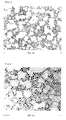
- FIGs. 1 and 2 are TEM photographs of the nanoparticle silver powder of this Example (photographs for determining TEM average particle diameter and the like). In these photographs, spherical silver nanoparticles are observed to be well dispersed at regular intervals. Although a very small number of overlapped particles are observed, the measurements of average particle diameter (DTEM), aspect ratio and CV value were made with respect to completely dispersed particles.
- FIG 5 is an x-ray diffraction chart of a nanoparticle silver powder of this Example. As can seen in FIG. 5, only peaks attributable to silver are observed.
- Example 1 was repeated except that 5.571 g of silver carbonate powder was changed to 4.682 g of silver oxide powder (Dowa Mining Co., Ltd.) The results of the measurements were TEM average particle diameter: 6.0 nm, aspect ratio: 1.15, X-ray crystallite size (Dx): 6.52 nm, and degree of single crystal grain (DTEM / Dx): 0.92.
- D50 measured by the dynamic light-scattering method (Microtrack UPA) was 21.2 nm.
- D50 / DTEM was 3.53.
- Silver purity was 92% and silver yield was 90.1%.
- TEM photographs of the nanoparticle silver powder are shown in FIGs. 3 and 4.
- Example 2 An attempt was made to repeat Example 1 with the silver carbonate powder, 5.571 g, changed to silver nitrate crystal, 6.863 g.
- the silver nitrate was dissolved in the oleic acid and added to the isobutanol. Although the result was continuously stirred, it did not dissolve.
- the sediment obtained following heating and reaction in this condition was subjected to x-ray measurement but almost no peaks attributable to silver were observed. Silver oleate was probably produced.
Landscapes
- Chemical & Material Sciences (AREA)
- Engineering & Computer Science (AREA)
- Nanotechnology (AREA)
- Inorganic Chemistry (AREA)
- General Chemical & Material Sciences (AREA)
- Chemical Kinetics & Catalysis (AREA)
- Materials Engineering (AREA)
- General Physics & Mathematics (AREA)
- Condensed Matter Physics & Semiconductors (AREA)
- Crystallography & Structural Chemistry (AREA)
- Composite Materials (AREA)
- Physics & Mathematics (AREA)
- Dispersion Chemistry (AREA)
- Microelectronics & Electronic Packaging (AREA)
- Manufacture Of Metal Powder And Suspensions Thereof (AREA)
- Powder Metallurgy (AREA)
- Parts Printed On Printed Circuit Boards (AREA)
Abstract
Description
- The present invention relates to a spherical, fine, particulate powder of silver (especially one of a particle diameter on the nanometer order) and a liquid dispersion thereof, particularly to a particulate silver powder low in corrosive components that is a suitable interconnect forming material for fabricating fine circuit patterns, especially for forming interconnects by the ink-jet method, and a method of manufacturing the powder. The particulate silver powder of the present invention is also a suitable material for forming interconnects on LSI substrates, and electrodes and interconnects of flat panel displays (FPDs), and for filling in fine trenches, via holes and contact holes. It is also suitable for use as a coloring material for automobile paints and the like. Moreover, its low impurity content and toxicity level make it useful as a carrier for adsorbing biochemical substances and the like in the fields of medical treatment, diagnostics and biotechnology.
- When the size of solid substance particles reaches the ultrafine nanometer order (called "nanoparticles" in the following), the specific surface area of the particles becomes very great, so that, even though they are solids, their interface with a gas or liquid becomes extremely large. Their surface characteristics therefore strongly affect the properties of the solid substance.
- It is known that the melting point of metal nanoparticles is dramatically reduced from that in the bulk state. In comparison with conventional micrometer-order particles, therefore, metal nanoparticles offer not only fine interconnect formation capability but also other features such as low-temperature sinter capability. Owing to the low resistance and excellent weatherability of silver nanoparticles, and also their low price compared with other noble metal nanoparticles, silver nanoparticles are seen as metal nanoparticles with particular promise as the next-generation material for fine interconnects.
- Known methods of manufacturing nanometer-order particlesof silver are broadly divided into vapor phase methods and liquid phase methods. Vapor phase methods are ordinarily methods that conduct deposition in a gas. Patent Document 1 describes a method of vaporizing silver in a helium or other inert gas atmosphere, under a reduced pressure of around 0.5 torr. Patent Document 2 teaches a liquid phase method for obtaining a silver colloid by reducing silver ions in an aqueous phase using an amine and transferring the obtained silver deposition phase to an organic solvent phase (polymeric dispersant). Patent Document 3 describes a method in which a reducing agent (alkali metal borohydride or ammonium borohydride) is used to reduce a silver halide in a solvent in the presence of a thiol type protective agent.
- Patent Document 1:
JP 2001-35255A - Patent Document 2:
JP 11-319538 A - Patent Document 3:
JP 2003-253311A - The silver particles obtained by the vapor phase method of Patent Document 1 are 10 nm or less in diameter and have good dispersibility in solvent. However, the technology requires a special apparatus. This makes it difficult to synthesize large quantities of silver nanoparticles for industrial use. In contrast, the liquid phase method is basically suitable for large-volume synthesis but has a problem in that the metal nanoparticles in the liquid have a strong tendency to agglomerate, making it difficult to obtain a monodispersed nanoparticle powder. In most cases, citric acid is used as the dispersant when manufacturing metal nanoparticles, and the metal ion concentration in the liquid is usually very low as 10 mmole/L (0.01 mole/L) or lower. This is a barrier to its industrial application.
- Although the foregoing method of Patent Document 2 achieves synthesis of stably dispersed silver nanoparticles by using a high metal ion concentration of 0.1 mole/L or greater and a high reaction mixture concentration, it suppresses agglomeration by using a polymeric dispersant having a high number average molecular weight of several tens of thousands. The use of a dispersant of high molecular weight is not a problem when the silver nanoparticles are to be used as a coloring material, but when the particles are to be used in circuit fabrication applications, a firing temperature that is equal to or higher than the polymer boiling point is required and, in addition, pores readily form in the interconnects after the firing, so that problems of high resistance and breakage arise, making the particles not altogether suitable for fine interconnect applications.
- The foregoing method of Patent Document 3 conducts the reaction at a relatively high reactant concentration of 0.1 mole/L or greater and disperses the obtained silver particles of 10 nm or less using a dispersant. As a suitable dispersant, Patent Document 3 proposes a thiol type dispersant, which can be readily vaporized by low-temperature firing at the time of interconnect formation because it has a low molecular weight of around 200. However, the thiol type surfactant contains sulfur (S), and sulfur causes corrosion of interconnects and other electronic components, making it an unsuitable element for interconnect formation applications. The method is therefore not suitable for interconnect formation applications.
- Moreover, the liquid phase method uses silver nitrate, silver halide or the like as the silver source material (Patent Documents 2 and 3), so that the reaction solution unavoidably contains many ions originating from the silver source material, such as I-, Cl-, SO4 2-, NO3 - and CN-. In the case of nanoparticles, specific surface area is extraordinarily large, solid-liquid separation and washing are difficult, and the reactivity of the ions with silver is high since most of the ions originating from the starting material originally formed compounds with silver. Because of these and other factors, the ions originating from the starting material are found to be adsorbed on the silver particles after reaction or to have reacted with them and become present as inclusions therein. A liquid dispersion prepared using the particles similarly contains the ions as impurities. On the other hand, the increasingly sophisticated performance capabilities of electronic equipment in recent years has placed severe demands on the components of such equipment, and the content of constituents and elements that degrade reliability is required to be managed on the ppm order. Under such circumstances, it is undesirable for corrosive components like I-, Cl-, SO4 2-, NO3 - and CN- to be entrained in the liquid dispersion of the particulate silver powder.
- Therefore, an object of the present invention is to overcome such problems by providing a nanoparticle powder of silver low in corrosive components that is suitable for fine interconnect formation applications, and a liquid dispersion thereof, at low cost and in large quantities. Moreover, since monodispersion of spherical silver nanoparticles of uniform diameter is preferable, another object is to provide a liquid dispersion of such silver particles.
- In accordance with the present invention, there is provided a particulate silver powder having an average particle diameter measured by TEM observation (DTEM) of 200 nm or less, preferably 100 nm or less, more preferably 30 nm or less, an aspect ratio of less than 2.50, and a {(DTEM) / (Dx)} of 5.0 or less (where (Dx) denotes X-ray crystallite size), which particulate silver powder has a content of each of I-, Cl-, SO4 2-, NO3 - and CN- of 100 ppm or less. The particulate silver powder preferably has a TEM average particle diameter (DTEM) of 100 nm, preferably 30 nm or less, and has adhered to the surfaces of the particles thereof an organic protective agent (typically a fatty acid or an amine compound) having a molecular weight of 100 to 400.
- The present invention further provides a liquid dispersion of silver particles obtained by dispersing such particulate silver powder in an organic solvent (typically a non-polar or low-polarity solvent), which liquid dispersion of silver particles has an average particle diameter (D50) measured by the dynamic light-scattering method of 200 nm or less, a degree of dispersion {(D50) / (DTEM)} of 5.0 or less, and a content of each of I-, Cl-, SO4 2-, NO3 - and CN- of 100 ppm or less.
- Further, as a method of manufacturing such a particulate silver powder, the present invention provides a method of manufacturing a particulate silver powder, wherein a silver compound other than silver nitrate (typically silver carbonate or silver oxide) is reduced in an organic solvent (typically an alcohol or polyol) having a boiling point of 85 °C or greater at a temperature of 85 °C or greater and in the presence of an organic protective agent (typically a fatty acid or amino compound having a molecular weight of 100 to 400).
-
- FIG 1 is an electron microscope (TEM) photograph of a nanoparticle powder of silver of the present invention.
- FIG 2 is an electron microscope (TEM) photograph of the nanoparticle powder of silver of the present invention taken at a different magnification from that of FIG 1.
- FIG 3 is an electron microscope (TEM) photograph of another nanoparticle powder of silver of the present invention.
- FIG 4 is an electron microscope (TEM) photograph of the other nanoparticle powder of silver of the present invention taken at a different magnification from that of FIG. 3.
- FIG 5 is an x-ray diffraction chart of a nanoparticle powder of silver of the present invention.
- The present inventor conducted numerous experiments to manufacture nanoparticle powder of silver by the liquid phase method and found it was possible to obtain a powder composed of spherical silver nanoparticles of uniform particle diameter by subjecting a silver compound other than silver nitrate (typically silver carbonate or silver oxide) to reduction treatment at a temperature of 85 °C or greater in an alcohol or polyol having a boiling point of 85 °C or greater (while refluxing vaporized alcohol or polyol to the liquid phase) and in the co-presence of an organic protective agent having a molecular weight of 100 to 400. This nanoparticle powder of silver disperses well in a dispersant because it is in a condition of having the organic protective agent adhered to its surface. Moreover, the powder can be consistently obtained with a particle diameter on the nanoparticle order of 200 nm or less, preferably 100 nm or less, more preferably 30 nm or less. In addition, the powder has a content of each of I-, Cl- , SO4 2-, NO3 - and CN- of 100 ppm or less and was therefore found capable of serving as a material suitable for forming interconnects of fine circuit patterns, especially for forming interconnects by the ink-jet method.
- The characteristic features of the invention particulate silver powder are explained individually below.
- TEM particle diameter (DTEM)
The average particle diameter (DTEM) of the invention particulate silver powder measured by TEM (transmission electron microscope) observation is 200 nm or less, preferably 100 nm or less, more preferably 30 nm or less. It is determined by measuring the diameters of 300 discrete, non-overlapping particles observed in a 600000x TEM image and calculating the average thereof. The aspect ratio is determined from the same observational results. - Aspect ratio
The aspect ratio (ratio of long diameter / short diameter) of the particulate silver powder of this invention is less than 2.0, preferably not greater than 1.2, more preferably not greater than 1.1. The particles in the photograph of FIG 1 are substantially spherical and have an (average) aspect ratio of not greater than 1.05. They are therefore ideal for interconnect formation applications. If the aspect ratio of not less than 2.0, particle packing is degraded when the particle liquid dispersion is applied to a substrate and dried, which may cause pores to occur during firing, increasing the resistance and possibly giving rise to interconnect breakage. - Degree of single crystal grain
Degree of single crystal grain {(DTEM) / (Dx)} is represented by the ratio of TEM particle diameter to X-ray crystallite size. X-ray crystallite size (Dx) can be determined from the results of x-ray diffraction measurement using the Scherrer relationship. It is determined as follows.
The Scherrer relationship is expressed by the general equation:
where K is Scherrer constant, D is crystallite size, λ is wavelength of the x-ray used for the measurement, β is half-value width of the x-ray diffraction peak, and θ is Bragg angle of the diffraction line.
If 0.94 is used as the value of K and a Cu X-ray tube is used, the equation can be rewritten as:
Degree of single crystal grain is represented by the ratio of TEM particle diameter to X-ray crystallite size {(DTEM) / (Dx)}. The degree of single crystal grain approximately corresponds to the number of crystals per particle. The higher the value of the degree of single crystal grain, the greater is the number of crystallites, which called the particle to be composed of multiple crystals. The degree of single crystal grain of the invention silver particles is 5.0 or less, preferably 2.0 or less, more preferably 1.0 or less. Grain boundaries within the particles are therefore few. Electrical resistance rises with increasing number of grain boundaries present. In the invention particulate silver powder, the value of the degree of single crystal grain is low, which gives it low resistance and makes it suitable for use in conductors. - Average particle diameter by the dynamic light-scattering method
The invention liquid dispersion obtained by mixing the particulate silver powder and the organic solvent has an average particle diameter (D50) by the dynamic light-scattering method of 200 nm or less and the degree of dispersion {(D50) / (DTEM)} is 5.0 or less.
The particulate silver powder of this invention readily disperses in the dispersion medium and can remain in a stable dispersed state in the dispersion medium. The dynamic light-scattering method can be used to assess the state of dispersion of the silver nanoparticles in the dispersion medium, and also to calculate the average particle diameter. The principle of the method is as follows. In a liquid, the translational, rotational and other forms of Brownian movement of particles having a diameter in the range of around 1 nm to 5 µm ordinarily changes the location and orientation of the particles from instant to instant. When a laser beam is projected onto the particles and the scattered light that emerges is detected, there are observed fluctuations in the scattered light intensity that are attributable to the Brownian movement. By measuring the time dependence of the scattered light intensity, it is possible to determine the velocity of the Brownian movement (diffusion coefficient) of the particles and also to learn the size of the particles. If the average diameter of the particles in the dispersion medium measured utilizing this principle is close to the average particle diameter obtained by TEM observation, this means that the particles in the liquid are individually dispersed (not attached to each other or agglomerated). In other words, the particles in the dispersion medium are spaced apart from each other and thus in a state that enables them to move independently.
The average particle diameter of the particulate silver powder in the invention liquid dispersion determined by carrying out the dynamic light-scattering method thereon is on a level not much different from the average particle diameter found by TEM observation. More specifically, the average particle diameter of the invention liquid dispersion measured by the dynamic light-scattering method is 200 nm or less, preferably 100 nm or less, and more preferably 30 nm or less, which is not very different from the average particle diameter by TEM observation. This means that, a monodispersed state is achieved and indicates that the present invention is capable of providing a liquid dispersion in which the nanoparticles of the silver powder are independently dispersed.
Still, even when the particles are completely monodispersed in the dispersion medium, cases arise in which measurement error or the like causes differences to arise with respect to the average particle diameter obtained by TEM observation. For example, the concentration of the liquid dispersion during the measurement must be suitable for the performance and the scattered light detection system of the measurement apparatus, and errors occur if the concentration does not ensure transmission of enough light. Moreover, the signal obtained when measuring nanometer-order particles is so feeble that contaminants and dust come to have a strong effect that may cause errors. Care is therefore necessary regarding pretreatment of samples and the cleanliness of the measurement environment. The laser beam source used for nanometer-order particle measurement should have an output power of 100 mW or greater so as to ensure adequate scattered light intensity. In addition, it is known that when the dispersion medium is adsorbed on the particles, the adsorbed dispersion medium layer has an effect that works to increase particle diameter even when the particles are completely dispersed. This effect becomes particularly manifest when particle diameter falls below 10 nm. So it can be assumed that good dispersion is maintained even if the dispersed particles do not have exactly the same degree of dispersion as the value found by the TEM observation, provided that the degree of dispersion (D50) / (DTEM) is 5.0 or less, preferably 3.0 or less.
The particulate silver powder of the present invention contains each of the ions I-, Cl- SO4 2-, NO3 - and CN- at 100 ppm or less. Therefore, so long as a high-purity dispersion medium is used, the liquid dispersion prepared by dispersing the powder in the dispersion medium can also have a content of each of the ions I-, Cl-, SO4 2-, NO3 - and CN- of 100 ppm or less. Dispersion mediums suitable for use in the present invention include, for example, non-polar and low-polarity organic dispersants such as hexane, toluene, kerosene, decane, dodecane or tetradecane. - Manufacturing method
The particulate silver powder of the present invention can be manufactured by subjecting a silver salt other than silver nitrate (typically silver carbonate or silver oxide) to reduction treatment at a temperature of 85 °C or greater in an alcohol or polyol having a boiling point of 85 °C or greater and in the co-presence of an organic protective agent. - The alcohol or polyol used in the present invention as an organic solvent/reducing agent is required to have a boiling point of 85 °C or greater but is not otherwise particularly limited. An alcohol having a boiling point below 85 °C does not readily enable a reaction temperature of 85 °C or higher without using a special reactor such as an autoclave. Complete reduction of silver carbonate or silver oxide to silver is difficult to achieve at a reaction temperature below 85 °C. Preferred examples of the organic solvent/reducing agent are isobutanol and n-butanol, either individually or in a mixture of the two, but this is not a restriction and any organic solvent/reducing agent having a boiling point of 85 °C or greater can be used. As the compound other than silver nitrate, a silver compound that is sparingly soluble in the organic solvent, such as silver carbonate, silver oxide or the like is used. Silver nitrate is undesirable because the starting material thereof readily entrains I-, Cl-, SO4 2-, NO3 -, CN- and other such ions. Silver carbonate, silver oxide and the like are used in the form of powder.
- As the organic protective agent, there is used a metal coordination compound of a molecular weight of 100 to 400 that has coordinating capability toward silver, typically a fatty acid or amino compound. When a compound having no or only weak coordinating capability toward silver is used, a large amount of the protective agent is required to produce nanoparticles. Viewed generally, metal coordination compounds include isonitrile compounds, sulfur compounds, amino compounds, and fatty acids having a carboxyl group. However, a sulfur compound would degrade the reliability of electronic components because it would cause corrosion owing to the sulfur it contains. Isonitrile compounds have problems of toxicity and the like. This invention enables provision of a material for forming interconnects free of these problems by using a fatty acid or amino compound having a molecular weight of 100 to 400 as the organic protective agent.
- The amino compound is preferably a primary amine. A secondary amine or tertiary amine would itself operate as a reducing agent, which would cause an inconvenience in a case where an alcohol is already in use as a reducing agent, because the resulting presence of two types of reducing agent would complicate control of the reduction rate and the like. An amino compound or fatty acid having a molecular weight of less than 100 has low agglomeration suppressing effect. One with a molecular weight exceeding 400 has strong agglomeration suppressing effect but also has a high boiling point. If a particulate silver powder whose particle surfaces are coated therewith should be used as a material for forming interconnects, the amino compound or fatty acid would act as a sinter inhibitor during firing. The resistance of the interconnects would therefore become high, possibly to the point of impairing conductivity. Since this is undesirable, it is best to use an amino compound or fatty acid having a molecular weight of 100 - 400.
- The reduction of the silver carbonate or silver oxide in alcohol or polyol is best conducted using an apparatus equipped with a reflux condenser to return vaporized alcohol or polyol to the liquid phase during the reaction. The silver concentration of the reaction mixture is preferably made 50 mmole/L or greater. A lower concentration than this is not suitable because cost increases.
- Upon completion of the reaction, the slurry obtained is centrifuged to separate solid from liquid. The resulting sediment is added with a dispersion medium such as ethanol and dispersed therein using an ultrasonic disperser. The dispersion is again centrifuged and the sediment is again added with ethanol and dispersed with the ultrasonic disperser. This process of [solid-liquid separation → dispersion] is repeated three times, whereafter the supernatant is discarded and the sediment dried to obtain the particulate silver powder of the present invention.
- The particulate silver powder obtained is dried in a vacuum drier (for 12 hours at 200 °C, for example), whereafter the dry product can be assayed for silver purity using the gravimetric method (upon dissolution in nitric acid followed by addition of HCl to prepare a silver chloride precipitate) to measure purity from the weight thereof. The purity of the particulate silver powder of the present invention is 90% or greater. Moreover, as pointed out earlier, the particulate silver powder has a content of each of I-, Cl-, SO4 2-, NO3 - and CN- of 100 ppm or less. As the dispersion medium for dispersing the invention particulate silver powder can be used an ordinary non-polar solvent or a low-polarity solvent such as hexane, toluene, kerosene, decane, dodecane or tetradecane. The liquid dispersion obtained is then centrifuged to remove coarse particles and agglomerated particles. Next, only the supernatant is collected as a sample to be subjected to TEM, x-ray, particle size distribution and other measurements.
- Isobutanol (reagent grade from of Wako Pure Chemical Industries, Ltd.), 200 mL, used as a solvent/reducing agent, was added with 0.1329 mL of oleic acid (Wako Pure Chemical Industries, Ltd.) and 5.571 g of silver carbonate powder (Kojundo Chemical Laboratory Co., Ltd.), and the mixture was stirred lightly with a spoon. The solution was transferred to a container equipped with a reflux condenser which was then placed in an oil bath. The solution was stirred with a magnetic stirrer at 200 rpm and heated while nitrogen gas used as an inert gas was blown into the container at the rate of 400 mL/min. Refluxing was continued for 3 hours at 100 °C to complete the reaction. The temperature increase rate to 100 °C was 1 °C/min.
- After the reaction, the slurry was subjected to solid-liquid separation and washing by the procedure set out below:
- 1. The slurry following the reaction was centrifuged at 5000 rpm for 60 minutes in a CF7D2 centrifuge made by Hitachi Koki Co., Ltd. to separate solid from liquid, and the supernatant was discarded.
- 2. The sediment was added with ethanol and dispersed using an ultrasonic disperser.
- 3. Steps 1 and 2 were repeated 3 times.
- 4. Step 1 was performed and the supernatant was discarded to obtain a sediment.
- The pasty sediment obtained in Step 4 was prepared for evaluation as follows:
- a) For the measurement of particle size distribution by TEM observation and dynamic light-scattering, the sediment was added with and dispersed in kerosene, the liquid dispersion was centrifuged to sediment coarse particles, and the supernatant was recovered to obtain a dispersion of independent fine particles of silver.
- b) For the x-ray diffraction and crystallite size measurement, the independent liquid dispersion was concentrated to a paste that was coated onto a non-reflective substrate and analyzed with an x- ray diffractometer.
- c) For determining Ag purity and yield, the sediment obtained in 4 was dried in a vacuum drier for 12 hours at 200 °C and the weight of the dried product was measured. More specifically, the Ag purity of the dried product was measured by the gravimetric method (method of dissolving the dried product in nitric acid, adding HCI to the solution to prepare a silver chloride precipitate, and measuring the purity from the weight thereof). Yield was calculated as (weight of dried product / theoretical yield calculated from materials used to prepare the reaction solution) x 100 (%).
- d) For measuring the content of the corrosive components I-, Cl-, SO4 2-, NO3 - and CN-, analysis was performed on the sediment obtained in 4 after it had been dried in a vacuum drier at room temperature for 12 hours.
- The results of the measurements were TEM average particle diameter: 7.7 nm, aspect ratio: 1.2, X-ray crystallite size (Dx): 8.12 nm, and degree of single crystal grain (DTEM / Dx): 0.95. Only peaks attributable to silver were observed in the x-ray diffraction results. D50 measured by the dynamic light-scattering method (Microtrack UPA) was 20.2 nm. D50 / DTEM was 2.6. Silver purity was 93% and silver yield was 93.1%. The content of each of I-, Cl- , SO4 2- , NO3 - and CN- was 100 ppm or less in both the dried silver nanoparticles and the liquid dispersion.
- FIGs. 1 and 2 are TEM photographs of the nanoparticle silver powder of this Example (photographs for determining TEM average particle diameter and the like). In these photographs, spherical silver nanoparticles are observed to be well dispersed at regular intervals. Although a very small number of overlapped particles are observed, the measurements of average particle diameter (DTEM), aspect ratio and CV value were made with respect to completely dispersed particles. FIG 5 is an x-ray diffraction chart of a nanoparticle silver powder of this Example. As can seen in FIG. 5, only peaks attributable to silver are observed.
- Example 1 was repeated except that 5.571 g of silver carbonate powder was changed to 4.682 g of silver oxide powder (Dowa Mining Co., Ltd.) The results of the measurements were TEM average particle diameter: 6.0 nm, aspect ratio: 1.15, X-ray crystallite size (Dx): 6.52 nm, and degree of single crystal grain (DTEM / Dx): 0.92. D50 measured by the dynamic light-scattering method (Microtrack UPA) was 21.2 nm. D50 / DTEM was 3.53. Silver purity was 92% and silver yield was 90.1%. TEM photographs of the nanoparticle silver powder are shown in FIGs. 3 and 4. Also for the nanoparticle silver powder of this Example, only peaks attributable to silver were observed in the x-ray diffraction results. The content of each of I-, Cl-, SO4 2-, NO3 - and CN- was 100 ppm or less in both the dried silver nanoparticles and the liquid dispersion.
- An attempt was made to repeat Example 1 with the silver carbonate powder, 5.571 g, changed to silver nitrate crystal, 6.863 g. The silver nitrate was dissolved in the oleic acid and added to the isobutanol. Although the result was continuously stirred, it did not dissolve. The sediment obtained following heating and reaction in this condition was subjected to x-ray measurement but almost no peaks attributable to silver were observed. Silver oleate was probably produced.
Claims (10)
- A particulate silver powder having an average particle diameter measured by TEM observation (DTEM) of 200 nm or less, an aspect ratio of less than 2.50, and a {(DTEM) / (Dx)} of 5.0 or less (where (Dx) denotes X-ray crystallite size), which particulate silver powder has a content of each of I-, Cl-, SO4 2-, NO3 - and CN- of 100 ppm or less.
- The particulate silver powder according to claim 1, whose surface is coated with an organic protective agent having a molecular weight of 100 to 400.
- The particulate silver powder according to claim 2, wherein the organic protective agent is a fatty acid or an amino compound.
- A liquid dispersion of silver particles obtained by dispersing the particulate silver powder of claim 1 or 2 in a dispersion medium, which liquid dispersion of silver particles has an average particle diameter (D50) measured by the dynamic light-scattering method of 200 nm or less, a degree of dispersion {(D50) / (DTEM)} of 5.0 or less, and a content of each off, Cl-, SO4 2-, NO3 - and CN- of 100 ppm or less.
- The liquid dispersion of silver particles according to claim 4, wherein the dispersion medium is a non-polar or low-polarity organic solvent.
- A method of manufacturing a particulate silver powder which comprises:subjecting a silver compound other than silver nitrate to reduction in an organic solvent having a boiling point of 85 °C or greater at a temperature of 85 °C or greater and in the presence of an organic protective agent.
- A method of manufacturing a particulate silver powder according to claim 6, wherein the organic solvent is an alcohol or a polyol.
- A method of manufacturing a particulate silver powder according to claim 6 or 7, wherein the silver compound other than silver nitrate is silver carbonate or silver oxide.
- A method of manufacturing a particulate silver powder according to any of claims 6, 7 or 8, wherein the organic protective agent is a fatty acid or amine compound having a molecular weight of 100 to 400.
- A method of manufacturing a liquid dispersion of silver particles which comprises:dispersing the particulate silver powder of claim 1 or 2 in a non-polar or low-polarity organic solvent having a boiling point of 80°C or greater.
Applications Claiming Priority (2)
| Application Number | Priority Date | Filing Date | Title |
|---|---|---|---|
| JP2005026866 | 2005-02-02 | ||
| PCT/JP2006/302109 WO2006082996A1 (en) | 2005-02-02 | 2006-02-01 | Silver particle powder and process for producing the same |
Publications (3)
| Publication Number | Publication Date |
|---|---|
| EP1844883A1 true EP1844883A1 (en) | 2007-10-17 |
| EP1844883A4 EP1844883A4 (en) | 2009-08-05 |
| EP1844883B1 EP1844883B1 (en) | 2012-04-11 |
Family
ID=36777365
Family Applications (1)
| Application Number | Title | Priority Date | Filing Date |
|---|---|---|---|
| EP06713252A Expired - Lifetime EP1844883B1 (en) | 2005-02-02 | 2006-02-01 | Silver particle powder and process for producing the same |
Country Status (7)
| Country | Link |
|---|---|
| US (1) | US20080146680A1 (en) |
| EP (1) | EP1844883B1 (en) |
| JP (1) | JP5108502B2 (en) |
| KR (1) | KR101244201B1 (en) |
| CN (1) | CN101111334B (en) |
| TW (1) | TWI285568B (en) |
| WO (1) | WO2006082996A1 (en) |
Cited By (3)
| Publication number | Priority date | Publication date | Assignee | Title |
|---|---|---|---|---|
| EP2139007A4 (en) * | 2007-03-15 | 2011-03-23 | Dainippon Ink & Chemicals | CONDUCTIVE INK FOR TYPOGRAPHIC TRANSPARENCY PRINTING |
| EP2298471A4 (en) * | 2008-01-17 | 2013-07-24 | Applied Nanoparticle Lab Corp | COMPOSITE SILVER NANOPARTICLES, COMPOSITE SILVER NANOPATHES, AND METHOD FOR PRODUCING THE SAME, PRODUCTION APPARATUS, CONJUGATION METHOD, AND METHOD OF MANUFACTURING |
| CN104985175A (en) * | 2015-07-02 | 2015-10-21 | 广东光华科技股份有限公司 | Method for removing nano-metal powder surface anions |
Families Citing this family (26)
| Publication number | Priority date | Publication date | Assignee | Title |
|---|---|---|---|---|
| JP2006328532A (en) * | 2005-05-10 | 2006-12-07 | Samsung Electro-Mechanics Co Ltd | Metal nanoparticles, method for producing the same, and conductive ink |
| KR100790457B1 (en) * | 2006-07-10 | 2008-01-02 | 삼성전기주식회사 | Method for producing metal nanoparticles |
| JP5164239B2 (en) * | 2006-09-26 | 2013-03-21 | Dowaエレクトロニクス株式会社 | Silver particle powder, dispersion thereof, and method for producing silver fired film |
| WO2008062548A1 (en) * | 2006-11-24 | 2008-05-29 | Nihon Handa Co., Ltd. | Pasty metal particle composition and method of joining |
| JP5232016B2 (en) * | 2007-01-09 | 2013-07-10 | Dowaエレクトロニクス株式会社 | Wiring forming material |
| JP5252843B2 (en) * | 2007-01-09 | 2013-07-31 | Dowaエレクトロニクス株式会社 | Silver ink and its manufacturing method |
| JP5005362B2 (en) * | 2007-01-15 | 2012-08-22 | Dowaエレクトロニクス株式会社 | Silver particle dispersion and method for producing the same |
| WO2008123494A1 (en) * | 2007-03-30 | 2008-10-16 | Mitsubishi Materials Corporation | Fine silver particle, process for producing fine silver particle, and apparatus for producing fine silver particle |
| JP4257621B2 (en) | 2007-05-16 | 2009-04-22 | Dic株式会社 | Method for producing silver-containing nanostructure and silver-containing nanostructure |
| TW201100185A (en) * | 2009-05-01 | 2011-01-01 | Du Pont | Silver particles and a process for making them |
| WO2010129604A1 (en) * | 2009-05-05 | 2010-11-11 | Cambrios Technologies Corporation | Reliable and durable conductive films comprising metal nanostructures |
| CN102039422A (en) * | 2010-11-03 | 2011-05-04 | 上海中科同力化工材料有限公司 | Neutral nano-silver aqueous solution as well as preparation method and application thereof |
| CN102310200B (en) * | 2011-08-24 | 2014-09-03 | 明基材料有限公司 | Nano silver particle forming method |
| JP5310967B1 (en) * | 2011-11-18 | 2013-10-09 | 住友金属鉱山株式会社 | Silver powder manufacturing method |
| JP5343138B2 (en) | 2012-02-09 | 2013-11-13 | 田中貴金属工業株式会社 | Metal colloid solution and method for producing the same |
| JP5705150B2 (en) * | 2012-02-16 | 2015-04-22 | 株式会社ノリタケカンパニーリミテド | Metal fine particle dispersion and method for producing the same |
| US9034075B2 (en) * | 2012-04-30 | 2015-05-19 | Dow Global Technologies Llc | Methods of manufacturing high aspect ratio silver nanowires |
| JP2014001455A (en) * | 2013-06-28 | 2014-01-09 | Sumitomo Metal Mining Co Ltd | Silver powder |
| JP5732520B1 (en) * | 2013-12-11 | 2015-06-10 | 田中貴金属工業株式会社 | Silver particle production method and silver particles produced by the method |
| KR20170030929A (en) | 2015-09-10 | 2017-03-20 | 엘에스니꼬동제련 주식회사 | The manufacturing method of silver |
| JP6920029B2 (en) | 2016-04-04 | 2021-08-18 | 日亜化学工業株式会社 | Metal powder sintered paste and its manufacturing method, conductive material manufacturing method |
| JP6404261B2 (en) * | 2016-05-17 | 2018-10-10 | トクセン工業株式会社 | Silver powder |
| JP2018017987A (en) * | 2016-07-29 | 2018-02-01 | 株式会社ジャパンディスプレイ | Display device |
| KR102081183B1 (en) | 2017-10-31 | 2020-02-25 | 엘에스니꼬동제련 주식회사 | The manufacturing method of silver |
| JP7414421B2 (en) * | 2019-08-05 | 2024-01-16 | 田中貴金属工業株式会社 | Gold powder, method for producing the gold powder, and gold paste |
| WO2022138235A1 (en) | 2020-12-22 | 2022-06-30 | 花王株式会社 | Fine-metal-particle-containing ink |
Family Cites Families (26)
| Publication number | Priority date | Publication date | Assignee | Title |
|---|---|---|---|---|
| US5371853A (en) * | 1991-10-28 | 1994-12-06 | University Of Maryland At College Park | Method and system for CELP speech coding and codebook for use therewith |
| JP2779886B2 (en) * | 1992-10-05 | 1998-07-23 | 日本電信電話株式会社 | Wideband audio signal restoration method |
| US5995539A (en) * | 1993-03-17 | 1999-11-30 | Miller; William J. | Method and apparatus for signal transmission and reception |
| JP3520555B2 (en) * | 1994-03-29 | 2004-04-19 | ヤマハ株式会社 | Voice encoding method and voice sound source device |
| US5602959A (en) * | 1994-12-05 | 1997-02-11 | Motorola, Inc. | Method and apparatus for characterization and reconstruction of speech excitation waveforms |
| ZA9510509B (en) * | 1994-12-23 | 1996-05-30 | Qualcomm Inc | Dual-mode digital FM communication system |
| US6028890A (en) * | 1996-06-04 | 2000-02-22 | International Business Machines Corporation | Baud-rate-independent ASVD transmission built around G.729 speech-coding standard |
| CA2249792C (en) * | 1997-10-03 | 2009-04-07 | Matsushita Electric Industrial Co. Ltd. | Audio signal compression method, audio signal compression apparatus, speech signal compression method, speech signal compression apparatus, speech recognition method, and speech recognition apparatus |
| US6415253B1 (en) * | 1998-02-20 | 2002-07-02 | Meta-C Corporation | Method and apparatus for enhancing noise-corrupted speech |
| JP3511128B2 (en) * | 1998-03-02 | 2004-03-29 | 日立造船株式会社 | Method for producing metal fine particles and method for supporting fine particles on porous carrier |
| US6765931B1 (en) * | 1999-04-13 | 2004-07-20 | Broadcom Corporation | Gateway with voice |
| US7117156B1 (en) * | 1999-04-19 | 2006-10-03 | At&T Corp. | Method and apparatus for performing packet loss or frame erasure concealment |
| US6691082B1 (en) * | 1999-08-03 | 2004-02-10 | Lucent Technologies Inc | Method and system for sub-band hybrid coding |
| US6743395B2 (en) * | 2000-03-22 | 2004-06-01 | Ebara Corporation | Composite metallic ultrafine particles and process for producing the same |
| US6661842B1 (en) * | 2000-09-22 | 2003-12-09 | General Dynamics Decision Systems, Inc. | Methods and apparatus for error-resilient video coding |
| ES2261637T3 (en) * | 2001-04-09 | 2006-11-16 | Koninklijke Philips Electronics N.V. | ADPCM SPEECH CODING SYSTEM, WITH PHASE DIFFUSED FILTERS AND INVERSE PHASE DIFFUSED. |
| US7590525B2 (en) * | 2001-08-17 | 2009-09-15 | Broadcom Corporation | Frame erasure concealment for predictive speech coding based on extrapolation of speech waveform |
| JP2005537386A (en) * | 2001-10-05 | 2005-12-08 | スーペリア マイクロパウダーズ リミテッド ライアビリティ カンパニー | Low viscosity precursor composition and method for depositing conductive electronic features |
| US6951666B2 (en) * | 2001-10-05 | 2005-10-04 | Cabot Corporation | Precursor compositions for the deposition of electrically conductive features |
| SE521600C2 (en) * | 2001-12-04 | 2003-11-18 | Global Ip Sound Ab | Lågbittaktskodek |
| JP2003226901A (en) * | 2002-02-05 | 2003-08-15 | Hitachi Maxell Ltd | Binary alloy fine particles and method for producing the same |
| US6878184B1 (en) * | 2002-08-09 | 2005-04-12 | Kovio, Inc. | Nanoparticle synthesis and the formation of inks therefrom |
| JP4248857B2 (en) | 2002-11-29 | 2009-04-02 | 三ツ星ベルト株式会社 | Method for producing silver fine particles |
| US20060090597A1 (en) * | 2004-10-29 | 2006-05-04 | Goia Dan V | Polyol-based method for producing ultra-fine metal powders |
| US7676362B2 (en) * | 2004-12-31 | 2010-03-09 | Motorola, Inc. | Method and apparatus for enhancing loudness of a speech signal |
| CN101120399B (en) * | 2005-01-31 | 2011-07-06 | 斯凯普有限公司 | Method for weighted overlap-add |
-
2006
- 2006-01-27 TW TW095103417A patent/TWI285568B/en not_active IP Right Cessation
- 2006-02-01 KR KR1020077016402A patent/KR101244201B1/en not_active Expired - Fee Related
- 2006-02-01 US US11/883,343 patent/US20080146680A1/en not_active Abandoned
- 2006-02-01 CN CN200680003884XA patent/CN101111334B/en not_active Expired - Fee Related
- 2006-02-01 JP JP2007501679A patent/JP5108502B2/en not_active Expired - Fee Related
- 2006-02-01 WO PCT/JP2006/302109 patent/WO2006082996A1/en not_active Ceased
- 2006-02-01 EP EP06713252A patent/EP1844883B1/en not_active Expired - Lifetime
Cited By (5)
| Publication number | Priority date | Publication date | Assignee | Title |
|---|---|---|---|---|
| EP2139007A4 (en) * | 2007-03-15 | 2011-03-23 | Dainippon Ink & Chemicals | CONDUCTIVE INK FOR TYPOGRAPHIC TRANSPARENCY PRINTING |
| US8241528B2 (en) | 2007-03-15 | 2012-08-14 | Dic Corporation | Conductive ink for letterpress reverse printing |
| EP2298471A4 (en) * | 2008-01-17 | 2013-07-24 | Applied Nanoparticle Lab Corp | COMPOSITE SILVER NANOPARTICLES, COMPOSITE SILVER NANOPATHES, AND METHOD FOR PRODUCING THE SAME, PRODUCTION APPARATUS, CONJUGATION METHOD, AND METHOD OF MANUFACTURING |
| CN104985175A (en) * | 2015-07-02 | 2015-10-21 | 广东光华科技股份有限公司 | Method for removing nano-metal powder surface anions |
| CN104985175B (en) * | 2015-07-02 | 2017-03-08 | 广东光华科技股份有限公司 | A method for removing anions on the surface of nanometer metal powder |
Also Published As
| Publication number | Publication date |
|---|---|
| US20080146680A1 (en) | 2008-06-19 |
| CN101111334A (en) | 2008-01-23 |
| WO2006082996A1 (en) | 2006-08-10 |
| EP1844883A4 (en) | 2009-08-05 |
| JPWO2006082996A1 (en) | 2008-06-26 |
| KR20070101863A (en) | 2007-10-17 |
| JP5108502B2 (en) | 2012-12-26 |
| EP1844883B1 (en) | 2012-04-11 |
| CN101111334B (en) | 2011-10-19 |
| TW200631697A (en) | 2006-09-16 |
| TWI285568B (en) | 2007-08-21 |
| KR101244201B1 (en) | 2013-03-18 |
Similar Documents
| Publication | Publication Date | Title |
|---|---|---|
| EP1844883B1 (en) | Silver particle powder and process for producing the same | |
| US7776442B2 (en) | Particulate powder of silver and method of manufacturing same | |
| EP1698413B1 (en) | Silver particle powder and method of manufacturing same | |
| EP2208559B1 (en) | Silver microparticle-containing composition, process for production of the composition, process for production of the silver microparticle, and paste containing the silver microparticle | |
| Deki et al. | NH2-terminated poly (ethylene oxide) containing nanosized NiO particles: synthesis, characterization, and structural considerations | |
| Zhou et al. | Facet-dependent dispersion and aggregation of aqueous hematite nanoparticles | |
| Panigrahi et al. | Cysteine functionalized copper organosol: synthesis, characterization and catalytic application | |
| EP2101334B1 (en) | Silver particle dispersion and process for producing the same | |
| US9533354B2 (en) | Method for preparing size-controlled gold nanoparticles and colorimetric detection method of strong acid using the same | |
| JP5064423B2 (en) | Silver particle powder and dispersion | |
| Adhikari | Strategies for Colloidal Metal Nanocrystal Synthesis in Deep Eutectic Solvents | |
| Togashi et al. | Silver Nano-and Microplates Grew on a Specific Face of Coordination Polymer Crystals |
Legal Events
| Date | Code | Title | Description |
|---|---|---|---|
| PUAI | Public reference made under article 153(3) epc to a published international application that has entered the european phase |
Free format text: ORIGINAL CODE: 0009012 |
|
| 17P | Request for examination filed |
Effective date: 20070730 |
|
| AK | Designated contracting states |
Kind code of ref document: A1 Designated state(s): DE FR GB NL |
|
| DAX | Request for extension of the european patent (deleted) | ||
| RBV | Designated contracting states (corrected) |
Designated state(s): DE FR GB NL |
|
| A4 | Supplementary search report drawn up and despatched |
Effective date: 20090708 |
|
| 17Q | First examination report despatched |
Effective date: 20091028 |
|
| GRAP | Despatch of communication of intention to grant a patent |
Free format text: ORIGINAL CODE: EPIDOSNIGR1 |
|
| GRAS | Grant fee paid |
Free format text: ORIGINAL CODE: EPIDOSNIGR3 |
|
| GRAA | (expected) grant |
Free format text: ORIGINAL CODE: 0009210 |
|
| AK | Designated contracting states |
Kind code of ref document: B1 Designated state(s): DE FR GB NL |
|
| REG | Reference to a national code |
Ref country code: GB Ref legal event code: FG4D |
|
| REG | Reference to a national code |
Ref country code: DE Ref legal event code: R096 Ref document number: 602006028756 Country of ref document: DE Effective date: 20120606 |
|
| REG | Reference to a national code |
Ref country code: NL Ref legal event code: VDEP Effective date: 20120411 |
|
| PG25 | Lapsed in a contracting state [announced via postgrant information from national office to epo] |
Ref country code: NL Free format text: LAPSE BECAUSE OF FAILURE TO SUBMIT A TRANSLATION OF THE DESCRIPTION OR TO PAY THE FEE WITHIN THE PRESCRIBED TIME-LIMIT Effective date: 20120411 |
|
| PLBE | No opposition filed within time limit |
Free format text: ORIGINAL CODE: 0009261 |
|
| STAA | Information on the status of an ep patent application or granted ep patent |
Free format text: STATUS: NO OPPOSITION FILED WITHIN TIME LIMIT |
|
| 26N | No opposition filed |
Effective date: 20130114 |
|
| REG | Reference to a national code |
Ref country code: DE Ref legal event code: R097 Ref document number: 602006028756 Country of ref document: DE Effective date: 20130114 |
|
| REG | Reference to a national code |
Ref country code: FR Ref legal event code: ST Effective date: 20131031 |
|
| PG25 | Lapsed in a contracting state [announced via postgrant information from national office to epo] |
Ref country code: FR Free format text: LAPSE BECAUSE OF NON-PAYMENT OF DUE FEES Effective date: 20130228 |
|
| PGFP | Annual fee paid to national office [announced via postgrant information from national office to epo] |
Ref country code: GB Payment date: 20211230 Year of fee payment: 17 |
|
| PGFP | Annual fee paid to national office [announced via postgrant information from national office to epo] |
Ref country code: DE Payment date: 20211230 Year of fee payment: 17 |
|
| REG | Reference to a national code |
Ref country code: DE Ref legal event code: R119 Ref document number: 602006028756 Country of ref document: DE |
|
| GBPC | Gb: european patent ceased through non-payment of renewal fee |
Effective date: 20230201 |
|
| PG25 | Lapsed in a contracting state [announced via postgrant information from national office to epo] |
Ref country code: GB Free format text: LAPSE BECAUSE OF NON-PAYMENT OF DUE FEES Effective date: 20230201 |
|
| PG25 | Lapsed in a contracting state [announced via postgrant information from national office to epo] |
Ref country code: GB Free format text: LAPSE BECAUSE OF NON-PAYMENT OF DUE FEES Effective date: 20230201 Ref country code: DE Free format text: LAPSE BECAUSE OF NON-PAYMENT OF DUE FEES Effective date: 20230901 |