EP1843510A1 - Signing device, verifying device, certifying device, encrypting device, and decrypting device - Google Patents
Signing device, verifying device, certifying device, encrypting device, and decrypting device Download PDFInfo
- Publication number
- EP1843510A1 EP1843510A1 EP05816699A EP05816699A EP1843510A1 EP 1843510 A1 EP1843510 A1 EP 1843510A1 EP 05816699 A EP05816699 A EP 05816699A EP 05816699 A EP05816699 A EP 05816699A EP 1843510 A1 EP1843510 A1 EP 1843510A1
- Authority
- EP
- European Patent Office
- Prior art keywords
- vector
- commitment
- data
- signature
- verifying
- Prior art date
- Legal status (The legal status is an assumption and is not a legal conclusion. Google has not performed a legal analysis and makes no representation as to the accuracy of the status listed.)
- Granted
Links
- 125000004122 cyclic group Chemical group 0.000 claims abstract description 25
- 238000012795 verification Methods 0.000 claims abstract description 10
- 239000013598 vector Substances 0.000 claims description 358
- 238000000034 method Methods 0.000 claims description 85
- 238000004891 communication Methods 0.000 description 8
- 238000010586 diagram Methods 0.000 description 8
- 101100086495 Candida albicans (strain SC5314 / ATCC MYA-2876) RBE1 gene Proteins 0.000 description 3
- 101100068466 Oryza sativa subsp. japonica SBE1 gene Proteins 0.000 description 3
- 101100341236 Arabidopsis thaliana ISA2 gene Proteins 0.000 description 2
- 230000005540 biological transmission Effects 0.000 description 2
- 101001128431 Homo sapiens Myeloid-derived growth factor Proteins 0.000 description 1
- 102100031789 Myeloid-derived growth factor Human genes 0.000 description 1
- 238000013459 approach Methods 0.000 description 1
- 230000000694 effects Effects 0.000 description 1
Images






Classifications
-
- G—PHYSICS
- G09—EDUCATION; CRYPTOGRAPHY; DISPLAY; ADVERTISING; SEALS
- G09C—CIPHERING OR DECIPHERING APPARATUS FOR CRYPTOGRAPHIC OR OTHER PURPOSES INVOLVING THE NEED FOR SECRECY
- G09C1/00—Apparatus or methods whereby a given sequence of signs, e.g. an intelligible text, is transformed into an unintelligible sequence of signs by transposing the signs or groups of signs or by replacing them by others according to a predetermined system
-
- H—ELECTRICITY
- H04—ELECTRIC COMMUNICATION TECHNIQUE
- H04L—TRANSMISSION OF DIGITAL INFORMATION, e.g. TELEGRAPHIC COMMUNICATION
- H04L9/00—Cryptographic mechanisms or cryptographic arrangements for secret or secure communications; Network security protocols
- H04L9/30—Public key, i.e. encryption algorithm being computationally infeasible to invert or user's encryption keys not requiring secrecy
- H04L9/3006—Public key, i.e. encryption algorithm being computationally infeasible to invert or user's encryption keys not requiring secrecy underlying computational problems or public-key parameters
- H04L9/3013—Public key, i.e. encryption algorithm being computationally infeasible to invert or user's encryption keys not requiring secrecy underlying computational problems or public-key parameters involving the discrete logarithm problem, e.g. ElGamal or Diffie-Hellman systems
-
- H—ELECTRICITY
- H04—ELECTRIC COMMUNICATION TECHNIQUE
- H04L—TRANSMISSION OF DIGITAL INFORMATION, e.g. TELEGRAPHIC COMMUNICATION
- H04L9/00—Cryptographic mechanisms or cryptographic arrangements for secret or secure communications; Network security protocols
- H04L9/32—Cryptographic mechanisms or cryptographic arrangements for secret or secure communications; Network security protocols including means for verifying the identity or authority of a user of the system or for message authentication, e.g. authorization, entity authentication, data integrity or data verification, non-repudiation, key authentication or verification of credentials
- H04L9/3218—Cryptographic mechanisms or cryptographic arrangements for secret or secure communications; Network security protocols including means for verifying the identity or authority of a user of the system or for message authentication, e.g. authorization, entity authentication, data integrity or data verification, non-repudiation, key authentication or verification of credentials using proof of knowledge, e.g. Fiat-Shamir, GQ, Schnorr, ornon-interactive zero-knowledge proofs
-
- H—ELECTRICITY
- H04—ELECTRIC COMMUNICATION TECHNIQUE
- H04L—TRANSMISSION OF DIGITAL INFORMATION, e.g. TELEGRAPHIC COMMUNICATION
- H04L9/00—Cryptographic mechanisms or cryptographic arrangements for secret or secure communications; Network security protocols
- H04L9/32—Cryptographic mechanisms or cryptographic arrangements for secret or secure communications; Network security protocols including means for verifying the identity or authority of a user of the system or for message authentication, e.g. authorization, entity authentication, data integrity or data verification, non-repudiation, key authentication or verification of credentials
- H04L9/3247—Cryptographic mechanisms or cryptographic arrangements for secret or secure communications; Network security protocols including means for verifying the identity or authority of a user of the system or for message authentication, e.g. authorization, entity authentication, data integrity or data verification, non-repudiation, key authentication or verification of credentials involving digital signatures
Definitions
- the present invention relates to a signature apparatus, a verifying apparatus, a proving apparatus, an encrypting apparatus, and a decrypting apparatus and, more particularly, to a signature apparatus, a verifying apparatus, a proving apparatus, an encrypting apparatus, and a decrypting apparatus capable of efficiently reducing a signature text counterfeit problem to a discrete logarithm problem.
- a public key is a cipher which uses different keys for encrypting and decrypting.
- the key used for the decrypting is maintained in a secret state, while the key used for the encrypting is publicized.
- the public key needs a system for ensuring an authenticity of a key to be publicized. However, there is no need to distribute the key to a counter party in advance.
- due to the public key it is possible to implement a digital signature capable of authenticating the counter party for communication and verifying the authenticity of received data. For this reason, the public key is widely used as an information security technique in a network such as the Internet.
- Non-Patent Document 9 Since an electronic signature scheme was disclosed in Non-Patent Document 9, implementation of a safe and efficient signature scheme has been one of the objects of a cryptology. As approaches for achieving the object, there are signature schemes using Fiat-Shamir heuristic (Non-Patent Document 4) or a hash-then-sign method (Non-Patent Document 1).
- Non-Patent Documents 3, 6, and 8 in terms of safety proof (Non-Patent Documents 3, 6, and 8) of the signature schemes, it is disclosed that a signature text cannot be counterfeited during a polynomial time interval while it is not disclosed in detail how much amount of calculation is needed to counterfeit the signature text. For this reason, there is a probability of presence of an attacker who can succeed counterfeiting the signature text with a much smaller amount of calculation than the amount of calculation required for decrypting a base problem (Non-Patent Document 2).
- the Schnorr signature scheme (Non-Patent Document 10) is one of the signature schemes having such a probability.
- the base problem that is, a discrete logarithm problem has a safety of about ⁇ bits
- the safety proof (Non-Patent Documents 6 and 8) of the Schnorr signature scheme ensures that the Schnorr signature scheme has at most a safety of about ⁇ /2 bits. Therefore, a signature scheme capable of efficiently reducing the signature text counterfeit problem to the discrete logarithm problem is required.
- Non-Patent Document 7 a scheme of converting to a cut-and-choose type proving scheme of the discrete logarithm problem.
- the scheme needs a large amount of calculation for signature and verification. It is disclosed that a signature scheme capable of efficiently reducing the signature text counterfeit problem to the discrete logarithm problem and using a small amount of calculation cannot be implemented (Non-Patent Document 5).
- Non-Patent Document 2 since there is a need to rewind an attacker during the safety proof, an efficiency of reduction to the base problem is deteriorated, so that the safety is deteriorated compared with the base problem.
- the safety proof ⁇ cite[PS00] of the Schnorr signature scheme since there is a need to rewind the attacker, the safety is deteriorated compared with the base problem, that is, the discrete logarithm problem.
- an object of the present invention is to provide a signature apparatus, a verifying apparatus, a proving apparatus, an encrypting apparatus, and a decrypting apparatus capable of summarizing secret information of an attacker from a commitment without rewinding the attacker by using a hash value as the commitment.
- An invention according to claim 1 provides a signature apparatus for generating a signature text by using a commitment, wherein the commitment is a hash value of a set including a committed value, data including a pair of elements of a cyclic group associated with a discrete logarithm problem is used as a public key, and a discrete logarithm of an order of the pair is used as a secret key.
- the commitment is a hash value of a set including a committed value
- data including a pair of elements of a cyclic group associated with a discrete logarithm problem is used as a public key
- a discrete logarithm of an order of the pair is used as a secret key.
- An invention according to claim 2 provides the signature apparatus according to claim 1, comprising: committed vector selecting means which selects a committed vector associated with a first commitment; first commitment calculating means which calculates the first commitment; basis vector calculating means which calculates a basis vector; second commitment calculating means which calculates the power residue and generates a second commitment; vector challenge calculating means which calculates a vector challenge; vector response calculating means which calculates a vector response by using the first commitment, a set used for calculating the power residue, the vector challenge, and the basis vector; and a storage unit which stores the committed vector, the first commitment, the basis vector, the second commitment, the vector challenge, and the vector response, wherein the basis vector and the vector challenge are hash values.
- An invention according to claim 3 provides the signature apparatus according to claim 2, wherein the committed vector selecting means selects a plurality of the committed vectors, each component of the plurality of committed vectors and a secret key satisfy a relation equation with a group order as a modulus, and the set is data calculated by using a portion of data selected by the committed vector selecting means, the basis vector, and the vector challenge.
- An invention according to claim 4 provides the signature apparatus according to claim 3, wherein each component of the committed vectors and the secret key satisfy a linear equation with the group order as a modulus, an input of the first commitment is data including a random number, a portion of the data is determined by the vector challenge, and the set is represented by a linear equation of the portion of the data and the basis vector.
- An invention according to claim 5 provides the signature apparatus according to claim 4, wherein the committed vector includes two components, the one component being a value obtained by adding a secret key to the other component and obtaining a residue with a group order as a modulus, an input of the first commitment includes data for specifying each component of the committed vector, and the set includes a inner product of the portion of the data and the basis vector.
- An invention according to claim 7 provides the signature apparatus according to claim 2, wherein the committed vector selecting means selects the plurality of committed vectors, and each component of the plurality of committed vectors and a secret key satisfy a relational equation.
- An invention according to claim 8 provides the signature apparatus according to claim 7, wherein the relational equation satisfies a linear equation of each component of the plurality of vectors and the secret key, and an input of the first commitment is data including a random number.
- An invention according to claim 9 provides the signature apparatus according to claim 8, wherein the plurality of committed vectors include a plurality of components, the one component is obtained by adding a secret key to another component, and an input of the first commitment includes data for specifying each of the components and data for specifying which is the ordinal number of the component.
- An invention according to claim 11 provides the signature apparatus according to claim 10, comprising: committed vector selecting means which selects a committed vector associated with a first commitment; first commitment calculating means which calculates the first commitment; basis vector calculating means which calculates a basis vector; second commitment calculating means which calculates the power residue and generates a second commitment; vector challenge calculating means which calculates a vector challenge; vector response calculating means which calculates a vector response by using the first commitment, a set used for calculating the power residue, the vector challenge, and the basis vector; and a storage unit which stores the committed vector, the first commitment, the basis vector, the second commitment, the vector challenge, and the vector response, wherein the basis vector and the vector challenge are hash values.
- An invention according to claim 12 provides the signature apparatus according to claim 11, wherein the committed vector selecting means selects a plurality of the committed vectors, each having the same configuration as the committed vector, each component of the plurality of committed vectors and a secret key satisfy a relation equation with a group order as a modulus, and the set is data calculated by using a portion of data selected by the committed vector selecting means, the basis vector, and the vector challenge.
- An invention according to claim 13 provides the signature apparatus according to claim 12, wherein each component of the committed vectors and the secret key satisfy a linear equation with the group order as a modulus, the first commitment is data including a random number, a portion of the data is determined by the vector challenge, and the set is represented by a linear equation of the portion of the data and the basis vector.
- An invention according to claim 14 provides the signature apparatus according to claim 13, wherein the one component of the committed vector is a value obtained by adding a secret key to another component and obtaining a residue with a group order as a modulus, the set includes an inner product of the portion of the data and the basis vector, and the basis vector is a value obtained by multiplying a predetermined number t with (1, t ⁇ 1, t ⁇ 2, ..., t ⁇ N).
- An invention according to claim 16 provides a verifying apparatus for determining a validity of input data, wherein the input data includes a message and a signature text associated with the message; only if the data is valid, the data is accepted, first commitments are used for verification calculation, and power residue is performed the number of times less than the number of the first commitments; if the validity of the data is authenticated, the first commitments are hash values of data including components of a vector response which is a portion of the data; a public key is data including a pair of elements of a cyclic group associated with a discrete logarithm problem; and a secret key is a discrete logarithm of an order of the pair.
- An invention according to claim 17 provides the verifying apparatus according to claim 16, comprising: basis vector calculating means which calculates a basis vector; vector challenge calculating means which calculates a vector challenge; first commitment validity verifying means which determines a validity of the first commitment; second validity verifying means which calculates power residue and determines a validity of the vector response; and storage means which stores data input to and output from each of the means, wherein the vector challenge and the basis vector are hash values, and, only if the first commitment validity verifying means and the second validity verifying means determine that the signature text is valid, the input of the data is accepted.
- An invention according to claim 18 provides the verifying apparatus according to claim 17, wherein the first commitment validity verifying means inputs a portion of the input data including the vector response to a hash function in a predetermined method and determines that the first commitment is valid only if the calculated hash value is equal to the first commitment, when the to be determined data include data called a second commitment and the vector response and the public key includes two elements of a cyclic group associated with a discrete logarithm problem, the second validity verifying means calculates first and second power residues which are power residues of the elements and determines whether or not the first power residue is equal to a value obtained by multiplying the second power residue with the second commitment, the first power residue is obtained by designating elements which are a portion of the public key to an order and designating a Schnorr challenge to a set, the second power residue is obtained by designating elements which are a portion of the public key to an order and designating a Schnorr response to a set, the Schnorr challenge is data calculated by using the vector
- An invention according to claim 19 provides the verifying apparatus according to claim 18, wherein, if a valid signature text is not included in data validly selected at random by the signature apparatus, the data is not accepted, the data selected at random is input to each hash function calculated by the first commitment validity verifying means, one component of the vector response is input to each of the hash functions, the Schnorr challenge is a linear equation of the vector challenge and a linear equation of the basis vector, and the Schnorr response is a linear equation of the vector response and a linear equation of the basis vector.
- An invention according to claim 20 provides the verifying apparatus according to claim 19, wherein the Schnorr challenge is an inner product of the vector challenge and the basis vector, and the Schnorr response is an inner product of the vector response and the basis vector.
- An invention according to claim 22 provides the verifying apparatus according to claim 16, comprising: vector challenge calculating means which calculates the vector challenge; first commitment validity verifying means which determines a validity of the first commitment; and second validity verifying means which calculates the power residue and determines a validity of the vector response, wherein the signature text is accepted only if the validity is authenticated in the first commitment validity verifying means and the second validity verifying means.
- An invention according to claim 23 provides the verifying apparatus according to claim 22, wherein, if a hash value obtained by inputting a portion of the input data to a hash function is equal to the first commitment, the first commitment validity verifying means determines that the first commitment is valid, the data input to the hash function is used to calculate two power residues, and it is determined whether or not the one of the two power residues is equal to a value obtained by multiplying the other power residue with the second commitment, the to be determined data includes the second commitment and the vector response, the public key includes elements of a cyclic group associated with a discrete logarithm problem, each of the power residues is obtained by designating the other element which is a portion of the public key to an order and designating a Schnorr challenge to a set, the Schnorr challenge is calculated by using the vector challenge and the basis vector, and the Schnorr response is calculated by using the vector response and the basis vector.
- An invention according to claim 24 provides the verifying apparatus according to claim 23, wherein, if data which should be selected at random is not included in a case where the signature apparatus generates a signature text validly, the data is rejected, the data which should be selected at random is input to each of the hash functions calculated by the first commitment validity verifying means, one component of the vector response is input to each of the hash functions, the Schnorr challenge is a linear equation of the vector challenge and a linear equation of the basis vector, and the Schnorr response is a linear equation of the vector response and a linear equation of the basis vector.
- An invention according to claim 25 provides the verifying apparatus according to claim 24, wherein the Schnorr challenge is an inner product of the vector challenge and the basis vector, and the Schnorr response is an inner product of the vector response and the basis vector.
- a proving apparatus is characterized by using a method of determining a validity of a proof text by the method according to claim 5.
- a proving apparatus is characterized by using a method of determining a validity of a signature text by the method according to claim 9.
- a proving apparatus is characterized by using a method of determining a validity of a signature text generated by the method according to claim 14.
- An invention according to claim 30 provides a proving apparatus for determining a validity of a public key in a verifying apparatus using a verifier-designated proving scheme, wherein the public key of the verifying apparatus includes two data, the first data and the second data belong to the same cyclic group, and a secret key of a verifier or a portion thereof is obtained by designating the first data to an order and designating the second data to a discrete logarithm.
- a proving apparatus is characterized by using a signature text generated by the signature apparatus according to claim 5 as a proof text or a portion thereof for determining validity.
- a proving apparatus is characterized by using a signature text generated by the signature apparatus according to claim 9 as a proof text or a portion thereof for determining validity.
- An invention according to claim 33 provides the proving apparatus according to claim 30 using a signature text generated by the signature apparatus according to claim 14 as a proof text or a portion thereof for determining a validity.
- An invention according to claim 34 provides a verifying apparatus for verifying a validity of a proof text for a public key of a verifier-designated proving scheme verifying apparatus, wherein the verifying is performed by using the method according to claim 20.
- An invention according to claim 35 provides a verifying apparatus for verifying a validity of a proof text for a public key of a verifier-designated proving scheme verifying apparatus, wherein the verifying is performed by using the method according to claim 25.
- An encrypting apparatus is characterized by using a signature text generated by using the method according to claim 5 as a proof text or a portion thereof for proving a knowledge of a random number used to generate a cipher text.
- An encrypting apparatus is characterized by using a signature text generated by using the method according to claim 9 as a proof text or a portion thereof for proving a knowledge of a random number used to generate a cipher text.
- An encrypting apparatus is characterized by using a signature text generated by using the method according to claim 14 as a proof text or a portion thereof for proving a knowledge of a random number used to generate a cipher text.
- a decrypting apparatus is characterized by including a proof text as a portion of a cipher text and verifying the proof text by using the method according to claim 20.
- a decrypting apparatus is characterized by including a proof text as a portion of a cipher text and verifying the proof text by using the method according to claim 25.
- the hash value is used as a commitment, so that it is possible to summarize secret information of an attacker from the commitment without rewinding the attacker and to ensure a higher safety than that of a Schnorr signature scheme.
- one-time power residue calculation is performed in each of the signature and verification calculations, thus it is possible to lower an amount of calculation in the signature and verification calculations.
- FIG. 1 is a block diagram illustrating configurations of a signature apparatus SBN0 and a verifying apparatus VBN0 according to a first exemplary embodiment.
- the signature apparatus SBN0 receives data by using a receiving apparatus RBN0 and transmits data through a transmitting apparatus SeBN0.
- the verifying apparatus VBN0 receives data by using a receiving apparatus RBN1.
- LAN or Internet can be used as a channel used for data communication, but the present invention is not limited thereto.
- Symbol A denotes a cyclic group of which order is q.
- the number of bits of the order q is ⁇ .
- Symbol g denotes a base point of the cyclic group A. It is assumed that, although the order q of the cyclic group A is publicized, the discrete logarithm problem associated with the cyclic group A is hard to falsify.
- Symbol Z denotes a ring of all integers.
- Symbol N denotes a set of all natural numbers.
- An i-th component of a vector "a” is denoted by a_i.
- An inner product is denoted by ⁇ , ⁇ >.
- An X-value hash function of a set X is denoted by H_X.
- a key generating method is described.
- a public key and a secret key are (g, h, q) and x, respectively.
- the signature apparatus SBN0 reserves the public key and the secret key in a storage unit SB0. It is assumed that the public key is reserved in a location, from which the verifying apparatus VBN0 can acquire the public key in any type of an acquisition method.
- the acquisition method is, for example, means for reserving the public key in a public key table publicized on the Internet or means for directly acquiring the public key from the signature apparatus SBN0.
- the verifying apparatus VBN0 acquires the public key and reserves the public key in the storage unit SB0 if needed. Details of the key generating method are disclosed in Non-Patent Document 11. Hereinafter, the description is made under the state that the verifying apparatus VBN0 has already acquired the public key.
- the signature apparatus SBN0 When the receiving apparatus RBN0 receives a message, the signature apparatus SBN0 inputs the message to an input unit SB1.
- a signature text is generated and output in a committed vector selecting unit SB2, a first commitment calculating unit SB3, a basis vector calculating unit SB4, a second commitment calculating unit SB5, a vector challenge calculating unit SB6, a vector response calculating unit SB7, and a signature text output unit SB8.
- Each of the units reads the data from the storage unit SB0, processes the data, and store the data in the storage unit SB0 if needed.
- the input unit SB1 receives a message M from the receiving apparatus RBN0 and stores the message M in the storage unit SB0.
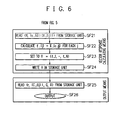
- the committed vector selecting unit SB2 reads the order q from the storage unit SB0 (SF2).
- the committed vector selecting unit SB2 selects at random a residue group of order q, that is, X_ ⁇ 01 ⁇ , ..., X_ ⁇ 0N ⁇ (Z/qZ) (SF3).
- the Y_0 and the Y_1 are referred to as i-th committed vectors.
- the Y_0 and the Y_1 are stored in the storage unit SB0 (SF6).
- the first commitment calculating unit SB3 reads (v, g, h, ⁇ X_ ⁇ ij ⁇ ), i, j, r) from the storage unit SB0 (SF7).
- the first commitment calculating unit SB3 selects at random a bit column r of ⁇ bits (SF8).
- a hash value C_ ⁇ ij ⁇ H_ ⁇ 0, 1 ⁇ (g, h, X_ ⁇ ij ⁇ , i, j, r) of data including the bit column r and the public key (g, h, q) is calculated (SF9).
- i 0 and 1.
- the first commitment vector(r, ⁇ C_ ⁇ ij ⁇ ) calculated by the first commitment calculating unit SB3 is stored in the storage unit SB0 (SF10).
- the basis vector calculating unit SB4 reads (q, N, g, h, ⁇ C_ ⁇ ij ⁇ ) from the storage unit SB0 (SF11).
- the second commitment calculating unit SB5 is described.
- the second commitment calculating unit SB5 reads (q, g, V, Y_0) from the storage unit SB0 (SF14) and calculates an inner product of the basis vector V and the Y_0 (SF15).
- the signature text output unit SB8 reads a signature text (r, ⁇ C_ ⁇ ij ⁇ , G, ) (SF25) and outputs the signature text (r, ⁇ C_ ⁇ ij ⁇ , G, ⁇ to the verifying apparatus VBN0 (SF26).
- an input unit VB1 stores the message M and its signature text (r, ⁇ C_ ⁇ ij ⁇ , G, ) in the storage unit VB0 (VF1).
- a validity of the signature text is verified through the later-described verifying processes of a basis vector calculating unit VB2, a vector challenge VB3, a first validity verifying unit VB4, a second validity verifying unit VB5, and an output unit VB6.
- the ⁇ V, > is set to a Schnorr response
- the ⁇ V, K> is set to a Schnorr challenge.
- FIG. 1 is a block diagram illustrating configurations of a signature apparatus SBN0 and a verifying apparatus VBN0 according to a second exemplary embodiment.
- the signature apparatus SBN0 receives data by using a receiving apparatus RBN0 and transmits data through a transmitting apparatus SeBN0.
- the verifying apparatus VBN0 receives data by using a receiving apparatus RBN1.
- LAN or Internet can be used for transmission / reception of data, but the present invention is not limited thereto.
- Symbol A denotes a cyclic group of which order is q.
- the number of bits of the order q is ⁇ .
- Symbol g denotes a base point of the cyclic group A.
- Symbol Z denotes a ring of all integers.
- Symbol N denotes a set of all natural numbers.
- An i-th component of a vector "a” is denoted by a_i.
- Inner product is denoted by ⁇ ., .>.
- An X-value hash function of a set X is denoted by H_X.
- R_ ⁇ + ⁇ Z ⁇ [0, 2 ⁇ + ⁇ ] is defined.
- a hash value function of the set X is denoted by H_X.
- a key generating method is described.
- a public key and a secret key are (g, h, q) and x, respectively.
- the signature apparatus SBN0 stores the public key and the secret key in a storage unit SB0. It is assumed that the public key is reserved in a location, from which the verifying apparatus VBN0 can acquire the public key in any type of an acquisition method.
- the acquisition method is, for example, means for using a means for reserving the public key in a public key table publicized on the Internet or means for directly acquiring the public key from the signature apparatus SBN0.
- the verifying apparatus VBN0 acquires the public key and stores the public key in the storage unit SB0 if needed. Details of the key generating method are disclosed in Non-Patent Document 11. Hereinafter, the description is made under the state that the verifying apparatus VBN0 has already acquired the public key.
- the signature apparatus SBN0 When the receiving apparatus RBN0 receives a message, the signature apparatus SBN0 inputs the message to an input unit SB1.
- a signature text is generated and output in a committed vector selecting unit SB2, a first commitment calculating unit SB3, a basis vector calculating unit SB4, a second commitment calculating unit SB5, a vector challenge calculating unit SB6, a vector response calculating unit SB7, and a signature text output unit SB8.
- the committed vector selecting unit SB2 reads (M, ⁇ , ⁇ ) from the storage unit SB0 (SF22).
- the committed vector selecting unit SB2 selects a residue group X_ ⁇ 01 ⁇ , ..., X_ ⁇ 0N ⁇ from R_ ⁇ + ⁇ (SF23).
- the Y_0 and the Y_1 are referred to as i-th committed vectors.
- the Y_0 and the Y_1 are stored in the storage unit SB0 (SF26).
- the first commitment calculating unit SB3 reads (N, ⁇ c_ ⁇ j ⁇ , ⁇ X_ ⁇ ij ⁇ ) from the storage unit SB0 (SF27).
- the first commitment calculating unit SB3 selects at random a bit column r of ⁇ bits (SF28).
- a hash value C_ ⁇ ij ⁇ H_ ⁇ 0,1 ⁇ (g, h, X_ ⁇ ij ⁇ , i, j, r) of data including the bit column r and the public key (g, h, q) is calculated (SF29).
- i 0 and 1.
- the first commitment vector(r, ⁇ C_ ⁇ ij ⁇ ) calculated by the first commitment calculating unit SB3 is stored in the storage unit SB0 (SF210).
- the basis vector calculating unit SB4 reads ( ⁇ , ⁇ , N, g, h, ⁇ C_ ⁇ ij ⁇ ) from the storage unit SB0 (SF211).
- the second commitment calculating unit SB5 is described.
- the second commitment calculating unit SB5 reads (V, Y_0, G) from the storage unit SB0 (SF214) and calculates an inner product of the basis vector V and the Y_0 (SF215).
- the signature text output unit SB8 reads a signature text (r, ⁇ C_ ⁇ ij ⁇ , G, ) (SF225) and outputs the signature text (r, ⁇ C_ ⁇ ij ⁇ , G, ⁇ ) to the verifying apparatus VBN0 (SF226).
- an input unit VB1 stores the message M and its signature text (r, ⁇ C_ ⁇ ij ⁇ , G, ) in the storage unit VB0 (VF1).
- a validity of the signature text is verified through the later-described verifying processes in a basis vector calculating unit VB2, a vector challenge VB3, a first validity verifying unit VB4, a second validity verifying unit VB5, and an output unit VB6.
- the ⁇ V, > is set to a Schnorr response
- the ⁇ V, K> is set to a Schnorr challenge.
- FIG. 8 is a block diagram illustrating configurations of a signature apparatus SB30 and a verifying apparatus VBN30 according to a third exemplary embodiment.
- the signature apparatus SB30 receives data by using a receiving apparatus RBN30 and transmits data through a transmitting apparatus SeBN30.
- the verifying apparatus VBN30 receives data by using a receiving apparatus RBN31.
- LAN or Internet can be used for transmission/reception of data, but the present invention is not limited thereto.
- Symbol A denotes a cyclic group of which order is q.
- the number of bits of the order q is ⁇ .
- Symbol g denotes a base point of the cyclic group A. It is assumed that, although the order q of the cyclic group A is publicized, the discrete logarithm problem associated with the cyclic group A is hard to falsify.
- Symbol Z denotes a ring of all integers.
- N denotes a set of all natural numbers.
- An i-th component of a vector "a” is denoted by a_i.
- An inner product is denoted by ⁇ , ⁇ >.
- An X-value hash function of a set X is denoted by H_X.
- the signature apparatus SBN30 stores the public key and the secret key in a storage unit SB30. It is assumed that the public key is reserved in a location, from which the verifying apparatus VBN30 can acquire the public key in any type of an acquisition method.
- the acquisition method is, for example, a method of means for reserving the public key in a public key table publicized on the Internet or means for directly acquiring the public key from the signature apparatus SBN30.
- the verifying apparatus VBN30 acquires the public key and reserves the public key in the storage unit SB30 if needed. Details of the key generating method are disclosed in Non-Patent Document 11. Hereinafter, the description is made under the state that the verifying apparatus VBN0 has already acquired the public key.
- the signature apparatus SBN30 When the receiving apparatus RBN30 receives a message, the signature apparatus SBN30 inputs the message to an input unit SB31.
- a signature text is generated and output in a committed vector selecting unit SB32, a second commitment calculating unit SB33, a first commitment calculating unit SB34, a vector challenge calculating unit SB35, a vector response calculating unit SB36, and a signature text output unit SB37.
- the input unit SB31 receives a message M from the receiving apparatus RBN30 and stores the message M in a storage unit SB30.
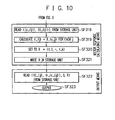
- the committed vector selecting unit SB2 reads (q, x) from the storage unit SB30 (SF32).
- the committed vector selecting unit SB2 selects a residue group X_ ⁇ 01 ⁇ , ..., X_ ⁇ 0N ⁇ from (Z/qZ) (SF33).
- the Y_0 and the Y_1 are referred to as i-th committed vectors.
- the Y_0 and the Y_1 are stored in the storage unit SB0 (SF36).
- the first commitment calculating unit 34 reads (v, ⁇ X_ ⁇ ij ⁇ ) (SF311).
- the first commitment calculating unit 34 selects at random a bit column r of ⁇ bits for each of the i, j (SF312).
- a hash value C_ ⁇ j ⁇ H_ ⁇ 0, 1 ⁇ (X_ ⁇ ij ⁇ , r_ ⁇ ij ⁇ ) of data including the bit column r and the public key (g, h, q) is calculated (SF313).
- i 0 and 1.
- the hash value C_ ⁇ ij ⁇ calculated by the first commitment calculating unit SB34 is set to a first commitment.
- the first commitment vector ⁇ C_ ⁇ ij ⁇ calculated by the first commitment calculating unit SB3 is stored in the storage unit SB0 (SF314).
- the signature text output unit SB37 reads a signature text ( ⁇ C_ ⁇ ij ⁇ , ⁇ r_ ⁇ c_ ⁇ jj ⁇ , G, ) (SF322) and outputs the signature text ( ⁇ C_ ⁇ ij ⁇ , ⁇ r_ ⁇ c_jj ⁇ , G, ) to the verifying apparatus VBN30 (SF323).
- input unit VB31 stores the message M and its signature text ( ⁇ C_ ⁇ ij ⁇ , ⁇ r_ ⁇ c_jj ⁇ , G, ) in a storage unit VB0 (VF31).
- a validity of the signature text is verified through the later-described verifying processes of a vector challenge VB32, a first validity verifying unit VB34, a second validity verifying unit VB33, and an output unit VB35.
- the ⁇ V, > is set to a Schnorr response
- the ⁇ V, K> is set to a Schnorr challenge.
- Non-Patent Document 12 An example of the first exemplary embodiment to which a straight-line extractable proving scheme of a discrete logarithm (Non-Patent Document 12) is applied is described.
- Fig. 12 Configurations of a proving apparatus and a verifying apparatus are illustrated in Fig. 12. As illustrated in Fig. 12, in the example, there are the proving apparatus PSPBN0 and the verifying apparatus VSPBN0, which correspond to the signature apparatus SBN0 and the verifying apparatus VBN0 according to the first exemplary embodiment, respectively.
- a predetermined ID or random number is used instead of a message M. Operations of each units are the same as those of the first exemplary embodiment except that the ID or the random number is used instead of the message M.
- a straight-line extractable proving scheme of the discrete logarithm may be applied to the second or third exemplary embodiment.
- Example 2 is an example where a verifier-designated proving scheme is applied to a proving apparatus DVSSBN0 and a verifying apparatus DVSVBN0 according to Example 1.
- the proving apparatus DVSSBN0 receives data by using a receiving apparatus DVSRBNO and transmits data through a communication apparatus DVSCBNO.
- the verifying apparatus DVSVBN0 receives data by using a receiving apparatus DVSRBN1.
- LAN or Internet can be used as a channel used for data communication.
- the proving apparatus DVSSBN0 includes an input unit DVSSB1, a key validity proof text verifying unit DVSSB2, a proving unit DVSSB3, and a storage unit DVSSB0.
- the data input through the input unit DVSSB0 of the proving apparatus DVSSBN0 is stored in the storage unit DVSSB0.
- the verifying apparatus DVSVBN0 includes an output unit DVSVB1, a key validity proof text generating unit DVSSB2, a verifying unit DVSVB3, and a storage unit DVSVB0.
- the data input through the communication unit DVSCBN0 is stored in the storage unit DVSVB0.
- the key validity proof text generating unit DVSSB2 reads required data from the storage unit DVSSB0 and stores a calculation result thereof in the storage unit DVSSB0.
- the proving unit DVSSB3 reads required data from the storage unit DVSSB0 and stores a calculation result thereof in the storage unit DVSSB0.
- the key validity proof text generating unit DVSVB2 reads required data from the storage unit DVSVB0 and stores a calculation result thereof in the storage unit DVSVB0.
- the verifying unit DVSVB3 reads required data from the storage unit DVSVB0 and stores a calculation result thereof in the storage unit DVSVB0.
- the output unit DVSVB1 reads a required data from the storage unit DVSSB0 and outputs the data.
- An instance which is used for proving the corresponding secret is shared by the proving apparatus DVSSBN0 and the verifying apparatus DVSVBN0 in advance.
- the to-be-proven secret is transmitted and received through a channel by using a transmitting/receiving apparatus, and the secret is hard-coded when the proving apparatus DVSSBN0 and the verifying apparatus DVSVBN0 are produced.
- the proving apparatus DVSSBN0 is assumed to have the to-be-proven secret in advance. For example, there is a method where the secret is transmitted through the channel by using the transmitting/receiving apparatus or a method where the secret is hard-coded when the proving apparatus DVSSBN0 is produced.
- a key generating method in the verifying apparatus DVSVB0 is described.
- a public key and a secret key are (g, h, q) and x, respectively.
- the storage unit DVSVB0 of the verifying apparatus DVSVBN0 stores the public key (g, h, q) and the secret key x.
- An acquisition method for the public key (g, h, q) is, for example, an method of reserving the public key in a public key table published on the Internet or a method of directly acquiring the public key from the verifying apparatus DVSVBN00.
- the proving apparatus DVSSBN0 acquires the public key and stores the public key in the storage unit DVSSB0 if needed. Details of the key generating method are disclosed in Non-Patent Document 11. Hereinafter, the description is made under the state that the proving apparatus DVSSBN0 has already acquired the public key.
- the verifying apparatus DVSVBN0 operates key validity proof text verifying unit DVSVB2 to generate a proof text indicating that the verifying apparatus has a secret key corresponding to the its own public key.
- the key validity proof text generating unit DVSVB2 which generates the proof text performs operations which are the same as those of the proving apparatus PSPBN0 (Fig. 12) according to Example 1.
- the verifying apparatus DVSVBN0 transmits the generated proof text through the communication apparatus DVSCBN1 to the proving apparatus DVSSBN0.
- the proving apparatus DVSSBN0 receives the proof text through the communication apparatus DVSCBNO.
- the proving apparatus DVSPBN0 verifies a validity of the proof text in the key validity proof text verifying unit DVSSB2.
- the key validity proof text verifying unit DVSSB2 performs operations which are the same as those of the verifying apparatus VSPBN0 (Fig. 12) according to Example 1.
- the proving apparatus DVSPBN0 proves whether or not there is a secret corresponding to the instance in the proving unit DVSSB3 or whether or not there is a secret key corresponding to the public key of a verifier.
- the verifying apparatus DVSVBN0 verifies a validity of the proof in the verifying unit DVSVB3.
- Non-Patent Document 13 Since the proving unit DVSSB3 and the verifying unit DVSVB3 are the same as a proving method and a verifying method in Non-Patent Document 13, the description thereof is not repeated. Details thereof are disclosed in Non-Patent Document 13.
- Example 3 a crypto scheme added to the configurations and operations of Example 1 is implemented (see Fig. 14).
- an encrypting apparatus EVEN0 and a decrypting apparatus DVEN1 receives data by using a receiving apparatus RBSO and transmits data through a transmitting apparatus SeBEO.
- the decrypting apparatus DBEN0 receives data by using a receiving apparatus RBE1.
- LAN or Internet can be used for data communication, but not limited thereto.
- a key generating method in the encrypting apparatus EBEN0 is described.
- a public key and a secret key are (g, h, q) and x, respectively.
- a storage unit EEB0 of the encrypting apparatus EBEN0 stores the public key and the secret key.
- the public key is reserved in a location from which the decrypting apparatus DBEN0 can acquires the public key in any type of an acquisition method.
- the acquisition method is, for example, means for reserving the public key in a public key table publicized on the Internet or means for directly acquiring the public key from the encrypting apparatus EBEN0.
- the decrypting apparatus DBEN0 acquires the public key and reserves the public key in the storage unit DBE0 if needed. Details of the key generating method are disclosed in Non-Patent Document 11. Hereinafter, the description is made under the state that the decrypting apparatus DVEN0 has already acquired the public key in advance.
- the input unit EBE1 When the input unit EBE1 receives a to-be-encrypted message m ⁇ G, the message m ⁇ G is stored in the storage unit EBE0.
- the proving unit EBE3 reads required data from the storage unit EBE0 and generates a proof text P which is associated with a discrete logarithm problem of I with g as a base in the same manner as that of the proving apparatus PSPBN0 (see Fig. 12) according to Example 1. Finally, a cipher text (I, J, P) is stored in the storage unit EBE.
- the receiving apparatus RBE1 When the receiving apparatus RBE1 receives cipher text (I, J, P), the receiving apparatus RBE1 stores the cipher text (I, J, P) in the storage unit DBE0. Processes of a verifying unit DBE1, a decrypting unit DBE3, and an output unit DBE4 are sequentially performed.
- the output unit DBE4 reads the m' from the storage unit DBE0 and outputs the m'.
Landscapes
- Engineering & Computer Science (AREA)
- Computer Security & Cryptography (AREA)
- Computer Networks & Wireless Communication (AREA)
- Signal Processing (AREA)
- Theoretical Computer Science (AREA)
- Computing Systems (AREA)
- Physics & Mathematics (AREA)
- General Physics & Mathematics (AREA)
- Storage Device Security (AREA)
Abstract
Description
- The present invention relates to a signature apparatus, a verifying apparatus, a proving apparatus, an encrypting apparatus, and a decrypting apparatus and, more particularly, to a signature apparatus, a verifying apparatus, a proving apparatus, an encrypting apparatus, and a decrypting apparatus capable of efficiently reducing a signature text counterfeit problem to a discrete logarithm problem.
- A public key is a cipher which uses different keys for encrypting and decrypting. The key used for the decrypting is maintained in a secret state, while the key used for the encrypting is publicized. The public key needs a system for ensuring an authenticity of a key to be publicized. However, there is no need to distribute the key to a counter party in advance. In addition, due to the public key, it is possible to implement a digital signature capable of authenticating the counter party for communication and verifying the authenticity of received data. For this reason, the public key is widely used as an information security technique in a network such as the Internet.
- Recently, a crypto scheme having a provable safety and a practicability has been widely researched with respect to the public key. Among the current used crypto schemes, an efficient decryption method has not yet been implemented, and safety of most crypto schemes has not been proven. A probability of presence of the efficient decryption methods associated with the crypto schemes can not completely be denied.
- Non-Patent Document 1: Mihir. Bellare and Phillip. Rogaway. Random Oracles are Practical: A Paradigm for Designing Efficient Protocols. ACM-CCS. 1993. pp. 62-73
- Non-Patent Document 2: Mihir Bellare, Phillip Rogaway. The Exact Secrity of Digital Signatures: How to Sign with RSA and Rabin. In Advances in Cryptology --- EUROCRYPT' 96, vol. 1070 of LNCS, pp. 399-416, Springer-Verlag, 1996.
- Non-Patent Document 3: Jean-Sebastien Coron. On the Exact Security of Full Domain Hash. In Advances in Cryptology --- CRYPTO 2000, vol. 1880 of LNCS, pp. 229-235, Springer Verlag, 2000.
- Non-Patent Document 4: Amos. Fiat and Adi. Shamir. How to prove yourself Practical Solution to Identification and Signature Problems. In Advances in Cryptology --- CRYPTO' 86, vol. 263 of LNCS pp. 186-194, Springer-Verlag, 1987.
- Non-Patent Document 5: Eu Jin Goh, Stanislaw Jarecki. A Signature Scheme as Secure as the Diffie-Hellman Problem. In Advances in Cryptology --- EUROCRYPT 2003, vol. 2656 of LNCS, pp. 401-415, Springer-Verlag, 2003.
- Non-Patent Document 6: Kazuo Ohta, Tatsuaki Okamoto. On Concrete Security Treatment of Signatures Derived from Identification. In Advances in Cryptology --- CRYPTO'98, vol. 1462 of LNCS, pp. 354-369, Springer-Verlag, 1998.
- Non-Patent Document 7: Rafael Pass. On Deniability in the Common Reference String and Random Oracle Model. In Advances in Cryptology --- CRYPTO 2003, vol. 2729 of LNCS pp. 316-337, Springer Verlag, 2003.
- Non-Patent Document 8: David Pointcheval, Jacques Stern: Security Arguments for Digital Signatures and Blind Signatures. J. Cryptology 13(3): 361-396 (2000)
- Non-Patent Document 9: R. Rivest, A. Shamir, L. Adleman. A Method for Obtaining Digital Signatures and Public-Key Cryptosystems. Communicaions of the ACM. Vol. 21, No. 2, pp. 120-126, 1978.
- Non-Patent Document 10: C. Schnorr. Efficient Signature Generation by Smart Cards. Journal of Cryptology, 4(3), pp. 161-174, 1991.
- Non-Patent Document 11: Handbook of Applied Cryptography. A. Menezes P. Oorshot, and S. Vanstone, CRC Press.
- Non-Patent Document 12: Rafael Pass.On Deniability in the Common Reference String and Random Oracle Model. In Advances in Cryptology --- CRYPTO 2003, vol. 2729 of LNCS, pp. 316-337, Springer-Verlag, 2003.
- Non-Patent Document 13: Markus Jakobsson, Kazue Sako, and Russell Impagliazzo. Designated Verifier Proofs and Their Applications. In Advances in Cryptology --- EUROCRYPT'96, vol. 1070 of LNCS, pp. 143-154, Springer-Verlag, 1996.
- However, the aforementioned schemes have the following problems.
- Since an electronic signature scheme was disclosed in Non-Patent
Document 9, implementation of a safe and efficient signature scheme has been one of the objects of a cryptology. As approaches for achieving the object, there are signature schemes using Fiat-Shamir heuristic (Non-Patent Document 4) or a hash-then-sign method (Non-Patent Document 1). - However, in terms of safety proof (Non-Patent Documents 3, 6, and 8) of the signature schemes, it is disclosed that a signature text cannot be counterfeited during a polynomial time interval while it is not disclosed in detail how much amount of calculation is needed to counterfeit the signature text. For this reason, there is a probability of presence of an attacker who can succeed counterfeiting the signature text with a much smaller amount of calculation than the amount of calculation required for decrypting a base problem (Non-Patent Document 2).
- The Schnorr signature scheme (Non-Patent Document 10) is one of the signature schemes having such a probability. Although the base problem, that is, a discrete logarithm problem has a safety of about λ bits, the safety proof (Non-Patent Documents 6 and 8) of the Schnorr signature scheme ensures that the Schnorr signature scheme has at most a safety of about λ/2 bits. Therefore, a signature scheme capable of efficiently reducing the signature text counterfeit problem to the discrete logarithm problem is required.
- It is known that a scheme having such a property can be theoretically implemented. As a scheme satisfying the property, there is a scheme of converting to a cut-and-choose type proving scheme (Non-Patent Document 7) of the discrete logarithm problem. However, the scheme needs a large amount of calculation for signature and verification. It is disclosed that a signature scheme capable of efficiently reducing the signature text counterfeit problem to the discrete logarithm problem and using a small amount of calculation cannot be implemented (Non-Patent Document 5).
- In Non-Patent Document 2, since there is a need to rewind an attacker during the safety proof, an efficiency of reduction to the base problem is deteriorated, so that the safety is deteriorated compared with the base problem. In the safety proof ¥cite[PS00] of the Schnorr signature scheme, since there is a need to rewind the attacker, the safety is deteriorated compared with the base problem, that is, the discrete logarithm problem.
- Therefore, an object of the present invention is to provide a signature apparatus, a verifying apparatus, a proving apparatus, an encrypting apparatus, and a decrypting apparatus capable of summarizing secret information of an attacker from a commitment without rewinding the attacker by using a hash value as the commitment.
- An invention according to
claim 1 provides a signature apparatus for generating a signature text by using a commitment, wherein the commitment is a hash value of a set including a committed value, data including a pair of elements of a cyclic group associated with a discrete logarithm problem is used as a public key, and a discrete logarithm of an order of the pair is used as a secret key. - An invention according to claim 2 provides the signature apparatus according to
claim 1, comprising: committed vector selecting means which selects a committed vector associated with a first commitment; first commitment calculating means which calculates the first commitment; basis vector calculating means which calculates a basis vector; second commitment calculating means which calculates the power residue and generates a second commitment; vector challenge calculating means which calculates a vector challenge; vector response calculating means which calculates a vector response by using the first commitment, a set used for calculating the power residue, the vector challenge, and the basis vector; and a storage unit which stores the committed vector, the first commitment, the basis vector, the second commitment, the vector challenge, and the vector response, wherein the basis vector and the vector challenge are hash values. - An invention according to claim 3 provides the signature apparatus according to claim 2, wherein the committed vector selecting means selects a plurality of the committed vectors, each component of the plurality of committed vectors and a secret key satisfy a relation equation with a group order as a modulus, and the set is data calculated by using a portion of data selected by the committed vector selecting means, the basis vector, and the vector challenge.
- An invention according to claim 4 provides the signature apparatus according to claim 3, wherein each component of the committed vectors and the secret key satisfy a linear equation with the group order as a modulus, an input of the first commitment is data including a random number, a portion of the data is determined by the vector challenge, and the set is represented by a linear equation of the portion of the data and the basis vector.
- An invention according to
claim 5 provides the signature apparatus according to claim 4, wherein the committed vector includes two components, the one component being a value obtained by adding a secret key to the other component and obtaining a residue with a group order as a modulus, an input of the first commitment includes data for specifying each component of the committed vector, and the set includes a inner product of the portion of the data and the basis vector. - An invention according to claim 6 provides the signature apparatus according to claim 5, wherein assuming that security parameters are κ, N, and v, and an order of the cyclic group is q, the committed vector selecting means selects a residue group X_{01}, ..., X_{0N}∈(Z/qZ) at random and sets values obtained by adding x to the residue group X_{0j} for j = 1, ...N and obtaining a residue with the order q as a modulus to X_{1j}, the committed vector for i = 0, 1 is Y_i = (X_{i1}, ..., X_{iN}), the first commitment calculating means selects at random a bit column r of ν bits, a hash value of data including the public key, X_{ij}, i, j, r for i = 0, 1 is set to the first commitment C_{ij}, the basis vector calculating means sets a hash value of data including the public key and the first commitment C_{ij} to the basis vector V = (u_1, ..., u_N), the second commitment calculating means calculates an inner product of the basis vector V and the Y_0 and calculates a second commitment G = g^{X}, the vector challenge calculating means calculates a hash value K = (c_1, ..., c_N) of data including the public key, {C_{ij}}, G, r, and a message received by the signature apparatus, the vector response calculating means calculates the vector response ξ_{j} = X_{c_jj} for all j = 1, ..., N and= (ξ_1, ..., ξ_κ), and a signature text (r, {C_{ij}}, G,
 ) is output.
 - An invention according to claim 7 provides the signature apparatus according to claim 2, wherein the committed vector selecting means selects the plurality of committed vectors, and each component of the plurality of committed vectors and a secret key satisfy a relational equation.
- An invention according to claim 8 provides the signature apparatus according to claim 7, wherein the relational equation satisfies a linear equation of each component of the plurality of vectors and the secret key, and an input of the first commitment is data including a random number.
- An invention according to
claim 9 provides the signature apparatus according to claim 8, wherein the plurality of committed vectors include a plurality of components, the one component is obtained by adding a secret key to another component, and an input of the first commitment includes data for specifying each of the components and data for specifying which is the ordinal number of the component. - An invention according to claim 10 provides the signature apparatus according to claim 9, wherein assuming that security parameters are κ, N, and v, and an integer set R{κ+ξ} satisfies 0 ≤ R(κ+ξ) < 2^(κ+ξ), the committed vector selecting means selects a residue group X_{01}, ..., X_{0N}∈(Z/qZ) at random and sets values obtained by adding x to the residue group X_{0j} for j = 1, ...N to X_{1j}, the committed vector for i = 0, 1 is Y_i = (X_{i1}, ..., X_{iN}), the first commitment calculating means selects at random a bit column r of ν bits, a hash value of data including the public key, X_{ij}, i, j, r for i = 0, 1 is set to the first commitment C_{ij}, the basis vector calculating means sets a hash value of data including the public key and the first commitment C_{ij} to the basis vector V = (u_1 ..., u_N), the second commitment calculating means calculates an inner product of the basis vector V and the Y_0 and calculates a second commitment G = g^{X}, the vector challenge calculating means calculates a hash value K = (c_1, ..., c_N) of data including the public key, {C_{ij}}, G, r, and a message received by the signature apparatus, the vector response calculating means calculates the vector response ξ_(j) = X_{cjj} for all j = 1, ..., N and= (ξ_1, ..., ξ_κ), and a signature text (r, {C_{ij}}, G,) is output.
- An invention according to claim 11 provides the signature apparatus according to claim 10, comprising: committed vector selecting means which selects a committed vector associated with a first commitment; first commitment calculating means which calculates the first commitment; basis vector calculating means which calculates a basis vector; second commitment calculating means which calculates the power residue and generates a second commitment; vector challenge calculating means which calculates a vector challenge; vector response calculating means which calculates a vector response by using the first commitment, a set used for calculating the power residue, the vector challenge, and the basis vector; and a storage unit which stores the committed vector, the first commitment, the basis vector, the second commitment, the vector challenge, and the vector response, wherein the basis vector and the vector challenge are hash values.
- An invention according to claim 12 provides the signature apparatus according to claim 11, wherein the committed vector selecting means selects a plurality of the committed vectors, each having the same configuration as the committed vector, each component of the plurality of committed vectors and a secret key satisfy a relation equation with a group order as a modulus, and the set is data calculated by using a portion of data selected by the committed vector selecting means, the basis vector, and the vector challenge.
- An invention according to claim 13 provides the signature apparatus according to claim 12, wherein each component of the committed vectors and the secret key satisfy a linear equation with the group order as a modulus, the first commitment is data including a random number, a portion of the data is determined by the vector challenge, and the set is represented by a linear equation of the portion of the data and the basis vector.
- An invention according to claim 14 provides the signature apparatus according to claim 13, wherein the one component of the committed vector is a value obtained by adding a secret key to another component and obtaining a residue with a group order as a modulus, the set includes an inner product of the portion of the data and the basis vector, and the basis vector is a value obtained by multiplying a predetermined number t with (1, t^1, t^2, ..., t^N).
- An invention according to claim 15 provides the signature apparatus according to claim 14, wherein assuming that the message is M, the committed vector selecting means selects at random Y_0 = (X_{01}, ...,X_{0N})∈Zq^{N}, calculates X_{1j} = x+X_{0j}modq for j = 1, ..., N, and generates the committed vector Y_1 = (X_{11}, ...X_{1N}), the second commitment calculating means calculates X = <{Y_0, V}> = Σ_jX_{0j}2^{j-1}modq and calculates the commitment G = g^{X}, the first commitment calculating means selects at random r_{ij}∈{0, 1}^{v} for each i and j and calculates the first commitment C_{ij} = H_{{0, 1}^v}(X_{ij}, r_{ij}) of the X_{ij}, the vector challenge calculating means calculates K = (c_{1}, ..., c_{N}) = H_{{0, 1}^{N}(g, h, {C_{ij}}, G, M), the vector response calculating means calculates the vector response ξ_j = X_{c_jj}modq for each j and calculates= (ξ_{1}, ..., ξ_{N}), and a signature text ({C_{ij}}, {r_{c_jj}}, G,) is output.
- An invention according to claim 16 provides a verifying apparatus for determining a validity of input data, wherein the input data includes a message and a signature text associated with the message; only if the data is valid, the data is accepted, first commitments are used for verification calculation, and power residue is performed the number of times less than the number of the first commitments; if the validity of the data is authenticated, the first commitments are hash values of data including components of a vector response which is a portion of the data; a public key is data including a pair of elements of a cyclic group associated with a discrete logarithm problem; and a secret key is a discrete logarithm of an order of the pair.
- An invention according to claim 17 provides the verifying apparatus according to claim 16, comprising: basis vector calculating means which calculates a basis vector; vector challenge calculating means which calculates a vector challenge; first commitment validity verifying means which determines a validity of the first commitment; second validity verifying means which calculates power residue and determines a validity of the vector response; and storage means which stores data input to and output from each of the means, wherein the vector challenge and the basis vector are hash values, and, only if the first commitment validity verifying means and the second validity verifying means determine that the signature text is valid, the input of the data is accepted.
- An invention according to claim 18 provides the verifying apparatus according to claim 17, wherein the first commitment validity verifying means inputs a portion of the input data including the vector response to a hash function in a predetermined method and determines that the first commitment is valid only if the calculated hash value is equal to the first commitment, when the to be determined data include data called a second commitment and the vector response and the public key includes two elements of a cyclic group associated with a discrete logarithm problem, the second validity verifying means calculates first and second power residues which are power residues of the elements and determines whether or not the first power residue is equal to a value obtained by multiplying the second power residue with the second commitment, the first power residue is obtained by designating elements which are a portion of the public key to an order and designating a Schnorr challenge to a set, the second power residue is obtained by designating elements which are a portion of the public key to an order and designating a Schnorr response to a set, the Schnorr challenge is data calculated by using the vector challenge and the basis vector, and the Schnorr response is data calculated by using the vector response and the basis vector.
- An invention according to claim 19 provides the verifying apparatus according to claim 18, wherein, if a valid signature text is not included in data validly selected at random by the signature apparatus, the data is not accepted, the data selected at random is input to each hash function calculated by the first commitment validity verifying means, one component of the vector response is input to each of the hash functions, the Schnorr challenge is a linear equation of the vector challenge and a linear equation of the basis vector, and the Schnorr response is a linear equation of the vector response and a linear equation of the basis vector.
- An invention according to claim 20 provides the verifying apparatus according to claim 19, wherein the Schnorr challenge is an inner product of the vector challenge and the basis vector, and the Schnorr response is an inner product of the vector response and the basis vector.
- An invention according to claim 21 provides the verifying apparatus according to claim 20, wherein assuming that the message is M, and the to-be-determined data is (r, {C_{ij}}, G,), the basis vector calculating means calculates a hash value of data including the public key and {C_{ij}}, the hash value being the basis vector V = (u_1, ..., u_N), the vector challenge calculating means calculates a hash value of data including the public key, {C_{ij}}, G, r, and M, the hash value being the vector challenge K = (c_1, ..., c_N), the first commitment validity verifying means determines that C_{c_jj} is valid only if C_{c-jj} for j = 1, ..., N are equal to the hash function determines that {C_{jj}} is valid only if all the C_{c_jj} are valid, the hash function is a hash value of data including the public key, ξ_{j}, c_j, j, and r, and the second validity verifying means determines whether or not g^{<V,>} = h^{<V, K>}G is satisfied and determines that the signature text is valid if g^{<V,>} = h^{<V, K>}G is satisfied.
- An invention according to claim 22 provides the verifying apparatus according to claim 16, comprising: vector challenge calculating means which calculates the vector challenge; first commitment validity verifying means which determines a validity of the first commitment; and second validity verifying means which calculates the power residue and determines a validity of the vector response, wherein the signature text is accepted only if the validity is authenticated in the first commitment validity verifying means and the second validity verifying means.
- An invention according to claim 23 provides the verifying apparatus according to claim 22, wherein, if a hash value obtained by inputting a portion of the input data to a hash function is equal to the first commitment, the first commitment validity verifying means determines that the first commitment is valid, the data input to the hash function is used to calculate two power residues, and it is determined whether or not the one of the two power residues is equal to a value obtained by multiplying the other power residue with the second commitment, the to be determined data includes the second commitment and the vector response, the public key includes elements of a cyclic group associated with a discrete logarithm problem, each of the power residues is obtained by designating the other element which is a portion of the public key to an order and designating a Schnorr challenge to a set, the Schnorr challenge is calculated by using the vector challenge and the basis vector, and the Schnorr response is calculated by using the vector response and the basis vector.
- An invention according to claim 24 provides the verifying apparatus according to claim 23, wherein, if data which should be selected at random is not included in a case where the signature apparatus generates a signature text validly, the data is rejected, the data which should be selected at random is input to each of the hash functions calculated by the first commitment validity verifying means, one component of the vector response is input to each of the hash functions, the Schnorr challenge is a linear equation of the vector challenge and a linear equation of the basis vector, and the Schnorr response is a linear equation of the vector response and a linear equation of the basis vector.
- An invention according to claim 25 provides the verifying apparatus according to claim 24, wherein the Schnorr challenge is an inner product of the vector challenge and the basis vector, and the Schnorr response is an inner product of the vector response and the basis vector.
- An invention according to claim 26 provides the verifying apparatus according to claim 25, wherein assuming that the message is M, and the to-be-verified signature text is ({C_{ij}}, {r_{cjj}}, G, E), the vector challenge calculating means calculates K = (c_{1}, ..., c_{N}) = H_{{0, 1}^{N}}(g, h, {C_{ij}, G, M}; the first commitment validity verifying means determines whether or not C_{c_jj} = H_{{0, 1}^ν}(ξ_j, r_{c_jj}) for all j = 1, ...,N is satisfied, if the relation for all j is satisfied, it is determined to be b = 1, and if not, it is determined to be b = 0; when b = 0, the second validity verifying means determines whether or not g^{<V,>} = h^{<V, K>}G is satisfied; if g^{<V,>} = h^{<V, K>}G is not satisfied, b = 0 is designated, and data indicating that the signature text is rejected is output; and if g^{<V,>} = h^{<V, K>}G is satisfied, b = 1 is designated, and data indicating that the signature text is accepted is output.
- A proving apparatus according to claim 27 is characterized by using a method of determining a validity of a proof text by the method according to
claim 5. - A proving apparatus according to claim 28 is characterized by using a method of determining a validity of a signature text by the method according to
claim 9. - A proving apparatus according to claim 29 is characterized by using a method of determining a validity of a signature text generated by the method according to claim 14.
- An invention according to claim 30 provides a proving apparatus for determining a validity of a public key in a verifying apparatus using a verifier-designated proving scheme, wherein the public key of the verifying apparatus includes two data, the first data and the second data belong to the same cyclic group, and a secret key of a verifier or a portion thereof is obtained by designating the first data to an order and designating the second data to a discrete logarithm.
- A proving apparatus according to claim 31 is characterized by using a signature text generated by the signature apparatus according to
claim 5 as a proof text or a portion thereof for determining validity. - A proving apparatus according to claim 32 is characterized by using a signature text generated by the signature apparatus according to
claim 9 as a proof text or a portion thereof for determining validity. - An invention according to claim 33 provides the proving apparatus according to claim 30 using a signature text generated by the signature apparatus according to claim 14 as a proof text or a portion thereof for determining a validity.
- An invention according to claim 34 provides a verifying apparatus for verifying a validity of a proof text for a public key of a verifier-designated proving scheme verifying apparatus, wherein the verifying is performed by using the method according to claim 20.
- An invention according to claim 35 provides a verifying apparatus for verifying a validity of a proof text for a public key of a verifier-designated proving scheme verifying apparatus, wherein the verifying is performed by using the method according to claim 25.
- An encrypting apparatus according to claim 36 is characterized by using a signature text generated by using the method according to
claim 5 as a proof text or a portion thereof for proving a knowledge of a random number used to generate a cipher text. - An encrypting apparatus according to claim 37 is characterized by using a signature text generated by using the method according to
claim 9 as a proof text or a portion thereof for proving a knowledge of a random number used to generate a cipher text. - An encrypting apparatus according to claim 38 is characterized by using a signature text generated by using the method according to claim 14 as a proof text or a portion thereof for proving a knowledge of a random number used to generate a cipher text.
- A decrypting apparatus according to claim 39 is characterized by including a proof text as a portion of a cipher text and verifying the proof text by using the method according to claim 20.
- A decrypting apparatus according to claim 40 is characterized by including a proof text as a portion of a cipher text and verifying the proof text by using the method according to claim 25.
- According to the present invention, the hash value is used as a commitment, so that it is possible to summarize secret information of an attacker from the commitment without rewinding the attacker and to ensure a higher safety than that of a Schnorr signature scheme. In addition, one-time power residue calculation is performed in each of the signature and verification calculations, thus it is possible to lower an amount of calculation in the signature and verification calculations.
- Hereinafter, configurations and operations of a signature apparatus and a verifying apparatus according to exemplary embodiments will be described.
- FIG. 1 is a block diagram illustrating configurations of a signature apparatus SBN0 and a verifying apparatus VBN0 according to a first exemplary embodiment. The signature apparatus SBN0 receives data by using a receiving apparatus RBN0 and transmits data through a transmitting apparatus SeBN0. The verifying apparatus VBN0 receives data by using a receiving apparatus RBN1. For example, LAN or Internet can be used as a channel used for data communication, but the present invention is not limited thereto.
- Now, symbols used in the embodiment are described.
- Symbol A denotes a cyclic group of which order is q. The number of bits of the order q is κ. Symbol g denotes a base point of the cyclic group A. It is assumed that, although the order q of the cyclic group A is publicized, the discrete logarithm problem associated with the cyclic group A is hard to falsify.
- Symbol Z denotes a ring of all integers. Symbol N denotes a set of all natural numbers. An i-th component of a vector "a" is denoted by a_i. An inner product is denoted by <·, ·>. An inner product of a vector "a" and a vector "b" is represented by <a, b> = a_1b_1+···a_Nb_N. An X-value hash function of a set X is denoted by H_X.
- Now, a key generating method is described. An x∈(Z/qZ)\{0} is taken at random, and h = g^x is obtained. A public key and a secret key are (g, h, q) and x, respectively. The signature apparatus SBN0 reserves the public key and the secret key in a storage unit SB0. It is assumed that the public key is reserved in a location, from which the verifying apparatus VBN0 can acquire the public key in any type of an acquisition method. The acquisition method is, for example, means for reserving the public key in a public key table publicized on the Internet or means for directly acquiring the public key from the signature apparatus SBN0. The verifying apparatus VBN0 acquires the public key and reserves the public key in the storage unit SB0 if needed. Details of the key generating method are disclosed in Non-Patent Document 11. Hereinafter, the description is made under the state that the verifying apparatus VBN0 has already acquired the public key.
- The operations of the signature apparatus SBN0 are described with reference to Figs. 1 to 3.
- When the receiving apparatus RBN0 receives a message, the signature apparatus SBN0 inputs the message to an input unit SB1. A signature text is generated and output in a committed vector selecting unit SB2, a first commitment calculating unit SB3, a basis vector calculating unit SB4, a second commitment calculating unit SB5, a vector challenge calculating unit SB6, a vector response calculating unit SB7, and a signature text output unit SB8.
- Each of the units (SB1 to SB7) reads the data from the storage unit SB0, processes the data, and store the data in the storage unit SB0 if needed.
- Now, detailed processes of each of the units (SB1 to SB7) are described.
- The input unit SB1 receives a message M from the receiving apparatus RBN0 and stores the message M in the storage unit SB0.
- Processes of the committed vector selecting unit SB2 are described.
- When the message M is stored in the storage unit SB0, the committed vector selecting unit SB2 reads the order q from the storage unit SB0 (SF2). When the order q is read, the committed vector selecting unit SB2 selects at random a residue group of order q, that is, X_{01}, ..., X_{0N}∈(Z/qZ) (SF3). The X_{1j} = x+X_{0j}modq for all the j = 1, ..., N is calculated (SF4). The X_{0j} for i = 0 and j = 1, ..., N is set to Y_0, and the X_{1j} for i = 0 and j = 1, ..., N is set to Y_1 (SF5). The Y_0 and the Y_1 are referred to as i-th committed vectors. The Y_0 and the Y_1 are stored in the storage unit SB0 (SF6).
- Processes of the first commitment calculating unit SB3 are described.
- The first commitment calculating unit SB3 reads (v, g, h, {X_{ij}}), i, j, r) from the storage unit SB0 (SF7). The first commitment calculating unit SB3 selects at random a bit column r of ν bits (SF8). A hash value C_{ij} = H_{{0, 1}^ν}(g, h, X_{ij}, i, j, r) of data including the bit column r and the public key (g, h, q) is calculated (SF9). Here, i = 0 and 1. In the embodiment, the hash value C_{ij} calculated by the first commitment calculating unit SB3 is set to a first commitment, and {C_{ij}}_{i = 0, 1, j = 1, ..., N} is set to a first commitment vector.
- The first commitment vector(r, {C_{ij}}) calculated by the first commitment calculating unit SB3 is stored in the storage unit SB0 (SF10).
- Processes of the basis vector calculating unit SB4 are described.
- The basis vector calculating unit SB4 reads (q, N, g, h, {C_{ij}}) from the storage unit SB0 (SF11).
- The basis vector calculating unit SB4 calculates a hash value V = (u_1, ..., u_N) = H_{((Z/qZ)\{0})^{N}}(g, h, {C_{ij}}) of data including the public key (q, g, h) and the first commitment{C_{ij}} (SF12) and stores the V as a basis vector in the storage unit SB0 (SF13).
- The second commitment calculating unit SB5 is described.
- The second commitment calculating unit SB5 reads (q, g, V, Y_0) from the storage unit SB0 (SF14) and calculates an inner product of the basis vector V and the Y_0 (SF15). The second commitment calculating unit SB5 calculates a second commitment G = g^{X} (SF16) and stores the second commitment G in the storage unit SB0 (SF17).
- Operations of the vector challenge calculating unit SB6 are described.
- The vector challenge calculating unit SB6 reads (g, h, {C_{ij}}, G, r, M) from the storage unit SB0 (SF18), calculates a vector challenge K = (c_1, ..., c_N) = H_{{0, 1}^N}(g, h, {C_{ij}, G, r, M} (SF19), and stores the vector challenge in the storage unit SB0 (SF20).
- Operations of the vector response calculating unit SB7 are described.
- The vector response calculating unit SB7 reads ({X_{ij}}, {c_j}) from the storage unit SB0 (SF21), calculates ξ_{j} = {c_jj} for j = 1, ..., N (SF23), and stores a vector response= (ξ_1, ..., ξ_κ) in the storage unit SB0 (SF24).
- Operations of the signature text output unit SB8 are described.
- The signature text output unit SB8 reads a signature text (r, {C_{ij}}, G,) (SF25) and outputs the signature text (r, {C_{ij}, G,} to the verifying apparatus VBN0 (SF26).
- Now, a configuration and operations of the verifying apparatus VBN0 are described with reference to Figs. 1 and 4.
- When the receiving apparatus RBN1 receives a message M, an input unit VB1 stores the message M and its signature text (r, {C_{ij}}, G,) in the storage unit VB0 (VF1). When the message M and the signature text (r, {C_{ij}}, G,) are stored in the storage unit VB0, a validity of the signature text is verified through the later-described verifying processes of a basis vector calculating unit VB2, a vector challenge VB3, a first validity verifying unit VB4, a second validity verifying unit VB5, and an output unit VB6.
- Operations of the basis vector calculating unit VB2 are described.
- The basis vector calculating unit VB2 reads (N, g, h, {C_{ij}}) from the storage unit VB0 (VF2), calculates a basis vector V = (u_1, ..., u_N) = H_{((Z/qZ)\{0})^{N}}(g, h, {C_{ij}} (VF3), and stores the basis vector in the storage unit VB0 (VF4).
- Operations of the vector challenge calculating unit VB3 are described.
- The vector challenge calculating unit VB3 reads (ν, g, h, {C_{ij}, G, r, M} from the storage unit VB0 (VF5), calculates a vector challenge K = (c_1, ..., c_N) = H_{{0, 1}^ν}(g, h, {C_{ij}}, G, r, M) (VF6), and stores the vector challenge in the storage unit VB0 (VF7).
- Operations of the first commitment validity verifying unit VB4 are described.
- The first commitment validity verifying unit VB4 reads (v, g, h, ξ_{j}, {c_j}, {C_{c_jj}}) from the storage unit VB0 (VF8). It is verified whether or not H_{{0, 1}^{ν}(g, h, ξ_{j}, c_j, j, r) = C_{cjj} for j = 1, ..., N is satisfied. For the j in which H_{{0, 1}^{ν}}(g, h, ξ_{j} , c_j, j, r) = C_{c_jj} is satisfied, b = 1 is designated, and for the j in which H_{{0, 1}^{ν}}(g, h, ξ_{j} , c_j, j, r) = C_{c-jj} is not satisfied, b = 0 is designated, and the data are stored in the storage unit VB0 (VF9). In addition, the first commitment validity verifying unit VB4 determines whether or not b corresponding to j = 1, ..., N is 0 (VF10). When b = 0 (VF10/YES), the verification is ended. When b = 1 (VF10/NO), processes of the second validity verifying unit VB5 are performed.
- The second validity verifying unit VB5 reads (b, g, h, V,, K, G) from the storage unit VB0 (VF12). Next, it is checked whether or not g^{<V,>} = h^{<V, K>}G is satisfied, and when the equation is satisfied, the b = 1 stored in the step VF9 is replaced with b = 0 (VF13, VF14). Here, the <V,> is set to a Schnorr response, and the <V, K> is set to a Schnorr challenge.
- Finally, the output unit VB6 outputs data indicating that the signature text is accepted if b = 1 and data indicating that the signature text is rejected if b = 0.
- FIG. 1 is a block diagram illustrating configurations of a signature apparatus SBN0 and a verifying apparatus VBN0 according to a second exemplary embodiment. The signature apparatus SBN0 receives data by using a receiving apparatus RBN0 and transmits data through a transmitting apparatus SeBN0. The verifying apparatus VBN0 receives data by using a receiving apparatus RBN1. For example, LAN or Internet can be used for transmission / reception of data, but the present invention is not limited thereto.
- Now, symbols used in the embodiment are described.
- Symbol A denotes a cyclic group of which order is q. The number of bits of the order q is κ. Symbol g denotes a base point of the cyclic group A. In addition, it is assumed that, although the order q of the cyclic group A is publicized, the discrete logarithm problem associated with the cyclic group A is hard to falsify.
- Symbol Z denotes a ring of all integers. Symbol N denotes a set of all natural numbers. An i-th component of a vector "a" is denoted by a_i. Inner product is denoted by <., .>. An inner product of a vector "a" and a vector "b" is represented by <a, b> = a_1b_1+···a_Nb_N. An X-value hash function of a set X is denoted by H_X. In addition, R_{κ+ζ} = Z∩[0, 2^{κ+ζ}] is defined. A hash value function of the set X is denoted by H_X.
- Now, a key generating method is described. An x∈(Z/qZ)\{0} is taken at random, and h = g^x is obtained. A public key and a secret key are (g, h, q) and x, respectively. The signature apparatus SBN0 stores the public key and the secret key in a storage unit SB0. It is assumed that the public key is reserved in a location, from which the verifying apparatus VBN0 can acquire the public key in any type of an acquisition method. The acquisition method is, for example, means for using a means for reserving the public key in a public key table publicized on the Internet or means for directly acquiring the public key from the signature apparatus SBN0. The verifying apparatus VBN0 acquires the public key and stores the public key in the storage unit SB0 if needed. Details of the key generating method are disclosed in Non-Patent Document 11. Hereinafter, the description is made under the state that the verifying apparatus VBN0 has already acquired the public key.
- Specific operations of the signature apparatus SBN0 according to the embodiment are described with reference to Figs. 1, 5, and 6.
- When the receiving apparatus RBN0 receives a message, the signature apparatus SBN0 inputs the message to an input unit SB1. A signature text is generated and output in a committed vector selecting unit SB2, a first commitment calculating unit SB3, a basis vector calculating unit SB4, a second commitment calculating unit SB5, a vector challenge calculating unit SB6, a vector response calculating unit SB7, and a signature text output unit SB8.
- Specific operations of the committed vector selecting unit SB2 are described.
- The committed vector selecting unit SB2 reads (M, κ, ζ) from the storage unit SB0 (SF22). The committed vector selecting unit SB2 selects a residue group X_{01}, ..., X_{0N} from R_{κ+ζ} (SF23). The X_{1j} = x+X_{0j} for all the j = 1, ..., N is calculated (SF24). The X_{0j} for i = 0 and j = 1, ..., N is set to Y_0, and the X_{1j} for i = 0 and j = 1, ..., N is set to Y_1 (SF25). The Y_0 and the Y_1 are referred to as i-th committed vectors. The Y_0 and the Y_1 are stored in the storage unit SB0 (SF26).
- Processes of the first commitment calculating unit SB3 are described.
- The first commitment calculating unit SB3 reads (N, {c_{j}}, {X_{ij}}) from the storage unit SB0 (SF27). The first commitment calculating unit SB3 selects at random a bit column r of ν bits (SF28). A hash value C_{ij} = H_{{0,1}^ν}(g, h, X_{ij}, i, j, r) of data including the bit column r and the public key (g, h, q) is calculated (SF29). Here, i = 0 and 1. In the embodiment, the hash value C_{ij} calculated by the first commitment calculating unit SB3 is set to a first commitment, and the {C_{ij}}_{i = 0, 1, j = 1, ..., N} is set to a first commitment vector.
- The first commitment vector(r, {C_{ij}}) calculated by the first commitment calculating unit SB3 is stored in the storage unit SB0 (SF210).
- Processes of the basis vector calculating unit SB4 are described.
- The basis vector calculating unit SB4 reads (κ, ζ, N, g, h, {C_{ij}}) from the storage unit SB0 (SF211).
- The basis vector calculating unit SB4 calculates a hash value V = (u_1, ..., u_N) = H_{(R_{κ+ζ}\{0})^{N}}(g, h, {C_{ij}}) of data including the public key (q, g, h) and the first commitment{C_{ij}} (SF212) and stores the V as a basis vector in the storage unit SB0 (SF213).
- The second commitment calculating unit SB5 is described.
- The second commitment calculating unit SB5 reads (V, Y_0, G) from the storage unit SB0 (SF214) and calculates an inner product of the basis vector V and the Y_0 (SF215). The second commitment calculating unit SB5 calculates a second commitment G = g^{X} (SF216) and stores the second commitment G in the storage unit SB0 (SF217).
- Operations of the vector challenge calculating unit SB6 are described.
- The vector challenge calculating unit SB6 reads (g, h, {C_{ij}}, G, r, M) from the storage unit SB0 (SF18), calculates a vector challenge K = (c_1, ..., c_N) = H_{{0, 1}^N)(g, h, {C {ij}, G, r, M} (SF19), and stores the vector challenge in the storage unit SB0 (SF220).
- Operations of the vector response calculating unit SB7 are described.
- The vector response calculating unit SB7 reads (N, {c_{j}}, {X_{ij}}) from the storage unit SB0 (SF221), calculates ξ_{j} = X_{c_jj} for j = 1, ..., N (SF223), and stores the ξ_{j} = X_{c_jj} as a vector response= (ξ_1, ..., ξ_κ) in the storage unit SB0 (SF24).
- Operations of the signature text output unit SB8 are described.
- The signature text output unit SB8 reads a signature text (r, {C_{ij}}, G,) (SF225) and outputs the signature text (r, {C_{ij}, G,}) to the verifying apparatus VBN0 (SF226).
- A configuration and operations of the verifying apparatus VBN0 are described with reference to Figs. 1 and 7.
- When the receiving apparatus RBN1 receives a message M, an input unit VB1 stores the message M and its signature text (r, {C_{ij}}, G,) in the storage unit VB0 (VF1). When the message M and the signature text (r, {C_{ij}}, G,) are stored in the storage unit VB0, a validity of the signature text is verified through the later-described verifying processes in a basis vector calculating unit VB2, a vector challenge VB3, a first validity verifying unit VB4, a second validity verifying unit VB5, and an output unit VB6.
- Operations of the basis vector calculating unit VB2 are described.
- The basis vector calculating unit VB2 reads (N, κ, ζ, g, h, {C_{ij}}) from the storage unit VB0 (VF22), calculates a basis vector V = (u_1, ..., u_N) = H_{(R_{κ+ζ}\{0})^{N}}(g, h, {C_{ij}} (VF23), and stores the basis vector in the storage unit VB0 (VF24).
- Operations of the vector challenge calculating unit VB3 are described.
- The vector challenge calculating unit VB3 reads (N, g, h, {C_{ij}}, G, r, M) from the storage unit VB0 (VF25), calculates a vector challenge K = (c_1, ..., c_N) = H_{{0, 1}^N}(g, h, {C_{ij}}, G, r, M) (VF26), and stores the vector challenge in the storage unit VB0 (VF27).
- Operations of the first commitment validity verifying unit VB4 are described.
- The first commitment validity verifying unit VB4 reads (ν, g, h, ξ_{j}, {c_j}, {C_{c_jj}}) from the storage unit VB0 (VF28). It is verified whether or not H_{{0, 1}^{ν}}(g, h, ξ_{j}, c_j, j, r) = C_{c_jj} for j = 1, ..., N is satisfied. For the j in which H_{{0, 1}^{ν}}(g, h, ξ_{j}, c_j, j, r) = C_{c_jj} is satisfied, b = 1 is designated, and for the j in which H_{{0, 1}^{ν}}(g, h, ξ_{j}, c_j, j, r) = C_{c_jj} is not satisfied, b = 0 is designated (VF210). In addition, the first commitment validity verifying unit VB4 determines whether or not b corresponding to j = 1, ..., N is 0 (VF210). When b = 0 (VF210/NO), the verification is ended. When b = 1 (VF210/YES), b = 1 is stored in the storage unit VB0 (VF211).
- The second validity verifying unit reads (b, g, h, V,, K, G) from the storage unit VB0 (VF212). It is checked whether or not g^{<V,>}= h^{<V, K>}G is satisfied, and when the equation is satisfied, the b = 1 stored in the step VF9 is replaced with b = 0 (VF213, VF214)). Here, the <V,> is set to a Schnorr response, and the <V, K> is set to a Schnorr challenge.
- Finally, the output unit VB6 reads b from the storage unit VB0 (VF215), and outputs data indicating that the signature text is accepted if b = 1 and data indicating that the signature text is rejected if b = 0 (VF216).
- FIG. 8 is a block diagram illustrating configurations of a signature apparatus SB30 and a verifying apparatus VBN30 according to a third exemplary embodiment. The signature apparatus SB30 receives data by using a receiving apparatus RBN30 and transmits data through a transmitting apparatus SeBN30. The verifying apparatus VBN30 receives data by using a receiving apparatus RBN31. For example, LAN or Internet can be used for transmission/reception of data, but the present invention is not limited thereto.
- Now, symbols used in the embodiment are described.
- Symbol A denotes a cyclic group of which order is q. The number of bits of the order q is κ. Symbol g denotes a base point of the cyclic group A. It is assumed that, although the order q of the cyclic group A is publicized, the discrete logarithm problem associated with the cyclic group A is hard to falsify.
- Symbol Z denotes a ring of all integers. Symbol N denotes a set of all natural numbers. An i-th component of a vector "a" is denoted by a_i. An inner product is denoted by <·, ·>. An inner product of a vector "a" and a vector "b" is represented by <a, b> = a_1b_1+···a_Nb_Nmodq. An X-value hash function of a set X is denoted by H_X. A basis vector is defined as V = (u_1, ..., u_{N}) = (2^{0}, ..., 2^{N-1}).
- Now, a key generating method is described. An x∈(Z/qZ)\{0} is taken at random, and h = g^x is obtained. A public key and a secret key are (g, h, q) and x, respectively. The signature apparatus SBN30 stores the public key and the secret key in a storage unit SB30. It is assumed that the public key is reserved in a location, from which the verifying apparatus VBN30 can acquire the public key in any type of an acquisition method. The acquisition method is, for example, a method of means for reserving the public key in a public key table publicized on the Internet or means for directly acquiring the public key from the signature apparatus SBN30. The verifying apparatus VBN30 acquires the public key and reserves the public key in the storage unit SB30 if needed. Details of the key generating method are disclosed in Non-Patent Document 11. Hereinafter, the description is made under the state that the verifying apparatus VBN0 has already acquired the public key.
- Specific operations of the signature apparatus SBN30 according to the embodiment are described with reference to Figs. 8, 9, and 10.
- When the receiving apparatus RBN30 receives a message, the signature apparatus SBN30 inputs the message to an input unit SB31. A signature text is generated and output in a committed vector selecting unit SB32, a second commitment calculating unit SB33, a first commitment calculating unit SB34, a vector challenge calculating unit SB35, a vector response calculating unit SB36, and a signature text output unit SB37.
- The input unit SB31 receives a message M from the receiving apparatus RBN30 and stores the message M in a storage unit SB30.
- Specific operations of the committed vector selecting unit SB32 are described.
- The committed vector selecting unit SB2 reads (q, x) from the storage unit SB30 (SF32). The committed vector selecting unit SB2 selects a residue group X_{01}, ..., X_{0N} from (Z/qZ) (SF33). The X_{1j} = x+X_{0j} for all the j = 1, ..., N is calculated (SF34). The X_{0j} for i = 0 and j = 1, ..., N is set to Y_0, and the X_{1j} for i = 0 and j = 1, ..., N is set to Y_1 (SF35). The Y_0 and the Y_1 are referred to as i-th committed vectors. The Y_0 and the Y_1 are stored in the storage unit SB0 (SF36).
- Processes of the second commitment calculating unit SB33 are described.
- The second commitment calculating unit SB33 reads (q, V, Y_0, g) from the storage unit SB30 (SF37) and calculates a set X = <{Y_0, V}> = Σ_X_{0j}2^{j-1}modq (SF38). The second commitment calculating unit SB33 calculates a commitment G = g^{X} (SF39) and stores the commitment G in the storage unit SB30 (SF310).
- Processes of the first commitment calculating unit 34 are described.
- The first commitment calculating unit 34 reads (v, {X_{ij}}) (SF311). The first commitment calculating unit 34 selects at random a bit column r of ν bits for each of the i, j (SF312). A hash value C_{ïj} = H_{{0, 1}^ν}(X_{ij}, r_{ij}) of data including the bit column r and the public key (g, h, q) is calculated (SF313). Here, i = 0 and 1. In the embodiment, the hash value C_{ij} calculated by the first commitment calculating unit SB34 is set to a first commitment.
- The first commitment vector{C_{ij}} calculated by the first commitment calculating unit SB3 is stored in the storage unit SB0 (SF314).
- Operations of the vector challenge calculating unit SB35 are described.
- The vector challenge calculating unit SB35 reads (N, g, h, {C_{ij}}, G, M) from the storage unit SB0 (SF315), calculates a vector challenge K = (c_1, ..., c_N) = H_{{0, 1}^N}(g, h, {C_fij}}, G, M) (SF316), and stores the vector challenge in the storage unit SB0 (SF317).
- Operations of the vector response calculating unit SB36 are described.
- The vector response calculating unit SB36 reads ({c_{j}}, {X_{ij}}) from the storage unit SB0 (SF318), calculates ξ_{j} = X_{c_jj} for j = 1, ..., N (SF319), and stores a vector response= (ξ_1, ..., ξ_κ in the storage unit SB30 (SF320, SF321).
- Operations of the signature text output unit SB37 are described.
- The signature text output unit SB37 reads a signature text ({C_{ij}}, {r_{c_{jj}}, G,) (SF322) and outputs the signature text ({C_{ij}}, {r_{c_jj}}, G,) to the verifying apparatus VBN30 (SF323).
- A configuration and operations of the verifying apparatus VBN30 are described with reference to Figs. 8 and 11.
- When the receiving apparatus RBN31 receives a message M, input unit VB31 stores the message M and its signature text ({C_{ij}}, {r_{c_jj}}, G,) in a storage unit VB0 (VF31). When the message M and the signature text ({C_{ij}}, {r_{c_{jj}}, G,} are stored in the storage unit VB30, a validity of the signature text is verified through the later-described verifying processes of a vector challenge VB32, a first validity verifying unit VB34, a second validity verifying unit VB33, and an output unit VB35.
- Operations of the vector challenge calculating unit VB32 are described.
- The vector challenge calculating unit VB32 reads (N, g, h, {C_{ij}}, G, M) from the storage unit VB30 (VF32), calculates a vector challenge K = (c_1, ..., c_N) = H_{{0, 1}^N}(g, h, {C_{ij}}, G, M) (VF33), and stores the vector challenge in the storage unit VB30 (VF34).
- Operations of the first commitment validity verifying unit VB33 are described.
- The first commitment validity verifying unit VB33 reads (v, ξ_j, r_{c_jj}, {C_{c_jj}}) from the storage unit VB30 (VF35). It is verified whether or not H_{{0, 1}^{ν}}(ξ_j, r_{c_jj}, j, r) = C_{c_jj} for each of j = 1, ..., N is satisfied. For the j in which H_{{0, 1}^{ν}}(g, h, ξ_{j}, c_j, j, r) = C_{c_jj} is satisfied, b = 1 is designated, and for the j in which H_{{0, 1}^{ν}}(g, h, ξ_{j}, c_j, j, r) = C_{c_jj} is not satisfied, b = 0 is designated (VF36). In addition, the first commitment validity verifying unit VB4 determines whether or not b corresponding to j = 1, ..., N is 0 (VF37). When b = 0 (VF37/NO), the verification is ended. When b = 1 (VF37/YES), b = 1 is stored in the storage unit VB0 (VF38).
- The second validity verifying unit 33 reads (b, g, h, V,, K, G) from the storage unit VB30 (VF39). It is checked whether or not g^{<V,>} = h^{<V, K>}G is satisfied, and when the equation is satisfied, the b = 1 stored in the step VF9 is replaced with the b = 0 (VF310, VF311). Here, the <V,> is set to a Schnorr response, and the <V, K> is set to a Schnorr challenge.
- Finally, the output unit VB35 reads b from the storage unit VB30 (VF312), and the output unit VB35 outputs data indicating that the signature text is accepted if b = 1 and data indicating that the signature text is rejected if b = 0.
- An example of the first exemplary embodiment to which a straight-line extractable proving scheme of a discrete logarithm (Non-Patent Document 12) is applied is described.
- Configurations of a proving apparatus and a verifying apparatus are illustrated in Fig. 12. As illustrated in Fig. 12, in the example, there are the proving apparatus PSPBN0 and the verifying apparatus VSPBN0, which correspond to the signature apparatus SBN0 and the verifying apparatus VBN0 according to the first exemplary embodiment, respectively.
- In the example, instead of a message M, a predetermined ID or random number is used. Operations of each units are the same as those of the first exemplary embodiment except that the ID or the random number is used instead of the message M.
- In addition, in the example, a straight-line extractable proving scheme of the discrete logarithm may be applied to the second or third exemplary embodiment.
- Example 2 is an example where a verifier-designated proving scheme is applied to a proving apparatus DVSSBN0 and a verifying apparatus DVSVBN0 according to Example 1.
- The proving apparatus DVSSBN0 receives data by using a receiving apparatus DVSRBNO and transmits data through a communication apparatus DVSCBNO. The verifying apparatus DVSVBN0 receives data by using a receiving apparatus DVSRBN1. For example, LAN or Internet can be used as a channel used for data communication.
- The proving apparatus DVSSBN0 includes an input unit DVSSB1, a key validity proof text verifying unit DVSSB2, a proving unit DVSSB3, and a storage unit DVSSB0. The data input through the input unit DVSSB0 of the proving apparatus DVSSBN0 is stored in the storage unit DVSSB0.
- The verifying apparatus DVSVBN0 includes an output unit DVSVB1, a key validity proof text generating unit DVSSB2, a verifying unit DVSVB3, and a storage unit DVSVB0. The data input through the communication unit DVSCBN0 is stored in the storage unit DVSVB0.
- The key validity proof text generating unit DVSSB2 reads required data from the storage unit DVSSB0 and stores a calculation result thereof in the storage unit DVSSB0.
- Similarly, the proving unit DVSSB3 reads required data from the storage unit DVSSB0 and stores a calculation result thereof in the storage unit DVSSB0.
- The key validity proof text generating unit DVSVB2 reads required data from the storage unit DVSVB0 and stores a calculation result thereof in the storage unit DVSVB0.
- Similarly, the verifying unit DVSVB3 reads required data from the storage unit DVSVB0 and stores a calculation result thereof in the storage unit DVSVB0.
- The output unit DVSVB1 reads a required data from the storage unit DVSSB0 and outputs the data.
- An instance which is used for proving the corresponding secret is shared by the proving apparatus DVSSBN0 and the verifying apparatus DVSVBN0 in advance. For example, there is a method where, the to-be-proven secret is transmitted and received through a channel by using a transmitting/receiving apparatus, and the secret is hard-coded when the proving apparatus DVSSBN0 and the verifying apparatus DVSVBN0 are produced.
- The proving apparatus DVSSBN0 is assumed to have the to-be-proven secret in advance. For example, there is a method where the secret is transmitted through the channel by using the transmitting/receiving apparatus or a method where the secret is hard-coded when the proving apparatus DVSSBN0 is produced.
- A key generating method in the verifying apparatus DVSVB0 is described. An x∈(Z/qZ)^* is taken at random, and h = g^x is obtained. A public key and a secret key are (g, h, q) and x, respectively. The storage unit DVSVB0 of the verifying apparatus DVSVBN0 stores the public key (g, h, q) and the secret key x. An acquisition method for the public key (g, h, q) is, for example, an method of reserving the public key in a public key table published on the Internet or a method of directly acquiring the public key from the verifying apparatus DVSVBN00. The proving apparatus DVSSBN0 acquires the public key and stores the public key in the storage unit DVSSB0 if needed. Details of the key generating method are disclosed in Non-Patent Document 11.
Hereinafter, the description is made under the state that the proving apparatus DVSSBN0 has already acquired the public key. - Now, operations of each unit of the apparatuses are described.
- The verifying apparatus DVSVBN0 operates key validity proof text verifying unit DVSVB2 to generate a proof text indicating that the verifying apparatus has a secret key corresponding to the its own public key. The key validity proof text generating unit DVSVB2 which generates the proof text performs operations which are the same as those of the proving apparatus PSPBN0 (Fig. 12) according to Example 1.
- The verifying apparatus DVSVBN0 transmits the generated proof text through the communication apparatus DVSCBN1 to the proving apparatus DVSSBN0. The proving apparatus DVSSBN0 receives the proof text through the communication apparatus DVSCBNO. The proving apparatus DVSPBN0 verifies a validity of the proof text in the key validity proof text verifying unit DVSSB2. The key validity proof text verifying unit DVSSB2 performs operations which are the same as those of the verifying apparatus VSPBN0 (Fig. 12) according to Example 1.
- The proving apparatus DVSPBN0 proves whether or not there is a secret corresponding to the instance in the proving unit DVSSB3 or whether or not there is a secret key corresponding to the public key of a verifier. The verifying apparatus DVSVBN0 verifies a validity of the proof in the verifying unit DVSVB3.
- Since the proving unit DVSSB3 and the verifying unit DVSVB3 are the same as a proving method and a verifying method in Non-Patent Document 13, the description thereof is not repeated. Details thereof are disclosed in Non-Patent Document 13.
- In Example 3, a crypto scheme added to the configurations and operations of Example 1 is implemented (see Fig. 14).
- In the example, there are an encrypting apparatus EVEN0 and a decrypting apparatus DVEN1. The encrypting apparatus EVEN1 receives data by using a receiving apparatus RBSO and transmits data through a transmitting apparatus SeBEO. The decrypting apparatus DBEN0 receives data by using a receiving apparatus RBE1. For example, LAN or Internet can be used for data communication, but not limited thereto.
- A key generating method in the encrypting apparatus EBEN0 is described. An x∈(Z/qZ)^* is taken at random, and h = g^x is obtained. A public key and a secret key are (g, h, q) and x, respectively. A storage unit EEB0 of the encrypting apparatus EBEN0 stores the public key and the secret key. The public key is reserved in a location from which the decrypting apparatus DBEN0 can acquires the public key in any type of an acquisition method. The acquisition method is, for example, means for reserving the public key in a public key table publicized on the Internet or means for directly acquiring the public key from the encrypting apparatus EBEN0. The decrypting apparatus DBEN0 acquires the public key and reserves the public key in the storage unit DBE0 if needed. Details of the key generating method are disclosed in Non-Patent Document 11. Hereinafter, the description is made under the state that the decrypting apparatus DVEN0 has already acquired the public key in advance.
- In the encrypting apparatus EBEN0, processes of an input unit EBE1, an encrypting unit EBE2, and a proving unit EBE3 are sequentially performed.
- When the input unit EBE1 receives a to-be-encrypted message m∈G, the message m∈G is stored in the storage unit EBE0.
- In the encrypting unit EBE2, an ElGamal cipher text of the message m∈G is generated. More specifically, the encrypting unit EBE2 reads required data from the storage unit EBE0 and selects y∈Z/qZ at random. I = g^{y} and J = mh^{y} are calculated, and a cipher text (I, J) is generated. The generated cipher text (I, J) is stored in the storage unit EBE0.
- The proving unit EBE3 reads required data from the storage unit EBE0 and generates a proof text P which is associated with a discrete logarithm problem of I with g as a base in the same manner as that of the proving apparatus PSPBN0 (see Fig. 12) according to Example 1. Finally, a cipher text (I, J, P) is stored in the storage unit EBE.
- When the receiving apparatus RBE1 receives cipher text (I, J, P), the receiving apparatus RBE1 stores the cipher text (I, J, P) in the storage unit DBE0. Processes of a verifying unit DBE1, a decrypting unit DBE3, and an output unit DBE4 are sequentially performed.
- The verifying unit DBE1 reads required data from the storage unit DBE and verifies the cipher text P in the same manner as that of the verifying apparatus VSPBN0 (see Fig. 12) according to Example 1. If it is determined that the cipher text P is valid, b = 1 is designated, and if not, b = 0 is designated. The determination result is stored in the storage unit DBE.
- The decrypting apparatus DBEN0 reads b from the storage unit DBE0. If b = 0, data indicating that "cipher text is invalid" is output, and if b = 1, processes of the decrypting unit DBE3 are performed.
- The decrypting unit DBE3 decrypts the ElGamal cipher text by using a typical decrypting operation. More specifically, the decrypting unit DBE3 reads required data from the storage unit DBE0 and calculates m' = J/I^y. The calculation result is stored in the storage unit DBE0.
- The output unit DBE4 reads the m' from the storage unit DBE0 and outputs the m'.
-
- Fig. 1 is a block diagram illustrating configurations of a signature apparatus and a verifying apparatus.
- Fig. 2 is a flowchart of processes of the signature apparatus.
- Fig. 3 is a flowchart of processes of the signature apparatus.
- Fig. 4 is a flowchart of processes of the verifying apparatus.
- Fig. 5 is a flowchart of processes of the signature apparatus.
- Fig. 6 is a flowchart of processes of the signature apparatus.
- Fig. 7 is a flowchart of processes of the verifying apparatus.
- Fig. 8 is a block diagram illustrating configuration of a signature apparatus and a verifying apparatus.
- Fig. 9 is a flowchart of processes of the signature apparatus.
- Fig. 10 is a flowchart of processes of the signature apparatus.
- Fig. 11 is a flowchart of processes of the verifying apparatus.
- Fig. 12 is a block diagram illustrating configuration of a signature apparatus and a verifying apparatus.
- Fig. 13 is a block diagram illustrating configuration of a proving apparatus and a verifying apparatus.
- Fig. 14 is a block diagram illustrating configuration of an encrypting apparatus and a decrypting apparatus.
-
- SBN0:
- signature apparatus
- SB0:
- storage unit
- SB1:
- input unit
- SB2:
- committed vector selecting unit
- SB3:
- first commitment calculating unit
- SB4:
- basis vector calculating unit
- SB5:
- second commitment calculating unit
- SB6:
- vector challenge calculating unit
- SB7:
- vector response calculating unit
- SB8:
- signature text output unit
- VBN0:
- verifying apparatus
- VB0:
- storage unit
- VB1:
- input unit
- VB2:
- basis vector calculating unit
- VB3:
- vector challenge calculating unit
- VB4:
- first validity verifying unit
- VB5:
- second validity verifying unit
- VB6:
- output unit
Claims (40)
- A signature apparatus for generating a signature text by using a commitment,
wherein the commitment is a hash value of a set including a to-be-committed value,
data including a pair of elements of a cyclic group associated with a discrete logarithm problem is used as a public key, and
a discrete logarithm of an order of the pair is used as a secret key. - The signature apparatus according to claim 1, comprising:committed vector selecting means which selects a committed vector associated with a first commitment;first commitment calculating means which calculates a first commitment;basis vector calculating means which calculates a basis vector;second commitment calculating means which calculates the power residue and generates a second commitment;vector challenge calculating means which calculates a vector challenge;vector response calculating means which calculates a vector response by using the first commitment, a set used for calculating the power residue, the vector challenge, and the basis vector; anda storage unit which stores the committed vector, the first commitment, the basis vector, the second commitment, the vector challenge, and the vector response,wherein the basis vector and the vector challenge are hash values.
- The signature apparatus according to claim 2,
wherein the committed vector selecting means selects a plurality of the committed vectors, each having the same configuration as the committed vector,
each component of the plurality of committed vectors and a secret key satisfy a relation equation with a group order as a modulus, and
the set is data calculated by using a portion of data selected by the committed vector selecting means, the basis vector, and the vector challenge. - The signature apparatus according to claim 3,
wherein each component of the committed vectors and the secret key satisfy a linear equation with the group order as a modulus,
an input of the first commitment is data including a random number,
a portion of the data is determined by the vector challenge, and
the set is represented by a linear equation of the portion of the data and the basis vector. - The signature apparatus according to claim 4,
wherein the committed vector includes two components, the one component being a value obtained by adding a secret key to the other component and obtaining a residue with a group order as a modulus,
an input to the first commitment includes data for specifying each component of the committed vector, and
the set is an inner product of the portion of the data and the basis vector. - The signature apparatus according to claim 5,
wherein assuming that security parameters are κ, N, and v, and an order of the cyclic group is q,
the committed vector selecting means selects a residue group X_{01}, ..., X_{0N}∈(Z/qZ) at random and sets values obtained by adding x to the residue group X_{0j} for j = 1, ...N and obtaining a residue with the order q as a modulus to X_{1j},
the committed vector for i = 0, 1 is Y_i = (X_{i1}, ..., X_{iN}),
the first commitment calculating means selects at random a bit column r of ν bits,
a hash value of data including the public key, X_{ij}, i, j, r for i = 0, 1 is set to a first commitment C_{ij},
the basis vector calculating means sets a hash value of data including the public key and the first commitment C_{ij} to the basis vector V = (u_1, ..., u_N),
the second commitment calculating means calculates an inner product of the basis vector V and the Y_0 and calculates a second commitment G = g^{X},
the vector challenge calculating means calculates a hash value K = (c_1, ..., c_N) of data including the public key, {C_{ij}}, G, r, and a message received by signature apparatus,
the vector response calculating means calculates the vector response ξ_{j} = X_{c_jj} for all j = 1, ..., N and= (ξ_1, ..., ξ_κ), and
a signature text (r, {C_{ij}}, G,) is output. - The signature apparatus according to claim 2,
wherein the committed vector selecting means select a plurality of the committed vectors, each having the same configuration as the committed vector, and
each component of the plurality of committed vectors and a secret key satisfy a relational equation. - The signature apparatus according to claim 7,
wherein the relational equation satisfies a linear equation of each of the plurality of vectors and the secret key, and
an input of the first commitment is data including a random number. - The signature apparatus according to claim 8,
wherein the plurality of committed vectors include a plurality of components,
the one component is obtained by adding a secret key to another component, and
an input of the first commitment includes data for specifying each of the components and data specifying which is the ordinal number of the component. - The signature apparatus according to claim 9,
wherein assuming that security parameters are κ, N, and v, and an integer set R{κ+ξ} satisfies 0 ≤ R{κ+ξ} < 2^{κ+ξ},
the committed vector selecting means selects a residue group X_{01}, ..., X_{0N}∈(Z/qZ) at random and sets values obtained by adding x to the residue group X_{0j} for j = 1, ...N to X_{1j},
the committed vector for i = 0, 1 is Y_i = (X_{i1}, ..., X_{iN}),
the first commitment calculating means selects at random a bit column r of ν bits,
a hash value of data including the public key, X_{ij}, i, j, r for i = 0, 1 is set to the first commitment C_{ij},
the basis vector calculating means sets a hash value of data including the public key and the first commitment C_{ij} to the basis vector V = (u_1, ..., u_N),
the second commitment calculating means calculates an inner product of the basis vector V and the Y_0 and calculates a second commitment G = g^{X},
the vector challenge calculating means calculates a hash value K = (c_1, ..., c_N) of data including the public key, (C_(ij)), G, r, and a message received by signature apparatus,
the vector response calculating means calculates the vector response ξ_{j} = X_{cjj} for all j = 1, ..., N and= (ξ_1, ..., ξ_κ), and
a signature text (r, {C_{ij}}, G,) is output. - The signature apparatus according to claim 10, comprising:committed vector selecting means which selects a committed vector associated with a first commitment;first commitment calculating means which calculates a first commitment;basis vector calculating means which calculates a basis vector;second commitment calculating means which calculates the power residue and generates a second commitment;vector challenge calculating means which calculates a vector challenge;vector response calculating means which calculates a vector response by using the first commitment, a set used for calculating the power residue, the vector challenge, and the basis vector; anda storage unit which stores the committed vector, the first commitment, the basis vector, the second commitment, the vector challenge, and the vector response,wherein the basis vector and the vector challenge are hash values.
- The signature apparatus according to claim 11,
wherein the committed vector selecting means selects a plurality of the committed vectors, each having the same configuration as the committed vector,
each component of the plurality of committed vectors and a secret key satisfy a relation equation with a group order as a modulus, and
the set is data calculated by using a portion of the data selected by the committed vector selecting means, the basis vector, and the vector challenge. - The signature apparatus according to claim 12,
wherein each component of the committed vectors and the secret key satisfy a linear equation with a group order as a modulus,
the first commitment is data including a random number,
the portion of the data is determined by the vector challenge, and
the set is represented by a linear equation of the portion of the data and the basis vector. - The signature apparatus according to claim 13,
wherein the one component of the committed vector is a value obtained by adding a secret key to another component and obtaining a residue with a group order as a modulus,
the set is an inner product of the portion of the data and the basis vector, and
the basis vector is a value obtained by multiplying a predetermined number t with (1, t^1, t^2, ..., t^N). - The signature apparatus according to claim 14,
wherein assuming that the message is M,
the committed vector selecting means selects at random Y_0 = (X_{01}, ..., X_{0N})∈Zq^{N}, calculates X_{1j} = x+X_{0j}modq for j = 1, ..., N, and generates the committed vector Y_1 = (X_{11}, ...X_{1N}),
the second commitment calculating means calculates X = <{Y_0, V}> = Σ_jX_{0j}2^{j-1}modq and calculates the commitment G = g^{X},
the first commitment calculating means selects at random r_{ij}∈{0, 1}^{ν} for each i and j and calculates the first commitment C_{ij} = H_{{0, 1}^ν}(X_{ij}, r_{ij}) of the X_{ij},
the vector challenge calculating means calculates K = (c_{1}, ..., c_{N}) = H_{{0, 1}^{N}(g, h, {C_{ij}}, G, M),
the vector response calculating means calculates the vector response ξ_j = X_{c_jj}modq for each j and calculates= (ξ_{1}, ..., ξ_{N}), and
a signature text ({C_{ij}}, {r_{c_jj}}, G,) is output. - A verifying apparatus for determining a validity of an input data,
wherein the input data includes a message and a signature text associated with the message,
only if the data is valid, the data is accepted, first commitments are used for verification calculation, and a power residue is performed the number of times less than the number of the first commitments,
if the validity of the data is authenticated, the first commitments are hash values of data including components of a vector response which is a portion of the data,
a public key is data including a pair of elements of a cyclic group associated with a discrete logarithm problem, and
a secret key is a discrete logarithm of an order of the pair. - The verifying apparatus according to claim 16, comprising:basis vector calculating means which calculates a basis vector;vector challenge calculating means which calculates a vector challenge;first commitment validity verifying means which determines a validity of the first commitment;second validity verifying means which calculates power residue and determines a validity of the vector response; andstorage means which stores data input to and output from each of the means,the vector challenge and the basis vector are hash values, andonly if the first commitment validity verifying means and the second validity verifying means determine that the signature text is valid, the input of the data is accepted.
- The verifying apparatus according to claim 17,
wherein the first commitment validity verifying means inputs a portion of the input data including the vector response to a hash function in a predetermined method and determines that the first commitment is valid only if the calculated hash value is equal to the first commitment,
when the to-be-determined data includes data called a second commitment and the vector response and the public key includes two elements of a cyclic group associated with a discrete logarithm problem, the second validity verifying means calculates first and second power residues that are power residues of the elements and determines whether or not the first power residue is equal to a value obtained by multiplying the second power residue with the second commitment,
the first power residue is obtained by designating elements which are a portion of the public key to an order and designating a Schnorr challenge to a set, and
the second power residue is obtained by designating elements which are a portion of the public key to an order and designating a Schnorr response to a set, and
the Schnorr challenge is data calculated by using the vector challenge and the basis vector, and
the Schnorr response is data calculated by using the vector response and the basis vector. - The verifying apparatus according to claim 18,
wherein, if a valid signature text is not included in data selected at random by the signature apparatus, the data is not accepted,
the data selected at random is input to each hash function calculated by the first commitment validity verifying means,
one component of the vector response is input to each of the hash functions,
the Schnorr challenge is a linear equation of the vector challenge and a linear equation of the basis vector, and
the Schnorr response is a linear equation of the vector response and a linear equation of the basis vector. - The verifying apparatus according to claim 19,
wherein the Schnorr challenge is an inner product of the vector challenge and the basis vector, and
the Schnorr response is an inner product of the vector response and the basis vector. - The verifying apparatus according to claim 20,
wherein assuming that the message is M, and the to be determined data is (r, {C_{ij}}, G,),
the basis vector calculating means calculates a hash value of data including the public key and {C_{ij}}, the hash value being the basis vector V = (u_1, ..., u_N),
the vector challenge calculating means calculates a hash value of data including the public key, {C_{ij}}, G, r, and M, and the hash value is the vector challenge K = (c_1, ..., c_N),
the first commitment validity verifying means determines that C_{c_jj} is valid only if C_{c_jj} for j = 1, ..., N are equal to the hash function and determines that {C_{jj}} is valid only if all the C_{cjj} are valid,
the hash function is a hash value of data including the public key, ξ_{j}, c_j, j, and r, and
the second validity verifying means determines whether or not g^{<V,>} = h^{<V, K>}G is satisfied and determines that the signature text is valid if g^{<V, 3>} = h^{<V, K>}G is satisfied. - The verifying apparatus according to claim 16, comprising:vector challenge calculating means which calculates the vector challenge;first commitment validity verifying means which determines a validity of the first commitment; andsecond validity verifying means which calculates the power residue and determines a validity of the vector response,wherein the signature text is accepted only if the validity is authenticated in the first commitment validity verifying means and the second validity verifying means.
- The verifying apparatus according to claim 22,
wherein, if a hash value obtained by inputting a portion of the input data to a hash function is equal to the first commitment, the first commitment validity verifying means determines that the first commitment is valid, and
the data input to the hash function is used to calculate two power residues, and it is determined whether or not the one of the two power residues is equal to a value obtained by multiplying the other power residue with the second commitment,
the to-be-determined data includes the second commitment and the vector response,
the public key includes elements of a cyclic group associated with a discrete logarithm problem,
each of the power residues is obtained by designating the other element which is a portion of the public key to an order and designating a Schnorr challenge to a set,
the Schnorr challenge is calculated by using the vector challenge and the basis vector, and
the Schnorr response is calculated by using the vector response and the basis vector. - The verifying apparatus according to claim 23,
wherein, if data to be selected at random is not included in a case where the signature apparatus generates a signature text validly, the data is rejected,
the data to be selected at random is input to each of the hash functions calculated by the first commitment validity verifying means,
one component of the vector response is input to each of the hash functions,
the Schnorr challenge is a linear equation of the vector challenge and a linear equation of the basis vector, and
the Schnorr response is a linear equation of the vector response and a linear equation of the basis vector. - The verifying apparatus according to claim 24,
wherein the Schnorr challenge is an inner product of the vector
challenge and the basis vector, and
the Schnorr response is an inner product of the vector response and the basis vector. - The verifying apparatus according to claim 25,
wherein assuming that the message is M, and the to-be-verified signature text is ({C_{ij}}, {r_{cjj}}, G,),
the vector challenge calculating means calculates K = (c_{1}, ..., c_{N}) = H_{{0, 1}^{N}}(g, h, {C_{ij}, G, M},
the first commitment validity verifying means determines whether or not C_{c_jj} = H_{{0, 1}^ν}(ξ_j, r_{c_jj}) for all j = 1, ..., N is satisfied, and if the relation for all j is satisfied, it is determined to be b = 1, and if not, it is determined to be b = 0,
when b = 0, the second validity verifying means determines whether or not g^{<V,>} = h^{<V, K>}G is satisfied,
if g^{<V,>} = h^{<V, K>}G is not satisfied, b = 0 is designated, and data indicating that the signature text is rejected is output, and
if g^{<V,>} = h^{<V, K>}G is satisfied, b = 1 is designated, and data indicating that the signature text is accepted is output - A proving apparatus using a method of determining a validity of a proof text in the method according to claim 5.
- A proving apparatus using a method of determining a validity of a signature text in the method according to claim 9.
- A proving apparatus using a method of determining a validity of a signature text generated by the method according to claim 14.
- A proving apparatus for determining a validity of a public key in a verifying apparatus using a verifier-designated proving scheme,
wherein the public key of the verifying apparatus includes two data,
the first data and the second data belong to the same cyclic group, and
a secret key of a verifier or a portion thereof is obtained by designating the first data to an order and designating the second data to a discrete logarithm. - The proving apparatus according to claim 30, using a signature text generated by the signature apparatus according to claim 5 as a proof text or a portion thereof for determining validity.
- The proving apparatus according to claim 30, using a signature text generated by the signature apparatus according to claim 9 as a proof text or a portion thereof for determining validity.
- The proving apparatus according to claim 30, using a signature text generated by the signature apparatus according to claim 14 as a proof text or a portion thereof for determining validity.
- A verifying apparatus for verifying a validity of a proof text for a public key of a verifier-designated proving scheme verifying apparatus, wherein the verifying is performed by using the method according to claim 20.
- A verifying apparatus for verifying a validity of a proof text for a public key of a verifier-designated proving scheme verifying apparatus, wherein the verifying is performed by using the method according to claim 25.
- An encrypting apparatus using a signature text generated by the method according to claim 5 as a proof text or a portion thereof for proving knowledge of a random number used to generate a cipher text.
- An encrypting apparatus using a signature text generated by the method according to claim 9 as a proof text or a portion thereof for proving knowledge of a random number used to generate a cipher text.
- An encrypting apparatus using a signature text generated by the method according to claim 14 as a proof text or a portion thereof for proving knowledge of a random number used to generate a cipher text.
- A decrypting apparatus including a proof text as a portion of a cipher text and verifying the proof text by the method according to claim 20.
- A decrypting apparatus including a proof text as a portion of a cipher text and verifying the proof text by the method according to claim 25.
Applications Claiming Priority (2)
| Application Number | Priority Date | Filing Date | Title |
|---|---|---|---|
| JP2005014891 | 2005-01-21 | ||
| PCT/JP2005/022875 WO2006077701A1 (en) | 2005-01-21 | 2005-12-13 | Signing device, verifying device, certifying device, encrypting device, and decrypting device |
Publications (3)
| Publication Number | Publication Date |
|---|---|
| EP1843510A1 true EP1843510A1 (en) | 2007-10-10 |
| EP1843510A4 EP1843510A4 (en) | 2010-07-14 |
| EP1843510B1 EP1843510B1 (en) | 2015-10-14 |
Family
ID=36692095
Family Applications (1)
| Application Number | Title | Priority Date | Filing Date |
|---|---|---|---|
| EP05816699.2A Expired - Lifetime EP1843510B1 (en) | 2005-01-21 | 2005-12-13 | Signing device, verifying device, certifying device, encrypting device, and decrypting device |
Country Status (7)
| Country | Link |
|---|---|
| US (1) | US8028171B2 (en) |
| EP (1) | EP1843510B1 (en) |
| JP (1) | JP4830860B2 (en) |
| KR (1) | KR101099867B1 (en) |
| CN (1) | CN101156349B (en) |
| AU (1) | AU2005325353A1 (en) |
| WO (1) | WO2006077701A1 (en) |
Families Citing this family (16)
| Publication number | Priority date | Publication date | Assignee | Title |
|---|---|---|---|---|
| US7162035B1 (en) | 2000-05-24 | 2007-01-09 | Tracer Detection Technology Corp. | Authentication method and system |
| US8171567B1 (en) | 2002-09-04 | 2012-05-01 | Tracer Detection Technology Corp. | Authentication method and system |
| US7647498B2 (en) * | 2004-04-30 | 2010-01-12 | Research In Motion Limited | Device authentication |
| JP4771053B2 (en) * | 2005-05-27 | 2011-09-14 | 日本電気株式会社 | Integrated shuffle validity proving device, proof integrating device, integrated shuffle validity verifying device, and mixed net system |
| JP5060556B2 (en) * | 2007-07-11 | 2012-10-31 | 株式会社東芝 | Group signature system, apparatus and program |
| US20090198619A1 (en) * | 2008-02-06 | 2009-08-06 | Motorola, Inc. | Aggregated hash-chain micropayment system |
| US7995196B1 (en) | 2008-04-23 | 2011-08-09 | Tracer Detection Technology Corp. | Authentication method and system |
| US20110246779A1 (en) * | 2008-12-11 | 2011-10-06 | Isamu Teranishi | Zero-knowledge proof system, zero-knowledge proof device, zero-knowledge verification device, zero-knowledge proof method and program therefor |
| CN101808142B (en) * | 2010-03-10 | 2013-03-27 | 上海十进制网络信息技术有限公司 | Method and device for realizing trusted network connection through router or switch |
| JP5943880B2 (en) * | 2013-06-26 | 2016-07-05 | 日本電信電話株式会社 | Commitment system, common reference information generation device, commit generation device, commit reception device, commitment method, and program |
| US10243738B2 (en) * | 2015-12-04 | 2019-03-26 | Microsoft Technology Licensing, Llc | Adding privacy to standard credentials |
| EP3337119B1 (en) | 2016-12-13 | 2019-09-11 | Nxp B.V. | Updating and distributing secret keys in a distributed network |
| CN108170403B (en) * | 2017-12-29 | 2021-06-25 | 北京欧链科技有限公司 | Data screening method and device |
| KR101991775B1 (en) * | 2018-12-18 | 2019-06-21 | (주)엘에스시스텍 | Method for data encryption and decryption based on fpga |
| CN111342955B (en) * | 2018-12-19 | 2023-04-18 | 北京沃东天骏信息技术有限公司 | Communication method and device and computer storage medium |
| CN110322246A (en) * | 2019-07-09 | 2019-10-11 | 深圳市网心科技有限公司 | A kind of optimization method and relevant device of block chain Transaction Information |
Family Cites Families (3)
| Publication number | Priority date | Publication date | Assignee | Title |
|---|---|---|---|---|
| JP3562262B2 (en) | 1997-10-17 | 2004-09-08 | 富士ゼロックス株式会社 | Authentication method and device |
| JP2000353204A (en) * | 1999-06-10 | 2000-12-19 | Nec Kofu Ltd | Electronic data management device, method and recording medium |
| JP3434251B2 (en) | 1999-11-02 | 2003-08-04 | 日本電信電話株式会社 | Message recovery type signature system and program recording medium thereof |
-
2005
- 2005-12-13 CN CN2005800492293A patent/CN101156349B/en not_active Expired - Fee Related
- 2005-12-13 JP JP2006553834A patent/JP4830860B2/en not_active Expired - Fee Related
- 2005-12-13 AU AU2005325353A patent/AU2005325353A1/en not_active Abandoned
- 2005-12-13 US US11/795,616 patent/US8028171B2/en not_active Expired - Fee Related
- 2005-12-13 WO PCT/JP2005/022875 patent/WO2006077701A1/en not_active Ceased
- 2005-12-13 EP EP05816699.2A patent/EP1843510B1/en not_active Expired - Lifetime
- 2005-12-13 KR KR1020077019082A patent/KR101099867B1/en not_active Expired - Fee Related
Non-Patent Citations (4)
| Title |
|---|
| EU-JIN GOH ET AL: "A SIGNATURE SCHEME AS SECURE AS THE DIFFIE-HELLMAN PROBLEM" INTERNET CITATION, [Online] XP002332179 Retrieved from the Internet: URL:WARSAW, POLAND http://theory.lcs.mit.edu/stasio/Papers/gj 03.pdf> [retrieved on 2005-06-16] * |
| KATZ J; WANG N: "Efficiency improvements for signature schemes with tight security reductions" PROCEEDINGS OF THE 10TH ACM CONFERENCE ON COMPUTER AND COMMUNICATIONS SECURITY, 2003 , pages 155-164, XP002585192 Washington D.C., USA ISBN: 1-58113-738-9 * |
| PASS R: "On Deniability in the Common Reference String and Random Oracle Model" LECTURE NOTES IN COMPUTER SCIENCE, SPRINGER, DE, vol. 2729, 1 August 2003 (2003-08-01), pages 316-337, XP002997137 ISSN: 0302-9743 * |
| See also references of WO2006077701A1 * |
Also Published As
| Publication number | Publication date |
|---|---|
| JPWO2006077701A1 (en) | 2008-08-07 |
| KR101099867B1 (en) | 2011-12-28 |
| EP1843510B1 (en) | 2015-10-14 |
| JP4830860B2 (en) | 2011-12-07 |
| US8028171B2 (en) | 2011-09-27 |
| CN101156349A (en) | 2008-04-02 |
| CN101156349B (en) | 2013-01-02 |
| EP1843510A4 (en) | 2010-07-14 |
| KR20070103467A (en) | 2007-10-23 |
| US20080301449A1 (en) | 2008-12-04 |
| WO2006077701A1 (en) | 2006-07-27 |
| AU2005325353A1 (en) | 2006-07-27 |
Similar Documents
| Publication | Publication Date | Title |
|---|---|---|
| Camenisch | Better privacy for trusted computing platforms | |
| EP1843510B1 (en) | Signing device, verifying device, certifying device, encrypting device, and decrypting device | |
| US6473508B1 (en) | Auto-recoverable auto-certifiable cryptosystems with unescrowed signature-only keys | |
| US7007164B1 (en) | Method and array for authenticating a first instance and a second instance | |
| US9800418B2 (en) | Signature protocol | |
| EP2686978B1 (en) | Keyed pv signatures | |
| Pornin et al. | Digital signatures do not guarantee exclusive ownership | |
| US20140082361A1 (en) | Data encryption | |
| US20150006900A1 (en) | Signature protocol | |
| Meier | The elgamal cryptosystem | |
| Huang et al. | Partially blind ECDSA scheme and its application to bitcoin | |
| Zhang et al. | A novel efficient group signature scheme with forward security | |
| WO2003013052A1 (en) | Cryptosystems based on non-commutatity | |
| US7519178B1 (en) | Method, system and apparatus for ensuring a uniform distribution in key generation | |
| WO2016187689A1 (en) | Signature protocol | |
| Vaudenay | Digital signature schemes with domain parameters | |
| Zheng | Signcryption or how to achieve cost (signature & encryption)<< cost (signature)+ cost (encryption) | |
| Hsu et al. | Group-oriented signature scheme with distinguished signing authorities | |
| Zahhafi et al. | A DSA-like digital signature protocol | |
| Blackburn et al. | Certification of secure RSA keys | |
| Baikenov et al. | ElGamal Digital Signature Scheme in a Matrix Finite Field | |
| Basu et al. | Curve Cryptography | |
| JP2002215019A (en) | A public key cryptographic method secure against adaptive choice ciphertext attacks on a standard model | |
| CA2892318C (en) | Signature protocol | |
| CN119966636A (en) | A method and system for generating SM2 digital signatures capable of verifying evidence encryption |
Legal Events
| Date | Code | Title | Description |
|---|---|---|---|
| PUAI | Public reference made under article 153(3) epc to a published international application that has entered the european phase |
Free format text: ORIGINAL CODE: 0009012 |
|
| 17P | Request for examination filed |
Effective date: 20070820 |
|
| AK | Designated contracting states |
Kind code of ref document: A1 Designated state(s): FR GB |
|
| RBV | Designated contracting states (corrected) |
Designated state(s): FR GB |
|
| DAX | Request for extension of the european patent (deleted) | ||
| A4 | Supplementary search report drawn up and despatched |
Effective date: 20100616 |
|
| GRAP | Despatch of communication of intention to grant a patent |
Free format text: ORIGINAL CODE: EPIDOSNIGR1 |
|
| INTG | Intention to grant announced |
Effective date: 20140910 |
|
| GRAP | Despatch of communication of intention to grant a patent |
Free format text: ORIGINAL CODE: EPIDOSNIGR1 |
|
| INTG | Intention to grant announced |
Effective date: 20150116 |
|
| GRAS | Grant fee paid |
Free format text: ORIGINAL CODE: EPIDOSNIGR3 |
|
| GRAA | (expected) grant |
Free format text: ORIGINAL CODE: 0009210 |
|
| AK | Designated contracting states |
Kind code of ref document: B1 Designated state(s): FR GB |
|
| REG | Reference to a national code |
Ref country code: GB Ref legal event code: FG4D |
|
| PGFP | Annual fee paid to national office [announced via postgrant information from national office to epo] |
Ref country code: GB Payment date: 20151217 Year of fee payment: 11 |
|
| PLBE | No opposition filed within time limit |
Free format text: ORIGINAL CODE: 0009261 |
|
| STAA | Information on the status of an ep patent application or granted ep patent |
Free format text: STATUS: NO OPPOSITION FILED WITHIN TIME LIMIT |
|
| 26N | No opposition filed |
Effective date: 20160715 |
|
| REG | Reference to a national code |
Ref country code: FR Ref legal event code: ST Effective date: 20160831 |
|
| PG25 | Lapsed in a contracting state [announced via postgrant information from national office to epo] |
Ref country code: FR Free format text: LAPSE BECAUSE OF NON-PAYMENT OF DUE FEES Effective date: 20151231 |
|
| GBPC | Gb: european patent ceased through non-payment of renewal fee |
Effective date: 20161213 |
|
| PG25 | Lapsed in a contracting state [announced via postgrant information from national office to epo] |
Ref country code: GB Free format text: LAPSE BECAUSE OF NON-PAYMENT OF DUE FEES Effective date: 20161213 |