EP1842841A1 - Process for production of fluoro derivative - Google Patents
Process for production of fluoro derivative Download PDFInfo
- Publication number
- EP1842841A1 EP1842841A1 EP06729424A EP06729424A EP1842841A1 EP 1842841 A1 EP1842841 A1 EP 1842841A1 EP 06729424 A EP06729424 A EP 06729424A EP 06729424 A EP06729424 A EP 06729424A EP 1842841 A1 EP1842841 A1 EP 1842841A1
- Authority
- EP
- European Patent Office
- Prior art keywords
- group
- formula
- alkyl group
- derivative
- organic base
- Prior art date
- Legal status (The legal status is an assumption and is not a legal conclusion. Google has not performed a legal analysis and makes no representation as to the accuracy of the status listed.)
- Granted
Links
- 0 *C(C1)NCC1O Chemical compound *C(C1)NCC1O 0.000 description 1
Classifications
-
- C—CHEMISTRY; METALLURGY
- C07—ORGANIC CHEMISTRY
- C07D—HETEROCYCLIC COMPOUNDS
- C07D209/00—Heterocyclic compounds containing five-membered rings, condensed with other rings, with one nitrogen atom as the only ring hetero atom
- C07D209/02—Heterocyclic compounds containing five-membered rings, condensed with other rings, with one nitrogen atom as the only ring hetero atom condensed with one carbocyclic ring
- C07D209/44—Iso-indoles; Hydrogenated iso-indoles
- C07D209/48—Iso-indoles; Hydrogenated iso-indoles with oxygen atoms in positions 1 and 3, e.g. phthalimide
-
- C—CHEMISTRY; METALLURGY
- C07—ORGANIC CHEMISTRY
- C07B—GENERAL METHODS OF ORGANIC CHEMISTRY; APPARATUS THEREFOR
- C07B39/00—Halogenation
-
- C—CHEMISTRY; METALLURGY
- C07—ORGANIC CHEMISTRY
- C07C—ACYCLIC OR CARBOCYCLIC COMPOUNDS
- C07C17/00—Preparation of halogenated hydrocarbons
- C07C17/093—Preparation of halogenated hydrocarbons by replacement by halogens
- C07C17/16—Preparation of halogenated hydrocarbons by replacement by halogens of hydroxyl groups
-
- C—CHEMISTRY; METALLURGY
- C07—ORGANIC CHEMISTRY
- C07C—ACYCLIC OR CARBOCYCLIC COMPOUNDS
- C07C67/00—Preparation of carboxylic acid esters
- C07C67/30—Preparation of carboxylic acid esters by modifying the acid moiety of the ester, such modification not being an introduction of an ester group
- C07C67/307—Preparation of carboxylic acid esters by modifying the acid moiety of the ester, such modification not being an introduction of an ester group by introduction of halogen; by substitution of halogen atoms by other halogen atoms
-
- C—CHEMISTRY; METALLURGY
- C07—ORGANIC CHEMISTRY
- C07D—HETEROCYCLIC COMPOUNDS
- C07D207/00—Heterocyclic compounds containing five-membered rings not condensed with other rings, with one nitrogen atom as the only ring hetero atom
- C07D207/02—Heterocyclic compounds containing five-membered rings not condensed with other rings, with one nitrogen atom as the only ring hetero atom with only hydrogen or carbon atoms directly attached to the ring nitrogen atom
- C07D207/04—Heterocyclic compounds containing five-membered rings not condensed with other rings, with one nitrogen atom as the only ring hetero atom with only hydrogen or carbon atoms directly attached to the ring nitrogen atom having no double bonds between ring members or between ring members and non-ring members
- C07D207/10—Heterocyclic compounds containing five-membered rings not condensed with other rings, with one nitrogen atom as the only ring hetero atom with only hydrogen or carbon atoms directly attached to the ring nitrogen atom having no double bonds between ring members or between ring members and non-ring members with hetero atoms or with carbon atoms having three bonds to hetero atoms with at the most one bond to halogen, e.g. ester or nitrile radicals, directly attached to ring carbon atoms
- C07D207/16—Carbon atoms having three bonds to hetero atoms with at the most one bond to halogen, e.g. ester or nitrile radicals
-
- C—CHEMISTRY; METALLURGY
- C07—ORGANIC CHEMISTRY
- C07H—SUGARS; DERIVATIVES THEREOF; NUCLEOSIDES; NUCLEOTIDES; NUCLEIC ACIDS
- C07H19/00—Compounds containing a hetero ring sharing one ring hetero atom with a saccharide radical; Nucleosides; Mononucleotides; Anhydro-derivatives thereof
- C07H19/02—Compounds containing a hetero ring sharing one ring hetero atom with a saccharide radical; Nucleosides; Mononucleotides; Anhydro-derivatives thereof sharing nitrogen
- C07H19/04—Heterocyclic radicals containing only nitrogen atoms as ring hetero atom
- C07H19/06—Pyrimidine radicals
- C07H19/073—Pyrimidine radicals with 2-deoxyribosyl as the saccharide radical
-
- C—CHEMISTRY; METALLURGY
- C07—ORGANIC CHEMISTRY
- C07B—GENERAL METHODS OF ORGANIC CHEMISTRY; APPARATUS THEREFOR
- C07B2200/00—Indexing scheme relating to specific properties of organic compounds
- C07B2200/07—Optical isomers
Definitions
- the present invention relates to industrial fluorination reactions, which are suitable for large-scale productions, using sulfuryl fluoride.
- it relates to production processes of optically-active fluoro derivatives, which are important intermediates of medicines, agricultural chemicals and optical materials, specifically 4-fluoroproline derivatives, 2'-deoxy-2'-fluorouridine derivatives, optically-active ⁇ -fluorocarboxylate derivatives, and the like.
- the fluorination reaction which is the target of the present invention, is classified into a dehydroxyfluorination reaction in which a hydroxyl group is replaced with a fluorine atom.
- a process Patent Publication 1 and Patent Publication 2 in which a substrate having a hydroxyl group is reacted with a perfluoroalkanesulfonyl fluoride, such as perfluorobutanesulfonyl fluoride, in the presence of a special, strongly basic, organic base, such as DBU (1,8-diazabicyclo[5.4.0]undec-7-ene); 2) a process (Non-patent Publication 1) in which a substrate having a hydroxyl group is reacted with perfluorobutanesulfonyl fluoride in the presence of an organic base, such as triethylamine, and "a salt or complex comprising an organic base and hydrogen fluoride" such as
- Patent Publication 1 and Patent Publication 2 it was necessary to use a long-chain perfluoroalkanesulfonyl fluoride, which is not preferable in industrial use, and a high-price, special organic base.
- a perfluoroalkanesulfonic acid is stoichiometrically produced as a by-product in the form of a salt of an organic base. Therefore, waste treatment of the acid was a large problem in conducing the reaction in industrial scale.
- Non-patent Publication 2 was not a direct fluorination reaction (see Scheme 1), due to its necessity of going through imidazole sulfate in order to convert the hydroxy derivative to the fluorosulfate.
- Non-patent Publication 1 it is disclosed therein that, when the dehydroxyfluorination agent comprising trifluoromethanesulfonic anhydride, triethylamine tris(hydrogen fluoride) complex and triethylamine is used, gaseous trifluoromethanesulfonyl fluoride (boiling point: -21°C) is formed in the reaction system, thereby not achieving an efficient trifluoromethanesulfonylation of a hydroxyl group of the substrate, and that a combination with high-boiling-point (64°C) perfluorobutanesulfonyl fluoride (perfluorobutanesulfonyl fluoride, triethylamine tris(hydrogen fluoride) complex and triethylamine) is preferable.
- gaseous trifluoromethanesulfonyl fluoride (boiling point: -21°C) is formed in the reaction system, thereby not
- the characteristic of the present invention is that a hydroxy derivative can be converted into a fluorosulfate by using sulfuryl fluoride and that "a salt or complex comprising an organic base and hydrogen fluoride", which has been stoichiometrically produced as a by-product in the reaction system in the step of this fluorosulfonylation, can be effectively used as a fluorine source of the fluorine substitution.
- the fluorosulfonylation can also be conducted in the presence of "a salt or complex comprising an organic base and hydrogen fluoride".
- a salt or complex comprising an organic base and hydrogen fluoride As compared with the process shown in Scheme 2, it was also found that the fluoro derivative can be obtained with high yield and selectivity.
- triethylamine (1 equivalent) has been used as the organic base.
- triethylamine (1 equivalent) has been used as the organic base and in which a triethylamine tris(hydrogen fluoride) complex (1 equivalent) has been used as "the salt or complex comprising an organic base and hydrogen fluoride”.
- Sulfuryl fluoride which is used as a dehydroxyfluorination agent in the present invention, has two reaction points to the hydroxyl group.
- 4-hydroxyproline derivatives which are particularly optically active hydroxy derivatives, 1- ⁇ -D-arabinofuranosyluracil derivatives, optically active ⁇ -hydroxycarboxylate derivatives, and primary alcohol derivatives as hydroxy derivatives
- a disubstituted sulfate is almost not given (see Scheme 4) and that the fluorine substitution proceeds well by going through the target fluorosulfate.
- sulfuryl fluoride can preferably be used as a dehydroxyfluorination agent.
- the present inventors have found that stereochemistry of a fluoro derivative obtained by the reaction with sulfuryl fluoride is inverted, in the case of using as the hydroxyl derivative an optically active compound caused by chirality of the carbon atom that is covalently bonded with the hydroxyl group.
- the fluorosulfonylation proceeds with maintenance of stereochemistry and the subsequent fluorine substitution proceeds with inversion of stereochemistry.
- a dehydroxyfluorination reaction accompanied with such inversion of stereochemistry is also already disclosed in a process using a perfluoroalkanesulfonyl fluoride of Patent Publication 2.
- the present invention provides a novel process of dehydroxyfluorinating hydroxy derivatives.
- the process according to the present invention may be any of the following first process to seventh process.
- the first process is a process for producing a fluoro derivative, which is represented by the formula [2], by reacting a hydroxy derivative, which is represented by the formula [1], with sulfuryl fluoride (SO 2 F 2 ) in the presence of an organic base, in the formula [1] and the formula [2], each of R, R 1 and R 2 is independently a hydrogen atom, alkyl group, substituted alkyl group, aromatic ring group, or alkoxycarbonyl group.
- the second process is a process for producing a fluoro derivative, which is represented by the formula [2a], by reacting a hydroxy derivative, which is represented by the formula [1a], with sulfuryl fluoride (SO 2 F 2 ) in the presence of an organic base, in the formula [1a] and the formula [2a], each of R, R 1 and R 2 independently represents a hydrogen atom, alkyl group, substituted alkyl group, aromatic ring group, or alkoxycarbonyl group, the alkyl group is defined as being a C 1 -C 16 straight-chain or branched alkyl group, the substituted alkyl group is defined as being an alkyl group, in which a halogen atom, lower alkoxy group, lower haloalkoxy group, lower alkylamino group, lower alkylthio group, cyano group, aminocarbonyl group (CONH 2 ), unsaturated group, aromatic ring group, nucleic acid base, aromatic-ring oxy group, aliphatic
- the third process is a process for producing an optically-active, fluoro derivative, which is represented by the formula [4], by reacting an optically-active, hydroxy derivative, which is represented by the formula [3], with sulfuryl fluoride (SO 2 F 2 in the presence of an organic base, in the formula [3] and the formula [4], each of R and R 1 is independently an alkyl group, substituted alkyl group, or alkoxycarbonyl group, * represents an asymmetric carbon (R and R' do not take the same substituent), the alkyl group is defined as being a C 1 -C 16 straight-chain or branched alkyl group, the substituted alkyl group is defined as being an alkyl group, in which a halogen atom, lower alkoxy group, lower haloalkoxy group, lower alkylamino group, lower alkylthio group, cyano group, aminocarbonyl group (CONH 2 ), unsaturated group, aromatic ring group, nucleic acid base, aromatic-
- the fourth process is a process for producing a 4-fluoroproline derivative, which is represented by the formula [6], by reacting a 4-hydroxyproline derivative, which is represented by the formula [5], with sulfuryl fluoride (SO 2 F 2 ) in the presence of an organic base, in the formula [5] and the formula [6], R 3 represents a protecting group of the secondary amino group, R 4 represents a protecting group of the carboxyl group, represents an asymmetric carbon, and stereochemistry of the 4-position is inverted through the reaction, and stereochemistry of the 2-position is maintained.
- the fifth process is a process for producing a 2'-deoxy-2'-fluorouridine derivative, which is represented by the formula [8], by reacting a 1- ⁇ -D-arabinofuranosyluracil derivative, which is represented by the formula [7], with sulfuryl fluoride (SO 2 F 2 ) in the presence of an organic base, in the formula [7] and the formula [8], each of R 5 and R 6 independently represents a protecting group of the hydroxyl group.
- the sixth process is a process for producing an optically-active, ⁇ -fluorocarboxylate derivative, which is represented by the formula [10], by reacting an optically-active, ⁇ -hydroxycarboxylate derivative, which is represented by the formula [9], with sulfuryl fluoride (SO 2 F 2 ) in the presence of an organic base, in the formula [9] and the formula [10],
- R 7 represents a C 1 -C 12 alkyl group or substituted alkyl group
- R 8 represents a C 1 -C 8 alkyl group
- any carbon atoms themselves of the alkyl group or of the substituted alkyl group of R 7 and R 8 may form a covalent bond to have a lactone ring
- * represents an asymmetric carbon
- stereochemistry of the ⁇ -position is inverted through the reaction.
- the seventh process is a process for producing a monofluoromethyl derivative, which is represented by the formula [12], by reacting a primary alcohol derivative, which is represented by the formula [11], with sulfuryl fluoride (SO 2 F 2 ) in the presence of an organic base, in the formula [11] and the formula [12],
- R represents an alkyl group or substituted alkyl group
- the alkyl group is defined as being a C 1 -C 16 straight-chain or branched alkyl group
- the substituted alkyl group is defined as being an alkyl group, in which a halogen atom, lower alkoxy group, lower haloalkoxy group, lower alkylamino group, lower alkylthio group, cyano group, aminocarbonyl group (CONH 2 ), unsaturated group, aromatic ring group, nucleic acid base, aromatic-ring oxy group, aliphatic heterocyclic group, protected hydroxyl group, protected amino group, protected thiol group, or protected carboxy
- reaction may be conducted by making "a salt or complex comprising an organic base and hydrogen fluoride" further present in the system.
- Patent Publication 1 Patent Publication 2
- Patent Publication 3 it is not necessary to use perfluoroalkanesulfonyl fluorides that are problematic in waste treatment, long-term persistence in environment and toxicity, and it is possible in the present invention to use sulfuryl fluoride, which is widely used as a fumigant.
- fluorosulfuric acid is stoichiometrically produced as a salt of an organic base. It is, however, possible to easily treat the acid into fluorite (CaF 2 ) as a final waste. It is thus extremely preferable for a fluorination reaction in industrial scale.
- perfluoroalkyl moiety of perfluoroalkanesulfonyl fluoride is at last not incorporated into the target product.
- One having a less fluorine content is industrially advantageous, as long as it has sufficient sulfonylation ability and leaving ability. From such a viewpoint too, sulfuryl fluoride is vastly superior.
- Non-patent Publication 2 Relative to the process of Non-patent Publication 2, it is not necessary to go through imidazole sulfate. In the present invention, it is possible to directly convert a hydroxy derivative to a fluorosulfate by using sulfuryl fluoride.
- a new advantageous effect of the invention has been found by using sulfuryl fluoride.
- a salt of a perfluoroalkanesulfonic acid and an organic base is stoichiometrically contained in the reaction-terminated liquid.
- the salt particularly a salt derived from a perfluoroalkanesulfonic acid having a carbon number of 4 or greater, has an extremely high solubility in organic solvent.
- a fluorination reaction having characteristics disclosed in the present invention has not been disclosed at all in related technical fields. It is extremely useful as an industrial fluorination reaction, since it is very high in selectivity and does almost not produce as by-products impurities that are difficult in separation. In particular, it can extremely preferably be used for an industrial production process of optically active fluoro derivatives, which are important intermediates of medicines, agricultural chemicals and optical materials, specifically 4-fluoroproline derivatives, 2'-deoxy-2'-fluorouridine derivatives, and optically active ⁇ -fluorocarboxylate derivatives. It is capable of remarkably efficiently producing them, as compared with conventional production processes.
- the present invention is conducted by reacting a hydroxy derivative represented by the formula [1] with sulfuryl fluoride in the presence of an organic base or in the presence of an organic base and "a salt or complex comprising an organic base and hydrogen fluoride". It is possible to continuously conduct the fluorosulfonylation and the fluorine substitution in one reaction vessel without isolating a fluorosulfate that is the reaction intermediate. In the fluorosulfonylation, stereochemistry of the hydroxyl group is maintained, and stereochemistry is inverted in the subsequent fluorine substitution. Therefore, 4-fluoroproline derivative represented by the formula [6] in 4S/2R configuration is obtained from 4-hydroxyproline derivative represented by the formula [5] in 4R/2R configuration.
- Optically active ⁇ -fluorocarboxylate derivative represented by the formula [10] in S configuration at ⁇ -position is obtained from optically active ⁇ -hydroxycarboxylate derivative represented by the formula [9] in R configuration at ⁇ -position.
- R configuration at ⁇ -position is obtained from S configuration at ⁇ -position.
- Each of R, R 1 and R 2 of the hydroxyl derivative represented by the formula [1] is independently a hydrogen atom, alkyl group, substituted alkyl group, aromatic ring group, or alkoxycarbonyl group.
- R, R 1 and R 2 of the hydroxyl derivative represented by the formula [1] are alkyl groups, substituted alkyl groups, aromatic ring groups or alkoxycarbonyl groups other than hydrogen atoms, they also can have an optically active moiety caused by chirality of carbon atom, axis and the like. In these cases, stereochemistry of the optically active moiety is maintained through the fluorination reaction of the present invention.
- the alkyl group of R, R 1 and R 2 of the hydroxy derivative represented by the formula [1a] is defined as being "a C 1 -C 16 straight-chain or branched alkyl group”.
- the substituted alkyl group of R, R 1 and R 2 of the hydroxy derivative represented by the formula [1a] is defined as being "an alkyl group, in which a halogen atom of fluorine, chlorine, bromine and iodine; lower alkoxy group such as methoxy group, ethoxy group and propoxy group; lower haloalkoxy group such as fluoromethoxy group, chloromethoxy group and bromomethoxy group; lower alkylamino group such as dimethylamino group, diethylamino group and dipropylamino group; lower alkylthio group such as methylthio group, ethylthio group and propylthio group; cyano group; aminocarbonyl group (CONH 2 ); unsaturated group such as alkenyl group and alkynyl group; aromatic ring group such as phenyl group and naphthyl group; nucleic acid base such as adenine residue, guanine residue, hypox
- “Lower” means C 1 -C 6 straight-chain or branched. In case that “unsaturated group” is a double bond, it can be in a geometrical isomerism of either E configuration or Z configuration.
- “Aromatic ring group” also can be an aromatic heterocyclic group (containing a condensed skeleton) containing oxygen atom, nitrogen atom, sulfur atom and the like, such as furyl group, pyrrolyl group and thienyl group, other than aromatic hydrocarbon groups.
- Nucleic acid base can be protected with a protecting group that is generally used in the field of syntheses of nucleic acid related substances (For example, as a protecting group of hydroxyl group, it is possible to mention acyl groups such as acetyl group and benzoyl group; alkyl groups such as methoxymethyl group and allyl group; and aralkyl groups such as benzyl group and triphenylmethyl group. As a protecting group of amino group, it is possible to mention acyl groups such as acetyl group and benzoyl group and aralkyl groups such as benzyl group. Furthermore, halogen atom, lower alkyl group, lower alkoxy group and the like can be substituted in these protecting groups.).
- a protecting group of hydroxyl group it is possible to mention acyl groups such as acetyl group and benzoyl group; alkyl groups such as methoxymethyl group and allyl group; and aralkyl groups such as benzyl group
- hydrogen atom, hydroxyl group and amino group of "nucleic acid base” can be replaced with hydrogen atom, amino group, halogen atom, lower alkyl group, lower alkenyl group nitro group and the like.
- protecting groups of hydroxyl group, amino group, thiol group and carboxyl group it is possible to use protecting groups and the like described in Protective Groups in Organic Synthesis, Third Edition, 1999, John Wiley & Songs, Inc.
- Alkyl group and substituted alkyl group of R, R 1 and R 2 of the hydroxy derivative represented by the formula [1a] also can be an aliphatic ring, such as cyclopentane ring and cyclohexane ring, by the formation of a covalent bond by any carbon atoms of any two alkyl groups or substituted alkyl groups. They also can be an aliphatic heterocyclic ring, such as pyrrolidine ring (also containing a protected secondary amino group), piperidine ring (also containing a protected secondary amino group), oxolane ring and oxane ring, in which carbon atoms of the aliphatic ring have been partially replaced with nitrogen atoms or oxygen atoms.
- Aromatic ring group of R, R 1 and R 2 of the hydroxy derivative represented by the formula [1a] is defined as being "an aromatic hydrocarbon group, such as phenyl group, naphthyl group and anthryl group, or aromatic heterocyclic group containing oxygen atom, nitrogen atom, sulfur atom or the like, such as furyl group, pyrrolyl group, thienyl group, benzofuryl group, indolyl and benzothienyl group.
- aromatic hydrocarbon groups and aromatic heterocyclic groups it also possible to substitute lower alkyl group, halogen atom, lower haloalkyl group, lower alkoxy group, lower haloalkoxy group, lower alkylamino group, lower alkylthio group, cyano group, aminocarbonyl group, unsaturated group, aromatic ring group, aromatic ring oxy group, aliphatic heterocyclic group, protected hydroxyl group, protected amino group, protected thiol group, protected carboxyl group, and the like.
- Alkoxycarbonyl group of R, R 1 and R 2 of the hydroxy derivative represented by the formula [1a] is defined as being "an alkoxycarbonyl group comprising an C 1 -C 12 straight-chain or branched alkoxy group". Any carbon atoms of the alkoxy group and of any alkyl group or substituted alkyl group may form a covalent bond to have a lactone ring.
- Each of R and R 1 of the optically active hydroxy derivative represented by the formula [3] is independently an alkyl group, substituted alkyl group, or alkoxycarbonyl group. * represents an asymmetric carbon (R and R' do not take the same substituent).
- the alkyl group is defined as being a C 1 -C 16 straight-chain or branched alkyl group.
- the substituted alkyl group is defined as being an alkyl group, in which a halogen atom, lower alkoxy group, lower haloalkoxy group, lower alkylamino group, lower alkylthio group, cyano group, aminocarbonyl group (CONH 2 ), unsaturated group, aromatic ring group, nucleic acid base, aromatic-ring oxy group, aliphatic heterocyclic group, protected hydroxyl group, protected amino group, protected thiol group, or protected carboxyl group has been substituted therefor by any number and by any combination on any carbon atom of the alkyl group.
- any carbon atoms themselves of two alkyl groups or substituted alkyl groups may form a covalent bond to have an aliphatic ring, and carbon atoms of the aliphatic ring may be partially replaced with nitrogen atom or oxygen atom to have an aliphatic heterocyclic ring.
- the alkoxycarbonyl group is defined as being an alkoxycarbonyl group comprising an C 1 -C 12 straight-chain or branched alkoxy group, and any carbon atoms themselves of the alkoxy group and of any alkyl group or substituted alkyl group may form a covalent bond to have a lactone ring.
- the alkyl group is defined as being a C 1 -C 16 straight-chain or branched alkyl group.
- the substituted alkyl group is defined as being an alkyl group, in which a halogen atom, lower alkoxy group, lower haloalkoxy group, lower alkylamino group, lower alkylthio group, cyano group, aminocarbonyl group (CONH 2 ), unsaturated group, aromatic ring group, nucleic acid base, aromatic-ring oxy group, aliphatic heterocyclic group, protected hydroxyl group, protected amino group, protected thiol group, or protected carboxyl group has been substituted therefor by any number and by any combination on any carbon atom of the alkyl group.
- the dehydroxyfluorination reaction of the present invention becomes particularly effective for the production of high-optical-purity fluoro derivatives, which are required for important intermediates of medicines, agricultural chemicals and optical materials.
- the selection of the raw material substrate is important. Specifically, although it can be applied to optically active tertiary alcohol derivatives, which are sterically bulky, optically active secondary alcohol derivatives (corresponding to optically active hydroxy derivatives represented by the formula [3]), which can be expected to have a high asymmetry transcription percentage, are still more preferable.
- the substituents of the optically active secondary alcohol derivative are preferably alkyl group, substituted alkyl group and alkoxycarbonyl group, as compared with aromatic ring groups, which are expected to be accompanied with a partial racemization by going through a transition state, such as the benzyl-position carbonium ion, in the course of the fluorine substitution of the fluorosulfate as the reaction intermediate.
- the carbon number of the alkyl group is generally preferably 1 to 14, particularly more preferably 1 to 12.
- the substituents of the substituted alkyl group are preferably nucleic acid base, protected hydroxyl group, protected amino group, and protected carboxyl group. It is preferable that two alkyl groups or substituted alkyl groups take an aliphatic heterocyclic ring.
- the carbon number of the alkoxy group of the alkoxycarbonyl group is generally preferably 1 to 10, particularly more preferably 1 to 8.
- stereochemistry of the asymmetric carbon of the optically active secondary alcohol derivative can be R configuration or S configuration.
- Enantiomer excess ratio (%ee) is not particularly limited. It suffices to use one having 90%ee or greater. In general, 95%ee or greater is preferable, and particularly 97%ee is more preferable.
- the optically active hydroxy derivative represented by the formula [3] the 4-hydroxyproline derivative represented by the formula [5], 1- ⁇ -D-arabinofuranosyluracil derivative represented by the formula [7], the optically active ⁇ -hydroxycarboxylate derivative represented by the formula [9], and the primary alcohol derivative represented by the formula [11] are particularly preferable as the hydroxy derivative represented by the formula [1].
- the protecting group R 3 of the secondary amino group of the 4-hydroxyproline derivative represented by the formula [5] it is possible to mention benzyloxycarbonyl (Z) group, tert-butoxycarbonyl (Boc) group, 9-fluorenylmethoxycarbonyl (Fmoc) group, 3-nitro-2-pyridinesulfenyl (Npys) group, p-methoxybenzyloxycarbonyl [Z(MeO)] group, and the like.
- benzyloxycarbonyl (Z) group and tert-butoxycarbonyl (Boc) group are preferable, and particularly tert-butoxycarbonyl (Boc) group is more preferable.
- the protecting group R 4 of the carboxyl group of the 4-hydroxyproline derivative represented by the formula [5] it is possible to mention methyl (Me) group, ethyl (Et) group, tert-butyl (t-Bu) group, trichloroethyl (Tce) group, phenacyl (Pac) group, benzyl (Bzl) group, 4-nitrobenzyl [Bzl(4-NO 2 )] group, 4-methoxybenzyl [Bzl(4-MeO)] group, and the like.
- methyl (Me) group, ethyl (Et) group and benzyl (Bzl) group are preferable, and particularly methyl (Me) group and ethyl (Et) group are more preferable.
- each of 2-position and 4-position can independently take R configuration or S configuration.
- Enantiomer excess ratio (%ee) or diastereomer excess ratio (%de) of each stereoisomer is not particularly limited. It suffices to use 90%ee or 90%de or greater, normally preferably 95%ee or 95%de or greater, particularly more preferably 97%ee or 97%de or greater.
- the protecting groups R 5 and R 6 of the hydroxyl groups of the 1- ⁇ -D-arabinofuranosyluracil derivative represented by the formula [7] it is possible to mention trithyl group (triphenylmethyl group), tetrahydropyranil group (THP group), and tetrahydrofuranyl group (THF group). Of these, tetrahydropyranil group (THP group), and tetrahydrofuranyl group (THF group) are preferable, and particularly tetrahydropyranil group (THP group) is more preferable. It is possible to produce 1- ⁇ -D-arabinofuranosyluracil derivative represented by the formula [7] by referring to Chem. Pharm. Bull.
- R 7 of the optically active ⁇ -hydroxycarboxylate derivative represented by the formula [9] it is possible to mention methyl group, ethyl group, propyl group, butyl group, amyl group, hexyl group, heptyl group, octyl group, nonyl group, decyl group, undecyl group, and lauryl group.
- the alkyl group having a carbon number of 3 or greater can be straight-chain or branched.
- any carbon atom of the alkyl group it is possible to substitute one or any combination of two of aromatic hydrocarbon groups such as phenyl group and naphthyl group, unsaturated hydrocarbon groups such as vinyl group, C 1 -C 6 straight-chain or branched alkoxy groups, aryloxy groups such as phenoxy group, halogen atoms (fluorine, chlorine, bromine and iodine), protected carboxyl groups, protected amino groups, or protected hydroxyl groups.
- aromatic hydrocarbon groups such as phenyl group and naphthyl group
- unsaturated hydrocarbon groups such as vinyl group, C 1 -C 6 straight-chain or branched alkoxy groups
- aryloxy groups such as phenoxy group
- halogen atoms fluorine, chlorine, bromine and iodine
- ester group and the like as the protecting group of the carboxyl group.
- benzyl group acyl groups (acetyl group, chloroacetyl group, benzoyl group, 4-methylbenzoyl group and the like), and phthaloyl group, and the like as the protecting group of the amino group.
- benzyl group 2-tetrapyranil group, acyl groups (acetyl group, chloroacetyl group, benzoyl group, 4-methylbenzoyl group and the like), silyl groups (trialkylsilyl group, alkylarylsilyl group and the like), and the like.
- a protecting group or the like that forms 2,2-dimethyl-1,3-dioxolane, as the protecting group of the 1,2-dihydroxy group.
- R 7 of the optically active ⁇ -hydroxycarboxylate derivative represented by the formula [9] is an aromatic hydrocarbon group
- R 8 of the optically active ⁇ -hydroxycarboxylate derivative represented by the formula [9] it is possible to mention methyl group, ethyl group, propyl group, butyl group, amyl group, hexyl group, heptyl group, and octyl group.
- the alkyl group having a carbon number of 3 or greater can be straight-chain or branched.
- any carbon atoms themselves of the alkyl group or of the substituted alkyl group of R 7 and R 8 of the optically active ⁇ -hydroxycarboxylate derivative represented by the formula [9] may form a covalent bond to have a lactone ring.
- Stereochemistry of the asymmetric carbon of the optically active ⁇ -hydroxycarboxylate derivative represented by the formula [9] can be R configuration or S configuration.
- Enantiomer excess ratio (%ee) is not particularly limited. It suffices to use one having 90%ee or greater. In general, 95%ee or greater is preferable, and particularly 97%ee is more preferable.
- optically active ⁇ -hydroxycarboxylate derivative represented by the formula [9] can be produced similarly from various, commercial, optically-active, ⁇ -amino acids by referring to Synthetic Communications (US), 1991, Vol. 21, No. 21, p. 2165-2170 .
- a commercial product was used as (S)-ethyl lactate used in the Examples.
- the amount of sulfuryl fluoride (SO 2 F 2 ) used is not particularly limited. It suffices to use 1 mole or greater, normally preferably 1-10 moles, particularly more preferably 1-5 moles, relative to 1 mole of the hydroxy derivative represented by the formula [1].
- organic base it is possible to mention trimethylamine, triethylamine, diisopropylethylamine, tri-n-propylamine, pyridine, 2,3-lutidine, 2,4-lutidine, 2,5-lutidine, 2,6-lutidine, 3,4-lutidine, 3,5-lutidine, 2,3,4-collidine, 2,4,5-collidine, 2,5,6-collidine, 2,4,6-collidine, 3,4,5-collidine, 3,5,6-collidine, and the like.
- triethylamine, diisopropylethylamine, tri-n-propylamine, pyridine, 2,3-lutidine, 2,4-lutidine, 2,6-lutidine, 3,4-lutidine, 3,5-lutidine, 2,4,6-collidine, and 3,5,6-collidine are preferable.
- triethylamine, diisopropylethylamine, pyridine, 2,4-lutidine, 2,6-lutidine, 3,5-lutidine, and 2,4,6-collidine are more preferable.
- the amount of the organic base used is not particularly limited. It suffices to use 1 mole or greater, normally preferably 1-20 moles, particularly more preferably 1-10 moles, relative to 1 mole of the hydroxy derivative represented by the formula [1].
- the organic base of "the salt or complex comprising an organic base and hydrogen fluoride” it is possible to mention trimethylamine, triethylamine, diisopropylethylamine, tri-n-propylamine, pyridine, 2,3-lutidine, 2,4-lutidine, 2,5-lutidine, 2,6-lutidine, 3,4-lutidine, 3,5-lutidine, 2,3,4-collidine, 2,4,5-collidine, 2,5,6-collidine, 2,4,6-collidine, 3,4,5-collidine, 3,5,6-collidine, and the like.
- triethylamine, diisopropylethylamine, tri-n-propylamine, pyridine, 2,3-lutidine, 2,4-lutidine, 2,6-lutidine, 3,4-lutidine, 3,5-lutidine, 2,4,6-collidine, and 3,5,6-collidine are preferable.
- triethylamine, diisopropylethylamine, pyridine, 2,4-lutidine, 2,6-lutidine, 3,5-lutidine, and 2,4,6-collidine are more preferable.
- the molar ratio of organic base to hydrogen fluoride of "the salt or complex comprising organic base and hydrogen fluoride” is in a range of 100:1 to 1:100, normally preferably 50:1 to 1:50, particularly more preferably 25:1 to 1:25. Furthermore, it is very convenient to use "a complex comprising 1 mole of triethylamine and 3 moles of hydrogen fluoride” and "a complex comprising ⁇ 30% ( ⁇ 10 mol%) of pyridine and ⁇ 70% ( ⁇ 90 mol%) of hydrogen fluoride", which are on the market from Aldrich (Aldrich, 2003-2004 overall catalogue).
- the amount of "the salt or complex comprising organic base and hydrogen fluoride” used is not particularly limited. It suffices to use 0.3 moles or greater, normally preferably 0.5-50 moles, particularly more preferably 0.7-25 moles, in terms of fluorine anion (F - ), relative to 1 mole of the hydroxy derivative represented by the formula [1].
- reaction solvent it is possible to mention aliphatic hydrocarbon series such as n-hexane, cyclohexane and n-heptane; aromatic hydrocarbon series such as benzene, toluene, xylene and mesitylene; halogenated hydrocarbon series such as methylene chloride, chloroform and 1,2-dichloroethane; ether series such as diethyl ether, tetrahydrofuran and tert-butyl methyl ether; ester series such as ethyl acetate and n-butyl acetate; amide series such as N,N-dimethylformamide, N,N-dimethylacetamide and N-methylpyrrolidone; nitrile series such as acetonitrile and propionitrile; dimethylsulfoxide; and the like.
- aliphatic hydrocarbon series such as n-hexane, cyclohexane and n-heptane
- n-heptane, toluene, mesitylene, methylene chloride, tetrahydrofuran, ethyl acetate, N,N-dimethylformamide, N,N-dimethylacetamide, acetonitrile, propionitrile, and dimethylsulfoxide are preferable.
- toluene, mesitylene, methylene chloride, tetrahydrofuran, N,N-diemethylformamide, and acetonitrile are more preferable. It is possible to use these reaction solvents alone or in combination.
- the amount of the reaction solvent used is not particularly limited. It suffices to use 0.1L (liter) or greater, normally preferably 0.1-20L, particularly more preferably 0.1-10L, relative to 1 mole of the hydroxy derivative represented by the formula [1].
- the temperature condition is not particularly limited. It suffices to conduct it in a range of-100 to +100°C, normally preferably -80 to +80°C, particularly preferably -60 to +60°C.
- a pressure-proof reaction vessel In the case of conducting the reaction under a temperature condition that is not lower than boiling point (-49.7°C) of sulfuryl fluoride, it is possible to use a pressure-proof reaction vessel.
- the pressure condition is not particularly limited. It suffices to conduct it in a range of atmospheric pressure to 2MPa, normally preferably atmospheric pressure to 1.5MPa, particularly more preferably atmospheric pressure to 1MPa. Therefore, it is preferable to conduct the reaction using a pressure-proof reaction vessel made of a material such as stainless steel (SUS) or glass (glass lining).
- SUS stainless steel
- glass glass lining
- the reaction time is not particularly limited. It suffices to conduct it in a range of 0.1 to 72 hours. Since it depends on substrate and the reaction conditions, it is preferable to determine the time, at which the raw material has almost disappeared, as the end point, while tracing the progress of the reaction by an analytical means such as gas chromatography, liquid chromatography, or NMR.
- the post-treatment is not particularly limited. Normally, it is possible to obtain a crude product by pouring the reaction-terminated liquid into water or an aqueous solution of inorganic base (for example, sodium hydrogencarbonate, potassium hydrogencarbonate, sodium carbonate or potassium carbonate) of alkali metal, followed by extraction with an organic solvent (for example, toluene, mesitylene, methylene chloride or ethyl acetate).
- inorganic base for example, sodium hydrogencarbonate, potassium hydrogencarbonate, sodium carbonate or potassium carbonate
- an organic solvent for example, toluene, mesitylene, methylene chloride or ethyl acetate.
- a pressure-proof reaction vessel made of stainless steel (SUS) was charged with 2.45g (9.99mmol, 1.00eq) of 4-hydroxyproline derivative represented by the following formula, 10.0mL of acetonitrile, and 1.10g (10.87mmol, 1.09eq) of triethylamine, followed by lowering the inside temperature to -40°C and then bubbling 2.00g (19.60mmol, 1.96eq) of sulfuryl fluoride from a cylinder.
- the inside temperature was returned to room temperature, and stirring was conducted for 20 hours and 20 minutes. Conversion of the reaction was found by gas chromatography measurement to be 100%.
- the reaction-terminated liquid was poured into a potassium carbonate aqueous solution [prepared from 2.80g (20.26mmol, 2.03eq) of potassium carbonate and 50.0mL of water], followed by extraction two times with 50.0mL of ethyl acetate.
- the recovered organic layer was concentrated under reduced pressure, followed by vacuum drying, thereby obtaining a crude product of 4-fluoroproline derivative represented by the following formula, as a brown-color, oil-like substance.
- the recovered amount of the crude product was slightly greater than the weight of the theoretical yield.
- a pressure-proof reaction vessel made of stainless steel (SUS) was charged with 2.45g (9.99mmol, 1.00eq) of 4-hydroxyproline derivative represented by the following formula, 13.0mL of acetonitrile, 3.50g (34.59mmol, 3.46eq) of triethylamine, and 1.60g (9.92mmol, 0.99eq) of triethylamine tris(hydrogen fluoride) complex, followed by lowering the inside temperature to -40°C and then bubbling 2.00g (19.60mmol, 1.96eq) of sulfuryl fluoride from a cylinder. The inside temperature was returned to room temperature, and stirring was conducted for 20 hours. Conversion of the reaction was found by gas chromatography measurement to be 100%.
- the reaction-terminated liquid was poured into a potassium carbonate aqueous solution [prepared from 6.30g (45.58mmol, 4.56eq) of potassium carbonate and 100.0mL of water], followed by extraction two times with 100.0mL of ethyl acetate.
- the recovered organic layer was concentrated under reduced pressure, followed by vacuum drying, thereby obtaining a crude product of 4-fluoroproline derivative represented by the following formula, as a brown-color, oil-like substance.
- the recovered amount of the crude product was slightly greater than the weight of the theoretical yield.
- a pressure-proof reaction vessel made of stainless steel (SUS) was charged with 12.30g (29.82mmol, 1.00eq) of 1- ⁇ -D-arabinofuranosyluracil derivative represented by the following formula, 38.0mL of acetonitrile, 18.15g (179.37mmol, 6.02eq) of triethylamine, and 19.30g (119.71mmol, 4.01eq) of triethylamine tris(hydrogen fluoride) complex, followed by lowering the inside temperature to -40°C and then bubbling 10.00g (97.98mmol, 3.29eq) of sulfuryl fluoride from a cylinder.
- SUS stainless steel
- the inside temperature was returned to room temperature, and stirring was conducted for 16 hours and 30 minutes and then at 40°C for 5 hours and 30 minutes. Conversion of the reaction was found by liquid chromatography measurement to be not lower than 99%.
- the reaction-terminated liquid was poured into a potassium carbonate aqueous solution [prepared from 58.00g (419.65mmol, 14.07eq) of potassium carbonate and 300.0mL of water], followed by extraction two times with 300.0mL of ethyl acetate.
- the recovered organic layer was washed with 200.0mL of 10% brine, followed by concentration under reduced pressure and vacuum drying, thereby obtaining 12.83g of a crude product of 2'-deoxy-2'-fluorouridine derivative represented by the following formula, as a brown-color, oil-like substance.
- the recovered amount of the crude product was slightly greater than the weight of the theoretical yield.
- Selectivity of the crude product was found by liquid chromatography measurement to be 83.2%. Instrument data of the crude product of the obtained 2'-deoxy-2'-fluorouridine derivative are shown in the following (four kinds of diastereomers resulting from two THP groups were observed).
- a pressure-proof reaction vessel made of stainless steel (SUS) was charged with 9.60g (81.27mmol, 1.00eq, optical purity: 98.4%ee) of an optically-active, ⁇ -hydroxycarboxylate derivative represented by the following formula, 27.0mL of mesitylene, and 8.50g (84.00mmol, 1.03eq) of triethylamine, followed by lowering the inside temperature to -40°C and then bubbling 11.50 g (112.68mmol, 1.39eq) of sulfuryl fluoride from a cylinder. The inside temperature was returned to room temperature, and stirring was conducted for 22 hours and 10 minutes. Conversion of the reaction was found by gas chromatography measurement to be 100%.
- the reaction-terminated liquid was poured into a potassium carbonate aqueous solution [prepared from 7.90g (57.16mmol, 0.70eq) of potassium carbonate and 100.0mL of water], followed by extraction two times with 45.0mL of mesitylene.
- the recovered organic layer was washed with a hydrochloric acid brine (prepared from 95.0mL of 1N hydrochloric acid and 10.00g of common salt), thereby obtaining 110.63g of a mesitylene solution of a crude product of an optically-active, ⁇ -fluorocarboxylate derivative represented by the following formula.
- Selectivity of the crude product was found by gas chromatography measurement to be not less than 99.0% (except mesitylene).
- the mesitylene solution of the crude product was subjected to a fractional distillation (81-90°C/20000Pa), thereby recovering 26.82g of a main fraction.
- the main fraction was found by 1 H-NMR spectrum to contain 46.90mmol of the optically-active, ⁇ -fluorocarboxylate derivative, and the main fraction concentration was 21.0wt%. The total yield was 58%.
- Optical purity and instrument data of the main fraction of the obtained optically-active, ⁇ -fluorocarboxylate derivative are shown in the following.
- a pressure-proof reaction vessel made of stainless steel (SUS) was charged with 3.50g (15.00mmol, 1.00eq) of a primary alcohol derivative represented by the following formula, 30.0mL of acetonitrile, 8.35g (82.52mmol, 5.50eq) of triethylamine, and 4.84g (30.02mmol, 2.00eq) of triethylamine tris(hydrogen fluoride) complex, followed by lowering the inside temperature to -40°C and then bubbling 7.86g (77.01mmol, 5.13eq) of sulfuryl fluoride from a cylinder. The inside temperature was returned to room temperature, and stirring was conducted for 1 hr and 10 minutes. Stirring was further conducted at 60°C for 39 hours and 30 minutes.
- SUS stainless steel
- the primary alcohol derivative of the raw material substrate from a commercial optically active valinol by referring to Protective Groups in Organic Synthesis, Third Edition, 1999, John Wiley & Sons, Inc.
- the obtained monofluoromethyl derivative can be converted to optically active 1-isopropyl-2-fluoroethylamine without damaging optical purity by referring to the same book.
- a pressure-proof reaction vessel made of stainless steel (SUS) was charged with 1.39g (7.98mmol, 1.00eq) of a primary alcohol derivative represented by the following formula, 16.0mL of acetonitrile, 4.45g (43.98mmol, 5.51eq) of triethylamine, and 2.58g (16.00mmol, 2.01eq) of triethylamine tris(hydrogen fluoride) complex, followed by lowering the inside temperature to -40°C and then bubbling 3.00g (29.39mmol, 3.68eq) of sulfuryl fluoride from a cylinder. The inside temperature was returned to room temperature, and stirring was conducted for 19 hr and 15 minutes.
- SUS stainless steel
- a pressure-proof reaction vessel made of stainless steel (SUS) was charged with 1.58g (9.98mmol, 1.00eq) of a primary alcohol derivative represented by the following formula, 20.0mL of acetonitrile, 5.57g (55.04mmol, 5.52eq) of triethylamine, and 3.22g (19.97mmol, 2.00eq) of triethylamine tris(hydrogen fluoride) complex, followed by lowering the inside temperature to -40°C and then bubbling 2.04g (19.99mmol, 2.00eq) of sulfuryl fluoride from a cylinder. The inside temperature was returned to room temperature, and stirring was conducted for 22 hr and 20 minutes. Conversion of the reaction was found by gas chromatography measurement to be 100%.
- a commercial product was used as the primary alcohol derivative of the raw material substrate.
Landscapes
- Chemical & Material Sciences (AREA)
- Organic Chemistry (AREA)
- Health & Medical Sciences (AREA)
- Life Sciences & Earth Sciences (AREA)
- Engineering & Computer Science (AREA)
- Biochemistry (AREA)
- Biotechnology (AREA)
- General Health & Medical Sciences (AREA)
- Genetics & Genomics (AREA)
- Molecular Biology (AREA)
- Organic Low-Molecular-Weight Compounds And Preparation Thereof (AREA)
- Pyrrole Compounds (AREA)
- Low-Molecular Organic Synthesis Reactions Using Catalysts (AREA)
- Saccharide Compounds (AREA)
Abstract
Description
- The present invention relates to industrial fluorination reactions, which are suitable for large-scale productions, using sulfuryl fluoride. In particular, it relates to production processes of optically-active fluoro derivatives, which are important intermediates of medicines, agricultural chemicals and optical materials, specifically 4-fluoroproline derivatives, 2'-deoxy-2'-fluorouridine derivatives, optically-active α-fluorocarboxylate derivatives, and the like.
- The fluorination reaction, which is the target of the present invention, is classified into a dehydroxyfluorination reaction in which a hydroxyl group is replaced with a fluorine atom. As typical reaction examples relating to the present invention, it is possible to cite 1) a process (Patent Publication 1 and Patent Publication 2) in which a substrate having a hydroxyl group is reacted with a perfluoroalkanesulfonyl fluoride, such as perfluorobutanesulfonyl fluoride, in the presence of a special, strongly basic, organic base, such as DBU (1,8-diazabicyclo[5.4.0]undec-7-ene); 2) a process (Non-patent Publication 1) in which a substrate having a hydroxyl group is reacted with perfluorobutanesulfonyl fluoride in the presence of an organic base, such as triethylamine, and "a salt or complex comprising an organic base and hydrogen fluoride" such as triethylamine tris(hydrogen fluoride) complex; and 3) a process (Patent Publication 3) in which 1-β-D-Arabinofuranosyluracil in 3',5'-hydroxyl-protected form is reacted with a trifluoromethanesulfonylation agent, such as trifluoromethanesulfonyl fluoride, in the presence of an organic base, such as triethylamine, to convert it to 2'-triflate, followed by a reaction with a fluorination agent comprising "a salt or complex comprising an organic base and hydrogen fluoride" such as triethylamine tris(hydrogen fluoride) complex. Furthermore, there is a report of 4) a process (Non-patent Publication 2) in which a hydroxyl group is converted into a fluorosulfate, followed by replacement with a fluorine anion.
- Patent Publication 1:
US Patent 5760255 specification - Patent Publication 2:
US Patent 6248889 specification - Patent Publication 3: International Publication
2004/089968 Japanese Patent Application Publication 2004-323518 - Non-patent Publication 1: Organic Letters (US), 2004, Vol. 6, No. 9, p. 1465-1468
- Non-patent Publication 2: Tetrahedron Letters (Great Britain), 1996, Vol. 37, No. 1, p. 17-20
- It is an object of the present invention to provide an industrial fluorination reaction. In the processes of Patent Publication 1 and Patent Publication 2, it was necessary to use a long-chain perfluoroalkanesulfonyl fluoride, which is not preferable in industrial use, and a high-price, special organic base. In the dehydroxyfluorination reaction using a perfluoroalkanesulfonyl fluoride, a perfluoroalkanesulfonic acid is stoichiometrically produced as a by-product in the form of a salt of an organic base. Therefore, waste treatment of the acid was a large problem in conducing the reaction in industrial scale. In particular, long-chain perfluoroalkanesulfonic acid derivatives having a carbon number of 4 or greater are pointed out to have long-term persistence in environment and toxicity, and therefore their industrial use is limited (for example, see FARUMASHIA Vol. 40, No. 2, 2004 with respect to perfluorooctanesulfonic acid derivatives). Also in the process of Non-patent Publication 1, there was a similar problem of using long-chain perfluorobutanesulfonyl fluoride. On the other hand, the process of Patent Publication 3 is a superior process that is capable of avoiding problems of long-term persistence in environment and toxicity, since it uses trifluoromethanesulfonyl fluoride having a carbon number of 1. The industrial production amount of trifluoromethanesulfonyl fluoride is, however, limited, as compared with perfluorobutanesulfonyl fluoride and perfluorooctanesulfonyl fluoride. Therefore, its obtainment in large amount was not necessarily easy. The process of Non-patent Publication 2 was not a direct fluorination reaction (see Scheme 1), due to its necessity of going through imidazole sulfate in order to convert the hydroxy derivative to the fluorosulfate.

- According to Non-patent Publication 1, it is disclosed therein that, when the dehydroxyfluorination agent comprising trifluoromethanesulfonic anhydride, triethylamine tris(hydrogen fluoride) complex and triethylamine is used, gaseous trifluoromethanesulfonyl fluoride (boiling point: -21°C) is formed in the reaction system, thereby not achieving an efficient trifluoromethanesulfonylation of a hydroxyl group of the substrate, and that a combination with high-boiling-point (64°C) perfluorobutanesulfonyl fluoride (perfluorobutanesulfonyl fluoride, triethylamine tris(hydrogen fluoride) complex and triethylamine) is preferable. This description clearly indicates that low-boiling-point trifluoromethanesulfonyl fluoride is not preferable as a perfluoroalkanesulfonyl fluoride of the dehydroxyfluorination agent. Sulfuryl fluoride used in the present invention has a further lower boiling point (-49.7°C). Thus, it has been totally unclear whether or not that can preferably be used as the dehydroxyfluorination agent.
- As mentioned hereinbefore, there has been a strong demand for a novel fluorination reaction that is easy in industrial operation, for producing a fluoro derivative represented by the after-mentioned formula [2].
- Prior to the present application, the present applicant has filed
Japanese Patent Application 2004-130375 2004-184099 Japanese Patent Application 2004-215526 Japanese Patent Application 2004-237883 - From the above viewpoint, the present inventors have conducted an eager examination to find a novel fluorination reaction that is easy in industrial operation. As a result, we have obtained a finding that sulfuryl fluoride (SO2F2), which is widely used as a fumigant, is extremely preferable for subjecting a hydroxy derivative, which is the target of the present invention, to dehydroxyfluorination, thereby reaching a solution of the task. That is, it was found that a fluoro derivative represented by the after-mentioned formula [2] can be produced with good yield by reacting a hydroxy derivative represented by the after-mentioned formula [1] with sulfuryl fluoride in the presence of an organic base or in the presence of an organic base and "a salt or complex comprising an organic base and hydrogen fluoride". There has been no report of using sulfuryl fluoride as a dehydroxyfluorination agent.
- In the process of the present invention, it is possible to continuously conducting a fluorosulfonylation and a fluorine substitution in one reaction vessel without isolating a fluorosulfate that is a reaction intermediate. As shown in Scheme 2, the characteristic of the present invention is that a hydroxy derivative can be converted into a fluorosulfate by using sulfuryl fluoride and that "a salt or complex comprising an organic base and hydrogen fluoride", which has been stoichiometrically produced as a by-product in the reaction system in the step of this fluorosulfonylation, can be effectively used as a fluorine source of the fluorine substitution. Furthermore, as shown in Scheme 3, the fluorosulfonylation can also be conducted in the presence of "a salt or complex comprising an organic base and hydrogen fluoride". As compared with the process shown in Scheme 2, it was also found that the fluoro derivative can be obtained with high yield and selectivity.


- Sulfuryl fluoride, which is used as a dehydroxyfluorination agent in the present invention, has two reaction points to the hydroxyl group. However, in the case of using 4-hydroxyproline derivatives, which are particularly optically active hydroxy derivatives, 1-β-D-arabinofuranosyluracil derivatives, optically active α-hydroxycarboxylate derivatives, and primary alcohol derivatives as hydroxy derivatives, it was found that a disubstituted sulfate is almost not given (see Scheme 4) and that the fluorine substitution proceeds well by going through the target fluorosulfate. We have clarified that such problem does not occur by perfluoroalkanesulfonyl fluoride and that sulfuryl fluoride can preferably be used as a dehydroxyfluorination agent.

- Furthermore, the present inventors have found that stereochemistry of a fluoro derivative obtained by the reaction with sulfuryl fluoride is inverted, in the case of using as the hydroxyl derivative an optically active compound caused by chirality of the carbon atom that is covalently bonded with the hydroxyl group. In the present dehydroxyfluorination reaction, it is considered that the fluorosulfonylation proceeds with maintenance of stereochemistry and the subsequent fluorine substitution proceeds with inversion of stereochemistry. A dehydroxyfluorination reaction accompanied with such inversion of stereochemistry is also already disclosed in a process using a perfluoroalkanesulfonyl fluoride of Patent Publication 2. However, fluorosulfuric acid group is vastly inferior to perfluoroalkanesulfonic acid group in leaving ability [Synthesis (Germany) 1982, Vol. 2, p. 85-126]. Therefore, it was unclear whether or not the reaction proceeds with high asymmetry transcription percentage in a dehydroxyfluorination reaction, using sulfuryl fluoride, of a chain substrate, which is difficult in control of stereochemistry, particularly an optically active α-hydroxycarboxylate derivative represented by the after-mentioned formula [9]. In contrast with this, the present inventors have found that a dehydroxyfluorination using sulfuryl fluoride of the present invention proceeds well under a very mild reaction condition and that an optically active α-fluorocarboxylate derivative represented by the after-mentioned formula [10], which is extremely high in optical purity, is obtained by the reflection of optical purity of the optically active α-hydroxycarboxylate derivative represented by the formula [9], which is used as the raw material substrate.
- Furthermore, it was unclear whether or not fluorosulfates that are obtained by conversion of 4-hydroxyproline derivative represented by the after-mentioned formula [5] and 1-β-D-arabinofuranosyluracil derivative represented by the after-mentioned formula [7] through fluorosulfonylation and that correspond to the respective raw material substrates have sufficient leaving abilities. In contrast with this too, the present inventors have found that a dehydroxyfluorination reaction using sulfuryl fluoride of the present invention can preferably be used as the process for producing 4-fluoroproline derivative represented by the after-mentioned formula [6] and 2'-deoxy-2'-fluorouridine derivative represented by the after-mentioned formula [8].
- That is, the present invention provides a novel process of dehydroxyfluorinating hydroxy derivatives. The process according to the present invention may be any of the following first process to seventh process.
- The first process is a process for producing a fluoro derivative, which is represented by the formula [2],


in the formula [1] and the formula [2], each of R, R1 and R2 is independently a hydrogen atom, alkyl group, substituted alkyl group, aromatic ring group, or alkoxycarbonyl group. - The second process is a process for producing a fluoro derivative, which is represented by the formula [2a],


in the formula [1a] and the formula [2a], each of R, R1 and R2 independently represents a hydrogen atom, alkyl group, substituted alkyl group, aromatic ring group, or alkoxycarbonyl group,
the alkyl group is defined as being a C1-C16 straight-chain or branched alkyl group,
the substituted alkyl group is defined as being an alkyl group, in which a halogen atom, lower alkoxy group, lower haloalkoxy group, lower alkylamino group, lower alkylthio group, cyano group, aminocarbonyl group (CONH2), unsaturated group, aromatic ring group, nucleic acid base, aromatic-ring oxy group, aliphatic heterocyclic group, protected hydroxyl group, protected amino group, protected thiol group, or protected carboxyl group has been substituted therefor by any number and by any combination on any carbon atom of the alkyl group,
any carbon atoms themselves of any two alkyl groups or substituted alkyl groups may form a covalent bond to have an aliphatic ring, and carbon atoms of the aliphatic ring may be partially replaced with nitrogen atom or oxygen atom to have an aliphatic heterocyclic ring,
the aromatic ring group is defined as being an aromatic hydrocarbon group or aromatic heterocyclic group containing oxygen atom, nitrogen atom or sulfur atom,
the alkoxycarbonyl group is defined as being an alkoxycarbonyl group comprising an C1-C12 straight-chain or branched alkoxy group, and any carbon atoms themselves of the alkoxy group and of any alkyl group or substituted alkyl group may form a covalent bond to have a lactone ring. - The third process is a process for producing an optically-active, fluoro derivative, which is represented by the formula [4],


in the formula [3] and the formula [4], each of R and R1 is independently an alkyl group, substituted alkyl group, or alkoxycarbonyl group,
* represents an asymmetric carbon (R and R' do not take the same substituent),
the alkyl group is defined as being a C1-C16 straight-chain or branched alkyl group,
the substituted alkyl group is defined as being an alkyl group, in which a halogen atom, lower alkoxy group, lower haloalkoxy group, lower alkylamino group, lower alkylthio group, cyano group, aminocarbonyl group (CONH2), unsaturated group, aromatic ring group, nucleic acid base, aromatic-ring oxy group, aliphatic heterocyclic group, protected hydroxyl group, protected amino group, protected thiol group, or protected carboxyl group has been substituted therefor by any number and by any combination on any carbon atom of the alkyl group,
any carbon atoms themselves of two alkyl groups or substituted alkyl groups may form a covalent bond to have an aliphatic ring, and carbon atoms of the aliphatic ring may be partially replaced with nitrogen atom or oxygen atom to have an aliphatic heterocyclic ring,
the alkoxycarbonyl group is defined as being an alkoxycarbonyl group comprising an C1-C12 straight-chain or branched alkoxy group, and any carbon atoms themselves of the alkoxy group and of any alkyl group or substituted alkyl group may form a covalent bond to have a lactone ring,
stereochemistry of the carbon atom, to which the hydroxyl group is covalently bonded, is inverted through the reaction. - The fourth process is a process for producing a 4-fluoroproline derivative, which is represented by the formula [6],


in the formula [5] and the formula [6], R3 represents a protecting group of the secondary amino group, R4 represents a protecting group of the carboxyl group, represents an asymmetric carbon, and stereochemistry of the 4-position is inverted through the reaction, and stereochemistry of the 2-position is maintained. - The fifth process is a process for producing a 2'-deoxy-2'-fluorouridine derivative, which is represented by the formula [8],


in the formula [7] and the formula [8], each of R5 and R6 independently represents a protecting group of the hydroxyl group. - The sixth process is a process for producing an optically-active, α-fluorocarboxylate derivative, which is represented by the formula [10],


in the formula [9] and the formula [10], R7 represents a C1-C12 alkyl group or substituted alkyl group, R8 represents a C1-C8 alkyl group, any carbon atoms themselves of the alkyl group or of the substituted alkyl group of R7 and R8 may form a covalent bond to have a lactone ring, * represents an asymmetric carbon, and stereochemistry of the α-position is inverted through the reaction. - The seventh process is a process for producing a monofluoromethyl derivative, which is represented by the formula [12],


in the formula [11] and the formula [12], R represents an alkyl group or substituted alkyl group,
the alkyl group is defined as being a C1-C16 straight-chain or branched alkyl group,
the substituted alkyl group is defined as being an alkyl group, in which a halogen atom, lower alkoxy group, lower haloalkoxy group, lower alkylamino group, lower alkylthio group, cyano group, aminocarbonyl group (CONH2), unsaturated group, aromatic ring group, nucleic acid base, aromatic-ring oxy group, aliphatic heterocyclic group, protected hydroxyl group, protected amino group, protected thiol group, or protected carboxyl group has been substituted therefor by any number and by any combination on any carbon atom of the alkyl group. - In each of the above first to seventh processes, the reaction may be conducted by making "a salt or complex comprising an organic base and hydrogen fluoride" further present in the system.
- Advantageous points of the fluorination reaction of the present invention are described in the following, as compared with prior art.
- Relative to the processes of Patent Publication 1, Patent Publication 2, Non-patent Publication 1 and Patent Publication 3, it is not necessary to use perfluoroalkanesulfonyl fluorides that are problematic in waste treatment, long-term persistence in environment and toxicity, and it is possible in the present invention to use sulfuryl fluoride, which is widely used as a fumigant.
- In the present invention, fluorosulfuric acid is stoichiometrically produced as a salt of an organic base. It is, however, possible to easily treat the acid into fluorite (CaF2) as a final waste. It is thus extremely preferable for a fluorination reaction in industrial scale.
- Furthermore, the perfluoroalkyl moiety of perfluoroalkanesulfonyl fluoride is at last not incorporated into the target product. One having a less fluorine content is industrially advantageous, as long as it has sufficient sulfonylation ability and leaving ability. From such a viewpoint too, sulfuryl fluoride is vastly superior.
- It is not necessary to use a high-price, special organic base such as DBU. In the present invention, it is possible to use a low-price organic base, such as triethylamine, that is common in industrial use.
- Relative to the process of Non-patent Publication 2, it is not necessary to go through imidazole sulfate. In the present invention, it is possible to directly convert a hydroxy derivative to a fluorosulfate by using sulfuryl fluoride.
- Furthermore, a new advantageous effect of the invention has been found by using sulfuryl fluoride. In a dehydroxyfluorination reaction using a perfluoroalkanesulfonyl fluoride, a salt of a perfluoroalkanesulfonic acid and an organic base is stoichiometrically contained in the reaction-terminated liquid. The salt, particularly a salt derived from a perfluoroalkanesulfonic acid having a carbon number of 4 or greater, has an extremely high solubility in organic solvent. We thus have found that there is a problem that it is not possible to effectively remove the salt and thereby it imposes a burden on the purification operation, even if conducting a post-treatment operation that is generally used in organic syntheses, such as washing of organic layer with water or alkali aqueous solution. Furthermore, a salt of perfluoroalkanesulfonic acid and organic base may act as an acid catalyst in some cases. Thus, it was necessary to efficiently remove the salt in order to produce a compound having an acid-labile functional group. Actually, if a large amount of a salt of perfluorobutanesulfonic acid and organic base is contained in a distillation purification of a crude product of 4-fluoroproline derivative represented by the formula [6], in which the protecting group of the secondary amino group is a tert-butoxycarbonyl (Boc) group, debutoxycarbonylation reaction is found considerably. Thus, it was not possible to recover the target product with good yield. On the other hand, a salt of fluorosulfuric acid and organic base, which is produced as a by-product in the present invention, is extremely high in solubility in water. Therefore, it can perfectly be removed by washing the organic layer with water or alkali aqueous solution. Since it does almost not impose a burden on the purification operation, it was found to be extremely preferable for an industrial fluorination reaction.
- A fluorination reaction having characteristics disclosed in the present invention has not been disclosed at all in related technical fields. It is extremely useful as an industrial fluorination reaction, since it is very high in selectivity and does almost not produce as by-products impurities that are difficult in separation. In particular, it can extremely preferably be used for an industrial production process of optically active fluoro derivatives, which are important intermediates of medicines, agricultural chemicals and optical materials, specifically 4-fluoroproline derivatives, 2'-deoxy-2'-fluorouridine derivatives, and optically active α-fluorocarboxylate derivatives. It is capable of remarkably efficiently producing them, as compared with conventional production processes.
- In the following, a fluorination reaction using sulfuryl fluoride of the present invention is described in detail.
- The present invention is conducted by reacting a hydroxy derivative represented by the formula [1] with sulfuryl fluoride in the presence of an organic base or in the presence of an organic base and "a salt or complex comprising an organic base and hydrogen fluoride". It is possible to continuously conduct the fluorosulfonylation and the fluorine substitution in one reaction vessel without isolating a fluorosulfate that is the reaction intermediate. In the fluorosulfonylation, stereochemistry of the hydroxyl group is maintained, and stereochemistry is inverted in the subsequent fluorine substitution. Therefore, 4-fluoroproline derivative represented by the formula [6] in 4S/2R configuration is obtained from 4-hydroxyproline derivative represented by the formula [5] in 4R/2R configuration. Similarly, 4R/2R configuration from 4S/2R configuration, 4S/2S configuration from 4R/2S configuration, and 4R/2S configuration from 4S/2S configuration. Optically active α-fluorocarboxylate derivative represented by the formula [10] in S configuration at α-position is obtained from optically active α-hydroxycarboxylate derivative represented by the formula [9] in R configuration at α-position. Similarly, R configuration at α-position is obtained from S configuration at α-position.
- Each of R, R1 and R2 of the hydroxyl derivative represented by the formula [1] is independently a hydrogen atom, alkyl group, substituted alkyl group, aromatic ring group, or alkoxycarbonyl group.
- When R, R1 and R2 of the hydroxyl derivative represented by the formula [1] are alkyl groups, substituted alkyl groups, aromatic ring groups or alkoxycarbonyl groups other than hydrogen atoms, they also can have an optically active moiety caused by chirality of carbon atom, axis and the like. In these cases, stereochemistry of the optically active moiety is maintained through the fluorination reaction of the present invention.
- The alkyl group of R, R1 and R2 of the hydroxy derivative represented by the formula [1a] is defined as being "a C1-C16 straight-chain or branched alkyl group".
- The substituted alkyl group of R, R1 and R2 of the hydroxy derivative represented by the formula [1a] is defined as being "an alkyl group, in which a halogen atom of fluorine, chlorine, bromine and iodine; lower alkoxy group such as methoxy group, ethoxy group and propoxy group; lower haloalkoxy group such as fluoromethoxy group, chloromethoxy group and bromomethoxy group; lower alkylamino group such as dimethylamino group, diethylamino group and dipropylamino group; lower alkylthio group such as methylthio group, ethylthio group and propylthio group; cyano group; aminocarbonyl group (CONH2); unsaturated group such as alkenyl group and alkynyl group; aromatic ring group such as phenyl group and naphthyl group; nucleic acid base such as adenine residue, guanine residue, hypoxanthine residue, xanthine residue, uracil residue, thymine residue and cytosine residue; aromatic-ring oxy group such as phenoxy group and naphthoxy group; aliphatic heterocyclic group such as piperidyl group, piperidino group and morpholyl group; protected hydroxyl group, protected amino group, protected thiol group, protected carboxyl group, or the like has been substituted therefor by any number and by any combination on any carbon atom of the alkyl group".
- In the present specification, each of the following terms is used as having the following meaning. "Lower" means C1-C6 straight-chain or branched. In case that "unsaturated group" is a double bond, it can be in a geometrical isomerism of either E configuration or Z configuration. "Aromatic ring group" also can be an aromatic heterocyclic group (containing a condensed skeleton) containing oxygen atom, nitrogen atom, sulfur atom and the like, such as furyl group, pyrrolyl group and thienyl group, other than aromatic hydrocarbon groups. "Nucleic acid base" can be protected with a protecting group that is generally used in the field of syntheses of nucleic acid related substances (For example, as a protecting group of hydroxyl group, it is possible to mention acyl groups such as acetyl group and benzoyl group; alkyl groups such as methoxymethyl group and allyl group; and aralkyl groups such as benzyl group and triphenylmethyl group. As a protecting group of amino group, it is possible to mention acyl groups such as acetyl group and benzoyl group and aralkyl groups such as benzyl group. Furthermore, halogen atom, lower alkyl group, lower alkoxy group and the like can be substituted in these protecting groups.). Furthermore, hydrogen atom, hydroxyl group and amino group of "nucleic acid base" can be replaced with hydrogen atom, amino group, halogen atom, lower alkyl group, lower alkenyl group nitro group and the like. As "protecting groups of hydroxyl group, amino group, thiol group and carboxyl group", it is possible to use protecting groups and the like described in Protective Groups in Organic Synthesis, Third Edition, 1999, John Wiley & Songs, Inc. In "unsaturated group", "aromatic ring group", "aromatic ring oxy group" and "aliphatic heterocyclic group", it is possible to substitute lower alkyl group, halogen atom, lower haloalkyl group, lower alkoxy group, lower haloalkoxy group, lower alkylamino group, lower alkylthio group, cyano group, aminocarbonyl group, protected hydroxyl group, protected amino group, protected thiol group, protected carboxyl group, and the like.
- Alkyl group and substituted alkyl group of R, R1 and R2 of the hydroxy derivative represented by the formula [1a] also can be an aliphatic ring, such as cyclopentane ring and cyclohexane ring, by the formation of a covalent bond by any carbon atoms of any two alkyl groups or substituted alkyl groups. They also can be an aliphatic heterocyclic ring, such as pyrrolidine ring (also containing a protected secondary amino group), piperidine ring (also containing a protected secondary amino group), oxolane ring and oxane ring, in which carbon atoms of the aliphatic ring have been partially replaced with nitrogen atoms or oxygen atoms.
- Aromatic ring group of R, R1 and R2 of the hydroxy derivative represented by the formula [1a] is defined as being "an aromatic hydrocarbon group, such as phenyl group, naphthyl group and anthryl group, or aromatic heterocyclic group containing oxygen atom, nitrogen atom, sulfur atom or the like, such as furyl group, pyrrolyl group, thienyl group, benzofuryl group, indolyl and benzothienyl group. In these aromatic hydrocarbon groups and aromatic heterocyclic groups, it also possible to substitute lower alkyl group, halogen atom, lower haloalkyl group, lower alkoxy group, lower haloalkoxy group, lower alkylamino group, lower alkylthio group, cyano group, aminocarbonyl group, unsaturated group, aromatic ring group, aromatic ring oxy group, aliphatic heterocyclic group, protected hydroxyl group, protected amino group, protected thiol group, protected carboxyl group, and the like.
- Alkoxycarbonyl group of R, R1 and R2 of the hydroxy derivative represented by the formula [1a] is defined as being "an alkoxycarbonyl group comprising an C1-C12 straight-chain or branched alkoxy group". Any carbon atoms of the alkoxy group and of any alkyl group or substituted alkyl group may form a covalent bond to have a lactone ring.
- Each of R and R1 of the optically active hydroxy derivative represented by the formula [3] is independently an alkyl group, substituted alkyl group, or alkoxycarbonyl group. * represents an asymmetric carbon (R and R' do not take the same substituent). The alkyl group is defined as being a C1-C16 straight-chain or branched alkyl group. The substituted alkyl group is defined as being an alkyl group, in which a halogen atom, lower alkoxy group, lower haloalkoxy group, lower alkylamino group, lower alkylthio group, cyano group, aminocarbonyl group (CONH2), unsaturated group, aromatic ring group, nucleic acid base, aromatic-ring oxy group, aliphatic heterocyclic group, protected hydroxyl group, protected amino group, protected thiol group, or protected carboxyl group has been substituted therefor by any number and by any combination on any carbon atom of the alkyl group. Any carbon atoms themselves of two alkyl groups or substituted alkyl groups may form a covalent bond to have an aliphatic ring, and carbon atoms of the aliphatic ring may be partially replaced with nitrogen atom or oxygen atom to have an aliphatic heterocyclic ring. The alkoxycarbonyl group is defined as being an alkoxycarbonyl group comprising an C1-C12 straight-chain or branched alkoxy group, and any carbon atoms themselves of the alkoxy group and of any alkyl group or substituted alkyl group may form a covalent bond to have a lactone ring.
- As to the alkyl group or substituted alkyl group of R of the primary alcohol derivative represented by the formula [11], the alkyl group is defined as being a C1-C16 straight-chain or branched alkyl group. The substituted alkyl group is defined as being an alkyl group, in which a halogen atom, lower alkoxy group, lower haloalkoxy group, lower alkylamino group, lower alkylthio group, cyano group, aminocarbonyl group (CONH2), unsaturated group, aromatic ring group, nucleic acid base, aromatic-ring oxy group, aliphatic heterocyclic group, protected hydroxyl group, protected amino group, protected thiol group, or protected carboxyl group has been substituted therefor by any number and by any combination on any carbon atom of the alkyl group.
- The dehydroxyfluorination reaction of the present invention becomes particularly effective for the production of high-optical-purity fluoro derivatives, which are required for important intermediates of medicines, agricultural chemicals and optical materials. In order to maximize this effect, the selection of the raw material substrate is important. Specifically, although it can be applied to optically active tertiary alcohol derivatives, which are sterically bulky, optically active secondary alcohol derivatives (corresponding to optically active hydroxy derivatives represented by the formula [3]), which can be expected to have a high asymmetry transcription percentage, are still more preferable. Furthermore, the substituents of the optically active secondary alcohol derivative (corresponding to R and R' of the optically active hydroxy derivative represented by the formula [3]) are preferably alkyl group, substituted alkyl group and alkoxycarbonyl group, as compared with aromatic ring groups, which are expected to be accompanied with a partial racemization by going through a transition state, such as the benzyl-position carbonium ion, in the course of the fluorine substitution of the fluorosulfate as the reaction intermediate.
- Due to the usefulness of the product to be obtained, the carbon number of the alkyl group is generally preferably 1 to 14, particularly more preferably 1 to 12. The substituents of the substituted alkyl group are preferably nucleic acid base, protected hydroxyl group, protected amino group, and protected carboxyl group. It is preferable that two alkyl groups or substituted alkyl groups take an aliphatic heterocyclic ring. The carbon number of the alkoxy group of the alkoxycarbonyl group is generally preferably 1 to 10, particularly more preferably 1 to 8.
- Furthermore, stereochemistry of the asymmetric carbon of the optically active secondary alcohol derivative (corresponding to the optically active hydroxy derivative represented by the formula [3]) can be R configuration or S configuration. Enantiomer excess ratio (%ee) is not particularly limited. It suffices to use one having 90%ee or greater. In general, 95%ee or greater is preferable, and particularly 97%ee is more preferable.
- In the development of medicines having new effectiveness, "monofluoromethyl group" is recognized as being an important motif. Thus, primary alcohol derivatives (corresponding to the primary alcohol derivative represented by the formula [11]), which can efficiently produce monofluoromethyl derivatives (corresponding to the monofluoromethyl derivative represented by the formula [12]), are also preferable substrates.
- Specifically, the optically active hydroxy derivative represented by the formula [3], the 4-hydroxyproline derivative represented by the formula [5], 1-β-D-arabinofuranosyluracil derivative represented by the formula [7], the optically active α-hydroxycarboxylate derivative represented by the formula [9], and the primary alcohol derivative represented by the formula [11] are particularly preferable as the hydroxy derivative represented by the formula [1]. These are respectively converted into the optically active fluoro derivative represented by the formula [4], the 4-fluoroproline derivative represented by the formula [6], the 2'-deoxy-2'-fluorouridine derivative represented by the formula [8], the optically active α-fluorocarboxylate derivative represented by the formula [10], and the monofluoromethyl derivative represented by the formula [12], through the fluorination reaction of the present invention.
- As the protecting group R3 of the secondary amino group of the 4-hydroxyproline derivative represented by the formula [5], it is possible to mention benzyloxycarbonyl (Z) group, tert-butoxycarbonyl (Boc) group, 9-fluorenylmethoxycarbonyl (Fmoc) group, 3-nitro-2-pyridinesulfenyl (Npys) group, p-methoxybenzyloxycarbonyl [Z(MeO)] group, and the like. Of these, benzyloxycarbonyl (Z) group and tert-butoxycarbonyl (Boc) group are preferable, and particularly tert-butoxycarbonyl (Boc) group is more preferable.
- As the protecting group R4 of the carboxyl group of the 4-hydroxyproline derivative represented by the formula [5], it is possible to mention methyl (Me) group, ethyl (Et) group, tert-butyl (t-Bu) group, trichloroethyl (Tce) group, phenacyl (Pac) group, benzyl (Bzl) group, 4-nitrobenzyl [Bzl(4-NO2)] group, 4-methoxybenzyl [Bzl(4-MeO)] group, and the like. Of these, methyl (Me) group, ethyl (Et) group and benzyl (Bzl) group are preferable, and particularly methyl (Me) group and ethyl (Et) group are more preferable.
- It is possible to produce the 4-hydroxyproline derivative represented by the formula [5] from a commercial optically active 4-hydroxyproline by referring to 4th Edition Jikken Kagaku Koza 22 Organic Synthesis IV Acid, Amino acid, Peptide (Maruzen, 1992, p. 193-309). Depending on a combination of the protecting group R3 of the secondary amino group and the protecting group R4 of the carboxyl group, there are commercial products, and it is also possible to use these. Of the 4-hydroxyproline derivative represented by the formula [5], it is possible to easily convert a hydrochloride of optically active 4-hydroxyproline methyl ester into one in which the protecting group R3 of the secondary amino group is a tert-butoxycarbonyl (Boc) group and in which the protecting group R4 of the carboxyl group is a methyl (Me) group, in accordance with Tetrahedron Letters (United Kingdom), 1988, Vol. 39, No. 10, p. 1169-1172.
- As stereochemistry of the asymmetric carbon of the 4-hydroxyproline derivative represented by the formula [5], each of 2-position and 4-position can independently take R configuration or S configuration. As a combination of stereochemistry, there is 4R/2R form, 4S/2R form, 4R/2S form or 4S/2S form. Enantiomer excess ratio (%ee) or diastereomer excess ratio (%de) of each stereoisomer is not particularly limited. It suffices to use 90%ee or 90%de or greater, normally preferably 95%ee or 95%de or greater, particularly more preferably 97%ee or 97%de or greater.
- As the protecting groups R5 and R6 of the hydroxyl groups of the 1-β-D-arabinofuranosyluracil derivative represented by the formula [7], it is possible to mention trithyl group (triphenylmethyl group), tetrahydropyranil group (THP group), and tetrahydrofuranyl group (THF group). Of these, tetrahydropyranil group (THP group), and tetrahydrofuranyl group (THF group) are preferable, and particularly tetrahydropyranil group (THP group) is more preferable. It is possible to produce 1-β-D-arabinofuranosyluracil derivative represented by the formula [7] by referring to Chem. Pharm. Bull. (Japan), 1994, Vol. 42, No. 3, p. 595-598 and Khim. Geterotsikl. Soedin. (Russia), 1996, No. 7, p. 975-977. It is possible to obtain one, in which hydroxyl groups of 3'-position and 5'-position are selective protected, by following the processes of these publications.
- As R7 of the optically active α-hydroxycarboxylate derivative represented by the formula [9], it is possible to mention methyl group, ethyl group, propyl group, butyl group, amyl group, hexyl group, heptyl group, octyl group, nonyl group, decyl group, undecyl group, and lauryl group. The alkyl group having a carbon number of 3 or greater can be straight-chain or branched. On any carbon atom of the alkyl group, it is possible to substitute one or any combination of two of aromatic hydrocarbon groups such as phenyl group and naphthyl group, unsaturated hydrocarbon groups such as vinyl group, C1-C6 straight-chain or branched alkoxy groups, aryloxy groups such as phenoxy group, halogen atoms (fluorine, chlorine, bromine and iodine), protected carboxyl groups, protected amino groups, or protected hydroxyl groups. As the protecting groups of the carboxyl group, amino group and hydroxyl group, similar to the above, it is possible to use protecting groups described in Protective Groups in Organic Synthesis, Third Edition, 1999, John Wiley & Sons, Inc. Specifically, it is possible to mention ester group and the like as the protecting group of the carboxyl group. It is possible to mention benzyl group, acyl groups (acetyl group, chloroacetyl group, benzoyl group, 4-methylbenzoyl group and the like), and phthaloyl group, and the like as the protecting group of the amino group. It is possible to mention benzyl group, 2-tetrapyranil group, acyl groups (acetyl group, chloroacetyl group, benzoyl group, 4-methylbenzoyl group and the like), silyl groups (trialkylsilyl group, alkylarylsilyl group and the like), and the like. In particular, it is possible to mention a protecting group or the like that forms 2,2-dimethyl-1,3-dioxolane, as the protecting group of the 1,2-dihydroxy group.
- Although the production process, which is the target of the present invention, can be used even in case that R7 of the optically active α-hydroxycarboxylate derivative represented by the formula [9] is an aromatic hydrocarbon group, optical purity of the target product, optically active α-fluorocarboxylate derivative (R7 = an aromatic hydrocarbon group) represented by the formula [10], lowers significantly, as compared with a case that R7 is an alkyl group or substituted alkyl group. Therefore, an alkyl group or substituted alkyl group is preferable as R7 of the optically active α-hydroxycarboxylate derivative represented by the formula [9].
- As R8 of the optically active α-hydroxycarboxylate derivative represented by the formula [9], it is possible to mention methyl group, ethyl group, propyl group, butyl group, amyl group, hexyl group, heptyl group, and octyl group. The alkyl group having a carbon number of 3 or greater can be straight-chain or branched. Furthermore, any carbon atoms themselves of the alkyl group or of the substituted alkyl group of R7 and R8 of the optically active α-hydroxycarboxylate derivative represented by the formula [9] may form a covalent bond to have a lactone ring.
- Stereochemistry of the asymmetric carbon of the optically active α-hydroxycarboxylate derivative represented by the formula [9] can be R configuration or S configuration. Enantiomer excess ratio (%ee) is not particularly limited. It suffices to use one having 90%ee or greater. In general, 95%ee or greater is preferable, and particularly 97%ee is more preferable.
- The optically active α-hydroxycarboxylate derivative represented by the formula [9] can be produced similarly from various, commercial, optically-active, α-amino acids by referring to Synthetic Communications (US), 1991, Vol. 21, No. 21, p. 2165-2170. A commercial product was used as (S)-ethyl lactate used in the Examples.
- It is possible to achieve the reaction in the present invention by bringing any of the above-mentioned hydroxy derivatives into contact with sulfuryl fluoride in the presence of organic base or in the presence of organic base and "a salt or complex comprising organic base and hydrogen fluoride", followed by a sufficient mixing with the after-mentioned predetermined temperature and pressure.
- The amount of sulfuryl fluoride (SO2F2) used is not particularly limited. It suffices to use 1 mole or greater, normally preferably 1-10 moles, particularly more preferably 1-5 moles, relative to 1 mole of the hydroxy derivative represented by the formula [1].
- As the organic base, it is possible to mention trimethylamine, triethylamine, diisopropylethylamine, tri-n-propylamine, pyridine, 2,3-lutidine, 2,4-lutidine, 2,5-lutidine, 2,6-lutidine, 3,4-lutidine, 3,5-lutidine, 2,3,4-collidine, 2,4,5-collidine, 2,5,6-collidine, 2,4,6-collidine, 3,4,5-collidine, 3,5,6-collidine, and the like. Of these, triethylamine, diisopropylethylamine, tri-n-propylamine, pyridine, 2,3-lutidine, 2,4-lutidine, 2,6-lutidine, 3,4-lutidine, 3,5-lutidine, 2,4,6-collidine, and 3,5,6-collidine are preferable. In particular, triethylamine, diisopropylethylamine, pyridine, 2,4-lutidine, 2,6-lutidine, 3,5-lutidine, and 2,4,6-collidine are more preferable.
- The amount of the organic base used is not particularly limited. It suffices to use 1 mole or greater, normally preferably 1-20 moles, particularly more preferably 1-10 moles, relative to 1 mole of the hydroxy derivative represented by the formula [1].
- Next, "a salt or complex comprising an organic base and hydrogen fluoride", which is usable in the first to seventh processes, is explained in detail.
- As the organic base of "the salt or complex comprising an organic base and hydrogen fluoride", it is possible to mention trimethylamine, triethylamine, diisopropylethylamine, tri-n-propylamine, pyridine, 2,3-lutidine, 2,4-lutidine, 2,5-lutidine, 2,6-lutidine, 3,4-lutidine, 3,5-lutidine, 2,3,4-collidine, 2,4,5-collidine, 2,5,6-collidine, 2,4,6-collidine, 3,4,5-collidine, 3,5,6-collidine, and the like. Of these, triethylamine, diisopropylethylamine, tri-n-propylamine, pyridine, 2,3-lutidine, 2,4-lutidine, 2,6-lutidine, 3,4-lutidine, 3,5-lutidine, 2,4,6-collidine, and 3,5,6-collidine are preferable. In particular, triethylamine, diisopropylethylamine, pyridine, 2,4-lutidine, 2,6-lutidine, 3,5-lutidine, and 2,4,6-collidine are more preferable.
- The molar ratio of organic base to hydrogen fluoride of "the salt or complex comprising organic base and hydrogen fluoride" is in a range of 100:1 to 1:100, normally preferably 50:1 to 1:50, particularly more preferably 25:1 to 1:25. Furthermore, it is very convenient to use "a complex comprising 1 mole of triethylamine and 3 moles of hydrogen fluoride" and "a complex comprising ~30% (~10 mol%) of pyridine and ~70% (~90 mol%) of hydrogen fluoride", which are on the market from Aldrich (Aldrich, 2003-2004 overall catalogue).
- The amount of "the salt or complex comprising organic base and hydrogen fluoride" used is not particularly limited. It suffices to use 0.3 moles or greater, normally preferably 0.5-50 moles, particularly more preferably 0.7-25 moles, in terms of fluorine anion (F-), relative to 1 mole of the hydroxy derivative represented by the formula [1].
- As the reaction solvent, it is possible to mention aliphatic hydrocarbon series such as n-hexane, cyclohexane and n-heptane; aromatic hydrocarbon series such as benzene, toluene, xylene and mesitylene; halogenated hydrocarbon series such as methylene chloride, chloroform and 1,2-dichloroethane; ether series such as diethyl ether, tetrahydrofuran and tert-butyl methyl ether; ester series such as ethyl acetate and n-butyl acetate; amide series such as N,N-dimethylformamide, N,N-dimethylacetamide and N-methylpyrrolidone; nitrile series such as acetonitrile and propionitrile; dimethylsulfoxide; and the like. Of these, n-heptane, toluene, mesitylene, methylene chloride, tetrahydrofuran, ethyl acetate, N,N-dimethylformamide, N,N-dimethylacetamide, acetonitrile, propionitrile, and dimethylsulfoxide are preferable. In particular, toluene, mesitylene, methylene chloride, tetrahydrofuran, N,N-diemethylformamide, and acetonitrile are more preferable. It is possible to use these reaction solvents alone or in combination.
- The amount of the reaction solvent used is not particularly limited. It suffices to use 0.1L (liter) or greater, normally preferably 0.1-20L, particularly more preferably 0.1-10L, relative to 1 mole of the hydroxy derivative represented by the formula [1].
- The temperature condition is not particularly limited. It suffices to conduct it in a range of-100 to +100°C, normally preferably -80 to +80°C, particularly preferably -60 to +60°C. In the case of conducting the reaction under a temperature condition that is not lower than boiling point (-49.7°C) of sulfuryl fluoride, it is possible to use a pressure-proof reaction vessel.
- The pressure condition is not particularly limited. It suffices to conduct it in a range of atmospheric pressure to 2MPa, normally preferably atmospheric pressure to 1.5MPa, particularly more preferably atmospheric pressure to 1MPa. Therefore, it is preferable to conduct the reaction using a pressure-proof reaction vessel made of a material such as stainless steel (SUS) or glass (glass lining).
- The reaction time is not particularly limited. It suffices to conduct it in a range of 0.1 to 72 hours. Since it depends on substrate and the reaction conditions, it is preferable to determine the time, at which the raw material has almost disappeared, as the end point, while tracing the progress of the reaction by an analytical means such as gas chromatography, liquid chromatography, or NMR.
- The post-treatment is not particularly limited. Normally, it is possible to obtain a crude product by pouring the reaction-terminated liquid into water or an aqueous solution of inorganic base (for example, sodium hydrogencarbonate, potassium hydrogencarbonate, sodium carbonate or potassium carbonate) of alkali metal, followed by extraction with an organic solvent (for example, toluene, mesitylene, methylene chloride or ethyl acetate). A salt formed of fluorosulfuric acid and organic base or an alkali metal salt of fluorosulfuric acid, which is produced as a by-product from sulfuryl fluoride, is remarkably high in distribution to water. Therefore, it is possible to efficiently remove these salts by an easy operation such as washing with water and to obtain the target fluoro derivative represented by the formula [2] with high chemical purity. According to need, it can be purified to have a higher chemical purity by activated carbon treatment, distillation, recrystallization and the like.
- In the following, embodiments of the present invention are specifically explained by examples. The present invention is, however, not limited to these examples.
- A pressure-proof reaction vessel made of stainless steel (SUS) was charged with 2.45g (9.99mmol, 1.00eq) of 4-hydroxyproline derivative represented by the following formula,


1H-NMR (standard substance: Me4Si, heavy solvent: CDCl3), δppm: 1.43&1.49 (sx2, total 9H), 1.95-2.55 (total 2H), 3.51-3.94 (total 2H), 3.75 (S, 3H), 4.36-4.58 (total 1H), 5.10-5.31 (total 1H).
19F-NMR (standard substance: C6F6, heavy solvent: CDCl3), δppm : -11.27 (total 1F). - A pressure-proof reaction vessel made of stainless steel (SUS) was charged with 2.45g (9.99mmol, 1.00eq) of 4-hydroxyproline derivative represented by the following formula,
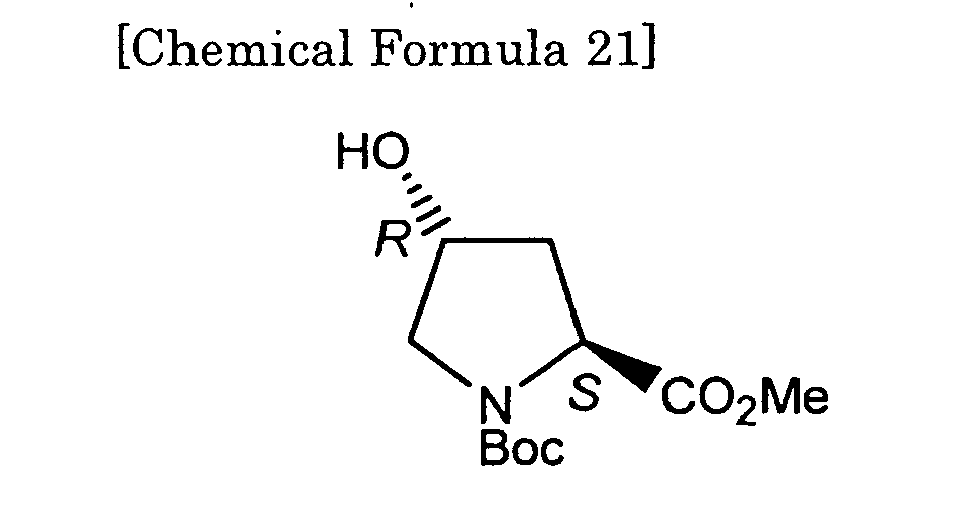

- A pressure-proof reaction vessel made of stainless steel (SUS) was charged with 12.30g (29.82mmol, 1.00eq) of 1-β-D-arabinofuranosyluracil derivative represented by the following formula,


19F-NMR (standard substance: C6F6, heavy solvent: CDCl3), δppm: -43.13 (dt, 51.9Hz, 15.4Hz), -42.50 (dt, 51.5Hz, 15.4Hz), -37.62 (dt, 51.5Hz, 15.0Hz), -37.55 (dt, 51.9Hz, 15.OHz)/total 1F. - A pressure-proof reaction vessel made of stainless steel (SUS) was charged with 9.60g (81.27mmol, 1.00eq, optical purity: 98.4%ee) of an optically-active, α-hydroxycarboxylate derivative represented by the following formula,


1H-NMR (standard substance: Me4Si, heavy solvent: CDCl3), δppm: 1.32 (t, 7.2Hz, 3H), 1.58 (dd, 23.6Hz, 6.9Hz, 3H), 4.26 (q, 7.2Hz, 2H), 5.00 (dq, 49.0Hz, 6.9Hz, 1H).
19F- NMR (standard substance: C6F6, heavy solvent: CDCl3), δppm: -21.88 (dq, 48.9Hz, 24.4Hz, 1F) - A pressure-proof reaction vessel made of stainless steel (SUS) was charged with 3.50g (15.00mmol, 1.00eq) of a primary alcohol derivative represented by the following formula,


1H-NMR (standard substance: Me4Si, heavy solvent: CDCl3), δppm: 0.90 (d, 6.8Hz, 3H), 1.08 (d, 6.8Hz, 3H), 2.44 (m, 1H), 4.24 (m, 1H), 4.76 (ddd, 46.6Hz, 9.5Hz, 4.8Hz, 1H), 5.01 (dt, 46.6Hz, 9.5Hz, 1H), 7.74 (Ar-H, 2H), 7.86 (Ar-H, 2H).
19F-NMR (standard substance: C6F6, heavy solvent: CDCl3), δppm: -62.12 (dt, 13.3Hz, 46.6Hz, 1F).
It is possible to produce the primary alcohol derivative of the raw material substrate from a commercial optically active valinol by referring to Protective Groups in Organic Synthesis, Third Edition, 1999, John Wiley & Sons, Inc. The obtained monofluoromethyl derivative can be converted to optically active 1-isopropyl-2-fluoroethylamine without damaging optical purity by referring to the same book. - A pressure-proof reaction vessel made of stainless steel (SUS) was charged with 1.39g (7.98mmol, 1.00eq) of a primary alcohol derivative represented by the following formula,



1H-NMR (standard substance: Me4Si, heavy solvent: CDCl3), δppm: 1.42-1.88 (m, 10H), 3.35-3.52 (m, 2H), 3.70-3.88 (m, 2H), 4.45 (dt, 46.8Hz, 6.1Hz, 2H), 4.56 (m, 1H).
19F-NMR (standard substance: C6F6, heavy solvent: CDCl3), δppm: -56.37 (septet, 23.4Hz, 1F).
It is possible to produce the primary alcohol derivative of the raw material substrate from a commercial optically active 1,4-butanediol by referring to Protective Groups in Organic Synthesis, Third Edition, 1999, John Wiley & Sons, Inc. The obtained monofluoromethyl derivative can be converted to 4-fluoro-1-butanol by referring to the same book. - A pressure-proof reaction vessel made of stainless steel (SUS) was charged with 1.58g (9.98mmol, 1.00eq) of a primary alcohol derivative represented by the following formula,


1H-NMR (standard substance: Me4Si, heavy solvent: CDCl3), δppm: 0.89 (t, 6.8Hz, 3H), 1.20-1.45 (m, 14H), 1.60-1.70 (m, 2H), 4.44 (dt, 47.6Hz, 6.2Hz, 2H).
19F-NMR (standard substance: C6F6, heavy solvent: CDCl3), δppm: -55.97 (septet, 23.8Hz, 1F). - A commercial product was used as the primary alcohol derivative of the raw material substrate.
Claims (14)
- A process for producing a fluoro derivative, which is represented by the formula [2],


in the formula [1] and the formula [2], each of R, R1 and R2 is independently a hydrogen atom, alkyl group, substituted alkyl group, aromatic ring group, or alkoxycarbonyl group. - A process for producing a fluoro derivative according to claim 1, which is characterized in that in claim 1 the reaction is conducted by making "a salt or complex comprising an organic base and hydrogen fluoride" further present in the system.
- A process for producing a fluoro derivative, which is represented by the formula [2a],


in the formula [1a] and the formula [2a], each of R, R1 and R2 independently represents a hydrogen atom, alkyl group, substituted alkyl group, aromatic ring group, or alkoxycarbonyl group,
the alkyl group is defined as being a C1-C16 straight-chain or branched alkyl group,
the substituted alkyl group is defined as being an alkyl group, in which a halogen atom, lower alkoxy group, lower haloalkoxy group, lower alkylamino group, lower alkylthio group, cyano group, aminocarbonyl group (CONH2), unsaturated group, aromatic ring group, nucleic acid base, aromatic-ring oxy group, aliphatic heterocyclic group, protected hydroxyl group, protected amino group, protected thiol group, or protected carboxyl group has been substituted therefor by any number and by any combination on any carbon atom of the alkyl group,
any carbon atoms themselves of any two alkyl groups or substituted alkyl groups may form a covalent bond to have an aliphatic ring, and carbon atoms of the aliphatic ring may be partially replaced with nitrogen atom or oxygen atom to have an aliphatic heterocyclic ring,
the aromatic ring group is defined as being an aromatic hydrocarbon group or aromatic heterocyclic group containing oxygen atom, nitrogen atom or sulfur atom,
the alkoxycarbonyl group is defined as being an alkoxycarbonyl group comprising an C1-C12 straight-chain or branched alkoxy group, and any carbon atoms themselves of the alkoxy group and of any alkyl group or substituted alkyl group may form a covalent bond to have a lactone ring. - A process for producing a fluoro derivative according to claim 3, which is characterized in that in claim 3 the reaction is conducted by making "a salt or complex comprising an organic base and hydrogen fluoride" further present in the system.
- A process for producing an optically-active, fluoro derivative, which is represented by the formula [4],


in the formula [3] and the formula [4], each of R and R1 is independently an alkyl group, substituted alkyl group, or alkoxycarbonyl group,
* represents an asymmetric carbon (R and R' do not take the same substituent),
the alkyl group is defined as being a C1-C16 straight-chain or branched alkyl group,
the substituted alkyl group is defined as being an alkyl group, in which a halogen atom, lower alkoxy group, lower haloalkoxy group, lower alkylamino group, lower alkylthio group, cyano group, aminocarbonyl group (CONH2), unsaturated group, aromatic ring group, nucleic acid base, aromatic-ring oxy group, aliphatic heterocyclic group, protected hydroxyl group, protected amino group, protected thiol group, or protected carboxyl group has been substituted therefor by any number and by any combination on any carbon atom of the alkyl group,
any carbon atoms themselves of two alkyl groups or substituted alkyl groups may form a covalent bond to have an aliphatic ring, and carbon atoms of the aliphatic ring may be partially replaced with nitrogen atom or oxygen atom to have an aliphatic heterocyclic ring,
the alkoxycarbonyl group is defined as being an alkoxycarbonyl group comprising an C1-C12 straight-chain or branched alkoxy group, and any carbon atoms themselves of the alkoxy group and of any alkyl group or substituted alkyl group may form a covalent bond to have a lactone ring,
stereochemistry of the carbon atom, to which the hydroxyl group is covalently bonded, is inverted through the reaction. - A process for producing an optically-active, fluoro derivative according to claim 5, which is characterized in that in claim 5 the reaction is conducted by making "a salt or complex comprising an organic base and hydrogen fluoride" further present in the system.
- A process for producing a 4-fluoroproline derivative, which is represented by the formula [6],


in the formula [5] and the formula [6], R3 represents a protecting group of the secondary amino group, R4 represents a protecting group of the carboxyl group, * represents an asymmetric carbon, and stereochemistry of the 4-position is inverted through the reaction, and stereochemistry of the 2-position is maintained. - A process for producing a 4-fluoroproline derivative according to claim 7, which is characterized in that in claim 7 the reaction is conducted by making "a salt or complex comprising an organic base and hydrogen fluoride" further present in the system.
- A process for producing a 2'-deoxy-2'-fluorouridine derivative, which is represented by the formula [8],

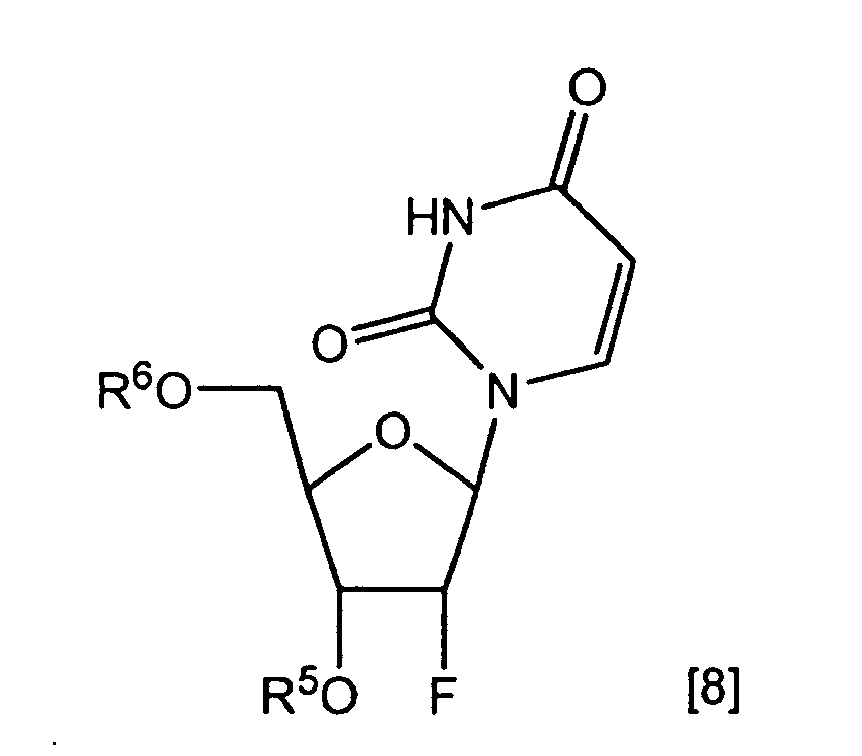

in the formula [7] and the formula [8], each of R5 and R6 independently represents a protecting group of the hydroxyl group. - A process for producing a 2'-deoxy-2'-fluorouridine derivative according to claim 9, which is characterized in that in claim 9 the reaction is conducted by making "a salt or complex comprising an organic base and hydrogen fluoride" further present in the system.
- A process for producing an optically-active, α-fluorocarboxylate derivative, which is represented by the formula [10],


in the formula [9] and the formula [10], R7 represents a C1-C12 alkyl group or substituted alkyl group, R8 represents a C1-C8 alkyl group, any carbon atoms themselves of the alkyl group or of the substituted alkyl group of R7 and R8 may form a covalent bond to have a lactone ring, * represents an asymmetric carbon, and stereochemistry of the α-position is inverted through the reaction. - A process for producing an optically-active, α-fluorocarboxylate derivative according to claim 11, which is characterized in that in claim 11 the reaction is conducted by making "a salt or complex comprising an organic base and hydrogen fluoride" further present in the system.
- A process for producing a monofluoromethyl derivative, which is represented by the formula [12],


in the formula [11] and the formula [12], R represents an alkyl group or substituted alkyl group,
the alkyl group is defined as being a C1-C16 straight-chain or branched alkyl group,
the substituted alkyl group is defined as being an alkyl group, in which a halogen atom, lower alkoxy group, lower haloalkoxy group, lower alkylamino group, lower alkylthio group, cyano group, aminocarbonyl group (CONH2), unsaturated group, aromatic ring group, nucleic acid base, aromatic-ring oxy group, aliphatic heterocyclic group, protected hydroxyl group, protected amino group, protected thiol group, or protected carboxyl group has been substituted therefor by any number and by any combination on any carbon atom of the alkyl group. - A process for producing a monofluoromethyl derivative according to claim 13, which is characterized in that in claim 13 the reaction is conducted by making "a salt or complex comprising an organic base and hydrogen fluoride" further present in the system.
Applications Claiming Priority (3)
| Application Number | Priority Date | Filing Date | Title |
|---|---|---|---|
| JP2005079641 | 2005-03-18 | ||
| JP2005379257A JP5186722B2 (en) | 2005-03-18 | 2005-12-28 | Fluorination reaction using sulfuryl fluoride |
| PCT/JP2006/305435 WO2006098444A1 (en) | 2005-03-18 | 2006-03-17 | Process for production of fluoro derivative |
Publications (3)
| Publication Number | Publication Date |
|---|---|
| EP1842841A1 true EP1842841A1 (en) | 2007-10-10 |
| EP1842841A4 EP1842841A4 (en) | 2010-06-09 |
| EP1842841B1 EP1842841B1 (en) | 2013-05-15 |
Family
ID=36991788
Family Applications (1)
| Application Number | Title | Priority Date | Filing Date |
|---|---|---|---|
| EP06729424.9A Expired - Lifetime EP1842841B1 (en) | 2005-03-18 | 2006-03-17 | Process for production of fluoro derivative |
Country Status (6)
| Country | Link |
|---|---|
| US (1) | US7807858B2 (en) |
| EP (1) | EP1842841B1 (en) |
| JP (1) | JP5186722B2 (en) |
| CN (1) | CN101111462B (en) |
| ES (1) | ES2425170T3 (en) |
| WO (1) | WO2006098444A1 (en) |
Cited By (3)
| Publication number | Priority date | Publication date | Assignee | Title |
|---|---|---|---|---|
| EP2020402A4 (en) * | 2006-06-30 | 2012-04-11 | Central Glass Co Ltd | DEHYDROXYLATED FLUORATION AGENT |
| EP2578578A4 (en) * | 2010-06-03 | 2014-01-01 | Central Glass Co Ltd | Method for producing (2r)-2-fluoro-2-c-methyl-d-ribono- -lactone precursor |
| EP2216337A4 (en) * | 2007-12-12 | 2014-01-22 | Central Glass Co Ltd | Method for producing 4-deoxy-4-fluoro-d-glucose derivative |
Families Citing this family (29)
| Publication number | Priority date | Publication date | Assignee | Title |
|---|---|---|---|---|
| JP5047781B2 (en) * | 2005-03-28 | 2012-10-10 | 東ソ−・エフテック株式会社 | Method for producing fluoro compound |
| DK2089351T3 (en) * | 2006-10-27 | 2017-04-24 | Bayer Ip Gmbh | STEREOSELECTIVE ONE-STEP FLUORATION PROCEDURE FOR PREPARING 2-FLUORPROPIONATE |
| JP5109530B2 (en) * | 2007-01-23 | 2012-12-26 | セントラル硝子株式会社 | Process for producing optically active α-fluorocarboxylic acid ester |
| CN101245086B (en) * | 2007-02-14 | 2013-05-29 | 上海巨龙药物研究开发有限公司 | Process for producing 1-methoxy-2,3,6-O-tri-benzoyl-4-deoxidation-4-fluorine-alpha-D-glucose |
| WO2008122611A1 (en) * | 2007-04-05 | 2008-10-16 | Solvay (Société Anonyme) | Process for the manufacture of fluorinated compounds |
| JP5326400B2 (en) | 2007-08-17 | 2013-10-30 | セントラル硝子株式会社 | Method for purifying optically active α-fluorocarboxylic acid ester |
| JP5374895B2 (en) * | 2008-03-21 | 2013-12-25 | セントラル硝子株式会社 | Process for producing optically active fluoroamines |
| JP5412742B2 (en) * | 2008-03-31 | 2014-02-12 | セントラル硝子株式会社 | Process for producing 4-perfluoroisopropylanilines |
| JP5369853B2 (en) | 2008-04-28 | 2013-12-18 | セントラル硝子株式会社 | Process for producing α-fluoro-β-amino acids |
| JP5338138B2 (en) * | 2008-05-29 | 2013-11-13 | セントラル硝子株式会社 | Method for producing halogenated α-fluoroethers |
| JP5277837B2 (en) * | 2008-09-26 | 2013-08-28 | セントラル硝子株式会社 | Process for producing α-trifluoromethyl-α, β-unsaturated esters |
| JP5359252B2 (en) | 2008-10-22 | 2013-12-04 | セントラル硝子株式会社 | Method for producing fluorosulfuric acid esters |
| JP5476895B2 (en) * | 2008-12-17 | 2014-04-23 | セントラル硝子株式会社 | Method for producing hydroxyl-substituted product |
| JP5240078B2 (en) * | 2009-06-09 | 2013-07-17 | セントラル硝子株式会社 | Method for producing 2-fluoroacrylic acid ester |
| JP5600994B2 (en) * | 2010-03-29 | 2014-10-08 | セントラル硝子株式会社 | Method for producing 2-fluoroisobutyric acid ester |
| PT105139B (en) * | 2010-06-01 | 2013-01-29 | Hovione Farmaciencia S A | METHOD FOR THE MONOFLUOROMETHYLATION OF ORGANIC SUBSTRATES FOR THE PREPARATION OF BIOLOGICALLY ACTIVE ORGANIC COMPOUNDS |
| JP2013126970A (en) * | 2011-11-17 | 2013-06-27 | Central Glass Co Ltd | Industrial method for manufacturing optically active 3-cyclopropylaminomethyl-4-fluoropyrrolidines |
| JP5853771B2 (en) * | 2012-03-01 | 2016-02-09 | セントラル硝子株式会社 | Method for producing α, α-difluoroaromatic compound |
| JP5853772B2 (en) * | 2012-03-01 | 2016-02-09 | セントラル硝子株式会社 | Method for producing α, α-difluoroaromatic compound |
| CN103420955B (en) * | 2012-05-23 | 2016-09-28 | 浙江瑞博制药有限公司 | A kind of preparation method of fluoro ribose lactone |
| US9676700B2 (en) | 2013-02-11 | 2017-06-13 | Trinapco, Inc. | Preparation of fluorosulfonate esters and onium salts derived therefrom |
| KR102699048B1 (en) * | 2015-03-31 | 2024-08-26 | 칸토 덴카 코교 가부시키가이샤 | Method for producing fluorinated alkanes, separation and recovery of amidine bases, and use of recovered amidine bases |
| US10683252B2 (en) | 2016-12-29 | 2020-06-16 | Central Glass Company, Limited | Production method for 1,2,2,2-tetrafluoroethyl difluoromethyl ether (desflurane) |
| JP6886104B2 (en) | 2016-12-29 | 2021-06-16 | セントラル硝子株式会社 | Method for producing halogenated α-fluoroethers |
| JP7231162B2 (en) | 2018-05-11 | 2023-03-01 | ダイキン工業株式会社 | Method for producing fluoromethyl derivative |
| CN111978218A (en) * | 2019-05-24 | 2020-11-24 | 上海博璞诺科技发展有限公司 | Synthetic method of florfenicol |
| JP7652598B2 (en) | 2021-03-22 | 2025-03-27 | 国立大学法人 名古屋工業大学 | Method for producing 2-fluoromethylacrylic acid ester derivative |
| CN113683648B (en) * | 2021-08-26 | 2025-03-07 | 上海皓鸿生物医药科技有限公司 | A synthetic method of 2'-fluoro-2'-deoxyuridine and its intermediate |
| CN116789702B (en) * | 2023-06-15 | 2024-11-26 | 浙江工业大学 | A method for fluorinating phosphonic acid compounds |
Family Cites Families (15)
| Publication number | Priority date | Publication date | Assignee | Title |
|---|---|---|---|---|
| US3692695A (en) * | 1970-06-25 | 1972-09-19 | Texaco Inc | Fluorided composite alumina catalysts |
| DE2301207C2 (en) | 1973-01-11 | 1984-05-24 | Basf Ag, 6700 Ludwigshafen | Process for the preparation of β-haloalkylaminosulfonyl halides |
| FI761457A7 (en) | 1975-06-12 | 1976-12-13 | Merck & Co Inc | |
| DE4439488C1 (en) | 1994-10-26 | 1996-03-21 | Schering Ag | Process for the conversion of hydroxyl groups into the corresponding fluorine compounds |
| DK172447B1 (en) * | 1995-04-05 | 1998-07-13 | Topsoe Haldor As | Process for the preparation of fluorinated alkyl sulfonyl halides |
| US5780682A (en) | 1995-04-04 | 1998-07-14 | Haldor Topsoe A/S | Process for the synthesis of fluorinated alkyl sulphonyl halides |
| DE19525727A1 (en) * | 1995-07-14 | 1997-01-16 | Hoechst Ag | Process for the selective production of monofluor derivatives |
| US6248889B1 (en) * | 1998-11-20 | 2001-06-19 | 3M Innovative Properties Company | Process for converting an alcohol to the corresponding fluoride |
| JP3890411B2 (en) * | 2003-01-07 | 2007-03-07 | 独立行政法人物質・材料研究機構 | Method of modulating light with coherent phonons and phonon modulator |
| JP4774676B2 (en) | 2003-04-10 | 2011-09-14 | セントラル硝子株式会社 | Method for producing 2'-deoxy-2'-fluorouridine |
| EP1612213B1 (en) | 2003-04-10 | 2012-04-04 | Central Glass Company, Limited | Process for producing 2'-deoxy-2'-fluorouridine |
| JP4610252B2 (en) | 2004-04-26 | 2011-01-12 | セントラル硝子株式会社 | Method for producing 4-fluoroproline derivative |
| JP4675065B2 (en) | 2004-06-22 | 2011-04-20 | セントラル硝子株式会社 | Method for producing 4-fluoroproline derivative |
| JP4839724B2 (en) | 2004-08-18 | 2011-12-21 | セントラル硝子株式会社 | Method for producing optically active α-fluorocarboxylic acid ester derivative |
| JP4940790B2 (en) * | 2006-06-30 | 2012-05-30 | セントラル硝子株式会社 | Dehydroxy fluorinating agent |
-
2005
- 2005-12-28 JP JP2005379257A patent/JP5186722B2/en not_active Expired - Fee Related
-
2006
- 2006-03-17 WO PCT/JP2006/305435 patent/WO2006098444A1/en not_active Ceased
- 2006-03-17 CN CN2006800034228A patent/CN101111462B/en not_active Expired - Lifetime
- 2006-03-17 ES ES06729424T patent/ES2425170T3/en not_active Expired - Lifetime
- 2006-03-17 US US11/795,378 patent/US7807858B2/en not_active Expired - Fee Related
- 2006-03-17 EP EP06729424.9A patent/EP1842841B1/en not_active Expired - Lifetime
Cited By (3)
| Publication number | Priority date | Publication date | Assignee | Title |
|---|---|---|---|---|
| EP2020402A4 (en) * | 2006-06-30 | 2012-04-11 | Central Glass Co Ltd | DEHYDROXYLATED FLUORATION AGENT |
| EP2216337A4 (en) * | 2007-12-12 | 2014-01-22 | Central Glass Co Ltd | Method for producing 4-deoxy-4-fluoro-d-glucose derivative |
| EP2578578A4 (en) * | 2010-06-03 | 2014-01-01 | Central Glass Co Ltd | Method for producing (2r)-2-fluoro-2-c-methyl-d-ribono- -lactone precursor |
Also Published As
| Publication number | Publication date |
|---|---|
| WO2006098444A1 (en) | 2006-09-21 |
| US20080125589A1 (en) | 2008-05-29 |
| EP1842841A4 (en) | 2010-06-09 |
| US7807858B2 (en) | 2010-10-05 |
| EP1842841B1 (en) | 2013-05-15 |
| ES2425170T3 (en) | 2013-10-11 |
| CN101111462B (en) | 2011-12-28 |
| JP2006290870A (en) | 2006-10-26 |
| JP5186722B2 (en) | 2013-04-24 |
| CN101111462A (en) | 2008-01-23 |
Similar Documents
| Publication | Publication Date | Title |
|---|---|---|
| EP1842841B1 (en) | Process for production of fluoro derivative | |
| US8058412B2 (en) | Dehydroxyfluorination agent | |
| AU706328B2 (en) | Method and compositions for the synthesis of dioxolane nucleosides with beta-configuration | |
| JP4770174B2 (en) | Process for producing glutamic acid derivative and pyroglutamic acid derivative, and novel production intermediate | |
| Gruzdev et al. | Acylative kinetic resolution of racemic heterocyclic amines using N-phthaloyl-(S)-amino acyl chlorides with alkyl side chains | |
| EP2357168B1 (en) | Method for producing fluorosulfuric acid ester | |
| KR20060037417A (en) | Preparation method of cis-4-fluoro-L-proline derivative | |
| Baba et al. | Electrolytic partial fluorination of organic compounds. Part 61: The first example of direct α-fluorination of protected α-amino acids | |
| EP1063232B1 (en) | Process for producing erythro-3-amino-2-hydroxybutyric acid derivatives | |
| Pomeisl et al. | Simple Transformation of Thymine 1-[3-hydroxy-2-(phosphonomethoxy) propyl] Derivatives to Their 1-[3-fluoro-2-(phosphonomethoxy) propyl] Counterparts | |
| JP5613168B2 (en) | Method for producing deoxyribofuranose compound | |
| JP4675065B2 (en) | Method for producing 4-fluoroproline derivative | |
| JP4610252B2 (en) | Method for producing 4-fluoroproline derivative | |
| JP7788145B2 (en) | Method for producing azanucleoside precursors | |
| JP5396841B2 (en) | Process for producing α-trifluoromethyl-β-substituted-β-amino acids | |
| Shirode et al. | Synthesis of (3S, 4R)-4-benzylamino-3-methoxypiperidine, an important intermediate for (3S, 4R)-Cisapride | |
| Nishiguchi et al. | Convenient synthesis of antisepsis agent TAK-242 by novel optical resolution through diastereomeric N-acylated sulfonamide derivative | |
| Ochoa Terán et al. | Synthesis of enantiopure trisubstituted piperidines from a chiral epoxyaziridine and α-amino esters | |
| Liu et al. | Selective reduction of N-protected-α-amino lactones to lactols with lithium tri-tert-butoxyaluminohydride | |
| JPH10316672A (en) | Aminocoumaroneacetic acid ester derivative and its optical resolution | |
| JP2007001877A (en) | Method for producing 4-fluoroproline derivative | |
| JPH09241279A (en) | N-phosphoglucose-substituted amino acid ester derivative | |
| JP2005132775A (en) | Furanosyl adenine derivative and method for producing the same, and 3'-amino-3'-deoxyadenosine compound and method for producing the same. |
Legal Events
| Date | Code | Title | Description |
|---|---|---|---|
| PUAI | Public reference made under article 153(3) epc to a published international application that has entered the european phase |
Free format text: ORIGINAL CODE: 0009012 |
|
| 17P | Request for examination filed |
Effective date: 20070807 |
|
| AK | Designated contracting states |
Kind code of ref document: A1 Designated state(s): DE ES FR GB IT |
|
| DAX | Request for extension of the european patent (deleted) | ||
| RBV | Designated contracting states (corrected) |
Designated state(s): DE ES FR GB IT |
|
| A4 | Supplementary search report drawn up and despatched |
Effective date: 20100507 |
|
| 17Q | First examination report despatched |
Effective date: 20110801 |
|
| REG | Reference to a national code |
Ref country code: DE Ref legal event code: R079 Ref document number: 602006036284 Country of ref document: DE Free format text: PREVIOUS MAIN CLASS: C07C0017160000 Ipc: C07B0039000000 |
|
| RIC1 | Information provided on ipc code assigned before grant |
Ipc: C07B 39/00 20060101AFI20120507BHEP Ipc: C07C 17/16 20060101ALI20120507BHEP Ipc: C07H 19/073 20060101ALI20120507BHEP Ipc: C07C 67/307 20060101ALI20120507BHEP Ipc: C07D 209/48 20060101ALI20120507BHEP Ipc: C07D 207/16 20060101ALI20120507BHEP |
|
| GRAP | Despatch of communication of intention to grant a patent |
Free format text: ORIGINAL CODE: EPIDOSNIGR1 |
|
| RIN1 | Information on inventor provided before grant (corrected) |
Inventor name: TSURUTA, HIDEYUKI CHEM. RES. CENTER OF CENTRAL GLA Inventor name: INOMIYA, KENIJN CHEM. RES. CENTER OF CENTRAL GLASS Inventor name: MOGI, KAORI CHEM. RES. CENTER OF CENTRAL GLASS COM Inventor name: YASUMOTO, MANABU CHEM. RES. CENTER OF CENTRAL GLAS Inventor name: UEDA, KOJI CHEM. RES. CENTER OF CENTRAL GLASS COMP Inventor name: ISHI, AKIHIRO CHEM. RES. CENTER OF CENTRAL GLASS C Inventor name: OOTSUKA, TAKASHI CHEM. RES. CENTER OF CENTRAL GLAS |
|
| GRAS | Grant fee paid |
Free format text: ORIGINAL CODE: EPIDOSNIGR3 |
|
| RIN1 | Information on inventor provided before grant (corrected) |
Inventor name: TSURUTA, HIDEYUKI CHEM. RES. CENTER OF CENTRAL GLA Inventor name: OOTSUKA, TAKASHI CHEM. RES. CENTER OF CENTRAL GLAS Inventor name: MOGI, KAORI CHEM. RES. CENTER OF CENTRAL GLASS COM Inventor name: ISHII, AKIHIRO CHEM. RES. CENTER OF CENTRAL GLASS Inventor name: UEDA, KOJI CHEM. RES. CENTER OF CENTRAL GLASS COMP Inventor name: YASUMOTO, MANABU CHEM. RES. CENTER OF CENTRAL GLAS Inventor name: INOMIYA, KENJIN CHEM. RES. CENTER OF CENTRAL GLASS |
|
| GRAP | Despatch of communication of intention to grant a patent |
Free format text: ORIGINAL CODE: EPIDOSNIGR1 |
|
| GRAA | (expected) grant |
Free format text: ORIGINAL CODE: 0009210 |
|
| AK | Designated contracting states |
Kind code of ref document: B1 Designated state(s): DE ES FR GB IT |
|
| REG | Reference to a national code |
Ref country code: GB Ref legal event code: FG4D |
|
| REG | Reference to a national code |
Ref country code: DE Ref legal event code: R096 Ref document number: 602006036284 Country of ref document: DE Effective date: 20130711 |
|
| REG | Reference to a national code |
Ref country code: ES Ref legal event code: FG2A Ref document number: 2425170 Country of ref document: ES Kind code of ref document: T3 Effective date: 20131011 |
|
| PLBE | No opposition filed within time limit |
Free format text: ORIGINAL CODE: 0009261 |
|
| STAA | Information on the status of an ep patent application or granted ep patent |
Free format text: STATUS: NO OPPOSITION FILED WITHIN TIME LIMIT |
|
| 26N | No opposition filed |
Effective date: 20140218 |
|
| REG | Reference to a national code |
Ref country code: DE Ref legal event code: R097 Ref document number: 602006036284 Country of ref document: DE Effective date: 20140218 |
|
| REG | Reference to a national code |
Ref country code: FR Ref legal event code: PLFP Year of fee payment: 11 |
|
| REG | Reference to a national code |
Ref country code: FR Ref legal event code: PLFP Year of fee payment: 12 |
|
| REG | Reference to a national code |
Ref country code: FR Ref legal event code: PLFP Year of fee payment: 13 |
|
| PGFP | Annual fee paid to national office [announced via postgrant information from national office to epo] |
Ref country code: IT Payment date: 20200221 Year of fee payment: 15 Ref country code: GB Payment date: 20200304 Year of fee payment: 15 |
|
| PGFP | Annual fee paid to national office [announced via postgrant information from national office to epo] |
Ref country code: FR Payment date: 20200214 Year of fee payment: 15 |
|
| PGFP | Annual fee paid to national office [announced via postgrant information from national office to epo] |
Ref country code: ES Payment date: 20200401 Year of fee payment: 15 |
|
| GBPC | Gb: european patent ceased through non-payment of renewal fee |
Effective date: 20210317 |
|
| PG25 | Lapsed in a contracting state [announced via postgrant information from national office to epo] |
Ref country code: FR Free format text: LAPSE BECAUSE OF NON-PAYMENT OF DUE FEES Effective date: 20210331 Ref country code: GB Free format text: LAPSE BECAUSE OF NON-PAYMENT OF DUE FEES Effective date: 20210317 |
|
| PG25 | Lapsed in a contracting state [announced via postgrant information from national office to epo] |
Ref country code: IT Free format text: LAPSE BECAUSE OF NON-PAYMENT OF DUE FEES Effective date: 20210317 |
|
| REG | Reference to a national code |
Ref country code: ES Ref legal event code: FD2A Effective date: 20220523 |
|
| PG25 | Lapsed in a contracting state [announced via postgrant information from national office to epo] |
Ref country code: ES Free format text: LAPSE BECAUSE OF NON-PAYMENT OF DUE FEES Effective date: 20210318 |
|
| P01 | Opt-out of the competence of the unified patent court (upc) registered |
Effective date: 20230330 |
|
| PGFP | Annual fee paid to national office [announced via postgrant information from national office to epo] |
Ref country code: DE Payment date: 20250319 Year of fee payment: 20 |
|
| REG | Reference to a national code |
Ref country code: DE Ref legal event code: R071 Ref document number: 602006036284 Country of ref document: DE |