EP1842515A1 - Disposable wearing article - Google Patents
Disposable wearing article Download PDFInfo
- Publication number
- EP1842515A1 EP1842515A1 EP06712516A EP06712516A EP1842515A1 EP 1842515 A1 EP1842515 A1 EP 1842515A1 EP 06712516 A EP06712516 A EP 06712516A EP 06712516 A EP06712516 A EP 06712516A EP 1842515 A1 EP1842515 A1 EP 1842515A1
- Authority
- EP
- European Patent Office
- Prior art keywords
- liner
- passage
- chassis
- elastic members
- wearing article
- Prior art date
- Legal status (The legal status is an assumption and is not a legal conclusion. Google has not performed a legal analysis and makes no representation as to the accuracy of the status listed.)
- Withdrawn
Links
Images



Classifications
-
- A—HUMAN NECESSITIES
- A61—MEDICAL OR VETERINARY SCIENCE; HYGIENE
- A61F—FILTERS IMPLANTABLE INTO BLOOD VESSELS; PROSTHESES; DEVICES PROVIDING PATENCY TO, OR PREVENTING COLLAPSING OF, TUBULAR STRUCTURES OF THE BODY, e.g. STENTS; ORTHOPAEDIC, NURSING OR CONTRACEPTIVE DEVICES; FOMENTATION; TREATMENT OR PROTECTION OF EYES OR EARS; BANDAGES, DRESSINGS OR ABSORBENT PADS; FIRST-AID KITS
- A61F13/00—Bandages or dressings; Absorbent pads
- A61F13/15—Absorbent pads, e.g. sanitary towels, swabs or tampons for external or internal application to the body; Supporting or fastening means therefor; Tampon applicators
- A61F13/45—Absorbent pads, e.g. sanitary towels, swabs or tampons for external or internal application to the body; Supporting or fastening means therefor; Tampon applicators characterised by the shape
- A61F13/49—Absorbent pads, e.g. sanitary towels, swabs or tampons for external or internal application to the body; Supporting or fastening means therefor; Tampon applicators characterised by the shape specially adapted to be worn around the waist, e.g. diapers, nappies
- A61F13/495—Absorbent pads, e.g. sanitary towels, swabs or tampons for external or internal application to the body; Supporting or fastening means therefor; Tampon applicators characterised by the shape specially adapted to be worn around the waist, e.g. diapers, nappies with faecal cavity
-
- A—HUMAN NECESSITIES
- A61—MEDICAL OR VETERINARY SCIENCE; HYGIENE
- A61F—FILTERS IMPLANTABLE INTO BLOOD VESSELS; PROSTHESES; DEVICES PROVIDING PATENCY TO, OR PREVENTING COLLAPSING OF, TUBULAR STRUCTURES OF THE BODY, e.g. STENTS; ORTHOPAEDIC, NURSING OR CONTRACEPTIVE DEVICES; FOMENTATION; TREATMENT OR PROTECTION OF EYES OR EARS; BANDAGES, DRESSINGS OR ABSORBENT PADS; FIRST-AID KITS
- A61F13/00—Bandages or dressings; Absorbent pads
- A61F13/15—Absorbent pads, e.g. sanitary towels, swabs or tampons for external or internal application to the body; Supporting or fastening means therefor; Tampon applicators
- A61F13/45—Absorbent pads, e.g. sanitary towels, swabs or tampons for external or internal application to the body; Supporting or fastening means therefor; Tampon applicators characterised by the shape
- A61F13/49—Absorbent pads, e.g. sanitary towels, swabs or tampons for external or internal application to the body; Supporting or fastening means therefor; Tampon applicators characterised by the shape specially adapted to be worn around the waist, e.g. diapers, nappies
- A61F13/494—Absorbent pads, e.g. sanitary towels, swabs or tampons for external or internal application to the body; Supporting or fastening means therefor; Tampon applicators characterised by the shape specially adapted to be worn around the waist, e.g. diapers, nappies characterised by edge leakage prevention means
- A61F13/49473—Absorbent pads, e.g. sanitary towels, swabs or tampons for external or internal application to the body; Supporting or fastening means therefor; Tampon applicators characterised by the shape specially adapted to be worn around the waist, e.g. diapers, nappies characterised by edge leakage prevention means the edge leakage prevention means having a continuous closed form, e.g. circle, ellipse, rectangle
-
- A—HUMAN NECESSITIES
- A61—MEDICAL OR VETERINARY SCIENCE; HYGIENE
- A61F—FILTERS IMPLANTABLE INTO BLOOD VESSELS; PROSTHESES; DEVICES PROVIDING PATENCY TO, OR PREVENTING COLLAPSING OF, TUBULAR STRUCTURES OF THE BODY, e.g. STENTS; ORTHOPAEDIC, NURSING OR CONTRACEPTIVE DEVICES; FOMENTATION; TREATMENT OR PROTECTION OF EYES OR EARS; BANDAGES, DRESSINGS OR ABSORBENT PADS; FIRST-AID KITS
- A61F13/00—Bandages or dressings; Absorbent pads
- A61F13/15—Absorbent pads, e.g. sanitary towels, swabs or tampons for external or internal application to the body; Supporting or fastening means therefor; Tampon applicators
- A61F13/45—Absorbent pads, e.g. sanitary towels, swabs or tampons for external or internal application to the body; Supporting or fastening means therefor; Tampon applicators characterised by the shape
- A61F13/49—Absorbent pads, e.g. sanitary towels, swabs or tampons for external or internal application to the body; Supporting or fastening means therefor; Tampon applicators characterised by the shape specially adapted to be worn around the waist, e.g. diapers, nappies
- A61F13/495—Absorbent pads, e.g. sanitary towels, swabs or tampons for external or internal application to the body; Supporting or fastening means therefor; Tampon applicators characterised by the shape specially adapted to be worn around the waist, e.g. diapers, nappies with faecal cavity
- A61F2013/4958—Absorbent pads, e.g. sanitary towels, swabs or tampons for external or internal application to the body; Supporting or fastening means therefor; Tampon applicators characterised by the shape specially adapted to be worn around the waist, e.g. diapers, nappies with faecal cavity with a faecal management layer
Definitions
- the present invention relates to a disposable wearing article and more particularly to a disposable wearing article adapted to prevent bodily waste from clinging to the wearer's body.
- the location at which the topsheet is formed with the opening is not properly limited to the vicinity of the anus but further extends forward. Consequentially, there is a serious apprehension that the wearer's skin might be contaminated not only around the anus but also around the external genitalia.
- the entire area of the liner is lifted up and the front zone to which the opening does not extend also comes in direct contact with the wearer's external genitalia. Consequentially, a feeling to wear may be deteriorated or the wearer's skin may suffer from rash.
- the amount of urine may exceed the capacity of the disposable diaper and may lead to leak of urine.
- the present invention is directed to a disposable wearing article comprising: a longitudinal direction; a transverse direction, a front waist region; a rear waist region, a crotch region extending between the front and rear waist region, a flexible chassis, a semi-rigid absorbent panel laid on an inner surface of the chassis, the article being characterized in that the chassis has an outermost layer, an innermost layer, a backsheet defining the outermost layer and a liner defining the innermost layer; the liner is fixed to the absorbent panel in a fixed zone defined substantially in a middle region of the crotch region as viewed in the transverse direction and extending in the transverse direction and has a passage formed through the liner at a region put aside from the fixed zone toward the rear waist region to guide feces through the passage, a first elastic member extending along a peripheral edge of the passage so as to be stretchable and contractible, and paired second elastic member and a third elastic member are laid outside opposite side edges of the passage so as to be stretchable and contract
- the passage comes close to the wearer's anus as the liner is lifted off from the absorbent panel in the region put aside from the fixed zone toward the rear waist region and, in this state, the liner reliably guides feces through the passage.
- the liner forms the barrier rising up along the fixed zone and the upper edge of this barrier is held in a close contact with a wearer's perineum during use of the wearing article so that the barrier can reliably block feces and protect the wearer's external genitalia from being contaminated with feces.
- the liner is fixed to the absorbent panel along the fixed zone lying in the crotch region and the chassis is kept reliably spaced from the wearer' s skin in the front waist region during use of the wearing article. Consequentially, there is no anxiety that the wearer might experience any uncomfortable feeling and/or suffer from rash. It is unlikely that urine leak might occur even if a large amount of urine is discharged at once.
- the passage may be implemented in the form of a slit extending in the longitudinal or transverse direction or an opening formed by partially cutting out the liner. While the passage may be appropriately positioned so that the passage falls in line with the wearer's anus as the liner is lifted off from the absorbent panel, the passage is preferably formed at the position put aside from the crotch region toward the rear waist region substantially along the middle of the chassis as viewed in the transverse direction.
- the peripheral edge of the passage is sufficiently reinforced to keep the passage in an opened state.
- the first elastic member well follows the wearer's movement to be stretched or contracted so that the passage can be kept opened toward the wearer's anus.
- the first elastic member may be continuously or intermittently bonded to the liner fully along the peripheral edge of the passage.
- the rear end segments of these elastic members preferably terminate at least behind the longitudinal middle of the passage and, more preferably, behind the rearmost edge of the passage to maintain the passage as a whole closer to the wearer's anus.
- These second and third elastic members preferably extend forward in the longitudinal direction in a stretchable and contractible fashion at least to the foremost edge of the passage and, more preferably, at least to the fixed zone to ensure that the upper edge of the barrier rising more reliably comes in close contact with the wearer's perineum and this barrier effectively blocks feces.
- the liner may be liquid-pervious or liquid-resistant
- the liner is preferably liquid-pervious substantially in the front half of the chassis facing the wearer's urethra and preferably liquid-resistant substantially in the rear half of the chassis facing the wearer's anus.
- the first liner has a flexibility lower than that of the second liner.
- the liner preferably comprises the first liner extending substantially in the front half of the chassis and the second liner provided separately of the first liner and extending substantially in the rear half of the chassis. In this way, the property of the chassis is easily differentiated between the front half and the rear half as has previously been described.
- these barrier cuffs also function against bodily waste.
- the passage formed so as to extend through the liner closely faces the wearer's anus and the upper edge of the barrier rising comes in contact with the wearer's perineum.
- feces can be reliably guided through the passage and the wearer's external genitalia can be protected from being contaminated with feces.
- a space is maintained between the chassis and the wearer's skin adequate to improve a feeling to wear, on one hand, to prevent leakage of urine even if a large amount of urine is discharged at once.
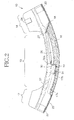
- Fig. 1 is a partially cutaway perspective view showing an open-type disposable diaper 10 according to a first embodiment of the present invention and Fig. 2 is a sectional view taken along a line 2-2 in Fig. 1.
- the disposable diaper 10 has a longitudinal direction and a transverse direction.
- the diaper 10 is symmetric about a center line 2 extending in the longitudinal direction and bows in the longitudinal direction as viewed in Fig. 1.
- the disposable diaper 10 generally includes a chassis 11 having a front waist region 14, a rear waist region 12, a rear waist region 14 and a crotch region 13 extending between these two waist regions 12, 14 and a semi-rigid absorbent panel 16 laid on an inner surface of this chassis 11.
- the chassis 11 has a middle portion as viewed in the longitudinal direction which is constricted so as to provide the chassis 11 with an hourglass-like shape as a whole.
- the chassis 11 has an innermost layer 11a and an outermost layer 11b and includes a liner 17 defining the innermost layer 11a and a backsheet 18 defining the outermost layer 11b.
- the liner 17 includes a first liner 17a laid in a substantially front half section of the chassis 11 and formed by a single sheet and a second liner 17b laid in a substantially rear half of the chassis 11 and formed by two sheets. The liner 17 is bonded along its outer edge to the backsheet 18.
- the liner 17b is fixed to the absorbent panel 16 along a fixed zone 19 located at a transverse middle of the crotch region 13 so as to extend in the transverse direction. It is not essential to fix the second liner 17b directly to the absorbent panel 16 at the fixed zone 19 and it is possible without departing from the scope of the invention to fix this second liner 17b to the absorbent panel 16 by the intermediary of the first liner 17a.
- the second liner 17b overlaps the first liner 17a from above in the crotch region 13 and these overlapped portions are bonded to each other, as will be seen in Fig. 2.
- the first liner 17a has a flexibility lower than that of the second liner 17b.
- the first liner 17a is liquid-pervious and made of well known thermoplastic synthetic fibrous nonwoven fabric.
- the second liner 17b is liquid-resistant and air-permeable and made of well known thermoplastic synthetic fibrous nonwoven fabric.
- the thermoplastic synthetic fibrous nonwoven fabric may be selected from, for example, those made from polyolefin-, polyester- and polyamide-based synthetic resin.
- the backsheet 18 is made of well known liquid-impervious thermoplastic synthetic fibrous nonwoven fabric or well known liquid-resistant thermoplastic film.
- the film maybe selected from, for example, polyolefin-based plastic, more preferably, breathable but liquid-impervious plastic film obtained by uniaxial or biaxial orientation of synthetic resin film containing inorganic microparticles such as calcium carbonate or barium sulfate.
- the absorbent panel 16 is a mixture of fluff pulp, super-absorbent polymer particles and, if desired, thermoplastic synthetic fibers appropriately compressed together. Consequentially, the absorbent panel 16 is semi-rigid with respect to the flexible chassis. Preferably, this compressed mixture is entirely wrapped with a liquid-diffusive sheet (not shown) such as a tissue paper or nonwoven fabric for its shape retention and desired absorbability. While Fig. 1 shows the absorbent panel 16 of a rectangular shape, the panel 16 may also have an hourglass-like shape similar to the chassis 11 having its middle portion constricted so as to provide the chassis 11 with the hourglass-like shape. As will be seen in Fig.
- the absorbent panel 16 in the disposable diaper 10 has a uniform thickness over all.
- a section of the absorbent panel 16 extending in the rear waist region 14 may include thinner zones depressed toward the backsheet 18 or partially cut off to improve a feces retaining capacity.
- waist-surrounding elastic members 20, 20 are attached to the inner surface of the chassis 11 in a stretchable/contractible manner.
- leg-surrounding elastic members 21, 21 are attached to the inner surface of the chassis 11 in a stretchable/contractible manner and the chassis 11 is provided on its inner surface with a pair of gasket cuffs 11c, 11c extending in the longitudinal direction.
- Barrier cuffs 22, 22 are laid on upper surfaces of the respective gasket cuffs 11c, 11c. The barrier cuffs 22 extend to the outer edge of the backsheet 18 and are placed thereupon.
- Each of the barrier cuffs 22 has a proximal section 22a forming the gasket cuff 11c and a distal section 22b collapsed outward in the transverse direction. In such a collapsed state, longitudinally opposite ends 22c, 22c are fixed to the gasket cuffs 11c, 11c, respectively.
- the barrier cuffs 22 are provided with cuff elastic members 23 attached thereto, respectively, in a manner that these elastic members 23 are stretchable and contractible in longitudinal direction thereof. Contraction of these cuff elastic members 23 causes the barrier cuffs 22 to rise up with respect to the upper surface of the chassis 11 and cooperate with the respective gasket cuffs 11c to form barriers against bodily waste.
- the barrier cuffs 22 are made of well known liquid-resistant thermoplastic synthetic fibrous nonwoven fabric.
- the thermoplastic synthetic fibrous nonwoven fabric may be selected from, for example, those made from polyolefin-, polyester- and polyamide-based synthetic resin.
- a pair of tape fasteners 24, 24 used to connect the front and rear waist regions 12, 14 with each other are attached to transversely opposite side edges 15b, 15b of the chassis 11 in the rear waist region 14.
- Each of the tape fasteners 24 has a proximal section permanently bonded to the chassis 11 and a distal section coated with a pressure-sensitive adhesive.
- the front waist region 12 of the chassis 11 is provided with a target tape strip 25 onto which the tape fastener 24 is anchored (See Fig. 2) .
- the disposable diaper 10 may be also in the type-pants (referred to also as "pull-on-type") in which the front and rear waist regions 12, 14 have previously been bonded to each other along the transversely opposite side edges 15a, 15b of these two waist regions, respectively.
- the liner 17 has a passage 26 located aside from the fixed zone 19 toward the rear waist region 14 and serving to receive feces, a first elastic member 27 provided so as to be stretchable and contractible along a peripheral edge of the passage 26 and a pair of elastic members, i.e., second and third elastic members 28, 29 attached to the inner surface of the liner 17 on both sides and in the vicinity of the passage 26 so that these second and third elastic members 28, 29 are stretchable and contractible in the longitudinal direction. Contraction of the second and third elastic members 28, 29 causes a region of the liner 17 located aside from the fixed zone 19 toward the rear waist region 14 to be lifted off from the absorbent panel 16 and to form a barrier 30 rising up along the fixed zone 19 (See Fig. 2).
- This barrier 30 comes in contact with the wearer's perineum.
- Such disposable diaper 10 ensures that the passage 26 of the liner 17 is aligned with the wearer' s anus and thereby reliably guides feces for retention thereof. Should feces move forward on the wearer's skin, it is unlikely that the wearer's external genitalia might be contaminated with feces since the upper edge 30a of the barrier 30 is kept in close contact with the wearer's perineum.
- a longitudinal dimension Ma of the passage 26 as measured from a foremost edge 26a to a rearmost edge 26b is preferably in a range of about 8 to about 40% of a longitudinal dimension L of the chassis 11 (for example, in a range of about 38 to about 190 mm with respect to the dimension L of 475 mm). If the dimension Ma is less than 8% of the dimension L, it will be difficult to guide feces through the passage 26. If the dimension Ma exceeds 40% of the dimension L, on the contrary, the passage will face also the wearer's external genitalia and feces may possibly cling to the wearer' s external genitalia.
- a transverse dimension Mb of the passage 26 is preferably in a range of about 5 to about 70 mm. If the dimension Mb is less than about 5 mm, it will be difficult to guide feces through the passage 26. If the dimension Mb exceeds about 70 mm, on the contrary, feces once having been guided through the passage 26 may possibly cling to the wearer's skin and it will be not expected to protect the wearer's external genitalia against being contaminated with feces.
- a dimension P1 by which the foremost edge 26a of the passage 26 is spaced from the front end 12a of the chassis 11 is preferably in a range of about 37 to about 57% of the dimension L (for example, in a range of about 180 to about 270 mm with respect to the dimension L of 475 mm). If the dimension P1 is less than about 37% of the dimension L, the passage 26 will rather face the wearer's external genitalia and feces may possibly cling to the wearer's external genitalia. If the dimension P1 exceeds about 57% of the dimension L, on the contrary, it will be difficult for the passage 26 to face the wearer's anus and consequently to guide feces therethrough.
- a dimension P2 by which the rearmost edge 26b is spaced from the rear end 14a of the chassis 11 is preferably in a range of about 13 to 33% of the dimension L (for example, in a range of about 60 to about 150 mm with respect to the dimension L of 475 mm). If the dimension P2 is less than about 13% of the dimension L, the rearmost edge 26b of the passage 26 will be excessively aside toward the wearer's back and consequently feces may spread on the wearer's back until feces may leak beyond the chassis 11. If the dimension P2 exceeds about 33% of the dimension L, on the contrary, it will be difficult for the passage 26 to face the wearer's anus and consequently to guide feces therethrough. By provision of such uniquely arranged passage 26, this disposable diaper 10 ensures that the wearer's external genitalia are more reliably protected against being contaminated with feces.
- the liner 17 and the absorbent panel 16 are bonded to each other by means of a hot melt adhesive 31 (See Fig. 2).
- the fixed zone 19 is located in a substantially transverse middle of the chassis 11 and a transverse dimension N is preferably 75% or higher of the transverse dimension Mb of the passage 26. If the dimension N is less than 75% of the dimension Mb, a transverse dimension of the barrier 30 will be too small to achieve an expected function for this barrier 30.
- a dimension P3 as measured from the fixed zone 19 to the foremost edge 26a of the passage 26 corresponding a height of the barrier 30 formed by the liner 17 is preferably in a range of 20 to 60 mm. If the dimension P3 is less than 20 mm, the barrier 30 will not achieve the expected function. If the dimension P3 exceeds 60 mm, on the contrary, the wearer may experience a feeling of incompatibility when the barrier 30 comes in contact with the wearer's skin.
- the first elastic member 27 is wrapped with the second liner 17b comprising a pair of sheets and continuously extends along the entire peripheral edge of the passage 26.
- the second and third elastic members 28, 29 are laid aside from the first elastic member 27 toward the side edges of the liner 17 and sandwiched between two sheets constituting the second liner 17b.
- These second and third elastic members 28, 29 extend substantially in parallel to each other in the longitudinal direction from the foremost edge 26a beyond the rearmost edge 26b of the passage 26 in a stretchable and contractible manner.
- the second and third elastic members 28, 29 are spaced from the peripheral edge of the passage 26 by a range of 5 to 30 mm and located so as to intersect a transverse center line of the passage 26.
- a longitudinal dimension S of the second and third elastic members 28, 29 is preferably is in a range of 50 to 150% of the longitudinal dimension Ma of the passage 26. If the dimension S is less than 50% of the dimension Ma, it will be difficult for the liner 17 to be lifted off from the absorbent panel 16.
- the first, second and third elastic members 27, 28, 29 may be selectively formed by thread-like rubber, flat rubber or the like made from well known material such as natural rubber, synthetic rubber, urethane foam, or the like.
- the first elastic member laid along the peripheral edge of the passage reinforces the peripheral edge of the passage so as to maintain the passage in its opened state.
- the second and third elastic members respectively laid on transversely opposite sides of the passage cooperated with each other to bias the passage close to the wearer's anus.
- these second and third elastic members extend forward so as to be stretchable and contractible in the longitudinal direction at least to the foremost edge of the passage. Consequentially, the passage as a whole inclusive of the foremost edge is biased close to the wearer's anus so as to ensure that feces is reliably guided into the passage as the liner is lifted off from the absorbent panel.
- Fig. 3 is a partially cutaway plan view showing a disposable diaper according to the second embodiment of this invention similar to Fig. 1.
- the basic members and regions or zones similar to those in the disposable diaper according to the first embodiment are designated by the respectively corresponding reference numerals and not repetitively described.
- the disposable diaper according to this second embodiment is distinguished from that according to the first embodiment in that the second and third elastic members 28, 29 extend in the longitudinal direction beyond the foremost edge 26a of the passage 26 to the fixed zone 19.
- the second and third elastic members are relatively long and the liner is correspondingly facilitated to be lifted off.
- the second and third elastic members extending so as to stretchable and contractible in the longitudinal direction beyond the fixed zone ensure that the upper edge of the barrier formed by the liner is more reliably held in close contact with the wearer's skin and feces is more effectively blocked thereby.
- Fig. 4 is a perspective view showing a disposable pants-type (referred to also as "pull-on-type") diaper according to the third embodiment of this invention.
- Fig. 5 is a partially cutaway perspective view of the disposable diaper shown in Fig. 4.
- Fig. 6 is a partially cutaway plan view of the disposable diaper shown in Fig. 4 with front and rear waist regions of a chassis separated from each other along transversely opposite side edges thereof.
- Fig. 7 is a sectional view taken along a line 7-7 in Fig. 6.
- the basic members and regions or zones similar to those in the disposable diaper according to the first embodiment are designated by the respectively corresponding reference numerals and not repetitively described.
- the front and rear waist regions 12, 14 are put flat and intermittently bonded to each other along the respective opposed side edges 15a, 15b, whereupon the disposable diaper 10 is formed with a waist-opening 34 and a pair of leg-openings 35, 35.
- the front and rear ends 12a, 14a of the chassis 11 are provided with a plurality of the waist-surrounding elastic members 20 laid so as to stretchable and contractible along a full circumference of the waist-opening 34 and permanently bonded to the inner surface of the chassis 11 by means of a hot melt adhesive (not shown).
- a plurality of the leg-surrounding elastic members 21 are laid so as to be stretchable and contractible along the side edges 15c, 15d defining upper half circumferences of the respective leg-openings 35 and are permanently bonded to the inner surface of the chassis 11 by means of a hot melt adhesive (not shown).
- the chassis 11 is further provided on the inner surface thereof with a plurality of waist-surrounding auxiliary elastic members 36 extending so as to be stretchable and contractible in the transverse direction and spaced one from another in the longitudinal direction.
- the waist-surrounding auxiliary elastic members 36 are disposed in a zone put aside from the lower ends of the respective side edges 15a, 15b toward the front and rear ends 12a, 14a (i.e., the upper ends as viewed in Fig. 4).
- the waist-surrounding auxiliary elastic members 36 may be a thread-like rubber made of material usually used in the industry of the disposable diaper.
- the chassis 11 is additionally provided with a pair of barrier cuffs 22, 22 extending in the longitudinal direction along the opposite side edges 13a, 13a thereof.
- Each of these barrier cuffs 22 has a proximal section 22a, a distal section 22b and longitudinally opposite ends 22c, 22c.
- the respective proximal sections 22a, 22a are permanently bonded to the chassis 11 by means of a hot melt adhesive (not shown).
- the longitudinally opposite ends 22c, 22c are also permanently bonded to the chassis 11 by means of a hot melt adhesive (not shown) with the respective distal sections 22b, 22b collapsing inward in the transverse direction.
- the respective barrier cuffs 22 are provided with elastic members 23 for the cuffs 22 so as to be stretchable and contractible in the longitudinal direction. Contraction of these elastic members 23 causes the barrier cuffs 22 to rise up on the inner surface of the chassis 11 substantially in a vertical direction and serve as barriers against bodily wastes.
- the backsheet 18 is folded along the front and rear ends 12a, 14a of the front and rear waist regions 12, 14 back onto the inner surface of the chassis 11 (See Fig. 7).
- the backsheet 18 includes single or plural hydrophobic thermoplastic synthetic fibrous nonwoven fabric layer or layers.
- An intermediate sheet 38 formed by liquid-resistant thermoplastic film is sandwiched between the backsheet 18 and the absorbent panel 16.
- This intermediate sheet 38 has a substantially same size as the absorbent panel 16.
- the fixed zone 19 extends over a full dimension of the absorbent panel 16 in the transverse direction and, in this fixed zone 19, the first liner 17a and the second liner 17b are bonded to each other (See Figs. 6 and 7).
- the absorbent panel 16 includes an opening formed by partially cut out the panel 16 so that this opening in opposition to the passage 26 formed by the second liner 17b.
- This opening of the absorbent panel 16 and a periphery thereof are covered with a cover sheet 37 (See Fig. 7).
- the cover sheet 37 is preferably in close contact with the backsheet 18 inside the opening of the absorbent panel 16.
- the cover sheet 37 may be formed by the hydrophilic sheet of prior art such as tissue paper or nonwoven fabric. In stead of using the cover sheet 37, it is possible for the equivalent effect to cover the absorbent panel 16 with the first liner 17a extending rearward from the fixed zone 19.
- the second liner 17b has its front end bonded to the first liner 17a, its rear end bonded to the cover sheet 37 and its opposite side edges bonded also to the cover sheet 37. However, it is not essential that the second liner 17b is bonded along the opposite side edges thereof to the cover sheet 37 so far as the second liner 17b is bonded at least along the front and rear ends thereof to the first liner 17a or the cover sheet 37.
- the front end of the second line 17 lies in the fixed zone 19.
- the rear end of the second liner 17b is illustrated to lie between the rear end of the absorbent panel 16 and the rear end 14a of the chassis 11, the same effect can be assured by an alternative arrangement such that the rear end of the second liner 17b falls in a line with the rear end 14a of the chassis 11 or lies in front of the rear end of the absorbent panel 16.
- the absorbing efficiency for bodily fluid is improved. This is for the reason that bodily fluid is absorbed by the absorbent panel 16 through a region of the hydrophilic cover sheet 37 not covered with the second liner 17b.
- the opposite side edges of the second liner 17b lie inside the proximal sections 22a of the respective barrier cuffs 22.
- the liner 17b has a transverse dimension slightly smaller than that of the absorbent panel 16 while the cover sheet 37 has a transverse dimension slightly larger than that of the absorbent panel 16.
- the transverse dimension of the second liner 17b is smaller than that of the cover sheet 37.
- the semi-rigid absorbent panel 16 might be contracted even if movement of the wearer's body causes the waist-surrounding auxiliary elastic members 36 lying in the front and rear waist region 12, 14 of the chassis 11 to repeat stretching and contraction.
- the first, second and third elastic members 27, 28, 29 lying in the region of the chassis 11 in which the semi-rigid absorbent panel 16 is present might follow such repetitive stretching and contraction of the auxiliary elastic members 36 in the transverse direction.
- an opening dimension Mb of the passage 26 in the transverse direction substantially remains constant during use of the disposable diaper 10.
- the paired second and third elastic members 28, 29 extend so as to be stretchable and contractible in the longitudinal direction and to describe curves which are convex toward the passage 26.
- the opening's peripheral edge of the passage 26 is normally biased by these second and third elastic members 28, 29 to be pulled outward in the transverse direction.
- the opening's dimension of the passage 26 in the transverse direction is always kept sufficient to guide feces reliably through the passage 26.
- the second and third elastic members 28, 29 extend to the fixed zone 19 in Fig. 6, these second and third elastic members 28, 29 may further extend forward in the longitudinal direction beyond the fixed zone 19.
- the second and third elastic members 28, 29 extend forward in the longitudinal direction in stretchable and contractible fashion at least to the fixed zone 19, the upper edge 30a of the rising barrier 30 can be more reliably brought in close contact with the wearer's perineum. Consequentially, feces can be reliably blocked by the barrier 30 even if feces moves forward on the wearer's skin.
- the second and third elastic members 28, 29 respectively comprise intermediate rectilinear segments 28a, 29a extending in parallel to each other in the longitudinal direction and traverse segments 28b, 29b extending from longitudinally opposite ends of the respective rectilinear segments 28a, 29a so as to traverse the chassis 11 in the transverse direction.
- the rectilinear segments 28a, 29a are spaced from the peripheral edge of the passage 26 in the transverse direction by 5 to 30 mm so as to intersect a line extending in the transverse direction through the longitudinal middle of the passage 26.
- Each of the rectilinear segments 28a, 29a preferably has a length dimension corresponding to 50 to 150 % of the opening's longitudinal dimension Ma of the passage 26.
- the liner 17 is further provided with paired fourth and fifth elastic members 32, 33 lying on both sides of the passage 26. More specifically, these fourth and fifth elastic members 32, 33 are put aside from the second and third elastic members 28, 29 toward the side edges of the liner 17 and sandwiched between two sheets forming the second liner 17b. These fourth and fifth elastic members 32, 33 extend substantially in parallel to each other in a stretchable and contractible fashion. By providing the disposable diaper 10 with these fourth and fifth elastic members 32, 33, the liner 17 can be more easily lifted off and the location of the passage 26 in the transverse direction can be stabilized.
- the fourth and fifth elastic members 32, 33 are spaced from the peripheral edge of the passage 26 by 10 to 40 mm in the transverse direction and intersect the line extending in the transverse direction through the longitudinal middle of the passage 26.
- the fourth and fifth elastic members 32, 33 may be formed by thread-like or flat rubber made of the conventionally used material such as natural rubber, synthetic rubber or urethane foam just as in the case of the first, second and third elastic members 27, 28, 29.
- the waist-surrounding auxiliary elastic members 36 function to improve fitness of the diaper 10 around the wearer's waist as has previously been described.
- the waist-surrounding auxiliary elastic members 36 exhibit no stretchable and contractible elasticity in the transversely middle region of the chassis 11 in which the absorbent panel 16 is present but exhibit such elasticity in the region of the chassis 11 in which the absorbent panel 16 is absent.
- auxiliary elastic members 36 may be severed in the middle region or subjected to heat treatment to plasticize them or none of the waist-surrounding auxiliary elastic members 36 is laid in the middle region as illustrated in Fig. 8. Also by adjusting the rigidity of the disposable diaper 10 so as to be higher in the middle region than in the lateral regions, it is ensured that the waist-surrounding auxiliary elastic members 36 exhibit no stretchable and contractible elasticity in the middle region.
- the waist-surrounding auxiliary elastic members 36 may be so designed so as to exhibit neither stretchable nor contractible elasticity in the transversely middle region of the chassis 11 in order to ensure that a transverse opening's dimension Mb of the passage 26 is maintained substantially constant. In this way, a feces receiving capacity is improved while a possibility of leakage is reduced irrespectively of the wearer's posture during discharge since the opening of the passage 26 is reliably held in close contact with the wearer's anus.
Landscapes
- Health & Medical Sciences (AREA)
- Epidemiology (AREA)
- Engineering & Computer Science (AREA)
- Biomedical Technology (AREA)
- Heart & Thoracic Surgery (AREA)
- Vascular Medicine (AREA)
- Life Sciences & Earth Sciences (AREA)
- Animal Behavior & Ethology (AREA)
- General Health & Medical Sciences (AREA)
- Public Health (AREA)
- Veterinary Medicine (AREA)
- Absorbent Articles And Supports Therefor (AREA)
- Orthopedics, Nursing, And Contraception (AREA)
- Details Of Garments (AREA)
Abstract
Description
- The present invention relates to a disposable wearing article and more particularly to a disposable wearing article adapted to prevent bodily waste from clinging to the wearer's body.
- In
Japanese Patent Publication No. 2572744B Japanese Patent Publication No. 2880191B - PATENT DOCUMENT 1:
Japanese Patent Publication No. 2572744B - PATENT DOCUMENT 2:
Japanese Patent Publication No. 2880191B - In the disposable diaper disclosed in
PATENT DOCUMENT 1, the location at which the topsheet is formed with the opening is not properly limited to the vicinity of the anus but further extends forward. Consequentially, there is a serious apprehension that the wearer's skin might be contaminated not only around the anus but also around the external genitalia. In the disposable diaper disclosed inPATENT DOCUMENT 2, the entire area of the liner is lifted up and the front zone to which the opening does not extend also comes in direct contact with the wearer's external genitalia. Consequentially, a feeling to wear may be deteriorated or the wearer's skin may suffer from rash. In addition, when a large amount of urine is discharged at once, the amount of urine may exceed the capacity of the disposable diaper and may lead to leak of urine. - In view of the problem as has been described above, it is an object of the present invention to provide a disposable wearing article improved to protect the wearer's external genitalia from being contaminated with feces without deterioration of a feeling to wear the article and/or reduction of a urine containing capacity.
- The present invention is directed to a disposable wearing article comprising: a longitudinal direction; a transverse direction, a front waist region; a rear waist region, a crotch region extending between the front and rear waist region, a flexible chassis, a semi-rigid absorbent panel laid on an inner surface of the chassis, the article being characterized in that the chassis has an outermost layer, an innermost layer, a backsheet defining the outermost layer and a liner defining the innermost layer; the liner is fixed to the absorbent panel in a fixed zone defined substantially in a middle region of the crotch region as viewed in the transverse direction and extending in the transverse direction and has a passage formed through the liner at a region put aside from the fixed zone toward the rear waist region to guide feces through the passage, a first elastic member extending along a peripheral edge of the passage so as to be stretchable and contractible, and paired second elastic member and a third elastic member are laid outside opposite side edges of the passage so as to be stretchable and contractible in the longitudinal direction in a vicinity of the passage, whereby the liner is lifted off from the absorbent panel in the region put aside from the fixed zone toward the rear waist region so as to form a barrier rising up along the fixed zone as the second and third elastic members contract.
- The passage comes close to the wearer's anus as the liner is lifted off from the absorbent panel in the region put aside from the fixed zone toward the rear waist region and, in this state, the liner reliably guides feces through the passage. In addition, the liner forms the barrier rising up along the fixed zone and the upper edge of this barrier is held in a close contact with a wearer's perineum during use of the wearing article so that the barrier can reliably block feces and protect the wearer's external genitalia from being contaminated with feces. The liner is fixed to the absorbent panel along the fixed zone lying in the crotch region and the chassis is kept reliably spaced from the wearer' s skin in the front waist region during use of the wearing article. Consequentially, there is no anxiety that the wearer might experience any uncomfortable feeling and/or suffer from rash. It is unlikely that urine leak might occur even if a large amount of urine is discharged at once.
- Configuration and size of the passage are not particularly specified so far as feces can pass through the passage. For example, the passage may be implemented in the form of a slit extending in the longitudinal or transverse direction or an opening formed by partially cutting out the liner. While the passage may be appropriately positioned so that the passage falls in line with the wearer's anus as the liner is lifted off from the absorbent panel, the passage is preferably formed at the position put aside from the crotch region toward the rear waist region substantially along the middle of the chassis as viewed in the transverse direction.
- In the case of the liner provided along the peripheral edge of the passage with the first elastic member attached thereto in a stretchable and contractible fashion, the peripheral edge of the passage is sufficiently reinforced to keep the passage in an opened state. The first elastic member well follows the wearer's movement to be stretched or contracted so that the passage can be kept opened toward the wearer's anus. The first elastic member may be continuously or intermittently bonded to the liner fully along the peripheral edge of the passage.
In the case of the liner provided in the vicinity of the passage, in addition to the first elastic member, with the paired second and third elastic members extending on the transversely opposite sides of the passage so as to be stretchable and contractible in the longitudinal direction, contraction of these second and third elastic members causes the liner to be lifted off from the absorbent panel and thereby causes the passage to get nearer to the wearer's anus. In this way, it is facilitated to guide feces through the passage. At the same time, the liner rises up along the fixed zone to form the barrier having its upper edge coming in close contact with the wearer's perineum. Consequentially, it is ensured that the barrier reliably blocks feces even if feces moves forward on the wearer's skin. - While the positions at which the front and rear end segments of the second and third elastic members terminate are not particularly specified, the rear end segments of these elastic members preferably terminate at least behind the longitudinal middle of the passage and, more preferably, behind the rearmost edge of the passage to maintain the passage as a whole closer to the wearer's anus. These second and third elastic members preferably extend forward in the longitudinal direction in a stretchable and contractible fashion at least to the foremost edge of the passage and, more preferably, at least to the fixed zone to ensure that the upper edge of the barrier rising more reliably comes in close contact with the wearer's perineum and this barrier effectively blocks feces.
In the case of these second and third elastic members extending in a stretchable and contractible fashion in the longitudinal direction so as to describe curves which are convex toward the passage, contraction of these second and third elastic members prevents the opening's dimension of the passage in the transverse direction from being narrowed and thereby allows feces to be reliably guided through the passage. - While the liner may be liquid-pervious or liquid-resistant, the liner is preferably liquid-pervious substantially in the front half of the chassis facing the wearer's urethra and preferably liquid-resistant substantially in the rear half of the chassis facing the wearer's anus. Preferably, the first liner has a flexibility lower than that of the second liner. The liner preferably comprises the first liner extending substantially in the front half of the chassis and the second liner provided separately of the first liner and extending substantially in the rear half of the chassis. In this way, the property of the chassis is easily differentiated between the front half and the rear half as has previously been described.
In the case of the chassis provided on the opposite side edges thereof with a pair of the barrier cuffs extending in the longitudinal direction, these barrier cuffs also function against bodily waste. - With the disposable wearing article according to the present invention, the passage formed so as to extend through the liner closely faces the wearer's anus and the upper edge of the barrier rising comes in contact with the wearer's perineum. In this way, feces can be reliably guided through the passage and the wearer's external genitalia can be protected from being contaminated with feces. In the region aside from the fixed zone toward the front waist region, a space is maintained between the chassis and the wearer's skin adequate to improve a feeling to wear, on one hand, to prevent leakage of urine even if a large amount of urine is discharged at once.
- The other arrangements as well as features will be understood from detailed description of the embodiments described hereunder. However, the present invention is not limited to these embodiments.
-
- [FIG. 1] Fig. 1 is a partially cutaway plan view showing a disposable diaper according to the first embodiment of this invention.
- [FIG. 2] Fig. 2 is a sectional view taken along a line II-II in Fig. 1.
- [FIG. 3] Fig. 3 is a partially cutaway plan view similar to Fig. 1, showing a disposable diaper according to the second embodiment of this invention.
- [FIG. 4] Fig. 4 is a perspective view showing a disposable diaper according to the third embodiment of this invention.
- [FIG. 5] Fig. 5 is a partially cutaway perspective view of the disposable diaper shown in Fig. 4.
- [FIG. 6] Fig. 6 is a partially cutaway plan view of the disposable diaper shown in Fig. 4 with front and rear waist regions of a chassis separated from each other along transversely opposite side edges thereof.
- [FIG. 7] Fig. 7 is a sectional view taken along a line 7-7 in Fig. 6.
- [FIG. 8] Fig. 8 is a perspective view similar to Fig. 4, showing alternative embodiment of auxiliary elastic members for waist region.
-
- 10
- disposable diaper
- 11
- chassis
- 11a
- innermost layer
- 11b
- outermost layer
- 12
- front waist region
- 13
- crotch region
- 13a
- opposite side edges
- 14
- rear waist region
- 16
- absorbent panel
- 17
- liner
- 17a
- first liner
- 17b
- second liner
- 18
- backsheet
- 19
- fixed zone
- 22
- barrier cuff
- 26
- passage
- 26a
- foremost edge
- 27
- first elastic member
- 28
- second elastic members
- 29
- third elastic members
- 30
- barrier
- Details of a disposable wearing article according to the present invention will be more fully understood from the description of the disposable diaper as typical embodiment given hereunder with reference to the accompanying drawings.
- Fig. 1 is a partially cutaway perspective view showing an open-type
disposable diaper 10 according to a first embodiment of the present invention and Fig. 2 is a sectional view taken along a line 2-2 in Fig. 1.
Thedisposable diaper 10 has a longitudinal direction and a transverse direction. Thediaper 10 is symmetric about acenter line 2 extending in the longitudinal direction and bows in the longitudinal direction as viewed in Fig. 1. Thedisposable diaper 10 generally includes achassis 11 having afront waist region 14, arear waist region 12, arear waist region 14 and acrotch region 13 extending between these twowaist regions absorbent panel 16 laid on an inner surface of thischassis 11.
Thechassis 11 has a middle portion as viewed in the longitudinal direction which is constricted so as to provide thechassis 11 with an hourglass-like shape as a whole. Thechassis 11 has aninnermost layer 11a and anoutermost layer 11b and includes aliner 17 defining theinnermost layer 11a and abacksheet 18 defining theoutermost layer 11b.
Theliner 17 includes afirst liner 17a laid in a substantially front half section of thechassis 11 and formed by a single sheet and asecond liner 17b laid in a substantially rear half of thechassis 11 and formed by two sheets. Theliner 17 is bonded along its outer edge to thebacksheet 18. In addition, theliner 17b is fixed to theabsorbent panel 16 along a fixedzone 19 located at a transverse middle of thecrotch region 13 so as to extend in the transverse direction. It is not essential to fix thesecond liner 17b directly to theabsorbent panel 16 at the fixedzone 19 and it is possible without departing from the scope of the invention to fix thissecond liner 17b to theabsorbent panel 16 by the intermediary of thefirst liner 17a. In the disposable diaper according to this embodiment, thesecond liner 17b overlaps thefirst liner 17a from above in thecrotch region 13 and these overlapped portions are bonded to each other, as will be seen in Fig. 2. Preferably, thefirst liner 17a has a flexibility lower than that of thesecond liner 17b.
Thefirst liner 17a is liquid-pervious and made of well known thermoplastic synthetic fibrous nonwoven fabric. Thesecond liner 17b is liquid-resistant and air-permeable and made of well known thermoplastic synthetic fibrous nonwoven fabric. The thermoplastic synthetic fibrous nonwoven fabric may be selected from, for example, those made from polyolefin-, polyester- and polyamide-based synthetic resin.
Thebacksheet 18 is made of well known liquid-impervious thermoplastic synthetic fibrous nonwoven fabric or well known liquid-resistant thermoplastic film. The filmmaybe selected from, for example, polyolefin-based plastic, more preferably, breathable but liquid-impervious plastic film obtained by uniaxial or biaxial orientation of synthetic resin film containing inorganic microparticles such as calcium carbonate or barium sulfate. - The
absorbent panel 16 is a mixture of fluff pulp, super-absorbent polymer particles and, if desired, thermoplastic synthetic fibers appropriately compressed together. Consequentially, theabsorbent panel 16 is semi-rigid with respect to the flexible chassis. Preferably, this compressed mixture is entirely wrapped with a liquid-diffusive sheet (not shown) such as a tissue paper or nonwoven fabric for its shape retention and desired absorbability. While Fig. 1 shows theabsorbent panel 16 of a rectangular shape, thepanel 16 may also have an hourglass-like shape similar to thechassis 11 having its middle portion constricted so as to provide thechassis 11 with the hourglass-like shape. As will be seen in Fig. 1, theabsorbent panel 16 in thedisposable diaper 10 according to this embodiment, theabsorbent panel 16 has a uniform thickness over all. Preferably, a section of theabsorbent panel 16 extending in therear waist region 14 may include thinner zones depressed toward thebacksheet 18 or partially cut off to improve a feces retaining capacity. - Along respective front and
rear ends rear waist regions elastic members chassis 11 in a stretchable/contractible manner. Alongopposite side edges crotch region 13, leg-surroundingelastic members chassis 11 in a stretchable/contractible manner and thechassis 11 is provided on its inner surface with a pair ofgasket cuffs respective gasket cuffs backsheet 18 and are placed thereupon. Each of the barrier cuffs 22 has aproximal section 22a forming thegasket cuff 11c and adistal section 22b collapsed outward in the transverse direction. In such a collapsed state, longitudinally opposite ends 22c, 22c are fixed to the gasket cuffs 11c, 11c, respectively. The barrier cuffs 22 are provided with cuffelastic members 23 attached thereto, respectively, in a manner that theseelastic members 23 are stretchable and contractible in longitudinal direction thereof. Contraction of these cuffelastic members 23 causes the barrier cuffs 22 to rise up with respect to the upper surface of thechassis 11 and cooperate with the respective gasket cuffs 11c to form barriers against bodily waste. The barrier cuffs 22 are made of well known liquid-resistant thermoplastic synthetic fibrous nonwoven fabric. The thermoplastic synthetic fibrous nonwoven fabric may be selected from, for example, those made from polyolefin-, polyester- and polyamide-based synthetic resin. - A pair of
tape fasteners rear waist regions opposite side edges chassis 11 in therear waist region 14. Each of thetape fasteners 24 has a proximal section permanently bonded to thechassis 11 and a distal section coated with a pressure-sensitive adhesive. Thefront waist region 12 of thechassis 11 is provided with atarget tape strip 25 onto which thetape fastener 24 is anchored (See Fig. 2) . It should be noted that thedisposable diaper 10 may be also in the type-pants (referred to also as "pull-on-type") in which the front andrear waist regions opposite side edges - The
liner 17 has apassage 26 located aside from the fixedzone 19 toward therear waist region 14 and serving to receive feces, a firstelastic member 27 provided so as to be stretchable and contractible along a peripheral edge of thepassage 26 and a pair of elastic members, i.e., second and thirdelastic members liner 17 on both sides and in the vicinity of thepassage 26 so that these second and thirdelastic members elastic members liner 17 located aside from the fixedzone 19 toward therear waist region 14 to be lifted off from theabsorbent panel 16 and to form abarrier 30 rising up along the fixed zone 19 (See Fig. 2). Anupper edge 30a of thisbarrier 30 comes in contact with the wearer's perineum. Suchdisposable diaper 10 ensures that thepassage 26 of theliner 17 is aligned with the wearer' s anus and thereby reliably guides feces for retention thereof. Should feces move forward on the wearer's skin, it is unlikely that the wearer's external genitalia might be contaminated with feces since theupper edge 30a of thebarrier 30 is kept in close contact with the wearer's perineum. - With the relevant elastic members being not in a stretched sate, a longitudinal dimension Ma of the
passage 26 as measured from aforemost edge 26a to arearmost edge 26b is preferably in a range of about 8 to about 40% of a longitudinal dimension L of the chassis 11 (for example, in a range of about 38 to about 190 mm with respect to the dimension L of 475 mm). If the dimension Ma is less than 8% of the dimension L, it will be difficult to guide feces through thepassage 26. If the dimension Ma exceeds 40% of the dimension L, on the contrary, the passage will face also the wearer's external genitalia and feces may possibly cling to the wearer' s external genitalia.
Also with the relevant elastic members being not in a stretched state, a transverse dimension Mb of thepassage 26 is preferably in a range of about 5 to about 70 mm. If the dimension Mb is less than about 5 mm, it will be difficult to guide feces through thepassage 26. If the dimension Mb exceeds about 70 mm, on the contrary, feces once having been guided through thepassage 26 may possibly cling to the wearer's skin and it will be not expected to protect the wearer's external genitalia against being contaminated with feces.
A dimension P1 by which theforemost edge 26a of thepassage 26 is spaced from thefront end 12a of thechassis 11 is preferably in a range of about 37 to about 57% of the dimension L (for example, in a range of about 180 to about 270 mm with respect to the dimension L of 475 mm). If the dimension P1 is less than about 37% of the dimension L, thepassage 26 will rather face the wearer's external genitalia and feces may possibly cling to the wearer's external genitalia. If the dimension P1 exceeds about 57% of the dimension L, on the contrary, it will be difficult for thepassage 26 to face the wearer's anus and consequently to guide feces therethrough.
A dimension P2 by which therearmost edge 26b is spaced from therear end 14a of thechassis 11 is preferably in a range of about 13 to 33% of the dimension L (for example, in a range of about 60 to about 150 mm with respect to the dimension L of 475 mm). If the dimension P2 is less than about 13% of the dimension L, therearmost edge 26b of thepassage 26 will be excessively aside toward the wearer's back and consequently feces may spread on the wearer's back until feces may leak beyond thechassis 11. If the dimension P2 exceeds about 33% of the dimension L, on the contrary, it will be difficult for thepassage 26 to face the wearer's anus and consequently to guide feces therethrough.
By provision of such uniquely arrangedpassage 26, thisdisposable diaper 10 ensures that the wearer's external genitalia are more reliably protected against being contaminated with feces. - In the fixed
zone 19, theliner 17 and theabsorbent panel 16 are bonded to each other by means of a hot melt adhesive 31 (See Fig. 2). The fixedzone 19 is located in a substantially transverse middle of thechassis 11 and a transverse dimension N is preferably 75% or higher of the transverse dimension Mb of thepassage 26. If the dimension N is less than 75% of the dimension Mb, a transverse dimension of thebarrier 30 will be too small to achieve an expected function for thisbarrier 30. A dimension P3 as measured from the fixedzone 19 to theforemost edge 26a of thepassage 26 corresponding a height of thebarrier 30 formed by theliner 17 is preferably in a range of 20 to 60 mm. If the dimension P3 is less than 20 mm, thebarrier 30 will not achieve the expected function. If the dimension P3 exceeds 60 mm, on the contrary, the wearer may experience a feeling of incompatibility when thebarrier 30 comes in contact with the wearer's skin. - The first
elastic member 27 is wrapped with thesecond liner 17b comprising a pair of sheets and continuously extends along the entire peripheral edge of thepassage 26.
The second and thirdelastic members elastic member 27 toward the side edges of theliner 17 and sandwiched between two sheets constituting thesecond liner 17b. These second and thirdelastic members foremost edge 26a beyond therearmost edge 26b of thepassage 26 in a stretchable and contractible manner. Preferably, the second and thirdelastic members passage 26 by a range of 5 to 30 mm and located so as to intersect a transverse center line of thepassage 26. If the second and thirdelastic members passage 26 by more than 30 mm, stretch stress of these second and thirdelastic members passage 26 and consequently it will be difficult to maintain thepassage 26 in an opened state. A longitudinal dimension S of the second and thirdelastic members passage 26. If the dimension S is less than 50% of the dimension Ma, it will be difficult for theliner 17 to be lifted off from theabsorbent panel 16.
The first, second and thirdelastic members - In the disposable diaper according to this embodiment, the first elastic member laid along the peripheral edge of the passage reinforces the peripheral edge of the passage so as to maintain the passage in its opened state. The second and third elastic members respectively laid on transversely opposite sides of the passage cooperated with each other to bias the passage close to the wearer's anus. In addition, these second and third elastic members extend forward so as to be stretchable and contractible in the longitudinal direction at least to the foremost edge of the passage. Consequentially, the passage as a whole inclusive of the foremost edge is biased close to the wearer's anus so as to ensure that feces is reliably guided into the passage as the liner is lifted off from the absorbent panel. Even if feces move forward on the wearer's skin, there is no anxiety that the wearer's external genitalia might be contaminated with feces since the upper edge of the barrier formed by the liner is reliably kept in close contact with the wearer's perineum and blocks feces. The fixed zone of the liner is bonded to the absorbent panel and there is no possibility that the chassis might come in close contact with the wearer's skin in the region of the chassis extending forward from the fixed zone toward the front waist region. In this way, there is unlikely that the wearer might experience uncomfortable feeling and/or a leakage might occur due to a large amount of urine discharged at once.
- Fig. 3 is a partially cutaway plan view showing a disposable diaper according to the second embodiment of this invention similar to Fig. 1.
Of the disposable diaper according to this second embodiment, the basic members and regions or zones similar to those in the disposable diaper according to the first embodiment are designated by the respectively corresponding reference numerals and not repetitively described. - The disposable diaper according to this second embodiment is distinguished from that according to the first embodiment in that the second and third
elastic members foremost edge 26a of thepassage 26 to the fixedzone 19.
In the disposable diaper according to this embodiment, the second and third elastic members are relatively long and the liner is correspondingly facilitated to be lifted off. In addition, the second and third elastic members extending so as to stretchable and contractible in the longitudinal direction beyond the fixed zone ensure that the upper edge of the barrier formed by the liner is more reliably held in close contact with the wearer's skin and feces is more effectively blocked thereby. - Fig. 4 is a perspective view showing a disposable pants-type (referred to also as "pull-on-type") diaper according to the third embodiment of this invention. Fig. 5 is a partially cutaway perspective view of the disposable diaper shown in Fig. 4. Fig. 6 is a partially cutaway plan view of the disposable diaper shown in Fig. 4 with front and rear waist regions of a chassis separated from each other along transversely opposite side edges thereof. Fig. 7 is a sectional view taken along a line 7-7 in Fig. 6.
Of the disposable diaper according to this third embodiment, the basic members and regions or zones similar to those in the disposable diaper according to the first embodiment are designated by the respectively corresponding reference numerals and not repetitively described. - In the disposable diaper according to this embodiment, as will be seen in Fig. 4, the front and
rear waist regions opposed side edges disposable diaper 10 is formed with a waist-opening 34 and a pair of leg-openings rear ends chassis 11 are provided with a plurality of the waist-surroundingelastic members 20 laid so as to stretchable and contractible along a full circumference of the waist-opening 34 and permanently bonded to the inner surface of thechassis 11 by means of a hot melt adhesive (not shown). A plurality of the leg-surroundingelastic members 21 are laid so as to be stretchable and contractible along the side edges 15c, 15d defining upper half circumferences of the respective leg-openings 35 and are permanently bonded to the inner surface of thechassis 11 by means of a hot melt adhesive (not shown). - The
chassis 11 is further provided on the inner surface thereof with a plurality of waist-surrounding auxiliaryelastic members 36 extending so as to be stretchable and contractible in the transverse direction and spaced one from another in the longitudinal direction. Preferably, the waist-surrounding auxiliaryelastic members 36 are disposed in a zone put aside from the lower ends of therespective side edges rear ends elastic members 36 may be a thread-like rubber made of material usually used in the industry of the disposable diaper. - The
chassis 11 is additionally provided with a pair of barrier cuffs 22, 22 extending in the longitudinal direction along theopposite side edges proximal section 22a, adistal section 22b and longitudinally opposite ends 22c, 22c. Immediately outside the transversely opposite edges of theabsorbent panel 16, the respectiveproximal sections chassis 11 by means of a hot melt adhesive (not shown). The longitudinally opposite ends 22c, 22c are also permanently bonded to thechassis 11 by means of a hot melt adhesive (not shown) with the respectivedistal sections elastic members 23 for thecuffs 22 so as to be stretchable and contractible in the longitudinal direction. Contraction of theseelastic members 23 causes the barrier cuffs 22 to rise up on the inner surface of thechassis 11 substantially in a vertical direction and serve as barriers against bodily wastes. - In the
disposable diaper 10 according to this embodiment, thebacksheet 18 is folded along the front andrear ends rear waist regions backsheet 18 includes single or plural hydrophobic thermoplastic synthetic fibrous nonwoven fabric layer or layers. Anintermediate sheet 38 formed by liquid-resistant thermoplastic film is sandwiched between thebacksheet 18 and theabsorbent panel 16. Thisintermediate sheet 38 has a substantially same size as theabsorbent panel 16.
The fixedzone 19 extends over a full dimension of theabsorbent panel 16 in the transverse direction and, in this fixedzone 19, thefirst liner 17a and thesecond liner 17b are bonded to each other (See Figs. 6 and 7). By dimensioning this fixedzone 19 in this manner, a bonding strength is improved.
Theabsorbent panel 16 includes an opening formed by partially cut out thepanel 16 so that this opening in opposition to thepassage 26 formed by thesecond liner 17b. This opening of theabsorbent panel 16 and a periphery thereof are covered with a cover sheet 37 (See Fig. 7). Thecover sheet 37 is preferably in close contact with thebacksheet 18 inside the opening of theabsorbent panel 16. In thisdisposable diaper 10, the internal space defined by thepassage 26 is sufficiently deep to receive even relatively long feces. Thecover sheet 37 may be formed by the hydrophilic sheet of prior art such as tissue paper or nonwoven fabric. In stead of using thecover sheet 37, it is possible for the equivalent effect to cover theabsorbent panel 16 with thefirst liner 17a extending rearward from the fixedzone 19. - The
second liner 17b has its front end bonded to thefirst liner 17a, its rear end bonded to thecover sheet 37 and its opposite side edges bonded also to thecover sheet 37. However, it is not essential that thesecond liner 17b is bonded along the opposite side edges thereof to thecover sheet 37 so far as thesecond liner 17b is bonded at least along the front and rear ends thereof to thefirst liner 17a or thecover sheet 37. The front end of thesecond line 17 lies in the fixedzone 19. While the rear end of thesecond liner 17b is illustrated to lie between the rear end of theabsorbent panel 16 and therear end 14a of thechassis 11, the same effect can be assured by an alternative arrangement such that the rear end of thesecond liner 17b falls in a line with therear end 14a of thechassis 11 or lies in front of the rear end of theabsorbent panel 16. With the arrangement that the rear end of thesecond liner 17b lies in front of the rear end of theabsorbent panel 16, the absorbing efficiency for bodily fluid such as urine is improved. This is for the reason that bodily fluid is absorbed by theabsorbent panel 16 through a region of thehydrophilic cover sheet 37 not covered with thesecond liner 17b. The opposite side edges of thesecond liner 17b lie inside theproximal sections 22a of the respective barrier cuffs 22. Theliner 17b has a transverse dimension slightly smaller than that of theabsorbent panel 16 while thecover sheet 37 has a transverse dimension slightly larger than that of theabsorbent panel 16. In other words, the transverse dimension of thesecond liner 17b is smaller than that of thecover sheet 37. Thedisposable diaper 10 according to such embodiment ensures that, even when thesecond liner 17b is formed by liquid-resistant sheet material, the absorbing efficiency for bodily fluid is improved since bodily fluid is absorbed by theabsorbent panel 16 through a region of thehydrophilic cover sheet 37 not covered with thesecond liner 17b. - Every one of the first, second and third
elastic members chassis 11 in which the semi-rigidabsorbent panel 16 is present (See Fig. 5). In thedisposable diaper 10 of such arrangement, there is substantially no possibility that the semi-rigidabsorbent panel 16 might be contracted even if movement of the wearer's body causes the waist-surrounding auxiliaryelastic members 36 lying in the front andrear waist region chassis 11 to repeat stretching and contraction. Consequentially, it is unlikely that the first, second and thirdelastic members chassis 11 in which the semi-rigidabsorbent panel 16 is present might follow such repetitive stretching and contraction of the auxiliaryelastic members 36 in the transverse direction. This means that an opening dimension Mb of thepassage 26 in the transverse direction substantially remains constant during use of thedisposable diaper 10. - As will be apparent from Fig. 6, the paired second and third
elastic members passage 26. In thedisposable diaper 10 provided with the second and thirdelastic members passage 26 is normally biased by these second and thirdelastic members passage 26 in the transverse direction is always kept sufficient to guide feces reliably through thepassage 26. While the second and thirdelastic members zone 19 in Fig. 6, these second and thirdelastic members zone 19. With such unique arrangement that the second and thirdelastic members zone 19, theupper edge 30a of the risingbarrier 30 can be more reliably brought in close contact with the wearer's perineum. Consequentially, feces can be reliably blocked by thebarrier 30 even if feces moves forward on the wearer's skin.
The second and thirdelastic members rectilinear segments segments rectilinear segments chassis 11 in the transverse direction. Preferably, therectilinear segments passage 26 in the transverse direction by 5 to 30 mm so as to intersect a line extending in the transverse direction through the longitudinal middle of thepassage 26. Each of therectilinear segments passage 26. - The
liner 17 is further provided with paired fourth and fifthelastic members passage 26. More specifically, these fourth and fifthelastic members elastic members liner 17 and sandwiched between two sheets forming thesecond liner 17b. These fourth and fifthelastic members disposable diaper 10 with these fourth and fifthelastic members liner 17 can be more easily lifted off and the location of thepassage 26 in the transverse direction can be stabilized. Preferably, the fourth and fifthelastic members passage 26 by 10 to 40 mm in the transverse direction and intersect the line extending in the transverse direction through the longitudinal middle of thepassage 26. The fourth and fifthelastic members elastic members - In the
disposable diaper 10 according to this embodiment, the waist-surrounding auxiliaryelastic members 36 function to improve fitness of thediaper 10 around the wearer's waist as has previously been described. Preferably, the waist-surrounding auxiliaryelastic members 36 exhibit no stretchable and contractible elasticity in the transversely middle region of thechassis 11 in which theabsorbent panel 16 is present but exhibit such elasticity in the region of thechassis 11 in which theabsorbent panel 16 is absent. In order to ensure that the waist-surrounding auxiliaryelastic members 36 exhibit no stretchable and contractible elasticity in the transversely middle region of thechassis 11, for example, these auxiliaryelastic members 36 may be severed in the middle region or subjected to heat treatment to plasticize them or none of the waist-surrounding auxiliaryelastic members 36 is laid in the middle region as illustrated in Fig. 8. Also by adjusting the rigidity of thedisposable diaper 10 so as to be higher in the middle region than in the lateral regions, it is ensured that the waist-surrounding auxiliaryelastic members 36 exhibit no stretchable and contractible elasticity in the middle region. In any way, the waist-surrounding auxiliaryelastic members 36 may be so designed so as to exhibit neither stretchable nor contractible elasticity in the transversely middle region of thechassis 11 in order to ensure that a transverse opening's dimension Mb of thepassage 26 is maintained substantially constant. In this way, a feces receiving capacity is improved while a possibility of leakage is reduced irrespectively of the wearer's posture during discharge since the opening of thepassage 26 is reliably held in close contact with the wearer's anus.
Claims (8)
- A disposable wearing article comprising:a longitudinal direction,a transverse direction,a front waist region,a rear waist region,a crotch region extending between said front and rear waist region,a flexible chassis, anda semi-rigid absorbent panel laid on an inner surface of said chassis, said article being characterized in that:said chassis has an outermost layer, an innermost layer, a backsheet defining said outermost layer and a liner defining said innermost layer,said liner is fixed to said absorbent panel in a fixed zone defined substantially in a middle region of said crotch region as viewed in said transverse direction and extending in said transverse direction and has a passage formed through said liner at a region put aside from said fixed zone toward said rear waist region to guide feces through said passage, a first elastic member extending along a peripheral edge of said passage so as to be stretchable and contractible, and paired second elastic member and a third elastic member are laid outside opposite side edges of said passage so as to be stretchable and contractible in said longitudinal direction in a vicinity of said passage,whereby said liner is lifted off from said absorbent panel in said region put aside from said fixed zone toward said rear waist region so as to form a barrier rising up along said fixed zone as said second and third elastic members contract.
- The wearing article defined by Claim 1, wherein said second and third elastic members extend forward so as to be stretchable and contractible in the longitudinal direction at least to a foremost end of said passage.
- The wearing article defined by Claim 1, wherein said second and third elastic members extend forward so as to be stretchable and contractible in the longitudinal direction at least to said fixed zone.
- The wearing article defined by Claim 1, wherein said second and third elastic members extend in stretchable and contractible fashion in said longitudinal direction so as to describe curves which are convex toward said passage.
- The wearing article defined by any one of Claims1 through 4, wherein said liner comprises a first liner lying in a substantially front half of said chassis and a second liner lying in a substantially rear half of said chassis.
- The wearing article defined by Claim 5, wherein said second liner is liquid-resistant.
- The wearing article defined by Claim 5, wherein said first liner has a flexibility lower than that of said second liner.
- The wearing article defined by any one of Claims 1 through 7, wherein said chassis is provided along opposite side edges thereof with a pair of barrier cuffs extending in said longitudinal direction.
Applications Claiming Priority (2)
| Application Number | Priority Date | Filing Date | Title |
|---|---|---|---|
| JP2005021890A JP4766654B2 (en) | 2005-01-28 | 2005-01-28 | Disposable wearing items |
| PCT/JP2006/301350 WO2006080458A1 (en) | 2005-01-28 | 2006-01-27 | Disposable wearing article |
Publications (2)
| Publication Number | Publication Date |
|---|---|
| EP1842515A1 true EP1842515A1 (en) | 2007-10-10 |
| EP1842515A4 EP1842515A4 (en) | 2011-10-05 |
Family
ID=36740482
Family Applications (1)
| Application Number | Title | Priority Date | Filing Date |
|---|---|---|---|
| EP06712516A Withdrawn EP1842515A4 (en) | 2005-01-28 | 2006-01-27 | Disposable wearing article |
Country Status (10)
| Country | Link |
|---|---|
| US (1) | US7942859B2 (en) |
| EP (1) | EP1842515A4 (en) |
| JP (1) | JP4766654B2 (en) |
| KR (1) | KR20070095412A (en) |
| CN (1) | CN101128175B (en) |
| BR (1) | BRPI0606243A2 (en) |
| MY (1) | MY140527A (en) |
| RU (1) | RU2389458C2 (en) |
| TW (1) | TWI305143B (en) |
| WO (1) | WO2006080458A1 (en) |
Families Citing this family (24)
| Publication number | Priority date | Publication date | Assignee | Title |
|---|---|---|---|---|
| WO2008066006A1 (en) | 2006-11-27 | 2008-06-05 | Uni-Charm Corporation | Absorptive article |
| JP5244613B2 (en) | 2006-11-27 | 2013-07-24 | ユニ・チャーム株式会社 | Absorbent articles and composite sheets |
| EA017504B1 (en) * | 2007-03-19 | 2013-01-30 | Юни-Чарм Корпорейшн | Disposable diaper |
| JP5140295B2 (en) * | 2007-03-19 | 2013-02-06 | ユニ・チャーム株式会社 | Disposable diapers |
| JP4964693B2 (en) * | 2007-07-10 | 2012-07-04 | 王子ネピア株式会社 | Disposable diapers |
| JP2009017931A (en) * | 2007-07-10 | 2009-01-29 | Oji Nepia Kk | Disposable diapers |
| JP5280653B2 (en) * | 2007-07-10 | 2013-09-04 | 王子ネピア株式会社 | Disposable diapers |
| JP5140374B2 (en) * | 2007-10-09 | 2013-02-06 | ユニ・チャーム株式会社 | Absorbent wearing article and method for producing the same |
| JP5405761B2 (en) * | 2008-03-27 | 2014-02-05 | ユニ・チャーム株式会社 | Wearing article |
| JP5102106B2 (en) | 2008-05-19 | 2012-12-19 | 株式会社リブドゥコーポレーション | Absorbent articles |
| JP2009285196A (en) * | 2008-05-29 | 2009-12-10 | Uni Charm Corp | Absorptive article |
| JP5566594B2 (en) | 2008-11-11 | 2014-08-06 | 株式会社リブドゥコーポレーション | Absorbent articles |
| JP5378071B2 (en) * | 2009-06-04 | 2013-12-25 | 株式会社リブドゥコーポレーション | Absorbent articles |
| US8506544B2 (en) | 2010-06-21 | 2013-08-13 | The Procter & Gamble Company | Disposable absorbent pant with efficient design and convenient single-section side stretch panels |
| JP2012157596A (en) * | 2011-02-01 | 2012-08-23 | Livedo Corporation | Excrement storage product |
| DE102011081984A1 (en) * | 2011-09-01 | 2013-03-07 | Paul Hartmann Ag | Incontinence article in panty form |
| DE102011081985A1 (en) * | 2011-09-01 | 2013-03-07 | Paul Hartmann Ag | Incontinence article in panty form |
| US9820894B2 (en) | 2013-03-22 | 2017-11-21 | The Procter & Gamble Company | Disposable absorbent articles |
| JP2015058163A (en) * | 2013-09-19 | 2015-03-30 | 光都子 古江 | Comfortable diaper |
| CN106264888A (en) * | 2016-08-26 | 2017-01-04 | 重庆百亚卫生用品股份有限公司 | Paper diaper for infant and processing technology thereof |
| CN111447905B (en) * | 2017-12-27 | 2022-02-18 | 花王株式会社 | Absorbent article |
| US20250339319A1 (en) * | 2023-02-28 | 2025-11-06 | Tivon Sinclair Jeffers | Diaper for Structurally Isolating Urine Matter from Fecal Matter |
| US12201504B1 (en) * | 2023-11-28 | 2025-01-21 | Thomas C. Chan | Reusable diaper with feces sensing |
| US12121430B1 (en) * | 2023-11-28 | 2024-10-22 | Chi Chen HSIEN | Reusable diaper |
Family Cites Families (37)
| Publication number | Priority date | Publication date | Assignee | Title |
|---|---|---|---|---|
| AU568944B2 (en) | 1984-08-02 | 1988-01-14 | Johnson & Johnson | Diaper with facing raised above absorbent pad |
| US4743241A (en) * | 1986-04-15 | 1988-05-10 | Uni-Charm Corporation | Disposable absorbent underpants |
| US4892536A (en) | 1988-09-02 | 1990-01-09 | The Procter & Gamble Company | Absorbent article having elastic strands |
| US4990147A (en) * | 1988-09-02 | 1991-02-05 | The Procter & Gamble Company | Absorbent article with elastic liner for waste material isolation |
| US5207663A (en) * | 1991-05-03 | 1993-05-04 | Mcneil-Ppc, Inc. | Urinary and bowel incontinency control undergarment |
| JP3139161B2 (en) * | 1992-09-02 | 2001-02-26 | 王子製紙株式会社 | Disposable diapers and their manufacturing method |
| US6010490A (en) * | 1992-12-18 | 2000-01-04 | The Procter & Gamble Company | Absorbent article having an upstanding transverse partition |
| JP2757931B2 (en) * | 1993-05-26 | 1998-05-25 | 株式会社日本吸収体技術研究所 | Tapeless absorber product and method of manufacturing the same |
| US5746730A (en) * | 1993-06-03 | 1998-05-05 | Paragon Trade Brands, Inc. | Absorbent article and method of manufacturing article |
| FR2707482B1 (en) * | 1993-07-12 | 1995-09-29 | Peaudouce | Disposable absorbent hygiene article with double sealing barrier and manufacturing process. |
| SE502419C2 (en) * | 1993-12-13 | 1995-10-16 | Moelnlycke Ab | Diaper |
| SE508261C2 (en) * | 1993-12-13 | 1998-09-21 | Moelnlycke Ab | Diaper |
| SE502549C2 (en) * | 1994-03-18 | 1995-11-13 | Moelnlycke Ab | Absorbent article, such as a diaper, comprising an apertured top layer |
| US5830203A (en) * | 1994-05-24 | 1998-11-03 | Paragon Trade Brands, Inc. | Absorbent article and method of manufacturing the same |
| US5576091A (en) * | 1994-08-16 | 1996-11-19 | Paragon Trade Brands, Inc. | Raised elasticized barrier for absorbent article |
| SE503780C2 (en) * | 1994-12-30 | 1996-09-02 | Moelnlycke Ab | Absorbent articles with a leak barrier in the back of the article |
| SE503781C2 (en) * | 1994-12-30 | 1996-09-02 | Moelnlycke Ab | Absorbent articles with a front urine collection section and a rear stool section |
| SE508631C2 (en) * | 1995-02-02 | 1998-10-19 | Sca Hygiene Prod Ab | Absorbent pants product |
| SE508283C2 (en) * | 1995-02-02 | 1998-09-21 | Moelnlycke Ab | Absorbent pants |
| SE508632C2 (en) * | 1995-02-02 | 1998-10-19 | Sca Hygiene Prod Ab | Ways of elasticating a substrate |
| US5716351A (en) * | 1996-07-25 | 1998-02-10 | The Procter & Gamble Company | Diaper having adjustable absorbent assemblies |
| RU2197213C2 (en) * | 1996-12-20 | 2003-01-27 | Кимберли-Кларк Уорлдвайд, Инк. | An absorbing product with a protective channel |
| SE512762C2 (en) * | 1997-02-28 | 2000-05-08 | Sca Hygiene Prod Ab | Absorbent article, such as a diaper or incontinence cover |
| US5957907A (en) * | 1997-08-13 | 1999-09-28 | Kimberly-Clark Worldwide, Inc. | Absorbent article having a close to the body liner |
| JPH11342156A (en) * | 1998-05-30 | 1999-12-14 | Uni Charm Corp | Throw-away diaper |
| US7037299B2 (en) * | 1998-06-12 | 2006-05-02 | First Quality Products, Inc. | Disposable elastic absorbent article having retaining enclosures |
| US6716204B1 (en) * | 1998-10-28 | 2004-04-06 | The Procter & Gamble Company | Absorbent article with improved feces containment characteristics |
| JP2000271168A (en) * | 1999-03-29 | 2000-10-03 | Crecia Corp | Absorptive article not causing side leakage and excellent in fit feeling |
| JP3527435B2 (en) * | 1999-05-21 | 2004-05-17 | ユニ・チャーム株式会社 | Disposable diapers |
| EP1064899A1 (en) | 1999-07-02 | 2001-01-03 | The Procter & Gamble Company | Disposable absorbent article having barrier means, and method of its manufacture |
| JP3557133B2 (en) | 1999-09-03 | 2004-08-25 | ユニ・チャーム株式会社 | Disposable diapers |
| JP3541157B2 (en) * | 2000-02-18 | 2004-07-07 | ユニ・チャーム株式会社 | Disposable diapers |
| EP1398013A4 (en) * | 2000-09-21 | 2010-12-08 | Japan Absorbent Tech Inst | ABSORBENT PRODUCT COMPRISING REMOVABLE ABSORBENTS |
| JP3816012B2 (en) * | 2001-02-27 | 2006-08-30 | ユニ・チャーム株式会社 | Disposable diapers |
| US7238175B2 (en) | 2001-02-27 | 2007-07-03 | Uni-Charm Corporation | Disposable diaper |
| JP3934943B2 (en) * | 2002-01-11 | 2007-06-20 | ユニ・チャーム株式会社 | Disposable excrement disposal articles |
| WO2006031639A1 (en) * | 2004-09-13 | 2006-03-23 | The Procter & Gamble Company | Absorbent article with urine-permeable coversheet |
-
2005
- 2005-01-28 JP JP2005021890A patent/JP4766654B2/en not_active Expired - Fee Related
-
2006
- 2006-01-26 TW TW095103177A patent/TWI305143B/en not_active IP Right Cessation
- 2006-01-26 MY MYPI20060370A patent/MY140527A/en unknown
- 2006-01-27 KR KR1020077018624A patent/KR20070095412A/en not_active Ceased
- 2006-01-27 US US11/340,564 patent/US7942859B2/en not_active Expired - Fee Related
- 2006-01-27 BR BRPI0606243-1A patent/BRPI0606243A2/en not_active IP Right Cessation
- 2006-01-27 CN CN2006800058561A patent/CN101128175B/en not_active Expired - Fee Related
- 2006-01-27 EP EP06712516A patent/EP1842515A4/en not_active Withdrawn
- 2006-01-27 WO PCT/JP2006/301350 patent/WO2006080458A1/en not_active Ceased
- 2006-01-27 RU RU2007132267/14A patent/RU2389458C2/en not_active IP Right Cessation
Non-Patent Citations (2)
| Title |
|---|
| No further relevant documents disclosed * |
| See also references of WO2006080458A1 * |
Also Published As
| Publication number | Publication date |
|---|---|
| MY140527A (en) | 2009-12-31 |
| JP4766654B2 (en) | 2011-09-07 |
| WO2006080458A1 (en) | 2006-08-03 |
| US20060173435A1 (en) | 2006-08-03 |
| RU2007132267A (en) | 2009-03-10 |
| TWI305143B (en) | 2009-01-11 |
| RU2389458C2 (en) | 2010-05-20 |
| TW200642673A (en) | 2006-12-16 |
| JP2007300940A (en) | 2007-11-22 |
| US7942859B2 (en) | 2011-05-17 |
| KR20070095412A (en) | 2007-09-28 |
| CN101128175A (en) | 2008-02-20 |
| EP1842515A4 (en) | 2011-10-05 |
| BRPI0606243A2 (en) | 2009-06-09 |
| WO2006080458A8 (en) | 2009-08-27 |
| CN101128175B (en) | 2010-10-13 |
Similar Documents
| Publication | Publication Date | Title |
|---|---|---|
| US7942859B2 (en) | Disposable wearing article | |
| US8197457B2 (en) | Disposable wearing article | |
| EP2410966B2 (en) | Absorbent article | |
| US7666173B2 (en) | Disposable wearing article having a transverse partition | |
| US7722587B2 (en) | Disposable diaper | |
| US7563257B2 (en) | Disposable wearing article | |
| US7500969B2 (en) | Disposable diaper | |
| US8529535B2 (en) | Disposable wearing article | |
| CN104427962B (en) | Wearing article | |
| US7449014B2 (en) | Disposable wearing article | |
| US7654990B2 (en) | Disposable diaper | |
| US20030023224A1 (en) | Pants-type disposable diaper | |
| EP1212999A2 (en) | Disposale Undergarment | |
| US7316675B2 (en) | Disposable pants-type wearing article | |
| JP4786627B2 (en) | Disposable pants-type diapers |
Legal Events
| Date | Code | Title | Description |
|---|---|---|---|
| PUAI | Public reference made under article 153(3) epc to a published international application that has entered the european phase |
Free format text: ORIGINAL CODE: 0009012 |
|
| 17P | Request for examination filed |
Effective date: 20070713 |
|
| AK | Designated contracting states |
Kind code of ref document: A1 Designated state(s): AT BE BG CH CY CZ DE DK EE ES FI FR GB GR HU IE IS IT LI LT LU LV MC NL PL PT RO SE SI SK TR |
|
| DAX | Request for extension of the european patent (deleted) | ||
| A4 | Supplementary search report drawn up and despatched |
Effective date: 20110902 |
|
| RIC1 | Information provided on ipc code assigned before grant |
Ipc: A61F 13/511 20060101ALI20110829BHEP Ipc: A61F 13/15 20060101AFI20110829BHEP Ipc: A61F 13/49 20060101ALI20110829BHEP Ipc: A61F 13/494 20060101ALI20110829BHEP |
|
| 17Q | First examination report despatched |
Effective date: 20110913 |
|
| RIC1 | Information provided on ipc code assigned before grant |
Ipc: A61F 13/49 20060101ALI20120306BHEP Ipc: A61F 13/494 20060101ALI20120306BHEP Ipc: A61F 13/495 20060101ALI20120306BHEP Ipc: A61F 13/15 20060101AFI20120306BHEP |
|
| GRAP | Despatch of communication of intention to grant a patent |
Free format text: ORIGINAL CODE: EPIDOSNIGR1 |
|
| RIN1 | Information on inventor provided before grant (corrected) |
Inventor name: NAKAJIMA, KAIYO Inventor name: TAKADA, NAOKO Inventor name: MINATO, HIRONAO |
|
| STAA | Information on the status of an ep patent application or granted ep patent |
Free format text: STATUS: THE APPLICATION IS DEEMED TO BE WITHDRAWN |
|
| 18D | Application deemed to be withdrawn |
Effective date: 20120920 |