EP1840823A1 - Method for discriminating textures regions and homogeneous or flat regions in an image - Google Patents
Method for discriminating textures regions and homogeneous or flat regions in an image Download PDFInfo
- Publication number
- EP1840823A1 EP1840823A1 EP06006855A EP06006855A EP1840823A1 EP 1840823 A1 EP1840823 A1 EP 1840823A1 EP 06006855 A EP06006855 A EP 06006855A EP 06006855 A EP06006855 A EP 06006855A EP 1840823 A1 EP1840823 A1 EP 1840823A1
- Authority
- EP
- European Patent Office
- Prior art keywords
- image
- texture
- homogeneous
- regions
- value
- Prior art date
- Legal status (The legal status is an assumption and is not a legal conclusion. Google has not performed a legal analysis and makes no representation as to the accuracy of the status listed.)
- Granted
Links
Images






Classifications
-
- G—PHYSICS
- G06—COMPUTING OR CALCULATING; COUNTING
- G06T—IMAGE DATA PROCESSING OR GENERATION, IN GENERAL
- G06T7/00—Image analysis
- G06T7/40—Analysis of texture
- G06T7/41—Analysis of texture based on statistical description of texture
-
- G—PHYSICS
- G06—COMPUTING OR CALCULATING; COUNTING
- G06T—IMAGE DATA PROCESSING OR GENERATION, IN GENERAL
- G06T7/00—Image analysis
- G06T7/10—Segmentation; Edge detection
- G06T7/11—Region-based segmentation
-
- G—PHYSICS
- G06—COMPUTING OR CALCULATING; COUNTING
- G06T—IMAGE DATA PROCESSING OR GENERATION, IN GENERAL
- G06T2207/00—Indexing scheme for image analysis or image enhancement
- G06T2207/20—Special algorithmic details
- G06T2207/20004—Adaptive image processing
- G06T2207/20012—Locally adaptive
-
- G—PHYSICS
- G06—COMPUTING OR CALCULATING; COUNTING
- G06T—IMAGE DATA PROCESSING OR GENERATION, IN GENERAL
- G06T2207/00—Indexing scheme for image analysis or image enhancement
- G06T2207/20—Special algorithmic details
- G06T2207/20016—Hierarchical, coarse-to-fine, multiscale or multiresolution image processing; Pyramid transform
-
- G—PHYSICS
- G06—COMPUTING OR CALCULATING; COUNTING
- G06T—IMAGE DATA PROCESSING OR GENERATION, IN GENERAL
- G06T2207/00—Indexing scheme for image analysis or image enhancement
- G06T2207/20—Special algorithmic details
- G06T2207/20021—Dividing image into blocks, subimages or windows
-
- G—PHYSICS
- G06—COMPUTING OR CALCULATING; COUNTING
- G06T—IMAGE DATA PROCESSING OR GENERATION, IN GENERAL
- G06T2207/00—Indexing scheme for image analysis or image enhancement
- G06T2207/20—Special algorithmic details
- G06T2207/20036—Morphological image processing
Definitions
- the invention relates to a method for discriminating texture regions and homogeneous or flat regions in an image. More specifically, the present invention relates to a method for determining textured and flat regions in a picture under noisy conditions.
- the underlying images, frames, or pictures and the respective data have been pre-processed in order to better adapt the image properties, and the like.
- One aspect is the enhancement of sharpness of the image, picture, or frame.
- a problem when enhancing the sharpness of an image or with respect to other pre-processing steps is that the respective process is in general applied to all image details represented by the image data. However, some of the image details indeed originate from noise components which are also contained in the image and the image data. Under a process of e. g. sharpness enhancement, also respective noise components contained in the image data will be enhanced and therefore will be amplified.
- the object is achieved by methods for discriminating texture regions and homogeneous or flat regions in an image according to independent claims 1 and 3, and in addition by a system, apparatus or device by a computer program product, and by a computer readable storage medium according to claims 24, 25, 26, respectively.
- the inventive method for discriminating texture regions and homogeneous or flat regions in an image is based on the aspect that a multi-scale or multi-resolution measurement is performed in said image.
- the inventive method for discriminating texture regions and homogeneous or flat regions in an image is based on the aspect that the image is analyzed by using a prior measured noise value and a local variance value in said image.
- a method for discriminating texture regions and homogeneous or flat regions in an image is provided, wherein a multi-scale or multi-resolution measurement is performed in said image.
- a method for discriminating texture regions and homogeneous or flat regions in an image is provided, wherein said image is analyzed by using a prior measured noise value and a local variance value in said image.
- a method for discriminating texture regions and homogeneous or flat regions in an image wherein a multi-scale or multi-resolution measurement is performed in or with respect to said image.
- Said image may be analyzed by using a prior measured noise value and a local variance value in or with respect to said image.
- a method for discriminating texture regions and homogeneous or flat regions in an image wherein said image may analyzed by using a prior measured noise value and a local variance value in or with respect to said image.
- a multi-scale or multi-resolution measurement may be performed in or with respect to said image.
- Said multi-scale measurement or said multi-resolution measurement may be performed in order to obtain a real noise level or real noise level value, in particular as a variance value for said image.
- An image region of said image may be classified as textured if a variance value or local variance value exceeds a given threshold value.
- An image region of said image may be classified as homogeneous or flat if a variance value or a local variance value is below or equals a given threshold value.
- a noise variance value - in particular said prior measured variance value - or a derivative thereof may be used as said threshold value.
- Homogeneous-texture discrimination data may be generated and provided, which are descriptive and discriminating textured image regions and homogeneous or flat image regions in said image, wherein said homogeneous-texture discrimination data are in particular given as a homogeneous-texture discrimination map.
- the inventive method may comprise a global variance level calculating process, wherein blocks of said image are defined as image regions and assigned to a respective certain class of blocks, wherein for each class of blocks of said image a sub-variance value is determined, wherein an overall variance value for said image is determined, and wherein said sub-variance values for said classes of blocks of said image and said overall variance value for said image are taken as variance value candidates for describing the noise level or global noise level of said image.
- the inventive method may comprise a global variance selection process, wherein from said variance value candidates one value is selected for describing the noise level or the global noise level of said image, in particular according to given selection criteria.
- An adaptive median filter process may be used to realize said selection criteria.
- a temporal filtering process may be applied to said selected global noise level value, in particular to temporally stabilize said global noise level value for said image.
- a IIR filtering process may be used within said or as said temporal filtering process.
- said image may be subdivided into blocks as image regions which are essentially centrally located around a respective pixel within said image.
- Each block, each pixel in said image or block and/or classes thereof may get assigned a respective local variance value.
- Said generated homogeneous-texture discrimination data and in particular said homogeneous-texture discrimination map may be cleaned in order to improve its homogeneity to thereby avoid side effects.
- the inventive method may comprise a homogeneous-texture smoothing process with respect to said homogeneous-texture discrimination data, which is adapted and performed in order to smoothen transitions in said homogeneous-texture discrimination data.
- a vertical IIR filter may be used for said or in said homogeneous-texture smoothing process.
- a low pass filtering process is used in or for said homogeneous-texture smoothing process.
- the inventive method may comprise a homogeneous-texture noise level scale process.
- the inventive method may comprise a homogeneous-texture linear scale process, in order to provide optimization parameters.
- a system, apparatus or device for discriminating texture regions and homogeneous regions in an image are provided, which are adapted and which comprises means for carrying out a method for discriminating textured regions and homogeneous regions in an image according to the present invention and the steps thereof.
- a computer program product comprising a computer program means which is arranged and adapted in order to perform and realize a method for discriminating texture regions and homogeneous regions in an image according to the present invention and the steps thereof when it is executed on a computer or a digital signal processing means.
- a computer readable storage medium which comprises a computer program product according to the present invention.
- the Flat Texture (FT) process or algorithm is used in combination with a sharpness enhancement process or algorithm.
- the block S in Fig.2 is the actual controlling block of this sharpness enhancement process or algorithm by means of utilizing the FT information.
- the target is to lower the enhancement factor of the sharpness enhancement process or algorithm in case of noise in homogenous areas in order to avoid an unwanted enhancement of noise in this areas. In textured regions, the sharpness enhancement level can be kept even under noisy conditions because the noise is masked by the human eye.
- Another possibility is to also in case of texture synthesis or scaling methods.
- This block or process comprises a noise measurement method, which provides the global noise level independent if the picture content contains texture or noise.
- This can be reached by using a multi scale measurement approach, where for a given block, four sub-variances and one overall variance is calculated. This utilizes the fact, that (Gaussian) noise is independent from the spatial position and texture (to some extend) is not. Therefore, that sub-variances should change in case of texture and they should stay similar in case of homogenous regions even in case of noisy condition.
- the determination of the global noise level is crucial for the system.
- This block outputs 5 candidates for the global variance level.
- This block or process is adapted to select the best suitable global variance level from the five candidates.
- the method, which is actually used in our embodiment is called adaptive median.
- This block or process provides a temporal filtering of the GVL value in order to avoid temporal side effects like pumping. It stabilizes the GVL value by means of a IIR filter.
- the second task is to apply some offset and gain parameters for final adjustment of the algorithm in the real-time system.
- This block or process is adapted to calculates the variance of block centrally located around an actual pixel. Each pixel in the picture gets an variance value assigned in this way.
- This block or process is adapted to compare pixel by pixel the above mentioned local variance value against the GVT.
- This block or process is adapted to clean the binary flat vs. texture map to improve the homogeneity of the map, which avoids side effects. It removes small spots which are flagged as texture within a homogenous region and vice versa. Especially small areas indicated as texture within a homogenous area can lead to visible distortions for the viewer.
- the erosion fits the area, which is masked as texture better the real object / region border. There is some overlap of the texture mask compared to the actual textured region in the picture due to the mask size of the local variance operator.
- the local variance of pixel which are still in a homogenous region but near a textured area is already increased because the mask for calculating the local variance covers already some texture pixel or pixel from another characteristic than the actual one.
- the erosion process is a countermeasure for this issue.
- This block or process is adapted to smoothen the transitions in the binary flat vs. texture map. This is also necessary to avoid side effects for the viewer because a steep transition or binary switching of the sharpness enhancement or any other method is visible to the human eye as error.
- the vertical IIR filter was chosen to save implementation resources and to achieve a strong filtering also in vertical direction.
- the strong low pass filtering further attenuates also the enhancement of small textured areas within a homogenous region which is of advantage for the image impression.
- This block or process is adapted to guarantee a certain adaptivity to the overall noise level for the complete system. This means that if very strong noise is apparent in the picture, the textured region should be gradually, with increasing noise level, be also set to "no texture". This means in our embodiment that the sharpness enhancement is gradually completely switched off also for textured areas for very strong noise.
- This block or process is adapted to provide some optimization parameters for the algorithm chain the real-time system and is not mandatory.
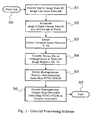
- Fig. 1 is a schematic flow chart for elucidating some aspects of an embodiment of the method for discriminating texture regions TR and homogeneous or flat regions HR in an image I according to the present invention.
- a first processing section S1 digital image data ID or a derivative thereof - e.g. the luminance part - or even an image, frame or picture I as such are provided as input data inD.
- a second processing section S2 said digital image data ID, said derivative thereof - in particular said luminance part - or even said image I as such are subdivided into blocks Bjk of image elements or pixels.
- a global variance or global variance value V as well as local variances or local variance values Vx with respect to said blocks Bjk or classes Cx thereof are derived. From these global and classes of local variances an estimate for the noise level or noise level value NV for the image, frame or picture I is derived.
- a fourth processing section S4 from said noise level or said noise level value NV image regions - e.g. said blocks Bjk - are locally classified as being textured - i.e. being an textured image region TR - or as being homogenous or flat - i.e. being a homogeneous image region HR.
- homogeneous-texture discrimination data HTDD - e.g. a homogeneous-texture discrimination map HTDM - are derived in a following fifth processing section S5 and then output as output data outD in a sixth processing section S6.
- the flat/homogeneous vs. texture image/picture analysis component or HT or FT image/picture analysis component differentiates flat from texture regions within an image, frame and/or video picture.
- the target for this algorithm is to deliver a map to a image/picture enhancement block, e.g. block S in Fig. 2, which uses this information to control the level of enhancement within these different image/picture regions.
- Fig. 2 describes this use case. In the case of a noisy input, this map helps to avoid the enhancement of noise in homogeneous or flat image/picture regions.
- HT or FT block or process depicted in the block diagram of Fig. 2 comes with a register list as shown in Fig. 19. A detailed description is given in the following sections.
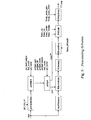
- Fig. 3 gives an overview about the functional components which are incorporated in the reference model for the homogeneous/flat vs. texture algorithm.
- This block diagram shows the software implemented reference model from a logical point of view.
- a hardware implementation may collapse some blocks like all gvlXxx blocks or the localVariance and the ftDiscriminate block. The parameters for all connection lines are taken from the fixed point reference model.
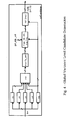
- FIG. 4 The block diagram of Fig. 4 describes the gvlCandidates process/block.
- the gvlCandidates process block calculates 5 global variance level (GVL) candidates with the following method: 1. Subdivide the picture into blocks B(x,y). 2. Calculate for each block B(x,y) the following values: a. ⁇ tot: variance for all pixel in B(x,y) b. ⁇ A, B, C, D: variance for all pixel on the sub-sampling raster A,B,C,D (see drawing of Fig. 5) c. ⁇ var: variance of variances ⁇ A, B, C, D, tot 3. Compare ⁇ var to the constant value fa_pen, which is a flat area penalty.
- Fig. 6 shows the structure of the gvl2Select module.
- a basic principle of this process/block is to calculate some selection criteria on the 5 values ⁇ tot [i] and to pass the selected value ⁇ tot, which is named GVL, to the output.
- Different methods have been investigated for the selection process like min( ⁇ tot [i]) or med( ⁇ tot [i]).
- adaptive median The method which is currently performing best is called adaptive median. This works like follows (refer to Fig. 6):
- Input Global Variance Level - GVL Parameters: gvl2gvt_stabL ... stabilization length, length of IIR filter gvl2gvt_stabW ... stabilization weight gvl2gvt_gain ... multiplication factor gvl2gvt_offset ... offset value test_mode ... FT test mode flag gvt_const ... GVT value used in the FT test mode
- Output Global Variance Threshold GVT Stabilized Global Variance Threshold GVLstab
- the basic objective for this process/block is to stabilize the GVL and to apply the tuning parameters to it in order to output the GVT.
- the stabilization is realized by an IIR filter.
- the block diagram of Fig. 7 describes the process flow.
- This process/block is adapted to calculate the variance within a 5x5 block, centrally located around the actual position, as is shown in Fig. 8.
- the process/algorithm can be described as follows.
- This process/functional block does the actual discrimination between homogeneous/flat and textured area by comparing the local variance value to the GVT value as described Fig. 9.
- the cleaning step is intended to improve the homogeneity of the FT map and to remove spurious errors.
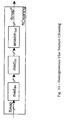
- the cleaning block comprises two median filters and one erosion step as depicted in the block diagram of Fig. 10.
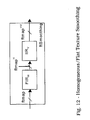
- Figs. 12 and 13 describe the sub-components of the ftSmoothing process/block.
- This process/module has two basic functions as depictured in Fig. 14.
- the first function is to scale the maximum value of the FT map down with increasing noise level.
- the downscaling is currently implemented with a linear approach. If the noise level (GVLstab) is below ftnlsc_nla, no scaling of the FT map is applied. If the noise level (GVLstab) is higher than ftnlsc_nlc, the FT map is set to zero. This applies a graceful degradation of the sharpness enhancer SRC with high noise levels.
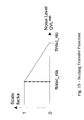
- the scaling transfer function looks as shown in Fig. 15.
- the second function is to avoid wrong results with pictures, which contain only texture.
- Such pictures produce very high variances because there are no flat blocks for variance measurement in the gvlCandidates block available. This effect increases with high sharpness and contrast. This may result in a FT map, which is indicating a completely flat picture although it is completely textured.
- a countermeasure for this problem is, to add a linearly increasing offset, if the noise level (GVLstab) exceeds a certain threshold ftnlsc_nv_min, which indicates that this high variance level might not result from noise in a flat area.
- the offset is increasing linearly up to the maximum value 255 when the measured noise level is surely not stemming from noise in a flat area but from a high contrast textured picture.
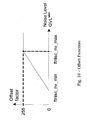
- the transfer function for the offset function looks as shown in Fig. 16.
- Input Noise adaptive scaled flat vs. texture map ftmap_nlscout to the enhancer component. Parameters: ftmap_scale_gain - FT map scaling gain factor ftmap_scale_offset - FT map scaling offset factor Output: Final scaled flat vs. texture map ftmapout to the enhancer component.
Landscapes
- Engineering & Computer Science (AREA)
- Physics & Mathematics (AREA)
- Computer Vision & Pattern Recognition (AREA)
- General Physics & Mathematics (AREA)
- Theoretical Computer Science (AREA)
- Probability & Statistics with Applications (AREA)
- Image Analysis (AREA)
- Compression Or Coding Systems Of Tv Signals (AREA)
- Image Processing (AREA)
Abstract
Description
- The invention relates to a method for discriminating texture regions and homogeneous or flat regions in an image. More specifically, the present invention relates to a method for determining textured and flat regions in a picture under noisy conditions.
- In many applications and customer devices, before displaying images, pictures, or frames the underlying images, frames, or pictures and the respective data have been pre-processed in order to better adapt the image properties, and the like. One aspect is the enhancement of sharpness of the image, picture, or frame. A problem when enhancing the sharpness of an image or with respect to other pre-processing steps is that the respective process is in general applied to all image details represented by the image data. However, some of the image details indeed originate from noise components which are also contained in the image and the image data. Under a process of e. g. sharpness enhancement, also respective noise components contained in the image data will be enhanced and therefore will be amplified.
- It is therefore necessary to know in advance, i. e. before pre-processing image data, to know something about the general noise level in the respective image, in particular with respect to homogeneous and textured regions of the image.
- It is therefore an object of the present invention to provide a method for discriminating textured regions or texture regions and homogeneous or flat regions in an image which is capable of providing in a simple manner information about the distribution and the location of textured regions and of homogeneous or flat regions in an image.
- The object is achieved by methods for discriminating texture regions and homogeneous or flat regions in an image according to
independent claims 1 and 3, and in addition by a system, apparatus or device by a computer program product, and by a computer readable storage medium according to claims 24, 25, 26, respectively. - According to the most general view and the broadest sense of the invention, the inventive method for discriminating texture regions and homogeneous or flat regions in an image is based on the aspect that a multi-scale or multi-resolution measurement is performed in said image.
- According to an alternative most general view of the present invention, the inventive method for discriminating texture regions and homogeneous or flat regions in an image is based on the aspect that the image is analyzed by using a prior measured noise value and a local variance value in said image.
- According to a first solution for the object underlying the present invention, a method for discriminating texture regions and homogeneous or flat regions in an image is provided, wherein a multi-scale or multi-resolution measurement is performed in said image.
- According to a second solution for the object underlying the present invention, a method for discriminating texture regions and homogeneous or flat regions in an image is provided, wherein said image is analyzed by using a prior measured noise value and a local variance value in said image.
- The invention will now be explained based on preferred embodiments thereof and by taking reference to the accompanying and schematical figures.
- Fig. 1
- is a schematic block diagram for elucidating basic principles underlying preferred embodiments of the present invention.
- Fig. 2
- is a schematic block diagram for elucidating a possible application of an embodiment of the present invention.
- Fig. 3
- is a schematic block diagram for elucidating in more detail some aspects underlying an embodiment of the present invention.
- Fig. 4
- is a schematic block diagram for elucidating aspects of a global variance level candidate generation process underlying an embodiment of the present invention.
- Fig. 5
- is a schematic diagram for elucidating a possible sub-sampling array or arrangement underlying an embodiment of the present invention.
- Fig. 6
- is a schematic block diagram for elucidating a global variance level selection process underlying an embodiment of the present invention.
- Fig. 7
- is a schematic block diagram for elucidating a global variance level to global variance threshold conversion process underlying an embodiment of the present invention.
- Fig. 8
- is a schematic block diagram for elucidating a local variance determination process underlying an embodiment of the present invention.
- Fig. 9
- is a schematic block diagram for elucidating a flat/homogeneous texture discrimination process underlying an embodiment of the present invention.
- Fig. 10
- is a schematic block diagram for elucidating a flat texture cleaning process underlying an embodiment of the present invention.
- Fig. 11A, 11B
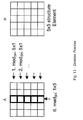
- are schematic block diagrams for elucidating the structure of a possible arrangement process underlying an embodiment of the present invention.
- Fig. 12, 13
- are schematic block diagrams for elucidating a possible structure for a flat texture smoothing process underlying an embodiment of the present invention.
- Fig. 14
- is a schematic block diagram for elucidating a flat/homogeneous texture noise level scale process underlying an embodiment of the present invention.
- Fig. 15
- is a graphical representation for elucidating a possible scaling transfer function and might be used in an embodiment of a flat/homogeneous noise level scaling process as shown in Fig. 14.
- Fig. 16
- is a graphical representation for elucidating offset properties in a possible flat/homogeneous noise level scaling process underlying an embodiment of the present invention as shown in Fig. 14.
- Fig. 17
- is a schematic block diagram for elucidating a flat/homogeneous texture final linear scaling process underlying an embodiment of the present invention.
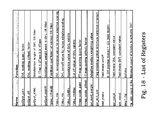
- Fig. 18
- is a tabular for elucidating a list of registers which might be used in an embodiment of the present invention and an implementation thereof.
- In the following functional and structural similar or equivalent element structures will be denoted with the same reference symbols. Not in each case of their occurrence a detailed description will be repeated.
- According to a first aspect of the present invention a method for discriminating texture regions and homogeneous or flat regions in an image is provided, wherein a multi-scale or multi-resolution measurement is performed in or with respect to said image.
- Said image may be analyzed by using a prior measured noise value and a local variance value in or with respect to said image.
- According to a second aspect of the present invention a method for discriminating texture regions and homogeneous or flat regions in an image is provided, wherein said image may analyzed by using a prior measured noise value and a local variance value in or with respect to said image.
- A multi-scale or multi-resolution measurement may be performed in or with respect to said image.
- Said multi-scale measurement or said multi-resolution measurement may be performed in order to obtain a real noise level or real noise level value, in particular as a variance value for said image.
- An image region of said image may be classified as textured if a variance value or local variance value exceeds a given threshold value.
- An image region of said image may be classified as homogeneous or flat if a variance value or a local variance value is below or equals a given threshold value.
- A noise variance value - in particular said prior measured variance value - or a derivative thereof may be used as said threshold value.
- Homogeneous-texture discrimination data may be generated and provided, which are descriptive and discriminating textured image regions and homogeneous or flat image regions in said image, wherein said homogeneous-texture discrimination data are in particular given as a homogeneous-texture discrimination map.
- The inventive method may comprise a global variance level calculating process, wherein blocks of said image are defined as image regions and assigned to a respective certain class of blocks, wherein for each class of blocks of said image a sub-variance value is determined, wherein an overall variance value for said image is determined, and wherein said sub-variance values for said classes of blocks of said image and said overall variance value for said image are taken as variance value candidates for describing the noise level or global noise level of said image.
- The inventive method may comprise a global variance selection process, wherein from said variance value candidates one value is selected for describing the noise level or the global noise level of said image, in particular according to given selection criteria.
- An adaptive median filter process may be used to realize said selection criteria.
- A temporal filtering process may be applied to said selected global noise level value, in particular to temporally stabilize said global noise level value for said image.
- A IIR filtering process may be used within said or as said temporal filtering process.
- For analyzing said image, said image may be subdivided into blocks as image regions which are essentially centrally located around a respective pixel within said image.
- Each block, each pixel in said image or block and/or classes thereof may get assigned a respective local variance value.
- Based on pixels within said image local variance values assigned to each of said pixels are compared against said global variance value.
- Said generated homogeneous-texture discrimination data and in particular said homogeneous-texture discrimination map may be cleaned in order to improve its homogeneity to thereby avoid side effects.
- In said cleaning process small spots within homogeneous sections may be removed.
- The inventive method may comprise a homogeneous-texture smoothing process with respect to said homogeneous-texture discrimination data, which is adapted and performed in order to smoothen transitions in said homogeneous-texture discrimination data.
- A vertical IIR filter may be used for said or in said homogeneous-texture smoothing process.
- A low pass filtering process is used in or for said homogeneous-texture smoothing process.
- The inventive method may comprise a homogeneous-texture noise level scale process.
- The inventive method may comprise a homogeneous-texture linear scale process, in order to provide optimization parameters.
- According to a further aspect of the present invention a system, apparatus or device for discriminating texture regions and homogeneous regions in an image are provided, which are adapted and which comprises means for carrying out a method for discriminating textured regions and homogeneous regions in an image according to the present invention and the steps thereof.
- According to a further aspect of the present invention a computer program product is provided, comprising a computer program means which is arranged and adapted in order to perform and realize a method for discriminating texture regions and homogeneous regions in an image according to the present invention and the steps thereof when it is executed on a computer or a digital signal processing means.
- According to a still further aspect of the present invention a computer readable storage medium is provided which comprises a computer program product according to the present invention.
- These and further aspects of the present invention will be further discussed in the following:
- The present invention inter alia also relates to a method to determine and discriminate textured and flat regions within an image, frame, or picture under noisy conditions.
- The problem to be solved is to provide a reliable method to distinguish in images, frames, or pictures textured areas from flat areas under noise free conditions and under noisy conditions. Such information can be used in different image, frame, or picture improvement application like noise reduction, sharpness enhancement or any other.
- The problem of distinguishing texture from homogenous areas under noisy conditions is, that the noise can make the homogonous area also look like texture. Depending on the decision criteria, such areas cannot be distinguished any more reliably.
- In the following a first and short overview over several aspects of the present invention is given.
- In the current embodiment, the Flat Texture (FT) process or algorithm is used in combination with a sharpness enhancement process or algorithm. The block S in Fig.2 is the actual controlling block of this sharpness enhancement process or algorithm by means of utilizing the FT information. The target is to lower the enhancement factor of the sharpness enhancement process or algorithm in case of noise in homogenous areas in order to avoid an unwanted enhancement of noise in this areas. In textured regions, the sharpness enhancement level can be kept even under noisy conditions because the noise is masked by the human eye.
- In the case of Fig. 2 the processing does not necessarily have to work on luminance lum, this is just the one appropriate embodiment here. It could work also on RGB or other domains where three separate processes are done and at the end combined or the like.
- Of course it can be used in combination with other picture processing system like noise reduction , where a different configuration could be used in case of texture and homogenous areas.
- Another possibility is to also in case of texture synthesis or scaling methods.
- In the following a overview over some basic aspects of an embodiment of the present invention is given:
- This block or process comprises a noise measurement method, which provides the global noise level independent if the picture content contains texture or noise. This can be reached by using a multi scale measurement approach, where for a given block, four sub-variances and one overall variance is calculated. This utilizes the fact, that (Gaussian) noise is independent from the spatial position and texture (to some extend) is not. Therefore, that sub-variances should change in case of texture and they should stay similar in case of homogenous regions even in case of noisy condition. The determination of the global noise level is crucial for the system. This block outputs 5 candidates for the global variance level.
- This block or process is adapted to select the best suitable global variance level from the five candidates. The method, which is actually used in our embodiment is called adaptive median.
- The advantage of this adaptive median method is, that in cases where almost the whole picture is consisting of texture and only a very small region has homogenous content, the noise level will be taken from this homogenous region, although it is not the median value in the candidate list. This helped to solve some problematic cases where despite the multi-scale approach, the candidates have been wide spread in the value range. It improves the reliability of the GVL vale.
- This block or process provides a temporal filtering of the GVL value in order to avoid temporal side effects like pumping. It stabilizes the GVL value by means of a IIR filter. The second task is to apply some offset and gain parameters for final adjustment of the algorithm in the real-time system.
- This block or process is adapted to calculates the variance of block centrally located around an actual pixel. Each pixel in the picture gets an variance value assigned in this way.
- This block or process is adapted to compare pixel by pixel the above mentioned local variance value against the GVT.
- This block or process is adapted to clean the binary flat vs. texture map to improve the homogeneity of the map, which avoids side effects. It removes small spots which are flagged as texture within a homogenous region and vice versa. Especially small areas indicated as texture within a homogenous area can lead to visible distortions for the viewer.
- The erosion fits the area, which is masked as texture better the real object / region border. There is some overlap of the texture mask compared to the actual textured region in the picture due to the mask size of the local variance operator. The local variance of pixel which are still in a homogenous region but near a textured area is already increased because the mask for calculating the local variance covers already some texture pixel or pixel from another characteristic than the actual one. The erosion process is a countermeasure for this issue.
- This block or process is adapted to smoothen the transitions in the binary flat vs. texture map. This is also necessary to avoid side effects for the viewer because a steep transition or binary switching of the sharpness enhancement or any other method is visible to the human eye as error. The vertical IIR filter was chosen to save implementation resources and to achieve a strong filtering also in vertical direction.
- The strong low pass filtering further attenuates also the enhancement of small textured areas within a homogenous region which is of advantage for the image impression.
- This block or process is adapted to guarantee a certain adaptivity to the overall noise level for the complete system. This means that if very strong noise is apparent in the picture, the textured region should be gradually, with increasing noise level, be also set to "no texture". This means in our embodiment that the sharpness enhancement is gradually completely switched off also for textured areas for very strong noise.
- This block or process is adapted to provide some optimization parameters for the algorithm chain the real-time system and is not mandatory.
- In the following a more detailed overview over several aspects of the present invention is given. The following passages give therefore a more detailed explanation of the flat vs. texture video analysis component and of the underlying methods and algorithms and related implementation notes:
- Fig. 1 is a schematic flow chart for elucidating some aspects of an embodiment of the method for discriminating texture regions TR and homogeneous or flat regions HR in an image I according to the present invention.
- After an initialisation step S0, in a first processing section S1 digital image data ID or a derivative thereof - e.g. the luminance part - or even an image, frame or picture I as such are provided as input data inD.
- In a second processing section S2 said digital image data ID, said derivative thereof - in particular said luminance part - or even said image I as such are subdivided into blocks Bjk of image elements or pixels.
- Then in a third processing section S3 a global variance or global variance value V as well as local variances or local variance values Vx with respect to said blocks Bjk or classes Cx thereof are derived. From these global and classes of local variances an estimate for the noise level or noise level value NV for the image, frame or picture I is derived.
- In a fourth processing section S4 from said noise level or said noise level value NV image regions - e.g. said blocks Bjk - are locally classified as being textured - i.e. being an textured image region TR - or as being homogenous or flat - i.e. being a homogeneous image region HR.
- From said classification homogeneous-texture discrimination data HTDD - e.g. a homogeneous-texture discrimination map HTDM - are derived in a following fifth processing section S5 and then output as output data outD in a sixth processing section S6.
- The flat/homogeneous vs. texture image/picture analysis component or HT or FT image/picture analysis component differentiates flat from texture regions within an image, frame and/or video picture. The target for this algorithm is to deliver a map to a image/picture enhancement block, e.g. block S in Fig. 2, which uses this information to control the level of enhancement within these different image/picture regions. Fig. 2 describes this use case. In the case of a noisy input, this map helps to avoid the enhancement of noise in homogeneous or flat image/picture regions.
- The HT or FT block or process depicted in the block diagram of Fig. 2 comes with a register list as shown in Fig. 19. A detailed description is given in the following sections.
- Fig. 3 gives an overview about the functional components which are incorporated in the reference model for the homogeneous/flat vs. texture algorithm.
- This block diagram shows the software implemented reference model from a logical point of view. A hardware implementation may collapse some blocks like all gvlXxx blocks or the localVariance and the ftDiscriminate block. The parameters for all connection lines are taken from the fixed point reference model.
- Parameters which are applied to the system from outside are depicted with a separate input arrow to the respective blocks.
- The following sections describe each functional block by its input, output, processing steps or algorithm and some related notes for implementation.
-
Input: Input luminance image/picture lum Parameters: gvl_min_crit Output: Array of 5 minimum variance values σtot[i], i = {1..5} - The block diagram of Fig. 4 describes the gvlCandidates process/block.
- The gvlCandidates process block calculates 5 global variance level (GVL) candidates with the following method:
1. Subdivide the picture into blocks B(x,y).
2. Calculate for each block B(x,y) the following values:a. σtot: variance for all pixel in B(x,y) b. σA, B, C, D: variance for all pixel on the sub-sampling raster A,B,C,D (see drawing of Fig. 5) c. σvar: variance of variances σA, B, C, D, tot
4. In case that flag gvl_min_crit is enabled, σtot is assigned to σvar. With this you disable the multi-scale NM and enable the global minimum block variance search for determining the final GVL value.
5. Find the minimum values σvar for all blocks and store them together with their accompanying value σtot for the respective block B(x,y).
6. Output these five minimum σtot[i], i = {1..5} to the gvlSelect module. - The sub-sampling arrangement or raster mentioned in itemt 2.c for a block B(x,y) above is described in Fig. 5.
- Two different methods to calculate the variance are analyzed as follows:
- 1. σ = 1/N * Σ(x(i) - µ )2, for all x(i) in B(x,y), where N is the number of pel in B(x,y) and µ describes the pixel average in B(x,y). We usually refer to this value as "normal variance".
- 2. σ = 1 /N * Σ| x(i) - µ |, which describes a variance based on the absolute value of the difference between the actual sample and the average in B(x,y). This is usually referred to as "simple variance".
- Investigations show that it is possible to use both types of variance calculation for our purposes. However, it was decided to use the normal variance because it is more advantageous in terms of resource usage.
- Implementation notes:
- 1. There is no specific border processing since the measurement blocks are placed only inside the active picture area.
- 2. Blocks which are not fully fitting into the active picture area are discarded.
- 3. For implementation we use the GVL of the previous frame for the actual picture in order to avoid a full frame delay. For the time instance t=0 the first GVL value is set to GVL(t=0) = 0.
- 4. The bit-width for all different signals is taken from the katv_FT fixed point model. All primary variances σA, B, C, D, tot are 18 bit.
- 5. The flat area penalty fa_pen is set per define to 0.02 and is used to discard measurements in black bars.
-
Input: Array of variance values σtot[i], i = {1..5} Parameters: gvl_med_weight, test_mode, gvl_const Output: Global Variance Level (GVL) - Fig. 6 shows the structure of the gvl2Select module. A basic principle of this process/block is to calculate some selection criteria on the 5 values σtot [i] and to pass the selected value σtot, which is named GVL, to the output. Different methods have been investigated for the selection process like min(σtot [i]) or med(σtot [i]).
- The method which is currently performing best is called adaptive median. This works like follows (refer to Fig. 6):
- 1. Calculate the minimum σtot,min = min (σtot [i]).
- 2. Calculate the median σtot,med = med (σtot [i]).
- 3. Calculate the distance δ [i] for each σtot [i] to σtot,med. The distance criterion is based on the absolute difference: δ[i] = dist (σtot [i], σtot,med) = Σi=1...5 |σtot [i] - σtot,med|.
- 4. Determine the maxium from all distances δ[i]: δmax = max(δ[i]).
- 5. A binary decision is taken from δmax > gvl_med_weight · σtot,med. If this condition is true (1) the result will be σtot,min, otherwise the output will be σtot,med (see below notes for information on gvl_med_weight). If gvl_med_weight is set to its maximum possible value, GVL is chosen to be σtot,med. By this it is possible to switch with the help of gvl_med_weight between σtot,min and σtot,med.
- Implementation notes:
- The gvl_med_weight value is a register parameter with 10 bits. In the full precision reference implementation, it is set by default to α = 0.2 (fix-point model: 0.1875).
- For testing the FT algorithm, a test mode has been introduced by using the parameters test_mode & gvl_const. In case that test_mode is enabled the constant value gvl_const is set as output of this block.
-
Input: Global Variance Level - GVL Parameters: gvl2gvt_stabL ... stabilization length, length of IIR filter gvl2gvt_stabW ... stabilization weight gvl2gvt_gain ... multiplication factor gvl2gvt_offset ... offset value test_mode ... FT test mode flag gvt_const ... GVT value used in the FT test mode Output: Global Variance Threshold GVT Stabilized Global Variance Threshold GVLstab - The basic objective for this process/block is to stabilize the GVL and to apply the tuning parameters to it in order to output the GVT. The stabilization is realized by an IIR filter. The block diagram of Fig. 7 describes the process flow.
- The processing works as follows:
- 1. Calculate the stabilized global variance level as GVLstab = gvl2gvt_stabW · GVLstab[i] + (1- gvl2gvt_stabW) - GVL, where GVLstab[i] describes an array with gvl2gvt_stabL elements of the last stabilized GVLstabs and where GVL describes the actual incoming value. GVLstab[i] is depicted in the above drawing as IIR block.
- 2. Update GVLstab[i] (IIR) for the next iteration.
- 3. Calculate the global variance threshold as GVT = gvl2gvt_gain · GVLstab + gvl2gvt_offset.
- 4. In case the amount of counted blocks (in actual region of interest) is smaller than the register value fte_min_count_blks the GVT value is set to 0. By default the value is set to 150, which represent 1/3 * 1/3 SD.
- 5. Output GVT and GVLstab.
- Implementation notes:
- 1. During the run-in of the process, the averaging process is only carried out over valid values in the FIFO, which means the full length is considered after gvl2gvt_stabL frames (gvl2gvt_stabL subsequent GVL inputs).
- 2. The parameter gvl2gvt_stabL maps to the IIR filter length as follows:
- gvl2gvt_stabL = 0 ==> IIR -Filter length = 1 Tap
- gvl2gvt_stabL = 1 ==> IIR -Filter length = 2 Taps
- gvl2gvt_stabL = 2,3 ==> IIR -Filter length = 4 Taps
- 3. Similar to the gvlSelect block, this block features alsoa test mode enabled and defined by the parameters test_mode & gvt_const. In case that the test_mode is enabled the constant value gvt_const is set as output of this block.
-
Input: Luminance picture lum Parameters: None Output: Local variance σloc - This process/block is adapted to calculate the variance within a 5x5 block, centrally located around the actual position, as is shown in Fig. 8.
- The process/algorithm can be described as follows.
- 1. Load all pixels in a 5x5 block around the actual pixel.
- 2. Calculate the local variance σloc over all pixels in the block with the same method as for the GVL, the "normal" variance formula.
- 3. Output the σloc and proceed to the next position.
- Implementation note: The border handling is implemented with pixel repetition.
-
Input: Local variance level σloc GVT Parameters: None Output: Flat vs. texture map: ftmap - This process/functional block does the actual discrimination between homogeneous/flat and textured area by comparing the local variance value to the GVT value as described Fig. 9.
- Compare each σloc to the GVT and write a binary decision value to the output.
- Implementation notes: No special considerations. This block may be collapsed (in hardware design this has been considered already) with others in a final implementation. It's separate in the simulation model for ease of use and analysis.
-
Input: Flat vs. texture map: ftmap Parameters: None Output: Cleaned flat vs. texture map: ftmapcl - The cleaning step is intended to improve the homogeneity of the FT map and to remove spurious errors. The cleaning block comprises two median filters and one erosion step as depicted in the block diagram of Fig. 10.
- All applied filter methods are regular text book methods. The algorithm can be described as follows:
- 1. Apply a 5 tap median in horizontal direction centrally located around the actual pixel.
- 2. Apply a 5 tap median filter in vertical direction, centrally located around the actual pixel. The input to this filter step is pre-processed by the previous hor. median step.
- 3. Apply on the horizontally and vertically median filtered map an erosion process with a squared 5x5 structure element.
- 4. Output the cleaned FT map values.
- Implementation notes:
- 1. Figs. 11A, 11B give some hint to the current software implementation. The filter mask for the median filtering is shown in the left picture of both. The central column of the 5x5 mask is the input to the vertical 5-tap median filter. Each of the values of this vertical mask are first horizontally median filtered by a 5-tap median, which is depicted with the horizontal extension. The numbering in front of the median operators gives some hint to the order of processing.
The right picture shows the 5x5 structure element for the erosion process.
Since we have only 1 bit values, all the rank order filters in this block can be implemented by simple counters. - 2. The border handling is done by pixel repetition.
-
Input: FT map Parameters: ftsmo_iirFeedB Output: Horizontally and vertically smoothed FT map: ftmapHV - This process/block is intended to smooth out the transitions between flat and texture area in the FT map, which is crucial for the final picture quality because this reduces side effects. Different methods have been investigated. Figs. 12 and 13 describe the sub-components of the ftSmoothing process/block.
- The process algorithm works specifically as follows:
- 1. Apply a horizontal filter to the incoming binary FT map. The hor. filter applies a averaging over 17 taps centrally located around the actual one and outputs the result as ftmapH to the vertical smoothing filter.
- 2. The vertical filter is implemented as 2-tap IIR filter with the ftsmo_iirFeedB+ε parameter as weight for the feedback path. ε is called "feedback disturbance" and was introduced because the ftmap output does not reach the maximum valued 255 without this small offset. The ε value is currently set to 0.001.
- 3. To avoid overflow, a clipping block is introduced, which limits the map between 0 and 255.
- 4. The output is ftmapHV.
- Implementation notes:
- 1. All border processing is done with pixel repetition.
- 2. Also a vertical 5-tap FIR filter has been investigated, which may be integrated with the horizontal IIR filter to a squared 17x5 mask for averaging. This may be an alternative to the IIR filter, which has an 8 bit input signal at the input and therefore is more expensive. However the 2-tap IIR is preferable because it delivers a stronger smoothing.
-
Input: Smoothed flat vs texture map ftmapHV GVLstab- Stabilized global variance level as noise level Parameters: ftnlsc_nla - Noise level acceptance threshold ftnlsc_nlc - Noise level cut off threshold ftnlsc_nv_min - Minimum valid noise level ftnlsc_nv_max - Maximum valid noise level Output: Noise adaptive scaled flat vs. texture map ftmap_nlscout to the enhancer component. - This process/module has two basic functions as depictured in Fig. 14.
- The first function is to scale the maximum value of the FT map down with increasing noise level. The downscaling is currently implemented with a linear approach. If the noise level (GVLstab) is below ftnlsc_nla, no scaling of the FT map is applied. If the noise level (GVLstab) is higher than ftnlsc_nlc, the FT map is set to zero. This applies a graceful degradation of the sharpness enhancer SRC with high noise levels. The scaling transfer function looks as shown in Fig. 15.
- The second function is to avoid wrong results with pictures, which contain only texture. Such pictures produce very high variances because there are no flat blocks for variance measurement in the gvlCandidates block available. This effect increases with high sharpness and contrast. This may result in a FT map, which is indicating a completely flat picture although it is completely textured.
- A countermeasure for this problem is, to add a linearly increasing offset, if the noise level (GVLstab) exceeds a certain threshold ftnlsc_nv_min, which indicates that this high variance level might not result from noise in a flat area. The offset is increasing linearly up to the
maximum value 255 when the measured noise level is surely not stemming from noise in a flat area but from a high contrast textured picture. The transfer function for the offset function looks as shown in Fig. 16. - The specific processing or algorithmic steps are as follows:
- 1. Calculate the linear transfer function for the filter curve from ftnlsc_nla, ftnlsc_nlc.
- 2. Calculate the scaling factor for the actual picture.
- 3. Scale the input FT map globally with this factor and output it.
- 4. Calculate the linear transfer function in a similar way for ftnlsc_nv_min, ft_nv_max and add the appropriate offset to the ftmap value.
- Implementation notes:
- 1. The transfer functions may be implemented as look up table since the ftnlsc_nla, ftnlsc_nlc, ftnlsc_nv_min and ftnlsc_nv_max are set only once.
- 2. The parameters ftnlsc_nla and ftnlsc_nlc are set per default to 70 and 218.
- 3. Values of ftnlsc_nv_min and ftnlsc_nv_max are currently set to 512 and 1024.
-
Input: Noise adaptive scaled flat vs. texture map ftmap_nlscout to the enhancer component. Parameters: ftmap_scale_gain - FT map scaling gain factor ftmap_scale_offset - FT map scaling offset factor Output: Final scaled flat vs. texture map ftmapout to the enhancer component. - This block is doing a final linear scaling of the FT map regarding the incoming two parameters scale_gain & scale_offset and is described by Fig. 17.
- The default setting are ftmap_scale_gain = 1 and ftmap_scale_offset = 0 so there is no change of FT map.
-
- Bjk
- Block of an image, frame, picture
- HTDD
- Homogeneous-texture discrimination data
- HTDM
- Homogeneous-texture discrimination map
- I
- Image, frame, picture
- ID
- Digital image data
- inD
- Input data
- IR
- Image region
- outD
- Output data
- HR
- Homogeneous/flat image region
- TR
- Texture/textured image region
- T
- Threshold value
- V, Vo
- Global/overall variance/variance value
- Vx
- Local variance/variance value (for block or class of blocks)
Claims (26)
- Method for discriminating texture regions (TR) and flat regions (HR) in an image (I) even under noisy conditions,
wherein a multi-resolution measurement is performed with respect to said image (I). - Method according to claim 1,
wherein said image (I) is analyzed by using a prior measured noise value and a local variance value with respect to said image (1). - Method for discriminating texture regions (TR) and flat regions (HR) in an image (I) even under noisy conditions,
wherein said image (I) is analyzed by using a prior measured noise value and a local variance value with respect to said image (I). - Method according to claim 3,
wherein a multi-resolution measurement is performed with respect to said image (I). - Method according to any one of the preceding claims,
wherein said multi-resolution measurement is performed in order to obtain a real noise level value as a variance value for said image (I). - Method according to any one of the preceding claims,- wherein an image region (IR) of said image (I) is classified as textured if a variance value exceeds a given threshold value (T) and- wherein an image region (IR) of said image (I) is classified as flat if a variance value is below or equals a given threshold value (T).
- Method according to claim 6,
wherein a noise variance value or a derivative thereof is used as said threshold value (T). - Method according to any one of the preceding claims,- wherein homogeneous-texture discrimination data (HTDD) are provided, which are descriptive and discriminating textured image regions (TR) and flat image regions (HR) in said image (I), and- wherein said homogeneous-texture discrimination data (HTDD) are given as a homogeneous-texture discrimination map (HTDM).
- Method according to any one of the preceding claims,- comprising a global variance level calculating process,- wherein blocks (Bjk) of said image (I) are defined as image regions (IR) and assigned to a respective certain class (Cx) of blocks (Bjk),- wherein for each class (Cx) of blocks (Bjk) of said image (I) a sub-variance value (Vx) is determined,- wherein an overall variance value (Vo) for said image (I) is determined, and- wherein said sub-variance values (Vx) for said classes (Cx) of blocks (Bjk) of said image (I) and said overall variance value (Vo) for said image (I) are taken as variance value candidates for describing the noise level of said image (I).
- Method according to claim 9,- comprising a global variance selection process,- wherein from said variance value candidates one value is selected for describing the noise level of said image (I), in particular according to given selection criteria.
- Method according claim 10,
wherein an adaptive median filter process is used to realize said selection criteria. - Method according to any one of the preceding claims,
wherein a temporal filtering process is applied to said selected global noise level value in order to temporally stabilize said noise level value for said image (I). - Method according to claim 12,
wherein a IIR filtering process is used as said temporal filtering process. - Method according to any one of the preceding claims,
wherein for analyzing said image (I) is subdivided into blocks (Bjk) as image regions (IR) which are essentially centrally located around a respective pixel within said image (I). - Method according to claim 14,
wherein a respective local variance value (Vx) is assigned to each block (Bjk) and to each pixel in said image (I). - Method according to any one of the preceding claims,
wherein based on pixels within said image (I) local variance values (Vx) assigned to each of said pixels are compared against said variance value (V). - Method according to any one of the preceding claims,
wherein said generated homogeneous-texture-discrimination data (HTDD) are cleaned in order to improve its homogeneity to thereby avoid side effects. - Method according to claim 17,
wherein in said cleaning process small spots within homogeneous sections are removed. - Method according to any one of the preceding claims,- comprising a homogeneous texture smoothing process with respect to said homogeneous-texture-discrimination data (HTDD),- which is adapted in order to smoothen transitions in said homogeneous-texture-discrimination data (HTDD).
- Method according to claim 19,
wherein a vertical IIR filter is used in said homogeneous-texture smoothing process. - Method according to any one of the preceding claims 19 or 20,
wherein a low pass filtering process is used for said homogeneous-texture-smoothing process. - Method according to any one of the preceding claims,
comprising a homogeneous-texture noise level scale process. - Method according to any one of the preceding claims,
comprising a homogeneous-texture linear scale process in order to provide optimization parameters, in particular for an overall system adjustment. - System, apparatus or device for discriminating texture regions and homogeneous regions in an image (I),
which is adapted and which comprises means for carrying out a method for discriminating textured regions (TR) and homogeneous regions (HR) in an image (I) according to any one of the claims 1 to 23 and the steps thereof. - Computer program product,
comprising a computer program means which is arranged and adapted in order to perform and realize a method for discriminating texture regions (TR) and homogeneous regions (HR) in an image (I) according to any one of the claims 1 to 23 and the steps thereof when executed on a computer or a digital signal processing means. - Computer readable storage medium,
comprising a computer program product according to claim 25.
Priority Applications (4)
| Application Number | Priority Date | Filing Date | Title |
|---|---|---|---|
| EP06006855A EP1840823B1 (en) | 2006-03-31 | 2006-03-31 | Method for discriminating textures regions and homogeneous or flat regions in an image |
| DE602006021701T DE602006021701D1 (en) | 2006-03-31 | 2006-03-31 | Method for distinguishing the texture areas and homogeneous or flat areas in an image |
| PCT/EP2007/001544 WO2007096168A2 (en) | 2006-02-22 | 2007-02-22 | Method for discriminating textures regions and homogeneous or flat regions in an image and methods for estimating noise in an image sequence |
| US12/280,365 US8145005B2 (en) | 2006-02-22 | 2007-02-22 | Method for discriminating textures regions and homogeneous or flat regions in an image and methods for estimating noise in an image sequence |
Applications Claiming Priority (1)
| Application Number | Priority Date | Filing Date | Title |
|---|---|---|---|
| EP06006855A EP1840823B1 (en) | 2006-03-31 | 2006-03-31 | Method for discriminating textures regions and homogeneous or flat regions in an image |
Publications (2)
| Publication Number | Publication Date |
|---|---|
| EP1840823A1 true EP1840823A1 (en) | 2007-10-03 |
| EP1840823B1 EP1840823B1 (en) | 2011-05-04 |
Family
ID=36645699
Family Applications (1)
| Application Number | Title | Priority Date | Filing Date |
|---|---|---|---|
| EP06006855A Expired - Fee Related EP1840823B1 (en) | 2006-02-22 | 2006-03-31 | Method for discriminating textures regions and homogeneous or flat regions in an image |
Country Status (2)
| Country | Link |
|---|---|
| EP (1) | EP1840823B1 (en) |
| DE (1) | DE602006021701D1 (en) |
Cited By (2)
| Publication number | Priority date | Publication date | Assignee | Title |
|---|---|---|---|---|
| EP2498219A1 (en) * | 2011-03-09 | 2012-09-12 | Canon Kabushiki Kaisha | Image processing apparatus, image processing method, and computer-readable storage medium |
| US8745451B2 (en) | 2009-07-02 | 2014-06-03 | Sony Corporation | Method and device for processing signal data |
Citations (2)
| Publication number | Priority date | Publication date | Assignee | Title |
|---|---|---|---|---|
| US20040120597A1 (en) * | 2001-06-12 | 2004-06-24 | Le Dinh Chon Tam | Apparatus and method for adaptive spatial segmentation-based noise reducing for encoded image signal |
| US6771793B1 (en) * | 1999-02-17 | 2004-08-03 | Fuji Photo Film Co., Ltd. | Image processing method and apparatus |
-
2006
- 2006-03-31 EP EP06006855A patent/EP1840823B1/en not_active Expired - Fee Related
- 2006-03-31 DE DE602006021701T patent/DE602006021701D1/en not_active Expired - Lifetime
Patent Citations (2)
| Publication number | Priority date | Publication date | Assignee | Title |
|---|---|---|---|---|
| US6771793B1 (en) * | 1999-02-17 | 2004-08-03 | Fuji Photo Film Co., Ltd. | Image processing method and apparatus |
| US20040120597A1 (en) * | 2001-06-12 | 2004-06-24 | Le Dinh Chon Tam | Apparatus and method for adaptive spatial segmentation-based noise reducing for encoded image signal |
Non-Patent Citations (4)
| Title |
|---|
| AMER A ET AL: "Reliable and fast structure-oriented video noise estimation", PROCEEDINGS 2002 INTERNATIONAL CONFERENCE ON IMAGE PROCESSING. ICIP 2002. ROCHESTER, NY, SEPT. 22 - 25, 2002, INTERNATIONAL CONFERENCE ON IMAGE PROCESSING, NEW YORK, NY : IEEE, US, vol. VOL. 2 OF 3, 22 September 2002 (2002-09-22), pages 840 - 843, XP010607455, ISBN: 0-7803-7622-6 * |
| DONG-HYUK SHIN ET AL: "Block-based noise estimation using adaptive gaussian filtering", CONSUMER ELECTRONICS, 2005. ICCE. 2005 DIGEST OF TECHNICAL PAPERS. INTERNATIONAL CONFERENCE ON LAS VEGAS, NV, USA JAN. 8-12, 2005, PISCATAWAY, NJ, USA,IEEE, 8 January 2005 (2005-01-08), pages 263 - 264, XP010796632, ISBN: 0-7803-8838-0 * |
| MEER P ET AL: "A fast parallel algorithm for blind estimation of noise variance", IEEE TRANSACTIONS ON PATTERN ANALYSIS AND MACHINE INTELLIGENCE USA, vol. 12, no. 2, February 1990 (1990-02-01), pages 216 - 223, XP002390654, ISSN: 0162-8828 * |
| STARCK J -L ET AL: "Automatic noise estimation from the multiresolution support", PUBLICATIONS OF THE ASTRONOMICAL SOCIETY OF THE PACIFIC UNIVERSITY OF CHICAGO PRESS FOR ASTRON. SOC. PACIFIC USA, vol. 110, no. 744, February 1998 (1998-02-01), pages 193 - 199, XP002390653, ISSN: 0004-6280 * |
Cited By (5)
| Publication number | Priority date | Publication date | Assignee | Title |
|---|---|---|---|---|
| US8745451B2 (en) | 2009-07-02 | 2014-06-03 | Sony Corporation | Method and device for processing signal data |
| EP2498219A1 (en) * | 2011-03-09 | 2012-09-12 | Canon Kabushiki Kaisha | Image processing apparatus, image processing method, and computer-readable storage medium |
| CN102743181A (en) * | 2011-03-09 | 2012-10-24 | 佳能株式会社 | Image processing apparatus and image processing method |
| US8983122B2 (en) | 2011-03-09 | 2015-03-17 | Canon Kabushiki Kaisha | Image processing apparatus, image processing method, and computer-readable storage medium |
| CN102743181B (en) * | 2011-03-09 | 2016-01-20 | 佳能株式会社 | Image processing apparatus and image processing method |
Also Published As
| Publication number | Publication date |
|---|---|
| DE602006021701D1 (en) | 2011-06-16 |
| EP1840823B1 (en) | 2011-05-04 |
Similar Documents
| Publication | Publication Date | Title |
|---|---|---|
| US8145005B2 (en) | Method for discriminating textures regions and homogeneous or flat regions in an image and methods for estimating noise in an image sequence | |
| US9615039B2 (en) | Systems and methods for reducing noise in video streams | |
| US20200134795A1 (en) | Image processing method, image processing system, and storage medium | |
| US8126258B2 (en) | Method of detecting defects in patterns on semiconductor substrate by comparing second image with reference image after acquiring second image from first image and apparatus for performing the same | |
| US7321699B2 (en) | Signal intensity range transformation apparatus and method | |
| US10021413B2 (en) | Apparatus and method for video data processing | |
| EP2637138A1 (en) | Method and apparatus for combining panoramic image | |
| US20100254572A1 (en) | Continuous extended range image processing | |
| KR100860988B1 (en) | Method and apparatus for object detection in sequences | |
| CN111223083B (en) | Method, system, device and medium for constructing neural network for surface scratch detection | |
| EP2274725A1 (en) | Filtering method and apparatus for anti-aliasing | |
| US9341579B2 (en) | Defect detection apparatus, defect detection method, and computer program | |
| CN113542868A (en) | Video key frame selection method and device, electronic equipment and storage medium | |
| CN113514054A (en) | A kind of star sensor star spot image spot detection method and system | |
| US20100061650A1 (en) | Method And Apparatus For Providing A Variable Filter Size For Providing Image Effects | |
| CN113888575A (en) | Contraband detection method, device, equipment and computer readable storage medium | |
| JP2004524901A (en) | Method and apparatus for reducing correlation noise in image data | |
| US20100079665A1 (en) | Frame Interpolation Device | |
| CN111091513B (en) | Image processing method, device, computer-readable storage medium, and electronic device | |
| EP1840823A1 (en) | Method for discriminating textures regions and homogeneous or flat regions in an image | |
| US7932955B2 (en) | Method and system for content adaptive analog video noise detection | |
| TWI864769B (en) | Video noise reduction method and video noise reduction system based on portrait mode | |
| US20070248287A1 (en) | Pattern detecting method and related image processing apparatus | |
| US20080310751A1 (en) | Method And Apparatus For Providing A Variable Blur | |
| Chughtai et al. | An edge preserving locally adaptive anti-aliasing zooming algorithm with diffused interpolation |
Legal Events
| Date | Code | Title | Description |
|---|---|---|---|
| PUAI | Public reference made under article 153(3) epc to a published international application that has entered the european phase |
Free format text: ORIGINAL CODE: 0009012 |
|
| AK | Designated contracting states |
Kind code of ref document: A1 Designated state(s): AT BE BG CH CY CZ DE DK EE ES FI FR GB GR HU IE IS IT LI LT LU LV MC NL PL PT RO SE SI SK TR |
|
| AX | Request for extension of the european patent |
Extension state: AL BA HR MK YU |
|
| 17P | Request for examination filed |
Effective date: 20080220 |
|
| 17Q | First examination report despatched |
Effective date: 20080320 |
|
| AKX | Designation fees paid |
Designated state(s): DE FR GB |
|
| GRAP | Despatch of communication of intention to grant a patent |
Free format text: ORIGINAL CODE: EPIDOSNIGR1 |
|
| GRAS | Grant fee paid |
Free format text: ORIGINAL CODE: EPIDOSNIGR3 |
|
| GRAA | (expected) grant |
Free format text: ORIGINAL CODE: 0009210 |
|
| AK | Designated contracting states |
Kind code of ref document: B1 Designated state(s): DE FR GB |
|
| REG | Reference to a national code |
Ref country code: GB Ref legal event code: FG4D |
|
| REF | Corresponds to: |
Ref document number: 602006021701 Country of ref document: DE Date of ref document: 20110616 Kind code of ref document: P |
|
| REG | Reference to a national code |
Ref country code: DE Ref legal event code: R096 Ref document number: 602006021701 Country of ref document: DE Effective date: 20110616 |
|
| PLBE | No opposition filed within time limit |
Free format text: ORIGINAL CODE: 0009261 |
|
| STAA | Information on the status of an ep patent application or granted ep patent |
Free format text: STATUS: NO OPPOSITION FILED WITHIN TIME LIMIT |
|
| 26N | No opposition filed |
Effective date: 20120207 |
|
| REG | Reference to a national code |
Ref country code: DE Ref legal event code: R097 Ref document number: 602006021701 Country of ref document: DE Effective date: 20120207 |
|
| GBPC | Gb: european patent ceased through non-payment of renewal fee |
Effective date: 20120331 |
|
| REG | Reference to a national code |
Ref country code: FR Ref legal event code: ST Effective date: 20121130 |
|
| PG25 | Lapsed in a contracting state [announced via postgrant information from national office to epo] |
Ref country code: GB Free format text: LAPSE BECAUSE OF NON-PAYMENT OF DUE FEES Effective date: 20120331 Ref country code: FR Free format text: LAPSE BECAUSE OF NON-PAYMENT OF DUE FEES Effective date: 20120402 |
|
| REG | Reference to a national code |
Ref country code: DE Ref legal event code: R119 Ref document number: 602006021701 Country of ref document: DE Effective date: 20121002 |
|
| PG25 | Lapsed in a contracting state [announced via postgrant information from national office to epo] |
Ref country code: DE Free format text: LAPSE BECAUSE OF FAILURE TO SUBMIT A TRANSLATION OF THE DESCRIPTION OR TO PAY THE FEE WITHIN THE PRESCRIBED TIME-LIMIT Effective date: 20121002 |