EP1840194A1 - Gear fluids - Google Patents
Gear fluids Download PDFInfo
- Publication number
- EP1840194A1 EP1840194A1 EP07005713A EP07005713A EP1840194A1 EP 1840194 A1 EP1840194 A1 EP 1840194A1 EP 07005713 A EP07005713 A EP 07005713A EP 07005713 A EP07005713 A EP 07005713A EP 1840194 A1 EP1840194 A1 EP 1840194A1
- Authority
- EP
- European Patent Office
- Prior art keywords
- phosphonic acid
- additive composition
- anyone
- hydrocarbyl group
- additive
- Prior art date
- Legal status (The legal status is an assumption and is not a legal conclusion. Google has not performed a legal analysis and makes no representation as to the accuracy of the status listed.)
- Granted
Links
Images

Classifications
-
- C—CHEMISTRY; METALLURGY
- C10—PETROLEUM, GAS OR COKE INDUSTRIES; TECHNICAL GASES CONTAINING CARBON MONOXIDE; FUELS; LUBRICANTS; PEAT
- C10M—LUBRICATING COMPOSITIONS; USE OF CHEMICAL SUBSTANCES EITHER ALONE OR AS LUBRICATING INGREDIENTS IN A LUBRICATING COMPOSITION
- C10M137/00—Lubricating compositions characterised by the additive being an organic non-macromolecular compound containing phosphorus
-
- C—CHEMISTRY; METALLURGY
- C10—PETROLEUM, GAS OR COKE INDUSTRIES; TECHNICAL GASES CONTAINING CARBON MONOXIDE; FUELS; LUBRICANTS; PEAT
- C10M—LUBRICATING COMPOSITIONS; USE OF CHEMICAL SUBSTANCES EITHER ALONE OR AS LUBRICATING INGREDIENTS IN A LUBRICATING COMPOSITION
- C10M137/00—Lubricating compositions characterised by the additive being an organic non-macromolecular compound containing phosphorus
- C10M137/02—Lubricating compositions characterised by the additive being an organic non-macromolecular compound containing phosphorus having no phosphorus-to-carbon bond
- C10M137/04—Phosphate esters
-
- C—CHEMISTRY; METALLURGY
- C10—PETROLEUM, GAS OR COKE INDUSTRIES; TECHNICAL GASES CONTAINING CARBON MONOXIDE; FUELS; LUBRICANTS; PEAT
- C10M—LUBRICATING COMPOSITIONS; USE OF CHEMICAL SUBSTANCES EITHER ALONE OR AS LUBRICATING INGREDIENTS IN A LUBRICATING COMPOSITION
- C10M137/00—Lubricating compositions characterised by the additive being an organic non-macromolecular compound containing phosphorus
- C10M137/02—Lubricating compositions characterised by the additive being an organic non-macromolecular compound containing phosphorus having no phosphorus-to-carbon bond
- C10M137/04—Phosphate esters
- C10M137/08—Ammonium or amine salts
-
- C—CHEMISTRY; METALLURGY
- C10—PETROLEUM, GAS OR COKE INDUSTRIES; TECHNICAL GASES CONTAINING CARBON MONOXIDE; FUELS; LUBRICANTS; PEAT
- C10M—LUBRICATING COMPOSITIONS; USE OF CHEMICAL SUBSTANCES EITHER ALONE OR AS LUBRICATING INGREDIENTS IN A LUBRICATING COMPOSITION
- C10M137/00—Lubricating compositions characterised by the additive being an organic non-macromolecular compound containing phosphorus
- C10M137/12—Lubricating compositions characterised by the additive being an organic non-macromolecular compound containing phosphorus having a phosphorus-to-carbon bond
-
- C—CHEMISTRY; METALLURGY
- C10—PETROLEUM, GAS OR COKE INDUSTRIES; TECHNICAL GASES CONTAINING CARBON MONOXIDE; FUELS; LUBRICANTS; PEAT
- C10M—LUBRICATING COMPOSITIONS; USE OF CHEMICAL SUBSTANCES EITHER ALONE OR AS LUBRICATING INGREDIENTS IN A LUBRICATING COMPOSITION
- C10M169/00—Lubricating compositions characterised by containing as components a mixture of at least two types of ingredient selected from base-materials, thickeners or additives, covered by the preceding groups, each of these compounds being essential
- C10M169/04—Mixtures of base-materials and additives
-
- C—CHEMISTRY; METALLURGY
- C10—PETROLEUM, GAS OR COKE INDUSTRIES; TECHNICAL GASES CONTAINING CARBON MONOXIDE; FUELS; LUBRICANTS; PEAT
- C10M—LUBRICATING COMPOSITIONS; USE OF CHEMICAL SUBSTANCES EITHER ALONE OR AS LUBRICATING INGREDIENTS IN A LUBRICATING COMPOSITION
- C10M2203/00—Organic non-macromolecular hydrocarbon compounds and hydrocarbon fractions as ingredients in lubricant compositions
- C10M2203/06—Well-defined aromatic compounds
- C10M2203/065—Well-defined aromatic compounds used as base material
-
- C—CHEMISTRY; METALLURGY
- C10—PETROLEUM, GAS OR COKE INDUSTRIES; TECHNICAL GASES CONTAINING CARBON MONOXIDE; FUELS; LUBRICANTS; PEAT
- C10M—LUBRICATING COMPOSITIONS; USE OF CHEMICAL SUBSTANCES EITHER ALONE OR AS LUBRICATING INGREDIENTS IN A LUBRICATING COMPOSITION
- C10M2223/00—Organic non-macromolecular compounds containing phosphorus as ingredients in lubricant compositions
- C10M2223/02—Organic non-macromolecular compounds containing phosphorus as ingredients in lubricant compositions having no phosphorus-to-carbon bonds
- C10M2223/04—Phosphate esters
- C10M2223/043—Ammonium or amine salts thereof
-
- C—CHEMISTRY; METALLURGY
- C10—PETROLEUM, GAS OR COKE INDUSTRIES; TECHNICAL GASES CONTAINING CARBON MONOXIDE; FUELS; LUBRICANTS; PEAT
- C10M—LUBRICATING COMPOSITIONS; USE OF CHEMICAL SUBSTANCES EITHER ALONE OR AS LUBRICATING INGREDIENTS IN A LUBRICATING COMPOSITION
- C10M2223/00—Organic non-macromolecular compounds containing phosphorus as ingredients in lubricant compositions
- C10M2223/06—Organic non-macromolecular compounds containing phosphorus as ingredients in lubricant compositions having phosphorus-to-carbon bonds
-
- C—CHEMISTRY; METALLURGY
- C10—PETROLEUM, GAS OR COKE INDUSTRIES; TECHNICAL GASES CONTAINING CARBON MONOXIDE; FUELS; LUBRICANTS; PEAT
- C10N—INDEXING SCHEME ASSOCIATED WITH SUBCLASS C10M RELATING TO LUBRICATING COMPOSITIONS
- C10N2030/00—Specified physical or chemical properties which is improved by the additive characterising the lubricating composition, e.g. multifunctional additives
- C10N2030/06—Oiliness; Film-strength; Anti-wear; Resistance to extreme pressure
-
- C—CHEMISTRY; METALLURGY
- C10—PETROLEUM, GAS OR COKE INDUSTRIES; TECHNICAL GASES CONTAINING CARBON MONOXIDE; FUELS; LUBRICANTS; PEAT
- C10N—INDEXING SCHEME ASSOCIATED WITH SUBCLASS C10M RELATING TO LUBRICATING COMPOSITIONS
- C10N2030/00—Specified physical or chemical properties which is improved by the additive characterising the lubricating composition, e.g. multifunctional additives
- C10N2030/70—Soluble oils
-
- C—CHEMISTRY; METALLURGY
- C10—PETROLEUM, GAS OR COKE INDUSTRIES; TECHNICAL GASES CONTAINING CARBON MONOXIDE; FUELS; LUBRICANTS; PEAT
- C10N—INDEXING SCHEME ASSOCIATED WITH SUBCLASS C10M RELATING TO LUBRICATING COMPOSITIONS
- C10N2040/00—Specified use or application for which the lubricating composition is intended
- C10N2040/04—Oil-bath; Gear-boxes; Automatic transmissions; Traction drives
-
- C—CHEMISTRY; METALLURGY
- C10—PETROLEUM, GAS OR COKE INDUSTRIES; TECHNICAL GASES CONTAINING CARBON MONOXIDE; FUELS; LUBRICANTS; PEAT
- C10N—INDEXING SCHEME ASSOCIATED WITH SUBCLASS C10M RELATING TO LUBRICATING COMPOSITIONS
- C10N2040/00—Specified use or application for which the lubricating composition is intended
- C10N2040/04—Oil-bath; Gear-boxes; Automatic transmissions; Traction drives
- C10N2040/042—Oil-bath; Gear-boxes; Automatic transmissions; Traction drives for automatic transmissions
-
- C—CHEMISTRY; METALLURGY
- C10—PETROLEUM, GAS OR COKE INDUSTRIES; TECHNICAL GASES CONTAINING CARBON MONOXIDE; FUELS; LUBRICANTS; PEAT
- C10N—INDEXING SCHEME ASSOCIATED WITH SUBCLASS C10M RELATING TO LUBRICATING COMPOSITIONS
- C10N2040/00—Specified use or application for which the lubricating composition is intended
- C10N2040/04—Oil-bath; Gear-boxes; Automatic transmissions; Traction drives
- C10N2040/044—Oil-bath; Gear-boxes; Automatic transmissions; Traction drives for manual transmissions
-
- C—CHEMISTRY; METALLURGY
- C10—PETROLEUM, GAS OR COKE INDUSTRIES; TECHNICAL GASES CONTAINING CARBON MONOXIDE; FUELS; LUBRICANTS; PEAT
- C10N—INDEXING SCHEME ASSOCIATED WITH SUBCLASS C10M RELATING TO LUBRICATING COMPOSITIONS
- C10N2040/00—Specified use or application for which the lubricating composition is intended
- C10N2040/04—Oil-bath; Gear-boxes; Automatic transmissions; Traction drives
- C10N2040/045—Oil-bath; Gear-boxes; Automatic transmissions; Traction drives for continuous variable transmission [CVT]
Definitions
- the present disclosure relates to gear and power transmission fluids having improved characteristics particularly for extreme pressure applications.
- the fluids disclosed herein may include fluids and additives suitable for use in a broad range of gear and transmission applications in the automotive and machinery industries.
- An example of a gear apparatus is the limited slip differential.
- Limited slip differentials are provided in many vehicles to counteract a commonly occurring situation where one of the two driving tires or wheels is essentially void of traction. This may be in loose soil, sand, mud, or ice.
- the driving tire void of traction receives all of the powertrain torque, but spins without moving the vehicle in the desired direction.
- a mechanism divides, or shares, a portion of the torque delivered by the powertrain with both driving wheels. By sharing the available torque, a wheel with some traction receives enough torque to move the vehicle in the desired direction.
- high performance vehicles have so much torque that in certain turning situations the torque on one wheel exceeds the available traction and, thus, performance suffers.
- the limited slip differential shares the torque between both wheels, enhancing the performance of the vehicle.
- Limited slip differentials have a variety of mechanisms to provide torque transfer from the input pinion gear to the axle shafts.
- a common mechanism is a multi-plate wet clutch that transfers torque from the differential carrier to the side gear.
- These multi-plate clutches typically have a set of friction plates of one material or facing material, and a set of steel plates. One set of plates is linked through some means to the differential carrier, while the other set of plates is linked through a similar means to the side gear. As the side gear drives the axle shaft, torque is therefore transferred to the axle shaft and thereby the wheel and tire of the vehicle. This then gives a motive force to the vehicle.
- the limited slip differential friction and steel clutch plates spin at different speeds with respect to one another when in a vehicle turn or when traction to one wheel is reduced or void.
- the relative rotational speed of the clutch plates may range from near zero revolutions per minute to very high speeds of several hundred revolutions per minute.
- the clutch plates are operated in most cases by a biasing spring force that pushes the two sets of plates together, as well as the differential gear set separating force.
- Limited slip differentials require that the lubricant for the rear axle have proper friction characteristics, and that the friction characteristics last for a sufficient elapsed mileage or duration.
- the proper friction characteristic is that the friction coefficient rises with increasing plate rotational speed, and falls with decreasing plate rotational speed.
- additives may be added as a top treat to the gear lubricant.
- These additives can be selected from a wide range of friction modifiers and related compounds. However, a particularly effective additive will not stay in solution in a top treat.
- gear fluids is intended to include, but is not limited to, the foregoing gear and transmission systems and applications.
- Gear fluids formulated according to the present disclosure are suitably formulated to protect transmission and gear drive components in metal-on-metal contact situations.
- additives which provide such improvement are difficult to maintain dissolved in a concentrate for deliverance to a gear fluid.
- a gear fluid composition for extreme pressure applications contains an base oil component and a friction modifier mixture.
- the friction modifier includes
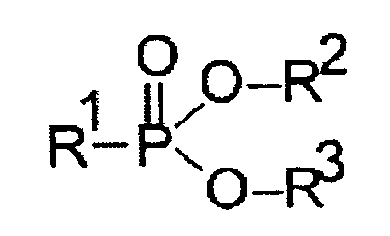
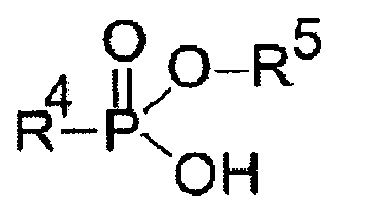
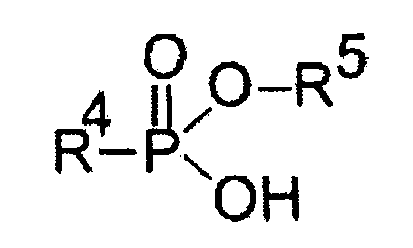
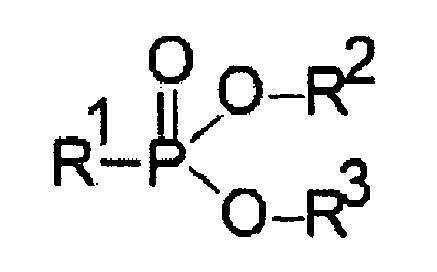
- a method of improving the solubility of friction modifier components in a friction modifier additive package includes blending at least one alky phosphonic acid diester of the formula: with at least one alkyl phosphonic acid monoester of the formula: and at least one amine salt of a partial ester of phosphoric acid represented by the formula wherein R 1 and R 4 are selected from a hydrocarbyl group containing from about 8 to about 24 carbon atoms; R 2 , R 3 and R 5 are independently selected from hydrogen and a hydrocarbyl group containing from about 1 to about 8 carbon atoms; each of R 6 , and R 8 is, independently, a hydrocarbyl group; and R 7 is hydrogen or a hydrocarbyl group.
- the ratio of the diester to the monoester of the alkyl phosphonic acids in the mixture ranges from about 3 to about 5.5 and the total acid number (TAN) of the alkyl phosphonic acid diester is up to about 15.
- the foregoing components are blended in an amount of the base oil component sufficient to stabilize substantially all of the alkyl phosphonic acid diester and monoester.
- compositions and methods described herein are that the components of the additive package remain substantially solubilized or stabilized in the base oil component without the need for additional solubilizing additives so that the additive package is substantially free from additive drop-out.
- the additive package described herein also enables a high concentration of friction modifier component to be delivered to a gear fluid.
- Such additive packages are particularly suitable for a wide variety of gear and/or transmission applications including, but not limited to, automotive gears, industrial gears, stationary gears, rear axles, limited slip differentials, conventional differentials, and/or automatic and manual transmissions. Further, such additive packages are suitable for use in multi-plate differentials, cone clutch differentials, torsen differentials, and/or dog clutch differentials.
- hydrocarbyl substituent or “hydrocarbyl group” is used in its ordinary sense, which is well-known to those skilled in the art. Specifically, it refers to a group having a carbon atom directly attached to the remainder of a molecule and having a predominantly hydrocarbon character. Examples of hydrocarbyl groups include:
- a gear fluid additive may include a base oil component and a friction modifier additive composition including an ester of phosphonic acid and an amine salt of an oil soluble phosphoric acid derivative.
- the esters of phosphonic acid may be represented by the general formula: where R 1 is a hydrocarbyl group containing from about 8 to about 24 carbon atoms, R 2 and R 3 are independently selected from H and a hydrocarbyl group containing from about 1 to about 8 carbon atoms.
- the esters of phosphonic acid may include a fully or partially monoester of phosphonic acid and a diester of phosphonic acid.
- the diester of phosphonic acid may be represented by the above formula (I) wherein R 2 and R 3 are independently from a hydrocarbyl group containing from about 1 to about 8 carbon atoms.
- the monoester of phosphonic acid may be represented by the formula: wherein R 4 is a hydrocarbyl group containing from about 8 to about 24 carbon atoms, and R 5 is selected from hydrogen and a hydrocarbyl group containing from about 1 to about 8 carbon atoms.
- R 1 and R 4 may be the same hydrocarbyl group and R 5 may be the same hydrocarbyl group as R 2 .
- the monoester of formula (II) may be derived from the diester of formula (I) by hydrolysis of the diester according to a procedure disclosed in U.S. Publication No. 2004/0230068 A1 , the disclosure of which is incorporated herein by reference.
- the monoester of formula (II) may be a fully or partially hydrolyzed ester.
- the total amount of monoester and diester in an additive concentrate typically ranges from about 2 to about 6 percent by weight of the total weight of the concentrate.
- the ratio of diester to monoester used in the additive concentrate is selected to provide prolonged stability of the esters in a base oil component. Typically, it is difficult to maintain the solubility of the diester in an additive concentrate.
- combining a monoester with a diester in a ratio of diester to monoester ranging from about 3 to about 5.5 greatly increases the prolonged stability of the diester in the additive package even at concentrations of the diester above 4 percent by weight.
- Examples of monoesters of phosphonic acid include, but are not limited to, hexane phosphonic acid, octane phosphonic acid, dodecane phosphonic acid, tetradecane phosphonic acid, hexadecane phosphonic acid, pentadecane phosphonic acid, 2-methylpentane phosphonic acid, trimethylpentane phosphonic acid, octadecane phosphonic acid, ethane phosphonic acid, propane phosphonic acid, 2-methylpropane phosphonic acid, hexane phosphonic acid, n-heptyl ester, octane phosphonic acid 2-ethylhexyl ester, dodecane phosphonic acid ethyl ester, tetradecane phosphonic acid methyl ester, hexadecane phosphonic acid butyl ester, pentadecane phosphonic acid methyl ester, 2-methylpentane
- diesters of phosphonic acid include, but are not limited to, hexane phosphonic acid di-n-heptyl ester, octane phosphonic acid di-2-ethylhexyl ester, dodecane phosphonic acid diethyl ester, tetradecane phosphonic acid dimethyl ester, hexadecane phosphonic acid dibutyl ester, pentadecane phosphonic acid dimethyl ester, 2-methylpentane phosphonic acid diethyl ester, hexane phosphonic acid di-4-methylpentyl-(2) ester, 2,4,4,-tirmethylpentane phosphonic acid diethyl ester, octadecane phosphonic acid diisopropyl ester, ethane phosphonic acid dimethyl ester, ethane phosphonic acid diethyl ester, ethane phosphonic acid di-isobutyl ester, propane
- phosphonic acid esters are described in U.S. Patent No. 2,724,718 to Siles et al. and U.S. Patent No. 3,812,222 to Kleiner et al. , for example.
- the diesters typically have a total acid number (TAN) up to about 15.
- Another component of the friction modifier additive composition is selected from amine salts of a partial ester of phosphoric acid.
- Such compounds may be represented by the formula: wherein each of R 6 and R 8 is, independently, a hydrocarbyl group, and R 7 is hydrogen or a hydrocarbyl group.
- amine salts of a partial ester of phosphoric acid include, but are not limited to, the following:
- Octadecylamine salts or adducts have been set forth in the above two listings merely for purposes of illustration.
- use can be made of nonylamine, decylamine, undecylamine, dodecylamine, tridecylamine, tetradecylamine, pentadecylamine, hexadecylamine, heptadecylamine, cyclohexylamine, phenylamine, mesitylamine, oleylamine, cocoamine, soyamine, C 8 tertiary alkyl primary amine, C 12-14 tertiary alkyl primary amine, C 22-24 tertiary alkyl primary amine, phenethylamine, etc., salts or adducts of partially esterified phosphoric acids, including mixtures of any such compounds.
- suitable amine salts are salts of aliphatic amines, especially the saturated or olefinically unsaturated aliphatic primary amines, such as n-octadecylamine, 2-ethylhexylamine, tert-octylamine, n-decylamine, the C 10 , C 12 , C 14 and C 16 tertiary alkyl primary amines (either singly or in any combinations thereof, such as a mixture of the C 12 and C 14 tertiary alkyl primary amines), n-undecylamine, a mixture of C 14 to C 18 a tertiary alkyl primary amines, lauryl amine, hexadecylamine, heptadecylamine, octadecylamine, the C 22 and C 24 tertiary alkyl primary amines (either singly or in combination), decenylamine
- Secondary hydrocarbyl amines and tertiary hydrocarbyl amines can also be used either alone or in combination with each other or in combination with primary amines.
- any combination of primary, secondary, and/or tertiary amines, whether monoamine or polyamine, can be used in forming the salts or adducts.
- the amines used can be in the form of polyalkylene polyamines; functionally-substituted polyamines such as a succinimide or succinamide of a polyalkylene polyamine such as a polyisobutenyl succinimide of diethylene triamine, a polyisobutenyl succinimide of triethylene tetramine, a polyisobutenyl succinimide of tetraethylene pentamine, a polyisobutenyl succinimide of pentaethylene hexamine (including succinimides made from commercially available polyethylene polyamine mixtures which contain linear, branched and cyclic species); and Mannich bases derived from polyalkylene polyamines of the types just described.
- a succinimide or succinamide of a polyalkylene polyamine such as a polyisobutenyl succinimide of diethylene triamine, a polyisobutenyl succinimide of triethylene tetramine,
- the polyalkylene polyamines whether in the free state or in the form of a succinimide, succinamide, or Mannich base, can be partially boronated, partially phosphorylated, or partially acylated with a reagent such as maleic anhydride, malic acid, itaconic acid, itaconic anhydride, thiomalic acid, fumaric acid, and the like, provided that such boronated or phosphorylated or acylated amine or amine moiety contains at least sufficient residual basicity to enable it to form a salt with the partially esterified phosphoric acid.
- Alkylene polyamines in the form of succinimides, succinamides or Mannich bases which have been boronated and phosphorylated are described for example in U.S. Pat. No. 4,857,214 .
- Suitable amines are alkyl monoamines and alkenyl monoamines having from about 8 to about 24 carbon atoms in the molecule.
- Amines having less than 8 carbon atoms can be used, including methyl amine, etc., provided the resultant amine salt is oil-soluble.
- amines having more than 24 carbon atoms can be used, again with the proviso that the resultant amine salt is oil soluble.
- a suitable amount of the amine salt of partial esters of phosphoric acid in the friction modifier additive composition may range from about 20 to about 40 percent by weight of the total weight of the additive composition, as another example from about 25 to about 35 weight percent, and as an even further example from about 28 to about 32 weight percent.
- the base oil component may comprise a synthetic blendstock.
- the synthetic blendstock for the foregoing friction modifier additive composition may comprise an alkylated aromatic compound, for example an alkylated naphthalene.
- Alkylated naphthalenes may be produced by any suitable means known in the art, from naphthalene or from an alkyl-substituted naphthalene which may contain one or more short chain alkyl groups having up to about eight carbon atoms, such as methyl, ethyl, or propyl, etc.
- Suitable alkyl-substituted naphthalenes include alpha-methylnaphthalene, dimethylnaphthalene and ethylnaphthalene.
- alkylating a non-substituted naphthalene may provide better thermal and oxidative stability than more highly alkylated materials.
- alkylated naphthalenes A convenient method of producing alkylated naphthalenes is disclosed in U.S. Pat. No. 5,034,563 , entitled “Naphthalene Alkylation Process” and which is incorporated herein in its entirety by reference thereto. Briefly in accordance with that method, long chain alkyl substituted naphthalenes are produced by the alkylation of naphthalene with an olefin such as an alpha-olefin or other alkylating agent such as an alcohol or alkyl halide possessing at least 6 carbon atoms, or 10 to 30 carbon atoms, or 12 to 20 carbon atoms, in the presence of an alkylation catalyst comprising a zeolite which contains cations having a radius of at least 2.5 Angstroms.
- an alkylation catalyst comprising a zeolite which contains cations having a radius of at least 2.5 Angstroms.
- Cations of this size may be provided by hydrated cations such as hydrated ammonium, sodium or potassium cations or by organoammonium cations such as tetraalkylammonium cations.
- the zeolite is usually a large pore size zeolite USY. The presence of the bulky cations in the zeolite increases the selectivity of the catalyst for the production of long chain mono-alkyl substituted naphthalenes in preference to more highly substituted products.
- the amount of synthetic blendstock in the friction modifier additive composition may range from about 50 to about 80 percent by weight of the additive.
- Base oils suitable for use in formulating gear additive or fluid compositions according to the disclosure may be selected from any of the synthetic or natural oils or mixtures thereof.
- Natural oils include animal oils and vegetable oils (e.g., castor oil, lard oil) as well as mineral lubricating oils such as liquid petroleum oils and solvent treated or acid-treated mineral lubricating oils of the paraffinic, naphthenic or mixed paraffinic-naphthenic types. Oils derived from coal or shale are also suitable.
- the base oil typically has a viscosity of about 2 to about 15 cSt or as another example about 2 to about 10 cSt at 100° C.
- the synthetic base oils include alkyl esters of dicarboxylic acids, polyglycols and alcohols, poly-alpha-olefins, including polybutenes, alkyl benzenes, organic esters of phosphoric acids, and polysilicone oils.
- Synthetic oils include hydrocarbon oils such as polymerized and interpolymerized olefins (e.g., polybutylenes, polypropylenes, propylene isobutylene copolymers, etc.); poly(1-hexenes), poly-(1-octenes), poly(1-decenes), etc.
- alkylbenzenes e.g., dodecylbenzenes, tetradecylbenzenes, di-nonylbenzenes, di-(2-ethylhexyl)benzenes, etc.
- polyphenyls e.g., biphenyls, terphenyl, alkylated polyphenyls, etc.
- Alkylene oxide polymers and interpolymers and derivatives thereof where the terminal hydroxyl groups have been modified by esterification, etherification, etc. constitute another class of known synthetic oils that may be used.
- Such oils are exemplified by the oils prepared through polymerization of ethylene oxide or propylene oxide, the alkyl and aryl ethers of these polyoxyalkylene polymers (e.g., methyl-polyisopropylene glycol ether having an average molecular weight of about 1000, diphenyl ether of polyethylene glycol having a molecular weight of about 500-1000, diethyl ether of polypropylene glycol having a molecular weight of about 1000-1500, etc.) or mono- and polycarboxylic esters thereof, for example, the acetic acid esters, mixed C 3-8 fatty acid esters, or the C 13 Oxo acid diester of tetraethylene glycol.
- esters of dicarboxylic acids e.g., phthalic acid, succinic acid, alkyl succinic acids, alkenyl succinic acids, maleic acid, azelaic acid, suberic acid, sebacic acid, fumaric acid, adipic acid, linoleic acid dimer, malonic acid, alkyl malonic acids, alkenyl malonic acids, etc.
- alcohols e.g., butyl alcohol, hexyl alcohol, dodecyl alcohol, 2-ethylhexyl alcohol, ethylene glycol, diethylene glycol monoether, propylene glycol, etc.
- these esters include dibutyl adipate, di(2-ethylhexyl)sebacate, di-n-hexyl fumarate, dioctyl sebacate, diisooctyl azelate, diisodecy
- Esters useful as synthetic oils also include those made from C 5 to C 12 monocarboxylic acids and polyols and polyol ethers such as neopentyl glycol, trimethylol propane, pentaerythritol, dipentaerythritol, tripentaerythritol, etc.
- oils derived from a gas-to-liquid process are also suitable.
- the base oil used which may be used to make the gear fluid compositions as described herein may be selected from any of the base oils in Groups I-V as specified in the American Petroleum Institute (API) Base Oil Interchangeability Guidelines.
- Such base oil groups are as follows: Base Oil Group 1 Sulfur (wt.%) Saturates (wt.%) Viscosity Index Group I > 0.03 and/or ⁇ 90 80 to 120 Group II ⁇ 0.03 And ⁇ 90 80 to 120 Group III ⁇ 0.03 And ⁇ 90 ⁇ 120 Group IV all polyalphaolefins (PAOs) Group V all others not included in Groups I-IV 1 Groups I-III are mineral oil base stocks.
- PAOs polyalphaolefins
- the foregoing additive composition containing the esters of phosphonic acid, the amine salts of partial esters of phosphoric acid, and the base oil component may be provided as a top-treat composition to a gear fluid.
- the additive composition or top treat composition may be added to a gear fluid in an amount ranging from about 3 to about 10 percent by weight based on the total weight of the gear fluid.
- Gear fluids that may be enhanced with such additive or top treat compositions typically include a major amount of a base oil and a minor amount of an additive composition.
- the additive composition may include, for example, ashless dispersants, friction modifiers, antioxidants, viscosity index improvers, corrosion inhibitors, antiwear additives, metal deactivators, antifoamants, pour point depressants, detergents metallic detergents, and/or seal swell agents.
- Additives used in formulating the fluid compositions described herein can be blended into the base oil individually or in various sub-combinations. It is also suitable to blend all of the components concurrently using an additive concentrate (i.e., additives plus a diluent, such as a hydrocarbon solvent).
- an additive concentrate i.e., additives plus a diluent, such as a hydrocarbon solvent.
- the use of an additive concentrate takes advantage of the mutual compatibility afforded by the combination of ingredients when in the form of an additive concentrate. Also, the use of a concentrate reduces blending time and lessens the possibility of blending errors.
- the gear fluids disclosed herein may include fluids suitable for a wide variety of gear and/or transmission applications including, but not limited to, automotive gears, industrial gears, stationary gears, rear axles, limited slip differentials, conventional differentials, and/or automatic and manual transmissions. Further, such additive packages are suitable for use in multi-plate differentials, cone clutch differentials, torsen differentials, and/or dog clutch differentials
- An exemplary composition useful as a top treat additive for a gear fluid as described above may contain the following components in the amounts indicated based on weight percent in the additive composition: Component Amount Group I-V base oil 60-70 wt.% alkenyl amine 15-20 wt.% mono-hydrocarbyl acid phosphate 10-12 wt.% dimethyloctadecylphosphonate 4-5 wt.% methyloctadecylphosphonate monoester 0.5-1.5 wt.%
- the foregoing additive or top treat composition may be added to a gear fluid in an amount ranging from about 3 to about 10 percent by weight to provide improved fluid characteristics. Friction durability tests of the foregoing additive or top treat fluid in conventional gear fluids containing non-synthetic base oils, synthetic base oils, and a combination of non-synthetic and synthetic base oils have exhibited an increasing coefficient of friction with increasing slip speed after a 24 hour durability test on an SAE #2 test rig.
- FIG. 1 A comparison between two conventional top treat additives (Curves B and C) and a top treat additive (Curve D) according to the foregoing exemplary composition is provided graphically in FIG. 1.
- Each of the top treat additives were added to a conventional gear fluid that was subjected to a 24 hour durability test on a SAE #2 test rig at 100 rpm and an applied pressure of 450 KPascals.
- the friction coefficients for the gear fluids containing top treat additive B, C, or D at a rotational speed of 100 rpm (Curve A) are illustrated in FIG. 1.
- Curve D which is the friction coefficient curve for a fluid containing a top treat additive according to the disclosure (Curve D) exhibited increasing friction coefficients during the durability test, whereas the fluids containing the conventional top treat additives (Curves B and C) exhibited decreasing friction coefficients during the test cycle. Hence, it is believed that a top treat additive according to the disclosure will significantly outperform conventional top treat additives for an extended period of time.
- each numerical parameter should at least be construed in light of the number of reported significant digits and by applying ordinary rounding techniques. Notwithstanding that the numerical ranges and parameters setting forth the broad scope of the invention are approximations, the numerical values set forth in the specific examples are reported as precisely as possible. Any numerical value, however, inherently contains certain errors necessarily resulting from the standard deviation found in their respective testing measurements. It is intended that the specification and examples be considered as exemplary only, with a true scope and spirit of the invention being indicated by the following claims.
- the invention also relates to the following embodiments (1) to (32):
Landscapes
- Chemical & Material Sciences (AREA)
- Chemical Kinetics & Catalysis (AREA)
- General Chemical & Material Sciences (AREA)
- Oil, Petroleum & Natural Gas (AREA)
- Organic Chemistry (AREA)
- Lubricants (AREA)
- General Details Of Gearings (AREA)
Abstract

Description
- The present disclosure relates to gear and power transmission fluids having improved characteristics particularly for extreme pressure applications. The fluids disclosed herein may include fluids and additives suitable for use in a broad range of gear and transmission applications in the automotive and machinery industries.
- New and advanced differential gear and transmission systems are being developed by the automotive industry. These new systems often involve high energy requirements. Therefore, component protection technology must be developed to meet the increasing energy requirements of these advanced systems.
- An example of a gear apparatus is the limited slip differential. Limited slip differentials are provided in many vehicles to counteract a commonly occurring situation where one of the two driving tires or wheels is essentially void of traction. This may be in loose soil, sand, mud, or ice. In the standard open differential, the driving tire void of traction receives all of the powertrain torque, but spins without moving the vehicle in the desired direction. In a limited slip differential, a mechanism divides, or shares, a portion of the torque delivered by the powertrain with both driving wheels. By sharing the available torque, a wheel with some traction receives enough torque to move the vehicle in the desired direction. In addition, high performance vehicles have so much torque that in certain turning situations the torque on one wheel exceeds the available traction and, thus, performance suffers. The limited slip differential shares the torque between both wheels, enhancing the performance of the vehicle.
- Limited slip differentials have a variety of mechanisms to provide torque transfer from the input pinion gear to the axle shafts. A common mechanism is a multi-plate wet clutch that transfers torque from the differential carrier to the side gear. These multi-plate clutches typically have a set of friction plates of one material or facing material, and a set of steel plates. One set of plates is linked through some means to the differential carrier, while the other set of plates is linked through a similar means to the side gear. As the side gear drives the axle shaft, torque is therefore transferred to the axle shaft and thereby the wheel and tire of the vehicle. This then gives a motive force to the vehicle.
- In operation, the limited slip differential friction and steel clutch plates spin at different speeds with respect to one another when in a vehicle turn or when traction to one wheel is reduced or void. The relative rotational speed of the clutch plates may range from near zero revolutions per minute to very high speeds of several hundred revolutions per minute. The clutch plates are operated in most cases by a biasing spring force that pushes the two sets of plates together, as well as the differential gear set separating force.
- Limited slip differentials require that the lubricant for the rear axle have proper friction characteristics, and that the friction characteristics last for a sufficient elapsed mileage or duration. The proper friction characteristic is that the friction coefficient rises with increasing plate rotational speed, and falls with decreasing plate rotational speed.
- To provide the proper friction characteristics and lifetime, certain additives may be added as a top treat to the gear lubricant. These additives can be selected from a wide range of friction modifiers and related compounds. However, a particularly effective additive will not stay in solution in a top treat.
- For the purposes of this disclosure, the phrase "gear fluids" is intended to include, but is not limited to, the foregoing gear and transmission systems and applications.
- Gear fluids formulated according to the present disclosure are suitably formulated to protect transmission and gear drive components in metal-on-metal contact situations. However, additives which provide such improvement are difficult to maintain dissolved in a concentrate for deliverance to a gear fluid.
- In an embodiment, a gear fluid composition for extreme pressure applications is provided. The gear fluid contains an base oil component and a friction modifier mixture. The friction modifier includes
- (i) at least one alkyl phosphonic acid diester of the formula:

- (ii) at least one alkyl phosphonic acid monoester of the formula
- (iii) at least one amine salt of a partial ester of phosphoric acid represented by the formula

- In another embodiment, there is provided a method of improving the solubility of friction modifier components in a friction modifier additive package. The method includes blending at least one alky phosphonic acid diester of the formula:


- An advantage of the compositions and methods described herein is that the components of the additive package remain substantially solubilized or stabilized in the base oil component without the need for additional solubilizing additives so that the additive package is substantially free from additive drop-out. The additive package described herein also enables a high concentration of friction modifier component to be delivered to a gear fluid. Such additive packages are particularly suitable for a wide variety of gear and/or transmission applications including, but not limited to, automotive gears, industrial gears, stationary gears, rear axles, limited slip differentials, conventional differentials, and/or automatic and manual transmissions. Further, such additive packages are suitable for use in multi-plate differentials, cone clutch differentials, torsen differentials, and/or dog clutch differentials.
- Further advantages of the exemplary embodiments may become apparent by reference to the detailed description when considered in conjunction with the figure, wherein:
- FIG. 1 is a graphical comparison of top treat compositions in a gear fluid during a friction durability test on an SAE #2 test rig.
- As used herein, the term "hydrocarbyl substituent" or "hydrocarbyl group" is used in its ordinary sense, which is well-known to those skilled in the art. Specifically, it refers to a group having a carbon atom directly attached to the remainder of a molecule and having a predominantly hydrocarbon character. Examples of hydrocarbyl groups include:
- (1) hydrocarbon substituents, that is, aliphatic (e.g., alkyl or alkenyl), alicyclic (e.g., cycloalkyl, cycloalkenyl) substituents, and aromatic-, aliphatic-, and alicyclic-substituted aromatic substituents, as well as cyclic substituents wherein the ring is completed through another portion of the molecule (e.g., two substituents together form an alicyclic radical);
- (2) substituted hydrocarbon substituents, that is, substituents containing non-hydrocarbon groups which, in the context of the description herein, do not alter the predominantly hydrocarbon substituent (e.g., halo (especially chloro and fluoro), hydroxy, alkoxy, mercapto, alkylmercapto, nitro, nitroso, and sulfoxy);
- (3) hetero-substituents, that is, substituents which, while having a predominantly hydrocarbon character, in the context of this description, contain other than carbon in a ring or chain otherwise composed of carbon atoms. Hetero-atoms include sulfur, oxygen, nitrogen, and encompass substituents such as pyridyl, furyl, thienyl and imidazolyl. In general, no more than two, as another example, no more than one, non-hydrocarbon substituent will be present for every ten carbon atoms in the hydrocarbyl group; typically, there will be no non-hydrocarbon substituent in the hydrocarbyl group.
- In exemplary embodiments described herein, a gear fluid additive may include a base oil component and a friction modifier additive composition including an ester of phosphonic acid and an amine salt of an oil soluble phosphoric acid derivative. The esters of phosphonic acid may be represented by the general formula:

- More specifically, the esters of phosphonic acid may include a fully or partially monoester of phosphonic acid and a diester of phosphonic acid. The diester of phosphonic acid may be represented by the above formula (I) wherein R2 and R3 are independently from a hydrocarbyl group containing from about 1 to about 8 carbon atoms. The monoester of phosphonic acid may be represented by the formula:

U.S. Publication No. 2004/0230068 A1 , the disclosure of which is incorporated herein by reference. The monoester of formula (II) may be a fully or partially hydrolyzed ester. - Whether the monoester is derived from the diester or separately made, the total amount of monoester and diester in an additive concentrate typically ranges from about 2 to about 6 percent by weight of the total weight of the concentrate. Also, the ratio of diester to monoester used in the additive concentrate is selected to provide prolonged stability of the esters in a base oil component. Typically, it is difficult to maintain the solubility of the diester in an additive concentrate. However, combining a monoester with a diester in a ratio of diester to monoester ranging from about 3 to about 5.5 greatly increases the prolonged stability of the diester in the additive package even at concentrations of the diester above 4 percent by weight.
- Examples of monoesters of phosphonic acid include, but are not limited to, hexane phosphonic acid, octane phosphonic acid, dodecane phosphonic acid, tetradecane phosphonic acid, hexadecane phosphonic acid, pentadecane phosphonic acid, 2-methylpentane phosphonic acid, trimethylpentane phosphonic acid, octadecane phosphonic acid, ethane phosphonic acid, propane phosphonic acid, 2-methylpropane phosphonic acid, hexane phosphonic acid, n-heptyl ester, octane phosphonic acid 2-ethylhexyl ester, dodecane phosphonic acid ethyl ester, tetradecane phosphonic acid methyl ester, hexadecane phosphonic acid butyl ester, pentadecane phosphonic acid methyl ester, 2-methylpentane phosphonic acid ethyl ester, hexane phosphonic acid 4-methylpentyl-(2) ester, 2,4,4,-trimethylpentane phosphonic acid ethyl ester, octadecane phosphonic acid isopropyl ester, ethane phosphonic acid methyl ester, ethane phosphonic acid ethyl ester, ethane phosphonic acid isobutyl ester, propane phosphonic acid ethyl ester, and 2-methylpropane phosphonic acid isobutyl ester. The monoesters typically have a total acid number (TAN) ranging from about 100 to about 200.
- Examples of diesters of phosphonic acid include, but are not limited to, hexane phosphonic acid di-n-heptyl ester, octane phosphonic acid di-2-ethylhexyl ester, dodecane phosphonic acid diethyl ester, tetradecane phosphonic acid dimethyl ester, hexadecane phosphonic acid dibutyl ester, pentadecane phosphonic acid dimethyl ester, 2-methylpentane phosphonic acid diethyl ester, hexane phosphonic acid di-4-methylpentyl-(2) ester, 2,4,4,-tirmethylpentane phosphonic acid diethyl ester, octadecane phosphonic acid diisopropyl ester, ethane phosphonic acid dimethyl ester, ethane phosphonic acid diethyl ester, ethane phosphonic acid di-isobutyl ester, propane phosphonic acid diethyl ester, and 2-methylpropane phosphonic acid di-isobutyl ester. Methods for making phosphonic acid esters are described in
U.S. Patent No. 2,724,718 to Siles et al. andU.S. Patent No. 3,812,222 to Kleiner et al. , for example. The diesters typically have a total acid number (TAN) up to about 15. - Another component of the friction modifier additive composition is selected from amine salts of a partial ester of phosphoric acid. Such compounds may be represented by the formula:

- Illustrative examples of amine salts of a partial ester of phosphoric acid include, but are not limited to, the following:
- Octadecylamine salt of butylphosphoric acid
- Octadecylamine salt of isobutylphosphoric acid
- Octadecylamine salt of amylphosphoric acid
- Octadecylamine salt of hexylphosphoric acid
- Octadecylamine salt of heptylphosphoric acid
- Octadecylamine salt of 2-ethylhexylphosphoric acid
- Octadecylamine salt of octylphosphoric acid
- Octadecylamine salt of nonylphosphoric acid
- Octadecylamine salt of decylphosphoric acid
- Octadecylamine salt of dodecylphosphoric acid
- Octadecylamine salt of tridecylphosphoric acid
- Octadecylamine salt of tetradecylphosphoric acid
- Octadecylamine salt of hexadecylphosphoric acid
- Octadecylamine salt of octadecylphosphoric acid
- Octadecylamine salt of oleylphosphoric acid
- Octadecylamine salt of benzylphosphoric acid
- Octadecylamine salt of cyclohexylphosphoric acid
- Octadecylamine salt of p-tolylphosphoric acid
- Octadecylamine salt of xylylphosphoric acid
- Octadecylamine salts or adducts have been set forth in the above two listings merely for purposes of illustration. In lieu of octadecyl amine salts, or in addition thereto, use can be made of nonylamine, decylamine, undecylamine, dodecylamine, tridecylamine, tetradecylamine, pentadecylamine, hexadecylamine, heptadecylamine, cyclohexylamine, phenylamine, mesitylamine, oleylamine, cocoamine, soyamine, C8 tertiary alkyl primary amine, C12-14 tertiary alkyl primary amine, C22-24 tertiary alkyl primary amine, phenethylamine, etc., salts or adducts of partially esterified phosphoric acids, including mixtures of any such compounds. Generally speaking, suitable amine salts are salts of aliphatic amines, especially the saturated or olefinically unsaturated aliphatic primary amines, such as n-octadecylamine, 2-ethylhexylamine, tert-octylamine, n-decylamine, the C10, C12, C14 and C16 tertiary alkyl primary amines (either singly or in any combinations thereof, such as a mixture of the C12 and C14 tertiary alkyl primary amines), n-undecylamine, a mixture of C14 to C18 a tertiary alkyl primary amines, lauryl amine, hexadecylamine, heptadecylamine, octadecylamine, the C22 and C24 tertiary alkyl primary amines (either singly or in combination), decenylamine, dodecenylamine, palmitoleylamine, oleylamine, linoleylamine, eicosenylamine, etc. Secondary hydrocarbyl amines and tertiary hydrocarbyl amines can also be used either alone or in combination with each other or in combination with primary amines. Thus any combination of primary, secondary, and/or tertiary amines, whether monoamine or polyamine, can be used in forming the salts or adducts.
- Similarly, the amines used can be in the form of polyalkylene polyamines; functionally-substituted polyamines such as a succinimide or succinamide of a polyalkylene polyamine such as a polyisobutenyl succinimide of diethylene triamine, a polyisobutenyl succinimide of triethylene tetramine, a polyisobutenyl succinimide of tetraethylene pentamine, a polyisobutenyl succinimide of pentaethylene hexamine (including succinimides made from commercially available polyethylene polyamine mixtures which contain linear, branched and cyclic species); and Mannich bases derived from polyalkylene polyamines of the types just described. Moreover, the polyalkylene polyamines whether in the free state or in the form of a succinimide, succinamide, or Mannich base, can be partially boronated, partially phosphorylated, or partially acylated with a reagent such as maleic anhydride, malic acid, itaconic acid, itaconic anhydride, thiomalic acid, fumaric acid, and the like, provided that such boronated or phosphorylated or acylated amine or amine moiety contains at least sufficient residual basicity to enable it to form a salt with the partially esterified phosphoric acid. Alkylene polyamines in the form of succinimides, succinamides or Mannich bases which have been boronated and phosphorylated are described for example in
U.S. Pat. No. 4,857,214 . - Use of primary amines is suitable. Other suitable amines are alkyl monoamines and alkenyl monoamines having from about 8 to about 24 carbon atoms in the molecule.
- Amines having less than 8 carbon atoms can be used, including methyl amine, etc., provided the resultant amine salt is oil-soluble. Likewise, amines having more than 24 carbon atoms can be used, again with the proviso that the resultant amine salt is oil soluble.
-
- A suitable amount of the amine salt of partial esters of phosphoric acid in the friction modifier additive composition may range from about 20 to about 40 percent by weight of the total weight of the additive composition, as another example from about 25 to about 35 weight percent, and as an even further example from about 28 to about 32 weight percent.
- In some embodiments, the base oil component may comprise a synthetic blendstock. The synthetic blendstock for the foregoing friction modifier additive composition may comprise an alkylated aromatic compound, for example an alkylated naphthalene. Alkylated naphthalenes may be produced by any suitable means known in the art, from naphthalene or from an alkyl-substituted naphthalene which may contain one or more short chain alkyl groups having up to about eight carbon atoms, such as methyl, ethyl, or propyl, etc. Suitable alkyl-substituted naphthalenes include alpha-methylnaphthalene, dimethylnaphthalene and ethylnaphthalene. However, alkylating a non-substituted naphthalene may provide better thermal and oxidative stability than more highly alkylated materials.
- A convenient method of producing alkylated naphthalenes is disclosed in
U.S. Pat. No. 5,034,563 , entitled "Naphthalene Alkylation Process" and which is incorporated herein in its entirety by reference thereto. Briefly in accordance with that method, long chain alkyl substituted naphthalenes are produced by the alkylation of naphthalene with an olefin such as an alpha-olefin or other alkylating agent such as an alcohol or alkyl halide possessing at least 6 carbon atoms, or 10 to 30 carbon atoms, or 12 to 20 carbon atoms, in the presence of an alkylation catalyst comprising a zeolite which contains cations having a radius of at least 2.5 Angstroms. Cations of this size may be provided by hydrated cations such as hydrated ammonium, sodium or potassium cations or by organoammonium cations such as tetraalkylammonium cations. The zeolite is usually a large pore size zeolite USY. The presence of the bulky cations in the zeolite increases the selectivity of the catalyst for the production of long chain mono-alkyl substituted naphthalenes in preference to more highly substituted products. - The amount of synthetic blendstock in the friction modifier additive composition may range from about 50 to about 80 percent by weight of the additive.
- Base oils suitable for use in formulating gear additive or fluid compositions according to the disclosure may be selected from any of the synthetic or natural oils or mixtures thereof. Natural oils include animal oils and vegetable oils (e.g., castor oil, lard oil) as well as mineral lubricating oils such as liquid petroleum oils and solvent treated or acid-treated mineral lubricating oils of the paraffinic, naphthenic or mixed paraffinic-naphthenic types. Oils derived from coal or shale are also suitable. The base oil typically has a viscosity of about 2 to about 15 cSt or as another example about 2 to about 10 cSt at 100° C.
- The synthetic base oils include alkyl esters of dicarboxylic acids, polyglycols and alcohols, poly-alpha-olefins, including polybutenes, alkyl benzenes, organic esters of phosphoric acids, and polysilicone oils. Synthetic oils include hydrocarbon oils such as polymerized and interpolymerized olefins (e.g., polybutylenes, polypropylenes, propylene isobutylene copolymers, etc.); poly(1-hexenes), poly-(1-octenes), poly(1-decenes), etc. and mixtures thereof; alkylbenzenes (e.g., dodecylbenzenes, tetradecylbenzenes, di-nonylbenzenes, di-(2-ethylhexyl)benzenes, etc.); polyphenyls (e.g., biphenyls, terphenyl, alkylated polyphenyls, etc.); alkylated diphenyl ethers and alkylated diphenyl sulfides and the derivatives, analogs and homologs thereof and the like.
- Alkylene oxide polymers and interpolymers and derivatives thereof where the terminal hydroxyl groups have been modified by esterification, etherification, etc., constitute another class of known synthetic oils that may be used. Such oils are exemplified by the oils prepared through polymerization of ethylene oxide or propylene oxide, the alkyl and aryl ethers of these polyoxyalkylene polymers (e.g., methyl-polyisopropylene glycol ether having an average molecular weight of about 1000, diphenyl ether of polyethylene glycol having a molecular weight of about 500-1000, diethyl ether of polypropylene glycol having a molecular weight of about 1000-1500, etc.) or mono- and polycarboxylic esters thereof, for example, the acetic acid esters, mixed C3-8 fatty acid esters, or the C13 Oxo acid diester of tetraethylene glycol.
- Another class of synthetic oils that may be used includes the esters of dicarboxylic acids (e.g., phthalic acid, succinic acid, alkyl succinic acids, alkenyl succinic acids, maleic acid, azelaic acid, suberic acid, sebacic acid, fumaric acid, adipic acid, linoleic acid dimer, malonic acid, alkyl malonic acids, alkenyl malonic acids, etc.) with a variety of alcohols (e.g., butyl alcohol, hexyl alcohol, dodecyl alcohol, 2-ethylhexyl alcohol, ethylene glycol, diethylene glycol monoether, propylene glycol, etc.) Specific examples of these esters include dibutyl adipate, di(2-ethylhexyl)sebacate, di-n-hexyl fumarate, dioctyl sebacate, diisooctyl azelate, diisodecyl azelate, dioctyl phthalate, didecyl phthalate, dieicosyl sebacate, the 2-ethylhexyl diester of linoleic acid dimer, the complex ester formed by reacting one mole of sebacic acid with two moles of tetraethylene glycol and two moles of2-ethylhexanoic acid and the like.
- Esters useful as synthetic oils also include those made from C5 to C12 monocarboxylic acids and polyols and polyol ethers such as neopentyl glycol, trimethylol propane, pentaerythritol, dipentaerythritol, tripentaerythritol, etc.
- Further, oils derived from a gas-to-liquid process are also suitable.
- Hence, the base oil used which may be used to make the gear fluid compositions as described herein may be selected from any of the base oils in Groups I-V as specified in the American Petroleum Institute (API) Base Oil Interchangeability Guidelines. Such base oil groups are as follows:
Base Oil Group1 Sulfur (wt.%) Saturates (wt.%) Viscosity Index Group I > 0.03 and/or < 90 80 to 120 Group II ≤ 0.03 And ≥ 90 80 to 120 Group III ≤ 0.03 And ≥ 90 ≥ 120 Group IV all polyalphaolefins (PAOs) Group V all others not included in Groups I-IV 1Groups I-III are mineral oil base stocks. - The foregoing additive composition containing the esters of phosphonic acid, the amine salts of partial esters of phosphoric acid, and the base oil component may be provided as a top-treat composition to a gear fluid. The additive composition or top treat composition may be added to a gear fluid in an amount ranging from about 3 to about 10 percent by weight based on the total weight of the gear fluid.
- Gear fluids that may be enhanced with such additive or top treat compositions typically include a major amount of a base oil and a minor amount of an additive composition. The additive composition may include, for example, ashless dispersants, friction modifiers, antioxidants, viscosity index improvers, corrosion inhibitors, antiwear additives, metal deactivators, antifoamants, pour point depressants, detergents metallic detergents, and/or seal swell agents.
- Additives used in formulating the fluid compositions described herein can be blended into the base oil individually or in various sub-combinations. It is also suitable to blend all of the components concurrently using an additive concentrate (i.e., additives plus a diluent, such as a hydrocarbon solvent). The use of an additive concentrate takes advantage of the mutual compatibility afforded by the combination of ingredients when in the form of an additive concentrate. Also, the use of a concentrate reduces blending time and lessens the possibility of blending errors.
- The gear fluids disclosed herein may include fluids suitable for a wide variety of gear and/or transmission applications including, but not limited to, automotive gears, industrial gears, stationary gears, rear axles, limited slip differentials, conventional differentials, and/or automatic and manual transmissions. Further, such additive packages are suitable for use in multi-plate differentials, cone clutch differentials, torsen differentials, and/or dog clutch differentials
- An exemplary composition useful as a top treat additive for a gear fluid as described above may contain the following components in the amounts indicated based on weight percent in the additive composition:
Component Amount Group I-V base oil 60-70 wt.% alkenyl amine 15-20 wt.% mono-hydrocarbyl acid phosphate 10-12 wt.% dimethyloctadecylphosphonate 4-5 wt.% methyloctadecylphosphonate monoester 0.5-1.5 wt.% - The foregoing additive or top treat composition may be added to a gear fluid in an amount ranging from about 3 to about 10 percent by weight to provide improved fluid characteristics. Friction durability tests of the foregoing additive or top treat fluid in conventional gear fluids containing non-synthetic base oils, synthetic base oils, and a combination of non-synthetic and synthetic base oils have exhibited an increasing coefficient of friction with increasing slip speed after a 24 hour durability test on an SAE #2 test rig.
- A comparison between two conventional top treat additives (Curves B and C) and a top treat additive (Curve D) according to the foregoing exemplary composition is provided graphically in FIG. 1. Each of the top treat additives were added to a conventional gear fluid that was subjected to a 24 hour durability test on a SAE #2 test rig at 100 rpm and an applied pressure of 450 KPascals. The friction coefficients for the gear fluids containing top treat additive B, C, or D at a rotational speed of 100 rpm (Curve A) are illustrated in FIG. 1. Curve D which is the friction coefficient curve for a fluid containing a top treat additive according to the disclosure (Curve D) exhibited increasing friction coefficients during the durability test, whereas the fluids containing the conventional top treat additives (Curves B and C) exhibited decreasing friction coefficients during the test cycle. Hence, it is believed that a top treat additive according to the disclosure will significantly outperform conventional top treat additives for an extended period of time.
- At numerous places throughout this specification, reference has been made to a number of U.S. Patents. All such cited documents are expressly incorporated in full into this disclosure as if fully set forth herein.
- Other embodiments of the present invention will be apparent to those skilled in the art from consideration of the specification and practice of the invention disclosed herein. As used throughout the specification and claims, "a" and/or "an" may refer to one or more than one. Unless otherwise indicated, all numbers expressing quantities of ingredients, properties such as molecular weight, percent, ratio, reaction conditions, and so forth used in the specification and claims are to be understood as being modified in all instances by the term "about." Accordingly, unless indicated to the contrary, the numerical parameters set forth in the specification and claims are approximations that may vary depending upon the desired properties sought to be obtained by the present invention. At the very least, and not as an attempt to limit the application of the doctrine of equivalents to the scope of the claims, each numerical parameter should at least be construed in light of the number of reported significant digits and by applying ordinary rounding techniques. Notwithstanding that the numerical ranges and parameters setting forth the broad scope of the invention are approximations, the numerical values set forth in the specific examples are reported as precisely as possible. Any numerical value, however, inherently contains certain errors necessarily resulting from the standard deviation found in their respective testing measurements. It is intended that the specification and examples be considered as exemplary only, with a true scope and spirit of the invention being indicated by the following claims.
- The invention also relates to the following embodiments (1) to (32):
- (1.) An gear additive composition, comprising:
- (a) a base oil component; and
- (b) a friction modifier mixture including:
- (i) at least one alkyl phosphonic acid diester of the formula:

- (ii) at least one alkyl phosphonic acid monoester of the formula

- (iii) at least one amine salt of a partial ester of phosphoric acid represented by the formula

- (i) at least one alkyl phosphonic acid diester of the formula:
- (2.) The additive composition of embodiment (1), wherein the base oil component comprises an alkylated naphthalene blendstock.
- (3.) The additive composition of embodiment (1), wherein the base oil component comprises a mono-alkylated naphthalene.
- (4.) The additive composition of embodiment (1), wherein the alkyl phosphonic acid diester is selected from the group consisting of dimethyloctadecylphosphonate, dimethyloctadecenylphosphonate, diethyl-2-ethyldecylphosphonate, ethylpropyl-1-butylhexadecylphosphonate, methylethyloctadecylphosphonate, methylbutyl eicosylphosphonate, dimethylhexatriacontylphosphonate.
- (5.) The additive composition of embodiment (1), wherein the alkyl phosphonic acid monoester is derived from the alkyl phosphonic acid diester.
- (6.) The additive composition of embodiment (1), wherein the amine salt is derived from 2-ethylhexyl acid phosphate.
- (7.) The additive composition of embodiment (1), wherein the amine salt is derived from oleylamine.
- (8.) The additive composition of embodiment (1), comprising from about 1 to about 10 percent by weight of the monoester and diester of phosphonic acid.
- (9.) The additive composition of embodiment (1), comprising from about 10 to about 30 percent by weight of the amine salt of the phosphoric acid.
- (10.) The additive composition of embodiment (1), comprising from about 50 to about 70 percent by weight of the base oil component.
- (11.) The additive composition of embodiment (1), further comprising an antioxidant, an antiwear agent, an antifoam agent, and a viscosity index improver.
- (12.) A gear fluid containing an effective amount of the additive composition of embodiment (1).
- (13.) The gear fluid of embodiment (12), wherein the gear fluid comprises from about 3 to about 6 percent by weight of the additive composition.
- (14.) An axle containing the additive composition of embodiment (1).
- (15.) The axle of embodiment (14), wherein the axle comprises a limited slip differential.
- (16.) The additive composition of embodiment (1), wherein the additive composition is applied to a limited slip axle as a top treat fluid.
- (17.) A method of improving the solubility of one or more friction modifier components in a friction modifier additive package comprising blending at least one alky phosphonic acid diester of the formula:


- (18.) The method of embodiment (17), wherein the base oil component comprises an alkylated naphthalene blendstock.
- (19.) The method of embodiment (17), wherein the base oil component comprises a mono-alkylated naphthalene.
- (20.) The method composition of embodiment (17), wherein the alkyl phosphonic acid diester is selected from the group consisting of dimethyloctadecylphosphonate, dimethyloctadecenylphosphonate, diethyl-2-ethyldecylphosphonate, ethylpropyl-1-butylhexadecylphosphonate, methylethyloctadecylphosphonate, methylbutyl eicosylphosphonate, dimethylhexatriacontylphosphonate.
- (21.) The method of embodiment (17), wherein the amine salt is derived from 2-ethylhexyl acid phosphate.
- (22.) The method of embodiment (17), wherein the amine salt is derived from oleylamine.
- (23.) The method of embodiment (17), comprising mixing from about 1 to about 10 percent by weight of the alkyl phosphonic acid diester with from about 0.5 to about 1.5 percent by weight of the alkyl phosphonic acid monoester, and with from about 10 to about 30 percent by weight of the amine salt of the partial ester of phosphoric acid in the base oil component.
- (24.) The method of embodiment (17), comprising blending from about 50 to about 70 percent by weight of the base oil component with the alkyl phosphonic acid monoester, with the alkyl phosphonic acid diester, and with the amine salt of the partial ester of phosphoric acid.
- (25.) A top-treat additive package made by the method of embodiment (17).
- (26.) A method for improving the friction performance of a gear fluid comprising providing an additive package to a gear fluid, the additive package comprising a base oil component and a friction modifier mixture including:
- (i) at least one alkyl phosphonic acid diester of the formula:
- (ii) at least one alkyl phosphonic acid monoester of the formula

- (iii) at least one amine salt of a partial ester of phosphoric acid represented by the formula

- (i) at least one alkyl phosphonic acid diester of the formula:
- (27.) The method of embodiment (26), wherein the additive package is suitable for use in a limited slip differential.
- (28.) The method of embodiment (26), wherein the gear fluid comprises from about 0.03 to about 0.5 percent by weight of the alkyl phosphonic acid diester based on the total weight of the gear fluid.
- (29.) The method of embodiment 26, wherein the additive packages is added to the gear fluid in an amount ranging from about 1 to about 10 percent of the total weight of the gear fluid.
- (30.) A method for improving the solubility of gear additive components in a base oil comprising the steps of:
- providing an alkyl phosphonic acid diester of the formula:

- providing an alkyl phosphonic acid monoester of the formula:

- combining from about 3 to about 5.5 parts of the diester with about 1 part of the monoester in the base oil.
- providing an alkyl phosphonic acid diester of the formula:
- (31.) The method of embodiment (30), further comprising adding at least one amine salt of a partial ester of phosphoric acid represented by the formula

- (32.) The method of embodiment (31), wherein the gear additive composition comprises from about 5 to about 20 percent by weight of the amine salt.
Claims (26)
- A fiction modifier or gear additive composition, comprising:(a) a base oil component; and(b) a friction modifier mixture including:wherein each of R6 and R8 is, independently, a hydrocarbyl group, and R7 is hydrogen or a hydrocarbyl group, and wherein the ratio of (i) to (ii) ranges from about 3 to about 5.5.(i) at least one alkyl phosphonic acid diester of the formula:
 (ii) at least one alkyl phosphonic acid monoester of the formula
 (iii) at least one amine salt of a partial ester of phosphoric acid represented by the formula
- The additive composition of claim 1, wherein the base oil component comprises an alkylated naphthalene blendstock.
- The additive composition of claim 1 or 2, wherein the base oil component comprises a mono-alkylated naphthalene.
- The additive composition of anyone of claims 1 to 3, wherein the alkyl phosphonic acid diester is selected from the group consisting of dimethyloctadecylphosphonate, dimethyloctadecenylphosphonate, diethyl-2-ethyldecylphosphonate, ethylpropyl-1-butylhexadecylphosphonate, methylethyloctadecylphosphonate, methylbutyl eicosylphosphonate, dimethylhexatriacontylphosphonate.
- The additive composition of anyone of claims 1 to 4, wherein the alkyl phosphonic acid monoester is derived from the alkyl phosphonic acid diester.
- The additive composition of anyone of claims 1 to 5, wherein at least one amine salt is derived from 2-ethylhexyl acid phosphate.
- The additive composition of anyone of claims 1 to 6, wherein at least one amine salt is derived from oleylamine.
- The additive composition of anyone of claims 1 to 7, comprising from about 1 to about 10 percent by weight of the monoester and diester of phosphonic acid.
- The additive composition of anyone of claims 1 to 8, comprising from about 10 to about 30 percent by weight of the amine salt of the phosphoric acid.
- The additive composition of anyone of claims 1 to 9, comprising from about 50 to about 70 percent by weight of the base oil component.
- The additive composition of anyone of claims 1 to 10, further comprising an antioxidant, an antiwear agent, an antifoam agent, and a viscosity index improver.
- The additive composition of anyone of claims 1 to 11, wherein the composition is a gear additive composition.
- The additive composition of anyone of claims 1 to 12, wherein the additive composition comprises from about 5 to about 20 percent by weight of the amine salt.
- A gear fluid containing an effective amount of the additive composition of anyone of claims 1 to 13, in particular from about 3 to about 6 percent by weight of the additive composition.
- An axle containing the additive composition of anyone of claims 1 to 13.
- The axle of claim 15, wherein the axle comprises a limited slip differential.
- The additive composition of anyone of claims 1 to 13, wherein the additive composition is applied to a limited slip axle as a top treat fluid.
- A method of improving the solubility of one or more friction modifier components in a friction modifier additive composition according to anyone of claims 1 to 13 comprising blending at least one alkyl phosphonic acid diester of the formula:


- The method of claim 18, comprising mixing from about 1 to about 10 percent by weight of the alkyl phosphonic acid diester with from about 0.5 to about 1.5 percent by weight of the alkyl phosphonic acid monoester, and with from about 10 to about 30 percent by weight of the amine salt of the partial ester of phosphoric acid in the base oil component.
- The method of claim 18 or 19, comprising blending from about 50 to about 70 percent by weight of the base oil component with the alkyl phosphonic acid monoester, with the alkyl phosphonic acid diester, and with the amine salt of the partial ester of phosphoric acid.
- The additive composition of anyone of claims 1 to 13, made by the method of anyone of claims 18 to 20, the additive package being a top-treat additive package.
- A method for improving the friction performance of a gear fluid and/or solubility of gear additive components in a base oil, comprising providing an additive package to a gear fluid, the additive package comprising an additive composition according to anyone of claim 1 to 13.
- The method of claim 22, wherein the additive package is suitable for use in a limited slip differential.
- The method of anyone of claims 22 or 23, wherein the gear fluid comprises from about 0.03 to about 0.5 percent by weight of the alkyl phosphonic acid diester based on the total weight of the gear fluid.
- The method of anyone of claims 22 to 24, wherein the additive packages is added to the gear fluid in an amount ranging from about 1 to about 10 percent of the total weight of the gear fluid.
- A method for improving the solubility of gear additive components in a base oil comprising the steps of:providing an alkyl phosphonic acid diester of the formula:
 providing an alkyl phosphonic acid monoester of the formula:
 combining from about 3 to about 5.5 parts of the diester with about 1 part of the monoester in the base oil.
Applications Claiming Priority (1)
| Application Number | Priority Date | Filing Date | Title |
|---|---|---|---|
| US11/386,436 US7410935B2 (en) | 2006-03-22 | 2006-03-22 | Gear fluids |
Publications (2)
| Publication Number | Publication Date |
|---|---|
| EP1840194A1 true EP1840194A1 (en) | 2007-10-03 |
| EP1840194B1 EP1840194B1 (en) | 2009-05-13 |
Family
ID=38327029
Family Applications (1)
| Application Number | Title | Priority Date | Filing Date |
|---|---|---|---|
| EP07005713A Active EP1840194B1 (en) | 2006-03-22 | 2007-03-20 | Gear fluids |
Country Status (6)
| Country | Link |
|---|---|
| US (1) | US7410935B2 (en) |
| EP (1) | EP1840194B1 (en) |
| JP (1) | JP4856575B2 (en) |
| KR (1) | KR100912022B1 (en) |
| CN (1) | CN101070506B (en) |
| DE (1) | DE602007001091D1 (en) |
Cited By (4)
| Publication number | Priority date | Publication date | Assignee | Title |
|---|---|---|---|---|
| WO2009073390A1 (en) * | 2007-12-06 | 2009-06-11 | The Lubrizol Corporation | Lubricating composition containing borated phospholipid |
| EP2749630A1 (en) * | 2012-12-28 | 2014-07-02 | Afton Chemical Corporation | Lubricant Composition |
| EP2428552B1 (en) | 2009-05-08 | 2015-07-01 | Idemitsu Kosan Co., Ltd. | Biodegradable lubricant composition |
| EP3569679A1 (en) * | 2018-05-18 | 2019-11-20 | Afton Chemical Corporation | Slideway lubricants |
Families Citing this family (8)
| Publication number | Priority date | Publication date | Assignee | Title |
|---|---|---|---|---|
| US20080182770A1 (en) * | 2007-01-26 | 2008-07-31 | The Lubrizol Corporation | Antiwear Agent and Lubricating Compositions Thereof |
| JP2008280536A (en) * | 2007-05-09 | 2008-11-20 | Afton Chemical Corp | Composition comprising at least one friction modifying compound and method of use thereof |
| JP5465921B2 (en) | 2009-05-15 | 2014-04-09 | 出光興産株式会社 | Biodegradable lubricating oil composition |
| US20110046029A1 (en) * | 2009-08-20 | 2011-02-24 | Milner Jeffrey L | Combinations of Phosphorus-Containing Compounds For Use As Anti-Wear Additives In Lubricant Compositions |
| JP6422260B2 (en) * | 2014-08-06 | 2018-11-14 | 出光興産株式会社 | Lubricating oil composition |
| US10113131B2 (en) | 2017-01-11 | 2018-10-30 | The Boeing Company | Phosphono paraffins |
| CN110343132B (en) * | 2019-07-03 | 2021-09-03 | 太原理工大学 | Preparation method and application of branched alkyl phosphonic acid dialkyl ester |
| CN116554949A (en) * | 2023-05-16 | 2023-08-08 | 广州大学 | A kind of lubricating oil additive and preparation method thereof |
Citations (5)
| Publication number | Priority date | Publication date | Assignee | Title |
|---|---|---|---|---|
| US4356097A (en) * | 1978-03-30 | 1982-10-26 | Edwin Cooper, Inc. | Alkylphosphonate lubricating oil |
| EP0459656A1 (en) * | 1990-05-17 | 1991-12-04 | Ethyl Petroleum Additives, Inc. | Lubricant compositions |
| US5358652A (en) * | 1992-10-26 | 1994-10-25 | Ethyl Petroleum Additives, Limited | Inhibiting hydrolytic degradation of hydrolyzable oleaginous fluids |
| EP1544279A1 (en) * | 2002-08-27 | 2005-06-22 | Nippon Oil Corporation | Lubricating composition |
| EP1785475A1 (en) * | 2005-11-09 | 2007-05-16 | Afton Chemical Corporation | A gear additive composition |
Family Cites Families (13)
| Publication number | Priority date | Publication date | Assignee | Title |
|---|---|---|---|---|
| US2063629A (en) * | 1935-02-19 | 1936-12-08 | Du Pont | Esters of the thio acids of phosphorus |
| US2224695A (en) * | 1938-11-25 | 1940-12-10 | Carl F Prutton | Inhibitor |
| US2447288A (en) * | 1946-03-06 | 1948-08-17 | Gulf Oil Corp | Primary aliphatic amine salts of dialiphatic substituted mono-thiophosphoric acids |
| NL145897B (en) * | 1948-04-12 | Union Carbide Corp | PROCEDURE FOR PREPARING GRAINED DETERGENTS. | |
| US2616905A (en) * | 1952-03-13 | 1952-11-04 | Lubrizol Corp | Organic alkaline earth metal complexes and methods of making same |
| IL35844A (en) * | 1969-12-16 | 1973-11-28 | Hoechst Ag | Process for the manufacture of alkane phosphonic acid diesters |
| DE2363388C2 (en) * | 1973-12-20 | 1982-08-19 | Hoechst Ag, 6000 Frankfurt | Process for the preparation of dialkyl thiophosphates |
| US4431552A (en) * | 1982-11-26 | 1984-02-14 | Chevron Research Company | Lubricant composition containing an alkali-metal borate and a mixture of phosphates, monothiophosphates and dithiophosphates in a critical ratio |
| US4857214A (en) * | 1988-09-16 | 1989-08-15 | Ethylk Petroleum Additives, Inc. | Oil-soluble phosphorus antiwear additives for lubricants |
| US5034563A (en) * | 1990-04-06 | 1991-07-23 | Mobil Oil Corporation | Naphthalene alkylation process |
| US6180575B1 (en) * | 1998-08-04 | 2001-01-30 | Mobil Oil Corporation | High performance lubricating oils |
| JP3855494B2 (en) * | 1998-10-14 | 2006-12-13 | Jfeスチール株式会社 | Alkali film removal type paint for lubricated steel sheet and alkali film removal type lubricated steel sheet |
| US7208452B2 (en) * | 2003-05-16 | 2007-04-24 | Afton Chemical Intangibles, Llc | Process for manufacturing alkylphosphonate monoesters |
-
2006
- 2006-03-22 US US11/386,436 patent/US7410935B2/en active Active
-
2007
- 2007-03-20 DE DE602007001091T patent/DE602007001091D1/en active Active
- 2007-03-20 EP EP07005713A patent/EP1840194B1/en active Active
- 2007-03-21 KR KR1020070027712A patent/KR100912022B1/en active Active
- 2007-03-21 CN CN2007101035281A patent/CN101070506B/en active Active
- 2007-03-22 JP JP2007075420A patent/JP4856575B2/en active Active
Patent Citations (5)
| Publication number | Priority date | Publication date | Assignee | Title |
|---|---|---|---|---|
| US4356097A (en) * | 1978-03-30 | 1982-10-26 | Edwin Cooper, Inc. | Alkylphosphonate lubricating oil |
| EP0459656A1 (en) * | 1990-05-17 | 1991-12-04 | Ethyl Petroleum Additives, Inc. | Lubricant compositions |
| US5358652A (en) * | 1992-10-26 | 1994-10-25 | Ethyl Petroleum Additives, Limited | Inhibiting hydrolytic degradation of hydrolyzable oleaginous fluids |
| EP1544279A1 (en) * | 2002-08-27 | 2005-06-22 | Nippon Oil Corporation | Lubricating composition |
| EP1785475A1 (en) * | 2005-11-09 | 2007-05-16 | Afton Chemical Corporation | A gear additive composition |
Cited By (9)
| Publication number | Priority date | Publication date | Assignee | Title |
|---|---|---|---|---|
| WO2009073390A1 (en) * | 2007-12-06 | 2009-06-11 | The Lubrizol Corporation | Lubricating composition containing borated phospholipid |
| US8445417B2 (en) | 2007-12-06 | 2013-05-21 | The Lubrizol Corporation | Lubricating composition containing borated phospholipid |
| EP2428552B1 (en) | 2009-05-08 | 2015-07-01 | Idemitsu Kosan Co., Ltd. | Biodegradable lubricant composition |
| EP2749630A1 (en) * | 2012-12-28 | 2014-07-02 | Afton Chemical Corporation | Lubricant Composition |
| US9574156B2 (en) | 2012-12-28 | 2017-02-21 | Afton Chemical Corporation | Lubricant composition |
| EP3241883A1 (en) * | 2012-12-28 | 2017-11-08 | Afton Chemical Corporation | Lubricant compositions |
| EP3569679A1 (en) * | 2018-05-18 | 2019-11-20 | Afton Chemical Corporation | Slideway lubricants |
| EP3800236A1 (en) * | 2018-05-18 | 2021-04-07 | Afton Chemical Corporation | Slideway lubricants |
| US11072757B2 (en) | 2018-05-18 | 2021-07-27 | Afton Chemical Corporation | Slideway lubricants |
Also Published As
| Publication number | Publication date |
|---|---|
| CN101070506B (en) | 2011-04-20 |
| CN101070506A (en) | 2007-11-14 |
| JP4856575B2 (en) | 2012-01-18 |
| US7410935B2 (en) | 2008-08-12 |
| KR100912022B1 (en) | 2009-08-12 |
| US20070225182A1 (en) | 2007-09-27 |
| KR20070095819A (en) | 2007-10-01 |
| EP1840194B1 (en) | 2009-05-13 |
| DE602007001091D1 (en) | 2009-06-25 |
| JP2007291357A (en) | 2007-11-08 |
Similar Documents
| Publication | Publication Date | Title |
|---|---|---|
| EP1840194B1 (en) | Gear fluids | |
| EP1859014B1 (en) | Multifunctional dispersants | |
| EP2028256B1 (en) | Lubricating oils having improved friction stability | |
| DE69614040T2 (en) | Composition for providing permanent vibration damping and friction properties in automatic transmissions | |
| KR101571578B1 (en) | Antiwear composition and method of lubricating driveline device | |
| EP1974000B1 (en) | Lubricant composition for a final drive axle | |
| EP2837675B1 (en) | Automotive transmission fluid compositions for improved energy efficiency | |
| EP2557144A1 (en) | Lubricant compositions containing a functionalized dispersant | |
| KR20110106865A (en) | Lubrication composition containing a compound derived from hydroxy-carboxylic acid | |
| EP2500406B1 (en) | Lubricant compositions containing a functionalized dispersant for improved soot of sludge handling capabilities | |
| CA2936418C (en) | Method of improving vehicle transmission operation through use of specific lubricant compositions | |
| EP2298854A1 (en) | Combinations of phosphorus-containing compounds for use as anti-wear additives in lubricant compositions | |
| KR20160008629A (en) | The use of polytetrahydrofuranes in lubricating oil compositions | |
| KR100838136B1 (en) | Lubricant composition | |
| CN103384718A (en) | Functionalized copolymers and lubricating compositions thereof | |
| US20070298984A1 (en) | Lubricant Compositions Containing Seal Conditioning Agents | |
| EP1857533A1 (en) | Power transmission fluids | |
| EP3222697A1 (en) | Color-stable transmission fluid compositions | |
| US20070105729A1 (en) | Gear additive composition | |
| KR100970360B1 (en) | Compositions comprising at least one friction modifying compound, and methods of using the same | |
| EP2843033A1 (en) | Transmission fluid compositions for improved energy efficiency | |
| JP2026511699A (en) | Lubricant additive composition for electric vehicles | |
| US20070164259A1 (en) | Additive system for lubricating fluids | |
| WO2007084208A1 (en) | Lubricating fluids |
Legal Events
| Date | Code | Title | Description |
|---|---|---|---|
| PUAI | Public reference made under article 153(3) epc to a published international application that has entered the european phase |
Free format text: ORIGINAL CODE: 0009012 |
|
| 17P | Request for examination filed |
Effective date: 20070320 |
|
| AK | Designated contracting states |
Kind code of ref document: A1 Designated state(s): AT BE BG CH CY CZ DE DK EE ES FI FR GB GR HU IE IS IT LI LT LU LV MC MT NL PL PT RO SE SI SK TR |
|
| AX | Request for extension of the european patent |
Extension state: AL BA HR MK YU |
|
| 17Q | First examination report despatched |
Effective date: 20080115 |
|
| AKX | Designation fees paid |
Designated state(s): DE FR IT SE |
|
| GRAP | Despatch of communication of intention to grant a patent |
Free format text: ORIGINAL CODE: EPIDOSNIGR1 |
|
| GRAS | Grant fee paid |
Free format text: ORIGINAL CODE: EPIDOSNIGR3 |
|
| GRAA | (expected) grant |
Free format text: ORIGINAL CODE: 0009210 |
|
| AK | Designated contracting states |
Kind code of ref document: B1 Designated state(s): DE FR IT SE |
|
| REF | Corresponds to: |
Ref document number: 602007001091 Country of ref document: DE Date of ref document: 20090625 Kind code of ref document: P |
|
| REG | Reference to a national code |
Ref country code: SE Ref legal event code: TRGR |
|
| PLBE | No opposition filed within time limit |
Free format text: ORIGINAL CODE: 0009261 |
|
| STAA | Information on the status of an ep patent application or granted ep patent |
Free format text: STATUS: NO OPPOSITION FILED WITHIN TIME LIMIT |
|
| 26N | No opposition filed |
Effective date: 20100216 |
|
| PGFP | Annual fee paid to national office [announced via postgrant information from national office to epo] |
Ref country code: SE Payment date: 20100329 Year of fee payment: 4 |
|
| PG25 | Lapsed in a contracting state [announced via postgrant information from national office to epo] |
Ref country code: IT Free format text: LAPSE BECAUSE OF FAILURE TO SUBMIT A TRANSLATION OF THE DESCRIPTION OR TO PAY THE FEE WITHIN THE PRESCRIBED TIME-LIMIT Effective date: 20090513 |
|
| REG | Reference to a national code |
Ref country code: SE Ref legal event code: EUG |
|
| PG25 | Lapsed in a contracting state [announced via postgrant information from national office to epo] |
Ref country code: SE Free format text: LAPSE BECAUSE OF NON-PAYMENT OF DUE FEES Effective date: 20110321 |
|
| REG | Reference to a national code |
Ref country code: FR Ref legal event code: PLFP Year of fee payment: 10 |
|
| REG | Reference to a national code |
Ref country code: FR Ref legal event code: PLFP Year of fee payment: 11 |
|
| REG | Reference to a national code |
Ref country code: FR Ref legal event code: PLFP Year of fee payment: 12 |
|
| PGFP | Annual fee paid to national office [announced via postgrant information from national office to epo] |
Ref country code: DE Payment date: 20260327 Year of fee payment: 20 |
|
| PGFP | Annual fee paid to national office [announced via postgrant information from national office to epo] |
Ref country code: FR Payment date: 20260325 Year of fee payment: 20 |