EP1840116A1 - Process for producing optically active beta-hydroxy-alpha-aminocarboxylic acid derivative - Google Patents
Process for producing optically active beta-hydroxy-alpha-aminocarboxylic acid derivative Download PDFInfo
- Publication number
- EP1840116A1 EP1840116A1 EP06711598A EP06711598A EP1840116A1 EP 1840116 A1 EP1840116 A1 EP 1840116A1 EP 06711598 A EP06711598 A EP 06711598A EP 06711598 A EP06711598 A EP 06711598A EP 1840116 A1 EP1840116 A1 EP 1840116A1
- Authority
- EP
- European Patent Office
- Prior art keywords
- group
- ethyl
- optically active
- dimethyl
- methyl
- Prior art date
- Legal status (The legal status is an assumption and is not a legal conclusion. Google has not performed a legal analysis and makes no representation as to the accuracy of the status listed.)
- Granted
Links
- 0 *[C@@]([C@](C(O*)=O)N)O Chemical compound *[C@@]([C@](C(O*)=O)N)O 0.000 description 4
Classifications
-
- C—CHEMISTRY; METALLURGY
- C07—ORGANIC CHEMISTRY
- C07C—ACYCLIC OR CARBOCYCLIC COMPOUNDS
- C07C227/00—Preparation of compounds containing amino and carboxyl groups bound to the same carbon skeleton
- C07C227/30—Preparation of optical isomers
- C07C227/32—Preparation of optical isomers by stereospecific synthesis
-
- B—PERFORMING OPERATIONS; TRANSPORTING
- B01—PHYSICAL OR CHEMICAL PROCESSES OR APPARATUS IN GENERAL
- B01J—CHEMICAL OR PHYSICAL PROCESSES, e.g. CATALYSIS OR COLLOID CHEMISTRY; THEIR RELEVANT APPARATUS
- B01J31/00—Catalysts comprising hydrides, coordination complexes or organic compounds
- B01J31/16—Catalysts comprising hydrides, coordination complexes or organic compounds containing coordination complexes
- B01J31/24—Phosphines, i.e. phosphorus bonded to only carbon atoms, or to both carbon and hydrogen atoms, including e.g. sp2-hybridised phosphorus compounds such as phosphabenzene, phosphole or anionic phospholide ligands
- B01J31/2404—Cyclic ligands, including e.g. non-condensed polycyclic ligands, the phosphine-P atom being a ring member or a substituent on the ring
- B01J31/2409—Cyclic ligands, including e.g. non-condensed polycyclic ligands, the phosphine-P atom being a ring member or a substituent on the ring with more than one complexing phosphine-P atom
-
- C—CHEMISTRY; METALLURGY
- C07—ORGANIC CHEMISTRY
- C07D—HETEROCYCLIC COMPOUNDS
- C07D307/00—Heterocyclic compounds containing five-membered rings having one oxygen atom as the only ring hetero atom
- C07D307/02—Heterocyclic compounds containing five-membered rings having one oxygen atom as the only ring hetero atom not condensed with other rings
- C07D307/34—Heterocyclic compounds containing five-membered rings having one oxygen atom as the only ring hetero atom not condensed with other rings having two or three double bonds between ring members or between ring members and non-ring members
- C07D307/38—Heterocyclic compounds containing five-membered rings having one oxygen atom as the only ring hetero atom not condensed with other rings having two or three double bonds between ring members or between ring members and non-ring members with substituted hydrocarbon radicals attached to ring carbon atoms
- C07D307/54—Radicals substituted by carbon atoms having three bonds to hetero atoms with at the most one bond to halogen, e.g. ester or nitrile radicals
-
- C—CHEMISTRY; METALLURGY
- C07—ORGANIC CHEMISTRY
- C07D—HETEROCYCLIC COMPOUNDS
- C07D317/00—Heterocyclic compounds containing five-membered rings having two oxygen atoms as the only ring hetero atoms
- C07D317/08—Heterocyclic compounds containing five-membered rings having two oxygen atoms as the only ring hetero atoms having the hetero atoms in positions 1 and 3
- C07D317/44—Heterocyclic compounds containing five-membered rings having two oxygen atoms as the only ring hetero atoms having the hetero atoms in positions 1 and 3 ortho- or peri-condensed with carbocyclic rings or ring systems
- C07D317/46—Heterocyclic compounds containing five-membered rings having two oxygen atoms as the only ring hetero atoms having the hetero atoms in positions 1 and 3 ortho- or peri-condensed with carbocyclic rings or ring systems condensed with one six-membered ring
- C07D317/48—Methylenedioxybenzenes or hydrogenated methylenedioxybenzenes, unsubstituted on the hetero ring
- C07D317/50—Methylenedioxybenzenes or hydrogenated methylenedioxybenzenes, unsubstituted on the hetero ring with only hydrogen atoms, hydrocarbon or substituted hydrocarbon radicals, directly attached to atoms of the carbocyclic ring
- C07D317/60—Radicals substituted by carbon atoms having three bonds to hetero atoms with at the most one bond to halogen, e.g. ester or nitrile radicals
-
- C—CHEMISTRY; METALLURGY
- C07—ORGANIC CHEMISTRY
- C07D—HETEROCYCLIC COMPOUNDS
- C07D333/00—Heterocyclic compounds containing five-membered rings having one sulfur atom as the only ring hetero atom
- C07D333/02—Heterocyclic compounds containing five-membered rings having one sulfur atom as the only ring hetero atom not condensed with other rings
- C07D333/04—Heterocyclic compounds containing five-membered rings having one sulfur atom as the only ring hetero atom not condensed with other rings not substituted on the ring sulphur atom
- C07D333/06—Heterocyclic compounds containing five-membered rings having one sulfur atom as the only ring hetero atom not condensed with other rings not substituted on the ring sulphur atom with only hydrogen atoms, hydrocarbon or substituted hydrocarbon radicals, directly attached to the ring carbon atoms
- C07D333/14—Radicals substituted by singly bound hetero atoms other than halogen
- C07D333/16—Radicals substituted by singly bound hetero atoms other than halogen by oxygen atoms
-
- B—PERFORMING OPERATIONS; TRANSPORTING
- B01—PHYSICAL OR CHEMICAL PROCESSES OR APPARATUS IN GENERAL
- B01J—CHEMICAL OR PHYSICAL PROCESSES, e.g. CATALYSIS OR COLLOID CHEMISTRY; THEIR RELEVANT APPARATUS
- B01J2231/00—Catalytic reactions performed with catalysts classified in B01J31/00
- B01J2231/60—Reduction reactions, e.g. hydrogenation
- B01J2231/64—Reductions in general of organic substrates, e.g. hydride reductions or hydrogenations
- B01J2231/641—Hydrogenation of organic substrates, i.e. H2 or H-transfer hydrogenations, e.g. Fischer-Tropsch processes
- B01J2231/643—Hydrogenation of organic substrates, i.e. H2 or H-transfer hydrogenations, e.g. Fischer-Tropsch processes of R2C=O or R2C=NR (R= C, H)
-
- B—PERFORMING OPERATIONS; TRANSPORTING
- B01—PHYSICAL OR CHEMICAL PROCESSES OR APPARATUS IN GENERAL
- B01J—CHEMICAL OR PHYSICAL PROCESSES, e.g. CATALYSIS OR COLLOID CHEMISTRY; THEIR RELEVANT APPARATUS
- B01J2531/00—Additional information regarding catalytic systems classified in B01J31/00
- B01J2531/02—Compositional aspects of complexes used, e.g. polynuclearity
- B01J2531/0261—Complexes comprising ligands with non-tetrahedral chirality
- B01J2531/0266—Axially chiral or atropisomeric ligands, e.g. bulky biaryls such as donor-substituted binaphthalenes, e.g. "BINAP" or "BINOL"
-
- B—PERFORMING OPERATIONS; TRANSPORTING
- B01—PHYSICAL OR CHEMICAL PROCESSES OR APPARATUS IN GENERAL
- B01J—CHEMICAL OR PHYSICAL PROCESSES, e.g. CATALYSIS OR COLLOID CHEMISTRY; THEIR RELEVANT APPARATUS
- B01J2531/00—Additional information regarding catalytic systems classified in B01J31/00
- B01J2531/80—Complexes comprising metals of Group VIII as the central metal
- B01J2531/82—Metals of the platinum group
- B01J2531/822—Rhodium
Definitions
- the present invention relates to a process for producing optically active ⁇ -hydroxy- ⁇ -aminocarboxylic acid derivative that is useful as an intermediate for pharmaceuticals and agrochemicals.
- Optically active ⁇ -hydroxy- ⁇ -aminocarboxylic acid derivatives are important intermediates for compounds useful as several fine chemical materials represented by physiologically active substances such as pharmaceuticals and agrochemicals, etc.
- a process for producing optically active ⁇ -hydroxy- ⁇ -aminocarboxylic acid derivative a process is known in which a racemic ⁇ -aminoacyl acetic acid ester compound is subjected to asymmetric hydrogenation by catalytic asymmetric hydrogenation with ruthenium-optically active phosphine complex catalyst to produce syn-selectively an optically active ⁇ -hydroxy- ⁇ -aminocarboxylic acid derivative (see, for example, Non-patent Documents 1 and 2, and Patent Document 1).
- Patent Document 1 JP-A-6-80617 (1994 )
- Patent Document 2 JP-A-2-172956 (1990 )
- Patent Document 3 EP-A-0612758 (1994 )
- Non-patent Document 1 J. Am. Chem. Soc., 1989, 111, p. 9134-9135
- Non-patent Document 2 SYNTHESIS, 1992, p. 1248-1254
- Non-patent Document 3 R. Noyori ed. Asymmetric Catalysis in Organic Synthesis, (1994) Jhon Wiley &; Sons, Inc, New York
- Non-patent Documents 1 and 2 and Patent Document 1 are excellent as processes for selectively producing the syn form of optically active ⁇ -hydroxy- ⁇ -aminocarboxylic acid derivative.
- these processes cannot directly produce the anti form of optically active ⁇ -hydroxy- ⁇ -aminocarboxylic acid derivative, it was required to produce the syn form once and revert the configuration of the one side in order to produce the anti form.
- the process disclosed in Patent Document 2 can produce an anti form in a high selectivity but the optical yield thereof is as low as 12.3%ee.
- the present inventors eagerly investigated as to processes for selectively producing the anti form of optically active ⁇ -hydroxy- ⁇ -aminocarboxylic acid derivative.
- the anti form of optically active ⁇ -hydroxy- ⁇ -aminocarboxylic acid derivative can be easily obtained in an efficient manner by performing asymmetric hydrogenation in the presence of an acetic acid salt when the hydrogenation is carried out by use of a rhodium catalyst containing a specific asymmetric ligand in the presence of an acid, and they completed the present invention.
- the present invention pertains to the followings:
- Halogen atom includes fluorine atom, chlorine atom, bromine atom and iodine atom.
- C 1-4 alkyl group may be a straight-chain alkyl group or branched alkyl group, or contain C 3-4 cycloalkyl group, and includes for example methyl group, ethyl group, n-propyl group, i-propyl group, c-propyl group, n-butyl group, i-butyl group, s-butyl group, t-butyl group, c-butyl group, 1-methyl-c-propyl group and 2-methyl-c-propyl group, etc.
- C 1-6 alkyl group may be a straight-chain alkyl group or branched alkyl group, or contain C 3-6 cycloalkyl group, and includes for example in addition to the above-mentioned groups, n-pentyl group, 1-methyl-n-butyl group, 2-methyl-n-butyl group, 3-methyl-n-butyl group, 1,1-dimethyl-n-propyl group, 1,2-dimethyl-n-propyl group, 2,2-dimethyl-n-propyl group, 1-ethyl-n-propyl group, c-pentyl group, 1-methyl-c-butyl group, 2-methyl-c-butyl group, 3-methyl-c-butyl group, 1,2-dimethyl-c-propyl group, 2,3-dimethyl-c-propyl group, 1-ethyl-c-propyl group, 2-ethyl-c-propyl group, n-hexyl group, 1-methyl-n-
- C 1-7 alkyl group may be a straight-chain alkyl group or branched alkyl group, or contain C 3-7 cycloalkyl group, and includes for example in addition to the above-mentioned groups, 1-heptyl group, 2-heptyl group, c-heptyl group, 1-ethyl-1,2-dimethyl-n-propyl group and 1-ethyl-2,2-dimethyl-n-propyl group, etc.
- C 1-20 alkyl group may be a straight-chain alkyl group or branched alkyl group, or contain C 3-20 cycloalkyl group, and includes in addition to the above-mentioned groups, 1-methyl-1-ethyl-n-pentyl group, 1-octyl group, 3-octyl group, c-octyl group, 4-methyl-3-n-heptyl group, 6-methyl-2-n-heptyl group, 2-propyl-1-n-heptyl group, 2,4,4-trimethyl-1-n-pentyl group, 1-nonyl group, 2-nonyl group, 2,6-dimethyl-4-n-heptyl group, 3-ethyl-2,2-dimethyl-3-n-pentyl group, 3,5,5-trimethyl-1-n-hexyl group, 1-decyl group, 2-decyl group, 4-decyl group, 3,7-dimethyl-1-n-octyl
- C 1-4 alkoxy group may be a straight-chain alkoxy group or branched alkoxy group, or contain C 3-4 cycloalkoxy group, and includes methoxy group, ethoxy group, n-propoxy group, i-propoxy group, c-propoxy group, n-butoxy group, i-butoxy group, s-butoxy group, t-butoxy group, c-butoxy group, 1-methyl-c-propoxy group and 2-methyl-c-propoxy group, etc.
- C 1-6 alkoxy group may be a straight-chain alkoxy group or branched alkoxy group, or contain C 3-6 cycloalkoxy group, and includes in addition to the above-mentioned groups, n-pentyloxy group, 1-methyl-n-butoxy group, 2-methyl-n-butoxy group, 3-methyl-n-butoxy group, 1,1-dimethyl-n-propoxy group, 1,2-dimethyl-n-propoxy group, 2,2-dimethyl-n-propoxy group, 1-ethyl-n-propoxy group, c-pentyloxy group, 1-methyl-c-butoxy group, 2-methyl-c-butoxy group, 3-methyl-c-butoxy group, 1,2-dimethyl-c-propoxy group, 2,3-dimethyl-c-propoxy group, 1-ethyl-c-propoxy group, 2-ethyl-c-propoxy group, n-hexyloxy group, 1-methyl-n-pentyloxy group, 2-methyl-n-p
- C 1-6 alkoxycarbonyl group may be a straight-chain or branched alkoxycarbonyl group, or contain C 3-6 cycloalkoxycarbonyl group, and includes methoxycarbonyl group, ethoxycarbonyl group, n-propoxycarbonyl group, i-propoxycarbonyl group, c-propoxycarbonyl group, n-butoxycarbonyl group, i-butoxycarbonyl group, s-butoxycarbonyl group, t-butoxycarbonyl group, c-butoxycarbonyl group, 1-methyl-c-propoxycarbonyl group, 2-methyl-c-propoxycarbonyl group, n-pentyloxycarbonyl group, 1-methyl-n-butoxycarbonyl group, 2-methyl-n-butoxycarbonyl group, 3-methyl-n-butoxycarbonyl group, 1,1-dimethyl-n-propoxycarbonyl group, 1,2-dimethyl-n-propoxycarbonyl group, 2,2-dimethyl-
- C 1-6 alkylcarbonyloxy group may be a straight-chain or branched alkylcarbonyloxy group, or contain C 3-6 cycloalkylcarbonyloxy group, and includes methylcarbonyloxy group, ethylcarbonyloxy group, n-propylcarbonyloxy group, i-propylcarbonyloxy group, c-propylcarbonyloxy group, n-butylcarbonyloxy group, i-butylcarbonyloxy group, s-butylcarbonyloxy group, t-butylcarbonyloxy group, c-butylcarbonyloxy group, 1-methyl-c-propylcarbonyloxy group, 2-methyl-c-propylcarbonyloxy group, n-pentylcarbonyloxy group, 1-methyl-n-butylcarbonyloxy group, 2-methyl-n-butylcarbonyloxy group, 3-methyl-n-butylcarbonyloxy group, 1,1-dimethyl
- C 4-12 aromatic group includes 2-furyl group, 3-furyl group, 2-thienyl group, 3-thienyl group, phenyl group, ⁇ -naphthyl group, ⁇ -naphthyl group, o-biphenylyl group, m-biphenylyl group and p-biphenylyl group, etc.
- R 1 examples include methyl group, ethyl group, n-propyl group, i-propyl group, c-propyl group, n-butyl group, i-butyl group, s-butyl group, t-butyl group, c-butyl group, 1-methyl-c-propyl group, 2-methyl-c-propyl group, n-pentyl group, 1-methyl-n-butyl group, 2-methyl-n-butyl group, 3-methyl-n-butyl group, 1,1-dimethyl-n-propyl group, 1,2-dimethyl-n-propyl group, 2,2-dimethyl-n-propyl group, 1-ethyl-n-propyl group, c-pentyl group, 1-methyl-c-butyl group, 2-methyl-c-butyl group, 3-methyl-c-butyl group, 1,2-dimethyl-c-propyl group, 2,3-dimethyl-c-propy
- R 2 include methyl group, ethyl group, n-propyl group, i-propyl group, c-propyl group, n-butyl group, i-butyl group, s-butyl group, t-butyl group, c-butyl group, 1-methyl-c-propyl group, 2-methyl-c-propyl group, n-pentyl group, 1-methyl-n-butyl group, 2-methyl-n-butyl group, 3-methyl-n-butyl group, 1,1-dimethyl-n-propyl group, 1,2-dimethyl-n-propyl group, 2,2-dimethyl-n-propyl group, 1-ethyl-n-propyl group, c-pentyl group, 1-methyl-c-butyl group, 2-methyl-c-butyl group, 3-methyl-c-butyl group, 1,2-dimethyl-c-propyl group, 2,3-dimethyl-c-propyl
- Preferable ⁇ -aminoacyl acetic acid ester compounds of formula (1) include the following:
- Preferable optically active compounds of formula (4) or (4') include the following:
- optically active compound of formula (4) or (4') commercially available one can be used, and also the compounds prepared with reference to the production process disclosed in EP-A-0612758 (1994 ) can be used.
- Preferable optically active compounds of formula (5) include the following:
- optically active compound of formula (5) commercially available one can be used, and also the compounds stated in publications can be used (see, for example R. Noyori ed. Asymmetric Catalysis in Organic Synthesis, (1994) Jhon Wiley &; Sons, Inc, New York ).
- the rhodium complex (catalyst) used for the catalytic asymmetric hydrogenation in the present invention can be prepared from a rhodium agent and a ligand (an optically active compound), and optionally an additive that can be coordinated.
- the rhodium agent includes di- ⁇ -chlorotetrakis(cyclooctene) 2rhodium, di- ⁇ -chlorobis(1,5-cyclooctadiene) 2rhodium and 1,5-cyclooctadienebis(acetonitrile) rhodium tetrafluoroborate, [Rh(nbd) 2 ]BF 4 , [Rh(nbd) 2 ]BF 4 and [RhCl(nbd)] 2 , preferably [Rh(nbd) 2 ]BF 4 and [RhCl(nbd)] 2 .
- the used amount of the ligand is 1 equivalent or more, preferably 1 to 2 equivalents, more preferably 1.1 to 1.5 equivalent based on the amount of the rhodium agent.
- the preparation of the rhodium complex used for catalytic asymmetric hydrogenation is preferably performed in the presence of an inert gas such as argon or the like.
- optically active ⁇ -hydroxy- ⁇ -aminocarboxylic acid derivative of the present invention is described. As shown in the scheme below, an optically active ⁇ -hydroxy- ⁇ -aminocarboxylic acid derivative of formula (2) or (3) can be produced by reducing an ⁇ -aminoacyl acetic acid ester compound of formula (1) with hydrogen in the presence of a catalyst (rhodium complex) used for catalytic asymmetric hydrogenation and an acid:
- the above-mentioned reaction is carried out in a solvent.
- the solvent is not specifically limited so long as it does not pertain to the reaction, and includes for example halogen-type solvents such as 1,1-dichloroethane, 1,2-dichloroethane, methylene chloride, chloroform, chlorobenzene and 1,2-dichlorobenzene or the like, ether-type solvents such as diethyl ether, diisopropyl ether, tetrahydrofuran, or the like, alcohol-type solvent such as methanol, ethanol, n-propanol, i-propanol, 2-butanol, and ethylene glycol or the like, acetic acid and arbitrary mixed solvents of the above-mentioned solvents, preferably acetic acid.
- halogen-type solvents such as 1,1-dichloroethane, 1,2-dichloroethane, methylene chloride, chloroform, chlorobenzene
- the used amount of the catalyst for catalytic asymmetric hydrogenation is a range of 0.01 to 100 mol% based on the used amount of ⁇ -aminoacyl acetic acid ester compound of formula (1). It is preferably a range of 0.01 to 20 mol%, more preferably a range of 0.1 to 10 mol%, the most preferably a range of 0.3 to 5 mol% from the standpoint of reaction efficiency and cost.
- an ⁇ -aminoacyl acetic acid ester compound of formula (1) may be added in a solution in which an acid is present
- a salt previously prepared from an ⁇ -aminoacyl acetic acid ester compound of formula (1) and an acid may be added in a solution.
- the used acid is preferably a strong acid.
- the specific examples of the strong acid are HCl, HBr, H 2 SO 4 , HClO 4 , CH 3 SO 3 H, PhSO 3 H, TsOH (Ts means p-toluene sulfonyl group), CF 3 SO 3 H and CF 3 CO 2 H, etc., preferably HCl and TsOH, more preferably HCl.
- the used amount of the acid is a range of 0.8 to 3 mol%, preferably a range of 0.9 to 2 mol%, more preferably a range of 0.9 to 1.5 mol% based on the used amount of ⁇ -aminoacyl acetic acid ester compound of formula (1).
- the used amount of the acid means the total amount involving acids contained in the salt.
- the acetic acid salt includes an alkali metal acetate such as lithium acetate, sodium acetate and potassium acetate, etc., and ammonium acetate, etc., and preferably an alkali metal acetate such as sodium acetate.
- the used amount of the acetic acid salt is a range of 0.8 to 5 equivalents, preferably a range of 0.8 to 2 equivalents based on the used amount of ⁇ -aminoacyl acetic acid ester compound of formula (1).
- the used hydrogen is generally hydrogen gas.
- the pressure of the used hydrogen is generally a range of 1 to 150 atm, preferably a range of 10 to 150 atm, more preferably 30 to 100 atm.
- the reaction can be carried out at a reaction temperature ranging from 0°C to a boiling point of the solvent, preferably from 10°C to 150°C, more preferably 10°C to 50°C.
- the reaction time is not necessarily determined because it varies depending on the reaction temperature, but for example a reaction time of 12 hours or more in case where the reaction temperature is 23°C is satisfactory.
- an aimed optically active ⁇ -hydroxy- ⁇ -aminocarboxylic acid derivative can be obtained in a form of salt by concentrating the solvent.
- an aimed optically active ⁇ -hydroxy- ⁇ -aminocarboxylic acid derivative can be obtained by making the reaction solution basic and extracting with a suitable solvent.
- an optically active ⁇ -hydroxy- ⁇ -aminocarboxylic acid derivative of formula (2) or (3) can be isolated in a high purity by purifying by distillation, recrystallization and silica gel column chromatography, etc.
- Diastereo selectivity (de: selectivity of syn form and anti form) and enantio selectivity (ee) of the optically active ⁇ -hydroxy- ⁇ -aminocarboxylic acid derivative of formula (2) or (3) obtained in the present invention can be determined by performing instrumental analysis after t-butoxycarbonylation of the resulting optically active ⁇ -hydroxy- ⁇ -aminocarboxylic acid derivative.
- the process of the t-butoxycarbonylation is as follows: That is, the t-butoxycarbonylated compound of the optically active ⁇ -hydroxy- ⁇ -aminocarboxylic acid derivative of formula (2) or (3) can be produced by reacting the optically active ⁇ -hydroxy- ⁇ -aminocarboxylic acid derivative of formula (2) or (3) or the salt thereof with di-t-butyl dicarbonate (Boc 2 O) in a mixed solvent of 1,4-dioxane and water in the presence of sodium hydrogen carbonate.
- di-t-butyl dicarbonate Boc 2 O
- diastereo selectivity (de: selectivity of syn form and anti form) thereof can be determined with 1 H-NMR or the like and enantio selectivity (ee) thereof can be determined with HPLC analysis or the like.
- the ⁇ -aminoacyl acetic acid ester compound of formula (1) being a starting material can be produced by a process shown below. That is, the hydrochloride of the ⁇ -aminoacyl acetic acid ester compound of formula (1)
- the hydrochloride of the ⁇ -aminoacyl acetic acid ester compound of formula (1) can be produced also by a process shown below: That is, the hydrochloride of the ⁇ -aminoacyl acetic acid ester compound of formula (1) can be produced by dehydrating and condensing glycine with an alcohol in the presence of TsOH (p-toluenesulfonic acid) to obtain an ester, subjecting the amino group to t-butoxycarbonylation with Boc 2 O (di-t-butyl dicarbonate), treating with KHMDS (potassium hexamethyl disilazide), subjecting to amidation by adding acyl chloride, and carrying out rearrangement reaction by treating with LHMDS (lithium hexamethyl disilazide) and DMPU (1,3-dimethyl-3,4,5,6-perhydropyrimidine-2-one) to obtain Boc form of the ⁇ -aminoacyl acetic acid ester compound, then removing Boc
- (S)-MeO-BIPHEP is 2,2'-dimethoxy-6,6'-bis(diphenyl)phosphino)-1,1'-biphenyl
- (R)-(S)-PPF-P t Bu 2 is (R)-(-)-1-[(S)-2-(diphenylphosphino)ferrocenyl]ethyl-di-tert-butylphosphine
- AcONa is sodium acetate.
- Methylisocyanoate (2.97 g, 30 mmol), benzoyl chloride (2.97 g, 30 mmol) and triethylamine (12.6 ml, 90 mmol) were added in tetrahydrofuran (50 ml), stirred at room temperature for 48 hours. Then, the solvent was distilled off under reduced pressure, ethyl acetate (100 ml) was added in the residue, and washed with water, 1mol/L hydrochloric acid (50 ml), saturated sodium hydrogen carbonate aqueous solution (50 ml) and saturated salt water in that order.
- the oxazole compound (2.26 g, 11.1 mmol) was dissolved in 4 mol/L hydrochloric acid-dioxane (18 ml) and methanol (18 ml), stirred at 60°C for 24 hours. The solution was cooled to room temperature, and then concentrated. The residue was dissolved in methanol, and concentrated again. This procedure was repeated five times to perfectly remove remaining hydrochloric acid. Then, the resulting solid was washed with ether and harvested by filtration.
- Rhodium agent Ligand Additive (equivalent weight) Yield (%) de (%) ee (%) 2 [Rh(cod) 2 ]BF 4 (S)-MeO-BIPHEP AcONa (1) 8 >90 48 3 [RhCl(nbd)] 2 (R)-(S)-PPF-P t Bu 2 AcONa (1) 58 >90 74
- Example 4 The procedures of Example 4 were repeated except that the reaction time and substrate were variously changed.
- BnO means benzyloxy group.
- Table 3 Example No. R R' Reaction time (hr) Yield (%) d e (%) e e (%) 14 Et 5 61 94 80 15 Me 3 53 84 84 16 Me 2.5 73 92 77 17 Et 1.5 66 94 79 18 Me 1.5 63 86 58
- the hydrogenation was performed similarly to that of Example 1 except that sodium acetate was not added to obtain an aimed product in a yield of 58%, and an optical purity of 79% ee, and a ratio of anti:syn of 56:44.
- anti forms of optically active ⁇ -hydroxy- ⁇ -aminocarboxylic acid derivatives that are useful as an intermediate for pharmaceuticals and agrochemicals can be efficiently produced.
Landscapes
- Chemical & Material Sciences (AREA)
- Organic Chemistry (AREA)
- Inorganic Chemistry (AREA)
- Engineering & Computer Science (AREA)
- Materials Engineering (AREA)
- Chemical Kinetics & Catalysis (AREA)
- Organic Low-Molecular-Weight Compounds And Preparation Thereof (AREA)
- Catalysts (AREA)
- Low-Molecular Organic Synthesis Reactions Using Catalysts (AREA)
- Heterocyclic Compounds That Contain Two Or More Ring Oxygen Atoms (AREA)
- Heterocyclic Compounds Containing Sulfur Atoms (AREA)
- Furan Compounds (AREA)
Abstract


Description
- The present invention relates to a process for producing optically active β-hydroxy-α-aminocarboxylic acid derivative that is useful as an intermediate for pharmaceuticals and agrochemicals.
- Optically active β-hydroxy-α-aminocarboxylic acid derivatives are important intermediates for compounds useful as several fine chemical materials represented by physiologically active substances such as pharmaceuticals and agrochemicals, etc.
As a process for producing optically active β-hydroxy-α-aminocarboxylic acid derivative, a process is known in which a racemic α-aminoacyl acetic acid ester compound is subjected to asymmetric hydrogenation by catalytic asymmetric hydrogenation with ruthenium-optically active phosphine complex catalyst to produce syn-selectively an optically active β-hydroxy-α-aminocarboxylic acid derivative (see, for example, Non-patent Documents 1 and 2, and Patent Document 1).
On the other hand, asymmetric hydrogenation with a transition metal catalyst of olefins, ketones and imines has been known well (see, for example, Non-patent Document 3).
In addition, it is reported an anti-selective process for producing 3-(3,4-dihydroxyphenyl) serine derivative being one of β-hydroxy-α-aminocarboxylic acid derivatives by asymmetric hydrogenation with a rhodium catalyst containing (+)-DIOP as an asymmetric ligand (see, for example Patent Document 2).
Further, an example of asymmetric hydrogenation with a rhodium complex containing a specific ferrocene derivative as a ligand is known (see, for example Patent Document 3).
However, hydrogenation in the presence of an acetic acid salt has not been known.
Patent Document 1:JP-A-6-80617 (1994
Patent Document 2:JP-A-2-172956 (1990
Patent Document 3:EP-A-0612758 (1994 )
Non-patent Document 1: J. Am. Chem. Soc., 1989, 111, p. 9134-9135
Non-patent Document 2: SYNTHESIS, 1992, p. 1248-1254
Non-patent Document 3: R. Noyori ed. Asymmetric Catalysis in Organic Synthesis, (1994) Jhon Wiley &; Sons, Inc, New York - The processes disclosed in Non-patent Documents 1 and 2 and Patent Document 1 are excellent as processes for selectively producing the syn form of optically active β-hydroxy-α-aminocarboxylic acid derivative.
However, as these processes cannot directly produce the anti form of optically active β-hydroxy-α-aminocarboxylic acid derivative, it was required to produce the syn form once and revert the configuration of the one side in order to produce the anti form.
In addition, the process disclosed in Patent Document 2 can produce an anti form in a high selectivity but the optical yield thereof is as low as 12.3%ee. - The present inventors eagerly investigated as to processes for selectively producing the anti form of optically active β-hydroxy-α-aminocarboxylic acid derivative. As a result of it, they found that the anti form of optically active β-hydroxy-α-aminocarboxylic acid derivative can be easily obtained in an efficient manner by performing asymmetric hydrogenation in the presence of an acetic acid salt when the hydrogenation is carried out by use of a rhodium catalyst containing a specific asymmetric ligand in the presence of an acid, and they completed the present invention.
- That is, the present invention pertains to the followings:
- 1. A process for producing optically active β-hydroxy-α-aminocarboxylic acid derivative of formula (2) or (3)

R2 is C1-20 alkyl group [the C1-20 alkyl group may be arbitrarily substituted with C4-12 aromatic group (the aromatic group may be arbitrarily substituted with halogen atom, C1-6alkyl group, C1-6 alkoxy group, C1-6 alkoxycarbonyl group, C1-6 alkylcarbonyloxy group or CONRaRb wherein Ra and Rb are independently of each other are hydrogen atom or C1-6 alkyl group), C1-6alkoxy group, C1-6 alkoxycarbonyl group or CONRaRb wherein Ra and Rb are independently of each other are hydrogen atom or C1-6 alkyl group], or C4-12 aromatic group [the aromatic group may be arbitrarily substituted with halogen atom, C1-6 alkyl group, C1-6 alkoxy group, C1-6 alkoxycarbonyl group, C1-6 alkylcarbonyloxy group or CONRaRb wherein Ra and Rb are independently of each other are hydrogen atom or C1-6 alkyl group], comprising subjecting an α-aminoacyl acetic acid ester compound of formula (1)

- 2. The process for producing optically active β-hydroxy-α-aminocarboxylic acid derivative as set forth in 1., wherein the ligand of the rhodium complex is the optically active compound of formula (4) or (4');
- 3. The process for producing optically active β-hydroxy-α-aminocarboxylic acid derivative as set forth in 2., wherein R3 is phenyl group, cyclohexyl group, 2-furyl group, 3,5-bistrifluoromethylphenyl group, 4-trifluoromethylphenyl group or 3,5-dimethyl-4-methoxyphenyl group, and R4 is tert-butyl group, cylcohexyl group, phenyl group or 3,5-dimethylphenyl group;
- 4. The process for producing optically active β-hydroxy-α-aminocarboxylic acid derivative as set forth in 3., wherein the ligand is (R)-(-)-1-[(S)-2-(bis(4-trifluoromethylphenyl)phosphino)ferrocenyl]ethyl-di-tert-butylphosphine, (R)-(-)-1-[(S)-2-(di(3,5-bistrifluoromethylphenyl)phosphino)ferrocenyl]ethyl-dicyclohexylphosphine, (R)-(-)-1-[(S)-2-(di(3,5-bistrifluoromethylphenyl)phosphino)ferrocenyl]ethyl-di(3,5-dimethylphenyl)phosphine, (R)-(-)-1-[(S)-2-(dicyclohexylphosphino)ferrocenyl]ethyl-di-tert-butylphosphine, (R)-(-)-1-[(S)-2-(dicyclohexylphosphino)ferrocenyl]ethyldicyclohexylphosphine, (S)-(+)-1-[(R)-2-(dicyclohexylphosphino)ferrocenyl]ethyldicyclohexylphosphine, (S)-(+)-1-[(R)-2-(dicyclohexylphosphino)ferrocenyl]ethyldiphenylphosphine, (R)-(-)-1-[(S)-2-(bis(3,5-dimethyl-4-methoxyphenyl) phosphino)ferrocenyl]ethyl-dicyclohexylphosphine, (S)-(+)-1-[(R)-2-(di-2-furylphosphino)ferrocenyl]ethyl-di(3,5-dimethylphenyl)phosphine, (R)-(-)-1-[(S)-2-(diphenylphosphino)ferrocenyl]ethyl-di-tert-butylphosphine, (S)-(+)-1-[(R)-2-(diphenylphosphino)ferrocenyl]ethyl-di-tert-butylphosphine, (R)-(-)-1-[(R)-2-(diphenylphosphino)ferrocenyl]ethyl-dicyclohexylphosphine, (S)-(+)-1-[(R)-2-(diphenylphosphino)ferrocenyl]ethyl-dicyclohexylphosphine, (R)-(-)-1-[(S)-2-(dicyclohexylphosphino)ferrocenyl]ethyl-diphenylphosphine or (R)-(-)-1-[(S)-2-(diphenylphosphino)ferrocenyl]ethyl-di(3,5-dimethylphenyl)phosphine;
- 5. The process for producing optically active β-hydroxy-α-aminocarboxylic acid derivative as set forth in 4., wherein the ligand is (R)-(-)-1-[(S)-2-(diphenylphosphino)ferrocenyl]ethyl-di-tert-butylphosphine;
- 6. The process for producing optically active β-hydroxy-α-aminocarboxylic acid derivative as set forth in 1., wherein the ligand of the rhodium complex is the optically active compound of formula (5);
- 7. The process for producing optically active β-hydroxy-α-aminocarboxylic acid derivative as set forth in 6., wherein R6 is cyclohexyl group, phenyl group, 4-methylphenyl group, 4-methoxyphenyl group or 4-tert-butylphenyl group, R7 is methyl group or methoxy group, R8 is hydrogen atom or methoxy group, and R9 is hydrogen atom, methyl group or dimethylamino group;
- 8. The process for producing optically active β-hydroxy-α-aminocarboxylic acid derivative as set forth in 7., wherein the ligand is 2,2'-dimethyl-6,6'-bis(diphenylphosphino)-1,1'-biphenyl, 2,2'-dimethyl-6,6'-bis(dicyclohexylphosphino)-1,1'-biphenyl, 2,2'-dimethyl-4,4'-bis(dimethylamino)-6,6'-bis(diphenylphosphino)-1,1'-biphenyl, 2,2',4,4'-tetramethyl-6,6'-bis(diphenylphosphino)-1,1'-biphenyl, 2,2'-dimethoxy-6,6'-bis(diphenylphosphino)-1,1'-biphenyl, 2,2',3,3'-tetramethoxy-6,6'-bis(diphenylphosphino)-1,1'-biphenyl, 2,2',4,4'-tetramethyl-3,3'-dimethoxy-6,6'-bis(diphenylphosphino)-1,1'-biphenyl, 2,2'-dimethyl-6,6'-bis(di-4-methylphenylphosphino)-1,1'-biphenyl, 2,2'-dimethyl-6,6'-bis(di-4-tert-butylphenylphosphino)-1,1'-biphenyl or 2,2',4,4'-tetramethyl-3,3'-dimethoxy-6,6'-bis(di-4-methoxyphenylphosphino)-1,1'-biphenyl;
- 9. The process for producing optically active β-hydroxy-α-aminocarboxylic acid derivative as set forth in 8., wherein the ligand is 2,2'-dimethoxy-6,6'-bis(diphenylphosphino)-1,1'-biphenyl;
- 10. The process for producing optically active β-hydroxy-α-aminocarboxylic acid derivative as set forth in any one of 1. to 9., wherein the acid is a strong acid;
- 11. The process for producing optically active β-hydroxy-α-aminocarboxylic acid derivative as set forth in any one of 1. to 10., wherein acetic acid is used as a solvent;
- 12. The process for producing optically active β-hydroxy-α-aminocarboxylic acid derivative as set forth in any one of 1. to 11., wherein the acetic acid salt is sodium acetate;
- 13. The process for producing optically active β-hydroxy-α-aminocarboxylic acid derivative as set forth in any one of 1. to 12., wherein the rhodium complex is a compound prepared from [RhCl(nbd)]2 or [Rh(nbd)2]BF4 wherein nbd is norbornadiene, and the ligand.
- Hereinafter, the present invention is described in further detail.
In the meantime, "n" means normal, "i" means iso, "s" means secondary, "t" means tertiary, "c" means cyclo, "o" means ortho, "m" means meta, "p" means para, "Me" means methyl group, "Et" means ethyl group, "Ph" means phenyl group, "Ac" means acetyl group, "Ts" means paratoluenesulfonyl group, "Boc" means tertiary butoxy carbonyl group, "cod" means 1,5-cyclooctadiene and "nbd" means norbornadiene in this specification.
First of all, each substituent of substituents R1 and R2 is described. - Halogen atom includes fluorine atom, chlorine atom, bromine atom and iodine atom.
- C1-4 alkyl group may be a straight-chain alkyl group or branched alkyl group, or contain C3-4 cycloalkyl group, and includes for example methyl group, ethyl group, n-propyl group, i-propyl group, c-propyl group, n-butyl group, i-butyl group, s-butyl group, t-butyl group, c-butyl group, 1-methyl-c-propyl group and 2-methyl-c-propyl group, etc.
- C1-6 alkyl group may be a straight-chain alkyl group or branched alkyl group, or contain C3-6 cycloalkyl group, and includes for example in addition to the above-mentioned groups, n-pentyl group, 1-methyl-n-butyl group, 2-methyl-n-butyl group, 3-methyl-n-butyl group, 1,1-dimethyl-n-propyl group, 1,2-dimethyl-n-propyl group, 2,2-dimethyl-n-propyl group, 1-ethyl-n-propyl group, c-pentyl group, 1-methyl-c-butyl group, 2-methyl-c-butyl group, 3-methyl-c-butyl group, 1,2-dimethyl-c-propyl group, 2,3-dimethyl-c-propyl group, 1-ethyl-c-propyl group, 2-ethyl-c-propyl group, n-hexyl group, 1-methyl-n-pentyl group, 2-methyl-n-pentyl group, 3-methyl-n-pentyl group, 4-methyl-n-pentyl group, 1,1-dimethyl-n-butyl group, 1,2-dimethyl-n-butyl group, 1,3-dimethyl-n-butyl group, 2,2-dimethyl-n-butyl group, 2,3-dimethyl-n-butyl group, 3,3-dimethyl-n-butyl group, 1-ethyl-n-butyl group, 2-ethyl-n-butyl group, 1,1,2-trimethyl-n-propyl group, 1,2,2-trimethyl-n-propyl group, 1-ethyl-1-methyl-n-propyl group, 1-ethyl-2-methyl-n-propyl group, c-hexyl group, 1-methyl-c-pentyl group, 2-methyl-c-pentyl group, 3-methyl-c-pentyl group, 1-ethyl-c-butyl group, 2-ethyl-c-butyl group, 3-ethyl-c-butyl group, 1,2-dimethyl-c-butyl group, 1,3-dimethyl-c-butyl group, 2,2-dimethyl-c-butyl group, 2,3-dimethyl-c-butyl group, 2,4-dimethyl-c-butyl group, 3,3-dimethyl-c-butyl group, 1-n-propyl-c-propyl group, 2-n-propyl-c-propyl group, 1-i-propyl-c-propyl group, 2-i-propyl-c-propyl group, 1,2,2-trimethyl-c-propyl group, 1,2,3-trimethyl-c-propyl group, 2,2,3-trimethyl-c-propyl group, 1-ethyl-2-methyl-c-propyl group, 2-ethyl-1-methyl-c-propyl group, 2-ethyl-2-methyl-c-propyl group and 2-ethyl-3-methyl-c-propyl group, etc.
- C1-7 alkyl group may be a straight-chain alkyl group or branched alkyl group, or contain C3-7 cycloalkyl group, and includes for example in addition to the above-mentioned groups, 1-heptyl group, 2-heptyl group, c-heptyl group, 1-ethyl-1,2-dimethyl-n-propyl group and 1-ethyl-2,2-dimethyl-n-propyl group, etc.
- C1-20 alkyl group may be a straight-chain alkyl group or branched alkyl group, or contain C3-20 cycloalkyl group, and includes in addition to the above-mentioned groups, 1-methyl-1-ethyl-n-pentyl group, 1-octyl group, 3-octyl group, c-octyl group, 4-methyl-3-n-heptyl group, 6-methyl-2-n-heptyl group, 2-propyl-1-n-heptyl group, 2,4,4-trimethyl-1-n-pentyl group, 1-nonyl group, 2-nonyl group, 2,6-dimethyl-4-n-heptyl group, 3-ethyl-2,2-dimethyl-3-n-pentyl group, 3,5,5-trimethyl-1-n-hexyl group, 1-decyl group, 2-decyl group, 4-decyl group, 3,7-dimethyl-1-n-octyl group, 3,7-dimethyl-3-n-octyl group, n-undecyl group, n-dodecyl group, n-tridecyl group, n-tetradecyl group, n-pentadecyl group, n-hexadecyl group, n-heptadecyl group, n-octadecyl group, n-nonadecyl group and n-eicosyl, etc.
- C1-4 alkoxy group may be a straight-chain alkoxy group or branched alkoxy group, or contain C3-4 cycloalkoxy group, and includes methoxy group, ethoxy group, n-propoxy group, i-propoxy group, c-propoxy group, n-butoxy group, i-butoxy group, s-butoxy group, t-butoxy group, c-butoxy group, 1-methyl-c-propoxy group and 2-methyl-c-propoxy group, etc.
- C1-6 alkoxy group may be a straight-chain alkoxy group or branched alkoxy group, or contain C3-6 cycloalkoxy group, and includes in addition to the above-mentioned groups, n-pentyloxy group, 1-methyl-n-butoxy group, 2-methyl-n-butoxy group, 3-methyl-n-butoxy group, 1,1-dimethyl-n-propoxy group, 1,2-dimethyl-n-propoxy group, 2,2-dimethyl-n-propoxy group, 1-ethyl-n-propoxy group, c-pentyloxy group, 1-methyl-c-butoxy group, 2-methyl-c-butoxy group, 3-methyl-c-butoxy group, 1,2-dimethyl-c-propoxy group, 2,3-dimethyl-c-propoxy group, 1-ethyl-c-propoxy group, 2-ethyl-c-propoxy group, n-hexyloxy group, 1-methyl-n-pentyloxy group, 2-methyl-n-pentyloxy group, 3-methyl-n-pentyloxy group, 4-methyl-n-pentyloxy group, 1,1-dimethyl-n-butoxy group, 1,2-dimethyl-n-butoxy group, 1,3-dimethyl-n-butoxy group, 2,2-dimethyl-n-butoxy group, 2,3-dimethyl-n-butoxy group, 3,3-dimethyl-n-butoxy group, 1-ethyl-n-butoxy group, 2-ethyl-n-butoxy group, 1, 1, 2-trimethyl-n-propoxy group, 1, 2, 2-trimethyl-n-propoxy group, 1-ethyl-1-methyl-n-propoxy group, 1-ethyl-2-methyl-n-propoxy group, c-hexyloxy group, 1-methyl-c-pentyloxy group, 2-methyl-c-pentyloxy group, 3-methyl-c-pentyloxy group, 1-ethyl-c-butoxy group, 2-ethyl-c-butoxy group, 3-ethyl-c-butoxy group, 1,2-dimethyl-c-butoxy group, 1,3-dimethyl-c-butoxy group, 2,2-dimethyl-c-butoxy group, 2,3-dimethyl-c-butoxy group, 2,4-dimethyl-c-butoxy group, 3,3-dimethyl-c-butoxy group, 1-n-propyl-c-propoxy group, 2-n-propyl-c-propoxy group, 1-i-propyl-c-propoxy group, 2-i-propyl-c-propoxy group, 1,2,2-trimethyl-c-propoxy group, 1,2,3-trimethyl-c-propoxy group, 2,2,3-trimethyl-c-propoxy group, 1-ethyl-2-methyl-c-propoxy group, 2-ethyl-1-methyl-c-propoxy group, 2-ethyl-2-methyl-c-propoxy group and 2-ethyl-3-methyl-c-propoxy group, etc.
- C1-6 alkoxycarbonyl group may be a straight-chain or branched alkoxycarbonyl group, or contain C3-6 cycloalkoxycarbonyl group, and includes methoxycarbonyl group, ethoxycarbonyl group, n-propoxycarbonyl group, i-propoxycarbonyl group, c-propoxycarbonyl group, n-butoxycarbonyl group, i-butoxycarbonyl group, s-butoxycarbonyl group, t-butoxycarbonyl group, c-butoxycarbonyl group, 1-methyl-c-propoxycarbonyl group, 2-methyl-c-propoxycarbonyl group, n-pentyloxycarbonyl group, 1-methyl-n-butoxycarbonyl group, 2-methyl-n-butoxycarbonyl group, 3-methyl-n-butoxycarbonyl group, 1,1-dimethyl-n-propoxycarbonyl group, 1,2-dimethyl-n-propoxycarbonyl group, 2,2-dimethyl-n-propoxycarbonyl group, 1-ethyl-n-propoxycarbonyl group, c-pentyloxycarbonyl group, 1-methyl-c-butoxycarbonyl group, 2-methyl-c-butoxycarbonyl group, 3-methyl-c-butoxycarbonyl group, 1,2-dimethyl-c-propoxycarbonyl group, 2,3-dimethyl-c-propoxycarbonyl group, 1-ethyl-c-propoxycarbonyl group, 2-ethyl-c-propoxycarbonyl group, n-hexyloxycarbonyl group, 1-methyl-n-pentyloxycarbonyl group, 2-methyl-n-pentyloxycarbonyl group, 3-methyl-n-pentyloxycarbonyl group, 4-methyl-n-pentyloxycarbonyl group, 1,1-dimethyl-n-butoxycarbonyl group, 1,2-dimethyl-n-butoxycarbonyl group, 1,3-dimethyl-n-butoxycarbonyl group, 2,2-dimethyl-n-butoxycarbonyl group, 2,3-dimethyl-n-butoxycarbonyl group, 3,3-dimethyl-n-butoxycarbonyl group, 1-ethyl-n-butoxycarbonyl group, 2-ethyl-n-butoxycarbonyl group, 1,1, 2-trimethyl-n-propoxycarbonyl group, 1, 2, 2-trimethyl-n-propoxycarbonyl group, 1-ethyl-1-methyl-n-propoxycarbonyl group, 1-ethyl-2-methyl-n-propoxycarbonyl group, c-hexyloxycarbonyl group, 1-methyl-c-pentyloxycarbonyl group, 2-methyl-c-pentyloxycarbonyl group, 3-methyl-c-pentyloxycarbonyl group, 1-ethyl-c-butoxycarbonyl group, 2-ethyl-c-butoxycarbonyl group, 3-ethyl-c-butoxycarbonyl group, 1,2-dimethyl-c-butoxycarbonyl group, 1,3-dimethyl-c-butoxycarbonyl group, 2,2-dimethyl-c-butoxycarbonyl group, 2,3-dimethyl-c-butoxycarbonyl group, 2,4-dimethyl-c-butoxycarbonyl group, 3,3-dimethyl-c-butoxycarbonyl group, 1-n-propyl-c-propoxycarbonyl group, 2-n-propyl-c-propoxycarbonyl group, 1-i-propyl-c-propoxycarbonyl group, 2-i-propyl-c-propoxycarbonyl group, 1,2,2-trimethyl-c-propoxycarbonyl group, 1,2,3-trimethyl-c-propoxycarbonyl group, 2,2,3-trimethyl-c-propoxycarbonyl group, 1-ethyl-2-methyl-c-propoxycarbonyl group, 2-ethyl-1-methyl-c-propoxycarbonyl group, 2-ethyl-2-methyl-c-propoxycarbonyl group and 2-ethyl-3-methyl-c-propoxycarbonyl group, etc.
- C1-6 alkylcarbonyloxy group may be a straight-chain or branched alkylcarbonyloxy group, or contain C3-6 cycloalkylcarbonyloxy group, and includes methylcarbonyloxy group, ethylcarbonyloxy group, n-propylcarbonyloxy group, i-propylcarbonyloxy group, c-propylcarbonyloxy group, n-butylcarbonyloxy group, i-butylcarbonyloxy group, s-butylcarbonyloxy group, t-butylcarbonyloxy group, c-butylcarbonyloxy group, 1-methyl-c-propylcarbonyloxy group, 2-methyl-c-propylcarbonyloxy group, n-pentylcarbonyloxy group, 1-methyl-n-butylcarbonyloxy group, 2-methyl-n-butylcarbonyloxy group, 3-methyl-n-butylcarbonyloxy group, 1,1-dimethyl-n-propylcarbonyloxy group, 1,2-dimethyl-n-propylcarbonyloxy group, 2,2-dimethyl-n-propylcarbonyloxy group, 1-ethyl-n-propylcarbonyloxy group, c-pentylcarbonyloxy group, 1-methyl-c-butylcarbonyloxy group, 2-methyl-c-butylcarbonyloxy group, 3-methyl-c-butylcarbonyloxy group, 1,2-dimethyl-c-propylcarbonyloxy group, 2,3-dimethyl-c-propylcarbonyloxy group, 1-ethyl-c-propylcarbonyloxy group, 2-ethyl-c-propylcarbonyloxy group, n-hexylcarbonyloxy group, 1-methyl-n-pentylcarbonyloxy group, 2-methyl-n-pentylcarbonyloxy group, 3-methyl-n-pentylcarbonyloxy group, 4-methyl-n-pentylcarbonyloxy group, 1,1-dimethyl-n-butylcarbonyloxy group, 1,2-dimethyl-n-butylcarbonyloxy group, 1,3-dimethyl-n-butylcarbonyloxy group, 2,2-dimethyl-n-butylcarbonyloxy group, 2,3-dimethyl-n-butylcarbonyloxy group, 3,3-dimethyl-n-butylcarbonyloxy group, 1-ethyl-n-butylcarbonyloxy group, 2-ethyl-n-butylcarbonyloxy group, 1, 1, 2-trimethyl-n-propylcarbonyloxy group, 1, 2, 2-trimethyl-n-propylcarbonyloxy group, 1-ethyl-1-methyl-n-propylcarbonyloxy group, 1-ethyl-2-methyl-n-propylcarbonyloxy group, c-hexylcarbonyloxy group, 1-methyl-c-pentylcarbonyloxy group, 2-methyl-c-pentylcarbonyloxy group, 3-methyl-c-pentylcarbonyloxy group, 1-ethyl-c-butylcarbonyloxy group, 2-ethyl-c-butylcarbonyloxy group, 3-ethyl-c-butylcarbonyloxy group, 1,2-dimethyl-c-butylcarbonyloxy group, 1,3-dimethyl-c-butylcarbonyloxy group, 2,2-dimethyl-c-butylcarbonyloxy group, 2,3-dimethyl-c-butylcarbonyloxy group, 2,4-dimethyl-c-butylcarbonyloxy group, 3,3-dimethyl-c-butylcarbonyloxy group, 1-n-propyl-c-propylcarbonyloxy group, 2-n-propyl-c-propylcarbonyloxy group, 1-i-propyl-c-propylcarbonyloxy group, 2-i-propyl-c-propylcarbonyloxy group, 1,2,2-trimethyl-c-propylcarbonyloxy group, 1,2,3-trimethyl-c-propylcarbonyloxy group, 2,2,3-trimethyl-c-propylcarbonyloxy group, 1-ethyl-2-methyl-c-propylcarbonyloxy group, 2-ethyl-1-methyl-c-propylcarbonyloxy group, 2-ethyl-2-methyl-c-propylcarbonyloxy group and 2-ethyl-3-methyl-c-propylcarbonyloxy group, etc.
- C4-12 aromatic group includes 2-furyl group, 3-furyl group, 2-thienyl group, 3-thienyl group, phenyl group, α-naphthyl group, β-naphthyl group, o-biphenylyl group, m-biphenylyl group and p-biphenylyl group, etc.
- Next, specific examples of each substituent of R1 and R2 are described.
- Specific examples of R1 include methyl group, ethyl group, n-propyl group, i-propyl group, c-propyl group, n-butyl group, i-butyl group, s-butyl group, t-butyl group, c-butyl group, 1-methyl-c-propyl group, 2-methyl-c-propyl group, n-pentyl group, 1-methyl-n-butyl group, 2-methyl-n-butyl group, 3-methyl-n-butyl group, 1,1-dimethyl-n-propyl group, 1,2-dimethyl-n-propyl group, 2,2-dimethyl-n-propyl group, 1-ethyl-n-propyl group, c-pentyl group, 1-methyl-c-butyl group, 2-methyl-c-butyl group, 3-methyl-c-butyl group, 1,2-dimethyl-c-propyl group, 2,3-dimethyl-c-propyl group, 1-ethyl-c-propyl group, 2-ethyl-c-propyl group, n-hexyl group, 1-methyl-n-pentyl group, 2-methyl-n-pentyl group, 3-methyl-n-pentyl group, 4-methyl-n-pentyl group, 1,1-dimethyl-n-butyl group, 1,2-dimethyl-n-butyl group, 1,3-dimethyl-n-butyl group, 2,2-dimethyl-n-butyl group, 2,3-dimethyl-n-butyl group, 3,3-dimethyl-n-butyl group, 1-ethyl-n-butyl group, 2-ethyl-n-butyl group, 1,1,2-trimethyl-n-propyl group, 1,2,2-trimethyl-n-propyl group, 1-ethyl-1-methyl-n-propyl group, 1-ethyl-2-methyl-n-propyl group, c-hexyl group, 1-methyl-c-pentyl group, 2-methyl-c-pentyl group, 3-methyl-c-pentyl group, 1-ethyl-c-butyl group, 2-ethyl-c-butyl group, 3-ethyl-c-butyl group, 1,2-dimethyl-c-butyl group, 1,3-dimethyl-c-butyl group, 2,2-dimethyl-c-butyl group, 2,3-dimethyl-c-butyl group, 2,4-dimethyl-c-butyl group, 3,3-dimethyl-c-butyl group, 1-n-propyl-c-propyl group, 2-n-propyl-c-propyl group, 1-i-propyl-c-propyl group, 2-i-propyl-c-propyl group, 1,2,2-trimethyl-c-propyl group, 1,2,3-trimethyl-c-propyl group, 2,2,3-trimethyl-c-propyl group, 1-ethyl-2-methyl-c-propyl group, 2-ethyl-1-methyl-c-propyl group, 2-ethyl-2-methyl-c-propyl group, 2-ethyl-3-methyl-c-propyl group, c-heptyl group, c-octyl group, 2-furyl group, 3-furyl group, 2-thienyl group, 3-thienyl group, phenyl group, o-methylphenyl group, m-methylphenyl group, p-methylphenyl group, o-methoxyphenyl group, m-methoxyphenyl group, p-methoxyphenyl group, o-benzyloxyphenyl group, m-benzyloxyphenyl group, p-benzyloxyphenyl group, o-chlorophenyl group, m-chlorophenyl group, p-chlorophenyl group, o-bromophenyl group, m-bromophenyl group, p-bromophenyl group, 3,4-methylene dioxyphenyl group, α-naphthyl group, β-naphthyl group and benzyl group etc., and particularly n-propyl group, i-propyl group, t-butyl group, c-pentyl group, c-hexyl group, c-heptyl group, phenyl group, p-benzyloxyphenyl group, m-methylphenyl group, p-methylphenyl group, β-naphthyl group, p-bromophenyl group, 3,4-methylene dioxyphenyl group, 2-thienyl group and 2-furyl group, and further phenyl group, p-benzyloxyphenyl group, p-bromophenyl group, 3,4-methylene dioxyphenyl group, 2-thienyl group and 2-furyl group.
- Specific examples of R2 include methyl group, ethyl group, n-propyl group, i-propyl group, c-propyl group, n-butyl group, i-butyl group, s-butyl group, t-butyl group, c-butyl group, 1-methyl-c-propyl group, 2-methyl-c-propyl group, n-pentyl group, 1-methyl-n-butyl group, 2-methyl-n-butyl group, 3-methyl-n-butyl group, 1,1-dimethyl-n-propyl group, 1,2-dimethyl-n-propyl group, 2,2-dimethyl-n-propyl group, 1-ethyl-n-propyl group, c-pentyl group, 1-methyl-c-butyl group, 2-methyl-c-butyl group, 3-methyl-c-butyl group, 1,2-dimethyl-c-propyl group, 2,3-dimethyl-c-propyl group, 1-ethyl-c-propyl group, 2-ethyl-c-propyl group, n-hexyl group, 1-methyl-n-pentyl group, 2-methyl-n-pentyl group, 3-methyl-n-pentyl group, 4-methyl-n-pentyl group, 1,1-dimethyl-n-butyl group, 1,2-dimethyl-n-butyl group, 1,3-dimethyl-n-butyl group, 2,2-dimethyl-n-butyl group, 2,3-dimethyl-n-butyl group, 3,3-dimethyl-n-butyl group, 1-ethyl-n-butyl group, 2-ethyl-n-butyl group, 1,1,2-trimethyl-n-propyl group, 1,2,2-trimethyl-n-propyl group, 1-ethyl-1-methyl-n-propyl group, 1-ethyl-2-methyl-n-propyl group, c-hexyl group, 1-methyl-c-pentyl group, 2-methyl-c-pentyl group, 3-methyl-c-pentyl group, 1-ethyl-c-butyl group, 2-ethyl-c-butyl group, 3-ethyl-c-butyl group, 1,2-dimethyl-c-butyl group, 1,3-dimethyl-c-butyl group, 2,2-dimethyl-c-butyl group, 2,3-dimethyl-c-butyl group, 2,4-dimethyl-c-butyl group, 3,3-dimethyl-c-butyl group, 1-n-propyl-c-propyl group, 2-n-propyl-c-propyl group, 1-i-propyl-c-propyl group, 2-i-propyl-c-propyl group, 1,2,2-trimethyl-c-propyl group, 1,2,3-trimethyl-c-propyl group, 2,2,3-trimethyl-c-propyl group, 1-ethyl-2-methyl-c-propyl group, 2-ethyl-1-methyl-c-propyl group, 2-ethyl-2-methyl-c-propyl group, 2-ethyl-3-methyl-c-propyl group, c-heptyl group, c-octyl group, phenyl group and benzyl group etc., and particularly methyl group, ethyl group and benzyl group.
- Preferable α-aminoacyl acetic acid ester compounds of formula (1) include the following:
- 1) α-aminoacyl acetic acid ester compounds of formula (1) wherein R1 is C1-20 alkyl group or C4-12 aromatic group (the aromatic group may be arbitrarily substituted with halogen atom, C1-6 alkyl group, C1-6 alkoxy group or benzyloxy group);
- 2) α-aminoacyl acetic acid ester compounds of formula (1) wherein R2 is C1-6 alkyl group, or C1-6 alkyl group substituted with C4-12 aromatic group;
- 3) α-aminoacyl acetic acid ester compounds of formula (1) wherein R1 is C1-20 alkyl group or C4-12 aromatic group (the aromatic group may be arbitrarily substituted with halogen atom, C1-6 alkyl group, C1-6 alkoxy group or benzyloxy group), and R2 is C1-6 alkyl group, or C1-6 alkyl group substituted with C4-12 aromatic group;
- 4) α-aminoacyl acetic acid ester compounds of formula (1) wherein R1 is n-propyl group, i-propyl group, t-butyl group, c-pentyl group, c-hexyl group, c-heptyl group, phenyl group, p-benzyloxyphenyl group, m-methylphenyl group, p-methylphenyl group, β-naphthyl group, p-bromophenyl group, 3,4-methylene dioxyphenyl group, 2-thienyl group or 2-furyl group;
- 5) α-aminoacyl acetic acid ester compounds of formula (1) wherein R2 is methyl group, ethyl group or benzyl group;
- 6) α-aminoacyl acetic acid ester compounds of formula (1) wherein R1 is n-propyl group, i-propyl group, t-butyl group, c-pentyl group, c-hexyl group, c-heptyl group, phenyl group, p-benzyloxyphenyl group, m-methylphenyl group, p-methylphenyl group, β-naphthyl group, p-bromophenyl group, 3,4-methylene dioxyphenyl group, 2-thienyl group or 2-furyl group, and R2 is methyl group, ethyl group or benzyl group; and
- 7) α-aminoacyl acetic acid ester compounds of formula (1) wherein R1 is phenyl group, p-benzyloxyphenyl group, p-bromophenyl group, 3,4-methylene dioxyphenyl group, 2-thienyl group or 2-furyl group, and R2 is methyl group, ethyl group or benzyl group.
- Preferable optically active compounds of formula (4) or (4') include the following:
- 1) compounds wherein R3 is phenyl group, cyclohexyl group, 2-furyl group, 3,5-bistrifluoromethylphenyl group, 4-trifluoromethylphenyl group or 3,5-dimethyl-4-methoxyphenyl group, and R4 is tert-butyl group, cylcohexyl group, phenyl group or 3,5-dimethylphenyl group;
- 2) compound that is (R)-(-)-1-[(S)-2-(bis(4-trifluoromethylphenyl)phosphino)ferrocenyl]ethyl-di-tert-butylphosphine, (R)-(-)-1-[(S)-2-(di(3,5-bistrifluoromethylphenyl)phosphino)ferrocenyl]ethyl-dicyclohexylphosphine, (R)-(-)-1-[(S)-2-(di(3,5-bistrifluoromethylphenyl)phosphino)ferrocenyl]ethyl-di(3,5-dimethylphenyl)phosphine, (R)-(-)-1-[(S)-2-(dicyclohexylphosphino)ferrocenyl]ethyl-di-tert-butylphosphine, (R)-(-)-1-[(S)-2-(dicyclohexylphosphino)ferrocenyl]ethyldicyclohexylphosphine, (S)-(+)-1-[(R)-2-(dicyclohexylphosphino)ferrocenyl]ethyldicyclohexylphosphine, (S)-(+)-1-[(R)-2-(dicyclohexylphosphino)ferrocenyl]ethyldiphenylphosphine, (R)-(-)-1-[(S)-2-(bis(3,5-dimethyl-4-methoxyphenyl) phosphino)ferrocenyl]ethyl-dicyclohexylphosphine, (S)-(+)-1-[(R)-2-(di-2-furylphosphino)ferrocenyl]ethyl-di(3,5-dimethylphenyl)phosphine, (R)-(-)-1-[(S)-2-(diphenylphosphino)ferrocenyl]ethyl-di-tert-butylphosphine, (S)-(+)-1-[(R)-2-(diphenylphosphino)ferrocenyl]ethyl-di-tert-butylphosphine, (R)-(-)-1-[(R)-2-(diphenylphosphino)ferrocenyl]ethyl-dicyclohexylphosphine, (S)-(+)-1-[(R)-2-(diphenylphosphino)ferrocenyl]ethyl-dicyclohexylphosphine, (R)-(-)-1-[(S)-2-(dicyclohexylphosphino)ferrocenyl]ethyl-diphenylphosphine or (R)-(-)-1-[(S)-2-(diphenylphosphino)ferrocenyl]ethyl-di(3,5-dimethylphenyl)phosphine;
- 3) compound that is (R)-(-)-1-[(S)-2-(diphenylphosphino)ferrocenyl]ethyl-di-tert-butylphosphine.
- In the meantime, as the optically active compound of formula (4) or (4'), commercially available one can be used, and also the compounds prepared with reference to the production process disclosed in
EP-A-0612758 (1994 ) can be used. - Preferable optically active compounds of formula (5) include the following:
- 1) compounds wherein R6 is cyclohexyl group, phenyl group, 4-methylphenyl group, 4-methoxyphenyl group or 4-tert-butylphenyl group, R7 is methyl group or methoxy group, R8 is hydrogen atom or methoxy group, and R9 is hydrogen atom, methyl group or dimethylamino group;
- 2) compound that is 2,2'-dimethyl-6,6'-bis(diphenylphosphino)-1,1'-biphenyl, 2,2'-dimethyl-6,6'-bis(dicyclohexylphosphino)-1,1'-biphenyl, 2,2'-dimethyl-4,4'-bis(dimethylamino)-6,6'-bis(diphenylphosphino)-1,1'-biphenyl, 2,2',4,4'-tetramethyl-6,6'-bis(diphenylphosphino)-1,1'-biphenyl, 2,2'-dimethoxy-6,6'-bis(diphenylphosphino)-1,1'-biphenyl, 2,2',3,3'-tetramethoxy-6,6'-bis(diphenylphosphino)-1,1'-biphenyl, 2,2',4,4'-tetramethyl-3,3'-dimethoxy-6,6'-bis(diphenylphosphino)-1,1'-biphenyl, 2,2'-dimethyl-6,6'-bis(di-4-methylphenylphosphino)-1,1'-biphenyl, 2,2'-dimethyl-6,6'-bis(di-4-tert-butylphenylphosphino)-1,1'-biphenyl or 2,2',4,4'-tetramethyl-3,3'-dimethoxy-6,6'-bis(di-4-methoxyphenylphosphino)-1,1'-biphenyl;
- 3) compound that is 2,2'-dimethoxy-6,6'-bis(diphenylphosphino)-1,1'-biphenyl.
- In the meantime, as the optically active compound of formula (5), commercially available one can be used, and also the compounds stated in publications can be used (see, for example R. Noyori ed. Asymmetric Catalysis in Organic Synthesis, (1994) Jhon Wiley &; Sons, Inc, New York).
- The rhodium complex (catalyst) used for the catalytic asymmetric hydrogenation in the present invention can be prepared from a rhodium agent and a ligand (an optically active compound), and optionally an additive that can be coordinated.
- The rhodium agent includes di-µ-chlorotetrakis(cyclooctene) 2rhodium, di-µ-chlorobis(1,5-cyclooctadiene) 2rhodium and 1,5-cyclooctadienebis(acetonitrile) rhodium tetrafluoroborate, [Rh(nbd)2]BF4, [Rh(nbd)2]BF4 and [RhCl(nbd)]2, preferably [Rh(nbd)2]BF4 and [RhCl(nbd)]2.
- The used amount of the ligand is 1 equivalent or more, preferably 1 to 2 equivalents, more preferably 1.1 to 1.5 equivalent based on the amount of the rhodium agent.
Generally, the preparation of the rhodium complex used for catalytic asymmetric hydrogenation is preferably performed in the presence of an inert gas such as argon or the like. - The process for producing optically active β-hydroxy-α-aminocarboxylic acid derivative of the present invention is described.
As shown in the scheme below, an optically active β-hydroxy-α-aminocarboxylic acid derivative of formula (2) or (3) can be produced by reducing an α-aminoacyl acetic acid ester compound of formula (1) with hydrogen in the presence of a catalyst (rhodium complex) used for catalytic asymmetric hydrogenation and an acid:
- Generally, the above-mentioned reaction is carried out in a solvent. The solvent is not specifically limited so long as it does not pertain to the reaction, and includes for example halogen-type solvents such as 1,1-dichloroethane, 1,2-dichloroethane, methylene chloride, chloroform, chlorobenzene and 1,2-dichlorobenzene or the like, ether-type solvents such as diethyl ether, diisopropyl ether, tetrahydrofuran, or the like, alcohol-type solvent such as methanol, ethanol, n-propanol, i-propanol, 2-butanol, and ethylene glycol or the like, acetic acid and arbitrary mixed solvents of the above-mentioned solvents, preferably acetic acid.
- The used amount of the catalyst for catalytic asymmetric hydrogenation is a range of 0.01 to 100 mol% based on the used amount of α-aminoacyl acetic acid ester compound of formula (1). It is preferably a range of 0.01 to 20 mol%, more preferably a range of 0.1 to 10 mol%, the most preferably a range of 0.3 to 5 mol% from the standpoint of reaction efficiency and cost.
- Although an α-aminoacyl acetic acid ester compound of formula (1) may be added in a solution in which an acid is present, a salt previously prepared from an α-aminoacyl acetic acid ester compound of formula (1) and an acid may be added in a solution.
From the standpoint of the stability of α-aminoacyl acetic acid compounds of formula (1), it is preferable to prepare previously a salt composed of an α-aminoacyl acetic acid ester compound of formula (1) and an acid and add the salt in a solution. - The used acid is preferably a strong acid. The specific examples of the strong acid are HCl, HBr, H2SO4, HClO4, CH3SO3H, PhSO3H, TsOH (Ts means p-toluene sulfonyl group), CF3SO3H and CF3CO2H, etc., preferably HCl and TsOH, more preferably HCl.
The used amount of the acid is a range of 0.8 to 3 mol%, preferably a range of 0.9 to 2 mol%, more preferably a range of 0.9 to 1.5 mol% based on the used amount of α-aminoacyl acetic acid ester compound of formula (1).
In the meanwhile, when a salt previously prepared from an α-aminoacyl acetic acid ester compound of formula (1) and an acid is added, the used amount of the acid means the total amount involving acids contained in the salt. - The acetic acid salt includes an alkali metal acetate such as lithium acetate, sodium acetate and potassium acetate, etc., and ammonium acetate, etc., and preferably an alkali metal acetate such as sodium acetate.
The used amount of the acetic acid salt is a range of 0.8 to 5 equivalents, preferably a range of 0.8 to 2 equivalents based on the used amount of α-aminoacyl acetic acid ester compound of formula (1). - The used hydrogen is generally hydrogen gas.
The pressure of the used hydrogen is generally a range of 1 to 150 atm, preferably a range of 10 to 150 atm, more preferably 30 to 100 atm. - The reaction can be carried out at a reaction temperature ranging from 0°C to a boiling point of the solvent, preferably from 10°C to 150°C, more preferably 10°C to 50°C.
- The reaction time is not necessarily determined because it varies depending on the reaction temperature, but for example a reaction time of 12 hours or more in case where the reaction temperature is 23°C is satisfactory.
- After the completion of the reaction, an aimed optically active β-hydroxy-α-aminocarboxylic acid derivative can be obtained in a form of salt by concentrating the solvent. In addition, an aimed optically active β-hydroxy-α-aminocarboxylic acid derivative can be obtained by making the reaction solution basic and extracting with a suitable solvent.
Further, an optically active β-hydroxy-α-aminocarboxylic acid derivative of formula (2) or (3) can be isolated in a high purity by purifying by distillation, recrystallization and silica gel column chromatography, etc. - Diastereo selectivity (de: selectivity of syn form and anti form) and enantio selectivity (ee) of the optically active β-hydroxy-α-aminocarboxylic acid derivative of formula (2) or (3) obtained in the present invention can be determined by performing instrumental analysis after t-butoxycarbonylation of the resulting optically active β-hydroxy-α-aminocarboxylic acid derivative.
- The process of the t-butoxycarbonylation is as follows:

- The α-aminoacyl acetic acid ester compound of formula (1) being a starting material can be produced by a process shown below.

- (1) can be produced by condensing an acid anhydride or acyl chloride and an isonitrile acetate in the presence of a base (the base includes triethyl amine, 1,8-diazabicyclo[5.4.0]undeca-7-ene or the like) to obtain an oxazole compound and then cleaving the oxazole ring with concentrated hydrochloric acid. The resulting hydrochloride can be used as such for the following reduction reaction, and can be processed with a base or the like to obtain the α-aminoacyl acetic acid ester compound of formula (1). In addition, in order to obtain the salt with other acid, the oxazole compound is cleft with other acid or the hydrochloride is subjected to salt exchange with other acid.
- The hydrochloride of the α-aminoacyl acetic acid ester compound of formula (1) can be produced also by a process shown below:

- Hereinafter, the present invention is described based on examples to which the present invention is not limited at all.
In the meantime, (S)-MeO-BIPHEP is 2,2'-dimethoxy-6,6'-bis(diphenyl)phosphino)-1,1'-biphenyl, (R)-(S)-PPF-PtBu2 is (R)-(-)-1-[(S)-2-(diphenylphosphino)ferrocenyl]ethyl-di-tert-butylphosphine, and AcONa is sodium acetate.
Reference Example 1: Production of Substrate (6g)
- Methylisocyanoate (2.97 g, 30 mmol), benzoyl chloride (2.97 g, 30 mmol) and triethylamine (12.6 ml, 90 mmol) were added in tetrahydrofuran (50 ml), stirred at room temperature for 48 hours. Then, the solvent was distilled off under reduced pressure, ethyl acetate (100 ml) was added in the residue, and washed with water, 1mol/L hydrochloric acid (50 ml), saturated sodium hydrogen carbonate aqueous solution (50 ml) and saturated salt water in that order. The solution was dried over anhydrous sodium sulfate, and then precipitates were filtered off, and the solvent was distilled off under reduced pressure. The residue was purified by silica gel column chromatography (100g, ethyl acetate:n-hexane=1:5) to obtain an oxazole compound (4.07 g, 20 mmol, 67%) as colorless solid.
1H-NMR (400 MHz, CDCl3): δ 3.96 (s, 3H), 7.45-7.53 (3H, m, Ar-H), 7.92 (s, 1 H, oxazole-H), 8.00-8.12 (2H, m, Ar-H)
FT-IRνmax (KBr): 3108, 1717, 1582, 1651, 1516, 1495, 1433, 1354, 1325, 1312, 1221, 1195, 1109, 1087, 1068, 1010, 936, 767, 688. - The oxazole compound (2.26 g, 11.1 mmol) was dissolved in 4 mol/L hydrochloric acid-dioxane (18 ml) and methanol (18 ml), stirred at 60°C for 24 hours. The solution was cooled to room temperature, and then concentrated. The residue was dissolved in methanol, and concentrated again. This procedure was repeated five times to perfectly remove remaining hydrochloric acid. Then, the resulting solid was washed with ether and harvested by filtration. The solid was re-crystallized from ethyl acetate and methanol to obtain Compound 6g (1.42 g, 6.2 mmol, 56%) as colorless solid
1H-NMR (400 MHz, CD3OD): δ 3.77 (s, 3H), 7.60 (t, J=7.6Hz, 2H), 7.77 (t, J=7.6Hz, 1 H), 8.17 (dd, J=1.6, 8.8Hz, 2H);
13C-NMR (100MHz, CD3OD): δ (ppm) 54.6, 130.1, 131.0, 134.9, 136.3, 165.4, 190.0; FABMS (NBA) m/z: 194 (M-Cl-)+;
FT-IRνmax (KBr): 3441, 2840, 1739, 1688, 1597, 1274, 1217, 684. -

- A mixture of [Rh(nbd)2]BF4 (2.6 mg, 0.0065 mmol) and (R)-(S)-PPF-PtBu2 (4.7 mg, 0.0087 mmol) in methylene chloride (1.0 mL) was deaerated by 3-cylcle freeze-thaw. Under argon atmosphere, the solution was stirred at 23°C for 10 minutes, and then dried under reduced pressure. In the prepared rhodium catalyst, a substrate (50 mg, 0.218 mmol), sodium acetate (17.9 mg, 0.218 mmol) and acetic acid (1.1 mL) were added, and the resulting solution was deaerated by 3-cylcle freeze-thaw. The resulting mixture was stirred at 23°C for 12 hours under hydrogen pressure of 50 atm. In the reaction mixture, 3.0 mL of 1 mol/L hydrochloric acid was added, and concentrated and dried under reduced pressure at a temperature of 40°C or less. The resulting residue was dissloved in methanol, and concentrated under reduced pressure. The procedure was repeated five times. The resulting residue was used for the next step without purification. t-Butoxycarbonylation
- In the solution of the residue obtained above in 1,4-dioxane (4 mL) and water (4 mL), Boc2O (di-t-butyl dicarbonate) (52.4 mg, 0.240 mmol) and sodium hydrogen carbonate (20.2 mg, 0.240 mmol) were added at 0°C. After stirring at room temperature for 12 hours, the reaction mixture was diluted with ethyl acetate. The organic phase was washed with 1 ml/L potassium hydrogen sulfate aqueous solution, saturated sodium hydrogen carbonate aqueous solution and saturated salt water in that order, dried over anhydrous sodium sulfonate, and precipitates was filtered off and the filtrate was concentrated under reduced pressure. The resulting residue was purified by silica gel chromatography (ethyl acetate : n-hexane = 1:1) to obtain N-t-butoxycarbonyl derivative (44.8 mg, 70% (2-step total), anti:syn=>95:5, 75.2% ee). HPLC analysis condition, column: CHIRALCEL OJ (Daicel Chemical Industries, Ltd.), Mobile phase: n-hexane/i-propanol = 85/15, Flow rate: 0.25 mL/min., Retention time: 2S, 3S form 29.2 min., 2R, 3R form 21.9 min.
- The procedures of Example 1 were repeated except that a condition such as a rhodium agent, a ligand, an additive, etc. was altered. Yield was shown in 2-step total.
In the meatime, the used amount of substrate:the used amount of rhodium agent:the used amount of ligand=100:3:4. In addition, the amount of additive in the table is shown in equivalent weight based on the used amount of rhodium.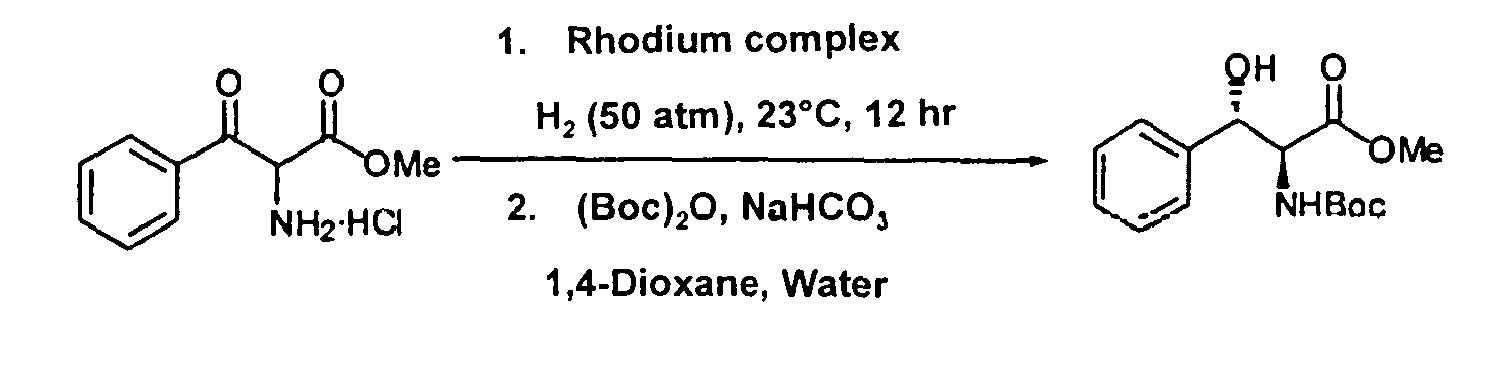
Table 1 Example No. Rhodium agent Ligand Additive (equivalent weight) Yield (%) de (%) ee (%) 2 [Rh(cod)2]BF4 (S)-MeO-BIPHEP AcONa (1) 8 >90 48 3 [RhCl(nbd)]2 (R)-(S)-PPF-PtBu2 AcONa (1) 58 >90 74 - Asymmetric hydrogenation was performed similarly to the procedures of Example 1 except that the concentration of substrate, reaction time or hydrogen pressure was altered, and then benzoylation was carried out instead of t-butoxycarbonylation, and the aimed product was isolated and yield (2-step total), de (%) and ee(%) were measured.
In the meatime, de was determined from 1H-NMR spectrum of the reaction mixture, and ee was determined from HPLC analysis. The HPLC analysis was performed according to the analytical condition used in Example 1.
In addition, benzoylation was performed by reacting with anhydrous benzoic acid (Bz2O) in the presence of triethylamine (TEA) in tetrahydrofuran (THF) solution.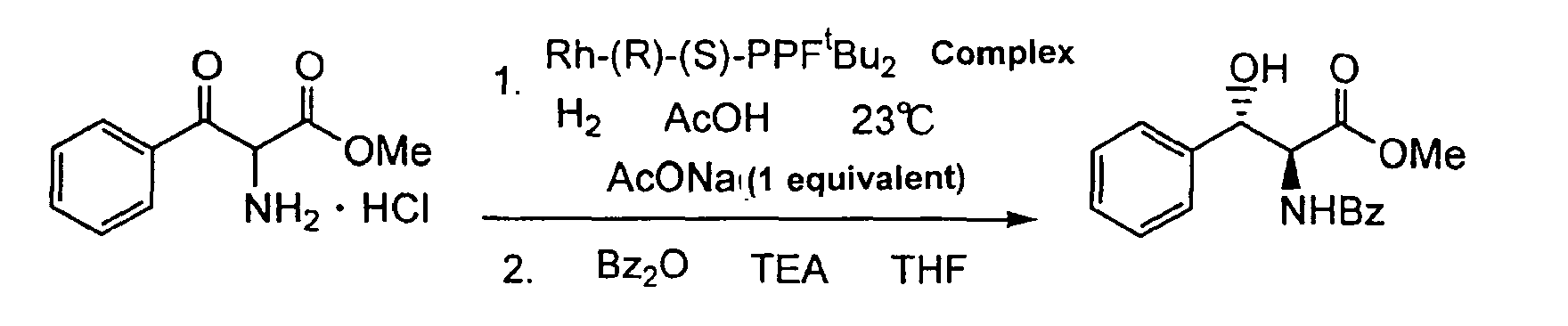
Table 2 Example No. Substrate concentration (M) Reaction time Hydrogen pressure (atm) Yield (%) de (%) ee (%) 4 0.088M 48 hours 50 71 83 73 5 0.044M 48 hours 50 55 86 83 6 0.022M 48 hours 50 49 82 79 7 0.088M 1 hour 50 75 88 84 8 0.088M 30 minutes 50 82 88 83 9 0.088M 10 minutes 50 26 92 77 10 0.088M 10 minutes 100 62 86 80 11 0.088M 1 hour 5 34 86 80 - The procedures of Example 4 were repeated except that the substrate was altered from hydrochloride to toluene sulfonate to obtain an aimed product in a yield of 15% (2-step total), de of 92% (anti:syn=96:4) and ee of 36%.
- The procedures of Example 12 were repeated except that tetramethyl ammonium chloride was added on asymmetric hydrogenation to obtain an aimed product in a yield of 44% (2-step total), de of 88% (anti:syn=94:6) and ee of 73%. Examples 14-18
- The procedures of Example 4 were repeated except that the reaction time and substrate were variously changed.
In the table, BnO means benzyloxy group.
Table 3 Example No. R R' Reaction time (hr) Yield (%) d e (%) e e (%) 14 
Et 5 61 94 80 15 
Me 3 53 84 84 16 
Me 2.5 73 92 77 17 
Et 1.5 66 94 79 18 
Me 1.5 63 86 58 - The hydrogenation was performed similarly to that of Example 1 except that sodium acetate was not added to obtain an aimed product in a yield of 58%, and an optical purity of 79% ee, and a ratio of anti:syn of 56:44.
- According to the present invention, anti forms of optically active β-hydroxy-α-aminocarboxylic acid derivatives that are useful as an intermediate for pharmaceuticals and agrochemicals can be efficiently produced.
Claims (13)
- A process for producing optically active β-hydroxy-α-aminocarboxylic acid derivative of formula (2) or (3)

R2 is C1-20 alkyl group [the C1-20 alkyl group may be arbitrarily substituted with C4-12 aromatic group (the aromatic group may be arbitrarily substituted with halogen atom,
C1-6 alkyl group, C1-6 alkoxy group, C1-6 alkoxycarbonyl group, C1-6 alkylcarbonyloxy group or CONRaRb wherein Ra and Rb are independently of each other are hydrogen atom or C1-6 alkyl group), C1-6 alkoxy group, C1-6 alkoxycarbonyl group or CONRaRb wherein Ra and Rb are independently of each other are hydrogen atom or C1-6 alkyl group], or C4-12 aromatic group [the aromatic group may be arbitrarily substituted with halogen atom, C1-6 alkyl group, C1-6 alkoxy group, C1-6 alkoxycarbonyl group, C1-6 alkylcarbonyloxy group or CONRaRb wherein Ra and Rb are independently of each other are hydrogen atom or C1-6 alkyl group], comprising subjecting an α-aminoacyl acetic acid ester compound of formula (1)

- The process for producing optically active β-hydroxy-α-aminocarboxylic acid derivative according to claim 1, wherein the ligand of the rhodium complex is the optically active compound of formula (4) or (4').
- The process for producing optically active β-hydroxy-α-aminocarboxylic acid derivative according to claim 2, wherein R3 is phenyl group, cyclohexyl group, 2-furyl group, 3,5-bistrifluoromethylphenyl group, 4-trifluoromethylphenyl group or 3,5-dimethyl-4-methoxyphenyl group, and R4 is tert-butyl group, cylcohexyl group, phenyl group or 3,5-dimethylphenyl group.
- The process for producing optically active β-hydroxy-α-aminocarboxylic acid derivative according to claim 3, wherein the ligand is (R)-(-)-1-[(S)-2-(bis(4-trifluoromethylphenyl)phosphino)ferrocenyl]ethyl-di-tert-butylphosphine, (R)-(-)-1-[(S)-2-(di(3,5-bistrifluoromethylphenyl)phosphino)ferrocenyl]ethyl-dicyclohexylphosphine, (R)-(-)-1-[(S)-2-(di(3,5-bistrifluoromethylphenyl)phosphino)ferrocenyl]ethyl-di(3,5-dimethylphenyl)phosphine, (R)-(-)-1-[(S)-2-(dicyclohexylphosphino)ferrocenyl]ethyl-di-tert-butylphosphine, (R)-(-)-1-[(S)-2-(dicyclohexylphosphino)ferrocenyl]ethyldicyclohexylphosphine, (S)-(+)-1-[(R)-2-(dicyclohexylphosphino)ferrocenyl]ethyldicyclohexylphosphine, (S)-(+)-1-[(R)-2-(dicyclohexylphosphino)ferrocenyl]ethyldiphenylphosphine, (R)-(-)-1-[(S)-2-(bis(3,5-dimethyl-4-methoxyphenyl) phosphino)ferrocenyl]ethyl-dicyclohexylphosphine, (S)-(+)-1-[(R)-2-(di-2-furylphosphino)ferrocenyl]ethyl-di(3,5-dimethylphenyl)phosphine, (R)-(-)-1-[(S)-2-(diphenylphosphino)ferrocenyl]ethyl-di-tert-butylphosphine, (S)-(+)-1-[(R)-2-(diphenylphosphino)ferrocenyl]ethyl-di-tert-butylphosphine, (R)-(-)-1-[(R)-2-(diphenylphosphino)ferrocenyl]ethyl-dicyclohexylphosphine, (S)-(+)-1-[(R)-2-(diphenylphosphino)ferrocenyl]ethyl-dicyclohexylphosphine, (R)-(-)-1-[(S)-2-(dicyclohexylphosphino)ferrocenyl]ethyl-diphenylphosphine or (R)-(-)-1-[(S)-2-(diphenylphosphino)ferrocenyl]ethyl-di(3,5-dimethylphenyl)phosphine.
- The process for producing optically active β-hydroxy-α-aminocarboxylic acid derivative according to claim 4, wherein the ligand is (R)-(-)-1-[(S)-2-(diphenylphosphino)ferrocenyl]ethyl-di-tert-butylphosphine.
- The process for producing optically active β-hydroxy-α-aminocarboxylic acid derivative according to claim 1, wherein the ligand of the rhodium complex is the optically active compound of formula (5).
- The process for producing optically active β-hydroxy-α-aminocarboxylic acid derivative according to claim 6, wherein R6 is cyclohexyl group, phenyl group, 4-methylphenyl group, 4-methoxyphenyl group or 4-tert-butylphenyl group, R7 is methyl group or methoxy group, R8 is hydrogen atom or methoxy group, and R9 is hydrogen atom, methyl group or dimethylamino group.
- The process for producing optically active β-hydroxy-α-aminocarboxylic acid derivative according to claim 7, wherein the ligand is 2,2'-dimethyl-6,6'-bis(diphenylphosphino)-1,1'-biphenyl, 2,2'-dimethyl-6,6'-bis(dicyclohexylphosphino)-1,1'-biphenyl, 2,2'-dimethyl-4,4'-bis(dimethylamino)-6,6'-bis(diphenylphosphino)-1,1'-biphenyl, 2,2',4,4'-tetramethyl-6,6'-bis(diphenylphosphino)-1,1'-biphenyl, 2,2'-dimethoxy-6,6'-bis(diphenylphosphino)-1,1'-biphenyl, 2,2',3,3'-tetramethoxy-6,6'-bis(diphenylphosphino)-1,1'-biphenyl, 2,2',4,4'-tetramethyl-3,3'-dimethoxy-6,6'-bis(diphenylphosphino)-1,1'-biphenyl, 2,2'-dimethyl-6,6'-bis(di-4-methylphenylphosphino)-1,1'-biphenyl, 2,2'-dimethyl-6,6'-bis(di-4-tert-butylphenylphosphino)-1,1'-biphenyl or 2,2',4,4'-tetramethyl-3,3'-dimethoxy-6,6'-bis(di-4-methoxyphenylphosphino)-1,1'-biphenyl.
- The process for producing optically active β-hydroxy-α-aminocarboxylic acid derivative according to claim 8, wherein the ligand is 2,2'-dimethoxy-6,6'-bis(diphenylphosphino)-1,1'-biphenyl.
- The process for producing optically active β-hydroxy-α-aminocarboxylic acid derivative according to any one of claims 1 to 9, wherein the acid is a strong acid.
- The process for producing optically active β-hydroxy-α-aminocarboxylic acid derivative according to any one of claims 1 to 10, wherein acetic acid is used as a solvent.
- The process for producing optically active β-hydroxy-α-aminocarboxylic acid derivative according to any one of claims 1 to 11, wherein the acetic acid salt is sodium acetate.
- The process for producing optically active β-hydroxy-α-aminocarboxylic acid derivative according to any one of claims 1 to 12, wherein the rhodium complex is a compound prepared from [RhCl(nbd)]2 or [Rh(nbd)2]BF4 wherein nbd is norbornadiene, and the ligand.
Applications Claiming Priority (2)
| Application Number | Priority Date | Filing Date | Title |
|---|---|---|---|
| JP2005005366 | 2005-01-12 | ||
| PCT/JP2006/300275 WO2006075651A1 (en) | 2005-01-12 | 2006-01-12 | PROCESS FOR PRODUCING OPTICALLY ACTIVE β-HYDROXY-α-AMINOCARBOXYLIC ACID DERIVATIVE |
Publications (3)
| Publication Number | Publication Date |
|---|---|
| EP1840116A1 true EP1840116A1 (en) | 2007-10-03 |
| EP1840116A4 EP1840116A4 (en) | 2010-08-04 |
| EP1840116B1 EP1840116B1 (en) | 2012-10-03 |
Family
ID=36677676
Family Applications (1)
| Application Number | Title | Priority Date | Filing Date |
|---|---|---|---|
| EP06711598A Expired - Lifetime EP1840116B1 (en) | 2005-01-12 | 2006-01-12 | Process for producing optically active beta-hydroxy-alpha-aminocarboxylic acid derivative |
Country Status (4)
| Country | Link |
|---|---|
| US (1) | US7781609B2 (en) |
| EP (1) | EP1840116B1 (en) |
| JP (1) | JP4924814B2 (en) |
| WO (1) | WO2006075651A1 (en) |
Families Citing this family (1)
| Publication number | Priority date | Publication date | Assignee | Title |
|---|---|---|---|---|
| CA2531898C (en) * | 2003-07-10 | 2012-01-03 | Nissan Chemical Industries, Ltd. | Process for producing optically active .beta.-hydroxy-.alpha.-aminoc arboxylic acid derivative |
Family Cites Families (5)
| Publication number | Priority date | Publication date | Assignee | Title |
|---|---|---|---|---|
| JPH02172956A (en) | 1988-12-23 | 1990-07-04 | Sumitomo Pharmaceut Co Ltd | New process for producing erythro-3-(3,4-dihydroxyphenyl) serine derivative |
| JP2976214B2 (en) | 1992-09-01 | 1999-11-10 | 高砂香料工業株式会社 | Method for producing optically active dihydrosphingosines |
| DE59410267D1 (en) | 1993-02-26 | 2003-05-15 | Syngenta Participations Ag | Ferrocenyldiphosphines as ligands for homogeneous catalysts |
| JP3489152B2 (en) | 1993-10-21 | 2004-01-19 | 住友化学工業株式会社 | Phosphine compounds and transition metal complexes using them as ligands |
| CA2531898C (en) * | 2003-07-10 | 2012-01-03 | Nissan Chemical Industries, Ltd. | Process for producing optically active .beta.-hydroxy-.alpha.-aminoc arboxylic acid derivative |
-
2006
- 2006-01-12 WO PCT/JP2006/300275 patent/WO2006075651A1/en not_active Ceased
- 2006-01-12 EP EP06711598A patent/EP1840116B1/en not_active Expired - Lifetime
- 2006-01-12 US US11/795,035 patent/US7781609B2/en not_active Expired - Fee Related
- 2006-01-12 JP JP2006552957A patent/JP4924814B2/en not_active Expired - Fee Related
Non-Patent Citations (2)
| Title |
|---|
| No further relevant documents disclosed * |
| See also references of WO2006075651A1 * |
Also Published As
| Publication number | Publication date |
|---|---|
| US7781609B2 (en) | 2010-08-24 |
| JPWO2006075651A1 (en) | 2008-06-12 |
| EP1840116A4 (en) | 2010-08-04 |
| JP4924814B2 (en) | 2012-04-25 |
| US20080139825A1 (en) | 2008-06-12 |
| EP1840116B1 (en) | 2012-10-03 |
| WO2006075651A1 (en) | 2006-07-20 |
Similar Documents
| Publication | Publication Date | Title |
|---|---|---|
| Karimi et al. | Recent advances in metal-catalyzed asymmetric Mannich reactions | |
| Lygo et al. | A new class of asymmetric phase-transfer catalysts derived from Cinchona alkaloids—Application in the enantioselective synthesis of α-amino acids | |
| US7468459B2 (en) | Process for the preparation of chiral beta amino acid derivatives by asymmetric hydrogenation | |
| CN103080072B (en) | New method for preparing intermediates useful in the production of NEP inhibitors | |
| CN102757431B (en) | A kind of novel method of synthesizing sitagliptin | |
| Rapi et al. | Enantioselective Michael addition of malonates to aromatic nitroalkenes catalyzed by monosaccharide-based chiral crown ethers | |
| EP4151620B1 (en) | Method for preparing chiral 4-aryl-beta-amino acid derivative | |
| EP1650185B1 (en) | Process for production of optically active beta-hydroxy- alpha-aminocarboxylic acid derivatives | |
| EP1840116B1 (en) | Process for producing optically active beta-hydroxy-alpha-aminocarboxylic acid derivative | |
| EP1640361B1 (en) | Asymmetric urea compounds and process for producing asymmetric compounds by asymmetric conjugate addition reaction using the same as catalyst | |
| JP4621918B2 (en) | Method for producing novel asymmetric iridium catalyst and method for producing optically active β-hydroxy-α-amino acid derivative using them | |
| CN105111134A (en) | Method for preparing (R)-or(S)-3-aminopiperidine dihydrochloride | |
| JP2006502996A (en) | Method for producing 3-hydroxy- (2-thienyl) propanamine | |
| WO2012085474A1 (en) | Process for preparing chiral amino acids | |
| JP4677562B2 (en) | Method for producing novel asymmetric nickel catalyst and method for producing optically active β-hydroxy-α-amino acid derivative using them | |
| KR101498802B1 (en) | Method for preparation of chiral 2-amino-4H-chromene derivatives | |
| JP4788854B2 (en) | Process for producing trans-1,2-diarylethanediamine and derivatives thereof, and trans-1,2-diarylethanediamine derivative | |
| CN115108937A (en) | Synthetic method of α-azidoketone containing tertiary stereocenter | |
| CN101314574B (en) | Synthetic method of acylated enamine | |
| EP1506148B1 (en) | Process for the preparation of enantiomerically enriched compounds | |
| US6437175B2 (en) | Process for racemization of n-acylamino acids by means of transition metal catalysts | |
| JP2004244377A (en) | Method for producing arylpiperazine derivative | |
| KR20050010050A (en) | Process for production of 1,2,4-butanetriol | |
| EP2042478A1 (en) | Method for producing -diaryl electron-withdrawing group substituted compound | |
| JP2003012590A (en) | Method of producing acylacetylene derivative |
Legal Events
| Date | Code | Title | Description |
|---|---|---|---|
| PUAI | Public reference made under article 153(3) epc to a published international application that has entered the european phase |
Free format text: ORIGINAL CODE: 0009012 |
|
| 17P | Request for examination filed |
Effective date: 20070723 |
|
| AK | Designated contracting states |
Kind code of ref document: A1 Designated state(s): AT BE BG CH CY CZ DE DK EE ES FI FR GB GR HU IE IS IT LI LT LU LV MC NL PL PT RO SE SI SK TR |
|
| DAX | Request for extension of the european patent (deleted) | ||
| A4 | Supplementary search report drawn up and despatched |
Effective date: 20100705 |
|
| GRAP | Despatch of communication of intention to grant a patent |
Free format text: ORIGINAL CODE: EPIDOSNIGR1 |
|
| RIC1 | Information provided on ipc code assigned before grant |
Ipc: C07C 271/22 20060101ALI20120403BHEP Ipc: C07B 53/00 20060101ALI20120403BHEP Ipc: C07C 229/36 20060101ALI20120403BHEP Ipc: C07D 307/54 20060101ALI20120403BHEP Ipc: C07D 333/16 20060101ALI20120403BHEP Ipc: C07C 269/04 20060101ALI20120403BHEP Ipc: C07D 317/60 20060101ALI20120403BHEP Ipc: C07C 227/16 20060101AFI20120403BHEP |
|
| GRAS | Grant fee paid |
Free format text: ORIGINAL CODE: EPIDOSNIGR3 |
|
| GRAA | (expected) grant |
Free format text: ORIGINAL CODE: 0009210 |
|
| AK | Designated contracting states |
Kind code of ref document: B1 Designated state(s): AT BE BG CH CY CZ DE DK EE ES FI FR GB GR HU IE IS IT LI LT LU LV MC NL PL PT RO SE SI SK TR |
|
| REG | Reference to a national code |
Ref country code: GB Ref legal event code: FG4D |
|
| REG | Reference to a national code |
Ref country code: CH Ref legal event code: NV Representative=s name: E. BLUM & CO. AG PATENT- UND MARKENANWAELTE VSP Ref country code: CH Ref legal event code: EP Ref country code: AT Ref legal event code: REF Ref document number: 577902 Country of ref document: AT Kind code of ref document: T Effective date: 20121015 |
|
| REG | Reference to a national code |
Ref country code: IE Ref legal event code: FG4D |
|
| REG | Reference to a national code |
Ref country code: DE Ref legal event code: R096 Ref document number: 602006032238 Country of ref document: DE Effective date: 20121129 |
|
| REG | Reference to a national code |
Ref country code: AT Ref legal event code: MK05 Ref document number: 577902 Country of ref document: AT Kind code of ref document: T Effective date: 20121003 |
|
| PG25 | Lapsed in a contracting state [announced via postgrant information from national office to epo] |
Ref country code: SI Free format text: LAPSE BECAUSE OF FAILURE TO SUBMIT A TRANSLATION OF THE DESCRIPTION OR TO PAY THE FEE WITHIN THE PRESCRIBED TIME-LIMIT Effective date: 20121003 |
|
| REG | Reference to a national code |
Ref country code: NL Ref legal event code: VDEP Effective date: 20121003 |
|
| REG | Reference to a national code |
Ref country code: LT Ref legal event code: MG4D |
|
| PG25 | Lapsed in a contracting state [announced via postgrant information from national office to epo] |
Ref country code: FI Free format text: LAPSE BECAUSE OF FAILURE TO SUBMIT A TRANSLATION OF THE DESCRIPTION OR TO PAY THE FEE WITHIN THE PRESCRIBED TIME-LIMIT Effective date: 20121003 Ref country code: NL Free format text: LAPSE BECAUSE OF FAILURE TO SUBMIT A TRANSLATION OF THE DESCRIPTION OR TO PAY THE FEE WITHIN THE PRESCRIBED TIME-LIMIT Effective date: 20121003 Ref country code: ES Free format text: LAPSE BECAUSE OF FAILURE TO SUBMIT A TRANSLATION OF THE DESCRIPTION OR TO PAY THE FEE WITHIN THE PRESCRIBED TIME-LIMIT Effective date: 20130114 Ref country code: IS Free format text: LAPSE BECAUSE OF FAILURE TO SUBMIT A TRANSLATION OF THE DESCRIPTION OR TO PAY THE FEE WITHIN THE PRESCRIBED TIME-LIMIT Effective date: 20130203 Ref country code: SE Free format text: LAPSE BECAUSE OF FAILURE TO SUBMIT A TRANSLATION OF THE DESCRIPTION OR TO PAY THE FEE WITHIN THE PRESCRIBED TIME-LIMIT Effective date: 20121003 Ref country code: LT Free format text: LAPSE BECAUSE OF FAILURE TO SUBMIT A TRANSLATION OF THE DESCRIPTION OR TO PAY THE FEE WITHIN THE PRESCRIBED TIME-LIMIT Effective date: 20121003 |
|
| PG25 | Lapsed in a contracting state [announced via postgrant information from national office to epo] |
Ref country code: BE Free format text: LAPSE BECAUSE OF FAILURE TO SUBMIT A TRANSLATION OF THE DESCRIPTION OR TO PAY THE FEE WITHIN THE PRESCRIBED TIME-LIMIT Effective date: 20121003 Ref country code: CY Free format text: LAPSE BECAUSE OF FAILURE TO SUBMIT A TRANSLATION OF THE DESCRIPTION OR TO PAY THE FEE WITHIN THE PRESCRIBED TIME-LIMIT Effective date: 20121003 Ref country code: PT Free format text: LAPSE BECAUSE OF FAILURE TO SUBMIT A TRANSLATION OF THE DESCRIPTION OR TO PAY THE FEE WITHIN THE PRESCRIBED TIME-LIMIT Effective date: 20130204 Ref country code: PL Free format text: LAPSE BECAUSE OF FAILURE TO SUBMIT A TRANSLATION OF THE DESCRIPTION OR TO PAY THE FEE WITHIN THE PRESCRIBED TIME-LIMIT Effective date: 20121003 Ref country code: LV Free format text: LAPSE BECAUSE OF FAILURE TO SUBMIT A TRANSLATION OF THE DESCRIPTION OR TO PAY THE FEE WITHIN THE PRESCRIBED TIME-LIMIT Effective date: 20121003 Ref country code: GR Free format text: LAPSE BECAUSE OF FAILURE TO SUBMIT A TRANSLATION OF THE DESCRIPTION OR TO PAY THE FEE WITHIN THE PRESCRIBED TIME-LIMIT Effective date: 20130104 |
|
| PG25 | Lapsed in a contracting state [announced via postgrant information from national office to epo] |
Ref country code: AT Free format text: LAPSE BECAUSE OF FAILURE TO SUBMIT A TRANSLATION OF THE DESCRIPTION OR TO PAY THE FEE WITHIN THE PRESCRIBED TIME-LIMIT Effective date: 20121003 |
|
| PG25 | Lapsed in a contracting state [announced via postgrant information from national office to epo] |
Ref country code: SK Free format text: LAPSE BECAUSE OF FAILURE TO SUBMIT A TRANSLATION OF THE DESCRIPTION OR TO PAY THE FEE WITHIN THE PRESCRIBED TIME-LIMIT Effective date: 20121003 Ref country code: BG Free format text: LAPSE BECAUSE OF FAILURE TO SUBMIT A TRANSLATION OF THE DESCRIPTION OR TO PAY THE FEE WITHIN THE PRESCRIBED TIME-LIMIT Effective date: 20130103 Ref country code: CZ Free format text: LAPSE BECAUSE OF FAILURE TO SUBMIT A TRANSLATION OF THE DESCRIPTION OR TO PAY THE FEE WITHIN THE PRESCRIBED TIME-LIMIT Effective date: 20121003 Ref country code: EE Free format text: LAPSE BECAUSE OF FAILURE TO SUBMIT A TRANSLATION OF THE DESCRIPTION OR TO PAY THE FEE WITHIN THE PRESCRIBED TIME-LIMIT Effective date: 20121003 Ref country code: DK Free format text: LAPSE BECAUSE OF FAILURE TO SUBMIT A TRANSLATION OF THE DESCRIPTION OR TO PAY THE FEE WITHIN THE PRESCRIBED TIME-LIMIT Effective date: 20121003 |
|
| PLBE | No opposition filed within time limit |
Free format text: ORIGINAL CODE: 0009261 |
|
| STAA | Information on the status of an ep patent application or granted ep patent |
Free format text: STATUS: NO OPPOSITION FILED WITHIN TIME LIMIT |
|
| PG25 | Lapsed in a contracting state [announced via postgrant information from national office to epo] |
Ref country code: IT Free format text: LAPSE BECAUSE OF FAILURE TO SUBMIT A TRANSLATION OF THE DESCRIPTION OR TO PAY THE FEE WITHIN THE PRESCRIBED TIME-LIMIT Effective date: 20121003 Ref country code: MC Free format text: LAPSE BECAUSE OF NON-PAYMENT OF DUE FEES Effective date: 20130131 Ref country code: RO Free format text: LAPSE BECAUSE OF FAILURE TO SUBMIT A TRANSLATION OF THE DESCRIPTION OR TO PAY THE FEE WITHIN THE PRESCRIBED TIME-LIMIT Effective date: 20121003 |
|
| 26N | No opposition filed |
Effective date: 20130704 |
|
| REG | Reference to a national code |
Ref country code: IE Ref legal event code: MM4A |
|
| REG | Reference to a national code |
Ref country code: DE Ref legal event code: R097 Ref document number: 602006032238 Country of ref document: DE Effective date: 20130704 |
|
| PG25 | Lapsed in a contracting state [announced via postgrant information from national office to epo] |
Ref country code: IE Free format text: LAPSE BECAUSE OF NON-PAYMENT OF DUE FEES Effective date: 20130112 |
|
| PG25 | Lapsed in a contracting state [announced via postgrant information from national office to epo] |
Ref country code: TR Free format text: LAPSE BECAUSE OF FAILURE TO SUBMIT A TRANSLATION OF THE DESCRIPTION OR TO PAY THE FEE WITHIN THE PRESCRIBED TIME-LIMIT Effective date: 20121003 |
|
| PG25 | Lapsed in a contracting state [announced via postgrant information from national office to epo] |
Ref country code: LU Free format text: LAPSE BECAUSE OF NON-PAYMENT OF DUE FEES Effective date: 20130112 Ref country code: HU Free format text: LAPSE BECAUSE OF FAILURE TO SUBMIT A TRANSLATION OF THE DESCRIPTION OR TO PAY THE FEE WITHIN THE PRESCRIBED TIME-LIMIT; INVALID AB INITIO Effective date: 20060112 |
|
| REG | Reference to a national code |
Ref country code: FR Ref legal event code: PLFP Year of fee payment: 11 |
|
| PGFP | Annual fee paid to national office [announced via postgrant information from national office to epo] |
Ref country code: FR Payment date: 20151208 Year of fee payment: 11 |
|
| PGFP | Annual fee paid to national office [announced via postgrant information from national office to epo] |
Ref country code: CH Payment date: 20160111 Year of fee payment: 11 Ref country code: DE Payment date: 20160105 Year of fee payment: 11 |
|
| PGFP | Annual fee paid to national office [announced via postgrant information from national office to epo] |
Ref country code: GB Payment date: 20160106 Year of fee payment: 11 |
|
| REG | Reference to a national code |
Ref country code: DE Ref legal event code: R119 Ref document number: 602006032238 Country of ref document: DE |
|
| REG | Reference to a national code |
Ref country code: CH Ref legal event code: PL |
|
| GBPC | Gb: european patent ceased through non-payment of renewal fee |
Effective date: 20170112 |
|
| REG | Reference to a national code |
Ref country code: FR Ref legal event code: ST Effective date: 20170929 |
|
| PG25 | Lapsed in a contracting state [announced via postgrant information from national office to epo] |
Ref country code: LI Free format text: LAPSE BECAUSE OF NON-PAYMENT OF DUE FEES Effective date: 20170131 Ref country code: FR Free format text: LAPSE BECAUSE OF NON-PAYMENT OF DUE FEES Effective date: 20170131 Ref country code: CH Free format text: LAPSE BECAUSE OF NON-PAYMENT OF DUE FEES Effective date: 20170131 |
|
| PG25 | Lapsed in a contracting state [announced via postgrant information from national office to epo] |
Ref country code: DE Free format text: LAPSE BECAUSE OF NON-PAYMENT OF DUE FEES Effective date: 20170801 Ref country code: GB Free format text: LAPSE BECAUSE OF NON-PAYMENT OF DUE FEES Effective date: 20170112 |