EP1839685A2 - Bearing material for a medical implant - Google Patents
Bearing material for a medical implant Download PDFInfo
- Publication number
- EP1839685A2 EP1839685A2 EP20070251351 EP07251351A EP1839685A2 EP 1839685 A2 EP1839685 A2 EP 1839685A2 EP 20070251351 EP20070251351 EP 20070251351 EP 07251351 A EP07251351 A EP 07251351A EP 1839685 A2 EP1839685 A2 EP 1839685A2
- Authority
- EP
- European Patent Office
- Prior art keywords
- active agent
- surface active
- bearing material
- bearing
- medical implant
- Prior art date
- Legal status (The legal status is an assumption and is not a legal conclusion. Google has not performed a legal analysis and makes no representation as to the accuracy of the status listed.)
- Granted
Links
Images


Classifications
-
- A—HUMAN NECESSITIES
- A61—MEDICAL OR VETERINARY SCIENCE; HYGIENE
- A61L—METHODS OR APPARATUS FOR STERILISING MATERIALS OR OBJECTS IN GENERAL; DISINFECTION, STERILISATION OR DEODORISATION OF AIR; CHEMICAL ASPECTS OF BANDAGES, DRESSINGS, ABSORBENT PADS OR SURGICAL ARTICLES; MATERIALS FOR BANDAGES, DRESSINGS, ABSORBENT PADS OR SURGICAL ARTICLES
- A61L27/00—Materials for grafts or prostheses or for coating grafts or prostheses
- A61L27/14—Macromolecular materials
- A61L27/16—Macromolecular materials obtained by reactions only involving carbon-to-carbon unsaturated bonds
-
- A—HUMAN NECESSITIES
- A61—MEDICAL OR VETERINARY SCIENCE; HYGIENE
- A61L—METHODS OR APPARATUS FOR STERILISING MATERIALS OR OBJECTS IN GENERAL; DISINFECTION, STERILISATION OR DEODORISATION OF AIR; CHEMICAL ASPECTS OF BANDAGES, DRESSINGS, ABSORBENT PADS OR SURGICAL ARTICLES; MATERIALS FOR BANDAGES, DRESSINGS, ABSORBENT PADS OR SURGICAL ARTICLES
- A61L27/00—Materials for grafts or prostheses or for coating grafts or prostheses
- A61L27/14—Macromolecular materials
- A61L27/18—Macromolecular materials obtained otherwise than by reactions only involving carbon-to-carbon unsaturated bonds
-
- A—HUMAN NECESSITIES
- A61—MEDICAL OR VETERINARY SCIENCE; HYGIENE
- A61L—METHODS OR APPARATUS FOR STERILISING MATERIALS OR OBJECTS IN GENERAL; DISINFECTION, STERILISATION OR DEODORISATION OF AIR; CHEMICAL ASPECTS OF BANDAGES, DRESSINGS, ABSORBENT PADS OR SURGICAL ARTICLES; MATERIALS FOR BANDAGES, DRESSINGS, ABSORBENT PADS OR SURGICAL ARTICLES
- A61L27/00—Materials for grafts or prostheses or for coating grafts or prostheses
- A61L27/50—Materials characterised by their function or physical properties, e.g. injectable or lubricating compositions, shape-memory materials, surface modified materials
-
- C—CHEMISTRY; METALLURGY
- C08—ORGANIC MACROMOLECULAR COMPOUNDS; THEIR PREPARATION OR CHEMICAL WORKING-UP; COMPOSITIONS BASED THEREON
- C08L—COMPOSITIONS OF MACROMOLECULAR COMPOUNDS
- C08L23/00—Compositions of homopolymers or copolymers of unsaturated aliphatic hydrocarbons having only one carbon-to-carbon double bond; Compositions of derivatives of such polymers
- C08L23/02—Compositions of homopolymers or copolymers of unsaturated aliphatic hydrocarbons having only one carbon-to-carbon double bond; Compositions of derivatives of such polymers not modified by chemical after-treatment
- C08L23/04—Homopolymers or copolymers of ethene
- C08L23/06—Polyethylene
-
- C—CHEMISTRY; METALLURGY
- C08—ORGANIC MACROMOLECULAR COMPOUNDS; THEIR PREPARATION OR CHEMICAL WORKING-UP; COMPOSITIONS BASED THEREON
- C08L—COMPOSITIONS OF MACROMOLECULAR COMPOUNDS
- C08L53/00—Compositions of block copolymers containing at least one sequence of a polymer obtained by reactions only involving carbon-to-carbon unsaturated bonds; Compositions of derivatives of such polymers
-
- C—CHEMISTRY; METALLURGY
- C08—ORGANIC MACROMOLECULAR COMPOUNDS; THEIR PREPARATION OR CHEMICAL WORKING-UP; COMPOSITIONS BASED THEREON
- C08L—COMPOSITIONS OF MACROMOLECULAR COMPOUNDS
- C08L71/00—Compositions of polyethers obtained by reactions forming an ether link in the main chain; Compositions of derivatives of such polymers
- C08L71/02—Polyalkylene oxides
-
- Y—GENERAL TAGGING OF NEW TECHNOLOGICAL DEVELOPMENTS; GENERAL TAGGING OF CROSS-SECTIONAL TECHNOLOGIES SPANNING OVER SEVERAL SECTIONS OF THE IPC; TECHNICAL SUBJECTS COVERED BY FORMER USPC CROSS-REFERENCE ART COLLECTIONS [XRACs] AND DIGESTS
- Y10—TECHNICAL SUBJECTS COVERED BY FORMER USPC
- Y10T—TECHNICAL SUBJECTS COVERED BY FORMER US CLASSIFICATION
- Y10T428/00—Stock material or miscellaneous articles
- Y10T428/26—Web or sheet containing structurally defined element or component, the element or component having a specified physical dimension
- Y10T428/269—Web or sheet containing structurally defined element or component, the element or component having a specified physical dimension including synthetic resin or polymer layer or component
-
- Y—GENERAL TAGGING OF NEW TECHNOLOGICAL DEVELOPMENTS; GENERAL TAGGING OF CROSS-SECTIONAL TECHNOLOGIES SPANNING OVER SEVERAL SECTIONS OF THE IPC; TECHNICAL SUBJECTS COVERED BY FORMER USPC CROSS-REFERENCE ART COLLECTIONS [XRACs] AND DIGESTS
- Y10—TECHNICAL SUBJECTS COVERED BY FORMER USPC
- Y10T—TECHNICAL SUBJECTS COVERED BY FORMER US CLASSIFICATION
- Y10T428/00—Stock material or miscellaneous articles
- Y10T428/31504—Composite [nonstructural laminate]
- Y10T428/31855—Of addition polymer from unsaturated monomers
-
- Y—GENERAL TAGGING OF NEW TECHNOLOGICAL DEVELOPMENTS; GENERAL TAGGING OF CROSS-SECTIONAL TECHNOLOGIES SPANNING OVER SEVERAL SECTIONS OF THE IPC; TECHNICAL SUBJECTS COVERED BY FORMER USPC CROSS-REFERENCE ART COLLECTIONS [XRACs] AND DIGESTS
- Y10—TECHNICAL SUBJECTS COVERED BY FORMER USPC
- Y10T—TECHNICAL SUBJECTS COVERED BY FORMER US CLASSIFICATION
- Y10T428/00—Stock material or miscellaneous articles
- Y10T428/31504—Composite [nonstructural laminate]
- Y10T428/31855—Of addition polymer from unsaturated monomers
- Y10T428/31938—Polymer of monoethylenically unsaturated hydrocarbon
Definitions
- Medical implants employ a polymeric material such as ultrahigh molecular weight polyethylene (UHMWPE) as the bearing material which articulates against a hard counterface, for example, a metallic counterface, of the implant.
- UHMWPE ultrahigh molecular weight polyethylene
- the polymeric material tends to wear during use with concomitant production of wear debris comprising microscopic particles of the polymer. These particles can cause adverse reactions such as inflammation and deterioration of cell tissues, or osteolysis of the tissues.
- the foregoing shows that there exists a need for a medical implant or medical implant part, such as the bearing material, which has a reduced wear rate.
- the present invention provides such an implant or implant part.
- the present invention also provides a method for reducing the wear rate.
- the invention provides a bearing material of a medical implant comprising a polymer such as UHMWPE and a surface active agent that is not covalently bonded to the polymer.
- the bearing material has a reduced wear rate; it produces a reduced amount of wear debris.
- the bearing material can offer reduced osteolysis.
- the surface active agent acts as a boundary lubricant, and reduces the friction between the polymer of the bearing material when it articulates against the hard counterface.
- the bearing material of the invention has one or more advantages.
- the bearing material of the invention made of UHMWPE and containing a surface agent provides a lower wear rate than a bearing material made of crosslinked UHMWPE.
- the present invention also provides a method of reducing the wear rate of a polymeric bearing material of a medical implant when it articulates against a hard counterface in the presence of synovial fluid, the method comprising providing a surface active agent in the synovial fluid in close proximity to the bearing surface, the hard counterface, or both.
- the present invention is predicated on the observation that surface active agents reduce the friction, and/or provide a lubricating effect, between a polymer surface articulating against a hard counterface in a fluid medium such as serum containing a protein. Accordingly, in an embodiment, the invention provides a bearing material of a medical implant comprising a polymer and a surface active agent that is not covalently bonded to the polymer, wherein the bearing material is adopted for articulating against a hard counterface of the medical implant.
- the bearing material in accordance with the invention can be that of any suitable medical implant or medical implant part.
- suitable medical implants or medical implant parts include, but are not limited to, the acetabular cup, the insert or liner of the acetabular cup, or trunnion bearings (e.g., between the modular head and the stem) of artificial hip joints, the tibial plateau, patellar button (patello-femoral articulation), and trunnion or other bearing components of artificial knee joints, the talar surface (tibiotalar articulation) and other bearing components of artificial ankle joints, the radio-numeral joint, ulno-humeral joint, and other bearing components of artificial elbow joints, the glenoro-humeral articulation and other bearing components of artificial shoulder joints, intervertebral disk replacements and facet joint replacements for the spine, temporo-mandibular joints (jaw), and finger joints.
- the polymer of the bearing material can be made of any suitable polymer, specifically polyethylene, particularly ultrahigh molecular weight polyethylene (UHMWPE), which typically has a weight average molecular weight of about 400,000 atomic mass units or more.
- UHMWPE ultrahigh molecular weight polyethylene
- the term "ultrahigh molecular weight polyethylene” refers to a polyethylene polymer having a weight average molecular weight of about 400,000 atomic mass units or more.
- the ultrahigh molecular weight polyethylene has a weight average molecular weight of about 1,000,000 (e.g., about 2,000,000 or about 3,000,000) atomic mass units or more.
- the weight average molecular weight of the ultrahigh molecular weight polyethylene is less than 10,000,000 atomic mass units or less, more preferably about 6,000,000 atomic mass units or less.
- Ultrahigh molecular weight polyethylene suitable for use in the invention includes, but is not limited to, commercially available ultrahigh molecular weight polyethylene, such as GUR 1050 (weight average molecular weight of about 5,000,000 to about 6,000,000 atomic mass units) or GUR 1020 (weight average molecular weight of about 3,000,000 to about 4,000,000 atomic mass units) powdered ultrahigh molecular weight polyethylene from Ticona (Summit, N.J.).
- the surface active agent which contains both hydrophobic and hydrophilic segments, can be any suitable surface active agent, for example, anionic, cationic, nonionic, or amphoteric, preferably nonionic.
- the surface active agent is an added (endogenous) surface active agent, and does not refer to any surface active agent that may be present in the synovial fluid naturally.
- the surface active agent can be of any suitable molecular weight, for example, from about 100 to about 20,000 g.mole -1 or more, and in embodiments from about 1000 to about 20,000 g.mole -1 .
- the nonionic surface active agent comprises a block copolymer of hydrophilic and hydrophobic blocks, for example, the surface active agent is block copolymer of the type A-B, A-B-A, or B-A-B or a combination thereof, wherein A is a hydrophilic block and B is a hydrophobic block.
- A is polyethylene oxide (PEO)
- B is polypropylene oxide (PPO).
- PEO polyethylene oxide
- PPO polypropylene oxide
- An example of a suitable surface active agent is that sold by BASF under the trade mark PLURONIC F127, which has a molecular weight of about 12,600 g.mole -1 .
- the surface active agent can be incorporated into the bearing material in any suitable amount, for example, in an amount of about 0.01% by weight or more, e.g., from about 0.1% to about 5%, and preferably from about 0.5% to about 1% by weight of the bearing material.
- the wear rate of the polymer is reduced at least by a factor of about 2, preferably 5, and more preferably about 10, relative to the unmodified polymer, particularly when the surface active agent is added at a level of 1% to the fluid, e.g., synovial fluid or serum.
- PLURONIC F127 reduces the wear rate of UHMWPE by a factor of 10 when added to the serum at a level of 1% by weight of the serum. Wear rate and the coefficient of friction can be determined by methods known in the art, for example, by measuring the loss of weight or the normal force in the Pin-on-Disk method.
- the invention further provides a method of reducing the wear rate of a polymeric bearing material of a medical implant, the bearing material having a bearing surface, the bearing surface articulating against a hard counterface of the medical implant in the presence of synovial fluid, the method comprising providing a surface active agent in the synovial fluid in close proximity to the bearing surface, the hard counterface, or both.
- the bearing material includes a surface active agent that migrates to the interface between the bearing surface and the synovial fluid.
- the surface active agent can be included in the bearing material by any suitable method, for example, by moulding, ram extrusion, or infiltration of the finished polymeric (e.g., UHMWPE) article with the surface active agent in a suitable solvent.
- a suitable solvent for example, powdered or pelletized UHMWPE and a surface active agent can be blended, e.g., dry blended, at a desired concentration and the resulting blend can be moulded by compression moulding or ram extrusion.
- the surface active agent can be originally distributed throughout the bearing material or only present on the small portion thereof, e.g., at the surface.
- the surface active agent can be present in a surface layer having a thickness of about 0.5 mm or more, e.g., from about 0.5 mm to about 2 mm or more.
- the internal volume of the compression mould can be filled entirely with a blend of the polymer and the surface active agent, or alternatively, a portion of the internal volume can be filled with the blend, and the remaining volume filled with the polymer. In the latter case, the surface active agent will be contained in the surface of the bearing material.
- the bearing material can be immersed in a solution of the surface active agent at a suitable temperature and for suitable length of time to obtain a sufficient concentration of the surface active agent in the polymer.
- the solvent can be removed by suitable drying.
- the hard counterface includes a surface active agent and releases the surface active agent into the synovial fluid in close proximity to the hard counterface.
- the surface active agent can be included in a hydrogel which can be incorporated into a porous support in close proximity to the articulating surfaces.
- the hydrogel can be formed from hydrophobic and hydrophilic macromers, for example as disclosed in US-6916857 and US-6846875 . The resulting hydrogel can be loaded with a surface active agent. The hydrogel can be coated on the hard counterface.
- the surface active agent can be provided by injecting the surface active agent into the synovial fluid. If the surface active agent is injected into the fluid, in accordance with an embodiment of the invention, it can be injected, for example, in an amount of about 0.01% by weight or more, e.g., from about 0.1 to about 5%, and preferably from about 0.5 to about 1% by weight of the fluid.
- the surface active agent can be provided such that it elutes from a non-articulating portion of the medical implant.
- the surface active agent is originally present in the serum (or synovial fluid) or in the bulk of the polymer, it migrates to the interface between the polymer and the serum due to the reduction of surface energy.
- the hard counterface of the implant can be made of any suitable material, e.g., metallic, ceramic, or a combination thereof. Suitable metals include titanium, tantalum, and stainless steel. Typically, the hard counterfaces are formed from a metallic alloy that will exhibit appropriate strength and flexure in use. Examples of metallic alloys that may be used include titanium alloys, such as a titanium-aluminum-vanadium alloy, and cobalt-chromium alloys, such as a cobalt-chromium-molybdenum alloy, and stainless steel. In a specific example, the hard counterface comprises cobalt-chromium-molybdenum alloy.
- This example illustrates an advantage of the surface active agent, namely, it reduces the wear rate of UHMWPE.
- UHMWPE pins 17.8 mm (0.7 inch) long and 9.5 mm (0.375 inch) diameter, manufactured from GUR 1020 resin is ram extruded into bar stock. The pins are sterilized by irradiation.
- Metal counterfaces 38.1 mm (1.5 inch) diameter and 12.7 mm (0.5 inch) thick, are fabricated from cast 68% cobalt, 26% chromium, 6% molybdenum, and 0.2% carbon. The counterfaces are hot isostatic pressed and homogenized by heat treatment and polished to an average surface roughness of between 10 and 20 nm. Three disks are obtained for each wear test group. A sample pairing chart including same identifications is shown in the following table. Sample group Pin Disk Station Serum and surface active agent S1 2B 1 S2 5B 2 S3 6 3 Water W1 7 4 W2 8 5 W3 9 6 Serum 4 43 4 5 44 5 6 45 6
- the wear tests are conducted on a Pin-on-Disk (POD) machine (AMTI OrthoPOD).
- POD Pin-on-Disk
- the pins move in a 10 mm by 10 mm square pattern with respect to the disk, providing a maximum amount of cross shear motion.
- a Paul loading cycle with a peak of 330N is applied ( Paul, J., Forces transmitted by joints in the human body, Proc. Inst. Mech. Eng., 181, 8-15 (1967) ).
- the frequency is 1.6 Hz.
- Six, 0.33 million-cycle data collection intervals are performed for a 1.98 million cycle test duration. Water lost by evaporation is replenished approximately every 24 hours.
- the test lubricant is discarded at the end of each test interval, and fresh lubricant is added.
- each sample pair is rotated clockwise one station for the next interval.
- All of the samples are tested in all of the stations.
- Three different lubricants are tested: Reverse Osmosis treated water, Bovine serum (Hyclone Inc. diluted to 90% of the initial concentration and treated with EDTA and sodium azide), and the bovine serum formulation above containing 1% by weight PLURONIC F127 surfactant. Bulk serum temperature is maintained at 37°C.
- Gravimetric data is obtained from the pins as follows.
- the pins are cleaned and weighed in a microbalance with 0.01 mg resolution.
- the balance is calibrated with standard weights. Corrections for fluid uptake are applied using standard soak control pins.
- Contact profilometry of the disks is performed on a Taylor-Hobson Form Talysurf Series II Profilometer. A cut off length of 250 ⁇ m, a 100:1 1 bandwidth, and a gauge range of 1 mm are used. Two pairs of perpendicular traces are taken on each sample. Pictures of the pins are taken with a Nikon Epiphot 200/300 Inverted Microscope (metallograph). Pictures of the disks are taken with a Nikon D1 Digital Camera.
- Fig. 2A-B depict the wear rate of UHMWPE pins.
- the wear rate of the pins is less when a surface active agent is employed.
- This example illustrates an advantage of the present invention, namely, the coefficient of friction between the polymer surface and the hard counterface is reduced.
- Friction data is collected on the same type of pins and disks illustrated in Example 1.
- the data are obtained on an AMTI OrthoPOD Pin-on-Disk tester equipped with multiaxis strain gauges.
- the coefficient of friction is calculated by dividing the normal force by the in plane force during the same 10 mm by 10 mm test pattern and Paul load cycle used in wear testing.
- the friction data is collected over a small portion of the test pattern between the peaks of the Paul loading curve.
- Fig. 3 depicts the reduction in the coefficient of friction brought about by the use of the surfactant. Each point in Fig. 3 is the average of approximately 30 data points.
Landscapes
- Health & Medical Sciences (AREA)
- Chemical & Material Sciences (AREA)
- Transplantation (AREA)
- Dermatology (AREA)
- Medicinal Chemistry (AREA)
- Oral & Maxillofacial Surgery (AREA)
- Epidemiology (AREA)
- Life Sciences & Earth Sciences (AREA)
- Animal Behavior & Ethology (AREA)
- General Health & Medical Sciences (AREA)
- Public Health (AREA)
- Veterinary Medicine (AREA)
- Chemical Kinetics & Catalysis (AREA)
- Materials For Medical Uses (AREA)
- Prostheses (AREA)
Abstract
Description
- Medical implants employ a polymeric material such as ultrahigh molecular weight polyethylene (UHMWPE) as the bearing material which articulates against a hard counterface, for example, a metallic counterface, of the implant. The polymeric material, however, tends to wear during use with concomitant production of wear debris comprising microscopic particles of the polymer. These particles can cause adverse reactions such as inflammation and deterioration of cell tissues, or osteolysis of the tissues.
- Attempts have been made to reduce the wear rate of the bearing material, particularly UHMWPE, for example, by modifying the bulk properties of the polymer. Approaches to modify the bulk properties of the bearing material include radiation crosslinking of the polymer and stabilizing the associated free radicals against oxidation. While highly crosslinked UHMWPE has wear rates lower than the uncrosslinked material, the highly crosslinked material also tends to produce finer wear debris with higher osteolytic potential.
- The foregoing shows that there exists a need for a medical implant or medical implant part, such as the bearing material, which has a reduced wear rate. The present invention provides such an implant or implant part. The present invention also provides a method for reducing the wear rate.
- The invention provides a bearing material of a medical implant comprising a polymer such as UHMWPE and a surface active agent that is not covalently bonded to the polymer. The bearing material has a reduced wear rate; it produces a reduced amount of wear debris. The bearing material can offer reduced osteolysis. The surface active agent acts as a boundary lubricant, and reduces the friction between the polymer of the bearing material when it articulates against the hard counterface. The bearing material of the invention has one or more advantages. For example, the bearing material of the invention made of UHMWPE and containing a surface agent provides a lower wear rate than a bearing material made of crosslinked UHMWPE.
- The present invention also provides a method of reducing the wear rate of a polymeric bearing material of a medical implant when it articulates against a hard counterface in the presence of synovial fluid, the method comprising providing a surface active agent in the synovial fluid in close proximity to the bearing surface, the hard counterface, or both.
- The present invention is predicated on the observation that surface active agents reduce the friction, and/or provide a lubricating effect, between a polymer surface articulating against a hard counterface in a fluid medium such as serum containing a protein. Accordingly, in an embodiment, the invention provides a bearing material of a medical implant comprising a polymer and a surface active agent that is not covalently bonded to the polymer, wherein the bearing material is adopted for articulating against a hard counterface of the medical implant.
- The bearing material in accordance with the invention can be that of any suitable medical implant or medical implant part. Suitable medical implants or medical implant parts include, but are not limited to, the acetabular cup, the insert or liner of the acetabular cup, or trunnion bearings (e.g., between the modular head and the stem) of artificial hip joints, the tibial plateau, patellar button (patello-femoral articulation), and trunnion or other bearing components of artificial knee joints, the talar surface (tibiotalar articulation) and other bearing components of artificial ankle joints, the radio-numeral joint, ulno-humeral joint, and other bearing components of artificial elbow joints, the glenoro-humeral articulation and other bearing components of artificial shoulder joints, intervertebral disk replacements and facet joint replacements for the spine, temporo-mandibular joints (jaw), and finger joints.
- The polymer of the bearing material can be made of any suitable polymer, specifically polyethylene, particularly ultrahigh molecular weight polyethylene (UHMWPE), which typically has a weight average molecular weight of about 400,000 atomic mass units or more. As utilized herein, the term "ultrahigh molecular weight polyethylene" refers to a polyethylene polymer having a weight average molecular weight of about 400,000 atomic mass units or more. Preferably, the ultrahigh molecular weight polyethylene has a weight average molecular weight of about 1,000,000 (e.g., about 2,000,000 or about 3,000,000) atomic mass units or more. Typically, the weight average molecular weight of the ultrahigh molecular weight polyethylene is less than 10,000,000 atomic mass units or less, more preferably about 6,000,000 atomic mass units or less. Ultrahigh molecular weight polyethylene suitable for use in the invention includes, but is not limited to, commercially available ultrahigh molecular weight polyethylene, such as GUR 1050 (weight average molecular weight of about 5,000,000 to about 6,000,000 atomic mass units) or GUR 1020 (weight average molecular weight of about 3,000,000 to about 4,000,000 atomic mass units) powdered ultrahigh molecular weight polyethylene from Ticona (Summit, N.J.).
- The surface active agent, which contains both hydrophobic and hydrophilic segments, can be any suitable surface active agent, for example, anionic, cationic, nonionic, or amphoteric, preferably nonionic. The surface active agent is an added (endogenous) surface active agent, and does not refer to any surface active agent that may be present in the synovial fluid naturally. The surface active agent can be of any suitable molecular weight, for example, from about 100 to about 20,000 g.mole-1 or more, and in embodiments from about 1000 to about 20,000 g.mole-1. In an embodiment, the nonionic surface active agent comprises a block copolymer of hydrophilic and hydrophobic blocks, for example, the surface active agent is block copolymer of the type A-B, A-B-A, or B-A-B or a combination thereof, wherein A is a hydrophilic block and B is a hydrophobic block. As an example, A is polyethylene oxide (PEO) and B is polypropylene oxide (PPO). An example of a suitable surface active agent is that sold by BASF under the trade mark PLURONIC F127, which has a molecular weight of about 12,600 g.mole-1.
- The surface active agent can be incorporated into the bearing material in any suitable amount, for example, in an amount of about 0.01% by weight or more, e.g., from about 0.1% to about 5%, and preferably from about 0.5% to about 1% by weight of the bearing material.
- The wear rate of the polymer, particularly UHMWPE, is reduced at least by a factor of about 2, preferably 5, and more preferably about 10, relative to the unmodified polymer, particularly when the surface active agent is added at a level of 1% to the fluid, e.g., synovial fluid or serum. For example, PLURONIC F127 reduces the wear rate of UHMWPE by a factor of 10 when added to the serum at a level of 1% by weight of the serum. Wear rate and the coefficient of friction can be determined by methods known in the art, for example, by measuring the loss of weight or the normal force in the Pin-on-Disk method.
- The invention further provides a method of reducing the wear rate of a polymeric bearing material of a medical implant, the bearing material having a bearing surface, the bearing surface articulating against a hard counterface of the medical implant in the presence of synovial fluid, the method comprising providing a surface active agent in the synovial fluid in close proximity to the bearing surface, the hard counterface, or both. In an embodiment, the bearing material includes a surface active agent that migrates to the interface between the bearing surface and the synovial fluid.
- The surface active agent can be included in the bearing material by any suitable method, for example, by moulding, ram extrusion, or infiltration of the finished polymeric (e.g., UHMWPE) article with the surface active agent in a suitable solvent. Thus, for example, powdered or pelletized UHMWPE and a surface active agent can be blended, e.g., dry blended, at a desired concentration and the resulting blend can be moulded by compression moulding or ram extrusion.
- The surface active agent can be originally distributed throughout the bearing material or only present on the small portion thereof, e.g., at the surface. Thus, for example, the surface active agent can be present in a surface layer having a thickness of about 0.5 mm or more, e.g., from about 0.5 mm to about 2 mm or more. The internal volume of the compression mould can be filled entirely with a blend of the polymer and the surface active agent, or alternatively, a portion of the internal volume can be filled with the blend, and the remaining volume filled with the polymer. In the latter case, the surface active agent will be contained in the surface of the bearing material.
- Alternatively, the bearing material can be immersed in a solution of the surface active agent at a suitable temperature and for suitable length of time to obtain a sufficient concentration of the surface active agent in the polymer. The solvent can be removed by suitable drying.
- In another embodiment, the hard counterface includes a surface active agent and releases the surface active agent into the synovial fluid in close proximity to the hard counterface. For example, the surface active agent can be included in a hydrogel which can be incorporated into a porous support in close proximity to the articulating surfaces. For example, the hydrogel can be formed from hydrophobic and hydrophilic macromers, for example as disclosed in
US-6916857 andUS-6846875 . The resulting hydrogel can be loaded with a surface active agent. The hydrogel can be coated on the hard counterface. - In yet another embodiment of the invention, the surface active agent can be provided by injecting the surface active agent into the synovial fluid. If the surface active agent is injected into the fluid, in accordance with an embodiment of the invention, it can be injected, for example, in an amount of about 0.01% by weight or more, e.g., from about 0.1 to about 5%, and preferably from about 0.5 to about 1% by weight of the fluid.
- In a further embodiment, the surface active agent can be provided such that it elutes from a non-articulating portion of the medical implant.
- Whether the surface active agent is originally present in the serum (or synovial fluid) or in the bulk of the polymer, it migrates to the interface between the polymer and the serum due to the reduction of surface energy.
- The hard counterface of the implant can be made of any suitable material, e.g., metallic, ceramic, or a combination thereof. Suitable metals include titanium, tantalum, and stainless steel. Typically, the hard counterfaces are formed from a metallic alloy that will exhibit appropriate strength and flexure in use. Examples of metallic alloys that may be used include titanium alloys, such as a titanium-aluminum-vanadium alloy, and cobalt-chromium alloys, such as a cobalt-chromium-molybdenum alloy, and stainless steel. In a specific example, the hard counterface comprises cobalt-chromium-molybdenum alloy.
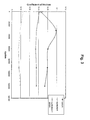
- It is known that proteins tend to alter the wear rate of UHMWPE. For example, as shown in Fig. 1, the wear rate increases with increasing protein concentration up to a certain protein concentration. Beyond this concentration, the wear rate tends to decrease. In accordance with the present invention, by the use of a surface active agent, it is possible to reduce the wear rate even further. As depicted in Figure 2, the wear rate of UHMWPE in a serum containing 1% surface active agent is less than that in serum alone. Further, as shown in Figure 3, the coefficient of friction of UHMWPE against Co-Cr-Mo counterface is decreased by the use of a surface active agent in the serum.
- Embodiments of the invention will now be described by way of example with reference to the accompanying drawings, in which:
- Figure 1 depicts the known wear rate of UHMWPE bearing material against various counterfaces as a function of the concentration of proteins in the serum.
- Figure 2A depicts the weight change of UHMWPE pin as it rubs against cast CoCrMo counterfaces in water and in bovine calf serum plus 1% by weight surface active agent in accordance with an embodiment of the invention. Figure 2B depicts the weight change of the UHMWPE pins in bovine calf serum only.
- Figure 3 depicts the coefficient of friction between UHMWPE pins and CoCrMo counterfaces as a function of the number of cycles in serum (diamonds), 1% by weight surface active agent (triangles), and serum plus 1% by weight surface active agent (x), in accordance with an embodiment of the invention.
- This example illustrates an advantage of the surface active agent, namely, it reduces the wear rate of UHMWPE.
- UHMWPE pins, 17.8 mm (0.7 inch) long and 9.5 mm (0.375 inch) diameter, manufactured from GUR 1020 resin is ram extruded into bar stock. The pins are sterilized by irradiation. Metal counterfaces, 38.1 mm (1.5 inch) diameter and 12.7 mm (0.5 inch) thick, are fabricated from cast 68% cobalt, 26% chromium, 6% molybdenum, and 0.2% carbon. The counterfaces are hot isostatic pressed and homogenized by heat treatment and polished to an average surface roughness of between 10 and 20 nm. Three disks are obtained for each wear test group. A sample pairing chart including same identifications is shown in the following table.
Sample group Pin Disk Station Serum and surface active agent S1 2B 1 S2 5B 2 S3 6 3 Water W1 7 4 W2 8 5 W3 9 6 Serum 4 43 4 5 44 5 6 45 6 - The wear tests are conducted on a Pin-on-Disk (POD) machine (AMTI OrthoPOD). The pins move in a 10 mm by 10 mm square pattern with respect to the disk, providing a maximum amount of cross shear motion. A Paul loading cycle with a peak of 330N is applied (Paul, J., Forces transmitted by joints in the human body, Proc. Inst. Mech. Eng., 181, 8-15 (1967)). The frequency is 1.6 Hz. Six, 0.33 million-cycle data collection intervals are performed for a 1.98 million cycle test duration. Water lost by evaporation is replenished approximately every 24 hours. The test lubricant is discarded at the end of each test interval, and fresh lubricant is added.
- After each data collection interval, each sample pair is rotated clockwise one station for the next interval. During the course of the test all of the samples are tested in all of the stations. Three different lubricants are tested: Reverse Osmosis treated water, Bovine serum (Hyclone Inc. diluted to 90% of the initial concentration and treated with EDTA and sodium azide), and the bovine serum formulation above containing 1% by weight PLURONIC F127 surfactant. Bulk serum temperature is maintained at 37°C.
- Gravimetric data is obtained from the pins as follows. The pins are cleaned and weighed in a microbalance with 0.01 mg resolution. The balance is calibrated with standard weights. Corrections for fluid uptake are applied using standard soak control pins. Contact profilometry of the disks is performed on a Taylor-Hobson Form Talysurf Series II Profilometer. A cut off length of 250 µm, a 100:1 1 bandwidth, and a gauge range of 1 mm are used. Two pairs of perpendicular traces are taken on each sample. Pictures of the pins are taken with a Nikon Epiphot 200/300 Inverted Microscope (metallograph). Pictures of the disks are taken with a Nikon D1 Digital Camera.
- Fig. 2A-B depict the wear rate of UHMWPE pins. The wear rate of the pins is less when a surface active agent is employed.
- This example illustrates an advantage of the present invention, namely, the coefficient of friction between the polymer surface and the hard counterface is reduced.
- Friction data is collected on the same type of pins and disks illustrated in Example 1. The data are obtained on an AMTI OrthoPOD Pin-on-Disk tester equipped with multiaxis strain gauges. The coefficient of friction is calculated by dividing the normal force by the in plane force during the same 10 mm by 10 mm test pattern and Paul load cycle used in wear testing. The friction data is collected over a small portion of the test pattern between the peaks of the Paul loading curve. Fig. 3 depicts the reduction in the coefficient of friction brought about by the use of the surfactant. Each point in Fig. 3 is the average of approximately 30 data points.
Claims (23)
- A bearing material of a medical implant comprising a polymer and a surface active agent that is not covalently bonded to the polymer, wherein the bearing material is adopted for articulating against a hard counterface of the medical implant.
- The bearing material of claim 1, wherein the polymer comprises polyethylene.
- The bearing material of claim 2, wherein the polyethylene is ultrahigh molecular weight polyethylene (UHMWPE).
- The bearing material of claim 1, wherein the surface active agent is an anionic, cationic, nonionic, or amphoteric surface active agent.
- The bearing material of claim 4, wherein the surface active agent is a nonionic surface active agent.
- The bearing material of claim 5, wherein the nonionic surface active agent comprises a block copolymer of hydrophilic and hydrophobic blocks.
- The bearing material of claim 6, wherein the block copolymer is an A-B, A-B-A, or B-A-B block copolymer, wherein A is a hydrophilic block and B is a hydrophobic block.
- The bearing material of claim 7, wherein A is polyethylene oxide (PEO) and B is polypropylene oxide (PPO).
- The bearing material of claim 8, wherein the molecular weight of the copolymer is from about 100 to about 20,000 g.mole-1.
- The bearing material of claim 9, wherein the molecular weight of the copolymer is about 12,600 g.mole-1.
- A method of reducing the wear rate of a polymeric bearing material of a medical implant, said bearing material having a bearing surface, said bearing surface articulating against a hard counterface of the medical implant in the presence of synovial fluid, the method comprising providing a surface active agent in the synovial fluid in close proximity to the bearing surface, the hard counterface, or both.
- The method of claim 11, wherein the bearing material includes a surface active agent that migrates to the interface between the synovial fluid and the bearing surface.
- The method of claim 11, wherein the hard counterface includes a surface active agent and releases said surface active agent into the synovial fluid in close proximity to the hard counterface.
- The method of claim 11, wherein the surface active agent is provided by injecting the surface active agent into the synovial fluid.
- The method of claim 11, wherein the surface active agent is provided such that it elutes from a non-articulating portion of the medical implant.
- The method of claim 11, wherein the polymer is polyethylene.
- The method of claim 16, wherein the polyethylene is ultrahigh molecular weight polyethylene.
- The method of claim 11, wherein the surface active agent is an anionic, cationic, nonionic, or amphoteric surface active agent.
- The method of claim 18, wherein the surface active agent is a nonionic surface active agent.
- The method of claim 19, wherein the nonionic surface active agent comprises a block copolymer of hydrophilic and hydrophobic blocks.
- The method of claim 20, wherein the block copolymer is an A-B, A-B-A, or B-A-B block copolymer, wherein A is a hydrophilic block and B is a hydrophobic block.
- The method of claim 21, wherein A is polyethylene oxide (PEO) and B is polypropylene oxide (PPO).
- The method of claim 11, which includes reducing the coefficient of friction between the bearing surface and the opposing surface.
Applications Claiming Priority (1)
| Application Number | Priority Date | Filing Date | Title |
|---|---|---|---|
| US11/394,423 US7812098B2 (en) | 2006-03-31 | 2006-03-31 | Bearing material of medical implant having reduced wear rate and method for reducing wear rate |
Publications (3)
| Publication Number | Publication Date |
|---|---|
| EP1839685A2 true EP1839685A2 (en) | 2007-10-03 |
| EP1839685A3 EP1839685A3 (en) | 2008-01-02 |
| EP1839685B1 EP1839685B1 (en) | 2011-10-05 |
Family
ID=38331498
Family Applications (1)
| Application Number | Title | Priority Date | Filing Date |
|---|---|---|---|
| EP20070251351 Active EP1839685B1 (en) | 2006-03-31 | 2007-03-28 | Bearing material for a medical implant |
Country Status (6)
| Country | Link |
|---|---|
| US (1) | US7812098B2 (en) |
| EP (1) | EP1839685B1 (en) |
| JP (1) | JP5128158B2 (en) |
| CN (1) | CN101049517A (en) |
| AT (1) | ATE527002T1 (en) |
| AU (1) | AU2007201379B2 (en) |
Cited By (2)
| Publication number | Priority date | Publication date | Assignee | Title |
|---|---|---|---|---|
| EP1882483A3 (en) * | 2006-07-28 | 2008-03-26 | DePuy Products, Inc. | Medical implant bearing material |
| US7812098B2 (en) | 2006-03-31 | 2010-10-12 | Depuy Products, Inc. | Bearing material of medical implant having reduced wear rate and method for reducing wear rate |
Families Citing this family (6)
| Publication number | Priority date | Publication date | Assignee | Title |
|---|---|---|---|---|
| US20110066253A1 (en) * | 2008-11-24 | 2011-03-17 | Depuy Products, Inc. | Ceramic coated orthopaedic implants and method of making such implants |
| CN101810884A (en) * | 2010-03-19 | 2010-08-25 | 中国矿业大学 | Antioxidant ultra-low abrasion ultra-high molecular weight polyethylene hip cotyle |
| US10646574B2 (en) | 2014-07-21 | 2020-05-12 | Board Of Regents, The University Of Texas System | Formulations of intraarticular pharmaceutical agents and methods for preparing and using the same |
| CN105031721A (en) * | 2015-06-16 | 2015-11-11 | 江南大学 | Preparation method and application of hip joint socket |
| CN110152072B (en) * | 2019-06-27 | 2021-09-21 | 合肥工业大学 | Preparation method of joint synovial fluid for reducing wear of titanium alloy artificial joint material |
| CN110607014A (en) * | 2019-08-29 | 2019-12-24 | 福建师范大学 | A preparation method of high-strength and high-toughness electromagnetic shielding composite material |
Family Cites Families (79)
| Publication number | Priority date | Publication date | Assignee | Title |
|---|---|---|---|---|
| US62264A (en) * | 1867-02-19 | Improvement in land conveyance | ||
| DE227328C (en) | ||||
| NL262650A (en) | 1960-03-23 | |||
| JPS5018909B2 (en) | 1971-11-09 | 1975-07-02 | ||
| US3954927A (en) | 1973-02-05 | 1976-05-04 | Sun Ventures, Inc. | Method of making porous objects of ultra high molecular weight polyethylene |
| US4454612A (en) | 1980-05-07 | 1984-06-19 | Biomet, Inc. | Prosthesis formation having solid and porous polymeric components |
| CA1142883A (en) | 1980-09-04 | 1983-03-15 | George White | Process for irradiation of polyethylene |
| JPS60252645A (en) | 1984-05-30 | 1985-12-13 | Sekisui Chem Co Ltd | Ultra-high molecular weight polyethylene composition |
| US4670508A (en) | 1984-01-06 | 1987-06-02 | Mitsui Petrochemical Industries Ltd. | Thermoplastic resin composition |
| EP0175769B1 (en) | 1984-03-29 | 1990-10-31 | Hoechst Celanese Corporation | Polyethylene molding composition and process |
| US5082655A (en) * | 1984-07-23 | 1992-01-21 | Zetachron, Inc. | Pharmaceutical composition for drugs subject to supercooling |
| US4778601A (en) | 1984-10-09 | 1988-10-18 | Millipore Corporation | Microporous membranes of ultrahigh molecular weight polyethylene |
| EP0198904A1 (en) | 1984-10-24 | 1986-10-29 | ZACHARIADES, Anagnostis E. | Ultra-high-molecular-weight polyethylene products including vascular prosthesis devices and methods relating thereto and employing pseudo-gel states |
| US5403592A (en) | 1987-08-25 | 1995-04-04 | Macnaught Pty Limited | Lubricant composition for rheumatism |
| US4880843A (en) | 1988-03-28 | 1989-11-14 | Hoechst Celanese Corporation | Composition and process for making porous articles from ultra high molecular weight polyethylene |
| US5275838A (en) | 1990-02-28 | 1994-01-04 | Massachusetts Institute Of Technology | Immobilized polyethylene oxide star molecules for bioapplications |
| JP2957021B2 (en) | 1991-01-25 | 1999-10-04 | テルモ株式会社 | Medical material, medical device, and method of manufacturing medical material |
| JP3008507B2 (en) * | 1991-01-28 | 2000-02-14 | 松下電器産業株式会社 | Artificial joint and manufacturing method thereof |
| US5288818A (en) | 1991-08-20 | 1994-02-22 | Exxon Chemical Patents Inc. | Method for separating a water soluble noble metal catalyst from a noble metal catalyzed hydroformylation reaction |
| US5414049A (en) | 1993-06-01 | 1995-05-09 | Howmedica Inc. | Non-oxidizing polymeric medical implant |
| US5593719A (en) | 1994-03-29 | 1997-01-14 | Southwest Research Institute | Treatments to reduce frictional wear between components made of ultra-high molecular weight polyethylene and metal alloys |
| ES2138699T3 (en) | 1994-04-11 | 2000-01-16 | Bristol Myers Squibb Co | IMPLANT OF POLYMERIC COMPOSITE MATERIAL AND MANUFACTURING PROCEDURE. |
| DE4421270A1 (en) | 1994-06-20 | 1995-12-21 | Henkel Kgaa | Aqueous fatty alcohol dispersions |
| CA2166450C (en) | 1995-01-20 | 2008-03-25 | Ronald Salovey | Chemically crosslinked ultrahigh molecular weight polyethylene for artificial human joints |
| US5594055A (en) | 1995-02-22 | 1997-01-14 | Hoffmann-La Roche Inc. | Antioxidant system for polyolefins |
| US5641502A (en) * | 1995-06-07 | 1997-06-24 | United States Surgical Corporation | Biodegradable moldable surgical material |
| AUPN723395A0 (en) | 1995-12-19 | 1996-01-18 | Macnaught Medical Pty Limited | Lubrication methods |
| US5879400A (en) | 1996-02-13 | 1999-03-09 | Massachusetts Institute Of Technology | Melt-irradiated ultra high molecular weight polyethylene prosthetic devices |
| US5721334A (en) | 1996-02-16 | 1998-02-24 | Newyork Society For The Ruptured And Crippled Maintaining The Hospital For Special Surgery | Process for producing ultra-high molecular weight low modulus polyethylene shaped articles via controlled pressure and temperature and compositions and articles produced therefrom |
| US5844027A (en) | 1996-05-03 | 1998-12-01 | Ciba Specialty Chemicals Corporation | Stabilizer composition for thermoplastic materials |
| JP2000514481A (en) | 1996-07-09 | 2000-10-31 | ザ オーソピーディック ホスピタル | Crosslinking of low wear polyethylene using radiation and heat treatment |
| US6228900B1 (en) | 1996-07-09 | 2001-05-08 | The Orthopaedic Hospital And University Of Southern California | Crosslinking of polyethylene for low wear using radiation and thermal treatments |
| US5827904A (en) | 1996-09-27 | 1998-10-27 | Hahn; David | Medical implant composition |
| US6017975A (en) | 1996-10-02 | 2000-01-25 | Saum; Kenneth Ashley | Process for medical implant of cross-linked ultrahigh molecular weight polyethylene having improved balance of wear properties and oxidation resistance |
| EP1028760B1 (en) | 1996-10-15 | 2004-04-14 | Orthopaedic Hospital | Wear resistant surface-gradient cross-linked polyethylene |
| US5945457A (en) | 1997-10-01 | 1999-08-31 | A.V. Topchiev Institute Of Petrochemical Synthesis, Russian Academy Of Science | Process for preparing biologically compatible polymers and their use in medical devices |
| DE19750121C1 (en) | 1997-11-13 | 1999-04-08 | Eska Implants Gmbh & Co | Sliding surfaces for an artificial joint |
| US6123990A (en) | 1998-05-26 | 2000-09-26 | Henkel Corporation | Anti-static lubricant composition and method of making same |
| US6443991B1 (en) * | 1998-09-21 | 2002-09-03 | Depuy Orthopaedics, Inc. | Posterior stabilized mobile bearing knee |
| EP0995449A1 (en) | 1998-10-21 | 2000-04-26 | Sulzer Orthopädie AG | UHMW-polyethylene for implants |
| AU1926100A (en) | 1998-11-30 | 2000-06-19 | Regents Of The University Of California, The | Plasma-assisted surface modification of polymers for medical device applications |
| SE9900519D0 (en) | 1999-02-17 | 1999-02-17 | Lars Lidgren | A method for the preparation of UHMWPE doped with an antioxidant and an implant made thereof |
| DK1168934T3 (en) | 1999-04-12 | 2008-05-13 | Cornell Res Foundation Inc | Hydrogel forming system with hydrophobic and hydrophilic components |
| FR2793245B1 (en) * | 1999-05-05 | 2002-10-11 | Adir | NOVEL SUBSTITUTED PYRIDINIC OR PIPERIDINIC COMPOUNDS, PROCESS FOR THEIR PREPARATION AND THE PHARMACEUTICAL COMPOSITIONS CONTAINING THEM |
| US6365089B1 (en) | 1999-09-24 | 2002-04-02 | Zimmer, Inc. | Method for crosslinking UHMWPE in an orthopaedic implant |
| US6395799B1 (en) | 2000-02-21 | 2002-05-28 | Smith & Nephew, Inc. | Electromagnetic and mechanical wave energy treatments of UHMWPE |
| US6846875B2 (en) | 2000-04-10 | 2005-01-25 | Pharmacia Groningen Bv | Hydrogels and methods for their production |
| EP2275052A1 (en) | 2000-04-27 | 2011-01-19 | Orthopaedic Hospital | Oxidation-resistant and wear-resistant polyethylenes for human joint replacements and methods for making them |
| US6800298B1 (en) | 2000-05-11 | 2004-10-05 | Clemson University | Biological lubricant composition and method of applying lubricant composition |
| JP4489914B2 (en) * | 2000-07-27 | 2010-06-23 | 浜松ホトニクス株式会社 | A / D converter and solid-state imaging device |
| WO2002026464A1 (en) | 2000-09-29 | 2002-04-04 | Depuy Orthopaedics, Inc. | Supercritical fluid treatment of irradiated polyethylene |
| US6818172B2 (en) | 2000-09-29 | 2004-11-16 | Depuy Products, Inc. | Oriented, cross-linked UHMWPE molding for orthopaedic applications |
| US7662954B2 (en) | 2001-10-30 | 2010-02-16 | Colorado State University Research Foundation | Outer layer having entanglement of hydrophobic polymer host and hydrophilic polymer guest |
| WO2003049930A1 (en) | 2001-12-12 | 2003-06-19 | Depuy Products, Inc. | Orthopaedic device and method for making same |
| US6743388B2 (en) | 2001-12-31 | 2004-06-01 | Advanced Cardiovascular Systems, Inc. | Process of making polymer articles |
| WO2003059200A1 (en) | 2002-01-04 | 2003-07-24 | Massachusetts General Hospital | A high modulus crosslinked polyethylene with reduced residual free radical concentration prepared below the melt |
| US7186364B2 (en) | 2002-01-28 | 2007-03-06 | Depuy Products, Inc. | Composite prosthetic bearing constructed of polyethylene and an ethylene-acrylate copolymer and method for making the same |
| US7819925B2 (en) | 2002-01-28 | 2010-10-26 | Depuy Products, Inc. | Composite prosthetic bearing having a crosslinked articulating surface and method for making the same |
| WO2003070289A1 (en) | 2002-02-19 | 2003-08-28 | Kabushiki Kaisha Kobe Seiko Sho | Artificial joint member made of polymeric material |
| US7238744B2 (en) | 2002-04-12 | 2007-07-03 | Daramic, Inc. | Ultrahigh molecular weight polyethylene articles and method of manufacture |
| US20040019366A1 (en) * | 2002-07-25 | 2004-01-29 | Rottenberg William B. | System and method for classification of cardiac activity using multiple sensing locations |
| US20040068322A1 (en) | 2002-10-04 | 2004-04-08 | Ferree Bret A. | Reduced-friction artificial joints and components therefor |
| US20060085080A1 (en) | 2002-10-11 | 2006-04-20 | Cartificial A/S | Medical device comprising a bio-compatible polymeric product with a layered structure |
| US20050019366A1 (en) | 2002-12-31 | 2005-01-27 | Zeldis Jerome B. | Drug-coated stents and methods of use therefor |
| EP2671538A1 (en) | 2003-01-16 | 2013-12-11 | Massachusetts General Hospital | Methods For Making Oxidation Resistant Polymeric Material |
| AU2004211991B2 (en) | 2003-02-12 | 2011-03-31 | Syncera, Inc. | Random and non-random alkylene oxide polymer alloy compositions |
| US7938861B2 (en) | 2003-04-15 | 2011-05-10 | Depuy Products, Inc. | Implantable orthopaedic device and method for making the same |
| US20040265165A1 (en) | 2003-06-30 | 2004-12-30 | Depuy Products, Inc. | Free radical quench process for irradiated ultrahigh molecular weight polyethylene |
| US20040262809A1 (en) | 2003-06-30 | 2004-12-30 | Smith Todd S. | Crosslinked polymeric composite for orthopaedic implants |
| US7214764B2 (en) | 2003-06-30 | 2007-05-08 | Depuy Products, Inc. | Free radical quench process for irradiated ultrahigh molecular weight polyethylene |
| US20050065307A1 (en) * | 2003-09-19 | 2005-03-24 | Depuy Products, Inc. | Medical implant or medical implant part comprising porous UHMWPE and process for producing the same |
| US7205051B2 (en) | 2003-09-30 | 2007-04-17 | Depuy Products, Inc. | Medical implant or medical implant part |
| JP4482379B2 (en) * | 2004-06-15 | 2010-06-16 | 瑞穂医科工業株式会社 | Implant for artificial joint and method for manufacturing the same |
| US7384430B2 (en) | 2004-06-30 | 2008-06-10 | Depuy Products, Inc. | Low crystalline polymeric material for orthopaedic implants and an associated method |
| US7335697B2 (en) * | 2004-12-23 | 2008-02-26 | Depuy Products, Inc. | Polymer composition comprising cross-linked polyethylene and methods for making the same |
| US7879275B2 (en) | 2004-12-30 | 2011-02-01 | Depuy Products, Inc. | Orthopaedic bearing and method for making the same |
| US7896921B2 (en) | 2004-12-30 | 2011-03-01 | Depuy Products, Inc. | Orthopaedic bearing and method for making the same |
| US8343230B2 (en) | 2005-09-22 | 2013-01-01 | Depuy Products, Inc. | Orthopaedic bearing material |
| US7812098B2 (en) | 2006-03-31 | 2010-10-12 | Depuy Products, Inc. | Bearing material of medical implant having reduced wear rate and method for reducing wear rate |
-
2006
- 2006-03-31 US US11/394,423 patent/US7812098B2/en active Active
-
2007
- 2007-03-28 EP EP20070251351 patent/EP1839685B1/en active Active
- 2007-03-28 AT AT07251351T patent/ATE527002T1/en not_active IP Right Cessation
- 2007-03-29 AU AU2007201379A patent/AU2007201379B2/en active Active
- 2007-03-30 JP JP2007091389A patent/JP5128158B2/en active Active
- 2007-03-30 CN CNA2007101016191A patent/CN101049517A/en active Pending
Non-Patent Citations (1)
| Title |
|---|
| PAUL, J.: "Forces transmitted by joints in the human body", PROC. INST. MECH. ENG., vol. 181, 1967, pages 8 - 15 |
Cited By (2)
| Publication number | Priority date | Publication date | Assignee | Title |
|---|---|---|---|---|
| US7812098B2 (en) | 2006-03-31 | 2010-10-12 | Depuy Products, Inc. | Bearing material of medical implant having reduced wear rate and method for reducing wear rate |
| EP1882483A3 (en) * | 2006-07-28 | 2008-03-26 | DePuy Products, Inc. | Medical implant bearing material |
Also Published As
| Publication number | Publication date |
|---|---|
| JP2007268277A (en) | 2007-10-18 |
| AU2007201379A1 (en) | 2007-10-18 |
| US7812098B2 (en) | 2010-10-12 |
| EP1839685A3 (en) | 2008-01-02 |
| CN101049517A (en) | 2007-10-10 |
| AU2007201379B2 (en) | 2011-12-01 |
| ATE527002T1 (en) | 2011-10-15 |
| US20070232761A1 (en) | 2007-10-04 |
| JP5128158B2 (en) | 2013-01-23 |
| EP1839685B1 (en) | 2011-10-05 |
Similar Documents
| Publication | Publication Date | Title |
|---|---|---|
| EP1882483B1 (en) | Medical implant bearing material | |
| EP1839685B1 (en) | Bearing material for a medical implant | |
| Oral et al. | Crosslinked polyethylene | |
| JP5752035B2 (en) | Hydrophilic interpenetrating polymer network derived from hydrophobic polymer | |
| US10457803B2 (en) | Orthopedic implants having gradient polymer alloys | |
| Kaddick et al. | Hip simulator wear testing according to the newly introduced standard ISO 14242 | |
| JP5143501B2 (en) | Bearing material for medical implant and manufacturing method thereof | |
| Chowdhury et al. | Wear characteristic and biocompatibility of some polymer composite acetabular cups | |
| Bhatt et al. | Implant wear mechanisms—basic approach | |
| Scholes et al. | The wear properties of CFR-PEEK-OPTIMA articulating against ceramic assessed on a multidirectional pin-on-plate machine | |
| McKellop | Bearing surfaces in total hip replacement: State of the art and future development | |
| Hosseinzadeh et al. | The bearing surfaces in total hip arthroplasty–options, material characteristics and selection | |
| Halma et al. | Edge loading does not increase wear rates of ceramic‐on‐ceramic and metal‐on‐polyethylene articulations | |
| Bragdon et al. | Third-body wear testing of a highly cross-linked acetabular liner: the effect of large femoral head size in the presence of particulate poly (methyl-methacrylate) debris | |
| Pritchett | Very large diameter polymer acetabular liners show promising wear simulator results | |
| Shen et al. | Surface-gradient cross-linked polyethylene acetabular cups: oxidation resistance and wear against smooth and rough femoral balls. | |
| Medley et al. | Hydrophilic polyurethane elastomers for hemiarthroplasty: a preliminary in vitro wear study | |
| John | The effect of serum protein concentration on wear rates in a hip simulator | |
| CN114209473A (en) | Joint friction pair and joint prosthesis | |
| Burger | Failure analysis of ultra-high molecular weight polyethyelene acetabular cups | |
| Sitton et al. | Residue analysis on RPVOT test samples for single and multiple antioxidants chemistry for turbine lubricants | |
| Silva et al. | Polyethylene in total knee arthroplasty | |
| Kraft | Impact of the processing history on the wear performance of a PEEK-on-PEEK bearing for cervical total disc replacement | |
| Laurent et al. | The wear of highly crosslinked UHMWPE in the presence of abrasive particles: hip and knee simulator studies | |
| Zippel et al. | Bioceramics in joint arthroplasty |
Legal Events
| Date | Code | Title | Description |
|---|---|---|---|
| PUAI | Public reference made under article 153(3) epc to a published international application that has entered the european phase |
Free format text: ORIGINAL CODE: 0009012 |
|
| AK | Designated contracting states |
Kind code of ref document: A2 Designated state(s): AT BE BG CH CY CZ DE DK EE ES FI FR GB GR HU IE IS IT LI LT LU LV MC MT NL PL PT RO SE SI SK TR |
|
| AX | Request for extension of the european patent |
Extension state: AL BA HR MK YU |
|
| PUAL | Search report despatched |
Free format text: ORIGINAL CODE: 0009013 |
|
| RIC1 | Information provided on ipc code assigned before grant |
Ipc: A61L 27/16 20060101AFI20070815BHEP Ipc: A61L 27/50 20060101ALI20071122BHEP Ipc: A61L 27/18 20060101ALI20071122BHEP Ipc: A61L 27/14 20060101ALI20071122BHEP |
|
| AK | Designated contracting states |
Kind code of ref document: A3 Designated state(s): AT BE BG CH CY CZ DE DK EE ES FI FR GB GR HU IE IS IT LI LT LU LV MC MT NL PL PT RO SE SI SK TR |
|
| AX | Request for extension of the european patent |
Extension state: AL BA HR MK YU |
|
| 17P | Request for examination filed |
Effective date: 20080502 |
|
| 17Q | First examination report despatched |
Effective date: 20080626 |
|
| AKX | Designation fees paid |
Designated state(s): AT BE BG CH CY CZ DE DK EE ES FI FR GB GR HU IE IS IT LI LT LU LV MC MT NL PL PT RO SE SI SK TR |
|
| GRAP | Despatch of communication of intention to grant a patent |
Free format text: ORIGINAL CODE: EPIDOSNIGR1 |
|
| GRAS | Grant fee paid |
Free format text: ORIGINAL CODE: EPIDOSNIGR3 |
|
| GRAA | (expected) grant |
Free format text: ORIGINAL CODE: 0009210 |
|
| AK | Designated contracting states |
Kind code of ref document: B1 Designated state(s): AT BE BG CH CY CZ DE DK EE ES FI FR GB GR HU IE IS IT LI LT LU LV MC MT NL PL PT RO SE SI SK TR |
|
| REG | Reference to a national code |
Ref country code: GB Ref legal event code: FG4D |
|
| REG | Reference to a national code |
Ref country code: CH Ref legal event code: NV Representative=s name: E. BLUM & CO. AG PATENT- UND MARKENANWAELTE VSP Ref country code: CH Ref legal event code: EP |
|
| REG | Reference to a national code |
Ref country code: IE Ref legal event code: FG4D |
|
| REG | Reference to a national code |
Ref country code: DE Ref legal event code: R096 Ref document number: 602007017610 Country of ref document: DE Effective date: 20111201 |
|
| REG | Reference to a national code |
Ref country code: NL Ref legal event code: VDEP Effective date: 20111005 |
|
| PG25 | Lapsed in a contracting state [announced via postgrant information from national office to epo] |
Ref country code: SI Free format text: LAPSE BECAUSE OF FAILURE TO SUBMIT A TRANSLATION OF THE DESCRIPTION OR TO PAY THE FEE WITHIN THE PRESCRIBED TIME-LIMIT Effective date: 20111005 |
|
| LTIE | Lt: invalidation of european patent or patent extension |
Effective date: 20111005 |
|
| REG | Reference to a national code |
Ref country code: AT Ref legal event code: MK05 Ref document number: 527002 Country of ref document: AT Kind code of ref document: T Effective date: 20111005 |
|
| PG25 | Lapsed in a contracting state [announced via postgrant information from national office to epo] |
Ref country code: IS Free format text: LAPSE BECAUSE OF FAILURE TO SUBMIT A TRANSLATION OF THE DESCRIPTION OR TO PAY THE FEE WITHIN THE PRESCRIBED TIME-LIMIT Effective date: 20120205 Ref country code: BE Free format text: LAPSE BECAUSE OF FAILURE TO SUBMIT A TRANSLATION OF THE DESCRIPTION OR TO PAY THE FEE WITHIN THE PRESCRIBED TIME-LIMIT Effective date: 20111005 Ref country code: LT Free format text: LAPSE BECAUSE OF FAILURE TO SUBMIT A TRANSLATION OF THE DESCRIPTION OR TO PAY THE FEE WITHIN THE PRESCRIBED TIME-LIMIT Effective date: 20111005 |
|
| PG25 | Lapsed in a contracting state [announced via postgrant information from national office to epo] |
Ref country code: LV Free format text: LAPSE BECAUSE OF FAILURE TO SUBMIT A TRANSLATION OF THE DESCRIPTION OR TO PAY THE FEE WITHIN THE PRESCRIBED TIME-LIMIT Effective date: 20111005 Ref country code: SE Free format text: LAPSE BECAUSE OF FAILURE TO SUBMIT A TRANSLATION OF THE DESCRIPTION OR TO PAY THE FEE WITHIN THE PRESCRIBED TIME-LIMIT Effective date: 20111005 Ref country code: PT Free format text: LAPSE BECAUSE OF FAILURE TO SUBMIT A TRANSLATION OF THE DESCRIPTION OR TO PAY THE FEE WITHIN THE PRESCRIBED TIME-LIMIT Effective date: 20120206 Ref country code: GR Free format text: LAPSE BECAUSE OF FAILURE TO SUBMIT A TRANSLATION OF THE DESCRIPTION OR TO PAY THE FEE WITHIN THE PRESCRIBED TIME-LIMIT Effective date: 20120106 Ref country code: NL Free format text: LAPSE BECAUSE OF FAILURE TO SUBMIT A TRANSLATION OF THE DESCRIPTION OR TO PAY THE FEE WITHIN THE PRESCRIBED TIME-LIMIT Effective date: 20111005 |
|
| PG25 | Lapsed in a contracting state [announced via postgrant information from national office to epo] |
Ref country code: CY Free format text: LAPSE BECAUSE OF FAILURE TO SUBMIT A TRANSLATION OF THE DESCRIPTION OR TO PAY THE FEE WITHIN THE PRESCRIBED TIME-LIMIT Effective date: 20111005 |
|
| PG25 | Lapsed in a contracting state [announced via postgrant information from national office to epo] |
Ref country code: CZ Free format text: LAPSE BECAUSE OF FAILURE TO SUBMIT A TRANSLATION OF THE DESCRIPTION OR TO PAY THE FEE WITHIN THE PRESCRIBED TIME-LIMIT Effective date: 20111005 Ref country code: BG Free format text: LAPSE BECAUSE OF FAILURE TO SUBMIT A TRANSLATION OF THE DESCRIPTION OR TO PAY THE FEE WITHIN THE PRESCRIBED TIME-LIMIT Effective date: 20120105 Ref country code: EE Free format text: LAPSE BECAUSE OF FAILURE TO SUBMIT A TRANSLATION OF THE DESCRIPTION OR TO PAY THE FEE WITHIN THE PRESCRIBED TIME-LIMIT Effective date: 20111005 Ref country code: DK Free format text: LAPSE BECAUSE OF FAILURE TO SUBMIT A TRANSLATION OF THE DESCRIPTION OR TO PAY THE FEE WITHIN THE PRESCRIBED TIME-LIMIT Effective date: 20111005 Ref country code: SK Free format text: LAPSE BECAUSE OF FAILURE TO SUBMIT A TRANSLATION OF THE DESCRIPTION OR TO PAY THE FEE WITHIN THE PRESCRIBED TIME-LIMIT Effective date: 20111005 |
|
| PLBE | No opposition filed within time limit |
Free format text: ORIGINAL CODE: 0009261 |
|
| STAA | Information on the status of an ep patent application or granted ep patent |
Free format text: STATUS: NO OPPOSITION FILED WITHIN TIME LIMIT |
|
| PG25 | Lapsed in a contracting state [announced via postgrant information from national office to epo] |
Ref country code: PL Free format text: LAPSE BECAUSE OF FAILURE TO SUBMIT A TRANSLATION OF THE DESCRIPTION OR TO PAY THE FEE WITHIN THE PRESCRIBED TIME-LIMIT Effective date: 20111005 Ref country code: RO Free format text: LAPSE BECAUSE OF FAILURE TO SUBMIT A TRANSLATION OF THE DESCRIPTION OR TO PAY THE FEE WITHIN THE PRESCRIBED TIME-LIMIT Effective date: 20111005 |
|
| 26N | No opposition filed |
Effective date: 20120706 |
|
| PG25 | Lapsed in a contracting state [announced via postgrant information from national office to epo] |
Ref country code: MC Free format text: LAPSE BECAUSE OF NON-PAYMENT OF DUE FEES Effective date: 20120331 |
|
| REG | Reference to a national code |
Ref country code: DE Ref legal event code: R097 Ref document number: 602007017610 Country of ref document: DE Effective date: 20120706 |
|
| PG25 | Lapsed in a contracting state [announced via postgrant information from national office to epo] |
Ref country code: AT Free format text: LAPSE BECAUSE OF FAILURE TO SUBMIT A TRANSLATION OF THE DESCRIPTION OR TO PAY THE FEE WITHIN THE PRESCRIBED TIME-LIMIT Effective date: 20111005 |
|
| PG25 | Lapsed in a contracting state [announced via postgrant information from national office to epo] |
Ref country code: ES Free format text: LAPSE BECAUSE OF FAILURE TO SUBMIT A TRANSLATION OF THE DESCRIPTION OR TO PAY THE FEE WITHIN THE PRESCRIBED TIME-LIMIT Effective date: 20120116 |
|
| PG25 | Lapsed in a contracting state [announced via postgrant information from national office to epo] |
Ref country code: FI Free format text: LAPSE BECAUSE OF FAILURE TO SUBMIT A TRANSLATION OF THE DESCRIPTION OR TO PAY THE FEE WITHIN THE PRESCRIBED TIME-LIMIT Effective date: 20111005 |
|
| PG25 | Lapsed in a contracting state [announced via postgrant information from national office to epo] |
Ref country code: MT Free format text: LAPSE BECAUSE OF FAILURE TO SUBMIT A TRANSLATION OF THE DESCRIPTION OR TO PAY THE FEE WITHIN THE PRESCRIBED TIME-LIMIT Effective date: 20111005 |
|
| PG25 | Lapsed in a contracting state [announced via postgrant information from national office to epo] |
Ref country code: TR Free format text: LAPSE BECAUSE OF FAILURE TO SUBMIT A TRANSLATION OF THE DESCRIPTION OR TO PAY THE FEE WITHIN THE PRESCRIBED TIME-LIMIT Effective date: 20111005 |
|
| PG25 | Lapsed in a contracting state [announced via postgrant information from national office to epo] |
Ref country code: LU Free format text: LAPSE BECAUSE OF NON-PAYMENT OF DUE FEES Effective date: 20120328 |
|
| PG25 | Lapsed in a contracting state [announced via postgrant information from national office to epo] |
Ref country code: HU Free format text: LAPSE BECAUSE OF FAILURE TO SUBMIT A TRANSLATION OF THE DESCRIPTION OR TO PAY THE FEE WITHIN THE PRESCRIBED TIME-LIMIT Effective date: 20070328 |
|
| REG | Reference to a national code |
Ref country code: FR Ref legal event code: PLFP Year of fee payment: 10 |
|
| REG | Reference to a national code |
Ref country code: FR Ref legal event code: PLFP Year of fee payment: 11 |
|
| REG | Reference to a national code |
Ref country code: FR Ref legal event code: PLFP Year of fee payment: 12 |
|
| PGFP | Annual fee paid to national office [announced via postgrant information from national office to epo] |
Ref country code: FR Payment date: 20220209 Year of fee payment: 16 |
|
| PG25 | Lapsed in a contracting state [announced via postgrant information from national office to epo] |
Ref country code: FR Free format text: LAPSE BECAUSE OF NON-PAYMENT OF DUE FEES Effective date: 20230331 |
|
| PGFP | Annual fee paid to national office [announced via postgrant information from national office to epo] |
Ref country code: IT Payment date: 20250211 Year of fee payment: 19 |
|
| PGFP | Annual fee paid to national office [announced via postgrant information from national office to epo] |
Ref country code: CH Payment date: 20250401 Year of fee payment: 19 |
|
| PGFP | Annual fee paid to national office [announced via postgrant information from national office to epo] |
Ref country code: GB Payment date: 20260209 Year of fee payment: 20 |
|
| PGFP | Annual fee paid to national office [announced via postgrant information from national office to epo] |
Ref country code: DE Payment date: 20260204 Year of fee payment: 20 Ref country code: IE Payment date: 20260211 Year of fee payment: 20 |