EP1837375A2 - Curable silicone composition - Google Patents
Curable silicone composition Download PDFInfo
- Publication number
- EP1837375A2 EP1837375A2 EP07104798A EP07104798A EP1837375A2 EP 1837375 A2 EP1837375 A2 EP 1837375A2 EP 07104798 A EP07104798 A EP 07104798A EP 07104798 A EP07104798 A EP 07104798A EP 1837375 A2 EP1837375 A2 EP 1837375A2
- Authority
- EP
- European Patent Office
- Prior art keywords
- cyclopolysiloxane
- group
- component
- following formula
- composition
- Prior art date
- Legal status (The legal status is an assumption and is not a legal conclusion. Google has not performed a legal analysis and makes no representation as to the accuracy of the status listed.)
- Withdrawn
Links
- 0 C*[Si](*)(O[Si+](C)O*(C)*)O[Si](*C)(N)O Chemical compound C*[Si](*)(O[Si+](C)O*(C)*)O[Si](*C)(N)O 0.000 description 2
- DYJNQVUXRPQXGL-UHFFFAOYSA-N CCCCC[O](C1C(C2)C=CC2C1)=C Chemical compound CCCCC[O](C1C(C2)C=CC2C1)=C DYJNQVUXRPQXGL-UHFFFAOYSA-N 0.000 description 1
Classifications
-
- C—CHEMISTRY; METALLURGY
- C08—ORGANIC MACROMOLECULAR COMPOUNDS; THEIR PREPARATION OR CHEMICAL WORKING-UP; COMPOSITIONS BASED THEREON
- C08G—MACROMOLECULAR COMPOUNDS OBTAINED OTHERWISE THAN BY REACTIONS ONLY INVOLVING UNSATURATED CARBON-TO-CARBON BONDS
- C08G77/00—Macromolecular compounds obtained by reactions forming a linkage containing silicon with or without sulfur, nitrogen, oxygen or carbon in the main chain of the macromolecule
- C08G77/48—Macromolecular compounds obtained by reactions forming a linkage containing silicon with or without sulfur, nitrogen, oxygen or carbon in the main chain of the macromolecule in which at least two but not all the silicon atoms are connected by linkages other than oxygen atoms
- C08G77/50—Macromolecular compounds obtained by reactions forming a linkage containing silicon with or without sulfur, nitrogen, oxygen or carbon in the main chain of the macromolecule in which at least two but not all the silicon atoms are connected by linkages other than oxygen atoms by carbon linkages
-
- C—CHEMISTRY; METALLURGY
- C08—ORGANIC MACROMOLECULAR COMPOUNDS; THEIR PREPARATION OR CHEMICAL WORKING-UP; COMPOSITIONS BASED THEREON
- C08L—COMPOSITIONS OF MACROMOLECULAR COMPOUNDS
- C08L83/00—Compositions of macromolecular compounds obtained by reactions forming in the main chain of the macromolecule a linkage containing silicon with or without sulfur, nitrogen, oxygen or carbon only; Compositions of derivatives of such polymers
- C08L83/04—Polysiloxanes
-
- C—CHEMISTRY; METALLURGY
- C08—ORGANIC MACROMOLECULAR COMPOUNDS; THEIR PREPARATION OR CHEMICAL WORKING-UP; COMPOSITIONS BASED THEREON
- C08G—MACROMOLECULAR COMPOUNDS OBTAINED OTHERWISE THAN BY REACTIONS ONLY INVOLVING UNSATURATED CARBON-TO-CARBON BONDS
- C08G77/00—Macromolecular compounds obtained by reactions forming a linkage containing silicon with or without sulfur, nitrogen, oxygen or carbon in the main chain of the macromolecule
- C08G77/04—Polysiloxanes
- C08G77/12—Polysiloxanes containing silicon bound to hydrogen
-
- C—CHEMISTRY; METALLURGY
- C08—ORGANIC MACROMOLECULAR COMPOUNDS; THEIR PREPARATION OR CHEMICAL WORKING-UP; COMPOSITIONS BASED THEREON
- C08G—MACROMOLECULAR COMPOUNDS OBTAINED OTHERWISE THAN BY REACTIONS ONLY INVOLVING UNSATURATED CARBON-TO-CARBON BONDS
- C08G77/00—Macromolecular compounds obtained by reactions forming a linkage containing silicon with or without sulfur, nitrogen, oxygen or carbon in the main chain of the macromolecule
- C08G77/04—Polysiloxanes
- C08G77/20—Polysiloxanes containing silicon bound to unsaturated aliphatic groups
Definitions
- the present invention relates to a composition having excellent heat resistance and petroleum solvent resistance, specifically to a composition comprising a cyclopolysiloxane having norbornenyl and vinyl groups each bonded to a silicon atom, a multifunctional organohydrogensiloxane, a bifunctional cyclic organohydrogensiloxane, and an addition reaction catalyst.
- magnetic devices are widely used as industrial parts such as automotive sensors.
- these parts are produced by compounding magnetic powder with an organic binder and curing and/or molding the binder.
- the molded compounds are required not to swell in hydrocarbon solvents as well as to have excellent mechanical strength and heat resistance.
- An object of the present invention is to provide a curable composition which forms a flexible and solvent resistant cured product and is suitable as a binder for powder.
- the present invention is a composition comprising
- the present composition comprises both a component to attain mechanical strength and a component to attain flexibility to form a cured product having mechanical strength, heat resistance and solvent resistance.
- the composition is suitable as a binder of molded automotive parts.
- the component (A) is a cyclopolysiloxane represented by the above formula (1) having a norbornenyl group and/or a vinyl group.
- the component (A) may be a mixture of two or more of the cyclopolysiloxane.
- the norbornenyl group is essential.
- a composition that differs from the present composition only in absence of a norbornenyl group has been found to form a cured product having many cracks on its surface. This indicates that the norbornenyl moiety gives flexibility to a cured product of the present composition.
- siloxane units having a vinyl group and those having a norbornenyl group may be bonded randomly.
- R 1 and R 2 are alkyl groups which may be different from each other.
- R 1 and R 2 include alkyl groups such as methyl, ethyl, propyl, isopropyl, butyl, tert-butyl, pentyl, isopentyl, hexyl and sec-hexyl groups; cycloalkyl groups such as cyclopentyl and cyclohexyl groups; halogenated groups thereof such as chloromethyl, 3-chloroprpyl, and 3,3,3-trifluoropropyl groups; and cyanoalkyl groups such as 2-cyanoethyl group, among which methyl group is preferred.
- each of m and n is an integer of from 0 to 10, preferably from 1 to 6, with m+n being 3 or larger, preferably ranging from 4 to 10.
- the cyclopolysiloxane of the formula (1) can be easily prepared by subjecting a cyclopolysiloxane having a vinyl group and cyclepentadiene, which can be obtained by pyrolyzing dicyclopentadiene, to Diels-Alder reaction to convert the vinyl group to a norbornenyl group.
- a cyclopolysiloxane having both vinyl and norbornenyl groups By using a cyclopolysiloxane having a plurality of vinyl groups and converting a part of the vinyl groups to a norbornenyl group, a cyclopolysiloxane having both vinyl and norbornenyl groups can be obtained.
- the one with m being 0 represents a unreacted cyclopolysiloxane possibly remaining in a reaction product.
- the component (B) is a polycyclopolysiloxane having a cyclopolysiloxane unit represented by the following formula (2).
- the component (B) can be a mixture of two or more of the polycyclopolysiloxane.
- R 4 is a substituted or unsbustituted alkyl group having 1 to 12 carbon atoms which may be the same with or different from each other; j and k are integers of from 1 to 9 with j + k being 3 or larger; Y is an alkylene group having 1 to 10 carbon atoms.
- R 4 examples include alkyl groups such as methyl, ethyl, propyl, isopropyl, butyl, tert-butyl, pentyl, isopentyl, hexyl and sec-hexyl groups; cycloalkyl groups such as cyclopentyl and cyclohexyl groups; halogenated groups thereof such as chloromethyl, 3-chloroprpyl, and 3,3,3-trifluoropropyl groups; and cyanoalkyl groups such as 2-cyanoethyl group, among which methyl group is preferred.
- siloxane units may be bonded randomly.
- each of j and k is an integer of from 1 to 6, more preferably from 1 to 4.
- Y is an alkylene group having 2 to 4 carbon atoms.
- Examples of preferred cyclopolysiloxane unit are those having one alkylene group, two alkylene groups, three alkylene groups and four alkylene groups as shown below: wherein Me represents a methyl group and Y is as defined above.
- a preferred polycyclopolysiloxane (B) has the following repeating unit.
- the polycyclosiloxane (B) has 1 to 100, preferably 1 to 50 repeating units.
- the component (B) can be prepared by subjecting a cyclopolysiloxane (b1) having a hydrogen atom in place of Y in the above formula (1) and a cyclopolysiloxane (b2) having an alkylene group to an addition reaction.
- cyclopolysiloxane (b1) is represented by the following formula (4) : wherein R 5 and R 6 which may be the same with or different from each other and are selected from the groups listed for R 4 , among which a methyl group is preferred, r is an integer of from 2 to 10, preferably from 2 to 8 and s is an integer of from 0 to 7, preferably from 0 to 2 with r+s ranging from 3 to 10, preferably from 3 to 6.
- siloxane units may be bonded randomly.
- Examples of the cyclopolysiloxane (b1) include 1,3,5,7-tetramethylcyclotetrasiloxane, 1,3,5,7,9-pentamethylcyclopentasiloxane, 1,3,5,7,9,11-hexamethylcyclohexasiloxane, and a mixture thereof, among which 1,3,5,7-tetramethylcyclotetrasiloxane is preferred because of easy production and good availability.
- R 8 and R 9 which may be the same with or different from each other and are selected from the groups listed for R 4 , among which a methyl group is preferred.
- R 7 is an alkenyl group having 2 to 10 carbon atoms
- t is an integer of from 2 to 10, preferably from 2 to 8
- u is an integer of from 0 to 7, preferably from 0 to 2, with t+u ranging from 3 to 10, preferably from 3 to 6.
- each siloxane unit may be bonded randomly.
- R 7 examples include alkenyl groups such as vinyl, allyl, propenyl, butenyl, pentenyl, and hexenyl groups, among which a vinyl group is preferred.
- Examples of the cyclopolysiloxane (b2) include 1,3,5,7-tetravinyl-1,3,5,7-tetramethylcyclotetrasiloxane, 1,3,5,7,9-pantavinyl-1,3,5,7,9-pentamethylcyclopentaslloxane, 1,3,5,7,9,11-hexavinyl-1,3,5,7,9,11-hexamehtylcyolohexasiloxane and a mixture thereof, among which 1,3,5,7- tetravinyl-1,3,5,7-tetramethylcyclotetrasiloxane is preferred because of easy production and good availability.
- the component (B) can be prepared by subjecting aforesaid (b1) and (b2) to an addition reaction in such an amount that a molar amount of the SiH bonds of (b1 exceeds that of the alkenyl groups of (b2) in the presence of a hydrosilylation catalyst such as the after-mentioned component (D).
- an amount of the SiH bonds of (b1) is in the range of from 2.0 to 10.0 moles, preferably from 4.0 to 8.0 per mole of the alkenyl groups in (b2).
- the hydrosilylation catalyst can be selected from those listed for the after-mentioned component (D).
- platinum metal deposited on carbon is used for the reason that an addition reaction proceeds moderately, preventing gel formation due to a local vigorous reaction. Further, the platinum metal deposited on carbon can be removed from a reaction mixture easily by filtration, for instance, after the reaction completes. The reaction product thus obtained is storage stable without showing increase in viscosity because of no residual catalyst.
- the component (C) is a cyclopolysiloxane having two SiH bonds per molecule represented by the following formula (3).
- R 3 is a substitute or unsubstituted alkyl group which may be the same with or different from each other, if g is 2 or larger; and g is an integer of from 1 to 8, preferably from 1 to 4.
- R 3 include alkyl groups such as methyl ethyl, propyl, ispropyl, butyl, tert-butyl, pentyl, isopentyl, hexyl and sec-hexyl groups; cycloalkyl groups such as cyclopentyl and cyclohexyl groups; and halogenated alkyl and cyanoalkyl groups such as chloromethyl, 3-chloropropyl,3, 3, 3-trifluoropropyl, and 2-cyanoethyl groups, among which propyl group is preferred.
- Preferred component (C) is as shown below.
- Contents of the aforesaid (A) to (C) components are such that a molar ratio of a total of the SiH bonds of the components (B) and (C) to the unsaturated groups, i.e., a total of vinyl and norbornenyl groups of the component (A) ranges from 0.1 to 10, preferably from 0.5 to 3.
- a composition with content of SiH bonds below aforesaid lower limit may not be cured sufficiently, and a composition with content of SiH bonds above the aforesaid upper limit may form a cured product which is not so hard and tends to degrade with time.
- the aforesaid molar ratio corresponds to a total 1 to 200 parts by weight, preferably from 5 to 100 parts by weight, of the components (B) and (C) per 100 parts by weight of the component (A), though these values vary depending on molecular weight of the components.
- a cured product having a desired hardness By varying a weight ratio of the component (B) to the component (C) in the aforesaid range, a cured product having a desired hardness can be obtained. Generally, a larger ratio gives a harder product and a smaller ratio gives a softer rubbery product.
- addition catalyst (D) examples include group VII metals in the periodic table and compounds thereof.
- platinum and compounds thereof are used, for example, chloroplatinic acid, reaction products of platinum with alcohols, complexes of platinum with olefin such as ethylene and vinylsiloxane, platinum metal deposited on silica, alumina, or carbon, and a mixture thereof.
- Platinum group metal catalysts other than platinum are also known, for example, rhodium, ruthenium, iridium, and palladium compounds such as RhCl(PPh 3 ) 3 , RhCl(CO)(PPh 3 ) 2 , Ru 3 (CO) 12 , IrCl(CO)(PPh 3 )2, and Pd(PPh 3 ) 4 .
- the component (D) is contained in the composition in a catalytic amount, which typically ranges from 0.001 to 10 parts by weight, more typically from 0.01 to 5 parts by weight, per total 100 parts by weight of the components (A), (B) and (C). If the component (D) is contained less than the catalytic amount, sufficient curing may not be attained. Too much amount of component (D) makes curing speed too fast to control.
- the present composition can contain a filler to improve mechanical strength of a cured product.
- a filler include fumed silica, precipitated silica, pulverised silica, calcium carbonate, diatomaceous earth, spherical plastic filler, silicone powder, carbon black, various kinds of metals and metal oxides.
- the filler may be surface treated.
- the present composition can further contain various kinds of additives in an amount not to adversely affect properties of the composition.
- an antioxidant can be incorporated such as 2,6-di-t-butyl-4-mothylphenol, 2,5-di-t-amylhydroquinone, 2,5-di-t-butylhydroquinone, 4,4'- butylidenebis(3-methyl-6-t-butylphenol), 2,2'-methylenebis(4-methyl-6-t-butylphenol), or 2,2'-mothylenebis(4-ethyl-6-t-butylphenol).
- a mixture of two or more of the antioxidants can be used.
- An amount of the antioxidant typically ranges from 10 to 10,000 ppm, particularly from 100 to 1,000 ppm, based on a total weight of the components (A) and (B).
- the antioxidant in the aforesaid amount can prevent discoloration, clouding, and oxidation degradation, allowing the composition to be used for optical applications.
- a light stabilizer can be incorporated in the composition to provide the composition with resistance to degradation by light such as sunlight and light from a fluorescent bulb.
- Preferred light stabilizers are hindered amine compounds.
- the hindered amine compounds are bis(2,2,6,6-tetramethyl-4-piperidyl)sebacate, 4-benzoyl-2,2,6,6-tetramethylpiperidine, and a mixture thereof.
- the composition can further contain an addition reaction retarder to secure a pot life.
- the retarder include acetylanic alcohols such as 1-ethynyl-1-hydroxycyclohexane, 3-methl-1-butyne-3-ol, 3,5-dimethyl-l-hexyene-3-ol, 3-methl-1-pantene-3-ol, and phenylbutenol; 3-methyl-3-pentene-1-yne, 3,5-dimehtyl-3-hexene-1-yne, polymethylvinylsiloxane cyclic compound, and organic phosphorus compounds.
- the retarder suppresses curing reaction to improve storage stability of the composition.
- the present composition can be prepared by mixing at room temperature the aforesaid components (A), (B), (C) and (D), and optional components, if desired. Any known mixing means can be employed.
- a molded article of the present composition can be prepared as follows: mixing the components (A), (B) and (C) with a mixing means such as a Shinagawa mixer, adding the component (D) just before molding, and casting the composition in a mold followed by heating in an oven, or molding with a press molding machine which can be heated.
- polysiloxane B transparent colorless oily reaction product having a viscosity of 770 mPa ⁇ s and a SiH content of 0.83 mole/100g was obtained. No vinyl group was detected in the polysiloxane B.
- a composition was prepared by mixing 100 parts by weight of the polysiloxane A, 70 parts by weight of the polysiloxane B, and 68 parts by weight of a cyclic polysiloxane represented by the following formula as component (C), herein after referred to as "polysiloxane C", and a platinum-diviyltetramethyldisiloxane complex as component (D) in an amount of 20 ppm, as platinum metal, based a total weight of the components (A), (B) and (C).
- a molar ratio of a total SiH bonds in the polysiloxane B and the polysiloxane C to a total of vinyl and norbornenyl groups of the polysiloxane A was 1.19.
- compositions comprising each component in an amount (parts by weight) as shown in Table 1 were prepared in the same manner as in Example 1.
- a composition was poured in a 9 mm-deep aluminum petri dish, and kept in an oven at 120°C for 30 minutes and then at 150°C for 60 minutes to prepare a cured product.
- test piece having a size of about 3 cm 2 was cut from a cured product.
- the test piece was immersed in 30 ml of toluene placed in a 50 ml glass container for 30 minutes.
- the test piece was weighed immediately after taken out from toluene and a weight increase in % was calculated as a degree of swelling.
- Example 1 Example 2
- Example 3 Example 4
- Table 2 Electronic properties as shown in Table 2 were measured according to the Japanese Industrial Standard K 6249 on a cured product of the composition of Example 1.
- Table 2 Volume resistivity 1.7 ⁇ 10 17 ⁇ cm Dielectric constant (50Hz) 2.50
- Dielectric constant dissipation factor (50Hz) 0 0045
- Dielectric breakdown strength 25 kv/mm
- test piece having a thickness of 2 mm was prepared from the composition of Example 1.
- a light transmission at 300 nm of the test piece was measured to be 79.5% with a spectrophotometer model U-3310, ex Hitachi Co.
- a composition was prepared in the same manner as in Example 1 except that 72 parts by weight of methylvinyltetrasiloxane was used in place of the polysiloxane A.
- the composition thus obtained was cured in the manner as described above, but cracks occurred throughout a product during cooled to room temperature.
- a composition was prepared in the same manner as in Example 1 except that 104 parts by weight of linear polysiloxane of the formula Me 3 Si(OSiMeH) 4 OSiMe 3 was used in place of the polysiloxane B.
- a cured product was prepared in the manner as described above, but it was soft and rubbery having a Shore D scale hardness of 3 and a degree of swelling of 35 %.
- the present composition forms a cured product which has excellent hardness and solvent resistance and is suitable as a binder of molded automotive parts.
- the cured product also has excellent electronic properties, so that it can be used for semiconductor or electric parts. Further, because of good optical transparency, optical applications are expected such as making optical lenses and encapsulating optical devices such as LED.
Landscapes
- Chemical & Material Sciences (AREA)
- Health & Medical Sciences (AREA)
- Chemical Kinetics & Catalysis (AREA)
- Medicinal Chemistry (AREA)
- Polymers & Plastics (AREA)
- Organic Chemistry (AREA)
- Compositions Of Macromolecular Compounds (AREA)
- Silicon Polymers (AREA)
Abstract
(A) a cyclopolysiloxane represented by the following formula (1) having a norbornenyl group and/or a vinyl group each bonded to a silicon atom,


Description
- The present invention relates to a composition having excellent heat resistance and petroleum solvent resistance, specifically to a composition comprising a cyclopolysiloxane having norbornenyl and vinyl groups each bonded to a silicon atom, a multifunctional organohydrogensiloxane, a bifunctional cyclic organohydrogensiloxane, and an addition reaction catalyst.
- Recently, magnetic devices are widely used as industrial parts such as automotive sensors. Generally, these parts are produced by compounding magnetic powder with an organic binder and curing and/or molding the binder. Because of automotive applications where parts come in contact with gasoline or lubricant oil, the molded compounds are required not to swell in hydrocarbon solvents as well as to have excellent mechanical strength and heat resistance.
- As the organic binder, epoxy resins are commonly used. Cured products of the epoxy resins are mechanically strong, but their heat resistance is not enough for required long-term reliability. Silicone resins have been studied, but silicone varnish has been found to be not adequate due to brittleness of its cured product. Silicone rubber, on the other hand, has been found to be too soft for a binder use. To solve this problem,
Japanese Patent Application Laid-Open No.2005-298606 - An object of the present invention is to provide a curable composition which forms a flexible and solvent resistant cured product and is suitable as a binder for powder.
- The present invention is a composition comprising
- (A) a cyclopolysiloxane represented by the following formula (1) having a norbornenyl group, a vinyl group or a norbornenyl group and a vinyl group each bonded to a silicon atom,

- (B) a polycyclopolysiloxane comprising a cyclopolysiloxane unit represented by the following formula (2)

- (C) a cyclopolysiloxane represented by the following formula (3) having two SiH bonds

- The present composition comprises both a component to attain mechanical strength and a component to attain flexibility to form a cured product having mechanical strength, heat resistance and solvent resistance. The composition is suitable as a binder of molded automotive parts.
- In the present composition, the component (A) is a cyclopolysiloxane represented by the above formula (1) having a norbornenyl group and/or a vinyl group. The component (A) may be a mixture of two or more of the cyclopolysiloxane. In the present invention, the norbornenyl group is essential. A composition that differs from the present composition only in absence of a norbornenyl group has been found to form a cured product having many cracks on its surface. This indicates that the norbornenyl moiety gives flexibility to a cured product of the present composition. In the formula (1), siloxane units having a vinyl group and those having a norbornenyl group may be bonded randomly.
- In the formula (1), R1 and R2 are alkyl groups which may be different from each other. Examples of R1 and R2 include alkyl groups such as methyl, ethyl, propyl, isopropyl, butyl, tert-butyl, pentyl, isopentyl, hexyl and sec-hexyl groups; cycloalkyl groups such as cyclopentyl and cyclohexyl groups; halogenated groups thereof such as chloromethyl, 3-chloroprpyl, and 3,3,3-trifluoropropyl groups; and cyanoalkyl groups such as 2-cyanoethyl group, among which methyl group is preferred.
- In the formula (1), each of m and n is an integer of from 0 to 10, preferably from 1 to 6, with m+n being 3 or larger, preferably ranging from 4 to 10. The cyclopolysiloxane of the formula (1) can be easily prepared by subjecting a cyclopolysiloxane having a vinyl group and cyclepentadiene, which can be obtained by pyrolyzing dicyclopentadiene, to Diels-Alder reaction to convert the vinyl group to a norbornenyl group. By using a cyclopolysiloxane having a plurality of vinyl groups and converting a part of the vinyl groups to a norbornenyl group, a cyclopolysiloxane having both vinyl and norbornenyl groups can be obtained. In the formula (1), the one with m being 0 represents a unreacted cyclopolysiloxane possibly remaining in a reaction product.
- The component (B) is a polycyclopolysiloxane having a cyclopolysiloxane unit represented by the following formula (2). The component (B) can be a mixture of two or more of the polycyclopolysiloxane.

- In the above formula, R4 is a substituted or unsbustituted alkyl group having 1 to 12 carbon atoms which may be the same with or different from each other; j and k are integers of from 1 to 9 with j + k being 3 or larger; Y is an alkylene group having 1 to 10 carbon atoms. Examples of R4 include alkyl groups such as methyl, ethyl, propyl, isopropyl, butyl, tert-butyl, pentyl, isopentyl, hexyl and sec-hexyl groups; cycloalkyl groups such as cyclopentyl and cyclohexyl groups; halogenated groups thereof such as chloromethyl, 3-chloroprpyl, and 3,3,3-trifluoropropyl groups; and cyanoalkyl groups such as 2-cyanoethyl group, among which methyl group is preferred. In the formula (2), siloxane units may be bonded randomly.
- Preferably, each of j and k is an integer of from 1 to 6, more preferably from 1 to 4. Preferably, Y is an alkylene group having 2 to 4 carbon atoms.
- Examples of preferred cyclopolysiloxane unit are those having one alkylene group, two alkylene groups, three alkylene groups and four alkylene groups as shown below:


- A preferred polycyclopolysiloxane (B) has the following repeating unit.

- The polycyclosiloxane (B) has 1 to 100, preferably 1 to 50 repeating units.
- The component (B) can be prepared by subjecting a cyclopolysiloxane (b1) having a hydrogen atom in place of Y in the above formula (1) and a cyclopolysiloxane (b2) having an alkylene group to an addition reaction.
- An example of the cyclopolysiloxane (b1) is represented by the following formula (4) :
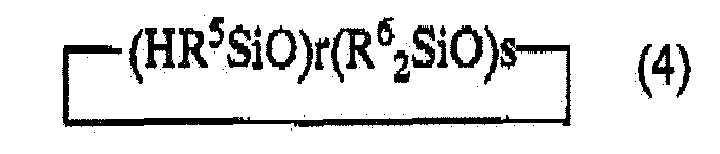
- Examples of the cyclopolysiloxane (b1) include 1,3,5,7-tetramethylcyclotetrasiloxane, 1,3,5,7,9-pentamethylcyclopentasiloxane, 1,3,5,7,9,11-hexamethylcyclohexasiloxane, and a mixture thereof, among which 1,3,5,7-tetramethylcyclotetrasiloxane is preferred because of easy production and good availability.
- An example of the cyclopolysiloxane (b2) is represented by the following formula (5):

- In the formula, R8 and R9 which may be the same with or different from each other and are selected from the groups listed for R4, among which a methyl group is preferred. R7 is an alkenyl group having 2 to 10 carbon atoms, t is an integer of from 2 to 10, preferably from 2 to 8, and u is an integer of from 0 to 7, preferably from 0 to 2, with t+u ranging from 3 to 10, preferably from 3 to 6. In the formula, each siloxane unit may be bonded randomly.
- Examples of R7 include alkenyl groups such as vinyl, allyl, propenyl, butenyl, pentenyl, and hexenyl groups, among which a vinyl group is preferred.
- Examples of the cyclopolysiloxane (b2) include 1,3,5,7-tetravinyl-1,3,5,7-tetramethylcyclotetrasiloxane, 1,3,5,7,9-pantavinyl-1,3,5,7,9-pentamethylcyclopentaslloxane, 1,3,5,7,9,11-hexavinyl-1,3,5,7,9,11-hexamehtylcyolohexasiloxane and a mixture thereof, among which 1,3,5,7- tetravinyl-1,3,5,7-tetramethylcyclotetrasiloxane is preferred because of easy production and good availability.
- The component (B) can be prepared by subjecting aforesaid (b1) and (b2) to an addition reaction in such an amount that a molar amount of the SiH bonds of (b1 exceeds that of the alkenyl groups of (b2) in the presence of a hydrosilylation catalyst such as the after-mentioned component (D). Preferably, an amount of the SiH bonds of (b1) is in the range of from 2.0 to 10.0 moles, preferably from 4.0 to 8.0 per mole of the alkenyl groups in (b2).
- Conditions of the addition reaction can be those conventionally employed. The hydrosilylation catalyst can be selected from those listed for the after-mentioned component (D). Preferably, platinum metal deposited on carbon is used for the reason that an addition reaction proceeds moderately, preventing gel formation due to a local vigorous reaction. Further, the platinum metal deposited on carbon can be removed from a reaction mixture easily by filtration, for instance, after the reaction completes. The reaction product thus obtained is storage stable without showing increase in viscosity because of no residual catalyst.
- The component (C) is a cyclopolysiloxane having two SiH bonds per molecule represented by the following formula (3).

- In the formula (3); R3 is a substitute or unsubstituted alkyl group which may be the same with or different from each other, if g is 2 or larger; and g is an integer of from 1 to 8, preferably from 1 to 4. Examples of R3 include alkyl groups such as methyl ethyl, propyl, ispropyl, butyl, tert-butyl, pentyl, isopentyl, hexyl and sec-hexyl groups; cycloalkyl groups such as cyclopentyl and cyclohexyl groups; and halogenated alkyl and cyanoalkyl groups such as chloromethyl, 3-chloropropyl,3, 3, 3-trifluoropropyl, and 2-cyanoethyl groups, among which propyl group is preferred.
- Preferred component (C) is as shown below.

- Contents of the aforesaid (A) to (C) components are such that a molar ratio of a total of the SiH bonds of the components (B) and (C) to the unsaturated groups, i.e., a total of vinyl and norbornenyl groups of the component (A) ranges from 0.1 to 10, preferably from 0.5 to 3. A composition with content of SiH bonds below aforesaid lower limit may not be cured sufficiently, and a composition with content of SiH bonds above the aforesaid upper limit may form a cured product which is not so hard and tends to degrade with time. The aforesaid molar ratio corresponds to a total 1 to 200 parts by weight, preferably from 5 to 100 parts by weight, of the components (B) and (C) per 100 parts by weight of the component (A), though these values vary depending on molecular weight of the components.
- By varying a weight ratio of the component (B) to the component (C) in the aforesaid range, a cured product having a desired hardness can be obtained. Generally, a larger ratio gives a harder product and a smaller ratio gives a softer rubbery product.
- Examples of the addition catalyst (D) include group VII metals in the periodic table and compounds thereof. Preferably, platinum and compounds thereof are used, for example, chloroplatinic acid, reaction products of platinum with alcohols, complexes of platinum with olefin such as ethylene and vinylsiloxane, platinum metal deposited on silica, alumina, or carbon, and a mixture thereof. Platinum group metal catalysts other than platinum are also known, for example, rhodium, ruthenium, iridium, and palladium compounds such as RhCl(PPh3)3, RhCl(CO)(PPh3)2, Ru3(CO)12, IrCl(CO)(PPh3)2, and Pd(PPh3)4. The component (D) is contained in the composition in a catalytic amount, which typically ranges from 0.001 to 10 parts by weight, more typically from 0.01 to 5 parts by weight, per total 100 parts by weight of the components (A), (B) and (C). If the component (D) is contained less than the catalytic amount, sufficient curing may not be attained. Too much amount of component (D) makes curing speed too fast to control.
- In addition to the aforesaid components (A) to (D), the present composition can contain a filler to improve mechanical strength of a cured product. Examples of the filler include fumed silica, precipitated silica, pulverised silica, calcium carbonate, diatomaceous earth, spherical plastic filler, silicone powder, carbon black, various kinds of metals and metal oxides. The filler may be surface treated.
- The present composition can further contain various kinds of additives in an amount not to adversely affect properties of the composition. For example, an antioxidant can be incorporated such as 2,6-di-t-butyl-4-mothylphenol, 2,5-di-t-amylhydroquinone, 2,5-di-t-butylhydroquinone, 4,4'- butylidenebis(3-methyl-6-t-butylphenol), 2,2'-methylenebis(4-methyl-6-t-butylphenol), or 2,2'-mothylenebis(4-ethyl-6-t-butylphenol). A mixture of two or more of the antioxidants can be used. An amount of the antioxidant typically ranges from 10 to 10,000 ppm, particularly from 100 to 1,000 ppm, based on a total weight of the components (A) and (B). The antioxidant in the aforesaid amount can prevent discoloration, clouding, and oxidation degradation, allowing the composition to be used for optical applications.
- A light stabilizer can be incorporated in the composition to provide the composition with resistance to degradation by light such as sunlight and light from a fluorescent bulb. Preferred light stabilizers are hindered amine compounds. By using the light stabilizer together with the aforesaid antioxidant, effect of antioxidant can be increased in a synergistic manner. Examples of the hindered amine compounds are bis(2,2,6,6-tetramethyl-4-piperidyl)sebacate, 4-benzoyl-2,2,6,6-tetramethylpiperidine, and a mixture thereof.
- The composition can further contain an addition reaction retarder to secure a pot life. Examples of the retarder include acetylanic alcohols such as 1-ethynyl-1-hydroxycyclohexane, 3-methl-1-butyne-3-ol, 3,5-dimethyl-l-hexyene-3-ol, 3-methl-1-pantene-3-ol, and phenylbutenol; 3-methyl-3-pentene-1-yne, 3,5-dimehtyl-3-hexene-1-yne, polymethylvinylsiloxane cyclic compound, and organic phosphorus compounds. The retarder suppresses curing reaction to improve storage stability of the composition.
- The present composition can be prepared by mixing at room temperature the aforesaid components (A), (B), (C) and (D), and optional components, if desired. Any known mixing means can be employed. A molded article of the present composition can be prepared as follows: mixing the components (A), (B) and (C) with a mixing means such as a Shinagawa mixer, adding the component (D) just before molding, and casting the composition in a mold followed by heating in an oven, or molding with a press molding machine which can be heated.
- The present invention will be further explained with reference to the following examples, but not limited thereto. In Examples, viscosities were those measured at 25°C.
- in a 2000 ml four-necked flask fitted with a stirrer, a condensor and a thermometer, 382g(2.89 moles)of dicyclopentadiene and 1000g of methylvinyltetrasiloxane having a vinyl value of 1.16 moles/100g were placed and subjected to a reaction at a temperature of from 150°C to 160°C for 6 hours under nitrogen gas flow. By vaccuum distilling volatile substances off, 1288g of transparent light yellow liquid, herein after referred to as "polysiloxane A", having a viscosity of 50 mPa·s and a refractive index of 1.480 was obtained.
- In a 500 ml four-necked flask fitted with a stirrer, a condensor, a dropping funnel and a thermometer, 150 g of toluene and 144g (0.6 mole) of 1,3,5,7-tetramethylcyclotetrasiloxane were placed and heated at 80°C in an oil bath. To the flask, 0.05 g of carbon powder with 5 wt% of platinum metal deposed thereon was added. Subsequently, 34.4 g (0.1 mole) of 1,3,5,7-tetravinyl-1,3,5,7-tetramethyloyclotetrasiloxane was added dropwise in 60 minutes while mixing. After the addition completed, the reaction mixture was heated at 95°C for 5 hours while stirring and then cooled to room temperature. The carbon powder with platinum metal deposed thereon was filtered out. By vaccuum distilling toluene and volatile substances off, 115 g of transparent colorless oily reaction product, hereinafter referred to as "polysiloxane B", having a viscosity of 770 mPa·s and a SiH content of 0.83 mole/100g was obtained. No vinyl group was detected in the polysiloxane B.
- A composition was prepared by mixing 100 parts by weight of the polysiloxane A, 70 parts by weight of the polysiloxane B, and 68 parts by weight of a cyclic polysiloxane represented by the following formula as component (C), herein after referred to as "polysiloxane C", and a platinum-diviyltetramethyldisiloxane complex as component (D) in an amount of 20 ppm, as platinum metal, based a total weight of the components (A), (B) and (C). In the composition, a molar ratio of a total SiH bonds in the polysiloxane B and the polysiloxane C to a total of vinyl and norbornenyl groups of the polysiloxane A was 1.19.

- Compositions comprising each component in an amount (parts by weight) as shown in Table 1 were prepared in the same manner as in Example 1.
- A composition was poured in a 9 mm-deep aluminum petri dish, and kept in an oven at 120°C for 30 minutes and then at 150°C for 60 minutes to prepare a cured product.
- The cured product thus obtained was evaluated by the following methods. Results are as shown in Table 1.
- After cooling a cured product to room temperature, its hardness was measured with a Shore D scale hardness tester.
- A test piece having a size of about 3 cm2 was cut from a cured product. The test piece was immersed in 30 ml of toluene placed in a 50 ml glass container for 30 minutes. The test piece was weighed immediately after taken out from toluene and a weight increase in % was calculated as a degree of swelling.
- A test piece having a size of about 3 cm2 was cut from a cured product. The test piece was kept in an oven at 180 °C for 72 hours and weighed to calculate a change (%) in weight.
Table 1 Example 1 Example 2 Example 3 Example 4 Example 5 Polysiloxane A 100 100 100 100 100 Polysiloxane B 70 20 100 140 42 Polysiloxane C 68 134 27 136 49 SiH/unsaturated bond 1.19 1.2 1.2 2.4 0.7 Pt (ppm) 20 20 20 20 20 Hardness (Shore D) 56 25 85 28 33 Swelling (toluene) +4.0% +5.0% +1.3% +6.5% +7.1% Weight change,% (180°C, 72 hrs) -0.08 -0.15 -0.23 -0.10 +0.20 - Electronic properties as shown in Table 2 were measured according to the Japanese Industrial Standard K 6249 on a cured product of the composition of Example 1.
Table 2 Volume resistivity 1.7×10¹⁷ Ω·cm Dielectric constant (50Hz) 2.50 Dielectric constant dissipation factor (50Hz) 0 0045 Dielectric breakdown strength 25 kv/mm - A test piece having a thickness of 2 mm was prepared from the composition of Example 1. A light transmission at 300 nm of the test piece was measured to be 79.5% with a spectrophotometer model U-3310, ex Hitachi Co.
- A composition was prepared in the same manner as in Example 1 except that 72 parts by weight of methylvinyltetrasiloxane was used in place of the polysiloxane A. The composition thus obtained was cured in the manner as described above, but cracks occurred throughout a product during cooled to room temperature.
- A composition was prepared in the same manner as in Example 1 except that 104 parts by weight of linear polysiloxane of the formula Me3Si(OSiMeH)4OSiMe3 was used in place of the polysiloxane B. A cured product was prepared in the manner as described above, but it was soft and rubbery having a Shore D scale hardness of 3 and a degree of swelling of 35 %.
- The present composition forms a cured product which has excellent hardness and solvent resistance and is suitable as a binder of molded automotive parts. The cured product also has excellent electronic properties, so that it can be used for semiconductor or electric parts. Further, because of good optical transparency, optical applications are expected such as making optical lenses and encapsulating optical devices such as LED.
a catalytic amount of (D)an addition reaction catalyst,
amounts of the components (A),(B) and (C) being such that a molar ratio of a total of the SiH bonds of the components (B) and (C) to the unsaturated bond of the component (A) ranges from 0.1 to 10.
Claims (6)
- A composition comprising(A) a cyclopolysiloxane represented by the following formula (1) having a norbornenyl group, a vinyl group or a norbornenyl group and a vinyl group each bonded to a silicon atom,
 (B) a polycyolopolysiloxane comprising a cyclopolysiloxane unit represented by the following formula (2)
 (C) a cyclopolysiloxane represented by the following formula (3) having two SiH bondswherein R3 may be the same with different from each other and is a substituted or unsubstituted alkyl group having 1 to 12 carbon atoms, and g is an integer of from 1 to 8, and
a catalytic amount of (D) an addition reaction catalyst,
amounts of the components (A),(B) and (C) being such that a molar ratio of a total of the SiH bonds of the components (B) and (C) to the unsaturated bond of the component (A) ranges from 0.1 to 10. - The composition according to claim 1, wherein a molar ratio of the total of the SiH bonds of the components (B) and (C) to the unsaturated bond of the component (A) ranges from 0.5 to 3.
- The composition according to claim 1 or 2, wherein the component (A) is represented by the following formula.
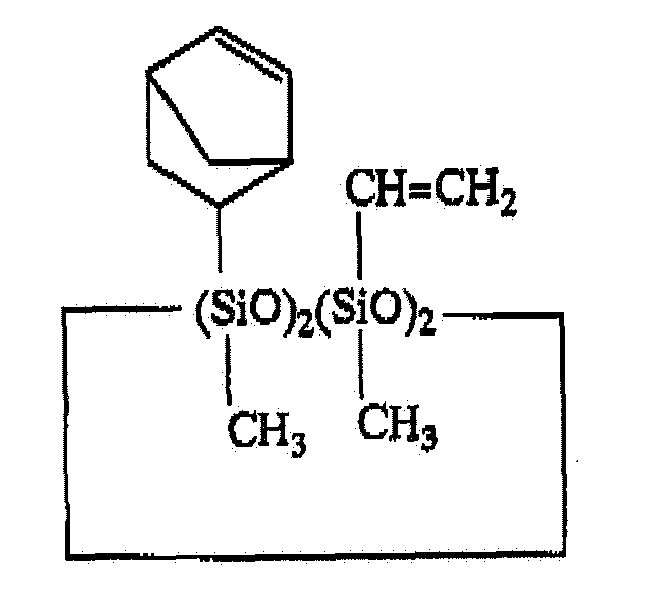
- The composition according to any one of claims 1, to 3, wherein the polycyclopolysiloxane (B) has the following repeating units.

- The composition according to any one of claims 1 to 4, wherein the component (C) is represented by the following formula.

- A binder comprising the composition according to any one of claims 1 to 5.
Applications Claiming Priority (1)
| Application Number | Priority Date | Filing Date | Title |
|---|---|---|---|
| JP2006083671A JP4900782B2 (en) | 2006-03-24 | 2006-03-24 | Curable silicone composition |
Publications (2)
| Publication Number | Publication Date |
|---|---|
| EP1837375A2 true EP1837375A2 (en) | 2007-09-26 |
| EP1837375A3 EP1837375A3 (en) | 2008-05-14 |
Family
ID=38164546
Family Applications (1)
| Application Number | Title | Priority Date | Filing Date |
|---|---|---|---|
| EP07104798A Withdrawn EP1837375A3 (en) | 2006-03-24 | 2007-03-23 | Curable silicone composition |
Country Status (3)
| Country | Link |
|---|---|
| US (1) | US20070225433A1 (en) |
| EP (1) | EP1837375A3 (en) |
| JP (1) | JP4900782B2 (en) |
Families Citing this family (2)
| Publication number | Priority date | Publication date | Assignee | Title |
|---|---|---|---|---|
| JP5801028B2 (en) * | 2009-10-21 | 2015-10-28 | 株式会社Adeka | Silicon-containing curable composition and cured product thereof |
| US9963469B2 (en) | 2013-03-14 | 2018-05-08 | Momentive Performance Materials Inc. | High refractive index siloxanes |
Family Cites Families (12)
| Publication number | Priority date | Publication date | Assignee | Title |
|---|---|---|---|---|
| US3296291A (en) * | 1962-07-02 | 1967-01-03 | Gen Electric | Reaction of silanes with unsaturated olefinic compounds |
| JPH0655895B2 (en) * | 1989-03-16 | 1994-07-27 | 信越化学工業株式会社 | Curable silicone rubber composition |
| US5196498A (en) * | 1991-09-24 | 1993-03-23 | Hercules Incorporated | Organosilicon polymers |
| US5334688A (en) * | 1993-04-19 | 1994-08-02 | Hercules Incorporated | Fully substituted cyclopolysiloxanes and their use for making organosilicon polymers |
| ATE363518T1 (en) * | 2002-05-01 | 2007-06-15 | Dow Corning | COMPOSITIONS WITH EXTENDED PROCESSING TIME |
| JP5036125B2 (en) * | 2003-08-14 | 2012-09-26 | 信越化学工業株式会社 | Curable silicone resin composition |
| DE102004039111A1 (en) * | 2003-08-14 | 2005-04-14 | Shin-Etsu Chemical Co., Ltd. | Curable silicone resin composition |
| JP2005232200A (en) * | 2004-02-17 | 2005-09-02 | Shin Etsu Chem Co Ltd | Silicone composition for release film |
| JP4219843B2 (en) * | 2004-04-08 | 2009-02-04 | 信越化学工業株式会社 | Curable siloxane-based composition |
| US7135535B2 (en) * | 2004-07-29 | 2006-11-14 | National Starch And Chemical Investment Holding Corporation | Siloxane resins with oxetane functionality |
| JP4530145B2 (en) * | 2004-08-18 | 2010-08-25 | 信越化学工業株式会社 | Method for producing norbornenyl group-containing siloxane compound |
| JP2007045782A (en) * | 2005-08-11 | 2007-02-22 | Shin Etsu Chem Co Ltd | Process for producing polycycloolefin functional polysiloxane |
-
2006
- 2006-03-24 JP JP2006083671A patent/JP4900782B2/en not_active Expired - Lifetime
-
2007
- 2007-03-22 US US11/723,897 patent/US20070225433A1/en not_active Abandoned
- 2007-03-23 EP EP07104798A patent/EP1837375A3/en not_active Withdrawn
Also Published As
| Publication number | Publication date |
|---|---|
| JP2007254675A (en) | 2007-10-04 |
| US20070225433A1 (en) | 2007-09-27 |
| JP4900782B2 (en) | 2012-03-21 |
| EP1837375A3 (en) | 2008-05-14 |
Similar Documents
| Publication | Publication Date | Title |
|---|---|---|
| EP1945716B1 (en) | Curable silicone composition | |
| EP1990367B1 (en) | Curable organosilicon composition and cured product thereof | |
| JP3765444B2 (en) | Silicone gel composition and silicone gel for sealing and filling electric and electronic parts | |
| EP2289979A1 (en) | Organopolysilmethylene and a composition comprising the same | |
| KR20120099282A (en) | Organosilicon compound, method for producing thereof, and curable silicone composition containing the same | |
| US6841647B2 (en) | Fluid resistant silicone encapsulant | |
| JPH05163437A (en) | Room temperature curable silicone rubber composition and cured product thereof | |
| KR102561851B1 (en) | Organopolysiloxane, method for producing same, and curable silicone composition | |
| EP3318593A1 (en) | Heat dissipation material | |
| JP2009215434A (en) | Silicone resin composition and light-emitting semiconductor device | |
| JP6998905B2 (en) | Additive-curable silicone compositions, cured products and opto-semiconductor devices | |
| KR20210042022A (en) | Addition-curable silicone composition, cured product thereof, and semiconductor device | |
| JP5036125B2 (en) | Curable silicone resin composition | |
| CN113950513A (en) | Thermally Conductive Silicone Composition | |
| KR102710276B1 (en) | Addition-curable silicone composition, cured product, and optical semiconductor element | |
| US20070225433A1 (en) | Curable silicone composition | |
| KR102507620B1 (en) | Cross-linkable organosiloxane composition | |
| TW202309210A (en) | Low dielectric constant insulating coating composition, cured product of same and display device | |
| KR102471220B1 (en) | Cross-linkable organosiloxane composition | |
| KR102435198B1 (en) | Crosslinkable Organosiloxane Composition | |
| JP5889399B2 (en) | Silicone resin with improved barrier properties | |
| KR102404842B1 (en) | Curable organopolysiloxane composition and cured product thereof | |
| CN113260659A (en) | Curable silicone composition and cured product thereof | |
| EP0455137A2 (en) | Charge-dissipating silicone rubber compositions | |
| TW202608992A (en) | Addition-curing silicone compositions, their cured forms, and optical semiconductor devices |
Legal Events
| Date | Code | Title | Description |
|---|---|---|---|
| PUAI | Public reference made under article 153(3) epc to a published international application that has entered the european phase |
Free format text: ORIGINAL CODE: 0009012 |
|
| AK | Designated contracting states |
Kind code of ref document: A2 Designated state(s): AT BE BG CH CY CZ DE DK EE ES FI FR GB GR HU IE IS IT LI LT LU LV MC MT NL PL PT RO SE SI SK TR |
|
| AX | Request for extension of the european patent |
Extension state: AL BA HR MK YU |
|
| PUAL | Search report despatched |
Free format text: ORIGINAL CODE: 0009013 |
|
| AK | Designated contracting states |
Kind code of ref document: A3 Designated state(s): AT BE BG CH CY CZ DE DK EE ES FI FR GB GR HU IE IS IT LI LT LU LV MC MT NL PL PT RO SE SI SK TR |
|
| AX | Request for extension of the european patent |
Extension state: AL BA HR MK RS |
|
| RIC1 | Information provided on ipc code assigned before grant |
Ipc: C08G 77/50 20060101ALI20080407BHEP Ipc: C08L 83/04 20060101AFI20070628BHEP |
|
| STAA | Information on the status of an ep patent application or granted ep patent |
Free format text: STATUS: THE APPLICATION HAS BEEN WITHDRAWN |
|
| 17P | Request for examination filed |
Effective date: 20081105 |
|
| 18W | Application withdrawn |
Effective date: 20081202 |